They Will Get Burned

In Europe, the corporate elite
Have started, their worries, to bleat
They’re now quite concerned
That they will get burned
If dollar sales start to retreat
 
For years, when the dollar was rising
Weak unit sales, it was disguising
But now the buck’s falling
Which they find appalling
As earnings forecasts, they’re downsizing
 

Markets are very interesting constructs.  Not only do they help find a clearing price for supply and demand of something, but they also tend to take on anthropomorphic characteristics in many eyes as some type of creature beyond anyone’s control, but with a tinge of malevolence.  Part of that latter feeling comes from markets’ ability to make every pundit seem like a fool.  After all, it was just 3 days ago when I was reliably informed by the punditry that equity values were set to collapse as the US economy entered a depression.  It seems we may have to wait a few more days for that situation to play out.  And, in fact, they have now changed their tune.  While ascribing the rebound to President Trump’s reversal on some issues, the overall doom and gloom story has moved to the background.  But if there is one thing I have continuously discussed since Trump’s election is that volatility was very likely to increase, and that has certainly been the case. 

Shifting our focus to the FX markets, though, I couldn’t help but chuckle at a Bloomberg article this morning titled, The Dollar’s Slide is Raising Red Flags for Corporate Earnings.  As I am based in the US, the fact that this was a front-page article had me somewhat confused.  A long career in speaking with corporate accounts on FX made it clear that a weak dollar was the best thing for earnings of US multinationals.  Generally, when the dollar was strong, CFOs would ascribe any earnings problems to that issue as a catch-all excuse, but when the dollar declined, outperformance by a company was the result of brilliant execution.

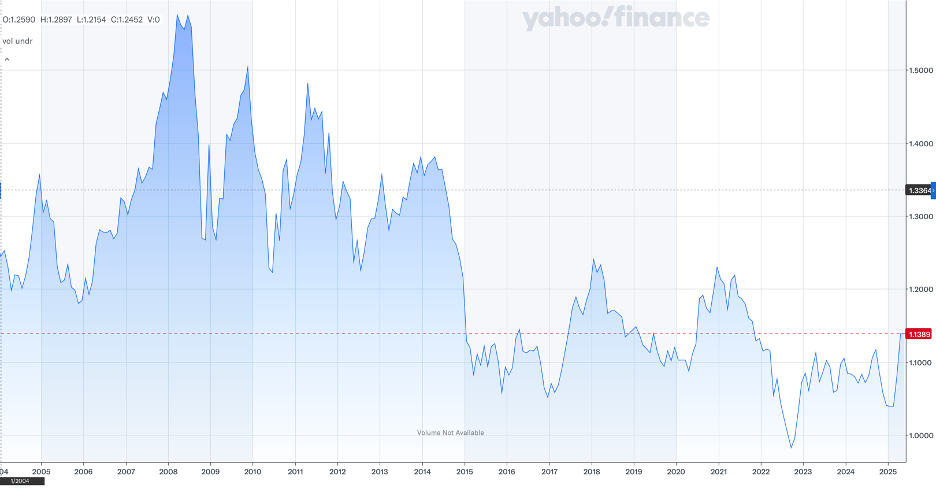
So, you can understand my initial confusion.  But upon reading the article, it turns out they were talking about European corporates, who for the first time in three years find that hedging their US dollar sales is critical.  Not only that, but they have also been quick to highlight that all new hedges will be at worse rates and therefore future earnings are already sure to be impacted.  Now, a quick look at the chart below does show that the euro has risen to its highest level in three years.  But it also shows that compared to the past 20 years, the euro is nowhere near high levels. In fact, it sits well below the median price (somewhere in the 40th percentile actually).  Perhaps European corporate Treasurers have simply forgotten their history.  Or more likely, just like US corporate Treasurers when the dollar is rising, they are seeking a scapegoat.
I cannot emphasize enough that the FX rate is not the driver, but the release valve for all the things that happen in the global economy.  Other actions take place, whether interest rate changes, policy or market, economic adjustments, policy or market, or exogenous events, and the FX rate is the place where equilibria are found.  In fact, arguably, that is the biggest flaw in the Trump administration’s idea that if they weaken the dollar, it will solve policy problems.  The dollar is the tail to the economy’s dog.

In the meantime, the reason one runs a hedge program with consistency is to mitigate the big moves in FX and their impacts on earnings.  But remember, even the best hedge programs lag large secular moves.

Ok, I’ll step down off my high horse and let’s look at how markets behaved overnight.  After yesterday’s second consecutive rally in the US, the picture elsewhere in the world is more mixed.  In Asia, the Nikkei (+0.5%) continued its rebound but the Hang Seng (-0.75%) and CSI 300 (-0.1%) saw no benefit overnight.  Elsewhere in the region winners and losers were pretty evenly split and nobody saw a movement of more than 0.8% in either direction.  In Europe, red is today’s color, but it’s a pale red with losses across the board of the 0.1% to 0.25% variety.  The only news overnight was German Ifo data, which showed a bit of a surprising uptick in the current business climate as well as expectations.  Perhaps the promise of more German fiscal largesse is outweighing concerns over tariffs.  As to US futures, they, too, are lower by about -0.15% at this hour (7:20).

In the bond market, yields are sliding around the world with Treasuries (-3bps) continuing to back away from their recent highs while European sovereigns see yields decline between -3bps and -4bps.  Even JGB yields slipped -1bp overnight.  My take is some of the fear has ebbed away from the market.

In the commodity markets, oil (+1.1%) remains in its recent trading range, with a still very large gap above the market in price terms.  The demand story seems fixed at weakening demand because of either slowing growth, or the electrification of everything or something like that, while the supply story is starting to see hints that oil companies are going to back off production with prices at current levels.  The latter feels like the larger short-term risk, although nothing has changed my longer-term view of lower prices here.  In the metals markets, gold (+0.7%) is rebounding after a difficult two days, arguably some real profit taking was seen.  Meanwhile silver (-0.5%) which actually outperformed gold for the past two sessions is giving some of those gains back and copper (+0.8%) is continuing its rebound after a dramatic decline from the all-time highs seen just one month ago.  Talk about a V-shaped recovery!

Source: tradingeconomics.com

Finally, the dollar is softer this morning, giving back about half of yesterday’s 1% gains.  In the G10, SEK and NOK (both +1.1%) are leading the way although the euro (+0.6%) is having a good day, as is the yen (+0.75%). The pound (+0.5%) is a bit of a laggard but after seeing this interview of Ed Miliband (UK Secretary of Energy and Climate Change), and his either inability to understand the implications of his policy, or his willingness to lie about it, I cannot believe the pound will continue to track the euro.  The UK’s energy policy appears designed to destroy the UK economy.  Consider that solar power is a key pillar of their future efforts to achieve net zero carbon emissions, and the UK is the nation that gets the least solar coverage in the world.  After all, it rains there half the time.  Meanwhile, the government is keen to end all other sources of energy.  No matter what you think of President Trump’s policies, they are not nationally suicidal like the UK’s.

Turning to the EMG bloc, gains are the norm, but not universal.  The CE4 are doing well but ZAR (-0.2%) and KRW (-0.6%) with the latter suffering from weaker than expected GDP growth in Q1 while the former, after a strong run since early in April, appears to merely be taking a breather.

We finally see some notable data this morning with Initial (exp 222K) and Continuing (1880K) Claims, Durable Goods (2.0%, 0.3% ex-Transport) and the Chicago Fed National Activity Index (0.11) all at 8:30, then at 10:00 we get Existing Home Sales (4.13M).  Yesterday saw New Home Sales pick up more than expected and the Beige Book indicate that economic activity was unchanged from the past, but uncertainty had risen.

Here’s what we know; the world is not ending but it is continuing to change from the structures created in the post WWII period.  This process is just beginning and anybody who claims to know where things are headed is lying.  I continue to believe in my bigger picture views, but day to day, there is no rhyme or reason, especially given the importance of headline bingo.

Good luck

Adf

Downward, Crawling

The trends in the market of late
Continue, and there’s no debate
The dollar keeps falling
With stocks, downward, crawling
While gold never has looked so great
 
The latest concerns are that Trump
Chair Powell, is looking to dump
The narrative shows
That if Powell goes
That Treasuries clearly will slump


Europe remains closed today for its Easter Monday holiday, as was Hong Kong last night, but the rest of Asia and the US are open.  With that in mind, though, I’m guessing there are many who would prefer markets to remain closed given the price action.  At least those who remain invested in the US as equity futures are pointing lower, yet again, this morning, with all three major indices down by about -1.0% at this hour (6:00).  But really, the market story that is atop the headlines today is the dollar and its continued weakening.  Since President Trump’s inauguration, so basically in the past three months, the euro (+1.3% today) has climbed about 11% as you can see in the chart below.

Source: tradingeconomics.com

While that is not an unprecedented move, it is certainly swift in the world of foreign exchange.  Of course, it is important to remember that the current level, and higher levels, were extant for more than a year (July 2020 – November 2021) not all that long ago.  My point is perspective is key, and while the dollar has been declining sharply of late, this is not unexplored territory.  In fact, stepping back a bit, as I’ve shown before, the euro remains in the lowest quartile of its value over the past twenty years.

Source: finance.yahoo.com

One of the interesting ways in which the narrative has changed has been that prior to the imposition of tariffs by President Trump, when they were only threatened, the economic intelligentsia were convinced that the only outcome would be other currencies declining in value sufficiently to offset the tariff, thus a stronger dollar with the end result that US exports would no longer be competitive.  Now those same analysts are explaining that the weaker dollar is a problem because imports will be more expensive, thus raising the inflation rate.  

However, the lesson I have learned throughout my career is that movement in the dollar, while important on a very micro level for businesses and foreign earnings calculations, is rarely a driver of any macroeconomic trend.  In fact, it is a response.  Other things happen and the dollar adjusts based on the flows that occur. While theoretically, at the margin, a weaker dollar will tend to result in higher import prices, and ceteris paribus, that would feed through to the inflation rate, no ceteris is paribus these days.  For one thing, oil prices are lower by nearly 18% since the inauguration and oil prices have a far larger impact on inflation than does the value of the dollar.  My point is that neither the dollar’s level nor the fact that it is declining is a sign of the end of times.

Source: tradingeconomics.com

Of more concern to many is the Treasury bond market as that is a true Achilles heel for the US.  Given the massive amount of debt outstanding, and the fact that there is so much to roll over this year, and the fact that the budget is still running a massive deficit, the need to refinance is the biggest issue facing the US economy in my view.  Of course, the US will be able to refinance, the question is the price.  

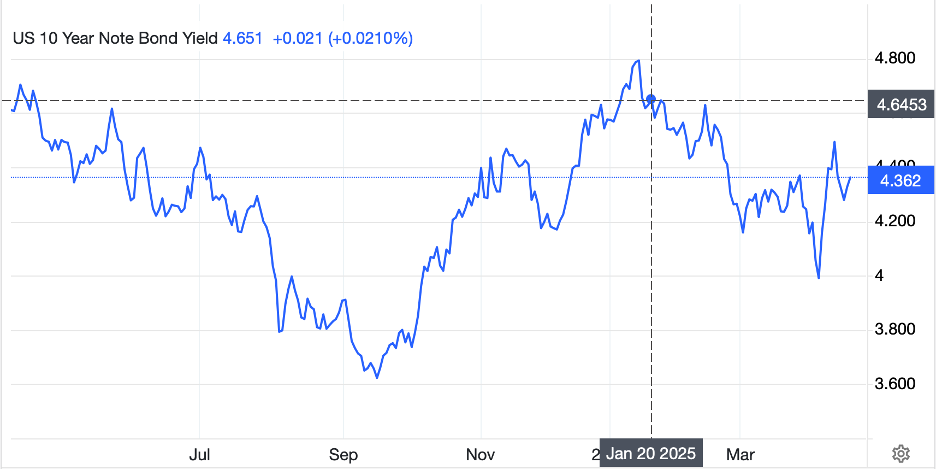
Since we’ve been measuring things from Trump’s inauguration, a look at 10-year Treasury yields shows they have declined a modest 28bps as of this morning’s pricing.  There has also been some volatility, but again, hardly unprecedented volatility.

Source: tradingeconomics.com

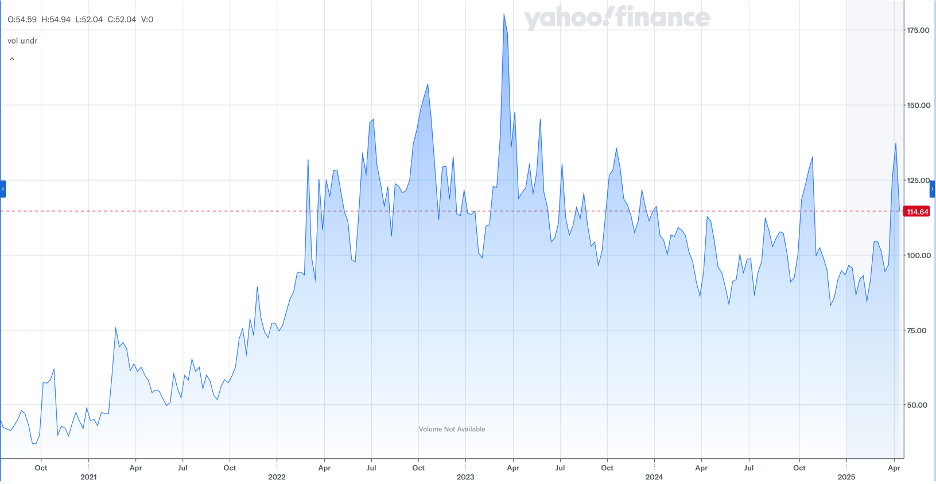
For instance, a widely followed measure of bond market volatility is the MOVE Index, currently produced by BofA.  At Friday’s close, it sat at 114.64.  A quick look at this chart shows the index, and by extension bond market volatility, is in the upper one-third of its range since inflation kicked off in 2022.  Again, it has spent a lot of time at higher levels and a lot of time at lower levels.

Source: finance.yahoo.com

There are numerous stories being written these days about reduced liquidity in the bond market, and there are many stories being written about how the Chinese, or the Japanese, or Europeans are selling Treasury bonds as a signal that all is not well.  First, we know all is not well, so that should not be a surprise.  Second, there has been no indication that Treasury auctions are failing, in fact the opposite, with the most recent 10-year and 30-year auctions showing substantial foreign demand.  

The funny thing about the bond market is to many it is a Rorschach test as people see what they want to see. To some, it is entirely about inflation and inflation expectations, so rising yields portend inflation on the horizon.  To others, it is a recession/growth indicator, which for most people is a coincident indicator, higher growth leads to higher inflation in that view.  But these days, much ink is spilled discussing how it is now and indicator of confidence in the US, especially with the growing antagonism between President Trump and Chairman Powell.  The same folks who lambasted Powell for keeping rates too high, now seem to be cheering him on to keep rates “too” high as a sign of his independence.

There is no doubt that despite the fact that the Fed’s press has diminished, and the market’s focus on the Fed has waned, their actions remain important to the US economy.  But is Jay Powell the last bastion of confidence in the US?  That, too, seems a stretch.

Trying to summarize, things in the US are quite messy right now.  For many investors, and hedgers, the previous status quo was so comfortable, and actions were easy to take.  However, Donald Trump’s election back in November was a very clear signal that things were going to change.  And they are changing.  In situations like this, investors tend to bring their money as close to home as possible.  This process has only just begun.  Since March, I have maintained that I see the dollar lower, and for a long time that the equity market was overvalued.  While the recent speed of movement is unlikely to be maintained, I expect the direction is pretty clear.

Ok, a really quick tour of markets overnight.  In Tokyo (-1.3%) equity markets slumped further as the yen strengthened and the status of the trade talks with the US remains unclear.  Chinese shares (+0.3%) edged higher and the rest of Asia that was open was mixed.  With all of Europe closed today, all eyes will be on the States where things are pointing to a lower opening.

Treasury yields have risen 4bps this morning and European sovereign markets are all closed.  Last night, JGB yields edged higher by 1bp, but the narrative of Japanese interest rates rising closer to other national levels has not had much press lately.

The commodity markets have been where all the action is, with oil (-2.5%) lower this morning as I have seen comments that the US-Iran talks are making progress.  As well, it appears that the Russia / Ukraine peace talks are reaching a denouement.  Successful conclusions in either, or both, of these discussions would very likely point to a lot more available crude on the market, and lower prices ahead.  I still think $50/bbl is in the cards.  But gold (+1.9%) is the story of the day here as the barbarous relic makes yet another new all-time high vs. the dollar dragging silver (+1.3%) and copper (+3.9%) along for the ride.  Not only are foreign central banks continuing to buy, as well as populations in China, India and elsewhere in Asia, but it appears that US retail is waking up to the fact that gold has been the best performing asset for the past year (+45%).  I continue to see the metals complex benefitting from the current macro environment.

Finally, we have already discussed the dollar which is lower this morning against virtually all its counterpart currencies in Europe and Asia.  As it happens, LATAM currencies are gaining the least and BRL (-0.1%) has even managed a slight decline on the opening.  But overall, this is a dollar selling day.

On the data front, today brings Leading Indicators (exp -0.5%) at 10:00 and that is all that is on the calendar.  It is a quiet week, and I will outline the rest tomorrow.

It should be a quiet market given Europe’s absence, and given how far the dollar has fallen leading into the open, I wouldn’t be surprised to see a modest bounce, but the trend, as I explained, remains clearly for a lower dollar going forward.

Good luck

Adf

Right On Humming

So, CPI didn’t decline
And may not be quite so benign
As Jay and the Fed
Consistently said
When hinting more rate cuts are fine
 
However, that will not deter
Chair Powell, next month, to confer
Another rate cut
Though it is somewhat
Unclear if his colleagues concur


Despite the fact the narrative is pushing Unemployment as the primary focus of the FOMC, yesterday’s CPI report, which seemingly refuses to decline to the Fed’s preferred levels, had Fed speakers beginning to hedge their bets regarding just how quickly rates would be coming down from here. [Emphasis added.]

St. Louis Fed President Alberto Musalem explained, “The strength of the economy is likely to provide the space for there to be a gradual easing of policy with little urgency to try and find where the neutral rate may be.

Dallas Fed President Lorrie Logan commented (using a series of maritime metaphors for some reason) “After a voyage through rough waters, we’re in sight of the shore: the FOMC’s Congressionally mandated goals of maximum employment and stable prices, but we haven’t tied up yet, and risks remain that could push us back out to sea or slam the economy into the dock too hard.”  

Finally, Kansas City Fed President Jeff Schmid told us, “While now is the time to begin dialing back the restrictiveness of monetary policy, it remains to be seen how much further interest rates will decline or where they might eventually settle.”  

If we ignore the oddity of the maritime metaphor, my takeaway is that the Fed is still looking to cut rates further as directed by Chairman Powell, but the speed with which they will act seems to be slowing down.  As I have maintained in the past, given the current data readings, it still doesn’t make that much sense to me that they are cutting rates at all, but arguably, that’s just another reason I am not a member of the FOMC.  Certainly, the market is on board as futures pricing increased the probability of that cut from 62% before the release to 82% this morning.  There is still a long way to go before the next meeting, with another NFP, PCE and CPI report each to be released, as well as updates on GDP and Retail Sales and all the monthly figures, so this story is subject to change.  But for now, a rate cut seems likely.

One other thing, I couldn’t help but notice a headline that may pour a little sand into the gears of the rate cutting apparatus at the Eccles Building.  This is on Bloomberg this morning: Manhattan Apartment Rents Rise to Highest Level Since July.  Again, the desperation to cut rates seems misplaced.

Despite the fact rate cuts are coming
The dollar just keeps right on humming
This morning it’s rising
Which ain’t that surprising
As more depths, the euro is plumbing

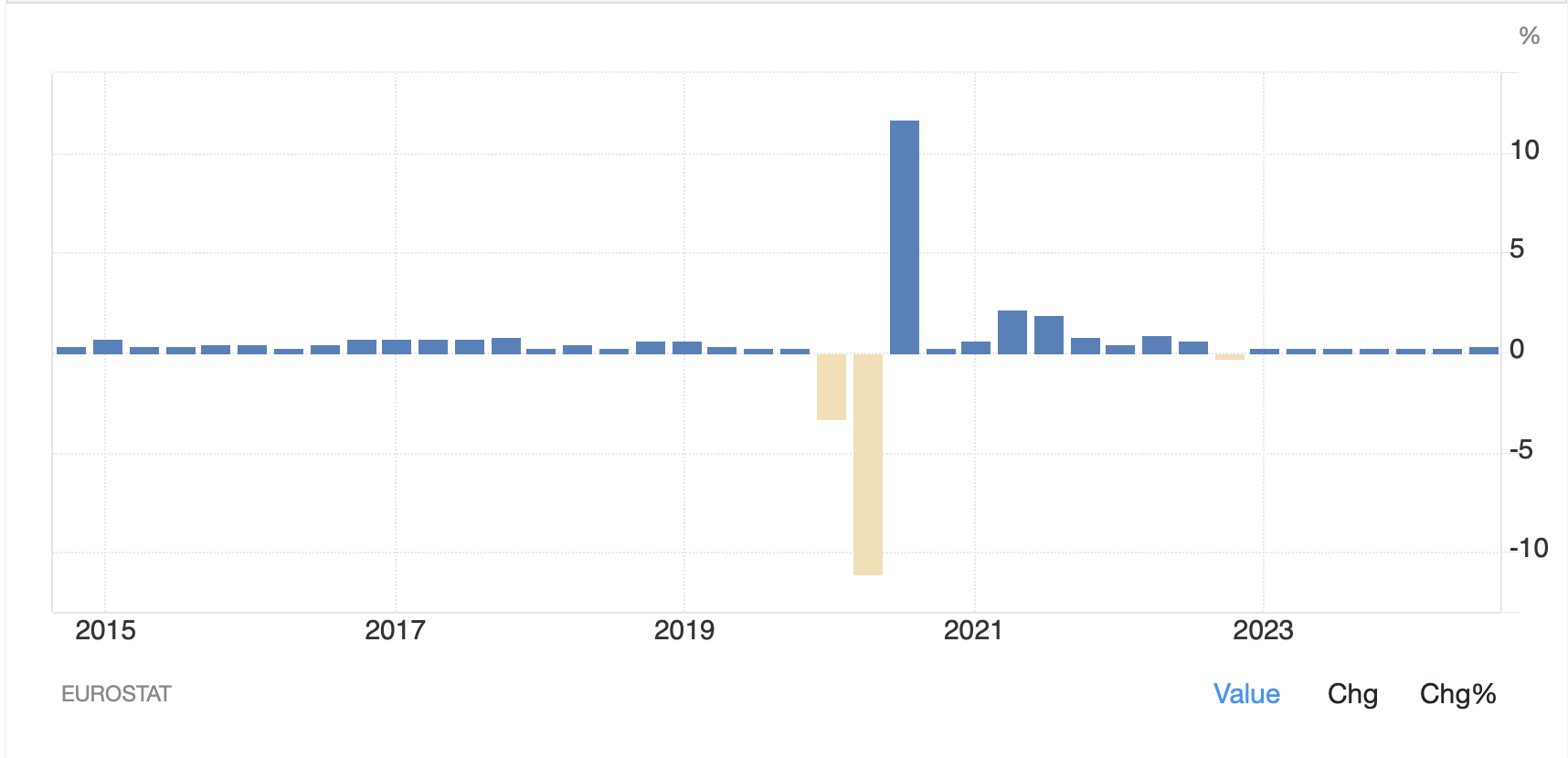
Turning our attention to the continent, European GDP figures were released this morning, and they remain disheartening, to say the least.  While the quarterly number rose to 0.4%, as you can see from the chart below, it has been several years since the continent showed any real growth, and that was really just the rebound from the Covid lockdowns.  Prior to Covid, growth was still lackluster.

Source: tradingeconomics.com

While these are the quarterly numbers, when looking at the Y/Y results, real GDP grew less than 1% in Q3 for the past 6 quarters and, in truth, shows little sign of improving.  After all, virtually every nation in the Eurozone is keen to continue their economic suicide via energy policy and regulation.  This thread on X (formerly Twitter)is a worthwhile read to get an understanding of the situation on the continent.  I show it because this morning, the euro has fallen yet further, and is touching the 1.05 level, seemingly on its way to parity and below.  It highlights that since just before the GFC, the Eurozone economy has fallen from virtually the same size as the US economy, to just 60% as large, and explains the key reasons.  Read it and you will be hard-pressed to consider the euro as a safe store of value, at least relative to the dollar.  And remember, the dollar has its own issues, but at least the US economy remains dynamic.

But the dollar is king, again, this morning, rising against virtually all its counterparts on the session.  Versus the G10, the average movement is on the order of 0.3% or so, but it is uniform.  USDJPY is now pushing 156.00, the pound seems headed for 1.2600 and Aussie is below 0.65.  My point is concerns about the dollar and its status in the world seem misplaced in the current environment.  If we look at the EMG bloc, the dollar is stronger nearly across the board as well, with similar gains as the G10.  MXN (-0.5%), ZAR (-0.4%) and CNY (-0.2%) describe the situation which has been a steady climb of the greenback since at least the Fed rate cut, and for many of these currencies, for the past 6 months.  Nothing about President-elect Trump’s expected policies seems likely to change this status for now.

If we look at equity markets, yesterday’s US outcomes were essentially little changed on the day.  However, when Asia opened, with the dollar soaring, we saw a lot more weakness than strength, notably in China with the CSI 300 (-1.7%) and Hang Seng (-2.0%) leading the way lower although the Nikkei (-0.5%) also lagged along with most other Asian markets.  While there were some modest gainers (Australia +0.4%, Singapore +0.5%) red was the predominant color on screens.  In Europe, however, investors are scooping up shares with the DAX (+1.2%) leading the way although all the major bourses are higher on the session.  It seems that there is a growing consensus that the ECB is going to cut 25bps in December and then another 25bps in January, which has some folks excited.  US futures, meanwhile, are slightly firmer at this hour (7:00).

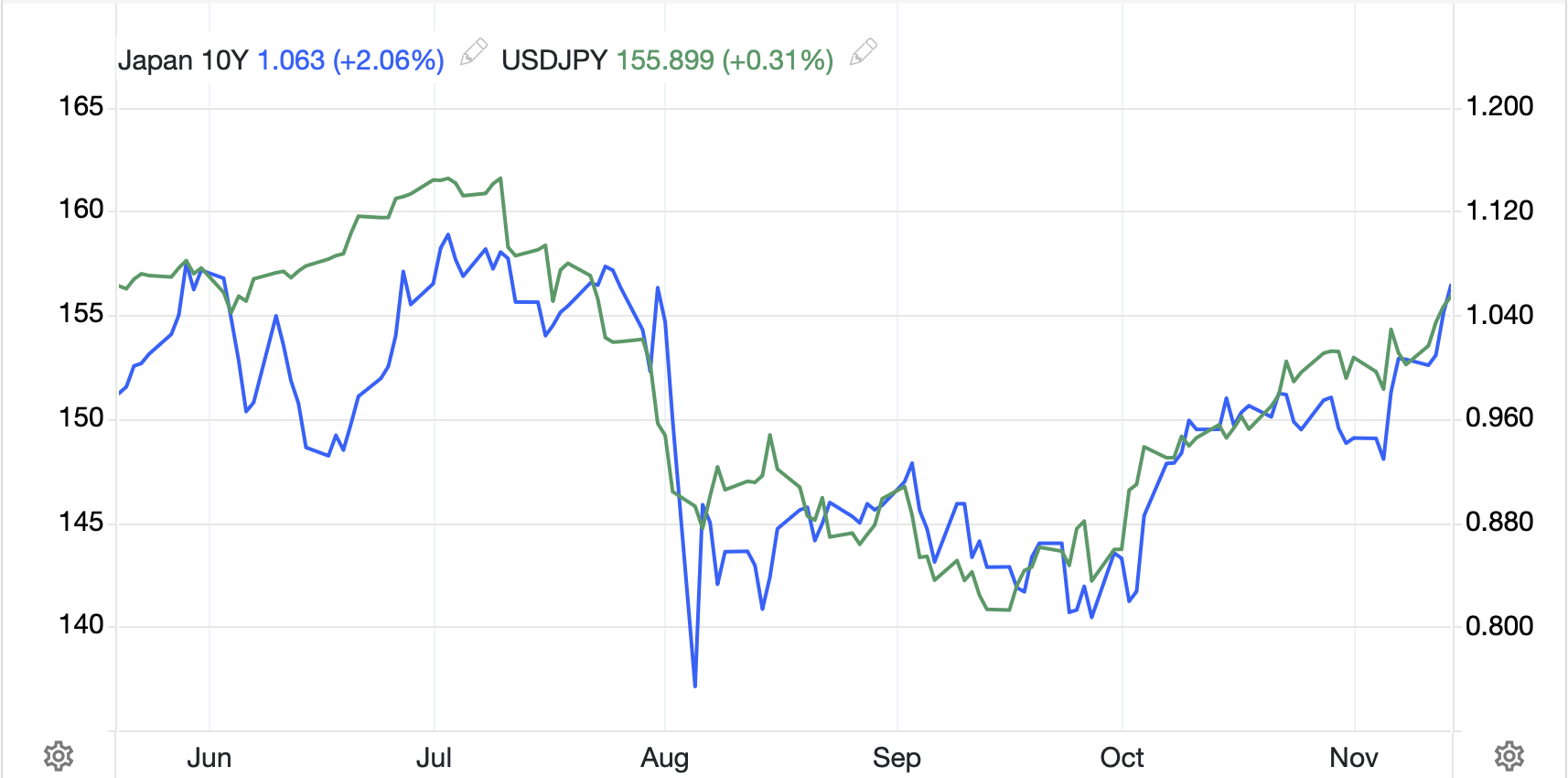
All this is happening against a backdrop of a continued climb in yields around the world.  Yesterday, again, yields rose with 10yr Treasuries trading as high as 4.48%, their highest level since May, and that helped drag most European yields higher as well.  This morning, we are seeing some consolidation with Treasury yields backing off 1bp and European sovereign yields lower by -2bps across the board.  The one place not following is Japan, where JGB yields edged higher by 1bp and now sit at 1.05%.    Consider, though, that despite those rising yields, the yen continues to slide.  In fact, that is the correlation that exists, weaker JPY alongside higher JGB yields as you can see in the below chart.

Source: tradingeconomics.com

While it is open to question which leads and which follows, my money is on Japanese investors searching for higher yields, selling JGB’s and buying dollars to buy Treasuries.

Finally, the commodity space continues to get blitzed, or at least the metals markets continue that way as once again both precious and industrial metals are all lower this morning.  In fact, in the past week, gold (-5.7%), silver (-6.4%) and copper (-9.1%) have all retraced a substantial portion of their YTD gains.  It is unclear to me whether this is a lot of latecomers to the trade getting stopped out or a fundamental change in thinking.  My view is it is the former, as if the Trump administration is able to support growth, I expect that will reveal the potential shortages that exist in the metals space.  Oil (+0.4%) is a different story as it continues to consolidate, but here I think the odds are we see lower prices going forward as more US drilling brings supply onto the market.

On the data front, this morning brings the weekly Initial (exp 223K) and Continuing (1880K) Claims data along with PPI (0.2%, 2.3% Y/Y) and core PPI (0.3%, 3.0% Y/Y).  In addition, the weekly EIA oil data is released with modest inventory builds expected and then we hear from Chair Powell at 3:00pm this afternoon.  Arguably, that is the event of the day as all await to see if the trajectory of rate cuts is going to flatten out or not.

I cannot look at the data and conclude that the Fed will be very aggressive cutting rates going forward.  The futures market is now pricing in about 75bps of cuts, total, by the end of 2025.  That is a 50bp reduction in that view during the past month and one of the reasons the dollar remains strong.  I would not be surprised if there are even fewer cuts.  Right now, everything points to the dollar continuing to outperform virtually every other currency.

Good luck

Adf

Another Mistake

Said Janet, we need to watch out
‘Cause bank fraud is starting to sprout
So maybe I’ll make
Another mistake
And drive banking stocks to a rout


I absolutely agree with the premise — which is that fraud is becoming a huge problem.”  These sage wordsfrom our esteemed Treasury Secretary have made headlines and also raised some alarms.  After all, was not Madam Yellen in charge of bank regulation not that long ago?  Did she not receive millions of dollars in speaking fees from those same banks before being named Treasury Secretary?  It is difficult to listen to the recent change in tone without considering the fact that she is concerned if the election results in a Trump victory, her time at Treasury may come under deeper scrutiny so she is starting to spill a few beans to show she was on the ball.

But arguably, the biggest issue is not that fraud is rampant in banking, with action around government checks being the most fertile area, the biggest issue remains the nonstop borrowing that continues as the US government debt continues to grow aggressively each day.  There have been several recent commentaries by some very smart guys, Luke Gromen and Bob Elliott,  regarding the coincidence of rising interest rates in the US and almost every other G10 economy despite significant differences regarding the economic situation and borrowing patterns.  One conclusion is that owning government debt from any western government, at least debt with any significant duration, is losing its luster quickly.  This is a valid explanation of why yields continue to rise despite the Fed’s, and other central banks’, recent rate cuts.  

Of course, there is another popular explanation about the recent rise in yields; the prospects of a Trump victory and corresponding sweep in the House and Senate is seen as growing substantially.  The thesis is that if that is the outcome, the budget deficit will grow even larger as the tax cuts due to expire next year will very likely be rolled over, and there is no indication there will be a reduction in spending (the Republicans merely have different spending priorities).  Hence, deficits will continue to grow, Treasury debt will continue to increase, and yields will increase as well.  At least, that’s the thesis.

One thing which is undoubtedly true is that if there is an increase in volatility in government bond markets, the dollar is going to be one of the beneficiaries.  Keep that in mind going forward.

Though views about Europe were dire
Today, GDP printed higher
While Italy sank
They’ve Germans to thank
For being the major highflier

The other story of note this morning is the Eurozone GDP report alongside GDP readings from several key nations.  At the Eurozone level, GDP surprised everyone with a 0.4% Q/Q print and a 0.9% Y/Y print, higher than the 0.2%/0.8% expectations.  Now, in the big scheme of things, those numbers are not that great, but better than expected is certainly worth something.  Germany was the key driver as they avoided a technical recession by growing 0.2% in Q3.  What is little noted is that Q2’s data was revised lower from -0.1% to -0.3%, so it is fair to say that things have not been great there.  In fact, below is a chart of the past 5 years’ worth of quarterly results in Germany and you can see that the concept of a growth impulse there, at least since the beginning of 2022, has largely been absent.

Source: tradingeconomics.com

Another telling sign that the headline may not be a true reflection of the situation on the ground there is that the Eurozone also released a series of sentiment indicators, almost all of which were weaker than expected, notably Economic Sentiment (95.6 vs. 96.3 last month and expected) and Industrial Sentiment (-13.0 vs. -11.0 last month and -10.5 expected).  Apparently, the growth was the product of greater than expected government spending, not really the best way to grow your economy.  However, the market did respond by pushing the euro (+0.15%) a bit higher although the recent downtrend remains in place as evidenced by the below chart.  It remains difficult to get too excited about the single currency given the growing divergence in views on the Fed and ECB, with the former being questioned about its policy easing while the latter is being called on to do more.

Source: tradingeconomics.com

And that was really the macro news for the evening so let’s see how markets overall behaved.  Yesterday’s mixed US session was followed by similar price action in Asia with the Nikkei (+1.0%) continuing its recent rally as the market gets comfortable with PM Ishiba putting together a minority government while Chinese shares (CSI 300 -0.9%, Hang Seng -1.55%) suffered as hopes for the ‘bazooka’ stimulus faded, at least temporarily.  As to the rest of the region, almost all the stock markets declined on the evening.  That negative price action is evident in Europe as well this morning with every major market in the red (CAC -1.4%, DAX -0.8%, IBEX -0.6%) as the better than expected GDP figures don’t seem to have been that enticing for investors.  In the UK, too, stocks are softer (FTSE 100 -0.3%), although there has been no data released.  The big story there today is the budget release upcoming with most pundits looking for a lot of smoke and mirrors and no progress on spending stability.  Meanwhile, US futures are a bit firmer this morning after solid earnings from Google after the close yesterday.

In the bond market, yields have backed off from their recent highs with Treasuries (-4bps) falling after yesterday’s 4bp decline.  Yesterday’s US data was a bit softer than expected (Goods Trade Deficit fell to -$108.23B, much larger than expected while the JOLTS data (7.44M) fell to its lowest level since January 2021 and indicates a rough balance in the jobs market.  As discussed above, European yields are following Treasuries lower with declines on the order of -3bps across the major economies with only Italy (+1bp) the outlier on higher than expected CPI readings.  Meanwhile, UK Gilts (-10bps) are the real outlier as bond investors seem intrigued over the potential budget.

In the commodity space, oil (+1.3%) is bouncing a bit although remains well below the $70/bbl level.  It appears that the worst is over for now and a choppy market is in our immediate future pending the election outcome.  Consider that if Trump wins, given his ‘drill, baby, drill’ plank in the platform, it is likely that oil will slide on the news while a Harris win is likely to see prices rise on the fear of a fracking ban.  Gold (+0.2%) continues its steady march higher with investors abandoning bonds and looking for a haven, although the other metals (silver -1.1%, copper -0.6%) are suffering this morning on the softer economic data.

Finally, the dollar is under very modest pressure this morning but remains at the high end of its recent trading range.  JPY (+0.25%) has managed a modest rally ahead of tomorrow’s BOJ meeting but we have seen a mixed picture overall with some gainers (AUD, NZD, KRW) and some laggards (SEK, GBP, HUF).  Ahead of the election, I continue to expect choppiness and a lack of direction but once that is complete, as I have said before, market volatility in other markets is likely to lead to a stronger dollar.

On the data front today, we start with ADP Employment (exp 115K) and then see the first look at Q3 GDP (3.0%) along with a key subcomponent of Real Consumer Spending (3.0%).  We also see the Treasury Refunding Announcement, with not nearly as much press given to this as today as we had seen over the past several quarters.  Expectations are running for no large increases although given the budget deficit continues to widen, I’m not sure how that math works.  Lastly, we see oil inventories where a modest build is anticipated.

While the election continues to dominate the discussion, we cannot ignore this data or what is to come tomorrow and Friday, as the Fed will not be ignoring it.  We will need to see a spate of much weaker data to change my long-held view that the dollar has further to climb, so let’s watch and wait.

Good luck

Adf

Contracted, Not Grown

There once was a continent, grand
Whose culture and history fanned
Both science and art
Which helped to jumpstart
Expansion across all the land

But lately the data has shown
That Europe’s contracted, not grown
This bodes ill for those
Who purchased euros
As markets take on a new tone

Entering 2021, one of the highest conviction trades amongst the analyst and investment community was that the dollar would decline sharply this year.  After all, it fell broadly and steadily in 2020 from the moment it peaked in mid-March on the initial pandemic fears.  But the narrative that developed was that the Fed would be the king of all monetary easers, pumping so much liquidity into markets that the surfeit of dollars would simply drive the value of the greenback lower vs. all its main counterparts.  Adding to the tale was the election of Joe Biden as president, and the belief that he would be able to enact massive stimulus to help reflate the economy, thus adding fiscal stimulus to the Fed’s already humongous monetary efforts.  The pièce de résistance was the Georgia runoff elections, when the Democrats gained effective control of the Senate, and so all of these dreams seemed destined to come true.

However, there was always one conundrum that never made sense, at least to me, and that was the idea that the dollar would decline while the US yield curve steepened.  The thesis was that all the fiscal stimulus would result in massive Treasury issuance (check), which would result in higher yields as the market had trouble absorbing all that debt (partial check) and then the dollar would decline sharply (oops).  The problem is that historically, as the US yield curve steepens, the dollar typically rallies.

The other quibble with this narrative was that it seemed to ignore the facts on the ground in Europe.  It was never realistic to believe that the ECB would sit back and allow the euro to rally sharply without responding.  And of course, that is exactly what we have seen.  In the past three weeks, we have heard from numerous ECB speakers, including Madame Lagarde, that the exchange rate is quite important in their deliberations.  The proper translation of that comment into English is, if the euro keeps rallying, we will directly respond via further easing or even intervention if necessary.  Remember, Europe can ill afford a strong euro from both a growth and inflationary perspective, and they will do all they think they can to prevent it from coming about.

At the same time, there is another issue that the dollar bears seemed to neglect, the pathetic state of affairs in the Eurozone economy, as well as the vast incompetence displayed throughout the continent with respect to the inoculation of their populations with the new Covid vaccines. Based on current trends, the US and UK will have vaccinated 75% of their respective populations by the end of 2021.  Italy, Germany and France are looking at 2024 at the earliest to achieve the same milestone.  Ask yourself how beneficial that will be for the Eurozone economy if the current lockdowns remain in place for the next 2-3 years.

The one possible saving grace for this view is that the Fed responds more aggressively to any steepening of the yield curve.  While Europe cannot afford for the euro to rise, the US cannot afford for interest rates to rise, at least not very much.  While yields have clearly risen from their summer lows, they remain extremely accommodative.  However, if yields should start to rise further, say because inflation starts to accelerate, the Fed seems destined to stop that move, either explicitly, via YCC, or tacitly via extending and expanding QE such that they absorb all the new Treasury issuance and prevent yields from rising.  Of course, this will result in much deeper negative real yields which, in my view, will be what leads to the dollar’s eventual decline.  Given Europe’s much duller inflationary pulse, it will be much harder for the ECB to drive real yields in Europe as low as in the US.  But that is a story for the second half of 2021, not the first.

Which brings us to today’s activity.  The discussion above was prompted by the much weaker than expected Eurozone Retail Sales data released this morning, with December’s monthly growth at 2.0% and the Y/Y number at just 0.6%, half of expectations.  And this was before the extended and expanded lockdowns in January.  It is increasingly evident that the Eurozone is in its second recession in just over a year, again, hardly a rationale to buy its currency.  Which makes it completely unsurprising that the euro has declined yet again, -0.4%, and breaking below the psychological 1.20 level.  For those keeping track, this is he fourth consecutive day of declines and it is pretty easy to look at a chart and see a downtrend developing.  In fact, since its peak on January 7, the euro is down a solid 3%.

But the dollar is performing well against all its G10 brethren, and most EMG counterparts as well.  SEK (-0.6%) and NOK (-0.5%) are the worst performers with the latter somewhat surprising given that oil (+0.75%) continues to rally.  It seems that both these countries are seeing doubts over their ability to inoculate their populations from Covid similar to the Eurozone, so it should not be surprising that their currencies decline.  The same is true of CAD (-0.25%) where the current trend for vaccinations shows it will take a full ten years to vaccinate 75% of Canada’s population!  I imagine the pace will increase, but it does demonstrate the futility so far.  CAD, however, has not been as weak as the euro given the benefits from the rising oil price seem to be offsetting some of its other problems.

In the Emerging markets, ZAR (-0.8%) is the worst performer today, falling on a combination of broad dollar strength and concerns over the possibility of a debt crisis as the nation’s debt/GDP ratio has climbed rapidly to 80%, and with its still high yields, debt service ability is becoming a bigger problem.  Of course, there is also a new strain of Covid, first identified there, that has increased virulence and is working against the economy.  With the euro lower, it is no surprise that the CE4 have followed it down, and we are also seeing weakness in MXN (-0.6%), again, after central bank comments indicating possible rate cuts in the future.  On the flipside, TRY (+0.5%) is the star performer today, continuing to gather interest given its world-beating interest rate structure and promises from the central bank to maintain those yields.

While I skipped over both equity and bond markets today, it is only because there was precious little movement in most cases and certainly no discernible trend.

On the data front, yesterday saw better than expected ADP Employment and ISM Services prints, once again highlighting the differences between the US and Europe.  This morning brings a raft of data as follows: Initial Claims (exp 830K), Continuing Claims (4.7M), Nonfarm Productivity (-3.0%), Unit Labor Costs (4.0%) and Factory Orders (0.7%).  With Payrolls tomorrow, all eyes will be on the Initial Claims number, but it is hard to believe any print will change market sentiment.

Finally, the BOE met this morning and left policy unchanged, as expected.  However, they did tell banks to start preparing for negative interest rates going forward.  While they claim the policy is not imminent, it seems unlikely that they are asking banks to prepare for a low probability event.  Despite significant evidence that negative rates do not help the economy, although they do help stock prices, the BOE looks like it is going to ignore that and go there anyway.  The only analyses that showed NIRP was beneficial was produced by the central banks that are operating under NIRP.  This cannot be good for the pound over time.

For the day, the dollar is starting to gain momentum to move higher, and I think a slow continuation of this move is likely.

Good luck and stay safe
Adf

I’m Concerned

Said Madame Lagarde, ‘I’m concerned
That strength in the euro’s returned
If that is the case
We’ll simply debase
The currency many have earned

Christine Lagarde, in a wide-ranging interview last week, but just released this morning, indicated several things were at the top of her agenda.  First is the fact that the containment measures now reappearing throughout the continent, notably in France, Spain and Germany, will weaken the recovery that started to gather steam during the summer. This cannot be a surprise as the key reason for the economic devastation, to begin with, was the dramatic lockdowns seen throughout Europe, and truthfully around the world.  But her second key concern, one about which I have written numerous times in the past, is that the euro’s recent strength is damaging the ECB’s efforts to support a recovery.  The new euphemism from ECB members is they are “very attentive” to the exchange rate.  The implication seems to be that if the euro starts to head back to the levels seen in early September, when it touched 1.20, they might act.  Clearly, the preferred action will be more verbal intervention.  But after that, I expect to see an increase in the PEPP program followed by a potential cut in the deposit rate and lastly actual intervention.

To be fair, most economists are already anticipating the PEPP will be expanded in December, when the ECB next publishes its economic forecasts.  Currently, the program has allocated €1.35 trillion to purchase assets on an unencumbered basis.  Recall, one of the issues with the original QE program, the APP, was that it followed the capital key, meaning the ECB would only purchase government bonds in amounts corresponding with a given economy’s size in the region.  So German bunds were the largest holdings, as Germany has the largest economy.  The problem with this was that Italy and Spain were the two large nations that needed the most help, and the ECB could not overweight their purchases there.  Enter PEPP, which has no such restrictions, and the ECB is now funding more purchases of Italian government bonds than any other nation’s.  Of course, there are more Italian government bonds than any other nation in Europe, and in fact Italy is the fourth largest issuer worldwide, following only the US, Japan and China.

As to further interest rate cuts, the futures market is already pricing in a 0.10% cut next year, so in truth, for the ECB to have an impact, they would need to either surprise by cutting sooner, or cut by a larger amount.  While the former is possible, the concern is it would induce fear that the ECB knows something negative about the economy that the rest of the market does not and could well induce a sharp asset sell-off.  As to cutting by a larger amount, European financial institutions are already suffering mightily from NIRP, and some may not be able to withstand further downward pressure there.

What about actual intervention?  Well, that would clearly be the last resort.  The first concern is that intervention tends not to work unless it is a concerted effort by multiple central banks together (think of the Plaza Agreement in 1985), so its efficacy is in doubt, at least in the medium and long term.  But second, depending on who occupies the White House, ECB intervention could be seen as a major problem for the US inspiring some type of retaliation.

In the end, for all those dollar bears, it must be remembered that the Fed does not operate in a vacuum, and in the current global crisis, (almost) every country would like to see their currency weaken on a relative basis in order to both support their export industries as well as goose inflation readings.  As such, nobody should be surprised that other central banks will become explicit with respect to managing currency appreciation, otherwise known as dollar depreciation.

Keeping this in mind, a look at markets this morning shows a somewhat mixed picture.  Yesterday’s strong US equity performance, ostensibly on the back of President Trump’s release from the hospital, was enough to help Asian markets rally with strength in the Nikkei (+0.5%) and Hang Seng (+0.9%).  China remains closed until Friday.  European markets started the day a bit under the weather, as virtually all of them were lower earlier in the session, but in the past hour, have climbed back toward flat, with some (Spain’s IBEX +0.95%) even showing solid gains.  However, the DAX (+0.1%) and CAC (+0.3%) are not quite following along.  Perhaps Madame Lagarde’s comments have encouraged equity investors that the ECB is going to add further support.  As to US futures markets, only NASDAQ futures are showing any movement, and that is actually a -0.4% decline at this time.

The bond market, on the other hand, has been a bit more exciting recently, as yesterday saw 10-year Treasury yields trade to their highest level, 0.782%, since June.  While this morning’s price action has seen a modest decline in yields, activity lately speaks to a trend higher.  Two potential reasons are the ever increasing amount of US debt being issued and the diminishing appetite for bonds by investors other than the Fed; and the potential that the recent trend in inflation, which while still below the Fed’s targeted level, has investors concerned that there are much higher readings to come.  After all, core PCE has risen from 0.9% to 1.6% over the past five months.  With the Fed making it clear they will not even consider responding until that number is well above 2.0%, perhaps investors are beginning to become a bit less comfortable that the Fed has things under control.  Inflation, after all, has a history of being much more difficult to contain than generally expected.

Finally, looking at the dollar, it is the least interesting market this morning, at least in terms of price action.  In the G10, the biggest mover has ben AUD, which has declined 0.4%, as traders focus on the ongoing accommodation of the RBA as stated in their meeting last night.  But away from Aussie, the rest of the G10 is +/- 0.2% or less from yesterday’s closing levels, with nothing of note to discuss.  In the emerging markets. THB (+0.7%) was the big winner overnight as figures showed an uptick in foreign purchases of Thai bonds.  But away from that, again, the movement overnight was both two-way and modest at best.  Clearly, the FX market is biding its time for the next big thing.

On the data front, this morning brings the Trade Balance (exp -$66.2B) and JOLTS Job Openings (6.5M).  Yesterday’s ISM Services number was a bit better than expected at 57.8, indicating that the pace of growth in the US remains fairly solid.  In fact, the Atlanta Fed GDPNow forecast is up to 34.6% for Q3.  But arguably, Chairman Powell is today’s attraction as he speaks at 10:40 this morning.    I imagine he will once again explain how important it is for fiscal stimulus to complement everything they have done, but as data of late has been reasonably solid, I would not expect to hear anything new.  In the end, the dollar remains range-bound for now, but I expect that the bottom has been seen for quite a while into the future.

Good luck and stay safe
Adf

More Growth to Ignite

While Congress continued to fight
The President stole the limelight
Four orders he signed
As he tries to find
The kindling, more growth to ignite

As I return to action after a short hiatus, it doesn’t appear the market narrative has changed very much at all.  Broadly speaking, markets continue to be focused on, and driven by, the Fed and other central banks and the ongoing provision of extraordinary liquidity.  Further fiscal stimulus remains a key objective of both central bankers and central planners everywhere, and the arguments for the dollar’s decline and eventual collapse are getting inordinate amounts of airtime.

Starting with the fiscal side of the equation, the key activity this weekend was the signing, by President Trump, of four executive orders designed to keep the fiscal gravy train rolling.  By now, we are all aware that the Democratic led House had passed a $3.5 trillion fiscal stimulus bill while the Republican led Senate had much more modest ambitions, discussing a bill with a price tag of ‘only’ $1.0-$1.5 trillion.  (How frightening is it that we can use the term ‘only’ to describe $1 trillion?)  However, so far, they cannot agree terms and thus no legislation has made its way to the President’s desk for enactment.  Hence, the President felt it imperative to continue the enhanced unemployment benefits, albeit at a somewhat reduced level, as well as to prevent foreclosures and evictions while reducing the payroll tax.

Naturally, this has inflamed a new battle regarding the constitutionality of his actions, but it will certainly be difficult for either side of the aisle to argue that these orders should be rescinded as they are aimed directly at the middle class voter suffering from the economic effects of the pandemic.

Another group that must be pleased is the FOMC, where nearly to a (wo)man, they have advocated for further fiscal stimulus to help them as they try to steer the economy back from the depths of the initial lockdown phase of the pandemic.  Perhaps we should be asking them why they feel it necessary to steer the economy at all, but that is a question for a different venue.  However, along with central banks everywhere, the Fed has been at the forefront of the calls for more fiscal stimulus.  Again, despite the unorthodox methodology of the stimulus coming to bear, it beggars belief that they would complain about further support.

So, while political squabbles will continue, so will enhanced unemployment benefits.  And that matters to the more than 31 million people still out of work due to the impact of Covid-19 on the economy.  Of course, the other thing that will continue is the Fed’s largesse, as there is absolutely no indication they are going to be turning off the taps anytime soon.  And while their internal discussions regarding the strength of their forward guidance will continue, and to what metrics they should tie the ongoing application of stimulus, it is already abundantly clear to the entire world that interest rates in the US will not be rising until sometime in 2023 at the earliest.

Which brings us to the third main discussion in the markets these days, the impending collapse of the dollar.  Once again, the weekend literature was filled with pontifications and dissertations about why the dollar would continue its recent decline and why it could easily turn into a rout.  The key themes appear to be the US’s increasingly awful fiscal position, with debt/GDP rising rapidly above 100%, the fact that the Fed is going to continue to add liquidity to the system for years to come, and the fact that the US is losing its status as the global hegemon.

And yet, it remains exceedingly difficult, at least in my mind, to make the case that the end of the dollar is nigh.  As I have explained before, but will repeat because it is important to maintain perspective, not only is the dollar not collapsing, it is actually little changed if we look at its value since the beginning of 2020.  And as I recall, there was no discussion of the dollar collapsing back then.  Whether looking at the G10 or the EMG bloc, what we see is that there are some currencies that have performed well, and others that have suffered this year.  For example, despite the dollar’s “collapse”, CAD has fallen 3.0% so far in 2020, and NOK has fallen 2.9%.  Yes, SEK is higher by 7.0% and CHF by 5.3%, but the tally is six gainers and four laggards, hardly an indication of irretrievable decline.

Looking at the EMG bloc, it is even clearer that the dollar’s days are not yet numbered.  YTD, BRL has tumbled 25.9%, ZAR has fallen 21.2% and TRY, the most recent victim of true economic mismanagement, is lower by 18.6%.  The fact that the Bulgarian lev (+4.8%) and Romanian leu (+3.8%) are a bit higher does not detract from the fact that the dollar continues to play a key role as a haven asset.

Finally, I must mention the euro, which has gained 4.8% YTD.  When many people think of the dollar’s value rising or falling, this is the main metric.  But again, keeping things in context, the euro, currently trading around 1.1750, is still below the midpoint of its historic range (0.8230-1.6038) as well as its lifetime average (1.2000).  The point is, there is no evidence of a collapse.  And there are two other things to keep in mind; first, the fact that it is assumed the Fed will continue to ease policy for years ignores the fact that the ECB will almost certainly be required to ease policy for an even longer time.  And second, long positioning in EURUSD is now at historically high levels, with the CFTC showing record long outstanding positions.  The point is, there is far more room for a correction than for a continued collapse.

One last thing to consider is that despite the shortcomings of the US economy right now, the reality remains that there is currently no viable alternative to replace the greenback as the world’s reserve currency.  And there won’t be one for many years to come.  While modest further dollar weakness vs. the euro and some G10 currencies is entirely reasonable, do not bet on a collapse.

With that out of the way, the overnight session was entirely lackluster across all markets, as summer holidays are what most traders are either dreaming about, or living, so I expect the next several weeks to see less volatility.  As to the data this week, Retail Sales and CPI are the highlights, although I continue to look at Initial Claims as the most important number of all.

Today JOLTS Job Openings 5.3M
Tuesday NFIB Small Business 100.4
  PPI 0.3% (-0.7% Y/Y)
  -ex food & energy 0.1% (0.0% Y/Y)
Wednesday CPI 0.3% (0.7% Y/Y)
  -ex food & energy 0.2% (1.1% Y/Y)
Thursday Initial Claims 1.1M
  Continuing Claims 15.8M
Friday Retail Sales 1.9%
  -ex autos 1.3%
  Nonfarm Productivity 1.5%
  Unit Labor Costs 6.2%
  IP 3.0%
  Capacity Utilization 70.3%
  Business Inventories -1.1%
  Michigan Sentiment 71.9

Source: Bloomberg

While I’m sure Retail Sales will garner a great deal of interest, it remains a backward-looking data point, which is why I keep looking mostly at the weekly claims data.  In addition to this plethora of new information, we hear from six different Fed speakers, but ask yourself, what can they say that is new?  Arguably, any decision regarding the much anticipated changes in forward guidance will come from the Chairman, and otherwise, they all now believe that more stimulus is the proper prescription going forward.

Keeping everything in mind, while the dollar is not going to collapse anytime soon, that does not preclude some further weakness against select currencies.  If I were a hedger, I would be thinking about taking advantage of this dollar weakness, at least for a portion of my needs.

Good luck and say safe

Adf


About to Retrace

The question investors must face
Is what type of risk to embrace
Are we in a movie
Where things turn out groovy?
Or are stocks about to retrace?

The risk narrative is having a harder time these days as previous rules of engagement seem to have changed. For instance, historically, when risk was ‘off’, stock prices fell, government bond markets rallied, although credit spreads would widen, the dollar and the yen, and to an extent the Swiss franc, would all out perform the rest of the currency world and gold would outperform the rest of the commodity complex. Risk on would see the opposite movement in all these markets. Trading any product successfully mostly required one to understand the narrative and then respond mechanically. Those were the days!

Lately, the risk narrative has been in flux, as a combination of massive central bank interference across most markets and evolving views on the nature of the global geopolitical framework have called into question many of the previous market assumptions.

The adjustments have been greatest within the bond markets as global debt issuance has exploded higher ever since the GFC in 2009, taking an even sharper turn up in the wake of Covid-19. Of course, central banks have been so heavily involved in the market via QE purchases that it is no longer clear what the bond market is describing. Classical economics explained that countries that issued excessive debt ultimately saw their interest rates rise and their currencies devalue amidst an inflationary spike. However, it seems that theory must be discarded because the empirical evidence has shown that massive government debt issuance has resulted in low inflation and relative currency stability for most nations.

The MMT crowd will explain this is the natural response and should be expected because government spending is an unalloyed good that can be expanded indefinitely with nary a consequence. Meanwhile, the Austrians are hyperventilating over the idea that the ongoing expansion of both government spending and debt issuance will result in a debt deflation and anemic growth for as long as that debt remains a weight on the economy.

These days, the distortion in the bond markets has rendered them unrecognizable to investors with any longevity. Central banks are actively buying not only their own government debt, but corporate debt (IG and junk) and municipal debt. Thus, credit spreads have been compressed to record low levels despite the fact that the current economic situation is one of a cataclysmic collapse in activity. Bankruptcies are growing, but debt continues to be sought by investors worldwide. At some point, this final dichotomy will reconcile itself, but for now, central banks rule the roost.

Equity markets have taken a slightly different tack; when things are positive, buy the FANGMAT group of stocks before anything else, although other purchases are allowed. But when it is time to be concerned because the economic story is in question, simply buy FANGMAT and don’t touch any other stocks. If you remove those seven stocks from the indices, the result is that the S&P and NASDAQ have done virtually nothing since the crash in March, and US markets have actually underperformed their European brethren. Of course, those stocks are in the indices, so cannot be ignored, but the question that must be asked is, based on their current valuation of >$6.8 trillion, are they really worth more than the GDP of Germany and the UK combined? While yesterday saw a modest sell-off in the US, which has continued overnight (Hang Seng -2.2%, Shanghai -3.9%, DAX -1.5%, CAC -1.3%) the fact remains stock markets continue to price in a V-shaped recovery and nothing less. And since stock markets tend to drive the overall narrative, if that story changes, beware the movement elsewhere.

It should be noted that yesterday’s Initial Claims data, printing at 1.41M, the first rise in the data point since March, bodes ill for the idea that growth is going to quickly return to pre-Covid levels. And given the uncertainty over how long that recovery will take, stocks may soon be telling us a different story. Just stay alert.

While idioms tell us what’s bold
Is brass, we must all now behold
The barbarous relic
Whose rise seems angelic
Of course, I’m referring to gold!

Turning to precious metals as risk indicators, price action in both gold and silver indicates a great deal of underlying concern in the current market framework. Gold, as you cannot have missed, is fast approaching $1900/oz and its record high level of $1921 is in sight. Silver, while still well below its all-time highs of $49.80/oz, has rallied more than 24% in July, and is gaining more and more adherents. The key unknown is whether this is due to an impending fear of economic calamity, or simply the fact that real interest rates have turned negative throughout the G10 nations and so the cost of owning gold is de minimis.

For the conspiracy theorists, the concern is that ongoing central bank money printing is going to ultimately debase the value of all currencies, so while they may remain relatively stable in the FX markets, their value in purchasing real goods will greatly diminish. In other words, inflation, that the central banks so fervently desire, will reveal itself as a much greater threat than currently imagined by most. Here, too, the geopolitics comes into play, as there is growing concern that the current tit-for-tat squabbles between the US and China will escalate into a more dangerous situation, one where shots are fired in anger, at which times gold is seen as the ultimate safe haven. Personally, I do not believe the US-China situation deteriorates into a hot war as while both presidents need to show they are strong and tough against their rivals, thus the rhetoric and diplomatic squabbles, neither can afford a war.

And finally, to the FX market, where the dollar has clearly lost its luster as the ultimate safe haven, a title it held as recently as two month’s ago. While today’s movement is relatively benign across all currencies, what we have seen this month is a dollar declining against the entire G10 bloc and the bulk of the EMG bloc as well, with several currencies (CLP +7.0%, HUF +5.4%, SEK +5.2%) showing impressive gains. If we think back to the narrative heading into the July 4th holiday, it was focused on the upcoming payroll release and the recent FOMC meeting which had everyone buying into the risk-on narrative. That came from the fact that the payroll data was MUCH better than expected and the Fed made clear they were going to stand ready to continue to add liquidity to markets forever, if they deemed it necessary. Back then, the euro was trading just above 1.12, and its future path seemed uncertain to most. But now, here we are just three weeks later, and the euro has been rising steadily despite the fact that concerns continue to grow over the growth narrative.

Is the euro becoming the new haven currency of last resort? That seems a bit premature, although the EU’s recent agreement to issue mutual debt and inaugurate a more fulsome EU-wide fiscal policy will be an important part of that story in the future. But for now, it seems that there is an almost willful blindness on the part of the investor community as they pay lip service to worries about the recovery’s shape but continue to find succor in (previous) risk-on assets.

While the dollar today is mixed with limited movement in any currency, there is no doubt the FX narrative is evolving toward ‘the dollar has much further to fall between the political chaos and the still positive view of the economy’s future. But remember this, while the dollar has traded to its weakest point in about two years, it is far away from any level that could be considered weak. Current momentum is against the dollar, and if the euro were to trade to resistance between 1.17-1.18, it would not be surprising, but already the pace of its decline has been ebbing, so I do not expect a collapse of any sort, rather a further gradual decline seems the best bet for now.

Good luck, good weekend and stay safe
Adf


No Use Delaying

In Europe, the powers that be
Are feeling quite smug, don’t you see
Not only have they
Held Covid at bay
But also, they borrow for free

Thus, Italy now wants to spend
More money, recession, to end
If Germany’s paying
There’s no use delaying
With Merkel now Conte’s best friend

The euro is continuing its climb this morning, as it mounts a second attack on 1.1600, the highest level it has traded since October 2018. While the overall news cycle has been relatively muted, one thing did jump out today. It should be no surprise, but Italy is the first nation to take advantage of the new EU spending plans as they passed a supplemental €25 billion budget to help support their economy.

Now, it must be remembered that prior to the pandemic, Italy was in pretty bad shape already, at least when looking at both fiscal and economic indicators. For instance, Italy was in recession as of Q4 2019, before Covid, and it was maintaining a debt/GDP ratio of more than 130%. Unemployment was in double digits and there was ongoing political turmoil as the government was fighting for its life vs. the growing popularity of the conservative movement, The League, led by Matteo Salvini. Amongst his supporters were a large number of Euroskeptics, many of whom wanted to follow in the UK’s footsteps and leave the EU. (Quitaly, not Italexit!) However, it seems that the economic devastation of Covid-19 may have altered the equation, and while Salvini’s League still has the most support, at 26%, it has fallen significantly since the outbreak when it was polling more than 10 points higher. Of course, when the government in power can spend money without limits, which is the current situation, that tends to help that government stay in power. And that is the current situation. The EU has suspended its budget restrictions (deficits <3.0%) during the pandemic, and Italy clearly believes, and are probably correct, that the EU is ultimately going to federalize all EU member national debt.

It seems the growing consensus is that federalization of EU fiscal policies will be a true benefit. Of course, it remains to be seen if the 8 EU nations that are not part of the Eurozone will be forced to join, or if the EU will find a way to keep things intact. My money is on the EU forcing the issue and setting a deadline for conversion to the euro as a requisite for remaining in the club. Of course, this is all looking far in the future as not only are these monumental national decisions, but Europe takes a very long time to move forward on pretty much everything.

This story, though, is important as background information to developing sentiment regarding the euro, which is clearly improving. In fairness, there are shorter term positives for the single currency’s value, notably that real interest rates in the rest of the world are falling rapidly, with many others, including the US, now plumbing the depths of negative real rates. Thus, the rates disadvantage the euro suffered is dissipating. At the same time, as we have seen over the past several months, there is clearly very little fear in the market these days, with equity prices relentlessly marching higher on an almost daily basis. Thus, the dollar’s value as a safe haven has greatly diminished as well. And finally, the appearance of what seems to be a second wave of Covid infections in the US, which, to date, has not been duplicated as widely in Europe, has added to confidence in the Eurozone and the euro by extension.

With all this in mind, it should be no surprise that the euro continues to rally, and quite frankly, has room for further gains, at least as long as the economic indicators continue to rebound. And that is the big unknown. If the economic rebound starts to falter, which may well be the case based on some high-frequency data, it is entirely likely that there will be some changes to some of the narrative, most notably the idea that risk will continue to be eagerly absorbed, and the euro may well find itself without all its recent supports.

But for now, the euro remains in the driver’s seat, or perhaps more accurately, the dollar remains in the trunk. Once again, risk is on the move with equity markets having gained modestly in Asia (Hang Seng +0.8%, Sydney +0.3%, Nikkei was closed), while European bourses have also seen modest gains, on the order of 0.5% across the board. US futures are also pointing higher, as there is no reason to be worried for now. Bond markets have behaved as you would expect, with Treasuries and bunds little changed (although Treasuries remain at levels pointing to significant future economic weakness) while bonds from the PIGS are seeing more demand and yields there are falling a few basis points each. Oil is higher on optimism over economic growth, and gold continues to rally, preparing to set new all-time highs as it trades just below $1900/oz. The gold (and silver) story really revolves around the fact that negative real interest rates are becoming more widespread, thus the opportunity cost of holding that barbarous relic have fallen dramatically. Certainly, amongst the market punditry, gold is a very hot topic these days.

As to the rest of the currency space, there are two noteworthy decliners in the G10, NOK (-0.5%) and GBP (-0.25%). The former, despite rising oil prices, fell following the release of much worse than expected employment data. After all, rising unemployment is hardly the sign of an economic rebound. The pound, on the other hand, has suffered just recently after comments by both sides regarding Brexit negotiations, where the essence was that they are no nearer a positive conclusion than they were several months ago. Brexit has been a background issue for quite a few months, as most market players clearly assume a deal will be done, and that is a fair assumption. But that only means that there is the potential for a significant repricing lower in the pound if the situation falls apart there. Otherwise, the G10 is broadly, but modestly firmer.

In the emerging markets, the picture is a bit more mixed with the CE4 tracking the euro higher, but most other currencies ceding earlier session gains. IDR is the one exception, having rallied 0.5% for a second day as equity inflows helped to support the rupiah. On the downside, KRW (-0.2%) suffered after GDP data was released at a worse than expected -3.4%, confirming Korea is in a recession. Meanwhile, the weakest performer has been ZAR (-0.6%) as traders anticipate a rate cut by the SARB later today.

Data in the US this morning includes the ever-important Initial Claims (exp 1.3M) and Continuing Claims (17.1M), as well as Leading Indicators (2.1%). But all eyes will be on the Claims data as the consensus view is weakness there implies the rebound is over and the economic situation may slide back again. Counterintuitively, that could well help the dollar as it spreads fear that the V-shaped recovery is out of the question. However, assuming the estimates are close, I would look for the current trends to continue, so modestly higher equities and a modestly weaker dollar.

Good luck and stay safe
Adf

Undeterred

Said Christine, we are “undeterred”
By Germany’s court that inferred
QE is lawbreaking
As there’s no mistaking
Our power, from Brussels’, conferred

Thus, QE is here til we say
The ‘conomy’s finally okay
More bonds we will buy
And don’t even try
To hint there might be a delay!

Last week, when the German Constitutional Court ruled that the ECB’s original QE program, PSPP, broke EU laws about monetary financing of EU governments, there was a flurry of interest, but no clear understanding of the eventual ramifications of the ruling. This morning, those ramifications are beginning to become clear. Not surprisingly the ruling ruffled many feathers within the EU framework, as it contradicted the European Court of Justice, which is the EU’s highest court. This is akin to a State Supreme Court contradicting the US Supreme Court on a particular issue. At least, that’s what the legal difference is. But in one way, this is much more dangerous. There is no serious opportunity for any US state to leave the union, but what we have learned over the course of the past several years is that while the German people, on the whole, want to remain in the Eurozone and EU, they also don’t want to pay for everybody else’s problems. So, the question that is now being raised is, will Frau Merkel and her government be able to contain the damage?

In the end, this will most likely result in no changes of any sort by the ECB. There will be much harrumphing about what is allowed, and a great deal of technical jargon will be discussed about the framework of the EU. But despite Merkel’s weakened political state, she will likely manage to prevent a blow-up.

The thing is, this is the likely outcome, but it is certainly not the guaranteed outcome. The EU’s biggest problem right now is that Italy, and to a slightly lesser degree Spain, the third and fourth largest economies in the EU, have run are running out of fiscal space. As evidenced by the spreads on their debt vs. that of Germany, there remains considerable concern over either country’s ability to continue to provide fiscal support during the Covid-19 crisis. The ECB has been the only purchaser of their bonds, at least other than as short-term trading vehicles, and the entire premise of this ruling is that the ECB cannot simply purchase whatever bonds they want, but instead, must adhere to the capital key.

The threat is that if the ECB does not respond adequately, at least according to the German Court, then the Bundesbank would be prevented from participating in any further QE activities. Since they are the largest participant, it would essentially gut the program and correspondingly, the ECB’s current monetary support for the Eurozone economies. As always, it comes down to money, in this case, who is ultimately going to pay for the current multi-trillion euros of largesse. The Germans see the writing on the wall and want to avoid becoming the Eurozone’s ATM. Will they be willing to destroy a structure that has been so beneficial for them in order to not pick up the tab? That is the existential question, and the one on which hangs the future value of the euro.

Since the ruling was announced, the euro has slumped a bit more than 1.25% including this morning’s 0.2% fall. This is hardly a rout, and one could easily point to the continued awful data like this morning’s Italian March IP release (-28.4%) as a rationale. The thing about the data argument is that it no longer seems clear that the market cares much about data. As evidenced by equity markets’ collective ability to rally despite evidence of substantial economic destruction, it seems that no matter how awful a given number, traders’ attitudes have evolved into no data matters in the near-term, and in the longer-term, all the stimulus will solve the problem. With this as background, it appears that the euro’s existential questions are now a more important driver than the economy.

But it’s not just the euro that has fallen today, in fact the dollar is stronger across the board. In the G10 space, Aussie (-0.7%) and Kiwi (-0.8%) are the leading decliners, after a story hit the tapes that China may impose duties on Australia’s barley exports to the mainland. This appears to be in response to Australia’s insistence on seeking a deeper investigation into the source of the covid virus. But the pound (-0.65%), too, is softer this morning as PM Johnson has begun lifting lockdown orders in an effort to get the country back up and running. However, he is getting pushback from labor unions who are concerned for the safety of their members, something we are likely to see worldwide.

Interestingly, the yen is weaker this morning, down 0.6%, in what started as a risk-on environment in Asia. However, we have since seen equity markets turn around, with most of Europe now lower between 0.3% and 1.3%, while US futures have turned negative as well. The yen, however, has not caught a bid and remains lower at this point. I would look for the yen to gain favor if equity markets start to add to their current losses.

In the EMG space, the bulk of the group is softer today led by CZK (-1.1%) and MXN (-1.0%), although the other losses are far less impressive. On the plus side, many SE Asian currencies showed marginal gains overnight while the overall risk mood was more constructive. If today does turn more risk averse, you can look for those currencies to give back last night’s gains. A quick look at CZK shows comments from the central bank that they are preparing for unconventional stimulus (read QE) if the policy rate reaches 0%, which given they are currently at 0.25% as of last Thursday, seems quite likely. Meanwhile, the peso seems to be preparing for yet another rate cut by Banxico this week, with the only question being the size. 0.50% is being mooted, but there is clearly scope for more.

On the data front, to the extent this still matters, this week brings a modicum of important news:

Tuesday NFIB Small Biz Optimism 85.0
  CPI -0.8% (0.4% Y/Y)
  -ex food & energy -0.2% (1.7% Y/Y)
Wednesday PPI -0.5% (-0.3% Y/Y)
  -ex food & energy 0.0% (0.9% Y/Y)
Thursday Initial Claims 2.5M
  Continuing Claims 24.8M
Friday Retail Sales -11.7%
  -ex autos -6.0%
  IP -12.0%
  Capacity Utilization 64.0%
  Empire Manufacturing -60.0
  Michigan Sentiment 68.0

Source: Bloomberg

But, as I said above, it is not clear how much data matters right now. Certainly, one cannot look at these forecasts and conclude anything other than the US is in a deep recession. The trillion-dollar questions are how deep it will go and how long will this recession last. Barring a second wave of infections following the reopening of segments of the economy, it still seems like it will be a very long time before we are back to any sense of normalcy. The stock market continues to take the over, but the disconnect between stock prices and the economy seems unlikely to continue growing. As to the dollar, it remains the ultimate safe haven, at least for now.

Good luck and stay safe
Adf