No Cash Left in the Fisc

Right now, markets keep taking risk
And lately, the pace has been brisk
But coming next week
We could see a peak
If there’s no cash left in the fisc
 
A government shutdown would raise
Concerns about ‘nomic malaise
As well, what I see
Is Trump’s OMB
Is planning a RIF anyways


Volatility remains absent from most markets these days, metals excepted, and given the dearth of data until tomorrow’s PCE report, the focus is beginning to turn elsewhere.  Perhaps the biggest story developing right now is the potential US government shutdown if no continuing resolution is passed by Congress.  The government’s fiscal year runs from October 1 through September 30, and the rules are if Congress hasn’t passed appropriations bills by the end of the fiscal year, nonessential services are ended, and government employees are furloughed until that process is completed.  As of right now, the House of Representatives has passed a clean bill, meaning it continues spending at the current rate, and we are all awaiting on the Senate.  However, the Senate needs 60 votes to pass it to overcome the filibuster and right now, the Democratic Minority Leader, Chuck Schumer, claims they will not support the bill.

First, understand this is not unprecedented.  In fact, according to Grok, it has happened 21 times since 1980 with the longest being 35 days in 2018-19 over funding for the border wall.  Now, I ask you, can anyone remember the impact of any of those shutdowns, which in fairness typically last less than a week?  

Next, it is worth understanding what actually happens during a shutdown.  National Parks are closed, while passport services, HUD services, SBA services, scientific research and EPA inspections are the type of things that are put on hold.  Also, the BLS will pause data collection and calculations, although given their recent track record, that may be seen as a benefit!  But things like Social Security, Medicare, Medicaid and the Military are all unaffected.

Naturally, there is a lot of politicking ongoing with this process and apparently, President Trump has given marching orders for departments to begin a RIF if the government is shut down.  So, when things reopen, there will be fewer federal employees, one of the goals of this administration, and something that is anathema to his opponents.

From a market perspective, the impact on equity markets during the December 2018 – January 2019 shutdown was actually a rally of just over 10%, although the market did decline in the month leading up to the shutdown.  My point is, there is a lot more politics than economics in this process.

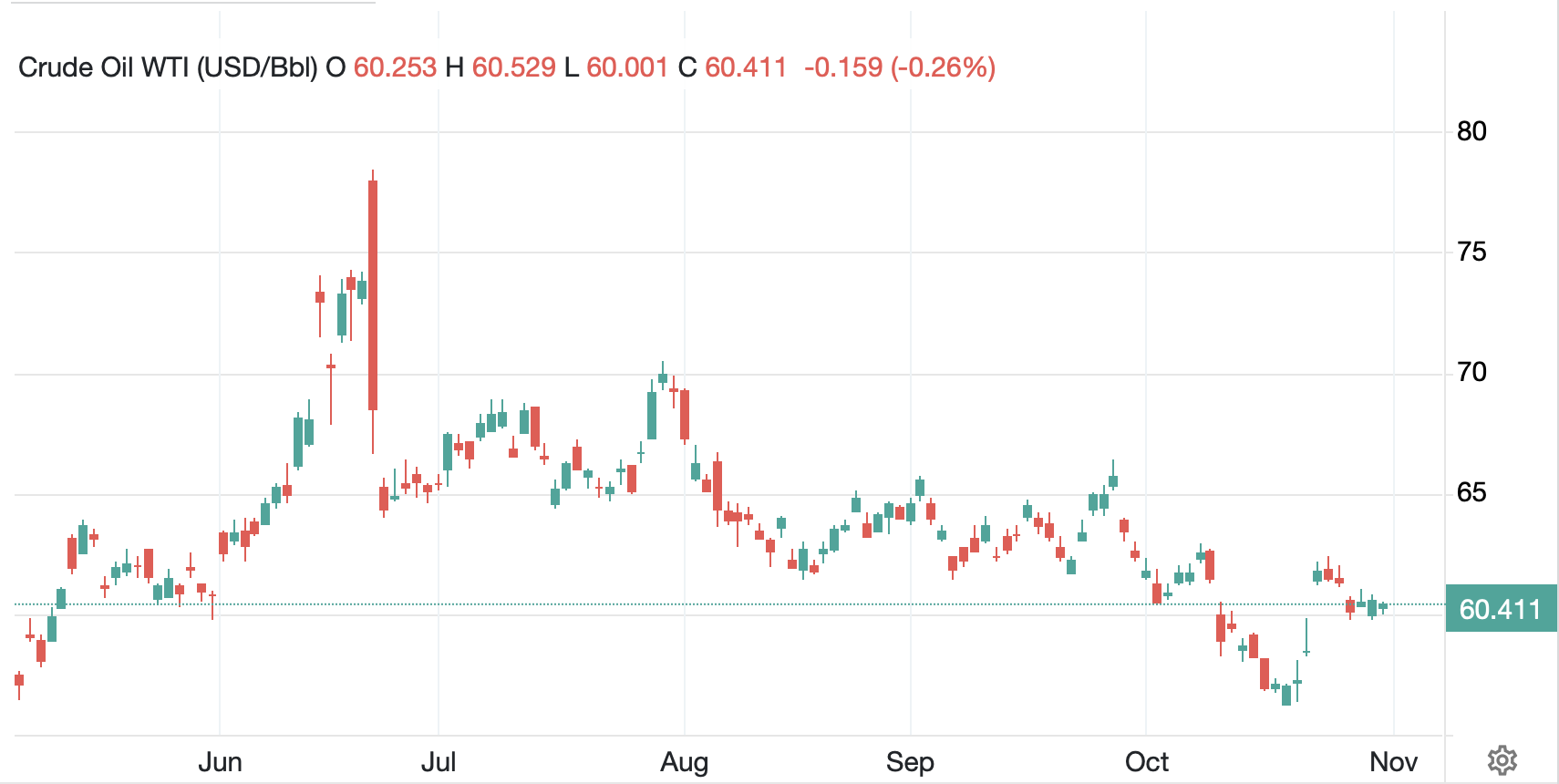
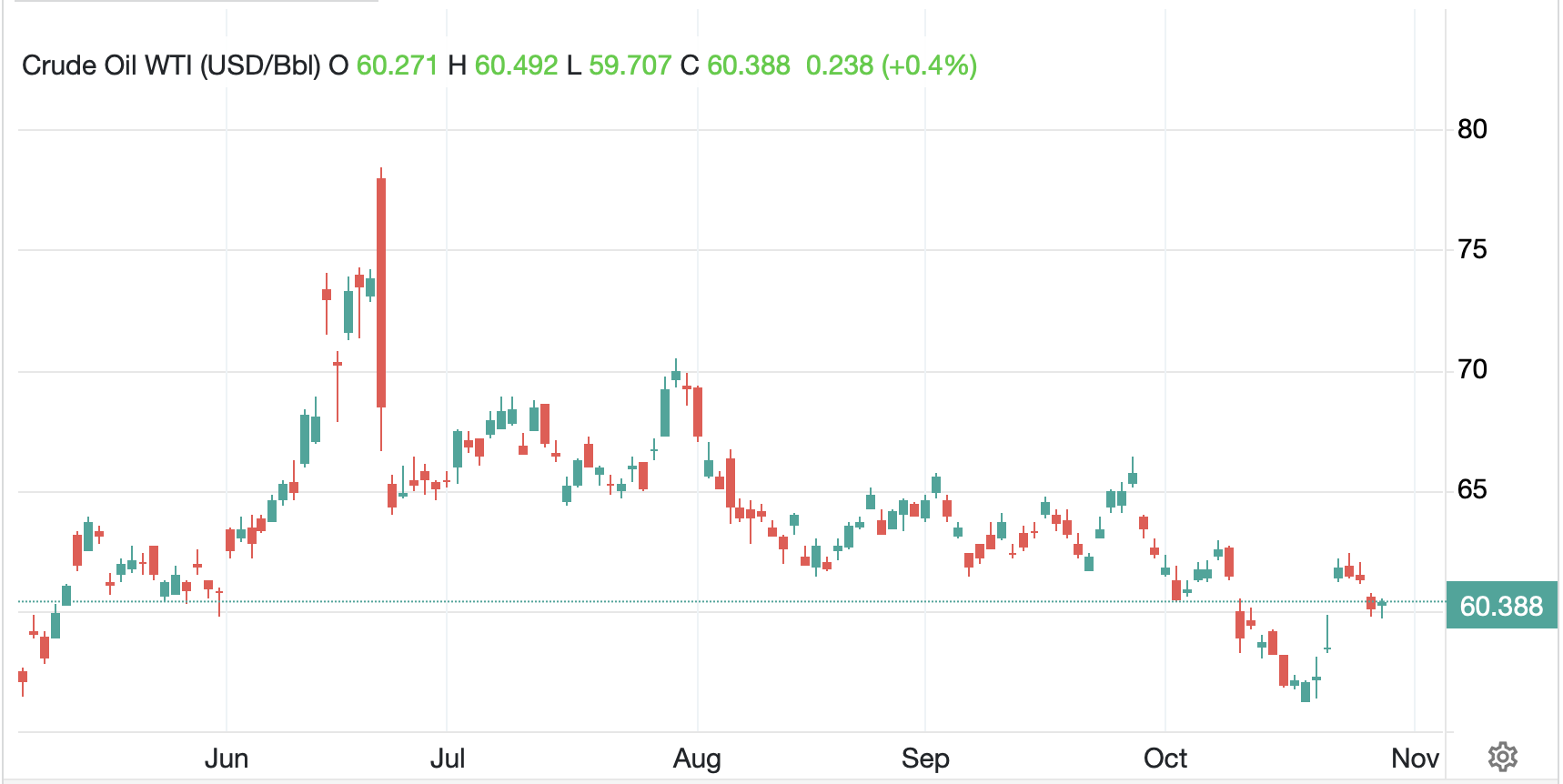
But away from that story, commodities remain the market with the most interest as oil (-0.5%) continues to trade within the range I highlighted earlier this week with a top at $65.50, but has made a technical break above its 50-day moving average, which has the bulls starting to get excited.  As well, the backwardation of the curve is increasing, another bullish sign and much of this is being laid at the feet of President Trump’s seeming turn on the Russia/Ukraine war, where he is quite tired of President Putin’s dissembling.  Certainly, a break above that range top would be at least short term bullish for crude.

Source: tradingeconomics.com

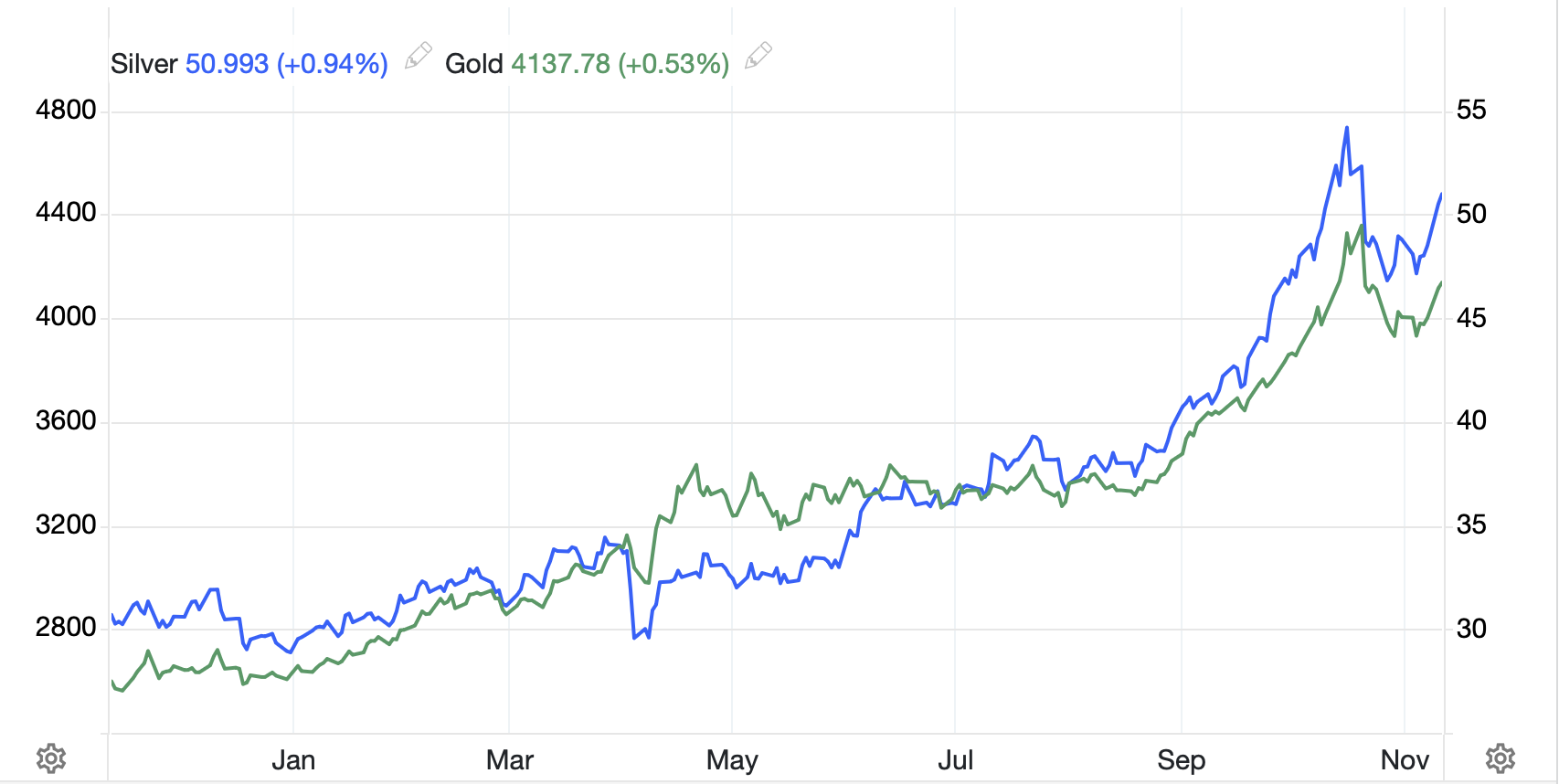
As to the precious metals, while gold continues to trade well, silver has taken the mantle and as you can see from the chart below, is accelerating higher at an even more impressive clip than the yellow metal.  This is a common occurrence as silver historically outperforms gold, on a percentage basis, when both are in bull markets like this.  Just wait until it reaches $50/oz, and makes new all-time highs, and you will see even more discussion of the metals and why they are rallying with inflation concerns a major part of that discussion.

Source: tradingeconomics.com

Meanwhile, financial instruments are far less exciting lately with equity markets stabilizing after their recent run and bond markets also doing little.  Granted, we have seen two consecutive down days in US equity markets, but the magnitude of the decline was de minimis, so it is not really telling us very much.  European markets appear more closely linked to the US, with all bourses there lower by between -0.1% and -0.5% this morning although we did see some modest gains in Asia (China +0.6%, Japan +0.3%).  Net, it seems investors are not certain where to turn right now and are waiting for more clarity from the Fed as to whether more rate cuts are on the way.

The same is true of bond investors who apparently are unconcerned over the shutdown threats, with yields unchanged despite the increasingly combative rhetoric.  We did hear from SF Fed president Daly yesterday, a known dove, who explained that she is coming around to the idea that more cuts are necessary, and they were simply waiting to see how tariffs were going to impact things.  I might argue that she is anxious to cut rates but also doesn’t want to seem to support President Trump’s demands.

Finally, the dollar, after a pretty solid rally yesterday, is essentially unchanged this morning as well.  (That seems to be the theme today, no change.). As I look across my screen, the largest move I see is 0.15%, which is how far CHF has declined on the session, otherwise things have been completely dead.

On the data front, this morning brings the weekly Initial (exp 235K) and Continuing (1930K) Claims data as well as Durable Goods (-0.5%, 0.0% ex-Transport) and the final Q2 GDP reading (3.3%) all at 8:30 with Existing Home Sales (3.96M) at 10:00.  Yesterday saw New Home Sales rise dramatically more than expected at 800K although most analysts expect that number to be revised lower as the Census Bureau gets more information.  Nonetheless, it is a sign that the economy is not collapsing, that’s for sure.  

We also hear from four more Fed speakers today, Williams, Bowman, Barr and Daly again, and we will need to see how they all interpret the current situation.  We learned from the dot plot that there are a lot of different opinions at the Fed right now, and personally, I am very glad to see that.  Given the overall confusion, and the asynchronous nature of the economy right now, it would be more concerning if everyone was on the same page.

As far as the shutdown is concerned, you can be sure that this process will continue until next Tuesday night, at the earliest, if the Democrats cave, and if not, we will then be bombarded by both sides claiming it is the other side’s fault.  Eventually a spending bill will be passed, and as we saw back in 2019, markets pretty much look through this stuff.  Meanwhile, unless the data starts to really deteriorate and brings Fed comments along for that ride, I think the dollar is probably in a rough equilibrium space for now.

Good luck

Adf
Fading

In Germany, growth has been fading
Down Under, inflation’s upgrading
Chair Jay gave his views
But it was old news
And Trump, for more cuts, is crusading


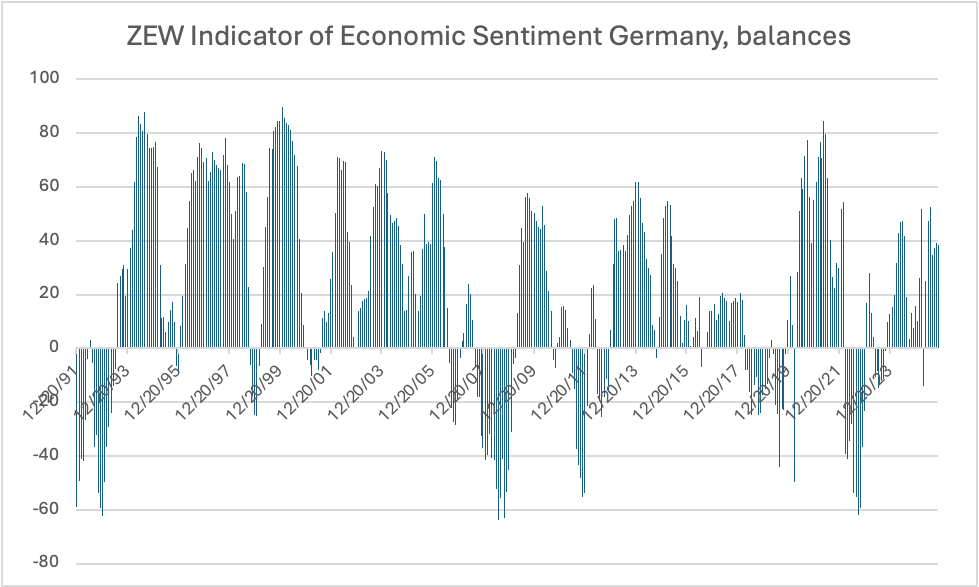
Some days, there is less to discuss than others, and this morning that seems to be the case.  Even my X feed had very little of interest.  Arguably, the top story is German Ifo readings came out much lower than expected and have now reversed most of the gains that occurred from front-running US tariff policy changes.  Germany’s bigger problem, though, is that the trend here is abysmal, as ever since Russia’s invasion of Ukraine and the dramatic rise in energy prices there, the German economy has been under significant pressure.  A look at the 5-year history of the Ifo series does an excellent job of explaining why growth has completely stalled there.

Source: tradingeconomics.com

In fact, if we look at the last three+ years of GDP activity in Germany, as per the below chart, we see that seven of the thirteen quarters were negative while two were exactly flat and the sum total of growth was -0.9%.  It’s amazing what happens to a nation that decides to impose extreme conditions on the production of energy domestically.  Or perhaps it’s not so amazing.  After all, economic activity is merely energy transformed.  If the cost of energy is high, economic activity is going to be slow.

Source: tradingeconomics.com

I highlight this because it runs counter to the narrative that Europe is a better place to invest than the US, which has been the thesis of the ‘end of American exceptionalism’ trade.  Germany is the largest European nation by far and had been a manufacturing powerhouse.  But those days appear to have passed.  If Germany is going to continue to lag, and I see no reason for that to change based on the current political dynamic there, please explain the idea behind long-term strength in the euro.  As I wrote yesterday, if the Fed cuts aggressively, the dollar will decline in the short run, but one cannot look at the trajectories of the relative economies and claim Europe is the place to be in the long run.

This morning, the euro (-0.5%) has responded logically to the data but the dollar is broadly stronger as well after Chair Powell’s speech yesterday where he continued the modestly hawkish tone from the FOMC press conference.  He continues to agonize over the fact that inflation won’t fall while unemployment is edging higher, although he finally admitted that tariffs would likely have a temporary, one-off impact on prices.  While there is no doubt the dollar has fallen since the beginning of the year, a 10% or 15% move is hardly unprecedented, but rather occurs pretty frequently.  A look at the below chart from the beginning of the euro’s existence in 1999 shows at least six or seven other instances when the euro rallied that much in a short period of time.

Source: tradingview.com

In fact, to demonstrate the politicization of the current world, one need only go back to the period in 2008 when the euro peaked at 1.60 or so to see that it was not seen as a global calamity, simply a period where US monetary policy had loosened dramatically relative to the rest of the world.

The other marginally interesting story this morning is Australia’s inflation rate, which came in at 3.0%, higher than expected and demonstrating what appears to be a break in the declining trend previously seen.

Source: tradingeconomics.com

This matters as AUD (+0.1%) is outperforming all its G10 peers this morning on the back of the idea that the RBA will be stuck on hold, rather than cutting rates again soon.  Too, this weighed on Australian equities (-0.9%) which underperformed other Asian markets overnight.

But that’s really all the interesting stuff, and it wasn’t that interesting, I fear.  So, let’s look at the rest of the market behavior overnight.  While I thought it was illegal, yesterday resulted in US equity markets declining on the session, albeit less than 1%.  And this morning, you’ll be happy to know, the futures are all modestly green.  As to Asian markets, Japan (+0.3%), China (+1.0%) and HK (+1.4%) all had strong sessions although it appears most of the other regional bourses declined.  The Chinese story making the rounds is the lessening in trade tensions between the US and China was seen as a key positive while HK survived Typhoon Ragasa without any major impacts.  But Korea, India, Taiwan and Singapore were all softer on the session.

In Europe, markets have generally done little with marginal declines the norm although, surprisingly, Germany’s DAX is unchanged on the day despite the weak Ifo data.  However, it is hard to get excited about anything happening there right now.

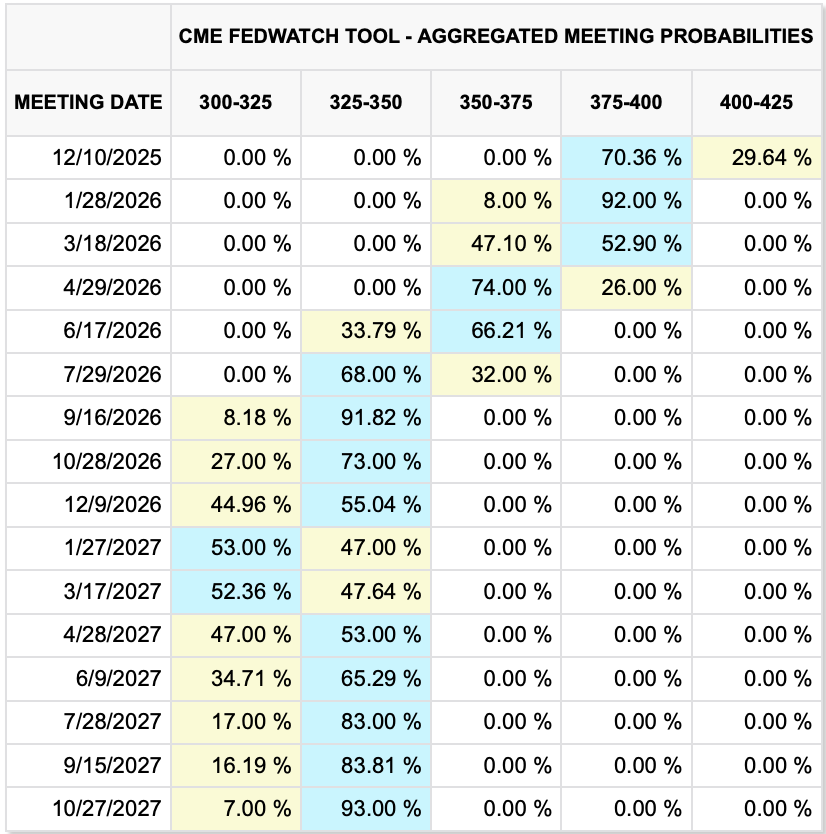
Bond yields fell yesterday with Treasuries declining -4bps although this morning they have edged back higher by 1bp.  Perhaps Powell’s tone yesterday was enough to keep the bond vigilantes on the sidelines, or perhaps there is simply not enough new information to change any views right now.  The Fed funds futures market continues to price a 94% probability of a cut at the end of next month and apparently bond investors are cool with that.  European yields are also little changed this morning as were JGB yields last night.

In the commodity space, oil (+1.1%) is heading back toward the top of the range I highlighted yesterday, but still more than $1 away and there have been no stories to drive things.  This is all just range trading in my view.  As to the metals markets, this morning gold and silver are essentially unchanged, consolidating their recent gains while copper (-.0.75%) is slipping slightly and has retraced some of its gains from earlier in the month.  Remember, copper is much more an economic play than a fear play or inflation play.

Finally, the dollar is firmer across the board this morning with gains against almost all G10 counterparts on the order of 0.5% and against EMG counterparts it is more like 0.8%.  Even CNY (-0.25%) is weakening as it appears Chinese state banks are selling renminbi in the spot market and hedging in the swap market to help mitigate its recent gains.  It is beginning to feel like the dollar’s decline this year, which has been widespread, is coming to an end.  

On the data front, today brings only New Home Sales (exp 650K) and EIA oil inventories.  Yesterday’s Flash PMI data was right in line with expectations, and my take is until NFP a week from Friday, there is going to be little of interest on the data front for markets overall.  Even PCE this week will have to be significantly different from expectations to have any impact.

It appears that absent Stephen Miran convincing the rest of the FOMC to cut rates aggressively, a very low probability event, the dollar is finding a bottom, and the next major move will be higher on the basis of stronger growth in the US vs. the rest of the world.  Of course, if the Fed does start to get more aggressive, then the dollar will suffer, I just don’t see that happening anytime soon.

Good luck

Adf

No Reprieve

The barbarous relic is soaring
As Stephen Miran is imploring
That Fed funds should be
At 2, don’t you see
An idea that Trump is adoring
 
But what else would happen if Steve
Is Fed Chair, when Powell does leave?
At first stocks would rally
Though bonds well could valley
And ‘flation? There’d be no reprieve


Arguably, the most interesting news in the past twenty-four hours has been the speech given by the newest FOMC member, Stephen Miran, where he explained his rationale for interest rates going forward.  There is no point going into the details of the argument here, but the upshot is he believes that 2.0% is the proper current setting for Fed funds based on his interpretation of the Taylor Rule.  That number is significantly lower than any other estimate I have seen from other economists, but then, the track record of most economists hasn’t been that stellar either.  Who am I to say he is right or wrong?

Well, actually, I guess that’s what I do, comment from the cheap seats, and FWIW, I suspect that number is far too low.  But forgetting economists’ views, perhaps the best arbiter of those views is the market, and in this case, the gold market.  With that in mind, I offer the following chart from tradingeconomics.com:

Those are weekly bars in the chart which shows us that the price of gold has risen for the past five weeks consecutively, during which time it has gained more than 14% on an already elevated price given the rally that began back in the beginning of 2024. Today’s 1% rise is just another step toward what appears to be much higher levels going forward.  

Why, you may ask, is gold rallying like this?  The thought process, which Miran defined for us all yesterday, is that he is in line to be the next Fed chair when Powell leaves, and so his effort will be to cut rates as quickly as possible to that 2% level.  Of course, the risk is inflation readings will continue to rise while the Fed is cutting.  If that occurs, and I suspect it is quite likely, then fears about a weaker dollar are well founded (that has been my view all along, aggressive rate cuts by the Fed will undermine the dollar in the short-run, longer term is different) and gold and other commodities will benefit greatly.  As to bonds…well here the picture is likely to be pretty ugly, with yields rising.  In fact, I wouldn’t be surprised to see 10-year Treasury yields head back toward 5.0% at which point the Treasury and the Fed, working hand in hand, will cap them via some combination of QE and YCC.

Of course, this is just one hypothesis based on what we know today and won’t happen until Q2 or Q3 next year.  Gold is merely sniffing out the probability of this outcome.  Remember, too, that the Trump administration has been quite unpredictable in its policy moves, and so none of this is a sure thing.

As an aside, given the inherent dovishness of the current make up of Fed governors, it would seem that a Miran chairmanship with a distinctly dovish bent will not have much problem getting the rest of the FOMC to go along, except perhaps for a few regional presidents.  And that doesn’t even assume that Governor Cook is forced out.  After all, she is a raging dove, just a political one that doesn’t want to give President Trump what he wants.

And before I start in on the overnight activity, here is another question I have.  Generally, economists are much more in favor of consumption taxes (that’s why they love a VAT) rather than income taxes and it makes sense, in that consumption taxes offer folks the choice to pay the tax by consuming or not.  If that is the case, why are these same economists’ hair all on fire about the tariffs, which they plainly argue is a consumption tax?  I read that the US is set to generate $400 billion in tariff revenue this year which would seem to go a long way to offsetting no tax on tips and other tax cuts from the OBBB.  I would expect that if starting from scratch, an honest economist, with no political bias (if such a person were to exist) would much rather see lower income tax rates and higher consumption tax rates.  Alas, that feels like a conversation we will never be able to have.

Anyway, on to markets where yesterday saw yet another set of new all-time highs in the US across all the major indices with futures this morning slightly higher yet again.  Japan was closed for Autumnal Equinox Day, while the rest of the region had a mixed performance.  China (-0.1%) and HK (-0.7%) suffered on continuing concerns over the Chinese economy with news that banks which are still dealing with property loan problems are now beginning to see consumer loan defaults as well.  Elsewhere Korea and Taiwan both rallied nicely, following the tech-led US while India suffered a bit on the H1-B visa story with the rupee falling to yet another historic low (dollar high) now pushing 89.00.  There were some other laggards as well (Thailand, Philippines) but most of the rest were modestly higher.  

In Europe, green is the theme with the CAC (+0.7%) leading the way while the DAX (+0.2%) and IBEX (+0.3%) are not as positive.  Ironically, Flash PMI data showed that French activity was lagging the most, with both manufacturing (48.1) and services (48.9) below the 50.0 breakeven level and much worse than expected.  It seems the fiscal issues in France are starting to feed into the private sector.  As to the UK, weaker Flash PMI data there has resulted in no change in the FTSE 100 as it appears caught between inflation worries and growth worries.

In the bond market, Treasury yields which rose 2bps yesterday have slipped by -1bp this morning while continental sovereigns are all essentially unchanged.  The one outlier here is the UK where gilts (-3bps) are rallying on hopes that the PMI data will lead to easier monetary policy.

Elsewhere in the commodity markets, oil (+1.1%) is bouncing from its recent lows but has not made much of a case to breech its recent $61.50/$65.50 trading range as per the below.

Source: tradingeconomics.com

The other precious metals are rocking alongside gold (Ag +0.7%, Pt +2.6%) with silver having outperformed gold since the beginning of the year by nearly 10 percentage points.  Oh, and platinum has risen even more, more than 63% YTD!

Finally, the dollar is basically unchanged this morning, with marginal movement against most of its counterparties.  There are only two outliers, SEK (+0.5%) which rallied despite (because of?) the Riksbank cutting their base rate by 25bps in a surprise move.  However, the commentary indicated they are done cutting for this cycle, so perhaps that is the support.  On the other side of the coin, INR (-0.5%) has been weakening steadily with the H1-B visa story just the latest chink in the armor there.  PM Modi is walking a very narrow tight rope to appease President Trump while not upsetting Presidents Putin and Xi.  His problem is that he needs both cheap oil and the US market for the economy to continue its growth, and there is a great deal of tension in his access to both simultaneously.  But away from those currencies, +/- 0.1% describes the session.

On the data front, today brings the Flash PMI data (exp 52.0 Manufacturing, 54.0 Services) and the Richmond Fed Manufacturing Index (-5.0).  remember, the Philly Fed Index registered a much higher than expected 23.2 last week, so the manufacturing story is clearly not dead yet.

Arguably, though, of far more importance than those numbers will be Chairman Powell’s speech at 12:35 this afternoon on the Economic Outlook in Providence, RI.  All eyes and ears will be on his current views regarding the employment situation and inflation, especially in light of Miran’s speech yesterday.

While the gold market is implying our future is inflationary and fiat currencies will weaken, the FX market has not yet taken that idea to extremes.  Any dovishness by Powell, which given the lack of data since we heard from him last week would be a surprise, will have an immediate impact.  However, I suspect he will maintain the relatively hawkish tone of the press conference and not impact markets much at all.

Good luck

Adf

Many Ructions

Just two days before Halloween
When Jay and his minions convene
With great joie de vivre
Investors believe
A quarter-point cut will be seen
 
But what if the model that Jay
Consults might have led him astray
Then Fed fund reductions
May cause many ructions
In markets, and too, the beltway


But I am just a poet and my voice is not so loud in financial markets.  However, John Mauldin is someone with much greater reach and his letter this week highlighted that exact issue. (For those of you who are not familiar with John, his weekly letter, “Thoughts from the Frontline” is usually an excellent read and completely free, you should sign up.)  At any rate, he reprinted a chart originally in the WSJ that I think does an excellent job of demonstrating the flaws in models developed pre-Covid.

It is quite apparent how this particular model, which appears to use the type of inputs that most econometric models utilize, had done a pretty good job, even throughout the GFC, of anticipating changes in consumer sentiment right up until Covid.  However, it is also clear that since then, it has a terrible track record.  

And this is the problem.  I would wager that every one of the models built by the hundreds of PhD’s at the Fed has a similar problem, things that used to drive economic decision making no longer do.  I guess when people get used to the government supporting them completely, many are willing to sit back and do nothing.  And when that support stops, it appears that people aren’t very happy about that situation.  Go figure!

The bigger picture here is that I believe it is time for the Fed to question its own modeling prowess.  Consider the situation that with interest rates at their current levels of 4% +/- a bit depending on the tenor, many people, especially retirees, were quite content to clip coupons and were spending those funds supporting the economy.  At the same time, interest expense for small companies never really fell that far, so current rates are not deathly. 

But you know who benefits from low interest rates?  The government and large corporations who have access to capital markets and pay the lowest rates.  And even there, companies like Apple, Google and Microsoft have so much cash on hand that they are net earning interest with higher rates.

All this begs the question, what is the purpose of the Fed cutting rates?  A key risk is that inflation will return with a vengeance.  It has been 55 months since core PCE was at or below the Fed’s target level of 2.0% as you can see in the below chart, and I feel confident in saying that when the data is released this Friday, it will not be changing that trend.

Source: tradingeconomics.com

So, savers will suffer as their income will be reduced, the risk of rising inflation will increase as easier monetary policy typically precedes that type of movement, and long-term yields, which have rebounded recently, run the risk of starting higher again.  Remember what happened last year when the Fed cut, 10-year Treasury yields rose 100bps. (see chart below)

Source: tradingeconomics.com

It is far too early to claim the outcome will be the same this time, but it is a real risk.  After all, bond yields have a strong relationship with inflation, running at a long-term correlation of 0.36 and as can be seen in the chart below I prepared from FRED data.

Concluding, the current batch of economic models utilized by analysts and the Fed appear to have limited ability to describe the economy, whether it is because of the asynchronous nature of the current state of the world, or because the unprecedented government responses around the world to the Covid pandemic have changed the way everything works.  The market is pricing a 93% probability of another rate cut in October, and it appears Chairman Powell believes that to be the case.  But is it the right move at this time?  I feel like that is not the question being asked, but it needs to be by people more powerful than this poet.

Ok, I’ll step down from my soapbox to survey the market activity overnight.  Friday’s US closes at yet more all-time highs were followed by a more mixed session in Asia.  While Japanese investors got the joke, with the Nikkei rising 1.0%, Hong Kong (-0.8%) and India (-0.6%) were both under pressure with the former suffering from a strengthening currency and concern about a major typhoon about to hit the island nation, while India is suffering from the backlash of the Trump policy change on H1-b visas, now charging $100,000 for them.  It turns out Indian firms were the largest user of those visas and there is concern over a serious economic impact there.  Otherwise, the region saw a mixture of green (China, Taiwan, Australia, Malaysia) and red (New Zealand, Indonesia, Singapore, Thailand).

European bourses, though, are having a tougher time this morning with the continental exchanges all under pressure (DAX -0.7%, CAC -0.3%, IBEX -1.0%, FTSE MIB -1.0%) as concerns rise over the Flash PMI data to be released tomorrow and the idea it may show a much weaker economy than previously considered.  As well, USD futures are softer at this hour (6:40), with all three major indices showing declines on the order of -0.25%.  However, we must keep in mind that the trend in equity markets has been strongly higher so a modest pullback would not be a surprise and perhaps should be welcomed.

In the bond market, yields having moved higher on Friday, are quite stable this morning with Treasury yields unchanged and most of Europe seeing a -1bp decline.  The only outlier here is Japan, where JGB yields topped 1.65%, a new high for the move and the highest level since 2008 as per the below chart from marketwatch.com.  Ueda-san has to start getting worried soon, I think.

In the commodity space, oil (-0.7%) is continuing its recent decline but remains within the trading range and doesn’t appear to have much impetus in the short term in either direction.  However, I continue to look for an eventual decline here.  As to gold (+1.15%) and silver (+1.6%), nothing is going to stop this train.  Well, certainly there is no indication that policy changes are coming anywhere in the world that would force investors to rethink the idea of continuous depreciation of fiat currencies, and let’s face it, that’s all this represents.  I continue to see analysts raise their target price for the barbarous relic and I agree there is plenty of room to run as interest has been modest, at best, by Western investors.

Finally, the dollar is a touch softer this morning with both the euro (+0.25%) and pound (+0.25%) leading the way in the G10, although the yen is basically unchanged.  There was an interesting story in Bloombergdiscussing how volatility in the FX markets has been declining rapidly with many attributing this to the rise of algorithmic trading.  As well, all over X this morning are stories about how the dollar’s decline this year (about -14% vs. the euro) is unprecedented.  It’s not at all which is one of the reasons you need be careful about what people put up there.  It seems that some analysts are putting undue emphasis on the starting point being January 1st, rather than when the market tops.  But saying the dollar is declining in an unprecedented manner is absurd and picayune.  Meanwhile, EMG currencies are all over the place with gainers (KRW +0.4%, ZAR +0.4%) and laggards (MXN -0.5%, INR -0.25%) and everything in between.  

On the data front, PCE is Friday’s offering, but before then there is some stuff and more interestingly, there is lots of Fed speak.

TodayChicago Fed National Activity-0.17
TuesdayFlash Manufacturing PMI52.0
 Flash Services PMI53.9
WednesdayNew Home Sales650K
ThursdayDurable Goods-0.5%
 -ex transport-0.2%
 GDP (Q2)3.3%
 Initial Claims235K
 Continuing Claims1930K
 Existing Home Sales3.96M
FridayPCE0.3% (2.7% Y/Y)
 Core PCE0.2% (2.9% Y/Y)
 Personal Income0.3%
 Personal Spending0.5%
 Michigan Sentiment55.4

Source: tradingeconomics.com

On top of the data, we hear from…wait for it…ten different Fed speakers, including Chair Powell tomorrow, across 16 different events.  I expected to hear from a lot as there is clearly no real consensus at this point in time there.

People love to hate the dollar, and if the Fed is going to ease more aggressively, I understand that, but longer term, I think the story is different.  Just be careful.

Good luck

Adf

A Centruy Hence

A century hence
The BOJ’s equities
May well have been sold
 
But policy rates
Were left unchanged yet again
What of inflation?


Finishing up our week filled with central bank meetings, the BOJ left rates untouched last night, as universally expected, and really didn’t indicate when they might consider the next rate hike.  Ueda-san has the same problem as Powell-san in that inflation continues to run hotter than target while the economy appears to be struggling along.  In addition, the political situation in Tokyo is quite uncertain as PM Ishiba has stepped down and a new LDP leadership election is set to be held on October 4th with the two leading candidates espousing somewhat different views of the future.  If I were Ueda, I wouldn’t do anything about rates either.  Interestingly, there were two dissents on the BOJ board with both calling for another rate hike.

But there was a policy change, albeit one that does not feel like it is going to have a significant impact for quite some time.  The BOJ has decided to start to sell its equity and ETF holdings, which currently total about ¥37.2 trillion, at the annual rate of…¥330 billion.  At this pace, it will take almost 113 years for the BOJ to unwind the “temporarily” purchased equities acquired during the GFC to support the market.  While the Nikkei initially fell about 2% after the announcement, it rebounded over the rest of the session to close lower by a mere -0.6%.  However, in a strong advertisement for the concept of buy and hold, a look at the below chart shows when they started buying and how well the BOJ has done.

Source: finance.yahoo.com

There is no indication that the BOJ has unrealized losses on their balance sheet like the Fed does!

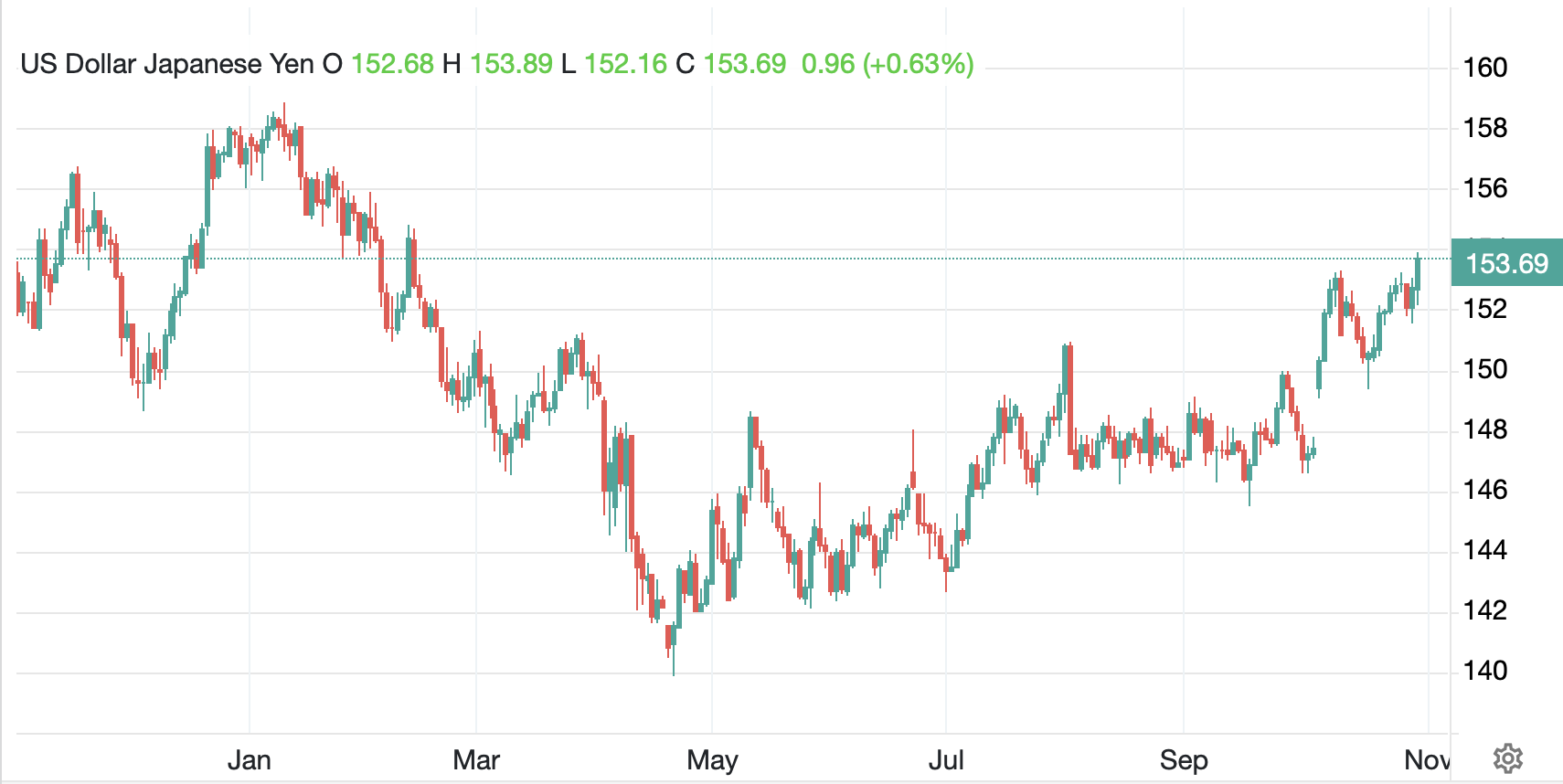
What of USDJPY you might ask?  And the answer is, nothing.  It is essentially unchanged on the day and in truth, as you can see from the chart below, it has done very little for the past 5+ months, trading at the exact same level as prior to the Liberation Day tariff announcements.  While there was an initial decline in the dollar then, that was a universal against all currencies, but we are back to where we were.

Source: tradingeconomics.com

Consider, too, that over the course of the past year, the Fed has cut Fed funds by 125bps while the BOJ has raised their base rate by 60bps, and yet spot USDJPY is effectively unchanged.  Perhaps, short-term interest rate differentials aren’t always the driver of the FX market after all. 

In fact, there is a case to be made that the driver in USDJPY is the capital flowing out of Japan by fixed income investors as they seek a less chaotic situation than they have at home.  This could well be the reason for the ongoing rise in long-dated JGB yields to record after record, while Treasury yields seem to have found a top.  Recall, in the latest 10-year auction, dealers took down only 4% of the auction with foreign interest rising to 71%.  While there has been much discussion amongst the punditry of how nobody wants to buy Treasuries and they are no longer the haven asset of old, the nobody of whom they speak are foreign central banks.  But foreign private investors seem pretty happy to scoop them up and are doing so at a remarkable pace.  I think there are a few more years left before the dollar disappears.

Ok, let’s tour the markets here as we reach the end of the week.  Record highs across the board in the US yesterday as investors apparently decided that the Fed was just like Goldilocks, not too hawkish and not too dovish.  And the hits keep on coming this morning as futures are all higher by about 0.25% at this hour (7:15).  As to Asia, we discussed Japan already, and both China and HK were unchanged.  But elsewhere in the region, the euphoria was not apparent as Korea, India, Taiwan, Singapore and Thailand all fell by at least -0.3% or more while Australia, New Zealand and Indonesia were the only gainers, also at the margin on the order of 0.3% or so.

Europe this morning is also mixed with the DAX (-0.2%) lagging after weaker than expected PPI data indicated that economic activity is slowing more rapidly than anticipated, while both the CAC (+0.2%) and IBEX (+0.4%) are edging higher absent any new data.  There was a comment by an ECB member, Centeno from Portugal, that the ECB needs to be wary of “too low” inflation, a particularly tone-deaf comment after the past several years!  But I guess that is the first hint that the ECB is ready to cut again.

In the bond market, Treasury yields have been bouncing since the FOMC meeting and are now higher by 13bps since immediately after the FOMC statement.  Again, my view is this is a case of selling the news after the market was pricing in the rate cut ahead of the meeting.  I would argue that no matter how you draw the trend line of the decline in yields over the past several months, we are nowhere near testing it.

Source: tradingeconomics.com

And in what cannot be a surprise, European sovereign yields are all rising alongside Treasuries, with today’s bump up of another 1bp to 2bps adding onto yesterday’s 5bp to 7bp raise across the board.  As well, we cannot ignore JGBs which have jumped 4bps after the BOJ meeting last night.  I guess Japanese investors didn’t get any warm and fuzzy feelings about how Ueda-san is going to fight inflation.

Turning to commodities, oil (-0.4%) remains firmly within its recent range, ignoring Russai/Ukraine news as well as inventory data and economic statistics.  I don’t know what it will take to change this equation, but it certainly seems like we will be in this range for a while yet.  Peace in Ukraine maybe does it, or a major escalation there.  Otherwise, I am open to suggestions.  Gold (+0.2%) continues to be accumulated by central banks around the world as well as retail investors in Asia, although Western investors appear oblivious despite its remarkable run.  Silver (+0.7%) too is rallying and has been outperforming gold of late.  Perhaps of more interest is that the precious metals are doing so well despite the dollar’s rebound in the FX markets.

Speaking of which, this morning the dollar is firmer by 0.25% to 0.4% vs most of its G10 counterparts although some of the Emerging Market currencies are holding up better.  So, the euro (-0.25%), pound (-0.5%), AUD (-0.25%), CHF (-0.35%) and SEK (-0.6%) are defining the G10 with only the yen (0.0%) bucking the trend.  As to the EMG currencies, HUF (-0.65%), KRW (-0.6%) and PLN (-0.3%) are the laggards with the rest showing far less movement.  However, while short dollar positions are rife, there is not much joy there lately.  I grant that the trend in the dollar is lower, and we did see a new low for the move print in the immediate aftermath of the FOMC meeting, but it appears that people have not yet abandoned the greenback entirely.  Perhaps the lure of more new record highs in the stock market is enough to get foreigners to reconsider their “end of American exceptionalism” idea.

There is no data today nor are any Fed speakers on the calendar.  Perhaps the most notable data we have seen is UK Public Sector Net Borrowing, which fell to -£17.96B, a massive jump from last month and much worse than expected.  As you can see from the chart below, while there is much angst over US budget deficits, at least the US has the reserve currency on which to stand.  The UK has nothing, and the fiscal situation there is becoming more dire each day.  Yet another reason that the Starmer government can fall sooner rather than later.

Source: tradingeconomics.com

It is hard to look at that chart and think, damn, I want to buy the pound!  

For all the hate it gets, the dollar is still the cleanest dirty shirt in the laundry, and while it may trade somewhat lower in the near term, it will find its legs and rebound.

Good luck and good weekend

Adf

Ere Recession Arose

There once was a Fed Chair named Jay
Who fought ‘gainst the prez every day
He tried to explain
That tariffs brought pain
So higher rates needed to stay
 
But data turned out to expose
The job market, which had no clothes
So, he and his friends
Were forced, in the end
To cut ere recession arose


The Fed cut 25bps yesterday, as widely expected (although I went out on a limb and called for 50bps) and markets, after all was said and done by Chair Powell, saw equities mixed with the DJIA rising 0.6% while the S&P 500 and NASDAQ both slipped slightly.  Treasury yields rose 5bps which felt much more like some profit taking after a month-long rally, than the beginning of a new trend as per the chart below.

Source: tradingeconomics.com

Gold rallied instantaneously on the cut news, trading above $3700/oz, but slipped back nearly 2% as Powell started speaking and the dollar fell sharply on the news but rebounded to close higher on the day as per the below chart from tradingeconomics.com.  See if you can determine when the statement was released and when Powell started to speak.

Did we learn very much from this meeting?  I think we learned two things, one which is a positive and one which is not.  On the positive side, there is clearly a very robust discussion ongoing at the Fed with respect to how FOMC members see the future evolving.  This was made clear in the dot plot as even the rest of 2025 sees a major split in expected outcomes.  But more importantly, looking into the future, there is certainly no groupthink ongoing, which is a wonderful thing.  Simply look at the dispersion of the dots for each year.

Source: federalreserve.gov

The negative, though, is that Chairman Powell is very keen to spin a narrative that seems at odds with the data that they released in the SEP.  In other words, the flip side of the idea that there is a robust discussion is that nobody there has a clue about what is happening in the economy, or at least Powell is not willing to admit to their forecasts, and that is a problem given their role in policy making.

It was a little surprising that only newly seated Governor Miran voted for 50bps with last meeting’s dissenters happy to go with 25bps.  But I have a feeling that the commentary going forward, which starts on Monday of next week, is going to offer a variety of stories.  If guidance from Fed speakers contradicts one another, exactly where is it guiding us?  (Please know I have always thought that forward guidance was one of the worst policy implementations in the Fed’s history.)

Moving on, the other central banks that have announced have done exactly as expected with both Canada and Norway cutting 25bps.  Shortly, the BOE will announce their decision with market expectations for a 7-2 vote to leave rates on hold, especially after yesterday’s 3.8% CPI reading.  Then, all eyes will turn to Tokyo tonight where the BOJ seems highly likely to leave rates on hold there as well.

If you think about it, it is remarkable that equity markets around the world continue to rally broadly at a time when central banks around the world are cutting rates because they are concerned that economic activity is slowing and they seek to prevent a recession.  Something about that sequence seems out of sorts, but then, I freely admit that markets move for many reasons that seem beyond logic.

Ok, having reviewed the immediate market response to the Fed, let’s see how things are shaping up this morning.  Asian equity markets had both winners (Tokyo +1.15%, Korea +1.4%, Taiwan +1.3%, India +0.4%) and laggards, (China -1.2%, HK 1.4%, Australia -0.8%, Malaysia -0.8%) with the rest of the region seeing more laggards than gainers.  The China/HK story seems to be profit taking related while the gainers all alleged that the prospect of another 50bps of cuts from the Fed this year is bullish.  Meanwhile, in Europe, while the UK (+0.2%) is biding its time ahead of the BOE announcement, there has been real strength in Germany (+1.2%), France (+1.15%) and Italy (+0.85%) while Spain (+0.25%) is only modestly firmer.  While there was no data of note released, we did hear from ECB VP de Guindos who said the ECB may not be done cutting rates.  Clearly that got some investors excited.  As to US futures, at this hour (6:55), they are solidly higher, on the order of 0.8% or more.

In the bond market, Treasury yields are backing off the highs seen yesterday and have slipped -4bps, hovering just above 4.0% on the 10-year.  European sovereign yields are essentially unchanged this morning as were JGB yields overnight.  It seems investors were completely prepared for the central bank actions and had it all priced in.  I guess the real question is are those investors prepared for the fact that the Fed is no longer that concerned about inflation and will allow it to rise further?  My guess there is they are not, but then, that’s where QE/YCC comes into play.

In the commodity markets, oil (-0.25%) is slightly lower this morning despite Ukraine attacking two more Russian refineries last night.  What makes that particularly interesting is that the EIA inventory data showed a massive net draw of oil and products last week of more than 11 million barrels, seemingly a bullish signal.  But hey, I’m an FX guy so maybe supply and demand in oil markets works differently!  In metals, gold (+0.2%) and silver (+0.4%) continue to rebound from their short-term lows from yesterday.  It is abundantly clear that there is growing demand for alternatives to fiat currencies.

Speaking of which, in the fiat world, rumors of the dollar’s demise remain greatly exaggerated.  After yesterday afternoon’s gyrations discussed above, it is largely unchanged this morning with some outlier moves in smaller currencies, NZD (-0.5%), ZAR (+0.3%), KRW (-0.3%) while amongst the true majors, only JPY (-0.25%) has moved any distance at all.  

***BOE Leaves rates on hold, as expected, with 7-2 vote, as expected.***

Turning to this morning’s data, we see the weekly Initial (exp 240K) and Continuing (1950K) Claims as well as Philly Fed (2.3), then at 10:00 we get Leading Indicators (-0.2%).  Something I read was that last week’s Initial Claims number of 263K was caused by a data glitch in Texas, implying it was overstated.  I imagine we will find out more on that this morning.  

Recapping all we learned yesterday and overnight, the Fed seems reasonably likely to cut at both of their last two meetings this year, but expect only one cut in 2026, which is at least 50bps less of cuts than had been expected prior to the meeting.  Meanwhile, equity markets don’t seem to care and continue to rally while bond investors remain under a spell, believing the Fed will fight inflation effectively.  Gold is under no such spell, and the dollar is the outlet for all of it, toing and froing on the back of various theories of the day.  If forced to guess, I do believe there is a bit more weakness in the dollar in the near-term, but do not look for a collapse.  In fact, I suspect that as investment flows into the US pick up, we will see a reversal of note by the middle of next year.

Good luck

Adf

Throw in the Towel

All eyes are on Chairman Jay Powell
And if he will throw in the towel
Or will he still fight
Inflation? Oh, right
He caved as the hawks all cried foul!
 
So, twenty-five’s baked in the cake
While fifty would be a mistake
If fighting inflation
Is his obligation
Though half may, Trump’s thirst, somewhat slake


Well, it’s Frabjous Fed Day and there will be a great deal of commentary on what may happen and what it all means.  Of course, none of us really knows at this point, but I assure you by this afternoon, almost all pundits will explain they had it right.  

At any rate, my take is as follows, FWIW.  I believe the huge revision to NFP data has got the FOMC quite concerned.  Prior to that, they were smug in their contention that patience was a virtue and their caution because of the uncertain price impact of tariffs was warranted given the underlying strength in the jobs market.  Now, not only has that underlying strength been shown to be a mirage, but the import price data released yesterday, showing that Y/Y, import prices are flat, is further evidence that tariffs have not been a significant driver of inflation.  If you look at the chart below of Y/Y import prices for the past 5 years, you can see that since April’s ‘Liberation Day’ tariff announcements, they have not risen at all.

Source: tradingeconomics.com

With that in mind, if you are the Fed, and you are data dependent, as they claim to be, and the data shows weakening employment and stable prices in the area you had been highlighting, you have no choice but to cut.  The question then becomes, 25bps or 50bps?  While the market is pricing just a 6% probability of a 50bp cut, given there are almost certainly three Governor votes for 50bps (Waller, Bowman and Miran) and the underlying central bank tendency is toward dovishness, I am going to go out on a limb and call for 50bps.  Powell and the Fed have already been proven wrong, and the only thing worse for them than seeming to cave to pressure from the White House would be standing pat and being blamed for causing a recession.  

With that in mind, my prognostications for market responses are as follows:

  • The dollar will weaken pretty much across the board with a move as much as -1% possible
  • Precious metals will rally sharply, making new highs for the move as this will be proof positive that the Fed has tacitly raised its inflation target from the previous 2%.  In fact, my take is 3% is the new 2%, at least until we spend a long time at 4%.
  • Equity markets will take the news well, at least initially, as the algos will be programmed to buy, but the concern will have to grow that slowing economic activity will impair earnings going forward, and multiples will suffer with higher inflation.  I continue to fear a correction here.
  • Bonds are tricky here as they have been rallying aggressively for the past six weeks and that could well have been ‘buying the rumor’ ahead of the meeting.  So, it is not hard to make the case that bonds sell off, and long end yields rise in response to 50bps.

On the other hand, if they cut 25bps, and sound hawkish in the statement or Powell’s presser, I don’t imagine there will be much movement of note.   I guess we’ll see in a while.

Until then, let’s look at the overnight price action.  Yesterday’s modest declines in US equities looked far more like consolidation after strong runs higher than like the beginning of the end.  The follow on in Asia was mixed with Tokyo (-0.25%) after export data was weak, especially in the auto sector, while HK (+1.8%) and China (+0.6%) both rallied on the prospect of reduced trade tensions between the US and China based on the upcoming meeting between Presidents Trump and Xi.  Elsewhere in the region, Korea, Taiwan and Australia fell while India, Malaysia and Indonesia all rallied, the latter on the back of a surprise 25bp rate cut by Bank Indonesia.

In Europe, the picture is also mixed with Germany (-0.2%), France (-0.4%) and Italy (-1.2%) all under pressure, with Italy noticeably feeling the pain of potential domestic moves that will hurt bank profitability with increased taxes there to offset tax cuts for individuals.  Spain is flat and the UK (+0.25%) slightly firmer after inflation data there showed 3.8% Y/Y headline, and 3.6% Y/Y core, as expected and still far higher than the BOE’s 2.0% target.  While the BOE meets tomorrow, and no policy change is expected, if the Fed cuts 50bps, do not be surprised to see 25bps from the Old Lady.  US futures at this hour (7:30) are essentially unchanged.

In the bond market, Treasury yields continue to creep lower ahead of the meeting, slipping another 2bps this morning and now trading at 4.01%, the lowest level since Liberation Day and the initial fears of economic disaster in the US.

Source: tradingeconomics.com

You can see the trend for the past six months remains lower and appears to be accelerating right now. Meanwhile, as is often the case, European sovereign yields are following Treasury yields and they are lower by between -1bp and -2bps across the board.  Nothing to see here.

Commodity markets have seen the most movement overnight with oil (-0.7%) topping a bit while gold (-0.65%), silver (-2.5%) and copper (-1.8%) have all seen some profit taking ahead of the FOMC meeting.  Now, there are plenty of profits to take given the 10% rallies we have seen in gold and silver in the past month.  In fact, I lightened up some of my gold position yesterday as well!

Finally, the dollar, which fell pretty sharply yesterday is bouncing a bit this morning.  Using the DXY as proxy, it came close to the lows seen back on July 1st, as you can see in the chart below. 

Source: tradingeconomics.com

But remember, as you step away from the day-to-day, the dollar is hardly weak.  Rather, it is much closer to the middle of its long-term price action as evidenced by the longer view below.

Source: finance.yahoo.com

There is a lot of discussion on FinX (nee FinTwit) about whether we are about to bounce or if the dollar is going to collapse.  But it is hard to look at the chart directly above and get the feeling that things are out of hand in either direction.  Now, relative to some other currencies, there are trends in place that don’t impact the DXY, but matter.  Notably, CNY and MXN have both been strengthening slowly for the bulk of the year and are now at levels not seen for several years.  given the importance of both these nations with respect to trade with the US, this is where Mr Trump must be happiest as it clearly is weighing on their export statistics.

Source: tradingeconomics.com

Ahead of the FOMC meeting, we do get a few data points, with Housing Starts (exp 1.37M) and Building Permits (1.37M) leading off at 8:30.  Then at 9:45 the BOC interest rate decision comes, with a 25bp cut expected and finally the Fed at 2:00.  Housing will not have any impact on the market in my view but the BOC, if they surprise, could matter, especially if they pre-emptively cut 50bps as that will get the juices flowing for the Fed to follow suit.  But otherwise, we will have to wait for Powell and friends for the next steps.

Good luck

Adf

A Third Fed Mandate

As Jay and his minions convene
A new man is making the scene
Now, Stephen Miran
A man with a plan
Will help restart Jay’s cash machine
 
But something that’s happened of late
Is talk of a third Fed mandate
Yes, jobs and inflation
Have been the fixation
But long-term yields need be sedate


As the FOMC begins their six-weekly meeting this morning, most market participants focus on the so-called ‘dual mandate’ of promoting the goals maximum employment and stable prices.  This, of course, is why everybody focuses on the tension between the inflation and unemployment rates and why the recent revisions to the NFP numbers have convinced one and all that a rate cut is coming tomorrow with the only question being its size.  But there is a third mandate as is clear from the below text of the Federal Reserve Act, which I have copied directly from federalreserve.gov [emphasis added]:

“Section 2A. Monetary policy objectives

The Board of Governors of the Federal Reserve System and the Federal Open Market Committee shall maintain long run growth of the monetary and credit aggregates commensurate with the economy’s long run potential to increase production, so as to promote effectively the goals of maximum employment, stable prices, and moderate long-term interest rates.

[12 USC 225a. As added by act of November 16, 1977 (91 Stat. 1387) and amended by acts of October 27, 1978 (92 Stat. 1897); Aug. 23, 1988 (102 Stat. 1375); and Dec. 27, 2000 (114 Stat. 3028).]”

One of the things we have heard consistently from Treasury Secretary Bessent is that he is highly focused on ensuring that longer-term yields do not get too high.  Lately, the market has been working to his advantage with both 10-year, and 30-year yields having declined by more than 25bps in the past month.  And more than 40bps since mid-July.  (Look at the yields listed on the top of the chart below to see their recent peaks, not just the line.)

Source: tradingeconomics.com

Now, with President Trump’s head of the CEA, Stephen Miran getting voted onto the board to fill the seat that had been held by Governor Adriana Kugler, but heretofore vacant, one would think that the tone of the conversation is going to turn more dovish.  What makes this so odd is that, by their nature, central bankers are doves and seemingly love to print money, so there should be no hesitation to cut rates further.  But…that third mandate opens an entirely different can of worms and brings into play the idea of yield curve control as a way to ensure the Fed “promote(s)…moderate long-term interest rates.”

It was Ben Bernanke, as Chair, who instigated QE during the GFC although he indicated it was an emergency measure.  It was Janet Yellen, as Chair, who normalized QE as one of the tools in the toolbox for the Fed to address its dual mandate.  I believe the case can be made that newly appointed Governor Miran will begin to bang the drum for the Fed to act to ensure moderate long-term interest rates, and there is no better policy to do that than QE/YCC.  Actually, there is a better policy, reduced government spending and less regulation that allows productivity to increase and balances the production-consumption equation, but that is out of the Fed’s hands.

At any rate, we cannot ignore that there could be a subtle change in focus to the statement and perhaps Chairman Powell will discuss this at the press conference.  If this has any validity, a big IF, the market impacts would be significant.  The dollar would start another leg lower, equities would rise sharply, and commodity prices would rise as well.  Bonds, of course, would be held in check regardless of the inflationary consequences.  Just something to keep on your bingo card!

Ok, let’s check out the overnight activity.  While it was quiet in the US yesterday, we did manage to make more new highs in the S&P 500 as all three major indices were higher.  As to Asia, Tokyo (+0.3%) had the same type of session, with modest gains as it takes aim at a new big, round number of 45,000.  China (-0.2%) and HK (0.0%) did little although there was a lot of positivity elsewhere in the region with Korea (+1.2%), India, (+0.7%) and Taiwan (+1.1%) leading the way amidst almost all markets, large and small, showing gains.  Europe, though, is a different story with red today’s color of the day, as Spain (-0.8%) and Germany (-0.6%) leading the down move despite better-than-expected German ZEW data (37.3 vs. 26.3 expected).  One of the things I read this morning was that German auto manufacturers have laid off 125,000 workers in the past 6 weeks.  That is a devastating number and bodes ill for German economic activity in the future.  As to other European bourses, -0.1% to -0.4% covers the lot.  US futures, though, continue to point higher, up 0.3% at this hour (7:30).

In the bond market, Treasury yields are unchanged this morning while European sovereign yields have edged higher by between 1bp and 2bps.  It doesn’t feel like investors there are thinking of better growth, but we did hear from several ECB members that while cuts are not impossible during the rest of the year, they are not certain.

In the commodity space, oil (+0.7%) is back in a modest upswing but still has shown no inclination to move outside that trading range of $60/$65.  It has been more than a month since that range has been broken and absent a major change in the Russia sanctions situation, where Europe actually stops buying Russian oil (as if!) I see no short-term catalyst on the horizon to change this situation.  Clearly, producers are happy enough to produce and sell at this level and demand remains robust.

Turning to the metals markets, I discuss gold (+0.4%) a lot, and given it is making historic highs, that makes sense, but silver (+0.4%) has been outperforming gold for the past month and looks ever more like it is going to make a run for its all-time highs of $49.95 set back in January 1980.  The more recent peak, set in 2011, of $48.50 looks like it is just days away based on the recent rate of climb.

Source: finance.yahoo.com

Finally, the dollar is under pressure this morning, with the euro (+0.4%) trading above 1.18 again for the first time since July 1st and there is a great deal of discussion as to how it is going to trade back to, and through, 1.20 soon, a level not seen since 2021.  

Source: tradingeconomics.com

The narrative is now that the Fed is set to begin cutting rates and the ECB is going to stand pat, the euro will rise.  This is true for GBP (+0.3%) as wel, with the Sterling chart largely the same as the euro one above.  Here’s the thing.  I understand the weak dollar thesis if the Fed gets aggressive, I discussed it above. However, if German manufacturing is contracting that aggressively, and the layoffs numbers are eye opening, can the ECB really stand pat?  Similarly, PM Starmer is under enormous, and growing, pressure to resign with the Labour party in the throes of looking to oust him for numerous reasons, not least of which is the economy is struggling.  So, please tell me why investors will flock to those currencies.  I see the dollar declining, just not as far as most.

Data this morning brings Retail Sales (exp 0.2%, 0.4% -ex autos) along with IP (-0.1%) and Capacity Utilization (77.4%).  However, it is not clear to me that markets will give this data much consideration given the imminence of the FOMC outcome tomorrow.  The current futures pricing has just a 4% probability of a 50bp cut.  I am waiting for the Timiraos article to see if that changes.  Look for it this afternoon.

Good luck

Adf

More Insane

Though debt round the world keeps on growing
The equity run isn’t slowing
But what’s more insane
Is yields slowly wane
Despite signs inflation ain’t slowing
 
The French are the latest to hear
Their credit’s somewhat less sincere
But CBs this week
Seem likely to tweak
Rates lower, and markets will cheer


Something is rotten in the state of financial markets, or at least that is the conclusion this poet has drawn (and please do not think I am trying to compare myself to Shakespeare).  No matter what my personal view of the economy may be, I cannot help but look at the recent performance of the equity market and the bond market and be extremely confused.  The chart below shows the past year’s price action in the S&P 500 (blue line) and US 10-year yields (green line). 

Source: tradingeconomics.com

Since early June, the two price series, which have historically had a pretty decent correlation, have gone in completely opposite directions.  Equity markets continue to trade to new highs on a regular basis as earnings multiples continue their expansion.  Typically, multiples only expand when growth expectations are rising, and the economy is in an uptrend.  Ergo, if multiples are high and rising, it seems equity investors believe that is the case.  I understand that view as there are strong indications the administration is going to continue to ‘run the economy hot’ meaning do all it can to increase economic activity and allow inflation to rise as well, counting on the fast growth to offset the pain.

However, 10-year Treasury yields have been sliding steadily for the past three months despite the equity market belief in running it hot.  Bond yields have historically been far more sensitive to inflationary pressures and the fact that yields have been declining, down >40bps since early June, would lead to a very different conclusion about the economy, that it is going to see much slower growth and by consequence, reduced inflationary pressures.

I have discussed the asynchronous economy in the past and I believe this is more proof of that thesis.  The equity markets are still being largely driven by the AI/Tech sector and while that is a huge portion of the equity market, its size within the overall economy is pretty small.  Given the capital weightings of both the S&P 500 and NASDAQ, strength in that sector has clearly been sufficient to drive stock indices higher.  However, much of the rest of the economy is not seeing the same benefits, and in fact, there is a portion suffering as AI takes over roles that had been filled by people thus increasing unemployment.  That segment of the economy is much larger, and it seems there is a growing probability that a recession may be coming there.  

Or not, if the administration is able to run it hot.  Ultimately, the thing the makes the least sense to me is that there is no indication that inflation is slowing anywhere back toward the Fed’s alleged 2% target.  Rather CPI looks far more likely to coalesce around the 3.5%-4.0% level which means that PCE, even on a core basis, is going to be hanging around 3.0%.  If the Fed is getting set to cut rates, and by all indication they are going to cut at least 25bps on Wednesday, I think it is clear that 3.0% is the new 2.0%.

And here’s the problem with that. When inflation is low, 2% or less, equities have historically been negatively correlated with bond prices, so if stocks fell, bonds rallied and the 60:40 portfolio had an internal hedge.  But when inflation is higher, and it doesn’t need to be 10%, 4% is enough to change the relationship, equity prices and bond prices tend to move in sync.  This means, if stock prices fall because of a recession, so do bond prices with yields rising.  In that situation, the 60:40 portfolio suffers greatly.  Just think back to 2022 when both equities and bonds fell -30% or so.  Where was inflation?  Right, we were in the throes of the Fed’s last mistake regarding the word transitory.  The below chart is the best I could find to show how things behaved in the 60’s and 70’s with inflation running hot and then how things changed after Mr Volcker began to squash inflation.

Original source: Isabelnet.com

And what of the dollar you may ask?  Well, theoretically, rising inflation should undermine the currency, but rising rates, when central banks fight inflation, should help support it.  However, this time, with rising inflation and the Fed set to cut, it seems the dollar may have some trouble, although as other central banks follow suit, and they will, the dollar will find support.

Ok, let’s see how things behaved overnight.  While Friday’s US session was mixed with only the NASDAQ managing to gain, there was more green in Asia and Europe.  The Japanese celebrated Respect for the Aged Day, so markets there were closed.  However, both HK (+0.2%) and China (+0.25%) managed modest gains despite (because of?) weaker than expected Chinese economic data.  Every aspect of the data, IP, Retail Sales, Investment and Unemployment, printed worse than forecasts and has now encouraged investors to look for further Chinese government stimulus to support the economy.  That theory helped Korea, Malaysia and Indonesia, all showing solid gains, but did nothing for the rest of the region, perhaps most surprisingly Taiwan.

In Europe, Fitch cut France’s credit rating to A+ from AA- based on fiscal deficits and political turmoil (aka no government), yet equity investors saw that as a buy signal with the CAC (+1.15%) leading European shares higher.  The DAX (+0.4%) and IBEX (+0.6%) are also doing well although the FTSE 100 (0.0%) is just treading water.  There has been no data of note, so it appears investors there are anticipating good things from the US where futures are higher by 0.2% at this hour (7:30).

Bond yields in the US are unchanged this morning, but European sovereign yields have slipped -2bps across the board, despite France’s downgrade.  I am really at a loss these days to understand the mind of bond investors.  I guess there is a growing belief that central bank rate cuts are going to help!

In the commodity sector, oil (+0.4%) has edged higher this morning but remains firmly in the middle of its 3-month trading range and is showing no desire to move in either direction.  Metals markets, meanwhile, are basically unchanged this morning, simply sitting at their recent highs with the latest contest on Wall Street being who can forecast the highest price for gold in 2026.  Goldman just explained that $5000/oz is reasonable if just 1% of risk assets move into the relic.

As to the dollar, while it did little most of the evening, as NY is walking in, it is slipping a bit, with the euro (+0.25%) and pound (+0.5%) leading the way higher in the G10, and truthfully across the board as the largest EMG moves are KRW (+0.4%) and HUF (+0.4%) while the rest have moved on the order of 0.1% to 0.2%.  There has been growing chatter that China is now going to allow the renminbi to start to strengthen more steadily (in fairness, it has been strengthening modestly since the beginning of 2025, up about 3% since then), and that this is part of the trade negotiations ongoing with the US currently taking place in Madrid.  But remember, while CNY has been creeping higher this year, a quick look at the chart below shows it has fallen substantially since 2022, having declined more than 17% between 2022 and the beginning of this year.

Source: tradingeconomics.com

On the data front, in addition to the FOMC, there are several other central bank meetings and some important data as follows:

TodayEmpire State Manufacturing5.0
TuesdayRetail Sales0.3%
 -ex autos0.4%
 Control Group0.4%
 IP-0.1%
 Capacity Utilization77.4%
WednesdayIndonesia Rate Decision5.0% (Unchanged)
 Housing Starts1.37M
 Building Permits1.37M
 Bank of Canada Rate Decision2.5% (-0.25%)
 FOMC Decision4.25% (-0.25%)
 Brazil Rate Decision15.0% (unchanged)
ThursdayBOE Rate Decision4.0% (unchanged)
 Initial Claims240K
 Continuing Claims1950K
 Philly Fed2.3
 South Africa Rate Decision7.0% (unchanged)
 Leading Indicators-0.1%
 BOJ Rate Decision0.5% (unchanged)

Source: tradingeconomics.com

So, while Retail Sales may give us some more color on the strength of the economy, it is really a week filled with central bank policy decisions and the ensuing discussions they have to spin things as they desire.  I imagine we will be getting an article from Nickileaks this afternoon or tomorrow to get Powell’s message out, but it remains to be seen if we are watching bond traders buy the rumor and they are set to sell bonds on the news, especially if the Fed goes 50bps, something that remains a real possibility in my mind, though the futures market is pricing just a 4% chance of that as of this morning.

A 50bp cut will undermine the dollar in the short run and may put pressure on the BOE to cut more rather than hold.  Until then, though, I suspect there will be little net movement in either direction.

Good luck

Adf

Not Blazing

Inflation was hot, but not blazing
And so, though I am paraphrasing
A 50 bip cut
Is most likely what
We’ll see next week, ain’t that amazing!
 
Though futures are not there quite yet
The Claims data’s seen as a threat
It’s been four long years
Since Claims caused such fears
Seems Trump, what he wants he will get


While I spent most of yesterday discussing the CPI data, which came out on the warm side of things with headline rising 0.4% M/M, a tick higher than forecast, although the Y/Y number at 2.9% was as expected, it seems far more attention than normal was paid to the Initial Claims data.  As it happens, the last time Initial Claims printed this high, 263K, was October 2021.

Source: tradingeconomics.com.

Now, we all remember last September, just prior to the Fed cutting 50bps in a surprise move, and as it happens, the Claims data the week before that jumped as well, a one-off blip to 259K.  Of course, the Fed felt it had a political imperative back then to cut as a means of supporting their preferred candidate for President, VP Harris, but that is another story.  Nonetheless, a precedent has been set that a strong claims number with inflation still warm was sufficient to get them to move.  So, will they cut 50bps next week?

Right now, the Fed funds futures market is still pricing just an 8% probability of that move, so apparently that is not the market perception.  However, this is exactly the time where we should be seeing an article from the Fed Whisperer, Nick Timiraos, at the WSJ (aka Nickileaks), which ought to explain that changes in the labor market are sufficient to overcome any concerns about inflation, especially since there is a growing expectation that a recession is coming.  Look for it on Monday.

But let us consider this for another moment.  Based on BLS data, the median reading for Initial Claims since January 1967 is 339K, far more than we saw yesterday.  In addition, if you look at a long-term chart of the Claims data, or even the shorter-term one above, while it is possible this is the beginning of a trend higher in Claims, there is no evidence yet for that, and blips higher are pretty common throughout the data set.

The one caveat here is that if we look at the recessions highlighted in gray in the above chart, the Claims data didn’t really rise until the end of the recession, so there is a chance that we are seeing the beginnings of bigger problems.  Certainly, if Claims data starts to climb further and we see 300K, there will be a stronger case to anticipate a recession.  But we haven’t yet seen that.  Alas, what we do know from Powell’s last press conference is that the Fed has basically abandoned their inflation target, so despite the fact it has been 54 months (February 2021) since core PCE has been at or below 2.0%, and even though the very idea that rate cuts are appropriate is remarkable, it seems the case for 50bps is strengthening.  

Source: tradingeconomics.com

But, as Walter Cronkite used to say, “That’s the way it is.”

So, how have markets been digesting this news?  Well, yesterday saw US equity indices make yet another set of new all-time highs on the prospects of a 50bp cut and that has largely fed to other equity markets around the world.  Bond yields remain quiescent, at least out to 10 years, although the really long stuff is having a tougher time, and the dollar remains range bound.  Aside from equities, the only market really moving is precious metals, which continue to rally nonstop.

Starting in Asia, Tokyo (+0.9%) rallied nicely as a combination of anticipated Fed cuts and the calming of trade tensions with the US has investors there feeling giddy.  It, too, has reached new all-time highs.  Hong Kong (+1.1%) also had a good session although China (-0.6%) didn’t follow through as profit taking was evident after what has been a very strong run in mainland stocks lately.  Elsewhere in the region, only two markets (Singapore and Philippines) lagged, and those were very modest declines of -0.3%.  Otherwise, gains of up to 1.5% were the norm.

However, Europe didn’t get that memo this morning with continental bourses all under pressure (DAX -0.3%, CAC -0.5%, IBEX -0.7%) amid a growing realization that the ECB may have finished its cutting cycle, at least according to Madame Lagarde’s comments yesterday expressing confidence the bank is in a “good place”.  However, under the rubric bad news is good, UK stocks (+0.3%) are edging higher after data showed GDP flatlined in July with the Trade deficit rising, and IP falling sharply (-0.9%) as traders are becoming more convinced the BOE will cut rates despite much stickier inflation than their target level.  Remember, too, the BOE’s mandate is entirely inflation focused, but these days, none of that matters!  Finally, US futures are either side of unchanged as I type (7:00).

In the bond market, yields remain in their longer-term downtrend in the US although have edged higher by 1bp overnight.  European sovereign yields are higher by 3bps across the board as there are still growing concerns over French fiscal deficits and the fact that the ECB has finished cutting implies less support there.  It is interesting to look at the difference in performance between US and French 10-year bonds as per the below, as despite much angst over the US fiscal profligacy, which is well-deserved, investors still feel far more comfortable with Treasuries than with OATs.

Source: tradingeconomics.com

In the commodity markets, oil (+1.3%) is rebounding from yesterday’s decline and, net, continues to go nowhere.  Whatever the catalyst is that will change this view, it has not made an appearance yet.  Meanwhile, like the broken record I am, I see gold (+0.5%) and silver (+1.9%) continuing to rally as more and more investors around the world flock to the precious metals as they fear the destruction of the value of their fiat currencies.  And they are right because there is not a single central bank around (perhaps Switzerland and maybe Norway) that is concerned about inflation as evidenced by the fact that despite the fact inflation rates are running far higher than they had pre-Covid, every central bank is in a cutting cycle except Japan, and they have stopped hiking despite CPI there running at 3.4%!

Finally, the dollar is modestly firmer as I type, although it had been a bit softer overnight, and basically going nowhere fast.  If I look at the movement in the major currencies over the past month, only NOK (+3.0%) stands out on the back of higher than anticipated inflation readings and growing expectations that the Norges Bank, which did cut rates a few months ago, will soon have the highest interest rates in the G10 after the Fed cuts next week and they remain on hold.  As to today’s movement, JPY (-0.35%), NZD (-0.4%) and NOK (-0.3%) are the largest movers, with the EMG seeing even smaller movement than that.  Again, it is difficult to find a compelling short-term story here.

On the data front, this morning brings Michigan Sentiment (exp 58.0) and that’s it.  No Fed speakers ahead of the meeting next week, so we will be reliant on either the White House making some new, unexpected, announcement, or the dollar will take its cues from the equity markets.  It is interesting that the precious metals complex continues to perform well despite the dollar edging higher.  To me, that is the biggest story around.

Good luck and good weekend

Adf