Jobs is Passe

The usual story today
Would be NFP’s on its way
But with BLS
On furlough, I guess
The story on jobs is passe
 
But ask yourself, if we don’t get
A data point always reset
That’s only a fraction
Of total job action
Is this something ‘bout we need fret?


I guess the question is, is the government shutdown impacting markets?  Frankly, it’s hard for me to see that is the case. Today offers a perfect scenario to see if it is true.  After all, if the government was working, the BLS would have released the weekly Claims data yesterday and market participants would be waiting with bated breath for today’s NFP number.  As I said yesterday, while Ken Griffin is likely quite annoyed because I’m sure Citadel makes a fortune on NFP days, the rest of the world seems to be getting along just fine.  In fact, maybe this is exactly what market participants need to learn that the data points on which they rely don’t really matter.  

With NFP in particular, the monthly number, which since 1980 has averaged 125K with a median of 179K seems insignificant relative to the number of people actually employed, which as of August 2025 was recorded as 159.54 million.  Now I grant, that the employed population has grown greatly in the past 45 years, so when I take it down to percentages, the average monthly NFP result is 0.10% of the workforce during that period, with the median a whopping 0.14%.  The idea that business decisions are made, and more importantly, monetary policy decisions are made on such a tenuous thread is troublesome, to say the least.  Did this report really tell us that much of importance?  Especially given its penchant for major revisions.

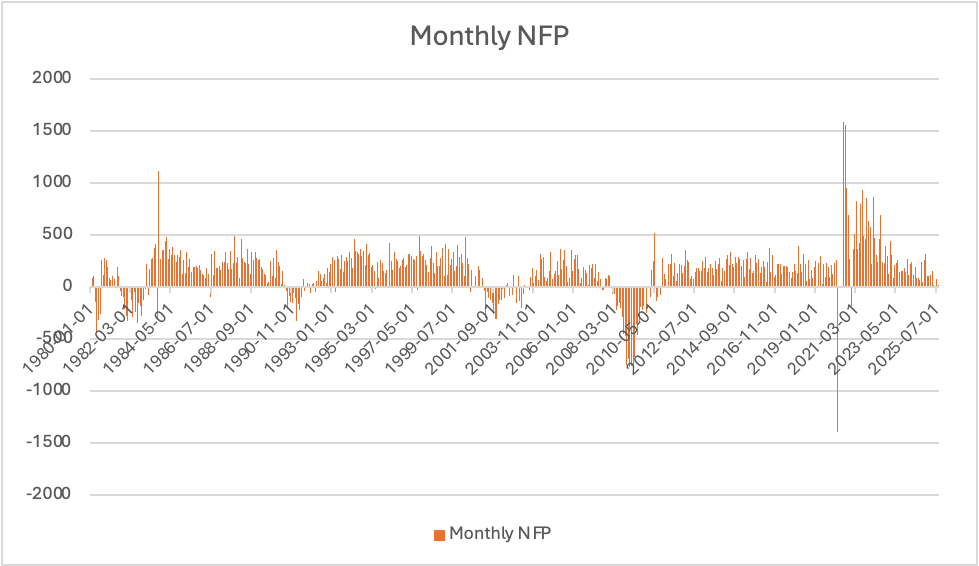
Below is a graphic history of NFP (data from FRED) having removed the Covid months given they really distorted the chart.

And below is a chart showing total payrolls (in 000’s) on the RHS axis with the % of total payrolls represented by the monthly change in NFP on the LHS.  Notice that almost the entire NFP series, as a %age of total employment, remains either side of 0 with only a few outcomes as much as even 0.5%.  My point is, perhaps the inordinate focus on this data point by markets and policymakers alike, has been misguided, especially as the accuracy of the initial releases seems to have worsened over time.  Maybe everybody will be able to figure out that they can still do their jobs even without this data.  (Ken Griffiin excepted. 🤣)

Food for thought.

Like swallows return
To Capistrano, Japan
Votes again this year


The other notable news story is tomorrow’s election in Japan’s LDP for president of the party and the likely next Prime Minister.  While there are technically 5 candidates, apparently, it is really between two, Sanae Takaichi, a former economic security minister and a woman who would be the first female PM in the nation’s history, and Shinjiro Koizumi, son of former PM Junichiro Koizumi, and a man who would become the nation’s youngest prime minister.  There are several others, but these are the front runners.  From what I gather, Takaichi-san is the defense hawk and the more conservative of the two, an updated version of Margaret Thatcher, to whom she will constantly be compared if she wins.  Meanwhile, Koizumi is more of the same they have had in the past.

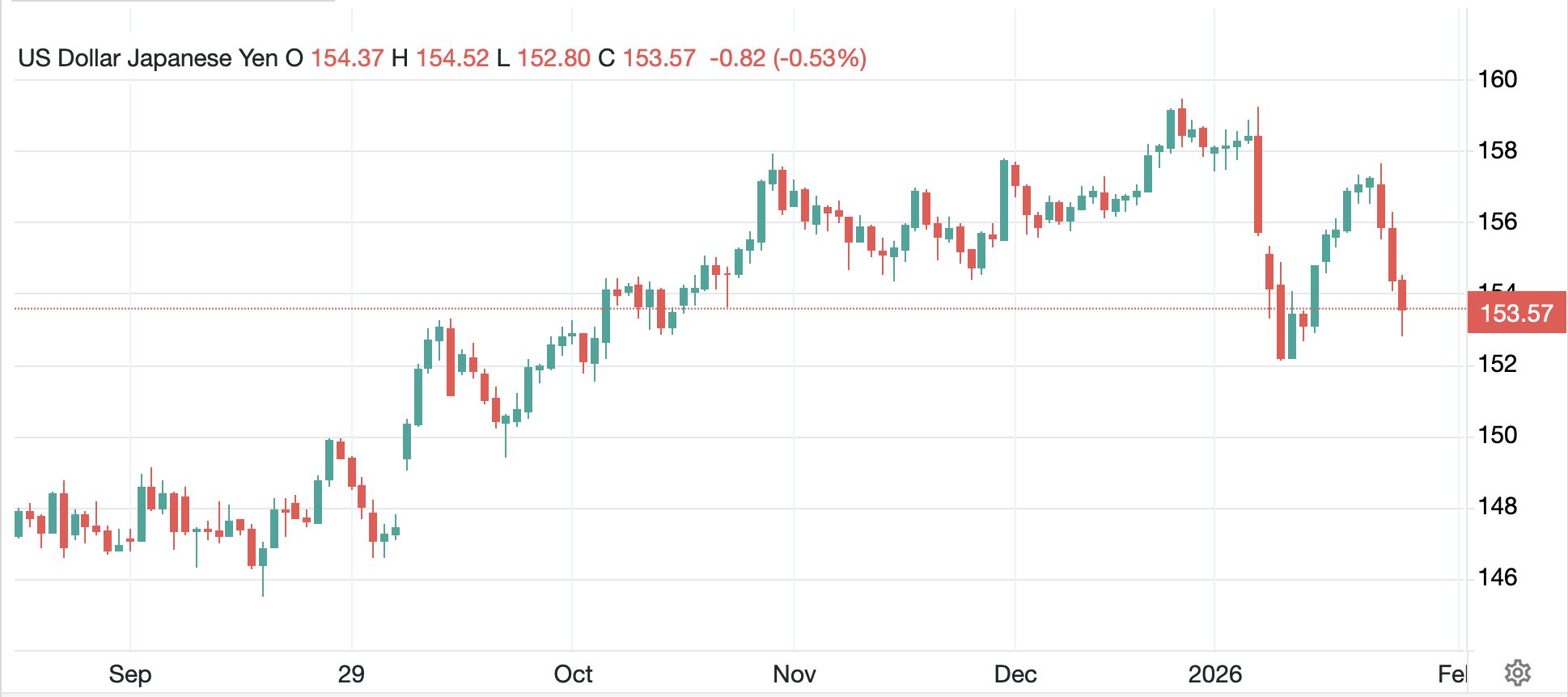
There are some analysts who are trying to make the case that this election has had a major impact on Japanese markets, and one might think that makes sense.  But if I look at USDJPY (0.0% today), as per the below chart, I am hard pressed to see that the election campaign has had any impact of note.

Source: tradingeconomics.com

If we turn to the Nikkei (+1.9%) which made a new high last night, it seems that is tracking US technology shares and is unconcerned over the election.  

Source: tradingeconomics.com

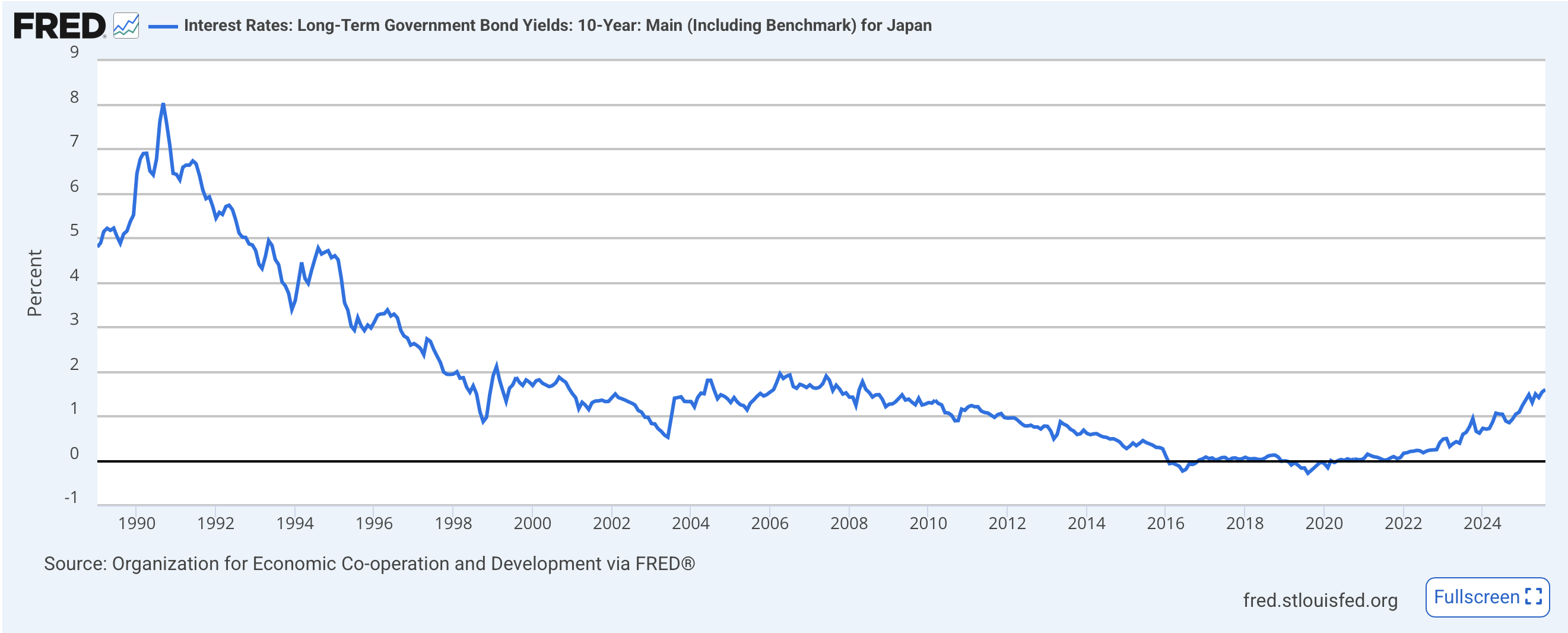
Arguably, if the equity market is forward looking (which I think is true) investors are indifferent to the next PM.  Finally, a look at JGBs shows that yields continue to climb there, albeit quite slowly, but consistently make new highs for the move and are back to levels last seen in 2008.

In fact, like almost everything since the GFC, perhaps the recent run of incredibly low yields in Japan is the aberration, not the rule!  But the argument for higher Japanese yields is more about the fact that inflation there is running at 3.5% and the base rate remains at 0.50%.  Investors remain concerned that the recent history of virtually zero inflation in Japan may be a thing of the past and so are demanding higher yields to hold Japanese debt.

I have no idea who will win this election, although I suspect that Takaichi-san may wind up on top.  But will it change the BOJ?  I don’t think so.  And the fact that the LDP does not have a working majority means not much may get done afterwards anyway.  All told, it is hard to be excited about holding yen in my eyes.

Ok, let’s look at the rest of the world quickly.  Despite a soft start, US equity markets managed to close in the green and this morning all three major indices are pointing higher by 0.25%.  Away from Japan, Chinese markets are closed for their holiday, and most of the rest of Asia followed the US higher, notably Korea (+2.7%) and Taiwan (+1.5%).  The only outlier was HK (-0.5%) which looked to be some profit taking after a sharp run higher in the past week.  In Europe, Spain (+0.8%) and the UK (+0.6%) are the best performers despite (because of?) slightly softer PMI Services data.  Either that, or they are caught up in the US euphoria.

The bond market saw yields slip a few basis points yesterday and this morning, while Treasury yields are unchanged at 4.08%, European sovereigns are sliding -1bp across the board.  I think the slightly softer data is starting to get some folks itching for another ECB rate cut, or at least a BOE cut.

In the commodity markets, oil (+0.4%) which continued to fall throughout yesterday’s session to just above $60/bbl, looks like it is trying to stabilize for now.  There continues to be discussion about more OPEC+ production increases, and it seems that whatever damage Ukraine has done to Russia’s oil infrastructure is not considered enough to change the global flows.  As to the metals, gold (+0.2%) and silver (+1.2%) absorbed a significant amount of selling yesterday in London, which may well have been one account, as they reversed course late morning and have been climbing ever since.  Copper (+1.1%) is also pushing higher and the entire argument about the defilement of fiat currencies remains front and center.  I guess JP is now calling it the debasement trade as Gen Z, if I understand correctly, is selling other assets and buying a combination of gold and bitcoin.

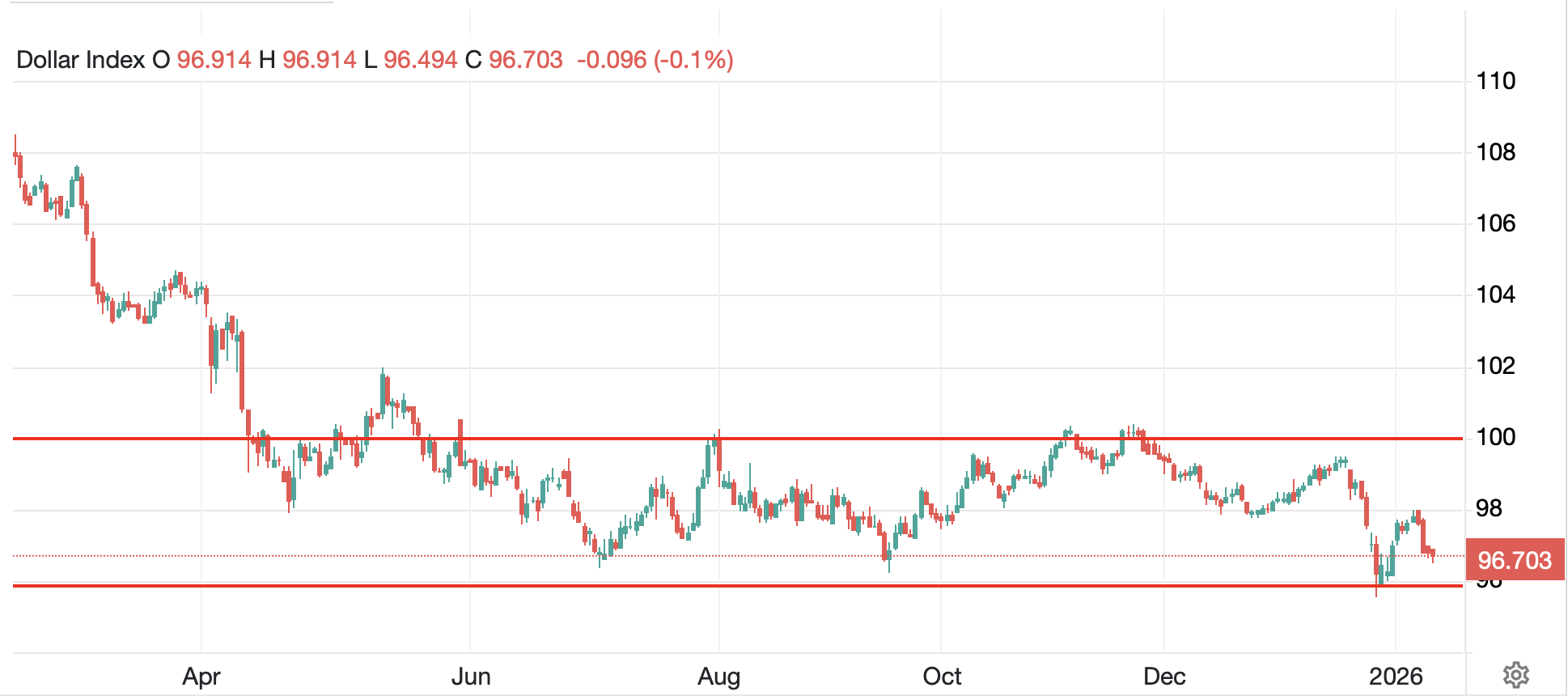
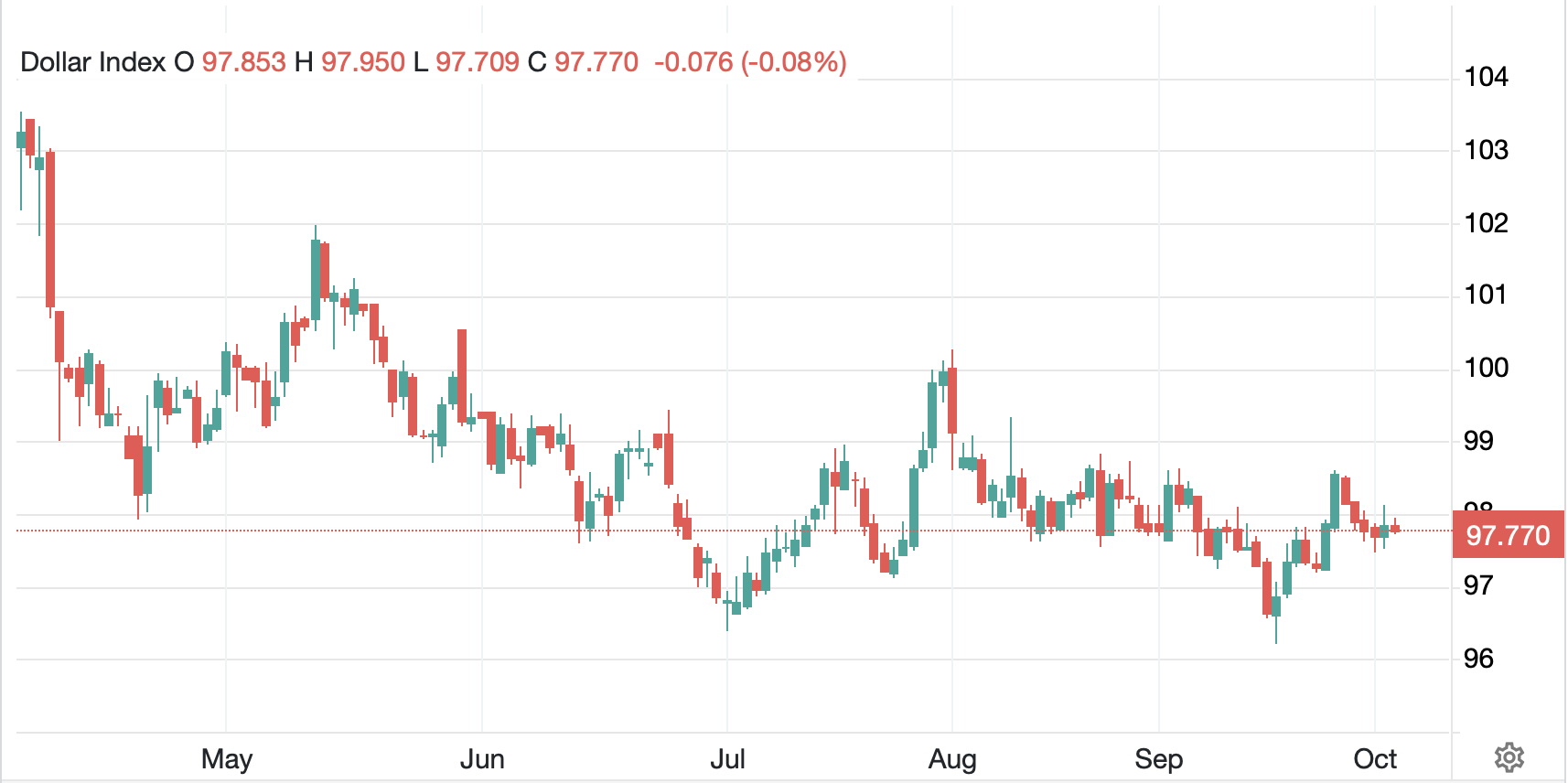
Finally, the dollar is…the dollar.  Back on April 20, DXY was at 98.08.  This morning it is 97.75.  look at the chart below from tradingeconomics.com and tell me you can get excited about any movement at all.  We will need a major outside catalyst, I believe, to change any views and right now, I see nothing on the horizon.

And that’s really all there is.  We do get ISM data this morning as it’s privately compiled and released (exp 51.7) and Fed speakers apparently will never shut up.  What is interesting there is that Lorrie Logan, Dallas Fed president, has come out much more hawkish than some of her colleagues.  That strikes me as a disqualification for being elevated to Fed chair.

I continue to read lots of bear porn and doom porn, and it all sounds great and markets clearly don’t care.  The government shutdown has been irrelevant and that should make a lot of people in Washington nervous given this administration.  President Trump has been angling to reduce government, and if it is out of action and nobody notices, it will make his job a lot easier.  But for now, nothing stops this train with higher risk assets the way forward.

Good luck and good weekend

Adf

Savants Disagree

The Senate completed their vote
And so, BBB, though there’s bloat
Will soon become law
As Dems say pshaw
While lacking a doctrine, keynote
 
So, eyes now turn to NFP
The key for the FOMC
The JOLTs showed that gobs
Of ‘vailable jobs
Exist, though savants disagree


Market activity continues to demonstrate lower volumes and despite several competing political narratives, price action remains muted overall.  The biggest news of late is the Senate passed their version of President Trump’s BBB last night and now it goes to committee for reconciliation before getting to the president for signing.  Of course, given the mainstream media’s complete antagonism toward the president, the headlines this morning refer to the problems the Republicans will have agreeing terms between the two houses, and I’m sure it will be difficult.  However, based on everything that President Trump has done to date, I expect it will get completed.  While perhaps not by Friday, probably by next week.

This matters to markets because it will help set the tone for government spending and the potential companies that will benefit, as well as those that will be negatively impacted, based on the change in focus from that of the Biden administration.  

At this point, it is impossible to forecast with any certainty how things will evolve, especially with respect to issues like the budget deficit and debt issuance.  While yesterday, Treasury Secretary Bessent did explain that they were going to continue to focus on short-term issuance, if (and it’s a big if) the bill does goose economic activity in the US, it is quite possible that faster GDP growth increases tax collections and reduces net government spending and the deficit.  I would estimate that view is not discounted at all in markets at this time given the constant messaging from media and the punditry that not only are people going to starve to death and lose their medical care because of this bill, but that it is unaffordable and will bankrupt the country.  Something tells me the results will be slow acting, although if the government does continue its deportations and stops subsidizing too-expensive green energy projects, we could see less government spending.  We shall see.

But markets need a focus and tomorrow’s NFP is as good as it gets.  Chairman Powell has been attending the ECB’s summer symposium and, in his speech, yesterday he essentially reiterated his views that the Fed will continue to watch and wait on rates as there is still concern that tariffs may drive inflation higher.  As to jobs, they are watching the situation closely, but thus far, the labor market has held up.  Proof of that idea was evident in yesterday’s JOLTs Job Openings data which showed a surprising jump of more than 300K new job listings available.  I haven’t seen a rationale yet, but perhaps it is related to the self-deportations by illegal immigrants who have left businesses with numerous vacancies.  The weekly claims data, while above its lowest levels lately, continues to run at very modest numbers on a long-term perspective as can be seen in the chart below with data from the Department of Labor.  If the job market holds up, I don’t see the Fed cutting rates despite President Trump’s ire.

Also, at Sintra was BOJ Governor Ueda who explained that Japanese policy rates were substantially lower than neutral and that inflation would likely continue creeping higher over time.  I guess we cannot be surprised that the yen (-0.5%) has slipped in the wake of those comments.  The final noteworthy comments from Sintra were from BOE governor Bailey who explained that despite sticky inflation, more rate cuts were on the way, helping to undermine the pound (-0.4%) this morning.

But there is one final thing to discuss regarding the Sintra meeting, and that is how many central bankers were suddenly concerned that their currencies were getting “too strong”!  We have been hearing about the dollar’s decline in the first half of the year as though it was a signal the US was in permanent decline.  Of course, given the nature of FX trading, a weaker dollar can also be seen as strength in other currencies. (To be clear, all fiat currencies continue to weaken vs. stuff as evidenced by the fact that inflation continues to be positive everywhere in the world, except perhaps Switzerland and China right now.)  However, I could not help but laugh at the ECB comments from several board members, that if the euro were to rise any further it could become a problem for the Eurozone economies.  All their models show that if a major export destination raises tariffs, their own currencies should decline to offset those tariffs.  Alas, once again, their models are not giving them answers that reflect the reality in markets.  And given Europe has built their economies on export reliance, a strong currency is a problem.

We must distinguish between a stronger exchange rate and a strong case to own a currency, especially as a reserve asset, but the two have historically been highly correlated.  As I have repeatedly explained, the dollar’s decline this year is neither anomalous nor particularly large in the broad scheme of things.  As well, it is exactly what the administration is seeking as it helps the competitiveness of US companies on the world stage.  However, my take is that at some point soon, the dollar will find a bottom.  I indicated a move to 90 on the DXY would be possible, and I think that is probably still true, although given the growing net short positions in USD vs. other currencies, the short squeeze will be spectacular when it arrives!

Ok, let’s see if we can get through the overnight activity without falling asleep.  Yesterday’s mixed US session was followed by a mixed session in Asia (Nikkei -0.6%, Hang Seng +0.6%, CSI 300 0.0%) with a mixture of modest gains and losses across the rest of the region, all on low volumes.  In Europe this morning, bourses are firmer led by the CAC (+1.1%) and Spain’s IBEX (+0.75%) as hopes for further rate cuts from the ECB dominate discussions.  As to US futures, they are modestly higher at this hour (7:30), about 0.15%.

In the bond market, after stronger than expected JOLTs data and ISM data, yields are backing up with Treasuries (+4bps) leading the way although both Germany (+5bps) and the UK (+6bps) are seeing selling pressure as well.  However, the rest of European sovereigns have only seen yields edge 1bp higher.  The only noteworthy comments I saw were from the Italian FinMin who explained Italy would be maintaining its fiscal prudence.  Not surprisingly, given Ueda-san’s comments, JGB yields rose 4bps overnight as well.

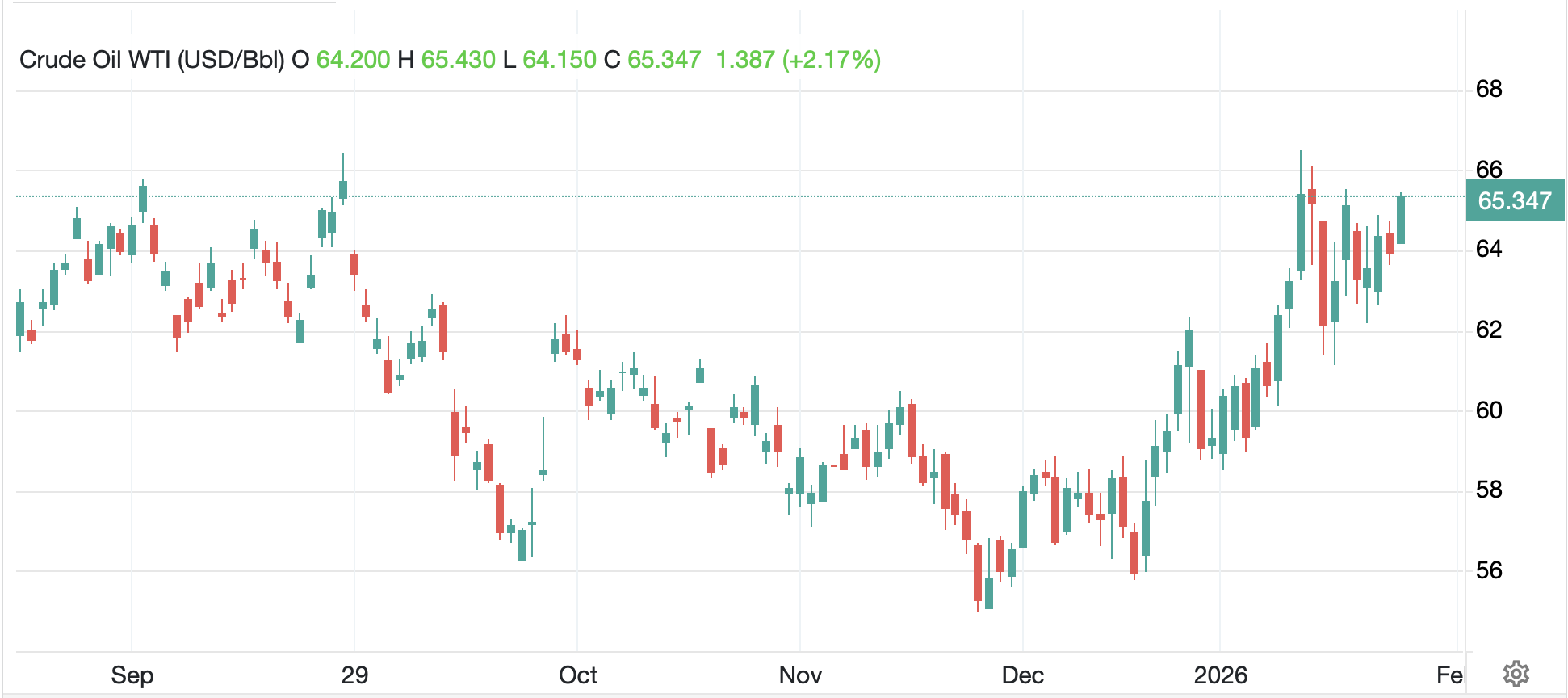
In the commodity space, oil (+1.25%) continues to drift higher as it tries to fill the gap seen last week.

Source: tradingeconomics.com

Apparently, the fact that supply seems to be rising rapidly has not dissuaded traders from the view that the ‘proper’ price range is $65-$75 rather than my belief of $50-$60.  But right now, they are looking smart.  In the metals markets, we continue to see support as the entire decline in the gold price at the end of June has been recouped and we are modestly higher this morning across all the metals (Au +0.1%, Ag +0.6%, Cu +0.4%, Pt +2.2%) with platinum merely showing its volatility due to lack of liquidity.

Finally, the dollar is firmer this morning against every one of its G10 and major EMG counterparts with the euro and pound (both -0.4% now) setting the tone.  Perhaps the best performer this morning is INR (-0.1%) which seems to be benefitting from the news that a trade deal is almost complete there.  As to trade with the Eurozone, that deal seems a bit further away, although I did see something about a European recognition that US tariffs would be, at a minimum, 10%.  At least for today, I haven’t read anything about the dollar’s ultimate demise!

On the data front, today brings ADP Employment (exp 95K) and then the EIA oil inventory data.  There are no Fed speakers either, so quite frankly, absent something newsworthy from DC, I suspect this will be a quiet session ahead of tomorrow’s NFP.  I guess the dollar is not dead yet.

Good luck

Adf

Gnashing and Wailing

The narrative writers are failing
To keep their perspectives prevailing
They want to blame Trump
But if there’s no slump
They’ll find themselves gnashing and wailing
 
Economists have the same trouble
‘Cause most of their models are rubble
The change that’s been wrought
Requires more thought
Than counting on one more Fed bubble


Investors seem to be growing unhappier by the day as so many traditional signals regarding market movement no longer appear to work.  Nothing describes this better, I think, than the fact that forecasts for 10-year Treasury yields by major banks are so widely disparate.  While JPMorgan is calling for 5.00% by the end of the year, Morgan Stanley sees 2.75% by then.  What’s the right position to take advantage of that type of knowledge and foresight?

One of the most confusing things over the past months, has been the growing dichotomy between soft, survey data and hard numbers.  But even here, it is worth calling into question what we are learning.  For instance, this week we will see the NFP data along with the overall employment report.  That data comes from the establishment survey.  It seems that just 10 years ago, more than 60% of companies reported their hiring data.  Now, that is down to ~43%.  Does that number have the same predictive or explanatory power that it once did?  It doesn’t seem so.

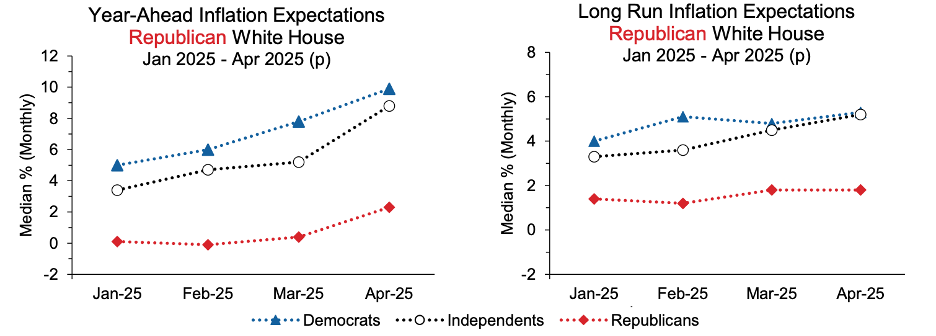
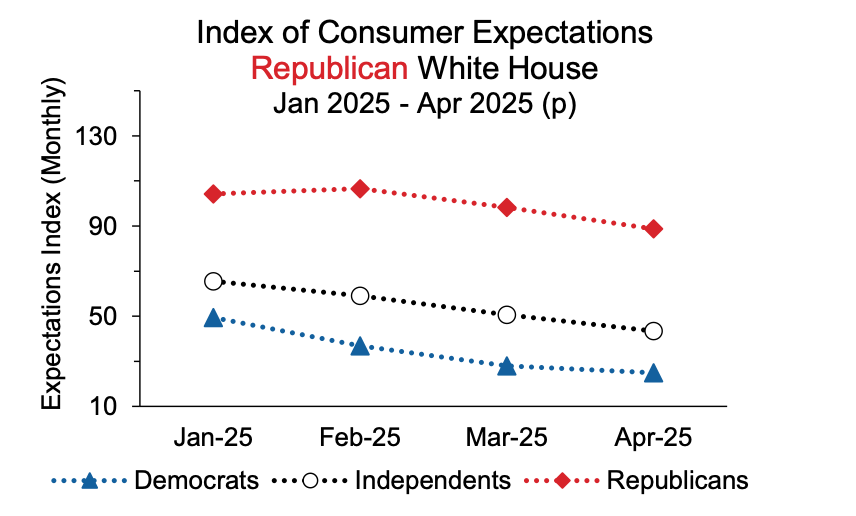
Too, if we consider the Michigan Sentiment data, it has become completely corrupted by the political angle, with the current situation being Democrats answering the survey anticipate high inflation and weak growth while Republicans see the opposite.  Is that actually telling us anything useful from an economic perspective let alone a market perspective?  (see charts below from sca.isr.unmich.edu)

But this phenomenon is not merely a survey issue, it is an analysis issue.  At this point, I would contend there are essentially zero analysts of the US economy (poets included) who do not have a political bias built into their analysis and forecasts.  Consider that if you are in a good mood generally, then your own perspective on things tends to be brighter than if you are in a bad mood.  Well, expand that on a political basis to, if you are a Democrat, President Trump has been defined as the essence of evil and therefore your viewpoint will see all potential outcomes as bad.  If you’re a Republican, you will see much better potential.  It is who we are and has always been the case, but it appears a combination of President Trump and social media has pushed this issue to heretofore unseen extremes.

There are two problems with this.  First, for most consumers of financial information, the decision matrix is opaque.  Who should you believe?  But perhaps more concerningly, as evidenced by the decline in the response rate to hard data, for policymakers like the Fed and Treasury, what should they believe?  Are they receiving accurate readings of the economic realities on the ground?  Is the job market as strong (or weak) as currently portrayed?  Is the uncertainty in ISM data a result of political bias?  And if politics is an issue in these situations, who is to say that answers to questions will be fact-based rather than crafted to present a political viewpoint?

I would contend that the reason the narrative is breaking down everywhere is that the willingness of investors, as well as the proverbial man on the street, to listen to pronouncements from on high has diminished greatly.  After all, the mainstream media, which had always been the purveyor of the narrative, or at least its main amplifier, has lost its luster.  Or perhaps, they have lost all their credibility.  Independent media, whether on X, Substack or simply blogs that are posted all over the internet, have demonstrated far more clarity and accuracy of situations than anything coming from the NYT, WSJ, BBG or WaPo, let alone the TV “news” programs.

We are on our own to determine what is actually happening in the world, and that is true of how markets will perform going forward.  I have frequently written that volatility is going to be higher going forward across all markets.  President Trump is the avatar of volatility.  As someone whose formative years in trading were in the mid 80’s, when inflation was high, and Paul Volcker never said a word to anyone about what the Fed was doing (and even better, nobody even knew who the other FOMC members were), the best way to thrive is to maintain modest positions with limited leverage.  The time of ZIRP and NIRP will be seen as the aberration it was.  As it fades, so, too, will the ability to maintain highly levered positions because any large move can be existential.

With that cheery opening, let’s take a look at what has happened overnight.  Friday’s US session was not very noteworthy with mixed data leading to mixed results but no real movement.  Alas, things have taken a turn lower since then.  Asian markets were weaker overnight (Nikkei -1.3%, Hang Seng -0.6%, CSI 300 -0.5%) with most other regional markets having a rough go of things as well.  Concerns over further tariffs by the US (steel tariffs have been raised to 50%) and claims by both sides of the US – China trade debate claiming the other side has already breached the temporary truce have weighed on sentiment overall.  Meanwhile, PMI data from the region was less than inspiring with China, Korea, Japan and Indonesia all showing sub 50 readings for Manufacturing surveys.

In Europe, equity markets are also generally softer (DAX -0.5%, CAC -0.7%) although the FTSE 100 (0.0%) has managed to buck the trend after data this morning showed Housing Prices firmed along side Credit growth.  As investors await the US ISM/PMI data, futures are pointing lower across the board, currently down around -0.4% at 7:15.

In the bond market, yields all around the world are backing up with Treasuries (+3bps) bouncing off the lows seen on Friday, although remaining below 4.50%, while European sovereigns have climbed between 3bps and 4bps across the board.  JGB’s overnight (+2bps) also rose, although the back end of that curve saw yields slip a few bps.  It seems the world isn’t ending quite yet, although there does not seem to be any cure for government spending and debt issuance anywhere in the world.

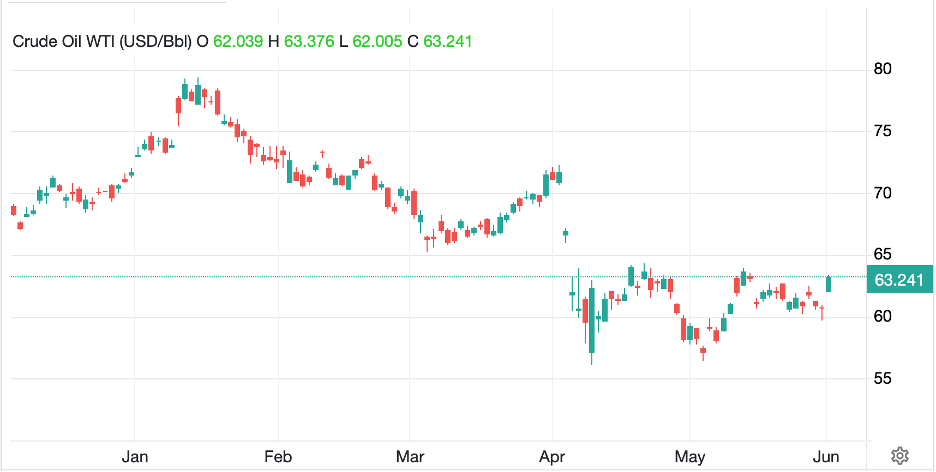
Commodity prices, though, are on the move as it appears investors are interested in acquiring stuff that hurts if you drop it on your foot.  Gold (+1.85%), silver (+0.9%) and copper (+3.6%) are all in demand this morning, the latter ostensibly benefitting from fears that the US will impose more tariffs on other metals thus driving prices higher.  But the real beneficiary overnight has been oil (+4.0%) which rose on the back of an intensification of the Russia – Ukraine war as well as the idea that OPEC+ ‘only’ raised production by 411K barrels/day, less than the whisper numbers of twice that amount.  As I watch the situation in Ukraine, it appears to have the hallmarks of an imminent peace process as both sides are pulling out all the stops to gain whatever advantage they can ahead of the ceasefire and both recognizing that the ceasefire is going to come soon.  But despite the big jump in the price of WTI, you cannot look at the chart below and expect a breakout in either direction.  If I were trading this, I would be more likely to fade the rally than jump on board the rise.

Source: tradingeconomics.com

Finally, the dollar is under the gun this morning, falling against pretty much all its major counterparts.  Both the euro (+0.7%) and pound (+0.6%) are having strong sessions although JPY (+1.0%) and NOK (+1.3%) are leading the way in the G10.  NOK is obviously benefitting from oil’s rally, while there remains an underlying belief that Japanese investors are slowing their international investments and bringing money home.  Now, the ECB meets this week and is widely anticipated to be cutting rates 25bps, but my take is, today is a dollar hatred day, not a euro love day.  As to the EMG bloc, gains are evident across regions with CZK and HUF (both +1.0%) demonstrating their beta to the euro although PLN (+0.5%) is lagging after the presidential election there disappointed the elites with the Right leaning candidate winning the job and likely frustrating Brussels in their attempts to widen the war in Ukraine.  In Asia, CNY (+0.1%) was relatively quiet but KRW (+0.5%), IDR (+0.8%) and THB (+0.9%) all benefitted from that broad dollar weakness.  So, too, did MXN (+0.65%) although BRL has not participated.

There is plenty of data this week culminating in the payroll report on Friday.

TodayISM Manufacturing49.5
 ISM Prices Paid70.2
 Construction Spending0.3%
TuesdayJOLTS Job Openings7.1M
 Factory Orders-3.0%
 -ex Transport0.2%
WednesdayADP Employment115K
 BOC Rate Decision2.75% (current 2.75%)
 ISM Services52.0
 Fed’s Beige Book 
ThursdayECB Rate Decision2.00% (current -2.25%)
 Initial Claims235K
 Continuing Claims1910K
 Trade Balance-$94.0B
 Nonfarm Productivity-0.7%
 Unit Labor Costs5.7%
FridayNonfarm Payrolls130K
 Private Payrolls120K
 Manufacturing Payrolls-1K
 Unemployment Rate4.2%
 Average Hourly Earnings0.3% (3.7% Y/Y)
 Average Weekly Hours34.3
 Participation Rate62.6%
 Consumer Credit$10.85B

Source: tradingeconomics.com

In addition, we hear from four more Fed speakers over five venues.  The thing about this is they continue to discuss patience as the driving force, except for Governor Waller, who explained overnight that he could see rate cuts if inflation stays low almost regardless of the other data.

The trade story remains the topic of most importance in most eyes it seems, although it remains a mystery where things will wind up.  The narrative is lost for all the reasons above, but I will say that it appears risk aversion is today’s theme.  The new part is that the dollar is considered a risk asset.  

Good luck

Adf

Havoc the Dollar Will Wreak

Apparently, President Xi
Is starting to listen to me 🤣
His currency’s falling
As he stops forestalling
The weakness in his renminbi
 
But it’s not just yuan that is weak
The havoc the dollar will wreak
Is set to keep growing
As funds keep on flowing
To US investments, still chic


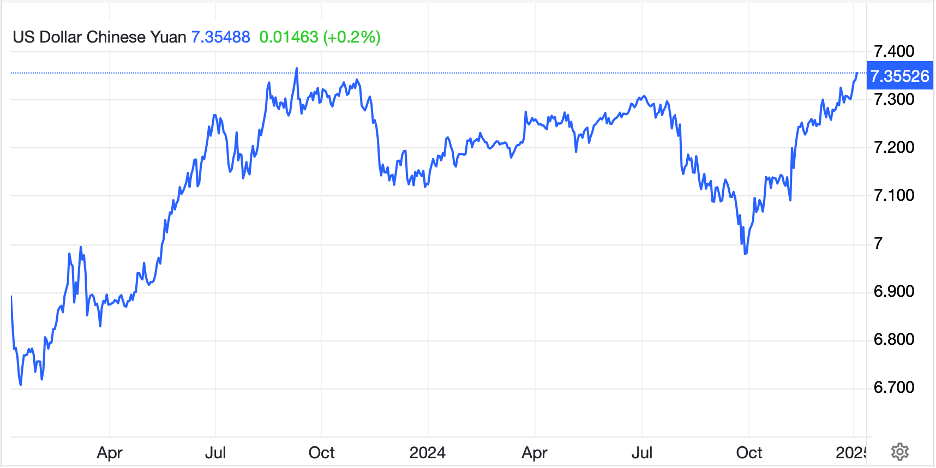
It seems that one of President Xi Jinping’s New Year’s resolutions was to finally allow the renminbi to resume its longer-term decline.  While 7.30 has been the line in the sand for a while, as can be seen from the first chart below, suddenly, as the calendar page turned to 2025, it appears that the PBOC is going to allow for the renminbi to weaken further.  Thus far, the PBOC has been adamant about fixing the Chinese currency at levels much stronger than anyone wants to pay for it, and even last night that was the case, with a fixing rate of 7.1878.  However, while the onshore market must trade within +/- 2% of that fixing rate, no such restriction limits the offshore market, and this morning, the offshore renminbi is trading 2.3% weaker than the fixing, above 7.35 to the dollar.

Much has been made of the “chess” moves that are ongoing between the US and China regarding currency policy with many pundits blankly claiming that if Trump is to impose the threatened tariffs, the renminbi will simply weaken to offset them.  However, while I do believe the CNY has much further to fall, that is not the driving case I see.  Rather, Xi’s problem is that his economy is not in nearly as good condition as he needs it to be and confidence in the consumer sector continues to wane.  This is largely a result of the ongoing destruction of the property bubble that was blown for decades.

Remember, Chinese investors have tied up significant personal wealth in second and third homes as stores of value.  This was encouraged as cities could sell property to developers, get paid a bunch to help finance their operations, and since demand was so high, prices kept rising so everyone was happy.  Alas, as with all bubbles (I’m looking at you, too, NASDAQ) eventually the air comes out.  For the past three years the Chinese have been trying to deal with this collapsing property market, but house prices continue to decline thus reducing investor wealth and confidence.  I read that there are an estimated 80 million empty homes that have been built over the past decades and are now in disrepair in the countryside.  These are the ghost cities that were all part of the Chinese growth miracle, but in fact were simply massive malinvestment.

While the prescription for China has long been to increase its consumer sector of the economy, Xi and his minions at the central committee have no idea how to do that (given they are communist, this is not that surprising) and so continue to support the means of production.  The problem is they have now seemingly gone too far in that space as well with not merely the Western world, but also much of the developing world starting to push back on all the excess stuff that is coming from China.  

Xi’s other problem is that as he rails against the dollar and seeks others to use the renminbi in their trade, if the currency starts to fall sharply, that will be a difficult ask.  Given the US FX policy remains benign neglect, it is entirely upon China to solve their own problems.  While it is unlikely to happen in a big devaluation a la August 2015, weakness is the trend to bet here this year.

Source: tradingeconomics.com

Source: tradingeconomics.com

Away from that news, though, the year is starting off in a fairly modestly.  Most of the world’s focus is on the upcoming Trump inauguration as well as the political machinations that will begin today as Trump’s Cabinet nominees start to go through their paces in front of the Senate.  New Year’s Eve’s horrifying terrorist attack in New Orleans has just upped the ante with respect to Trump getting his picks through the process.  

So, let’s review the overnight market activity to get a sense of what today could bring.  The first day of the US trading year resulted in modest declines across the board in equities, although as I type (7:30), they appear to be retracing those losses and are slightly higher.  The bigger news was from Asia where both the Nikkei (-1.0%) and CSI 300 (-1.2%) showed weakness with the former feeling the pain of some profit taking after gains last week, although Chinese shares seem to be succumbing to the troubles I have described above.  Elsewhere in the region there was no consistency with gainers (Hong Kong, Taiwan, Korea and Australia) and losers (India, New Zealand, Malaysia) with other exchanges little changed.  In Europe this morning, there is more red than green with the CAC (-0.8%) the biggest laggard amid concerns over the fiscal situation in France.  But the DAX (-0.35%) and FTSE MIB (-0.45%) are also lagging with only Spain’s IBEX (0.0%) bucking the trend.

In the bond market, Treasury yields have slipped 2bps this morning, but remain above 4.50%, something that continues to vex Chairman Powell as he and the Fed seemed certain that by cutting the Fed funds rate, he would drive the entire yield curve lower.  I wonder if he will learn this lesson about the relation between a made-up rate (Fed funds) and market rates (bond yields) anytime soon.  In Europe, French yields are 2bps higher, widening their spread vs. German bunds and perhaps more remarkably, at least from a nominal perspective, well above Greek government bond yields now! (Remember, there are far fewer GGB’s around than OAT’s so there is a scarcity bid there). Certainly, Madame Lagarde must be getting a bit concerned over her native nation’s profligacy and I suspect that the fiscal ‘need’ for lower Eurozone interest rates is one of the features of the discussion regarding the ECB’s future path (lower).  As to JGB’s, they are unchanged, sitting at 1.07% and showing no sign of rising anytime soon.  One last thing, Chinese 10yr bonds now yield a new record low of 1.61%, 2bps lower on the day and pretty convincing evidence that not all is well in the Middle Kingdom’s economy.

On the commodity front, oil (-0.2%) is consolidating yesterday’s strong gains which were ostensibly based on the idea that President Xi will successfully implement more stimulus and aid growth in China.  History shows otherwise, but we shall see.  Gold (-0.1%) is also consolidating yesterday’s strong gains as it appears there has been renewed central bank buying activity to start the year.  The other metals also benefitted yesterday with silver (+0.8%) continuing this morning.

Finally, the dollar is retracing some of yesterday’s gains but remains much stronger than we saw just last week, and certainly since the last time I wrote.  Looking at the Dollar Index, it is hovering near 109 this morning, having traded well above that yesterday afternoon.  The next obvious technical target is 112, about 3% higher and there are now many calls for a test of the 2002 highs of 120.  I assure you, if the DXY gets to those levels, EMG currencies are going to come under a great deal of pressure.  As an example, we already see several EMG currencies (CLP, BRL) trading at or near all-time lows (dollar highs) and there is nothing to think this will change soon.  As well, check out the euro at 1.03 this morning, which while 0.3% higher on the session, appears as though it could well test those October 2022 lows (dollar highs) sooner rather than later, especially if the ECB continues to lean more dovish than the Fed.  If you are a receivables hedger, currency puts seem like a pretty good idea these days.

On the data front, ISM Manufacturing (exp 48.4) and Prices Paid (51.7) are all we have today and late this morning Richmond Fed president Barkin speaks.  Interestingly, tomorrow evening and Sunday we hear from SF Fed President Daly and tomorrow evening Governor Kugler will be joining Daly.  I guess they can’t go but so long without hearing their voices in the echo chamber!

There is nothing to suggest that the dollar, while modestly softer today, is set to turn around soon.  Keep that in mind.

Good luck and good weekend

Adf

Full Throat

The news cycle’s still ‘bout the vote
With Harris and Trump in full throat
‘Bout why each should be
The one filled with glee
When voters, to prez, they promote
 
Meanwhile, out of China we hear
More stimulus is coming near
The rumor is on
That ten trillion yuan
Is how much Xi’ll spend through next year


The presidential election continues to be the primary source of news stories and will likely remain that way until a winner is decided.  The vitriol has increased on both sides, and that is unlikely to stop, even after the election as neither side can seem to countenance the other’s views on so many subjects.  

As we watch Treasury yields continue to rise, many are ascribing this move to the recent polls that show former President Trump gaining an advantage.  The thesis seems to be that his proffered plans will increase the budget deficit by more than Harris’s proffered plans, but I find all this a bit premature as budget deficits are created by Congress, not presidents, so the outcome there will have a significant impact on the budget.  With that in mind, though, if we continue to see the yield curve steepen as long-end rates rise, my take is the dollar will continue to perform well.

But the election is still a week away and while there is no new data of note today, we do see important numbers starting tomorrow.  In the meantime, one of the big stories is that the Chinese National People’s Congress is now considering a total stimulus package of CNY 10 Trillion to help support the economy, and that if Trump wins, that number may grow larger under the assumption that he will make things more difficult for the nation.  This report from Reuters indicates that there would be a lot of new debt issuance to help support local governments repay their current borrowings as well as support the property market.  

Now, this is very similar to what was reported last week, although the totals are larger, but there is nothing in the story indicating that President Xi is going to give money to citizens, nor focus on new production.  This all appears to be an attempt to clean up the property market mess (remember, most local government debt problems are a result of the property debacle as well), which while necessary is not sufficient to get China back to its pre-pandemic growth trend.

As it happens, this story did not print until after the Chinese equity markets closed onshore, so the CSI 300’s decline of -1.0% has been reversed in the futures aftermarket.  As well, given that Hong Kong’s market doesn’t close until one hour later, it had the opportunity to rebound before the close and finished higher on the day by 0.5%.  As to the rest of Asia, it mostly followed the US rally from yesterday with the Nikkei (+0.8%) performing well and gains seen across virtually all the other markets there.

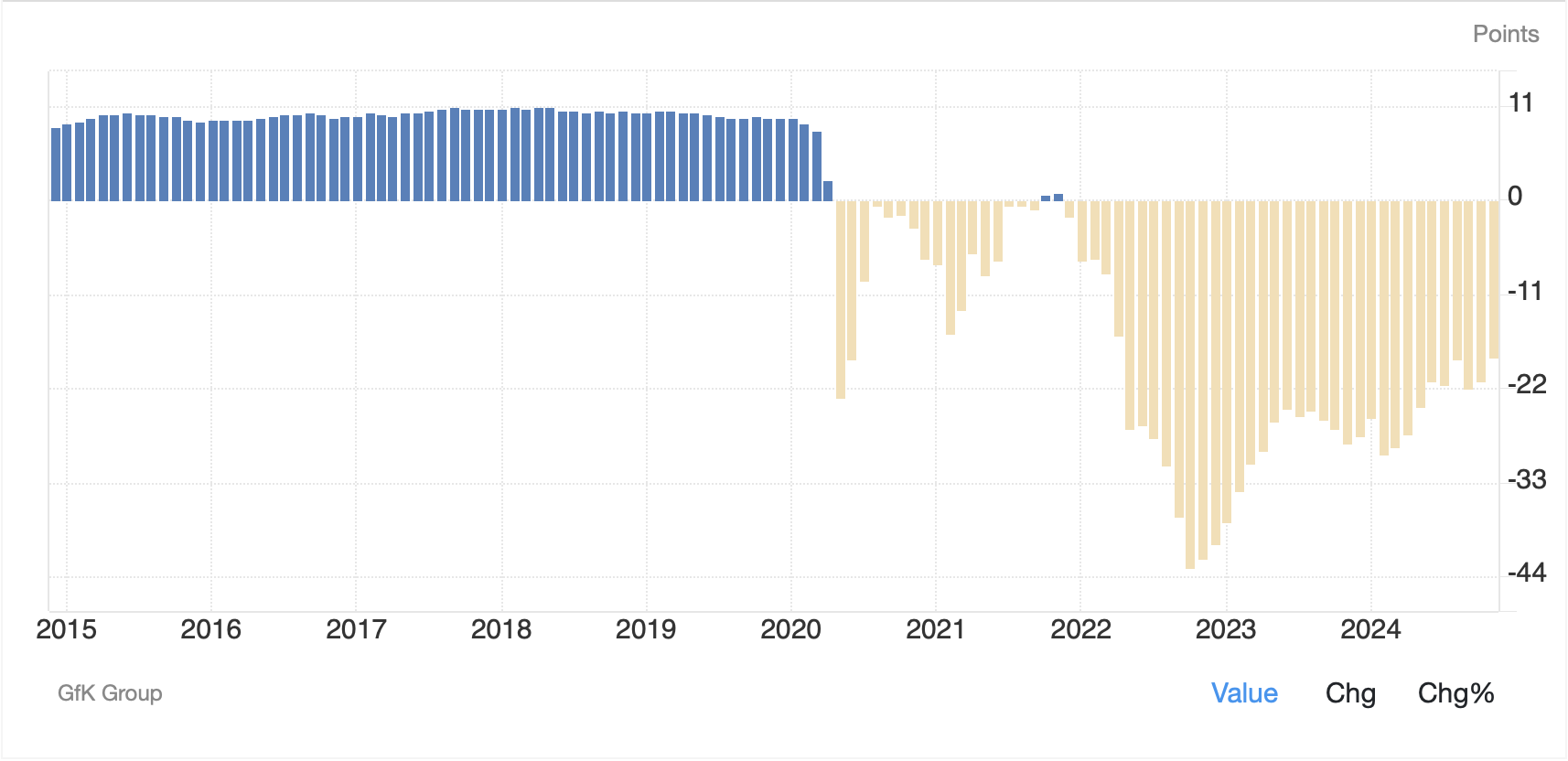
Turning to Europe, the only data of note was the German GfK Consumer Confidence index which rose to -18.3.  While this was better than last month and better than expected, a little perspective is in order.  Here is the series over the past ten years.

Source: tradingeconomics.com

While it seems clear that consumers are feeling a bit more confident than they have in the past year, ever since the pandemic, the German consumer has been one unhappy group!  And the other story from Germany this morning helps explain their unhappiness.  VW is set to close at least 3 factories and reduce wages by 10% as they try to compete more effectively with Chinese EV’s.  I can only imagine how confident that will make the people of Germany!

Now, the interesting thing about confidence is that while it offers a view of the overall sentiment in markets, it doesn’t really correlate to any specific market moves.  For instance, the euro (-0.2%) remains rangebound albeit slightly lower this morning, while the DAX (+0.25%) has actually rallied a bit, although that is likely on the basis of the VW news helping to convince the ECB that they need to cut rates further and faster.  In fact, most European bourses are firmer this morning on the lower rate thesis I believe, although Spain’s IBEX (-0.25%) is lagging after some moderately worse earnings news from local companies.

Turning to the commodities sector, it should be no surprise that they are higher across the board as the combination of proposed Chinese stimulus and potential future inflation in the US based on a possible Trump victory (although there is nothing in the Harris policies that seem likely to reduce inflation) means that commodities remain a favored outlet for investors.  After a couple of days of choppiness, we are seeing oil (+1.2%) rise nicely (perhaps the decline was a bit overdone on position adjustments) and the metals complex rise as well (Au +0.3%, Ag +1.3%, Cu +1.1%) as all three will benefit from all the new spending that is likely to occur in the US as well as China.  

One other thing to note, which disappointed the gold bulls, as well as the dollar bears, is that the BRICS meeting in Kazan, Russia resulted in…nothing at all regarding a new currency to ‘challenge’ the dollar.  Toward the bottom of their proclamation, they indicated they would continue to look for ways to work more closely together, but there is nothing concrete on this subject.  As I have been writing for the past several years, and paraphrasing Mark Twain, rumors of the dollar’s demise have been greatly exaggerated.  So, there will be no BRICS currency backed by gold or anything else, no new payment rails and Treasuries are going to remain the haven asset of choice alongside gold.

As to the dollar vs. its other fiat counterparts, it is a bit stronger this morning alongside US yields (Treasuries +3bps) with even the commodity bloc having difficulty gaining ground.  Of note is USDJPY, which is higher by 0.35% and now firmly above 153.00.  Last night, we did hear our first bout of verbal concern from a MOF spokesman explaining they are watching the yen carefully.  I’m sure they are, but I believe they will be very reluctant to enter the market when US yields are rising, and the BOJ is not keeping pace.  In fact, while the November rate cut is baked in at this point, the probability of the Fed cutting in December continues to slowly decrease (now 71%).  If we see a good NFP number Friday, I would look for that to decrease more rapidly and the dollar to see another leg higher.

And that’s all the market stuff today.  On the data front, Case Shiller Home Prices (exp 5.1%) and the JOLTS Job Openings data (7.99M) are the major releases.  As well, the Treasury is auctioning 7-year Notes this morning after a tepid 2-year auction yesterday.  It is very possible investors are starting to get a bit nervous about the US fiscal situation and if that continues, the irony is that higher yields will beget a higher dollar despite the concerns.

It is difficult to get away from the election impact on markets, and it seems that as momentum for Trump builds, the market is going to continue to push yields and stocks higher with the dollar gaining ground alongside gold.  Go figure.

Good luck

Adf

A Brand-New World

Even in Japan
Incumbency is questioned
It’s a brand-new world


Yesterday’s elections in Japan brought about the downfall of yet another incumbent government as people around the world continue to demonstrate they are tired of the status quo.  Recently appointed PM, Shigeru Ishiba called for a snap election within days of his appointment following the resignation of previous PM Kishida on the heels of a funding scandal.  Ishiba’s idea was to receive a fresh mandate from the electorate so he could implement his vision.  Oops!  It turns out that his vision was not in sync with the majority of the population.  Ultimately, the LDP and its key ally, Komeito, won only 215 seats in the Diet (Japan’s more powerful Lower House), well below the 233 necessary for a majority and even further from the 293 seats they held prior to the election.  The very fact that this occurred in Japan, the most homogenous of G10 nations, is indicative of just how strong the anti-incumbent bias has grown and just how tired people are of current leadership (keep that in mind for the US election).

Now, turning to the market impact, the tenuous hold any government formed from these disparate results means that Japan seems unlikely to have a clear, coherent vision going forward.  One of the key issues was the ongoing buildup in defense expenditures as the neighborhood there increasingly becomes more dangerous.  But now spending priorities may shift.  Ultimately, as the government loses its luster and ability to drive decisions, more power will accrue to Ueda-san and the BOJ.  This begs the question of whether the gradual tightening of monetary policy will continue, or if Ueda-san will see the need for more support by living with more inflation and potentially faster economic growth.The yen’s recent decline (-0.25% today, -8.5% since the Fed rate cut in September) shows no signs of slowing down as can be seen from the chart below.  As the burden of policy activity falls to the BOJ, I expect that we could see further yen weakness, especially when if the Fed’s rate cutting cycle slows or stops as December approaches.  If this process accelerates, I suspect the MOF will want to intervene, but that will only provide temporary respite.  Be prepared for further weakness in the yen.

Source: tradingeconomics.com
 
This weekend’s Israeli response
To missile attacks from Iran-ce
Left bulls long of oil
In massive turmoil
As prices collapsed at the nonce

The other major market story this morning was the oil market’s response to Israel’s much anticipated retaliation to the Iranian missile barrage from several weeks ago.  The precision attacks on military assets left the energy sector untouched and may have the potential to de-escalate the overall situation.  With this information, it cannot be surprising that more risk premium has been removed from the price of oil and this morning the black, sticky stuff has fallen by nearly 6% and is well below $70/bbl.  This has led the entire commodity sector lower in price with not only the entire energy sector falling, but also the entire metals sector where both precious (Au -0.6%, Ag -0.9%) and base (Cu -0.2%, Al -1.1%) have given back some of their recent gains.  While declining oil prices will certainly help reduce inflationary readings over time, at least at the headline level, I do not believe that the underlying fundamentals have changed, and we are likely to continue to see inflation climb slowly.  In fact, Treasury yields (+3bps) continue to signal concern on that very issue.

Which takes us to the rest of the overnight activity.  Friday’s mixed session in NY equity markets was followed by a lot more green than red in Asia with the Nikkei (+1.8%) leading the way on the back of both lower energy prices and the weaker yen, while Chinese stocks (+0.2%) managed a small gain along with Korea (+1.1%) and India (+0.8%).  However, most of the other regional markets wound up with modest declines.  In Europe, mixed is the description as well, with the CAC (+0.25%) and IBEX (+0.4%) in good spirits while both the DAX and FTSE 100 (-0.1%) are lagging.  Given the complete lack of data, the European markets appear to be responding to ECB chatter, which is showing huge variety on members’ views of the size of the next move, and questions about the results of the US election, with President Trump seeming to gain momentum and traders trying to figure out the best way to play that outcome.  As to US futures, this morning they are firmer by 0.5% at this hour (7:20).

Although Treasury yields have continued their recent climb, European sovereign yields are a touch softer this morning, although only by 1bp to 2bps, as clarity is missing with respect to ECB actions, Fed actions and the US elections.  My sense is that we will need to see some substantial new news to change the current trend of rising yields for more than a day.

Finally, the dollar is net, a little softer today although several currencies are suffering.  We have already discussed the yen, and we cannot be surprised that NOK (-0.4%) is weaker given oil’s decline, but we are also seeing MXN (-0.3% and back above 20.00 for the first time since July) under pressure as that appears to be a response to a potential Trump electoral victory.  But elsewhere, the dollar is under modest pressure with gains on the order of 0.1% – 0.3% across most of the rest of the G10 as well as many EMG currencies.  There are precious few other stories of note this morning.

On the data front, it is a very big week as we see not only NFP data but also PCE data.

TuesdayCase-Shiller Home Prices5.4%
 JOLTS Job Openings7.99M
 Consumer Confidence99.3
WednesdayADP Employment115K
 Q3 GDP3.0%
ThursdayInitial Claims233K
 Continuing Claims1880K
 Personal Income0.2%
 Personal Spending0.4%
 PCE0.1% (2.1% Y/Y)
 Core PCE 0.1% (2.7% Y/Y)
 Chicago PMI47.5
FridayNonfarm Payrolls180K
 Private Payrolls160K
 Manufacturing Payrolls-35K
 Unemployment Rate4.2%
 Average Hourly Earnings0.3% (4.0% Y/Y)
 Average Weekly Hours34.2
 Participation Rate62.5%
 ISM Manufacturing47.5
 ISM Prices Paid48.2

Source: tradingeconomics.com

Of course, with the FOMC meeting next week, we are now in the Fed’s quiet period, so there will be no more official commentary.  The one thing to watch is if something unexpected occurs, then look for an article from the Fed whisperer, Nick Timiraos of the WSJ.  But otherwise, this is shaping up as a week that starts slowly and builds to the back half when the data comes.

Regardless of the election outcome, I expect that the budget situation will only devolve into greater deficits.  I believe that will weigh on the bond market, driving yields higher and for now, I think that will likely help the dollar overall, but not too much.  It remains difficult for me to see the dollar reverse course lower absent a much more aggressive FOMC, and that just doesn’t seem to be on the cards.

Good luck

Adf