
Not Blazing

Inflation was hot, but not blazing
And so, though I am paraphrasing
A 50 bip cut
Is most likely what
We’ll see next week, ain’t that amazing!
 
Though futures are not there quite yet
The Claims data’s seen as a threat
It’s been four long years
Since Claims caused such fears
Seems Trump, what he wants he will get


While I spent most of yesterday discussing the CPI data, which came out on the warm side of things with headline rising 0.4% M/M, a tick higher than forecast, although the Y/Y number at 2.9% was as expected, it seems far more attention than normal was paid to the Initial Claims data.  As it happens, the last time Initial Claims printed this high, 263K, was October 2021.
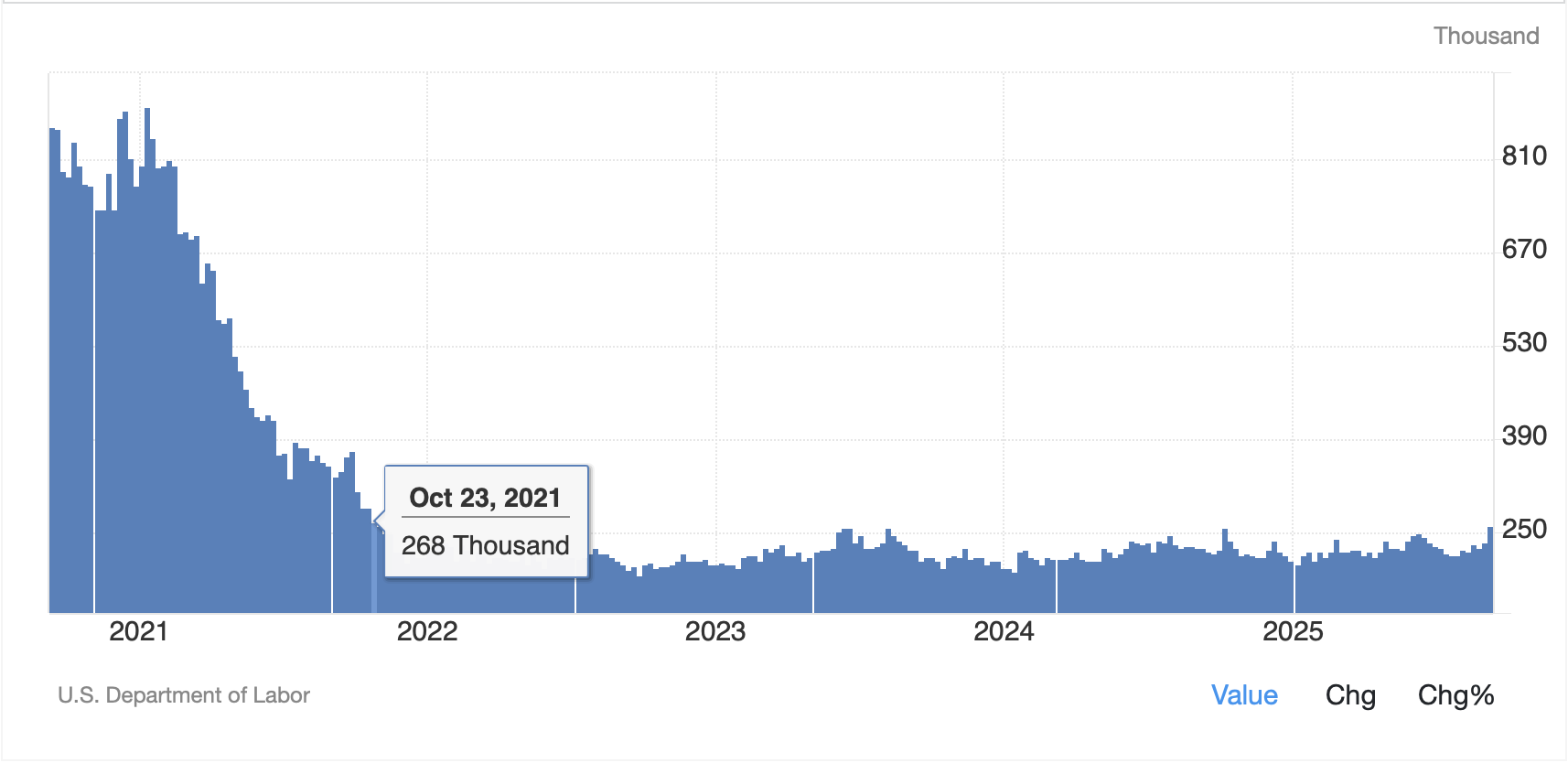
Source: tradingeconomics.com.

Now, we all remember last September, just prior to the Fed cutting 50bps in a surprise move, and as it happens, the Claims data the week before that jumped as well, a one-off blip to 259K.  Of course, the Fed felt it had a political imperative back then to cut as a means of supporting their preferred candidate for President, VP Harris, but that is another story.  Nonetheless, a precedent has been set that a strong claims number with inflation still warm was sufficient to get them to move.  So, will they cut 50bps next week?

Right now, the Fed funds futures market is still pricing just an 8% probability of that move, so apparently that is not the market perception.  However, this is exactly the time where we should be seeing an article from the Fed Whisperer, Nick Timiraos, at the WSJ (aka Nickileaks), which ought to explain that changes in the labor market are sufficient to overcome any concerns about inflation, especially since there is a growing expectation that a recession is coming.  Look for it on Monday.

But let us consider this for another moment.  Based on BLS data, the median reading for Initial Claims since January 1967 is 339K, far more than we saw yesterday.  In addition, if you look at a long-term chart of the Claims data, or even the shorter-term one above, while it is possible this is the beginning of a trend higher in Claims, there is no evidence yet for that, and blips higher are pretty common throughout the data set.
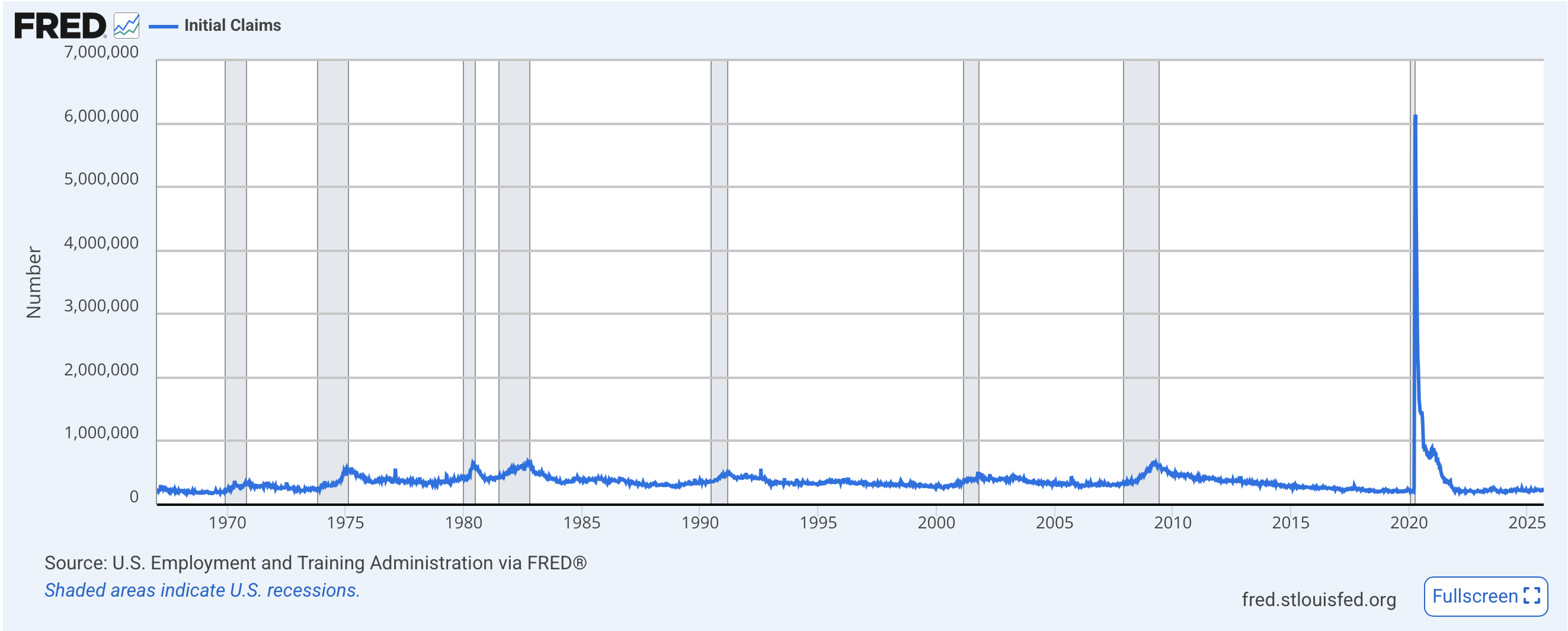
The one caveat here is that if we look at the recessions highlighted in gray in the above chart, the Claims data didn’t really rise until the end of the recession, so there is a chance that we are seeing the beginnings of bigger problems.  Certainly, if Claims data starts to climb further and we see 300K, there will be a stronger case to anticipate a recession.  But we haven’t yet seen that.  Alas, what we do know from Powell’s last press conference is that the Fed has basically abandoned their inflation target, so despite the fact it has been 54 months (February 2021) since core PCE has been at or below 2.0%, and even though the very idea that rate cuts are appropriate is remarkable, it seems the case for 50bps is strengthening.  
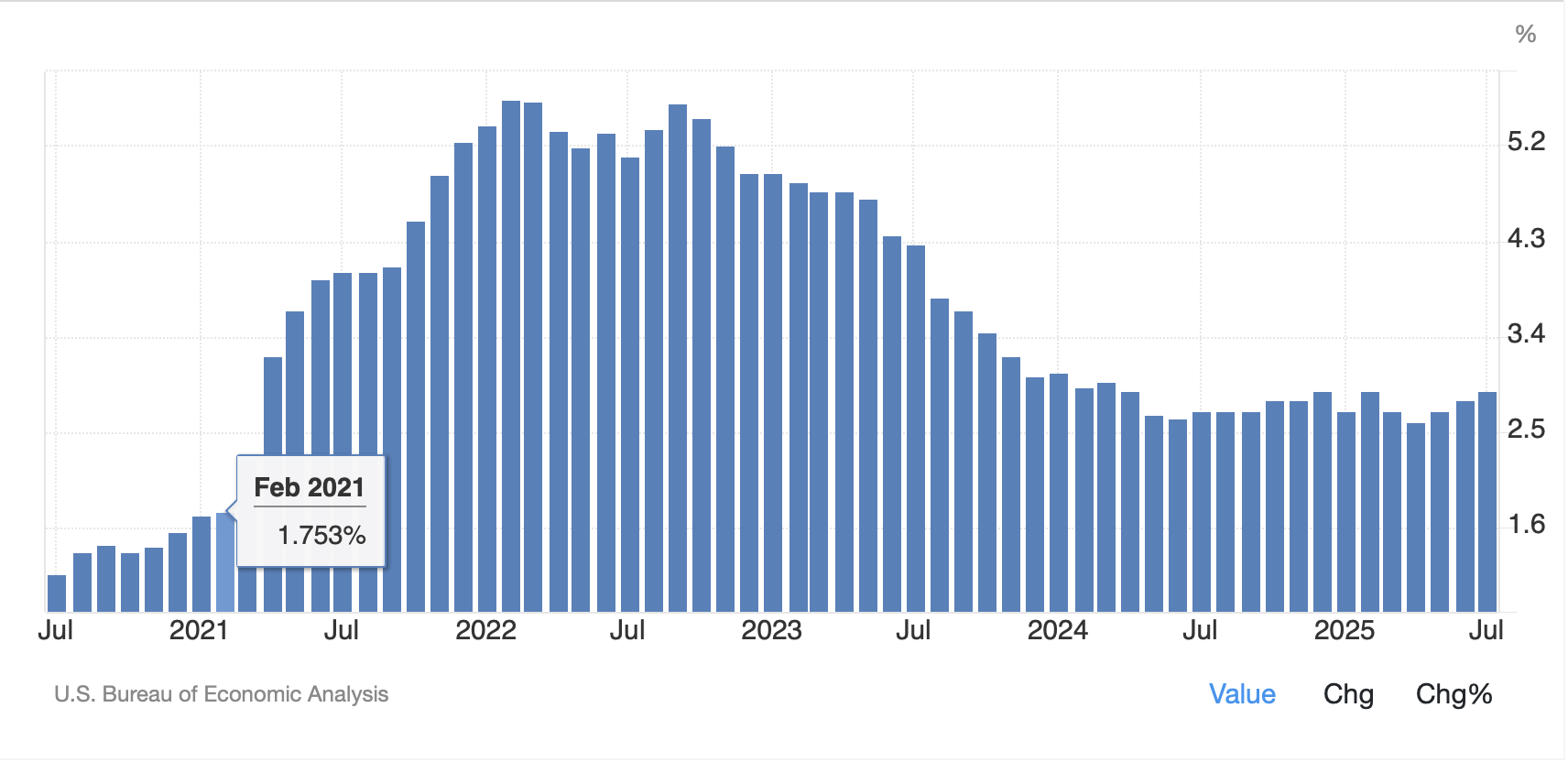
Source: tradingeconomics.com

But, as Walter Cronkite used to say, “That’s the way it is.”

So, how have markets been digesting this news?  Well, yesterday saw US equity indices make yet another set of new all-time highs on the prospects of a 50bp cut and that has largely fed to other equity markets around the world.  Bond yields remain quiescent, at least out to 10 years, although the really long stuff is having a tougher time, and the dollar remains range bound.  Aside from equities, the only market really moving is precious metals, which continue to rally nonstop.

Starting in Asia, Tokyo (+0.9%) rallied nicely as a combination of anticipated Fed cuts and the calming of trade tensions with the US has investors there feeling giddy.  It, too, has reached new all-time highs.  Hong Kong (+1.1%) also had a good session although China (-0.6%) didn’t follow through as profit taking was evident after what has been a very strong run in mainland stocks lately.  Elsewhere in the region, only two markets (Singapore and Philippines) lagged, and those were very modest declines of -0.3%.  Otherwise, gains of up to 1.5% were the norm.

However, Europe didn’t get that memo this morning with continental bourses all under pressure (DAX -0.3%, CAC -0.5%, IBEX -0.7%) amid a growing realization that the ECB may have finished its cutting cycle, at least according to Madame Lagarde’s comments yesterday expressing confidence the bank is in a “good place”.  However, under the rubric bad news is good, UK stocks (+0.3%) are edging higher after data showed GDP flatlined in July with the Trade deficit rising, and IP falling sharply (-0.9%) as traders are becoming more convinced the BOE will cut rates despite much stickier inflation than their target level.  Remember, too, the BOE’s mandate is entirely inflation focused, but these days, none of that matters!  Finally, US futures are either side of unchanged as I type (7:00).

In the bond market, yields remain in their longer-term downtrend in the US although have edged higher by 1bp overnight.  European sovereign yields are higher by 3bps across the board as there are still growing concerns over French fiscal deficits and the fact that the ECB has finished cutting implies less support there.  It is interesting to look at the difference in performance between US and French 10-year bonds as per the below, as despite much angst over the US fiscal profligacy, which is well-deserved, investors still feel far more comfortable with Treasuries than with OATs.
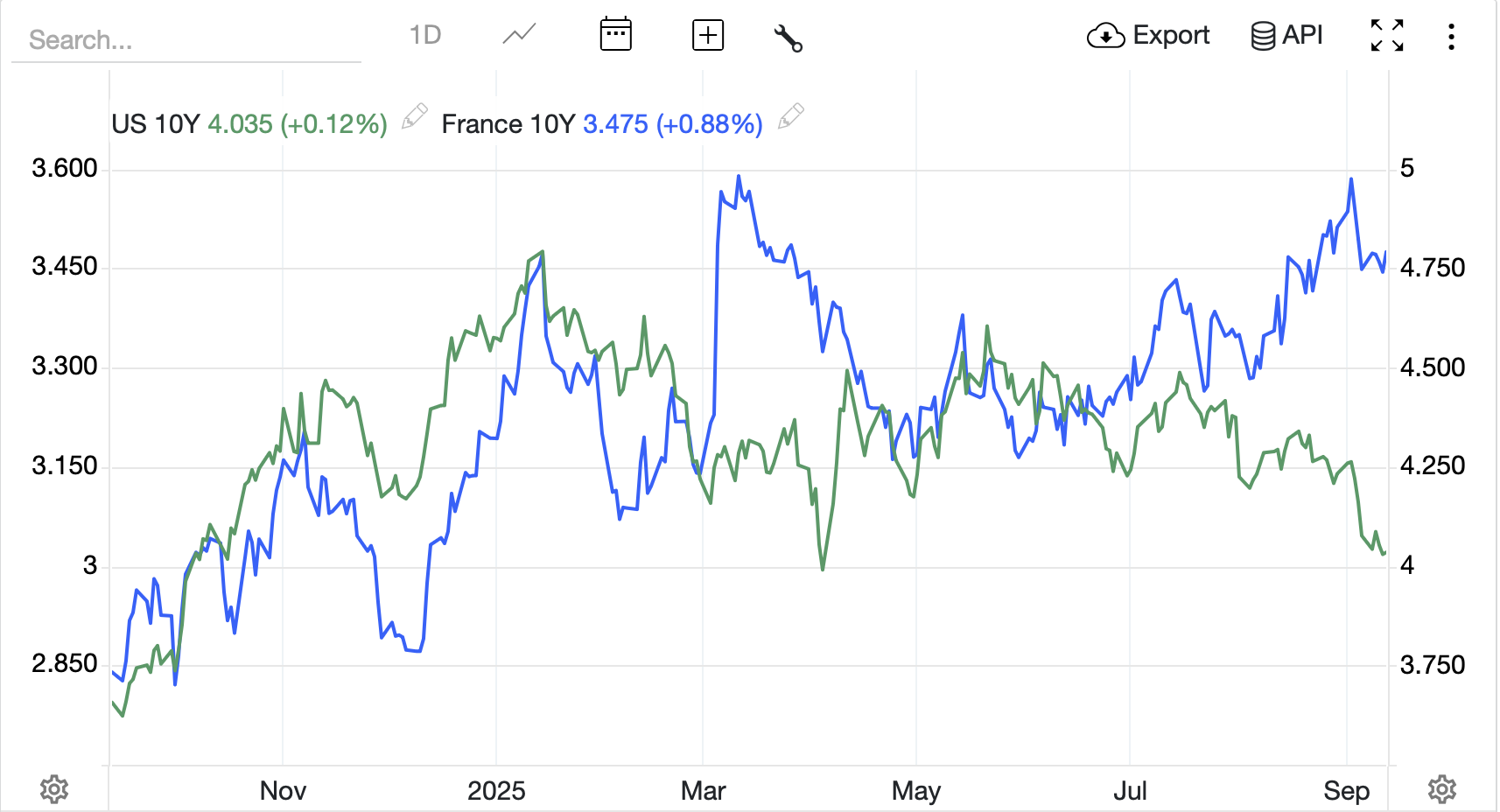
Source: tradingeconomics.com

In the commodity markets, oil (+1.3%) is rebounding from yesterday’s decline and, net, continues to go nowhere.  Whatever the catalyst is that will change this view, it has not made an appearance yet.  Meanwhile, like the broken record I am, I see gold (+0.5%) and silver (+1.9%) continuing to rally as more and more investors around the world flock to the precious metals as they fear the destruction of the value of their fiat currencies.  And they are right because there is not a single central bank around (perhaps Switzerland and maybe Norway) that is concerned about inflation as evidenced by the fact that despite the fact inflation rates are running far higher than they had pre-Covid, every central bank is in a cutting cycle except Japan, and they have stopped hiking despite CPI there running at 3.4%!

Finally, the dollar is modestly firmer as I type, although it had been a bit softer overnight, and basically going nowhere fast.  If I look at the movement in the major currencies over the past month, only NOK (+3.0%) stands out on the back of higher than anticipated inflation readings and growing expectations that the Norges Bank, which did cut rates a few months ago, will soon have the highest interest rates in the G10 after the Fed cuts next week and they remain on hold.  As to today’s movement, JPY (-0.35%), NZD (-0.4%) and NOK (-0.3%) are the largest movers, with the EMG seeing even smaller movement than that.  Again, it is difficult to find a compelling short-term story here.

On the data front, this morning brings Michigan Sentiment (exp 58.0) and that’s it.  No Fed speakers ahead of the meeting next week, so we will be reliant on either the White House making some new, unexpected, announcement, or the dollar will take its cues from the equity markets.  It is interesting that the precious metals complex continues to perform well despite the dollar edging higher.  To me, that is the biggest story around.

Good luck and good weekend

Adf

Wasn’t Whizzbang

There once was a time in the past
When earnings reports were forecast
If companies beat
It was quite a treat
If not, CEOs were harassed
 
But that was before Jensen Huang
Described the AI bell he rang
Nvidia now
Is what defines tao
Alas, last night wasn’t whizzbang


In what cannot be that great a surprise, given the remarkable hype that continues to surround Nvidia, their earnings were great, but not great enough to exceed the outsized expectations that have become commonplace.  And while revenues and earnings more than doubled, and their profit margins are above 50%, it wasn’t enough to satisfy the underlying belief that exists.  What is that belief?  The best I can tell is that the true believers are certain Nvidia will be the only company left on earth when AI takes over, and so it’s value will equate to global economic activity, currently approximately $105 trillion, so it has much further to climb.  Perhaps the oddest result was that there were actual ‘watch parties’ for the earnings release.  It is not clear to me if that is more hype than a Jensen Huang fan asking him to sign her breast or not, but it is certainly a lot of hype.
 
And yet, the world continues to turn this morning despite the disappointment and US stock futures are actually higher after a lackluster day yesterday where all three main indices declined. As is always the case, in hindsight, the hype is revealed for just what it was, but usually the rest of our lives feel no impact.  That said, it was clearly the market driver yesterday and will almost certainly continue to have an outsized impact on things for a while yet.  But let’s move on.
 
Said Bostic, I need to see more
Results on inflation before
I’m banging the drum
For that cut to come
‘Cause I don’t know what more’s in store

Back in the macro world, we heard from Atlanta Fed president Bostic last night and he was far more circumspect of a rate cutting cycle than the market currently believes was signaled by Chairman Powell last week in Jackson Hole.  As of this morning, the market continues to price a one-third probability of a 50bp cut in September, a total of 100bps of cuts in the rest of 2024 and a total of 225bps of cuts by the end of 2025.  Meanwhile, Mr Bostic explained, “I don’t want us to be in a situation where we cut and then we have to raise rates again.  So, if I’m going to err on one side, it’s going to be waiting longer just to make sure that we don’t have that up and down.”

Now, I know I’m not a Fed funds trader, or even a fixed income trader (I’m just an FX guy) but these comments didn’t sound like he was ready to start slashing rates anytime soon.  Bostic is a voter this year, and while I’m pretty sure the Fed is going to cut next month, I remain in the 25bp camp, and I might suggest that there are still several FOMC members who see no reason to cut rates quickly.  After all, absent a serious downturn in the labor market, and given the economy continues to perform reasonably well, at least according to the data they watch, what is the rationale for a cut?  And remember, if the Fed is cutting rates quickly it means they are responding to economic difficulties.  That doesn’t seem like an outcome we want to see.

Beyond those two stories, though, once again, there is a dearth of new information on which to make decisions.  China continues to struggle and there are now more bank analysts (UBS being the latest) who are lowering their forecasts for GDP growth there to the 4.5% range, well below President Xi’s 5.0% target.  The ongoing implosion of the Chinese property market continues to weigh heavily on the economy there and, as the chart below shows, the Chinese stock market.

A graph with blue lines and numbers

Description automatically generated

Source: Bloomberg.com

Aside from the irony of a strictly communist country even having the very essence of capitalism, an equity market, I believe the incredibly poor performance in Chinese shares is an ongoing signal that not all is well in China, regardless of what official statistical data they present.  President Xi has many problems to address, and I expect he will spend far more of his time trying to smooth international trade relations than anything else for the time being.  After all, the blank paper protests that led to the end of Covid restrictions in China are evidence that Xi is still subject to some popular sentiment.  If the economy were to crater, it would become a major problem for his power, and potentially his health.

Ok, let’s run through the overnight price action.  Asian markets were a mixed bag overnight with Japan essentially unchanged while China (-0.3%) continues to lag virtually all other markets.  The Hang Seng (+0.5%) managed a rally alongside India and Singapore, but there were more laggards including Australia, Korea, Indonesia and New Zealand.  But that is not the story in Europe this morning with all markets in the green led by the CAC (+0.7%) and DAX (+0.6%) on the back of somewhat softer German state inflation data (the national number is released at 8:00am) and what appears to be modestly better than expected Eurozone sentiment indices regarding services and industry, although consumers are still a bit unhappy.

In the bond market, everyone is asleep it seems as there has been no movement of more than 1 basis point in any major market.  Given the lack of new economic inputs, this should not be a great surprise.  I suspect that this morning’s US data, and especially tomorrow’s PCE data may shake things up if there are any unusual outcomes.

In the commodity markets, oil (+0.3%) has stopped falling for now as yesterday’s EIA inventory data showed a total draw of more than 4 million barrels, the 9th drawdown in the past 10 weeks and an indication that supply is falling to meet the alleged weakening demand.  Gold (+0.6%), which started off under pressure yesterday rebounded in the afternoon and continues this morning dragging silver along for the ride.  Copper (-1.9%) however, remains under pressure on both the softening demand story and a technical trading move.

Finally, the dollar, at least the DXY, is continuing to rebound from its Tuesday lows although there is a lot of mixed activity here with some gainers (AUD +0.55%, NZD +0.5%, ZAR +0.85%, CNY +0.6%) and some laggards (EUR -0.25%) along with the CE4 showing weakness.  The big outlier is CNY, which is showing one of its largest single day gains in the past year.  This seems a bit odd given the ongoing lackluster equity market performance and the data showing that foreign investment into China has reversed course and is now divestment.  None of that speaks to a currency’s strength, but as yet, I have not found a good rationale for the renminbi’s strength.  I will keep looking.

On the data front, we finally see some things this morning starting with Initial (exp 232K) and Continuing (1870K) Claims, the second look at Q2 GDP (2.8%) and all the attendant data that comes with that release (Real Consumer Spending +2.3%, PCE +2.6%, 2.9% core).  As well, Mr Bostic as back at it this afternoon at 3:30.  

My take is given the elevated importance of the employment report, today’s data that really matters will be the Claims numbers with any substantial miss (>15k different than forecast) leading to some price action and potential concerns.  But otherwise, Bostic certainly won’ change his tune in less than 24 hours, and the current market zeitgeist appears to be that the dollar, while headed lower, is going to chop to get there.  If we do see a high Claims number, above 245K, look for the dollar to fall more sharply, retracing its overnight bounce.

Good luck

Adf

More Woe

It wasn’t all that long ago
When everyone forecast more woe
As long as the Fed
Kept moving ahead
And, higher rates, still did bestow

But now that is all in the past
As CPI fell, at long last
Below current rates
So everyone waits
For Jay’s monetary recast

I am old enough to remember when the market was pricing in two more Fed funds rate hikes and an extended period of time at those higher interest rates as the default position.  After all, the Fed has been harping on about higher for longer quite a while and at their June meeting, they explicitly published their collective forecasts that showed a median expectation of an additional 50bps of tightening and then no real decline for at least a year.  That view, however, is so 24 hours old!  The new theme is…BUY STONKS!  This was a remarkably fast turn of opinions, even for markets that produce whiplash on a regular basis.

By now, you are certainly aware that the CPI data printed a bit lower than the median forecasts with the headline at 3.0% and the core at 4.8%.  These are the lowest levels since March 2021 and October 2021 respectively and are certainly encouraging news.  However, we all knew that the base effects were a key part of the puzzle as to why the year over year numbers fell so much.  But, in fairness to the bulls, the monthly increases were also quite low, 0.2% in both cases, and it remains to be seen if that monthly trend can continue.

As I suggested yesterday, the lower-than-expected readings led to an immediate explosion higher in risk appetite with equity markets in the US having a great day which was followed by strength throughout Asia and Europe this morning.  And Europe had a good day yesterday as well.  Meanwhile, US futures continue to bathe in the glow of declining inflation, rising further as I type (7:00am) with NASDAQ futures up more than 1.2% at this hour.  Risk is back, baby!

Perhaps a better indicator of the market’s renewed vigor is the bond market, where 10-year Treasury yields are lower today by a further 4.3bps and have fallen 25bps since Friday’s close.  All those fears that a 4.0% 10-year yield could lead to further economic breakage are now merely bad dreams, with no seeming basis in the new, current reality.  As to European sovereigns, they have fallen even further since yesterday, with declines on the order of 10bps nearly across the board on the continent and 7bps in the UK.  Granted, part of the European movement seems to be on the back of comments by uberdove Yannis Stournaras, the Greek central bank head and ECB council member, who explained this morning that they never promised a July rate hike and now that the data is softening, a pause may well be appropriate.  

As to yesterday’s Fed speakers, Barkin was first up and his comments, right at 8:30 when the CPI data was released, got lost in the news.  So, the fact that he said inflation remains too high and they still need to do more was completely ignored.  Governor Barr was entirely focused on bank capital plans, indicating that the Fed would look to tighten capital requirements going forward as the best way to improve bank solidity.  In other words, nobody cared what they said from a market’s perspective.

Overnight we saw some Chinese data that also spoke to slowing overall demand and economic activity, thus implying slowing inflationary pressures, as the Chinese trade data, while growing their surplus to $70.6B, exposed a much weaker export performance, with exports there falling -12.4% Y/Y.  That is a strong indication of slowing global growth, hence a view that also bodes well for future inflation declines.

Alas, there is one area that might have a detrimental impact on all this falling inflation euphoria, oil prices.  The black sticky stuff rallied again yesterday and is higher yet again this morning, albeit just by 0.3% right now, but has risen >4% in just the pat 3 days with WTI firmly above $75/bbl while Brent crude is now above >$80/bbl.  While I am no market technician, I do know that there is a huge amount of focus on the 200-day moving average and a potential break above that level which currently sits at $77.34/bbl.  If one looks at the ongoing production cuts by the Saudis as the short-term impetus and combines that with the structural shortage from the lack of drilling and exploration over the past decade due to ESG focused policies, it is easy to understand the bullish case.  One other thing that has not seemed to have received much press is that the Biden administration is apparently trying to refill the SPR to some extent, and so are a bid in the market as well.  

The one thing that we all know well is that higher oil prices tend to lead to higher gasoline prices which are a critical part of both inflation and inflation expectations.  This could well throw a spanner in the works for the collapsing inflation story, as well as the Fed is finished story.  It is certainly too early to draw that conclusion, but if WTI pushes above that moving average and to $80/bbl or more, just watch how quickly opinions shift.    

Ironically, despite concerns over slowing growth, both base and precious metals have been rallying as well, almost entirely on the back of a weaker dollar.  Now, it is a chicken and egg question here as to whether the weaker dollar is driving commodity (and stock) prices higher, or whether the rally in those markets is driving the dollar down, but whichever way the causality runs, that is the current price action.

Actually, it makes sense.  If the declining inflation story is taken at face value, and the market has removed further rate hikes by the Fed and is actually bringing the first rate cuts closer in time, then the dollar’s attractiveness as an asset is going to be reduced.  And that is exactly what has happened.  The buck is down against virtually all its counterparts, both G10 and EMG and the only thing that is likely to change that trajectory is data showing inflation is rebounding in the US and the Fed will be called on for more aggressive tightening.  Today’s PPI data seems highly unlikely to provide any information of that sort, so while the market continues to price in a strong likelihood of a 25bp rate hike in a few weeks, the strong belief is that will be the last.

Yesterday I posited that the one scenario that was not getting much love was that a recession was imminent, rather than either being delayed into 2024 or not even showing up.  But even the inflation data is somewhat indicative of reduced demand.  A little mentioned outcome regarding Consumer Credit on Monday showed growth of ‘just’ $7.24B, the lowest number since coming out of the pandemic in October 2020, and, perhaps, an indication that things are not as rosy as some would have us believe.  And while confirmation of weaker US economic activity is likely to weigh on the dollar and US yields, it is also likely to weigh on US equity prices, so do not forget that connection.

While I don’t believe today’s PPI data will be that impactful, keep an eye on the Claims data (exp 250K Initial, 1720K Continuing) as if those numbers keep edging higher, that too will play into the Fed’s thinking.  I have maintained for many months that employment is the key, not inflation per se.  Rising unemployment will lead to a quick reversal of Fed policy but will also be a harbinger of much weaker economic activity and just maybe that most anticipated recession in history will finally arrive.

Lastly, we have two more Fed speakers today, Daly and Waller, which are the last before the quiet period begins.  Given the sudden shift in narrative and the softer CPI data, it will be very interesting to hear if they are going to fight the new narrative or adjust their tone.  Daly is first at 11:10 this morning on CNBC, so all eyes will be there.

I would not fight this current trend for a lower dollar and frankly, with the euro back above 1.11 for the first time since March 2022, and the pound back above 1.30, the dollar bears are firmly in control.  If this dollar weakness persists for another 1%-2% I believe it could open up a much further decline, so consider what it takes to manage that kind of movement.  An additional 10% is quite easy to believe on that break.

Good luck
Adf

No Ceiling

The narrative’s taken a turn
As traders, for lower rates, yearn
Initial Claims jumped
And that, in turn, pumped
The idea that rate hikes, Jay’d spurn
To add to the positive feeling
Inflation in China is reeling
Now bulls are all in
And to bears’ chagrin
It seems that for stocks there’s no ceiling

Well, it seems that Initial Claims can have an impact after all!  Yesterday the data series printed at 261K, the highest level since October 2021 and significantly higher than all the economists’ forecasts.  The market impact was clear as it appears there is an evolution from the narrative preceding the data release to a newer version.  For clarity’s sake, I would argue the prevailing narrative went something like this:

  • Prices were falling sharply, and inflation would soon be back at or near the Fed’s 2% target.
  • Unemployment remains low because of a significant mismatch between job openings and potential employees so consumption would remain robust
  • This economic strength will overcome further Fed tightening…so
  • Buy stocks!


Arguably the newer narrative is something like this:

  • Initial Claims data shows that the employment situation may be deteriorating
  • Not only will the Fed skip hiking at next week’s meeting, but at any meeting going forward
  • Rising Unemployment will force the Fed to finally pivot and cut rates…so
  • Buy stocks!


Granted these may be somewhat simplistic descriptions, but I would argue that they are representative of the current zeitgeist.  If nothing else, I would argue that the algorithms that implement so much trading these days are written in this manner. 


At any rate, the impact was far more significant than would ordinarily be expected from an Initial Claims release.  Rate hike expectations by the Fed have begun to fade, not only for next week, but for the July meeting as well.  Treasury yields fell 8bps yesterday, although they have rebounded slightly this morning by 3bps along with European government bonds.  And, of course, equity markets all rallied further yesterday with the S&P 500 ticking up to a level 20% above the October lows so now “officially” in a bull market.  In fact, that equity rally continued through into Asia as all markets there were higher led by the Nikkei (+2.0%).  Life is good!


Is this sustainable?  I guess so, the market for risk assets has been willing to look through every potential problem and continue to rally.  Are there flaws in the argument?  I would argue there are, but as John Maynard Keynes explained to us all, the market can remain irrational far longer than you can remain solvent.


One other noteworthy data point was released overnight, Chinese CPI and PPI, both of which remain quite low.  CPI rose only 0.2% in the past year while PPI fell -4.6%.  These results have market participants looking for the Chinese to ease monetary policy still further to support the economy, continuing to widen the policy differential between China and the G10 nations which, at least for now, remain in tightening mode.  As such, it should not be that surprising that the renminbi (-0.3%) fell further last night.  Given the distinct lack of inflationary pressures currently evident in China, I suspect the PBOC will be quite comfortable watching CNY weaken further still, with another 3%-5% quite realistic as the year progresses.  After all, China remains a mercantilist economy highly reliant on exports and a weaker yuan will only help their cause.


Now, keep in mind that everything is not positive.  We continue to see weak economic activity throughout the Eurozone with this morning’s Italian IP data (-1.9% M/M, -7.2% Y/Y) showing there are still many problems on the continent.  It is no wonder that Italian PM Meloni is so unhappy with the ECB as the Italian economy continues to stumble while the ECB continues to tighten policy.  But it certainly appears that Madame Lagarde is unconcerned about Italy at least for the time being.  However, while the ECB will almost certainly raise rates next week, if the Fed truly has finished their rate hike cycle, the ECB will not be far behind.


So, as we head into the weekend, the equity markets that are actually trading at this hour (7:30) are in the red with all of Europe down on the order of -0.2% to -0.4% and US futures also slightly softer.  Meanwhile, oil prices (+0.25%) are edging higher this morning, although that was after a sharp afternoon decline yesterday on inventory data.  Meanwhile, gold, which rallied sharply yesterday amid a weak dollar session, is consolidating its gains and the base metals are mixed.


Finally, the dollar is mixed this morning with about a 50/50 split in the G10 led by NOK (+1.1%) after CPI printed at a higher than expected 6.7% in May and the market is now pricing in further policy tightening by the Norgesbank.  This seems to fly in the face of the inflation is collapsing narrative which should make next week’s US CPI data on Tuesday that much more interesting.  After that, the rest of the commodity bloc of currencies is slightly firmer vs. the greenback while the European currencies as well as the yen are all under a bit of pressure.  However, on the week, the dollar has definitely backed off its recent strength.


In the EMG bloc, the pattern is similar with KRW (+1.0%) the leading gainer on the view that more Chinese policy support will help the Korean economy substantially, while we continue to see ZAR (+0.5%) rally on the commodity price gains.  On the downside, TRY (-1.25%) continues to lag despite (because of?) the appointment of a new central bank chief, Hafize Gaye Erkan, within the new government.  Perhaps her background as co-CEO of First Republic Bank did not inspire confidence given its recent demise.  But regardless, TRY has fallen more than 10% this week alone and shows no signs of stopping the slide anytime soon.


And that, my friends, is all there is heading into the weekend.  There is neither data nor Fedspeak to look for so the FX market will almost certainly be taking its cues from the US equity markets for the day.  As such, if equity markets decline, I would look for the dollar to gain a bit and vice versa, but until we get at least through next Tuesday’s CPI, and more likely the FOMC on Wednesday, I see more range trading overall.


Good luck and good weekend

Adf

Struck by the Flu

If you think that Jay even thought
‘bout thinking ‘bout thinking he ought
To raise interest rates
He’ll not tempt the fates
Despite all the havoc ZIRP’s wrought

Meanwhile, ‘cross the pond what we learned
Is Germany ought be concerned
Their growth in Q2
Was struck by the flu
As exports, their customers, spurned

(Note to self; dust off “QE is Our Fate” on September 16, as that now seems a much more likely time to anticipate how the Fed is going to adjust their forward guidance.) Yesterday we simply learned that rates are going to remain low for the still indeterminate, very long time. Clearly, the bond market has gotten the message as yields along the Treasury curve press to lows in every tenor out through 7-year notes while the 10-year sits just 1.5 bps above the lows seen in March at the height of the initial panic. This should be no surprise as the FOMC statement and ensuing press conference by Chairman Powell made plain that the Fed is committed to use all their available tools to support the economy. Negative rates are not on the table, yield curve control is already there, effectively, so the reality is they only have more QE and forward guidance left in their toolkit. Powell promised that QE would be maintained at least at the current level, and the question of forward guidance is tied up with the internal discussions on the Fed’s overall policy framework. Those discussions have been delayed by the pandemic but are expected to be completed by the September meeting. Perhaps, at that time, they will let us know what they plan to do about their inflation mandate. The smart money is betting on a commitment to allow inflation to overshoot their target for an extended period in order to make up for the ground lost over the past decade, when inflation was consistently below target. I guess you need to be a macroeconomist to understand why rising prices helps Main Street, because, certainly from the cheap seats, I don’t see the benefit!

The market response was in line with what would be expected, as yields fell a bit further, the dollar fell a bit further and stocks rallied a bit further. But that is soooo yesterday. Let’s step forward into today’s activities.

Things started on a positive note with Japanese Retail Sales jumping far more than expected (+13.1%) in June which took the Y/Y number to just -1.2%. That means that Japanese Retail Sales are almost back to where things were prior to the outbreak. Unfortunately, this was not enough to help the Nikkei (-0.3%) and had very little impact on the yen, which continues to trade either side of 105.00. Perhaps it was the uptick in virus cases in Japan which has resulted in further restrictions being imposed on bars and restaurants that is sapping confidence there.

Speaking of the virus, Australia, too, is dealing with a surge in cases, as Victoria and Melbourne have seen significant jumps. As it is winter in the Southern Hemisphere, there is growing concern that when the weather cools off here, we are going to see a much bigger surge in cases as well, and based on the current government response to outbreaks, that bodes ill for economic activity in the US come the fall.

But then, Germany reported their Q2 GDP data and it was much worse than expected at -10.1%. Analysts had all forecast a less severe decline because Germany seemed to have had a shorter shutdown and many fewer unemployed due to their labor policies where the government pays companies to not lay-off workers. So, if the shining star of Europe turned out worse than expected, what hope does that leave us for the other major economies there, France, Italy and Spain, all of which are forecast to see declines in Q2 GDP in excess of 15%. That data is released tomorrow, but the FX market wasted no time in selling the euro off from its recent peak. This morning, the single currency is lower by 0.35%, although its short-term future will also be highly dependent on the US GDP data due at 8:30.

Turning to this morning’s US data, today is the day we get the most important numbers, as the combination of GDP (exp -34.5%), to see just how bad things were in Q2, and Initial (1.445M) and Continuing (16.2M) Claims, to see how bad things are currently, are to be released at 8:30. After the combination of weak German data and resurgence in virus cases in areas thought to have addressed the issue, it should be no surprise that today is a conclusively risk-off session.

We have seen that in equity markets, where both the Hang Seng (-0.7%) and Shanghai (-0.25%) joined the Nikkei lower in Asia while European bourses are all in the red led by the DAX (-2.3%) and Italy’s FTSE MIB (-2.2%). And don’t worry, US futures are all declining, with all three major indices currently pointing to 1% declines at the open.

We have already discussed the bond market, where yields are lower in the US and across all of Europe as well with risk being pared around the world. A quick word on gold, which is lower by 0.8%, and which may seem surprising to some. But while gold is definitely a long-term risk aversion asset, its day to day fluctuations are far more closely related to the movement in the dollar and today, the dollar reigns supreme.

In the G10 bloc, NOK is the laggard, falling 1.0% as oil prices come under pressure given the weak economic data, but we have seen substantial weakness throughout the entire commodity bloc with AUD (-0.6%) and CAD (-0.57%) also suffering. In fact, the only currency able to hold its own this morning is the pound, which is essentially unchanged on the day. In the EMG bloc, there are several major declines with ZAR (-1.6%), RUB (-1.4%) and MXN (-1.0%) leading the way down. The contributing factor to all three of these currencies is the weakness in the commodity space and corresponding broad-based dollar strength. But the CE4 are all lower by between 0.3% and 0.6%, and most Asian currencies also saw modest weakness overnight. In other words, today is a dollar day.

And that is really the story. At this point, we need to wait for the data releases at 8:30 to get our next cues on movement. My view is that the Initial Claims data remains the single most important data point right now. Today’s expectation is for a higher print than last week, which the market may well read as the beginning of a reversal of the three-month trend of declines. A higher than expected number here is likely to result in a much more negative equity day, and correspondingly help the dollar recoup even more of its recent losses.

Good luck and stay safe
Adf

No Use Delaying

In Europe, the powers that be
Are feeling quite smug, don’t you see
Not only have they
Held Covid at bay
But also, they borrow for free

Thus, Italy now wants to spend
More money, recession, to end
If Germany’s paying
There’s no use delaying
With Merkel now Conte’s best friend

The euro is continuing its climb this morning, as it mounts a second attack on 1.1600, the highest level it has traded since October 2018. While the overall news cycle has been relatively muted, one thing did jump out today. It should be no surprise, but Italy is the first nation to take advantage of the new EU spending plans as they passed a supplemental €25 billion budget to help support their economy.

Now, it must be remembered that prior to the pandemic, Italy was in pretty bad shape already, at least when looking at both fiscal and economic indicators. For instance, Italy was in recession as of Q4 2019, before Covid, and it was maintaining a debt/GDP ratio of more than 130%. Unemployment was in double digits and there was ongoing political turmoil as the government was fighting for its life vs. the growing popularity of the conservative movement, The League, led by Matteo Salvini. Amongst his supporters were a large number of Euroskeptics, many of whom wanted to follow in the UK’s footsteps and leave the EU. (Quitaly, not Italexit!) However, it seems that the economic devastation of Covid-19 may have altered the equation, and while Salvini’s League still has the most support, at 26%, it has fallen significantly since the outbreak when it was polling more than 10 points higher. Of course, when the government in power can spend money without limits, which is the current situation, that tends to help that government stay in power. And that is the current situation. The EU has suspended its budget restrictions (deficits <3.0%) during the pandemic, and Italy clearly believes, and are probably correct, that the EU is ultimately going to federalize all EU member national debt.

It seems the growing consensus is that federalization of EU fiscal policies will be a true benefit. Of course, it remains to be seen if the 8 EU nations that are not part of the Eurozone will be forced to join, or if the EU will find a way to keep things intact. My money is on the EU forcing the issue and setting a deadline for conversion to the euro as a requisite for remaining in the club. Of course, this is all looking far in the future as not only are these monumental national decisions, but Europe takes a very long time to move forward on pretty much everything.

This story, though, is important as background information to developing sentiment regarding the euro, which is clearly improving. In fairness, there are shorter term positives for the single currency’s value, notably that real interest rates in the rest of the world are falling rapidly, with many others, including the US, now plumbing the depths of negative real rates. Thus, the rates disadvantage the euro suffered is dissipating. At the same time, as we have seen over the past several months, there is clearly very little fear in the market these days, with equity prices relentlessly marching higher on an almost daily basis. Thus, the dollar’s value as a safe haven has greatly diminished as well. And finally, the appearance of what seems to be a second wave of Covid infections in the US, which, to date, has not been duplicated as widely in Europe, has added to confidence in the Eurozone and the euro by extension.

With all this in mind, it should be no surprise that the euro continues to rally, and quite frankly, has room for further gains, at least as long as the economic indicators continue to rebound. And that is the big unknown. If the economic rebound starts to falter, which may well be the case based on some high-frequency data, it is entirely likely that there will be some changes to some of the narrative, most notably the idea that risk will continue to be eagerly absorbed, and the euro may well find itself without all its recent supports.

But for now, the euro remains in the driver’s seat, or perhaps more accurately, the dollar remains in the trunk. Once again, risk is on the move with equity markets having gained modestly in Asia (Hang Seng +0.8%, Sydney +0.3%, Nikkei was closed), while European bourses have also seen modest gains, on the order of 0.5% across the board. US futures are also pointing higher, as there is no reason to be worried for now. Bond markets have behaved as you would expect, with Treasuries and bunds little changed (although Treasuries remain at levels pointing to significant future economic weakness) while bonds from the PIGS are seeing more demand and yields there are falling a few basis points each. Oil is higher on optimism over economic growth, and gold continues to rally, preparing to set new all-time highs as it trades just below $1900/oz. The gold (and silver) story really revolves around the fact that negative real interest rates are becoming more widespread, thus the opportunity cost of holding that barbarous relic have fallen dramatically. Certainly, amongst the market punditry, gold is a very hot topic these days.

As to the rest of the currency space, there are two noteworthy decliners in the G10, NOK (-0.5%) and GBP (-0.25%). The former, despite rising oil prices, fell following the release of much worse than expected employment data. After all, rising unemployment is hardly the sign of an economic rebound. The pound, on the other hand, has suffered just recently after comments by both sides regarding Brexit negotiations, where the essence was that they are no nearer a positive conclusion than they were several months ago. Brexit has been a background issue for quite a few months, as most market players clearly assume a deal will be done, and that is a fair assumption. But that only means that there is the potential for a significant repricing lower in the pound if the situation falls apart there. Otherwise, the G10 is broadly, but modestly firmer.

In the emerging markets, the picture is a bit more mixed with the CE4 tracking the euro higher, but most other currencies ceding earlier session gains. IDR is the one exception, having rallied 0.5% for a second day as equity inflows helped to support the rupiah. On the downside, KRW (-0.2%) suffered after GDP data was released at a worse than expected -3.4%, confirming Korea is in a recession. Meanwhile, the weakest performer has been ZAR (-0.6%) as traders anticipate a rate cut by the SARB later today.

Data in the US this morning includes the ever-important Initial Claims (exp 1.3M) and Continuing Claims (17.1M), as well as Leading Indicators (2.1%). But all eyes will be on the Claims data as the consensus view is weakness there implies the rebound is over and the economic situation may slide back again. Counterintuitively, that could well help the dollar as it spreads fear that the V-shaped recovery is out of the question. However, assuming the estimates are close, I would look for the current trends to continue, so modestly higher equities and a modestly weaker dollar.

Good luck and stay safe
Adf

Quite Dramatic

The Chinese report ‘bout Q2
Showed growth has rebounded, it’s true
But things there remain
Subject to more pain
Til elsewhere bids Covid adieu

The market’s response was emphatic
With Shanghai’s decline quite dramatic
Thus, risk appetite
Today is quite slight
Which means bears are now just ecstatic

It is no surprise that the Chinese reported a rebound to positive GDP growth in Q2 as, after all, the nation was the epicenter of Covid-19 and they, both shut down and reopened their economy first. The numbers, however, were mixed at best, with the GDP number rebounding a more than expected 3.2% Y/Y, but their Retail Sales data failing to keep up, printing at -1.8% Y/Y, rather than the expected 0.5% gain. The lesson to be learned here is that while Chinese industry seems to be heading back to a pre-Covid pace, domestic consumption is not keeping up. This is a problem for China for two reasons; first, they have made an enormous effort to adjust the mix of their economy from entirely export oriented to a much greater proportion of consumption led growth. Thus, weak Retail Sales implies that those efforts are now likely to restrict the nation’s growth going forward. Secondly, the fact that the rest of the world is months behind China in this cycle, with many emerging markets still in the closing process, not nearly ready to reopen, implies that while industry in China may have retooled, their export markets are a long way from robust.

The other interesting thing that came out of China last night, that had a more direct impact on markets there, was yet another round of stories published about the evils of speculation and how Chinese financial institutions would be selling more stocks. You may recall last week, when the Chinese government had an article published singing the praises of a strong stock market, encouraging retail investors to drive a more than 6.0% gain in the Shanghai Composite. Just a few days later, they reversed course, decrying the evils of speculation with a corresponding sharp decline. Well, it seems that speculators are still evil, as last night’s message was unequivocally negative pushing Shanghai lower by 4.5% and finally removing all those initial speculative gains. It seems the PBOC and the government are both concerned about inflating bubbles as they well remember the pain of 2015, when they tried to deflate their last one.

But this activity set the tone for all Asian markets, with red numbers everywhere, albeit not quite to the extent seen on the mainland. For instance, the Nikkei slipped 0.75% and the Hang Seng, fell 2.0%.

Europe has its own set of issues this morning, although clearly the weakness in Asia has not helped their situation. Equity markets throughout the Continent are lower with the DAX (-0.5%) and CAC (-0.7%) representative of the losses everywhere. While traders there await the ECB meeting outcome, the focus seems to be on the UK announcement that they will be increasing their debt issuance by £110 billion in Q3 to help fund all the fiscal stimulus. This will take the debt/GDP ratio above 100%, ending any chance of retaining fiscal prudence.

It’s remarkable how things can change in a short period of time. During the Eurozone debt crisis, less than 10 years ago, when Greece was on the cusp of leaving the euro, they were constantly lambasted for having a debt/GDP ratio of 150% or more while Italy, who was puttering along at 125% was also regularly excoriated by the EU and the IMF. But these days, those entities are singing a different tune, where suddenly, government borrowing is seen as quite appropriate, regardless of the underlying fiscal concerns, with the supranational bodies calling for additional fiscal stimulus and the borrowing that goes along with it. At any rate, there is certainly no sign that the current mantra of issuing debt and spending massive amounts of money to support the economy is about to change. Fiscal prudence is now completely passé.

With that as a backdrop, it should be no surprise that risk is being pared back across all markets. Having already discussed equities, we can look at bond markets and see yields virtually everywhere lower today as investors seek out haven assets. Interestingly, despite the new issuance announced in the UK, Gilts lead the way with a 2.5bp decline, while Treasuries and Bunds have both seen yields decline a more modest 1bp. Oil prices have fallen again, which is weighing on both NOK (-0.65%) and RUB (-0.4%) the two currencies most closely linked to its price. But of course, lower oil prices are indicative of weaker overall sentiment.

As such, it is also no surprise that every one of the currencies in the G10 and major emerging markets is weaker vs. the dollar this morning. While the trendy view remains that the dollar is going to continue to decline, and that has been expressed with near record short dollar positions in futures markets, the greenback is not playing along today.

At this point, I think it is important to remind everyone that a key part of the weak dollar thesis is the ongoing expansion of the Fed’s balance sheet adding more liquidity to the system and thus easing dollar policy further. But for the past 5 weeks, the Fed’s balance sheet has actually shrunk by $250 billion, a not inconsiderable 3.5%, as repo transactions have matured and not been replaced. It appears that for now, the market is flush with cash. So, given the combination of major short dollar positions extant and short term fundamental monetary details pointing to dollar strength, do not be surprised if we see a short squeeze in the buck over the next week or two.

This morning brings the bulk of the week’s data, certainly its most important readings, and it all comes at 8:30. Retail Sales (exp 5.0%, 5.0% ex autos), Philly Fed (20.0), Initial Claims (1.25M) and Continuing Claims (17.5M) will hopefully give us a clearer picture of how the US economy is progressing. One of the problems with this data is that it is mostly backward looking (Philly Fed excepted) and so probably does not capture the apparent second wave of infections seen in Florida, Texas and California, three of the most populous states. So, even if we do see somewhat better than expected data, it could easily slip back next week/month. In fact, this is why the Claims data is so important, it is the timeliest of all the major economic releases, and given the ongoing uncertainty surrounding the current economic situation, it is likely the most helpful. So, while the trend in Initial Claims has been lower, it remains at extremely problematic levels and is indicative of many more businesses retrenching and letting staff go. It has certainly been my go-to data point for the pulse of the economy.

Recent data points have been better than forecast, but nobody doubts that things are still in dire shape. Unfortunately, it appears we are still a long way from recouping all the lost economic activity we have suffered over the past months. But FX remains a relative game, and arguably, so is everyone else.

Good luck and stay safe
Adf

Singing Off-Tune

The Jobless report showed that June
Saw Payroll growth really balloon
But stubbornly, Claims
Are fanning the flames
Of bears, who keep singing off-tune

Markets are quiet this morning as not only is it a summer Friday, but US equity and commodity markets are closed to celebrate the July 4th holiday. In fact, it is curious that it is not a Fed holiday. But with a limited and illiquid session on the horizon, let’s take a quick peak at yesterday’s data and some thoughts about its impact.

The Jobless report was clearly better than expected on virtually every statistic. Payrolls rose more than expected (4.8M vs. exp 3.06M) while the Unemployment Rate fell substantially (11.1% from 13.3%). Happily, the Participation Rate also rose which means that the country is getting back to work. It should be no surprise that this was touted as a great outcome by one and all.

Of course, there was some less positive news, at least for those who were seeking it out. The Initial and Continuing Claims data, both of which are much more current, declined far less than expected. The problem here is that while tremendous progress was made in June from where things were before, it seems that progress may be leveling off at much worse than desired numbers.

It seems there are two things at work here. First, the second wave of Covid is forcing a change in the timeline of the reopening of the economy. Several states, notably Texas and California, are reimposing lockdowns and closing businesses, like bars and restaurants, that had reopened. This is also slowing the reopening of other states’ economies. Second is the pending end of some of the CARES act programs, notably PPP, which has seen the money run out and layoffs occur now, rather than in April. It is entirely realistic that the Initial and Continuing Claims data run at these much higher levels going forward for a while as different businesses wrestle with the right size for their workforce in the new economy.

Odds are we will see a second stimulus bill at some point this summer, but it is not yet a certainty, nor is it clear how large it will be or what it will target. But it would be a mistake to assume that the road ahead will be smooth.

The other potential market impacting news was this morning’s European Services PMI data, which was generally slightly better than expected, but still pointing to slowing growth. For instance, Germany’s Services number was at 47.3, obviously well above the April print of 16.2, but still pointing to a slowing economy. And that was largely the case everywhere.

The point is that nothing we have seen either yesterday or today indicates that the global economy is actually growing relative to 2019. It is simply not shrinking as quickly as before. The implication here is that central banks will continue to add liquidity to their respective economies through additional asset purchases and, for those with positive interest rates still, further rate cuts. Governments will be loath to stop their fiscal stimulus as well, especially those who face elections in the near-term. But in the end, 2020 is going to be a decidedly lost year when it comes to the world’s economy!

On the market side, risk generally remained in demand overnight as Asian equity markets continued to rally (Nikkei +0.7%, Hang Seng +1.0%, Shanghai +2.0%). Will someone please explain to me how Hong Kong’s stock market continues to rally in the face of the draconian new laws imposed by Beijing on the freedom’s formerly available to its citizens? While I certainly don’t have proof, this must be coordinated buying by Chinese government institutions trying to demonstrate that everything there is great.

However, despite the positive cast of APAC markets, Europe has turned red this morning with the DAX (-0.2%), CAC (-0.7%) and FTSE 100 (-0.9%) all under pressure. Each nation has a story today starting with Germany’s Angela Merkel trying to expand fiscal stimulus, not only in Germany, but fighting for the EU program as well. Meanwhile, in France, President Macron has shaken up his entire government and replace most of the top positions including PM and FinMin. Finally, the UK is getting set to reopen tomorrow, and citizens are expected to be ready to head back to a more normal life.

In the bond markets, while US markets are closed, we are seeing a very modest bid for European government bonds, but yields are only about 1 basis point lower on the day. Commodity markets show that oil is once again under pressure, down a bit more than 1% but still hanging onto the $40/bbl level.

Turning to currencies, in the G10, only NOK (+0.4%) is showing any real life today as its Unemployment Rate printed at a lower than expected 4.8% encouraging some to believe it is leading the way back in Europe. Otherwise, this bloc is doing nothing, with some gainers and some losers and no direction.

In emerging markets, the story is of two weak links, IDR (-1.0%) and RUB (-0.9%). The former, which has been falling for more than a week, is suffering from concerns over debt monetization by the central bank there, something that I’m sure will afflict many currencies going forward. As to the ruble, the only explanation can be the oil price decline as their PMI data was better than expected, although still below 50.0. But there are issues there regarding the spread of the infection as well, and concerns over the potential imposition of new sanctions by the US.

And that is really it for the day. With no data or speakers here, look for markets to close by lunchtime, so if you have something to do, get it done sooner rather than later.

Have a wonderful holiday weekend and stay safe
Adf


Over and Done

Our planet, third rock from the sun
Has had a remarkable run
For ten years, at least
No famine, just feast
But now that streak’s over and done

The IMF said, yesterday
This year will see growth go away
For ‘Twenty, it’s clear
While next year they fear
A second wave, growth will delay

Fear was the order of the day yesterday amid several related stories. Headlines continue to highlight the resurgence in reported Covid cases in the US, notably in those states that have begun to reopen more aggressively. So, California, Texas and Florida have all seen a big jump in infections which many are saying requires a second lockdown. While no orders of that nature have yet been issued, it is clear there is a risk they will be deemed necessary. That would be quite the body blow to the US economy, as well as to the equity markets which are pretty clearly pricing in that elusive V-shaped recovery. If we see second order lockdowns, you can be pretty confident that the equity market will suffer significantly. Simply consider yesterday’s performance, with the three US indices all falling at least 2.2% without having to deal with any actual change in regulations.

Adding insult to injury was the IMF, which released its updated global GDP forecasts and is now looking for a more severe global recession with growth falling 4.9% in 2020. That is down from the -3.0% expectation in April. As well, they reduced their forecasts for 2021, albeit not as dramatically, to +5.4%, down 0.4% from the April forecasts. However, they warned that should a second wave manifest itself, 2021 could see essentially zero growth globally as unemployment worldwide explodes and poverty levels in the emerging markets explodes with it. In other words, they don’t really think we are out of the woods yet.

With that one-two punch, it is no surprise that we saw risk jettisoned yesterday as not only did equity markets suffer, but we saw demand for bonds (Treasury yields -4bps yesterday and another 1.5bps this morning) while the dollar saw broad-based demand, with the DXY rising 0.6% on the day. If nothing else, this is strong evidence that all markets are anticipating quite a strong recovery, and that anything that may disrupt that process is going to have a negative impact on risk asset prices.

Adding to the fun yesterday was oil’s 6% decline on data showing inventories growing more than expected, which of course means that demand remains lackluster. Certainly, I know that while I used to fill up the tank of my car every week, I have done so only once in the past three months! While that is good for my budget, it is not helping support economic activity.

The point is, the risk asset rally has been built on shaky foundations. Equity fundamentals like revenues and earnings are (likely) in the process of bottoming out, but the rally is based on expectations of a V. Every data point that indicates the V is actually a U or a W or, worst of all, an L, will add pressure on the bulls to continue to act solely because the Fed keeps purchasing assets. History has shown that at some point, that will not be enough, and a more thorough repricing of risk assets will occur. Part of that process will almost certainly be a very sharp USD rally, which is, of course, what matters in the context of this note.

Looking at how today’s session has evolved shows that Asian equity markets had a down session, with the Nikkei taking its cues from the US and falling 1.2%, and Australia suffering even more, down 2.5%. China and Hong Kong were closed while they celebrated Dragon Boat Day. European bourses are in the green this morning, but just barely, with the average gain just 0.15% at this hour following yesterday’s 1.3%-2.0% declines. And US futures have turned lower at this time after spending much of the overnight session in the green.

As mentioned, bond markets are rallying with yields falling correspondingly, while the dollar continues to climb even after yesterday’s broad-based strength. So, in the G10 space, the euro is today’s worst performer, down 0.4%, amid overall growing concerns of a slower rebound. While the German GfK Consumer Confidence survey printed better than expected (-9.6), it was still the second worst print in the series history after last month’s. Aside from the euro, perhaps the most interesting thing is that both CHF and JPY have fallen 0.2%, despite the demand for havens. There is no news from either nation that might hint at why these currencies are underperforming from their general risk stance, but as I wrote last week, it may well be that the demand for dollars is leading the global markets these days, rather than acting as a relief valve like usual.

Emerging market currencies are seeing a more broad-based decline, simply following on yesterday’s price action. I cannot ignore the 3.6% fall in BRL yesterday, as the Covid situation grows increasingly out of control there. While the market has not opened there yet, indications are that the real’s decline will continue. Meanwhile, today’s worst performer is HUF, down 1.3%, although here, too, there is no obvious catalyst for the decline other than the dollar’s strength. Now, from its weakest point in April, HUF had managed to rally nearly 12% through the beginning of the month but has given back 5.3% of that since. On a fundamental basis, HUF is highly reliant on the Eurozone economies performing well as so much of their economic activity is generated directly on the back of Europe. Worries over the Eurozone’s trajectory will naturally hit all of the CE4. And that is true today with CZK (-0.7%) and PLN (-0.55%) also amongst the worst performers. APAC currencies suffered overnight, but not to the extent we are seeing this morning, and LATAM seems set to pick up where yesterday’s declines left off.

On the data front, this morning brings the bulk of the week’s important data. Initial Claims (exp 1.32M) and Continuing Claims (20.0M) remain critical data points in the market’s collective eyes. Anything that indicates the employment situation is not getting better will have a direct, and swift, negative impact on risk assets. We also see Durable Goods (10.5%, 2.1% ex transport) and the second revision of Q1 GDP (-5.0%). One other lesser data point that might get noticed is Retail Inventories (-2.8%) which has been falling after a sharp rise in March, but if it starts to rise again may also be a red flag toward future growth.

Two more Fed speakers are on the docket, Kaplan and Bostic, but there is nothing new coming from the Fed unless they announce a new program, and that will only come from the Chairman. So, at this stage, I see no reason to focus on those speeches. Instead, lacking an exogenous catalyst, like another Fed announcement (buying stocks maybe?) it feels like risk will remain on the defensive for the day.

Good luck and stay safe
Adf


Dire Straits

In Europe, that grouping of states
Now find themselves in dire straits
The PMI data
Described a schemata
Of weakness and endless low rates

In the past, economists and analysts would build big econometric models with multiple variables and then, as new data was released, those models would spit out new estimates of economic activity. All of these models were based on calculating the historic relationships between specific variables and broader growth outcomes. Generally speaking, they were pretty lousy. Some would seem to work for a time, but the evolution of the economy was far faster than the changes made in the models, so they would fall out of synch. And that was before Covid-19 pushed the pace of economic change to an entirely new level. So now, higher frequency data does a far better job of giving indications as to the economic situation around the world. This is why the Initial Claims data (due this morning and currently expected at 4.5M) has gained in the eyes of both investors and economists compared to the previous champ, Nonfarm Payrolls. The latter is simply old news by the time it is released.

There is, however, another type of data that is seen as quite timely, the survey data. Specifically, PMI data is seen as an excellent harbinger of future activity, with a much stronger track record of successfully describing inflection points in the economy. And that’s what makes this morning’s report so disheartening. Remember, the PMI question simply asks each respondent whether activity is better, the same or worse than the previous month. They then subtract the percentage of worse from the percentage of better and, voila, PMI. With that in mind, this morning’s PMI results were spectacularly awful.

Country Manufacturing Services Composite
France 31.5 10.4 11.2
Germany 34.4 15.9 17.1
UK 32.9 12.3 12.9
Eurozone 33.6 11.7 13.5

Source: Bloomberg

In each case, the data set new historic lows, and given the service-oriented nature of developed economies, it cannot be that surprising that the Services number fell to levels far lower than manufacturing. After all, social distancing is essentially about stopping the provision of individual services. But still, if you do the math, in France 94.8% of Service businesses said that things were worse in April than in March. That’s a staggering number, and across the entire continent, even worse than the dire predictions that had been made ahead of the release.

With this in mind, two things make more sense. First, the euro is under pressure this morning, falling 0.6% as I type and heading back toward the lows seen last month. Despite all the discussion of how the Fed’s much more significant policy ease will ultimately undermine the dollar, the short-term reality continues to be, the euro has much bigger fundamental problems and so is far less attractive. The other thing is the ECB’s announcement last evening that they were following the Fed’s example and would now be accepting junk bonds as collateral, as long as those bonds were investment grade as of April 7. This is an attempt to prevent Italian debt, currently rated BBB with a negative outlook, from being removed from the acceptable collateral list when if Standard & Poor’s downgrades them to junk tomorrow. Italian yields currently trade at a 242bp premium to German yields in the 10-year bucket, and if they rise much further, it will simply call into question the best efforts of PM Conte to try to support the Italian economy. After all, unlike the US, Italy cannot print unlimited euros to fund themselves.

Keeping all that happy news in mind, market performance this morning is actually a lot better than you might expect. Equities in Asian markets were mixed with the Nikkei up nicely, +1.5%, but Shanghai slipping a bit, -0.2%. Another problem in Asia is Singapore, where early accolades about preventing the spread of Covid-19 have fallen by the wayside as the infection rate there spikes and previous efforts to reopen the economy are halted or reversed. Interestingly, the Asian PMI data was relatively much better than Europe, with Japanese Services data at 22.8. Turning to Europe, the picture remains mixed with the DAX (-0.3%) and FTSE 100 (-0.3%) slipping while the CAC (+0.1%) has managed to keep its head above water. The best performer on the Continent is Italy (+1.0%) as the ECB decision is seen as a win for all Italian markets. US futures markets are modestly negative at this time, but just 0.2% or so, thus it is hard to get a sense of the opening.

Bond markets are also having a mixed day, with the weakest links in Europe, the PIGS, all rallying smartly with yields lower by between 5bps (Italy) and 19bps (Greece). Treasury yields, however, have actually edged higher by a basis point, though still yield just 0.63%. And finally, the dollar, too, is having a mixed session. In the G10 bloc, the euro and Swiss franc are at the bottom of the list today, with Switzerland inextricably tied to the Eurozone and its foibles. On the plus side, NOK has jumped 1.0% as oil prices, after their early week collapse, are actually rebounding nicely this morning with WTI higher by 12.4% ($1.70/bbl), although still at just $15.50/bbl. Aussie (+0.6%) and Kiwi (+0.75%) are also in the green, as both have seen sharp recent declines moderate.

EMG currencies also present a mixed picture, with the ruble on top of the charts, +1.4%, on the strength of the oil market rebound. India’s rupee has also performed well overnight, rising 0.8%, as the market anticipates further monetary support from the Reserve bank there. While there are other gainers, none of the movement is significant. On the other side of the ledger, the CE4 are all under pressure, tracking the euro’s decline with the lot of them down between 0.3% and 0.5%. I must mention BRL as well, which while it hasn’t opened yet today, fell 2.6% yesterday as the market responded to BCB President Campos Neto indicating that further rate cuts were coming and that QE in the future is entirely realistic. The BRL carry trade has been devastated with the short-term Selic rate now sitting at 3.75%, and clearly with room to fall.

Aside from this morning’s Initial Claims data, we see Continuing Claims (exp 16.74M), which run at a one week lag, and then we get US PMI data (Mfg 35.0, Services 30.0) at 9:45. Finally at 10:00 comes New Home Sales, which are forecast to have declined by 16% in March to 644K.

The big picture remains that economic activity is still slowing down around the world with the reopening of economies still highly uncertain in terms of timing. Equity markets have been remarkable in their ability to ignore what have been historically awful economic outcomes, but at some point, I fear that the next leg lower will be coming. As to the dollar, it remains the haven of choice, and so is likely to remain well bid overall for the foreseeable future.

Good luck and stay safe
Adf