The Whisperer’s Roar

Most focus is still on the Fed
And what every Fed speaker said
But do not ignore
The Whisperer’s roar
That Jay’s got the votes, rates to shred
 
And this is why markets are soaring
While bond vigilantes are snoring
But, too, it’s why gold
Is bought and not sold
The question is, whose ox Jay’s goring?


One thing that is very clear right now, the demand for lower interest rates is extremely widespread, regardless of one’s political persuasion.  People may despise everything that President Trump has done or claims he will do, but those same folks are desperate for him to be able to force the Fed to cut rates further.  At least that’s my observation.  

But putting that aside, the narrative around next month’s FOMC meeting seems to be coming to a clearer point; a cut is in the cards, but a potentially long delay in the next move will follow.  While there were no Fed speakers on the calendar, at least the calendar I use, yesterday, we did hear from two more, the presidents of San Francisco and Boston, and though the former, renowned dove Mary Daly, was far more forthright in her views a cut was appropriate, the latter, centrist Susan Collins, clearly was amenable to the idea, though not forcefully so.  But we know that Chair Powell cares since the Fed Whisperer, Nick Timiraos, got top billing in this morning’s WSJ with the following article, “Fed Chair Powell’s Allies Provide Opening for December Rate Cut.”  

As this story was coming into view yesterday, we saw equity markets rise sharply in the US, or at least the tech portion (the DJIA managed only a 0.4% gain compared to the NASDAQ’s 2.7% jump).  We also have seen the Fed funds futures market up the pricing of a rate cut to 81% as of this morning, with the concerns last week about Powell’s hawkishness quickly forgotten.  One other thing of note was the strong rally in precious metals, with gold (0.0% this morning, +1.8% yesterday) and silver (-0.3% this morning, +2.6% yesterday) responding to the imminent further debasement of the dollar.  While both remain somewhat below their October highs, nothing indicates that their trends higher have ended.

Source: tradingeconomics.com

There continues to be a lot of discussion on two fronts, the state of the economy and the rationale for further equity market gains, and interestingly, they are completely independent discussions.  For the former, the dribs and drabs of data that have been released since the end of the government shutdown have been inconclusive as to what is going on, at least officially.  Yesterday brought nothing new, although this morning we are due to see September data on Retail Sales (exp 0.3%, 0.3% ex autos), PPI (2.7% for both headline and core) and House Prices (+1.4% Case Shiller) along with November Consumer Confidence (93.5, down slightly from last month).  It hardly seems this will change any views

But the market conversation is completely different.  Between talk of a Santa rally, the popping of the AI bubble (assuming there is such a thing) and growing certainty that a Fed cut will help goose the stock market, that economic uncertainty means nothing.  There remains a large swath of investors who are certain the Fed will not allow equity markets to fall in any meaningful fashion and who are prepared to continue to buy the dip.  

Interestingly, the place where these two issues meet, earnings forecasts, shows that while fixed income investors may feel uncertain about the economy’s future, 2026 earnings estimates of 14% growth have equity investors in a very different place.  While I don’t know which side is correct, I suspect that the ‘run it hot’ philosophy which has been driving everything this administration does will favor equities over bonds.  While a correction is still likely in my mind, there is still nothing to stop this train!  

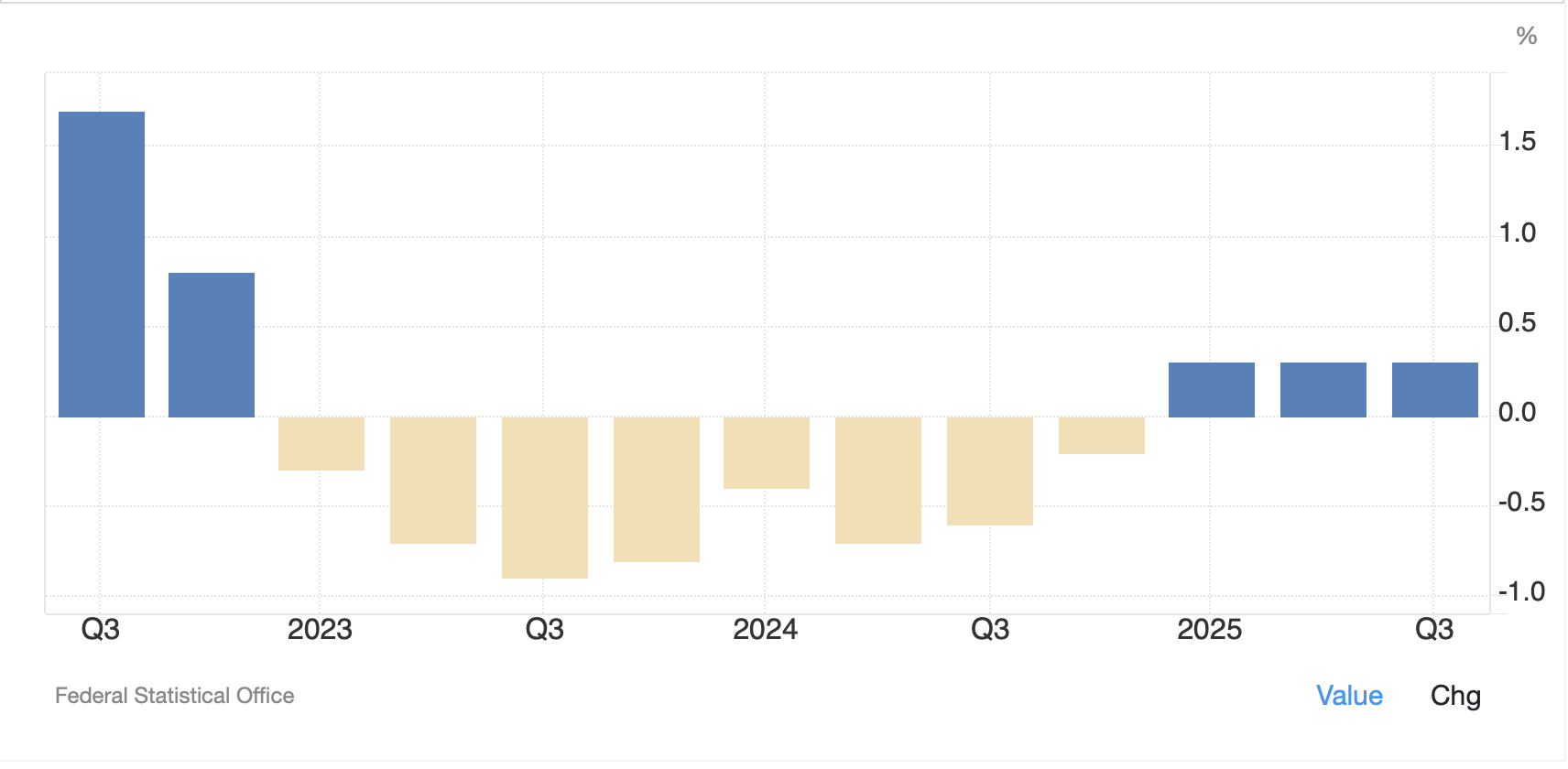
Ok, let’s turn to market performance overnight.  Japan (+0.1%) didn’t love the US tech story, which is somewhat surprising, although that may be because there continues to be growing concern regarding the JGB market and the spat with China.  China (+1.0%) and HK (+0.7%) however, both rallied on the US rate cut plus tech rally story.  Taiwan (+1.5%) and Thailand (+1.3%) also liked that story, but the rest of Asia was nonplussed, and more exchanges saw weakness than strength.  As to Europe, nobody there has a strong view this morning with every major bourse +/- 0.15% or less.  The only data was German GDP, which rose to…0.0% for Q3 and clocked in at +0.3% Y/Y! Look at the history of German economic activity over the past 3 years below and ask yourself if this is the powerhouse of Europe, why would anyone want to own any European assets?
Source: tradingeconomics.com

As well, the increased focus on a potential peace in Ukraine may be a negative for the continent.  While it has the potential to help them on the energy side, much of the rally seen across these nations was predicated on the military buildup that was coming.  However, if there is peace, I sense it will be difficult for a group of nations that are massively in debt to convince their populations to borrow more to defend themselves since the threat has abated.  After all, I’m willing to wager there isn’t a single person in the EU who if given the choice between defense spending for a potential future threat or an increased pension will opt for the former.  As to US futures, at this hour (7:25) they are unchanged.

In the bond market, Treasury yields are unchanged this morning after slipping another few basis points yesterday and are sitting at 4.03%.  Either the market is sanguine about the ongoing federal deficit spending or…everybody assumes the Fed is going to restart QE in some form or another if things start to deteriorate.  European sovereign yields are slipping this morning, down between -1bp and -3bps, with the UK on the larger end despite (because of?) tomorrow’s Budget announcement.  

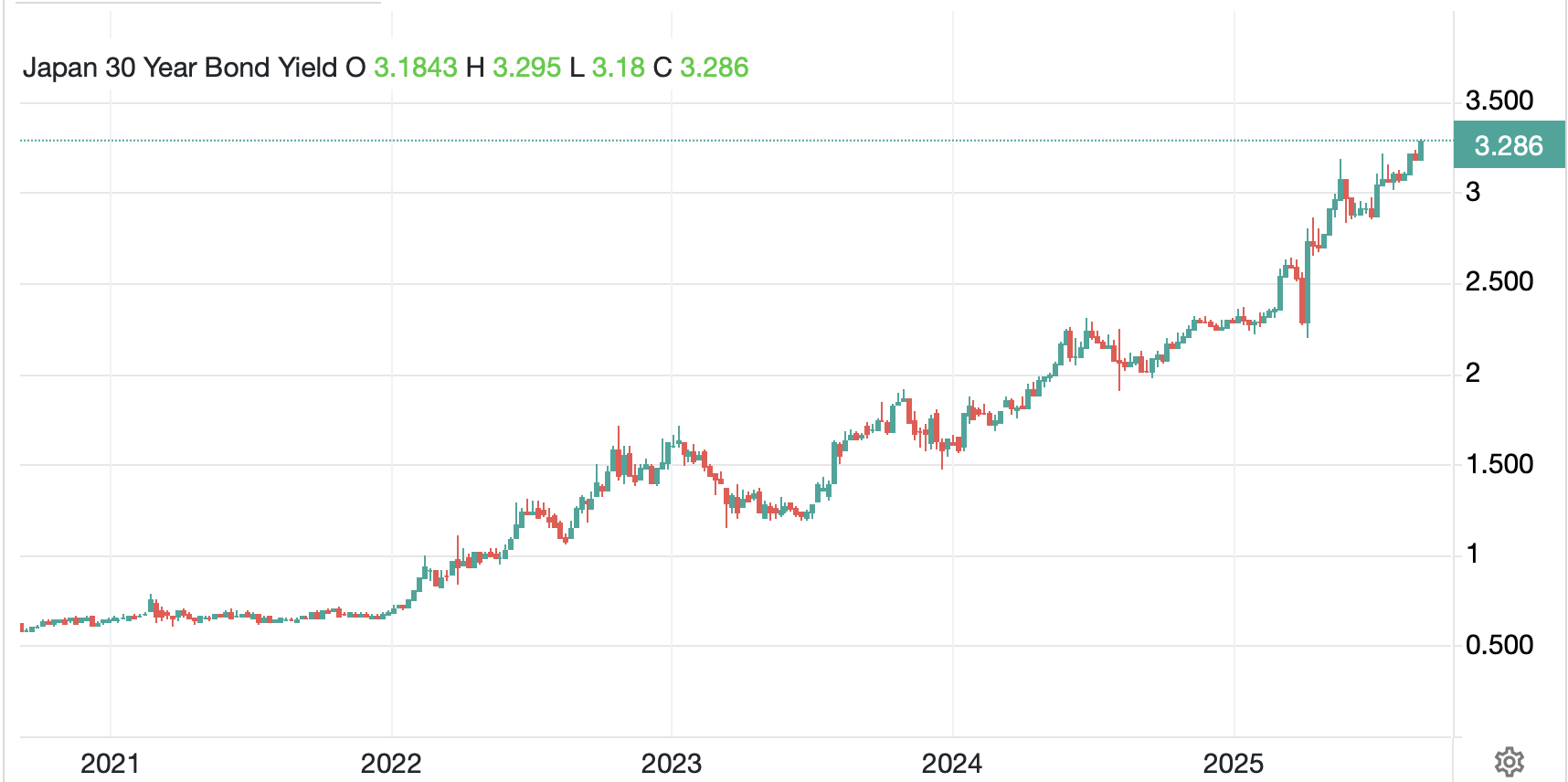
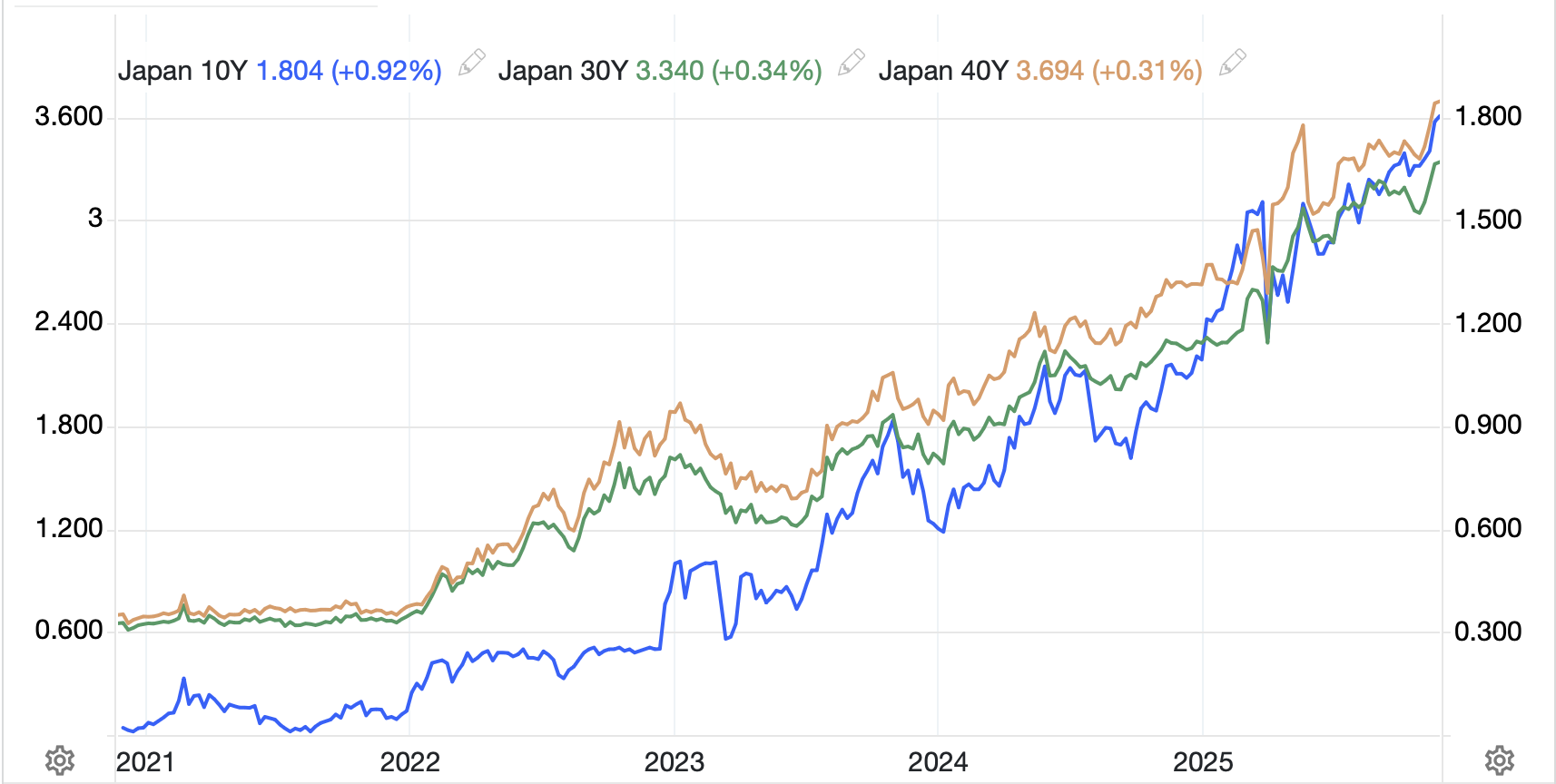
While you may think the US has a fiscal problem, and it does, at least it has the global reserve currency and with it, the ability to live beyond its means for a long time.  The UK, however, simply has the first part, a fiscal problem, which they have exacerbated by adopting the most idiotic energy policies in the world (who would ever have thought that solar power made sense in the UK given the fact it rains, on average, 50% of the days in the year.)  It is unclear to me what the UK can do to right the ship with the current government and its stated priorities.  I suppose that we will see new regulations requiring UK financial institutions to hold more Gilts as otherwise nobody will buy them.  Before I leave this asset class, I cannot ignore the JGB market where back-end yields continue to climb.  As you can see from the below chart, the 10-, 30-, and 40-year yields are all at record highs and show no signs of stopping their multi-year rise.
Source: tradingeconomics.com

I had a long conversation with Charlie Garcia on Substack, someone you should all follow as he has very sharp ideas, on the causes, ramifications and potential outcomes of this unprecedented rise in yields there.  Needless to say, the end game will not be very good for anyone, but the timing remains in question.  As Keynes warned us all, markets can remain wrong longer than you can remain solvent.  But Japan has its own, unique fiscal problems along with every other nation in the world.

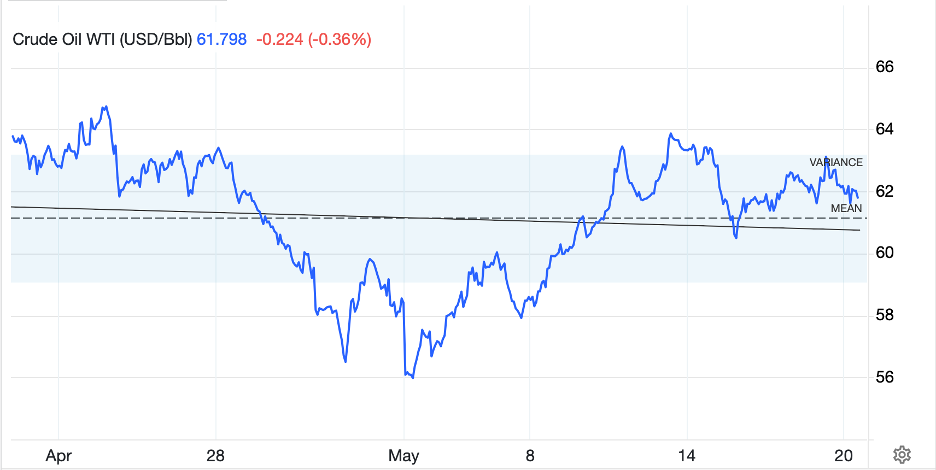
Turning to commodities, oil (-0.3%) continues to be the least interesting thing around, drifting slowly lower, but at an increasingly leisurely pace.  The glut narrative has calmed down, but I think there is more concern over the weakening economic story.  Hard for me to say from the outside, but lower is the direction of travel here.  The opposite is true for NatGas (-3.3%) which despite today’s decline is up 55% since October 16th!

Finally, the dollar is under modest pressure today with both the euro and pound stronger by 0.2%, a move that describes almost the entire G10.  One outlier here is NOK (-0.2%) which is clearly suffering on oil’s ongoing weakness.  In the EMG bloc, though, there has been more substantial movement with KRW (+0.7%) rising as traders position for the BOK to remain on hold while the Fed gets ready to cut, thus reversing some of the recent 7% decline in the won over the past quarter.  The CE3 have also rallied nicely, on the order of 0.5%, as they continue to demonstrate their excessive beta with the euro and even CNY (+0.3%) is moving this morning on the back of a potential thaw in relations between the US and China after Presidents Xi and Trump spoke by phone yesterday.  While my long-term perspective on the dollar remains positive, if the Fed does get aggressive, the greenback can certainly come under short-term pressure.

And that’s really all there is today.  With Thanksgiving coming, I expect that volumes will begin to decline so keep that in mind when trying to execute any trades.

Good luck

Adf
Got Smote

There once was a poet that wrote
‘Bout bonds and the fact they got smote
So, yields, they did rise
And to his surprise
Most pundits, this news did promote
 
Now turning to stories today
The biggest one, I’d have to say
Is how, in Japan
Ishiba’s grand plan
Has failed, thus he’ll be swept away


The number of stories this morning regarding the synchronous rise of long-dated bond yields around the world has risen dramatically.  While yesterday, I highlighted this fact, I certainly didn’t expect it to be the key narrative this morning.  But such is life, and virtually every news outlet is focusing on the subject as both a reason for the poor equity performances yesterday as well as a way to highlight government profligacy.  I do find it interesting, though, that the same publications that push for more spending for their preferred causes have suddenly become worried about too much government spending.  But double standards are nothing new.   A smattering of examples show ReutersBloomberg and the WSJ all feigning concern over too much government spending.

I say they are feigning concern because all these publications are perfectly willing to support excess government spending if it is spent on the things they care about.  Regardless, the fact that this has become one of today’s key talking points is evidence that some folks are starting to recognize that trees cannot grow to the sky.  Even though almost every major central bank is in easing mode, long-term yields keep rising.  Alas, the almost certain outcome here, albeit likely still well into the future, is some form of yield curve control as central banks will be forced to prevent yields from rising too high lest their respective governments go bust.  I expect that the initial stages will be regulations requiring banks and insurance companies, and maybe private, tax-advantaged accounts like IRA’s and 401K’s, to hold a certain percentage of Treasuries.  But I suspect that eventually, only central banks will have the wherewithal to prevent runaway yields.  Welcome to the future; got gold?

However, you can read about this everywhere, and after all, I touched on it yesterday so let’s move on.  Government stability/fragility is the topic du jour in this poet’s eyes.  We already know that the French government is set to fall on Monday when PM Bayrou loses a confidence vote.  It is unclear what comes next, but French finances are in bad shape and getting worse and they don’t print their own currency.  This tells me that we could see a lot more social unrest in France going forward given the French penchant for nationwide strikes.  

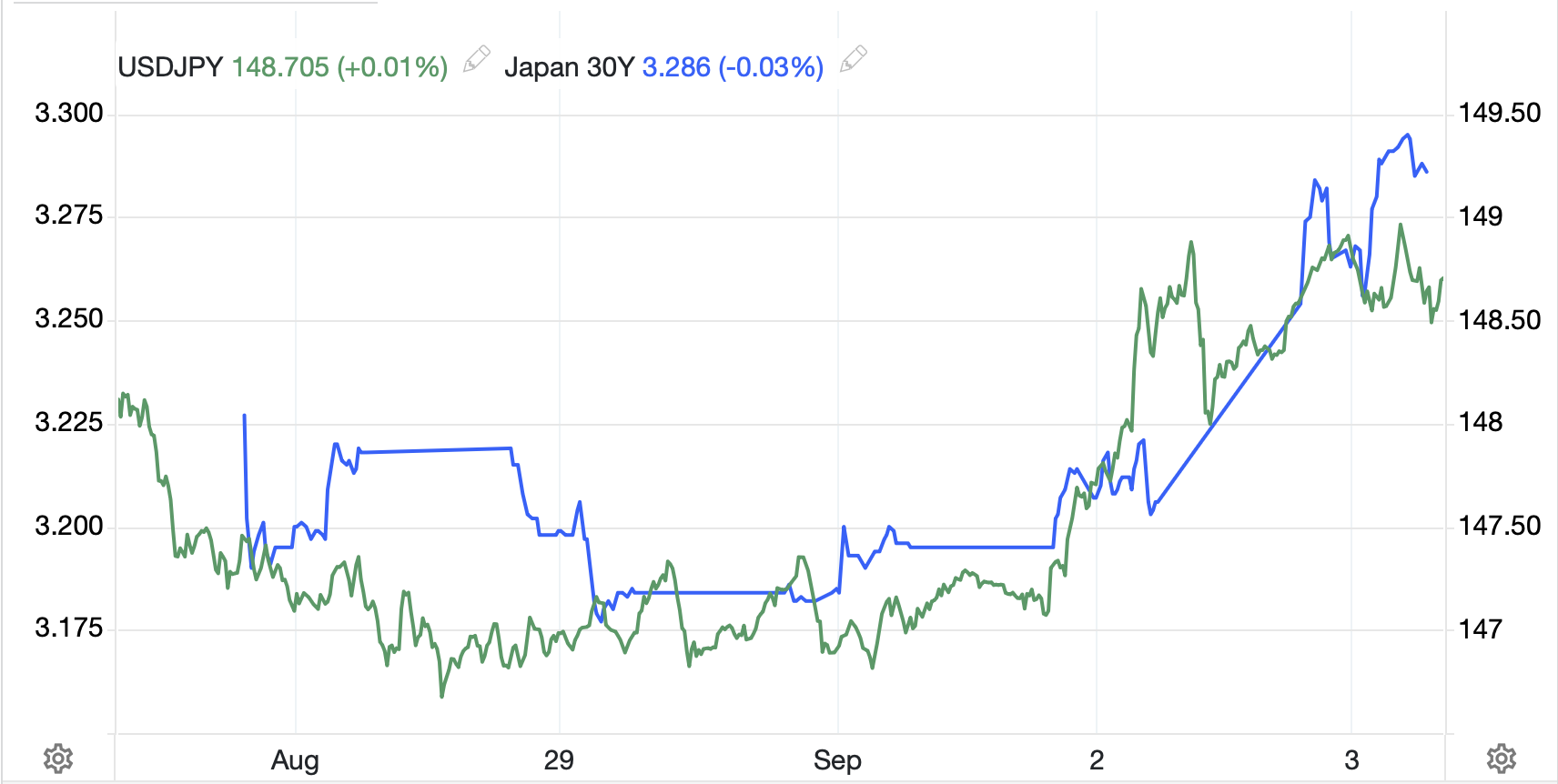
But a story that has gotten less press is in Japan, where PM Ishiba saw the LDP majority decimated in the Upper House two weeks ago and is now heading a minority government as the LDP does not have a majority in either house in the Diet.  One of the key members of the LDP, and apparently the glue that was holding together the fragile coalition was Hiroshi Moriyama, the LDP Secretary General, and he is now resigning along with several of his lieutenants, so it appears that Japan’s government is about to fall as well.  The upshot here is that the BOJ seems unlikely to raise interest rates given the political uncertainty, which is not only pressuring long-dated JGB’s but also the yen. (see chart below from tradingeconomics.com)

While I have not written extensively about the UK’s government, the situation there is quite similar, with massive fiscal problems driving yields higher while the government focuses on removing the right of free speech amongst its people if that speech is contra to the government’s policies.  While the next UK election need not be held for another 4 years, my take is it will be much sooner as PM Starmer has destroyed his legitimacy with recent policy decisions and will soon be unable to govern.  It will only be a matter of time before his own party turns on him.

The governments in Japan, France and the UK are all under increasing pressure as their policy prescriptions have not tackled the key problems in their respective economies.  Inflation in Japan and the UK and benefits in France need to be addressed, but it is abundantly clear that the current leadership will not be able to do so effectively.  Once again, please explain why people are so bearish the dollar, at least in the long run.  While inflation will be higher worldwide and fiat currencies will all suffer vs. real assets, on a relative basis, the dollar doesn’t appear so bad after all.

Ok, let’s move on to the overnight activity as it gets too depressing highlighting all the government failures around the world.  While US stocks closed above their worst levels of the session, they were all lower yesterday.  That bled into Asia with Japan (-0.9%), Hong Kong (-0.6%) and China (-0.7%) all falling with worse outcomes in some other parts of the region (Australia -1.8%, Philippines -0.75%) although there were winners as well (Korea, India, Taiwan) albeit in less impressive fashion.  Perhaps the surprise was Chinese underperformance after PMI Services data there printed at its highest level since May 2024.

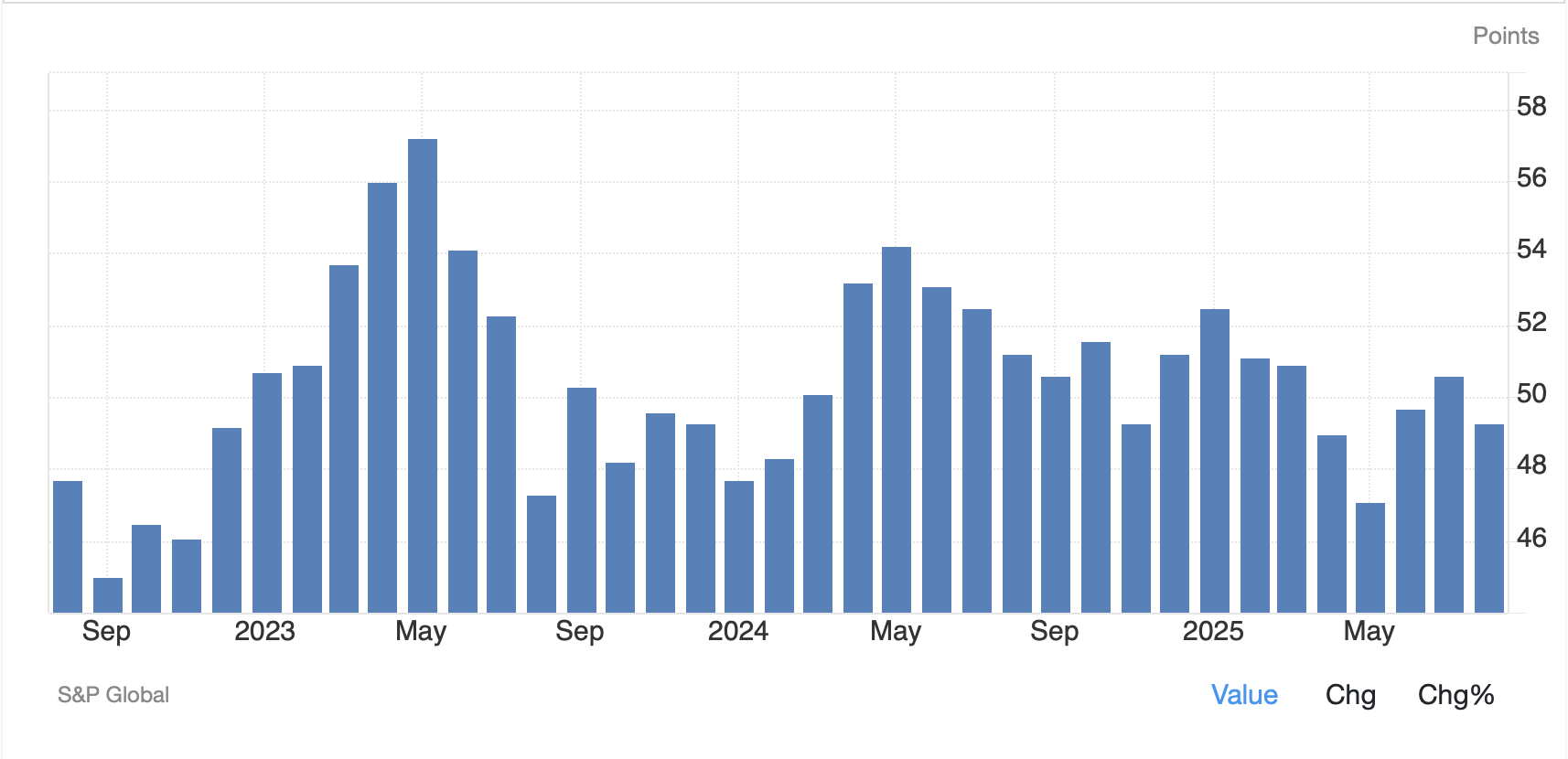
But whatever the negativity that existed in Asia was, it did not translate to European shares as they are all higher (CAC +1.0%, DAX +0.8%, FTSE 100 +0.55%, IBEX +0.2%).  Now, clearly it is not confidence in government activity that has investors excited.  The only data of note was Services PMI, which was mostly as expected except in Germany where it fell to 49.3, far lower than the initial estimate of 50.1 and based on the chart below, seemingly trending lower.

Source: tradingeconomics.com

US futures, too, are higher this morning, with gains of 0.5% to 0.75% for the S&P and NASDAQ.

You won’t be surprised that bond yields continue to drift higher, even in the 10-year space with Treasuries higher by 2bps, although most European sovereign yields have edged down by -1bp in the 10-year space.  It is the longer dated yields that continue to see the most pressure with 30-year yields across the US, Europe and Japan all pushing to new highs for the move, and in the case of Japan, new all-time highs.

Source: tradingeconomics.com

This, of course, is the underlying story for virtually all markets right now.

In the commodity markets, oil (-2.1%) has given back yesterday’s gains after reports that OPEC+, which is meeting this weekend, will be raising their output yet again.  Whatever the situation is in Russia, whether Ukrainian attacks are reducing supply or not, it seems clear that OPEC is unperturbed and wants to pump as much as possible. In the metals markets, gold (+0.3%) has set another new all-time high and appears to be breaking out from its recent consolidation pattern.  I am no market technician (I’m a poet after all), but a consensus seems to be forming that $3700 is coming soon and $4000 will be achieved by early next year.

Source: tradingeconomics.com

The rest of the metals space is little changed this morning with silver holding at its 11-year highs and copper treading water at the levels that existed pre-tariff threats.

Finally, the currency markets, which saw the dollar rally sharply yesterday, are taking a breather with the dollar giving back some of those gains amid a consolidation.  In the G10, movement is 0.2% or less, so really nothing and in the EMG bloc, HUF (+0.6%), KRW (+0.5%) and ZAR (+0.3%) are the biggest gainers, with the latter following gold, while traders see the central bank in Hungary maintaining higher rates to fight still, too high inflation of 4.3%.  As to Korea, better than expected GDP data helped drive inflows to the currency.

On the data front today, we see JOLTs Job Openings (exp 7.4M) and Factory Orders (-1.4%) this morning and the Fed’s Beige Book is released at 2:00pm.  We also hear from two Fed speakers, which given the row over Governor Cook’s tenure at the Fed, may be interesting to see.  The market continues to price a 92% probability of a 25bp cut in two weeks’ time, but I suspect that Friday’s NFP data may be the ultimate arbiter there.

I cannot look at the world and conclude that the US is the biggest problem around.  However, if we do see weak data on Friday and the market starts to price 50bps of cuts by the Fed, the dollar will decline in the near term.  But longer term, the more I read, the more bullish I get on the greenback, at least relative to other currencies.

Good luck

Adf

Not Crashing

The data was pretty darn good
And so, it must be understood
The world is not crashing
Though some things are flashing
Red signs, where recession’s a ‘could’


A review of yesterday’s economic data shows that Retail Sales were stronger than expected on every metric and subcomponent, Import Prices rose a scant 0.1%, the Philly Fed Index was much stronger than expected and Jobless Claims fell on both an Initial and Continuing basis.  In truth, it was a sweep of positive economic news.  As such, we cannot be surprised that equity markets responded positively, as did the dollar, while bonds held their ground, given the lack of inflationary signals.  But if we look at the movements in markets, they remain very modest overall.  Sure, the S&P 500 made a new high, by 2 points, but if you look at the chart below, since July 3rd, the rally has been 26 points, or 0.4%.  This is hardly the stuff of excitement.

Source: tradingecononmics.com

Of course, this did not stop the pundits who are calling for recession to highlight any negative subtext, nor did it prevent Fed Governor Waller from claiming that a rate cut in July was appropriate because the labor market is on the edge.  But the naysayers find themselves with diminishing attention these days as market price action has been quite positive.  In fact, most markets have shown similar behavior.  Whether gold or oil or other equity indices or bonds, we have been in a narrow range for a while now and it is not clear what it will take to break us out.  But here’s one thought…

On Sunday, Japan
Will vote for their Upper House
Is there change afoot?

While market insiders will discuss today’s options’ expirations as the key driver of things in the short-term, I think we need turn our eyes Eastward to Japan’s Upper House elections this Sunday.  PM Ishiba’s LDP-Komeito coalition is already in a minority status in the more powerful Lower House, a key reason why so little has been accomplished there.  But at least he had a majority in the Upper House to rubber stamp anything that was enacted.  However, signs are pointing to the LDP losing their majority in the Upper House which could well lead to Ishiba getting forced out.

Now, why does this matter to the rest of us?  There is a case to be made that flows in the JGB market are an important driver of global bond flows, including Treasuries.  For instance, Japan is the second largest net creditor nation with about $3.73 trillion invested abroad (according to Grok), much of which is Japanese insurance companies searching for higher yields than have been available there for the past decades. You may remember back in May, when there was a spike in long-dated JGB yields as all maturities from 20 years on out reached new historic highs (see below chart), well above 3.0%. 

Source: tradingeconomics.com’

Now, consider if you were a Japanese life insurer looking to match your assets to your liabilities.  Historically, buying Treasury bonds, with their much higher yield, was the place to be, especially over the past several years when the yen weakened, adding to your JPY gains.  However, that is still a risky trade, and hedging the FX risk is expensive given the yield differential between the US and Japan.  (Hedgers need to sell USD forward and the FX points reduce the effective exchange rate and by extension the benefits of the higher bond yields.)

But now, for the first time ever, JGB yields are above 3.0%, and that can be earned by a Japanese life insurer with zero FX risk, a very attractive proposition.  In fact, Bloomberg has an article this morning discussing just such a situation with one of the larger insurers, Fukoku Life.

Circling back to the election, it appears that the key issues are the rising cost of living and what the government is going to do about it.  Apparently, there are two approaches; the LDP is talking about giving out cash bribes grants of ¥20,000 to individuals while the opposition is talking about reducing consumption taxes on necessities like food.  However, in either case, the reality is that fiscal policy would loosen further with the MOF needing to issue yet more JGBs to make up for either the increased outlays or reduced income.  Add to that the uncertainty over future Japanese policy if the LDP loses its majority, and the pressure from the US regarding tariff negotiations and suddenly, it makes a lot more sense that the knock-on effects of this election can be substantial, at least with respect to the global bond markets and the USDJPY exchange rate.  (It must be said that Japanese inflation data last night actually fell to 3.3%, but that was due entirely to declining oil prices as fresh food prices, the big issue there, continue to rise.)

An election outcome that weakens PM Ishiba, potentially leading to a fall of his government and new elections in the Lower House, would be a distinct negative for the yen, and likely for the JGB market.  The impact would be felt in global bond markets as yields in the back end would almost certainly rise everywhere around the world.  This is not to imply that yields would rise by 100bps or more, but rather that the current trend of rising long-dated yields would continue for the foreseeable future.  And that will make things tough on every government.

Ok, sorry, I went on a bit long there.  A quick turn through markets shows that other than Japan (-0.2%) Asian equity indices were mostly nicely in the green following the US lead with the biggest winners Australia (+1.4%), Hong Kong (+1.3%) and Taiwan (+1.2%).  Meanwhile, in Europe this morning, while green is the color, the movement has been miniscule, averaging about 0.1% gains.  And US futures are also modestly higher at this hour (7:00) about 0.15% across the board.

In the bond market, Treasury yields have edged lower by -2bps but European sovereign yields are all higher by 2bps across the board.  The talk in Europe is over concerns regarding the conclusion of a trade deal with the US, where concerns are growing nothing will be achieved by the end of the month.

In the commodity markets, oil (+1.3%) is continuing its rebound, perhaps on the beginnings of a belief that the economy is not going to crater in the US.  Certainly, yesterday’s data was positive.  As to the metals markets, they are in fine fettle this morning with both gold (+0.4%) and silver (+0.4%) trading back to the middle of their trading ranges and copper (+1.3%) pushing back toward its recent all-time highs.

Finally, the dollar is under pressure this morning, sliding against the euro (+0.25%), pound (+0.2%) and AUD (+0.4%).  But the real movement has been in the commodity space where NOK (+0.8%) and ZAR (+0.7%) are both having solid days.  There continues to be a great deal of discussion regarding President Trump’s desire to fire Chairman Powell with a multitude of articles describing how that would be the end of the world as we know it because the Fed cherishes their “independence”.  Let’s not have that discussion.

On the data front, this morning brings Housing Starts (exp 1.3M) and Building Permits (1.39M) and then Michigan Sentiment (61.5) at 10:00.  There are no Fed speakers on the slate for today although Governor Kugler, not surprisingly, explained that waiting was the right call for the Fed when she spoke yesterday.  

It is a Friday in the summer with relatively unimportant data.  Absent another surprise from the White House Bingo card, I expect a quiet session overall as most traders and investors leave the office early for the weekend.  The dollar’s biggest risk is the Fed does cut early, but if the data keeps cooperating, it will be much harder for dollar bears, especially since so many are already short, to sell it aggressively from here.

Good luck and good weekend

Adf

Heartburn

It seems bond investors are learning
That government spending’s concerning
As yields ‘cross the board
Have all really soared
While buyers become more discerning
 
Meanwhile, o’er the weekend we learned
That Tariff Man’s truly returned
More letters were sent
Designed to foment
Responses as well as heartburn


As we approach the middle of the summer, two things are becoming increasingly clear; the world today is very different from just a few years ago and it is getting harder and harder to pay for all the things that the world seems to want.  Taking the second point first, market headlines today have pointed to German 30-year yields which have traded to their highest level since October 2023, and appear set to breech that point and move to levels not seen since prior to the Eurozone bond crisis in 2011 (see MarketWatch chart below)

Similarly, we have seen 30-year yields rise in Japan, a story that gained legs back in late May, and yields overnight returned to those all-time highs from then.

Source: tradingeconomics.com

Not surprisingly, given the debt dynamics globally, US 30-year yields are also pushing back to the levels seen back in May, although have not quite reached those lofty levels and as I type this morning, are trading just below the 5.00% level.

Source: tradingeconomics.com

As Austin Powers might say, “What does it all mean, Basil?”  While I’m just a poet, so take it for what it’s worth, it seems pretty clear that the level of government borrowing is pushing the limits of what private sector investors are willing to absorb.  The below chart, created from FRED data tells an interesting tale.  Up through the GFC, government and private sector debt grew pretty much in step with each other, although after Black Monday in October 1987, government debt started to grow a bit more rapidly.  But the GFC completely changed the conversation and government debt took on a life of its own.  Essentially, the GFC took private losses and nationalized them and put them on the government’s balance sheet. (As an aside, this is why there is still so much anger at the fact that nobody was held accountable for that event, with the perpetrators getting larger bonuses after their banks were bailed out.). But in today’s context, the rise in yields is telling us, or me at least, that the market is losing its appetite for more government debt.

While this is the US graph, the situation is similar around the developed world.  This is why we are hearing more about Secretary Bessent’s sudden love of stablecoins as they will be a source of significant demand for Treasury paper that he needs to sell.  But in the end, do not be surprised if we see more than simply QE, whatever they call it, going forward, but outright financial repression and yield curve control.  While the US may be in the vanguard of this situation, the yields in Germany and Japan tell us that the same is happening there as well.  

As to the first point above, back in the day, it seemed that weekends were observed by one and all around the world with policy statements a weekday affair.  But no longer.  Over the weekend, President Trump sent letters to Mexico and the EU that 30% tariffs were on the way if they did not reach an agreement by August 1st.  For 80 years, most of the Western world operated on a genteel basis, with decorum more important than results.  It is not clear to me if this was because negotiations were more effective, or because most leaders didn’t have the stomach for confrontation.  But it is abundantly clear that President Trump is quite willing to be confrontational with other leaders in order to get his way.  The problem for other leaders is they are not used to dealing in this manner and find themselves uncertain as to how to proceed.  Thus far, whether they have been combative or conciliatory, it doesn’t seem to matter.  Remarkably, it is still just 6 months into this presidency, so things are going to continue to change, but the one thing that is unequivocally true is the world is a different place today than ever before.

Ok, let’s see how other markets are handling the latest tariff storms.  Equity markets are mostly unhappy with this new process as after Friday’s modest declines in the US, we saw more losers (Japan, India, Taiwan, Australia) than winners (Hong Kong, China, Korea) in Asia.  The salient news there was that the Chinese trade surplus grew to $114.8B, slightly more than expected as exports rose sharply while imports underperformed.  However, Chinese bank and lending data did show an increase in M2 and Loan Growth, so at least they are trying to add some monetary stimulus.  As to Europe, other than the UK (+0.4%) the continent is under pressure with Germany (-1.0%) the laggard of the bunch.  The UK story seems to be a single stock, AstraZeneca, which released strong trial results for a new drug.  But otherwise, the tariff story is weighing on the continent.  US futures are also softer at this hour (7:30), down around -0.3% across the board.

While my bond conversation was on the 30-year space, 10-year yields are only marginally higher, about 1bp, in the US and Europe although JGB yields did jump 6bps ahead of their Upper House elections this week. 

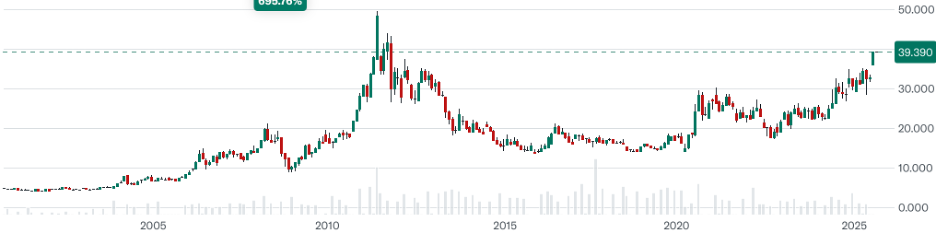
In commodities, oil (+1.2%) continues to find support despite the ongoing theme that the economy is soft and supply is growing significantly with OPEC increasing production and set to return even more to the market by the end of the summer.  As it happens, NatGas (+4.75%) is also higher this morning and continues to find substantial support as on a per BTU basis, it is desperately cheap vs. oil, something like one-seventh the price.  In the metals markets, while gold (+0.4%) continues to see support, the real action is in silver (+1.4%) which has rallied very consistently, gapping higher as you can see in the chart below, and has been the subject of much discussion as to how far it can rise.  Historically, silver lags the timing of gold rallies but far outperforms the gains in percentage terms.

Source: finance.yahoo.com

Finally, the dollar is little changed to a touch stronger this morning as traders cannot decide if tariffs are going to be a problem, or if deals are going to be struck.  However, in the dollar’s favor right now is the fact that most other countries are in a clear easing cycle while the Fed remains firmly on hold.  Fed funds futures are pricing less than a 7% chance of a cut this month and only a 61% chance of a September cut.  If US rates continue to run higher than the rest of the world, and there is limited belief they are going to fall, the dollar will find support.  However, given the pressure that President Trump continues to heap on Chairman Powell (there was a story this weekend that Powell is close to resigning, although my take is that is wishful thinking), it is hard to get excited about the dollar’s prospects.  Remember this, all the economists who tell us that an independent central bank is critical work for central banks.

On the data front, after virtually nothing last week, we do get some important numbers this week.

TuesdayCPI0.3% (2.7% Y/Y)
 -ex food & energy0.3% (3.0% Y/Y)
 Empire State Manufacturing-8.0
WednesdayPPI0.2% (2.5% Y/Y)
 -ex food & energy0.2% (2.7% Y/Y)
 IP0.1%
 Capacity Utilization77.4%
 Fed’s Beige Book 
ThursdayInitial Claims234K
 Continuing Claims1970K
 Retail Sales0.1%
 -ex autos0.3%
FridayHousing Starts1.30M
 Building Permits1.39M
 Michigan Sentiment61.4

Source: tradingeconomics.com

In addition to this, we hear from eight FOMC members, so it will be interesting to see if the erstwhile doves are willing to join Waller and Bowman in their call for a July rate cut.  If we start to see momentum build for a July cut, something which is not currently evident, look for the dollar to suffer substantially.  But absent that, I have a feeling we are going to range trade for the rest of the summer.

Good luck

Adf

Eighty-Sixed

The data remains rather mixed
But traders are still all transfixed
By tariffs and trade
As JGBs fade
And new ideas get eighty-sixed
 
Despite signs that peace in Ukraine
Is further away and hopes wane
It seems all that matters
Is whether Huang flatters
Investors, so stock markets gain


Apparently, at least based on yesterday’s equity market performance, concerns over the eventual outcome of the current global fiscal and monetary regimes remains far down everyone’s list of worries.  Rising inflation?  Bah, doesn’t matter.  Increasing tensions between Presidents Trump and Putin as Russia continues, and arguably increases its aggression?  No big deal.  But you know what has tongues wagging this morning?  Nvidia earnings are to be released after the close, and as we all know, if they are strong (everyone is counting on Jensen Huang, the CEO), then every other concern pales in significance.  After all, a global conflagration is no match in the imagination compared to your stock portfolio increasing in value!

Once upon a time, investors in the stock market sought companies that had good business models and good management who were able to grow their businesses.  These investors were buying a piece of a business in which they believed.  Analysts looked at metrics like P/E ratios and book value to determine if the price paid offered future opportunities as an investment, but the underlying company was the focus.  Of course, that is simply a quaint relic of times long ago, pre GFC.  Today, there is only one metric that matters, ‘NUMBER GO UP’!  While this concept was originally ascribed to Bitcoin and the crypto universe, it has spread across virtually all financial markets.  Nobody cares what a ticker symbol represents, they only care if the number next to the ticker symbol rises, and how rapidly it does so.  Welcome to the future.

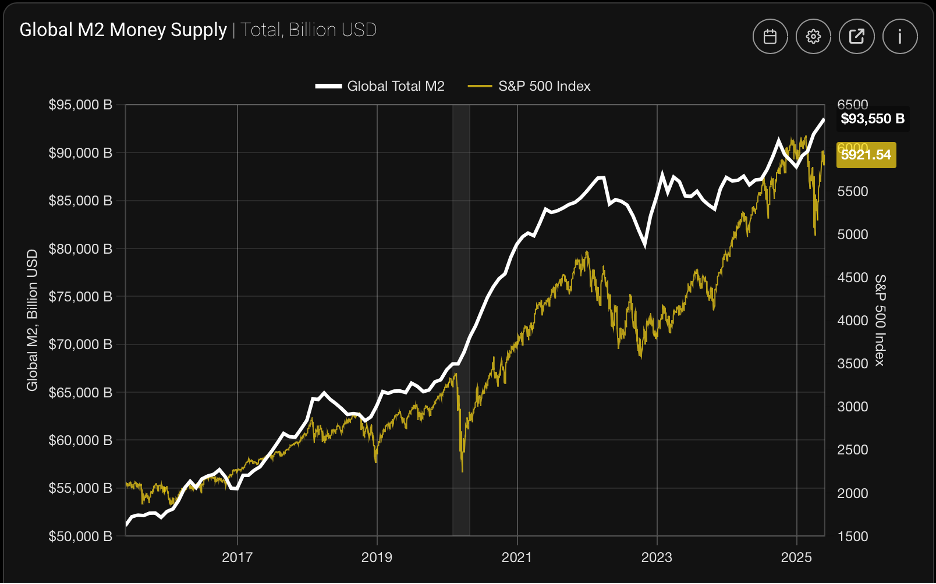
I highlight this because it has become increasingly clear that the macroeconomic landscape is an anachronism for analyzing financial markets.  At this point, whether or not a recession is on the horizon, or inflation is rising, or unemployment is rising or falling seems to have only a fleeting impact on market movements.  Rather, the true driver appears to be the flow of all that money that has entered the global financial system since the GFC.  The below chart from streetstats.finance shows the last 10 years of the growth in the global money supply and the corresponding move in the S&P 500.  You may not be surprised at the tight correlation.

My point is that all the news items that draw our attention may not matter at all in the broad scheme of things.  As long as money continues to be printed and injected into the financial system, while some assets will outperform others, the trend remains sharply from the lower left to the upper right.  Going back to my discussion yesterday, since the overriding goal of every global central bank is to ensure that their governments can issue bonds to finance their spending, I see no end to this trend.  While the speed of the increase may ebb and flow slightly, the direction will only change under the most egregious circumstances, something like the aftermath of WWIII.

In a funny way, this highlights that FX markets have the opportunity to be the most interesting trading markets going forward given the relativity of their underlying basis.  Assets, whether debt, equity or commodity, are all priced on demand functions while FX is priced on relative demand for each side of the cross.  Perhaps FX will be the last bastion of macroeconomic analysis.

But not today!  Starting with FX, the dollar is little changed to slightly higher this morning, consolidating yesterday’s gains but things are quiet.  In fact, across the main markets, the largest movement in either direction is NZD (+0.25%) after the RBNZ cut rates as expected by 25bps, but the market reduced the probability of another rate cut in July.  But away from that move, +/-0.1% is the norm today.  Discussion about tariffs continues to be the major talking point, but as of now, it appears nobody has a clue as to how things will evolve, so everybody is just hunkering down.  

Turning to equities, while yesterday saw a very large rally in the US, that sentiment was absent overnight with Asian markets generally drifting slightly lower although New Zealand (-1.7%) was clearly unhappy with the RBNZ mild hawkish view.  But elsewhere, movement was far less than 1.0%.  In Europe, it is a similar tale, very modest declines across the board as data showed German Unemployment rising slightly, Eurozone Consumer Inflation Expectations also rising slightly while French GDP disappointed on the downside, just 0.6% Y/Y.  You can appreciate the lack of enthusiasm there, although the story that Madame Lagarde is considering stepping down from the ECB to take over WEF should put a spring in the step of European investors as perhaps the next ECB president will understand economics and central banking.  As to US futures, they are little changed at this hour (7:35).

In the bond market, after a session where yields slid across the board yesterday, this morning brings a modest reversal with Treasuries (+2bps) right in line with most of Europe (+1bp across the board) although JGB’s (+5bps) suffered after another lousy long-dated auction last night where 40-year JGBs saw pretty weak demand overall.  The Japanese bond market remains a serious issue for many and a potential signal for the timing of next big move.  While risk assets rallied yesterday, nothing changed my description of the problems that exist globally.

Finally, in the commodity markets, oil (+0.7%) is modestly higher this morning but continues to trade within its range and shows no sign of breaking out in the near term.  Metals markets, which sold off aggressively yesterday have stopped falling, but are hardly rebounding, at least as of now.  

Let’s look at the data for the rest of the week though.

TodayFOMC Minutes 
ThursdayInitial Claims230K
 Continuing Claims1900K
 Q1 GDP (2nd estimate)-0.3%
FridayPersonal Income0.3%
 Personal Spending0.2%
 PCE0.1% (2.2% Y/Y)
 Core PCE0.1% (2.5% Y/Y)
 Goods Trade Balance-$141.5B
 Chicago PMI45.0
 Michigan Sentiment51.0

Source: tradingeconomics.com

In addition to the data, with all eyes really on Friday’s numbers, we hear from six more Fed speakers, although, again, will they really change their tune about patience in watching what the impact of tariffs are going to be on the economy?  I think not.  In the Fed funds futures market, the probability of a cut in June has fallen to just 2% while the market is now pricing just 47bps of cuts this year, the lowest amount in forever.  Unless the data completely fall off the map, I don’t see why they would cut at all, and that has just not happened yet.

The summer is upon us (although you wouldn’t know by the weather in the Northeast) and that typically leads to a bit less activity overall.  At this point, much depends on Congress and its ability to complete the budget bill to move the legislative process along.  Then the hard part of spending bills will be the next topic and you can expect a lot of screaming then.  In the meantime, though, I expect that we will hear of a number of other trade deals getting completed and a good portion of the trade anxiety ebbing from market views.  Alas, the peace/war equation is far more difficult to handicap as so many in power clearly benefit from war.

The prevailing view in the market is that the dollar has further to decline going forward as I think a majority of players are anticipating a recession in the US and the Fed to respond.  Under that scenario, a softer dollar feels right.  But is that the right scenario?

Good luck

Adf

So Mind-Blowing

On one hand, the chorus is growing
That US debt is so mind-blowing
The ‘conomy will
Slow down, then stand still
As ‘flation continues its slowing
 
But others remind us the data
Does not show a slowing growth rate-a
And their main concerns
Are Powell still yearns
For rate cuts to help market beta


As many of us enjoyed the long weekend, it appears it is time to put our noses back to the proverbial grindstone.  I know that as I age, I find the meaning of the Memorial Day holiday to grow in importance, although I have personally been very fortunate having never lost a loved one in service of the nation.  However, as the ructions in the nation are so evident each day, I remain quite thankful for all those that “…gave the(ir) last full measure of devotion” as President Lincoln so eloquently remarked all those years ago.

But on to less important, but more topical things.  A week ago, an X account I follow, The Kobeissi Letter, posted the following which I think is such an excellent description of why we are all so confused by the current market gyrations.  

Prior to President Trump’s second term, I would contend that the broad narrative had some internal consistency to it, so risk-on days saw equity markets rally along with commodities while bond prices would fall (yields rise) and the dollar would sink as well.  Similarly, risk-off days would see pretty much the opposite.  And it was not hard to understand the logic attached to the process.  

But here we are, some four plus months into President Trump’s term and pretty much every old narrative has broken into pieces.  I think part of that stems from the fact that the mainstream media, who were purveyors of that narrative, have been shown to be less than trustworthy in much of what they reported during the Biden Administration, and so there is a great deal of skepticism now regarding all that they say, whether political or financial.

However, I think a bigger part of the problem is that different markets have seen participants focusing on different idiosyncratic issues rather than on the bigger picture, and so there are many mini narratives that are frequently at odds.  Add to this the fact that there continues to be a significant dichotomy between the soft, survey data and the hard, calculated data, with the former pointing toward recession or stagflation while the latter seems to be pointing to stronger economic activity, and the fact that if you ask twenty market participants about the impact of President Trump’s tariff policies, you will receive twenty-five different explanations for why markets are behaving in a given manner and what those policies will mean for the economy going forward.

It is at times like these, when there are persuasive short-term arguments on both sides that I step back and try to look at bigger picture events.  In this category I place two things, energy and debt.  Energy is life.  Economic activity is simply energy transformed and the more energy a nation has and the cheaper it is, the better off that economy will be.  President Trump has made no bones about his desire to cement the US as the number one energy producer on the planet and to allow affordable energy to power the economy forward.  As that occurs, that is a medium- and long-term bullish backdrop.

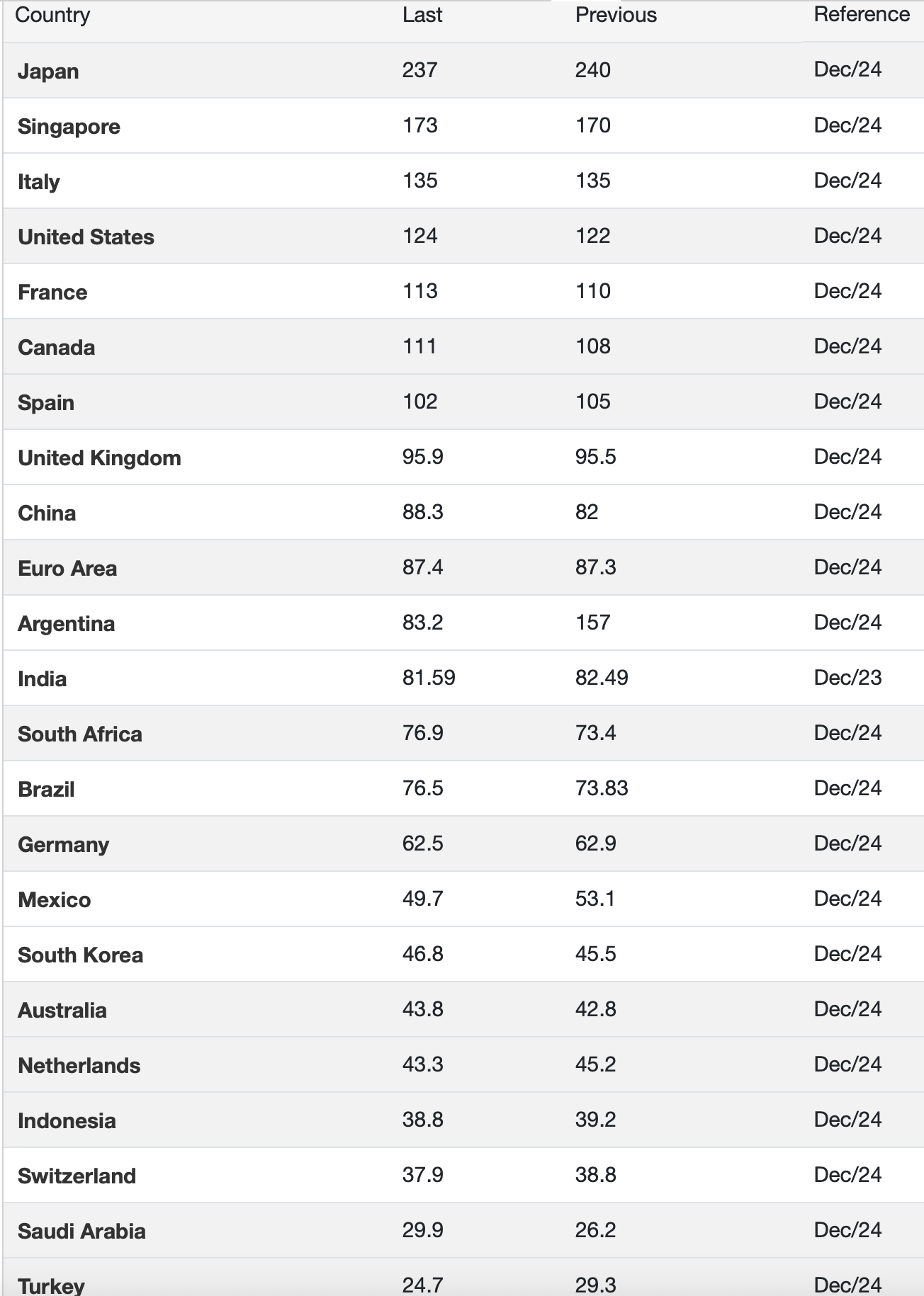
On the other hand, we cannot forget the debt situation, which is an undeniable drag on economic activity.  Forgetting the numbers per se, the fact that the US debt/GDP ratio is at wartime levels during peacetime (well, US peacetime) with no obvious end to the spending is a key concern.  But it is not just the US with a growing debt/GDP ratio.  Here is a listing from tradingeconomics.com of the G20’s ratios.  (Russia is the bottom of the list but not relevant for this discussion.)

And remember what has been promised by Germany and the Eurozone with respect to defense spending? More than €1 trillion for Germany and it sounds, if my addition is correct, like upwards of €1.7 trillion across the continent.  And all of that will be borrowed, so that is another 22% in Germany alone.  The point is the global debt/GDP ratio remains above 300% for public and private debt.  As government debt grows above 100%, at some point, we are going to see central banks, in sync, clamp down on longer-term yields.  

However they couch it, and however they do it, whether actual yield curve control, through regulations requiring banks and insurance companies to hold more government bonds on their balance sheets with no capital charges, or through adjustments to tax driven accounts like IRA’s and 401K’s, requiring a certain amount of government debt in the portfolio to maintain the tax deferred status, I expect that is what we are going to see.  And even with oil prices declining, which I think remains the trend, inflation is going to be with us for a long time to come as debt will be monetized.  It is the only solution absent a depression.  And every central bank will be in on the joke.  Which takes us to this morning…

As yields were soaring
The BOJ kept quiet
Until yesterday

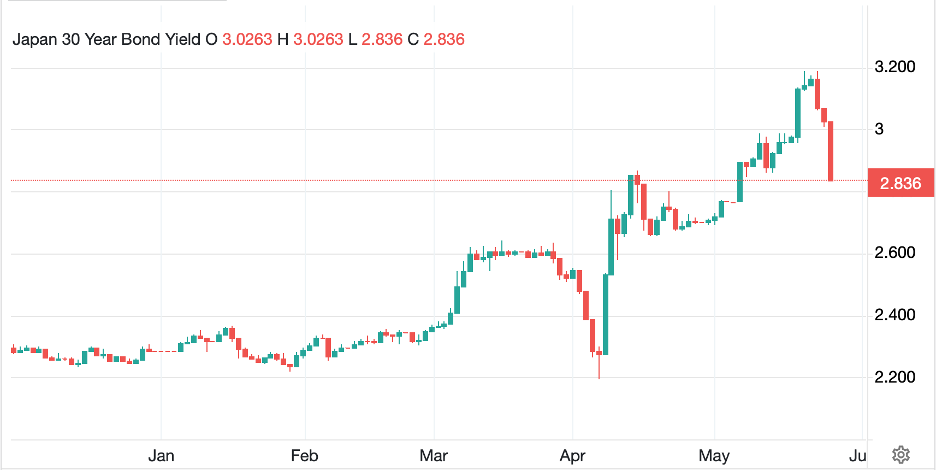
Apparently, the bond vigilantes have spent the past decades learning Japanese.  At least that is what I conclude from the price action, and more importantly, the BOJ’s recent response in the JGB market. As you can see in the chart below, there has been a significant reversal in 30-year JGB yields with similar price action in both the 20-year and 40-year varieties.

Source: tradingeconomics.com

You may recall that last week, the Japanese government issued 20-year bonds, and the auction went quite poorly, with yields rising sharply (that was the large green candle six sessions ago). Well, it seems that the BOJ (along with the Ministry of Finance) have figured out that the bond situation in Japan is reaching its limits. After all, in less than two months, 30-year JGB yields rose 100 basis points from a starting point of about 2.2%.  That is an enormous move.  Now, if we look at the table above, we are reminded that Japan’s debt/GDP ratio is the highest in the developed world at well over 200%.  In addition, the BOJ owns more than 53% of all JGBs outstanding.  Quite frankly, it is easy to make the case that the BOJ has been monetizing Japanese debt for years.  

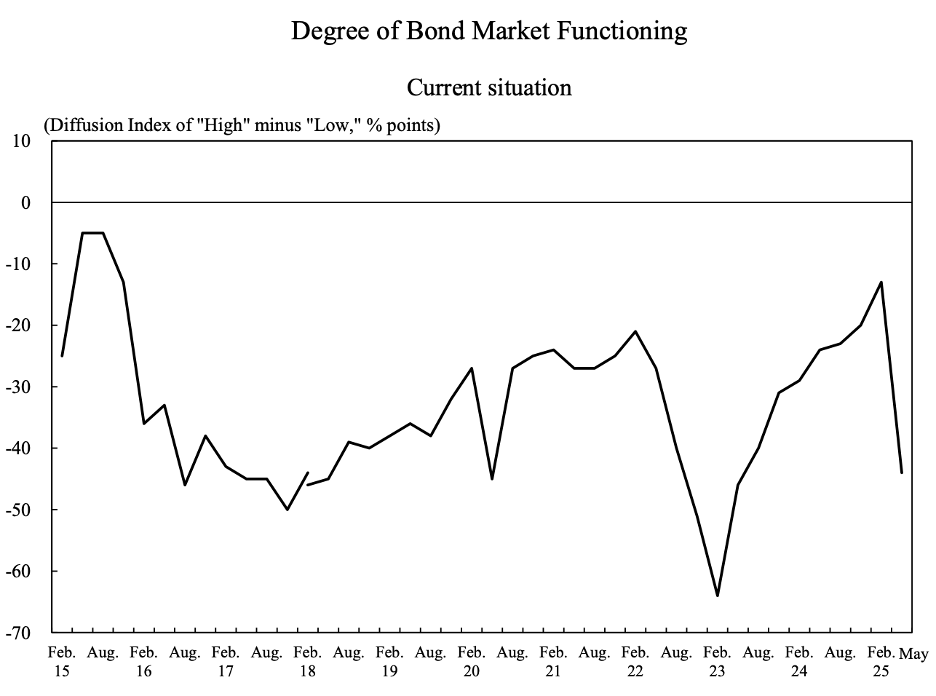
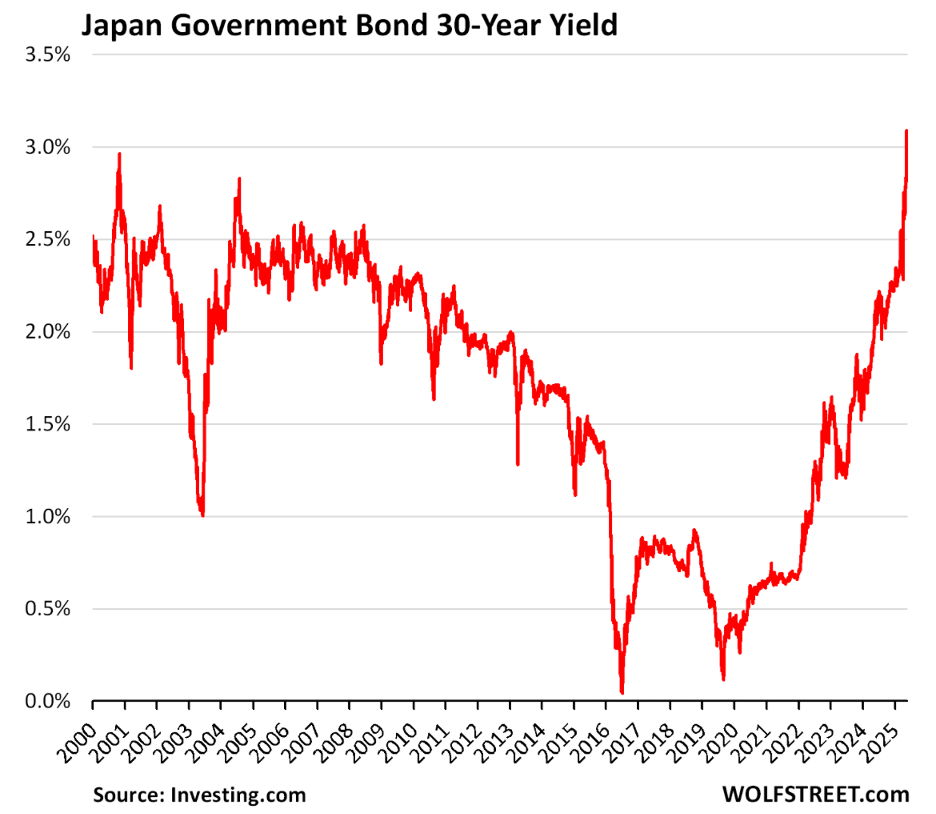
As it happens, last week the BOJ held one of their periodic (actually, the 22nd) “Bond Market Group” meetings in which they discuss with various groups of market participants the situation in the JGB market regarding liquidity and trading capabilities and the general functioning of the market.  The two charts below, taken from the BOJ’s website (H/T Weston Nakamura) demonstrate that there is growing concern in the market as to its ability to continue along its current path.

The concern demonstrated by market participants is a clear signal, at least to me, that we are entering the end game.  For all the angst about the situation in the US, with excessive fiscal expenditures and too much debt, Japan has that on steroids.  And while Japan has the benefit of being a net creditor country, the US has the advantage of having both the strongest military in the world and issuing the world’s reserve currency.  As well, the US neighborhood is far less troublesome than Japan’s in East Asia with two potential protagonists, China and North Korea.  All I’m saying is that after decades of kicking the can down the road, it appears that the road may be ending for Japan and difficult policy decisions regarding spending, deficits and by extension JGB issuance are coming soon.

It’s funny, many economists have, in the past, described the US situation as Japanification, with rising debt and slowing growth.  But perhaps Japanification will really be the road map for how to respond to the first true limits on the issuance of government debt for a major economy.  Last night, JGB yields fell across the board, dragging global yields down with them.  The yen (-0.8%) weakened sharply, reversing its trend of the past two weeks, while the Nikkei (+0.5%) rallied.  Perhaps market participants are feeling comforted by the fact the Japanese government seems finally ready to recognize that things must change.  But this is the beginning of that process, not the end, and there will be many twists and turns along the way.  Stay tuned.

Ok, I really ran on, but I feel it is critical for us all to recognize the debt situation and that there are going to be changes coming.  As to other markets overnight, this is what we’ve seen.  Asia was mixed with gainers (Hong Kong, Australia, Singapore) and laggards (China, Korea, India, Taiwan) but nothing moving more than 0.5% in either direction.  Europe, on the other hand, has been the beneficiary of President Trump delaying the tariffs on the EU until July 9th, with all the major indices higher led by the DAX (+0.8%) which also rallied more than 1% yesterday.  Say what you will about President Trump, he has gotten trade discussions moving FAR faster than ever before in history.  US futures, at this hour (6:15) are also pointing nicely higher, more than 1.3% across the board.

We’ve already discussed bond yields where 10yr Treasury yields have backed off by 5bps this morning although European sovereign yields have not benefitted quite the same way with declines of only 2bps on average.  But the trend in all cases is for lower yields right now.  Hope springs eternal, I guess.

In the commodity space, with the new view on tariffs, risk is abating and gold (-1.5%) is being sold off aggressively.  Not surprisingly, this has taken the whole metals complex with it.  As to oil (+0.1%) it continues to trade in its recent $60 – $65 range and while the trend remains lower, it is a very slow trend.

Source: tradingeconomics.com

Finally, the dollar is perking up this morning, not only against the yen, but across the board.  On the haven front, CHF (-0.6%) is sinking and the commodity currencies (AUD -0.6%, NZD -0.8%, SEK -0.6%) are also under pressure.  But the euro (-0.4%) is lower and taking the CE4 with it.  In fact, every major counterpart currency is lower vs. the dollar this morning.

On the data front, this morning brings Durable Goods (exp -7.8%, -0.1% ex-transport), Case Shiller Home Prices (4.5%), and Consumer Confidence (87.0). We also hear from NY Fed President Williams this evening.  Chairman Powell spoke at the Princeton graduation ceremony but said nothing about policy.  I will review the rest of the week’s data tomorrow.

Bonds are the thing to watch for now, especially if we are going to see more active policy adjustments to address what has long been considered an unsustainable path.  The question is, will there be fiscal adjustments that help?  Or will central banks simply soak up the bonds?  While I hope it is the former, I fear it is the latter.  Be prepared.

Good luck

Adf

Has Bug Met Windshield?

So, once again, we were misled
By all those who told us, with dread,
The ratings reduction
Would cause much destruction
With both stocks and bonds, money, dead
 
Instead, what we saw yesterday
Was traders jumped into the fray
Despite all the gloom
It seems there’s still room
Where bullish investors hold sway


I know it is hard to believe, but it seems that all the angst that was fomented over the weekend following Moody’s ratings downgrade of US Treasury debt was for naught.  In fact, the decline in both stocks and bonds didn’t even last one session, let alone weeks or months as both markets closed the session essentially unchanged on the day, recouping the early losses seen.  A quick look at the chart below shows the price action in S&P 500 futures from the time of the announcement through yesterday’s close and then this morning.  It seems the market is concerned about things other than the US credit rating.

Source: tradingeconomics.com

In fact, I am willing to say that we are unlikely to hear anything more about the downgrade until such time that equity prices fall on some other catalyst, and the punditry will add in the ratings story to help bolster whatever claim they are making at that time.  Please remember, as well, that I am quite concerned that equity valuations remain rich and that a decline is quite possible, if not likely.  It’s just that the ratings downgrade story is not going to be the driver of that move.

In Japan, it seems
No one’s buying JGBs
Has bug met windshield?

Last night, Japan auctioned 20-year JGBs with the yield coming at 2.52%, the highest since these bonds were first issued back in 1999.  As well, yields in 30-year and 40-year JGBs also soared, rising 12bps in each case to the highest yield in more than 25 years as per the below chart of the 30-year bond.

While the selloff in JGBs has been accelerating, real yields there are still negative with CPI running at 3.6%.  This presents quite a conundrum for Japanese investors as despite the negative real yield, the ability to borrow cheaply (remember short term rates in Japan are 0.50%) and invest in long-dated bonds and earn 3.0% is quite tempting.  250 basis points of carry with no currency risk is now going to compete with 450 basis points of carry (US 30-year yields of ~5.0% – 0.50% funding costs in Japan) with FX risk.

What makes this especially tricky for Japanese investors is that the dollar’s future path, which had been clearly higher for longer, appears to have adjusted.  It seems evident the Trump administration is keen to see the dollar decline, or perhaps more accurately, see other currencies appreciate, especially if those nations run significant trade surpluses with the US.  Japan certainly fits that bill.  And the thing about currency risk is that FX can move swiftly enough to wipe out any carry benefits before institutional investors can even organize meetings to determine if they want to change their strategy.

One of the things that we have heard regularly for the past several years (decades?) is that the US fiscal situation has put the nation in a precarious position, relying on investment by foreigners to fund the massive budget deficits that the government has been running.  The problem with these warnings is they have been ongoing for so long, nobody really pays them any attention.  It is not to say the theory is incorrect, just that there have been other things that have offset that factor and attracted capital to the US anyway.  It is also not apparent that Moody’s ratings cut has changed that dynamic.

But, if at the margin, Japanese investors start to focus more on the JGB market to reduce currency risk, rather than on the highest yield available in major nations, that would likely have a negative impact on the Treasury market.  That is, of course, a big IF and there is no evidence yet that is the situation.  It is something, though, we must watch closely.  

Remember, too, global debt/GDP is more than 300% across all types of debt, public and private.  That tells me it will never be repaid, only rolled over.  The question is at what point will investors decide that holding debt is too great a risk at current yields?  While I assure you governments around the world will work hard to prevent that outcome, including changing regulations to force purchases, it is not clear how much higher that ratio can go without more seriously negative consequences.  We will need to watch this closely.

With that in mind, let’s turn to markets and see how things have behaved in the wake of the reversal in US markets yesterday.  Asian equities were mixed with Japan essentially unchanged, China (+0.5%) and Hong Kong (+1.5%) showing the best performance in the region while India (-1.0%) was the laggard.  Otherwise, there were both gainers and losers of limited note.  In Europe, though, equity markets are rallying across the board led by Spain’s IBEX (+1.6%) despite another infrastructure disaster where half the nation lost telecoms for several hours as Telefonica (Spain’s major telecom company) messed up a systems upgrade.  The rest of the continent has seen shares rise on the order of 0.4% to 0.5% as ECB comments seem to be encouraging the idea of another rate cut coming soon and European Current Account data showed a greater surplus than expected.  US futures, though, are ever so slightly lower at this hour (7:15), down about -0.1% across the board.

In the bond market, in the 10-year space, yields are within 1bp of yesterday’s closing for Treasuries (+1bp), European sovereigns (-1bp) and JGBs (+1bp).  It seems that despite all the talk of the end of times, investors haven’t given up yet, at least not in the 10yr space.  However, the evidence is growing that fixed income investors are growing leery of tenors longer than that.

In the commodity markets, oil (-0.6%) is slightly softer but remains well within its recent trading range amid the slightest of downtrends.  In truth, I find this chart to be an excellent description of my feelings of this market, a really slow decline over time.

Source: tradingeconomics.com

As to the metals markets, gold (+0.6%) is continuing its rebound from the worst levels seen last Thursday and is currently more than $100/oz higher than those recent lows.  This has helped silver (+0.5%) as well although copper (-0.5%) is not playing along today.

Finally, the dollar, remarkably, did not collapse in the wake of the Moody’s downgrade.  In fact, similar to the price action in both stocks and bonds yesterday, the dollar retraced much of its early losses.  This morning, it remains on the soft side, but movement is much less pronounced across both the G10 and EMG blocs.  However, the worst performer today is AUD (-0.7%) which some may attribute to the fact that the RBA cut their base rate by 25bps last night (although that was widely expected).  But I would point to the law that was recently enacted by the Albanese government in Australia to begin taxing UNREALIZED capital gains.  This idea has been floated by other governments but never actually enacted.  I fear that the consequences for Australia will be dire as it becomes clear the policy is extraordinarily destructive.  Capital will flee and that bodes ill for the currency.  If they truly follow through with this, be very careful.

There is no data today, but we hear from six different Fed speakers as they are all participating in an Atlanta Fed symposium.  However, I do not expect anything other than patience is the watchword as they observe the Trump administration policies unfold.

In the end, the predicted doom did not come to pass.  However, for my money, I would pay closest attention to Australia.  I fear the negative consequences of this policy will be extreme.

Good luck

Adf

Shortsighted

The CPI data delighted
Investors, who in a shortsighted
Response bought the bond
Of which they’re now fond
And did so in, time, expedited
 
But does this response make much sense?
Or is it just way too intense?
I’d offer the latter
Although that may shatter
The narrative’s current pretense


Leading up to yesterday’s CPI data, it appeared to me that despite a better (lower) than expected set of PPI readings on Tuesday, the market was still wary about inflation and concerned that if the recent trend of stubbornly sticky CPI prints continued, the Fed would soon change their tune about further rate cuts.  Heading into the release, the median expectations were for a 0.3% rise in the headline rate and a 0.2% rise in the core rate for the month of December which translated into Y/Y numbers of 2.9%% and 3.3% respectively. At least those were the widely reported expectations based on surveys.  

However, in this day and age, the precision of those outcomes seems to be lacking, and many analysts look at the underlying indices prepared by the BLS and calculate the numbers out several more decimal places.  This is one way in which analysts can claim to be looking under the hood, and it can, at times, demonstrate that a headline number, which is rounded to the first decimal place, may misrepresent the magnitude of any change.  I would submit that is what we saw yesterday, where the headline rate rose to the expected 2.9% despite a 0.4% monthly print, but the core rate was only 3.24% higher, which rounded down to 3.2% on the report. Voila!  Suddenly we had confirmation that inflation was falling, and the Fed was right back on track to cut rates again.

Source: tradingeconomics.com

Now, I cannot look at the above chart of core CPI and take away that the rate of inflation is clearly heading back to 2% as the Fed claims to be the case.  But don’t just take my word for it.  On matters inflation I always refer to Mike Ashton (@inflation_guy) who has a better grasp on this stuff than anyone I know or read.  As he points out in his note yesterday, 3.5% is the new 2.0% and that did not change after yesterday’s data.

However, markets and investors did not see it that way and the response was impressive.  Treasury yields tumbled 13bps and took all European sovereign yields down by a similar amount, equity markets exploded higher with the NASDAQ soaring 2.5% and generally, the investment world is now in nirvana.  Growth remains robust but that pesky inflation is no longer a problem, thus the Fed can continue cutting rates to support equity prices even further.  At least that’s what the current narrative is.  

Remember all that concern over Treasury yields?  Just kidding!  Inflation is dying and Trump’s tariffs are not really a problem and… fill in your favorite rationale for remaining bullish on risk assets.  I guess this is where my skepticism comes to bear.  I do not believe yesterday’s data reset the clock on anything, at least not in the medium and long term.

Before I move on to the overnight, there is one other thesis which I read about regarding the recent (prior to yesterday) global bond market sell-off which has some elements of truth, although the timing is unclear to me.  It seems that if you look at the timing of the recent slide in bond markets, it occurred almost immediately after the fires in LA started and were realized to be out of control.  This thesis is that insurers, who initially were believed to be on the hook for $20 billion (although that has recently been raised to >$100 billion) recognized they would need cash and started selling their most liquid assets, namely Treasuries and US equities.  In fact, this thesis was focused on Japanese insurers, the three largest of which have significant exposure to California property, and how they were also selling JGB’s aggressively.  Now, the price action before yesterday was certainly consistent with that thesis, but correlation and causality are not the same thing.  If this is an important underlying driver, I would expect that there is more pressure to come on bond markets as almost certainly, most insurance companies don’t respond that quickly to claims that have not yet even been filed.

Ok, let’s see how the rest of the world responded to the end of inflation as we know it yesterday’s CPI data. Japanese equities (+0.3%) showed only a modest gain, perhaps those Japanese insurers were still out selling, or perhaps the fact that the yen (+0.3%) is continuing to grind higher has held back the Nikkei.  Hong Kong (+1.25%) stocks had a good day as did almost every other Asian market with the US inflation / Fed rate cuts story seemingly the driver.  The one market that did not participate was China (+0.1%) which managed only an anemic rally.  In Europe, the picture is mixed as the CAC (+2.0%) is roaring while the DAX (+0.2%) and IBEX (-0.4%) are both lagging as is the FTSE 100 (+0.65%).  The French are embracing the Fed story and assuming luxury goods will be back in demand although the rest of the continent is having trouble shaking off the weak overall economic data.  In the UK, GDP was released this morning at 1.0% Y/Y after just a 0.1% gain in November, slower than expected and adding pressure to the Starmer government who seems at a loss as to how to address the slowing economy.  As to US futures, at this hour (7:30) they are pointing slightly higher, about 0.2%.

In the bond market, after yesterday’s impressive rally, it is no surprise that there is consolidation across the board with Treasury yields higher by 2bps and similar gains seen across the continent.  Overnight, Asian government bond markets reacted to the Treasury rally with large gains (yield declines) across the board.  Even JGB yields fell 4bps.  The one market that didn’t move was China, where yields remain at 1.65% just above their recent historic lows.

In the commodity markets, oil (-1.0%) is backing off yesterday’s rally which saw WTI trade above $80/bbl for the first time since July as despite ongoing inventory builds in the US, and ostensibly peace in the Middle East, the market remains focused on the latest sanctions on Russia’s shadow tanker fleet and the likely inability of Russia (and Iran) to export as much as 2.5 million barrels/day going forward.  NatGas (+0.75%) remains as volatile as ever and given the polar vortex that seems set to settle over the US for the next two weeks, I expect will remain well bid.  On the metals side of things, yesterday’s rally across the board is being followed with modest gains this morning (Au +0.3%) as the barbarous relic now sits slightly above $2700/oz.

Finally, the dollar doesn’t seem to be following the correct trajectory lately as although there was a spike lower after the CPI print yesterday, it was recouped within a few hours, and we have held at that level ever since.  In fact, this morning we are seeing broader strength as the euro (-0.2%), pound (-0.4%) and AUD (-0.5%) are all leaking and we are seeing weakness in EMG (MXN -0.6%, ZAR -0.6%) as well.  My take is that the bond market, which had gotten quite short on a leveraged basis, washed out a bunch of positions yesterday and we are likely to see yields creep higher on the bigger picture supply issues going forward.  For now, this is going to continue to underpin the dollar.

On the data front, this morning opens with Retail Sales (exp 0.6%, 0.4% -ex autos) and Initial (210K) and Continuing (1870K) Claims.  We also see Philly Fed (-5.0) to round out the data.  There are no Fed speakers today, although in what cannot be a surprise, the three who spoke yesterday jumped all over the CPI print and reaffirmed their view that 2% was not only in sight, but imminent!  As well, today we hear from Scott Bessent, Trump’s pick to head the Treasury so that will be quite interesting.  In released remarks ahead of the hearings, he focused on the importance of the dollar remaining the world’s reserve currency, although did not explicitly say he would like to see it weaken as well.  The one thing I know is that he is so much smarter than every member of the Senate Finance committee, that it will be amusing to watch them try to take him down.

And that’s really it for now.  If Retail Sales are very strong, look for equities to see that as another boost in sentiment, but a weak number will just rev up the Fed cutting story.  Right now, the narrative is all is well, and risk assets are going higher.  I hope they are right; I fear they are not.

Good luck

Adf