Awakened the Beast

The longshoreman’s union conceded
And ports will now work unimpeded
But is that enough
To make sure that stuff
Gets everywhere that it is needed?


Arguably, one of the biggest stories this morning is that the fears over the longshoreman’s union strike dramatically weakening the US economy while pushing up inflation have passed as there has been a temporary agreement to raise workers’ pay by 62% over the next six years although it seems that the questions over automation remain.  However, the agreement will last until January 15th, so the 3-day work stoppage is unlikely to have a major impact on the US economy, although I’m sure there will be a few hiccups around.  But hey, at least one problem is off the docket.
 
Meanwhile, problems in the Mideast
Continuously have increased
Iran took their shot
And all that it wrought
Was fear they’ve awakened the beast

Which takes us to the next major story, the nature of Israel’s response to Iran’s missile attack from earlier this week.  From what I have read, the US is trying very hard to persuade PM Netanyahu to leave Iran’s nuclear facilities and oil production capabilities alone.  While I understand the latter, given an attack there would likely drive oil prices far higher and not help VP Harris’s election prospects, I cannot understand why the US would be so adamant that Israel not seek to destroy Iran’s nuclear capabilities.  At any rate, the headline in this morning’s WSJ, “Biden Sidelined as Israel Reshapes Middle East”, seems to say it all.  At this point, we can only watch and wait.  

However, consider the benefits of either of those targets.  As it remains unclear whether Iran has achieved the capability to create nuclear weapons, an attack on those facilities, which are hardened and underground, may or may not be effective at preventing a future nuclear Iran.  But an attack on the oil production facilities, which are wide open and not nearly as well-defended, would immediately limit Iran’s income despite the certain rise in oil prices, as they would not be able to sell any.  Starving Iran of capital to continue to run its military and fund its proxies would likely be extremely effective at dramatically reducing threats to Israel.  As well, I’m pretty confident the Saudis would not be unhappy if oil rose to $90 or $100 per barrel.  My point is the latter strategy is likely to be effective at reducing Iranian activities while being quite achievable.  We shall see.

And finally, early today
The payrolls report will hold sway
O’er markets worldwide
As traders decide
If more cuts are soon on their way

Which takes us to the big economic story today, the monthly payroll report.  Wednesday’s ADP Employment data was much better than expected, showing job growth of 143K.  Current expectations are as follows:

Nonfarm Payrolls140K
Private Payrolls125K
Manufacturing Payrolls-5K
Unemployment Rate4.2%
Average Hourly Earnings0.3% (3.8% Y/Y)
Average Weekly Hours34.3
Participation Rate62.9%

Source: tradingeconomics.com

One thing to keep in mind is this is going to be the last meaningful payroll report before the next FOMC meeting because the October report, scheduled to be released on November 1st, is going to be a complete wreck with virtually no information because of the impact of Hurricane Helene.  In fact, it will likely take several months before economic data gets back to whatever its underlying trend may be given the disruption over such a wide swath of the nation.

The question of the economy’s strength continues to be a hotly contested disagreement between those who believe that a recession is coming soon, or has already started, vs. those who believe that there is no recession coming in the near future.  The first group tends to look through the headline data and sees decreasing quit rates and reduced hiring offsetting reduced firing with the lack of hiring seen as an indication business activity is slowing.  They look at high household credit card debt and growing delinquencies and see analogies to past recessions.  Meanwhile, the bulls look at the headline data and say, GDP continues to grow, inflation continues to slide and while manufacturing has been weak for nearly two years, this is a services economy and that has been strong (yesterday’s ISM Services print was a much stronger than expected 54.9).

Now, the very fact that Powell cut rates two weeks ago is indicative of the fact that there is real concern at the FOMC that growth is slowing.  I will not discuss the political question here.  But data like TSA travel clearances and restaurant seatings and the crowds at events show that at least some portion of the economy is still doing well.  Yesterday’s Claims data was 225K, a few thousand more than expected but still nowhere near a level that would indicate there is an employment glut.  

I believe the idea of the K-shaped recovery is the best description of things around.  The top quartile of income earners is doing just fine while the rest of the economy is struggling.  But that top quartile represents an outsized amount of economic activity, so the data continues to be positive.  In fact, if you are looking for a reason that there is so much angst in the electorate, this is it.  With all that in mind, though, my take is this morning’s number is going to be better than expected, somewhere on the 175K – 200K level.

Ok, let’s quickly run through market activity overnight.  Yesterday’s modest decline in US markets did not really give much direction to the overnight session as the Nikkei (+0.2%) managed to continue its recent modest rally and the Hang Seng (+2.8%) continues to benefit from a belief that Chinese stimulus is coming to the rescue.  But the rest of Asia couldn’t make up its mind (China is still closed) with gainers (Korea, New Zealand, Singapore) and laggards (India, Australia , Taiwan).  In Europe, the picture is also mixed ahead of the US data with modest gainers (CAC, DAX) and laggards (FTSE 100, IBEX) as the US data is still the key driver.  One story here is that the EU decided to impose tariffs of as much as 45% on Chinese BEV’s, something that is likely to become problematic for European exporters going forward.  As to US futures, just ahead of the data (8:00) markets are edging higher by 0.2%.

In the bond market, yields are continuing to rise around the world with Treasuries higher by 2bps this morning after a 5bp climb yesterday afternoon.  European sovereign yields are also much firmer, between 3bps and 6bps across the continent as concerns over inflation reignite.  Both the price of oil and the Chinese tariff story are driving this bond move.  As to JGB’s, they jumped 6bps last night, but that was more on the back of the US rise than any domestic news.

Oil (+1.4%) is continuing to rally as fears over an Israeli attack on Iranian assets builds.  This has helped the entire commodities complex with metals markets also firmer this morning, albeit only on the order of +0.25%. Nonetheless, the commodity higher story remains a fundamental one in my world view, especially as food prices are picking back up again around the world.  The UN’s FAO Food price index rose to its highest level in more than a year and looks for all the world like it has based and is now going to trend higher again.

Finally, the dollar is mixed this morning, with no defining theme here.  The pound (+0.35%) and MXN (+0.4%) have rallied while KRW (-0.5%) and AUD (-0.25%) have declined with the euro virtually unchanged.  My point is there is nothing specific to explain the movement.

And that’s really it.  We hear from a couple of more Fed speakers but since Powell on Monday cooled the idea of another quick 50bp cut, they have not given us much new guidance.  If I am correct and the data is strong, I expect bonds to suffer along with commodities while the dollar should gain.  Stocks are a little less clear.  However, if it is a soft number, you can be sure that the 50bp talk will dramatically increase and stocks and commodities will soar as the dollar slides.

Good luck and good weekend

Adf

A Brand New Zeitgeist

Although it’s the number two nation
Of late its shown real desperation
Seems Xi did appraise
The recent malaise
And ordered growth maximization
 
So, mortgage rates there have been sliced
And refi’s are now getting priced
It’s different this time
The bulls, in sync, chime
As Xi seeks a brand new zeitgeist


As China gets set to head off for a week-long holiday, President Xi wanted to make sure everybody there felt great and would start to spend money again.  His latest move came via the PBOC where they loosened the regulations regarding refinancing of home mortgages, now allowing them for everybody starting November 1st.  The key housing rate in China is the 5-year Loan Prime Rate, and while that has fallen steadily over the past two years, down nearly 1%, all the people who were swept up in the property bubble that began to burst three years ago have not been able to take advantage of the lower rates.  This is what is changing, and I presume there will be quite a bit of refi activity for the rest of the year.

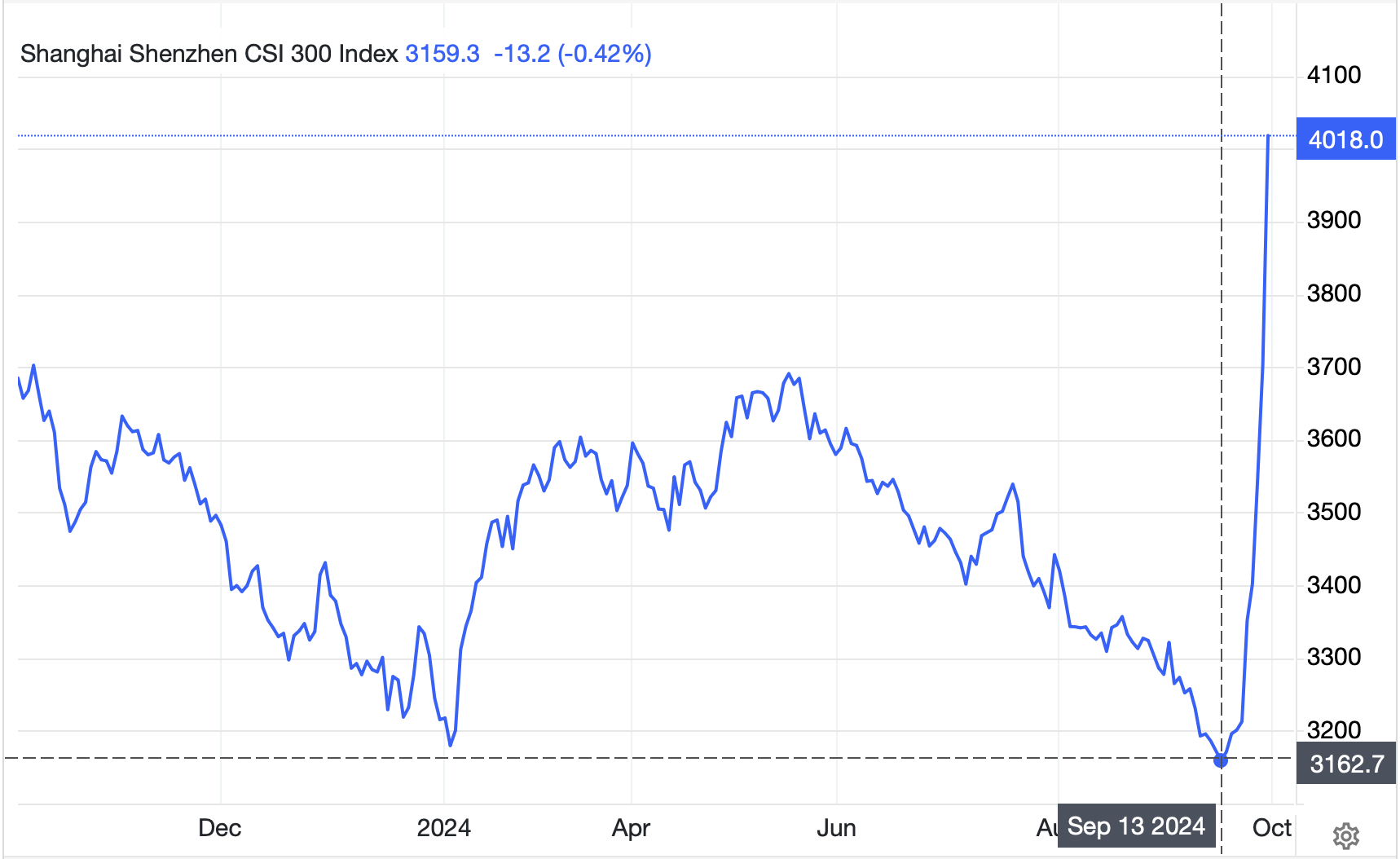
So, to recap what China has done in the past week, they have cut interest rates across the board, guaranteed loans to be used for stock repurchases, changed regulations to allow lower down payments on mortgages for first and second homes and now allowed more aggressive refinancing of existing mortgages.  As well, they reduced the RRR, freeing up capital for banks, and relaxed rules for regional governments to be able to spend more.  Now matter how this ultimately ends up, you must give Xi full marks for finally figuring out that in a command economy, he needed to command some more stimulus.  The latest mortgage news has simply excited the equity market even more and there was another huge rally last night (CSI 300 +8.5%), which when looking at a chart of that index shows an impressive rally in the past two weeks, slightly more than 27%!

Source: tradingeconomics.com

However, before we get too carried away, a little perspective may be in order.  The below chart is the 5-year view, and while the recent rebound is quite impressive, it simply takes us back to the level from July 2023 and remains more than 30% below the highs seen in February 2021.  I might argue that even if all of these policies work out as planned, something which rarely ever happens, until the economic data start to prove it out, things here feel a bit overbought for now.  Putting an exclamation on the last point, last night China released its monthly PMI data which showed just why Xi has become so aggressive.  Every reading, from both Caixin and the National Bureau of Statistics, was weaker than last month and weaker than expected.  Xi certainly needed to do something.

Source: tradingeconomics.com

Gravity remains
An unyielding force, even
For Japanese stocks

Now, a quick mea culpa from Friday’s note as I was in error on my analysis of the Japanese stock market in the wake of the election of Ishiba-san.  It seems that the announcement of his victory was not made until after the cash equity market was closed for the day. At that time, Sanae Takaichi remained the odds-on favorite to win the vote, and the market was anticipating a more dovish approach to things. Hence, the idea of the return to Abenomics and a much slower policy tightening was welcomed by the equity market at the same time the yen weakened.  But with Ishiba-san’s surprise victory, all of that got tossed out the window.  

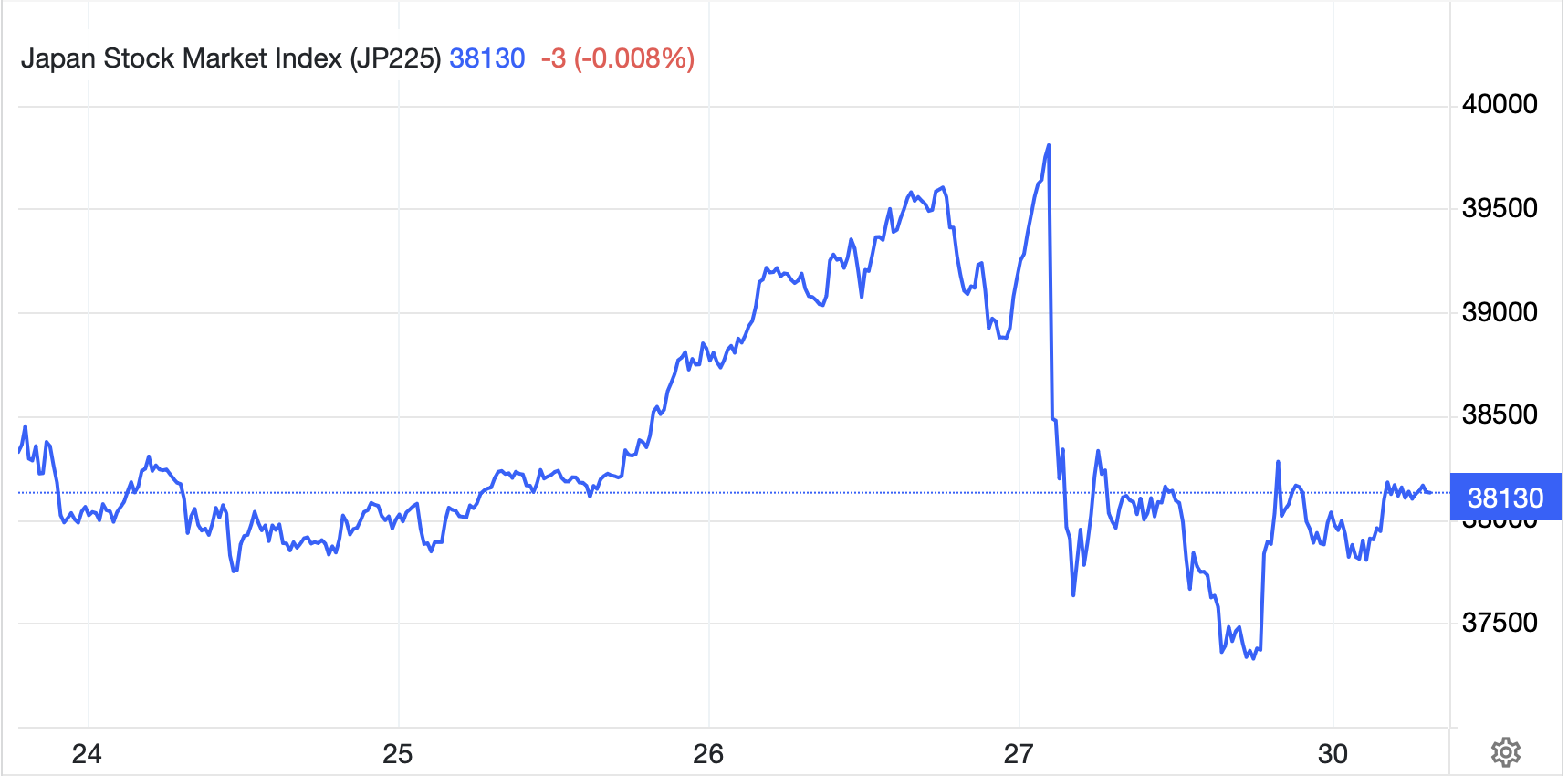
Of course, USDJPY was able to respond instantly, hence the sharp reversal in the market I showed in a chart on Friday.  However, the futures market sold off sharply on the election news and now that has been reflected in the overnight session with the Nikkei (-4.8%) giving back all the gains it had made in the previous two sessions in anticipation of a dovish turn.  So, as you can see in the below chart for the Nikkei 225 over the past week, we are basically exactly where things started before the Takaichi expectations built.  Truly much ado about nothing.

Source: tradingeconomics.com

As to the rest of the overnight session, beyond the Chinese data, we saw German state CPI readings which continue to fall as the German economy continues to slow appreciably.  We also saw UK GDP data, which was slightly softer than forecast, although at 0.9% Y/Y, still well ahead of Germany’s pace.  But otherwise, not very much else.  Last Friday’s PCE data was largely in line and quite frankly, most of the market seems to be focused on China right now, not the US, as that has become the newest idea on how to get rich quick.

So, here’s a quick recap of the session thus far.  Away from China and Japan, we saw more weakness than strength in Asia with both Korea and India falling more than -1.0%, although the rest of the region was mixed with much smaller moves.  Australia (+0.8%), though, benefitted from the China story as the price of iron ore, one of its major exports, rose 11% overnight on the idea that Chinese construction was coming back.  However, European bourses are under pressure this morning led by the CAC (-1.6%) with the rest of the continent also soft on the back of weaker earnings forecasts and announcements from European companies.  As to US futures, at this hour (7:20), they are pointing lower by -0.25%.

In the bond market, with all the excitement over renewed growth in China and continued tightening in Japan, yields are backing up slightly with virtually every G10 government seeing yields higher by 2bps this morning.  Ultimately, for Treasuries my fear is with the Fed cutting rates now and no real sign that the economy is slowing rapidly, we are going to see a quicker rebound in inflation than they are anticipating and that will not help the long end of the curve at all.

In the commodity markets, we are following Friday’s declines with further moves lower this morning as oil (-0.55%) continues to struggle on the weak demand story (this time from Europe, not China) while metals markets are also under pressure with all three biggies down (Au -0.75%, Ag -1.4%, Cu -0.7%).  This is a bit confusing for two reasons.  First, with the euphoria that the Chinese reflation story has generated, I would have expected copper to continue to rally alongside iron ore, but second, the dollar is softer today, and that generally supports the metals markets.

So, a quick look at the dollar shows the DXY is looking to test 100.00, a level it last briefly touched in July 2023 but spend most of 2020 and 2021 below.  This is concurrent with the euro (+0.3%) testing 1.12 and the pound (+0.3%) testing 1.35, with the former showing virtually the same pattern as the DXY and the latter making new highs for the past two years.  But there is some schizophrenia in the G10 with JPY (-0.2%), CHF (-0.3%), NOK (-0.35%) and SEK (-0.2%) all under pressure today.  While NOK and SEK make sense given the commodity moves, that doesn’t explain gains in AUD and NZD.  Some days are just like that.  In the EMG bloc, in truth, the dollar is showing more strength than weakness with ZAR (-0.35%), CNY (-0.2%) and KRW (-0.15%) although MXN (+0.3%) is bucking that trend.  On the one hand, it is quite confusing to see so many contrary moves amongst the currencies that typically track closely together.  On the other, though, none of the moves are very large, so there can be idiosyncratic explanations for all of this without changing the big picture story.

On the data front, we get a bunch of stuff culminating in NFP on Friday.

TodayChicago PMI46.2
 Dallas Fed Manufacturing-4.5
TuesdayISM Manufacturing47.5
 ISM Prices Paid53.7
 JOLTS Job Openings7.67M
WednesdayADP Employment120K
ThursdayInitial Claims220K
 Continuing Claims1837K
 ISM Services51.6
 Factory Orders0.1%
FridayNonfarm Payrolls140K
 Private Payrolls120K
 Manufacturing Payrolls-5K
 Unemployment Rate4.2%
 Average Hourly Earnings0.3% (3.8% Y/Y)
 Average Weekly Hours34.3
 Participation Rate62.9%

Source: tradingeconomics.com

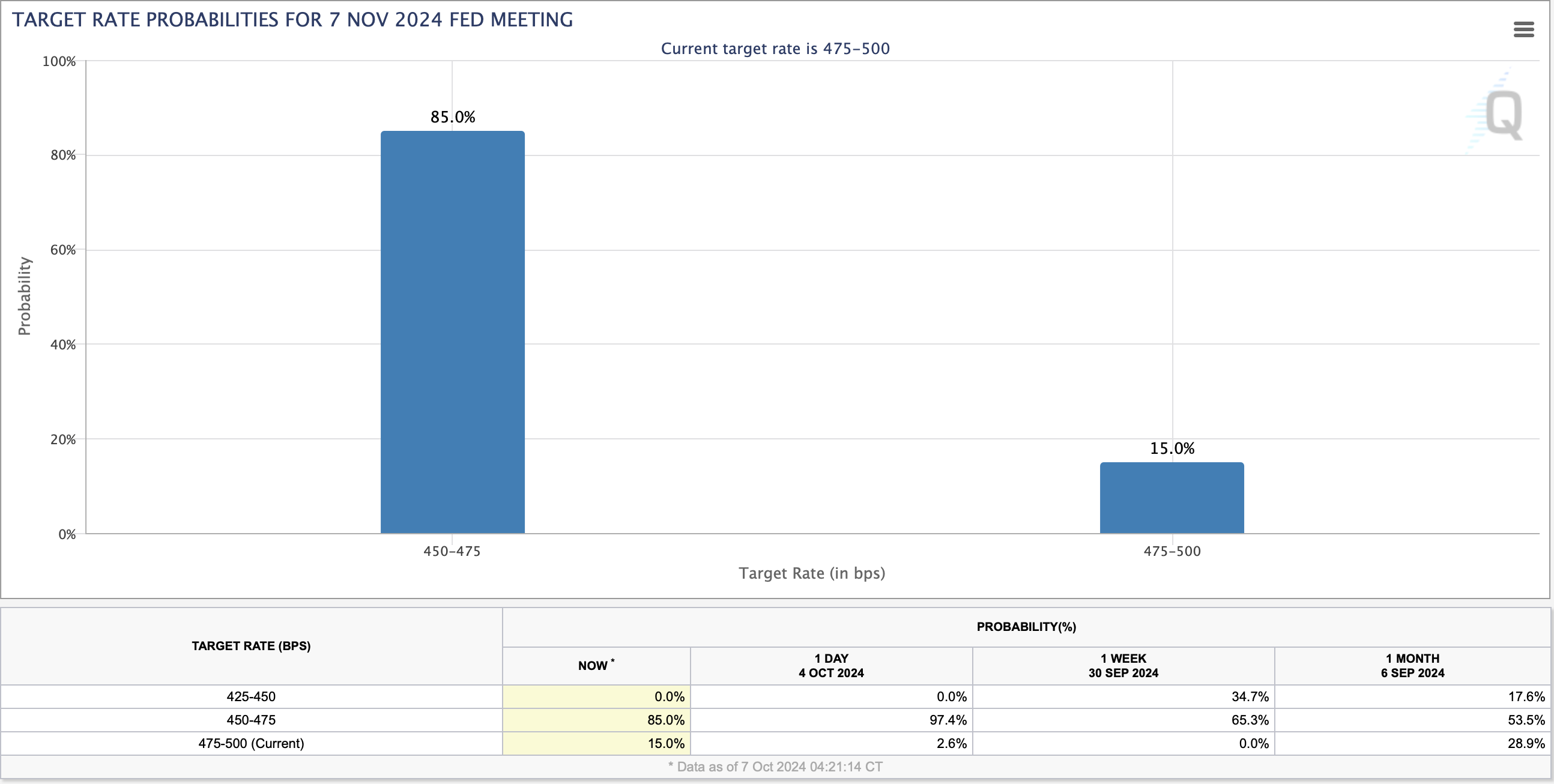
As well as all that, we hear from nine different Fed speakers over 13 different speeches this week, including Chairman Powell this afternoon at 2:00pm.  It’s not clear that we have learned enough new information for Powell to change his tune although given all of China’s moves there could be some belief that the Fed doesn’t need to be so aggressive.  Now, as of this morning, the Fed funds futures market is pricing a 41% probability of a 50bp cut in November and a 50:50 chance of a total of 100bps by the end of the year.  but, if China is easing so aggressively, does the Fed need to as well?

Right now, the story is all China.  However, I still detect a lot of positive sentiment in the US and expectations that the Fed is going to continue to ease and boost growth, inflation be damned.  It still strikes me that you cannot be bullish both stocks and bonds here as they are going to respond quite differently to the future.  As to the dollar, it is clearly on its back foot as the pricing of further Fed ease undermines it for now, but remember, as other central banks follow the Fed more aggressively, any dollar declines will be muted.

Good luck

Adf

Harshly Depressed

The Payrolls report was a test
That Rorschach would clearly have blessed
The bears saw the data
As proof that the rate-a
Of growth would be harshly depressed
 
The bulls, though saw only the best
Of times and, their narrative, pressed
In their point of view
The Fed will come through
And stick the soft landing unstressed


With the Fed now in its quiet period, the market is trying to come to grips with what to expect going forward.  But before we look there, a quick recap of Friday’s NFP report, dubbed ‘the most important of all time’ by some hysterics, is in order.  By now you almost certainly know that the headline number was modestly weaker than expected, but that the revisions lower in the previous two months weighed on the report.  However, the Unemployment Rate ticked lower to 4.2% and wage growth edged higher by 0.1%.  Perhaps one of the worst pieces of the report was that the Manufacturing payrolls declined by -24K, the second worst outcome in the past 3 years, and hardly a sign of a strong economy.

The point is that depending on one’s underlying predispositions, it would be easy to come away with either a hopeful or dreary perspective after that report.  And, in fact, I would argue that the report changed exactly zero minds as to how the future is going to evolve, at least in the analyst community.  The biggest sentiment change came in the Fed funds futures markets where the probability of a 50bp cut next week fell to just 25%.  You may recall that particular probability has ranged from one-third up to one-half and now down to one-quarter just over the past week.  I think that is an excellent metaphor regarding both the uncertainty and the confidence in the economy’s growth and the Fed’s likely moves.  In other words, nobody has a clue (this poet included.)

One other observation is that reading headlines from various financial writers and publications shows that the world is still virtually split 50:50 on whether we are going to see a recession (with some calling for stagflation) or the Fed is going to stick the soft landing.  FWIW, which is probably not that much, my personal view is the recession is still going to arrive, but given how aggressively the government continues to spend money, we may need to redefine the concept of recession.  Consider if we look at only the private-sector and whether it is in recession and if that is enough to drag the overall economy, including the government spending, down with it.  In fact, given the 6+% deficits that the government is running, it may be realistic to consider this is exactly what is ongoing right now, although not to the extent that the totality of the economy is sinking.

Now that I’ve cleared that up 🤣, let’s look at how markets have been processing the NFP report and what we might expect going forward.  I’m sure you all know how poorly equity markets behaved on Friday, with US markets falling sharply led by the NASDAQ.  That negativity flowed into the Asian session with the Nikkei (-0.5%), Hang Seng (-1.4%) and CSI 300 (-1.2%) all under pressure.  While the Chinese data overnight, showing inflation rising slightly less than expected at 0.6% Y/Y while PPI there fell more than expected at -1.8%, continues to show that the Chinese economy is faltering and there is still no fiscal stimulus on the way, the Japanese data was generally solid with GDP growing 0.7% Q/Q, much higher than Q1 although a tick lower than the initial estimate.  The upshot is there is further slowing in China while Japan is rebounding.  I guess the question is why would both nations’ equity markets decline.  Arguably, the Chinese story is one of lost hope that the economy will be able to rebound in any timely fashion from an investor’s perspective while the Japanese story is that given the rebound in growth, the BOJ is far more likely to continue on the policy tightening path, thus undermining Japanese corporate earnings.

There once was a banker from Rome
Whose tenure preceded Jerome
“Whatever it takes”
Prevented the breaks
In Europe that would have hit home
 
But now he’s an eminence grise
Who answered the Eurozone’s pleas
To write a report
And help to exhort
Investment to beat the Chinese

But that was the Asian story.  In Europe, the story is far more optimistic with gains across the board on the order of 0.6% – 0.8% on all the major bourses.  The big news here is that Mario Draghi, he of “whatever it takes” fame from his time as President of the ECB and his famous comments that save the Eurozone and the euro back in 2012, was asked to evaluate the Eurozone and help come up with a plan to shake the economy from its current lethargy.  As a true technocrat, his view was that more government investment in key areas was critical.  On the positive side, he did suggest a reduction in regulations, although that really goes against the grain in Europe.  However, it appears that equity investors viewed the report positively as there has been no data or other commentary that might have catalyzed a rally there.  As to US futures, they are bouncing this morning after a rough week last week, with all three major indices higher by at least 0.6% at this hour (6:45).

In the bond market, after a week when yields fell around the world, we are seeing a bounce this morning everywhere.  Treasury yields (+4bps) are actually the laggard with European sovereigns all rising between 6pbs and 7bps and even JGB yields jumping 5bps overnight.  Of course, the Japan story is the solid growth numbers encouraging the belief that Ueda-san will raise rates again by December, while the European story is a combination of expectations of more European debt issuance (Draghi called for more European debt, rather than individual national debt) as well as the influence of Treasury yields.

In the commodity markets, oil (+0.8%) is bouncing this morning but remains well below $70/bbl and this looks far more like a trading bounce than a change in perspective.  The weak Chinese economic data continues to weigh on this market and if OPEC changes its stance and decides to restart production again later this year, it does appear that we could have a move much lower still.  As to the metals markets, they are firmer this morning although that is a bit surprising given the generally weak economic sentiment and the fact that the dollar is following yields higher.  Perhaps the biggest surprise is copper (+1.9%) which based on everything else, should be falling today.  Once again, markets are not mechanical and things occur, about which very few know, but have big consequences.

Finally, the dollar is much stronger this morning with the DXY (+0.5%) rejecting the push lower, at least for now.  This strength is broad-based with NOK (-1.1%) and JPY (-1.0%) the worst performers in the G10 despite the higher oil price and growing confidence that the BOJ will raise rates again.  But every G10 currency is weaker as are virtually every EMG currency with only MXN (+0.4%) bucking the trend, although that seems more of a trading response to the fact that the peso fell through 20.00 (dollar rose) for the first time in nearly two years on Friday.

As to the data this week, CPI is the biggest US number although we also hear from the ECB on Thursday.

WednesdayCPI0.2% M/M (2.6% Y/Y)
 -ex food & energy0.2% M/M (3.2% Y/Y)
ThursdayECB rate decision4.0% (current 4.25%)
 Initial Claims230K
 Continuing Claims1850K
 PPI0.1% (1.8% y/Y)
 -ex food & energy0.2% M/M (2.5% Y/Y)
FridayMichigan Sentiment68.0

Source: tradingeconomics.com

I guess the question is, does the CPI matter any more?  Given the Fed has essentially declared victory and turned its focus to employment, Wednesday’s number would have to be MUCH higher to matter.  With that in mind, I suspect that this week in FX will be far more focused on the equity market than on the macro situation.  If the equity rebound continues, I expect that the dollar will start to cede this morning’s gains, but if yields reverse their past two weeks’ sharp decline and the dollar continues this morning’s strength, then equity investors will feel some more pain.

Good luck

Adf

A New Pox

The interest rate doves are excited
That job growth in August was blighted
If that was the case
The Fed may embrace
Enough cuts to leave them delighted
 
But if they’re correct, what of stocks?
Will weak data be a new pox
On earnings and growth
And undermine both
With stocks falling onto the rocks?


As far as anyone can tell, there is only one thing that matters today, the payroll report.  Let’s set the table with the latest median forecasts:

Nonfarm Payrolls160K
Private Payrolls139K
Manufacturing Payrolls0K
Unemployment Rate4.2%
Average Hourly Earnings 0.3% (3.7% Y/Y)
Average Weekly Hours34.3
Participation Rate62.6%

Source: tradingeconomics.com

I’m sure you all remember that last month we got a surprising, and disappointing, reading of 114K for the headline number and then we subsequently got those massive revisions from the BLS which indicated that they had overstated job growth by more than 800K over the year from April 2023 through March 2024.  As well, yesterday’s ADP Employment data showed private job growth of a below expectations 99K with a revision lower to the previous month’s number.  Certainly, some of the data we have seen is pointing in the direction of a weaker outcome.  However, if one looks at the Initial and Continuing Claims data, neither of those series are pointing to a significant weakening in the labor market, although it has cooled somewhat since last year.

Since the last NFP report, 10-year Treasury yields have declined by 28bps and now sit at 3.70% this morning.  If you compare that to the current Fed funds rate of 5.375%, the implication is that rates are going to fall by at least 160 basis points over the next two years.  In fact, we are starting to see some analysts (Citi) call for nearly that many cuts by the end of 2024!  It strikes me that 150bps of cuts by December 2024 would only occur in response to a significant slowing of US economic activity, in other words, the long-awaited recession. Now, if the Fed were to cut that aggressively without a clear decline in the economy, it would certainly open the door to much higher inflation ahead.  After all, why add liquidity and ease policy if the economy continues to cruise along at a decent clip?

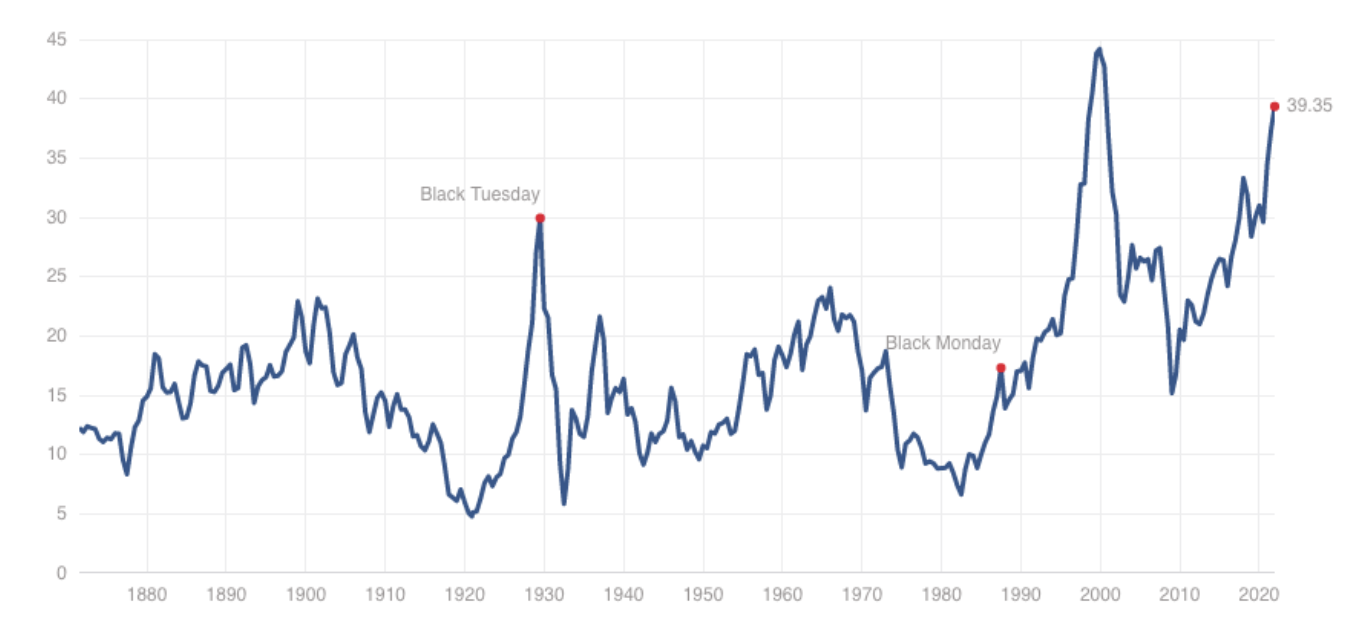
The upshot is that it appears, at least to this poet’s eyes, that the bond market is way ahead of itself with respect to potential Fed rate cuts.  Either that or the stock market is completely mispriced for the potential future earnings results of its components.  The one consistent outcome from all recessions is that corporate earnings growth slows dramatically.  Given that current equity prices embody P/E multiples near historically high levels (see chart below of Cyclically Adjusted Price Earnings for the S&P 500), if the E in that fraction declines, you better believe that so will the P.

Source: lesswrong.com

What will this mean for other asset classes, notably commodities and the dollar?  Here we need to consider the driver of the potential rate cuts in question.  If the US economy is clearly slowing dramatically and the Fed is responding by cutting rates aggressively, I would expect that the dollar will come under real pressure, at least initially, as the Fed is likely to be more aggressive than other central banks.  However, remember that the market is already pricing in significant rate cuts, so given the reality that if the US enters recession, most of the rest of the world is going to see much slower economic growth with their central banks easing policy as well, I would not look for a dollar decline of historic proportions.  Another 5%-8% seems viable but looking for the euro at 1.50 or the pound at 1.75 or the renminbi at 6.00 seems unrealistic.  The one outlier here is the yen, of course, where a situation with declining US equity prices, and correspondingly declining risk asset prices all over the world, could easily see Japanese investors run home with their money and USDJPY could well fall back to the 120 level or even lower in that scenario.

As to commodity prices, I expect the initial move would be lower as concerns about growth would imply falling demand for the key commodities oil and copper.  Gold, however, is a different animal and I imagine that we could see more uptake here as a weaker dollar and growing fear drive more retail buying of the barbarous relic.

Of course, if the data this morning is firmer than expected, all these bets are off.  In fact, that appears to be the biggest risk in markets today, a strong NFP number with a decline in the Unemployment Rate.  Market participants seem quite confident that the slowdown is coming and that the Fed is going to stick the soft landing.  That is the only explanation for the fact that equity markets, despite yesterday’s modest declines, continue to trade near all-time highs regardless of the indications that US economic activity is slowing somewhat.  The belief seems to be that the Fed will be able to cut rates the appropriate amount to prevent a collapse without triggering a renewed burst in inflation.  And maybe they will.  But given the fact that equity ownership is at record high levels already, the question becomes who is going to buy from here.  Any misstep by the Fed, where it becomes clear that the outcome will be worse than a soft landing (either a recession or higher inflation or both) is going to weigh heavily on equity and other risk markets.

So, as we await the big news, a quick review of the overnight session shows that most equity markets in Asia (Nikkei -0.7%, CSI 300 -0.8%) and Europe (DAX -0.4%, FTSE 100 -0.3%) are lower, following the US session.

In the bond markets, yields everywhere continue to decline with Treasury yields (-3bps) continuing their fall while European sovereign yields are all softer by between -4bps and -5bps this morning.  Even JGB yields (-3bps) are continuing lower as the global bond markets seem to be implying that economic activity is waning everywhere.

In the commodity markets, oil (+0.5%) is a touch firmer but remains below $70/bbl and has not shown any real strength despite a dramatic inventory drawdown reported by the EIA yesterday.  OPEC+ has explained they are not going to restart production next month and will wait until at least December before doing so, but based on the price action of oil, I will wager they will delay it again then.  Metals markets are little changed this morning after rallying yesterday during the US session, but like almost every market, all eyes are on the tape at 8:30 when NFP is released.

Finally, the dollar is a touch softer net, with traders seemingly preparing for a weak number.  But the movements are so small that the largest is JPY (+0.25%) which is the result of a combination of fear and the broader dollar weakness I think.    Here, too, we will learn much based on the data, so not much to do until then.

In addition to the payroll report we will hear from NY Fed President Williams and Governor Waller this morning as they will be the last to speak ahead of the Fed’s quiet period.  Williams is due at 8:45, so his speech is prepared, but Waller will have time to alter things if the data is a significant surprise given he doesn’t speak until 11:00.

And that’s really it for today.  It’s all NFP all the time.  While it is very easy to believe that a weak number is coming, it is also clear to me that the pain trade would be a strong number.  As such, I have a sneaking suspicion we could see something much firmer than forecast, maybe 200K with the Unemployment Rate ticking back down to 4.1%.  That would be the real surprise.

Good luck and good weekend

Adf

JOLTed

The market, on Wednesday, was JOLTed
By data, and traders revolted
The jobs situation
Has changed the narration
And helped Jay, his door be unbolted


What door you may ask?  Why, the door that leads to a 50bp rate cut at the FOMC meeting in two weeks.  Already, the Fed funds futures market is pricing in a 43% probability of a 50bp cut, up from a one-third probability on Tuesday morning.  Remember, everything now revolves around the labor market, and yesterday’s JOLTs data was not only worse than forecast, at 7.67M (forecast 8.1M), but last month’s was revised lower by nearly 200K jobs as well.  Remember, too, that tomorrow the NFP report is released with current forecasts centering on 160K, higher than last month but well down on what we have been seeing all year prior to the August report.

There are many analysts who have been calling out Powell and the Fed for making a policy error and holding rates too high for too long.  Perhaps they are correct.  But so much of the decision to cut rates relies on the idea that inflation is well and truly dead, or at least terminal, and if that assumption is incorrect, there will be hell to pay.  The last time the US saw inflation of the same magnitude that we have seen in the past two years, then Fed Chair, Arthur Burns, cut rates too early and inflation exploded higher, peaking at a higher rate than the first rise.  In fact, he did that twice, with inflation spiking three times throughout the 1970’s and early 1980’s.  

Source: FRED database

Powell has been very clear that he is trying to channel Paul Volcker and not Arthur Burns, but if he cuts rates, he opens himself up to a much less satisfactory outcome.  There have been many charts of the following nature showing the parallels of the 1970’s to recent price levels and it is entirely possible we see another wave higher if the Fed cuts.

Source: Real Investment Advice

As things currently stand, I would contend that the Fed’s focus is almost entirely on employment, hence the market response to yesterday’s weaker than forecast JOLTs data.  This implies that this morning’s ADP and Initial Claims data have the chance to really move things.  It also means that tomorrow’s NFP data remains a critical focus for all markets.

In the meantime, market activity overall could well be described as choppy.  While US equity markets opened lower yesterday, following the sharp declines on Tuesday, they closed mixed with limited overall movement. The fears in the semiconductor sector, which were fanned by a, since denied, report that Nvidia had been subpoenaed in an anti-trust investigation, has stopped falling and there are still numerous stories about how much Capex the big 4 tech companies are going to invest this year in all things AI.  Traders and investors are looking for the next big clue which is why I expect limited activity until tomorrow morning’s data release.

Asian equity markets were similarly mixed overnight with some gainers (Australia +0.4%, Taiwan +0.45%, CSI 300 +0.2%) and some laggards (Nikkei -1.05%, KOSPI -0.2%, Hang Seng -0.1%), as no clear direction presently exists.  Late last week, BOJ Governor Ueda sent a letter to the Diet explaining he still expected to raise interest rates if the economy progressed as expected, and that has a number of analysts calling for another leg down in USDJPY and further Nikkei weakness.  But it seems that is a big IF.  With economic activity clearly slowing around the world, it is not hard to believe that the same will be true in Japan and conditions for further rate hikes may not develop.  As to European bourses, the picture here is mixed as well with the CAC (-0.5%) lagging while Spain’s IBEX (+0.7%) is having a pretty good day.  Both the DAX (+0.2%) and FTSE 100 (+0.1%) are modestly higher despite weak Construction PMI data, perhaps both anticipating further policy ease.

In the bond markets, though, the direction of travel is clear for now with yields everywhere having fallen sharply yesterday and simply consolidating today.  After the JOLTs data, Treasury yields fell 9bps (2yr yields fell 12bps and the 2yr-10yr spread is now flat), although this morning it has bounced by a single basis point.  European sovereign yields slipped yesterday as well, between -3bps and -5bps, after the JOLTs data and this morning have backed up by 1bp across the board.  As to JGB yields, they edged lower by -1bp last night and remain a good distance from the 1.00% level despite the recirculated Ueda comments.

In the commodity markets, oil (+0.2%) which had bounced a bit yesterday morning, ceded those gains as the session wore on and is currently below $70/bbl.  While talk of OPEC+ starting up more production has faded, the weak economy / slowing demand story, especially the weak Chinese economy story, remains front and center and continues to weigh on the price.  Meanwhile, in the metals markets, gold (+0.7%) continues to shine overall as the growing sentiment for a 50bp Fed funds cut helps all commodities, but especially this one as concerns over the dollar’s ability to maintain its purchasing power remain rife.  But this morning we are seeing silver (+1.4%) and copper (+0.2%) higher as well, although the latter seem more trading than fundamentally based.

Finally, the dollar is under some modest pressure this morning, which given the movement in yields and rate cut expectations, should be no surprise.  In the G10, virtually all the movement has been less than 0.2% with CAD (-0.1%) the laggard after the BOC cut rates by 25bps yesterday as widely expected.  This morning the yen is also a touch softer, but that is after a sharp rally yesterday of more than 1%, so this morning feels like a trading bounce.  In the EMG bloc, the picture is a bit more mixed with ZAR (+0.5%) the leader this morning on both the gold price as well as economic data showing the Current Account deficit shrank dramatically in Q2 in a pleasant surprise.  On the flipside, MXN (-0.3%) is lagging as the market absorbs recent modestly weaker than expected economic data on Unemployment and Fixed Investment.

Which brings us to today’s data releases.  We start with ADP Employment (exp 145K), then Initial (229K) and Continuing (1870K) Claims.  As well, at 8:30 we see Nonfarm Productivity (2.4%) and Unit Labor Costs (0.8%).  Then, at 10:00 comes ISM Services (51.1) with the final set of data the EIA oil inventories at 11:00 with net further drawdowns forecast.  There are no Fed speakers on the docket today, but we are supposed to hear from two tomorrow after the NFP data.

Absent a big surprise in either ADP or Initial Claims, with the former more likely than the latter, I suspect that it will be another choppy day as all eyes focus on NFP tomorrow.  However, the one thing that seems likely is the dollar has further to decline within the current market narrative of more rate cuts sooner by Powell and the Fed.

Good luck

Adf

Quite Drear

The world is apparently ending
‘Cause stocks just will not stop descending
So, calls have increased
For fifty, at least
And government to up its spending
 
The cause of this rout is unclear
Though data of late’s been quite drear
If growth is much slower
Then stocks can go lower
And that, my good friends, triggers fear


The only topic on market practitioners’ lips this morning is the ongoing sell-off in equity markets around the world.  The US returned after the Labor Day holiday and sold equities aggressively with the NASDAQ falling more than 3.25% and the other major indices all declining at least -1.5%.  This led to a disastrous opening in Asia with the Nikkei (-4.25%) leading the way down as fears of a repeat of the early August rout were rampant.  While things never got to that point, we did see both Korea and Taiwan markets fall even more than Tokyo with declines between -4.5% and -5.0%.  This negative sentiment is alive and well in Europe with every market lower there, although the declines are less pronounced, between -0.7% and -1.1%, and US futures are lower this morning as well, down anywhere between -0.3% and -0.6% at this hour (6:30).

So, what’s happening?  Is there something new that was previously unknown?  The first place to look is the data which saw ISM manufacturing rise less than expected to 47.2, a number that historically represents recession, with the added problem of the ISM Prices Paid reading at 54.0, higher than expected and a potential harbinger that inflation may not be declining as quickly the Fed expects.  Add to that a weaker than expected Construction Spending result, -0.3%, and you have the makings of some potential dreariness on the economic front.  The problem with this thesis is that the equity market opened prior to the releases and was already down -1.0% by the time they hit the tape.

Perhaps it is simply the end of summer blues as historically, September seems to be the worst month for equity performance, although I don’t put much credence in the idea that just because something has happened at a particular time before in markets, it will happen again.  Seasonality is real, especially in things like commodities, but is technology really seasonal?  And tech was leading the way lower.

Of course, markets have a long history of simply moving up and down over time without any specific catalyst.  Positioning and changes in sentiment evolve over time and sometimes they combine to move markets more than would otherwise be expected.

From a macro perspective, I believe that this week will teach us a great deal as the ISM data along with the employment data will give further evidence of the potential for that widely hoped for soft-landing or whether things are declining more rapidly.  Certainly, we continue to read of problems arising elsewhere in the world with the VW news about potential plant closings and weakness in Chinese PMI data overnight indicating that President Xi may need to do more to support his economy.  The thing about sentiment is that it doesn’t necessarily need a clear catalyst to change.  

Source: Horace.org

In the end, I’m hard-pressed to define anything that has changed since Friday afternoon.  However, it appears that sentiment is clearly far more circumspect about the future of economic activity and how that will be able to support the current extremely high valuations of so many companies.  As Ace Greenberg, then Chairman of Bear Stearns said when asked about what happened in the wake of Black Monday in 1987, “markets move, next question.”  

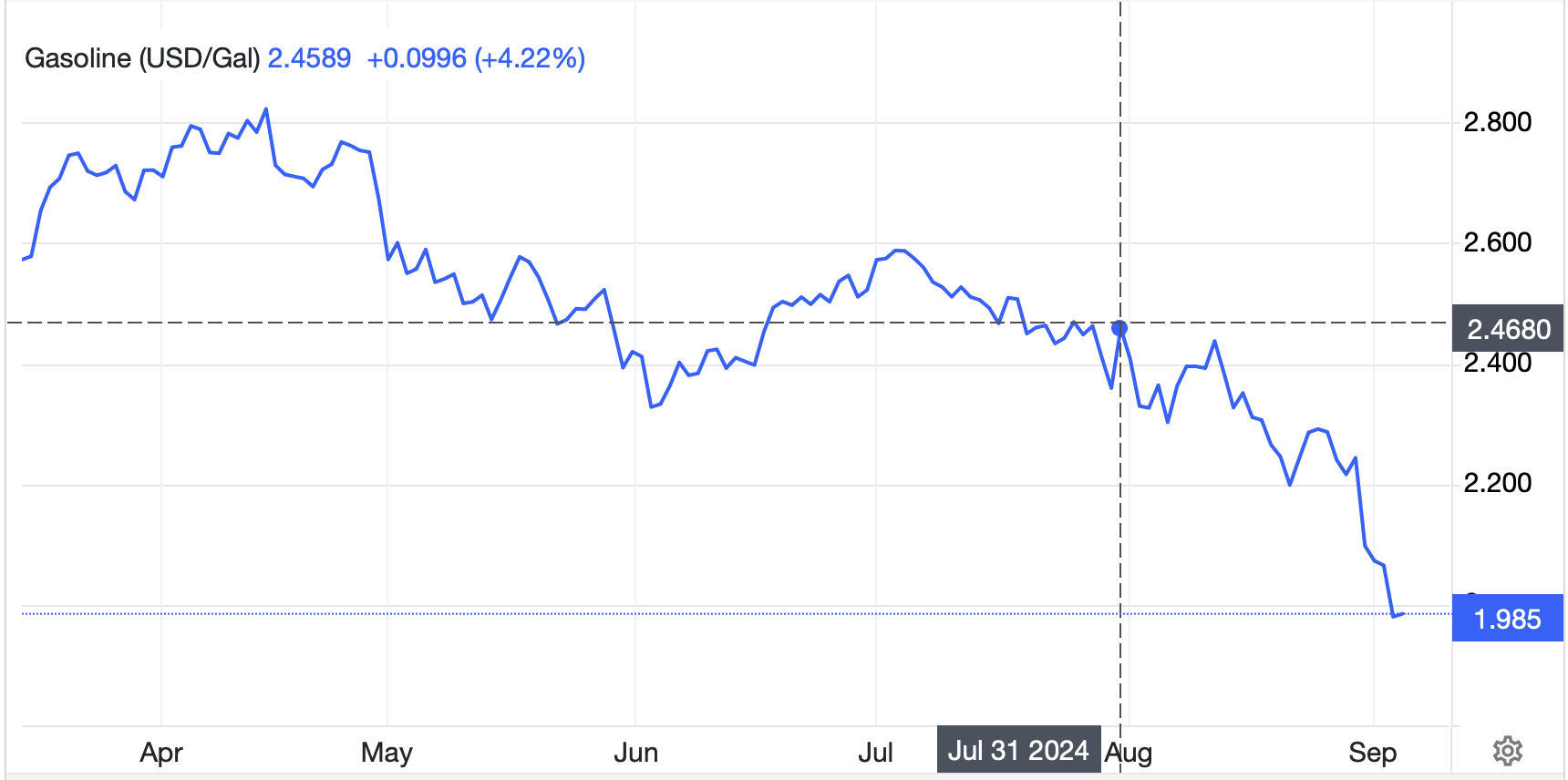
To this poet’s eyes, the big picture remains that economic activity is continuing to slow down around the world, and that price pressures in the US are lagging that decline.  It appears that China is flooding the global markets with manufactured goods as domestic consumption there remains lackluster, thus goods price inflation remains under control.  However, there is no sign that central banks or governments are reducing the amount of available liquidity which is finding its way into services pricing, and that is a much larger part of the economy, hence likely to sustain inflation readings going forward.  I’m confident the Fed will cut rates in 2 weeks’ time, but I’m also highly concerned that the result will be inflation remaining higher than ‘target’ going forward.  The one thing on Powell’s side right now is the decline in oil, and by extension gasoline (see chart below where gasoline futures fell >15% in August), prices, which will help push headline numbers lower.

Source: tradingeconomics.com

So, how did other markets behave while stocks were getting hammered?  Treasury yields fell 9bps yesterday after the data release and are lower by another 2bps this morning.  Clear risk-off behavior.  In Europe, sovereign bonds are all seeing declines this morning between -4bps and -5bps after declines yesterday as well and even JGB yields are lower by -4bps this morning.  investors are running for the relative safety of fixed income right now.

In the commodity markets, oil (+1.3%) is bouncing off the lows seen yesterday, when WTI traded down to $69.15/bbl briefly, as the recent decline has OPEC rethinking their decision to start increasing supply next month.  You may recall that when they cut production, they kept renewing that decision every few months but were set to slowly increase production again starting in October.  However, the sharp decline in the price of oil has them backtracking now.  The problem is that the evidence of slowing economic activity is weighing on the price here.  I suspect that until there is clear evidence that economic activity is rebounding, oil could remain under pressure.  In the metals markets, they were also sold off sharply yesterday, but have basically stopped declining for now, consolidating those losses.  Gold continues to be the best performer as the combination of risk-off and ongoing central bank purchases are supporting it well enough.  This is clearer if you look at the price of gold in other currencies, where it continues to make new highs.  But the industrial metals will have a difficult road ahead with slowing growth.

Finally, the dollar, after a strong rally yesterday, is little changed this morning.  In fact, most currencies are within a few basis points of their closing levels yesterday with only MXN (-0.35%) and SEK (-0.3%) showing any semblance of weakness while ZAR (+0.3%) and JPY (+0.3%) are the biggest gainers.  The yen story is clearly the haven aspect with Japanese investors bringing funds home.  Both the peso and krona are likely feeling a little pressure from the declines in commodity prices, while the rand has bucked that trend after reporting higher than expected GDP growth in Q2 and higher Business Confidence this morning.

Data today brings the Trade Balance (exp -$79.0B) at 8:30 and then the JOLTs Job Openings (8.10M) and Factory Orders (4.7$, -0.2% ex transport) at 10:00.  We also will see the BOC cut rates 25bps this morning, although nobody is paying much attention to Canada with all eyes on the Fed and ECB.

While a lower opening seems baked in, I wouldn’t be surprised to see a bounce of some sort by this afternoon as market participants seem to have a hard time allowing prices to fall for too long.  But there appears to be ample reason for further equity declines and further risk reduction, which historically has supported the dollar.

Good luck

Adf

Taboo’s Been Broken

The calendar’s now turned the page
So, summer has moved to backstage
Thus, risk is retreating
And people are treating
The autumn as though it’s a phage
 
Meanwhile, German voters have spoken
And fears are a new trend’s awoken
Political leaning
Is rightward, thus meaning
A longstanding taboo’s been broken


Arguably, the biggest story from the long weekend was the voting in two German states, Thuringia and Saxony, where the Alternative for Germany (AfD) won one-third of the vote in each state thus destroying the traditional political calculus.  AfD is the right-wing party that has been described as neo-nazi and fascist regularly by the media (of course, the Republican party in the US has also been described in those same words), but more importantly, represents a complete rejection of the current status quo in Germany.  But perhaps the bigger concern for the German political elite is that an entirely new party, the Sarah Wagenknecht Alliance (BSW) won 15.5% and 11.5% of the votes in those two states respectively.  The BSW is a far-left party that espouses some of the same opinions, notably on immigration, as the AfD.  In other words, nearly half the electorate voted against the traditional parties as apparently people in Germany are not very happy.

To complete this story, the issue is that AfD, with which all parties have sworn against working in the parliament, has enough votes for a blocking minority, meaning they can (and almost certainly will) prevent the appointment of new judges and any constitutional changes that they don’t like.  As I said, the political calculus in Germany has changed significantly.  In fact, the parties in the current federal coalition (SPD, FDP and the Greens) saw their share of the vote fall to just 10.3% and 12.4%, respectively, in the two states.

I highlight this issue because it is indicative of the ongoing changes in Europe that may well undermine the single currency’s potential, and assumed, future strength based on the dollar’s assumed future weakness.  After all, whether or not the Fed embarks on a long period of rate cutting, or simply implements a token cut or two, given the political upheaval in Europe, is that going to be a good place for industry to invest?  Their energy policies have been hugely counterproductive, and Europe has about the most expensive energy in the Western world.  In fact, Volkswagen AG, has indicated it may be closing plants in Germany for the first time in the company’s long history.  It has simply become too expensive a place to do business.

This is not to imply that the euro (-0.25%) is going to collapse imminently.  Germany is only one of twenty nations in the Eurozone, albeit the largest economy by far.  But the story in Germany is not isolated to that nation.  We have seen similarly poor energy decisions and similar voter responses in other nations (notably the Netherlands, France and Austria). Whatever you think about the dollar, it is very difficult to get excited about the euro in my view.  

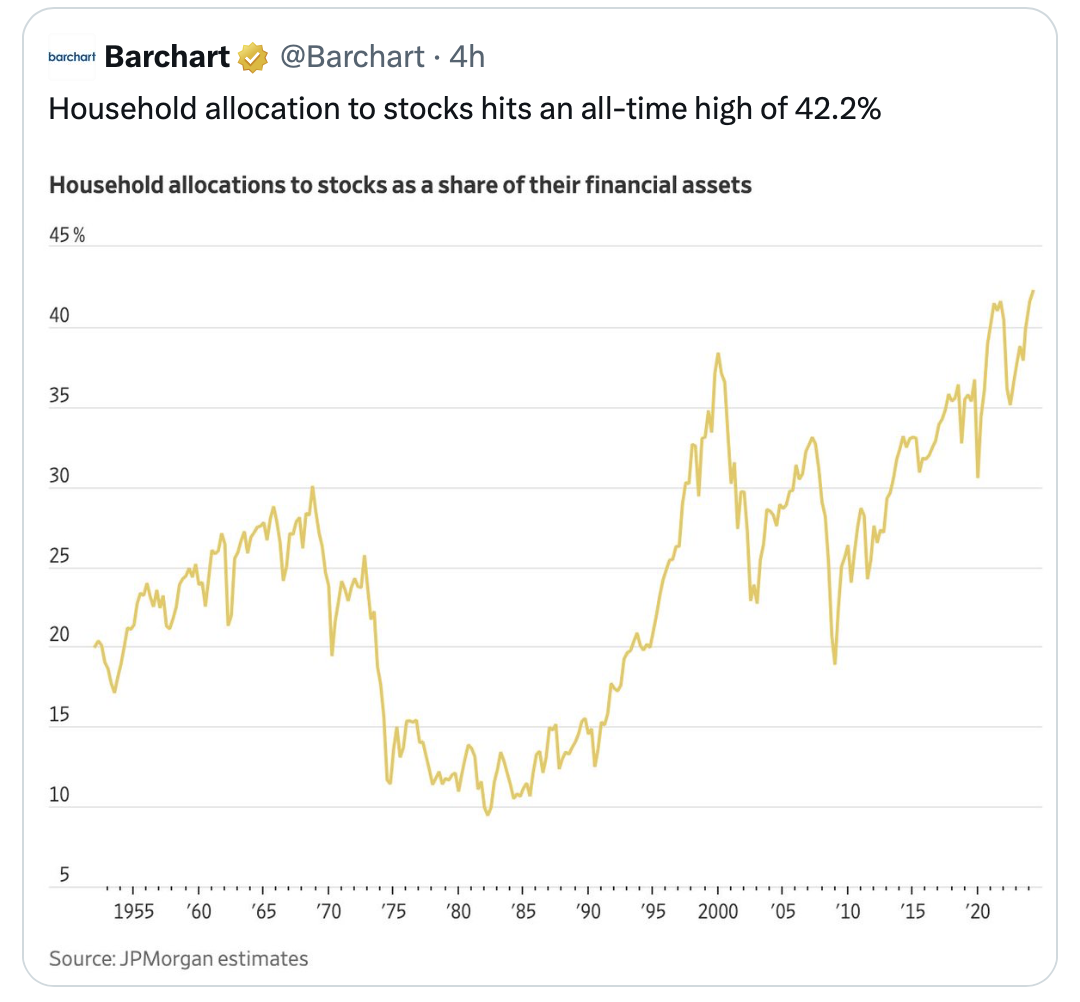
But let’s turn our attention to risk writ large.  I keep reading that September is historically the weakest month in the US equity markets and given the number of sources of strong repute that have written such, am willing to take that at face value.  As well, apparently, US households are the most bullish equities, or at least have the largest equity positions as a portion of their assets, in history (see chart below from @InvariantPersp1 on X).

It strikes me that the combination of extreme long positioning and a historical tendency for weakness may open up some downside in the equity markets, at least for a period.  Of course, if you are old enough to remember the yen carry trade debacle all the way back at the beginning of August, you know that even if we see a big downdraft, it can be reversed quite quickly.  And given both the Fed and ECB (and BOE) all meet later this month, it is not hard to believe that if equities were to decline sharply before their meetings, we could see larger than expected rate cuts across the board.  For now, the market continues to price a one-third probability of a 50bp cut by the Fed while expectations are for the ECB to cut in September and a 50% probability of an October cut.  

Net, do not be surprised if September has nearly as much volatility as August as the idea of max-long equity exposure into a slowing economy with still high inflation feels like a tenuous position.  We shall see.

Ok, let’s try to catch up to overnight activity, which has generally been of the risk-off variety.  Since Friday’s close, the story has been more negative than positive with Japanese (-1.1%) and Chinese (-1.5%) markets falling amid slightly softer than expected data and a more general malaise.  In Europe, too, things have been soft with today’s declines ranging from -0.2% (CAC) to -0.8% (Spain’s IBEX) and everything in between.  This is completely in sync with US futures markets which are all lower by at least -0.6% at this hour (7:20).  

Interestingly, while risk is under pressure, the traditional havens of government bonds are not seeing much benefit with Treasury yields edging higher by 1bp and similar moves throughout much of Europe although both Gilts and Bunds have seen yields edge lower by 1bp.  JGB yields have also edged higher by 1bp and are creeping, ever so slowly, back toward 1.00%.  This follows comments by BOJ Governor Ueda that he really means it when he says they BOJ will normalize policy.  The caveat is that will occur only if the economy meets their expectations with growth rising and inflation remaining high.  However, inflation continues to be fairly stable with services inflation actually declining there, thus undermining his message somewhat.

In the commodity markets, oil (-2.3%) has been taking it on the chin for the past week as the combination of the weaker demand story on a slowing global economy combines with growing confirmation that OPEC+ is going to end their production cuts starting next month, thus adding to supply, has weighed heavily on prices.  Back in January, I wrote a piece discussing my change of view on the long-term prospects for oil prices, which I flipped from bullish to bearish.  The essence of the piece was that there is plenty of oil around, it is political decisions that prevent its extraction.  As the politics of everything around the world continues to quickly change, I think this is an important baseline to keep in mind, although that doesn’t mean we won’t see short term spikes in oil’s price.  However, right now, it looks awful on the charts.

As to the metals markets, they have been under some pressure lately as well, notably copper and silver, with each of those falling more than 5% in the past week.  Gold, however, continues to find buyers as the bigger picture concerns of monetary debasement combine with still active central bank purchasers to support the barbarous relic.

Finally, the dollar is quite strong this morning, rallying against almost all its counterparts.  The commodity bloc are the laggards with AUD (-0.8%), NOK (-0.75%), NZD (-0.7%) and SEK (-0.5%) all suffering in the G10 with only JPY (+0.5%) rallying, arguably playing its haven role.  In the EMG bloc, ZAR (-0.8%), and the CE4 (-0.5% each) are under pressure along with KRW (-0.4%) and even CNY (-0.2%).  LATAM is the surprise with MXN (-0.1%) little changed at this hour.

On the data front, this is a big week that culminates in the payroll report on Friday.

TodayISM Manufacturing47.5
 Construction Spending0.0%
WednesdayTrade Balance-$78.9B
 JOLTs Job Openings8.10M
 Factory Orders4.6%
 -ex Transport-0.2%
ThursdayADP Employment145K
 Initial Claims230K
 Continuing Claims1870K
 Nonfarm Productivity2.4%
 Unit Labor Costs0.9%
 ISM Services51.1
FridayNonfarm Payrolls165K
 Private Payrolls138K
 Manufacturing Payrolls0K
 Unemployment Rate4.2%
 Average Hourly Earnings0.3% (3.7% Y/Y)
 Average Weekly Hours34.3
 Participation Rate62.6%

Source: tradingeconomics.com

Obviously, all eyes will be on NFP as the Fed has clearly turned its primary attention to the employment side of its mandate.  However, don’t fall asleep on the JOLTs data tomorrow, as that has also been part of Powell’s calculus. (seems there was a lot of calculus today, I hope you all managed to get through that in college 😂).  Remember, too, that CPI comes next week and then the FOMC meeting is the following week, so there is no respite.

This morning, risk feels unwanted.  With equity markets still within spitting distance of their all-time highs, it appears there is ample room for some down days ahead.  Of course, Friday will be key.  Regarding the dollar, for now, I believe the bounce continues.  But Friday will dictate the medium term, at least until the FOMC meeting.

Good luck

Adf

The Time Has Come

(with apologies to Lewis Carroll)

The time has come, the Chairman said,
To speak of many things.
Of joblessness and how inflation,
            Social unrest, brings
And whether we have done our job
            Although we live like kings
 
But wait a bit, the pundits cried
            Before you do explain
For we thought that inflation was
            The overwhelming bane
It was, the Chairman did remark
            But now its jobs that reign


On Friday morning, Fed Chair Jay Powell laid out his vision for the immediate future, and much as many had hoped, he was quite clear in his belief that the inflation mission is accomplished.

A person in a suit and tie

Description automatically generated

Now, many of us remember how that worked out for the last official who exclaimed that concept a bit too early, but hey, maybe this time IS different!  At any rate, during his Jackson Hole speech, the below comments were what got speculative juices quickening, although a quick look at history indicates all may not be well, at least in the risk asset world.  But first to the soothing words of the Chairman [emphasis added]:

The time has come for policy to adjust. The direction of travel is clear, and the timing and pace of rate cuts will depend on incoming data, the evolving outlook, and the balance of risks.”  

“We will do everything we can to support a strong labor market as we make further progress toward price stability. With an appropriate dialing back of policy restraint, there is good reason to think that the economy will get back to 2 percent inflation while maintaining a strong labor market. The current level of our policy rate gives us ample room to respond to any risks we may face, including the risk of unwelcome further weakening in labor market conditions.”

So, why, you may ask, would anything negative occur if the Fed is finally going to cut rates?  After all, lower rates add monetary stimulus and allow companies to borrow more cheaply while allowing individuals to reduce their borrowing costs and afford more stuff, like cheaper mortgages making houses more affordable.  But under the rubric, a picture is worth a thousand words, the following chart purloined from X in @allincapital’s feed, does an excellent job of highlighting how equity markets have performed after the Fed pivots to cutting rates.

A screenshot of a graph

Description automatically generated

You may have notices that each pivot led to a substantial decline in the S&P 500.  Of course, if you think it through, the basic reason the Fed is pivoting is because the economy is typically heading into, or already in, a recession.  And there has never been a recession when corporate earnings rose across the board. 

This is the crux of the recession argument.  If those who are convinced we are already in a recession are correct, then the prospects for risk assets are dour at best.  On the other hand, for those who remain pollyannaish and believe that the data continues to point to economic strength, the first question is, why should the Fed cut?  And the second question is, why is the data showing rising unemployment, which has an almost perfect correlation of occurring during recessions, not indicating a recession this time?

One last thing, inflation.  You remember that bugaboo, the thing that has had the Fed’s undivided attention for the past two plus years.  Well, given that the money supply has resumed its growth, and money velocity continues to rise, while Chairman Powell has convinced himself that he won the battle, so did Chairman Arthur Burns…three times!  Friday, the equity bulls were in the ascendancy and the market moved to price a 36% chance of a 50bp cut in September with 100bps priced in for the rest of the year while the major indices all rose > 1%.  Personally, I’m a bit wary.

But enough of Friday.  It will take a great deal of new and contradictory information to change the narrative now with the next real chance the NFP report to be released on September 6th.  In the meantime, let’s see what happened overnight.  There was very little in the way of data or activity with only German Ifo readings showing a continuation in their trend lower, printing at 86.6.  It has become increasingly difficult to look at Germany, and its place within Europe as the largest economy by far, and not be concerned over the entire continent’s economic situation.  Energy policies around the Eurozone have hamstrung the economy significantly, and there is no indication that this is either recognized, or if it is, of concern to the governments across the continent.  I understand the short-term view that the Fed is going to start cutting rates and that the dollar has the opportunity to decline because of that, but the longer-term prospects for the euro seem far more dire, at least to my eyes.

Ok, let’s see how markets are handling the unmitigated joy of the Fed finally doing what everyone was so fervently wishing them to do.  In Asia, the Nikkei (-0.7%) didn’t get the bullish memo, likely suffering on the yen’s strength (+1.3% Friday, +0.2% this morning) which started on Friday, right as the Powell speech began.  However, the Hang Seng (+1.0%), India (+0.75%) and Australia (+0.8%) all followed the US movement.  Alas, mainland Chinese shares (-0.1%) continue to lag as the PBOC left rates on hold last night, although some were hopeful of another cut.  In Europe, Germany (-0.3%) is the laggard this morning, not surprisingly given the Ifo data, but overall, markets are moving very little with only the FTSE 100 (+0.5%) showing any life as the only market there following the US.  As to US futures, at this hour (7:10) they are essentially unchanged.

In the bond market, Treasury yields are unchanged this morning, but did fall 5bps on Friday.  In Europe, sovereign yields have all rebounded 2bps, basically unwinding the Friday declines seen in the wake of the Powell comments.  In truth, this is surprising given the lackluster data that was released from Germany, but markets can be that way.  As to JGB yields, they slipped 1bp lower overnight, still not showing any evidence that there is concern the BOJ is going to tighten policy substantially going forward.

In the commodity markets, oil (+2.6%) is rocketing higher after Israel initiated a pre-emptive attack on Hezbollah in Lebanon and Hezbollah responded.  While the WSJ headline is that both sides are now trying to de-escalate things, the oil market, which has seemingly been underpricing risks of a greater supply disruption, has woken up to those risks this morning.  Arguably part of that wakening was the fact that Libya just declared force majeure and has stopped pumping oil because of internal conflict over the central bank and its use of monetary reserves.  Hence, a supply disruption!  Remember, though, the Saudis have a decent amount of spare capacity to fill in if prices start to rise “too” quickly.  

In the metals markets, green is today’s theme with gold (+0.6%) continuing to show its luster as a haven asset.  Meanwhile, silver (+0.9%) has been gaining rapidly amidst stories that China is hording it along with stories that there is not enough silver around to meet the plans for all the solar panels that are still expected to be built.  This movement is dragging copper and aluminum higher as well.

Finally, the dollar is slightly higher this morning overall, although there are some reasonably large movers in smaller currencies.  Surprisingly, NOK (-0.9%) is under pressure despite the big move in oil price higher.  As well, NZD (-0.5%) has slipped, but that was after a very sharp rally on Friday of nearly 2% which seemed to be based on the Fed rate cut story, although NZD responded far more aggressively than any other currency.  We are also seeing weakness in MXN (-0.4%) and SEK (-0.5%) while the euro (-0.2%) and pound (-0.2%) hold up slightly better.  ZAR (-0.1%) may be the best performer today as the metals’ strength seems to be offsetting the dollar’s own strength.

On the data front, there is a decent amount of new information culminating in the PCE data on Friday.

TodayDurable Goods5.0%
 -ex transport-0.1%
TuesdayCase Shiller Home Prices6.0%
 Consumer Confidence100.6
ThursdayInitial Claims234K
 Continuing Claims1870K
 Q2 GDP (2nd look)2.8%
 Goods Trade Balance-$97.5B
FridayPCE0.2% (2.5% Y/Y)
 Ex food & energy0.2% (2.7% Y/Y)
 Personal Income0.2%
 Personal Spendinmg0.5%
 Chicago PMI45.5
 Michigan Sentiment68.0

Source: tradingeconomics.com

In addition to the data, we hear from Fed Governor Waller and Atlanta Fed president Bostic but given that Powell just basically gave the market the roadmap for the Fed’s thinking, it would be surprising if either one changed anything at all.  And given the next really important data point is NFP at the end of next week, Fed speak is likely not that important right now.

At this point, Powell has explained what the Fed is going to do, so the data will help traders and investors adjust the amount of risk they want to take, at least until the point where a recession is more obvious.  Maybe Powell will have successfully prevented a recession, but I still believe the odds are against him.  With that in mind, though, I expect the dollar will remain under pressure for as long as the market believes that Powell is going to cut more aggressively than everybody else.

Good luck

Adf

Scuppered

There once was a time many thought
That equities had to be bought
Then, darn it, Japan
It scuppered the plan
And havoc is all that they wrought
 
So, last week, not greed, but fear, won
And risk assets ended their run
But now folks are sure
In fact, it’s de jure
That rate cuts, next month, are, deal, done


Congratulations everyone.  You made it through the end of the world!  I must admit, though, that on this side of that extraordinary event, things don’t really seem that different.  A quick recap reminds us that on July 31st, the BOJ surprised markets and raised interest rates by 15bps, taking their overnight funding rate to 0.25%, its highest level in 15 years.  Twelve hours later, the FOMC did not cut rates, as some had been advocating, but seemed to promise that a cut was coming in September.  Then, two days later, the US employment report showed substantially weaker jobs activity than expected.  Over the ensuing several sessions, USDJPY declined dramatically, falling nearly 10 big figures as can be seen in the first chart below.

A graph with numbers and a line

Description automatically generated

Source: tradingeconomics.com

After an initial reflexive trading bounce, it was starting to slide again when, on August 6th, BOJ vice-governor Ichida explained that the BOJ would not, in fact, be aggressively tightening policy immediately.  The result was a relief rally and now USDJPY sits about halfway between the level prior to the rate hike and the low’s plumbed afterwards.

Perhaps just as interesting is the fact that the Nikkei 225 showed virtually the identical trading pattern, with its decline last Monday, August 5th, as the second largest single-day decline in its history.

Source: tradingeconomics.com

And yet, it is not hard to see that the trading pattern for both the Nikkei 225 and USDJPY are virtually identical, with the same catalysts.  In fact, we can look at other markets, 10yr Treasury yields and the NASDAQ come to mind, and see extremely similar price action.  (Alas, I couldn’t get the BOJ and Unemployment rate points on the combined chart, but you can see it is the same pattern.)

A graph of stock market

Description automatically generated

Source: tradingeconomics.com

The one truism that holds is that during a time of stress, all correlations go to one!

But perhaps it’s time to consider, once again, the idea of recession.  As of now, there are still two camps:

  1. Recession is already here and started sometime in the late spring.  This is based on the declining trend in manufacturing activity, the rise in the unemployment rate (the Sahm Rule), the rising number of bankruptcies and increasing size of household debt along with delinquencies.  Constant downward revisions of previous data releases also weigh on the view, and of course, the yield curve continues to point to lower interest rates going forward, the implication being growth is slowing.  One last feature is the dramatic difference between GDP and GDI, two different measures of US economic activity that should show the same thing, however currently, GDI (Gross Domestic Income) is printing below 1% real growth.
  • Meanwhile, the soft/no-landing scenario remains popular amongst a different set of analysts.  Perhaps the most comprehensive discussion comes from Apollo Research’s Torsten Slok as he highlights the fact that real-time indicators like air travel, restaurant seatings, income tax withholdings and Retail Sales remain quite strong.  As well, the Atlanta Fed’s GDPNow is currently running at 2.9%, which certainly doesn’t appear to be pointing to a recession.

So, which is it?  Of course, that’s the $1 trillion question.  However, let us consider a few incontrovertible truths.  First, business cycles still exist.  Despite all the efforts by finance ministries and central banks to create an ever upward trajectory in economic activity, or more accurately because of those efforts, excesses are created and at some point, that growth is no longer sustainable.  In other words, governments and central banks blow bubbles and eventually they pop.  Second, not all parts of the economy grow at the same pace and respond to the same catalysts in a similar manner.  So, certain parts of the economy may be under pressure while others are doing fine.  Third, trees don’t grow to the sky.  There are no magic beans which grow that beanstalk ever higher.  Rather, at some point, gravity becomes a stronger force, and things return to earth. 

From this poet’s viewpoint, we are continuing to see sectoral weakness that has not yet tipped into general weakness.  We’ve all heard about commercial real estate and the problems ongoing in that sector.  As well, we’ve all heard the excitement about AI and the massive (over)investment that has been focused on that sector, supporting the companies at the heart of the story.  In between, there are many shades of grey with some areas holding up better than others.  But on an economy-wide basis, it seems likely that given the amount of ongoing fiscal stimulus that is still being pumped into the economy, overall, a recession will still be delayed further.

Perhaps the bigger problem for the economy is that inflation remains a very real phenomenon. As the WSJnoted this morning, it is the prices of things with which we cannot do without (e.g., food, shelter, insurance) that continue to rise, rather than the discretionary items, which seem to see prices ebbing.  Ultimately, the downturn will come, but you can be sure that the government, and the Fed, will do all they can to prevent it happening, at least before the election.

Ok, with that in mind, let’s look at markets overnight as well as what this week’s data releases will bring.  After modest gains in the US on Friday, with the early part of last week’s dramatic declines essentially elimiated, Asian equity markets were generally stronger (Korea, Taiwan, Australia) although Chinese shares continue to lag (CSI 300 -0.2%) as data showed that investment into China has turned to divestment from China for the second quarter of the past four. (see chart below).  This is obviously not a positive story for the Chinese economy or its equity markets.  As an aside, Japanese markets were closed for a holiday last night.

A graph of a graph showing the value of a stock market

Description automatically generated with medium confidence

Source: Bloomberg.com

Meanwhile, European bourses are generally little changed, +/-0.15% or less except for the UK, where the FTSE 100 is higher by 0.5% despite hawkish comments from BOE member Catherine Mann warning against complacency on inflation and pushing back against the idea of consistent interest rate cuts.  Lastly, US futures are edging higher at this hour (7:15), up about 0.2% across the board.

In the bond market, yields are edging back up this morning, with Treasuries higher by 2bps and similar gains across all of Europe.  To the extent that government bonds are serving as havens again, the idea that equity markets are rebounding would certainly imply less demand for them.  The one place where yields continue to decline is in China, where 10-year yields are trading near the historic lows seen at the end of July, and clearly still trending lower, an indication that growth expectations are falling.

A graph with a line graph

Description automatically generated

Source: tradingeconomics.com

In the commodity markets, oil (+1.25%) is gaining on the growing expectation that Iran is set to finally respond to Israel and launch a significant assault with fears this can grow into a wider conflagration and impact supply.  That fear seems to be bleeding into gold (+0.5%) as well, which is back toward its historic highs, and taking the entire metals complex (Ag +1.8%, Cu +1.1%) with it.

Finally, the dollar is mixed this morning, rising strongly against the yen (-0.7%) and CHF (-0.5%) but lagging the commodity currencies (AUD +0.5%, NZD +0.5%, ZAR +0.6%).  As to the more financial currencies, like EUR, GBP, CAD, they are little changed on the session.  Ultimately, the story remains driven by expectations of Fed activity with the market currently pricing a 50:50 chance of a 50bp rate cut come September.

On the data front, we do see important things this week as follows:

TodayNY Fed Inflation Expectations3.0%
TuesdayNFIB Small Biz Confidence91.7
 PPI0.1% (2.3% Y/Y)
 -ex food & energy0.2% (2.7% Y/Y)
WednesdayCPI0.2% (2.9% Y/Y)
 -ex food & energy0.2% (3.2% Y/Y)
ThursdayInitial Claims235K
 Continuing Claims1880K
 Retail Sales0.3%
 -ex autos0.1%
 Empire State Mfg Index-6.0
 Philly Fed7.0
 IP0.1%
 Capacity Utilization78.6%
FridayHousing Starts1.35M
 Building Permits1.44M
 Michigan Sentiment66.7

Source: tradingeconomics.com

In addition, we hear from several Fed speakers, with at least three on the docket, but I imagine we will get more than that.  Last week’s fears have been memory-holed.  The vibe this morning is that it was all the BOJ’s fault and that everything is going to be great.  Maybe that will be the case, but I remain a skeptic.  Just consider, if everything is great, why would the Fed cut rates?  And the one thing that seems clear to me is that a Fed rate cut is the base case for virtually everyone. I maintain if they cut, especially 50bps, the dollar will fall sharply.  But if that recession data doesn’t start to appear soon, some folks are going to need to change their views, and positions, regarding how things unfold.

Good luck

Adf

A Stock Jamboree

Said Jay, there are two goals we seek
Strong job growth while prices are weak
And as I sit here
The way things appear
Come autumn, Fed funds we may tweak

The market responded with glee
Twas truly a stock jamboree
Plus, bonds joined the fun
And went on a run
The dollar, though, sank in the sea

At this point, the only question in market participants’ minds is whether the Fed will cut 25bps or 50bps in the September meeting.  Yesterday afternoon, as widely expected, the FOMC left rates unchanged and tried to offer a balanced view of the future, explaining that both of their dual mandate goals were normalizing.  Obviously, inflation, which has been their primary focus for the past two years, has been moving in the right direction and Chairman Powell reiterated that they are gaining ‘confidence’ that they will achieve their 2% target.  But this time, Powell spent more time describing the job market and how it was now coming into balance.  In other words, what had previously been a significant inflationary pressure in the Fed’s collective view, was now having less of an impact on prices.

At the press conference, Powell would not be pinned down on a September cut, although based on pricing in the Fed funds futures market, you would be hard pressed to believe that.  This morning, the market is pricing more than 28bps of rate cuts (a 13.5% probability of a 50bp cut) into the September meeting, so the key will be to watch how that probability of a 50bp cut evolves.  If we start to see hard data, like tomorrow’s NFP or CPI, in two weeks’ time, decline, I’m confident that the market will be calling for a 50bp cut before long.

In the end, the recent correction seen in risk asset markets seems to have been just that, a correction, and now the narrative is that there are blue skies ahead with lower rates to support things and the Fed is going to stick the soft landing.  This poet is less certain that the best case will obtain, but that’s what makes markets.

So, even though we have not yet heard from the third major central bank as I write (the BOE is due to announce in a few hours’ time), I don’t think that is going to impact the global narrative.  Let me start by saying that I believe they will cut rates in the UK as yesterday’s activities in the US make it all but certain a cut is coming here, and given the ECB, BOC and Riksbank have all cut already, they have plenty of company.  However, let’s recap where things are now and what the market narrative is now explaining to us all.

Policy normalization is the new watchword as we hear that the BOJ is normalizing policy by raising interest rates and tightening while the rest of the G10 are normalizing policy by cutting rates and ending activities like QT.  I guess the definition that the punditry ascribes to normal policy is, every country has the same interest rate!  In fact, I say that only half tongue in cheek, as there is some merit to the discussion.  While it is certainly true that global economies have evolved in greater synchronicity over the past decades, interest rate policy has always been based on the idiosyncrasies of each economic area.  For instance, money supplies and productive capacities differ widely amongst countries, so why should we believe that the “proper” monetary policy is the same level of interest rates across the board.  Of course, we shouldn’t, but for market participants, it is much easier if they have one target for everything rather than being forced to understand each economy in its own right.

But with that in mind, let’s recap where things currently stand around the major economies.

1.     US – economic activity is slowing, but the pace of that slowdown is very modest, at least based on the recent GDP reading.  Inflation is slowly receding but has not yet achieved the Fed’s target and the jobs market has, to date, held up reasonably well.  Of course, we will know more about that tomorrow.  On the flip side, the manufacturing portion of the economy has been the laggard, with PMI and regional Fed surveys pointing to subpar activity.  There seems to be a disconnect between the slowing economy and the roaring equity market, but markets have a life of their own.
2.     Europe – economic activity overall is modest with a reversal in the weak vs. strong players as Germany is the sick man of Europe and the PIGS economies are all faring far better.  Inflation here is a bit stickier than it seems in the US as evidenced by yesterday’s higher than expected readings and remains well above the 2% target here.  Most nations are seeing more substantial weakness in their manufacturing sectors, although for some (I’m looking at you Germany) it is self-inflicted based on insane energy policies driving energy costs much higher.
3.     Japan – recent growth signs have been quite poor with a negative GDP release just last week indicating things are not going well.  This has been accompanied by above target inflation, which while seeming to slow, is slowing very gradually.  In fact, this is the one place where the FX rate seems to really have had an impact, with the yen’s previous weakness adding to inflationary pressures and offsetting their very modest monetary policy tightening.  However, the combination of the BOJ hiking and the Fed seeming to promise a cut has led the yen to recoup nearly 8% over the past several weeks and now that USDJPY is below 150, I expect to see this move continue.  That should help ameliorate some of the inflation pressures, although it is not clear to me it will help economic growth.
4.     China – last night’s Caixin Manufacturing PMI was a disappointing 49.8, down two points and below expectations.  The indication is that economic activity in China remains hampered by the lack of consumer activity.  China’s long-term policy of mercantilism is running into its limits as nations around the world are unwilling to take their excess production freely, and the domestic economy remains in the doldrums, still suffering from the ongoing deflation of the property bubble.  While the PBOC did reduce interest rates recently, the fact that neither the Third Plenum nor the Politburo were willing to inject real stimulus into the economy indicates that things are going to remain lackluster going forward.

Arguably, the lesson from this recap is that economic activity is in a downtrend and that inflation is also in a downtrend, just a shallower one.  Policy makers around the world are struggling to find the right mix because oftentimes, the right mix means something politically difficult.  Net, I expect this process will continue and that we will see more and more efforts to turn around the economic trend while ignoring the inflation trend.

Ok, this has turned into more than I expected, so let’s be quick on markets today.  Yesterday’s Fed led to a huge tech sector rally in the US but that was not enough to help the rest of the world.  Despite that optimism, Japanese shares (-2.5%) were down sharply on the continued strength of the yen, while Chinese shares, in both Hong Kong (-0.25%) and the mainland (-0.7%) saw no love either.  In fact, the whole region was under water.  The same is true in Europe this morning with all the continental bourses lower on average by -0.65% or so after continued weak PMI data was released this morning.  The only exception here is the UK, where the FTSE 100 is now higher by 0.3% after the BOE, as I expected, cut rates by 25bps at 7:00am.  As to US futures, euphoria is still alive and they are all higher at this hour, just past 7:00.

In the bond market, yields are declining around the world led by Treasury yields which fell 10bps yesterday, although they have rebounded by 2bps this morning.  2yr yields also fell a similar amount so the yield curve’s inversion remains at -23bps this morning.  In Europe, yields also slid yesterday, albeit not as much as in the US and are a further 2bps lower this morning as they try to catch up.  The exception here is the UK, again, as 10yr Gilt yields are lower by 5bps this morning in the wake of the BOE cut.  JGB yields overnight fell 1bp, although given the move in Treasury yields, that gap has still narrowed substantially.

In the commodity markets, oil (+0.9%) continues to rally as fears over an Iranian retaliation against Israel grow with no clear idea where this will stop.  Consider, though, WTI remains below $80/bbl still, so right in the middle of its longer term range.  I imagine we could see a bump higher, but remember, OPEC has a lot of spare capacity, so if some countries are forced to stop producing, the Saudis can turn on the taps.  Gold (-0.4%) is backing off the new all-time highs it reached yesterday, but remains far above $2400/oz.  In fact, all the metals markets saw gains yesterday and this morning they are ceding some of those gains, but I don’t think this story has changed; if the Fed gets more aggressive, I expect these commodity prices to rise further.

Finally, the dollar is on fire this morning, rallying against everything but the Swiss franc right now.  The pound (-0.7%) is under the most pressure in the G10 after the rate cut, but we are seeing weakness everywhere else but Norway and Switzerland.  Even the yen, which had broken through the 150 level earlier this morning is now back below (dollar above) that level, although I expect there are further declines to come here in the dollar.  One other surprisingly large mover is CNY (-0.4%) which has given back more than half its gains from the activities last week involving the PBOC rate cuts and intervention.  Remember, if the yen continues to strengthen, the renminbi will be able to do so at a very gradual rate and maintain increased competitiveness vs. Japanese exports.

On the data front, this morning brings Initial (exp 236K) and Continuing (1860K) Claims, Nonfarm Productivity (1.7%), Unit Labor Costs (1.8%) and ISM Manufacturing (48.8).  Remarkably, there are no Fed speakers on the schedule, but I imagine they will not be able to keep quiet for long.  However, while there is a definite glow amongst investors, all eyes will turn to tomorrow’s NFP data, where a hot number will not be taken well, at least not at first, but if we print below NFP expectations, look for stocks to rock on a growing expectation of 50bps in September.  That will also hurt the dollar, which should retrace some of today’s gains.

Good luck
Adf