Circumspect

Said Williams, I really don’t think
Inflation will get us to blink
The jobs situation
Has led the narration
That growth has now started to shrink
 
But is that assumption correct?
In truth, it’s quite hard to detect
Atlanta’s Fed states
The ‘conomy’s great
And so, rate cuts are circumspect


Friday, John Williams was the latest FOMC member to regale us with his views and left us with the following:

“I view monetary policy as being modestly restrictive, although somewhat less so than before our recent actions. Therefore, I still see room for a further adjustment in the near term to the target range for the federal funds rate to move the stance of policy closer to the range of neutral, thereby maintaining the balance between the achievement of our two goals…

“My assessment is that the downside risks to employment have increased as the labor market has cooled, while the upside risks to inflation have lessened somewhat. Underlying inflation continues to trend downward, absent any evidence of second round effects emanating from tariffs.”

The reason his comments are important is because, not only is he a permanent voting member as NY Fed president, but he is also deemed quite close to Chairman Powell, and the belief is Powell okayed the text, implying Powell is still leaning toward a cut.  The Fed funds futures market certainly thinks so as the probability of a cut jumped from 32% on Thursday to 75% this morning.  In fact, that seemed to be the driver of the rebound in equity markets on Friday as futures market started their all-day rally right as he spoke at 7:30 in the morning.

Source: tradingeconomics.com

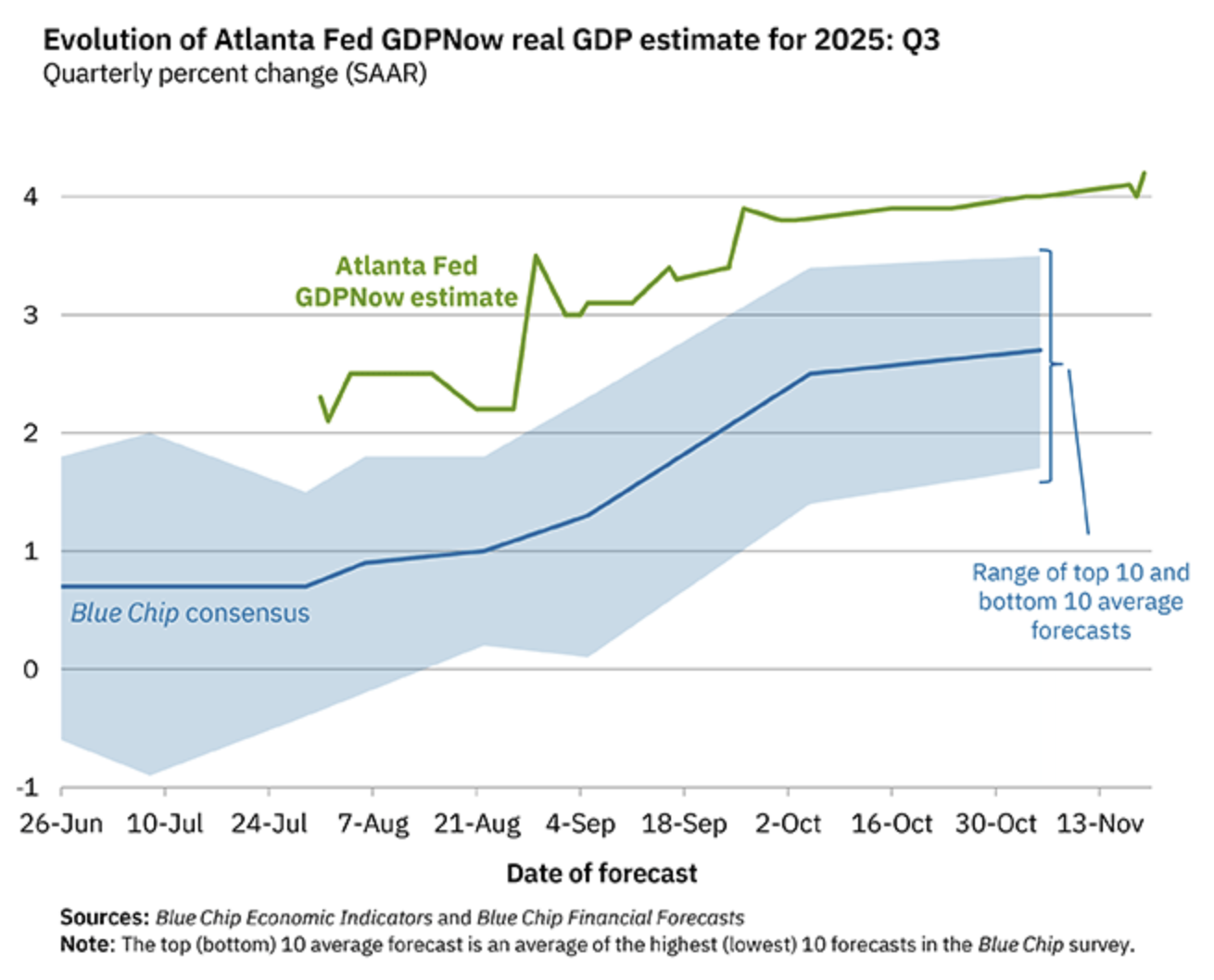
As to the Atlanta Fed’s GDPNow forecast, it ticked higher on Friday and is now sitting at 4.2% for Q3, certainly not synchronous with a major employment crisis.
This week, we will start to get much more information from the BLS and BEA although there is still a huge hole in that output, notably CPI, PCE and GDP.  It will likely take several more months before the rhythm of data gets back to the pre-shutdown cadence and more importantly, it offers the same level of completeness that existed back then.  I guess the FOMC will have to earn their keep for a while longer.

But Williams triggered a solid risk-on session with equities rallying and Treasury yields slipping, while the dollar held tight.  However, I want to touch on one more thing before looking at markets, where the overnight session was rather bland, and that is in reference to a Substack article by Michael Green I read over the weekend that offered a more quantitative approach toward understanding why despite what appears to be solid economic activity, so many people are so unhappy, unhappy enough to believe Socialism is a better choice for the nation going forward. 

The essence of the article, which is very well worth reading as he does all the math to prove his points, is that the delineation of poverty in the US (and I suspect in many Western nations) is laughably low.  For instance, the current poverty line is $31,200, which we all know is far below livable, while the current family median wage in the US is ~$80,000.  Seemingly, most folks should have no problems.  But Green does the calculations to show that if a family of 4 earns less than ~$140,000, they are going to struggle, even if they live in a lower cost area, not NYC where you probably need $350,000 to live.  Between health care, childcare, housing and food, etc., less than that $140k means you are not only living paycheck to paycheck but falling behind as well.

Read the article, linked above, and afterward, you can get a better appreciation for how Zohran Mamdani was elected Mayor of New York City, promising all sorts of free stuff, even though he has approximately zero chance of delivering any of it.

At any rate, that is background for the week ahead.  In Asia, Japan was closed for Workers Day, but Takaichi-san continues to make news regarding her hawkish stance on China.  Meanwhile, bourses in the region had a mixes session with some nice gainers (HK +2.0%, Australia +1.3%, Indonesia +1.85%) although the bulk of the rest of the region saw relatively little overall movement, +/-0.2% or so.  I guess they didn’t understand the benefits of the Fed potentially cutting rates. 🙃

Meanwhile, in Europe, things are far less interesting with a mix of gainers (Spain +0.5%, Germany +0.3%) and laggards (France -0.3%, Italy -1.1%) and the only notable news released being the German Ifo Expectations which slipped although remain solidly within its recent range.  Turning to US futures, at this hour (7:00), they are pointing higher by 0.5%.

In the bond market, Treasury yields continue to slide, down -2bps this morning and now back at 4.05%.  Clearly, the change in sentiment regarding the Fed rate cuts is dragging this yield lower for now.  In Europe, sovereign yields are little changed, overall, with some showing a -1bp decline and others completely lifeless.  Of course, JGB yields are unchanged given the Tokyo holiday.

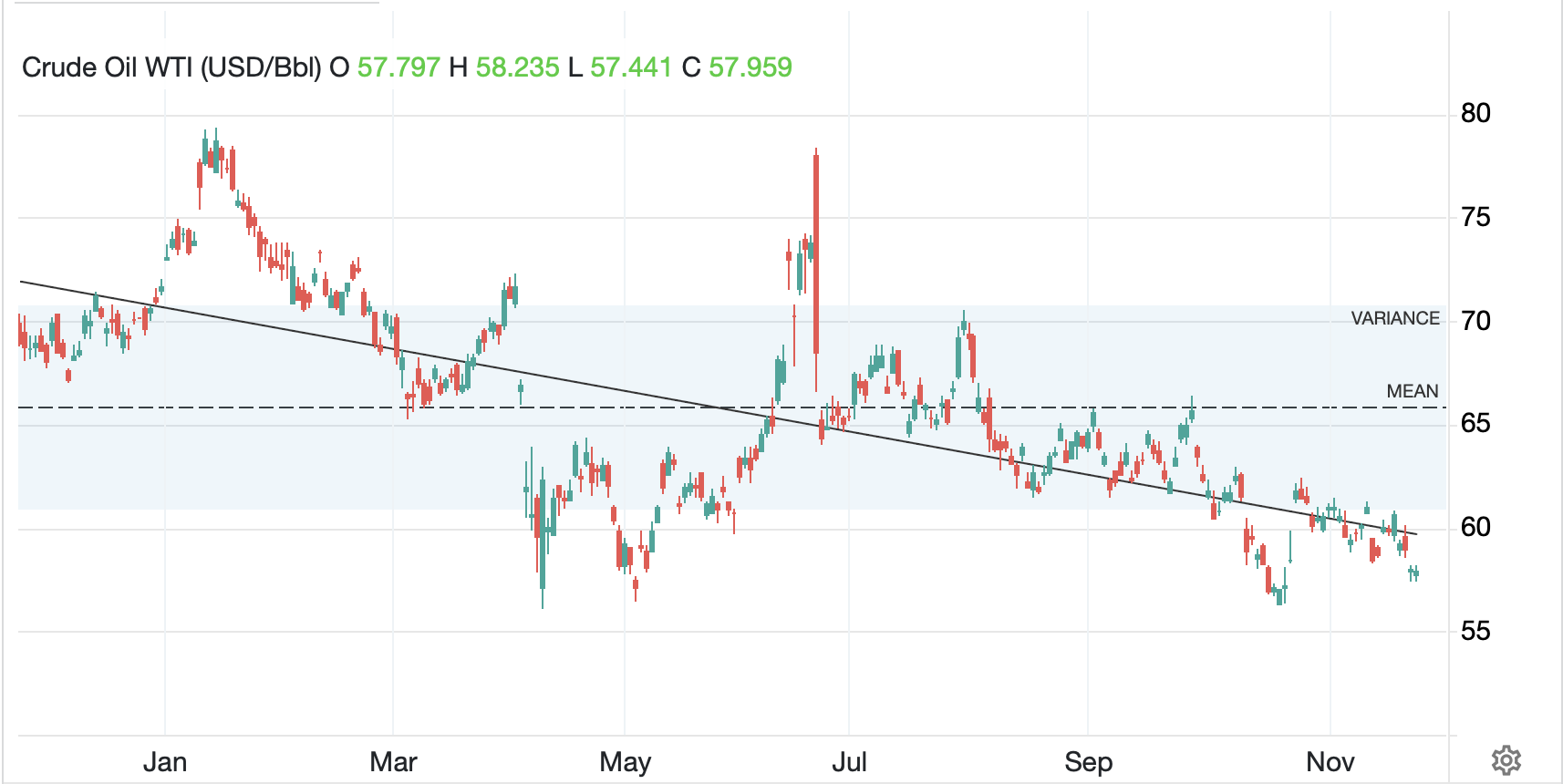
In the commodity space, oil (-0.25%) continues to drift lower and the trend remains very much in that direction as can be seen in the chart below.  There was a very interesting article by Doomberg on Substack this week, reviewing their call that the idea of peak cheap oil is a myth, and there is a virtually unlimited supply of hydrocarbons available with only the politics preventing more production. (For instance, consider the UK essentially shutting down their North Sea oil production despite being in the midst of a self-inflicted energy crisis with the highest electricity prices in the world.  That’s not geology, that’s politics.)  But geology shows there is plenty to go around and growing supply will continue to pressure prices lower.
Source: tradingeconomics.com

Meanwhile, the metals markets are fairly quiet this morning with gold (+0.25%) and silver (+0.1%) showing far less movement than we have seen of late.  The one thing to note is that while both these metals are well off their highs from last month, they both seem to have found a comfortable resting place for now, and nothing about the global macroeconomic situation leads me to believe that the direction is lower from here.

Finally, the dollar is a touch softer this morning with the euro (+0.25%) the largest gainer in the G10 although JPY (-0.3%) remains under pressure overall.  However, in the EMG bloc, INR (+0.5%) and the CE3 (HUF +0.4%, CZK +0.4%. PLN +0.5%) are all firmer with many other currencies in this bloc creeping higher by 0.2% or so.  Interestingly, the DXY has barely slipped and remains above 100 for now.

This week, we are going to see a lot of the delayed September data come out, so like the NFP report from last week, which was old news, the question is, will we learn anything?  But here is a listing to keep in mind:

TuesdaySep Retail Sales0.4%
 -ex autos0.4%
 Sep PPI0.3% (2.7% Y/Y)
 -ex food & energy0.3% (2.7% Y/Y)
 Case Shiller Home Prices1.4%
 Consumer Confidence93.5
WednesdaySep Durable Goods0.2%
 -ex Transport0.2%
 Initial Claims227K
 Chicago PMI43.8
 Fed’s Beige Book 

Source: tradingeconomics.com

Obviously, Thursday is the Thanksgiving holiday and Friday there is nothing slated to be released.  Housing Data, Personal Income and Spending and PCE data are all still up in the air as to when, and what exactly, will be released.  The good news is it appears the entire FOMC is taking the week off as no Fed speakers are currently on the calendar.

If I recap what we know, the market remains beholden to the idea that the economy needs a Fed rate cut and was encouraged by Williams’ comments Friday.  However, questions about AI accounting methods are being raised and there is a growing split between those looking for an equity correction and those who think the near-future is going to be all roses.  From this poet’s perspective, nothing has changed my view that the Fed wants to cut rates, they just need cover to do so, and some softer data will give that cover.  But I also look around the world and find almost every other nation is in a worse situation than the US from a macroeconomic perspective, and it is that issue that informs my view that the dollar remains the best of a bad lot.  So, while fiat currencies will remain under pressure vs. commodities, I’d rather hold dollars than yen, euros, pesos or pretty much anything else.

Good luck

Adf
More Insane

Though debt round the world keeps on growing
The equity run isn’t slowing
But what’s more insane
Is yields slowly wane
Despite signs inflation ain’t slowing
 
The French are the latest to hear
Their credit’s somewhat less sincere
But CBs this week
Seem likely to tweak
Rates lower, and markets will cheer


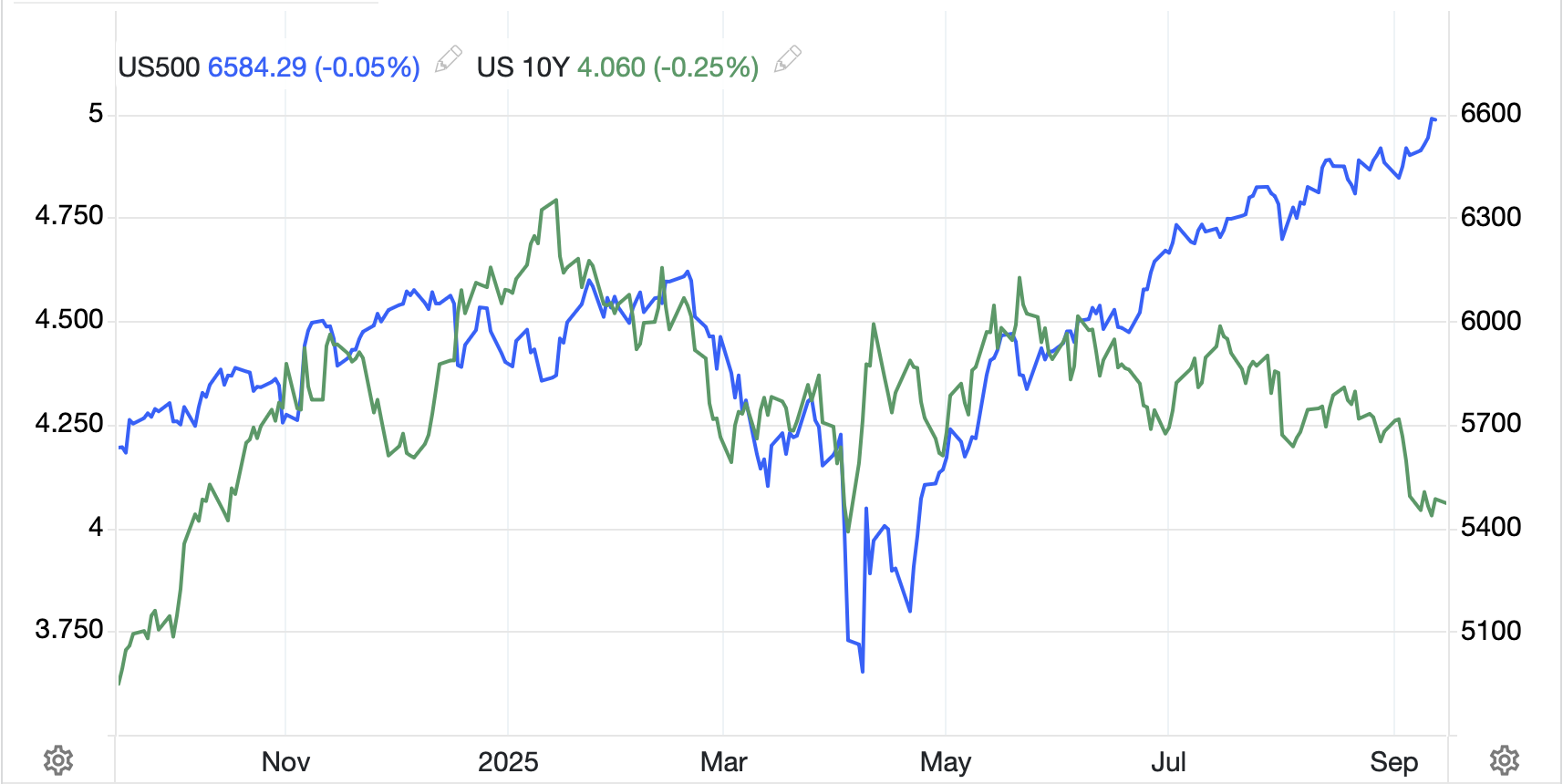
Something is rotten in the state of financial markets, or at least that is the conclusion this poet has drawn (and please do not think I am trying to compare myself to Shakespeare).  No matter what my personal view of the economy may be, I cannot help but look at the recent performance of the equity market and the bond market and be extremely confused.  The chart below shows the past year’s price action in the S&P 500 (blue line) and US 10-year yields (green line). 

Source: tradingeconomics.com

Since early June, the two price series, which have historically had a pretty decent correlation, have gone in completely opposite directions.  Equity markets continue to trade to new highs on a regular basis as earnings multiples continue their expansion.  Typically, multiples only expand when growth expectations are rising, and the economy is in an uptrend.  Ergo, if multiples are high and rising, it seems equity investors believe that is the case.  I understand that view as there are strong indications the administration is going to continue to ‘run the economy hot’ meaning do all it can to increase economic activity and allow inflation to rise as well, counting on the fast growth to offset the pain.

However, 10-year Treasury yields have been sliding steadily for the past three months despite the equity market belief in running it hot.  Bond yields have historically been far more sensitive to inflationary pressures and the fact that yields have been declining, down >40bps since early June, would lead to a very different conclusion about the economy, that it is going to see much slower growth and by consequence, reduced inflationary pressures.

I have discussed the asynchronous economy in the past and I believe this is more proof of that thesis.  The equity markets are still being largely driven by the AI/Tech sector and while that is a huge portion of the equity market, its size within the overall economy is pretty small.  Given the capital weightings of both the S&P 500 and NASDAQ, strength in that sector has clearly been sufficient to drive stock indices higher.  However, much of the rest of the economy is not seeing the same benefits, and in fact, there is a portion suffering as AI takes over roles that had been filled by people thus increasing unemployment.  That segment of the economy is much larger, and it seems there is a growing probability that a recession may be coming there.  

Or not, if the administration is able to run it hot.  Ultimately, the thing the makes the least sense to me is that there is no indication that inflation is slowing anywhere back toward the Fed’s alleged 2% target.  Rather CPI looks far more likely to coalesce around the 3.5%-4.0% level which means that PCE, even on a core basis, is going to be hanging around 3.0%.  If the Fed is getting set to cut rates, and by all indication they are going to cut at least 25bps on Wednesday, I think it is clear that 3.0% is the new 2.0%.

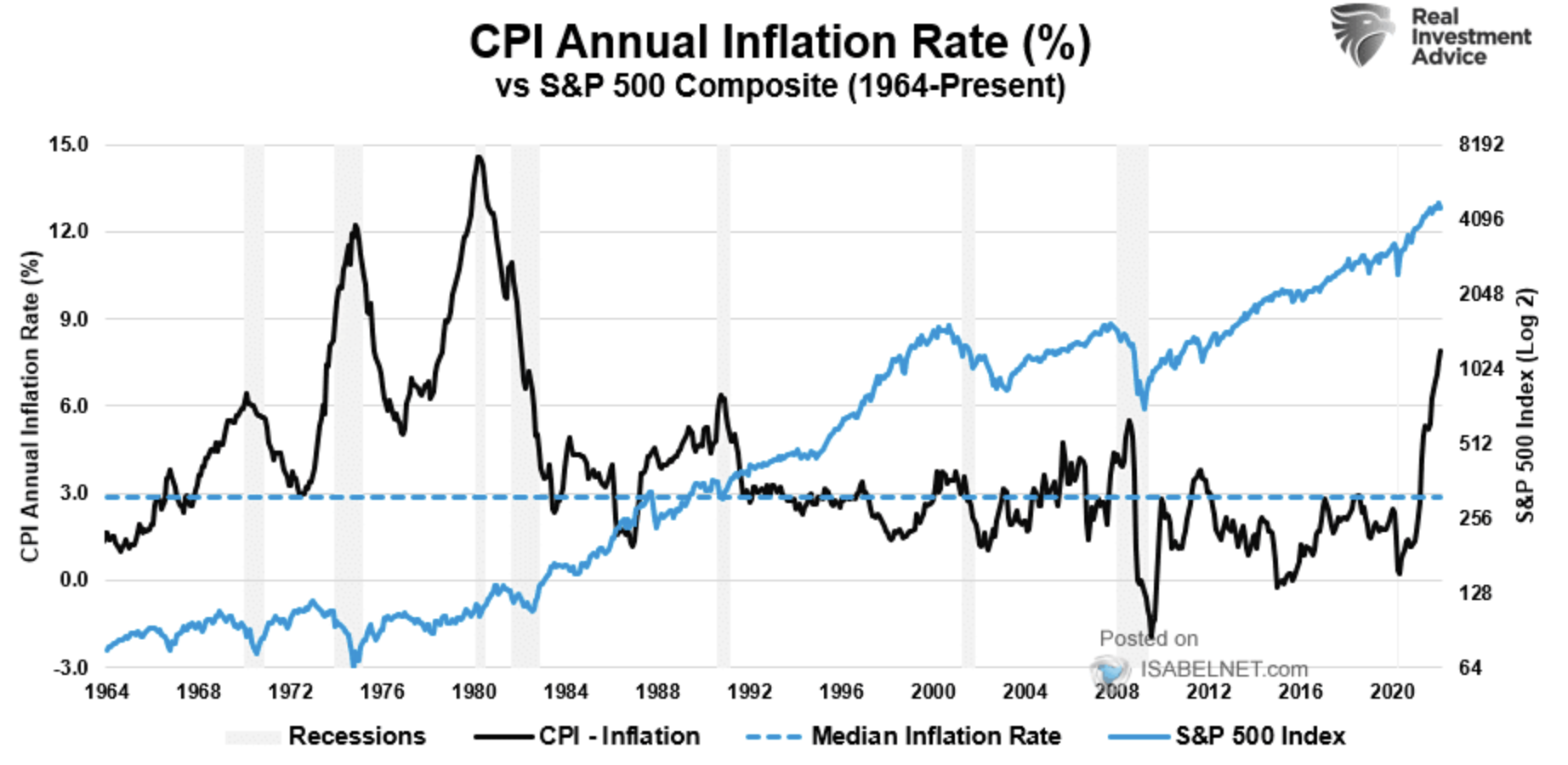
And here’s the problem with that. When inflation is low, 2% or less, equities have historically been negatively correlated with bond prices, so if stocks fell, bonds rallied and the 60:40 portfolio had an internal hedge.  But when inflation is higher, and it doesn’t need to be 10%, 4% is enough to change the relationship, equity prices and bond prices tend to move in sync.  This means, if stock prices fall because of a recession, so do bond prices with yields rising.  In that situation, the 60:40 portfolio suffers greatly.  Just think back to 2022 when both equities and bonds fell -30% or so.  Where was inflation?  Right, we were in the throes of the Fed’s last mistake regarding the word transitory.  The below chart is the best I could find to show how things behaved in the 60’s and 70’s with inflation running hot and then how things changed after Mr Volcker began to squash inflation.

Original source: Isabelnet.com

And what of the dollar you may ask?  Well, theoretically, rising inflation should undermine the currency, but rising rates, when central banks fight inflation, should help support it.  However, this time, with rising inflation and the Fed set to cut, it seems the dollar may have some trouble, although as other central banks follow suit, and they will, the dollar will find support.

Ok, let’s see how things behaved overnight.  While Friday’s US session was mixed with only the NASDAQ managing to gain, there was more green in Asia and Europe.  The Japanese celebrated Respect for the Aged Day, so markets there were closed.  However, both HK (+0.2%) and China (+0.25%) managed modest gains despite (because of?) weaker than expected Chinese economic data.  Every aspect of the data, IP, Retail Sales, Investment and Unemployment, printed worse than forecasts and has now encouraged investors to look for further Chinese government stimulus to support the economy.  That theory helped Korea, Malaysia and Indonesia, all showing solid gains, but did nothing for the rest of the region, perhaps most surprisingly Taiwan.

In Europe, Fitch cut France’s credit rating to A+ from AA- based on fiscal deficits and political turmoil (aka no government), yet equity investors saw that as a buy signal with the CAC (+1.15%) leading European shares higher.  The DAX (+0.4%) and IBEX (+0.6%) are also doing well although the FTSE 100 (0.0%) is just treading water.  There has been no data of note, so it appears investors there are anticipating good things from the US where futures are higher by 0.2% at this hour (7:30).

Bond yields in the US are unchanged this morning, but European sovereign yields have slipped -2bps across the board, despite France’s downgrade.  I am really at a loss these days to understand the mind of bond investors.  I guess there is a growing belief that central bank rate cuts are going to help!

In the commodity sector, oil (+0.4%) has edged higher this morning but remains firmly in the middle of its 3-month trading range and is showing no desire to move in either direction.  Metals markets, meanwhile, are basically unchanged this morning, simply sitting at their recent highs with the latest contest on Wall Street being who can forecast the highest price for gold in 2026.  Goldman just explained that $5000/oz is reasonable if just 1% of risk assets move into the relic.

As to the dollar, while it did little most of the evening, as NY is walking in, it is slipping a bit, with the euro (+0.25%) and pound (+0.5%) leading the way higher in the G10, and truthfully across the board as the largest EMG moves are KRW (+0.4%) and HUF (+0.4%) while the rest have moved on the order of 0.1% to 0.2%.  There has been growing chatter that China is now going to allow the renminbi to start to strengthen more steadily (in fairness, it has been strengthening modestly since the beginning of 2025, up about 3% since then), and that this is part of the trade negotiations ongoing with the US currently taking place in Madrid.  But remember, while CNY has been creeping higher this year, a quick look at the chart below shows it has fallen substantially since 2022, having declined more than 17% between 2022 and the beginning of this year.

Source: tradingeconomics.com

On the data front, in addition to the FOMC, there are several other central bank meetings and some important data as follows:

TodayEmpire State Manufacturing5.0
TuesdayRetail Sales0.3%
 -ex autos0.4%
 Control Group0.4%
 IP-0.1%
 Capacity Utilization77.4%
WednesdayIndonesia Rate Decision5.0% (Unchanged)
 Housing Starts1.37M
 Building Permits1.37M
 Bank of Canada Rate Decision2.5% (-0.25%)
 FOMC Decision4.25% (-0.25%)
 Brazil Rate Decision15.0% (unchanged)
ThursdayBOE Rate Decision4.0% (unchanged)
 Initial Claims240K
 Continuing Claims1950K
 Philly Fed2.3
 South Africa Rate Decision7.0% (unchanged)
 Leading Indicators-0.1%
 BOJ Rate Decision0.5% (unchanged)

Source: tradingeconomics.com

So, while Retail Sales may give us some more color on the strength of the economy, it is really a week filled with central bank policy decisions and the ensuing discussions they have to spin things as they desire.  I imagine we will be getting an article from Nickileaks this afternoon or tomorrow to get Powell’s message out, but it remains to be seen if we are watching bond traders buy the rumor and they are set to sell bonds on the news, especially if the Fed goes 50bps, something that remains a real possibility in my mind, though the futures market is pricing just a 4% chance of that as of this morning.

A 50bp cut will undermine the dollar in the short run and may put pressure on the BOE to cut more rather than hold.  Until then, though, I suspect there will be little net movement in either direction.

Good luck

Adf

Misguided

On Friday, the news was a sign
Of imminent US decline
The Fed was a hawk
And all of the talk
Was Trump’s actions wiped off the shine
 
But yesterday, markets decided
That Friday’s response was misguided
They’ve come to believe
A Fed funds reprieve
By Powell will soon be provided


As I have frequently written in the past, markets are perverse.  The narrative Friday was about the dire straits in which the US found itself with the employment situation collapsing and the recession that has been forecast for the past three years finally upon us.  Part of this story was because of the Fed’s seeming intransigence regarding interest rates as made clear by Chairman Powell’s relatively hawkish comments at the FOMC press conference last week.

But that story is sooo twenty-four hours ago. In the new world, the huge bond market rally that was seen on Friday, and equally importantly, the changing pricing of Fed funds rate cuts has the new narrative as, the Fed is going to cut so buy stonks!  Confirmation of this new narrative was provided by SF Fed President Mary Daly who remarked yesterday evening, “time is nearing for rate cuts, may need more than two.”  All I can say is wow!  

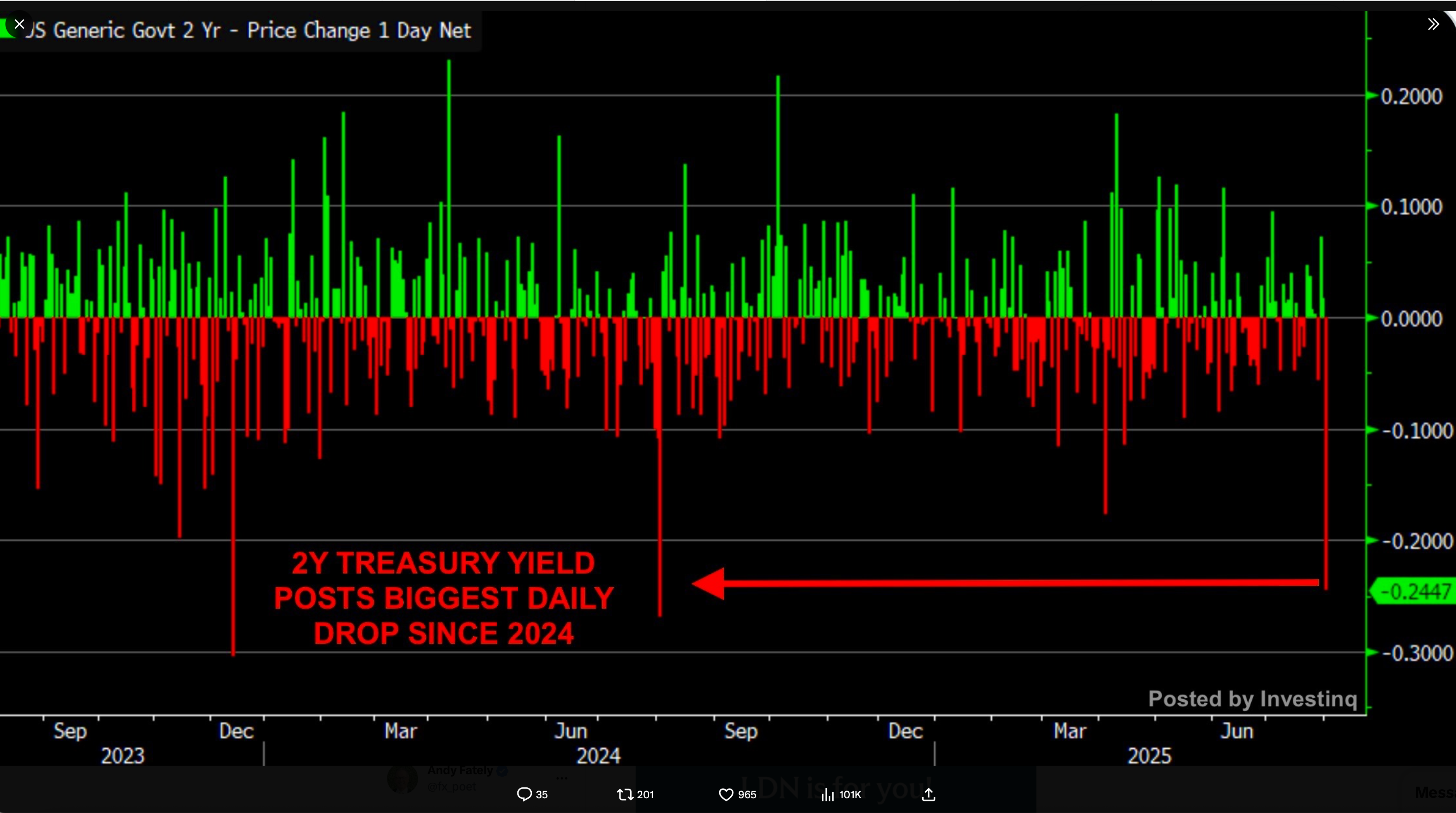
The below chart shows the daily moves, in basis points, of the 2-year Treasury note which is seen as the market’s best indicator or predictor of future Fed funds rates.  On Friday, the yield fell nearly 25bps, essentially pricing in one additional rate cut coming, and as we saw with the Fed funds futures market, that pricing is now anticipating three cuts this year.  Ms Daly merely reconfirmed that news.

Source: https://x.com/_investinq/status/1951356470877925408?s=46

Perhaps it is fair to ask why Daly has taken so long to come around to this view.  After all, she is a known dove and has been for her entire time at the Fed.  As I have asked before, why haven’t the other known doves, like Governors Cook and Jefferson, been out there talking about rate cuts?  For anyone who wants to continue to believe that the Fed is apolitical, nonpartisan or above politics, this is exhibit A as to why it is not.  In fact, if you look, only one Board member was considered a hawk in this analysis by In Touch Markets, and she just resigned.  The other hawks are all regional Fed presidents.  Perhaps this is why they were so slow to raise rates when inflation was roaring in 2022 and why they were so anxious to cut rates in 2024 on virtually no news other than the upcoming election. 

To be clear, until Friday’s NFP data, it was difficult to make the case, in my mind, for a cut because I continue to see inflationary pressures beyond any tariff impacts.  But if the labor market is weaker than had been assumed, that will certainly open the door to more cuts.  Of course, the conundrum is, if the economy is so weak that the Fed needs to cut, why are stocks rallying?  Arguably, a weak economy would foretell weaker earnings growth, a direct negative to equity valuations.  But that appears to be old-fashioned thinking.  I guess I am just an old-fashioned guy.

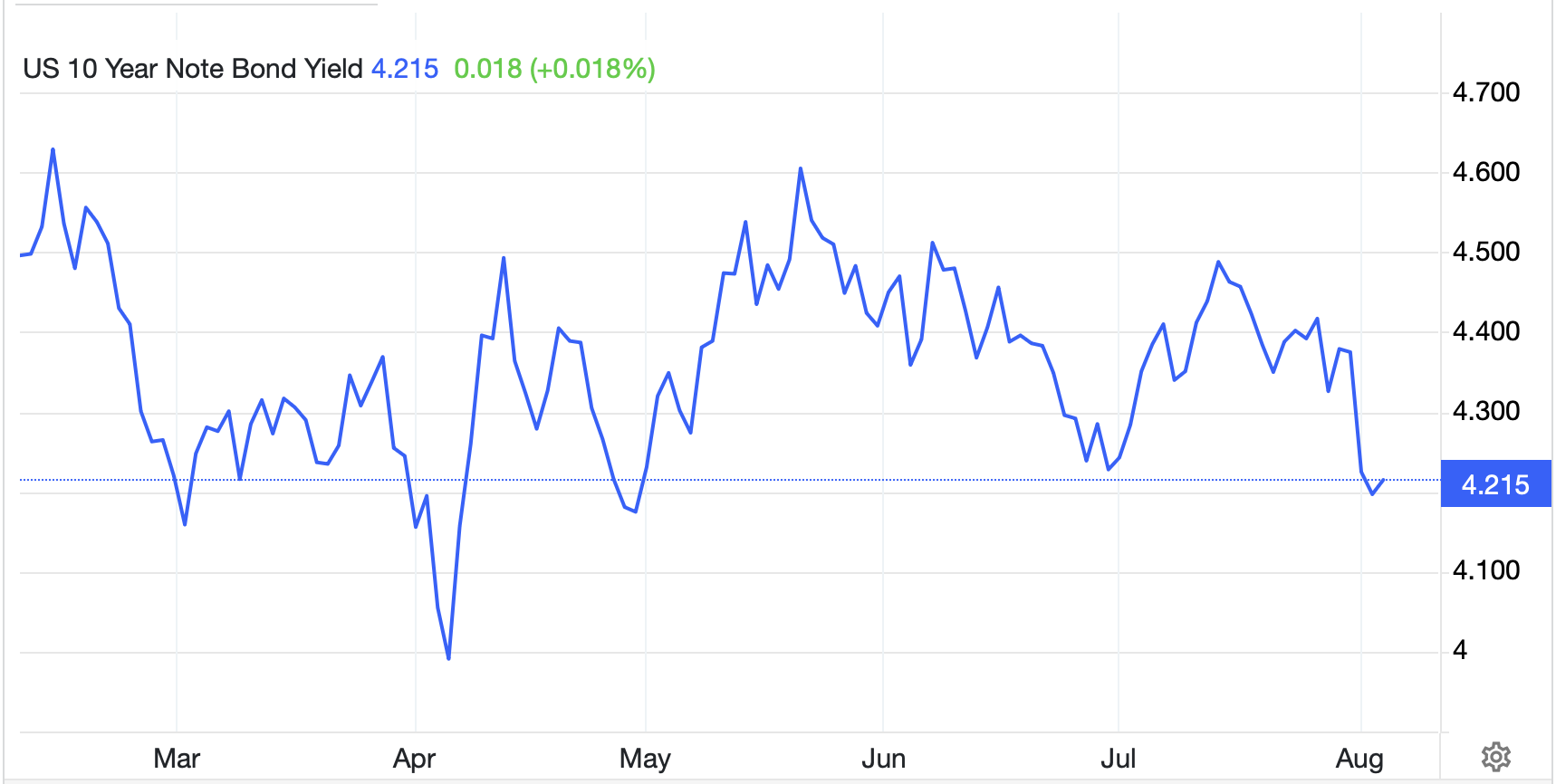
Ok, let’s turn to the overnight activity.  Starting with bonds, since the big move Friday, Treasury yields have been little changed, climbing 2bps overnight to 4.21%, but still hovering near the bottom of their recent trading range with only the Liberation Day announcement panic showing yields below the current level.  This is a great boon for the Treasury as auctions of 3-, 10-, and 30-year Treasuries are due this week starting with the 3-year today.

Source: tradingeconomics.com

European sovereign yields have also edged higher by 1bp across the board after PMI data was released this morning, pretty much exactly at expected levels.  The outlier last night was JGB yields which slipped -4bps and continue to slide away from designs of a BOJ rate hike.

In the equity markets, yesterday’s US rally was followed almost universally in Asia (Japan +0.65%, China +0.8%, Hong Kong +0.7%, Australia +1.2%) with only India (-0.3%) lagging there.  As to Europe, it too is having a good day with the DAX (+0.8%) leading the way although strength almost everywhere as the PMI data was good enough to keep spirits higher.

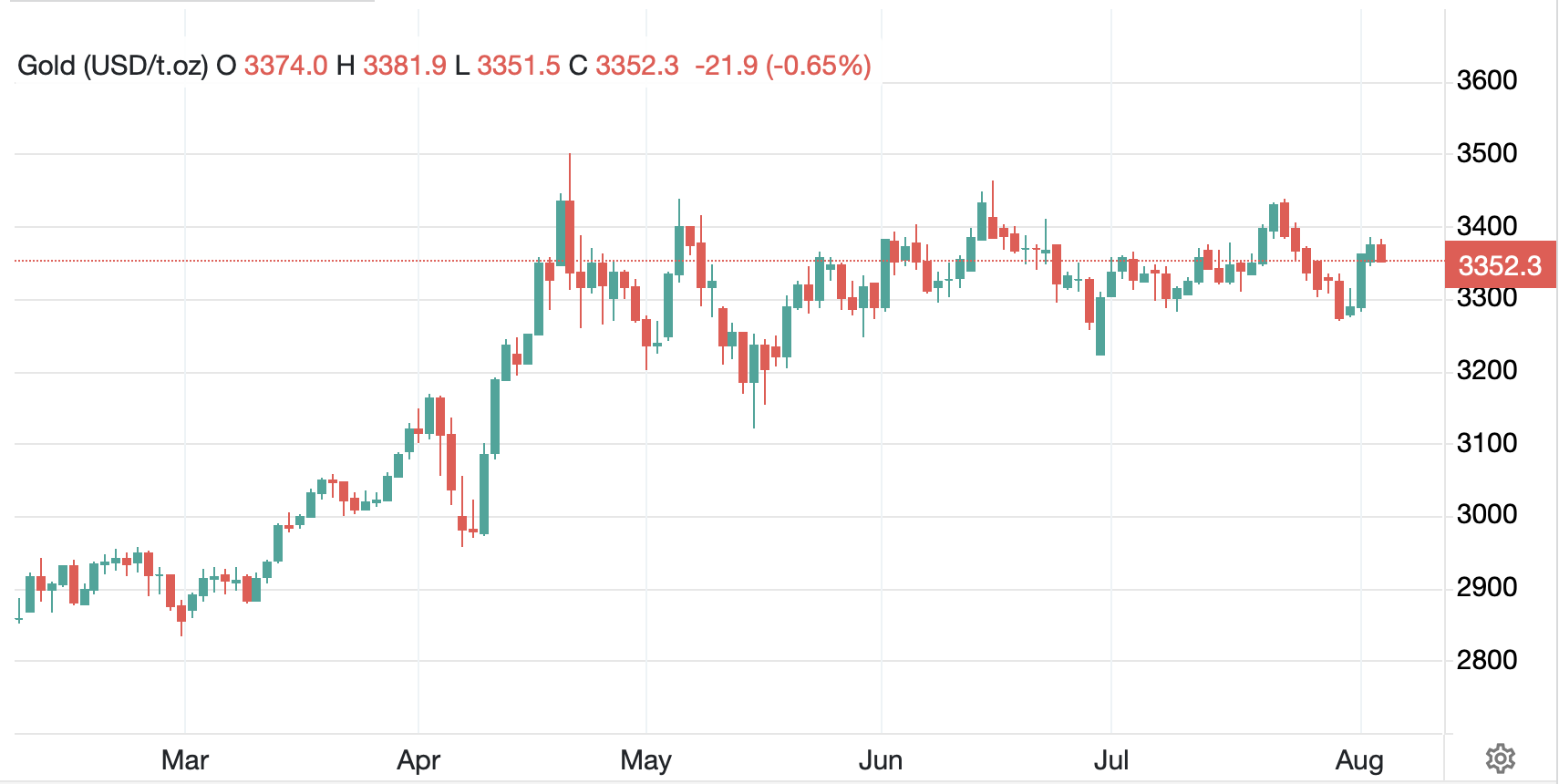
In the commodity markets, oil (-1.1%) is slipping for a fourth consecutive day, but is still right in the middle of its $60 – $70 trading range.  There remain so many potential geopolitical issues with saber rattling between the US and Russia and President Trump’s threatened excess tariffs on nations who buy Russian oil that it remains difficult to discern supply/demand characteristics.  Certainly, if the US is heading into a recession, that is likely to dampen demand for a while, but that remains unclear at this time.  As to the metals, gold (-0.65%) is giving back some of its post NFP gains but if I look at the chart below, all it shows is a relatively narrow trading range with no impetus in either direction.  

Source: tradingeconomics.com

The rest of the metals complex is being dragged lower by gold this morning, but not excessively so.

Finally, the dollar is a touch stronger today, despite the rate cut talk, as the euro (-0.4%) and yen (-0.55%) lead the G10 currencies down.  While I understand the rationale for the dollar to soften in the short- and medium-term vs its counterparts, it is very difficult for me to look at the political and economic situations elsewhere in the world and think I’d rather be investing there.  Europe is a mess as is Japan.  And don’t get me started on the emerging market bloc.  So, remember, while day-to-day movements can be all over the map and are impacted by things like data releases or announcements, structural strength or weakness remains largely in place, and the US situation appears stronger than most others for now.   Touching briefly on EMG currencies, the dollar is firmer vs. virtually all of them, mostly on the order of 0.4% or so.

On the data front, today brings the Trade Balance (exp -$61.4B) and then ISM Services (51.5) at 10:00.  We don’t get the first post-FOMC speech until tomorrow by Governor Cook, so it will be interesting to see if there are more doves who are willing to show their colors.  But in the end, as demonstrated by the quick reversal of the narrative from Friday to Monday, there remains an underlying bid to risk assets and we will need to see substantial economic weakness to remove that bid, even temporarily.

Good luck

Adf

Quite Dreary

While pundits expected inflation
Would rise with Trump as the causation
The data has not
Shown prices are hot
Since tariffs joined the conversation
 
In fact, there’s a budding new theory
That’s made dollar bulls somewhat leery
If Powell cuts rates
While Christine, she waits
The dollar might soon look quite dreary


Well, it turns out measured inflation wasn’t quite as high as many had forecast, even if we ignore those whose views are completely political.  Yesterday’s readings of 0.1% for both headline and core were lower despite all the tariff anxiety.  The immediate response has been, just wait until next month, that’s when the tariff impact will kick in, you’ll see.  Maybe that will be the case, but right now, for a sober look, the Inflation_Guy™, Mike Ashton, offers a solid description of what happened and some thoughts about how things may be going forward.  Spoiler alert, tariffs are not likely the problem, let’s start thinking about money supply growth.

However, the market, as always, is seeking to create a narrative to drive things (or does the narrative follow the market?  Kind of a chicken and egg question) and there is a new one forming regarding the dollar.  Now, with inflation appearing to slow in the US, this is an opening for Chair Powell to cut rates again, despite the fact that inflation on every reading remains above their target.  Meanwhile, the uncertainty that US policy is having on economies elsewhere, notably in Europe as the tariff situation is not resolved, means Madame Lagarde is set to pause, (if not halt), ECB rate cuts for a while and voilà, we have the makings of a dollar bearish story.  

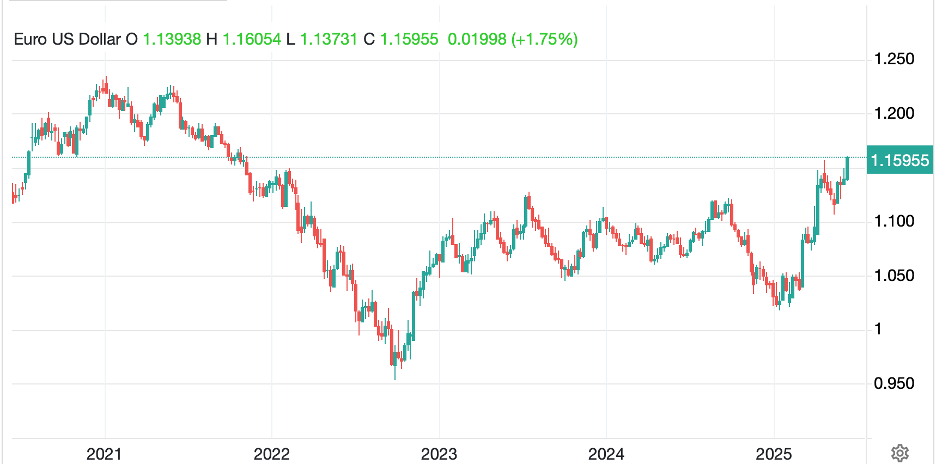
That seems likely to have been the driver of today’s move in the euro (+1.0%) which has taken the single currency back to its highest level since November 2021.

Source: tradingeconomics.com

Now, if you are President Trump and are seeking to reduce the trade deficit while bringing manufacturing capacity back to the US, this seems like a pretty big win.  Lower inflation and a lower dollar both work towards those goals.  Not surprisingly, the president immediately called for the Fed to cut rates by 100 basis points after the release.  As much as FOMC members seem to love the sound of their own voices, perhaps this is one time where they are happy to be in the quiet period as no response need be given!

At any rate, the softer inflation data has had a significant impact on the dollar writ large, with the greenback sliding against all its G10 counterparts, with SEK (+1.3%) leading the way, although CHF (+1.1%), NOK (+0.9%) and JPY (+0.8%) have also been quite strong.  However, the biggest winner was KRW (+1.3%) as not only has there been dollar weakness, but new president, Lee Jae-myung, has proposed tax cuts on dividends to help support Korean equity markets and that encouraged some inflows.  Other EMG currencies have gained as well, although those gains are more muted (CNY +0.3%, PLN +0.6%) and some have even slipped a bit (ZAR -0.5%, MXN -0.1%).  Net, however, the dollar is down.

Yesterday, I, and quite a few other analysts, were looking for more heat in the inflation story.  Clearly, if that is to come, it is a story for another day.  With this in mind, we shouldn’t be surprised that government bond yields have also fallen around the world with Treasuries (-5bps) showing the way for most of Europe (Bunds -6bps, OATs -5bps, Gilts -6bps) and even JGBs (-2bps) are in on the action.  

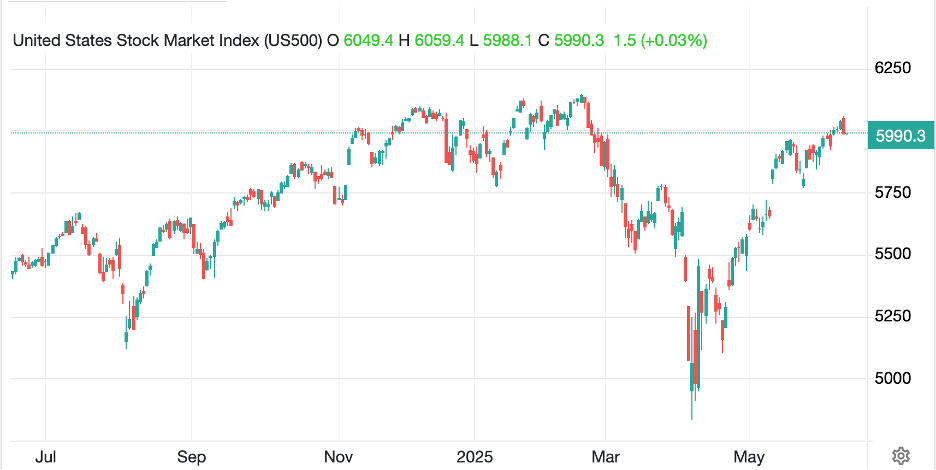
Earlier this week, the tone of commentary was that inflation was coming back, and a US stagflation was inevitable.  This morning, that narrative has disappeared.    Interestingly, I would have thought the combination of the cooler CPI and the trade truce between the US and China would have the bulls feeling a bit better.  Alas, the equity markets have not responded in that manner at all.  Despite the soft inflation readings, US equity markets yesterday edged lower, albeit not by very much.  But that weakness was followed in Asia (Nikkei -0.65%, Hang Seng -0.4%, CSI 300 -0.1%) with India, Taiwan and Australia all under pressure although Korea (+0.45%) bucked the trend on that dividend tax story.  And Europe, this morning, is also unhappy with the DAX (-1.1%) leading the way lower followed by the IBEX (-.9%) and CAC (-0.7%).  The FTSE 100 (-0.1%) is faring a bit better as, ironically, weaker than expected GDP data this morning (-0.3% in April) has reawakened hope that the BOE will get more aggressive cutting rates.  US futures are in the red as well this morning, -0.5% across the board.  Perhaps this is the beginning of the long-awaited decline from overbought levels.  Or perhaps, this is just a modest correction after a strong performance over the past two months.  After all, the bounce in the wake of the Liberation Day pause has been impressive.  A little selling cannot be a surprise.

Source: tradingeconomics.com

Lastly, we turn to commodities where the one consistency is that gold (+0.5%) has no shortage of demand, at least in Asia.  It seems that despite a 29% rise year-to-date in the barbarous relic, US investors are not that interested.  Those gains dwarf everything other than Bitcoin, and yet they have not caught the fancy of the individual investor in the US.  However, I believe that demand represents an important measure of the diminishing trust in the US dollar, at least for the time being.  The other metals are less interesting today.  As to oil (-1.9%), it has rallied despite alleged production increases from OPEC and weakening demand regarding economic activity.  Some part of this story doesn’t make any sense, although I don’t know which part yet.

This morning’s data brings Initial (exp 240K) and Continuing (1910K) Claims as well as PPI (0.2%, 2.6% Y/Y headline; 0.3%, 3.1% core).  While there are no Fed speakers, there is much prognostication as to how the CPI data is going to alter their DOT plot and SEP information next week at the Fed meeting.  

Finally, the situation in LA does not appear to have improved very much and it is spreading to other cities with substantial protests ostensibly planned for this weekend.  However, market participants have moved on as nothing there is going to change macroeconomic views, at least not yet.  If inflation is quiescent, the Fed doesn’t have to cut to have the tone of the conversation change.  That is what we are seeing this morning and this can continue quite easily.  When I altered my view on the strong dollar several months ago, I suggested a decline of 10% to 15% was quite viable.  Certainly, another 5% from here seems possible over the next several months absent a significant change in the inflation tone.

Good luck

Adf

PS – having grown up in the 60’s I was a huge Beach Boys fan and mourn, with so many others, the passing of Brian Wilson.  In fact, I wanted to write this morning’s rhyme as new lyrics to one of his songs, either “Fun, Fun, Fun” or “Surfin’ USA” two of my favorites.  But I realise that I have become too curmudgeonly as both of those are wonderfully upbeat and I just couldn’t get skeptical words to work.

Rate Cutting Pretension

The US and China have shaken
Their hands, as trade talks reawaken
And while it’s a start
It could fall apart
For granted, not much should be taken
 
So, markets have turned their attention
To ‘flation with some apprehension
This morning’s report
Might help, or might thwart
Chair Powell’s rate cutting pretension


Starting with the trade talks between China and the US, both sides have agreed that progress was made. Here is a quote from a report on China’s state broadcaster, CCTV, last night.  “China and the US held candid and in-depth talks and thoroughly exchanged views on economic and trade issues of mutual concern during their first meeting of the China-US economic and trade consultation mechanism in London on Monday and Tuesday. The two sides have agreed in principle the framework for implementing consensus between the two heads of state during their phone talks on June 5, as well as those reached at Geneva talks. The first meeting of such consultation mechanism led to new progress in addressing each other’s economic and trade concerns.”  I highlight this because it concurs with comments from Commerce Secretary Lutnick and tells me that things are back on track.

Clearly, this is a positive, although one I suspect that equity markets anticipated as they have been rallying for the past several sessions prior to the announcements.  Certainly, this is good news for all involved as if trade tensions between the US and China diminish, it should be a net global economic positive.  While anything can still happen, we must assume that a conclusion will be reached going forward that will stabilize the trade situation.  However, none of this precludes President Trump’s stated desire to reindustrialize the US, so that must be kept in mind.  And one of the features of that process, at least initially, is likely to be upward price pressures in the economy.

Which brings us to the other key story today, this morning’s CPI report.  Expectations for headline (0.2% M/M, 2.5% Y/Y) and core (0.3% M/M, 2.9% Y/Y) are indicating that the bottom of the move lower in inflation may have been seen last month.  However, these readings, while still higher than the Fed’s target (and I know the Fed uses Core PCE, but the rest of us live in a CPI world) remain well below the 2022 highs and inflation seems to be seen as less of a problem.  Yes, there are some fears that the newly imposed tariff regime is going to drive prices higher, and I have seen several analysts explain that we are about to see that particular process begin as of today’s data.  

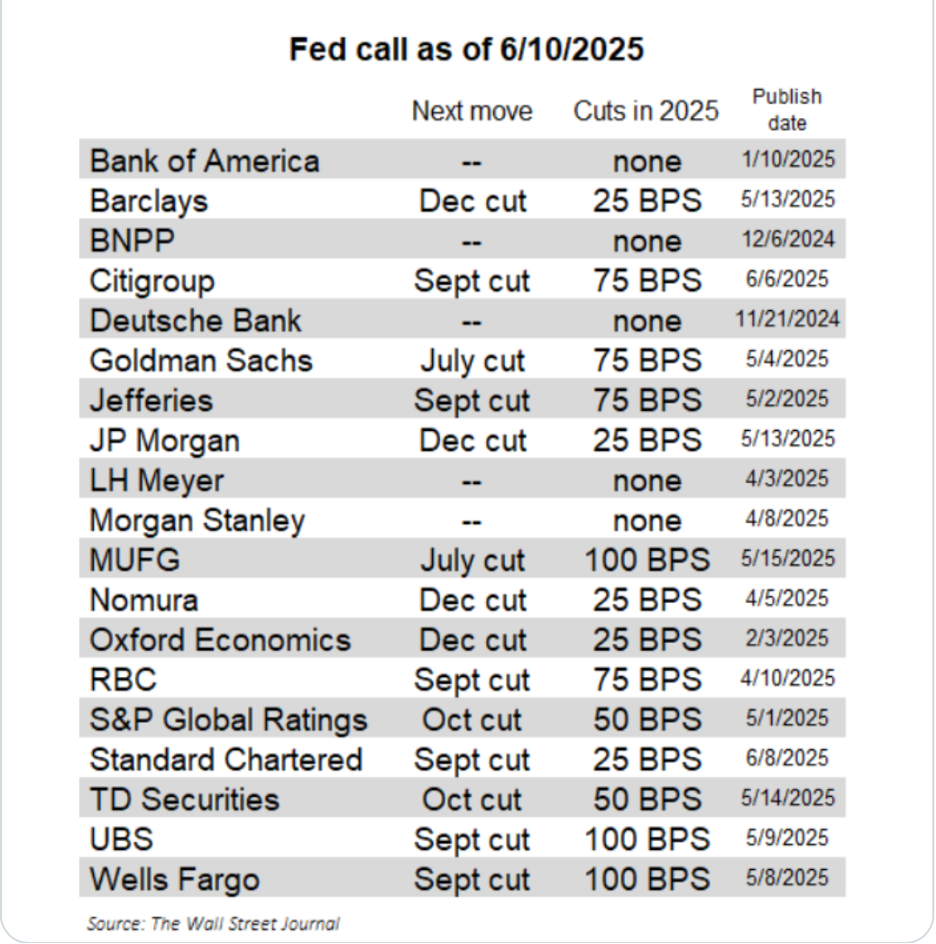
Of course, from a markets perspective, the key issue with inflation is how it will impact interest rates.  In this case, I think the following chart from Nick Timiraos in the WSJ is an excellent description of how there is NO consensus view at all.

At the same time, Fed funds futures markets are pricing in the following probabilities as of this morning.

Source: cmegroup.com

The thing about the Fed is they have proven to be far more political than they claim.  First, it is unambiguous that there is no love lost between President Trump and Chairman Powell.  Interestingly, the Fed is strongly of the belief that when they cut rates, they are helping the federal government, and more importantly, the population’s impression of what the federal government is doing.  Hence, the 100bps of cuts last summer/fall never had an economic justification, they appeared to have been the Fed’s effort to sway the electorate to maintain the status quo.  With that in mind, absent a collapse in the labor market with a significantly higher Unemployment Rate, I fall into the camp of no Fed action this year at all.  And, if as I suspect, inflation readings start to pick up further, questions about hikes are going to be raised.

Consider if the BBB is passed and it juices economic activity so nominal GDP accelerates to 6% or 7%, the Fed will be quite concerned about inflation at that point and the market will need to completely reevaluate their interest rate stance.  My point is the fact that rate cuts are currently priced does not make them a given.  Market pricing changes all the time.

So, let’s take a look at how things behaved overnight.  After a modest US rally in equities yesterday, Asia had a solid session, especially China (+0.75%) and Hong Kong (+0.8%) as both responded to the trade news. Elsewhere in the region, things were green (Nikkei +0.5%), but without the same fanfare.  I have to highlight a comment from PM Ishiba overnight where he said “[Japan] should be cautious about any plans that would deteriorate already tattered state finances.  Issuing more deficit financing bonds is not an option.”  That sounds an awful lot like a monetary hawk, although that species was long thought to be extinct in Japan.  It will be interesting to see how well they adhere to this idea.

Meanwhile, in Europe, the only equity market that has moved is Spain (-0.6%) which is declining on idiosyncratic issues locally while the rest of the continent is essentially unchanged.  As to US futures, at this hour (7:30) they are pointing slightly lower, about -0.15% across the board.

In the bond market, the somnolence continues with yields backing up in the US (+2bps) and Europe, (virtually all sovereign yields are higher by 2bps) with only UK Gilts (+5bps) under any real pressure implying today’s 10-year auction was not as well received as some had hoped.  In Japan, yields slipped -1bp overnight and I thought, in the wake of the Ishiba comments above, I would highlight Japan 40-year bonds, where yields have collapsed over the past three weeks.  Recall, back in May there was a surge in commentary about how Japanese yields were breaking out and how Japanese investors would be bringing money home with the yen strengthening dramatically.  I guess this story will have to wait.

Source: tradingeconomics.com

Turning to commodities, oil (+1.5%), which reversed course during yesterday’s session, has regained its mojo and is very close to closing that first gap I showed on the chart yesterday.  Above $65, I understand most shale drilling is profitable so do not be surprised to hear that narrative pick up again.  In the metals markets, gold (+0.2%) now has the distinction of being the second largest reserve asset at central banks around the world, surpassing the euro, although trailing the dollar substantially.  I expect this process will continue.  Silver (-0.8%) and copper (-2.1%) are both under pressure this morning although I have not seen a catalyst which implies this is trading and position adjustments, notably profit taking after strong runs in both.

Finally, the dollar is slightly stronger this morning with the euro and pound essentially unchanged, AUD, NZD and JPY all having slipped -0.25%, and some smaller currencies (KRW -0.55%, ZAR -0.5%) having fallen a bit further.  However, for those who follow the DXY, it is unchanged on the day.  The thing about the dollar is despite a lot of discussion about a break much lower, it has proven more resilient than many expected and really hasn’t gone anywhere in the past two months.  If the Fed turns hawkish as inflation rebounds, I suspect the dollar bears are going to have a tougher time to make their case (present poets included.)

In addition to the CPI at 8:30, we see EIA oil inventory data with a modest build expected although yesterday’s API data showed a draw that surprised markets.  I must admit I fear inflation data is going to start to rebound again which should get tongues wagging about next week’s FOMC meeting.  However, for today, a hot print is likely to see a knee-jerk reaction lower in stocks and bonds and higher in the dollar.  But the end of the day is a long way away and could be very different, especially given the always present headline risk.

Good luck

Adf

The Time Has Come

(with apologies to Lewis Carroll)

The time has come, the Chairman said,
To speak of many things.
Of joblessness and how inflation,
            Social unrest, brings
And whether we have done our job
            Although we live like kings
 
But wait a bit, the pundits cried
            Before you do explain
For we thought that inflation was
            The overwhelming bane
It was, the Chairman did remark
            But now its jobs that reign


On Friday morning, Fed Chair Jay Powell laid out his vision for the immediate future, and much as many had hoped, he was quite clear in his belief that the inflation mission is accomplished.

A person in a suit and tie

Description automatically generated

Now, many of us remember how that worked out for the last official who exclaimed that concept a bit too early, but hey, maybe this time IS different!  At any rate, during his Jackson Hole speech, the below comments were what got speculative juices quickening, although a quick look at history indicates all may not be well, at least in the risk asset world.  But first to the soothing words of the Chairman [emphasis added]:

The time has come for policy to adjust. The direction of travel is clear, and the timing and pace of rate cuts will depend on incoming data, the evolving outlook, and the balance of risks.”  

“We will do everything we can to support a strong labor market as we make further progress toward price stability. With an appropriate dialing back of policy restraint, there is good reason to think that the economy will get back to 2 percent inflation while maintaining a strong labor market. The current level of our policy rate gives us ample room to respond to any risks we may face, including the risk of unwelcome further weakening in labor market conditions.”

So, why, you may ask, would anything negative occur if the Fed is finally going to cut rates?  After all, lower rates add monetary stimulus and allow companies to borrow more cheaply while allowing individuals to reduce their borrowing costs and afford more stuff, like cheaper mortgages making houses more affordable.  But under the rubric, a picture is worth a thousand words, the following chart purloined from X in @allincapital’s feed, does an excellent job of highlighting how equity markets have performed after the Fed pivots to cutting rates.

A screenshot of a graph

Description automatically generated

You may have notices that each pivot led to a substantial decline in the S&P 500.  Of course, if you think it through, the basic reason the Fed is pivoting is because the economy is typically heading into, or already in, a recession.  And there has never been a recession when corporate earnings rose across the board. 

This is the crux of the recession argument.  If those who are convinced we are already in a recession are correct, then the prospects for risk assets are dour at best.  On the other hand, for those who remain pollyannaish and believe that the data continues to point to economic strength, the first question is, why should the Fed cut?  And the second question is, why is the data showing rising unemployment, which has an almost perfect correlation of occurring during recessions, not indicating a recession this time?

One last thing, inflation.  You remember that bugaboo, the thing that has had the Fed’s undivided attention for the past two plus years.  Well, given that the money supply has resumed its growth, and money velocity continues to rise, while Chairman Powell has convinced himself that he won the battle, so did Chairman Arthur Burns…three times!  Friday, the equity bulls were in the ascendancy and the market moved to price a 36% chance of a 50bp cut in September with 100bps priced in for the rest of the year while the major indices all rose > 1%.  Personally, I’m a bit wary.

But enough of Friday.  It will take a great deal of new and contradictory information to change the narrative now with the next real chance the NFP report to be released on September 6th.  In the meantime, let’s see what happened overnight.  There was very little in the way of data or activity with only German Ifo readings showing a continuation in their trend lower, printing at 86.6.  It has become increasingly difficult to look at Germany, and its place within Europe as the largest economy by far, and not be concerned over the entire continent’s economic situation.  Energy policies around the Eurozone have hamstrung the economy significantly, and there is no indication that this is either recognized, or if it is, of concern to the governments across the continent.  I understand the short-term view that the Fed is going to start cutting rates and that the dollar has the opportunity to decline because of that, but the longer-term prospects for the euro seem far more dire, at least to my eyes.

Ok, let’s see how markets are handling the unmitigated joy of the Fed finally doing what everyone was so fervently wishing them to do.  In Asia, the Nikkei (-0.7%) didn’t get the bullish memo, likely suffering on the yen’s strength (+1.3% Friday, +0.2% this morning) which started on Friday, right as the Powell speech began.  However, the Hang Seng (+1.0%), India (+0.75%) and Australia (+0.8%) all followed the US movement.  Alas, mainland Chinese shares (-0.1%) continue to lag as the PBOC left rates on hold last night, although some were hopeful of another cut.  In Europe, Germany (-0.3%) is the laggard this morning, not surprisingly given the Ifo data, but overall, markets are moving very little with only the FTSE 100 (+0.5%) showing any life as the only market there following the US.  As to US futures, at this hour (7:10) they are essentially unchanged.

In the bond market, Treasury yields are unchanged this morning, but did fall 5bps on Friday.  In Europe, sovereign yields have all rebounded 2bps, basically unwinding the Friday declines seen in the wake of the Powell comments.  In truth, this is surprising given the lackluster data that was released from Germany, but markets can be that way.  As to JGB yields, they slipped 1bp lower overnight, still not showing any evidence that there is concern the BOJ is going to tighten policy substantially going forward.

In the commodity markets, oil (+2.6%) is rocketing higher after Israel initiated a pre-emptive attack on Hezbollah in Lebanon and Hezbollah responded.  While the WSJ headline is that both sides are now trying to de-escalate things, the oil market, which has seemingly been underpricing risks of a greater supply disruption, has woken up to those risks this morning.  Arguably part of that wakening was the fact that Libya just declared force majeure and has stopped pumping oil because of internal conflict over the central bank and its use of monetary reserves.  Hence, a supply disruption!  Remember, though, the Saudis have a decent amount of spare capacity to fill in if prices start to rise “too” quickly.  

In the metals markets, green is today’s theme with gold (+0.6%) continuing to show its luster as a haven asset.  Meanwhile, silver (+0.9%) has been gaining rapidly amidst stories that China is hording it along with stories that there is not enough silver around to meet the plans for all the solar panels that are still expected to be built.  This movement is dragging copper and aluminum higher as well.

Finally, the dollar is slightly higher this morning overall, although there are some reasonably large movers in smaller currencies.  Surprisingly, NOK (-0.9%) is under pressure despite the big move in oil price higher.  As well, NZD (-0.5%) has slipped, but that was after a very sharp rally on Friday of nearly 2% which seemed to be based on the Fed rate cut story, although NZD responded far more aggressively than any other currency.  We are also seeing weakness in MXN (-0.4%) and SEK (-0.5%) while the euro (-0.2%) and pound (-0.2%) hold up slightly better.  ZAR (-0.1%) may be the best performer today as the metals’ strength seems to be offsetting the dollar’s own strength.

On the data front, there is a decent amount of new information culminating in the PCE data on Friday.

TodayDurable Goods5.0%
 -ex transport-0.1%
TuesdayCase Shiller Home Prices6.0%
 Consumer Confidence100.6
ThursdayInitial Claims234K
 Continuing Claims1870K
 Q2 GDP (2nd look)2.8%
 Goods Trade Balance-$97.5B
FridayPCE0.2% (2.5% Y/Y)
 Ex food & energy0.2% (2.7% Y/Y)
 Personal Income0.2%
 Personal Spendinmg0.5%
 Chicago PMI45.5
 Michigan Sentiment68.0

Source: tradingeconomics.com

In addition to the data, we hear from Fed Governor Waller and Atlanta Fed president Bostic but given that Powell just basically gave the market the roadmap for the Fed’s thinking, it would be surprising if either one changed anything at all.  And given the next really important data point is NFP at the end of next week, Fed speak is likely not that important right now.

At this point, Powell has explained what the Fed is going to do, so the data will help traders and investors adjust the amount of risk they want to take, at least until the point where a recession is more obvious.  Maybe Powell will have successfully prevented a recession, but I still believe the odds are against him.  With that in mind, though, I expect the dollar will remain under pressure for as long as the market believes that Powell is going to cut more aggressively than everybody else.

Good luck

Adf

A Stock Jamboree

Said Jay, there are two goals we seek
Strong job growth while prices are weak
And as I sit here
The way things appear
Come autumn, Fed funds we may tweak

The market responded with glee
Twas truly a stock jamboree
Plus, bonds joined the fun
And went on a run
The dollar, though, sank in the sea

At this point, the only question in market participants’ minds is whether the Fed will cut 25bps or 50bps in the September meeting.  Yesterday afternoon, as widely expected, the FOMC left rates unchanged and tried to offer a balanced view of the future, explaining that both of their dual mandate goals were normalizing.  Obviously, inflation, which has been their primary focus for the past two years, has been moving in the right direction and Chairman Powell reiterated that they are gaining ‘confidence’ that they will achieve their 2% target.  But this time, Powell spent more time describing the job market and how it was now coming into balance.  In other words, what had previously been a significant inflationary pressure in the Fed’s collective view, was now having less of an impact on prices.

At the press conference, Powell would not be pinned down on a September cut, although based on pricing in the Fed funds futures market, you would be hard pressed to believe that.  This morning, the market is pricing more than 28bps of rate cuts (a 13.5% probability of a 50bp cut) into the September meeting, so the key will be to watch how that probability of a 50bp cut evolves.  If we start to see hard data, like tomorrow’s NFP or CPI, in two weeks’ time, decline, I’m confident that the market will be calling for a 50bp cut before long.

In the end, the recent correction seen in risk asset markets seems to have been just that, a correction, and now the narrative is that there are blue skies ahead with lower rates to support things and the Fed is going to stick the soft landing.  This poet is less certain that the best case will obtain, but that’s what makes markets.

So, even though we have not yet heard from the third major central bank as I write (the BOE is due to announce in a few hours’ time), I don’t think that is going to impact the global narrative.  Let me start by saying that I believe they will cut rates in the UK as yesterday’s activities in the US make it all but certain a cut is coming here, and given the ECB, BOC and Riksbank have all cut already, they have plenty of company.  However, let’s recap where things are now and what the market narrative is now explaining to us all.

Policy normalization is the new watchword as we hear that the BOJ is normalizing policy by raising interest rates and tightening while the rest of the G10 are normalizing policy by cutting rates and ending activities like QT.  I guess the definition that the punditry ascribes to normal policy is, every country has the same interest rate!  In fact, I say that only half tongue in cheek, as there is some merit to the discussion.  While it is certainly true that global economies have evolved in greater synchronicity over the past decades, interest rate policy has always been based on the idiosyncrasies of each economic area.  For instance, money supplies and productive capacities differ widely amongst countries, so why should we believe that the “proper” monetary policy is the same level of interest rates across the board.  Of course, we shouldn’t, but for market participants, it is much easier if they have one target for everything rather than being forced to understand each economy in its own right.

But with that in mind, let’s recap where things currently stand around the major economies.

1.     US – economic activity is slowing, but the pace of that slowdown is very modest, at least based on the recent GDP reading.  Inflation is slowly receding but has not yet achieved the Fed’s target and the jobs market has, to date, held up reasonably well.  Of course, we will know more about that tomorrow.  On the flip side, the manufacturing portion of the economy has been the laggard, with PMI and regional Fed surveys pointing to subpar activity.  There seems to be a disconnect between the slowing economy and the roaring equity market, but markets have a life of their own.
2.     Europe – economic activity overall is modest with a reversal in the weak vs. strong players as Germany is the sick man of Europe and the PIGS economies are all faring far better.  Inflation here is a bit stickier than it seems in the US as evidenced by yesterday’s higher than expected readings and remains well above the 2% target here.  Most nations are seeing more substantial weakness in their manufacturing sectors, although for some (I’m looking at you Germany) it is self-inflicted based on insane energy policies driving energy costs much higher.
3.     Japan – recent growth signs have been quite poor with a negative GDP release just last week indicating things are not going well.  This has been accompanied by above target inflation, which while seeming to slow, is slowing very gradually.  In fact, this is the one place where the FX rate seems to really have had an impact, with the yen’s previous weakness adding to inflationary pressures and offsetting their very modest monetary policy tightening.  However, the combination of the BOJ hiking and the Fed seeming to promise a cut has led the yen to recoup nearly 8% over the past several weeks and now that USDJPY is below 150, I expect to see this move continue.  That should help ameliorate some of the inflation pressures, although it is not clear to me it will help economic growth.
4.     China – last night’s Caixin Manufacturing PMI was a disappointing 49.8, down two points and below expectations.  The indication is that economic activity in China remains hampered by the lack of consumer activity.  China’s long-term policy of mercantilism is running into its limits as nations around the world are unwilling to take their excess production freely, and the domestic economy remains in the doldrums, still suffering from the ongoing deflation of the property bubble.  While the PBOC did reduce interest rates recently, the fact that neither the Third Plenum nor the Politburo were willing to inject real stimulus into the economy indicates that things are going to remain lackluster going forward.

Arguably, the lesson from this recap is that economic activity is in a downtrend and that inflation is also in a downtrend, just a shallower one.  Policy makers around the world are struggling to find the right mix because oftentimes, the right mix means something politically difficult.  Net, I expect this process will continue and that we will see more and more efforts to turn around the economic trend while ignoring the inflation trend.

Ok, this has turned into more than I expected, so let’s be quick on markets today.  Yesterday’s Fed led to a huge tech sector rally in the US but that was not enough to help the rest of the world.  Despite that optimism, Japanese shares (-2.5%) were down sharply on the continued strength of the yen, while Chinese shares, in both Hong Kong (-0.25%) and the mainland (-0.7%) saw no love either.  In fact, the whole region was under water.  The same is true in Europe this morning with all the continental bourses lower on average by -0.65% or so after continued weak PMI data was released this morning.  The only exception here is the UK, where the FTSE 100 is now higher by 0.3% after the BOE, as I expected, cut rates by 25bps at 7:00am.  As to US futures, euphoria is still alive and they are all higher at this hour, just past 7:00.

In the bond market, yields are declining around the world led by Treasury yields which fell 10bps yesterday, although they have rebounded by 2bps this morning.  2yr yields also fell a similar amount so the yield curve’s inversion remains at -23bps this morning.  In Europe, yields also slid yesterday, albeit not as much as in the US and are a further 2bps lower this morning as they try to catch up.  The exception here is the UK, again, as 10yr Gilt yields are lower by 5bps this morning in the wake of the BOE cut.  JGB yields overnight fell 1bp, although given the move in Treasury yields, that gap has still narrowed substantially.

In the commodity markets, oil (+0.9%) continues to rally as fears over an Iranian retaliation against Israel grow with no clear idea where this will stop.  Consider, though, WTI remains below $80/bbl still, so right in the middle of its longer term range.  I imagine we could see a bump higher, but remember, OPEC has a lot of spare capacity, so if some countries are forced to stop producing, the Saudis can turn on the taps.  Gold (-0.4%) is backing off the new all-time highs it reached yesterday, but remains far above $2400/oz.  In fact, all the metals markets saw gains yesterday and this morning they are ceding some of those gains, but I don’t think this story has changed; if the Fed gets more aggressive, I expect these commodity prices to rise further.

Finally, the dollar is on fire this morning, rallying against everything but the Swiss franc right now.  The pound (-0.7%) is under the most pressure in the G10 after the rate cut, but we are seeing weakness everywhere else but Norway and Switzerland.  Even the yen, which had broken through the 150 level earlier this morning is now back below (dollar above) that level, although I expect there are further declines to come here in the dollar.  One other surprisingly large mover is CNY (-0.4%) which has given back more than half its gains from the activities last week involving the PBOC rate cuts and intervention.  Remember, if the yen continues to strengthen, the renminbi will be able to do so at a very gradual rate and maintain increased competitiveness vs. Japanese exports.

On the data front, this morning brings Initial (exp 236K) and Continuing (1860K) Claims, Nonfarm Productivity (1.7%), Unit Labor Costs (1.8%) and ISM Manufacturing (48.8).  Remarkably, there are no Fed speakers on the schedule, but I imagine they will not be able to keep quiet for long.  However, while there is a definite glow amongst investors, all eyes will turn to tomorrow’s NFP data, where a hot number will not be taken well, at least not at first, but if we print below NFP expectations, look for stocks to rock on a growing expectation of 50bps in September.  That will also hurt the dollar, which should retrace some of today’s gains.

Good luck
Adf

More Fun Than Blondes

In just the past week we have seen
That traders have changed their routine
They’re confident bonds
Have more fun than blondes
‘Cause rate cuts are what they now glean

Despite this, most central bank threads
Explain rate cuts ain’t in their heads
They all still maintain
Inflation’s not slain
And so now, they’re at loggerheads

There is only one story that continues to drive market activity lately, and that is bond yields.  They have become the best barometer of market sentiment we’ve seen in quite a while and the reaction function is quite clear; lower yields mean a soft landing, is coming and with it, central bank rate cuts to prevent a hard one.  While the US continues to lead the way, we are seeing yields decline around the world.  In essence, the bond markets worldwide have declared victory on behalf of the central banks.  In fact, as I look at my screen this morning, of the major economies in the world, only two, Mexico and South Africa, have seen 10yr yields climb today and that has been by 1.5bps and 0.5bps respectively.  In other words, virtually unchanged, while the rest of the world has seen declines of between 3bps and 7bps with even JGB yields lower by 5bps.

There are more and more adherents to the soft landing story as recent inflation readings have been declining steadily while economic activity is not slipping nearly as quickly.  Of course, this view is not universal as there remains a camp that points to underlying pieces of the economic puzzle like slowing bank lending growth or sliding manufacturing and are still looking for a more dramatic downturn in economic activity.  But generally, between the cheerleaders in finance ministries around the world and CNBC talking heads, all is right with the world.

Of course, if you are a central banker right now, all this positivity is working at cross purposes to your view that inflation is not actually dead and there is still further to go.  This is why we continue to hear that although progress has been made, it’s too early to take the victory lap.  We heard it from Cleveland Fed President Loretta Mester yesterday and from Austrian Central Bank chief and ECB Council Member Robert Holzmann this morning.  And we have been hearing it consistently for the past week, policy is somewhat restrictive, but we need to stay here until we are sure inflation is heading back to target.

Now, I am old enough to remember when the idea of tighter financial conditions doing the Fed’s job for them was a thing.  But in the month that has passed since that was first mooted, financial conditions are actually looser now than then.  The point is that the feedback loop between the data and the market response is now so dramatic, and occurring so rapidly, that the central bank reaction function is falling further behind the curve.  I have neither heard nor read a single thing in the past several days that implies there is a possibility the central banks are not done.  

But whether more rate hikes will do anything for inflation is no longer the issue, my sense is central banks want to make sure they are seen as in control.  I know things have been great lately with equities and bonds on fire and everybody’s 401Ks growing, but Jay doesn’t really care about your portfolio, and absent a complete collapse in economic activity in the next month, I would not be surprised by a December rate hike.  There is clearly no certainty on this, and the Fed funds futures market is currently pricing in just a 0.3% chance of it occurring.  I also know the Fed does not like to surprise markets, but I think the Fed fears the appearance of losing control more than anything else.  

However, until such time as they sound increasingly forceful, or the data starts to show inflation is not collapsing, it is hard to fight this move.  We have come a very long way in a very short period of time with respect to 10-year Treasury yields, a 60 basis point decline in slightly less than a month.  Be careful in assuming this will continue in a straight line.  As well, the fact that the yield curve’s inversion remains at -40bps is quite interesting.  Given the market is pricing 100bps of rate cuts by the end of 2024, I would have expected the front end of the curve to have fallen further in yield.

But that is where things stand as we get ready for another weekend and then, next week’s Thanksgiving holiday.  So, a quick tour of the overnight session shows that Chinese equities remain under pressure, especially in Hong Kong (-2.1%) as whatever they are doing over there is not solving their problems.  However, Japan is benefitting with modest gains and Europe is higher this morning across the board, about +0.8%.  As well, after a mixed day yesterday, US futures are pointing slightly higher, +0.2% or so at this hour (8:30).

We know the bond story so a look at commodities shows oil bouncing a bit, +1.3%, although it has been a horrific week and month for the black sticky stuff, down -15% in the past month.  Gold and silver, however, are huge beneficiaries of the decline in yields as they continue to rally and base metals are holding their own as well on the softer yield story.

Finally, it should be no surprise that the dollar remains under pressure, down 0.2% broadly (the DXY).  In the G10, JPY (+0.85%) is the leader followed by AUD (+0.5%) but all of them are firmer.  While there is a little more divergence in the EMG bloc, the broad trend remains for a softer dollar and as long as US yields remain under pressure, the dollar is likely to do so as well.  The one place I would watch carefully is the yen, as there is a growing belief it is set to rebound sharply.  On the plus side is the fact that US yields are falling, and the rate narrative is changing rapidly.  But remember, Japanese yields are also declining, and their recent GDP data was terrible, -2.1% in Q3, so the idea that the BOJ is going to tighten policy soon seems shaky at best.  There are many technical support levels on the way down, but do not be surprised of a test of 142.00 in the coming weeks if the current zeitgeist continues.

On the data front, Housing Starts (1.372M) and Building Permits (1.487M) were both released this morning pretty much on target and put paid to the idea that the housing market is collapsing. For the rest of the day, we have 5 more Fed speakers, but I doubt we hear anything new.  One other thing to remember is that Sunday, Argentina goes to the polls and the chances for the upstart candidate, Javier Milei, seem pretty good as the people there are fed up with the current government.  That could have some repercussions both financially and politically around the world, especially the latter, as it would be another step away from the current ruling class.  The point is, I do not believe that everything is better, and while right now things look good, there is more volatility in store.  Be careful and stay hedged, it is your best protection.

Good luck and good weekend

Adf

Not Preordained

The first cracks have started to show
In Jay’s, up til now, status quo
When Harker explained,
Though not preordained,
That rate cuts, next year, they’d bestow

While he is the first of the Fed
To claim that rate cuts are ahead
Do not be surprised
When views are revised
By others now this road’s been tread

While things looked dire yesterday morning with respect to risk assets, along around lunchtime there was a reversal of attitudes and while equity markets did finish in the red, they were all well off their lows by the close. So, the question is, what could have caused that reversal?  Interestingly, an argument can be made that Philadelphia Fed President Patrick Harker’s comments may well have been the catalyst.  

After explaining, “I think there is a path to an economic soft landing,” Harker went on to the money quote, “Sometime, probably next year, we’ll start cutting rates.”  While the first comment was a nice sentiment, the second comment was the first time we have heard any Fed speaker consider that rate cuts would be appropriate in 2024.  Remember, the entire mantra has been, ‘higher for longer’ with no indication that the FOMC was even close to considering rate cuts.  Importantly, Mr Harker is a current voting member, so his views carry a touch more weight than the non-voters.

Of course, the Fed funds futures market has been pricing in that exact scenario for months, with the current expectation that by the end of 2024, Fed funds will be back to 4.0%.  The conundrum here, though, is that if the economy comes in for a soft landing, meaning we do not have a recession while inflation falls back to their target, why would they adjust rates at all?  It would seem under that scenario that interest rates could be termed ‘appropriate’, neither too high nor too low.  I get why equity investors want lower rates, but then seemingly, rate cuts could well bring on another bout of inflation as an already growing economy overheats with extra monetary stimulus.

Yesterday’s other Fed speaker, Richmond’s Thomas Barkin (a non-voter this year) had a less dovish message.  He was unwilling to ‘predeclare’ where rates are going, explaining they have time before the next FOMC meeting to monitor the data.  He also explained that there are competing outlooks for the economy, “one where inflation will glide down to 2%, another where it remains persistent.”  But that message is far more in line with what we have been hearing.  It was the Harker comments that got things rolling.

And so, as we walk in this morning, there is a lot of green on the screen in the equity markets as risk is once again in favor.  Not surprisingly, this has pushed commodity prices higher, especially oil, which while higher by 1.3% this morning, and back over $83/bbl, is more than 5% above the lows seen yesterday morning.  That is a big reversal!  Metals markets, too, are firmer this morning with gold, copper and aluminum all benefitting from this change in sentiment.

In the equity space, Asian markets were more mixed with the Nikkei (-0.5%) which had been holding its own giving back a bit, but the Hang Seng managed to reverse a small portion of yesterday’s losses.  The real story, though, is in Europe, where all the markets are higher, mostly by 1% or more, notably Italy’s FTSE MIB (+1.75%) which has benefitted from both the overall risk sentiment as well as a change in plans by the Italian government regarding the bank windfall profit tax mooted yesterday.  It seems that they got a little nervous over the market’s reaction, which wiped out more than €10 billion in market cap from the banking sector, and so reversed course a bit.  As to US futures, they are modestly firmer (+0.3%) at this hour (7:45).

In the bond market, after sharp declines in yields yesterday, we are seeing a bit of a reversal with 10yr Treasury yields up 1bp this morning.  While early yesterday that yield had fallen below 4.0%, it was a short-lived move, and we are back above that key level today.  The easy part of the quarterly refunding was well received yesterday with the 3yr note clearing at 4.398% and a 2.90 bid/cover ratio.  In other words, there were plenty of buyers for that $42 billion tranche.  Today could be a bit trickier as the Treasury seeks to sell $38 billion of 10yr notes.  We shall see where bonds trade as the auctions progress.  And tomorrow comes the 30yr, with $23 billion set to be auctioned, so there is still plenty of new supply coming.  Meanwhile, European sovereign bonds are all seeing yields higher as well this morning, mostly on the order of 1bp to 2.5 bps, after yesterday’s sharp yield declines.

Finally, the dollar is under a bit of pressure this morning, as would be expected given the change in risk attitude.  NOK (+0.5%) leads the way in the G10 on the back of oil’s performance, but in truth, the rest of this bloc has not moved very far at all, although I would argue that gainers mean more than laggards.  In the EMG space, the situation is similar with quite a few more currencies gaining ground, albeit not too much, while only a few are under pressure.  ZAR (-0.5%) is the laggard although there is no obvious catalyst for the movement, especially given the commodity rebound.

There is no data of note today and no Fed speakers are on the docket either.  With this in mind, and as we all await tomorrow’s CPI data, I suspect that risk will remain in favor today.  That means that commodities should continue to perform well along with equities, while the dollar remains under pressure.

Good luck

Adf

Urgent Action

Said Madame Lagarde urgent action
Is needed if we’re to gain traction
In putting a lid
On spreading Covid
Or we’ll have an ‘08 contraction

No sooner were those words reported
Than Governor Carney supported
A 50bp cut
(More than scuttlebutt!)
Thus, hoping recession is thwarted

Another day and another raft of new and important news driving markets. So far this morning, the biggest news has been the BOE’s surprise emergency rate cut of 0.50%, taking the base rate back down to 0.25%, its all-time low first reached during the financial crisis. Governor Carney, in his last official act, as he steps down on Sunday, explained that the idea behind the early cut (after all, the BOE has its regularly scheduled meeting in two weeks) was to show coordination with the government which will be releasing its budget for the new fiscal year later today. In addition, he explained, and was seconded by incoming Governor Andrew Bailey, that the BOE still had plenty of tools available to ease policy further if necessary.

In addition to the rate cut, they also restarted a targeted lending scheme that is designed to support bank lending to SME’s. As I type, we have not yet heard the nature of the budget package, but expectations are for a significant increase in spending focused on the National Health Service and small businesses. The market response has been positive for equities (FTSE 100 +0.8%), although Gilt yields have edged higher by 5bps. In the FX market, the pound’s initial reaction on the rate cut was to fall sharply, more than a penny, but it has since recouped all of that and then some and is currently higher by 0.2%.

Turning to Europe, Madame Lagarde led a conference call of EU leaders this morning and explained that if they don’t respond quickly and aggressively, the situation could devolve into the same type of financial crisis that the 2008 mortgage and credit crisis engendered with an equally deep recession. At the same time, Italian PM Conte is trying to get the rest of the EU to allow him to break the spending limits in order to rescue his country. With the entire nation on lockdown, economic activity is screeching grinding to a halt and the impact on individuals, who will not be able to get paid and therefore pay their bills, as well as small companies will be devastating. But remarkably, the EU has not yet endorsed the package, which is set to be as much as €25 billion. In the end, there is no question the package will be implemented even if the Germans are dragged along kicking and screaming. Italian stocks rallied on the announcement, +0.9%, while Italian BTP’s (their treasury bonds) rallied sharply with yields falling 16bps. The euro has also benefitted this morning, currently higher by 0.4%, although I think a lot of that is simply a rebound from yesterday’s sharp decline. After all, the single currency fell 1.5% yesterday.

Turning to the dollar itself, broadly speaking it is weaker overall, albeit not universally so. Versus its G10 counterparts, the dollar is on the back foot, which seems to reflect the fact that we are hearing of every other G10 country taking concrete action to fight Covid-19, while the US remains a little behind the curve. The $8 billion package passed last week is small beer in this economy, but the administration’s calls for a reduction in payroll taxes and federally supported sick leave pay has fallen on deaf ears in Congress. With Congress due to go on a one-week recess starting Thursday, it is hard to believe they will come up with something before they leave. This policy uncertainty is weighing on US assets with equity futures pointing lower as I type, on the order of 1.7%, and Treasuries rallying again with the 10-year yield falling by 10bps.

At this point, all eyes are on the Fed with market expectations still fully baked in for a 50bp rate cut one week from today. What is interesting is the number of pundits who are pointing to a speech given last summer by NY Fed President Williams, where he highlighted research showing that when policy space is limited (i.e. rates are already low), a central bank should be more aggressive to get an impact from their actions, rather than trying to hold onto what limited ammunition they have left. This has a number of economists around Wall Street calling for a 1.00% rate cut next week by the Fed, which would truly be a shock and awe move, at least initially. The problem for the Fed is that they don’t have the structure to create targeted lending facilities the way other central banks do, and they can only buy securities issued or guaranteed by the US government, so Treasuries and mortgages. While that law can be changed, it will not be done either quickly or without controversy. In other words, the Fed may find it has a more limited toolkit than they need in the short run. At this point, a 0.50% cut to Fed funds next week will not do very much, but more than that is likely to have a big market impact. In fact, I’m leaning toward the idea that they cut 1.00% next week to see if they can get a positive response and force the government to step up.

In the EMG bloc, only ZAR (-0.7%) and MXN (-0.65%) are under any real pressure this morning as both feel the weight of sinking commodity prices. While some others here are soft, the moves are modest (RUB -0.3%). On the positive side, INR is the leader, rising 0.7% in a catch-up move as the country was on holiday yesterday during the rally by other Asian currencies.

But as we look ahead to today, unless we get new news from the US administration, my sense is the dollar will remain under pressure overall. There is data upcoming as CPI will print at 8:30 (exp 2.2%, 2.3% core), but I don’t think anybody is paying attention. The market is still completely driven by comments and official actions, with longer term views sidelined.

Good luck
Adf