Not Fraught

The Retail Sales data did nought
To clarify anyone’s thought
‘Bout growth or inflation
While anticipation
Of Jay, for a change, is not fraught
 
Meanwhile, tariffs are, once again
A question of how much, not when
Just two weeks from now
The president’s vow
For more, has disturbed market zen


In a remarkable situation, at least these days, there is precious little new news impacting financial markets.  Perhaps that is why equities around the world are rallying, the absence of bad news is seen as good.  Here in the States, the biggest story continues to be the controversy over the deportation of several hundred Venezuelan and Salvadorean gang members that some claim ignored a judge’s order.  I’m confident this will get top billing for at least another day, but after that, we will move on.  However, market related stories are sparser.

For instance, we can look at yesterday’s Retail Sales data, which was not terrible, but not great, as the headline number rose a less than expected 0.2%, but that still translated into 3.1% growth Y/Y.  One of the things weighing on the data was the fact that gasoline prices fell, thus despite modest growth in volume, total dollar sales declined.  The same was true with autos, where allegedly prices declined though volumes remained solid.  (Remember, Retail Sales measures the dollar value of sales, not the quantity of items sold.). At any rate, investors absorbed the data and decided that the recent market declines, to the extent they are a reflection of concerns over rapidly slowing economic activity, were overdone.  The result, happily, is that equities rallied most of the day yesterday and that has followed through around the world overnight.

Alas, the other string of stories in headlines today is the Trump administration’s efforts to determine exactly how they want to implement the promised reciprocal tariffs which are due to be put in place on April 2.  It seems the fact the US trades with over 180 nations, each with their own tariff schedules, makes the details of the proposal difficult to shape and implement.  However, my take is, absent some major shifts by other nations, these tariffs will be imposed.

Ultimately, given the US is the ‘buyer of last resort’ for pretty much every other nation on earth with regards to any of their exports, I expect that there will be a number of nations that choose to adjust their own schedules rather than have diminished access to the US market.  But ex ante, there is no way to determine which nations will blink.

As a testament to just how much things have changed in the market, and just as importantly, the market narrative, the fact that three major central banks are meeting this week with the potential to adjust policy, is basically a footnote.  The FOMC starts their meeting today and tomorrow afternoon they will announce rates are unchanged.  Some attention will be paid to the dot plot, to try to see if the recent discussions of patience translate into higher long-term rate expectations, but quite frankly, it is not clear to me that Chairman Powell can say anything that is going to move markets absent a surprise rate adjustment.  The Fed funds futures market continues to price in basically one rate cut each quarter for the rest of the year at this point.

But before that, this evening the BOJ will announce their latest policy updates and, not surprisingly, there is no anticipation of a move there either.  While there has been much discussion in Japan of how companies will be, on average, increasing pay by 5.46% this year, that has not resulted in any expectations for the BOJ to adjust policy in response.  And in fairness to Ueda-san and his crew, the fact that the yen (-0.3% today) has been relatively stable of late, having rebounded from its dramatic lows last summer and held a good portion of those gains, concerns over a much weaker yen have diminished.

Source: tradingeconomics.com

Looking at the chart above, while I am no market technician, there seem to be several overhead resistance levels starting with that recent trend line.  The absence of concern over a declining yen (rising dollar) will leave the BOJ on hold for a while I think.

And let us not forget Thursday morning, where the BOE will convene, also with no policy changes expected. While GDP remains desultory there, printing at 1.0% Y/Y last week for Q4, inflation refuses to fall to their 2% target and so Governor Bailey is caught between that proverbial rock and hard place.  In such a scenario, no action is the most likely outcome.

Ok, let’s turn to the overnight market activity, which has all investors excited given the fact that markets everywhere are embracing risk today.  A solid day in the US was followed by strong gains throughout Asia (Nikkei +1.2%, Hang Seng +2.5%, CSI 300 +0.3%) with the mainland a little disappointing.  There has been more discussion recently that despite some splashy headlines about more Chinese stimulus, it is less than meets the eye.  That is a view with which I agree.  The exception to this rule was Indonesia (-3.9%) which fell after concerns over slowing growth and a widening budget deficit spooked foreign investors.  In Europe, things are also bright with all markets firmly higher led by Germany (+1.2%) as continued belief in the end of the debt brake has investors anxious to take advantage of all the government spending set to come.  We shall see how that works out, but if the US is the template, it probably has some room to run.  However, all these bourses are higher this morning in a general risk-on mood.  The crimp in the story is US indices are all slightly softer this morning ahead of Housing data.

In the bond market, yields are climbing with Treasury yields up by 1bp and European sovereign yields all higher by 3bps.  Again, this seems to be focused on the mooted extra government spending which is coming down the pike, although yields have backed off the levels seen after the initial announcements as per the below.  In fact, I read a forecast this morning about German bund yields rising to 4% by the end of next year after all the borrowing.

Source: tradingeconomics.com

In the commodity bloc, gold (+0.9%) is unstoppable for now, and taking silver (+1.1%) and copper (+0.4%) along for the ride.  Whatever else is ongoing, it appears that more and more investors have decided that having some portion of their portfolios in the barbarous relic is the right trade. After all, it is higher by more than 15% just since the beginning of the year and more than 40% over the past twelve months.  Oil (+1.1%) is also managing to hold above its recent lows but continues to run into resistance below $70/bbl.  The biggest news today is that Saudi Aramco has seen its stock price falling to 5-year lows, down 50% from its highs of 2022 after cutting dividends earlier this month.

Finally, the dollar is little changed at this hour (7:45), rebounding from modest weakness earlier in the session.  The euro and pound are unchanged, and the yen remains slightly softer.  However, MXN (-0.5%) and KRW (-0.5%) are both feeling the heat of the tariff story.  In the opposite camp, CL (+0.6%) continues to benefit from the rally in copper prices.  The big picture here remains unchanged, with the dollar likely to remain on its back foot as capital flows toward Europe’s government spending bonanza and away from the US, which appears to be pushing for fiscal tightness. 

On the data front, this morning we see Housing Starts (exp 1.38M) and Building Permits (1.45M) at 8:30 then at 9:15 we get IP (0.2%) and Capacity Utilization (77.8%).  With the Fed meeting ongoing, the only headlines will come from the White House, and those are virtually random these days.  Tight fiscal and loose monetary policy tends to weaken a currency and given that is the best description of the US these days, it remains my default position.

Good luck

Adf
Panic Attack

The FX Poet will be in Nashville at the AFP Conference October 21-22, speaking about effective ways to use FX options in a hedging program.  Please come to the presentation on Monday at 1:45 in Grand Ballroom C1 if you are there.  I would love to meet and speak.
 
Said Madame Lagarde, we’re “on track”
To make sure inflation gets back
Below two percent
So, we can prevent
A government panic attack
 
The subsequent news from the East
Is Chinese growth, once more, decreased
Their five-percent goal
Ain’t on cruise control
So, Xi needs more skids to be greased


See if you can find the conundrum in the ECB statement issued yesterday after they cut interest rates 25bps, as expected, taking the Deposit Rate down to 3.25%,. [emphasis added]

“The incoming information on inflation shows that the disinflationary process is well on track. The inflation outlook is also affected by recent downside surprises in indicators of economic activity. Meanwhile, financing conditions remain restrictive.

Inflation is expected to rise in the coming months, before declining to target in the course of next year. Domestic inflation remains high, as wages are still rising at an elevated pace. At the same time, labour cost pressures are set to continue easing gradually, with profits partially buffering their impact on inflation.”

While I realize that I am just an FX guy, and that my education at MIT was far more focused on numbers than words, I cannot help but read the highlighted phrases and be confused how the conclusion of high domestic inflation and expectations for it to rise means the disinflationary process is “well on track.”  Of course, it is important to remember that Madame Lagarde is a politician, not an economist nor banker nor any other background familiar with numbers, so perhaps she is the one that doesn’t understand.  Either that or as with every politician she is simply lying.

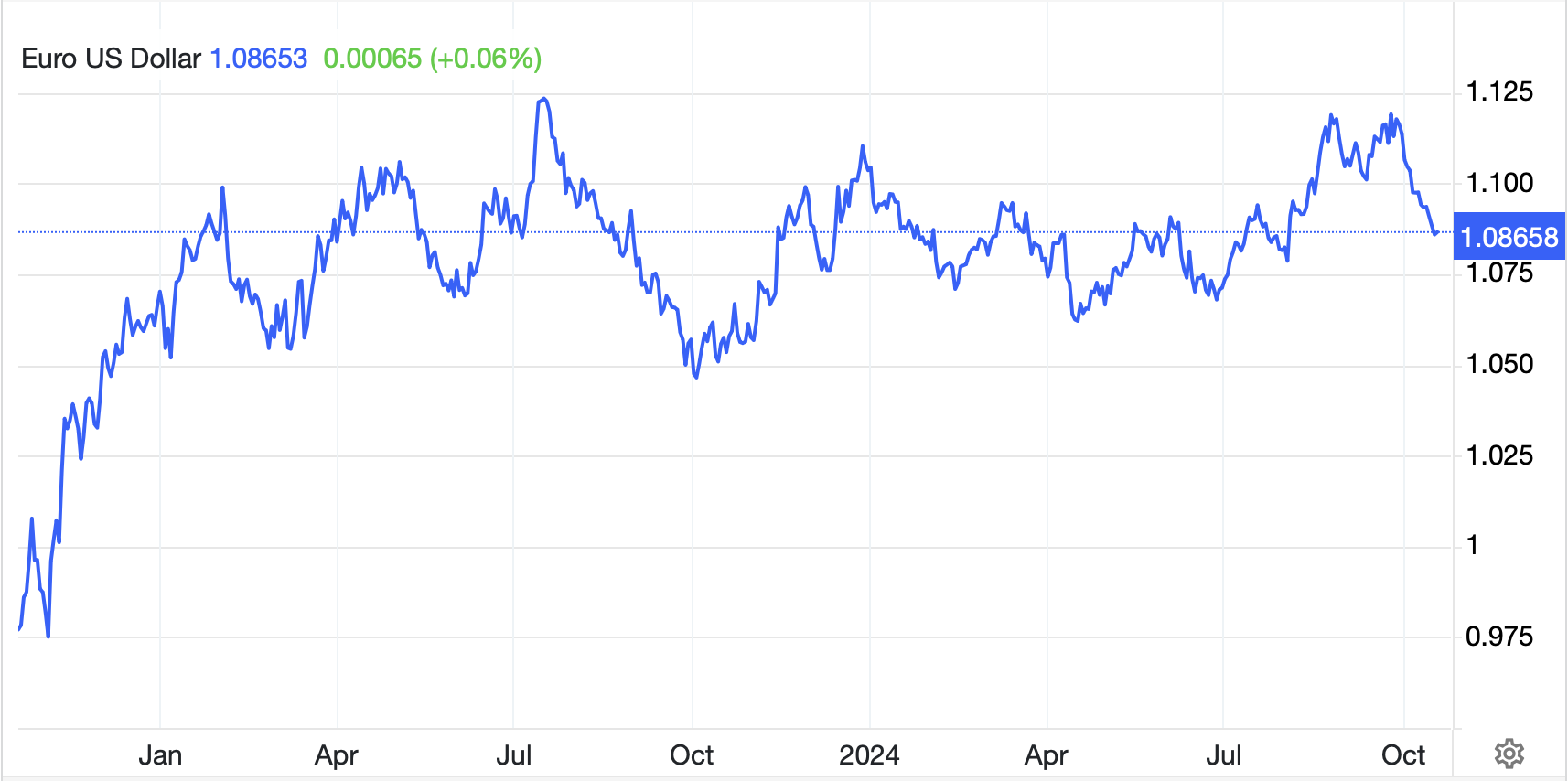
Regardless, as you can see in the chart below, the market response in the wake of the announcement was to sell the euro as interest rate traders priced in a December rate cut as well.

Source: tradingeconomics.com

The juxtaposition of US and Eurozone data remains the key here and as yesterday’s US numbers showed, the long-awaited recession continues to be postponed.  It becomes ever more difficult to see how the Fed will justify easing policy in any substantive manner if every economic print beats expectations.  (To clarify, Retail Sales printed at 0.4%, 0.5% ex-autos vs. expectations of 0.3% and 0.1% respectively. Philly Fed printed at 10.3 vs. expectations of 3.0 and Initial Claims fell to 241K despite the hurricanes, vs expectations of 260K). 

In the end, all this simply reinforces my view that the euro has further to decline going forward.  I still like the 1.05 – 1.06 level as a target by year end.

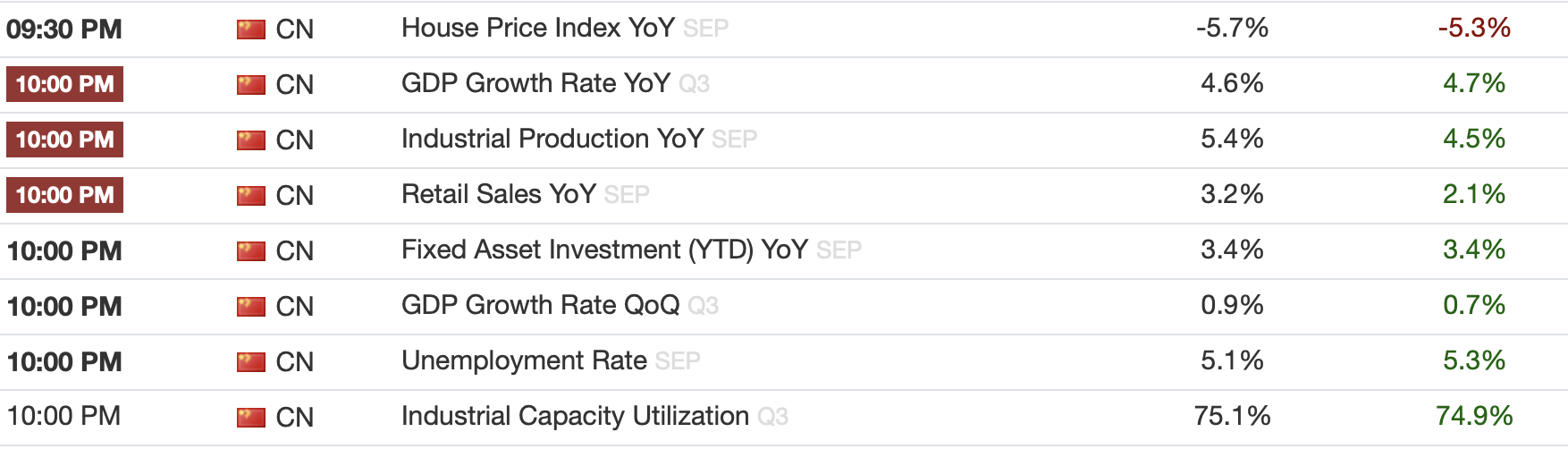
Turning to China, last night they had their monthly data dump and the numbers there continue to point to an economy struggling to gain momentum. (The first, black, number is the September data, the second, green or red, number is the August data.)

Source: tradingeconomics.com

Xi’s 5% target, or even if you use their recent “around 5%’ concept, is getting strained.  While Retail Sales there was a positive, the ongoing disintegration of the housing/property market is a major problem.  Now, all this data represents activity before the plethora of stimulus measures that have been announced.  However, recent equity market performance there, if using as an indicator of the belief that the stimulus was going to be effective, had shown a substantial decline from the early sugar highs back in September immediately following the first stimulus announcements.

With that in mind, PBOC Governor Pan Gongsheng strongly hinted that there would be another interest rate cut next week, as the government struggles to not only convince investors that they have things under control, but to also implement the measures already described.  Now, last night, after Pan hinted at the rate cuts, along with other comments regarding the funds allocated to help companies buy back shares, Chinese equity markets rose sharply in the afternoon session, as per the below chart, rising 3.6% on the day.

Source: Bloomberg.com

Once again, I will highlight the irony of the Chinese Communist Party focusing on the epitome of capitalism, the equity market, as a key means of economic improvement and a key signal that they are on the right track.

That was really all the big news since I last wrote.  Let’s look at the overall market activity.  After yesterday’ lackluster US session, Japanese shares (+0.2%) managed to edge a bit higher and Hong Kong (+3.6%) mirrored Chinese mainland shares.  The other beneficiary of the Chinese stimulus discussion was Taiwan (+1.9%) but Australia (-0.9%), Korea (-0.6%) and a host of other regional exchanges did not seem to appreciate the effort.  In Europe, only the UK (-0.3%) is really under any pressure although the gains on the continent are not terribly impressive with the CAC (+0.5%) the leader at this point.  Most other markets there are little changed to slightly higher.  As to US futures, at this hour (7:20), they are higher by about 0.25%.

In the bond market, after yesterday’s much stronger than expected US data, Treasury yields jumped 7bps and this morning have edged higher by another 1bp to get back to 4.10%.  However, on the continent, sovereign yields this morning are lower by between -2bps and -4bps after yesterday’s ECB action and comments.  The one exception here is the UK, where gilt yields are higher by 2bps after UK Retail Sales data printed much stronger than expected at +0.3% in September, vs. -0.3% expected.

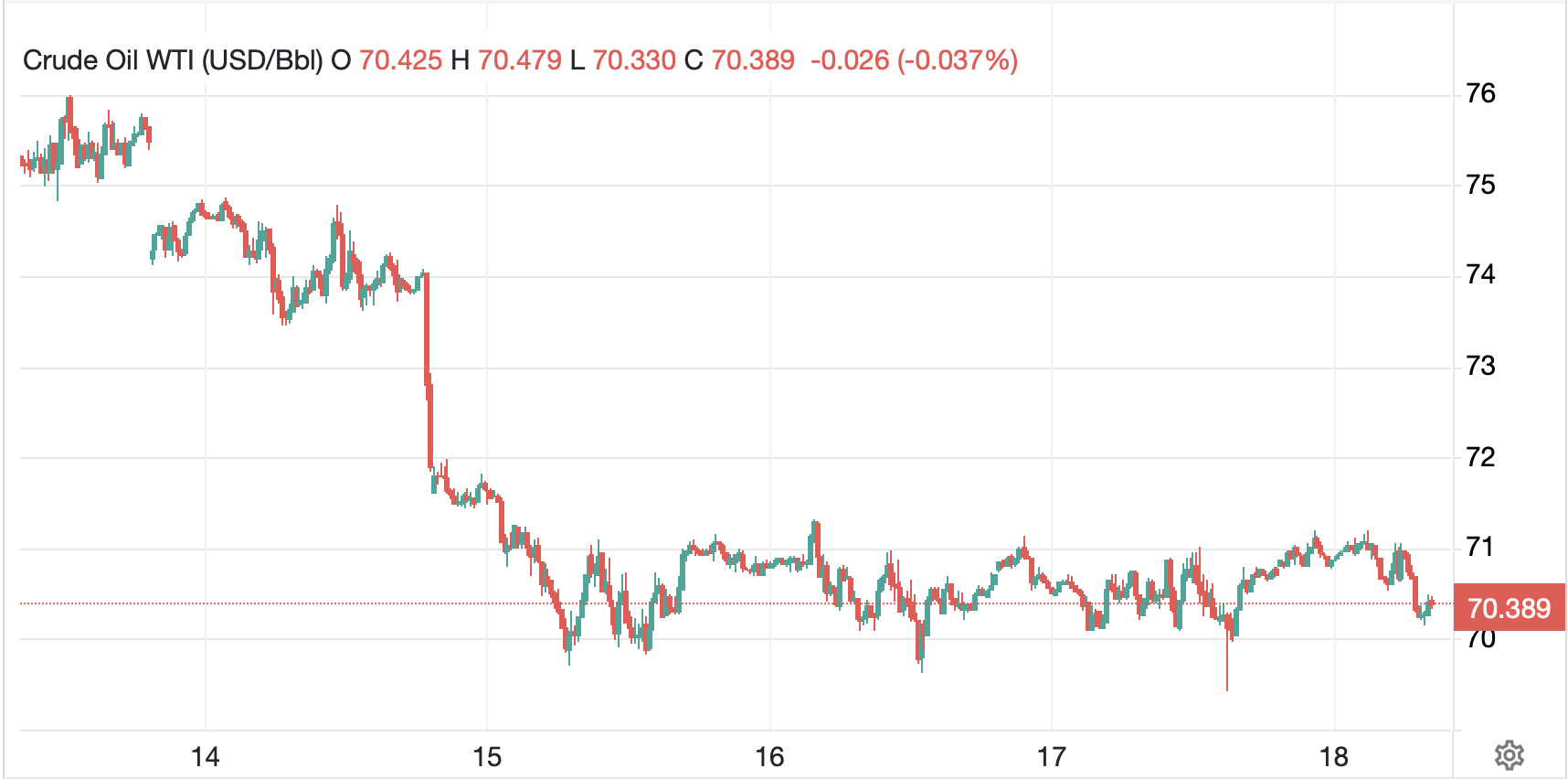
In the commodity markets, oil (-0.4%) is modestly lower this morning but really going nowhere for now as evidenced by the chart below.  Once the word had come that Israel was not going to target Iranian oil infrastructure and the price fell, it has basically been flat.

Source: tradingeconomics.com

As to the metals complex, gold (+0.6%) continues its ongoing rally and is at yet another new all-time high, above $2700/oz this morning, as demand continues to be present from all segments.  However, this morning, all the metals are rallying with silver (+1.0%) and copper (+1.5%) showing even better performance.  The combination of continued solid data from the US and hopes for a return to Chinese demand seem to be the drivers.

Finally, the dollar is closing the week on a down note, as traders reduce positions and take profits ahead of the weekend.  During the week, the dollar rose against virtually every one of its main counterparts in both the G10 and EMG blocs.  Again, the big picture here is that for the dollar, good US economic data is going to continue to benefit the greenback, and we will need to see not just one bad number, but a series of them before the dollar truly suffers.

On the data front, we see Housing Starts (exp 1.35M) and Building Permits (1.46M) at 8:30 this morning and then we hear from three more Fed speakers (Bostic, Kashkari and Waller) with Bostic making two appearances.  At this stage, despite the strong data, the Fed funds futures market is pricing in a 92% probability of a 25bp cut next month and then a 75% probability of another one in December.  I know that Powell seems desperate to cut rates, but if the data continues to show strength, the case to do so is going to be much harder to make.  That doesn’t mean he won’t do it, but if he continues down that path, it just means that inflation will return that much sooner.  

Good luck and good weekend and reach out if you are in Nashville at the AFP!

Adf

Turn Into Snails

The FX Poet will be in Nashville at the AFP Conference October 21-22, speaking about effective ways to use FX options in a hedging program.  Please come to the presentation on Monday at 1:45 in Grand Ballroom C1 if you are there.  I would love to meet and speak.
 
This morning the ECB’s meeting
And no doubt they will be repeating
The idea inflation
Is near its cessation
So, high rates will now be retreating
 
As well, we will learn the details
Of what’s occurred in Retail Sales
If strength’s what we see
The FOMC
Rate cutters may turn into snails


Yesterday was generally very quiet as investors appear to be turning their focus to the US presidential election and trying to determine the outcome and what it will mean for markets going forward.  (FWIW, this poet is not going to attempt to determine how things will play out at this stage given the fact that whatever claims or promises are made by either candidate, at least economically, they can only be accomplished through Congress, so are really just wishes right now).  The upshot is that the volume of activity is likely to remain modest until the election.  Of course, that doesn’t mean prices won’t move, just that there won’t be much conviction behind the moves.

In the meantime, central banks remain at the forefront of every market conversation and today is no different with Madame Lagarde set to regale us with the news of an ECB rate cut of 25bps later this morning.  Inflation data from the Eurozone this morning was revised down further with the headline falling to 1.7% Y/Y in September, the lowest print since April 2021.  However, the core rate, at 2.7%, remains well above their target.  Now, the ECB mandate targets headline inflation specifically, unlike the Fed which has determined by itself that core PCE is the proper metric, so a rate cut can easily be justified.  Adding to the story is the fact that Germany remains mired in recession and economic activity in the Eurozone overall remains desultory at best.  The problem the ECB has is that services inflation remains sticky, still printing near 4% and money supply is growing again which is a strong indicator that inflation is going to rise in the future.  But as we have learned over the past decades, the future is now when it comes to central banks, and they will respond to the moment.

One of the problems for the ECB, though, is that despite the Fed’s mistaken 50bp rate cut, the data in the US we have seen since indicates that the economy continues to motor along fairly well.  This means that although the Fed seems likely to cut 25bps in November, I think it will be doing so reluctantly.  After all, if they didn’t cut, it would basically be an admission that they made a mistake with the 50bp cut in September, and you know as well as I that they will never admit a mistake.  

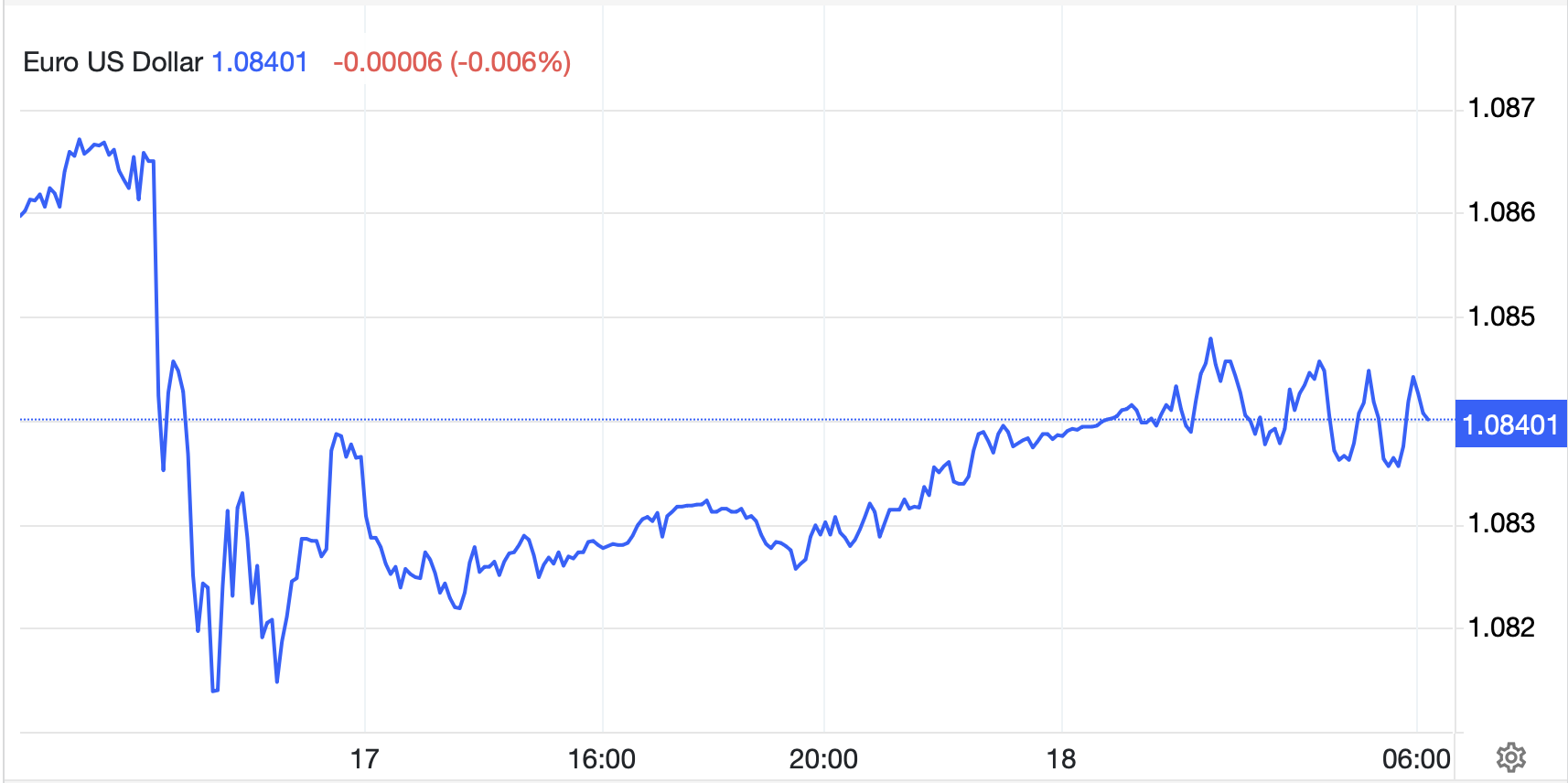
My point is that with the ECB feeling greater pressure to cut with their inflation reading below target and growth slowing, and the Fed likely to back away from an aggressive rate cutting path, the euro is likely to continue to suffer.  For instance, this morning, though it is unchanged, it sits below the 1.09 level (last seen in August) and certainly appears as though it is in a strong downtrend as per the below chart.  If I were to guess, I think a move toward 1.06 is in the cards as a measured move around that long-term 1.09 pivot level.

Source: tradingeconomics.com

The problem for the ECB is that a weakening currency is likely to add upward inflation pressures before it helps the exporters in Europe expand market share, and boosts growth.  Stagflation is such an ugly word, but one that may well come to describe the Eurozone.  As an aside, when the US was in stagflation in the late 1970’s, that is when the dollar was at its weakest point historically.

Of course, this also makes this morning’s Retail Sales (exp 0.3%, 0.1% ex autos) so important.  You may recall that last month, this number beat expectations and was another in the list of surprisingly strong US data releases.  Another strong print will really cement the difference between the US and the Eurozone, to the dollar’s advantage I believe.  

But will any of this really matter to markets?  Certainly, Lagarde’s comments can have an impact on Eurozone markets, but my take is we will not see major investment swings, regardless of the data, ahead of the election.

Ok, let’s see how things played out overnight.  Despite the rebound in the US yesterday, Asia was having none of it with most markets in the red.  Japan (-0.7%) fell despite the US strength and the yen’s weakness (JPY pushing back to 150 for the first time since August) and China continues to see the recent bubble of stimulus expectations deflate (CSI 300 -1.1%, Hang Seng -1.0%).  Elsewhere in the region, the results were mixed with some gainers (Australia, New Zealand, Singapore) and some laggards (India, Korea, Philippines).  In Europe, though, green is today’s theme with gains across the board, led by the CAC (+1.2%) but strength everywhere as investors are betting on a more dovish ECB.  In the US futures market, we are all green as well, with strong gains (+0.5% or more) at this hour (7:30).

In the bond markets, after dipping back to the 4.0% level yesterday, 10-year Treasuries are 2bps higher this morning and we are seeing similar price action across all the European sovereign markets.  This seems like a classic risk-on move.  In Japan, JGB yields edged higher by 1bp and are now at 0.95%, perhaps as the market anticipates the BOJ is set to get more aggressive with the yen steadily falling for the past several months.  I don’t believe 150 is a line in the sand, but it cannot be making Ueda-san feel any better about things.

Turning to commodities, the one truism is that gold (+0.5%) continues to rally.  The number of different storylines (central bank buying, reduced mining activity, western investors waking up, Asian investors accelerating) about the shiny metal continues to increase and every one of them is bullish.  This continues to help Silver, although copper (-0.6%) remains far more reliant on a positive economic story, something that remains in doubt.  As to oil (+0.25%) it is holding that $70/bbl level although its grip does seem tenuous at times.  However, I would contend there is virtually no war premium in the price at this point.

Finally, the dollar has net softened a bit this morning, but that is in the context of a more than 3-week long steady rally.  So, AUD (+0.5%) is the big winner this morning in the G10 and as I am typing, GBP (+0.2%) has recaptured the 1.30 level, but those trends remain lower.  In the EMG markets, KRW (-0.55%) is today’s laggard although we are seeing weakness in both ZAR (-0.3%) and MXN (-0.3%) despite that metals strength.  Remember, FX markets are perverse.

In addition to the Retail Sales data, we see Initial (exp 260K) and Continuing (1870K) Claims and Philly Fed (3.0) at 8:30 with IP (-0.2%) and Capacity Utilization (77.8%) at 9:15.  Also, because of the holiday Monday, we see EIA oil inventory data this morning as well with a slight draw expected.  Only one Fed speaker is on the docket (Goolsbee) who will undoubtedly explain that more cuts are coming.

While the dollar may be under modest pressure this morning, I see upward pressure overall for the time being until policies change.

Good luck

Adf

A Joyous Occasion

For those of a certain persuasion
Wednesday was a joyous occasion
Though CPI rose
The doves did propose
That rate cuts complete their equation
 
They claim that the speed of its rise
Is slowing, so Jay should surmise
It’s time to cut rates
Cause everyone hates
When stocks don’t make further new highs


Yesterday’s CPI reading was, on the surface, slightly softer than markets had been expecting.  The headline reading of 2.9% was the slowest increase Y/Y since March 2022.  Of course, back then we were repeatedly told inflation was transitory.  However, looking at the chart below, created by wolfstreet.com, it seems pretty clear that the main driver of the recent decline in the CPI readings has been Durable Goods.

A graph of a number of lines

Description automatically generated with medium confidence

I guess it’s possible that durable goods prices continue to deflate going forward, but that seems unlikely, at least based on the historical record.  While the auto industry, a key segment of the durable goods data, has obviously struggled lately, with significant unsold inventories of EV’s building up and dealer incentives to sell them driving prices down, if you’ve looked for a new washer/dryer or refrigerator lately, I haven’t seen the same price action for those goods.  As to the largest driver of the CPI readings, the shelter component, those numbers were higher than last month and more in line with the overall trend we have seen there for the past several years.  Owners Equivalent Rent, the biggest piece of this puzzle, rose 0.4% in July, just what it has been doing for the previous two plus years prior to the June reading.

In the end, while it was nice to see a headline print below 3.0%, it is not clear to me that inflation is defeated.  Other than the fact that Powell essentially promised he would be cutting rates next month, the data released since the last meeting is not screaming out for more support.  Certainly, the employment report was softer than the forecasts, but it was not indicative that we are in a recession.  And the CPI report, while ever so slightly softer than forecast, is also not a clear signal that things are collapsing in the economy.  I’m pretty confident that Powell will cut next month, but absent some really awful August data, released in early September ahead of the next FOMC meeting, it seems like 25bps is all we should expect.  Even the Fed funds futures market is slowly turning toward that view with the probability of a 50bp cut falling to 37.5% this morning.

The other news of note last night was the monthly Chinese data dump which was, on the whole, not very inspiring.  The best news was that Retail Sales there rose 2.7% Y/Y in July, slightly more than expected.  However, IP and Fixed Asset Investment were both weaker than forecast and weaker than last month although higher than Retail Sales.  Meanwhile, Housing prices continue to decline, -4.9% Y/Y, and the Unemployment Rate ticked up to 5.2%.  As yet, there has been no significant commentary from the government, but the ongoing weakness has encouraged some traders and investors to expect that President Xi will authorize some much larger stimulus in the near future.  At least that’s the story behind the rally in the CSI 300 (+1.0%) last night, because there are few other highlights from the Middle Kingdom.

With this in mind, and as we await this morning’s US data releases, let’s tour the markets to see how things played out after the modest US equity rally yesterday.  Aside from China, in Asia Japanese stocks did well (Nikkei +0.8%) although Hong Kong did not go along with the Chinese story.  Australian employment data was released, arguably a touch better than expected but that good news reduced the chances for a rate cut so equities there only edged higher by 0.2%.  As to the rest of the region, there were some gainers (Korea, New Zealand, Singapore) and some laggards (Taiwan, Indonesia).  

In Europe this morning, the story is one of a seeming lack of interest with no major market having moved more than 0.2%, whether higher or lower, on the session.  On the data front there, the UK GDP data was just a touch softer than the forecast, and the Y/Y output of 0.7% shows that problems remain in the economy.  It will be interesting to see if the new government there can adopt policies that help rejuvenate the nation.  As to the FTSE 100, it is basically unchanged on the day, arguably tension between weaker growth prospects clashing with hopes for rate cuts to support things.  Meanwhile, on the continent there was nothing of note and no major movement.  And lastly, US futures, at this hour (7:00), are little changed awaiting the US data.

In the bond market, Treasury yields, after a little early gyration following the CPI release, basically closed the day unchanged and remain at those levels this morning.  the yield curve remains mildly inverted, just -11bps this morning, but it seems it will require the Fed to actually cut rates, or much worse economic data, to get that process complete and normalize the curve.  In Europe, sovereign yields are largely unchanged, or perhaps higher by 1bp this morning amid very little activity.  Also, a quick look at JGBs shows that while the yield edged up 1bp overnight, the level is still just 0.82%.  I would contend that any ideas of a quick normalization of interest rates in Japan are fading away.

In the commodity space, oil (+0.85%) is rebounding after data showed net draws across all products yesterday.  Obviously, the Iran/Israel situation remains live, but it feels like markets are losing interest in that story.  As to the metals, gold (0.4%) is recouping yesterday’s losses and both silver and copper are firmer this morning, not so much on the demand story, but more on the supply story with potential strikes at key mines in Chile and Peru.

As to the dollar, it is little changed, net, on the day, although it is no surprise to see the commodity bloc performing well (AUD +0.5%, ZAR +0.5%, NOK +0.4%).  But away from those currencies, the euro is unchanged, though the pound (+0.3%) seems to be benefitting from the GDP data.  The yen, too, is unchanged on the day while CNY (-0.2%) is under pressure from the weak data there.  Again, I will note that CNY’s volatility has definitely increased over the course of the past several months.  Partly this is because all currency volatility has moved higher, but I believe there is some real China specific aspect to this change.  Beware as this could continue going forward.

On the data front, this morning brings a bunch here at home:

Initial Claims235K
Continuing Claims1880K
Retail Sales0.3%
-ex autos0.1%
Empire State Manufacturing-6.0
Philly Fed7.0
IP-0.3%
Capacity Utilization78.5%

Source: tradingeconomics.com

You may recall that last week’s Initial Claims number was seen as a savior when it printed a bit lower than forecasts.  However, if the Unemployment Rate is truly heading higher, it would seem that we should see this number resume its climb.  Right now, it is not clear to me if good news is good or bad and vice versa. Generically, the narrative still wants to push for as many rate cuts as quickly as possible, I think, but if the data starts to collapse, that will not be a positive either.  I suspect that Retail Sales is today’s key release.  A strong number there will further reduce the probability of a 50bp cut in September and may weigh on equity markets.  

We also hear from St Louis Fed President Alberto Musalem this morning, one of the newer members of the FOMC who has not spoken much.  However, he appears to be more on the hawkish side thus far.  In my view, markets are looking for reasons to continue to push equities higher but are not getting all the love they need.  The problem is that it is not clear what the right medicine for that is right now.  Strong data may support the economy but reduces the probability of rate cuts, or at least the amount of rate cutting that will come.  As to the dollar, it has been under some pressure of late and I think it will be very clear that weak data will encourage dollar selling and vice versa.

Good luck

Adf

He’s Got Spine

The market’s now certain that June
Is when Jay, the funds rate, will prune
Inflation don’t matter
Despite all the chatter
They don’t want to cut rates too soon
 
But what if inflation keeps rising?
And data continues surprising?
Can he hold the line?
And show he’s got spine
Despite all the doves’ vocalizing?


It’s funny.  So much was made about the CPI number on Tuesday and the lines seemed to have been drawn quite clearly; soft or as expected data would cement a June cut while hot data would call that into question.  And yet, here we are two days later, with the only information in the interim showing that oil and product inventories have fallen further driving oil prices higher, and the probability of a June cut has risen above 90%.  In fact, amid a day with limited new information, and during the Fed’s quiet period, perhaps the most interesting comments came from Treasury Secretary Yellen.  Not only did she indicate she regretted her use of the word ‘transitory’ at the beginning of the inflation episode, but more importantly, it appears that Treasury is now assuming much higher interest rates in their forecasts than before.  In other words, she no longer believes that interest rates are going to head back down to 2%.  Personally, I think that is a huge step in the right direction.  Alas, that concept certainly did nothing to constrain their spending plans, so it is not clear it really matters.

But the reality as that even though we get some more Tier 1 data this morning, it has become quite clear, to me at least, that the market is uninterested in anything other than the FOMC statement, the dot plots and Powell’s press conference coming on Wednesday next week.  You can see this in the equity markets which are now trading in ranges after their recent sharp rises, and you can see this in the FX market given the dollar’s virtual complete lack of volatility.  In fact, the only place that is demonstrating some concern is the bond market, where yields continue to edge higher very slowly.

Let’s start by taking a quick look at this morning’s data.  Retail Sales (exp 0.8%, 0.5% ex-autos) is set to rebound from last month’s terrible -0.8% print.  Many have looked past that number as a combination of bad seasonal adjustments and heavy discounting and continue to see strength in the economy.  We also see PPI (0.3%, 1.1% Y/Y) and Core (0.2%, 1.9% Y/Y) which seems to have bottomed, not dissimilar to CPI, but which will be a problem for those who believe that inflation is still trending lower.  Finally, as it is Thursday, we see Initial (218K) and Continuing (1900K) Claims, both in line with recent outcomes signaling the labor market remains in solid shape.

Now, you all know my view that inflation is not dead and that the market will need to continue to adjust interest rates higher over time to account for that fact.  Since the beginning of the year, as you can see from the chart below courtesy of tradingeconomics.com, while there have been several cycles, it seems clear that the trend in yields remains higher.

I think this makes a lot of sense and expect it to continue.  In fact, the question I have is how can the Fed truly consider it will be appropriate to cut the Fed funds rate given the economic signals are showing continued solid growth, a solid labor market and indications that inflation is heading higher?  Many make the political argument that since they are hell-bent on cutting, they need to get started before it gets too close to the election.  But I am going to go out on a limb here and say that I think Powell has shown he is made of sterner stuff and if the data remains where it has been, let alone inflation ticks higher between now and June, there will be no rate cuts.  If I am correct, risk assets are going to rerate, trust me.  And that is really the only question that needs to be answered at this point.

And so, other than bonds which seem to be sussing out the potential for rates to continue at their higher-for-longer pace, a look at other asset class markets shows not much overall movement.  After yesterday’s mixed US session, Asia, too, was mixed with Japan slightly firmer while Chinese shares slid as there appears to be no real help in sight there.  European bourses are also mixed with the UK lagging and slightly softer on the day and the bulk of the movement higher quite modest.  The only exception is the CAC in Paris higher by 0.9%, on the back of continued strong performance of the luxury goods sector.  (As an aside, why would central bankers think that the economy is going to tank if luxury goods remain hot?). US futures, though, are firmer at this hour (7:30) with all three indices higher by 0.5%.

In the bond market, while US yields have been dragging the global structure higher, they are unchanged on the morning and European sovereigns are actually a touch softer, between 1bp and 2bps today.  That is likely on the back of comments by Greek ECB member Stournaras that they need to quickly make two rate cuts to manage things properly.  While that seems excessive, I maintain the ECB cuts before the Fed.  As to Japan, JGB yields have edged higher by one more basis point overnight, though remain at just 0.77%.  Ueda-san, when he speaks, sounds far less hawkish than many of the analysts in Tokyo, or the other members of the BOJ from whom we have recently heard.  I am still in the April camp for the first rate hike, and very few afterwards.

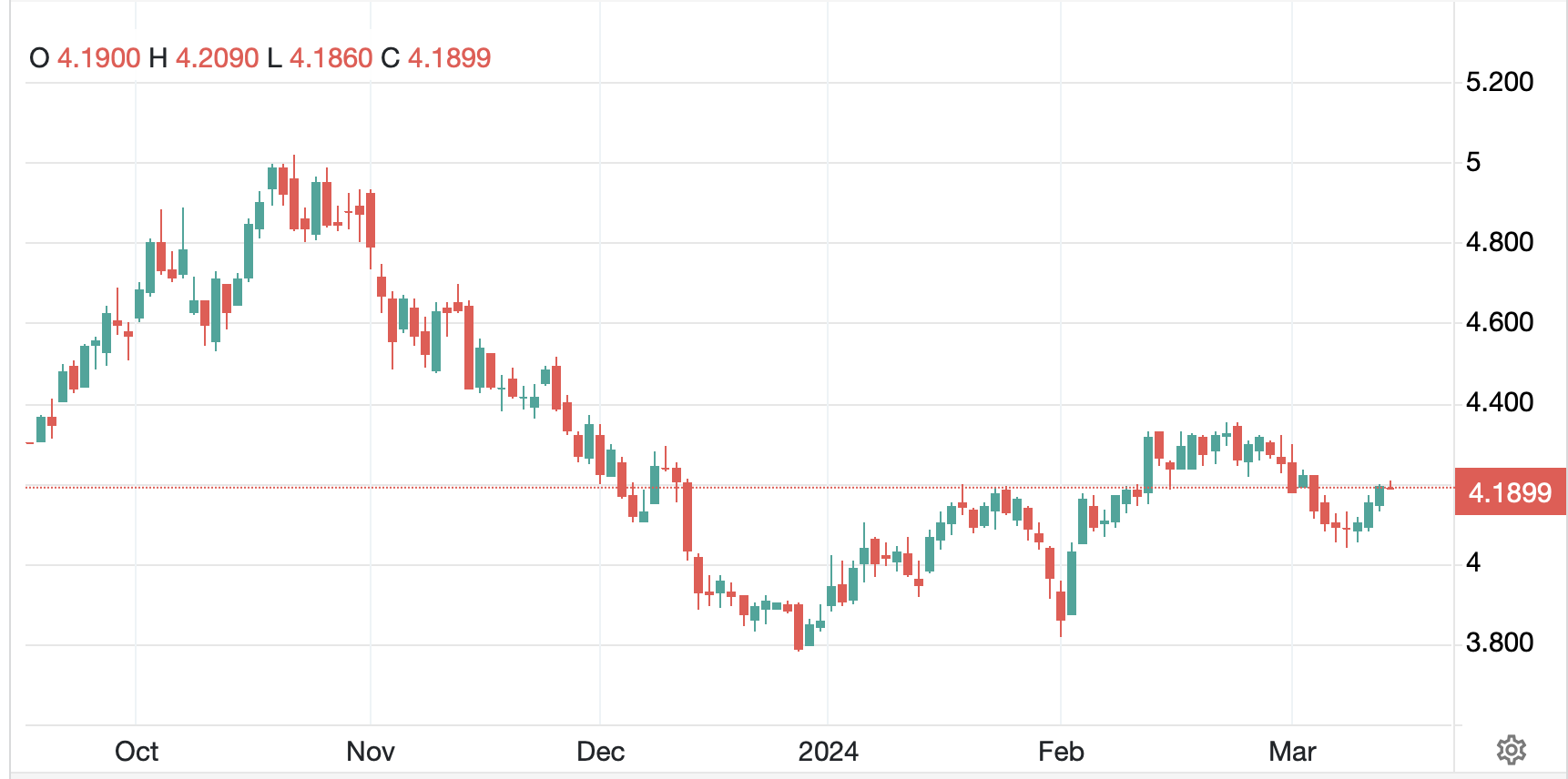
Oil is the big mover of the day, up 0.9% with WTI back over $80/bbl for the first time since early November.  Yesterday’s EIA Inventory data showed drawdowns in crude and gasoline stocks that were much greater than expected.  You may have noticed at the pump that gas prices are rising, and it seems the market is figuring that out as well.  Remember, though, that OPEC+ has reduced production so has significant spare capacity at this stage, probably 2mm – 3mm bbl/day that they can restart at any time, so I don’t expect prices here to skyrocket.  Gold, which rallied nicely yesterday, is slightly softer this morning, as is copper, although the red metal remains above $4.00/Lb.  It strikes me that the commodity markets are not anticipating a significant economic slowdown right now.

Lastly, the dollar is very little changed overall this morning, with the largest moves NZD (+0.25%) and PLN (-0.25%) and every other major currency seeing less movement than that.  USDJPY is pushing back toward 148.00 slowly and seems likely to be the next big mover based on Monday night’s BOJ meeting.  Otherwise, this space is dead.

And that’s really what we have for the day.  If the data is hot, look for yields to continue their recent climb and for the dollar to take on a bid tone.  As to stocks, demand remains strong regardless of the economics.  If the data is soft, then a weak dollar should accompany strength in both stocks and bond prices.

Good luck

Adf

Good…or Bad

FinMin Suzuki
Noted that a weaker yen
Might be good…or bad

One of the great things about finance and central bank officials is their ability to twist language into pretzels while trying to make their case in any given situation.  Last night offered another great example from Japanese FinMin Shun’ichi Suzuki with this being the money quote, “From that standpoint, I’m closely watching market moves with a strong sense of urgency.”  It is not clear how you watch something with urgency, but if you are the MOF official in charge of explaining why your currency has been declining so rapidly, I guess you have to say something.  (As an aside, I might simply point out that the interest rate differential between the US and Japan is now 5.5%, having risen from 0.35% over the past two years and that might have something to do with the FX move.)

As previously mentioned, the MOF is moving up its ladder of pre-intervention activities as detailed on Wednesday, arguably now somewhere between numbers 2 and 3.  The biggest problem Japan has is that there is a quickly declining probability that the US is going to be easing policy as soon as had been previously thought, and so the incentive to own yen remains diminished.  The second biggest problem they have is their economy has slipped into recession and so the urgency for Ueda-san to tighten policy is also diminished.  While USDJPY has been hovering just above 150 for a few days, I expect that it is going to grind higher still and force Suzuki-san to continue to climb that numeric ladder.  The one saving grace for Suzuki is that as we approach fiscal year-end in Japan, there is likely to be a seasonal flow of funds back home for dressing up balance sheets.  That could well keep things in check until sometime in April, but all signs are that the market is going to test him again before too long.

On Tuesday, the data was hot
On Thursday, it really was not
So, which one describes
The ‘conomy’s vibes?
Or have, now, stagflation, they wrought?

The CPI data on Tuesday certainly opened a rift between the narrative of smoothly declining inflation leading to numerous Fed rate cuts this year and what appears to be a more realistic situation where any further decline in inflation comes in fits and starts if it comes at all.  The narrative explanation for the sticky inflation was that economic activity was so strong that it should be expected.  But if the economy is truly that strong, someone needs to explain how Retail Sales can decline -0.8% in January, why Industrial Production would decline -0.1% and why Capacity Utilization would fall back to 78.5% despite all the government support for reshoring activity.  In an ironic twist, the other two releases yesterday, Philly Fed and Empire State Manufacturing, were both better than forecast.  This is a complete reversal of the pattern we have seen for the past 2 years where survey data is lousy but hard numbers remained strong.

In the end, it appears that market participants have given up on the macro data and are back to buying any dip with abandon.  I will be the first to explain that the economic outlook remains very cloudy.  To date, it appears that the excessive deficit spending has been successful in maintaining steady GDP growth.  Of course, excessive deficit spending is not something that can continue forever.  As Herbert Stein explained in 1985, “if something can’t go on forever, it will stop.”

This leads to the question; how long until forever?  If we have learned nothing else in the past decades it is that when governments involve themselves directly in economic activity and financial markets, forever is delayed. Things take MUCH more time than we expect for them to play out.  Simply consider how long Japan has been running massive budget deficits, NIRP and QE without destroying their economy.  (30 years.)

Of course, forever in the economy and forever in the markets are two very different things and while the government may be able to delay a reckoning in economic activity, we must be very careful around how markets behave with the same catalysts and inputs.  My point is any risk-off outcome will be important for your investing and hedging decisions, but not necessarily change the trajectory of GDP.  After all, there is always more money to be printed.  In fact, it is this issue that drives my longer-term inflation thesis.  Every government will do whatever they think they need to prevent a serious economic contraction and high on the list of actions will be much easier monetary policy.  Watch closely for things like QT to end or another BTFP-like program to continue to force liquidity into markets.

Ok, let’s look at how things finished the week.  As I said, the market no longer cares about bad data and simply continued to add to risk assets.  Yesterday saw gains in the major indices in the US which was followed by gains throughout Asia and most of Europe, all of them pretty substantial.  In fact, the only red numbers on my screen are in Spain’s IBEX which is suffering on the back of Spanish central banker Pablo Hernandez de Cos explained that several Spanish banks may suffer due to the ongoing drought in Spain and its negative impact on the economy there.  US futures are basically pointing higher again this morning as well.

In the bond market, though, yields are edging higher around the world.  Treasury yields are up 4bps today and pushing back to that peak seen immediately following the CPI print on Tuesday.  European sovereign yields are all higher by between 3bps and 4bps although JGB yields are unchanged on the day.  Ultimately, I continue to see the case for yields to climb from these levels as there is no indication that inflation is truly ending.

Oil markets powered higher yesterday, rising nearly 2% despite the huge build in inventories as concerns over supply being unable to keep up with ever growing demand have reemerged.  As well, the fact that any cease fire in the Israel-Hamas war seems to be a distant memory has some on edge that things can get worse in the Middle East overall.  As to the metals markets, gold managed to regain the $2000/oz level yesterday and is hanging right there this morning.  On a brighter note, both copper (+1.5%) and aluminum (+0.5%) are firmer this morning, perhaps in anticipation of China’s reopening next week, or perhaps because the dollar has stopped rising.

Speaking of the dollar, it is mixed this morning with the yen (-0.3%) and KRW (-0.3%) the laggards while ZAR (+0.3%) seems to be benefitting from the metals price action.  Broadly speaking, I still like the greenback for as long as the US maintains the tightest policy around.

On the data front, to finish the week we see PPI (exp 0.6% headline, 1.6% ex food & energy) as well as housing data with Starts (1.46M) and Building Permits (1.509M).  Finally, at 10:00 we see Michigan Sentiment (80.0).  We also hear from two more Fed speakers, Governor Michael Barr and SF President Mary Daly.  Yesterday, Atlanta Fed president Bostic explained he was not worried by Tuesday’s CPI print, but not yet convinced they had beaten inflation.  I have a feeling we will hear a lot of that sentiment for the time being.

Heading into the weekend, despite Tuesday’s shocking data, risk assets have performed well overall, with the S&P 500 making its 11th new all-time high this year yesterday.  I don’t know what will derail this train, and for now, there is nothing obvious to do so.  As such, I would keep with the trend overall, that means modestly higher stocks, yields grinding higher and the dollar edging higher as well.  I know that doesn’t seem to make much sense, but that’s what we’ve got.

Good luck and good weekend
Adf

Widow Maker

The widow maker
Looks like it is about to
Make some more widows

For those unacquainted with the term as it relates to the financial markets, the widow maker trade has been going short JGB’s and buying JPY under the assumption that at some point, the BOJ would normalize monetary policy.  Lately, this trade has been reinvigorated in a major way on the back of the belief that Ueda-san is going to raise the base rate from its current level of -0.10%.  Granted, 10-year JGB yields have risen about 35bps since last summer, which given their starting level of 0.35%, is quite a bit.  Simultaneously, the yen weakened dramatically, falling more than 8% over the same timeframe.  An unstated, but critical, underlying part of the idea was that the Japanese economy was chugging along nicely and would continue to do so.  This would pressure wages higher and force the BOJ to join the rest of the world in raising interest rates.

But a funny thing happened to those plans last night when the Japanese government released its latest GDP data showing that Q4 GDP fell -0.1% Q/Q, far below the expected +0.3% gain.  This, when combined with Q3’s revised decline of -0.8% Q/Q (also worse than before) is the very definition of a recession.  Hence, the problem for all those traders who are short JGB’s and long the yen.  If Japan is in recession, it seems highly unlikely that Ueda-san is going to be tightening monetary policy in the near-term.  Rather, I would expect more fiscal and monetary stimulus which ought to result in lower yields and a still weaker yen.  And this is why the trade is nicknamed the widow maker.  It has fooled traders for some 30 years so far, and many have lost fortunes on its back.

One other quirk of this outcome is that Japan, heretofore the world’s third largest economy, has now slipped into fourth place behind Germany.  Part of this outcome is due to the fact that the weak yen has altered the calculations such that a given yen amount is worth many fewer dollars.  Relatively speaking, the euro has not fallen nearly as much, hence the switch in the rankings.  Should the yen regain even a quarter of its losses over the past two years, the two economies are likely to switch back to their old places.

In Europe and in the UK
The story is growth’s gone away
Recession is nigh
And if you ask why
It’s policy blunders at play

It was not just the Japanese who have fallen into a technical recession, the UK has also managed the trick as Q4 GDP data released this morning showed Q/Q growth of -0.3%, which when following Q3’s -0.1% leaves us with two consecutive quarters of negative GDP growth, the same definition of a recession.  In fairness, the Eurozone managed to skirt recession, but is there for all intents and purposes.  Yesterday, they released their data which showed that Q4 GDP growth was a resounding 0.0% following Q3’s -0.1%, so not a recession, by definition, but certainly a lousy performance.

I highlight these outcomes to contrast them with the data from the US, which has shown massive GDP prints over Q3 and Q4 of 1.2% and 0.8% respectively.  Now, we have discussed that a key part of this growth is the extraordinary amount of deficit spending that is currently ongoing in the US, far more than anywhere in Europe.  But from a monetary policy perspective, it is much easier for the Fed to maintain its current policy stance than it is for either the BOE or the ECB.  It is for this reason that I believe we will see continued changes in market pricing for monetary policy easing going forward.  I expect that Fed funds futures will continue to reduce the number of cuts as well as push out the timing of the first cut while in both the Eurozone and the UK, we start to see pricing that indicates a cut before the US.

As this process plays out, the impact on financial markets will be significant.  Regarding the FX market, this will underpin further strength in the dollar overall.  Although it is certainly possible, if not likely, that the BOJ intervenes to prevent, or at least slow down, further weakness in the yen, there will be no such action by the other two banks.  Regarding bond markets, much will depend on the timing of the first cuts and the status of inflation.  If the pain of economic weakness rises enough to offset the pain of inflation, and cuts come before inflation is under control, look for much steeper yield curves and higher back-end yields.  However, if inflation really does decline as currently wished for projected by all these central banks, then look for those curves to bull steepen, with the front end of the curve rallying and the back remaining fairly static.  After all, 4% or less for 10-year yields does not seem in appropriate in a 2%-3% inflation world.

Summing it all up, there are many potential paths forward, and as has been the case since 2022, inflation remains the number one driver of everything.

Ok, let’s tour markets quickly.  The dip was bought in the US yesterday with decent rebounds in all the major indices.  That was followed by further solid gains in Japan (Nikkei +1.2%) and continuing to make new highs for the run, with most of Asia following suit.  In Europe, equities are doing pretty well, with gains on the order of +0.75% except in the UK which is flat on the day after the weaker GDP data.  As to US futures, at this hour (7:30) they are very slightly firmer, 0.2% across the board.

Bond markets are continuing to rebound from Tuesday’s dramatic declines with yields slipping back further this morning.  Treasury yields are lower by 4bps, and now approaching 4.20% from the high side with many traders expecting that level to be technical support.  European sovereigns are all seeing yields decline either 2bps or 3bps this morning and overnight we saw JGB yields slip 2bps.  Of more note were the moves in Australia (-13bps) and New Zealand (-14bps) after Australian employment data came in a bit soft (Unemployment Rate up to 4.1%) so thoughts of RBA tightening have faded a bit.

Oil prices are continuing yesterday’s slide, -0.7%, after inventory data printed much higher than expected on the back of record US oil production.  Meanwhile, metals prices are mixed with gold edging higher on the softer rates story but copper and aluminum giving opposite signals as the former is higher and the latter lower by about 0.6% each.

Finally, the dollar is a touch softer this morning as US yields drift lower.  Thus far, it has not returned below key perceived levels with USDJPY still above 150 and the DXY still above 104, but I suspect that if risk appetite continues to reassert itself, the dollar may slide further.  The greenback’s movement have been extremely closely tied to 10-year yields of late.

On the data front, we see a bunch of things this morning led by Retail Sales (exp -0.1%, +0.2% ex-autos), Initial Claims (220K), Continuing Claims (1880K), Empire State Manufacturing (-15.0), and Philly Fed (-8.0) all at 8:30.  Later on we see IP (0.3%) and Capacity Utilization (78.8%).  In addition, we hear from Governor Waller at 1:15 this afternoon, so it will be very interesting to get his take on how the recent data is going to impact the FOMC.  There have been no substantive changes in the futures pricing for Fed funds with still less than a 50% probability of a cut in May.

Risk markets were clearly shaken by the CPI data on Tuesday.  More hot data today will further impact those assets negatively in my view.  In fact, this will continue as long as the market is going to trade on interest rate expectations.  At some point, if economic activity manages to continue strongly, it is likely to turn into a positive catalyst for risk assets, but we are not there yet.

Good luck
Adf

Somewhat Queasy

Though markets appeared somewhat queasy
Said Janet, it’s really quite easy
To fund wars times two
But Moody’s said ooh
Your credit is now a bit wheezy

The combo of deficit growth
As well as a Congress that’s loath
To pass any bills
Has given us chills
So downgrading debt’s due to both

Under cover of night last Friday, Moody’s put US Treasury debt on Negative watch, citing, “…the risk that successive governments will not be able to reach consensus on a fiscal plan to slow the decline in debt affordability.”  Ultimately, they criticized the combination of rising interest rates and a concern that the current polarization in Congress will prevent anything from being done about constantly growing deficits and calls into question the ultimate value of the debt.  Moody’s is the last ratings agency to maintain the Aaa rating for the world’s risk-free asset, so this is quite a blow.  

Not surprisingly, the administration disagreed with the decision as Deputy Treasury Secretary Wally Adeyemo explained,” we disagree with the shift to a negative outlook.  The American economy remains strong, and Treasury securities are the world’s preeminent safe and liquid asset.”  I don’t believe anyone is concerned that repayment in full is in question, this is simply another shot across the bow of the idea that the value of the nominal dollars that are repaid will be anywhere near what they were when originally invested.

But that was just one of the many crosscurrents that have been afflicting the macro scene and markets of late.  For instance, in the past month, we have seen better than expected data from Retail Sales, IP, Capacity Utilization, New Home Sales, GDP, Durable Goods, Personal Spending, Nonfarm Productivity and Unit Labor Costs.  That’s quite an impressive listing of reports, and the characteristic they all share is they are ‘hard’ data.  In other words, this is not survey data, but rather these are measured statistics.

Meanwhile, the prognosis for the future continues to be far less optimistic with worse than expected outcomes in Empire State Manufacturing, ISM Manufacturing and Services, Leading Indicators and Michigan Sentiment.  The common thread here is these are all surveys and subject to the whims of the person answering the question.  In fact, the only ‘hard’ data points that were worse than expected were the Nonfarm Payrolls and Unemployment Rate.  I guess we can add the Moody’s downgrade to the list of worse than expected data, but it too is subjective rather than a hard data point.

Given the widely diverging data story, it should be no surprise that there are widely divergent views on how things are going to progress from here.  In fact, I read this morning that the two best known Investment Banks, Goldman Sachs and Morgan Stanley, have pretty divergent views on what the future holds.

The bullish argument remains that despite the gnashing of teeth and clutching of pearls by the faint-hearted, the data continues to perform well and that is the best measurement of the economy.  Certainly, the Fed is using this as their crutch to maintain their higher for longer stance and fight back against anyone who claims they have overtightened policy and need to cut rates.

However, all the hard data is backward looking, so describing what has already passed.  The bulls claim that there is autocorrelation in the data, so the past is prolog.  My observation is this is generally true in a trending market, but at inflection points, things become much murkier.

Meanwhile, the bears point to the ongoing weakness in all the survey data, which shows a dour view of the future with ISM in contraction, Michigan Sentiment falling to levels only surpassed during Covid, and inflation expectations continuing to rise.  

Another perfect analogy of this dichotomy is the S&P 500, where the median stock is -36% this year while the index is +14% given the extreme narrowness of breadth.  Absent the so-called Magnificent 7*, the index is actually lower on the year.  Now, those seven stocks are part of the index and so the reality is the S&P remains higher, but if looking for a signal on the economy, the case can certainly be made that broadly speaking, things are not great.

There is one potential reason for this dichotomy of survey vs. hard data, and that is the outside world.  After all, through the lens of the ordinary American, we see two hot wars ongoing, both of which we are spending money in supporting as well as a growing divide in the country along political party lines and sides in each conflict.  Perhaps Moody’s is onto something after all.  But with all that negativity in the press, it is easy to understand why surveys look so dismal.  However, people continue to spend money for things they need and want and given there is still so much money floating around in the wake of the pandemic stimulus efforts, business continues to get done.

There is, of course, one other thing that is part of the equation and that is the presidential election that is coming in one year’s time.  If history is a guide, you can be sure that the administration will be seeking to spend as much money as possible to support reelection, although with the House in opposition, it won’t be as much as they would like.  Nonetheless, at the margin, I expect that it will be substantial enough to continue to pressure yields higher which ought to weigh on equities and support the dollar, at least ceteris paribus.

Ok, so let’s look at how markets have behaved overnight as we start the week.  In the equity space, after a massive rebound rally on Friday in the US, only the Hang Seng in Hong Kong managed any love, rising 1.3%, but the rest of the space was flat to marginally lower on the day.  However, European bourses are all firmer this morning, about 0.5% or so.  As to US futures, they are pointing slightly lower, -0.25%, at this hour (7:20).

Turning to the bond market, Treasury yields are softer by 2bps this morning, but still well off the lows seen last week ahead of the lousy 30-year auction.  I still see higher yields in the future, but I am increasingly in the minority on this view.  European sovereigns are all bid today with yields declining between -3bps and -6bps despite a dearth of new data.  In fact, if anything, from the periphery we have seen firmer inflation data from Sweden and Norway and the market is now looking for both those central banks to hike again later this month.  That does not sound like a reason to buy bonds but it’s all I’ve seen.

Turning to the commodity markets, oil (+0.3%) is edging higher this morning but is just consolidating after a terrible week last week.  Gold, too, is in consolidation, unchanged this morning but having lost some of its recent luster.  Interestingly, both copper and aluminum are firmer this morning, arguably on discussion of further Chinese stimulus that may be coming soon.

Finally, the dollar is little changed this morning, with G10 currencies all within +/-0.2% of Friday’s levels while EMG currencies are showing a similar mixed picture, although with slightly wider ranges of +/-0.4%.  It appears traders are awaiting the next key piece of information, perhaps tomorrow’s CPI.

Speaking of which, after a week that was dominated by Fed speeches (18 of them I think), we are back to some hard data with CPI tomorrow and Retail Sales on Wednesday.  

TuesdayNFIB Small Biz Optimism89.8
 CPI0.1% (3.3% Y/Y)
 -ex food & energy0.3% (4.1% Y/Y)
WednesdayPPI0.1% (1.9% Y/Y)
 -ex food & energy0.3% (2.7% Y/Y)
 Retail Sales-0.3%
 -ex autos-0.1%
ThursdayInitial Claims220K
 Continuing Claims1848K
 Philly Fed-10
 IP-0.3%
 Capacity Utilization79.4%
FridayHousing Starts1.347M
 Building Permits1.45M

Source: tradingeconomics.com

As well as all the data, we hear from eight more Fed speakers across 14 different speeches, and that doesn’t include any off-the-cuff interviews.  Waller and Williams arguably highlight the schedule, and it will be quite interesting to see if anyone is going to try to adjust Powell’s themes from last week.  I kind of doubt it.

Putting it all together tells me that today is likely to see limited activity as everyone awaits both the CPI and Retail Sales data to see if the hard data is going to start to follow the surveys or not.  As such, I see little reason for the dollar to decline very far absent a big surprise lower in the data.

Good luck

Adf

*Magnificent 7 stocks = Apple, Amazon, Alphabet, Meta, Microsoft, Nvidia, Tesla,

Growth Dynamo

The data continues to show
Economies still want to grow
Here in the US
The Retail success
Came ere China's growth dynamo

The upshot is all of the talk
That bonds are where people should flock
Turns out to be wrong
Then those who went long
Are likely to soon be in shock

Wow!  That’s all you can say about the data from yesterday where Retail Sales were hot and beat on every measure (headline 0.7%, ex-autos 0.6%, control group 0.6%) while IP (0.3%) and Capacity Utilization (79.7%) also indicated that economic activity remains quite robust in the US.  On the data front, this was followed by last night’s Chinese data dump where every one of their monthly indicators; GDP (4.9%), IP (4.5%), Retail Sales (5.5%), Fixed Asset Investment (3.1%), Capacity Utilization (75.6%) and Unemployment (5.0%), was better than expected.

Perhaps the idea that a recession is right around the corner needs to be reconsidered.  And remember, I have been in that camp as well, but the data is the data and needs to inform our opinions.  The immediate reaction to yesterday’s US data was a sharp decline in both stocks and bonds, while oil rallied, gold edged higher and the dollar tread water.  Of this movement, I was most surprised at the dollar’s lack of dynamism given the rate situation.  Unremarkably, given the ongoing belief in the Fed pivot, by the end of the day, US equities were tantamount to unchanged.  But the bond market remains under severe pressure with yields having risen another 12bps in the 10-year and having now reversed the entire safe haven move on the back of the Israeli-Hamas war situation.  

I continue to believe that yields have much further to rise and stronger data will only add to the case.  My view had been based on the combination of stickier inflation than the punditry describes along with massive amounts of new issuance requiring a lower price (higher yield) to clear markets.  But if we are going to continue to see strong economic growth, then there is an added catalyst for yields to rise.

One of the problems about which we hear constantly these days is the fact that there are no more natural buyers of US Treasury debt, at least not at current yield levels.  Many point to the decline in ownership by both Japan and China, the two largest foreign holders of Treasuries, and claim they are both selling their holdings.  However, I have a quibble with that thesis and would contend that perhaps, they are merely suffering the same mark-to-market losses that the banks are.  For instance, according to the US Treasury Department, holdings by these two nations from July 2022 through July 2023 declined by -9.6% (Japan) and -12.5% (China) respectively as can be seen in the chart below.  (data source US Treasury)

But ask yourself what has happened to interest rates over the past year?  They have risen dramatically (10yr yields +85bps) and that means the price of bonds has declined.  As a proxy, in the past 12 months, TLT (the long bond ETF) has declined by more than 13% in price.  So, if you have the exact same amount of bonds and their prices declined by 13%, it is not hard to understand how when you measure the value of your portfolio it has shrunk by upwards of 13%.  I have no idea what the maturity ladders for Japan and China look like, and it is likely they own a mix of short and long-dated bonds, but it is not at all clear to me they have actually been selling Treasuries.  Likely, they are simply holding tight, and I would not be surprised, given the dramatic rise in yields here, if they roll maturities into new bonds.  All I’m saying here is that the narrative about everybody fleeing bonds may not be correct.  In fact, regarding the TLT, which is a pretty good proxy for bond demand of the retail investor, there is a case to be made that demand is quite high.  My understanding is that calls on the TLT are amongst the most active contracts in the options market, and people don’t buy calls if they are bearish!

With that in mind, though, the underlying point is US yields continue to rise and that is going to be the driver for all markets.  In global bond markets, the US unambiguously leads the way and we have seen European sovereigns show similar movement to the US with large moves higher in yields yesterday, on the order of 10bps – 15bps depending on the nation, and consolidation today with virtually no movement, the same as Treasuries.  Last night, JGB yields managed to rally 3bps as well, another indication that as goes the US, so goes the world.

But the more interesting thing to me is the ability of the equity market to hold onto its gains.  The fact that US markets rallied back nearly one full percent from the immediate post-data lows was quite impressive.  Consider that the leadership of the US stock market has been the so-called magnificent 7 tech stocks (Apple, Microsoft, Google, Amazon, Nvidia, Meta (nee Facebook), and Tesla) most of which are essentially long duration assets with their extreme values based on a belief that they will continue to grow at incredible rates.  But with yields rising, the present value of those anticipated earnings continues to decline which should generally be a negative for their price.  So far, they have held up reasonably well, but cracks are definitely starting to show.  I suspect that at some point in the not-too-distant future if yields continue on their current trajectory, that equity market comeuppance will arrive and these stocks will feel the brunt of it.  But not yet apparently.  Interestingly, despite the positive Chinese data, equities in Hong Kong and the mainland both declined about -0.5%.  And looking at Europe, weakness is the theme with all the major bourses lower by -0.5%.  As to US futures, -0.25% covers the situation at this hour (8:00).

Meanwhile, the escalation in Israel and concerns about a wider Mideast war have joined with the stronger economic data, especially from China, to push oil prices higher again this morning, up 1.8%.  And that war theme has gold rocking as well, up 1.3% to new highs for the move with both copper and aluminum rising on the better economic data.  High nominal growth and high inflation (so low real growth) is going to be a powerful support for commodity prices.

Finally, turning to the dollar, this is where I lose my train of thought.  Given the higher yields and seeming increased worries about a wider Mideast war, I would have expected the dollar to continue to rally.  But that has not been the case.  Instead, it has been stable, stuck in a tight range against most of its major and emerging market counterparts.  Perhaps this market is waiting to hear from Chairman Powell tomorrow before traders take a view, but I need to keep looking for a reason to sell the dollar as the evidence to buy it seems strong, higher yields and safety.

Today’s data brings Housing Starts (exp 1.38M) and Building Permits (1.45M) as well as the EIA oil inventory data.  We also hear from a bunch more Fed speakers; Waller, Williams, Bowman Harker and Cook, so it will be interesting to see if there are more definitive views on a pause, especially after the recent hot data.  I have not changed my view that the dollar has further to rise, but its recent relative weakness is a potential warning that something else is driving things.  I will continue to investigate, but for now, higher still seems the better bet.

Good luck

Adf

Much Maligned

Though pundits worldwide have opined
The world’s in a terrible bind
Investors don’t seem
Concerned ‘bout that theme
With naysayers still much maligned

But trees cannot grow to the sky
And rallies, at some point, must die
If Jay and his kin
Do not soon begin
To cut rates, bulls will start to cry

I guess the hint at peace negotiations in the Israeli-Palestinian conflict was enough to get the bulls back in front of the move.  Or perhaps it was the comments from Philly Fed president Patrick Harker, who seems to be one of the most dovish on the FOMC these days.  After explaining, “Small firms are really struggling with access to capital,” and “some of the bankers I’ve talked to are concerned that their business plans just aren’t going to be able to make it at the higher rates” he gave us the money line (my emphasis), “This is why we should hold rates steady, we should not at this point be thinking about any increases, because if that’s true – and it is true – then we should let that ride out.”  So here is the first clear signal for an FOMC member that they are done.  Now, Harker is a voter, so that matters, but it seems pretty clear that nobody is expecting a rate hike in early November.  Arguably, the big question is what will happen in December and that is still very far away.

However, that signal implying the Fed is well and truly done was sufficient to boost risk assets, well at least to boost equity markets with US markets all higher by 1% or so while European bourses had smaller gains, on the order of 0.3%.  Bond markets, meanwhile, remain under pressure as the hint of peace talks removed some of the need for a haven, and our Treasury Secretary explained that “we can certainly afford two wars.”  If you were wondering what the fiscal situation was, she seems to have things under control.  However, beware that paying for two wars by issuing yet more debt seems like it may have a significant negative impact on bond prices.  With this attitude in Washington, perhaps we should be looking for 6% in the 10-year Treasury yield soon.

And that’s really the crux of the issue, it seems that the stock market and the bond market are pricing very different outcomes.  Stocks continue to trade well as we enter earnings season and investors remain sanguine about any potential economic downturn.  There is a great deal of belief that if the economy does reverse course from its recent apparent strength, the Fed will step right back into the market, cut rates and end QT, if not restart QE.  Meanwhile, the bond market continues to look at the still too hot inflation data and combines that with the prospect of still more debt issuance as Secretary Yellen funds two wars and more social programs and is quite concerned.  Perhaps it is my age and experience, but alas, I fear the bond market is correct.  The prospects for better investment performance in the near-term seem limited to me.

For now, given the lack of significant new news or data, as well as the anticipation of Chairman Powell’s comments come Thursday, markets in Europe and US futures are biding their time.  Remember, too, that we see US Retail Sales as well as Canadian CPI this morning at 8:30, so either of those could well be a new catalyst.  But until then, a look at markets shows that equities are mixed in Europe with the FTSE 100 slightly higher while continental bourses are slightly softer while US futures are a touch softer at this hour (6:30), down about -0.3%, as they consolidate after yesterday’s rally.

Bond markets, however, continue to fade as the benefits accorded to stocks (potential end to Israeli war and hoped for better earnings) are anathema to bond investors.  Treasury yields are higher by 5bps this morning, leading the way higher while European sovereigns are all higher by between 3bps and 6bps with the Bund-BTP spread widening back above 200bps.  Last night saw JGB yields edge higher to 0.77%, as the new Mr. Yen, Kanda-san, once again explained that intervention was possible as was the idea of raising interest rates.  (Yes, I know that the MOF doesn’t control interest rates, but apparently, he doesn’t.)

Turning to commodities, oil continues to consolidate its recent gains, essentially unchanged today, but still above $85/bbl with a major concern that any escalation in fighting in Israel may spread to OPEC producers.  That certainly cannot be ruled out, and remember, the US has already wasted utilized its SPR so there is no additional supply likely to emerge in that situation.  As to the metals markets, gold (+0.2%) continues to consolidate after last week’s impressive rally while both copper and aluminum are softer this morning on economic concerns.  Here too, there seems to be a disconnect between investors and traders in stocks and commodities with the former remaining quite bullish overall while the latter are anything but.

Finally, the dollar is also biding its time this morning although it is beginning to creep higher.  Two particular movers are the pound (-0.5%) which has responded to slightly softer payrolls and wages data opening some room for the BOE to back off a bit from its tightening schedule, and NZD (-0.7%), where CPI was quite a bit softer than forecast.  Meanwhile, USDJPY seems frozen just below 150 as the threats of intervention are currently sufficient to offset the ongoing carry opportunities.  In this case, I continue to see room for the dollar to rise as intervention is only ever a temporary solution and I cannot see a reason why the Fed would object to a strong dollar given its inflation fighting impact.  

In the EMG space, the dollar is broadly higher with the renminbi back above 7.32 and pushing toward the lows (dollar highs) seen last month.  But KRW, THB, TWD and SGD are all softer as well.  Meanwhile in LATAM, we are seeing the same general price action in BRL and MXN both having weakened more than 9% through August and September and both now edging a bit higher lately.  However, there is no indication that the broader dollar strengthening trend has ended.

As mentioned above, this morning we see Retail Sales (exp 0.3%, 0.2% ex autos) and Canadian CPI (exp 4.0%, core 3.3%).  We also hear from Williams, Bowman, Barkin and Kashkari throughout the day as virtually every FOMC member wants to get on the tape before the quiet period begins on Friday.  In the end, consolidation seems the likely activity for now barring something new in Israel or a blowout number this morning.  Net, I still like the dollar overall.

Good luck

Adf