As Though It Had Fleas

Well, CPI wasn’t as hot
As most of the punditry thought
But bonds don’t believe
The Fed will achieve
Low ‘flation, so they weren’t bought
 
But maybe, the biggest response
Has been that the buck, at the nonce
Has lost devotees
As though it had fleas
The end of the Trump renaissance?


Yesterday’s CPI data was released a touch softer than market expectations with both headline and core monthly numbers printing at 0.2%.  If you dig a bit deeper, and look out another decimal place, apparently the miss was just 0.03%, but I don’t think that really matters.  As always, when it comes to inflation issues, I rely on @inflation_guy for the scoop, and he provided it here.  The essence of the result is that while inflation is not as high as it had been post Covid, it also doesn’t appear likely that it is going to decline much further.  I think we all need to be ready for 3.5% inflation as the reality going forward.

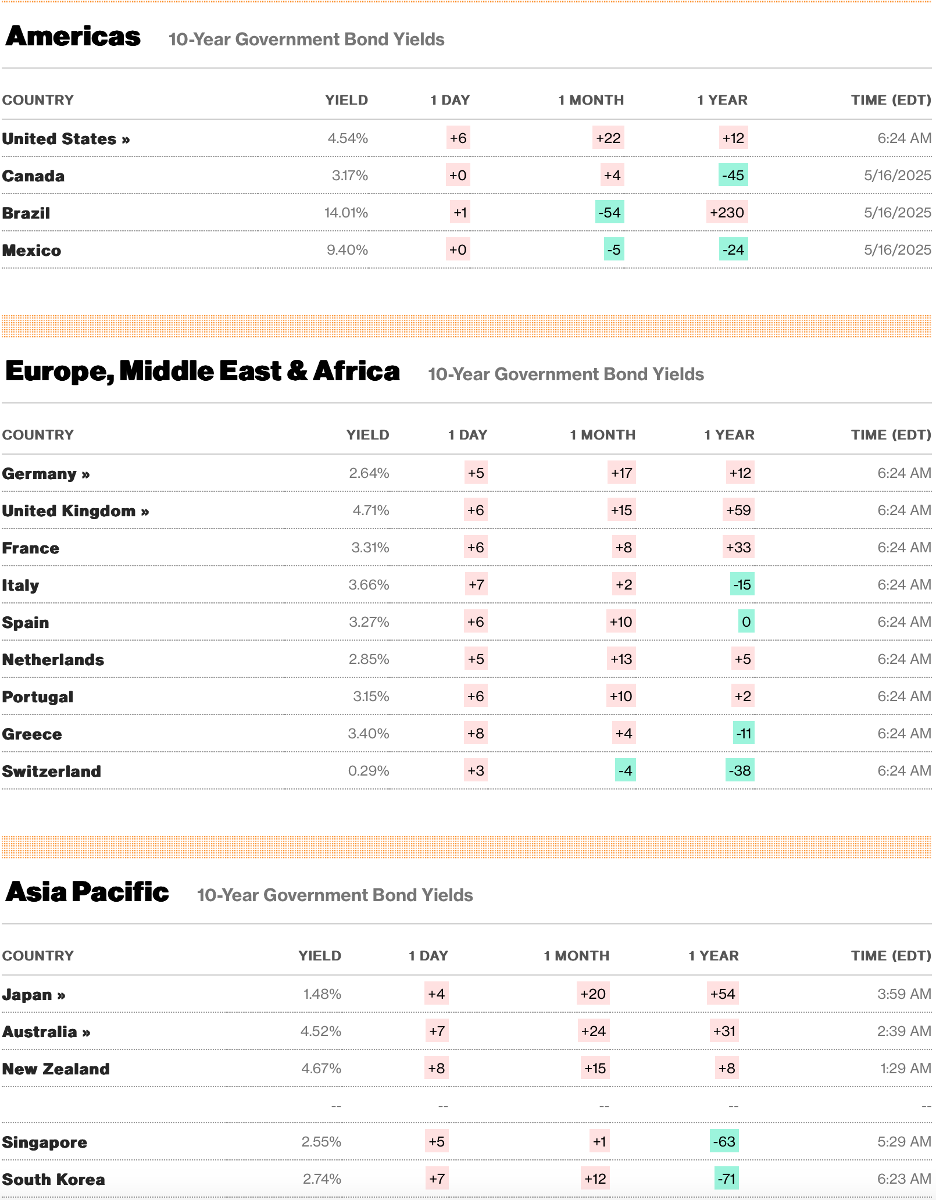
Interestingly, different markets seemed to have taken different messages from the report.  For instance, Treasury yields did not see the outcome as particularly positive at all.  While yields have edged lower by -2bps this morning, as you can see from the below chart, they remain near their highest level in the past month.  

Source: tradingeconomics.com

There are two potential drivers of this price action, I believe, either bond investors don’t believe the headline data is representative of the future, akin to my views of inflation finding a home higher than current readings, or bond investors are losing faith in the full faith and credit of the US.  Certainly, the latter would be a much worse scenario for the US, and arguably the world, as the repudiation of the global risk-free asset of long-standing choice will result in a wild scramble to find a replacement.  I continue to see comments on X about how that is the case, and that US yields are destined to climb to 6% or 10% over the next couple of years as the dollar declines in importance in the global trading system.  However, when I look at the world, especially given my views on inflation, I find that to be a lot of doomporn clickbait and not so much analysis.  Alas, higher inflation is not a great outcome either.

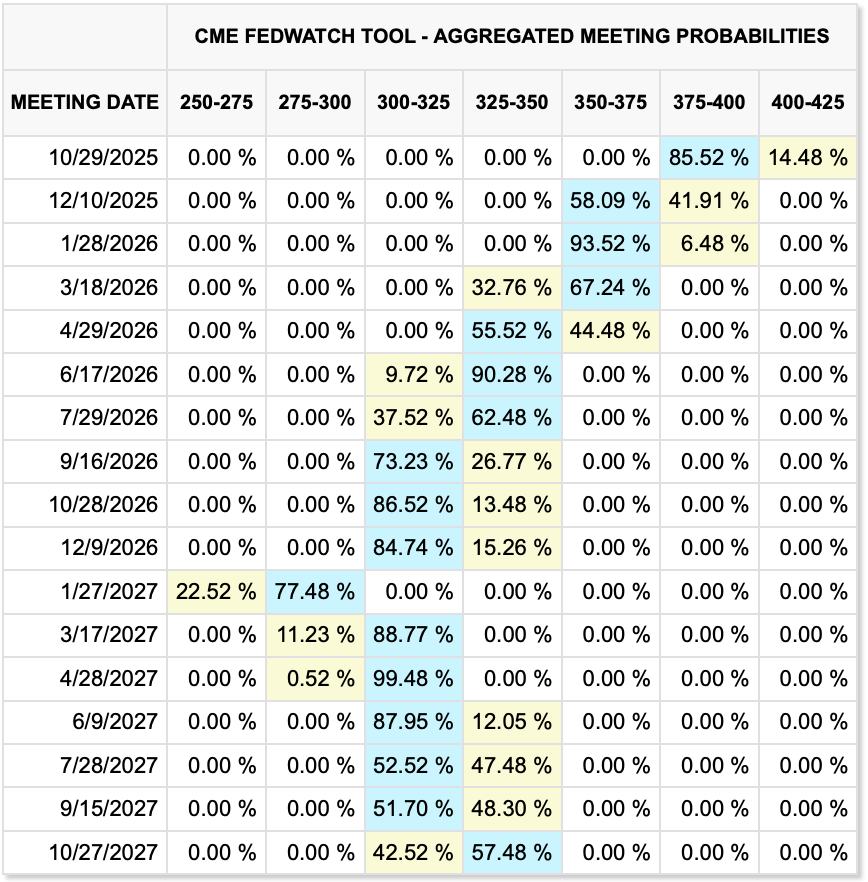
Interestingly, while bond investors did not believe in the idea of lower yields, FX traders took the softer inflation figure as a reason to sell dollars.  This is a little baffling to me as there was virtually no change in Fed funds futures expectations with only an 8% probability of a cut next month and only 2 cuts priced for the year.  So, if long-dated yields didn’t decline, and short-dated yields didn’t decline, (and equity prices didn’t decline), I wonder what drove the dollar lower.  

Yet here we are this morning with the greenback softer against all its G10 counterparts (JPY +1.0%, NOK +0.6%, EUR +0.5%, CHF +0.5%) and almost all its EMG counterparts (KRW +1.5%, MXN +0.3%, ZAR +0.3%, CLP +0.6%, CZK +0.5%).  In fact, the only currency bucking the trend is INR (-0.25%) but given the gyrations driven by the Pakistan issues, that may simply be the market adjusting positions.

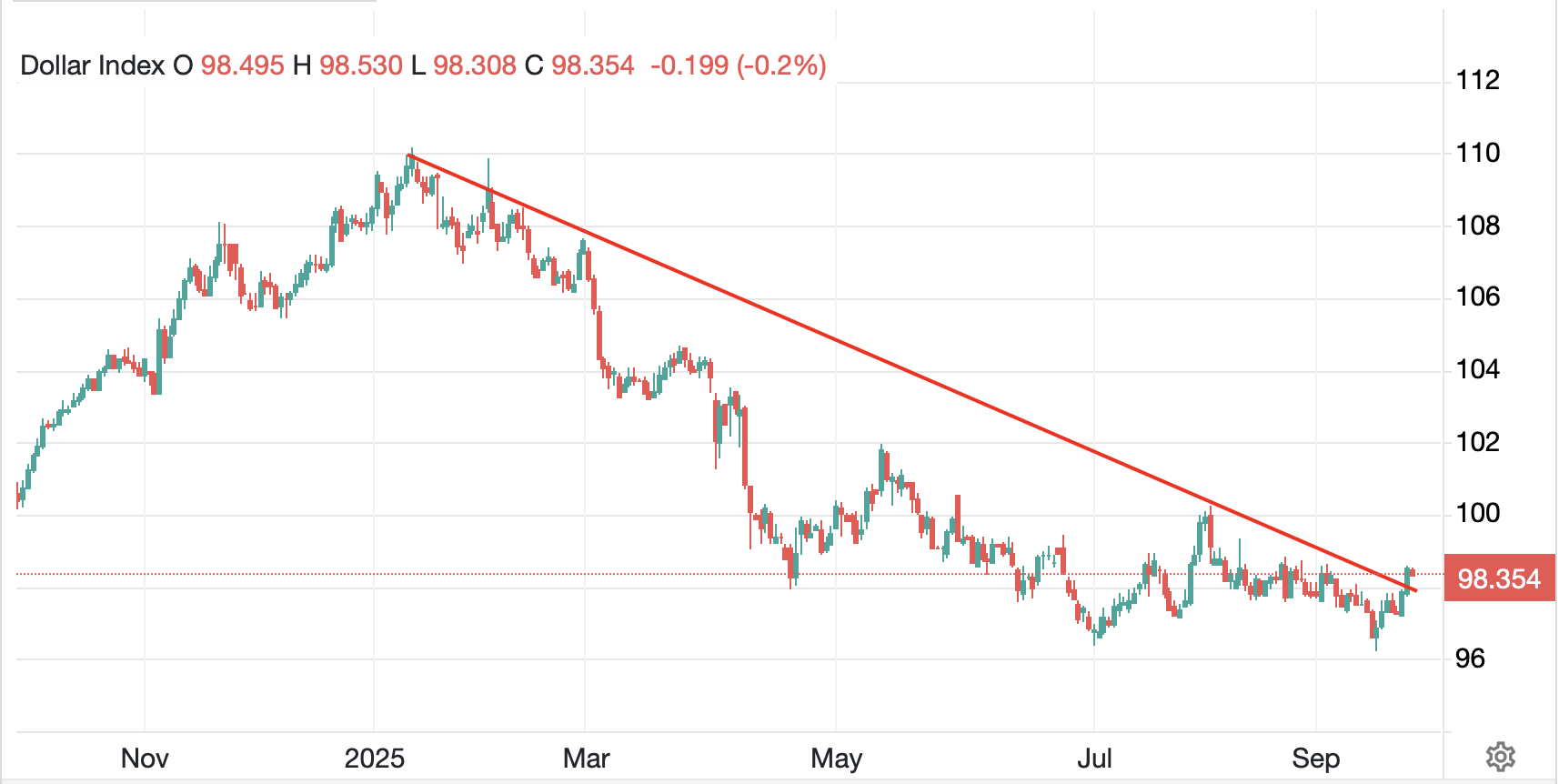
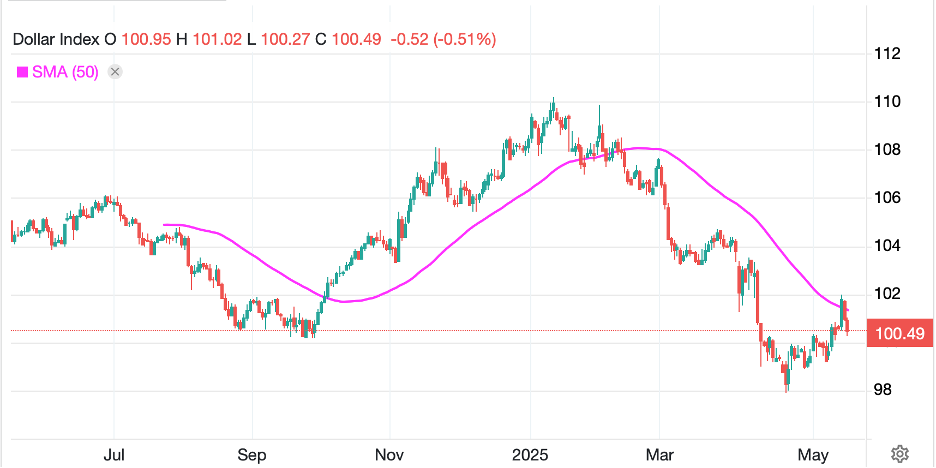
From a technical perspective, we are going to hear a lot about how the dollar failed on its break above the 50-day moving average that was widely touted just two days ago. (see DXY chart below).

Source: tradingeconomics.com

But let’s think about the fundamentals for a bit.  First, we know that the Trump administration would prefer a weaker dollar as it helps the competitiveness of US exporters and that is a clear focus.  Second, the fact that US yields remain higher than elsewhere in the world is old news, that hasn’t changed since the Fed stopped its brief cutting spree ahead of the election last year while other nations (except Japan) have been cutting rates consistently.  What about trade and tariffs?  While it is possible that the idea of a reduction in trade will reduce the demand for dollars, arguably, all I have read is that during this 90-day ‘truce’, companies are ordering as much as they can to lock in low tariffs.  That sounds like more dollars will be flowing, not less.

As I ponder this question, the first thing to remember is that markets don’t necessarily trade in what appears to be a logical or consistent fashion.  I often remark that markets are simply perverse.  But going back to the first point regarding President Trump’s desire for a weaker dollar, there was a story overnight that a stronger KRW was part of the trade discussion between the US and South Korea and I have a feeling that is going to be part of the discussion throughout Asia, especially with Japan.  As of now, I continue to see more downward pressure on the dollar than upward given the Administration’s desires.  I don’t think the Fed is going to do anything, nor should they, but I also don’t foresee a change in the recession narrative in the near future.  While that has not been the lead story today, it remains clear that concern about an impending recession is everywhere except, perhaps, the Marriner Eccles Building.  My view has been a lower dollar, and perhaps today’s price action is a good example of why that is the case.

Ok, let’s touch on other markets quickly.  After yesterday’s mixed session in the US, Asia saw much more positivity with China (+1.2%) and Hong Kong (+2.3%) leading the way higher with most regional markets having good sessions and only Japan (-0.15%) missing the boat.  In Europe, though, the picture is not as bright with both the CAC (-0.6%) and DAX (-0.5%) under some pressure this morning despite benign German inflation data and no French data.  Perhaps the euro’s strength is weighing on these markets.  As to US futures, at this hour (6:45), they are basically unchanged.

Away from Treasury markets, European sovereign yields have all slipped either -1bp or -2bps on the day with very little to discuss overall here.

Finally, in the true surprise, commodity prices are under pressure this morning across the board despite the weak dollar.  Oil (-1.1%) is slipping, with the proximate cause allegedly being API oil inventory data showed a surprising gain of >4 million barrels.  However, given the courteousness of the meeting between President Trump and Saudi Prince MBS, I would not be surprised to hear of an agreement to see prices lower overall.  I believe that is Trump’s goal for many reasons, notably to put more pressure on Russia’s finances, as well as Iran’s and to help the inflation story in the US.  As to the metals complex, they are all lower this morning with gold (-0.7%) leading the way but both silver (-0.3%) and copper (-0.5%) lagging as well.

On the data front, there is no front-line data to be released, although we do see EIA oil inventories with modest declines expected.  However, it is worth noting that Chinese monetary data was released this morning and it showed a significant decline in New Yuan Loans and Total Social Financing, exactly the opposite of what you would expect if the Chinese were seeking to stimulate their economy.  It is difficult for me to look at the chart below of New Bank Loans and see any trend of note.  I would not hold my breath for the Chinese bazooka of stimulus that so many seem to be counting on.

Source: tradingeconomics.com

Overall, it appears to me the market is becoming inured to the volatility which is Donald Trump.  As I have written before, after a while, traders simply get tired and stop chasing things.  My take is we will need something truly new, a resolution of the Chinese trade situation, or an Iran deal of some kind, to get things moving again.  But until then, choppy trading going nowhere is my call.

Good luck

Adf

I Am Your Savior

Investors are showing concern
‘Bout tariffs and Trump, so they spurn
The riskiest stuff
But that’s not enough
To help generate a return
 
Seems most of the holdings in favor
Are no longer risk takers’ flavor
How long before Jay
Will finally say
QE is here, I am your savior


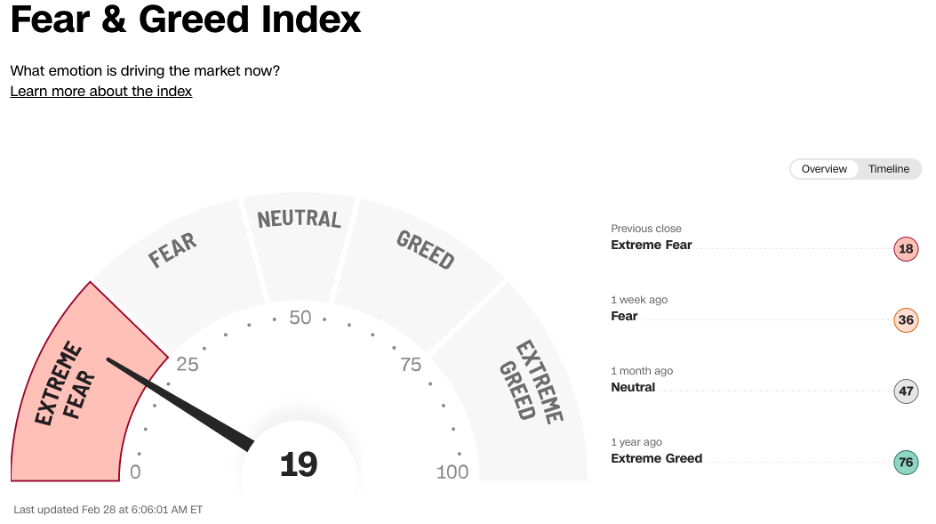
Have you bailed out on your risk exposures yet?  Because if not, it certainly seems you are behind the curve!  At least, that’s what it feels like this morning as trepidation underlies every player’s market activity.  Based on the commentary, as well as the Fear & Greed Index, you might think we are in a depression!

Source: cnn.com

But are things really that bad?  I know that the past week has seen a modest drawdown in equity prices, but after all, on February 20th, they reached yet another new all-time high, at least as per the S&P 500.  Since then, as you can see below, the decline has been less than 5%.  And while the market has traded below its 50-day moving average (blue line), a key technical indicator, it remains well above both the 200-day version of the same (purple line) and the longer-term trend line.  My point is it feels like the narrative is overstating the magnitude of the move thus far.

Source: tradingeconomics.com

Is this the beginning of the end?  While you can never rule that out, as major corrections can occur at any time, I have no reason to believe this will be the case.  Much has been made of yesterday’s Initial Claims print at 242K, much higher than forecast as a harbinger of future economic weakness.  However, looking at the past 3 years of weekly data here, while certainly in the upper levels of readings, it is not nearly the only occurrence and not nearly the highest reading.

Source: tradingeconomics.com

One data point does not make a trend and to my eye, looking at this chart, there is no discernible trend in either direction.  Yet part of the narrative evolution is that the DOGE cuts in government jobs, along with all the headline spending cuts, is setting the economy up for much slower growth in the short run.

In fact, this issue goes back to one about which I wrote several days ago here regarding the impact of government spending on actual economic activity.  The current view of economic activity includes government spending.  If President Trump’s goal is to reduce that spending, regardless of the net long-term benefits of such actions, GDP readings are going to decline initially.  Yes, there will be more productive use of capital with less regulation and less government, but that will take some time to become evident.  In the meantime, weaker economic activity is likely to be the outcome.

I have frequently written that there has not been a market clearing event since, arguably, October 1987, when equity markets plunged and erased significant excess and speculation.  Alas, newly minted (at the time) Fed Chair Greenspan stepped in and promised to support markets with ample liquidity the next day which opened the way for far more Fed intervention in markets leading up to Ben Bernanke and the first QE programs in the wake of the GFC in 2009 and every QE version since then.  While the movement so far does not remotely indicate the end of the world, based on the Fed’s history, once equity markets correct about 20%, they tend to become far more active in supporting the markets economy.  Will this time be different?  Given the Fed’s seeming underlying desperation to cut rates to begin with, my take is if the correction reaches 15% – 20%, we will see just that.

To sum things up, risk assets are under pressure on the basis of 1) excessive valuations, 2) the Trump efforts to reduce wasteful spending (which while wasteful is still spending and counted as economic activity), and 3) the idea that Trump’s imposition of tariffs is going to dramatically raise inflation and slow growth further.  Given the mainstream media’s inherent hatred of the president, they will certainly be playing up this theme for as long as they can as they try to force Trump to change tack.  But Trump, and Treasury Secretary Bessent, have been clear that their concern is 10-year bond yields, and getting them to lower levels.  A natural corollary of the current risk-off sentiment is that bond yields tend to decline.   Look at the chart below which shows that since Trump’s inauguration, 10-year yields are down nearly 40bps.  I would argue that Trump and Bessent are perfectly comfortable with the market right now.

Source: tradingeconomics.com

Ok, let’s move on to the overnight activity.  Sticking to the bond theme, while Treasuries, this morning, are unchanged, they did decline all yesterday afternoon and this morning European sovereigns are all lower by -2bps.  As well, JGB yields have also slipped by -3bps as we are seeing risk aversion evident all around the world.  Of course, the problem with all G10 nations (Germany excepted) is that they all have very high debt/GDP ratios and in Europe, especially, this is a problem as they have begun to realize they need to spend a great deal more on defense than they have in the past.  And all that spending is going to be funded by more borrowing.  The tension between additional issuance driving yields higher and risk aversion driving yields lower is going to be the theme of European bond markets for a while.

In the equity world, it is not a pretty picture anywhere in the world.  After yesterday’s US rout, with the NASDAQ (-2.8%) leading the way lower, Asian bourses were all in the red.  Japan (-2.9%), Hong Kong (-3.3%), China (-2.0%), Korea (-3.4%), India (-1.9%)… the list goes on across the entire region with only New Zealand (+0.5%) bucking the trend on some better than expected local earnings and consumer confidence data.  European markets, though, are in a bit better shape as they suffered yesterday and are consolidating those losses this morning with most markets trading +/- 0.3% on the session.  We have seen a lot of European inflation data this morning, most of it lower than forecast which has encouraged the view that the ECB will be cutting rates more aggressively going forward.  US futures, too, are higher at this hour (7:00), on the order of 0.5% as they bounce from yesterday’s, and truly the past week’s, declines.

In the commodity markets, oil (-1.25%) is back under pressure and back under $70/bbl.  The latest fear is that slowing economic activity around the world will reduce demand for the black sticky stuff and drive prices lower still.  Remember this, oil supply is restricted not by geology, but by politics.  As nations determine that cheaper energy is critical to their future, expect to see more effort to produce more oil.  Meanwhile, metals markets are also under pressure with gold (-0.5%) still falling despite its ostensible risk profile.  However, the barbarous relic remains well above $2800/oz and I continue to believe that this correction is just that, and not the reversal of a trend.  Too many things are happening around the world to induce more fear and in that scenario, gold is the oldest store of value around.  The rest of the metals complex is also under pressure with copper (-1.2%) slipping back a bit.  It is important to remember, though, that despite the recent declines, all the major metals are still nicely higher on the month.  

Finally, the dollar is a bit firmer again this morning after a rally yesterday as well.  In classic risk-off fashion, investors flocked to the dollar, arguably to buy Treasuries.  So, we are seeing weakness in NZD (-0.6%), JPY (-0.4%) and CHF (-0.3%) in the G10 and weakness in KRW (-0.5%), ZAR (-0.2%) amongst others in the EMG bloc.  Here the story remains the impacts of Trump’s tariffs and how they will be applied, if they will be applied, as well as a general fear factor which tends to help the dollar.  Consider, too, ideas that the ECB is going to cut rates will not help the single currency.

On the data front, this morning brings Personal Income (exp +0.3%), Personal Spending (0.1%), and the PCE data where Headline (0.3%, 2.5% Y/Y) and Core (0.3%, 2.6% Y/Y) will be the most important data points.  As well, we will see Chicago PMI (40.6) which has been below 50.0 in every month but one since August 2022.  

There is no question that the economic data has been softening lately.  We saw that with the Citi Surprise Index as well as the continuous stream of commentary by the economic bears who point to underlying pieces of data that point in that direction (whether housing or employment indicators and the recent weak PMI data).  

Consider this, an early recession in Trump’s term can be blamed on the Biden administration as well as set things up for future growth, certainly in time for the mid-term elections.  As well, it will likely help reduce the yield on the 10-year, an explicit goal.  This scenario likely means short-term weakness with an eye to longer term growth.  The dollar is likely to benefit early on, at least until the Fed steps in.

Good luck and good weekend

Adf

Shortsighted

The CPI data delighted
Investors, who in a shortsighted
Response bought the bond
Of which they’re now fond
And did so in, time, expedited
 
But does this response make much sense?
Or is it just way too intense?
I’d offer the latter
Although that may shatter
The narrative’s current pretense


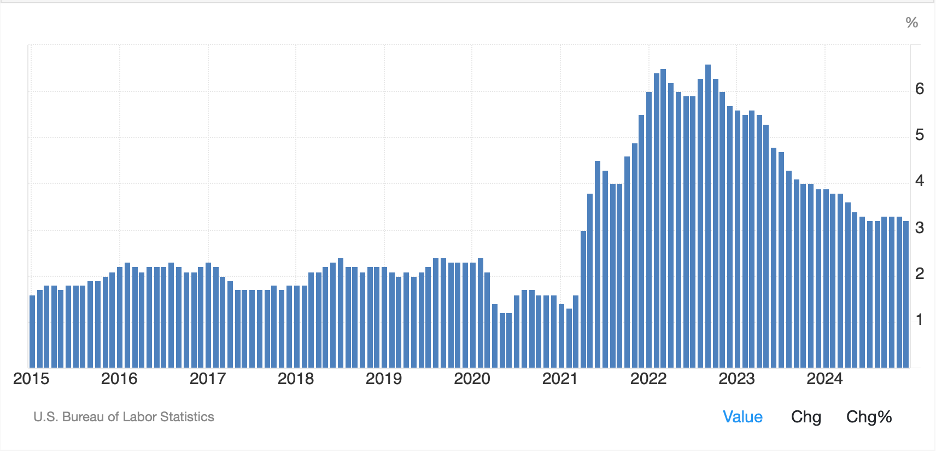
Leading up to yesterday’s CPI data, it appeared to me that despite a better (lower) than expected set of PPI readings on Tuesday, the market was still wary about inflation and concerned that if the recent trend of stubbornly sticky CPI prints continued, the Fed would soon change their tune about further rate cuts.  Heading into the release, the median expectations were for a 0.3% rise in the headline rate and a 0.2% rise in the core rate for the month of December which translated into Y/Y numbers of 2.9%% and 3.3% respectively. At least those were the widely reported expectations based on surveys.  

However, in this day and age, the precision of those outcomes seems to be lacking, and many analysts look at the underlying indices prepared by the BLS and calculate the numbers out several more decimal places.  This is one way in which analysts can claim to be looking under the hood, and it can, at times, demonstrate that a headline number, which is rounded to the first decimal place, may misrepresent the magnitude of any change.  I would submit that is what we saw yesterday, where the headline rate rose to the expected 2.9% despite a 0.4% monthly print, but the core rate was only 3.24% higher, which rounded down to 3.2% on the report. Voila!  Suddenly we had confirmation that inflation was falling, and the Fed was right back on track to cut rates again.

Source: tradingeconomics.com

Now, I cannot look at the above chart of core CPI and take away that the rate of inflation is clearly heading back to 2% as the Fed claims to be the case.  But don’t just take my word for it.  On matters inflation I always refer to Mike Ashton (@inflation_guy) who has a better grasp on this stuff than anyone I know or read.  As he points out in his note yesterday, 3.5% is the new 2.0% and that did not change after yesterday’s data.

However, markets and investors did not see it that way and the response was impressive.  Treasury yields tumbled 13bps and took all European sovereign yields down by a similar amount, equity markets exploded higher with the NASDAQ soaring 2.5% and generally, the investment world is now in nirvana.  Growth remains robust but that pesky inflation is no longer a problem, thus the Fed can continue cutting rates to support equity prices even further.  At least that’s what the current narrative is.  

Remember all that concern over Treasury yields?  Just kidding!  Inflation is dying and Trump’s tariffs are not really a problem and… fill in your favorite rationale for remaining bullish on risk assets.  I guess this is where my skepticism comes to bear.  I do not believe yesterday’s data reset the clock on anything, at least not in the medium and long term.

Before I move on to the overnight, there is one other thesis which I read about regarding the recent (prior to yesterday) global bond market sell-off which has some elements of truth, although the timing is unclear to me.  It seems that if you look at the timing of the recent slide in bond markets, it occurred almost immediately after the fires in LA started and were realized to be out of control.  This thesis is that insurers, who initially were believed to be on the hook for $20 billion (although that has recently been raised to >$100 billion) recognized they would need cash and started selling their most liquid assets, namely Treasuries and US equities.  In fact, this thesis was focused on Japanese insurers, the three largest of which have significant exposure to California property, and how they were also selling JGB’s aggressively.  Now, the price action before yesterday was certainly consistent with that thesis, but correlation and causality are not the same thing.  If this is an important underlying driver, I would expect that there is more pressure to come on bond markets as almost certainly, most insurance companies don’t respond that quickly to claims that have not yet even been filed.

Ok, let’s see how the rest of the world responded to the end of inflation as we know it yesterday’s CPI data. Japanese equities (+0.3%) showed only a modest gain, perhaps those Japanese insurers were still out selling, or perhaps the fact that the yen (+0.3%) is continuing to grind higher has held back the Nikkei.  Hong Kong (+1.25%) stocks had a good day as did almost every other Asian market with the US inflation / Fed rate cuts story seemingly the driver.  The one market that did not participate was China (+0.1%) which managed only an anemic rally.  In Europe, the picture is mixed as the CAC (+2.0%) is roaring while the DAX (+0.2%) and IBEX (-0.4%) are both lagging as is the FTSE 100 (+0.65%).  The French are embracing the Fed story and assuming luxury goods will be back in demand although the rest of the continent is having trouble shaking off the weak overall economic data.  In the UK, GDP was released this morning at 1.0% Y/Y after just a 0.1% gain in November, slower than expected and adding pressure to the Starmer government who seems at a loss as to how to address the slowing economy.  As to US futures, at this hour (7:30) they are pointing slightly higher, about 0.2%.

In the bond market, after yesterday’s impressive rally, it is no surprise that there is consolidation across the board with Treasury yields higher by 2bps and similar gains seen across the continent.  Overnight, Asian government bond markets reacted to the Treasury rally with large gains (yield declines) across the board.  Even JGB yields fell 4bps.  The one market that didn’t move was China, where yields remain at 1.65% just above their recent historic lows.

In the commodity markets, oil (-1.0%) is backing off yesterday’s rally which saw WTI trade above $80/bbl for the first time since July as despite ongoing inventory builds in the US, and ostensibly peace in the Middle East, the market remains focused on the latest sanctions on Russia’s shadow tanker fleet and the likely inability of Russia (and Iran) to export as much as 2.5 million barrels/day going forward.  NatGas (+0.75%) remains as volatile as ever and given the polar vortex that seems set to settle over the US for the next two weeks, I expect will remain well bid.  On the metals side of things, yesterday’s rally across the board is being followed with modest gains this morning (Au +0.3%) as the barbarous relic now sits slightly above $2700/oz.

Finally, the dollar doesn’t seem to be following the correct trajectory lately as although there was a spike lower after the CPI print yesterday, it was recouped within a few hours, and we have held at that level ever since.  In fact, this morning we are seeing broader strength as the euro (-0.2%), pound (-0.4%) and AUD (-0.5%) are all leaking and we are seeing weakness in EMG (MXN -0.6%, ZAR -0.6%) as well.  My take is that the bond market, which had gotten quite short on a leveraged basis, washed out a bunch of positions yesterday and we are likely to see yields creep higher on the bigger picture supply issues going forward.  For now, this is going to continue to underpin the dollar.

On the data front, this morning opens with Retail Sales (exp 0.6%, 0.4% -ex autos) and Initial (210K) and Continuing (1870K) Claims.  We also see Philly Fed (-5.0) to round out the data.  There are no Fed speakers today, although in what cannot be a surprise, the three who spoke yesterday jumped all over the CPI print and reaffirmed their view that 2% was not only in sight, but imminent!  As well, today we hear from Scott Bessent, Trump’s pick to head the Treasury so that will be quite interesting.  In released remarks ahead of the hearings, he focused on the importance of the dollar remaining the world’s reserve currency, although did not explicitly say he would like to see it weaken as well.  The one thing I know is that he is so much smarter than every member of the Senate Finance committee, that it will be amusing to watch them try to take him down.

And that’s really it for now.  If Retail Sales are very strong, look for equities to see that as another boost in sentiment, but a weak number will just rev up the Fed cutting story.  Right now, the narrative is all is well, and risk assets are going higher.  I hope they are right; I fear they are not.

Good luck

Adf

Active De-Bonding

Up north is a nation quite vast
Whose money, of late’s been, out, cast
But word that Trudeau
Is soon set to go
Has seen Loonies quickly amassed
 

One of the biggest stories over the weekend has been the sudden upsurge in articles and discussion regarding the remaining tenure for Canadian PM Justin Trudeau.  For the past several weeks, since his FinMin Krystia Freeland resigned and published a scathing resignation letter, pressure on Trudeau has increased dramatically.  It appears that it is coming to a head with articles from both Canadian and international sources indicating he may step down as soon as this week.  As well, his main political rival, conservative party leader Pierre Poilievre, is touted, according to the betting websites, as an 89% probability to be the next PM.
 
Now, we all know the dollar has been strong in its own right lately, and I suspect that while there will be bumps along the road, it will get stronger still over the year absent some major Fed rate cutting.  As such, USDCAD is higher along with everything else.  However, you can see in the chart below (the green line rising faster than the blue line since December) that it has been an underperformer for the past month, since that Freeland resignation, as investors have been shying away from Canada, given the combination of concerns over the incoming Trump administration imposing tariffs and no political leadership to address these issues.


Source: tradingeconomics.com

While no sitting politician is ever willing to cede power easily, and there are indications that Trudeau is going to go down kicking and screaming, ultimately, I expect that Poilievre will be the PM and will develop a strong relationship with the US.  As that becomes clearer, I expect to see the CAD appreciate modestly vs. the dollar, but much more so against other G10 currencies.

Once more, what the Chinese have said
Is stimulus is straight ahead
But so far, its talk
They ain’t walked the walk
So, bulls need take care where they tread

Another tidbit this morning comes from Beijing, where the economic planning agency there has indicated that they will expand subsidies for consumer purchases of electronic goods like cellphones, tablets and smart watches, as President Xi continues to watch his nation’s economy grind along far more slowly than he really needs to happen.  There was an excellent thread on X this morning by Michael Pettis, one of the best China analysts around, describing the fundamental problem that Xi has and why the slow motion collapse of the property market portends weakness for a long time going forward.  As is almost always the case, while tearing the proverbial band aid off quickly can hurt more at the instant, the pain dissipates more quickly.  President Xi believes he cannot afford to inflict that much pain, so their problems, which stem from decades of malinvestment in property that inflated a massive bubble, are going to last for a long time.  While CNY (+0.4%) is modestly firmer this morning, that is only because the dollar is weaker across the board, and in fact, it is significantly underperforming.

This week, the US Treasury’s Yellen
Much debt, will look forward to sellin’
The market’s responding
By active “de-bonding”
With dollars and bonds both rebellin’

The last big story of the day is clearly the upcoming Treasury auctions this week, where the US is set to sell $119 billion of debt, starting with $58 billions of 3-year notes today.  Arguably, market participants have been aware that this was going to be a necessary outcome given the massive deficits that continue to be run by the US.  Adding to the broad concept of deficits, the Biden administration appears to be trying to spend every appropriated dollar in the last two weeks in office and that requires actual cash, hence the auctions to raise that cash.  In addition, the debt ceiling comes back into force shortly, so they want to get this done before that serves to prevent further issuance.

Now, the yield curve has reverted back to a normal slope with the 2yr-10-yr spread at 34bps and 30yr bonds trading another 22bps higher than 10yr at 4.81% and bringing 5% into view.  Here’s the thing about the relationship between the dollar and yields; the dollar is typically far more correlated to short-term yield differentials, not long-term yields.  So rising 30yr bond yields is not likely to be a dollar benefit.  In fact, just the opposite as international investors will not want to suffer the pain of those bonds declining in price rapidly.  

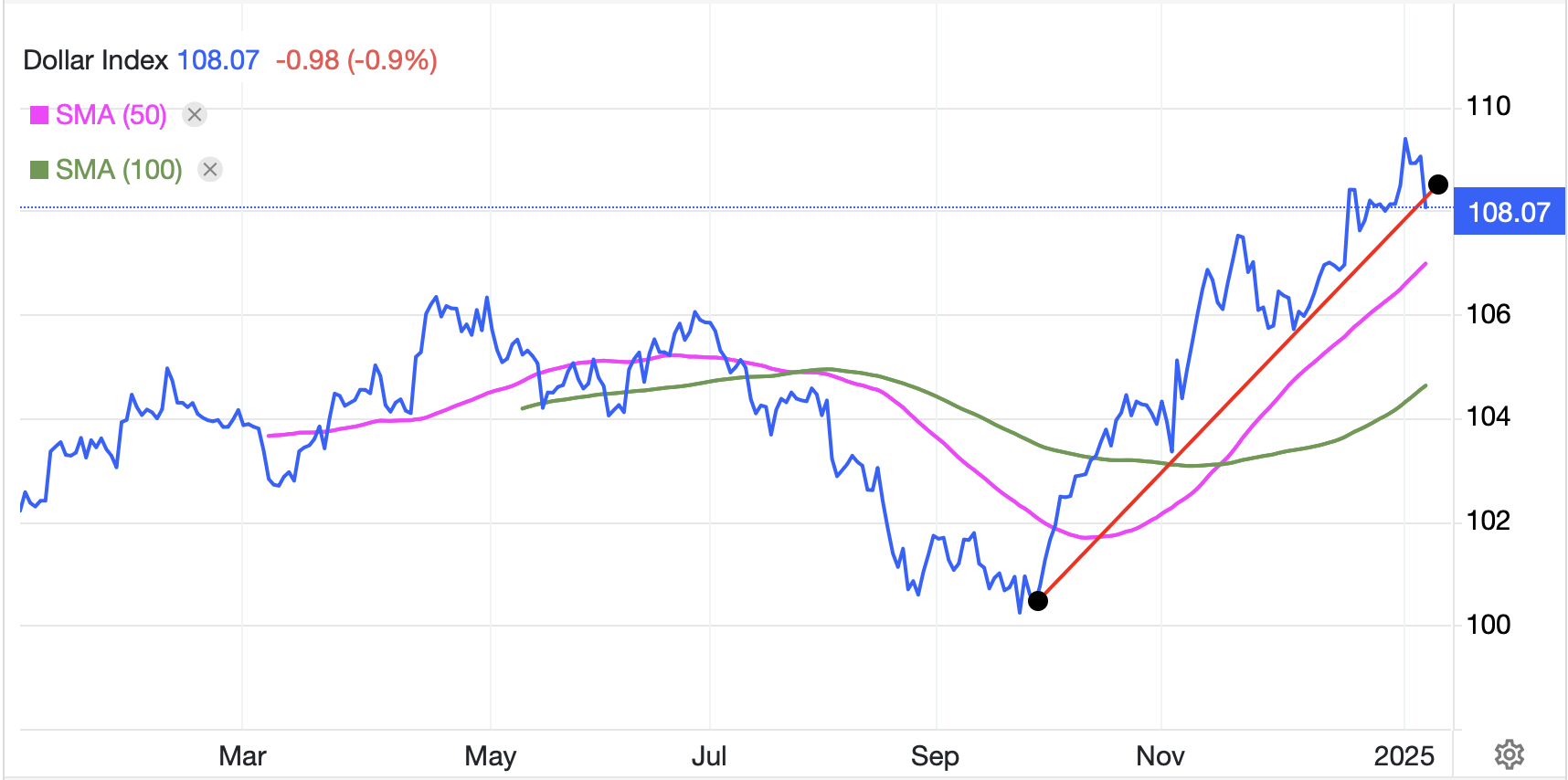
And this is what we are witnessing this morning as the dollar, which rallied sharply at the end of last week, is correcting in a hurry today.  As mentioned above, CNY is the laggard with the euro, pound, Aussie, Kiwi and Loonie all firmer by 1% or more this morning and similar gains seen across the emerging markets, with some extending those gains as far as 1.35% or so.  Is this the end of the dollar?  I would argue absolutely not.  However, that doesn’t mean that we won’t see a further decline in the buck before it heads higher again.  A quick look at the chart below, which shows the Dollar Index, while it has just touched the steep trend line higher, it remains far above its 50-day and 100-day moving averages.  Howe er, it seems that the big story here comes from a report from the Washington Post that Trump is considering much less widespread tariff impositions with only some critical imports to be addressed.  As such, given the tariffs = higher dollar consensus, if this is true, you can understand the dollar’s retreat.

Source: tradingeconomics.com

However, today’s story is that of a weak dollar and strong equity markets, well at least in some places. Friday’s US equity rally was not followed by similar enthusiasm in Asia with the Nikkei (-1.5%) leading the way lower while both the Hang Seng (-0.4%) and China (-0.2%) also lagged.  Perhaps the mooted China stimulus helped those markets on a relative basis.  Europe, however, is in fine fettle (CAC +2.3%, DAX +1.4%, IBEX +0.9%) as PMI data released this morning was solid, if not spectacular, and the weaker dollar seems to be having a net positive impact.  US futures are also firmer, with NASDAQ (+1.1%) leading the way.

In the bond market, the big movement was in Asia overnight as JGBs (+4bps) sold off alongside virtually every other Asian bond market except China, which saw yields edge lower by 1bp to a new record low of 1.59%.  In Europe, there has been very little movement with yields +/- 1bp at most and Treasury yields, which had been firmer earlier in the overnight session, have actually slipped back at this hour and are lower by 2bps to 4.58%.

In the commodity markets, the weak dollar has helped support prices here with oil (+1.0%) continuing its rally (+9% in the past month) as the combination of Chinese stimulus hopes and cold weather seem to be providing support.  Speaking of cold weather, NatGas (+7.4%) is also in demand this morning as winter storm Barrie makes its way across the country.  In the metals markets, gold (+0.3%) is the laggard this morning with both silver (+2.3%) and copper (+2.4%) really taking advantage of the dollar’s weakness.

On the data front, there is a ton of stuff this week, culminating in NFP on Friday.

TodayPMI Services58.5
 PMI composite56.6
 Factory Orders-0.3%
TuesdayTrade Balance-$78.0B
 ISM Services53.0
 JOLTS Job Openings7.70M
WednesdayADP Employment139K
 Initial Claims217K
 Continuing Claims1848K
 Consumer Credit$12.0B
 FOMC Minutes 
FridayNonfarm Payrolls160K
 Private Payrolls134K
 Manufacturing Payrolls10K
 Unemployment Rate4.2%
 Average Hourly Earnings0.3% (4.0% Y/Y0
 Average Weekly Hours34.3
 Participation Rate62.8%
 Michigan Sentiment73.9

Source: tradingeconomics.com

In addition to all this, we hear from six more Fed speakers over seven venues with Governor Waller likely the most impactful.  Over the weekend, we heard from Governor Kugler and SF President Daly, both explaining that they needed to see more progress on inflation before becoming comfortable that things were ok.

Clearly, the tariff story is the current market driver in the dollar.  As I never saw tariffs as the medium-term driver of dollar strength, I don’t think it has as much importance.  Plus, this is a report from the Washington Post.  There are still two weeks before inauguration and many things can happen between now and then.  Nothing has changed my longer-term view that the dollar will be supported as the Fed, which is not tipped to cut rates this month and is seen only to be cutting about 40bps all year will ultimately raise rates as inflation proves far more stubborn than desired.  But that is the future.  Today, pick spots to establish dollar buys and leave orders.

Good luck

Adf

The Throes of Anguish

The answer this morning is clear
The president starting next year
Is Donald J Trump
Who always could pump
Excitement when he did appear

The market response has been swift
With equities getting a lift
The dollar, too, rose
But bonds felt the throes
Of anguish while getting short shrift

The punditry was quite convinced that it would be a long time before the results of the election were clear as they anticipated significant delays in the vote count in the battleground states.  Fears were fanned that if Trump were to lose, he wouldn’t accept the election.  As well, virtually every pundit in the mainstream media portrayed the race as “tight as a tick’ (a somewhat odd expression in my mind).

But none of that is what happened at all.  Instead, somewhere around 3:00am NY time, Donald J Trump was called the winner of the presidential election, effectively in a landslide as he appears set to win > 300 electoral votes and, perhaps more importantly as a signal, the popular vote, and will be inaugurated as the 47thpresident of the United States on January 20th, 2025.  Congratulations are in order.

It ought not be surprising that the ‘Trump trade’ is back in full force early on with US equity futures rallying about 2%, Treasury bonds selling off sharply with 10-year yields jumping 20bps and the dollar exploding higher, jumping by about 1.5% as per the DXY, with substantial gains against virtually all its G10 and EMG counterparts.  Oil prices are under pressure as the prospect of ‘drill, baby, drill’ is the future and Bitcoin has exploded higher to new all-time highs amid the prospects of a pro-crypto Trump administration.

Much digital ink will be spilled over the next weeks and months as the punditry first tries to understand how they could have been so wrong, and then tries to create the new narrative.  However, if we learned nothing else from this election it is that the previous narrative writers, especially the MSM, have lost a great deal of sway and that it will be the new narrative writers, those independents on X and Substack and podcasters, who don’t answer to a corporate master, who will be leading the way imparting information and stories.  I’ve no idea how this will play out with respect to financial markets, but I am confident it will have an impact over time.

With all of the votes being tallied
While stocks and the dollar have rallied
We’ll turn to the Fed
Who soon will have said
On rate cuts, we’ve not dilly-dallied

With the election now past, at least as a point of volatility, all eyes will likely turn to the FOMC meeting, which starts this morning and will run until the statement is released tomorrow at 2pm with Chairman Powell’s press conference coming 30 minutes later.  The election result has not changed any views on tomorrow’s rate cut, with futures markets still pricing in a 98% probability, but the pricing as we look further out the curve has changed a bit more.  For instance, the December meeting is now priced at less than a 70% probability for the next 25bps, and if we look out to December 2025, the market has removed at least one 25bp cut from the future.

This makes sense based on the idea that a Trump administration is going to be heavily pro-growth and one consequence will potentially be more inflationary pressures.  Of course, if energy prices decline, that is going to help cap inflation, at least at the headline level, so the impact going forward is very hard to discern at this time.  As well, if that pro-growth agenda helps improve the employment situation, the Fed will be far less compelled to cut rates further.  In fact, the only reason to do so at that time would be to address the massive debt load and that cannot be ruled out, but my take is Powell is not inclined to try to help President Trump in any way, so will likely feign allegiance to the mandate when the situation arises.

But with all the election excitement today, my sense is the Fed is tomorrow’s market discussion, not today’s.  Rather, let’s see how markets around the world have responded to the news.

It seems that yesterday’s US markets foretold the story with a solid rally across the board.  Overnight, Japanese shares (+2.65%) were beneficiaries as the yen (-1.7%) weakened sharply along with all the other currencies.  Elsewhere in the region, China (-0.5%) and Hong Kong (-2.2%) both suffered on prospects of more tariffs coming and Korea (-0.5%) was also under pressure, but almost every other regional exchange rallied nicely.  As to Europe, green is the predominant color with the DAX (+0.9%), CAC (+1.5%) and FTSE 100 (+1.2%) all performing well although Spain’s IBEX (-1.5%) is underperforming allegedly on fears of some tax issues that will impact the Spanish banking sector.  But I would look at Spain’s Services PMI falling short of expectations as a better driver.

In the bond market, while US yields have rocketed higher as discussed above, in Europe, that is not the case at all.  Instead, we are seeing declines of between 4bps and 5bps across the continent as concerns grow that Eurozone economic activity may suffer with Trump in office as threats of tariffs rise.  The market has now priced in further rate cuts by the ECB and that seems to be the driver here.

Aside from oil prices falling, metals, too, are under severe pressure with the dollar’s sharp rally.  So precious (Au -1.3%, Ag-2.3%) and industrial (Cu-2.8%, Al -1.0%) are all selling off.  Now, this space has seen a strong rally overall lately so a correction can be no real surprise.  However, it strikes me that if the growth story is maintained, demand for industrial metals will expand and gold is going to find buyers no matter what.

Finally, the dollar just continues to rock, climbing further since I started writing this morning.  the biggest loser is MXN (-2.9%) which has fallen to multi-year lows amid concerns they will be an early target of tariffs.  While the dollar, writ large, is stronger across the board today, it is only back to levels last seen in July, hardly a massive breakout.  However, do not be surprised if this rally continues over time as investors learn more specifics of how President Trump wants to proceed on all these issues about the economy, taxes and tariffs.

The only meaningful data releases this morning are the EIA Oil inventories, which last week saw a large draw and are expected to see a further one today.  Otherwise, European Services PMI data, aside from Spain’s disappointing showing, was actually better than expected, probably helping equity markets there as well.  Of course, as the Fed doesn’t come out until tomorrow, there is no Fedspeak so traders will likely continue to push the Trump trade for now.  As such, look for the dollar to remain strong until further notice.

Good luck
Adf

Another Mistake

Said Janet, we need to watch out
‘Cause bank fraud is starting to sprout
So maybe I’ll make
Another mistake
And drive banking stocks to a rout


I absolutely agree with the premise — which is that fraud is becoming a huge problem.”  These sage wordsfrom our esteemed Treasury Secretary have made headlines and also raised some alarms.  After all, was not Madam Yellen in charge of bank regulation not that long ago?  Did she not receive millions of dollars in speaking fees from those same banks before being named Treasury Secretary?  It is difficult to listen to the recent change in tone without considering the fact that she is concerned if the election results in a Trump victory, her time at Treasury may come under deeper scrutiny so she is starting to spill a few beans to show she was on the ball.

But arguably, the biggest issue is not that fraud is rampant in banking, with action around government checks being the most fertile area, the biggest issue remains the nonstop borrowing that continues as the US government debt continues to grow aggressively each day.  There have been several recent commentaries by some very smart guys, Luke Gromen and Bob Elliott,  regarding the coincidence of rising interest rates in the US and almost every other G10 economy despite significant differences regarding the economic situation and borrowing patterns.  One conclusion is that owning government debt from any western government, at least debt with any significant duration, is losing its luster quickly.  This is a valid explanation of why yields continue to rise despite the Fed’s, and other central banks’, recent rate cuts.  

Of course, there is another popular explanation about the recent rise in yields; the prospects of a Trump victory and corresponding sweep in the House and Senate is seen as growing substantially.  The thesis is that if that is the outcome, the budget deficit will grow even larger as the tax cuts due to expire next year will very likely be rolled over, and there is no indication there will be a reduction in spending (the Republicans merely have different spending priorities).  Hence, deficits will continue to grow, Treasury debt will continue to increase, and yields will increase as well.  At least, that’s the thesis.

One thing which is undoubtedly true is that if there is an increase in volatility in government bond markets, the dollar is going to be one of the beneficiaries.  Keep that in mind going forward.

Though views about Europe were dire
Today, GDP printed higher
While Italy sank
They’ve Germans to thank
For being the major highflier

The other story of note this morning is the Eurozone GDP report alongside GDP readings from several key nations.  At the Eurozone level, GDP surprised everyone with a 0.4% Q/Q print and a 0.9% Y/Y print, higher than the 0.2%/0.8% expectations.  Now, in the big scheme of things, those numbers are not that great, but better than expected is certainly worth something.  Germany was the key driver as they avoided a technical recession by growing 0.2% in Q3.  What is little noted is that Q2’s data was revised lower from -0.1% to -0.3%, so it is fair to say that things have not been great there.  In fact, below is a chart of the past 5 years’ worth of quarterly results in Germany and you can see that the concept of a growth impulse there, at least since the beginning of 2022, has largely been absent.

Source: tradingeconomics.com

Another telling sign that the headline may not be a true reflection of the situation on the ground there is that the Eurozone also released a series of sentiment indicators, almost all of which were weaker than expected, notably Economic Sentiment (95.6 vs. 96.3 last month and expected) and Industrial Sentiment (-13.0 vs. -11.0 last month and -10.5 expected).  Apparently, the growth was the product of greater than expected government spending, not really the best way to grow your economy.  However, the market did respond by pushing the euro (+0.15%) a bit higher although the recent downtrend remains in place as evidenced by the below chart.  It remains difficult to get too excited about the single currency given the growing divergence in views on the Fed and ECB, with the former being questioned about its policy easing while the latter is being called on to do more.

Source: tradingeconomics.com

And that was really the macro news for the evening so let’s see how markets overall behaved.  Yesterday’s mixed US session was followed by similar price action in Asia with the Nikkei (+1.0%) continuing its recent rally as the market gets comfortable with PM Ishiba putting together a minority government while Chinese shares (CSI 300 -0.9%, Hang Seng -1.55%) suffered as hopes for the ‘bazooka’ stimulus faded, at least temporarily.  As to the rest of the region, almost all the stock markets declined on the evening.  That negative price action is evident in Europe as well this morning with every major market in the red (CAC -1.4%, DAX -0.8%, IBEX -0.6%) as the better than expected GDP figures don’t seem to have been that enticing for investors.  In the UK, too, stocks are softer (FTSE 100 -0.3%), although there has been no data released.  The big story there today is the budget release upcoming with most pundits looking for a lot of smoke and mirrors and no progress on spending stability.  Meanwhile, US futures are a bit firmer this morning after solid earnings from Google after the close yesterday.

In the bond market, yields have backed off from their recent highs with Treasuries (-4bps) falling after yesterday’s 4bp decline.  Yesterday’s US data was a bit softer than expected (Goods Trade Deficit fell to -$108.23B, much larger than expected while the JOLTS data (7.44M) fell to its lowest level since January 2021 and indicates a rough balance in the jobs market.  As discussed above, European yields are following Treasuries lower with declines on the order of -3bps across the major economies with only Italy (+1bp) the outlier on higher than expected CPI readings.  Meanwhile, UK Gilts (-10bps) are the real outlier as bond investors seem intrigued over the potential budget.

In the commodity space, oil (+1.3%) is bouncing a bit although remains well below the $70/bbl level.  It appears that the worst is over for now and a choppy market is in our immediate future pending the election outcome.  Consider that if Trump wins, given his ‘drill, baby, drill’ plank in the platform, it is likely that oil will slide on the news while a Harris win is likely to see prices rise on the fear of a fracking ban.  Gold (+0.2%) continues its steady march higher with investors abandoning bonds and looking for a haven, although the other metals (silver -1.1%, copper -0.6%) are suffering this morning on the softer economic data.

Finally, the dollar is under very modest pressure this morning but remains at the high end of its recent trading range.  JPY (+0.25%) has managed a modest rally ahead of tomorrow’s BOJ meeting but we have seen a mixed picture overall with some gainers (AUD, NZD, KRW) and some laggards (SEK, GBP, HUF).  Ahead of the election, I continue to expect choppiness and a lack of direction but once that is complete, as I have said before, market volatility in other markets is likely to lead to a stronger dollar.

On the data front today, we start with ADP Employment (exp 115K) and then see the first look at Q3 GDP (3.0%) along with a key subcomponent of Real Consumer Spending (3.0%).  We also see the Treasury Refunding Announcement, with not nearly as much press given to this as today as we had seen over the past several quarters.  Expectations are running for no large increases although given the budget deficit continues to widen, I’m not sure how that math works.  Lastly, we see oil inventories where a modest build is anticipated.

While the election continues to dominate the discussion, we cannot ignore this data or what is to come tomorrow and Friday, as the Fed will not be ignoring it.  We will need to see a spate of much weaker data to change my long-held view that the dollar has further to climb, so let’s watch and wait.

Good luck

Adf

A Brand-New World

Even in Japan
Incumbency is questioned
It’s a brand-new world


Yesterday’s elections in Japan brought about the downfall of yet another incumbent government as people around the world continue to demonstrate they are tired of the status quo.  Recently appointed PM, Shigeru Ishiba called for a snap election within days of his appointment following the resignation of previous PM Kishida on the heels of a funding scandal.  Ishiba’s idea was to receive a fresh mandate from the electorate so he could implement his vision.  Oops!  It turns out that his vision was not in sync with the majority of the population.  Ultimately, the LDP and its key ally, Komeito, won only 215 seats in the Diet (Japan’s more powerful Lower House), well below the 233 necessary for a majority and even further from the 293 seats they held prior to the election.  The very fact that this occurred in Japan, the most homogenous of G10 nations, is indicative of just how strong the anti-incumbent bias has grown and just how tired people are of current leadership (keep that in mind for the US election).

Now, turning to the market impact, the tenuous hold any government formed from these disparate results means that Japan seems unlikely to have a clear, coherent vision going forward.  One of the key issues was the ongoing buildup in defense expenditures as the neighborhood there increasingly becomes more dangerous.  But now spending priorities may shift.  Ultimately, as the government loses its luster and ability to drive decisions, more power will accrue to Ueda-san and the BOJ.  This begs the question of whether the gradual tightening of monetary policy will continue, or if Ueda-san will see the need for more support by living with more inflation and potentially faster economic growth.The yen’s recent decline (-0.25% today, -8.5% since the Fed rate cut in September) shows no signs of slowing down as can be seen from the chart below.  As the burden of policy activity falls to the BOJ, I expect that we could see further yen weakness, especially when if the Fed’s rate cutting cycle slows or stops as December approaches.  If this process accelerates, I suspect the MOF will want to intervene, but that will only provide temporary respite.  Be prepared for further weakness in the yen.

Source: tradingeconomics.com
 
This weekend’s Israeli response
To missile attacks from Iran-ce
Left bulls long of oil
In massive turmoil
As prices collapsed at the nonce

The other major market story this morning was the oil market’s response to Israel’s much anticipated retaliation to the Iranian missile barrage from several weeks ago.  The precision attacks on military assets left the energy sector untouched and may have the potential to de-escalate the overall situation.  With this information, it cannot be surprising that more risk premium has been removed from the price of oil and this morning the black, sticky stuff has fallen by nearly 6% and is well below $70/bbl.  This has led the entire commodity sector lower in price with not only the entire energy sector falling, but also the entire metals sector where both precious (Au -0.6%, Ag -0.9%) and base (Cu -0.2%, Al -1.1%) have given back some of their recent gains.  While declining oil prices will certainly help reduce inflationary readings over time, at least at the headline level, I do not believe that the underlying fundamentals have changed, and we are likely to continue to see inflation climb slowly.  In fact, Treasury yields (+3bps) continue to signal concern on that very issue.

Which takes us to the rest of the overnight activity.  Friday’s mixed session in NY equity markets was followed by a lot more green than red in Asia with the Nikkei (+1.8%) leading the way on the back of both lower energy prices and the weaker yen, while Chinese stocks (+0.2%) managed a small gain along with Korea (+1.1%) and India (+0.8%).  However, most of the other regional markets wound up with modest declines.  In Europe, mixed is the description as well, with the CAC (+0.25%) and IBEX (+0.4%) in good spirits while both the DAX and FTSE 100 (-0.1%) are lagging.  Given the complete lack of data, the European markets appear to be responding to ECB chatter, which is showing huge variety on members’ views of the size of the next move, and questions about the results of the US election, with President Trump seeming to gain momentum and traders trying to figure out the best way to play that outcome.  As to US futures, this morning they are firmer by 0.5% at this hour (7:20).

Although Treasury yields have continued their recent climb, European sovereign yields are a touch softer this morning, although only by 1bp to 2bps, as clarity is missing with respect to ECB actions, Fed actions and the US elections.  My sense is that we will need to see some substantial new news to change the current trend of rising yields for more than a day.

Finally, the dollar is net, a little softer today although several currencies are suffering.  We have already discussed the yen, and we cannot be surprised that NOK (-0.4%) is weaker given oil’s decline, but we are also seeing MXN (-0.3% and back above 20.00 for the first time since July) under pressure as that appears to be a response to a potential Trump electoral victory.  But elsewhere, the dollar is under modest pressure with gains on the order of 0.1% – 0.3% across most of the rest of the G10 as well as many EMG currencies.  There are precious few other stories of note this morning.

On the data front, it is a very big week as we see not only NFP data but also PCE data.

TuesdayCase-Shiller Home Prices5.4%
 JOLTS Job Openings7.99M
 Consumer Confidence99.3
WednesdayADP Employment115K
 Q3 GDP3.0%
ThursdayInitial Claims233K
 Continuing Claims1880K
 Personal Income0.2%
 Personal Spending0.4%
 PCE0.1% (2.1% Y/Y)
 Core PCE 0.1% (2.7% Y/Y)
 Chicago PMI47.5
FridayNonfarm Payrolls180K
 Private Payrolls160K
 Manufacturing Payrolls-35K
 Unemployment Rate4.2%
 Average Hourly Earnings0.3% (4.0% Y/Y)
 Average Weekly Hours34.2
 Participation Rate62.5%
 ISM Manufacturing47.5
 ISM Prices Paid48.2

Source: tradingeconomics.com

Of course, with the FOMC meeting next week, we are now in the Fed’s quiet period, so there will be no more official commentary.  The one thing to watch is if something unexpected occurs, then look for an article from the Fed whisperer, Nick Timiraos of the WSJ.  But otherwise, this is shaping up as a week that starts slowly and builds to the back half when the data comes.

Regardless of the election outcome, I expect that the budget situation will only devolve into greater deficits.  I believe that will weigh on the bond market, driving yields higher and for now, I think that will likely help the dollar overall, but not too much.  It remains difficult for me to see the dollar reverse course lower absent a much more aggressive FOMC, and that just doesn’t seem to be on the cards.

Good luck

Adf

Pulling All-Nighters

As Harris and Trump try persuading
The voters, the markets keep trading
So, narrative writers
Are pulling all-nighters
To pump up the side that is fading
 
The latest attack is on Trump
Who’s blamed for the bond market slump
But what of the Fed
Whose rate cuts have spread
The fear that inflation will jump?


It appears we have reached the point in time when macroeconomic data is taking a backseat to the political situation.  Almost every story you can read in any of the mainstream media right now is about how the election is going to affect whatever subject an article is about.  The latest discussion, which I have seen across numerous sources like Bloomberg, the WSJ and Reuters, just to name a few, is that the bond markets recent decline is entirely Trump’s fault.  The logic is that as Trump’s election prospects improve, and those of fellow Republicans in both the House and Senate alongside him, the market is suddenly concerned that the government is going to spend a lot of money and run a large deficit.  You can’t make this up!

The federal government deficit under the current administration is pegged to be just shy of $2 trillion this fiscal year, and you have all heard about the fact that interest payments on the government’s nearly $36 trillion of debt have grown to be more than $1 trillion.  But that is not the driver according to the narrative.  The driver is the idea that the Republicans could sweep and that would mean large deficits because…Trump.

Now, I realize I am only an FX guy (FX poet I guess), but my rudimentary understanding of economics is that when economic activity is strong (like the current data implies) and the central bank then adds more liquidity to the system to goose demand, say by cutting interest rates in the front end of the curve, then demand can outstrip supply and prices will rise.  As such, bond investors, when they see a dovish Fed entering an easing cycle while economic activity continues to move along and the government is already running a large fiscal deficit, are concerned over higher inflation ahead and so demand higher yields to own Treasury securities.  Of course, that view doesn’t necessarily suit the narrative so desperately pushed by the mainstream media that Trump is the root of all evil, but it does seem to make more sense.

At any rate, for the next two weeks at least, and likely four years if Trump wins, I can assure you that every negative day in any financial market will be blamed on Trump and his policies, despite the fact that the Fed seems to be the one with far more direct impact on short-term economic outcomes.  A look at the below chart, showing 10yr Treasury yields and the Fed funds rate cannot help but show that it was the Fed’s rate cut that is coincident with the recent sharp rise in yields, and this took place long before the odds of a Trump victory improved.  Look through the narrative and instead at the data and Fed activities for the most important clues as to what is actually happening.  I would argue that this is a bond market that is concerned about returning inflation as the Fed’s policy prescription no longer matches the reality on the ground.

Source: tradingeconomics.com

One other thing.  If the Fed does continue to cut rates while US economic data continues to demonstrate solid growth, look for commodity prices to continue their ongoing rally, likely equity markets to continue to perform well, but the dollar is more nuanced as rising inflation ought to undermine the greenback, but given we are seeing more aggressive rate cuts elsewhere in the world (Bank of Canada just cut 50bps this week and the ECB and BOE are going to be cutting again next month), it is entirely possible the dollar holds its own despite macroeconomic fundamentals that should point to weakness.

Ok, let’s see what happened overnight.  Yesterday’s US sell-off, the third consecutive day of broad market weakness, seems to have been sufficient to wash out some of the froth in the market as US futures are pointing higher this morning, especially after Tesla’s better than expected earnings report.  But overnight, the trend from yesterday’s US session was intact with most Asian markets under pressure (Hang Seng -1.3%, CSI 300 -1.1%, KOSPI -0.7%) with only Japan (Nikkei +0.1%) bucking the trend.  In Europe, however, this morning’s color is green with all the major bourses showing life (CAC +0.75%, DAX +0.7%, FTSE 100 +0.5%). Now, there was data released in Europe with the Flash PMI readings out this morning.  The funny thing is that they did not paint a great picture, with continued softness almost everywhere.  My take is Europe is going through a ‘bad news is good’ phase where the weak PMI data implies there will be more aggressive rate cuts by the ECB going forward.  Certainly, Eurozone economic activity, led by Germany’s virtual stagnation, is lackluster at best.

In the bond markets, after several sessions of rising yields, Treasuries have seen yields slip back 5bps this morning with similar declines across the board in European sovereign markets.  Part of this is the weak PMI data I believe, but part of it is a simple trading response to a market that is likely somewhat oversold.  After all, for the past month, bonds have been under significant pressure so a bounce can be no surprise.

In the commodity markets, after yesterday’s rout, where there seemed to be a lot of profit taking of the recent rally, this morning the march higher continues.  Oil (+1.0%) is leading the energy complex higher and the entire metals complex (Au +0.5%, Ag +0.7%, Cu +0.5%, Al +0.9%) is back in gear as all the underlying drivers (rising inflation, solid demand, and for gold, ongoing geopolitical concerns) remain in place.

Finally, the dollar is a bit softer this morning, but this too seems like a response to what has been a strong rally.  Once again, using DXY as a proxy (see chart below) for the broad dollar, the rally over the past month has been quite strong, so a day of backing off is to be expected.  As I mentioned above, the future of the dollar is nuanced because while the macro indicators point to potential weakness, if the rest of the world eases monetary policy more aggressively, the dollar will still rally.

Source: tradingeconomics.com

As to today’s movement, currency gains have been between 0.2% and 0.5% with the commodity bloc the biggest beneficiary (ZAR +0.5%, NOK +0.4%, AUD +0.3%) and we have also seen the yen (+0.5%) regain a little of its footing amid declining US yields, although it remains far above the 150 level.  There are those who are looking for another bout of intervention, but I am not in that camp, at least not in the near-term.

On the data front, this morning brings the Chicago Fed National Activity Index (exp 0.2), Initial Claims (242K), Continuing Claims (1880K), Flash PMI (Mfg 47.5, Services 55.0) and New Home Sales (720K).  Yesterday’s Existing Home Sales data was weaker than expected at 3.84M, arguably a testament to the fact that mortgage rates have followed Treasury yields higher and are back above 7.0% again.  On the Fed front, we hear from new Cleveland Fed president Beth Hammack, but it feels like Fed speak is losing some momentum.  Nobody believes that they are going to stop cutting rates, and fewer and fewer analysts think they should continue amid strong growth.  The futures market is now pricing a 95% probability of a November cut but only a 71% probability of a December cut to follow.  I remain in the camp that they pause in December, especially in the event of a Trump victory.

While the dollar is under pressure today, I continue to believe it retains the ‘cleanest shirt in the dirty laundry’ appeal and will ultimately continue to rally.  

Good luck

Adf

Nothing But Fearporn

Said Logan, right now things are cool
With loads of reserves in the pool
And if I’m correct
The likely effect
Is rates will remain our key tool
 
As such, talk of balance sheet woes
Is nothing but fearporn, God knows
We’ll let bonds mature
Though we are unsure
Of how many we need dispose


“If the economy evolves as I currently expect, a strategy of gradually lowering the policy rate toward a more normal or neutral level can help manage the risks and achieve our goals,” explained Dallas Fed President Lorrie Logan on Monday. “However, any number of shocks could influence what that path to normal will look like, how fast policy should move and where rates should settle.”

In other words, we want to keep up appearances but we have no real idea how things are going to play out and so whatever we think our policies are going to be right now, they are subject to changes at any time.  It shouldn’t be surprising that the Fed doesn’t really know where things are going to go, after all, predicting the future is very hard.  But for some reason, many folks, both market focused and politicians, seem to believe they should be able to forecast well and control the outcomes.

Based on the market reaction to Logan’s comments, market participants, at least, are losing some of that confidence.  Treasury yields jumped 11bps in the 10-year dragging the entire yield curve higher along with all of Europe.  And perhaps more ominously for the Fed’s wish list, mortgage rates also rocketed to their highest level since July.  I might suggest market participants are losing their belief that the Fed is going to continue to cut interest rates as many had believed.  Fed funds futures have reduced their cut probabilities by nearly 10 points compared to yesterday as the latest example of this issue.  

And you know what else continues to benefit as those interest rates refuse to decline?  That’s right, the dollar continues to rally steadily against all comers.  Using the DXY as a proxy, the greenback has rebounded 3% from its levels around the time of the last Fed meeting as per the below chart.  I assure you, if I am correct that the Fed cuts 25bps in November and then doesn’t cut in December, the dollar will be much higher still.  Something to watch for!  

Source: tradingeconomics.com

In fact, there were four Fed speakers yesterday and three of them, including Logan, sounded more cautionary in their view of the future path of rates.  However, uber dove Mary Daly from the SF Fed is still all-in for many more cuts to come.  And this is the current situation at the Fed, I believe.  There are FOMC members who remain in the “we must cut rates at all costs” camp, who despite the evidence of the data they supposedly track remaining stronger than expected want lower rates, and there are those who are willing to reduce the pace of cuts, but still want lower rates.  This tells me that the Fed is going to continue to cut rates regardless, and so the bond market is going to become the arbiter of financial conditions.  Recent bond market movements seem more likely to be a harbinger of the future than an aberration, at least unless/until the economy weakens substantially.  In fact, you can see that the relation between bond yields and the dollar is quite strong now, something I suspect will remain true for a while going forward.

And that was really all that we had as the overnight session brought us virtually nothing new.  So, a quick recap of the overnight shows that after a lackluster session in the US on low volumes, Asia had more laggards than leaders with Tokyo (-1.4%) and Australia (-1.7%) dominating the story although China (CSI 300 +0.6%, Hang Seng +0.1%) managed to buck the trend.  The latter two, though, seemed like reactionary bounces from recent declines.  In Europe, bourses are all red this morning led lower by Spain’s IBEX (-1.1%) but seeing weakness everywhere (CAC -0.7%, FTSE 100 -0.7%, DAX -0.25%).  And, at this hour (7:45), US futures are lower by -0.5% or so.

After yesterday’s dramatic rise in yields in the US, we are seeing a continuation this morning with Treasuries edging higher by 1bp but European sovereigns all higher b between 4bps and 5bps.  That seems to be catching up to the last of the afternoon Treasury move yesterday.  As I mention above, I see the trend for yields in the US to be higher, and that should impact yields everywhere.

In the commodity markets, once again, demand is increasing and we are seeing gains in oil (+1.1%), gold (+0.6% and new all-time highs), silver (+1.7%) and copper (+0.9%).  The financial narrative is turning more and more to inflation concerns and the fact that commodities remain an undervalued and important segment in which to have exposure.  I am personally long throughout this space and believe there is much further to run here.

Finally, after the dollar’s blockbuster day yesterday, it has paused for a rest with the noteworthy gainers today all in the commodity bloc (AUD +0.5%, NZD +0.55%, MXN +0.2%, ZAR +0.2%, NOK +0.4%) with most other currencies actually a bit softer vs. the buck.  Keep an eye on JPY (-0.2%) which is now firmly above the 150 level and is likely to begin to see more discussion about potential intervention soon.

There is no data of note this morning although we do hear from Philly Fed president Harker.  It will be interesting to hear if he is in the dovish or uber dovish camp, as there appear to be no hawks left on the FOMC. 

Until the election in two weeks, I suspect that volumes will remain low but trends will remain intact, so higher yields and a higher dollar seem most likely to be in our future.

Good luck

Adf

Worries Abound

That smell in the market is fear
In truth, for the first time this year
As both bonds and stocks
Are now on the rocks
And no sign t’will soon disappear
 
The Fed is remaining on hold
Though elsewhere, rate cuts are foretold
But worries abound
As risk is unwound
That everything soon will be sold


It is very difficult to get excited about much in the markets these days as we see stocks, bonds and commodities all slide in price.  The fear in markets is palpable as investors and traders clearly remember 2022, when both stocks and bonds fell sharply and those holding the traditional 60/40 portfolio got crushed.  This is not to say that we are seeing the same thing right now, but the very fact that we can have both asset classes suffer simultaneously, even for a few days, is disconcerting to everyone.

It is difficult to pin down a specific driving force right now as opposed to the 2022 scenario when the Fed was raising the Fed funds rate aggressively amid a serious bout of inflation.  But currently, there are a relatively equal number of pundits and analysts on both sides of the inflation and growth debate.  With this as the case, it doesn’t seem logical that there would be a significant trend shift.

So, this morning let’s try to consider the current stories that may be driving this recent bout of investor skepticism.  On the macro side of things, while recent data hasn’t been awful, it has hardly been scintillating.  For instance, the recent Dallas Fed Manufacturing Index was quite weak, similar to what we saw with Philly and Empire State, but the Richmond number rebounded.  While we all await this morning’s second look at Q1 GDP (exp 1.3%, down from the initial reading of 1.6%), there is much more focus on tomorrow’s PCE data.  In fact, given the dour mood in the market, it is hard to remember that the CPI data earlier this month was seen as a slight positive.  

But bigger problems reside in the Retail Sales and consumption story on the micro side of things as we have been hearing from an increasing number of companies that customers are balking at higher prices.  Retail Sales were flat in April, hardly a sign of strength, and just this morning we had Walgreens say they will be cutting prices on 1500 items in their stores in an effort to stimulate sales.  We heard bad tidings from Target earlier this month, as well as McDonalds, Starbucks and Walmart.  

It is certainly difficult to hear these reports and come away feeling bullish about either the economy or the equity markets.  Yesterday’s Fed Beige Book was its usual mix of some good and some bad, but no strong trend in either direction.  Atlanta Fed president Bostic explained yesterday that “My outlook is that if things go according to what I expect — inflation goes slowly, the labor market slowly and orderly moves back into a sort of a weaker stance, but a stable-growth stance — I’m looking at the end of the year, the fourth quarter, as the time where we might actually think about and be prepared to reduce rates.”  That sounds like a December cut, a far cry from expectations just last week, let alone the beginning of the year.

In fact, I challenge you to come up with a bullish piece of news that may drive sentiment back toward overall risk bullishness.  Arguably, the only thing around is Nvidia, which is pretty thin gruel on which to sustain a global economy!  And ask yourself, how much of that is overdone?

Looking elsewhere in the world doesn’t make you feel much better either.  For instance, in Europe, while a rate cut next week seems certain, this morning’s Unemployment release showing a decline to 6.4%, the lowest level ever recorded, is hardly cause for the ECB to get aggressive in cutting rates further.  Similarly to the US, with unemployment so low, and inflation remaining well above target, please explain why any central bank would feel compelled to cut rates.

Summing up, it is quite easy to make the case that risk assets have gotten far ahead of themselves on the hope that the global interest rate structure was going to decline thus allowing the leverage that had been implemented during the post-Covid ZIRP and NIRP regimes to be refinanced at more attractive levels.  However, as the data continues to show more resilience than expected in both the employment and inflation regimes, central banks find themselves with few good reasons to cut rates despite their very clear bias to do so.  And now that each move and utterance they make is scrutinized so closely, they have limited incentive to act.  Here’s my take; while we may see some initial rate cuts by the ECB, BOE and BOC, do not look for a long cycle absent a significant decline in inflation or sharp rise in unemployment, neither of which seems imminent.

Ok, the negativity in the US yesterday followed through to Asia with all markets lower there, some by a bunch like the Nikkei (-1.3%) and the Hang Seng (-1.3%) while others were merely down by -0.5% or so.  However, in Europe this morning, bourses have edged a bit higher with one outlier, Spain’s IBEX (+1.25%) the biggest beneficiary after inflation numbers from that nation proved cooler than expected.  Alas, at this hour (7:30) US futures are lower by -0.5% or so after a weak Salesforce earnings report last night.

In the bond market, the last two days of higher yields has halted for now with Treasury yields lower by 2bps and European sovereigns trading in a similar manner.  Yesterday’s 7-year Treasury auction was also soft, although the bid-to-cover ratio was 2.37, not as low as the 5-year the day before.  However, confidence in the ability of the market to continue to absorb the number of Treasuries required to fund the government deficit appears to be slipping, at least a little.

In the commodity markets, oil is unchanged this morning, consolidating its recent gains as traders await the latest OPEC news from a meeting scheduled for next week.  In the metals markets, gold is also little changed this morning but both silver and copper are under pressure as they continue to give back some of their recent substantial gains.  For instance, even after today’s -2.2% performance in silver, it is higher by 4% in the past week and 17% in the past month.  

Finally, the dollar is under some pressure this morning following several days of strength on the back of the higher US yield story.  The biggest G10 movers are CHF (+0.7%) and JPY (+0.6%) as the former responds to comments from the SNB hinting that further rate cuts may be delayed over concerns of the franc weakening too quickly, while the latter looks mostly like a trading response as there were no comments or data to drive things. After all, despite the threat of intervention, the yen has been sliding consistently of late.  In the EMG bloc, it is a different story as the only noteworthy gainer is CNY (+0.25%) while ZAR (-0.7%) on the back of uncertainty regarding the election outcome, and KRW (-0.5%) on the back of continued weakness in the KOSPI index, cannot find any support today.

On the data front, in addition to the GDP data mentioned above, we see the weekly Initial (exp 218K) and Continuing (1800K) Claims as well as the Goods Trade Balance (-$91.8B).  Alongside the GDP data are a series of other indices like Final Sales (2.0%) and Real Consumer Spending (2.5%) which are important numbers to get a more holistic view of the economy.  Of course, it wouldn’t be a day ending in “Y” if we didn’t have more Fed speakers, with two more on the docket, Williams and Logan.

It is tough to fight a sentiment that is turning negative.  While I would expect the dollar to benefit from this, right now it is a mixed picture.  I doubt either Fed speaker will break new ground, so I fear that the overall negativity is going to be today’s key theme.  Lower stocks, lower bonds and a mixed dollar like we’ve seen overnight seem likely to be what we see in the US.

Good luck

Adf