Pulling All-Nighters

As Harris and Trump try persuading
The voters, the markets keep trading
So, narrative writers
Are pulling all-nighters
To pump up the side that is fading
 
The latest attack is on Trump
Who’s blamed for the bond market slump
But what of the Fed
Whose rate cuts have spread
The fear that inflation will jump?


It appears we have reached the point in time when macroeconomic data is taking a backseat to the political situation.  Almost every story you can read in any of the mainstream media right now is about how the election is going to affect whatever subject an article is about.  The latest discussion, which I have seen across numerous sources like Bloomberg, the WSJ and Reuters, just to name a few, is that the bond markets recent decline is entirely Trump’s fault.  The logic is that as Trump’s election prospects improve, and those of fellow Republicans in both the House and Senate alongside him, the market is suddenly concerned that the government is going to spend a lot of money and run a large deficit.  You can’t make this up!

The federal government deficit under the current administration is pegged to be just shy of $2 trillion this fiscal year, and you have all heard about the fact that interest payments on the government’s nearly $36 trillion of debt have grown to be more than $1 trillion.  But that is not the driver according to the narrative.  The driver is the idea that the Republicans could sweep and that would mean large deficits because…Trump.

Now, I realize I am only an FX guy (FX poet I guess), but my rudimentary understanding of economics is that when economic activity is strong (like the current data implies) and the central bank then adds more liquidity to the system to goose demand, say by cutting interest rates in the front end of the curve, then demand can outstrip supply and prices will rise.  As such, bond investors, when they see a dovish Fed entering an easing cycle while economic activity continues to move along and the government is already running a large fiscal deficit, are concerned over higher inflation ahead and so demand higher yields to own Treasury securities.  Of course, that view doesn’t necessarily suit the narrative so desperately pushed by the mainstream media that Trump is the root of all evil, but it does seem to make more sense.

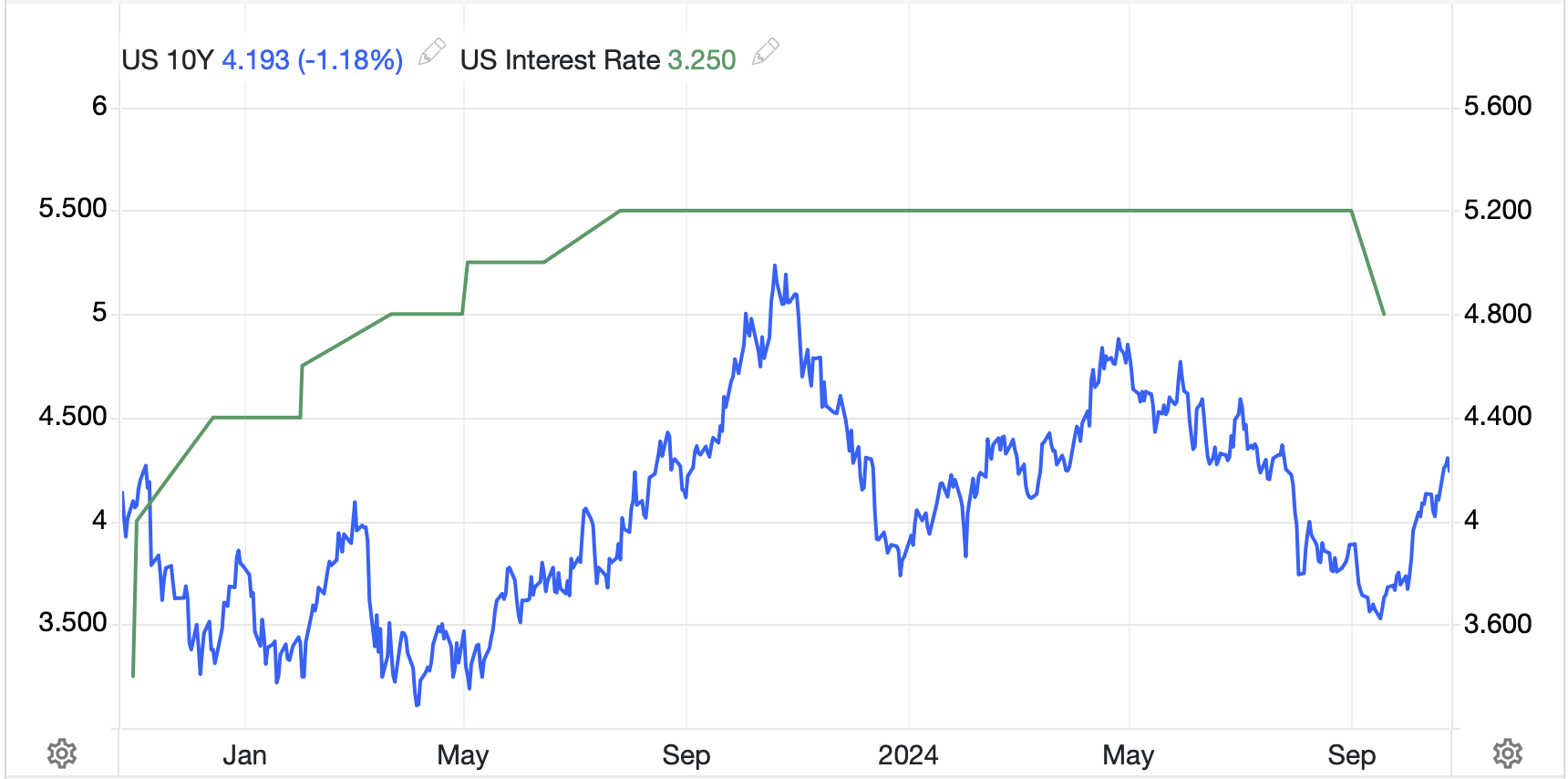
At any rate, for the next two weeks at least, and likely four years if Trump wins, I can assure you that every negative day in any financial market will be blamed on Trump and his policies, despite the fact that the Fed seems to be the one with far more direct impact on short-term economic outcomes.  A look at the below chart, showing 10yr Treasury yields and the Fed funds rate cannot help but show that it was the Fed’s rate cut that is coincident with the recent sharp rise in yields, and this took place long before the odds of a Trump victory improved.  Look through the narrative and instead at the data and Fed activities for the most important clues as to what is actually happening.  I would argue that this is a bond market that is concerned about returning inflation as the Fed’s policy prescription no longer matches the reality on the ground.

Source: tradingeconomics.com

One other thing.  If the Fed does continue to cut rates while US economic data continues to demonstrate solid growth, look for commodity prices to continue their ongoing rally, likely equity markets to continue to perform well, but the dollar is more nuanced as rising inflation ought to undermine the greenback, but given we are seeing more aggressive rate cuts elsewhere in the world (Bank of Canada just cut 50bps this week and the ECB and BOE are going to be cutting again next month), it is entirely possible the dollar holds its own despite macroeconomic fundamentals that should point to weakness.

Ok, let’s see what happened overnight.  Yesterday’s US sell-off, the third consecutive day of broad market weakness, seems to have been sufficient to wash out some of the froth in the market as US futures are pointing higher this morning, especially after Tesla’s better than expected earnings report.  But overnight, the trend from yesterday’s US session was intact with most Asian markets under pressure (Hang Seng -1.3%, CSI 300 -1.1%, KOSPI -0.7%) with only Japan (Nikkei +0.1%) bucking the trend.  In Europe, however, this morning’s color is green with all the major bourses showing life (CAC +0.75%, DAX +0.7%, FTSE 100 +0.5%). Now, there was data released in Europe with the Flash PMI readings out this morning.  The funny thing is that they did not paint a great picture, with continued softness almost everywhere.  My take is Europe is going through a ‘bad news is good’ phase where the weak PMI data implies there will be more aggressive rate cuts by the ECB going forward.  Certainly, Eurozone economic activity, led by Germany’s virtual stagnation, is lackluster at best.

In the bond markets, after several sessions of rising yields, Treasuries have seen yields slip back 5bps this morning with similar declines across the board in European sovereign markets.  Part of this is the weak PMI data I believe, but part of it is a simple trading response to a market that is likely somewhat oversold.  After all, for the past month, bonds have been under significant pressure so a bounce can be no surprise.

In the commodity markets, after yesterday’s rout, where there seemed to be a lot of profit taking of the recent rally, this morning the march higher continues.  Oil (+1.0%) is leading the energy complex higher and the entire metals complex (Au +0.5%, Ag +0.7%, Cu +0.5%, Al +0.9%) is back in gear as all the underlying drivers (rising inflation, solid demand, and for gold, ongoing geopolitical concerns) remain in place.

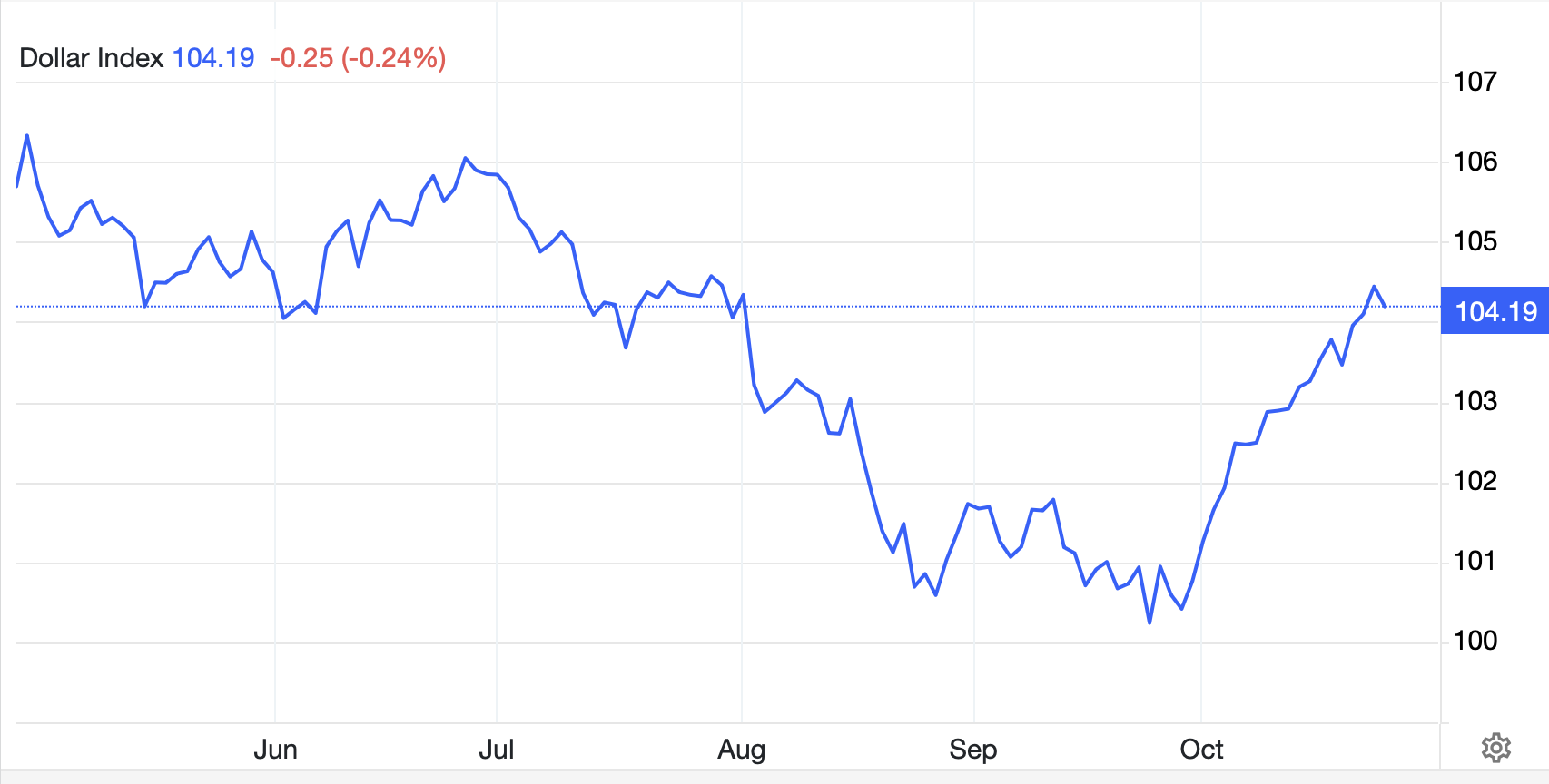
Finally, the dollar is a bit softer this morning, but this too seems like a response to what has been a strong rally.  Once again, using DXY as a proxy (see chart below) for the broad dollar, the rally over the past month has been quite strong, so a day of backing off is to be expected.  As I mentioned above, the future of the dollar is nuanced because while the macro indicators point to potential weakness, if the rest of the world eases monetary policy more aggressively, the dollar will still rally.

Source: tradingeconomics.com

As to today’s movement, currency gains have been between 0.2% and 0.5% with the commodity bloc the biggest beneficiary (ZAR +0.5%, NOK +0.4%, AUD +0.3%) and we have also seen the yen (+0.5%) regain a little of its footing amid declining US yields, although it remains far above the 150 level.  There are those who are looking for another bout of intervention, but I am not in that camp, at least not in the near-term.

On the data front, this morning brings the Chicago Fed National Activity Index (exp 0.2), Initial Claims (242K), Continuing Claims (1880K), Flash PMI (Mfg 47.5, Services 55.0) and New Home Sales (720K).  Yesterday’s Existing Home Sales data was weaker than expected at 3.84M, arguably a testament to the fact that mortgage rates have followed Treasury yields higher and are back above 7.0% again.  On the Fed front, we hear from new Cleveland Fed president Beth Hammack, but it feels like Fed speak is losing some momentum.  Nobody believes that they are going to stop cutting rates, and fewer and fewer analysts think they should continue amid strong growth.  The futures market is now pricing a 95% probability of a November cut but only a 71% probability of a December cut to follow.  I remain in the camp that they pause in December, especially in the event of a Trump victory.

While the dollar is under pressure today, I continue to believe it retains the ‘cleanest shirt in the dirty laundry’ appeal and will ultimately continue to rally.  

Good luck

Adf

Nothing But Fearporn

Said Logan, right now things are cool
With loads of reserves in the pool
And if I’m correct
The likely effect
Is rates will remain our key tool
 
As such, talk of balance sheet woes
Is nothing but fearporn, God knows
We’ll let bonds mature
Though we are unsure
Of how many we need dispose


“If the economy evolves as I currently expect, a strategy of gradually lowering the policy rate toward a more normal or neutral level can help manage the risks and achieve our goals,” explained Dallas Fed President Lorrie Logan on Monday. “However, any number of shocks could influence what that path to normal will look like, how fast policy should move and where rates should settle.”

In other words, we want to keep up appearances but we have no real idea how things are going to play out and so whatever we think our policies are going to be right now, they are subject to changes at any time.  It shouldn’t be surprising that the Fed doesn’t really know where things are going to go, after all, predicting the future is very hard.  But for some reason, many folks, both market focused and politicians, seem to believe they should be able to forecast well and control the outcomes.

Based on the market reaction to Logan’s comments, market participants, at least, are losing some of that confidence.  Treasury yields jumped 11bps in the 10-year dragging the entire yield curve higher along with all of Europe.  And perhaps more ominously for the Fed’s wish list, mortgage rates also rocketed to their highest level since July.  I might suggest market participants are losing their belief that the Fed is going to continue to cut interest rates as many had believed.  Fed funds futures have reduced their cut probabilities by nearly 10 points compared to yesterday as the latest example of this issue.  

And you know what else continues to benefit as those interest rates refuse to decline?  That’s right, the dollar continues to rally steadily against all comers.  Using the DXY as a proxy, the greenback has rebounded 3% from its levels around the time of the last Fed meeting as per the below chart.  I assure you, if I am correct that the Fed cuts 25bps in November and then doesn’t cut in December, the dollar will be much higher still.  Something to watch for!  

Source: tradingeconomics.com

In fact, there were four Fed speakers yesterday and three of them, including Logan, sounded more cautionary in their view of the future path of rates.  However, uber dove Mary Daly from the SF Fed is still all-in for many more cuts to come.  And this is the current situation at the Fed, I believe.  There are FOMC members who remain in the “we must cut rates at all costs” camp, who despite the evidence of the data they supposedly track remaining stronger than expected want lower rates, and there are those who are willing to reduce the pace of cuts, but still want lower rates.  This tells me that the Fed is going to continue to cut rates regardless, and so the bond market is going to become the arbiter of financial conditions.  Recent bond market movements seem more likely to be a harbinger of the future than an aberration, at least unless/until the economy weakens substantially.  In fact, you can see that the relation between bond yields and the dollar is quite strong now, something I suspect will remain true for a while going forward.

And that was really all that we had as the overnight session brought us virtually nothing new.  So, a quick recap of the overnight shows that after a lackluster session in the US on low volumes, Asia had more laggards than leaders with Tokyo (-1.4%) and Australia (-1.7%) dominating the story although China (CSI 300 +0.6%, Hang Seng +0.1%) managed to buck the trend.  The latter two, though, seemed like reactionary bounces from recent declines.  In Europe, bourses are all red this morning led lower by Spain’s IBEX (-1.1%) but seeing weakness everywhere (CAC -0.7%, FTSE 100 -0.7%, DAX -0.25%).  And, at this hour (7:45), US futures are lower by -0.5% or so.

After yesterday’s dramatic rise in yields in the US, we are seeing a continuation this morning with Treasuries edging higher by 1bp but European sovereigns all higher b between 4bps and 5bps.  That seems to be catching up to the last of the afternoon Treasury move yesterday.  As I mention above, I see the trend for yields in the US to be higher, and that should impact yields everywhere.

In the commodity markets, once again, demand is increasing and we are seeing gains in oil (+1.1%), gold (+0.6% and new all-time highs), silver (+1.7%) and copper (+0.9%).  The financial narrative is turning more and more to inflation concerns and the fact that commodities remain an undervalued and important segment in which to have exposure.  I am personally long throughout this space and believe there is much further to run here.

Finally, after the dollar’s blockbuster day yesterday, it has paused for a rest with the noteworthy gainers today all in the commodity bloc (AUD +0.5%, NZD +0.55%, MXN +0.2%, ZAR +0.2%, NOK +0.4%) with most other currencies actually a bit softer vs. the buck.  Keep an eye on JPY (-0.2%) which is now firmly above the 150 level and is likely to begin to see more discussion about potential intervention soon.

There is no data of note this morning although we do hear from Philly Fed president Harker.  It will be interesting to hear if he is in the dovish or uber dovish camp, as there appear to be no hawks left on the FOMC. 

Until the election in two weeks, I suspect that volumes will remain low but trends will remain intact, so higher yields and a higher dollar seem most likely to be in our future.

Good luck

Adf

Worries Abound

That smell in the market is fear
In truth, for the first time this year
As both bonds and stocks
Are now on the rocks
And no sign t’will soon disappear
 
The Fed is remaining on hold
Though elsewhere, rate cuts are foretold
But worries abound
As risk is unwound
That everything soon will be sold


It is very difficult to get excited about much in the markets these days as we see stocks, bonds and commodities all slide in price.  The fear in markets is palpable as investors and traders clearly remember 2022, when both stocks and bonds fell sharply and those holding the traditional 60/40 portfolio got crushed.  This is not to say that we are seeing the same thing right now, but the very fact that we can have both asset classes suffer simultaneously, even for a few days, is disconcerting to everyone.

It is difficult to pin down a specific driving force right now as opposed to the 2022 scenario when the Fed was raising the Fed funds rate aggressively amid a serious bout of inflation.  But currently, there are a relatively equal number of pundits and analysts on both sides of the inflation and growth debate.  With this as the case, it doesn’t seem logical that there would be a significant trend shift.

So, this morning let’s try to consider the current stories that may be driving this recent bout of investor skepticism.  On the macro side of things, while recent data hasn’t been awful, it has hardly been scintillating.  For instance, the recent Dallas Fed Manufacturing Index was quite weak, similar to what we saw with Philly and Empire State, but the Richmond number rebounded.  While we all await this morning’s second look at Q1 GDP (exp 1.3%, down from the initial reading of 1.6%), there is much more focus on tomorrow’s PCE data.  In fact, given the dour mood in the market, it is hard to remember that the CPI data earlier this month was seen as a slight positive.  

But bigger problems reside in the Retail Sales and consumption story on the micro side of things as we have been hearing from an increasing number of companies that customers are balking at higher prices.  Retail Sales were flat in April, hardly a sign of strength, and just this morning we had Walgreens say they will be cutting prices on 1500 items in their stores in an effort to stimulate sales.  We heard bad tidings from Target earlier this month, as well as McDonalds, Starbucks and Walmart.  

It is certainly difficult to hear these reports and come away feeling bullish about either the economy or the equity markets.  Yesterday’s Fed Beige Book was its usual mix of some good and some bad, but no strong trend in either direction.  Atlanta Fed president Bostic explained yesterday that “My outlook is that if things go according to what I expect — inflation goes slowly, the labor market slowly and orderly moves back into a sort of a weaker stance, but a stable-growth stance — I’m looking at the end of the year, the fourth quarter, as the time where we might actually think about and be prepared to reduce rates.”  That sounds like a December cut, a far cry from expectations just last week, let alone the beginning of the year.

In fact, I challenge you to come up with a bullish piece of news that may drive sentiment back toward overall risk bullishness.  Arguably, the only thing around is Nvidia, which is pretty thin gruel on which to sustain a global economy!  And ask yourself, how much of that is overdone?

Looking elsewhere in the world doesn’t make you feel much better either.  For instance, in Europe, while a rate cut next week seems certain, this morning’s Unemployment release showing a decline to 6.4%, the lowest level ever recorded, is hardly cause for the ECB to get aggressive in cutting rates further.  Similarly to the US, with unemployment so low, and inflation remaining well above target, please explain why any central bank would feel compelled to cut rates.

Summing up, it is quite easy to make the case that risk assets have gotten far ahead of themselves on the hope that the global interest rate structure was going to decline thus allowing the leverage that had been implemented during the post-Covid ZIRP and NIRP regimes to be refinanced at more attractive levels.  However, as the data continues to show more resilience than expected in both the employment and inflation regimes, central banks find themselves with few good reasons to cut rates despite their very clear bias to do so.  And now that each move and utterance they make is scrutinized so closely, they have limited incentive to act.  Here’s my take; while we may see some initial rate cuts by the ECB, BOE and BOC, do not look for a long cycle absent a significant decline in inflation or sharp rise in unemployment, neither of which seems imminent.

Ok, the negativity in the US yesterday followed through to Asia with all markets lower there, some by a bunch like the Nikkei (-1.3%) and the Hang Seng (-1.3%) while others were merely down by -0.5% or so.  However, in Europe this morning, bourses have edged a bit higher with one outlier, Spain’s IBEX (+1.25%) the biggest beneficiary after inflation numbers from that nation proved cooler than expected.  Alas, at this hour (7:30) US futures are lower by -0.5% or so after a weak Salesforce earnings report last night.

In the bond market, the last two days of higher yields has halted for now with Treasury yields lower by 2bps and European sovereigns trading in a similar manner.  Yesterday’s 7-year Treasury auction was also soft, although the bid-to-cover ratio was 2.37, not as low as the 5-year the day before.  However, confidence in the ability of the market to continue to absorb the number of Treasuries required to fund the government deficit appears to be slipping, at least a little.

In the commodity markets, oil is unchanged this morning, consolidating its recent gains as traders await the latest OPEC news from a meeting scheduled for next week.  In the metals markets, gold is also little changed this morning but both silver and copper are under pressure as they continue to give back some of their recent substantial gains.  For instance, even after today’s -2.2% performance in silver, it is higher by 4% in the past week and 17% in the past month.  

Finally, the dollar is under some pressure this morning following several days of strength on the back of the higher US yield story.  The biggest G10 movers are CHF (+0.7%) and JPY (+0.6%) as the former responds to comments from the SNB hinting that further rate cuts may be delayed over concerns of the franc weakening too quickly, while the latter looks mostly like a trading response as there were no comments or data to drive things. After all, despite the threat of intervention, the yen has been sliding consistently of late.  In the EMG bloc, it is a different story as the only noteworthy gainer is CNY (+0.25%) while ZAR (-0.7%) on the back of uncertainty regarding the election outcome, and KRW (-0.5%) on the back of continued weakness in the KOSPI index, cannot find any support today.

On the data front, in addition to the GDP data mentioned above, we see the weekly Initial (exp 218K) and Continuing (1800K) Claims as well as the Goods Trade Balance (-$91.8B).  Alongside the GDP data are a series of other indices like Final Sales (2.0%) and Real Consumer Spending (2.5%) which are important numbers to get a more holistic view of the economy.  Of course, it wouldn’t be a day ending in “Y” if we didn’t have more Fed speakers, with two more on the docket, Williams and Logan.

It is tough to fight a sentiment that is turning negative.  While I would expect the dollar to benefit from this, right now it is a mixed picture.  I doubt either Fed speaker will break new ground, so I fear that the overall negativity is going to be today’s key theme.  Lower stocks, lower bonds and a mixed dollar like we’ve seen overnight seem likely to be what we see in the US.

Good luck

Adf

Vaporized

The powers-that-be are concerned
That Argentine voters have spurned
Advice they’ve provided
And rather decided
It’s time some new lessons were learned

And so, we cannot be surprised
The media pundits advised
Milei should step back
And take a new tack
Lest talking points get vaporized

It has been quite a slow session overnight.  There has been precious little new in the way of data or commentary of note with respect to the current economic story.  At the same time, the Thanksgiving holiday has trading desks thinly staffed and the Fed is noteworthy in its absence from the tape.  As such, the news cycle has been filled with the OpenAI saga, something far outside the scope of this poet, the ongoing political infighting that is a constant thrum in the background, and one very interesting thing, the mainstream response to the election of Javier Milei as president of Argentina.

Given the dearth of other news, and the fact that I believe this has the opportunity to be quite impactful going forward, I thought I would take a little time and discuss this further.

According to Wikipedia, which in this case I have no reason to disbelieve, Milei, while new to politics, is a serious economist.  He has earned two masters degrees in the subject, taught at university and is a widely published author on the subject.  The point is, he has very clear ideas on how economies work from a theoretical perspective and having grown up in Argentina during one of its earlier hyperinflations, from a practical aspect as well.

What makes all this so fascinating is the deluge of articles that have been published in the WSJ, Bloomberg, CNN, the New York Times, et al. which are quite keen to highlight that his views are highly unorthodox and will fail dramatically, dragging the nation into an even deeper hole.  In fact, I cannot find a single mainstream media source that believes his ideas will succeed.  However, 56% of the voters in Argentina, who are actually living through the economic disaster of the mainstream views, thought differently.

Perhaps the clearest signal of this disagreement is that the Merval, Argentina’s main equity index, rose 7.1% yesterday on the news of his election.  One need not be a conspiracy theorist to understand that if Milei is successful in righting the Argentine ship by throwing out the current orthodoxies, it will call into question everything that finance ministries throughout the G10 have been claiming and doing.  As I wrote yesterday, I believe this election has the potential to signal a beginning of a significant change in the make-up of governments around the world.  Do not be surprised when there is significant support for 3rd party candidates in the US; when AfD wins an outright majority in a state election or two in Germany; and if Mexico throws the ruling PRI out of office.  As Neil Howe and William Strauss wrote in their tour de force, The Fourth Turning, this is the time when major upheavals occur.  Be prepared for more volatility in financial markets as these changes make their way into the system.  In other words, stay hedged!

Ok, back to the markets as they currently sit.  Yesterday’s strong US equity performance found limited follow-through around the world.  Asian indices were mostly slightly lower and European indices are mixed with the DAX (+0.2%) edging higher while the CAC (-0.25%) and FTSE 100 (-0.5%) are both under pressure.  As to US futures this morning, at this hour (7:30), they are ever so slightly softer, -0.1%.

In the bond market, Treasury yields edged lower yesterday amid a relatively quiet session and are a further 1bp softer this morning.  European sovereign yields are also a touch softer, somewhere between -2bps and -4bps, generally speaking, while JGB yields fell a further 5pbps overnight and are now down to 0.69%.  This is certainly a far cry from the idea of tighter Japanese policy, although the yen continues to strengthen.  Two noteworthy aspects in the Treasury market are that the 20yr auction yesterday went off without a hitch as the tail was actually negative (the highest yield was lower than the when-issued price) and dealers only took down 9.5% of the auction.  This is a far cry from the terrible 30-year auction we saw last week.  But the other thing that is not getting much press is the fact that the yield curve continues to reinvert with the 2yr-10yr spread back to -48bps this morning.  Recall, this had fallen as low as -15bps and looked like it was about to normalize just a few weeks ago.  Arguably, investors are telling us that the prognosis for future growth is declining although they are still uncertain as to when the Fed will begin cutting rates.

Oil prices, which have rallied for the past several sessions, are a touch softer this morning as the market has become confused to the key drivers.  Does OPEC+ and its production matter more than economic activity?  Are supplies tight or loose?  I expect that we are going to continue to see uncertainty and volatile price action until something clearer shows up.  As to the metals markets, gold and silver have both rallied this morning with gold creeping back toward that $2000/oz level, although not yet breaking through.  But base metals are mixed with very minor movement.  While equity investors remain convinced the soft landing is a given, the commodity space is far less certain.

Finally, the dollar remains under pressure as sliding Treasury yields weigh on the greenback.  Once again JPY (+055%) is the leading gainer in the G10 and remarkably, CNY (+0.35%) is leading the way in the EMG space.  What is quite interesting here is that the spot USDCNY rate in the market has fallen below the fixing rate for the first time since June.  You may recall that the spot rate had been hovering at the 2% band limit for quite a while.  This is another indication that the near-term outlook for the dollar remains lower.

On the data front, we get the Chicago Fed National Activity Index (exp 0.02) and Existing Home Sales (3.9M) this morning and then the FOMC Minutes at 2:00 this afternoon.  You may recall that the Statement in the beginning of the month was seen as hawkish, but the press conference was seen as dovish and they talked about how financial conditions had tightened and helped the Fed along.  But now, those conditions have eased again.  Also, we have heard from so many Fed speakers in the interim, it is hard to believe that whatever they said three weeks ago is newsworthy.

So, with more eyes on the clock ,as folks want to get away for the holiday and are worried about travel conditions, than market conditions, I suspect today, and tomorrow and Friday, will be very quiet indeed.

Good luck

Adf

Somewhat Queasy

Though markets appeared somewhat queasy
Said Janet, it’s really quite easy
To fund wars times two
But Moody’s said ooh
Your credit is now a bit wheezy

The combo of deficit growth
As well as a Congress that’s loath
To pass any bills
Has given us chills
So downgrading debt’s due to both

Under cover of night last Friday, Moody’s put US Treasury debt on Negative watch, citing, “…the risk that successive governments will not be able to reach consensus on a fiscal plan to slow the decline in debt affordability.”  Ultimately, they criticized the combination of rising interest rates and a concern that the current polarization in Congress will prevent anything from being done about constantly growing deficits and calls into question the ultimate value of the debt.  Moody’s is the last ratings agency to maintain the Aaa rating for the world’s risk-free asset, so this is quite a blow.  

Not surprisingly, the administration disagreed with the decision as Deputy Treasury Secretary Wally Adeyemo explained,” we disagree with the shift to a negative outlook.  The American economy remains strong, and Treasury securities are the world’s preeminent safe and liquid asset.”  I don’t believe anyone is concerned that repayment in full is in question, this is simply another shot across the bow of the idea that the value of the nominal dollars that are repaid will be anywhere near what they were when originally invested.

But that was just one of the many crosscurrents that have been afflicting the macro scene and markets of late.  For instance, in the past month, we have seen better than expected data from Retail Sales, IP, Capacity Utilization, New Home Sales, GDP, Durable Goods, Personal Spending, Nonfarm Productivity and Unit Labor Costs.  That’s quite an impressive listing of reports, and the characteristic they all share is they are ‘hard’ data.  In other words, this is not survey data, but rather these are measured statistics.

Meanwhile, the prognosis for the future continues to be far less optimistic with worse than expected outcomes in Empire State Manufacturing, ISM Manufacturing and Services, Leading Indicators and Michigan Sentiment.  The common thread here is these are all surveys and subject to the whims of the person answering the question.  In fact, the only ‘hard’ data points that were worse than expected were the Nonfarm Payrolls and Unemployment Rate.  I guess we can add the Moody’s downgrade to the list of worse than expected data, but it too is subjective rather than a hard data point.

Given the widely diverging data story, it should be no surprise that there are widely divergent views on how things are going to progress from here.  In fact, I read this morning that the two best known Investment Banks, Goldman Sachs and Morgan Stanley, have pretty divergent views on what the future holds.

The bullish argument remains that despite the gnashing of teeth and clutching of pearls by the faint-hearted, the data continues to perform well and that is the best measurement of the economy.  Certainly, the Fed is using this as their crutch to maintain their higher for longer stance and fight back against anyone who claims they have overtightened policy and need to cut rates.

However, all the hard data is backward looking, so describing what has already passed.  The bulls claim that there is autocorrelation in the data, so the past is prolog.  My observation is this is generally true in a trending market, but at inflection points, things become much murkier.

Meanwhile, the bears point to the ongoing weakness in all the survey data, which shows a dour view of the future with ISM in contraction, Michigan Sentiment falling to levels only surpassed during Covid, and inflation expectations continuing to rise.  

Another perfect analogy of this dichotomy is the S&P 500, where the median stock is -36% this year while the index is +14% given the extreme narrowness of breadth.  Absent the so-called Magnificent 7*, the index is actually lower on the year.  Now, those seven stocks are part of the index and so the reality is the S&P remains higher, but if looking for a signal on the economy, the case can certainly be made that broadly speaking, things are not great.

There is one potential reason for this dichotomy of survey vs. hard data, and that is the outside world.  After all, through the lens of the ordinary American, we see two hot wars ongoing, both of which we are spending money in supporting as well as a growing divide in the country along political party lines and sides in each conflict.  Perhaps Moody’s is onto something after all.  But with all that negativity in the press, it is easy to understand why surveys look so dismal.  However, people continue to spend money for things they need and want and given there is still so much money floating around in the wake of the pandemic stimulus efforts, business continues to get done.

There is, of course, one other thing that is part of the equation and that is the presidential election that is coming in one year’s time.  If history is a guide, you can be sure that the administration will be seeking to spend as much money as possible to support reelection, although with the House in opposition, it won’t be as much as they would like.  Nonetheless, at the margin, I expect that it will be substantial enough to continue to pressure yields higher which ought to weigh on equities and support the dollar, at least ceteris paribus.

Ok, so let’s look at how markets have behaved overnight as we start the week.  In the equity space, after a massive rebound rally on Friday in the US, only the Hang Seng in Hong Kong managed any love, rising 1.3%, but the rest of the space was flat to marginally lower on the day.  However, European bourses are all firmer this morning, about 0.5% or so.  As to US futures, they are pointing slightly lower, -0.25%, at this hour (7:20).

Turning to the bond market, Treasury yields are softer by 2bps this morning, but still well off the lows seen last week ahead of the lousy 30-year auction.  I still see higher yields in the future, but I am increasingly in the minority on this view.  European sovereigns are all bid today with yields declining between -3bps and -6bps despite a dearth of new data.  In fact, if anything, from the periphery we have seen firmer inflation data from Sweden and Norway and the market is now looking for both those central banks to hike again later this month.  That does not sound like a reason to buy bonds but it’s all I’ve seen.

Turning to the commodity markets, oil (+0.3%) is edging higher this morning but is just consolidating after a terrible week last week.  Gold, too, is in consolidation, unchanged this morning but having lost some of its recent luster.  Interestingly, both copper and aluminum are firmer this morning, arguably on discussion of further Chinese stimulus that may be coming soon.

Finally, the dollar is little changed this morning, with G10 currencies all within +/-0.2% of Friday’s levels while EMG currencies are showing a similar mixed picture, although with slightly wider ranges of +/-0.4%.  It appears traders are awaiting the next key piece of information, perhaps tomorrow’s CPI.

Speaking of which, after a week that was dominated by Fed speeches (18 of them I think), we are back to some hard data with CPI tomorrow and Retail Sales on Wednesday.  

TuesdayNFIB Small Biz Optimism89.8
 CPI0.1% (3.3% Y/Y)
 -ex food & energy0.3% (4.1% Y/Y)
WednesdayPPI0.1% (1.9% Y/Y)
 -ex food & energy0.3% (2.7% Y/Y)
 Retail Sales-0.3%
 -ex autos-0.1%
ThursdayInitial Claims220K
 Continuing Claims1848K
 Philly Fed-10
 IP-0.3%
 Capacity Utilization79.4%
FridayHousing Starts1.347M
 Building Permits1.45M

Source: tradingeconomics.com

As well as all the data, we hear from eight more Fed speakers across 14 different speeches, and that doesn’t include any off-the-cuff interviews.  Waller and Williams arguably highlight the schedule, and it will be quite interesting to see if anyone is going to try to adjust Powell’s themes from last week.  I kind of doubt it.

Putting it all together tells me that today is likely to see limited activity as everyone awaits both the CPI and Retail Sales data to see if the hard data is going to start to follow the surveys or not.  As such, I see little reason for the dollar to decline very far absent a big surprise lower in the data.

Good luck

Adf

*Magnificent 7 stocks = Apple, Amazon, Alphabet, Meta, Microsoft, Nvidia, Tesla,

The Bond, or Not the Bond

The bond, or not the bond, that is the question:
Whether ‘tis nobler for the Fed to consider
That long-term yields have offered outrageous fortune,
Or to take Arms against a Sea of inflation
And in opposing it: hike rates yet again

(with deepest apologies to William Shakespeare)

For some reason, the ongoing cacophony of Fedspeak regarding whether the rise in long-term yields is helping the Fed in their efforts, or whether it is merely incidental, brought this famous soliloquy to mind.  We have had no less than eight different Fed speakers from the time Dallas Fed president Logan first mentioned the idea several weeks ago through yesterday discuss the subject with the majority continuing to latch on to the benefits for the Fed, although some dismiss the issue.  Now, in any definition of financial conditions I have ever seen, long-term yields are part of the construction, so it is perfectly reasonable to take them into account.  Clearly, the Fed is aware of this as QE was created entirely to ease financial conditions and consisted of simply buying bonds to lower long-term yields.  However, now that the Fed is in QT mode, their ability to control the long end of the curve has vanished.  In fact, if anything it is simply pushing those yields higher by removing themselves, a price-insensitive buyer, from the mix.

The problem for Chairman Powell is that whatever the Fed’s reaction function is with respect to data, the market’s reaction function to any hint that the Fed has finished tightening policy is well understood by one and all; BUY STONKS!!  The reason I believe this is a concern for Powell and co. is that they fear a rally in equities will signal an all-clear on the inflation front.  And it is abundantly clear that there is nobody on the FOMC who is prepared to claim victory over inflation.  That is exclusively the stance of the CNBC bulls and the administration sycophants who are paid to make that case specifically.  Reality, however, continues to demonstrate that inflation remains a feature of our everyday lives and I suspect that the FOMC mostly understands that.  Remember, too, that the Fed is data dependent, or so they say, which implies that they are not in a position to anticipate the death of inflation, rather they will only accept that premise when they see the body.

Where does this leave us now?  I suspect that the ongoing dance between the Fed and the markets with respect to the future of inflation will continue to play out for at least another year.  In fact, nothing has changed my view that inflation will remain well above their 2.0% target for the foreseeable future, likely finding a new home in the 3.5% +/- range.  And as long as Powell is Fed Chair, I see no indication he is willing to reverse course.  While the Fed may not hike rates again, certainly the market does not believe that is going to be the case with just a 9.6% probability of a hike in December now priced, I find it extremely difficult to believe they will cut rates anytime soon absent clear signs that we are already in a recession.

Though soft-landing bulls have all scoffed
The fact that the data was soft
In China implies
It cannot surprise
If growth worldwide can’t stay aloft

So, is a recession coming soon to an economy near you?  That is the $64 trillion question and one where there are myriad views expressed daily.  The most recent inkling that economic activity is slowing more sharply than had previously been thought was the surprisingly weak Chinese trade data, where not only did their trade surplus decline substantially (to a still robust $56.5B) but exports fell in absolute terms, they did not merely rise more slowly than imports.  The implication is that global growth is slowing more rapidly than the narrative explains.  

We already know that Europe is in a world of trouble with Germany the current sick man of the continent, but we also have seen the latest Atlanta Fed GDPNow data showing that growth in the US is slowing as well with the latest reading at 1.2%.  The UK is struggling as are many Asian nations, notably South Korea and Taiwan, or at least their export industries which are the key economic drivers there.

Another clue is the recent sharp decline in the price of oil, which has fallen -5.0% this week and ~-10% in the past month.  Clearly, a part of this price decline is based on the growing belief (hope?) that the Israeli-Palestinian conflict will not spread into a wider Middle East conflagration that affects oil production.  But part of this is the fact that oil inventories are building as are gasoline and diesel inventories with the result that prices are falling sharply.  Given it wasn’t that long ago when there were shortages in these products, it appears that demand is falling sharply as well.  Remember, diesel fuel is what drives the world as essentially no industry or commerce could continue without its use.  The fact that less is being used is a clear signal of slowing activity.

Putting it all together shows that amidst what appears to be a slowing global growth impulse, markets are pricing out further central bank monetary policy tightening.  Equity markets have been looking at the second part of that equation, less tightening and potential easing, while ignoring the first part, slower growth leading to lower profits.  It is very easy, at least for me, to accept the idea that markets have not yet understood that slower economic activity will lead to lower profits and subsequently, lower equity prices.  Alas, I understand that sequence so remain quite cautious overall.

Ok, how has this translated overnight?  Well, after a modest rally in the US yesterday, equity markets in Asia were a bit softer, declining on the order of -0.35% while European bourses are edging slightly higher this morning, maybe +0.1%.  US futures at this hour (7:45) are basically unchanged as we all await Chairman Powell’s dulcet tones at 10:15 this morning.

Bond yields are also quiet this morning with Treasuries (+2bps) one of the larger movers as European sovereigns are almost all unchanged right now.  It seems that the market has found a new temporary home around the 4.60% level and the yield curve inversion continues to deepen, now at -36bps.  JGB yields, which have fallen from their recent YCC-tweak induced highs, have edged up overnight by 3bps, but are at 0.85%, still far from the 1.00% target or cap or concept, whatever they are calling it now.

We already know that oil is under pressure, having fallen sharply yesterday and another -1.2% this morning.  In fact, at $76.35/bbl, it is trading at its lowest level since mid-July.  Gold, too, has been suffering, down -0.3% this morning and drifting further away from the $2000/oz level as those Middle East fears seem to dissipate.  Copper and aluminum are also under pressure on the slowing growth story worldwide.  Foodstuffs, however, are generally bid lately, as we can all discern every time we go grocery shopping.

Finally, the dollar is back to its dominant ways again, rallying vs. almost all its counterparts in both the G10 and EMG blocs.  USDJPY is marching back toward 151 this morning, the euro is back below 1.07 and the pound back below 1.23.  Meanwhile, in the EMG space, ZAR (-1.1%) is the laggard although it has competition from CLP (-0.9%), KRW (-0.7%) and HUF (-0.7%) as virtually the entire bloc is under pressure.  In fact, CNY (-0.15%) is about the best performer as the PBOC continues to prevent any significant further declines.

Aside from Powell’s speech this morning, we hear from Williams, Barr and Jefferson, but there is absolutely no data to be released.  Given the dearth of new data on the calendar, this week is going to continue to be all about the Fedspeak.  In fact, Powell speaks again tomorrow and there are 5 more speakers as well by Friday, so rather than data, this week is about parsing language.  Of course, Powell will set the tone today, and I am confident he will continue to push back on the idea the Fed is done.  But we shall see.

In the end, it still seems to me that a higher dollar is the path of least resistance.  Manage accordingly.

Good luck

Adf

Towel Throwing

Did they sell?  Or not?
The new Mr Yen, Kanda
Explained, “No comment”

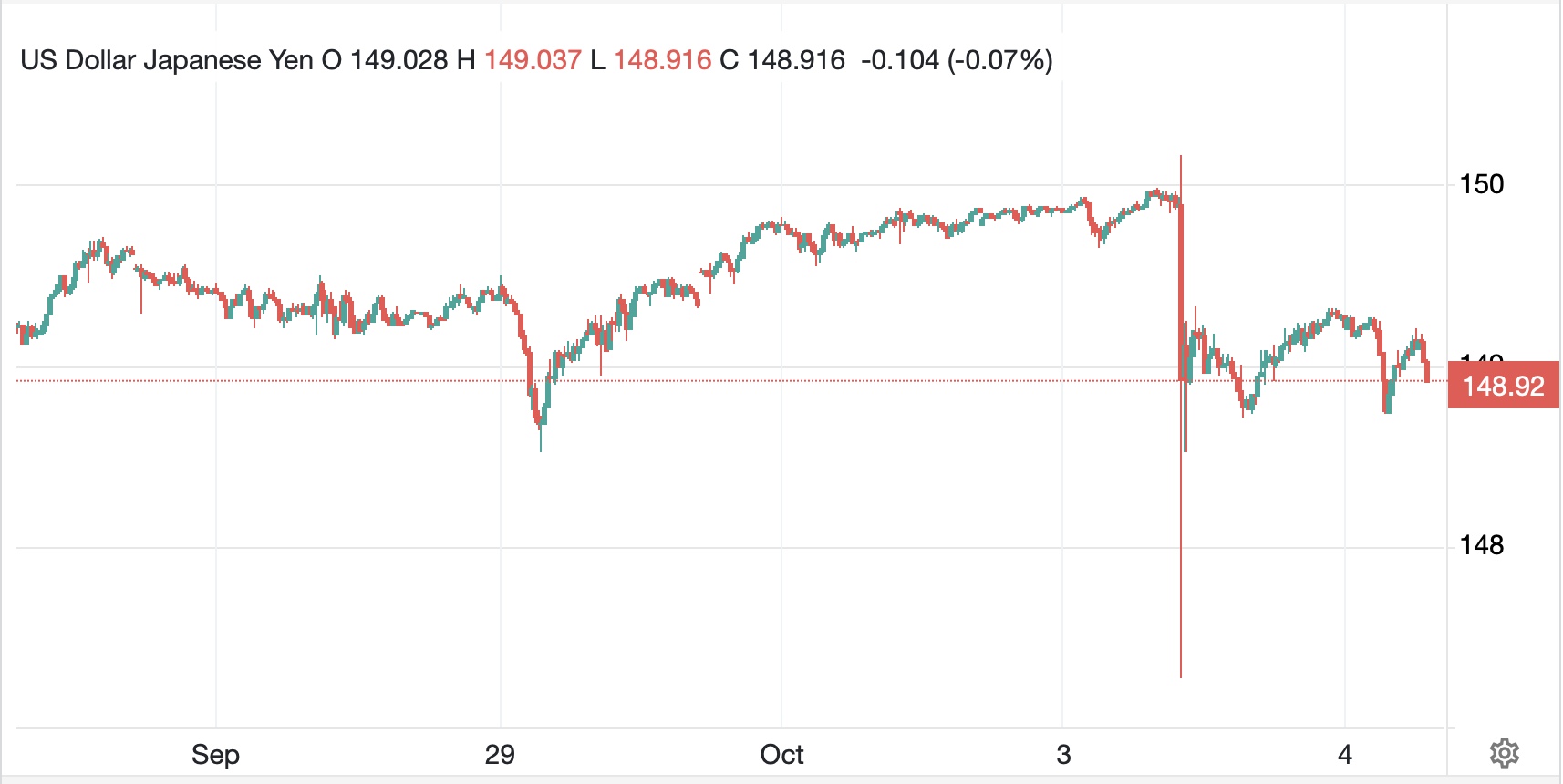
As is clear from the chart below (source tradingeconomics.com), there was a bit of movement in the USDJPY market yesterday morning.  The price action certainly had the feel of intervention, with a nearly 2% decline that occurred in seconds, but there has been neither confirmation nor denial of any BOJ trading activity.  Kanda-san, who is vice minister of international affairs which is the MOF role that deals with the currency, is the current Mr Yen.  His comments were certainly cryptic and as such, not very informative.  “We will continue with the existing stance on our response to excessive currency moves,” said Kanda. “While we are basically like a Gulliver in the market, we’re also coming and going as a market player, so usually we won’t say whether or not we’ve intervened each time,” Kanda said.  

The story that makes the most sense is that the BOJ reached out to the major Japanese banks in NY and London and checked rates.  The fact that the move happened minutes after the spot rate finally breeched the 150 level certainly was suspicious and indicated that contrary to yesterday’s comments by Watanabe-san, a former Mr Yen, the level really does matter, not just the speed of the move.  Others have tried to explain that breeching 150 triggered selling levels, but if there were exotic option barriers at 150, and I’m sure there were, the more typical move would be an acceleration higher as stop-loss orders by dealers were triggered.  The spike down, at least in my experience, is a sign of exogenous activity, not market internals.

Looking ahead, are we likely to see more of this type of activity?  You can never rule out currency support from any nation whose currency is weakening sharply, but there are G7 and G20 constructs that are supposed to limit these, and are designed to focus on volatility of movement, not levels.  This appeared contrary to those concepts, so we have much yet to learn.  At the end of the month, the BOJ will publish any intervention activity as part of their transparency initiative, but that might as well be next year for all the information it will provide.  Be wary of further movements like this, but the fundamentals continue to point to a higher USDJPY, especially given the accelerating rise in US Treasury yields.

The bond market rout keeps on going
As we see more folks towel throwing
The question at hand
Is can Powell stand
The pressure that’s certainly growing

Thus far, there’s no sign that the Fed
Is worried when looking ahead
More speakers were heard
To follow the word
That higher for longer’s not dead

Of course, away from the FX market, where the dollar has continued to show remarkable strength overall, the big story is the Treasury market.  After yesterday’s sharp move, the 10-year yield is higher by 23bps so far in October and it is only the morning of the third session of the month!  The yield curve inversion is down to -32bps and 30-year Treasury yields are pressing 5% now, a level not seen since summer 2007.  This sharp move has been the true driver of almost all markets and as long as it continues, there is going to be more pain for risk assets.  There has been no change in the fundamentals and yesterday’s move was ascribed to a much higher than expected JOLTS Job Openings number, which printed at 9.61M, far above the forecast 8.8M and a huge jump from last month’s outcome.  This seemed to encourage the Fed speakers to maintain their higher for longer attitude with a number still looking for one more rate hike this year.  Once again, I will point to Friday’s NFP number and its importance as a key driver of Fed policy.  If that number remains strong, and Unemployment remains low, the Fed can maintain this policy stance with limited fallout politically.

The rise in Treasury yields is being copied elsewhere around the world with yields following the US higher.  While today is seeing a bit of consolidation, with European sovereign and Treasury yields currently softer by 1bp-2bps, this is a trading effect, not a change of heart.  Interestingly, even JGB yields are getting dragged along higher as they closed last night at 0.80%, their highest level since 2012, the beginning of Abenomics.  But in the end, this is all about US yields with the rest of the world continuing to follow their lead.  I heard some analysts claiming this was a blow-off top in yields and we have seen the end.  Alas, I don’t believe that as history shows the yield curve will move back to a normal stance and with the Fed firmly in the higher for longer camp, 10-year yields have further to rise.  Yes, something is likely to break at some point, but so far, the few hiccups have been contained.

Not surprisingly, risk assets had a tough time in yesterday’s session with US indices all falling sharply, by -1.3% or more.  Yesterday’s European bourses were also under significant pressure and the Asian markets open overnight got hit hard as well with the Nikkei (-2.3%) and Hang Seng (-0.8%) the biggest movers.  However, this morning, Europe has a touch of green on the screen, with small gains on the order of 0.3% and US futures are also edging higher, +0.15% at this hour (7:45).  I wouldn’t read too much into this modest bounce and fear that there is further, and potentially much further, to go.  One of the remarkable things about the equity market is that earnings estimates for 2024 are for a rise of 12% on 2023 earnings.  Given the ongoing rise in energy costs and the increasing probability of a recession, those seem quite optimistic.  As they are revised lower, that, too, will weigh on equities, and by extension all risk assets.

Lastly, in the energy space, oil (-1.7%) is under further pressure this morning, although the fundamentals wouldn’t indicate that is the right move.  Not only did we see a further draw in inventories in the US, notably at the key Cushing, OK storage depot, but we heard from Russia that they are going to continue to restrict production by 300K bbl/day through the end of the year.  Meanwhile, the law in the US is set that the government cannot sell oil from the SPR when the inventory level falls below 330 million barrels.  Currently, it sits at 327 million, so that supply has ended.  Nothing has changed my view that oil has much higher to go, albeit not in a straight line.

Metals prices remain generally under pressure although gold (+0.2%) seems to be bouncing with other risk assets this morning on a technical trading basis.  However, both copper and aluminum are still sliding, typically a harbinger of weaker economic activity to come.

As to the dollar broadly, it, too, is a touch softer this morning, pulling back from highs seen yesterday in sync with all the markets.  But the same fundamentals driving the bond and stock markets are in play here, higher yields leading to more demand and a higher dollar.  Yes, this will end at some point, but we need to see a change in policy for that to happen.  The next real chance we have for something like that is on Friday with the payroll report.  A weak report, which seems unlikely at this time given the other employment indicators, would almost certainly change the market’s tone.  However, until then, look for positioning to continue to favor a stronger dollar, and for more and more dollar short sellers to get stopped out.

On the data front, this morning brings ADP Employment (exp 153K) as well as Factory Orders (-2.1%) and ISM Services (54.5).  the PMI Services data from Europe indicated that the worst may be over, but that there is, as yet, no real rebound.  We hear from a few more Fed speakers, but thus far they remain consistent, higher for longer is appropriate.

Today could see more consolidation of the recent moves across the board, but I do not believe that we have come to the end.  Calling a top or bottom is always impossible but remembering that the trend is your friend is likely to keep your activities in good shape.

Good luck

Adf

Growth Will, Fall, Free

In China when data is weak
And nothing implies there’s a peak
The answer is to
Remove it from view
And henceforth, no more of it speak

But just because President Xi
Decided there’s nothing to see
That will not prevent
The wid’ning extent
Of views China’s growth will, fall, free

Last night China released their monthly series of economic statistics, all of which were lousy.  Briefly, Retail Sales (2.5%), IP (3.7%), Fixed Asset Investment (3.4%), Property Investment (-8.5%) and Unemployment (5.3%) all missed the mark with respect to economists’ forecasts and all indicated much weaker growth than previously expected.  Conspicuously there was one data point that was missing, youth unemployment, which had been rising rapidly over the past months and in June reached a record high of 21.3%.  However, given the amount of negative press coverage that particular data point was receiving, especially in the West, it seems that President Xi decided it was no longer relevant and it will not be published going forward.  Given the broad-based weakness in all the other data, as well as the fact that there are many new graduates who would have just entered the workforce, one can only assume the number was pretty substantially higher than 21.3%.

The other news from China was that the PBOC cut their 1yr Medium-Term Lending Facility rate by 15bps in a complete surprise to the market.  As well, the 1wk repo rate was also cut by 10bps as the government there tries to address the very evident weakening economic picture without blanket fiscal stimulus.  One cannot be surprised that the renminbi weakened further, falling another -0.4% onshore with the offshore version currently -0.5% on the session.  One also cannot be surprised that Chinese equity markets were all under pressure as prospects for near-term growth continue to erode.  FYI, the renminbi is within pips of its weakest point in more than 15 years and, quite frankly, there is no indication it is going to stop sliding anytime soon.  I continue to look for 7.50 before things really slow down.

As growth increases
And inflation remains high
Can QE remain?

In contrast to the Chinese economic data, we also saw Japanese data overnight and it was a completely different story.  Q2 GDP was estimated at 6.0% on an annual basis, much higher than expected and an indication that Japan is finally benefitting from its policy stance.  While inflation data will not be released until Thursday, the current forecasts are for little change from last month’s readings.  However, remember every inflation indicator in Japan is above the BOJ’s 2% target so the question remains at what point is QE going to end?  For the FX market this matters a great deal as USDJPY is back above 145 again, and if you recall the activities last October, when USDJPY spiked above 150 briefly and the BOJ/MOF felt forced to respond with significant intervention, we could be headed for some more fireworks.  However, despite the BOJ’s YCC policy adjustment at the last BOJ meeting in July, the JGB market has remained fairly well-behaved, so it doesn’t appear there is great internal pressure to do anything yet.  The flipside of that is the US treasury market, where 10yr yields are back above 4.20% and that spread to JGBs keeps widening.  As the Bloomberg chart below demonstrates, the relationship between 10yr Treasury yields and USDJPY remains pretty tight.  Given there is no indication 10yr yields are peaking, I suspect USDJPY has further to rise.

All this, and we haven’t even touched on Europe or the UK, where UK employment data showed higher wages and a higher Unemployment Rate, a somewhat incongruous outcome.  The Gilt market has sold off on the news, with yields climbing about 6bps, but the rest of the European sovereign market is much worse off, with yields rising between 8bps and 12bps.  Treasuries are the veritable winner with yields this morning only higher by 3.5bps.

What about equities, you may ask, after yesterday’s positive US performance.  The disconnect between the NASDAQ’s ongoing strength in the face of rising US yields remains confusing to many, this poet included, as the NASDAQ, with all its tech led growth names, seems to be an extremely long duration asset.  But, another 1% rally was seen yesterday, ostensibly on the strength of Nvidia which rallied after a number of analysts raised their price target on the company amid news that Saudi Arabia and the UAE both have been buying up the fastest processors the company makes.  Well, while Japanese equities managed gains after the strong data, all of Europe is in the red, all by more than 1% and US futures are currently (7:30) lower by about -0.5%.  If US yields continue to rise, and there is no indication they are going to stop doing so in the near future, I find it harder and harder to see equity prices continue to rise as well.  Something’s gotta give.

Interestingly, the commodity space seems to be out of step with the securities markets.  Or perhaps not.  Oil (-1.0%) is down for the third day in four, hardly the sign of economic strength, as arguably the combination of rising interest rates and slowing growth in China would seem to weigh on demand.  And yet, the soft-landing narrative remains the highest conviction case among so many analysts.  So, which is it?  Soft landing with continued growth and energy demand?  Or a hard landing with energy demand falling sharply?  My money is on a harder landing, although I think energy demand will surprise on the high side regardless.  Meanwhile, both base and precious metals are under pressure today with copper (-1.6%) the laggard of the group.  Remarkably, despite ongoing USD strength, gold is still above $1900/oz, but at this point, just barely.

Speaking of the dollar, today is a perfect indication of why the dollar index (DXY) is not a very good estimator of the overall trend.  As I type, DXY is lower by about -0.2%, yet the dollar has risen against virtually every APAC currency and the entire commodity bloc in the G10.  In fact, the only currencies rising today are the euro and pound, both higher by about 0.2%.  At any rate, there is no indication that the dollar’s rebound is ending either.  This is especially true for as long as US yields continue to climb.  Think of it this way, global investors need to buy dollars in order to buy the high yielding Treasuries we now have, so demand is likely to remain robust for now.  

On the data front, Retail Sales (exp 0.4%, 0.4% ex autos) is the big number but we also see Empire Manufacturing (-1.0) and the Import and Export Price Indices.  In addition, we hear from Minneapolis Fed President Kashkari at 11:00, which is likely to have taken on more importance now that we have seen the first split on the concept of higher for longer.  Which camp will he fall into and how vocal will he be regarding the potential to cut rates next year?

But, putting it all together right now, risk is under pressure, and I see no reason for that to change today.  I guess a blowout Retail Sales number, something like 1.0% could get the bulls juices flowing, but that would likely push yields even higher and that is going to be a drag.  Either way, I like the dollar to continue to perform well here overall, especially against EMG currencies.

Good luck

Adf

Bears are All Thrilled

Kuroda explained
The future is like the past
Ergo, rates unchanged

The BOJ concluded their latest policy meeting last night and the results were…nothing changed.  Well, that’s not strictly true.  Their economic and inflation forecasts were tweaked to arrive at a revised path to the same outcome.  So, instead of faster growth this year, they decided it would be delayed a year before falling back to its long-term 1.0% trend while inflation is now forecast to jump up to… 1.1% for the next two years, from a previous expectation of 1.0%. Now that’s precision!  Kuroda-san’s term expires in April 2023 and despite 12 years of extraordinarily easy money, with QE, YCC and NIRP all employed to drive inflation higher, at this time it seems likely that he will have failed dismally in his only task.  (As an aside, I would wager if you surveyed the Japanese population, there would be scant few demands for higher prices in their purchases.  Just sayin’.)  As to the yen, it is essentially unchanged on the day and when asked about the currency, Kuroda explained it should move stably (whatever that means), but that a weaker yen would ultimately be desired.  Plus ça change.

Excitement has started to build
And bond market bears are all thrilled
With One point Eight breached
The story they’ve preached
Is finally being fulfilled

Arguably, however, the biggest story today is that the US 10-year yield has finally traded above 1.80% (as I type it is +3.2bps at 1.816%) for the first time since before the pandemic in February 2020.  For those market participants who have been preaching that rising inflation would lead to higher yields, this is a clear milestone.  Regarding the transitory vs. persistent inflation narrative, this also indicates a growing number of investors are moving toward the persistent side of the argument.  The key question, of course, is why has this happened today?  Are there specific catalysts or was it simply time?

Perhaps the first place to look is the oil market, where WTI (+1.2%) has rallied more than $1.00/bbl and is trading back above $85/bbl for the first time since October 2014.  We all know that higher oil prices tend to have a very clear impact on both actual prices and price expectations.  Today’s oil rally seems to be the result of a few different issues.  First has been the news that there was a drone attack on oil facilities in the UAE raising the specter of market disruptions from the Middle East.  A background story there is that the amount of spare capacity available in OPEC+ members may also be somewhat overstated as evidenced by the fact that OPEC’s last production increase of 400K barrels per day fell short because several members simply couldn’t pump enough to meet their quotas.  Meanwhile, demand seems pretty robust as 1) the omicron variant is quickly becoming seen as akin to the common cold and so not too disruptive; and 2) with NatGas prices so high in Europe and Asia, utilities are turning to both oil and coal to power their countries adding to oil demand.

Of course, the other key feature of the US interest rate market is forecasting what the Fed is going to do this year and how that will impact things.  It is worth noting that while 10-year yields have jumped 3+ basis points this morning, 2-year yields are higher by more than 6 basis points and back above 1.0% for the first time since before the pandemic as well.  But that means that the yield curve continues to flatten, a harbinger of slower future growth.  Now, one might expect that slower future growth would help reduce inflationary fears and ordinarily that would be a good thought.  However, there is nothing ordinary about the current policy settings nor their recent history and it is those features that are likely to drive market sentiment for at least a little longer.

Remember, monetary policy works with “long and variable lags” which historically has been calculated as somewhere between 24 and 30 months.  This implies that whatever action the Fed takes next week will not start to impact the economy until 2024.  It also means that the actions they took at the beginning of the pandemic, about 22 months ago, are likely starting to be felt in the real economy.  Money supply rose >35% for many months throughout 2020 and the early part of 2021, and it is fair to expect that the impact of all that extra cash floating around has not yet completely been seen.  The point is that inflation remains built up in the system and is likely to be with us for quite some time to come.  With this in mind, it is easy to see why yields are rising.

And there is one more thing to add to the puzzle, QT.  Remember, too, comments from a number of FOMC members hinted at an increasing desire to start reducing the size of their balance sheet.  If they do follow through with that process, it seems likely that Treasury yields will move even higher across the curve as the only price insensitive buyer leaves the market.  The question then becomes, at what point do yields rise enough to make the Treasury uncomfortable when it comes to refinancing the current debt?  I make no claims that I know where that level lies, but I remain confident that as soon as carrying costs for debt start to climb as a percentage of GDP, QT is going to end.  Summing up, there is a lot happening and it feels like we may be at the beginning of some significant trend changes.

How has all this activity impacted markets today?  You will not be surprised to know that risk has been significantly reduced across the board.  Looking at equity markets, red is the predominant color on screens this morning with only one exception, Shanghai (+0.8%) as traders react to easing monetary policy and support for property markets in China.  Otherwise, it is not pretty (Nikkei -0.3%, Hang Seng -0.4%, DAX -1.0%, CAC -1.0%, FTSE 100 -0.6%).  US futures are also under severe pressure led by the NASDAQ (-1.8%) although both the DOW and SPX are lower by -1.0% at this hour.  It seems that rising yields are pretty bad for growth stocks and I believe that story has legs.

Global bond markets had all been much softer earlier in the session but have since recouped their losses so that European sovereigns are essentially unchanged at this hour.  The one outlier, again, in Asia was China, where CGB’s saw yields decline 4.4bps last night as investors pile in looking for further policy ease.

On the commodity front, we have already discussed oil, which is by far the most interesting thing out there.  NatGas in the US is little changed on the day and actually slightly lower in Europe.  Gold (-0.3%) has fallen which should be no surprise given the rise in yields across the curve, and copper (-0.85%) is also under pressure as the flatter curve and declining stocks hint at weaker future growth.

As to the dollar, it is generally firmer this morning although not universally so.  SEK (-0.5%) is the laggard in the G10 on a combination of residual belief the Riksbank will remain relatively dovish and the beginnings of concern over election outcomes when the Swedes go to the polls in September.  After that, AUD (-0.4%) and NZD (-0.4%) are next in line, both suffering from weakness in metals and agricultural markets.  The rest of the bloc is softer by about 0.2% or so save CAD (+0.1%) which is benefitting from oil’s rise.

In the emerging markets, TRY (-0.8%) volatility continues to dominate, but INR (-0.45%), PHP (-0.45%) and HUF (-0.45%) are all under pressure as well.  The first two are feeling the effects of higher Treasury yields as well as concerns over potential CNY weakness after PBOC comments about preventing one-way trading (meaning continued strength).  As to HUF, it and the rest of the CE4 look simply to be displaying their relatively high betas with respect to the euro (-0.2%).

On the data front, Empire Manufacturing (exp 25.0) is today’s only number of note and we will need a big surprise in either direction to have a market impact.  Rather, today’s trend seems pretty clear, higher yields, weaker stocks and a stronger dollar.  Will it continue much longer?  That, of course, is the key question.

Good luck and stay safe
Adf

QE Galore

With Kaplan and Rosengren out
The hawks have lost much of their clout
This opens the door
For QE galore
With tapering now more in doubt

As well, has Jay’s rep now been stained
So much that he won’t be retained
As Chair of the Fed
With Brainerd, instead
The one that progressives ordained?

All the action is in the bond market these days as investors and traders focus on the idea that the Fed is going to begin tapering its asset purchases in November.  Not surprisingly, demand for Treasuries has diminished on these prospects with the yield curve bear steepening as 10-year and 30-year yields climb more rapidly than the front end of the curve.  In fact, this morning, 10-year Treasury yields have risen a further 3.5 basis points, which makes 22bps since the FOMC meeting, and is now trading at 1.52%, its highest level since June.  Yields are rising elsewhere in the world as well, just not quite as rapidly as in the US.  For instance, Bunds (+3.2bps today, +13bps since Wednesday), OATs (+3.1bps today, 15bps since Wednesday) and Gilts (+4.8bps today, +20bps since Wednesday) are also under severe pressure.  While the BOE has absolutely discussed the idea of tapering, the same is not true with the ECB, which instead is discussing how it is going to replace PEPP when it expires in March 2022.

By the way, there is another victim to these rate rises, the NASDAQ, (futures -1.6%) where the tech sector lives and whose valuations have moved to extraordinary heights based on their long duration characteristics.

But let us consider how recent, sudden, changes in the makeup of the Fed may impact the current narrative.  It seems that two of the more hawkish Regional Fed presidents, Boston’s Rosengren and Dallas’ Kaplan, were actively trading their personal accounts at the same time they were privy to the inside discussions at the FOMC.  I can’t imagine more useful information short of knowledge of an acquisition, with respect to how to position my personal portfolio.  When this news broke last week, there was an initial uproar and then a slow boil rose such that both clearly felt pressured to step down.  (Of course, they had already sold out their positions ahead of the tapering discussion, so don’t worry, they kept their gains!)

There are a couple of things here which I have not yet seen widely discussed, but which must be considered when looking ahead.  First, the two of them were amongst the more hawkish FOMC members, with Kaplan the first to talk about tapering and Rosengren climbing on that bandwagon several months ago with vocal support.  So, will their replacements be quite as hawkish?  It would not surprise if Dallas goes for another hawk but given the progressivity of the bulk of New England, the new Boston Fed president seems far more likely to lean dovish in my view.  So, the tone of the FOMC seems likely to change.

Perhaps of more importance, though, is that this went on under Chairman Powell’s nose with no issues raised until it became public.  That is hardly a sign of strong leadership, and the very idea that two FOMC members were trading their personal accounts on the back of inside information is a huge black mark on his chairmanship.  You can be certain that when he sits down before the Senate Banking Panel today, Senator Warren is going to be tenacious in her attacks.  The point is, the idea that Powell will be reappointed may just have been squashed.  This means that Lael Brainerd, currently a Fed governor, may well get the (poison) chalice.  Governor Brainerd, just yesterday, explained that she was not nearly ready to taper, rather that the labor market was still “a bit short of the mark” of the “substantial further progress” threshold.  In fact, she is convinced that the economy will revert to its pre-pandemic characteristics soon after the delta variant dissipates.

If you consider the implications of this new information, we could well wind up with a more dovish FOMC generally with a much more dovish Fed chair.  Ask yourself if that scenario is likely to produce a consensus to taper asset purchases?  While Jay may get the process started, assuming economic activity holds up through November, they will never end QE with that type of FOMC bias.  In fact, it would not be surprising if the Biden administration nominated someone like Professor Stephanie Kelton, the queen of MMT, for one of the open governorships.

Summing up, recent surprising actions have now opened the door for a much more dovish Fed going forward.  This means that the fight against inflation, which even Powell has begun to admit could last a bit longer than initially anticipated, is of secondary, if not tertiary, importance.  For now, the dollar is following US rates higher as spreads widen in the dollar’s favor, but if the Fed gets reconstructed in a more dovish manner, which seems far more likely this morning than last week, I would expect the dollar to find a top sooner rather than later.

However, that is all prognostication of what may happen.  What is happening right now is that yields are rising on the taper talk and risk is being jettisoned as a result.  So, equity markets are generally under pressure.  Last night saw the Nikkei (-0.2%) slip a bit while the bulk of the rest of the region suffered more acutely (Australia -1.5%), although Shanghai (+0.5%) and the Hang Seng (+1.2%) were the positive outliers.  However, that seemed more like dip buying than fundamentally led activity.  Europe is really under the gun (DAX -1.15%, CAC -1.75%, FTSE 100 -0.5%) as yields, as discussed above, rise everywhere.

Commodity prices continue to show mixed behavior as oil (WTI +0.95%) and Nat Gas (+7.5%), rise sharply on supply concerns while metals (Au -0.9%, Cu -1.3%) all suffer on the back of concerns over economic growth and the dollar’s strength.

Speaking of the dollar, it is universally higher this morning against both G10 and EMG counterparts.  NZD (-0.8%) and GBP (-0.7%) are the downside leaders this morning, with kiwi feeling pressure from falling iron ore prices while the pound turned tail recently on position adjustments as traders await a dovish BOE speaker’s comments later in the session.  But, AUD (-0.6%) is also feeling the pressure from declining metals prices and in a more surprising outcome, NOK (-0.5%) is floundering despite rising oil prices and the fact that the Norgesbank was the First G10 central bank to actually raise rates!  As well, don’t forget JPY (-0.4%) which is now pushing to its highest levels of the year and not far from multi-year highs.  Remember, high energy prices are a distinct yen negative.

EMG currencies are being led lower by ZAR (-1.0%) on weaker metals prices and THB (-0.75%) which is continuing to feel pressure from its fiscal accounts.  But here too, the weakness is widespread (KRW -0.65%, MXN -0.6%, PLN -0.6%) as the dollar is simply in substantial demand on the back of the yield benefit.

On the data front, yesterday’s Durable Goods numbers were much stronger than expected, clearly helping the rate/dollar story.  This morning brings Case Shiller House Prices (exp 20.0%) as well as Consumer Confidence (115.0) and the Advanced Goods Trade Balance (-$87.3B).  But the feature event will be the 10:00am sit down by Powell and Yellen at the Senate.  We do hear from four other FOMC members, but none will garner the same attention.  It will be interesting to hear how he parries what are almost certain to be questions about the insider trading scandal as well as more persistent inflation.  Stay tuned!

The correlation of the dollar to the 10-year yield has risen sharply in the past several sessions and is now above 60%.  I see no reason for that to change, nor any reason for yields to stop climbing right now.  While I doubt we even get back to the March highs of 1.75%, that doesn’t mean we won’t see some more fireworks in the meantime.

Good luck and stay safe
Adf