Lost In Translation

The data today on inflation
Will help tweak the latest narration
But arguably
There’s little to see
As CPI’s lost in translation
 
And too, central bankers have learned
Their comments leave folks unconcerned
Today’s BOC
Where rate cuts will be
The outcome will ne’er be discerned


It is Donald Trump’s world, and we are all just living in it.  Virtually everything that happens in any financial market these days is a result of something that President Trump has either said or done.  Obviously, tariffs are a major player, but so are the peace talks in Ukraine (good news that Ukraine has agreed a cease fire to get things started) and his domestic initiatives regarding DOGE and the shake up that has come to government from that project.  You cannot look at a business journal without reading a story about how corporate America’s CEO’s are very concerned because of all the activity as they are having difficulty planning their strategies.

While this poet endeavors to track the macroeconomic issues and how they impact markets, and one can argue that tariffs are a macro issue, the ongoing back and forth as to which products will get tariffed and when is occurring far more rapidly than is worth reporting on a daily outlook.  After all, nobody has any idea what today will bring on that front.

With that in mind, one of the other things I have discussed has been the demotion of central bankers from their previous preeminence in the world of financial markets.  Now, every one of them is simply left to respond to whatever President Trump says that day.  Consider, the Fed entered their quiet period last Friday and the fact that we have not heard a word from them is entirely inconsequential.  The Fed funds futures market is currently pricing just a 3% probability of a rate cut next week and a total of 75bps of cuts by the end of the year, but that has been true for the past several weeks.  Despite an increase in the talk of a US recession, the markets are not indicating that is a concern.

Now, that doesn’t mean that other central banks aren’t doing things, but when the BOC cuts rates by 25bps this morning, taking their base rate to 2.75%, 150 basis points below the US, nothing is going to happen in the market.  It is already widely assumed.  I guess it is possible that Governor Macklem could make some comments of note, but given that Canada remains a bit player on the world stage, does whatever he says really matter?  In fact, the only reason people are discussing Canada now is because of President Trump and his trolling former PM Trudeau and calls to make it the 51st state.  Let’s face it, the economy there is ticking along fine for now, although if their exports to the US are impaired by tariffs it will definitely hurt them.  Meanwhile, other than a huge housing bubble, nobody really notices them.  After all, their economy is roughly $2.3 trillion, smaller than that of Texas.

We have also heard from Madame Lagarde recently as she tries to calm European leaders’ nerves while the ECB tries to manage their policy around US fiscal gyrations.  However, the most concerning information from there has been her confirmation that the ECB is pushing forward with their central bank digital currency (CBDC) project, looking to get things started in October of this year.  This contrasts with President Trump’s EO that the US will not pursue a CBDC and there is currently legislation in Congress to enshrine that into law.  My personal view is a CBDC would be very concerning given its inherent reduction in individual liberties.  While the current setup is for the euro to rise relative to the dollar, it is not clear to me that will remain the case in the event the digital euro comes into being.  In fact, it would not surprise me if many Europeans decided that holding dollars was a much better idea than holding euros in that environment.  But that is a story for the future.

As to today, CPI is set to be released with the following median expectations; headline (0.3%, 2.9% Y/Y) and core (0.3%, 3.2% Y/Y).  Both of those annualized numbers are one tick lower than last month’s outcomes, so would help the Fed narrative that inflation is falling back to their target.  But again, absent a major discrepancy, something like a 0.1% or 0.5% reading on the core number, I don’t think it will have any market impact across any market.  Data is just not that important these days.

Let’s turn to the overnight session to see how things are behaving in the wake of yesterday’s late US equity rebound, where while the indices all finished lower, they were well off the daily lows.  In Asia, the picture was very mixed with some major gainers (Korea +1.5%, Indonesia +1.8%, Taiwan +0.9%) and some major laggards (Thailand -2.5%, Malaysia -2.3%, Australia -1.3%, Hong Kong -0.8%) with both Japan and mainland China showing little movement.  In Europe, after a down day yesterday, this morning is seeing a solid rebound across most major markets with the DAX (+1.8%) leading the way followed by the CAC (+1.4%) and FTSE 100 (+0.6%).  Some solid earnings reports and ongoing hope belief that European defense spending will ramp up seems to be the drivers.  As to US futures, at this hour (7:30) they are firmer by 0.8% ish across the board.

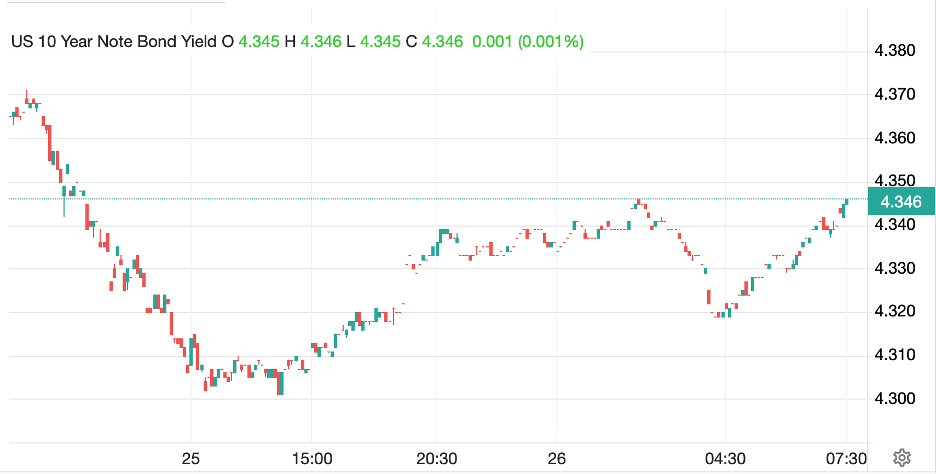
In the bond market, after Treasury yields climbed 7bps yesterday, this morning they have edged a further 1bp higher.  The big domestic story is the continuing resolution which was just passed by the House and now sits at the Senate.  If it is not passed by Friday, the government will shut down, although it is not clear to me how that can be more disruptive than the way things have been operating for the past 6 weeks!  Meanwhile, European sovereign yields are also edging higher with German bunds (+4bps) leading the way as the ongoing discussion over breeching the debt brake continues and concerns over massive new issuance remain front and center.   Elsewhere in Europe, yields have risen as well, but generally by only 1bp or 2bps.  Last night, JGB yields didn’t move at all.

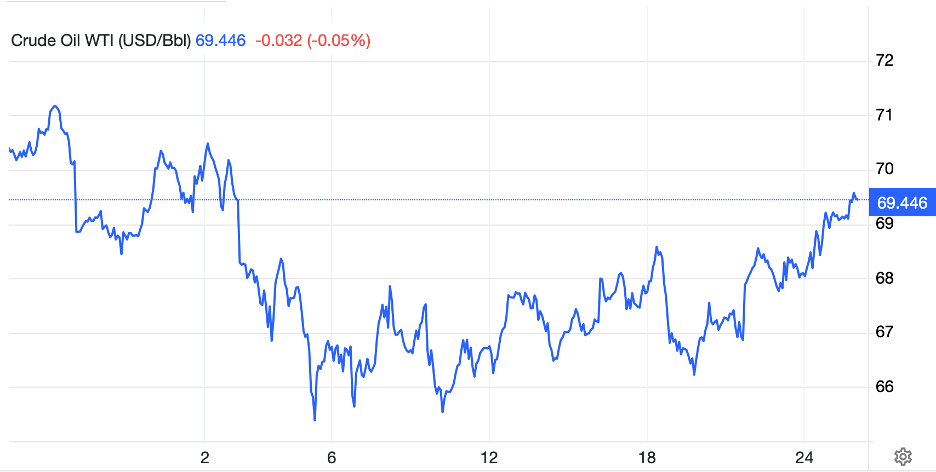
In the commodity bloc, oil (+1.1%) is continuing to bounce along the bottom of its trading range as per the below chart.

Source: tradingeconomics.com

A look at the trend line there shows that, at least based on the past 6 months, there has not been any net movement of note.  The question of whether the Ukraine war ends and that allows Russian oil back into the market, out in the open, is also current, with no clear answer in sight.  Meanwhile, the metals markets continue to ignore the recession calls with silver (+0.7%) and copper (+2.3%) both strong although gold is unchanged on the day.

Finally, the dollar is bouncing slightly this morning after declining sharply in 5 of the past 7 sessions with the other two basically unchanged.  This has all the hallmarks of a trading pause as there is nothing that has altered the idea that President Trump wants the dollar lower, and his policies are going to push it in that direction.  The one big outlier this morning is CLP (+0.9%) which is tracking copper’s rally, but otherwise, the yen (-0.6%) is the only mover of note, and that also seems a trading response, certainly not a fundamental change.

And that’s really it.  CPI is the only data for the day and there are no Fed speakers.  Of course, tape bombs are the new normal and we never have any idea what President Trump or Secretary Bessent may say at any given time.  However, with that in mind, the bigger picture remains intact.  I remain negative the equity space overall as changes continue, while the dollar is likely to remain under pressure as well.  This should help the bond market, and commodities.

Good luck

Adf

Trumpian Thunder

No respite was found yesterday
With risk assets given away
Now traders all wonder
If Trumpian thunder
Will ever, a rally, convey
 
But from the cheap seats what seems clear
Is Trump, for right now, will adhere
To efforts to trim
The grift and the skim
A prospect his enemies fear


The only discussion in markets today is about yesterday’s sharp declines in equity markets.  Questions about how long this can continue or how long President Trump can withstand the pain that accompanies these declines are rampant.  However, thus far the indications are that he and his administration are aware of the risks but also committed to achieving his goals of more domestic manufacturing activity and a perceived fairness or leveling of the international commerce playing field.

We have heard from Trump, Bessent and Commerce Secretary Lutnick, that there is going to be some pain, but they believe it will be short-lived in nature.  And ask yourself this, given how overextended both market valuations and debt metrics had become, was there any way to address these issues (assuming you believed they were issues) without some pain?  Of course not.  I have long maintained that what needs to happen in the US economy is for markets to be allowed to clear, all markets, whether housing or financial, and that we have not seen that happen for more than 50 years.  

While perhaps the case can be made that the housing market came close to clearing in the wake of the GFC, consider what has happened since then with the implementation of waves of QE and ZIRP.  The chart below from the St Louis Fed’s FRED database shows their housing index over time.  Ask yourself if you think the housing market really cleared?  And more importantly, look at the acceleration since then.  President Trump has made clear his focus is on Main Street, not Wall Street, and it is easy to argue that a key driver of this massive rise in house prices has been the Fed and their efforts to prop up Wall Street.  Reversing that is going to be painful.  Hell, simply stopping that move will be painful.

As to equity markets, the only clearing event that we have seen was the crash of the NASDAQ after the tech bubble burst in 2000.  But again, the Fed was there cutting rates and easing policy to support things.  The best evidence that equity markets are at unsustainable levels comes from the valuation metrics, with things like the Shiller CAPE ratio pushed to levels only ever seen in that tech bubble, and clearly significantly above long-term mean (17.21) and median (16.03) levels with today’s current reading of 35.34.

Source: multpl.com

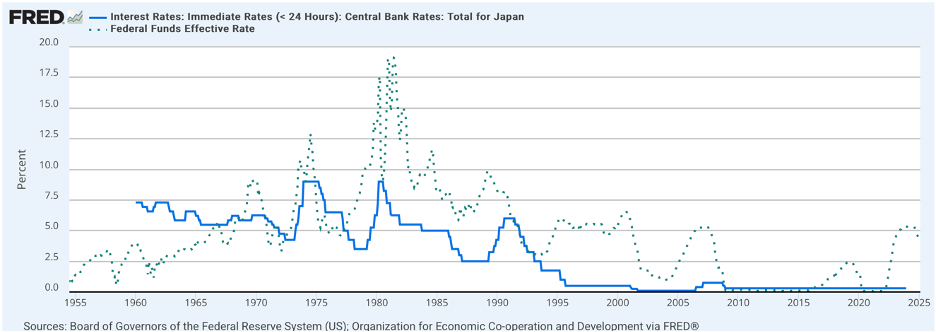
All of this is my way of saying that I do not believe we are anywhere near the end of this process.  While many of you don’t remember President Reagan, at the beginning of his first term, he stood by Fed Chairman Volcker in his efforts to squelch inflation, when Volcker raised Fed funds to 22.0% (see below) and the economy suffered two quick recessions in 1980 and 1982.  

However, that was the medicine that was needed to break inflation’s back and begin a 40-year run of stability and growth in the US amid low inflation.  It is not hard to believe that we are going to need to see another cleansing bout of austerity to once again reset the economy.  And remember, Trump is not running again, so is not worried about reelection.  If we do have a recession soon, it will likely be over and the recovery under way as we head into the next elections, a perfect political outcome for his party.

Ok, let’s see how other markets responded to yesterday’s US declines.  In Asian equity markets, Tokyo (-0.6%) slid, but nowhere near the declines seen in the US.  China (+0.3%) and Hong Kong (0.0%) basically ignored the situation, but the rest of Asia saw a lot more red on the screen with large losses seen in Korea, Taiwan, Australia, Malaysia, Singapore and the Philippines.  In Europe, though, the price action is mixed with some gainers (DAX +0.4%, CAC +0.2%) and laggards (IBEX -0.2%, FTSE 100 -0.15%) as it appears funds continue to flow from the US markets to Europe on the back of the mooted defense buildup.  US futures at this hour (7:10), are very modestly higher, 0.15% across the board, but my take is there is further pain to come.

In the bond market, yesterday saw a flight to safety with Treasury yields sliding 10bps and although we did not see similar moves in European sovereigns.  This morning, Treasury yields are unchanged from the close while European bonds are showing modestly higher yields, between 1bp and 3bps.  JGB’s though, saw yields follow Treasuries lower, dropping -6bps last night as not only did US yields fall, but Japanese Q4 GDP data was released at a weaker than preliminarily reported 2.2%.  Although that was higher than Q3, and represents solid growth, it is not quite what was in the market.

In the commodity market, oil (+0.9%) while higher this morning continues to hold its downtrend as per the below chart.  With further Russia/Ukraine peace talks starting up in Saudi Arabia, the prospects of Russian oil coming back to the market seem to be growing.

Source: tradingeconomics.com

As to the metals markets, gold (+1.0%) is the laggard this morning with both silver (+1.6%) and copper (+1.9%) leading the space higher.  If US equities are responding to a growing probability of a US recession, then I would have expected the industrial metals to soften.  However, after several down days, this could well be just a reflexive trading bounce.  We will need to see further movement to get a better sense of things.

Finally, the dollar remains under pressure generally with the euro (+0.5%) once again gaining ground and touching the 1.09 level for the first time since the US presidential election.  Not surprisingly, that has dragged the CE4 currencies higher as well, but the dollar’s weakness is seen vs. CNY (+0.4%), KRW (+0.5%), SEK (+0.45%), NOK (+0.8%) and even CAD (+0.25%).  Again, the big picture here is that the current policy aims for the US have begun to alter the concept of US exceptionalism with regards to the stock market.  As funds flow elsewhere, the dollar is quite likely to continue to decline.  This will be reinforced if we continue to see 10-year Treasury yields decline.

On the data front, while today is not very exciting, we do see CPI and PPI this week.

TodayJOLTS Job Openings7.75M
WednesdayCPI0.3% (2.9% Y/Y)
 Ex food & energy0.3% (3.2% Y/Y)
ThursdayInitial Claims225K
 Continuing Claims1910K
 PPI0.3% (3.3% Y/Y)
 Ex food & energy0.3% (3.6% Y/Y)
FridayMichigan Sentiment66.3

Source: tradingeconomics.com

We are now in the Fed’s quiet period so there are no Fed speakers until their meeting next Wednesday, but as I have been saying, nobody is really paying much attention to them anyway.  I think we have seen some major changes evolve and that means that equities are likely to remain under pressure along with the dollar, while bonds should hold their own.

Good luck

Adf

In a Trice

The calendar’s not e’en turned twice
Since Trump, with JD as his Vice
Have taken the reins
And beat up on Keynes
While weeding out waste in a trice
 
For markets, the problem, it seems
Is rallies are now merely dreams
So, equity buyers
Are putting out fires
While thinking up pump and dump schemes
 
For bondholders, it’s not so clear
If salvation truly is near
But one thing seems sure
The buck will endure
Much weakness throughout this whole year


We have not even reached 50 days of a Trump presidency as of this morning and nobody would fault you if you estimated we had three years of policies enacted to date.  The pace of changes has been blistering and clearly most politicians, let alone investors, have not been prepared for all that has occurred.

One of the things that I read regularly is that Trump is destroying the Rules Based Order (RBO) which was underpinned by the Pax Americana of the US essentially being the world’s policeman.  This is cast as a distinct negative under the premise that things were going great and now, he is upsetting the applecart for his own personal reasons.  Of course, market participants had grown quite accustomed to this framework, had built all sorts of models to profit from it and with the Fed’s help of monetization of debt, were able to gain significantly at the expense of those without market linked assets.  Hence, the K-shaped recovery.

But while that is a lovely narrative, is it really an accurate representation of the way of the world?  If the US was truly the world’s policeman, and we certainly spend enough on defense to earn that title, perhaps it was time for the US to be fired from that role anyway.  After all, there is currently raging military conflict in Ukraine, Lebanon, Syria, Congo, Sudan and the ongoing tensions in Gaza.  That’s a pretty long list of wars to claim that things were going great.

Secondly, the question of financing all this conflagration, as well as other economic goals, notably the alleged transition to net zero carbon energy production, appears to be reaching the end of the line.  While the US can still borrow as needed, (assuming the debt ceiling is raised), the reality is that the US gross national debt outstanding is greater than $36,000,000,000,000 relative to GDP that is a touch under $28,000,000,000,000.  On a global basis, total (not just government) debt is in excess of $300,000,000,000,000 while global GDP clocks in somewhere just north of $100,000,000,000,000.  Arguably, on a credit metric basis, the world is BB- or B+, a clear indication that all that debt is unlikely to be repaid.

If we consider things considering this information, perhaps the RBO had outlived its usefulness.  Arguably, the loudest complaints are coming from those who benefitted most greatly and are quite unhappy to see things change against them.  But as evidenced by the polls taken after President Trump’s speech last Tuesday evening, the bulk of the American public is still strongly supporting this agenda.  The idea that the president and his Treasury secretary are seeking to engineer a short-term recession early, blame it on fixing Biden’s mess, and having things revert to stronger growth in time for the 2026 mid-term elections is not crazy.  In fact, there have been several comments from both men that short-term pain would be necessary to achieve a stabler, long-term gain.

So, what does this mean for the markets?  You have no doubt already recognized that volatility is the main event in every market, and I don’t see that changing anytime soon.  But some of the themes that follow this agenda would be for US equities to suffer relative to other markets, as the last decade plus of American exceptionalism, led by massive deficit spending and borrowing, would reverse under this new thesis.  Add to this the sudden realization that other nations are going to be investing significantly more in their own defense, and money will be flowing out of the US into Europe, Japan and emerging markets around the world.

Bonds are a tougher call as a weaker economy would ordinarily mean lower yields, but the question of tariff impacts on prices, as well as reshoring, which, by definition, will raise prices, could mean we see the yield curve steepen with the Fed cutting rates more aggressively than currently priced, but 10-year and 30-year yields staying right where they are now.

I believe this will be a strong period for commodities as all that foreign capex will be a driver, as will the fact that, as I will discuss shortly, the dollar is likely to underperform significantly.  Gold will retain its haven characteristics as well as remain in demand for foreign central banks, while industrial metals should hold their own.  As to oil, my take is lower initially, as OPEC returns its production and slowing GDP weighs on demand, at least for a while, although eventually, I suspect it will rebound along with economic activity.

Finally, the dollar will remain under significant pressure across the board.  Clearly, Trump is seeking a weaker dollar to help the export industries, as well as discourage imports.  Add to this the potential for lower yields, lower short-term rates, and an exit of equity investors as US stocks underperform, and you have the making of at least another 15% decline in the greenback this year.

With this as backdrop, we need to touch on three key stories this morning.  First, Friday’s NFP report was pretty much in line with expectations at the headline level but seemed a bit weaker in some of the underlying bits, specifically in the Household Survey where a total of 588K jobs were lost and there was a large increase in the number of part-time workers doing so for economic reasons.  Basically, that means they wanted full-time work but couldn’t find a job.  Markets gyrated after the release, with yields initially sliding but then rebounding to close higher on the day.  Equities, too, closed higher on the day although that had the earmarks of a relief rally after a lousy week overall.  The thing about this report is that it did not include any of the government changes that have been in the press, so next month may offer more information regarding the impact of DOGE and their cuts.

The second story comes from north of the border where Mark Carney, former BOC and BOE head, was elected to lead the Labour Party in Canada and replace Justin Trudeau.  As is always the case, when there is new leadership, there is excitement and he said he will call for a general election in the next several weeks, ostensibly to take advantage of this new momentum.  It seems that President Trump’s derision of not only Trudeau, but Canada as well in many Canadian’s eyes, will play a large role with the two lead candidates, Carney and Poilievre, fighting to explain that they are each better placed to go toe-to-toe with Trump on critical issues.

Here’s the thing, though.  Despite much angst about the US-Canada relationship on the Canadian side of the border, the market viewpoint is nothing has really changed.  a look at the chart below shows that after a bout of weakness for the Loonie in the wake of the US election and leading up to Trump’s tariff announcements, USDCAD is basically unchanged since mid-December, with one day showing a spike and reversal in early February.  My point is that the market has not, at least not yet, determined that the Canadian PM matters very much.

Source: tradingecoomics.com

The last story to discuss is Chinese inflation data which was released Saturday evening in the US and showed deflation in February (-0.7% Y/Y) for CPI and continuing deflation in PPI (-2.2%).  In fact, as you can see from the below chart, PPI in China has been in deflation for several years now.  Recently there have been several articles explaining this offers President Xi a great opportunity for significant stimulus because no matter how much the government spends and how much debt they monetize, inflation won’t be a problem for a long time to come.  I would counter that given deflation has been the norm for several years, they have had this opportunity for quite a while and done nothing with it.  Why will this time be different?  Ultimately, the default result in China is when things are not looking like they will achieve the targeted growth of “about 5%”, you can be sure there will be more investment to build things up adding still more downward pressure on prices as production facilities increase.  

Source: tradingeconomics.com

The renminbi’s response to this news has been modest, at best, with a tiny decline overnight of -0.25%.  And a look at the chart there shows it is remarkably similar to the CAD, with steady weakness through December and then no real movement since then.  Given the dollar’s recent weakness overall, this seems unusual.  Although, we also know that China prefers a weaker currency to help support their export industries, so perhaps this in not unusual at all.

Source: tradingeconomics.com

Ok, this note is already overly long, so will end it here.  We do have important data later this week with both CPI and Retail Sales coming.  As well, the consensus from the Fedspeak is that they are pretty happy right here and not planning to do anything for a while.

The big picture is best summarized, I believe, by the idea that we are at the beginnings of a regime change in markets as discussed above.  Volatility continues to be the driving force, so hedging remains crucial for those with natural exposures.

Good luckAdf

Dynamited

Investors don’t seem that excited
‘Bout Germany’s now expedited
Designs to rearm
And that caused much harm
To Bunds, with their price dynamited


One of the biggest impacts of President Trump’s recent friction with Ukraine and its security is that European nations now realize that their previous ability to make butter, not guns, because the US had enough guns for everybody is no longer necessarily the case.  Mr Trump’s turn inward, which should be no surprise given his campaign rhetoric and America First goals, apparently was a surprise to most European leaders.  It seems they couldn’t believe the US would change course in this manner.  Regardless, the upshot is that Europe finds itself badly under armed and is now promising to change this.

The country best placed to start this process is Germany, where soon-to-be Chancellor, Friedrich Merz has promised a €500 billion spending spree on new defense items.  However, as the Germans don’t have this money laying around, they will need to borrow it.  The wrinkle in this plan is that enshrined in Germany’s constitution is a debt brake designed to prevent fiscal profligacy, kind of like this.  So, Merz has proposed waiving the debt brake for defense expenditures, but in order to do so, will need a two-thirds majority vote in the Bundestag (German parliament).  Now given AfD has been quite anti-war, it is not clear he will be able to obtain the requisite votes but for now, that is not the concern.

However, the German bund market clearly believes he will be successful as evidenced by the chart below. Overall, German 10-year yields rose 30bps yesterday, a dramatic move, and dragged most European sovereigns along for the ride as the new narrative is that all European nations will increase borrowing to spend on their defense.  It is worth noting, though, that the reason German yields have been so low is because the economy there has been exhibiting approximately 0% growth for more than a year as they continue to commit energy suicide seek to achieve their idealistic greenhouse gas emission goals.

Source: tradingeconomics.com

The trick, though, is that while Germany, with a debt/GDP ratio around 60%, has plenty of fiscal space to follow through, assuming they can alter their constitution, the rest of Europe is in a much more difficult spot with both France and Italy already under EU scrutiny for their budget deficits and debt/GDP ratios.  Recall, a key aspect of the Eurozone’s creation was the regulation designed to keep national budget deficits below 3% of GDP and drive the debt/GDP ratios to 60% or below.  Right now, Germany is the only nation that fits within those parameters. 

While I have no doubt that they will alter the rules as necessary elsewhere in Europe and certainly given the now perceived existential crisis for Europe, those limits are sure to be ignored, the story in Germany remains different because of the constitution.  Markets, though, clearly believe that a lot more debt is about to be issued by European nations, hence the dramatic decline in bond prices and jump in yields.  

But there are other knock-on effects here as well, notably that the euro is climbing dramatically against the dollar, up nearly 4% in the past week, and far ahead of the pound and most G10 currencies with only the SEK (+1.0% overnight, +6.1% in past week) outperforming the single currency.  For a while I have suggested that short-term rates were losing their sway over the FX markets and traders were looking at 10-year yields.  Certainly, the recent price action indicates that remains the case as Treasury yields (+2bps) have bounced off their lows but have risen far less than their G10 counterparts.  In fact, a look at the movement in 10-year government bond yields over the past month and year reveals just how significant these changes have been.

Source: Bloomberg.com

I feel safe in saying that for the next several weeks, perhaps months, this story of European defensive revival and the knock-on effects is going to be top of mind for both investors and pundits.  Only history will determine if these dramatic changes in policy stances will have been effective in reducing the chance of war or not and if they will have been beneficial or detrimental to economies around the world. As much of the current narrative is driven by politics rather than economics, punditry on the latter is going to be worse than usual.  Once again, I harken back to the need for a robust hedging plan for all those with exposures.  As recent price action across all markets demonstrates, volatility is back, and I believe here to stay for a while.

Ok, let’s run down the rest of the markets not yet discussed.  Yesterday’s US equity bounce was widely appreciated by many although this morning, futures markets are all pointing lower by between -0.75% and -1.25%, enough to wipe out yesterday’s gains.  As to Asia overnight, Japan (+0.8%) followed the US and both Hong Kong (+3.3%) and China (+1.4%) are continuing to get positive vibes from the Chinese twin meetings of policymakers.  More stimulus continues to be the driving belief there although China’s history has shown their stimulus efforts have tended to fall short of initial expectations.  As to Europe, this morning only the DAX (+0.5%) is continuing yesterday’s gains as concerns begin to grow that while Germany can afford to spend more money on defense, the rest of Europe is not in the same situation, so government procurement contracts may be less prevalent than initially hoped.  This is evident in the -0.4% to -1.0% declines seen across both the UK and most of the rest of the continent.

We’ve already discussed bonds, although I should mention that JGB yields have risen 10bps as well, up to new highs for the move and finally above 1.50%

In the commodity space, oil (+0.65%) which has had a very rough week, falling more than -5% in the past seven days, seems to be finding a bit of support.  Recall yesterday’s chart showing the bimodal distribution and that we are now in supply destruction territory.  Ultimately, that should support the price, but the timing is unclear.  In the metals markets, this morning sees red across the board, although not dramatically so, with both precious and base metals sagging on the order of -0.5%.

And lastly the dollar continues to decline, albeit not as swiftly as yesterday.  However, while it is considerably weaker vs. its G10 counterparts, versus the EMG bloc, the story is far less clear.  For instance, the only notable EMG currency gaining ground this morning is CLP (+1.2%) while virtually every other major emerging market currency is actually slipping a bit.  Look at this list; CNY -0.2%, MXN -0.25%, PLN -0.3%, ZAR -0.15%, INR -0.3% and HUF -0.5%.  I have a feeling we are going to see more behavior like this going forward, where G10 currencies are now trading on a different basis than EMG currencies.

On the data front, this morning brings Initial (exp 235K) and Continuing (1880K) Claims as well as the Trade Balance (-$127.4B) and Nonfarm Productivity (1.2%) and Unit Labor Costs (3.0%) all at 8:30.  We also hear from two more Fed speakers, Waller and Bostic later in the day.  Yesterday’s ADP employment data was much weaker than expected, falling to 77K, while the ISM Services data held up well although the prices paid piece did rise.  In addition, there has been a change in tone from the Fed speakers as we are now hearing mention of the possibility of stagflation due to the Trump tariffs, although there was no indication as to which way they will lean if that is the economic path forward.

I continue to highlight volatility as the watchword for now and the near future at least.  As long as politics has become the key driver, and as long as President Trump is that driver, given his penchant to shake things up, the one thing of which I am sure is we have not seen the last dramatic change in perception.  With that in mind, my view is the dollar will remain under pressure for a while yet.

Good luck

Adf

Things Are Creaking

Before Mr Trump started speaking
The Chinese explained things are creaking
As growth there is slow
So now they will blow
More funds to achieve what they’re seeking


The Chinese government has outlined a very active agenda for 2025 as the current pace of growth in their economy remains sluggish at best.  They continue to focus on a 5% headline GDP target and have promised to increase the budget deficit by a similar amount, so the idea of organic growth seems to be dead.  They reiterated their plan to recapitalize the big banks with CNY 500 billion and are looking to raise defense spending by 7.2%.  Long term debt issuance will increase with CNY 1.3 trillion planned for this year and they talk about adding 12 million urban jobs.  It all sounds fantastic.
 
But will it work?  Of course, there is no way to know yet, but if history is any guide, the mercantilist structure of the Chinese economy remains extremely difficult to overcome and replace with a more consumer-focused economy.  The property market there remains in terrible shape and that continues to be a drag on the overall economy as individuals, who had been encouraged to invest in property as a means of creating a retirement nest egg find themselves with much less disposable income and an illiquid and depreciating asset.
 
President Trump’s tariffs are not going to help them at all, but it is unclear if they will be significantly detrimental.  While I would not bet against China reporting 5% GDP growth in 2025, given the questionable reliability of their data, it is not clear it will be reflective of the state of the nation.
 
My take on market impacts are as follows: Chinese yields will climb as more debt is issued while growth will allegedly increase, Chinese equities should benefit If they are successful at getting things moving, but the yuan will have a harder time in my view, as capital flows to the nation remain stunted.  Of course, much will also depend on the evolution of US policy, which has been erratic, to say the least.

Said Trump, It’s a “new golden age”
As finally, we turn the page
On four years of waste
And so, we’ll make haste
With changes despite Dem outrage

Of course, the other big news was last night’s speech by President Trump to a joint session of Congress where he outlined both the many things he has accomplished in the first 6 weeks of his presidency, but also his plans for the rest of the time.  While many are still reeling from the speed with which changes are being made, there was no indication that his pace is going to slow.

Mr Trump did acknowledge that there may be some short-term pain as the economy adjusts to the changes he has wrought, but he remains focused on the long-term and how to achieve a strong economy with a far better balance sheet and a smaller government.  The implication is that he is still the avatar of volatility, and that aspect will not be changing.

Let us, though, take a step back and look at a much bigger picture.  For the past seventeen years, the US economy was the clear leader in global growth with massive government spending and budget deficits incurred to drive the process.  Meanwhile, while most of the rest of the world exited the pandemic with a burst of reopening growth, they have all lagged the US.  The chart below shows the ratio of the MSCI US index / MSCI World index and demonstrates that investment into the US, following that leading growth profile, has been historic in its effects.

Source: longtermtrends.net

But that situation seems to be changing.  President Trump is openly seeking to reduce the size of the US government and withdraw spending on many foreign adventures while the rest of the world is doing the opposite.  As per the above, China has just announced significant new stimulus.  As well, Europe, now that they need to become more responsible for their own defense, has also announced a major spending plan to rearm themselves.  This is the real sea change, I think, and the one that is going to have the biggest medium and long-term impacts on markets everywhere.  Changes in the level of capital flows and changes in trade patterns are going to significantly impact the value of the dollar as well as stocks, bonds and commodities.  It is a brave new world, so attention must be paid.

In the meantime, let’s see the markets’ initial response to the recent spate of news.  The tariff news has served to undermine US equities for the past two sessions and is still dragging on some markets, but the new spending promises are the new drivers.  So, in Asia, while the Nikkei (+0.2%) managed only a modest rally, the Hang Seng (+2.8%) exploded higher on the Chinese stimulus story although surprisingly, the CSI 300 (+0.5%) did not do nearly as well.  But elsewhere in the region, it was mostly large gains with Korea, India, Taiwan, Indonesia and Thailand all rallying more than 1%.  The laggards were Australia and New Zealand, which seemed to focus on the negatives of tariffs.

In Europe, Germany’s DAX (+3.4%) is the beneficiary of most of the mooted defense spending as not only are there quite a few defense focused firms, but rumors are that the government is going to coopt the auto manufacturers into building defense equipment (shades of WWII).  As well, the rest of the continent is flying (CAC +1.9%, IBEX +1.6%) and even the UK (+0.45%) is benefitting although there is growing concern that the BOE is not going to be aggressively cutting rates to support the economy because of still sticky inflation.  As to US futures, they are bouncing this morning and higher by 0.4% at this hour (7:00).

In the bond market, while Treasury yields rebounded from their recent lows yesterday, gaining 9bps on the day, this morning they are unchanged.  However, a look at European sovereigns tells the story of investors anticipation of a big uptick in new issuance to fund that defense spending.  The picture below is that of German yields, as an example, showing its 20bp rise this morning, but the entire continent has seen yields rise by at least 16bps!

Source: tradingeconomics.com

The market clearly believes the Europeans are going to move forward!

In the commodity markets, oil (-1.6%) remains under pressure as despite the mooted fiscal stimulus, there continues to be more concern over excess supply than newly created demand.  The below chart is quite interesting as a history of long-term price activity in oil with the interpretation that if we are near the supply destruction level, the future for prices is likely to be bullish.  Something to keep in mind. (as an aside, Josh_Young_1 is an excellent follow on X for oil ideas and information.)

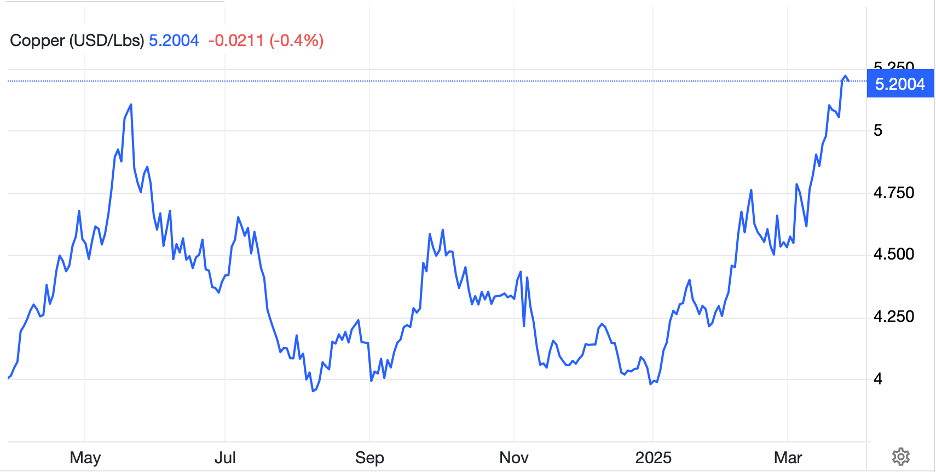
As to the metals markets, gold is little changed but copper (+4.7%) has clearly gotten excited over the Chinese stimulus as well as the European defense spending, where copper will be an important piece of the puzzle.

Finally, the dollar is under substantial pressure this morning vs. both G10 and EMG currencies.  Given the yield changes, and my view that 10-year yields have become the FX driver, rather than short-term rates, it should be no surprise that the euro (+0.6%) is rallying to levels not seen since November.  The pound (+0.3%) is following suit, also making 5-month highs.  But the really impressive moves are in the peripheral European currencies with SEK (+1.1%) and PLN (+1.1%) both trading back to levels not seen since September.  On the tariff front, both MXN (+0.25%) and CAD (+0.1%) are lagging the main move but still managing a very modest rally v. the greenback.

In this brave new world, where the US is not the fiscal profligacy leader, but that role is assumed by others, my sense is that the dollar may well have topped for a much longer-term period.  While at the beginning of the year I was confident that the dollar would outperform, the policy changes we have seen since then have altered my views.  While volatility will still be rampant, I believe the broad direction will be a lower dollar going forward.

On the data front, this morning brings ADP Employment (exp 140K) as well as ISM Services (52.6) and Factory Orders (1.6%).  Then we see the EIA oil inventories where a small draw is expected and at 2:00pm, the Fed’s Beige book.  Perhaps the best thing about the changing world order is that central banks are losing some of their market power.  As I wrote yesterday, perhaps US rates are destined to fall as both the president and Chair Powell are keen to see that happen.

At this point, I think the dollar may have seen its highs for quite a while.  Remember, FX trends tend to be very long-term in nature.  For those of you who are payables hedgers, keep that in mind going forward.

Good luck

Adf

Recession in Sight

There once was a policy view
That tariffs, we all should eschew
But President Trump
Explained on the stump
To this idea, he wouldn’t hew
 
And so, as the clock struck midnight
Trump’s tariffs once more saw the light
Most analysts say
The tariffs will weigh
On growth, with recession in sight


By now you are all aware that as of 12:01 EST this morning, 25% tariffs have been imposed on all imports from both Canada and Mexico except energy products, which have seen 10% tariffs imposed.  As well, all Chinese imports have been hit with an additional 10% tariff.  Once again, President Trump has proven to be a man of his word, promising these tariffs during his election campaign and imposing them now.

The mainstream view is that these tariffs are a disaster and will send the economy into a recession.  In fact, the International Chamber of Commerce said a depression was likely.  As well, there is much concern that inflation will rise during the recession, which for Keynesians must be a very difficult concept to grasp given their strongly held belief that a recession will result in declining inflation.

Now remember, I am just a poet, so please take that into account when I offer my views here.  First, we have no idea how things will play out.  The one thing about which I am extremely confident is that there will be numerous behavioral changes by everyone because of these tariffs.  The first question is who will absorb the cost of the tariffs.  Remember, essentially the definition of a recession is that demand is declining.  Will companies be able to pass through the higher costs?  In some instances, they likely will, but in others probably not.  Anecdotally, there was a story in the WSJ that Chipotle will see its costs rise because of the tariff on avocados from Mexico but will not change their prices to account for that.  I’m confident they are not the only company who will absorb those costs.

However, there will certainly be companies that believe they can raise prices and maintain their sales and will try to do that.  My point is each company will evaluate the environment under which they operate and respond in the profit-maximizing manner, but each company’s scenario will be different.

Second, let’s consider the reason that President Trump is such a strong believer in tariffs.  He sees them as the stick to achieve his goals.  I would argue there are two goals in sight.  With Canada and Mexico, he is still unsatisfied with their efforts on the border and with fentanyl smuggling and is very keen to push that to completion.  However, the broader goal is to return manufacturing to America from its decampment overseas, mostly to Southeast Asia, during the past forty years.  And remember, he is seeking to implement a carrot as well, looking to cut corporate taxes to 15% going forward, which would put the US in the lowest quartile of corporate tax rates in the world.  While this morning the headlines are all about the tariffs and their potential destruction, just yesterday, Taiwan Semiconductor announced they would be investing $100 billion to build new fabrication plants in Arizona.  That is exactly the response Trump is seeking.

We all recognize that the world today is very different than it was even two months ago as President Trump has taken an extraordinary number of steps to implement the ideas upon which he was elected.  Interestingly, a large majority of the public remains strongly in his camp with approval ratings for many of his policies well above 60% and as high as 80%.  While markets are clearly unhappy as they have no idea how things will play out, and companies are now faced with far more uncertainty as they attempt to plan for their future, there is no reason to believe this process is going to change anytime soon.  

Keep one other thing in mind, unlike Trump’s first term in office, where he was constantly touting the strength of the stock market as a vote of confidence, this time around he and Treasury Secretary Bessent have been entirely focused on the 10-year yield and getting that rate down.  After a 7bp decline yesterday, he has been successful there. (see chart below) I would be surprised if Trump speaks about the stock market much at all for a while.

Source: tradingeconomics.com

With that in mind, let’s see how markets have been handling the tariff imposition.  After yesterday’s rout in the US, where a higher open morphed into a sharply lower close on the day, we saw red throughout Asia (Nikkei -1.2%, Hang Seng -0.3%, CSI 300 -0.1%) and Europe (DAX -2.1%, CAC -1.2%, IBEX -2.3%).  In fact, it is far harder to find a market that has rallied at all, although US futures at this hour (6:40) are pointing slightly higher.  However, after the sharp declines, an early bounce is not uncommon though not necessarily a harbinger of activity for the day.  All of this makes sense as public companies are likely going to see impacts on their profitability either because of reduced sales or reduced margins, or both, with tariffs now in place.  (Well, private companies are going to feel the same pressures, but there are no markets for them to worry about.). The worry for investors is given the extremely high price multiples that currently exist across so many companies, margin pressures can be problematic for stock prices.  For the near term, it is easy to make the case that equities have further to fall.

In the bond market, after yesterday’s Treasury yield decline, there has been a modest 1bp bounce, although as per the above chart, the trend remains lower.  In Europe, the news just hit the tape that the Eurozone is creating a plan to rearm the continent allowing for European countries to exceed debt restrictions to enable them to borrow and spend the money on this task.  The mooted amount is €800 billion, meaning that markets can expect that much new debt issuance across the continent in the coming months and years.  However, it appears investors are viewing the situation overall and are far more concerned with potential slowing growth than on increased issuance as yields have slipped one or two basis points across all nations in Europe.  Perhaps that is a signal that there is little belief in the likelihood of this new plan coming to fruition.

In the commodity markets, oil (-1.4%) continues its slide as a combination of worries over future growth due to the US tariffs and the OPEC+ announcement that they would start to bring production back online beginning in April (just 138K bbl/day, but the signal is quite clear that more is on the way) has traders unnerved.  Certainly, this is part of what President Trump is seeking, lower oil prices to help keep a lid on inflation, and there is no doubt he has pressured OPEC+ on the issue.  Remember, too, that if gasoline prices fall at the pump, that is a key driver of inflation perceptions for everyone.  As to the metals markets, we are seeing a split this morning with precious (Au +1.0%, Ag +0.65%) rallying on uncertainty and fear while copper (-1.2%) seems to be suffering on recession fears.

Finally, the dollar is lower again this morning with the DXY breaking back below 106 for the first time since early December as a signal of the broad trend.  This is interesting as the textbooks claim that if the US imposes tariffs, the dollar will strengthen, or more accurately other currencies will weaken, to offset those tariffs, and yet this morning CNY (+0.55%) and CAD (+0.45%) are bucking that trend although MXN (-0.2%) is behaving as most would expect.  But the dollar’s weakness is broad based, and my take is given the movement in interest rates, which are suddenly declining far more rapidly than anticipated just a week ago (Fed funds futures are now pricing in 75bps of cuts this year with a 11% probability of a cut in March, up from 2% last week) the dollar bull case is under real pressure.  I have maintained all along that if the Fed reignited their easing policy, the dollar would suffer.  Funnily enough, despite any angst between Chairman Powell (remember him?) and President Trump, they both may see lower rates as their preferred outcome.  In that case, the dollar has further to fall.

There is no hard data set to be released today although we do hear from NY Fed President Williams this afternoon.  This could be the first hint that the Fed’s caution is abating, and further rate cuts are in store.  Of course, with Powell on the calendar for Friday, if there is a change in tone, most market participants will be waiting to hear it from him.

The watchword has shifted from caution to uncertainty.  The tariffs have thrown sand into the gears of the economy and markets.  It remains to be seen how much impact they will have, but for now, fear is rising although the dollar is not following suit.  I think Trump must be happy, but I’m not sure how many in the markets are.

Good luck

Adf

Balling Their Fists

The world is no longer the same
Since Trump put Zelenskiy to shame
Now Europe insists
They’re balling their fists
And this time it isn’t a game
 
But markets just don’t seem to care
That, anymore, war’s in the air
Instead, what’s decisive
Is that the new price of
All cryptos has answered their prayer


Last Friday’s remarkable live TV meeting between Presidents Trump and Zelenskiy in the Oval Office has rocked the entire world, or certainly the entire Western World.  The unwillingness of Zelenskiy to consider a ceasefire and Trump’s dismissal of him from the White House, even before lunch, has clearly changed a lot of views of how things are going to evolve from here.

The most noteworthy result is the sudden realization by the EU and NATO that the US is committed to ending the war and is not interested in spending much, if any, more money on the subject.  The response by the EU, an emergency meeting in London yesterday where every nation committed to a strong defense of Ukraine, including boots on the ground, is remarkable.  My fear is that if they proceed along these lines, and French or British soldiers are attacked/shot during the conflict, NATO will seek to invoke Article 5 and drag the US into the conflict.  Certainly, that appears to be Zelenskiy’s goal, to get the US to fight Russia on their behalf.  (Although, there are those who might say the Biden administration was using Ukraine to fight Russia on their behalf, so this is justified not surprising.). In the end, I believe this path is terrifying as that would result in two nuclear powers meeting on the battlefield, perhaps a cogent definition of WWIII.

However, there is little evidence that market participants are terribly concerned about this situation.  Perhaps they are confident that this is all bluster and ultimately President Trump’s plan of increasing US economic interests in Ukraine will be enacted and a sufficient deterrent to prevent that outcome.  Or perhaps this is a YOLO moment, where the belief is, if nuclear war destroys the world, I can’t stop it, so I better make as much money as possible now.  I recognize geopolitical risk is tough to price, but I would have expected a lot more flight to safety than so far seen.

In fact, in markets, the true story of the weekend was the announcement of a cryptocurrency reserve to be created by the US although no specific size was revealed.  While I don’t typically write on the topic, that is because the crypto space has not yet, in my view, become enough of an influence on the macro world to matter.  However, this could change that.  

Source: tradingeconomics.com

One cannot be surprised that crypto currency prices have rallied dramatically on the back of the announcement, which almost seemed timed to arrest what had been a very sharp decline in those prices recently.  It is too early to really determine if this will draw cryptocurrencies closer to mainstream economic and financial discussion, but I would argue it is closer now than it has ever been before.

In Europe, the scoop on inflation
Does not seem ripe for celebration
While CPI slipped
Most forecasts, it pipped
So, slower but not near cessation

Eurozone CPI data was released this morning and the response to the outcome is quite interesting.  The data showed that headline fell from 2.5% to 2.4%, while core fell from 2.7% to 2.6%.  Obviously, that is a step in the right direction.  Alas, analysts’ forecasts were looking for a 0.2% decline in both readings, so while the data was good, it was worse than expectations.  In a perfect encapsulation of how narrative writing is so critical, both the WSJ and Bloomberg wrote articles explaining how the declines had set the table for the ECB to cut rates at their meeting this Thursday with neither one discussing market forecasts.

Now, a look at the market response shows that European sovereign yields have all risen between 6bps and 9bps, hardly the response one would expect in a lower inflation world.  As well, with Treasury yields higher only by 5bps this morning, as they bounce from their recent declines, the euro (+0.7%) has rallied sharply on the day.  

Much has been made of the European’s new commitments to increase defense spending, especially in the wake of yesterday’s meeting discussed above, and the requisite increases in defense spending that would accompany this new stance.  However, increased European defense spending has been a story for the past many weeks as President Trump has been railing against European members of NATO for not holding up their end of the bargain.  I guess the meeting added a greater sense of urgency, but remember, not an additional dime has been spent yet, nor even legislated.  Talk is cheap!

But there you have it.  Despite what appears to be a giant step closer to a major global conflagration, the market response has been a more classic risk-on result, with bond yields rising, the dollar falling and most equity indices doing fine.  Some days, things don’t make much sense.

Time for a quick recap of overnight markets then.  Friday’s strong US equity rally was followed by strength in Tokyo (+1.7%) and Australia (+0.9%) although both Hong Kong and China were little changed in the session. It appears Chinese traders are awaiting the news from Wednesday’s NPC meeting where the government will define their economic growth targets for the current year and how they might achieve them.  In Europe, Spain (-0.1%) is the laggard with the rest of the continent doing well, led by Germany (+1.1%).  It seems there are more defense companies there to benefit from all this mooted spending than elsewhere, hence the rally. Lastly, US futures are higher by 0.35% or so at this hour (7:00).

We have already discussed bonds, where yields are higher everywhere, including Japan (+4bps) as all the war talk has investors convinced there will be a lot more government borrowing everywhere in the world going forward.

In the commodity markets, oil (+0.25%) has been trading either side of unchanged in the overnight session but seems to be consolidating after last week’s declines.  I continue to believe that if the Ukraine war does end (and I believe that will be the outcome regardless of Europe’s hawkish turn), oil prices are likely to slide further as one of the likely outcomes will be the end of sanctions against Russian oil and Russian oil transports.  Meanwhile, gold (+0.6%) which had a rough week last week, is bouncing and dragging the entire metals complex higher with it.  If war is truly in the air, gold and silver seem likely to rally further.

Finally, the dollar is under great pressure this morning across the board.  Not only is the euro higher, but only JPY (-0.4%) is weaker vs. the dollar in the G10 as this seems a very risk-on initiative.  SEK (+1.3%) is the leader, perhaps because it is on the front lines of the potential war?  Seriously, I have no explanation there.  But EMG currencies are also rallying with HUF (+2.1%) the big winner, although the entire CE4 is stronger.  Again, this makes little sense to me if the politics is pushing toward war as all those nations are on the front lines.  Meanwhile, MXN (+0.4%) is managing to rally despite the ongoing threat of tariffs to be imposed tonight at midnight.  I continue to read numerous stories on the potential impacts of tariffs with dramatically different takes.  In the end, it appears that at least some things will go up in price, although fears of widespread massive price rises seem a bit overdone.

On the data front, along with Thursday’s ECB meeting, Friday brings the payroll report and there is plenty of stuff between now and then.

TodayISM Manufacturing50.5
 ISM Prices Paid56.2
WednesdayADP Employment 140K
 ISM Services52.9
 Factory Orders1.6%
 -ex Transport0.3%
 Fed’s Beige Book 
ThursdayECB Rate Decision2.75% (current 3.00%)
 Trade Balance-$93.1B
 Initial Claims340K
 Continuing Claims1870K
 Nonfarm Productivity1.2%
 Unit Labor Costs3.0%
FridayNonfarm Payrolls153K
 Private Payrolls138K
 Manufacturing Payrolls5K
 Unemployment Rate4.0%
 Average Hourly Earnings0.3% (4.1% Y/Y)
 Average Weekly Hours34.2
 Participation Rate62.6%
 Consumer Credit$15.5B

Source: tradingeconomics.com

In addition to this, we hear from 7 more Fed speakers at 9 venues including Chairman Powell Friday afternoon at 12:30.  Now, I have made a big deal about the fact that the Fed has lost much of its sway in the market to President Trump.  I believe that Powell’s speech will tell us much about whether they are unhappy about this, or whether they will be quite comfortable sinking into the background.  Given Powell’s previous antagonistic relationship with President Trump, I would think it would be the latter.  But every central banker seems drawn to the limelight like moths to a flame, so I would not be surprised to see something more dramatic.

As things currently stand, I see the ongoing efforts to cut government spending as a critical piece of the US fiscal puzzle.  The more success that DOGE and the administration has in this process, the better the potential outcomes for the US, tariffs or not.  This could increase private sector activity and reduce the deficit, thus slowing the debt issuance, and perhaps, weighing on inflation.  However, this is a longer-term process, not something that will happen in weeks, but over quarters.  In the meantime, I cannot get past the Ukraine situation as the biggest potential risk factors around, and if escalation is in the cards, I would expect Treasury yields to decline amid growing demand while the dollar rallies along with the yen as a haven.  Hopefully not but be prepared.

Good luck

Adf

I Am Your Savior

Investors are showing concern
‘Bout tariffs and Trump, so they spurn
The riskiest stuff
But that’s not enough
To help generate a return
 
Seems most of the holdings in favor
Are no longer risk takers’ flavor
How long before Jay
Will finally say
QE is here, I am your savior


Have you bailed out on your risk exposures yet?  Because if not, it certainly seems you are behind the curve!  At least, that’s what it feels like this morning as trepidation underlies every player’s market activity.  Based on the commentary, as well as the Fear & Greed Index, you might think we are in a depression!

Source: cnn.com

But are things really that bad?  I know that the past week has seen a modest drawdown in equity prices, but after all, on February 20th, they reached yet another new all-time high, at least as per the S&P 500.  Since then, as you can see below, the decline has been less than 5%.  And while the market has traded below its 50-day moving average (blue line), a key technical indicator, it remains well above both the 200-day version of the same (purple line) and the longer-term trend line.  My point is it feels like the narrative is overstating the magnitude of the move thus far.

Source: tradingeconomics.com

Is this the beginning of the end?  While you can never rule that out, as major corrections can occur at any time, I have no reason to believe this will be the case.  Much has been made of yesterday’s Initial Claims print at 242K, much higher than forecast as a harbinger of future economic weakness.  However, looking at the past 3 years of weekly data here, while certainly in the upper levels of readings, it is not nearly the only occurrence and not nearly the highest reading.

Source: tradingeconomics.com

One data point does not make a trend and to my eye, looking at this chart, there is no discernible trend in either direction.  Yet part of the narrative evolution is that the DOGE cuts in government jobs, along with all the headline spending cuts, is setting the economy up for much slower growth in the short run.

In fact, this issue goes back to one about which I wrote several days ago here regarding the impact of government spending on actual economic activity.  The current view of economic activity includes government spending.  If President Trump’s goal is to reduce that spending, regardless of the net long-term benefits of such actions, GDP readings are going to decline initially.  Yes, there will be more productive use of capital with less regulation and less government, but that will take some time to become evident.  In the meantime, weaker economic activity is likely to be the outcome.

I have frequently written that there has not been a market clearing event since, arguably, October 1987, when equity markets plunged and erased significant excess and speculation.  Alas, newly minted (at the time) Fed Chair Greenspan stepped in and promised to support markets with ample liquidity the next day which opened the way for far more Fed intervention in markets leading up to Ben Bernanke and the first QE programs in the wake of the GFC in 2009 and every QE version since then.  While the movement so far does not remotely indicate the end of the world, based on the Fed’s history, once equity markets correct about 20%, they tend to become far more active in supporting the markets economy.  Will this time be different?  Given the Fed’s seeming underlying desperation to cut rates to begin with, my take is if the correction reaches 15% – 20%, we will see just that.

To sum things up, risk assets are under pressure on the basis of 1) excessive valuations, 2) the Trump efforts to reduce wasteful spending (which while wasteful is still spending and counted as economic activity), and 3) the idea that Trump’s imposition of tariffs is going to dramatically raise inflation and slow growth further.  Given the mainstream media’s inherent hatred of the president, they will certainly be playing up this theme for as long as they can as they try to force Trump to change tack.  But Trump, and Treasury Secretary Bessent, have been clear that their concern is 10-year bond yields, and getting them to lower levels.  A natural corollary of the current risk-off sentiment is that bond yields tend to decline.   Look at the chart below which shows that since Trump’s inauguration, 10-year yields are down nearly 40bps.  I would argue that Trump and Bessent are perfectly comfortable with the market right now.

Source: tradingeconomics.com

Ok, let’s move on to the overnight activity.  Sticking to the bond theme, while Treasuries, this morning, are unchanged, they did decline all yesterday afternoon and this morning European sovereigns are all lower by -2bps.  As well, JGB yields have also slipped by -3bps as we are seeing risk aversion evident all around the world.  Of course, the problem with all G10 nations (Germany excepted) is that they all have very high debt/GDP ratios and in Europe, especially, this is a problem as they have begun to realize they need to spend a great deal more on defense than they have in the past.  And all that spending is going to be funded by more borrowing.  The tension between additional issuance driving yields higher and risk aversion driving yields lower is going to be the theme of European bond markets for a while.

In the equity world, it is not a pretty picture anywhere in the world.  After yesterday’s US rout, with the NASDAQ (-2.8%) leading the way lower, Asian bourses were all in the red.  Japan (-2.9%), Hong Kong (-3.3%), China (-2.0%), Korea (-3.4%), India (-1.9%)… the list goes on across the entire region with only New Zealand (+0.5%) bucking the trend on some better than expected local earnings and consumer confidence data.  European markets, though, are in a bit better shape as they suffered yesterday and are consolidating those losses this morning with most markets trading +/- 0.3% on the session.  We have seen a lot of European inflation data this morning, most of it lower than forecast which has encouraged the view that the ECB will be cutting rates more aggressively going forward.  US futures, too, are higher at this hour (7:00), on the order of 0.5% as they bounce from yesterday’s, and truly the past week’s, declines.

In the commodity markets, oil (-1.25%) is back under pressure and back under $70/bbl.  The latest fear is that slowing economic activity around the world will reduce demand for the black sticky stuff and drive prices lower still.  Remember this, oil supply is restricted not by geology, but by politics.  As nations determine that cheaper energy is critical to their future, expect to see more effort to produce more oil.  Meanwhile, metals markets are also under pressure with gold (-0.5%) still falling despite its ostensible risk profile.  However, the barbarous relic remains well above $2800/oz and I continue to believe that this correction is just that, and not the reversal of a trend.  Too many things are happening around the world to induce more fear and in that scenario, gold is the oldest store of value around.  The rest of the metals complex is also under pressure with copper (-1.2%) slipping back a bit.  It is important to remember, though, that despite the recent declines, all the major metals are still nicely higher on the month.  

Finally, the dollar is a bit firmer again this morning after a rally yesterday as well.  In classic risk-off fashion, investors flocked to the dollar, arguably to buy Treasuries.  So, we are seeing weakness in NZD (-0.6%), JPY (-0.4%) and CHF (-0.3%) in the G10 and weakness in KRW (-0.5%), ZAR (-0.2%) amongst others in the EMG bloc.  Here the story remains the impacts of Trump’s tariffs and how they will be applied, if they will be applied, as well as a general fear factor which tends to help the dollar.  Consider, too, ideas that the ECB is going to cut rates will not help the single currency.

On the data front, this morning brings Personal Income (exp +0.3%), Personal Spending (0.1%), and the PCE data where Headline (0.3%, 2.5% Y/Y) and Core (0.3%, 2.6% Y/Y) will be the most important data points.  As well, we will see Chicago PMI (40.6) which has been below 50.0 in every month but one since August 2022.  

There is no question that the economic data has been softening lately.  We saw that with the Citi Surprise Index as well as the continuous stream of commentary by the economic bears who point to underlying pieces of data that point in that direction (whether housing or employment indicators and the recent weak PMI data).  

Consider this, an early recession in Trump’s term can be blamed on the Biden administration as well as set things up for future growth, certainly in time for the mid-term elections.  As well, it will likely help reduce the yield on the 10-year, an explicit goal.  This scenario likely means short-term weakness with an eye to longer term growth.  The dollar is likely to benefit early on, at least until the Fed steps in.

Good luck and good weekend

Adf

Eyes Like a Bat

The new Mr Yen
Is watching for excess moves
With eyes like a bat


While every day of this Trump presidency is filled with remarkable activity at the US government level, financial markets are starting to tune out the noise.  Yes, each pronouncement may well be important to some part of the market structure, but the sheer volume of activity is overwhelming investment views.  The result is that while markets are still trading, there seem to be fewer specific drivers of activity.  Consider the fact that tariffs have been on everyone’s mind since Trump’s inauguration, but nobody, yet, has any idea how they will impact the global macro situation.  Are they inflationary?  Will sellers reduce margins?  Will there be a strong backlash by the US consumer?  None of this is known and so trading the commentary is virtually impossible.

With that in mind, it is worth turning our attention this morning to Japan, where the yen (-0.4%) has been steadily climbing in value, although not this morning, since the beginning of the year as you can see from the chart below.

Source: tradingeconomics.com

Amongst G10 currencies, the yen is the top performer thus far year-to-date, rising about 5%.  Arguably, the key driver here has been the ongoing narrative that the BOJ is going to continue to tighten monetary policy while the Fed, as discussed yesterday, is still assumed to be cutting rates later in the year.  

Let’s consider both sides of that equation.  Starting with the Fed, just yesterday Atlanta Fed president Bostic explained to a housing conference, “we need to stay where we are.  We need to be in a restrictive posture.”  Now, I cannot believe the folks at the conference were thrilled with that message as the housing market has been desperate for lower rates amid slowing sales and building activity.  But back to the FX perspective, what if the Fed is not going to cut this year?  It strikes me that will have an impact on the narrative, and by extension, on market pricing.

Meanwhile, Atsushi Mimura, the vice finance minister for international affairs (a position known colloquially to the market as Mr Yen) explained, when asked about the current market narrative regarding the BOJ’s recent comments and their impact on the yen, said, “there is no gap with my view.  Amid high uncertainty, we have to keep watching the impact of any speculative trading on, not only the exchange market, but also financial markets overall.”  

If I were to try to describe the current market narrative on the yen, it would be that further yen strength is likely based on the assumed future narrowing of interest rate differentials between the US and Japan.  That has been reinforced by Ueda-san’s comments that they expect to continue to ‘normalize’ policy rates, i.e. raise them, if the economy continues to perform well and if inflation remains stably at or above their 2% target.  With that in mind, a look at the below chart of Japanese core inflation shows that it has been above 2.0% since April 2022.  That seems pretty stable to me, but then I am just a poet.

Source: tradingecomnomics.com

Adding it all up, I feel far better about the Japanese continuing to slowly tighten monetary policy as they have a solid macro backdrop with inflation clearly too high and looking like it may be trending a bit higher.  However, the other side of the equation is far more suspect, as while the market is pricing in rate cuts this year, recent Fed commentary continues to maintain that the current level of rates is necessary to wring the last drops of inflation out of the economy.

There is a caveat to this, though, and that is the gathering concern that the US economy is getting set to fall off a cliff.  While that may be a bit hyperbolic, I do continue to read pundits who are making the case that the data is starting to slip and if the Fed is not going to be cutting rates, things could get worse.  In fairness to that viewpoint, the Citi Surprise Index is pointing lower and has been declining since the beginning of December, meaning that the data releases in the US have underperformed expectations for the past two months. (see below)

Source: cbonds.com

However, a look at the Atlanta Fed’s GDPNow estimate shows that Q1 is still on track for growth of 2.3%, not gangbusters, but still quite solid and a long way from recession.  I think we will need to see substantially weaker data than we have to date to get the Fed to change their wait-and-see mode, and remember, employment is a lagging indicator, so waiting for that to rise will take even longer.  For now, I think marginal further yen strength is the most likely outcome as we will need a big change in the US to alter current Fed policy.

Ok, let’s see how markets have behaved overnight.  Yesterday saw a reversal of recent US equity performance with the DJIA slipping while the NASDAQ rallied, although neither moved that far.  In Asia, the Nikkei (+0.3%) edged higher as did the CSI 300 (+0.2%) although the Hang Seng (-0.3%) gave back a small portion of yesterday’s outsized gains.  The rest of the region, though, was under more significant pressure with Korea, Taiwan, Indonesia and Thailand all seeing their main indices decline by more than -1.0%.  In Europe, red is the most common color on the screen with one exception, the UK (+0.35%) where there is talk of resurrecting free trade talks between the US and UK.  But otherwise, weakness is the theme amid mediocre secondary data and growing concern over US tariffs.  Finally, US futures are nicely higher this morning after Nvidia’s earnings were quite solid.

In the bond market, Treasury yields (+4bps) have backed up off their recent lows but remain in their recent downtrend.  Traders keep trying to ascertain the impacts of Trump’s policies and whether DOGE will be able to find substantial budget cuts or not with opinions on both sides of the debate widely espoused.  European sovereign yields have edged higher this morning, up 2bps pretty much across the board, arguably responding to the growing recognition that Europe will be issuing far more debt going forward to fund their own defensive needs.  And JGB yields (+4bps) rose after the commentary above.

In the commodity markets, oil (+1.1%) is bouncing after a multi-day decline although it remains below that $70/bbl level.  The latest news is that Trump is reversing his stance on Venezuela as the nation refuses to take back its criminal aliens.  Meanwhile, gold (-1.1%) is in the midst of its first serious correction in the past two months, down a bit more than 2% from its recent highs, and trading quite poorly.  There continue to be questions regarding tariffs and whether gold imports will be subject to them, as well as the ongoing arbitrage story between NY and London markets.  However, the underlying driver of the barbarous relic remains a growing concern over increased riskiness in markets and rising inflation amid the ongoing deglobalization we are observing.

Finally, the dollar is modestly firmer overall vs. its G10 counterparts, with the yen decline the biggest in the bloc.  However, we are seeing EMG currency weakness with most of the major currencies in this bloc lower by -0.3% to -0.5% on the session.  In this case, I think the growing understanding that the Fed is not cutting rates soon, as well as concerns over tariff implementation, is going to keep pressure on this entire group of currencies.

On the data front, we see the weekly Initial (exp 221K) and Continuing (1870K) Claims as well as Durable Goods (2.0%, 0.3% ex Transport) and finally the second look at Q4 GDP (2.3%) along with the Real Consumer Spending piece (4.2%).  Four Fed speakers are on the calendar, Barr, Bostic, Hammack and Harker, but again, as we heard from Mr Bostic above, they seem pretty comfortable watching and waiting for now.

While I continue to believe the yen will grind slowly higher, the rest of the currency world seems likely to have a much tougher time unless we see something like a Mar-a Lago Accord designed to weaken the dollar overall.  Absent that, it is hard to see organic weakness of any magnitude, although that doesn’t mean the dollar will rise.  We could simply chop around on headlines until the next important shift in policy is evident.

Good luck

Adf

As It’s Been Wrote

Though China would have you believe
Their goals, they are set to achieve
Their banks are in trouble
From their housing bubble
So capital, now, they’ll receive
 
Meanwhile, with Ukraine there’s a deal
For mineral wealth that’s a steal
This will help the peace
If war there does cease
And so, it has broader appeal
 
But really, the thing to denote
Is everything is anecdote
The data don’t matter
Unless it can flatter
The narrative as it’s been wrote


Confusion continues to be the watchword in financial markets as it is very difficult to keep up with the constant changes in the narrative and announcements on any number of subjects.  And traders are at a loss to make sense of the situation.  This is evidenced by the breakdown in previously strong correlations between different markets and ostensibly critical data for those markets.  

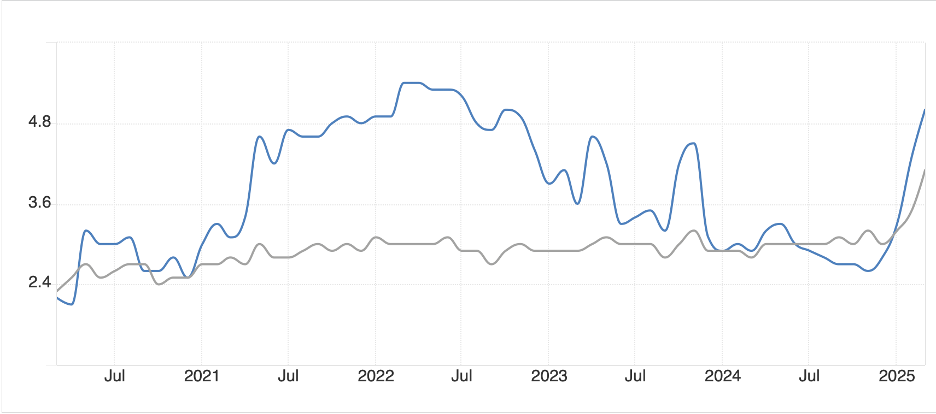
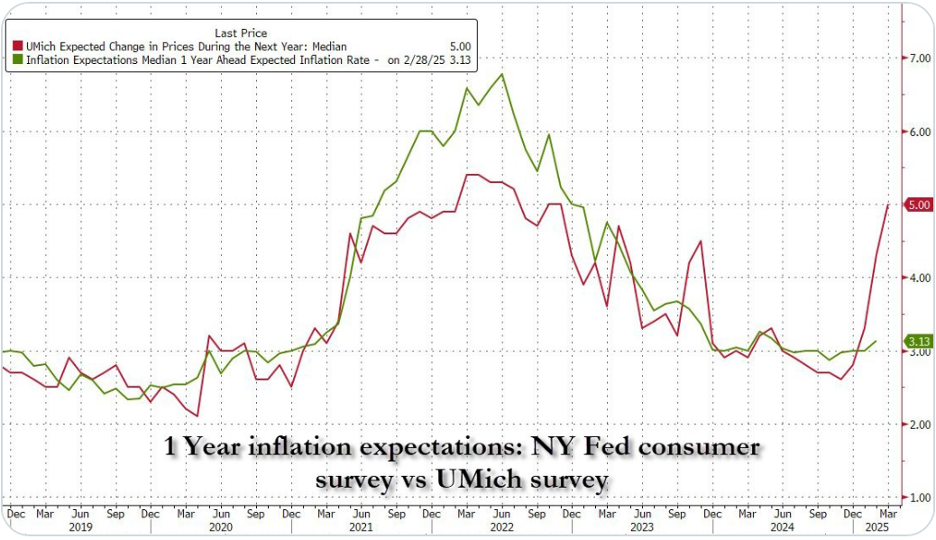
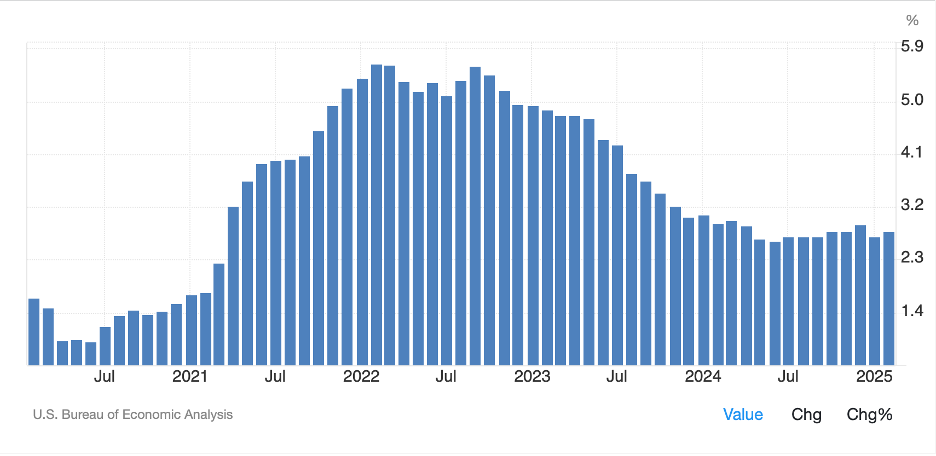
For example, inflation expectations continue to rise, at least as per the University of Michigan surveys, with last week’s result coming in at 4.3% for one year and 3.5% for 5 years.  And yet, Treasury yields continue to fall in the back end of the curve, with 10-year Treasury yields lower by nearly 15bps since that report was released on Friday.  So, which is it?  Is the data a better reflection of things?  Or is market pricing foretelling the future?

Source: tradingeconomics.com

At the same time, the Fed funds futures market is now pricing in 55bps of cuts this year, up from just 29bps a few weeks ago.  Is this reflective of concerns over economic growth?  And how does this jibe with the rising inflation expectations?  

Source: cmegroup.com

If risk is a concern, why is the price of gold declining?  

Source: cnn.com

My point is right now, at least, many of the relationships that markets and investors have relied upon in the past seem to be broken.  They could revert to form, or perhaps this is a new paradigm.  In fact, that is the point, there is no clear pathway.

Sometimes a better way to view these things is to look at policy actions at the country level as they reflect a government’s major concerns.  I couldn’t help but notice in Bloomberg this morning the story that the Chinese government is going to be injecting at least $55 billion of equity into their large banks.  Now, government capital injections are hardly a sign of a strong industry, regardless of the spin.  This highlights the fact that Chinese banks remain in difficult straits from the ongoing property market woes and so, are clearly not lending to industry in the manner that the government would like to see.  I’m not sure how injecting capital into large banks that lend to SOE’s is helping the consumer in China, which allegedly has been one of their goals, but regardless, actions speak louder than words.  Clearly the Chinese remain concerned over the health of their economy and are doing more things to support it.  As it happens, this helped equity markets there last night with the Hang Seng (+3.3%) ripping higher with mainland shares (+0.9%) following along as well.  Will it last?  Great question.

Another interesting story that seems at odds with what the narrative, or at least quite a few headlines, proclaimed, is that the US and Ukraine have reached a deal for the US to have access to Ukrainian rare earth minerals once the fighting stops.  The terms of this deal are unclear, but despite President Zelensky’s constant protests that he will not partake in peace talks, it appears that this is one of the steps necessary for the US to let him into the conversation.  Now, is peace a benefit for the markets?  Arguably, it is beneficial for lowering inflation as the one thing we know about war is it is inflationary.  If peace is coming soon, how much will that help the Eurozone economy, which remains in the doldrums, and the euro?  Will it lower energy prices as sanctions on Russian oil and gas disappear?  Or will keeping the peace become a huge expense for Europe and not allow them to focus on their domestic issues?

Again, my point is that there are far more things happening that add little clarity to market narratives, and in some cases, result in price action that is not consistent with previous relationships.  With this I return to my preaching that the only thing we can truly anticipate is increased volatility across markets.

With that in mind, let’s consider what happened overnight.  First, US markets had another weak session, with the NASDAQ particularly under pressure.  (I half expect the Fed to put forth an emergency rate cut to support the stock market.)  As to Asian markets, that Chinese news was well received almost everywhere except Japan (Nikkei -0.25%) as most other markets gained on the idea that Chinese stimulus would help their economies.  As such, we saw gains virtually across the board in Asia.  Similarly, European bourses are all feeling terrific this morning with the UK (+0.6%) the laggard and virtually every continental exchange higher by more than 1%.  Apparently, the Ukraine/US mineral rights deal has traders and investors bidding up shares for the peace dividend.  Too, US futures are higher at this hour, about 0.5% or so across the board.

As to bond yields, after a sharp decline in Treasury yields over the past two sessions, this morning, the 10-year is higher by 1bp, consolidating that move.  Meanwhile, European sovereign yields are all slipping between -2bps and -4bps as the peace dividend gets priced in there as well.  While European governments may be miffed they have not been part of the peace talks, clearly investors are happy.  Also, JGB yields, which didn’t move overnight, need to be noted as having fallen nearly 10bps in the past week as the narrative of ever tighter BOJ policy starts to slip a bit.  While the yen has held its own, and USDJPY remains just below 150, it appears that for now, the market is taking a respite.

In the commodity markets, oil (-0.25% today, -2.0% yesterday) has convincingly broken below the $70/bbl level as this market clearly expects more Russian oil to freely be available.  OPEC+ had discussed reducing their cuts in H2 this year, but if the price of oil continues to slide, I expect that will be changed as well.  Certainly, declining oil prices will be a driver for lower inflation, arguably one of the reasons that Treasury yields are falling.  So, some things still make some sense.  As to the metals markets, gold (-0.2%) still has a hangover from yesterday’s sharp sell-off, although there have been myriad reasons put forth for that movement.  Less global risk with Ukraine peace or falling inflation on the back of oil prices or suddenly less concern over the status of the gold in Ft Knox, pick your poison.  Silver is little changed this morning but copper, which had been following gold closely, has jumped 2.7% this morning after President Trump turned his attention to the red metal for tariff treatment.

Finally, the dollar is firmer this morning, recouping most of yesterday’s losses.  G10 currencies are lower by between -0.1% (GBP) and -0.5% (AUD) with the entire bloc under pressure.  In the EMG space, only CLP (+0.45%) is managing any strength based on its tight correlation to the copper price.  But otherwise, most of these currencies have slipped in the -0.1% to -0.3% range.

On the data front, New Home Sales (exp 680K) is the only hard data although we do see the EIA oil inventory numbers with a small build expected.  Richmond Fed president Barkin speaks again, but as we have seen lately, the Fed’s comments have ceased to be market moving.  President Trump’s policy announcements are clearly the primary market mover these days.

Quite frankly, it is very difficult to observe the ongoing situation and have a strong market view in either direction.  There are too many variables or perhaps, as Donald Rumsfeld once explained, too many unknown unknowns.  Who can say what Trump’s next target will be and how that will impact any particular market.  In fact, this points back to my strong support for consistent hedging programs to help reduce volatility in one’s financial reporting.

Good luck

Adf