Too Much Debt

In Spain, electricity failed
In Canada, Carney prevailed
But markets don’t care
As movement’s quite spare
It seems many traders have bailed
 
But problems, worldwide, still abound
Though right now, they’re in the background
There’s far too much debt
And still a real threat
That no true solutions are found


The two biggest stories of the past twenty-four hours were clearly the national scale blackout in Spain and Portugal yesterday, and the slim victory for Mark Carney in Canada, where the Liberal Party appears to have a plurality, but not a majority, and will oversee a minority government.

Touching on the second story first, in truth there is not much to discuss.  Much has been made of the vote being an anti-Trump statement with the idea that Carney is better placed to defend Canada from President Trump’s (imagined) predations.  However, given the lack of a majority government, it is not clear how effective this line of reasoning will prove.  As there is no futures market for the TSX, we really don’t have a sense yet of how the Canadian equity market will greet the news.  Yesterday’s modest gains of 0.35% amid a general atmosphere of modest gains doesn’t really tell much of a tale.  As to CAD (-0.1% today), a quick look at the past week shows it has done nothing even in the wake of the news. (see below).  My take is this is a nothingburger event, a perfect description for Mark Carney, a nothingburger of a politician.
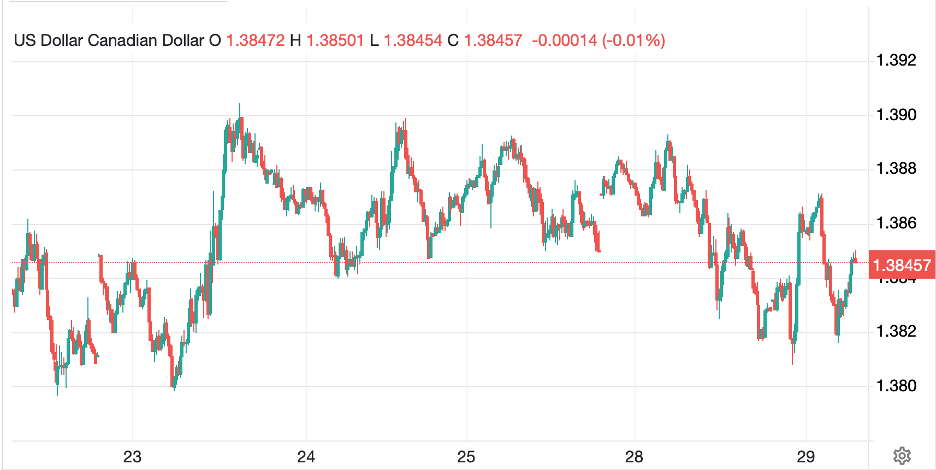
Source: tradingeconomics.com

As to the story about Spain’s electricity, I think it may be more instructive on two levels.  The first is as a warning to the risks inherent of powering your electric grid with more than 25% – 30% intermittent, renewable energy sources like wind and solar.  It is somewhat ironic that just twelve days prior to the blackout, Spain’s entire electricity requirement was met by solar, wind and hydro power, the Green dream.  Alas, here we are now and while no answers have yet been forthcoming, and I assume the media will downplay any blame on too much renewable power, virtually every engineering study has shown that once a grid has more than that 25% renewables, it tends towards instability.  This issue will be argued by both sides for a while, although as always, physics will be the final arbiter.  

But I have to wonder if the sudden failure of the electric grid is an omen of sorts, for what may be happening in global markets.  If we analogize global supply chains to the electrical grid, over the course of the past 50 years, we have seen the world create a massively complex web of trade with raw materials, intermediate goods and final products all crisscrossing the world.  There have been myriad benefits to all involved with real per capita economic benefits abounding, and for everybody reading this note, the ability to essentially buy whatever you want/need with limited interference and trouble.  Certainly, the availability of everyday necessities like food and clothing is widespread.

However, underpinning that bounty were two networks.  The first being the obvious one, the supply chains which since Covid have been much discussed by the punditry.  But the second, which gets far less notice is the network of debt that is issued around the world by governments and companies, as well as taken on by individuals, and that has grown to be more than 3x the entire global economic output.  While we most often read about the US government debt which is quickly approaching $37 trillion, total global debt is much greater than that.  In fact, at this point, the debt market is not about issuing new debt to fund new investment, rather it is almost entirely a refinancing mechanism.  

It is this latter issue that should concern us all.  What happens if, one day, the ability to refinance some of that debt, whether US Treasuries, German bunds or Chinese government bonds, has a hiccup of some sort?  A failed US Treasury auction, where the Fed is required to purchase bonds, or a power outage in a key financial center that prevents trades from being confirmed/settled and moneys not moving as expected, or some other force majeure type event that disrupts the current smooth functioning of global debt markets.  

Frankly, the combination of the changes being wrought by President Trump to the global economy, where globalization is giving way to mercantilism, and the significant weight of global debt that hangs over the global economy and is given very little thought seems a potentially volatile mix.

Ironically, as much as I have lately been describing how the Fed’s role seems to have diminished, in the event that something upsets this apple cart, the Fed will be the only game in town.  While this is not a today event, it is something we must not forget.

I apologize for my little diatribe, but with so little ongoing in markets, and the parallel to the Spanish electrical grid, it seemed timely.  Let’s look at markets.  Asian equity markets were mixed with the main markets very quiet but a couple of 1% gainers (Australia, Taiwan and Korea) although the rest of the region was +/- 0.3% or less.  Too, volumes were quite lethargic.  In Europe, it should be no surprise that Spain (-0.8%) is the laggard today as the first economists’ to opine on the impact of the blackout said it could be a hit of as much as 0.5% of GDP.  Germany (+0.6%) is the other side of the coin after the GfK Consumer Confidence reading came out at a better than expected -20.6.  Now, maybe it’s just me, but if I look at the past 5 years’ worth of this index, it is difficult to get excited about German economic prospects.
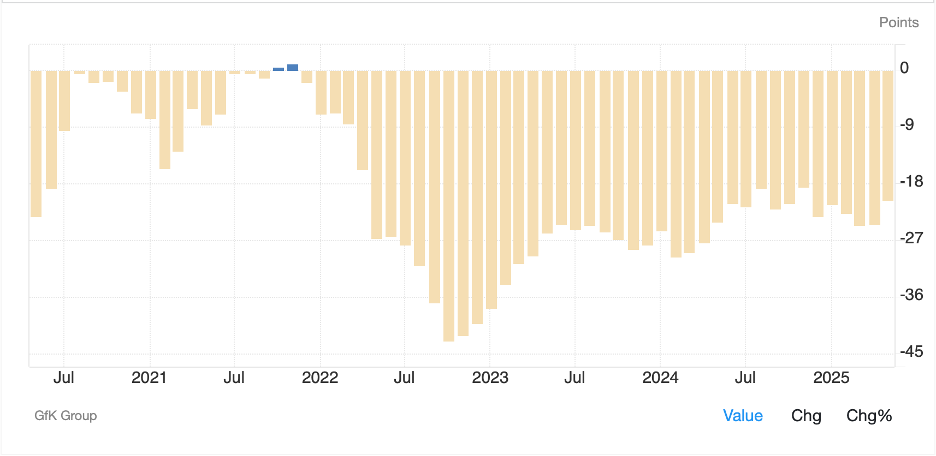
Source: tradingeconomics.com

Yes, this was a better reading, but either the people of Germany are manic depressive, or the index is indicative of major structural problems in the country.  Maybe a bit of both.  As to US futures, at this hour (7:10) they are basically unchanged after being basically unchanged yesterday.

In the bond market, Treasury yields have bounced 2bps this morning after touching their lowest level in 3 weeks yesterday.  European sovereign yields, though, are all softer by 1bp to 2bps this morning as comments from ECB members seem to highlight more rate cuts as Europe achieves their inflation target and are now getting concerned they will fall below the 2.0% rate.

In the commodity markets, oil (-1.7%) is under pressure this morning ostensibly on a combination of concerns over slowing growth and little movement in the US-China trade talks as well as a report that Kazakhstan is pushing up output and other OPEC+ members are talking about increasing production further when they meet next week.  Meanwhile, gold (-0.75%), which rallied back to unchanged in NY yesterday is once again finding sellers at its recent trading pivot of $3340ish (H/T Alyosha).  However, gold’s slide has not impacted either silver (+0.4%) or copper (+0.9%) at least so far in the session.

Finally, the dollar is firmer, largely across the board, this morning.  The euro (-0.3%), pound (-0.4%), JPY (-0.4%) and CHF (-0.6%) are all under some pressure, perhaps profit taking.  But in truth, other than INR (+0.15%) the rest of the major currencies, both G10 and EMG, are all softer vs. the greenback.  I guess the dollar’s demise will need to wait at least one more day.

On the data front, the Goods Trade Balance (exp -$146B), Case Shiller Home Prices (4.7%) and JOLTs Job Openings (7.48M) are the main numbers, although we also see Consumer Confidence (87.5).  But with no Fed discussions much more crucial data on Thursday (GDP, PCE) and Friday (NFP) it seems that today is setting up for not much excitement.

In fact, lack of excitement seems the best description of markets right now.  I don’t know what the next catalyst will be to change things, but absent peace in one of the wars, kinetic or trade, or another force majeure event, it feels like range trading is the order of the day for a while.  My big picture view of a slowly declining dollar is still intact, but day-to-day, it’s hard to see much right now.

Good luck

Adf
Be Quite Scared

The pundits have now all declared
That everyone should be quite scared
It will be a bummer
When shelves, come this summer
Are empty, so please be prepared
 
As well, a recession’s in view
Although, that seems like déjà vu
For three years at least
The pundits increased
The odds that this bill would come due


Apparently, the only thing you need to know this morning is that by summertime, shelves across the country will be barren as imports from China halt.  The upshot, at least according to the sources that I have read, is that you should blame President Trump and join the media chorus in hating the man and his policies.

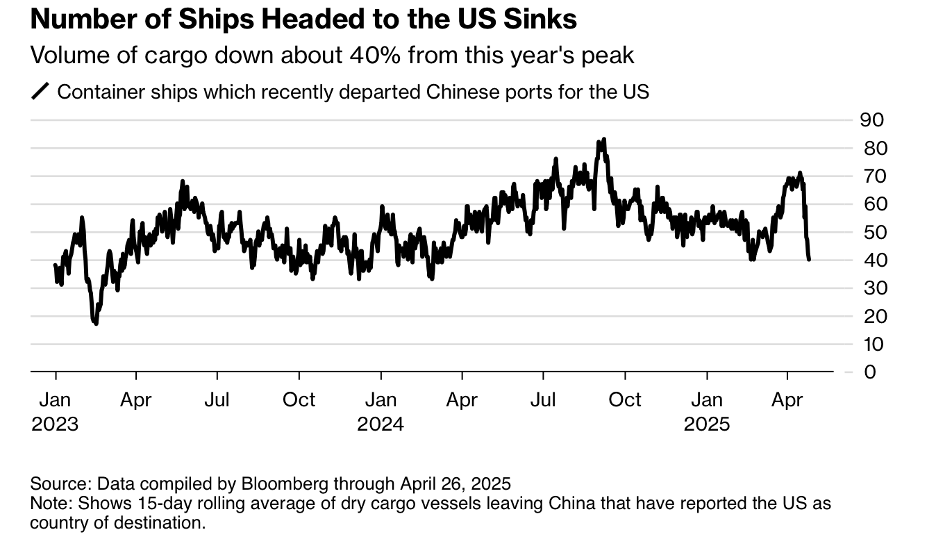
Now, I am no logistics expert, but the concern stems from the significant decline in shipping as evidenced by port activity in both China and the US.  As you can see from the chart below, there has certainly been a significant decline in the number of ships leaving China on their way to the US.

I guess the question is just how much of what is on store shelves comes from China?  Much will depend on what kind of store one considers.  Certainly, toy stores seem likely to have less inventory, as will Best Buy with electronics potentially suffering, although as I recall President Trump exempted electronics initially.  Arguably, clothing shelves and racks may be sparser as well.  But based on official data, Chinese imports (~$463B) accounted for approximately 1.7% of the US’s $26.9T GDP in 2024.  This may be an overreaction.

Potentially a bigger issue will be the impact on intermediate goods that are imported from China and elsewhere and incorporated into products finalized in the US.  However, I cannot calculate that, nor have I seen any data of this issue, although I have read many stories about the end of this particular world as well.

One of the things to remember about the punditry is that they make their living describing the worst possible outcome because that gets them recognition.  However, I’m confident we all remember that a recession was forecast for 2022, 2023 and 2024 by much of the punditry and yet one was never officially declared by the NBER.  In fact, you may recall that in Q1 and Q2 of 2022, US Real GDP growth was -0.2% for both quarters, thus two consecutive quarters of negative growth.  Historically, that has defined a recession.  However, subsequent data revisions did remove that as you can see below with Q2 revised higher.

Source: tradingeconomics.com

The one thing I do know is that there is a group of analysts/economists who have been forecasting the next recession consistently for several years.  They point to data like changes in the housing market, the JOLTs Quits rate shrinking and various other secondary and tertiary data points and sources, all of which have been pointing in that direction for several years.  And I grant, reading that ~40% of GenZ is using BNPL to buy their groceries, and then run late on payments, is a frightening statistic (although perhaps one that highlights financial illiteracy more than economic reality).

In the end, what you need to know is you should be terrified because the punditry is almost certain that this time, they have it right.  But our concern is how will this scenario impact markets.

Basically, despite all this huffing and puffing, it appears markets are whistling past this particular graveyard.  Friday’s US equity rally was followed by general strength in Asia and strength this morning in Europe.  Last night, Tokyo (+0.4%), Mumbai (+1.3%), Taiwan (+0.8%) and Australia (+0.4%) all had solid performances although neither Hong Kong (-0.1%) nor China (-0.15%) could find any real buying support.  A less reported story is that China is exempting a number of US imports from its 125% tariffs on the US as clearly, this trading relationship is deep and complex.

As to Europe, all markets are ahead this morning, with the UK (+0.4%) the laggard and most of the continent higher by between 0.7% and 0.8%.  There are headlines around as to how the ECB is preparing to cut rates further on the assumption that global economic activity is going to slow and thus hurt Europe, while the consistent message is that US tariffs will be deflationary in Europe, so less concerns about their inflation mandate.  Finally, US futures are pointing slightly softer (-0.2%) at this hour (6:45).

In the bond market, 10-year Treasury yields have fallen 30bps in the past two and one-half weeks, sliding 5bps on Friday before bouncing 3bps overnight. However, the recent trend does seem lower.

Source: tradingeconomics.com

But yields are climbing in Europe as well today, higher by 5bps across the board on the continent, although UK Gilts have only edged higher by 2bps.  It’s funny, despite all the doom and gloom regarding the economy because of US tariffs, as well as growing expectations of an ECB rate cut at the early June meeting, investors appear to be growing concerned about something.  Perhaps they have pivoted back to the promised fiscal spending increases as their driver today.

In the commodity markets, oil (-0.35%) continues to trade in its recent $60 – $63/bbl range with limited signs that this will soon change.  Peace in Ukraine does not seem at hand yet and reports are that the initial discussions between the US and Iran, while constructive, still have a ways to go before completion.  Both of those seem likely to weigh on oil prices if completed.  However, the more unusual thing to me is that with the rising chorus of recession calls, oil’s price has not fallen further.  To date, markets have not yet agreed with the economists’ view that recession is imminent.  In the metals markets, gold (-1.0%) is continuing its rough week, although remains nicely higher on the month.  You may recall my view a week ago Friday that the move seemed parabolic and due for a correction.  Recent price action is exactly that, corrective, as I believe the underlying thesis to own the barbarous relic remains intact.  The other main metals are a touch softer this morning, but really nothing to discuss.

Finally, the dollar is mixed this morning with modest strength against the euro (-0.15%) but softness vs. the pound (+0.15%) and those size moves are representative of most of the price action across both G10 and EMG currencies this morning. The outlier is KRW (-0.4%), which seems to be suffering from comments that no trade deal will be completed before June’s election there.

Overall, despite ongoing doom and gloom by much of the punditry, it is not obvious to me that investors are anticipating major changes.  Perhaps they are wrong, and the pundits are correct.  But as yet, there is no evidence to support that conclusion.

Ok, let’s turn to the data this week, which starts slowly but ends on NFP.

TuesdayGoods Trade Balance-$146.0B
 Case-Shiller Home Prices4.8%
 JOLTs Job Openings7.5M
WednesdayADP Employment108K
 Q1 GDP0.4%
 Q1 Employment Cost Index0.9%
 Chicago PMI45.5
 Personal Income0.4%
 Personal Spending0.6%
 PCE0.0% (2.2% Y/Y)
 Core PCE0.1% (2.6% Y/Y)
ThursdayInitial Claims225K
 Continuing Claims1860K
 ISM Manufacturing48.0
 ISM Prices Paid70.2
FridayNonfarm Payrolls135K
 Private Payrolls127K
 Manufacturing Payrolls-5K
 Unemployment Rate4.2%
 Average Hourly Earnings0.3% (3.9% Y/Y)
 Average Weekly Hours34.2
 Participation Rate62.5%
 Factory Orders4.5%

Source: tradingeconomics.com

As well as NFP, we get the PCE data, which looks like it has changed to a 10:00am release from its traditional 8:30am time.  The Fed is in its quiet period, but nobody has been listening to them anyway.  Secretary Bessent, along with President Trump, has been the most important voice lately.  Again, for now, the data has not indicated recession, although Q1 GDP is slated to be soft.  Markets, too, have been unwilling to get behind the recession call completely. 

Ultimately, the one thing we know is that the nature of the global economy has changed since President Trump’s election.  Globalization is in retreat and mercantilism is the new normal.  It is not clear to me that existing econometric models will accurately portray how that works, so I need to see more data before recognizing the end of times.  In the meantime, these myriad views are a sign that hedging for risk managers remains the only path forward.

Good luck

Adf

That Man is Our Bane

Apparently, back in the day
Investors and CEOs say
The future was clear
But now they all fear
Uncertainty is in their way
 
So, they will now clearly explain
When earnings and profits do wane
That they’re not to blame
Instead, they now claim
It’s Trump’s fault, that man is our bane


I’m having some difficulty understanding a number of the concerns about which I read every day as more and more corporate executives and investment managers have suddenly found a new scapegoat, uncertainty.  Apparently, I missed the time when the future was certain, as I have no recollection of that at all.  Perhaps you remember.  If so, could you remind me please?

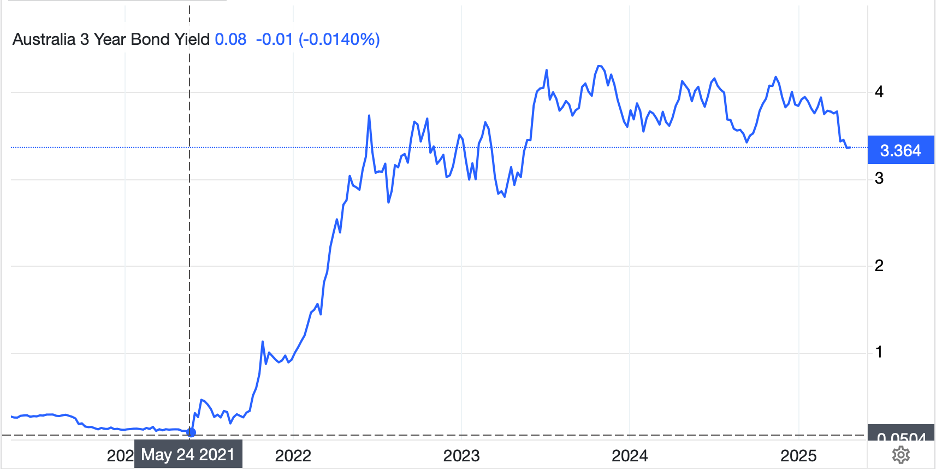
For instance, I remember the certitude of the comments from the RBA back in April 2021 that interest rates would remain lower for longer, and that it would be at least three years before they would need to raise interest rates.  I also remember, as the graph below demonstrates, that certainty was misplaced as less than two months after those comments, the RBA started raising interest rates despite the clear directive they would not need to do so for years.

Source: tradingeconomics.com

While this is just one example, in my experience, certainty is not part of the mix when running a business or a portfolio of assets or a position in any financial market.  So imagine my surprise when reading Bloomberg this morning and finding that suddenly, the world is awash in uncertainty.  Has it ever not been the case?  Pretty much once you get beyond the laws of physics or mathematics, it strikes me that certainty in the future just doesn’t exist. (Even at 4Imprint).  Nonetheless, uncertainty because of President Trump’s trade policies is the latest rationale for every problem at every company right now.  In truth, I suspect that many executives are quite happy with this as the Covid excuse was wearing thin.

In the markets, too, uncertainty is the favored excuse for underperformance as how can anyone manage money with tape bombs constantly appearing.  Powell is a loser one day to I’m not going to fire Powell the next.  Tariffs are forever to a 90-day pause.  And of course, there are many other political stories that have limited impact on markets but seem to change regularly.  While this gets back to my view that President Trump is the avatar of volatility, I seem to recall long before President Trump that there were numerous presidential statements that had major market impacts.  My point is, nothing has really changed folks, other than the media dislikes this president more than any other in my lifetime so amplifies anything they think makes him look bad.

However, the one thing about which we cannot be surprised is that trading activity is waning, at least compared to what we saw since Trump’s inauguration.  Volumes of activity on the exchanges are sliding (see chart of S&P 500 volume below from ycharts.com) which makes perfect sense in a volatile and uncertain market.  

Now, as per the above, I would contend that the future is always uncertain.  Rather the real culprit here is volatility.  My take is that the future is going to continue to be volatile which implies, to me at least, that trading activity is going to remain on the low side and with it, liquidity for those who have significant real flows to transact.  It’s funny, volatility begets lower volumes, and lower volumes beget volatility due to reduced liquidity.  I’m not sure what it will take to break us from this cycle, but I have a sense that it will be with us for a while.

With that in mind, let’s see what happened overnight.  Yesterday’s strength in the US was followed by strength in Tokyo (+1.9%) although both China (+0.1%) and Hong Kong (+0.3%) didn’t really participate.  Interestingly, this morning I read that China was exempting a number of imports from the US from tariffs as apparently, it was hurting their businesses so severely it could cause closures.  Elsewhere in Asia, the picture was mixed although there were more gainers (Korea, Taiwan, Philippines, Thailand) than laggards (India, Singapore).  I do believe the tariff story is impacting these markets more than any as they are directly in the line of fire.

Meanwhile, in Europe, most markets are firmer this morning (DAX +0.6%, CAC +0.4%, IBEX +0.9%) but the UK (-0.1%) is lagging despite much stronger than expected Retail Sales data there this morning.  As to US futures, at this hour (7:00) they are pointing lower by about -0.35%.

In the bond market, Treasury yields continue to slide, down another -3bps this morning although Europe is moving in the opposite direction, with yields climbing between 2bps and 3bps in the session.  It’s odd because I continue to hear about European growth forecasts being cut and the ECB preparing for more rate cuts while the talk around the markets is that the US is going to see inflation from the tariffs.  Today’s bond moves don’t really speak to those narratives, but it is just one day.  I need to mention JGB yields, which rose 3bps overnight after Tokyo CPI came in 2 ticks hotter than forecast at both headline and core levels.  

In the commodity markets, oil (-1.2%) is slipping again and has consistently demonstrated it is unable to make any dent in the major price gap above the market.  To close that gap, WTI will need to rally more than $8/bbl from current levels, something I just don’t see happening in the current environment.  That would require a war in Iran I think.  As to metals, yesterday’s gold rally has been reversed (-1.5%) and today it is impacting both silver (-0.75%) and copper (-2.1%) as is the stronger dollar it seems.

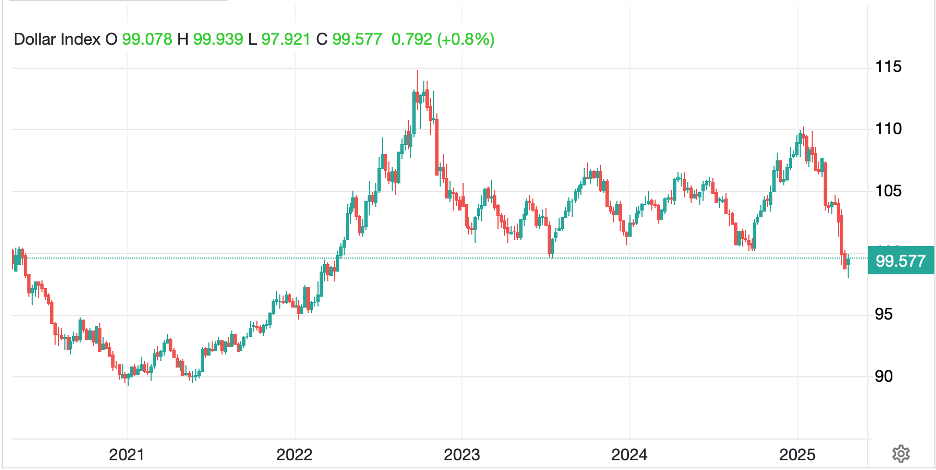
Speaking of the dollar, Monday’s narrative that the dollar was about to collapse will need at least another day to come to fruition as it is modestly higher again this morning.  looking at the DXY as a proxy, it is trading just below 100, a level that many are watching closely.  A quick look at the chart below shows this is the third time in the past two years it has traded to this level, although the first of those times it broke through.  Of course, it was much lower just a couple years earlier.

Source: tradingeconomics.com

Today’s dollar strength is modest but broad-based with only CLP (+0.6%) higher this morning which makes absolutely no sense given copper’s slide today.  The worst performer is SEK (-0.8%) but given it has been the best performer YTD amongst the G10, perhaps this is just corrective.  Otherwise, we are looking at movements on the order of 0.25% to 0.45% across the board.

The only data this morning is Michigan Sentiment (exp 50.8).  We continue to see a dichotomy between the ‘hard’ data, Claims, NFP, CPI, Factory Orders, and the ‘soft’ data, Michigan Sentiment, PMI, inflation expectations with the former holding in well while the latter weakens.  Many analysts believe that recession is coming our way by summer, but these same analysts have been predicting the recession for the past 3 years.  The one thing about the US economy is that it is extraordinarily resilient despite all the things governments try to do to disrupt it.  I understand the concern, at least if you watch/read the news, but I have a sense that many people across the nation do not really do that.  While I believe that equity valuations remain too high to be sustainable, it is not clear to me that the economy is heading into a recession at this time.  As to the dollar, I wouldn’t write its obituary just yet, although I do think it will soften further over time.

Good luck and good weekend

Adf

They Will Get Burned

In Europe, the corporate elite
Have started, their worries, to bleat
They’re now quite concerned
That they will get burned
If dollar sales start to retreat
 
For years, when the dollar was rising
Weak unit sales, it was disguising
But now the buck’s falling
Which they find appalling
As earnings forecasts, they’re downsizing
 

Markets are very interesting constructs.  Not only do they help find a clearing price for supply and demand of something, but they also tend to take on anthropomorphic characteristics in many eyes as some type of creature beyond anyone’s control, but with a tinge of malevolence.  Part of that latter feeling comes from markets’ ability to make every pundit seem like a fool.  After all, it was just 3 days ago when I was reliably informed by the punditry that equity values were set to collapse as the US economy entered a depression.  It seems we may have to wait a few more days for that situation to play out.  And, in fact, they have now changed their tune.  While ascribing the rebound to President Trump’s reversal on some issues, the overall doom and gloom story has moved to the background.  But if there is one thing I have continuously discussed since Trump’s election is that volatility was very likely to increase, and that has certainly been the case. 

Shifting our focus to the FX markets, though, I couldn’t help but chuckle at a Bloomberg article this morning titled, The Dollar’s Slide is Raising Red Flags for Corporate Earnings.  As I am based in the US, the fact that this was a front-page article had me somewhat confused.  A long career in speaking with corporate accounts on FX made it clear that a weak dollar was the best thing for earnings of US multinationals.  Generally, when the dollar was strong, CFOs would ascribe any earnings problems to that issue as a catch-all excuse, but when the dollar declined, outperformance by a company was the result of brilliant execution.

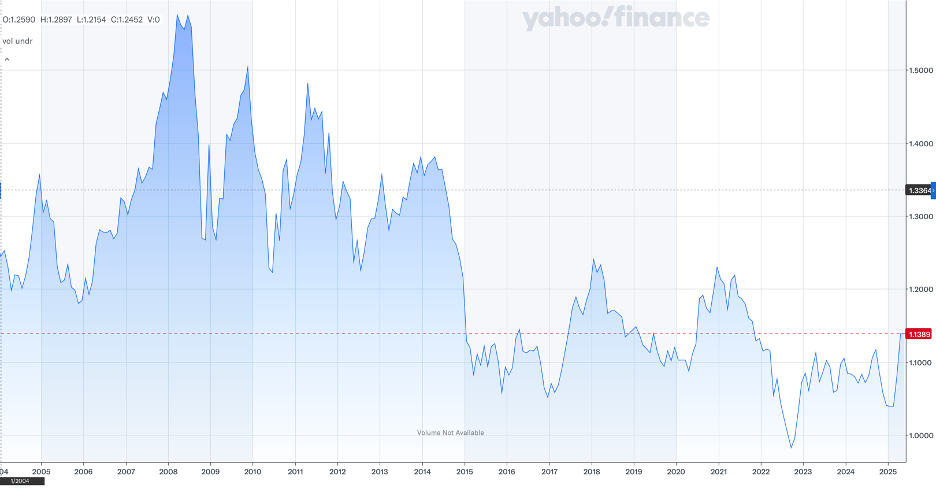
So, you can understand my initial confusion.  But upon reading the article, it turns out they were talking about European corporates, who for the first time in three years find that hedging their US dollar sales is critical.  Not only that, but they have also been quick to highlight that all new hedges will be at worse rates and therefore future earnings are already sure to be impacted.  Now, a quick look at the chart below does show that the euro has risen to its highest level in three years.  But it also shows that compared to the past 20 years, the euro is nowhere near high levels. In fact, it sits well below the median price (somewhere in the 40th percentile actually).  Perhaps European corporate Treasurers have simply forgotten their history.  Or more likely, just like US corporate Treasurers when the dollar is rising, they are seeking a scapegoat.

I cannot emphasize enough that the FX rate is not the driver, but the release valve for all the things that happen in the global economy.  Other actions take place, whether interest rate changes, policy or market, economic adjustments, policy or market, or exogenous events, and the FX rate is the place where equilibria are found.  In fact, arguably, that is the biggest flaw in the Trump administration’s idea that if they weaken the dollar, it will solve policy problems.  The dollar is the tail to the economy’s dog.

In the meantime, the reason one runs a hedge program with consistency is to mitigate the big moves in FX and their impacts on earnings.  But remember, even the best hedge programs lag large secular moves.

Ok, I’ll step down off my high horse and let’s look at how markets behaved overnight.  After yesterday’s second consecutive rally in the US, the picture elsewhere in the world is more mixed.  In Asia, the Nikkei (+0.5%) continued its rebound but the Hang Seng (-0.75%) and CSI 300 (-0.1%) saw no benefit overnight.  Elsewhere in the region winners and losers were pretty evenly split and nobody saw a movement of more than 0.8% in either direction.  In Europe, red is today’s color, but it’s a pale red with losses across the board of the 0.1% to 0.25% variety.  The only news overnight was German Ifo data, which showed a bit of a surprising uptick in the current business climate as well as expectations.  Perhaps the promise of more German fiscal largesse is outweighing concerns over tariffs.  As to US futures, they, too, are lower by about -0.15% at this hour (7:20).

In the bond market, yields are sliding around the world with Treasuries (-3bps) continuing to back away from their recent highs while European sovereigns see yields decline between -3bps and -4bps.  Even JGB yields slipped -1bp overnight.  My take is some of the fear has ebbed away from the market.

In the commodity markets, oil (+1.1%) remains in its recent trading range, with a still very large gap above the market in price terms.  The demand story seems fixed at weakening demand because of either slowing growth, or the electrification of everything or something like that, while the supply story is starting to see hints that oil companies are going to back off production with prices at current levels.  The latter feels like the larger short-term risk, although nothing has changed my longer-term view of lower prices here.  In the metals markets, gold (+0.7%) is rebounding after a difficult two days, arguably some real profit taking was seen.  Meanwhile silver (-0.5%) which actually outperformed gold for the past two sessions is giving some of those gains back and copper (+0.8%) is continuing its rebound after a dramatic decline from the all-time highs seen just one month ago.  Talk about a V-shaped recovery!

Source: tradingeconomics.com

Finally, the dollar is softer this morning, giving back about half of yesterday’s 1% gains.  In the G10, SEK and NOK (both +1.1%) are leading the way although the euro (+0.6%) is having a good day, as is the yen (+0.75%). The pound (+0.5%) is a bit of a laggard but after seeing this interview of Ed Miliband (UK Secretary of Energy and Climate Change), and his either inability to understand the implications of his policy, or his willingness to lie about it, I cannot believe the pound will continue to track the euro.  The UK’s energy policy appears designed to destroy the UK economy.  Consider that solar power is a key pillar of their future efforts to achieve net zero carbon emissions, and the UK is the nation that gets the least solar coverage in the world.  After all, it rains there half the time.  Meanwhile, the government is keen to end all other sources of energy.  No matter what you think of President Trump’s policies, they are not nationally suicidal like the UK’s.

Turning to the EMG bloc, gains are the norm, but not universal.  The CE4 are doing well but ZAR (-0.2%) and KRW (-0.6%) with the latter suffering from weaker than expected GDP growth in Q1 while the former, after a strong run since early in April, appears to merely be taking a breather.

We finally see some notable data this morning with Initial (exp 222K) and Continuing (1880K) Claims, Durable Goods (2.0%, 0.3% ex-Transport) and the Chicago Fed National Activity Index (0.11) all at 8:30, then at 10:00 we get Existing Home Sales (4.13M).  Yesterday saw New Home Sales pick up more than expected and the Beige Book indicate that economic activity was unchanged from the past, but uncertainty had risen.

Here’s what we know; the world is not ending but it is continuing to change from the structures created in the post WWII period.  This process is just beginning and anybody who claims to know where things are headed is lying.  I continue to believe in my bigger picture views, but day to day, there is no rhyme or reason, especially given the importance of headline bingo.

Good luck

Adf
Very Near Future

The “very near future” is when
The US and China, again
Will restart their talks
Assuming no balks
By either of these august men
 
That’s all that the market required
For buyers to get so inspired
Can this idea last?
Or will it have passed
Ere market resolve has expired


While all and sundry have been very confident that President Trump’s attempt to alter the structure of the global economy and world trade to a more beneficial one, in his view for the US, will fail dismally and that we are doomed to stagflation as prices rise and the economy sinks, it seems these same economic analysts have forgotten that there are two sides to the supply/demand equation.  I have written before that despite all the slings and arrows that have been aimed at Trump, the US has a very strong hand in the trade game given it is THE CONSUMER OF LAST RESORT.  Virtually every nation in the world has built an economy designed to be able to manufacture stuff cheaply and sell it into the largest economy in the world.

And US consumers are remarkable in their ability to continue to consume at high levels despite what appear to be significant headwinds, whether high financing costs, limited savings or slowing economic activity.  But a funny thing is happening on the way to this mooted US stagflation, it’s not happening yet.  In fact, as described by economist Daniel Lacalle in his most recent post, it seems that the biggest problem is not that Americans cannot find what they want to buy, it is that they only bought all this stuff because it was cheap.  They will not accept significant price rises and so inventory is building up at factories while ships are stuck with containers full of stuff nobody wants, at the price.  Could it be that President Trump read the room better than the economists?

I use this as preamble to yesterday’s massive equity rebound which was, ostensibly, triggered by comments from Treasury Secretary Bessent that substantive trade talks with China would begin in the “very near future.”  Subsequent soothing comments by the President indicated that the days of 125% tariffs were numbered but there would be tariffs in place.  As well, Mr Trump explicitly said he has no intention to fire Fed Chair Powell, despite his recent diatribe that Powell is always late to the party and should cut rates.  Certainly, I agree the Fed is, and will always be, late to the party as long as they use a data driven approach.  After all, by the time economic change is reflected in the data, whatever is going to change has already done so.  However, I don’t yet see the rationale for cutting rates given the current economic data and the fact that inflation remains a problem.

As of this morning, following significant equity rallies around the world, one might come to believe that all the world’s problems have been successfully addressed.  The fact that one would be wrong in that belief is the best example of ‘the market is not the economy’.  But, hey, let’s take the rallies when they come!

From a market perspective, that was really the big story yesterday and continuing into today.  Flash PMI data is not that exciting, and all the other headlines revolve around the ongoing immigration/deportation issues plus RFK Jr’s edict to remove petroleum-based food coloring from foods.  So, let’s look at the markets and recap the action.

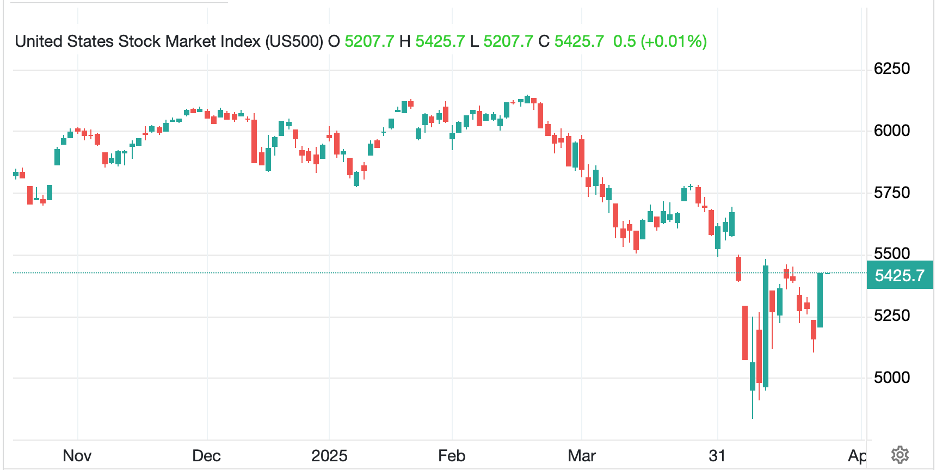
The 2.5% to 3.0% gains in the US were followed by Tokyo (+1.9%) and Hong Kong (+2.4%) performing well but nothing like Taiwan (+4.5%).  The laggard last night was China (+0.1%) with other regional exchanges showing gains between 0.5% and 1.5%.  Net, I suppose everybody was happy.  In Europe this morning, the screens are green as well, with Germany (+2.6%) leading the way followed by France (+2.2%) and the UK (+1.3%).  Again, the trade story appears to be the leading driver.  And, adding to the joy, US futures are also higher between 2.0% (DJIA) and 3.0% (NASDAQ) this morning as of 6:50.  And to think, just two days ago I was assured that the end was nigh.  A quick look at the S&P 500 chart below does give a flavor for just how much volatility we have seen on a day-to-day basis and how narrative changes continue to have huge impacts.

Source: tradingecomics.com

At the same time, Treasury yields have been retracing, lower by -8bps this morning with UK gilts (-6bps) also performing well, although continental European sovereigns are not seeing the same demand with bunds (+3bps) the laggard despite the weakest PMI readings with both Manufacturing and Services below 50.0, lower than last month and far lower than forecasts.  The narrative of money leaving the US and heading back to Europe is certainly appealing, and seems quite reasonable as a long-term metric, but it is not clear to me that it will be driving daily price action in any market.

In commodities, oil (+1.0%) continues to edge higher although it has not yet come close to filling that massive gap lower from the beginning of the month.  

Source: tradingeconomics.com

From a fundamental perspective, fears of a US recession, which remain high, as well as the IMF recently reducing their global growth forecast seem to be undermining the demand side of the equation.  Meanwhile, the opportunity for significant new supply (Iran deal, Russia peace) seems quite real.  I’m no oil trader but it strikes me the risk-reward here is for a further drop in prices.  As to the metals markets, gold (-0.4%) fell more than $100/oz yesterday, so perhaps my view that the parabolic move was too much was correct.  However, I believe this is a short-term, and much needed, correction with the long-term story fully intact.  Meanwhile, silver (+1.4%) and copper (+0.4%) are modestly higher after quiet sessions yesterday.

Finally, the dollar is firmer this morning against most of its counterparts, but this is not a universal situation.  While both the euro and pound have fallen -0.25%, AUD (+0.6%) is showing some oomph as it figures to be one of the key beneficiaries of a trade agreement between the US and China, no matter how far in the future.  Other key gainers are KRW (+0.6%) and CNY (+0.3%), with both clearly benefitting from that same trade story.  But otherwise, the dollar is mostly ascendent.  

An aside here on the yen (-0.4%) which just two days ago traded below the key psychological level of 140 and this morning is back above 142.  It strikes me that this is the first currency that will be reactive to any trade deal.  As you can see from the below, long-term chart of the yen, it has spent the bulk of its time at far higher (dollar lower) levels.  I suspect that any trade deal will include an effort to revalue the yen higher vs. the dollar, perhaps to its longer-term average of around 120.

Moving on to today’s data, we have New Home Sales (exp 680K) and then the Fed’s Beige Book at 2:00pm. I’m not sure when the surveys were taken for the Beige Book, but you can be sure they will express a great deal of uncertainty and discuss how it will reduce economic activity.  You can also be sure that this will be hyped in the press.  But now that everything is better (just look at the stock market) is this old news?

If we try to look past the daily gyrations to the bigger picture, I would contend the following is the case.  Equity markets remain overvalued and are likely to weaken, the dollar is likely to slide as well as foreign investors slowly reallocate funds away from the US.  Quite frankly, the Treasury story is much harder as the interplay between inflation and potential reduced government expenditure is highly uncertain right now, although one will eventually dominate.  Finally, commodities remain far more important than their current relative weight in the global asset basket and I believe they have much further to climb in price.  One poet’s views.

Good luck

Adf

This is the End

Apparently, this is the end
So says every article penned
The markets are tanking
But nobody’s banking
On help to arrest the downtrend
 
The pundits’ unanimous line
Is things before Trump were just fine
Yes, debt was insane
But that gravy train
Allowed them to drink the best wine


Every financial website lead this morning is how President Trump’s policies are causing the worst slide in equity prices in forever, with my favorite today in the WSJ describing this as the worst performance in April since 1932!  Much has been made about how President Trump is undermining the Fed’s credibility, as though the Fed has that much credibility to undermine.  This is the group that declared stable prices to be an increase in their favored indicator, core PCE, of 2.0% annually, and complained vociferously when inflation was slightly below that level for a decade.  In order to adjust things, they changed their target to an average of 2.0% over time, then watched their metrics, in the wake of the Covid fiscal response, explode higher.  Now, after more than four years of their target metric above their target, they are concerned they are losing their credibility because of President Trump.  

Source: tradingeconomics.com

Certainly, if they had been achieving their goals any time during the past four years, this argument might have had some force.  However, given the history, I am suspect.

Nonetheless, this is today’s narrative, that equity markets are falling sharply because of Trump.  It has nothing to do with the fact that US equity markets have been overvalued by nearly every measure since November 2012, (the last time the S&P 500 P/E ratio was at its mean of 16.14 vs today’s still very high 25.64).  This is not to say that the president’s tactics have necessarily been the best possible, but we have all long known that a catalyst would come along and adjust prices to a more sustainable level.  

Source: multpl.com

Once again, I will highlight that President Trump was elected with a mandate to make substantial changes to the way things work in the US, both the economy and other issues like immigration.  Remember, too, that many of his supporters are not heavily invested in equity markets, so this is not really a problem for them.  I believe he can tolerate a lot more downside in equity prices before feeling it necessary to address them.  And if he is successful in signing some trade deals during his 90-day time frame, I expect that things will calm down quite quickly.

But right now, investors are very unhappy, and since virtually everyone in the media is an investor, we are going to hear a lot more on this topic, especially since they almost certainly didn’t vote for President Trump.

Here’s the thing about markets, overvaluations correct over time.  In fact, often they result in under valuations as markets tend to overshoot in both directions.  However, you have probably heard of the Buffett Indicator, which is Warren Buffett’s shorthand way of determining stock valuations.  He simply divides the total market capitlaization of US equities by GDP.  His view is that when that ratio is between 110% and 130%, equity markets are fairly valued.  Below that, things are cheap, and it is a good time to buy stocks.  Above that, like today, and good values are hard to find.  You are also probably aware that Berkshire Hathaway is currently holding its largest cash position ever, a sign that he still thinks things are overvalued.  One need only look at the below chart to see that while the recent decline in stocks has brought the indicator lower, its current level of 173% remains extremely overvalued.

Source: buffettindicator.net

All I am trying to do is offer some perspective on the recent movement.  Risk appetite was over extended while the US ran 7% budget deficits and issued a massive amount of debt to fund it.  Much of that funding went into risk assets.  That situation has clearly changed, or at least that is the goal of the Trump administration.  It is a painful transition, but likely one that we need to absorb for longer term fiscal and economic health.

Ok, let’s see how market behaved overnight, after a rout in the US yesterday, now that everybody is back at their desks.  Major Asian markets were very quiet, with limited movement in Japan, China, Korea, Australia and India, although we did see sharp declines in Taiwan (-1.6%) and New Zealand (-2.25%) with the latter seeming to be one of the few markets tracking the US directly.  The only news there was a larger than expected trade surplus, which doesn’t seem the type of thing to cause a sell-off.  Meanwhile, in Europe, there is also little net movement with a couple of modest gainers (Spain, UK) and a couple of modest laggards (France Germany) with everything trading less than 0.5% different than their last closes.  Interestingly, US futures are all higher by about 1.0% at this hour (7:05).

In the bond market, this morning is quiet everywhere with movements of +/-1bp the norm although yesterday did see Treasury yields climb 6bps in the session.  Something that is starting to move in fixed income markets are credit spreads, which have been abnormally tight for a long time and may be starting to widen out to previous historical levels.  If spreads start to widen, that will not help equity markets at all, and that could be the signal that policy adjustments are coming, both from the administration and the Fed.  We will keep an eye here.

In the commodity markets, nothing is stopping the gold train, up another 0.7% this morning to another new high.  This movement is parabolic and that cannot last very long.  Beware of a correction.  

source: tradingeconomics.com

In the meantime, silver (-0.2%) and copper (+0.5%) are still hanging around, but without the same panache as gold.  In the oil market, WTI (+1.3%) has rebounded from yesterday’s decline as the latest stories are that capex by the oil majors is going to decline and with it, we will see a reduction in supply, hence higher prices.  On the flip side, if a deal with Iran is signed and their oil comes back on the market freely, that will weigh on prices for at least a while.

Finally, the dollar, which along with equities, has been sold aggressively of late, is bouncing slightly this morning.  This story remains perfectly logical as one of the reasons the dollar had been so strong was foreign investors bought dollars to buy the Mag7 and US equities in general.  With US equities weakening, these foreigners are likely to start to sell more and take their money home, or elsewhere, but nonetheless, they don’t need those dollars.  Certainly nothing has changed my bearish view here with today’s gains a modest correction.  There are two outliers this morning, with MXN (+0.6%) and ZAR (+0.5%) the only currencies of note rallying against the greenback, both seemingly following the commodity rally.

On the data front, there is nothing noteworthy this morning, but a bit of data later in the week.

WednesdayFlash Manufacturing PMI49.4
 Flash Services PMI52.8
 New Home Sales680K
 Fed’s Beige Book 
ThursdayInitial Claims221K
 Continuing Claims1880K
 Durable Goods2.0%
 -ex Transport0.2%
 Existing Home Sales4.13M
FridayMichigan Sentiment50.8
 Michigan Inflation Expected6.7%

Source: tradingeconomics.com

In addition, we have 7 Fed speakers over 8 venues this week, with four of them today.  However, it is not clear that they have much impact these days.  Expectations for a cut next month are down to 9% although the market is pricing 90bps of cuts this year.  But, once President Trump started implementing his policies, the Fed slipped into the shadows.  It is interesting that there are questions about the Fed’s credibility as lately, nobody has listened to them anyway.  I don’t expect anything other than patience from them for now as they await the “inevitable” decline in the economy.  However, until the data really starts to show something, and there is nothing forecast in this week’s releases, that points to economic weakness of note, they are on the sidelines.

Overall, I expect more volatility in risk assets, and I do believe the trend for foreign investors to reduce their exposure to the US will continue.  That, too, will weigh on the dollar.  Maybe not today, but another 10% this year is quite viable.

Good luck

Adf

Downward, Crawling

The trends in the market of late
Continue, and there’s no debate
The dollar keeps falling
With stocks, downward, crawling
While gold never has looked so great
 
The latest concerns are that Trump
Chair Powell, is looking to dump
The narrative shows
That if Powell goes
That Treasuries clearly will slump


Europe remains closed today for its Easter Monday holiday, as was Hong Kong last night, but the rest of Asia and the US are open.  With that in mind, though, I’m guessing there are many who would prefer markets to remain closed given the price action.  At least those who remain invested in the US as equity futures are pointing lower, yet again, this morning, with all three major indices down by about -1.0% at this hour (6:00).  But really, the market story that is atop the headlines today is the dollar and its continued weakening.  Since President Trump’s inauguration, so basically in the past three months, the euro (+1.3% today) has climbed about 11% as you can see in the chart below.

Source: tradingeconomics.com

While that is not an unprecedented move, it is certainly swift in the world of foreign exchange.  Of course, it is important to remember that the current level, and higher levels, were extant for more than a year (July 2020 – November 2021) not all that long ago.  My point is perspective is key, and while the dollar has been declining sharply of late, this is not unexplored territory.  In fact, stepping back a bit, as I’ve shown before, the euro remains in the lowest quartile of its value over the past twenty years.

Source: finance.yahoo.com

One of the interesting ways in which the narrative has changed has been that prior to the imposition of tariffs by President Trump, when they were only threatened, the economic intelligentsia were convinced that the only outcome would be other currencies declining in value sufficiently to offset the tariff, thus a stronger dollar with the end result that US exports would no longer be competitive.  Now those same analysts are explaining that the weaker dollar is a problem because imports will be more expensive, thus raising the inflation rate.  

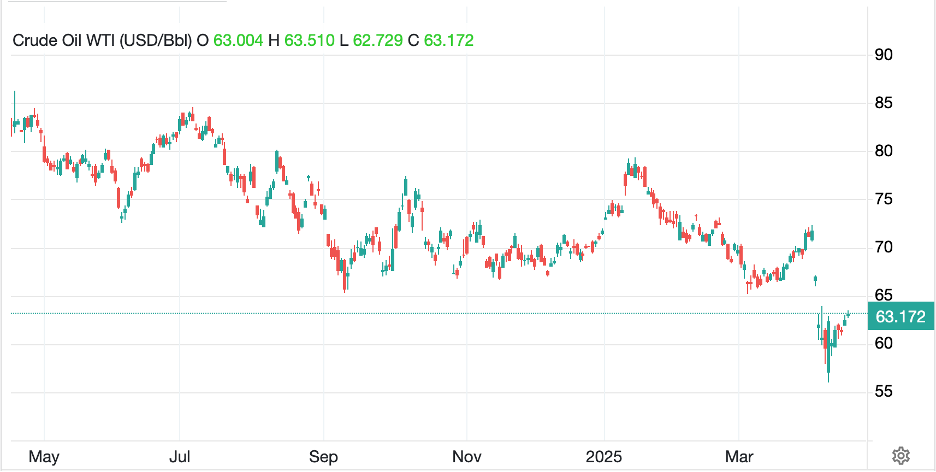
However, the lesson I have learned throughout my career is that movement in the dollar, while important on a very micro level for businesses and foreign earnings calculations, is rarely a driver of any macroeconomic trend.  In fact, it is a response.  Other things happen and the dollar adjusts based on the flows that occur. While theoretically, at the margin, a weaker dollar will tend to result in higher import prices, and ceteris paribus, that would feed through to the inflation rate, no ceteris is paribus these days.  For one thing, oil prices are lower by nearly 18% since the inauguration and oil prices have a far larger impact on inflation than does the value of the dollar.  My point is that neither the dollar’s level nor the fact that it is declining is a sign of the end of times.

Source: tradingeconomics.com

Of more concern to many is the Treasury bond market as that is a true Achilles heel for the US.  Given the massive amount of debt outstanding, and the fact that there is so much to roll over this year, and the fact that the budget is still running a massive deficit, the need to refinance is the biggest issue facing the US economy in my view.  Of course, the US will be able to refinance, the question is the price.  

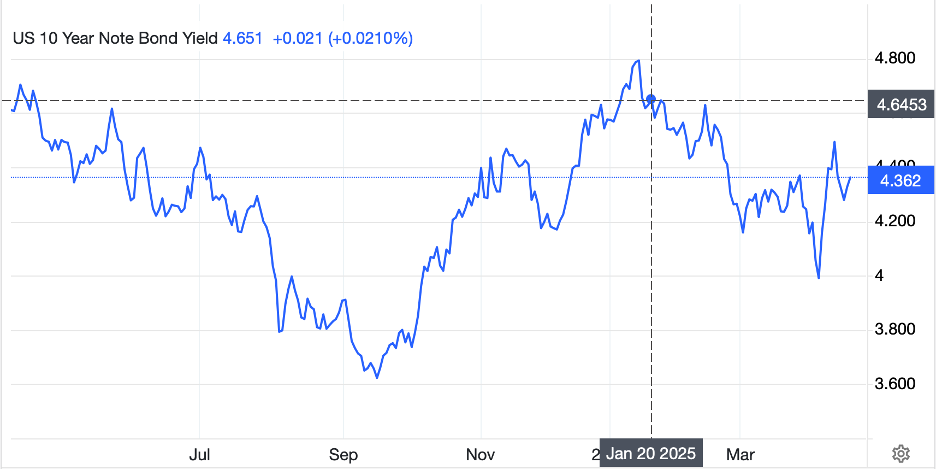
Since we’ve been measuring things from Trump’s inauguration, a look at 10-year Treasury yields shows they have declined a modest 28bps as of this morning’s pricing.  There has also been some volatility, but again, hardly unprecedented volatility.

Source: tradingeconomics.com

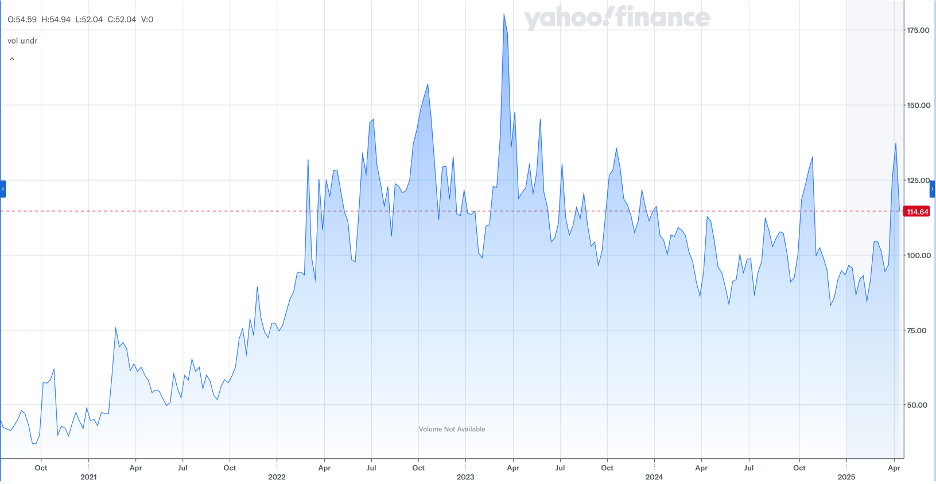
For instance, a widely followed measure of bond market volatility is the MOVE Index, currently produced by BofA.  At Friday’s close, it sat at 114.64.  A quick look at this chart shows the index, and by extension bond market volatility, is in the upper one-third of its range since inflation kicked off in 2022.  Again, it has spent a lot of time at higher levels and a lot of time at lower levels.

Source: finance.yahoo.com

There are numerous stories being written these days about reduced liquidity in the bond market, and there are many stories being written about how the Chinese, or the Japanese, or Europeans are selling Treasury bonds as a signal that all is not well.  First, we know all is not well, so that should not be a surprise.  Second, there has been no indication that Treasury auctions are failing, in fact the opposite, with the most recent 10-year and 30-year auctions showing substantial foreign demand.  

The funny thing about the bond market is to many it is a Rorschach test as people see what they want to see. To some, it is entirely about inflation and inflation expectations, so rising yields portend inflation on the horizon.  To others, it is a recession/growth indicator, which for most people is a coincident indicator, higher growth leads to higher inflation in that view.  But these days, much ink is spilled discussing how it is now and indicator of confidence in the US, especially with the growing antagonism between President Trump and Chairman Powell.  The same folks who lambasted Powell for keeping rates too high, now seem to be cheering him on to keep rates “too” high as a sign of his independence.

There is no doubt that despite the fact that the Fed’s press has diminished, and the market’s focus on the Fed has waned, their actions remain important to the US economy.  But is Jay Powell the last bastion of confidence in the US?  That, too, seems a stretch.

Trying to summarize, things in the US are quite messy right now.  For many investors, and hedgers, the previous status quo was so comfortable, and actions were easy to take.  However, Donald Trump’s election back in November was a very clear signal that things were going to change.  And they are changing.  In situations like this, investors tend to bring their money as close to home as possible.  This process has only just begun.  Since March, I have maintained that I see the dollar lower, and for a long time that the equity market was overvalued.  While the recent speed of movement is unlikely to be maintained, I expect the direction is pretty clear.

Ok, a really quick tour of markets overnight.  In Tokyo (-1.3%) equity markets slumped further as the yen strengthened and the status of the trade talks with the US remains unclear.  Chinese shares (+0.3%) edged higher and the rest of Asia that was open was mixed.  With all of Europe closed today, all eyes will be on the States where things are pointing to a lower opening.

Treasury yields have risen 4bps this morning and European sovereign markets are all closed.  Last night, JGB yields edged higher by 1bp, but the narrative of Japanese interest rates rising closer to other national levels has not had much press lately.

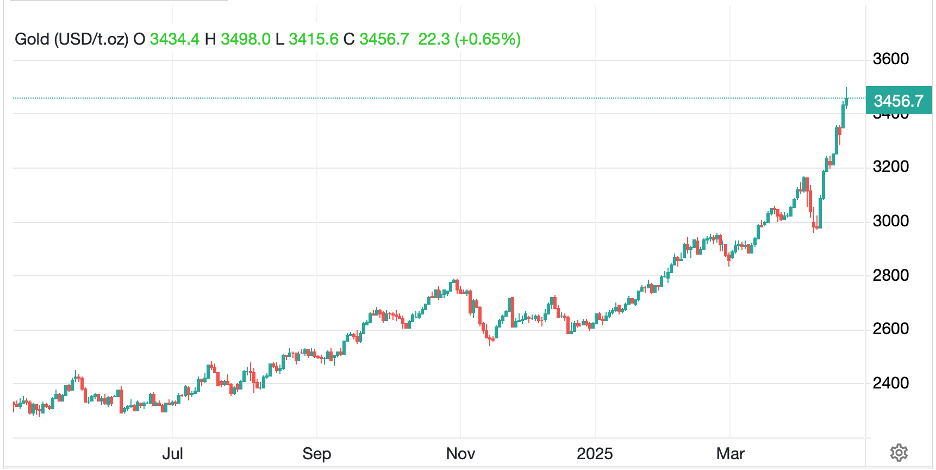
The commodity markets have been where all the action is, with oil (-2.5%) lower this morning as I have seen comments that the US-Iran talks are making progress.  As well, it appears that the Russia / Ukraine peace talks are reaching a denouement.  Successful conclusions in either, or both, of these discussions would very likely point to a lot more available crude on the market, and lower prices ahead.  I still think $50/bbl is in the cards.  But gold (+1.9%) is the story of the day here as the barbarous relic makes yet another new all-time high vs. the dollar dragging silver (+1.3%) and copper (+3.9%) along for the ride.  Not only are foreign central banks continuing to buy, as well as populations in China, India and elsewhere in Asia, but it appears that US retail is waking up to the fact that gold has been the best performing asset for the past year (+45%).  I continue to see the metals complex benefitting from the current macro environment.

Finally, we have already discussed the dollar which is lower this morning against virtually all its counterpart currencies in Europe and Asia.  As it happens, LATAM currencies are gaining the least and BRL (-0.1%) has even managed a slight decline on the opening.  But overall, this is a dollar selling day.

On the data front, today brings Leading Indicators (exp -0.5%) at 10:00 and that is all that is on the calendar.  It is a quiet week, and I will outline the rest tomorrow.

It should be a quiet market given Europe’s absence, and given how far the dollar has fallen leading into the open, I wouldn’t be surprised to see a modest bounce, but the trend, as I explained, remains clearly for a lower dollar going forward.

Good luck

Adf

Not Persuaded

As tariff concerns are digested
By markets, Chair Powell’s been tested
Is cutting the move
They need to improve?
Or are they, to tightness, still vested
 
It sounds as though he’s not persuaded
A rate cut will soon be paraded
But markets still price
He’ll be cutting thrice
It could be that view should be fade


Perusing the WSJ this morning, I stumbled across the following article, “What the Weak Dollar Means for the Global Economy” and couldn’t help but chuckle.  It was not that long ago when the punditry was complaining about the strong dollar as a problem for the global economy.  The current thesis is that the weakening dollar will make foreign exports to the US more expensive, on top of the tariffs, and will reduce the number of US tourists traveling abroad.  Foreign companies will also suffer as they translate their US sales into their respective local currencies, negatively impacting their earnings.  A moment as I shed a tear.

Of course, when the dollar was strong, the concern for the global economy was that it was increasingly expensive in local currency terms to obtain the dollars necessary to service the massive amounts of USD debt that foreign companies and nations have issued, thus reducing their ability to spend money on other things to drive their domestic economy.

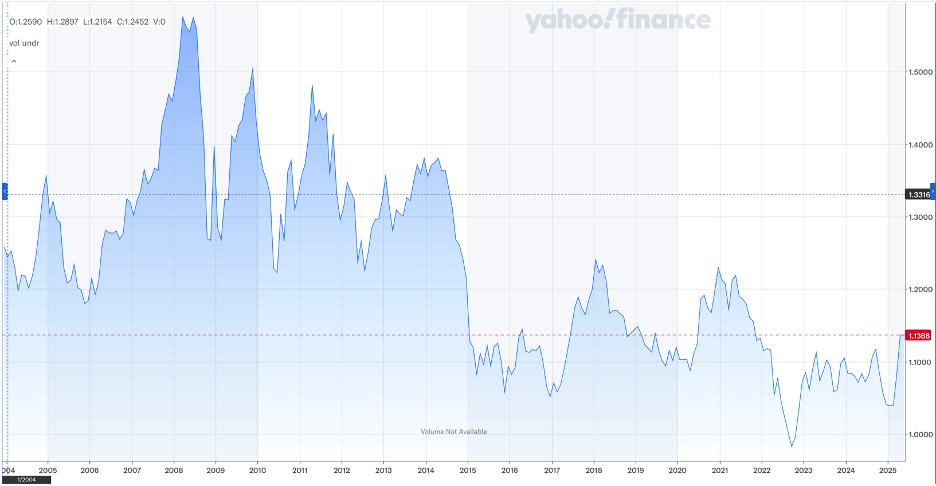
As they say, you can’t have it both ways.  While there is no doubt the dollar’s decline this year has been swift, it is important to remember we are nowhere near an extremely weak dollar.  As you can see from the below chart, the euro was trading near 1.60 back in 2008 and as high as 1.38 even in 2014.  When looking at today’s price of 1.1375, it is hard to feel overly concerned.

Source: finance.yahoo.com

As it happens, this morning the single currency has slipped back -0.3% from yesterday’s levels.  The dollar’s future remains highly uncertain given the potential policy changes that may unfold as the tariff situation becomes clearer.  Which leads us to the Fed.

For the first time in many weeks, the Fed became a topic of conversation for the market when Chairman Powell spoke to the Economic Club of Chicago.  “Our obligation is to keep longer-term inflation expectations well anchored and to make certain that a one-time increase in the price level does not become an ongoing inflation problem,” Powell explained.  “We may find ourselves in the challenging scenario in which our dual-mandate goals are in tension. If that were to occur, we would consider how far the economy is from each goal, and the potentially different time horizons over which those respective gaps would be anticipated to close.”  

Let me start by saying, the Fed’s track record in anticipating economic outcomes is not stellar.  Equity markets were not encouraged by these comments and sold off during the discussion, although they retraced some of those losses before the end of the session.  At the same time, the Fed funds futures market, while having reduced the probability of a rate cut next month to just 15%, continues to price 88bps of cuts into the market by the December meeting.  Assuming there is no cut in May, that leaves five meetings for between three and four cuts.  Based on Powell’s comments, that seems like aggressive market pricing.

It appears that there is a growing belief that a recession is on its way and that will both reduce inflationary pressures and force allow the Fed to start to reduce rates further.  Of course, there are those, Powell included, who seem to believe that stagflation is a strong possibility.  If that were the case, especially given Powell’s new-found belief that price stability matters, and his clear distaste for the president, my sense is they will focus on inflation not growth if financial conditions (aka bond markets) remain in good shape.  Will the dollar continue to decline under that scenario?  That is a very tough call as a US recession would almost certainly spread globally, and other central banks will likely ease policy.  If the Fed stands pat amidst a global reduction in interest rates, I don’t see the dollar declining.  If for no other reason, the cost of carrying short dollar positions would become too prohibitive.

As usual, the future remains quite cloudy.  Cases can be made for Fed cuts, and against them.  Cases can be made for dollar weakness and dollar strength.  Arguably, the biggest unknown is how the trade talks are going to resolve.  Yesterday, President Trump explained that “big progress” has been made on the Japanese tariff talks.  If Trump is successful in creating a coalition of nations that have closer trade relations with lower tariffs, I expect that would be taken quite positively by the markets.  On the other hand, if those talks fall apart, I expect equity markets to start the next leg lower, and that is a global phenomenon, while the dollar sinks further.  There is much yet to come.

Ok, let’s see how things played out overnight.  After yesterday’s US rout, Trump’s comments on trade talks with Japan clearly helped the market there as the Nikkei (+1.35%) rallied nicely as did the Hang Seng (+1.6%).  In fact, gains were widespread with Korea, India and Australia, to name three, all rising nicely.  Alas, Chinese shares did not participate, and Taiwan actually slipped a bit.  In Europe, investors await the ECB’s outcome this morning, where a 25bp cut is the median forecast, but there are those hinting at a 50bp cut to help moderate strength in the euro as well as support the economy given the tariff situation.  Remember, we have heard from a number of ECB members that they are confident inflation is heading back to their target.  Ahead of the news, shares are softer across the board with declines on the order of -0.5% to -0.8% throughout the continent and the UK.  Remember, too, their tariff talks are after Japan.  Interestingly, US futures are mixed with DJIA (-1.3%) the laggard while the other two are both higher about 0.5%.  It seems United Health shares have fallen enough to take the DJIA down with it.

In the bond market, Treasury yields have regained the 3bps they fell during yesterday’s US session, so are unchanged over two days.  We have also seen European sovereign yields climb between 2bps and 4bps, rising alongside Treasuries and JGB yields jumped 5bps, responding to confidence that the US-Japan trade dialog will be successful and support Japanese risk.

Despite all the reasons for oil to decline, including recession fears and continued pumping by pariahs like Iran and Venezuela, the black sticky stuff is higher by 1.1% this morning, its highest level in two weeks.  But as you can see in the chart below, there remains a huge gap to be filled more than $8/bbl higher than current prices.  It is difficult to see a significant rally on the horizon absent a major change in the supply situation.

Source: tradingeconomics.com

As to the metals markets, gold (-0.6%) blasted higher to another new high yesterday, above $3300/oz, and while it is backing off a bit today, shows no signs of stopping for now.  Both silver and copper rallied yesterday as well, and both are also falling back this morning (Ag -1.4%, Cu -2.1%).

Finally, the dollar is modestly firmer across the board this morning, with the DXY seeming to find 99.50 as a key trading pivot level.  In the G10, JPY (-0.45%) is the laggard along with CHF (-0.4%) while other currencies in the bloc have fallen around -0.2%.  The exception here is NOK (+0.3%) as it benefits from oil’s rebound.  In the EMG bloc, the dollar is mostly firmer, but most of the movement has been of the 0.3% variety, so especially given the overall decline in the dollar, this looks an awful lot like position adjustments ahead of the long weekend with no new trend to discern.

On the data front, yesterday’s Retail Sales was stronger than expected, and not just goods that were bought ahead of tariffs, but also services and dining out, which would seem less impacted.  This morning, we see a bunch of stuff as follows: Housing Starts (exp 1.42M), Building Permits (1.45M), Philly Fed (2.0), Initial Claims (225K) and Continuing Claims (1870K).  As long as the employment data continues to hold up, my take is the Fed will sit on the sidelines.  If that is the case, I sense we have found a new range for the dollar, 99/101 in the DXY and we will need a headline of note to break that.

As tomorrow is Good Friday and markets are essentially closed throughout Europe, as well as US exchanges, there will be no poetry.

Good luck and good weekend

Adf

The Tariff Explosion

In China, Xi’s ‘conomy grew
Quite nicely, but now in Q2
The tariff explosion
Ought lead to erosion
Of growth, lest we see a breakthrough


Chinese economic data was released last night, and the numbers were far better than expected, well most of them were.  The below table from tradingecoomics.com highlights the big numbers showing strength in GDP, IP and Retail Sales although Capacity Utilization was soft.

But this is Q1 data, and pretty early at that, just two weeks past the end of the quarter.  As well it reflected activity prior to the tariffs imposed by President Trump, and subsequently the Chinese themselves.  Just as we saw massive increases in the trade deficit here, as companies were front-running the tariff threat, I imagine we saw a lot more activity brought forward by the Chinese to both satisfy that front-running, as well as some front-running of their own.  I guess the question to ask is, how much information does this data provide regarding potential future outcomes and I suspect the answer is, not much.  

Already we are seeing global economists reducing their forecasts for Chinese annual GDP growth this year, with the lowest number I have seen at 3.5% (Goldman).  That is far below the ‘about 5%’ that President Xi targeted back in February and clearly assumes tariffs will remain in place.  And perhaps that is the biggest unknown.  The current state of play between Trump and Xi is that Trump said, call me, maybe and we can talk while Xi has said, show some respect and we can talk.

At this point, it is all theater, with both men playing to their bases and trying to show strength.  I do believe that Trump is seeking to isolate China, but the ultimate end game may well be to get them to alter their behavior.  If history is any guide, I imagine that this won’t be settled quickly, but that by summer, both sides will be feeling the heat on the economy.  Alas, that’s a long time from now and there is ample opportunity for significant market gyrations between now and then.

Like Fujiyama
Successful trade talks will be
A beautiful thing

On the other side of the tariff sheet is Japan, which is priority number one for the US.  PM Ishiba has sent his chief trade negotiator, Ryosei Akazawa, to the US to sit down with Treasury Secretary Bessent who has been named the lead in these negotiations.  While there is much discussion on autos, another very sticky subject is rice, on which Japan imposes a very high tariff.  President Trump claims it is 700%, others say less, more like 400%, but whatever it is, clearly the Japanese are protecting their rice farmers.  Ironically, Japan is in the middle of a rice shortage and has been pulling from strategic stockpiles to prevent prices there from rising too sharply.  Meanwhile, the US has ample export capacity.  It seems like a win-win opportunity, but politics is convoluted and from what I have read, the Japanese farmers don’t want to cede any market share to imports.  

Nonetheless, I expect that this will be a successful outcome as it is too important to fail.  While President Trump continues his bluster, he needs a win economically, and if Japanese talks are successful, we will see many more versions completed within the 90-day period in my view.  Things won’t go back to the way they were before Liberation Day, but if trade questions are answered, all eyes will turn to the budget, which is going to be a different kind of messy.  As I have written before, the greatest potential irony from this tariff war is that we could see lower tariffs around the world, something that all that WTO hobknobbing could never obtain.

One other mooted issue between the US and Japan is the exchange rate, which, while the yen has strengthened more than 10% since its low (dollar high) back just before the inauguration, remains far above levels seen before the Covid inspired inflation resulted in the Fed tightening policy aggressively.  The chart below is quite clear in displaying just how weak, relative to the past 30 years of history, the yen remains.  That last little dip is the move so far this year.

Of course, given the yen’s most recent bout of weakness dates from 2022, when US interest rates started to climb, if Treasury Secretary Bessent is successful in getting rates lower, that will be a natural driver of a weaker dollar, stronger yen.  Especially if Ueda-san does tighten policy further.

We have much to anticipate as the year progresses.  Ok, let’s turn to the overnight session and see what’s happening.  Yesterday’s lackluster US equity performance was followed by a terrible earnings discussion for Nvidia and much more extended weakness in Asia.  The Nikkei (-1.0%) and Hang Seng (-1.9%) fell sharply as did Korea (-1.2%) and Taiwan (-2.0%).  China (+0.3%), however, bucked the trend likely on the support of the plunge protection team there buying to prevent a rout.  Certainly, the positive data didn’t hurt, but I doubt that was enough.  In Europe, screens are all red as well, with declines on the order of -0.3% (UK and Spain) to -0.6% (Germany and France).  It is, however, universal with every market there declining.  As to US futures, while the DJIA is unchanged, both the NASDAQ and SPX are down sharply on that Nvidia news.

In the bond market, yields have been edging lower despite (because of?) all the tariff anxiety.  While Treasuries are unchanged this morning, they drifted off 3bps yesterday.  European sovereign yields are all lower by -2bps to -3bps and the big news was JGB yields tumbling -10bps last night.  There continues to be a great deal of discussion about China using its Treasury holdings as a weapon, but I find that highly unlikely.  Unless they could literally find a bid for all of them at once, to prevent further losses, it would self-inflict too much damage.  My take is they are essentially performing their own version of QT, allowing Treasuries to mature and slowly replacing them with other things, Bunds, gold, oil, copper.  One of the biggest problems is there are precious few asset classes that are large enough to absorb all that money, so they will continue to hold Treasuries in some relatively large amount, probably forever.

Turning to commodities, oil (+1.0%) continues to trade quietly and hang around just above $60/bbl.  It feels to me like there is a lot more room on the downside than the upside, but that is just me.  In the metals markets, gold (+1.5%) is glittering again, making yet another new all-time high this morning.  Remember a week ago when the market was correcting and there was discussion about gold losing its luster?  Me neither!

Source: tradingeconomics.com

This chart is a perfect example of the idea that nothing goes up in a straight line.  But the trend here is strong.  Silver (+1.6%) is following in gold’s footsteps today but copper (-0.4%) is lagging.  No matter, I continue to think commodities have more strength ahead.

One of the reasons is that the dollar remains under pressure.  Last night, further weakness was manifest with the euro trading back close to the highs touched on Friday at the 1.14 level.  Prior to Friday, the last time the euro was here was in February 2022.  But again, like the yen chart above, the euro’s strength is a very recent, short-term phenomenon.  A look at the chart below demonstrates just how “weak” the dollar is vs. the single currency on a long-term basis.  The answer is not very.

But overall, the dollar is weaker this morning across the board against both G10 and EMG currencies.  I do agree with the idea that foreign investors have been liquidating their US equity holdings slowly and repatriating the funds home.  If that continues, and it could, a continued decline in the dollar, especially if US yields slide, is likely.

On the data front, Retail Sales (exp 1.3%, 0.3% ex-autos) is the headliner at 8:30 then IP (-0.2%) and Capacity Utilization (78.0%) at 9:15.  We also hear from the BOC, although they are expected to leave their base rate on hold at 2.75%.  EIA oil inventory data is due later this morning with a decent sized draw of more than 5mm barrels across products expected.  There are Fed speakers including Chair Powell at 1:30 this afternoon, but they have just not had much sway lately, and I think they are ok with that.

Putting it all together, at least in the FX framework, my take is the dollar has further to fall.  There is no collapse coming, but steady weakness seems realistic.  However, given the overall uncertainty at the current time, I would be maintaining hedges rather than anticipating that weak dollar.

Good luck

Adf

USDi Launch

Today we are proud to announce the launch of the first cryptocurrency issued by USDi Partners, the first fully-backed CPI-indexed currency. I am delighted to be involved with this effort. Here is the official press release!
https://www.prlog.org/13071354-usdi-partners-notes-launch-of-the-usdi-coin-the-first-us-currency-to-permanently-preserve-purchasing-power.html

As well, there is an article in Bloomberg (and it appears Yahoo Finance) discussing the project and launch.

https://finance.yahoo.com/news/crypto-newest-stablecoin-inflation-linked-123000624.html

please note this disclaimer

Important Disclaimer: The USDi Coin is offered only to accredited investors. Due to various risks and uncertainties, actual events or results or the actual performance of the instrument described herein may differ materially from those discussed here. This information is as of the date indicated, is not complete nor has it been audited, and does not contain certain material information about the products to be offered, including important disclosures and risk factors associated with an investment. Neither Enduring Investments, USDi Partners, nor their principals, employees, agents or authorized representatives, makes any warranty or representation, whether express or implied, or assumes any legal liability for the accuracy, completeness or usefulness of any information disclosed. Past performance is no guarantee of future results.