Everyone’s Bitching

With President Trump on the road
The market has heard a boatload
Of ideas and plans
Including Iran’s
Return to a more normal mode
 
There’s talk of a nuclear deal
Audacious, if it’s truly real
Instead of enriching
While everyone’s bitching
A partnership deal they would seal


One is never disappointed with the tone of the overnight news when President Trump is traveling.  Between his flair for the dramatic and his desire to conclude deals, it seems like there is always something surprising when we awake each morning.  This morning is no different.  

While the mainstream media has been harping on the audacity of Qatar gifting a “flying palace” to the US for President Trump to use as Boeing’s delivery of the newest Air Force One is something like 10 years behind schedule, Mr Trump has indicated he is quite keen to make a deal with Iran that would bring them back into the fold of good neighbor nations.  Ostensibly, Iran has suggested that they work with the Saudis, Emiratis and the US to enrich uranium together in order to develop nuclear power in the Middle East.  As the Saudis and Emiratis have already expressed interest in building more nuclear power plants, it is not a stretch for them.  But bringing Iran into the fold, so that enrichment activities are done jointly, and therefore can be closely overseen by the US and Saudi Arabia, would be a remarkable outcome.

The JCPOA deal signed by President Obama was a nullifying deal, one that was designed to prevent an activity, the enrichment of uranium to the required concentrations sufficient to build a bomb.  But this is an encompassing deal, one that would join erstwhile enemies into a partnership to jointly produce uranium sufficiently enriched for nuclear power, without pushing toward weapons grade material.  Now, this would be a remarkable change in attitude in Tehran as the theocracy there has basically made the end of the US and Israel their motto ever since 1979 and the revolution that brought them to power.  But things are tough in Iran right now and the funny thing about power is that those who hold it are really reluctant to let go.  It would not be unprecedented for a nation’s leadership to reverse course completely in order to maintain their grip, and it is also not hard to believe that a softer tone would be welcome in Iran by the populace.

Regardless, this is a bold and audacious idea, but one that could just work.  Now, we should all care not simply because anything that could lead to less terrorism and destruction is an unalloyed good, but because the impact on the global economy would be significant, namely, the price of oil is likely to decline further.  A deal like this is likely to include the end of restrictions on Iranian oil sales, or at least a dramatic reduction in those restrictions.  While Iran has been producing and selling oil all along this would change the tone of the oil market with another major player now actively looking to expand production and sales.  (After all, the Iranian economy is desperate and the ability to generate more revenue without restrictions would be an extraordinary carrot for the mullahs.)

With this in mind, it should be no surprise that the price of oil (-3.65%) has fallen sharply today, and the real question is just how low it can go.  A look at the chart shows that the trend has been lower for the past year although it seems to have found a temporary bottom just above $56/bbl. 

Source: tradingeconomics.com

I have maintained for the past year and a half that the ‘peak cheap oil’ thesis has been faulty and that there is plenty of the stuff around with political, not geological restrictions the driving force toward higher prices.  This is Exhibit A on the political restriction case.  President Trump is quite keen to see oil prices lower as it suits both the inflation story in the US as well as offers a significant advantage to US manufacturing facilities with access to cheap energy.  I would guess this was not on anyone’s bingo card before today but must now be taken seriously as a potential outcome.  While I’m not an oil trader, I suspect we will test, and break, through those lows just above $56 in the coming weeks and find a new home closer to $50/bbl.

This is such an extraordinary story, I could not ignore it.  But as an aside, President Trump also mentioned that India has allegedly offered to cut their tariff rates on US goods to 0.0%!  I don’t know if that would be reciprocal, and that has not yet been verified by India, but again, it demonstrates that many of the things we believed to be true regarding international relations are not carved in stone.

Ok, let’s look at how markets are absorbing these latest surprises.  Yesterday’s price action could best be described as dull, with US equity markets doing little all day, although the NASDAQ managed to edge higher into the close.  In Asia overnight, the major markets (Japan -0.9%, China -0.9% and Hong Kong -0.8%) all came under pressure although there doesn’t appear to have been a particular story.  There were no new trade related comments, so I sense that the recent uptick just saw some profit-taking.  Elsewhere in Asia, the biggest winner was India (+1.5%) and then it was a mixed bag.  In Europe, equity markets have done very little overall after Eurozone data showed GDP activity was more disappointing than first reported with Q1’s second estimate down to 0.3%.  As to US futures, at this hour (7:10), they are pointing lower by about -0.4% or so across the board.

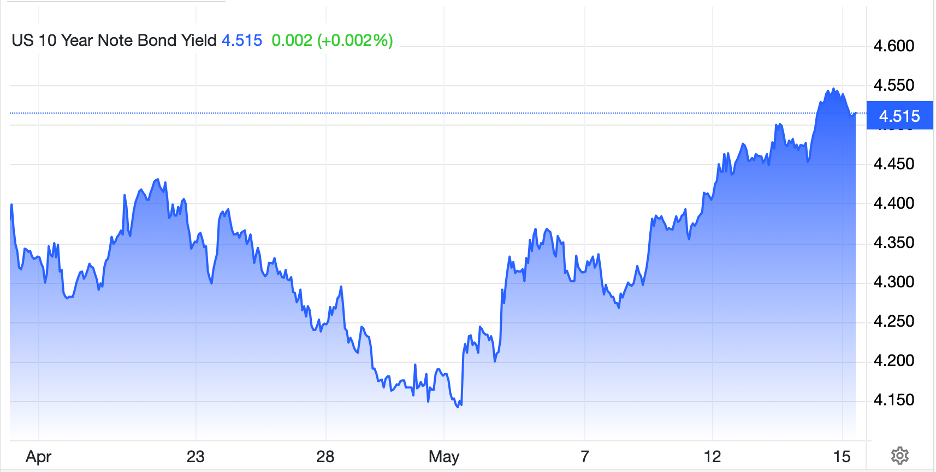
In the bond market, Treasury yields, which have been climbing relentlessly all month as per the below chart, have backed off -2bps this morning, but 10-year yields are still above 4.50%, a level Mr Bessent is clearly unhappy with.  But today’s price action has also seen European sovereign yields slide a similar amount, with the softer Eurozone growth one of the reasons here as well.
Source: tradingeconomics.com

Turning to the metals markets, the shine is off gold (-0.2%) which has fallen more than 4% in the past week, although remains well above $3100/oz.  It seems that much of the fear that drove the price higher is being removed from the markets by the constant updates of trade and peace deals that we hear regularly.  It remains to be seen if this lasts, and how the Fed will ultimately behave, but for now, fear is fading.

Finally, the dollar is a touch softer overall, but not universally so.  In the G10, the euro (+0.2%) and pound (+0.2%) are both edging higher with UK data looking a tad better compared to that modest weakness in Eurozone data.  But the yen (+0.6%) and CHF (+0.5%) are both nicely higher as there continues to be a strong belief that President Trump is seeking the dollar to decline in value.  In the EMG bloc KRW (+0.7%) and ZAR (+0.8%) are the leaders with most of the rest of the bloc making very modest gains on the order of 0.2% or less.  It appears that the dollar has decoupled from the US rate picture for the time being.  I wonder if it is presaging lower US rates, or if this relationship is going to change for a longer time going forward.  We will need to watch this closely.

On the data front, there is a bunch this morning as well as comments from Chairman Powell at 8:40.  

Initial Claims229K
Continuing Claims1890K
Retail Sales0.0%
-ex autos0.3%
PPI0.2% (2.5% Y/Y)
-ex food & energy0.3% (3.1% Y/Y)
Empire State Manufacturing-10
Philly Fed Manufacturing-11
IP0.2%
Capacity Utilization77.8%

Source: tradingeconomics.com

I don’t see PPI as having much impact, but Retail Sales will get some discussion as will the manufacturing indices as weakness there will help the negative narrative that some are trying to portray.  Net, though, the story seems likely to continue to be the announcements of deals as they come in.  It is not clear to me that they will all be net positives, and I believe that much positivity has already been absorbed so we will need to see data that backs up the narrative and that could take a few quarters.  In the meantime, my lower dollar thesis seems to fit better today.  That’s my story and I’m sticking to it!

Good luck

Adf

As Though It Had Fleas

Well, CPI wasn’t as hot
As most of the punditry thought
But bonds don’t believe
The Fed will achieve
Low ‘flation, so they weren’t bought
 
But maybe, the biggest response
Has been that the buck, at the nonce
Has lost devotees
As though it had fleas
The end of the Trump renaissance?


Yesterday’s CPI data was released a touch softer than market expectations with both headline and core monthly numbers printing at 0.2%.  If you dig a bit deeper, and look out another decimal place, apparently the miss was just 0.03%, but I don’t think that really matters.  As always, when it comes to inflation issues, I rely on @inflation_guy for the scoop, and he provided it here.  The essence of the result is that while inflation is not as high as it had been post Covid, it also doesn’t appear likely that it is going to decline much further.  I think we all need to be ready for 3.5% inflation as the reality going forward.

Interestingly, different markets seemed to have taken different messages from the report.  For instance, Treasury yields did not see the outcome as particularly positive at all.  While yields have edged lower by -2bps this morning, as you can see from the below chart, they remain near their highest level in the past month.  

Source: tradingeconomics.com

There are two potential drivers of this price action, I believe, either bond investors don’t believe the headline data is representative of the future, akin to my views of inflation finding a home higher than current readings, or bond investors are losing faith in the full faith and credit of the US.  Certainly, the latter would be a much worse scenario for the US, and arguably the world, as the repudiation of the global risk-free asset of long-standing choice will result in a wild scramble to find a replacement.  I continue to see comments on X about how that is the case, and that US yields are destined to climb to 6% or 10% over the next couple of years as the dollar declines in importance in the global trading system.  However, when I look at the world, especially given my views on inflation, I find that to be a lot of doomporn clickbait and not so much analysis.  Alas, higher inflation is not a great outcome either.

Interestingly, while bond investors did not believe in the idea of lower yields, FX traders took the softer inflation figure as a reason to sell dollars.  This is a little baffling to me as there was virtually no change in Fed funds futures expectations with only an 8% probability of a cut next month and only 2 cuts priced for the year.  So, if long-dated yields didn’t decline, and short-dated yields didn’t decline, (and equity prices didn’t decline), I wonder what drove the dollar lower.  

Yet here we are this morning with the greenback softer against all its G10 counterparts (JPY +1.0%, NOK +0.6%, EUR +0.5%, CHF +0.5%) and almost all its EMG counterparts (KRW +1.5%, MXN +0.3%, ZAR +0.3%, CLP +0.6%, CZK +0.5%).  In fact, the only currency bucking the trend is INR (-0.25%) but given the gyrations driven by the Pakistan issues, that may simply be the market adjusting positions.

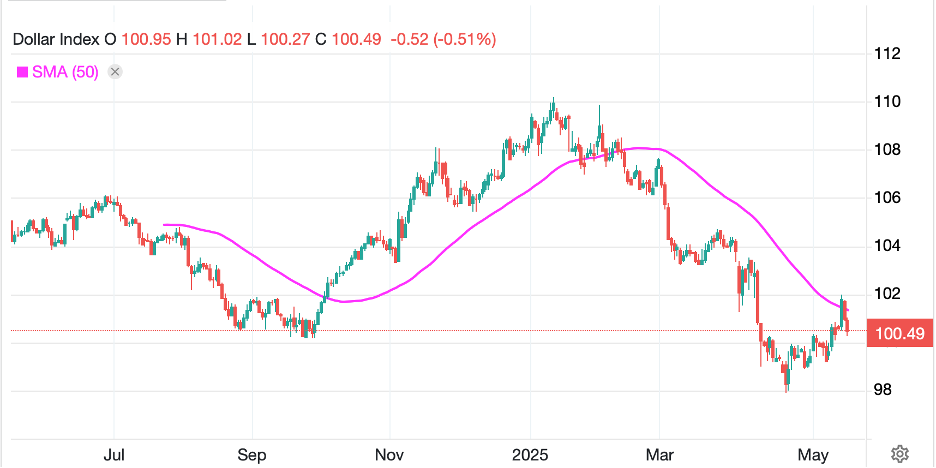
From a technical perspective, we are going to hear a lot about how the dollar failed on its break above the 50-day moving average that was widely touted just two days ago. (see DXY chart below).

Source: tradingeconomics.com

But let’s think about the fundamentals for a bit.  First, we know that the Trump administration would prefer a weaker dollar as it helps the competitiveness of US exporters and that is a clear focus.  Second, the fact that US yields remain higher than elsewhere in the world is old news, that hasn’t changed since the Fed stopped its brief cutting spree ahead of the election last year while other nations (except Japan) have been cutting rates consistently.  What about trade and tariffs?  While it is possible that the idea of a reduction in trade will reduce the demand for dollars, arguably, all I have read is that during this 90-day ‘truce’, companies are ordering as much as they can to lock in low tariffs.  That sounds like more dollars will be flowing, not less.

As I ponder this question, the first thing to remember is that markets don’t necessarily trade in what appears to be a logical or consistent fashion.  I often remark that markets are simply perverse.  But going back to the first point regarding President Trump’s desire for a weaker dollar, there was a story overnight that a stronger KRW was part of the trade discussion between the US and South Korea and I have a feeling that is going to be part of the discussion throughout Asia, especially with Japan.  As of now, I continue to see more downward pressure on the dollar than upward given the Administration’s desires.  I don’t think the Fed is going to do anything, nor should they, but I also don’t foresee a change in the recession narrative in the near future.  While that has not been the lead story today, it remains clear that concern about an impending recession is everywhere except, perhaps, the Marriner Eccles Building.  My view has been a lower dollar, and perhaps today’s price action is a good example of why that is the case.

Ok, let’s touch on other markets quickly.  After yesterday’s mixed session in the US, Asia saw much more positivity with China (+1.2%) and Hong Kong (+2.3%) leading the way higher with most regional markets having good sessions and only Japan (-0.15%) missing the boat.  In Europe, though, the picture is not as bright with both the CAC (-0.6%) and DAX (-0.5%) under some pressure this morning despite benign German inflation data and no French data.  Perhaps the euro’s strength is weighing on these markets.  As to US futures, at this hour (6:45), they are basically unchanged.

Away from Treasury markets, European sovereign yields have all slipped either -1bp or -2bps on the day with very little to discuss overall here.

Finally, in the true surprise, commodity prices are under pressure this morning across the board despite the weak dollar.  Oil (-1.1%) is slipping, with the proximate cause allegedly being API oil inventory data showed a surprising gain of >4 million barrels.  However, given the courteousness of the meeting between President Trump and Saudi Prince MBS, I would not be surprised to hear of an agreement to see prices lower overall.  I believe that is Trump’s goal for many reasons, notably to put more pressure on Russia’s finances, as well as Iran’s and to help the inflation story in the US.  As to the metals complex, they are all lower this morning with gold (-0.7%) leading the way but both silver (-0.3%) and copper (-0.5%) lagging as well.

On the data front, there is no front-line data to be released, although we do see EIA oil inventories with modest declines expected.  However, it is worth noting that Chinese monetary data was released this morning and it showed a significant decline in New Yuan Loans and Total Social Financing, exactly the opposite of what you would expect if the Chinese were seeking to stimulate their economy.  It is difficult for me to look at the chart below of New Bank Loans and see any trend of note.  I would not hold my breath for the Chinese bazooka of stimulus that so many seem to be counting on.

Source: tradingeconomics.com

Overall, it appears to me the market is becoming inured to the volatility which is Donald Trump.  As I have written before, after a while, traders simply get tired and stop chasing things.  My take is we will need something truly new, a resolution of the Chinese trade situation, or an Iran deal of some kind, to get things moving again.  But until then, choppy trading going nowhere is my call.

Good luck

Adf

No Longer Concern

Seems tariffs no longer concern
The markets, as mostly they yearn
For Jay and the Fed,
When looking ahead
To cut rates when next they adjourn
 
Alas, there’s no hint that’s the case
As prices keep rising apace
In fact, come this morning
There could be a warning
If CPI starts to retrace


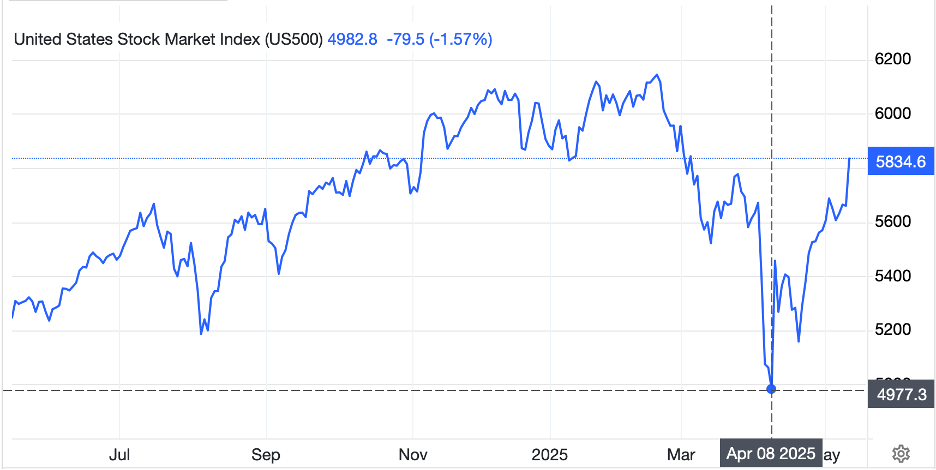
I am old enough to remember when President Trump’s actions on tariffs combined with DOGE was set to collapse the US economy.  I’m sure that was the case because it was headline news every day.  Equity markets fell sharply, the dollar fell sharply, gold rallied, and the clear consensus was the “end of American exceptionalism” in finance.  That was the description of how investors around the world flocked to the US equity markets as they held the best opportunities.  But the punditry was certain President Trump had killed that idea and were virtually licking their lips writing the obits for the US economy and President Trump’s plans.  In fact, I suspect all of you are old enough to remember that as well.  The chart below highlights the timing.

Source: tradingeconomics.com

But that is such old news it seems a mistake to even mention it.  The headlines this morning are all about how the stock market is now set to make new highs!  Bloomberg led with, Traders Model Bullish Moves for S&P 500 With Tariff Tensions Easing, although it is the theme everywhere.  So, is the world that much better today than a month ago?  Well, certainly the tariff situation continues to evolve, and we have moved away from the worst outcomes there it seems.  But recession probabilities remain elevated in all these econometric models, with current forecasts of 35%-50% quite common.  

Is a recession coming?  Well, the same people who have been telling us for the past 3 years that a recession was right around the corner, and some have even said we are currently living through one, are telling us that one is right around the corner.  Their track record isn’t inspiring.  In fact, these are the same people who are telling us that store shelves will be empty by the summer.  Personally, I take solace in the fact that the underlying numbers from the Q1 GDP data showed that despite a negative outcome, the positives of a huge increase in private investment and a reduction in government spending, were far more important to the economy than the fact that the trade deficit grew as companies rushed to stock up before the threatened tariffs.  Less government spending and more private investment are a much better mix for the economy’s performance going forward.  Let’s hope it stays that way.

But what about prices?  This morning’s CPI data (exp 0.3%, 2.4% Y/Y Headline, 0.3%, 2.8% Y/Y Core) will give us further hints about how the Fed will behave going forward.  As of now, there is no indication that the Fed is concerned about a growth slowdown of such magnitude that they need to cut rates.  In fact, Fed funds futures have reduced the probability of a June cut to just 8% and have reduced the total cuts for 2025 to just 2 now, down from 3 just a week ago.  Yesterday, Fed Governor Adriana Kugler reiterated the old view that tariffs could raise prices and reduce growth although gave no indication that cutting rates was the appropriate solution.  Arguably of more importance to the market will be Chairman Powell’s comments when he speaks Thursday morning.  My take here, though, is that the rate of inflation has bottomed and that the Fed is going to remain on hold all year long.  In fact, as I wrote back in the beginning of the year, I would not be surprised to ultimately see a rate hike before the year is over.  A rebound in growth and inflation remaining firm will change the narrative before too long, probably by the end of summer.  Of course, remember, I am just a poet and not nearly as smart as all those pundits, so take my views with at least a grain of salt.

Ok, let’s look at how markets have behaved in the new world order.  Yesterday’s massive US equity rally did not really see much follow through elsewhere although the Nikkei (+1.4%) had a solid session.  In fact, the Hang Seng (-1.9%) saw a reversal after a string of 8 straight gains as both profit-taking and some concerns about slowing growth in China seemed to be the main talking points there.  Elsewhere in the region, Malaysia and the Philippines had strong sessions while India lagged.  

In Europe, other than Spain’s IBEX (+0.8%), which has rallied purely on market internals, the rest of the continent and the UK are virtually unchanged this morning.  The most interesting comment I saw was from Treasury Secretary Bessent who dismissed the idea that a trade deal with the EU would be coming soon, “My personal belief is Europe may have a collective action problem; that the Italians want something that’s different than the French. But I’m sure at the end of the day, we will reach a satisfactory conclusion.”  That sounds to me like Europe is not high on the list of nations with whom the US is seeking to complete a deal quickly.  Finally, US futures are a touch softer this morning, although after the huge rallies yesterday, a little pullback is no surprise.

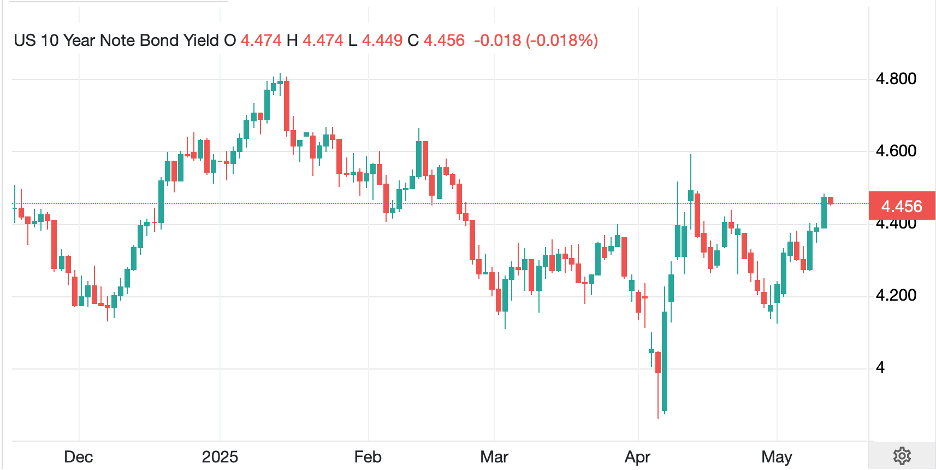
In the bond market, Treasury yields have backed off 2bps this morning, but in reality, they are higher by nearly 30bps so far this month as you can see below.

Source: tradingeconomics.com

This cannot please either Trump or Bessent but ultimately the question is, what is driving this price action?  If this is a consequence of investors anticipating faster US growth with inflation pressures building, that may be an acceptable outcome, especially if the administration can slow government spending.  But if this is the result of concern over the full faith and credit of the US government, or a liquidation by reserve holders around the world, that is a very different situation and one that I presume would be addressed directly by the Trump administration.  As to European sovereign yields, today has seen very modest rises, 1bp or 2bps across the board.  The biggest news there was the German ZEW survey which, while the Current Conditions Index fell to -82, saw the Economic Sentiment Index jump 39 points to +25.2, far better than expected.  It seems there is a lot of hope for the rearmament of Germany and the economic knock-on effects that will may bring.

In the commodity markets, oil (+0.6%) continues to grind higher as it looks set to test the recent highs near $64/bbl and from a technical perspective, may have put in a double bottom just above $56/bbl.  There is still a huge gap above the market that would need to be filled (trading above $70/bbl) in order to break this downtrend, at least in my mind.  But that doesn’t mean we can’t chop back and forth between $60 and $65 for a long time.  As to gold (+0.7%) after a sharp decline yesterday as the world was no longer scared about the future, it is bouncing back.  Whether this is merely technical, and we are heading lower, or yesterday’s price action was the aberration is yet to be determined.  Meanwhile, silver (+1.3%) and copper (+1.0%) are both having solid sessions as well.

Finally, the dollar is giving back a tiny bit of yesterday’s massive gains.  The euro (+0.2%) and pound (+0.25%) are emblematic of the overall movement although we have seen a few currencies with slightly stronger profiles this morning (SEK +0.8%, AUD +0.6%, CHF +0.5%).  In the EMG bloc, the movement has actually been far less impressive with ZAR (-0.45%) and KRW (-0.4%) bucking the trend of dollar softness but gains in MXN (+0.4%) and CZK (+0.4%) the best the bloc can do.  

One thing I will say about this administration is they have the ability to really change the tone of the discussion in a hurry.  If they are ultimately successful in reordering US economic activity away from the government and to the private sector, that is going to destroy my dollar weakness thesis.  I freely admit I didn’t expect anything like this to happen, but the early evidence points in that direction.  We will know more when Q2 GDP comes out and we find out if private sector activity is really increasing like the hints from Q1.  If that is the case, then the idea of American exceptionalism is going to make a major comeback in the punditry, although I suspect markets will have figured it out before then.

Other than the CPI, there is no other data and there are no Fed speakers on the docket.  While the dollar is soft this morning, I expect that any surprises in CPI will be the driver.  Otherwise, as I just mentioned, I am becoming concerned about my dollar weakness view.

Good luck

adf

Huge Fluctuations

There once was a war between nations
That led to some huge fluctuations
In markets worldwide
As pundits all cried
The world’s shaken to its foundations
 
In secret, though, pundits all cheered
‘Cause they all hate Trump, and thus steered
The narrative toward
This Damocles’ sword
That hung o’er the world and was feared
 
But now, twixt the US and China
There is just a bit less angina
Both sides, tariffs, slashed
And quite unabashed
These pundits said things were just fine-a


The wonderful thing about controlling the narrative is that it doesn’t matter if you are right or wrong at any particular time, because if you are wrong, you simply change the narrative.  At least that’s my impression looking here from the cheap seats.  At any rate, the news this weekend brought the end to the trade war, or at least a 90-day cease fire, as both the US and China slashed their announced tariffs dramatically, with US tariffs falling to 30% on Chinese goods and Chinese tariffs falling to 10% on US goods.  Between now and August, Treasury Secretary Bessent will be leading trade talks with Chinese Vice Premier He to try to come up with a more permanent solution.

In the interim, it will be interesting to see how the narrative evolves.  Certainly, I got tired of the different articles I saw explaining that there were no ships crossing the Pacific from China to the US and that store shelves would be empty by summer.  I wonder if we will see any of those claims retracted. (I’m not holding my breath).  I also wonder why that is the case simply from a mathematic perspective.  After all, annual US GDP is ~$28 trillion and imports from China in the twelve months from April 2024 through March 2025 were ~$444 billion, according to the FRED database.  So, does that mean that the other $27.56 trillion in economic activity was all services?  A look at the charts below created from FRED data shows that not only has the amount of imports from China not been growing lately, as a percentage of GDP, they have been shrinking.  I am not saying Chinese activity is unimportant to the US, just that the reduction in relative trade has been happening far longer than President Trump has been in office this time.

While certainly, low priced items could become a bit scarcer, it strikes me that there was more than a bit of hyperbole involved in those claims.  Of course, the next question is, will those ships start sailing again?  I guess we shall find out soon enough.

But stepping back a bit, I think it is critical to remember that prior to President Trump’s “Liberation Day” tariff announcements, it’s not as though the world trade system was all peaches and cream.  In fact, this weekend I listened to an excellent Monetarymatters podcast with guest George Magnus discussing the trade situation and why it was untenable in its current form before President Trump tried to change things.  He is far more eloquent and knowledgeable than a mere poet like me, and it is worth listening.  In the end, as others have also said, the status quo was unsustainable as both US government spending needs to be cut and the US reliance on China (or any other nation) for things of national security importance could not continue without grave results for our nation.  

I contend there is no easy way to change a system that has evolved over 80 years with goals changing during that period.  I also contend that the idea that a proverbial scalpel would have been a better method to do things, as it would not have created the market ructions we have all felt for the past few months, would never have worked.  Just like in changing the way the federal government works, the inertia in the trade system is far too great to be adjusted by tweaks here and there.  To make a lasting change, major disruptions are needed and that is what President Trump has been doing, disrupting things majorly.  Whether or not he will ultimately be successful is hard to say, but the odds of a change are greater now than before he started.  And almost everybody agreed that things were unsustainable.

One last thing you are sure to hear, especially now that the negotiations have begun is that the only reason is because President Trump “blinked” and couldn’t stand the pain of the market and the slings and arrows of the punditry.  However, it remains very difficult for me to look at the data that has been released of late, with Chinese growth slowing rapidly and Chinese stimulus unable to solve the problem and believe that President Xi hasn’t felt enormous pressure to speed up the economy.  It is clearly in both sides interest to come to a resolution, and that is what we should focus on going forward.

So, how did markets take the news?  Well, it should be no surprise that Chinese (+1.2%) and Hong Kong (+3.0%) shares both rallied sharply given they are the direct beneficiaries of the story.  Taiwan (+1.0%) and Korea (+1.2%) also fared well in the euphoria, but perhaps the biggest news in Asia was the ceasefire between India and Pakistan that was brokered by the US.  That saw Indian shares (+3.8%) and Pakistani shares (+9.0%) both explode higher.  It is certainly better that the explosions are in the relevant stock markets than on the ground!  As to the rest of Asia, markets were generally higher but not nearly as ebullient. Meanwhile, in Europe, screens are green (Germany +0.9%, France +1.35%, UK +0.4%) but the gains pale compared to some of the Asian price action.  US futures, though, are soaring at this hour (6:50) with gains between 2.4% (DJIA) and 4.0% (NASDAQ).

In the bond market, yields are soaring everywhere with Treasuries (+7bps) rising a similar amount to all European sovereigns (Bunds +7bps, OATs +6bps, Gilts +8bps) and JGBs (+8bps).  It appears that with money flowing rapidly back into the equity markets now that the trade war has ended RISK IS ON baby!!!  Either that or the only way to generate this new growth is by spending lots of government money which will require even more issuance.  I’ll take the first for now.

But that risk on trade is clear in commodities with oil (+3.6%) soaring higher to its highest level in three weeks and despite the idea that OPEC+ is going to increase production.  In fact, there are many things ongoing in the oil market that are far too detailed for this commentary, but in a nutshell, from what I understand, OPEC’s changes are simply catching up to the reality of what members have already been pumping and the market is now focusing on the renewed growth enthusiasm with the trade war on hold.  As well, if risk is no longer a concern, you don’t need to hold gold, and the barbarous relic is under huge pressure this morning, tumbling -3.5% and taking silver (-2.1%) with it.  Copper (+0.4%), however, is higher on the growth story.

Finally, the dollar is flying this morning.  on the one hand, given risk is in such demand, that doesn’t make much sense as historically, risk on markets tend to see the dollar weaken.  But my take is that all the stories about the end of American exceptionalism, with respect to US equity markets, got destroyed by the truce in the trade war, and now folks are buying dollars to buy US equities.  So, the euro (-1.4%) is under major pressure along with the pound (-1.1%) and the yen (-2.0%) is in more dire straits, as is CHF (-1.8%).  Other G10 currencies have also fallen, albeit not as far.  In the Emerging markets, only two currencies are rallying this morning, both benefitting from truces; INR (+0.7%) which is obviously benefitting from the military ceasefire and CNY (+0.6%) which is benefitting from the trade ceasefire.  As to the rest of the bloc, all currencies are lower between -0.6% and -1.6%.

On the data front, we see the following this week:

TuesdayCPI0.3% (2.4% Y/Y)
 -ex food & energy0.3% (2.8% Y/Y)
ThursdayInitial Claims230K
 Continuing Claims1890K
 Retail Sales0.0%
 -ex autos0.3%
 PPI0.2% (2.5% Y/Y)
 -ex food & energy0.3% (3.1% Y/Y)
 Empire State Manufacturing-10.0
 Philly Fed Manufacturing-12.5
 IP0.2%
 Capacity Utilization77.9%
FridayHousing Starts1.37M
 Building Permits1.45M
 Michigan Sentiment53.1

Source: tradingeconomics.com

As well as all the data, we hear from six Fed speakers, including Chairman Powell on Thursday morning.  I cannot help but think that things are a bit overdone this morning but perhaps not.  It is certainly positive that the US and China are speaking about trade, but it remains to be seen what can be agreed.  In the end, while this week is starting off well, I suggest not getting too excited yet.  As to the dollar, certainly this is positive news, but I have not changed my view that eventually it will slide.

Good luck

Adf

Heartburned

There’s no one surprised that the Fed
Did nothing, and here’s what Jay said
We’re not in a hurry
To cut, but don’t worry
If things change, we can cut ahead
 
The narrative now has returned
To Trump, which has many concerned
That in the short run
The things that he’s done
Will leave many traders heartburned


As universally expected, the Fed left policy unchanged yesterday.  Everything we had heard from FOMC members prior to the quiet period indicated they had to be patient to see how things played out regarding the impact of tariffs.  Apparently, Chairman Powell used the term “wait” or some version of that idea 22 times in the press conference.  Tomorrow, the Fed speakers hit the circuit again, but absent some change in data, which will take at least another month or two, I don’t see that the Fed is relevant again for a while.  

I will note that the market is currently pricing only about a 17% chance of a cut at the June 18 meeting though they are still pricing in 3 cuts for the year.  It appears that the idea of a H2 recession is gaining ground amongst both the punditry and the futures market.

However, contra to that message, the bigger news of the day is that President Trump will be announcing, at 10am, the first trade deal in the new era, this one with the UK.  It strikes me that this should be the easiest of trade deals to negotiate since both economies produce the same types of things.  Neither has a labor cost advantage, and there is great commonality between them with respect to the overall culture.  Arguably, the biggest advantage the US has is its energy sector has not been destroyed by the government, something PM Starmer is working hard to accomplish on his end.  Realistically, the trade deal here is going to be more about services than goods I suspect, given that’s what drives both economies.  I guess we will learn later today.

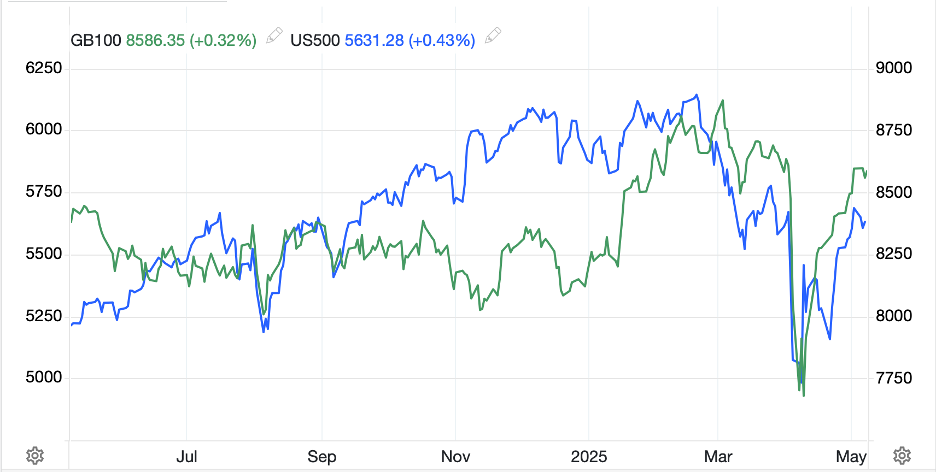
In a modest surprise, UK equities (FTSE 100 +0.4%) do not seem to see the benefits of such a deal, as they lag most of the rest of Europe.  Too, the BOE is expected to cut its base rate by 25bps this morning, which in isolation would ordinarily be seen as a positive for stock markets.  Perhaps, this is why the UK is the first to say yes, things there may be worse than meet the eye.  After all, the stock market there is higher by just 2% in the past year, hardly a breathtaking performance.  In fact, as you can see below, the FTSE 100 and S&P 500 have had very similar performances this year, tracking each other closely, although despite all the angst about recent volatility in US markets, the S&P is still 8% higher in the past year, decently outperforming the UK.

Source: tradingeconomics.com

Stepping back for a moment from individual markets, my take is the following: President Trump is keen to sign a number of key trade deals in this 90-day window.  If they agree deals with the UK, Japan, South Korea, Taiwan, Canada and Mexico, all of which seem quite possible, it will reduce the uncertainty and accompanying stress in markets.  If, as well, Congress can get the ‘big, beautiful budget bill’ passed, thoughts of recession will quickly dissipate.  Obviously, the China trade talks will still be outstanding, but both sides need to find a solution here.  While the punditry in the US will continue to harp on how those tariffs are going to kill the US economy, China has already shown they are having problems and need to come to an agreement.  It is quite possible that Mr Trump can be successful in his aims to reorder the nature of world trade such that the US reduces its deficits without destroying the world.  I think I am going to take the over on this question.

In the meantime, let’s see how markets have behaved overnight.  Yesterday saw US equity markets rally modestly after the Fed and that followed through in Asia, with modest gains being the best description.  The Nikkei (+0.4%), Hang Seng (+0.4%) and CSI 300 (+0.5%) all seemed to benefit from the US and hopes for a reduction in trade anxiety.  Of note in Asia was India (-0.5%) and perhaps more tellingly Pakistan (-6.0%) as the escalation in military conflict between those two nations has grown even hotter.  I expect that market impact will remain more isolated as neither market is a key destination of foreign capital, at least if the actual military conflict doesn’t spread into other areas.

Turning to Europe, both Germany (+1.1%) and France (+1.0%) are having very good days with both markets ostensibly responding to the news of the impending UK trade deal and perhaps some hopes there will be one with the EU.  As well, German IP data was released at a much better level than expected (3.0% vs. 0.8% expected), an indication that companies there are gearing up for all that mooted military spending.  As to US futures, at this hour (7:00) they are all higher by at least 1.0% with the NASDAQ higher by 1.6%.  

In the bond market, Treasury yields are higher by 4bps this morning, having recouped the declines yesterday.  But still, the 10-year hovers either side of 4.30% and has done for the past month as you can see in the chart below.  If anything, it appears that the trend remains toward modestly lower rates.

Source: tradingeconomics.com

In Europe, sovereign yields are also climbing slightly, higher by between 2bps and 3bps this morning and we saw similar movement in JGB markets overnight.  Frankly, bond markets have not been very exciting lately.

In the commodity markets, oil (+1.6%) is continuing its recent bounce from the lows seen Sunday night, but WTI remains below $60/bbl.  There is growing talk that at current prices, capex is going to decline and supply along with that, but you cannot look at what is happening in Guyana, for instance, as they seek to exploit the massive new oilfield discovered in their coastal waters last year and think that oil supply is going to shrink.  As well, OPEC+ looks set to produce all out.  I do not see a good case for higher oil prices in the near term.  Meanwhile, gold (-1.0%) is giving back some of its recent rebound gains, but nothing about the recent price action indicates to me that the bigger picture trend higher is over.  However, today, it is weighing on both silver (-0.2%) and copper (-0.8%).  

As aside about copper.  The red metal has been nicknamed Dr Copper given its importance in industrial activity.  Hence, when demand is strong, it foretells strong economic activity and vice-versa.  With that in mind, what does the below chart of copper tell you about economic activity?

Source: tradingeconomics.com

What it tells me is that this, too, is a former economic signal that had been reliable in the old world view but has lost its way as a signpost of future activity in the new world view.

Finally, the dollar is modestly stronger this morning, most notably vs. the yen (-0.6%) and INR (-0.8%). The latter is clearly suffering on the impacts of some negative military news, having lost several fighter jets and drones, while the former seems to be responding to the story that Mr Trump will not lower tariffs with China ahead of the first meetings that are upcoming this weekend, and that had been demanded requested by the Chinese to start talking.  Too, NZD (-0.6%) is softer but elsewhere, there is far less of interest overall with the euro unchanged and the pound edging higher by 0.25% after the BOE cut rates 25bps, as expected, but the vote was 7-2, with two MPC members voting for no change, a slightly more hawkish outcome than expected.

On the data front, this morning brings the weekly Initial (exp 230K) and Continuing (1890K) Claims data as well as Nonfarm Productivity (-0.7%) and Unit Labor Costs (5.1%).  Yesterday’s EIA oil inventory data showed modest draws, as expected and didn’t seem to matter much to the market.  It is difficult to get too excited about much these days as the landscape remains highly uncertain.  If, and it’s a big if, President Trump can come to agreement on trade deals with a number of countries, I suspect that we will see uncertainty wane and markets continue higher.  But the Fed won’t be cutting rates in that scenario.  Ultimately, though, I do believe that a lower dollar will be part of many of these deals, and for now, a lower dollar still seems the most likely outcome.

Good luck

Adf

Quite Excited

The market is now quite excited
As trade talks have been expedited
With Bessent and He
Now speaking, we’ll see
If buyers last night were farsighted
 
However, do not ignore gold
Whose price is a thing to behold
The past several days
There’s been quite a craze
As sellers now rue what they’ve sold


Source: tradingeconomics.com

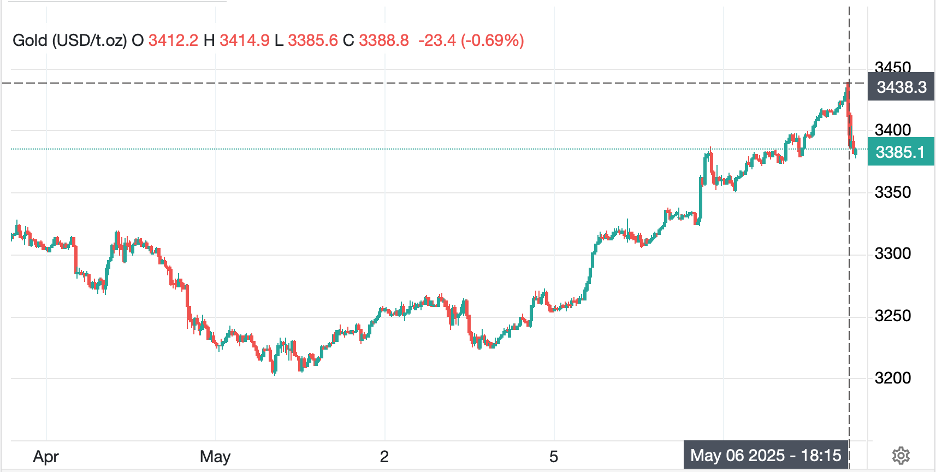
I don’t often lead with a chart, but I think it is worthwhile this morning.  I grabbed this picture at 7:00pm last night, shortly after the news hit that Treasury Secretary Bessent and Trade Representative Greer were heading to Switzerland later this week to sit down with He Lifeng, the Chinese Vice Premier and trade negotiator and begin trade talks.  Prior to that announcement, the barbarous relic had rallied more than $200/oz over the past four sessions, a pretty impressive move for something that has maintained a low overall volatility.  The first explanation of the reversal, which coincided with a sharp gain in equity futures (see chart below) is that all the fear of the world ending with corresponding equity weakness and a need to hold gold, has ended!  Hooray!!!

Source: tradingeconomics.com

Alas, just as I never believed the world was ending before, neither do I believe that everything is suddenly better.  Seemingly, this is all part of the process.  The idea that China could simply accept much of the stuff they produce would not be able to find a home in the US was never going to be the case.  I have no idea how things will work out, and they certainly will take a lot of time to come to some agreement, but it is very positive that the dialog has begun.

On the subject of which side blinked, which is a favorite for the punditry, especially those who despise dislike President Trump and believe this shows weakness on his part, I would note that the Chinese are the ones who have recently reported weaker economic data and last night the PBOC cut their 1-week reverse repo rate by 0.1% and reduced their Reserve Requirement Ratio by 50 basis points, both monetary easing measures to address the ongoing weakness in China.  Neither side benefits from this process in the short-term, but we will need to see the results of the talks, which will take many months I presume, before we know if goals have been achieved.

Away from the story on trade
The Fed story must be portrayed
Alas, it’s quite dull
As Jay and friends mull
The idea rate cuts be delayed

The only other story of note today is the FOMC meeting where they will release their policy statement at 2:00 this afternoon revealing no change in policy, and very likely almost no change in the wording, and then Chairman Powell will face the press at 2:30.  However, given the low probability of any changes, and given nothing regarding trade policy has really changed since they entered their quiet period, it seems unlikely that we will learn anything of consequence from Powell.  Today will be a complete non-event.

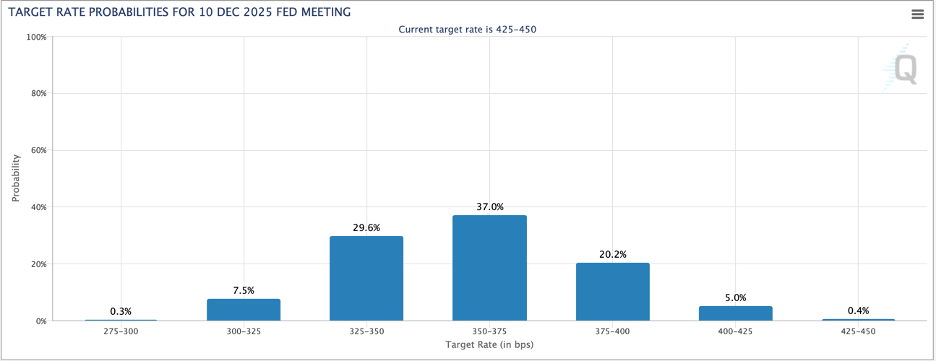
However, I cannot help but consider why the futures market appears so convinced that there are going to be rate cuts going forward this year.  As of this morning, the Fed funds futures are pricing a total of 78 basis points of cuts for the rest of this year, so three 25bp cuts as per the below chart from the CME.

Certainly, the data released thus far this year have not indicated the economy is heading into a tailspin.  Of course, there are many analysts calling for a recession to start in Q2 or Q3 as the tariff impacts ostensibly undermine the economy.  It is important to note, however, that these are the same analysts who have been calling for a recession for the past three years.  The boldest calls are for a period of stagflation, with the tariffs simultaneously killing growth and raising prices.

It is entirely possible that we see a recession this year, especially if government spending decreases given its role in supporting recent growth data.  (According to the BEA, Federal government spending in Q1 declined -5.1% while investment in the economy expanded more than 2%.). If this is the path forward, the long-term benefits will be substantial, but they must be maintained.  As well, if this is the path forward, total economic activity in the US will expand substantially and it is not clear that rate cuts will need to be part of that mix. 

Regardless, it seems that today’s activity is less likely to be impacted by the Fed than by any random headlines regarding trade or other administration maneuvers.  So, let’s see how markets have responded to the US-China trade talk news.

The China news came long after the close yesterday so the US markets closed lower on the session, approaching 1% declines, but US futures are currently higher by around 0.7% at 7:15.  In Asia, however, we did see some modest gains although the Nikkei (-0.15%) faded a bit, both China (0.6%) and Hong Kong (+0.15%) managed to rally.  As to the rest of the region, most markets were modestly higher although in a seeming sympathy move on the China news.  In Europe, bourses are softer this morning with the CAC (-0.7%) leading the way and other key indices falling less.  The data releases show Construction PMI softening on the continent as well as weak Eurozone Retail Sales (-0.1%), so I imagine that is weighing on investors’ minds today.

In the bond market, Treasury yields are 2bps firmer this morning but have been trading either side of 4.30% for the past several sessions as traders try to estimate the next big thing.  I see just as many stories about how yields are going to 10% as I do about how they are headed to 2% amid the depression coming, so my take is, we are going to range trade for a while yet.  In Europe, sovereign yields are lower by between -3bps (Germany) and -5bps (Italy) as that softer data is encouraging investors to believe that inflation will continue to decline and the ECB will cut further.

The commodity market has been where the real action is of late with oil (+0.9% today after +2.0% yesterday) rising after comments by two US oil companies that they will not be drilling any more if oil prices stay at these levels.  What I don’t understand is, what will they be doing as they are oil companies?  At any rate, this will be the tension in markets, who can afford to drill and sell oil at lower prices.  I expect we will hear from companies and pundits on both sides of this equation.  I discussed gold above, which has bounced slightly from its lowest levels overnight and I don’t believe anything will derail this train for a while yet.  However, both silver (-0.75%) and copper (-2.6%) are softer this morning, partly based on gold’s slide and partly on the weaker economy story.

Finally, the dollar is modestly firmer this morning, at least against its G10 counterparts with JPY (-0.6%) the weakest of the bunch, followed by SEK (-0.5%) and AUD (-0.3%).  The euro and pound are little changed and NOK (+0.15%) has gained on the back of oil’s strength.  In the EMG block, KRW (-1.1%) and TWD (-1.1%) have both rebounded some from their recent highs (dollar lows) in what seems more like a trading reaction than a change in policies.  Elsewhere in this bloc, though, MXN (+0.2%) is a touch stronger while ZAR (-0.5%) is a touch weaker and CNY is little changed.  There is a story making the rounds today that a well-known currency analyst, Steven Jen, is claiming that there could be as much as $2.5 trillion of excess currency reserves held by Asian nations that they may no longer need.  If this is true and these reserves were sold quickly, it would certainly drive the dollar much lower.  However, it strikes me that given the enormous amount of USD debt that has been issued by Asian companies and countries, and given these countries do not have access to Fed swap lines in emergencies, there is no reason to sell the dollars.  Rather they will simply have a ready supply without having to chase them when repayment and rollovers come due.  I would take this story with a large grain of salt.

Other than the Fed, we see EIA oil inventory data where some drawdowns are anticipated and that is really the day.  We are all awaiting the trade negotiation outcomes and I would say nobody has an inside track there.  Bigger picture, though, I do think the dollar has further to slide.

Good luck

Adf

More Pain

The data from China reflected
That tariffs have hurt, as expected
It’s likely more pain,
On China, will rain
As both nations are so connected
 
Meanwhile, in a German surprise
Herr Merz failed to get his allies
To name him to lead
Which seemed guaranteed
Could this presage his quick demise?

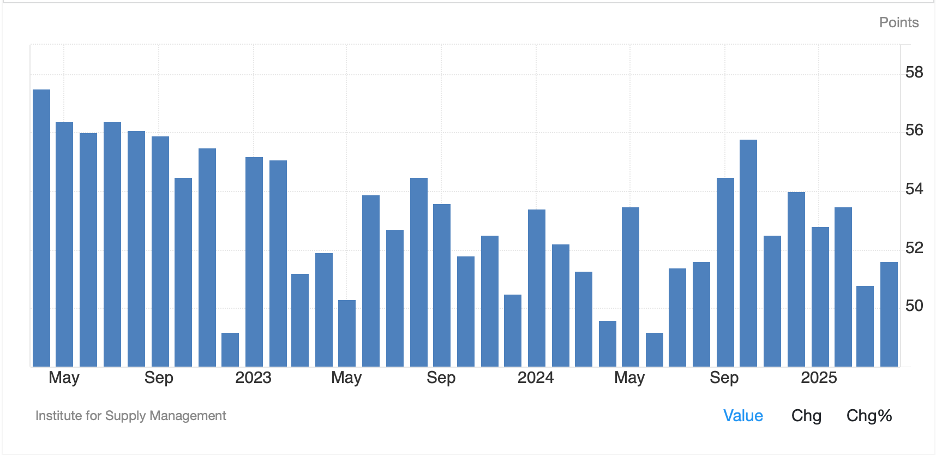
In the battle being waged between the US and China via tariffs, the first data indications have shown that the US is faring a bit better.  Yesterday’s ISM Services data was stronger than expected, remaining well above the 50 level although arguably slightly below the recent average reading.

Source: tradingeconomics.com

Meanwhile, last night, the Chinese Caixin Services PMI fell to 50.7, missing expectations and continuing its drift lower over time.  

Source: tradingeconmics.com

Are things really worse in China than the US, at least from the perspective of data releases?  I think both nations will suffer during this period as the impacts of the tariffs and reduced trade bleed into the data over the next months, but so far, it seems the US is holding its own.  One of the problems with analyzing the issue is that as the WSJ pointed out yesterday, when the data in China gets bad, they simply stop releasing it, so it may be difficult to see.

Now, last night, Chinese shares did manage a nice rally with the CSI 300 higher by 1.0% but that follows six consecutive down sessions, albeit of modest size.  

Source: tradingeconomics.com

As to the renminbi, after a 1% gain last Friday, it has done little and remains very much in line with its levels of the past year.  The thing about China is that nothing there moves quickly, so absent a policy announcement of some type, I expect this activity will continue to gradually adjust to the realities as they become clear to the market.  If President Trump reduces tariffs, as he implied he would eventually, things could work better, but again, given the time lags of moving products across the Pacific, we have a lot of time between now and whatever the new normal turns out to be.

But the more interesting story to me overnight was that Friedrich Merz, the ostensible winner of the German elections last month failed to achieve the votes to be named Chancellor despite his coalition having a 12-seat majority in the Bundestag.  As it was a secret ballot, nobody knows who didn’t support him, but this outcome certainly calls into question both his ability to lead Germany effectively, and correspondingly, Germany’s ability to lead Europe in the new world order.

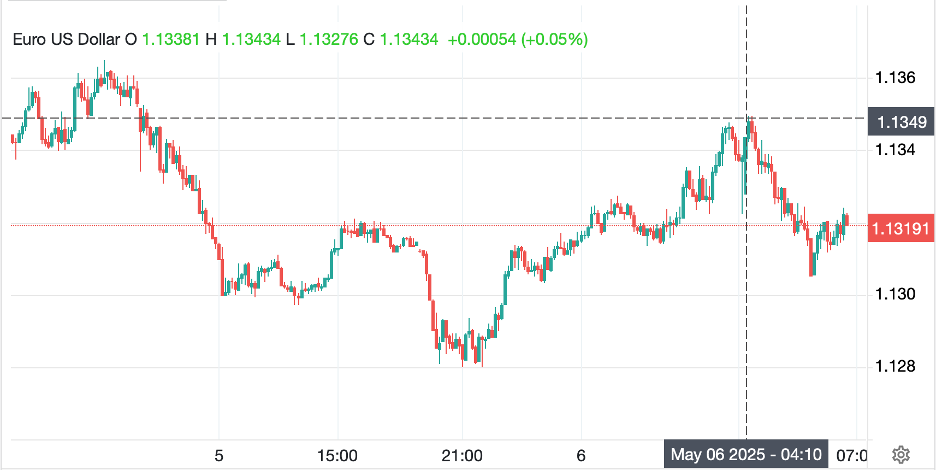
Recall, Germany remains keen to support Ukraine in its ongoing war with Russia and even destroyed their once sacrosanct fiscal responsibility in order to be able to pay for that support.  But if they do not have an effective leader, one who can command their parliament to enact his policies, it is not clear why other European nations would follow their lead on anything.  It should not be surprising that the DAX (-1.3%) fell sharply when the news was released, and that has helped drag most European shares lower (CAC -0.7%, IBEX -0.3%, Poland -3.3%).  As to the euro, you can see from the below chart that the response, when the news was announced, that it slipped about 0.5%, basically wiping out the gains it had achieved prior to the vote.

Source: tradingeconomics.com

Will this matter in the long run?  I believe that a weakened Germany, which is likely the outcome of this situation, will simply undermine the euro’s value.  As such, while I still believe the dollar has further to decline, the euro will probably not be a major winner.  Look for other currencies to outperform the euro going forward.

Ok, I think those are the real stories as we head into today’s session with most market participants remaining tentative in the face of the ongoing confusion over policies, counter policies and macroeconomic data.  Remember, too, we have the Fed tomorrow and the BOE on Thursday, so despite the fact that fiscal policy has been the driver, the Fed’s opinions still carry weight amongst the fixed income community, at the very least.

Looking at the price action overnight, the Nikkei (+1.0%) gained on some solid earnings data from Japanese companies as well as increased hopes that the US-Japan trade talks will be successfully completed by June.  Apparently, there is also some faith that the US and China will begin talking soon on this subject.  Hong Kong (+0.7%) also benefitted from these discussions, but the rest of the region showed very little movement overall, with gains or losses on the order of 0.3% or less.  As we have already discussed Europe, a look at US futures shows they are pointing lower by about -0.5% at this hour (7:10).

Bond markets remain very dull these days with Treasury yields edging higher by 1bp this morning after climbing 3bps yesterday.  European sovereign yields are also higher. By 1bp to 2bps although there is neither data nor a story that seems to have had much impact.  The Services PMI data that was released this morning was very much in line with expectations and continues to hover around 50.0 for the continent as a whole.  Meanwhile, JGB yields were unchanged last night and sit at 1.25%, well below the levels seen back in late March and having really gone nowhere for the past month.  It strikes me that JGB yields will respond to any trade deals but are likely to be quiet in the interim.

Commodity prices are rallying this morning with oil (+2.2%) rebounding from its level yesterday which happen to come quite close to touching the lows from April 9th.  It should be no surprise that there are up days in this market, but if the Saudis and OPEC are going to continue increasing production, I expect that prices have further to fall.  In the metals markets, gold (+1.4%) is having another blockbuster day, now having gained $150/oz in the past three sessions and bouncing off the correction lows.  Demand for the barbarous relic continues to come from Asia mostly with all signs showing that US investors are not interested in this trade.  As to silver (+1.7%) and copper (+0.6%), they are both still along for the ride.

It should be no surprise with the commodity markets showing strength that the dollar is under pressure this morning.  while we’ve discussed the euro already, the pound (+0.5%) is looking quite solid as it continues its rally from the lows seen in mid-January.  But the yen (+0.5%), SEK (+0.45%) and NOK (+0.35%) are all gaining today as well.  Interestingly, the impact in emerging markets is far less noticeable with none of the major EMG currencies moving even 0.2% this morning.

On the data front, there is very little hard data this week although we do have the Fed on Wednesday and then a whole bunch of Fed speakers on Friday.

TodayTrade Balance-$137.0B
WednesdayFOMC Rate Decision4.50% (unchanged)
 Consumer Credit$9.5B
ThursdayBOE Rate Decision4.25% (-0.25%)
 Initial Claims230K
 Continuing Claims1890K
 Nonfarm Productivity-0.7%
 Unit Labor Costs5.1%

Source: tradingeconomics.com

Today’s trade data is for March, prior to the tariff impositions, so will reflect significant tariff front-running.  But really, it’s about the Fed this week, and since they have lost much of their cachet lately, I think the market is really going to continue to look to the White House for trade news and react to that.  Net, I continue to believe that the dollar’s FX rate will be part of many trade discussions, like we saw with Taiwan (which by the way did reverse 3% of yesterday’s gain overnight) and that means further weakness is in our future.

Good luck

Adf

The Future As Fraught

Though I’ve been away near a week
From what I read things are still bleak
Two months have gone by
Since stocks touched the sky
And traders all want a new peak
 
Meanwhile, GDP fell ‘neath nought
And lots see the future as fraught
The popular claim
Is Trump is to blame
And rue all the things he has wrought


I worked hard not to pay close attention to markets while I was away last week in an effort to get some true relaxation.  And now that I’m back at my desk, I can see that I didn’t miss anything at all.  The narratives remain the same, the split between those who believe everything the president says/does is a disaster and those who believe everything he says/does is brilliant has not changed at all.  In other words, life continues as do all the arguments.

A review of the data last week showed two key outcomes, the labor market remains far more resilient than the recessionistas will accept and jobs continue to be created.  For some reason, that seems like good news to me, but then I am not a highly paid economist with a narrative to stoke.  On the other hand, Q1 GDP printed at -0.3%, the first negative print in 3 years, but also one that is easily explained by the rush of imports that occurred prior to the imposition of tariffs in early April.  Remember, imports subtract from Gross DomesticProduct.  However, a look under the hood of this number shows that the positive news was government activity declined while private sector investment exploded higher.  It strikes me that this is the best possible direction for the US economy going forward.

In China, it seems Xi’s decided
That data has been too one-sided
So, henceforth they’ll furnish
Just data to burnish
The views Xi and friends have provided

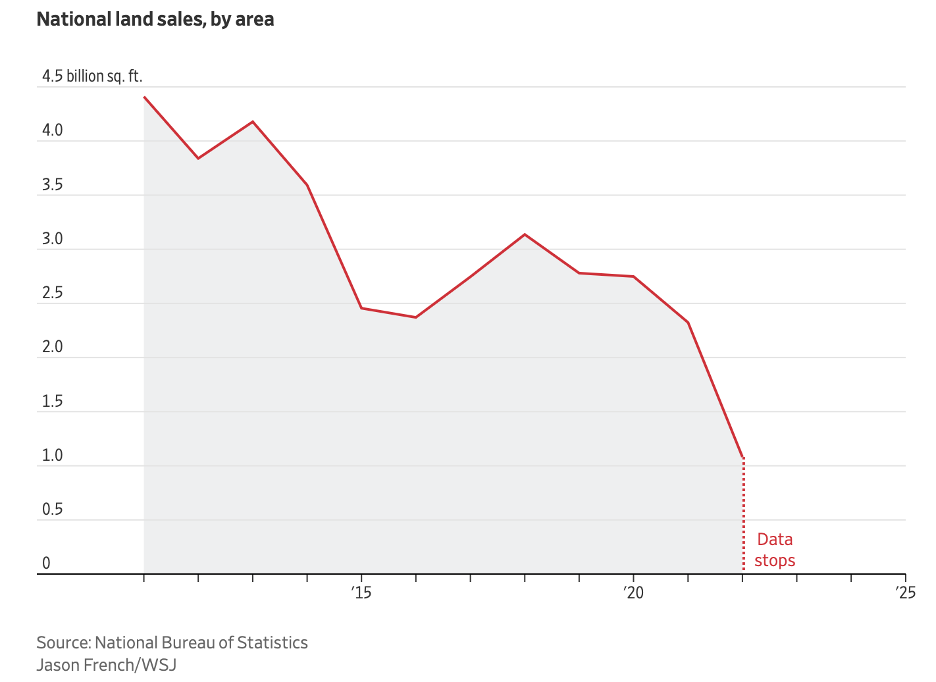
Turning to the more recent stories, though, the WSJ had a very interesting take on the fact that China’s statistical output is shrinking quite rapidly as data that has been trending lower suddenly stops being produced.  The below chart from the article on National Land Sales is an excellent depiction of things, and likely an indication that land sales, which are critical to local government finances, have become even a bigger problem over the past three years than when the property market first started melting down in early 2021.

It is worth noting that in this trade war between the US and China, while much of the punditry continues to insist that China has the upper hand as the stuff they sell to the US is more critical and less replaceable than the stuff the US sells to them, I have maintained things are not necessarily that easy.  The US is facing a supply shock, and will need time to work it through, but the US economy is the most dynamic in the world, and these issues will be resolved.  China faces a demand shock, which in economic theory should be easier to address, but which in China’s reality has not proven to be the case.  Consider that Xi and the CCP have been creating fiscal stimulus plans since Covid without any serious success.  In fact, the Chinese have openly stated that they are seeking to shift the production/consumption mix of the nation closer to Western standards of 60%-70% consumption from their current 45%-50% level.  It hasn’t worked yet, and I see no reason to believe that is going to change.  We must never forget the US is the consumer of last resort, and if China doesn’t have access to this market, it is a major problem for them.

I have no inside knowledge of how things are evolving on this issue, but here’s my take; while Xi doesn’t need to worry about being elected, he still needs to ensure that China’s economy grows sufficiently to increase the well-being of his population.  Whatever the official statistics have shown, it is clear that things in China are not what they would have the rest of the world believe and that is a problem for Xi.  Meanwhile, Trump will not face another election and was elected with a pretty broad mandate.  I believe given the timing of the mid-term elections, he has another 9-12 months to get things done and will play hardball with China to do so.  In fact, I have a feeling that Trump may have the upper hand.  This will be settled by the autumn is my view.

Ok, let’s turn to markets and what happened in the overnight session.  Looking first at currencies for a change, I couldn’t help but notice the following chart.

Source: tradingeconomics.com

I also couldn’t help but notice the following comment from the Taiwanese central bank in response to a question about whether the FX rate is on the table in the trade negotiations.  (As an aside, @PIQSuite is an excellent follow on X.  Key market headlines on a real-time basis with other things available as well.)

The question of whether FX rates would be part of the trade talks seems to have been answered, and the answer is yes.  Perhaps there will not need to be a Mar-a-Lago accord after all regarding revaluing gold and terming out bonds.  Instead, the pressures will be relieved on a country-by-country basis with each trade deal.  

While the TWD revaluation of 10% over the past 2 sessions is the most dramatic, the dollar is generally lower this morning against both G10 and EMG currencies.  In the G10, AUD (+0.85%) leads the way but JPY (+0.7%), NOK (+0.6%) and CHF (+0.5%) are all pushing higher.  This must be music to President Trump’s ears.  As to the emerging markets, KRW (+2.5%), is the next biggest mover although they admitted that FX rates were part of the trade discussions.  SGD (+0.8%) has also seen a relatively large move and INR (+0.4%) is moving in that direction.  It seems clear that Asia is the focus of both the administration and the markets this morning.  The rest of the EMG bloc has seen much smaller gains, between +0.25% and +0.5%, with CNY (+0.15%) really doing very little.

Turning to the equity markets, last week clearly finished on a strong note and, in fact, since I last wrote, the S&P 500 has rallied a bit more than 2% and is higher by more than 14% since April 8th.  Apparently, the world has not yet ended, but there hasn’t been a new high in the stock market in more than 3 months, and people are edgy!  As to the overnight session, the Nikkei (+1.0%) rallied along with the Hang Seng (+1.75%) although Mainland shares (CSI 300 -0.1%) showed little life.  Elsewhere in the region, Taiwan (-1.25%) and Australia (-1.0%) felt the most pressure and the rest were mixed with much smaller movements.  In Europe, indices are mixed as earnings data from each country are the drivers amid a lack of broad-based news.  So, the UK (+1.2%) and Germany (+0.6%) are firmer while France (-0.6%) is lagging on the back of some weaker earnings numbers.  As to the US, futures are pointing lower by about -0.7% across the board at this hour (7:15).

In the bond market, last week saw Treasury yields jump sharply after the better-than-expected payroll report, finishing the day 9bps higher, although still within the middle of the trading range since February and lower on the year.  This morning, they are basically unchanged while European sovereign yields have slipped by about -2bps across the board. The picture there continues to focus on the uptick in fiscal spending that is expected and the borrowing that will be needed to pay for it.  However, there is still a strong view that the ECB will be cutting rates going forward.

Lastly, in the commodity markets, oil (-1.15%) is sliding again as OPEC+ has promised to continue to increase production.  There are two takes on this activity, both of which probably have some truth.  First is the idea that President Trump has made a deal with MBS in Saudi Arabia to increase production and drive prices lower. Remember, lower energy prices are a boon to the US (and the world).  But added to that is the idea that MBS agreed so he can help force fracking production to pull back and regain market share for OPEC+.  However, regardless of the rationale, nothing has changed my view that oil prices are heading lower, and I still like the $50/bbl level as a target.  As to the metals, gold (+2.3%) which has been under pressure for several weeks in a correction, seems to have found support below $3300/oz and could well be setting up for another leg higher. This has taken silver (+1.3%) and copper (+.8%) along for the ride.  If the dollar is going to continue lower, metals prices should remain quite firm.

On the data front, today only brings ISM Services (exp 50.6), but really, all eyes will be on the FOMC meeting on Wednesday.  I will highlight the rest of the week’s data tomorrow morning.

The past month has seen significant volatility in markets as participants did not correctly estimate the potential moves in trade policy.  At this point, it seems those questions are being answered, with President Trump even hinting some deals could be finalized this week.  I believe we are going to see trade announcements that include new FX goals, and they will be pushing the dollar lower across the board.  While I don’t see a collapse coming, that is the trend for now.

Good luck

Adf