Misconstrue

Ahead of today’s CPI
The markets continue to fly
Though prices keep rising
The pace is surprising-
Ly slower than pundits decry
 
Perhaps now it’s time to review
How old models all misconstrue
The world of today
As their results stray
From outcomes we’re all living through


Let’s start with this morning’s CPI data where expectations are for M/M rises of 0.3% for both headline and core readings which translate to 2.7% and 3.0% for the annual numbers.  In both cases, that would be the highest reading since February and will put a crimp in the inflation slowing trend as both the 3-month and 6-month trend data will stop declining.  I assure you that the immediate culprit will be defined as the tariffs, although it is probably still too early to make an accurate reading on that.  Nonetheless, you can be sure that, especially if the bond market sells off, the cacophony will be extreme as to President Trump’s policies are destroying the nation.

Personally, I would disagree with that take.  In fact, something I theorized last week was that a likely impact of the tariffs was that corporate margins would be hit, not necessarily that prices would rise.  Apparently, somebody much smarter than me agrees with that view, a well-respected analyst, @super_macro on X, who made that point this morning.  But all we can do is wait and see the data and response.

Yesterday, as well, I touched on how bond yields around the world were rising which remarkably seems to be a theme in the mainstream media this morning.  I wonder if they’re secretly reading fxpoetry?

Ok, but let’s move on.  I have consistently expressed my view that the current macroeconomic models in use, which are almost entirely Keynesian based, are simply no longer relevant to the world as it currently exists.  I made the point about economic statecraft, as defined by Michael Every (@TheMichaelEvery), the Rabobank analyst who has been far more accurate in his forecasts of likely political outcomes.  Well, in the financial space, another Michael, Green (@profplum99), is also ahead of the pack in my view.  He was on a podcastlast week that is well worth the hour (40 minutes if you listen at 1.5X speed).  

The essence of his work is that the rise in passive investing has had major consequences for equity markets, and by extension other financial markets.  When John Bogle founded Vanguard with the goal of popularizing passive index investing, it represented a tiny fraction of the market and so, its low fees made it an excellent source of capturing market beta unobtrusively.  However, in the ensuing 50 years, and especially in the last 20 when 401K plans were flipped from opt-in to opt-out by government regulation, things have changed dramatically.

This is the most recent chart I can find showing how passive investments (e.g., index funds and target date funds) have grown dramatically in size relative to the overall market (notice the inflection in 2006 when the opt-in regs changed).  In fact, they currently represent about 50% of equity market assets.

The reason this matters is because the term passive is no longer very descriptive of what these funds do.  As Mr Green explains, they work on the following algorithm, if funds flow in, they buy more stocks and if funds flow out they sell them.  Since they are following cap weighted indices, they basically reflect that since funds flow from every 401K into the market throughout every day, they continue to buy the largest stocks (Mag7) out there regardless of any concept of value.  If you think this through, the main factor in the markets is no longer how a company performs, but how many people have jobs where they have some portion of their incomes allocated to 401K plans.  So, as long as people have jobs, and if employment is growing, equity prices have a price-insensitive base of support.  The upshot is equity markets are no longer forward-looking systems, as has been the belief since early financial market theories, but rather they are indicators of the employment situation.  And it is key to remember that the unemployment rate is a lagging macroeconomic indicator

This matters because the Fed, and frankly most major financial institutions and analysts, continue to model the economy with an input from equity markets.  Consider the Index of Leading Economic Indicators, which has the S&P 500 explicitly in the calculation as an example.  Now, if the Fed is looking at models which discount changes in the equity market, clearly a part of their process, it means they are looking in the rear-view mirror.  This is a very cogent explanation as to why the Fed’s models have grown so out of touch with reality, which if you consider how important they are to monetary policy, and by extension the economy as a whole, is quite concerning.  

Concluding, Mr Green has eloquently explained what I have observed over the past months and years, the Fed’s (and most of Wall Street’s) models are simply no longer fit for purpose.  Add to this the concept of fiscal dominance, where government spending overwhelms monetary policy as has been the case for the past several years, and we all can see why the Fed is flying blind.  

With that cheery thought, let’s see how markets are behaving.  Yesterday’s modest US rally was followed by some strength in Asia (Nikkei +0.55%, Hang Seng +1.6%) although mainland shares were unchanged.  Chinese data overnight surprised on the upside regarding GDP, with an annualized outcome of 5.2%, and it saw IP rise 6.8% Y/Y, also better than expected but Retail Sales (4.8%) and Fixed Asset Investment, which is housing driving (2.8%) both disappointed.  The upshot is that domestic demand continues to flag although they have been working hard to export lots of stuff.  The rest of the region saw a very positive day with almost all markets gaining.  In Europe, the picture is more mixed as tariff concerns continue to weigh on nations there with today’s price action a mix of small gains (CAC, DAX) and losses (IBEX, FTSE 100) and nothing more than 0.3%.  US futures, though, are pointing higher at this hour (7:20) by 0.5% or so.

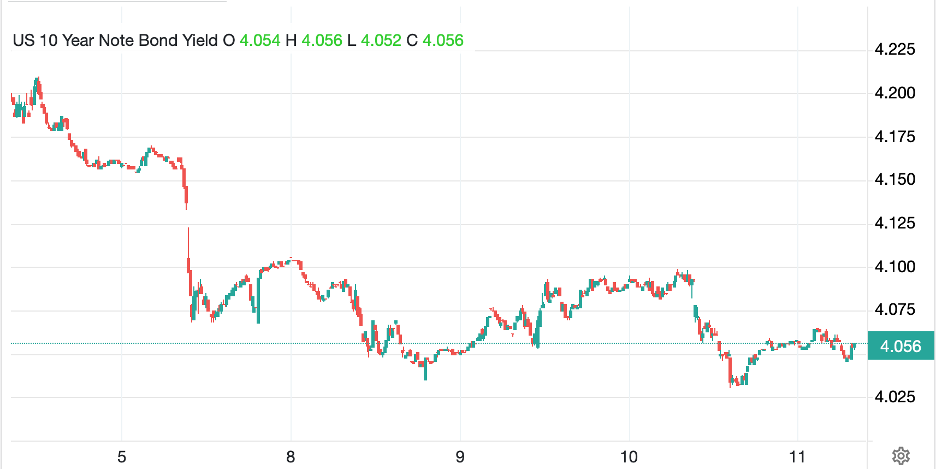
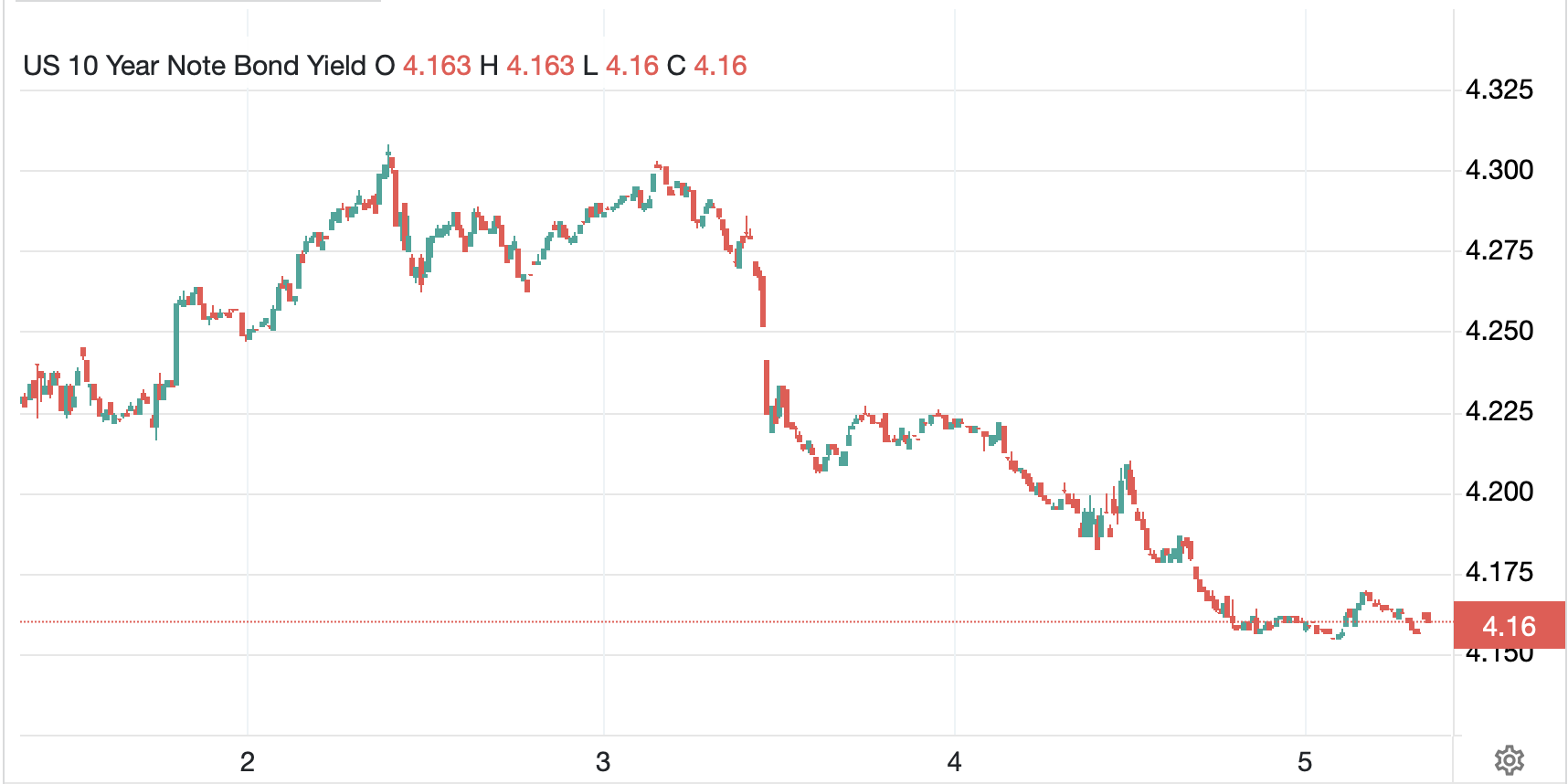
In the bond market, yesterday’s modest rise in yields is seeing a reversal with Treasury yields slipping -1bp, but European sovereigns having a good day with yields down between -5bps and -6bps.  Inflation data from Spain confirmed that the overall inflation situation there is ebbing, and market participants are now pricing one more rate cut by the end of this year which would take the ECB rate down to 1.75%.  As it happens, JGB yields were unchanged overnight, but there is still growing angst over their recent rise.

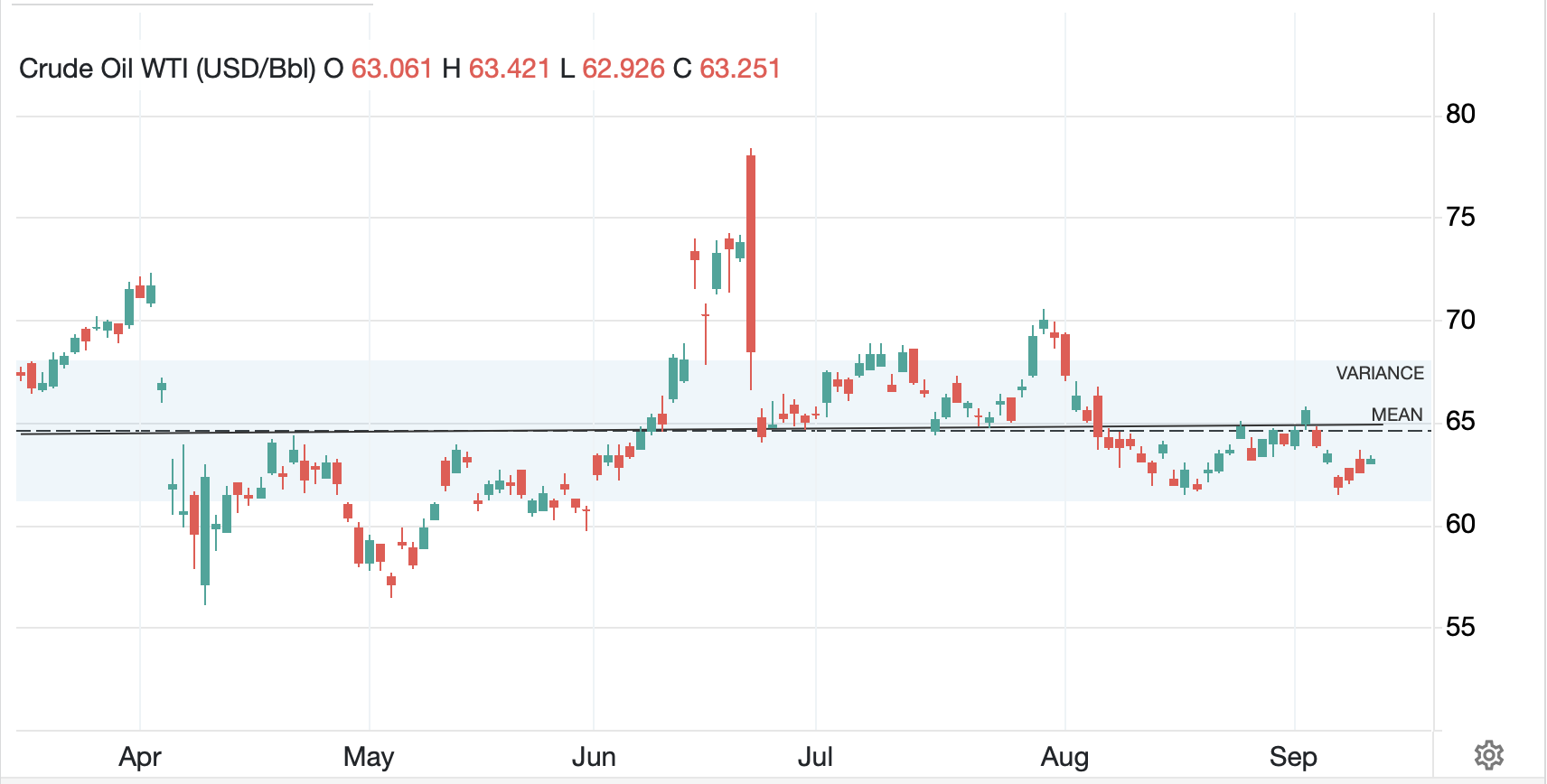
In the commodity arena, oil (-0.5%) reversed course yesterday and sold off more than $2/bbl as per the below chart.

Source: tradingeconomics.com

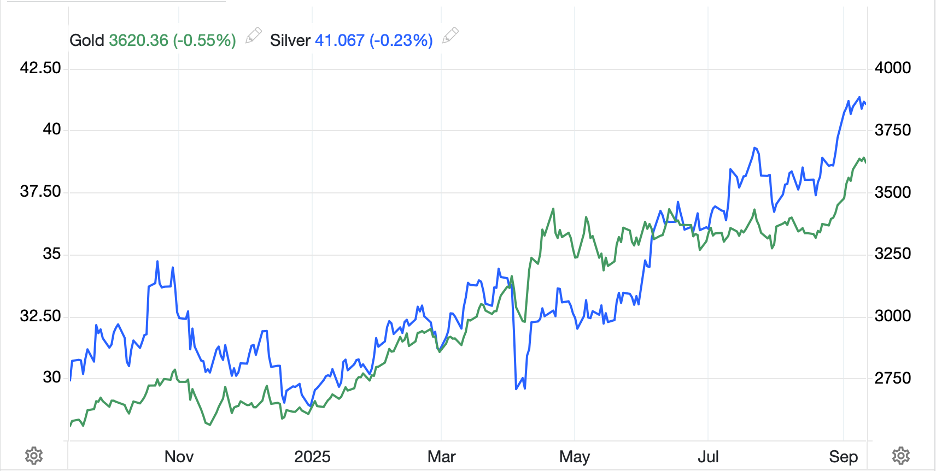
This makes more sense to me given the apparent growth in supply, but there seems to be an awful lot of calendar and crack spread activity in the market, most of which I do not understand well enough to describe, but which can impact pricing of the front futures contract.  I would suggest looking on substack at market vibesfor a real education.  I keep trying to learn.  However, from a macro view, I continue to believe that prices have further to decline than rise from current levels.  As to the metals markets, gold (+0.5%) and silver (+0.4%) continue to find consistent support and I see no reason for them to reverse course anytime soon.

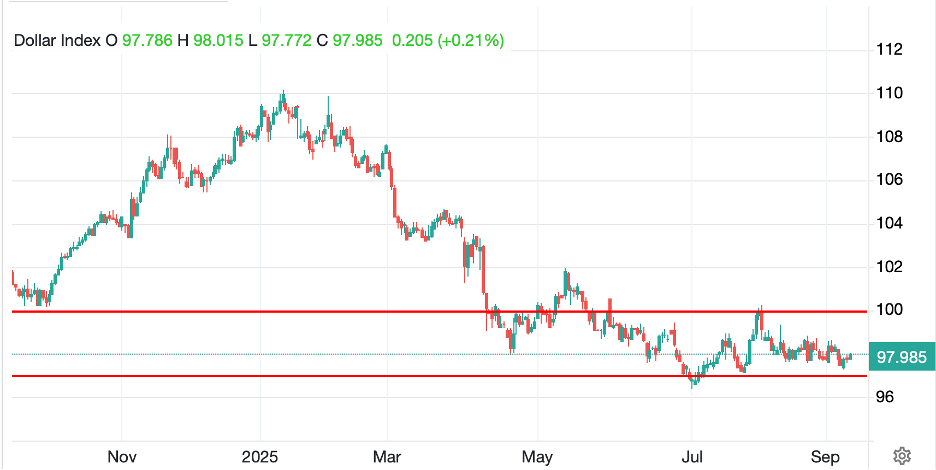
Finally, the dollar continues to do very little overall.  For now, the more aggressive downtrend appears to have been halted, as per the chart of the DXY below, but it is hard to get too excited about a significant rebound based on the macro data and interest rate outlook.  The one thing working in the favor of a dollar rebound is the extreme short dollar positions that exist in the hedge fund and CTA communities.

Source: tradingeconomics.com

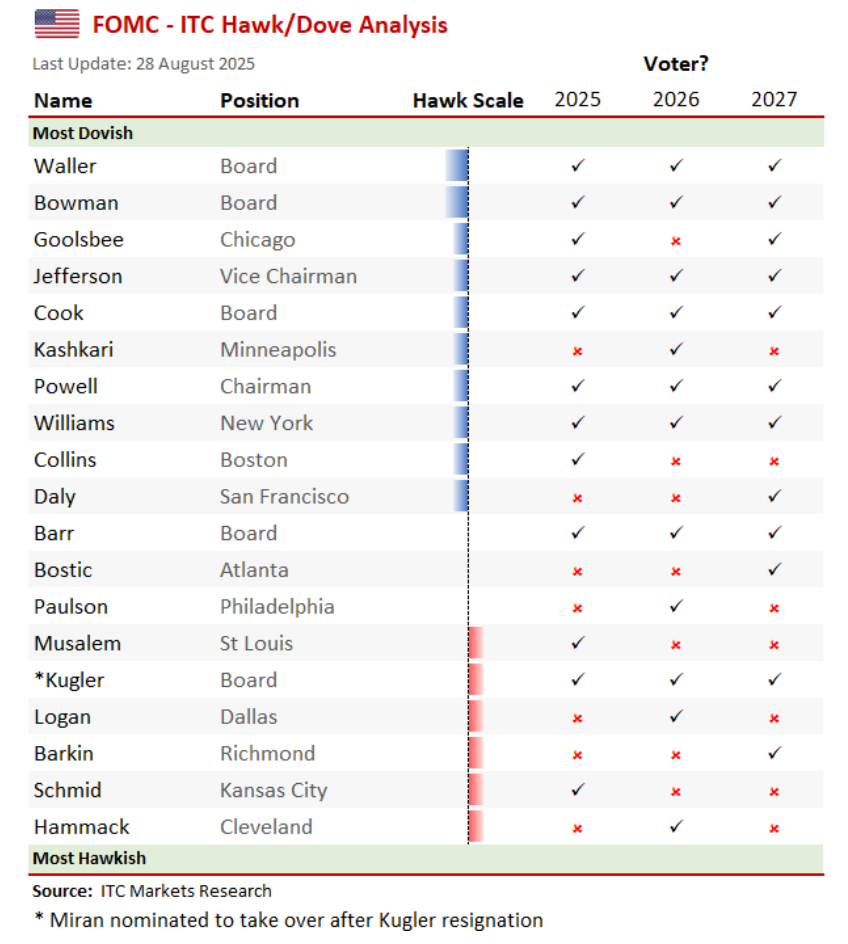
In addition to the CPI data, we will see the Empire State Manufacturing Index (exp -9.0) and we will hear from four Fed speakers today (Bowman, Barr, Collins and Logan).  Absent a major shock in the CPI data, it strikes me that there is limited reason for any of these speakers to change their personal tune.  So, Bowman is calling for cuts, while the other three have not done so, at least not yet.  In fact, if we start to hear a more dovish take from any of them, that would be news.

And that’s it for this morning.  Market activity is pretty dull overall, and trends remain in place.  Remember, the trend is your friend.

Good luck

Adf
Heartburn

It seems bond investors are learning
That government spending’s concerning
As yields ‘cross the board
Have all really soared
While buyers become more discerning
 
Meanwhile, o’er the weekend we learned
That Tariff Man’s truly returned
More letters were sent
Designed to foment
Responses as well as heartburn


As we approach the middle of the summer, two things are becoming increasingly clear; the world today is very different from just a few years ago and it is getting harder and harder to pay for all the things that the world seems to want.  Taking the second point first, market headlines today have pointed to German 30-year yields which have traded to their highest level since October 2023, and appear set to breech that point and move to levels not seen since prior to the Eurozone bond crisis in 2011 (see MarketWatch chart below)

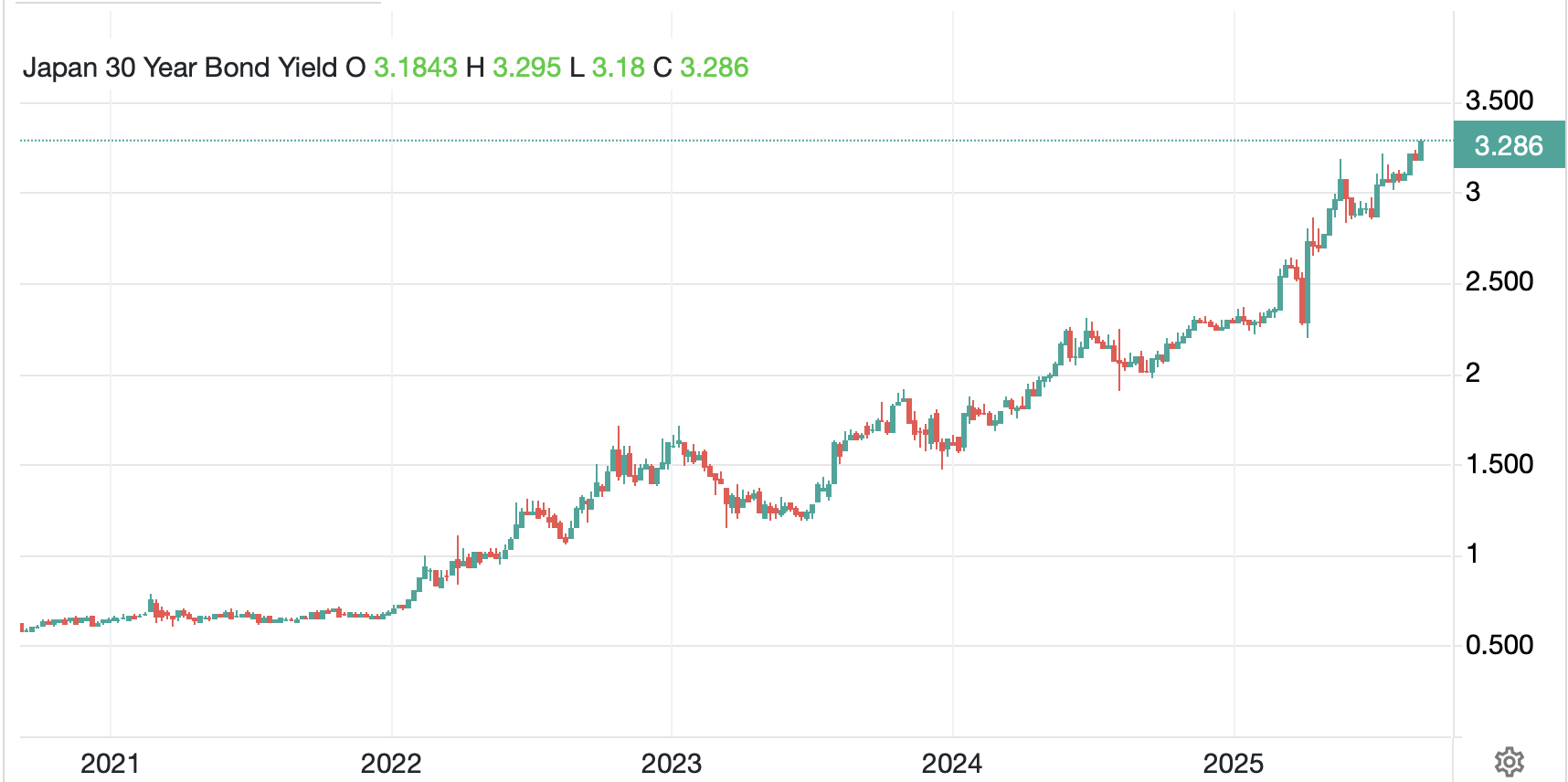
Similarly, we have seen 30-year yields rise in Japan, a story that gained legs back in late May, and yields overnight returned to those all-time highs from then.

Source: tradingeconomics.com

Not surprisingly, given the debt dynamics globally, US 30-year yields are also pushing back to the levels seen back in May, although have not quite reached those lofty levels and as I type this morning, are trading just below the 5.00% level.

Source: tradingeconomics.com

As Austin Powers might say, “What does it all mean, Basil?”  While I’m just a poet, so take it for what it’s worth, it seems pretty clear that the level of government borrowing is pushing the limits of what private sector investors are willing to absorb.  The below chart, created from FRED data tells an interesting tale.  Up through the GFC, government and private sector debt grew pretty much in step with each other, although after Black Monday in October 1987, government debt started to grow a bit more rapidly.  But the GFC completely changed the conversation and government debt took on a life of its own.  Essentially, the GFC took private losses and nationalized them and put them on the government’s balance sheet. (As an aside, this is why there is still so much anger at the fact that nobody was held accountable for that event, with the perpetrators getting larger bonuses after their banks were bailed out.). But in today’s context, the rise in yields is telling us, or me at least, that the market is losing its appetite for more government debt.

While this is the US graph, the situation is similar around the developed world.  This is why we are hearing more about Secretary Bessent’s sudden love of stablecoins as they will be a source of significant demand for Treasury paper that he needs to sell.  But in the end, do not be surprised if we see more than simply QE, whatever they call it, going forward, but outright financial repression and yield curve control.  While the US may be in the vanguard of this situation, the yields in Germany and Japan tell us that the same is happening there as well.  

As to the first point above, back in the day, it seemed that weekends were observed by one and all around the world with policy statements a weekday affair.  But no longer.  Over the weekend, President Trump sent letters to Mexico and the EU that 30% tariffs were on the way if they did not reach an agreement by August 1st.  For 80 years, most of the Western world operated on a genteel basis, with decorum more important than results.  It is not clear to me if this was because negotiations were more effective, or because most leaders didn’t have the stomach for confrontation.  But it is abundantly clear that President Trump is quite willing to be confrontational with other leaders in order to get his way.  The problem for other leaders is they are not used to dealing in this manner and find themselves uncertain as to how to proceed.  Thus far, whether they have been combative or conciliatory, it doesn’t seem to matter.  Remarkably, it is still just 6 months into this presidency, so things are going to continue to change, but the one thing that is unequivocally true is the world is a different place today than ever before.

Ok, let’s see how other markets are handling the latest tariff storms.  Equity markets are mostly unhappy with this new process as after Friday’s modest declines in the US, we saw more losers (Japan, India, Taiwan, Australia) than winners (Hong Kong, China, Korea) in Asia.  The salient news there was that the Chinese trade surplus grew to $114.8B, slightly more than expected as exports rose sharply while imports underperformed.  However, Chinese bank and lending data did show an increase in M2 and Loan Growth, so at least they are trying to add some monetary stimulus.  As to Europe, other than the UK (+0.4%) the continent is under pressure with Germany (-1.0%) the laggard of the bunch.  The UK story seems to be a single stock, AstraZeneca, which released strong trial results for a new drug.  But otherwise, the tariff story is weighing on the continent.  US futures are also softer at this hour (7:30), down around -0.3% across the board.

While my bond conversation was on the 30-year space, 10-year yields are only marginally higher, about 1bp, in the US and Europe although JGB yields did jump 6bps ahead of their Upper House elections this week. 

In commodities, oil (+1.2%) continues to find support despite the ongoing theme that the economy is soft and supply is growing significantly with OPEC increasing production and set to return even more to the market by the end of the summer.  As it happens, NatGas (+4.75%) is also higher this morning and continues to find substantial support as on a per BTU basis, it is desperately cheap vs. oil, something like one-seventh the price.  In the metals markets, while gold (+0.4%) continues to see support, the real action is in silver (+1.4%) which has rallied very consistently, gapping higher as you can see in the chart below, and has been the subject of much discussion as to how far it can rise.  Historically, silver lags the timing of gold rallies but far outperforms the gains in percentage terms.

Source: finance.yahoo.com

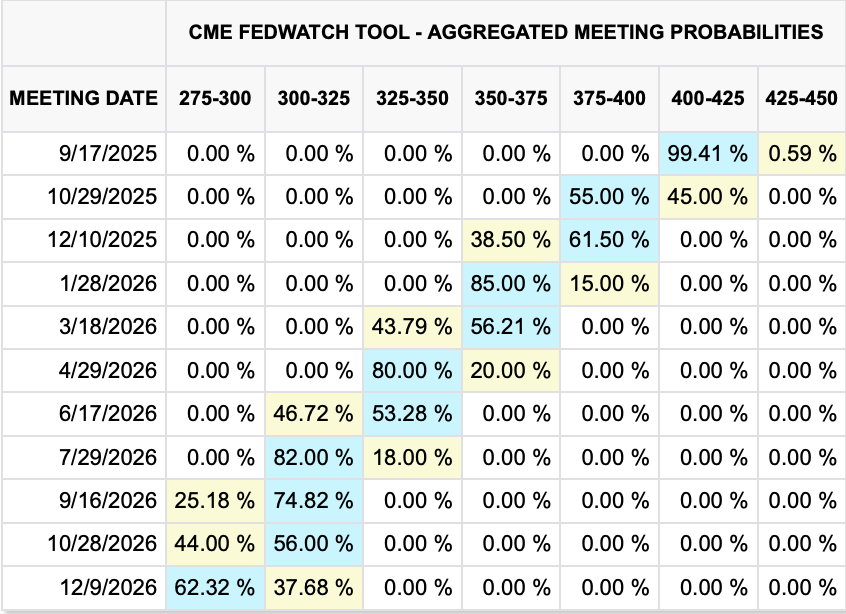
Finally, the dollar is little changed to a touch stronger this morning as traders cannot decide if tariffs are going to be a problem, or if deals are going to be struck.  However, in the dollar’s favor right now is the fact that most other countries are in a clear easing cycle while the Fed remains firmly on hold.  Fed funds futures are pricing less than a 7% chance of a cut this month and only a 61% chance of a September cut.  If US rates continue to run higher than the rest of the world, and there is limited belief they are going to fall, the dollar will find support.  However, given the pressure that President Trump continues to heap on Chairman Powell (there was a story this weekend that Powell is close to resigning, although my take is that is wishful thinking), it is hard to get excited about the dollar’s prospects.  Remember this, all the economists who tell us that an independent central bank is critical work for central banks.

On the data front, after virtually nothing last week, we do get some important numbers this week.

TuesdayCPI0.3% (2.7% Y/Y)
 -ex food & energy0.3% (3.0% Y/Y)
 Empire State Manufacturing-8.0
WednesdayPPI0.2% (2.5% Y/Y)
 -ex food & energy0.2% (2.7% Y/Y)
 IP0.1%
 Capacity Utilization77.4%
 Fed’s Beige Book 
ThursdayInitial Claims234K
 Continuing Claims1970K
 Retail Sales0.1%
 -ex autos0.3%
FridayHousing Starts1.30M
 Building Permits1.39M
 Michigan Sentiment61.4

Source: tradingeconomics.com

In addition to this, we hear from eight FOMC members, so it will be interesting to see if the erstwhile doves are willing to join Waller and Bowman in their call for a July rate cut.  If we start to see momentum build for a July cut, something which is not currently evident, look for the dollar to suffer substantially.  But absent that, I have a feeling we are going to range trade for the rest of the summer.

Good luck

Adf
White House Bingo

At this point, investors don’t care
‘Bout tariffs and if they are there
The hype train is rolling
With pundits extolling
Nvidia’s four trillion share
 
So, Canada’s out in the cold
As Loonies, this morning, are sold
But energy’s boring
When folks are adoring
AI or, if bankers, then gold


The tariff machine has been switched back on with yesterday’s announcement that the US will now apply 35% tariffs to all imports from Canada that do not comply with the USMCA.  These tariffs are due to go into effect on August 1st.  It appears this is an effort by Mr Trump to push the progress of trade talks forward as they are not moving at a pace with which he is satisfied.  The Canadian response, by PM Carney, was to indicate they will redouble their efforts to get things done on a timely basis.

I understand that there are many who dislike the President’s bullying tactics as they are completely different than any previous president (or world leader really) and fall far afield from what had been previously accepted and expected in “polite” society.  Diplomats are horrified that he is forcing decisions to be made, something that has been anathema to the diplomatic community since the beginning of time.  But Mr Trump has his agenda firmly in mind and is very keen to use all the power he can to achieve it.  It turns out, the US has a great deal of power beyond its military might.

But for our purposes, the market response is the place we need to look.  First, it can be no surprise that the Canadian dollar quickly declined -0.5% on the announcement as that is the textbook response to tariffs, the country affected sees their currency weaken.  As to equity markets, as there are no TSX futures, we cannot tell exactly how stocks in Canada will be impacted but based on the fact that virtually every market is lower this morning, I expect to see weakness there as well.  in fact, a look at this listing of equity futures markets from 6:30 this morning shows exactly what is happening.  You will note that the Toronto market still reflects yesterday, but pretty much every other nation is feeling the heat of a new potential wave of tariffs from the US.

Source: tradingeconomics.com

I continue to read that European nations are getting closer to agreeing a deal with the US, something that has never occurred before and I suspect that there are a number of leaders in the EU that are growing nervous about the situation.  Again, the world was not anticipating the US to wield its power in such a brash and open manner, and many governing theories still need to be rewritten to address the new reality.

But yesterday’s story was all about Nvidia becoming the first $4 trillion market cap company, a remarkable achievement.  It seems Nvidia’s market cap is greater than the entire German stock market.  

For the longest time, I was convinced that the market concentration of the Mag7, which now account for just over 34% of the S&P 500, would ultimately lead to their demise and a major correction.  However, it is becoming harder to make the case that concentration alone is going to be the problem.  

Rather, I believe any correction will now come from a broader economic result, arguably the long forecast recession when it finally arrives.  If you recall, on Sunday I wrote about how the relative gain in corporate profits vs. labor has been a key driver in the bifurcation in the country.  I also strongly believe that President Trump is very serious about changing that situation.  The obvious solution is to reduce corporate profits.  One way to do that is to impose tariffs where companies wind up reducing their margins to maintain sales volumes. If inflation does not rise (and it has not done so yet) that is a step in the President’s direction of choice.  I have no idea whether this will work, and arguably neither does anybody else.  Virtually, every economic model is no longer viable as Mr Trump has changed the rules so completely that the underlying assumptions are almost certainly incorrect.  But remember this chart, if by the end of his term in 2028, the two lines have begun to converge more clearly, he will have changed a multi-decade trend and likely to the detriment of equity markets.

Ok, enough philosophizing, let’s see how other markets beyond equities have behaved overnight.  Bond markets have been under modest pressure with Treasury yields ticking higher by 3bps and all European sovereign yields higher by 1bp this morning.  We heard from Bundesbank, and ECB, member Isabel Schnabel that it was unlikely there would be further rate cuts from the ECB absent a major decline in Eurozone growth. Inflation has returned to their target, and she indicated her belief that current rates there were modestly accommodative, i.e. below neutral.  JGB yields have returned to 1.5% after having spent the past month below that level.  

Recall back in March and April when yields in Japan moved higher quite quickly with the 10yr touching 1.6% and the longer bonds trading above 3.0% to new all-time highs.   That panic subsided but it appears that yields are on the move again as the BOJ discusses selling its equity ETF’s in an effort to reduce their balance sheet further.  Interestingly, the yen (-0.4%) is under pressure this morning and trading back above 147 for the first time in two months.  Here’s what we know about the yen; the carry trade is still in place in significant amounts, inflation is running hot, and the BOJ clearly is uncomfortable raising rates further to address that situation.  My sense is that the yen could have further to weaken, especially if tariffs on Japanese exports are increased as per the recent letter from Mr Trump.  

Continuing with currencies, the dollar is having a good day all around, with only CNY (+0.15%) bucking the trend.  The pound (-0.45%) is under pressure after weaker than expected May GDP figures were released this morning (-0.1% vs. +0.1% expected).  We’re also seeing weakness in MXN (-0.5%) and ZAR (-0.7%) even though precious metals prices are rising this morning.  Here, too, we must keep in mind that many of the old relationships have broken down.

Finally, in the commodity space, gold (+0.65%) is back at its pivot level, taking silver (+1.4%) and platinum (+1.9%) along for the ride although copper (-2.2%) remains subject to the vagaries of exactly what those mooted 50% tariffs are going to cover.  Oil (+1.0%) which sold off yesterday after news that Saudi Arabia had been producing more than its OPEC quota, is rebounding this morning with all eyes on President Trump’s upcoming announcement regarding potential sanctions on Russia given President Putin’s unwillingness to talk peace.

And that’s all there is.  There is neither data nor scheduled Fed speakers on the calendar today, so we all await the next pronouncement from the White House.  Word is that Presidents Trump and Xi will soon be sitting down for a discussion with the opportunity to get more clarity on that situation a potential outcome.  However, White House bingo remains the game of the day, and my card has not been a winner lately.  How about yours?

Good luck and good weekend

Adf

Trump’s Latest Ire

The Minutes explained that in June
The Fed felt no need to impugn
Their previous view
Of nothing to do
Though two sang an alternate tune


Yesterday’s release of the FOMC Minutes from their June meeting confirmed what we have learned in the interim.  Governors Waller and Bowman have been clear that they see tariffs as a one-off impact on the rate of inflation, and not something on which to base policy.  If you think about it, tariffs are like food and energy, something that cannot be addressed effectively by monetary policy and which the Fed explicitly excludes from their decision-making process.  (For a really good read on the inflationary impact on tariffs, @inflation_guy published this yesterday).  To me, the salient comments from the Minutes are below:

“While a few participants noted that tariffs would lead to a one-time increase in prices and would not affect longer-term inflation expectations, most participants noted the risk that tariffs could have more persistent effects on inflation.”

“Participants agreed that although uncertainty about inflation and the economic outlook had decreased, it remained appropriate to take a careful approach in adjusting monetary policy.” 

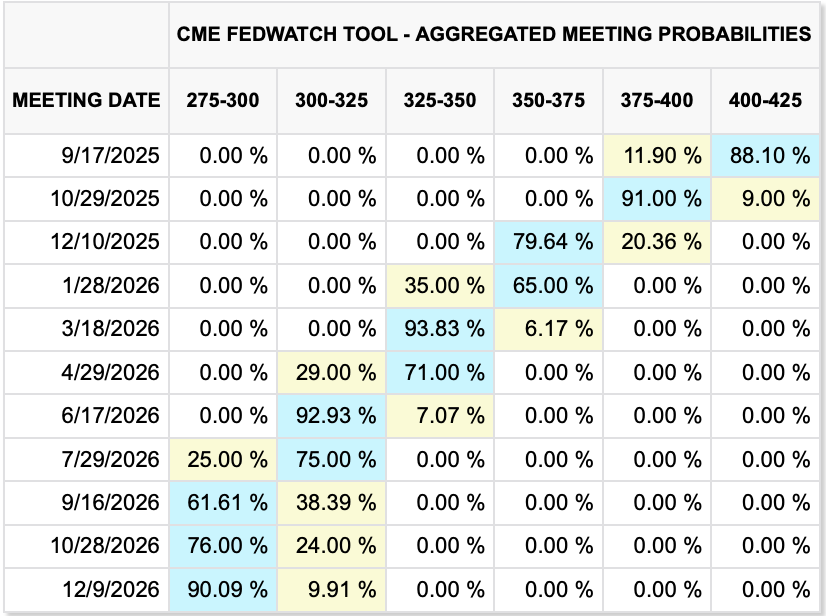
In fact, it is not hard to conclude that the Fed’s intransigence on this issue is politically motivated as well since we have already established that the Fed is clearly political (and partisan).  I would estimate part of the reason they do not want to cut rates here is because they don’t want to be seen as caving into President Trump’s demands.  But whatever the reason, even the futures market is reducing the probability of a cut with the July probability having fallen from more than 20% two weeks ago to 6.7% as I type this morning.  We will need to see some seriously weak economic data to get the Fed to move, I believe, although I expect we will see Governors Waller and Bowman dissent at the July 30th meeting.

However, I would contend that the market has already sussed this out and there will be limited impact on any financial markets after the meeting absent a surprise cut.  So, let’s move on.

The target of Trump’s latest ire
Brazil, has now come under fire
The issue’s not trade
Instead, Trump was swayed
By lawfare ‘gainst one he admire(s)

The other news from yesterday (and there has been precious little overnight) was President Trump’s threat of 50% tariffs on all of Brazil’s exports to the US.  Now, the US runs a trade surplus with Brazil of about $10 billion, so clearly trade is not the issue here.  Rather, it seems that Mr Trump is seeking to help is friend, former Brazilian president Joao Bolsonaro, who is also a right-leaning populist and who is on trial for leading an insurrection after he lost the last election.  It is not hard to understand Mr Trump’s concern over the issue given the history in the US and the previous administration’s efforts to imprison Trump himself.  

However, this seems, at least to me, a bit over the top.  Brazil had been slated to get the minimum 10% tariff prior to yesterday’s outburst.  As well, the US is Brazil’s second largest trading partner, so this will have a significant impact on the country if these tariffs are imposed.  As such, it is no surprise that the market responded immediately.  

Source: tradingeconomics.com

As you can see from the chart above, the announcement at 1:30 yesterday afternoon had an immediate impact with the real falling -2.5% with minutes of the news.  Too, the IBOVESPA stock index fell more than -1.3% yesterday with Embraer, the airplane manufacturer down nearly 10%.  Right now, this is a threat, and the immediate Brazilian response was to say they would not be cowed by this action and will continue with their internal legal activities.  There is no way I will opine on how this will end, but if these tariffs are put in place, it will be a distinct negative for Brazil’s economy, and I would expect that the real could quickly head back toward 6.00 from its current levels.

Away from those two stories, though, issues impacting financial markets are sparse.  With that in mind, let’s see how markets behaved overnight.  Yesterday’s US equity rally was followed by a mixed picture in Asia with Japan (-0.4%) slipping a bit but gains in both China (+0.5%) and Hong Kong (+0.6%) after rumors came out that the Chinese government was getting set to add more support to the still-imploding Chinese property market.  Other regional bourses saw some gains (Korea, Taiwan, Australia) and some losses (India, Thailand, Philippines).  At this point, all eyes remain on the tariff story for most of these nations.  Meanwhile, in Europe, the FTSE 100 (+1.1%) is today’s leader on the strength of its mining sector which responded positively to President Trump’s mooted 50% tariffs on copper.  Elsewhere, though, things have been less robust with the CAC (+0.7%) having a nice day, the DAX (+0.2%) edging higher after inflation data was released as expected at 2.0% while the IBEX (-0.6%) is moving in the other direction absent a major catalyst.  However, remember it has been performing well, so this could just be some profit taking.  US futures are essentially unchanged at this hour (7:00).

In the bond market, yesterday’s 10-year auction went well with no tail and yields ultimately slipped 6bps during the session.  This morning, that yield has edged back higher by just 1bp.  As to European sovereigns, they are +/- 1bp this morning, showing no direction or new views on anything.  Readings from Europe this morning have confirmed that the rate of inflation is quiet and near the ECB’s target so there is little reason for investors to worry.  As well, the word is that a trade deal between the US and EU is getting close, which will almost certainly be seen as a benefit for markets on the continent.

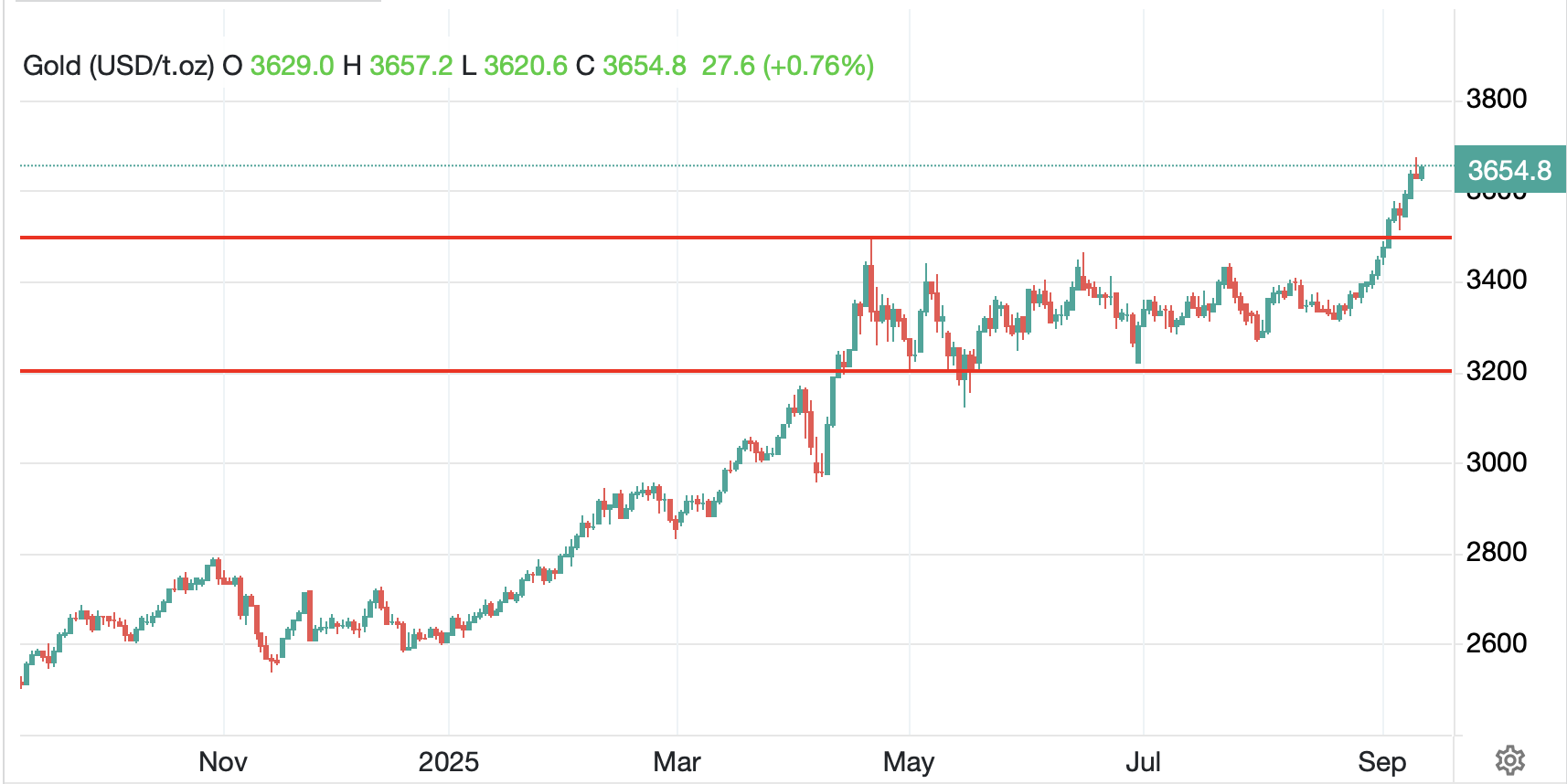
In the commodity markets, oil (-0.6%) is softer this morning but continues to hug the $68/bbl level despite EIA inventory data showing a net large build of nearly 4 mm barrels.  It appears that there is both ample supply and production and there continues to be concern over slowing economic activity, yet oil is in demand.  As I often say, sometimes markets are simply perverse.  In the metals markets, gold (+0.5%) continues to trade either side of $3350/oz and has done so since mid-April.  I continue to read about central banks buying the relic and replacing US Treasuries with gold in their reserve portfolios, but there is obviously enough supply to prevent further price appreciation for now.  But gold is leading gains across the entire metals complex (although copper is getting a boost from the tariff talk.)

Finally, in the FX markets, there is no direction this morning.  both the euro and pound are slightly softer, but AUD (+0.4%) and NZD (+0.35%) are firmer with the yen and CAD little changed.  ZAR (+0.4%) is also having a good day, arguably on the strength in the precious metals markets but otherwise, it is hard to find anything exciting to note.

Turning to this morning’s data, we get the weekly Initial (exp 235K) and Continuing (1980K) Claims and that’s it.  We do hear from three Fed speakers, Musalem, Daly and Waller, but since we already know Waller’s views, it will be far more interesting to hear the other two.  I do find it interesting that Ms Daly, one of the most dovish FOMC members, is not in the rate cut camp, a situation I attribute entirely to her political views.

And that’s what we’ve got today.  Nothing has changed any trends, and it seems highly unlikely that today’s data will.  However, if we hear dovish signals from both Daly and Musalem, that may indicate a turn at the Fed and perhaps we will see that narrative change.  I am confident the one thing Chairman Powell does not want is to have a 5-4 vote to leave rates unchanged.  I would contend that is the most intriguing thing on the horizon right now.

Good luck

Adf
Widely Abhorred

Most traders this summer are bored
Thus, markets are being ignored
Attention, instead
Is on a man, dead
For years, but still widely abhorred
 
So, even though President Trump
More tariffs on copper did pump
The outrage is such
That nothing else much
Is noticed, not gains nor a slump


This is not a political discussion piece but the only story getting any press today, overwhelming the terrible tragedy in Texas from the weekend, is the closing of the Jeffrey Epstein case by the Trump administration.  I will not go into the details here as they are not relevant to our focus, but it certainly has many people irate, although I imagine there are a small number who are relieved.  On the surface, though, it certainly doesn’t seem to be in accord with Trump’s remarkable transparency in all other facets of his governance.  I will leave it at that.

Regarding market issues, while there continue to be ongoing tariff negotiations with numerous countries, nothing new has been completed in that realm in the past several days.  The one new thing is copper, where the president mooted 50% tariffs on the red metal yesterday during a wide-ranging press conference.  See if you can determine when he mentioned this.

Source: tradingeconomics.com

The result is that copper is now trading at new all-time highs, although in fairness, this morning it has slipped back -2.6% from the peak it reached yesterday.  This move has also weighed on gold (-0.3%) and silver (-0.5%), although both those metals remain in longer term uptrends as well.

Away from those stories, perhaps the biggest news is that the Supreme Court overturned a lower court injunction against a Trump executive order from February that was designed to reduce the size of the government.  His cabinet secretaries now have the ability to reduce headcounts as they deem appropriate with estimates of several hundred thousand expected to be let go.  (If I recall correctly, immediately upon entering office Trump offered a buyout for government employees with a generous severance.  I suspect those laid off will not receive the same benefits now).  

I make the connection here as a reduced headcount seems likely to help reduce government spending at the margin, something that has been a key focus of everyone concerned about both inflation and the general growth of government.  Also consider, given the remarkable inefficiency of government processes, any other job these laid off employees take will almost certainly add more value to the economy than they are currently adding.

Otherwise, I’ve got nothing.  Things are just not very interesting right now.  So, let’s recap the overnight session.  Yesterday’s US session was the epitome of dull, with the DJIA the worst performer at just -0.4% and the other two essentially unchanged.  Asian markets saw a modest gain in Tokyo (+0.3%) as investors get used to the new tariffs.  Elsewhere in the region there was no consistency at all with gainers (Korea, Taiwan, Indonesia and Singapore) and laggards (China, Hong Kong, India and Australia).  In other words, there is no pattern here to note.  In Europe, however, gains are universal (DAX +1.0%, CAC +1.15%, IBEX +0.85%) as it appears trade talks are getting close to some sort of agreement.  Again, given the amount of time it has historically taken to reach agreement, the speed with which things are occurring right now is remarkable.  I guess sometimes a stick is needed rather than a carrot.  Lastly in the equity world, US futures at this hour (7:10) are slightly higher, 0.2% or so.

In the bond market, yields, which I pointed out yesterday have risen 20bps in the past week, are on hold this morning with Treasury yields (+1bp) edging higher ahead of today’s 10-year auction.  In Europe, sovereign yields are lower by -1bp across the board which appears to be a simple trading reaction to the recent rise.  JGB yields are also edged higher by 1bp overnight as Japan closes in on its election and comments from a BOJ member indicated they are not likely to hike rates again until March!  Remember, inflation in Japan is 3.6%!

Oil prices continue to edge higher, up 0.5% this morning despite the increased OPEC+ production and the alleged global slowdown in economic activity.  Something about this price action is out of kilter with the narrative and either we are going to see production numbers decline dramatically or the economic data is going to start to show that things are much better than the bears would have you believe.

Finally, the dollar is slightly firmer this morning, +0.2% on the DXY, but continues to trade well below its 50-day moving average and bump up against a very clear trendline lower as per the picture below.

Source: tradingeconomics.com

I am no technician as is obvious by my efforts on the chart, but the general thesis remains intact.  Right now, lower seems to be the direction of least resistance although positioning in the market remains quite net short dollars.  But looking at individual currencies this morning, KRW (-0.5%) is the biggest mover, as concerns over more tariffs on semiconductors undermined investor sentiment there, but other than that, you are hard pressed to find a currency move of 0.2% in either direction.  In essence, like every other market, there is just nothing going on right now.

On the data front, today brings only the EIA oil inventory data where a small draw is expected and the FOMC Minutes at 2:00, although my take is they are pretty stale at this point.  Yesterday saw a surprising decline in Consumer Inflation expectations to 3.0%, despite all the tariff talk, and a decline in Consumer Credit to $5.1B, not a good sign for spending.

As per the above chart, the dollar’s trend remains lower for now.  We will need to see some major changes in policy to alter that trajectory I think, and for now, that seems unlikely.  Everything continues to revolve around what the President says and where he focuses.  If you can anticipate that, good for you.  But this poet hasn’t a clue on the next target.  Stay hedged and nimble.

Good luck

Adf

A Reprieve

Some nations have gained a reprieve
About a month left to achieve
A deal to prevent
The extra percent
Of tariffs that Trump can conceive


The news cycle continues to be bereft of new stories regarding finance and markets as there is continued focus on the tragedy in Texas after the flash floods that were responsible for over 100 deaths.  But in our little corner of the world, tariff redux is all we have.  So, to rehash, today marks 90 days since President Trump delayed the imposition of his Liberation Day tariffs back in April with the idea of negotiating many new trade deals.  Thus far, only two have been agreed, the UK and Vietnam, while there has clearly been progress made on several key deals including Japan, South Korea, the EU, India and Australia.  As such, the president has delayed the imposition of these tariffs now to August 1st, but we shall see what happens then.

It is worth noting that trade negotiations historically have taken a very long time, years if not decades, as evidenced by the fact that any time an agreement is reached, it is met with dramatic fanfare on both sides of the deal.  Consider, for a moment, that the EU and MERCOSUR finally agreed terms in 2024, after 25 years of negotiations, although the deal has not yet been ratified by both sides.  With this in mind, it is remarkable that as much ground has been covered in this short period of time as it has.

However, if I understand correctly, many other nations will be subject to tariffs starting today.  Of course, along with these tariffs are the resumed calls for a catastrophic outcome for the US with inflation now set to advance sharply while growth stagnates.  At least the naysayers are consistent.

Away from this story, though, the market is the very picture of the summer doldrums.  After all, nothing else has really changed.  The BBB solved the debt ceiling issue, with another $5 trillion added to the mix, so funding the government should not be a problem for several years at least.  Of course, this means the monetary hawks will re-emerge and complain that the government is spending too much (which it clearly is) and that the economy will collapse under the weight of all that debt.  After all, one needs a calamity to get one’s views aired these days, and doomporn is all the rage with President Trump in office.

So, I won’t waste any more time before heading into the market recap.  Yesterday’s US equity decline, catalyzed by the display of letters written to Japan and South Korea about the imposition of 25% tariffs, was halted after the delay was announced, but the markets still closed lower.  Overnight, Asian markets managed to rally a bit with the Nikkei (+0.3%) the laggard while Korea (+1.8%) really benefitted from that delay.  Meanwhile, China (+0.8%) and Hong Kong (+1.1%) were also solid as was most of the region although Thailand (-0.7%) which did not receive a reprieve, did suffer.

In Europe, the picture is somewhat mixed with the DAX (+0.45%) rising after a slightly wider than expected trade surplus was reported this morning while the CAC (-0.1%) has been under modest pressure after the French trade deficit rose slightly.  But the bulk of the market here is modestly higher on the reprieve concept, although only about 0.2%.  As to US futures, at this hour (7:05), they are basically unchanged to slightly higher.

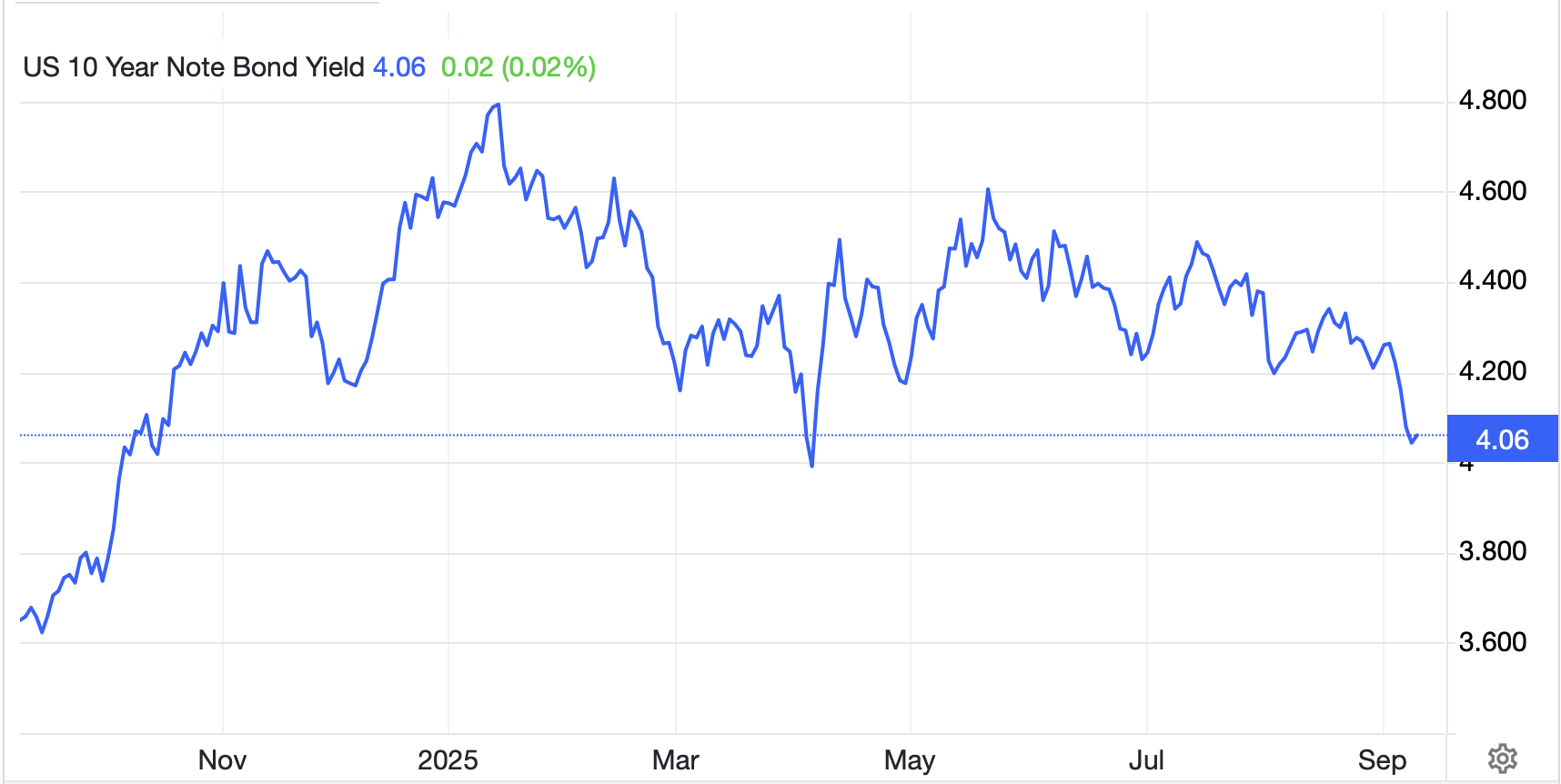
In the bond market, though, yields continue to rise around the world this morning as it appears investors are growing somewhat concerned that all the government spending that is being enacted around the world is becoming a concern.  Treasury yields have risen 3bps and European sovereigns are higher by between 4bps and 5bps.  JGB yields, too, are higher by 4bps and in Australia, an 8bp rise was seen after the RBA failed to cut their base rate last night as widely expected.  Since the beginning of the month, 10-year Treasury yields have risen by more than 20 basis points (as per the chart below) a sign that there may be concern over excess supply…or that the BBB is going to encourage faster growth.  I’m not willing to opine yet.

Source: tradingeconomics.com

In the commodity markets, oil (-0.3%) has been trading in a $4/bbl range since the end of the 12-Day War and the US destruction of Iranian nuclear facilities removed the war premium from the market.  In truth, this is surprising given the ongoing increases in production from OPEC+ and the widespread belief that the economy is suffering and heading into a recession.  But it is difficult to look at the below chart and be confident of the next move in either direction.

Source: tradingeconomics.com

Meanwhile, metals markets this morning show gold (-0.35%) giving back some of its late day gains yesterday while silver and copper remain little changed.  Again, range trading defines the price action as gold has basically gone nowhere since late April.

Source: tradingeconomics.com

Finally, the dollar is mixed this morning with AUD (+0.6%) the leading gainer after the RBA no-action outcome, although ZAR (+0.6%) has gained a similar amount which appears to have been driven by Trump rescinding his threat to add a 10% additional tariff on all BRICS nations (the S is South Africa) that seek to avoid using the dollar for trade.  On the other side of the coin, the pound (-0.3%) and yen (-0.4%) are both slipping this morning with the former suffering from domestic finance problems as the Starmer government continues to flail in its efforts to pay for its promised spending.  In Japan, the Upper House elections, which are to be held July 20th, are a problem for PM Ishiba and his minority government.  One of the key issues is despite the fact that rice prices there have risen more than 100% in the past year, and the US is keen to export rice to Japan to help mitigate the problem, the farmers bloc in Japanese politics has outsized influence and is vehemently against the proposal.  If the government falls due to election losses, agreeing a trade deal will be impossible.  Perhaps this time, the yen will weaken in the wake of tariffs.  (As an aside, are any of you old enough to remember the death of the carry trade and how the yen was going to explode higher?  I seem to recall that was a strong narrative just a few months ago, but it is certainly not evident now.)

On the data front, the NFIB Survey was released this morning at 98.6, a tick lower than expected and 2 ticks lower than last month, but basically little changed.  I don’t think it provides much new information.  Later this afternoon we see Consumer Credit (exp $11.0B), potentially a harbinger of future spending outcomes.  But really, that’s it.

Headline bingo continues to drive markets with the narratives locked in place.  The dollar’s trend is clearly lower, but it remains to be seen if the oft-predicted collapse is on the cards.  Personally, while a bit further weakness seems reasonable, getting short here, with the market already significantly positioned that way, does not feel like the right trade.

Good luck

Adf

Recession Repression

Though many conclude that recession
Is coming, this poet’s impression
Cannot overcome
A key rule of thumb
More jobs mean recession repression
 
As well, on the fourth of July
The naysayers all went awry
The BBB’s law
As Trump oversaw
Parades and a massive fly-by


I will be brief this morning.  First, Thursday’s NFP report was much stronger than expected, with 147K new jobs and the Unemployment Rate falling to 4.1%.  This is clearly not pointing in a recessionary direction, although as would be expected by all those who have made that call, there was much analysis about the underlying makeup of the jobs report, with more government hires and less private sector ones.  And I agree, I would much rather see private sector hiring, but I don’t recall as much angst in the previous administration when they hired into the government extremely rapidly.  It is difficult for me to look at the below chart of government hiring over the past five years and conclude that this administration is being anywhere nearly as profligate.

Source: tradingeconomics.com

Second, despite all the naysaying by the punditry, President Trump got his Big, Beautiful Bill through Congress and he was able to sign it on his schedule, July 4th.  Whether you love Trump or hate him, you must admit that he is a remarkable political force, greater than any other president I can remember, although Mr Reagan was certainly able to accomplish many things with a very different style.  And perhaps, that is the issue, Trump’s style is unique in our lifetimes as a president, although I understand that throughout our history, there have been some presidents with a similarly brash manner, I guess Andrew Jackson is the best known.  And it is that style, I would say that leads to the Trump Derangement Syndrome, although his attack on the Washington elite is also a key driver there.

Thus far, the articles I have read about the legislation all focus on how many people are going to die because Medicaid is requiring able-bodied adults to work, volunteer or go to school 20 hours/week in order to remain eligible.  It would be helpful if these ‘news’ sources could keep a running tally so we can all see the results.  Given the law simply sets priorities, and not actual appropriations yet, my take is all this death and destruction may take a few months yet to materialize.

But after those two stories, there is a growing focus on the upcoming Tariff deadline this Wednesday, with a mix of views.  There is both a growing concern that the original level of tariffs is going to be put back in place, and that will disrupt global commerce, and there is a story gaining traction that the deadline will be delayed again.  The administration hinted there would be some notable deal signings this week, so we shall see.

As that’s all there is, let’s look at markets overnight.  Thursday’s US rally in the wake of the NFP data is ancient history.  Overnight in Asia, the major markets (Japan -0.6%, Hang Seng -0.1%, CSI 300 -0.4%) were under pressure but the rest of the region was mixed with some gainers (Korea, Indonesia, Singapore) and some laggards (Taiwan, Malaysia, Australia) although none of the movement was very large, 0.5% or less in either direction.  In Europe this morning, the DAX (+0.65%) is far and away the leader after a stronger than expected IP reading of +1.2%.  However, the rest of the continent and the UK are all tantamount to unchanged in the session.  US futures at this hour (7:00) are pointing slightly lower, about -0.025%.

In the bond market, Treasury yields which rallied 5bps on Thursday after the data are higher by one more basis point this morning.  European sovereign yields are all higher this morning as well, between 2bps and 3bps, as concerns over the timing of tariffs has investors cautious.  The rumors are solid progress has been made in these negotiations.

In the commodity space, oil (+0.7%) is higher this morning which is a bit of a surprise given that OPEC+ raised their production quotas by a more than expected 548K barrels/day at their meeting this weekend.  At this point, they are well on their way to eliminating those production cuts completely.  I guess demand must be real despite the recession calls.  Metals markets, though, are all lower this morning (Au -1.0%, Ag -2.0%, Cu -0.6%) as hopes for trade deals has reduced some haven demand.  Of course, copper’s decline doesn’t jibe with oil’s rally on a demand note, but the movements have not been that large, so it is probably just random fluctuations.

Finally, the dollar is stronger this morning, which is also weighing on the metals markets.  ZAR (-1.1%) is the biggest loser overnight although NZD (-0.9%) and AUD (-0.7%) are doing their best to catch up.  But the euro (-0.35%) and pound (-0.3%) are both under pressure as is the yen (-0.7%) and CAD (-0.5%) and MXN (-0.5%). In other words, the dollar’s strength is quite broad-based.  On this note, I couldn’t help but chuckle at this article in Bloomberg, Misfiring Models Leave Wall Street Currency Traders Flying Blind, which describes how all the old models no longer work in the current world.  This is a theme I have harped on for a while, mostly with the Fed, but also with the punditry in general.  The world today is a different place, and I might ascribe the biggest difference to the fact that for 20+ years, inflation had fallen to 2% or lower in most of the western world and markets behaved accordingly.  But now, inflation is higher, and those relationships no longer hold.

On the data front, this may be the least active week I have ever seen.

TuesdayNFIB Small Biz Optimism98.7
 Consumer Credit$10.5B
WednesdayFOMC Minutes 
ThursdayInitial Claims235K
 Continuing Claims1980K

Source: tradingeconomics.com

There are only 3 Fed speakers as well so pretty much, Washington is on vacation this week.  It is very hard to get excited about much right now.  We will all need to see the outcomes of the trade negotiations and which countries will see tariffs applied or not.  I have no forecasts for any of that.  In the meantime, I think the fact that implied volatilities are relatively low across most asset classes offers the opportunity for hedgers to protect themselves at reasonable prices.

Good luck

Adf
Too Extreme

The year is now halfway completed
While narrative writers repeated
The story, same old,
The dollar’s been sold
‘Cause global investors retreated
 
As well, they continue to scream
Trump’s policies are too extreme
His tariffs will drive
Inflation to thrive
While growth will soon start to lose steam


I don’t know about you, but this poet is tired of reading the same stories over and over from different pundits when it comes to the current macroeconomic situation.  And so, I thought I might take a look at what the current narrative seems to be and, perhaps, analyze some of the reasons it will be wrong.  I have full confidence it will be wrong because…it always is.  Add to that the fact that the narratives continue to try to build on expectations of what President Trump wants to do and let’s face it, there is no more unpredictable political leader on the planet right now.

In fact, we can look at one of the key narratives that had been making the rounds right up until Thursday night when the House and Senate agreed the terms of the BBB which has since been signed into law.  Serious pundits were convinced that the president could never get this done and yet there it is.

But let’s discuss another popular narrative, the end of American exceptionalism.  First, I’d like to define the term American exceptionalism because I believe that the equity analysts borrowed the term from the Ronald Reagan.  For the longest time, I would contend the term referred to the American experiment, writ large, with the dynamic market economy that was created by the legal framework in the US.  After all, no other nation, certainly not these days, has anything like this framework.  The combination of the 1st and 2nd Amendments to the Constitution have been critical in not only creating this framework but keeping it from getting too far out of hand. 

However, in the market context, American exceptionalism refers to the fact that the relative strength of the US economy drew investors from around the world into US equity markets, driving the value of US equities relative to both total global equities and the US proportion of global GDP to extreme heights.  While the chart below shows a peak just above 50% of global market cap and that number is declining right now, I have seen estimates that the number could be as high as 70% of global market cap.  I suppose it depends on how you define global market cap, but MSCI’s readings tend to be well respected.

In addition to the significant portion of equity market capitalization compared to the rest of the world is the fact that US GDP is a significantly smaller percentage, somewhere in the 23% – 26% range depending on how one calculates things with FX rates.  

The upshot is that heading into 2025, US equity valuation was at least twice the size of the US economy compared to the entire world.  Certainly, that is exceptional, and the term American exceptionalism seemed warranted.  But as you can see from the first chart, other markets have been outperforming the US thus far this year with the result that the US no longer represents quite as large a percentage of the world’s equity market capitalization.  So, is this the end of that form of American exceptionalism?  The pundits are nearly unanimous this is the case.

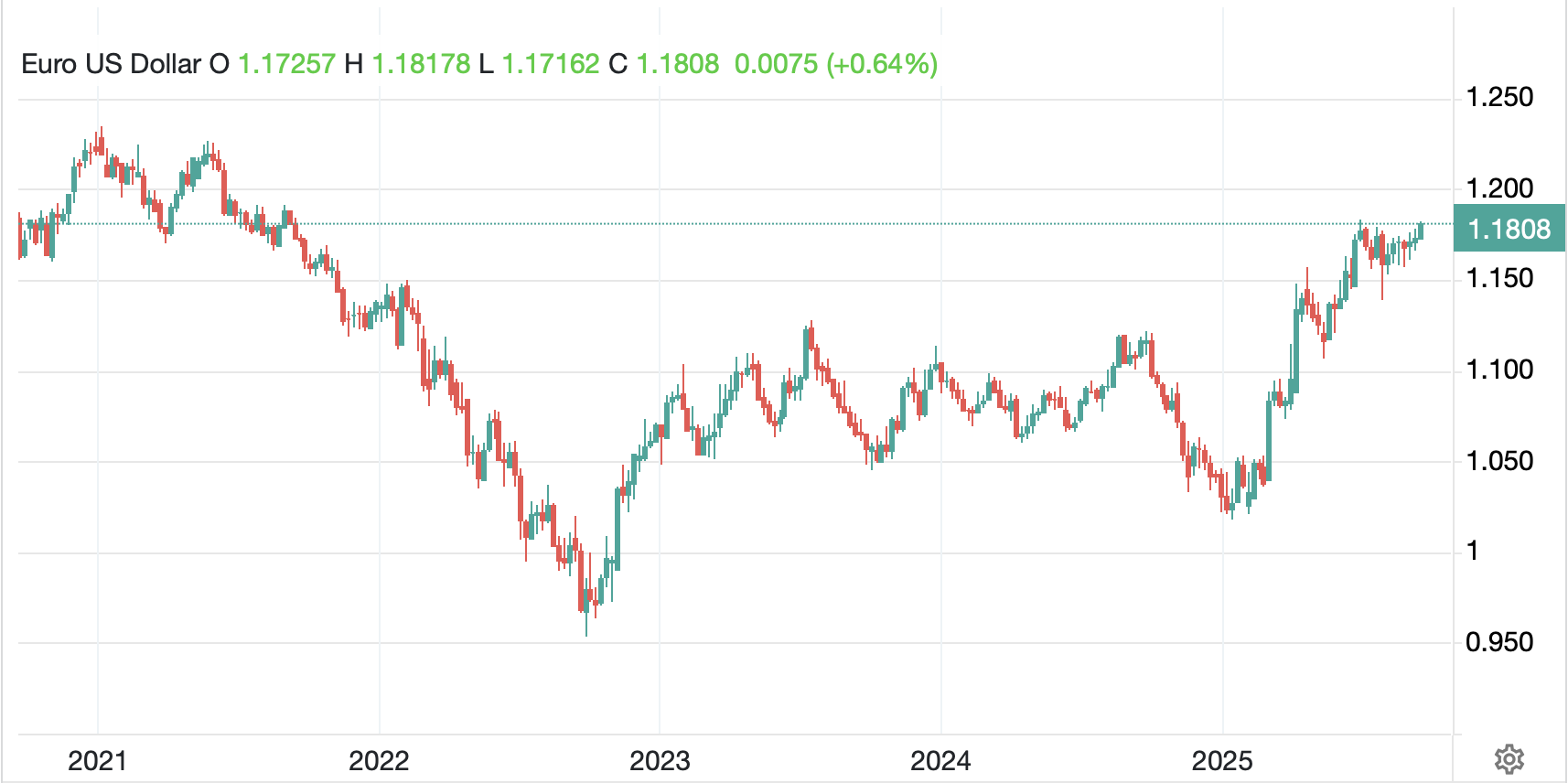
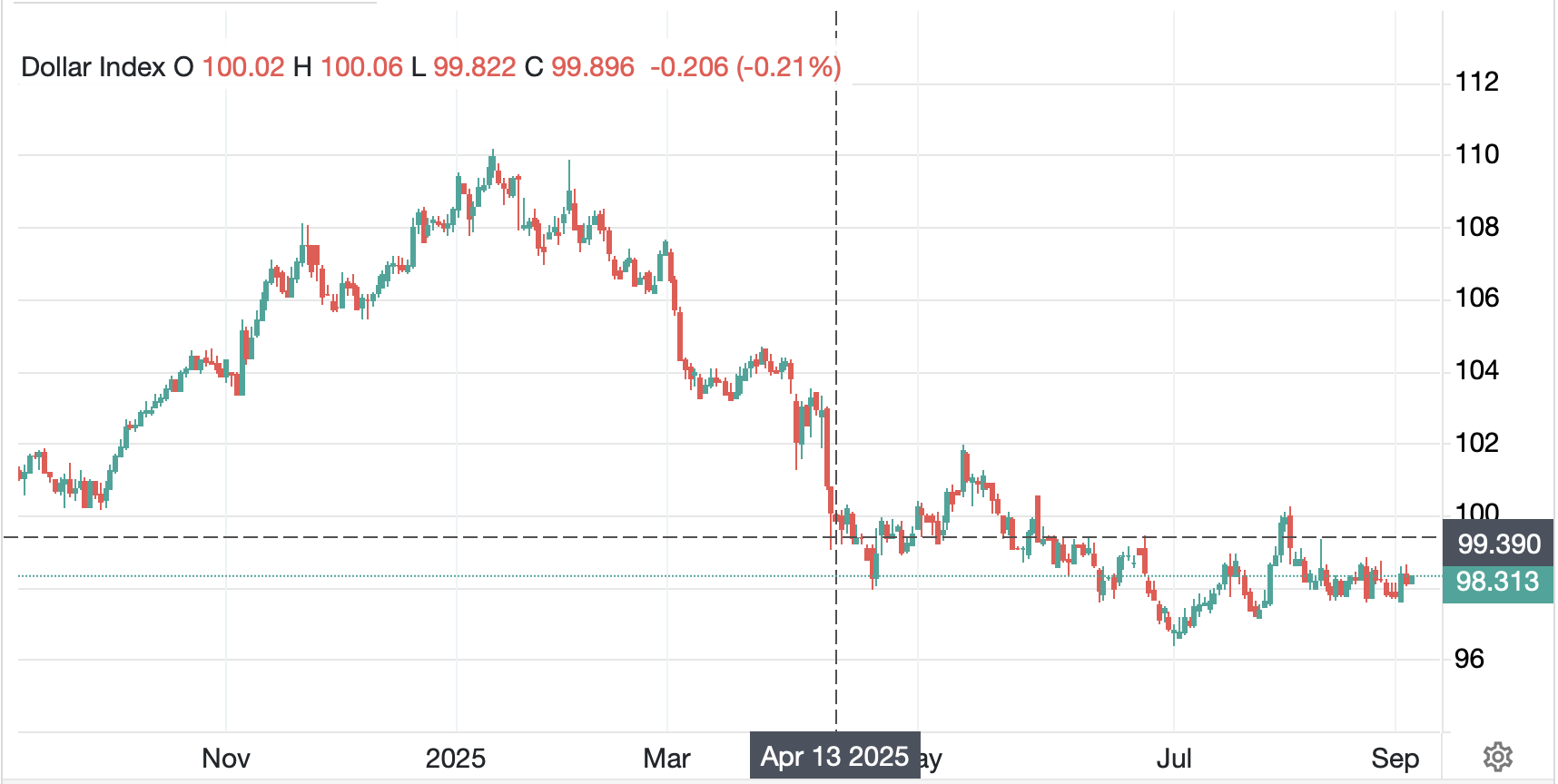
A knock-on effect of this is that the dollar has been under pressure all year, having declined more than 10% vs. the DXY and 13% vs. the euro.  In fact, a key factor in the weaker dollar thesis is that international investors are either selling their US stocks or hedging the FX exposure with either of those weighing on the dollar.

Source: tradingeconomics.com

Now, so far, that seems a logical conclusion and I cannot argue with it.  However, as we look forward, is it reasonable to expect that to continue?  In this instance, I think we need to head back to the BBB, which is undoubtedly going to provide significant economic stimulus to many parts of the economy (sorry green tech), and seems likely to help energy, tech and industrial companies continue to perform well.  Much has been made of the idea that American exceptionalism has peaked but I wouldn’t be so sure.  Net, I am not convinced the US ride is over, at least not for the economy, although segments of the equity market could well be in for a fall.

The other narrative that I continue to hear is that Trump’s policy mix, of tariffs and deportations is going to drive inflation much higher.  In fact, Dr Torsten Sløk, who does excellent work, explained this weekend that tariffs would raise US CPI a very precise 0.3% this year.  Of course, the problem with this story is that, thus far, inflation readings have been quite tame, falling since Liberation Day.  It is certainly early in the game, but it is not at all clear to me that tariffs are going to be a major driver of inflation.  First, many companies have decided to eat the cost themselves, notably Japanese car manufacturers.  Second, M2 in the US has basically flatlined since April 2022 (see chart below), and if money supply is not growing, inflation will be hard-pressed to rise too quickly.

Now, it is certainly possible that the Fed increases the supply of money, although given the antagonism between Powell and Trump, I sense that the Fed will remain tighter for longer as they will make no effort to help the president if the economy starts to visibly slow down.  

But, if I were to try to estimate what Trump’s end game is, I think the following chart is the most important.

This chart is the reason Donald Trump is our president, and it is one that the punditry does not understand.  It is also the reason that US equities have performed so well.  Corporate profit margins in the US have grown unabated since Covid.

Now, let’s put these two thoughts together.  Corporate profit margins have exploded higher, currently at an all-time high of 10.23%.  Meanwhile, the share of GDP that has gone toward labor has fallen dramatically since China entered the WTO.  The result has been workers in the US have seen their incomes decline relative to corporate income.  While it is true that, technically, the punditry is part of the work force, they are asset owners as opposed to Main Street who have far less invested in the equity markets.  Ask yourself, how did corporates improve their margins so significantly?  The combination of immigrant labor and moving production offshore weighed heavily on US wage growth.  If you want to understand why President Trump is speaking to Main Street and using tariffs with reckless abandon it is because he is trying to adjust this process.  

If he is successful, I expect that equity markets will lag other investments as those profit margins are likely to decline. If they just go back to pre-Covid levels of 6%, that represents a huge amount of money in the pockets of consumers.  Do not be surprised if the result is solid economic growth with lagging profits and lagging equity prices.  Too, a weaker dollar plays right into this game as it helps the competitiveness of US manufacturers both for domestic consumption and exports.

This is not the narrative, however.  The narrative continues to be that Trump’s tariffs are going to generate significant inflation and drive the economy into a recession.  In fact, just this morning I read that Professor Steven Hanke (a very smart fellow) now has a recession estimated at 80% to 90% probability.  All the uncertainty is preventing activity as corporate managers hold back on making decisions, allegedly.  Of course, now that the BBB is law, the tax situation is settled, and I will not be surprised to see investment return with clarity on that issue.

The narratives have been uniformly negative for a while.  Part of that is because many of the narrative writers objectively despise President Trump and cannot abide anything he does.  But part of that is because I believe the president is not focusing on the issues that market pundits have done for many years and instead is focusing on helping Main Street, not Wall Street.  Perhaps that is why Wall Street political donations were heavily biased toward VP Harris and every other Democrat.

I hope this made some sense to you all, as I try to keep things in context.  In addition, as it is Sunday evening, I expect tomorrow morning’s note to be quite brief.  Love him or hate him, President Trump clearly hears the sounds of a different drummer than the rest of the political class and has proven that he can get what he wants.  Do not ignore that fact.

Good luck

adf

Mind-Numbing

According to those in the know
The BBB’s ready to go
The vote is this morning
So, this is your warning
That President Trump will soon crow
 
As well, ere the Fourth of July
The NFP may quantify
If rate cuts are coming
(A subject, mind-numbing)
Or whether Fed funds will stay high


Perhaps this will be the last day we hear about the Big Beautiful Bill, or at least the last day it leads the news, as it appears that by the time you read this, the House will have voted on the changes and by all accounts it is set to pass.  If so, the President will sign it tomorrow amidst great fanfare and then it will just be a secondary story when somebody complains about something that was in the bill.  However, the drama over passage will have finally ended.  

(I guess what has really led the news was that Diddy was found not guilty of the RICO charges and Kohburger in Idaho got a plea deal avoiding the death penalty, but neither of those are market related.)

At any rate, the question now to be asked is will the BBB perform as advertised by either side of the aisle?  Experience tells us that while the economy will not take off rapidly while inflation collpases, neither will there be people dropping in the streets because of the changes in Medicare, although if you listened to the pundits on both sides of the aisle, that is what you might expect.  While this is not quite as bad as Nancy Pelosi’s immortal words, “we have to pass the bill to find out what’s inside it”, the fact that it approaches 1000 pages in length implies there is a lot inside it.

From what I have read, and it has not been extensive, it appears that there is some stimulus in the bill in the form of tax relief on tips and overtime as well as reductions for seniors, and spending on defense and the border.  It also appears there have been several previous subsidies, notably for wind and solar, that are being removed.  The fact that the CBO is claiming it will increase the budget deficit by $1.5 trillion, and given the fact that Jim Cramer is the only one with a worse track record than the CBO, tells me it will have limited impact on the nation’s fiscal stance initially, although if growth does pick up, that will clearly help things.

Which takes us to the other story this morning, the payroll report.  Here are the current median forecasts by economists for the results, as well as the rest of the data to be released:

Nonfarm Payrolls110K
Private Payrolls105K
Manufacturing Payrolls-5K
Unemployment Rate4.3%
Average Hourly Earnings0.3% (3.9% Y/Y)
Average Weekly Hours34.3
Participation Rate62.3%
Initial Claims240K
Continuing Claims1960K
ISM Services50.5
Factory Orders8.2%
-ex Transport0.9%

Source: tradingeconomics.com

Some will point to yesterday’s ADP Employment report which showed a decline of -33K, the first decline in more than 2 years, as a harbinger of a bad number, but as you can see from the chart below, there has been a pretty big difference between ADP (grey bars) and NFP (blue bars) for a while now.

Source: tradingeconomics.com

Perhaps of more concern is the Unemployment Rate, which is forecast to rise a tick to 4.3%, which would be its highest print since October 2021 and if I look at the chart below, it is not hard to see a very gradual trend rising higher here.  While markets really focus on NFP, I learned a long time ago from a very smart economist, Larry Kantor, that the Unemployment Rate was the best single indicator of economic activity in the US, and that when it is rising, that bodes ill for the future.  

Source: tradingeconomics.com

You may recall there was a great deal of discussion about a year ago regarding the Sahm Rule, which hypothesized that when the Unemployment Rate rose more than 0.5% above its cycle average within 12 months, the US was already in a recession.  The discussion centered on whether it had been triggered although the final claim was it hadn’t when extending the readings out to the second decimal place.  Now, for the past year, the Unemployment Rate has hovered between 3.9% and 4.2%, so there doesn’t seem to be any chance of a trigger here, although if it does rise, you can be sure you will hear about it.

And that’s what is on tap ahead of the long holiday weekend.  With that in mind, let’s look at the market action overnight. Excitement is clearly lacking in the equity markets these days as the summer doldrums are universal.  Yesterday’s new closing highs in the S&P 500 seem like they should be exciting but were anything but amid low volume.  As to Asia, Japan was flat, China (+0.6%) and Hong Kong (-0.6%) offset each other and in the rest of the region, other than Korea (+1.3%) which is starting to see a steady stream of foreign investment on the premise that the country is set to improve the regulatory structure for equities there, things were +/- a bit.

Meanwhile, in Europe, there is little net movement on the continent but the UK (+0.4%) is bouncing off recent lows after PM Starmer reiterated his support for Chancellor Reeves.  A story I missed yesterday was that when she was trying to make a case in parliament for spending cuts, the back bench liberals revolted, literally bringing her to tears.  The market response was that the UK would blow up its fiscal situation which saw Gilts tumble and yields rise 15bps yesterday at one point, while stocks fell.  But that problem has been addressed for now.  However, looking at the statement Starmer made, it reminded me of a baseball GM’s comments supporting his manager right before he fires him.

In the bond market, yields are declining, led by Gilts (-9bps) which are retracing yesterday’s gains on the above story.  But Treasury yields are down (-2bps) and European sovereigns are all seeing yields lower by between -4bps and -5bps.  In Japan, JGB yields are unchanged as PM Ishiba grapples with a trade deal where the US is keen to be able to export rice to the nation and Japan has a rice shortage with prices rising sharply but doesn’t want to accept imports.  Go figure.

In the commodity markets, oil (-0.2%) is slipping slightly after a solid rally over the past seven sessions where it rose over $3.50/bbl.  Gold (-0.3%) continues to trade around its pivot level of $3350/oz while silver (+1.0%) continues its longer run rally.

Finally, the dollar, which fell during yesterday’s session after I wrote, is effectively unchanged net this morning ahead of the data with very modest moves of +/-0.2% or less almost universal.  KRW (+0.4%) is the outlier here and based on equity inflows discussed above, that makes sense.

So, that’s where we stand heading into the payroll report and the long weekend.  If pressed on the NFP outcome, I expect a weak outcome, 50K or so, as the birth/death model continues to be revised.  But remember, the error bars on this number are huge.  However, if it is weak, look for the probability of a July rate cut (currently 25.3%) to rise and the equity market to follow that higher.  As to the dollar, I think for now, lower is still the trend.

Good luck and have a wonderful long weekend

Adf

Savants Disagree

The Senate completed their vote
And so, BBB, though there’s bloat
Will soon become law
As Dems say pshaw
While lacking a doctrine, keynote
 
So, eyes now turn to NFP
The key for the FOMC
The JOLTs showed that gobs
Of ‘vailable jobs
Exist, though savants disagree


Market activity continues to demonstrate lower volumes and despite several competing political narratives, price action remains muted overall.  The biggest news of late is the Senate passed their version of President Trump’s BBB last night and now it goes to committee for reconciliation before getting to the president for signing.  Of course, given the mainstream media’s complete antagonism toward the president, the headlines this morning refer to the problems the Republicans will have agreeing terms between the two houses, and I’m sure it will be difficult.  However, based on everything that President Trump has done to date, I expect it will get completed.  While perhaps not by Friday, probably by next week.

This matters to markets because it will help set the tone for government spending and the potential companies that will benefit, as well as those that will be negatively impacted, based on the change in focus from that of the Biden administration.  

At this point, it is impossible to forecast with any certainty how things will evolve, especially with respect to issues like the budget deficit and debt issuance.  While yesterday, Treasury Secretary Bessent did explain that they were going to continue to focus on short-term issuance, if (and it’s a big if) the bill does goose economic activity in the US, it is quite possible that faster GDP growth increases tax collections and reduces net government spending and the deficit.  I would estimate that view is not discounted at all in markets at this time given the constant messaging from media and the punditry that not only are people going to starve to death and lose their medical care because of this bill, but that it is unaffordable and will bankrupt the country.  Something tells me the results will be slow acting, although if the government does continue its deportations and stops subsidizing too-expensive green energy projects, we could see less government spending.  We shall see.

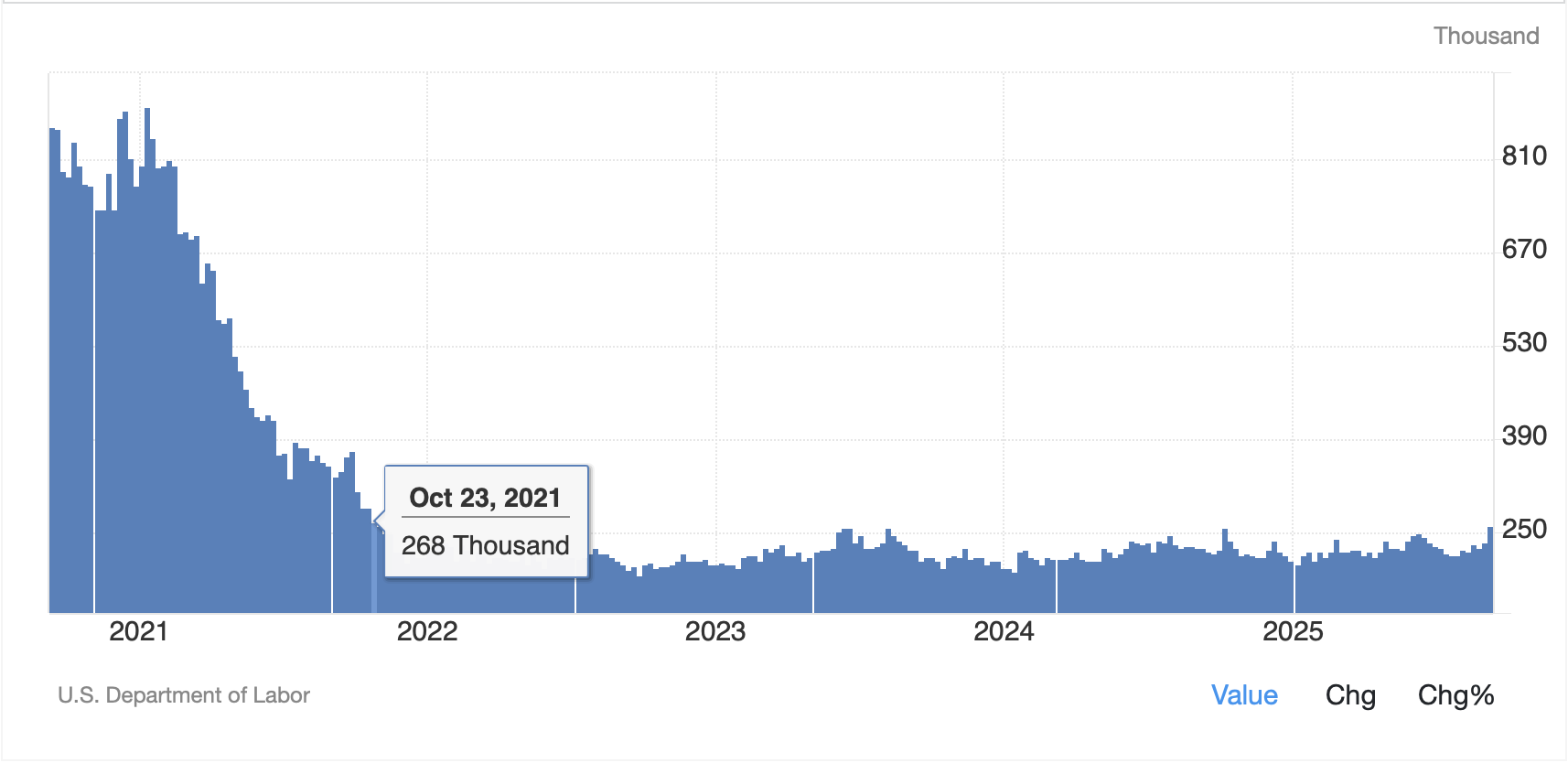
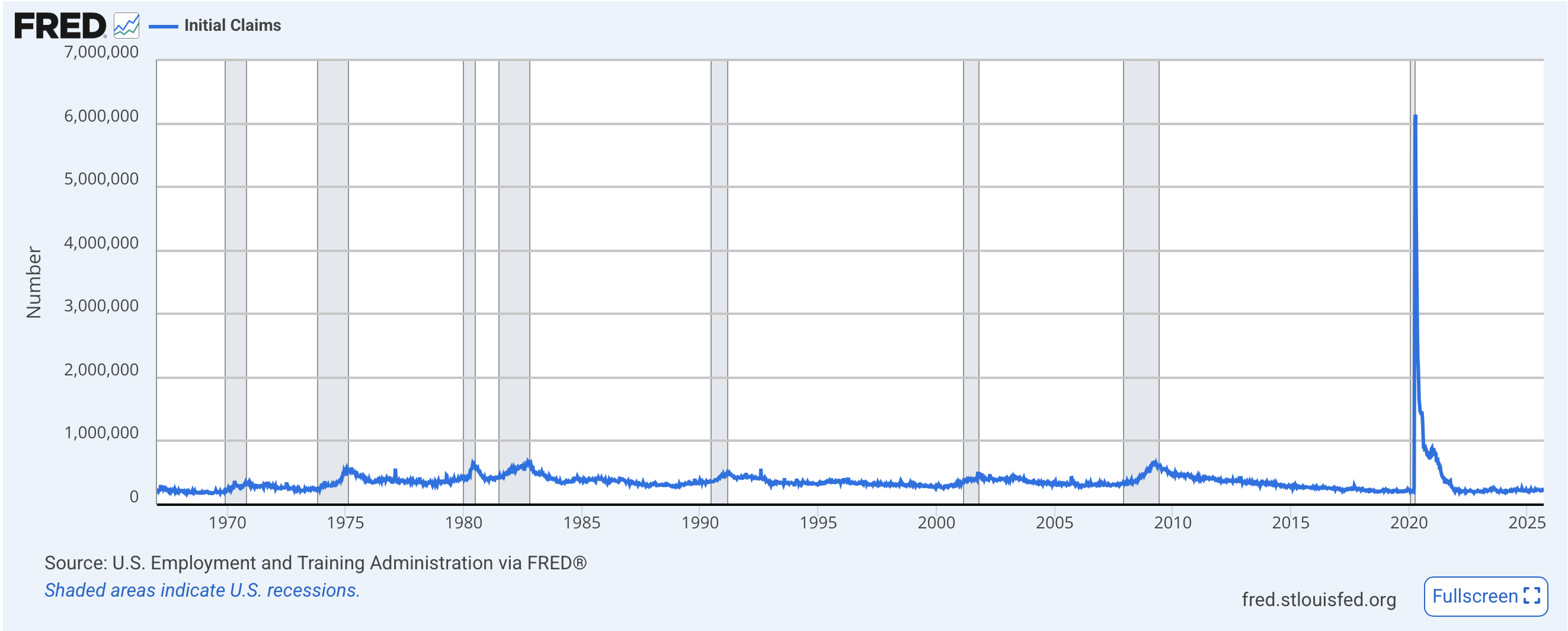
But markets need a focus and tomorrow’s NFP is as good as it gets.  Chairman Powell has been attending the ECB’s summer symposium and, in his speech, yesterday he essentially reiterated his views that the Fed will continue to watch and wait on rates as there is still concern that tariffs may drive inflation higher.  As to jobs, they are watching the situation closely, but thus far, the labor market has held up.  Proof of that idea was evident in yesterday’s JOLTs Job Openings data which showed a surprising jump of more than 300K new job listings available.  I haven’t seen a rationale yet, but perhaps it is related to the self-deportations by illegal immigrants who have left businesses with numerous vacancies.  The weekly claims data, while above its lowest levels lately, continues to run at very modest numbers on a long-term perspective as can be seen in the chart below with data from the Department of Labor.  If the job market holds up, I don’t see the Fed cutting rates despite President Trump’s ire.

Also, at Sintra was BOJ Governor Ueda who explained that Japanese policy rates were substantially lower than neutral and that inflation would likely continue creeping higher over time.  I guess we cannot be surprised that the yen (-0.5%) has slipped in the wake of those comments.  The final noteworthy comments from Sintra were from BOE governor Bailey who explained that despite sticky inflation, more rate cuts were on the way, helping to undermine the pound (-0.4%) this morning.

But there is one final thing to discuss regarding the Sintra meeting, and that is how many central bankers were suddenly concerned that their currencies were getting “too strong”!  We have been hearing about the dollar’s decline in the first half of the year as though it was a signal the US was in permanent decline.  Of course, given the nature of FX trading, a weaker dollar can also be seen as strength in other currencies. (To be clear, all fiat currencies continue to weaken vs. stuff as evidenced by the fact that inflation continues to be positive everywhere in the world, except perhaps Switzerland and China right now.)  However, I could not help but laugh at the ECB comments from several board members, that if the euro were to rise any further it could become a problem for the Eurozone economies.  All their models show that if a major export destination raises tariffs, their own currencies should decline to offset those tariffs.  Alas, once again, their models are not giving them answers that reflect the reality in markets.  And given Europe has built their economies on export reliance, a strong currency is a problem.

We must distinguish between a stronger exchange rate and a strong case to own a currency, especially as a reserve asset, but the two have historically been highly correlated.  As I have repeatedly explained, the dollar’s decline this year is neither anomalous nor particularly large in the broad scheme of things.  As well, it is exactly what the administration is seeking as it helps the competitiveness of US companies on the world stage.  However, my take is that at some point soon, the dollar will find a bottom.  I indicated a move to 90 on the DXY would be possible, and I think that is probably still true, although given the growing net short positions in USD vs. other currencies, the short squeeze will be spectacular when it arrives!

Ok, let’s see if we can get through the overnight activity without falling asleep.  Yesterday’s mixed US session was followed by a mixed session in Asia (Nikkei -0.6%, Hang Seng +0.6%, CSI 300 0.0%) with a mixture of modest gains and losses across the rest of the region, all on low volumes.  In Europe this morning, bourses are firmer led by the CAC (+1.1%) and Spain’s IBEX (+0.75%) as hopes for further rate cuts from the ECB dominate discussions.  As to US futures, they are modestly higher at this hour (7:30), about 0.15%.

In the bond market, after stronger than expected JOLTs data and ISM data, yields are backing up with Treasuries (+4bps) leading the way although both Germany (+5bps) and the UK (+6bps) are seeing selling pressure as well.  However, the rest of European sovereigns have only seen yields edge 1bp higher.  The only noteworthy comments I saw were from the Italian FinMin who explained Italy would be maintaining its fiscal prudence.  Not surprisingly, given Ueda-san’s comments, JGB yields rose 4bps overnight as well.

In the commodity space, oil (+1.25%) continues to drift higher as it tries to fill the gap seen last week.

Source: tradingeconomics.com

Apparently, the fact that supply seems to be rising rapidly has not dissuaded traders from the view that the ‘proper’ price range is $65-$75 rather than my belief of $50-$60.  But right now, they are looking smart.  In the metals markets, we continue to see support as the entire decline in the gold price at the end of June has been recouped and we are modestly higher this morning across all the metals (Au +0.1%, Ag +0.6%, Cu +0.4%, Pt +2.2%) with platinum merely showing its volatility due to lack of liquidity.

Finally, the dollar is firmer this morning against every one of its G10 and major EMG counterparts with the euro and pound (both -0.4% now) setting the tone.  Perhaps the best performer this morning is INR (-0.1%) which seems to be benefitting from the news that a trade deal is almost complete there.  As to trade with the Eurozone, that deal seems a bit further away, although I did see something about a European recognition that US tariffs would be, at a minimum, 10%.  At least for today, I haven’t read anything about the dollar’s ultimate demise!

On the data front, today brings ADP Employment (exp 95K) and then the EIA oil inventory data.  There are no Fed speakers either, so quite frankly, absent something newsworthy from DC, I suspect this will be a quiet session ahead of tomorrow’s NFP.  I guess the dollar is not dead yet.

Good luck

Adf