Splitting More Hairs

The data continues to be
Uncertain, and so what we see
Is both bulls and bears
Just splitting more hairs
Til markets reach their apogee
 
Meanwhile, throughout Europe concern
Is building, that no one did learn
Their energy dreams
Are nought but grift schemes
And growth’s in a long-term downturn


Once again, macroeconomic stories are light on the ground with no overarching theme atop the headlines.  As data continues to be released in the US post the government shutdown, we are seeing a similar pattern as before the shutdown, namely lots of conflicting data.  Yesterday was a perfect example as ADP Employment data was far weaker than expected printing at -32K (exp +10K) and indicative of a slowing economy.  At the same time, ISM Services showed unexpected strength, printing 52.6 with every sub indicator printing higher than last month except prices, which slipped 5 points.  While there was September IP and Capacity Utilization data, given it was so old, it just didn’t seem relevant.  

Depending on your underlying view, it was once again easy to point to recent data and make either the bull case on the economy and stocks or the bear case.  But there’s more.  A look at the last 5 years of ADP data shows a very distinct downward trend in employment as per the below.

Source: tradingeconomics.com

But as with so many things in the economy lately, it is fair to ask if the data we have known in the past is reflective of the current economic situation.  After all, if the Trump administration has deported 500K individuals, and another 1.5 million have self-deported, as the administration claims, it ought not be surprising that employment numbers are declining.  The implication is that population is declining, which would make sense.  So, I ask, does the declining ADP data signal what it did 5 years ago or 10 years ago?  I don’t believe the answer is that straightforward.

One of the things that has concerned me lately is the measurement of GDP.  My thesis has been that counting government spending in Keynes’s equation Y = C + I + G + (X-M) is double counting because, after all, if the government spends money, it goes into the economy and is recorded by the people/companies who receive it.  But perhaps my queasiness over the GDP idea is caused by something else instead, the fact that GDP measures credit creation, not economic activity.  This article by Alasdair Macleod, a pretty well-known economic analyst with a long career observing markets and economies, does an excellent job of identifying some really interesting problems that get accepted and assumed by many in their analysis of the current situation.  

For a while we have all seen, and probably felt, there is a disconnect between the data published and the feeling we get with respect to the current situation.  I highlighted the cost-of-living problem last week with the Michael Green articles.  This is another arrow in the quiver of things are not what they appear and that’s why so many people are so unhappy (even taking away TDS).

For me, where I try to synthesize a market view based on the information available, it is a very difficult time because of all the inconsistencies relative to what I have known in the past.  As well, I am being forced to reconfigure my mental models as the world has changed.  I suggest everyone do the same, as there is no going back to pre-Covid, let alone pre-GFC.

But the US is relatively well-off compared to most of the rest of the G10 as evidenced by this morning’s Eurozone data where Construction PMIs were, in a word, dreadful as can be seen below:

Source: tradingeconomics.com

No matter how you slice it, the fact that every reading is below 50 is a telling statement on the economic situation in Europe.  Adding to this problem is the fact that it appears, the EU, under the guidance(?) of President Ursula von der Leyen, is getting set to force the appropriation of Russian assets that were frozen at the outset of the Ukraine war, an act that Russia has indicated would, itself, be an act of war and they would respond in kind.  The US has unequivocally said they will not defend Europe if that is their decision, although we will continue to sell them weapons.  

For 80 years, NATO has been the defense umbrella allowing Europe to spend their money on butter, not guns.  Despite all the plans of rearmament, if Europe goes down this road, I suspect that there is nothing they can do to defend themselves without the US.  Once again, it is difficult to look at fiat currencies around the world, especially in Europe, and think they have more staying power than the dollar.  

Ok, let’s tour markets.  A solid day in the US was followed by strength virtually across the board in Asia (Japan +2.3%, HK +0.7%, China +0.3%) with the rest of the region +/- 0.3%, so not overwhelmingly positive or negative.  The Japanese outlier was based on news about Fanuc signing a deal with Nvidia to make AI industrial robots and that took the whole tech sector in Tokyo higher.  In Europe, green is also today’s theme as despite the weak data shown above, we started to get the first hints that the ECB may consider rate cuts after all.  While Madame Lagarde has been on her high horse saying there is no need to adjust rates, Piero Cipollone, a board member has highlighted concerns over further potential economic weakness going forward.  I look for others to come to the same conclusion and talk of an ECB cut to start to increase although swaps markets do not yet reflect any changes.  And at this hour (7:40) US futures are pointing slightly higher, 0.15% or so.

In the bond market, Treasury yields are reversing some of yesterday’s modest decline, rising 2bps this morning and that has helped pull European sovereign yields higher by similar amounts across the board.  The one exception here is UK gilts, which given the ongoing weak data seem to be anticipating a greater chance of a BOE cut than before.  in Asia, JGB yields rose 4bps and now sit at 1.93%, a new high for the move, but there is no indication we are near a top.  There is growing confidence the BOJ will hike rates later this month, although I would expect that should help slow the rise as at least it will have a modest impact on inflation readings going forward.

In the commodity markets, oil (+0.5%) continues to chop back and forth making no new ground in either direction.  Stories about peace in Ukraine don’t seem to matter much, nor do stories about a US invasion of Venezuela.  In fact, nothing seems to matter too much to this market other than actual supply and demand, and that seems pretty balanced, at least as evidenced by  the fact that for the past 2+ months, we have gyrated either side of $60/bbl with no impetus in either direction.  (see below)

Source: tradingeconomics.com

Metals markets are slipping a bit this morning (Au -0.25%, Ag -1.8%, Cu -0.6%) but that is simply part of the recent consolidation.  After all, metals have rallied forcefully all year, so taking a breather is no surprise. 

Finally, the dollar is a nonevent today with the most noteworthy story the news that the PBOC fixing last night was 160 pips higher (weaker CNY) than forecast by the market.  As well, there have been several stories that Chinese state-owned banks are buying dollars in the market to help slow down the yuan’s recent appreciation.  I discussed the yuan yesterday so this should be no surprise.  The tension on China to maintain a weak enough currency to support their export industries is huge, so a quick appreciation would be extremely negative for the nation’s trade balance and economic activity.

On the data front, Initial (exp 220K) and Continuing (1960K) Claims lead us off and then Factory Orders from September (0.5%) come at 10:00.  There are still no Fed speakers, so markets remain subject to headline risk, notably from the White House.  As we are in December, my sense is that things will become increasingly uninteresting from a market perspective absent a major new event.  While price action will likely remain choppy, it is hard to see a major directional move until next year.

Good luck

Adf

Mind-Numbing

According to those in the know
The BBB’s ready to go
The vote is this morning
So, this is your warning
That President Trump will soon crow
 
As well, ere the Fourth of July
The NFP may quantify
If rate cuts are coming
(A subject, mind-numbing)
Or whether Fed funds will stay high


Perhaps this will be the last day we hear about the Big Beautiful Bill, or at least the last day it leads the news, as it appears that by the time you read this, the House will have voted on the changes and by all accounts it is set to pass.  If so, the President will sign it tomorrow amidst great fanfare and then it will just be a secondary story when somebody complains about something that was in the bill.  However, the drama over passage will have finally ended.  

(I guess what has really led the news was that Diddy was found not guilty of the RICO charges and Kohburger in Idaho got a plea deal avoiding the death penalty, but neither of those are market related.)

At any rate, the question now to be asked is will the BBB perform as advertised by either side of the aisle?  Experience tells us that while the economy will not take off rapidly while inflation collpases, neither will there be people dropping in the streets because of the changes in Medicare, although if you listened to the pundits on both sides of the aisle, that is what you might expect.  While this is not quite as bad as Nancy Pelosi’s immortal words, “we have to pass the bill to find out what’s inside it”, the fact that it approaches 1000 pages in length implies there is a lot inside it.

From what I have read, and it has not been extensive, it appears that there is some stimulus in the bill in the form of tax relief on tips and overtime as well as reductions for seniors, and spending on defense and the border.  It also appears there have been several previous subsidies, notably for wind and solar, that are being removed.  The fact that the CBO is claiming it will increase the budget deficit by $1.5 trillion, and given the fact that Jim Cramer is the only one with a worse track record than the CBO, tells me it will have limited impact on the nation’s fiscal stance initially, although if growth does pick up, that will clearly help things.

Which takes us to the other story this morning, the payroll report.  Here are the current median forecasts by economists for the results, as well as the rest of the data to be released:

Nonfarm Payrolls110K
Private Payrolls105K
Manufacturing Payrolls-5K
Unemployment Rate4.3%
Average Hourly Earnings0.3% (3.9% Y/Y)
Average Weekly Hours34.3
Participation Rate62.3%
Initial Claims240K
Continuing Claims1960K
ISM Services50.5
Factory Orders8.2%
-ex Transport0.9%

Source: tradingeconomics.com

Some will point to yesterday’s ADP Employment report which showed a decline of -33K, the first decline in more than 2 years, as a harbinger of a bad number, but as you can see from the chart below, there has been a pretty big difference between ADP (grey bars) and NFP (blue bars) for a while now.

Source: tradingeconomics.com

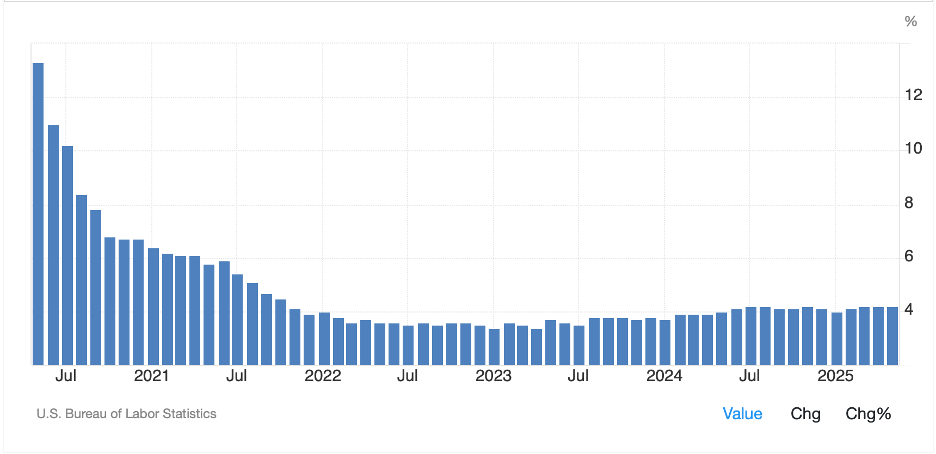
Perhaps of more concern is the Unemployment Rate, which is forecast to rise a tick to 4.3%, which would be its highest print since October 2021 and if I look at the chart below, it is not hard to see a very gradual trend rising higher here.  While markets really focus on NFP, I learned a long time ago from a very smart economist, Larry Kantor, that the Unemployment Rate was the best single indicator of economic activity in the US, and that when it is rising, that bodes ill for the future.  

Source: tradingeconomics.com

You may recall there was a great deal of discussion about a year ago regarding the Sahm Rule, which hypothesized that when the Unemployment Rate rose more than 0.5% above its cycle average within 12 months, the US was already in a recession.  The discussion centered on whether it had been triggered although the final claim was it hadn’t when extending the readings out to the second decimal place.  Now, for the past year, the Unemployment Rate has hovered between 3.9% and 4.2%, so there doesn’t seem to be any chance of a trigger here, although if it does rise, you can be sure you will hear about it.

And that’s what is on tap ahead of the long holiday weekend.  With that in mind, let’s look at the market action overnight. Excitement is clearly lacking in the equity markets these days as the summer doldrums are universal.  Yesterday’s new closing highs in the S&P 500 seem like they should be exciting but were anything but amid low volume.  As to Asia, Japan was flat, China (+0.6%) and Hong Kong (-0.6%) offset each other and in the rest of the region, other than Korea (+1.3%) which is starting to see a steady stream of foreign investment on the premise that the country is set to improve the regulatory structure for equities there, things were +/- a bit.

Meanwhile, in Europe, there is little net movement on the continent but the UK (+0.4%) is bouncing off recent lows after PM Starmer reiterated his support for Chancellor Reeves.  A story I missed yesterday was that when she was trying to make a case in parliament for spending cuts, the back bench liberals revolted, literally bringing her to tears.  The market response was that the UK would blow up its fiscal situation which saw Gilts tumble and yields rise 15bps yesterday at one point, while stocks fell.  But that problem has been addressed for now.  However, looking at the statement Starmer made, it reminded me of a baseball GM’s comments supporting his manager right before he fires him.

In the bond market, yields are declining, led by Gilts (-9bps) which are retracing yesterday’s gains on the above story.  But Treasury yields are down (-2bps) and European sovereigns are all seeing yields lower by between -4bps and -5bps.  In Japan, JGB yields are unchanged as PM Ishiba grapples with a trade deal where the US is keen to be able to export rice to the nation and Japan has a rice shortage with prices rising sharply but doesn’t want to accept imports.  Go figure.

In the commodity markets, oil (-0.2%) is slipping slightly after a solid rally over the past seven sessions where it rose over $3.50/bbl.  Gold (-0.3%) continues to trade around its pivot level of $3350/oz while silver (+1.0%) continues its longer run rally.

Finally, the dollar, which fell during yesterday’s session after I wrote, is effectively unchanged net this morning ahead of the data with very modest moves of +/-0.2% or less almost universal.  KRW (+0.4%) is the outlier here and based on equity inflows discussed above, that makes sense.

So, that’s where we stand heading into the payroll report and the long weekend.  If pressed on the NFP outcome, I expect a weak outcome, 50K or so, as the birth/death model continues to be revised.  But remember, the error bars on this number are huge.  However, if it is weak, look for the probability of a July rate cut (currently 25.3%) to rise and the equity market to follow that higher.  As to the dollar, I think for now, lower is still the trend.

Good luck and have a wonderful long weekend

Adf

Savants Disagree

The Senate completed their vote
And so, BBB, though there’s bloat
Will soon become law
As Dems say pshaw
While lacking a doctrine, keynote
 
So, eyes now turn to NFP
The key for the FOMC
The JOLTs showed that gobs
Of ‘vailable jobs
Exist, though savants disagree


Market activity continues to demonstrate lower volumes and despite several competing political narratives, price action remains muted overall.  The biggest news of late is the Senate passed their version of President Trump’s BBB last night and now it goes to committee for reconciliation before getting to the president for signing.  Of course, given the mainstream media’s complete antagonism toward the president, the headlines this morning refer to the problems the Republicans will have agreeing terms between the two houses, and I’m sure it will be difficult.  However, based on everything that President Trump has done to date, I expect it will get completed.  While perhaps not by Friday, probably by next week.

This matters to markets because it will help set the tone for government spending and the potential companies that will benefit, as well as those that will be negatively impacted, based on the change in focus from that of the Biden administration.  

At this point, it is impossible to forecast with any certainty how things will evolve, especially with respect to issues like the budget deficit and debt issuance.  While yesterday, Treasury Secretary Bessent did explain that they were going to continue to focus on short-term issuance, if (and it’s a big if) the bill does goose economic activity in the US, it is quite possible that faster GDP growth increases tax collections and reduces net government spending and the deficit.  I would estimate that view is not discounted at all in markets at this time given the constant messaging from media and the punditry that not only are people going to starve to death and lose their medical care because of this bill, but that it is unaffordable and will bankrupt the country.  Something tells me the results will be slow acting, although if the government does continue its deportations and stops subsidizing too-expensive green energy projects, we could see less government spending.  We shall see.

But markets need a focus and tomorrow’s NFP is as good as it gets.  Chairman Powell has been attending the ECB’s summer symposium and, in his speech, yesterday he essentially reiterated his views that the Fed will continue to watch and wait on rates as there is still concern that tariffs may drive inflation higher.  As to jobs, they are watching the situation closely, but thus far, the labor market has held up.  Proof of that idea was evident in yesterday’s JOLTs Job Openings data which showed a surprising jump of more than 300K new job listings available.  I haven’t seen a rationale yet, but perhaps it is related to the self-deportations by illegal immigrants who have left businesses with numerous vacancies.  The weekly claims data, while above its lowest levels lately, continues to run at very modest numbers on a long-term perspective as can be seen in the chart below with data from the Department of Labor.  If the job market holds up, I don’t see the Fed cutting rates despite President Trump’s ire.

Also, at Sintra was BOJ Governor Ueda who explained that Japanese policy rates were substantially lower than neutral and that inflation would likely continue creeping higher over time.  I guess we cannot be surprised that the yen (-0.5%) has slipped in the wake of those comments.  The final noteworthy comments from Sintra were from BOE governor Bailey who explained that despite sticky inflation, more rate cuts were on the way, helping to undermine the pound (-0.4%) this morning.

But there is one final thing to discuss regarding the Sintra meeting, and that is how many central bankers were suddenly concerned that their currencies were getting “too strong”!  We have been hearing about the dollar’s decline in the first half of the year as though it was a signal the US was in permanent decline.  Of course, given the nature of FX trading, a weaker dollar can also be seen as strength in other currencies. (To be clear, all fiat currencies continue to weaken vs. stuff as evidenced by the fact that inflation continues to be positive everywhere in the world, except perhaps Switzerland and China right now.)  However, I could not help but laugh at the ECB comments from several board members, that if the euro were to rise any further it could become a problem for the Eurozone economies.  All their models show that if a major export destination raises tariffs, their own currencies should decline to offset those tariffs.  Alas, once again, their models are not giving them answers that reflect the reality in markets.  And given Europe has built their economies on export reliance, a strong currency is a problem.

We must distinguish between a stronger exchange rate and a strong case to own a currency, especially as a reserve asset, but the two have historically been highly correlated.  As I have repeatedly explained, the dollar’s decline this year is neither anomalous nor particularly large in the broad scheme of things.  As well, it is exactly what the administration is seeking as it helps the competitiveness of US companies on the world stage.  However, my take is that at some point soon, the dollar will find a bottom.  I indicated a move to 90 on the DXY would be possible, and I think that is probably still true, although given the growing net short positions in USD vs. other currencies, the short squeeze will be spectacular when it arrives!

Ok, let’s see if we can get through the overnight activity without falling asleep.  Yesterday’s mixed US session was followed by a mixed session in Asia (Nikkei -0.6%, Hang Seng +0.6%, CSI 300 0.0%) with a mixture of modest gains and losses across the rest of the region, all on low volumes.  In Europe this morning, bourses are firmer led by the CAC (+1.1%) and Spain’s IBEX (+0.75%) as hopes for further rate cuts from the ECB dominate discussions.  As to US futures, they are modestly higher at this hour (7:30), about 0.15%.

In the bond market, after stronger than expected JOLTs data and ISM data, yields are backing up with Treasuries (+4bps) leading the way although both Germany (+5bps) and the UK (+6bps) are seeing selling pressure as well.  However, the rest of European sovereigns have only seen yields edge 1bp higher.  The only noteworthy comments I saw were from the Italian FinMin who explained Italy would be maintaining its fiscal prudence.  Not surprisingly, given Ueda-san’s comments, JGB yields rose 4bps overnight as well.

In the commodity space, oil (+1.25%) continues to drift higher as it tries to fill the gap seen last week.

Source: tradingeconomics.com

Apparently, the fact that supply seems to be rising rapidly has not dissuaded traders from the view that the ‘proper’ price range is $65-$75 rather than my belief of $50-$60.  But right now, they are looking smart.  In the metals markets, we continue to see support as the entire decline in the gold price at the end of June has been recouped and we are modestly higher this morning across all the metals (Au +0.1%, Ag +0.6%, Cu +0.4%, Pt +2.2%) with platinum merely showing its volatility due to lack of liquidity.

Finally, the dollar is firmer this morning against every one of its G10 and major EMG counterparts with the euro and pound (both -0.4% now) setting the tone.  Perhaps the best performer this morning is INR (-0.1%) which seems to be benefitting from the news that a trade deal is almost complete there.  As to trade with the Eurozone, that deal seems a bit further away, although I did see something about a European recognition that US tariffs would be, at a minimum, 10%.  At least for today, I haven’t read anything about the dollar’s ultimate demise!

On the data front, today brings ADP Employment (exp 95K) and then the EIA oil inventory data.  There are no Fed speakers either, so quite frankly, absent something newsworthy from DC, I suspect this will be a quiet session ahead of tomorrow’s NFP.  I guess the dollar is not dead yet.

Good luck

Adf

Gone Astray

The ADP Labor report
On Wednesday, came up a bit short
Investors decided
That they would be guided
By this and bought bonds like a sport
 
As well, there’s a story today
The BLS has gone astray
It seems that their data
Might have the wrong weight-a
So, CPI’s not what they say


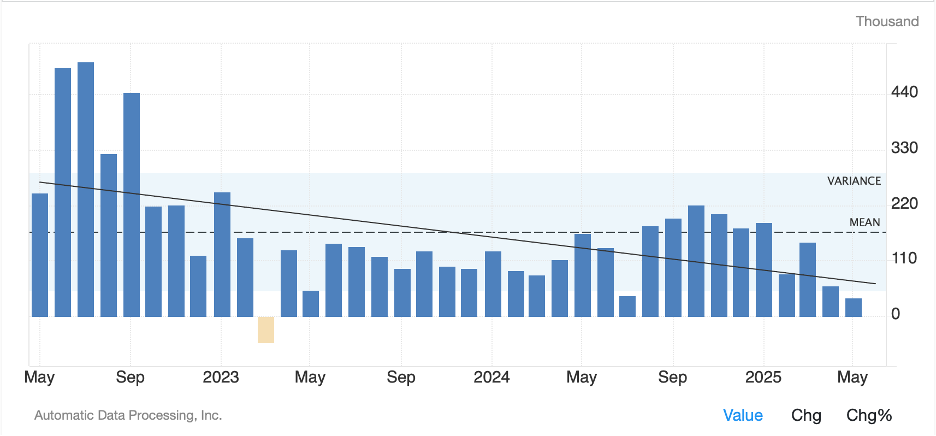
It has been another very dull session in most markets although yesterday did see a strong bond market rally after the ADP Employment Report was released much lower than expected at just 37K jobs created.  Certainly, the trend has been lower for the past three years as you can see in the below chart from tradingeconomics.com, so I guess we cannot be that surprised.

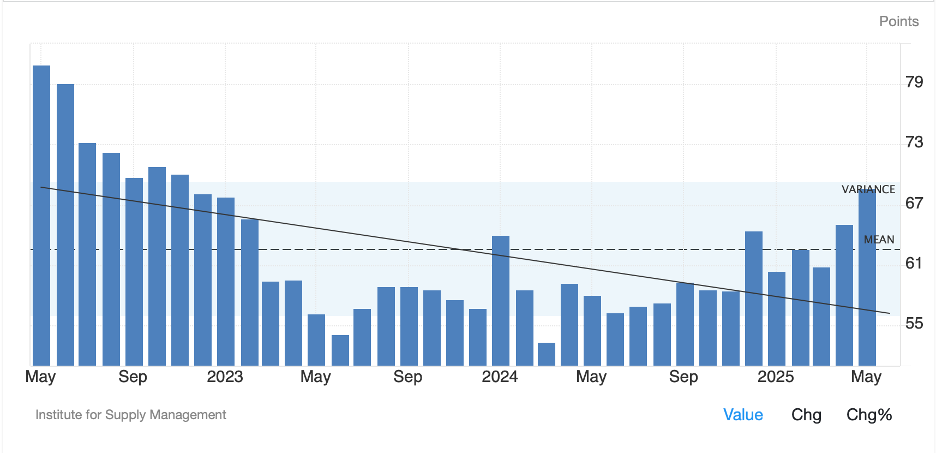
You will also not be surprised that this data brought out the recessionistas as they jumped all over the release to make their case that recession was just around the corner, and quite possibly stagflation.  Adding to their case was the ISM Services data which also disappointed at 49.9 and has also been trending lower for the past three years.  As well, they were almost gleeful in their description of the Prices Paid sub index rising to 68.7, its highest print since November 2022.  Alas, while Pries Paid have been rising for the past year or so, a look at the trendline shows they are continuing to retreat from the highs seen during the Bidenflation of 2022.

Source: tradingeconomics.com

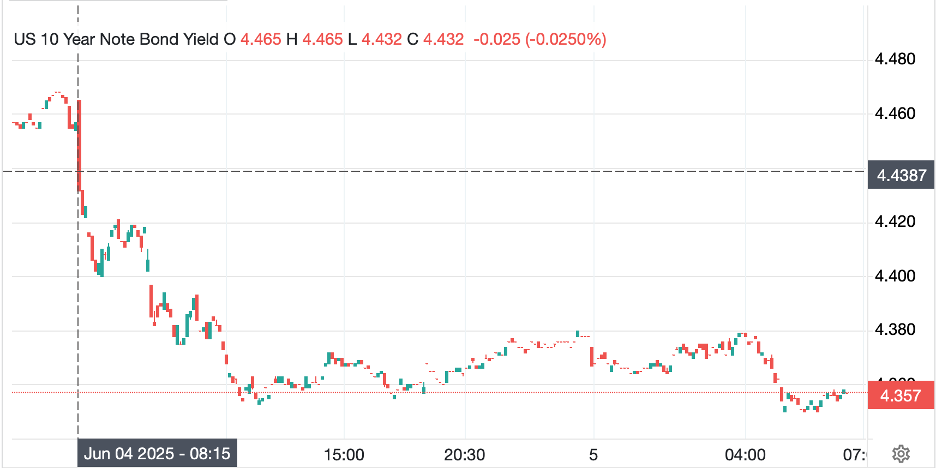
In the end, although this data was unquestionably disappointing, it feels a bit too early, at least to me, to declare the recession has arrived.  But not too early for the bond market where 10-year yields tumbled 11bps on the day and almost all the damage was done in the first hour after the ADP release although the ISM helped things along as well.

Source: tradingeconomics.com

Perhaps we are going into a recession, or even already in one, but overall, the data so far are just showing the beginnings of that.  I imagine opinions will be strengthened one way or another tomorrow when the NFP report is released, but for now, the recessionistas appear to have the upper hand, at least in the bond market.

The other story that is getting a response, at least amongst the Twitterati (X-eratti?) is the WSJ article about how the BLS, due to President Trump’s hiring freeze, is suddenly calling into question the accuracy of their statistical releases, notably the CPI report due next week.  I will let my friend, The Inflation Guy™, Mike Ashton, explain why this is a nothing burger. [emphasis added]

WSJ story about how staff shortages at BLS are affecting how many estimates the staff has to make instead of collecting actual data. It is very hard to make these errors accumulate to as much as 1-2bps on the monthly number.

UNLESS: there is bias in the estimating, or there are very large categories affected, or there are HUGE errors in some categories. Lots of random errors increases the overall error but is unlikely to affect the mean. And be honest. Do you have any idea what the MSE (mean standard error) of the CPI is?

People really should care about the error bars but even most economists almost never do. Unless it’s an opportunity to complain about budget cuts to economists, which is what this is. Nothing to see here.”

Otherwise, folks, another day in paradise with nothing else new, at least on the market front.  At some point, domestic politics, or geopolitics or war or something else is going to catch the fancy of the algos and change trading, but right now, that does not appear to be the case.  Perhaps Friday’s NFP data will be the catalyst to start a serious change in attitudes but I’m not holding my breath.

In the meantime, let’s survey market activity.  Yesterday’s US session was quite dull with limited movement and low volumes. Asia saw a mixed picture with the Nikkei (-0.5%) slipping, ostensibly, on concerns that a weaker US would negatively impact their export sector, tariffs be damned.  Hong Kong (+1.1%) though, rallied on Chinese PMI data holding on to recent levels rather than slipping further.  The rest of the region was far more positive, led by Korea (+1.5%) although the gains were more on the order of +0.5%.  Europe is all green this morning, with the CAC (+0.5%) leading the way, although the DAX (+0.4%) and FTSE 100 (+0.3%) are also holding up well on the back of positive German Factory orders data and solid UK Retail Sales.  Meanwhile, at this hour (7:00), US futures are ever so slightly firmer, +0.15% or so.

In the bond market this morning, after the big rally yesterday discussed above, Treasury yields this morning have edged lower by 1bp and European sovereigns have seen yields slide by between -3bps and -5bps as inflation data on the continent continues to soften encouraging the belief that the ECB, later this morning, may even consider more than the 25bp cut that is priced in.

The one true consistency lately has been gold (+0.8%) which has no shortage of demand, especially in Asia, and certainly feels like it is going to test, and break, the previous high of $3500/oz, which is now just $100 away.  But this has encouraged silver (+4.0%), copper (+2.65%) and now even platinum (+3.8%) has been invited to the party.  Regardless of the macroeconomic statistics, the ongoing global monetary policy of fiat debasement seems set to continue which can only help these metals.  As to oil (+0.3%), it continues to sit near its recent highs with not much activity in either direction.  It feels like we will need a major event/pronouncement of some sort, whether wider war in the Middle East or a change in OPEC policy to move this thing.

Finally, the dollar can best be described, again, as mixed.  While the euro and pound are marginally higher, the yen is marginally weaker.  In the EMG bloc, both KRW (+0.4%) and ZAR (+0.5%) are showing gains this morning, but nothing else of note is moving.  And when looking at the broad DXY, unchanged is where it’s at.  As with most markets right now, metals excepted, doing nothing seems the best choice.

On the data front, this morning brings the weekly Initial (exp 235K) and Continuing (1910K) Claims as well as the Trade Balance (-$94.0B) which if correct will almost certainly bring on a lot of White House crowing but is likely inconsequential with respect to the overall scheme of things.  We also see Nonfarm Productivity (-0.7%) and Unit Labor Costs (+5.7%) a combination of expectations that does speak to stagflation.  The ECB meeting will get some eyeballs, but unless they cut 50bps, a very low probability event based on current market pricing, it is hard to see much impact there either.

We are in a rut for now.  Whatever the catalyst that is required to change views substantially, it is not obvious at this point.  Bigger picture, nothing indicates any government is going to slow their spending or their money printing.  There is too much debt to ever be repaid, so a slow inflationary debasement is very likely our future.  I still think the dollar slides further, but it could be a few months before the current range breaks.

Good luck

Adf

Surprise!

Ishiba explained
He was just kidding about
Tight money…surprise!


So, yesterday’s biggest mover was JPY (-2.1%), where the market responded to comments by new PM Ishiba that all his previous comments regarding policy normalization were not really serious (and you thought Kamala flip-flopped!)

Here are his comments in the wake of that massive 12% decline in the Nikkei back in early August:

“The Bank of Japan (BOJ) is on the right policy track to gradually align with a world with positive interest rates,” ruling party heavyweight Shigeru Ishiba told Reuters in an interview.

“The negative aspects of rate hikes, such as a stock market rout, have been the focus right now, but we must recognize their merits, as higher interest rates can lower costs of imports and make industry more competitive,” he said.

And here are his comments after meeting with BOJ Governor Ueda Wednesday morning in Tokyo:

“From the government’s standpoint, monetary policy must remain accommodative as a trend given current economic conditions.”

See if you can tell the difference.  The below chart includes the market response to his election last week as well as its response since uttering those last words early yesterday morning.

Source: tradingeconomics.com

Remember the idea that the carry trade was dead and completely unwound?  Well, now the talk is its coming back with a vengeance between Powell sounding less dovish, Ishiba sounding more dovish and then yesterday’s ADP Employment Report printing at a higher-than-expected 143K.  Maybe all those rate cuts that had been priced are not going to show up in traders’ Christmas stockings after all.  Certainly, the Nikkei (+2.0%) was pleased with the weaker yen which has fallen further this morning (-0.2%) after further comments from BOJ member Noguchi calling for more time to evaluate the situation before considering tighter policy.  In fairness, though, Noguchi-san is a known dove and voted against the rate hikes back in July.  Summing it all up here, it is hard to make a case currently for the yen to strengthen too much from here.  Rather, a test of 150 seems the next likely outcome.

In England, the Old Lady’s Guv
Explained that he’s really a dove
He’ll be more aggressive
Though not quite obsessive
While showing investors some love

The other big mover this morning is the British pound (-1.1%) which is responding to an interview BOE Governor Bailey had in The Guardian where he explained he could become “a bit more aggressive” in their policy easing stance provided inflation data continues to trend lower.  Now, prior to the interview, the OIS market was already pricing in a 25bp cut at the next meeting in November, and 45bps of cuts by year end, and it is not much changed now.  But for whatever reason, the FX market decided this was the news on which to sell pounds.  

Remember, as I’ve repeatedly explained, the dollar’s demise is likely to be far slower than dollar bears believe because now that the Fed has begun cutting rates, and nothing is going to stop them going forward for a while, other central banks will feel empowered to cut as well.  The only way the dollar falls sharply is if the Fed is the most dovish central bank of the bunch, but Monday, Chairman Powell made clear that was not the case.  In fact, yesterday, Richmond Fed president Barkin was the latest to explain that things look good, but they are in no hurry to cut aggressively.  Other central banks are now in a position to ease policy more aggressively, something many had been seeking to do as economic activity was slowing in their respective countries, without the fear of a currency collapse. 

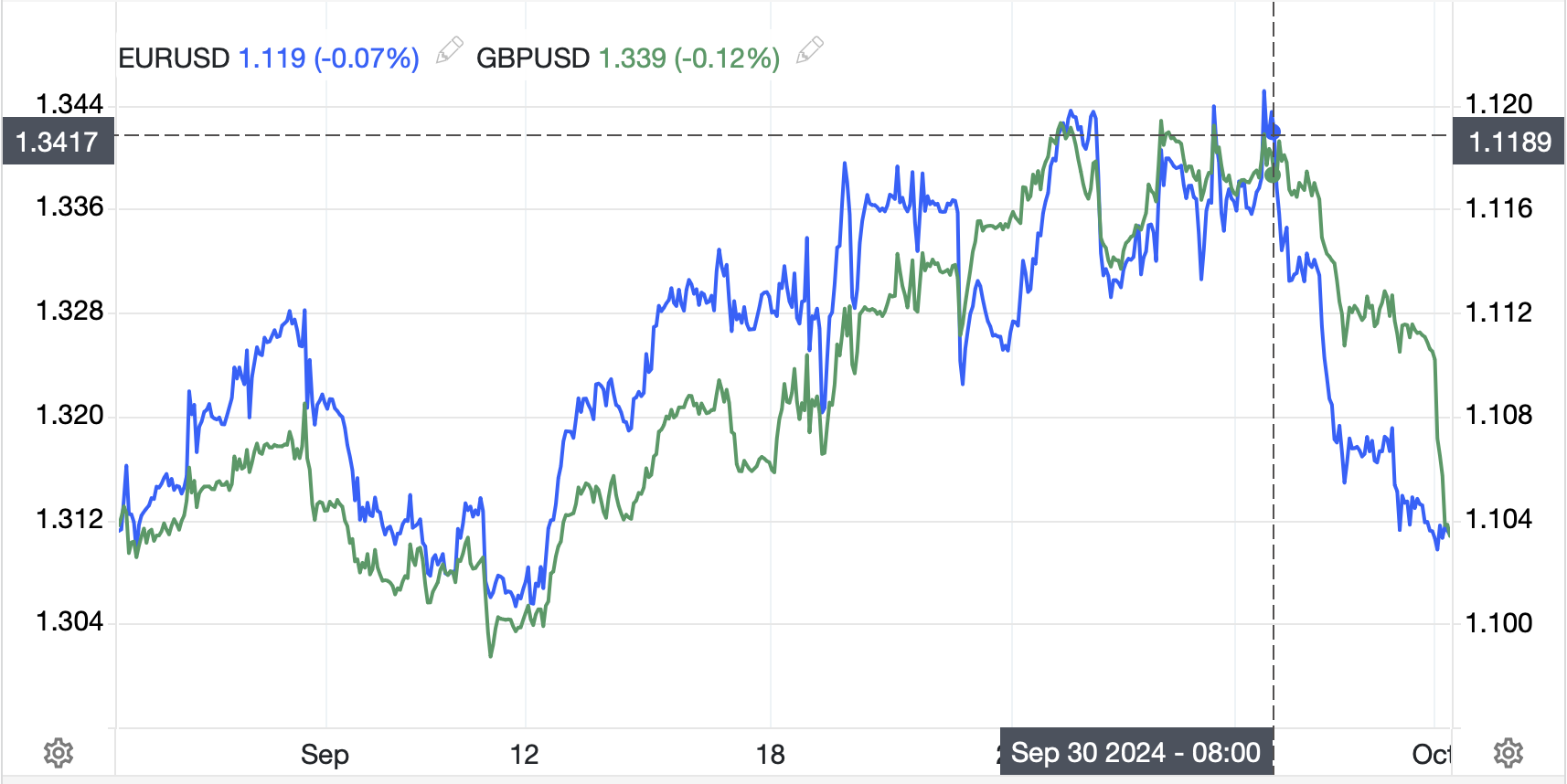
It was just a few days ago that I highlighted key technical levels the market was focused on, which if broken might herald a much weaker dollar.  Across the board, we are more than 2% from those levels (EUR 1.12, GBP 1.35, DXY 100.00) and traveling swiftly in the other direction.  A quick peek at the chart below shows that while the exact timing of these moves was not synchronized, the outcome is the same.

Source: tradingeconomics.com

Moving beyond the FX market, where the dollar is stronger literally across the board, the economic story continues to muddle along.  Services PMI data was released this morning with most of Europe looking a bit better, although the Italians were lagging, but not enough to get people excited about European assets in general.  Equity markets on the continent are mixed with both the DAX (-0.6%) and CAC (-0.8%) under pressure while Spain’s IBEX (+0.1%) and the FTSE 100 (+0.25%) buck the trend on the back of Spain’s best in class PMI data and, of course, the UK rate cut frenzy.  As to last night’s Asian markets, while China remains closed, the Hang Seng (-1.5%) gave back some of yesterday’s gains and the rest of the region was unconvinced in either direction.  While US markets eked out the smallest of gains yesterday, futures this morning are pointing lower by -0.4% or so at this hour (6:45).

In the bond market, Treasury yields are higher by 3bps this morning, as the market absorbs the idea that the Fed may not be cutting in 50bp increments each meeting and traders responded to a much better than expected ADP Employment Report yesterday (143K, exp 120K) so are prepping for a good NFP number tomorrow. Meanwhile, European sovereign yields are all higher by between 5bps and 7bps as they catch up to yesterday’s Treasury move, much of which occurred after European markets were closed.  One thing to keep in mind here is that bond markets, at least 10-year and longer maturities, are far more concerned with the inflation outlook than the central bank discussion.  Right now, as the world awaits Israel’s response to the Iranian missile attack, concerns are rife that oil prices could move much higher and take inflation readings along for the ride.  If you add that to the idea that 3% is the new 2% for central bank inflation targets, something which is also gaining credence in the market, the case for higher bond yields is strong.

Speaking of oil markets, once again this morning the black sticky stuff is higher (+2.0%) amid those Middle East conflagration fears.  As I highlighted yesterday, if Israel were to attack Iran’s oil fields and knock a large portion offline, I would expect oil to get back to $100 in a hurry.  And if the damage was sufficient to keep it offline for many months, we could stay there.  However, the combination of the stronger dollar and higher oil prices has taken a toll on the metals markets with all the major metals weaker this morning (Au -0.5%, Ag -1.1%, Cu -1.5%).  This strikes me as a short-term phenomenon as the fundamental supply/demand issues remain in favor of higher prices and anything that drives inflation higher will help price as well.  But not today.

As to the dollar, I have already discussed its broad-based strength with gains against literally all its G10 and EMG counterparts.  It will take some pretty bad US data to change this story today.

Speaking of the data, as it’s Thursday, we get the weekly Initial (exp 220K) and Continuing (1837K) Claims data as well as ISM Services (51.7) and Factory Orders (0.0%).  Yesterday, in a surprise, EIA oil inventories rose, a welcome outcome, but not enough to offset the Middle East fears.  The only Fed speaker on the calendar today is Atlanta Fed president Bostic, one of the more hawkish members, so my guess is he is likely to continue to preach moderation in rate cuts.  Speaking of the Atlanta Fed, their GDPNow reading fell to 2.5% for Q3 after the weaker than expected construction spending the other day, but it remains above the Fed’s estimated long-term trend growth rate.

Putting it all together, I can see no good reason for the dollar to reverse this morning’s gains absent a Claims number above 250K.  The hyper dovishness that had been a critical part of the dollar decline story has been beaten back.  Of course, tomorrow brings the NFP report, so anything can still happen.  

Good luck

Adf

JOLTed

The market, on Wednesday, was JOLTed
By data, and traders revolted
The jobs situation
Has changed the narration
And helped Jay, his door be unbolted


What door you may ask?  Why, the door that leads to a 50bp rate cut at the FOMC meeting in two weeks.  Already, the Fed funds futures market is pricing in a 43% probability of a 50bp cut, up from a one-third probability on Tuesday morning.  Remember, everything now revolves around the labor market, and yesterday’s JOLTs data was not only worse than forecast, at 7.67M (forecast 8.1M), but last month’s was revised lower by nearly 200K jobs as well.  Remember, too, that tomorrow the NFP report is released with current forecasts centering on 160K, higher than last month but well down on what we have been seeing all year prior to the August report.

There are many analysts who have been calling out Powell and the Fed for making a policy error and holding rates too high for too long.  Perhaps they are correct.  But so much of the decision to cut rates relies on the idea that inflation is well and truly dead, or at least terminal, and if that assumption is incorrect, there will be hell to pay.  The last time the US saw inflation of the same magnitude that we have seen in the past two years, then Fed Chair, Arthur Burns, cut rates too early and inflation exploded higher, peaking at a higher rate than the first rise.  In fact, he did that twice, with inflation spiking three times throughout the 1970’s and early 1980’s.  

Source: FRED database

Powell has been very clear that he is trying to channel Paul Volcker and not Arthur Burns, but if he cuts rates, he opens himself up to a much less satisfactory outcome.  There have been many charts of the following nature showing the parallels of the 1970’s to recent price levels and it is entirely possible we see another wave higher if the Fed cuts.

Source: Real Investment Advice

As things currently stand, I would contend that the Fed’s focus is almost entirely on employment, hence the market response to yesterday’s weaker than forecast JOLTs data.  This implies that this morning’s ADP and Initial Claims data have the chance to really move things.  It also means that tomorrow’s NFP data remains a critical focus for all markets.

In the meantime, market activity overall could well be described as choppy.  While US equity markets opened lower yesterday, following the sharp declines on Tuesday, they closed mixed with limited overall movement. The fears in the semiconductor sector, which were fanned by a, since denied, report that Nvidia had been subpoenaed in an anti-trust investigation, has stopped falling and there are still numerous stories about how much Capex the big 4 tech companies are going to invest this year in all things AI.  Traders and investors are looking for the next big clue which is why I expect limited activity until tomorrow morning’s data release.

Asian equity markets were similarly mixed overnight with some gainers (Australia +0.4%, Taiwan +0.45%, CSI 300 +0.2%) and some laggards (Nikkei -1.05%, KOSPI -0.2%, Hang Seng -0.1%), as no clear direction presently exists.  Late last week, BOJ Governor Ueda sent a letter to the Diet explaining he still expected to raise interest rates if the economy progressed as expected, and that has a number of analysts calling for another leg down in USDJPY and further Nikkei weakness.  But it seems that is a big IF.  With economic activity clearly slowing around the world, it is not hard to believe that the same will be true in Japan and conditions for further rate hikes may not develop.  As to European bourses, the picture here is mixed as well with the CAC (-0.5%) lagging while Spain’s IBEX (+0.7%) is having a pretty good day.  Both the DAX (+0.2%) and FTSE 100 (+0.1%) are modestly higher despite weak Construction PMI data, perhaps both anticipating further policy ease.

In the bond markets, though, the direction of travel is clear for now with yields everywhere having fallen sharply yesterday and simply consolidating today.  After the JOLTs data, Treasury yields fell 9bps (2yr yields fell 12bps and the 2yr-10yr spread is now flat), although this morning it has bounced by a single basis point.  European sovereign yields slipped yesterday as well, between -3bps and -5bps, after the JOLTs data and this morning have backed up by 1bp across the board.  As to JGB yields, they edged lower by -1bp last night and remain a good distance from the 1.00% level despite the recirculated Ueda comments.

In the commodity markets, oil (+0.2%) which had bounced a bit yesterday morning, ceded those gains as the session wore on and is currently below $70/bbl.  While talk of OPEC+ starting up more production has faded, the weak economy / slowing demand story, especially the weak Chinese economy story, remains front and center and continues to weigh on the price.  Meanwhile, in the metals markets, gold (+0.7%) continues to shine overall as the growing sentiment for a 50bp Fed funds cut helps all commodities, but especially this one as concerns over the dollar’s ability to maintain its purchasing power remain rife.  But this morning we are seeing silver (+1.4%) and copper (+0.2%) higher as well, although the latter seem more trading than fundamentally based.

Finally, the dollar is under some modest pressure this morning, which given the movement in yields and rate cut expectations, should be no surprise.  In the G10, virtually all the movement has been less than 0.2% with CAD (-0.1%) the laggard after the BOC cut rates by 25bps yesterday as widely expected.  This morning the yen is also a touch softer, but that is after a sharp rally yesterday of more than 1%, so this morning feels like a trading bounce.  In the EMG bloc, the picture is a bit more mixed with ZAR (+0.5%) the leader this morning on both the gold price as well as economic data showing the Current Account deficit shrank dramatically in Q2 in a pleasant surprise.  On the flipside, MXN (-0.3%) is lagging as the market absorbs recent modestly weaker than expected economic data on Unemployment and Fixed Investment.

Which brings us to today’s data releases.  We start with ADP Employment (exp 145K), then Initial (229K) and Continuing (1870K) Claims.  As well, at 8:30 we see Nonfarm Productivity (2.4%) and Unit Labor Costs (0.8%).  Then, at 10:00 comes ISM Services (51.1) with the final set of data the EIA oil inventories at 11:00 with net further drawdowns forecast.  There are no Fed speakers on the docket today, but we are supposed to hear from two tomorrow after the NFP data.

Absent a big surprise in either ADP or Initial Claims, with the former more likely than the latter, I suspect that it will be another choppy day as all eyes focus on NFP tomorrow.  However, the one thing that seems likely is the dollar has further to decline within the current market narrative of more rate cuts sooner by Powell and the Fed.

Good luck

Adf

Fervor and Joy

The talk of the Street is the Fed,
While quiet this week, will soon shed
The higher for longer
Idea, with words stronger
That cuts are directly ahead
 
So, bonds are the new favorite toy
Of every hedge fund girl and boy
Since growth is now slowing
Investors are going
To buy bonds with fervor and joy


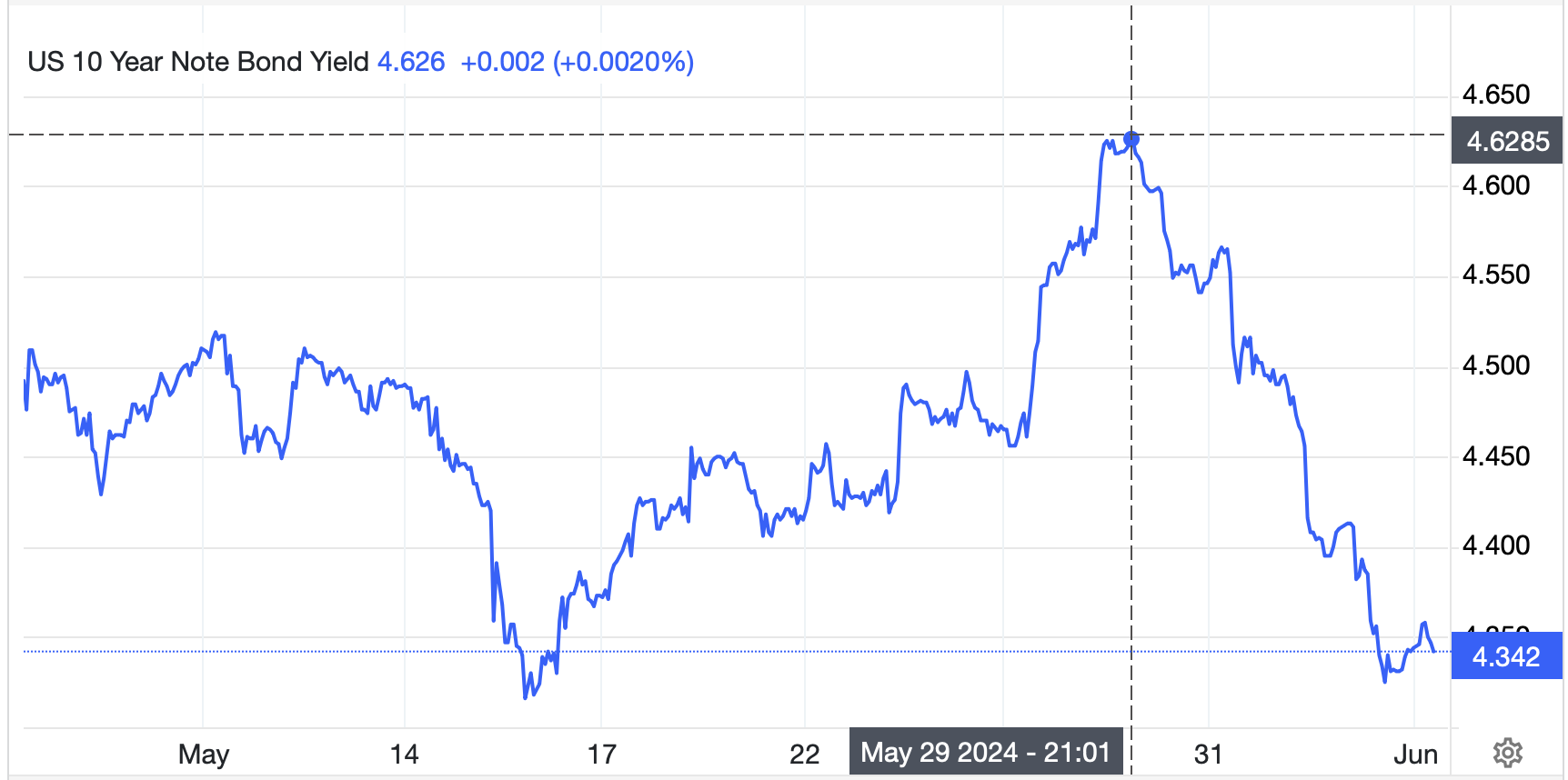
The amazing thing about markets is just how quickly they can shift their focus and reverse course if they find the right catalyst. Consider that just one week ago, 10-year Treasury yields were trading at 4.63%, having risen nearly 30 basis points in the prior two weeks on the strength of hawkish commentary from FOMC speakers, a much more hawkish than expected FOMC Minutes release, and economic data that indicated economic growth was still solid.

Source: tradingeconomics.com

And yet, in the past seven days, that entire move has been reversed and now the commentary is pointing to weakening economic activity, declining inflation, a looser jobs market and the inevitability of the Fed cutting rates before the election!  So, what happened?

Well, first, a little perspective is in order.  While a 30 basis point move in 10-year yields is a nice sized move, it is hardly unprecedented.  Consider that if we look at a chart of yields over just the past year, rather than the past month as above, the most recent dip does not stand out as particularly impressive.

Source: tradingeconomics.com

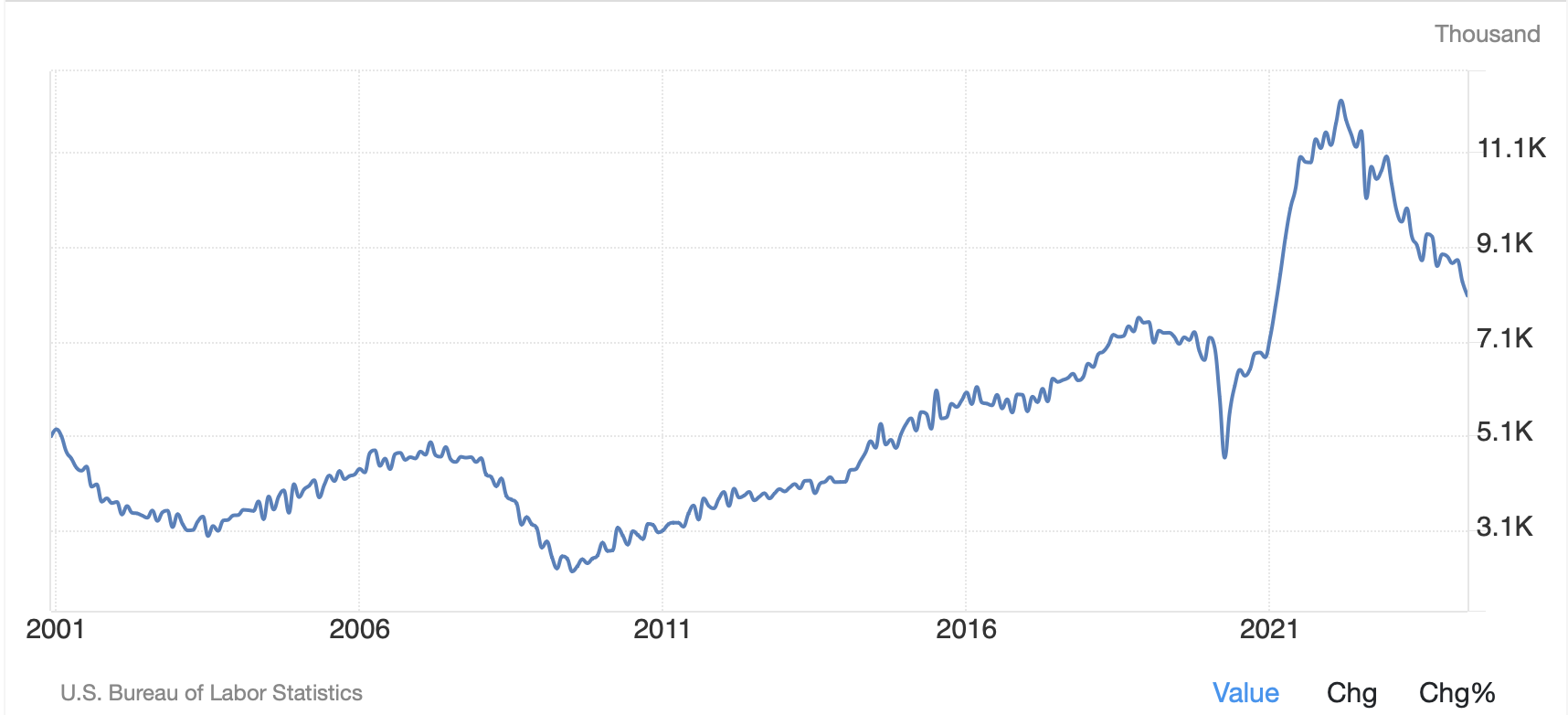
But second, the economic data in the US is starting to align more clearly in a negative fashion.  Yesterday I showed the Citi Surprise economic indicator index, which demonstrated that data is failing to keep up with forecasts.  Then yesterday, the JOLTS Job Openings data was released at a much diminished 8.059M, more than 300K jobs less than both anticipated and than last month.  In fact, despite this data point really looking backward (yesterday’s print was for April data), the recent trend, as seen below is very clearly lower.  

Source: tradingeconomics.com

This is an indication that the jobs market is much looser than the Fed had been worried about with regards to inflation, but of course is a problem for their maximum employment mandate.  In any event, the weaker data continues to pile up and the natural response of investors is to start to price in a more traditional weak growth scenario.  This includes declining bond yields on the assumption the Fed is going to ease policy, declining commodity prices on lessening demand, and a declining dollar on the back of those lower interest rates.  And that is exactly what we have seen.  

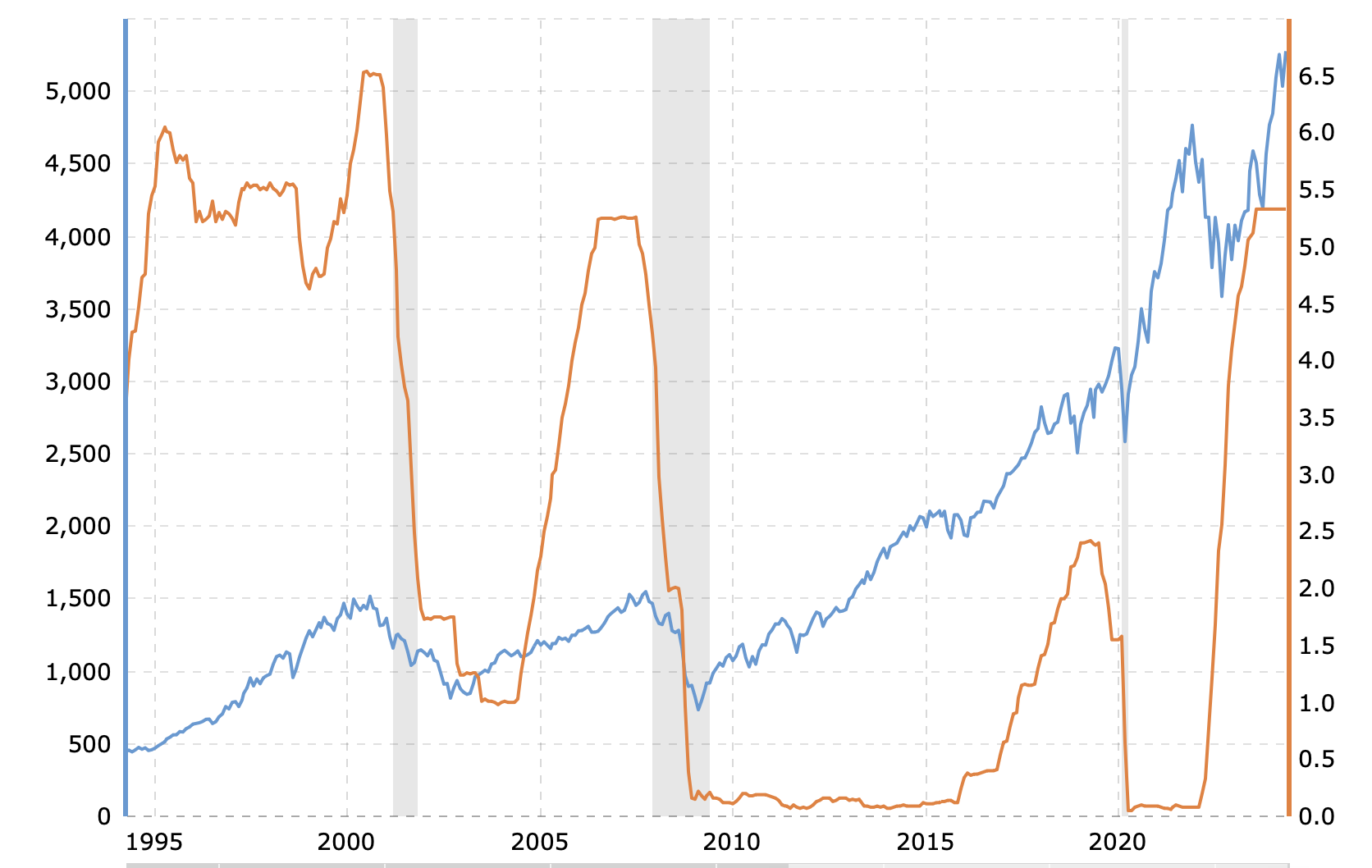
You will notice I left out the equity response to these events as I would contend it is far less clear.  Initially, I expect that equity investors will be excited by the prospects of rate cuts, and we could see stocks rally, but if growth is really slowing, then that is going to negatively impact earnings which should undermine equity prices.  Historically, when the Fed is cutting rates, it is in response to a slowing economy and equity prices have not fared well in this scenario.  You can see in the chart below, that the Fed tends to cut rates (orange line) during recessions (grey areas), and those declines are coincident with equity market (S&P 500 – blue line) declines.

Source: macrotrends.net

So, has the economy turned down for real now?  I would contend there are more indicators that are widely followed which indicate that is the case.  Several months ago, one really needed to dig into the secondary parts of major releases to conclude things were rolling over.  Today, it seems a bit clearer.  But remember, too, Treasury Secretary Yellen has > $700 billion in the TGA to spend leading up to the election in an effort to prevent that outcome, and you can be certain she will do all in her power to do so.  Will it be enough?  I guess we will find out.  

One last thought, though, is that my take is the current sticky inflation may well remain sticky despite an economic slowdown.  Remember, there is a humongous amount of money around, and the response of every government will be to print even more if things slow, so the idea of stagflation remains very real and cannot be dismissed at this time.

Ok, let’s look at the overnight session to see how things have fared.  After yesterday’s late equity rally resulted in very minor gains in the US, Asia had a mixed session with both Japan (-0.9%) and China (-0.6%) lower, although there were gains throughout the region led by India (+3.6%) rebounding from the initial election news there.  PM Modi will continue ruling, but in a coalition, so with much reduced power.  But Korea, Australia and Taiwan all performed well.  In Europe this morning, equity markets are having a good day with gains on the continent around 0.9% across the board although UK stocks are only higher by a bit (0.3%).  PMI Services data was released, and it was generally a touch better than forecasts (France excepted) but certainly not significant enough to change the view that the ECB is going to cut rates tomorrow.  Meanwhile, US futures are picking up at this hour (8:00), rising 0.3% across the board.

We discussed bonds earlier but not the fact that Treasury yields fell 7bps yesterday after the softer data, dragging European yields down as well.  This morning, Treasuries are another 1bp softer with Europe sliding by between 1bp and 4bps.  Overnight, yields also fell, with JGB’s down 2bps and now right back at 1.00%, while other bonds in Asia saw yields fall more sharply.  It seems pretty clear that the market is starting to price in a global slowdown in the economy.

In the commodity sector, after a week of routs, things have settled this morning with oil (+0.5%) bouncing slightly, although still lower by -7% in the past week.  Gold (+0.25%) too, is a bit firmer, although that was not the metal that fell most sharply.  Both silver and copper are unchanged this morning as the bullish long-term story mongers (present company included) are all licking their wounds, but absent more weak data, there is no incentive to sell things aggressively here right now.  However, if the data keeps softening, so will these prices.

Finally, the dollar, which had fallen earlier in the week, has edged up a touch this morning.  JPY (-0.6%) is giving back some of its recent haven inspired gains, and we have also seen both MXN (+0.9%) and INR (+0.25%) recoup a small amount of their election related losses.  ZAR (-1.0%), however, is still under pressure as the weakened state of the government combined with the weakness in metals prices is clearly a major weight on the rand.  All eyes today will be on CAD (unchanged) as the BOC meets and will be announcing their rate decision at 10:30. There is a 60% probability of a rate cut priced into the market, as recent data softness is getting traders excited that Governor Macklem will ignore his recent comments about needing “months of data” to confirm the situation.  After all, inflation up there is within the BOC’s range, and I suspect a cut is coming.

On the data front, ADP Employment was just released at a slightly softer than forecast 152K (exp 170K) and then we see ISM Services (50.8) at 10:00am.  As of yet, there has been no real response to the ADP data.  At this point, the narrative is swinging quickly to the idea that softer economic activity will lead the Fed to cut sooner than previously expected.  The Fed funds futures market has moved the probability of the September cut up to nearly two-thirds.  For now, that is going to drive things, and as such, I believe the dollar will remain under pressure overall.  Absent a very strong NFP report Friday, perhaps we have seen some near-term tops in yields and the dollar.

Good luck

Adf

Debased

Said Powell, the path is still clear
For cutting three times all this year
Though data’s been hot
We’ve certainly not
Decided no rate cuts are near

This was, of course, warmly embraced
By traders who bought shares post-haste
But do not forget
The very real threat
The dollar will, thus, be debased

Chairman Powell regaled us once again and yesterday he sounded far more like the December Powell than the March Powell.  Notice in his comments that he has essentially dismissed the recent hotter than expected inflation data and instead insists they are on the right road to achieve their goal.  He explained [emphasis added], “The recent data do not…materially change the overall picture, which continues to be one of solid growth, a strong but rebalancing labor market, and inflation moving down to 2% on a sometimes bumpy path.” And maybe he is correct.  Maybe the January and February data points are the outliers, and the rate of inflation is going to reverse back lower.

But he has to know that when he coos like a dove, risk assets are going to rally sharply.  The difference today is that the bond market is beginning to ignore all the Fed talk as we see despite these dovish tones, yields remain at their highest level (4.36%) since November, with no downward movement at all.  In fact, perhaps the real concern that the Fed should have is that gold continues to rise strongly almost every day, trading to $2300/oz and showing no signs of slowing down.

I have been consistent in my view that if the Fed cuts despite the ongoing better than expected data the result would be a sharp decline in the dollar, a sharp decline in bond prices (rise in yields) and a sharp rise in commodity prices.  I have also indicated that, at least initially, I expected equities to rally, but their medium-term outlook was more suspect.  Well, yesterday, that was exactly how the market behaved with metals markets screaming higher, stocks trading well and bonds lacking any bids.

Yesterday’s data showed the ADP Employment number jumping 184K, well above expectations of 148K, but the ISM Services data was a bit soft at 51.4 (exp 52.7) and more importantly, the Prices sub-index fell to 53.4 down 5 points from last month.  That was the set-up for Powell’s comments, and he jumped on board.  It remains abundantly clear that the Fed is desperate to cut rates almost regardless of the economics.  My take is the reason has more to do with the debt situation than the presidential election although there is a third possible explanation as well, a too-strong dollar.

Consider the following: the dollar remains the world’s reserve currency and the currency most widely used in trade and financing activity.  Because of this, a large majority of the world’s total outstanding debt of approximately $350 trillion is denominated in dollars despite the fact that most companies and countries are not USD functional.  The result of this situation is that all those non-USD functional debtors need to buy dollars in order to service and repay that debt.  If you were looking for an underlying reason as to the dollar’s broad strength, this is another candidate in the mix.

As such, it is entirely realistic that Chairman Powell is feeling intense pressure from the international community to cut interest rates to weaken the dollar.  While I don’t expect that a Plaza Accord type agreement is in the offing, it is possible that Powell sees this as an achievable outcome and one that would not result in global chaos.  However, whatever the reason, as we watch commodities rally, while the dollar and bond market sell off, we are watching Fed credibility dissipate.

Ok, let’s peruse the overnight session to see how markets have responded to the dovish version of Powell. While US equities sold off late in the day yesterday, minimizing gains, the same was not true overseas.  Though Chinese markets were closed for the Ching Ming Festival, pretty much everywhere else in Asia saw equity rallies of substance with the Nikkei’s 0.8% rise a good proxy for all.  Meanwhile, in Europe the screens are all green as well, although not quite as impressively, more on the order of 0.25% – 0.5%.  This performance is in accord with Services PMI data that was released this morning showing broadly better than expected outcomes across all the major nations as well as the Eurozone as a whole.  Finally, US futures at this hour (6:45) are firmer across the board by 0.25%.

In the bond market, Treasury investors do not see the benefits of Powell’s dovish turn amid still high inflation.  The ADP data is certainly a concern as all eyes turn toward tomorrow’s NFP report.  In fact, what we are seeing is a bit of a curve steepening (less inversion) with the 10yr-2yr inversion now down to -31bps from its -40bp level that had been steady for the past several weeks.  However, European sovereign yields are all a touch lower this morning, down between 2bps (Germany) and 6bps (Italy) as comments from Robert Holtzmann, Austrian central bank chief and the most hawkish ECB member finally conceded that a cut in June could be appropriate.  Of course, now there is talk of a cut at the end of this month weighing on yields.  Meanwhile, JGB yields crept higher by 1bp, but remain at 0.75%, showing no signs of running away higher.

Oil prices (-0.3%) are consolidating this morning after yet another positive session yesterday with WTI now trading above $85/bbl and Brent crude just below $90/bbl.  OPEC reconfirmed that production would remain at current levels and two nations, Iraq and Kazakhstan have promised to cut back to bring their numbers back in line with quotas.  As well, EIA data showed a build in crude but a much larger draw in gasoline stocks (which is why prices are rising at the pump) adding support to the market.  Gold (-0.1%), too, is consolidating this morning but the trend remains strongly higher.  At the same time, copper (+0.5% today, +5.75% this week) is continuing its rapid rise and is back to levels last touched in January of last year.  It appears the broader growth story remains a driver here, especially with the idea that the Fed may be cutting rates and goosing it further.

Finally, the dollar is under a bit more pressure this morning after Powell’s dovish stance, sliding against most of its counterparts in both the G10 and EMG blocs.  AUD (+0.65%) and SEK (+0.65%) are the leaders in the G10 space with most of the rest of the bloc following higher.  One exception is CHF (-0.4%) which has fallen after CPI there fell to 1.0% Y/Y (0.0% M/M) and encouraged traders to bet on faster rate cuts from the SNB.  The yen (-0.1%) too, is not following suit, which perhaps indicates we are seeing a reversion to the classic risk-on stance (higher stocks and commodities, weaker dollar and havens), at least for today.  In the emerging markets, most currencies are firmer led by (CLP +0.6% on copper strength) and HUF (+0.4%) which is simply demonstrating its higher beta relative to the euro, although there are key currencies that are little changed like MXN, BRL and CNY.

On the data front, this morning brings the weekly Initial (exp 214K) and Continuing (1822K) Claims data as well as the Trade Balance (-$67.3B).  As well we hear from five more Fed speakers (Barkin, Goolsbee, Mester, Musalem, and Kugler) to add to yesterday’s comments.  The question I would ask is, even if some of them sound more hawkish, given what we just heard from Powell, will it matter?  For instance, yesterday, Atlanta’s Raphael Bostic reiterated his stance that one cut was likely all that was necessary this year and nobody heard him speak, effectively.  We would need to hear every one of them vociferously defend the current stance and call for zero cuts to have an impact.  And that ain’t happening!

With Powell showing his dovish feathers, the dollar is going to remain under pressure while asset prices perform.  I think that’s the most likely outcome ahead of tomorrow’s data, where a particularly hot number could change things.  But we will discuss that then.

Good luck
Adf

The Really Good Stuff

While yesterday’s markets were tough
Today starts the really good stuff
It’s ADP first
Then Jay’s well-rehearsed
Defense the Fed’s doing enough


As I suggested in yesterday’s note, markets had a little further to fall prior to the beginning of the information onslaught that is coming today and continues for the rest of the week.  Apparently, this was the worst session since sometime in October, but in the broad scheme of things, a 1.0% – 1.5% decline doesn’t seem that dramatic.  After all, even after yesterday’s declines, the NASDAQ 100 is higher by 8.1%, the S&P 500 by 7.1% and the Dow Jones by 2.3% so far this year.

This morning, however, I think we need to look ahead to what is on the near horizon as I believe today’s information may be the most important of the week.  Before we get into the US story, a quick note on Europe and the UK.  Many of you will recall that during the Brexit drama in 2016, the Remainers claimed that the UK economy would collapse if they left the EU.  I cannot help but notice how it is the continent which is suffering the worst effects of the current economic situation with the UK faring quite a bit better.  

One need only look at the PMI data as evidence that while things in the UK may not be great, the Eurozone is in much worse condition.  Today’s Construction PMIs are a perfect encapsulation with the UK printing 49.7, not great, but miles ahead of Germany (39.1), France (41.9), and the Eurozone as a whole (42.9).  And this has been the pattern of data we have seen consistently for the past several years.  While the UK may have suffered somewhat, Europe is in far worse shape.  Looking at the data, it is easy to see why expectations for the ECB to cut rates first are rising.  They need to do something to support the Eurozone economy.

But anyway, let’s turn to this morning’s activity which starts with the ADP Employment number (exp 150K).  The relationship between this and the NFP data seems to have broken down a bit lately, but it remains a key early look at the US employment situation.  While 150K does not indicate remarkable strength, it would be the second highest print in the past six months, a time when the economy has grown at a > 3.0% clip.  I feel like the market will pay attention to a big miss in either direction, especially a weak number as that will be seen as a harbinger of rate cuts coming sooner.

The next thing we get is the Bank of Canada rate decision, where the universal expectation is for no adjustment in the current 5.0% rate.  Here, the issue will be much more about the tone of the statement and commentary.  Recent inflation data in Canada has been softer than expected, slipping below 3.0%, but growth data continues to motor along well.  There are many in the markets who believe that the BOC will lead the way in policy changes, and if they indicate a cut is coming soon, the Fed will follow.  Personally, I don’t buy that, but then, I remain unconvinced the Fed is going to cut at all.

Which takes us to Chairman Powell’s Senate testimony starting at 10:00am.  If I were to guess on the nature of his opening statement it will be something along the lines of; things are going well as growth is solid, unemployment remains low and inflation seems to be trending lower, however, inflation remains job #1 and we are not yet convinced it will sustainably reach our goal of 2%.  He will then get a series of bizarre and idiotic questions from Senators who have virtually no understanding of the economy, and only care about grandstanding on TV for their constituents.

But this is where the most opportunity for a market moving event will take place.  If Powell offers anything other than the above recap, look for markets to react quickly.  Any hint that they are closer to a cut, and we will see equities fly and the Fed funds futures markets rally sharply (remember the December pivot?).  Any hint that cuts seem unnecessary given the overall economic strength and continued low unemployment rate and look out below.

And that’s how the day is shaping up.  However, it would not be complete if I didn’t mention perhaps the most important inflation indicator I have seen to date, and perhaps a harbinger of the future.  Of course, I am referring to the Average Tooth Fairy payout as seen below.

I found this on the Morning Hark, a terrific Substack that does a great job of aggregating information published all around the world every day, and one I cannot recommend highly enough.  But let’s face it, if the tooth fairy is cutting back her (his? Its?) payout, inflation must be dead!

Ok, it’s time to review the overnight activity.  Following yesterday’s declines in the US, Asia had a mixes session with the big winner being the Hang Seng (+1.7%) on the strength of a strong earnings report from JD.com as well as a rebound from the prior session’s sharp declines.  But elsewhere, things were mixed with limited movement overall.  In Europe, the screen is green, but only Spain’s IBEX (+1.15%) is showing any real life, with the other bourses just barely above flat.  You will be happy to know, though, that US futures are all pointing higher at this hour (7:30) by between 0.25% and 0.75%.

In the bond market, things are stable although yields have drifted a bit lower over the past several sessions.  This morning, Treasury yields are down just 1bp while we are seeing a mixed view in Europe with different nations seeing moves of + or – 1 bp.  But in general, not much to note here.  As to Asia, yields fell overnight, following the US lead of late, with JGB’s the lone exception, creeping higher 1bp.  Arguably, the fact that the bulk of the movement has been 1 basis point tells us nothing is going on!

In the commodity market, oil is rebounding slightly this morning, up 0.9%, which reverses earlier losses this week.  The star here continues to be gold (+0.3%) which has risen 5% to new all-time highs this week and looks like it is not going to stop in the near future.  Alongside the sharp rally in Bitcoin, a case can be made that investors are seeking out non-monetary alternatives given the massive debt issuance that is ongoing in the US, as well as elsewhere in the world.  For instance, yesterday China mentioned they were going to be issuing an additional CNY 1 trillion of ultra-long-term bonds to finance some stimulus.  It is not unreasonable for investors to seek non-monetary stores of value when concerns arise over non-stop issuance of paper.

Finally, this morning the dollar is a bit softer against virtually all its counterparts.  While the movement has not been large, the breadth of the decline could be indicative of a view that Chairman Powell is going to be cooing like a dove today.  This is especially so if one has a political view as after yesterday’s Super Tuesday primary results, the presidential race has been cemented as a rematch of 2020.  Many make the case that Powell does not like Trump, especially given Trump has said he will not reappoint Powell.  But I don’t think that Powell cares about that as much as about trying to get things right.  He is independently wealthy and can retire with his head held high if he can get inflation back to target.  

We’ve already discussed the data although I left out the JOLTS Job Openings (exp 8.9M) at 10:00, and then the Beige Book is released at 2:00.  We also hear from Minneapolis Fed president Kashkari, but will anybody really care what he says having just heard from Powell himself?  I think not.

So, today is all about early data and more importantly Powell’s comments.  I continue to believe that the Fed does not need to cut rates at all given the economic backdrop and despite the Tooth Fairy, inflation will remain sticky and above the Fed’s target.  As the market prices out Fed rate cuts, the dollar should benefit, but that will take more time.

Good luck

Adf

Buyers’ Chagrin

Last month everything was just fine

As stocks traded up on cloud nine
But this week has been,
To buyers’ chagrin,
Less fun, and perhaps e’en malign

While soft is the landing of choice
And one where the Fed would rejoice
As data keeps slipping
The narrative’s flipping
Said some, in a very low voice

Oops!  ADP Employment fell further last month, down to 103K, well below forecast and moving into a more dangerous territory for the growth story.  Last month’s outcome was revised lower as well and the 3-month moving average is now 99K.  This is certainly not a level that inspires confidence in future economic activity.  Now, we all know that ADP is not the really important number, that is Friday’s NFP, but of late, the story there has also not been that fantastic either.  Last month printed just 150K, and revisions for virtually the entire year have been lower.  All I’m saying is that I get a soft landing requires slowing growth which will impact the employment situation.  But this is a $27 trillion economy, and not something that is steered so easily.  Be prepared for the narrative to start to slip from soft-landing to recession and perhaps onto deep recession.  

One number does not a trend make, but as I discussed yesterday, the weight of evidence is beginning to pile up on the slowing growth story.  The market that really is buying the recession story is the oil market, where prices fell a further 4% yesterday with WTI settling below $70/bbl.  That is not a market that is convinced demand is going to be robust!

I guess the question is, at what point does the data stop confirming the goldilocks wishes and point to a more significant economic decline?  With respect to the employment situation, I suspect we will need to see a series of negative NFP prints as the Unemployment Rate rises.  While the former has not yet been seen, the Unemployment Rate has risen by 0.5% over the past seven months.  While tomorrow’s rate is forecast to be unchanged at 3.9%, there will be much angst in some circles if it goes higher.  As far as other metrics, Retail Sales, which had a very strong run in Q3, slipped last month and is forecast to be -0.1% when released next week.  Currently, the GDPNow forecast from the Atlanta Fed is calling for a 1.3% growth rate in Q4, much weaker than last quarter but not recessionary.

Combining these ideas, plus the other ancillary ones that come from the plethora of data released each month, it is easy to understand the belief in the soft landing.  But remember this, monetary policy famously works with long and variable lags.  That is just as true when the Fed is easing policy as when they are tightening policy.  Currently, there is an ongoing debate over whether the Fed’s 525 basis points of tightening is fully embedded in the economy, or if there is still more pain to come.  But if we are already seeing economic activity slow and the Fed continues to expound its higher for longer mantra, it is easy to make the case that the slowdown will be far deeper than a soft landing.  

One other thing, all this is happening while measured inflation remains well above the Fed’s target which is likely to remain a constraining factor on their behavior going forward.  If pressed, I would say the economy is heading toward a more significant recession, probably starting in Q1 or early Q2 of next year unless we see a remarkable turn of events in the US.  Given the intransigence that the current House of Representatives is demonstrating with respect to funding Ukraine, it appears that fiscal help may be a quarter or two later than hoped.  Be prepared.

Is the BOJ

Ready to change policy?
No breath-holding please!

One other thing of note was an article in Nikkei Japan that discussed recent comments from Governor Ueda as well as Deputy Governor Himino, where the implication seems to be that the committee there is contemplating the idea of raising their base rate to 0.0% or even 0.1% from its current -0.1% level.  Certainly, the market is willing to believe this story as evidenced by the moves last night where 10-year JGB yields jumped 11bps while the Nikkei fell 1.75%.  As to the yen, this morning it is the outlier in the FX market, with a 1.4% rally and is now trading back to its strongest level (weakest dollar) since August.  While the most recent inflation data from Japan has continued to show consumer prices rising above the BOJ’s 2% target, 19 straight months now, wages remain more benign and that is a key metric there.  While I’m sure that the BOJ will alter policy at some point, it still feels like it is a mid 2024 event.

And one other thing to note with respect to USDJPY, tomorrow the December futures options on the CME expire and there is some very substantial open interest at strike prices right here.  Apparently, a single buyer purchased upwards of $2 billion notional of JPY calls with strike prices ranging from 145.50 down to 144.75 back in mid-November, which are now at- and in-the-money.  The thing to look for here is a choppier market as dealers hedge their gamma risk.  And don’t be surprised if we see another leg lower in USDJPY before they expire tomorrow.

Ok, let’s look at how all the other markets have behaved overnight as we await today’s Initial Claims data, but more importantly, tomorrow’s payroll report.  After another soft showing in the US yesterday regarding equity markets, Asia, aside from Japan were broadly weaker, albeit not dramatically so.  In Europe, the screens are all red too, but the losses are quite small, between -0.1% and -0.2%.  Adding to the idea that there is very little ongoing, US futures, at this hour (7:30) are essentially unchanged.

Turning to the bond markets, Treasury yields, which had fallen below 4.10% briefly yesterday, have bounced on the day and are firmer by 5bps.  But European sovereign bonds are little changed on the day with only UK Gilts (+5bps) an outlier here.  Perhaps that move was on the back of the Halifax House Price Index, which rose slightly more than expected, but I suspect it has more to do with position adjustments ahead of tomorrow’s US payroll data.  After all, remember, the US is still the straw that stirs the drink.

After a horrific day yesterday, oil (+0.6%) is trying to stabilize although WTI remains below $70/bbl.  There is now talk in the market that OPEC+ is going to cut production further, although given they just held their monthly confab last week, this seems premature.  Gold (+0.4%) is finding support again after its wild ride earlier in the week, and copper and aluminum are both showing green today.

Finally, the dollar, away from the yen, is mixed with modest weakness vs. most G10 currencies, and a completely uncertain picture in the EMG bloc.  For instance, MXN (-0.5%) is under pressure this morning while ZAR (+0.9%) is putting in quite a performance.  Looking at the entire space, it is hard to characterize a general theme here today.  As such, it strikes me that choppiness ahead of tomorrow’s data is the most likely outcome in the session.

As mentioned before, Initial (exp 222K) and Continuing (1910K) Claims are the only data this morning although we do see Consumer Credit ($9.0B) this afternoon at 3:00pm.  Right now, the dollar is trendless, except perhaps against the yen, although that means that hedging should be quite viable right now.  As to the broader economic trend, tomorrow’s data will really set the tone for the FOMC meeting next week, and for Q1 next year.

Good luck

Adf