Turned to Sh*t

While headlines are all ‘bout elections
And some have discussed stock corrections
The dollar keeps climbing
As some think pump priming
By Jay will find no real objections
 
The punditry, though, remains split
One side claims things have turned to sh*t
The other side, though
Is really gung-ho
And weakness they will not admit


The Democrats had a good election, sweeping the big three races in NYC, NJ and Virginia and many down ticket ones as well.  One spin is this is all a vote against President Trump but given that those three venues are all heavily Democratic to begin with, that may be an exaggeration.  Of the three, my concern turns to NYC as having lived there prior to Mayor Rudy Giuliani’s cleanup of the city, I can tell you, things were not fantastic.  Mayor-elect Mamdani’s stated plans have failed every time they have been tried around the world and I suspect that will be the situation here as well. Alas, that will not prevent him from trying.  Ironically, regarding high rents, it is possible that the increased outmigration from the city by those in the center and on the right will reduce housing demand and arguably housing costs.  We will all watch as it unfolds.

But will that directly impact markets?  Of that I am far less concerned.  I read that JPMorgan already had more employees in Texas than NY prior to the election and given that the concept of a physical exchange has basically disappeared, trading can relocate quickly.  My take is, this will get the talking heads quite excited for a while but will have a minimal impact on markets.

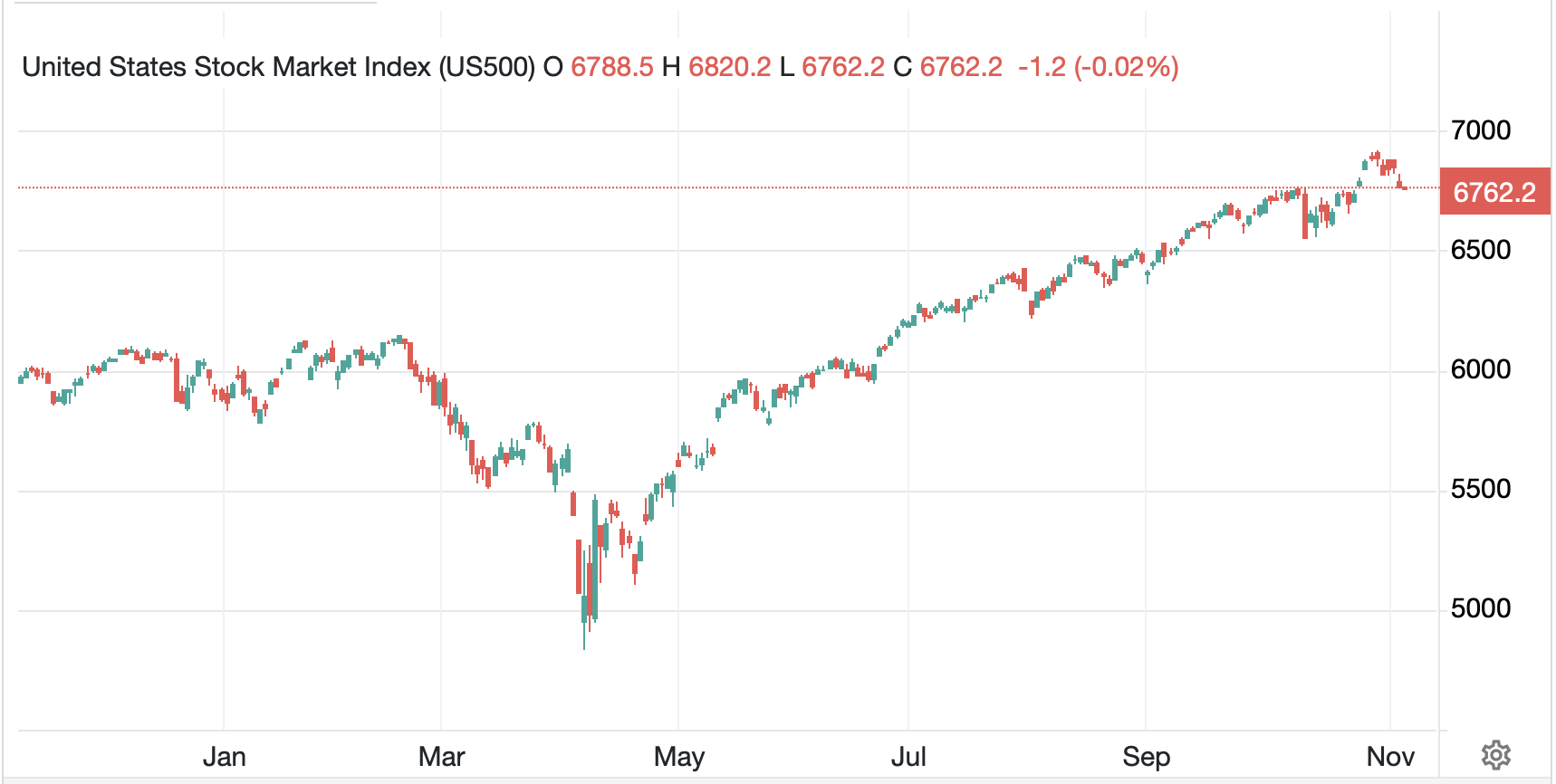
Which takes us to yesterday’s price action and its drivers.  First off, one might have thought that we experienced another Black Monday based on some of the hysteria in commentaries, but in the end, US equity indices only fell between -0.5% (DJIA) and -2.0% (NASDAQ).  In fact, using the S&P 500, a look at the chart shows that the decline over the past several sessions amounts to just -2.3% there, hardly calamitous!
Source: tradingeconomics.com

I continue to read about the K-shaped economy with the massive split between the top 10% of income/wealth representing 87% of spending and enjoying life while the bottom 90% struggle immensely.  This has been made possible by the ongoing support of financial assets by the Fed (and other central banks) which has accrued to asset holders, i.e. the top 10%.  In fact, this is a far more likely rationale for Zoran Mamdani’s victory yesterday, he has promised to help those who are struggling by freezing rents, offering free stuff and taking over the grocery stores to remove the profit motive and lower prices.  And when it comes to elections, the bottom 90% have a lot more votes!

Here is as good an explanation of the forces driving this narrative as any:

While equity and asset prices continue to climb, the working class is finding life increasingly difficult as job opportunities seem to be shrinking.  This latter issue seems only to be exacerbated by the growth in AI spending and the announcements by numerous companies that they will be reducing staffing because of the efficiencies created by AI in their operations.

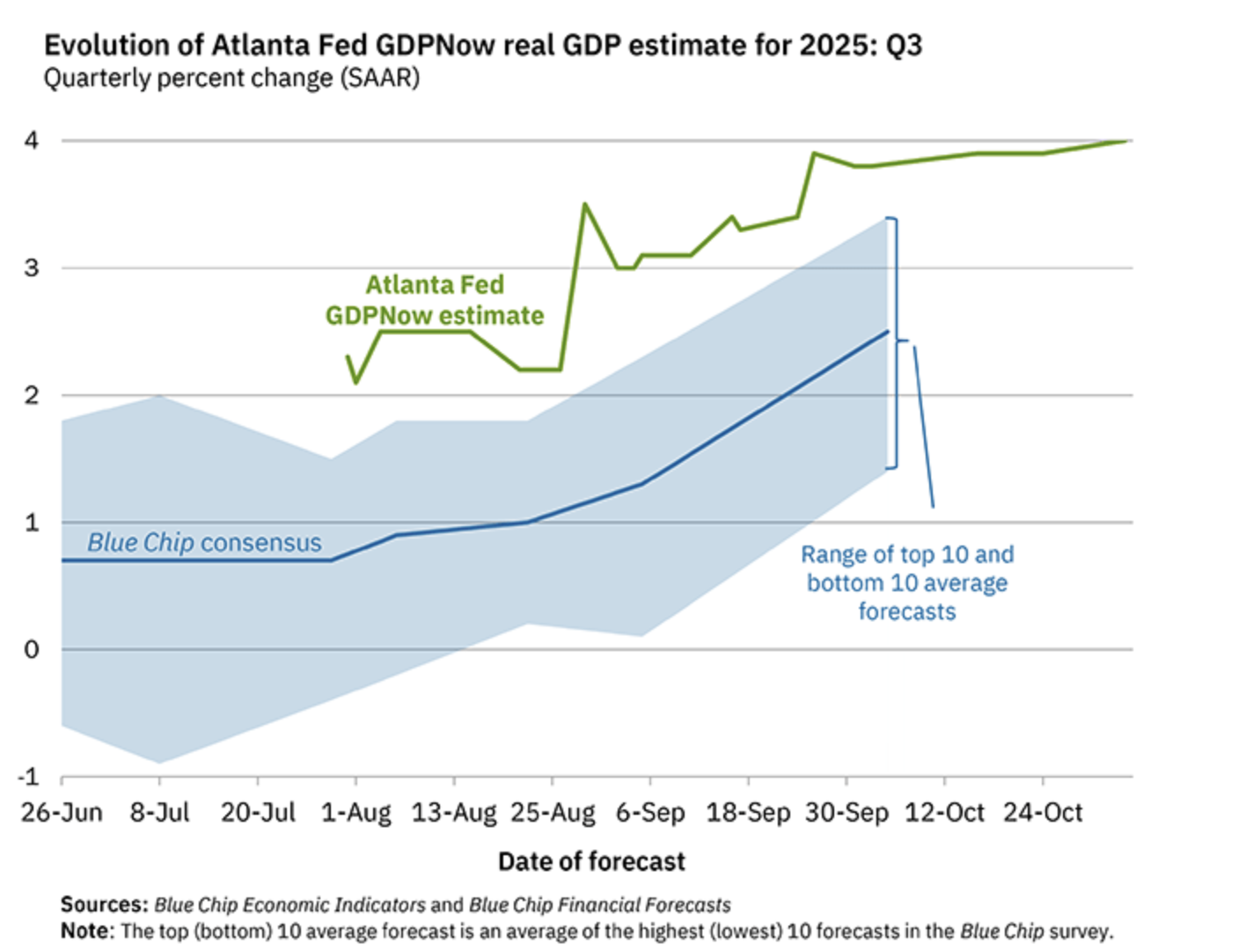
Arguably, the reason we have seen such a large dichotomy between analyst views is that some are focused on data that represents the bottom leg of the ‘K’ and see a recession around the corner, if not already upon us.  Meanwhile, others see the arm of the ‘K’ and see good times ahead.  Certainly, if we look at the broad-based GDP readings, at least based on the Atlanta Fed’s GDPNow forecast, Q3 was remarkably strong at real GDP growth of 4.0% annualized (see below chart).  Calling for a recession with that as backdrop is a very difficult case to make, in my view, but that won’t stop some analysts from trying.
Net, while nobody likes to see their portfolios’ value shrink, the declines so far have been very modest.  It is entirely reasonable to expect a correction of 10% – 15%, especially if we look at the chart at the top showing a 36% rally with limited drawdowns over the past 6 months.  It feels too early to panic.

And with that in mind, let’s see how markets behaved overnight.  Asian markets followed US ones lower with Tokyo (-2.5%) leading the way, although that was well off the early session lows which touched -4.0%.  Korea (-2.9%) and Taiwan (-1.4%) both suffered as well although the rest of the region was far less impacted.  Both China and HK were little changed and other gains and losses were on the order of +/-0.5% or less.  European bourses are all in the red as well this morning, although the one thing of which we can be sure is it is not related to the tech selloff given Europe has no tech industry of which to speak.  But Spain (-0.9%) and Germany (-0.75%) are both down despite reasonable Services PMI data from both nations and better than expected German Factory Orders (+1.1%).  UK equities are unchanged, and the rest of the continent is somewhere between unchanged and Spain.  Negative sentiment has clearly carried over, but there have been no strong reasons to sell aggressively.

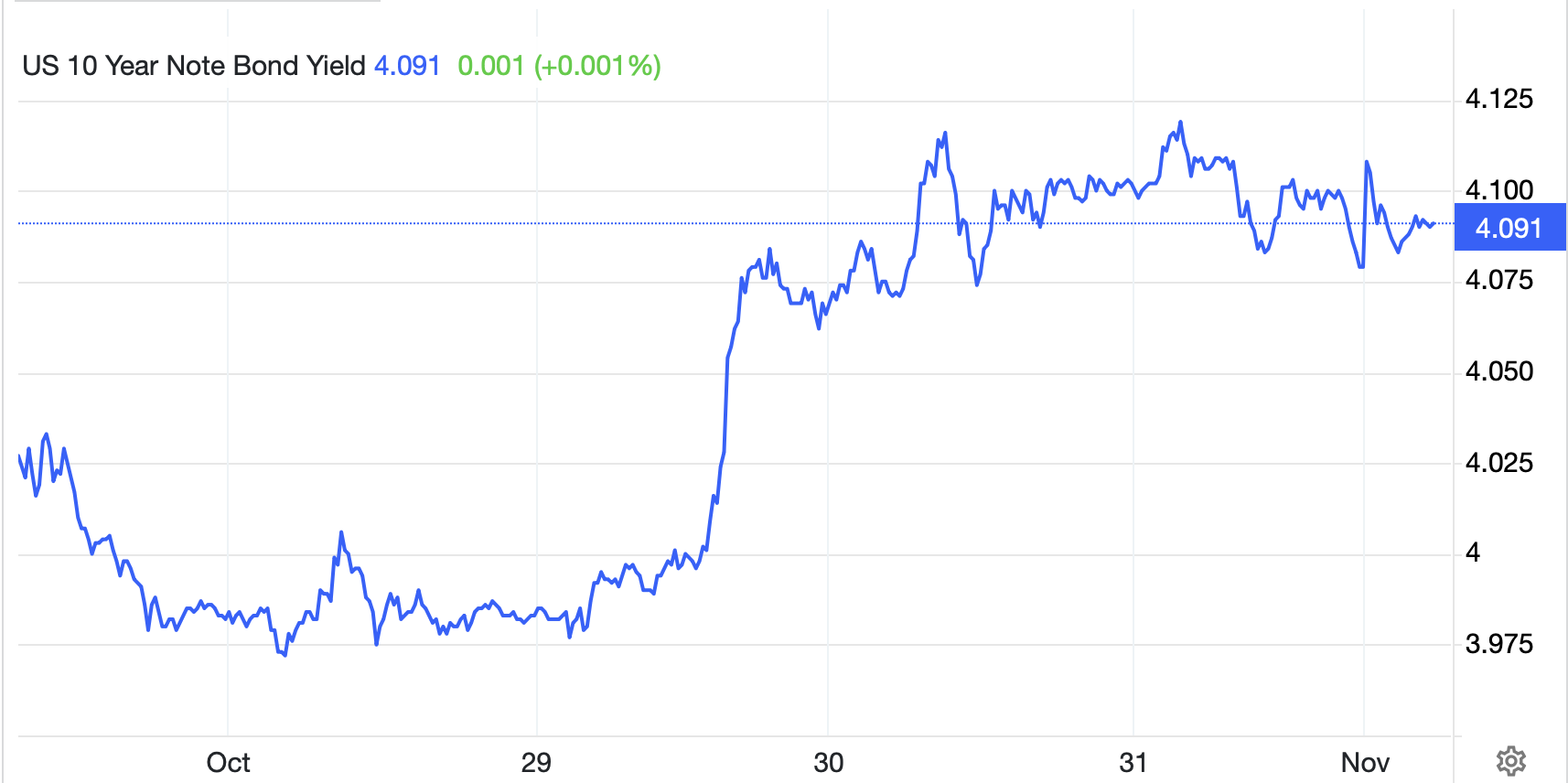
In the bond market, Zzzzzz is today’s message.  Every major government bond is within 1bp of yesterday’s close, and yesterday’s price action was only worth 1bp to 2bps.  In fact, as you can see from the chart below, since the FOMC and Powell’s hawkish press conference, nothing has changed.  This is true from Fed funds futures as well, with a 71% probability still price for a December cut.

Source: tradingeconomics.com

In the commodity space, oil (-0.3%) seems to be lower every morning when I write, but continues to trade in a narrow range around $60/bbl.  Perhaps the most interesting thing I read this morning was Javier Blas’ op-ed in Bloombergregarding the rationale for a US-led regime change in Venezuela given it is the nation with the largest known oil reserves.  If you are President Trump and seeking to get oil prices lower, that could be a very effective source of the stuff.  As to the metals markets, yesterday saw a sharp decline in precious metals and this morning they are rebounding with both gold and silver higher by 0.9%.  Copper (+0.25%), too is rising a bit, although remains well off the highs seen when gold peaked.

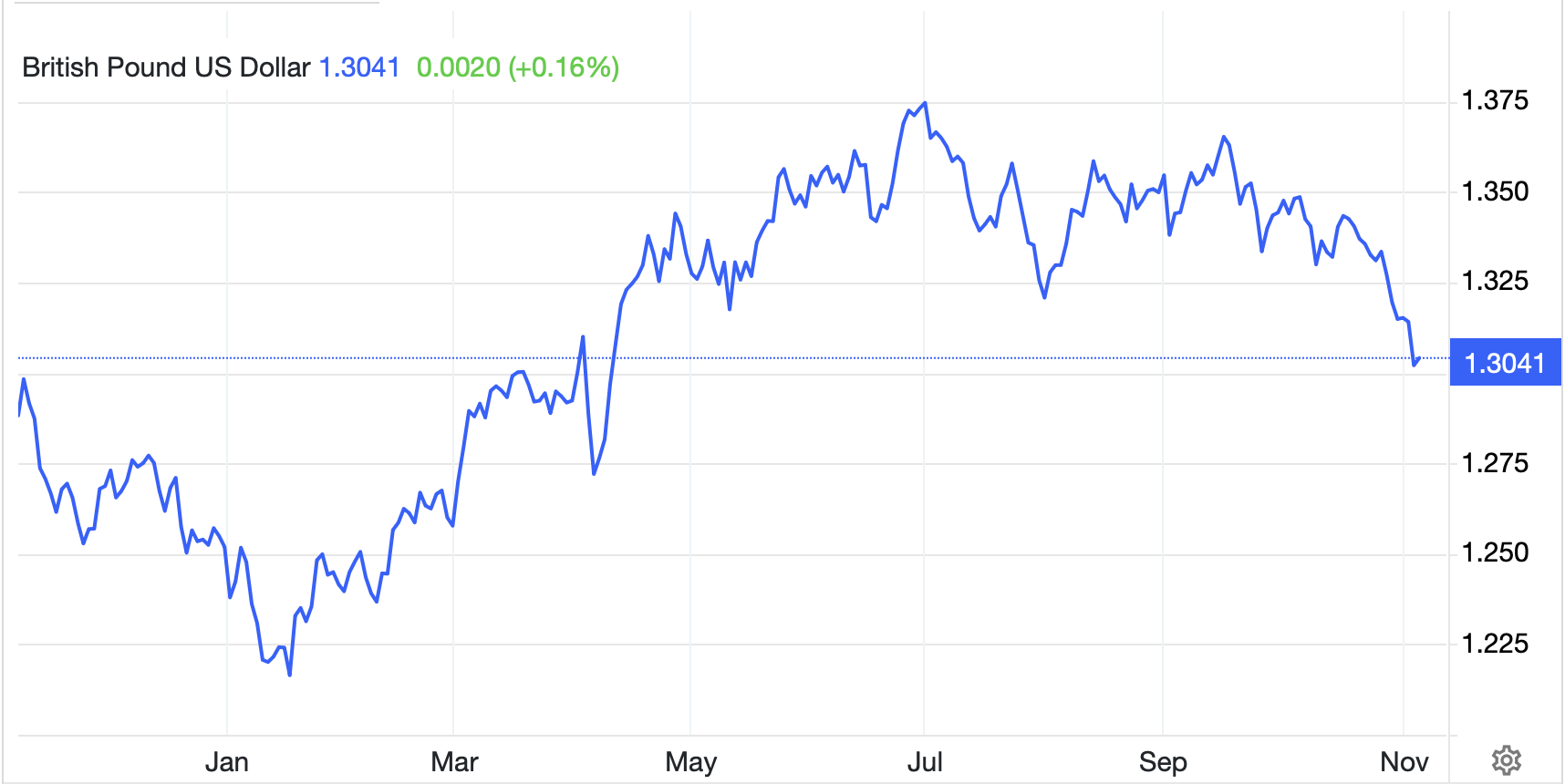
Finally, the dollar continues to impress.  While this morning it is little changed against most of its counterparts, it is, apparently, consolidating its recent gains.  The DXY remains above 100.00, which many have seen as a key resistance level.  The pound (+0.2%) while bouncing slightly this morning is hovering just above 1.30, a level last seen on Liberation Day, and certainly appears to be working its way lower from its summer peak.  If I consider the fiscal problems and the energy policy in the UK, it is very difficult to expect a significant amount of demand for the pound.
Source: tradingeconomics.com

Elsewhere, ZAR (+0.4%) is responding to the rise in gold prices and otherwise, +/-0.2% is today’s trading story.  Over time, given the promised investments into the US based on trade deals that have been signed, I expect there will be consistent demand for the greenback.  And as I wrote yesterday, the idea of a two-currency world in the future cannot be dismissed.

We do have data today with ADP Employment (exp 25K), ISM Services (50.8) and then the EIA oil inventory data where limited net change is expected although the API data yesterday showed a large build of 6.5mm barrels.  Remarkably, there are no scheduled Fed speakers, but that story remains caution but a tendency toward cutting.

For all the election hype, I don’t perceive that things have changed very much at all.  Perhaps the Supreme Court hearings on the legality of President Trump’s tariffs are the real story today, but regardless of the hearings, no verdict will be rendered for many weeks.  Which leaves us with a world in which tech is still dominant in equity markets and the US is still dominant in tech.  With the perception of the Fed being somewhat more hawkish, I don’t see a good reason to sell dollars.

Good luck

Adf

Woes and Scraps

The PMI data is in
And so far, it’s not really been
A sign of great strength
When viewed from arm’s length
No matter the punditry’s spin
 
That said, we are not near collapse
Despite many trade woes and scraps
And stocks keep on rising
So, t’will be surprising
For all when we see downside gaps


It was a quieter weekend than we have seen recently in the global arena with no new wars, no mega protests and no progress made on any of the major issues outstanding around the world.  Thus, the US government remains shut down, the war in Ukraine remains apace and the AI buzz continues to suck up most of the oxygen when discussing markets.

With this as background, arguably the most interesting market related news has been the manufacturing PMI data released last night and this morning.  starting in Asia, the story was some weakness as Chinese, Korean and Australian data all fell compared to last month, although India and Indonesia continued along well.  Meanwhile, in Europe, the data improved compared to last month, but the problem is it remains at or below 50 virtually across the board, so hardly indicative of strong economic activity.

                                                                                                      Current         Previous               Forecast

Source: tradingeconomics.com

I don’t know about you, but when I look at the releases this morning, I don’t see a European revival quite yet, not even if I squint.

I guess the other thing that has tongues wagging is Election Day tomorrow with three races garnering the focus, gubernatorial contests in New Jersey and Virginia and the mayoral race in New York City.  The first two are often described as harbingers of a president’s first year in office and I think this time will be no different.  But will they impact market behavior?  This I doubt.

So, let’s get right into markets this morning.  Friday’s further new record highs in the US were followed by strength through much of Asia (Tokyo was closed for Culture Day) with China (+0.3%), HK (+1.0%), Korea (+2.8%) and Taiwan (+0.4%) leading the way with only the Philippines (-1.7%) bucking the regional trend as earnings growth in the country continues to disappoint relative to its peers around the region.  Europe, too, has seen broad based gains with the DAX (+1.2%) leading the way higher and gains in the IBEX (+0.45%) and CAC (+0.3%) as well.  I guess the PMI data was sufficient to excite folks and despite Europe’s status as a global afterthought, at least in terms of geopolitical issues, their equity markets have been rising alongside the rest of the world’s all year.  And you needn’t worry, US futures are all higher at this hour (6:50), with the NASDAQ (+0.7%) leading the way.

Perhaps more interesting than equities though is the fact that government bond markets are doing so little.  Treasury yields jumped ~10bps in the wake of the FOMC meeting and, more accurately, Chairman Powell’s ostensible hawkishness.  However, as you can see in the below tradingeconomics.com chart, since then, nothing has happened. 

Recall, the probability of a December rate cut by the FOMC also fell from virtual certainty to 69% now.  In fact, if you think about it, that 30% probability decline translates into about 7.5bps, approximately the same amount as 10-year yield’s rose.  It appears that the market is consistent in its pricing at this point, and when (if?) data starts coming back into the picture, we will see both these interest rates rise and fall in sync.  As to European sovereigns, they continue to track the movement in the US and this morning, this morning, the entire bloc has seen yields edge higher by 1bp, exactly like the US.

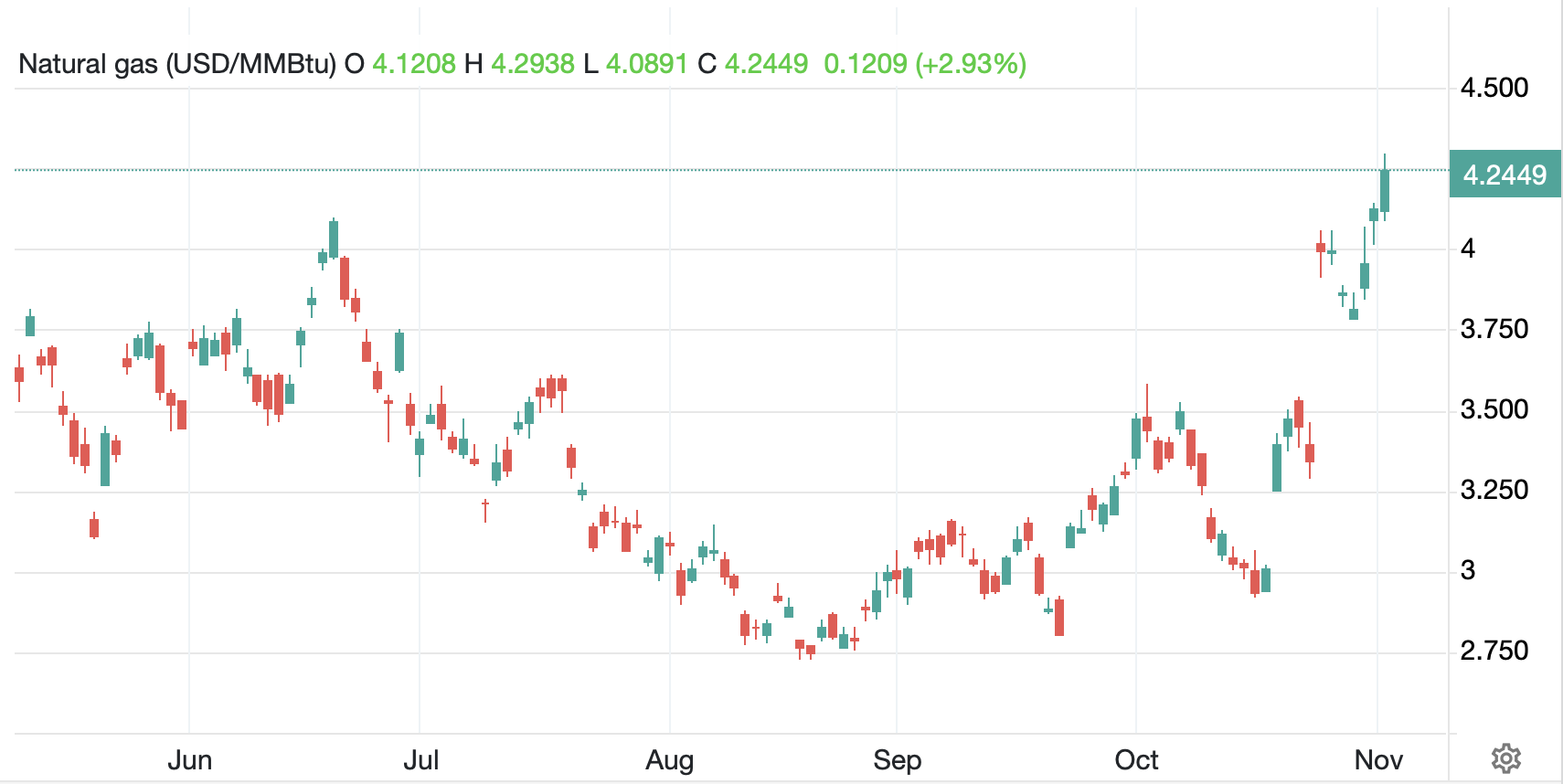
Commodities remain the most interesting place, although the dollar is starting to perk up a bit.  Oil (-0.3%) slipped overnight after OPEC+ indicated they were increasing production by another 137K bbl/day, although there would be no more increases for at least three months given the seasonality of reduced oil demand at this point on the calendar.  Something I have not touched on lately is NatGas, which traded through $4.00/MMBtu late last Thursday, and is now up to $4.25.  in fact, in the past month it has risen nearly 27%, which given it is massively underpriced compared to oil (on a per unit of energy basis) should not be that surprising.  Nonetheless, sharp movements are always noteworthy, and this is no different.

Source: tradingeconomics.com

Certainly, part of this is the fact that winter is coming and seasonal demand is rising in the US. 

Combine that with the European needs for LNG, of which the US is the largest provider, and you have the makings of a rally.  (I wonder though, did the fact that Bill Gates changed his tune on global warming no longer being an existential threat signal it is now OK to burn more fossil fuels?)

Turning to the metals markets, the ongoing fight between the gold bugs and the powers that be continues as early in the overnight session, gold was lower by nearly -1% but as I type, just past 7:00am, it is slightly higher (+0.1%) compared to Friday’s closing levels.  Silver (+0.1%) has seen similar price action although copper (-0.5%) appears more focused on the economic story than the inflation story.  

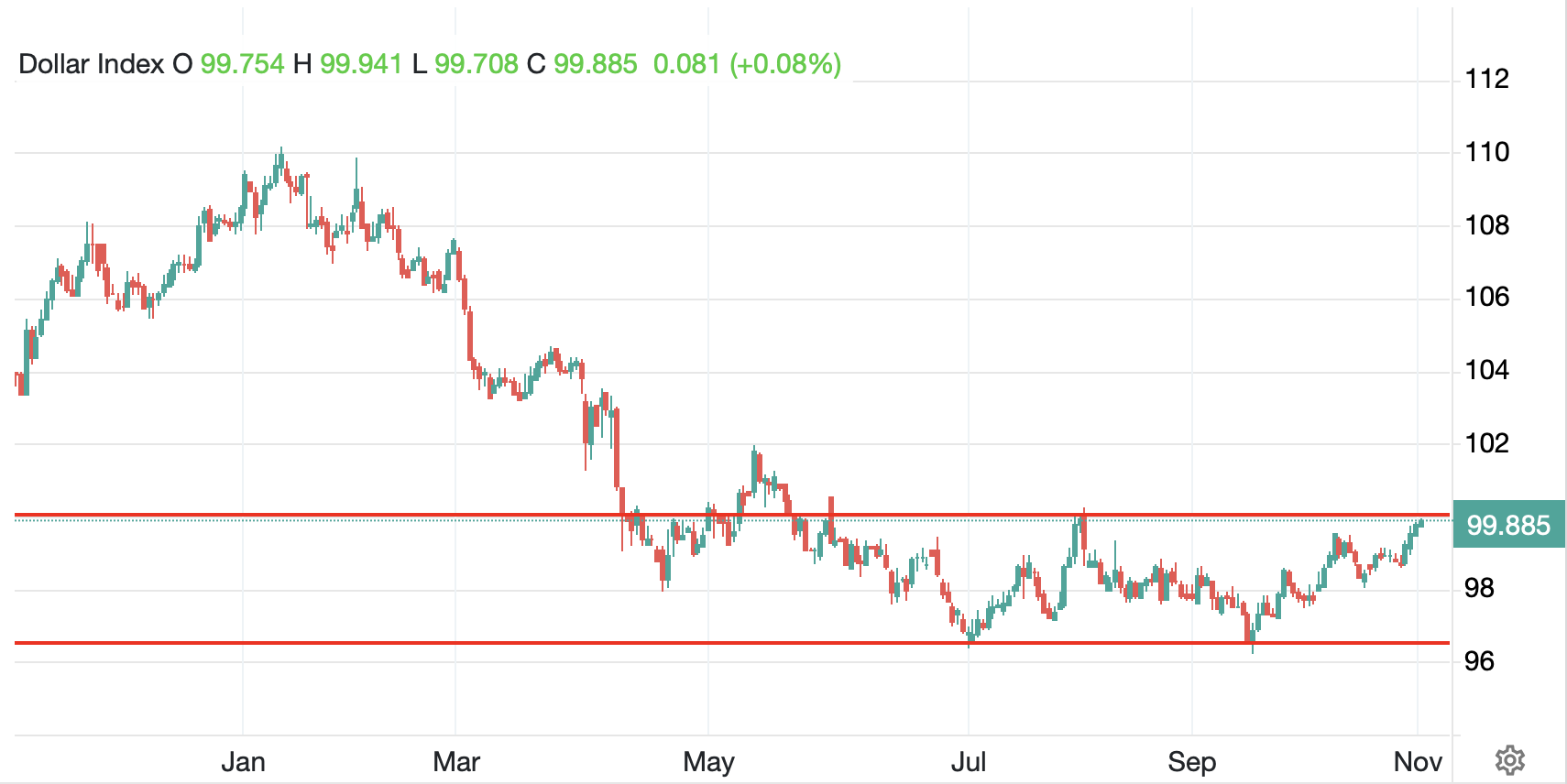
Which takes us to the dollar and its continued rally. Using the DXY (+0.1%) as our proxy, it is higher again this morning and pushing back to the psychological 100.00 level.  Now, I have made the case several times that the dollar has done essentially nothing for the past six months, and the chart below, I believe, bears that out.  We have basically traded between 96.5 and 100 since May.

Source: tradingeconomics.com

You will also recall that there is a narrative around about the end of the dollar’s hegemony and how nations around the world are trying to exit the USD financial system that has been in place since Bretton Woods, or at least since the fiat currency world took off when President Nixon closed the gold window.  And there is no doubt that China is seeking to become the global hegemon and thus wants a renminbi-based system to use to their advantage.  However, let’s run a little thought experiment. 

The Trump administration has embraced the cryptocurrency space, and especially the use of stablecoins.  Legislation has been passed (GENIUS Act) to help clarify the legal framework and the SEC has been solicitous in its willingness to ensure that these creations are not securities, thus placing them outside the SEC’s oversight.  When looking at the world of stablecoins, their current total value is approximately $311 billion (according to Grok) of which only ~$1.2 billion are non-USD.  

Now, if stablecoins represent the payment rails of the future, an idea that is readily believable, and the stablecoin market is virtually entirely USD, with massive first mover advantage, is it not possible that economies around the world are going to find it much easier to dollarize than to maintain their own native currency?  While there are calls for Argentina to dollarize, what would the world look like if the EU fell apart (an entirely possible outcome given the inconsistencies in their current energy and immigration policies and the stress within the bloc) and the euro with it?  Would smaller nations opt for their own currency, or would they see the value of having a dollarized economy given the many efficiencies it would present, especially for their export industries?

While I have no doubt that China will never accept that outcome for themselves, is the future a world where there are two currency blocs, USD and CNY, and everything else simply disappears?  Remember, we are merely spit balling here, but if that is the outcome, demand for dollars will continue to rise, and the value of other currencies will continue to decline until such time as they succumb.

Again, this is a thought experiment, but one that offers intriguing possibilities for the future.  And one where the foreign exchange market may ultimately meet its demise.  After all, if there are only two currencies, that doesn’t make much of a market.

One other thing I must note, in the stablecoin realm, there is a remarkable product, USDi (usdicoin.com), which tracks US CPI exactly, yet can fit within those same payment rails.  If you are looking into this space, USDI is worth a peek.

Ok, back to the markets, looking across the FX space, +/-0.2% is today’s theme virtually across the board, with the more important currencies slipping against the dollar (EUR, GBP, JPY, CHF, CAD) than rising vs the greenback (MXN, CLP, NOK, CZK), although the magnitudes are similar.

With the government still closed, there is no official data, but we do get ISM Manufacturing (exp 49.5) with the Prices Paid subindex (61.7) released at the same time.  There are two Fed speakers today, Daly and Cook, and then 9 more speeches throughout the week.  We also get the ADP Employment data on Wednesday (exp 24K), but I imagine that will get more press after the election results are learned Tuesday evening.

It is hard to get excited about things today, but nothing points to a weaker dollar right now.

Good luck

Adf

A Brand-New World

Even in Japan
Incumbency is questioned
It’s a brand-new world


Yesterday’s elections in Japan brought about the downfall of yet another incumbent government as people around the world continue to demonstrate they are tired of the status quo.  Recently appointed PM, Shigeru Ishiba called for a snap election within days of his appointment following the resignation of previous PM Kishida on the heels of a funding scandal.  Ishiba’s idea was to receive a fresh mandate from the electorate so he could implement his vision.  Oops!  It turns out that his vision was not in sync with the majority of the population.  Ultimately, the LDP and its key ally, Komeito, won only 215 seats in the Diet (Japan’s more powerful Lower House), well below the 233 necessary for a majority and even further from the 293 seats they held prior to the election.  The very fact that this occurred in Japan, the most homogenous of G10 nations, is indicative of just how strong the anti-incumbent bias has grown and just how tired people are of current leadership (keep that in mind for the US election).

Now, turning to the market impact, the tenuous hold any government formed from these disparate results means that Japan seems unlikely to have a clear, coherent vision going forward.  One of the key issues was the ongoing buildup in defense expenditures as the neighborhood there increasingly becomes more dangerous.  But now spending priorities may shift.  Ultimately, as the government loses its luster and ability to drive decisions, more power will accrue to Ueda-san and the BOJ.  This begs the question of whether the gradual tightening of monetary policy will continue, or if Ueda-san will see the need for more support by living with more inflation and potentially faster economic growth.The yen’s recent decline (-0.25% today, -8.5% since the Fed rate cut in September) shows no signs of slowing down as can be seen from the chart below.  As the burden of policy activity falls to the BOJ, I expect that we could see further yen weakness, especially when if the Fed’s rate cutting cycle slows or stops as December approaches.  If this process accelerates, I suspect the MOF will want to intervene, but that will only provide temporary respite.  Be prepared for further weakness in the yen.

Source: tradingeconomics.com
 
This weekend’s Israeli response
To missile attacks from Iran-ce
Left bulls long of oil
In massive turmoil
As prices collapsed at the nonce

The other major market story this morning was the oil market’s response to Israel’s much anticipated retaliation to the Iranian missile barrage from several weeks ago.  The precision attacks on military assets left the energy sector untouched and may have the potential to de-escalate the overall situation.  With this information, it cannot be surprising that more risk premium has been removed from the price of oil and this morning the black, sticky stuff has fallen by nearly 6% and is well below $70/bbl.  This has led the entire commodity sector lower in price with not only the entire energy sector falling, but also the entire metals sector where both precious (Au -0.6%, Ag -0.9%) and base (Cu -0.2%, Al -1.1%) have given back some of their recent gains.  While declining oil prices will certainly help reduce inflationary readings over time, at least at the headline level, I do not believe that the underlying fundamentals have changed, and we are likely to continue to see inflation climb slowly.  In fact, Treasury yields (+3bps) continue to signal concern on that very issue.

Which takes us to the rest of the overnight activity.  Friday’s mixed session in NY equity markets was followed by a lot more green than red in Asia with the Nikkei (+1.8%) leading the way on the back of both lower energy prices and the weaker yen, while Chinese stocks (+0.2%) managed a small gain along with Korea (+1.1%) and India (+0.8%).  However, most of the other regional markets wound up with modest declines.  In Europe, mixed is the description as well, with the CAC (+0.25%) and IBEX (+0.4%) in good spirits while both the DAX and FTSE 100 (-0.1%) are lagging.  Given the complete lack of data, the European markets appear to be responding to ECB chatter, which is showing huge variety on members’ views of the size of the next move, and questions about the results of the US election, with President Trump seeming to gain momentum and traders trying to figure out the best way to play that outcome.  As to US futures, this morning they are firmer by 0.5% at this hour (7:20).

Although Treasury yields have continued their recent climb, European sovereign yields are a touch softer this morning, although only by 1bp to 2bps, as clarity is missing with respect to ECB actions, Fed actions and the US elections.  My sense is that we will need to see some substantial new news to change the current trend of rising yields for more than a day.

Finally, the dollar is net, a little softer today although several currencies are suffering.  We have already discussed the yen, and we cannot be surprised that NOK (-0.4%) is weaker given oil’s decline, but we are also seeing MXN (-0.3% and back above 20.00 for the first time since July) under pressure as that appears to be a response to a potential Trump electoral victory.  But elsewhere, the dollar is under modest pressure with gains on the order of 0.1% – 0.3% across most of the rest of the G10 as well as many EMG currencies.  There are precious few other stories of note this morning.

On the data front, it is a very big week as we see not only NFP data but also PCE data.

TuesdayCase-Shiller Home Prices5.4%
 JOLTS Job Openings7.99M
 Consumer Confidence99.3
WednesdayADP Employment115K
 Q3 GDP3.0%
ThursdayInitial Claims233K
 Continuing Claims1880K
 Personal Income0.2%
 Personal Spending0.4%
 PCE0.1% (2.1% Y/Y)
 Core PCE 0.1% (2.7% Y/Y)
 Chicago PMI47.5
FridayNonfarm Payrolls180K
 Private Payrolls160K
 Manufacturing Payrolls-35K
 Unemployment Rate4.2%
 Average Hourly Earnings0.3% (4.0% Y/Y)
 Average Weekly Hours34.2
 Participation Rate62.5%
 ISM Manufacturing47.5
 ISM Prices Paid48.2

Source: tradingeconomics.com

Of course, with the FOMC meeting next week, we are now in the Fed’s quiet period, so there will be no more official commentary.  The one thing to watch is if something unexpected occurs, then look for an article from the Fed whisperer, Nick Timiraos of the WSJ.  But otherwise, this is shaping up as a week that starts slowly and builds to the back half when the data comes.

Regardless of the election outcome, I expect that the budget situation will only devolve into greater deficits.  I believe that will weigh on the bond market, driving yields higher and for now, I think that will likely help the dollar overall, but not too much.  It remains difficult for me to see the dollar reverse course lower absent a much more aggressive FOMC, and that just doesn’t seem to be on the cards.

Good luck

Adf

A Shocking Surprise

On Wednesday the data was dreck
On Friday, twas more of a wreck
The read’s now that growth
Is set for more slowth
Will this break the Fed’s bottleneck?
 
Meanwhile, in a shocking surprise
In France, tis the Left on the rise
But no party there
Is willing to share
Their power and reach compromise
 
And while day-to-day matters greatly
The populists, worldwide, are lately
Ascending to power
And ready to shower
Their voters with cash profligately


This morning, the world is a very different place than it was when I last wrote.  Broadly speaking there are three key stories of note; US data was much weaker than expected, the French election surprised one and all with the coalition of hard-left parties winning the most seats, although no group is even close to a majority of the French parliament, and the questions over President Biden’s capacity to remain on the job, let alone his ability to be president for the next four years, have been coming fast and furious from the mainstream media, many Democrats in Congress and the Democratic donor base.

So, let’s address them in order.  On the US data front, arguably the best release was the Trade Balance printing at a slightly smaller deficit than forecast by the Street.  Otherwise, ISM Services was miserable at 48.8, Factory Orders fell -0.5%, -0.7% ex Transport, and Initial and Continuing Claims both rose to new high levels for the cycle.  And that was just Wednesday.  On Friday, while the headline NFP number did beat forecasts, once again, there were major revisions lower to the past 3 months, -111K, the Unemployment Rate rose to a new high for the cycle at 4.1%, its highest level since November 2021 and a continuation of the recent uptrend in the data.  A look at the chart below seems to show a defined trend higher in the Unemployment Rate, and as I explained last week, this is a statistic that tends to have momentum once it gets going.  I would argue this number is going to continue to climb higher as the year progresses.

Source: tradingeconomics.com

As well, the biggest piece of the report was an increase of 70K Government jobs, compared to just 136K Private sector jobs and a loss of -8K in Manufacturing.  The one thing we know is that government jobs do not add to economic growth as they are the least productive of all.  

The upshot is that based on the data from Wednesday and Friday, the story of still strong growth in the US has clearly been called into question.  Will Powell, who testifies before Congress this week, pay homage to the weaker data and hint that perhaps higher for longer has reached its sell-by date?  While this is only one set of data, and he has been adamant that he needs to see several months of data, the market is becoming more convinced that a September rate cut is coming as the Fed funds futures probability of that cut has risen to 75%.  It should be an interesting week given both the CPI release and the Powell testimony.

On to the French and what was truly a shocking outcome, at least on one level.  After the first-round last week, the abject fear by the press in France, and all of Europe, of the idea that a right-wing government could come to power in a key European nation resulted in the numerous parties on the Left working with President Macron’s centrists to try to prevent any such thing from happening.  As such, they strategically pulled candidates from different seats in order to prevent splitting the vote and allowing Marine Le Pen’s RN party from achieving a majority.  And they were effective in that.  Alas, they now have a completely unworkable setup where no party has anywhere close to a majority and so passing any legislation will be nigh on impossible.  

Jean-Luc Melenchon, the Left’s most well-known proponent, and leader of a sect called France Unbowed, has declared that he wants his party’s agenda implemented full-on.  That means reducing the retirement age, raising wages and establishing price controls on power and energy as well as expanding wind and solar power.  Of course, the math on that won’t work, even if they raise taxes, but that certainly never stopped a populist once in office.  

Interestingly, while on the surface it would have been easy to conclude that French OATs would see yields rise vis-à-vis German Bunds as fears of larger government deficits build, that has not yet been the case.  In fact, this morning, yields across Europe are little changed as bond traders and investors seem to be ignoring the situation.  The rationale here is that given no group has a majority, the probability of having any party’s wish list implemented by parliament is vanishingly small.  The most likely outcome is a year of muddling through, with no decisions of any substance made and another election held next summer.  (By law, President Macron must wait one year after an election to call a second one.)  In fact, it will be very interesting to see how a prime minister will even be elected in parliament as it seems unlikely that any individual will have support of a majority of the chamber. 

As to the other potential impacts of this election, neither French equities nor the euro have shown any substantive movement as traders in both these spaces see the same situation, a very low probability of any substantive policy changes given the lack of parliamentary leadership.  Ultimately, while the political ramifications in France are large, the economic ones are not as obvious yet.

This is different than in the UK, where Keir Starmer and his Labour party swept to victory as widely expected.  In the UK, Labour runs the show now and so will be able to implement whatever policies they deem appropriate.  So far, there has been little in the way of concern demonstrated by market participants for UK assets either, but I fear the risk here is greater as the policy prescriptions that Starmer favors are likely to have a much larger negative economic toll.

Finally, in what must be THE most surprising aspect of the presidential election cycle in the US, former President Trump is NOT the major topic of conversation.  Rather, in the wake of the debate 10 days ago, the only topic is President Biden’s fitness for office now, and in the future.  This is certainly not a good look for the US, especially with a key NATO meeting this week in Washington D.C., but it is the current situation.  Thus far, US risk assets have ignored all this, arguably because the fiscal spending spigot has not been turned off.  But it is not hard to imagine that there are myriad problems ahead as Secretary Yellen tests just how many bonds the US can issue and still find buyers.

So, with all that remarkable news in our memory banks, let’s look at how markets are behaving this morning and what happened overnight.  Ironically, it seems Asian investors are the ones most upset by the European elections of last week as equity markets throughout the time zone fell.  The Hang Seng (-1.55%) was the laggard, although China (-0.85%) and Australia (-0.8%) also performed quite poorly and the Nikkei (-0.3%) was a star by comparison.  There was very little in the way of economic data to drive things here, so this seems merely to be part of the usual ebb and flow of markets.  The real surprise, though, is in Europe where equity markets are higher across the board.  Despite the pressures for more spending and higher taxes that will come from both France and the UK, the CAC (+0.45%) and the FTSE 100 (+0.3%) are nonplussed by the situation.  In the UK, as laws are implemented, I expect there will be a bigger reaction, but in France, perhaps the view that there is gridlock which will prevent any new legislation of note, means equities can run higher.  As to the US, futures markets at this hour (7:00) are basically unchanged.

As mentioned above, bond yields throughout Europe have been limited in their movement while Treasury yields have rebounded 2bps from last week’s declines.  While I was out, the weak data certainly encouraged bond investors to increase allocations as visions of a Fed rate cut grow.  For now, the bond markets are not signaling any concerns over the electoral outcomes.  My take is that may be appropriate for France and the continent, but I would be wary of UK Gilts given the likelihood of a downturn in the fiscal situation as more spending is implemented by parliament.

In the commodity markets, the end of last week saw sharp rallies in the metals markets, perhaps on those fears of a RN electoral victory in France, or perhaps on expectations of quicker Fed rate cuts, but this morning, commodities across the board are softer, with oil (-1.3%) leading the way, although WTI remains well above $82/bbl.  As to the metals, both precious (Au -0.7%, Ag -0.7%) and industrial (Cu -0.2%, al -0.1%) are giving back some of those gains.

Finally, the dollar is somewhat higher than it closed on Friday, although not very much.  In the G10, NOK (-0.5%) is suffering on oil’s decline which has dragged SEK (-0.4%) along with it.  The yen (-0.1%) which fell to near 162 vs. the dollar last Wednesday recouped some of those losses into the weekend but seems to have bounced with 160.00 now showing technical support in USDJPY.  In the EMG bloc, HUF (-0.8%) is the laggard as despite a lack of data, it seems markets are looking at the right-leaning politics of PM Orban and see continued friction between Hungary and the rest of the EU, specifically when it comes to subsidy payments.  KRW (-0.5%) is softer as the government’s efforts to expand trading hours in the currency have not yet borne fruit although it is still early days.  They are trying to improve onshore currency trading in order to allow more convertibility for equity investors and thus get Korean stock markets included in more global indices.

On the data front, while the calendar is not packed, it is impactful.

TodayConsumer Credit$10B
TuesdayNFIB Small Biz Optimism89.5
 Powell Testimony 
WednesdayPowell Testimony 
ThursdayInitial Claims240K
 Continuing Claims1860K
 CPI0.1% (3.1% Y/Y)
 -ex food & energy0.2% (3.4% Y/Y)
FridayPPI0.1% (2.3% Y/Y)
 -ex food & energy0.2% (2.5% Y/Y)
 Michigan Sentiment68.5
Source: tradingeconomics.com

In addition to Powell, 5 other Fed speakers are slated, but clearly all eyes will be on Powell.  And the CPI reading.  After last week’s soft data, there is a growing expectation that price pressures are going to fall back further and allow the Fed to cut rates.  Certainly, if CPI prints soft, I expect to see a rally in risk assets, but we must wait to hear Powell’s spin ahead of those numbers.

Net, the market is seemingly turning toward a more dovish approach with visions of rate cuts coming fast and furious once they get started.  That seems excessive to me, but for now, it is hard to like the dollar’s status as rate cut expectations build, especially given the market has ignored potential problems elsewhere.

Good luck

Adf

Ain’t

Ueda explained
Buying bonds is still our bag
But buying yen ain’t


The last of the major central banks met last night as the BOJ held their policy meeting.  As expected, they left the policy rate unchanged between 0.00% and 0.10%.  However, based on the April meeting comments, as well as a “leak” in the Nikkei news, the market was also anticipating guidance on the BOJ’s efforts to begin reducing its balance sheet.  Remember, they still buy a lot of JGBs every month, so as part of the overall normalization process, expectations were high they would indicate how much they would be reducing that quantity.

Oops!  Here is their statement on their continuing QQE program [emphasis added]:

Regarding purchases of Japanese government bonds (JGBs), CP, and corporate bonds for the intermeeting period, the Bank will conduct the purchases in accordance with the decisions made at the March 2024 MPM. The Bank decided, by an 8-1 majority vote, that it would reduce its purchase amount of JGBs thereafter to ensure that long-term interest rates would be formed more freely in financial markets. It will collect views from market participants and, at the next MPM, will decide on a detailed plan for the reduction of its purchase amount during the next one to two years or so. 

In other words, they have delayed the onset of their version of QT by another month and based on the nature of their process, where they pre-announce the bond buying schedule on a quarterly basis, it is entirely possible that the delay could be a bit longer.  You will not be surprised to know the yen fell sharply on the news, as per the below chart.

Source: tradingeconomics.com

In fact, it traded to its weakest (dollar’s highest) level since just prior to the intervention events in April.  However, as you can also see, that move was reversed during the press conference as it became clear to Ueda-san that his delay did not result in a desired outcome.  The issue was the belief that the BOJ cannot make decisions on interest rates and QT simultaneously (although for the life of me, I cannot figure out why that was the belief), and so Ueda addressed it directly, “We will present a concrete plan for long-term JGB buying operations in July. Of course, it’s possible for us to raise the short-term interest rate and adjust the degree of monetary easing at the same time depending on the information available then on the economy and prices.”

In the end, the only beneficiary of this was the Japanese stock market, which managed a modest rally of 0.25%.  Certainly, this did not help either Ueda’s or the BOJ’s credibility that they are prepared to normalize policy, and it also left the entirety of currency policy in the lap of the MOF.  The problem for Ueda-san is that until the Fed decides it is time to start cutting interest rates, a prospect which seems further and further distant, the yen is very likely to remain under pressure.  I am beginning to suspect that despite Ueda’s stated goal of normalizing monetary policy, the reality is that, just like every other central banker today, his bias is toward dovishness, and he cannot let go.  I fear the risk is that the yen could weaken further from here rather than it will strengthen dramatically, at least until there are real policy changes.  FYI, JGB yields closed 3bps lower after the drama.

Away from that, the overnight session informed us that Chinese economic activity appears to be slowing, at least based on their loan growth, or lack thereof.  Loans fell, as did the pace of M2 Money Supply and Vehicle Sales.  While none of these are typically seen as major data releases, when combined, it seems to point to slowing domestic activity.  The upshot is a growing belief that the PBOC will ease policy further thus supporting Chinese equities (+0.45%) and maintaining pressure on the renminbi which continues to trade at the limit of its 2% band vs. the daily CFETS fixing.

As to Europe, it is becoming clearer by the day that investors around the world have begun to grow concerned over what the future of Europe is going to look like.  Despite the ECB having cut their interest rates last week, the results of the European Parliament elections continue to be the hot topic and we are seeing European equity markets slide across the board, with France (-2.5% today, -5.8% this week) leading the way lower as President Macron’s Renaissance Party looks set to be decimated in the snap elections at the end of the month.  But the entire continent is under pressure with Italy (-2.8% today, -5.7% this week) showing similar losses and the other major nations coming in only slightly better (Germany -2.75% this week, Spain -3.9% this week).  You will not be surprised to know that the euro (-0.4%) is also under pressure this morning, extending its losses to -1.0% this week with thoughts it can now test the lows seen last October.

There is a great irony that the G7 is meeting this week as so many of the leaders there, Italy’s Giorgia Meloni and Japan’s Kishida-san excepted, looks highly likely to be out of office within a year.  Macron, Olaf Sholz, Justin Trudeau, President Biden and Rishi Sunak are all far behind in the polls.  One theory is that the blowback from the draconian policies put in place during the pandemic restricting freedom of movement and speech within these nations, as well as the ongoing immigration crisis, which is just as acute in Europe and the UK as it is in the US, has turned the tide on the belief that globalization is the best way forward.  

Earlier this year I forecast that there would be very severe repercussions during the multitude of elections that have already taken place and are yet to come.  Certainly, nothing has occurred that has changed that opinion, and in fact, I have a feeling the changes are going to be larger than I thought.  

The reason this matters is made clear by today’s market price action.  If the world is turning away from globalization, with a corresponding reduction in trade, equity markets which have been a huge beneficiary of this process (or at least large companies have directly) are very likely to come under further pressure.  As well, fiscal policies are going to put more pressure on central banks as the natural response of politicians is to spend more money when times are tough, and we could see some major realignments in market behaviors.   This will lead to ongoing inflationary pressures, thus weaker bond prices and higher yields, weaker equity prices, much strong commodity prices and the dollar, ironically, likely to do well as it retains its haven status.  Certainly, the euro is going to be under pressure, but very likely so will many other currencies.  This is a medium to long-term concept, certainly not something that is going to play out day-to-day right now, but I remain firmly in the camp that many changes are coming.

As to the rest of the markets overnight, yields are falling everywhere (Treasuries -5bps, Gilts -9bps, Bunds -12bps, OATs -6bps, Italian BTPs -1bp) as investors are seeking havens and for now, bonds seem better than stocks.  You will also notice that the spread between Bunds and other European sovereigns is widening as there is clear discernment about individual nation risk.  This is not a sign that everything is well.

Maintaining the risk-off thesis, gold (+1.25%) and silver (+1.00%) are rallying despite a much stronger dollar this morning and we are also seeing some strength in oil (+0.2%).

As to the dollar, it is stronger vs. almost every one of its counterparts this morning, most by 0.3% or more with CE4 currencies really under pressure (PLN -1.0%, HUF -0.8%).  However, there are two currencies that are bucking this trend, CHF (+0.25%) which is showing its haven characteristics and ZAR (+0.5%) where the market is responding to the news that the ANC has put together a coalition and that President Ramaphosa is going to remain in office.

Yesterday’s PPI data showed softness similar to the CPI on Wednesday but more surprisingly, the Initial Claims number jumped to 242K, its highest print since August 12, 2023, and a big surprise to one and all.  The combination of data certainly added to yesterday’s feel that growth and inflation were ebbing.  This morning, we get the Michigan Sentiment (exp 72.0) and then a couple of Fed speakers (Goolsbee and Cook) later on during the day.

I should note that equity futures are all in the red this morning, with the Dow continuing to lag the other markets, probably not a great signal of future strength.  Arguably, part of today’s price movement is some profit taking given US equity markets have rallied this week and month.  But do not discount the bigger issues discussed above as I believe they will be with us for quite a while to come and put increasing pressure on risk assets with support for havens.  As such, I think you have to like the dollar given both the geopolitical issues and the positive carry.

Good luck and good weekend

Adf

Change at the Top

Democracy lives and it dies
By voting for folks who devise
The laws to define
What’s right, or a crime
And this year, there’s much to surmise
 
Some sixty-four nations will vote
And watch as incumbents scapegoat
Political foes
For national woes
And claim they’re the best antidote
 
However, results that we’ve seen
Show that many nations are keen
For change at the top
Or leastwise, to swap
The current regimes’ philistines


So, I know I am not a political analyst, but I try to be a keen observer of trends around the world.  After all, to understand the macroeconomic situation globally, one needs to at least be aware of the politics in the major nations.  As such, I am going to attempt to analyze the elections we have seen around the world to date and see if we can use this trend to look ahead and forecast how things may turn out here in the US come November.

As of today, 35 nations have held elections for either Parliament (Congress), president, or both ranging from St. Maarten to India and many in between with respect to populations.  Arguably the most important have been India, Mexico, South Africa, Taiwan, Russia, Indonesia and Iran.  That list is based on both population and geopolitical importance.  

A look at the results shows the following:

  • India – PM Modi lost significant support and will now be ruling in a coalition, rather than his previous majority.  This was a far cry from the anticipated super-majority he sought.
  • Mexico – AMLO’s hand-picked successor, Claudia Sheinbaum won handily and the Morena party won a supermajority in the lower house, but not in the Senate, so there are great expectations for significant changes unchecked by congress there.
  • South Africa – President Ramaphosa and the African National Congress (ANC) the party that has ruled this nation by itself since the end of apartheid in 1994, lost their absolute majority and is casting about for a coalition partner to allow them to remain in power.
  • Taiwan – New President Lai Ching-te, an avowed separatist relative to China won, but the people did not give him the parliamentary majority to enable significant policy changes
  • Russia – was this really an election?
  • Indonesia – New President Prabowo, a former soldier and defense minister is tipped to be far more aggressive in his handling of dissent and criticism, a concern for some, but clearly given the size of his majority (>58%) something the people are ready for.
  • Iran – This is difficult to assess as the parliamentary elections have been overshadowed by the recent accidental death of the president in a helicopter crash, with a presidential election slated for June 28th.

As well, starting tomorrow, there will be voting for the European Parliament by all twenty-seven member nations.  This is a three-day process so we should know the results by next week.

In the meantime, let me offer my take on the results in a broad-brush manner.  People around the world are unhappy with their leadership and are seeking change.  More importantly, current incumbents are really annoyed by the fact that their populations are not happy.  It has been quite a long time since there have been so many efforts by governments to control all dialog and censor anything that offers an opposing view to government rules, laws and commands.

For instance, in India, despite being very popular, Modi must now account for the fact that he has lost majority support.  He has done much good for the nation, but clearly, there is a large segment of the population that does not feel they are benefitting and were looking for change.

In South Africa, it was a little different as the economic situation there is a wreck.  Inflation is rising (5.3% and climbing), Unemployment is rampant (32.9%) and confidence readings are negative while GDP stagnates. Even though the ANC has ruled for 30 years, people want change, especially since there have been numerous allegations of corruption at the top, and the country continuously has blackouts because of failures with energy policy.

In Taiwan, while former president Tsai Ing-wen was widely admired and had high favorability ratings, there is a clear concern over too much saber rattling with the mainland.  Arguably, China spent a lot of money to interfere in that election but was unsuccessful in getting their candidate elected.  However, the population there does not want war, and that seems to be the driving force.

My point is that even popular leaders have found that their popularity is not necessarily translating into power.  It is not hard to understand why this is the case given that inflation has been a global phenomenon, and the list of military conflicts has grown and forced many nations to choose sides rather than simply do what’s seen as best for themselves.

I know I ignored Mexico here, the exception that proves the rule, although perhaps the people felt that AMLO didn’t go far enough and given the huge rise in crime from the cartels there, people were looking for a stronger government to act, hence the supermajority.

What does this mean for Europe this weekend and the US later in the year?  I have been quite clear in my views that this is a change election year.  The current left leaning coalition in the European parliament is in danger of losing its ability to enact any legislation.  We have seen these changes in the Netherlands and Sweden, and Germany’s AfD party continues to gain adherents alongside the National Front in France and Italy’s European Conservative party.  Germany has three landes (state) elections in September, all in the former East Germany, where AfD is strongest.  While every other party has indicated they will not enter a coalition with AfD, I predict that in at least one of these states, AfD will win outright, and that will really shake things up.  As to the European parliament, the voting bloc on the right may be large enough to prevent almost all new legislation.  

Meanwhile, turning back home, the US election season is heating up and here, too, I would argue the population is very unhappy.  This is evident by the dreadful polling numbers of President Joe Biden, and perhaps even more significantly, by the growth in the number of Trump converts from previously solid democratic voters (watch this 2 minute video and ask yourself if Joe Biden is in trouble or not).  The efforts to utilize the DOJ to prevent Trump from contesting the election is not going over well across the nation, and I believe it will be seen as the biggest own goal in this process.

While I believe that Mr Trump WILL BE PUT IN JAIL because the Democratic party is desperate to do anything to tarnish him, it will not matter.  In fact, it will martyr him even further.  Remember, Nelson Mandela was jailed before being elected president, Vaclav Havel of the Czech Republic was imprisoned before being elected president, Lech Walesa of Poland was imprisoned before being elected president, Lula da Silva of Brazil was imprisoned before being elected president, Mohandas Gandhi was imprisoned for sedition, and yet still became leader of India.  History shows that the people of a nation can see through the political efforts of an incumbent party in their effort to remain in power, and when they demand change, they will get it.

With this in mind, my views on the economic situation remain that inflation continues to be a major impediment for every government worldwide, but if recent data is truly an indication of slowing economic activity, the outcome could well be easier monetary policy, but still weak growth, rising inflation, a falling dollar and rising commodities.  

Politics clearly matters, but it is a longer-term issue.  For now, all the efforts by governments and central banks to apply band-aids for the current ailments seem unlikely to be effective in the timeline required to alter the current broad-based unhappiness amongst the electorate.  Change is coming, and there will be hell to pay on the other side as all these short-term fixes will simply leave the long-term problems in worse shape.

One poet’s views, and I welcome any commentary and pushback.

Thanks

Adf