Need Some Revising

The punditry fears that the bond
Is starting to move far beyond
A level at which
The US can stitch
Together a plan to respond
 
Meanwhile, though yields broadly are rising
The dollar, it’s somewhat surprising
Continues to sink
Which makes some folks think
Their models now need some revising


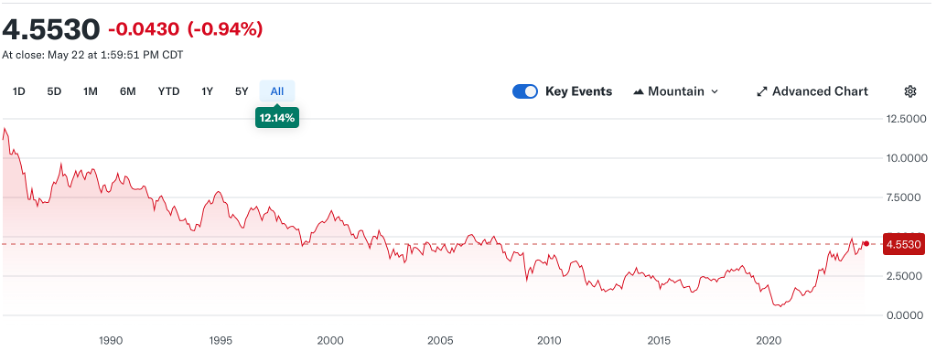
Perspective is an important thing to maintain when looking at markets as it is far too easy to get wrapped up in the short-term blips within a trend and accord them more importance than they’re due.  It is with that in mind that I offer the below chart of the 10-year US Treasury yield for the past 40 years.

Source: finance.yahoo.com

Lately, much has been made of the fact that 10-year yields have risen all the way back to where they were on…January 1st of this year.  But the long history of the bond market is that yields at 4.5% or so, which is their current level, is the norm, not the exception.  As you can see, in fact they were far higher for a long time.  Now, I grant that the amount of debt outstanding is an important piece of the puzzle when analyzing the risk in bonds, and the current situation is significant.  After all, even Moody’s finally figured out that the US’s debt metrics were lousy.  And under no circumstances am I suggesting that the fiscal situation in the US is optimal. 

But I also know that, as I wrote yesterday, the Fed is not going to allow the bond market to collapse no matter their view of President Trump.  Neither is the US going to default on its debt (beyond the slow pain of higher inflation) during any of our lifetimes.  I continue to read that the just-passed ‘Big, Beautiful Bill’ is going to result in deficits of 7% or more for the next decade, at least according to the CBO.  Alas, predicting the future is hard, and no one knows that better than the CBO.  Their track record is less than stellar on both sides of the equation, revenues and expenditures.  This is not to blame them, I’m sure they are doing their best, it is just an impossible task to create an accurate forecast of something with so many moving parts that additionally relies on human responses.

My point is that one needs to look at these forecasts with at least a few grains of salt.  While the current narrative is convinced that deficits are going to blow out and the nation’s finances are going to fall over the edge of the abyss, while the trend is in the wrong direction, my take is the end is a long way off.  In fact, the most likely outcome will be debt monetization around the world, as every government has borrowed more than they are capable of repaying without monetizing the debt.  The real question we need to answer is which nations will be able to do the best job of managing the situation on a relative basis.  And that, my friends, despite everything you read and hear about, is still likely to be the US.  This is not to say that US assets will not fall out of favor for a while relative to their recent behaviors, just that in the long run, no other nation has the resources and capabilities to thrive regardless of the future state of the world.

I guess the one caveat here would be that the entire global framework changes as the fourth turning evolves and old institutions die while new ones are formed.  So, the end of the IMF and World Bank, the end of SDR’s and even organizations like the UN cannot be ruled out.  And I have no idea what will replace them.  Regional accords may become the norm, CBDC’s may become the new money, and AI may run large swaths of both governments and the economy.  But in the end, at least nominally, government debt will be repaid in every G10 nation, of that I am confident.

One of the reasons I have waxed philosophical again is that market activity, despite all the chattering of the punditry, remains pretty dull.  For instance, in the bond market, despite all the talk, Treasury yields, after slipping a few bps yesterday, are unchanged today.  The same is true across Europe, with no sovereign bond having seen yields move by more than 1 basis point in either direction.  JGB’s overnight, despite CPI coming in a tick hotter than forecast, saw yields slip -4bps, following the US market from yesterday.  If the end is nigh, the bond market doesn’t see it yet.

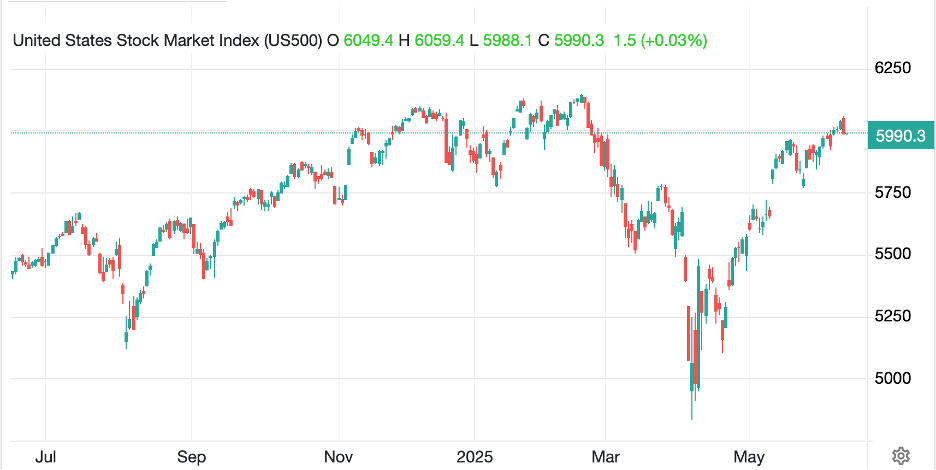
In equities, yesterday’s lackluster session in the US was followed by a lackluster session in Asia (Nikkei +0.5%, CSI 300 -0.8%, Hang Seng +0.25%) with no overall direction and this morning in Europe, the movement has been even less interesting (CAC -0.5%, DAX +0.2%, FTSE 100 0.0%). Too, US futures are little changed at this hour (7:00).

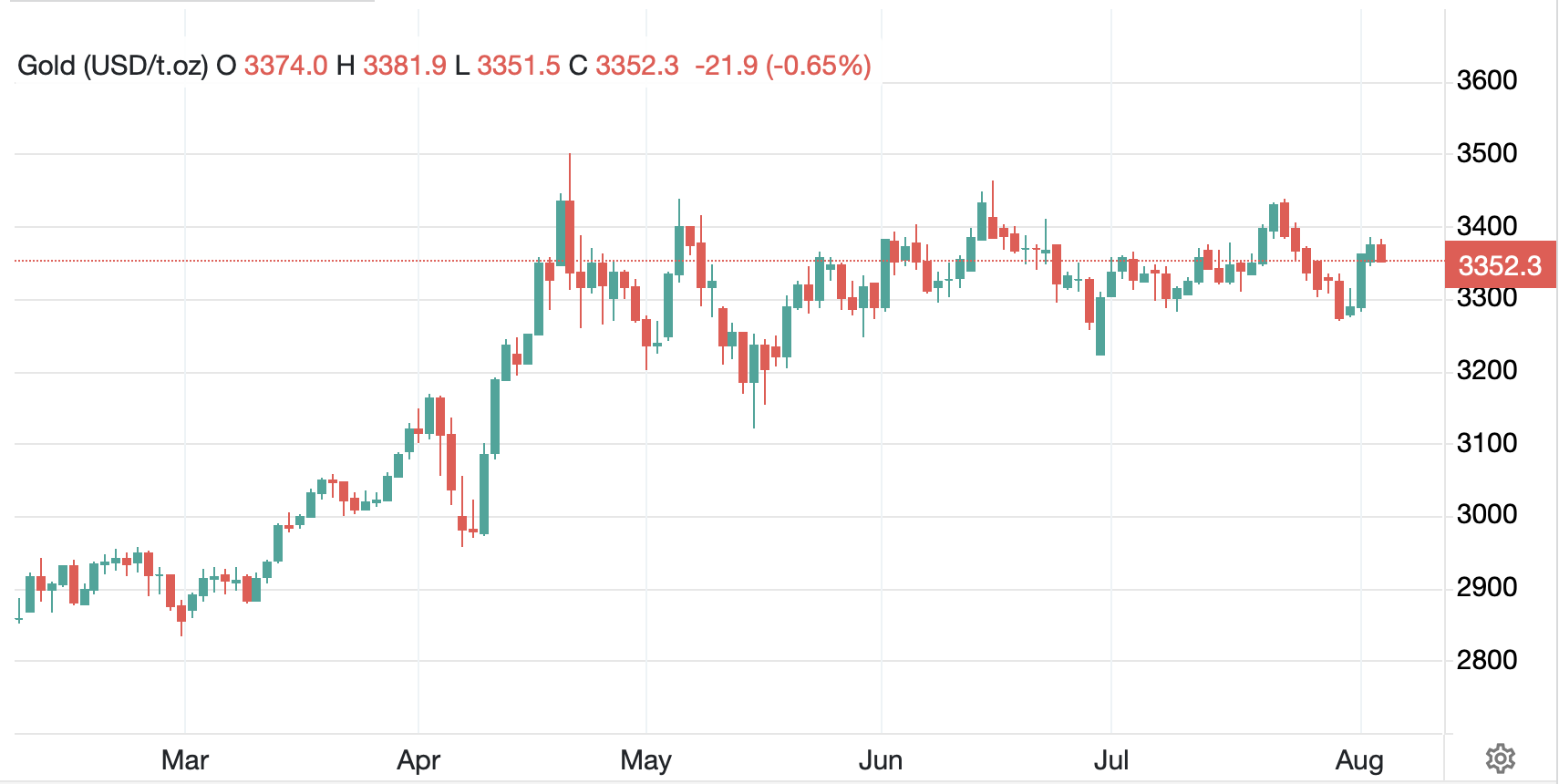
In the commodity markets, gold (+0.9%) continues to chop around within a range that it entered back in early April.

Source: tradingeconomics.com

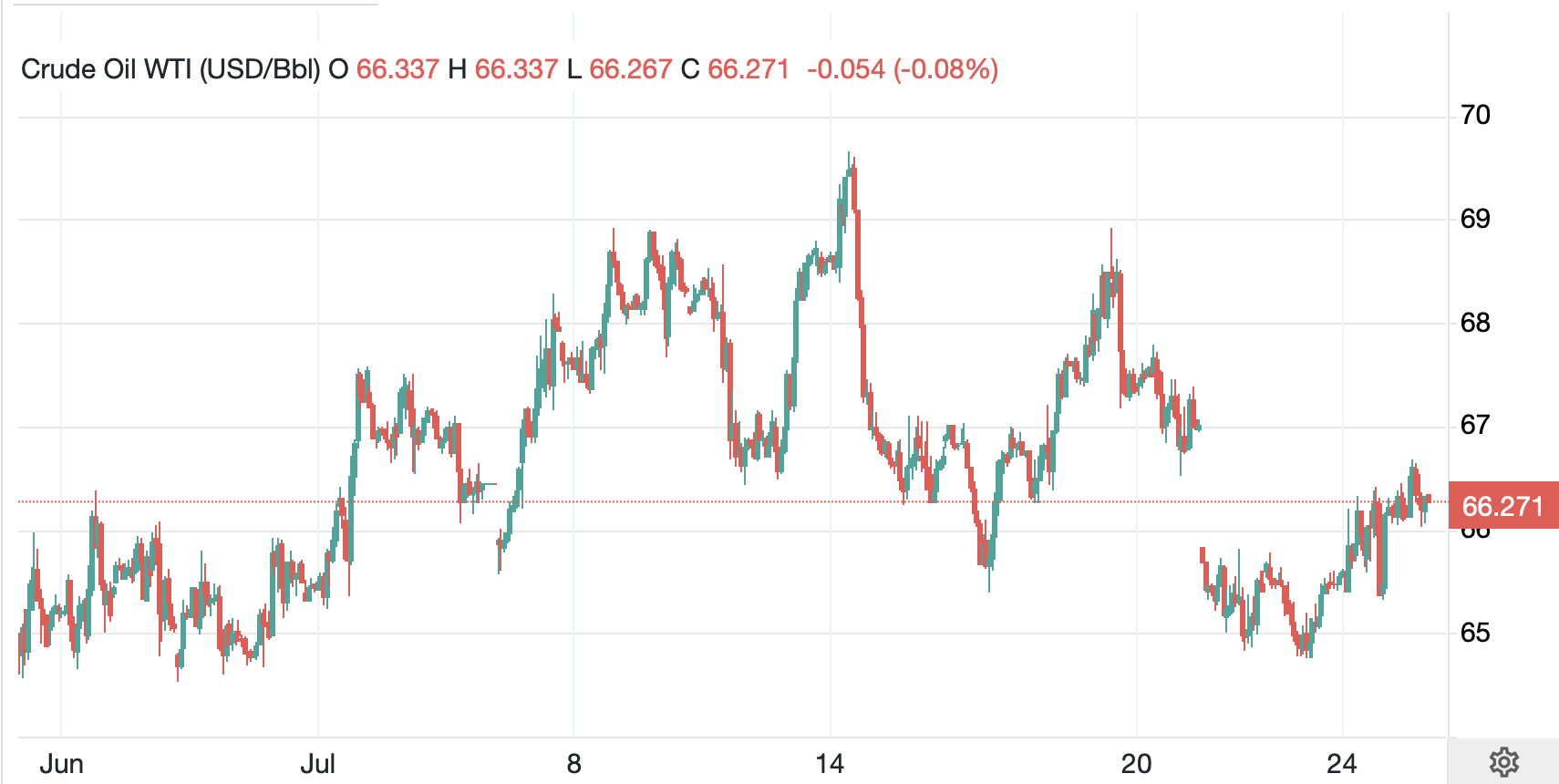
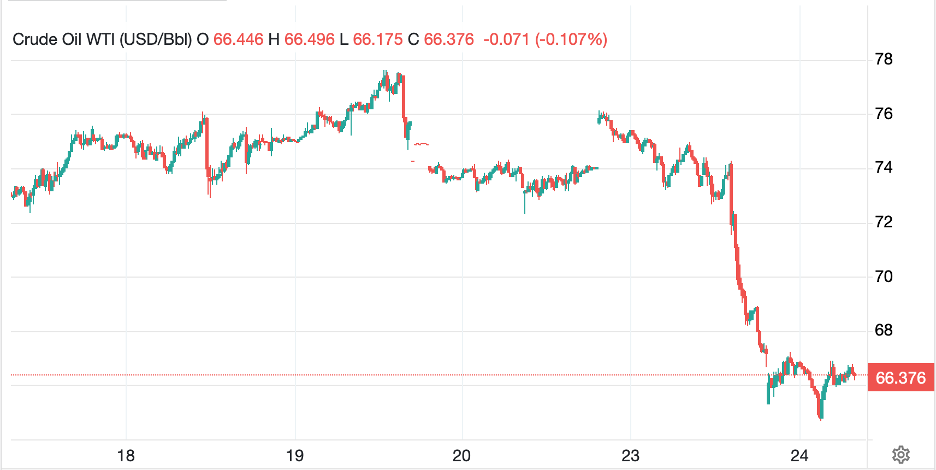
To me, this is the perfect encapsulation of all markets, hovering near recent highs, but unable to find a catalyst to either reject those highs, or leave them behind in a new paradigm.  You won’t be surprised that other metals are also a touch higher this morning (Ag +0.2%, Cu +0.7%), nor that oil (+0.3%) is also edging higher.  It strikes me that today’s commodity profile may be attributed to the dollar’s weakness.

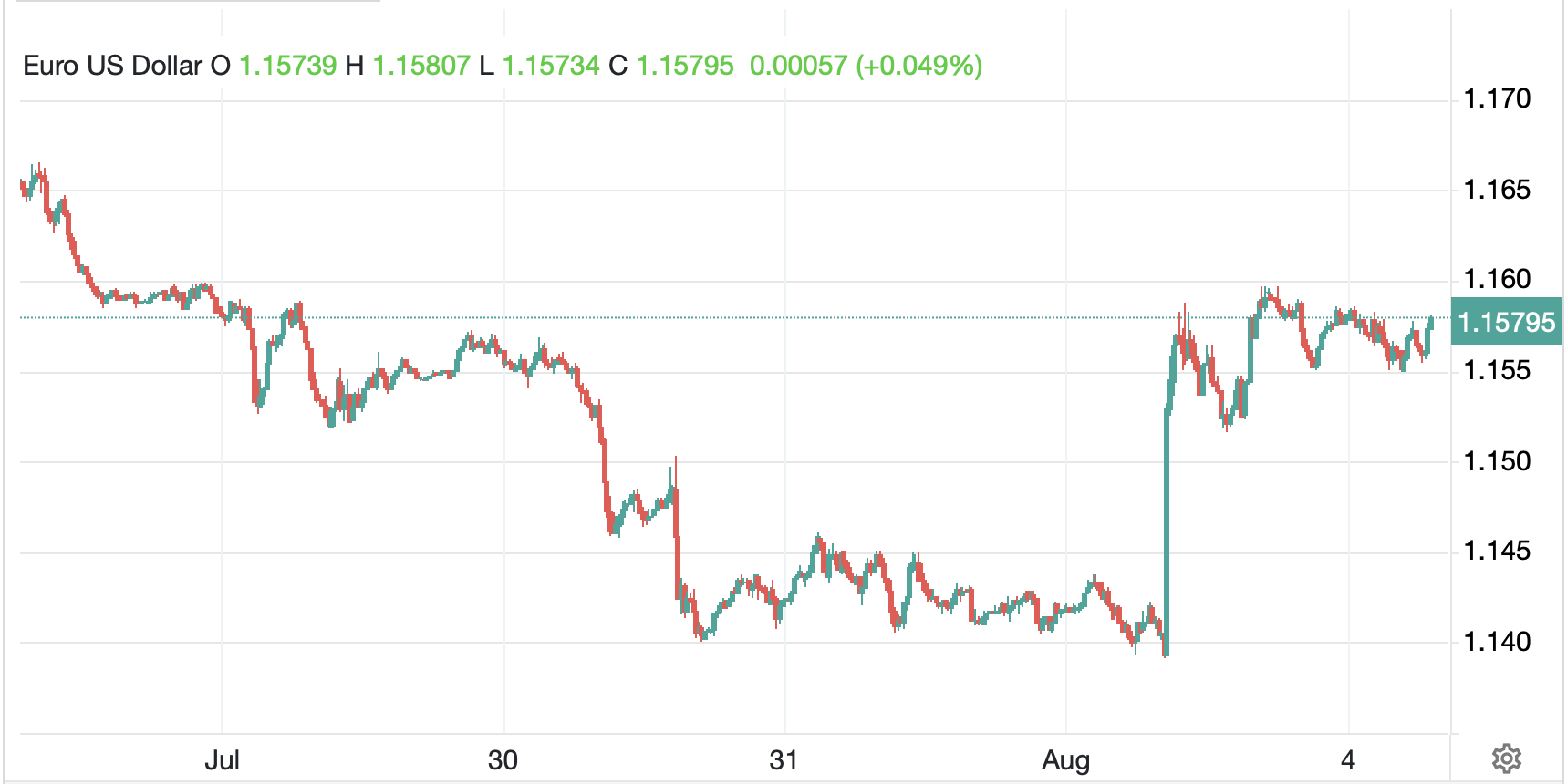
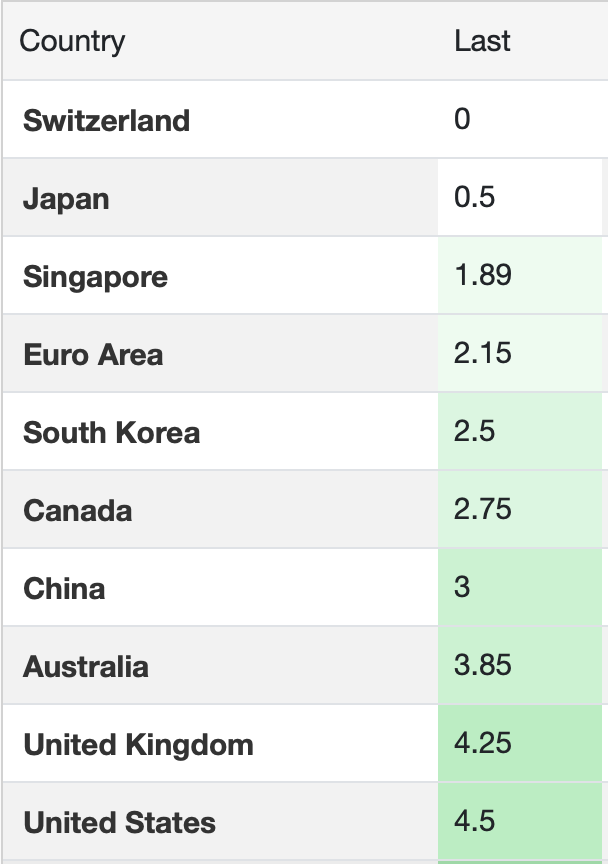
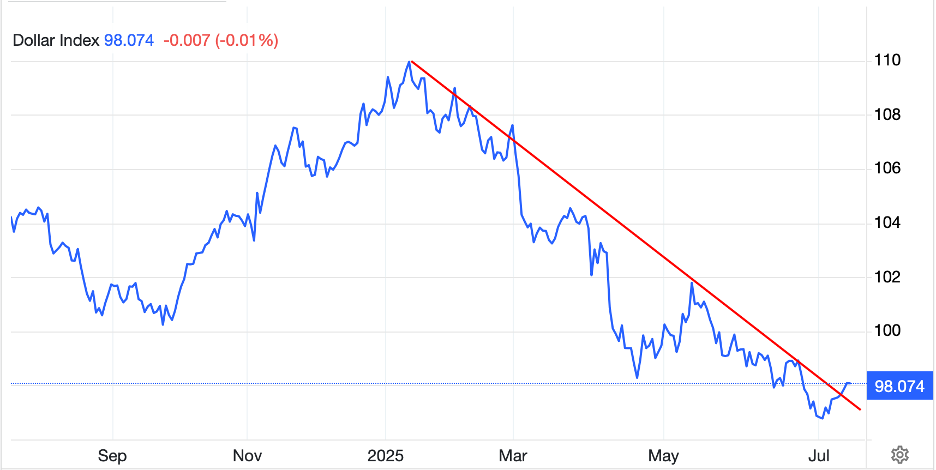
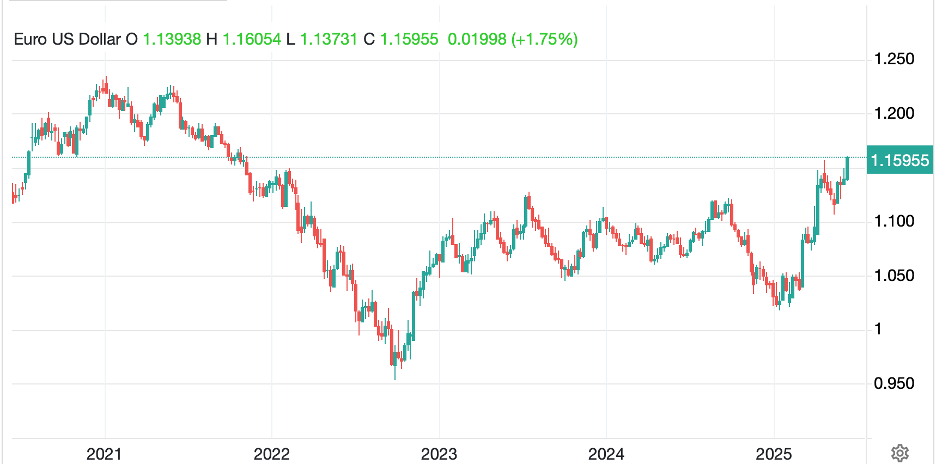
So lastly, turning to the dollar, it is softer against virtually all its major counterparts this morning, with the euro (+0.6%) and pound (+0.6%) both having a good day.  In fact, the pound has touched 1.35 for the first time in three years.  But the dollar’s softness is widespread in both blocks; G10 (AUD +0.85%, NZD +1.0%, SEK +1.0%. NOK +1.0%, JPY +0.5% and even CAD +0.35%), and EMG (ZAR +0.7%, PLN +0.6%, KRW +1.0%, SGD +0.5% and CNY +0.35%).  The fact that SGD moved 0.5% is remarkable given its inherently low volatility.  But I assure you, Secretary Bessent is not upset with this outcome.

The only data this morning is New Home Sales (exp 692K) and we hear from yet another Fed speaker this afternoon, Governor Cook.  Chairman Powell will be speaking on Sunday afternoon, so that may set things up for next week, although with the holiday weekend, whatever he says is likely to be diluted by the time US markets get back to their desks on Tuesday.

In the end, the message is the end is not nigh, markets are adjusting to the changing realities of trade and fiscal policies, and monetary policies remain on a steady state.  The ECB is going to cut again, as will the BOE.  The BOJ is likely to hike again, and the Fed is going to sit on its hands for as long as possible.  The futures market is still pricing in two rate cuts this year, but I still don’t see that happening.  In fact, if the tax bill is enacted, I suspect that it will have a significantly positive impact on the economy, as well as on expectations for the economy, and interest rates are unlikely to fall much at all.  As well, absent a concerted international effort to weaken the dollar (those pesky Mar-a-Lago accords again), while the short-term direction of the dollar is lower, I’m not sure how long that will continue.  

Good luck and have a great holiday weekend

Adf

Heartburned

There’s no one surprised that the Fed
Did nothing, and here’s what Jay said
We’re not in a hurry
To cut, but don’t worry
If things change, we can cut ahead
 
The narrative now has returned
To Trump, which has many concerned
That in the short run
The things that he’s done
Will leave many traders heartburned


As universally expected, the Fed left policy unchanged yesterday.  Everything we had heard from FOMC members prior to the quiet period indicated they had to be patient to see how things played out regarding the impact of tariffs.  Apparently, Chairman Powell used the term “wait” or some version of that idea 22 times in the press conference.  Tomorrow, the Fed speakers hit the circuit again, but absent some change in data, which will take at least another month or two, I don’t see that the Fed is relevant again for a while.  

I will note that the market is currently pricing only about a 17% chance of a cut at the June 18 meeting though they are still pricing in 3 cuts for the year.  It appears that the idea of a H2 recession is gaining ground amongst both the punditry and the futures market.

However, contra to that message, the bigger news of the day is that President Trump will be announcing, at 10am, the first trade deal in the new era, this one with the UK.  It strikes me that this should be the easiest of trade deals to negotiate since both economies produce the same types of things.  Neither has a labor cost advantage, and there is great commonality between them with respect to the overall culture.  Arguably, the biggest advantage the US has is its energy sector has not been destroyed by the government, something PM Starmer is working hard to accomplish on his end.  Realistically, the trade deal here is going to be more about services than goods I suspect, given that’s what drives both economies.  I guess we will learn later today.

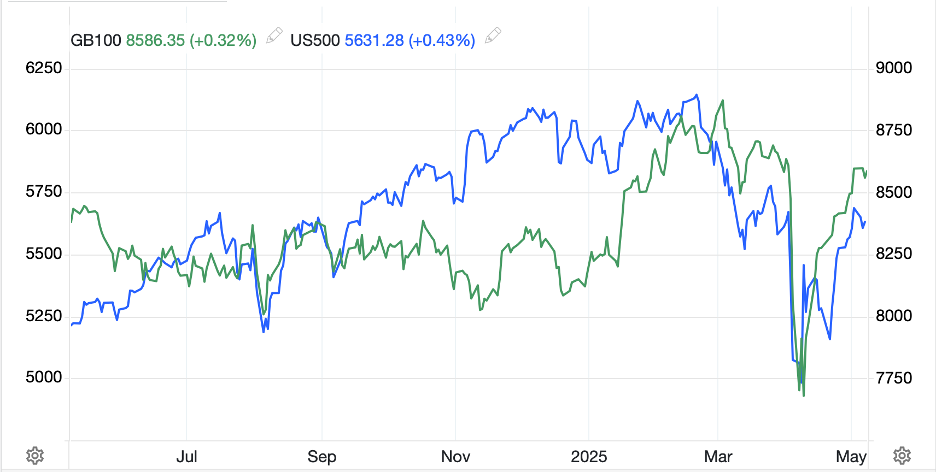
In a modest surprise, UK equities (FTSE 100 +0.4%) do not seem to see the benefits of such a deal, as they lag most of the rest of Europe.  Too, the BOE is expected to cut its base rate by 25bps this morning, which in isolation would ordinarily be seen as a positive for stock markets.  Perhaps, this is why the UK is the first to say yes, things there may be worse than meet the eye.  After all, the stock market there is higher by just 2% in the past year, hardly a breathtaking performance.  In fact, as you can see below, the FTSE 100 and S&P 500 have had very similar performances this year, tracking each other closely, although despite all the angst about recent volatility in US markets, the S&P is still 8% higher in the past year, decently outperforming the UK.

Source: tradingeconomics.com

Stepping back for a moment from individual markets, my take is the following: President Trump is keen to sign a number of key trade deals in this 90-day window.  If they agree deals with the UK, Japan, South Korea, Taiwan, Canada and Mexico, all of which seem quite possible, it will reduce the uncertainty and accompanying stress in markets.  If, as well, Congress can get the ‘big, beautiful budget bill’ passed, thoughts of recession will quickly dissipate.  Obviously, the China trade talks will still be outstanding, but both sides need to find a solution here.  While the punditry in the US will continue to harp on how those tariffs are going to kill the US economy, China has already shown they are having problems and need to come to an agreement.  It is quite possible that Mr Trump can be successful in his aims to reorder the nature of world trade such that the US reduces its deficits without destroying the world.  I think I am going to take the over on this question.

In the meantime, let’s see how markets have behaved overnight.  Yesterday saw US equity markets rally modestly after the Fed and that followed through in Asia, with modest gains being the best description.  The Nikkei (+0.4%), Hang Seng (+0.4%) and CSI 300 (+0.5%) all seemed to benefit from the US and hopes for a reduction in trade anxiety.  Of note in Asia was India (-0.5%) and perhaps more tellingly Pakistan (-6.0%) as the escalation in military conflict between those two nations has grown even hotter.  I expect that market impact will remain more isolated as neither market is a key destination of foreign capital, at least if the actual military conflict doesn’t spread into other areas.

Turning to Europe, both Germany (+1.1%) and France (+1.0%) are having very good days with both markets ostensibly responding to the news of the impending UK trade deal and perhaps some hopes there will be one with the EU.  As well, German IP data was released at a much better level than expected (3.0% vs. 0.8% expected), an indication that companies there are gearing up for all that mooted military spending.  As to US futures, at this hour (7:00) they are all higher by at least 1.0% with the NASDAQ higher by 1.6%.  

In the bond market, Treasury yields are higher by 4bps this morning, having recouped the declines yesterday.  But still, the 10-year hovers either side of 4.30% and has done for the past month as you can see in the chart below.  If anything, it appears that the trend remains toward modestly lower rates.

Source: tradingeconomics.com

In Europe, sovereign yields are also climbing slightly, higher by between 2bps and 3bps this morning and we saw similar movement in JGB markets overnight.  Frankly, bond markets have not been very exciting lately.

In the commodity markets, oil (+1.6%) is continuing its recent bounce from the lows seen Sunday night, but WTI remains below $60/bbl.  There is growing talk that at current prices, capex is going to decline and supply along with that, but you cannot look at what is happening in Guyana, for instance, as they seek to exploit the massive new oilfield discovered in their coastal waters last year and think that oil supply is going to shrink.  As well, OPEC+ looks set to produce all out.  I do not see a good case for higher oil prices in the near term.  Meanwhile, gold (-1.0%) is giving back some of its recent rebound gains, but nothing about the recent price action indicates to me that the bigger picture trend higher is over.  However, today, it is weighing on both silver (-0.2%) and copper (-0.8%).  

As aside about copper.  The red metal has been nicknamed Dr Copper given its importance in industrial activity.  Hence, when demand is strong, it foretells strong economic activity and vice-versa.  With that in mind, what does the below chart of copper tell you about economic activity?

Source: tradingeconomics.com

What it tells me is that this, too, is a former economic signal that had been reliable in the old world view but has lost its way as a signpost of future activity in the new world view.

Finally, the dollar is modestly stronger this morning, most notably vs. the yen (-0.6%) and INR (-0.8%). The latter is clearly suffering on the impacts of some negative military news, having lost several fighter jets and drones, while the former seems to be responding to the story that Mr Trump will not lower tariffs with China ahead of the first meetings that are upcoming this weekend, and that had been demanded requested by the Chinese to start talking.  Too, NZD (-0.6%) is softer but elsewhere, there is far less of interest overall with the euro unchanged and the pound edging higher by 0.25% after the BOE cut rates 25bps, as expected, but the vote was 7-2, with two MPC members voting for no change, a slightly more hawkish outcome than expected.

On the data front, this morning brings the weekly Initial (exp 230K) and Continuing (1890K) Claims data as well as Nonfarm Productivity (-0.7%) and Unit Labor Costs (5.1%).  Yesterday’s EIA oil inventory data showed modest draws, as expected and didn’t seem to matter much to the market.  It is difficult to get too excited about much these days as the landscape remains highly uncertain.  If, and it’s a big if, President Trump can come to agreement on trade deals with a number of countries, I suspect that we will see uncertainty wane and markets continue higher.  But the Fed won’t be cutting rates in that scenario.  Ultimately, though, I do believe that a lower dollar will be part of many of these deals, and for now, a lower dollar still seems the most likely outcome.

Good luck

Adf

Quite Excited

The market is now quite excited
As trade talks have been expedited
With Bessent and He
Now speaking, we’ll see
If buyers last night were farsighted
 
However, do not ignore gold
Whose price is a thing to behold
The past several days
There’s been quite a craze
As sellers now rue what they’ve sold


Source: tradingeconomics.com

I don’t often lead with a chart, but I think it is worthwhile this morning.  I grabbed this picture at 7:00pm last night, shortly after the news hit that Treasury Secretary Bessent and Trade Representative Greer were heading to Switzerland later this week to sit down with He Lifeng, the Chinese Vice Premier and trade negotiator and begin trade talks.  Prior to that announcement, the barbarous relic had rallied more than $200/oz over the past four sessions, a pretty impressive move for something that has maintained a low overall volatility.  The first explanation of the reversal, which coincided with a sharp gain in equity futures (see chart below) is that all the fear of the world ending with corresponding equity weakness and a need to hold gold, has ended!  Hooray!!!

Source: tradingeconomics.com

Alas, just as I never believed the world was ending before, neither do I believe that everything is suddenly better.  Seemingly, this is all part of the process.  The idea that China could simply accept much of the stuff they produce would not be able to find a home in the US was never going to be the case.  I have no idea how things will work out, and they certainly will take a lot of time to come to some agreement, but it is very positive that the dialog has begun.

On the subject of which side blinked, which is a favorite for the punditry, especially those who despise dislike President Trump and believe this shows weakness on his part, I would note that the Chinese are the ones who have recently reported weaker economic data and last night the PBOC cut their 1-week reverse repo rate by 0.1% and reduced their Reserve Requirement Ratio by 50 basis points, both monetary easing measures to address the ongoing weakness in China.  Neither side benefits from this process in the short-term, but we will need to see the results of the talks, which will take many months I presume, before we know if goals have been achieved.

Away from the story on trade
The Fed story must be portrayed
Alas, it’s quite dull
As Jay and friends mull
The idea rate cuts be delayed

The only other story of note today is the FOMC meeting where they will release their policy statement at 2:00 this afternoon revealing no change in policy, and very likely almost no change in the wording, and then Chairman Powell will face the press at 2:30.  However, given the low probability of any changes, and given nothing regarding trade policy has really changed since they entered their quiet period, it seems unlikely that we will learn anything of consequence from Powell.  Today will be a complete non-event.

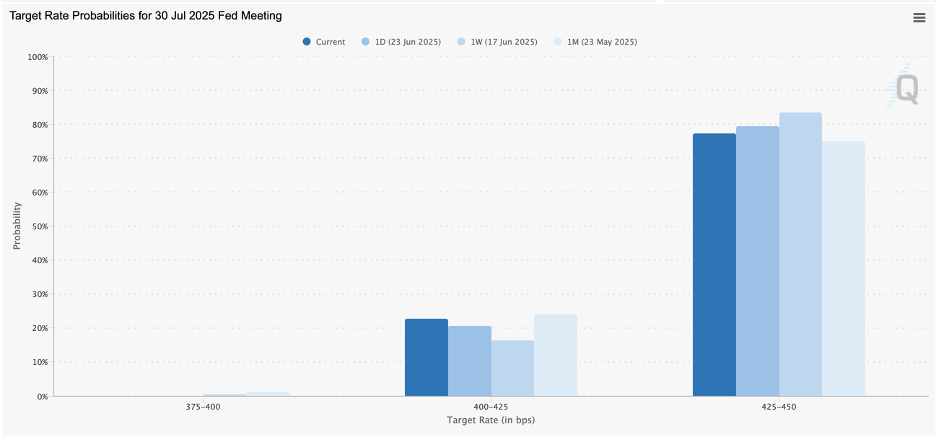
However, I cannot help but consider why the futures market appears so convinced that there are going to be rate cuts going forward this year.  As of this morning, the Fed funds futures are pricing a total of 78 basis points of cuts for the rest of this year, so three 25bp cuts as per the below chart from the CME.

Certainly, the data released thus far this year have not indicated the economy is heading into a tailspin.  Of course, there are many analysts calling for a recession to start in Q2 or Q3 as the tariff impacts ostensibly undermine the economy.  It is important to note, however, that these are the same analysts who have been calling for a recession for the past three years.  The boldest calls are for a period of stagflation, with the tariffs simultaneously killing growth and raising prices.

It is entirely possible that we see a recession this year, especially if government spending decreases given its role in supporting recent growth data.  (According to the BEA, Federal government spending in Q1 declined -5.1% while investment in the economy expanded more than 2%.). If this is the path forward, the long-term benefits will be substantial, but they must be maintained.  As well, if this is the path forward, total economic activity in the US will expand substantially and it is not clear that rate cuts will need to be part of that mix. 

Regardless, it seems that today’s activity is less likely to be impacted by the Fed than by any random headlines regarding trade or other administration maneuvers.  So, let’s see how markets have responded to the US-China trade talk news.

The China news came long after the close yesterday so the US markets closed lower on the session, approaching 1% declines, but US futures are currently higher by around 0.7% at 7:15.  In Asia, however, we did see some modest gains although the Nikkei (-0.15%) faded a bit, both China (0.6%) and Hong Kong (+0.15%) managed to rally.  As to the rest of the region, most markets were modestly higher although in a seeming sympathy move on the China news.  In Europe, bourses are softer this morning with the CAC (-0.7%) leading the way and other key indices falling less.  The data releases show Construction PMI softening on the continent as well as weak Eurozone Retail Sales (-0.1%), so I imagine that is weighing on investors’ minds today.

In the bond market, Treasury yields are 2bps firmer this morning but have been trading either side of 4.30% for the past several sessions as traders try to estimate the next big thing.  I see just as many stories about how yields are going to 10% as I do about how they are headed to 2% amid the depression coming, so my take is, we are going to range trade for a while yet.  In Europe, sovereign yields are lower by between -3bps (Germany) and -5bps (Italy) as that softer data is encouraging investors to believe that inflation will continue to decline and the ECB will cut further.

The commodity market has been where the real action is of late with oil (+0.9% today after +2.0% yesterday) rising after comments by two US oil companies that they will not be drilling any more if oil prices stay at these levels.  What I don’t understand is, what will they be doing as they are oil companies?  At any rate, this will be the tension in markets, who can afford to drill and sell oil at lower prices.  I expect we will hear from companies and pundits on both sides of this equation.  I discussed gold above, which has bounced slightly from its lowest levels overnight and I don’t believe anything will derail this train for a while yet.  However, both silver (-0.75%) and copper (-2.6%) are softer this morning, partly based on gold’s slide and partly on the weaker economy story.

Finally, the dollar is modestly firmer this morning, at least against its G10 counterparts with JPY (-0.6%) the weakest of the bunch, followed by SEK (-0.5%) and AUD (-0.3%).  The euro and pound are little changed and NOK (+0.15%) has gained on the back of oil’s strength.  In the EMG block, KRW (-1.1%) and TWD (-1.1%) have both rebounded some from their recent highs (dollar lows) in what seems more like a trading reaction than a change in policies.  Elsewhere in this bloc, though, MXN (+0.2%) is a touch stronger while ZAR (-0.5%) is a touch weaker and CNY is little changed.  There is a story making the rounds today that a well-known currency analyst, Steven Jen, is claiming that there could be as much as $2.5 trillion of excess currency reserves held by Asian nations that they may no longer need.  If this is true and these reserves were sold quickly, it would certainly drive the dollar much lower.  However, it strikes me that given the enormous amount of USD debt that has been issued by Asian companies and countries, and given these countries do not have access to Fed swap lines in emergencies, there is no reason to sell the dollars.  Rather they will simply have a ready supply without having to chase them when repayment and rollovers come due.  I would take this story with a large grain of salt.

Other than the Fed, we see EIA oil inventory data where some drawdowns are anticipated and that is really the day.  We are all awaiting the trade negotiation outcomes and I would say nobody has an inside track there.  Bigger picture, though, I do think the dollar has further to slide.

Good luck

Adf

Not Persuaded

As tariff concerns are digested
By markets, Chair Powell’s been tested
Is cutting the move
They need to improve?
Or are they, to tightness, still vested
 
It sounds as though he’s not persuaded
A rate cut will soon be paraded
But markets still price
He’ll be cutting thrice
It could be that view should be fade


Perusing the WSJ this morning, I stumbled across the following article, “What the Weak Dollar Means for the Global Economy” and couldn’t help but chuckle.  It was not that long ago when the punditry was complaining about the strong dollar as a problem for the global economy.  The current thesis is that the weakening dollar will make foreign exports to the US more expensive, on top of the tariffs, and will reduce the number of US tourists traveling abroad.  Foreign companies will also suffer as they translate their US sales into their respective local currencies, negatively impacting their earnings.  A moment as I shed a tear.

Of course, when the dollar was strong, the concern for the global economy was that it was increasingly expensive in local currency terms to obtain the dollars necessary to service the massive amounts of USD debt that foreign companies and nations have issued, thus reducing their ability to spend money on other things to drive their domestic economy.

As they say, you can’t have it both ways.  While there is no doubt the dollar’s decline this year has been swift, it is important to remember we are nowhere near an extremely weak dollar.  As you can see from the below chart, the euro was trading near 1.60 back in 2008 and as high as 1.38 even in 2014.  When looking at today’s price of 1.1375, it is hard to feel overly concerned.

Source: finance.yahoo.com

As it happens, this morning the single currency has slipped back -0.3% from yesterday’s levels.  The dollar’s future remains highly uncertain given the potential policy changes that may unfold as the tariff situation becomes clearer.  Which leads us to the Fed.

For the first time in many weeks, the Fed became a topic of conversation for the market when Chairman Powell spoke to the Economic Club of Chicago.  “Our obligation is to keep longer-term inflation expectations well anchored and to make certain that a one-time increase in the price level does not become an ongoing inflation problem,” Powell explained.  “We may find ourselves in the challenging scenario in which our dual-mandate goals are in tension. If that were to occur, we would consider how far the economy is from each goal, and the potentially different time horizons over which those respective gaps would be anticipated to close.”  

Let me start by saying, the Fed’s track record in anticipating economic outcomes is not stellar.  Equity markets were not encouraged by these comments and sold off during the discussion, although they retraced some of those losses before the end of the session.  At the same time, the Fed funds futures market, while having reduced the probability of a rate cut next month to just 15%, continues to price 88bps of cuts into the market by the December meeting.  Assuming there is no cut in May, that leaves five meetings for between three and four cuts.  Based on Powell’s comments, that seems like aggressive market pricing.

It appears that there is a growing belief that a recession is on its way and that will both reduce inflationary pressures and force allow the Fed to start to reduce rates further.  Of course, there are those, Powell included, who seem to believe that stagflation is a strong possibility.  If that were the case, especially given Powell’s new-found belief that price stability matters, and his clear distaste for the president, my sense is they will focus on inflation not growth if financial conditions (aka bond markets) remain in good shape.  Will the dollar continue to decline under that scenario?  That is a very tough call as a US recession would almost certainly spread globally, and other central banks will likely ease policy.  If the Fed stands pat amidst a global reduction in interest rates, I don’t see the dollar declining.  If for no other reason, the cost of carrying short dollar positions would become too prohibitive.

As usual, the future remains quite cloudy.  Cases can be made for Fed cuts, and against them.  Cases can be made for dollar weakness and dollar strength.  Arguably, the biggest unknown is how the trade talks are going to resolve.  Yesterday, President Trump explained that “big progress” has been made on the Japanese tariff talks.  If Trump is successful in creating a coalition of nations that have closer trade relations with lower tariffs, I expect that would be taken quite positively by the markets.  On the other hand, if those talks fall apart, I expect equity markets to start the next leg lower, and that is a global phenomenon, while the dollar sinks further.  There is much yet to come.

Ok, let’s see how things played out overnight.  After yesterday’s US rout, Trump’s comments on trade talks with Japan clearly helped the market there as the Nikkei (+1.35%) rallied nicely as did the Hang Seng (+1.6%).  In fact, gains were widespread with Korea, India and Australia, to name three, all rising nicely.  Alas, Chinese shares did not participate, and Taiwan actually slipped a bit.  In Europe, investors await the ECB’s outcome this morning, where a 25bp cut is the median forecast, but there are those hinting at a 50bp cut to help moderate strength in the euro as well as support the economy given the tariff situation.  Remember, we have heard from a number of ECB members that they are confident inflation is heading back to their target.  Ahead of the news, shares are softer across the board with declines on the order of -0.5% to -0.8% throughout the continent and the UK.  Remember, too, their tariff talks are after Japan.  Interestingly, US futures are mixed with DJIA (-1.3%) the laggard while the other two are both higher about 0.5%.  It seems United Health shares have fallen enough to take the DJIA down with it.

In the bond market, Treasury yields have regained the 3bps they fell during yesterday’s US session, so are unchanged over two days.  We have also seen European sovereign yields climb between 2bps and 4bps, rising alongside Treasuries and JGB yields jumped 5bps, responding to confidence that the US-Japan trade dialog will be successful and support Japanese risk.

Despite all the reasons for oil to decline, including recession fears and continued pumping by pariahs like Iran and Venezuela, the black sticky stuff is higher by 1.1% this morning, its highest level in two weeks.  But as you can see in the chart below, there remains a huge gap to be filled more than $8/bbl higher than current prices.  It is difficult to see a significant rally on the horizon absent a major change in the supply situation.

Source: tradingeconomics.com

As to the metals markets, gold (-0.6%) blasted higher to another new high yesterday, above $3300/oz, and while it is backing off a bit today, shows no signs of stopping for now.  Both silver and copper rallied yesterday as well, and both are also falling back this morning (Ag -1.4%, Cu -2.1%).

Finally, the dollar is modestly firmer across the board this morning, with the DXY seeming to find 99.50 as a key trading pivot level.  In the G10, JPY (-0.45%) is the laggard along with CHF (-0.4%) while other currencies in the bloc have fallen around -0.2%.  The exception here is NOK (+0.3%) as it benefits from oil’s rebound.  In the EMG bloc, the dollar is mostly firmer, but most of the movement has been of the 0.3% variety, so especially given the overall decline in the dollar, this looks an awful lot like position adjustments ahead of the long weekend with no new trend to discern.

On the data front, yesterday’s Retail Sales was stronger than expected, and not just goods that were bought ahead of tariffs, but also services and dining out, which would seem less impacted.  This morning, we see a bunch of stuff as follows: Housing Starts (exp 1.42M), Building Permits (1.45M), Philly Fed (2.0), Initial Claims (225K) and Continuing Claims (1870K).  As long as the employment data continues to hold up, my take is the Fed will sit on the sidelines.  If that is the case, I sense we have found a new range for the dollar, 99/101 in the DXY and we will need a headline of note to break that.

As tomorrow is Good Friday and markets are essentially closed throughout Europe, as well as US exchanges, there will be no poetry.

Good luck and good weekend

Adf

Eyes Like a Bat

The new Mr Yen
Is watching for excess moves
With eyes like a bat


While every day of this Trump presidency is filled with remarkable activity at the US government level, financial markets are starting to tune out the noise.  Yes, each pronouncement may well be important to some part of the market structure, but the sheer volume of activity is overwhelming investment views.  The result is that while markets are still trading, there seem to be fewer specific drivers of activity.  Consider the fact that tariffs have been on everyone’s mind since Trump’s inauguration, but nobody, yet, has any idea how they will impact the global macro situation.  Are they inflationary?  Will sellers reduce margins?  Will there be a strong backlash by the US consumer?  None of this is known and so trading the commentary is virtually impossible.

With that in mind, it is worth turning our attention this morning to Japan, where the yen (-0.4%) has been steadily climbing in value, although not this morning, since the beginning of the year as you can see from the chart below.

Source: tradingeconomics.com

Amongst G10 currencies, the yen is the top performer thus far year-to-date, rising about 5%.  Arguably, the key driver here has been the ongoing narrative that the BOJ is going to continue to tighten monetary policy while the Fed, as discussed yesterday, is still assumed to be cutting rates later in the year.  

Let’s consider both sides of that equation.  Starting with the Fed, just yesterday Atlanta Fed president Bostic explained to a housing conference, “we need to stay where we are.  We need to be in a restrictive posture.”  Now, I cannot believe the folks at the conference were thrilled with that message as the housing market has been desperate for lower rates amid slowing sales and building activity.  But back to the FX perspective, what if the Fed is not going to cut this year?  It strikes me that will have an impact on the narrative, and by extension, on market pricing.

Meanwhile, Atsushi Mimura, the vice finance minister for international affairs (a position known colloquially to the market as Mr Yen) explained, when asked about the current market narrative regarding the BOJ’s recent comments and their impact on the yen, said, “there is no gap with my view.  Amid high uncertainty, we have to keep watching the impact of any speculative trading on, not only the exchange market, but also financial markets overall.”  

If I were to try to describe the current market narrative on the yen, it would be that further yen strength is likely based on the assumed future narrowing of interest rate differentials between the US and Japan.  That has been reinforced by Ueda-san’s comments that they expect to continue to ‘normalize’ policy rates, i.e. raise them, if the economy continues to perform well and if inflation remains stably at or above their 2% target.  With that in mind, a look at the below chart of Japanese core inflation shows that it has been above 2.0% since April 2022.  That seems pretty stable to me, but then I am just a poet.

Source: tradingecomnomics.com

Adding it all up, I feel far better about the Japanese continuing to slowly tighten monetary policy as they have a solid macro backdrop with inflation clearly too high and looking like it may be trending a bit higher.  However, the other side of the equation is far more suspect, as while the market is pricing in rate cuts this year, recent Fed commentary continues to maintain that the current level of rates is necessary to wring the last drops of inflation out of the economy.

There is a caveat to this, though, and that is the gathering concern that the US economy is getting set to fall off a cliff.  While that may be a bit hyperbolic, I do continue to read pundits who are making the case that the data is starting to slip and if the Fed is not going to be cutting rates, things could get worse.  In fairness to that viewpoint, the Citi Surprise Index is pointing lower and has been declining since the beginning of December, meaning that the data releases in the US have underperformed expectations for the past two months. (see below)

Source: cbonds.com

However, a look at the Atlanta Fed’s GDPNow estimate shows that Q1 is still on track for growth of 2.3%, not gangbusters, but still quite solid and a long way from recession.  I think we will need to see substantially weaker data than we have to date to get the Fed to change their wait-and-see mode, and remember, employment is a lagging indicator, so waiting for that to rise will take even longer.  For now, I think marginal further yen strength is the most likely outcome as we will need a big change in the US to alter current Fed policy.

Ok, let’s see how markets have behaved overnight.  Yesterday saw a reversal of recent US equity performance with the DJIA slipping while the NASDAQ rallied, although neither moved that far.  In Asia, the Nikkei (+0.3%) edged higher as did the CSI 300 (+0.2%) although the Hang Seng (-0.3%) gave back a small portion of yesterday’s outsized gains.  The rest of the region, though, was under more significant pressure with Korea, Taiwan, Indonesia and Thailand all seeing their main indices decline by more than -1.0%.  In Europe, red is the most common color on the screen with one exception, the UK (+0.35%) where there is talk of resurrecting free trade talks between the US and UK.  But otherwise, weakness is the theme amid mediocre secondary data and growing concern over US tariffs.  Finally, US futures are nicely higher this morning after Nvidia’s earnings were quite solid.

In the bond market, Treasury yields (+4bps) have backed up off their recent lows but remain in their recent downtrend.  Traders keep trying to ascertain the impacts of Trump’s policies and whether DOGE will be able to find substantial budget cuts or not with opinions on both sides of the debate widely espoused.  European sovereign yields have edged higher this morning, up 2bps pretty much across the board, arguably responding to the growing recognition that Europe will be issuing far more debt going forward to fund their own defensive needs.  And JGB yields (+4bps) rose after the commentary above.

In the commodity markets, oil (+1.1%) is bouncing after a multi-day decline although it remains below that $70/bbl level.  The latest news is that Trump is reversing his stance on Venezuela as the nation refuses to take back its criminal aliens.  Meanwhile, gold (-1.1%) is in the midst of its first serious correction in the past two months, down a bit more than 2% from its recent highs, and trading quite poorly.  There continue to be questions regarding tariffs and whether gold imports will be subject to them, as well as the ongoing arbitrage story between NY and London markets.  However, the underlying driver of the barbarous relic remains a growing concern over increased riskiness in markets and rising inflation amid the ongoing deglobalization we are observing.

Finally, the dollar is modestly firmer overall vs. its G10 counterparts, with the yen decline the biggest in the bloc.  However, we are seeing EMG currency weakness with most of the major currencies in this bloc lower by -0.3% to -0.5% on the session.  In this case, I think the growing understanding that the Fed is not cutting rates soon, as well as concerns over tariff implementation, is going to keep pressure on this entire group of currencies.

On the data front, we see the weekly Initial (exp 221K) and Continuing (1870K) Claims as well as Durable Goods (2.0%, 0.3% ex Transport) and finally the second look at Q4 GDP (2.3%) along with the Real Consumer Spending piece (4.2%).  Four Fed speakers are on the calendar, Barr, Bostic, Hammack and Harker, but again, as we heard from Mr Bostic above, they seem pretty comfortable watching and waiting for now.

While I continue to believe the yen will grind slowly higher, the rest of the currency world seems likely to have a much tougher time unless we see something like a Mar-a Lago Accord designed to weaken the dollar overall.  Absent that, it is hard to see organic weakness of any magnitude, although that doesn’t mean the dollar will rise.  We could simply chop around on headlines until the next important shift in policy is evident.

Good luck

Adf

A Fifth Wheel

Confusion is clearly what reigns
As even the punditry strains
To understand whether
Investors will tether
Their future to stocks or take gains


As there was no activity in the US financial markets yesterday, it seems there was time for analysts to consider the current situation and make pronouncements as to investor behavior.  Ironically, we saw completely opposite conclusions from two major players.  On the one hand, BofA posted the following chart showing that investors’ cash holdings are at 15-year lows, implying they remain fully invested and quite bullish.

Meanwhile, the WSJ this morning has a lead article on how bearish investors are, claiming they are the most bearish since November 2023 according to the American Association of Individual Investors.  Apparently, 47.3% of investors surveyed believe stock prices will fall over the next 6 months.

So, which is it?  Are investors bullish or bearish?  To me this is a perfect description of the current situation.  Everyone is overloaded with information, much of which is contradictory, and so having a coherent view has become extremely difficult.  This is part and parcel of my view that the only thing we can clearly expect going forward is an increase in volatility.  In fact, someone said that Donald Trump is the avatar of volatility, and I think that is such an apt description.  Wherever he goes, mayhem follows.  Now, I also believe that people knew what they were voting for as change was in demand.  But for those of us who pay close attention to financial markets, it will take quite the effort to keep up with all the twists and turns.

Fed speakers are starting to feel
Like they have become a fifth wheel
So, let’s get prepared
For Fed speaking squared
As they work, their views, to reveal

Away from the conundrum above, the other noteworthy thing is that FOMC members are starting to feel left out of the conversation.  Prior to President Trump’s inauguration, market practitioners hung on their every word, and they apparently loved the power that came with that setting.  However, now virtually every story is about the President and his policies with monetary policy falling to a distant issue on almost all scorecards.  Clearly, for a group that had grown accustomed to moving markets with their words, this situation has been deemed unacceptable.  The solution, naturally, is to speak even more frequently, and I fear believe this is what we are going to see (or hear) going forward.  

Yesterday was a perfect example, where not only, on a holiday, did we have multiple speakers, but they actually proffered different messages.  From the hawkish side of the spectrum, Governor Michelle Bowman, the lone dissenter to the initial 50bp rate cut back in September, explained caution was the watchword when it comes to acting alongside President Trump’s mooted tariff and other policies, “It will be very important to have a better sense of these policies, how they will be implemented, and establish greater confidence about how the economy will respond in the coming weeks and months.”  That does not sound like someone ready to cut rates anytime soon.

Interestingly, from the dovish side of the spectrum, Governor Christopher Waller, an erstwhile hawk, explained in a speech in Australia (on the day the RBA cut rates by 25bps for their first cut of the cycle and ending an 18 month period of stable rates) that, “If this wintertime lull in progress [on inflation] is temporary, as it was last year, then further policy easing will be appropriate.”  I find it quite interesting that Governor Waller suddenly sounds so dovish as many had ascribed to him the intellectual heft amongst the governors.  This is especially so given that is not the message that Chairman Powell articulated either after the last meeting or at his Humphrey-Hawkins testimony recently.  

So, which is it?  Is the Fed staying hawkish or are they set for a turn?  That will be the crux of many decision-making processes going forward, not just in markets but also in businesses.  We will keep tabs going forward.

Ok, on to the market’s overnight performances.  Lacking a US equity market to follow, everybody was on their own last night which showed with the mixed results.  Japan (+0.25%) showed modest gains while the Hang Seng (+1.6%) rocketed higher on the belief that President Xi is going to be helping the economy, notably the tech firms in China, many of which are listed in Hong Kong.  Alas, the CSI 300 (-0.9%) didn’t get that memo with investors apparently still concerned over the Trump tariff situation.  Elsewhere in the region, Korea and Taiwan rallied while Australia lagged despite the rate cut.  In Europe, unchanged is the story of the day with most bourses just +/-0.1% different than yesterday’s close.  Right now, in Europe, the politicians are trying to figure out how to respond to the recent indication that the US is far less interested in Europe than in the past, and not paying close attention to financial issues.  As to the US, futures at this hour (7:25) are pointing higher with the NASDAQ leading the way, +0.5%.

In the bond market, yields are climbing led by Treasuries (+4bps) with most of Europe seeing yields edge higher by 1bp or 2bps as well.  Remember, yesterday European sovereign yields rose smartly across the board.  Also, I must note JGB yields (+4bps) which have made further new highs for the move and continue to rise.  It appears last night’s catalyst was a former BOJ member, Hiroshi Nakaso, explained he felt more rate hikes were coming with the terminal rate likely to be well above 1.0%.  While I believe the Fed will be cautious going forward, I still think they are focused on rate cuts for now.  With that in mind and the ongoing change in Japanese policy, I am increasingly comfortable with my new stance on the yen.

In the commodity markets, last Friday’s sell-off in the metals markets is just a bad memory with gold (+0.5%) rallying again and up more than 1% since Friday’s close.  I continue to believe those moves were positional and not fundamental.  Too, we are seeing gains in silver (+0.2%) and copper (+0.6%) to complete the triad.  Meanwhile, oil (-0.25%) continues to lag, holding above its recent lows but having a great deal of difficulty finding any buying impulse.  Whether that is due to a potential peace in Ukraine and the end of sanctions on Russian oil, or concerns over demand growth going forward is not clear to me, but the trend, as seen in the chart below, is clearly downward and has been so for the past year.

Source: tradingeconomics.com

Finally, in the FX markets, the dollar is firmer this morning rising against all its G10 counterparts with NZD (-0.6%) the laggard.  But losses of -0.2% are the norm this morning.  In the EMG bloc, we are seeing similar price behavior in most markets although MXN (+0.2%) is bucking the trend, seemingly benefitting from what appears to be a hawkish stance by Banxico and the still highly elevated interest rate differential in the peso’s favor.

On the data front, Empire State Manufacturing (exp -1.0) is the only data point although we will hear from two more Fed speakers, Daly and Barr.  I cannot believe that they have really changed their tune and expect that caution will remain their guiding principle for now, although I expect to hear that repeated ad nauseum as they try to regain their place in the spotlight.

Aside from my yen view, I still find it hard to be excited about many other currencies for now.  There is still no indication the Fed is going to move anytime soon, and other central banks are clearly in easing mode.  That bodes well for the dollar going forward.

Good luck

Adf

Positioning’s Fraught

The wonderful thing about Trump
Is traders no longer can pump
A market so high
That it can defy
Reality ere it goes bump
 
Since policies can change so fast
A long-term view just cannot last
So, Fed put or not
Positioning’s fraught
And larger ones won’t be amassed


As we await the NFP report this morning, I couldn’t help but ponder the uptick in complaints and concerns by traders that increased volatility in markets on the back of President Trump’s mercurial announcements has changed the trading game dramatically.  Let me say up front that I think this is a much healthier place to be and explain why.

Pretty much since the GFC and, more importantly, then Chairman Bernanke’s first utilization of QE and forward guidance, the nature of financial markets had evolved into hugely leveraged one-sided views based on whatever the Fed was guiding.  So, the initial idea behind QE and forward guidance was to assure all the traders and investors that make up the market that even though interest rates reached 0.0%, the Fed would continue to ease policy and would do so for as far out in time as you can imagine.  Lower for longer became the mantra and every time there was a hiccup in the market, the Fed rushed in, added yet more liquidity to calm things down, and put the market back on track for further gains.  This was true for both stocks and bonds, despite the fact that the Fed has no business or mandate involving the equity market.

This activity led to the ever-increasing size of trading firms as leverage was cheap and steadily rising securities prices led to lower volatility, both implied and real, in the markets.  Risk managers were comfortable allowing these positions to grow as the calculated risks were minimized by the low vol.  In fact, entire trading strategies were developed to take advantage of the situation with Risk Parity being a favorite.  

However, a negative result of these actions by the Fed was that investors no longer considered the fundamentals or macroeconomics behind an investment, only the Fed’s stance.  The only way to outperform was to take on more leverage than your competitors, and that was great while rates stayed at 0.0%.  Alas, this persisted for so long that many, if not most, traders who learned the business prior to the GFC wound up retiring or leaving the market, and the next generation of traders and investors lived by two credos, number go up and BTFD.

The Fed remained complicit in this process as FOMC members evolved from background players to a constant presence in our daily lives, virtually preening on screens and in front of audiences and reiterating the Fed’s views of what they were going to do, implicitly telling traders that taking large, leveraged bets would be fine because the Fed had their back.

Of course, the pandemic upset that apple cart as the combination of Fed and government response imbued the economy with significantly more inflation than expected and forced the Fed to change their tune.  The market was not prepared for that, hence the outcome in 2022 when both stocks and bonds fell sharply.  But the Fed would not be denied and calmed things down and created a coherent enough message so that markets recovered the past two years.  This has, naturally, led to increased position sizing and more leverage because that’s what this generation of traders understands and has worked.

Enter Donald J Trump as president, elected on a populist manifesto and despite his personal wealth, seemingly focused on Main Street, not Wall Street.  The thing about President Trump is if an idea he proffers doesn’t work, he will drop it in a heartbeat and move on.  As well, by wielding the full power of the United States when dealing in international situations, other nations can quickly find themselves in a difficult spot and, so far, have been willing to bend their knee.  As well, his focus on tariffs as a primary weapon, with little regard for the impact on markets, and the way with which he uses them, threatening to impose them, and holding off at the last minute when other nations alter their policy, has kept markets off-balance.

The result is large leveraged positions are very difficult to hold and manage when markets can move up and down 2% in a day, every day (like the NASDAQ 100 chart below), depending on the headlines.  

Source: tradingeconomics.com

The natural response is to reduce position size and leverage, and that, my friends, is a healthy turn in markets.  This is not to say that there are not still many significant imbalances, just that as they continue to blow up, whether Nvidia, or FX or metals, my take is the next set of positions will be smaller as nimble is more important than large.  It doesn’t matter how smart an algorithm is if there is no liquidity to adjust a position when the world changes.  This poet’s opinion is this is a much healthier place for markets to live.

Ok, let’s see what happened overnight ahead of today’s data.  Mixed is the best description as yesterday’s US closes saw a mixed outcome and overnight the Nikkei (-0.7%) fell while both Hong Kong (+1.2%) and China (+1.3%) gained ground.  Korea and India slid, Taiwan rose, the picture was one of uncertainty about the future.  That also describes Europe, where only Germany and Norway have managed any modest gains at all while the rest of the continent and the UK are all slightly lower.  Apparently, yesterday’s BOE rate cut has not comforted investors in the UK, nor has the talk of more rate cuts by the ECB bolstered attitudes in Europe.  As to US futures, at this hour (7:00) they are basically unchanged.

In the bond market, the biggest mover overnight was in Japan where JGB yields rose 3bps, once again touching that recent 30-year high.  While some BOJ comments indicated inflation remained well-behaved, the market is clearly of the view that Ueda-san is getting set to hike rates further.  In Europe, yields are basically lower by 1bp across the board and Treasury yields are unchanged on the session as investors and traders continue to focus on Treasury Secretary Bessent’s conversation that he cares about 10-year yields, not Fed funds.  Perhaps the Fed will cut rates to recapture the spotlight they have grown to love.

Oil (+0.5%) prices continue to drift lower overall, although this morning they are bouncing from yesterday’s closing levels.  Questions about sanctions policy on Iran, on Russia’s shadow fleet and about the state of the global economy and therefore oil demand remain unanswered.  However, the fact that oil has been sliding tells me that there is some belief that President Trump may get his way regarding a desire for lower oil prices.  In the metals markets, copper (+1.1%) is flying higher again, and seems to be telling us that the economy is in decent shape.  Either that or there is a major supply shortage, although if that is the case, I have not seen any reporting on the subject.  Both gold and silver are very modestly higher this morning after small declines yesterday as the London – NY arbitrage continues to be the hot topic and financing rates for both metals have gone parabolic.

Finally, the dollar is mixed this morning, perhaps slightly firmer as JPY (-0.5%) is actually the worst performer around, despite the rise in JGB yields.  There is a lot of chatter on how the yen is due to trade much higher, and it has rallied over the past month, but it is certainly not a straight line move.  As to the rest of the space, virtually every other currency is +/-0.2% from yesterday’s close with CLP (+0.5%) the lone exception as the Chilean peso benefits from copper’s huge rally.

On the data front, here are the latest expectations for this morning’s employment report:

Nonfarm Payrolls170K
Private Payrolls141K
Manufacturing Payrolls-2K
Unemployment Rate4.1%
Average Hourly Earnings0.3% (3.8% Y/Y)
Average Weekly Hours34.3
Participation Rate62.5%
Michigan Sentiment71.1

Source: tradingeconomics.com

Remember, though, the ADP number on Wednesday was much better than expected at 183K (exp 150K) with a major revision higher by 54K to the previous month).  As well, this month brings the BLS adjustments for 2024 which will not be broken down, just lumped into the data.  Recall, there are rumors of a significant reduction in the number of jobs created in 2024 as well as a significant increase in the population estimates with more complete immigration data, and that has led some pundits to call for a much higher Unemployment Rate.  I have no insight into how those adjustments will play out although the idea they will be large seems highly plausible.

Ahead of the number, nothing will happen.  If the number is strong, so NFP >200K, I expect that bonds will suffer, and the dollar will find some support.  A weak number should bring the opposite, but the revisions are a wild card.  As I stated this morning, the best idea is to maintain the smallest exposures possible for the time being, as volatility is the one thing on which we can count.

Good luck and good weekend

Adf

Is Past Prologue?

The Japanese tale
Now sees brighter times ahead
Yen buyers rejoice


While its movement has been somewhat choppy, for the past month, the yen has been the best performing currency in the G10, gaining more than 3.0% during that time.  This strength seems to have been built on several different themes including a more hawkish BOJ, better growth prospects based on PMI data, rising wages, and some underlying risk aversion.  A quick look at the chart shows that the trend is clearly lower and there have been far more down days for the dollar than up days during this period.

Source: tradingeconomics.com 

Of course, as I regularly remind myself, and you my good readers, perspective is an important thing to keep in mind, especially when making statements about longer term prospects of a currency.  When looking at USDJPY over a longer term, say the past 5 years where long-term trends have been entrenched based on broad macroeconomic issues as well as the day-to-day vagaries of trading, the picture looks quite different.  In fact, as you can see from the below chart, the past month’s movement barely registers.

Source: tradingeconomics.com

My point is that we must be careful regarding the relative importance of information and news and keep in mind that short-term movements may very well be just that, short-term, rather than major changes in long-term trends.  The latter require very significant macro changes regarding interest rate policy and economic activity, at least when it comes to currencies, not simply a single central bank policy move.

So, the question at hand is, are we at the beginning of a major set of policy shifts that will change the long-term trajectory of the yen?  Or is the yen’s recent strength merely normal noise?

While almost everybody has their own opinion on how the Fed is going to proceed going forward, I think it is instructive to look at the Fed funds futures market and the pricing for future rate activity.  For instance, a look at the current market, especially when compared where these probabilities were one month ago tells us that expectations for Fed rate cuts have diminished pretty substantially, arguably implying that there is more reason to hold dollars.

Source: CME.org

You can see in the lower right-hand corner of the chart that the probability of a rate cut has fallen from nearly 44% to just 16.5% over the past month.  However, during that same period, the BOJ has not only raised interest rates by 25bps, but they have made clear that further rate hikes are coming based on wage settlements and sticky inflationary readings.  One potential way to incorporate this relative movement is to look at the change in forecast interest rates, which in the US have risen by ~7bps (27% *25bps) while Japanese interest rates have risen by 25bps with expectations for another 25bps coming soon.  That is a powerful incentive to be long yen or at least less short yen, than previous positioning.  And we have seen that play out as the yen has strengthened as per the above.

The real question is, can we expect this to continue?  Or have we seen the bulk of the movement?   Here, much will depend on the future of the Fed’s actions as the market is seeing a bifurcation between those who believe rates are destined to fall further once inflation starts to ease again, vs. those, like this poet, who believe that inflation is showing no signs of easing, and therefore the Fed will be hard-pressed to justify further rate cuts.  While I am not the last word on the BOJ, from every source I see, expecting their base rate to be raised above 1.00% anytime in the next several years is aggressive.  Just look at the below chart showing the history of the BOJ base rate.  The last time the rate was above 0.50%, its current level, was September 1995.  That is not to say they cannot raise it, just that as you can see, several times in the intervening years they tried to do so and were forced to reverse course as the economy fell back into the doldrums with inflation quickly falling as well.  

Source: tradingeconomics.com

Is past prologue?  Personally, my take is above 1.0% is highly unlikely any time in the next several years.  Meanwhile, if inflation remains the problem it is in the US, Fed cuts will be much harder to justify.  This is not to say that the yen cannot strengthen somewhat further, but I am not of the opinion we have had a sea change in the long-term trend.

Ok, after spending way too much time on the yen, given that there hasn’t even been any tariff discussion on Japanese products, let’s look elsewhere to see how things moved overnight.

Yesterday saw further relief by equity investors that tariffs are a key Trump negotiating tactic rather than an effort to raise revenue and US markets all gained, especially the NASDAQ.  However, the movement in Asia was more muted with the Nikkei (+0.1%) barely higher while both Hong Kong (-0.9%) and China (-0.6%) fell amid the Chinese tariffs remaining in place.  As to the regional markets, there were some notably gainers (Korea and Taiwan), but away from those two a more mixed picture with less absolute movement was the order of the day.  In Europe, Spain’s IBEX (+1.0%) is the standout performer after the PMI data showed only a modest slowing, and a much better result than the rest of the continent.  Perhaps this explains why the rest of the continent is +/- 0.2% on the session.  As to US futures, they are lower at this hour (7:30) on the back of weaker earnings data from Google after the close last night.

In the bond market, yields have fallen across the board (except in Japan where JGB yields made a run at 1.30%) with Treasury yields lower by 4bps this morning and 12bps from the highs seen yesterday morning.  European sovereign yields are all lower as well, between -4bps and -7bps, as the weaker PMI data has traders convinced that the ECB is going to respond to weakening growth rather than sticky inflation and are now pricing in 100bps of cuts this year with the first 25bps coming tomorrow.

In the commodity space, gold (+1.0%) is the god of commodities right now, rallying more than $100/oz over the past five sessions.  There continue to be questions as to whether this is a major short squeeze as COMEX contracts come up for delivery, but it is not hard to write a narrative that there is increased uncertainty in the world and gold is still seen as the ultimate safe haven.  This gold rally continues to pull other metals higher (Ag +0.8%, Cu +0.2%) although I have to believe this is going to come to a halt soon.  Meanwhile, energy prices have fallen again (oil -1.0%, NatGas -1.5%) as fears over supply issues have dissipated completely.

Finally, the dollar is under pressure overall, certainly one of the reasons the yen (+1.0%) has performed so well overnight, but elsewhere in the G10, we are seeing the euro, pound and Aussie all gain 0.4% or so.  In the EMG bloc, CLP (+1.0%) is gaining on that renewed copper strength while ZAR (+0.5%) is shaking off the Trump threats regarding recent legislative changes and benefitting from gold’s massive rally.  The one outlier is MXN (-0.4%) which seems to be caught between the benefits of stronger silver prices (Mexico is a major exporter of silver) and weaker oil prices.

On the data front today, we start with ADP Employment (exp 150K) then the Trade Balance (-$96.6B) and get ISM Services (54.3) at 10:00.  We also see the EIA oil inventory data with a modest build anticipated across all products.  Four more Fed speakers are on the docket but as we continue to hear from more and more of the FOMC, the word of the moment is caution, as in, the Fed needs to move with caution regarding any further rate cuts.

I don’t blame the Fed for being cautious as President Trump has the ability to completely change perspectives with a single announcement.  While yesterday was focused on Gaza, not really a financial market concern, who knows what today will bring?  It is for this reason that I repeatedly remind one and all, hedging is the best way to moderate changes in cash flows and earnings, and consistent programs, regardless of the situation on a particular day, are very valuable.

Good luck

Adf

Rate Cuts Have Slowed

The story that’s driving the news
Is one on which most have strong views
Both neighbors have claimed
Their borders are tamed
So, tariffs, the Prez, will not use
 
Meanwhile, data yesterday showed
That managers are in growth mode
The ISM rose
And Fed speakers chose
To validate rate cuts have slowed


The major economic story is, of course, the news that both Canada and Mexico have altered their behavior in order to prevent the imposition of 25% tariffs on their exports to the US.  Both nations have now promised to police the border between themselves and the US more tightly, and it also seems that the US now has operational control, via military overflights, of the Mexican border.  While there are many pundits who believe all this activity was merely theater and could have been accomplished without tariff threats, none of them are in a position of power.  In the end, I think it is very difficult to conclude anything other than Trump got what he wanted and achieved it via his preferred means.

The market response was very much what you might expect.  The early sharp declines in the CAD and MXN were reversed and the day ended with both currencies at basically the same levels they closed on Friday.  However, as you can see from the chart below, there was clearly some excitement and panic during the session, with back and forth 2% movements.

Source: tradingeconomics.com

Here’s the thing, I think you all need to be prepared for this type of activity on a regular basis for the next four years.  Certainly, there is nothing to suggest that President Trump is going to change his style and as long as he is successful in achieving his aims in this manner, he will continue with these activities.  Consider this as well, no national leader wants to appear weak, especially to their electorate, and so when President Trump turns his focus to a smaller nation, those leaders are very likely to try to stand up to the pressure, at least in public.  But in the end, most nations are far more reliant on the US market to buy their stuff than the other way around.  After all, the US is basically the consumer of last resort globally.  As such, very few nations can truthfully withstand an onslaught of this magnitude.

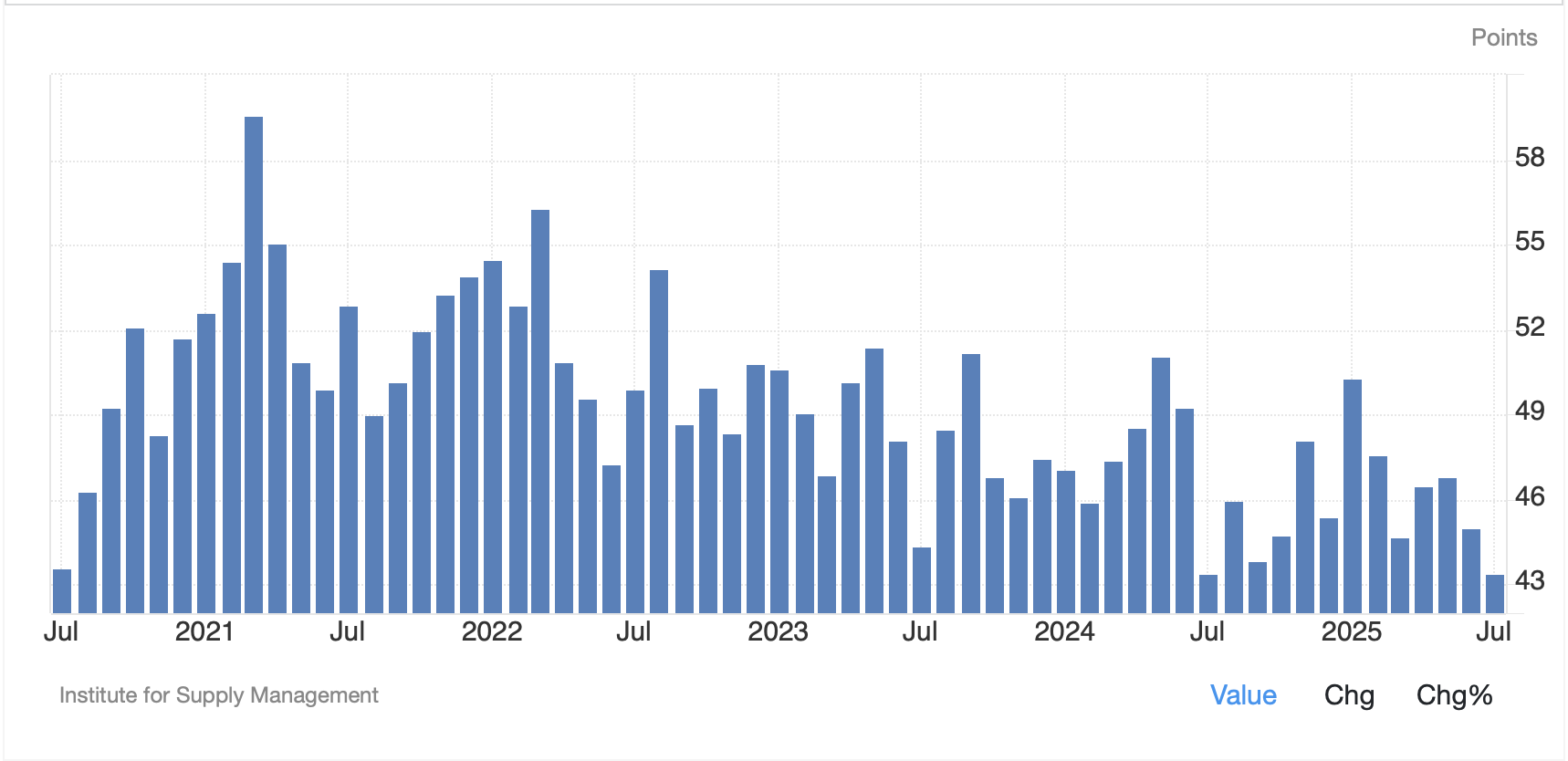
Now, turning to the state of the US economy, President Trump got some very positive news from the ISM data which printed at 50.9, its highest level since September 2022 and far higher than forecasts.  In fact, it is not hard to look at the recent trend in this data series and believe we are going to see positive economic growth going forward

Source: tradingeconomics.com

However, the downside here was that the Prices Paid portion of the index also rose, back to 54.9, implying that inflation pressures remain extant within the economy.  Now, you and I both know that is the case as we all deal with these prices on a daily basis, but until the data starts to become more obvious, it appears the Fed is always the last to know.

Speaking of the Fed, while only one speaker was on the schedule, Atlanta Fed President Bostic, we heard from three of them anyway as it remains clear to me there is a strong belief in the Marriner Eccles building that a key part of their job is to never shut up constantly pitch their narrative to try to keep markets in line.  So, as well as Bostic, we heard from Chicago’s Goolsbee and Boston’s Collins and they all basically said the same thing, perhaps best stated by Ms Collins, “There’s no urgency for making additional adjustments.  The data is going to have to tell us.  At some point I certainly would see additional normalization in terms of what the policy stance is.”  The last part of her comment refers to the idea that she, and truthfully all three, believe that further rate cuts remain appropriate despite the ongoing growth and continued stickiness of prices.  And to think, some people believe that Trump and the Fed are not on the same page.   They all want lower rates!

Ok, let’s turn to markets and see how they have behaved overnight.  Yesterday, after a pretty horrible opening on the basis of tariffs, tariffs everywhere, the news that they would be postponed saw US markets rebound, although still close lower on the session.  In Asia, Japan (+0.7%) rallied as so far, Japan remains out of the tariff sightlines, and Hong Kong (+2.8%) traded much higher in its first post-holiday session although mainland Chinese share trading doesn’t reopen until tonight.  Elsewhere in Asia, the screens were largely green, perhaps on the thesis that tariffs are just a negotiating tactic.  In Europe, the picture is more mixed with the UK (-0.2%) lagging while Spain’s IBEX (+0.8%) is the leading gainer.  The rest of the continent, though, is seeing gains on the order of just 0.2%, so not much love.  And at this hour (7:10) US futures are little changed.

In the bond market, Treasury yields, after edging higher by a few bps yesterday, are up another 2bps this morning and pushing back to 4.60%.  In Europe, sovereign yields are also firmer this morning, up between 2bps and 4bps across the board, although this is after sharply lower yields yesterday on still weak PMI data from the continent.  As well, Mr Trump is hinting that he is going to turn his tariff sights on Europe soon, so there has to be some trepidation there.  After all, Europe, which is already a basket case due to self-inflicted energy-based wounds, really cannot afford a trade fight with the US, especially since they have a net trade surplus on the order of $200 billion with the US.  Finally, JGB yields rose 3bps and are now at their highest level since May 2010 and look for all the world like the trend remains strongly intact as per the below chart.

Source: tradingeconomics.com

In the commodity markets, confusion in energy reigns as yesterday’s initial rally on Canadian tariff news has been completely reversed with oil (-2.1%) and NatGas (-4.2%) both falling sharply today.  But what is not falling is gold (+0.1%) which made yet another new all-time high yesterday and continues to defy gravity.  This has helped the entire metals complex with both silver and copper higher by 0.5% this morning.

Finally, the dollar continues its general winning ways this morning.  Yesterday saw early gains, also on the tariff story, which as evidenced by the chart at the beginning of the note, reversed.  But in the other currencies, the euro and pound remain under modest pressure along with Aussie, as all three are softer by about -0.3% today, with the yen (-0.4%) along for the ride.  In the EMG bloc, MXN (-0.6%), BRL (-1.2%) and ZAR (-0.3%) are also under pressure as though the immediate tariff threat seems to have abated, fear remains the driving force in the space.  Add to the tariff fears the fact that the US economy continues to outperform its peers, and the Fed has basically put the kibosh on any rate cuts anytime soon and it is easy to understand why money is flowing this way.

On the data front, JOLTS Job Openings (exp 8.0M) and Factory Orders (-0.7%, +0.6% ex Transport) are today’s information, and we hear from more Fed speakers.  It seems clear, so far, that the Fed mantra is wait and see as things evolve under President Trump.  Unless one of these speakers (Bostic, Daly, Jefferson) offers a different view, which seems unlikely, then I suspect the dollar will continue to find more support than resistance for now.

Good luck

Adf

Eclipse

This morning, the question on lips
Is where did DeepSeek get their chips
As well, there’s concern
That China will learn
Our secrets, and so, us, eclipse


Narratives are funny things.  They seemingly evolve from nowhere, with no centralization, but somehow, they quickly become the only thing people discuss.  I’ve always been partial to the below comic as a perfect representation of how narratives evolve for no apparent reason.

Of course, yesterday’s narrative was that the Chinese LLM, DeepSeek, was built by a hedge fund manager with older NVDA chips and for far less money than the other announced models from OpenAI or Google and performed just as well if not better.  While equity traders were not going to wait around to determine if this was true or not, hence the remarkable selling on the open of all things AI, a little time has resulted in some very interesting questions being raised about the veracity of how DeepSeek was built, what type of chips they use and who actually built it.

For instance, a quick look at NVDA’s 10Q shows that, remarkably, Singapore is a major source of revenue, and it has been growing dramatically.

Source: SEC.gov

Now, it is entirely possible that Singapore is a hotbed of AI development, but from what I have read, that is not the case.  In fact, there is basically one lab there that has resources on the order of just $70mm.  But despite that lack of local investment, at least reported local investment, Nvidia shows that chip sales in Singapore nearly quadrupled in the last year.  Far be it from me to suggest that the narrative may change again, but who is buying those chips, more than $17 billion worth?  The idea that they have been trans shipped to China is quite plausible and they may well be what underpins DeepSeek.

Again, I have no first-hand knowledge of the situation but it is not beyond the pale to make the connection that China has been effectively circumventing US export controls through Singapore, have built their own LLM model using the exact same chips as OpenAI and others, but propagated a narrative that they have built something better for much less in order to undermine the US tech sector equity performance and call into question some underlying beliefs in the US market and economy.  Now, maybe this Chinese hedge fund manager did what he said.  But the one thing we know about China is, it is opaque in everything it does, so perhaps we need to take this story and dig deeper.  I am sure others will do so, and more information will be forthcoming, but it highlights that narratives continue to drive markets, but can also, at times, be constructed rather than simply evolve.

The thing is, this is still the only story of note in the market.  Scott Bessent was confirmed as Treasury Secretary yesterday, and indicated he was a fan of gradual tariff increases, perhaps 2.5% per month, rather than large initial tariffs, but that does not seem all that exciting.  And while Trump has not slowed down one iota, his focus has been on things like browbeating California into allowing reconstruction of LA rather than international issues, at least for the past twenty-four hours.  The upshot is that markets, which even yesterday closed far above their worst levels from the opening, are rebounding further today with many of yesterday’s moves reversing, at least to some extent.

Starting in the equity markets, despite the weakness in the tech sector, US market closes were far higher than the opens with the DJIA actually gaining 0.65% on the session.  However, while Japanese shares (-1.4%) definitely felt the pain of the tech sector, the rest of Asia saw some decent performance (Korea +0.85%, India +0.7%, Taiwan +1.0%) although Chinese shares (-0.4%) struggled.  Of course, one reason for that may be that the largest Chinese property company, Vanke, reported humongous losses and both the Chairman and CEO stepped down.

In Europe, though, all is well with every major exchange in the green led by Spain’s IBEX (+1.0%) although gains of 0.5% – 0.7% are the norm.  Now, remember, there is effectively no tech sector in Europe to be negatively impacted by the AI story, and it should be no surprise that these shares have followed the DJIA higher.  And this morning in the US futures market, at this hour (6:50), we are seeing gains on the order of 0.4% across the board.

In the bond market, yesterday’s early rally in prices (decline in yields) backed off as stocks bounced from their lows although Treasury yields still fell 10bps on the day.  This morning, the bounce in yields continues with Treasury yields higher by another 3bps and European sovereign yields rising between 1bp and 2bps on the session.  It will be very interesting to watch the bond market now that Bessent has been confirmed as Treasury Secretary given his goal to extend the maturity of the US debt outstanding.  Arguably, that should push up back-end yields, so we will see how effective he can be in reaching that goal.  

Turning to commodities, yesterday saw a rout there as well with both oil and the metals markets suffering greatly.  However, this morning, like many other markets, things are reversing course.  Oil (+0.75%) has bounced off its lows from yesterday, and despite a pretty rough past two weeks, is still higher than it was at the beginning of the year.  Gold and silver are unchanged from yesterday’s closing levels, and while off their recent highs, remain much higher in the past month.  Copper, too, is bouncing slightly and still much higher this month.  Perhaps yesterday’s price action was a catalyst for lightening up positions rather than changing views.

Finally, the dollar has rebounded vs. the G10 this morning, rising alongside US yields with the euro (-0.7%) and AUD (-0.8%) lagging the field, although dollar gains of 0.5% are the norm across the entire G10 this morning.  In the EMG bloc, the CE4 are all tracking the euro lower, with all down around -0.6% to -0.8%, but yesterday’s biggest laggards, MXN, COP and BRL are little changed this morning, not rebounding, but not falling further.  With the Fed expected to remain on hold while both the BOC tomorrow and ECB on Thursday are set to cut rates, perhaps the FX market is reverting to its more fundamental interest rate drivers than the hysteria of AI models.  If that is the case, then we are likely to turn our attention to Chairman Powell’s press conference as the next critical piece of news.

On the data front this morning, we see Durable Goods (exp 0.8%, 0.4% -ex Transport), Case Shiller Home Prices (+4.3%) and Consumer Confidence (105.6).  Yesterday saw New Home Sales rise more than expected but still resulted in the smallest number of sales for the year since 1995 when the population was far smaller.  

Once again, depending on where you look, you can find data that supports either economic strength or weakness.  It strikes me that today’s data will be of little consequence as traders will be focused on the equity market to see if the rebound has legs, as well as further news regarding DeepSeek.  Tomorrow, however, the Fed will take center stage.

Good luckAdf