Basically Fictive

For Fedniks it must be addictive
To say rates are “somewhat restrictive”
It seems like a show
As how can they know
Since R-star is basically fictive
 
Investors, though, lap up this stuff
In fact, they just can’t get enough
Of comments that hint
There is a blueprint
For policy, though that’s a bluff


Yesterday, both Richmond Fed president Barkin and Governor Jefferson explained that current Fed policy is “somewhat restrictive”.  This takes to seven the number of FOMC members who have used this phrase with Powell, Kugler, Hammack, Schmid and Collins all having used it before, as did Jefferson two weeks ago.  And they are all referring to the concept of R-star, the mythical rate at which policy is neither restrictive nor accommodative.  In fact, R-star has become the Fed’s north star, with the key difference being, we can actually see the north star while R-star, even they will admit, is unobservable.  Of course, that hasn’t stopped them from basing policy decisions on the variable.

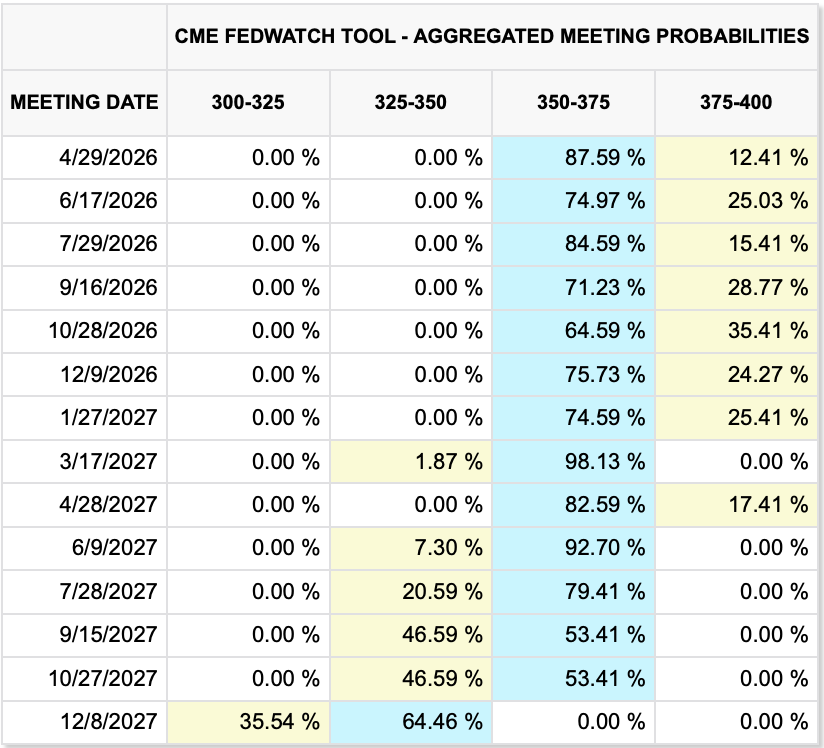
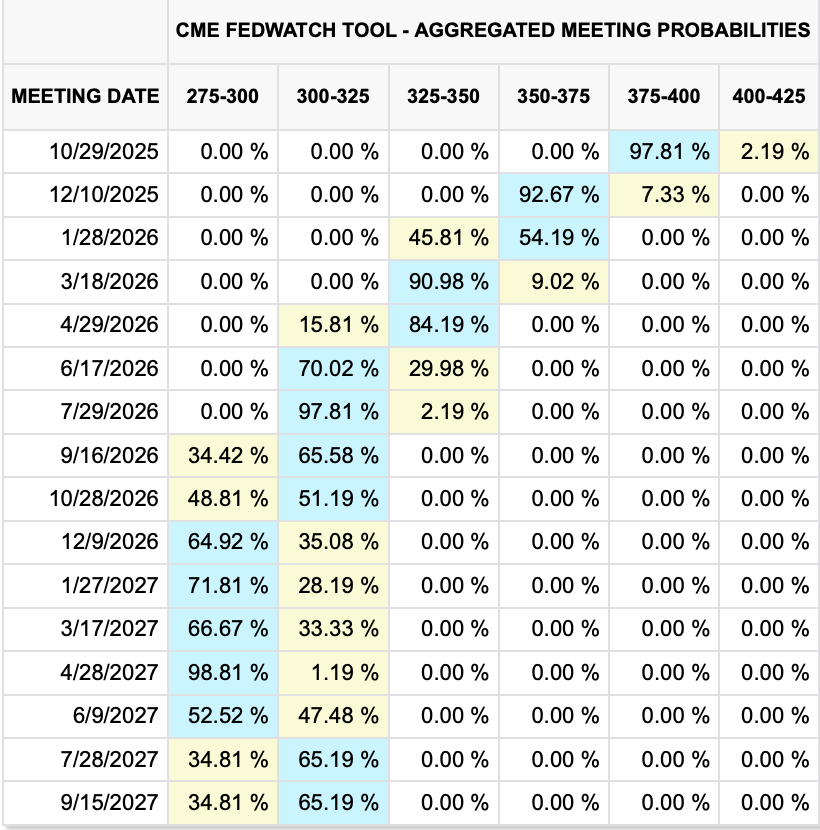
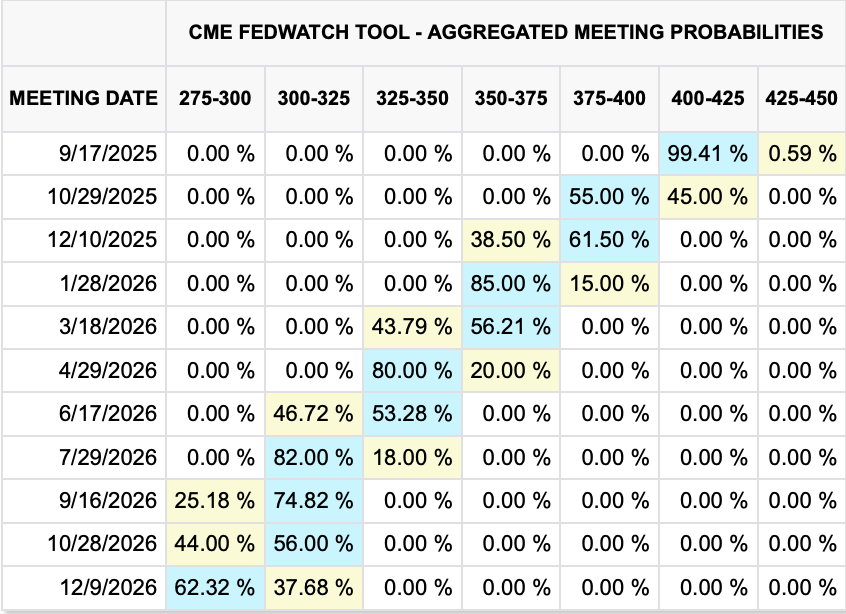
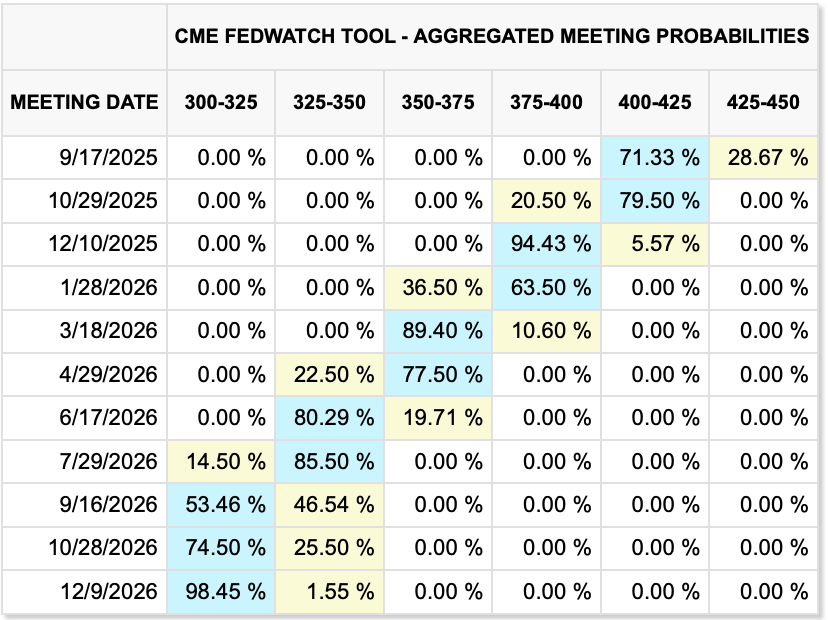
I highlight this because the tone of virtually every one of these speeches has been one of caution, with the implication being they are very close to their nirvana so the last steps will be small.  However, we cannot forget that though the last steps may be small, there is still confidence amongst the entire body that the direction of travel is toward lower rates. certainly, as you can see from the aggregated meeting probabilities from the Fed funds futures market below, there is zero expectation that rates will rise anytime during the next two years and a decent chance of another 100bps of cuts over that time.

Source: cmegroup.com

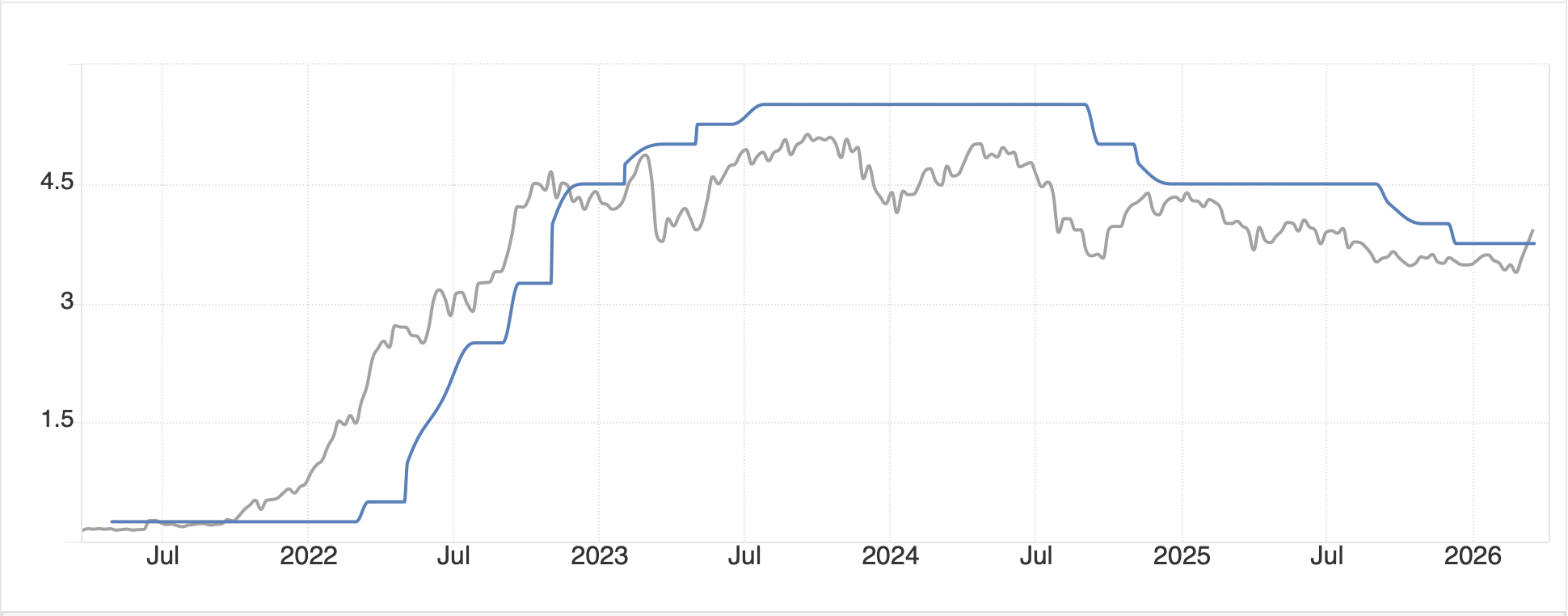
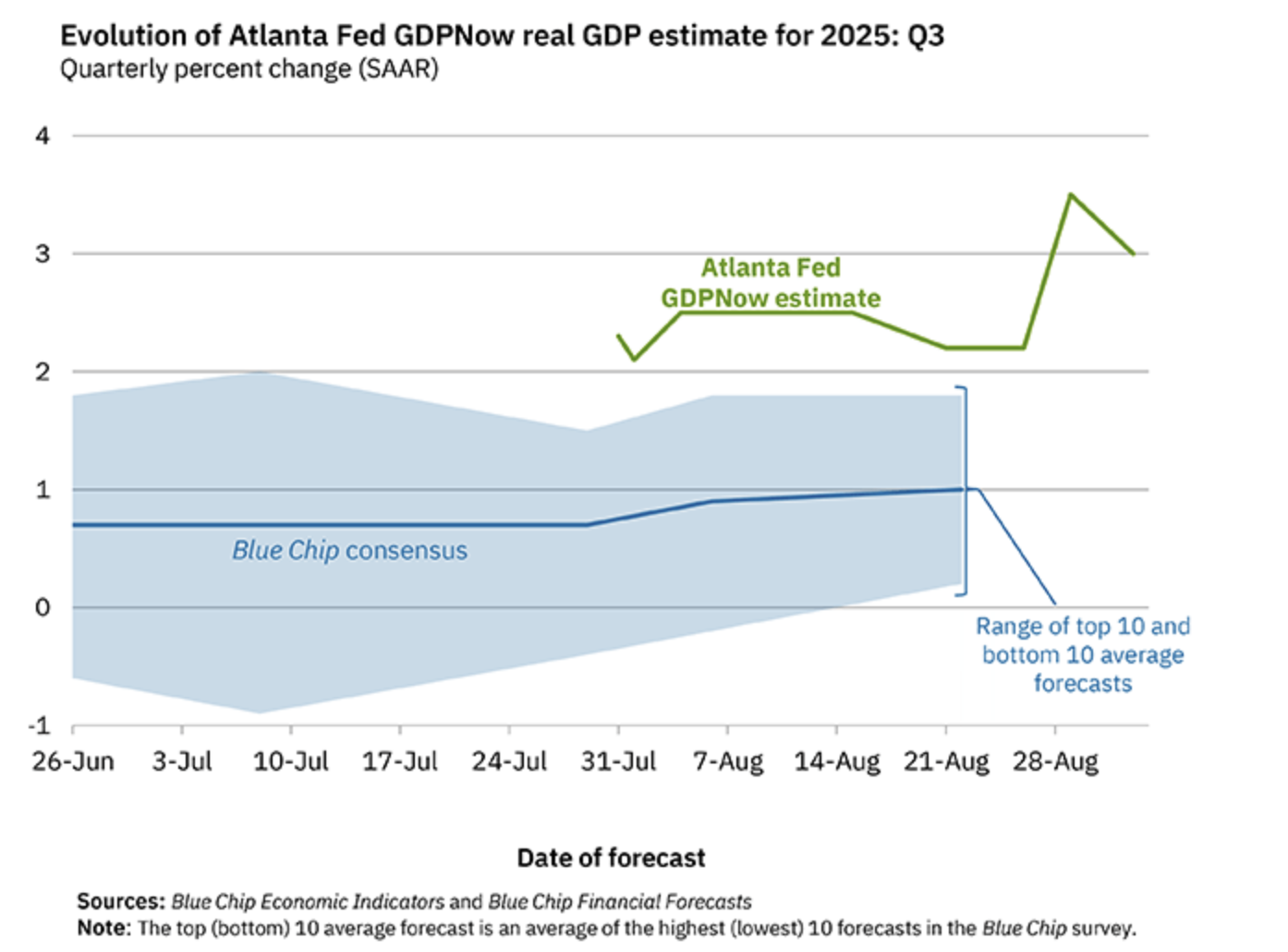
I might contend that is a pretty negative outlook on the US economy by the Fed.  Given the Fed’s models assume that a key to lower inflation is slowing economic growth, the idea that rates are going to fall implies slower growth to help them achieve the inflation portion of their mandate.  But that seems out of step with both the Atlanta Fed’s GDPNow forecast shown below and currently sitting at 4.1% annualized for Q3 and with earnings forecasts in the equity markets.

Asking Grok, the average current earnings growth forecasts for 2026 for the S&P 500 is somewhere in the 13% – 14% range with revenue growth running at ~6.9%, which is typically in line with nominal GDP growth.  (I understand that current forward PE ratios are extremely high at 23x, so be careful that companies hit their targets while their share prices fall anyway.)  But if nominal GDP is going to run at nearly 7%, and let’s assume inflation is at 3.5%, which I think is a reasonable possibility, then the math tells us that GDP is growing at 3.5% on a real basis.  With Fed funds currently at 4.0%, why would they need to decline further?

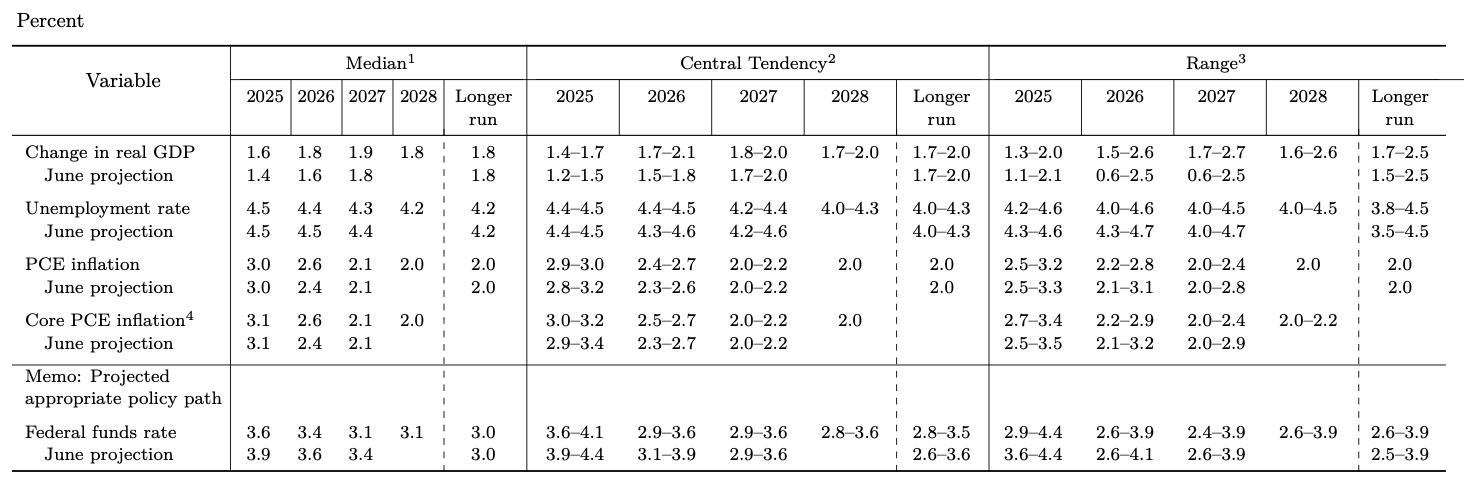
Looking back at the Fed’s September Summary of Economic Projections, it appears that the Fed sees a very different economy than the markets see.  In fact, you can see that they believe nominal GDP in the long run is going to average <4.0% (sum of longer run GDP and PCE in the table below).  

That is a really big difference, one that is the type that can lead to massive policy errors.  Now, if those 17 people cloistered in the Marriner Eccles building have a better handle on the economy than everybody else, I can understand why they believe rates need to fall further.  But is that the case?  

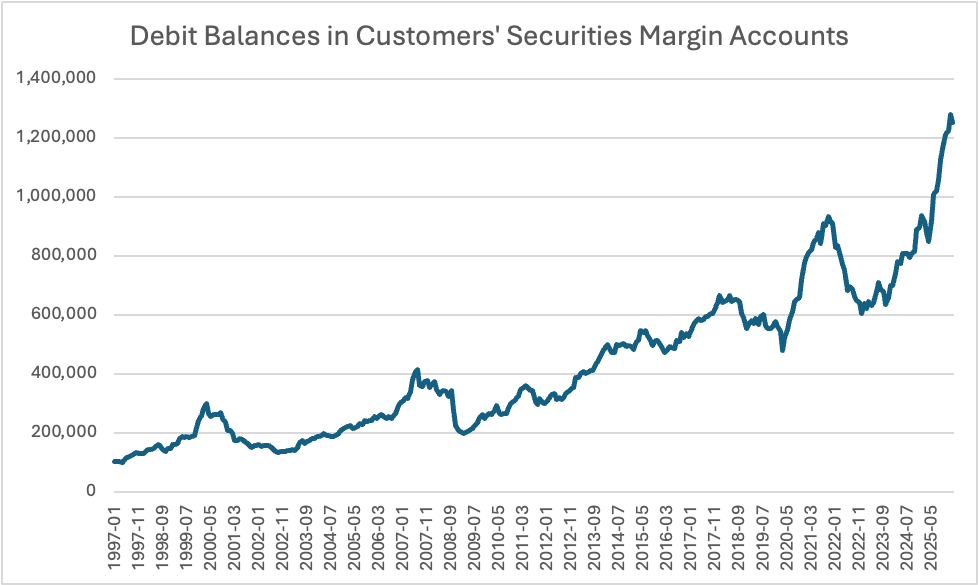
Here’s something else to ponder, I asked Grok about the relationship between nominal GDP and Fed funds and the below table is what it produced:

It is patently obvious how the Fed has developed its models and because of that, why they have been so wrong.  In fact, look at the SEP above and compare it to the period from 2001 – 2019, they are essentially identical.  But I would argue, and I’m not alone, that the economy from the dot.com crash up to the pandemic is no longer the reality on the ground.  The Fed’s backward-looking models seem set to make yet more errors going forward.

And with those cheery thoughts, let’s look at what happened overnight.  Yesterday’s continuation of the US stock decline seems to be finding a bottom, at least temporarily as Asian markets were mixed (Nikkei -0.3%, Hang Seng -0.4%, CSI 300 +0.4%) with the rest of the region showing a similar mixture of gainers (India, Malaysia, Indonesia, Philippines) and losers (Korea, Taiwan, Australia) as it appears the entire world is awaiting Nvidia’s earnings after the US close today.

Similarly, European bourses are edging higher this morning with the rout seemingly over for now.  This morning Spain (+0.5%) is leading the way higher followed by Germany (+0.3%) with the rest of the markets little changed overall, although leaning higher.  As to US futures, at this hour (7:30) they are pushing higher by about 0.4%.

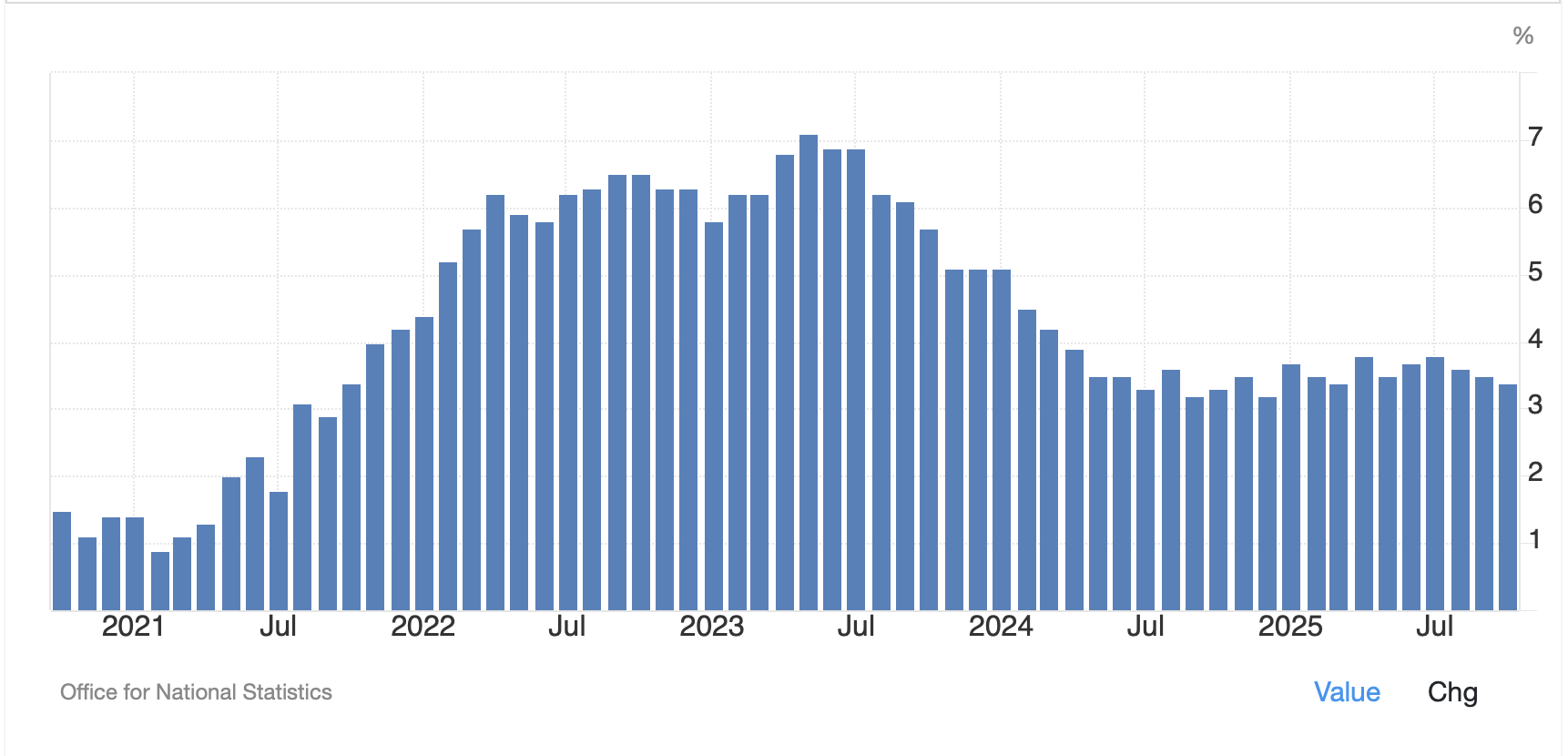
In the bond market, Treasury yields are unchanged this morning, still sitting right around that 4.10% level while European sovereigns have seen demand with yields slipping -2bps to -3bps across the continent.  The UK is the outlier here, with yields unchanged after releasing inflation data that was bang on expectations, and below last month’s readings, though remains well above their 2.0% target.  I guess if I look at the chart below, I might be able to make the case that core UK CPI is trending lower, but similarly to the Fed, the last time they were at their target was July 2021.

Source: tradingeconomics.com

I would be remiss if I didn’t mention that JGB yields have moved higher by 3bps, pushing their decade long highs further along as concerns grow over the Japanese fiscal situation.

Oil prices (-2.4%) are falling this morning, slipping to the low side of $60/bbl after API inventories showed a surprise build of 4.4 million barrels.  However, I would contend that there is very little new here.  Perhaps the dinner last night where President Trump hosted Saudi Prince MbS has some thinking OPEC will increase production more aggressively going forward.  In the metals markets, they are all shining this morning led by silver (+3.1%) and platinum (+3.0%) with gold (+1.3%) and copper (+1.3%) lagging, although remember the latter two are much larger markets so need more interest to rise as quickly.

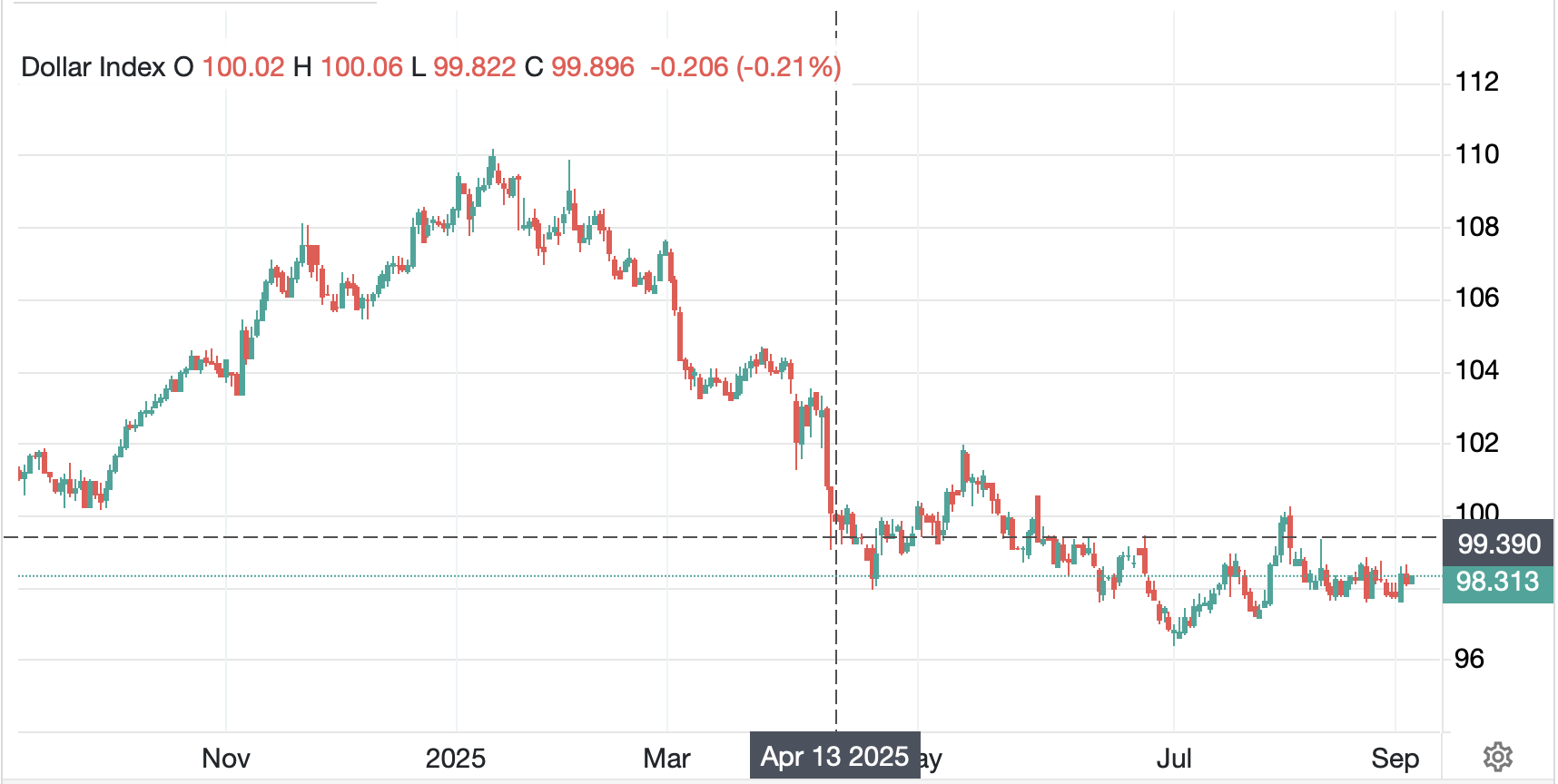
Finally, the dollar continues to find support, despite the precious metals gains, and this morning we see the DXY (+0.15%) pushing back toward that psychological 100.00 level.  JPY (-0.5%) has traded through 156 and certainly seems like it wants to push back to its YTYD highs of 158.80.  Interestingly, there was no Japanese commentary of note last night, but I presume if this continues, the MOF will be out warning of potential future action.  Another interesting fact is that while the dollar is firmer against virtually all G10 currencies, the EMG bloc is holding its own this morning led by HUF (+0.6%), PLN (+0.25%) and ZAR (+0.15%) with the rand obviously benefitting from gold’s rally.  The forint has benefitted from the central bank maintaining policy on hold at 6.5%, one of the highest available rates in Europe and that has helped drag the zloty along for the ride.

On the data front, this morning we see the August Trade Balance (exp -$61.0B) and then the EIA oil inventories where a small draw is expected.  We also get the FOMC Minutes at 2:00pm and hear from NY Fed president Williams this afternoon.

I cannot help but look at the difference between the Fed’s very clear view and the markets expectations and feel like the Fed is on the wrong side of the trade.  It is for this reason I fear higher inflation and ultimately, a much lower likelihood of further rate cuts.  If that is the case, the dollar will find even more support.  Interesting times.

Good luck

Adf
A Pox

The world is a wonderful place
We know this because of the chase
For more and more risk
Though Washington’s fisc
Continues, more debt, to embrace
 
Investors can’t get enough stocks
And bonds have found buyers in flocks
But havens like gold
Are actively sold
As though they’ve come down with a pox


I’m old enough to remember when there was trouble all around the world; war in Ukraine was escalating, anxiety over a more serious fracture in the trade relationship between the US and China was growing, and President Trump was building a ballroom at the White House!  Ok, the last one is hardly a problem.  But just two weeks ago, risk assets were struggling and havens seemed the best place for investors to hide.  But that is sooooo last week.

By now you are all aware that the delayed CPI report on Friday came in on the soft side, thus reinforcing the Fed’s plans to cut rates tomorrow.   While Fed funds futures pricing, as seen below, has not changed very much at all, with virtual certainty of cuts tomorrow and in December, plus two more by the April meeting next year, the punditry is starting to float the idea that even more cuts are coming because of concern over the employment situation and the fact that inflation appears under control.

Source: cmegroup.com

Now, it is a viable question, I believe, to ask if inflation is truly under control, but the problem with this concern is that Chairman Powell told us, back in September, that they are not really focused on that anymore.  The fact that the official payroll data has not been released allows the Fed to avoid specific scrutiny, but literally everything I read tells me that the employment situation is getting worse.  The latest highlight was Amazon’s announcement yesterday that they would be reducing corporate staff by about 14,000 folks in the coming months as, apparently, AI is reducing the need for headcount.

In fact, I would contend the answer to the question; if the economy is doing so well, why does the Fed need to cut rates, is there is a growing concern over the employment situation which has been masked by the lack of data.

But we all know that the economy and the stock market behave very differently at times, and this appears to be one of those times.  Yesterday, yet again, equity markets in the US closed at record highs as earnings releases were strong virtually across the board.  Adding to the impetus was the news that Treasury Secretary Bessent announced a framework for trade between the US and China had been reached with the implication that when Presidents Trump and Xi meet later this week, a deal will be signed.

Putting it all together and we see the concerns that were driving the “need” for owning havens last week have virtually all dissipated.  While the Russia/Ukraine situation remains fraught, I don’t believe that equity markets anywhere in the world have paid attention to that war in the past two years.  Oil markets, sure, but not equity markets.

There is a fly in this ointment, though, and one which only infrequently gets much airtime.  The US is continuing to run substantial fiscal deficits.  Lately, as evidenced by the fact that 10-year yields have slipped back to their lowest level this year, and as you can see below, are clearly trending lower, this doesn’t seem to be an issue.  But ever-increasing federal deficits cannot last forever, and if the Trump plans to boost growth significantly does not work out, there will be a comeuppance.  I have described before my view that the plan is to ‘run it hot’ and nothing we have seen lately has changed that sentiment.  I sure hope it works for all our sakes!

Source: tradingeconomics.com

Ok, let’s see if the euphoria evident in the US markets has made its way around the world.  The answer is, no.  Interestingly, despite a high-profile meeting between President Trump and Japanese PM Takaichi, where Trump was effusive in his support for the new PM and her plans to increase defense spending, Japanese equities were under pressure all evening, slipping -0.6%.  Too, both China (-0.5%) and HK (-0.3%) could find no traction despite the news that a trade deal was imminent.  In fact, the entire region was under pressure with losses in Korea, Taiwan, Australia and virtually every market there.  Was this a sell the news event?  That seems unlikely to me, but maybe.  As to Europe, pretty much every major index is modestly softer this morning, down between -0.1% and -0.2%, so not terrible, but clearly not following the US.  As to US futures, at this hour (7:30), they are little changed to slightly higher.

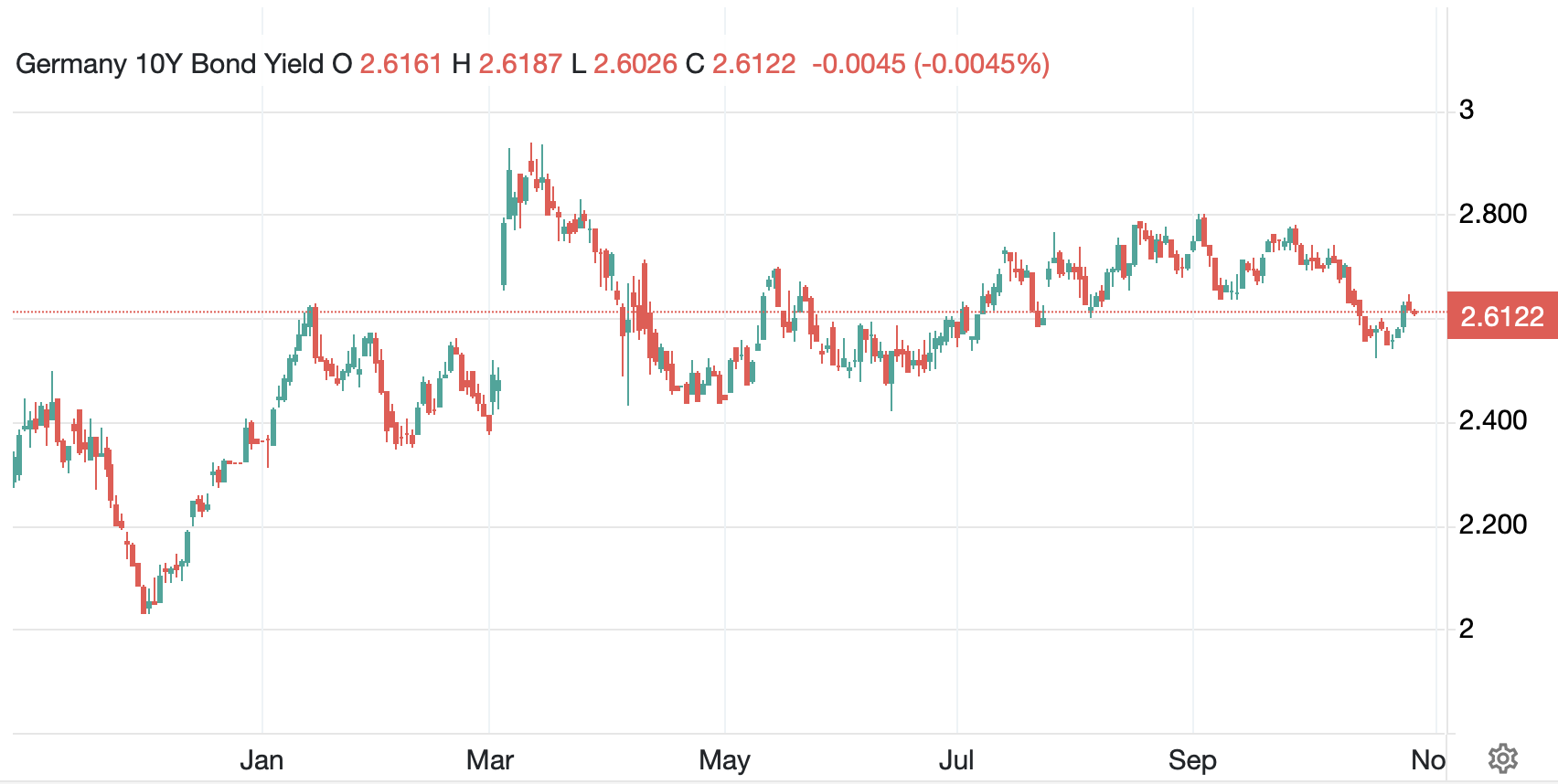
Global bond markets are quiet this morning, with almost all unchanged or seeing yields slip -1bp.  While US yields have been trending lower, in Europe, I would say things are more that yields have stopped rising and, perhaps, topped, but are not yet really declining in any meaningful fashion yet.  Germany’s bund market, pictured below, exemplifies the recent price action.

Source: tradingeconomics.com

One interesting note is that JGB yields slipped -3bps overnight, despite PM Takaichi reaffirming that the defense budget was going up with no funding mentioned.  Like I said, the world is a better place this morning!

In the commodity markets, gold (-1.5%) continues to get punished as all those who were chasing the haven story have been stopped out.  The price went parabolic two weeks ago, and price action like that cannot hold for any length of time.  This has taken silver (-1.1%) and copper (-0.5%) lower as well, and I suspect that there could well be further to decline.  Oil (-1.1%) meanwhile seems far less concerned about the sanctions on Lukoil and Rosneft this morning.  The conundrum here is if the economy is performing well, that would seem to be a positive demand driver.  I have not seen word of major new oil sources being discovered to increase supply dramatically, but if you think back to last week, the narrative was all about a glut.  I guess we will learn more with inventory data this week.

Finally, the dollar… well nobody really seems to care.  As you can see from the below chart of the DXY, it is approaching six months where the index has traded in a very narrow range, and we are pretty close to the middle.  I don’t know the catalyst that will be needed to change this story, but frankly, I suspect that nobody (other than FX traders) is unhappy with the current situation.

Source: tradingeconomics.com

It’s not that there aren’t currencies that move around on a given day, but there is no broad trend in place here.

On the data front, the key release today is the Case-Shiller Home Price Index (exp 1.9%) and then the Richmond Fed Manufacturing Index (-14) is also due later this morning.  However, all eyes are on tomorrow’s FOMC outcome with the focus likely to be more on QT and its potential ending, than on the rate cuts, which are universally expected.  One other thing, with the government shutdown ongoing, GDP and PCE data, which were originally scheduled for this week, will not be released.

Life is good!  That is the only conclusion I can draw right now based on the ongoing strength in risk assets, at least US risk assets.  Keynes was the one who said, markets can remain irrational longer than you can remain solvent, and I have a feeling that we are approaching some irrationality.  But for now, enjoy the ride and if FX is your arena, I just don’t see a reason for any movement.

Good luck

Adf

Is That the Fear?

Regarding the payroll report
The fear is jobs coming up short
But is that the fear?
Or will traders cheer
As 50bps they will exhort
 
With clarity at the Fed lacking
Because of Ms Cook’s recent sacking
And markets at highs
It seems to be wise
To hedge some exposure you’re tracking


Another month, another payroll day.  It certainly seems that the market has not lost any of its appetite for this particular data point, although one must be impressed with the ongoing rally to continuous record highs in share prices.  So, as we get started, let’s look at what expectations are for this morning’s numbers:

Nonfarm Payrolls75K
Private Payrolls75K
Manufacturing Payrolls-5K
Unemployment Rate4.3%
Average Hourly Earnings0.3% (3.7% Y/Y)
Average Weekly Hours34.3
Participation Rate62.1%

Source: tradingeconomics.com

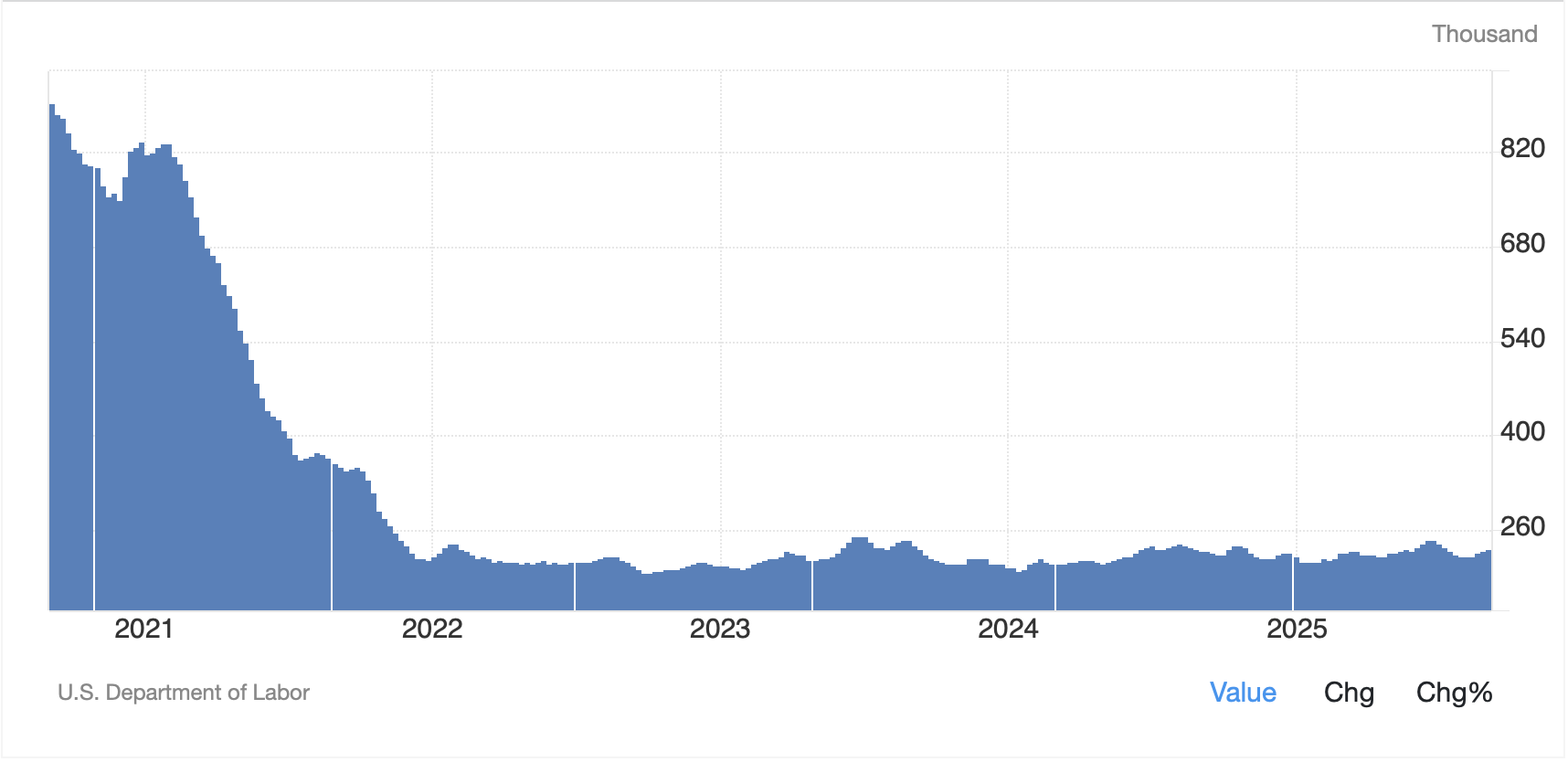
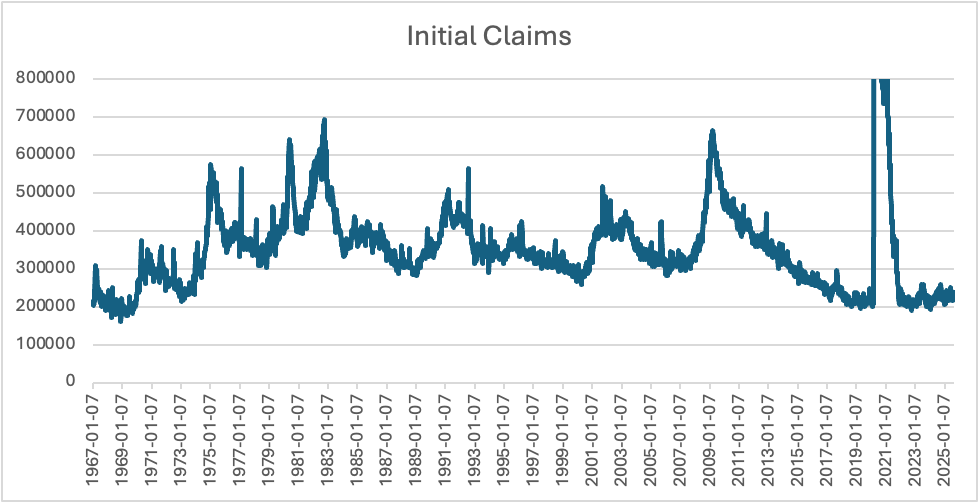
Yesterday’s ADP Employment number was a bit softer than forecast at 54K with a very slight revision higher to the previous month’s reading.  And of course, poor Ms McEntarfer was fired last month after the massive downward revisions to the previous data so as much scrutiny as this number ordinarily receives, it feels like even that has been turned up to 11 this month.  If we look at the Initial Claims data for a signal, (or the 4-week average which removes situations where individual states are late to report) it is hard to get excited about a major problem in the labor market as per the below chart from tradingeconomics.com.

It has pretty much flatlined since the end of the Covid aberration.  Even more impressively, the number is low by much longer-term historical standards when the absolute population was smaller, yet Claims data were typically somewhat higher.  (I capped the Covid situation so you could get a flavor for the rest of the series).  It is hard to look at the last 58 years and describe Initial Claims as pointing to a problem.  While I didn’t shade the chart, you can see the recessions in 1970, 1973, 1980, 1982, 1990, 2001, 2008-9 as the periods when Claims peaked.  Again, it is difficult to look at this data and conclude a recession is around the corner, at least the traditional definition of one.

Source: FRED database

Of course, there is a very different vibe these days regarding employment as evidenced by the discussions you see on LinkedIn or even the stories in the WSJ regarding the unwillingness of people to leave a job as they fear finding a new one.

All this is just my way of saying that the asynchronous nature of the economy means we really don’t know what to expect.  But we can anticipate market reactions depending on the outcome.  FWIW, and remember, I am just a poet:

NFPBondsFed funds futuresStocksDollarGold
>75K4.30%20bps-1%0.50%-1%
35K – 75K4.15%25bps0%0%0%
0K – 35K4.10%35bps1%-0.5%0.20%
<0K3.95%50bps-1%-1.50%1.50%

So, there you have it, one man’s guesses as to how the markets will respond depending on the data.  In essence, it seems to me that the market has been anticipating enough support to cut rates to protect the economy without assuming the economy is going to crash.  That’s why a negative number will be such a problem because that will force a reevaluation of the economic situation and stocks cannot abide a repricing of that risk given the rich valuations. It will demonstrate that the Fed is behind the curve, at least in traders’ minds, and the result will not be pretty.  We shall see.

In the meantime, after yesterday’s rally in the US, equity markets around the world are all in the green this morning despite some mediocre data from Europe.  But starting with Asia, Japan (+1.0%) had a nice session although China (+2.2%) and Hong Kong (+1.4%) put it to shame.  While Japan benefitted from a reduction to 15% on automobile tariffs vs. Japanese cars, Chinese shares jumped on word from the PBOC that they would inject CNY1 trillion into the system and reduced fears of efforts to hold back the rally.  Elsewhere in the region, other than India, which was unchanged on the day, everything else was nicely higher following the main exchanges’ leads.  As to Europe, while all the bourses are higher, the gains are de minimis, on the order of 0.1% or so, with traders caught between hopes of a US rally and ongoing meh data at home.

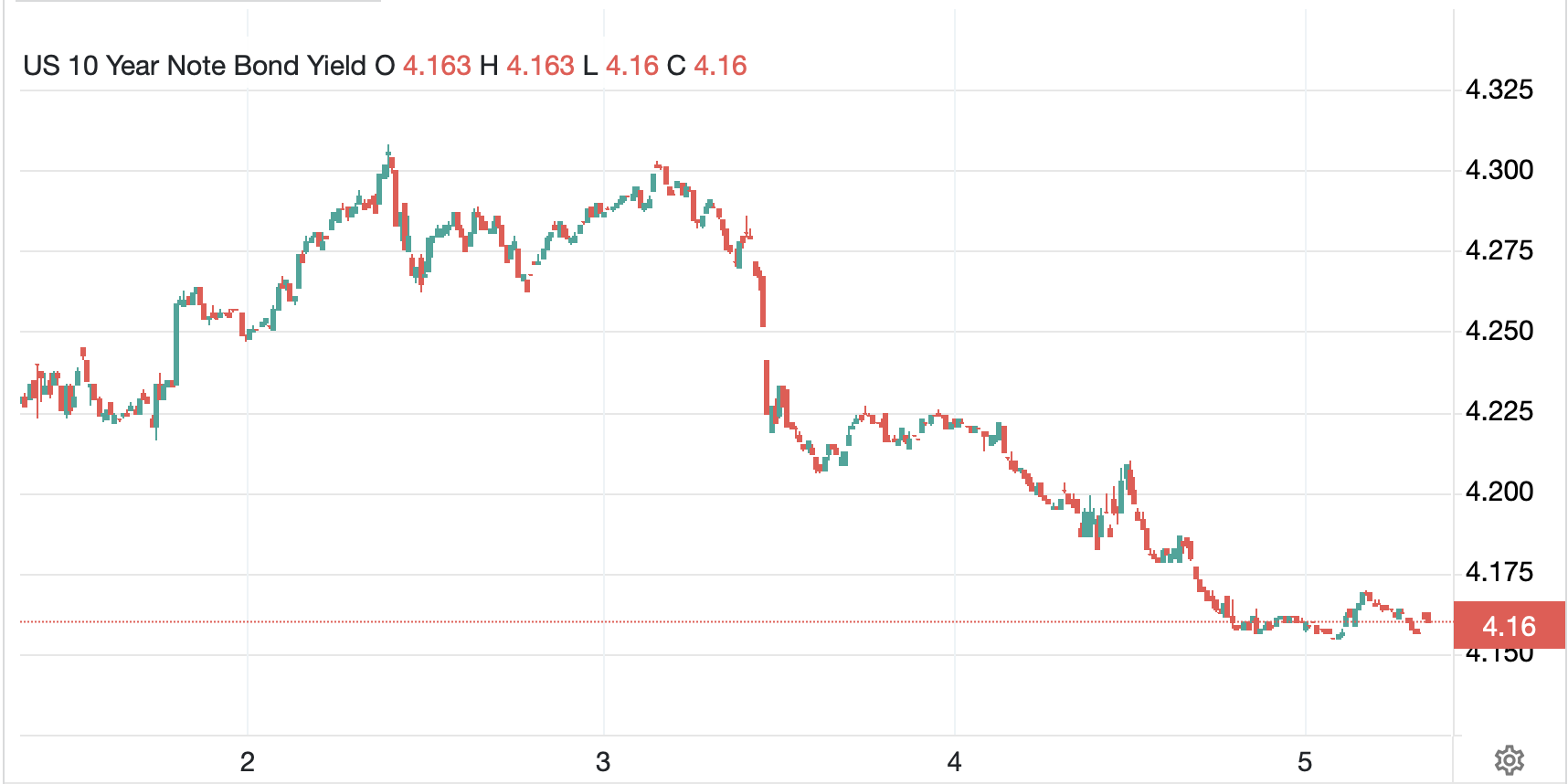
In the bond markets, Treasury yields are down to 4.15%, lower by -1bp today, but as you can see from the chart below, down 15bps this week as anticipation of either soft data or 50bps, I’m not sure which, builds.

Source: tradingeconomics.com

In Europe, sovereign yields are all lower by -2bps this morning and we saw the same price behavior overnight in Asia with JGB’s and Australian bond yields slipping as well.  Maybe inflation is dead! (just kidding)

In the commodity markets, oil (-0.7%) continues to slide and has given back all the gains that accrued based on the idea that OPEC+ was going to cut production further.  Gold (+0.1%) continues to find support and drag silver and copper along for the ride as the yellow stuff sits at new historic highs.

Finally, the dollar is softer this morning, down about 0.2% to 0.3% vs. the G10 with similar declines across most of the EMG bloc.  I have a feeling this is the market that is anticipating a weak NFP print and a more aggressive Fed come the meeting in two weeks.  Futures, right now, are pointing to a 99% probability of a 25bp cut and a 55% probability of another cut in October.  Any weak print this morning is going to really show up here, as I explained above.

Source: cmegroup.com

And that’s what we have.  There are no Fed speakers lined up, and after today, the Fed enters its quiet period, so we won’t hear anything until the meeting on the 17th.  NFP will set the tone, so until then, all we can do is wait.

Good luck and good weekend

Adf

Little Enjoyment

The Beige Book reported inflation
Was modest across the whole nation
And growth and employment
Found little enjoyment
While JOLTs data showed retardation
 
The upshot is traders were caught
Offsides, which is why bonds were bought
But so too was gold
And as things unfold
Be nimble or you’ll be distraught


Bonds rallied on both soft data, Factory Orders falling and JOLTs Job openings declining as well as a Beige Book that described modest economic activity across the nation.  Some cherry-picked quotes are as follows:

  • Most of the twelve Federal Reserve Districts reported little or no change in economic activity since the prior Beige Book period.
  • Eleven Districts described little or no net change in overall employment levels, while one District described a modest decline.
  • Ten Districts characterized price growth as moderate or modest. The other two Districts described strong input price growth that outpaced moderate or modest selling price growth.

Actually, these were the first lines from each of the key segments, Overall Economic Activity, Labor Markets and Prices.  But if you read them, it is hard to get excited about either growth or inflation as both seem pretty lackluster.  This is at odds with the Q2 GDP results as well as the early Q3 estimates from the Atlanta Fed’s GDPNow forecast as per the below showing 3.0% growth.

While the JOLTS data has always been confusing, and I think is even less reliable these days given the number of phantom job openings (just ask anybody looking for a job using LinkedIn), the Factory Orders data seems to have lost some of its information content given current tariff policies, and their substantive changes on short notice, have upset a lot of apple carts.  I had the system draw a trend line in the below data because it was difficult for me to eyeball it, but FWIW this does not seem a positive result.  Arguably, this is exactly why President Trump is seeking to bring manufacturing back to the US.

Source: tradingeconomics.com

Meanwhile, with ADP jobs this morning (exp 65K) and NFP tomorrow (exp 75K), it is difficult to get too excited about the JOLTS data.  One interesting thing about this data is how it is undermining the higher bond yield narrative that has been rampant (I wrote about it on Tuesday) with yields around the world slipping yesterday in the US and then everywhere else overnight.  For instance, 10-year Treasury yields are lower by -9bps since yesterday morning with virtually all European sovereign yields having fallen about -5bps over the same period.  This is true even in France which auctioned €11 billions of 10yr through 30yr debt this morning.   Compared to their last auction, yields are 30bps to 40bps higher, a strong indication that investors are concerned over the French fiscal situation.

Of course, these two narratives can be simultaneously correct with timing the key difference.  While the short-term view is weaker economic activity will dampen demand and reduce yields, the long-term trajectory of government spending and debt issuance almost ensures that yields will go higher.  Corroborating the long-term story is gold (-0.6% this morning, +3.6% this week) as though some profit taking is evident right now, the barbarous relic has managed to trade to new all-time highs yet again.  That is not a sign of confidence in government finances.

And truthfully, that last sentence continues to be the overriding issue to my mind.  No matter what we hear from any government (perhaps Switzerland should be excluded here), spending is on a sharp upward trajectory, and no government wants to slow it down.  What they want to do is sound like they are doing things to slow it down, but politicians see too much personal benefit from increased government spending to ever stop.  And so, this will continue until such time as it no longer can.  Yesterday I mentioned YCC and I remain convinced that is coming to every major economy over time.  But different nations will respond on different timelines and that is what will drive FX rates given they are the ultimate relative relationship asset class.  I wish I could paint a cheerier picture, but I just don’t see it at this point.

So, let’s see how other markets behaved overnight.  Yesterday’s US equity rally (mostly anyway) seemed entirely on the back of Google’s legal victory allowing it to keep Chrome, where spinning it off was one of the proposed penalties in the anti-trust case, and which saw the share price rally more than 9% in the session.  That move helped Japan (+1.5%) and Australia (+1.0%) but China (-2.1%) and Hong Kong (-1.1%) both suffered on rumors that the government was growing concerned with excess speculation and would soon be implementing rules to prevent further inflating the stock market.  These two markets have had a very nice run since April, rising on the order of 25% each as per the below.

Source: tradingeconomics.com

As to the rest of the region, Korea (+0.5%) was the next best performer with lots of nothing elsewhere, +/-0.3% or so.  In Europe, the DAX (+0.7%) and IBEX (+0.6%) are having solid sessions although the CAC (-0.2%) seems to be feeling pressure from the bond auctions and concerns over the future government situation.  European data was largely in line with expectations and secondary in nature at best.  Meanwhile, at this hour (7:20) US futures are little changed to slightly higher.

We’ve already discussed bonds, but I should mention that even JGB yields slid -4bps overnight as the status of the Ishiba government remains unclear as well.

In the commodity space, oil (-1.3%) continues to chop around in its recent trading range as yesterday’s concerns over OPEC increasing production seem to be giving way to today’s story about weaker demand and growing inventories available in the US.  It’s tough to keep up without a scorecard, that’s for sure.  It should not be surprising that the other metals (Ag -0.75%, Cu -1.2%) are also slipping this morning after they also rallied sharply along with gold yesterday.  In fact, as is often the case, silver’s recent moves have been much more aggressive than gold’s, although in the same direction.

Finally, the dollar is a bit firmer this morning after a modest decline yesterday.  If we use the DXY as our proxy, while there is no doubt the dollar fell sharply during the first half of the year, arguably, since just past Liberation Day in early April, it has gone nowhere.  

Source: tradingeconomics.com

The short-term story for the dollar revolves around the Fed and its behavior.  After yesterday’s data, Fed funds futures increased the probability of a cut on the 17th to 97.6% with a one-third probability of a total of 75bps by year end.  If the Fed were to become more aggressive, perhaps after a much weaker than expected NFP number on Friday, then the dollar would have room to fall.  But you cannot show me the combined fiscal and economic situations elsewhere in the world and explain those are better places to hold assets at this time.

As to today’s movements, the laggards are ZAR (-0.9%) following the precious metals complex lower, and NOK (-0.6%) suffering on the back of oil’s decline.  Otherwise, there is a lot of -0.2% across the board with no terribly interesting stories.

This morning’s data brings Initial (exp 230K) and Continuing (1960K) Claims along with ADP as well as the Trade Balance (-$75.7B), Nonfarm Productivity (2.7%), Unit Labor Costs (1.2%) and finally ISM Services (51.0).  Two more Fed speakers are on the docket, Williams and Goolsbee, but the Fed story is much more about President Trump’s ability to fire Governor Cook than about the nuances these speakers are trying to get across.

Weak data should reflect as a weaker dollar in the near term, and the opposite is true as well.  My sense is a very weak number on Friday will result in the market starting to ramp up the odds of a 50bp cut later this month and that will undermine the buck.  But if that number is solid, I need another reason to sell dollars and I just don’t have it yet.

Good luck

Adf

Panic They’re Sowing

While eyes and ears focus on Jay
And whatever he has to say
Poor Germany’s shrinking
And it’s wishful thinking
Japan’s kept inflation at bay
 
But fears about Jay have been growing
That rate cuts he will be foregoing
If that is the case
Most traders will race
To sell things while panic they’re sowing


Clearly, the big story today is Chairman Powell’s speech with growing expectations that he will sound more hawkish than had previously been anticipated.  Recall, after the much weaker than expected NFP data was released at the beginning of the month, it appeared nearly certain that the Fed was going to cut at the next meeting with talk of 50bps making the rounds.  Now, a few hours before Powell steps to the podium, the futures market is pricing just a 71% probability of that rate cut with a just two cuts priced in for 2025 as per the CME’s own analysis below:

Arguably, this is one reason that equity markets have been having trouble moving higher as the Mag7 drivers of the market are amongst the longest duration assets around, so higher rates really hurt them.  While there has been a rotation into more defensive names, if opinions start to shift regarding the magnificence of AI, or perhaps just how much money they are spending on it and the potential benefits they will receive, things could get ugly.

I also find it interesting that the Fed whisperer, Nick Timiraos at the WSJ, has been running flack for Chairman Powell in this morning’s article, trying to get people to focus on the Fed’s framework as the basis of today’s speech, rather than policy per se.  Briefly, the current Fed framework, was designed right before COVID when for whatever reason they were concerned that low inflation was a problem, and they created Average Inflation Targeting (AIT) as a way to allow inflation to run above their target of 2.0% for a period if it had been below that level for too long.  We all know how well that worked out and, in fact, we are all still paying for their mistakes every day!  The word is they are going to scrap AIT although it is not clear what they will come up with next.  It is exercises like this that foment the ‘end the Fed’ calls from a growing group of monetarist economists and pundits.

At any rate, comments from other Fed speakers indicate that most are not yet ready to cut rates, so Powell will be able to have a significant impact if he turns more dovish.  But we have to wait a few more hours for that so let’s turn our attention elsewhere.

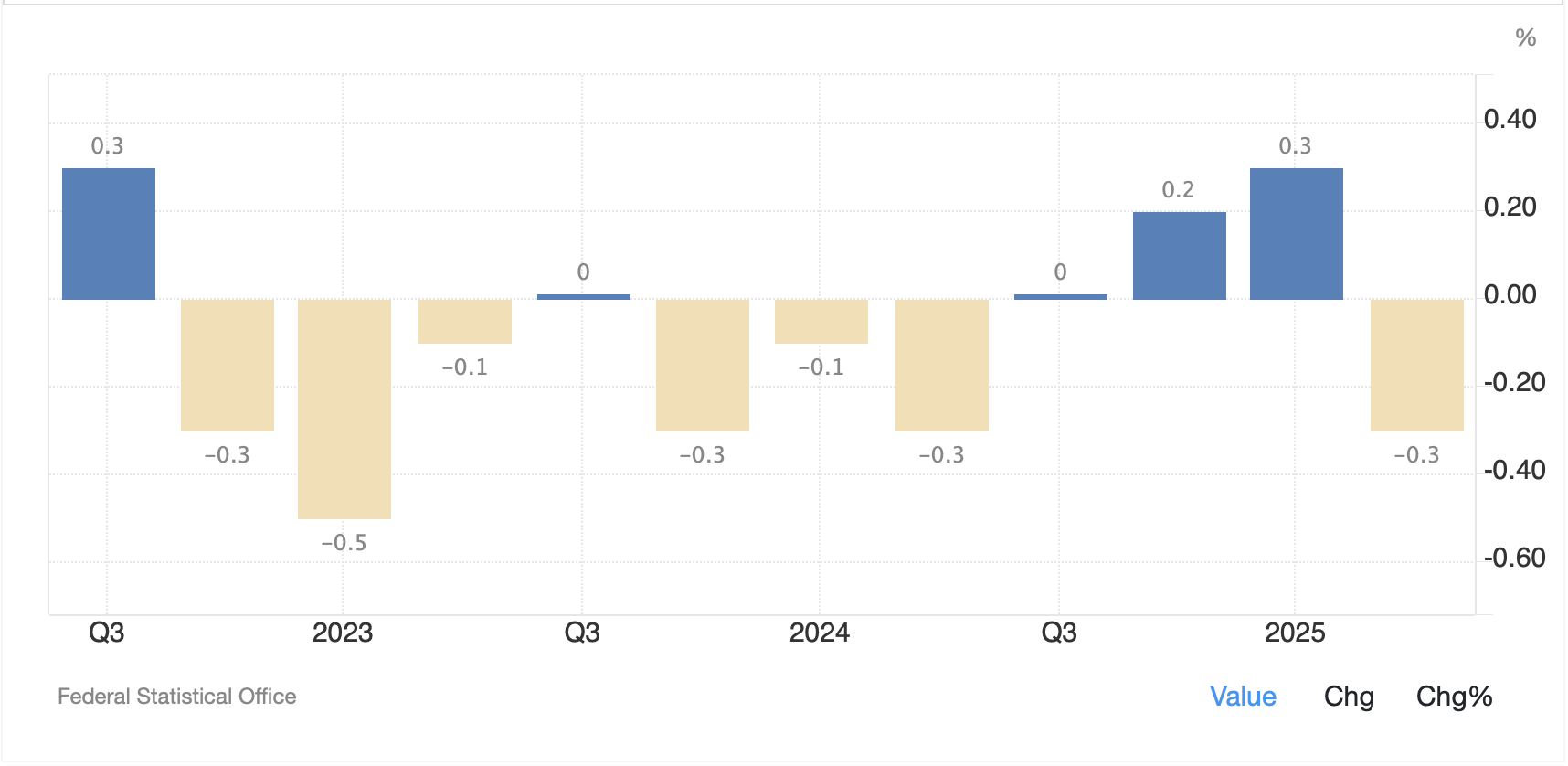
Germany GDP data (-0.3% Q/Q, +0.2% Y/Y) was a few ticks lower than expected and continues to point to an economy that has no positive momentum at all.  In fact, a look at the quarterly GDP data from Germany paints a pretty awful picture if growing your economy is the goal.

Source: tradingeconomics.com

Clearly, the US tariff changes have been quite negative, but in fairness, Germany’s insane energy policy is likely a much bigger driver of their problems as they have the most expensive power costs in the EU.  It is very difficult to have a manufacturing-based economy if you cannot power it cheaply.  Again, while the euro is more than just Germany, this does not bode well for the single currency.

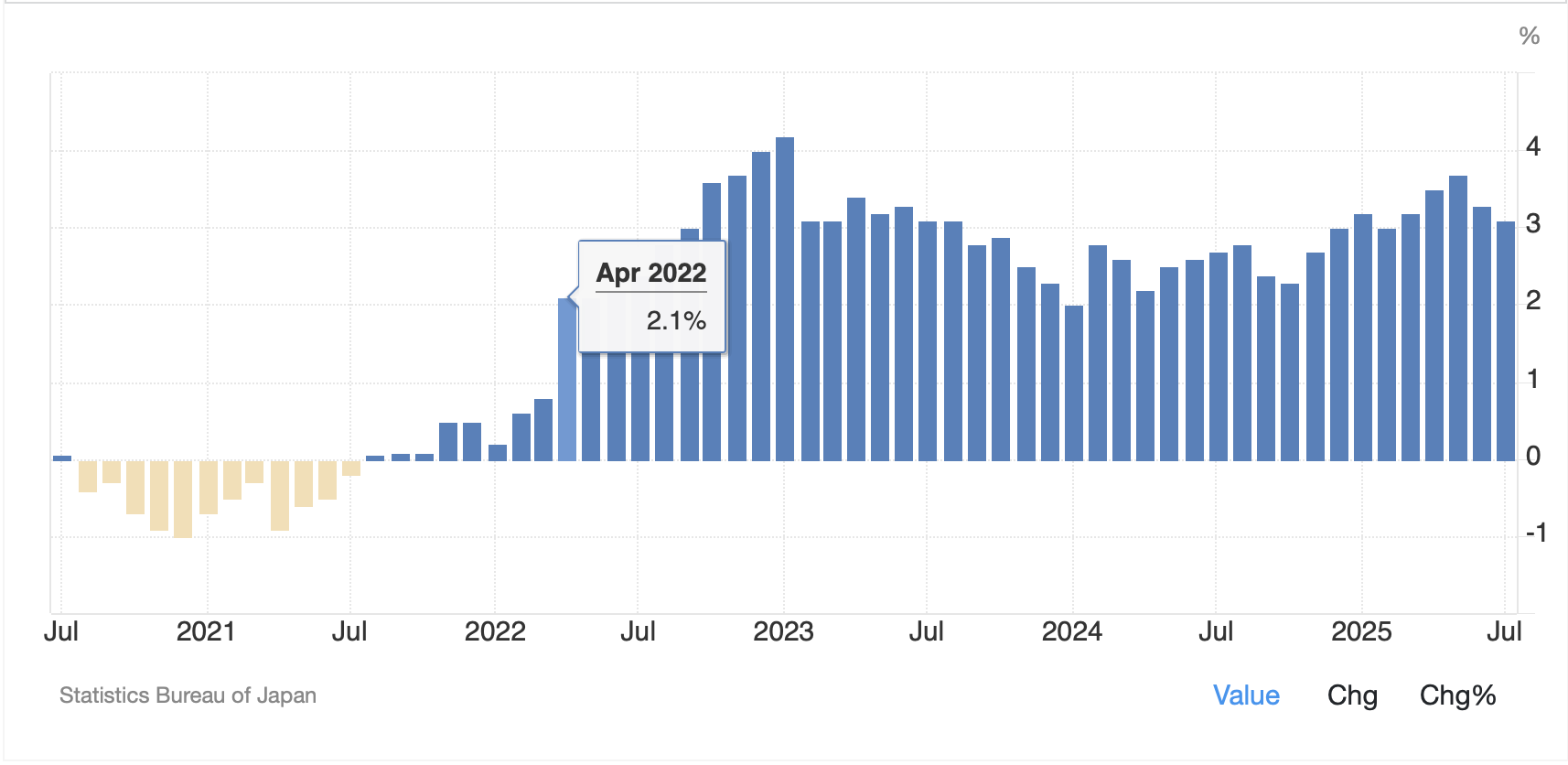
Turning to Japan, inflation continues to run far above their 2.0% target, printing last night at 3.1% on both the headline and core metrics, which while 2 ticks lower than June’s data, was still a tick higher than expected.  It has now been 40 consecutive months that core CPI in Japan has been above the BOJ’s 2.0% target and Ueda-san continues to twiddle his thumbs regarding raising rates.

Source: tradingeconomics.com

It is very hard to watch this lack of policy response to a clear problem, that from all I read is becoming a much bigger political issue for PM Ishiba, and have confidence that the yen is going to strengthen any time soon.  Back in May, the talk was of the unwinding of the carry trade.  All indications now are that it is being put back on in significant size.  FWIW I think we will see 150.00 before too long, especially if Powell sounds hawkish.

And those are really the stories today ahead of Powell and the NY open.  So, let’s see how things behaved overnight.  After a modest down day in the US yesterday, and despite the poor inflation data, Japan was unchanged overall.  However, China (+2.1%) had a huge up move apparently on the idea that US-China trade tensions are easing and despite continued weak data from the country.  Apparently, there has been a rotation from bonds to stocks by local investors driving the move.  Hong Kong (+0.9%) also had a strong session as did Korea (+1.0%) although India, Taiwan and Australia all struggled with declines between -0.6% and -1.0%.  In Europe, the. screens are green, but it is a pale green with muted gains (DAX +0.1%, CAC +0.25%, IBEX +0.4%) despite the weak German data.  Perhaps the belief is this will encourage the ECB to ease policy further.  Meanwhile, at this hour (7:15) US futures are pointing higher by 0.25% or so.

In the bond market, after climbing a few basis points yesterday, Treasury yields are unchanged, trading at 4.33%, so still range bound.  European sovereign yields are softer by -1bp to -2bps, again likely on the softer German data with hopes for a more aggressive ECB.  JGB yields edged higher by 1bp in the 10-year but the longer end of the curve there has seen yields move to new all-time highs with 30-year yields up to 3.216%. it feels like things are starting to unravel in Japanese bond markets.

Turning to commodities, oil (+0.4%) is creeping higher again this morning but remains in its downtrend and activity is lacking.  Meanwhile, the metals markets (Au -0.35%, Ag -0.5%, Cu -0.3%) are all under pressure from a combination of a strong dollar and a lack of investor interest, at least in the West.

Speaking of the dollar, it rallied yesterday and is largely continuing this morning with one notable exception, KRW (+0.75%) which benefitted from trade data showing exports rose 7.6% in the first 20 days of the month on strong semiconductor sales.  But otherwise, +/-0.3% or less is the story of the day, with most currencies within 0.1% of yesterday’s closing levels.

And that’s really it.  There is no data so we are all awaiting Powell and then anything that may come from the White House regarding trade deals, or peace, I guess.  As the summer comes to a close, unless Powell says rate hikes are coming or promises cuts, I expect that traders will have gone for the weekend by lunch time and it will be a very quiet market.

Good luck and good weekend

Adf

Quite Clearly Concerned

The data on Friday exceeded
All forecasts, and has now impeded
The idea the Fed
When looking ahead
Believes further rate cuts are needed
 
Meanwhile from the Chinese we learned
Their exports are still widely yearned
But imports are falling
As growth there is stalling
And Xi is quite clearly concerned


Under the rubric, even a blind squirrel finds an acorn occasionally, my prognostications on Friday morning turned out to be correct as the NFP number was much stronger than expected, the Unemployment Rate fell, and signs of labor market strength were everywhere.  One of the most interesting is the number of quits rose to 13.8%, its highest level in several years and an indication that there is growing confidence amongst the labor force that jobs are available if needed.  As well, as you all are certainly aware, the market responded by selling equities and bonds while reducing the probability of Fed rate cuts this year.  In fact, this morning, the market is pricing in just 24 basis points of cuts for all of 2025, in other words, one cut only.  

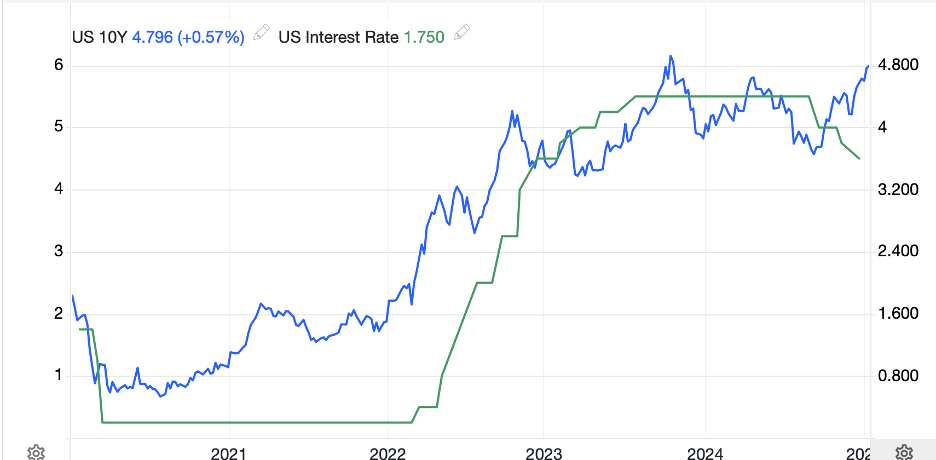
Meanwhile, the bond market continues to sell off with yields rising another 2bps this morning.  the chart below shows the dichotomy between Fed funds and 10-year Treasury yields.  Historically, when the Fed was cutting or raising rates, the bond market followed.  But not this time.

Source: tradingeconomics.com

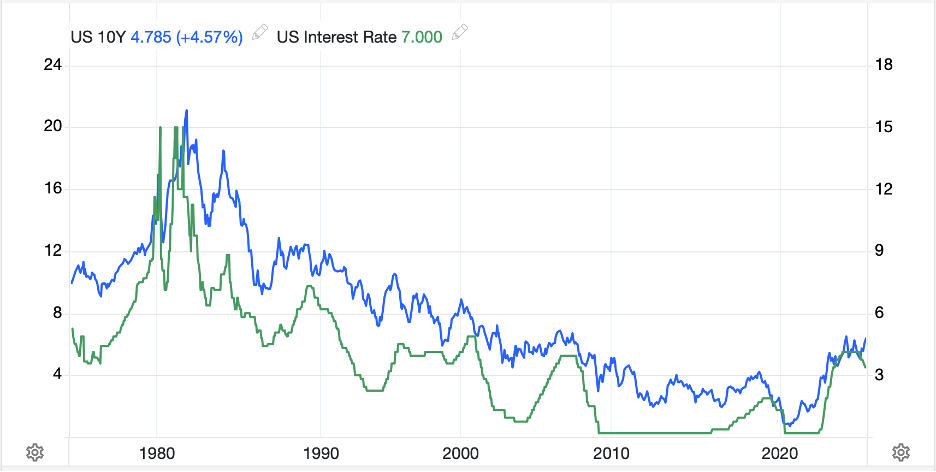
There have been many explanations put forth by analysts as to why this is the case, but to me, the most compelling is that investors disagree with the Fed’s analysis of the economy and, more specifically, with their pollyannaish tone that inflation is going to magically return to 2% because their models say so.  In fact, when looking back over the past 50-years of data, this is the only time that I can see when this dichotomy even existed.

Source: tradingeconomics.com

If I had to guess, there is going to be a lot more volatility coming as previous market signals, and more importantly, Fed market tools, no longer seem to be working as desired.  Nothing has changed my view that 10-year yields head to 5.5%, and if I am correct, look for equity markets to suffer, perhaps quite a bit.

The other story of note overnight was the Chinese trade surplus, which expanded to $104.8 billion in December which took the 2024 surplus to $1.08 trillion.  Now, much of this seems to be preordering of Chinese goods ahead of Trump’s inauguration and the promised tariffs.  But China’s surplus with other Asian economies also grew dramatically last year.  Remember, President Xi is desperate to achieve 5% growth (even on their accounting) and since the Chinese public remains unenthusiastic about spending any money given the $10 trillion hole in their collective savings accounts due to the property market collapse, Xi is reliant on exporting as much as possible.  While this is not making him any friends anywhere else in the world, it is an existential issue for him, so he doesn’t really care.  It will be very interesting to see just how the Trump-Xi relationship moves forward and what concessions are made on either side.

In the end, while the renminbi is basically unchanged this morning, it remains pegged against its 2% limit vs. the CFETS fixing onshore and is 2.35% weaker in the offshore market.  That pressure is going to continue until either the Chinese step up, apply significant stimulus to the domestic economy and start to rebalance the trade process or the PBOC lets the currency go.  Remember, too, Xi is in a tough position because he continuously explained that the renminbi is a good store of value and has been asking his trading partners to use it rather than the dollar.  But if he lets it slide, that will destroy that entire narrative, a real loss of face at the very least, and potentially a much bigger economic problem.  Interesting times.

And so, let us turn to the overnight market activity and see how things are shaping up for today and the rest of the week.  Friday’s sharp decline in US equity indices was followed by similar price action throughout Asia (Nikkei -1.05%, Hang Seng -1.0%, CSI 300 -0.3%, Australia -1.25%) as the narrative is struggling to come up with a positive spin absent further US rate cuts.  European bourses have also come under pressure (DAX -0.7%, CAC -0.8%, IBEX -0.7%, FTSE 100 -0.4%) despite the fact that ECB talking heads continue to explain that more rate cuts are coming, they just won’t be coming quite as quickly as previously expected.  At this point, the market is pricing in 84bps of cuts by the ECB this year.  And yes, US futures are also in the red at this hour (7:00), falling between -0.5% (DJIA) and -1.1% (NASDAQ).

It seems that the narrative writers are struggling to put together a bullish story right now as inflation refuses to fall while growth, at least in Europe, continues to abate.  At least, a bullish story for equities and bonds.  The dollar, on the other hand, has gained many adherents.

Turning to bonds, yields continue to climb across the board with European sovereign yields rising between 2bps (Germany) and 8bps (Greece) and everything in between.  It seems nobody wants to hold bonds right now.  The same was true overnight in Asia where the best performer was the JGB, which was unchanged, but other regional bond markets all saw yields rise between 3bps (Korea) and 9bps (Australia).  Even Chinese yields edged higher by 1bp!

In the commodity space, oil (+2.0%) is en fuego, as the impact of further sanctions on the Russian tanker fleet is being felt worldwide.  It seems the Biden administration has added another 150 Russian tankers to the sanctions list along with insurance companies, and so China and India, who have been the main recipients of Russian oil, are seeking supplies elsewhere.  As long as this continues, it appears oil has further to run.  Meanwhile NatGas (+3.8%) has blasted through $4.00/MMBtu and is now at its highest level since December 2022.  Despite all those global warming fears, the recent arctic blast has increased demand dramatically!

As to the metals markets, the story is different with gold (-0.5%) sliding alongside silver (-2.1%) and copper also trickling lower (-0.15%).  Part of this is clearly the dollar’s strength, which is impressive again today, and part is likely concern over how things are going to play out going forward between the US and China as well as the overall global economy.  Certainly, a case can be made that growth is going to be much slower going forward.

Finally, the dollar is king again, rallying sharply against the euro (-0.5%) and pound (-0.8%) with smaller gains against the rest of the G10 (JPY excepted as it rallied 0.2% on haven flows).  But we are also seeing gains against virtually all EMG currencies (CLP -0.6%, PLN -0.7%, ZAR -0.4%, INR -0.6%) as concerns grow that these other nations will not be able to ably fund their dollar debt as the dollar continues to rise.  FYI, the DXY (+0.35% to 110.07) is at its highest level since October 2022 and looking for all the world like it is going to take out the highs of that autumn at 113.20.

On the data front, this week brings CPI and PPI as well as Retail Sales.  In addition, I was mistaken, and the Fed is not in their quiet period so we will hear a lot more from them this week as well.

TuesdayNFIB Small Biz Optimism100.8
 PPI0.3% (3.4% Y/Y)
 Ex food & energy0.3% (3.7% Y/Y)
WednesdayCPI0.3% (2.8% Y/Y)
 Ex food & energy0.2% (3.3% Y/Y)
 Empire State Manufacturing4.5
 Fed’s Beige Book 
ThursdayInitial Claims214K
 Continuing Claims1870K
 Retail Sales0.5%
 Ex autos0.4%
 Philly Fed-4.0
FridayHousing Starts1.32M
 Building Permits1.46M
 IP0.3%
 Capacity Utilization76.9%

Source: tradingeconomics.com

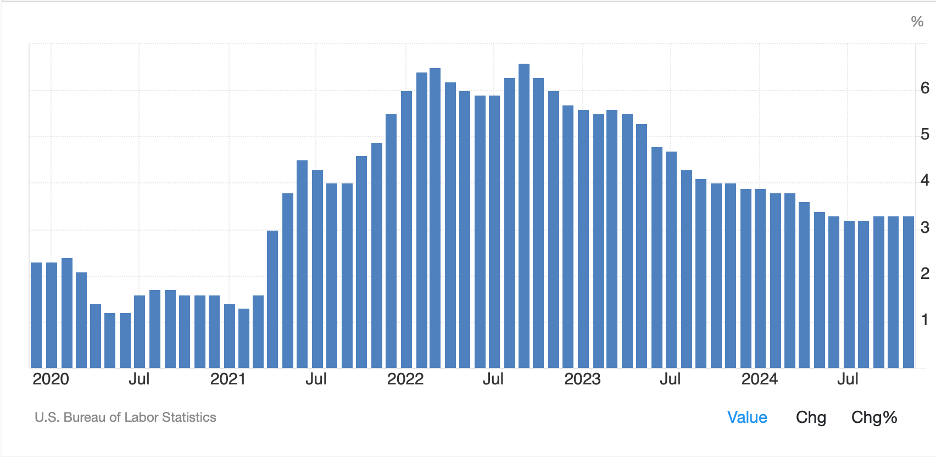
As well, we hear from five Fed speakers over six venues.  Now, the message from the Fed has been pretty unified lately, that caution and patience are appropriate regarding any further rate cuts but that to a (wo)man they all believe that inflation is heading back down to 2.0%.  I’m not sure why that is the case because if you look at the data, it certainly has the feeling that it has bottomed, and inflation rates are turning higher as you can see from the below chart of core CPI.

Source: tradingeconomics.com

And this is before taking into account that energy prices have been soaring lately!  I realize I’m not smart enough to be an FOMC member, but they certainly seem to be willfully blind on this issue.

At any rate, certainly all things still point to a higher dollar going forward, and I imagine we are going to test some big levels soon enough (parity in the euro, 1.20 in the pound) but I am beginning to get uncomfortable as so many analysts have come around to my view.  Historically, if everybody thinks something is going to happen, typically the opposite occurs.  Remember, markets are perverse!

Good luck

Adf

Great Expectations

In Europe, the largest of nations
Is faltering at its foundations
The ‘conomy’s sagging
And tongues are now wagging
‘Bout voting and great expectations
 
Alas for the good German folk
The government’s turned far too woke
Their energy views
Have caused them the blues
And soon they may realize they’re broke


With elections clearly on almost everybody’s mind, it can be no surprise that the crumbling government in Germany has also finally accepted their fate and called for a confidence vote to be held on December 16 which, when Chancellor Olaf Scholz loses (it is virtually guaranteed), will lead to a general election on February 23, 2025.  As has happened in literally every election held thus far in 2024, the incumbents are set to be tossed out.  The problems that have arisen in Europe, with Germany being ground zero, is that the declarations by the mainstream parties to avoid working with the right-wing parties that have garnered approximately 25% of the population’s support almost everywhere, means that the traditional parties cannot create working coalitions that make any sense.  After all, the German government that is collapsing was a combination of the Center-left Social Democrats, the far-left Greens and the free market FDP.  That was always destined to fail so perhaps the fact it took so long is what should be noted.

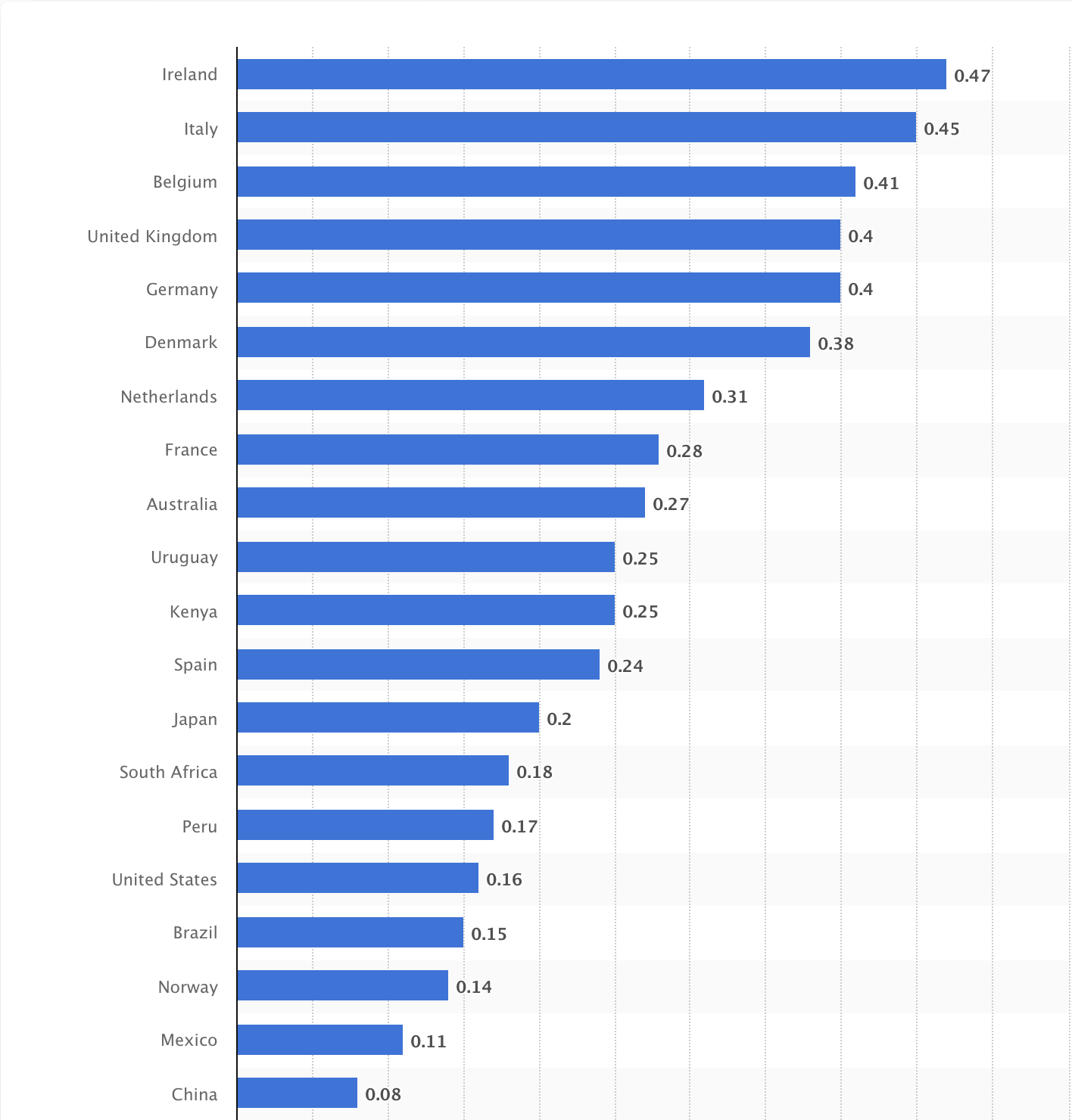
At any rate, it is not hard to understand why the people of Germany are unhappy given the economic situation there.  The economy hasn’t grown in more than two years, basically stagnating, while inflation continues to run above 2%.  Meanwhile, energy prices have risen sharply as a consequence of their Energiewende policy; the nation’s attempt to achieve net zero CO2 emissions.  However, not only did they shutter their nuclear generating fleet, the most stable source of CO2 free electricity, they decided that wind and solar were the way forward.  Given that there are, on average, between 1600 and 1700 hours of sunshine annually (4.3 to 4.5 hours per day), that seemed like a bad bet.  The results cannot be surprising as Germany energy costs are amongst the highest in the world.  The below chart shows electricity prices around the world.

Source: statista.com

If you want a good reason as to why incumbent governments around the world are falling, you don’t have to look much further than this.  Meanwhile, this morning brought the German ZEW Economic Sentiment Index which printed at 7.4, well below both last month and expectations.  As well, the Current Conditions Index fell to -91.4, which while not the lowest ever, certainly indicates concern given -100 is the end of the scale.  

I’m sure you won’t be surprised to note that the euro (-0.4%) has fallen further this morning amid a broad-based dollar rally, that German stocks (DAX -0.8%) are falling and German bund yields (-2bps) are also falling as it becomes ever clearer that the ECB is going to need to cut rates more aggressively than previously anticipated.  Perhaps the story of Bayer Chemical today, where their earnings fell 26% and the stock has fallen 11% to a level not seen since 2009, is a marker.  Just like Volkswagen, they are set to cut costs (i.e., fire people) further.  Germany is having a rough go, and if they continue to perform like this, Europe will have a hard time going forward.

So, while the media in the US continues to focus on President-elect Trump and his activities as he fills out his cabinet posts and other government roles, elsewhere around the world, governments are trying to figure out how to respond to the changes coming here.

In that vein, the COP 29 Climate Conference is currently ongoing in Baku, Azerbaijan (a major oil drilling city) but finding much less press than previous versions.  As well, the attendee list has shrunk, especially from governments around the world.  This appears to be another consequence of the shift in voting preferences.  In fact, I expect that over the next four years, the number of discussions on climate will decline substantially.  

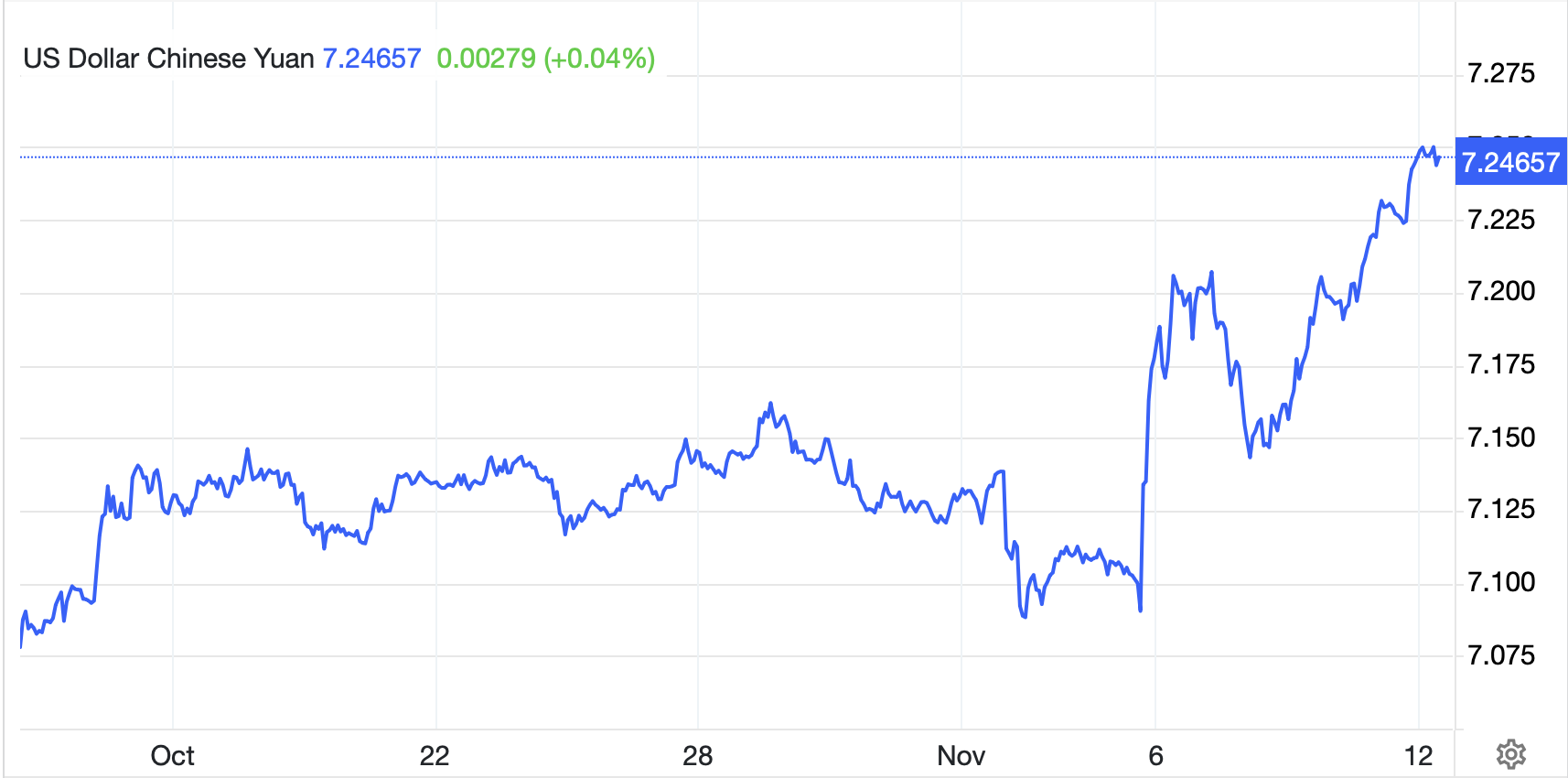
Perhaps the best place to observe how things are changing is China, as they now find themselves in the crosshairs of Trump’s policy changes and they know it.  The question is how they will respond with their own policies.  Recall, last week there were great hopes that we would finally see that big bazooka of fiscal stimulus and it was never fired.  Recent surveys of analysts, while continuing to hope for that elusive stimulus, now see a greater chance of Xi allowing the CNY to decline more rapidly to offset the impacts of tariffs.  This is something that I have expressed for a long time, that the CNY will be the relief valve for the Chinese economy as it comes under pressure.  Certainly, the market seems to be on board with this thesis as evidenced by the CNY’s movement since the election.  I expect there is further to run here.

Source: tradingeconomics.com

Ok, between Germany and China, those were the big stories away from the Trump cabinet watch.  Let’s see how markets behaved overnight in the wake of yet another set of record high closings in the US yesterday.  Despite the yen’s weakness, the Nikkei (-0.4%) was under pressure, although nothing like the pressure seen in China (Hang Seng -2.8%, CSI 300 -1.1%) or even elsewhere in Asia (Korea -1.9%, India -1.0%, Taiwan -2.3%) with pretty much the entire region in the red.  Of course, the same is true in Europe with all the major bourses under pressure (CAC -1.3%, FTSE 100 -1.0%) alongside the DAX’s decline.  As to US futures, at this hour (7:15) they are essentially unchanged as we await a series of five more Fed speeches.

In the bond market, Treasury yields (+6bps) are rising as it appears the 4.30% level is acting as a trading floor now that we have seen moves above it.  However, as mentioned above, the weaker economic prospects in Europe have seen yields across the continent soften between -1bp and -2bps.  Futures markets are now pricing more rate cuts by the ECB over the next year than the Fed although both are pricing about the same probability of a cut in December.  I think the direction of travel is less Fed cutting and more ECB cutting and that will not help the euro.

In the commodity markets, the rout in the metals markets continues with both precious (Au -0.8%, Ag -1.0%) and industrial (Cu -2.0%, Al -0.8%) finding no love.  In fairness, these had all seen very substantial rallies since the beginning of the year, so much of this is profit-taking, although there are those who believe that Trump will be able to arrest the constant rise in US debt issuance.  I’m not so sure about that.  As to oil (+0.6%) it has found a temporary bottom for now, but I do expect that it will continue to see pressure lower.

Finally, the dollar is king today, higher against every one of its counterparts in both the G10 and EMG blocs.  In the G10, the movement is almost uniform with most currencies declining between -0.4% and -0.5% although CHF (-0.1%) is trying to hang on.  In the EMG bloc, there are some larger declines (ZAR -0.8%, CZK -0.9%, HUF -0.9%) while LATAM currencies are lower by -0.5% and we saw similar movements in Asia overnight, -0.5% declines or so.  Again, it is difficult to make a case, at least in the near term, for the dollar to decline very far.  Keep that in mind when considering your hedges.

On the data front, the NFIB Small Business Optimism Index was released earlier at a better than expected 93.7, roughly the same as the July reading and potentially heading back toward the 2022 levels obtained during the recovery from the covid shutdowns.  I expect the election results had some part in this move.  Otherwise, its Fed speakers and we wait for tomorrow’s CPI.  All signs continue to point to a positive view in the US and a stronger dollar going forward.  Parity in the euro is on the cards before long.

Good luck

Adf

Fraught

The job growth that everyone thought
Existed, seems like it was fraught
Meanwhile ISM
Showed further mayhem
As growth slowed while prices were hot
 
The funny thing was the reaction
Where stocks were a source of attraction
But at the same time
Bond buys were a crime
With sellers the ones gaining traction


The NFP data was certainly surprising as the headline number fell to its lowest level, 12K, since December 2020 with the worst part, arguably, the fact that government jobs rose 40K, so there were 52K private sector job losses.  That is just not a good look, nor were the revisions to the previous months which saw another 112K jobs reduced from the rolls.  It cannot be surprising that the Fed funds futures market immediately took the probability of a rate cut to 99% this week and raised the December probability to 82%, up more than 10 points in the past week.  After all, Chair Powell basically told us that he has slain inflation, and they are now hyper focused on the employment mandate.  With that in mind, the futures reaction makes perfect sense.

Perhaps even more surprising was the market reaction, or the dichotomy of market reactions, which saw equity markets in the US rally nicely, with gains between 0.4% and 0.8% in the major indices, while Treasury yields spiked 10bps despite the data.  That yield spike helped carry the dollar higher as the greenback rallied smartly against virtually all its counterparts by more than 0.50%, and it undermined commodity prices.  

The most common explanation here, though, had less to do with the NFP data and more to do with the recent polls regarding the US election, where it appeared the former president Trump was gaining an advantage.  Remember, the ‘Trump trade’ is being described as a steeper yield curve with benefits for the dollar and US equities on the back of stronger growth and higher inflation.

There once was a US election
Where both candidates lacked affection
The worry it seems
Is half the world’s dreams
Are likely soon met with dejection
 
Meanwhile for investors worldwide
This week ought to be quite a ride
To all our chagrins
No matter who wins
Look for either outcome denied

However, this morning, the markets have changed their collective mind, with virtually all of Friday’s movement now unwound, at least in the bond and FX markets.  What would have caused such a reversal?  Well, the latest polls show that the race is much tighter than thought on Friday, with VP Harris gaining ground in a number of them, which now has most pundits simply calling for their favored candidate to win, rather than trying to read the polls.  As such, the Trump trade has been partially unwound and my sense is that until there is an outcome, it will be difficult for markets to do more than increase the amplitude of their moves amid less and less actual trading.  At least, that is true in bonds, FX and commodities.  Stocks, as we all know, are legally mandated to rise every day, so are likely to continue to do so. 

And now, despite the fact that the Fed meets on Thursday, with a rate cut all but assured and ostensibly a great deal of interest in Chairman Powell’s press conference, all eyes are on the election.  Remember, too, not only is that the case in the US, but also around the world.  Whether friend or foe of the US, pretty much all 195 nations on the planet are invested in the outcome.

With that in mind, and since this poet has no deep insight into the outcome, let me simply recount the overnight market activity with the understanding that many trends have the opportunity to reverse depending on the results.

Starting with equity markets, Japanese shares (-2.6%) fell sharply as a combination of both their domestic political struggles (remember their government situation is unclear after the recent snap election) and the significant rebound in the yen (+0.9%) weighed on equities there.  India (-1.2%) also struggled but elsewhere in the time zone, stocks rallied nicely led by China (+1.4%) and Korea (+1.8%) as visions of that Chinese fiscal bazooka continue to dance in investors dreams.  Interestingly, the WSJ had an article this morning downplaying the idea, which based on their history makes a great deal of sense to me.  Turning to Europe, most markets there are firmer, albeit only modestly so, with gains from the CAC and IBEX (+0.3% each) outpacing the DAX (0.0%).  Finishing off, US futures are basically unchanged at this hour (7:00).

In the bond markets, while the Treasury move Friday did help drag European yields somewhat higher, it was nothing like seen in the US and this morning, those yields are essentially unchanged, +/- 1bp in most cases.  The only data of note was the final PMI data which confirmed the flash data from last week.  As to JGB yields, they have been stuck in the mud for a while now, still hanging below the 1.0% level with no designs of a large move.

Oil prices (+3.1%) are rebounding nicely on news that OPEC+ has delayed their previous plans to start increasing production as of December this year.  Concerns about oversupply in the global market plus the return of Libyan production and record high US production have convinced them they better leave things as they are.  Metals markets are a bit firmer this morning with gold (+0.2%) actually somewhat disappointing given the magnitude of the dollar’s decline, while both silver (+1.25%) and copper (+1.1%) show nice gains.

Finally, the dollar is under severe pressure across the board.  The biggest gainers are MXN (+1.2%), NOK (+1.2%) and PLN (+1.1%) although most gains are on the order of 0.7% or more.  Certainly, the oil story is helping NOK, and given the concerns that traders have about prospective tariff increases on Mexico if Trump wins, the idea that the race is closer than previously thought has supported the peso.  As to the zloty, it seems that their PMI data, printing at 49.2, a fourth consecutive rise) has traders looking for a more hawkish central bank on the back of stronger economic activity.

On the data front, aside from the election and the Fed, there is other information, although it is not clear that anyone will notice.

TodayFactory Orders-0.4%
TuesdayTrade Balance-$84.1B
 ISM Services53.8
ThursdayBOE Rate Decision4.75% (current 5.00%)
 Initial Claims223K
 Continuing Claims1865K
 Nonfarm Productivity2.5%
 Unit Labor Costs1.1%
 FOMC Rate Decision4.75% (current 5.0%)
FridayMichigan Sentiment71.0

Source: tradingeconomics.com

Of course, the election will dominate everything, and it certainly appears that there will be legal challenges from the losing side regardless of the outcome.  My expectation is that markets will remain jumpy with outsized moves on low volumes until there is more clarity.  It is not often that an FOMC meeting is seen as an afterthought, but much to Chairman Powell’s delight, I sense that is going to be the case this week.  

I have already voted early and I encourage each of you to vote as the more voices heard, the better the case the winner will have at achieving a mandate.  And the reality is, we need a president with a mandate if we are going to see broad-based positive changes in the nation going forward.

Good luck

adf

Still Weak

In Germany, data’s still weak
For Europe, that doesn’t, well, speak
So, riddle me this
Are traders remiss
For claiming that euros are chic?
 
It’s true interest rates matter most
And Powell said Fed funds are toast
But can M. Lagarde
Just simply discard
The Germans, though they’re comatose?


There is a growing opinion that the dollar is going to decline sharply as the Fed begins to cut rates.  Numerous analysts believe that the market is underpricing how many Fed fund cuts are coming as they are all-in on the US recession story.  After Friday’s Jackson Hole speech, it certainly appears that we will get at least one cut come September, but stranger things have happened.  And obviously, given Powell’s pivot from inflation to unemployment as job #1, the NFP report a week from Friday is going to be crucial.

But we must never forget that the FX market is a relative concept.  It is not simply that one country’s economy is doing well or poorly, nor that their interest rates are high or low, or perhaps moving up or down, it is how those data points compare to other countries that determines the movement in the FX markets, at least the fundamentals, but also frequently the capital flows.  It is with this in mind that on a quiet day we have time to dissect the story in Germany for a bit.  Early this morning, Germany’s Federal Statistical Office released two data points, the GfK Consumer Confidence reading, which fell sharply to a below consensus reading of -22.0 and the Final GDP Growth numbers for Q2, which printed at -0.1% Q/Q and 0.0% Y/Y.  Now, this is not a single quarter feature in Germany as is illustrated in the below chart.

A graph with blue and yellow squares

Description automatically generated

Source: tradingeconomics.com

In fact, GDP growth in Germany has averaged just 0.3% annually over the past 5 years, a pretty anemic level, and one that bodes ill for Europe as a whole.  Recall, Germany’s economy is the largest in Europe (and 3rdlargest in the world) and represents about 28.6% of the Eurozone’s total economy.  If the largest economy in a group of nations is stagnating, it is very difficult for the group’s overall growth rate to expand.  Compare that to the fact that the data to date in the US indicate that growth remains fairly solid (GDP +2.8% in Q2), and then ask yourself, where are the opportunities for activity more prevalent, Europe or the US?  Again, the macro picture seems to point to the US as a continued preferred destination for capital.

And yet, the euro is pushing back to its highest level since a brief spike in July 2023, and otherwise, early 2022 prior to that.  So, does it really make sense for the euro to continue to rally from here?  Literally, the only argument in its favor is that the Fed has now committed to begin easing policy and the market is pricing in about 200bps of rate cuts through the end of 2025.  Meanwhile, although the ECB has implemented their first rate cut, and seem set to execute their second next month, the market is only pricing in 125bps of cuts by December 2025, and just 50bps total for 2024, compared to 100bps for the Fed.

As such, here is the explanation for the euro’s recent solid performance.  But I believe the question to ask is, can this last?  If Germany’s economy is going to continue to bounce along at essentially zero growth, and there is nothing indicating a rebound is coming soon, it seems more likely to me that the rest of Europe follows it lower, rather than ignores Germany and powers ahead.  It’s not that individual small nations in the Eurozone won’t grow more quickly, but Germany’s position in the Eurozone, notably as a trade partner, implies that things are more likely to sag than soar.  

Yes, the euro has rebounded lately, but that has been in response to the interest rate pricing described above.  I think it is a fair bet that Madame Lagarde, when faced with a Eurozone that is growing more slowly than desired, is likely to accelerate interest rate cuts there.  And when that happens, the euro’s recent rise will very likely retrace.  I am not saying that the dollar is going to climb against everything, just that the euro’s strength feels suspect.  One poet’s view.

I’m sorry for the focus on Germany, but some days, there is very little macro news of note, and this seemed the most important, especially given that the idea of a much weaker dollar going forward is gaining traction.  

Ok, with that in mind, let’s look at the overnight activity, which was not all that substantial.  After yesterday’s split between tech shares (NASDAQ -0.85%) and industrials (DJIA +0.16% and a new ATH), Asian shares were mixed as well.  The Nikkei (+0.5%) had a solid session as did the Hang Seng (+0.4%) although mainland Chinese shares (-0.6%) continue to suffer, last night due to a much weaker than forecast earnings result from the parent company of Temu.  Of more concern than the result was the commentary by their CEO that prospects for consumption were dimming.  In Europe, there are some very modest gains, with the DAX (+0.2%) surprisingly holding up well, although the move is obviously quite minimal.  I cannot look at the Eurozone economy and expect anything other than more aggressive rate cuts from the ECB going forward.  As to US futures, at this hour (7:30), they are essentially flat.

In the bond market, yields are backing up from their recent lows with Treasuries higher by 3bps and European sovereigns by between 5bps and 7bps.  In fact, the real outlier is the UK gilt market where 10yr yields are higher by 9bps as there is an increasing concern that the Starmer government is going to blow up the budget there as the PM tries to implement his new policies.  You may remember what happened when Liz Truss was PM and proposed a high spending, high deficit budget and caused all kinds of havoc in the gilt market back in October 2022.  I would not rule out another situation like that quite frankly.  Finally, JGB yields edged lower by 1bp last night, continuing to prove that normal monetary policy in Japan remains a distant prospect.

In the commodity markets, oil (-0.4%) which is higher by > 5% in the past week, has stopped climbing for now.  Perhaps the fact that there have been no new military incursions in the Middle East has been sufficient to get the algos to start selling again on the poor demand story.  Gold (-0.2%) is also biding its time, as are the other metals, although all are retaining the bulk of their recent gains.  Generically, my dollar view is that it will weaken vs. stuff like commodities, not necessarily vs. other currencies.  Of course, this implies a rebound in inflation, something which I continue to see going forward.

Lastly, the dollar is little changed this morning, with most G10 and EMG currencies +/-0.2% or less compared to yesterday’s closing levels.  The biggest mover today is NZD (+0.4%), although I am hard-pressed to see any fundamental reason as there was neither data nor central bank commentary.  Arguably, this is the result of some position changes rather than a fundamental move.  And after that, nothing has moved much at all.

Yesterday’s Durable Goods print of +9.9% was astonishingly high, although the ex-transport reading of -0.2% was a tick lower than forecast.  I guess Boeing sold more planes than anticipated.  As to this morning, we see Case-Shiller Home Prices (exp 6.0%) and Consumer Confidence (100.7), neither of which seems likely to have a major impact.  SF Fed president Daly reiterated the Powell idea that the time has come to cut rates, and I expect every Fed speaker going forward up to the quiet period to say the same.  I guess the real problem will be if the NFP report is hot.  Right now, the early forecasts are for 100K NFP and the Unemployment Rate to remain unchanged at 4.3%.  But what if it prints at 200K and Unemployment slips back a tick?  Will they still be anxious to cut?  I’m not forecasting that, simply reminding us all that assumptions need to be tempered.

As it is the last week of August with holidays rife around the Street, I suspect it will be very quiet overall.  At this point, we need more data to make decisions, so look for limited activity in the FX markets, although I guess the world is really waiting for Nvidia’s earnings tomorrow more than anything else.

Good luck

adf

The Mantra Repeated

Inflation has now been defeated
At least that’s the mantra repeated
By equity bulls
Who’re buying bagfuls
Of stocks which last week had depleted
 
But what if the data today
Does not show inflation’s at bay?
Will pundits still call
For Fed funds to fall
Or will cooler heads get their way?


As last week fades into the mists of memory, the narrative writers have been hard at work reimposing the soft-landing thesis and how the Fed is going to ride to the rescue of what seems to be slackening data across most aspects of the economy. The latest piece of information was yesterday’s PPI numbers that indicated, at the producer level, price pressures were ebbing further.  In fact, the core PPI reading for July was 0.0%, a huge victory for the Fed as it continues to add to the story that their timely behavior and strength of will have been having the desired effects.  And maybe they have been doing just that, although there is reason to believe that other things are happening.

Regardless, with the much more important CPI data set to be released this morning, if those PPI numbers are “confirmed” with lower than forecast CPI numbers, there will be no stopping the equity rebound/rally and expectations for a 50bp cut at the September meeting will run rampant.  The current median forecasts, according to tradingeconomics.com are: 

  • Headline (0.2%, 3.0% Y/Y); and 
  • Core (0.2% (3.2% Y/Y).  

Almost by definition, at least half of the punditry is looking for a headline print with a 2 handle, substantially closer to the Fed’s target than we have seen since March 2021.  The basis of this view is that shelter costs are going to continue to trend lower and there is a growing expectation that used car prices are also destined to head lower.  Given the way that shelter costs are implemented in the CPI calculations, I have no opinion on how recent activity will impact the overall results.  However, the anecdata that comes from my neighborhood shows that homes continue to sell over asking prices in short order and that there is no sign of prices declining yet.  I know that what happens here is not necessarily occurring elsewhere in the country, but it is unlikely to be entirely unique.  I guess we’ll all see the answer at 8:30.

In the meantime, the market story has been twofold, equity bulls are basking in the glow of the rebound from last week’s dramatic declines and the interest rate doves are completely willing to ignore actual Fed commentary and are increasing their bets that the Fed starts this cutting cycle with a 50bp reduction.  

As can be seen in the graphic below from the cmegroup.com website, the 50bp cut story is slightly more than a coin flip at the moment.  

A screenshot of a computer

Description automatically generated

But the interesting thing is to see how this pricing has evolved over the past month.  Looking at the table at the bottom of the graphic shows that last week, in the wake of the Japanese market selloff, the belief was much stronger that a 50bp cut was on the way (in fact, on July 5th, that probability was >90%), but a month ago, it was a very low probability event.  Back then, it was only the true believers in an upcoming recession that were looking for 50bps.  But now, it is mainstream thinking, at least among the punditry.  Yesterday, Atlanta Fed president Raphael Bostic explained, “we want to be absolutely sure.  It would be really bad if we started cutting rates and then had to turn around and raise them again.”  However, he did acknowledge that he is likely to be ready to cut “by the end of the year.”  While I have never met Mr Bostic, this does not sound like a man who is desperate to cut interest rates soon, narrative be damned.

Ok, away from all the huffing and puffing on US CPI, we did get some other important news overnight.  The first thing was the RBNZ surprised many folks by cutting their Official Cash Rate by 25bps.  Apparently, they are concerned with slowing growth and gratified that inflation appears to be slowing.  The upshot was that the NZD (-1.0%) fell sharply and the local stock market rallied more than 2%.

Elsewhere, UK inflation was released at a lower than expected 2.2% for July.  While that was an uptick from the June level of 2.0%, the fact that it was lower than both the BOE and Street expectations, and that services inflation rose “only” 5.2%, down from the 5.7% reading in June, has traders increasing their bets for a rate cut in September.  The pound (-0.2%) did slip slightly on the report but remains modestly higher on the year.  As to the FTSE 100, its 0.3% gain pales in comparison to the type of movements we have been seeing in equity markets elsewhere.

The zephyrs of change
Are blowing throughout Japan
Kishida’s leaving

One last piece of news is that Japanese PM, Fumio Kishida, has announced that he will not be running for LDP party leadership, the critical post to become (or in his case remain) Prime Minister.  A series of fundraising scandals has dogged his entire administration, and his approval rating remains below 30%.  The market take is that his leaving will enable the BOJ to act more aggressively, at least according to some local analysts and all depending on who wins the election.  While several of the mooted candidates are on record as calling for more monetary policy normalization (i.e. rate hikes), they are not the leading candidates at this time.  It seems early to make that case in my mind.  In the meantime, while the BOJ may want to raise rates, I think they are going to wait for more rate cutting in the rest of the G10, specifically from the Fed, before considering their next move.  Net, the yen’s response to this story has been nil, although we did see Japanese equities rally (Nikkei + 0.6%).

Elsewhere in equity markets, both the Hang Seng (-0.35%) and CSI 300 (-0.75%) continue to languish relative to other markets around the world as the prospects for the Chinese economy, and by extension its companies, remains lackluster, at best.  The absence of any significant Chinese stimulus remains a weight on the economy and the markets there.  However, most other markets in Asia rallied nicely overnight, following the US price action yesterday.  As to European bourses, they are all green, but the movements have been modest, on the order of 0.3% or so, as Eurozone economic data continues to disappoint (IP -0.1% in June, exp +0.5%).  As to US futures, ahead of the CPI data, they are essentially unchanged.

In the bond market, Treasury yields continue to grind lower, falling 7bps after the PPI data yesterday and down another basis point ahead of the CPI today.  European sovereign yields, though, are slightly higher this morning, between 1bp and 2bps, which based on the data makes no sense.  But the moves are small enough to be irrelevant.  One outlier here is UK Gilt yields, which have declined 4bps on the softer inflation print.

Oil (-0.2%) which suffered yesterday has stopped falling for the moment as the market remains on tenterhooks regarding a possible Iranian attack on Israel.  In the meantime, expectations are for a further draw of oil inventories in the US, although the industry continues to pump an extraordinary 13.4 million bpd despite all the efforts of the current administration to stifle it.  As to the metals markets, gold (+0.4%) continues to find support and is pushing toward new highs yet again.  This morning it is taking the rest of the metals complex with it, although that could be a result of the dollar’s modest weakness.

Finally, the dollar is a bit softer overall this morning, but there are several idiosyncratic stories.  We’ve already mentioned NZD, GBP and JPY.  However, the euro (+0.25%) is now at its highest level of 2024 and back above 1.10.  Meanwhile, the commodity currencies are mostly firmer vs. the dollar this morning (ZAR +0.3%, MXN +0.3%, NOK +0.6%, SEK +0.5%) although Aussie (-0.2%) is bucking that trend.  One other noteworthy mover is CNY (+0.2%) which has been showing far more volatility than normal in the past two weeks.  It seems it is still coming to grips with the Japanese story as well.

And that’s really it for the day.  There are no Fed speakers on the calendar, but we must always be aware of some unscheduled interview.  Remember, they love to talk.  Right now, I would say the market is looking for softer inflation data and is pricing accordingly.  As such, if this data is even modestly warm, let alone hot, be ready for some quick reversals, at least early in the session.  So, stocks lower with bonds while the dollar climbs.  But based on the current zeitgeist, I have to believe that any dip will be bought with reckless abandon.

Good luck

Adf