Terribly Keen

The evidence, so far, we’ve seen
Is nobody’s terribly keen
To stop all the shooting
In wars, or the looting
In riots, at least so I glean
 
But can stocks and bonds still maintain
The heights they consistently gain
Or will, one day soon
Risk assets all swoon
As traders turn to their left-brain?


I am old enough to remember when Israel’s attack on Iranian nuclear facilities was considered a risk to global financial assets.  Equity prices fell around the world as investors scrambled to find havens to protect their assets.  Alas, these days, the only haven around seems to be gold as Treasury yields, after an initial slide, rebounded which implies investors may have questioned their safety and the dollar, after a slight bump, slipped back.

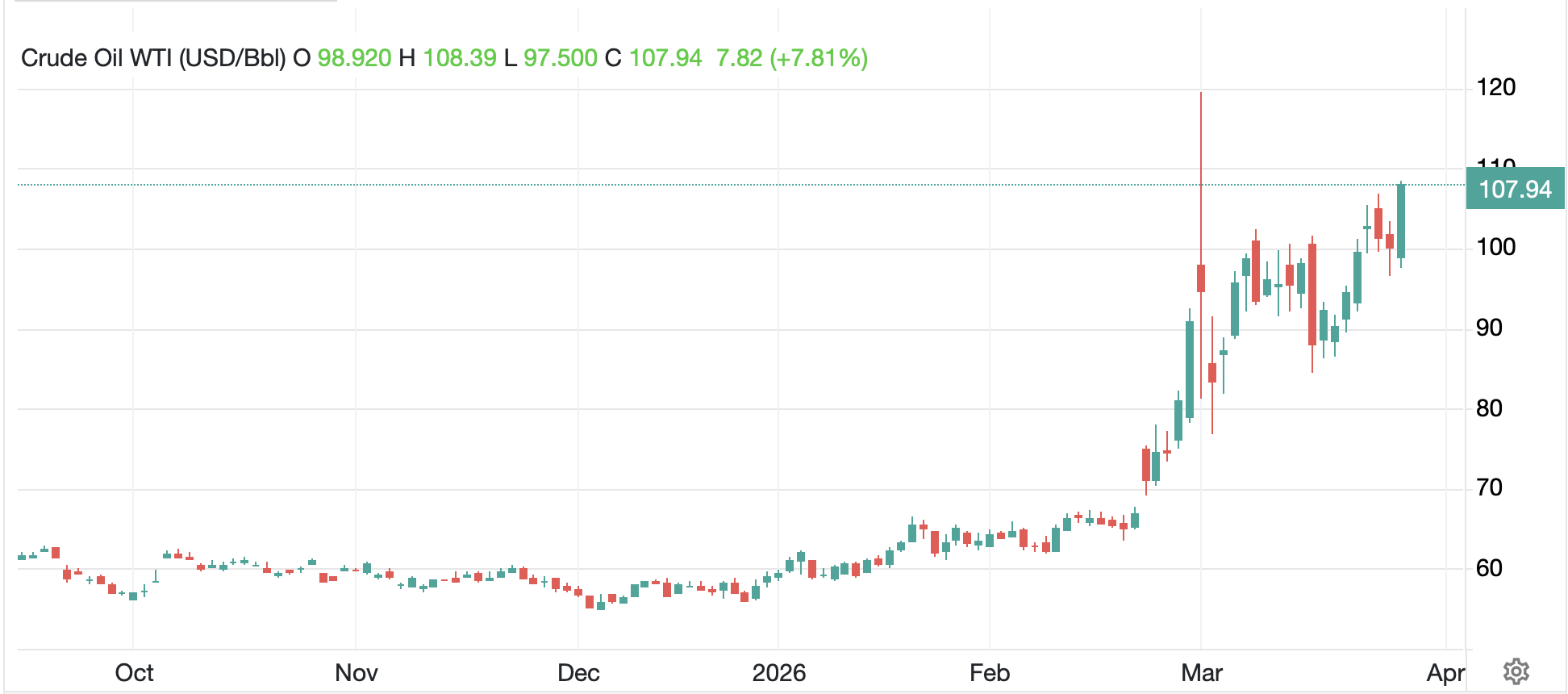
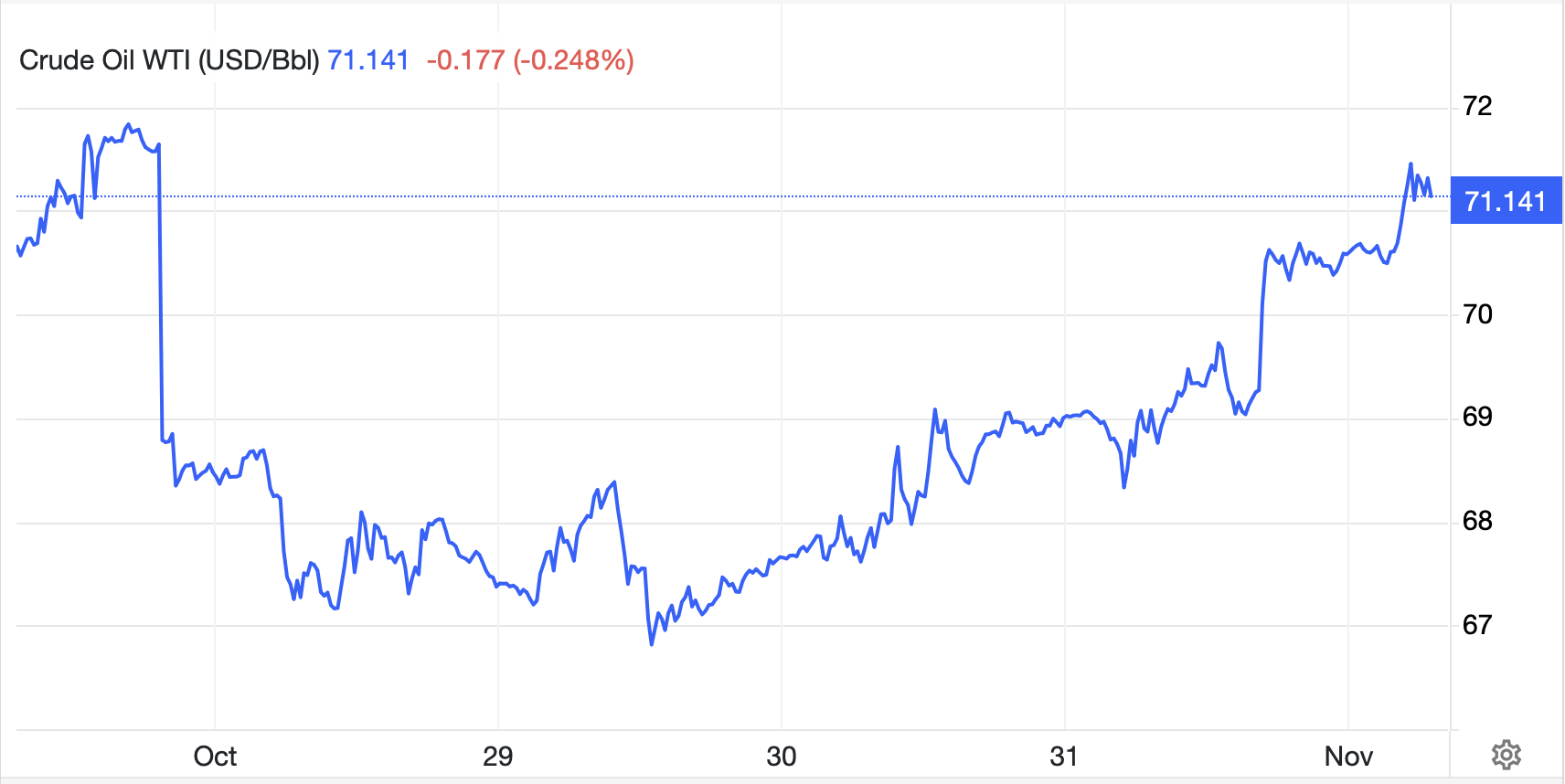
But that is clearly old-fashioned thinking as evidenced by the fact that fear is already ebbing in markets with equities rebounding this morning, the dollar under pressure and both gold and oil slipping slightly.  Now, it is early days but a look at the chart below of oil shows that it took about 9 months for oil prices to retrace to their pre-Russia invasion levels.  Obviously, this situation is different than that from the perspective that prior to Russia’s invasion, there were no energy market sanctions while Iran has been subject to sanctions for years.  However, the larger point is that the market, at least right now, seems to have adjusted to what it believes is the appropriate level to account for changes in production.

Source: tradingeconomics.com

Now, as of January 2025, at least as per the data I could find, Russia produces 10.7 million barrels/day while Iran clocks in at just under 4 million.  As well, given the sanctions, much of Iran’s production has a limited market, with China being the largest importer.  I’m simply trying to highlight that Russia’s production was much larger and more critical to the oil market overall, so a larger impact would be expected.  However, the fact that Israel continues to destroy Iranian infrastructure, and has targeted oil infrastructure as well as nuclear infrastructure, suggests there could easily be more impacts to come.  This is especially true if Iran seeks to close the Strait of Hormuz, a key bottleneck exiting the Persian Gulf and where some 20% of global oil production transits daily.

But the market is sanguine about these risks, at least for now.  There is no indication that Israel has completed what they see as their mission, and that means things could well escalate from here.  In that case, I would expect another jump in oil prices, but overall, it is not hard to believe that we have seen the bulk of any movement.  It strikes me that we will need substantially stronger economic activity to push oil prices much higher from here, and that seems unlikely right now.

Meanwhile, near Banff there’s a meeting
Where heads of state are all competing
To help convince Trump
There will be a slump
Unless tariff pressures are fleeting

The other noteworthy story this morning is the G-7 meeting that is being held in Kananaskis, Alberta, near Calgary and Banff and how all the other members of the club, as well as invitees from Mexico, Brazil, South Africa, India and South Korea, will be trying to convince the president that his tariffs are going to be too damaging and need to be adjusted or removed, at least for their own nations.

Anyone who indicates they know how things will evolve is offering misinformation as Trump’s mercurial nature precludes that from being the case.  However, it would not be inconceivable for some headway to be made by some of these nations in certain areas although President Trump does appear to strongly believe tariffs are a benefit by themselves.  I am not counting on any major breakthroughs here, but small victories are possible.

One last thing before the market recap though, and this was a Substack piece I read this weekend from The Brawl Street Journal, that, frankly, shocked and scared me regarding the ECB and some plans they are considering.  While President Trump has consistently called the climate hysteria a hoax and his administration is doing everything it can to remove Net Zero promises and CO2 reduction from anything the government does, the opposite is the case in Europe.  The frightening part is that the ECB is considering adding effective mandates to lending criteria such that loans to support agriculture or fossil fuel production will require banks to hold more capital, making them more expensive.  The very obvious result is there will be less loans in this space, and things like agriculture and fossil fuel production will become scarcer in Europe than elsewhere.  

Yes, this is suicidal, but then we have already seen Germany (and the UK) attempt to commit economic suicide with its energy policy, and while many in Europe would suffer the consequences, I assure you the members of the ECB would not be in that group.  But my point, overall, is that if this plan is enacted, and the target date appears to be this autumn, it is a cogent reason for the euro to begin a structural decline to much lower levels.  This is not for today, but something to remember if you hear that the NVaR (Nature Value at Risk) plan is enacted.  Tariffs will be their last concern as the continent enters a long-term economic decline as a result.  The blackout in Spain in April will become the norm, not the unusual circumstance.

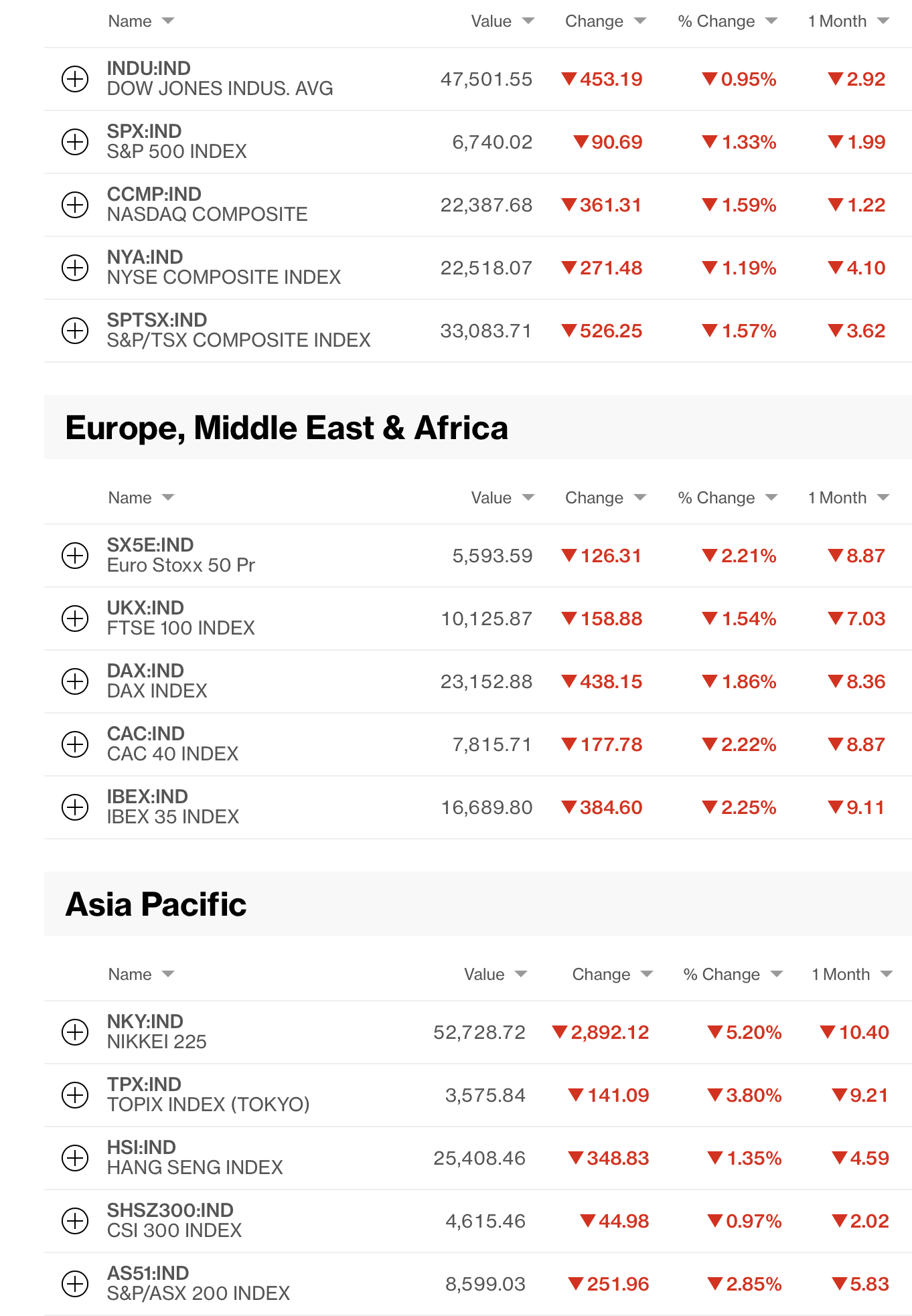
Ok, let’s see how little investors are concerned about war and escalation.  While equity markets were lower around the world on Friday, that is just not the case anymore.  Asia saw the Nikkei (+1.3%) lead the way higher with the Hang Seng (+0.7%) and CSI 300 (+0.25%) also gaining as well as strength in Korea (+1.8%) and India (+0.8%) as hopes rise some positive news will come from the G-7.  Europe, too, has seen gains across the board led by Spain (+0.9%) and France (+0.7%) with most other markets rising between 0.3% and 0.5%.  As to US futures, at this hour (6:50) they are higher by about 0.5% with the NASDAQ leading the way.

In the bond market, Treasury yields are backing up a further 3bps this morning but are still just above 4.40%.  European yields are +/- 1bp across the board as investors try to decipher ECB commentary about the next rate move.  The universal belief is there will be another cut, although Bundesbank president Nagel tried to pour cold water on that thesis this morning calling for caution and a meeting-by-meeting approach going forward.

Commodity markets, are of course, the real surprise this morning with oil (-1.1%) looking like it has put in at least a short-term top.  In the metals market, gold (-0.4%) is giving back some of last week’s gains although both silver (+0.2%) and copper (+1.1%) are rebounding after tougher weeks.  Metals prices seem to be pointing to less fear and more hope for economic rebound.

Finally, the dollar is under some pressure this morning, slipping vs. most of its counterparts in both the G10 and EMG blocs.  The euro (+0.25%) is having a solid session although both AUD (+0.4%) and NZD (+0.5%) are leading the G10 pack.   Even NOK (+0.1%) is rallying despite oil’s pullback.  In the EMG bloc, ZAR (+0.8%) is the leader right now, partially on continued gains in platinum and gold’s overall recent performance, and partially on hopes that their presence at the G-7 will get them some tariff relief.  Elsewhere, the gains have been less impressive with KRW (+0.5%) also benefitting from tariff hopes while the CE4 see gains of 0.3% or so.  No tariff hopes there.

It is an important data week with Retail Sales and housing data, but also because the FOMC leads a series of central bank decisions.

TodayEmpire State Manufacturing-5.5
TuesdayBOJ Rate Decision0.50% (no change)
 Retail Sales-0.7%
 -ex autos0.1%
 IP0.1%
 Capacity Utilization77.7%
WednesdayRiksbank Rate Decision2.0% (-25bps)
 Housing Starts1.36M
 Building Permits1.43M
 Initial Claims245K
 Continuing Claims1940K
 FOMC Rate Decision4.5% (no change)
ThursdaySNB Rate Decision0.00% (-25bps)
 BOE Rate Decision4.25% (no change)
FridayPhilly Fed-1.0

Source: tradingeconomics.com

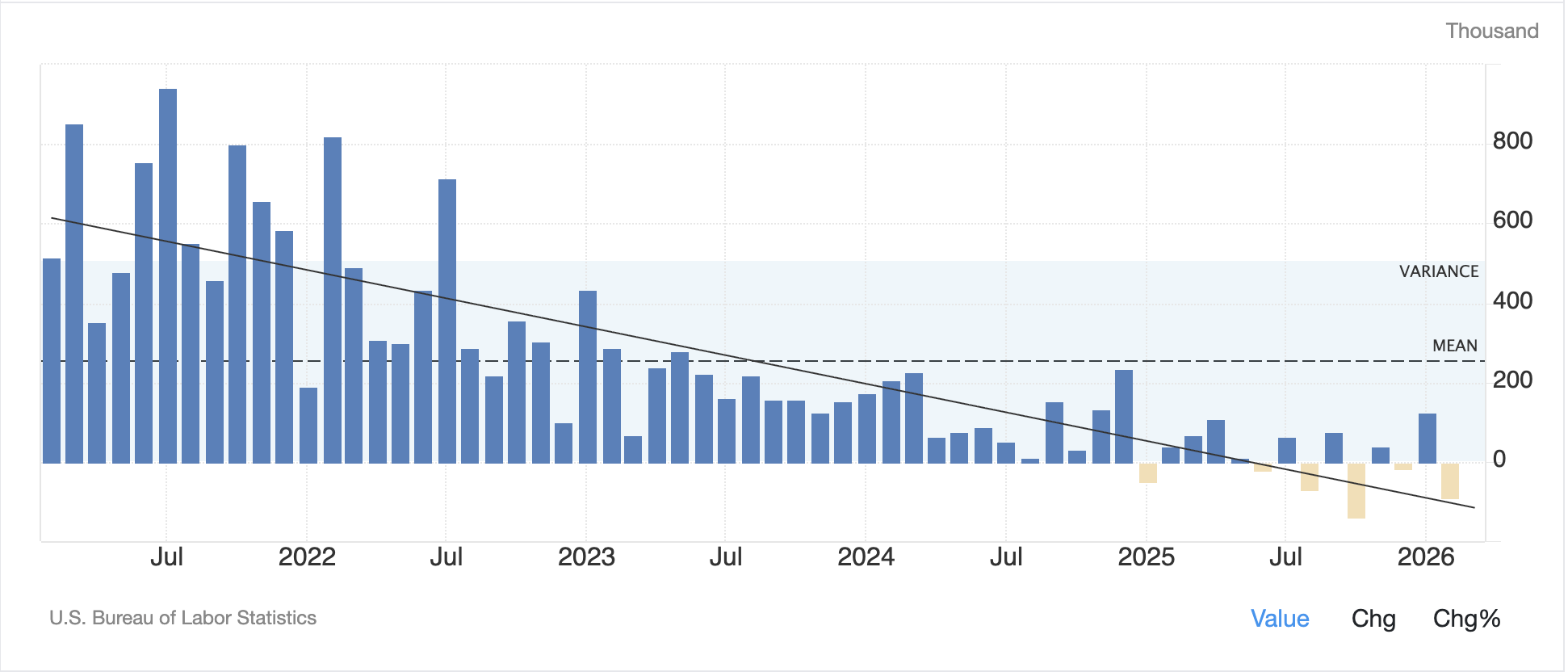
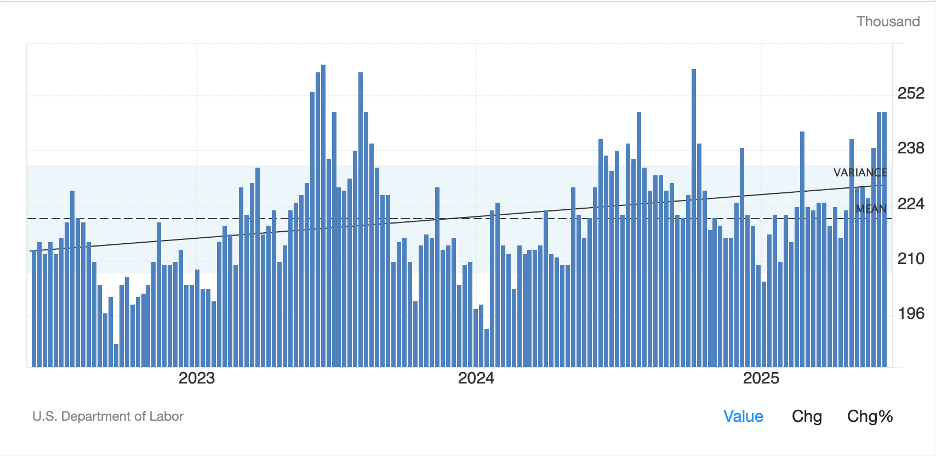
So, Sweden and Switzerland are set to cut rates again, while the rest of the world waits.  Chairman Powell’s comments seem unlikely to stray from the concept of too much uncertainty given current fiscal policies so no need to do anything.  Thursday is a Federal holiday, Juneteenth, hence the early release of Claims data.  I have to say the Claims data is starting to look a bit worse with the trend clearly climbing of late as per the below chart.

Source: tradingeconomics.com

I continue to read stories about the cracks in the labor market and how it will eventually show itself as weaker US economic activity, but the process has certainly taken longer to evolve than many analysts had forecast.  One other thing to remember is that Congress is still working on the BBB which if/when passed is likely to help support the economy overall.  The target date there is July 4th, but we shall see.

Summarizing the overall situation, many things make no sense at all, and others make only little sense, at least based on more historical correlations and relationships.  I think there is a real risk of another sell-off in risk assets, but I do not see a major collapse.  As to the dollar, the trend remains lower, but it is a slow trend.

Good luck

Adf

Much Hotter

Remember when riots were seen
Across every TV’s flat screen?
Well, that’s in the past
As news of a blast
In Tehran, just one thing, can mean
 
The Middle East just got much hotter
And now every armchair war plotter
Will offer their views
Of which side will lose
So, traders, keep watch o’er your blotter


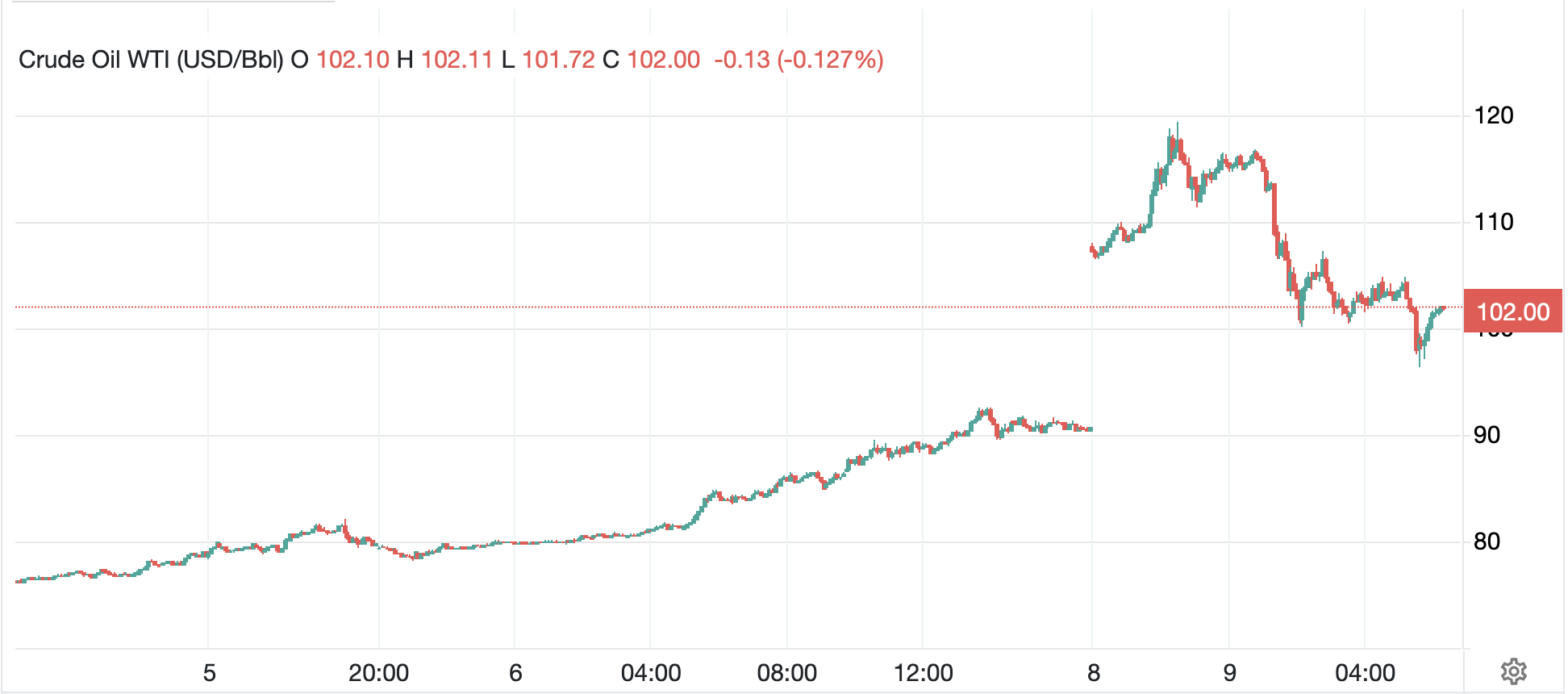
Is it a coincidence that Israel’s attack on Iran’s nuclear sites occurred on Friday the 13th, or was it meant as a message that luck, both good and bad, can be manufactured? Whatever the driver, the market reaction has been instantaneous.  Here is a look at the five-minute chart in oil with the black sticky stuff jumping more than 8% on the news.

Source: tradingeconomics.com

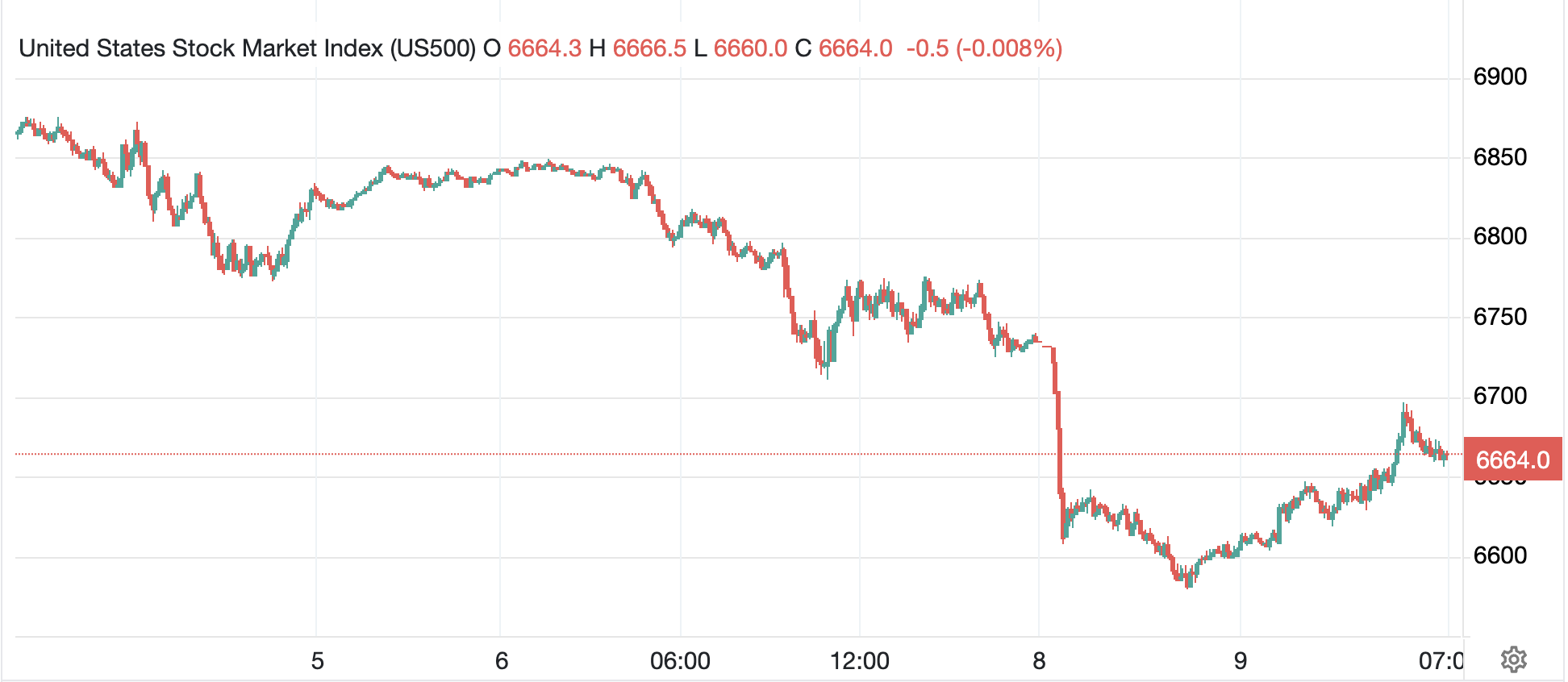
Too, gold jumped (+1.2%) as did the dollar (EUR -0.4%, AUD -1.0%) although both JPY (+0.3%) and CHF (+0.4%) showed their haven characteristics.  Treasury bonds rallied with yields slipping an additional -3bps in the evening session on top of the -5bp decline during the day, and stock futures are under pressure around the world (S&P500 -1.6%, Nikkei -1.5%, DAX -1.5%).  This was the early price action.

Those were last night’s initial moves and thus far, things have moderated a bit.  For instance, oil has fallen back about 1%, though remains higher by 7.3% and that big gap down on the charts from April has been filled.  

Source: tradingeconomics.com

Of course, there is now a new gap below the markets to fill, but that is a story for another day.  Equity markets are also finding their footing, bouncing off their lows as the 20-day moving average has held and dip buyers see this as an opportunity.  However, the dollar is little changed from its initial moves as is gold, and overall, not surprisingly, risk-off defines the overnight session and likely will be today’s focus.

Now, there is nothing funny about this situation with more death and destruction occurring and likely in our immediate future.  However, I could not help but chuckle at the Russian statement that Israel’s actions were “unprovoked” and “a violation of UN principles and international law.”  Of course, I guess President Putin would know all about unprovoked attacks and violating UN principles and international law given his ongoing efforts in Ukraine.

Ok, I am not a war plotter, nor a war monger, so let’s see how this and any other things are developing in the markets.  While the war discussion will dominate the headlines, there are other things ongoing that are worth considering.  For instance, though the dollar is performing as its historical safe haven this morning, SocGen analysts highlighted a very interesting relationship that has developed in the dollar with respect to inflation surprises over the past four months.  As you can see in the chart below, it appears that as we have seen a series of lower-than-expected inflation readings, the dollar has fallen in step.  Now, correlation is not causality but one could make the case that reduced inflation will lead to a more aggressive easing policy by the Fed and that could be the mechanism by which this relationship operates.

Along the same lines, there have been more stories regarding the softening in the US labor market and at what point the Fed is going to need to focus on that, rather than inflation, as they consider their policy objectives.  As well, the large contingent of analysts who expect the US to enter a recession soon have pointed to the labor market and the fact that much of the underlying data appears to show a less robust situation than the headlines have thus far revealed.  

I have two anecdotes to recount here, neither of which indicates the labor market is softening.  First, the local pizza parlor is at wits’ end trying to hire people to work there, a common high school summer or after school job but there are no takers.  Second, my daughter works for a TMT consulting firm in HR, and they are seeking to hire several new analysts and junior consultants, jobs that pay six figures out of college, and they, too, are having difficulty filling the roles.

I know that anecdata is not definitive, but two very disparate service industries are facing the same issue, and it is not a question as to whether to reduce headcount.  Consider the idea that the recent declines in inflation readings are a short-term outcome and that underlying inflation remains in the 3.5%-4.0% range.  Given median CPI is still running at 3.5%, that is entirely feasible.  If, as we go forward, we start to see high side surprises in inflation, and this relationship has meaning, that could well imply we are looking at a short-term dip in the dollar and that as the year progresses, this will reverse.  My take is that the Fed will only consider cutting rates, at least as long as Powell is Chair, if inflation remains quiescent and unemployment starts to rise.  But if inflation rebounds, I believe they will be reluctant to go there.

Now, as the morning progresses, the dollar is picking up steam with the euro (-0.8%), pound (-.6%) and JPY (-0.6%) all falling, even the havens yen and CHF (-0.5%).  In fact, looking across the board, every major currency is weaker vs. the dollar at this point in the morning (7:15).  As the US has awakened, it seems that the haven status of the dollar is reasserting itself.

Perhaps more surprisingly, Treasury yields have turned around and are now higher by 2bps, which has dragged all European sovereigns along for the ride.  In fact, the weakest nations (Italy +4bps, Spain +5bps) are faring even worse, as is the UK (Gilts +5bps).  Apparently, the recent ideas of the BOE getting more aggressive in its rate cutting is no longer the idea du jour.

In the equity markets, red remains the only color on the screen with Asian markets (Nikkei -0.9%, Hang Seng -0.6%, CSI 300 -0.7%) all rebounding from their early worst levels, but slipping on the day, nonetheless.  I guess there are dip buyers in every market 😃.  In Europe, continental bourses are all sharply lower (DAX -1.4%, CAC -1.1%, IBEX -1.6%) although the FTSE 100 (-0.4%) is holding up better.  As to US futures, they have rebounded slightly from their earliest lows and are now down about -1.0% at 7:20.  Wouldn’t it be something if they closed the day higher?  I don’t think we can rule that out!

Finally, commodities continue to show oil much higher, no retracement there, and gold also holding its gains although copper (-2.5%) is under pressure.  This is a bit odd to me as I would have thought war would bring more copper demand to a market that is physically undersupplied, but then the LME price of copper and the COMEX price of copper seem unrelated to the industrial flows of late.  At this time, everyone is waiting for the Iranian response, although apparently, the first response, a wave of drone attacks on Israel, was completely thwarted.  Not only did Israel destroy some key nuclear sites, but they were able to eliminate almost the entire leadership of the Iranian army and special forces, so any response is likely to take a little time to be created. No oil facilities were targeted, although the Strait of Hormuz is a key chokepoint in the oil market and Iran is likely able to disrupt the flow of tankers through there for now.  What we know is that everyone who was short oil as a trade has likely been stopped out.  It will likely take a little time before new shorts come back to play, so I expect a few days of prices at these levels.  However, the longer-term trend remains lower, so absent a destruction of oil producing fields, I expect that prices will retreat ahead.

On the data front, this morning brings only Michigan Consumer Sentiment (exp 53.5) and with it the inflation expectations piece, although that has been shown to be a political statement, not an economic one.  I cannot shake the feeling that by the time we head to the weekend, equities will have recovered their early losses, and the dollar will cede some of its gains.

Good luck and good weekend

Adf

Everyone’s Bitching

With President Trump on the road
The market has heard a boatload
Of ideas and plans
Including Iran’s
Return to a more normal mode
 
There’s talk of a nuclear deal
Audacious, if it’s truly real
Instead of enriching
While everyone’s bitching
A partnership deal they would seal


One is never disappointed with the tone of the overnight news when President Trump is traveling.  Between his flair for the dramatic and his desire to conclude deals, it seems like there is always something surprising when we awake each morning.  This morning is no different.  

While the mainstream media has been harping on the audacity of Qatar gifting a “flying palace” to the US for President Trump to use as Boeing’s delivery of the newest Air Force One is something like 10 years behind schedule, Mr Trump has indicated he is quite keen to make a deal with Iran that would bring them back into the fold of good neighbor nations.  Ostensibly, Iran has suggested that they work with the Saudis, Emiratis and the US to enrich uranium together in order to develop nuclear power in the Middle East.  As the Saudis and Emiratis have already expressed interest in building more nuclear power plants, it is not a stretch for them.  But bringing Iran into the fold, so that enrichment activities are done jointly, and therefore can be closely overseen by the US and Saudi Arabia, would be a remarkable outcome.

The JCPOA deal signed by President Obama was a nullifying deal, one that was designed to prevent an activity, the enrichment of uranium to the required concentrations sufficient to build a bomb.  But this is an encompassing deal, one that would join erstwhile enemies into a partnership to jointly produce uranium sufficiently enriched for nuclear power, without pushing toward weapons grade material.  Now, this would be a remarkable change in attitude in Tehran as the theocracy there has basically made the end of the US and Israel their motto ever since 1979 and the revolution that brought them to power.  But things are tough in Iran right now and the funny thing about power is that those who hold it are really reluctant to let go.  It would not be unprecedented for a nation’s leadership to reverse course completely in order to maintain their grip, and it is also not hard to believe that a softer tone would be welcome in Iran by the populace.

Regardless, this is a bold and audacious idea, but one that could just work.  Now, we should all care not simply because anything that could lead to less terrorism and destruction is an unalloyed good, but because the impact on the global economy would be significant, namely, the price of oil is likely to decline further.  A deal like this is likely to include the end of restrictions on Iranian oil sales, or at least a dramatic reduction in those restrictions.  While Iran has been producing and selling oil all along this would change the tone of the oil market with another major player now actively looking to expand production and sales.  (After all, the Iranian economy is desperate and the ability to generate more revenue without restrictions would be an extraordinary carrot for the mullahs.)

With this in mind, it should be no surprise that the price of oil (-3.65%) has fallen sharply today, and the real question is just how low it can go.  A look at the chart shows that the trend has been lower for the past year although it seems to have found a temporary bottom just above $56/bbl. 

Source: tradingeconomics.com

I have maintained for the past year and a half that the ‘peak cheap oil’ thesis has been faulty and that there is plenty of the stuff around with political, not geological restrictions the driving force toward higher prices.  This is Exhibit A on the political restriction case.  President Trump is quite keen to see oil prices lower as it suits both the inflation story in the US as well as offers a significant advantage to US manufacturing facilities with access to cheap energy.  I would guess this was not on anyone’s bingo card before today but must now be taken seriously as a potential outcome.  While I’m not an oil trader, I suspect we will test, and break, through those lows just above $56 in the coming weeks and find a new home closer to $50/bbl.

This is such an extraordinary story, I could not ignore it.  But as an aside, President Trump also mentioned that India has allegedly offered to cut their tariff rates on US goods to 0.0%!  I don’t know if that would be reciprocal, and that has not yet been verified by India, but again, it demonstrates that many of the things we believed to be true regarding international relations are not carved in stone.

Ok, let’s look at how markets are absorbing these latest surprises.  Yesterday’s price action could best be described as dull, with US equity markets doing little all day, although the NASDAQ managed to edge higher into the close.  In Asia overnight, the major markets (Japan -0.9%, China -0.9% and Hong Kong -0.8%) all came under pressure although there doesn’t appear to have been a particular story.  There were no new trade related comments, so I sense that the recent uptick just saw some profit-taking.  Elsewhere in Asia, the biggest winner was India (+1.5%) and then it was a mixed bag.  In Europe, equity markets have done very little overall after Eurozone data showed GDP activity was more disappointing than first reported with Q1’s second estimate down to 0.3%.  As to US futures, at this hour (7:10), they are pointing lower by about -0.4% or so across the board.

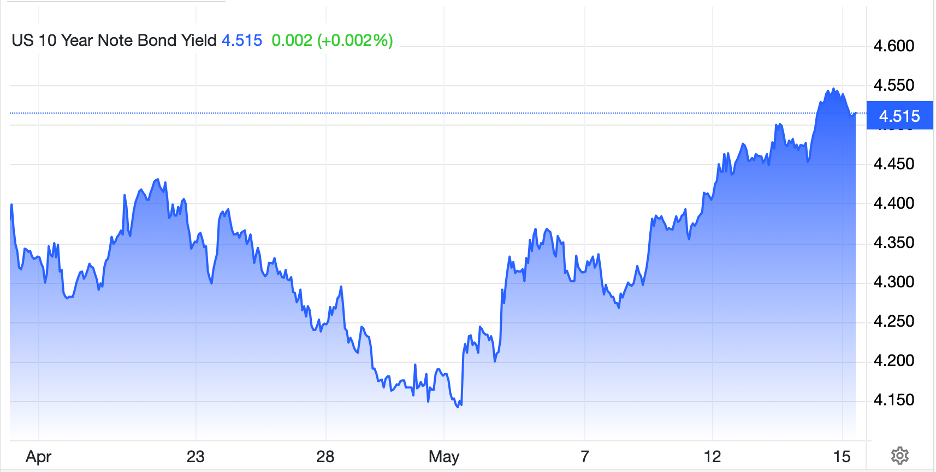
In the bond market, Treasury yields, which have been climbing relentlessly all month as per the below chart, have backed off -2bps this morning, but 10-year yields are still above 4.50%, a level Mr Bessent is clearly unhappy with.  But today’s price action has also seen European sovereign yields slide a similar amount, with the softer Eurozone growth one of the reasons here as well.

Source: tradingeconomics.com

Turning to the metals markets, the shine is off gold (-0.2%) which has fallen more than 4% in the past week, although remains well above $3100/oz.  It seems that much of the fear that drove the price higher is being removed from the markets by the constant updates of trade and peace deals that we hear regularly.  It remains to be seen if this lasts, and how the Fed will ultimately behave, but for now, fear is fading.

Finally, the dollar is a touch softer overall, but not universally so.  In the G10, the euro (+0.2%) and pound (+0.2%) are both edging higher with UK data looking a tad better compared to that modest weakness in Eurozone data.  But the yen (+0.6%) and CHF (+0.5%) are both nicely higher as there continues to be a strong belief that President Trump is seeking the dollar to decline in value.  In the EMG bloc KRW (+0.7%) and ZAR (+0.8%) are the leaders with most of the rest of the bloc making very modest gains on the order of 0.2% or less.  It appears that the dollar has decoupled from the US rate picture for the time being.  I wonder if it is presaging lower US rates, or if this relationship is going to change for a longer time going forward.  We will need to watch this closely.

On the data front, there is a bunch this morning as well as comments from Chairman Powell at 8:40.  

Initial Claims229K
Continuing Claims1890K
Retail Sales0.0%
-ex autos0.3%
PPI0.2% (2.5% Y/Y)
-ex food & energy0.3% (3.1% Y/Y)
Empire State Manufacturing-10
Philly Fed Manufacturing-11
IP0.2%
Capacity Utilization77.8%

Source: tradingeconomics.com

I don’t see PPI as having much impact, but Retail Sales will get some discussion as will the manufacturing indices as weakness there will help the negative narrative that some are trying to portray.  Net, though, the story seems likely to continue to be the announcements of deals as they come in.  It is not clear to me that they will all be net positives, and I believe that much positivity has already been absorbed so we will need to see data that backs up the narrative and that could take a few quarters.  In the meantime, my lower dollar thesis seems to fit better today.  That’s my story and I’m sticking to it!

Good luck

Adf

Looking Elsewhere

The Middle East story is back
With fears that Iran might attack
So, oil is rising
And it’s not surprising
The dollar is leading the pack
 
But til anything happens there
The market is looking elsewhere
The Payrolls report
May well be the sort
That causes Chair Powell to care


It was only a week ago when the Israeli response to the Iranian missile barrage was seen by market participants as a clear de-escalation of tensions in the Middle East.  The market’s response was to reduce the risk premium in the price of oil which promptly fell $5/bbl amid signs of slowing growth in China as well.  Alas, as can be seen in the chart below, that was Monday’s story and no longer pertains.  Rather, the new concern is that Iran is planning to launch yet another attack, this time via proxies in Iraq, with Israel vowing to respond more severely.  You cannot be surprised that oil has regained its levels prior to Monday’s narrative.

Source: tradingeconomics.com

Adding to the buying pressure for oil has been the better than expected growth data from China (Caixin Mfg PMI printing better than expected 50.3) and solid US GDP data on Wednesday along with stronger Personal Income and Spending data yesterday.  And remember, the market is also looking ahead to the Standing Committee of the National People’s Congress in China to add significant fiscal stimulus there, with CNY 10 trillion (~$1.4 trillion) the most popular number being bandied about.  If that comes to pass, it will seemingly increase demand for oil on China’s part.

Of course, there is another piece of news that the market is awaiting with the potential for a significant impact, today’s Employment Report.  Ahead of the release, these are the current consensus forecasts:

Nonfarm Payrolls113K
Private Payrolls90K
Manufacturing Payrolls-28K
Unemployment Rate4.1%
Average Hourly Earnings0.3% (4.0% Y/Y)
Average Weekly Hours34.2
Participation Rate62.5%
ISM Manufacturing47.6
ISM Prices Paid48.5

Source: tradingeconomics.com

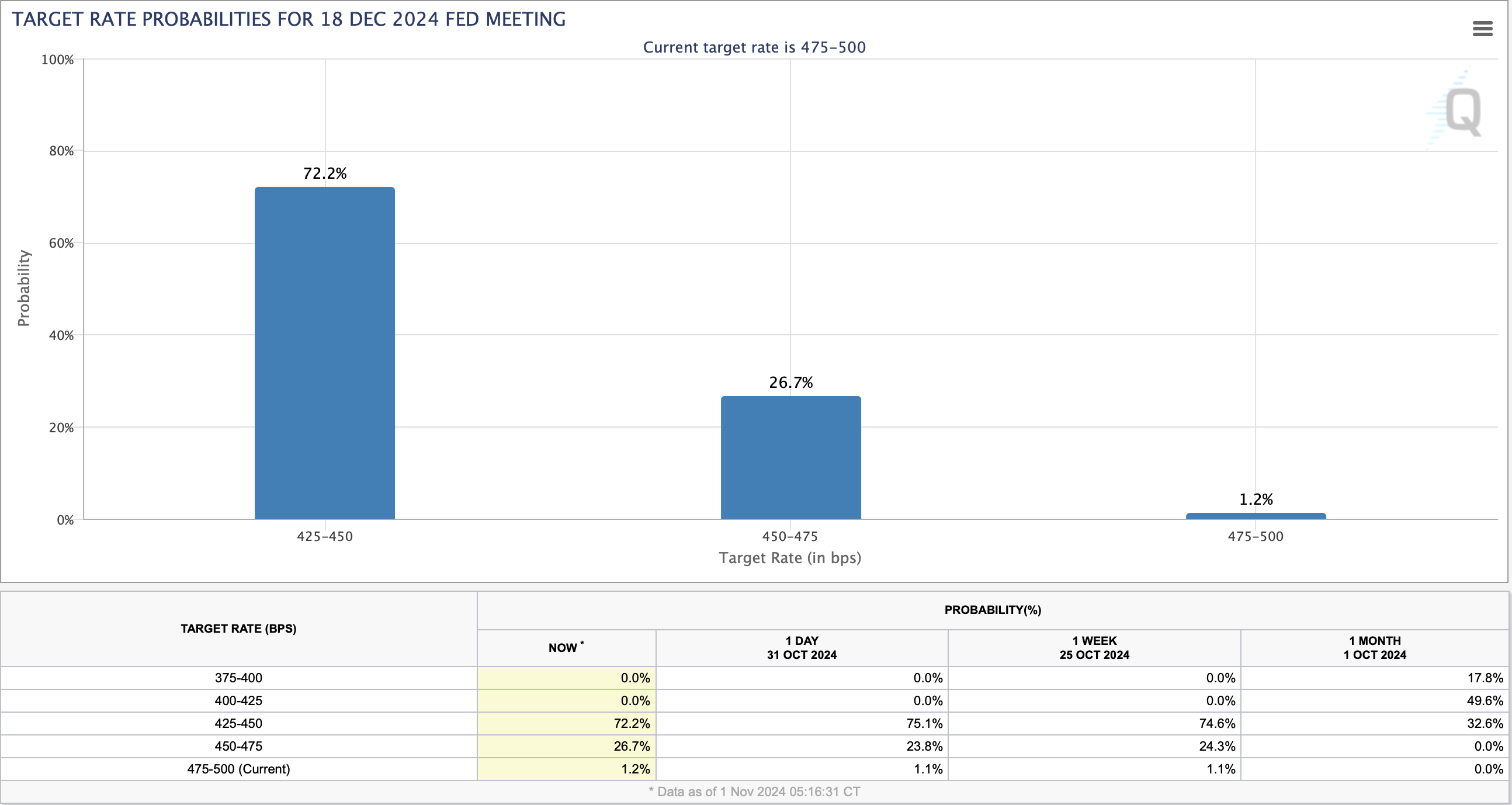
You may remember that last month, the NFP number printed much higher than expected at 233K which began the questioning of the Fed’s expected rate cutting path.  Frankly, the data since then has done very little to argue for much policy ease as Retail Sales have held up, GDP was solid and prices appear to be moving higher, not lower.  In fact, you can see how things have played out over the past month in the chart/table below from the CME showing the market priced probability of future Fed funds rates.  Check out where things were a month ago, just prior to the last NFP report.

The market was pricing a more than 50% probability of at least 75 basis points of rate cuts by December. Obviously, that is no longer the case and if this morning’s data proves stronger than forecast (remember, ADP Employment was significantly stronger than expected) many more people are going to call into question the assumption that the Fed is going to be cutting rates at all.  If you think about it, GDP is growing above trend at 2.8%, inflation remains above target with core CPI 3.3% and Unemployment is at a still historically low 4.1%.  if I look at those three major economic guideposts, the one that stands out to be addressed is inflation, not Unemployment, and that takes tighter policy.

Now, maybe this morning’s data will be awful, with a 50K NFP print and a jump in the UR to 4.3%.  That would certainly bring the doves out more aggressively but absent something like that, I continue to scratch my head as to why the Fed is so keen to cut the Fed funds rate.  Let’s put it this way, if the data surprises to the upside, I expect the December rate cut probability to fall close to 50%.

At any rate, those are the topics du jour, away from the election stories that are suffocating most everything else.  So, let’s see how things behaved overnight.

Well, I guess there has been one other story that has gotten tongues wagging, the fact that US equity markets had their worst session in two months with all three major indices falling sharply.  This was blamed on weaker than forecast earnings releases from several companies in the tech sector, where even if the actual earnings were solid, there were other issues like guidance or breakdowns of revenues, that disappointed.  It is far too early to declare that the love affair with the tech sector, especially AI, is ending, but there are a few names in the sector that are suffering greatly.  This certainly bears close watch going forward, because if this theme starts to lose adherents, even in the short run, it appears there is ample room for a move lower in stocks.

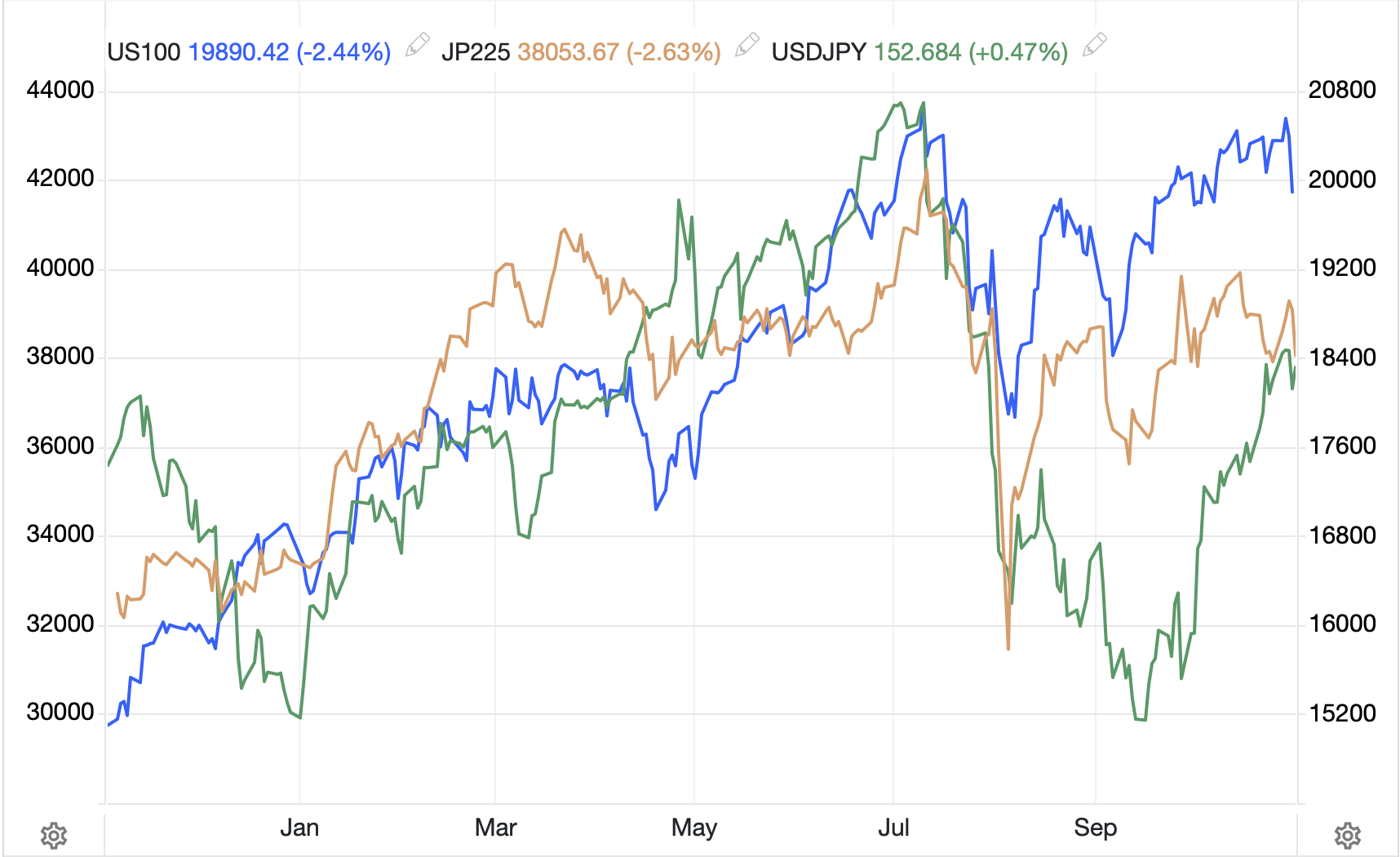
Turning to other markets overnight, Tokyo (-2.6%) led the way lower in Asia with most regional exchanges falling and only Hong Kong (+0.9%) bucking the trend.  There are those who believe there is a causal relationship between the Nikkei, the NASDAQ and USDJPY with one theory that it is the FX rate that drives these movements.  While it is certainly true that we have seen correlation amongst these three markets, I find it difficult to make the case that USDJPY is the driver.   A quick look at all three on the same chart certainly shows that they regularly move in similar directions, but I have a harder time claiming which one is the leader.

Source: tradingeconomics.com

However, despite the negativity from yesterday’s US moves and the overnight sell-off and the sharp rise in oil prices, European bourses are all in the green today, higher by about 0.5% across the board.  In fact, this is in sync with US futures which are also trading higher, by about 0.4%, this morning.

In the bond market, other than UK Gilt yields, which rose 7bps net yesterday although traded as high as 20bps higher than Wednesday’s close during the session, the rest of the bond markets were quiet.  It seems that UK bond investors are not that happy with the recently promulgated budget, and neither are voters as there was a by-election in a “safe” Labour seat that went to Nigel Farage’s Reform UK party.  I have a feeling that bond markets are going to be the epicenter of market activity over the next week or two as huge differences of opinion remain regarding the potential outcomes of the US election.

Away from oil (+1.9%) this morning, the rest of the commodity sector is also doing well today with both precious and base metals all in the green.  But they have not recouped yesterday’s declines which saw gold fall back -1.5% with even larger losses in silver (-3.2%) although copper (-0.6%) didn’t have nearly as bad a day.  This morning, the metals are higher by between 0.2% (gold ) and 0.6% (silver), so it seems like it was a month-end position adjustment and profit-taking exercise.

Finally, the dollar is strong this morning, rallying against most of its G10 counterparts with JPY (-0.4%) the laggard while the pound (+0.1%) seems to be benefitting from higher yields.  Versus the EMG bloc, the dollar is also broadly higher with only MXN (+0.2%) showing any life.  The peso has a number of issues ongoing with concerns that a Trump victory may lead to tariff increases and strain on the economy while domestic issues have arisen over the potential resignation of eight of their Supreme Court Justices which will have a big impact on the judicial system and potentially the Morena party’s ability to rule effectively.  However, after a steady weakening of the peso throughout October, it appears we are seeing a bit of a bounce this morning.

And that’s really what we have today.  At this point, we will all await the NFP and respond accordingly.  Something to keep in mind is that the hurricanes last month could well impact the data, so whatever the outcome, you can be sure that there will be those saying to ignore it as incomplete.  Regarding the dollar, it is still hard to bet against in my mind given the US economic data continues to be the best around.

Good luck and good weekend

Adf

Awakened the Beast

The longshoreman’s union conceded
And ports will now work unimpeded
But is that enough
To make sure that stuff
Gets everywhere that it is needed?


Arguably, one of the biggest stories this morning is that the fears over the longshoreman’s union strike dramatically weakening the US economy while pushing up inflation have passed as there has been a temporary agreement to raise workers’ pay by 62% over the next six years although it seems that the questions over automation remain.  However, the agreement will last until January 15th, so the 3-day work stoppage is unlikely to have a major impact on the US economy, although I’m sure there will be a few hiccups around.  But hey, at least one problem is off the docket.
 
Meanwhile, problems in the Mideast
Continuously have increased
Iran took their shot
And all that it wrought
Was fear they’ve awakened the beast

Which takes us to the next major story, the nature of Israel’s response to Iran’s missile attack from earlier this week.  From what I have read, the US is trying very hard to persuade PM Netanyahu to leave Iran’s nuclear facilities and oil production capabilities alone.  While I understand the latter, given an attack there would likely drive oil prices far higher and not help VP Harris’s election prospects, I cannot understand why the US would be so adamant that Israel not seek to destroy Iran’s nuclear capabilities.  At any rate, the headline in this morning’s WSJ, “Biden Sidelined as Israel Reshapes Middle East”, seems to say it all.  At this point, we can only watch and wait.  

However, consider the benefits of either of those targets.  As it remains unclear whether Iran has achieved the capability to create nuclear weapons, an attack on those facilities, which are hardened and underground, may or may not be effective at preventing a future nuclear Iran.  But an attack on the oil production facilities, which are wide open and not nearly as well-defended, would immediately limit Iran’s income despite the certain rise in oil prices, as they would not be able to sell any.  Starving Iran of capital to continue to run its military and fund its proxies would likely be extremely effective at dramatically reducing threats to Israel.  As well, I’m pretty confident the Saudis would not be unhappy if oil rose to $90 or $100 per barrel.  My point is the latter strategy is likely to be effective at reducing Iranian activities while being quite achievable.  We shall see.

And finally, early today
The payrolls report will hold sway
O’er markets worldwide
As traders decide
If more cuts are soon on their way

Which takes us to the big economic story today, the monthly payroll report.  Wednesday’s ADP Employment data was much better than expected, showing job growth of 143K.  Current expectations are as follows:

Nonfarm Payrolls140K
Private Payrolls125K
Manufacturing Payrolls-5K
Unemployment Rate4.2%
Average Hourly Earnings0.3% (3.8% Y/Y)
Average Weekly Hours34.3
Participation Rate62.9%

Source: tradingeconomics.com

One thing to keep in mind is this is going to be the last meaningful payroll report before the next FOMC meeting because the October report, scheduled to be released on November 1st, is going to be a complete wreck with virtually no information because of the impact of Hurricane Helene.  In fact, it will likely take several months before economic data gets back to whatever its underlying trend may be given the disruption over such a wide swath of the nation.

The question of the economy’s strength continues to be a hotly contested disagreement between those who believe that a recession is coming soon, or has already started, vs. those who believe that there is no recession coming in the near future.  The first group tends to look through the headline data and sees decreasing quit rates and reduced hiring offsetting reduced firing with the lack of hiring seen as an indication business activity is slowing.  They look at high household credit card debt and growing delinquencies and see analogies to past recessions.  Meanwhile, the bulls look at the headline data and say, GDP continues to grow, inflation continues to slide and while manufacturing has been weak for nearly two years, this is a services economy and that has been strong (yesterday’s ISM Services print was a much stronger than expected 54.9).

Now, the very fact that Powell cut rates two weeks ago is indicative of the fact that there is real concern at the FOMC that growth is slowing.  I will not discuss the political question here.  But data like TSA travel clearances and restaurant seatings and the crowds at events show that at least some portion of the economy is still doing well.  Yesterday’s Claims data was 225K, a few thousand more than expected but still nowhere near a level that would indicate there is an employment glut.  

I believe the idea of the K-shaped recovery is the best description of things around.  The top quartile of income earners is doing just fine while the rest of the economy is struggling.  But that top quartile represents an outsized amount of economic activity, so the data continues to be positive.  In fact, if you are looking for a reason that there is so much angst in the electorate, this is it.  With all that in mind, though, my take is this morning’s number is going to be better than expected, somewhere on the 175K – 200K level.

Ok, let’s quickly run through market activity overnight.  Yesterday’s modest decline in US markets did not really give much direction to the overnight session as the Nikkei (+0.2%) managed to continue its recent modest rally and the Hang Seng (+2.8%) continues to benefit from a belief that Chinese stimulus is coming to the rescue.  But the rest of Asia couldn’t make up its mind (China is still closed) with gainers (Korea, New Zealand, Singapore) and laggards (India, Australia , Taiwan).  In Europe, the picture is also mixed ahead of the US data with modest gainers (CAC, DAX) and laggards (FTSE 100, IBEX) as the US data is still the key driver.  One story here is that the EU decided to impose tariffs of as much as 45% on Chinese BEV’s, something that is likely to become problematic for European exporters going forward.  As to US futures, just ahead of the data (8:00) markets are edging higher by 0.2%.

In the bond market, yields are continuing to rise around the world with Treasuries higher by 2bps this morning after a 5bp climb yesterday afternoon.  European sovereign yields are also much firmer, between 3bps and 6bps across the continent as concerns over inflation reignite.  Both the price of oil and the Chinese tariff story are driving this bond move.  As to JGB’s, they jumped 6bps last night, but that was more on the back of the US rise than any domestic news.

Oil (+1.4%) is continuing to rally as fears over an Israeli attack on Iranian assets builds.  This has helped the entire commodities complex with metals markets also firmer this morning, albeit only on the order of +0.25%. Nonetheless, the commodity higher story remains a fundamental one in my world view, especially as food prices are picking back up again around the world.  The UN’s FAO Food price index rose to its highest level in more than a year and looks for all the world like it has based and is now going to trend higher again.

Finally, the dollar is mixed this morning, with no defining theme here.  The pound (+0.35%) and MXN (+0.4%) have rallied while KRW (-0.5%) and AUD (-0.25%) have declined with the euro virtually unchanged.  My point is there is nothing specific to explain the movement.

And that’s really it.  We hear from a couple of more Fed speakers but since Powell on Monday cooled the idea of another quick 50bp cut, they have not given us much new guidance.  If I am correct and the data is strong, I expect bonds to suffer along with commodities while the dollar should gain.  Stocks are a little less clear.  However, if it is a soft number, you can be sure that the 50bp talk will dramatically increase and stocks and commodities will soar as the dollar slides.

Good luck and good weekend

Adf

Much Maligned

Though pundits worldwide have opined
The world’s in a terrible bind
Investors don’t seem
Concerned ‘bout that theme
With naysayers still much maligned

But trees cannot grow to the sky
And rallies, at some point, must die
If Jay and his kin
Do not soon begin
To cut rates, bulls will start to cry

I guess the hint at peace negotiations in the Israeli-Palestinian conflict was enough to get the bulls back in front of the move.  Or perhaps it was the comments from Philly Fed president Patrick Harker, who seems to be one of the most dovish on the FOMC these days.  After explaining, “Small firms are really struggling with access to capital,” and “some of the bankers I’ve talked to are concerned that their business plans just aren’t going to be able to make it at the higher rates” he gave us the money line (my emphasis), “This is why we should hold rates steady, we should not at this point be thinking about any increases, because if that’s true – and it is true – then we should let that ride out.”  So here is the first clear signal for an FOMC member that they are done.  Now, Harker is a voter, so that matters, but it seems pretty clear that nobody is expecting a rate hike in early November.  Arguably, the big question is what will happen in December and that is still very far away.

However, that signal implying the Fed is well and truly done was sufficient to boost risk assets, well at least to boost equity markets with US markets all higher by 1% or so while European bourses had smaller gains, on the order of 0.3%.  Bond markets, meanwhile, remain under pressure as the hint of peace talks removed some of the need for a haven, and our Treasury Secretary explained that “we can certainly afford two wars.”  If you were wondering what the fiscal situation was, she seems to have things under control.  However, beware that paying for two wars by issuing yet more debt seems like it may have a significant negative impact on bond prices.  With this attitude in Washington, perhaps we should be looking for 6% in the 10-year Treasury yield soon.

And that’s really the crux of the issue, it seems that the stock market and the bond market are pricing very different outcomes.  Stocks continue to trade well as we enter earnings season and investors remain sanguine about any potential economic downturn.  There is a great deal of belief that if the economy does reverse course from its recent apparent strength, the Fed will step right back into the market, cut rates and end QT, if not restart QE.  Meanwhile, the bond market continues to look at the still too hot inflation data and combines that with the prospect of still more debt issuance as Secretary Yellen funds two wars and more social programs and is quite concerned.  Perhaps it is my age and experience, but alas, I fear the bond market is correct.  The prospects for better investment performance in the near-term seem limited to me.

For now, given the lack of significant new news or data, as well as the anticipation of Chairman Powell’s comments come Thursday, markets in Europe and US futures are biding their time.  Remember, too, that we see US Retail Sales as well as Canadian CPI this morning at 8:30, so either of those could well be a new catalyst.  But until then, a look at markets shows that equities are mixed in Europe with the FTSE 100 slightly higher while continental bourses are slightly softer while US futures are a touch softer at this hour (6:30), down about -0.3%, as they consolidate after yesterday’s rally.

Bond markets, however, continue to fade as the benefits accorded to stocks (potential end to Israeli war and hoped for better earnings) are anathema to bond investors.  Treasury yields are higher by 5bps this morning, leading the way higher while European sovereigns are all higher by between 3bps and 6bps with the Bund-BTP spread widening back above 200bps.  Last night saw JGB yields edge higher to 0.77%, as the new Mr. Yen, Kanda-san, once again explained that intervention was possible as was the idea of raising interest rates.  (Yes, I know that the MOF doesn’t control interest rates, but apparently, he doesn’t.)

Turning to commodities, oil continues to consolidate its recent gains, essentially unchanged today, but still above $85/bbl with a major concern that any escalation in fighting in Israel may spread to OPEC producers.  That certainly cannot be ruled out, and remember, the US has already wasted utilized its SPR so there is no additional supply likely to emerge in that situation.  As to the metals markets, gold (+0.2%) continues to consolidate after last week’s impressive rally while both copper and aluminum are softer this morning on economic concerns.  Here too, there seems to be a disconnect between investors and traders in stocks and commodities with the former remaining quite bullish overall while the latter are anything but.

Finally, the dollar is also biding its time this morning although it is beginning to creep higher.  Two particular movers are the pound (-0.5%) which has responded to slightly softer payrolls and wages data opening some room for the BOE to back off a bit from its tightening schedule, and NZD (-0.7%), where CPI was quite a bit softer than forecast.  Meanwhile, USDJPY seems frozen just below 150 as the threats of intervention are currently sufficient to offset the ongoing carry opportunities.  In this case, I continue to see room for the dollar to rise as intervention is only ever a temporary solution and I cannot see a reason why the Fed would object to a strong dollar given its inflation fighting impact.  

In the EMG space, the dollar is broadly higher with the renminbi back above 7.32 and pushing toward the lows (dollar highs) seen last month.  But KRW, THB, TWD and SGD are all softer as well.  Meanwhile in LATAM, we are seeing the same general price action in BRL and MXN both having weakened more than 9% through August and September and both now edging a bit higher lately.  However, there is no indication that the broader dollar strengthening trend has ended.

As mentioned above, this morning we see Retail Sales (exp 0.3%, 0.2% ex autos) and Canadian CPI (exp 4.0%, core 3.3%).  We also hear from Williams, Bowman, Barkin and Kashkari throughout the day as virtually every FOMC member wants to get on the tape before the quiet period begins on Friday.  In the end, consolidation seems the likely activity for now barring something new in Israel or a blowout number this morning.  Net, I still like the dollar overall.

Good luck

Adf