All But Assured

A cut has been all but assured
Though since last time we have endured
Some fears Jay’s a hawk
So, when he does talk
Will this cut, at last, be secured?
 
And now there’s a narrative view
Though rates will fall, what he will do
Is try to convey
Now it’s out the way
Another one may not come through


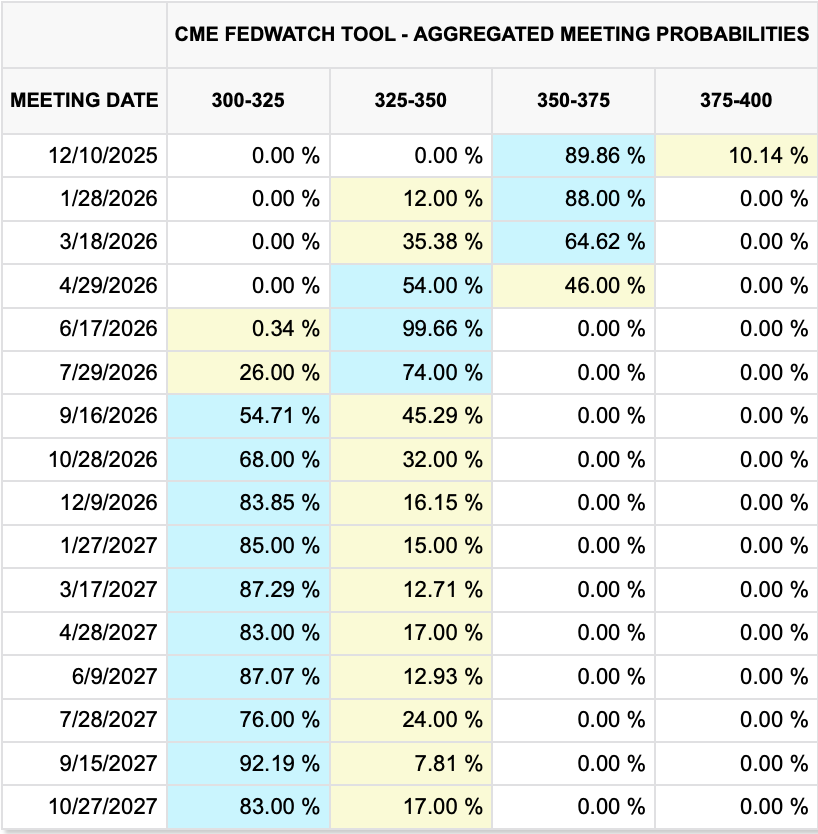
Good morning all and welcome to Fed Day.  The question, of course, is will this be a frabjous day?  As I write this morning, the Fed funds futures market continues to price a roughly 90% probability of a 25bp cut this afternoon, but the prospects for future rate cuts have greatly diminished as you can see in the table below from the CME.

It wasn’t long ago when the market was pricing 100bps more of rate cuts by the end of 2026, meaning a Fed funds rate of 2.50% – 2.75%.  However, the narrative has shifted over the past several weeks after very mixed signals from FOMC speakers and data releases that have indicated the economy is not cratering (e.g. yesterday’s JOLTS data printing at 7.658M, >400K higher than expected).  You may recall that shortly after the last FOMC meeting at the end of October, the probability of today’s rate cut had fallen to just 30%.

It appears that the new discussion point is this will be a hawkish cut, an idiom similar to jumbo shrimp.  At this point, the bulk of the discussion has been around how many dissents will be recorded with the subtext being, what will Chairman Powell have to promise potential dissenters in order to bring them along to his side of the ledger.  My take is if you thought the last press conference was hawkish, you ain’t seen nothin’ yet.  In fact, I would not be surprised to see a virtually categoric call to this being the end of the cutting cycle for the foreseeable future.

Remember, we also will see the new dot plots and SEP which will help us understand the broad picture of where FOMC members currently stand on the matter.  Personally, I expect to see a wide disparity between the ends of the distribution, and it wouldn’t surprise me to see some expectations of no rate changes for 2026 with other calls for 150bps of cuts and no consensus view at all. 

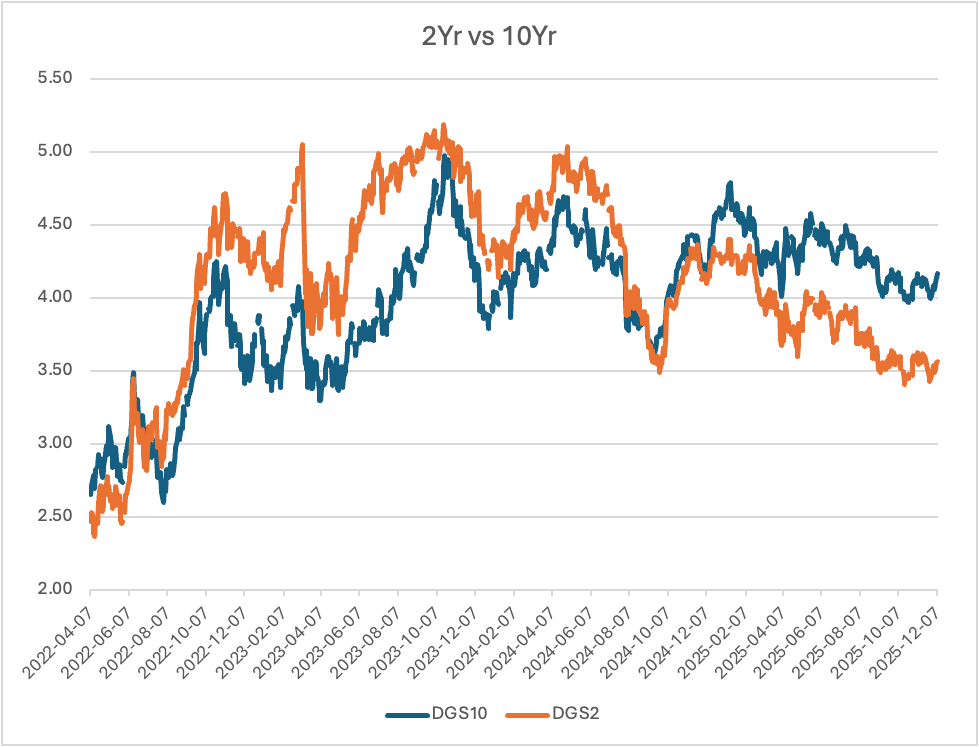
At this point, all we can do is wait.  However, the market discussion has centered on the fact that 10-year Treasury yields (+1bp) have been climbing lately, and that this morning they have touched 4.20% again while, at the same time, 2-year Treasury yields (no change) have been slipping as per the below chart I created from FRED data.

The steepening yield curve, which now appears to be turning into a bear steepener (when long dated yields rise more quickly than short-dated yields) is ringing alarm bells in some quarters.  The narrative is that there are growing concerns over both the quantity of debt outstanding and its rate of growth as well as the fact rate cuts will engender future inflation.

A key part of the discussion is the fact that what had been a synchronous system of global central bank policy easing is now starting to split up.  While we have known the BOJ is in a hiking cycle, albeit a slow one, today, the BOC is not only expected to leave rates on hold but explain they have bottomed.  We have heard that, as well, from the RBA earlier this week, and the commentary from the ECB may be coming along those lines.  So, is the US the outlier now?  And will that weaken the dollar?  Those are the key questions we will need to address going forward.

But before we move on, there is one market I must discuss, silver, which exploded to new historic highs yesterday, trading through $60/oz and is higher again this morning by 0.6% and trading at $61/oz.  someone made the point yesterday that for the second time in history, you need just 1 ounce of silver to buy one barrel of WTI.  The first time was back during the silver squeeze in January 1980, but that was quite short-lived (see chart below from macrotrends.com).  This one appears to have legs.  

I don’t know that I can find another indicator that better expresses my views of fiat currency debasement alongside an expanding availability of oil.  To my mind, both these trends remain quite strong, and this is the embodiment of them both combined.

Ok, so as we await the FOMC, let’s see if anybody is doing anything in financial markets of note.  As testament to the fact that virtually everybody is awaiting the Fed this afternoon, US equity markets barely moved yesterday, and Asian markets were similarly quiet, with only Taiwan (+0.8%) moving more than 0.4% in either direction.  The large markets were +/- 0.2% overall.  In Europe, the movement has been slightly larger, but still not impressive with Germany (-0.4%) the laggard of note while the UK (+0.3%) is the leader.  A smattering of data released from the continent doesn’t seem to be having any real impact, nor did comments by Madame Lagarde claiming the rates are in a good place and displaying some optimism on future GDP growth.  Of much greater concern is the headlong rush to a digital euro CBDC, where they are seeking to exert control over the citizenry.  If for no other reason, I would be leery of expecting great things from the Eurozone going forward.  Not surprisingly, at this hour (7:30) US futures are little changed ahead of the meeting.

In the bond market, yields are creeping higher all around the world with European sovereign yields higher between 2bps and 4bps this morning.  Perhaps investors are taking Madame Lagarde’s views to heart.  Or perhaps the fallout from the recently released US National Security Strategy, where the US basically dismisses Europe as strategic, has investors concerned that European governments are going to be spending that much more on defense without having the financial wherewithal to do so effectively, thus will be borrowing a lot and driving yields higher.  At this point, European sovereign yields have risen to levels not seen since the Eurozone bond crisis in 2011, but it feels like they have further to climb (see French 10-year OAT yields below from Marketwatch.com).

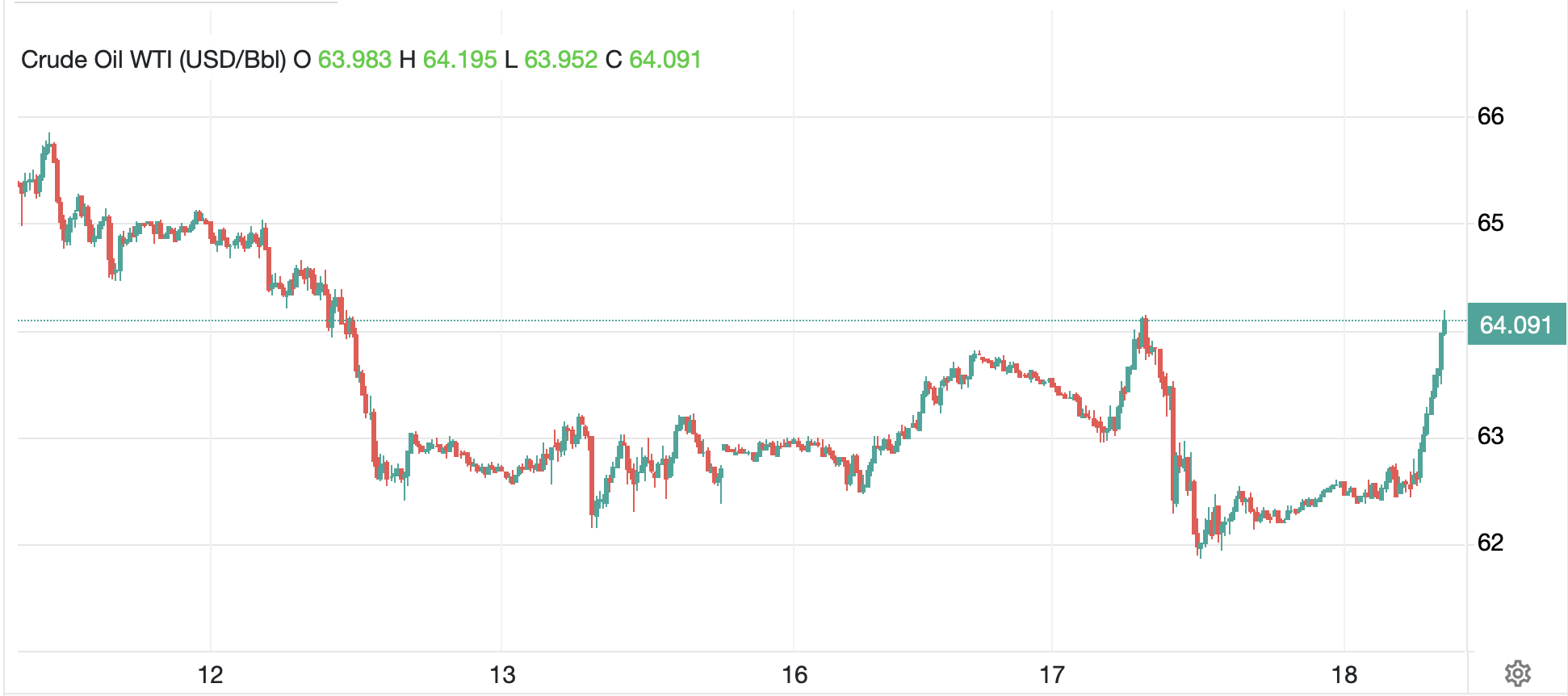
In the commodity market, oil (+0.5%) cannot get out of its own way.  While it is a touch higher this morning, it sits at $58.50/bbl, and that long-term trend remains lower.  We’ve already discussed silver and gold (-0.25%) continues to trade either side of $4200 these days, biding its time for its next move (higher I believe).  Copper (+1.4%) is looking good today, although it is hard to find economic news that is driving today’s price action.

Finally, the dollar is a touch softer this morning, about 0.1% in the DXY as well as virtually every major currency in the G10.  Interestingly, today’s outlier is SEK (+0.4%) which is rallying despite data showing GDP (-0.3%) slipping on the month while IP (-6.6%) fell sharply.  As to the EMG bloc, there is very little movement of note with the biggest news this evening’s Central Bank of Brazil meeting where they are expected to leave their overnight SELIC rate at 15.0% as inflation there, released this morning at a remarkably precise 4.46% continues to run at the top of their target range of 3.0% +/- 1.5%.

Ahead of the FOMC, we only see the Employment Cost Index (exp 0.9%), a number the Fed watches more closely than the market, and we hear from the BOC who are universally expected to leave Canadian rates on hold at 2.25%.

And that’s really it.  I wouldn’t look for much movement ahead of the 2pm statement release and then the fireworks at 2:30 when Powell speaks can drive things anywhere.  The most compelling story will be the number of dissents on the vote, as there will almost certainly be several.  According to Kalshi, 3 is the majority estimate.  With President Trump continuing to discuss the next Fed chair, I have a feeling there will be 4 and that will be a negative for bonds (higher yields) and a short-term negative for the dollar.  In fact, it is just another reason to hold precious metals.

Good luck

Adf

The Perfect Riposte

Attention right now’s being paid
To Congress on taxes and trade
The One BBB
Is seen as the key
To growth in the coming decade
 
Meanwhile, Sintra right now’s the host
To Powell, Lagarde and almost
All central bankers
Each one of whom hankers
To nurture the perfect riposte


The headlines this morning highlight that Congress put in an all-nighter last night as they try to get the BBB over the line and on the president’s desk by Friday.  My take is they were seeking sympathy for all the hard work they must do and trying to make it seem like they are slaving away on their constituents’ behalf.  Yet it appears that since the president’s inauguration on January 20, 161 days ago, Congress has been in session for somewhere between 40 and 50 days (according to Grok), about one-quarter of the time.  I have seen these estimates elsewhere as well, and quite frankly, it doesn’t speak well of Congressional leadership.  

In the end, though, I continue to expect the BBB to get passed by both houses and sent to the president.  I’m certain there are still a lot of things in the bill that many fiscal conservatives will not like, but I’m also confident that the fact that not a single Democratic representative or senator is going to vote for the bill is likely a sign that it does more good than harm.  I am completely aware of the debt and deficit issues and questions of their long-term sustainability, and I am not ignoring that.  But politics is the art of the possible, not the perfect, and my take is this is possible.  Consider for a moment the Orwellian-named Inflation Reduction Act from 2022, which passed the Senate on a tiebreaker vote by VP Harris.  That was a much more harmful piece of legislation from a fiscal perspective than this.  In fact, I would say this is the very definition of politics.

Through a market lens, if (when) this is passed, while there may be an initial ‘sell the news’ move, I suspect that the stimulus it entails will be a net benefit for risk assets overall.  And the only reason there would be a sell the news event is that the market is already pricing in a great future as evidenced by yesterday’s quarterly close at new all-time highs for the S&P 500, above 6200.

Turning to the other noteworthy news, the ECB is holding their faux Jackson Hole event this week in Sintra, Portugal where all the heads of major central banks are currently gathered along with academics and journalists who are there to spread the good word.  Chairman Powell speaks today, but this is the Powell story of the day.  Apparently, President Trump had this hand-written note delivered to the Fed Chair.  Are we not entertained?

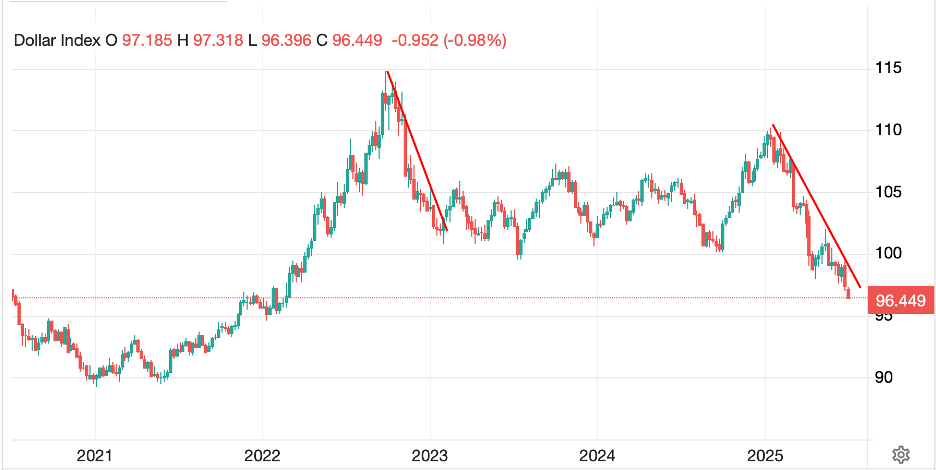
But ignoring for a moment the president’s desires, let us consider the dollar and its potential future direction.  The predominant current thinking is that it has further to slide as the trend is clearly lower and the rising anticipation of a recession in the US forcing the Fed to cut rates further will undermine the greenback.  Let’s break that down for a moment.  There is no question the dollar is currently in a downtrend as evidenced by the chart below.  A look at the red line on the right shows the slope of the decline thus far this year, which totals about 11%.

Source: tradingeconomics.com

In fact, much has been made of the decline thus far this year as to its speed and how it is a harbinger of both a recession and the end of the dollar’s hegemony.  Yet, we don’t have to go very far back in time, late 2022-early 2023 to see a virtually identical decline in the dollar over a slightly shorter period, hence the steeper slope of the line in the center of the chart, and I cannot find a single descrying of the end of the dollar at that time. Too, I remember being certain a recession was on the way then, when it never arrived.  According to JPMorgan, it seems the recession probability for 2025 is now 40%.  I have seen estimates ranging from 25% to 80% over the past few months which mostly tells me nobody has any idea.

We also don’t have to go very far back in time to see when the dollar was substantially weaker than its current levels.  I’m not sure why this time the dollar’s recent trend means the world is ending when that was not the case back in 2023 or any of the myriad times we have seen movement like this in the past.

But one other thing to consider regarding the dollar is that the BBB is going to provide significant stimulus to the economy.  Combining this with President Trump’s trade policies which are designed to draw investment into the US, and seemingly are working, and I think that despite his desire for lower interest rates, the Fed will have little reason to cut amid stronger growth in the economy.  I do not believe you can rule out a turn in the dollar higher once the legislation is passed as it is going to matter a great deal.  While spending priorities are going to change, it appears that investment is going to rise and that will help the buck.  Be wary of the dollar is dying thesis.

Ok, yesterday’s market activity, while reaching record highs in the equity markets, was actually incredibly slow with volumes shrinking.  My sense is folks are on holiday this week and those who aren’t are waiting for Thursday’s NFP data, so they can then run out of the office and go for their long weekend.  But the rest of the world doesn’t have the holiday Friday and are all trying to solve their trade situation with the US.  That led the Nikkei (-1.25%) lower yesterday as there appears to be a timing mismatch from a political perspective.  Ishiba doesn’t want to agree to open Japan’s market to US rice ahead of the election on July 20th as that will be a major political problem, but July 9th is approaching quickly, and Trump has said that is the date.  But aside from Japan and Hong Kong (-0.9%) the rest of the region had a pretty solid session led by Thailand (+2.1%) and Taiwan (+1.3%).  In Europe, though, PMI data was less than stellar, and bourses are modestly softer (DAX -0.5%, CAC -0.4%, FTSE 100 -0.3%) although Spain’s IBEX (+0.2%) has managed a gain as they had the best PMI outcome of the lot.  

In the bond market, yields continue to slide everywhere with Treasuries (-4bps) actually lagging the Eurozone which has seen declines of -6bps virtually across the board.  Madame Lagarde, in her Sintra opening speech, explained that the ECB would be altering their communication strategy to try to take account of the uncertainty in their forecasts, so not promise as much, but I have a feeling the movement is more a result of the softer PMI data as well as the Eurozone inflation release at 2.0% which has ECB members explaining things are under control.  Japan is a bit more confusing as JGB yields (-4bps) slipped despite what I would consider a strong Tankan report and a rise in their PMI data.  However, the newest BOJ board member did explain there was no reason to raise rates anytime soon, so perhaps that is the driver.

In the commodity markets, oil (+0.8%) continues to creep higher, perhaps a harbinger of stronger future economic activity around the world, or perhaps more short covering.  Gold (+1.4%) has completely erased the dip at the end of last week and is back at its recent pivot point of $3350 or so.  This has brought silver (+1.1%) and copper (+0.7%) along for the ride.

Finally, the dollar is clearly softer this morning with JPY (+0.6%) the leader in the G10 while ZAR (+0.9%) is the leading gainer in the EMG bloc as it follows precious metals prices higher.  Net, I would suggest that the average move here is about 0.25% strength in currencies.

On the data front, we get ISM Manufacturing (exp 48.8) and Prices Paid (69.0) and we get the JOLTs Job openings (7.3M) this morning.  Too, at 9:30, Chairman Powell speaks so it will be interesting to see if there is any change in his tune.

I see no reason for the dollar to turn higher right now but watch for the BBB.  Its passage could well change the dollar’s direction.

Good luck

Adf

Lost In Translation

The data today on inflation
Will help tweak the latest narration
But arguably
There’s little to see
As CPI’s lost in translation
 
And too, central bankers have learned
Their comments leave folks unconcerned
Today’s BOC
Where rate cuts will be
The outcome will ne’er be discerned


It is Donald Trump’s world, and we are all just living in it.  Virtually everything that happens in any financial market these days is a result of something that President Trump has either said or done.  Obviously, tariffs are a major player, but so are the peace talks in Ukraine (good news that Ukraine has agreed a cease fire to get things started) and his domestic initiatives regarding DOGE and the shake up that has come to government from that project.  You cannot look at a business journal without reading a story about how corporate America’s CEO’s are very concerned because of all the activity as they are having difficulty planning their strategies.

While this poet endeavors to track the macroeconomic issues and how they impact markets, and one can argue that tariffs are a macro issue, the ongoing back and forth as to which products will get tariffed and when is occurring far more rapidly than is worth reporting on a daily outlook.  After all, nobody has any idea what today will bring on that front.

With that in mind, one of the other things I have discussed has been the demotion of central bankers from their previous preeminence in the world of financial markets.  Now, every one of them is simply left to respond to whatever President Trump says that day.  Consider, the Fed entered their quiet period last Friday and the fact that we have not heard a word from them is entirely inconsequential.  The Fed funds futures market is currently pricing just a 3% probability of a rate cut next week and a total of 75bps of cuts by the end of the year, but that has been true for the past several weeks.  Despite an increase in the talk of a US recession, the markets are not indicating that is a concern.

Now, that doesn’t mean that other central banks aren’t doing things, but when the BOC cuts rates by 25bps this morning, taking their base rate to 2.75%, 150 basis points below the US, nothing is going to happen in the market.  It is already widely assumed.  I guess it is possible that Governor Macklem could make some comments of note, but given that Canada remains a bit player on the world stage, does whatever he says really matter?  In fact, the only reason people are discussing Canada now is because of President Trump and his trolling former PM Trudeau and calls to make it the 51st state.  Let’s face it, the economy there is ticking along fine for now, although if their exports to the US are impaired by tariffs it will definitely hurt them.  Meanwhile, other than a huge housing bubble, nobody really notices them.  After all, their economy is roughly $2.3 trillion, smaller than that of Texas.

We have also heard from Madame Lagarde recently as she tries to calm European leaders’ nerves while the ECB tries to manage their policy around US fiscal gyrations.  However, the most concerning information from there has been her confirmation that the ECB is pushing forward with their central bank digital currency (CBDC) project, looking to get things started in October of this year.  This contrasts with President Trump’s EO that the US will not pursue a CBDC and there is currently legislation in Congress to enshrine that into law.  My personal view is a CBDC would be very concerning given its inherent reduction in individual liberties.  While the current setup is for the euro to rise relative to the dollar, it is not clear to me that will remain the case in the event the digital euro comes into being.  In fact, it would not surprise me if many Europeans decided that holding dollars was a much better idea than holding euros in that environment.  But that is a story for the future.

As to today, CPI is set to be released with the following median expectations; headline (0.3%, 2.9% Y/Y) and core (0.3%, 3.2% Y/Y).  Both of those annualized numbers are one tick lower than last month’s outcomes, so would help the Fed narrative that inflation is falling back to their target.  But again, absent a major discrepancy, something like a 0.1% or 0.5% reading on the core number, I don’t think it will have any market impact across any market.  Data is just not that important these days.

Let’s turn to the overnight session to see how things are behaving in the wake of yesterday’s late US equity rebound, where while the indices all finished lower, they were well off the daily lows.  In Asia, the picture was very mixed with some major gainers (Korea +1.5%, Indonesia +1.8%, Taiwan +0.9%) and some major laggards (Thailand -2.5%, Malaysia -2.3%, Australia -1.3%, Hong Kong -0.8%) with both Japan and mainland China showing little movement.  In Europe, after a down day yesterday, this morning is seeing a solid rebound across most major markets with the DAX (+1.8%) leading the way followed by the CAC (+1.4%) and FTSE 100 (+0.6%).  Some solid earnings reports and ongoing hope belief that European defense spending will ramp up seems to be the drivers.  As to US futures, at this hour (7:30) they are firmer by 0.8% ish across the board.

In the bond market, after Treasury yields climbed 7bps yesterday, this morning they have edged a further 1bp higher.  The big domestic story is the continuing resolution which was just passed by the House and now sits at the Senate.  If it is not passed by Friday, the government will shut down, although it is not clear to me how that can be more disruptive than the way things have been operating for the past 6 weeks!  Meanwhile, European sovereign yields are also edging higher with German bunds (+4bps) leading the way as the ongoing discussion over breeching the debt brake continues and concerns over massive new issuance remain front and center.   Elsewhere in Europe, yields have risen as well, but generally by only 1bp or 2bps.  Last night, JGB yields didn’t move at all.

In the commodity bloc, oil (+1.1%) is continuing to bounce along the bottom of its trading range as per the below chart.

Source: tradingeconomics.com

A look at the trend line there shows that, at least based on the past 6 months, there has not been any net movement of note.  The question of whether the Ukraine war ends and that allows Russian oil back into the market, out in the open, is also current, with no clear answer in sight.  Meanwhile, the metals markets continue to ignore the recession calls with silver (+0.7%) and copper (+2.3%) both strong although gold is unchanged on the day.

Finally, the dollar is bouncing slightly this morning after declining sharply in 5 of the past 7 sessions with the other two basically unchanged.  This has all the hallmarks of a trading pause as there is nothing that has altered the idea that President Trump wants the dollar lower, and his policies are going to push it in that direction.  The one big outlier this morning is CLP (+0.9%) which is tracking copper’s rally, but otherwise, the yen (-0.6%) is the only mover of note, and that also seems a trading response, certainly not a fundamental change.

And that’s really it.  CPI is the only data for the day and there are no Fed speakers.  Of course, tape bombs are the new normal and we never have any idea what President Trump or Secretary Bessent may say at any given time.  However, with that in mind, the bigger picture remains intact.  I remain negative the equity space overall as changes continue, while the dollar is likely to remain under pressure as well.  This should help the bond market, and commodities.

Good luck

Adf

Havoc the Dollar Will Wreak

Apparently, President Xi
Is starting to listen to me 🤣
His currency’s falling
As he stops forestalling
The weakness in his renminbi
 
But it’s not just yuan that is weak
The havoc the dollar will wreak
Is set to keep growing
As funds keep on flowing
To US investments, still chic


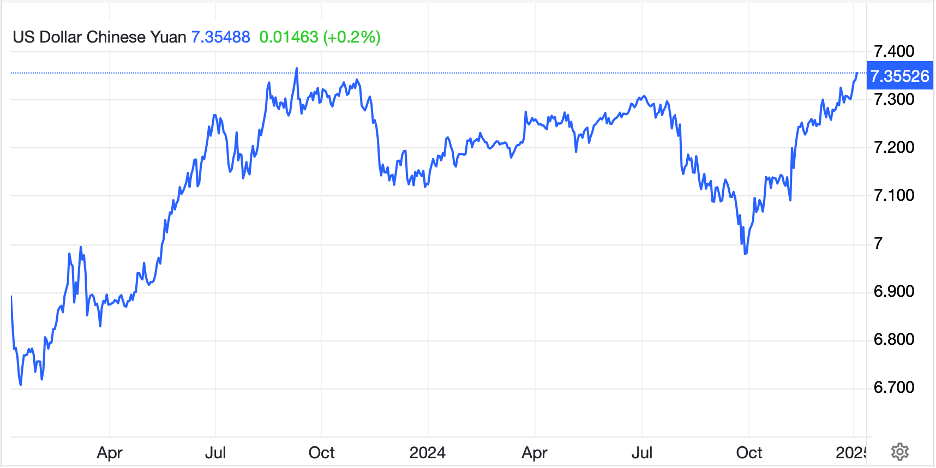
It seems that one of President Xi Jinping’s New Year’s resolutions was to finally allow the renminbi to resume its longer-term decline.  While 7.30 has been the line in the sand for a while, as can be seen from the first chart below, suddenly, as the calendar page turned to 2025, it appears that the PBOC is going to allow for the renminbi to weaken further.  Thus far, the PBOC has been adamant about fixing the Chinese currency at levels much stronger than anyone wants to pay for it, and even last night that was the case, with a fixing rate of 7.1878.  However, while the onshore market must trade within +/- 2% of that fixing rate, no such restriction limits the offshore market, and this morning, the offshore renminbi is trading 2.3% weaker than the fixing, above 7.35 to the dollar.

Much has been made of the “chess” moves that are ongoing between the US and China regarding currency policy with many pundits blankly claiming that if Trump is to impose the threatened tariffs, the renminbi will simply weaken to offset them.  However, while I do believe the CNY has much further to fall, that is not the driving case I see.  Rather, Xi’s problem is that his economy is not in nearly as good condition as he needs it to be and confidence in the consumer sector continues to wane.  This is largely a result of the ongoing destruction of the property bubble that was blown for decades.

Remember, Chinese investors have tied up significant personal wealth in second and third homes as stores of value.  This was encouraged as cities could sell property to developers, get paid a bunch to help finance their operations, and since demand was so high, prices kept rising so everyone was happy.  Alas, as with all bubbles (I’m looking at you, too, NASDAQ) eventually the air comes out.  For the past three years the Chinese have been trying to deal with this collapsing property market, but house prices continue to decline thus reducing investor wealth and confidence.  I read that there are an estimated 80 million empty homes that have been built over the past decades and are now in disrepair in the countryside.  These are the ghost cities that were all part of the Chinese growth miracle, but in fact were simply massive malinvestment.

While the prescription for China has long been to increase its consumer sector of the economy, Xi and his minions at the central committee have no idea how to do that (given they are communist, this is not that surprising) and so continue to support the means of production.  The problem is they have now seemingly gone too far in that space as well with not merely the Western world, but also much of the developing world starting to push back on all the excess stuff that is coming from China.  

Xi’s other problem is that as he rails against the dollar and seeks others to use the renminbi in their trade, if the currency starts to fall sharply, that will be a difficult ask.  Given the US FX policy remains benign neglect, it is entirely upon China to solve their own problems.  While it is unlikely to happen in a big devaluation a la August 2015, weakness is the trend to bet here this year.

Source: tradingeconomics.com

Source: tradingeconomics.com

Away from that news, though, the year is starting off in a fairly modestly.  Most of the world’s focus is on the upcoming Trump inauguration as well as the political machinations that will begin today as Trump’s Cabinet nominees start to go through their paces in front of the Senate.  New Year’s Eve’s horrifying terrorist attack in New Orleans has just upped the ante with respect to Trump getting his picks through the process.  

So, let’s review the overnight market activity to get a sense of what today could bring.  The first day of the US trading year resulted in modest declines across the board in equities, although as I type (7:30), they appear to be retracing those losses and are slightly higher.  The bigger news was from Asia where both the Nikkei (-1.0%) and CSI 300 (-1.2%) showed weakness with the former feeling the pain of some profit taking after gains last week, although Chinese shares seem to be succumbing to the troubles I have described above.  Elsewhere in the region there was no consistency with gainers (Hong Kong, Taiwan, Korea and Australia) and losers (India, New Zealand, Malaysia) with other exchanges little changed.  In Europe this morning, there is more red than green with the CAC (-0.8%) the biggest laggard amid concerns over the fiscal situation in France.  But the DAX (-0.35%) and FTSE MIB (-0.45%) are also lagging with only Spain’s IBEX (0.0%) bucking the trend.

In the bond market, Treasury yields have slipped 2bps this morning, but remain above 4.50%, something that continues to vex Chairman Powell as he and the Fed seemed certain that by cutting the Fed funds rate, he would drive the entire yield curve lower.  I wonder if he will learn this lesson about the relation between a made-up rate (Fed funds) and market rates (bond yields) anytime soon.  In Europe, French yields are 2bps higher, widening their spread vs. German bunds and perhaps more remarkably, at least from a nominal perspective, well above Greek government bond yields now! (Remember, there are far fewer GGB’s around than OAT’s so there is a scarcity bid there). Certainly, Madame Lagarde must be getting a bit concerned over her native nation’s profligacy and I suspect that the fiscal ‘need’ for lower Eurozone interest rates is one of the features of the discussion regarding the ECB’s future path (lower).  As to JGB’s, they are unchanged, sitting at 1.07% and showing no sign of rising anytime soon.  One last thing, Chinese 10yr bonds now yield a new record low of 1.61%, 2bps lower on the day and pretty convincing evidence that not all is well in the Middle Kingdom’s economy.

On the commodity front, oil (-0.2%) is consolidating yesterday’s strong gains which were ostensibly based on the idea that President Xi will successfully implement more stimulus and aid growth in China.  History shows otherwise, but we shall see.  Gold (-0.1%) is also consolidating yesterday’s strong gains as it appears there has been renewed central bank buying activity to start the year.  The other metals also benefitted yesterday with silver (+0.8%) continuing this morning.

Finally, the dollar is retracing some of yesterday’s gains but remains much stronger than we saw just last week, and certainly since the last time I wrote.  Looking at the Dollar Index, it is hovering near 109 this morning, having traded well above that yesterday afternoon.  The next obvious technical target is 112, about 3% higher and there are now many calls for a test of the 2002 highs of 120.  I assure you, if the DXY gets to those levels, EMG currencies are going to come under a great deal of pressure.  As an example, we already see several EMG currencies (CLP, BRL) trading at or near all-time lows (dollar highs) and there is nothing to think this will change soon.  As well, check out the euro at 1.03 this morning, which while 0.3% higher on the session, appears as though it could well test those October 2022 lows (dollar highs) sooner rather than later, especially if the ECB continues to lean more dovish than the Fed.  If you are a receivables hedger, currency puts seem like a pretty good idea these days.

On the data front, ISM Manufacturing (exp 48.4) and Prices Paid (51.7) are all we have today and late this morning Richmond Fed president Barkin speaks.  Interestingly, tomorrow evening and Sunday we hear from SF Fed President Daly and tomorrow evening Governor Kugler will be joining Daly.  I guess they can’t go but so long without hearing their voices in the echo chamber!

There is nothing to suggest that the dollar, while modestly softer today, is set to turn around soon.  Keep that in mind.

Good luck and good weekend

Adf

She Just Doesn’t Know

Though there was no change
Ueda-san hinted that
The future is known


Last night, the BOJ left policy unchanged, as universally expected, but indicated that “Our basic stance is that if our economic and price outlooks are realized, we’ll respond by raising rates.”  That seems pretty clear, and the market responded accordingly with the yen rallying nearly 1% in the immediate aftermath of the comments, although it has since retraced a bit and is now higher by just 0.5% on the session.  As well, he explained, “We’ve been looking at the downside risks to the US and overseas economies, but that fog is clearing somewhat. Needless to say, new risks could emerge depending on the policies coming from the new US president.”  The upshot is that market expectations are now for the next rate hike to take place at the January meeting (69% probability), although December cannot be ruled out.

Japanese equity markets fell modestly during the session (Nikkei -0.5%), but that could also have been more related to the US equity performance, where all three major indices fell yesterday (something that I thought had been made illegal 🤣).  As to JGB’s, they rallied slightly with the 10-year yield slipping 2bps on the session.

In the current market zeitgeist, I don’t believe the happenings in Japan are that crucial.  As Ueda-san said, US politics remains a key focus for every financial market around the world, as well as every economy, given the potential for a Trump victory and some very real changes to the current global trade and economic framework.  However, that doesn’t mean other things of note have stopped occurring.

The message from Madame Lagarde
Is further rate cuts aren’t barred
She just doesn’t know
How fast she should go
Though colleagues, more cuts, have pushed hard

The other story this morning, in the wake of some Eurozone data showing inflation ticked higher in October (headline 2.0%, core 2.7%), is the commentary from several ECB members.  Notably, Madame Lagarde explained “The objective is in sight, but I am not going to tell you that inflation is under control.  We also know that inflation will rise in the coming months, simply because of base effects.”  The punditry sees this as a middle ground between the more hawkish ECB members, like Nagel and Schnabel, who are calling for a “gradual approach” and that the ECB “mustn’t rush further steps,” and the doves, led by Panetta, who are concerned, “Monetary conditions are still tight and new cuts will be necessary.”  

The ECB is finding itself in a difficult position as they refuse to accept the idea that a recession is coming despite the lackluster economic data and the ongoing anecdotal evidence of trouble as evidenced by VW’s closing of factories and seeking wage cuts.  Meanwhile, they understand that inflation, at least optically, is due to rebound somewhat, and cutting rates while that is occurring may be more difficult to explain.

Ultimately, as we have seen repeatedly across all markets and nations, the biggest driver of almost everything is the combination of US economic activity and monetary policy.  However, that is not to say that other nations or blocs cannot demonstrate some independence for their own idiosyncratic reasons.  Regarding the euro, I find it interesting that I have seen more comments this morning about how the currency has found a bottom and is set to rebound.  However, I cannot help but look at the bigger picture (see chart below) and think nothing at all has changed.

Source: tradingeconomics.com

I continue to believe that in order for there to be any changes of substance, we will need to see the US policy change substantially.  That could take the form of an acknowledgement by the Fed that the economy remains strong and further cuts are not necessary (see yesterday’s ADP Employment number of 233K, twice expectations) or a decision by Chairman Jay that there are enough structural issues in the banking and financial system that further rate cuts are necessary despite what appears to be solid growth and still-high inflation.  If the former were to occur, I would look for the dollar to take another strong step higher and the euro to test parity along with other currencies declining commensurately.  If the opposite were to occur, the dollar would weaken substantially in my view, with the euro rising toward 1.15 or so.  However, I don’t see either of those scenarios playing out, so I believe the reality is we remain in the range we have traded in for the past two years as seen above.

And those were really the only stories to discuss away from the US election cacophony.  So, let’s see how markets behaved broadly overnight.  As mentioned above, US equities had a down day after some disappointing earnings results added to some overly long positioning.  Beyond Japanese shares, the rest of Asia was broadly negative as well, with Korea (-1.5%) and India (-0.7%) leading the way lower, but almost every market in the red.  We are seeing similar price action in Europe this morning as it appears Lagarde’s comments did not soothe any frazzled nerves, and the data was unhelpful as well.  As such, the CAC (-0.85%) is the lagging performer although the DAX (-0.5%) and FTSE 100 (-0.8%) are also under pressure.  Now, regarding the FTSE 100, that is also a product of the UK budget announcement yesterday which has been widely panned by most analysts.  It appears they have actually managed to create a situation where they increase spending and taxes but reduce growth substantially.  The upshot here is that there seems to be a little buyers’ remorse with the July election results.  Meanwhile, US futures are all pointing lower as well this morning, at least -0.5%.

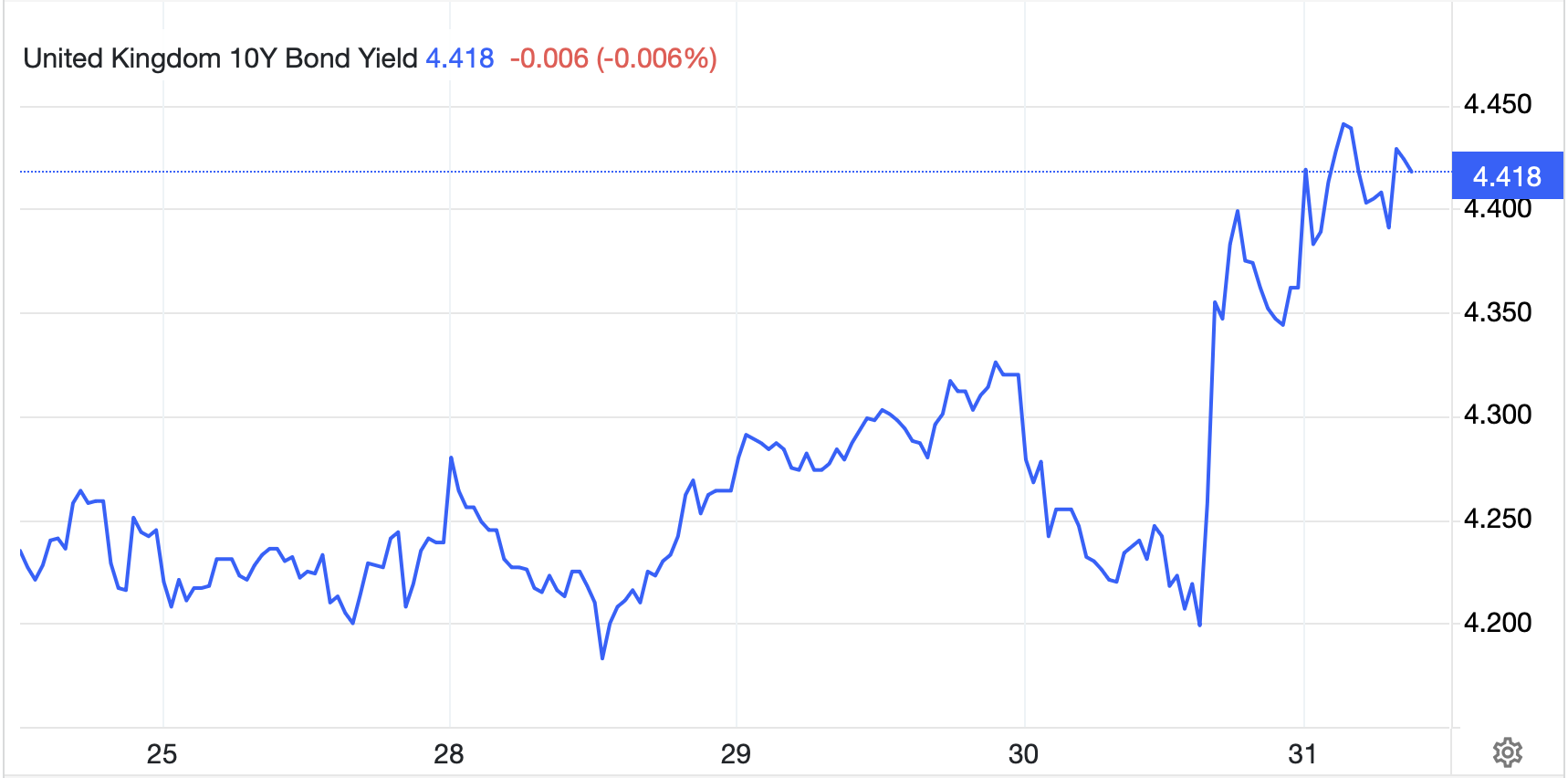
In the bond market, yesterday saw Treasury yields rebound to their recent highs at 4.30% but this morning they have slipped back lower by -2bps.  European sovereigns, however, are higher by those same 2bps as the market responds to the combination of yesterday’s Treasury movement and the higher than forecast Eurozone inflation report.  The outlier here is the UK, which after the budget has seen yields rise dramatically, a sign that markets are distinctly unimpressed with the proposals.  This is a case where a picture is truly worth 1000 words.

Source: tradingeconomics.com

I’ll let you determine when the budget was released, but one must be impressed with the more than 20bp response!

In the commodity space, oil (+0.5%) is continuing its rebound from its worst levels at the end of last week after EIA inventory saw surprising draws rather than modest builds.  As well, Chinese PMI data overnight was slightly better than expected and there are those now calling for a more robust Chinese economic rebound and increase in demand.  As to the metals markets, though, weakness is the order of the day with both precious and industrial metals slightly softer, although remember, these have rallied sharply over the course of the past month, so some trading movement lower is no surprise.

Finally, the dollar is mixed to slightly higher with only the MXN (+0.3%) showing any gains of note beyond the yen’s moves while there is more breadth in the decliners (NOK (-0.3%, ZAR -0.2%, AUD -0.2%) with almost no movement in Asian currencies overnight.

On the data front, this morning brings the weekly Initial (exp 230K) and Continuing (1890K) Claims data as well as Personal Income (0.3%), Personal Spending (0.4%) and PCE (0.2%/2.1%) and core PCE (0.3%/2.6%).  Already we are hearing that the impact of the recent hurricanes is likely to confuse the employment data, which makes sense, but I think much more attention will be paid to the Income/Spending data.  Certainly, Retail Sales have held up well, and if Personal Income continues to do well, it will call into question the need for that many more rate cuts by the Fed.  As of this morning, the futures market is pricing in a 94% probability of a cut next week and a 70% probability of another one in December.  Perhaps more interestingly, and where things could really change, is the fact the market is pricing in a total of 135bps of cuts by the end of next year.  We will need to keep an eye on how that changes for clues to the dollar’s future.

For now, the dollar appears on its back foot, but absent some much weaker than forecast data, it is hard for me to see a sharp decline.  Rather, I continue to see more reason for the dollar to maintain its broad strength going forward.

Good luck

Adf

Panic Attack

The FX Poet will be in Nashville at the AFP Conference October 21-22, speaking about effective ways to use FX options in a hedging program.  Please come to the presentation on Monday at 1:45 in Grand Ballroom C1 if you are there.  I would love to meet and speak.
 
Said Madame Lagarde, we’re “on track”
To make sure inflation gets back
Below two percent
So, we can prevent
A government panic attack
 
The subsequent news from the East
Is Chinese growth, once more, decreased
Their five-percent goal
Ain’t on cruise control
So, Xi needs more skids to be greased


See if you can find the conundrum in the ECB statement issued yesterday after they cut interest rates 25bps, as expected, taking the Deposit Rate down to 3.25%,. [emphasis added]

“The incoming information on inflation shows that the disinflationary process is well on track. The inflation outlook is also affected by recent downside surprises in indicators of economic activity. Meanwhile, financing conditions remain restrictive.

Inflation is expected to rise in the coming months, before declining to target in the course of next year. Domestic inflation remains high, as wages are still rising at an elevated pace. At the same time, labour cost pressures are set to continue easing gradually, with profits partially buffering their impact on inflation.”

While I realize that I am just an FX guy, and that my education at MIT was far more focused on numbers than words, I cannot help but read the highlighted phrases and be confused how the conclusion of high domestic inflation and expectations for it to rise means the disinflationary process is “well on track.”  Of course, it is important to remember that Madame Lagarde is a politician, not an economist nor banker nor any other background familiar with numbers, so perhaps she is the one that doesn’t understand.  Either that or as with every politician she is simply lying.

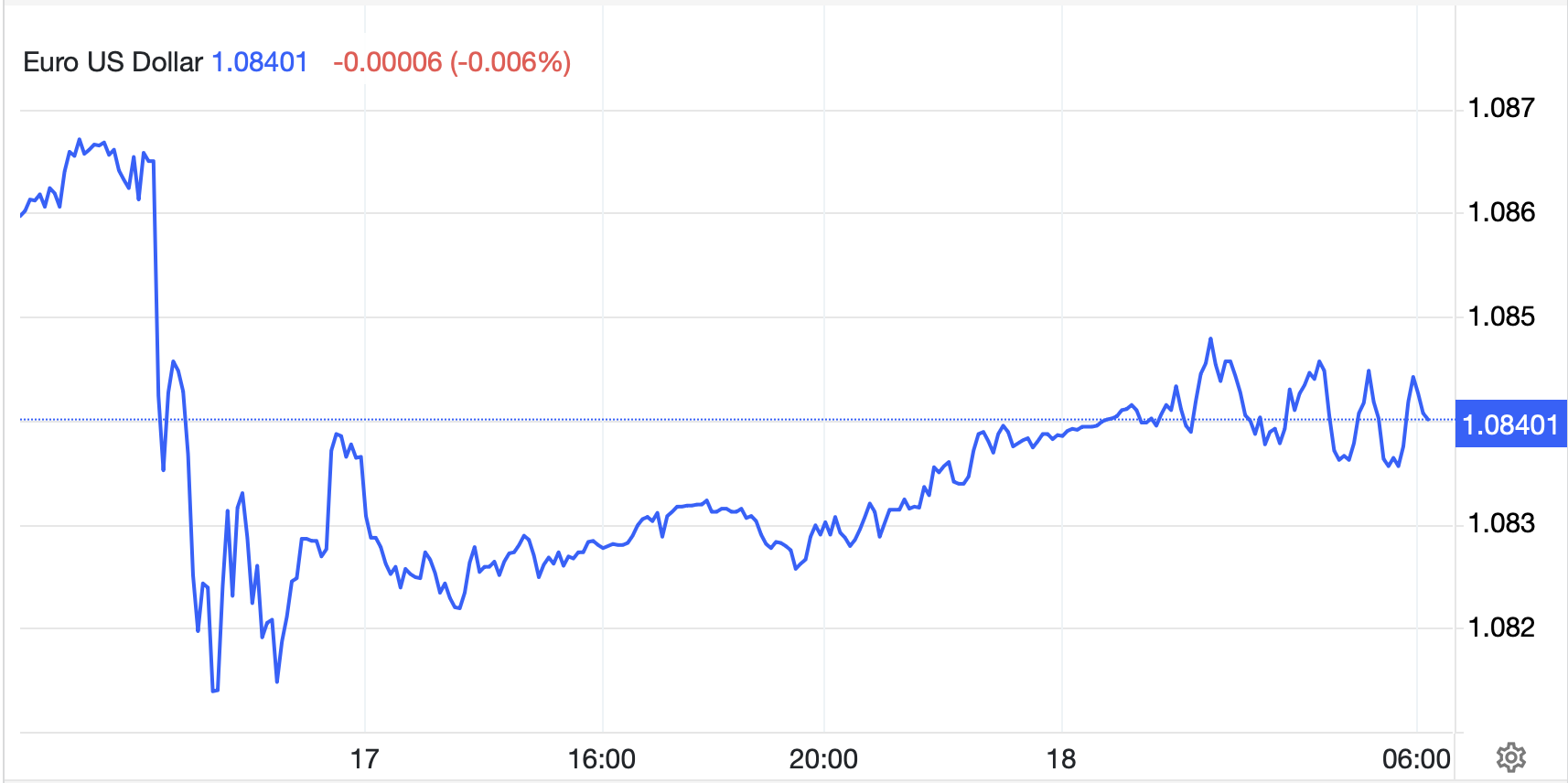
Regardless, as you can see in the chart below, the market response in the wake of the announcement was to sell the euro as interest rate traders priced in a December rate cut as well.

Source: tradingeconomics.com

The juxtaposition of US and Eurozone data remains the key here and as yesterday’s US numbers showed, the long-awaited recession continues to be postponed.  It becomes ever more difficult to see how the Fed will justify easing policy in any substantive manner if every economic print beats expectations.  (To clarify, Retail Sales printed at 0.4%, 0.5% ex-autos vs. expectations of 0.3% and 0.1% respectively. Philly Fed printed at 10.3 vs. expectations of 3.0 and Initial Claims fell to 241K despite the hurricanes, vs expectations of 260K). 

In the end, all this simply reinforces my view that the euro has further to decline going forward.  I still like the 1.05 – 1.06 level as a target by year end.

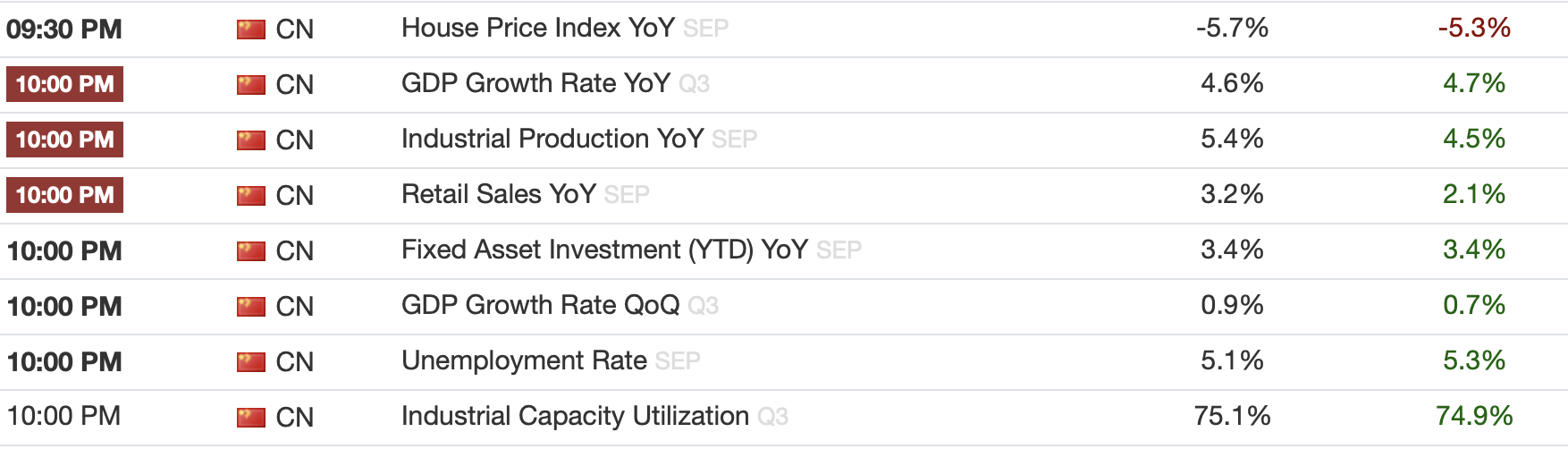
Turning to China, last night they had their monthly data dump and the numbers there continue to point to an economy struggling to gain momentum. (The first, black, number is the September data, the second, green or red, number is the August data.)

Source: tradingeconomics.com

Xi’s 5% target, or even if you use their recent “around 5%’ concept, is getting strained.  While Retail Sales there was a positive, the ongoing disintegration of the housing/property market is a major problem.  Now, all this data represents activity before the plethora of stimulus measures that have been announced.  However, recent equity market performance there, if using as an indicator of the belief that the stimulus was going to be effective, had shown a substantial decline from the early sugar highs back in September immediately following the first stimulus announcements.

With that in mind, PBOC Governor Pan Gongsheng strongly hinted that there would be another interest rate cut next week, as the government struggles to not only convince investors that they have things under control, but to also implement the measures already described.  Now, last night, after Pan hinted at the rate cuts, along with other comments regarding the funds allocated to help companies buy back shares, Chinese equity markets rose sharply in the afternoon session, as per the below chart, rising 3.6% on the day.

Source: Bloomberg.com

Once again, I will highlight the irony of the Chinese Communist Party focusing on the epitome of capitalism, the equity market, as a key means of economic improvement and a key signal that they are on the right track.

That was really all the big news since I last wrote.  Let’s look at the overall market activity.  After yesterday’ lackluster US session, Japanese shares (+0.2%) managed to edge a bit higher and Hong Kong (+3.6%) mirrored Chinese mainland shares.  The other beneficiary of the Chinese stimulus discussion was Taiwan (+1.9%) but Australia (-0.9%), Korea (-0.6%) and a host of other regional exchanges did not seem to appreciate the effort.  In Europe, only the UK (-0.3%) is really under any pressure although the gains on the continent are not terribly impressive with the CAC (+0.5%) the leader at this point.  Most other markets there are little changed to slightly higher.  As to US futures, at this hour (7:20), they are higher by about 0.25%.

In the bond market, after yesterday’s much stronger than expected US data, Treasury yields jumped 7bps and this morning have edged higher by another 1bp to get back to 4.10%.  However, on the continent, sovereign yields this morning are lower by between -2bps and -4bps after yesterday’s ECB action and comments.  The one exception here is the UK, where gilt yields are higher by 2bps after UK Retail Sales data printed much stronger than expected at +0.3% in September, vs. -0.3% expected.

In the commodity markets, oil (-0.4%) is modestly lower this morning but really going nowhere for now as evidenced by the chart below.  Once the word had come that Israel was not going to target Iranian oil infrastructure and the price fell, it has basically been flat.

Source: tradingeconomics.com

As to the metals complex, gold (+0.6%) continues its ongoing rally and is at yet another new all-time high, above $2700/oz this morning, as demand continues to be present from all segments.  However, this morning, all the metals are rallying with silver (+1.0%) and copper (+1.5%) showing even better performance.  The combination of continued solid data from the US and hopes for a return to Chinese demand seem to be the drivers.

Finally, the dollar is closing the week on a down note, as traders reduce positions and take profits ahead of the weekend.  During the week, the dollar rose against virtually every one of its main counterparts in both the G10 and EMG blocs.  Again, the big picture here is that for the dollar, good US economic data is going to continue to benefit the greenback, and we will need to see not just one bad number, but a series of them before the dollar truly suffers.

On the data front, we see Housing Starts (exp 1.35M) and Building Permits (1.46M) at 8:30 this morning and then we hear from three more Fed speakers (Bostic, Kashkari and Waller) with Bostic making two appearances.  At this stage, despite the strong data, the Fed funds futures market is pricing in a 92% probability of a 25bp cut next month and then a 75% probability of another one in December.  I know that Powell seems desperate to cut rates, but if the data continues to show strength, the case to do so is going to be much harder to make.  That doesn’t mean he won’t do it, but if he continues down that path, it just means that inflation will return that much sooner.  

Good luck and good weekend and reach out if you are in Nashville at the AFP!

Adf

Still Weak

In Germany, data’s still weak
For Europe, that doesn’t, well, speak
So, riddle me this
Are traders remiss
For claiming that euros are chic?
 
It’s true interest rates matter most
And Powell said Fed funds are toast
But can M. Lagarde
Just simply discard
The Germans, though they’re comatose?


There is a growing opinion that the dollar is going to decline sharply as the Fed begins to cut rates.  Numerous analysts believe that the market is underpricing how many Fed fund cuts are coming as they are all-in on the US recession story.  After Friday’s Jackson Hole speech, it certainly appears that we will get at least one cut come September, but stranger things have happened.  And obviously, given Powell’s pivot from inflation to unemployment as job #1, the NFP report a week from Friday is going to be crucial.

But we must never forget that the FX market is a relative concept.  It is not simply that one country’s economy is doing well or poorly, nor that their interest rates are high or low, or perhaps moving up or down, it is how those data points compare to other countries that determines the movement in the FX markets, at least the fundamentals, but also frequently the capital flows.  It is with this in mind that on a quiet day we have time to dissect the story in Germany for a bit.  Early this morning, Germany’s Federal Statistical Office released two data points, the GfK Consumer Confidence reading, which fell sharply to a below consensus reading of -22.0 and the Final GDP Growth numbers for Q2, which printed at -0.1% Q/Q and 0.0% Y/Y.  Now, this is not a single quarter feature in Germany as is illustrated in the below chart.

A graph with blue and yellow squares

Description automatically generated

Source: tradingeconomics.com

In fact, GDP growth in Germany has averaged just 0.3% annually over the past 5 years, a pretty anemic level, and one that bodes ill for Europe as a whole.  Recall, Germany’s economy is the largest in Europe (and 3rdlargest in the world) and represents about 28.6% of the Eurozone’s total economy.  If the largest economy in a group of nations is stagnating, it is very difficult for the group’s overall growth rate to expand.  Compare that to the fact that the data to date in the US indicate that growth remains fairly solid (GDP +2.8% in Q2), and then ask yourself, where are the opportunities for activity more prevalent, Europe or the US?  Again, the macro picture seems to point to the US as a continued preferred destination for capital.

And yet, the euro is pushing back to its highest level since a brief spike in July 2023, and otherwise, early 2022 prior to that.  So, does it really make sense for the euro to continue to rally from here?  Literally, the only argument in its favor is that the Fed has now committed to begin easing policy and the market is pricing in about 200bps of rate cuts through the end of 2025.  Meanwhile, although the ECB has implemented their first rate cut, and seem set to execute their second next month, the market is only pricing in 125bps of cuts by December 2025, and just 50bps total for 2024, compared to 100bps for the Fed.

As such, here is the explanation for the euro’s recent solid performance.  But I believe the question to ask is, can this last?  If Germany’s economy is going to continue to bounce along at essentially zero growth, and there is nothing indicating a rebound is coming soon, it seems more likely to me that the rest of Europe follows it lower, rather than ignores Germany and powers ahead.  It’s not that individual small nations in the Eurozone won’t grow more quickly, but Germany’s position in the Eurozone, notably as a trade partner, implies that things are more likely to sag than soar.  

Yes, the euro has rebounded lately, but that has been in response to the interest rate pricing described above.  I think it is a fair bet that Madame Lagarde, when faced with a Eurozone that is growing more slowly than desired, is likely to accelerate interest rate cuts there.  And when that happens, the euro’s recent rise will very likely retrace.  I am not saying that the dollar is going to climb against everything, just that the euro’s strength feels suspect.  One poet’s view.

I’m sorry for the focus on Germany, but some days, there is very little macro news of note, and this seemed the most important, especially given that the idea of a much weaker dollar going forward is gaining traction.  

Ok, with that in mind, let’s look at the overnight activity, which was not all that substantial.  After yesterday’s split between tech shares (NASDAQ -0.85%) and industrials (DJIA +0.16% and a new ATH), Asian shares were mixed as well.  The Nikkei (+0.5%) had a solid session as did the Hang Seng (+0.4%) although mainland Chinese shares (-0.6%) continue to suffer, last night due to a much weaker than forecast earnings result from the parent company of Temu.  Of more concern than the result was the commentary by their CEO that prospects for consumption were dimming.  In Europe, there are some very modest gains, with the DAX (+0.2%) surprisingly holding up well, although the move is obviously quite minimal.  I cannot look at the Eurozone economy and expect anything other than more aggressive rate cuts from the ECB going forward.  As to US futures, at this hour (7:30), they are essentially flat.

In the bond market, yields are backing up from their recent lows with Treasuries higher by 3bps and European sovereigns by between 5bps and 7bps.  In fact, the real outlier is the UK gilt market where 10yr yields are higher by 9bps as there is an increasing concern that the Starmer government is going to blow up the budget there as the PM tries to implement his new policies.  You may remember what happened when Liz Truss was PM and proposed a high spending, high deficit budget and caused all kinds of havoc in the gilt market back in October 2022.  I would not rule out another situation like that quite frankly.  Finally, JGB yields edged lower by 1bp last night, continuing to prove that normal monetary policy in Japan remains a distant prospect.

In the commodity markets, oil (-0.4%) which is higher by > 5% in the past week, has stopped climbing for now.  Perhaps the fact that there have been no new military incursions in the Middle East has been sufficient to get the algos to start selling again on the poor demand story.  Gold (-0.2%) is also biding its time, as are the other metals, although all are retaining the bulk of their recent gains.  Generically, my dollar view is that it will weaken vs. stuff like commodities, not necessarily vs. other currencies.  Of course, this implies a rebound in inflation, something which I continue to see going forward.

Lastly, the dollar is little changed this morning, with most G10 and EMG currencies +/-0.2% or less compared to yesterday’s closing levels.  The biggest mover today is NZD (+0.4%), although I am hard-pressed to see any fundamental reason as there was neither data nor central bank commentary.  Arguably, this is the result of some position changes rather than a fundamental move.  And after that, nothing has moved much at all.

Yesterday’s Durable Goods print of +9.9% was astonishingly high, although the ex-transport reading of -0.2% was a tick lower than forecast.  I guess Boeing sold more planes than anticipated.  As to this morning, we see Case-Shiller Home Prices (exp 6.0%) and Consumer Confidence (100.7), neither of which seems likely to have a major impact.  SF Fed president Daly reiterated the Powell idea that the time has come to cut rates, and I expect every Fed speaker going forward up to the quiet period to say the same.  I guess the real problem will be if the NFP report is hot.  Right now, the early forecasts are for 100K NFP and the Unemployment Rate to remain unchanged at 4.3%.  But what if it prints at 200K and Unemployment slips back a tick?  Will they still be anxious to cut?  I’m not forecasting that, simply reminding us all that assumptions need to be tempered.

As it is the last week of August with holidays rife around the Street, I suspect it will be very quiet overall.  At this point, we need more data to make decisions, so look for limited activity in the FX markets, although I guess the world is really waiting for Nvidia’s earnings tomorrow more than anything else.

Good luck

adf

In Vogue

The cutting of rates is in vogue
And Madame Lagarde won’t go rogue
She’ll cut twenty-five
And keep hopes alive
That with Chair Jay, she did collogue
 
The stock market clearly believes
That soon they’ll be getting reprieves
In higher for longer
So, markets are stronger
As everyone, rate cuts, conceives


First it was Switzerland in March with a surprise 25bp rate cut.  Then Sweden cut 25bps in early May, although that was more widely touted ahead of the move.  Yesterday, the Bank of Canada joined the fray with a 25bp cut with Governor Tiff Macklem explaining that they are “not close to the limits” of the difference between US and Canadian interest rates and that with both inflation and growth receding, “markets have a very good idea of what’s on our minds” with respect to the value of CAD.  I think the last comment was an indication that they are comfortable if CAD were to weaken further, although after a very short-term dip of about -0.5% yesterday in the wake of the announcement, it is right back to where it was before and unchanged this morning.

With this as background, we turn now to the ECB which has virtually promised us a 25bp rate cut this morning and will almost certainly deliver it.  While many will remember that just last week, Eurozone CPI was released at a higher than expected 2.6% with core CPI also rising, up to 2.8%, at least those numbers have the same big figure as the ECB’s target.  But, as per the CPI chart below from tradingeconomics.com, it is not hard to make the case that the decline in inflation has bottomed above their target.

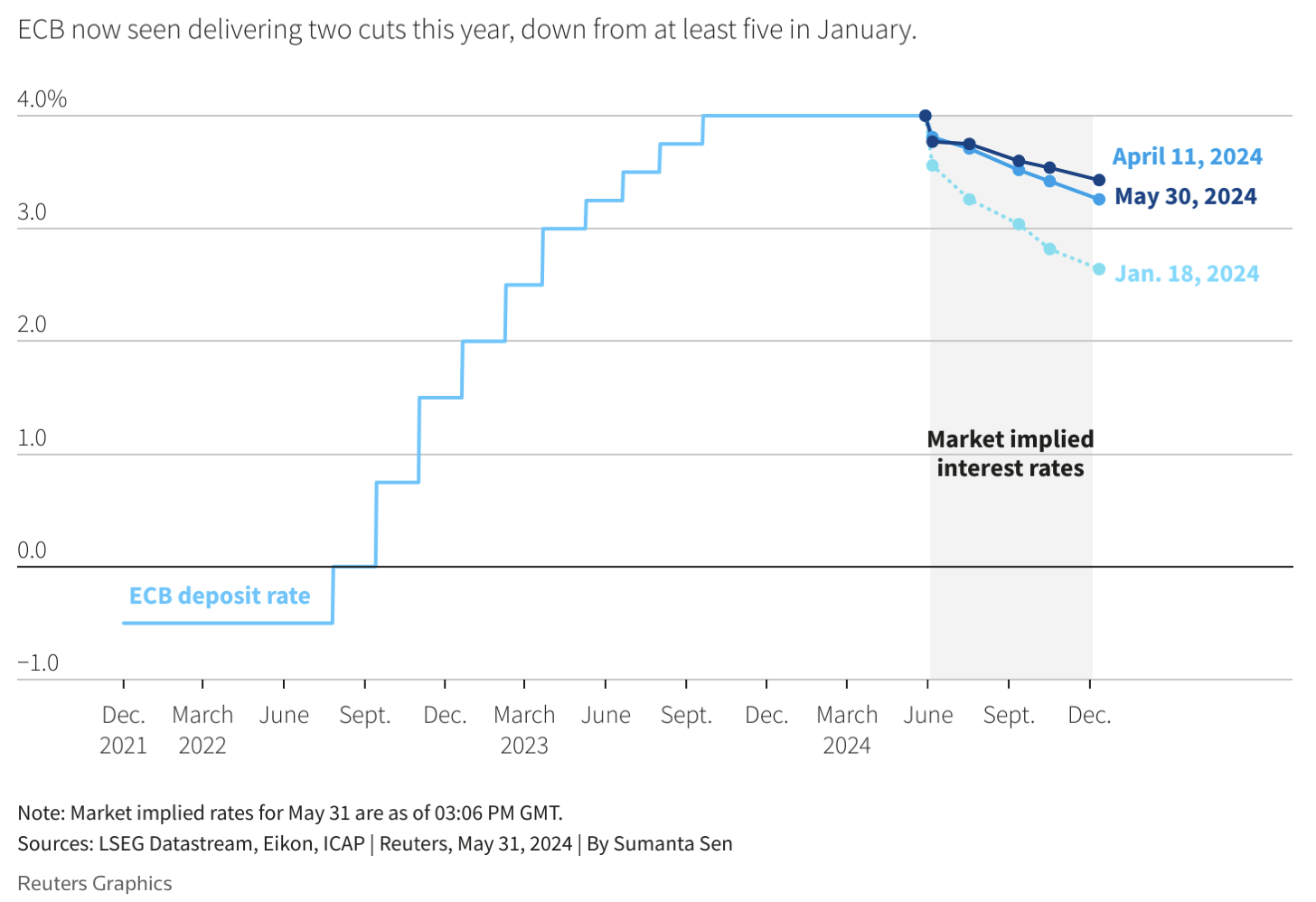
That could be awkward for their future actions but is also very likely why virtually every ECB speaker has been adamant that a July cut is not a given and they will continue to be data dependent.  Many analysts believe that there will be a total of three cuts this year, June, September and December, as the ECB will roll out their latest forecasts at those meetings, but beyond June, it is a bit less certain.  Market pricing shows that there are about 60bps total priced in at this stage, including today’s cut, as per the chart below.

Source: Reuters.com

Perhaps the most important question is, why do we care?  Well, certainly in the FX markets, given the importance of interest rate differentials, the relative speed of policy rate changes by the ECB and the FOMC can have an impact on the EURUSD exchange rate.  However, absent a surprise, something most central bankers try strenuously to avoid, the movement has already occurred ahead of the announcement.  Arguably, the more important part of this whole charade is the signal it gives for official views of future economic activity.  

When central banks are cutting interest rates, there is obviously concern that prospects for future economic activity to support the government in power are dimmer than they had been previously, hence the need to act.  As such, the very fact that a rate cutting cycle has begun in so many nations is indicative of the fact that expectations for future economic growth are diminishing.  It remains very difficult for me to understand that concept and expect that equity prices should rally substantially on the news.  But clearly, I am very old-fashioned in my thinking as evidenced by the fact that yet again, the S&P 500 and NASDAQ 100 have made new all-time highs on the strength of Nvidia’s non-stop rally.  While the Dow and NASDAQ Composite are still lagging, as are small cap stocks, euphoria remains the theme. (PS, my dour view from last Friday has been damaged, but I remain quite concerned with long-term prospects.)

However, this is where we are today.  The ECB will soon be the fourth major central bank to cut their policy rate and the pressure on the Fed to begin their cutting cycle will increase further.  Alas for the Fed, they continue to receive mixed signals from the data and rate cuts are not necessarily the proper prescription for what ails the US economy.  Just yesterday we received two contradictory signals with the ADP Employment report showing a weaker than expected 152K jobs created after a downwardly revised April number.  A few hours later, the ISM Services indicator was released at a much stronger than expected 53.8 reading, its highest since last August, and certainly not indicating that growth is ebbing.  As well, the Prices Paid subindex was a still hot 58.1, again not screaming out for a rate cut.

As of now, the market is pricing in virtually a zero probability of any rate move next week, but there has been a pickup in chatter about a cut at the July meeting with the probability of a cut then rising to 18.5% as of this morning, according to the Fed funds futures market.  If the Fed were to cut later this summer, nothing has changed my view that it will result in a significant decline in the dollar, and a significant rally in commodities. And, while the first move in both stocks and bonds might be higher, the specter of rising inflation will ultimately squash those moves.  But that is not today’s story, rather it is a story for the future.

Today, after those record highs in the US, we saw strength throughout most of Asia although Mainland Chinese shares did not participate in the fun.  That said, the gains were modest, between 0.25% and 0.5% overall.  In Europe this morning, the screens are all green with gains ranging from 0.3% in the UK to 0.7% in Germany as investors seem to believe in the goldilocks scenario there.  As to the US, futures at this hour (7:00) are unchanged as investors await tomorrow’s NFP data.

In the bond markets, after further declines yesterday, with 10-year Treasury yields touching their lowest level (4.27%) since the end of March, yields have bounced slightly this morning, higher by 2bps.  We are seeing similar price action throughout Europe, yield rallies of 2bps, except for the UK, which has seen a further 2bp decline despite the only data point, Construction PMI, rising the most in 2 years.  One last thing is that JGB yields, the ones that were supposed to be breaking out and running much higher now that the BOJ is leaving them alone, fell 5bps and are at 0.96%, below the 1.00% dotted line in the sand.

Commodity prices are rising this morning, continuing to rebound from the sharp declines earlier in the week, as oil (+0.6%) and NatGas (+0.4%) show there is still demand for energy regardless of the economic situation.  In the metals space, all the big four precious and industrial metals are higher this morning as it appears more and more like the weakness at the beginning of the week was a trading event, not a fundamental one.

Finally, the dollar is little changed overall this morning with the biggest mover being PLN (-0.3%), an indication that there is nothing ongoing.  While some currencies have managed small gains vs. the dollar and others have lagged, my sense is everyone is awaiting tomorrow’s NFP before deciding the next move, given the certitude of the ECB move later today.

We do, however, get some data this morning as follows: Initial Claims (exp 220K), Continuing Claims (1790K), Trade Balance (-$76.1B), Nonfarm Productivity (0.1%), and Unit Labor Costs (4.9%).  While we already know that the growth in the Trade Balance has been the key driver in the decline in the GDPNow figures (net exports are a subtraction from the calculation), I think the Fed may be more focused on the productivity numbers which are hardly inspiring and when combined with rising Labor Costs imply that inflation will have a tough time declining further.

So, the ECB will act first thing and then Madame Lagarde will very likely tell us that they remain data dependent, so nothing is promised for July or anytime the rest of the year.  As to today’s US data, I don’t believe it will be market moving.  This means that the equity bulls will continue to make their case and will need to be strongly disabused of the notion that the world is a great place right now.  When that time comes, beware, but it doesn’t seem likely today.

Good luck

Adf

Still Premature

The talk of the town has been gold
Whose rally, by some, was foretold
While Christine and Jay
Would give it away
Elsewhere it’s what folks want to hold
 
Under the rubric, a picture is worth a thousand words, have a look at the chart of the price of gold over the past twelve months below:

Source: tradingeconomics.com

That red arrow is pointing to the closing price on February 13, at $1988/oz, more than $400 lower than this morning’s market price.  There are many theories as to what is happening to drive this remarkable move in a commodity that has had a very limited role in the macroeconomic discussion for the past 53 years, ever since Nixon closed the gold window in 1971.  But the rally has been so strong it has fostered a host of theories as to what is driving it.  The latest is that there is a large, price-insensitive buyer acquiring large amounts outside the NY/London trading axis, with many people of the belief it is China and/or Russia preparing for a more complete break from the USD-based global monetary system.

Perhaps that is the case as we know from official reports that China has continued to acquire large amounts of gold over the past year.  But that has too much of a whiff of conspiracy theory in it for my taste.  My strong belief is that conspiracies are extremely difficult to maintain because people simply talk too much.  Rather, four decades of experience in financial markets, specifically FX and precious metals markets, has taught me that sometimes, markets move a long way on the basis of underlying fundamentals that have heretofore been ignored.  A simpler explanation could be that given its millennia-long history of being an able store of value and the fact that inflation remains rampant around most of the world while central bankers remain keen to cut interest rates and stop any efforts to fight it, many folks have decided it is a good idea to hold some portion of their personal wealth in the barbarous relic.  I know I do and have done so for quite a while.  I do not believe I am alone in that mindset.  Speaking of central bankers…

Said Christine, it’s still premature
To cut rates cause we’re not yet sure
Inflation is dying
Though we’re falsifying
It’s death from the Po to the Ruhr

At yesterday’s ECB meeting, as expected, there were no policy changes.  Madame Lagarde commented as follows: “If the Governing Council’s updated assessment of the inflation outlook, the dynamics of underlying inflation and the strength of monetary policy transmission were to further increase its confidence that inflation is converging to the target in a sustained manner, it would be appropriate to reduce the current level of monetary policy restriction.“  

That represents a lot of ten-dollar words to say, we want to cut rates, but we’re afraid if we do inflation might return so we are going to wait longer.  However, what was clear was that there is a wide range of views on the council.  For instance, this morning, Yannis Stournaris, the Greek central banker, said he thought that 4 cuts this year made sense.  At the same time, the last we heard from Robert Holtzmann of Austria, one cut was probably enough.  

Once again, Lagarde explained they are not waiting for the Fed, which is a good thing given the Fed seems less and less likely to cut this year at all, and Europe is in a recession already and needs lower rates.  This morning, the euro has fallen even further, down another -0.7%, and is back to levels last seen in early November.  It is becoming increasingly clear that monetary policies in the US and Europe are going to diverge further than currently priced and that does not bode well for the single currency going forward.

And those are really the big stories.  Yesterday’s PPI was a tick softer than expected, but the explanation was that in the calculation, the BLS seasonally adjusts the price of gasoline, so it showed a reduction despite the fact that gasoline prices, as we all know, have been rising steadily of late.  In any event, the market shook it off as we saw US equity markets perform well with both the S&P and NASDAQ reversing Thursday’s declines.  In Asia, however, while the Nikkei (+0.2%) managed a small gain, Chinese shares, and especially those in HK (-2.2%) had a lot more difficulty.  Chinese trade data was quite disappointing with the Trade balance shrinking dramatically (granted it is still >$50B) but both imports and exports declining.  And truthfully, all the other regional markets were lower to close the week.

European bourses, though, are all in the green, and nicely so, as investors and traders listen to the ECB doves and see more rate cuts, not less, coming.  This was confirmed with final pricing data showing the trend lower in inflation remains intact.  As to the US futures market, at this hour (7:50), they are lower by about -0.25% after weaker than expected earnings from JPM were released this morning.

In the bond market, after a week that has seen yields climb dramatically around the world, this morning Treasury yields are lower by 6bps, although still above 4.50%.  European sovereigns have seen yields decline even more, between 9bps and 11bps as the hope for rate cuts springs eternal.  Arguably, this is why the euro is under such pressure, the market narrative is gelling around the idea that the Fed won’t cut, and the ECB will be more aggressive.  One last thing, JGB yields are lower by 2bps this morning, but that is after a sharp rise seen in the wake of the US inflation report.  In fact, like many markets, with 10-year yields back at 0.84%, we are seeing levels not seen since November.

Turning to commodities, we have already discussed gold, and ignored silver (+2.0%) which is rallying even more aggressively, and copper (+1.80%) which is gaining on a combination of concerns over supply and a growing belief that China is going to add more stimulus to their economy.  Oil (+1.4%), too, is on the move, rebounding on growing concerns that the Middle East situation is getting even more dangerous with all eyes on Iran and any potential retaliation for Israel’s actions in Syria last week that resulted in the death of a key Iranian commander.  Historically, commodity rallies of this nature were accompanied by a weaker dollar, but not this time.  If this price action continues, there are going to be a lot of problems in nations all around the world that need to acquire commodities while their respective currencies are weakening.  Do not be surprised to see more market intervention in many places.

Finally, the dollar is back on top, rallying vs. virtually every currency this morning in a substantial manner.  In the G10, SEK (-1.3%) is the laggard, but the euro, pound, Aussie, Kiwi and Nokkie are all weaker by -0.6% or more.  In fact, only the yen (0.0%) is holding up, but that is after it blew through the previous ‘line-in-the-sand’ at 152.00 and is now above 153.00.  emerging market currencies are also uniformly weaker, although some are holding in better than others.  ZAR (-0.1%) is clearly benefitting from the metals rally, but not quite enough to rally on its own.  But KRW (-1.0%), MXN (-0.5%), BRL (-0.45%) and PLN (-0.65%) give a flavor of the overall price action.  Frankly, this is likely to continue until/unless we see a significant change in the data flow with US economic activity slowing, or at the very least, we get a consensus from all the Fed speakers that they are going to cut regardless of the data.

Speaking of the data, today we see only Michigan Sentiment (exp 79.0) and hear from two more Fed speakers, Bostic and Daly.  it doesn’t strike me that the data will matter that much, but market participants are quite keen to get more clarity from Fed speakers.  There is still a mix of views, although the one consistency is they have no confidence that inflation is falling toward their target sustainably.  However, some see a reversal higher as quite possible while others are holding out hope that this is a temporary bump in the road.  We will still see a significant amount of data before the FOMC meeting on May 1st including Retail Sales next week and the PCE data at the end of the month.  We will also hear much more from Fed speakers, so as of now, while there is no consensus, perhaps one will coalesce.  

Yesterday’s data did result in futures markets very slightly increasing the rate cut probabilities, with June now a 25% chance and 45bps priced for the rest of 2024.  I remain in the no-cut camp and so expect the dollar will continue to perform well vs. its brethren.  However, I see no reason for the commodity markets to back off either.  Bonds, however, are likely to see more pain going forward.

Good luck and good weekend

Adf

Smokin’

The CPI data was smokin’
So, Jay and the doves are now chokin’
He’s lost the debates
And they can’t cut rates
Without, higher prices, provokin’

As such, it should be no surprise
That traders, risk assets, despise
So, bond yields exploded
While stocks all eroded
And dollars made new five-month highs

Welp, the inflation data was not merely a little hot, it was a lot hot.  Measured prices rose 0.4% on both the headline and ex food & energy readings for the month of March with the annual rises ticking higher to 3.5% and 3.8% respectively.  Too, you will not likely hear the inflation doves and those who had been concerned with deflation talking about the trend for the past 3 months or 6 months, as both of those are now running well above 4%.

In truth, if the Fed was both data dependent and actually still fighting inflation, rate hikes would be on the table again as there is absolutely no indication that either wages or rental/housing prices are heading back to the levels necessary to see an overall inflation rate of 2.0%.  Alas, it is also clear that politics is a part of the decision process and the concept of fiscal dominance, where fiscal policy overwhelms monetary policy, remains the order of the day.

Fed funds futures adjusted their probabilities instantly with the idea of a June cut now down to just 16% while there are less than 40bps of cuts now priced in for the rest of 2024.  Given this price action, it is no surprise that bond yields rose dramatically, with the 10-year closing the session at 4.54%, up 18bps and the highest close since November 2023.  My sense is it has further to go.  Meanwhile, 2-year yields rose back to 4.97%, a more than 21bp rise to levels also last seen in November 2023.  One other aspect of the bond market was the worst 10-year auction in more than a year as the tail was 3.1bps, the third largest tail in history, with a lousy bid-to-cover ratio (2.33) and much less foreign interest (61.4%) than we have been seeing lately.  The last 5bps of the yield rally came after the auction result.

Adding to the general gloom, equity prices fell about -1.0% across the board, but closed above their session lows.  It is the dollar, though that really saw a big move with a greater than 1% move against most of its major counterparts.  USDJPY blasted through the 152.00 level that many had thought was a line in the sand for the MOF/BOJ and is a full big figure higher.  Meanwhile, European currencies all declined by more than -1.0% and Aussie (-1.8%) was the absolute laggard across both G10 and EMG blocs.

With this as backdrop, the ECB sits down this morning and must decide if it is too early to cut interest rates.  The economic data continues to underwhelm, and the inflation data is actually trending lower, rather than the situation in the US where it has turned back higher.  But the sharp decline in the euro yesterday has got to be a warning to Lagarde and her minions as a cut, especially since it is not priced at all, would likely see another sharp euro decline, something they are certainly keen to avoid.

One other thing, the Minutes of the March FOMC meeting were released in the afternoon, and it seems the committee is coming to an agreement that they are going to slow the roll-off of Treasury securities, likely cutting it in half to $30 billion/month although they are not going to touch the mortgage-backed part of the balance sheet since that is barely declining at all.  It appears that this may take place at the June or July meeting, but clearly before too long.

Enough about yesterday.  Overnight saw Chinese CPI data fall back to -1.0% M/M, reversing the previous month’s rise, as it becomes ever clearer that China will never be able to consume as much as it is able to produce.  That is the very crux of the trade issues that are becoming more heated as China ultimately dumps all its excess production overseas, or at least tries to.  This is an issue that is not going to disappear anytime soon, and one that will have major political and economic ramifications going forward.  I suspect that the tariff situation will only get worse, and I would not be surprised to see further absolute restrictions on Chinese trade regardless of who wins the US election in November.  As to the market impacts of this story, for now, I believe Xi is more fearful of a capital flight if he allows the yuan to weaken substantially, than he is of annoying the US and the rest of the world because the yuan is too weak.  But, given the clear difference in the trajectories of the US and Chinese economies and inflation stories, pressure for yuan weakness is going to continue.

Turning to this morning’s session, Madame Lagarde and her crew meet, and the market is not pricing in any movement.  June remains the odds-on favorite for the first rate cut, and given the fact that the Eurozone, as a whole, is stagnant from an economic growth perspective, and that price pressures there have been ebbing more quickly, that certainly makes sense.  Of course, after yesterday’s CPI, June is off the table in the US so the ECB will have to act without the ‘protection’ of the Fed.  As mentioned above, the euro declined by more than -1.0% yesterday and is edging lower this morning as well, down -0.1%.  Lagarde’s risk is she follows the path of lower rates, the euro declines more sharply, perhaps to parity or beyond, and that invites a resurgence in imported inflation.  Remember, energy is still priced in USD, so that a weak euro would raise the price of oil products across the continent.  Alas for Madame Lagarde, it’s not clear her political nous will allow her to solve this problem.

Recapping markets overnight, following the US declines yesterday, the Nikkei (-0.35%) also fell, but I think the yen weakness helped mitigate the declines.  Chinese shares were lackluster, slipping slightly both in HK and on the mainland and the rest of the time zone saw a mix of modest gains and losses.  Meanwhile, European bourses are all in the red this morning, with Spain (-0.9%) the laggard, but the average decline probably around -0.5%.  US futures, too, are softer at this hour (7:00), down about -0.3% across the board.  Clearly, there is grave concern that the Fed is not going to help ease global monetary policies.

As further proof that US yields drive global bond markets, yesterday’s CPI data pushed European sovereign yields higher by about 10bps across the board!  This despite the fact that inflation is going in the other direction in Europe.  This morning, those yields are continuing to grind higher, up between 2bps and 4bps across the board.  However, Treasury yields have stalled after yesterday’s dramatic rise.  Let me say that if the PPI data released this morning is hot, I fear things could move much further.

In the commodity space, oil rallied yesterday on stories that Iran was preparing for a more substantial retaliation against Israel and despite the fact that EIA inventory data showed surprising builds in crude and products.  However, this morning it is edging lower, -0.5%.  Perhaps more interesting is gold (+0.2%) which is a touch higher this morning but was able to rebound off its worst levels of the session after the CPI print to close nearly unchanged on the day.  In the end, the market remains quite concerned about inflation regardless of the Fed’s response, and gold continues to get love on that basis.  As to the base metals, yesterday’s rate induced declines were cut in half, but this morning both Cu and Al are drifting lower by about -0.2%.

It is the dollar, though that had the most impressive movement yesterday and this morning, it is holding onto most of those gains.  Absent a hawkish message from the ECB this morning, something which I believe is highly unlikely, the euro feels like it has further to decline.  The BOC left policy on hold and sounded fairly non-committal regarding its first rate cut there.  The Loonie suffered yesterday and has seen no rebound at all.  In fact, the only currencies showing any life this morning are AUD and NZD, both higher by 0.25%, which seems much more of a trading reaction after their dramatic declines yesterday, than a fundamental story.  As long as the Fed remains the most hawkish, the dollar should hold its bid.

Turning to the data today, PPI (exp 0.3% M/M, 2.2% Y/Y) and core PPI (0.2%, 2.3%) lead alongside Initial (215K) and Continuing (1792K) Claims.  Those numbers will arrive 15 minutes after the ECB policy decision is announced with no movement expected there.  Madame Lagarde has her press conference at 8:45 this morning.  We hear from Williams, Collins and Bostic over the course of the day, so it will be quite interesting to find out how far their thinking has changed.  I would be particularly concerned if there is further talk of rate hikes again.  Remember, Bowman intimated that might occur when she spoke last week, and Bostic has been in the one-cut camp so could turn as well.  Let me just say the market is not pricing in that eventuality at all!

At the beginning of the year, I opined that there would be at most one rate cut and rates would be higher by Christmas.  As of this morning, I see no cuts and a very real chance of hikes.  Keep that in mind for its impact on all asset classes going forward.

Good luck
Adf