To Further Debase

Said Jay, “The economy’s strong”
But rate cuts before weren’t wrong
We’re in a good place
To further debase
Your dollars and will before long
As we slow the pace
Of policy ease all year long


Chairman Powell regaled the market for the last time before the Fed’s quiet period begins tomorrow evening and here are the three comments that seem to explain his current views. 

  • We wanted to send a strong signal that we were going to support the labor market if it continued to weaken.”
  • The economy is strong, and it’s stronger than we thought it was going to be in September.”
  • The good news is that we can afford to be a little more cautious as we try to find a rate-setting that neither spurs nor slows growth.”

My read is he was trying to make an excuse for the 50bp cut that started the process in September as there is still no justification for that move.  However, he essentially reiterated his last remarks of the Fed not being in a hurry to cut rates further.  As it happens, SF Fed president Mary Daly also explained, “We do not need to be urgent. There’s no sense of urgency, but we do need to continue to carefully calibrate our policy and make sure it’s in line with the economy we have today the one we expect to have going forward.” 

Now, a funny thing happened to me yesterday as I read those comments, and my expectation was that the Fed funds futures market might reduce the probability of a December rate cut.  After all, we just heard from the Chairman that things are good and they can be cautious about further cuts, while another member expressly said there was no urgency to cut.  But in fact, the 74% probability this morning is unchanged from yesterday’s level and the punditry remains very convinced that they are going to cut next week despite their caution.  It seems that my understanding of caution and Powell’s are somewhat different.  However, his understanding is the one that matters, so it appears absent a major upside surprise in both NFP tomorrow and CPI next week, a cut is coming on the 18th.

The French president, M. Macron
May soon find himself overthrown
His PM is out
And there is great doubt
‘Bout any new views he has shown

The other topic of note this morning is the collapse of Monsieur Macron’s minority government in France.  This was the widely expected outcome that markets had priced in, so there has been little in the way of impact there.  However, the bigger picture impact is about the structure of the Eurozone (and EU) and its rules.  After all, if the second largest economy in the group is not merely floundering economically, but essentially leaderless, the concept of a coherent set of plans to oversee the Eurozone seems a bit of a stretch.

Macron’s term is not up until 2027, and he has consistently maintained he will not step down early, but there are increasing calls for him to do just that.  Members of parliament on both the left and right, although not Marine Le Pen, the RN’s leader, have been vocal on the subject and a recent poll by Cluster17 for Le Point magazine showed that 54% of the French public wanted him to step down as well.  Now, you know as well as I that absent a criminal conviction, the odds of an elected official stepping down anywhere in the world approach zero and I expect nothing less from Macron.  At the same time, French law prevents another parliamentary election for 12 months after the last, which means July.  At that time, one will almost certainly be called, and it will be interesting to see how that plays out.  

However, in the meantime, it seems likely that France will be floundering with no ability to address fiscal issues, be they spending or deficit focused.  This cannot be a positive for the single currency, especially if France slips into recession.  Again, despite all the concerns over the dollar and the untenable fiscal deficits, things in Europe appear far worse.  Parity in the euro and below seems a far better bet over the next 6 months than the opposite.  While the euro (+0.2%) has bounced slightly this morning, a look at the chart below indicates, at least to me, that the trend is distinctly lower.

Source: tradingeconomics.com

And with that, let’s look at the overnight session in markets.  Continuing in the FX world, that modest euro gain is descriptive of the market as a whole, with the dollar slightly softer this morning, although few currencies showing any notable strength.  I suspect much of this is based on the idea that the Fed will cut rates soon despite the “strong economy”.  In truth, in the G10, no currency has moved more than 0.2% and even in the EMG space, only ZAR (+0.4%) and HUF (+0.5%) have climbed more.  Those moves, which don’t appear to have any fundamental drivers, seem more likely to be expressions of the fact those markets are more volatile than the G10.

In the equity markets, yesterday’s US rally, to new all-time highs across the board, saw a mixed review in Asia with the Nikkei (+0.3%) edging higher but both Hong Kong (-0.9%) and Shanghai (-0.25%) slipping a bit.  The rest of Asia was also mixed with Korea (-0.9%) still suffering from the bizarre happenings there yesterday but other markets performing well (India +1.0%, Singapore +0.6%).  In Europe, only the UK (-0.1%) is under water this morning although the CAC (+0.2%) is the continental laggard.  Spain’s IBEX (+1.2%) is the leader on the back of stronger IP, and although Eurozone Retail Sales were much weaker than expected, it has not seemed to impact investor views.  As to US futures, they are little changed at this hour (7:30).

In the bond market, Treasury yields have backed up 3bps and I am beginning to sense that there is a negative correlation to the probability of a Fed rate cut and the 10-year yield.  As that probability rises, bonds sell off further, but that is merely an anecdotal observation, I have not done the math.  In Europe, yields are mixed, but within 1bp of yesterday’s closing levels with even French yields slipping 1bp. It will be very interesting to see how the European Commission handles the fact that the French budget deficit is so far above the targeted 3% level and now without a government, there is no way to address the situation.  The original idea when the euro was formed was that governments would be fined if they broke the policy caps on debt and deficits.  Of course, no fine has ever been imposed and I don’t suppose one will be now.  (However, if Marine Le Pen’s RN wins the election next summer, you can be sure they will seek to impose fines on her government!)

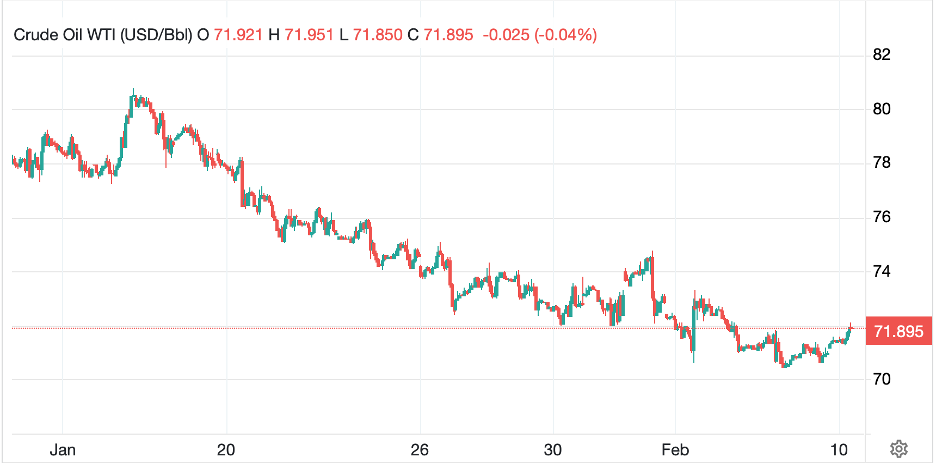
Finally, in the commodity markets, it is very quiet this morning.  Oil (+0.3%) is edging higher after a big rise and fall yesterday.  The rise was the result of a steep draw in US inventories, but the decline seemed to be a response to OPEC+ confirming they will be increasing production at some point in 2025.  Meanwhile, metals markets are basically unchanged this morning.

One other thing I have not discussed but is obviously getting a lot of press this morning, is Bitcoin which traded through $100K yesterday after President-elect Trump named Paul Atkins to be his new SEC Chair.  Atkins has a very pro crypto bias, and I expect we will see far more impetus in the crypto space going forward, not just in Bitcoin.

On the data front, yesterday’s ISM data was a bit softer than forecast while the Beige Book explained that economic activity rose slightly in the past month along with employment and prices, but all movements were quite modest.  This morning, we see Initial (exp 215K) and Continuing (1910K) Claims as well as the Trade Balance (-$75.0B) and later we hear from Richmond Fed president Barkin.  

Looking at the overall situation, investors continue to ignore any potential problems and run to risk assets, as evidenced by the rally in Bitcoin and new highs in stock prices.  Unless we see some really surprising data, either crazy strong implying the Fed is going to stop easing, or crazy weak implying we are in a recession, I see no reason for this process to end heading into the new year and President Trump’s inauguration.  Again, in that scenario, I think you have to like the dollar higher.

Good luck

Adf

In a Plight

The Minutes explained that the Fed
Is confident, looking ahead
They’ve conquered inflation
Although its duration
May last longer than they had said
 
They still think their policy’s tight
And truthfully, they may be right
But if they are not
And ‘flation’s still hot
They might find themselves in a plight


Below are a couple of key passages from the FOMC Minutes which show that the Fed continues to put on a game face when it comes to their performance.  Although some participants have begun to hedge their bets, it is clear the majority of the committee remains convinced that despite the broad inaccuracies of their models over the past forty four years, they are still on track to achieve their objectives.  

Participants anticipated that if the data came in about as expected, with inflation continuing to move down sustainably to 2% and the economy remaining near maximum employment, it would likely be appropriate to move gradually toward a more neutral stance of policy over time.”

Participants indicated that they remained confident that inflation was moving sustainably toward 2%, although a couple noted the possibility that the process could take longer than previously expected.”  [emphasis added]

And this morning, they will get to see if their confidence has been rewarded with the release of the October PCE data (exp 0.2%, 2.3% Y/Y headline; 0.3%, 2.8% Y/Y core).  One of the tell-tale signs that they are losing confidence is there has been more discussion about the vagaries of where exactly the neutral rate lies as evidenced by the following comment.  

Many participants observed that uncertainties concerning the level of the neutral rate of interest complicated the assessment of the degree of restrictiveness of monetary policy and, in their view, made it appropriate to reduce policy restraint gradually.

Once upon a time, the Fed was the undisputed master of markets, and their actions and words were the key drivers of prices across all asset classes.  However, not dissimilar to what we have seen occur regarding other mainstream institutions and their loss in respect, the same is happening at the Marriner Eccles Building I believe.  Chairman Powell, he of transitory inflation fame, is a far cry from the Maestro, Alan Greenspan, let alone Saint Volcker, and my observation is that more and more market participants listen to, but do not heed, the Fed’s words.

My read is the Fed has it in their mind that they need to continue to cut rates because the committee members have not lived through periods when interest rates were at current levels for any extended length of time.  They still fervently believe that their policy is restrictive, despite all the evidence to the contrary (record high stock prices and GDP expanding above potential) and so seem afraid that if they don’t cut rates they will be blamed for a recession.  I would argue the market interpretation of the Minutes was dovish as shown by the Fed funds futures market increasing the probability of a December cut to 66%.  Remember, Monday it was 52%.  My cynical view is the reason Powell wants to cut is his friends in the Private Equity space are suffering and he wants to help, because really, given both the inflation and economic activity data, it does not appear a cut is warranted.

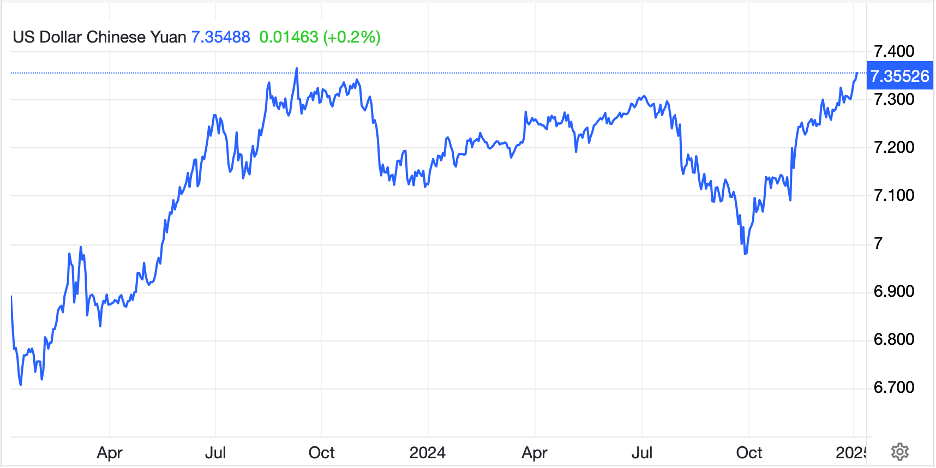
Turning our attention elsewhere, there is a story going round that China is preparing to fire that bazooka this time…for real.  At least that’s what I keep reading on X, and certainly, Chinese equity markets rallied on something (CSI 300 +1.75%, Hang Seng +2.3%), but I cannot find a news story explaining any of it.  Were there comments from Xi or Li Qiang?  If so, I have not seen them.  While Chinese assets have underperformed lately, that seems to have been a response to the Trump announcements of even more tariff-minded economic cabinet members.  And the currency is essentially unchanged this morning, hanging just above that 7.25 level vs. the dollar which has served as a cap for the past decade.  (see below).

Source: tradingeconomics.com

Keep in mind that the consensus view is if Trump imposes tariffs, the renminbi will weaken enough to offset them very quickly.  Arguably, the dollar’s strength since September, when it briefly traded below 7.00, is a response to first, Trump’s improving prospects to win, and then once he won, his cabinet selections.  Will CNY really decline 5% if tariffs are imposed?  That seems an awful lot, but I guess it’s possible.  It strikes me that hedgers should be looking at CNY puts to manage their risk here.

Finally, a look at Europe shows that the dysfunction on the continent seems to be accelerating.  France is the latest target as the current government is hanging on by a thread with growing expectations that Marine Le Pen’s RN party is going to call for a confidence vote and topple it.  As well, there are growing calls for President Macron to resign as he has clearly lost control.  They are currently running a 6% fiscal deficit (just like the US although without the benefit of the world’s reserve currency) and they already have the highest tax burden in Europe.    With Germany sinking further into its own morass (GfK Consumer Confidence fell to -23.3 and continues to show a nation lacking belief in its future.  Just look at the longer-term chart of this indicator below:

Source: tradingeconomics.com

While Covid was obviously a problem, things seemed to be getting back toward normal until Russia’s invasion of Ukraine in early 2022 sent energy prices higher and laid bare the insanity of their Energiewende policy.  As industry flees the country and politics focuses on the immigration issues ignited by Angela Merkel’s open borders policy, people there truly have little hope that things will get better.  

I cannot look at the situation in both Germany and France, with both nations struggling mightily and conclude anything other than the ECB is going to be cutting rates more aggressively going forward.  Combining that with the ongoing belief that Trump’s policies are going to be dollar positive overall, it seems that the euro has much further to decline.  Do not be surprised to see it break parity sometime early in 2025.

Ok, ahead of the Thanksgiving holiday, let’s look at other markets.  In addition to the gains in Chinese shares, Australia (+0.6%) and New Zealand (+0.7%) had a good session with the latter buoyed by the RBNZ cutting rates the expected 50bps.  However, Japan (-0.8%) was under pressure as the yen (+1.1%) rallied strongly on rumors that the BOJ is getting set to hike rates next month, a bit of a change from the previous viewpoint.  In Europe, the CAC (-1.25%) is the laggard as investors are watching French OATs slide in price (rise in yields) relative to their German Bund counterparts and worrying that if the government does fall, there is no way for things to work without the RN involved.  But the DAX (-0.6%) is also softer as is the rest of the continent.  Only the UK (0.0%) is holding up this morning.   meanwhile, at this hour (7:10), US futures are pointing slightly lower, just -0.15% or so.

In the bond market, Treasury yields (-4bps) continue to slide as investors are going all-in on the idea that proposed Treasury Secretary Bessent will be able to solve the intractable problems current Secretary Yellen is leaving him.  This decline is helping European sovereign yields slide as well, as they decline between -1bp and -3bps.  However, a quick look at the chart below shows the above-mentioned Bund-OAT story and how that spread is the widest it has been in many years.

Source: tradingeconomics.com

In the commodity space, oil (+0.2%) is settling in just below $70/bbl as it becomes clear that OPEC+ is not going to be raising production anytime soon.  NatGas (-4.8%) has suffered this morning on warmer weather in Europe, but the situation there remains dicey at best, and I think this has further to run.  In metals markets, gold (+0.8%) is continuing to rebound from Monday’s wipeout, having recouped about half of the move, and we are also seeing strength in silver and copper on the China stimulus story.

Finally, the dollar is under pressure again this morning with the yen and NZD (+1.1%) leading the way although the euro (+0.3%) and pound (+0.3%) are having solid sessions as well.  In the EMG bloc, MXN (-0.3%) continues to be pressured by the tariff talk although much of the rest of the bloc is following the euro’s lead and edging higher.  My sense here is that there are quite a few crosscurrents pushing the dollar around so on any given day, it is hard to tell what will happen.  However, I still am looking for eventual further dollar strength, especially given the Fed seems to be far less likely to cut aggressively.

On the data front, yesterday’s new Home Sales were horrific, falling -17.3% and indicating the housing market is beginning to struggle.  I think that is one of the reasons the rate cut probability rose.  As to the rest of today’s data beyond PCE we see the following: 

Personal Income0.3%
Personal Spending0.3%
Q2 GDP2.8%
Durable Goods0.5%
-ex Transport0.2%
Initial Claims216K
Continuing Claims1910K
Goods Trade Balance-$99.9B
Chicago PMI44.0

Source: tradingeconomics.com

With the holiday, there are no Fed speakers scheduled and Friday, exchanges are only open for a half-day.  There continues to be a very positive vibe overall, with retail investors the most bullish they have ever been according to several banking surveys.  As well, there continues to be a positive vibe from the Trump cabinet picks which has many people expecting great things.  As I said yesterday, I hope they are correct.

My concerns go back to the fact that I just don’t see inflation declining like the Fed projects and that is going to have some negative market impacts along the way.  The one inflation positive is that I see oil prices with the opportunity to fall further, although demand for NatGas should keep that market underpinned.  As to the dollar, I’m still looking for a reason to sell it and none has been presented.

There will be no poetry on Friday so please have a wonderful Thanksgiving holiday and we get to see how things play out come Monday.

Good luck and good weekend

Adf

Not in a Hurry

Said Jay, we are not in a hurry
To cut, as the future is blurry
As well, since it’s Trump
We don’t want a slump
‘Cause really, his favor, we curry


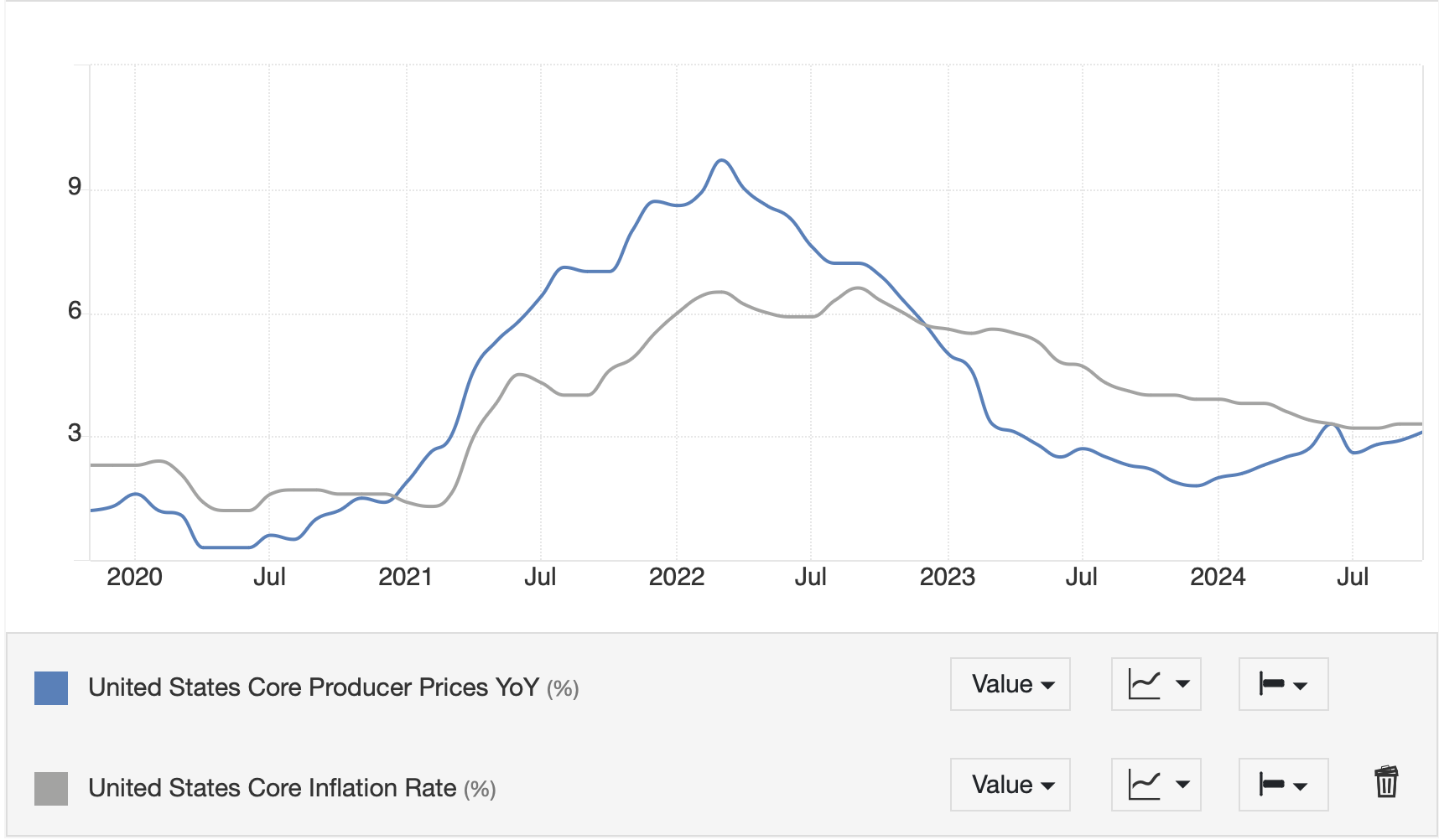
Apparently, the Chairman is reading FX Poetry (🤣) these days as he has come to the same conclusions I have drawn, there is no reason to cut rates anytime soon.  Yesterday, in a moderated discussion in Dallas, the Chairman said, “The economy is not sending any signals that we need to be in a hurry to lower rates. The strength we are currently seeing in the economy gives us the ability to approach our decisions carefully.”  And let’s face it, yesterday’s data simply added to the picture where the employment situation is not in trouble (Initial Claims rose only 217K, less than expected) while inflation signals remain hotter than desired with both core CPI and core PPI looking like they have bottomed as per the chart below.

Source: tradingeconomics.com

One of the things that Fed speakers consistently discuss is whether or not current policy is accommodative or restrictive based on their view of where the neutral rate of interest lies.  The problem, of course, is that neutral rate, also known as R* (R-star) is unknown and unknowable, only able to be determined in hindsight.  But that doesn’t stop them from trying.

At any rate, a consistent theme we have heard recently from Fed speakers is that they believe their policy is restrictive, hence the need to lower interest rates at all.  But there is a case to be made that policy is not restrictive at all right now as evidenced by the fact that the 10-year Treasury rate is actually below the “true” risk free rate.  How is that possible you may ask.

Consider that 30-year mortgage rates are also generally considered risk-free as not only are they collateralized, but they are mostly guaranteed by FNMA, GNMA and FHLMC, quasi government agencies that were shown to have the full faith and credit of the US government behind them when things got tough during the GFC.  Historically, meaning prior to Covid, the spread between 30-year mortgage rates and 10-year Treasuries was about 165bps on average.  However, since February of 2020, that average spread has expanded to 230bps.  (Notice how the green line representing the difference between the two rates is stably higher since Covid in 2020.)

Source: data FRED database, calculations @fx_poet

That difference is important because if you consider the idea that mortgage rates represent a better estimate of the “true” risk-free rate, then Treasury yields are cheap by 65bps relative to where they would otherwise be.  In other words, policy is looser by that amount than the Fed believes.  Why would this be the case?  Well, QE has very obviously distorted the price signals from the bond market.  Now, I grant that the Fed has also distorted the mortgage market (recall, they still own $2.26 trillion of those), but despite the ongoing QT process, they own $4.3 trillion of Treasuries.  And if price signals are distorted, making policy becomes that much tougher for the Fed.  It seems quite possible that through their own actions they have lost sight of reality and therefore, continue to make policy based on inaccurate data.  I would offer that as an explanation as to why the Fed always seems out of touch…because they are looking at the wrong things.

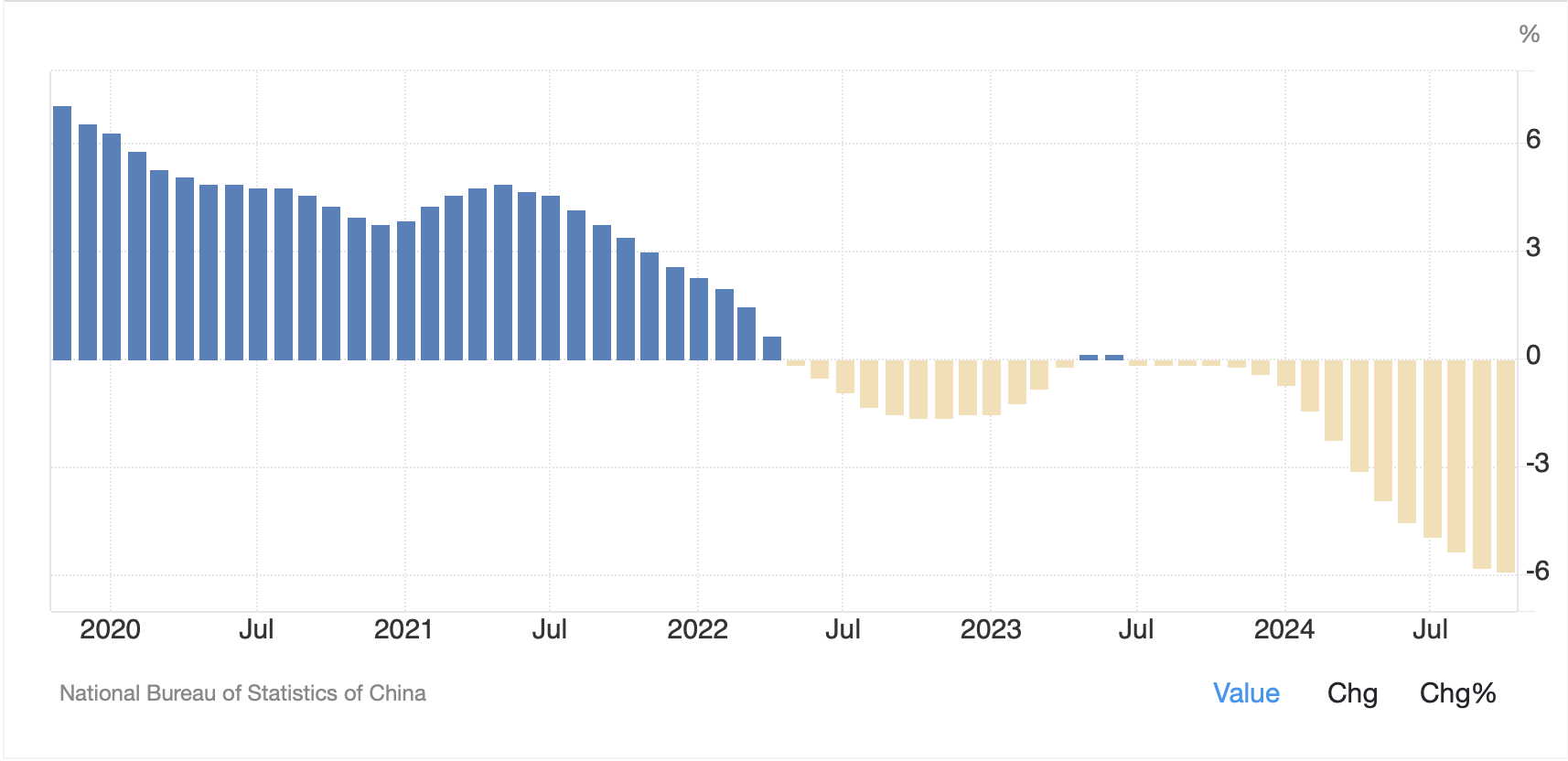
Ok, let’s take a look elsewhere in the non-political world to see what is going on.  Last night, China released their monthly data on Retail Sales (4.8% Y/Y), IP (5.3% Y/Y), Unemployment (5.0%) and Fixed Asset Investment (3.4% Y/Y).  Some parts were good (Unemployment was a tick lower than last month and expected, Retail Sales was a full point higher than expected) and some not so good (IP was 0.3% lower than forecast and Fixed Asset Investment came in 1 tick lower.). As well, the House Price Index there fell -5.9% Y/Y last month, which as you can see in the chart below, is indicative of the fact that the property problems in China are still significant and seemingly getting worse.

Source: tradingeconomics.com

However, one thing China is doing is pumping up its exports ahead of the inauguration of Donald Trump as they are clearly very concerned over the widely mooted 60% tariffs to be imposed on Chinese exports to the US.  In October, exports exploded higher by 12.7% and I expect we will see that again in November and December as companies there do all they can to beat the clock.  One thing this will do is help goose GDP data in China so that 5.0% growth target seems much more attainable now.  How things play out going forward remains to be seen, but for now, China is going to push as hard as possible.

Alas for the Chinese, that data and this idea did nothing to help the stock market there where the CSI 300 fell -1.75% last night, the laggard in the Asian time zone.  Given equities are discounting instruments, it appears people are more concerned over the future than the past.  Elsewhere in Asia, markets were generally flat to modestly firmer (Nikkei +0.3%) after (despite?) the US equity declines yesterday.  In Europe this morning, most markets are little changed to slightly softer  although Spain’s IBEX (+0.9%) is bucking the trend with its financial sector performing well, perhaps on the idea that the two big Spanish banks, Santander and BBVA, will benefit from the Fed’s seeming policy shift.  However, US futures are softer at this hour (7:15) lower by between -0.3% and -0.6%.

In the bond market, yields around the world are virtually unchanged this morning with 10yr Treasuries at 4.43% and no movement in either Europe or Japan.  This feels to me like investors are not sure which way to go.  Perhaps more are beginning to understand my type of explanation above regarding where things are now and are unsure how to play the future regarding inflation prospects, especially with potentially large changes coming under a new administration.  My take is yields will continue to drift higher alongside rising inflation, but that is not a universal view at all.

In the commodity space, oil (-0.4%) is a touch softer this morning although the big declines seemed to have stopped for now.  Here, too, uncertainty about how policy will evolve going forward has traders on the sidelines. In the metals markets, yesterday’s lows seem to be holding for now as while gold is unchanged on the session, both silver (+0.85%) and copper (+1.75%) seem to be rebounding.  If yields are going to continue higher, the road for metals is likely to be tough, but ultimately, lack of supply is going to drive this story.

Finally, the dollar is giving back some of its gains from this week in what appears to be a profit taking move.  It can be no surprise this is the case, especially given holding positions over the weekend at the current time remains a fraught exercise.  After all, will there be an escalation in Israel/Lebanon?  Ukraine?  Somewhere else?  And what will Trump announce over the weekend?  There has still been no announcement regarding his Treasury Secretary, and that is obviously crucial.  So, the dollar has given back about 0.3% of this week’s move largely across the board and I wouldn’t give it any more thought than that.

On the data front, this morning brings the Empire State Manufacturing Index (exp -0.7) as well as Retail Sales (0.3%, 0.3% ex autos) at 8:30.  Then, at 9:15 we see IP (-0.3%) and Capacity Utilization (77.2%).  There are no other Fed speakers scheduled today, although after Powell pushed back on further rate cuts yesterday, it will be interesting to hear the next ones and how they describe things.  If today’s data is hot, I would expect the probability of a rate cut in December, which currently sits at 62.4%, to fall below 50%.  As I have maintained, there just doesn’t seem to be much of a case to keep cutting given the economy’s overall strength.

With that in mind and given that growth elsewhere in the world is lagging, I still like the dollar to maintain and gain strength going forward.

Good luck and good weekend

Adf

Right On Humming

So, CPI didn’t decline
And may not be quite so benign
As Jay and the Fed
Consistently said
When hinting more rate cuts are fine
 
However, that will not deter
Chair Powell, next month, to confer
Another rate cut
Though it is somewhat
Unclear if his colleagues concur


Despite the fact the narrative is pushing Unemployment as the primary focus of the FOMC, yesterday’s CPI report, which seemingly refuses to decline to the Fed’s preferred levels, had Fed speakers beginning to hedge their bets regarding just how quickly rates would be coming down from here. [Emphasis added.]

St. Louis Fed President Alberto Musalem explained, “The strength of the economy is likely to provide the space for there to be a gradual easing of policy with little urgency to try and find where the neutral rate may be.

Dallas Fed President Lorrie Logan commented (using a series of maritime metaphors for some reason) “After a voyage through rough waters, we’re in sight of the shore: the FOMC’s Congressionally mandated goals of maximum employment and stable prices, but we haven’t tied up yet, and risks remain that could push us back out to sea or slam the economy into the dock too hard.”  

Finally, Kansas City Fed President Jeff Schmid told us, “While now is the time to begin dialing back the restrictiveness of monetary policy, it remains to be seen how much further interest rates will decline or where they might eventually settle.”  

If we ignore the oddity of the maritime metaphor, my takeaway is that the Fed is still looking to cut rates further as directed by Chairman Powell, but the speed with which they will act seems to be slowing down.  As I have maintained in the past, given the current data readings, it still doesn’t make that much sense to me that they are cutting rates at all, but arguably, that’s just another reason I am not a member of the FOMC.  Certainly, the market is on board as futures pricing increased the probability of that cut from 62% before the release to 82% this morning.  There is still a long way to go before the next meeting, with another NFP, PCE and CPI report each to be released, as well as updates on GDP and Retail Sales and all the monthly figures, so this story is subject to change.  But for now, a rate cut seems likely.

One other thing, I couldn’t help but notice a headline that may pour a little sand into the gears of the rate cutting apparatus at the Eccles Building.  This is on Bloomberg this morning: Manhattan Apartment Rents Rise to Highest Level Since July.  Again, the desperation to cut rates seems misplaced.

Despite the fact rate cuts are coming
The dollar just keeps right on humming
This morning it’s rising
Which ain’t that surprising
As more depths, the euro is plumbing

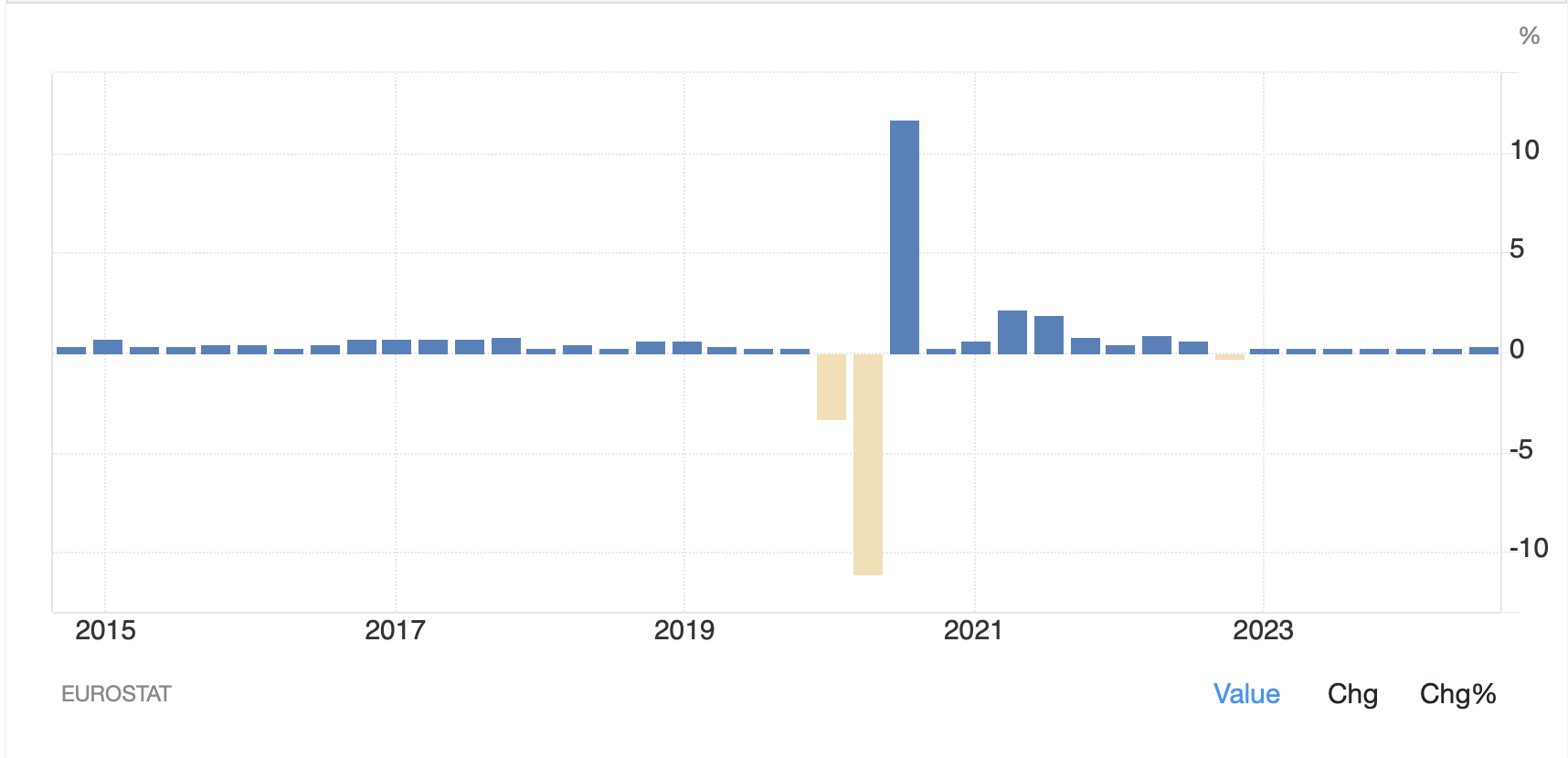
Turning our attention to the continent, European GDP figures were released this morning, and they remain disheartening, to say the least.  While the quarterly number rose to 0.4%, as you can see from the chart below, it has been several years since the continent showed any real growth, and that was really just the rebound from the Covid lockdowns.  Prior to Covid, growth was still lackluster.

Source: tradingeconomics.com

While these are the quarterly numbers, when looking at the Y/Y results, real GDP grew less than 1% in Q3 for the past 6 quarters and, in truth, shows little sign of improving.  After all, virtually every nation in the Eurozone is keen to continue their economic suicide via energy policy and regulation.  This thread on X (formerly Twitter)is a worthwhile read to get an understanding of the situation on the continent.  I show it because this morning, the euro has fallen yet further, and is touching the 1.05 level, seemingly on its way to parity and below.  It highlights that since just before the GFC, the Eurozone economy has fallen from virtually the same size as the US economy, to just 60% as large, and explains the key reasons.  Read it and you will be hard-pressed to consider the euro as a safe store of value, at least relative to the dollar.  And remember, the dollar has its own issues, but at least the US economy remains dynamic.

But the dollar is king, again, this morning, rising against virtually all its counterparts on the session.  Versus the G10, the average movement is on the order of 0.3% or so, but it is uniform.  USDJPY is now pushing 156.00, the pound seems headed for 1.2600 and Aussie is below 0.65.  My point is concerns about the dollar and its status in the world seem misplaced in the current environment.  If we look at the EMG bloc, the dollar is stronger nearly across the board as well, with similar gains as the G10.  MXN (-0.5%), ZAR (-0.4%) and CNY (-0.2%) describe the situation which has been a steady climb of the greenback since at least the Fed rate cut, and for many of these currencies, for the past 6 months.  Nothing about President-elect Trump’s expected policies seems likely to change this status for now.

If we look at equity markets, yesterday’s US outcomes were essentially little changed on the day.  However, when Asia opened, with the dollar soaring, we saw a lot more weakness than strength, notably in China with the CSI 300 (-1.7%) and Hang Seng (-2.0%) leading the way lower although the Nikkei (-0.5%) also lagged along with most other Asian markets.  While there were some modest gainers (Australia +0.4%, Singapore +0.5%) red was the predominant color on screens.  In Europe, however, investors are scooping up shares with the DAX (+1.2%) leading the way although all the major bourses are higher on the session.  It seems that there is a growing consensus that the ECB is going to cut 25bps in December and then another 25bps in January, which has some folks excited.  US futures, meanwhile, are slightly firmer at this hour (7:00).

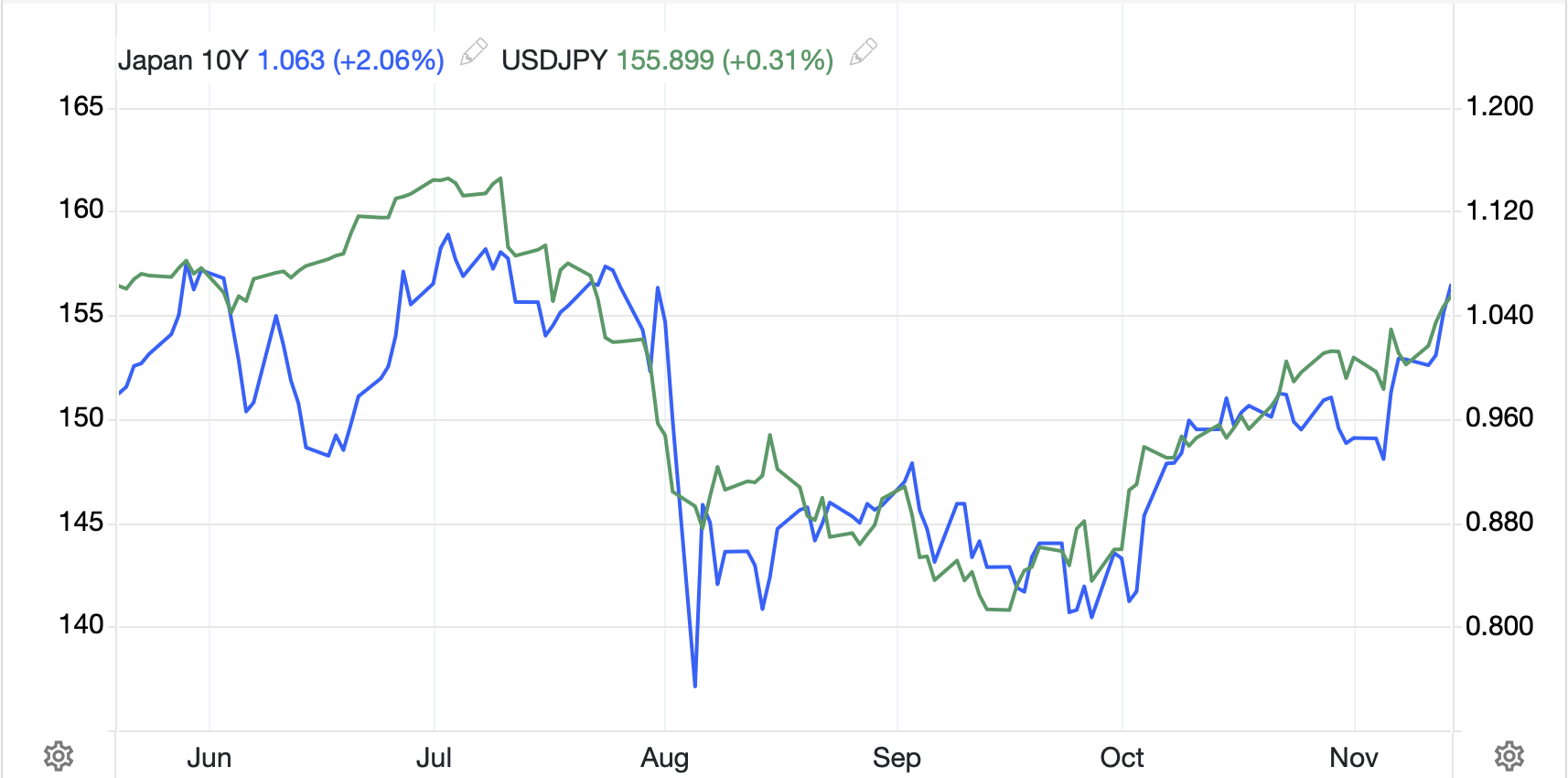
All this is happening against a backdrop of a continued climb in yields around the world.  Yesterday, again, yields rose with 10yr Treasuries trading as high as 4.48%, their highest level since May, and that helped drag most European yields higher as well.  This morning, we are seeing some consolidation with Treasury yields backing off 1bp and European sovereign yields lower by -2bps across the board.  The one place not following is Japan, where JGB yields edged higher by 1bp and now sit at 1.05%.    Consider, though, that despite those rising yields, the yen continues to slide.  In fact, that is the correlation that exists, weaker JPY alongside higher JGB yields as you can see in the below chart.

Source: tradingeconomics.com

While it is open to question which leads and which follows, my money is on Japanese investors searching for higher yields, selling JGB’s and buying dollars to buy Treasuries.

Finally, the commodity space continues to get blitzed, or at least the metals markets continue that way as once again both precious and industrial metals are all lower this morning.  In fact, in the past week, gold (-5.7%), silver (-6.4%) and copper (-9.1%) have all retraced a substantial portion of their YTD gains.  It is unclear to me whether this is a lot of latecomers to the trade getting stopped out or a fundamental change in thinking.  My view is it is the former, as if the Trump administration is able to support growth, I expect that will reveal the potential shortages that exist in the metals space.  Oil (+0.4%) is a different story as it continues to consolidate, but here I think the odds are we see lower prices going forward as more US drilling brings supply onto the market.

On the data front, this morning brings the weekly Initial (exp 223K) and Continuing (1880K) Claims data along with PPI (0.2%, 2.3% Y/Y) and core PPI (0.3%, 3.0% Y/Y).  In addition, the weekly EIA oil data is released with modest inventory builds expected and then we hear from Chair Powell at 3:00pm this afternoon.  Arguably, that is the event of the day as all await to see if the trajectory of rate cuts is going to flatten out or not.

I cannot look at the data and conclude that the Fed will be very aggressive cutting rates going forward.  The futures market is now pricing in about 75bps of cuts, total, by the end of 2025.  That is a 50bp reduction in that view during the past month and one of the reasons the dollar remains strong.  I would not be surprised if there are even fewer cuts.  Right now, everything points to the dollar continuing to outperform virtually every other currency.

Good luck

Adf

A Warning

Though Trump has been leading the news
With folks asking who he will choose
As agency chiefs
That share his beliefs
For markets, today brings new cues
 
Inflation will soon be released
And though Jay claims he killed this beast
The data this morning
May well be a warning
Inflation, in fact, has not ceased


Source: tradingeconomics.com

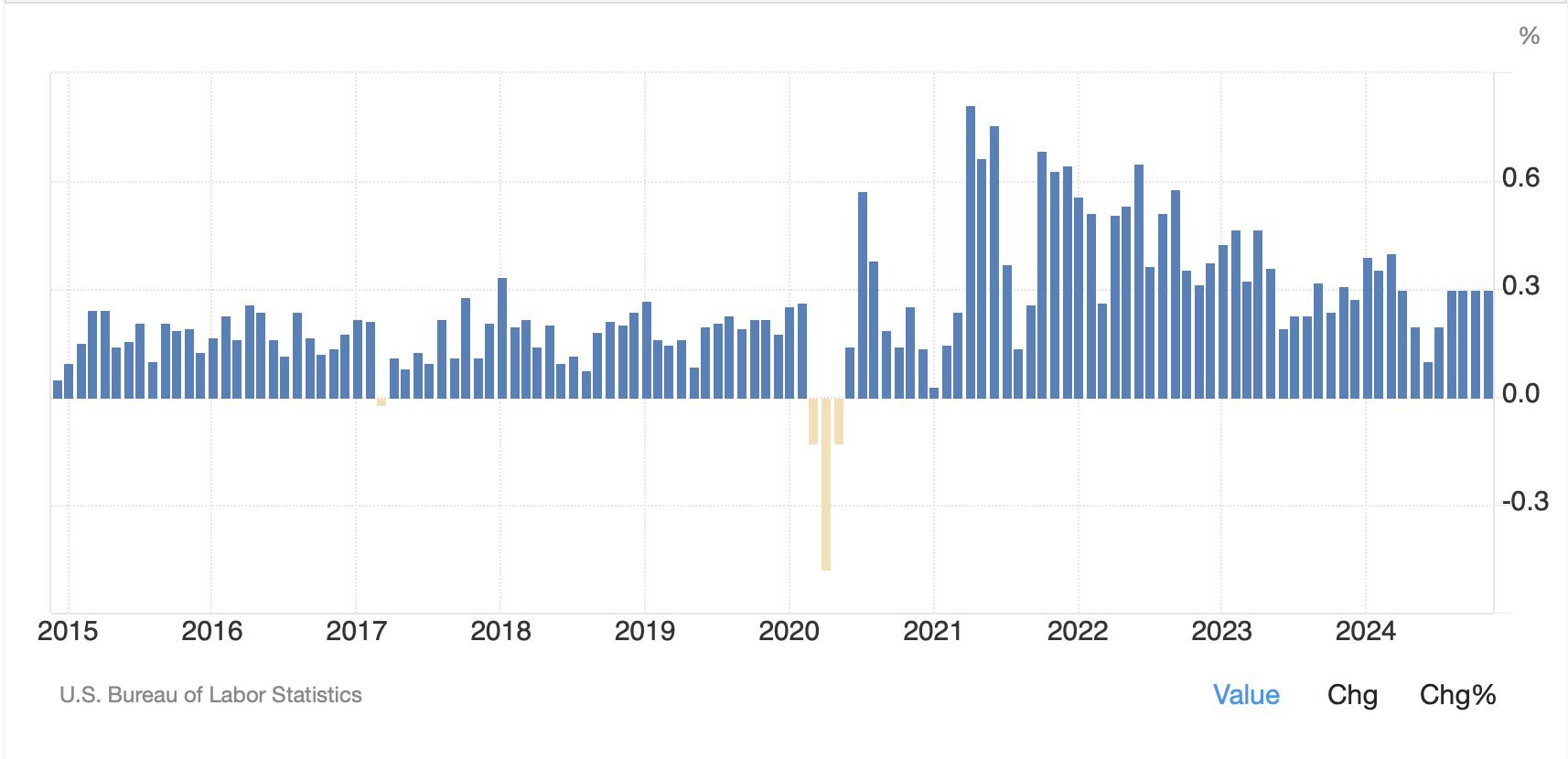
Beauty (and everything else) is in the eye of the beholder.  So, what are we to make of the above chart which shows the past ten years’ worth of monthly Core CPI readings prior to this morning’s release.  Some eyes will travel to the peak in April 2021 (0.812%) and see a downward sloping line from there.  The implication is that the trend is your friend and that things are going well.  Others will gravitate to the June 2023 print (0.195%) and see that except for a blip lower in June 2024 (0.1%), the series looks like it may have bottomed and, if anything, has found a new home.

Remember, that if the monthly print is 0.3%, that annualizes to 3.7% Core CPI.  That seems pretty far above the 2.0% target that the Fed is shooting for and would call into question exactly why they are cutting interest rates.  In fact, you can look at the above chart and see that prior to the pandemic, core CPI on a monthly basis was below 0.3% every month except one, with many clearly down near the 0.1% level.

As much as Powell and his minions want to convince us that inflation is heading back to their goal and everything is ok, the evidence does not yet seem to be pointing in that direction.  For today, current median analyst expectations are for a headline of 0.2% M/M, 2.6% Y/Y and a core of 0.3% M/M, 3.3% Y/Y.  Even if the data comes as expected, it would seem very difficult to justify continuing to cut rates given the equity market remains essentially at all-time highs, while Treasury yields (-1bp today, +12bps yesterday) seem like they are starting to price in higher long-term inflation.

However, something interesting seems to be happening with the Fed speakers.  Richmond Fed President Barkin yesterday explained that things look pretty good, but declined to even consider forecasting where things will go.  As well, Minneapolis Fed President Kashkari indicated that while inflation has declined, it does not yet seem dead.  The Fed funds futures market is now pricing just a 62% probability of a rate cut in December.  One month ago, it was pricing an 84% probability.  As I have maintained, it seems increasingly difficult for the Fed to make the case that rate cuts are necessary given the economic data that we continue to see.  I understand that there are still a large group of pundits who believe things are much worse when you dig under the surface of the data, and I also understand that most people in the country don’t believe that things are going that well, hence the landslide election results for Mr Trump.  However, based on the data that the Fed allegedly follows, rate cuts seem difficult to support.  Today will be another piece of the puzzle.  If the data is hot, I expect risk assets to suffer more and the dollar to continue its rally.  If the data is soft, look for new records in stocks while the dollar retraces some of its recent gains.

With that in mind, let’s look at what happened overnight in markets.  Yesterday’s modest declines in the US market were followed by more selling than buying in Asia with the Nikkei (-1.7%) leading the way lower but weakness also seen in Australia (-0.75%), Korea (-2.65%), India (-1.25%) and Taiwan (-0.5%) as an indication of the general sense in the time zone.  The outlier here was mainland China (+0.6%) where hope remains eternal that the government will fire their bazooka.  In Europe, though, this morning is seeing a hint of red with most major indices lower by just -0.1% and Spain’s IBEX (+0.2%) even managing a small gain.  The commentary from the continent is over fears of how things will evolve with the new Trump administration and his threat of more tariffs on European exports.

But here’s something to consider.  If Trump is successful in quickly negotiating an end to the Russia/Ukraine war, won’t that be a huge benefit to Europe?  After all, if the war is over, they will be able to restart imports of cheap Russian NatGas which should have an immediate impact on their overall cost of energy, especially Germany, and help the economies there substantially.  I know they love to scream because they all hate Trump, but it seems like he could help them a lot if they would let him.  Oh yeah, US futures are a touch lower, -0.2%, at this hour (7:10).

Anyway, in the bond market, after yesterday’s rout in the US, yields are little changed this morning but in Europe, yields are climbing as they weren’t able to keep up with US yields yesterday.  So, on the continent, yields are higher between 2bps and 4bps after rising 4bps – 6bps yesterday.  In Asia, JGB yields jumped 4bps on the global rise in bond yields and are now back above 1.0%.  However, that has not been nearly enough to help the yen (-0.2%), which continues to weaken and is pushing back above 155.00 this morning.  

In the commodity markets, oil (+0.2%) is edging higher, but that seems to be consolidation after what has been a pretty awful week for the black sticky stuff.  OPEC reduced its demand forecasts for the 4th consecutive month, something else that is weighing on the price and, of course, the Trump administration is going to seek to make it much easier to explore for and produce more oil.  In the metals markets, gold (+0.5%) seems to have found a temporary bottom along with silver (+0.8%) although the damage has been substantial this week.  However, copper and aluminum remain under pressure as fears over continued weakness in China seem to be weighing on the price.

Finally, the dollar has stopped rising sharply, although it is not really declining very much, at least not vs. the G10 currencies.  In fact, vs. the G10, the dollar is softer by just 0.1% or so vs. the entire bloc other than the yen mentioned above.  However, vs. the EMG bloc, the dollar has ceded some more gains with KRW (+0.7%) the leader but MXN (+0.4%), CNY (+0.35%) and ZAR (+0.6%) all bouncing back after a week of substantial declines.  We all know nothing goes up or down in a straight line, so this consolidation is just that, it is not a trend change by any stretch.  A quick look at the MXN chart below, which is essentially what we have seen everywhere, explains just how insignificant the overnight movement has been relative to the recent trend.

Source: tradingeconomics.com

On the data front, aside from the CPI data, we hear from three more Fed speakers (Logan, Musalem and Schmid) so it will be interesting to see if they are starting to change their sense of how things are going to progress.  Of course, all eyes will be on Powell’s speech Thursday afternoon, but perhaps there are some clues to be had here.

It is not clear to me that anything has changed in the big picture.  The US economy continues to be the strongest one around and now has the added impetus of expectations for more positivity with the change in the administration.  In that environment, my long-term view on the dollar remains it has further to run.

Good luck

Adf

Lickspittle

The Fed has a banker named Jay
Who last week was quick to betray
His fervent belief
He can’t come to grief
If Trump wants to force him away
 
This morning his Journal lickspittle
Wrote glowingly ‘bout Jay’s committal
To stand strong and firm
And finish his term
No matter how much he’s belittled


First, on this Veteran’s Day holiday, let us all pause a minute and remember those veterans who gave their lives for our nation.

The reverberations of Donald Trump’s re-election last week continue to be felt around the world with comments from virtually every walk of life explaining their joy/distress at the outcome and trying to prognosticate what will play out in the future.  I will tell you that I have no idea how things will evolve, although I am hopeful that his administration will be able to reduce the size of the federal government as that can only be a benefit.

But one of the things that we learn about people during times of change, especially people who believe they are crucially important to the world, is just how much they believe they are crucially important to the world.  Nothing highlights this quite like the lead article in this morning’s WSJ titled, If Trump Tries to Fire Powell, Fed Chair Is Ready for a Legal Fight.  This is not to say that Powell doesn’t have an important role, he certainly does.  But this pre-emption of the entire question is a testimony of just how important he thinks he is.  

My one observation on this is that despite all the discussion that the Fed isn’t political, it is clearly a very political institution.  Nothing highlights that better than this Tweet from Joseph Wang (aka @FedGuy12), a commentator who spent a dozen years at the Fed and understands its inner workings quite well.  Under the rubric that a picture is worth 1000 words, take a look at Federal Reserve political contributions below and then ask yourself if the Fed is not only political, but partisan.  

Source: X @FedGuy12

It is important to recognize this as it also may help explain why the Fed is cutting interest rates despite GDP (currently 2.8%) and Core PCE (currently 2.7%) running far above their long-term expectations and Unemployment (currently 4.1%) running below their long-term expectations as per the below SEP from the September FOMC meeting.  If anything, I might argue they should be raising interest rates!

Source: fedreserve.gov

At any rate, the ramifications of this election outcome are likely to drive the market narrative for a while yet.

But overnight, there just wasn’t that much of interest, at least not that much new.  So, let’s take a look at overnight market activity.  After Friday’s latest record high closes in the US, the picture in Asia was less robust with Japanese equities basically unchanged on the day after Shigeru Ishiba was elected PM to run a minority government, while Hong Kong (-1.5%) and mainland Chinese (+0.7%) shares went in opposite directions.  Chinese financing data was released that was mildly disappointing, but there are several stories about how the government is going to reacquire land that is currently in private hands but not being used and repurpose it for benefit.  The rest of the region had many more laggards than gainers, perhaps on concerns that Trump will be imposing tariffs throughout the region.  As to Europe, despite all the pearl clutching by the leadership there, equity investors are excited with gains seen across the board (DAX +1.3%, CAC +1.2%, FTSE 100 +0.8%).  US futures at this hour (7:30) are continuing their ride higher, up 0.4%.

In the bond market, Treasuries aren’t really trading today with banks closed.  In Europe, sovereign yields have edged down between 1bp and 2bps, perhaps feeling a little of that equity euphoria, as there was precious little in the way of news or commentary to drive things.

In the commodity space, oil (-1.7%) is under further pressure as broadly slower global growth undermines demand while prospects of the Trump administration fostering significant additional drilling opportunities helps build the supply side.  However, NatGas (+7.0%) is soaring this morning as Europe, notably Germany, is suffering from dunkelflaute (maybe the best word I have ever heard) which means ‘a period of low wind and solar power generation because it is cloudy, foggy and still’, and so they need to buy a lot more NatGas to power the economy.  In fact, NatGas is higher by nearly 15% in the past month although remains substantially cheaper in the US than in Europe and Asia.  My take is this discrepancy cannot last forever.  As to the metals markets, they are under pressure again this morning with both precious (Au -0.9%, Ag -0.3%) and industrial (Cu -0.5%, Al-1.4%) feeling the pain.  

A key driver in the metals space is the dollar, which is rallying against all its counterparts this morning quite robustly.  The euro (-0.6%) is back to levels last briefly touched in April, but where it spent more time a year ago, as it seems to be heading to 1.05 and below.  Meanwhile, JPY (-0.8%) is also feeling the heat while NOK (-0.7%) is pressured by both the dollar’s general strength and the oil weakness.  In the EMG bloc, MXN (-1.3%) is having a rough go as the tariff talk heats up, but we have also seen weakness in EEMEA with ZAR (-1.4%), PLN (-1.0%) and HUF (-1.2%) all under pressure this morning.  Not to be outdone, Asian currencies, too, are selling off with CNY (-0.3%) back above 7.20 for the first time since August while THB (-0.9%), MYR (-0.7%) and SGD (-0.6%) demonstrate the breadth of the move.

With the holiday, there is no data to be released today, but this week brings CPI amongst other things.

TuesdayNFIB Small Biz Optimism91.9
WednesdayCPI0.2% (2.6% Y/Y)
 Ex food & energy0.3% (3.3% Y/Y)
ThursdayPPI0.2% (2.3% Y/Y)
 Ex food & energy0.3% (2.9% Y/Y)
 Initial Claims224K
 Continuing Claims1895K
FridayRetail Sales0.3%
 -ex autos0.3%
 Empire State Mfg-1.4
 IP-0.3%
 Capacity Utilization77.2%

Source: tradingeconomics.com

In addition to this data, we hear from 11 different Fed speakers this week, including Chairman Powell again at 3:00pm on Thursday afternoon.  It is difficult to believe that the message from last week is going to change, but you never know.  However, I expect that every one of them is going to be explaining that things are good, but they are cutting rates to ensure things remain that way as they consistently congratulate themselves on having slain inflation.  I hope they are right…I fear they are not.

For now, though, the US economy remains the strongest in the world (7% budget deficits will help prop up growth after all) and capital continues to flow in this direction.  I see no reason for the dollar to fall anytime soon.  Whatever problems lie ahead, I believe they are over the metaphorical horizon and other than a few doomporn purveyors, not in the market’s view.

Good luck

Adf

Clueless

The risks to our mandates appear
More balanced so let us be clear
We’re still cutting rates
Which just demonstrates
We’re clueless and shaking with fear


To absolutely nobody’s surprise, the Fed cut the Fed funds rate by 25bps yesterday.  The accompanying statement explained, “The Committee judges that the risks to achieving its employment and inflation goals are roughly in balance.”  The implication is that they remain confident that inflation is slowly heading to their 2.0% target, and they are keeping a close eye on the Unemployment Rate, especially after the terrible number last week.  Of course, the combination of the Boeing strike and the impact of the two major hurricanes, Helene and Milton, were likely responsible for a significant portion of that underperformance, so we will need to see how the November report, published on December 6th plays out.  There is a lot of time between now and then so the narrative could easily change prior to the release.  Be vigilant.

The press conference consisted of a lot of self-congratulatory comments about how they have done a good job “recalibrating” policy and continuing to insist inflation is dying, although not quite dead yet.  The market response was to continue the US equity rally, with the NASDAQ (+1.5%) leading the way higher and to reverse some of yesterday’s bond losses with 10-year yields slipping -8bps.  In the commodity markets, yesterday saw all of them rebound, recouping roughly half of their losses from Wednesday and the dollar gave back some of those initial gains as well.

At this stage, the market is pricing a two-thirds probability of another 25bp cut at the December meeting, and all eyes are now going to turn to Trump and whatever policy prescriptions he starts to tout.  The early indication is that people expect more growth in the US from his policies as the no-landing scenario seems to be the favorite.  We shall see.

Investors had high hopes that Xi
Would give away more renminbi
Instead, in a flop
They’ve spurred a debt swap
While stimulus, no one can see

The other story of note overnight was the final statement of the Standing Committee in China, where many had expected hoped the elusive Chinese Bazooka would be fired.  It was not.  Instead, they gave more details on an effective debt swap that they will permit for local governments.  

A brief tutorial: Chinese cities and regions had typically financed infrastructure investment via local government funding vehicles (LGFV) which issued debt to investors that was backed by the government entity, but not officially on their balance sheet.  This model evolved because there were restrictions on how much debt these cities/regions were allowed to issue.  These entities would then sell land to developers to service and pay off the debt.  It all worked great while the property bubble in China was inflating and nobody was the wiser.  But now that property prices have been falling for 3 years, it is a major problem because the cities/regions aren’t generating the property sales and revenues needed to repay the debt.  

The solution that Xi came up with is to allow the cities/regions to issue debt on the balance sheet, upwards of CNY 10 trillion over the next 5 years, and replace the off-balance sheet stuff from the LGFVs.  And that’s it!  A debt swap that will likely lower interest rates slightly and save somewhere along the lines of CNY 600 billion over 5 years.  While the central government claims there is only a total of CNY 14.3 trillion in these LGFVs, most analysts put the number at around CNY 60 trillion.  This is not really that stimulative, will not help Chinese consumers nor factories in any way, and is very likely to have only a tiny impact. 

Cagily, the Standing Committee didn’t announce this until after local markets closed for the weekend, so the fact that stocks on the mainland and in Hong Kong only fell -1.0% does not represent the totality of the disappointment.  I expect we will see further declines next week.  President Xi has some tough sledding ahead for his economy.

And that was really the news of note.  Literally everything else you can read is a post-mortem of the election.  So, let’s look at how markets behaved overnight.  Away from the Chinese share declines, there were more winners than losers in Asia, with those nations that seem to have closer ties to the US benefitting (Taiwan, Australia, Singapore, New Zealand) while others which are more neutral or in China’s sphere of influence under pressure (India, Thailand, Vietnam).  The other noteworthy news was that the Chinese Current Account hit its second highest surplus ever last month, but with most people expecting significant tariff implementation when Trump takes office in January, I suspect those numbers will decline.  

Meanwhile, European bourses are almost entirely under water this morning with most lower by -0.9% although Spain’s IBEX is unchanged on the day.  There hasn’t been much in the way of new data, and I sense that investors are starting to price in more difficult relations with the US now that it seems clear the Republicans will win the House as well, giving Trump the ability to implement his vision.  Meanwhile, at this hour (6:50) US futures are little changed, consolidating ahead of the weekend.

In the bond market, yields which backed off in the wake of the FOMC meeting yesterday have edged 2bps lower this morning and are now sitting at 4.30%. This is the level, when first reached a week ago, set hair on fire as to the dichotomy between the Fed cutting rates and longer-term yields rising.  My view continues to be that yields have higher to climb over time as the Fed’s inflation fight is not won, and it will become evident that is the case going forward.  As to European sovereign yields, they are all lower by -4bps this morning as they are simply following Treasury yields but had to catch up given the FOMC meeting occurred after their close yesterday.

In the commodity markets, it appears that nobody wants to own ‘stuff’ anymore as they are back under real pressure.  Oil (-1.4%) is sliding although that makes sense as a Trump administration is very likely to support as much production as possible thus increasing supply.  But metals prices are also under pressure (Au -0.5%, Ag -1.5%, Cu -2.2%) which makes less sense as if economic expansion is the view, I would expect these to perform well.  Of course, it is possible that this is a reaction to the damp squib from China last night, but I expect these items to gradually regain lost ground.

Finally, the dollar is gaining some strength this morning, rising against most of its G10 counterparts with AUD (-0.6%) the worst performer, although JPY (+0.5%) and CHF (+0.2%) have managed to climb.  It’s almost as if this is a classic risk-off scenario in the FX markets.  Certainly, EMG currencies are under pressure this morning with ZAR (-1.1%) the laggard, but declines across the board, notably CNY (-0.3%) and pushing back toward the 7.20 level.  But the dollar is strong everywhere in this bloc.  

On the data front, Michigan Sentiment (exp 71.0) is all we get this morning although we also get our first Fed speaker, Governor Bowman, who has been one of the more hawkish voices.  One other thing to note is that the FAO’s Food Price Index was released this morning, climbing 2% to 127.4.  as you can see from the chart below, while this is not as high as prices reached in the immediate aftermath of the Russian invasion of Ukraine, this level is still in the upper echelons of where things have been over the past thirty-four years.

Source: tradingeconomics.com

It is worth remembering that the Arab Spring in 2011 was partially driven by rising food prices with large scale protests upending several governments.  Given how unhappy people around the world have been with their leadership, as evidenced by the number of governments that have been kicked out of office in recent elections and given that rising food prices have been a constant complaint, this needs to be kept in mind for how events unfold in the future.  To me, the market implication is that more volatile politics around the world will feed into more volatile financial markets as uncertainty grows.  In times of stress, the dollar remains the haven of choice, so this is just another reason to keep looking for the dollar to outperform in the medium term.

Good luck and good weekend

Adf

Erring

Excitement does not quite portray
The thirst for risk shown yesterday
Though media cried
Investors took pride
In Trump, sure that he’ll save the day
 
So, next Chairman Jay and the Fed
Will try to explain that instead
Of further rate paring
They might soon be erring
On side that Fed rate cuts are dead


Wow!  That is pretty much all one can say about yesterday’s equity market response to the confirmation that Donald Trump will be the next president of the United States.  The DJIA rose 3.6%, far outpacing both the S&P 500 (+2.5%) and the NASDAQ (+3.0%) but even that paled in comparison to the Russell 2000 small-cap index which jumped nearly 6% on the day!  Investors are all-in on the idea that Trump will seek to bring home as much manufacturing and economic activity as possible via tariff policies and small caps and old-line companies are the ones likely to benefit.

But boy, bonds had a tough day with yields across the curve rising between 10bps (2yr) and 20bps (30yr) with the 10yr gaining 15bps on the day.  It is all part of the same mindset, higher economic activity and no slowdown in spending leading to rising inflation and, correspondingly, rising yields.

The other area that really suffered were the metals markets, with gold (-3.3% or $90/oz), silver (-4.7%) and copper (-5.0%) all getting hammered.  The best explanation for the gold price’s decline I have heard is the idea that with Trump coming into office, the prospects for a nuclear war have greatly diminished.  Certainly, based on the fact that there were no new wars during his last term and one of his promises is to end the Russia/Ukraine war on the first day, perhaps that is correct.  As well, consider that the dollar exploded higher, something which had lately been a benefit for metals, but historically has been a negative, and at least we can make some sense of things here.

So, where do we go from here?  That, of course, is the $64 billion question.  Reactions around the world are still coming in and I would characterize them as a mix of stoicism and fear.  Perhaps a good place to start is Germany where the governing coalition just collapsed as Chancellor Sholz fired the FinMin who was the head of the FDP, one of his coalition’s groups.  Their problem is that the German economic model is crumbling, and the population is unhappy with the current situation.  The former can be demonstrated by today’s data showing the Trade Surplus fell more than expected while IP fell back into negative territory again, an all-too-common occurrence over the past three years as can be seen below, and hardly the best way to improve the productivity of your economy.

Source: tradingeconomics.com

Meanwhile, politically, the country is seeing a widening of views across the spectrum with the combination of the anti-immigration parties, AfD on the right and BSW on the left, garnering support of about 25% of the population and preventing any meaningful coalitions from being formed.  

If Germany continues to lag economically, it will negatively impact the whole of the Eurozone.  The divergence between the US economy, which has all the hallmarks of faster growth ahead, especially under a new administration, and the European economy, which continues to struggle under a suicidal energy policy that undermines any chance of industrial resurgence, and therefore a significant rebound in economic activity could not be greater.  While much ink has been spilled regarding the prospects that the dollar is going to collapse because of the debt situation and the BRICS are going to create something to replace it, the reality is the euro is in far more dire straits.  The ECB is going to be much more aggressive cutting rates than the Fed and the market is starting to price that in.  The below chart from Bloomberg this morning does an excellent job showing the change in market pricing over the past month.  

I find it hard to see how the euro can benefit in this environment regardless of the dollar’s performance against other currencies given the more limited economic prospects on the continent.  They are dealing with an existential crisis because of Russia’s more aggressive stance since the invasion of Ukraine combined with an undermining of their economic model which was based on exporting high value items to China and the rest of the world.  The problem with the latter is China has become a huge competitor and a shrinking market for their wares, and they have limited other markets.  If Trump holds to his word and imposes 20% tariffs on European imports to the US, the euro is likely to fall even further.

That is just a microcosm of one area and its response to the US election, but one that may well be a harbinger for many others.  The US stance in the world is changing and other nations are not really prepared.  Expect more financial market volatility, in both directions, as these changes become more evident and play out over time.

Ok, let’s see how other markets behaved with confirmation of the Trump victory.  In Asia, the Nikkei (-0.25%) slid but other indices rallied indicating a mixed picture.  Meanwhile Chinese shares rallied sharply (CSI 300 +3.0%, Hang Seng +2.0%) as expectations grow that the Standing Committee will expand the stimulus measures in the wake of the election.  Remember, the Chinese had delayed this annual meeting by a week to capture the results of the US election and now traders are betting on a bigger response.  As well, the Chinese Trade Surplus expanded far more than forecast, to its third highest monthly reading of all time at $95.3B.  As to the rest of the region, the picture was very mixed with some gainers (Singapore +1.9%, Taiwan +0.8%) helped by the China story and some laggards (India-1.0%, Philippines -2.1%) with the latter suffering from a much weaker than expected GDP report.

In Europe, interestingly, most markets are performing well this morning led by the DAX (+1.3%) although the rest of the continent’s bourses are only higher by around 0.5% or so.  The laggard here is the FTSE 100 which is unchanged on the day in the wake of the BOE’s widely expected 25bp rate cut.  Although, there were apparently some looking for a 50bp cut as stocks fell a bit in the wake of the news and the pound jumped 0.3%, a clear sign of a minor surprise.

Speaking of currencies, the dollar which has had quite a run in the past two sessions is backing off overall this morning although remains well above the pre-election levels.  In the G10, NOK (+1.3%) is the leader as the Norgesbank left rates on hold and indicated that was likely their stance going forward, while AUD (+1.0%) seems to be benefitting from both the rebound in metals prices and the potential Chinese stimulus.  Otherwise, currencies have rallied between 0.3% and 0.5% in this bloc.  In the EMG space, ZAR (+1.4%) is the biggest gainer, also on the precious metals rebound, while MXN (+1.2%) is next, although that is simply a continuation of the retracement from the post-election decline.  Bigger picture, I think the dollar remains well bid, but not today.

In the bond market, Treasury yields are unchanged this morning, consolidating their gains from the past week and waiting for the Fed this afternoon.  However, European sovereign yields have all rallied substantially, between 6bps and 9bps, which looks, for all intents and purposes, like the continent’s catch-up trade to yesterday’s US movement.  Nothing has changed the view that Treasury yields lead bond market moves in the G10.

Finally, in the commodity space, oil (-1.0%) is a bit lower this morning although yesterday it recouped most of its early losses and closed lower only minimally.  Yesterday also saw a surprising inventory build in the US which would be expected to weigh on prices.  In the metals markets, after a virtual collapse yesterday, this morning is seeing stabilization in precious metals and a sharp rebound in copper (+2.3%) as hopes for that Chinese stimulus spread to this market as well.

In addition to the FOMC meeting this afternoon, we see regular Thursday morning data of Initial (exp 221K) and Continuing (1880K) Claims as well as Nonfarm Productivity (2.3%) and Unit Labor Costs (1.0%).  However, despite all the recent activity, and the fact that a 25bp cut is a virtual certainty, Chairman Powell’s press conference will still have the trading community riveted to see how he describes any potential future paths in the wake of the election results.  Given the recent data and the estimate prospects of a Trump administration’s efforts to goose growth further, it is hard to see how the Fed can really discuss cutting rates much further.  In fact, I will go out on a limb and say I expect forecasts of the neutral rate are going to consistently climb higher and reach 4% before the end of 2025.  And that means, as is evident by both the economy and the stock market, the Fed has not tightened financial conditions very much at all.

Good luck

Adf

Open and Shut

The FX Poet will be in Nashville at the AFP Conference October 21-22, speaking about effective ways to use FX options in a hedging program.  Please come to the presentation on Monday at 1:45 in Grand Ballroom C2 if you are there.  I would love to meet and speak.
 
The great thing about recent data
Is nobody thinks it will matta
It’s open and shut
The Fed’s gonna cut
As ‘flation ambitions they shatta
 
In Jay’s mind, the risk tradeoff’s clear
As stocks work to find a new gear
However, for debt
They’re making the bet
The problems won’t hit til next year

On this Columbus Day holiday, US cash markets are closed although futures are trading, so no stock or bond market activity today.  The FX market will be open, as always, although I suspect liquidity will be less than usual, especially once Europe goes home at noon so hopefully, you don’t have much to do today in the way of hedging.

As it happens, there was not a lot of news overnight to discuss, although China did manage to once again disappoint with respect to their fiscal support announcement on Saturday, not offering up even a big picture number, let alone specific programs, that they are considering.  Interestingly, this did not deter the new China stock bulls, with the CSI 300 (+1.9%) rallying sharply, but this is becoming a sentiment story, not a data driven one.  Someone on X asked the question about why Xi was not doing more, and my view has become that he recognizes to truly get the economy going again he will need to cede some of the power he has spent the past 10 years amassing.  I sincerely doubt he is willing to do that, and since his life won’t change regardless of the amount of stimulus, in the end, holding power is far more important to him.

But let’s go back to the data driven approach and its pluses and minuses.  This morning’s WSJ had an articleby James Mackintosh titled, “The Fed Has a Dependency Problem That Needs Fixing”, and it is his view that data dependence is the current Achilles Heel for Powell and friends.  Now, I won’t dispute that the market’s tendency to extrapolate one data point out to infinity can have market consequences, but I think the point Mr Mackintosh misses is that this is a problem entirely of the Fed’s own making.  Nobody instructed them to offer their views, other than the semi-annual testimony before Congress.  Nobody is forcing FOMC members to be out blathering virtually every day (in fact, two of them, Waller and Kashkari, will be speaking today despite markets being closed).  Forward Guidance was Benny the Beard’s brainstorm, it is not a Congressional mandate, it is not in the Fed’s charter, it is entirely their own.

So, if too much forward guidance is a problem, the Fed can simply stop it.  There is no doubt the recent data releases have been somewhat confusing, with more strength than most economists and analysts have forecast, and there is no doubt that any given month’s data point is subject to certain random fluctuations and revisions.  However, consider if the Fed was not trying to guide the market to whatever their preferred outcome may be.

If there was no Forward Guidance, then each individual investor would have to analyze the current situation themselves, get their best estimate of how they anticipated the future to evolve, and position themselves accordingly.  In today’s world, there is a lot of data pointing in different directions.  Absent the Fed trying to sway opinion, position sizes would be greatly reduced, and the large reversals in markets like we saw in the wake of the recent rate cut and subsequent NFP and CPI releases, would likely be far less significant.  

When the Fed explains that they are going to keep rates lower for longer (as they did in the wake of the GFC and again post covid) that is a clear signal to investors to load up on assets that perform well in a low-rate environment (i.e. stocks).  When they change that view…oops!  That is what we saw in 2022 when they flipped the script and went from transitory inflation to persistent inflation.  Everybody who was long both stocks and bonds suffered.  

But let’s run a thought experiment.  If the Fed gave no Forward Guidance, and merely adjusted rates as they saw fit, investors would have had significantly less confidence that regardless of what had clearly become an inflation problem, the Fed was going to maintain low interest rates.  There would have been a much more gradual move out of risk assets as investors determined inflation was a problem, and the Fed wouldn’t have had all that egg on their face when they had to admit they made a mistake about inflation.

In the end, I disagree with Mackintosh that the Fed should essentially ignore the data, but I agree that they shouldn’t talk about it at all.  In fact, I think we would all be far better off if none of them ever said a word!

Enough of my diatribe.  Let’s see how the rest of the world’s markets behaved overnight.  While mainland Chinese stocks performed well, Hong Kong (-0.75%) did not.  Japan was closed for National Sports Day, although the broad Asia look was that markets there followed Friday’s US rally as well.  However, this morning in Europe, the picture is mixed with some gainers (DAX, IBEX) and some laggards (CAC, FTSE 100) and none of the moves more than 0.3%.  The only data overnight was Chinese Trade (reduced Trade surplus of $81.7B) and Chinese financing which was modestly disappointing despite the recent efforts at goosing things there.  US futures are trading this morning and at this hour (7:00) they are mixed with modest gains and losses of ~0.25%.

With Japan closed along with the US, it should be no surprise that bond market activity is extremely limited with yields essentially unchanged this morning from where they were at Friday’s close.  However, remember that 10-year Treasury yields are higher by nearly 50bps since the day before the FOMC meeting.  This is an important signal that market participants are far more concerned about inflation than the Fed.  On this subject, I think the market is correct.

In the commodity markets, oil (-2.4%) continues its recent decline as the long awaited and feared Israeli response to Iran’s missile attacks seems to have been postponed further.  The absence of that supply concern alongside the lack of Chinese stimulus, and by extension demand, has weighed heavily on the market.  Gold is unchanged this morning although we are seeing some softness in the industrial metals with both silver and copper softer today.

Part of that metals weakness is due to the fact that the dollar continues to rise against all forecasts.  This weekend there was a meeting of the old Soviet nations, the CIS (absent Ukraine of course) and they pledged to stop using dollars in their trade.  This is in the lead-up to the BRICS conference to be held next week in Kazan, Russia, where once again many claim that this group of nations will create their own currency in their efforts to get away from the dollar’s hegemony.  Whether or not they formally do so, I have yet to see a path that includes a cogent rationale for anyone to use this currency, especially if it is backed by a series of nonconvertible currencies like the CNY, BRL and INR.  But it does generate clicks in the doomporn sphere.  

But back in the real world, the dollar is just grinding higher vs everything this morning with NOK (-0.8%) suffering on oil’s weakness and AUD (-0.5%) and NZD (-0.5%) under pressure because of metals weakness and lack of Chinese stimulus.  ZAR (-0.8%) is also feeling the metals weakness but JPY (-0.4%) and CNY (-0.35%) are all softer this morning.  In other words, it is business as usual.  In fact, for those of you with a market technical bias, a quick look at the euro chart seems to define the concept of a double top.

Source: tradingeconomics.com

On the data front, aside from loads more Fedspeak this week, and the ECB monetary meeting on Thursday, the big data print in the US is Retail Sales, also on Thursday.

TuesdayEmpire State Manufacturing2.3
ThursdayECB Rate Decision3.25% (current 3.5%)
 Initial Claims255K
 Continuing Claims1870K
 Retail Sales0.3%
 -ex Autos0.2%
 Philly Fed3.0
 IP-0.1%
 Capacity Utilization77.8%
FridayHousing Starts1.35M
 Building Permits1.45M

Source: tradingeconomics.com

Adding to today’s Fedspeak, we hear from eight more speakers this week. With the Fed funds futures market pricing a 14% probability of no cut at all in November, which would be remarkable given the 50bp cut they made last month, it strikes me that there will be very little new from the speakers.  Rather, if the data this week comes in hotter than forecast, that is going to be the market driver.  I think it is fair to say the Fed has made a hash of things lately.  As long as the data continues to look good, though, I have to believe that fears of renewed inflation and higher rates are going to support the dollar.

Good luck

Adf

Clouded and Blurry

The Minutes explained twenty-five
Would likely still let markets thrive
But Powell demanded
A half, lest they landed
The ‘conomy in a crash dive


Yesterday’s release of the FOMC Minutes was enlightening to the extent it showed Chairman Powell did not have everybody in agreement for his 50bp rate cut last month.  In the Fed’s own words, “…a substantial majority of participants supported lowering the target range for the federal funds rate by 50 basis points to 4-3/4 to 5 percent.  However, noting that inflation was still somewhat elevated while economic growth remained solid and unemployment remained low, some participants observed that they would have preferred a 25 basis point reduction of the target range at this meeting, and a few others indicated that they could have supported such a decision.”  

Remember, too, that this meeting was held two days prior to the NFP report which changed a great deal of thinking on the subject, not least by the Fed funds futures market which as of this morning is pricing a 20% probability of no cut at the November meeting.  Looking at the GDPNow calculation from the Atlanta Fed, that NFP number increased the estimate to 3.4%, although recent inventory data has seen it slip back a tick as you can see below.  

Source: atlantafed.org

Despite that last little dip, though, the estimate remains far stronger than economists’ forecasts and paints a picture of a resilient economy.  (Perhaps adding $1.8 trillion via the budget deficit has something to do with that, but that is a story for a different time.). While the Fed is clearly anxious, if not desperate, to cut rates further, the economic case, with inflation remaining above their targets and the employment situation looking better amid solid economic growth, seems to be waning.

Three weeks ago, Jay and the Fed
Said joblessness was their, flag, red
Explaining inflation
Had taken vacation
So, more cutting rates was ahead
 
This morning we’ll learn if that’s true
Or if, like employment, their view
Is clouded and blurry
Which could cause some worry
For bulls and for Biden’s whole crew

Which leads us to the other key market story today (clearly the devastation from Hurricane Milton is the most important news of the day and my thoughts and prayers go to all those in its path), the CPI report.  Current consensus expectations are for a 0.1% rise in the monthly headline reading which translates to a 2.3% Y/Y increase and a 0.2% rise in the monthly core reading which translates into a 3.2% Y/Y increase.  

Looking at some obvious pieces of the puzzle, gasoline prices fell 8.4% in September, which is one of the reasons the headline number is below the core number.  The thing is, gasoline prices this morning are almost exactly where they were at the beginning of September, which informs us that the headline number could easily retrace somewhat next month.  The point is, we need to keep our eye on the core number (after all, the reason they created it was because food and energy prices were volatile and monetary policy’s impact on them virtually nonexistent, so they needed something that might give them a better feel for the reality elsewhere).  And I don’t know about you, but if the target is 2.0% then 3.2% doesn’t seem that close.  I know they are focused on core PCE, but even that remains well above their target.

One of the stories around this morning is that used car prices have stopped declining and that could have an outsized impact resulting in a higher than otherwise reading.  But in reality, I question whether this matters at all.  What we have learned from the Fed over the past month is that they are going to cut rates no matter what.  While the pace of those cuts may be faster or slower depending on some data, every Fed speaker this week, and even a review of the Minutes, points to the fact that they are all desperate to keep cutting rates.

But you know who is taking exception to that stance?  The bond market.  Perhaps the bond vigilantes of late 90’s fame have been resurrected, or perhaps investors are simply looking at the fiscal situation in the US, where deficit spending continues to increase which means more and more Treasury debt will need to be issued and decided that even 4.0% is no longer a reasonable nominal return on their investment.

As you can see below, 10-year Treasury yields have risen 46bps since just before the last FOMC meeting as the stronger US data combined with the Fed’s clear focus on cutting rates has made investors nervous.  

Source: tradingeconomics.com

You may recall the discussion about the inverted yield curve, where 2yr yields traded above 10yr yields for more than two full years, a record amount of time.  This fostered many recession calls as historically this has been a harbinger of a future recession.  However, a key question was whether the disinversion would be a bull (falling 2yr yields) or bear (rising 10yr yields) steepener.  Things started as a bull steepener with the Fed cutting rates, but lately, as we watch 10yr yields rise, fears are growing that inflation is making a comeback and the bond bears are going to drive this process.  A bear steepening is not going to be a welcome result for Powell and friends, nor especially for Ms Yellen, as the cost of debt will continue to rise.  It also speaks to concerns that the Fed has lost control of the narrative.  It is still too early to declare the outcome, but the original, widely held view of a bull steepener is fraying at the seams.

Ok, let’s quickly touch on overnight markets.  Yesterday’s US rally saw follow through in Japan (+0.25%) alongside a weakening yen (-0.75% yesterday, +0.2% this morning) and in China (+1.1%) and Hong Kong (+3.0%) after the PBOC detailed the support they would be giving to equity market players and indicated that more could follow.  As to the rest of the region, there were more gainers than laggards but nothing of real note.  In Europe, although most markets are little changed on the day, if leaning slightly lower, Spain’s IBEX (-0.9%) is the outlier on what seems to be profit taking ahead of the US CPI number after a strong 5-day run higher.  And at this hour (7:10) US futures are pointing slightly lower, about -0.2%.

In the bond market, yields continue to climb around the world with Treasuries adding 1bp and most of Europe seeing yields rise 2bps – 3bps.  The largest mover there, though is the UK (+6bps) as the market there prepares for Chancellor Rachel Reeves’ first budget and implies they are not expecting fiscal prudence.  In Japan, JGB yields rose 2bps and are now at 0.94% as given the turnaround in rates globally, expectations are growing for the BOJ to consider another hike.  In fact, ex-BOJ member Kazuo Momma was quoted last night saying that if USDJPY goes back above 150, the BOJ is likely to move before the January meeting currently expected.

Commodity markets are taking a breather from their recent rout with oil (+1.4%) leading the energy group higher while gold (+0.4%) leads the metals complex.  It has been a rough week for commodity bulls (this poet included) but nothing has changed the long-term picture in my view.  This is especially true if the Fed does cut rates regardless of the stronger data.

Finally, the dollar is continuing to show strength with the DXY pushing back to 103 and the euro back down near 1.09.  It seems clear the market is adjusting its views as to how much the Fed is going to cut based on the data, not the Fedspeak, and that turn, from an uber dovish Fed to one less dovish is going to support the greenback.  ZAR (+0.45%) is this morning’s outlier as it follows gold prices higher, but that is the largest movement across either the G10 or EMG blocs.  It seems everybody is awaiting the CPI data.

In addition to the CPI, we see the weekly Initial (exp 230K) and Continuing (1830K) Claims data and we hear from Gvoernor Lisa Cook, one of the more dovish Fed governors.  But for now, it is all CPI all the time.  My take is a soft number will be seen as a signal the Fed will be cutting aggressively and help stocks and commodities while undermining the dollar with a strong number doing the opposite.  Bonds, though, are much trickier here as I think there are a lot of fiscal concerns being priced in, and lower inflation won’t solve that problem in the short run.

Good luck

Adf