Fading

In Germany, growth has been fading
Down Under, inflation’s upgrading
Chair Jay gave his views
But it was old news
And Trump, for more cuts, is crusading


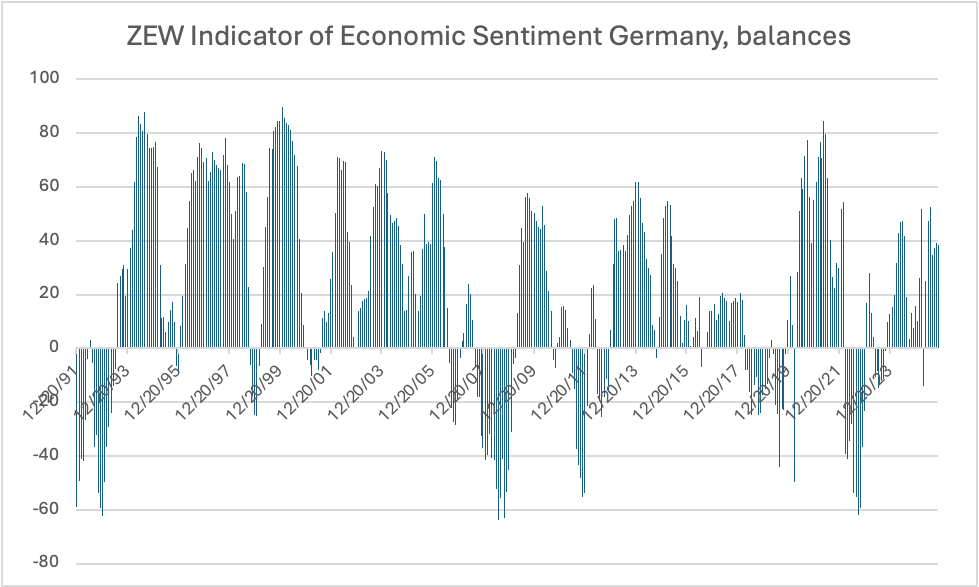
Some days, there is less to discuss than others, and this morning that seems to be the case.  Even my X feed had very little of interest.  Arguably, the top story is German Ifo readings came out much lower than expected and have now reversed most of the gains that occurred from front-running US tariff policy changes.  Germany’s bigger problem, though, is that the trend here is abysmal, as ever since Russia’s invasion of Ukraine and the dramatic rise in energy prices there, the German economy has been under significant pressure.  A look at the 5-year history of the Ifo series does an excellent job of explaining why growth has completely stalled there.

Source: tradingeconomics.com

In fact, if we look at the last three+ years of GDP activity in Germany, as per the below chart, we see that seven of the thirteen quarters were negative while two were exactly flat and the sum total of growth was -0.9%.  It’s amazing what happens to a nation that decides to impose extreme conditions on the production of energy domestically.  Or perhaps it’s not so amazing.  After all, economic activity is merely energy transformed.  If the cost of energy is high, economic activity is going to be slow.

Source: tradingeconomics.com

I highlight this because it runs counter to the narrative that Europe is a better place to invest than the US, which has been the thesis of the ‘end of American exceptionalism’ trade.  Germany is the largest European nation by far and had been a manufacturing powerhouse.  But those days appear to have passed.  If Germany is going to continue to lag, and I see no reason for that to change based on the current political dynamic there, please explain the idea behind long-term strength in the euro.  As I wrote yesterday, if the Fed cuts aggressively, the dollar will decline in the short run, but one cannot look at the trajectories of the relative economies and claim Europe is the place to be in the long run.

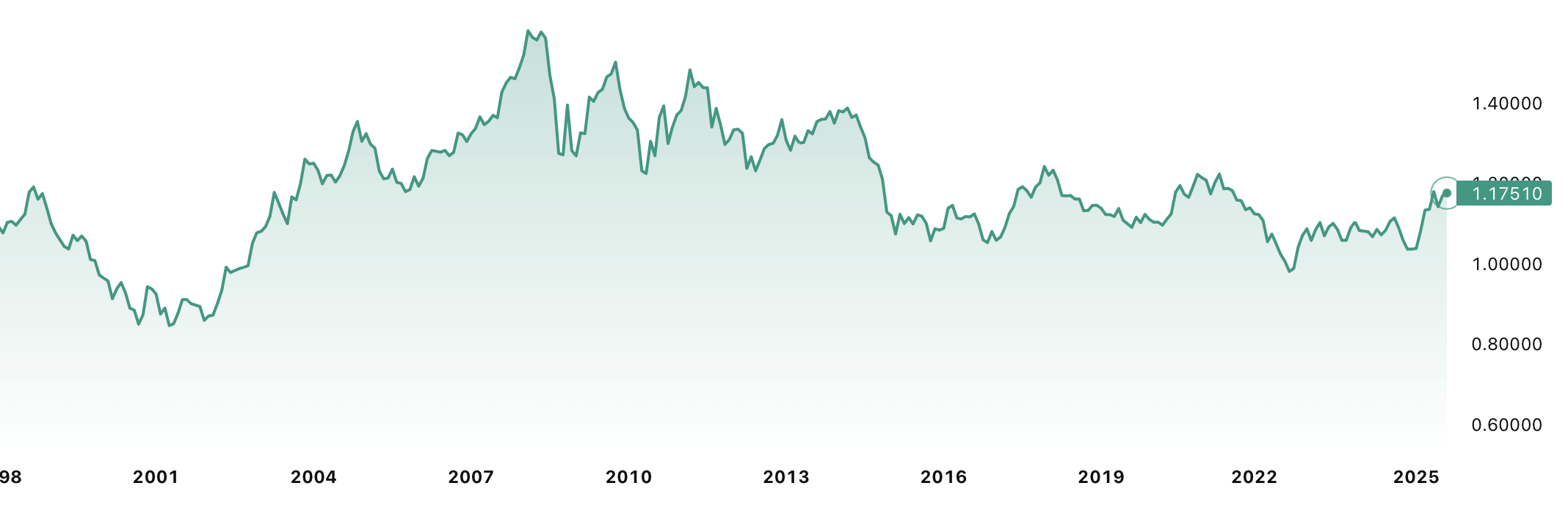
This morning, the euro (-0.5%) has responded logically to the data but the dollar is broadly stronger as well after Chair Powell’s speech yesterday where he continued the modestly hawkish tone from the FOMC press conference.  He continues to agonize over the fact that inflation won’t fall while unemployment is edging higher, although he finally admitted that tariffs would likely have a temporary, one-off impact on prices.  While there is no doubt the dollar has fallen since the beginning of the year, a 10% or 15% move is hardly unprecedented, but rather occurs pretty frequently.  A look at the below chart from the beginning of the euro’s existence in 1999 shows at least six or seven other instances when the euro rallied that much in a short period of time.

Source: tradingview.com

In fact, to demonstrate the politicization of the current world, one need only go back to the period in 2008 when the euro peaked at 1.60 or so to see that it was not seen as a global calamity, simply a period where US monetary policy had loosened dramatically relative to the rest of the world.

The other marginally interesting story this morning is Australia’s inflation rate, which came in at 3.0%, higher than expected and demonstrating what appears to be a break in the declining trend previously seen.

Source: tradingeconomics.com

This matters as AUD (+0.1%) is outperforming all its G10 peers this morning on the back of the idea that the RBA will be stuck on hold, rather than cutting rates again soon.  Too, this weighed on Australian equities (-0.9%) which underperformed other Asian markets overnight.

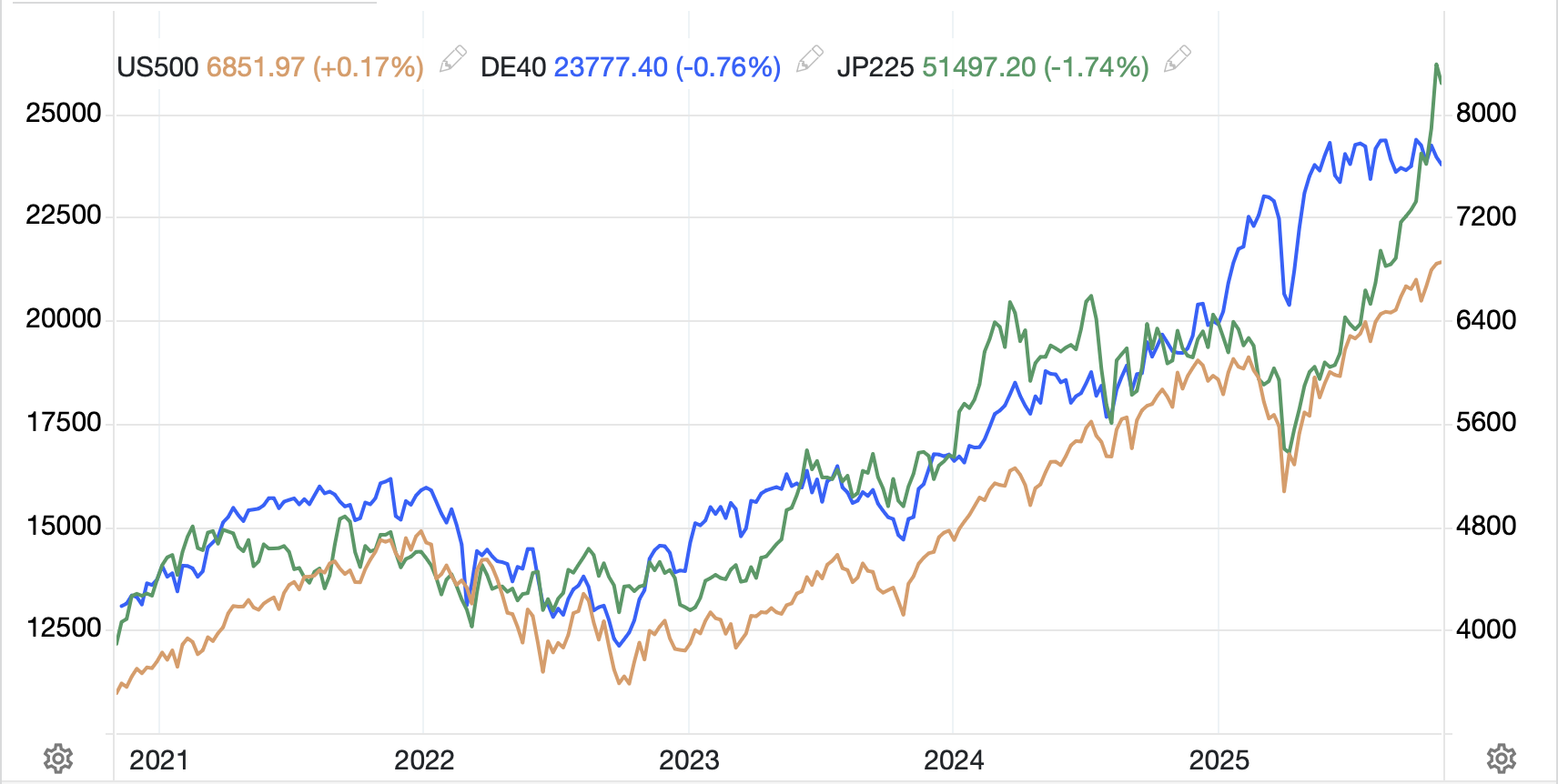
But that’s really all the interesting stuff, and it wasn’t that interesting, I fear.  So, let’s look at the rest of the market behavior overnight.  While I thought it was illegal, yesterday resulted in US equity markets declining on the session, albeit less than 1%.  And this morning, you’ll be happy to know, the futures are all modestly green.  As to Asian markets, Japan (+0.3%), China (+1.0%) and HK (+1.4%) all had strong sessions although it appears most of the other regional bourses declined.  The Chinese story making the rounds is the lessening in trade tensions between the US and China was seen as a key positive while HK survived Typhoon Ragasa without any major impacts.  But Korea, India, Taiwan and Singapore were all softer on the session.

In Europe, markets have generally done little with marginal declines the norm although, surprisingly, Germany’s DAX is unchanged on the day despite the weak Ifo data.  However, it is hard to get excited about anything happening there right now.

Bond yields fell yesterday with Treasuries declining -4bps although this morning they have edged back higher by 1bp.  Perhaps Powell’s tone yesterday was enough to keep the bond vigilantes on the sidelines, or perhaps there is simply not enough new information to change any views right now.  The Fed funds futures market continues to price a 94% probability of a cut at the end of next month and apparently bond investors are cool with that.  European yields are also little changed this morning as were JGB yields last night.

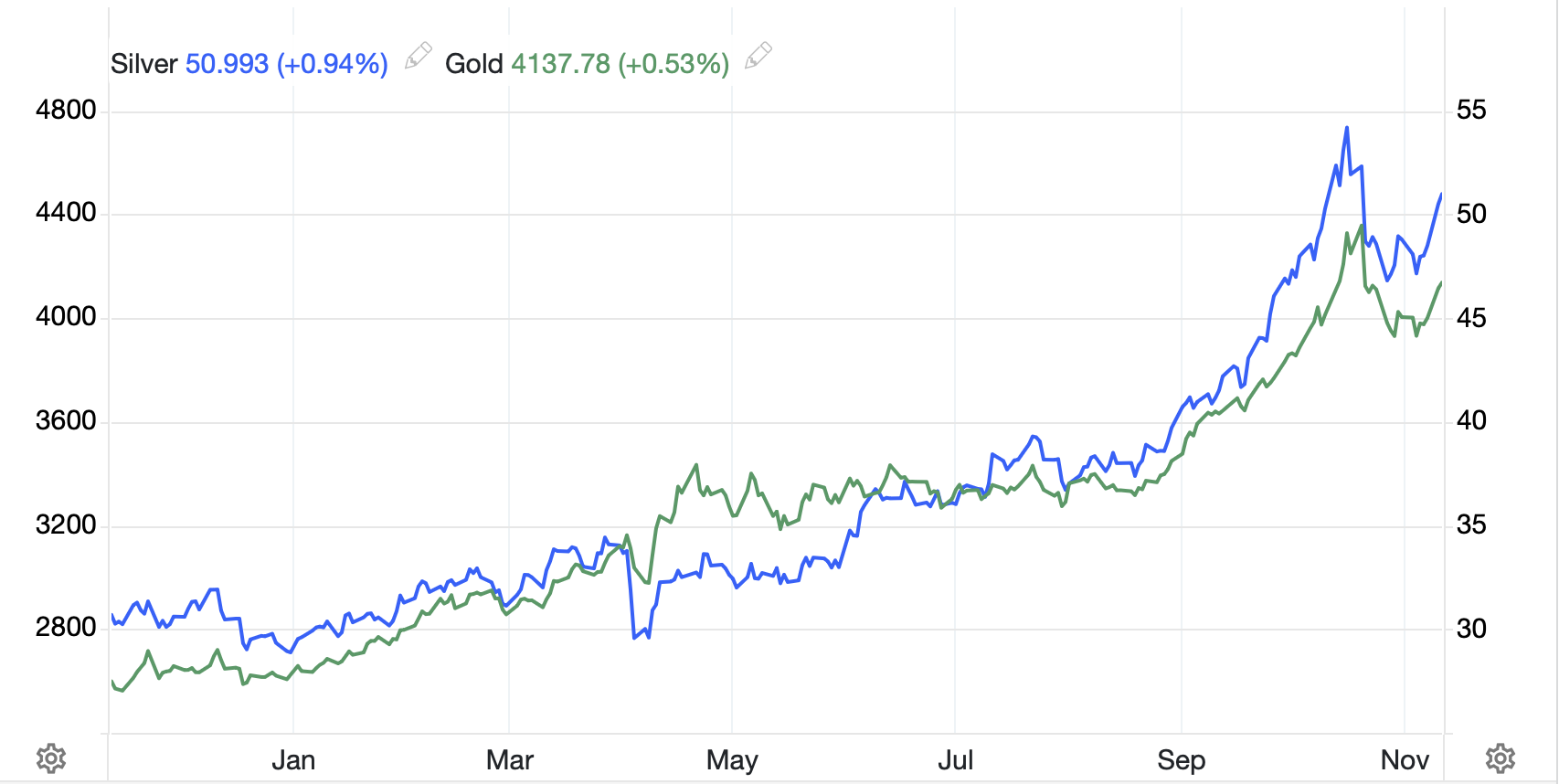
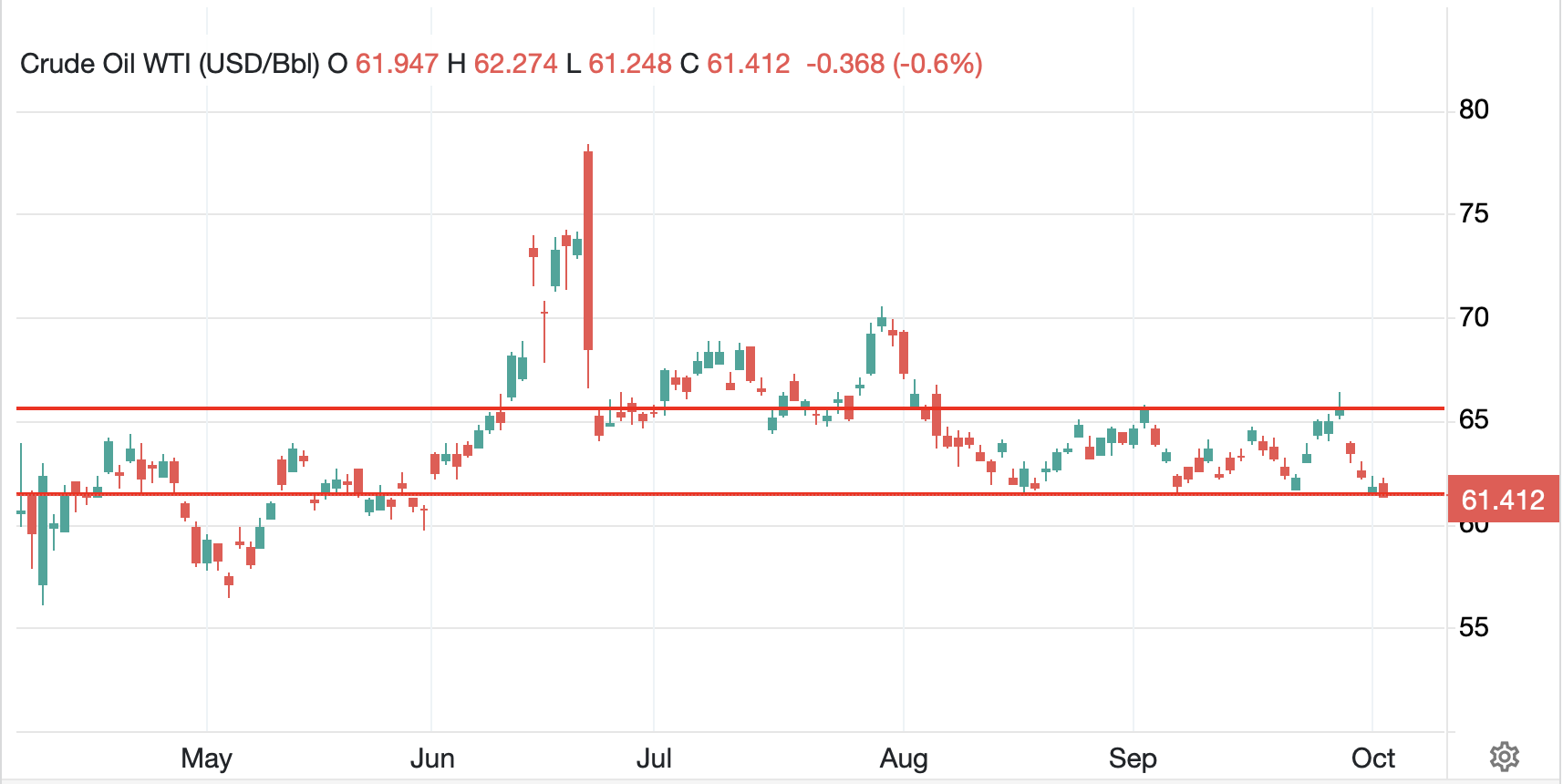
In the commodity space, oil (+1.1%) is heading back toward the top of the range I highlighted yesterday, but still more than $1 away and there have been no stories to drive things.  This is all just range trading in my view.  As to the metals markets, this morning gold and silver are essentially unchanged, consolidating their recent gains while copper (-.0.75%) is slipping slightly and has retraced some of its gains from earlier in the month.  Remember, copper is much more an economic play than a fear play or inflation play.

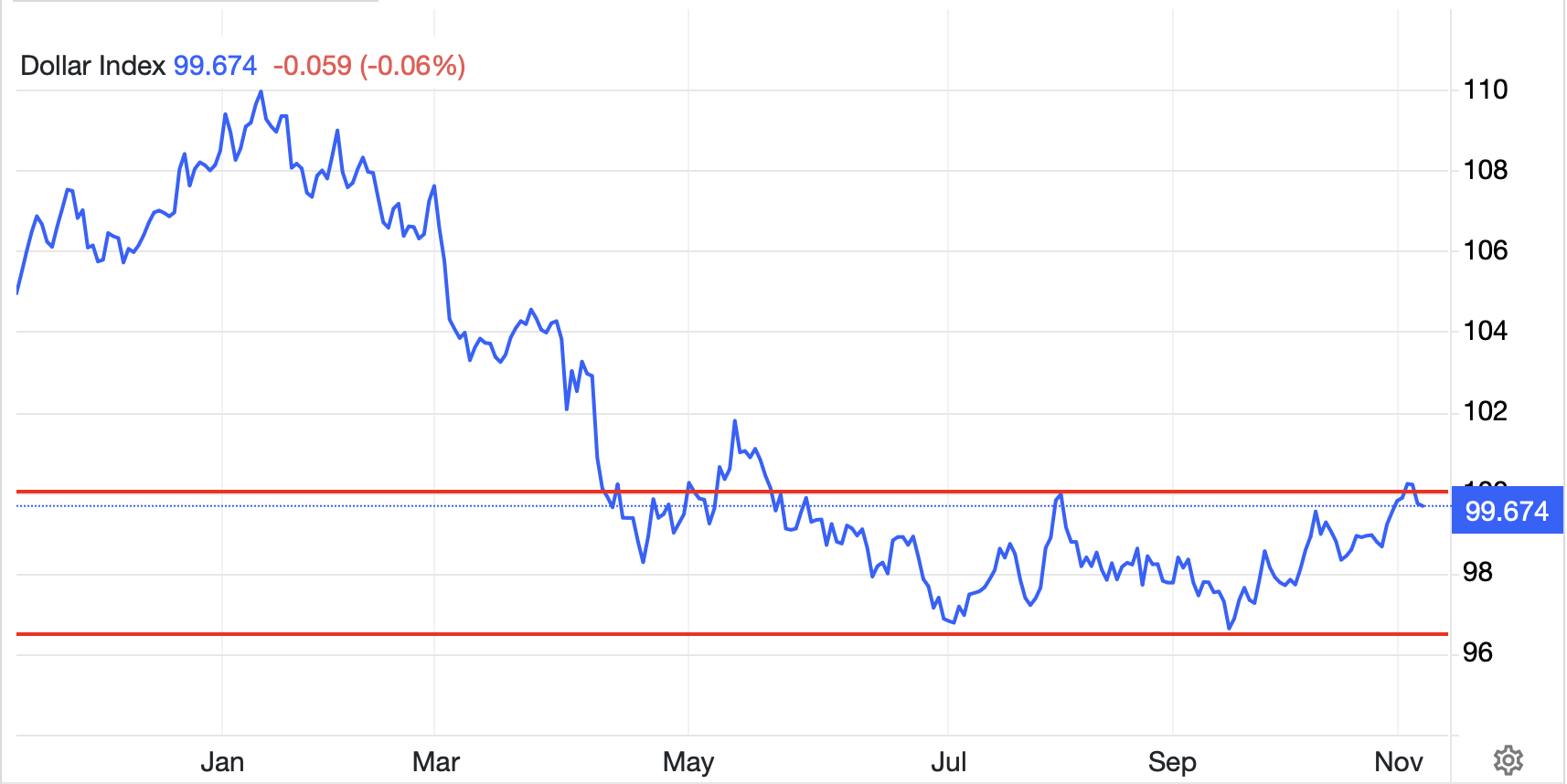
Finally, the dollar is firmer across the board this morning with gains against almost all G10 counterparts on the order of 0.5% and against EMG counterparts it is more like 0.8%.  Even CNY (-0.25%) is weakening as it appears Chinese state banks are selling renminbi in the spot market and hedging in the swap market to help mitigate its recent gains.  It is beginning to feel like the dollar’s decline this year, which has been widespread, is coming to an end.  

On the data front, today brings only New Home Sales (exp 650K) and EIA oil inventories.  Yesterday’s Flash PMI data was right in line with expectations, and my take is until NFP a week from Friday, there is going to be little of interest on the data front for markets overall.  Even PCE this week will have to be significantly different from expectations to have any impact.

It appears that absent Stephen Miran convincing the rest of the FOMC to cut rates aggressively, a very low probability event, the dollar is finding a bottom, and the next major move will be higher on the basis of stronger growth in the US vs. the rest of the world.  Of course, if the Fed does start to get more aggressive, then the dollar will suffer, I just don’t see that happening anytime soon.

Good luck

Adf
Falling Fast

His swords were words he wielded well
He spoke his truths, but would not yell
His followers enrapt
His enemies then snapped
And undeservedly he fell
 
RIP Charlie Kirk
 
A score plus four of years have passed
Since thousands died, we were aghast
No logic could be found
For those at, zero, ground
Society is falling fast


A generation after the horrific events of September 11, 2001, it appears that memories have faded.  Personally, having observed those events from one block away, it is indelibly imprinted on my brain.  But now, in the course of a week we have seen several senseless murders make the news as whatever decorum may have existed at the turn of the century is long gone.  Messrs. Howe and Strauss were always quite clear that the 4thTurning involved chaos and the destruction of institutions.  I fear the process is accelerating.  I also fear that it must play out to get through to the other side.  Civil war feels excessive as a description, but as I have forecast for the past year or two, one of the major political parties was likely to explode.  Right now, it feels like the Democrats are on that path.  I don’t know what will replace it, but something must, and it would behoove us all if there is some coherence in their policies when it appears.  I remain confident that Socialists are not the answer, nor will they be embraced across the nation. 
 
The reason I discuss this, which seems outside the bounds of my market perspective, is that it is going to impact markets even more than it already has.  The ongoing politicization of the media, businesses and entertainment does not lead to kumbaya, but rather volatility and distress.  If you wonder why gold continues to perform well, look no further.  Whatever the data, whatever the Fed does, whatever Trump and his administration do, or what Congress tries to do, gold has a history of maintaining value for the past 5 millennia.  Everything else is new and prices are all relative to gold.  Remember that as you approach your day job and your investments, whether you hedge for a living, or simply are trying to make a living.
 
There are now two things on the docket
That could lead risk assets to rocket
First, CPI comes
The Jay and his bums
Decide what gets put in our pocket

Considering these very serious issues, it seems almost ridiculous to discuss markets, but they will continue to trade and the ability to keep your eye on that particular ball is still critical to financial outcomes.  So, let us turn to the two stories (well, maybe two and a half stories) that have the potential to change some viewpoints.  The first is today’s CPI, then next week’s FOMC meeting with a half nod given to today’s ECB meeting.

Regarding the least important, the ECB is almost certainly going to leave policy unchanged.  The only opportunity for anything new will come from Madame Lagarde’s press conference and if she displays a new tone, whether hawkish (I doubt) or perhaps more dovish as European data continues to ebb.

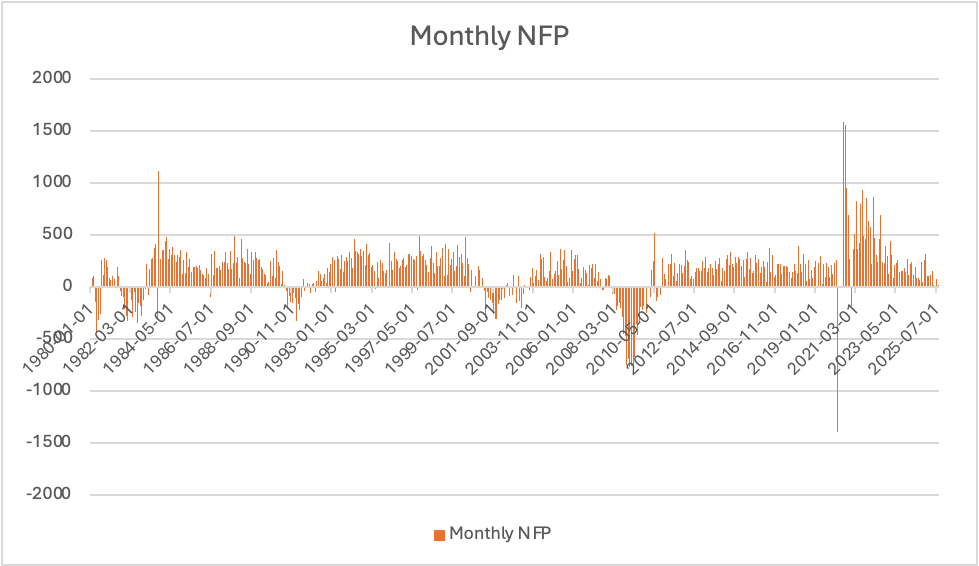
But let’s move on to CPI.  After yesterday’s much lower than expected PPI data, where the M/M numbers for both headline and core were -0.1% compared to +0.3% expected, there has been some talk on the margins that we could see much softer CPI data.  However, it is worth knowing that for the inflation cognoscenti (e.g., @inflation_guy) PPI data is seen as a random number generator with very little direct impact on the consumer data.  (In fact, after my look at NFP data, aren’t all the data points random?)  With that in mind, current median expectations remain as they were earlier in the week (0.3% M/M for both headline and Core with the Y/Y numbers expected at 2.9% and 3.1% respectively).  

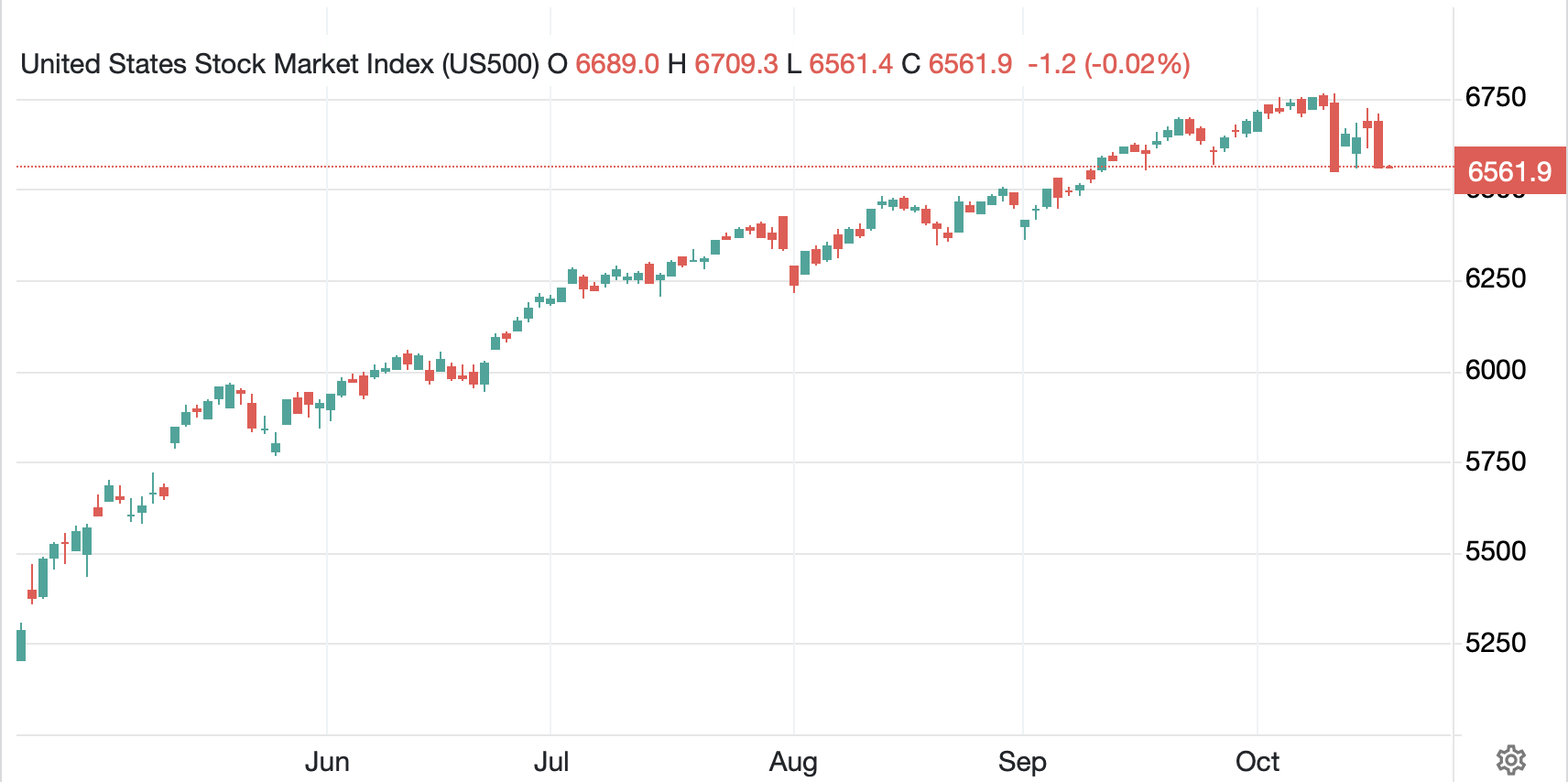
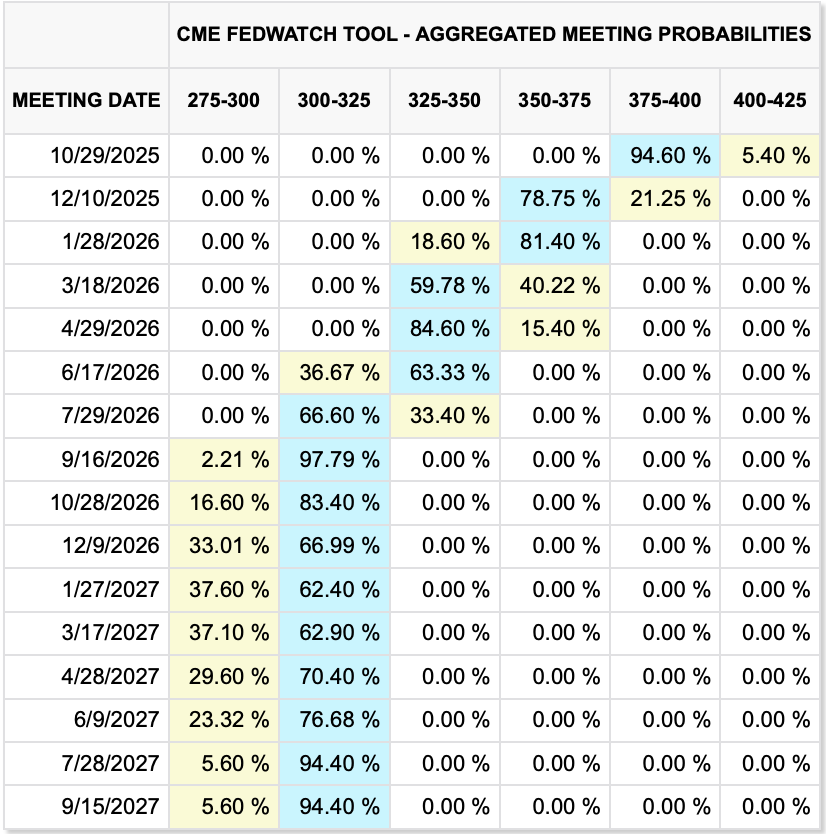
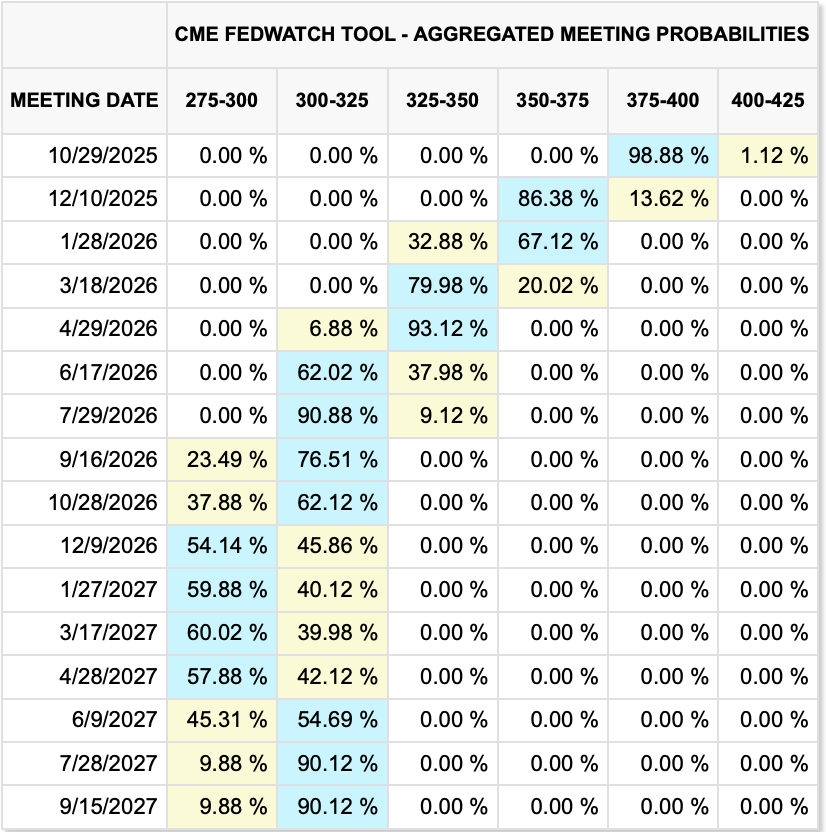
Given the market is currently pricing a full 25bp cut with an 8% probability of 50bps, my take is the only way to change things would be for CPI to also print like the PPI data as negative numbers.  If that were to be the case, and I do not anticipate that outcome by any stretch, it would give Chairman Powell ample opportunity to cut 50bps with the market welcoming the outcome along with President Trump.  On the flip side, I don’t think CPI can print a high enough number to remove the 25bp cut.  As a reminder, below are the cumulative probabilities for future Fed funds rates based on the CME’s futures contract.  A total of 75bps remains the default view for the rest of 2025.

We will learn about the outcome at 8:30 this morning and I have no particular insight into whether those median forecasts are high, low or on the money.  This is a wait and see situation.

As to the FOMC meeting, it has the opportunity to be far more impactful.  While 25bps is currently baked in the cake, I remain of the opinion that 50bps is a very viable outcome.  Recall, the most recent Fed discussions were about the importance of the employment portion of their mandate as opposed to the inflation portion.  With the newly revised reduction in NFP over the past twelve months, characterizing the employment situation as solid or strong seems unreasonable.  Weakening would seem a more apt description and should have the discussion be between 25bps or 50bps.  We already know there are at least two governors, Bowman and Waller, who wanted to start cutting last time, and it appears that Stephen Miran, Trump’s current head of the CEA, is going to get approved by the Senate in time to sit in the meeting next week.  One would assume that is a vote for easier policy.   

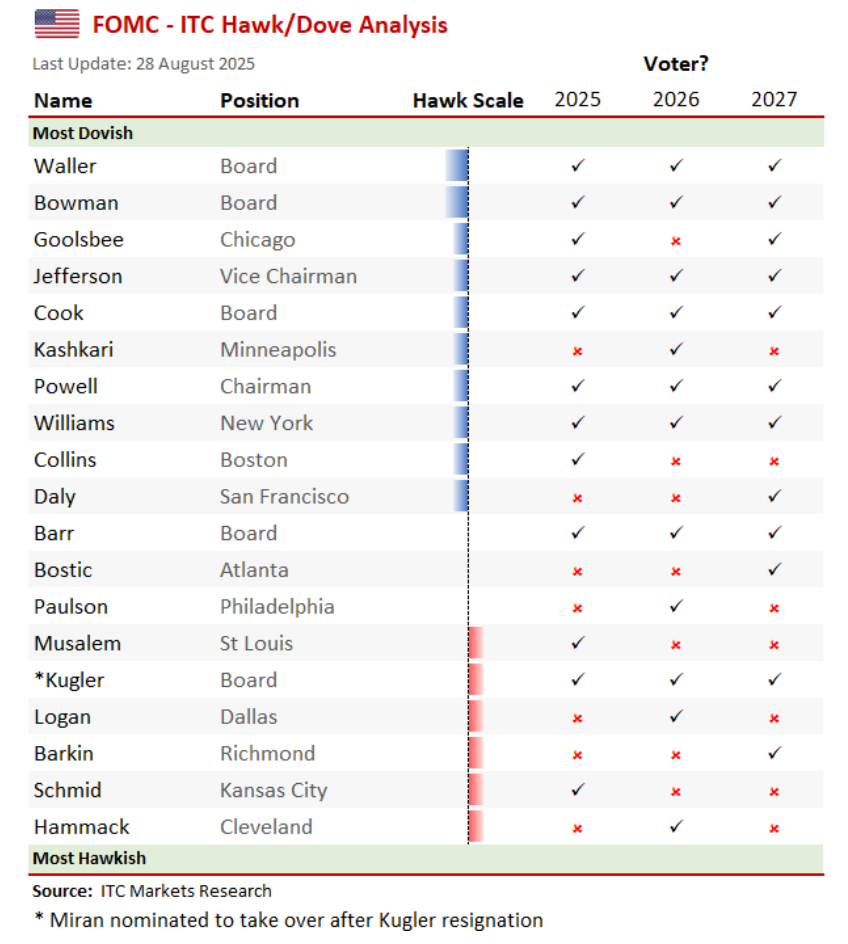
ITC Markets has a very nice table on the perceived hawkishness/dovishness of FOMC members, and it shows that the governors, as a whole, live in the dovish camp with only a few regional presidents as known hawks.  In fact, one of the remarkable things about the entire Lisa Cook affair is that she was always one of the more dovish members of the board and the fact that she was not pushing for cuts never made any sense.  At least based on her background and history.  However, if you take politics into account, and the idea that she didn’t want to cut because President Trump wanted a cut, it begins to become clearer.  At any rate, it strikes me that based on this table, which feels reasonable, 50bps is in play.

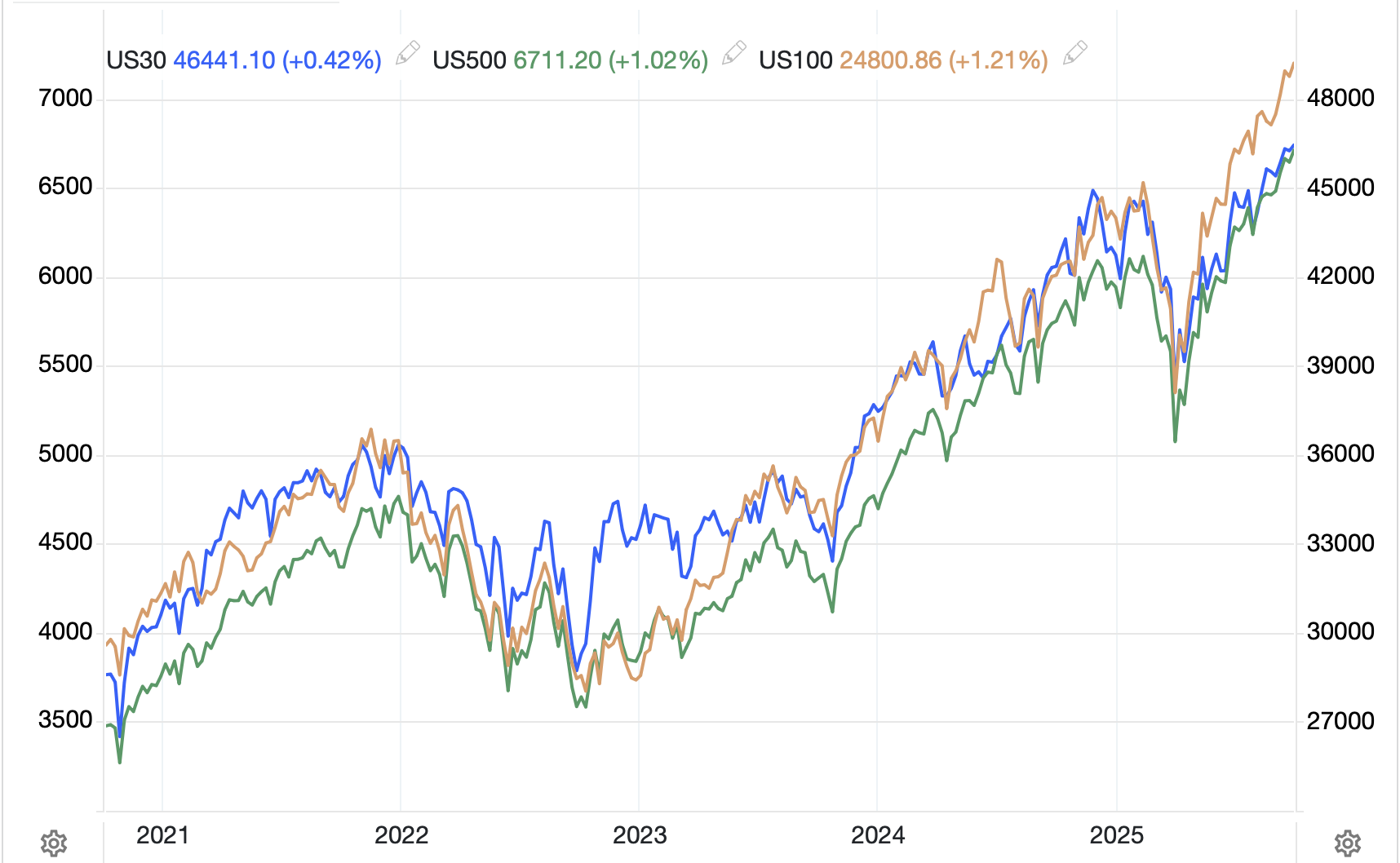
With all that in mind, let’s take a quick turn around the markets to see what is happening ahead of this morning’s data.  As seemingly always, equity markets rallied in the US yesterday, well mostly.  The DJIA slipped, but the other indices managed to continue their hot streaks.  It is very hard to link economic activity to equity market outcome these days, at least to my eyes.

But on to Asia, where Japan (+1.2%) had a solid session on the back of the remarkable rise in Oracle shares and the idea that Japanese tech companies will benefit.  China (+2.3%) was the beneficiary of the story that President Xi is now looking to have banks prop up local governments that have stopped paying contractors now that their property sale gravy train has derailed.  It seems that they have figured out if you don’t pay people, they don’t consume anything.  So, upwards of CNY 1 trillion will be injected into local government coffers specifically to pay these late bills and try to kickstart consumption.  But, as I look through the rest of the region, it was a much more mixed picture with some gainers (Korea, Indonesia, Thailand), some laggards (HK, Malaysia, Australia) and many markets that barely moved.

In Europe, all the major markets are green this morning led by the CAC (+0.85%) and UK (+0.5%) with the others showing much smaller gains (DAX +0.2%, IBEX +0.25%).  There is no obvious reason for the gains as expectations for the ECB remain static and there has been no data of note released.  Meanwhile, US futures are higher by 0.25% at this hour (7:30).

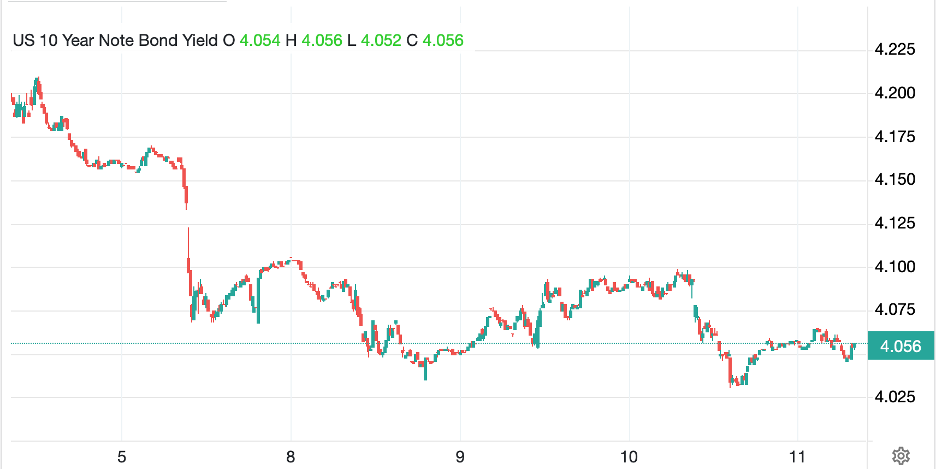
Bond markets remain frozen as Treasury yields have edged higher by just 1bp and European sovereign yields are +/-1bp from yesterday’s close.  As you can see from the chart below, the range on 10-year Treasuries has been fairly narrow for the past week.  Perhaps today’s CPI will shake things up.

Source: tradingeconomics.com

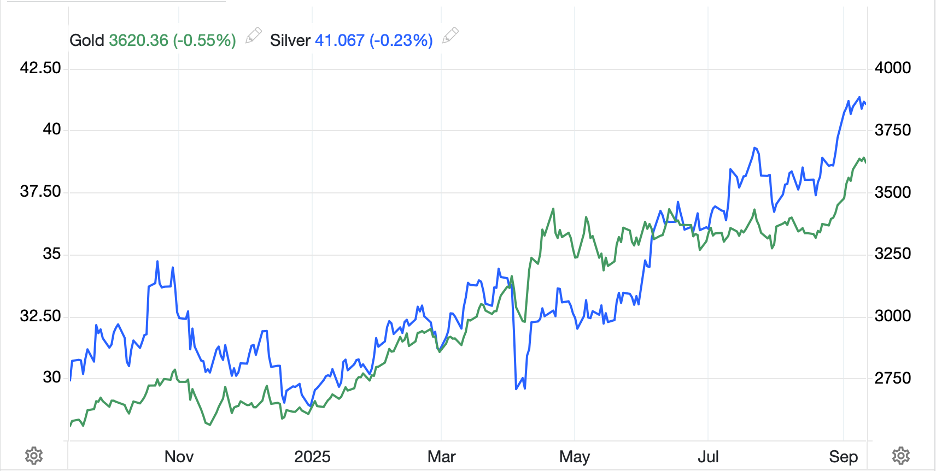
In the commodity space, oil (-1.25%) is giving back the gains it saw earlier in the week but basically remains unchanged overall.  If fears grow that a recession is upon us, I could see a rationale for oil to decline, but it is hard to get excited about the market right now.  Gold (-0.6%) is backing off its most recent all-time high, but is still firmly above $3600/oz.  Given the recent run, it is no surprise it takes a breather here and there is no reason to believe that precious metals are topping out.  In fact, a look at the charts tells me that there is plenty of upside left across the space.

Source: tradingeconomics.com

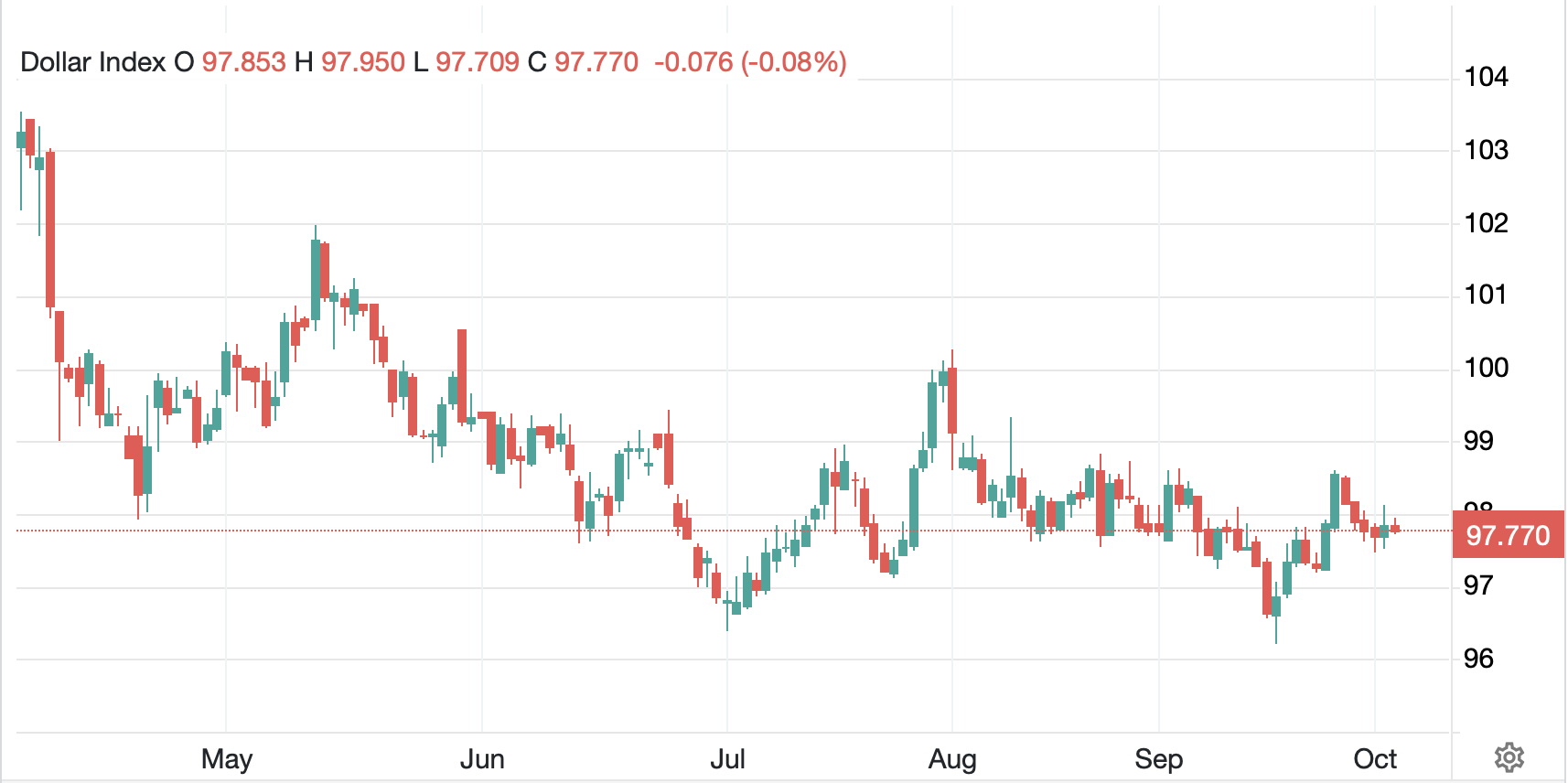
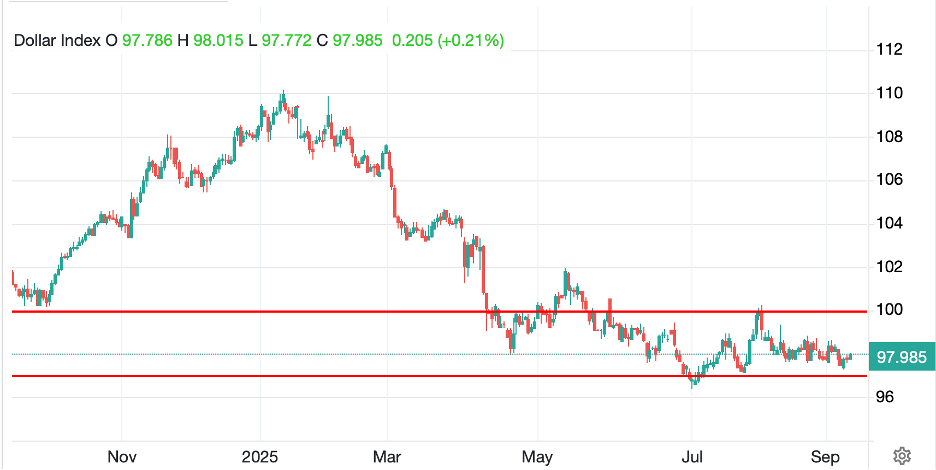
Finally, the dollar is a bit firmer this morning, probably one reason the precious metals are under some pressure, but here too, if we use the DXY as our proxy, the range is pretty clear.

Source: tradingeconomics.com

JPY, INR and ZAR are the largest movers this morning, each declining -0.4%, while the rest of the world is mostly softer by -0.1% to -0.2%.  Broad based dollar strength but no depth whatsoever.  We shall see how things behave after the CPI release.

And that’s really it.  For now, the big picture remains the same, where the prospects of an easier Fed will weigh on the dollar and support commodities.  Equities will like that for now, at least until inflation picks back up, and bonds feel subject to manipulation so I’m just not sure.

Good luck

Adf
Widely Decried

While tariffs are widely decried
By analysts, they are worldwide
But Trump’s latest scheme
To some, seems extreme
As license fees are codified
 
So, tech names, who’ve, taxes, deflected
Are now likely to be subjected
To payment of fees
To sell overseas
And revenues will be collected


One thing you can never say about President Trump is that he lacks innovative ideas.  Consider one of the biggest complaints over the past decades regarding US corporations; the fact that the tech companies (and drug companies) have been so effective at avoiding paying taxes based on the way they have gamed utilized the tax code and international treaties.  And this was not a partisan complaint as both sides of the aisle were constantly frustrated by large companies’ ability to not pay their “fair share” as it is often described.

It appears that President Trump has come up with a solution for this, charging a licensing fee for companies to sell overseas.  The big news over the weekend was that Nvidia and AMD are both going to pay a licensing fee of 15% of REVENUE on sales of chips to China.  In the case of Nvidia, that is anticipated to be some $2.5 billion with somewhat smaller numbers for AMD.  This is an excellent description of the process by @Kobeissiletter on X. 

I have often expressed the view that corporate taxation, if we are going to have it, ought not be on profits but on revenue.  Corporations are expert at reducing taxable income, maintaining a staff of lawyers and accountants to do just that.  But gaming top line revenues is much harder.  This gambit by President Trump is moving things in that direction.  And remarkably, given these license fees are for exports, it ought to be outside the consumer price chain in the US completely.

There is an article in the WSJ this morning titled, “The US Marches Toward State Capitalism With American Characteristics,” which outlines, and mildly complains, about the changes in the way the US government is dealing with the private sector under President Trump.  It discusses the purchase of 15% of MP Materials, the only US based miner/processor of rare earth minerals, and it discusses these license fees all under the guise of implying this is a bad direction.  And I completely understand that idea as governments tend to be terrible stewards of capital.  However, 25 years of Chinese unfettered access to Western markets while they have skirted the rules codified by the WTO have resulted in some significant national security challenges that can no longer be ignored.  Full marks to President Trump for creative methods to address these challenges, despite the wailing and teeth gnashing of economists.

But other than that story, as well as the ongoing back and forth regarding potential peace talks in the Russia-Ukraine war, not all that much has happened overnight.  For a change, markets are behaving like it is the summer doldrums, so perhaps we should be thankful for the respite.  As such, let’s take a look at how things have done and what we can anticipate this week with CPI and Retail Sales set to be released.

Friday’s US equity rally combined with the news that Nvidia and AMD will be able to export some chips to China saw modest gains there (+0.4%) and in Hong Kong (+0.2%) even though another major property company in China, China South City Holdings Ltd., is being forced into liquidation.  The property situation in China will continue to weigh on the economy there and given property investment was long seen as most Chinese families’ retirement nest egg, will undermine consumption for years.  Elsewhere in the region, there were more gainers (India, Indonesia, Malaysia, Australia, New Zealand, Taiwan) than laggards (Thailand, Philippines) with Japan closed for Mountain Day, a relatively new holiday, and other markets little changed.  

In Europe, though, screens are modestly red with losses on the order of -0.35% across the CAC, DAX and IBEX amid general uncertainties regarding the future economic direction and a lack of earnings positives.  At this hour (7:00), US futures are slightly higher, by 0.2%.

In the bond market, after last week’s auctions have been absorbed, Treasury yields have edged lower this morning, down -2bps, despite Fed funds futures’ probability of that September rate cut slipping to 88% from Friday’s 93%.  In fact, Fed Governor Bowman reiterated over the weekend that she would be voting for a cut at each of the three meetings left this year.  European sovereigns though are little changed, with some having seen yields edge higher by 1bp, as this appears to be a truly lackluster summer day.

Commodities are the only market that is seeing any movement of note, and it is not oil (+0.2%) which has been trading either side of unchanged since last night.  Rather, gold (-1.2%) is suffering this morning as you can see on the chart below as the promise of a potential peace in Ukraine seems to be removing some need for its haven status.  Of course, the thing to really note about the gold market is just how choppy trading has been as conflicting narratives continue to impinge on price movement.

Source: tradingeconomics.com

This decline has pulled down both silver (-1.4%) and copper (-0.95%) with all this happening despite virtually no movement in the FX markets.

Turning to the dollar, one is hard pressed to find any substantial movement in either G10 or EMG currencies. The true outlier this morning is NOK (+0.4%) but otherwise, +/- 0.1% or less is the best description of the price action.  This is what a summer market really looks like!

On the data front, we do get some important information as follows:

TuesdayRBA Rate Decision3.60% (current 3.85%)
 CPI0.2% (2.8% Y/Y)
 Ex food & energy0.3% (3.0% Y/Y)
 Monthly Budget Statement-$140B
ThursdayPPI0.2% (2.5% Y/Y)
 Ex food & energy0.2% (2.9% Y/Y)
 Initial Claims226K
 Continuing Claims1960K
FridayRetail Sales0.5%
 Ex Autos0.3%
 IP0.0%
 Capacity Utilization77.6%
 Michigan Sentiment62.0

Source: tradingeconomics.com

With all the hoopla about the firing of Ms McEnterfar at BLS, you can be sure that there will be lots of discussion on the CPI data regardless of the outcome.  However, as the Inflation Guy pointed out last week, imputing the bottom 30% of items in the basket, which represent something on the order of 2.5% of the total price impact, is likely to have no impact whatsoever.  We also hear from a bunch of Fed speakers, four to be exact, although Richmond Fed President Barkin will regale us twice.  Now that there are more calls for a September cut, it will be interesting to see who remains patient and who is ready to move.

And that’s all there is today.  It is hard to get excited about too much movement given the lack of obvious catalysts.  Of course, one never knows what will emanate from the White House but look for a quiet one, I think.

Good luck

Adf
Just a Bad Dream

Before yesterday traders whined
‘Bout how much that vol had declined
But President Trump
Caused copper to dump
And still, Chairman Powell, maligned
 
So, chaos is now the new theme
Though most hope it’s just a bad dream
And ere the week ends
Based on recent trends
We could see, results, more extreme


It isn’t often that copper is the talk of the town, but this is a new world in which we live, and as I’ve repeatedly explained, all that we think we knew about the way things work, or have worked in the past, is generically wrong.  It is with this in mind that I lead with a chart of the copper price, which after having rallied dramatically back in April, after Liberation Day, and again in July, both times on the back of tariff announcements, collapsed yesterday when President Trump altered the conversation by explaining that tariffs on copper would not be on the raw metal itself, but rather on refined products instead.  As you can see from the chart, this resulted in a massive decline, nearly 23% in the past twenty-four hours. 

Source: WSJ.com

Essentially, the US price, as traded on the COMEX, returned to be in line with the ROW price, as traded on the LME.  That doesn’t make the move any less dramatic, but the question of how long those price differentials could be maintained was always an open one.  At any rate, that was the biggest mover of the day yesterday and naturally, it had knock-on effects elsewhere with the entire metals complex falling sharply (Au -1.85%, Ag -3.0%, Pt -9.7%) as well as some currencies that are linked to those metals like CLP (-1.5%) and ZAR (-1.4%).  Remember how much complaining there was because market activity had slowed so much?  I bet most folks are looking wistfully at that pace this morning!

Turning to the other key focus of yesterday, the FOMC meeting, the FOMC statement was exactly as expected, with continued focus on “solid” labor market conditions and moderate economic activity acting as the rationale to leave rates on hold.  As widely expected, both Governors Bowman and Waller dissented, each calling for a 25 basis point cut.  The two schools of thought continue to be 1) headline data releases have been masking underlying economic weakness (declining home sales, declining air travel and restaurant activity); and 2) while those issues may be real at the margin, the fact that financial markets continue to rise, with significant speculative activity in things like meme coins and cryptocurrency in general, as well as Private Credit, indicate there is ample liquidity in the market and no reason to adjust policy.

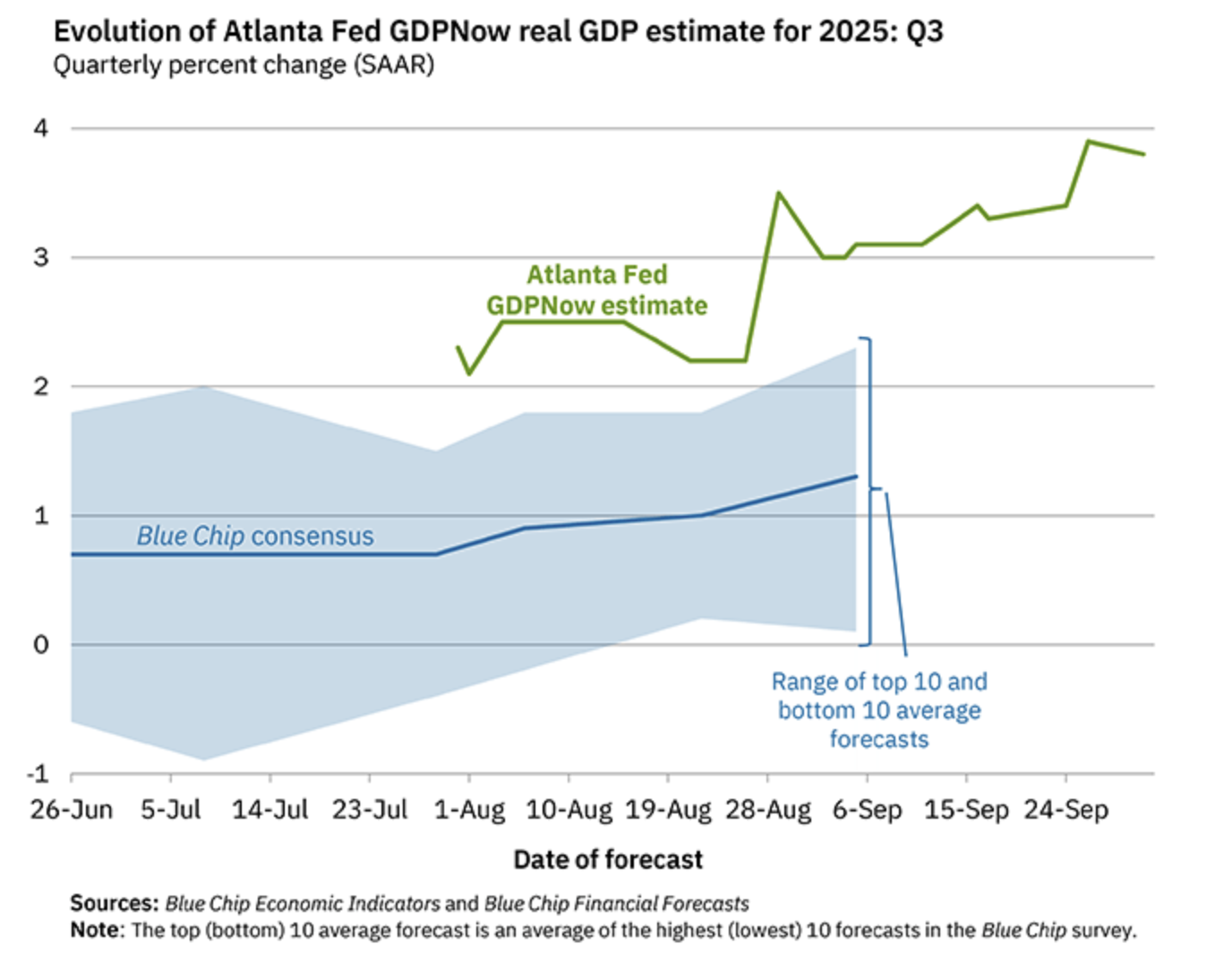
This poet, while not a PhD economist (thankfully!), comes down on the side of number 2 above.  There has been talk by numerous, quite smart analysts, about the underlying weakness in the economy and how the data would be demonstrating it very soon.  Whether it is the makeup of the employment situation, the housing market showing a huge imbalance of homes for sale vs. buyers (at least at current prices) or the added uncertainty of tariffs and how they will impact the economy, this story has been ongoing for more than three years without any proof.  In fact, yesterday’s GDP reading for Q2 was a much higher than expected 3.0%, once again undermining the thesis that the economy is already in a recession.  If so, it is the fastest economic growth ever seen in a recession.

In fact, I do not understand the rationale for so many that a rate cut is necessary.  I realize the market continues to price a 60% probability of a cut in September and about 35bps of cuts by year end, but it makes no sense to me.  In fact, the market is pricing for 110 basis points of cuts through 2026.  Now, either market participants are anticipating a significant slowdown in inflation, which given all the tariff talk seems unlikely, or they see that recession on the horizon.  At this point, I have come to believe it is nothing more than wishful thinking because there is such a strong belief that Fed funds rate cuts lead to higher equity prices, and after all, isn’t that the goal?

Chairman Powell, despite all the pressure he receives from the White House, has not budged.  In this instance, I believe he is correct.  After all, if the data suddenly implodes, the Fed can cut far more substantially and do so on an intermeeting basis if necessary.  Remember, ahead of the election, he cut rates 50bps for no discernible reason based on the data.  Unemployment had risen from 3.9% to 4.2% over the prior three months and that was enough to scare him (although there was clearly a political motive as well).  If the Unemployment Rate rises to 4.5% on September 5th, they could cut that day if they thought things were really unraveling.  If the Fed is truly data dependent, then the data does not yet point to a major economic problem.  And the one thing we know about the Trump administration’s policies is they are going to try to run the economy as hot as possible.  That does not speak to lower interest rates.

Ok, let’s look at how markets around the world absorbed these changes, and how they are preparing for today’s PCE and tomorrow’s NFP data.  Despite all the noise, the DJIA was the worst performer yesterday, sliding just -0.4%, while the NASDAQ actually rallied at the margin, +0.15%.  And this morning, futures are pointing much higher (NASDAQ +1.4%, SPU +1.1%) as both Meta and Microsoft beat estimates handily.

Overnight, while Japanese shares (+1.0%) rallied nicely, China (-1.8%) and Hong Kong (-1.6%) significantly underperformed as weaker than expected PMI data put a damper on the idea that stimulus was going to solve Chinese problems.  A greater surprise is that Korea (-0.3%) didn’t perform better given the announcement that they had agreed a trade deal with the US with 15% baseline tariffs, although that may have been announced after the markets there closed.  But the rest of Asia had a rough session with most key regional exchanges (Singapore, Philippines, Indonesia, Malaysia) all declining about -1.0% with only Taiwan (+0.35%) on the other side of the ledger.  However, if we continue to see strength in the US tech sector, and trade deals keep getting inked, I suspect these markets will be able to rebound.

In Europe, the picture is also mixed, with the CAC and DAX essentially unchanged after in-line inflation readings, while Spain’s IBEX (+0.5%) reacted positively to Current Account data while the FTSE 100 (+0.5%) rallied on strong earnings data from Rolls Royce and Shell Oil.

Perhaps the most interesting aspect of yesterday was how the bond market sat out the chaos.  Treasury yields edged higher by 2bps yesterday and this morning they have fallen back by -1bp.  European sovereign yields this morning are essentially unchanged, although a few nations have seen yields slip -1bp.  In many ways, I feel that this is confirmation that despite a lot of noise, not much has really changed.

Oil (-0.5%), is giving back some of yesterday’s $2.00/bbl surge which was based on more sanctions talk from President Trump on Russia and reviving the discussion on 100% secondary sanctions on nations that import oil from Russia.  While EIA data showed a major inventory build, the talk was more than enough to spook traders.

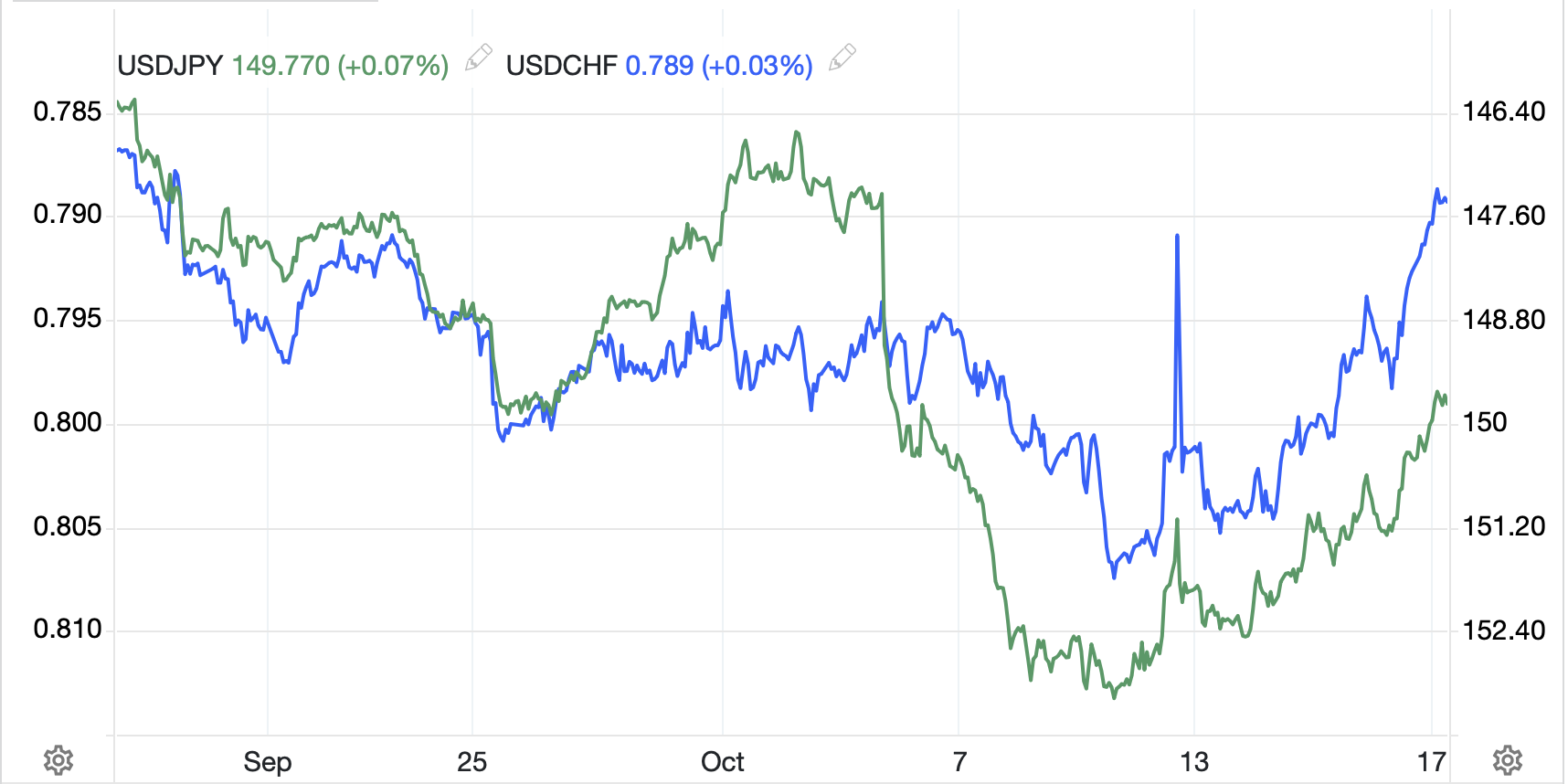
Finally, currency markets, which have seen dollar strength for the past several sessions, are relatively calm this morning, at least in the G10, where the DXY is unchanged, although at its highest level since just before Memorial Day.  In that bloc, JPY (-0.5%) is the laggard after the BOJ left policy on hold, as expected, and while the yen has not been the market’s focus lately, it is back to 150.00 this morning for the first time since March.

Source: tradingeconomics.com

Remember all the talk about the end of the carry trade and how the yen was going to explode higher?  Me neither!  As to the EMG bloc, other than the aforementioned metals focused currencies, there has not been much movement in this space either.  However, overall, while the longer-term trend has clearly been lower, this bounce looks more and more like it is gaining strength.  The DXY is a solid 2% through the trendline and a move to 102 seems well within reason in the near term.

Source: tradingeconomics.com

On the data front, this morning brings Initial (exp 224K) and Continuing (1960K) Claims, Personal Income (0.2%) and Spending (0.4%) and PCE (0.3%, 2.5% Y/Y headline, 0.3%, 2.7% Y/Y Core) all at 8:30.  Then at 9:45 we see Chicago PMI (42.0).  There are no Fed speakers and assuming today’s data is in line, I expect that all eyes will turn to earnings from Apple and Amazon after the close and then NFP tomorrow.  So, despite yesterday’s volatility, I see a respite for the day.

Good luck

Adf
Qualm(s)

As all of us wait for the Fed
And try to absorb what’s been said
Investors are calm
Though pundits have qualm(s)
Their warnings of problems are dead
 
While no move is likely today
So many continue to pray say
A rate cut is coming
To keep markets humming
So, shorts best get out of the way


Markets have been in wait and see mode, at least equity markets have, for the past week as investors, traders and algorithms seek something new to discuss.  In fact, a look at the chart below shows that the S&P 500 has moved the grand total of 9 points over the past week!

Source: finance.yahoo.com

Yes, there have been some earnings announcements, with a couple of key ones this afternoon (MSFT and META), but there continues to be an increasing focus on the FOMC which will announce their policy decision (no change) this afternoon.  The focus is really on what Chair Powell will hint at in the ensuing press conference.  At this point, I would say it is baked in the cake that two governors, Waller and Bowman, are going to dissent seeking a 25bp rate cut.

Ironically, if markets are looking for a catalyst from this FOMC meeting, I believe they are looking in the wrong place.  Chairman Powell will do everything he can to not answer any question about anything whatsoever, whether on the likely trajectory of future policy decisions or whether he will resign or be fired.  And so, we will need to look elsewhere for market moving catalysts.

Of course, there is always the White House, which has proven to be a rich source of uncertainty, and then there is the data onslaught starting today through Friday, which if it comes in differently than forecast, will have the opportunity to move markets.  Regarding the former, I will not even attempt to guess what the next story will be.  However, the latter is a potentially rich vein to be mined for insight.

To set the table, a look at yesterday’s outcomes is worthwhile.  The Goods Trade Balance fell to -$86B, substantially less than forecast, on the back of a significant decline in consumer goods imports.  While the data still shows a deficit, I imagine Mr Trump is pleased with the direction.  Certainly, compared to the trend prior to his election (as well as the front-running of tariffs early this year) it seems a modest improvement, or at least a reduction. (see chart below)

Source: tradingeconomics.com

Otherwise, Home Prices rose less than forecast and continue to slow their pace of increase and job openings were withing spitting distance of forecast at 7.44M, although somewhat lower than last month.  Finally, Consumer Confidence continues to rebound.  While equity markets were nonplussed, with US markets slipping a bit on the day, Treasury bonds rallied nicely with 10-year yields sliding -8bps on the day.  The bulk of that rally was based on a very positive 7-year auction, with the bid-to-cover ratio rising to 2.79, and dealers only getting 4% of the issue, the lowest level recorded since 2004.  In other words, investors took in virtually the entire $44 billion.  This morning, we will also learn about Treasury’s planned quarterly issuance, although estimates are there will be no increase in long-term bonds, with T-bills continuing to be the main financing vehicle for now.

Too, this morning we will get the ADP Employment report (exp 75K) and the first look at Q2 GDP (2.4% after -0.5% in Q1).  While all of that could have an impact, my sense is that tomorrow’s PCE data and Friday’s NFP will be of much more import.  A final though this morning is that the BOC is going to complete their policy meeting, but no change is expected there.

If we consider this information, absent a new surprise from the White House on your bingo card, it seems to me Friday is the most likely timing for any substantive movement in equities or bonds.  And with that in mind, let’s look at how other markets have been responding to things.

Yesterday’s modest declines in the US were followed by a mixed picture in Asia with both Japan and China little changed on the day although Hong Kong (-1.4%) was under pressure as the US-China trade talks stumbled for now.  But much of the rest of the region had a solid session with Australia (+0.6%) rallying after better-than-expected inflation data encouraged traders to price in a rate cut by the RBA at their next meeting.  But there were gains in Korea, India and Taiwan as well with only Indonesia really lagging.  In Europe, it is a mixed session with the CAC (+0.45%) leading the way higher while both the IBEX (-0.2%) and FTSE 100 (-0.3%) are lagging as Eurozone data was mixed with inflation edging higher in Spain although Eurozone GDP came in a tick better than forecast.  However, the big discussion there continues to revolve around the details of the trade deal.  As to US futures, they are a touch higher at this hour (7:40), about 0.25%.

In the bond market, after yesterday’s rally, US yields are unchanged on the day, trading at the low end of their recent range, while European sovereign yields are all lower by -2bps (Gilts are -5bps) as the US move came later in the day and Europe didn’t really participate yesterday.  Overnight, JGB yields slipped -1bp, but Australian govies fell -7bs as thoughts of rate cuts danced in traders’ heads.

In the commodity markets, oil (-0.65%) is giving back some of its gains that were catalyzed by President Trump’s threats to Russia if they don’t sit down in the next 10 days, rather than the original 50-day window.  As to metals markets, gold is unchanged this morning, still trading in the middle of its range, although we have seen some weakness in both silver (-0.9%) and copper (-0.8%) but it seems more in line with ordinary trading than with any new news.

Finally, the dollar is continuing its rebound as the euro (-0.2%) retreats further from its recent highs and is now lower by more than -2% in the past week.  In fact, the DXY has traded back above 99.0 for the first time since early June as the bottoming formation that I have highlighted over the past several days continues to prove prescient.  In fact, some might say the dollar is starting to accelerate higher!  Once again, I would highlight that the descriptions of the dollar’s demise were greatly exaggerated.

Source: tradingeconomics.com

And that’s pretty much all there is to discuss.  We are firmly in the middle of the summer doldrums where market activity remains subdued at best.  Given the prominence of algorithms in trading most markets, it will require something new and unexpected to get things going.  Of course, perhaps this evening’s earnings data will start some movement, but I’m still focused on Friday.

Good luck

Adf

All Its Sophists

The art of the deal
Tokyo and Washington
Birds of a feather


Seemingly, the biggest news story of the evening was the trade agreement between the US and Japan, where reciprocal tariffs have been set at 15%, including on Japanese autos, and Japan has pledged to invest $550 billion in the US, which I assume is from private corporations although that was not specified.  However, they did explain that one of the investments would be Alaskan North Slope natural gas liquification, a project that has been on the boards for more than 20 years.  Thus far, this seems like a big win and major milestone in President Trump’s trade strategy as it also opened Japanese markets to American products, including rice which had been a key sticking point.

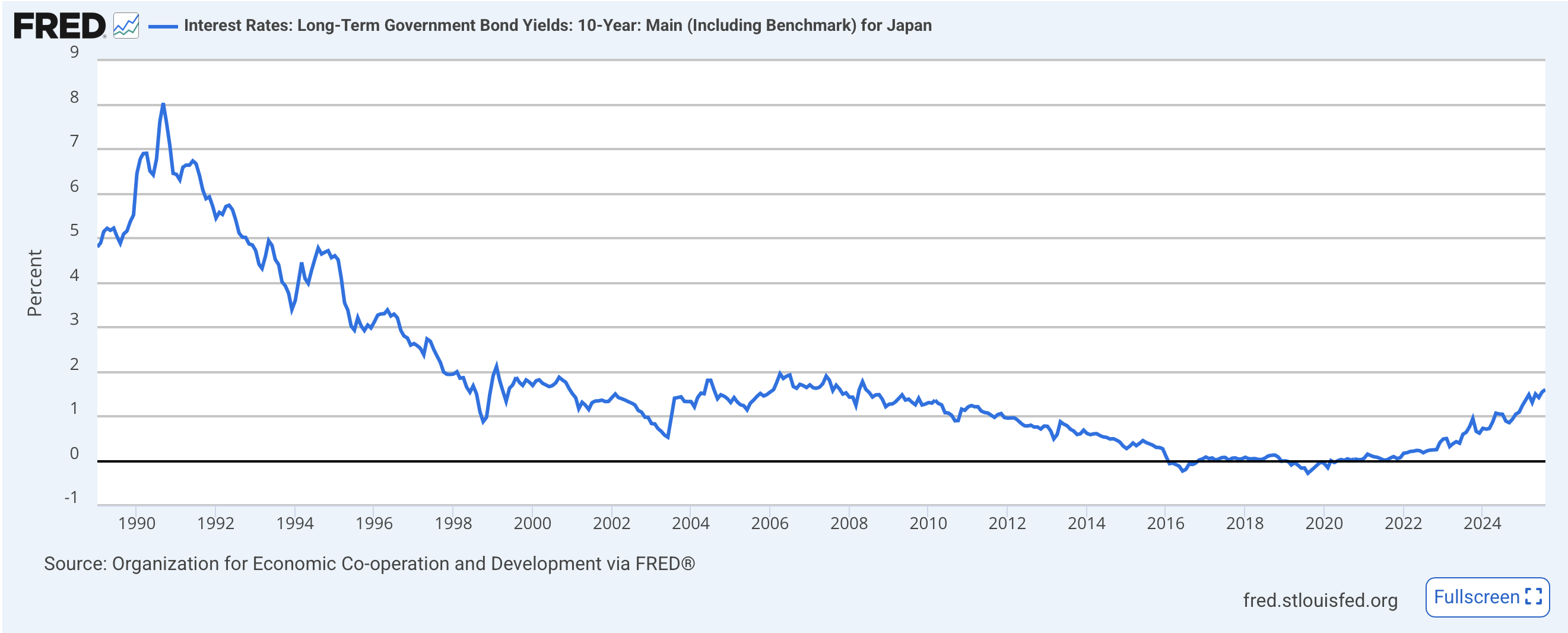
The market response was as might be expected with the Nikkei (+3.5%) rallying sharply and taking virtually every regional Asian market higher for the ride as the conclusion of a deal in the preferred timeline was seen as a precursor to others falling in line.  It is quite interesting that this happened so shortly after PM Ishiba’s election disaster on Sunday, but perhaps that was his motivation.  He needed a big win and conceding on some points to get a deal was much preferred to holding out and getting nothing.  However, JGB markets saw things differently as a very weak 40-year JGB auction (lowest bid-to-cover ratio of 2.127 since 2011) led to long-dated yields rising between 8bps and 10bps last night, with the 10-year yield trading back to the highs seen in late March.

Source: tradingeconomics.com

While the stock market was giddy, apparently the only discussion in the bond market was whether Ishiba-san would be forced to resign, leaving Japan with a leadership vacuum.  Meanwhile, the yen (+0.3%) did very little overnight although it has been creeping higher since the election results.  My sense is Japanese investors are cautiously heading home, but I would not look for a major move lower in USDJPY, rather the current gradual pace makes sense.

A juxtaposition exists
Twixt Europe with all its sophists
And stolid Japan
Who finished their plan
On trade despite recent vote twists

As trade continues to be the topic du jour, it is no surprise that the chatter out of European capitals is that they will fight to get the best trade deal possible.  (I cannot help but laugh at Friedrich Merz saying, if they [the US] want war, we will give them a war).  However, it is also no surprise that markets have looked at the Japanese deal and increased the pressure on EU negotiators to achieve a solution by the end of the month.  First off, every European official wants to go on holiday in August, so they will want to have completed things.  But secondly, equity investors have taken the fact that deals with major counterparties can be accomplished as a sign that the EU is next.  And if they do not agree terms, it will be a double whammy of political and financial problems as you can be certain that the equity gains we are seeing today and have been steady so far this year (see below), will likely reverse on a failure to agree.

                                                                                     Today        1 Week        1 Month          YTD

Source: tradingeconomics.com

But, away from the trade story, and various political stories in the US that are unlikely to have any immediate impact on markets, that’s kind of all there is to discuss.  The Fed meets next week and there is no expectation of a rate move.  The ECB meets tomorrow and there is no expectation of a rate move.  Important data is scarce on the ground and the focus on crypto and meme stocks continues.  In fact, this is likely the best descriptor of a market that has abundant liquidity and shoots down the case for cutting rates at all.  In the meantime, let’s look at how other markets behaved overnight.

You will not be surprised that US equity futures are all pointing higher this morning, and we have already discussed the rest of the equity markets around the globe.  In the bond markets, after declining yesterday, yields have stabilized this morning (Treasuries +1bp, Bunds +1bp, OATs +1bp) although UK Gilt yields (+5bps) have underperformed as there continue to be concerns over the fiscal picture in the UK as well as questions about PM Starmer’s ability to stay in his seat.  In fact, UK 10-year yields are the highest in the developed world right now, and while they have been knocking back and forth for a few months, show no sign of falling regardless of the BOE’s future actions.

In the commodity space, oil (-0.7%) has been slipping back to the bottom of its post 12-day war range amid lackluster overall activity.  Just as there didn’t seem to be an obvious driver when oil rallied to $68/bbl, too there is no clear driver of the recent decline.  I continue to believe this is market internals rather than macro fundamentals.  In the metals markets, after a major rally yesterday across the board, gold (-0.25%) is consolidating but silver (+0.1%) is pushing within spitting distance of a major milestone, $40/oz, while copper (+1.2%) sees the benefits of the trade deal and is rallying nicely.

Finally, the dollar is mixed this morning.  While the yen is firming and the effects of the trade deal seem to be helping Aussie (+0.6) and Kiwi (+0.75%), the euro and pound are both little changed.  in fact, the rest of the G10 is +/- 0.1% on the day, so nothing at all happening.  In the EMG bloc, KRW (+0.3%) is the biggest mover with every other currency across regions +/- 0.15% or less and showing no signs of a trend right now.  Broadly, the dollar appears to be in a downtrend, but short dollars is one of the most crowded trades in the hedge fund and CTA communities, and that gets expensive given US funding costs are higher than pretty much everybody else’s right now.  Depending on how you draw your trend line (and I am no market technician), it appears that the dollar broke above that line and is now getting set to retest it.  I would not be surprised to see a more substantial bounce on the next move.

Source: tradingeconomics.com

And that is really all there is today.  This morning’s data consists of Existing Home Sales (exp 4.01M) and EIA oil inventories with a small draw expected.  The Fed is in their quiet period so no speakers which means that all eyes will, once again, turn toward the White House to see who has the right squares on their bingo card.

Good luck

Adf

He’s the Worst

The talking points have been disbursed
With narrative writers well-versed
The dollar is falling
‘Cause Trump is now calling
For Powell to leave, “He’s the worst!”
 
The idea is Trump will soon name
The next Fed Chair, turning Jay lame
This shadow Fed Chair
Will have to beware
Since he’ll, for bad outcomes, get blame


The dollar is weaker this morning and if we use the Dollar Index as a proxy, it has fallen to its lowest level since February 2022.  

Source: tradingeconomics.com

While certainly a part of this movement has been the fact that US yields continue to slide lately, it also seems there is a new narrative that has been distributed to journalists, the dollar is falling because President Trump is considering naming a new Fed Chair much earlier than usual in an effort to undermine Chairman Powell.  We have all heard about the rants the President has had regarding Powell’s unwillingness to cut rates even though inflation readings have been declining for the past two months, and are, on a Y/Y basis back to their lowest level since March 2021 whether measured as CPI (grey line) or Core PCE (blue line).

Source: tradingeconomics.com

But in an exclusive (!) article in the WSJ, which was repeated in Bloomberg, that is the story du jour.  While Bloomberg’s take cannot be a surprise given Mayor Mike’s intense hatred of Trump (after all Trump is the NY billionaire that became president, not Bloomberg), and editorial direction clearly comes from the top, it is more interesting that the Journal is pushing this theme.  Of course, given the Fed whisperer is the article’s writer, it is more than possible that he is simply airing Powell’s views and trying to explain how any move like this would result in chaos, so it’s not Powell’s fault if things go pear-shaped.

Nonetheless, that is today’s story.  In concert with this story, though is another, somewhat more interesting feature, where a really smart analyst, Marko Papic, has broken down the dollar’s movements across different time zones during 2025.  The chart below shows that the dollar selling has been emanating from Asia mostly with Europe having a lesser impact and no substantive change in the NY session.  The implication is that Asian holders of dollars, which tend to be sovereigns rather than other users like investors or corporates, are the ones bailing out.

This activity first became noticeable in early April, right around “Liberation Day” and does fit with the idea that higher US tariffs will result in a smaller US trade deficit.  But as I consider that concept, it strikes me that a smaller US trade deficit will result in fewer dollars around the rest of the world, a reduction in supply, and that would arguably increase the dollar’s value ceteris paribus.  Perhaps this reflects investors selling US assets and converting them to Europe, which has been another theme this year as European companies are set to benefit from a major increase in defense spending by NATO.  However, that doesn’t really sync with the fact that US equities continue to trade near all-time highs.  At this point, I think this is an interesting observation, but am not sure of its meaning.  I’m open to suggestions.

Ok, while that is the narrative this morning, let’s look at how markets are behaving.  Yesterday’s lackluster activity in the US, with the S&P 500 almost exactly unchanged and the other two main indices +/- 0.3% was followed by a burst higher in Tokyo (Nikkei +1.6%) but lagging activity in HK (-0.6%) and China (-0.4%).  The rest of the region couldn’t decide on much with a couple of solid performances (India, Indonesia) and one laggard of note (South Korea).  In Europe, Germany (+0.6%) is leading the way higher across the board, as NATO countries have promised to spend upward of 5% of GDP on total defense (including nonlethal investments), with as much as possible going to European based companies.  That is a lot of money, well over $1.5 trillion.  Meanwhile, US futures are all higher at this hour (7:15), up by about 0.4% or so.

In the bond market, Treasury yields (-2bps) continue to slip and are now back to their lowest level since early May.  Perhaps more interestingly, European sovereign yields are sliding today as well, led by Italian BTPs (-4bps) but lower across the board.  This is interesting given the promises of more borrowing based on the NATO announcement.  But net, bond yields have not really done very much lately at all.

In the commodity markets, oil (+0.5%) is continuing to slowly bounce from the initial lows in the wake of the Iran/Israel ceasefire.  This market still feels quite heavy to me and absent a major change on the ground in the Middle East, if war were to resume and oil facilities be attacked, I still think lower is the way.  In the metals markets, gold (+0.25%) which tried to sell off yesterday continues to find bids below the market, likely central bank support.  But silver (+0.9%) and copper (+2.3% and above $5.00/lb) are looking good although nowhere near as impressive as platinum (+3.4%) which has now risen above $!400/oz and is going parabolic here.  There is much talk here about a supply shortage (it is used for catalytic converters) and significant Chinese demand.

Source: tradingeconomics.com

Finally, the dollar, as mentioned, is under pressure across the board, although the magnitude of this morning’s movement has not been that large.  The largest movement has been in Asia with IDR (+0.6%), JPY (+0.4%) and KRW (+0.35%) while European and LATAM movements have been generally 0.2% or less.  So, the direction is clear, but it has not been impressive.

On the data front, there is plenty today starting with the weekly Initial (exp 245K) and Continuing (1950K) Claims, the Chicago Fed National Activity Index (-0.1), the last look at Q1 GDP (-0.2%), and Durable Goods (8.5%, 0.0% ex-Transports).  We also hear from four more Fed speakers, but Powell just repeated yesterday that they are happy where they are and unlikely to move soon unless something really changes rapidly.  However, despite Powell’s claims of nothing to come, the Fed funds futures market is pricing a 25% probability of a cut at the July 30 meeting.  There is a lot of time between now and then for that to change.

I keep trying to figure out what actually matters to markets anymore as responses to different potential catalysts seem confused.  People do seem to be coalescing around the dollar is falling theme, something I have believed for a while, and if the Fed does lean to a cut next month, I do believe there is further for it to fall.  One thing to remember, though, is with Mr Trump as president, things are still a tweet away from a dramatic change.  If I were in charge of hedging risk, I would adhere to guidelines closely.  There is too great an opportunity for a sudden major reversal in the current environment.

Good luck

Adf
What He Will Mention

Last night there was, briefly, a peace
This morning, though, that seemed to cease
But worries Iran
From Hormuz, would ban
Most ships, have now greatly decrease(d)
 
So, markets have turned their attention
To Powell and what he will mention
When he sits before
The Senate once more
Though most seated lack comprehension


Talk about yesterday’s news!  While I am pretty confident we have not heard the last of the Iran/Israel conflict, it has dropped off the radar in a NY minute.  Last night President Trump announced a cease fire between the two nations and while Israel alleged that Iran already broke the peace, the market has clearly moved on from the erstwhile WWIII concept to WWJS (What Will Jay Say).  In that vein, this morning’s WSJ had an articlefrom the Fed whisperer, Nick Timiraos, describing the trials and tribulations of poor Chairman Powell as he tries to fend off those mean words from President Trump.  

Powell sits down before the Senate Banking Committee this morning, and the House Financial Services Committee tomorrow, ostensibly to describe the state of the economy and the Fed’s current thinking.  I have begun to see discussions that two Trump appointed governors, Bowman and Waller, are now interested in potentially cutting the Fed funds rate in July and the futures market has raised the probability of a cut next month to 23%, back to the levels seen a month ago, pre-war and prior to a run of stronger than expected economic data.

Source: cmegroup.com

Frequently mentioned throughout the WSJ article was the idea of Fed independence and how critical that is for monetary policy to be effective.  As well, the fact that the comments on rate cuts are from governors Trump appointed, and that is being highlighted in a negative fashion, is further evidence that the Fed remains a highly political, and quite frankly, partisan organization.  One cannot look at the rate cuts last autumn ahead of the election, which were certainly not warranted by the data, as anything other than the Fed’s attempt to support VP Harris’s presidential campaign.  And when inflation was still quite high, although starting to decline, calls for cuts by Biden appointees Cook and Jefferson, were also likely politically motivated given the still high inflation rate.  

In fact, I wonder where Governor’s Cook and Jefferson are today with respect to rate cuts.  After all, both have demonstrated dovish biases throughout their tenure at the Fed, but suddenly they are strangely silent on the subject.  I’m sure that is not a political bias showing, but rather deeply considered economic analysis. 🙃

I do find it interesting that there is an underlying presumption that the Fed funds rate is always too high, at least for the narrative, although I guess that is because most narrative writers believe strongly in the idea if rates are low, stock prices will rise.

Regardless of the politics, Powell will very likely explain that there is still concern that tariffs could raise prices and while there is the beginning of concern over the labor market, it remains solid and does not warrant rate cuts at this time.  Of course, we will also be subject to the preening of all those senators (what is the probability that Senator Van Hollen brings up deportations?) with no useful discussion.  It seems unlikely that Chairman Powell will alter his message from the post meeting press conference which remains, patience is a virtue.

Ok, now that the war has ended, let’s see how markets have behaved.  I must start with oil (-3.0% today, -12.0% since yesterday morning) where traders have removed the entire Hormuz closing premium and are now dealing with the fact that there are more than ample supplies around.  Recall, OPEC+ continues to increase production, and the macroeconomic narrative remains one of slowing economic activity.  Happily, gasoline prices are following oil lower so look for less inflation concerns for next month.

Source: tradingeconomics.com

Meanwhile, with war off the table, gold (-1.3%) is no longer in such great demand although silver (unchanged) and copper (+0.7%) continue to find support.  Net, my longer-term views remain that oil prices have further to decline while metals prices should grind higher over time.

In the equity markets, you have to search long and hard to find a market that didn’t rally overnight or is in the process of doing so this morning.  After yesterday’s strong US closing (all three main indices up about 0.9%), Asia (Nikkei +1.1%, Hang Seng +2.1%, CSI 300 +1.2%) rallied sharply with Korea (+3.0%) really popping and only one negative, New Zealand (-0.5%) where local traders cannot seem to get on board with the better news.  In Europe, the gains are also substantial (DAX +1.8%, CAC +1.2%, IBEX +1.4%) although the UK (+0.3%) is lagging given the large weighting of energy in the index.  US futures are also pointing higher this morning, about 0.8%.

In the bond market, Treasury yields are unchanged this morning after slipping -3bps yesterday, but we are seeing yields rise in Europe (Bunds +5bps, OATs +3bps) after the Germans announced they would be borrowing 20% more this quarter than initially expected to help their rearmament program.  I guess investors had a mild bout of indigestion.

Finally, the dollar, which rallied nicely into yesterday’s NY opening has basically reversed all those gains since then and is back trading near 98 on the DXY. While there are various relative sizes of movement, it is all in the same direction and entirely driven by the Iran/Israel war story.  Perhaps we are starting to see some pricing of a Fed rate cut, and if they do act in July, I would expect the dollar to fall, but right now, it feels much more like unwinding the war footing.

On the data front, aside from Chairman Powell at 10:00 this morning, we see Case Shiller Home Prices (exp +4.0%) and Consumer Confidence (100.0).  However, I suspect that neither of those will matter very much.  The equity market has the bit in its mouth and is looking for reasons to go higher.  Any dovish hints by Powell will set that off, as well as undermine the dollar.  We shall see.

Good luck

Adf

A New Paradigm

No matter the asset you trade
For weeks, every move’s been a fade
As headlines decry
Each thing Trump does try
Investors are feeling betrayed
 
They want to go back to the time
When markets did, every day, climb
But that time has passed
And I would forecast
We’ve entered a new paradigm


The following onslaught of charts from tradingeconomics.com are meant to highlight that for the past several weeks, basically nothing has gone on in markets.  Every day is like every other, and the only trend is a horizontal line.

Now, this is not to say that each movement is identical, just that any longer-term trends that may exist are not evident lately.  For traders, this can be terrific because there has been volatility which can be captured.  Of course, since much of the volatility has been headline bingo, that reduces the appeal.  But for longer term investors, it is a more difficult situation as those same headlines can call into question the underlying thesis of any or every trade.

Are the tariffs here to stay?  Or will they be overruled?  Is the “Big Beautiful Bill” going to be a benefit?  Or are there too many things hidden within that will impact the economy, markets and investor behaviors?  Is there going to be a Russia/Ukraine peace?  Is Iran going to sign a deal?  Will the US and China agree a trade deal?  Obviously, there are many very large issues currently outstanding with no clear resolutions in any of them as of now.  When you consider not only that the future is uncertain (which is always true) but the potential outcomes are diametrically opposed, it is easier to realize why markets are stuck in the mud.  But hey, nobody ever said trading was supposed to be easy!

There is, however, one issue I think worth highlighting that has seen an increase in discussion, and that is Section 899 of the reconciliation bill.  It is titled, “Enforcement of Remedies Against Unfair Foreign Taxes” and Bloomberg has a solid description here.  The essence of this clause is it increases taxes on nations, and individuals in those nations, who discriminate against US companies.  The idea is that Europe, especially, is busy enacting “Digital Services Taxes” which are designed to extract revenue from the large US tech companies that dominate particular spaces, like Meta, Google and Microsoft.  But these tax laws have thresholds such that essentially no other companies will be impacted.  This is the US response.  

Much of the discussion thus far has focused on the idea that this will discourage investment in US financial assets, potentially reducing the market for Treasury bonds and adding to the destruction of American exceptionalism in financial markets.  And it may well do that.  However, the thing to consider is that one of the reasons that the US has drawn so much investment is that there are so many investable securities here in the US, and that property rights remain sacrosanct.  Yes, taxation matters, but if you are a sovereign wealth fund with $100 billion in assets or more, where are you going to invest that money if not in the US, at least in some part?  And remember, this is only to be focused on nations with discriminatory taxes vs. US companies.  So, the Saudis, for example, or the Japanese need not worry.  It strikes me that at the margin, this could have a modest impact on prices, perhaps softening the dollar some and reducing future gains, but this is unlikely to end investment into the US.

Ok, let’s quickly run through the lack of overall movement last night.  Yesterday’s early US equity gains (triggered by the tariff ruling) faded all day and markets here closed very modestly higher.  In Asia, gains from yesterday were largely reversed as an appeals court stayed the ruling, so the tariffs remain in place as of now.  Thus Japan (-1.2%), Hong Kong (-1.2%) and China (-0.5%) basically reversed yesterday’s closings.  In Europe, though, things are a bit brighter. With gains across the board as inflation data released showed that it continues to drift lower across the continent.  This has encouraged traders to believe that more ECB rate cuts are coming, which was confirmed by the Bank of Italy’s Fabio Panetta, an ECB Governing Council Member, who exclaimed that inflation is nearly beaten.  Meanwhile, bank economists are now warning that further rate cuts need to come more quickly.  All this, of course, is music to equity investors’ ears.  As such, gains range from +0.3% (France) to 1.0% (Germany) and everywhere in between.  As to US futures, they are unchanged at this hour (7:30).

In the bond market, Treasury yields are unchanged this morning after sliding 8bps yesterday.  Interestingly, European sovereign yields, which also fell yesterday, have rebounded 3bps this morning despite the happy talk of more ECB rate cuts and the imminent death of inflation.  Too, last night saw yields decline in Japan (-3bps) and Australia (-11bps), following in the footsteps of yesterday’s Treasury market.

In the commodity markets, oil (+1.3%) is higher after EIA data yesterday showed modest inventory draws while gold (-0.75%) is giving back yesterday’s gains which came on the back of a weak dollar.  But as mentioned at the beginning of this piece, in the end, trends in both directions are on hold for now.

Finally, the dollar is firmer this morning, unwinding some of yesterday’s declines which grew throughout the day.  Right now, in the G10, the euro (-0.3%) is a pretty good proxy for the entire bloc, although JPY (+0.15%) is sticking out like a sore thumb.  In the EMG bloc, we see declines on the order of -0.5% (KRW, PLN, ZAR) although MXN (+0.2%) is also an aberration this morning.  Alas, I see no particular reason for this move.  However, as mentioned above, the recent trend is flat, although I cannot get over the idea that the dollar has further to decline going forward.

On the data front, this morning brings Personal Income (exp 0.3%), Personal Spending (+0.2%), PCE (0.1%, 2.2% Y/Y), and Core PCE (0.1%, 2.5% Y/Y) as well as the Goods Trade Balance (-$141.5B) all at 8:30.  Then we see Chicago PMI (45.0) and Michigan Consumer Sentiment (51.0) at 10:00.  There is one final Fed speaker this week, Atlanta’s Bostic this afternoon.  However, when it comes to the Fed, again yesterday we heard that patience is the watchword with no hurry to adjust policy right now.  As well, we learned that Chairman Powell had lunch with President Trump yesterday, where Trump asked him to lower rates, and Powell said they are following their long-proscribed tasks of responding to economic outcomes. 

There is nothing that seems likely to excite anyone today, so I look for a quiet session overall.  It seems unlikely that anything of note will be resolved, whether on a political or international relations basis, so look for a quiet session and a relatively early close as traders and investors head out for a summer weekend.

Good luck and good weekend

Adf
Eighty-Sixed

The data remains rather mixed
But traders are still all transfixed
By tariffs and trade
As JGBs fade
And new ideas get eighty-sixed
 
Despite signs that peace in Ukraine
Is further away and hopes wane
It seems all that matters
Is whether Huang flatters
Investors, so stock markets gain


Apparently, at least based on yesterday’s equity market performance, concerns over the eventual outcome of the current global fiscal and monetary regimes remains far down everyone’s list of worries.  Rising inflation?  Bah, doesn’t matter.  Increasing tensions between Presidents Trump and Putin as Russia continues, and arguably increases its aggression?  No big deal.  But you know what has tongues wagging this morning?  Nvidia earnings are to be released after the close, and as we all know, if they are strong (everyone is counting on Jensen Huang, the CEO), then every other concern pales in significance.  After all, a global conflagration is no match in the imagination compared to your stock portfolio increasing in value!

Once upon a time, investors in the stock market sought companies that had good business models and good management who were able to grow their businesses.  These investors were buying a piece of a business in which they believed.  Analysts looked at metrics like P/E ratios and book value to determine if the price paid offered future opportunities as an investment, but the underlying company was the focus.  Of course, that is simply a quaint relic of times long ago, pre GFC.  Today, there is only one metric that matters, ‘NUMBER GO UP’!  While this concept was originally ascribed to Bitcoin and the crypto universe, it has spread across virtually all financial markets.  Nobody cares what a ticker symbol represents, they only care if the number next to the ticker symbol rises, and how rapidly it does so.  Welcome to the future.

I highlight this because it has become increasingly clear that the macroeconomic landscape is an anachronism for analyzing financial markets.  At this point, whether or not a recession is on the horizon, or inflation is rising, or unemployment is rising or falling seems to have only a fleeting impact on market movements.  Rather, the true driver appears to be the flow of all that money that has entered the global financial system since the GFC.  The below chart from streetstats.finance shows the last 10 years of the growth in the global money supply and the corresponding move in the S&P 500.  You may not be surprised at the tight correlation.

My point is that all the news items that draw our attention may not matter at all in the broad scheme of things.  As long as money continues to be printed and injected into the financial system, while some assets will outperform others, the trend remains sharply from the lower left to the upper right.  Going back to my discussion yesterday, since the overriding goal of every global central bank is to ensure that their governments can issue bonds to finance their spending, I see no end to this trend.  While the speed of the increase may ebb and flow slightly, the direction will only change under the most egregious circumstances, something like the aftermath of WWIII.

In a funny way, this highlights that FX markets have the opportunity to be the most interesting trading markets going forward given the relativity of their underlying basis.  Assets, whether debt, equity or commodity, are all priced on demand functions while FX is priced on relative demand for each side of the cross.  Perhaps FX will be the last bastion of macroeconomic analysis.

But not today!  Starting with FX, the dollar is little changed to slightly higher this morning, consolidating yesterday’s gains but things are quiet.  In fact, across the main markets, the largest movement in either direction is NZD (+0.25%) after the RBNZ cut rates as expected by 25bps, but the market reduced the probability of another rate cut in July.  But away from that move, +/-0.1% is the norm today.  Discussion about tariffs continues to be the major talking point, but as of now, it appears nobody has a clue as to how things will evolve, so everybody is just hunkering down.  

Turning to equities, while yesterday saw a very large rally in the US, that sentiment was absent overnight with Asian markets generally drifting slightly lower although New Zealand (-1.7%) was clearly unhappy with the RBNZ mild hawkish view.  But elsewhere, movement was far less than 1.0%.  In Europe, it is a similar tale, very modest declines across the board as data showed German Unemployment rising slightly, Eurozone Consumer Inflation Expectations also rising slightly while French GDP disappointed on the downside, just 0.6% Y/Y.  You can appreciate the lack of enthusiasm there, although the story that Madame Lagarde is considering stepping down from the ECB to take over WEF should put a spring in the step of European investors as perhaps the next ECB president will understand economics and central banking.  As to US futures, they are little changed at this hour (7:35).

In the bond market, after a session where yields slid across the board yesterday, this morning brings a modest reversal with Treasuries (+2bps) right in line with most of Europe (+1bp across the board) although JGB’s (+5bps) suffered after another lousy long-dated auction last night where 40-year JGBs saw pretty weak demand overall.  The Japanese bond market remains a serious issue for many and a potential signal for the timing of next big move.  While risk assets rallied yesterday, nothing changed my description of the problems that exist globally.

Finally, in the commodity markets, oil (+0.7%) is modestly higher this morning but continues to trade within its range and shows no sign of breaking out in the near term.  Metals markets, which sold off aggressively yesterday have stopped falling, but are hardly rebounding, at least as of now.  

Let’s look at the data for the rest of the week though.

TodayFOMC Minutes 
ThursdayInitial Claims230K
 Continuing Claims1900K
 Q1 GDP (2nd estimate)-0.3%
FridayPersonal Income0.3%
 Personal Spending0.2%
 PCE0.1% (2.2% Y/Y)
 Core PCE0.1% (2.5% Y/Y)
 Goods Trade Balance-$141.5B
 Chicago PMI45.0
 Michigan Sentiment51.0

Source: tradingeconomics.com

In addition to the data, with all eyes really on Friday’s numbers, we hear from six more Fed speakers, although, again, will they really change their tune about patience in watching what the impact of tariffs are going to be on the economy?  I think not.  In the Fed funds futures market, the probability of a cut in June has fallen to just 2% while the market is now pricing just 47bps of cuts this year, the lowest amount in forever.  Unless the data completely fall off the map, I don’t see why they would cut at all, and that has just not happened yet.

The summer is upon us (although you wouldn’t know by the weather in the Northeast) and that typically leads to a bit less activity overall.  At this point, much depends on Congress and its ability to complete the budget bill to move the legislative process along.  Then the hard part of spending bills will be the next topic and you can expect a lot of screaming then.  In the meantime, though, I expect that we will hear of a number of other trade deals getting completed and a good portion of the trade anxiety ebbing from market views.  Alas, the peace/war equation is far more difficult to handicap as so many in power clearly benefit from war.

The prevailing view in the market is that the dollar has further to decline going forward as I think a majority of players are anticipating a recession in the US and the Fed to respond.  Under that scenario, a softer dollar feels right.  But is that the right scenario?

Good luck

Adf