The American Dream

To aid the American Dream
The most recent Trumpian scheme
Is new Trump Accounts
In proper amounts
To help stocks become more mainstream
 
One likely effect of this act
Is stocks will be forcefully backed
Though problems extant
May come back to haunt
For now, bearish plays will get whacked


Financial market news remains mostly uninspiring these days as the Fed story has largely gone back to a cut is coming next week (89.2% probability) thus the hawkish phase has passed.  AI is still the magical future, while precious metals continue to garner support overall as concerns rise about the ongoing debasement of fiat currencies.  Elsewhere, the war in Ukraine rages on as peace talks in Moscow were described as ‘constructive’ but have yet to resolve the issues.

The other piece of the Fed story, regarding the next Chair, has taken a modest turn as a series of interviews by the finalists in the process (allegedly Hassett, Warsh and Waller) with VP Vance, were suddenly canceled for no apparent reason.  As well, the president continues to hint that Mr Hassett is going to be the one.

But one of President Trump’s strengths is his ability to keep his ideas in the news, and nothing exemplifies that better than the new Trump Accounts.  This is the idea that the government should start investing in the next generation by way of establishing investment accounts in the name of children at birth with $1000 of seed money from the government.  If these accounts are invested in the S&P 500, for instance, with a historically average return of roughly 10%, by the time the child turns 18, the initial investment will have grown more than 5-fold.  As well, these accounts are eligible for additional contributions each year, up to $5000, so can really build some value in that circumstance.  

In addition, the news that Michael and Susan Dell will be donating $6.25 billion to add $250 to those accounts, tax free to the recipient, is another boon.  Estimates are that the total could rise to $4 billion/year of outlays, all of which will be required to go into the stock market.  It’s almost as though President Trump wants the government to support the stock market, but I’m sure that is a secondary consideration!

But away from that, the news has been sparse, so let’s look at market activity overnight.  yesterday’s US session played out like the opening, modest gains, and futures at this hour (7:15) indicate more of the same is on the way today.  In Asia overnight, while Tokyo (+1.1%) had a solid session, China (-0.5%) and HK (-1.3%) were far less fortunate.  Chinese PMI data continues to be soft but perhaps of more import is the fact that the yuan (+0.15%) continues to gradually strengthen, as it has been for the past year (see chart below).

Source: tradingeconomics.com

In fact, the yuan has reached its strongest level since September 2024.  The thing about a strong CNY is that it has definitive negative impacts on Chinese exporters.  While there has been very little discussion of the yuan regarding the trade talks between the US and China, the steady appreciation of the currency will certainly hurt Chinese company earnings, and by extension stock prices there.  One thing to note is that despite its recent strength, the yuan remains undervalued vs. the dollar based on a Real Effective Exchange Rate calculation by the World Bank as per the below chart, with the current USD value at 130.6 while the CNY sits at 113.1.  That is a substantial undervaluation that, if corrected, would likely have a significant impact on the respective economies of each nation as well as, maybe, the political rhetoric.

Elsewhere in the region, India was little changed even though the rupee (-0.4%) traded through 90.00 for the first time as the RBI has decided not to waste more reserves on supporting the currency.  It appears that capital outflows are driving the rupee, but that does not bode well for stocks there.  The rest of the region was mixed with more gainers (Korea, Taiwan, Australia, New Zealand) than laggards (Philippines, Thailand, Malaysia).

In Europe, both Spain (+1.5%) and Italy (+0.7%) are having solid sessions although much of the rest of the continent is less robust.  The story is that European defense companies have benefitted today based on the absence of a peace agreement, although Eurozone inflation readings coming in a tick hotter than forecast have put paid to any idea of an ECB cut anytime soon.

Moving on to bonds, Treasury yields (-3bps) have backed off a touch from highs yesterday and that has dragged European sovereigns down with them, with the entire continent seeing yields decline -1bp or so.  Overnight, JGB yields ticked up another 3bps, to further new highs for the move, as there is no indication that government spending is going to slow down while expectations of a BOJ hike remain in full force.

Commodity markets continue to show the most volatility with both oil (+1.3%) and NatGas (+2.3%) rising this morning, the former on the lack of peace talks, the latter on the expanding polar vortex which is driving cold weather in the Northeast.  Too, I would be remiss if I didn’t mention that European demand for US LNG is running at record rates as they try to wean themselves from Russian gas supplies.  FYI, NatGas is back to its highest level since late 2022, where it skyrocketed in the wake of the initial Russian invasion.  In the metals markets, after a bit of profit taking in yesterday’s session, both gold and silver have edged higher by 0.1% this morning as both continue to be accumulated by Asian central banks and Asian investors although Western investors don’t seem to believe in the idea.  Something to note is that silver has risen 102% so far in 2025, that’s a pretty big move!  Copper (+1.45%) has jumped on the back of news that Chinese smelters have reduced activity and inventories at the LME are limited.  Add to that the underlying electrification story, and demand seems likely to be pretty robust for a while yet.

Finally, the dollar is under pressure this morning with the DXY, though still in its range, trading below 99.00 for the first time in 3 weeks.  But looking at actual currencies, the euro (+0.4%), pound (+0.7%), NOK (+0.6%), SEK (+0.5%) and CHF (+0.4%) are all nicely higher this morning.  The rest of the G10 are in a similar state, albeit with slightly smaller gains.  In the EMG bloc, CLP (+0.5%) is climbing on the back of copper’s rise, while the CE3 are all following the euro higher rising in step.  ZAR (+0.1%), BRL (+0.1%) and MXN (+0.2%) are underperforming this morning, likely because the metals markets, other than copper, are underperforming.

Turning to the data, this morning brings ADP Employment (exp 10K), IP (0.0%), Capacity Utilization (77.3%) and then ISM Services (52.1) at 10:00.  Given the IP data is old, I expect ADP to be the number with the most possible influence.  But, given the market is already assuming a cut next week, it would have to be a dramatic negative number to change any views.

The big picture remains the same, run it hot, fiat currency debasement and the dollar should be the best of a bad lot, but on any given day, much can happen that doesn’t fit that story.  Today is one of those days.

Good luck

Adf

Inundated

Investors have been inundated
By news that has been unabated
There’s tariffs and war
Plus rate cuts and more
With stocks and bonds depreciated
 
Now looking ahead to today
The payroll report’s on its way
As well, later on
With nothing foregone
We’ll hear from our own Chairman Jay


It has certainly been an interesting week in both markets and the world writ large.  So much has happened and yet so much is still unclear as to how things may evolve going forward.  Through it all, volatility is the only constant.  To me, what has become abundantly clear is the post WWII order is being dismantled, and every nation is trying to determine its place in the future.  This is a grave threat to those who benefitted from flowery words and limited action, which covers a wide swath of government leaders around the world.  I’m not sure if this is the 4th Turning, or if this is merely the prelude, with the impacts of all these changes what brings the 4thTurning about.  Regardless, history is clearly in the making.

I do not have the bandwidth to continuously follow the tariff story, although yesterday’s news was there will be more delays for both Canada and Mexico.  China received no such relief and at their National People’s Congress they seemed resolute in their pushback and highlighted their own achievements.  The data from China, though, tells me that their goals for more domestic consumption remain far in the distance.  Last night they reported their Trade Balance for the January/February period (they always combine because of the Lunar New year disruptions) and it jumped to $170.5B, far greater than anticipated.  While exports underperformed slightly, growing only 2.3% compared to a 5% estimate, it was the imports that really tells the story.  Imports fell -8.4%, a significant shortfall from both last year and consensus estimates, and an indication that the Chinese consumer is not yet the type of force that President Xi would like to see.  

In fact, a look at the chart below showing imports for the past 10 years demonstrates that very little has changed on this front.  As I wrote yesterday, converting a mercantilist economy into a consumer-focused one is a huge lift, and one that the CCP has not yet figured out.  It is not clear that they ever will.  Meanwhile, the obvious explanation for the huge jump in the trade balance was companies pre-ordering things to get ahead of the tariffs.

Source: tradingeconomics.com

Moving on to the Ukraine situation, while yesterday’s news was of the “whatever it takes” moment for defending Europe, this morning it seems there are some caveats attached.  Of course, the first caveat is the changing of the German constitution to allow them to spend all that money.  The second seems to be that not every European nation is on board for the massive spending increase and continuation of the war.  There are many political and financial hurdles to overcome in this story in Europe, and this morning’s European equity markets are indicative of the idea that this is not a straight-line higher.  In fact, every equity market in Europe is lower this morning, led by the DAX (-1.5%) although with solid declines elsewhere as well (CAC -1.0%, FTSE 100 -0.5%).  This, too, is a story with no clear end in sight.  One unconfirmed story I saw was that the group convened by the UK last weekend has not been able to agree terms for additional support.

Meanwhile, yesterday the ECB cut their short-term rates by 25bps, as widely expected, with the Deposit Rate now down to 2.50%.  The funny thing is nobody really noticed.  This is of a piece with my observation that central bankers just don’t have that much sway on market activity these days, it is all about politics and statecraft, not monetary policy.  This morning, Eurozone GDP for Q4 was released at 0.2%, a tick higher than forecast but still lower than Q3’s 0.4%.  There is no doubt the financial mandarins of Europe are keen to get this defense spending going, because otherwise they will continue to preside over a stagnant economy.  

But here’s an interesting thing to consider.  Germany has made a big deal about this new willingness to spend €500 billion outside the bounds of their budget framework on defense.  However, they continue with their Energiewende policy which has been the Achilles Heel of the German economy and will prevent them from actually producing armaments if they seek to continuously reduce fossil fuel powered energy for renewables.  It is almost as if this is theater, rather than policy, but that may just be my cynicism speaking.

Moving on to the US, this morning brings the Payroll Report with the following current median estimates:

Nonfarm Payrolls160K
Private Payrolls111K
Manufacturing Payrolls5K
Unemployment Rate4.0%
Average Hourly Earnings0.3% (4.1% Y/Y)
Average Weekly Hours34.2
Participation Rate62.6%

Source: tradingeconomics.com          

As well, we hear from Chairman Powell at 12:30pm, along with Bowman, Williams and Kugler in the hours leading up to that.  But again, I ask, do they matter to the markets right now?  Certainly, there is much discussion that the US economic data is starting to show more weakness, and there are many who are saying that long-anticipated recession is going to become evident.  If that is the case, we could certainly see the Fed cut rates, but again, my take is markets are far more attuned to 10-year yields than Fed funds.  And remember, while 10-year yields are clearly quite inflation sensitive, what we also know that questions over budget deficits and supply are critical to their pricing as well.  This was made evident yesterday in Germany.

I have glossed over market activity overnight so will give a really short update here.  Yesterday’s weakness in the US was followed by broad weakness throughout Asia, with most markets there lower on the day, notably Japan (-2.2%), but declines almost everywhere.  We have already discussed European bourses and at this hour (7:30) US futures are basically unchanged ahead of the data.

In the bond market, Treasury yields are slipping back -3bps this morning and we are seeing similar price action across most of Europe although Spain (+1bp) is bucking the trend on some domestic issues.  It is easy to believe that the Germany story was a bit overblown, and remember, if they cannot change the constitution, I expect a rally in Bunds (lower yields) along with a selloff in the DAX and the euro.

Speaking of the euro, it is continuing its sharp ascent, up another 0.6% this morning.  however, something to keep in mind regarding all the huffing and puffing about the euro is that with this sharp move higher in the past week, it is merely back to the middle of its 3-year trading range.  So, is this as big a deal as some are saying?

Source: tradingeconomics.com

But the overall currency picture is more mixed with both AUD (-0.6%) and NZD (-0.5%) lower along with CAD (-0.2%).  There are other gainers (GBP +0.2%, SEK +0.7%) and other laggards (ZAR -0.2%) although I would say the broad direction is still for dollar weakness.  

Finally, oil (+1.5%) is bouncing this morning, although this could well be a trading bounce as I have seen no new news on the subject.  I guess the delay on Canadian tariffs probably played a role as well.  Gold (+0.4%) is also firmer although both silver (-0.4%) and copper (-1.2%) are lagging.  In fairness, the latter two have had significant up weeks so are likely seeing some profit taking.

Once again, I will remark that for those who have real flows and exposures, the current market situation is why hedging is critical to maintain financial performance.  Nobody really knows where anything is going to go, but right now, it feels like the one thing we know is prices will not remain where they currently are for very long.

Good luck and good weekendAdf

Balling Their Fists

The world is no longer the same
Since Trump put Zelenskiy to shame
Now Europe insists
They’re balling their fists
And this time it isn’t a game
 
But markets just don’t seem to care
That, anymore, war’s in the air
Instead, what’s decisive
Is that the new price of
All cryptos has answered their prayer


Last Friday’s remarkable live TV meeting between Presidents Trump and Zelenskiy in the Oval Office has rocked the entire world, or certainly the entire Western World.  The unwillingness of Zelenskiy to consider a ceasefire and Trump’s dismissal of him from the White House, even before lunch, has clearly changed a lot of views of how things are going to evolve from here.

The most noteworthy result is the sudden realization by the EU and NATO that the US is committed to ending the war and is not interested in spending much, if any, more money on the subject.  The response by the EU, an emergency meeting in London yesterday where every nation committed to a strong defense of Ukraine, including boots on the ground, is remarkable.  My fear is that if they proceed along these lines, and French or British soldiers are attacked/shot during the conflict, NATO will seek to invoke Article 5 and drag the US into the conflict.  Certainly, that appears to be Zelenskiy’s goal, to get the US to fight Russia on their behalf.  (Although, there are those who might say the Biden administration was using Ukraine to fight Russia on their behalf, so this is justified not surprising.). In the end, I believe this path is terrifying as that would result in two nuclear powers meeting on the battlefield, perhaps a cogent definition of WWIII.

However, there is little evidence that market participants are terribly concerned about this situation.  Perhaps they are confident that this is all bluster and ultimately President Trump’s plan of increasing US economic interests in Ukraine will be enacted and a sufficient deterrent to prevent that outcome.  Or perhaps this is a YOLO moment, where the belief is, if nuclear war destroys the world, I can’t stop it, so I better make as much money as possible now.  I recognize geopolitical risk is tough to price, but I would have expected a lot more flight to safety than so far seen.

In fact, in markets, the true story of the weekend was the announcement of a cryptocurrency reserve to be created by the US although no specific size was revealed.  While I don’t typically write on the topic, that is because the crypto space has not yet, in my view, become enough of an influence on the macro world to matter.  However, this could change that.  

Source: tradingeconomics.com

One cannot be surprised that crypto currency prices have rallied dramatically on the back of the announcement, which almost seemed timed to arrest what had been a very sharp decline in those prices recently.  It is too early to really determine if this will draw cryptocurrencies closer to mainstream economic and financial discussion, but I would argue it is closer now than it has ever been before.

In Europe, the scoop on inflation
Does not seem ripe for celebration
While CPI slipped
Most forecasts, it pipped
So, slower but not near cessation

Eurozone CPI data was released this morning and the response to the outcome is quite interesting.  The data showed that headline fell from 2.5% to 2.4%, while core fell from 2.7% to 2.6%.  Obviously, that is a step in the right direction.  Alas, analysts’ forecasts were looking for a 0.2% decline in both readings, so while the data was good, it was worse than expectations.  In a perfect encapsulation of how narrative writing is so critical, both the WSJ and Bloomberg wrote articles explaining how the declines had set the table for the ECB to cut rates at their meeting this Thursday with neither one discussing market forecasts.

Now, a look at the market response shows that European sovereign yields have all risen between 6bps and 9bps, hardly the response one would expect in a lower inflation world.  As well, with Treasury yields higher only by 5bps this morning, as they bounce from their recent declines, the euro (+0.7%) has rallied sharply on the day.  

Much has been made of the European’s new commitments to increase defense spending, especially in the wake of yesterday’s meeting discussed above, and the requisite increases in defense spending that would accompany this new stance.  However, increased European defense spending has been a story for the past many weeks as President Trump has been railing against European members of NATO for not holding up their end of the bargain.  I guess the meeting added a greater sense of urgency, but remember, not an additional dime has been spent yet, nor even legislated.  Talk is cheap!

But there you have it.  Despite what appears to be a giant step closer to a major global conflagration, the market response has been a more classic risk-on result, with bond yields rising, the dollar falling and most equity indices doing fine.  Some days, things don’t make much sense.

Time for a quick recap of overnight markets then.  Friday’s strong US equity rally was followed by strength in Tokyo (+1.7%) and Australia (+0.9%) although both Hong Kong and China were little changed in the session. It appears Chinese traders are awaiting the news from Wednesday’s NPC meeting where the government will define their economic growth targets for the current year and how they might achieve them.  In Europe, Spain (-0.1%) is the laggard with the rest of the continent doing well, led by Germany (+1.1%).  It seems there are more defense companies there to benefit from all this mooted spending than elsewhere, hence the rally. Lastly, US futures are higher by 0.35% or so at this hour (7:00).

We have already discussed bonds, where yields are higher everywhere, including Japan (+4bps) as all the war talk has investors convinced there will be a lot more government borrowing everywhere in the world going forward.

In the commodity markets, oil (+0.25%) has been trading either side of unchanged in the overnight session but seems to be consolidating after last week’s declines.  I continue to believe that if the Ukraine war does end (and I believe that will be the outcome regardless of Europe’s hawkish turn), oil prices are likely to slide further as one of the likely outcomes will be the end of sanctions against Russian oil and Russian oil transports.  Meanwhile, gold (+0.6%) which had a rough week last week, is bouncing and dragging the entire metals complex higher with it.  If war is truly in the air, gold and silver seem likely to rally further.

Finally, the dollar is under great pressure this morning across the board.  Not only is the euro higher, but only JPY (-0.4%) is weaker vs. the dollar in the G10 as this seems a very risk-on initiative.  SEK (+1.3%) is the leader, perhaps because it is on the front lines of the potential war?  Seriously, I have no explanation there.  But EMG currencies are also rallying with HUF (+2.1%) the big winner, although the entire CE4 is stronger.  Again, this makes little sense to me if the politics is pushing toward war as all those nations are on the front lines.  Meanwhile, MXN (+0.4%) is managing to rally despite the ongoing threat of tariffs to be imposed tonight at midnight.  I continue to read numerous stories on the potential impacts of tariffs with dramatically different takes.  In the end, it appears that at least some things will go up in price, although fears of widespread massive price rises seem a bit overdone.

On the data front, along with Thursday’s ECB meeting, Friday brings the payroll report and there is plenty of stuff between now and then.

TodayISM Manufacturing50.5
 ISM Prices Paid56.2
WednesdayADP Employment 140K
 ISM Services52.9
 Factory Orders1.6%
 -ex Transport0.3%
 Fed’s Beige Book 
ThursdayECB Rate Decision2.75% (current 3.00%)
 Trade Balance-$93.1B
 Initial Claims340K
 Continuing Claims1870K
 Nonfarm Productivity1.2%
 Unit Labor Costs3.0%
FridayNonfarm Payrolls153K
 Private Payrolls138K
 Manufacturing Payrolls5K
 Unemployment Rate4.0%
 Average Hourly Earnings0.3% (4.1% Y/Y)
 Average Weekly Hours34.2
 Participation Rate62.6%
 Consumer Credit$15.5B

Source: tradingeconomics.com

In addition to this, we hear from 7 more Fed speakers at 9 venues including Chairman Powell Friday afternoon at 12:30.  Now, I have made a big deal about the fact that the Fed has lost much of its sway in the market to President Trump.  I believe that Powell’s speech will tell us much about whether they are unhappy about this, or whether they will be quite comfortable sinking into the background.  Given Powell’s previous antagonistic relationship with President Trump, I would think it would be the latter.  But every central banker seems drawn to the limelight like moths to a flame, so I would not be surprised to see something more dramatic.

As things currently stand, I see the ongoing efforts to cut government spending as a critical piece of the US fiscal puzzle.  The more success that DOGE and the administration has in this process, the better the potential outcomes for the US, tariffs or not.  This could increase private sector activity and reduce the deficit, thus slowing the debt issuance, and perhaps, weighing on inflation.  However, this is a longer-term process, not something that will happen in weeks, but over quarters.  In the meantime, I cannot get past the Ukraine situation as the biggest potential risk factors around, and if escalation is in the cards, I would expect Treasury yields to decline amid growing demand while the dollar rallies along with the yen as a haven.  Hopefully not but be prepared.

Good luck

Adf

As It’s Been Wrote

Though China would have you believe
Their goals, they are set to achieve
Their banks are in trouble
From their housing bubble
So capital, now, they’ll receive
 
Meanwhile, with Ukraine there’s a deal
For mineral wealth that’s a steal
This will help the peace
If war there does cease
And so, it has broader appeal
 
But really, the thing to denote
Is everything is anecdote
The data don’t matter
Unless it can flatter
The narrative as it’s been wrote


Confusion continues to be the watchword in financial markets as it is very difficult to keep up with the constant changes in the narrative and announcements on any number of subjects.  And traders are at a loss to make sense of the situation.  This is evidenced by the breakdown in previously strong correlations between different markets and ostensibly critical data for those markets.  

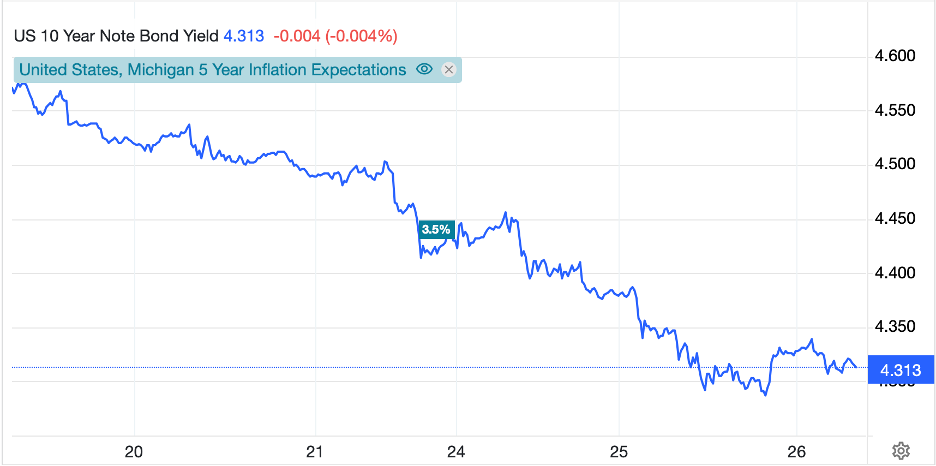
For example, inflation expectations continue to rise, at least as per the University of Michigan surveys, with last week’s result coming in at 4.3% for one year and 3.5% for 5 years.  And yet, Treasury yields continue to fall in the back end of the curve, with 10-year Treasury yields lower by nearly 15bps since that report was released on Friday.  So, which is it?  Is the data a better reflection of things?  Or is market pricing foretelling the future?

Source: tradingeconomics.com

At the same time, the Fed funds futures market is now pricing in 55bps of cuts this year, up from just 29bps a few weeks ago.  Is this reflective of concerns over economic growth?  And how does this jibe with the rising inflation expectations?  

Source: cmegroup.com

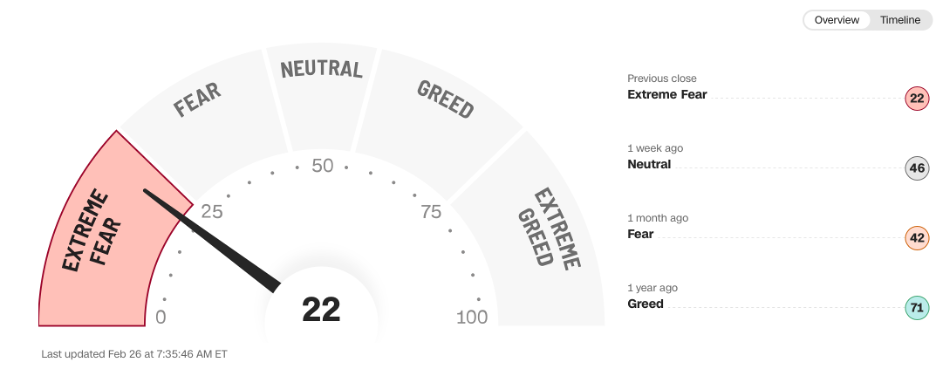
If risk is a concern, why is the price of gold declining?  

Source: cnn.com

My point is right now, at least, many of the relationships that markets and investors have relied upon in the past seem to be broken.  They could revert to form, or perhaps this is a new paradigm.  In fact, that is the point, there is no clear pathway.

Sometimes a better way to view these things is to look at policy actions at the country level as they reflect a government’s major concerns.  I couldn’t help but notice in Bloomberg this morning the story that the Chinese government is going to be injecting at least $55 billion of equity into their large banks.  Now, government capital injections are hardly a sign of a strong industry, regardless of the spin.  This highlights the fact that Chinese banks remain in difficult straits from the ongoing property market woes and so, are clearly not lending to industry in the manner that the government would like to see.  I’m not sure how injecting capital into large banks that lend to SOE’s is helping the consumer in China, which allegedly has been one of their goals, but regardless, actions speak louder than words.  Clearly the Chinese remain concerned over the health of their economy and are doing more things to support it.  As it happens, this helped equity markets there last night with the Hang Seng (+3.3%) ripping higher with mainland shares (+0.9%) following along as well.  Will it last?  Great question.

Another interesting story that seems at odds with what the narrative, or at least quite a few headlines, proclaimed, is that the US and Ukraine have reached a deal for the US to have access to Ukrainian rare earth minerals once the fighting stops.  The terms of this deal are unclear, but despite President Zelensky’s constant protests that he will not partake in peace talks, it appears that this is one of the steps necessary for the US to let him into the conversation.  Now, is peace a benefit for the markets?  Arguably, it is beneficial for lowering inflation as the one thing we know about war is it is inflationary.  If peace is coming soon, how much will that help the Eurozone economy, which remains in the doldrums, and the euro?  Will it lower energy prices as sanctions on Russian oil and gas disappear?  Or will keeping the peace become a huge expense for Europe and not allow them to focus on their domestic issues?

Again, my point is that there are far more things happening that add little clarity to market narratives, and in some cases, result in price action that is not consistent with previous relationships.  With this I return to my preaching that the only thing we can truly anticipate is increased volatility across markets.

With that in mind, let’s consider what happened overnight.  First, US markets had another weak session, with the NASDAQ particularly under pressure.  (I half expect the Fed to put forth an emergency rate cut to support the stock market.)  As to Asian markets, that Chinese news was well received almost everywhere except Japan (Nikkei -0.25%) as most other markets gained on the idea that Chinese stimulus would help their economies.  As such, we saw gains virtually across the board in Asia.  Similarly, European bourses are all feeling terrific this morning with the UK (+0.6%) the laggard and virtually every continental exchange higher by more than 1%.  Apparently, the Ukraine/US mineral rights deal has traders and investors bidding up shares for the peace dividend.  Too, US futures are higher at this hour, about 0.5% or so across the board.

As to bond yields, after a sharp decline in Treasury yields over the past two sessions, this morning, the 10-year is higher by 1bp, consolidating that move.  Meanwhile, European sovereign yields are all slipping between -2bps and -4bps as the peace dividend gets priced in there as well.  While European governments may be miffed they have not been part of the peace talks, clearly investors are happy.  Also, JGB yields, which didn’t move overnight, need to be noted as having fallen nearly 10bps in the past week as the narrative of ever tighter BOJ policy starts to slip a bit.  While the yen has held its own, and USDJPY remains just below 150, it appears that for now, the market is taking a respite.

In the commodity markets, oil (-0.25% today, -2.0% yesterday) has convincingly broken below the $70/bbl level as this market clearly expects more Russian oil to freely be available.  OPEC+ had discussed reducing their cuts in H2 this year, but if the price of oil continues to slide, I expect that will be changed as well.  Certainly, declining oil prices will be a driver for lower inflation, arguably one of the reasons that Treasury yields are falling.  So, some things still make some sense.  As to the metals markets, gold (-0.2%) still has a hangover from yesterday’s sharp sell-off, although there have been myriad reasons put forth for that movement.  Less global risk with Ukraine peace or falling inflation on the back of oil prices or suddenly less concern over the status of the gold in Ft Knox, pick your poison.  Silver is little changed this morning but copper, which had been following gold closely, has jumped 2.7% this morning after President Trump turned his attention to the red metal for tariff treatment.

Finally, the dollar is firmer this morning, recouping most of yesterday’s losses.  G10 currencies are lower by between -0.1% (GBP) and -0.5% (AUD) with the entire bloc under pressure.  In the EMG space, only CLP (+0.45%) is managing any strength based on its tight correlation to the copper price.  But otherwise, most of these currencies have slipped in the -0.1% to -0.3% range.

On the data front, New Home Sales (exp 680K) is the only hard data although we do see the EIA oil inventory numbers with a small build expected.  Richmond Fed president Barkin speaks again, but as we have seen lately, the Fed’s comments have ceased to be market moving.  President Trump’s policy announcements are clearly the primary market mover these days.

Quite frankly, it is very difficult to observe the ongoing situation and have a strong market view in either direction.  There are too many variables or perhaps, as Donald Rumsfeld once explained, too many unknown unknowns.  Who can say what Trump’s next target will be and how that will impact any particular market.  In fact, this points back to my strong support for consistent hedging programs to help reduce volatility in one’s financial reporting.

Good luck

Adf

Hard to Kill

Inflation just won’t go away
As evidenced by the UK
This year started out
Removing all doubt
The Old Lady’s work’s gone astray
 
And elsewhere, the problem is still
Inflation is quite hard to kill
Though central banks want
More rate cuts to flaunt
Those goals are quite hard to fulfill


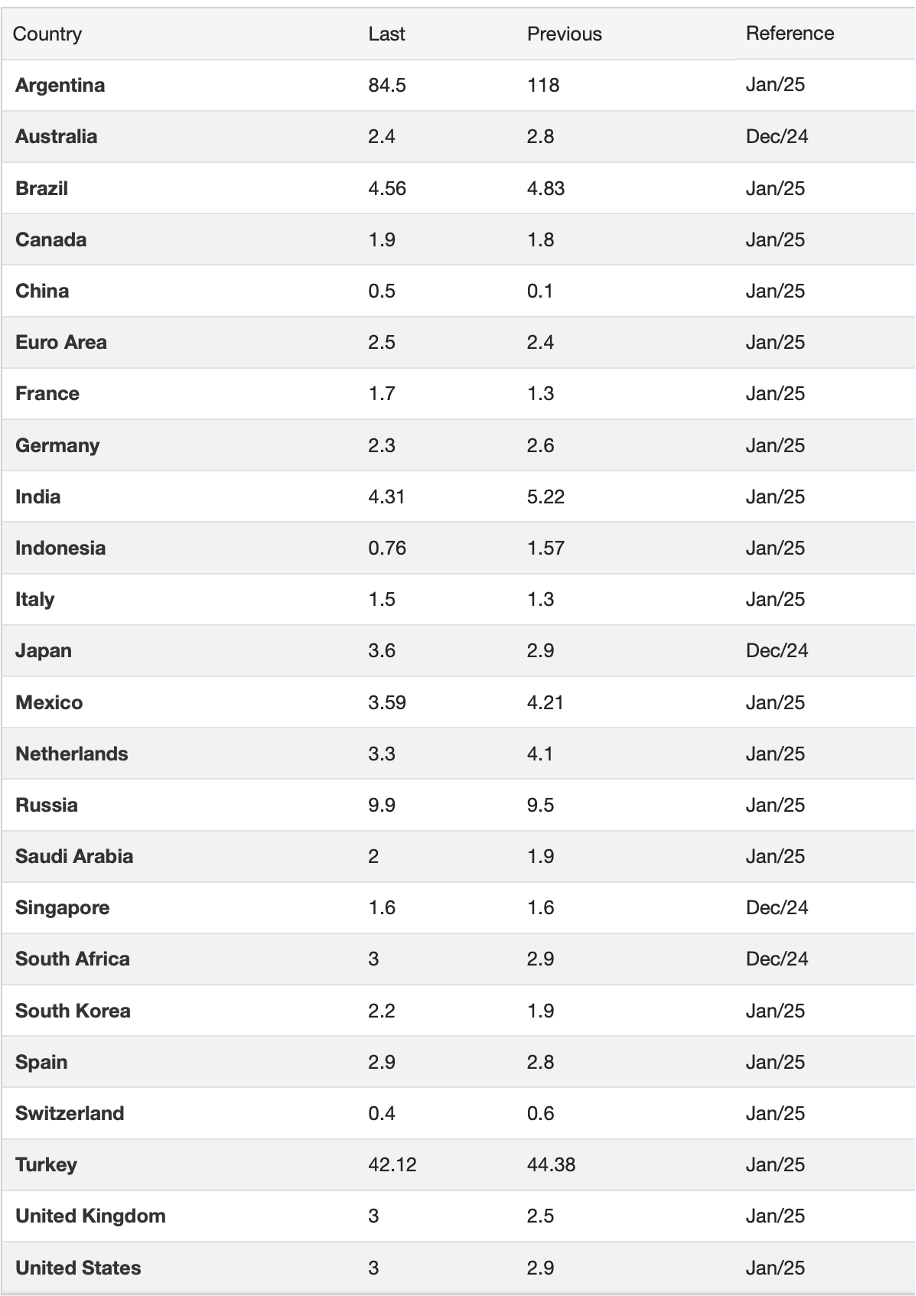
While most eyes remain on President Trump with his ongoing efforts to reduce the size of the US government, as well as his tariff discussions and efforts to negotiate a lasting peace in Ukraine, we cannot ignore the other things that go on around the world.  One of the big issues, which has almost universally been acclaimed a problem, is that inflation is higher than most of the world had become accustomed to pre-Covid.  As well, the virtual universal central bank goal remains the local inflation rate, however calculated, to be at 2.0%.  Alas for the central bankers in their seats today, that remains quite a difficult reach.  A quick look at the most recent headline CPI readings across the G20 shows that only 5 nations (counting the Eurozone as a bloc since they have only one monetary policy) are at or below that magic level as per the below table.

Source: tradingeconomics.com

Of those nations who are below, two, China and Switzerland, are actually quite concerned about the lack of price pressure and seeking to raise the inflation rate, and the other three (Canada, Singapore and Saudi Arabia) are right on the number, with core inflation readings tending higher than the headline reported here.

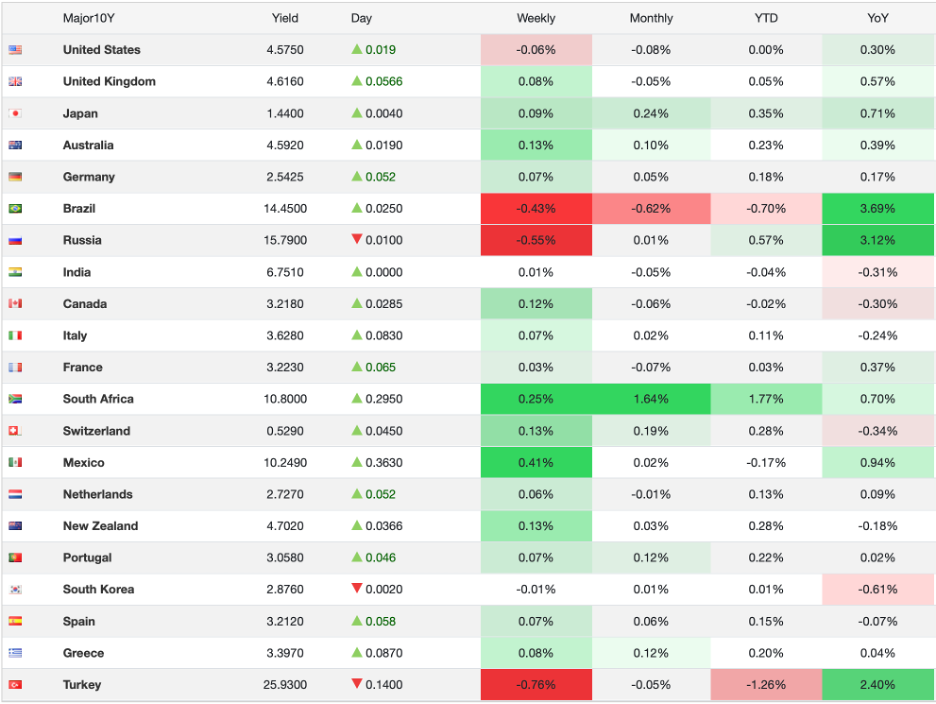
Perhaps a better way to highlight the problem is to look at the 10-year bonds of most countries and see how they have been behaving of late as an indication of whether investors are comfortable with the inflation fighting efforts by each nation.  While it is not universal, you can look at the column on the far right of the below table and see that 10-year yields have been rising for the past year.

Source: tradingeconomics.com

I only bring this up because, despite the fact that I have been downplaying central bank, especially the Fed’s, impact on markets, ultimately, every nation tasks their central bank to manage inflation.  That seems reasonable since inflation, as Milton Friedman explained to us in 1963, is “always and everywhere a monetary phenomenon.”  But perhaps you don’t believe that and are schooled in the idea that faster growth leads to higher wages and therefore higher inflation.  Certainly, Paul Samuelson’s iconic textbook (as an aside, Dr Samuelson was my Economics 101 professor in college) made clear that was the pathway.  Alas, as my good friend, @inflation_guy Mike Ashton, wrote yesterday, there is no evidence that is the case.  Read the article, it is well worth it and can help you start looking elsewhere for causes of inflation, like perhaps the growth in the money supply!

Of course, the reason that we continue to come back to inflation in our discussions is because it is critical to the outcomes in financial markets.  And that is our true focus.  It is the reason there is so much discussion regarding President Trump’s mooted tariffs and how inflationary they will be.  It is the reason that parties out of power continue to highlight any prices that have risen substantially in an effort to disparage the parties in power.  And it is the reason that central banks remain central to the plot of all financial markets, at least based on the current configuration of the global economy.  If there was only one financial lesson from the pandemic response, it is that Magical Money Tree Modern Monetary Theory is a failed concept of how to run policy.  This poet’s fervent hope is that Treasury Secretary Bessent is smart enough to understand that and will address fiscal issues in other manners.  I believe that to be the case.

Back to the UK, where CPI printed at 3.0%, 2 ticks higher than the median forecast, while core CPI printed at 3.7%.  This cannot be comforting for the BOE as most of the MPC remain committed to helping PM Starmer’s government find growth somehow and are keen to cut rates in support.  The problem they have is that inflation will not fade despite extremely lackluster GDP growth.  Recall, last week, even though the Q/Q GDP print of 0.1% beat forecasts, it was still just 0.1%.  Not falling into recession hardly seems a resounding victory for policy in the UK, especially since stagnation, or is it now stagflation, is the end result.  It should be no surprise that market participants have sold off the pound (-0.3%), Gilts (+5bps) and UK equities (-0.4%) and it is hard to find a positive way to spin any of this.  Again, while I have adjusted my views on Japan, the UK falls squarely in the camp of in trouble and likely to see a weaker currency.

Ok, let’s look elsewhere to see how things behaved overnight.  After a very modest rise in US equity indices yesterday, the Asian markets were mixed with the Nikkei (-0.3%) and Hang Seng (-0.15%) slacking off a bit although the CSI 300 (+0.7%) managed to find buyers after President Xi met with business leaders and the expectation is for further government stimulus, as well as a reduction in regulations, to help support the economy.  Australia (-0.7%) is still under pressure despite yesterday’s RBA rate cut as the post-meeting statement was quite hawkish, indicating caution is their approach for now given still sticky inflation.  (Where have we heard that before?)

In Europe, the only color on the screen is red with declines of between -0.4% and -0.9% as investors seem to be taking some profits after a solid run in most of these markets.  I guess the fact that European governments have been shown to be powerless in the world has not helped investor sentiment either as it appears these nations may be subject to more outside forces than they will be able to address adequately.  Lastly, US futures are unchanged at this hour (7:40).

In the bond market, as per the table above, yields are higher across the board with Treasuries (+2bps) the best performer as virtually all European sovereign issues have seen yields rise between 5bps and 7bps.  It simply appears that confidence in the Eurozone is slipping and demand for Eurozone assets is falling alongside that.

In the commodity markets, it should be no surprise that gold (+0.1%) continues to edge higher.  The barbarous relic continues to find price support despite the fact that interest in gold, at least in Western economies, remains lackluster at best.  There is much discussion now about an audit of the US’s gold reserves at Fort Knox and in the NY Fed, something that has not been performed since 1953.  Not surprisingly, there are rumors that there is much less gold in storage than officially claimed (a little over 8 tons) and rumors that there is much more which has not been reported but was obtained via seizures throughout history.  This story has legs as despite the lack of institutional interest in the US, it is picking up a retail following and we are seeing the punditry increasingly raise their price forecasts for the coming years.  As to oil (+0.8%) it is higher again this morning but remains in a tight trading range with market technicians looking at the $70/bbl level as a key support to hold.  A break there could well see a quick $5/bbl decline.

Finally, the dollar is modestly firmer this morning against most of its counterparts with most G10 currencies showing declines similar to the pound’s -0.2%, although the yen (+0.15%) is bucking that trend.  However, versus its EMG counterparts, the dollar is having a much better day, rising vs. PLN (-0.9%), ZAR (-0.7%) and BRL (-0.5%) on various idiosyncratic stories.  The zloty seems to be suffering from its proximity to Ukraine and the uncertainty with the future regarding a potential peace effort.  The rand is falling after the FinMin delayed the budget speech as internal squabbling in the governing coalition seems to be preventing a coherent message while the real is under pressure as inflation remains above target and the central bank’s tighter policy has been negatively impacting growth in the economy.

On the data front, this morning brings Housing Starts (exp 1.4M) and Building Permits (1.46M) and then this afternoon we see the FOMC Minutes from the January meeting.  That will be intensely parsed for a better understanding of what the committee is thinking.  We do hear from Governor Jefferson after the market closes, but generally, the cautious stance remains the most popular commentary.

Has anything really changed?  The market remains uncertain over Trump’s moves, the Fed remains on hold and cautious, and data shows that the economy continues to tick along nicely with price pressures unwilling to dissipate.  I see no reason to abandon the dollar at this point.

Good luck

Adf

Having a Fit

Seems Europe is having a fit
‘Cause Putin and Trump may submit
A plan for the peace
Where there’s an increase
In spending the Euros commit
 
Remarkably, though peace would seem
The basis of many a dream
Seems many despise
The fact that these guys
Don’t care Europe can’t stand this scheme


Here’s the thing about President Trump, you never know what he is going to do and how it is going to impact market behavior.  A case in point is the growing momentum for further peace negotiations between the US and Russia, with Ukraine basically going to be told how things are going to wind up.  On the one hand, you can understand Ukraine’s discomfort as they don’t feel like they are getting much say in the matter.  On the other hand, it seemed increasingly clear that the end game, if there is no US intervention of this nature, would be for Russia to bleed Ukraine of its fighting age population while systematically destroying its infrastructure.

The thing I find most remarkable is the number of pundits who hate this outcome despite the end result of the cessation of the fighting and destruction.  After three years of conflict, and with other nations willing to allow Ukrainians to die on the front lines while they preened about saving democracy, there was no serious push to find a solution.  I have no strong opinion on the terms that have been floated thus far, and I don’t believe rewarding a nation for aggressive action is the best outcome, but Russia has proven throughout history that they are willing to sacrifice millions of their own citizens in warfare, and the case for a Ukrainian victory seemed remote at best.  As experienced traders well understand, sometimes you have to cut your position so you can focus on something else.  Seems like a good time to cut the positions here.

Speaking of positions, let us consider what peace in Europe may mean for financial markets.  Yesterday I discussed how European NatGas prices have more than doubled since the war began.  If they return to their pre-war levels, that dramatically enhances Europe’s economic prospects, despite their ongoing climate policies.  Clearly, the FX market got that memo as the euro has rallied back to its highest level since December 2024 save for a one-day spike just after Trump’s inauguration.  In fact, it is not hard to look at the chart below and see a bottom forming in the single currency.  While the moving average I have included is only a short-term, 5-day version, you have to start somewhere.  While the fundamentals still seem to point to further downside in the single currency, between the Fed’s pause and more hawkish stance opposite the ECB’s ongoing policy ease, the medium-term picture could be far better for the Europeans.  If the war truly does end, it would likely see a significant uptick in investment and economic activity as they seek to rebuild Ukraine, and we could see substantial capital flows into the European economies.

Source: tradingeconomics.com

As well, oil prices, continue to trade near the bottom of their recent trading range as the working assumption seems to be that with a peace treaty, Russian oil would no longer be sanctioned, enhancing global supplies.  A look at the trend line in the chart below seems to indicate that is the direction of the future.

Source: tradingeconomics.com

The other remarkable thing is the decline in yields, where yesterday, despite a very hot PPI number, which followed Wednesday’s hot CPI number, Treasury yields fell back 7bps.  While there are likely some other aspects to this move, notably the ongoing story regarding DOGE and the attack on waste and fraud in the US, yesterday’s move was not indicative of fear, rather I read it as a positive sign that investors are betting on a chance that President Trump can be successful with respect to reducing the massive overspending by the government.  Clearly, this is early days regarding President Trump’s ability to get a handle on spending, and it could all blow up as legislative compromises may significantly water down any benefits, but I contend the market is showing hope right now, not fear.

And that, I would contend, is the big underlying driver of markets right now.  The prospects for peace and the potential impacts are the focus.  While tariffs are still a big deal, and yesterday’s talk about reciprocal tariffs is simply the latest in a long line of these discussions and pronouncements, the market seems to be getting tired of that conversation.  If we recap the current situation, central bank activities have lost their importance amid a huge uptick in governmental actions, both fiscal and geopolitical.  In many ways, I think this is great, the less central bank, the better.

Ok, let’s see how markets continue to absorb these daily haymakers from President Trump and the responses from other governments.  Clearly, the US equity market remains far more fixated on Trump’s actions than on higher inflation potentially forcing the Fed to raise rates.  In fact, despite the hot PPI print, the futures market has actually increased its expectation for rate cuts this year to 35bps.  That doesn’t make sense to me, but I’m just an FX poet. 

If we turn to Asian markets, Hong Kong (+3.7%) was the big winner overnight as a combination of growing expectations for more Chinese government stimulus to be announced soon, along with the ongoing tech positivity in the wake of the DeepSeek announcement got investors excited.  On the mainland, shares (CSI 300 +0.9%) were also higher, but not as frothy.  Meanwhile, the weaker dollar hindered the Nikkei (-0.8%) as the yen has gained 1.3% since the CPI data on Wednesday.  In Europe, the picture is mixed with the CAC (+0.4%) the best performer and the DAX (-0.4%) the worst performer.  Eurozone GDP surprised on the upside in Q4, growing…0.1%!! Talk about an explosive economy.  However, that was better than forecast and helped avoid a recession.  The interesting thing about European equity markets, though, is that despite a dismal economic backdrop, most major markets are trading at or near all-time highs.  Further proof that the market is not the economy.  As to US futures, ahead of this morning’s Retail Sales data, they are flat.

After several days of substantial movement in the bond market, it seems that traders have taken a long weekend given the virtual absence of movement here.  Treasury yields are unchanged on the day and European sovereign yields are higher by 1bp.  

In the commodity markets, on the day, oil prices are unchanged, although as per the above chart, it appears the trend is lower.  US NatGas (+1.8%) is rallying on forecasts for another cold spell, but European NatGas (-4.85%) continues to fall as prospects for peace indicate new supplies, or perhaps, renewed supplies.  In the metals markets, gold (+0.15%) is continuing its positive momentum but the big mover today is silver (+2.7%) which seems to be responding to some large option expirations in the SLV ETF (h/t Alyosha) which seem set to drive substantial demand for delivery.  

Finally, the dollar remains under pressure overall, although the movement has generally not been that large today.  The big outlier in the G10 is NZD (+0.9%) which has responded to the delay in the reciprocal tariff implementation until April.  Elsewhere in this bloc, gains are universal, but modest with movement between just 0.1% and 0.2%.  In the EMG bloc, the dollar is also under pressure with ZAR (+0.65%) a major gainer as precious metals continue to be in demand.  CLP (+1.15%) is also continuing to benefit from copper’s ongoing rally.  The exception to this movement has been Asia where most regional currencies are modestly softer this morning, KRW, TWD, INR, as the tariff talks still seem to be the driving force in these markets.

On the data front, we finish the week with Retail Sales (exp -0.1%, +0.3% ex autos), then IP (0.3%) and Capacity Utilization (77.7%).  Yesterday’s PPI data was several ticks hotter than forecast and seems to put paid to the idea that inflation is heading back to the Fed’s target.  This afternoon we hear from Dallas Fed president Lorrie Logan, but again, it is hard to make the case that the Fed is the driver of anything right now.

Fundamentals still point to dollar strength, I would argue, but the market is not paying attention. Rather peace and the peace dividend are now the driver in the FX markets and to me, that implies we are set to see the dollar give back some of its gains from the past 6 months.

Good luck and good weekend

Adf

Missiles are Flying

Apparently, nerves are on edge
Though pundits, no worries, allege
But missiles are flying
So, traders are buying
Safe havens as they start to hedge
 
So, it cannot be that surprising
The dollar and gold keep on rising
While sales are quite brisk
For assets with risk
Like stocks with investors downsizing


While some of you may be concerned over the news that Russia has launched an intercontinental ballistic missile in an its latest attack on Ukraine (as an aside, since both Russia and Ukraine are in Europe, was it really intercontinental?), by focusing on mundane aspects of life and death, you may have missed the truly important news release from yesterday afternoon, Nvidia’s guidance was disappointing and its stock price declined!  It is for situations like this that I write this morning missive, to make sure you focus on the important stuff.

All kidding aside, the knock-on effects of the escalation of the fight in Ukraine are likely to be more impactful over time, especially for Europe.  Consider the fact that most of Europe has recently been blanketed by a major winter storm with much colder than normal temperatures, and another one is forecast for the coming days.  As well, part of this weather pattern is weaker than normal wind speeds, so much of the continent is suffering a dunkelflaute again.  The energy implications are significant as both wind and solar power are virtually non-existent which means they are hugely reliant on NatGas to both keep the lights on and keep warm.  

However, Europeans continue their energy suicide and have recently closed one of the only domestic sources of NatGas to satisfy their Green tendencies.  This means they will be buying more LNG and competing more aggressively with Asia for cargoes.  While NatGas prices in the US have risen sharply in the past month, ~46%, they remain far below prices in Europe, less than one-quarter as expensive.  It is exactly this reason that an increasing number of companies in Europe are looking to relocate to areas with less expensive energy, like the US, and why investment in the US continues to outpace investment elsewhere.  Look no further than this to understand a key ingredient of the dollar’s ongoing strength.

Of course, there is another story that is dominating the press, the ongoing Trump cabinet picks and all the prognostications as to what they all mean for the future of US policies.  You literally cannot read a story without someone elsewhere in the world quoted as explaining they are awaiting the inauguration to see how things evolve and so they are postponing any new actions.  This is true for both governments and private companies (although obviously, the Biden administration is taking the opposite tack of trying to do as much as possible before the inauguration, like starting WWIII it seems).  

And that is the world this morning, anxiety over the escalation in Ukraine, disappointment that Nvidia didn’t beat the most optimistic forecast expectations and uncertainty over what President-elect Trump is going to do once he is in office.  It is with this in mind that we look at markets and see that the best performances are coming from havens and necessities.  On days like this, risk does not seem as appetizing.

Let’s start in the commodity markets this morning, where oil (+2.0%) is responding to both the Russia/Ukraine escalation and the US veto of a UN ceasefire resolution in Gaza with both of these prompting increased concerns of a short-term supply disruption.  While yesterday’s US inventory data showed some builds, for now, fear is the greater factor.  Meanwhile, NatGas (+6.3%) is skyrocketing amid forecasts for colder weather as a polar blast hits both Europe and the West Coast.  While the longer-term implications of a Trump presidency are for energy prices to stabilize or decline on the back of increased supply, that is not yet the case.  Meanwhile, gold (+0.5%) continues its rebound from its recent correction as havens are clearly in demand.  Remember, too, that almost every central bank remains in easing mode as they all convince themselves they have beaten inflation.

However, a look at equity markets shows a less resilient picture, at least from Asia where we saw the Nikkei (-0.85%) slip after that Nvidia result and the Hang Seng (-0.5%) also feel that pain.  Remember, these indices are very tech focused and Nvidia remains the tech bellwether.  While mainland Chinese shares were little changed, there was weakness in India, Taiwan, Malaysia and Indonesia, as a taste of how things behaved overnight.  Europe, though, is managing to shake off some of its concerns and most markets have edged higher, between 0.2% and 0.4% although the CAC (-0.15%) is lagging.  The latter is somewhat ironic given that French Business Confidence rose more than expected to 97, although that is merely back toward the long-term average of that series.  Arguably, the European move is on the back of US futures, which had been lower all evening but at this hour (7:30) are now all in the green by at least 0.2%.

However, under the heading havens are in demand, bond yields are backing off a bit with Treasury yields lower by -2bps and most European sovereigns lower by between -1bp and -3bps.  The tension in this market remains between recent declines in some inflation readings and growing concerns over the potential inflationary policies that President Trump will enact when he gets into office.  Nothing has changed my view that inflation is not dead and that a grind higher in yields seems the most likely outcome.

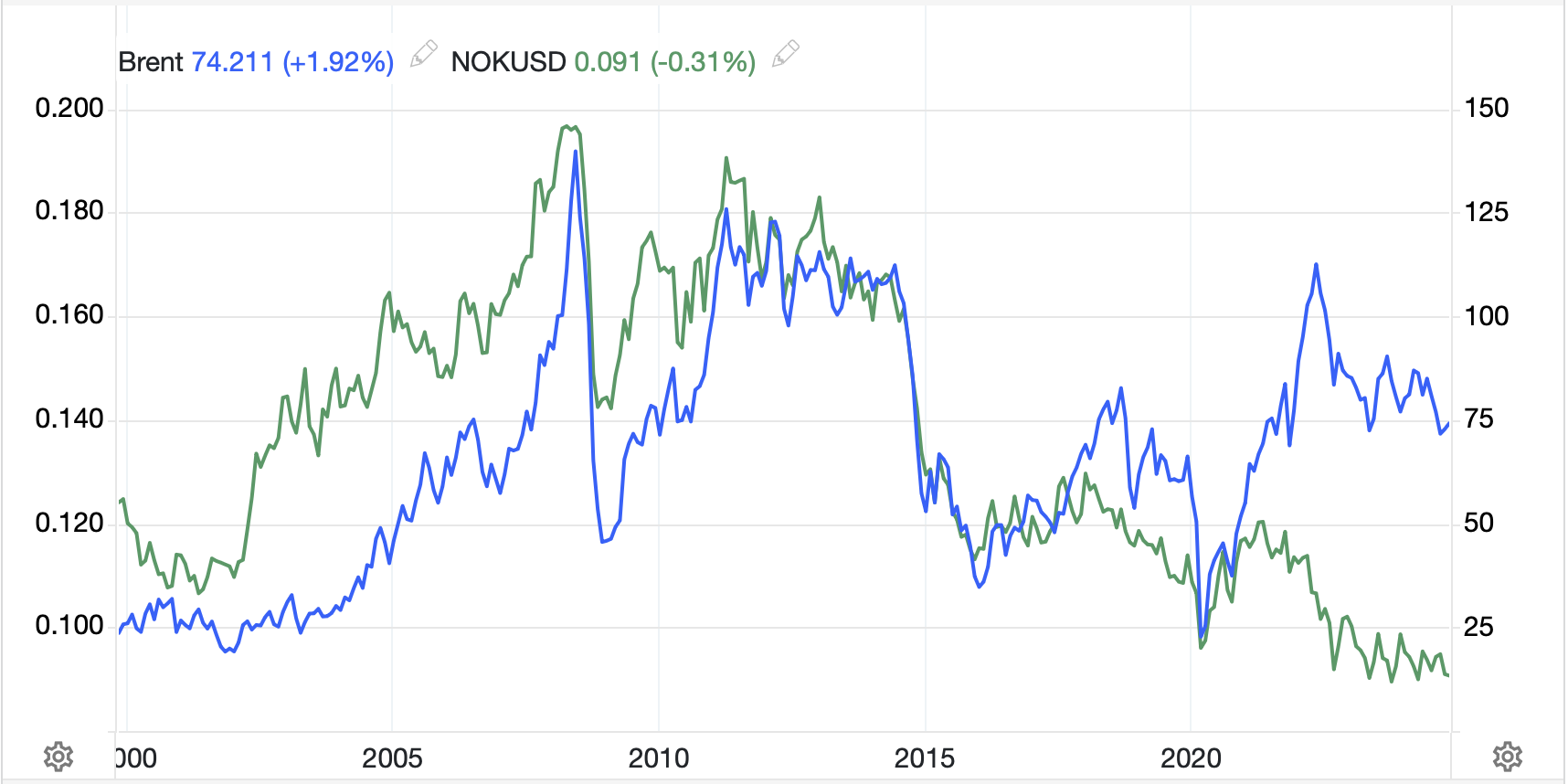
Finally, the dollar continues to find support versus almost all its counterparts, although this morning the yen (+0.5%) is demonstrating its own haven characteristics.  But broadly, the DXY is higher by 0.1% with the euro creeping ever closer to 1.0500 and the pound to 1.2600.  As well, NOK (+0.3%) is benefitting from the oil’s rise. This latter relationship, which makes perfect economic sense given the importance of oil to Norway’s economy, has been quite strong for a long time as can be seen in the chart below.  While daily wiggles may be different, the only true disruption was the start of the Ukraine war where oil jumped massively, and NOK did not follow along given its proximity to the war.  But otherwise, it’s pretty clear.

Source: tradingeconomics.com (NOKUSD is the inverse of what you typically see)

As to the emerging markets, we are seeing weakness in LATAM (BRL -0.8%, MXN -0.5%) as well as EEMEA (PLN -0.3%, CZK -0.5%, HUF -0.5%) although ZAR (+0.2%) seems to be benefitting from the ongoing rise in gold.  Asian currencies were much less impacted overnight and have not moved much at all.

On the data front, this morning brings the weekly Initial (exp 220K) and Continuing (1870K) Claims data as well as Philly Fed (8.0) and then at 10:00 Existing Home Sales (3.93M) and Leading Indicators (-0.3%).  Chicago Fed president Goolsbee speaks this afternoon, but again, it would be quite a surprise if he veers away from Powell’s comments last week.  This morning, the Fed funds futures are pricing a 55.7% probability of that December rate cut, and today’s data seems unlikely to change that.  Next week’s PCE data will be far more important.

It is interesting to see the equity market rebound but there is a huge amount of belief that Mr Trump is going to fix everything.  While I hope his policies improve the situation, and there is much to improve, it will take time before we see any truly positive impacts I believe.  I understand that markets are forward looking, but clarity remains elusive at this time.  The one thing that remains clear to me, though, is the demand for dollars is likely to continue for a while yet.

Good luck

Adf

Whining and Bleating

In Rio, the G20’s meeting
With typical whining and bleating
No progress was made
On tariffs or trade
And Trump, though not there, took a beating
 
Seems leaders in most of these nations
Are fearful of future relations
With Trump and the States
Which just demonstrates
How low are their own expectations


I guess the idea of these broad talking shops is rooted in a desire to keep open lines of communication between parties with different views on the way things should be in the world.  But, boy, the G20 has really deteriorated over time.  Probably, this is merely a symptom of the underlying changes in international relations.  Remember, the G20 is an outgrowth of the Group of 7 nations (US, Germany, UK, Japan, France, Canada and Italy) and only began in 1999.  The idea was to help develop the globalization initiative by creating an organization that included both developed and developing nations.  It was this group that led to China joining the WTO in 2001 and, ironically, which laid the groundwork for its own slow disintegration.

This is not to say that these leaders are going to stop meeting each year, just that the opportunity for substantive policy proposals has likely passed us by.  And understand, this has been the case for a while now as the Chinese mercantilist policy has seemingly reached the end of its global acceptance.  While President-elect Trump tends to get the most bashing for this, one need look no further than Europe to see tariff and non-tariff barriers rising quickly.  Below, I will allow Bloomberg’s reporters to summarize some of the key issues highlighting the lack of agreement on anything.

  • Germany’s Olaf Scholz and France’s Emmanuel Macron are pushing for tougher language in the summit communique against Hamas and Russia on the wars. Brazil doesn’t want to reopen the text, fearing that it will reignite battles over other issues too. 
  • UK Prime Minister Keir Starmer irritated Chinese officials by raising human rights and the issue of Taiwan with President Xi Jinping at their first bilateral meeting.
  • The potential impact of Donald Trump’s impending return to the White House on trade and diplomatic relations hung over many of the day’s bilaterals. 
  • The rivalry between host Brazil’s Luiz Inacio Lula da Silva and Argentina’s Javier Milei was on full display on everything from the role of the state in fighting poverty to climate change, with the latter leader maintaining his contrarian stance to some of the key points in the summit’s statement.
  • There was even drama around the traditional family photo, which US President Joe Biden, Canada’s Justin Trudeau and Italian Prime Minister Giorgia Meloni somehow missed.

As I said, I expect that these meetings will continue but their usefulness is very likely to continue to deteriorate.  One way you know that this process has reached the end of the road is that no financial markets have reacted to any commentary from anyone at the meeting.  In the past, the G20 statement or comments from leaders on the sidelines would move markets as they implied policy shifts.  No longer.  Remember, too, that at least four of these leaders are lame ducks (Biden, Macron, Scholz and Trudeau) and will be out of office within a year.

Away from the photos and sun
Investors see fear and not fun
Ukraine’s getting hotter
Midst greater manslaughter
While pundits, new stories, have spun

However, if we step away from the glitz (?) of the G20 meeting, markets are demonstrating a fearful tone this morning.  Yesterday saw US equities with a mixed session as investors continue to try to determine the impacts of President Trump’s return.  Will there be tariffs?  If so, how big and on what products?  And which companies will benefit or be hurt by the process.  Generally speaking, the thought has been small-cap companies would be the big beneficiaries while both Big Pharma and Big Food would feel pressure from this new administration.  But how has that impacted other nations and other markets?

In truth, I have a feeling one of the key issues this morning is that President Biden’s change in policy to allow Ukraine to fire long-range missiles into Russia is now a growing concern.  Russia has altered their nuclear response policy, essentially threatening that if this keeps up, they will both blame the US and NATO and respond with nuclear weapons if they determine that is appropriate.  Funnily enough, investors, especially those in Europe, have determined that may not be a positive outcome for European companies.  Hence, bourses across the continent are all lower this morning with declines greater than -1.1% everywhere with Poland (-2.1%) the laggard.  As to Asian markets overnight, they were broadly firmer as the potential escalation in Europe is likely to have a smaller impact there.  But US futures are under pressure this morning, -0.4% across the board at this hour (6:30).

That risk off feeling is being felt in bond markets as well, with yields falling everywhere as investors switch from stocks to bonds.  Treasury yields have fallen -6bps and we are seeing similar declines, between -4bps and -6bps, across the continent as well.  Fear is palpable this morning here.

This fear is clear in the commodity markets as well where oil (-1.0% after a 3.3% rally yesterday) is softer along with copper (-0.7%) but precious metals (Au +0.8%, Ag +0.5%) are both in demand.  The one other noteworthy move this morning is NatGas (+0.6%), bucking the oil trend as despite the oft-feared global boiling (to use UN Secretary General Antonio Guterres term), Europe is feeling an unseasonable cold spell with rain and temperatures just 40° Fahrenheit, some 15° below normal.

Finally, the dollar is back on top this morning as fear has driven investors and savers to holding the greenback despite all its problems.  Using the Dollar Index (DXY) as our proxy, you can see from the below chart that despite all the huffing and puffing that the post-election climb of the dollar had ended last Thursday, in fact, we have only seen a very modest correction of the sharp election move and my take is we have higher to go from here.

Source: tradingeconomics.com

Adding to the risk-off thesis is the fact the JPY (+0.4%) is firmer and CHF (0.0%) has not declined with both of those traditional havens holding up well.  One other note is AUD (-0.2%) is one of the better performers after the RBA Minutes last night indicated that the central bank Down Under is also in no hurry to cut rates with fears of inflation still percolating there.  A quick look across the EMG bloc shows us that virtually all these currencies are softer with PLN (-0.8%) and ZAR (-0.65%) the laggards.  I guess given the concerns over Poland and a potential escalation of the war in Ukraine, it is no surprise the zloty is under pressure.

On the data front, this morning brings Housing Starts (exp 1.33M) and Building Permits (1.43M) as well as Canadian inflation (1.9% headline, 2.4% Median).  There are no Fed speakers scheduled today and quite frankly; it doesn’t strike me that Housing data is critical to decision making right now.  Fear is in the air and that is likely to continue to drive markets.  With that in mind, a deeper equity correction along with continued USD strength seem like the best bets for the day.

Good luck

Adf

Ne’er Have Nightmares

Said Harker, it’s likely one cut
Is all that we’ll need this year, but
Depending on data
My current schemata
Might wind up by changing somewhat
 
However, in truth no one cares
‘Bout Harker and views that he shares
As long as, stocks, tech
Don’t suddenly wreck
Investors will ne’er have nightmares


“If all of it happens to be as forecasted, I think one rate cut would be appropriate by year’s end.  Indeed, I see two cuts, or none, for this year as quite possible if the data break one way or another.  So, again, we will remain data dependent.”  These sage words from Philadelphia Fed president Patrick Harker are exactly in line with the message from Chairman Powell last week, as well as the dot plot release.  In other words, there was nothing new disclosed.  Now, today, we will hear from six more Fed speakers (Barkin, Collins, Kugler, Logan, Musalem, and Goolsbee) and I will wager that none of them will offer a substantially different take.  

At this point, market participants seem to feel quite confident they understand the Fed’s current reaction function and so will respond to data that they believe will drive different Fed actions than those defined by Harker above.  But if the trend of data remains stable, the Fed will not be the driving force in the market going forward.

In fact, there appears to be just one thing (or maybe two) that matters to every market, the share prices of Nvidia and Apple.  As long as they continue to rise, everything will be alright.  At least that’s what a growing share of investors and analysts have come to believe.  Alas, this poet has been in the market far too long to accept this gospel as truth.  I assure you there are other issues extant; they are simply hidden by the current Nvidia-led zeitgeist.

For example, Europe remains on tenterhooks for several reasons, only one of which is likely to be settled very quickly, the upcoming French election.  But remember, there is still a war in Ukraine and NATO and European nations have just upped the ante by allowing their weapons to be used to attack into Russia in addition to supplying F-14 fighter jets as part of the package.  In an almost unbelievable outcome so far, while Russian piped natural gas to Europe has fallen to essentially nil, Russia has become Europe’s largest supplier of LNG, surpassing cargoes from both the US and UAE.  I’m not sure I understand the idea behind sanctioning Russian oil and buying their gas, but then I am not a European politician, so perhaps there are nuances that escape me.  But the point is that Russia can cut that off as well, and once again disrupt the already weak Eurozone economy.

At the same time, Germany, still the largest economy in Europe, remains in economic purgatory as evidenced by today’s ZEW data (Sentiment 47.5, exp 50.0; Current Conditions -73.8, exp -65) as well as the fact that Germany’s largest union, IG Metall, is now demanding a 7% wage increase for this year, far above the inflation rate and exactly the sort of thing that, if agreed, will delay further rate cuts by the ECB.  Productivity growth throughout Europe remains lackluster and combining that with the structurally high cost of energy due to European energy policies like Germany’s Energiewend, is certain to keep the continent and its finances under pressure.  Right now, equity markets in Europe are following US markets higher, but they lack a champion like Nvidia or Apple, and are likely to be subject to a few hiccups going forward.

Or perhaps we can gaze eastward to China, where economic activity remains lackluster, at best as evidenced by the slowdown in Fixed Asset Investment and IP, as well as by the fact that the PBOC continues to try to create support for the still declining property sector without cutting rates further and inflating a bubble elsewhere.  The onshore renminbi continues to trade at the limit of the 2% band as the PBOC adjusts the currencies level weaker by, literally, one pip a day, and the offshore version is trading 0.25% through the band and has been there for the past month.  The economic pressure for the Chinese to weaken their currency is great, but obviously, the political goal is to maintain stability, hence the incremental movements.

My point is that Nvidia is not the only thing in the world and while its stock price performance has been extraordinary, I would contend it is not emblematic of the current global situation.  Rather, it is an extreme outlier.  Not only that, but when other things break, they will have deleterious impacts on many financial markets, probably including the NASDAQ.  Just sayin’!

However, despite my warnings that things will not always be so bright, so far in this session, they have been.  Overnight, Japanese stocks (+1.0%) followed the US higher as did Australia (+1.0%) and much of Asia other than Hong Kong (-0.1%) which slipped a bit.  Meanwhile, as all sides in the French election try to pivot toward the center to gather votes, European bourses are all in the green as well, somewhere between 0.25% and 0.5%.  As to US futures, at this hour (7:30), they are little changed.

Bond yields have continued to rebound from the lows seen Friday, with Treasury yields edging up another basis point this morning.  However, European sovereigns have seen demand with yields slipping a few bps, perhaps on the idea that growth remains lackluster as evidenced by the ZEW report, or perhaps on the idea that the French election may not be as terrible as first discussed.  Meanwhile, JGB yields edged up 1bp but remain below the 1.00% level despite Ueda-san explaining that a rate hike was on the table for July and that QT and rate hikes were different processes and independent decisions.

In the commodity markets, oil is unchanged this morning but that is after a strong rally yesterday in NY with WTI closing above $80/bbl for the first time since the end of April, as suddenly, the story is oil demand is improving while supply will remain tight on the back of OPEC+ measures.  I’m not sure how that jives with the IEA’s recent comments that there would be a “massive”oil supply glut going forward, (which I find ridiculous), and perhaps market participants have turned to my view.  Metals, though, remain in the doghouse falling yet again across the board.  Something else I don’t understand is how the demand story for metals can be weak while the demand story for oil can be improving given both are critical to economic activity.  

Finally, the dollar continues to find support, despite its oft-expected demise, as it gains vs. virtually all of its counterparts both G10 and EMG.  The biggest laggards this morning are NZD (-0.6%) and NOK (-0.4%) in the G10 while we have seen weakness in the CE4 (HUF -0.5%, CZK -0.55%, PLN -0.5%) as well as most Asian currencies.  The outliers here are ZAR (+0.5%) which continues to benefit from the re-election of President Ramaphosa and his coalition with centrist parties, and MXN (+0.4%) which seems to be finding a floor after its extraordinary decline in the wake of the election there two weeks ago.

On the data front, this morning we see Retail Sales (exp 0.2%, 0.2% ex autos), IP (0.3%) and Capacity Utilization (78.6%) in addition to all those Fed speakers.  While Retail Sales can be impactful, it would need to be extraordinary, in my view, to alter the current Fed viewpoint of wait for lots more data.  

My take is it will be a quiet session today, and likely for the rest of the week, as the next important data point is not until PCE on June 28th.  Til then, trading ranges seem the most likely outcome, although if I had to choose a side, I would be looking for the dollar to continue to grind higher.

Good luck

Adf

Ready to Pop

Investors are having some trouble
Determining if the stock bubble
Is ready to pop
Or if Jay will prop
It up, ere it all turns to rubble

So, volatile markets are here
Most likely the rest of this year
Then, add to this fact
A Russian attack
On Ukraine.  I’d forecast more fear

One has to be impressed with yesterday’s equity markets in the US, where the morning appeared to be Armageddon, while the afternoon evolved into euphoria.  Did anything actually change with respect to information during the day?  I would argue, no, there was nothing new of note.  The proximate cause of the stock market’s decline appeared to be fear over escalating tensions in the Ukraine.  Certainly, that has not changed.  Russia continues to mass troops on its border and is proceeding with live fire drills off the coast of Ireland.  The Pentagon issued an order for troops to be ready for rapid deployment, which Russia claimed was fanning the flames of this issue.  While the key protagonists continue to talk, as of yet, there has been no indication that a negotiated solution is imminent.  With that in mind, though, today’s market reactions indicate somewhat less concern over a kinetic war.  European equity markets are all nicely higher (DAX +0.6%, CAC +0.8%, FTSE 100 +0.75%) and NatGas in Europe (-2.4%) has retraced a bit of yesterday’s surge.  Granted, these reversals are only a fraction of yesterday’s movement, but at least markets are calmer this morning.

However, one day of calm is not nearly enough to claim that the worst is behind us.  And, of course, none of this even considers the FOMC meeting which begins this morning and from which we will learn the Fed’s latest views tomorrow afternoon.  The punditry is virtually unanimous in their view that the first Fed funds hike will come in March and there will be one each quarter thereafter.  In fact, if there are any outliers, they expect a faster pace of rate hikes with five or more this year as the Fed makes a more concerted effort to temper rising prices.

Now, we have not heard from a Fed speaker since January 13th, nearly two weeks ago, although at that time there was a growing consensus that tighter policy needed to come sooner and via both rate hikes and balance sheet reduction.  But let’s take a look at the data we have seen since then.  Retail Sales were awful, -1.9%; IP -0.1% and Capacity Utilization (76.5%) both disappointed as did the Michigan Sentiment indicator at 68.8, its lowest print since 2011.  While the housing market continues to perform well, Claims data was much higher than anticipated and the Chicago Fed Activity Index fell sharply to -0.15, where any negative reading is seen as a harbinger of future economic weakness.  Finally, the Atlanta Fed’s GDPNow indicator has fallen to 5.14%, down from nearly 10% in December.  The point is, the data story is not one of unadulterated growth, but rather of an economy that is struggling somewhat.  It is this issue that informs my decision that the Fed is likely to sound far more dovish than market expectations tomorrow,  The policy error that has been discussed by the punditry is the Fed tightening policy into an economic slowdown and exacerbating the situation.  I think they are keenly aware of this and will move far more slowly to tackle inflation, especially given their underlying view that inflation is going to return to its previous trend on its own once supply chains are rebuilt.

For now, barring live fire in Ukraine, it seems the market is quite likely to remain rangebound until we hear from Mr Powell tomorrow afternoon.  As such, it is reasonable to expect a bit less market volatility than we saw yesterday.  But, do not discount the fact that markets remain highly leveraged in all spaces and that the reduction of high leverage has been a key driver of every market correction in history.  Add that to the fact that a Fed that is tightening policy may push rates to a point where levered accounts are forced to respond, and you have the makings of increased market volatility going forward.  While greed remains a powerful emotion, nothing trumps fear as a driver of market activity.  Yesterday was just an inkling of how things may play out.  Keep that in mind as we go forward.

Touring the markets this morning, while Europe is bouncing from yesterday’s movement as mentioned above, Asia saw no respite with sharp declines across the board (Nikkei -1.7%, Hang Seng -1.7%, Shanghai -2.6%).  US futures, too, are under pressure at this hour with NASDAQ (-1.7%) leading the way, but the other main indices much lower as well.

Looking at bond markets, European sovereigns are all softer with yields backing up as risk is re-embraced (Bunds +2.1bps, OATs +1.4bps, Gilts +4.4bps) as are Treasury markets (+0.7bps), despite the weakness in equity futures.  Bond investors are having a hard time determining if they should respond to ongoing high inflation prints or risk reduction metrics.  In the end, I continue to believe the latter will be the driving force and yields will not rise very high despite rising inflation.  The Fed, and most central banks, are willing to live with rising prices if it means they can stabilize bond yields at relatively low levels.

In the commodity markets, oil (+0.1%), after falling sharply from its recent highs yesterday has rebounded slightly.  NatGas (-1.4%) in the US is also dipping although remains right around $4/mmBTU in the US and $30/mmBTU in Europe.  Gold (-0.25%) and Copper (-0.3%) continue to consolidate as prospects for weaker growth hamper gains of the latter while uncertainty over inflation continue to bedevil the former.

As to the dollar, it is stronger for a second day in a row today, with substantial gains against both G10 (NOK -0.7%, CHF -0.7%, SEK -0.6%) and EMG (PLN -0.75%, RON -0.5%, MXN -0.45%) currencies.  Clearly, the Ukraine situation remains a problem for those countries in proximity to the geography, while Mexico responds to slightly disappointing GDP growth data just released.  But in the end, the dollar remains the haven of choice during this crisis and is likely to remain well bid for now.  However, if, as I suspect, the Fed comes across as less hawkish tomorrow, look for the greenback to give up some of its recent gains.

This morning brings only second tier data; Case Shiller Home Prices (exp 18.0%) and Consumer Confidence (111.1).  So, odds are that the FX market will continue to take its cues from equities, and if the sell-off resumes in stocks, I would expect the dollar to remain firm.  For payables hedgers, consider taking advantage of this strong dollar as I foresee weakness in its future as the year progresses.

Good luck and stay safe
Adf