Trump’s Latest Ire

The Minutes explained that in June
The Fed felt no need to impugn
Their previous view
Of nothing to do
Though two sang an alternate tune


Yesterday’s release of the FOMC Minutes from their June meeting confirmed what we have learned in the interim.  Governors Waller and Bowman have been clear that they see tariffs as a one-off impact on the rate of inflation, and not something on which to base policy.  If you think about it, tariffs are like food and energy, something that cannot be addressed effectively by monetary policy and which the Fed explicitly excludes from their decision-making process.  (For a really good read on the inflationary impact on tariffs, @inflation_guy published this yesterday).  To me, the salient comments from the Minutes are below:

“While a few participants noted that tariffs would lead to a one-time increase in prices and would not affect longer-term inflation expectations, most participants noted the risk that tariffs could have more persistent effects on inflation.”

“Participants agreed that although uncertainty about inflation and the economic outlook had decreased, it remained appropriate to take a careful approach in adjusting monetary policy.” 

In fact, it is not hard to conclude that the Fed’s intransigence on this issue is politically motivated as well since we have already established that the Fed is clearly political (and partisan).  I would estimate part of the reason they do not want to cut rates here is because they don’t want to be seen as caving into President Trump’s demands.  But whatever the reason, even the futures market is reducing the probability of a cut with the July probability having fallen from more than 20% two weeks ago to 6.7% as I type this morning.  We will need to see some seriously weak economic data to get the Fed to move, I believe, although I expect we will see Governors Waller and Bowman dissent at the July 30th meeting.

However, I would contend that the market has already sussed this out and there will be limited impact on any financial markets after the meeting absent a surprise cut.  So, let’s move on.

The target of Trump’s latest ire
Brazil, has now come under fire
The issue’s not trade
Instead, Trump was swayed
By lawfare ‘gainst one he admire(s)

The other news from yesterday (and there has been precious little overnight) was President Trump’s threat of 50% tariffs on all of Brazil’s exports to the US.  Now, the US runs a trade surplus with Brazil of about $10 billion, so clearly trade is not the issue here.  Rather, it seems that Mr Trump is seeking to help is friend, former Brazilian president Joao Bolsonaro, who is also a right-leaning populist and who is on trial for leading an insurrection after he lost the last election.  It is not hard to understand Mr Trump’s concern over the issue given the history in the US and the previous administration’s efforts to imprison Trump himself.  

However, this seems, at least to me, a bit over the top.  Brazil had been slated to get the minimum 10% tariff prior to yesterday’s outburst.  As well, the US is Brazil’s second largest trading partner, so this will have a significant impact on the country if these tariffs are imposed.  As such, it is no surprise that the market responded immediately.  

Source: tradingeconomics.com

As you can see from the chart above, the announcement at 1:30 yesterday afternoon had an immediate impact with the real falling -2.5% with minutes of the news.  Too, the IBOVESPA stock index fell more than -1.3% yesterday with Embraer, the airplane manufacturer down nearly 10%.  Right now, this is a threat, and the immediate Brazilian response was to say they would not be cowed by this action and will continue with their internal legal activities.  There is no way I will opine on how this will end, but if these tariffs are put in place, it will be a distinct negative for Brazil’s economy, and I would expect that the real could quickly head back toward 6.00 from its current levels.

Away from those two stories, though, issues impacting financial markets are sparse.  With that in mind, let’s see how markets behaved overnight.  Yesterday’s US equity rally was followed by a mixed picture in Asia with Japan (-0.4%) slipping a bit but gains in both China (+0.5%) and Hong Kong (+0.6%) after rumors came out that the Chinese government was getting set to add more support to the still-imploding Chinese property market.  Other regional bourses saw some gains (Korea, Taiwan, Australia) and some losses (India, Thailand, Philippines).  At this point, all eyes remain on the tariff story for most of these nations.  Meanwhile, in Europe, the FTSE 100 (+1.1%) is today’s leader on the strength of its mining sector which responded positively to President Trump’s mooted 50% tariffs on copper.  Elsewhere, though, things have been less robust with the CAC (+0.7%) having a nice day, the DAX (+0.2%) edging higher after inflation data was released as expected at 2.0% while the IBEX (-0.6%) is moving in the other direction absent a major catalyst.  However, remember it has been performing well, so this could just be some profit taking.  US futures are essentially unchanged at this hour (7:00).

In the bond market, yesterday’s 10-year auction went well with no tail and yields ultimately slipped 6bps during the session.  This morning, that yield has edged back higher by just 1bp.  As to European sovereigns, they are +/- 1bp this morning, showing no direction or new views on anything.  Readings from Europe this morning have confirmed that the rate of inflation is quiet and near the ECB’s target so there is little reason for investors to worry.  As well, the word is that a trade deal between the US and EU is getting close, which will almost certainly be seen as a benefit for markets on the continent.

In the commodity markets, oil (-0.6%) is softer this morning but continues to hug the $68/bbl level despite EIA inventory data showing a net large build of nearly 4 mm barrels.  It appears that there is both ample supply and production and there continues to be concern over slowing economic activity, yet oil is in demand.  As I often say, sometimes markets are simply perverse.  In the metals markets, gold (+0.5%) continues to trade either side of $3350/oz and has done so since mid-April.  I continue to read about central banks buying the relic and replacing US Treasuries with gold in their reserve portfolios, but there is obviously enough supply to prevent further price appreciation for now.  But gold is leading gains across the entire metals complex (although copper is getting a boost from the tariff talk.)

Finally, in the FX markets, there is no direction this morning.  both the euro and pound are slightly softer, but AUD (+0.4%) and NZD (+0.35%) are firmer with the yen and CAD little changed.  ZAR (+0.4%) is also having a good day, arguably on the strength in the precious metals markets but otherwise, it is hard to find anything exciting to note.

Turning to this morning’s data, we get the weekly Initial (exp 235K) and Continuing (1980K) Claims and that’s it.  We do hear from three Fed speakers, Musalem, Daly and Waller, but since we already know Waller’s views, it will be far more interesting to hear the other two.  I do find it interesting that Ms Daly, one of the most dovish FOMC members, is not in the rate cut camp, a situation I attribute entirely to her political views.

And that’s what we’ve got today.  Nothing has changed any trends, and it seems highly unlikely that today’s data will.  However, if we hear dovish signals from both Daly and Musalem, that may indicate a turn at the Fed and perhaps we will see that narrative change.  I am confident the one thing Chairman Powell does not want is to have a 5-4 vote to leave rates unchanged.  I would contend that is the most intriguing thing on the horizon right now.

Good luck

Adf

Not in a Hurry

Said Powell, we’re not in a hurry
To cut after last year’s late flurry
Instead, wait and see
Is likely to be
The future lest ‘flation hawks worry


The opening paragraph of the FOMC Statement was concise as they acknowledge that things aren’t too bad right now.  “Recent indicators suggest that economic activity has continued to expand at a solid pace. The unemployment rate has stabilized at a low level in recent months, and labor market conditions remain solid. Inflation remains somewhat elevated.”  

Of course, that didn’t stop Chairman Powell from still describing rates as restrictive or “meaningfully above” the neutral rate, although in fairness, he did explain “We do not need to be in a hurry to adjust our policy stance.”  When asked about the impact of President Trump’s mooted policies regarding tariffs and trade, he explained, “The committee is very much in the mode of waiting to see what policies are enacted. We need to let those policies be articulated before we can even begin to make a plausible assessment of what their implications for the economy will be.”

In the end, I don’t believe very much changed with respect to expectations for the Fed with the futures market still pricing in a total of 46 basis points of cuts for the rest of the year with just an 18% probability of a cut in March.  Certainly, nothing we heard or saw today changed my view of rates remaining here and potentially going higher before the end of 2025.  But for now, I don’t think there is much else to say on the subject.

In Europe, the data was bleak
As growth there remains awful weak
Today they’ll cut rates
And on future dates
A base rate much lower they’ll seek

As we await the ECB’s meeting announcement later this morning, where Madame Lagarde is virtually certain to cut their interest rate structure by 25bps, we were entertained by GDP data from the Eurozone as well as several of its members.  The numbers were disappointing even compared to weak forecasts.  For instance, in Q4, France (-0.1%) and Germany (-0.2%) both saw declining activity while Italy (0.0%) managed to not fall.  Not surprisingly, the Eurozone, as a whole, also saw a result of 0.0% GDP growth in Q4.  In every case, the annual number is below 1.0%.  Of course, if just looking at this data, it would be easy to say the ECB needs to cut rates further.  However, inflation remains uncomfortably higher than target and as evidenced by Spanish data this morning, showing it rose to 3.0% Y/Y in January, Madame Lagarde cannot ignore the sole ECB mandate of stable prices at 2.0%.

Under the rubric a picture is worth a thousand words, I think the chart below of quarterly GDP activity in Germany and the Eurozone speak volumes of how things are progressing on the continent. 

Source: tradingeconomics.com

The current policy mix in Europe is clearly not getting the job done, assuming the job is to grow the economy in a non-inflationary manner.  While the ECB can continue to cut rates in their effort to support growth, the problems on the continent have far more to do with energy policy than anything else.  The focus on ending the use of fossil fuels has resulted in the highest energy costs of any region which has led to the steady deindustrialization of the continent.  It doesn’t really matter where interest rates are if companies cannot power their operations and that is the crux of the ECB’s problems.  No matter what Lagarde and her friends do, it cannot reverse this decline.  If you were wondering why so many, including this poet, are negative on the euro’s prospects going forward, this is it in a nutshell.

Ok, let’s turn to the overnight market activity.  First, a moment’s thought for the tragedy that took place in Washington DC last night where a commuter jet collided with a military helicopter near Reagan National Airport.  As I write, it is not known how many fatalities occurred, but the word is there were 60 passengers plus crew on board the plane and 4 on the helicopter.

Yesterday’s US session was less positive than many had hoped with the specter of DeepSeek still haunting many investors but the situation in Asia was a bit more upbeat with the Nikkei (+0.25%) and Australia (+0.55%) both showing gains.  I read an entire X post as to why the next Chinese stimulus package was really going to change things and support the economy there although I continue to remain skeptical. (As an aside, it is Chinese New Year, the year of the snake, so markets in China and Hong Kong are closed for a few days.). Meanwhile, in Europe, all markets are higher as traders anticipate not only today’s ECB rate cut, but clearly more in the future as economic activity continues to wane.  So, gains across the board of between 0.35% (DAX) and 0.7% (IBEX).  US futures, too, are higher this morning, up by 0.4% at this hour (6:50).

In the bond market, yields are sliding as Treasuries (-3bps) are sitting right on 4.50% after Chairman Powell seemed to indicate they actually do care about inflation.  Meanwhile, European sovereign yields are all lower by between -6bps and -7bps ahead of the ECB announcement and responding to the weak GDP data.  Clearly, investors on the continent are convinced there are more rate cuts coming.  On the other side of that rate coin, JGB’s saw yields climb 2bps as Deputy BOJ Governor Himino indicated that further rate hikes would be appropriate given Japanese real interest rates remain negative.  Not only did that support JGB yields, but the yen (+0.5%) was also a beneficiary.  Finally, I would be remiss to ignore the Brazilian central bank, which hiked rates 100bps last night, taking their SELIC rate to 13.25%!  (And equity investors in the US complain rates are too high!)

In the commodity space, oil (-0.1%) is little changed this morning although remains near the bottom of its recent trading range.  There is so much discussion regarding what will happen here, whether Trump will be able to encourage more drilling in the US, how OPEC is going to respond to both Trump and the market, and what is going to happen in the Russia/Ukraine war, that it is very difficult to get a good handle on things.  Nothing has changed my long-term view that there is plenty of oil around and it is a political decision, not a technical nor geological one, that will determine the price.  As to metals markets, gold (+0.65%) continues to perform well and edges closer to the all-time high levels reached back in late October.  There is much discussion about the arbitrage between COMEX and LME gold with many deliveries apparently due in NY and not enough 100toz bars available.  This may be driving prices higher as those with short positions scramble to either roll their positions are get ready for delivery.  As to silver (+0.4%) and copper (+0.2%), they are both along for the ride.

Finally, the dollar is mixed this morning as while it is modestly stronger vs. some G10 counterparts (EUR -0.2%, SEK -0.2%), the yen’s strength is moderating the overall movement.  Versus its EMG counterparts, BRL (-0.8%) is the most notable mover as traders take profit after the BCB’s rate hike last night.  It was widely assumed to occur and real rates in Brazil are now nearly 9%, a very attractive level that has helped the currency appreciate more than 6% in the past month.  However, elsewhere, the movement is basically random.

On the data front, aside from the ECB rate decision, we see the weekly Initial (exp 220K) and Continuing (1890K) Claims data and the first look at Q4 GDP (exp 2.6%). Yesterday’s Goods Trade Balance was a record deficit of -$122.1 Billion as it appears many companies were ordering stuff to get ahead of the threatened tariffs.  Also, yesterday the BOC cut rates by 25bps, as widely expected, but nobody really noticed.  With the Fed sidelined for now, I suspect that we will continue to follow the equity stories more closely than the macro ones, although we do see PCE tomorrow, so a big surprise there could certainly impact the narrative.  But for now, it remains difficult to be too bearish the dollar.

Good luck

Adf

Tempt the Fates

Inflation just won’t seem to die
No matter what Jay and friends try
Will he tempt the fates
To once more cut rates?
And if so, will bond yields comply?


It took until 1:10pm yesterday for Nick Timiraos at the WSJ to publish his article regarding the fact that Strengthening Inflation Poses Challenge for Trump, Fed.  I find the title of the article interesting as, to the best of my knowledge, Mr Trump has yet to take office and enact any policies.  But I suppose if Chairman Powell doesn’t like Trump (which seems to be the widely held view) he wanted to ensure his mouthpiece took a dig and distracted the audience from Powell’s problems.

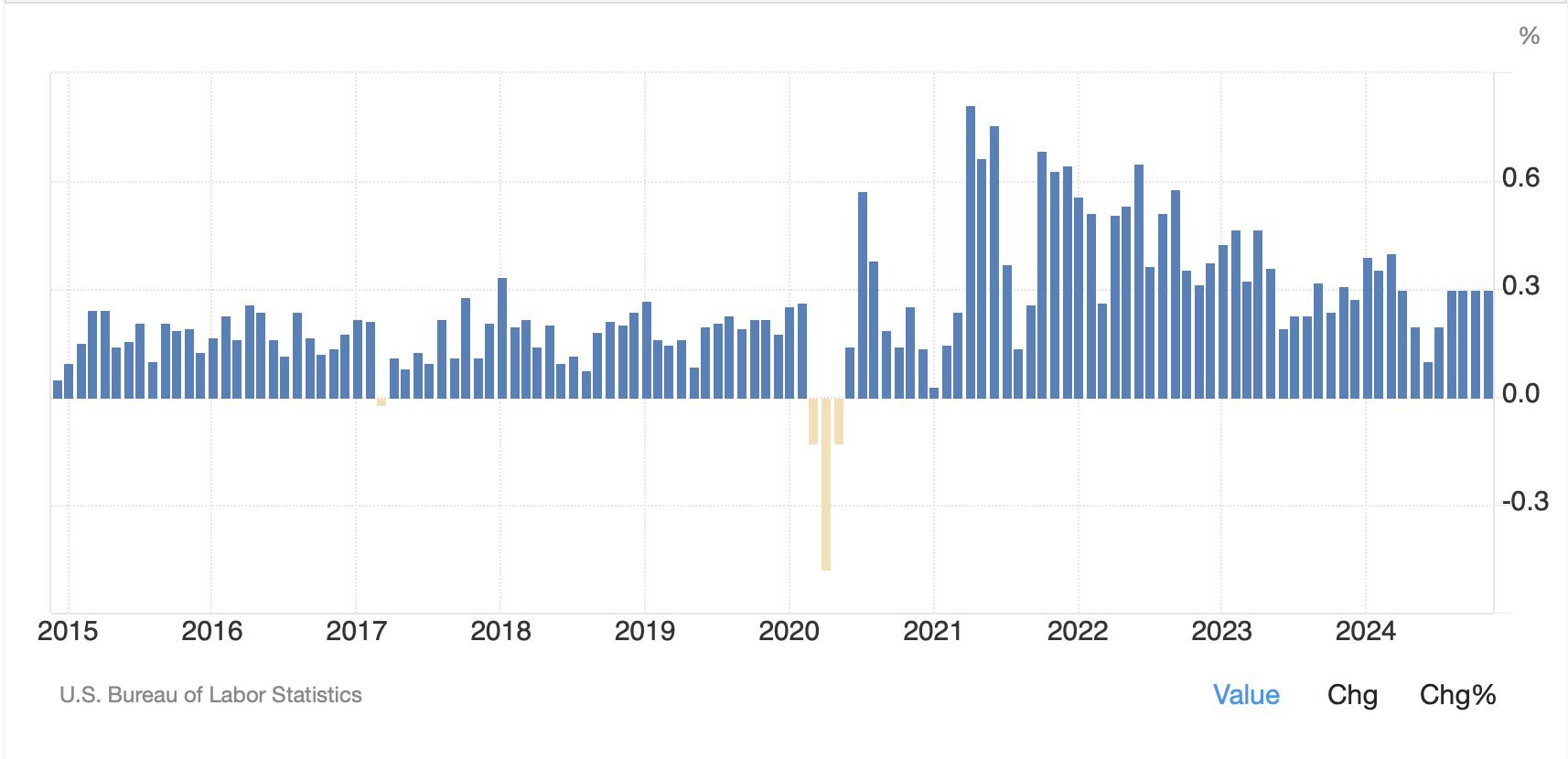
Regardless, yesterday’s CPI report was a bit firmer than forecast, at least at the second decimal place, which is enough for the punditry to discuss.  Of course, it is remarkable that a statistic of this nature is considered down to the second decimal place given the broad uncertainty over its measurement overall.  However,  looking at the chart below, which shows the monthly CPI readings for the past ten years, it is not hard to see that monthly inflation bottomed back in June and appears to be finding a new home at the 0.3% or higher level.  

Source: tradingeconomics.com

I showed the 10-year chart to also highlight that pre-Covid, the monthly readings were somewhere between 0.1% and 0.2% consistently.  My point is that 0.3% per month annualizes to about 3.7% which is as good a guess as any for how inflation is going to play out going forward absent some major fiscal and monetary changes.

Aside from the fact that this is important because we all suffer the consequences in our daily lives, from a markets perspective, I believe this is the money line in the article [emphasis added], “Officials have indicated sticky inflation could lead them to slow the pace of rate reductions or stop altogether.”  Yet, despite this strong hint that the Fed is getting uncomfortable with the market’s current assessment of how much further Fed funds are going to decline, the futures market is pricing a 98.6% probability of a cut next week.  

In fairness, the market is now pricing only two more rate cuts after next week for all of 2025, a number that has been declining slowly over the past month.  But ask yourself how the Fed will behave if their firmly held belief that inflation is still heading toward their 2% goal starts to falter under the weight of continued high readings.  There are a few analysts who are discussing rate hikes for next year for just this reason.  That, my friends, would upset the apple cart!

The central bank theme of the week
Is current rates need quite a tweak
Despite CPI
That’s still on the fly
More havoc, these bankers, will wreak
 
Down Under, though they didn’t cut
The doves’ case was open and shut
The Swiss and Canucks
Made changes, deluxe
While Christine, a quarter, will strut

While we are beginning to see some changes in the market’s perception of the Fed’s future path, those changes are not obvious elsewhere.  So far this week, the RBA left rates on hold, as they had promised, but explained the need to cut was upon them, demonstrating far less concern over inflation than in the past.  You may recall that the AUD fell sharply after the RBA statement put cuts in play going forward.  Then, yesterday, the BOC cut 50bps, as expected, as they, too, have turned their focus to economic activity and away from inflation, which continues above their target.  This morning, the Swiss National Bank surprised the markets with a 50bp cut, taking their base rate back down to 0.50%, expressing concern that inflation was slowing too rapidly and could become a problem.  Finally, shortly the ECB will announce their policy rate with the market highly confident a 25bp cut is on the way, although there are a few looking for 50bps.

The funny thing about all these cuts is that other than Switzerland, where recent CPI readings were at 0.7%, inflation remains above target levels and is demonstrating the same type of behavior as in the US, where it bottomed during the summer and is rebounding.  As well, especially in Europe, unemployment does not appear to be a major problem in these nations.  This begs the question, why are central banks so keen to cut rates if inflation remains sticky above their target levels and economic activity is hanging on?  

I have no good answer for this although I suspect there may be significant pressure from finance ministries regarding the cost of all that government debt that is outstanding and needs to be refinanced.  Alas, even though almost every central bank’s primary mandate is to maintain low inflation, it has become clearer by the day that following that mandate is not seen as important as other concerns.  Whether those concerns are economic activity or financing outstanding debt, or perhaps something else, I fear that we are heading back into a world where higher inflation is going to be the norm everywhere in the world.  Plan accordingly.

Ok, after another couple of record high closes in the US yesterday, let’s see how things have played out ahead of the ECB this morning.  In Asia, both Japan (+1.2%) and China (+1.0%) rallied on the brightening tech outlook, the prospect of further rate cuts and the ongoing hopes for that Chinese bazooka to finally be fired.  As well, Hong Kong (+1.2%) and Korea (+1.6%) also fared well, although the rest of the region was more mixed on much smaller movement.  In Europe, the best description ahead of the ECB is unchanged, with every bourse within 0.1% of Wednesday’s closing levels.  US futures at this hour (7:15) are pointing modestly lower, however, down about -0.2%.

In the bond market, despite all the surety of rate cuts, investors are not comfortable holding duration, and we are seeing yields continue to rise across the board.  Treasury yields are higher by another 3bps and back to 4.30% while European sovereign yields are all higher by between 3bps and 5bps.  It seems the bond markets are not convinced that central banks are behaving properly.  Perhaps the “bond vigilantes” will truly make a return after all.

In the commodity markets, oil (+0.1%) which managed to capture the $70/bl level is holding on this morning after the IEA raised its demand forecast for 2025 based on increased expectations for Chinese demand (because of the stimulus that is expected.). In the metals market, that Chinese stimulus is helping copper (+0.5%) although the precious sector is consolidating yesterday’s gains with gold (-0.3%) backing off slightly and silver unchanged.  However, gold is back above $2700/oz and appears to have finished its consolidation.

Finally, the dollar is mixed this morning, broadly holding onto its recent gains, but seeing some weakness against specific currencies.  For instance, BRL (+1.0%) responded to the fact that the central bank there, bucking the global trend, hiked the Selic rate by 100bps, a quarter point more than expected, as their concern over rising inflation increases.  (It seems they are one of the few central banks that is focused on their job, not the politics!). But away from that outlier move, we see AUD (+0.45%) rising on stronger than expected jobs growth data while NOK (+0.4%) is continuing to benefit from oil’s recent gains.  On the flip side, CHF (-0.35%) is suffering for the larger than expected SNB rate cut and GBP (-0.2%) is under modest pressure as traders debate whether the BOE will cut rates next week or not.

On the data front, Initial (exp 220K) and Continuing (1880K) Claims lead the way alongside PPI (0.2%, 2.6% Y/Y headline, 0.2%, 3.2% Y/Y core) at 8:30 this morning.  Beyond that, there is a 30-year auction this afternoon and that is really it.  I don’t see PPI having a great deal of impact and with CPI behind us, and Timiraos having told us that the Fed is going to slow the pace of cuts, I’m not sure what else there is to watch.  Obviously, this morning’s ECB meeting matters, but really, it is hard to get overly excited about the outcome there.  I suspect that attention will now be focused on the FOMC next week, with much more concern over the dot plot and SEP than the 25bp cut that seems a foregone conclusion.  

If the Fed is truly slowing the pace of cuts, once again, it becomes difficult to see how the dollar will soften vs. its major counterparts. Keep that in mind for now.

Good luck

Adf

Just Won’t Evanesce

The RBA left rates on hold
And sounded quite dovish, all told
Meanwhile in Brazil
Old Lula is ill
With something much worse than a cold
 
In Syria, things are a mess
In Taipei they’re feeling some stress
With all this unfolding
It’s no shock beholding
Risk assets just won’t evanesce


Risk is the topic du jour as pretty much everywhere one looks around the world, things are afoot that can inculcate fear (and loathing) rather than embrace those animal spirits.  Perhaps the least frightful, but most directly impactful regarding markets, was the RBA meeting last night at which the committee left rates on hold, as universally expected, but appeared to turn (finally) to the dovish side of the ledger.  The policy statement explained, “Some of the upside risks to inflation appear to have eased and while the level of aggregate demand still appears to be above the economy’s supply capacity, that gap continues to close.  The board is gaining some confidence that inflation is moving sustainably toward target.”   However, the proof is in the pudding and a quick look at the AUD (-0.7%) shows that the market has come to believe the RBA is finally joining the central bank rate cutting party.

Source: tradingeconomics.com

The trend seems pretty clear and it is hard to make a case for a reversal absent a massive spike in inflation Down Under forcing the RBA to change direction or something coming from the US focusing on weakening the USD, but given nothing like that seems likely until Mr Trump is officially in office, I am concerned that the Aussie dog will live up to its nickname and make new lows going forward, perhaps testing 0.6000 before this is over.

Speaking of currencies under pressure, elsewhere in the Southern Hemisphere we find the Brazilian real which has fallen to new historic lows, with the dollar now trading above 6.08.  For those of you who hate to pay away the points in USDBRL to hedge your balance sheet assets, the reason that you need to do it is very evident from the chart below.

Source: tradingeconomics.com

While there were several short-term dips in the dollar during the past year, the spot rate (at which you remeasure your balance sheet each month) moved from 4.92 to 6.08 in 12 months, nearly a 24% decline in the real.  A one-year forward would have cost far less, something like 40-45 big figures, or less than half the actual move, and would have given you certainty as to the cost.  Hedging matters!

Now, why, you may ask is this happening?  Well, news that Brazilian president Lula da Silva had emergency brain surgery has clearly not helped the currency.  Suddenly there are many questions over who is running the country and how they will address the ongoing fiscal issues that are extant.  As an aside, this is likely another deterrent to the idea of a BRICS currency appearing any time soon, if ever.

Turning our gaze elsewhere, the situation in Syria continues to unfold with no clear outcome although increased concerns over what will happen with the beleaguered people of that nation and whether it will foment yet another immigration wave into Europe and elsewhere in the Middle East.  However, right now, the oil market remains nonplussed over this issue as evidenced by yet another day of quiet trading and a slow drift lower in the price (-0.55%).

However, we cannot ignore Taiwan, where China is currently in the process of military maneuvers that appear to be simulating a naval blockade of the nation.  Price action here has shown the TWD (-0.4%) sliding further and pushing back toward its weakest level in more than 15 years (since the GFC), while the TAIEX stock index (-0.65%) is also feeling a little heat, although the story there has been one of consistent gains over the past several years, following the NASDAQ higher given the breadth of technology companies there, notably TSMC.

Putting it all together leaves one wanting with respect to their risk appetite this morning as today seems like another step closer to that Fourth Turning.  So, it should be no surprise that after a down day yesterday in the US, with all three major equity indices declining, we have seen far more red than green on the screens overnight.  The exception to this rule was in Korea, where the KOSPI (+2.4%) rose sharply as it appears that things are starting to revert to more normalcy there politically.  President Yoon is under pressure to resign and seems likely to be impeached and the government is back to functioning in more of its ordinary manner.  But elsewhere in Asia, Hong Kong (-0.5%), Australia (-0.5%) and most of the smaller regional bourses were lower although the Nikkei (+0.5%) rallied on the back of the yen’s renewed weakness, and mainland Chinese shares (+0.7%) seemed to begin to believe that more stimulus is, in fact, on its way.  We shall see about that.

In Europe, the bourses range from flat (DAX, IBEX) to down CAC (-0.5%), FTSE 100 (-0.5%) with both these nations suffering from their own political distress.  French President Macron is trying to form a government but categorically refuses to include Marine Le Pen’s RN party so has no chance of a majority with concerns growing over the fiscal situation there.  Apparently, if they cannot get a financing bill passed, the French will get to experience the heretofore unique American experience of a government shutdown.  Meanwhile, PM Starmer is watching his ratings circle the drain as his government continues to try to raise revenues by raising taxes on the rich and finding out that one thing rich people are really good at is creating new methods of operations to avoid paying higher taxes.  While there is no vote necessary in the UK for years (remember, Starmer won election just this past July 4th) it certainly feels like his government is going to fall sooner rather than later.  Meanwhile, US futures are little changed at this hour (7:30).

In the bond market, yields are rebounding with Treasuries higher by 3bps this morning after a 3bp rally yesterday.  In Europe, there is very little change except for UK Gilts (+4bps) with concerns over inflation rising there while in Asia, Australian yields slipped 6bps on the dovish RBA.  Generally speaking, the bond market has not been very exciting lately which is one reason, I believe, that things have not fallen apart.  If we start to see more volatility here, watch out.

In the commodity markets, aside from oil’s modest decline, gold (+0.65%) continues to find support in this risk-off scenario although both copper and silver are little changed this morning after solid rallies yesterday.

Finally, the dollar is higher again this morning, with the DXY well back above 106.00 and every G10 currency declining led by NZD (-1.0%).  This is suffering from the RBA’s dovishness which is expected to allow the RBNZ to maintain, or even increase, its own dovishness.  But the whole bloc is softer.  In the EMG bloc, there are a few currencies that are holding their own vs. the dollar this morning, but only just, with MXN (+0.2%) arguably the strongest currency around while CNY (+0.1%) is also relatively strong.  But elsewhere in this bloc, ZAR (-0.7%), PLN (-0.55%), and CLP (-0.4%) are indicative of the type of price action we are seeing across the board.  This is a dollar day, though, not really focusing on individual currency foibles.

On the data front, we see only Nonfarm Productivity (exp 2.2%) and Unit Labor Costs (1.5%) and that is really it.  There was nothing yesterday and all eyes are truthfully turned toward tomorrow’s CPI data.  Things don’t feel very positive right now, so I expect risk to remain on its back foot to start the day.  However, given the number of uncertain situations that abound, anything can happen to either change that view or reinforce it.  Once again, this is why you hedge, to mitigate the markets’ inherent volatility.

Good luck

Adf

They Cannot Wait

While Jay and the FOMC
Are certain it’s transitory
Inflation elsewhere
Has forced some to pare
Their policy stance by degree

Thus none of us ought be amazed
That yesterday Banxico raised
Its overnight rate
As they cannot wait
Til prices (and people) get crazed

Last week the central bank of Brazil raised its overnight rate by 1.0%, taking it back to 5.25%, and promised to continue raising rates until they get inflation back under control.  This seems pretty reasonable since the latest inflation reading there was 8.99%.  Currently, the market is pricing in a 1.25% rate hike next month.  Yesterday afternoon, Mexico’s central bank raised the overnight rate by 25 basis points for the second consecutive meeting, taking it up to 4.50%.  Given that the latest reading on inflation there is 5.81%, it seems they, too, have further to raise rates in order to tame rising prices.

In fact, this is a scenario we are witnessing around the world in emerging markets, where inflation has been rising quite rapidly and the monetary authorities, recognizing that they don’t have infinite capacity to borrow in either their local currency or in dollars, find themselves in a very uncomfortable position.  Either attack inflation now by raising rates and earning the wrath of their government, or let it rip and watch the country descend into more dire straits, akin to Argentina, Turkey, or worst of all, Venezuela.

But that the Fed would respond to inflation in the same manner.  Instead, we continue to get high inflation readings (yesterday’s PPI jumped to 7.8%, 6.2% ex food & energy) and a steady stream of pablum about the transitory nature of inflation in the US.  While only time will actually tell if higher inflation is truly here to stay, there certainly seems to be a lot of evidence that is the case.  One cannot open a newspaper (or perhaps scroll a newsfeed) without immediately seeing a story about how fast food restaurants, or food manufacturers or…fill in the blank, are raising prices because of a combination of higher input and shipping costs.  Perhaps, what is more surprising is that these companies have gained confidence that higher prices will not scare off their customers, meaning these price rises will stick.

On the wage front, this morning’s story of how newly minted college graduates taking (getting?) a job at Evercore Securities will now be paid a starting salary of $120,000 per year seems a pretty good indication that wages are rising.  Given the JOLTS data showing there are over 10 million open positions in the country, it is not surprising that ‘finding qualified people to hire’ remains the top problem of small businesses according to the NFIB survey.  The implication is wages are going to continue to rise and prices alongside them.

Speaking of shipping costs, we continue to see record rises in shipping rates as well as huge delays in timing.  China closed one-quarter of its Ningbo port, the third largest in China, because of concerns over the spread of the delta variant of Covid.  While US ports have not yet closed because of this, the backlog of ships waiting to unload continues to run near record high levels, and now delays from China will result in even bigger logistical and supply chain problems.  All in all, it remains difficult for this author to see a future, at least a near future, where prices do anything but go much higher.

Into that environment we continue to see the key Fed leadership remain sanguine over the prospects of inflation, maintaining the narrative that any price rises are transitory.  Apparently, this has come to mean prices will stop going up so rapidly but are unlikely to come back down.  While there is a growing chorus of FOMC members, mostly regional presidents, that believe it is coming time to taper QE purchases, until we hear that from Powell or Williams or Brainerd, I think it remains a 50:50 proposition at best.    But even if they do start to taper, given their history of responding to asset valuations, any stock market decline, which would seem likely given the current valuations are entirely built on the ‘lower forever’ interest rate scenario, would almost certainly see them stop quickly.  Painting a picture where real yields do anything but fall deeper into negative territory continues to be a difficult thing.  And that, ultimately, is going to be a negative for the dollar.

But when is ultimately?  It is still a little ways off.  Until then, it appears that the market is set up for the dollar to strengthen somewhat further.  The dollar’s relationship with 10-year yields, which had been strong in Q1 and broke in Q2, seems to be back on track.  All the taper talk has bond traders looking for a further backup in yields, and correspondingly, a further rise in the dollar.  While today it is drifting lower vs. most of its counterparts, this can easily be explained by the fact that it is a summer Friday and traders are paring positions going into the weekend.  But the medium-term view needs to be that higher US yields will support the dollar.

As to the rest of the markets, Asian equity markets continue to struggle as the spread of the delta variant accelerates and more countries in the region consider more drastic responses.  Last night saw losses in all the major markets (Nikkei -0.15%, Hang Seng -0.5%, Shanghai -0.25%) and as long as these nations have difficulty managing the resurgence of infections, investors seem to believe that the growth story will be negatively impacted.  Europe, on the other hand, is all green this morning (DAX +0.4%, CAC +0.35%, FTSE 100 +0.35%) as there is a greater belief that Covid issues are under better control.  Vaccination rates have risen quite rapidly and so while infection rates may be rising, hospitalizations are not, just like in the US.  Many analysts continue to believe European equity markets, writ large, are undervalued vs. their US counterparts, and while there is tapering talk here, there is absolutely no indication whatsoever that the ECB is going to do anything but continue to print money.

Treasury yields have drifted lower by 1.3bps this morning, which helps explain the dollar’s modest decline, but they remain right at 1.35% and show no signs of retracing last week’s sharp move higher.  European sovereigns, on the other hand, are a bit softer this morning, classic risk-on behavior, with Bunds (+0.9bps) and OATs (+1.4bps) slipping into the weekend.  Gilts are essentially unchanged, as it happens.

The commodity market is showing no clear directional bias of late, with both oil (-0.35%) and gold (+0.4%) having retraced a portion of major price declines over the past two weeks, but neither showing signs of either a break higher or the next leg down.  Rather, they are both a bit choppy right now.

Finally, the dollar is mostly softer against its G10 counterparts, with NOK (+0.3%) the leader and the euro pushing up 0.25%.  Frankly, both of these appear to be trading moves, as both had shown weakness all week, so positions are likely being pared into the weekend.

In the emerging market space, KRW (-0.65%) continues to be the bloc’s biggest laggard, falling for the fifth consecutive day as the combination of the record level of Covid infections, and concerns over the semiconductor space in the KOSPI have seen sellers come out of the woodwork for both stocks and the currency.  Away from the won, weakness was evident throughout the APAC currencies, albeit to a much lesser extent, as the Covid spread story is regionwide.  On the plus side, both CE4 and LATAM currencies are performing well, with MXN (+0.4%) the leader on the back of Banxico’s rate hike, and RUB (+0.4%) seeing position unwinding after a particularly weak trading period this week.

Data this morning brings Michigan Sentiment (exp 81.2) as well as some further secondary price indices, Import and Export prices, which have been running well above 10% each.  The point is there is inflationary pressure everywhere.

It is not surprising that after a week where the dollar was broadly stronger, it softens on Friday, but nothing has changed the short-term view that modestly higher US yields will lead to further dollar strength.  Keep an eye on the 1.1704 level in EURUSD, which I believe can be a catalyst for a much larger move higher in the dollar if it breaks.

Good luck, good weekend and stay safe
Adf

Enough Wherewithal

The Chairman explained to us all
The Fed has enough wherewithal
To counter the outbreak
But, too, Congress must take
More actions to halt the shortfall

The US equity markets led global stocks lower after selling off in the wake of comments from Chairman Powell yesterday morning. In what was a surprisingly realistic, and therefore, downbeat assessment, he explained that while the Fed still had plenty of monetary ammunition, further fiscal spending was necessary to prevent an even worse economic and humanitarian crisis. He also explained that any recovery would take time, and that the greatest risk was the erosion of skills that would occur as a huge swathe of the population is out of work. It cannot be a surprise that the equity markets sold off in the wake of those comments, with a weak session ending on its lows. It is also not surprising that Asian markets overnight followed US indices lower (Nikkei -1.75%, Hang Seng -1.45%, Shanghai -1.0%), nor that European markets are all in the red this morning (DAX -1.6%, CAC -1.7%, FTSE 100 -2.2%). What is a bit surprising is that US futures, at least as I type, are mixed, with the NASDAQ actually a touch higher, while both the Dow and S&P 500 see losses of just 0.2%. However, overall, risk is definitely on its back foot this morning.

But the Chairman raised excellent points regarding the timeline for any recovery and the potential negative impacts on economic activity going forward. The inherent conflict between the strategy of social distance and shelter in place vs. the required social interactions of so much economic activity is not a problem easily solved. At what point do government rules preventing businesses from operating have a greater negative impact than the marginal next case of Covid-19? What we have learned since January, when this all began in Wuhan, China, is that the greater the ability of a government to control the movement of its population, the more success that government has had preventing the spread of the disease. Alas, from that perspective, the inherent freedoms built into the US, and much of the Western World, are at extreme odds with those government controls/demands. As I have mentioned in the past, I do not envy policymakers their current role, as no matter the decision, it will be called into question by a large segment of the population.

What, though, are we now to discern about the future? Despite significant fiscal stimulus already enacted by many nations around the world, it is clearly insufficient to replace the breadth of lost activity. Central banks remain the most efficient way to add stimulus, alas they have demonstrated a great deal of difficulty applying it to those most in need. And so, despite marginally positive news regarding the slowing growth rate of infections, the global economy is not merely distraught, but seems unlikely to rebound in a sharp fashion in the near future. Q2 has already been written off by analysts, and markets, but the question that seems to be open is what will happen in Q3 and beyond. While we have seen equity weakness over the past two sessions, broadly speaking equity markets are telling us that things are going to be improving greatly while bond markets continue to point to a virtual lack of growth. Reading between the lines of the Chairman’s comments, he seems to be siding with the bond market for now.

Into this mix, we must now look at the dollar, and its behavior of late. This morning had seen modest movement until about 6:30, when the dollar started to rally vs. most of its G10 counterparts. As I type, NOK, SEK and AUD are all lower by 0.5% or so. The Aussie story is quite straightforward as the employment report saw the loss of nearly 600K jobs, a larger number than expected, with the consequences for the economy seen as potentially dire. While restrictions are beginning to be eased there, the situation remains one of a largely closed economy relying on central bank and government largesse for any semblance of economic activity. As to the Nordic currencies, SEK fell after a weaker than expected CPI report encouraged investors to believe that the Riksbank, which had fought so hard to get their financing rate back to 0.00% from several years in negative territory, may be forced back below zero. NOK, however, is a bit more confusing as there was no data to see, no comments of note, and the other big key, oil, is actually higher this morning by more than 4%. Sometimes, however, FX movement is not easily explained on the surface. It is entirely possible that we are seeing a large order go through the market. Remember, too, that while the krone is the worst performing G10 currency thus far in 2020, it has managed to rally more than 7% since late April, and so we are more likely seeing some ordinary back and forth in the markets.

One other comment of note in the G10 space was from BOE Governor Andrew Bailey, who reiterated that negative interest rates currently have no place in the BOE toolkit and are not necessary. While the comments didn’t impact the pound, which is lower by 0.25% as I type, it continues to be an important distinction as along with Chairman Powell, the US and the UK are the only two G10 nations that refuse to countenance the idea of NIRP, at least so far.

In the emerging markets, what had been a mixed and quiet session earlier has turned into a pretty strong USD performance overall. The worst performer is ZAR, currently down 0.9% the South African yield curve bear-steepens amid continued unloading of 10-year bonds by investors. But it is not just the rand falling this morning, we are seeing weakness in the CE4 (CZK -0.7%, HUF -0.5%, PLN -0.4%) and once again the Mexican peso is finding itself under strain. While the CE4 appear to simply be following the lead of the euro (-0.35%), perhaps with a bit more exuberance, I think the peso continues to be one of the more interesting stories out there.

Both MXN and BRL have been dire performers all year, with the two currencies being the worst two performers in the past three months and having fallen more than 20% each. Both currencies continue to be extremely volatile, with daily ranges averaging in excess of 2% for the past two months. The biggest difference is that BRL has seen a significant amount of direct intervention by the BCB to prevent further weakness, while MXN continues to be a 100% free float. The other thing to recall is that MXN is frequently seen as a proxy for all LATAM because of its relatively better liquidity and availability. The point is, further problems in Brazil (and they are legion as President Bolsonaro struggles to rule amid political fractures and Covid-19) may well result in a much weaker Mexican peso. This is so even if oil prices rebound substantially.

Turning to data, we see the weekly Initial Claims number (exp 2.5M) and Continuing Claims (25.12M), but otherwise that’s really it. While we have three more Fed speakers, Kashkari, Bostic and Kaplan, on the calendar, I think after yesterday’s Powell comments, the market may be happier not to hear their views. All the evidence points to an overbought risk atmosphere that needs to correct at some point. As that occurs, the dollar should retain its bid overall.

Good luck and stay safe
Adf

How Far Did It Sink?

This morning the data we’ll see
Is highlighted by GDP
How far did it sink?
And is there a link
Twixt that and the FOMC?

Which later today will convene
And talk about Covid-19
What more can they do
To help us all through
The havoc that we all have seen

Market activity has been somewhat mixed amid light volumes as we await the next two important pieces of information to add to the puzzle. Starting us off this morning will be the first look at Q1 GDP in the US. Remember, the virus really didn’t have an impact on the US economy until the first week of March, although the speed of its impact, both on markets and the broad economy were unprecedented. A few weeks ago, I mentioned that I created a very rough model to forecast Q1 GDP and came up with a number of -13.6% +/- 2%. This was based on the idea that economic activity was cut in half for the last three weeks of the month and had been reduced by 25% during the first week. My model was extremely rough, did not take into account any specific factors and was entirely based on anecdotal evidence. After all, sheltering in home, it is exceedingly difficult to survey actual activity. As it turns out, my ‘forecast’ is much more bearish than the professional chattering classes which, according to the Bloomberg survey, shows the median expectation is for a reading of -4.0%, with forecasts ranging from 0.0% to -10.0%. Ultimately, a range of forecasts this wide tells us that nobody has any real idea what this number is going to look like.

Too, remember that while things have gotten worse throughout April, as much of the nation has been locked down, the latest headlines highlight how many places will be easing restrictions in the coming days and weeks. So, it appears that the worst of the impact will straddle March and April, an inconvenient time for quarterly reporting. In the end, the issue for markets is just how much devastation is already reflected in prices and perhaps more importantly, how quick of a recovery is now embedded in the price. It is this last point which gives me pause as to the current levels in equity markets, as well as the overall risk framework. The evidence points to a strong investor belief that the trillions of dollars of support by central banks and governments around the world is going to ensure that V-shaped rebound. If that does not materialize (and I, for one, am extremely skeptical it will), then a repricing of risk is sure to follow.

The other key feature today is the FOMC meeting, with the normal schedule of a 2:00 statement release and a 2:30 press conference. There are no updated forecasts due to be released, and the general consensus is that the Fed is unlikely to add any new programs to the remarkable array of programs already initiated. Arguably, the biggest question for today’s meeting is will they try to clarify their forward guidance regarding the future path of rates and policy or is it still too early to change the view that policy will remain accommodative until the economy weather’s the storm.

While hard money advocates bash the Fed and many complain that their array of actions has actually crossed into illegality, Chairman Powell and his crew are simply trying to alleviate the greatest disruption any economy has ever seen while staying within a loose interpretation of the previous guidelines. Powell did not create the virus, nor did he spend a decade as Fed chair allowing significant financial excesses to be built up. For all the grief he takes, he is simply trying to clean up a major mess that he inherited. But market pundits make their living on being ‘smarter’ than the officials about whom they write, so don’t expect the commentary to change any time soon.

With that as prelude, a survey of this morning’s activity shows that equity markets in Europe are generally slightly higher, although a few, France and Switzerland, are in the red. Interestingly, Italy’s FTSE MIB is higher by 0.4% despite the surprise move by Fitch to cut Italy’s credit rating to BBB-, the lowest investment grade rating and now the same as Moody’s rating. S&P seems to have succumbed to political pressure last week and left their rating one notch higher at BBB although with a negative outlook. Though Italian stocks are holding in, BTP’s (Italian government bonds) have fallen this morning with yields rising 4bps. In fact, a conundrum this morning is the fact that the bond market is clearly in risk-off mode, with Treasury and bund yields lower (2bp and 3bp respectively) while PIGS yields are all higher. Meanwhile, European equities are performing fairly well, US equity futures are all higher by between 0.5%-1.0%, and the dollar is softer virtually across the board. These latter signal a more risk-on scenario.

Speaking of the dollar, it is lower vs. all its G10 counterparts except the pound this morning although earlier gains of as much as 1.0% by AUD and NZD have been cut by more than half as NY walks in. This currency strength is despite weaker than expected Confidence data from the Eurozone, although with an ECB meeting tomorrow, market participants are beginning to bet on Madame Lagarde adding to the ECB’s PEPP. Meanwhile, CAD and NOK seem to be benefitting from a small rebound in the price of oil, although that seems tenuous at best given the fear of holding the front contract after last week’s dip into negative territory on the previous front contract.

EMG currencies are also uniformly stronger this morning, led by IDR (+1.0%) after a well-received government bond issuance increased confidence the country will be able to get through the worst of the virus’ impact. We are also seeing ZAR (+0.9%) firmer on the modestly increased risk appetite, and MXN (+0.7%) follow yesterday’s rally of nearly 1.7% as the worst fears over a collapse in LATAM activity dissipate. Yesterday also saw Brazil’s real rebound 2.75%, which is largely due to aggressive intervention by the central bank. The background story in the country continues to focus on the political situation with the resignation of Justice Minister Moro and yesterday’s Supreme Court ruling that an investigation into President Bolsonaro could continue regarding his firing of the police chief. However, BRL had fallen nearly 14% in the previous two weeks, so some rebound should not be surprising. In fact, on a technical basis, a move back to 5.40 seems quite viable. However, in the event the global risk appetite begins to wane again, look for BRL to once again underperform.

Overall, this mixed session seems to be more likely to evolve toward a bit of risk aversion than risk embrasure unless the Fed brings us something new and unexpected. Remember, any positive sign from the GDP data just means that Q2 will be that much worse, not that things are better overall.

Good luck and stay safe
Adf

Feelings of Disquietude

In Germany, growth was subdued
In England, inflation’s now food
For thought rates will fall
As hawks are in thrall
To feelings of disquietude

This morning is a perfect lesson in just how little short-term movement is dependent on long-term factors like economic data. German GDP data was released this morning showing that for 2019 the largest economy in the Eurozone grew just 0.6%, which while expected was still the slowest rate in six years. And what’s more, forecasts for 2020 peg German GDP to grow at 0.7%, hardly enticing. Yet as I type, the euro is the best performer in the G10 space, having risen 0.2%. How can it be that weak data preceded this little pop in the currency? Well, here is where the short-term concept comes in; it appears there was a commercial order going through the market that triggered a series of stop-loss orders at 1.1140, and lo and behold, the euro jumped another 0.15%. My point is that any given day’s movement is only marginally related to the big picture and highly reliant on the short term flows and activities of traders and investors. So forecasts, like mine, that call for the euro to rally during this year are looking at much longer term issues, which will infiltrate trading views over time, not a prescription to act on intraday activity!

Meanwhile, the pound has come under modestly renewed pressure after CPI in the UK surprisingly fell to 1.3% with the core reading just 1.4%. This data, along with further comments by the most dovish BOE member, Michael Saunders, has pushed the probability of a UK rate cut at the end of the month, as measured by futures prices, up to 65%. Remember, yesterday this number was 47% and Friday just 25%. At this point, market participants are homing in on the flash PMI data to be released January 24 as the next crucial piece of data. The rationale for this is that the weakness that we have seen recently from UK numbers has all been backward-looking and this PMI reading will be the first truly forward looking number in the wake of the election in December. FYI, current expectations are for a reading of 47.6 in Manufacturing and 49.4 in Services, but those are quite preliminary. I expect that they will adjust as we get closer. In the meantime, look for the pound to remain under pressure as we get further confirmation of a dovish bias entering the BOE discussion. As to Brexit, it will happen two weeks from Friday and the world will not end!

Finally, the last G10 currency of interest today is the Swiss franc, which is vying with the euro for top performer, also higher by 0.2% this morning, as concern has grown over its ability to continue its intervention strategy in the wake of the US adding Switzerland back to the list of potential currency manipulators. Now, the SNB has been intervening for the past decade as they fight back against the franc’s historic role as a safe haven. The problem with that role is the nation’s manufacturing sector has been extraordinarily pressured by the strength of the franc, thus reducing both GDP and inflation. It seems a bit disingenuous to ask Switzerland to adjust their macroeconomic policies, as the US is alleged to have done, in order to moderate CHF strength given they already have the lowest negative interest rates in the world and run a large C/A surplus. But maybe that’s the idea, the current administration wants the Swiss to be more American and spend money they don’t have. Alas for President Trump, that seems highly unlikely. A bigger problem for the Swiss will be the fact that the dollar is likely to slide all year as QE continues, which will just exacerbate the Swiss problem.

Turning to the emerging market bloc, today’s biggest mover is BRL, where the real is opening lower by 0.5% after weaker than expected Retail Sales data (0.6%, exp 1.2%) point to ongoing weakness in the economy and increase the odds that the central bank will cut rates further, to a new record low of just 4.25%. While this still qualifies as a high-yielder in today’s rate environment, ongoing weakness in the Brazilian economy offer limited prospects for a reversal in the near-term. Do not be surprised to see BRL trade up to its recent highs of 4.25 before the bigger macro trend of USD weakness sets in.

And that’s been today’s currency story. I have neglected the signing of the phase one trade deal because that story has been so over reported there is exactly zero I can add to the discussion. In addition, the outcome has to be entirely priced into the market at this point. Equity markets have had difficulty trading higher during the past two sessions, but they certainly haven’t declined in any serious manner. As earnings season gets underway, investors seem to have turned their attention to more micro issues rather than the economy. Treasury yields have been edging lower, interestingly, despite the general good feelings about the economy and risk, but trying to determine if the stock or bond market is “correct” has become a tired meme.

On the data front, this morning brings PPI (exp 1.3%, 1.3% core) but given that we saw CPI yesterday, this data is likely to be completely ignored. We do get Empire Manufacturing (3.6) and then at 2:00 the Fed releases its Beige Book. We also hear from three Fed speakers, Harker, Daly and Kaplan, but at this point, the Fed has remained quite consistent that they have little interest in doing anything unless there is a significant change in the economic narrative. And that seems unlikely at this time.

And so, this morning the dollar is under modest pressure, largely unwinding yesterday’s modest strength. It seems unlikely that we will learn anything new today to change the current market status of limited activity overall.

Good luck
Adf

Flummoxed

Kuroda flummoxed
As inflation fails to rise
How low can rates go?

You know things are tough in Japan, at least for the BOJ, when a sales tax hike, that in the last go-round increased inflation by nearly two percentage points, had exactly zero impact on the latest CPI readings. Last night’s Tokyo CPI data was released at 0.4%, unchanged from the September data and well below the 0.7% expected. And that’s an annual number folks, not the monthly kind. It seems that the government’s efforts to help young families by reducing tuition for pre-school and kindergarten to zero was enough to offset the impact of the rise in the Goods and Services Tax, essentially the Japanese VAT. However, the upshot is that CPI inflation, at least in Tokyo which is seen as a harbinger for the nation as a whole, remains nonexistent. Now for the average Japanese family, one would think that is a good thing. After all, who wants the prices of the stuff they need to buy rising all the time. But for the BOJ, who doggedly continues to believe that unless inflation rises to 2.0% the economy will implode, it is merely the latest sign that central banks are out of ammunition.

The yen’s response to this ongoing futility was to rise ever so marginally, not quite 0.1%, but that has not changed its more recent trend. In the past two months, the yen has weakened a solid 4.4%. But the picture changes if you step a bit further back for more perspective. Over the past six months, since late April, the yen has actually strengthened nearly 3.0%. So, which is it; is the yen getting stronger or weaker? In fact, I would argue that it is doing neither, but rather the yen is in a major long-term consolidation pattern (a triangle formation for the technicians out there) and that barring a major exogenous shock like a GFC2, the yen is likely to continue trading in an even narrower range going forward, perhaps for as long as the next year. The thing is, these triangle patterns tend to resolve themselves with a very significant break-out move when they end. At this stage, there is no way to discern which direction that will follow, and , as I said, it is probably a year away, but it is quite realistic to expect that the doldrums we have experienced in the yen for the past many years is likely to end. Perhaps the US presidential election will be the catalyst to cause a change, at least the timing will be right.

For hedgers, the best advice I can offer is to extend the tenor of your hedges as much as you can. This is especially true for receivables hedgers, where the carry is in your favor. But the reality is that even a payables hedger needs to consider the benefits of hedging in an extremely low volatility environment as opposed to waiting until a breakout, which may result in the yen jumping higher by as much as 5%-10%, completely outweighing the current cost of carry.

Three Latin American nations
Have populist administrations
Brazil, on the right
Of late’s shining bright
But fear’s grown ‘round Argie’s relations

For the past two weeks, the story in Brazil has been one of unadulterated joy, at least for investors. The real has rallied more than 5.0% in that time as President Jair Bolsonaro, the right-wing firebrand, has been able to push pension reform through congress there. That has been warmly received by markets as it implies that Brazil’s long-term finances are likely to remain under control. The pension system had been massively underfunded and was far too generous relative to the government’s ability to pay. Correcting these problems is seen as crucial to allowing Brazil to move forward with other investments to help the nation’s economy and productivity. Again, a glance at the charts shows that USDBRL has formed a triple top formation and is already accelerating lower. Quite frankly, it would not surprise to see BRL strengthen to 3.70 before this movement is over.

Turning to Mexico, it too has performed extremely well over the past two months, rallying more than 5% during that time. It is interesting that the markets have been extremely patient with AMLO as, since his initial action to cancel the Mexico City Airport construction, which was seen in an extremely negative light, his policies have been far less disruptive than most investors feared. Clearly, Mexico has been a beneficiary of the ongoing US-China trade war as companies seek low cost manufacturing sites near the US and given the (still pending) USMCA trade agreement, there is more confidence that companies will be able to set up shop there with fewer repercussions.

However, as with the yen, I might argue that what we have seen over the past five years is an increasingly narrowing consolidation in the peso’s exchange rate, albeit with a tad more volatility attached. And the thing about this pattern is its culmination is likely to occur much sooner than that in the yen. A quick look at MXN’s PPP shows that the peso remains significantly undervalued vs. the dollar, and in truth vs. most currencies. All this points to the idea that barring any surprisingly anti-business actions from AMLO, the peso may be setting up for a much larger rally, especially with the carry benefits that continue to exist.

Argentina, on the other hand, with newly elected left-wing President Fernandez, has its work cut out for itself. If you recall, the preliminary vote back in August, saw the peso decline more than 35%, and while it was choppy for a bit, the price action of late has been for steady depreciation. It is too early to know what Fernandez will do, but given the dire straits in the Argentine economy, with inflation running north of 50% while growth is shrinking rapidly and the debt situation is untenable, it seems the path of least resistance is for ARS to continue to weaken.

A quick look at the majors sees the dollar generally firmer this morning as there is a mild risk-off sentiment in markets. However, the news moments ago that the Labour party agreed to an early election has helped bolster the pound specifically, and risk in general. I expect that the pound will now be reacting to the polls as it becomes clearer if Boris can win with a majority, or if he will go down to defeat and perhaps an even more beneficial outcome for the pound will arise, the withdrawal of Article 50. My money remains on a Johnson victory and a Brexit with the recently negotiated deal.

This morning we get two minor pieces of data, Case Shiller Home Prices (exp 2.10%) and Consumer Confidence (128.0). Yesterday we did see a weak Dallas Fed manufacturing index print, but equity markets made new highs. I can see little reason, beyond the ongoing Brexit story, for traders to alter their positions ahead of tomorrow’s FOMC meeting, and so anticipate another quiet day in the market.

Good luck
Adf

Not the Nadir

The Chairman explained to us all
Preventing the ‘conomy’s stall
Required a cut
Of twenty-five but
Don’t look for, rates, further to fall

However, it’s not the nadir
For all rates, that’s certainly clear
Brazil cut a half
While BOJ staff
Will check if they’re now too austere

As I mentioned on Monday, the Fed was merely the first in a long list of major central banks meeting this week. By now we all know the FOMC cut rates by 25 bps and released a statement that was certainly more hawkish than many had hoped for expected. The vote was largely as expected, with the July dissenters, George and Rosengren, continuing to vote for no change, while this month, St. Louis Fed President James Bullard also dissented, voting for a 50bp cut. Of more interest was the dot plot, which showed five members forecasting no further cuts this year, five looking for one more cut and seven looking for two cuts. That is actually quite a bit more hawkish than expected going into the meeting. In the end, equity markets sold off initially, but rallied late in the day to close essentially unchanged. Treasuries rallied all day leading up to the meeting, but ceded those gains in the wake of the announcement and press conference while the dollar rallied against most currencies, although it has given back those gains overnight.

Powell’s explanation for cutting was that the committee was still concerned over issues like global growth, trade policy and Brexit, and so felt a cut was merited to help insure steady growth. My impression is Powell is not anxious to cut again, but arguably it will depend on how the data evolves between now and the October meeting.

Meanwhile, late yesterday afternoon the Central Bank do Brazil cut their SELIC rate by 50bps to 5.50%, a new record low for the rate, but also a widely expected move by the market. Inflation in Brazil continues to slow, and with growth extremely sluggish, President Roberto Campos Neto made clear that they expect inflation to remain quiescent and will do what they can to help bolster the economy there. Look for another 50bps this year and potentially more next year as well. It should be no surprise that the real weakened yesterday, falling 0.8%, and I expect it has further to fall as Neto was clear that a weaker currency would not deter him.

Then overnight we heard from a number of central banks with Bank Indonesia cutting the expected 25bps top 5.25%, while the HKMA also cut in order to keep step with the US. Both currencies, IDR and HKD, were virtually unchanged overnight as the market had fully priced in the moves. Arguably of more importance was the BOJ meeting, where they left policy unchanged, but where Kuroda-san explained that the BOJ would undertake a full review of policy by the October meeting to insure they were doing everything they could to support the economy. There were a number of analysts who were expecting a rate cut, or at least further QE, and so the disappointment led to a 0.5% rally in the yen.

When Europe walked in, there were three central bank meetings scheduled with the Swiss maintaining policy rates but adjusting the amount of reserves exempt from the deposit rate of -0.75%. While Swiss banks have been complaining about this, given there was already a tiered system it was not anticipated that things would change. The upshot is that the franc is firmer by 0.6% in the wake of the announcement, although traders are a bit on edge given the SNB was clear that intervention remained on the table.

The biggest surprise came from Norway, which hiked rates 25 bps to 1.50%. While several of the Norwegian banks were calling for the hike, the market at large did not believe the Norgesbank would raise rates while the rest of the world was cutting. But there you go, the situation there is that the economy is doing fine, inflation is perking up and because of the government’s ability to tap the oil investment fund, they are actually utilizing fiscal policy as well as monetary policy in their economic management. With all that in mind, however, they were pretty clear this is the last hike for the foreseeable future. NOK rallied 0.5% on the news, but it has given all those gains back and now sits unchanged on the day.

Finally, in what is no surprise at all, the BOE just announced that policy remains unchanged for the time being as all eyes turn toward Brexit and what will happen there. The UK also released Retail Sales data which was bang on expectations and so the pound remains beholden entirely to the Brexit situation.

Speaking of Brexit, today is the third day of hearings at the UK Supreme Court regarding the two lawsuits against the Johnson government’s decision to prorogue parliament for five weeks. If you recall, late Tuesday when word got out that the justices seemed to be very hard on the government, the pound rallied. Interestingly, this morning there are stories all over the press about how the likelihood of a no-deal Brexit seems to be growing quickly. Everybody is tired of the process and thus far, neither side has blinked. I maintain the EU will blink as the economic damage to Germany, the Netherlands and Ireland adding to the entire EU’s economic malaise will be too much to tolerate. But we shall see. As I have been typing, the pound has been edging lower and is now down 0.2% on the day, but in the big picture, that is the same as unchanged.

Turning to this morning’s US data, we start with Philly Fed (exp 10.5) and Initial Claims (213K) and then at 10:00 see Existing Home Sales (5.38M). Yesterday’s housing data, starts and permits, were much better than expected, which given the sharp decline in mortgage rates and still robust employment situation, should not be that surprising. As to Fed speakers, there is no one on tap for today, but three (Williams, Rosengren and Kaplan) due to speak tomorrow. Equity futures are pointing slightly lower right now and if I had to guess, the dollar is more likely to rally slightly than not as the day progresses although large moves are not on the cards.

Good luck
Adf