The Temperature’s Rising

This morning the temperature’s rising
With Trump and his allies devising
An alternate way
For him to axe Jay
But this move is quite polarizing
 
The market response has been clear
It’s given the move a Bronx Cheer
Both stocks and the dollar
Are feeling a choler
But gold, everybody holds dear


The financial world is aghast this morning as last night, Chairman Powell revealed that the Fed has been served with grand jury subpoenas threatening criminal indictment regarding Chairman Powell’s testimony to the Senate Banking Committee last June.  The issue at hand is ostensibly the ongoing renovations at the Marriner Eccles Building, including their cost, and how that differs from Chairman Powell’s testimony.

Chairman Powell offered a video response last night explaining he will not be cowed into cutting rates because the President wants lower rates, but will continue their work of setting policy based on their assessments of the economy.  One cannot be surprised that this has raised an entirely new round of screaming about President Trump’s tactics, although what I did see this morning was that Florida House Representative Anna Paulina Luna took credit for referring the case to the DOJ.

While I have strong opinions on Chairman Powell’s effectiveness, or lack thereof, this is certainly a new level of pressure.  In fact, if you listen to the video above (it’s just 2 minutes) Powell explicitly claims that this is entirely about the Fed not cutting rates further.  But I am not going to discuss the legality, or tactics here, our focus is on the market’s response.

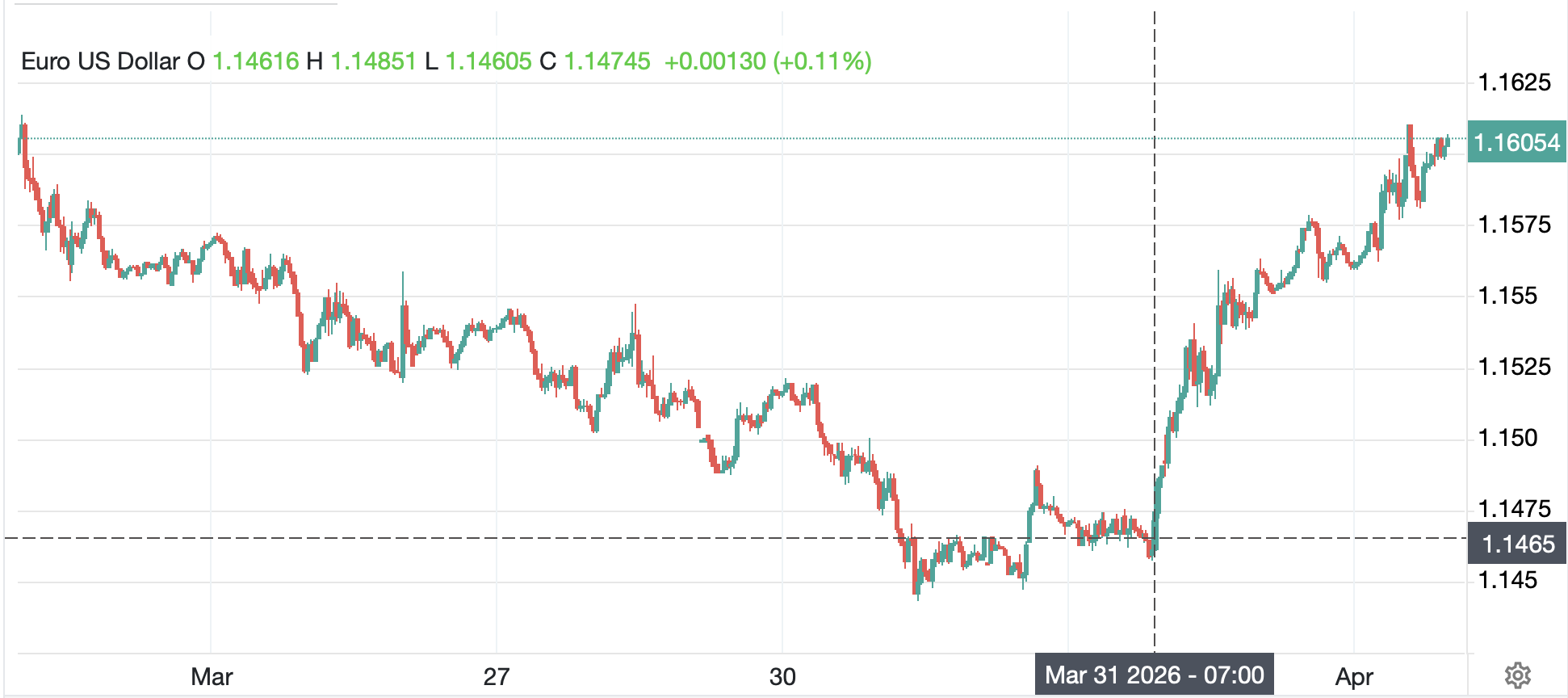
Starting with the dollar in the FX markets, it has fallen almost universally, and while it hasn’t collapsed, we are looking at a 0.3% to 0.5% decline pretty much everywhere.  Using the euro (+0.4%) as our proxy, you can see from the chart below that in the context of the past year’s price activity, this move is indistinguishable from any other move.

Source: tradingeconomics.com

This is not to imply that the Administration’s actions are insignificant, just that despite the rending of garments by the punditry, the market hasn’t determined it matters that much, at least not yet.  I have maintained my view that the dollar remains the best of a bad bunch of fiat currencies given the prospects for US economic activity compared to the rest of the world.  However, it is quite possible that foreign investors will view this action as far too detrimental to the structure of US financial markets and seek to exit, thus driving the dollar much lower.  I did not have this on my bingo card at the beginning of the year, so my views of dollar strength are somewhat tempered at this point.  It will certainly be interesting to see as we go forward.

One other thing to note is that CPI is released this week (exp 2.7% for both headline and core) and Truflation came out last week at 1.8%.  Now, I don’t put great stock in Truflation but there are many who do.  For that contingent, I assume they are aligned with President Trump in his views that Fed funds are too high.  After all, with Fed funds at 3.75%, that is nearly 200bps above the Truflation number.  I have always understood the “appropriate” relation to be closer to 75bps to 100bps above inflation, which if you believe Truflation, means you are looking for cuts.  (PS, this is not my personal view, I am simply highlighting part of the market thought process.)

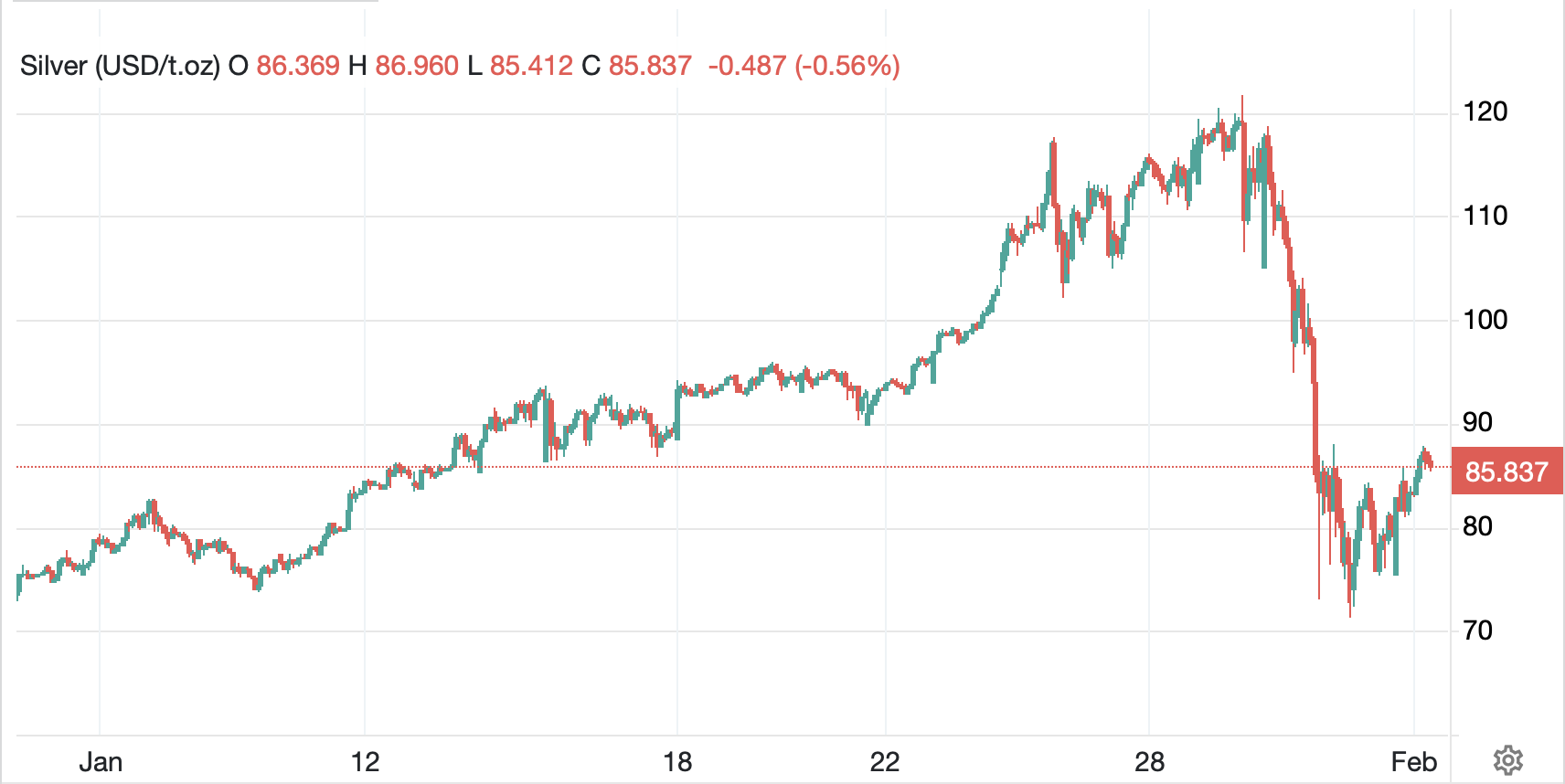
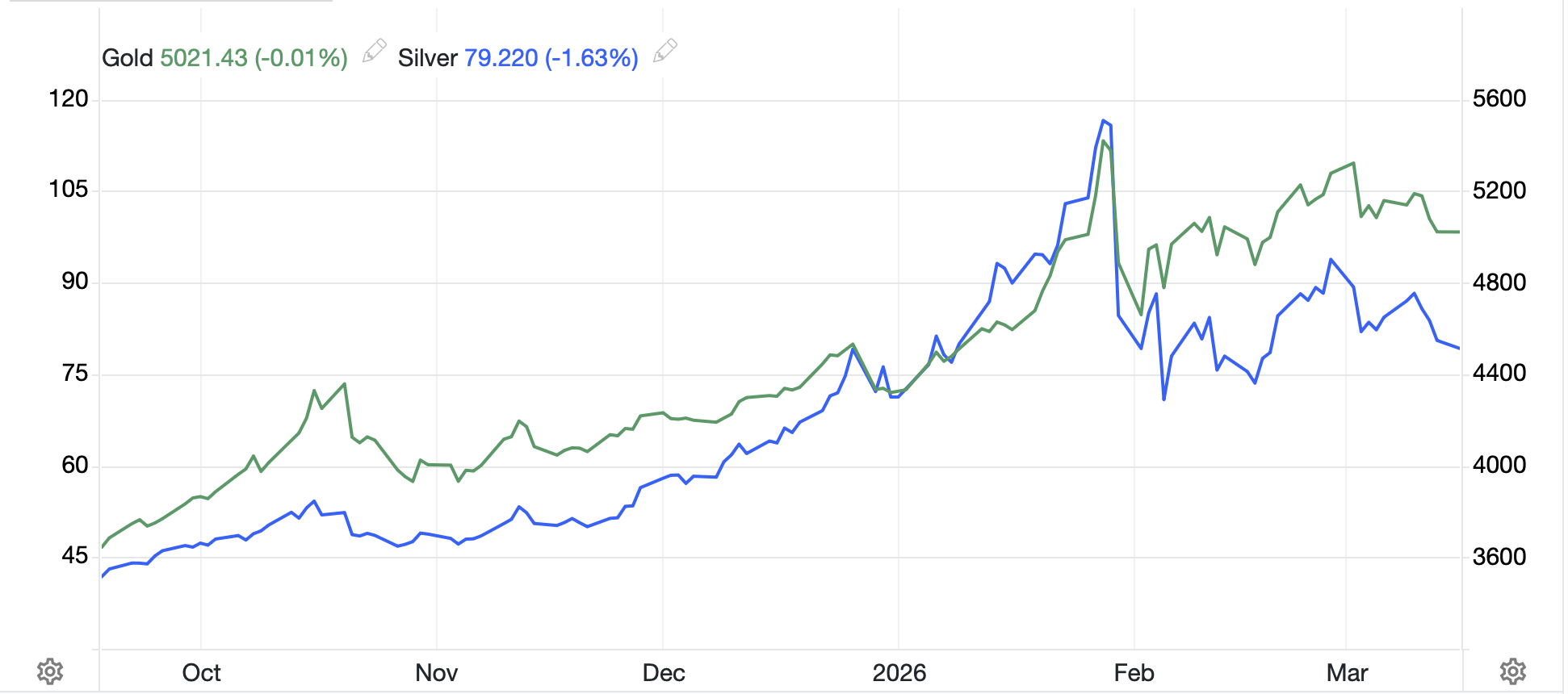
At any rate, the dollar is under pressure this morning but remains well within its recent trading range.  Turning to commodities, though, that is where the real price action is, with precious metals exploding higher on this news.  We are looking at record highs for gold (+1.6%), silver (+4.6%) with platinum (+3.2%) also much richer, although not back to all-time highs.  If we look at a chart of both gold and silver below, we can see the parabolic nature of silver’s recent move, a situation which should make everyone uncomfortable as parabolic moves frequently signal the end of the line. 

Source: tradingeconomics.com

But perhaps what makes this more interesting is that there is a substantial amount of supply in both gold and silver due to enter the market as the BCOM index rebalancing began last Friday and continues through Thursday.  Given the dramatic rallies in both metals last year, there is a significant amount to be sold by those funds that track the index.  Estimates are for a total of nearly $7 billion of gold and silver to be sold for the rebalancing, and many expected the metals markets to decline under that pressure.  And perhaps they still will, but today’s moves are the clearest signal that there are many investors who are uncomfortable with the Fed situation.

Remarkably, Venezuela and oil markets have basically disappeared from the conversation at this point.  However, this morning WTI (-0.9%) is giving back some of last week’s gains, and remains well within its recent downtrend, but shows no signs of a sharp break in either direction.

Turning to the other risk spot, equity markets, while US futures are all lower by -0.5% to -0.6% at this hour (7:10), the Fed news has had a mixed impact elsewhere around the world.  For instance, Japan (+1.6%), HK (+1.4%) and China (+0.65%) all had solid sessions with that being the case throughout the region.  Even India (+0.4%) finally managed to go green last night.  And all of this occurred after the Fed news.  One possible explanation is that foreign investors are running home, hence bidding up local shares.  Of course, it is also possible that they don’t believe there is much there, there, and are simply ignoring the news.

In Europe, the situation is different with weakness the general trend as Spain (-0.4%), France (-0.3%) and Italy (-0.15%) all slipping although Germany (+0.3%) has managed to buck the trend absent any specific macro catalyst.  German defense stocks are modestly higher this morning and perhaps threats by President Trump to aid the fomenting Iranian revolution have investors looking for more gains there.  As I often say, markets can be quite perverse for no apparent reason at all.

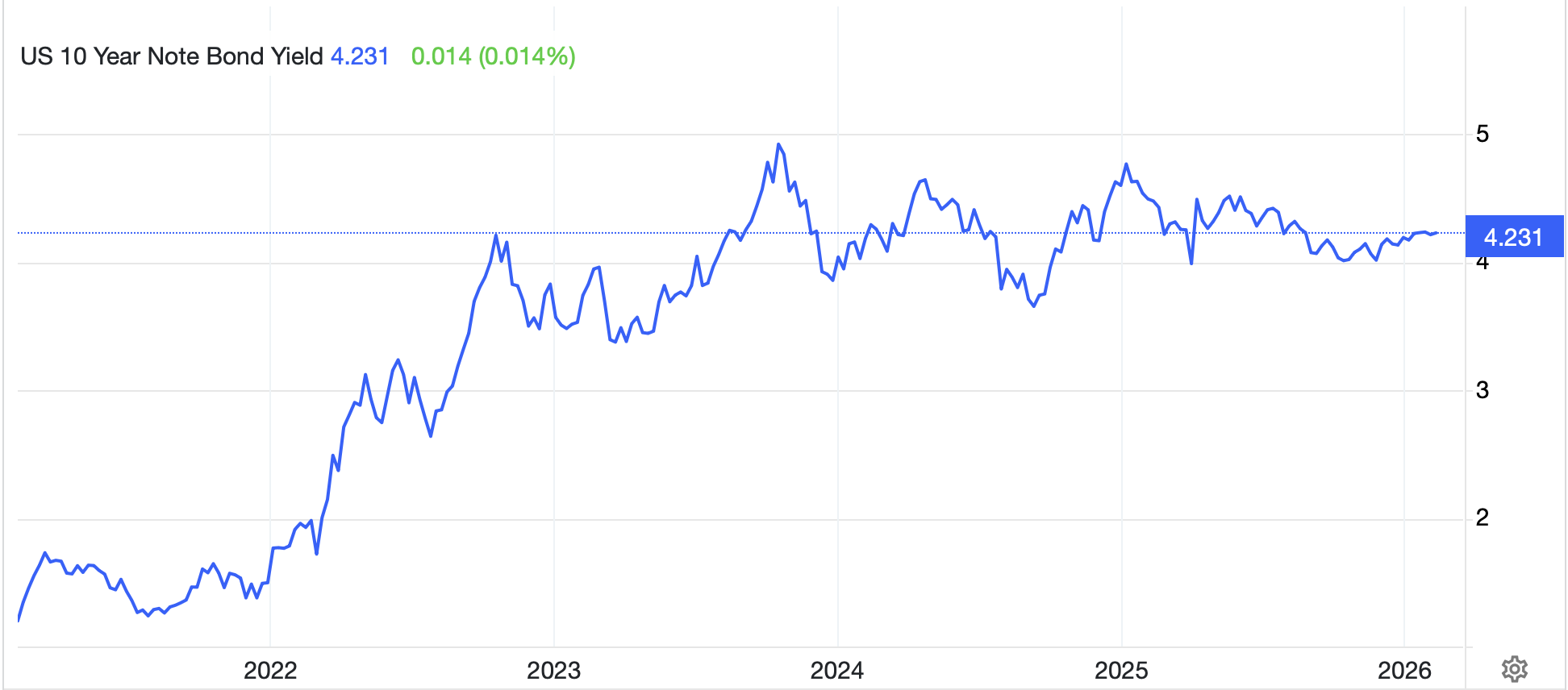
Finally, bond markets are not really responding to the news in any substantial manner.  Treasury yields have backed up 3bps this morning, but at 4.19%, remain within that long-term trading range and are not signaling flight.  European sovereigns have seen yields edge lower by -1bp across the board, so while modestly better, hardly the sign of massive buying.  And JGB yields were unchanged overnight.  Bonds remain the least interesting space there is of all the markets.

Which takes us to the data this week.

TuesdayNFIB Small Biz Optimism99.5
 CPI0.3% (2.7% Y/Y)
 -ex food & energy0.3% (2.7% Y/Y)
 New Home Sales710K
WednesdayRetail Sales0.4%
 -ex Autos0.3%
 Existing Home Sales4.2M
 Fed’s Beige Book 
ThursdayInitial Claims219K
 Continuing Claims1918K
 Empire State Mfg1.0
 Philly Fed-2.0
FridayIP0.1%
 Capacity Utilization76.0%

Source: tradingeconomics.com

In addition, we get PPI data on Wednesday, but it is all old data, for October and November and, as such, I don’t think it will matter very much at all.  We also hear from 10 different Fed speakers, some several times, over the course of the week.  It will be very interesting to hear how they address the major news overnight regarding the subpoenas, or if they even touch on them.  I expect there will be oblique references to Fed independence at most.

And remember, none of this even considers the ongoing revolution in Iran, which appears to be gaining strength in its third week.  If the theocracy in Iran falls, that will have a very different impact on oil markets than the Venezuela situation.  First, they are currently producing far more oil.  Second, the removal of sanctions there would seemingly reduce the amount of ultra cheap oil that China can import, adding pressure to the Chinese economy, as well as help pressure oil prices lower in general, which would negatively impact Putin’s war chest.  (If Iranian oil is no longer black market, it raises China’s cost, but lower overall prices will reduce further Russia’s sanctioned sale prices).

As to the dollar on the FX markets, this move certainly gives me pause regarding my bullish view, but there seems to be a long way to go before anything really comes of it.  As well, grand jury testimony is secret, so we won’t know about anything that is said anytime soon.  Ultimately, nothing may come of this, no charges of any sort.  Remember, this is a Washington DC grand jury, and so many there disagree with everything that President Trump does, they may not indict for that reason alone.

I’m not willing to make a sweeping statement at this time, but caution in positioning seems like a sensible view.

Good luck

Adf
Talk of the Town

Two things have been talk of the town
First, silver ne’er seems to go down
But also, of late
The Dow’s in a state
Where it wears the daily stock crown
 
But if we dig deeper, we find
Industrials, as they’re defined
Don’t build many things
Instead, they pull strings
As finance and tech are combined


Before I start, this will be the last poetry of 2025.  I want to thank all my readers for continuing to read and I certainly hope I both amused you and highlighted one view of what is driving the zeitgeist in markets these days.  FX poetry will return on January 5th with my annual long-form poetic prognostications.  Merry Christmas, Happy Chanukkah and Happy New Year to you all.

So, I was reading my friend JJ’s evening wrap up from yesterday and he highlighted the fact that the DJIA (+1.3%) made a new all-time high in trading and it was led by…Goldman Sachs.  

Source: tradingeconomics.com

Now, I have nothing against Goldman Sachs, per se, but it struck me as odd that Goldman Sachs, an investment bank, was a member of the Dow Jones Industrial Average.  It’s not that I wasn’t aware of the fact, but for some reason, this mention stuck out.  So, I thought I might look at the current membership of the Dow and see just how industrial it is.

While you will likely not be surprised that it has several non-industrial, service-based companies in the index, you might be surprised by just how many.  For instance, aside from Goldman, JPMorgan, American Express and Visa are in there as well as United Health and Travelers from the insurance space.  There are major retailers like Walmart, Home Depot, Amazon and McDonalds, along with tech and telecom/media names like Microsoft, Salesforce, Disney and Verizon.  

This is not to say that these are misplaced with respect to their relative importance in the US economy, clearly all are major corporations with long histories of profitability.  But it seems odd to list them as industrial.  I would contend that nothing explains the financialization of the US economy better than the fact that 14 out of the 30 members of the DJIA are service companies rather than producers of stuff.  Maybe they should rename it the Dow Jones Major Corporate Index.

To conclude the equity portion of our discussion, yesterday saw the NASDAQ (-0.25%) decline in the face of a broad overall equity rally as there appears to be a rotation of investors from AI into other things like financials (as hopes of another Fed rate cut spring eternal) and power producers as the power needs of AI keep getting estimated ever higher.  This rally was followed pretty much everywhere around the world as regardless of one’s religion, it appears investors are all counting on Santa to deliver higher prices.  In Asia, Tokyo (+1.4%). HK (+1.75%), China (+0.6%), Australia (+1.2%), Korea (+1.4%) and virtually every other market rallied.  The only data of note here was Japanese IP which came in a tick higher than its preliminary forecast, but to counter that, Nikkei reported that the BOJ, when they meet next week, are definitely going to raise the base rate by 25bps to 0.75%, the highest level since 1994.  That doesn’t seem that bullish, but then, I’m not Japanese.

In Europe, the gains are also universal, albeit less impressive with Spain (+0.5%) and France (+0.5%) leading the way and Germany and the UK both only marginally higher.  The most interesting news here is about the EU’s efforts to confiscatethe Russian assets that have been frozen since they invaded Ukraine, but which are being blocked by Belgium where they reside under SWIFT.  And as I type (7:45) US futures are mixed with the Dow (+0.2%) still in favor while NASDAQ (-0.5%) continues to lag.

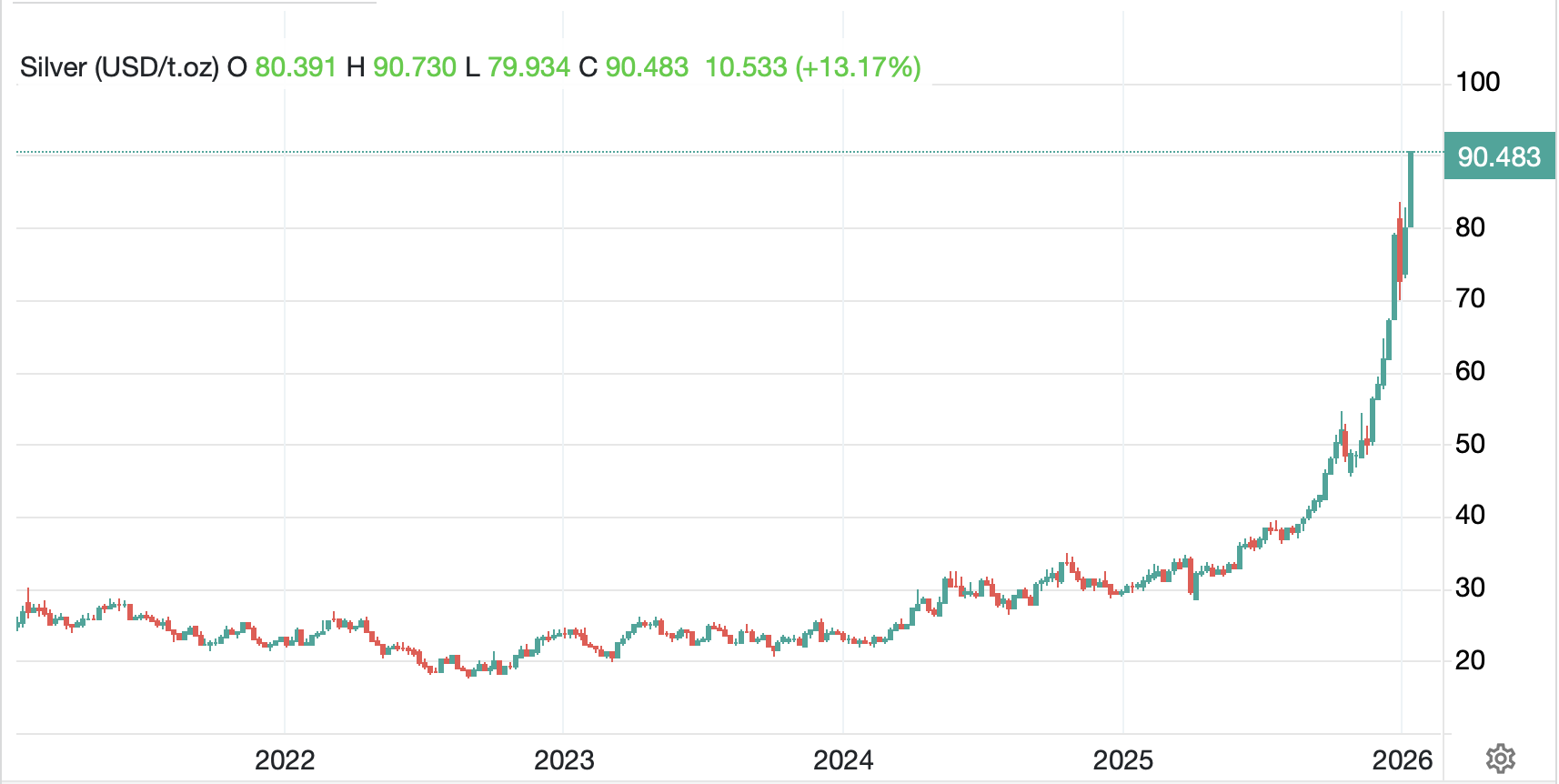
But the other story that is getting press, and arguably more press, is precious metals.  Silver (+0.9% today, +10% this week, +122% this year) is the leader and is now trading above $64/oz.  This is the very definition of a parabolic move, which is obvious when you look at the silver chart for the past 5 years.

Source: tradingeconomics.com

Referring back to JJ’s note, it is important to understand he is a commodity trader of long standing (remarkably even longer than my time in FX) and he discussed silver from an insider’s perspective.  The essence of the issue here is that there are quite a few paper short positions that have existed for a long time.  The rumor has long been that JPMorgan has been preventing silver from rising by playing in futures markets.  But now, real demand, between industrial users (solar panels and electronics) and Asian retail demand from both India and China is far higher than new supply or recovery from scrap, to the tune of 120 million oz/year, and those shorts cannot find the metal to deliver.  The last time there was a squeeze, when the Hunt’s tried to corner the market in 1980, people lined up at stores to sell their silver tea services, bringing metal to the market.  But those are all gone.  I’m not sure what will change this in the short run, but it cannot go up forever.  With that in mind, though, I think precious metals have much further to run as the ongoing debasement of fiat currencies simply adds further to demand.  

Silver managed to drag gold (+1.1% today, +3.0% this week, +65% this year) and platinum (+3.6% today, +7.2% this week, +98% this year) along for the ride and I expect this will continue across the board.  Meanwhile oil (0.0%) is unchanged this morning but has fallen -4.0% this week.  The news that the US boarded a Venezuelan oil tanker and took control in an effort to pressure Maduro didn’t seem to concern anyone in the market.  This trend remains clear.  

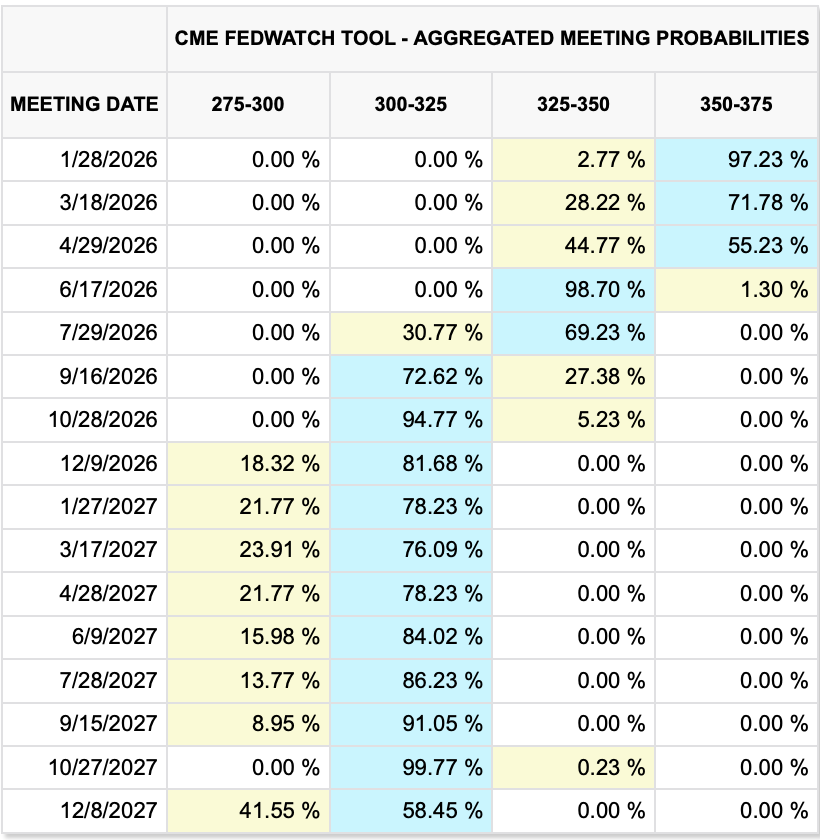
As to the bond market, this morning yields are higher by 2bps, pretty much across the board of Treasuries and all European sovereigns.  But with that in mind, the 10-year Treasury is still yielding 4.18%, below its worst level immediately following the FOMC meeting, and as I mentioned above, there appears to be a growing belief that Powell’s concern about the labor market will result in more cuts sooner rather than later.  While that is not really playing out in the futures market yet, as you can see below with the next cut priced for April with a 76% probability, that is the narrative that is being promulgated in FinX.  

Source: cmegroup.com

Next week we will get the November NFP report (exp 35K) and all the data we missed in October.  I can assure you if that comes in weak, the idea of a rate cut will explode onto the scene once again.  Too, on Wednesday evening, the WSJpublished an article indicating that Chairman Powell is concerned the employment data is overstating things because of the flaws in the birth/death model.  The point is he may be far more inclined to cut if next Tuesday’s report is weak.

Finally, the dollar is…still here.  It sold off after the Fed, and as I showed yesterday, has fallen back to the middle of its trading range of the past 6 months.  I keep reading how the dollar is the key, but quite frankly, I’m not certain what that key will unlock.  We need out of consensus activities to change the current situation.  After all, the underlying demand for dollars because of the trillions of dollars of debt outstanding outside of the US makes it difficult to get too bearish without a major reason.  If the Fed cut 50bps intermeeting, that would do it, but I’m not holding my breath.

And that’s really it my friends.  There is no data today although we do hear from three Fed speakers.  Given the dissent on the FOMC, I expect that we are going to be need to keep score as to views for a while when these folks speak. 

In the meantime, as I said above, have a wonderful holiday all

Adf

Crazier Still

There once was a time when the Fed
When meeting, and looking ahead
All seemed to agree
The future they’d see
And wrote banal statements, when read
 
But this time is different, it’s true
Though those words most folks should eschew
‘Cause nobody knows
Which way the wind blows
As true data’s hard to construe
 
So, rather than voting as one
Three members, the Chairman, did shun
But crazier still
The dot plot did kill
The idea much more can be done


I think it is appropriate to start this morning’s discussion with the dot plot, which as I, and many others, expected showed virtually no consensus as to what the future holds with respect to Federal Reserve monetary policy.  For 2026, the range of estimates by the 19 FOMC members is 175 basis points, the widest range I have ever seen.  Three members see a 25bp hike in 2026 and one member (likely Governor Miran) sees 150bps of cuts.  They can’t all be right!  But even if we look out to the longer run, the range of estimates is 125bps wide.

Personally, I am thrilled at this outcome as it indicates that instead of the Chairman browbeating everyone into agreeing with his/her view, which had been the history for the past 40 years, FOMC members have demonstrated they are willing to express a personal view.

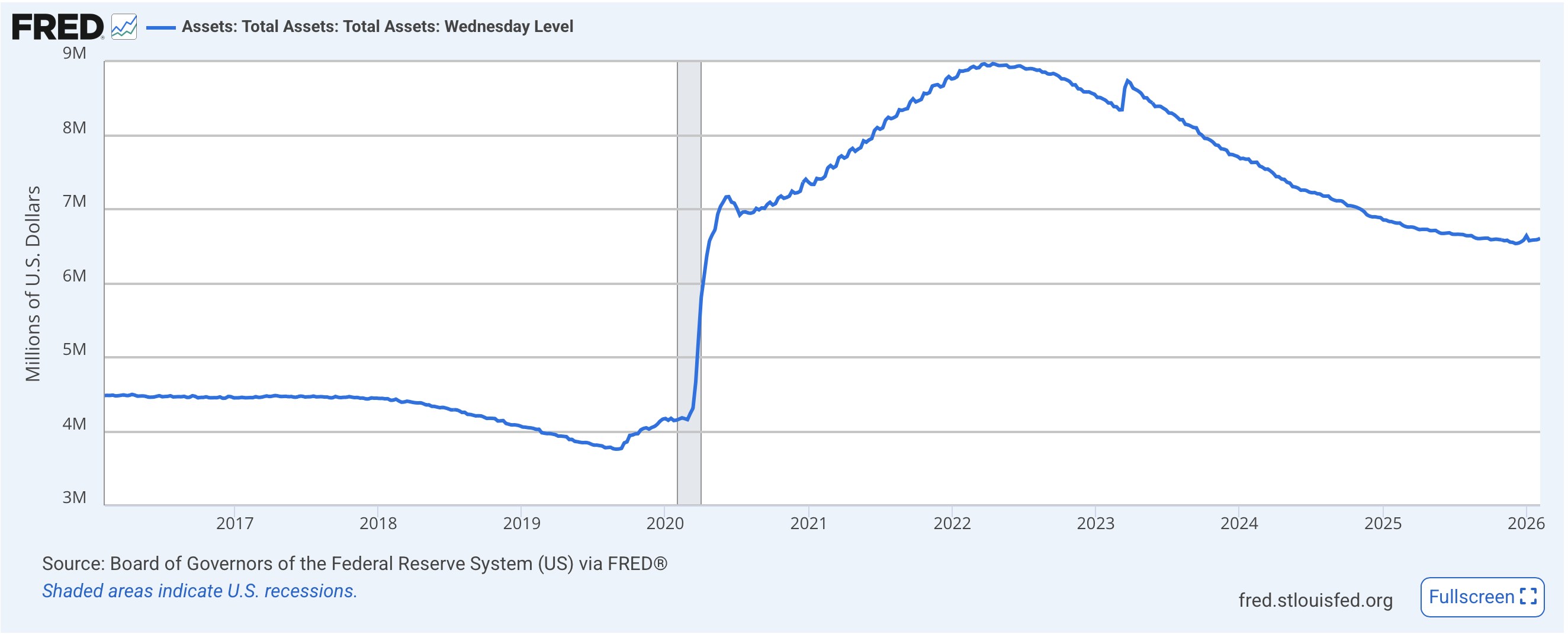
Now, generally markets hate uncertainty of this nature, and one might have thought that equity markets, especially, would be negatively impacted by this outcome.  But, since the unwritten mandate of the Fed is to ensure that stock markets never decline, they were able to paper over the lack of consensus by explaining they will be buying $40 billion/month of T-bills to make sure that bank reserves are “ample”.  QT has ended, and while they will continue to go out of their way to explain this is not QE, and perhaps technically it is not, they are still promising to pump nearly $500 billion /year into the economy by expanding their balance sheet.  One cannot be surprised that initially, much of that money is going to head into financial markets, hence today’s rally.

However, if you want to see just how out of touch the Fed is with reality, a quick look at their economic projections helps disabuse you of the notion that there is really much independent thought in the Marriner Eccles Building.  As you can see below, they continue to believe that inflation will gradually head back to their target, that growth will slow, unemployment will slip and that Fed funds have room to decline from here.

I have frequently railed against the Fed and their models, highlighting time and again that their models are not fit for purpose.  It is abundantly clear that every member has a neo-Keynesian model that was calibrated in the wake of the Dot com bubble bursting when interest rates in the US first were pushed down to 0.0% while consumer inflation remained quiescent as all the funds went into financial assets.  One would think that the experience of 2022-23, when inflation soared forcing them to hike rates in the most aggressive manner in history, would have resulted in some second thoughts.  But I cannot look at the table above and draw that conclusion.  Perhaps this will help you understand the growth in the meme, end the fed.

To sum it all up, FOMC members have no consensus on how to behave going forward but they decided that expanding the balance sheet was the right thing to do.  Perhaps they do have an idea, but given inflation is showing no signs of heading back to their target, they decided that the esoterica of the balance sheet will hide their activities more effectively than interest rate announcements.

One of the key talking points this morning revolves around the dollar in the FX markets and how now that the Fed has cut rates again, while the ECB is set to leave them on hold, and the BOJ looks likely to raise them next week, that the greenback will fall further.  Much continues to be made of the fact that the dollar fell about 12% during the first 6 months of 2025, although a decline of that magnitude during a 6-month time span is hardly unique, it was the first such decline that happened during the first 6 months of the year, in 50 years or so.  In other words, much ado about nothing.  

The latest spin, though, is look for the dollar to decline sharply after the rate cut.  I have a hard time with this concept for a few reasons.  First, given the obvious uncertainty of future Fed activity, as per the dot plot, it is unclear the Fed is going to aggressively cut rates from this level anytime soon.  And second, a look at the history of the dollar in relation to Fed activity doesn’t really paint that picture.  The below chart of the euro over the past five years shows that the single currency fell during the initial stages of the Fed’s panic rate hikes in 2022 then rallied back sharply as they continued.  Meanwhile, during the latter half of 2024, the dollar rallied as the Fed cut rates and then declined as they remained on hold.   My point is, the recent history is ambiguous at best regarding the dollar’s response to a given Fed move.

Source: tradingeconomics.com

I have maintained that if the Fed cuts aggressively, it will undermine the dollar.  However, nothing about yesterday’s FOMC meeting tells me they are about to embark on an aggressive rate cutting binge.

The other noteworthy story this morning is the outcome from China’s Central Economic Work Conference (CEWC).  I have described several times that the President Xi’s government claims they are keen to help support domestic consumption and the housing market despite neither of those things having occurred during the past several years.  Well, Bloomberg was nice enough to create a table highlighting the CEWC’s statements this year and compare them to the past two years.  I have attached it below.

In a testament to the fact that bureaucrats speak the same language, no matter their native tongue, a look at the changes in Fiscal Policy or Top Priority Task, or even Real Estate shows that nothing has changed but the order of the words.  The very fact that they need to keep repeating themselves can readily be explained by the fact that the previous year’s efforts failed.  Why will this time be different?

Ok, a quick tour of markets.   Apparently, Asia was not enamored of the FOMC outcome with Tokyo (-0.9%) and China (-0.9%) both sliding although HK managed to stay put.  Elsewhere in the region, both Korea (-0.6%) and Taiwan (-1.3%) were also under pressure as most markets here were in the red.  The exceptions were India, Malaysia and the Philippines, all of which managed gains of 0.5% or so.  

In Europe, things are a little brighter with modest gains the order of the day led by Spain (+0.5%) and France (+0.4%) although both Germany and the UK are barely higher at this hour.  There was no data released in Europe this morning although the SNB did meet and leave rates on hold at 0.0% as universally expected.  There has been a little bit of ECB speak, with several members highlighting that ECB policy is independent of Fed policy but that if Fed cuts force the dollar lower, they may feel the need to respond as a higher euro would reduce inflation.  Alas for the stock market bulls in the US, futures this morning are pointing lower led by the NASDAQ (-0.7%) although that is on the back of weaker than expected Oracle earnings results last night.  Perhaps promising to spend $5 trillion on AI is beginning to be seen as unrealistic, although I doubt that is the case 🤔.

Turning to the bond market, Treasury yields have slipped -2bps overnight after falling -5bps yesterday.  Similar price action has been seen elsewhere with European sovereign yields slipping slightly and even JGB yields down -2bps overnight.  Personally, I am a bit confused by this as I have been assured that the Fed cutting rates in this economy would result in a steeper yield curve with long-dated rates rising even though the front end falls.  Perhaps I am reading the data wrong.

In the commodity markets, the one truth is that there are no sellers in the silver market.  It is higher by another 0.5% this morning and above $62/oz as whatever games had been played in the past to cap its price seem to have fallen apart.  Physical demand for the stuff outstrips new supply by about 120 million oz /year, and new mines are scarce on the ground.  This feels like there is further room to run.

Source: tradingeconomics.com

As to the rest of the space, gold (-0.2%) which had a nice day yesterday is consolidating, as is copper.  Turning to oil (-1.1%) it continues to drift lower, dragging gasoline along for the ride, something that must make the president quite happy.  You know my views here.

As to the dollar writ large, while it sold off a bit yesterday, as you can see from the below DXY (-0.3%) chart, it is hardly making new ground, rather it is back to the middle of its 6-month range.  

Source: tradingeconomics.com

This morning more currencies are a bit stronger but in the G10, CHF (+0.45%) is the leader with everything else far less impactful.  And on the flip side, INR (-0.7%) has traded to yet another historic low (USD high) as the new RBI governor has decided not to waste too much money on intervention.  Oh yeah, JPY (+0.2%) has gotten some tongues wagging as now that the Fed cut and the BOJ is ostensibly getting set to hike, there is more concern about the unwind of the carry trade.  My view is, don’t worry unless the BOJ hikes 50bps and promises a lot more on the way.  After all, if the Fed has finished cutting, something that cannot be ruled out, this entire thesis will be destroyed.

On the data front, Initial (exp 220K) and Continuing (1950K) Claims are coming as well as the Trade Balance (-$63.3B).  There are no Fed speakers on the docket, but I imagine we will hear from some anyway, as they cannot seem to shut up.  

It would not surprise me to see the dollar head toward the bottom of this trading range, but I think we need a much stronger catalyst than uncertainty from the Fed to break the range.

Good luck

Adf
All But Assured

A cut has been all but assured
Though since last time we have endured
Some fears Jay’s a hawk
So, when he does talk
Will this cut, at last, be secured?
 
And now there’s a narrative view
Though rates will fall, what he will do
Is try to convey
Now it’s out the way
Another one may not come through


Good morning all and welcome to Fed Day.  The question, of course, is will this be a frabjous day?  As I write this morning, the Fed funds futures market continues to price a roughly 90% probability of a 25bp cut this afternoon, but the prospects for future rate cuts have greatly diminished as you can see in the table below from the CME.

It wasn’t long ago when the market was pricing 100bps more of rate cuts by the end of 2026, meaning a Fed funds rate of 2.50% – 2.75%.  However, the narrative has shifted over the past several weeks after very mixed signals from FOMC speakers and data releases that have indicated the economy is not cratering (e.g. yesterday’s JOLTS data printing at 7.658M, >400K higher than expected).  You may recall that shortly after the last FOMC meeting at the end of October, the probability of today’s rate cut had fallen to just 30%.

It appears that the new discussion point is this will be a hawkish cut, an idiom similar to jumbo shrimp.  At this point, the bulk of the discussion has been around how many dissents will be recorded with the subtext being, what will Chairman Powell have to promise potential dissenters in order to bring them along to his side of the ledger.  My take is if you thought the last press conference was hawkish, you ain’t seen nothin’ yet.  In fact, I would not be surprised to see a virtually categoric call to this being the end of the cutting cycle for the foreseeable future.

Remember, we also will see the new dot plots and SEP which will help us understand the broad picture of where FOMC members currently stand on the matter.  Personally, I expect to see a wide disparity between the ends of the distribution, and it wouldn’t surprise me to see some expectations of no rate changes for 2026 with other calls for 150bps of cuts and no consensus view at all. 

At this point, all we can do is wait.  However, the market discussion has centered on the fact that 10-year Treasury yields (+1bp) have been climbing lately, and that this morning they have touched 4.20% again while, at the same time, 2-year Treasury yields (no change) have been slipping as per the below chart I created from FRED data.

The steepening yield curve, which now appears to be turning into a bear steepener (when long dated yields rise more quickly than short-dated yields) is ringing alarm bells in some quarters.  The narrative is that there are growing concerns over both the quantity of debt outstanding and its rate of growth as well as the fact rate cuts will engender future inflation.

A key part of the discussion is the fact that what had been a synchronous system of global central bank policy easing is now starting to split up.  While we have known the BOJ is in a hiking cycle, albeit a slow one, today, the BOC is not only expected to leave rates on hold but explain they have bottomed.  We have heard that, as well, from the RBA earlier this week, and the commentary from the ECB may be coming along those lines.  So, is the US the outlier now?  And will that weaken the dollar?  Those are the key questions we will need to address going forward.

But before we move on, there is one market I must discuss, silver, which exploded to new historic highs yesterday, trading through $60/oz and is higher again this morning by 0.6% and trading at $61/oz.  someone made the point yesterday that for the second time in history, you need just 1 ounce of silver to buy one barrel of WTI.  The first time was back during the silver squeeze in January 1980, but that was quite short-lived (see chart below from macrotrends.com).  This one appears to have legs.  

I don’t know that I can find another indicator that better expresses my views of fiat currency debasement alongside an expanding availability of oil.  To my mind, both these trends remain quite strong, and this is the embodiment of them both combined.

Ok, so as we await the FOMC, let’s see if anybody is doing anything in financial markets of note.  As testament to the fact that virtually everybody is awaiting the Fed this afternoon, US equity markets barely moved yesterday, and Asian markets were similarly quiet, with only Taiwan (+0.8%) moving more than 0.4% in either direction.  The large markets were +/- 0.2% overall.  In Europe, the movement has been slightly larger, but still not impressive with Germany (-0.4%) the laggard of note while the UK (+0.3%) is the leader.  A smattering of data released from the continent doesn’t seem to be having any real impact, nor did comments by Madame Lagarde claiming the rates are in a good place and displaying some optimism on future GDP growth.  Of much greater concern is the headlong rush to a digital euro CBDC, where they are seeking to exert control over the citizenry.  If for no other reason, I would be leery of expecting great things from the Eurozone going forward.  Not surprisingly, at this hour (7:30) US futures are little changed ahead of the meeting.

In the bond market, yields are creeping higher all around the world with European sovereign yields higher between 2bps and 4bps this morning.  Perhaps investors are taking Madame Lagarde’s views to heart.  Or perhaps the fallout from the recently released US National Security Strategy, where the US basically dismisses Europe as strategic, has investors concerned that European governments are going to be spending that much more on defense without having the financial wherewithal to do so effectively, thus will be borrowing a lot and driving yields higher.  At this point, European sovereign yields have risen to levels not seen since the Eurozone bond crisis in 2011, but it feels like they have further to climb (see French 10-year OAT yields below from Marketwatch.com).

In the commodity market, oil (+0.5%) cannot get out of its own way.  While it is a touch higher this morning, it sits at $58.50/bbl, and that long-term trend remains lower.  We’ve already discussed silver and gold (-0.25%) continues to trade either side of $4200 these days, biding its time for its next move (higher I believe).  Copper (+1.4%) is looking good today, although it is hard to find economic news that is driving today’s price action.

Finally, the dollar is a touch softer this morning, about 0.1% in the DXY as well as virtually every major currency in the G10.  Interestingly, today’s outlier is SEK (+0.4%) which is rallying despite data showing GDP (-0.3%) slipping on the month while IP (-6.6%) fell sharply.  As to the EMG bloc, there is very little movement of note with the biggest news this evening’s Central Bank of Brazil meeting where they are expected to leave their overnight SELIC rate at 15.0% as inflation there, released this morning at a remarkably precise 4.46% continues to run at the top of their target range of 3.0% +/- 1.5%.

Ahead of the FOMC, we only see the Employment Cost Index (exp 0.9%), a number the Fed watches more closely than the market, and we hear from the BOC who are universally expected to leave Canadian rates on hold at 2.25%.

And that’s really it.  I wouldn’t look for much movement ahead of the 2pm statement release and then the fireworks at 2:30 when Powell speaks can drive things anywhere.  The most compelling story will be the number of dissents on the vote, as there will almost certainly be several.  According to Kalshi, 3 is the majority estimate.  With President Trump continuing to discuss the next Fed chair, I have a feeling there will be 4 and that will be a negative for bonds (higher yields) and a short-term negative for the dollar.  In fact, it is just another reason to hold precious metals.

Good luck

Adf
Nothing is Clear

Though next week the Fed will cut rates
The bond market’s in dire straits
‘Cause nothing is clear
‘Bout growth, and Jay’s fear
Is he’ll miss on both his mandates


In the past week, 10-year Treasury yields have risen 13bps, as per the below chart, even though market pricing of a Fed rate cut continues to hover around 88%.  Much to both the Fed’s and the President’s chagrin, it appears the bond market is less concerned with the level of short-term rates than they are of the macroeconomics of deficit spending, and total debt, as well as the potential for future inflation.

Source: tradingeconomics.com

I don’t think it is appropriate to describe the current bond market as being run by the bond vigilantes, at least not in the US (Japan may be another story) but it is unquestionable that there is a growing level of discomfort in the administration.  This morning, we will see the September PCE data (exp 0.3%, 2.8% Y/Y headline; 0.2% 2.9% Y/Y Core) which will do nothing to comfort those FOMC members who quaintly still believe that inflation matters.

It’s funny, while the President consistently touts how great things are in the economy, both he and Secretary Bessent continue to push hard for lower interest rates, which historically had been a sign of a weak economy.

But as I have highlighted before, the data is so disparate, every analyst can find something to support their pet theory.  For instance, on the employment front, the weak ADP reading on Wednesday indicated that small businesses were under pressure, yet the Initial Claims data yesterday printed at a remarkably low 191K, which on the surface indicates strong labor demand.  Arguably, that print was impacted by the Thanksgiving holiday so some states didn’t get their data in on time, and we will likely see revisions next week.  But revisions are not nearly as impactful as initial headlines.  Nonetheless, for those pushing economic strength, yesterday’s Claims number was catnip.

So, which is it?  Is the economy strong or weak?  My amateur observation is that we no longer have an ‘economy’ but rather we have multiple industrial and business sectors, each with its own dynamics and cycles, some of which are related but others which are independent.  And so, similar to the idea that the inflation rate that is reported is an average of subcomponents, each of which can have very different trajectories than the others (as illustrated in the chart below), the economy writ large is exactly the same.  So, an analogy might be that AI is akin to Hospital Services in the below chart while heavy industry is better represented by the TV’s line.

But, when we look at the Atlanta Fed’s GDPNow forecast below, it continues to show a much stronger economic impulse than the pundits expect.

And quite frankly, if 3.8% is the real growth rate, that is quite strong, certainly relative to the last two decades in the US as evidenced by the below chart I created from FRED data.  The orange line represents 4% and you can see that other than the Covid reopening, we haven’t been at that level for quite a while.

What is the reality?  Everybody has their own reality, just like everybody has their own personal inflation rate.  However, markets have been inclined to believe that the future is bright, which given my ongoing view of every nation ‘running it hot’ makes sense, so keep that in mind regardless of your personal situation.

Ok, let’s look at how markets behaved overnight.  Yesterday’s nondescript day in the US was followed by a mixed Asian session with Tokyo (-1.0%) slipping on concerns that the BOJ is going to raise rates.  I’m not sure why that is news suddenly, but there you go.  However, China (+0.8%), HK (+0.6%), Korea (+1.8%), India (+0.5%) and Taiwan (+0.7%) all continued their recent rallies.  The RBI did cut rates by 25bps, as expected, but that doesn’t seem to have been the driver.  Just good vibes for now.

In Europe, screens are also green this morning, albeit not dramatically so.  Frankfurt (+0.6%) leads the way but Paris (+0.3%), Madrid (+0.2%) and London (+0.1%) are all on the right side of the ledger.  Eurozone growth in Q3 was revised up to 0.3% on the quarter, although that translated into an annual rate of 1.4%, lower than Q2, but the positive revision was enough to get the blood flowing.  That and the idea that European defense companies are going to come back into vogue soon.  And as has been their wont, US futures are higher by 0.2% at this hour (7:35).

In the bond market, Treasury yields are higher by 2bps this morning and European sovereign yields are getting dragged along for the ride, up 1bp to 2bps across the board.  JGB yields also continue to climb and show no sign of stopping at any maturity.  A BOJ rate hike of 25bps is not going to be enough to stop the train of spending and borrowing in Japan, so I imagine there is much further to go here.

In the commodity space, silver (+1.8%) has been getting a lot more press than gold lately as there are ongoing stories about big banks, notably JPM, having large short futures positions that were designed to keep a lid on prices there, but the structural shortage of the metal has started to cause delivery questions on the exchanges all around the world.  So, while it has not yet breached $60/oz, my take is that is the direction and beyond.

Source: tradingeconomics.com

Gold’s (+0.4%) story has been told so many times, it is not nearly as interesting now, central bank buying and broader fiat debasement concerns continue to be the key here.  Copper (+1.8%) is also trading at new highs in London and the demand story here knows no bounds, at least not as long as AI and electrification are part of the mix.  As to oil (-0.25%), it is a dull and boring market and will need to see something of note (regime change in Venezuela or peace in Ukraine seem the most likely stories) to wake it up.

Finally, the dollar is still there.  The DXY is trading at 99, below its recent highs but hardly collapsing.  Looking for any outliers today ZAR (+0.4%) is benefitting from the gold rally (platinum rallying too) but otherwise there is nothing of note.  INR (-0.2%) continues to trade around its new big figure of 90.00, but has stopped falling for now, and everything else is dull.

As well as the PCE data, we get September Personal Income (exp 0.3%), Personal Spending (0.3%) and Michigan Sentiment (52.0) with only the Michigan number current.  We are approaching the end of the year and while with this administration, one can never rule out a black swan, my take is positions are being lightened up starting now, and when the December futures contracts mature, we may see very little of interest until the new year.  In the meantime, nothing has changed my big picture view.  For now, absent a very aggressive FOMC cutting rates, the dollar is still the best of a bad bunch.

Good luck and good weekend

Adf

The Whisperer’s Roar

Most focus is still on the Fed
And what every Fed speaker said
But do not ignore
The Whisperer’s roar
That Jay’s got the votes, rates to shred
 
And this is why markets are soaring
While bond vigilantes are snoring
But, too, it’s why gold
Is bought and not sold
The question is, whose ox Jay’s goring?


One thing that is very clear right now, the demand for lower interest rates is extremely widespread, regardless of one’s political persuasion.  People may despise everything that President Trump has done or claims he will do, but those same folks are desperate for him to be able to force the Fed to cut rates further.  At least that’s my observation.  

But putting that aside, the narrative around next month’s FOMC meeting seems to be coming to a clearer point; a cut is in the cards, but a potentially long delay in the next move will follow.  While there were no Fed speakers on the calendar, at least the calendar I use, yesterday, we did hear from two more, the presidents of San Francisco and Boston, and though the former, renowned dove Mary Daly, was far more forthright in her views a cut was appropriate, the latter, centrist Susan Collins, clearly was amenable to the idea, though not forcefully so.  But we know that Chair Powell cares since the Fed Whisperer, Nick Timiraos, got top billing in this morning’s WSJ with the following article, “Fed Chair Powell’s Allies Provide Opening for December Rate Cut.”  

As this story was coming into view yesterday, we saw equity markets rise sharply in the US, or at least the tech portion (the DJIA managed only a 0.4% gain compared to the NASDAQ’s 2.7% jump).  We also have seen the Fed funds futures market up the pricing of a rate cut to 81% as of this morning, with the concerns last week about Powell’s hawkishness quickly forgotten.  One other thing of note was the strong rally in precious metals, with gold (0.0% this morning, +1.8% yesterday) and silver (-0.3% this morning, +2.6% yesterday) responding to the imminent further debasement of the dollar.  While both remain somewhat below their October highs, nothing indicates that their trends higher have ended.

Source: tradingeconomics.com

There continues to be a lot of discussion on two fronts, the state of the economy and the rationale for further equity market gains, and interestingly, they are completely independent discussions.  For the former, the dribs and drabs of data that have been released since the end of the government shutdown have been inconclusive as to what is going on, at least officially.  Yesterday brought nothing new, although this morning we are due to see September data on Retail Sales (exp 0.3%, 0.3% ex autos), PPI (2.7% for both headline and core) and House Prices (+1.4% Case Shiller) along with November Consumer Confidence (93.5, down slightly from last month).  It hardly seems this will change any views

But the market conversation is completely different.  Between talk of a Santa rally, the popping of the AI bubble (assuming there is such a thing) and growing certainty that a Fed cut will help goose the stock market, that economic uncertainty means nothing.  There remains a large swath of investors who are certain the Fed will not allow equity markets to fall in any meaningful fashion and who are prepared to continue to buy the dip.  

Interestingly, the place where these two issues meet, earnings forecasts, shows that while fixed income investors may feel uncertain about the economy’s future, 2026 earnings estimates of 14% growth have equity investors in a very different place.  While I don’t know which side is correct, I suspect that the ‘run it hot’ philosophy which has been driving everything this administration does will favor equities over bonds.  While a correction is still likely in my mind, there is still nothing to stop this train!  

Ok, let’s turn to market performance overnight.  Japan (+0.1%) didn’t love the US tech story, which is somewhat surprising, although that may be because there continues to be growing concern regarding the JGB market and the spat with China.  China (+1.0%) and HK (+0.7%) however, both rallied on the US rate cut plus tech rally story.  Taiwan (+1.5%) and Thailand (+1.3%) also liked that story, but the rest of Asia was nonplussed, and more exchanges saw weakness than strength.  As to Europe, nobody there has a strong view this morning with every major bourse +/- 0.15% or less.  The only data was German GDP, which rose to…0.0% for Q3 and clocked in at +0.3% Y/Y! Look at the history of German economic activity over the past 3 years below and ask yourself if this is the powerhouse of Europe, why would anyone want to own any European assets?

Source: tradingeconomics.com

As well, the increased focus on a potential peace in Ukraine may be a negative for the continent.  While it has the potential to help them on the energy side, much of the rally seen across these nations was predicated on the military buildup that was coming.  However, if there is peace, I sense it will be difficult for a group of nations that are massively in debt to convince their populations to borrow more to defend themselves since the threat has abated.  After all, I’m willing to wager there isn’t a single person in the EU who if given the choice between defense spending for a potential future threat or an increased pension will opt for the former.  As to US futures, at this hour (7:25) they are unchanged.

In the bond market, Treasury yields are unchanged this morning after slipping another few basis points yesterday and are sitting at 4.03%.  Either the market is sanguine about the ongoing federal deficit spending or…everybody assumes the Fed is going to restart QE in some form or another if things start to deteriorate.  European sovereign yields are slipping this morning, down between -1bp and -3bps, with the UK on the larger end despite (because of?) tomorrow’s Budget announcement.  

While you may think the US has a fiscal problem, and it does, at least it has the global reserve currency and with it, the ability to live beyond its means for a long time.  The UK, however, simply has the first part, a fiscal problem, which they have exacerbated by adopting the most idiotic energy policies in the world (who would ever have thought that solar power made sense in the UK given the fact it rains, on average, 50% of the days in the year.)  It is unclear to me what the UK can do to right the ship with the current government and its stated priorities.  I suppose that we will see new regulations requiring UK financial institutions to hold more Gilts as otherwise nobody will buy them.  Before I leave this asset class, I cannot ignore the JGB market where back-end yields continue to climb.  As you can see from the below chart, the 10-, 30-, and 40-year yields are all at record highs and show no signs of stopping their multi-year rise.

Source: tradingeconomics.com

I had a long conversation with Charlie Garcia on Substack, someone you should all follow as he has very sharp ideas, on the causes, ramifications and potential outcomes of this unprecedented rise in yields there.  Needless to say, the end game will not be very good for anyone, but the timing remains in question.  As Keynes warned us all, markets can remain wrong longer than you can remain solvent.  But Japan has its own, unique fiscal problems along with every other nation in the world.

Turning to commodities, oil (-0.3%) continues to be the least interesting thing around, drifting slowly lower, but at an increasingly leisurely pace.  The glut narrative has calmed down, but I think there is more concern over the weakening economic story.  Hard for me to say from the outside, but lower is the direction of travel here.  The opposite is true for NatGas (-3.3%) which despite today’s decline is up 55% since October 16th!

Finally, the dollar is under modest pressure today with both the euro and pound stronger by 0.2%, a move that describes almost the entire G10.  One outlier here is NOK (-0.2%) which is clearly suffering on oil’s ongoing weakness.  In the EMG bloc, though, there has been more substantial movement with KRW (+0.7%) rising as traders position for the BOK to remain on hold while the Fed gets ready to cut, thus reversing some of the recent 7% decline in the won over the past quarter.  The CE3 have also rallied nicely, on the order of 0.5%, as they continue to demonstrate their excessive beta with the euro and even CNY (+0.3%) is moving this morning on the back of a potential thaw in relations between the US and China after Presidents Xi and Trump spoke by phone yesterday.  While my long-term perspective on the dollar remains positive, if the Fed does get aggressive, the greenback can certainly come under short-term pressure.

And that’s really all there is today.  With Thanksgiving coming, I expect that volumes will begin to decline so keep that in mind when trying to execute any trades.

Good luck

Adf
Divergent Views

This morning, we all must feel blessed
Nvidia is still the best
Its’s earnings were great
Which opened the gate
For buyers, much more, to invest
 
But contra to that piece of news
The Minutes showed divergent views
On whether to slash
Next month, rates for cash
Or else wait for more weakness clues


Whatever your view of AI and the entire discussion, one must be impressed with Nvidia’s performance as a company, and as an equity.  Last night’s earnings release was clearly better than expected as CEO Jensen Huang indicated that revenues for Q1 should grow to ~$65 billion as there is still significant demand for the buildout of data centers.  He also pushed back on the idea that AI was a bubble.  Of course, he would do that given he is at the center of the discussion.  Nonetheless, after modest gains in US equities yesterday, despite much more hawkish than expected FOMC Minutes (discussed below), US futures are rising sharply this morning, with NASDAQ futures currently higher by 1.6% (6:15) and taking all the indices with it.  Life is good!

Which takes us to the FOMC Minutes and our first look at dissention in the Eccles building.  I think the following paragraph, directly from the Minutes [emphasis added], does a good job in describing the wide range of views that currently exist around the table at the Fed, and make no mistake, I am hugely in favor of a wide range of views as I would contend it has been the groupthink in the past that led us to the current, unfavorable situation.

“In considering the outlook for monetary policy, participants expressed a range of views about the degree to which the current stance of monetary policy was restrictive. Some participants assessed that the Committee’s policy stance would be restrictive even after a potential 1/4 percentage point reduction in the policy rate at this meeting. By contrast, some participants pointed to the resilience of economic activity, supportive financial conditions, or estimates of short-term real interest rates as indicating that the stance of monetary policy was not clearly restrictive. In discussing the near-term course of monetary policy, participants expressed strongly differing views about what policy decision would most likely be appropriate at the Committee’s December meeting.”

Below I have copied the dot plot from the September meeting, which contra to most previous versions shows a particularly wide range of views regarding the future level of Fed funds.  I have to wonder, though, after reading the Minutes, if those dots will be stretched even wider apart from top to bottom in the December report.

Of course, our interest is how did the market respond to this release?  Well, it can be no surprise that the Fed funds futures market repriced further and is now showing just a 32% probability for a cut next month and 78% probability of the next cut coming in January.  That said, the market remains convinced that rates must go lower over time, something that does not appear in sync with equity market growth expectations and seems to be completely ignoring the announced inward investment flows to the US from around the world.

Source: cmegroup.com

As to the equity market response, the two vertical lines show the release of the Minutes and then the release of Nvidia earnings.  You can see for yourself which matters more to the market.

Source: tradingeconomics.com

Between the GDPNow data, which continues to show growth remains robust, and more announcements of inward investment on the back of trade deals, with the Saudis ostensibly promising $1 trillion after the recent White House dinner, I will take the over on future economic activity.  Remember, too, the government is actively supporting mining, drilling and manufacturing and all of that is going to feed into economic growth here.  My view is the Fed funds futures market is completely wrong, and we will not see rates back at the 3.0% level anytime in the next few years.  I’m not suggesting we won’t see an equity market correction, just that the end is not nigh.

Each day the yen slides
Intervention creeps closer
Yen traders beware

Turning to the dollar, it continues to strengthen across the board with the DXY trading back above 100 this morning, and now that the Fed seems more hawkish, looking like it may have legs.  But let us focus on the yen, quite beleaguered of late, as it appears to be accelerating its downfall.  Not only is this evident on the chart below, but we also have heard concerns for the third time, as per the following quotes from Minoru Kihara, the chief cabinet secretary:

The yen is experiencing sudden, one-way movements that are concerning and which require close monitoring.  Excessive fluctuations and disorderly movements in exchange rates must be monitored with vigilance.  We are concerned about the recent one-way and sudden movements in the foreign exchange market. It’s important for exchange rates to remain stable, reflecting fundamentals.”

In the past six months, the yen has fallen >10% vs. the dollar and is lower by nearly 4% in the past month.  At the same time, JGB yields are starting to accelerate higher, trading to yet another 20-year high at 1.82% and the price action there is remarkably similar to that of USDJPY as per the below chart.  The problem for the JGB market is the BOJ already owns more than 50% of the outstanding debt, so buying more doesn’t seem to be a solution, whereas buying JPY in the FX market will have an impact, albeit short-term if they don’t change policies.   

Source: tradingeconomics.com

The upshot of all this is the world is awash in debt, with global debt/GDP exceeding 3x.  The lesson is that not all this debt will be repaid, in fact probably not that much at all.  Be careful as to what you hold.

Ok, let’s briefly tour the markets I have not yet touched.  Tokyo equities (+2.65%) loved the Nvidia earnings as did Korea (+1.9%), Taiwan (+3.2%) and most of Asia although China (-0.5%) and HK (0.0%) didn’t play along last night.  I guess the ongoing restrictions on sales of Nvidia chips to China is still a negative there, as are recurring concerns over the property market as there is talk of yet another attempt to fix things by the government.  Europe, too, is firmer this morning, although clearly not on tech bullishness given the lack of tech on which to be bullish.  But there is talk of a Russia/Ukraine peace deal which may be a benefit.  At any rate, gains are widespread on the order of +0.6% or so across the board.

In the bond market, Treasury yields rose a couple of ticks yesterday and are higher by 1 more basis point this morning, but still at just 4.14%.  The front of the curve rose by more on the back of the Minutes.  European yields are also higher this morning, between 2bps and 3bps with UK gilts the outlier, unchanged on the day, as softer inflation has traders expecting a rate cut at the next BOE meeting on December 18th.

Oil (+1.0%) has rebounded off its recent lows and is trading back at…$60/bbl, the level at which it is clearly most comfortable these days.  Meanwhile, gold (0.0%) gave back yesterday’s overnight rally to close mostly unchanged with the same true across the other metals although this morning silver (-0.7%) is slipping a bit further.

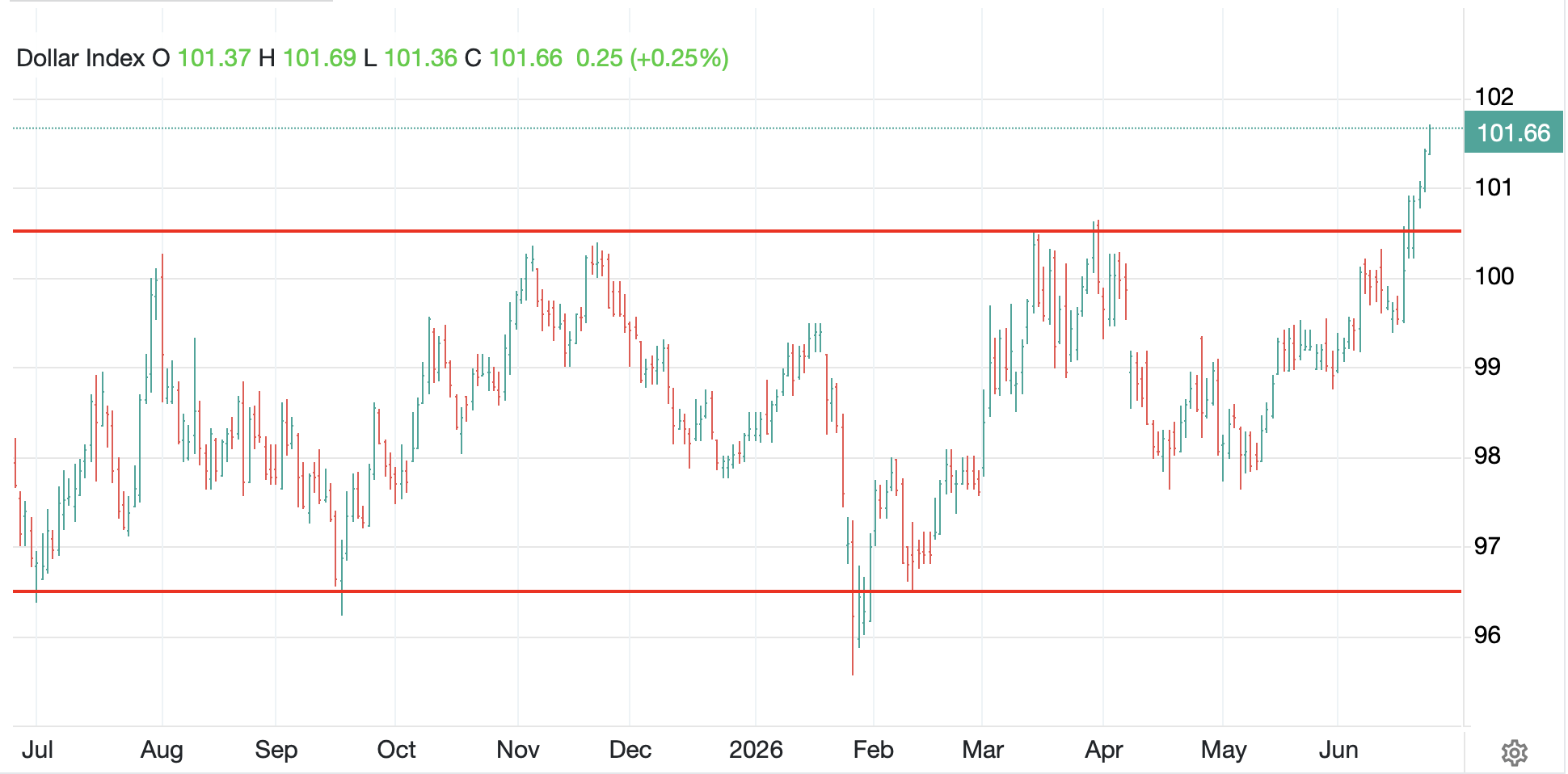
Finally, other currency movements beyond the yen (-0.3% today) are of a similar size across both the G10 and EMG blocs.  Using the DXY as proxy, this is the third test above 100 since August 1st with many analysts are calling for a breakout at last.  

Source: tradingeconomics.com

Perhaps this is true given the word is the Russia/Ukraine peace deal was negotiated entirely between the US and Russia without either Ukraine or Europe involved, demonstrating how insignificant Europe, and by extension the euro, have become.  Just a thought.

On the data front, the big news is the September employment report is going to be released this morning along with some other data:

Nonfarm Payrolls50K
Private Payrolls62K
Manufacturing Payrolls-8K
Unemployment Rate4.3%
Average Hourly Earnings0.3% (3.7% Y/Y)
Average Weekly Hours34.2
Participation Rate62.3%
Philly Fed-3.1
Existing Home Sales4.08M

Source: tradingeconomics.com

On the one hand, the data is stale.  On the other hand, it is all we have, so it will likely have greater importance than it deserves.  I have a hard time looking at the economy and seeing substantial weakness, whether because of corporate earnings, inward investment announcements or the Fed’s growing concern over higher inflation.  All that tells me the dollar is going to be in demand going forward.

Good luck

Adf
Left For Dead

Takaichi’s learned
Her chalice contained poison
Thus, her yen weakens


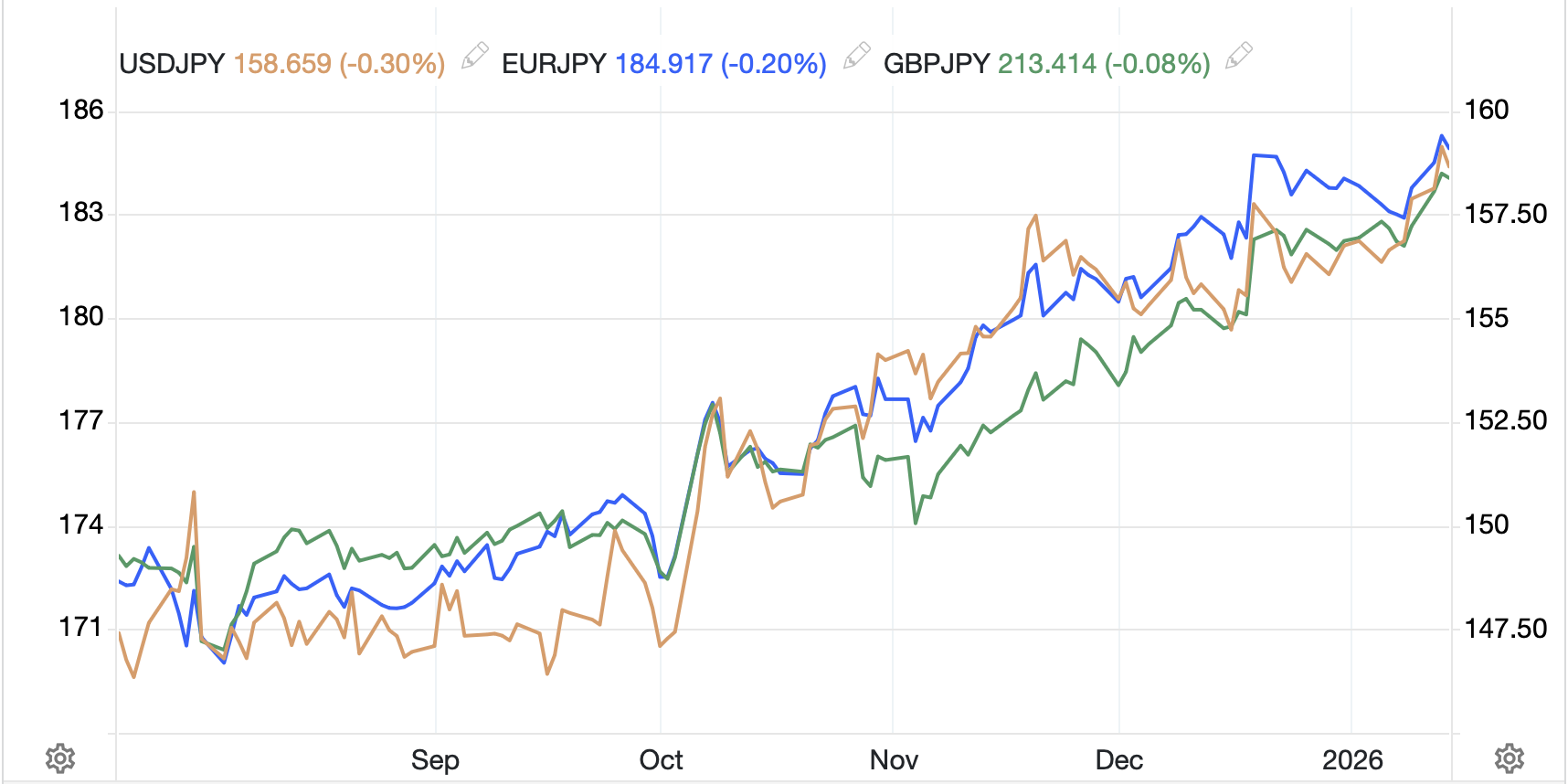
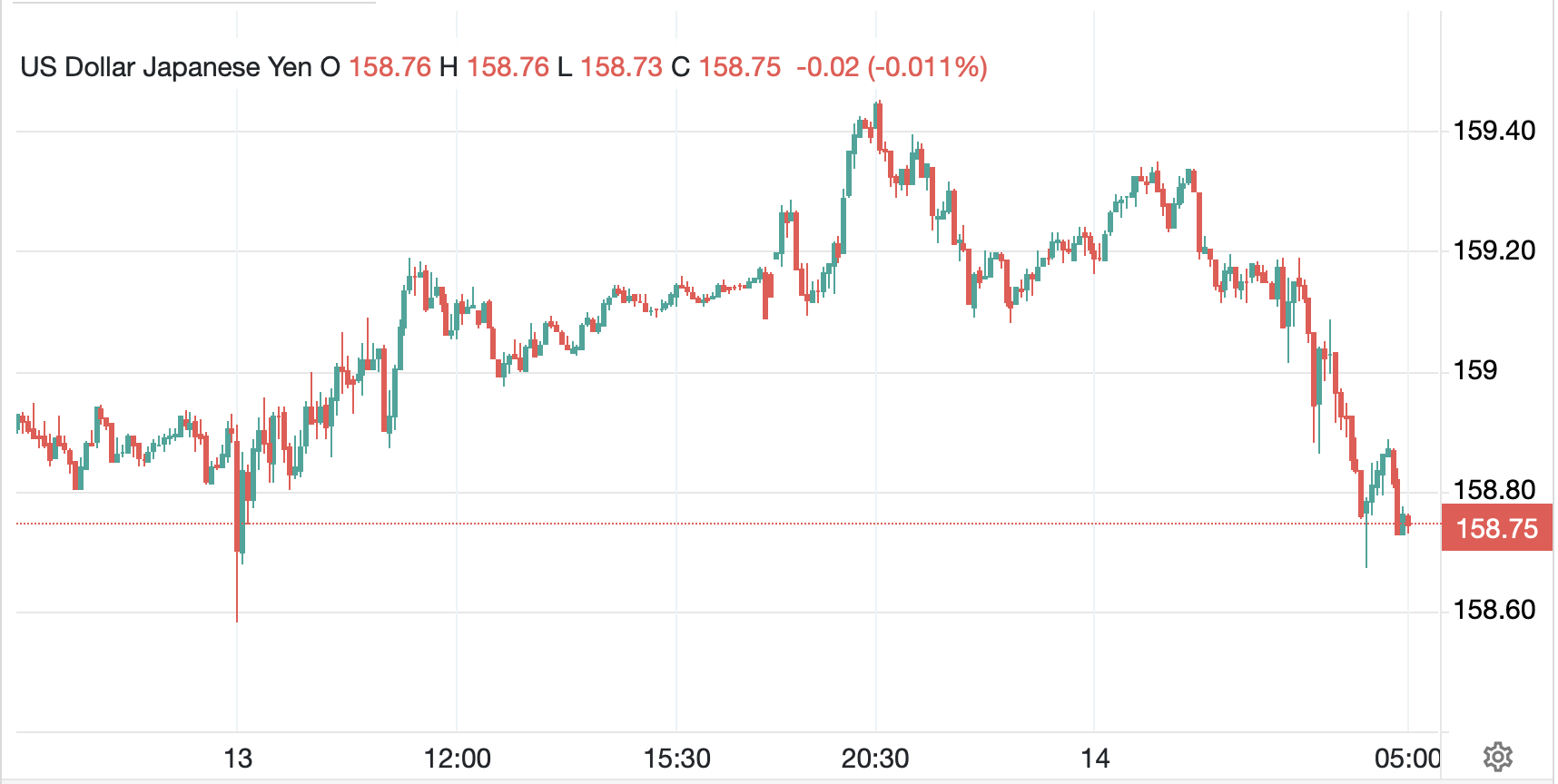
If one needed proof that interest rates are not the only determining factor in FX markets, look no further than Japan these days where JGB yields across the board, from 2yr to 40yr are trading at decade plus highs while the yen continues to decline on a regular basis.  This morning, the yen has traded through 155.00 vs. the dollar, and through 180.00 vs. the euro with the latter being a record low for the yen vs. the single currency since the euro was formed in 1999.

Source: tradingeconomics.com

Meanwhile, JGB yields continue to rise unabated on the back of growing concerns that Takaichi-san’s government is going to be issuing still more unfunded debt to pay for a massive new supplementary fiscal package rumored to be ¥17 trillion (~$109 billion).  While we may have many fiscal problems in the US, it is clear Japan should not be our fiscal role model.

Source: tradingeconomics.com

This market movement has led to the second step of the seven-step program of verbal intervention by Japanese FinMins and their subordinates.  Last night, FinMin Satsuki Katayama explained [emphasis added], “I’m seeing extremely one-sided and rapid movements in the currency market. I’m deeply concerned about the situation.”  Rapid and one-sided are the key words to note here.  History has shown the Japanese are not yet ready to intervene, but they are warming to the task.  My sense is we will need to see 160 trade again before they enter the market.  However, while that will have a short-term impact, it will not change the relative fiscal realities between the US and Japan, so any retreat is likely to be a dollar (or euro) buying opportunity.

As to the BOJ, after a highly anticipated meeting between Takaichi-san and Ueda-san, the BOJ Governor told a press conference, “The mechanism for inflation and wages to grow together is recovering. Given this, I told the prime minister that we are in the process of making gradual adjustments to the degree of monetary easing.”   Alas for the yen, I don’t think it will be enough to halt the slide.  That is a fiscal issue, and one not likely to be addressed anytime soon.

The screens everywhere have turned red
As folks have lost faith that the Fed,
Next month, will cut rates
Thus, leave to the fates
A stock market now left for dead

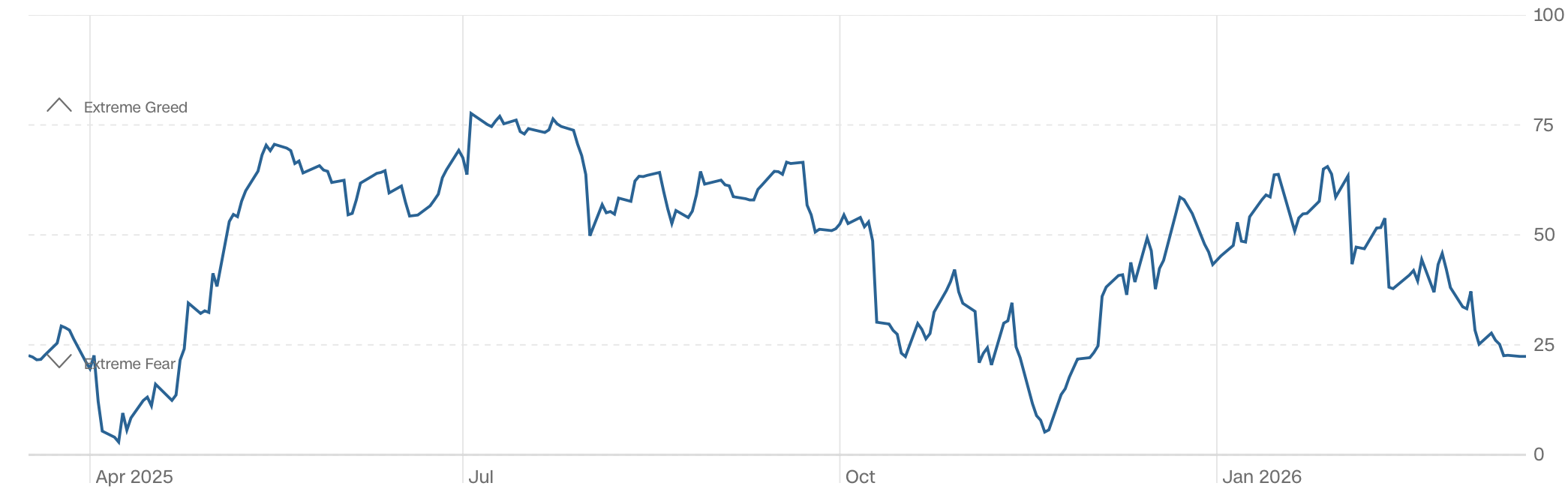
Yesterday, I showed the Fear & Greed Index and marveled at how it was pointing to so much fear despite equity markets trading within a few percentage points of all time highs.  Well, today it’s even worse!  This morning the index has fallen from 22 to 13 and is now pushing toward the lows seen last April when it reached 4 just ahead of Liberation Day.

In fact, it is worthwhile looking at a history of this index over the past year and remembering what happened in the wake of that all-time low reading.

Source: cnn.com

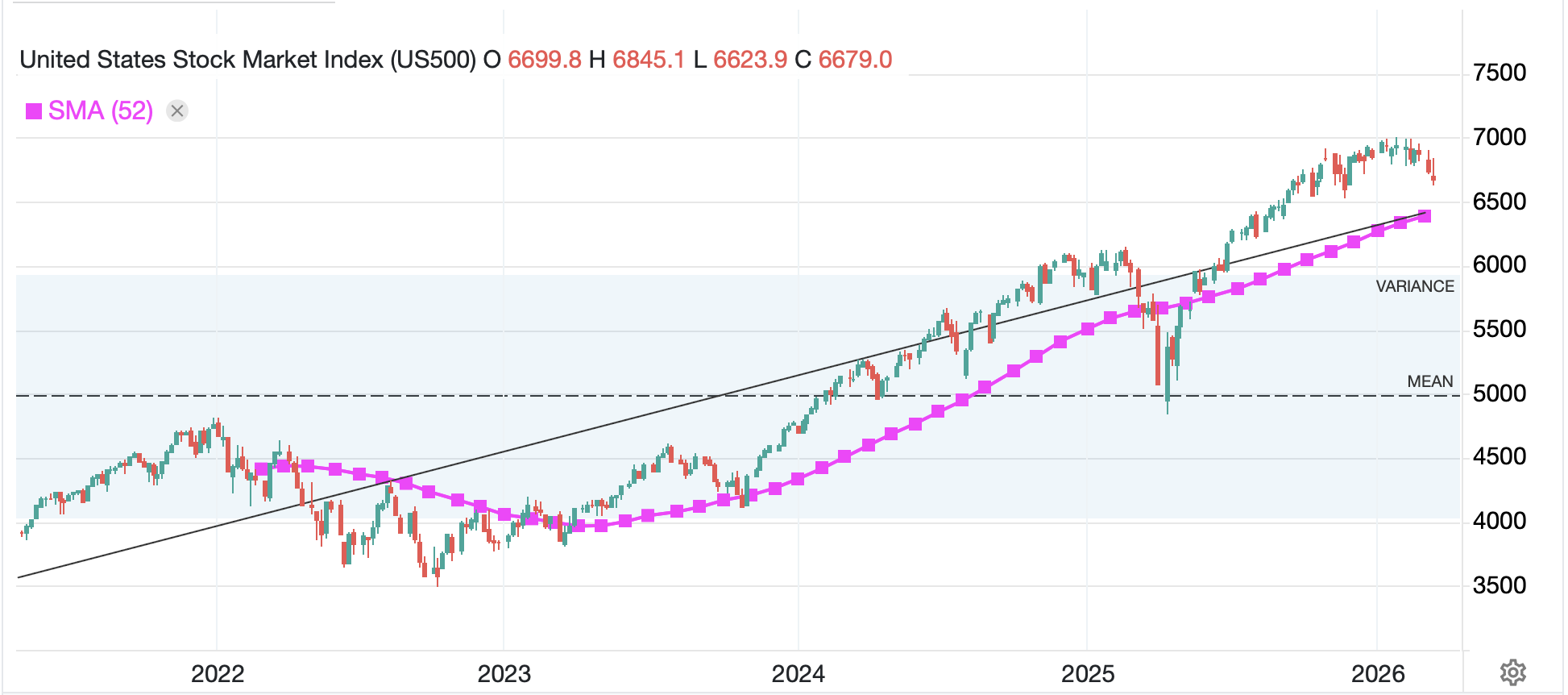
Now look at the S&P500 over the same timeline and see if you notice any similarities.

Source: tradingeconomics.com

It is certainly not a perfect match, but the dramatic rise in both indices from the bottom and through June is no coincidence.  The other interesting thing is that the fear index managed to decline so sharply despite the current pretty modest equity market decline.  After all, from the top, even after yesterday’s decline, we are less than 4% from record highs in the S&P 500.

Analysts discuss the ‘wall of worry’ when equity markets rise despite negative narratives.  Too, historically, when the fear index falls to current levels, it tends to presage a rally.  Yet, if we have only fallen 4% from the peak, it would appear that positions remain relatively robust in sizing.  In fact, BoA indicated that cash positions by investors have fallen to just 3.7%, the lowest level in the past 15 years.  So, everyone is fully invested, yet everyone is terrified.  Something’s gotta give!  In this poet’s eyes, the likely direction of travel in the short run is lower for equities, and a correction of 10% or so in total makes sense.  But at that point, especially if bonds are under pressure as well, I would look for the Fed to step in and not only cut rates but start expanding its balance sheet once again.  QT was nice while it lasted, but its time has passed.  One poet’s view.

Ok, following the sharp decline in US equity markets yesterday on weak tech shares, the bottom really fell out in Asia and Europe.  Japan (-3.2%) got crushed between worries about fiscal profligacy discussed above and the tech selloff.  China (-0.65%) and HK (-1.7%) followed suit as did every market in Asia (Korea -3.3%, Taiwan -2.5%, India -0.3%, Australia -1.9%).  You get the idea.  In Europe, the picture is no brighter, although the damage is less dramatic given the complete lack of tech companies based on the continent.  But Germany (-1.2%), France (-1.3%), Spain (-1.6%), Italy (-1.7%) and the UK (-1.3%) have led the way lower where all indices are in the red.  US futures, at this hour (7:15) are also pointing lower, although on the order of -0.5% right now.

In the bond market, Treasury yields, after edging higher yesterday are lower by -4bps this morning, and back at 4.10%, their ‘home’ for the past two months as per the below chart from tradingeconomics.com.

As to European sovereigns, they are not getting quite as much love with some yields unchanged (UK, Italy) and some slipping slightly, down -2bps (Germany, Netherlands), and that covers the entire movement today.  We’ve already discussed JGBs above.

In the commodity space, oil (-0.2%) continues to trade either side of $60/bbl and it remains unclear what type of catalyst is required to move us away from this level.  Interestingly, precious metals have lost a bit of their luster despite the fear with gold (-0.25%), silver (-0.2%) and platinum (-0.2%) all treading water rather than being the recipient of flows based on fear.  Granted, compared to the crypto realm, where BTC (-1.0%, -16% in the past month) has suffered far more dramatically, this isn’t too bad.  But you have to ask, if investors are bailing on risk assets like equities, and bonds are not rallying sharply, while gold is slipping a bit, where is the money going?

Perhaps a look at the currency market will help us answer that question.  Alas, I don’t think that is the case as while the dollar had a good day yesterday, and is holding those gains this morning, if investors around the world are buying dollars, where are they putting them?  I suppose money market funds are going to be the main recipient of the funds taken out of longer-term investments.  One thing we have learned, though, is that the yen appears to have lost its haven status given its continued weakening (-3.0% in the past month) despite growing fears around the world.  

On the data front, yesterday saw Empire State Manufacturing print a very solid 18.7 and, weirdly, this morning at 5am the BLS released the Initial Claims data from October 18th at 232K, although there is not much context for that given the absence of other weeks’ data around it.  Later this morning we are due the ADP Weekly number, Factory Orders (exp 1.4%) and another Fed speaker, Governor Barr.  Yesterday’s Fed speakers left us with several calling for a cut in December, and several calling for no move with the former (Waller, Bowman and Miran) focused on the tenuous employment situation while the latter (Williams, Jeffereson, Kashkari and Logan) worried about inflation.  Personally, I’m with the latter group as the correct policy, but futures are still a coin toss and there is too much time before the next meeting to take a strong stand in either direction.

The world appears more confusing than usual right now, perhaps why that Fear index is so low.  With that in mind, regarding the dollar, despite all the troubles extant in the US, it is hard to look around and find someplace else with better prospects right now.  I still like it in the medium and long term.

Good luck

Adf
We All Will Be Fucted

The Fed PhD’s have constructed
Their models, from which they’ve deducted
The future will be
Like post-GFC
In which case, we all will be fucted
 
Instead, perhaps what’s really needed
And for which Steve Miran has pleaded
Is changing impressions
In future Fed sessions
Accepting the past has receded


While we all know that things change over time, human nature tends to drive most of us, when facing a new situation, to call on our experience and analogize the new situation to what we have experienced in the past.  But sometimes, the differences are so great that there are no viable analogies.  For the past several years I have made the point in this commentary that the Fed’s models are broken.  Consider, as an example, how wrong they were regarding the alleged transitory nature of inflation in 2022 which led to policy adjustments that not only were far too late to address the issue, but in reality, only had a marginal impact anyway.

On a different, and topical subject, consider the issue with tariffs.  Economists explained that the imposition of tariffs would be devastating to the US consumer, raise prices dramatically and strengthen the dollar as FX markets adjusted to reflect the new trade policy.  But none of that happened, at least not yet.  In fact, the dollar continued to fall in the wake of the Liberation Day tariff announcements, while CPI since then has, granted, edged higher, but remains in its recent range for now and well below the 2022 levels (see below chart from tradingeconomics.com).

And a more important question regarding inflation is, have the tariffs been the driver, or has it been other parts of the price index, housing and core services for instance, that have been the key issue, neither of which would be directly impacted by tariffs.

All of this is to highlight the fact that the world has changed and that the evidence of the past several years, at least, is that the Fed’s econometric models are no longer fit for purpose.  I raise this issue because a look at so many previous market relationships show that many are breaking down.  We have seen gold rise alongside rising real interest rates and the dollar rise alongside gold, two things that are 180o from previous history.  Too, think back to 2022 when both stocks and bonds fell sharply at the same time, breaking the decades-long history of bonds behaving in a manner to offset declines in equity markets.

Source: tradingeconomics.com

This contemplation was brought on by a tweet which led me to a very interesting article (just a 5 minute read) by DL Jacobs of the Platypus Affiliated Society, regarding Fed Governor Miran and his recognition that the world has changed and that the Fed needs to change too.  Here is the second paragraph, and I think it explains the issue beautifully [emphasis added]:

He [Miran] used the moment to challenge the foundations of United States monetary policy. “I think it’s important to take these models seriously, not literally,” he said. He warned that models do not take into account the scale and speed of policy changes in light of the Trump administration’s re-election. The problem with the Fed isn’t wrong technique or bad data, he suggested, but rather that the very structure of its models is embedded in the economic and political assumptions of a bygone era. The world the forecasts are trying to measure no longer exists.

(At this point, I have to explain that the Platypus Society is a left-wing organization trying to explain why Marxism failed and recreate it, but that doesn’t make this article any less worthwhile.  I believe they see it as a step in the destruction of capitalism, which appears to be their goal.)

To me, this is just another point indicating that we’re not in Kansas anymore.  Policies need to change, and the Trump administration is working hard to do so.  One of the key points Miran makes is that the Fed and Treasury ought to be considered as a single entity, with the idea of Fed independence an anachronism from a bygone age.  The upshot is the Trump administration is going to continue to run things hot, or as macro analyst Lynn Alden has been saying, “Nothing stops this train”.  

This means that the Fed is going to run relatively easy monetary policy while the government, via the Treasury, is going to ensure there is ample liquidity available for everything, real economic activity and market activity.  The downside of these policies, alas, is that the idea inflation is going to decline in any meaningful way is simply wrong. It’s not.  Keep this in mind as we go forward.

As it happens, there was very little news of note overnight, at least market news, so let’s see how things behaved.  Friday’s mixed session in the US was followed by Chinese weakness with HK (-0.7%) and China (-0.7%) both under pressure.  Tokyo (-0.1%) was not nearly as impacted and the regional exchanges were actually broadly higher (Korea, India, Taiwan, Indonesia, Thailand).  The big news in Asia is the increasing verbal jousting by China and Japan at each other after PM Takaichi said, out loud, that if China attacked Taiwan, it would impact Japan.  Given the proximity, that is, of course, true, but apparently it was a taboo item in the diplomatic dance in the past.  I don’t see this having a long-term impact on anything.

In Europe, though, bourses are lower this morning led by Spain (-0.8%) although weakness is widespread (Germany -0.5%, France -0.4%. UK -0.1%).  There has been no data of note to drive this movement and it seems as though we are seeing the beginning of some longer-term profit taking after strong YTD gains by most bourses on the continent.  US futures at this hour (6:45) are pointing a bit higher, 0.43% or so.

In the bond market, Treasury yields have slipped -3bps this morning despite (because of?) the market pricing a December rate cut as a virtual coin toss.  This is a huge change over the past month as can be seen at the bottom of the chart below from cmegroup.com

Recent Fedspeak has highlighted the Fed’s uncertainty, especially absent data, and the belief that waiting is a better choice than acting incorrectly (what if waiting is the incorrect move?).  At any rate, we are going to be inundated with both Fedspeak (14 speeches this week!) as well as the beginnings of the delayed data so there will be lots of headlines.  Right now, I think it is fair to say that nobody is confident in the current direction of travel in the economy.  But perhaps, a more hawkish tone at the front of the curve has investors believing that inflation will, once again, become the Fed’s focus.  Alas, I don’t think so.  Looking elsewhere, European sovereign yields have followed Treasury yields lower, slipping between -2bps and -3bps this morning.  Perhaps more interesting is Japan, where JGB yields (+3bps) have risen to a new 17-year high as a prominent LDP member put forth a massive new spending bill to be passed.

In the commodity space, oil remains pinned to the $60/bbl level with lots of huffing and puffing about Russian sanctions and oil gluts and IEA changes of opinion but in the end, WTI has been either side of $60 for the past month+ and continues to trend slowly lower.  

Source: tradingeconomics.com

Metals remain the most volatile segment of the entire market complex although this morning, movement has not been so dramatic (Au -0.1%, Ag +0.9%, Cu -0.4%, Pt -0.1%).  All the metals remain substantially higher than where they began the year and all have seemingly run into levels at which more consolidation is needed before any further substantial gains can be made.  I don’t think the supply/demand story has changed here, just the price action.

Finally, the dollar is a touch firmer this morning, with the DXY (+0.1%) a good representation of the entire space.  The only two currencies that have moved more than 0.2% today are KRW (-0.9%) which reversed Friday’s price action and is explained as continued capital outflows to the US for investment.  On the flip side, CLP (+1.1%) is benefitting from the first round of Presidential elections in Chile, where the right-wing candidate came out ahead and is expected to consolidate the vote and win an absolute majority in the second round.  Jose Antonio Kast, if he wins, is expected to proffer more market-friendly policies than the current socialist president, Gabriel Boric.  It seems the people in Chile have had enough of socialism for now.  But other than those two currencies, this market remains quiet.

On the data front, there is so much data to be released, but the calendar for much of it has not yet been finalized.  One thing that is finalized is the September employment situation which is due for release Thursday morning at 8:30. This morning we see Empire State Manufacturing (exp 6.0) and Construction Spending (-0.1%) and hopefully, the calendar will fill in as the week passes.

While equity markets remain very near their all-time highs, the Fear and Greed Index is firmly in Fear territory as per the below from cnn.com.

Historically, this has been seen as an inverse indicator for stock markets although it has been down here for more than a month.  Uncertainty breeds fear and the lack of data has many people uncertain about the current state of the US economy since the only information they get is either from the cacophony of social media, the bias of mainstream media or their own two eyes.  But even if you trust your own eyes, they just don’t see that much, likely not enough to come to a broad conclusion. 

FWIW, which is probably not much, my take is things are slower than they have been earlier in the year, but nowhere near recession.  I think it is the correct decision for the Fed to hold next month rather than cut because the drivers of inflation remain extant.  But Jay doesn’t ask me.  Whether Miran is correct in his prescriptions for the economy, I am gratified that he is questioning the underlying structure.  In the meantime, run it hot remains the name of the game and that means any risk-off period is likely to be short.

Good luck

Adf
Like a Fable

It seems there’s a deal on the table
To end the shut down and enable
The chattering classes
To force feed the masses
A story that’s quite like a fable
 
Both sides will claim they have achieved
Their goals, though they were ill-conceived
But markets will love
The outcome above
All else, and we’ll all be relieved


While the shutdown is not technically over as the House of Representatives need to reconvene (they have been out of session since September 19th when they passed the continuing resolution) and adjust the bill so that it matches the one the Senate agreed last night and can be voted on in the House, it certainly appears that the momentum, plus President Trump’s imprimatur, is going to get it completed sometime this week. 
The nature of the deal is unimportant for our purposes here and both sides will continue to claim that they were in the right side of history, but the essence is that there appeared to be some movement on health care funding so, hurray!

As you can see in the chart below, while the story broke late yesterday afternoon and futures responded on the open in the evening session, the reality is the market sniffed out something was coming around noon on Friday.  In fact, the S&P 500 has rallied 2.4% since noon Friday.

Source: tradingeconomics.com

So, everything is now right with the world, right?  After all, this has been the major topic of conversation, not just by the talking heads on TV, but also in markets as analysts were trying to determine how much damage the shutdown was doing to the economy.  While I have no doubt that there were many people who felt the impact, my take is there were many, many more who felt nothing.  After all, the two main features were air travel and then SNAP benefits.  Let’s face it, on average (according to Grok) about 2.9 million people board airplanes in the US, well less than 1% of the population, although SNAP benefits, remarkably, go to 42 million people.  However, those have only been impacted for the past week, not the entire shutdown.

I’m not trying to make light of the inconveniences that occurred, just point out that from a macroeconomic perspective, despite the fact that the shutdown lasted 6 weeks, it probably didn’t have much of an impact on the statistics as all the money that wasn’t spent last month will be spent next month.  Different analyst estimates claim it will reduce Q4 GDP by between 0.2% and 0.5% with a concurrent impact on the annual result.  I am willing to wager it is much less.  However, it appears it will have ended by the end of the week and so markets are back to focusing on other things like AI, unemployment and QE.

Now, those three things are clearly important to markets, but I don’t think there is anything new to discuss there today.  Rather, I would like to focus on two other issues, one more immediate and one down the road, which may impact the way things evolve going forward.

In the near term, as winter approaches, meteorologists are forecasting a much colder winter in the Northern Hemisphere across both North America and Europe, something that is going to have a direct impact on NatGas.  Bloomberg had a long article on the topic this morning with the upshot being that the Polar Vortex may break further south early this year and bring a lot of cold weather along for the ride.  This is clearly not new news to the NatGas market, as evidenced by the fact that its price has exploded (no pun intended) higher by 43% in the past month!

Source: tradingeconomics.com

While oil prices have remained stuck in a narrow range, trading either side of $60/bbl for the past 6 weeks amid a longer-term drift lower as you can see in the below chart, oil is only utilized by ~4% of homeowners for heating with 46% using NatGas.

Source: tradingeconomics.com

Ultimately, I suspect that we are going to see this feed through to inflation as not only are there the direct costs of heating homes, but NatGas is also the major source of generating electricity, with 43% of the nation’s electricity using that as its source.  We have already seen electricity prices rise pretty sharply over the past months (I’m sure you have all felt that pain) and if NatGas prices continue to climb, that will continue.  Remember, the current price ~$4.45/MMBtu is nowhere near significant highs like those seen just 3 years ago when it traded as high as $10/MMBtu.  With all this price pressure, will the Fed continue down their path of rate cuts?  Alas, I believe they will, but that doesn’t make our lives any better.

Which takes me to the second, longer term issue I wanted to mention, European legislation that is seeking to effectively outlaw the utilization of cash euros.  This substack article regarding recent Eurozone legislation is eye-opening as the ECB and Europe try to combat the coming irrelevance of the euro.  For everyone who either lives in Europe or does business there, I cannot recommend reading this highly enough.  There are many changes occurring in financial architecture, and by extension financial markets.  Keep informed!

Ok, enough of that, let’s see how markets have responded to the Senate deal.  Apparently, US politics matters to the entire global equity market.  Green is today’s color with Japan (+1.25%), HK (+1.55%) and China (+0.35%) all performing well, although not as well as Korea (+3.0%) which really had a good session.  Pretty much all the other regional markets were also higher.  In Europe, the deal has everyone excited as well with gains across the board (Germany +1.8%, France +1.4%, Spain +1.4%, UK +1.0%).  As to US futures, at this hour (7:45) they are higher by about 1% across the board.

I guess with that much excitement about more government spending, we cannot be surprised the yields have edged higher.  This morning Treasury yields are up by 3bps, which is what we saw from JGB markets last night as well, although European sovereign yields are little changed on the day.  I suspect, though, if equities continue to rally, we will see yields there edge higher.

In the commodity space, oil (+0.5%) continues to trade in its recent range.  The most interesting thing I saw here was that the IEA is set to come out with their latest annual assessment of the oil market and for the first time in more than a decade they are not going to claim that peak fossil fuel demand is here or coming soon.  The climate grift is truly breaking down.  But the commodity story of the day is precious metals which are massively higher (Au +2.5%, Ag +3.3%, Pt +2.6%) with copper (+1.6%) coming along for the ride.  The narrative here is that with the government shutdown due to end soon, President Trump talking about $2000 tariff rebate checks and the Fed likely to cut rates in December (65% probability), debasement is with us and metals is the place to be!

Interestingly, the dollar is not suffering much at all despite the precious metals story.  While AUD (+0.6%), ZAR (+0.6%) and NOK (+0.6%) are all stronger on the commodity story, the euro is unchanged, JPY (-0.4%) continues to decline and the rest of the G10 is not doing enough to matter.  In truth, if I look across the board, there are more currencies strengthening than weakening vs. the greenback, but overall, at least per the DXY, the dollar is little changed.

There is still no data at this point, although it will start up again when the government gets back to work.  Actually, there has been much talk of the weakness in Consumer sentiment based on Friday’s Michigan Index which fell to 50.3, the second lowest in the history of the series with several subindices weakening substantially.  However, that was before the news about the end of the shutdown, so my take is people will regain confidence soon.  As well, we hear from 9 Fed speakers this week, with 5 of them on Wednesday!  Both dissenters from the October meeting will speak, so perhaps things have changed in their eyes, but I doubt it.

At this point, all is right with the world as investors anticipate the US government getting back to work while the Fed will continue to support markets by easing policy further.  In truth, the dollar should not benefit here, but I have a feeling that any weakness will be short-lived at best.  Longer term, I continue to believe the dollar is the place to be.

Good luck

Adf