Set Cash On Fire

On Friday, the Moody’s brain trust
At last said it’s time to adjust
America’s debt
As we start to fret
That it’s too large and might combust
 
So, Treasury yields are now higher
As pundits explain things are dire
But elsewhere, as well
Seems bonds are a sell
As governments set cash on fire


Arguably, the biggest story of the weekend happened late Friday evening as Moody’s became the third, and final, ratings agency to downgrade US government debt to Aa1 from Aaa.  S&P did the deed back in 2011 and Fitch in 2023.  The weekend was filled with analyses of the two prior incidents and how markets responded to both of those while trying to analogize those moves to today.  In a nutshell, the first move in both 2011 and 2023 was for stocks to fall and bonds to rally with the dollar falling. However, in both of those instances, those initial moves reversed over the course of the ensuing months such that within a year, markets had pretty much reversed those moves, and in some cases significantly outperformed, the situation prior to the downgrade.  

Looking at Moody’s press release, they were careful to blame this on successive US administrations, so not putting the entire blame on President Trump, but in the end, it is hard to ignore that the nation’s fiscal statistics regarding debt/GDP and debt coverage are substantially worse than that of other nations that maintain a Aaa rating.  As well, their underlying assumption is that there will be no changes in the current trajectory of deficits and so no reason to believe things can change.

The most popular weekend game was to try to estimate how things would play out this time although given the starting conditions are so different in the economy, I would contend past performance is no guarantee of future outcomes.  In this poet’s eyes, it is not clear to me that it will have a long-term material impact on any market.  We have already been hearing a great deal about how Treasuries are no longer the safe haven they were in the past.  I guarantee you that institutions looking for a haven were not relying solely on Moody’s Aaa rating for comfort.  In addition, given a key demand for Treasuries is as collateral in the financial markets, and the Aa1 rating is just as effective as a Aaa rating from a regulatory risk perspective, I see no changes coming

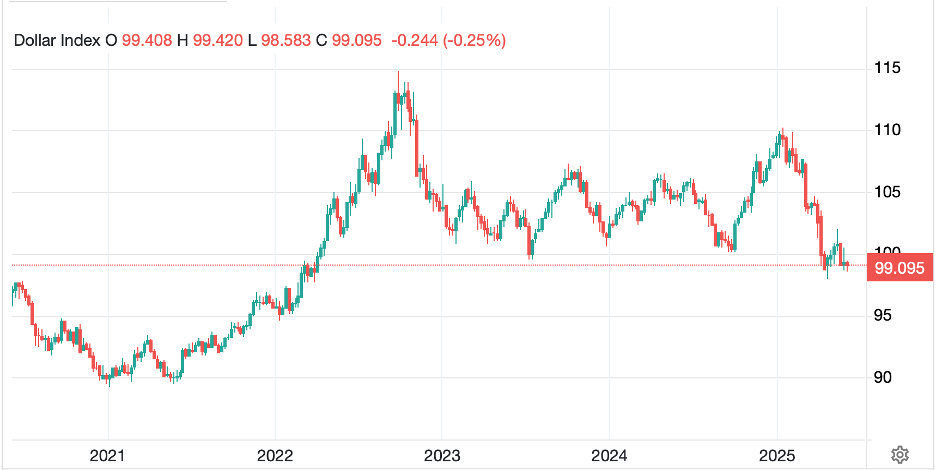
As to equities, I see no substantive impact on the horizon.  The equity market remains over richly valued and if it were to decline, I don’t think fingers could point to this action.  Finally, the dollar has been declining since the beginning of the year and remains in a downtrend.  Using the DXY as our proxy, if the dollar falls further, should we really be surprised?

source tradingeconomics.com

To summarize, expect lots more hyperbole on the subject, especially as many analysts and pundits will try to paint this as a failure of the Trump administration.  And while bond yields may rise further, as they are this morning, given the fact that yields are rising everywhere around the world, despite no other nations being downgraded, this is clearly not the only driver.

In fact, one could make the case that bond yields are rising around the world because, like the US, nations all over are talking about adding fiscal stimulus to their policy mix.  After all, have we not been assured that Europe is going to borrow €1 trillion or more to rearm themselves?  That is not coming out of tax revenue, that is a pure addition to the debt load.  As well, is not a key part of the ‘US will suffer more than China in the tariff wars’ story based on the idea that China will stimulate the domestic economy and increase consumption (more on that below)?  That, too, will be increased borrowing.  I might go so far as to say that the increased borrowing globally to increase fiscal stimulus will lead to higher nominal GDP growth everywhere along with higher inflation.  I guess we will all learn how things play out together. 

Ok, so now that we have a sense of THE big story, let’s see how markets behaved elsewhere.  I thought that today, particularly, it would be useful to see how bond markets around the world have behaved in the wake of the Moody’s news.  Below is a screenshot from Bloomberg this morning.  note that every major market that is open has seen bonds sell off and I’m pretty confident that Canada’s at the very least, will do so when they wake up.  Ironically, the European commission came out this morning and reduced their forecasts for GDP growth and inflation this year and next and still European sovereign yields are higher.  I have a feeling that this news is not as impactful as some would have you believe.

Turning to equity markets, Friday’s US rally is ancient history given the change in the narrative.  And as you can see below from the tradingeconomics.com page, every major market is softer this morning (those are US futures) with only Russia’s MOEX rising, hardly a major market.  Again, it appears the fallout from the ratings cut is either far more widespread, or not a part of the picture at all.  It seems you could make the case that if European growth is going to underperform previous expectations, equity markets there should underperform as well.  The other two green arrows are Canada and Mexico, neither of which is open as of 6:30 this morning.

Commodity markets are the ones that make the most sense this morning as oil (-1.3%) is under pressure, arguably on a weaker demand picture after softer Chinese data was released overnight.  While the timing of the impacts of the trade war is unsettled, there is certainly no evidence that China is aggressively stimulating its economy.  This was very clear from the decline in Retail Sales, Fixed Asset Investment and IP, although the latter at least beat expectations.  But the idea that China is changing the nature of their economy to a more consumption focused one is not yet evident.  Meanwhile, metals markets are all firmer this morning with gold (+1.2%) leading the way, arguably as a response to the ratings downgrade.  This has dragged both silver (+0.9%) and copper (+1.0%) along for the ride.  It is not hard to imagine that sovereign investors see the merit in owning storable commodities like metals in lieu of Treasuries, at least at the margin.  But also, given the dollar’s weakness, a rally in metals is not surprise.

Speaking of the dollar’s weakness, that is the strong theme of the day along with higher yields across the board.  Right now, the euro (+1.0%) and SEK (+1.0%) are leading the way higher although the pound (+0.9%) is also doing well.  Perhaps this has to do with the trade agreement signed between the UK and EU reversing some of the Brexit outcomes at least regarding food and fishing, although not regarding regulations or immigration.  JPY (+0.6%) is also rallying as is KRW (+0.75%) and THB (+0.9%) as there is a continuing narrative that stronger Asian currencies will be part of the trade negotiations.  Finally, Eastern European currencies are having a good day (RON +2.3%, HUF +1.8%, CZK +1.2%, PLN +1.0%) after the Romanians finally elected a president that was approved by the EU.  Yes, they had to nullify the first election and then ban that candidate from running again, but this is how democracy works!

On the data front, there is very little hard data to be released this week, although it appears every member of the FOMC will be on the tape ahead of the Memorial Day weekend.  Perhaps they are starting to feel ignored and want to get their message out more aggressively.

TodayLeading Indicators-0.9%
ThursdayInitial Claims230K
 Continuing Claims1890K
 Flash Manufacturing PMI50.5
 Flash Services PMI51.5
 Existing Home Sales4.1M
FridayNew Home Sales690K

Source: tradingeconomics.com

Actually, as I count, there are three members, Barr, Bowman and Waller who will not be speaking this week, although Chairman Powell doesn’t speak until next Sunday afternoon.  In the end, the narrative is going to focus on the ratings cut for a little while, at least for as long as equity markets are under pressure along with the dollar.  However, when that turns, and I am sure it will, there will be a search for the next big thing.  I have not forgotten about the potential large-scale changes I discussed on Friday, and I am still trying to work potential scenarios out there, but for now, that is not the markets’ focus.  Certainly, for now, I see no reason for the dollar to gain much strength.

Good luck

Adf

Much More Desirous

The world that we knew ere the virus
Was different, and much more desirous
‘Cause we got to ease
Whenever we’d please
And ‘flation was rare as papyrus


A few disparate thoughts this morning as there doesn’t seem to be a real theme in markets.  

Starting with Chairman Powell’s comments yesterday regarding the Fed’s policy framework and how they were reviewing the current framework established in 2020, to see if it was still appropriate.  It was during that policy discussion that the Fed came up with the idea of average inflation targeting, rather than maintaining a stable rate.  However, Chairman Powell was candid yesterday when he explained, “The idea of an intentional, moderate overshoot proved irrelevant to our policy discussions and has remained so through today.”  Ya think?

Of course, being the consummate central banker, he made sure to explain that their future failures would not be their fault.  As explained in the WSJ by the Fed whisperer himself, Nick Timiraos, Powell explained that higher real interest rates might “reflect the possibility that inflation could be more volatile going forward than in the intercrisis period of the 2010s. We may be entering a period of more frequent, and potentially more persistent, supply shocks—a difficult challenge for the economy and for central banks.” 

However, unlike the pre-Trump era, it’s not clear the market paid much attention to Mr Powell.  Going forward, I do expect the Fed to have more market sway again, but it may be a little while before that is the case.  But I think it is worthwhile for us to understand how they are thinking.

While pundits expressed they were certain
The US is who would be hurtin’
From tariffs and Trump
It turns out the slump
Is elsewhere, as he’d been assertin’

One of the themes following President Trump’s “Liberation Day” tariff announcements amongst much of the punditry was that the US was shooting itself in the foot and the US economy would be the loser in the end.  My thesis had been that the US, as the consumer of last resort, was far more important to other nations’ economic growth than vice versa.  Now, we know that the first look at Q1 GDP in the US was a negative number, but we also know that was entirely the result of the uptick in imports that came ahead of the tariffs.  Meanwhile, private economic activity in the US grew and government activity shrank, both distinct economic positives.

Well, it turns out that the rest of the world is finding that when the US market is not as welcoming of their exports as previously seen, those economies find themselves under pressure.  Yesterday we saw weaker Eurozone GDP and last night Japanese GDP declined much more than expected, -0.2% in Q1 leading to a -0.7% Y/Y result.  The change in trade relations and weaker exports were the driver.  Now, this is just one quarter, and not necessarily a trend, especially if trade negotiations conclude on a timely basis.  But Japanese inflation remains sticky on the high side while growth is ebbing.  The BOJ is unlikely to change policy anytime soon as they, like most central banks, try to figure out the underlying trends. 

My take is this is going to be the scenario through the summer, and likely into the early autumn as trade deals get concluded but their impacts will take time to feel.  I suspect that central banks will be reluctant to be too aggressive in either direction given the propensity of President Trump to upset the applecart of policy decisions.  Ultimately, I see this as the backdrop that will result in more market volatility in both directions in response to the currently unknown policy announcements that are sure to come.  If you are a hedger, maintain those hedge ratios, even if they are a little pricey, the alternative could be far worse.  If you are a speculator, keep your positions smaller than you might think.  Wrong is only a Trump tweet away.

And finally, let’s talk of peace
Which most folks would like to increase
Could we really see
A Trump policy
That gets global fighting to cease?

I’m going to don my tinfoil hat for a paragraph or two here, but I think we must consider the possibilities that Mr Trump has far larger plans for a geopolitical realignment than most are aware.  I discussed the remarkable Iranian proposal to re-enter the brotherhood of nations yesterday.  The recent history of war shows that it is a) hugely profitable for a select number of companies and b) generally inflationary.  Mr Trump’s overtures throughout the Middle East this week, as he seems to be cementing relationships with the leadership there could well have a motive beyond lower oil prices.  I read a remarkable piece from Dr Pippa Malmgrenyesterday that pulled together many threads as to potential motivations for Trump’s activities and they were framed as the enemy is not necessarily Russia or China or Iran, but rather the deep-state in the US (I told you it was tinfoil hat territory).  There is a group in government who profits immensely from the ongoing war footing and who are not interested in seeing peace break out all over.  

I have no idea if Mr Trump can be successful in this endeavor, but if he is, the implications for markets will be significant.  Oil prices will be far lower, as will commodity prices generally given the result could easily see more access granted for mining/drilling/growing.  Inflation will remain under control which would reduce interest rates, and by extension remove some pressure from the US budget situation.  As well, reduced defense requirements would also help the budget.  The dollar would maintain its status as the global reserve currency and focus would return to economic growth rather than geopolitical mischief.  And this feels like a pretty good state for equities, at least those that are not defense focused.  Maybe crazy…but maybe not.

Ok, really quick around the world.  In equities, mixed is the best description of the US yesterday and Asia overnight with no real outstanding movers in either direction.  Europe is all green this morning, with gains on the order of 0.6%, but I think that is based on the idea the ECB is going to continue to cut rates going forward given inflation there remains low and growth is declining.  US futures, at this hour (7:15) are pointing slightly higher, 0.25%.

Bond markets rallied yesterday with Treasury yields sliding 10bps and falling another -3bps this morning.  European sovereign yields tracked Treasuries yesterday and are actually leading the way today with yield declines on the order of -4bps to -6bps across the entire continent and the UK.  Even JGB yields fell -2bps overnight.

In the commodity space, oil (+0.25%) bounced from its worst levels of the morning during the session yesterday but has created a new gap above the price to add to the really big gap from the beginning of April.

Source: tradingeconomics.com

My take is the market sees the possibility of lower oil prices going forward as supply is set to increase further.  There has been some discussion about how low oil prices will reduce capex in the space, and that is probably true, but what are oil companies going to do if they don’t drill for oil?  My view is they will still drill.  Meanwhile, gold is under pressure again as fear seems to be abating around the world.  This morning the barbarous relic is lower by -2.0% and that is taking both copper and silver along with similar declines.

Finally, the dollar is a bit softer this morning, with NZD (+0.5%) the biggest mover in either the G10 or EMG blocs.  JPY, EUR, MXN, ZAR are all just basis points different this morning than yesterday with a few gainers and a few laggards but no real trend to note here.  I think it is very clear Mr Trump would like to see the dollar’s value decline in the FX markets for competitiveness reasons, but right now, uncertainty is the driving force.

On the data front, yesterday’s big surprise in PPI (-0.5%) seemed to be the driving force behind the bond market rally.  But there was also a huge surprise in the Philly Fed New Orders sub-index, which jumped 41.7 points, a 4.3SD move and the largest in the history of the series.  Perhaps things aren’t as negative as some would have us believe.  As to this morning, we get Housing Starts (exp 1.37M) and Building Permits (1.45M) at 8:30 followed by Michigan Consumer Sentiment (53.4) at 10:00.  

It is very difficult to determine if the recent equity rally is just a bear market rally, or if things are going to be fine.  Given the still uncertain policy outcomes both domestically and globally, there are still many possible paths forward.  I wonder if gold, which had been a harbinger of concerns about the future is now telling us that the worst has passed.  Certainly, a movement toward peace in the Middle East is going to be a net positive for risk appetite, which when I translate that back to the dollar, implies my view of weakness going forward remains intact.

Good luck and good weekend

Adf

As Though It Had Fleas

Well, CPI wasn’t as hot
As most of the punditry thought
But bonds don’t believe
The Fed will achieve
Low ‘flation, so they weren’t bought
 
But maybe, the biggest response
Has been that the buck, at the nonce
Has lost devotees
As though it had fleas
The end of the Trump renaissance?


Yesterday’s CPI data was released a touch softer than market expectations with both headline and core monthly numbers printing at 0.2%.  If you dig a bit deeper, and look out another decimal place, apparently the miss was just 0.03%, but I don’t think that really matters.  As always, when it comes to inflation issues, I rely on @inflation_guy for the scoop, and he provided it here.  The essence of the result is that while inflation is not as high as it had been post Covid, it also doesn’t appear likely that it is going to decline much further.  I think we all need to be ready for 3.5% inflation as the reality going forward.

Interestingly, different markets seemed to have taken different messages from the report.  For instance, Treasury yields did not see the outcome as particularly positive at all.  While yields have edged lower by -2bps this morning, as you can see from the below chart, they remain near their highest level in the past month.  

Source: tradingeconomics.com

There are two potential drivers of this price action, I believe, either bond investors don’t believe the headline data is representative of the future, akin to my views of inflation finding a home higher than current readings, or bond investors are losing faith in the full faith and credit of the US.  Certainly, the latter would be a much worse scenario for the US, and arguably the world, as the repudiation of the global risk-free asset of long-standing choice will result in a wild scramble to find a replacement.  I continue to see comments on X about how that is the case, and that US yields are destined to climb to 6% or 10% over the next couple of years as the dollar declines in importance in the global trading system.  However, when I look at the world, especially given my views on inflation, I find that to be a lot of doomporn clickbait and not so much analysis.  Alas, higher inflation is not a great outcome either.

Interestingly, while bond investors did not believe in the idea of lower yields, FX traders took the softer inflation figure as a reason to sell dollars.  This is a little baffling to me as there was virtually no change in Fed funds futures expectations with only an 8% probability of a cut next month and only 2 cuts priced for the year.  So, if long-dated yields didn’t decline, and short-dated yields didn’t decline, (and equity prices didn’t decline), I wonder what drove the dollar lower.  

Yet here we are this morning with the greenback softer against all its G10 counterparts (JPY +1.0%, NOK +0.6%, EUR +0.5%, CHF +0.5%) and almost all its EMG counterparts (KRW +1.5%, MXN +0.3%, ZAR +0.3%, CLP +0.6%, CZK +0.5%).  In fact, the only currency bucking the trend is INR (-0.25%) but given the gyrations driven by the Pakistan issues, that may simply be the market adjusting positions.

From a technical perspective, we are going to hear a lot about how the dollar failed on its break above the 50-day moving average that was widely touted just two days ago. (see DXY chart below).

Source: tradingeconomics.com

But let’s think about the fundamentals for a bit.  First, we know that the Trump administration would prefer a weaker dollar as it helps the competitiveness of US exporters and that is a clear focus.  Second, the fact that US yields remain higher than elsewhere in the world is old news, that hasn’t changed since the Fed stopped its brief cutting spree ahead of the election last year while other nations (except Japan) have been cutting rates consistently.  What about trade and tariffs?  While it is possible that the idea of a reduction in trade will reduce the demand for dollars, arguably, all I have read is that during this 90-day ‘truce’, companies are ordering as much as they can to lock in low tariffs.  That sounds like more dollars will be flowing, not less.

As I ponder this question, the first thing to remember is that markets don’t necessarily trade in what appears to be a logical or consistent fashion.  I often remark that markets are simply perverse.  But going back to the first point regarding President Trump’s desire for a weaker dollar, there was a story overnight that a stronger KRW was part of the trade discussion between the US and South Korea and I have a feeling that is going to be part of the discussion throughout Asia, especially with Japan.  As of now, I continue to see more downward pressure on the dollar than upward given the Administration’s desires.  I don’t think the Fed is going to do anything, nor should they, but I also don’t foresee a change in the recession narrative in the near future.  While that has not been the lead story today, it remains clear that concern about an impending recession is everywhere except, perhaps, the Marriner Eccles Building.  My view has been a lower dollar, and perhaps today’s price action is a good example of why that is the case.

Ok, let’s touch on other markets quickly.  After yesterday’s mixed session in the US, Asia saw much more positivity with China (+1.2%) and Hong Kong (+2.3%) leading the way higher with most regional markets having good sessions and only Japan (-0.15%) missing the boat.  In Europe, though, the picture is not as bright with both the CAC (-0.6%) and DAX (-0.5%) under some pressure this morning despite benign German inflation data and no French data.  Perhaps the euro’s strength is weighing on these markets.  As to US futures, at this hour (6:45), they are basically unchanged.

Away from Treasury markets, European sovereign yields have all slipped either -1bp or -2bps on the day with very little to discuss overall here.

Finally, in the true surprise, commodity prices are under pressure this morning across the board despite the weak dollar.  Oil (-1.1%) is slipping, with the proximate cause allegedly being API oil inventory data showed a surprising gain of >4 million barrels.  However, given the courteousness of the meeting between President Trump and Saudi Prince MBS, I would not be surprised to hear of an agreement to see prices lower overall.  I believe that is Trump’s goal for many reasons, notably to put more pressure on Russia’s finances, as well as Iran’s and to help the inflation story in the US.  As to the metals complex, they are all lower this morning with gold (-0.7%) leading the way but both silver (-0.3%) and copper (-0.5%) lagging as well.

On the data front, there is no front-line data to be released, although we do see EIA oil inventories with modest declines expected.  However, it is worth noting that Chinese monetary data was released this morning and it showed a significant decline in New Yuan Loans and Total Social Financing, exactly the opposite of what you would expect if the Chinese were seeking to stimulate their economy.  It is difficult for me to look at the chart below of New Bank Loans and see any trend of note.  I would not hold my breath for the Chinese bazooka of stimulus that so many seem to be counting on.

Source: tradingeconomics.com

Overall, it appears to me the market is becoming inured to the volatility which is Donald Trump.  As I have written before, after a while, traders simply get tired and stop chasing things.  My take is we will need something truly new, a resolution of the Chinese trade situation, or an Iran deal of some kind, to get things moving again.  But until then, choppy trading going nowhere is my call.

Good luck

Adf

No Longer Concern

Seems tariffs no longer concern
The markets, as mostly they yearn
For Jay and the Fed,
When looking ahead
To cut rates when next they adjourn
 
Alas, there’s no hint that’s the case
As prices keep rising apace
In fact, come this morning
There could be a warning
If CPI starts to retrace


I am old enough to remember when President Trump’s actions on tariffs combined with DOGE was set to collapse the US economy.  I’m sure that was the case because it was headline news every day.  Equity markets fell sharply, the dollar fell sharply, gold rallied, and the clear consensus was the “end of American exceptionalism” in finance.  That was the description of how investors around the world flocked to the US equity markets as they held the best opportunities.  But the punditry was certain President Trump had killed that idea and were virtually licking their lips writing the obits for the US economy and President Trump’s plans.  In fact, I suspect all of you are old enough to remember that as well.  The chart below highlights the timing.

Source: tradingeconomics.com

But that is such old news it seems a mistake to even mention it.  The headlines this morning are all about how the stock market is now set to make new highs!  Bloomberg led with, Traders Model Bullish Moves for S&P 500 With Tariff Tensions Easing, although it is the theme everywhere.  So, is the world that much better today than a month ago?  Well, certainly the tariff situation continues to evolve, and we have moved away from the worst outcomes there it seems.  But recession probabilities remain elevated in all these econometric models, with current forecasts of 35%-50% quite common.  

Is a recession coming?  Well, the same people who have been telling us for the past 3 years that a recession was right around the corner, and some have even said we are currently living through one, are telling us that one is right around the corner.  Their track record isn’t inspiring.  In fact, these are the same people who are telling us that store shelves will be empty by the summer.  Personally, I take solace in the fact that the underlying numbers from the Q1 GDP data showed that despite a negative outcome, the positives of a huge increase in private investment and a reduction in government spending, were far more important to the economy than the fact that the trade deficit grew as companies rushed to stock up before the threatened tariffs.  Less government spending and more private investment are a much better mix for the economy’s performance going forward.  Let’s hope it stays that way.

But what about prices?  This morning’s CPI data (exp 0.3%, 2.4% Y/Y Headline, 0.3%, 2.8% Y/Y Core) will give us further hints about how the Fed will behave going forward.  As of now, there is no indication that the Fed is concerned about a growth slowdown of such magnitude that they need to cut rates.  In fact, Fed funds futures have reduced the probability of a June cut to just 8% and have reduced the total cuts for 2025 to just 2 now, down from 3 just a week ago.  Yesterday, Fed Governor Adriana Kugler reiterated the old view that tariffs could raise prices and reduce growth although gave no indication that cutting rates was the appropriate solution.  Arguably of more importance to the market will be Chairman Powell’s comments when he speaks Thursday morning.  My take here, though, is that the rate of inflation has bottomed and that the Fed is going to remain on hold all year long.  In fact, as I wrote back in the beginning of the year, I would not be surprised to ultimately see a rate hike before the year is over.  A rebound in growth and inflation remaining firm will change the narrative before too long, probably by the end of summer.  Of course, remember, I am just a poet and not nearly as smart as all those pundits, so take my views with at least a grain of salt.

Ok, let’s look at how markets have behaved in the new world order.  Yesterday’s massive US equity rally did not really see much follow through elsewhere although the Nikkei (+1.4%) had a solid session.  In fact, the Hang Seng (-1.9%) saw a reversal after a string of 8 straight gains as both profit-taking and some concerns about slowing growth in China seemed to be the main talking points there.  Elsewhere in the region, Malaysia and the Philippines had strong sessions while India lagged.  

In Europe, other than Spain’s IBEX (+0.8%), which has rallied purely on market internals, the rest of the continent and the UK are virtually unchanged this morning.  The most interesting comment I saw was from Treasury Secretary Bessent who dismissed the idea that a trade deal with the EU would be coming soon, “My personal belief is Europe may have a collective action problem; that the Italians want something that’s different than the French. But I’m sure at the end of the day, we will reach a satisfactory conclusion.”  That sounds to me like Europe is not high on the list of nations with whom the US is seeking to complete a deal quickly.  Finally, US futures are a touch softer this morning, although after the huge rallies yesterday, a little pullback is no surprise.

In the bond market, Treasury yields have backed off 2bps this morning, but in reality, they are higher by nearly 30bps so far this month as you can see below.

Source: tradingeconomics.com

This cannot please either Trump or Bessent but ultimately the question is, what is driving this price action?  If this is a consequence of investors anticipating faster US growth with inflation pressures building, that may be an acceptable outcome, especially if the administration can slow government spending.  But if this is the result of concern over the full faith and credit of the US government, or a liquidation by reserve holders around the world, that is a very different situation and one that I presume would be addressed directly by the Trump administration.  As to European sovereign yields, today has seen very modest rises, 1bp or 2bps across the board.  The biggest news there was the German ZEW survey which, while the Current Conditions Index fell to -82, saw the Economic Sentiment Index jump 39 points to +25.2, far better than expected.  It seems there is a lot of hope for the rearmament of Germany and the economic knock-on effects that will may bring.

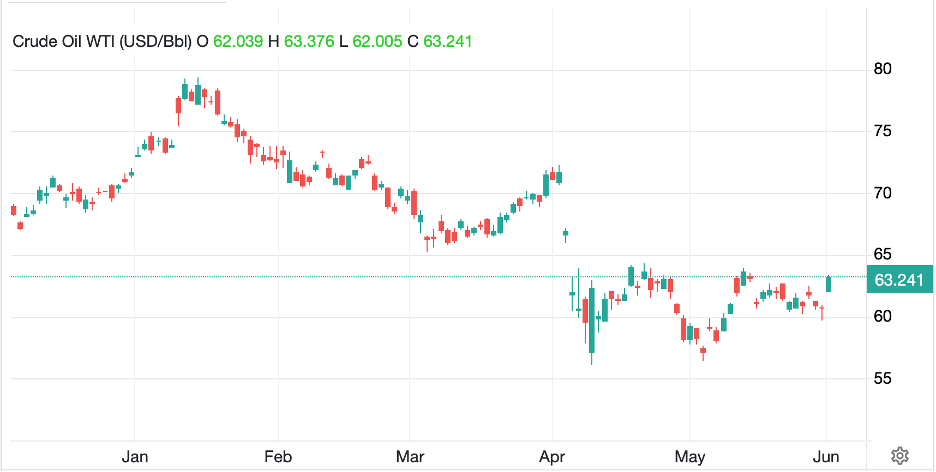
In the commodity markets, oil (+0.6%) continues to grind higher as it looks set to test the recent highs near $64/bbl and from a technical perspective, may have put in a double bottom just above $56/bbl.  There is still a huge gap above the market that would need to be filled (trading above $70/bbl) in order to break this downtrend, at least in my mind.  But that doesn’t mean we can’t chop back and forth between $60 and $65 for a long time.  As to gold (+0.7%) after a sharp decline yesterday as the world was no longer scared about the future, it is bouncing back.  Whether this is merely technical, and we are heading lower, or yesterday’s price action was the aberration is yet to be determined.  Meanwhile, silver (+1.3%) and copper (+1.0%) are both having solid sessions as well.

Finally, the dollar is giving back a tiny bit of yesterday’s massive gains.  The euro (+0.2%) and pound (+0.25%) are emblematic of the overall movement although we have seen a few currencies with slightly stronger profiles this morning (SEK +0.8%, AUD +0.6%, CHF +0.5%).  In the EMG bloc, the movement has actually been far less impressive with ZAR (-0.45%) and KRW (-0.4%) bucking the trend of dollar softness but gains in MXN (+0.4%) and CZK (+0.4%) the best the bloc can do.  

One thing I will say about this administration is they have the ability to really change the tone of the discussion in a hurry.  If they are ultimately successful in reordering US economic activity away from the government and to the private sector, that is going to destroy my dollar weakness thesis.  I freely admit I didn’t expect anything like this to happen, but the early evidence points in that direction.  We will know more when Q2 GDP comes out and we find out if private sector activity is really increasing like the hints from Q1.  If that is the case, then the idea of American exceptionalism is going to make a major comeback in the punditry, although I suspect markets will have figured it out before then.

Other than the CPI, there is no other data and there are no Fed speakers on the docket.  While the dollar is soft this morning, I expect that any surprises in CPI will be the driver.  Otherwise, as I just mentioned, I am becoming concerned about my dollar weakness view.

Good luck

adf

Heartburned

There’s no one surprised that the Fed
Did nothing, and here’s what Jay said
We’re not in a hurry
To cut, but don’t worry
If things change, we can cut ahead
 
The narrative now has returned
To Trump, which has many concerned
That in the short run
The things that he’s done
Will leave many traders heartburned


As universally expected, the Fed left policy unchanged yesterday.  Everything we had heard from FOMC members prior to the quiet period indicated they had to be patient to see how things played out regarding the impact of tariffs.  Apparently, Chairman Powell used the term “wait” or some version of that idea 22 times in the press conference.  Tomorrow, the Fed speakers hit the circuit again, but absent some change in data, which will take at least another month or two, I don’t see that the Fed is relevant again for a while.  

I will note that the market is currently pricing only about a 17% chance of a cut at the June 18 meeting though they are still pricing in 3 cuts for the year.  It appears that the idea of a H2 recession is gaining ground amongst both the punditry and the futures market.

However, contra to that message, the bigger news of the day is that President Trump will be announcing, at 10am, the first trade deal in the new era, this one with the UK.  It strikes me that this should be the easiest of trade deals to negotiate since both economies produce the same types of things.  Neither has a labor cost advantage, and there is great commonality between them with respect to the overall culture.  Arguably, the biggest advantage the US has is its energy sector has not been destroyed by the government, something PM Starmer is working hard to accomplish on his end.  Realistically, the trade deal here is going to be more about services than goods I suspect, given that’s what drives both economies.  I guess we will learn later today.

In a modest surprise, UK equities (FTSE 100 +0.4%) do not seem to see the benefits of such a deal, as they lag most of the rest of Europe.  Too, the BOE is expected to cut its base rate by 25bps this morning, which in isolation would ordinarily be seen as a positive for stock markets.  Perhaps, this is why the UK is the first to say yes, things there may be worse than meet the eye.  After all, the stock market there is higher by just 2% in the past year, hardly a breathtaking performance.  In fact, as you can see below, the FTSE 100 and S&P 500 have had very similar performances this year, tracking each other closely, although despite all the angst about recent volatility in US markets, the S&P is still 8% higher in the past year, decently outperforming the UK.

Source: tradingeconomics.com

Stepping back for a moment from individual markets, my take is the following: President Trump is keen to sign a number of key trade deals in this 90-day window.  If they agree deals with the UK, Japan, South Korea, Taiwan, Canada and Mexico, all of which seem quite possible, it will reduce the uncertainty and accompanying stress in markets.  If, as well, Congress can get the ‘big, beautiful budget bill’ passed, thoughts of recession will quickly dissipate.  Obviously, the China trade talks will still be outstanding, but both sides need to find a solution here.  While the punditry in the US will continue to harp on how those tariffs are going to kill the US economy, China has already shown they are having problems and need to come to an agreement.  It is quite possible that Mr Trump can be successful in his aims to reorder the nature of world trade such that the US reduces its deficits without destroying the world.  I think I am going to take the over on this question.

In the meantime, let’s see how markets have behaved overnight.  Yesterday saw US equity markets rally modestly after the Fed and that followed through in Asia, with modest gains being the best description.  The Nikkei (+0.4%), Hang Seng (+0.4%) and CSI 300 (+0.5%) all seemed to benefit from the US and hopes for a reduction in trade anxiety.  Of note in Asia was India (-0.5%) and perhaps more tellingly Pakistan (-6.0%) as the escalation in military conflict between those two nations has grown even hotter.  I expect that market impact will remain more isolated as neither market is a key destination of foreign capital, at least if the actual military conflict doesn’t spread into other areas.

Turning to Europe, both Germany (+1.1%) and France (+1.0%) are having very good days with both markets ostensibly responding to the news of the impending UK trade deal and perhaps some hopes there will be one with the EU.  As well, German IP data was released at a much better level than expected (3.0% vs. 0.8% expected), an indication that companies there are gearing up for all that mooted military spending.  As to US futures, at this hour (7:00) they are all higher by at least 1.0% with the NASDAQ higher by 1.6%.  

In the bond market, Treasury yields are higher by 4bps this morning, having recouped the declines yesterday.  But still, the 10-year hovers either side of 4.30% and has done for the past month as you can see in the chart below.  If anything, it appears that the trend remains toward modestly lower rates.

Source: tradingeconomics.com

In Europe, sovereign yields are also climbing slightly, higher by between 2bps and 3bps this morning and we saw similar movement in JGB markets overnight.  Frankly, bond markets have not been very exciting lately.

In the commodity markets, oil (+1.6%) is continuing its recent bounce from the lows seen Sunday night, but WTI remains below $60/bbl.  There is growing talk that at current prices, capex is going to decline and supply along with that, but you cannot look at what is happening in Guyana, for instance, as they seek to exploit the massive new oilfield discovered in their coastal waters last year and think that oil supply is going to shrink.  As well, OPEC+ looks set to produce all out.  I do not see a good case for higher oil prices in the near term.  Meanwhile, gold (-1.0%) is giving back some of its recent rebound gains, but nothing about the recent price action indicates to me that the bigger picture trend higher is over.  However, today, it is weighing on both silver (-0.2%) and copper (-0.8%).  

As aside about copper.  The red metal has been nicknamed Dr Copper given its importance in industrial activity.  Hence, when demand is strong, it foretells strong economic activity and vice-versa.  With that in mind, what does the below chart of copper tell you about economic activity?

Source: tradingeconomics.com

What it tells me is that this, too, is a former economic signal that had been reliable in the old world view but has lost its way as a signpost of future activity in the new world view.

Finally, the dollar is modestly stronger this morning, most notably vs. the yen (-0.6%) and INR (-0.8%). The latter is clearly suffering on the impacts of some negative military news, having lost several fighter jets and drones, while the former seems to be responding to the story that Mr Trump will not lower tariffs with China ahead of the first meetings that are upcoming this weekend, and that had been demanded requested by the Chinese to start talking.  Too, NZD (-0.6%) is softer but elsewhere, there is far less of interest overall with the euro unchanged and the pound edging higher by 0.25% after the BOE cut rates 25bps, as expected, but the vote was 7-2, with two MPC members voting for no change, a slightly more hawkish outcome than expected.

On the data front, this morning brings the weekly Initial (exp 230K) and Continuing (1890K) Claims data as well as Nonfarm Productivity (-0.7%) and Unit Labor Costs (5.1%).  Yesterday’s EIA oil inventory data showed modest draws, as expected and didn’t seem to matter much to the market.  It is difficult to get too excited about much these days as the landscape remains highly uncertain.  If, and it’s a big if, President Trump can come to agreement on trade deals with a number of countries, I suspect that we will see uncertainty wane and markets continue higher.  But the Fed won’t be cutting rates in that scenario.  Ultimately, though, I do believe that a lower dollar will be part of many of these deals, and for now, a lower dollar still seems the most likely outcome.

Good luck

Adf

Quite Excited

The market is now quite excited
As trade talks have been expedited
With Bessent and He
Now speaking, we’ll see
If buyers last night were farsighted
 
However, do not ignore gold
Whose price is a thing to behold
The past several days
There’s been quite a craze
As sellers now rue what they’ve sold


Source: tradingeconomics.com

I don’t often lead with a chart, but I think it is worthwhile this morning.  I grabbed this picture at 7:00pm last night, shortly after the news hit that Treasury Secretary Bessent and Trade Representative Greer were heading to Switzerland later this week to sit down with He Lifeng, the Chinese Vice Premier and trade negotiator and begin trade talks.  Prior to that announcement, the barbarous relic had rallied more than $200/oz over the past four sessions, a pretty impressive move for something that has maintained a low overall volatility.  The first explanation of the reversal, which coincided with a sharp gain in equity futures (see chart below) is that all the fear of the world ending with corresponding equity weakness and a need to hold gold, has ended!  Hooray!!!

Source: tradingeconomics.com

Alas, just as I never believed the world was ending before, neither do I believe that everything is suddenly better.  Seemingly, this is all part of the process.  The idea that China could simply accept much of the stuff they produce would not be able to find a home in the US was never going to be the case.  I have no idea how things will work out, and they certainly will take a lot of time to come to some agreement, but it is very positive that the dialog has begun.

On the subject of which side blinked, which is a favorite for the punditry, especially those who despise dislike President Trump and believe this shows weakness on his part, I would note that the Chinese are the ones who have recently reported weaker economic data and last night the PBOC cut their 1-week reverse repo rate by 0.1% and reduced their Reserve Requirement Ratio by 50 basis points, both monetary easing measures to address the ongoing weakness in China.  Neither side benefits from this process in the short-term, but we will need to see the results of the talks, which will take many months I presume, before we know if goals have been achieved.

Away from the story on trade
The Fed story must be portrayed
Alas, it’s quite dull
As Jay and friends mull
The idea rate cuts be delayed

The only other story of note today is the FOMC meeting where they will release their policy statement at 2:00 this afternoon revealing no change in policy, and very likely almost no change in the wording, and then Chairman Powell will face the press at 2:30.  However, given the low probability of any changes, and given nothing regarding trade policy has really changed since they entered their quiet period, it seems unlikely that we will learn anything of consequence from Powell.  Today will be a complete non-event.

However, I cannot help but consider why the futures market appears so convinced that there are going to be rate cuts going forward this year.  As of this morning, the Fed funds futures are pricing a total of 78 basis points of cuts for the rest of this year, so three 25bp cuts as per the below chart from the CME.

Certainly, the data released thus far this year have not indicated the economy is heading into a tailspin.  Of course, there are many analysts calling for a recession to start in Q2 or Q3 as the tariff impacts ostensibly undermine the economy.  It is important to note, however, that these are the same analysts who have been calling for a recession for the past three years.  The boldest calls are for a period of stagflation, with the tariffs simultaneously killing growth and raising prices.

It is entirely possible that we see a recession this year, especially if government spending decreases given its role in supporting recent growth data.  (According to the BEA, Federal government spending in Q1 declined -5.1% while investment in the economy expanded more than 2%.). If this is the path forward, the long-term benefits will be substantial, but they must be maintained.  As well, if this is the path forward, total economic activity in the US will expand substantially and it is not clear that rate cuts will need to be part of that mix. 

Regardless, it seems that today’s activity is less likely to be impacted by the Fed than by any random headlines regarding trade or other administration maneuvers.  So, let’s see how markets have responded to the US-China trade talk news.

The China news came long after the close yesterday so the US markets closed lower on the session, approaching 1% declines, but US futures are currently higher by around 0.7% at 7:15.  In Asia, however, we did see some modest gains although the Nikkei (-0.15%) faded a bit, both China (0.6%) and Hong Kong (+0.15%) managed to rally.  As to the rest of the region, most markets were modestly higher although in a seeming sympathy move on the China news.  In Europe, bourses are softer this morning with the CAC (-0.7%) leading the way and other key indices falling less.  The data releases show Construction PMI softening on the continent as well as weak Eurozone Retail Sales (-0.1%), so I imagine that is weighing on investors’ minds today.

In the bond market, Treasury yields are 2bps firmer this morning but have been trading either side of 4.30% for the past several sessions as traders try to estimate the next big thing.  I see just as many stories about how yields are going to 10% as I do about how they are headed to 2% amid the depression coming, so my take is, we are going to range trade for a while yet.  In Europe, sovereign yields are lower by between -3bps (Germany) and -5bps (Italy) as that softer data is encouraging investors to believe that inflation will continue to decline and the ECB will cut further.

The commodity market has been where the real action is of late with oil (+0.9% today after +2.0% yesterday) rising after comments by two US oil companies that they will not be drilling any more if oil prices stay at these levels.  What I don’t understand is, what will they be doing as they are oil companies?  At any rate, this will be the tension in markets, who can afford to drill and sell oil at lower prices.  I expect we will hear from companies and pundits on both sides of this equation.  I discussed gold above, which has bounced slightly from its lowest levels overnight and I don’t believe anything will derail this train for a while yet.  However, both silver (-0.75%) and copper (-2.6%) are softer this morning, partly based on gold’s slide and partly on the weaker economy story.

Finally, the dollar is modestly firmer this morning, at least against its G10 counterparts with JPY (-0.6%) the weakest of the bunch, followed by SEK (-0.5%) and AUD (-0.3%).  The euro and pound are little changed and NOK (+0.15%) has gained on the back of oil’s strength.  In the EMG block, KRW (-1.1%) and TWD (-1.1%) have both rebounded some from their recent highs (dollar lows) in what seems more like a trading reaction than a change in policies.  Elsewhere in this bloc, though, MXN (+0.2%) is a touch stronger while ZAR (-0.5%) is a touch weaker and CNY is little changed.  There is a story making the rounds today that a well-known currency analyst, Steven Jen, is claiming that there could be as much as $2.5 trillion of excess currency reserves held by Asian nations that they may no longer need.  If this is true and these reserves were sold quickly, it would certainly drive the dollar much lower.  However, it strikes me that given the enormous amount of USD debt that has been issued by Asian companies and countries, and given these countries do not have access to Fed swap lines in emergencies, there is no reason to sell the dollars.  Rather they will simply have a ready supply without having to chase them when repayment and rollovers come due.  I would take this story with a large grain of salt.

Other than the Fed, we see EIA oil inventory data where some drawdowns are anticipated and that is really the day.  We are all awaiting the trade negotiation outcomes and I would say nobody has an inside track there.  Bigger picture, though, I do think the dollar has further to slide.

Good luck

Adf

More Pain

The data from China reflected
That tariffs have hurt, as expected
It’s likely more pain,
On China, will rain
As both nations are so connected
 
Meanwhile, in a German surprise
Herr Merz failed to get his allies
To name him to lead
Which seemed guaranteed
Could this presage his quick demise?

In the battle being waged between the US and China via tariffs, the first data indications have shown that the US is faring a bit better.  Yesterday’s ISM Services data was stronger than expected, remaining well above the 50 level although arguably slightly below the recent average reading.

Source: tradingeconomics.com

Meanwhile, last night, the Chinese Caixin Services PMI fell to 50.7, missing expectations and continuing its drift lower over time.  

Source: tradingeconmics.com

Are things really worse in China than the US, at least from the perspective of data releases?  I think both nations will suffer during this period as the impacts of the tariffs and reduced trade bleed into the data over the next months, but so far, it seems the US is holding its own.  One of the problems with analyzing the issue is that as the WSJ pointed out yesterday, when the data in China gets bad, they simply stop releasing it, so it may be difficult to see.

Now, last night, Chinese shares did manage a nice rally with the CSI 300 higher by 1.0% but that follows six consecutive down sessions, albeit of modest size.  

Source: tradingeconomics.com

As to the renminbi, after a 1% gain last Friday, it has done little and remains very much in line with its levels of the past year.  The thing about China is that nothing there moves quickly, so absent a policy announcement of some type, I expect this activity will continue to gradually adjust to the realities as they become clear to the market.  If President Trump reduces tariffs, as he implied he would eventually, things could work better, but again, given the time lags of moving products across the Pacific, we have a lot of time between now and whatever the new normal turns out to be.

But the more interesting story to me overnight was that Friedrich Merz, the ostensible winner of the German elections last month failed to achieve the votes to be named Chancellor despite his coalition having a 12-seat majority in the Bundestag.  As it was a secret ballot, nobody knows who didn’t support him, but this outcome certainly calls into question both his ability to lead Germany effectively, and correspondingly, Germany’s ability to lead Europe in the new world order.

Recall, Germany remains keen to support Ukraine in its ongoing war with Russia and even destroyed their once sacrosanct fiscal responsibility in order to be able to pay for that support.  But if they do not have an effective leader, one who can command their parliament to enact his policies, it is not clear why other European nations would follow their lead on anything.  It should not be surprising that the DAX (-1.3%) fell sharply when the news was released, and that has helped drag most European shares lower (CAC -0.7%, IBEX -0.3%, Poland -3.3%).  As to the euro, you can see from the below chart that the response, when the news was announced, that it slipped about 0.5%, basically wiping out the gains it had achieved prior to the vote.

Source: tradingeconomics.com

Will this matter in the long run?  I believe that a weakened Germany, which is likely the outcome of this situation, will simply undermine the euro’s value.  As such, while I still believe the dollar has further to decline, the euro will probably not be a major winner.  Look for other currencies to outperform the euro going forward.

Ok, I think those are the real stories as we head into today’s session with most market participants remaining tentative in the face of the ongoing confusion over policies, counter policies and macroeconomic data.  Remember, too, we have the Fed tomorrow and the BOE on Thursday, so despite the fact that fiscal policy has been the driver, the Fed’s opinions still carry weight amongst the fixed income community, at the very least.

Looking at the price action overnight, the Nikkei (+1.0%) gained on some solid earnings data from Japanese companies as well as increased hopes that the US-Japan trade talks will be successfully completed by June.  Apparently, there is also some faith that the US and China will begin talking soon on this subject.  Hong Kong (+0.7%) also benefitted from these discussions, but the rest of the region showed very little movement overall, with gains or losses on the order of 0.3% or less.  As we have already discussed Europe, a look at US futures shows they are pointing lower by about -0.5% at this hour (7:10).

Bond markets remain very dull these days with Treasury yields edging higher by 1bp this morning after climbing 3bps yesterday.  European sovereign yields are also higher. By 1bp to 2bps although there is neither data nor a story that seems to have had much impact.  The Services PMI data that was released this morning was very much in line with expectations and continues to hover around 50.0 for the continent as a whole.  Meanwhile, JGB yields were unchanged last night and sit at 1.25%, well below the levels seen back in late March and having really gone nowhere for the past month.  It strikes me that JGB yields will respond to any trade deals but are likely to be quiet in the interim.

Commodity prices are rallying this morning with oil (+2.2%) rebounding from its level yesterday which happen to come quite close to touching the lows from April 9th.  It should be no surprise that there are up days in this market, but if the Saudis and OPEC are going to continue increasing production, I expect that prices have further to fall.  In the metals markets, gold (+1.4%) is having another blockbuster day, now having gained $150/oz in the past three sessions and bouncing off the correction lows.  Demand for the barbarous relic continues to come from Asia mostly with all signs showing that US investors are not interested in this trade.  As to silver (+1.7%) and copper (+0.6%), they are both still along for the ride.

It should be no surprise with the commodity markets showing strength that the dollar is under pressure this morning.  while we’ve discussed the euro already, the pound (+0.5%) is looking quite solid as it continues its rally from the lows seen in mid-January.  But the yen (+0.5%), SEK (+0.45%) and NOK (+0.35%) are all gaining today as well.  Interestingly, the impact in emerging markets is far less noticeable with none of the major EMG currencies moving even 0.2% this morning.

On the data front, there is very little hard data this week although we do have the Fed on Wednesday and then a whole bunch of Fed speakers on Friday.

TodayTrade Balance-$137.0B
WednesdayFOMC Rate Decision4.50% (unchanged)
 Consumer Credit$9.5B
ThursdayBOE Rate Decision4.25% (-0.25%)
 Initial Claims230K
 Continuing Claims1890K
 Nonfarm Productivity-0.7%
 Unit Labor Costs5.1%

Source: tradingeconomics.com

Today’s trade data is for March, prior to the tariff impositions, so will reflect significant tariff front-running.  But really, it’s about the Fed this week, and since they have lost much of their cachet lately, I think the market is really going to continue to look to the White House for trade news and react to that.  Net, I continue to believe that the dollar’s FX rate will be part of many trade discussions, like we saw with Taiwan (which by the way did reverse 3% of yesterday’s gain overnight) and that means further weakness is in our future.

Good luck

Adf
Too Much Debt

In Spain, electricity failed
In Canada, Carney prevailed
But markets don’t care
As movement’s quite spare
It seems many traders have bailed
 
But problems, worldwide, still abound
Though right now, they’re in the background
There’s far too much debt
And still a real threat
That no true solutions are found


The two biggest stories of the past twenty-four hours were clearly the national scale blackout in Spain and Portugal yesterday, and the slim victory for Mark Carney in Canada, where the Liberal Party appears to have a plurality, but not a majority, and will oversee a minority government.

Touching on the second story first, in truth there is not much to discuss.  Much has been made of the vote being an anti-Trump statement with the idea that Carney is better placed to defend Canada from President Trump’s (imagined) predations.  However, given the lack of a majority government, it is not clear how effective this line of reasoning will prove.  As there is no futures market for the TSX, we really don’t have a sense yet of how the Canadian equity market will greet the news.  Yesterday’s modest gains of 0.35% amid a general atmosphere of modest gains doesn’t really tell much of a tale.  As to CAD (-0.1% today), a quick look at the past week shows it has done nothing even in the wake of the news. (see below).  My take is this is a nothingburger event, a perfect description for Mark Carney, a nothingburger of a politician.

Source: tradingeconomics.com

As to the story about Spain’s electricity, I think it may be more instructive on two levels.  The first is as a warning to the risks inherent of powering your electric grid with more than 25% – 30% intermittent, renewable energy sources like wind and solar.  It is somewhat ironic that just twelve days prior to the blackout, Spain’s entire electricity requirement was met by solar, wind and hydro power, the Green dream.  Alas, here we are now and while no answers have yet been forthcoming, and I assume the media will downplay any blame on too much renewable power, virtually every engineering study has shown that once a grid has more than that 25% renewables, it tends towards instability.  This issue will be argued by both sides for a while, although as always, physics will be the final arbiter.  

But I have to wonder if the sudden failure of the electric grid is an omen of sorts, for what may be happening in global markets.  If we analogize global supply chains to the electrical grid, over the course of the past 50 years, we have seen the world create a massively complex web of trade with raw materials, intermediate goods and final products all crisscrossing the world.  There have been myriad benefits to all involved with real per capita economic benefits abounding, and for everybody reading this note, the ability to essentially buy whatever you want/need with limited interference and trouble.  Certainly, the availability of everyday necessities like food and clothing is widespread.

However, underpinning that bounty were two networks.  The first being the obvious one, the supply chains which since Covid have been much discussed by the punditry.  But the second, which gets far less notice is the network of debt that is issued around the world by governments and companies, as well as taken on by individuals, and that has grown to be more than 3x the entire global economic output.  While we most often read about the US government debt which is quickly approaching $37 trillion, total global debt is much greater than that.  In fact, at this point, the debt market is not about issuing new debt to fund new investment, rather it is almost entirely a refinancing mechanism.  

It is this latter issue that should concern us all.  What happens if, one day, the ability to refinance some of that debt, whether US Treasuries, German bunds or Chinese government bonds, has a hiccup of some sort?  A failed US Treasury auction, where the Fed is required to purchase bonds, or a power outage in a key financial center that prevents trades from being confirmed/settled and moneys not moving as expected, or some other force majeure type event that disrupts the current smooth functioning of global debt markets.  

Frankly, the combination of the changes being wrought by President Trump to the global economy, where globalization is giving way to mercantilism, and the significant weight of global debt that hangs over the global economy and is given very little thought seems a potentially volatile mix.

Ironically, as much as I have lately been describing how the Fed’s role seems to have diminished, in the event that something upsets this apple cart, the Fed will be the only game in town.  While this is not a today event, it is something we must not forget.

I apologize for my little diatribe, but with so little ongoing in markets, and the parallel to the Spanish electrical grid, it seemed timely.  Let’s look at markets.  Asian equity markets were mixed with the main markets very quiet but a couple of 1% gainers (Australia, Taiwan and Korea) although the rest of the region was +/- 0.3% or less.  Too, volumes were quite lethargic.  In Europe, it should be no surprise that Spain (-0.8%) is the laggard today as the first economists’ to opine on the impact of the blackout said it could be a hit of as much as 0.5% of GDP.  Germany (+0.6%) is the other side of the coin after the GfK Consumer Confidence reading came out at a better than expected -20.6.  Now, maybe it’s just me, but if I look at the past 5 years’ worth of this index, it is difficult to get excited about German economic prospects.

Source: tradingeconomics.com

Yes, this was a better reading, but either the people of Germany are manic depressive, or the index is indicative of major structural problems in the country.  Maybe a bit of both.  As to US futures, at this hour (7:10) they are basically unchanged after being basically unchanged yesterday.

In the bond market, Treasury yields have bounced 2bps this morning after touching their lowest level in 3 weeks yesterday.  European sovereign yields, though, are all softer by 1bp to 2bps this morning as comments from ECB members seem to highlight more rate cuts as Europe achieves their inflation target and are now getting concerned they will fall below the 2.0% rate.

In the commodity markets, oil (-1.7%) is under pressure this morning ostensibly on a combination of concerns over slowing growth and little movement in the US-China trade talks as well as a report that Kazakhstan is pushing up output and other OPEC+ members are talking about increasing production further when they meet next week.  Meanwhile, gold (-0.75%), which rallied back to unchanged in NY yesterday is once again finding sellers at its recent trading pivot of $3340ish (H/T Alyosha).  However, gold’s slide has not impacted either silver (+0.4%) or copper (+0.9%) at least so far in the session.

Finally, the dollar is firmer, largely across the board, this morning.  The euro (-0.3%), pound (-0.4%), JPY (-0.4%) and CHF (-0.6%) are all under some pressure, perhaps profit taking.  But in truth, other than INR (+0.15%) the rest of the major currencies, both G10 and EMG, are all softer vs. the greenback.  I guess the dollar’s demise will need to wait at least one more day.

On the data front, the Goods Trade Balance (exp -$146B), Case Shiller Home Prices (4.7%) and JOLTs Job Openings (7.48M) are the main numbers, although we also see Consumer Confidence (87.5).  But with no Fed discussions much more crucial data on Thursday (GDP, PCE) and Friday (NFP) it seems that today is setting up for not much excitement.

In fact, lack of excitement seems the best description of markets right now.  I don’t know what the next catalyst will be to change things, but absent peace in one of the wars, kinetic or trade, or another force majeure event, it feels like range trading is the order of the day for a while.  My big picture view of a slowly declining dollar is still intact, but day-to-day, it’s hard to see much right now.

Good luck

Adf
Be Quite Scared

The pundits have now all declared
That everyone should be quite scared
It will be a bummer
When shelves, come this summer
Are empty, so please be prepared
 
As well, a recession’s in view
Although, that seems like déjà vu
For three years at least
The pundits increased
The odds that this bill would come due


Apparently, the only thing you need to know this morning is that by summertime, shelves across the country will be barren as imports from China halt.  The upshot, at least according to the sources that I have read, is that you should blame President Trump and join the media chorus in hating the man and his policies.

Now, I am no logistics expert, but the concern stems from the significant decline in shipping as evidenced by port activity in both China and the US.  As you can see from the chart below, there has certainly been a significant decline in the number of ships leaving China on their way to the US.

I guess the question is just how much of what is on store shelves comes from China?  Much will depend on what kind of store one considers.  Certainly, toy stores seem likely to have less inventory, as will Best Buy with electronics potentially suffering, although as I recall President Trump exempted electronics initially.  Arguably, clothing shelves and racks may be sparser as well.  But based on official data, Chinese imports (~$463B) accounted for approximately 1.7% of the US’s $26.9T GDP in 2024.  This may be an overreaction.

Potentially a bigger issue will be the impact on intermediate goods that are imported from China and elsewhere and incorporated into products finalized in the US.  However, I cannot calculate that, nor have I seen any data of this issue, although I have read many stories about the end of this particular world as well.

One of the things to remember about the punditry is that they make their living describing the worst possible outcome because that gets them recognition.  However, I’m confident we all remember that a recession was forecast for 2022, 2023 and 2024 by much of the punditry and yet one was never officially declared by the NBER.  In fact, you may recall that in Q1 and Q2 of 2022, US Real GDP growth was -0.2% for both quarters, thus two consecutive quarters of negative growth.  Historically, that has defined a recession.  However, subsequent data revisions did remove that as you can see below with Q2 revised higher.

Source: tradingeconomics.com

The one thing I do know is that there is a group of analysts/economists who have been forecasting the next recession consistently for several years.  They point to data like changes in the housing market, the JOLTs Quits rate shrinking and various other secondary and tertiary data points and sources, all of which have been pointing in that direction for several years.  And I grant, reading that ~40% of GenZ is using BNPL to buy their groceries, and then run late on payments, is a frightening statistic (although perhaps one that highlights financial illiteracy more than economic reality).

In the end, what you need to know is you should be terrified because the punditry is almost certain that this time, they have it right.  But our concern is how will this scenario impact markets.

Basically, despite all this huffing and puffing, it appears markets are whistling past this particular graveyard.  Friday’s US equity rally was followed by general strength in Asia and strength this morning in Europe.  Last night, Tokyo (+0.4%), Mumbai (+1.3%), Taiwan (+0.8%) and Australia (+0.4%) all had solid performances although neither Hong Kong (-0.1%) nor China (-0.15%) could find any real buying support.  A less reported story is that China is exempting a number of US imports from its 125% tariffs on the US as clearly, this trading relationship is deep and complex.

As to Europe, all markets are ahead this morning, with the UK (+0.4%) the laggard and most of the continent higher by between 0.7% and 0.8%.  There are headlines around as to how the ECB is preparing to cut rates further on the assumption that global economic activity is going to slow and thus hurt Europe, while the consistent message is that US tariffs will be deflationary in Europe, so less concerns about their inflation mandate.  Finally, US futures are pointing slightly softer (-0.2%) at this hour (6:45).

In the bond market, 10-year Treasury yields have fallen 30bps in the past two and one-half weeks, sliding 5bps on Friday before bouncing 3bps overnight. However, the recent trend does seem lower.

Source: tradingeconomics.com

But yields are climbing in Europe as well today, higher by 5bps across the board on the continent, although UK Gilts have only edged higher by 2bps.  It’s funny, despite all the doom and gloom regarding the economy because of US tariffs, as well as growing expectations of an ECB rate cut at the early June meeting, investors appear to be growing concerned about something.  Perhaps they have pivoted back to the promised fiscal spending increases as their driver today.

In the commodity markets, oil (-0.35%) continues to trade in its recent $60 – $63/bbl range with limited signs that this will soon change.  Peace in Ukraine does not seem at hand yet and reports are that the initial discussions between the US and Iran, while constructive, still have a ways to go before completion.  Both of those seem likely to weigh on oil prices if completed.  However, the more unusual thing to me is that with the rising chorus of recession calls, oil’s price has not fallen further.  To date, markets have not yet agreed with the economists’ view that recession is imminent.  In the metals markets, gold (-1.0%) is continuing its rough week, although remains nicely higher on the month.  You may recall my view a week ago Friday that the move seemed parabolic and due for a correction.  Recent price action is exactly that, corrective, as I believe the underlying thesis to own the barbarous relic remains intact.  The other main metals are a touch softer this morning, but really nothing to discuss.

Finally, the dollar is mixed this morning with modest strength against the euro (-0.15%) but softness vs. the pound (+0.15%) and those size moves are representative of most of the price action across both G10 and EMG currencies this morning. The outlier is KRW (-0.4%), which seems to be suffering from comments that no trade deal will be completed before June’s election there.

Overall, despite ongoing doom and gloom by much of the punditry, it is not obvious to me that investors are anticipating major changes.  Perhaps they are wrong, and the pundits are correct.  But as yet, there is no evidence to support that conclusion.

Ok, let’s turn to the data this week, which starts slowly but ends on NFP.

TuesdayGoods Trade Balance-$146.0B
 Case-Shiller Home Prices4.8%
 JOLTs Job Openings7.5M
WednesdayADP Employment108K
 Q1 GDP0.4%
 Q1 Employment Cost Index0.9%
 Chicago PMI45.5
 Personal Income0.4%
 Personal Spending0.6%
 PCE0.0% (2.2% Y/Y)
 Core PCE0.1% (2.6% Y/Y)
ThursdayInitial Claims225K
 Continuing Claims1860K
 ISM Manufacturing48.0
 ISM Prices Paid70.2
FridayNonfarm Payrolls135K
 Private Payrolls127K
 Manufacturing Payrolls-5K
 Unemployment Rate4.2%
 Average Hourly Earnings0.3% (3.9% Y/Y)
 Average Weekly Hours34.2
 Participation Rate62.5%
 Factory Orders4.5%

Source: tradingeconomics.com

As well as NFP, we get the PCE data, which looks like it has changed to a 10:00am release from its traditional 8:30am time.  The Fed is in its quiet period, but nobody has been listening to them anyway.  Secretary Bessent, along with President Trump, has been the most important voice lately.  Again, for now, the data has not indicated recession, although Q1 GDP is slated to be soft.  Markets, too, have been unwilling to get behind the recession call completely. 

Ultimately, the one thing we know is that the nature of the global economy has changed since President Trump’s election.  Globalization is in retreat and mercantilism is the new normal.  It is not clear to me that existing econometric models will accurately portray how that works, so I need to see more data before recognizing the end of times.  In the meantime, these myriad views are a sign that hedging for risk managers remains the only path forward.

Good luck

Adf

That Man is Our Bane

Apparently, back in the day
Investors and CEOs say
The future was clear
But now they all fear
Uncertainty is in their way
 
So, they will now clearly explain
When earnings and profits do wane
That they’re not to blame
Instead, they now claim
It’s Trump’s fault, that man is our bane


I’m having some difficulty understanding a number of the concerns about which I read every day as more and more corporate executives and investment managers have suddenly found a new scapegoat, uncertainty.  Apparently, I missed the time when the future was certain, as I have no recollection of that at all.  Perhaps you remember.  If so, could you remind me please?

For instance, I remember the certitude of the comments from the RBA back in April 2021 that interest rates would remain lower for longer, and that it would be at least three years before they would need to raise interest rates.  I also remember, as the graph below demonstrates, that certainty was misplaced as less than two months after those comments, the RBA started raising interest rates despite the clear directive they would not need to do so for years.

Source: tradingeconomics.com

While this is just one example, in my experience, certainty is not part of the mix when running a business or a portfolio of assets or a position in any financial market.  So imagine my surprise when reading Bloomberg this morning and finding that suddenly, the world is awash in uncertainty.  Has it ever not been the case?  Pretty much once you get beyond the laws of physics or mathematics, it strikes me that certainty in the future just doesn’t exist. (Even at 4Imprint).  Nonetheless, uncertainty because of President Trump’s trade policies is the latest rationale for every problem at every company right now.  In truth, I suspect that many executives are quite happy with this as the Covid excuse was wearing thin.

In the markets, too, uncertainty is the favored excuse for underperformance as how can anyone manage money with tape bombs constantly appearing.  Powell is a loser one day to I’m not going to fire Powell the next.  Tariffs are forever to a 90-day pause.  And of course, there are many other political stories that have limited impact on markets but seem to change regularly.  While this gets back to my view that President Trump is the avatar of volatility, I seem to recall long before President Trump that there were numerous presidential statements that had major market impacts.  My point is, nothing has really changed folks, other than the media dislikes this president more than any other in my lifetime so amplifies anything they think makes him look bad.

However, the one thing about which we cannot be surprised is that trading activity is waning, at least compared to what we saw since Trump’s inauguration.  Volumes of activity on the exchanges are sliding (see chart of S&P 500 volume below from ycharts.com) which makes perfect sense in a volatile and uncertain market.  

Now, as per the above, I would contend that the future is always uncertain.  Rather the real culprit here is volatility.  My take is that the future is going to continue to be volatile which implies, to me at least, that trading activity is going to remain on the low side and with it, liquidity for those who have significant real flows to transact.  It’s funny, volatility begets lower volumes, and lower volumes beget volatility due to reduced liquidity.  I’m not sure what it will take to break us from this cycle, but I have a sense that it will be with us for a while.

With that in mind, let’s see what happened overnight.  Yesterday’s strength in the US was followed by strength in Tokyo (+1.9%) although both China (+0.1%) and Hong Kong (+0.3%) didn’t really participate.  Interestingly, this morning I read that China was exempting a number of imports from the US from tariffs as apparently, it was hurting their businesses so severely it could cause closures.  Elsewhere in Asia, the picture was mixed although there were more gainers (Korea, Taiwan, Philippines, Thailand) than laggards (India, Singapore).  I do believe the tariff story is impacting these markets more than any as they are directly in the line of fire.

Meanwhile, in Europe, most markets are firmer this morning (DAX +0.6%, CAC +0.4%, IBEX +0.9%) but the UK (-0.1%) is lagging despite much stronger than expected Retail Sales data there this morning.  As to US futures, at this hour (7:00) they are pointing lower by about -0.35%.

In the bond market, Treasury yields continue to slide, down another -3bps this morning although Europe is moving in the opposite direction, with yields climbing between 2bps and 3bps in the session.  It’s odd because I continue to hear about European growth forecasts being cut and the ECB preparing for more rate cuts while the talk around the markets is that the US is going to see inflation from the tariffs.  Today’s bond moves don’t really speak to those narratives, but it is just one day.  I need to mention JGB yields, which rose 3bps overnight after Tokyo CPI came in 2 ticks hotter than forecast at both headline and core levels.  

In the commodity markets, oil (-1.2%) is slipping again and has consistently demonstrated it is unable to make any dent in the major price gap above the market.  To close that gap, WTI will need to rally more than $8/bbl from current levels, something I just don’t see happening in the current environment.  That would require a war in Iran I think.  As to metals, yesterday’s gold rally has been reversed (-1.5%) and today it is impacting both silver (-0.75%) and copper (-2.1%) as is the stronger dollar it seems.

Speaking of the dollar, Monday’s narrative that the dollar was about to collapse will need at least another day to come to fruition as it is modestly higher again this morning.  looking at the DXY as a proxy, it is trading just below 100, a level that many are watching closely.  A quick look at the chart below shows this is the third time in the past two years it has traded to this level, although the first of those times it broke through.  Of course, it was much lower just a couple years earlier.

Source: tradingeconomics.com

Today’s dollar strength is modest but broad-based with only CLP (+0.6%) higher this morning which makes absolutely no sense given copper’s slide today.  The worst performer is SEK (-0.8%) but given it has been the best performer YTD amongst the G10, perhaps this is just corrective.  Otherwise, we are looking at movements on the order of 0.25% to 0.45% across the board.

The only data this morning is Michigan Sentiment (exp 50.8).  We continue to see a dichotomy between the ‘hard’ data, Claims, NFP, CPI, Factory Orders, and the ‘soft’ data, Michigan Sentiment, PMI, inflation expectations with the former holding in well while the latter weakens.  Many analysts believe that recession is coming our way by summer, but these same analysts have been predicting the recession for the past 3 years.  The one thing about the US economy is that it is extraordinarily resilient despite all the things governments try to do to disrupt it.  I understand the concern, at least if you watch/read the news, but I have a sense that many people across the nation do not really do that.  While I believe that equity valuations remain too high to be sustainable, it is not clear to me that the economy is heading into a recession at this time.  As to the dollar, I wouldn’t write its obituary just yet, although I do think it will soften further over time.

Good luck and good weekend

Adf