A Third Fed Mandate

As Jay and his minions convene
A new man is making the scene
Now, Stephen Miran
A man with a plan
Will help restart Jay’s cash machine
 
But something that’s happened of late
Is talk of a third Fed mandate
Yes, jobs and inflation
Have been the fixation
But long-term yields need be sedate


As the FOMC begins their six-weekly meeting this morning, most market participants focus on the so-called ‘dual mandate’ of promoting the goals maximum employment and stable prices.  This, of course, is why everybody focuses on the tension between the inflation and unemployment rates and why the recent revisions to the NFP numbers have convinced one and all that a rate cut is coming tomorrow with the only question being its size.  But there is a third mandate as is clear from the below text of the Federal Reserve Act, which I have copied directly from federalreserve.gov [emphasis added]:

“Section 2A. Monetary policy objectives

The Board of Governors of the Federal Reserve System and the Federal Open Market Committee shall maintain long run growth of the monetary and credit aggregates commensurate with the economy’s long run potential to increase production, so as to promote effectively the goals of maximum employment, stable prices, and moderate long-term interest rates.

[12 USC 225a. As added by act of November 16, 1977 (91 Stat. 1387) and amended by acts of October 27, 1978 (92 Stat. 1897); Aug. 23, 1988 (102 Stat. 1375); and Dec. 27, 2000 (114 Stat. 3028).]”

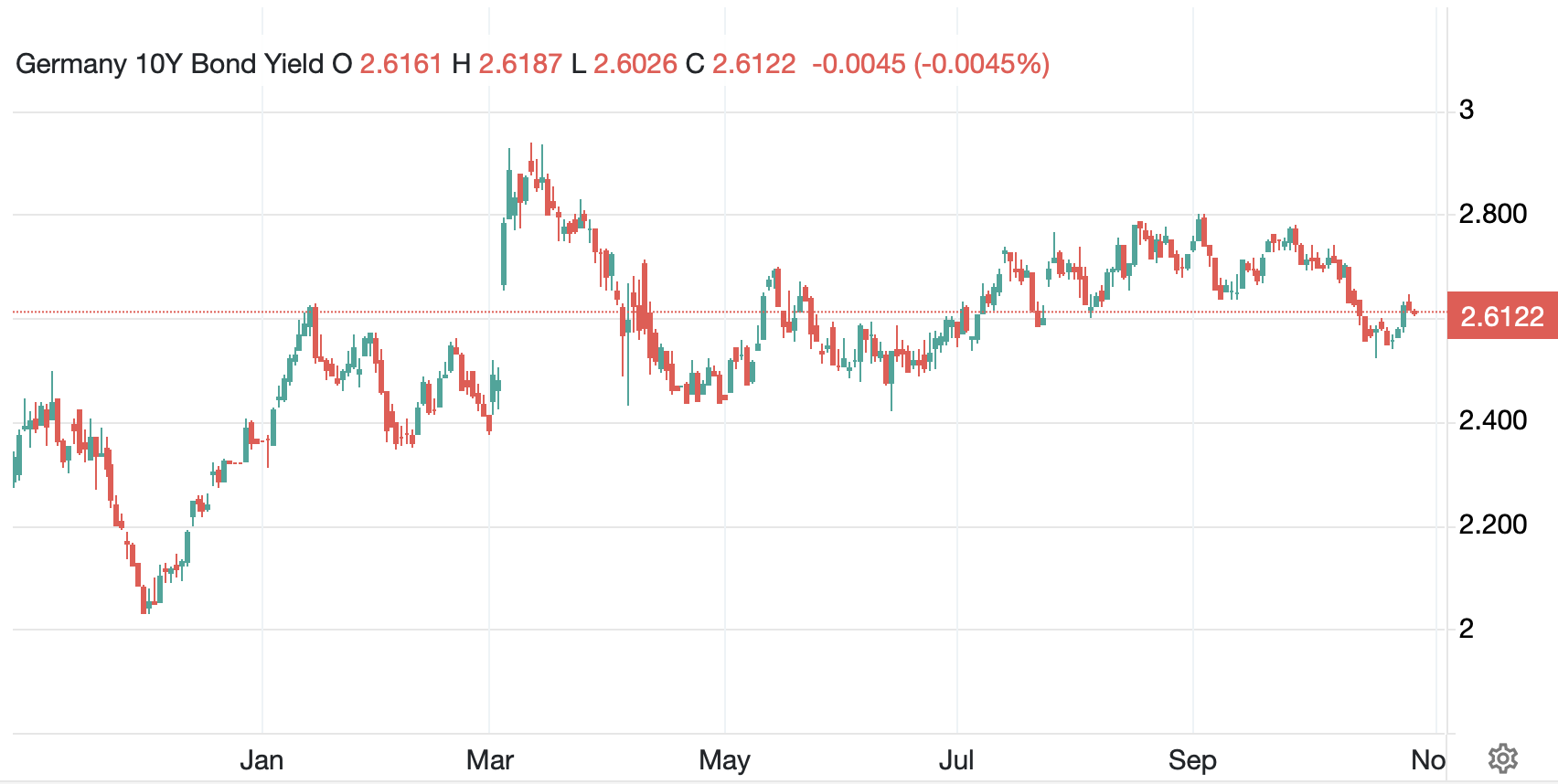
One of the things we have heard consistently from Treasury Secretary Bessent is that he is highly focused on ensuring that longer-term yields do not get too high.  Lately, the market has been working to his advantage with both 10-year, and 30-year yields having declined by more than 25bps in the past month.  And more than 40bps since mid-July.  (Look at the yields listed on the top of the chart below to see their recent peaks, not just the line.)

Source: tradingeconomics.com

Now, with President Trump’s head of the CEA, Stephen Miran getting voted onto the board to fill the seat that had been held by Governor Adriana Kugler, but heretofore vacant, one would think that the tone of the conversation is going to turn more dovish.  What makes this so odd is that, by their nature, central bankers are doves and seemingly love to print money, so there should be no hesitation to cut rates further.  But…that third mandate opens an entirely different can of worms and brings into play the idea of yield curve control as a way to ensure the Fed “promote(s)…moderate long-term interest rates.”

It was Ben Bernanke, as Chair, who instigated QE during the GFC although he indicated it was an emergency measure.  It was Janet Yellen, as Chair, who normalized QE as one of the tools in the toolbox for the Fed to address its dual mandate.  I believe the case can be made that newly appointed Governor Miran will begin to bang the drum for the Fed to act to ensure moderate long-term interest rates, and there is no better policy to do that than QE/YCC.  Actually, there is a better policy, reduced government spending and less regulation that allows productivity to increase and balances the production-consumption equation, but that is out of the Fed’s hands.

At any rate, we cannot ignore that there could be a subtle change in focus to the statement and perhaps Chairman Powell will discuss this at the press conference.  If this has any validity, a big IF, the market impacts would be significant.  The dollar would start another leg lower, equities would rise sharply, and commodity prices would rise as well.  Bonds, of course, would be held in check regardless of the inflationary consequences.  Just something to keep on your bingo card!

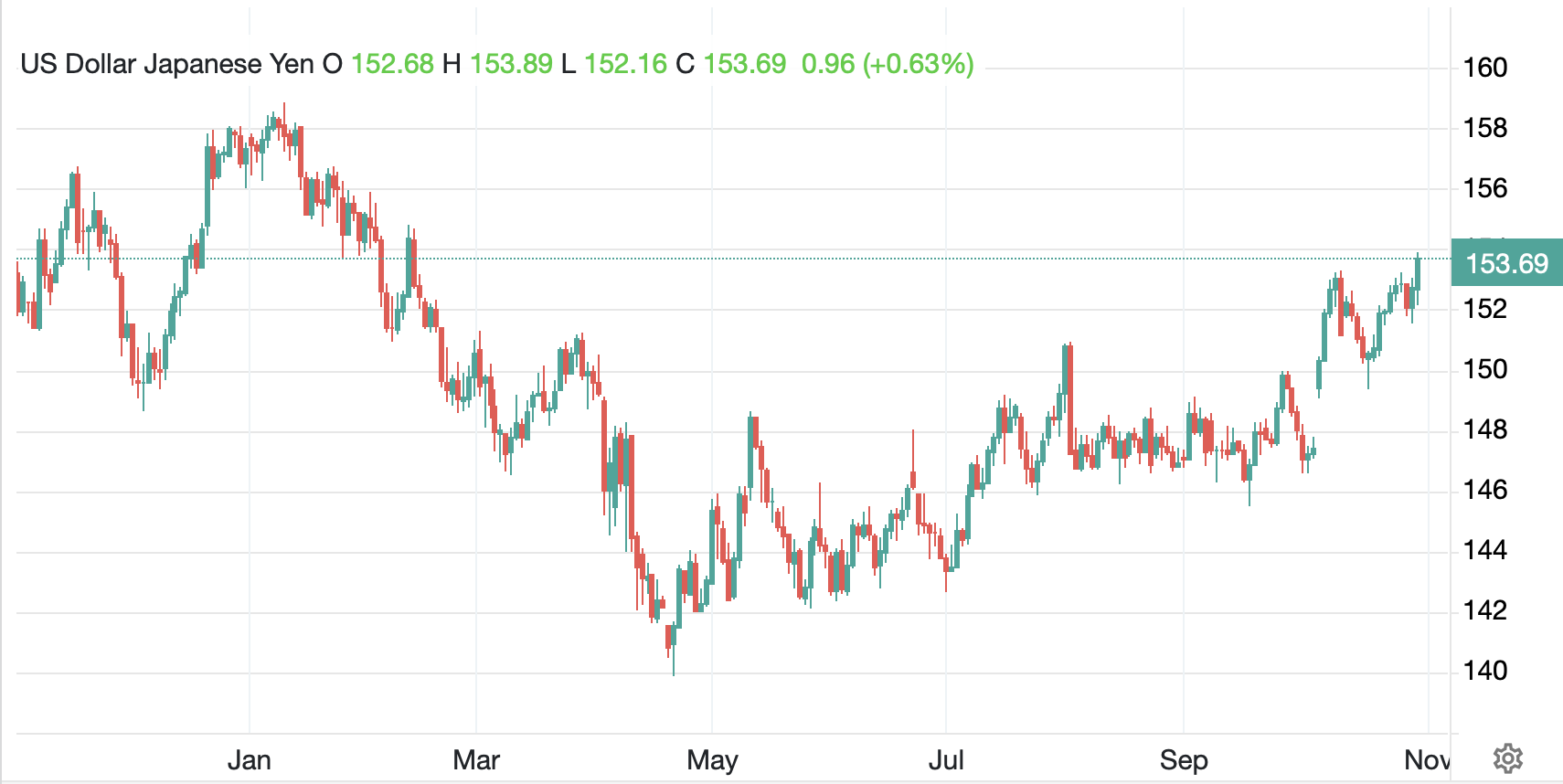
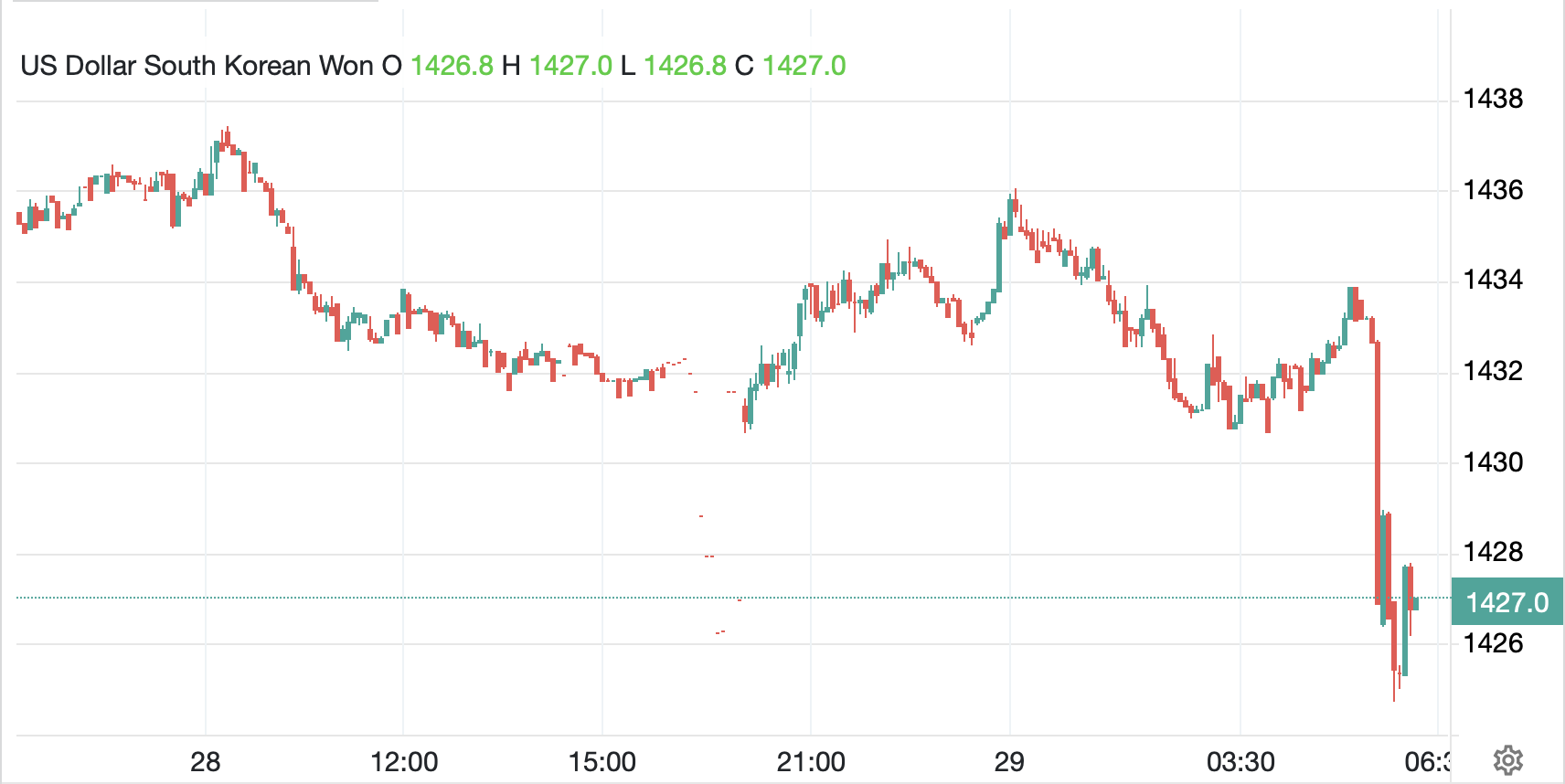
Ok, let’s check out the overnight activity.  While it was quiet in the US yesterday, we did manage to make more new highs in the S&P 500 as all three major indices were higher.  As to Asia, Tokyo (+0.3%) had the same type of session, with modest gains as it takes aim at a new big, round number of 45,000.  China (-0.2%) and HK (0.0%) did little although there was a lot of positivity elsewhere in the region with Korea (+1.2%), India, (+0.7%) and Taiwan (+1.1%) leading the way amidst almost all markets, large and small, showing gains.  Europe, though, is a different story with red today’s color of the day, as Spain (-0.8%) and Germany (-0.6%) leading the down move despite better-than-expected German ZEW data (37.3 vs. 26.3 expected).  One of the things I read this morning was that German auto manufacturers have laid off 125,000 workers in the past 6 weeks.  That is a devastating number and bodes ill for German economic activity in the future.  As to other European bourses, -0.1% to -0.4% covers the lot.  US futures, though, continue to point higher, up 0.3% at this hour (7:30).

In the bond market, Treasury yields are unchanged this morning while European sovereign yields have edged higher by between 1bp and 2bps.  It doesn’t feel like investors there are thinking of better growth, but we did hear from several ECB members that while cuts are not impossible during the rest of the year, they are not certain.

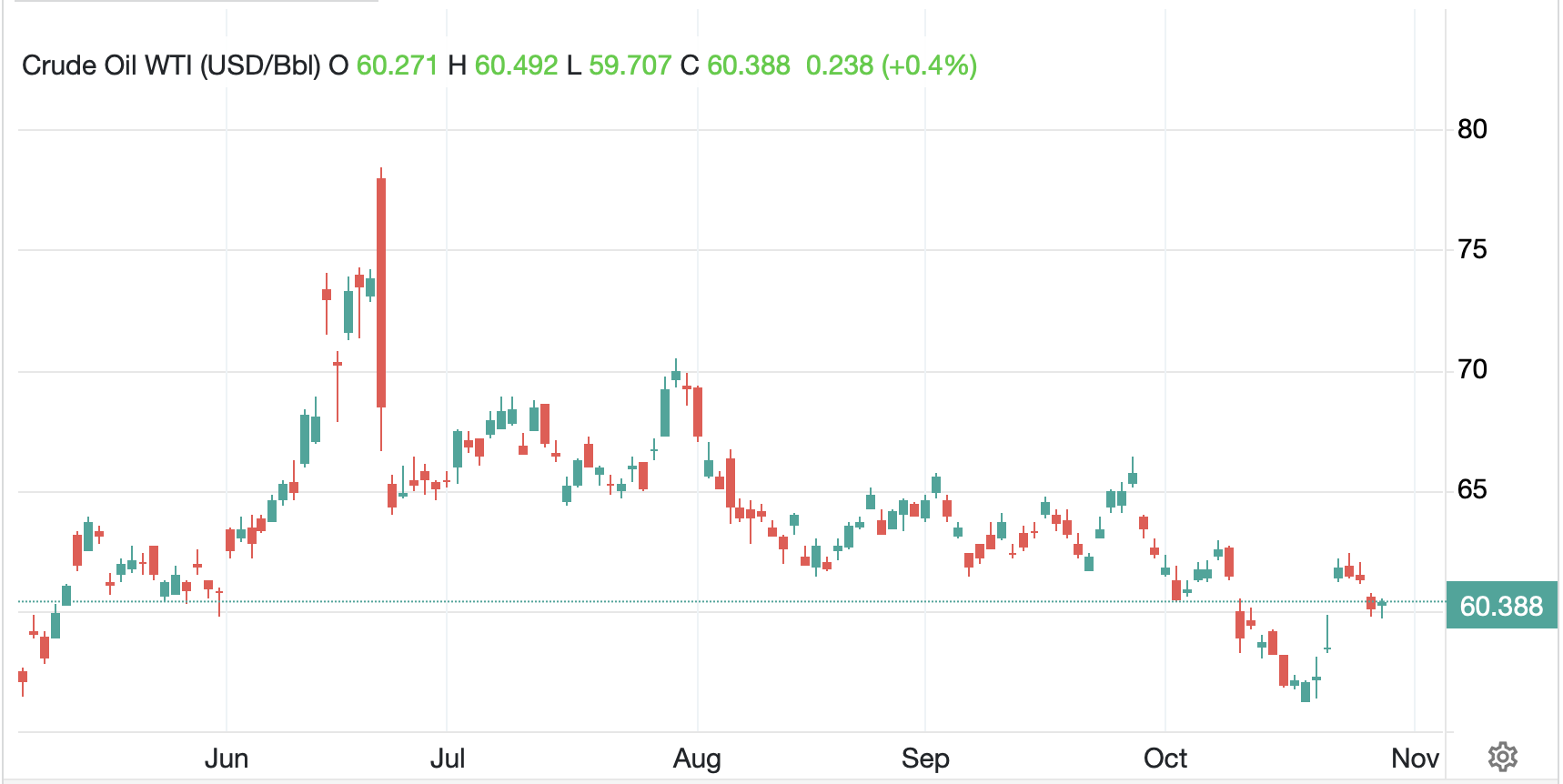
In the commodity space, oil (+0.7%) is back in a modest upswing but still has shown no inclination to move outside that trading range of $60/$65.  It has been more than a month since that range has been broken and absent a major change in the Russia sanctions situation, where Europe actually stops buying Russian oil (as if!) I see no short-term catalyst on the horizon to change this situation.  Clearly, producers are happy enough to produce and sell at this level and demand remains robust.

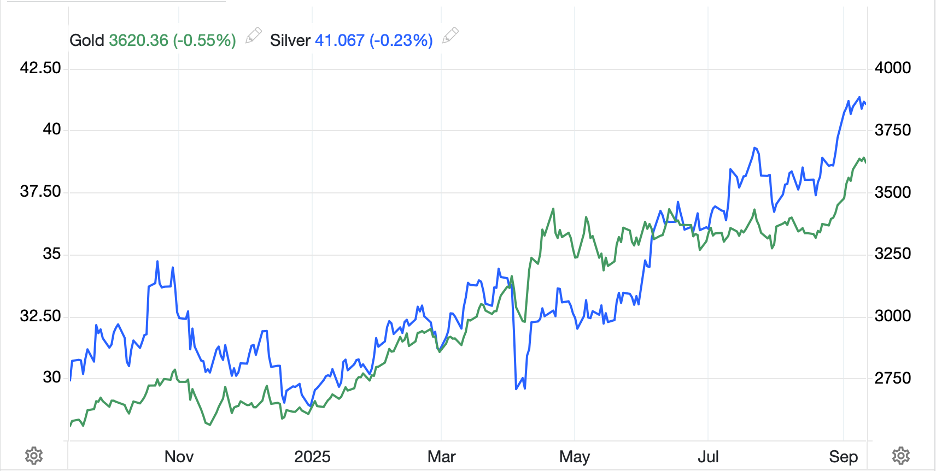
Turning to the metals markets, I discuss gold (+0.4%) a lot, and given it is making historic highs, that makes sense, but silver (+0.4%) has been outperforming gold for the past month and looks ever more like it is going to make a run for its all-time highs of $49.95 set back in January 1980.  The more recent peak, set in 2011, of $48.50 looks like it is just days away based on the recent rate of climb.

Source: finance.yahoo.com

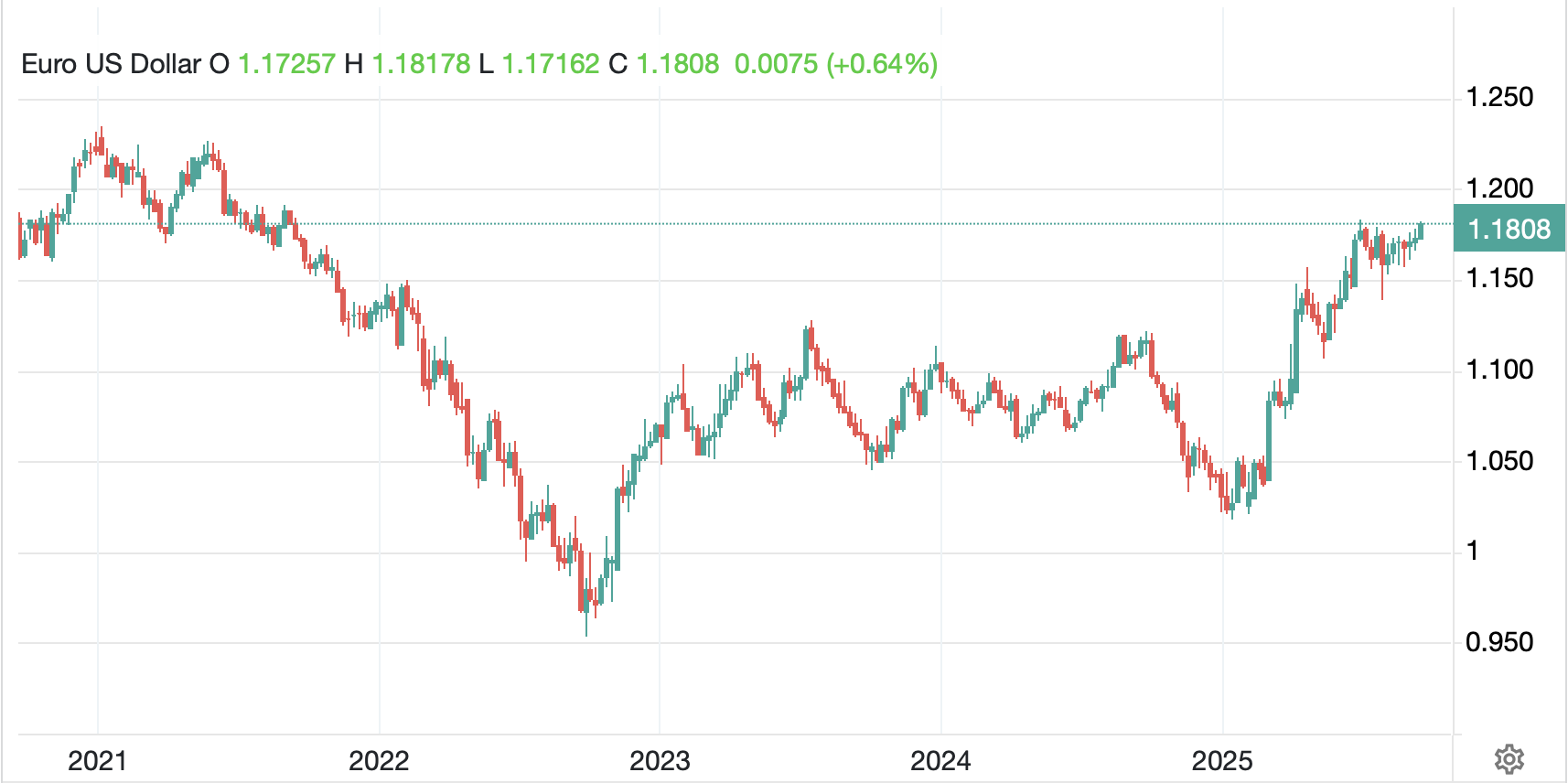
Finally, the dollar is under pressure this morning, with the euro (+0.4%) trading above 1.18 again for the first time since July 1st and there is a great deal of discussion as to how it is going to trade back to, and through, 1.20 soon, a level not seen since 2021.  

Source: tradingeconomics.com

The narrative is now that the Fed is set to begin cutting rates and the ECB is going to stand pat, the euro will rise.  This is true for GBP (+0.3%) as wel, with the Sterling chart largely the same as the euro one above.  Here’s the thing.  I understand the weak dollar thesis if the Fed gets aggressive, I discussed it above. However, if German manufacturing is contracting that aggressively, and the layoffs numbers are eye opening, can the ECB really stand pat?  Similarly, PM Starmer is under enormous, and growing, pressure to resign with the Labour party in the throes of looking to oust him for numerous reasons, not least of which is the economy is struggling.  So, please tell me why investors will flock to those currencies.  I see the dollar declining, just not as far as most.

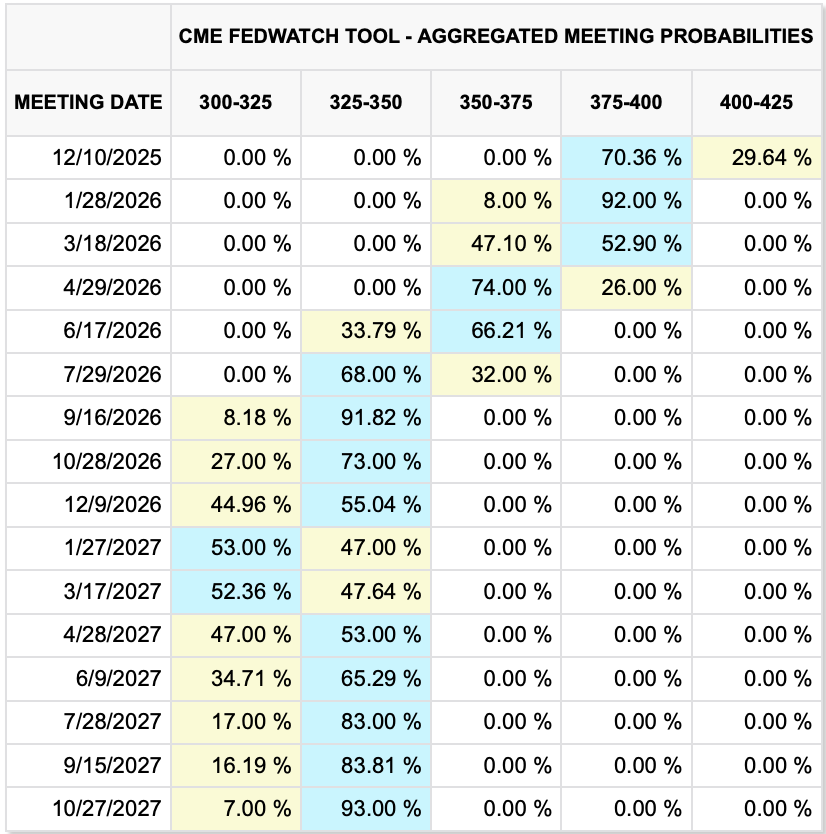
Data this morning brings Retail Sales (exp 0.2%, 0.4% -ex autos) along with IP (-0.1%) and Capacity Utilization (77.4%).  However, it is not clear to me that markets will give this data much consideration given the imminence of the FOMC outcome tomorrow.  The current futures pricing has just a 4% probability of a 50bp cut.  I am waiting for the Timiraos article to see if that changes.  Look for it this afternoon.

Good luck

Adf
Falling Fast

His swords were words he wielded well
He spoke his truths, but would not yell
His followers enrapt
His enemies then snapped
And undeservedly he fell
 
RIP Charlie Kirk
 
A score plus four of years have passed
Since thousands died, we were aghast
No logic could be found
For those at, zero, ground
Society is falling fast


A generation after the horrific events of September 11, 2001, it appears that memories have faded.  Personally, having observed those events from one block away, it is indelibly imprinted on my brain.  But now, in the course of a week we have seen several senseless murders make the news as whatever decorum may have existed at the turn of the century is long gone.  Messrs. Howe and Strauss were always quite clear that the 4thTurning involved chaos and the destruction of institutions.  I fear the process is accelerating.  I also fear that it must play out to get through to the other side.  Civil war feels excessive as a description, but as I have forecast for the past year or two, one of the major political parties was likely to explode.  Right now, it feels like the Democrats are on that path.  I don’t know what will replace it, but something must, and it would behoove us all if there is some coherence in their policies when it appears.  I remain confident that Socialists are not the answer, nor will they be embraced across the nation. 
 
The reason I discuss this, which seems outside the bounds of my market perspective, is that it is going to impact markets even more than it already has.  The ongoing politicization of the media, businesses and entertainment does not lead to kumbaya, but rather volatility and distress.  If you wonder why gold continues to perform well, look no further.  Whatever the data, whatever the Fed does, whatever Trump and his administration do, or what Congress tries to do, gold has a history of maintaining value for the past 5 millennia.  Everything else is new and prices are all relative to gold.  Remember that as you approach your day job and your investments, whether you hedge for a living, or simply are trying to make a living.
 
There are now two things on the docket
That could lead risk assets to rocket
First, CPI comes
The Jay and his bums
Decide what gets put in our pocket

Considering these very serious issues, it seems almost ridiculous to discuss markets, but they will continue to trade and the ability to keep your eye on that particular ball is still critical to financial outcomes.  So, let us turn to the two stories (well, maybe two and a half stories) that have the potential to change some viewpoints.  The first is today’s CPI, then next week’s FOMC meeting with a half nod given to today’s ECB meeting.

Regarding the least important, the ECB is almost certainly going to leave policy unchanged.  The only opportunity for anything new will come from Madame Lagarde’s press conference and if she displays a new tone, whether hawkish (I doubt) or perhaps more dovish as European data continues to ebb.

But let’s move on to CPI.  After yesterday’s much lower than expected PPI data, where the M/M numbers for both headline and core were -0.1% compared to +0.3% expected, there has been some talk on the margins that we could see much softer CPI data.  However, it is worth knowing that for the inflation cognoscenti (e.g., @inflation_guy) PPI data is seen as a random number generator with very little direct impact on the consumer data.  (In fact, after my look at NFP data, aren’t all the data points random?)  With that in mind, current median expectations remain as they were earlier in the week (0.3% M/M for both headline and Core with the Y/Y numbers expected at 2.9% and 3.1% respectively).  

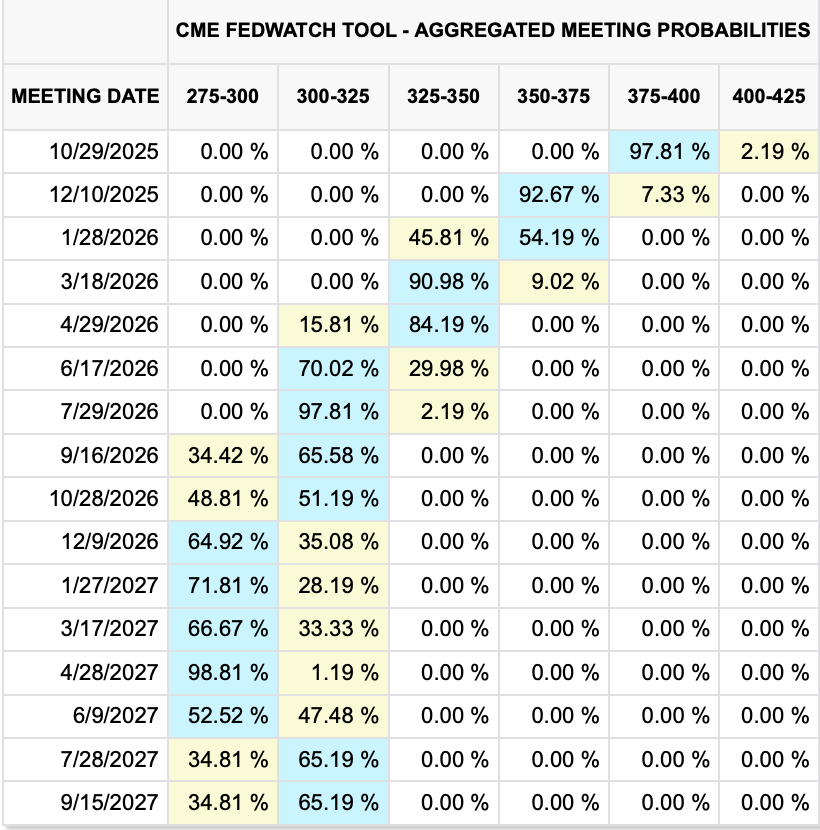
Given the market is currently pricing a full 25bp cut with an 8% probability of 50bps, my take is the only way to change things would be for CPI to also print like the PPI data as negative numbers.  If that were to be the case, and I do not anticipate that outcome by any stretch, it would give Chairman Powell ample opportunity to cut 50bps with the market welcoming the outcome along with President Trump.  On the flip side, I don’t think CPI can print a high enough number to remove the 25bp cut.  As a reminder, below are the cumulative probabilities for future Fed funds rates based on the CME’s futures contract.  A total of 75bps remains the default view for the rest of 2025.

We will learn about the outcome at 8:30 this morning and I have no particular insight into whether those median forecasts are high, low or on the money.  This is a wait and see situation.

As to the FOMC meeting, it has the opportunity to be far more impactful.  While 25bps is currently baked in the cake, I remain of the opinion that 50bps is a very viable outcome.  Recall, the most recent Fed discussions were about the importance of the employment portion of their mandate as opposed to the inflation portion.  With the newly revised reduction in NFP over the past twelve months, characterizing the employment situation as solid or strong seems unreasonable.  Weakening would seem a more apt description and should have the discussion be between 25bps or 50bps.  We already know there are at least two governors, Bowman and Waller, who wanted to start cutting last time, and it appears that Stephen Miran, Trump’s current head of the CEA, is going to get approved by the Senate in time to sit in the meeting next week.  One would assume that is a vote for easier policy.   

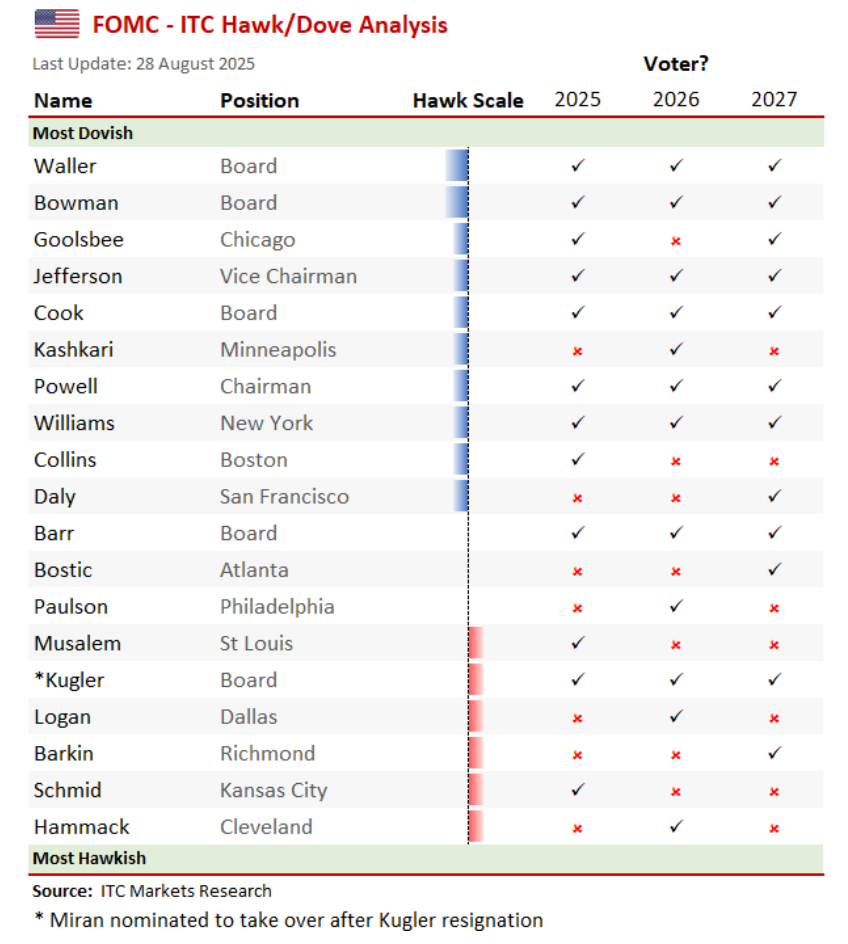
ITC Markets has a very nice table on the perceived hawkishness/dovishness of FOMC members, and it shows that the governors, as a whole, live in the dovish camp with only a few regional presidents as known hawks.  In fact, one of the remarkable things about the entire Lisa Cook affair is that she was always one of the more dovish members of the board and the fact that she was not pushing for cuts never made any sense.  At least based on her background and history.  However, if you take politics into account, and the idea that she didn’t want to cut because President Trump wanted a cut, it begins to become clearer.  At any rate, it strikes me that based on this table, which feels reasonable, 50bps is in play.

With all that in mind, let’s take a quick turn around the markets to see what is happening ahead of this morning’s data.  As seemingly always, equity markets rallied in the US yesterday, well mostly.  The DJIA slipped, but the other indices managed to continue their hot streaks.  It is very hard to link economic activity to equity market outcome these days, at least to my eyes.

But on to Asia, where Japan (+1.2%) had a solid session on the back of the remarkable rise in Oracle shares and the idea that Japanese tech companies will benefit.  China (+2.3%) was the beneficiary of the story that President Xi is now looking to have banks prop up local governments that have stopped paying contractors now that their property sale gravy train has derailed.  It seems that they have figured out if you don’t pay people, they don’t consume anything.  So, upwards of CNY 1 trillion will be injected into local government coffers specifically to pay these late bills and try to kickstart consumption.  But, as I look through the rest of the region, it was a much more mixed picture with some gainers (Korea, Indonesia, Thailand), some laggards (HK, Malaysia, Australia) and many markets that barely moved.

In Europe, all the major markets are green this morning led by the CAC (+0.85%) and UK (+0.5%) with the others showing much smaller gains (DAX +0.2%, IBEX +0.25%).  There is no obvious reason for the gains as expectations for the ECB remain static and there has been no data of note released.  Meanwhile, US futures are higher by 0.25% at this hour (7:30).

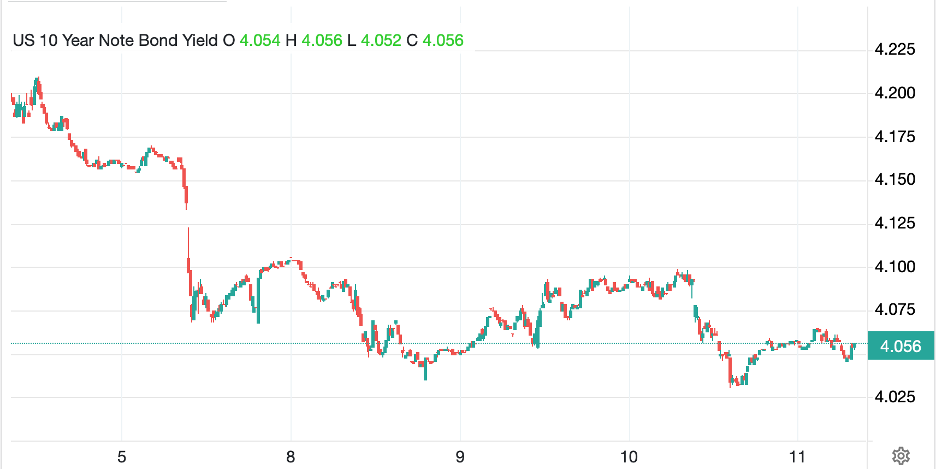
Bond markets remain frozen as Treasury yields have edged higher by just 1bp and European sovereign yields are +/-1bp from yesterday’s close.  As you can see from the chart below, the range on 10-year Treasuries has been fairly narrow for the past week.  Perhaps today’s CPI will shake things up.

Source: tradingeconomics.com

In the commodity space, oil (-1.25%) is giving back the gains it saw earlier in the week but basically remains unchanged overall.  If fears grow that a recession is upon us, I could see a rationale for oil to decline, but it is hard to get excited about the market right now.  Gold (-0.6%) is backing off its most recent all-time high, but is still firmly above $3600/oz.  Given the recent run, it is no surprise it takes a breather here and there is no reason to believe that precious metals are topping out.  In fact, a look at the charts tells me that there is plenty of upside left across the space.

Source: tradingeconomics.com

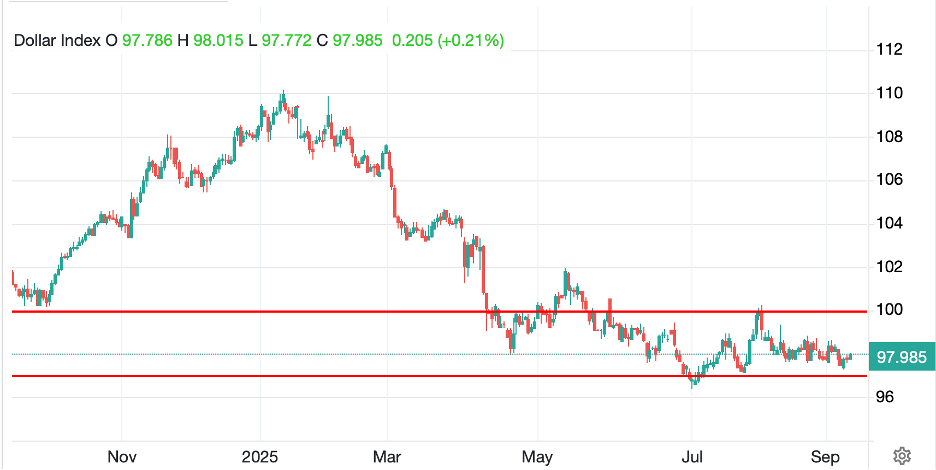
Finally, the dollar is a bit firmer this morning, probably one reason the precious metals are under some pressure, but here too, if we use the DXY as our proxy, the range is pretty clear.

Source: tradingeconomics.com

JPY, INR and ZAR are the largest movers this morning, each declining -0.4%, while the rest of the world is mostly softer by -0.1% to -0.2%.  Broad based dollar strength but no depth whatsoever.  We shall see how things behave after the CPI release.

And that’s really it.  For now, the big picture remains the same, where the prospects of an easier Fed will weigh on the dollar and support commodities.  Equities will like that for now, at least until inflation picks back up, and bonds feel subject to manipulation so I’m just not sure.

Good luck

Adf

Just a Bad Dream

Before yesterday traders whined
‘Bout how much that vol had declined
But President Trump
Caused copper to dump
And still, Chairman Powell, maligned
 
So, chaos is now the new theme
Though most hope it’s just a bad dream
And ere the week ends
Based on recent trends
We could see, results, more extreme


It isn’t often that copper is the talk of the town, but this is a new world in which we live, and as I’ve repeatedly explained, all that we think we knew about the way things work, or have worked in the past, is generically wrong.  It is with this in mind that I lead with a chart of the copper price, which after having rallied dramatically back in April, after Liberation Day, and again in July, both times on the back of tariff announcements, collapsed yesterday when President Trump altered the conversation by explaining that tariffs on copper would not be on the raw metal itself, but rather on refined products instead.  As you can see from the chart, this resulted in a massive decline, nearly 23% in the past twenty-four hours. 

Source: WSJ.com

Essentially, the US price, as traded on the COMEX, returned to be in line with the ROW price, as traded on the LME.  That doesn’t make the move any less dramatic, but the question of how long those price differentials could be maintained was always an open one.  At any rate, that was the biggest mover of the day yesterday and naturally, it had knock-on effects elsewhere with the entire metals complex falling sharply (Au -1.85%, Ag -3.0%, Pt -9.7%) as well as some currencies that are linked to those metals like CLP (-1.5%) and ZAR (-1.4%).  Remember how much complaining there was because market activity had slowed so much?  I bet most folks are looking wistfully at that pace this morning!

Turning to the other key focus of yesterday, the FOMC meeting, the FOMC statement was exactly as expected, with continued focus on “solid” labor market conditions and moderate economic activity acting as the rationale to leave rates on hold.  As widely expected, both Governors Bowman and Waller dissented, each calling for a 25 basis point cut.  The two schools of thought continue to be 1) headline data releases have been masking underlying economic weakness (declining home sales, declining air travel and restaurant activity); and 2) while those issues may be real at the margin, the fact that financial markets continue to rise, with significant speculative activity in things like meme coins and cryptocurrency in general, as well as Private Credit, indicate there is ample liquidity in the market and no reason to adjust policy.

This poet, while not a PhD economist (thankfully!), comes down on the side of number 2 above.  There has been talk by numerous, quite smart analysts, about the underlying weakness in the economy and how the data would be demonstrating it very soon.  Whether it is the makeup of the employment situation, the housing market showing a huge imbalance of homes for sale vs. buyers (at least at current prices) or the added uncertainty of tariffs and how they will impact the economy, this story has been ongoing for more than three years without any proof.  In fact, yesterday’s GDP reading for Q2 was a much higher than expected 3.0%, once again undermining the thesis that the economy is already in a recession.  If so, it is the fastest economic growth ever seen in a recession.

In fact, I do not understand the rationale for so many that a rate cut is necessary.  I realize the market continues to price a 60% probability of a cut in September and about 35bps of cuts by year end, but it makes no sense to me.  In fact, the market is pricing for 110 basis points of cuts through 2026.  Now, either market participants are anticipating a significant slowdown in inflation, which given all the tariff talk seems unlikely, or they see that recession on the horizon.  At this point, I have come to believe it is nothing more than wishful thinking because there is such a strong belief that Fed funds rate cuts lead to higher equity prices, and after all, isn’t that the goal?

Chairman Powell, despite all the pressure he receives from the White House, has not budged.  In this instance, I believe he is correct.  After all, if the data suddenly implodes, the Fed can cut far more substantially and do so on an intermeeting basis if necessary.  Remember, ahead of the election, he cut rates 50bps for no discernible reason based on the data.  Unemployment had risen from 3.9% to 4.2% over the prior three months and that was enough to scare him (although there was clearly a political motive as well).  If the Unemployment Rate rises to 4.5% on September 5th, they could cut that day if they thought things were really unraveling.  If the Fed is truly data dependent, then the data does not yet point to a major economic problem.  And the one thing we know about the Trump administration’s policies is they are going to try to run the economy as hot as possible.  That does not speak to lower interest rates.

Ok, let’s look at how markets around the world absorbed these changes, and how they are preparing for today’s PCE and tomorrow’s NFP data.  Despite all the noise, the DJIA was the worst performer yesterday, sliding just -0.4%, while the NASDAQ actually rallied at the margin, +0.15%.  And this morning, futures are pointing much higher (NASDAQ +1.4%, SPU +1.1%) as both Meta and Microsoft beat estimates handily.

Overnight, while Japanese shares (+1.0%) rallied nicely, China (-1.8%) and Hong Kong (-1.6%) significantly underperformed as weaker than expected PMI data put a damper on the idea that stimulus was going to solve Chinese problems.  A greater surprise is that Korea (-0.3%) didn’t perform better given the announcement that they had agreed a trade deal with the US with 15% baseline tariffs, although that may have been announced after the markets there closed.  But the rest of Asia had a rough session with most key regional exchanges (Singapore, Philippines, Indonesia, Malaysia) all declining about -1.0% with only Taiwan (+0.35%) on the other side of the ledger.  However, if we continue to see strength in the US tech sector, and trade deals keep getting inked, I suspect these markets will be able to rebound.

In Europe, the picture is also mixed, with the CAC and DAX essentially unchanged after in-line inflation readings, while Spain’s IBEX (+0.5%) reacted positively to Current Account data while the FTSE 100 (+0.5%) rallied on strong earnings data from Rolls Royce and Shell Oil.

Perhaps the most interesting aspect of yesterday was how the bond market sat out the chaos.  Treasury yields edged higher by 2bps yesterday and this morning they have fallen back by -1bp.  European sovereign yields this morning are essentially unchanged, although a few nations have seen yields slip -1bp.  In many ways, I feel that this is confirmation that despite a lot of noise, not much has really changed.

Oil (-0.5%), is giving back some of yesterday’s $2.00/bbl surge which was based on more sanctions talk from President Trump on Russia and reviving the discussion on 100% secondary sanctions on nations that import oil from Russia.  While EIA data showed a major inventory build, the talk was more than enough to spook traders.

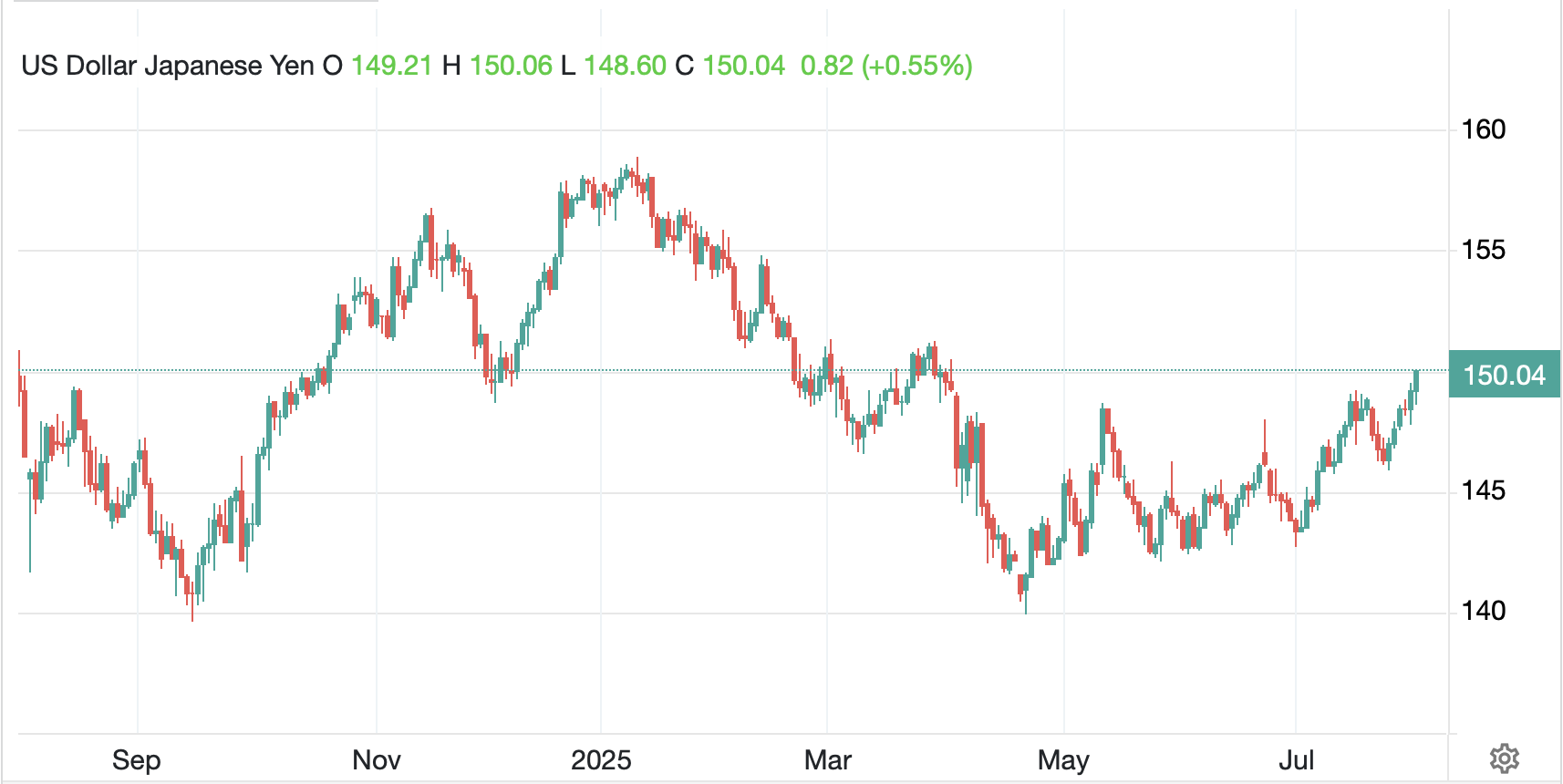
Finally, currency markets, which have seen dollar strength for the past several sessions, are relatively calm this morning, at least in the G10, where the DXY is unchanged, although at its highest level since just before Memorial Day.  In that bloc, JPY (-0.5%) is the laggard after the BOJ left policy on hold, as expected, and while the yen has not been the market’s focus lately, it is back to 150.00 this morning for the first time since March.

Source: tradingeconomics.com

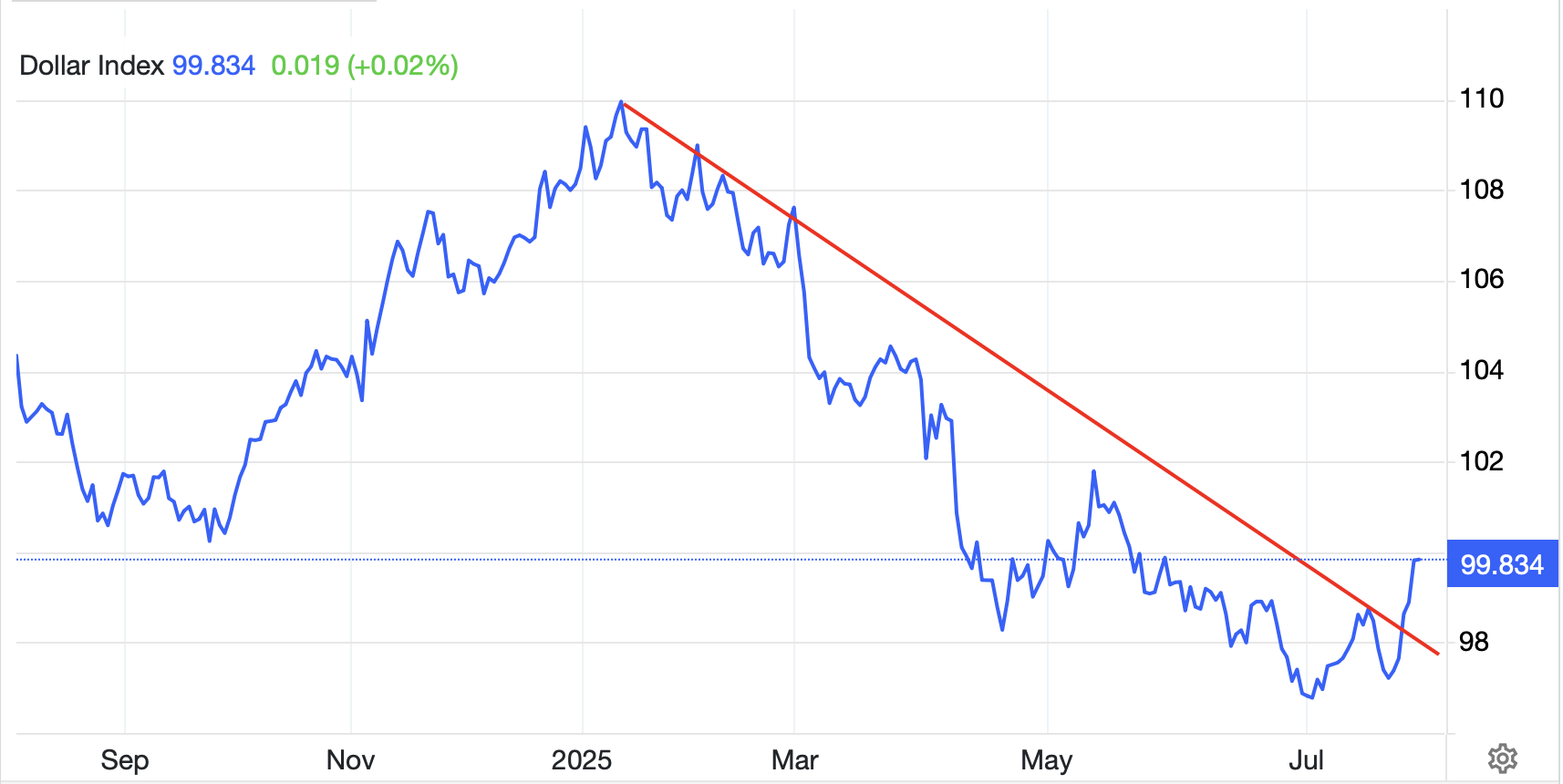
Remember all the talk about the end of the carry trade and how the yen was going to explode higher?  Me neither!  As to the EMG bloc, other than the aforementioned metals focused currencies, there has not been much movement in this space either.  However, overall, while the longer-term trend has clearly been lower, this bounce looks more and more like it is gaining strength.  The DXY is a solid 2% through the trendline and a move to 102 seems well within reason in the near term.

Source: tradingeconomics.com

On the data front, this morning brings Initial (exp 224K) and Continuing (1960K) Claims, Personal Income (0.2%) and Spending (0.4%) and PCE (0.3%, 2.5% Y/Y headline, 0.3%, 2.7% Y/Y Core) all at 8:30.  Then at 9:45 we see Chicago PMI (42.0).  There are no Fed speakers and assuming today’s data is in line, I expect that all eyes will turn to earnings from Apple and Amazon after the close and then NFP tomorrow.  So, despite yesterday’s volatility, I see a respite for the day.

Good luck

Adf
Qualm(s)

As all of us wait for the Fed
And try to absorb what’s been said
Investors are calm
Though pundits have qualm(s)
Their warnings of problems are dead
 
While no move is likely today
So many continue to pray say
A rate cut is coming
To keep markets humming
So, shorts best get out of the way


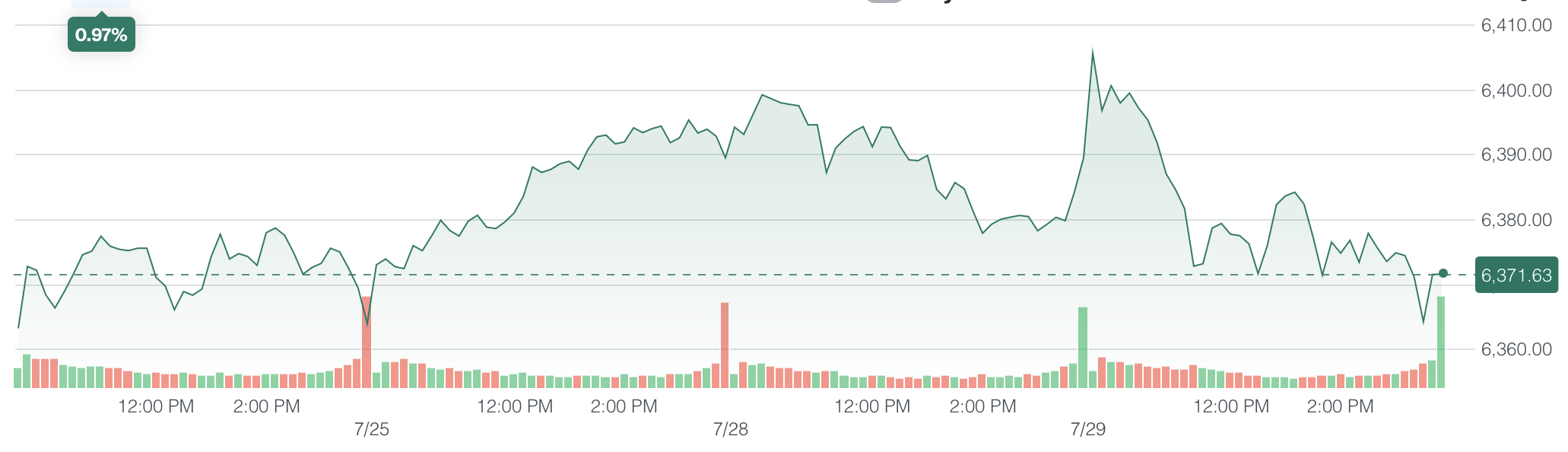
Markets have been in wait and see mode, at least equity markets have, for the past week as investors, traders and algorithms seek something new to discuss.  In fact, a look at the chart below shows that the S&P 500 has moved the grand total of 9 points over the past week!

Source: finance.yahoo.com

Yes, there have been some earnings announcements, with a couple of key ones this afternoon (MSFT and META), but there continues to be an increasing focus on the FOMC which will announce their policy decision (no change) this afternoon.  The focus is really on what Chair Powell will hint at in the ensuing press conference.  At this point, I would say it is baked in the cake that two governors, Waller and Bowman, are going to dissent seeking a 25bp rate cut.

Ironically, if markets are looking for a catalyst from this FOMC meeting, I believe they are looking in the wrong place.  Chairman Powell will do everything he can to not answer any question about anything whatsoever, whether on the likely trajectory of future policy decisions or whether he will resign or be fired.  And so, we will need to look elsewhere for market moving catalysts.

Of course, there is always the White House, which has proven to be a rich source of uncertainty, and then there is the data onslaught starting today through Friday, which if it comes in differently than forecast, will have the opportunity to move markets.  Regarding the former, I will not even attempt to guess what the next story will be.  However, the latter is a potentially rich vein to be mined for insight.

To set the table, a look at yesterday’s outcomes is worthwhile.  The Goods Trade Balance fell to -$86B, substantially less than forecast, on the back of a significant decline in consumer goods imports.  While the data still shows a deficit, I imagine Mr Trump is pleased with the direction.  Certainly, compared to the trend prior to his election (as well as the front-running of tariffs early this year) it seems a modest improvement, or at least a reduction. (see chart below)

Source: tradingeconomics.com

Otherwise, Home Prices rose less than forecast and continue to slow their pace of increase and job openings were withing spitting distance of forecast at 7.44M, although somewhat lower than last month.  Finally, Consumer Confidence continues to rebound.  While equity markets were nonplussed, with US markets slipping a bit on the day, Treasury bonds rallied nicely with 10-year yields sliding -8bps on the day.  The bulk of that rally was based on a very positive 7-year auction, with the bid-to-cover ratio rising to 2.79, and dealers only getting 4% of the issue, the lowest level recorded since 2004.  In other words, investors took in virtually the entire $44 billion.  This morning, we will also learn about Treasury’s planned quarterly issuance, although estimates are there will be no increase in long-term bonds, with T-bills continuing to be the main financing vehicle for now.

Too, this morning we will get the ADP Employment report (exp 75K) and the first look at Q2 GDP (2.4% after -0.5% in Q1).  While all of that could have an impact, my sense is that tomorrow’s PCE data and Friday’s NFP will be of much more import.  A final though this morning is that the BOC is going to complete their policy meeting, but no change is expected there.

If we consider this information, absent a new surprise from the White House on your bingo card, it seems to me Friday is the most likely timing for any substantive movement in equities or bonds.  And with that in mind, let’s look at how other markets have been responding to things.

Yesterday’s modest declines in the US were followed by a mixed picture in Asia with both Japan and China little changed on the day although Hong Kong (-1.4%) was under pressure as the US-China trade talks stumbled for now.  But much of the rest of the region had a solid session with Australia (+0.6%) rallying after better-than-expected inflation data encouraged traders to price in a rate cut by the RBA at their next meeting.  But there were gains in Korea, India and Taiwan as well with only Indonesia really lagging.  In Europe, it is a mixed session with the CAC (+0.45%) leading the way higher while both the IBEX (-0.2%) and FTSE 100 (-0.3%) are lagging as Eurozone data was mixed with inflation edging higher in Spain although Eurozone GDP came in a tick better than forecast.  However, the big discussion there continues to revolve around the details of the trade deal.  As to US futures, they are a touch higher at this hour (7:40), about 0.25%.

In the bond market, after yesterday’s rally, US yields are unchanged on the day, trading at the low end of their recent range, while European sovereign yields are all lower by -2bps (Gilts are -5bps) as the US move came later in the day and Europe didn’t really participate yesterday.  Overnight, JGB yields slipped -1bp, but Australian govies fell -7bs as thoughts of rate cuts danced in traders’ heads.

In the commodity markets, oil (-0.65%) is giving back some of its gains that were catalyzed by President Trump’s threats to Russia if they don’t sit down in the next 10 days, rather than the original 50-day window.  As to metals markets, gold is unchanged this morning, still trading in the middle of its range, although we have seen some weakness in both silver (-0.9%) and copper (-0.8%) but it seems more in line with ordinary trading than with any new news.

Finally, the dollar is continuing its rebound as the euro (-0.2%) retreats further from its recent highs and is now lower by more than -2% in the past week.  In fact, the DXY has traded back above 99.0 for the first time since early June as the bottoming formation that I have highlighted over the past several days continues to prove prescient.  In fact, some might say the dollar is starting to accelerate higher!  Once again, I would highlight that the descriptions of the dollar’s demise were greatly exaggerated.

Source: tradingeconomics.com

And that’s pretty much all there is to discuss.  We are firmly in the middle of the summer doldrums where market activity remains subdued at best.  Given the prominence of algorithms in trading most markets, it will require something new and unexpected to get things going.  Of course, perhaps this evening’s earnings data will start some movement, but I’m still focused on Friday.

Good luck

Adf
A Scold

The market’s convinced that Chair Jay
Is going far out of his way
To keep rates on hold
‘Cause Trump’s been a scold
And strength’s what Jay wants to portray
 
But ask yourself why should rates fall?
With stocks at new highs, after all
And crypto’s exploded
Which clearly eroded
The storied liquidity fall


Yesterday’s market activity was benign with modest market movements in both equity and bond markets although the dollar did rally sharply, on the back of the EU trade deal.  Of course, economic theory predicts just that, when tariffs on a nation (or bloc of nations) are raised, that currency will decline in value to offset the tariffs.  Recall, this was the expectation in the beginning of 2025 when President Trump was just coming into office and calling himself ‘Tariff Man’ as he explained he would be imposing tariffs on virtually all US trading partners.  However, back then, the theory didn’t work out very well and the dollar declined throughout the first six months of the year as can be seen below.

Source: tradingeconomics.com

In fact, analysts quickly moved on and were virtually gleeful that the dollar’s decline of roughly 13% was the largest decline during the first six months of the year since the 1980’s.  Personally, I’m not sure why classifying the decline in terms of the time of year is relevant, but that was a key talking point in the narrative that described the end of American exceptionalism.  Other parts of that narrative were the end of the dollar as the global reserve currency (gold was going to take over) and the onset of other currencies as payment rails for trade.  

None of that ever made sense nor do current proclamations that the euro’s status has changed in any significant way.  There are still very significant long euro positions outstanding as the dollar decline theory has many adherents, but being long euros, aside from being expensive, just got a bit uglier after yesterday’s and this morning’s declines totaling about -1.5%.  

Remember, a key portion of the short dollar thesis is that the Fed is going to cut rates more than other central banks going forward.  And now that the FOMC’s meeting is starting this morning, let’s discuss that idea.  We all know that President Trump has been a vocal advocate for significant rate cuts immediately.  However, let’s look at some evidence.  On the one hand, equity markets are at historic highs in terms of prices as well as readings like the Buffett ratio (market cap/GDP) and P/E and P/S ratios as well.  Crypto currencies, arguably the most speculative of assets, have been flying, especially things like meme coins, which are literally a play on the greater fool paying someone more than they paid for a token with no intrinsic value whatsoever.  Credit spreads, especially for weak credits, are pushing historic lows as per the below chart.  All these things point to not merely ample liquidity and policy being appropriate, but excess liquidity and policy being easy.  

And yet the other side of that coin is a look at 2-year Treasury yields, which have a long history of accurately forecasting future Fed Funds levels.  Right now, as you can see in the below chart, they are trading at a 50 basis point discount to Fed Funds, an indication that the market is quite convinced the Fed is going to cut rates.  Ironically, I believe that Chairman Powell, a PE guy by background, is a strong believer in lower interest rates and I’m sure all his colleagues from his time at Carlyle Group are also pressing for lower interest rates, but he doesn’t want to seem cowed by Trump.

The market is pricing just a 3% probability of a cut tomorrow, but a 65% probability of a cut in September and then another cut in December.  It strikes me that we will need to see a major reversal in the economic situation in the US, with Unemployment rising and growth rapidly declining in order to bring about a situation where there is a real case to be made for a cut.  But we also know that politics plays an enormous role in this story, and while expectations are that we are going to see two dissents at tomorrow’s meeting, that will not change the outcome of no movement.

Adding this all up I conclude that the weak dollar thesis is largely predicated on the idea that the Fed is going to ease monetary policy going forward, catching down to what most other central banks have already done.  And I agree, if the Fed does cut rates, the dollar will fall.  But every day I watch market behavior and continue to see economic data that appears to be holding up pretty well despite a great deal of angst from the analyst community, and I find it harder and harder to come up with a reason to cut rates.  

Consider the story about the new effort by the Trump administration to remove 100,000 regulations by July 4th2026.  Estimates of the value that will unlock are upwards of $1.5 trillion and that assumes no policy changes.  That’s more than 5% of GDP.  I cannot help but believe that President Trump is going to be successful in completely changing the way the US economy works by changing the way (i.e. reducing) the government’s intrusions in the economy.  And if that is successful, it is not clear why interest rates need to decline.  Remember, too, there is an enormous amount of data compressed into this week, so by Friday afternoon, we will have much more information.

Ok, a quick turn round markets shows that after a mixed session in the US yesterday, Japan (-0.8%) slipped on concerns over the nature of the trade deal, while China (+0.4%) edged higher as trade talks continue in Stockholm between the US and China.  Elsewhere in the region both Korea and India rose a bit, spurred by hopes for trade deals there, and the rest of the area was mixed with no large movement.  In Europe, green is today’s color as investors have taken the avoidance of a trade war as a positive and added the euro’s weakness as a positive as well, helping European exporters.  So, gains are strong (DAX 1.3%, CAC 1.4%, FTSE 100 0.7%) and things are generally bright despite grumbling by some nations that the trade deal is going to hurt them.  And at this hour (7:30), US futures are higher by 0.3% or so.

In the bond market, yields are edging lower this morning (Treasuries -2bps, Gilts -1bp, Bunds unchanged) as investors remain either comfortable with the current situation or uncertain what to do to change things at current yields.  I vote for uncertainty.

In the commodity markets, neither oil nor metals markets are moving much at all this morning with daily fluctuations less than 0.2% in all of them.  This has all the feel of a consolidation ahead of tomorrow’s Fed and the rest of the week’s data including GDP, PCE and NFP.

Finally, the dollar is firmer again today vs. almost all its counterparts with gains on the order of 0.2% to 0.3% in most G10 and EMG currencies.  However, two CE4 currencies (PLN -0.6% and HUF -0.9%) are under pressure with the former complaining that the trade deal will cost them > €2 billion, while the latter is suffering from poor economic data heading into an election where President Orban is on shakier ground that normal.  But net, expect to hear about some more dollar strength in the wake of higher tariffs.

On the data front this morning, we see the Goods Trade Balance (exp -$98.4B), Case Shiller Home Prices (3.0%), JOLTS Job Openings (7.55M) and Consumer Confidence (95.8).  With so much focus on trade lately, I suspect that number could matter, but really the JOLTS number will be of more interest, especially for the bond market, as any weakness in the labor market will encourage the lower rates story.

And that’s really all for today.  Until we hear from Powell, it is hard to make a dollar call in the short-term, and the medium term is dependent on the Fed’s actions.

Good luck

Adf
Trump’s Latest Ire

The Minutes explained that in June
The Fed felt no need to impugn
Their previous view
Of nothing to do
Though two sang an alternate tune


Yesterday’s release of the FOMC Minutes from their June meeting confirmed what we have learned in the interim.  Governors Waller and Bowman have been clear that they see tariffs as a one-off impact on the rate of inflation, and not something on which to base policy.  If you think about it, tariffs are like food and energy, something that cannot be addressed effectively by monetary policy and which the Fed explicitly excludes from their decision-making process.  (For a really good read on the inflationary impact on tariffs, @inflation_guy published this yesterday).  To me, the salient comments from the Minutes are below:

“While a few participants noted that tariffs would lead to a one-time increase in prices and would not affect longer-term inflation expectations, most participants noted the risk that tariffs could have more persistent effects on inflation.”

“Participants agreed that although uncertainty about inflation and the economic outlook had decreased, it remained appropriate to take a careful approach in adjusting monetary policy.” 

In fact, it is not hard to conclude that the Fed’s intransigence on this issue is politically motivated as well since we have already established that the Fed is clearly political (and partisan).  I would estimate part of the reason they do not want to cut rates here is because they don’t want to be seen as caving into President Trump’s demands.  But whatever the reason, even the futures market is reducing the probability of a cut with the July probability having fallen from more than 20% two weeks ago to 6.7% as I type this morning.  We will need to see some seriously weak economic data to get the Fed to move, I believe, although I expect we will see Governors Waller and Bowman dissent at the July 30th meeting.

However, I would contend that the market has already sussed this out and there will be limited impact on any financial markets after the meeting absent a surprise cut.  So, let’s move on.

The target of Trump’s latest ire
Brazil, has now come under fire
The issue’s not trade
Instead, Trump was swayed
By lawfare ‘gainst one he admire(s)

The other news from yesterday (and there has been precious little overnight) was President Trump’s threat of 50% tariffs on all of Brazil’s exports to the US.  Now, the US runs a trade surplus with Brazil of about $10 billion, so clearly trade is not the issue here.  Rather, it seems that Mr Trump is seeking to help is friend, former Brazilian president Joao Bolsonaro, who is also a right-leaning populist and who is on trial for leading an insurrection after he lost the last election.  It is not hard to understand Mr Trump’s concern over the issue given the history in the US and the previous administration’s efforts to imprison Trump himself.  

However, this seems, at least to me, a bit over the top.  Brazil had been slated to get the minimum 10% tariff prior to yesterday’s outburst.  As well, the US is Brazil’s second largest trading partner, so this will have a significant impact on the country if these tariffs are imposed.  As such, it is no surprise that the market responded immediately.  

Source: tradingeconomics.com

As you can see from the chart above, the announcement at 1:30 yesterday afternoon had an immediate impact with the real falling -2.5% with minutes of the news.  Too, the IBOVESPA stock index fell more than -1.3% yesterday with Embraer, the airplane manufacturer down nearly 10%.  Right now, this is a threat, and the immediate Brazilian response was to say they would not be cowed by this action and will continue with their internal legal activities.  There is no way I will opine on how this will end, but if these tariffs are put in place, it will be a distinct negative for Brazil’s economy, and I would expect that the real could quickly head back toward 6.00 from its current levels.

Away from those two stories, though, issues impacting financial markets are sparse.  With that in mind, let’s see how markets behaved overnight.  Yesterday’s US equity rally was followed by a mixed picture in Asia with Japan (-0.4%) slipping a bit but gains in both China (+0.5%) and Hong Kong (+0.6%) after rumors came out that the Chinese government was getting set to add more support to the still-imploding Chinese property market.  Other regional bourses saw some gains (Korea, Taiwan, Australia) and some losses (India, Thailand, Philippines).  At this point, all eyes remain on the tariff story for most of these nations.  Meanwhile, in Europe, the FTSE 100 (+1.1%) is today’s leader on the strength of its mining sector which responded positively to President Trump’s mooted 50% tariffs on copper.  Elsewhere, though, things have been less robust with the CAC (+0.7%) having a nice day, the DAX (+0.2%) edging higher after inflation data was released as expected at 2.0% while the IBEX (-0.6%) is moving in the other direction absent a major catalyst.  However, remember it has been performing well, so this could just be some profit taking.  US futures are essentially unchanged at this hour (7:00).

In the bond market, yesterday’s 10-year auction went well with no tail and yields ultimately slipped 6bps during the session.  This morning, that yield has edged back higher by just 1bp.  As to European sovereigns, they are +/- 1bp this morning, showing no direction or new views on anything.  Readings from Europe this morning have confirmed that the rate of inflation is quiet and near the ECB’s target so there is little reason for investors to worry.  As well, the word is that a trade deal between the US and EU is getting close, which will almost certainly be seen as a benefit for markets on the continent.

In the commodity markets, oil (-0.6%) is softer this morning but continues to hug the $68/bbl level despite EIA inventory data showing a net large build of nearly 4 mm barrels.  It appears that there is both ample supply and production and there continues to be concern over slowing economic activity, yet oil is in demand.  As I often say, sometimes markets are simply perverse.  In the metals markets, gold (+0.5%) continues to trade either side of $3350/oz and has done so since mid-April.  I continue to read about central banks buying the relic and replacing US Treasuries with gold in their reserve portfolios, but there is obviously enough supply to prevent further price appreciation for now.  But gold is leading gains across the entire metals complex (although copper is getting a boost from the tariff talk.)

Finally, in the FX markets, there is no direction this morning.  both the euro and pound are slightly softer, but AUD (+0.4%) and NZD (+0.35%) are firmer with the yen and CAD little changed.  ZAR (+0.4%) is also having a good day, arguably on the strength in the precious metals markets but otherwise, it is hard to find anything exciting to note.

Turning to this morning’s data, we get the weekly Initial (exp 235K) and Continuing (1980K) Claims and that’s it.  We do hear from three Fed speakers, Musalem, Daly and Waller, but since we already know Waller’s views, it will be far more interesting to hear the other two.  I do find it interesting that Ms Daly, one of the most dovish FOMC members, is not in the rate cut camp, a situation I attribute entirely to her political views.

And that’s what we’ve got today.  Nothing has changed any trends, and it seems highly unlikely that today’s data will.  However, if we hear dovish signals from both Daly and Musalem, that may indicate a turn at the Fed and perhaps we will see that narrative change.  I am confident the one thing Chairman Powell does not want is to have a 5-4 vote to leave rates unchanged.  I would contend that is the most intriguing thing on the horizon right now.

Good luck

Adf
Not Yet Foregone

The US has not yet been drawn
To war, though it’s not yet foregone
That won’t be the case
While Persians now brace
For busters of bunkers at dawn
 
But until such time as we learn
That outcome, the current concern
Is Jay and the Fed
And what will be said
At two o’clock when they adjourn


So, every top headline this morning discusses the idea that President Trump is considering whether to initiate US military action in Iran, specifically to drop the so-called bunker buster bombs to destroy Iran’s nuclear enrichment and bomb-making facilities.  There is certainly a lively discussion on both sides of the argument with the best description of the problem that I’ve seen being a poll showing that 74% approve Trump’s position that Iran must not get nuclear weapons, but 60% oppose US involvement in the war.  I’m glad I don’t have to thread that needle!

Obviously, there are market implications if the US does get involved but given the complete lack of clarity on the situation at this point, I do not believe I can add much to the discussion.  The only thing I will say is that the longer-term trends for both oil (lower) and metals (higher) are still intact, but we are likely to see some significant volatility along the way.

Which takes us to the next most important market discussion, the FOMC meeting that ends today and the potential market impacts.  It is universally assumed that there will be no policy change at the meeting, either interest rates or QT, which means that now the punditry is focused on the arcana of Fed policy.  As this is a quarter end meeting, the Fed will release its latest SEP (summary of economic projections) and dot plot, and with nothing else to discuss until the war in Iran either ends or intensifies, those are the key discussion points in the market.  

I have long maintained that one of the greatest blunders of the Bernanke era was the institution of forward guidance.  While it may have served its purpose initially, it has now become a major distraction.  Far too much attention is paid to the dot plot, where if one member adjusts their view by 25bps, it can impact markets which have built algorithms to respond to the median outcome.

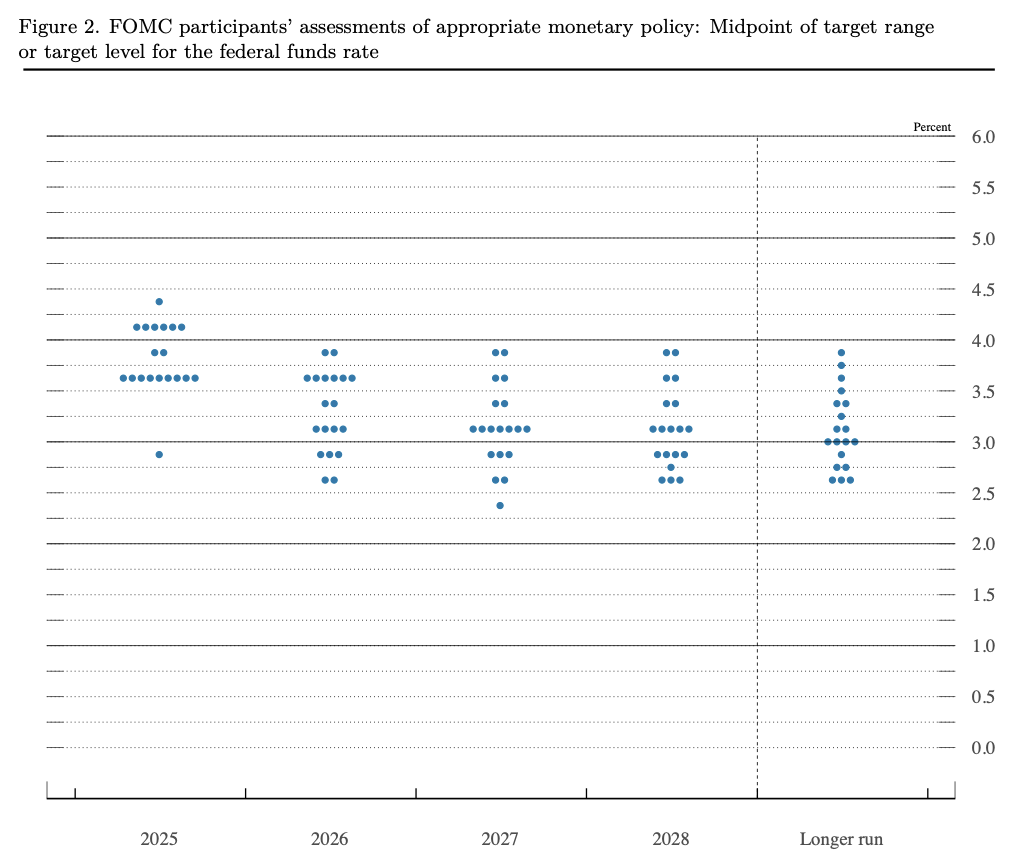
Below is the March dot plot which showed a median “expectation” of Fed funds for the end of 2025 at 3.875%, or 50 basis points lower than the current level.  However, if two more FOMC members (out of 17) thought there was only going to be one cut, that would have shifted the median “expectation” as well as the narrative.

As such, the importance of the dot plot feels overstated compared to its actual value.  After all, no FOMC member has an impressive track record with respect to their analysis of the economy and its future outcomes, let alone what the appropriate rate structure should be at any given time.  In fact, nobody has that, which is the argument for restricting the Fed’s duties to be lender of last resort and allow markets to determine the proper level of interest rates based on the supply and demand of money.  But this is the world in which we live.  My one observation is that the post GFC era has greatly distorted views on the economy and appropriate monetary policy.  It is hard not to look at the below history of Fed funds and see the anomaly that occurred during the initial QE phase.  

Concluding, regardless of my, or anyone not on the FOMC’s, views on appropriate policy, it doesn’t matter one whit.  They are going to do what they deem appropriate, and while I don’t doubt their sincerity, I do doubt they have the tools for the mission.  Perhaps the most interesting thing that could come from this meeting is further information on their assessment of the current Fed process, including their communication policy.  I remain strongly in favor of them all shutting up and letting markets do their job although that seems unlikely.  But perhaps they will get rid of the dots which seem to have outlived any value they may have had initially.

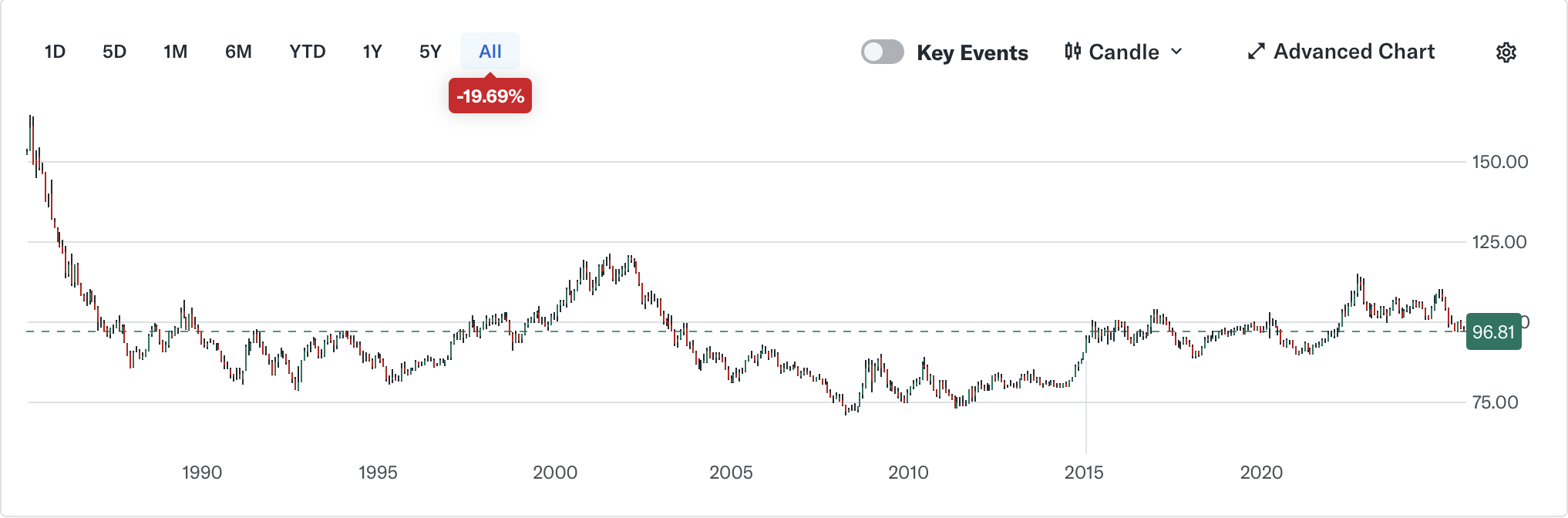
Before we go to markets, I have to highlight one other market discussion this morning with Bloomberg publishing two different articles, here and here,  on the end of the dollar’s hegemony.  The first highlights a speech by PBOC governor Pan Gongsheng and his vision of a multicurrency world which, of course, includes the renminbi as a major part of the process.  I will believe that is a possibility as soon as China opens its capital accounts completely and allows flows into and out of the country with no restrictions.  (I’m not holding my breath.)  The second takes the Michael Bloomberg Trump hatred in the direction of the president is destroying the dollar’s reign because of his policies and to highlight the dollar has fallen 10% already this year!  But let us look at a long-term chart of the dollar, using the DXY as a proxy, and you tell me if you can see the recent move as being outsized in any sense of the word.  In fact, the dollar’s recent price action is indistinguishable from anywhere in its history, and it is not anywhere near to its historic lows.  In fact, it is just a few percent below its long-term average.

Ok, now let’s look at markets.  Yesterday’s selloff in equities seemed to be based on concerns over the escalation in Iran, but as that drags out, traders don’t know what to do.  They are certainly not pushing things much further.  In fact, overnight saw the Nikkei (+0.9%) have a solid gain although HK (-1.1%) followed the US lower.  Elsewhere in the region, South Korea and Taiwan performed well, while India and Indonesia lagged and the rest were +/-20bps or less.  Europe, though, is softer this morning with declines on the order of -0.4% on the continent across the board.  I think investors here are also waiting on the potential events in Iran.  But US futures are actually pointing slightly higher at this hour (7:30).

In the bond market, yields around the world are slipping with Treasuries falling -2bps and most of Europe seeing declines between -1bp and -3bps.  This is after a few basis point decline yesterday as well.  I guess the fear of too much US debt is in abeyance this morning.

In commodity markets, oil, which rallied sharply yesterday on fears of the US entering the war, is little changed on the day after that climb as while there has been lots of talk, oil continues to flow through the Strait of Hormuz, and everybody is pumping nonstop to take advantage of the current relatively high prices.  Gold is unchanged although the other metals (Ag +0.25%, Cu +0.7%, Pt +2.4%) continue to see significant support.  In fact, platinum this morning has broken above the top of an 11-year range and many now see an opportunity for a significant rally from here.

Finally, the dollar is somewhat softer this morning, slipping about 0.2% against the pound, euro and yen, with similar declines against most other currencies.  The exceptions to this are the KRW (+0.45%) which seems to be benefitting from a growing hope that a trade deal will be completed between the US and Korea shortly, and ZAR (-0.5%) as CPI data release there this morning shows inflation under control and no reason for SARB to consider tightening policy further.

On the data front, because of tomorrow’s Juneteenth holiday, we see Initial (exp 245K) and Continuing (1940K) Claims as well as Housing Starts (1.36M) and Building Permits (1.43M).  And of course, at 2:00 it’s the Fed.  My sense is absent a US escalation in Iran, it will be quiet until the Fed, and probably thereafter as well given the lack of reason for any policy changes.  After all, there is no certainty as to either war or trade policy right now, so why would they do anything.

If I had to opine, I would say the dollar is likely to decline over the next year, but that in the longer run, it will be firmer than today.  

Good luck

Adf

Terribly Keen

The evidence, so far, we’ve seen
Is nobody’s terribly keen
To stop all the shooting
In wars, or the looting
In riots, at least so I glean
 
But can stocks and bonds still maintain
The heights they consistently gain
Or will, one day soon
Risk assets all swoon
As traders turn to their left-brain?


I am old enough to remember when Israel’s attack on Iranian nuclear facilities was considered a risk to global financial assets.  Equity prices fell around the world as investors scrambled to find havens to protect their assets.  Alas, these days, the only haven around seems to be gold as Treasury yields, after an initial slide, rebounded which implies investors may have questioned their safety and the dollar, after a slight bump, slipped back.

But that is clearly old-fashioned thinking as evidenced by the fact that fear is already ebbing in markets with equities rebounding this morning, the dollar under pressure and both gold and oil slipping slightly.  Now, it is early days but a look at the chart below of oil shows that it took about 9 months for oil prices to retrace to their pre-Russia invasion levels.  Obviously, this situation is different than that from the perspective that prior to Russia’s invasion, there were no energy market sanctions while Iran has been subject to sanctions for years.  However, the larger point is that the market, at least right now, seems to have adjusted to what it believes is the appropriate level to account for changes in production.

Source: tradingeconomics.com

Now, as of January 2025, at least as per the data I could find, Russia produces 10.7 million barrels/day while Iran clocks in at just under 4 million.  As well, given the sanctions, much of Iran’s production has a limited market, with China being the largest importer.  I’m simply trying to highlight that Russia’s production was much larger and more critical to the oil market overall, so a larger impact would be expected.  However, the fact that Israel continues to destroy Iranian infrastructure, and has targeted oil infrastructure as well as nuclear infrastructure, suggests there could easily be more impacts to come.  This is especially true if Iran seeks to close the Strait of Hormuz, a key bottleneck exiting the Persian Gulf and where some 20% of global oil production transits daily.

But the market is sanguine about these risks, at least for now.  There is no indication that Israel has completed what they see as their mission, and that means things could well escalate from here.  In that case, I would expect another jump in oil prices, but overall, it is not hard to believe that we have seen the bulk of any movement.  It strikes me that we will need substantially stronger economic activity to push oil prices much higher from here, and that seems unlikely right now.

Meanwhile, near Banff there’s a meeting
Where heads of state are all competing
To help convince Trump
There will be a slump
Unless tariff pressures are fleeting

The other noteworthy story this morning is the G-7 meeting that is being held in Kananaskis, Alberta, near Calgary and Banff and how all the other members of the club, as well as invitees from Mexico, Brazil, South Africa, India and South Korea, will be trying to convince the president that his tariffs are going to be too damaging and need to be adjusted or removed, at least for their own nations.

Anyone who indicates they know how things will evolve is offering misinformation as Trump’s mercurial nature precludes that from being the case.  However, it would not be inconceivable for some headway to be made by some of these nations in certain areas although President Trump does appear to strongly believe tariffs are a benefit by themselves.  I am not counting on any major breakthroughs here, but small victories are possible.

One last thing before the market recap though, and this was a Substack piece I read this weekend from The Brawl Street Journal, that, frankly, shocked and scared me regarding the ECB and some plans they are considering.  While President Trump has consistently called the climate hysteria a hoax and his administration is doing everything it can to remove Net Zero promises and CO2 reduction from anything the government does, the opposite is the case in Europe.  The frightening part is that the ECB is considering adding effective mandates to lending criteria such that loans to support agriculture or fossil fuel production will require banks to hold more capital, making them more expensive.  The very obvious result is there will be less loans in this space, and things like agriculture and fossil fuel production will become scarcer in Europe than elsewhere.  

Yes, this is suicidal, but then we have already seen Germany (and the UK) attempt to commit economic suicide with its energy policy, and while many in Europe would suffer the consequences, I assure you the members of the ECB would not be in that group.  But my point, overall, is that if this plan is enacted, and the target date appears to be this autumn, it is a cogent reason for the euro to begin a structural decline to much lower levels.  This is not for today, but something to remember if you hear that the NVaR (Nature Value at Risk) plan is enacted.  Tariffs will be their last concern as the continent enters a long-term economic decline as a result.  The blackout in Spain in April will become the norm, not the unusual circumstance.

Ok, let’s see how little investors are concerned about war and escalation.  While equity markets were lower around the world on Friday, that is just not the case anymore.  Asia saw the Nikkei (+1.3%) lead the way higher with the Hang Seng (+0.7%) and CSI 300 (+0.25%) also gaining as well as strength in Korea (+1.8%) and India (+0.8%) as hopes rise some positive news will come from the G-7.  Europe, too, has seen gains across the board led by Spain (+0.9%) and France (+0.7%) with most other markets rising between 0.3% and 0.5%.  As to US futures, at this hour (6:50) they are higher by about 0.5% with the NASDAQ leading the way.

In the bond market, Treasury yields are backing up a further 3bps this morning but are still just above 4.40%.  European yields are +/- 1bp across the board as investors try to decipher ECB commentary about the next rate move.  The universal belief is there will be another cut, although Bundesbank president Nagel tried to pour cold water on that thesis this morning calling for caution and a meeting-by-meeting approach going forward.

Commodity markets, are of course, the real surprise this morning with oil (-1.1%) looking like it has put in at least a short-term top.  In the metals market, gold (-0.4%) is giving back some of last week’s gains although both silver (+0.2%) and copper (+1.1%) are rebounding after tougher weeks.  Metals prices seem to be pointing to less fear and more hope for economic rebound.

Finally, the dollar is under some pressure this morning, slipping vs. most of its counterparts in both the G10 and EMG blocs.  The euro (+0.25%) is having a solid session although both AUD (+0.4%) and NZD (+0.5%) are leading the G10 pack.   Even NOK (+0.1%) is rallying despite oil’s pullback.  In the EMG bloc, ZAR (+0.8%) is the leader right now, partially on continued gains in platinum and gold’s overall recent performance, and partially on hopes that their presence at the G-7 will get them some tariff relief.  Elsewhere, the gains have been less impressive with KRW (+0.5%) also benefitting from tariff hopes while the CE4 see gains of 0.3% or so.  No tariff hopes there.

It is an important data week with Retail Sales and housing data, but also because the FOMC leads a series of central bank decisions.

TodayEmpire State Manufacturing-5.5
TuesdayBOJ Rate Decision0.50% (no change)
 Retail Sales-0.7%
 -ex autos0.1%
 IP0.1%
 Capacity Utilization77.7%
WednesdayRiksbank Rate Decision2.0% (-25bps)
 Housing Starts1.36M
 Building Permits1.43M
 Initial Claims245K
 Continuing Claims1940K
 FOMC Rate Decision4.5% (no change)
ThursdaySNB Rate Decision0.00% (-25bps)
 BOE Rate Decision4.25% (no change)
FridayPhilly Fed-1.0

Source: tradingeconomics.com

So, Sweden and Switzerland are set to cut rates again, while the rest of the world waits.  Chairman Powell’s comments seem unlikely to stray from the concept of too much uncertainty given current fiscal policies so no need to do anything.  Thursday is a Federal holiday, Juneteenth, hence the early release of Claims data.  I have to say the Claims data is starting to look a bit worse with the trend clearly climbing of late as per the below chart.

Source: tradingeconomics.com

I continue to read stories about the cracks in the labor market and how it will eventually show itself as weaker US economic activity, but the process has certainly taken longer to evolve than many analysts had forecast.  One other thing to remember is that Congress is still working on the BBB which if/when passed is likely to help support the economy overall.  The target date there is July 4th, but we shall see.

Summarizing the overall situation, many things make no sense at all, and others make only little sense, at least based on more historical correlations and relationships.  I think there is a real risk of another sell-off in risk assets, but I do not see a major collapse.  As to the dollar, the trend remains lower, but it is a slow trend.

Good luck

Adf
No Retreating

The virtue of patience remains
The key to our policy gains
Though tariffs and trade
May one day, soon, fade
It’s still ‘nuff to scramble our brains


In a bit of a surprise, Chairman Powell resurrected the term ‘transitory’ in his press conference yesterday with respect to the potential impact on prices from President Trump’s tariff policies.  He explained, “We now have inflation coming in from an exogenous source, but the underlying inflationary picture before that was basically 2½% inflation, 2% growth and 4% unemployment.”  In addition, he said, “It’s still the truth if there’s an inflationary impulse that’s going to go away on its own, it’s not the right policy to tighten policy because by the time you have your effect, you’re in effect, by design, you are lowering economic activity and employment.”  It is this mindset that returned ‘transitory’ to the discussion.  Now, while mainstream economics would agree to that characterization, with the idea being it is a one-off price rise, not the beginning of a trend, given the Fed’s history of using the word to describe the impact of monetary and fiscal policies in the wake of the pandemic, it caught most observers off guard.

But in the end, the Fed’s only policy change was a reduction in the pace of runoff of Treasuries from the Balance Sheet on a temporary basis.  Previously, they had been allowing $25B per month to run off without being replaced and starting April 1, that will be reduced to $5B per month.  The runoff of Mortgage-backed assets will continue as before.  This has been a widely discussed idea as the Fed approaches their target of “ample” reserves on the balance sheet, an amount they still characterize as “abundant”.

As to changes in the dot plot and SEP forecasts, they were, at the margin, modest, with the median dot plot ‘forecast’ continuing to call for 2 rate cuts this year.  Fed fund futures are now pricing in 65bps of cuts, so marginally tighter than the 75bps seen last week.  The SEP also showed slightly different forecasts for growth, inflation and unemployment, but just a tick or two different, hardly enough about which to get excited.  

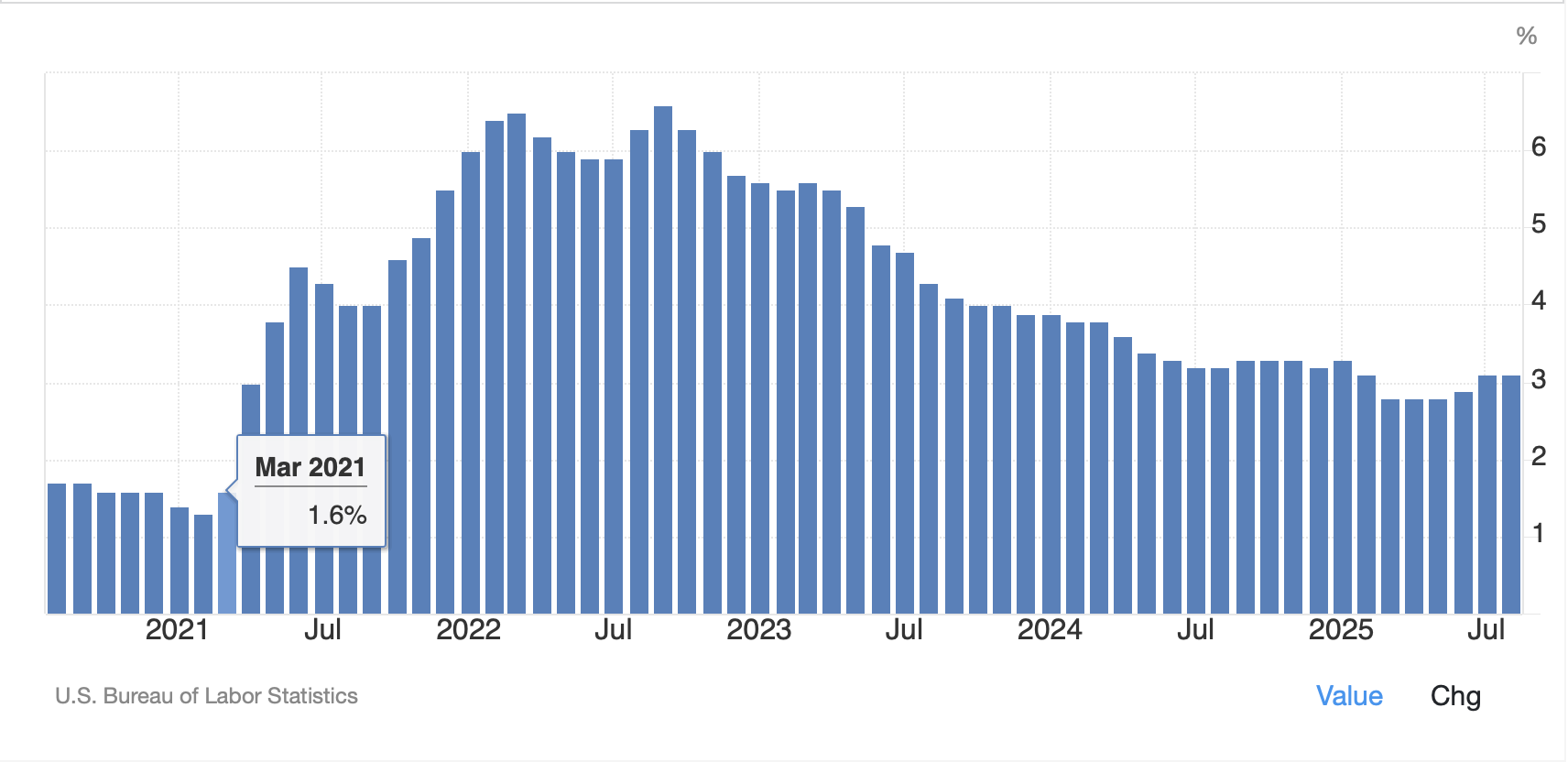
Certainly, Mr Powell said nothing to upset equity markets as the response was a continuation of the modest rally that began in the morning.  As well, bond yields slid almost 9bps from their level just before the Statement was released.  Net, I expect the only people who are unhappy with the Fed’s performance are the hundreds of millions of Americans who have seen the inflation rate remain above the 2.0% target for the past 48 months (see chart below), but then Powell doesn’t really respond to them directly, now does he?

Source: tradingeconomics.com

Oh yeah, President Trump also published a little note on Truth Social that Powell should cut rates, but I don’t think that had any impact at all.  For now, Trump’s attention is elsewhere, and if 10-year yields continue to slide, I suspect he will be fine, certainly Secretary Bessent will be.

In Europe, the leaders are meeting
Again, as they keep on repeating
They need to spend more
To maintain the war
In Ukraine, ‘cause there’s no retreating

Back in the real world, the diverging points of view between President Trump, and his attempts to end the Ukraine War, and the EU, which seems hell-bent on continuing it ad infinitum were highlighted again today as yet another summit meeting is being held in Brussels to discuss the process and progress on rearming the continent as well as how they envision the future of Ukraine.  This matters to markets as the continuous calls for more fiscal military spending is going to be a driver of equity prices in Europe, and given it is going to be funded by issuing more debt, on both a national and supranational basis, yields are likely to rise as well over time.  

There has been much talk lately of the end of US exceptionalism, and certainly there has been a shift of investment into European shares, especially defense firms, and out of US tech shares.  This has helped support the single currency, which while it has slipped the past two days, remains higher by 4.5% since the beginning of the month.  Ex ante, there is no way to know how this situation will evolve, but if history is a guide at all, the US continues to hold all the defense cards in the deck, and so even with European protests, I suspect the war will come to an end.

But here’s a thought, perhaps even if the war ends, the pre-war energy flows may not resume.  This would not be because Europe doesn’t want cheap Russian gas, but perhaps because Russia doesn’t want to sell it to those who will use it to build armaments that can be used against Russia.  The world has moved to a different place both politically and economically, than where it was pre-Covid.  My sense is many old models may no longer work as proxies for reality, which takes me back to my favorite theme, the one thing on which we can count is more volatility!

Ok, let’s take a turn through markets overnight.  After the US rally, Asia was far more mixed with the Nikkei (-0.25%) slipping a bit and both China (-0.9%) and Hong Kong (-2.2%) falling more substantially on fears that US tariffs could slow growth there more than previously feared.  But elsewhere in the region there were far more gains (Korea, Australia, India, Taiwan) than losses (Malaysia, Thailand). 

Europe, though, is having a tougher session with losses across the board.  The continent is particularly hard hit (Germany -1.7%, France -1.2%, Spain -1.2%) although the UK (-0.3%) is holding up better after decent employment data was released.  We did see the Swiss National Bank cut its base rate by 25bps, as expected, while Sweden’s Riksbank left rates on hold, also as expected.  In fairness, European stocks have had quite a good run, so a pullback should not be a surprise, but it is disappointing, nonetheless.  As to US futures, at this hour (7:10), they are pointing lower by -0.5% or so.

In the bond market, Treasury yields are lower by a further -4bps this morning and down to 4.20%, still well within the recent trading range (see chart below).  As to European sovereigns, they too are lower by between -3bps and -5bps, as despite concerns over potential new issuance, fear seems to be today’s theme.  Oh yeah, JGB yields are still pegged at 1.50%.

Source: tradingeconomics.com

In the commodity bloc, oil is little changed this morning, and net, on the week little changed as well.  It is difficult to see short-term drivers although I continue to believe we will see it drift lower over time as supply continues apace while demand, especially in a slowing growth scenario, is likely to ebb.  Gold (-0.6%) is having its worst day in more than a week, but the trend remains strongly higher.  Arguably a bit of profit taking is visible today.  This is dragging silver (-1.8%) along for the ride although copper (+0.1%) is sitting this move out.

Finally, the dollar is firmer again this morning, higher by 0.5% according to the DXY, with the biggest currency laggards the AUD (-1.1%), SEK (-0.8%) and ZAR (-0.75%).  But the dollar’s strength is universal this morning.  One possibility is that traders have decided Powell is not going to cut rates, hence more pressure on US equities, and more support for the dollar.  I don’t agree with that thesis, as I believe Powell really wants to cut rates, but for now, the other argument has the votes.

On the data front, we get the weekly Initial (exp 224K) and Continuing (1890K) Claims as well as the Philly Fed (8.5) all at 8:30.  Then at 10:00 we see Existing Home Sales (3.95M) and Leading Indicators (-0.2%).  Also, at 8:00 we will get the BOE rate decision, with no change expected.  However, as I have been explaining, central bank stories are just not that important, I believe.  Investors in the UK are far more worried about the Starmer fiscal disaster than the BOE.

There are no Fed speakers on the schedule today, so, I suspect it will be headline bingo.  While the dollar has outperformed for the past two sessions, I continue to believe the trend is lower for the buck and higher for commodities.  Perhaps today is a good day to take advantage of some dollar strength for payables hedgers.

Good luck

Adf
Just a Mistake

It wasn’t all that long ago
That folks really wanted to know
What Jay and the Fed
Implied was ahead
And if more cuts were apropos
 
But later today when they break
Their words are unlikely to shake
The narrative theme
That whate’er they deem
Important, is just a mistake


Presidents Trump and Putin spoke at length yesterday, but no solution was achieved so the Ukraine War will continue unabated for now. While talks are better than not, certainly this is a disappointment to some.  As well, the astronauts who have been stranded in space for the past 8 months are safely back on earth.  I mention these things because they are seemingly far more important than central banks these days, and today, that is all we have to discuss regarding financial markets.

To begin, last night the BOJ left rates on hold as universally anticipated.  The initial market response was for the yen to weaken through 150 briefly, but then Ueda-san spoke and discussed the expected wage increases and how the economy was doing fine, and the new market assessment is that the BOJ will hike rates by 25bps in May at their next meeting.  The market response was to buy back the yen, at least for a little while, although right now, USDJPY seems to be attracted to the 150 level overall.  

Source: tradingeconomics.com

It is worth understanding, though, that the last time short-term interest rates were that high in Japan was back in July 2008.  And they have not been above that level since August 1995.  The below chart from FRED database speaks volumes about just how low interest rates have been in Japan over time, and as an adjunct, just how long the opportunity for shorting JPY on the carry trade has been around.  That dotted line is the Fed funds rate compared to the Japanese overnight rate.  

Along the central bank thesis, Bank Indonesia, too, met last night and left policy on hold with their policy rate at 5.75%.  Governor Warjiyo explained that he felt falling inflation and improving growth would help prevent rupiah weakness despite the fact that the currency has been the worst performing Asian currency this year and is trading at historic lows.

But on to the FOMC meeting which will conclude at 2:00 this afternoon with the policy statement (no change expected although some tweaking of the verbiage is likely) and the release of the latest dot plot.  You have probably forgotten that at the December meeting, the FOMC reduced the median expectation of rate cuts for 2025 from 4 prior to the election to just 2.  In the interim we have seen Fed funds futures trade to where barely one rate cut was priced in, although we are now back to three cuts, seemingly on the idea that tariffs will cause significant economic weakness, and the Fed will need to respond.  At least that’s what the punditry maintains.

Here is the last dot plot for information purposes and it will be interesting to see just how much things have changed.  will longer run rates continue to move higher?  Will 2 rate cuts still be the median outcome for 2025?  All this we get to learn at 2:00.

Source: federalreserve.gov

But arguably, of far more import will be Chairman Powell’s press conference beginning at 2:30.  Prior to the Fed’s quiet period, the broad assessment was that patience in future rate moves was appropriate and they were happy with the current situation.  However, I am confident there will be numerous questions regarding the potential impact of tariffs on monetary policy responses, as well as other things like DOGE and an audit of the Fed.  Will any of it matter?  Maybe at the margin, but for most markets, I suspect that fiscal issues will remain dominant.  The one exception is the FX market, where unalloyed hawkishness could change views on the dollar’s recent weakness (although it is firmer this morning) while a dovish tone will almost certainly undermine the greenback.  So, with no other data of note to be released beforehand, it is clearly the day’s major event.

Ahead of that event, let’s see how markets have behaved overnight.  Following a weak session in the US, where all three major indices were lower by about -1.0% on average, Asia had a mixed picture.  The Nikkei (-0.25%) found no love from Ueda-san and drifted lower.  Both Hong Kong (+0.1%) and China (+0.1%) edged higher but continue to doubt the benefits of the mooted Chinese stimulus program while the rest of the region was mixed with some gainers (Indonesia, Korea, India) and some laggards (Taiwan, Australia, Malaysia).  In Europe, too, the picture is mixed with the DAX (-0.4%) lagging while the CAC (+0.5%) is gaining.  In Germany, the historic breech of the debt brake is not having the positive impact anticipated, or perhaps this is just selling the news.  Overall, though, shares in Europe seem to be awaiting the Fed’s actions, or comments, rather than focusing on anything else.  As to US futures, at this hour (7:30), they are pointing slightly higher, about 0.25% across the board.

In the bond market, Treasury yields have edged up 1bp this morning but continue to hang around 4.30%.  European sovereign debt has seen yields slip -1bp to -2bps, arguably on the Eurozone inflation data released 0.1% lower than forecast at 2.3%.  This continues the idea that the ECB will be cutting rates again at their next meeting.  As to JGBs, they are unchanged yet again, seemingly affixed at 1.50%.

Commodity prices show oil (-0.2%) continuing yesterday’s decline.  From the time I wrote to the end of the session, WTI fell $2/bbl, perhaps on the idea that the Putin/Trump phone call was bringing the war closer to an end.  Regardless, if economic activity is slowing, that will lessen demand everywhere, a clear price negative.  As to gold (+0.25%) it continues to trade higher undaunted by any news on any front.  While silver is little changed this morning, copper (+0.7%) has now crested $5.00/lb and is pushing to the all-time highs seen back in May 2024.

Finally, the dollar is rallying this morning, higher against all its G10 counterparts by between 0.2% and 0.4%.  This looks to me like a trading correction, not a new trend.  The same price action is true in the EMG bloc with one real outlier, TRY (-4.2%) which actually traded down by as much as -10% earlier in the session (see chart below) on the news that President Erdogan had his key political rival, Istanbul mayor Ekrem Imamoglu, arrested on charges of fraud and terror, while his university diploma was revoked, seemingly in an effort to prevent him from running for president in the future.  Thank goodness we never have things like that happen in this country!

Source: tradingeconomics.com

There is no data released today other than EIA oil inventories where a modest net build across products is currently expected.  So, until the Fed, I would anticipate very little net movement.  After that, it all depends.  However, Powell will need to by extremely hawkish to shake any of my view that the dollar is headed lower overall.

Good luck

Adf