Turn Into Snails

The FX Poet will be in Nashville at the AFP Conference October 21-22, speaking about effective ways to use FX options in a hedging program.  Please come to the presentation on Monday at 1:45 in Grand Ballroom C1 if you are there.  I would love to meet and speak.
 
This morning the ECB’s meeting
And no doubt they will be repeating
The idea inflation
Is near its cessation
So, high rates will now be retreating
 
As well, we will learn the details
Of what’s occurred in Retail Sales
If strength’s what we see
The FOMC
Rate cutters may turn into snails


Yesterday was generally very quiet as investors appear to be turning their focus to the US presidential election and trying to determine the outcome and what it will mean for markets going forward.  (FWIW, this poet is not going to attempt to determine how things will play out at this stage given the fact that whatever claims or promises are made by either candidate, at least economically, they can only be accomplished through Congress, so are really just wishes right now).  The upshot is that the volume of activity is likely to remain modest until the election.  Of course, that doesn’t mean prices won’t move, just that there won’t be much conviction behind the moves.

In the meantime, central banks remain at the forefront of every market conversation and today is no different with Madame Lagarde set to regale us with the news of an ECB rate cut of 25bps later this morning.  Inflation data from the Eurozone this morning was revised down further with the headline falling to 1.7% Y/Y in September, the lowest print since April 2021.  However, the core rate, at 2.7%, remains well above their target.  Now, the ECB mandate targets headline inflation specifically, unlike the Fed which has determined by itself that core PCE is the proper metric, so a rate cut can easily be justified.  Adding to the story is the fact that Germany remains mired in recession and economic activity in the Eurozone overall remains desultory at best.  The problem the ECB has is that services inflation remains sticky, still printing near 4% and money supply is growing again which is a strong indicator that inflation is going to rise in the future.  But as we have learned over the past decades, the future is now when it comes to central banks, and they will respond to the moment.

One of the problems for the ECB, though, is that despite the Fed’s mistaken 50bp rate cut, the data in the US we have seen since indicates that the economy continues to motor along fairly well.  This means that although the Fed seems likely to cut 25bps in November, I think it will be doing so reluctantly.  After all, if they didn’t cut, it would basically be an admission that they made a mistake with the 50bp cut in September, and you know as well as I that they will never admit a mistake.  

My point is that with the ECB feeling greater pressure to cut with their inflation reading below target and growth slowing, and the Fed likely to back away from an aggressive rate cutting path, the euro is likely to continue to suffer.  For instance, this morning, though it is unchanged, it sits below the 1.09 level (last seen in August) and certainly appears as though it is in a strong downtrend as per the below chart.  If I were to guess, I think a move toward 1.06 is in the cards as a measured move around that long-term 1.09 pivot level.
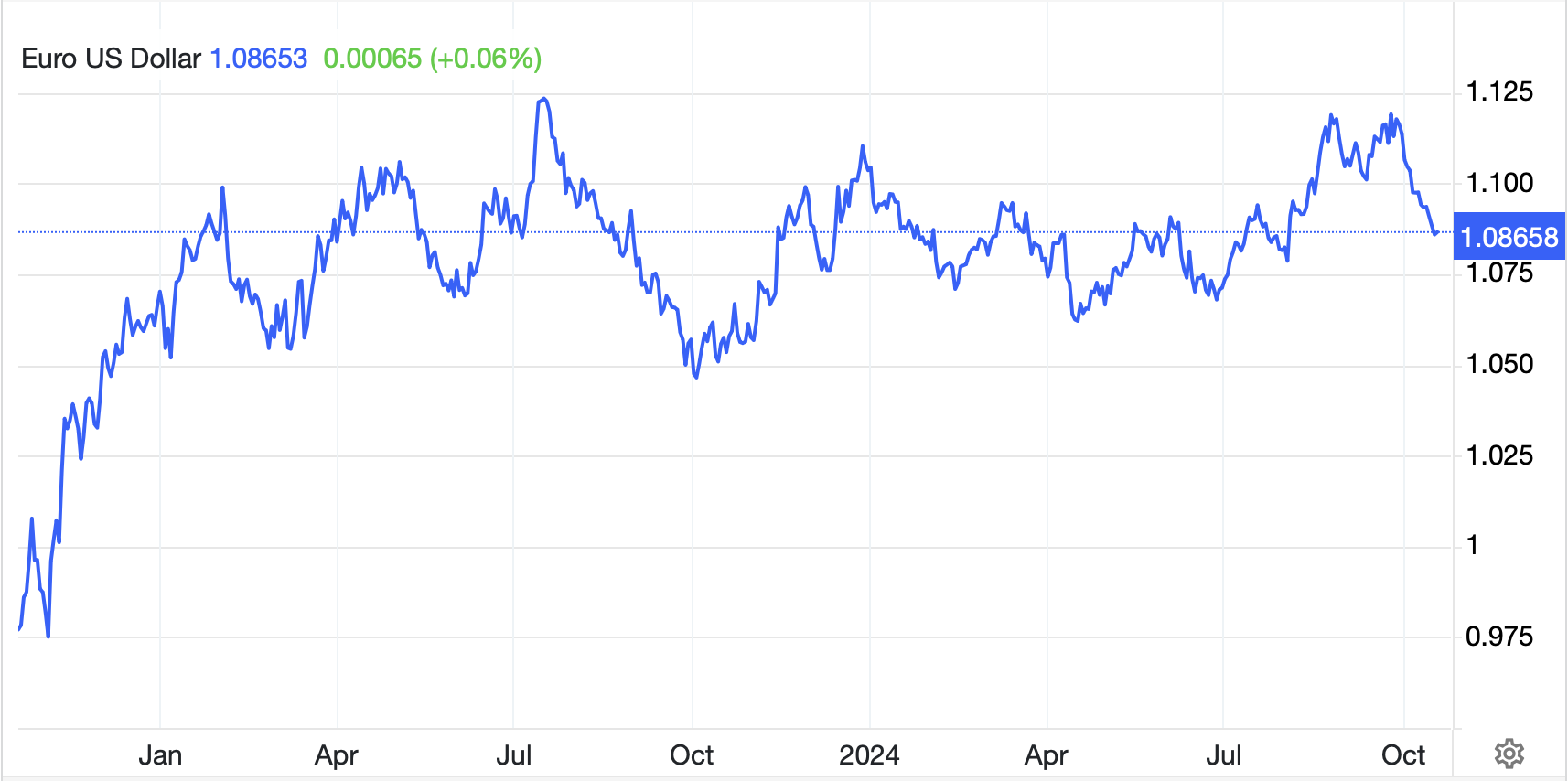
Source: tradingeconomics.com

The problem for the ECB is that a weakening currency is likely to add upward inflation pressures before it helps the exporters in Europe expand market share, and boosts growth.  Stagflation is such an ugly word, but one that may well come to describe the Eurozone.  As an aside, when the US was in stagflation in the late 1970’s, that is when the dollar was at its weakest point historically.

Of course, this also makes this morning’s Retail Sales (exp 0.3%, 0.1% ex autos) so important.  You may recall that last month, this number beat expectations and was another in the list of surprisingly strong US data releases.  Another strong print will really cement the difference between the US and the Eurozone, to the dollar’s advantage I believe.  

But will any of this really matter to markets?  Certainly, Lagarde’s comments can have an impact on Eurozone markets, but my take is we will not see major investment swings, regardless of the data, ahead of the election.

Ok, let’s see how things played out overnight.  Despite the rebound in the US yesterday, Asia was having none of it with most markets in the red.  Japan (-0.7%) fell despite the US strength and the yen’s weakness (JPY pushing back to 150 for the first time since August) and China continues to see the recent bubble of stimulus expectations deflate (CSI 300 -1.1%, Hang Seng -1.0%).  Elsewhere in the region, the results were mixed with some gainers (Australia, New Zealand, Singapore) and some laggards (India, Korea, Philippines).  In Europe, though, green is today’s theme with gains across the board, led by the CAC (+1.2%) but strength everywhere as investors are betting on a more dovish ECB.  In the US futures market, we are all green as well, with strong gains (+0.5% or more) at this hour (7:30).

In the bond markets, after dipping back to the 4.0% level yesterday, 10-year Treasuries are 2bps higher this morning and we are seeing similar price action across all the European sovereign markets.  This seems like a classic risk-on move.  In Japan, JGB yields edged higher by 1bp and are now at 0.95%, perhaps as the market anticipates the BOJ is set to get more aggressive with the yen steadily falling for the past several months.  I don’t believe 150 is a line in the sand, but it cannot be making Ueda-san feel any better about things.

Turning to commodities, the one truism is that gold (+0.5%) continues to rally.  The number of different storylines (central bank buying, reduced mining activity, western investors waking up, Asian investors accelerating) about the shiny metal continues to increase and every one of them is bullish.  This continues to help Silver, although copper (-0.6%) remains far more reliant on a positive economic story, something that remains in doubt.  As to oil (+0.25%) it is holding that $70/bbl level although its grip does seem tenuous at times.  However, I would contend there is virtually no war premium in the price at this point.

Finally, the dollar has net softened a bit this morning, but that is in the context of a more than 3-week long steady rally.  So, AUD (+0.5%) is the big winner this morning in the G10 and as I am typing, GBP (+0.2%) has recaptured the 1.30 level, but those trends remain lower.  In the EMG markets, KRW (-0.55%) is today’s laggard although we are seeing weakness in both ZAR (-0.3%) and MXN (-0.3%) despite that metals strength.  Remember, FX markets are perverse.

In addition to the Retail Sales data, we see Initial (exp 260K) and Continuing (1870K) Claims and Philly Fed (3.0) at 8:30 with IP (-0.2%) and Capacity Utilization (77.8%) at 9:15.  Also, because of the holiday Monday, we see EIA oil inventory data this morning as well with a slight draw expected.  Only one Fed speaker is on the docket (Goolsbee) who will undoubtedly explain that more cuts are coming.

While the dollar may be under modest pressure this morning, I see upward pressure overall for the time being until policies change.

Good luck

Adf
Nearly Obscene

The FX Poet will be in Nashville at the AFP Conference October 21-22, speaking about effective ways to use FX options in a hedging program.  Please come to the presentation on Monday at 1:45 in Grand Ballroom C1 if you are there.  I would love to meet and speak.
 
While here in the States we have seen
Inflation that’s nearly obscene
In Europe, inflation
In ‘bout every nation
Has fallen much more than foreseen
 
The narrative there has adjusted
As all of their models seem busted
So, cuts with more speed
We’ll soon see proceed
Though central banks still aren’t trusted

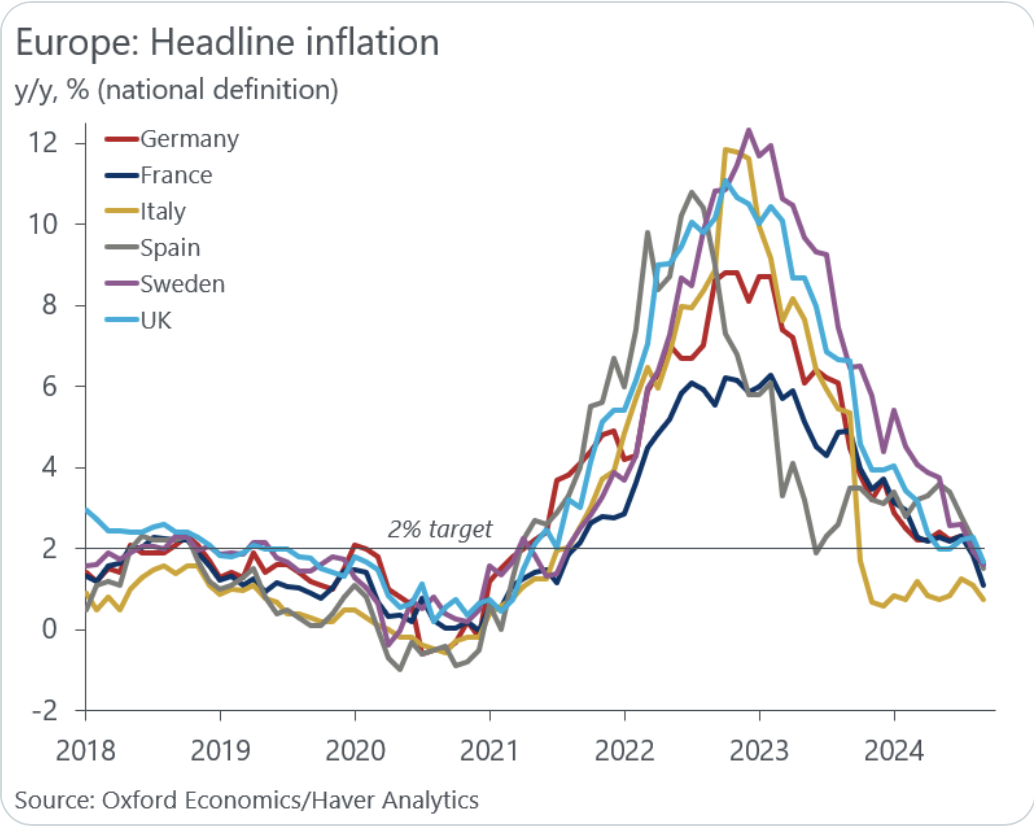
While Fed speakers are trying to claim victory over inflation, whether or not that is reality, the situation in Europe is a bit different.  In fact, headline inflation has fallen quite dramatically virtually across the board as evidenced by the below chart.

Now, a critical piece of this decline is the fact that energy prices have fallen dramatically in the past year with Brent Crude (-16.5%) and TTF NatGas (-18.9%) leading the way lower.  In fact, core inflation data, for the few nations that show it, remains above that 2% target with the UK (Core 3.2% Y/Y) the latest to report this morning.  One other thing to remember is that in the wake of the Covid pandemic, no nation printed and spent nearly as much money as the US on a relative basis, let alone an absolute basis, so there was less fiscal largesse elsewhere.

Yet, the fact remains that headline inflation throughout Europe and the UK has fallen below the 2% targets and so the narrative has now shifted to see more aggressive rate cuts by the central banks everywhere.  This will be part of the discussion tomorrow at the ECB, where most analysts are looking for a 25bp cut although some are calling for 50bps, and the market is pricing more than 40bps at this point.

You know what else is pricing a larger rate cut by the ECB?  The FX market.  Yesterday, the euro fell below the 1.09 level for the first time in more than two months (remember that chart of the double top formation from Monday?) and the single currency has fallen more than 2% in the past month.  Similarly, the pound, after today’s softer than expected CPI readings, has fallen -0.35% this morning, the worst performer in the G10, and is now lower by nearly -1.5% in the past month and looking like it has reversed the uptrend that existed through the summer and early autumn.

Ultimately, my point is that the narrative about rate cuts is shifting to a more accelerated mode in Europe and the UK (where talk of a 50bp cut is making the rounds as well) while here in the States, a 25bp cut is not fully priced in even after yesterdays’ much weaker than expected Empire State Manufacturing Index (-11.9 vs. exp 3.8 and last month’s +11.5).  If you want a reason to explain the dollar’s resilience, you could do worse than the fact that economies elsewhere in the world are lagging the performance here.

Speaking of the Fed, yesterday’s surprise Fedspeak came from Raphael Bostic, Atlanta Fed president, when he explained that he only foresees one more rate cut in 2024.  That is quite a different story than we have been hearing from the rest of the FOMC speakers, who seem completely on board with at least 50bps of cuts and seemingly could be persuaded to head toward 75bps.  There is still much to learn between now and the next FOMC meeting the day after the election here, but despite Bostic’s comments, I believe the minimum we will see before the end of the year will be 50bps.

Ok, that was really all the action overnight.  Yesterday’s disappointing US equity performance, with all three major indices lower by at least -0.75% (I thought that was outlawed 🤣) was followed by similarly weak performance in Asia with the Nikkei (-1.8%) leading the way lower as tech shares underperformed, but further weakness in China (-0.6%) as Godot seems more likely to arrive than the Chinese stimulus.  Throughout the region, only Thailand (+1.2%) managed any gains after the central bank there cut rates 25bps in a surprise move seeking to foster a better growth situation.  In Europe, only the UK (+0.6%) is rallying on the strength of the idea that lower inflation will encourage a 50bp cut from the BOE when they meet the day after the Fed. But otherwise, red is the color of the day in Europe with losses ranging from -0.1% (Spain) to -0.6% (France).  Meanwhile, US futures are a touch firmer at this hour (7:15), by just 0.2%.

In the bond market, yields are lower across the board after that weak Empire State number encouraged the slowing economy narrative and the lower inflation prints in Europe and the UK have weighed on yields there this morning.  So, Treasury yields (-2bps) are lagging most of Europe (Bunds -3bps, OATs -3bps) and UK Gilts (-8bps) are all about the data this morning.  Even JGB yields (-1bp) got into the act.

In the commodity space, oil (-0.5%) is continuing its recent decline, although yesterday it managed to bounce a bit and close above the $70/bbl level where it still sits, barely.  But the metals complex is having another good day with gold (+0.6%) pushing to new all-time highs as western investors are finally following Chinese and Indian investors as well as global central banks.  The lower interest rates certainly help here.  Similarly, we are seeing gains in the other metals (Ag +1.2%, Cu +1.1%) as stories regarding shortages for both metals in the long-term resurface given the lack of new mining activity and increased demand driven by the idea of increased solar and electricity needs respectively.

Finally, the dollar, overall, is little changed, holding onto its recent gains although with a mixed performance this morning.  ZAR (+0.5%) is this morning’s leader on the back of the metals market gains, and we have seen strength in KRW (+0.3%) as well.  However, elsewhere, movement is small and favoring the dollar (HUF -0.2%, CZK -0.2%) and we’ve already discussed the euro and pound.  Interestingly, the THB (+0.45%) rallied after the rate cut on the back of equity inflows.

There is no major data set to be released this morning and no Fed speakers on the current calendar, although as always, I suspect we will still hear from some of them.  Madame Lagarde speaks this afternoon, and given the ECB meeting tomorrow, there will be many interested listeners.

Overall, the themes seem to be that Eurozone inflation is sinking and rate cuts are coming.  That should keep some downward pressure on European currencies vs. the dollar, at least until we see or hear something that describes a more aggressively dovish Fed.  The one truly consistent feature of these markets has been the rally in gold which seems to benefit from fear, inflation and lower rates, all of which appear to be in our future.

Good luck

Adf

Surprise!

Ishiba explained
He was just kidding about
Tight money…surprise!


So, yesterday’s biggest mover was JPY (-2.1%), where the market responded to comments by new PM Ishiba that all his previous comments regarding policy normalization were not really serious (and you thought Kamala flip-flopped!)

Here are his comments in the wake of that massive 12% decline in the Nikkei back in early August:

“The Bank of Japan (BOJ) is on the right policy track to gradually align with a world with positive interest rates,” ruling party heavyweight Shigeru Ishiba told Reuters in an interview.

“The negative aspects of rate hikes, such as a stock market rout, have been the focus right now, but we must recognize their merits, as higher interest rates can lower costs of imports and make industry more competitive,” he said.

And here are his comments after meeting with BOJ Governor Ueda Wednesday morning in Tokyo:

“From the government’s standpoint, monetary policy must remain accommodative as a trend given current economic conditions.”

See if you can tell the difference.  The below chart includes the market response to his election last week as well as its response since uttering those last words early yesterday morning.

Source: tradingeconomics.com

Remember the idea that the carry trade was dead and completely unwound?  Well, now the talk is its coming back with a vengeance between Powell sounding less dovish, Ishiba sounding more dovish and then yesterday’s ADP Employment Report printing at a higher-than-expected 143K.  Maybe all those rate cuts that had been priced are not going to show up in traders’ Christmas stockings after all.  Certainly, the Nikkei (+2.0%) was pleased with the weaker yen which has fallen further this morning (-0.2%) after further comments from BOJ member Noguchi calling for more time to evaluate the situation before considering tighter policy.  In fairness, though, Noguchi-san is a known dove and voted against the rate hikes back in July.  Summing it all up here, it is hard to make a case currently for the yen to strengthen too much from here.  Rather, a test of 150 seems the next likely outcome.

In England, the Old Lady’s Guv
Explained that he’s really a dove
He’ll be more aggressive
Though not quite obsessive
While showing investors some love

The other big mover this morning is the British pound (-1.1%) which is responding to an interview BOE Governor Bailey had in The Guardian where he explained he could become “a bit more aggressive” in their policy easing stance provided inflation data continues to trend lower.  Now, prior to the interview, the OIS market was already pricing in a 25bp cut at the next meeting in November, and 45bps of cuts by year end, and it is not much changed now.  But for whatever reason, the FX market decided this was the news on which to sell pounds.  

Remember, as I’ve repeatedly explained, the dollar’s demise is likely to be far slower than dollar bears believe because now that the Fed has begun cutting rates, and nothing is going to stop them going forward for a while, other central banks will feel empowered to cut as well.  The only way the dollar falls sharply is if the Fed is the most dovish central bank of the bunch, but Monday, Chairman Powell made clear that was not the case.  In fact, yesterday, Richmond Fed president Barkin was the latest to explain that things look good, but they are in no hurry to cut aggressively.  Other central banks are now in a position to ease policy more aggressively, something many had been seeking to do as economic activity was slowing in their respective countries, without the fear of a currency collapse. 

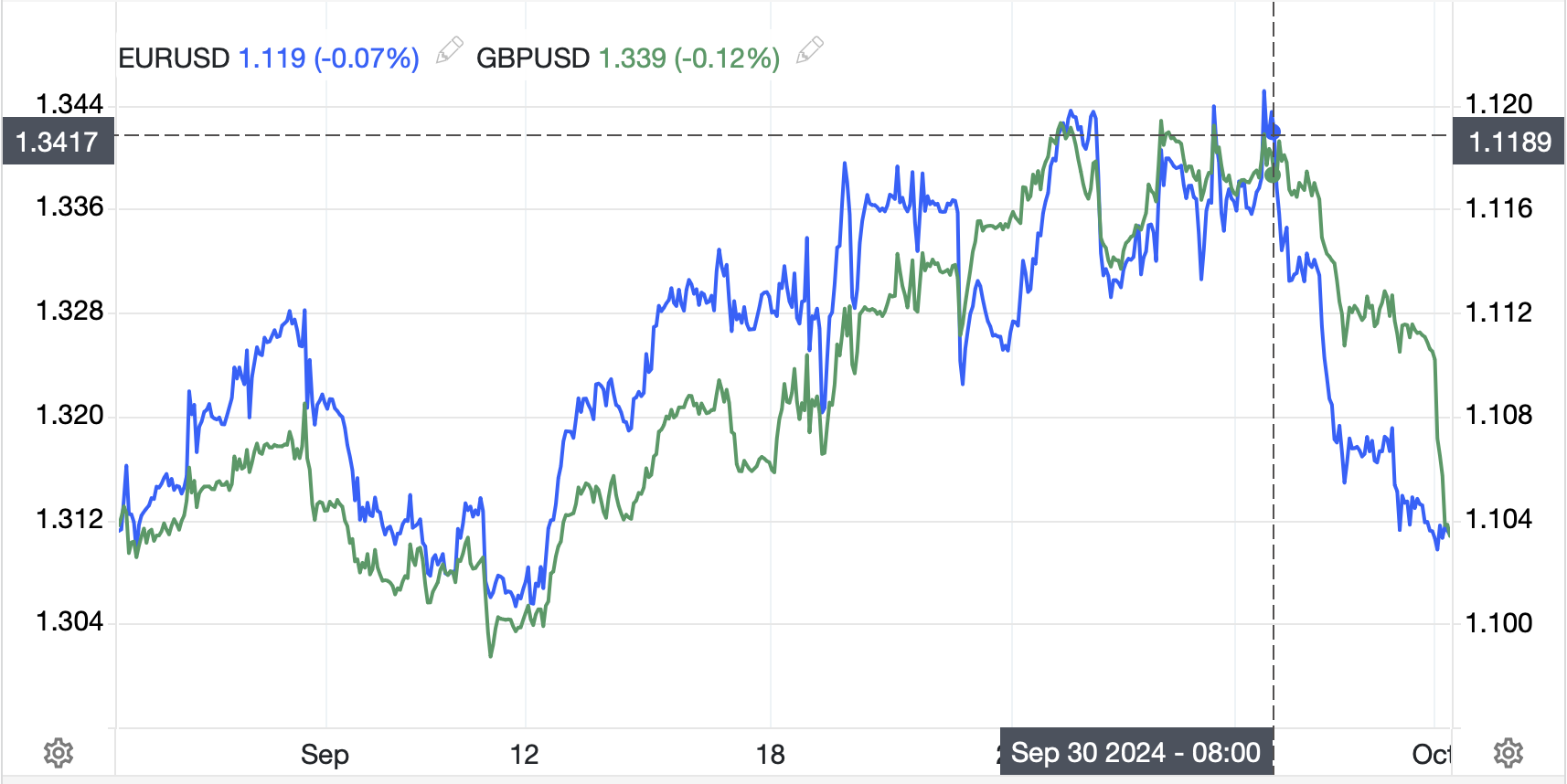
It was just a few days ago that I highlighted key technical levels the market was focused on, which if broken might herald a much weaker dollar.  Across the board, we are more than 2% from those levels (EUR 1.12, GBP 1.35, DXY 100.00) and traveling swiftly in the other direction.  A quick peek at the chart below shows that while the exact timing of these moves was not synchronized, the outcome is the same.

Source: tradingeconomics.com

Moving beyond the FX market, where the dollar is stronger literally across the board, the economic story continues to muddle along.  Services PMI data was released this morning with most of Europe looking a bit better, although the Italians were lagging, but not enough to get people excited about European assets in general.  Equity markets on the continent are mixed with both the DAX (-0.6%) and CAC (-0.8%) under pressure while Spain’s IBEX (+0.1%) and the FTSE 100 (+0.25%) buck the trend on the back of Spain’s best in class PMI data and, of course, the UK rate cut frenzy.  As to last night’s Asian markets, while China remains closed, the Hang Seng (-1.5%) gave back some of yesterday’s gains and the rest of the region was unconvinced in either direction.  While US markets eked out the smallest of gains yesterday, futures this morning are pointing lower by -0.4% or so at this hour (6:45).

In the bond market, Treasury yields are higher by 3bps this morning, as the market absorbs the idea that the Fed may not be cutting in 50bp increments each meeting and traders responded to a much better than expected ADP Employment Report yesterday (143K, exp 120K) so are prepping for a good NFP number tomorrow. Meanwhile, European sovereign yields are all higher by between 5bps and 7bps as they catch up to yesterday’s Treasury move, much of which occurred after European markets were closed.  One thing to keep in mind here is that bond markets, at least 10-year and longer maturities, are far more concerned with the inflation outlook than the central bank discussion.  Right now, as the world awaits Israel’s response to the Iranian missile attack, concerns are rife that oil prices could move much higher and take inflation readings along for the ride.  If you add that to the idea that 3% is the new 2% for central bank inflation targets, something which is also gaining credence in the market, the case for higher bond yields is strong.

Speaking of oil markets, once again this morning the black sticky stuff is higher (+2.0%) amid those Middle East conflagration fears.  As I highlighted yesterday, if Israel were to attack Iran’s oil fields and knock a large portion offline, I would expect oil to get back to $100 in a hurry.  And if the damage was sufficient to keep it offline for many months, we could stay there.  However, the combination of the stronger dollar and higher oil prices has taken a toll on the metals markets with all the major metals weaker this morning (Au -0.5%, Ag -1.1%, Cu -1.5%).  This strikes me as a short-term phenomenon as the fundamental supply/demand issues remain in favor of higher prices and anything that drives inflation higher will help price as well.  But not today.

As to the dollar, I have already discussed its broad-based strength with gains against literally all its G10 and EMG counterparts.  It will take some pretty bad US data to change this story today.

Speaking of the data, as it’s Thursday, we get the weekly Initial (exp 220K) and Continuing (1837K) Claims data as well as ISM Services (51.7) and Factory Orders (0.0%).  Yesterday, in a surprise, EIA oil inventories rose, a welcome outcome, but not enough to offset the Middle East fears.  The only Fed speaker on the calendar today is Atlanta Fed president Bostic, one of the more hawkish members, so my guess is he is likely to continue to preach moderation in rate cuts.  Speaking of the Atlanta Fed, their GDPNow reading fell to 2.5% for Q3 after the weaker than expected construction spending the other day, but it remains above the Fed’s estimated long-term trend growth rate.

Putting it all together, I can see no good reason for the dollar to reverse this morning’s gains absent a Claims number above 250K.  The hyper dovishness that had been a critical part of the dollar decline story has been beaten back.  Of course, tomorrow brings the NFP report, so anything can still happen.  

Good luck

Adf

Powell’s Dream Team

The punditry’s dominant theme
Is whether Chair Powell’s dream team
Will cut twenty-five
And try to contrive
A reason a half’s a pipe dream
 
But there’s something getting no press
The balance sheet shrinking process
They’re still in QT
But what if QE
Is something they’ll now reassess?


With all the data of note now passed (PPI was largely in line although tending a bit higher than forecast) and the ECB having cut their deposit facility rate by 25bps, as widely expected, the market discussion is now on whether the Fed will cut by one-quarter or one-half percent next week.  The Fed funds futures market, which you may recall had been pricing as little as a 15% probability for that 50bp cut earlier this week, is currently a coin toss between the two outcomes.  In addition, the Fed whisperer, Nick Timiraos of the WSJ, had a front page article on the subject this morning, although he drew no conclusions.

But something that is getting virtually no airtime is the Fed’s balance sheet and its ongoing shrinkage.  You may recall that the current level of QT is $25 billion/month, which was reduced from the original amount of $60 billion/month back in June as the FOMC started to grow cautious regarding the appropriate amount of reserves and liquidity in the system.  

The issue is nobody knows what number constitutes the right amount of reserves.  Fed research is of the belief that somewhere between 10% and 12% of GDP (currently about $2.7 trillion to $3.3 trillion) should be sufficient to ensure that economic activity does not grind lower due to a lack of liquidity.  This has been the rationale behind the slow reduction in balance sheet assets.  But that research may not be accurate, and the underlying assumption was that the economy continued to grow at its trend rate.  In the event of a slowdown or recession, you can be sure that the Fed will add liquidity back as well as cut rates.

Now, working against my thesis is the Fed has not discussed this idea at all, at least publicly, and so a complete surprise is not their typical MO.  However, they have found themselves in a place where the market is pricing in more than 100 basis points of cuts over the next three meetings, including next week’s, which if they stick to their 25bp increments, means that one of these meetings needs a 50bp cut.  As I have written before, the bond market is pricing nearly 200bps of cuts in the next two years (see chart below), which would indicate that the likelihood of an economic slowdown is high.  

Source: tradingeconomics.com

At the same time, equity markets are trading near all-time highs with earnings estimates indicating that economic growth expectations remain quite robust.  Both of those scenarios cannot be true at the same time.

Source: LSEG

This is the landscape through which Chairman Powell must navigate the Fed’s policies as well as his communication of those policies.  In Jackson Hole, he virtually promised a rate cut was coming next week, and one is certainly on its way.  The magnitude of that cut, though, will offer the best clues as to the Fed’s thinking with respect to the future trajectory of the economy and which market, stocks or bonds, is right. 

There is one other thing to consider, though, as an investor. Given the bond market is pricing a significant slowdown, if that is your view, bonds will not offer much return if you are correct.  And if you are wrong, and growth is strong, it will be ugly.  Similarly, if you are of the view that there is no recession, but rather a soft- or no-landing is the likely outcome, then being long stocks, which have already priced for that outcome will likely have only a modest benefit.  However, in the event that the economy does fold and recession arrives, stocks are likely to sell-off sharply.  Arguably, the best positioning for a trader is to be short both stocks and bonds, as whichever outcome prevails, one asset will fall substantially while the other has limited upside, at least for a while.  For a hedger, this is the time that options make a lot of sense as the asymmetry they provide is what allows a hedger to prevent locking in the worst outcomes.

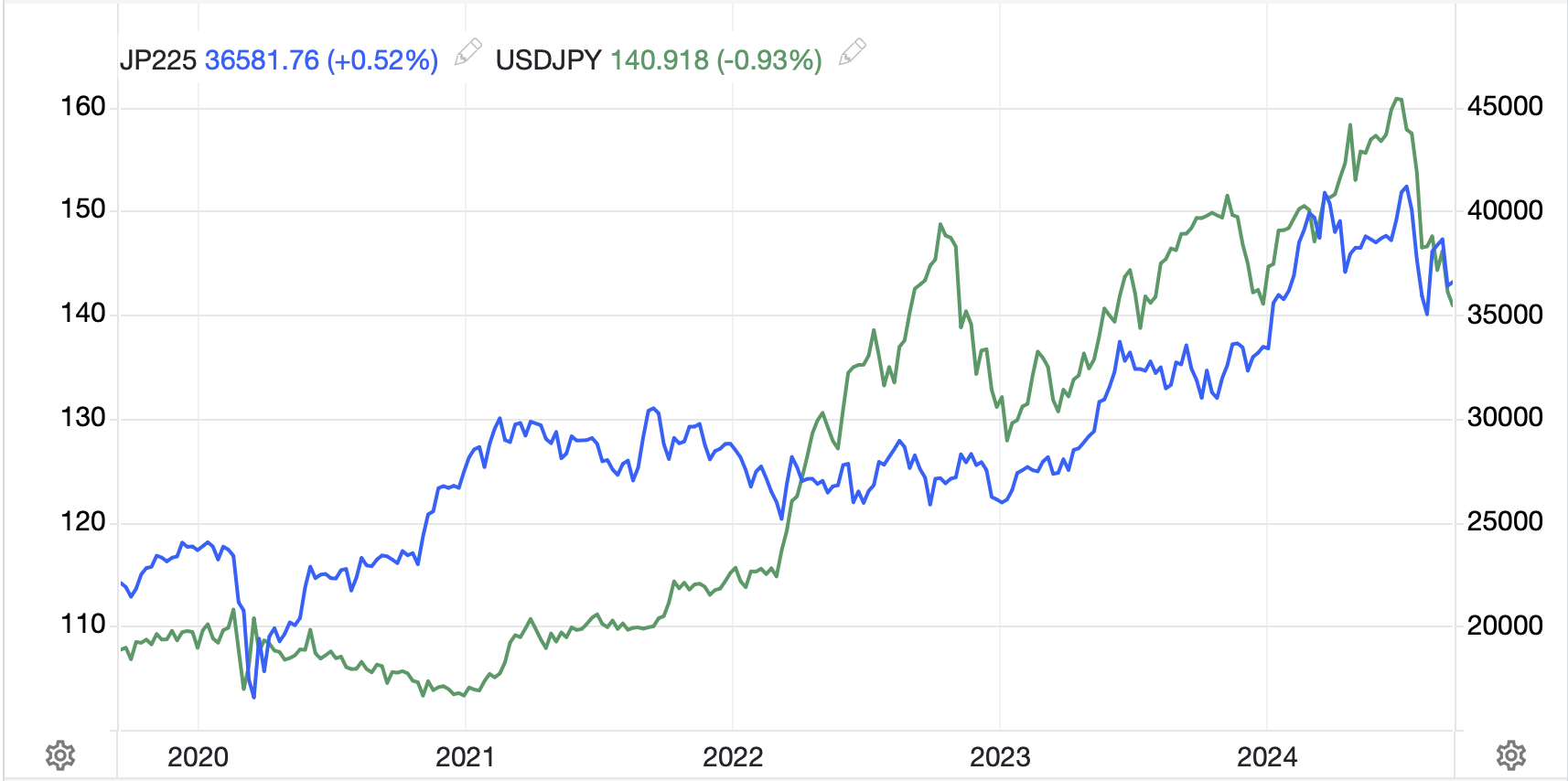
Ok, with that behind us, let’s look at the overnight session to see how things followed yesterday’s risk rally in the US.  In Asia, the Nikkei (-0.7%) has been struggling lately on the back of continued JPY strength.  As you can see from the below chart, that relationship has been pretty strong for a while, and last night, USDJPY traded to new lows for the year, erasing the entire gain (yen decline) that peaked at the end of June.

Source: tradingeconomics.com

As to the rest of Asia, mainland Chinese shares (CSI 300 -0.4%) continue to underperform although HK shares managed a rally (+0.75%) while most of the rest of the region showed very modest strength, certainly nothing like the US performance, but at least in the green.  In Europe, equity markets are all higher this morning with Spain’s IBEX (+0.8%) leading the way although solid gains of 0.3% – 0.5% prevalent elsewhere.  As to US futures, at this hour (7:45) they are creeping higher by about 0.1%.

In the bond market, Treasury yields are lower by 2bps this morning and European sovereign yields are generally little changed to lower by 2bps across the continent.  Yesterday’s ECB outcome was universally expected, and Madame Lagarde explained they remain data dependent and promised no timeline for potential further rate cuts, if they are even to come (they will).  As to JGB yields, they too fell 2bps last night, once again confusing those who are looking for policy tightening in Tokyo.

In the commodity markets, oil (+1.4%) is rallying for the third consecutive day as Hurricane Francine shut in about 40% of gulf production and the timing of its return is still uncertain.  Despite the US equity markets’ clear economic bullishness, the weak growth/demand story is still a major part of this discussion.  In the metals markets, gold (+0.3% overnight, +3.2% in the past week) continues to set new price records daily with a story making the rounds that SAMA, Saudi Arabia’s central bank, secretly bought 160 tons of gold last quarter, soaking up much supply.  This has helped drag silver back above $30/oz although copper (-0.5%) is stumbling a bit this morning.

Finally, it should be no surprise that the dollar is under some pressure this morning as the talk of more aggressive Fed easing grows.  While the euro and pound are little changed, JPY (+0.5%) is leading the way in the G10 with AUD (+0.45%), NZD (+0.4%), NOK (+0.2%) and SEK (+0.3%) all firmer on the back of commodity strength.  In the EMG bloc, the story is a bit more nuanced with ZAR (-0.15%) bucking the trend on domestic political concerns, although we saw strength in KRW (+0.5%) overnight and MXN (+0.35%) as the Fed rate cut story plays out across most currencies.

On the data front, only Michigan Sentiment (exp 68.0) is on the docket so once again, the dollar will be subject to the equity market behavior and the strength of narrative regarding just how dovish the Fed will wind up behaving next week.  I will say that a 50bp cut is likely to see some short-term dollar weakness, probably enough for it to fall to multi-year lows vs. its major counterparts.  But remember, if the Fed starts getting aggressive, other central banks will feel comfortable following that lead, so the dollar’s weakness may not be that long-lived.

Good luck and good weekend

Adf

No Choice

Data indicates
The BOJ intervened
Did they have no choice?


Last night, Masato Kanda, the Vice Minister of Finance for International Affairs, colloquially known as Mr Yen explained, “I have no choice but to respond appropriately if there are excessive moves caused by speculators.”  He also explained, “We are communicating very closely with the authorities of each country and complying with international agreements, so there has been no criticism from other countries.”  In other words, while he did not actually come out and say that the BOJ intervened on behalf of the MOF, it seems pretty clear that is the case.  Certainly, a look at the price action again last night, as per the below chart, shows that is a viable reality.

Source: tradingeconomics.com

You may recall that USDJPY fell sharply in the wake of the CPI data last week and there was substantial question as to whether there was intervention at the time.  My view was the BOJ would not have been able to act on a timely basis and attributed the move to an overly long dollar positioned market and some algorithmic selling.  However, it appears that data from the BOJ’s accounts have since been released showing approximately ¥6 trillion (~$38.4 billion) was spent at the end of last week.  Now, given the Kanda comments above, the reality is that the MOF is drawing a line in the sand at 162.  

In fairness, this seems a propitious time to do so given the growing certainty that the Fed is finally going to begin its policy easing.  Of course, the main reason that the yen had weakened so much is that, not only had the interest rate differential widened substantially, allowing for, and even encouraging, the growth of the ‘carry trade’ where investors were happy to simply hold long forward USDJPY positions and wait for the time to pass and the profits to roll in.  But as well, there was no indication that the Fed was going to change its stance while the BOJ, though it had threatened to begin tightening policy, was doing so at a glacial pace.  However, that CPI number has dramatically altered opinions, not only of the trading community, but more importantly, of the Fed.  All the Fed comments we have heard since that data point have indicated a much greater willingness to consider easing policy.  Talk about both the goods and labor markets coming into balance are indicators they are ready to roll.  

We still have seven more Fed speakers this week ahead of the quiet period and I would wager that to a (wo)man, they will all say their confidence is growing that price pressures are receding, and they are watching the employment situation carefully.  As I wrote yesterday, the CME Fed funds futures market is pricing a 100% probability of a 25bp cut in September with some folks looking for 50bps.  Given the totality of the recent data where the probability of a recession seems to be growing, I agree a September cut looks likely.  This is not to say every data point is going to be pointing to weaker economic activity (e.g., yesterday’s Retail Sales data was much stronger below the headline number), just that will be the broad trend.

In this situation, with the market starting to believe that higher for longer is truly dead, the initial reaction will be for further dollar weakness.  Of course, once it is clear the Fed has begun to ease policy, we will see other central banks increase their pace of policy ease at which point the dollar’s decline will likely slow or stop.  Remember, FX is a relative game, so if everybody is easing policy at the same time, those interest rate differentials are not going to change very much at all.  However, commodity prices, especially precious metals prices, are likely to be the biggest beneficiaries.  As to stocks and bonds, the former have a much less certain path given the impact of declining inflation on profits, especially for the mega cap names, but bonds should perform well (yields declining) at least as long as inflation remains tame.  Just beware of a slow reversal of the inflation story.  Nothing has changed my view that 3.0% is the new 2.0%.

Aside from the yen news, last night was decidedly lacking in new information.  We saw UK inflation data print at the expected levels showing it has fallen back close to their target of 2%.  We saw final Eurozone inflation also confirming a 2.5% inflation rate.  While the ECB has essentially ruled out a rate cut tomorrow, a September cut seems highly likely at this time, especially if they have confidence the Fed is going to cut then as well.

So, let’s look at the overnight session.  After more record highs in the US, with the DJIA approaching 41K, the tone in Asia was more mixed.  Japanese shares (Nikkei -0.4%) fell as the yen’s strength continues to hamper profit expectations for the many exporters in the index.  Chinese shares, both in Hong Kong and on the mainland, edged higher by less than 0.1% as investors continue to wait to hear the results of the Third Plenum.  As to the rest of the region, gains in Australia and New Zealand were offset by losses in South Korea with most other markets little changed.  however, in Europe this morning, the screens remain red with losses across the board, albeit not as significant as we have seen in the past several sessions.  The DAX (-0.4%) is the laggard although all the major markets are lower.  Finally, at this hour (7:20), US futures are suffering led by the NASDAQ (-1.5%) although they are all under pressure.  It seems that the story about increased tariffs on Chinese goods as well as a ban on selling additional semiconductors to China doesn’t help the prospects of semiconductor companies that rely on China for their sales.

Interestingly, the bond market has seen yields edge higher this morning with Treasuries higher by 2bps and most of Europe up by 1bp.  Given the small size of the movement, I wouldn’t attribute much fundamental thought to today’s price action, and after all, 10-year Treasury yields have fallen 30bps since the first of the month, so a lack of continuation is not that surprising.

In the commodity markets, oil (+0.5%) is rebounding after a rough couple of days.  The weakening economy story is weighing on perceived demand and there is ample supply around.  Gold (+0.1%) is continuing to rally after closing at another all-time high yesterday while silver (-0.9%), which followed gold yesterday, is giving back a bit this morning.  Industrial metals are little changed this morning as they await further confirmation of the economic situation.

Finally, the dollar is under pressure this morning, falling substantially against almost all of its major counterparts, both G10 and EMG.  Aside from the yen (+1.1%) which we discussed above, the pound (+0.5%) is leading the way along with SEK (+0.6%) although the euro (+0.35%) is also firm.  In fact, the pound has risen above 1.30 for the first time in a year while the euro pushes the top of its 1.0650/1.0950 2024 trading range.  The laggard in the G10 space is CAD, which is unchanged on the day as market participants tie its performance directly to the dollar and anticipate the BOC to match the Fed going forward.  In the EMG bloc, though, there are two outliers which have suffered today, despite the dollar’s broad weakness, MXN (-0.6%) and ZAR (-0.7%).  The peso seems to be feeling the effects of weaker than expected economic data lately which has put Banxico into a difficult position as inflation remains above their target.  Will they cut to support the economy and undermine the currency?  That is the question.  As to the rand, aside from its status as the most volatile currency, the market seems to be reacting to a sharp decline in Retail Sales last month, -0.7%.

On the data front, this morning brings Housing Starts (exp 1.3M), Building Permits (1.4M), IP (0.3%) and Capacity Utilization (78.4%) along with the EIA oil inventories.  In addition, we will hear from Richmond’s Thomas Barkin and Governor Waller and then at 2:00 the Fed’s Beige Book will be released.  The current market narrative has quickly shifted to rate cuts, and more tariffs.  The upshot is the dollar is likely to remain under pressure while equities will have a more difficult time going forward.  If inflation remains quiescent, then bonds can do well, but the big winner through it all should be commodities.

Good luck

Adf

None Be Unique

When looking ahead to this week
The noteworthy thing is Fedspeak
At least fifteen times
They’ll give us their dimes’
Worth of knowledge, though none be unique
 
For instance, we already know
Their confidence is rather low
So, absent new data
Do they have schemata
Designed to get ‘flation to slow?


Arguably, the biggest news this morning is the death of the Iranian President and Foreign Minister in a helicopter crash overnight as it opens a range of possibilities regarding the future stance of Iran in the Middle East.  Will it remain the strict theocracy that it has been?  Or will a new leadership recognize the people appear to be growing tired of that stance and want something different.  While it would seem unlikely that there will be a major change, at least from this view thousands of miles away, if one were to come about, it would have a major impact on the Middle East and the ongoing conflict in Gaza.  After all, if Iran stopped funding terrorist groups, that would de-escalate things dramatically and potentially see a significant decline in the price of oil.  At this time, however, there is no information as to who will step into the role and what policies will be followed, so it is a wait-and-see period.  As it happens, oil prices (-0.35%) have edged lower this morning, but this is hardly a sign of anything new.  This will be quite critical to watch going forward.

However, beyond that, there has been vanishingly little new information about which to speak regarding the macroeconomic situation around the world.  The Chinese left their policy rates unchanged, as universally expected, and there has literally not been any other data from any major nation since Friday.  In fact, looking ahead at the calendar for the week, arguably the most significant piece of data to be released is Canadian CPI, or perhaps UK CPI and then on Friday we see the Flash PMI reports. 

Which brings us back to the Fedspeak.  It is staggering to think that the FOMC believes they need to be so visible at this time, especially after Chairman Powell explained that rate hikes were off the table and that while it may take a little longer than they had initially expected, they were still certain that inflation was going to head back to their 2% target.

Speaking of inflation, over the weekend I was reading some analysis (sad, I know) that highlighted if the US used the European HICP calculation the core reading would already be below their target with April’s data coming in at 1.9%.  To me this is a similar stance to what we heard at the end of 2023 when numerous pundits were explaining that the 3-month trend or the 6-month trend was already at 2.0% so why wait to cut?  Of course, the sticky inflation camp (this poet included) was quick to hoist them on their own petard as the recent 3-month and 6-month trends are pointing to 4+% CPI readings going forward.  

In this particular instance the question I would ask is, other than the fact that the reading is lower, why would anyone think that the European HICP inflation reading is a more accurate representation than the BLS representation?  The difference lies in the fact that HICP doesn’t incorporate housing price changes, which given they remain stubbornly high, have been supporting higher CPI readings.  But don’t people pay for their housing?  Certainly, it would be easy to create a lower CPI if you simply remove all the items that are going higher in price.  Unfortunately, that process doesn’t really tell you anything about reality.

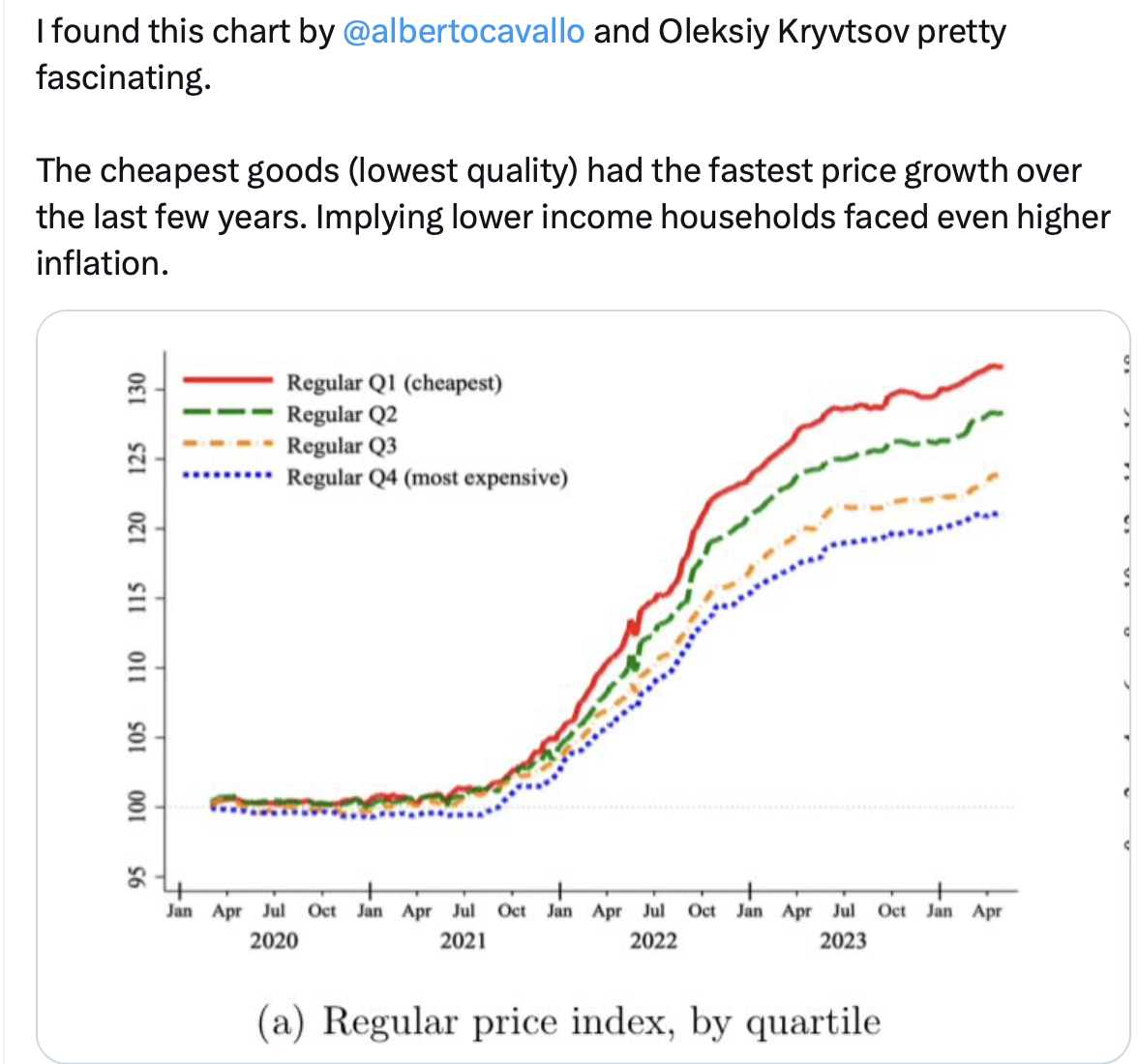
Below is a very interesting chart I found on X (nee Twitter) created by Professor Alberto Cavallo of Harvard and Oleksiy Kryvtsov, a Bank of Canada economist, which may be a better description of inflation as felt by the average person.

The fact that prices are rising fastest for the least expensive goods indicates that inflation is a major problem for Joe Sixpack, and no matter how pundits seek to adjust the measurement, so the numbers look better, reality is a harsh mistress.  (If you want to know why President Biden’s numbers are so bad, you needn’t look further than this chart.)  

Alas, there is no escaping the plethora of blather that will be coming from the Fed this week, although I sincerely doubt any of it will change anyone’s opinions about anything.  Ok, it was another generally quiet session overnight with the exception being the ongoing blast higher in metals markets.

Equity markets have performed well across the board, although the gains have not been too dramatic.  Japan (Nikkei +0.7%) was the best performer although the entire region was in the green to a lesser extent, about 0.35% or so.  In Europe, all the bourses are higher as well, but here the gains are even smaller, on the order of +0.25% across the board while US futures are essentially unchanged at this hour (6:30).

In the bond market, Treasury yields, which backed up 2bps on Friday are unchanged this morning while European sovereigns are higher by roughly 1bp across the board.  ECB speakers have conceded that a rate cut is coming in June, but many are pushing back hard against the idea that a July cut is a sure thing, preferring to wait until September.  However, the really interesting thing is in Japan, where JGB yields have traded up to 0.98%, a new high yield for this move and a level not seen since March 2012.  At this point, it would seem that 1.00% is a foregone conclusion so it will be interesting to see how the BOJ responds when that ‘magic’ number is finally traded.

But, as I mentioned above, it is a metals day with gold (+0.9%), silver (+1.1%) and copper (+0.9%) all continuing last week’s strong gains with gold making yet further new highs, copper pushing its historic highs and silver breaking above a key technical resistance level at $30/oz last week and now extending those gains.  While there have been many explanations for this price movement, I think you need to consider precious and industrial metals separately.  For precious, there continues to be a growing concern in the ongoing debasement of the fiat currency universe and both individuals and central banks are seeking to hold alternative assets.  On the industrial side, though, especially copper and silver which are both critical to electronics, the ten-year hiatus in investment due to the ESG cult combined with the recent recognition that all the new-fangled tech wizardry like AI is going to require gobs of power and electrical capacity has simply skewed the supply/demand curve to much more demand than supply.

Finally, the dollar is little changed this morning, pretty much at the same level overall since Thursday.  Given the lack of movement in the rates space, this ought not be a surprise.  It also ought not be surprising that the best performing currencies of the past week have been CLP (+3.5%) as it has simply traveled alongside its major export, copper, and ZAR (+5.1%) as it rallies alongside the precious metals complex.  Meanwhile, there has been no movement in the interest rate narrative with, perhaps, the exception of Japan, but what we have learned there lately is that higher JGB yields lead to a weaker yen.  Go figure!

On the data front, as I said earlier, it is extremely light this week,

WednesdayExisting Home Sales4.22M
 FOMC Minutes 
ThursdayInitial Claims220K
 Continuing Claims1799K
 New Home Sales680K
FridayDurable Goods-0.7%
 -ex Transport0.1%
 Michigan Sentiment67.6
Source: tradingeconomics.com

It is not clear, given how much we have already heard from Fed speakers since the last FOMC meeting, that the Minutes will be very informative.  Perhaps the discussion about QT will change some minds, but I doubt it.  Otherwise, if stocks continue to rally, market players will be happy and not try to rock the boat.  Meanwhile, the dollar will need a new impetus to break out of this narrow range, but that may not come until next month’s NFP data.

Good luck

Adf

Showing Concern

Investors are showing concern
And, risk assets, starting to spurn
But this time, it seems
That only in dreams
Are bonds something for which they yearn
 
Instead, the two havens of note
As evidenced by every quote
Are dollars and gold
Which folks want to hold
While stock bears are starting to gloat


**There will be no poetry for the rest of the week as this poet will be seeking rhythm only in his golf swing for a few days.  I will return on Monday, April 22.**

It appears that investors are beginning to ask more serious questions about the macroeconomic outlook and whether the current valuations in financial markets are representative of the future.  Not only did equity markets suffer significant declines yesterday, but so did bond markets.  At the same time, geopolitical tensions continue to rise driving even more risk reticence.  While it is still far too early to claim that things have turned decisively, it is certainly worth a discussion as to whether that may be a valid explanation.

I would paint the big picture in the following manner:

  1. US economic activity remains firm although there are still pockets of weakness.
    1. Retail Sales printed much higher than expected at +0.7% with a revision higher to last month’s data up to +0.9%.
    1. Empire State Manufacturing improved from last month to -14.3 but was worse than the expected -9.0.
  2. The Fed continues to downplay the probabilities of rate cuts in the near future.
    1. Daly: “The worst thing we can do right now is act urgently when urgency isn’t necessary.  The labor market’s not giving us any indication it’s faltering, and inflation is still above our target, and we need to be confident it is on the path to come down to our target before we would feel the need – and I would feel the need – to react.”
  3. Concerns over the next step in the evolving Israel/Iran conflict have market participants (and the rest of us) on edge.
    1. Bloomberg Headline: Israel Vows Response to Iran as US and Allied Urge Restraint.
    1. Reuters headline: Iran Says Any Action Against its Interests will get a Severe Response.

Clearly, there are other issues as well, with the ongoing Russia/Ukraine conflict, the critical elections upcoming, not only in the US but in Mexico, India and several German states, and confusion on the Chinese economy.

My point is that uncertainty is very high, and rightly so.  It is a fraught time in the world.  Historically, in this situation, US Treasuries were the place to where so many global investors would run.  The dollar would often benefit from this flight to safety, while risky assets, especially stocks, would suffer.  But it appears this generation of investors did not get the memo on how they are supposed to respond.  Instead, they seem to be looking at the ongoing fiscal profligacy in the US and the very real likelihood that inflation is not going to be declining anytime soon and decided that being long duration is a losing proposition.  Instead, the things that are in demand are dollars (with the highest cash yield around) and gold, with no yield, but with a long history of maintaining its value in both good times and bad.

Quite frankly, it is hard to argue with this sentiment, at least in my view.  I have long maintained that inflation was going to be stickier than many Fed and analyst models had forecast over the past several years.  I see no reason for the Fed to cut rates anytime soon.  Rather, while I expect that there may be ample reason to consider rate hikes going forward, given their inherent bias to cut, the outcome will be Fed funds remaining at their current level for much longer than most people expect.  Think, through mid-2025 at least.  

In this situation, absent a significant economic downturn, which doesn’t appear imminent, I continue to look for a bear steepening of the yield curve with 10yr yields rising above 5.0% and possibly as high as 5.5%.  In fact, this is exactly what the US needs to address its debt problem, high nominal GDP growth, high inflation, and negative real interest rates.  My fear is that the Fed will resort to Yield Curve Control, keeping the entire interest rate structure at an artificially low level in order to speed this process along.  This was the playbook immediately after WWII and it worked.  Do not be surprised to see them repeat that strategy.

If this is the way things evolve, protecting the value of your assets will require holding commodities and precious metals, real estate and some equities.  Both cash and bonds will be terrible investments in that environment, and equity selection will be important as not all will do equally well.  Value over growth is likely to be the play.  

In the meantime, let’s look at the wreckage from last night.  After the second down day in a row in the US, with red everywhere, Asia followed suit as both Japan (Nikkei -1.9%) and Hong Kong (-2.1%) really suffered while the mainland (-1.1%) was less awful after the Chinese data dump.  Surprisingly, Q1 GDP there rose 5.3%, better than expected and more than last quarter, but Retail Sales (3.1%, exp 4.5%) and IP (4.5%, exp 5.4%) both showed weakness compared to last month as well as expectations.  It seems odd that GDP was so firm with weak underliers.  Perhaps we should take this data with a grain or two of salt!  As to the rest of the regional markets, they were all in the red as well.

The picture is no better in Europe with red across the board, mostly on the order of 1.1% or more.  The only noteworthy data was German ZEW which showed current conditions to be horrible but expectations, for some reason, brightening.  As to US futures, at this hour (7:30) they have turned slightly green, up about 0.3% across the board.

In the bond market, yields around the world continue to rise as inflation concerns remain top of mind everywhere, or at least here in the States and since the US leads the parade in the global bond markets, everyone is following.  Yesterday saw 10-year yields climb 4bps and this morning they are a further 5bps higher, now sitting at 4.64%.  European yields are also firmer, up between 2bps and 4bps throughout the continent, but did not see as much of a move yesterday.  Regardless, it is pretty clear that investors are shying away from duration.  Even JGB yields are edging higher, up 1bp overnight, although they continue to badly lag the US situation, and that continues to weigh on the yen.

Oil prices, which rallied yesterday are consolidating those gains and edging lower this morning, down -0.4%.  The geopolitical concerns remain top of mind for traders, but economic forecasts are also key.  After all, if China truly is growing, that implies an uptick in demand which should be supportive overall.  Thus far, the middle east conflict has not targeted oil infrastructure, but if that changes, watch for much higher prices.  In the metals markets, yesterday saw strength across the board which is reverting this morning.  The biggest change in this market is that it has become far more volatile than its recent history.  I expect that will be the case in all markets going forward as uncertainty remains a key feature of the entire macro story.  Net, the metals have been rallying sharply for the past month or more, so this morning’s modest declines are more corrective than indicative in my view.

Finally, the dollar is ‘strong like bull!’  At least that has been the case for the past week or more as, especially the yen (-0.3% today, -1.9% in the past week), continues to lack buyers anywhere.  While I believe that the BOJ/MOF are less worried about the actual rate, the reality is that the yen is starting to decline pretty quickly.  If I were a hedger who needed to sell yen to hedge assets or revenues, I would be using options here, probably zero-premium collars, as you cannot be surprised if intervention is on the table.  We are just a shade below 155.00 and market talk is of a push to 160.00.  I have to believe that FinMin Suzuki and Governor Ueda are starting to get a little uncomfortable.   Now, the dollar is rising against all its counterparts, having risen more than 2% against many in the past week, but still, the yen’s decline has been consistent for more than two years and is starting to look unruly.

As to the rest of the currencies, this morning sees MXN (-0.6%) and PLN (-0.7%) as the laggards while the euro (+0.15%) has reversed losses from earlier in the session but is still lower by more than 2% since last Wednesday.  As the market continues to price Fed cuts out of the future while other central banks are seen still on track to cut, the dollar will likely keep going.

While we see Housing Starts (exp 1.48M) and Building Permits (1.514M) early and then IP (0.4%) and Capacity Utilization (78.5%) a bit later, the big news is that Chairman Powell will be speaking at the Spring IMF conference this afternoon at 1:15pm.  As well we will hear from Governor Jefferson, NY Fed president Williams and BOE Governor Bailey and BOC Governor Macklem before the day is through.  In other words, there will be a lot of words to digest.  However, none will be as important as Powell’s. if he acknowledges that inflation is hotter than they want and turns more hawkish, watch out for more severe risk asset declines.  But if he doesn’t, it could be even worse!

Good luck for the rest of the week

Adf

Still Premature

The talk of the town has been gold
Whose rally, by some, was foretold
While Christine and Jay
Would give it away
Elsewhere it’s what folks want to hold
 
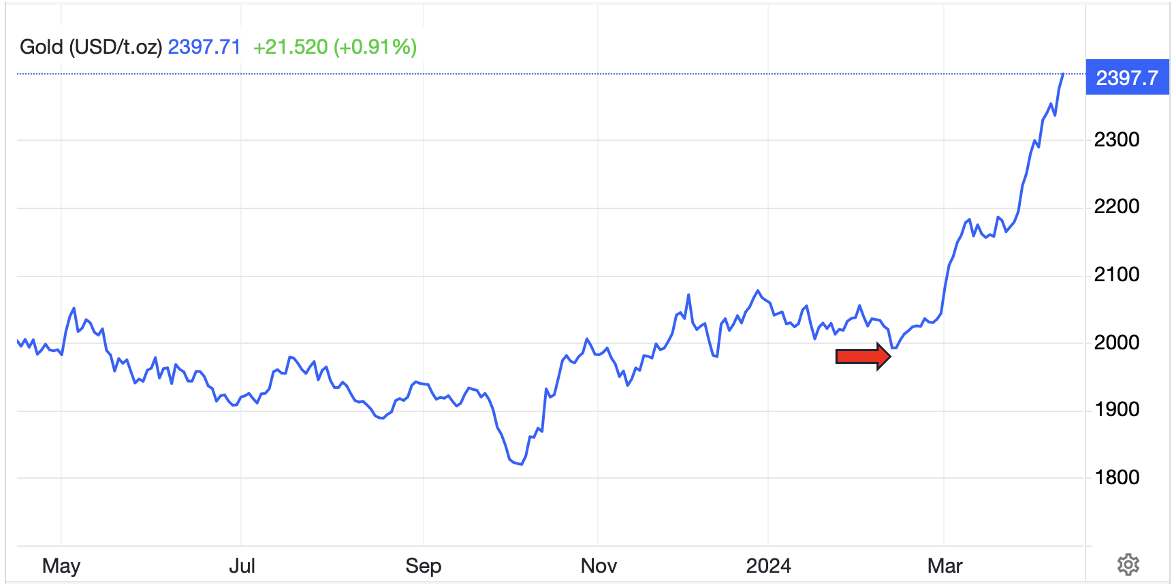
Under the rubric, a picture is worth a thousand words, have a look at the chart of the price of gold over the past twelve months below:

Source: tradingeconomics.com

That red arrow is pointing to the closing price on February 13, at $1988/oz, more than $400 lower than this morning’s market price.  There are many theories as to what is happening to drive this remarkable move in a commodity that has had a very limited role in the macroeconomic discussion for the past 53 years, ever since Nixon closed the gold window in 1971.  But the rally has been so strong it has fostered a host of theories as to what is driving it.  The latest is that there is a large, price-insensitive buyer acquiring large amounts outside the NY/London trading axis, with many people of the belief it is China and/or Russia preparing for a more complete break from the USD-based global monetary system.

Perhaps that is the case as we know from official reports that China has continued to acquire large amounts of gold over the past year.  But that has too much of a whiff of conspiracy theory in it for my taste.  My strong belief is that conspiracies are extremely difficult to maintain because people simply talk too much.  Rather, four decades of experience in financial markets, specifically FX and precious metals markets, has taught me that sometimes, markets move a long way on the basis of underlying fundamentals that have heretofore been ignored.  A simpler explanation could be that given its millennia-long history of being an able store of value and the fact that inflation remains rampant around most of the world while central bankers remain keen to cut interest rates and stop any efforts to fight it, many folks have decided it is a good idea to hold some portion of their personal wealth in the barbarous relic.  I know I do and have done so for quite a while.  I do not believe I am alone in that mindset.  Speaking of central bankers…

Said Christine, it’s still premature
To cut rates cause we’re not yet sure
Inflation is dying
Though we’re falsifying
It’s death from the Po to the Ruhr

At yesterday’s ECB meeting, as expected, there were no policy changes.  Madame Lagarde commented as follows: “If the Governing Council’s updated assessment of the inflation outlook, the dynamics of underlying inflation and the strength of monetary policy transmission were to further increase its confidence that inflation is converging to the target in a sustained manner, it would be appropriate to reduce the current level of monetary policy restriction.“  

That represents a lot of ten-dollar words to say, we want to cut rates, but we’re afraid if we do inflation might return so we are going to wait longer.  However, what was clear was that there is a wide range of views on the council.  For instance, this morning, Yannis Stournaris, the Greek central banker, said he thought that 4 cuts this year made sense.  At the same time, the last we heard from Robert Holtzmann of Austria, one cut was probably enough.  

Once again, Lagarde explained they are not waiting for the Fed, which is a good thing given the Fed seems less and less likely to cut this year at all, and Europe is in a recession already and needs lower rates.  This morning, the euro has fallen even further, down another -0.7%, and is back to levels last seen in early November.  It is becoming increasingly clear that monetary policies in the US and Europe are going to diverge further than currently priced and that does not bode well for the single currency going forward.

And those are really the big stories.  Yesterday’s PPI was a tick softer than expected, but the explanation was that in the calculation, the BLS seasonally adjusts the price of gasoline, so it showed a reduction despite the fact that gasoline prices, as we all know, have been rising steadily of late.  In any event, the market shook it off as we saw US equity markets perform well with both the S&P and NASDAQ reversing Thursday’s declines.  In Asia, however, while the Nikkei (+0.2%) managed a small gain, Chinese shares, and especially those in HK (-2.2%) had a lot more difficulty.  Chinese trade data was quite disappointing with the Trade balance shrinking dramatically (granted it is still >$50B) but both imports and exports declining.  And truthfully, all the other regional markets were lower to close the week.

European bourses, though, are all in the green, and nicely so, as investors and traders listen to the ECB doves and see more rate cuts, not less, coming.  This was confirmed with final pricing data showing the trend lower in inflation remains intact.  As to the US futures market, at this hour (7:50), they are lower by about -0.25% after weaker than expected earnings from JPM were released this morning.

In the bond market, after a week that has seen yields climb dramatically around the world, this morning Treasury yields are lower by 6bps, although still above 4.50%.  European sovereigns have seen yields decline even more, between 9bps and 11bps as the hope for rate cuts springs eternal.  Arguably, this is why the euro is under such pressure, the market narrative is gelling around the idea that the Fed won’t cut, and the ECB will be more aggressive.  One last thing, JGB yields are lower by 2bps this morning, but that is after a sharp rise seen in the wake of the US inflation report.  In fact, like many markets, with 10-year yields back at 0.84%, we are seeing levels not seen since November.

Turning to commodities, we have already discussed gold, and ignored silver (+2.0%) which is rallying even more aggressively, and copper (+1.80%) which is gaining on a combination of concerns over supply and a growing belief that China is going to add more stimulus to their economy.  Oil (+1.4%), too, is on the move, rebounding on growing concerns that the Middle East situation is getting even more dangerous with all eyes on Iran and any potential retaliation for Israel’s actions in Syria last week that resulted in the death of a key Iranian commander.  Historically, commodity rallies of this nature were accompanied by a weaker dollar, but not this time.  If this price action continues, there are going to be a lot of problems in nations all around the world that need to acquire commodities while their respective currencies are weakening.  Do not be surprised to see more market intervention in many places.

Finally, the dollar is back on top, rallying vs. virtually every currency this morning in a substantial manner.  In the G10, SEK (-1.3%) is the laggard, but the euro, pound, Aussie, Kiwi and Nokkie are all weaker by -0.6% or more.  In fact, only the yen (0.0%) is holding up, but that is after it blew through the previous ‘line-in-the-sand’ at 152.00 and is now above 153.00.  emerging market currencies are also uniformly weaker, although some are holding in better than others.  ZAR (-0.1%) is clearly benefitting from the metals rally, but not quite enough to rally on its own.  But KRW (-1.0%), MXN (-0.5%), BRL (-0.45%) and PLN (-0.65%) give a flavor of the overall price action.  Frankly, this is likely to continue until/unless we see a significant change in the data flow with US economic activity slowing, or at the very least, we get a consensus from all the Fed speakers that they are going to cut regardless of the data.

Speaking of the data, today we see only Michigan Sentiment (exp 79.0) and hear from two more Fed speakers, Bostic and Daly.  it doesn’t strike me that the data will matter that much, but market participants are quite keen to get more clarity from Fed speakers.  There is still a mix of views, although the one consistency is they have no confidence that inflation is falling toward their target sustainably.  However, some see a reversal higher as quite possible while others are holding out hope that this is a temporary bump in the road.  We will still see a significant amount of data before the FOMC meeting on May 1st including Retail Sales next week and the PCE data at the end of the month.  We will also hear much more from Fed speakers, so as of now, while there is no consensus, perhaps one will coalesce.  

Yesterday’s data did result in futures markets very slightly increasing the rate cut probabilities, with June now a 25% chance and 45bps priced for the rest of 2024.  I remain in the no-cut camp and so expect the dollar will continue to perform well vs. its brethren.  However, I see no reason for the commodity markets to back off either.  Bonds, however, are likely to see more pain going forward.

Good luck and good weekend

Adf

Limited Sellin’

After the data on Friday
Powell said, rushing’s not my way
Rates, we’ll still lower
If growth turns out slower
Least that’s what the punditry might say
 
Forget any thoughts about hikes
Old ideas that nobody likes
Other than Yellen
Limited sellin’
Suggests there will be no yield spikes


“The fact that the US economy is growing at such a solid pace, the fact that the labor market is still very, very strong, gives us the chance to just be a little more confident about inflation coming down before we take the important step of cutting rates.”

When Chairman Powell expressed this sentiment Friday morning, my take was he was seeking to give himself an out.  One way to read it is, since the economy remains strong, higher for longer isn’t killing us.  However, my first reading of the statement was that since the economy is strong, they can confidently cut rates.  Perhaps it is my confusion, or perhaps it is simply a badly constructed statement of the first view, but regardless, my confidence in the process has not been enhanced.

Friday’s PCE data was released pretty much in line with expectations but that is not as helpful as you might think given expectations were for a continued rebound in the numbers.  The fact that Powell is not more vociferously calling for a tougher stance is the most important piece of the puzzle.  This is what tells me that he has abandoned the 2% target.  While he will never officially admit that is the case, it has become increasingly clear that to achieve that goal, the Fed will need to push much harder on the economy and possibly drive a recession.  My read is that there are very few FOMC members who are willing to accept that tradeoff, especially in a presidential election year.

Right now, as Q2 begins, there is still time to see inflation data ebb closer to their target and allow that June rate cut that he seems to be promising.  But if the data between now and then, which includes three NFP reports, three CPI reports and two more PCE reports, does not cooperate and continues to show economic strength and sticky, if not building, price pressures, Powell and friends are going to have a very hard case to make with regards to any rate cuts.  And this really cuts to the chase as it is increasingly clear that the Fed’s true goal is not to reduce inflation, but to reduce interest rates so government borrowing becomes cheaper.  If the Treasury is going to continue to flood the market with T-bills rather than coupons (see chart below from BofA Global Research), the Fed has the ability to reduce their interest costs directly.  I expect that the pressure to do so is immense and growing.  The Fed remains in a precarious position given their credibility is on the line and so much of it is dependent on things outside their control.

There continues to be a yawning gap between views on the economy in the analyst community.  One camp remains firmly committed to the soft or no-landing scenario, expecting ongoing economic growth as inflation magically fades away (the so-called immaculate disinflation).  The other camp sees a recession on the horizon, if not already arrived, as when breaking down the data, they are able to find key aspects which indicate growth is slowing rapidly.  Right now, my guess is Powell is praying for the recession to appear more clearly, so he has a good reason to cut rates because otherwise, any rate cuts are going to be much more difficult to explain.

Beyond the Fed story, the news overnight was about China and Japan as PMI data from the former showed unexpected strength (Caixin Manufacturing PMI to 51.1) while the latter saw a mixed picture with the PMI data rising to 48.2, but still below the key 50.0 level, while the Quarterly Tankan data had some good news for large manufacturers and not-so-good news for small manufacturers.  With all of Europe still closed for the Easter holiday, a look at the markets open in Asia shows that the Nikkei (-1.4%) found no joy in the data and the index slipped back below the 40K level.  However, Chinese shares rose (+1.6%) on the data as it seems any read of recent commentary from the nation’s leaders indicates more fiscal support is on its way.

Bond markets, too, are closed throughout Europe and so the overnight saw only JGB yields edge up 1bp, Chinese yields follow suit, rising 1bp while Treasury yields are higher by 3bps this morning.  My take is there is limited information in these movements given the overall lack of market activity.

In the commodity markets, oil prices are unchanged to start the day, although they rose more than 6% in March, so there is clearly upside pressure there.  But once again, the star is gold (+0.75%) which is at another new all-time high as it seems an increasing number of investors and traders are becoming more concerned over the ongoing flood of liquidity entering the markets.  This strength is gold is mirrored today in silver, copper and aluminum as the desire to own ‘stuff’ rather than paper continues to grow.

Finally, the dollar continues to be in demand versus essentially all its major counterparts.  With Europe out of the office today, movement has been muted, but it is firmer against every one of its G10 counterparts with NOK (-0.55%) and SEK (-0.5%) the laggards, while it remains stronger vs. most of its EMG counterparts, although ZAR (+0.3%) is benefitting from the strong rally in gold and precious metals.  When looking at the macro situation around the world, right now, the US remains the proverbial cleanest shirt in the dirty laundry and so has the lowest case to cut interest rates.  I believe the ECB and BOE (and BOC and Riksbank, etc.) will all be cutting before the Fed and the dollar will benefit accordingly.  However, as I have maintained for a long time, if the Fed starts cutting with inflation remaining well above target, the dollar will decline sharply.

Looking at the data this week shows we have much to anticipate, culminating in Friday’s NFP report:

TodayISM Manufacturing48.4
 ISM Prices Paid52.6
 Construction Spending0.6%
TuesdayJOLTS Job Openings8.79M
 Factory Orders1.0%
WednesdayADP Employment130K
 ISM Services52.6
ThursdayInitial Claims214K
 Continuing Claims1822K
 Trade Balance-$67.0B
FridayNonfarm Payrolls200K
 Private Payrolls160K
 Manufacturing Payrolls5K
 Unemployment Rate3.9%
 Average Hourly Earnings 0.3% ((4.1% Y/Y)
 Average Weekly Hours34.3
 Participation Rate62.5%
 Consumer Credit$16.5B

Source: tradingeconomics.com

In addition to the data, we hear from 15 different FOMC members across 18 speeches this week.  This includes Chairman Powell on Wednesday as he discusses the Economic Outlook at the Stanford Business, Government and Society Forum.  By the time he speaks, we will have seen the ISM and ADP data, but my guess is that nothing is going to change his mind right now.  At this stage, hotter data is the Fed’s real problem as it will make cutting rates that much more difficult.  The Atlanta Fed’s latest GDPNow reading ticked up to 2.3% for Q1, certainly not indicating a slowdown is coming.  Sit back and get your popcorn out, it is going to be interesting to watch the Fed explain why rate cuts are needed if the data continues along its recent trend.

Good luck

Adf

One, Two, Three

On Monday, no one could agree
So, Powell unleashed; one, two, three
At least with respect
To how they dissect
The prospect for rate cuts they see
 
For Bostic, he sees only one
Before the committee is done
While Cook thinks that two
Are likely to do
And Goolsbee said three need be spun


During a session with very little new news, and ultimately, very little in the way of net market movement, it was quite interesting to hear from three different Fed speakers with somewhat different views of what the future holds.

In order of their views, as opposed to the timing of their comments, Atlanta Fed President Raphael Bostic reiterated his view from Friday in a different venue.  He explained that given the resilience of the economy, he sees little reason for any rate cuts in the near term and that his ‘dot’ was for just one cut this year, later in the year.  The thing about Bostic is he has proven to be flexible, arguably adhering to the Keynesian concept of, when the facts change, he changes his mind.  While it is not clear to me that the facts have actually changed, his perception of them certainly has.  At this point, it appears that he has become one of the more hawkish FOMC members and he is a current voter on the FOMC.

One step further toward the median we found Governor Lisa Cook, who explained that “the path of disinflation, as expected, has been bumpy and uneven, but a careful approach to further policy adjustments can ensure that inflation will return sustainably to 2% while striving to maintain the strong labor market.”  In other words, we have been surprised by the two consecutive hotter than expected CPI reports and so despite our fervent desire to cut rates as quickly as possible, if we were to do so, whatever credibility we still have would be thrown away.  At least, that is how I read her comments as she is a clear dove and desperate to cut.  To her credit, as a governor, she is making the effort to be a bit more restrained.

Lastly, we heard from Chicago Fed President, Austan Goolsbee, who during his interview (at Yahoo! Finance) quickly highlighted that his ‘dot’ was for three cuts this year.  He further explained that housing was the problem, at least with respect to their forecasts, and why they had expected inflation to decline more rapidly. Now, based on the housing data we continue to see, at least the price data, inflation is unlikely to decline much further at all.  Add in the fact that commodity prices, notably energy prices, have been rebounding for the past month and any hopes for another leg lower in either CPI or PCE are slipping away.  Also, Goolsbee is not a current voter, so many take his views a bit less seriously.

Now, let me ask, do you feel more enlightened?  Me neither.  If I were to assess the current situation, my read is that the majority of the FOMC really does want to cut rates as they believe they have done enough regarding inflation.  Frighteningly, there was an article in the FT this morning from Mohamed El-Erian, claiming that the time is ripe for allowing inflation to run hotter in order to support nominal growth.  We know that is every FinMin’s wet dream, but historically central bankers pushed back on that thesis.  However, El-Arian now claims that the central banks are on board as well.  If this is true, the only conclusion is that all fiat currencies are going to decline in value vs. stuff.  The relative pace of these declines will ebb and flow based on interest rate differentials and other circumstances, but it is not a net positive for the ordinary consumer.

Ok, let’s turn our attention to the overnight session and how markets are behaving.  The bulls have to be disappointed that the recent Fed speakers have not been more dovish, and we have seen that in another lackluster equity session in the US yesterday, with all three major indices lower by about -0.3%.  In Asia, while Japanese shares were essentially unchanged, we saw some strength in China and Hong Kong with the noteworthy story being President Xi’s invitation to keep several US CEOs currently visiting there, in country with the promise of a meeting with him.  The read is he is open to deeper business relationships.  As to the rest of the region, equity markets were mixed with some gainers and some laggards and no large movers.  As to Europe this morning, the color on the screen is green, with a few gains of 0.5% (Germany and Spain) and the rest much more subdued.  US futures are pointing higher at this hour (7:00), by about 0.5%, so the bulls are back.

In the bond market, yields have backed off a bit with Treasuries lower by 2bps and European sovereigns falling between 3bps (Germany) and 6bps (Italy) as the ECB speak continues to point to rate cuts clearly coming, with more hope for April making its way into the market, at least according to Italy’s Panetta.  In what cannot be a huge surprise, 10-year JGB yields remain unchanged as the idea of a tightening cycle there is slowly ebbing from traders’ minds.

In the commodity markets, oil (+0.2%) is creeping higher again as Russia has indicated it is going to restrict production alongside the lost output from refinery damage caused by Ukraine.  As well, after the UN Security Council vote yesterday, it appears that concerns are rising that there is no chance of a ceasefire anytime soon.  Meanwhile, gold (+1.2%) is screaming higher this morning and once again approaching $2200 as what appears to be a combination of growing geopolitical jitters combines with the growing awareness by market participants that inflation is not going to be addressed has investors seeking alternatives to fiat currencies.  Base metals, though, are not seeing the same boost, although are a touch higher overall.

Finally, the dollar is under some pressure this morning with most G10 currencies firmer, although the Swiss franc (-0.2%) is suffering a bit.  In fact, the biggest winner is NZD (+0.45%) but there is precious little to explain this movement.  One currency that is not gaining is the yen, which is unchanged on the session while the dollar remains just below its multi-decade highs set back in October 2022.  In the EMG bloc, the story is more mixed with some gainers (CZK +0.2%, HUF +0.3%) and some laggards (ZAR -0.3%, TWD -0.2%), but as you can see, the movement has been muted.

On the data front, this morning brings Durable Goods (exp 1.1%, 0.4% ex-transport) and Case Shiller Home Prices (6.7%). We also see Consumer Confidence (107.0) at 10:00.  There are no Fed speakers scheduled, but do not be surprised if there is an interview or two from a news source as they continue to try to tweak their message.

To me, the big picture is that there has been a clear relaxation by the Fed, and other central banks, in their attitude toward inflation.  As such, I expect to see risk assets perform and bonds lag.  However, regarding FX, it is all about the timing of the changes that are announced, or guided, rather than the absolute destruction in their value over time.  For now, though, the Fed remains the tightest policy around and the dollar should benefit because of that.

Good luck

Adf