Downward, Crawling

The trends in the market of late
Continue, and there’s no debate
The dollar keeps falling
With stocks, downward, crawling
While gold never has looked so great
 
The latest concerns are that Trump
Chair Powell, is looking to dump
The narrative shows
That if Powell goes
That Treasuries clearly will slump


Europe remains closed today for its Easter Monday holiday, as was Hong Kong last night, but the rest of Asia and the US are open.  With that in mind, though, I’m guessing there are many who would prefer markets to remain closed given the price action.  At least those who remain invested in the US as equity futures are pointing lower, yet again, this morning, with all three major indices down by about -1.0% at this hour (6:00).  But really, the market story that is atop the headlines today is the dollar and its continued weakening.  Since President Trump’s inauguration, so basically in the past three months, the euro (+1.3% today) has climbed about 11% as you can see in the chart below.

Source: tradingeconomics.com

While that is not an unprecedented move, it is certainly swift in the world of foreign exchange.  Of course, it is important to remember that the current level, and higher levels, were extant for more than a year (July 2020 – November 2021) not all that long ago.  My point is perspective is key, and while the dollar has been declining sharply of late, this is not unexplored territory.  In fact, stepping back a bit, as I’ve shown before, the euro remains in the lowest quartile of its value over the past twenty years.

Source: finance.yahoo.com

One of the interesting ways in which the narrative has changed has been that prior to the imposition of tariffs by President Trump, when they were only threatened, the economic intelligentsia were convinced that the only outcome would be other currencies declining in value sufficiently to offset the tariff, thus a stronger dollar with the end result that US exports would no longer be competitive.  Now those same analysts are explaining that the weaker dollar is a problem because imports will be more expensive, thus raising the inflation rate.  

However, the lesson I have learned throughout my career is that movement in the dollar, while important on a very micro level for businesses and foreign earnings calculations, is rarely a driver of any macroeconomic trend.  In fact, it is a response.  Other things happen and the dollar adjusts based on the flows that occur. While theoretically, at the margin, a weaker dollar will tend to result in higher import prices, and ceteris paribus, that would feed through to the inflation rate, no ceteris is paribus these days.  For one thing, oil prices are lower by nearly 18% since the inauguration and oil prices have a far larger impact on inflation than does the value of the dollar.  My point is that neither the dollar’s level nor the fact that it is declining is a sign of the end of times.

Source: tradingeconomics.com

Of more concern to many is the Treasury bond market as that is a true Achilles heel for the US.  Given the massive amount of debt outstanding, and the fact that there is so much to roll over this year, and the fact that the budget is still running a massive deficit, the need to refinance is the biggest issue facing the US economy in my view.  Of course, the US will be able to refinance, the question is the price.  

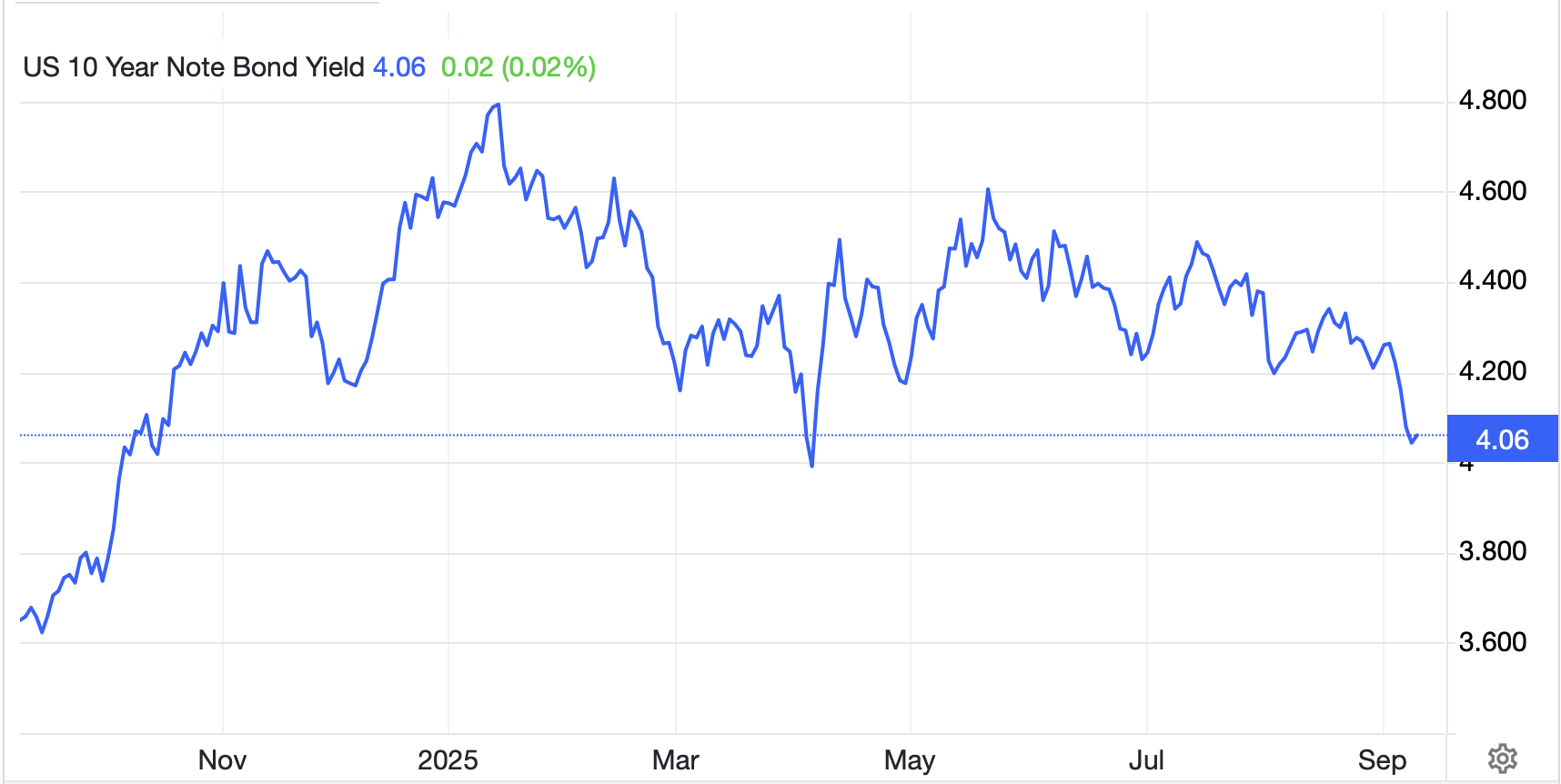
Since we’ve been measuring things from Trump’s inauguration, a look at 10-year Treasury yields shows they have declined a modest 28bps as of this morning’s pricing.  There has also been some volatility, but again, hardly unprecedented volatility.

Source: tradingeconomics.com

For instance, a widely followed measure of bond market volatility is the MOVE Index, currently produced by BofA.  At Friday’s close, it sat at 114.64.  A quick look at this chart shows the index, and by extension bond market volatility, is in the upper one-third of its range since inflation kicked off in 2022.  Again, it has spent a lot of time at higher levels and a lot of time at lower levels.

Source: finance.yahoo.com

There are numerous stories being written these days about reduced liquidity in the bond market, and there are many stories being written about how the Chinese, or the Japanese, or Europeans are selling Treasury bonds as a signal that all is not well.  First, we know all is not well, so that should not be a surprise.  Second, there has been no indication that Treasury auctions are failing, in fact the opposite, with the most recent 10-year and 30-year auctions showing substantial foreign demand.  

The funny thing about the bond market is to many it is a Rorschach test as people see what they want to see. To some, it is entirely about inflation and inflation expectations, so rising yields portend inflation on the horizon.  To others, it is a recession/growth indicator, which for most people is a coincident indicator, higher growth leads to higher inflation in that view.  But these days, much ink is spilled discussing how it is now and indicator of confidence in the US, especially with the growing antagonism between President Trump and Chairman Powell.  The same folks who lambasted Powell for keeping rates too high, now seem to be cheering him on to keep rates “too” high as a sign of his independence.

There is no doubt that despite the fact that the Fed’s press has diminished, and the market’s focus on the Fed has waned, their actions remain important to the US economy.  But is Jay Powell the last bastion of confidence in the US?  That, too, seems a stretch.

Trying to summarize, things in the US are quite messy right now.  For many investors, and hedgers, the previous status quo was so comfortable, and actions were easy to take.  However, Donald Trump’s election back in November was a very clear signal that things were going to change.  And they are changing.  In situations like this, investors tend to bring their money as close to home as possible.  This process has only just begun.  Since March, I have maintained that I see the dollar lower, and for a long time that the equity market was overvalued.  While the recent speed of movement is unlikely to be maintained, I expect the direction is pretty clear.

Ok, a really quick tour of markets overnight.  In Tokyo (-1.3%) equity markets slumped further as the yen strengthened and the status of the trade talks with the US remains unclear.  Chinese shares (+0.3%) edged higher and the rest of Asia that was open was mixed.  With all of Europe closed today, all eyes will be on the States where things are pointing to a lower opening.

Treasury yields have risen 4bps this morning and European sovereign markets are all closed.  Last night, JGB yields edged higher by 1bp, but the narrative of Japanese interest rates rising closer to other national levels has not had much press lately.

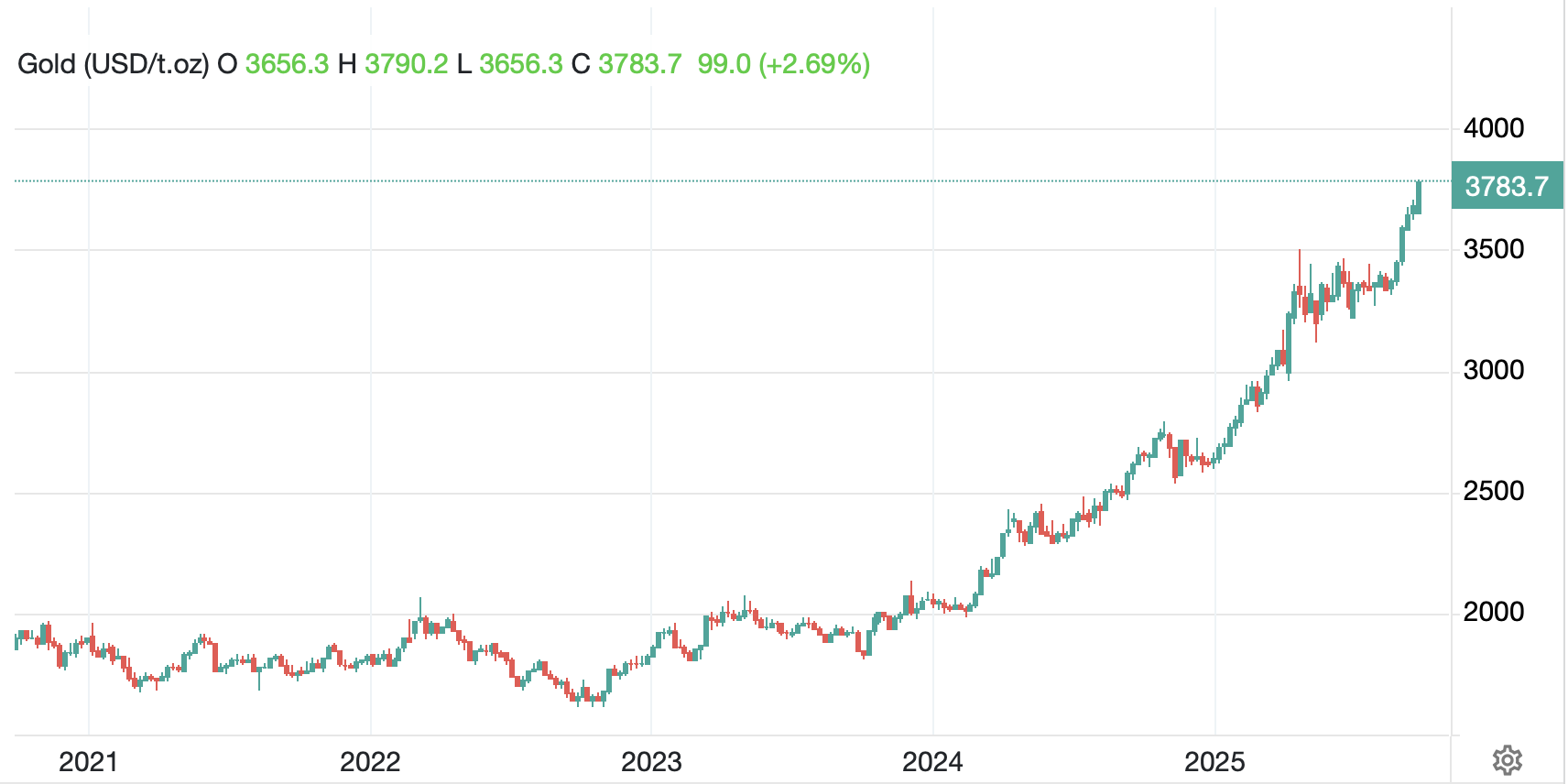
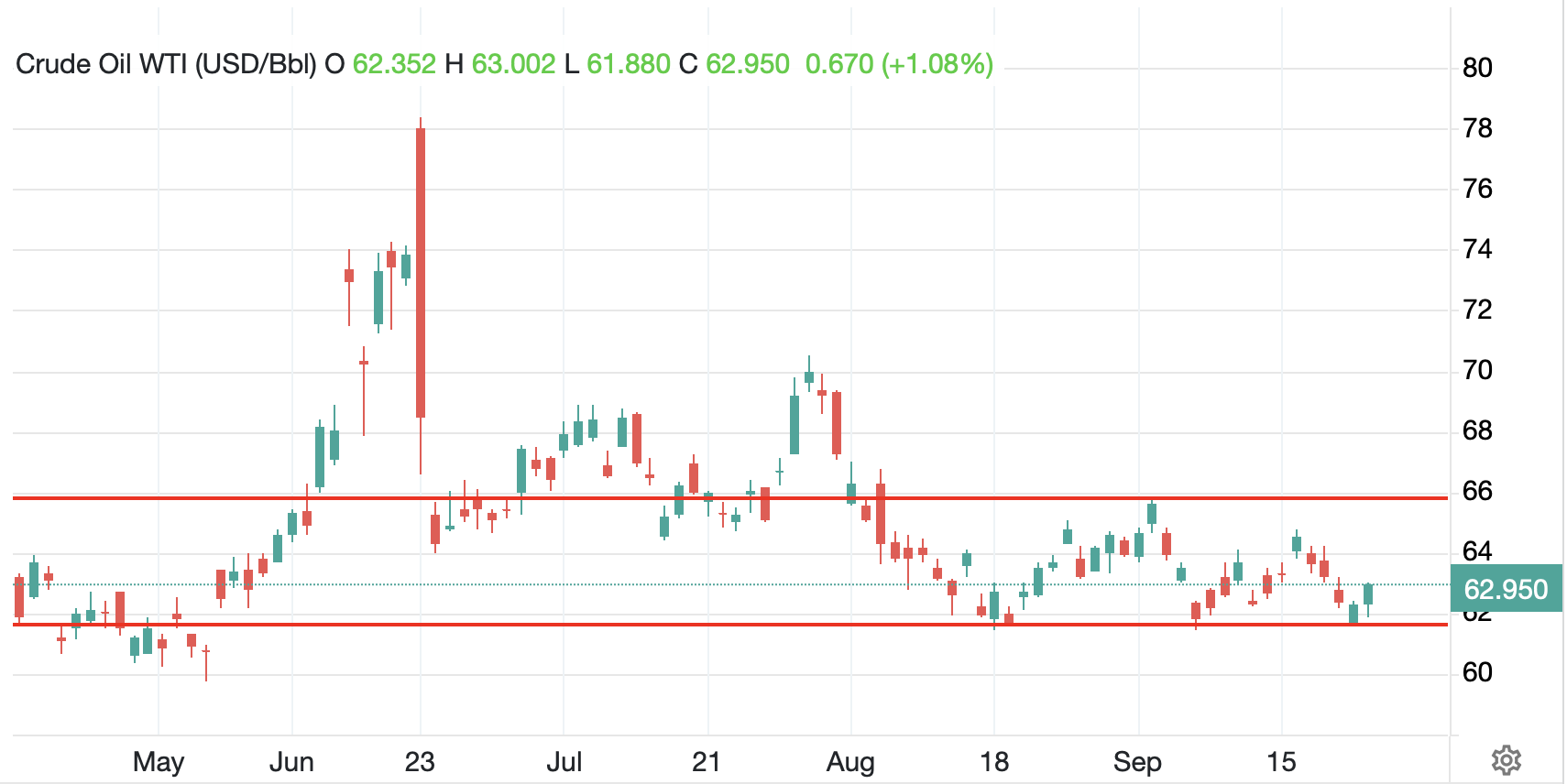
The commodity markets have been where all the action is, with oil (-2.5%) lower this morning as I have seen comments that the US-Iran talks are making progress.  As well, it appears that the Russia / Ukraine peace talks are reaching a denouement.  Successful conclusions in either, or both, of these discussions would very likely point to a lot more available crude on the market, and lower prices ahead.  I still think $50/bbl is in the cards.  But gold (+1.9%) is the story of the day here as the barbarous relic makes yet another new all-time high vs. the dollar dragging silver (+1.3%) and copper (+3.9%) along for the ride.  Not only are foreign central banks continuing to buy, as well as populations in China, India and elsewhere in Asia, but it appears that US retail is waking up to the fact that gold has been the best performing asset for the past year (+45%).  I continue to see the metals complex benefitting from the current macro environment.

Finally, we have already discussed the dollar which is lower this morning against virtually all its counterpart currencies in Europe and Asia.  As it happens, LATAM currencies are gaining the least and BRL (-0.1%) has even managed a slight decline on the opening.  But overall, this is a dollar selling day.

On the data front, today brings Leading Indicators (exp -0.5%) at 10:00 and that is all that is on the calendar.  It is a quiet week, and I will outline the rest tomorrow.

It should be a quiet market given Europe’s absence, and given how far the dollar has fallen leading into the open, I wouldn’t be surprised to see a modest bounce, but the trend, as I explained, remains clearly for a lower dollar going forward.

Good luck

Adf
The Tariff Explosion

In China, Xi’s ‘conomy grew
Quite nicely, but now in Q2
The tariff explosion
Ought lead to erosion
Of growth, lest we see a breakthrough


Chinese economic data was released last night, and the numbers were far better than expected, well most of them were.  The below table from tradingecoomics.com highlights the big numbers showing strength in GDP, IP and Retail Sales although Capacity Utilization was soft.

But this is Q1 data, and pretty early at that, just two weeks past the end of the quarter.  As well it reflected activity prior to the tariffs imposed by President Trump, and subsequently the Chinese themselves.  Just as we saw massive increases in the trade deficit here, as companies were front-running the tariff threat, I imagine we saw a lot more activity brought forward by the Chinese to both satisfy that front-running, as well as some front-running of their own.  I guess the question to ask is, how much information does this data provide regarding potential future outcomes and I suspect the answer is, not much.  

Already we are seeing global economists reducing their forecasts for Chinese annual GDP growth this year, with the lowest number I have seen at 3.5% (Goldman).  That is far below the ‘about 5%’ that President Xi targeted back in February and clearly assumes tariffs will remain in place.  And perhaps that is the biggest unknown.  The current state of play between Trump and Xi is that Trump said, call me, maybe and we can talk while Xi has said, show some respect and we can talk.

At this point, it is all theater, with both men playing to their bases and trying to show strength.  I do believe that Trump is seeking to isolate China, but the ultimate end game may well be to get them to alter their behavior.  If history is any guide, I imagine that this won’t be settled quickly, but that by summer, both sides will be feeling the heat on the economy.  Alas, that’s a long time from now and there is ample opportunity for significant market gyrations between now and then.

Like Fujiyama
Successful trade talks will be
A beautiful thing

On the other side of the tariff sheet is Japan, which is priority number one for the US.  PM Ishiba has sent his chief trade negotiator, Ryosei Akazawa, to the US to sit down with Treasury Secretary Bessent who has been named the lead in these negotiations.  While there is much discussion on autos, another very sticky subject is rice, on which Japan imposes a very high tariff.  President Trump claims it is 700%, others say less, more like 400%, but whatever it is, clearly the Japanese are protecting their rice farmers.  Ironically, Japan is in the middle of a rice shortage and has been pulling from strategic stockpiles to prevent prices there from rising too sharply.  Meanwhile, the US has ample export capacity.  It seems like a win-win opportunity, but politics is convoluted and from what I have read, the Japanese farmers don’t want to cede any market share to imports.  

Nonetheless, I expect that this will be a successful outcome as it is too important to fail.  While President Trump continues his bluster, he needs a win economically, and if Japanese talks are successful, we will see many more versions completed within the 90-day period in my view.  Things won’t go back to the way they were before Liberation Day, but if trade questions are answered, all eyes will turn to the budget, which is going to be a different kind of messy.  As I have written before, the greatest potential irony from this tariff war is that we could see lower tariffs around the world, something that all that WTO hobknobbing could never obtain.

One other mooted issue between the US and Japan is the exchange rate, which, while the yen has strengthened more than 10% since its low (dollar high) back just before the inauguration, remains far above levels seen before the Covid inspired inflation resulted in the Fed tightening policy aggressively.  The chart below is quite clear in displaying just how weak, relative to the past 30 years of history, the yen remains.  That last little dip is the move so far this year.

Of course, given the yen’s most recent bout of weakness dates from 2022, when US interest rates started to climb, if Treasury Secretary Bessent is successful in getting rates lower, that will be a natural driver of a weaker dollar, stronger yen.  Especially if Ueda-san does tighten policy further.

We have much to anticipate as the year progresses.  Ok, let’s turn to the overnight session and see what’s happening.  Yesterday’s lackluster US equity performance was followed by a terrible earnings discussion for Nvidia and much more extended weakness in Asia.  The Nikkei (-1.0%) and Hang Seng (-1.9%) fell sharply as did Korea (-1.2%) and Taiwan (-2.0%).  China (+0.3%), however, bucked the trend likely on the support of the plunge protection team there buying to prevent a rout.  Certainly, the positive data didn’t hurt, but I doubt that was enough.  In Europe, screens are all red as well, with declines on the order of -0.3% (UK and Spain) to -0.6% (Germany and France).  It is, however, universal with every market there declining.  As to US futures, while the DJIA is unchanged, both the NASDAQ and SPX are down sharply on that Nvidia news.

In the bond market, yields have been edging lower despite (because of?) all the tariff anxiety.  While Treasuries are unchanged this morning, they drifted off 3bps yesterday.  European sovereign yields are all lower by -2bps to -3bps and the big news was JGB yields tumbling -10bps last night.  There continues to be a great deal of discussion about China using its Treasury holdings as a weapon, but I find that highly unlikely.  Unless they could literally find a bid for all of them at once, to prevent further losses, it would self-inflict too much damage.  My take is they are essentially performing their own version of QT, allowing Treasuries to mature and slowly replacing them with other things, Bunds, gold, oil, copper.  One of the biggest problems is there are precious few asset classes that are large enough to absorb all that money, so they will continue to hold Treasuries in some relatively large amount, probably forever.

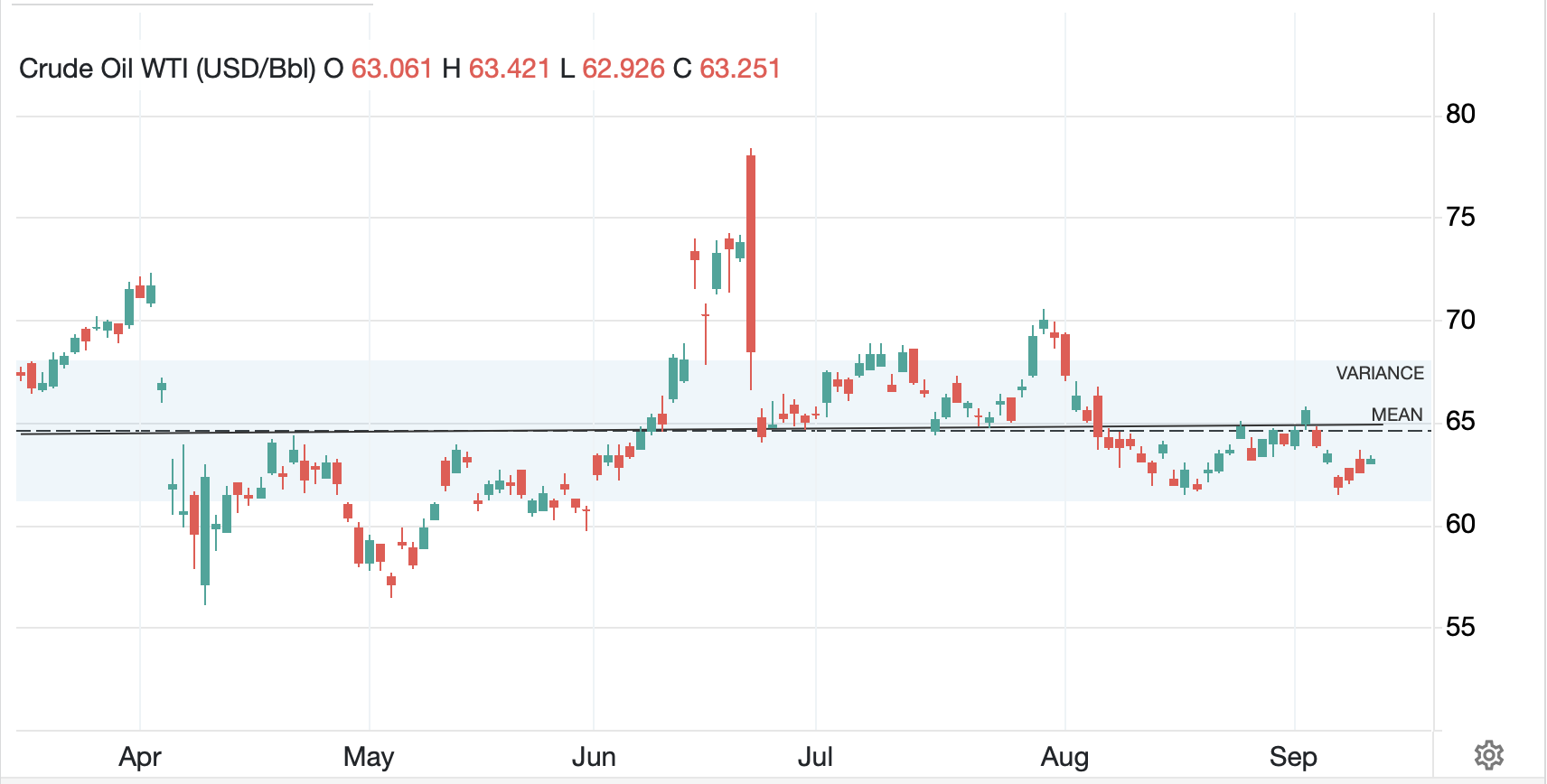
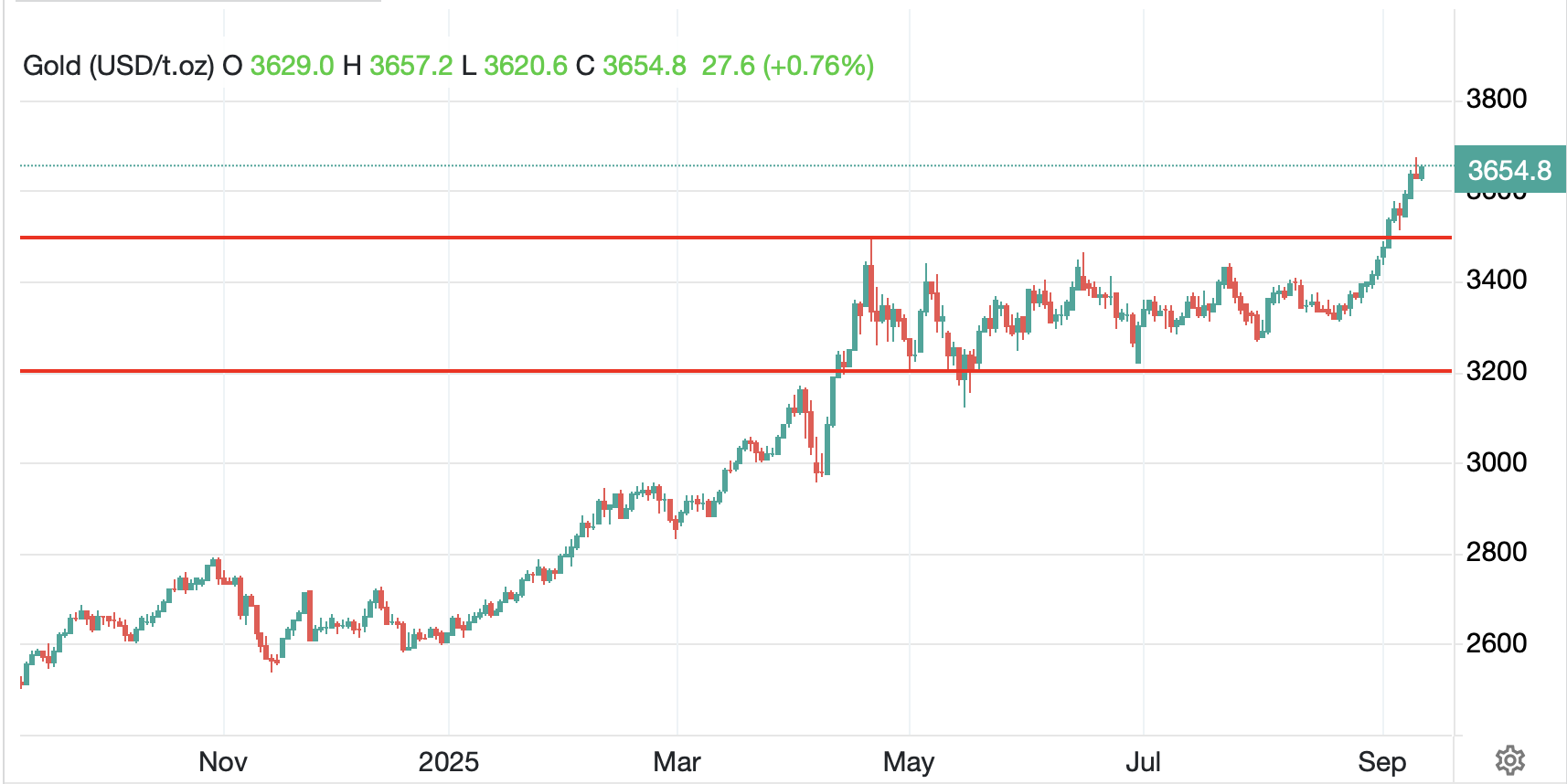
Turning to commodities, oil (+1.0%) continues to trade quietly and hang around just above $60/bbl.  It feels to me like there is a lot more room on the downside than the upside, but that is just me.  In the metals markets, gold (+1.5%) is glittering again, making yet another new all-time high this morning.  Remember a week ago when the market was correcting and there was discussion about gold losing its luster?  Me neither!

Source: tradingeconomics.com

This chart is a perfect example of the idea that nothing goes up in a straight line.  But the trend here is strong.  Silver (+1.6%) is following in gold’s footsteps today but copper (-0.4%) is lagging.  No matter, I continue to think commodities have more strength ahead.

One of the reasons is that the dollar remains under pressure.  Last night, further weakness was manifest with the euro trading back close to the highs touched on Friday at the 1.14 level.  Prior to Friday, the last time the euro was here was in February 2022.  But again, like the yen chart above, the euro’s strength is a very recent, short-term phenomenon.  A look at the chart below demonstrates just how “weak” the dollar is vs. the single currency on a long-term basis.  The answer is not very.

But overall, the dollar is weaker this morning across the board against both G10 and EMG currencies.  I do agree with the idea that foreign investors have been liquidating their US equity holdings slowly and repatriating the funds home.  If that continues, and it could, a continued decline in the dollar, especially if US yields slide, is likely.

On the data front, Retail Sales (exp 1.3%, 0.3% ex-autos) is the headliner at 8:30 then IP (-0.2%) and Capacity Utilization (78.0%) at 9:15.  We also hear from the BOC, although they are expected to leave their base rate on hold at 2.75%.  EIA oil inventory data is due later this morning with a decent sized draw of more than 5mm barrels across products expected.  There are Fed speakers including Chair Powell at 1:30 this afternoon, but they have just not had much sway lately, and I think they are ok with that.

Putting it all together, at least in the FX framework, my take is the dollar has further to fall.  There is no collapse coming, but steady weakness seems realistic.  However, given the overall uncertainty at the current time, I would be maintaining hedges rather than anticipating that weak dollar.

Good luck

Adf
Their Own Ego Trip

The talk of the town is the “Pause”
Which led to much market applause
Though naysayers still
Say Trump’s actions will
Result in bad outcomes…because


But yesterday saw markets rip
And all those who did buy the dip
Are feeling quite smart
When viewing the chart
Of prices, their own ego trip


See if you can guess when President Trump posted that there would be a 90-day pause on tariffs for everyone but China.

Source: tradingeconomics.com

By now, you are almost certainly aware that equity markets in the US rebounded massively in the US, with one of the biggest gains on record as the S&P 500 rose 9.5% and the NASDAQ 12.2%.  Of course, that merely retraced the bulk of the losses seen since the beginning of the month.  In fact, the S&P 500 is still lower by about 200 points since then.  Regardless, moods are much brighter today than they were yesterday at this hour.  And those equity gains are global.

I’ve seen several interpretations of the sequence of events and like virtually everything these days, it appears to have a partisan bias to people’s views.  There are those who claim President Trump could not stand the pressure of a declining stock market and “blinked” in the game of chicken he was playing.  There are also those who claim this was part of the strategy all along, essentially moving the Overton Window substantially in his preferred direction and now he is ready to reap the benefits of this move.  

Arguably, there is evidence for both sides of this argument and I suggest we will never really know. Remember, Trump is quite comfortable making outlandish pronouncements as he level sets for a negotiation.  But he is also quite the realist and while I do not believe he was concerned with his personal or family fortune, recognized that the speed of the pain inflicted could be damaging overall.  In the end, it is not clear the rationale matters, the action stands on its own merits.  

But remember this, equity valuations were very high before the decline last week, and were still quite high, although obviously less so, after the decline.  The rebound put them back in very high territory, especially with equity analysts revising profit forecasts lower on the back of the still 10% tariffs being imposed.  A truism is that the biggest rallies in the stock market occur during bear markets.  Keep that in mind as you assess risk going forward.

But let us turn our attention to a player who is not getting much attention these days, the Fed.  Many questioned the Fed’s rate cuts back in Q4 and attributed the moves to a partisan effort to help VP Harris get elected.  Certainly, there is no love lost between Chairman Powell and President Trump.  Of late, though, the commentary has focused on patience regarding any further policy ease as the impacts of Trump’s tariff policies are unknown at this stage.  Yet, it is not hard to read these comments and get a sense that the Fed is going to work at cross purposes to Mr Trump.  

For instance, yesterday, Minneapolis Fed President Neel Kashkari released an essay with the following comments, “Given the paramount importance of keeping long-run inflation expectations anchored and thelikely boost to near-term inflation from tariffs, the bar for cutting rates even in the face of a weakening economyand potentially increased unemployment is higher.  The hurdle to change the federal funds rate one way or theother has increased due to tariffs.”  While the words here don’t appear partisan per se, Mr Kashkari is one of the most dovish FOMC members and dismissed inflation concerns regularly for a long time.  This sudden change is interesting, at the least.  

At any rate, the market, which had been pricing a 50% probability of a rate cut next month just a few days ago and a total of at least 4 cuts this year, is back down to a <20% probability of a cut in May and about 3 cuts this year.  Truly the pause that refreshes.

So, let’s look at how other markets responded to the pause.  Markets everywhere, including China, rallied last night and this morning, with Tokyo (+9.1%) and Taiwan (+9.2%) leading the way in Asia although gains were universal.  Hong Kong (+2.1%) and China (+1.3%) were the laggards with gains between 2.5% and 5.0% the norm.  In Europe, too, equities are flying this morning as the threat of much higher tariffs is removed, at least temporarily, with the UK (+4.6%) the laggard and gains between 5.0% and 6.5% the story there.  Alas, futures this morning, at 7:00am, are pointing lower by -2.0% or so.  Is that profit taking or a harbinger of the day to come?

In the bond market, which has expressly been Trump and Bessent’s main concern, yields are a bit lower this morning, -3bps in 10-year Treasuries.  But the story in Europe is confusing to me, or perhaps not.  German bunds (+6bps) have seen the largest rise while UK Gilts (-10bps) have seen a sharp decline.  Too, Italy (-4bps and Greece (-2bps) have seen yields decline.  Could this be an illustration that bunds are a better safe haven than Treasuries? And now that haven status seems less important today, they are being sold off?  JGB yields (+9bps) are also rising, perhaps on the same notion.  The corroborating evidence is that nobody thinks Gilts are a good investment, so with risk back on, they are in demand given their highest yield in the G10.

In the commodity markets, oil rebounded sharply alongside equities yesterday although it has slipped 2.4% this morning.  I have altered the Y-axis on the chart below to percentages to give an idea of the magnitude of these moves in the past days, especially relative to the past 6 months.  Despite being the most liquid commodity market around (both figuratively and literally), it is far less liquid than bonds or FX or even stocks, so as commodities are wont to do, sometimes the moves are breathtaking.

Source: tradingeconomics.com

As to the metals markets, gold (+1.0%) continues its march higher, recovering more than 5% from the lows Tuesday morning.  I maintain that much of that selling was margin based, with positions liquidated to cover margin calls in other markets.  Now that the panic has passed, demand is likely increased given the new uncertainties.  However, both silver (-0.5%) and copper (-1.3%), which rallied sharply yesterday, have slipped back a bit.  These are different stories.

Finally, the dollar is lower this morning, having yo-yoed like every other market on the tariff news.  CHF (+1.9%) and JPY (+1.4%) are the big gainers in the G10 although the euro (+1.2%) is having a day as well.  However, there are currencies with less pizzazz this morning, notably ZAR (-0.9%), KRW (-0.6%) and MXN (-0.5%), as it remains difficult to know how to proceed going forward.  JPMorgan has a global volatility index which is a useful barometer of how things are going.  As you can see below, it is not surprising that volatility in this space has also risen sharply.

Once again, I return to the idea that President Trump is the avatar of volatility, and you must always remember that volatility can happen in both directions.  While financial assets tend to collapse (yesterday being the exception) when things get out of hand, commodities go the other way as supply interruptions are the big risk. Writ large, volatility simply means a lot of movement.

We finally get some meaningful data this morning with headline CPI (exp 0.1%, 2.6% Y/Y) and Core (0.3%, 3.0% Y/Y) along with the weekly Claims data (Initial 223K, Continuing 1880K).  Given all the focus on the tariffs, though, it is not clear to me what this data will imply on a forward-looking basis.  As we have seen with the Fed getting sidelined by Mr Trump, his tariff policies have also served to overshadow economic data, at least for now.  There are a couple of more Fed speakers and a 30-year bond auction as well.  Interestingly, I expect that auction may be the most important outcome of the day.  Will there be real demand or are investors shying away?

I expect that over the next few months, tariffs will be discussed on a nation-by-nation basis as new deals are struck.  But that will impede any medium-term views on the economy as until we have a much better sense of the end results, it will be difficult to assess things.  The upshot is, we may be entering a period where we chop up and down, but don’t go anywhere until the global trade situation is clearer.  Volatility with no direction is great for traders, less so for investors.  Headline bingo is still the game we are playing.

Good luck and good weekend

Adf

Fast or Slow Death?

As markets all take a deep breath
Concerns are that, just like Macbeth
The President will
The ‘conomy kill
The question is, fast or slow death?


Personally, I am hopeful that we can stop discussing tariffs after today.  It’s not that they will decrease in importance, but they will no longer be the primary topic.  Instead, they will be a secondary explanation for anything that anybody decides is wrong with the economy, or the country or the world.  Recession? Tariffs are the cause.  Inflation? Tariffs are the cause.  War? Tariffs are the cause.  Duke loses in the semis?  Tariffs are the cause.  

FWIW, which is probably not that much, my view is the market has absorbed this conversation and the correction we have seen over the past weeks in the equity market is the result of growing expectations of much slower growth or a recession.  Arguably, the biggest concern should be that US equity markets continue to trade at historically rich valuations and any negative catalyst can serve to both depress future expectations and compress multiples, and that’s how you get large equity market declines.

The thing about the tariff story is that while later today we will all find out the details, the actual impacts will take months, at least, to be determined.  For instance, the story that Israel has just decided to drop all tariffs on US made products, thus avoiding them on Israeli products is something I suspect we may see more frequently than now assumed.  Perhaps there would be no greater irony for all the naysayers than if this ‘end of free trade’ moment actually inspired a significant reduction in tariffs around the world as nations seek to retain access to the US.  I’m not saying this will be the case, but given the US is the consumer of last resort, running a nearly $1 trillion trade deficit, pretty much every other nation relies on the US as a market for some portion of their production.

Along these lines, I must ask, why is it that other nations, who apply tariffs and other non-tariff barriers like quotas or regulatory restrictions, to US products do so if tariffs are such a great evil?  Apparently when the French, for example, seek to protect their industries and farmers, it is healthy for the economy, but when the US does, it is world-ending.  Just sayin’

So, is the dip now to be bought?
Or are things still overly fraught?
The overnight session
Did naught for that question
As no one knows what Trump has wrought

Since there are literally no other stories to discuss regarding finance and markets right now, let’s turn to the overnight and see how markets are behaving in the runup to the Liberation Day announcement.  Yesterday’s mixed, but mildly positive, session in the US led to a mixed session in Asia with no real trend.  Even within a nation (Nikkei +0.3%, TOPIX -0.4%) there was no clarity.  Chinese shares were basically flat, Korea and Singapore fell while India and Malaysia rallied.  No movements approached even 1.0% so it is probably fair to say we didn’t learn anything.  However, European bourses are under pressure across the board this morning led by the DAX (-1.3%) and FTSE 100 (-0.9%).  Clearly, there is significant concern that the US tariffs, which are set to come into force immediately upon their announcement, will have a significant negative impact on European companies.  Certainly, German auto makers, who rely greatly on the US market, are likely to be negatively impacted, but as I said, it remains to be seen what actually occurs.  I guess considering that European shares have been performing well of late, with gains on the order of 10% or more YTD, some investors have decided to take their money and run.  

source: tradingeconomics.com

Meanwhile, US futures are pointing lower at this hour (7:10) down about -0.5% across the board.

In the bond market, while there is a lot of huffing and puffing that tariffs will be inflationary, yields are sliding this morning with Treasury yields (-2bps) declining to their lowest levels since last October, and a similar amount to most European sovereigns.  I suppose bond investors are more concerned over the mooted recession than the inflationary impact of tariffs.  Too, JGB yields slid -3bps, back to their lowest level in a month as questions remain about the BOJ’s future path as well as Japanese growth prospects in the new trade regime.

Turning to commodities, oil (-0.35%) has slipped a bit further but remains well up on the week as a story regarding the US moving more military assets toward the Middle East from Asia makes the rounds.  We cannot forget that President Trump has already initiated secondary sanctions on Venezuelan crude, and threatened to do so on Russian crude if Putin doesn’t agree to the ceasefire.  Meanwhile, Iran is always in Trump’s crosshairs while they remain a perceived threat to go nuclear.  As to the metals markets, gold (+0.1%) continues to edge higher with any pullbacks both short term and modest.  One look at the chart below shows how many more green days there have been than red ones over the past 6 months.  I see nothing to stop this trend.  As to the other metals, they are higher this morning and continue to trade well overall.  I believe the case can be made that going forward, commodity markets, and the shares of companies in the space, are set for some real outperformance in the new world order.

Source: tradingeconomics.com

Finally, the dollar is mixed as well, with some widely disparate movements seen.  For instance, NZD (+0.9%) is having a good day, perhaps because direct trade with the US is di minimus, or perhaps because it has been weakening so much for the past 6 months, down nearly 10% even after today’s rally, over that period, that it is a simple bounce.  At the same time, ZAR (-1.0%) is sliding despite the ongoing gold rally, although there are growing concerns over the outcome of the budget there and how it will be funded and impact the economy.  But in truth, as I look across the board, there are probably more currency gainers than losers this morning, which ironically is exactly the opposite of the forecast impact of tariffs by the US.  Just remember, as Yogi Berra allegedly explained, “in theory, there is no difference between theory and practice, in practice there is.” Detailed market outcomes based on economic theories rarely hold up.

On the data front, this morning brings ADP Employment (exp 105K) and Factory Orders (0.5%, 0.7% ex-Transport) as well as the EIA oil inventories.  Yesterday afternoon’s API inventories showed a large build, but expectations are for draws today.  We also hear from Adriana Kugler, Fed governor, but ironically, all the Fed talk is now about tariffs and not about monetary policy.

Today is a crapshoot, with no way to even guess how things will evolve.  Also, beware the initial reaction as it may not represent a new view, but rather the unwinding of current positions.  Until further notice, though, I still think the dollar has a slow decline in its future.

Good luck

Adf
Aren’t Just Rumors

Give plaudits to President Xi
Who’s trying to show it is he
That’s offering deals
To help grease the wheels
Of trade, which he claims will be free
 
The problem is Chinese consumers
Have not been in very good humors
And history shows
The Chinese impose
Restrictions that are aren’t just rumors


Market activity can well be described as lackluster, with equity indices generally slipping lower while bond markets wobble and the dollar retraces some of its recent losses.  In fact, the only markets really showing a trend right now are gold (+0.4%), silver (-0.1%) and copper (-0.2%), all of which have rallied sharply over the past month and year.  Obviously, the major discussion point is President Trump’s tariff policy and how that will impact economies around the world.  Recent focus has been on how other nations will respond with a variety of poses taken by different leaders, from conciliatory to combative.

So, it is with great interest that we see another impact of the Trump administration, the sight of China’s communist party leader, Xi Jinping, trying to convince foreign company CEO’s that investing in China is a good deal.  A lead article in Bloomberg this morning describes a large gathering in China where President Xi hosted CEO’s of numerous companies from around the world in an effort to portray China’s policies as investment friendly.

This makes sense given the trend in foreign direct investment toward China over the past years.  As can be seen in the chart below from the Bloomberg article, it has not been a pretty sight.  And remember, this all occurred before President Trump was elected.  Clearly, there were concerns prior to Mr Trump escalating the trade conflicts with the US.  

I find it somewhat ironic, though, that Xi is trying to promote Chinese policy as an island of stability in the world.  Consider how he has capriciously destroyed the private education market, or even the tech market until reversing course after the DeepSeek announcement, all while the housing market continues to implode.  Given the rest of the world has lost patience with China’s mercantilist policies and the flood of cheap goods they produce with government support, I am at a loss to understand the appeal of investing in China.  Using it as an export base is a nonstarter, and history has shown that nearly every foreign company that looked at China’s population as a great untapped market for their products has been hugely disappointed.  The exceptions are the luxury goods makers, where the global brand and cachet were too strong for domestic competitors to overcome.  But that is a small segment of the market.  

Instead, the usual outcome is forced technology transfer which results in a state-supported competitor for their products around the rest of the world.  I am confident there will be companies that choose to invest, if for no other reason than to curry favor with Xi and open the doors to further potential sales, but the trend of late is not promising.  Ultimately, property laws and their enforcement are the keystone for inward investment into any nation and China has no history of treating foreign companies fairly, or domestic ones for that matter.

But really, the flow of direct market news and economic data has been secondary with far more political news leading conversations.  The impact of tariffs on economic activity and inflation, as well as on market performance remains unclear with arguments being made on both sides as to potential benefits or detriments.  FWIW, which is probably not much, my take is the impacts will be very unevenly spread, and how that impacts broad based numbers is unknowable at this time.  I fear we will all need to be reactive for now, although for those with outstanding exposures, there is no better argument for maintaining robust hedge ratios given the overall uncertainty.

Ok, let’s take a look at the overnight action in markets.  After yesterday’s US declines, we saw much of Asia follow suit with Tokyo (-1.8%) particularly hard hit as PM Ishiba thought that he was making headway with President Trump but found out that Japanese auto manufacturers were going to be subject to those tariffs as well.  Adding to the pressure were the “Minutes” from the last BOJ meeting which implied further rate hikes are on the horizon. Both Hong Kong (-0.65%) and China (-0.45%) also slipped and, in fact, almost every major market in Asia (Korea, India, Taiwan, Malaysia, Singapore and Thailand) also fell, some quite sharply.  Apparently, Xi’s efforts at creating that stability haven’t yet been successful.  

In Europe, red is also the dominant color with most continental bourses lower by around -0.6%, also on the tariff story.  The one exception here is the UK, which released a passel of data showing growth was modestly firmer than expected at 1.5% led by Retail Sales growing 1.0%, rather than declining by -0.3% as expected.  As to US futures, at this hour (7:15) they are pointing slightly lower, about -0.2%.

In the bond market, yields are backing off around the world with Treasuries (-3bps) lagging European price action where sovereigns have seen yields decline between -4bps and -6bps.  Even JGB yields have slipped -4bps.  In Europe, inflation data from France and Spain came in softer than expected which has encouraged the move there, and we even heard arch ECB hawk, Robert Holzmann, explain that funding defense spending via bond purchases (i.e. QE) was viable.

In the commodity markets, oil (-0.2%) which rallied yesterday to touch the elusive $70/bbl level is slipping back a bit, but the trend remains clearly higher as per the below.

Source: tradingeconomics.com

Finally, in the currency markets, the dollar is firmer once again with modest rallies vs. the euro (-0.3%) and pound (-0.2%) as well as strength against the Scandies (SEK -0.6%, NOK -0.3%).  However, the picture in the EMG bloc is more mixed with ZAR (+0.35%) showing strength alongside gold’s rally, and INR (+0.2%) bucking the trend after having agreed to reduce tariffs on US products.  Throughout the rest of the bloc, there has been generally little change.

Turning to the data this morning, there is plenty that will be keenly watched.  Personal Income (exp 0.4%), Personal Spending (0.5%) and the PCE data (headline 0.3%, 2.5% Y/Y and core 0.3%, 2.7% Y/Y) all get released at 8:30.  Then at 10:00 we see Michigan Sentiment (57.9) and you can be sure people will be talking about the Inflation Expectations piece (1yr 4.9%, 5yr 3.9%), especially if it syncs with their narrative.  There are two more Fed speakers, Governor Barr and Atlanta Fed president Bostic, but nothing any Fed speaker has uttered has mattered at all, maybe since Trump was inaugurated.

My read on overall sentiment is that investors are wary of the future, but not yet ready to abandon the stocks only go up narrative.  Regarding the dollar, the recent trend remains modestly lower, as per the below, but it is hard to get excited about large moves, at least for today.  Again, Trump clearly wants it lower and seems likely to get his way, at least to some extent.  The one thing I truly do like is commodities, which I believe will remain well bid overall.

Source: tradingeconomics.com

Good luck and good weekend

Adf

The Fools

In April, it starts with the Fools
But two days thereafter the rules
For importing cars
To where Stars and Bars
Fly will change with tariffs as tools
 
For Europe, the pain will be keen
At least that’s what most have foreseen
And poor crypto bros
Will find their Lambos
May soon cost a price quite obscene


While the political set continues to harp on the “Signal” story, markets really don’t care about political infighting between the parties.  Rather, their focus is keenly attuned to President Trump’s confirmation that starting on April 3rd, there will be a 25% tariff imposed on all imported autos from everywhere in the world.  This is particularly difficult for European auto manufacturers as they produce a far smaller proportion (VW 21%, BMW 36%, Mercedes 41%) of their vehicles in the US than do the Japanese (Honda 73%, Toyota 50%, Nissan 52%), although the Koreans will be impacted as well (Hyundai/Kia 33%).  Ironically, according to Grok, where I got all this information, GM only produces about 54% of their vehicles sold in the US, in the US, with the rest coming from Canada and Mexico.  As an aside, Tesla produces all their vehicles in the US.

Particularly hard hit are the specialty manufacturers like Porsche, Ferrari and Lamborghini, which produce none of their vehicles in the US.  Of course, given the price points of these vehicles, my sense is it may not really hurt their sales as if you are spending $250k on a car, you can likely afford to spend $312.5k as well.  In fact, in a funny way, these tariffs may enhance the Veblen effect where people will brag about paying the higher price as it puts it out of reach of more people.

Nonetheless, the action merely confirms that President Trump is very serious with respect to changing the world’s trading model.  I saw something interesting this morning in that Paul Krugman, who made his name, and won his Nobel Prize, based on work regarding international trade and was the prototypical free trader, has adjusted his views after recognizing that nations need to maintain some manufacturing capabilities for security reasons.  I assure you, if Krugman, who has been a vocal liberal critic of every Republican idea for the past twenty years, agrees with this policy, it will be very difficult for anyone to reject it.

In a perfect world (globo economicus?) free trade accrues benefits to all.  But we don’t live in that world and national priorities often supersede these issues.  The pandemic highlighted the weaknesses that the US had developed in its ability to manufacture key items necessary for its continued economic and defense survival. And remember this, for the world at large, their idea of free trade is they should be able to sell whatever they grow/manufacture into the US with no barriers, but US manufacturers need to be subject to barriers in order to protect other nations’ favored industries and companies.  That world is now history with new rules being written every day and most of them by Donald Trump.

So how have markets responded to this tariff confirmation?  Not terribly well.  Yesterday’s US equity selloff was pretty significant led by the NASDAQ’s -2.0% decline.  In Asia, the Nikkei (-0.6%) also sold off as did Korea (-1.4%), Taiwan (-1.4%) and Australia (-0.4%).  On the other hand, both China (+0.3%) and Hong Kong (+0.4%) managed a better session, seemingly as a rebound against declines in the previous session with the only news showing that Chinese industrial profits fell by -0.3% compared to a Y/Y decline of -3.3% in December.  However, a quick look at a chart of this data for the past five years tells me they need to seasonally adjust it in order to get something meaningful, so I don’t think it really impacted markets.

Source: tradingeconomics.com

As to European shares, it should be no surprise that the tariff announcements have negatively impacted shares there with declines of between -0.2% (Spain) and -0.7% (Germany).  US futures though, at this hour (7:00) are little changed on the session.

In the bond market, Treasury yields continue to creep higher, up another 3bps this morning and back to levels last seen a month ago.  This cannot be helping Secretary Bessent’s blood pressure, although he very clearly has a plan in mind.  There is much stagflation discussion in the markets by the punditry as they assume tariffs will slow growth and raise prices and bonds are not the favored investment in that scenario.  Meanwhile, European sovereign yields are all sliding this morning, largely down -2bps, amid growth concerns on the back of the tariff announcements.  The one exception here is UK Gilts (+7bps) as the UK Budget announcement indicated slightly more gilt issuance would be necessary to fund the government’s spending plans.  However, there is a growing concern over the financial management of the Starmer government overall.

In the commodity markets, oil (-0.35%) is slipping from yesterday’s closing levels and continues to flirt with the $70/bbl level but has not been able to breech it since late February.  Apparently, there are questions as to whether the auto tariffs will reduce demand.  Personally, I would think it is the opposite as more older, less fuel efficient cars will remain on the road here.  As to gold (+1.0%) after a several day pause, it appears that it is resuming its very strong trend higher.  You know what we haven’t heard about lately?  Ft Knox auditing.  I wonder if that is getting arranged or is now so old a story nobody cares.  Silver (+1.0%) is along for the ride although copper (-0.4%) is taking a breather after a breathtaking run to new all-time highs this year.  Look at the slope of the copper chart and you can see why it is pausing, at the very least.

Source: tradingeconomics.com’

Finally, the dollar is broadly softer this morning, with the euro, pound and Aussie all gaining on the order of 0.3%.  As well, NOK (+0.3%) is firmer after the Norgesbank surprised some and left rates on hold with a relatively hawkish message about the future.  But there is weakness vs. the greenback around with JPY (-0.3%), MXN (-0.3%) and INR (-0.2%) all leaning the other way.  Another tariff related story is that India is planning to cut its tariffs in half for the US, a very clear victory for President Trump. 

On the data front, this morning brings the weekly Initial (exp 225K) and Continuing (1890K) Claims data as well as the third and final look at Q4 GDP (2.3%).  Part of the GDP data is Real Final Sales (4.2%) which is a key indicator for what happens here given consumption represents ~70% of the economy.  We do hear from Richmond Fed president Barkin this afternoon, but right now, Fed speakers are speaking into the void.

International statecraft continues to be the underlying thesis of global relations and President Trump’s goals of reshoring significant amounts of manufacturing and jobs along with it is still the primary driver.  There has been far less talk of the Mar-a-Lago Accord as that seems to be losing its luster.  If countries adjust their trade policies, Trump will continue in this direction.  While that may include short-term economic weakness and some pain, for both the economy and the stock markets, there is no indication, yet, he is anywhere near blinking.  One thing to keep in mind is that an overvalued stock market can correct by prices falling sharply, but also by prices stagnating for a long time while earnings catch up and multiples compress.  We may very well be looking at the latter scenario, so no large gains nor losses, just choppy markets going forward.  As to the dollar, lower still seems the direction of travel overall from current levels, but probably in a very gradual manner.

Good luck

Adf
Eyes Like a Bat

The new Mr Yen
Is watching for excess moves
With eyes like a bat


While every day of this Trump presidency is filled with remarkable activity at the US government level, financial markets are starting to tune out the noise.  Yes, each pronouncement may well be important to some part of the market structure, but the sheer volume of activity is overwhelming investment views.  The result is that while markets are still trading, there seem to be fewer specific drivers of activity.  Consider the fact that tariffs have been on everyone’s mind since Trump’s inauguration, but nobody, yet, has any idea how they will impact the global macro situation.  Are they inflationary?  Will sellers reduce margins?  Will there be a strong backlash by the US consumer?  None of this is known and so trading the commentary is virtually impossible.

With that in mind, it is worth turning our attention this morning to Japan, where the yen (-0.4%) has been steadily climbing in value, although not this morning, since the beginning of the year as you can see from the chart below.

Source: tradingeconomics.com

Amongst G10 currencies, the yen is the top performer thus far year-to-date, rising about 5%.  Arguably, the key driver here has been the ongoing narrative that the BOJ is going to continue to tighten monetary policy while the Fed, as discussed yesterday, is still assumed to be cutting rates later in the year.  

Let’s consider both sides of that equation.  Starting with the Fed, just yesterday Atlanta Fed president Bostic explained to a housing conference, “we need to stay where we are.  We need to be in a restrictive posture.”  Now, I cannot believe the folks at the conference were thrilled with that message as the housing market has been desperate for lower rates amid slowing sales and building activity.  But back to the FX perspective, what if the Fed is not going to cut this year?  It strikes me that will have an impact on the narrative, and by extension, on market pricing.

Meanwhile, Atsushi Mimura, the vice finance minister for international affairs (a position known colloquially to the market as Mr Yen) explained, when asked about the current market narrative regarding the BOJ’s recent comments and their impact on the yen, said, “there is no gap with my view.  Amid high uncertainty, we have to keep watching the impact of any speculative trading on, not only the exchange market, but also financial markets overall.”  

If I were to try to describe the current market narrative on the yen, it would be that further yen strength is likely based on the assumed future narrowing of interest rate differentials between the US and Japan.  That has been reinforced by Ueda-san’s comments that they expect to continue to ‘normalize’ policy rates, i.e. raise them, if the economy continues to perform well and if inflation remains stably at or above their 2% target.  With that in mind, a look at the below chart of Japanese core inflation shows that it has been above 2.0% since April 2022.  That seems pretty stable to me, but then I am just a poet.

Source: tradingecomnomics.com

Adding it all up, I feel far better about the Japanese continuing to slowly tighten monetary policy as they have a solid macro backdrop with inflation clearly too high and looking like it may be trending a bit higher.  However, the other side of the equation is far more suspect, as while the market is pricing in rate cuts this year, recent Fed commentary continues to maintain that the current level of rates is necessary to wring the last drops of inflation out of the economy.

There is a caveat to this, though, and that is the gathering concern that the US economy is getting set to fall off a cliff.  While that may be a bit hyperbolic, I do continue to read pundits who are making the case that the data is starting to slip and if the Fed is not going to be cutting rates, things could get worse.  In fairness to that viewpoint, the Citi Surprise Index is pointing lower and has been declining since the beginning of December, meaning that the data releases in the US have underperformed expectations for the past two months. (see below)

Source: cbonds.com

However, a look at the Atlanta Fed’s GDPNow estimate shows that Q1 is still on track for growth of 2.3%, not gangbusters, but still quite solid and a long way from recession.  I think we will need to see substantially weaker data than we have to date to get the Fed to change their wait-and-see mode, and remember, employment is a lagging indicator, so waiting for that to rise will take even longer.  For now, I think marginal further yen strength is the most likely outcome as we will need a big change in the US to alter current Fed policy.

Ok, let’s see how markets have behaved overnight.  Yesterday saw a reversal of recent US equity performance with the DJIA slipping while the NASDAQ rallied, although neither moved that far.  In Asia, the Nikkei (+0.3%) edged higher as did the CSI 300 (+0.2%) although the Hang Seng (-0.3%) gave back a small portion of yesterday’s outsized gains.  The rest of the region, though, was under more significant pressure with Korea, Taiwan, Indonesia and Thailand all seeing their main indices decline by more than -1.0%.  In Europe, red is the most common color on the screen with one exception, the UK (+0.35%) where there is talk of resurrecting free trade talks between the US and UK.  But otherwise, weakness is the theme amid mediocre secondary data and growing concern over US tariffs.  Finally, US futures are nicely higher this morning after Nvidia’s earnings were quite solid.

In the bond market, Treasury yields (+4bps) have backed up off their recent lows but remain in their recent downtrend.  Traders keep trying to ascertain the impacts of Trump’s policies and whether DOGE will be able to find substantial budget cuts or not with opinions on both sides of the debate widely espoused.  European sovereign yields have edged higher this morning, up 2bps pretty much across the board, arguably responding to the growing recognition that Europe will be issuing far more debt going forward to fund their own defensive needs.  And JGB yields (+4bps) rose after the commentary above.

In the commodity markets, oil (+1.1%) is bouncing after a multi-day decline although it remains below that $70/bbl level.  The latest news is that Trump is reversing his stance on Venezuela as the nation refuses to take back its criminal aliens.  Meanwhile, gold (-1.1%) is in the midst of its first serious correction in the past two months, down a bit more than 2% from its recent highs, and trading quite poorly.  There continue to be questions regarding tariffs and whether gold imports will be subject to them, as well as the ongoing arbitrage story between NY and London markets.  However, the underlying driver of the barbarous relic remains a growing concern over increased riskiness in markets and rising inflation amid the ongoing deglobalization we are observing.

Finally, the dollar is modestly firmer overall vs. its G10 counterparts, with the yen decline the biggest in the bloc.  However, we are seeing EMG currency weakness with most of the major currencies in this bloc lower by -0.3% to -0.5% on the session.  In this case, I think the growing understanding that the Fed is not cutting rates soon, as well as concerns over tariff implementation, is going to keep pressure on this entire group of currencies.

On the data front, we see the weekly Initial (exp 221K) and Continuing (1870K) Claims as well as Durable Goods (2.0%, 0.3% ex Transport) and finally the second look at Q4 GDP (2.3%) along with the Real Consumer Spending piece (4.2%).  Four Fed speakers are on the calendar, Barr, Bostic, Hammack and Harker, but again, as we heard from Mr Bostic above, they seem pretty comfortable watching and waiting for now.

While I continue to believe the yen will grind slowly higher, the rest of the currency world seems likely to have a much tougher time unless we see something like a Mar-a Lago Accord designed to weaken the dollar overall.  Absent that, it is hard to see organic weakness of any magnitude, although that doesn’t mean the dollar will rise.  We could simply chop around on headlines until the next important shift in policy is evident.

Good luck

Adf

Is Past Prologue?

The Japanese tale
Now sees brighter times ahead
Yen buyers rejoice


While its movement has been somewhat choppy, for the past month, the yen has been the best performing currency in the G10, gaining more than 3.0% during that time.  This strength seems to have been built on several different themes including a more hawkish BOJ, better growth prospects based on PMI data, rising wages, and some underlying risk aversion.  A quick look at the chart shows that the trend is clearly lower and there have been far more down days for the dollar than up days during this period.

Source: tradingeconomics.com 

Of course, as I regularly remind myself, and you my good readers, perspective is an important thing to keep in mind, especially when making statements about longer term prospects of a currency.  When looking at USDJPY over a longer term, say the past 5 years where long-term trends have been entrenched based on broad macroeconomic issues as well as the day-to-day vagaries of trading, the picture looks quite different.  In fact, as you can see from the below chart, the past month’s movement barely registers.

Source: tradingeconomics.com

My point is that we must be careful regarding the relative importance of information and news and keep in mind that short-term movements may very well be just that, short-term, rather than major changes in long-term trends.  The latter require very significant macro changes regarding interest rate policy and economic activity, at least when it comes to currencies, not simply a single central bank policy move.

So, the question at hand is, are we at the beginning of a major set of policy shifts that will change the long-term trajectory of the yen?  Or is the yen’s recent strength merely normal noise?

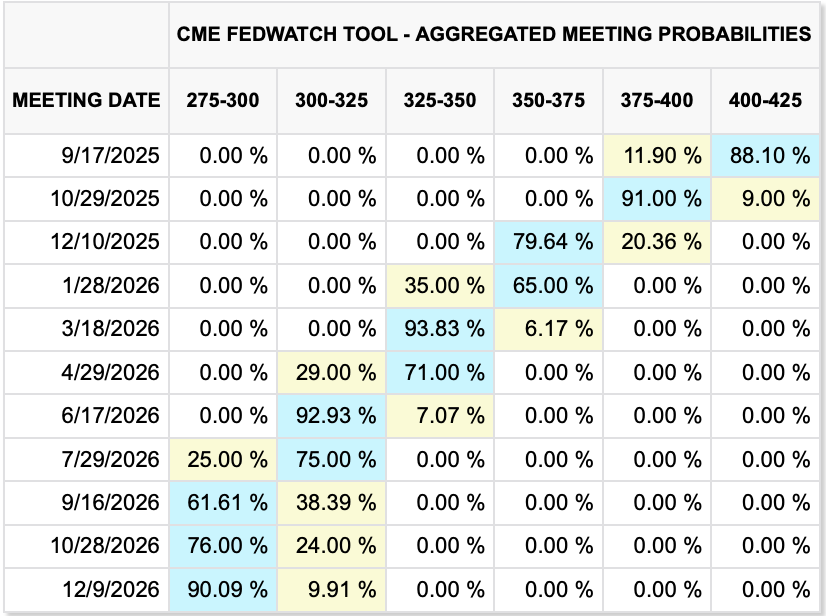
While almost everybody has their own opinion on how the Fed is going to proceed going forward, I think it is instructive to look at the Fed funds futures market and the pricing for future rate activity.  For instance, a look at the current market, especially when compared where these probabilities were one month ago tells us that expectations for Fed rate cuts have diminished pretty substantially, arguably implying that there is more reason to hold dollars.

Source: CME.org

You can see in the lower right-hand corner of the chart that the probability of a rate cut has fallen from nearly 44% to just 16.5% over the past month.  However, during that same period, the BOJ has not only raised interest rates by 25bps, but they have made clear that further rate hikes are coming based on wage settlements and sticky inflationary readings.  One potential way to incorporate this relative movement is to look at the change in forecast interest rates, which in the US have risen by ~7bps (27% *25bps) while Japanese interest rates have risen by 25bps with expectations for another 25bps coming soon.  That is a powerful incentive to be long yen or at least less short yen, than previous positioning.  And we have seen that play out as the yen has strengthened as per the above.

The real question is, can we expect this to continue?  Or have we seen the bulk of the movement?   Here, much will depend on the future of the Fed’s actions as the market is seeing a bifurcation between those who believe rates are destined to fall further once inflation starts to ease again, vs. those, like this poet, who believe that inflation is showing no signs of easing, and therefore the Fed will be hard-pressed to justify further rate cuts.  While I am not the last word on the BOJ, from every source I see, expecting their base rate to be raised above 1.00% anytime in the next several years is aggressive.  Just look at the below chart showing the history of the BOJ base rate.  The last time the rate was above 0.50%, its current level, was September 1995.  That is not to say they cannot raise it, just that as you can see, several times in the intervening years they tried to do so and were forced to reverse course as the economy fell back into the doldrums with inflation quickly falling as well.  

Source: tradingeconomics.com

Is past prologue?  Personally, my take is above 1.0% is highly unlikely any time in the next several years.  Meanwhile, if inflation remains the problem it is in the US, Fed cuts will be much harder to justify.  This is not to say that the yen cannot strengthen somewhat further, but I am not of the opinion we have had a sea change in the long-term trend.

Ok, after spending way too much time on the yen, given that there hasn’t even been any tariff discussion on Japanese products, let’s look elsewhere to see how things moved overnight.

Yesterday saw further relief by equity investors that tariffs are a key Trump negotiating tactic rather than an effort to raise revenue and US markets all gained, especially the NASDAQ.  However, the movement in Asia was more muted with the Nikkei (+0.1%) barely higher while both Hong Kong (-0.9%) and China (-0.6%) fell amid the Chinese tariffs remaining in place.  As to the regional markets, there were some notably gainers (Korea and Taiwan), but away from those two a more mixed picture with less absolute movement was the order of the day.  In Europe, Spain’s IBEX (+1.0%) is the standout performer after the PMI data showed only a modest slowing, and a much better result than the rest of the continent.  Perhaps this explains why the rest of the continent is +/- 0.2% on the session.  As to US futures, they are lower at this hour (7:30) on the back of weaker earnings data from Google after the close last night.

In the bond market, yields have fallen across the board (except in Japan where JGB yields made a run at 1.30%) with Treasury yields lower by 4bps this morning and 12bps from the highs seen yesterday morning.  European sovereign yields are all lower as well, between -4bps and -7bps, as the weaker PMI data has traders convinced that the ECB is going to respond to weakening growth rather than sticky inflation and are now pricing in 100bps of cuts this year with the first 25bps coming tomorrow.

In the commodity space, gold (+1.0%) is the god of commodities right now, rallying more than $100/oz over the past five sessions.  There continue to be questions as to whether this is a major short squeeze as COMEX contracts come up for delivery, but it is not hard to write a narrative that there is increased uncertainty in the world and gold is still seen as the ultimate safe haven.  This gold rally continues to pull other metals higher (Ag +0.8%, Cu +0.2%) although I have to believe this is going to come to a halt soon.  Meanwhile, energy prices have fallen again (oil -1.0%, NatGas -1.5%) as fears over supply issues have dissipated completely.

Finally, the dollar is under pressure overall, certainly one of the reasons the yen (+1.0%) has performed so well overnight, but elsewhere in the G10, we are seeing the euro, pound and Aussie all gain 0.4% or so.  In the EMG bloc, CLP (+1.0%) is gaining on that renewed copper strength while ZAR (+0.5%) is shaking off the Trump threats regarding recent legislative changes and benefitting from gold’s massive rally.  The one outlier is MXN (-0.4%) which seems to be caught between the benefits of stronger silver prices (Mexico is a major exporter of silver) and weaker oil prices.

On the data front today, we start with ADP Employment (exp 150K) then the Trade Balance (-$96.6B) and get ISM Services (54.3) at 10:00.  We also see the EIA oil inventory data with a modest build anticipated across all products.  Four more Fed speakers are on the docket but as we continue to hear from more and more of the FOMC, the word of the moment is caution, as in, the Fed needs to move with caution regarding any further rate cuts.

I don’t blame the Fed for being cautious as President Trump has the ability to completely change perspectives with a single announcement.  While yesterday was focused on Gaza, not really a financial market concern, who knows what today will bring?  It is for this reason that I repeatedly remind one and all, hedging is the best way to moderate changes in cash flows and earnings, and consistent programs, regardless of the situation on a particular day, are very valuable.

Good luck

Adf
Cha-Ching

It wasn’t all that long ago
When data would headline the show
As traders would wait
For each release date
And then recount trades blow-by-blow
 
But now there is only one thing
That matters, Trump’s latest cha-ching
He speaks off the cuff
Which makes it quite tough
To plan from Berlin to Beijing


As the morning of the third day of President Trump’s second term dawns, it is nigh on impossible to keep up with all the things he is doing and their actual and potential impacts on markets going forward.  Arguably, the main FX market driver continues to be the tariff discussion and the question of if, and when, he may be imposing said tariffs. You will recall that on Monday, the mere absence of his reaffirmation that tariffs were coming resulted in a major dollar decline, which was subsequently reversed when he finally mentioned them in the evening.

Of course, those were aimed at Canada and Mexico with China, significantly, left out of the mix.  Last night he remedied that situation declaring that China and Europe were also in his sights for tariffs, although he mooted a 10% initial level, far below the 60% he discussed during the election campaign.  Once again, I would argue it is not possible at this point to make any serious market prognostications based on the lack of information as to the products to be impacted, the exact timing and what he is seeking in return for a reduction or elimination of those threats. 

At the same time, I find the strait-laced approach that ‘tariffs are bad and a tax on Americans which will lead to inflation’ which continues to be promulgated by orthodox academic economists, typically from a left-leaning lens, to be almost comical at this point.  We all should remember that during his first term, he imposed many tariffs, especially on China, and yet inflation was quiescent, with CPI averaging 1.9% during the entire term.  This is not to say things will be identical in 2024 and beyond, just that in fairness, his record demonstrates that tariffs are not necessarily inflationary.  Below is a chart of the monthly readings showing only 8 of the 48 months he was in office that headline CPI rose more than 0.3%, implying the rest of the time it was at or below that level.  Those were the days.

Source: tradingeconomics.com

Beyond the tariff discussion, the bulk of his time currently seems to be focused on the size of the government workforce, which is certainly due to shrink, and the border and immigration.  What will market impacts of these issues be like?  For the former, I would suggest that less government employees will lead to less government interference in the workplace, and arguably, be beneficial for productivity if nothing else.  As to the latter, it is a much more difficult problem to solve as there will likely be reductions in both labor supply but also demand for services like housing.  It seems quite possible that there will be a reordering of the economy, although it is unclear if that will lead to a net positive or negative from an overall growth perspective, or at least an inflation perspective.  Growth, of course, is the product of the size of the workforce * productivity, so a smaller workforce, if that is the outcome, will weigh on topline GDP, but not necessarily on per capita GDP.  As I mentioned above, there are far more unknowns than knowns at this time, so forecasting the future is a mug’s game.

As we keep in mind that nobody knows anything about the future, let’s take a look at what happened overnight amid all the knee-jerk reactions to the latest Trump comments.

Yesterday saw US equity markets continue in their winning ways seemingly trying to achieve new highs.  In Asia, the follow on was broad with Japan (+1.6%), Korea (+1.2%) and India (+0.75%) all nicely higher although Chinese shares suffered.  This should be no surprise now that Trump has squarely put China on the tariff map again, but there are other things happening here as well.  Perhaps the most confusing is the word that financial workers would be seeing pay cuts of up to 50% as President Xi no longer sees them as critical workers for the nation.  I’m sure this will help rebalance the consumption-production equation…not!  So, it should be no real surprise that both mainland (-0.9%) and Hong Kong (-1.6%) shares were under pressure.

Not so the case in Europe where the DAX (+1.2%) is leading the way higher although gains are universal, after comments from several ECB bankers that rate cuts were coming next week and likely will continue during the year.  While inflation remains the sole ECB mandate, the weak economic situation plus the threat of tariffs certainly has Madame Lagarde under pressure to do something to support the economy there.  Finally, it should be no surprise that US futures are nicely higher this morning with the NASDAQ (+0.9%) leading the way at this hour (7:15).

In the bond market, yields have stabilized after their recent 20bp decline in the past week and have edged higher by 1bp this morning.  The same price action has been seen in Europe where sovereign yields are little changed to higher by 2bps across the continent.  As to JGB yields, they, too, were unchanged on the session despite an increase in chatter that the BOJ is set to hike rates on Friday.

In the commodity space, gold continues to rally and is now within 1% of its all-time highs set back in late October.  This has dragged silver along for the ride, and copper, in truth, although today copper is ceding -0.6%.  however, a look at the price movement over the past month shows all three metals nicely higher (Au +5.3%, Ag +3.7%, Cu +6.2%).  Oil (0.0%) is flat today as it consolidates its recent retracement.  Recall, for the first two weeks of the year, it rallied sharply, up nearly $10/bbl, although it seems that may have been more of a short squeeze than a fundamental shift in thinking.  Since then, it has given back about $4/bbl as market participants try to decide if the theorized Trumpian demand increase will offset the supply increase of drill, baby, drill.

Finally, the dollar is little changed this morning overall.  That said, net over the past week, it has given back about 1.5% although that was from recent highs.  This price movement feels far more like consolidation than a change in view especially given that the tariff story remains front and center.  Now, it is possible that the market pushed the dollar higher ahead of the inauguration on a ‘buy the rumor’ idea and is now selling the news, but it remains difficult to see what has changed in the US economy relative to its counterparts that would encourage a change in rate expectations.  As to today’s movement, there are more gainers than laggards vs. the dollar, but nothing of any real significance.

On the data front, the only US data is the Leading Indicators (exp 0.0%) so traders will continue to look at corporate earnings and listen to the president for the next pronouncement.  I assure you; I have no idea what that will entail.  Once again, I am a strong proponent of being hedged because the one thing we have learned lately is that markets can turn on a dime.

Good luck

adf

Growth Stank

Three score and a year have now passed
Since flags in the States flew half-mast
In honor of Jack
Who wouldn’t backtrack
On his goal of world peace at last


It has been sixty-one years since President John F Kennedy was assassinated in Dallas.  This was one of the most dramatic and impactful events in the history of the US with many still of the belief that it was an inside job.  One needn’t wear a tin-foil hat all the time to recognize that the government has done nothing but grow dramatically since then, with the defense complex the leader of the pack.  Perhaps in his second term, President Trump will release the case files in an effort to shine a light on the underbelly of the government.  This poet has no idea what occurred that day (although I did recently visit the 6th floor museum in Dallas, a quite interesting place) and I would guess that all these years later, there are very few, if any, people who may have been involved that are still alive.  Of course, the risk is that powerful organizations like the CIA and FBI could be forever tarred with this if they were involved, and that would have dramatic implications going forward, hence their desire to maintain secrecy.  I highlight this simply as another potential flashpoint in the upcoming Trump presidency.

The data from Europe revealed
That if there is growth, it’s concealed
The PMI’s sank
And German growth stank
Thus Christine, her razor, will wield

Let us now discuss the Eurozone.  Not only do they have an increasingly hot war on their border and not only are they being inundated by a major blizzard interrupting power and transportation throughout France, Germany and Scandinavia, but their economies appear to be slowing down far more rapidly than previously anticipated.  But that inflation was slowing as quickly!

This morning the Flash PMI data was released for Germany, France and the Eurozone as a whole, as well as the UK.  It did not make for happy reading if you are a politician or policymaker in any of these nations.

IndicatorCurrentPrevious
 Germany 
Manufacturing PMI43.243.0
Services PMI49.451.6
Composite PMI47.348.6
 France 
Manufacturing PMI43.244.5
Services PMI45.749.2
Composite PMI44.848.1
 Eurozone 
Manufacturing PMI45.246.0
Services PMI49.251.6
Composite PMI48.150.0
 UK 
Manufacturing PMI48.649.9
Services PMI50.052.0
Composite PMI49.951.6

Source: tradingeconomics.com

One needn’t look too hard to see that the economic situation in Europe is ebbing toward a recession or at least toward much slower growth (German GDP was also released at a slower than expected 0.1% Q/Q, -0.3% Y/Y).  While the ECB is very aware of this situation, the problem is that like most other central banks, their strong belief that inflation is going to reach their 2.0% goal has not yet been realized let alone shown an ability to stay at that level over time.  However, the ongoing comments from ECB members is that more rate cuts are coming with only the timing and size in question.  There is still a strong belief that interest rates in Europe (and the UK) are well above ‘neutral’.

Of course, it will not surprise you to see the chart of the EURUSD exchange rate given this information as the single currency collapses continues its sharp decline.

Source: tradingeconomics.com

Since the end of September, the single currency has declined ~7.0% in a quite steady fashion.  All the technical levels that had been in play have been broken with the next noteworthy level to consider being parity.  I have been clear for a while that I expected the dollar to continue to perform well and nothing has changed that view.  The combination of an increase in fear amid the escalation of tensions in Ukraine and Russia’s intimation that the US and NATO have entered the war already and the very divergent paths of the US and Eurozone economies can only lead to the conclusion that the euro is going to continue to decline for a while.  And remember, this price action has very little to do with potential Trump tariff or other policies as they remain highly uncertain.  The euro is simply a victim of its own leaders’ ineptitude on both the economic and diplomatic/military fronts.  Any Trump tariffs that are imposed on Europe will simply add to the pain.

Before we head to other asset classes, let’s take a quick look beyond the euro in the FX markets.  It should be no surprise that the dollar is broadly higher, although not universally so.  Versus the rest of the G10, even the yen has not been able to find enough haven demand to hold up as the greenback rallies against them all with the euro (-0.6%) and pound (-0.6%) sharing honors as the laggards.  However, in the EMG bloc, the picture is more mixed with CE4 currencies all sliding but ZAR (+0.4%) rallying amid the ongoing rebound in the price of gold (+1.2%) which is also benefitting from increased fear and risk disposition.  As to Asian currencies, most were somewhat weaker but other than KRW (-0.4%) the moves were unimpressive.

On the commodity front, oil (-0.6%) is slipping a bit heading into the weekend but it has had an excellent week, rallying more than 4%.  There are many cross tensions in this market as on one side we have fears that the Russia/Ukraine situation will impact supply, or that Iran will react to Israel’s ongoing campaign in Lebanon and do something about the Strait of Hormuz.  These are obviously bullish for crude.  But the flip side is that Trump has made very clear his desire to open up far more land for drilling and is seeking to increase supply substantially, a negative price signal.  

Turning to bond markets, there is demand everywhere as the combination of risk aversion and weaker Eurozone growth have brought the buyers out of the woodwork.  Treasury yields have slipped -4bps and in Europe, the entire continent is seeing yields decline between -7bps and. -8bps.  After the PMI data this morning, the Euribor futures market upped pricing for a December ECB rate cut from a 15% to a 50% probability.  Add to that comments from ECB members Stournaras and Guindos and it seems quite likely that rates in Europe are going to decline.

Finally, equity markets have shown very little consistency.  Yesterday’s strong US rally was followed by strength in Japan (+0.7%) but massive weakness in China (CSI 300 -3.1%, Hang Seng -1.9%) as concerns over those Trump tariffs continue to weigh on investors there.  However, it was only China that suffered as pretty much every other market in the region saw gains, with some (India +2.55, Taiwan +1.6%, New Zealand +2.1%) quite substantial.  European shares, however, are more mixed with most continental bourses showing modest declines although the UK (+0.8%) has managed to buck that trend despite the weak PMI data and weak Retail Sales data as investors seem to be prepping for a BOE rate cut next month.  As to US futures, at this hour (7:30) they are little changed.

Yesterday’s data showed Initial Claims sliding but Continuing Claims rising to their highest level, above 1.9M, in three years.  It appears that while layoffs aren’t increasing, finding a job once you are unemployed is much tougher.  Philly Fed was also softer than forecast and that seemed to help the Fed funds futures market push up the probability of a December cut to 59% this morning, up from 55% yesterday.  This morning, we see the Flash PMI data here (exp Mfg 48.5, Services 55.0) and then Michigan Sentiment (73.7).  There are no Fed speakers on the schedule so I expect that this morning’s trends may run for a little longer, but as it is Friday, I would not be surprised to see a little reversal amid week ending profit taking.  However, the dollar has further to go, mark my words.

Good luck and good weekend

Adf