Surprise!

Ishiba explained
He was just kidding about
Tight money…surprise!


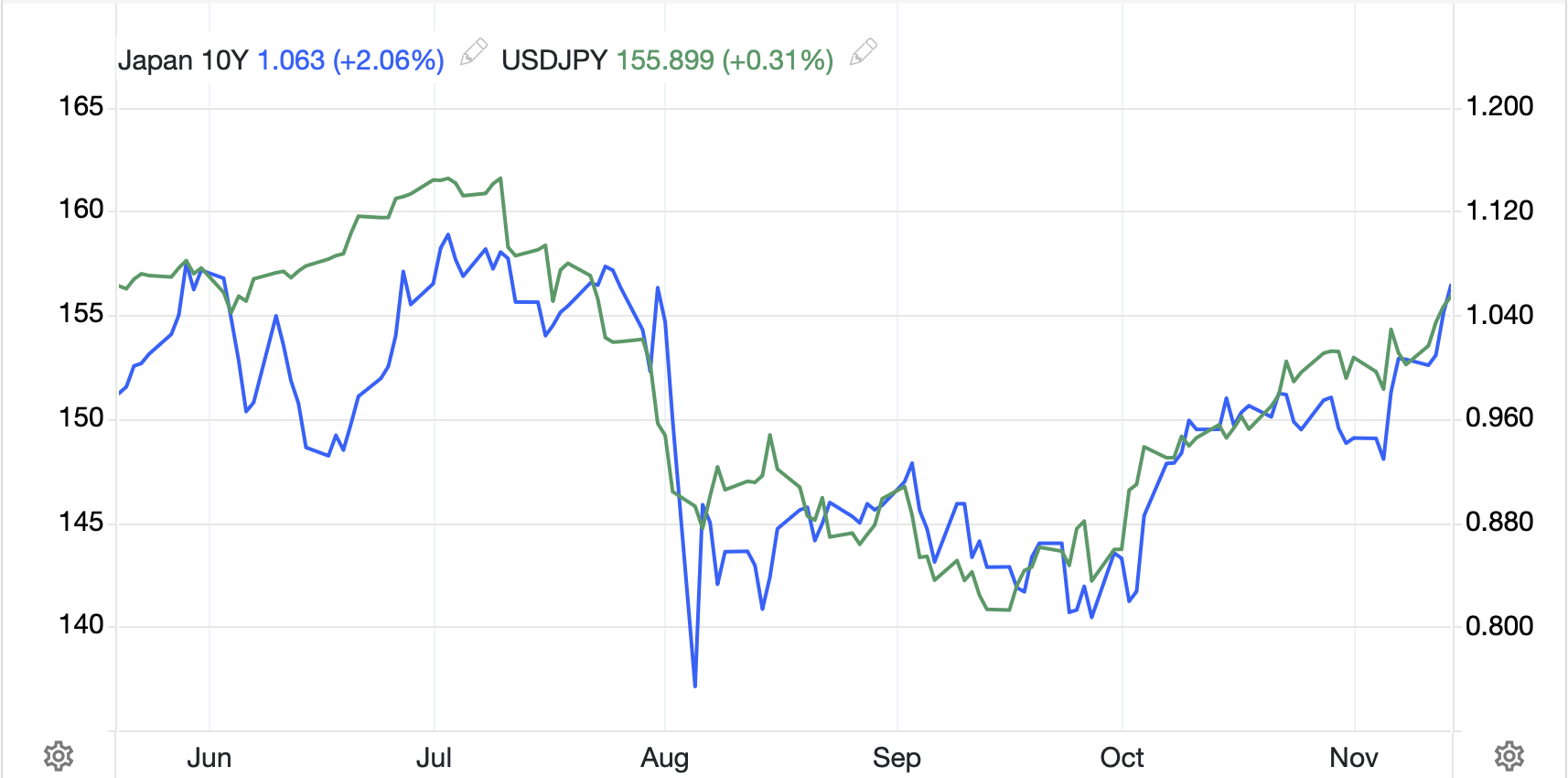
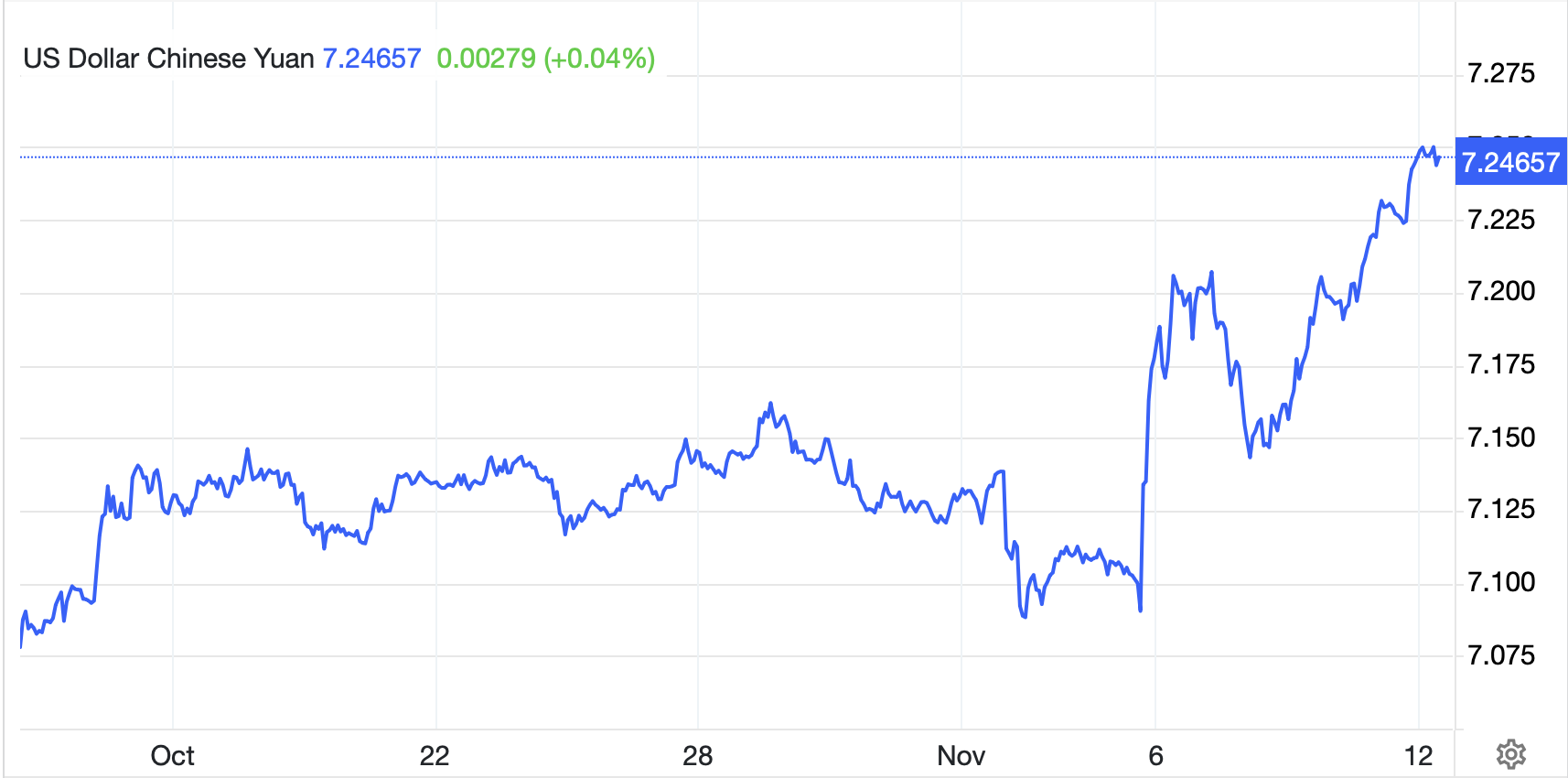
So, yesterday’s biggest mover was JPY (-2.1%), where the market responded to comments by new PM Ishiba that all his previous comments regarding policy normalization were not really serious (and you thought Kamala flip-flopped!)

Here are his comments in the wake of that massive 12% decline in the Nikkei back in early August:

“The Bank of Japan (BOJ) is on the right policy track to gradually align with a world with positive interest rates,” ruling party heavyweight Shigeru Ishiba told Reuters in an interview.

“The negative aspects of rate hikes, such as a stock market rout, have been the focus right now, but we must recognize their merits, as higher interest rates can lower costs of imports and make industry more competitive,” he said.

And here are his comments after meeting with BOJ Governor Ueda Wednesday morning in Tokyo:

“From the government’s standpoint, monetary policy must remain accommodative as a trend given current economic conditions.”

See if you can tell the difference.  The below chart includes the market response to his election last week as well as its response since uttering those last words early yesterday morning.

Source: tradingeconomics.com

Remember the idea that the carry trade was dead and completely unwound?  Well, now the talk is its coming back with a vengeance between Powell sounding less dovish, Ishiba sounding more dovish and then yesterday’s ADP Employment Report printing at a higher-than-expected 143K.  Maybe all those rate cuts that had been priced are not going to show up in traders’ Christmas stockings after all.  Certainly, the Nikkei (+2.0%) was pleased with the weaker yen which has fallen further this morning (-0.2%) after further comments from BOJ member Noguchi calling for more time to evaluate the situation before considering tighter policy.  In fairness, though, Noguchi-san is a known dove and voted against the rate hikes back in July.  Summing it all up here, it is hard to make a case currently for the yen to strengthen too much from here.  Rather, a test of 150 seems the next likely outcome.

In England, the Old Lady’s Guv
Explained that he’s really a dove
He’ll be more aggressive
Though not quite obsessive
While showing investors some love

The other big mover this morning is the British pound (-1.1%) which is responding to an interview BOE Governor Bailey had in The Guardian where he explained he could become “a bit more aggressive” in their policy easing stance provided inflation data continues to trend lower.  Now, prior to the interview, the OIS market was already pricing in a 25bp cut at the next meeting in November, and 45bps of cuts by year end, and it is not much changed now.  But for whatever reason, the FX market decided this was the news on which to sell pounds.  

Remember, as I’ve repeatedly explained, the dollar’s demise is likely to be far slower than dollar bears believe because now that the Fed has begun cutting rates, and nothing is going to stop them going forward for a while, other central banks will feel empowered to cut as well.  The only way the dollar falls sharply is if the Fed is the most dovish central bank of the bunch, but Monday, Chairman Powell made clear that was not the case.  In fact, yesterday, Richmond Fed president Barkin was the latest to explain that things look good, but they are in no hurry to cut aggressively.  Other central banks are now in a position to ease policy more aggressively, something many had been seeking to do as economic activity was slowing in their respective countries, without the fear of a currency collapse. 

It was just a few days ago that I highlighted key technical levels the market was focused on, which if broken might herald a much weaker dollar.  Across the board, we are more than 2% from those levels (EUR 1.12, GBP 1.35, DXY 100.00) and traveling swiftly in the other direction.  A quick peek at the chart below shows that while the exact timing of these moves was not synchronized, the outcome is the same.

Source: tradingeconomics.com

Moving beyond the FX market, where the dollar is stronger literally across the board, the economic story continues to muddle along.  Services PMI data was released this morning with most of Europe looking a bit better, although the Italians were lagging, but not enough to get people excited about European assets in general.  Equity markets on the continent are mixed with both the DAX (-0.6%) and CAC (-0.8%) under pressure while Spain’s IBEX (+0.1%) and the FTSE 100 (+0.25%) buck the trend on the back of Spain’s best in class PMI data and, of course, the UK rate cut frenzy.  As to last night’s Asian markets, while China remains closed, the Hang Seng (-1.5%) gave back some of yesterday’s gains and the rest of the region was unconvinced in either direction.  While US markets eked out the smallest of gains yesterday, futures this morning are pointing lower by -0.4% or so at this hour (6:45).

In the bond market, Treasury yields are higher by 3bps this morning, as the market absorbs the idea that the Fed may not be cutting in 50bp increments each meeting and traders responded to a much better than expected ADP Employment Report yesterday (143K, exp 120K) so are prepping for a good NFP number tomorrow. Meanwhile, European sovereign yields are all higher by between 5bps and 7bps as they catch up to yesterday’s Treasury move, much of which occurred after European markets were closed.  One thing to keep in mind here is that bond markets, at least 10-year and longer maturities, are far more concerned with the inflation outlook than the central bank discussion.  Right now, as the world awaits Israel’s response to the Iranian missile attack, concerns are rife that oil prices could move much higher and take inflation readings along for the ride.  If you add that to the idea that 3% is the new 2% for central bank inflation targets, something which is also gaining credence in the market, the case for higher bond yields is strong.

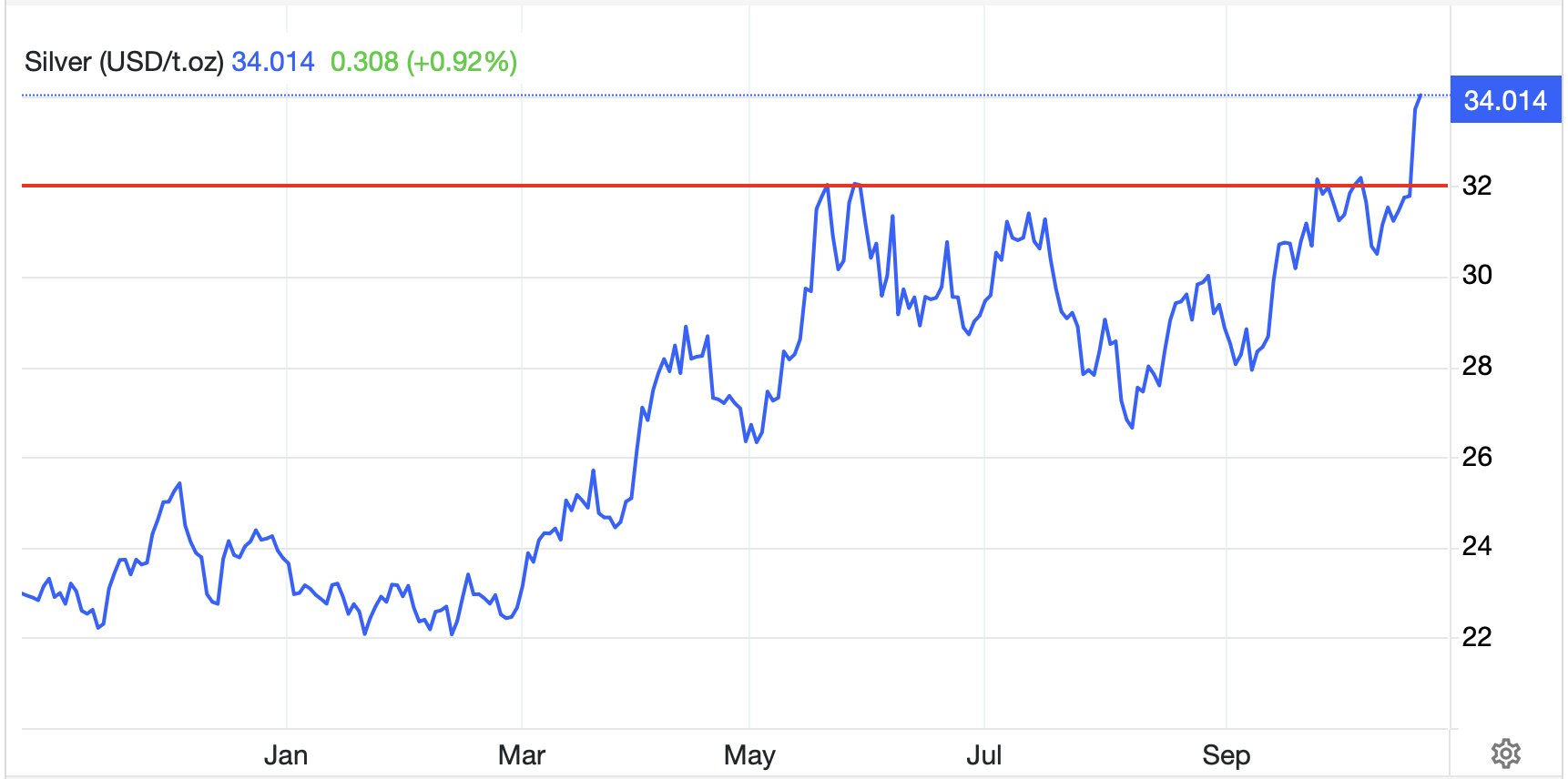
Speaking of oil markets, once again this morning the black sticky stuff is higher (+2.0%) amid those Middle East conflagration fears.  As I highlighted yesterday, if Israel were to attack Iran’s oil fields and knock a large portion offline, I would expect oil to get back to $100 in a hurry.  And if the damage was sufficient to keep it offline for many months, we could stay there.  However, the combination of the stronger dollar and higher oil prices has taken a toll on the metals markets with all the major metals weaker this morning (Au -0.5%, Ag -1.1%, Cu -1.5%).  This strikes me as a short-term phenomenon as the fundamental supply/demand issues remain in favor of higher prices and anything that drives inflation higher will help price as well.  But not today.

As to the dollar, I have already discussed its broad-based strength with gains against literally all its G10 and EMG counterparts.  It will take some pretty bad US data to change this story today.

Speaking of the data, as it’s Thursday, we get the weekly Initial (exp 220K) and Continuing (1837K) Claims data as well as ISM Services (51.7) and Factory Orders (0.0%).  Yesterday, in a surprise, EIA oil inventories rose, a welcome outcome, but not enough to offset the Middle East fears.  The only Fed speaker on the calendar today is Atlanta Fed president Bostic, one of the more hawkish members, so my guess is he is likely to continue to preach moderation in rate cuts.  Speaking of the Atlanta Fed, their GDPNow reading fell to 2.5% for Q3 after the weaker than expected construction spending the other day, but it remains above the Fed’s estimated long-term trend growth rate.

Putting it all together, I can see no good reason for the dollar to reverse this morning’s gains absent a Claims number above 250K.  The hyper dovishness that had been a critical part of the dollar decline story has been beaten back.  Of course, tomorrow brings the NFP report, so anything can still happen.  

Good luck

Adf

Deep-Rooted

We have now a president, Biden
Who lately, has taken much chidin’
Last night he debated
A man who he hated
Alas, polls against him did widen
 
The market response, though, was muted
With not many trades prosecuted
Instead, we await-a
The PCE data
To learn if inflation’s deep-rooted


While it was painful to watch, I did last through most of the debate.  Unfortunately, it didn’t help me sleep any better!  Clearly the top story around the Western world today is the performance of President Biden and the concerns it raised over his abilities to not merely execute the responsibilities of the President if he is re-elected, but to complete his current term.  There have been numerous calls by high profile Democratic strategists and pundits for him to step down from the ticket.  We shall see what happens, but my personal take is he will not willingly step aside regardless of the situation and that those closest to him will not force him to do so.

The upshot is that in the betting markets, Mr Trump is now a 60% favorite with Mr Biden at 22% and a host of other Democrats making up the difference, at least according to electionbettingodds.com.  Arguably, though, the question that most concerns all of us is how will this outcome impact markets going forward.  And remember, there is a very big election this weekend in France that is also going to have a major impact, not just in France, but in all of Europe.

Perhaps the most surprising thing to me is the non-plussed manner that markets have behaved in the wake of the debate.  Equity markets around the world have traded higher as have US futures.  Bond yields have traded modestly higher and so has oil, metals markets and the dollar.  Clearly, investors do not appear to be concerned that the leader of the free world is in such dire physical condition.  While I would not have expected a collapse, it doesn’t seem hard to foresee a chain of events that results in less positive economic outcomes.  

Or…perhaps the market has absorbed this outcome and determined that central banks, and especially the Fed, are going to be starting to err on the side of easy money to ensure that economies don’t fall into disarray, so all that rate cutting that has been discussed, hypothesized and, frankly, dreamed about may be coming sooner than the hawkish central bankers themselves had considered previously.  I understand that political events typically don’t have a big market response, but the depth and breadth of the damage that last night’s debate had on ideas about President Biden’s mental competence and acuity are stunningly large.  That cannot inspire confidence in investors.  

Of course, of far more importance to the market, obviously, is today’s PCE data release and the corresponding Personal Income and Spending figures.  So, let’s take a look at expectations there.

PCE0.0% (2.6% Y/Y)
Core PCE0.1% (2.6% Y/Y)
Personal Income0.4%
Personal Spending0.3%
Chicago PMI40.0
Michigan Final Sentiment65.8

Source: tradingeconomics.com

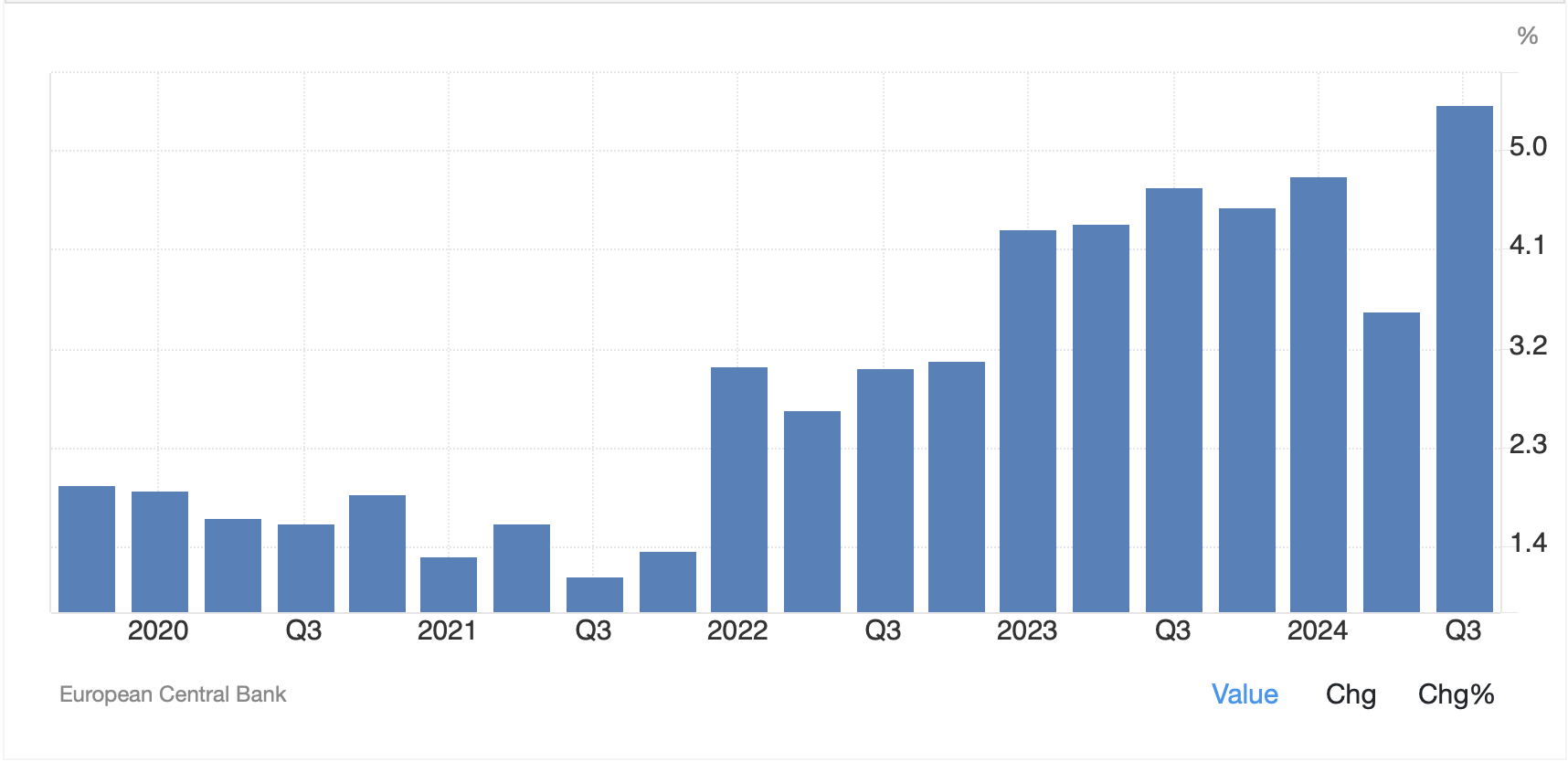
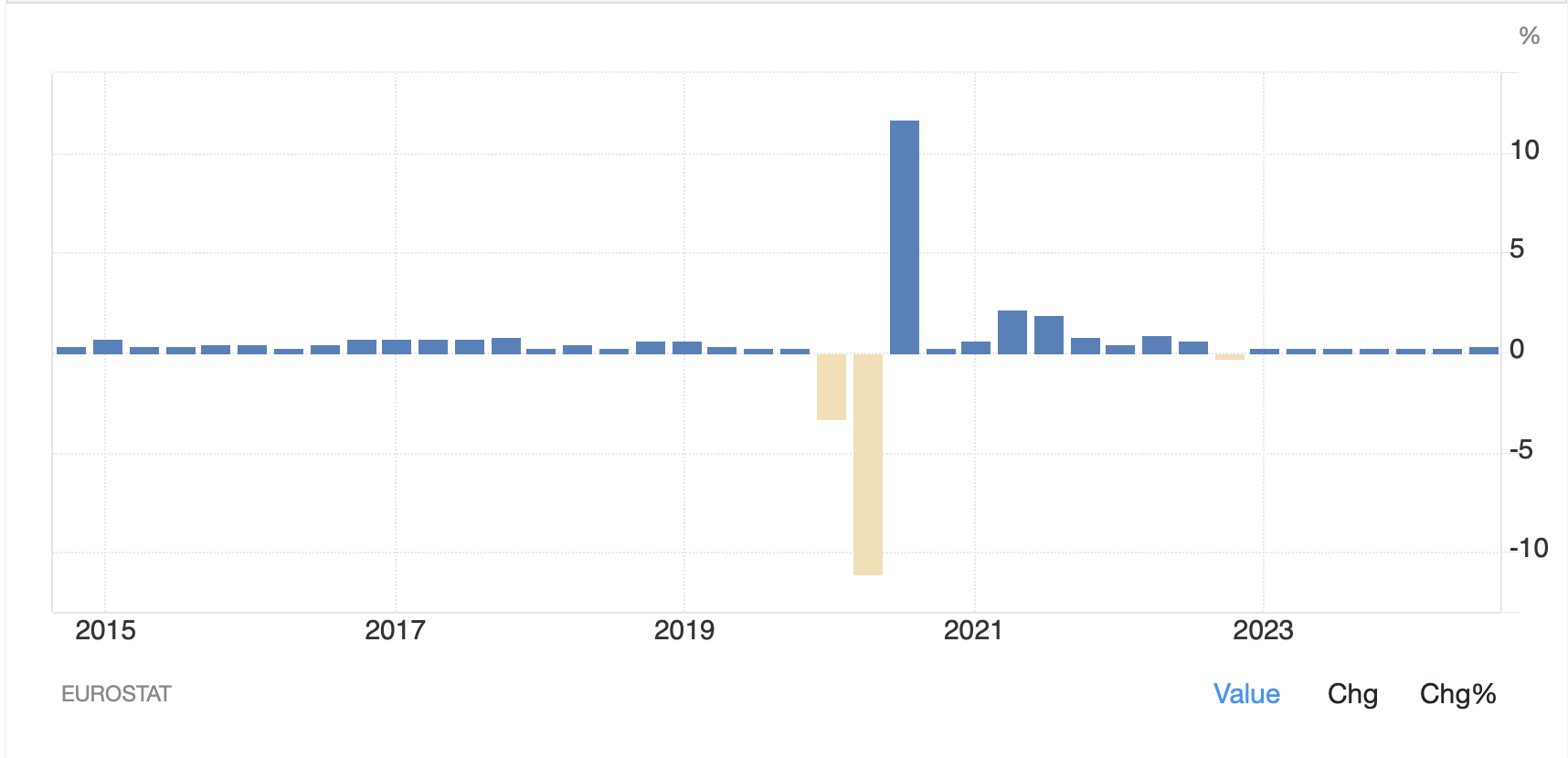
Of this grouping of data, the Core PCE reading is the most important as it represents the Fed’s North Star on inflation.  (While we all live in a CPI world, the Fed apparently found out that their models worked better with core PCE and so that became the benchmark.)  At any rate, forecasts are that prices, ex food & energy, did not rise in May.  That was not my lived experience, and I will wager not many of yours either, but we don’t really matter in this context.  However, the Bureau of Economic Analysis, when they are calculating GDP also calculate their own PCE figure for the quarter.  That was released yesterday with the Core PCE printing at 3.7% while GDP was raised to 1.4%.  In total, that implies nominal GDP was at 5.1% in Q1, a slight decline from Q4’s reading of 5.4%.  It should not be surprising that both these PCE measures track one another well, and as per the chart below, that seems to be the case.

Source: tradingeconomics.com

However, I cannot help but look at this chart and see that the blue line (the quarterly BEA data, RHS numbers) is not trending lower at all.  Perhaps it turns around, but perhaps the forecasts for this morning’s numbers are a bit too optimistic.  After all, we saw higher inflation in Canada and Australia this month.  As well, we have seen a continuation in the rise in the price of housing and energy.  None of those are perfect analogs for the PCE data this morning, but I sense that we may have found the lows in inflation.

Ahead of the data, as I discussed briefly above, markets are in fine fettle.  After a modestly positive session in the US yesterday, virtually every market in Asia was in the green as well, with the Nikkei (+0.6%) leading the way and smaller gains, on the order of 0.1% – 0.2% across the rest of the major markets in the region.  In Europe, the CAC (-0.3%) is bucking the trend as investors continue to leave the market ahead of the elections this weekend, but the rest of the bourses are all decently firmer, on the order of 0.35% – 0.55%.  I suppose the reason French investors are concerned is the possibility of a hung Parliament, where no party has a majority and therefore no new legislation will be able to be enacted under a caretaker government for at least a year.  Of course, there are also those who are concerned that a ‘cohabitation’ between President Macron and the RN might have trouble governing as well.  As to US markets, they continue to rally with futures higher across all three major indices this morning, roughly by 0.35%.

In the bond market, yields are higher across the board after they traded up yesterday as well.  This morning, Treasury yields are +2bps while European yields have risen between 3bps (Germany, Netherlands) and 9bps (Spain) with French and Italian yields 6bps higher.  This is the most straightforward explanation as investors demonstrate their concern with a further split between Germany and the rest of Europe regarding fiscal policies.  As to JGB’s they have slipped 2bps lower overnight, despite Tokyo CPI data printing a tick higher than expected at 2.3% headline, 2.1% core.

Oil prices (+0.75%) continue to rally as summer driving demand is now the story of the market despite the large inventory builds seen this week.  In a bit of a conundrum, metals markets are also firmer across the board despite the higher yields, although in the past hour or so, the dollar has reversed some of its earlier gains, so that is giving some support.  However, I suspect that these markets will be subject to a dislocation in the event that we see a surprising PCE report.

Finally, the dollar has edged a bit lower this morning with modest declines vs. the G10 bloc, on the order of 0.1% – 0.2%, and a few outliers vs. EMG currencies like ZAR (+1.4%) and KRW (+0.6%).  The won has benefitted from the upcoming increase in onshore trading hours as the country attempts to increase trading volumes and get more activity and more market participants to help the currency’s international standing.  As to the rand, it appears that the sharp rally today in the Johannesburg stock exchange has drawn in outside investors and supported the currency.

In addition to the data, we hear from both Governor Bowman, again, and SF Fed president Daly this afternoon.  Bowman has already explained, twice, that she would be amenable to raising rates if inflation rebounded, while you may recall Daly exhibited concern over the labor market and what to do if it deteriorates.  Well, labor is a discussion for next week when the NFP report is released.  Today is all about PCE.  My sense is it will be higher than forecast which will probably undermine equities to some extent and keep pressure on bonds while supporting the dollar.  In that situation, I see commodities suffering as well.

Good luck and good weekend

Adf

Concern ‘Bout the Fate

While waiting for Jay and the Fed
And CPI data on Wed
This week’s 3-year note
Was less than the GOAT
Though risk assets still moved ahead
 
But talk from some sources of late
Exhibit concern ‘bout the fate
Of how the US
Will deal with excess
Supply of bonds as they inflate


Since we observe market activities daily, though we remain subject to surprising outcomes (see Friday’s NFP results), there are more consistent features that offer a hint of how the mechanics of financial markets are working, and whether those mechanics are running smoothly or a bit creakier.

Arguably, the thing getting the most press is Nvidia’s stock price, as its continued rapid rise has resulted in the company now representing ~6.5% of the market capitalization of the S&P 500.  Along with Apple and Microsoft, all currently having market caps > $3 trillion, we are looking at three companies representing nearly 20% of the S&P 500.  This is unprecedented and many (including this poet) believe that it is unsustainable in the long run, and probably the medium run.

But another key market, arguably the most important when discussing the financial markets and the Fed, is the US Treasury market.  Countless hours are devoted to dissecting each tick and how movements in the yields of various maturity bonds may impact the economy and overall market sentiment.  With this in mind, when new securities are auctioned, it is always worth a look.  So, yesterday, the Treasury issued $53 billion of 3-year notes at a yield of 4.659%.  The underlying characteristics of this auction were not particularly encouraging for a Treasury that will be issuing 10-year and 30-year bonds as the week progresses, as well as another $trillion this year.  

The numbers that are most closely watched are the tail (the difference between the market estimate of the final yield prior to the auction and the actual results) which was at 1.1bps, a full basis point above the average tail of the past 6 months, an indication that demand was lacking.  As well, the bid to cover ratio (how many $ of bids were received vs. the $53 billion offered) fell to 2.43X, well below the average over the past 6-months of auctions.  Dealers were saddled with nearly 20% of the paper and overall, domestic demand was not very robust.

This gets highlighted because these little data points are often harbingers of bigger problems to come.  After all, if there is a dearth of demand for US Treasury paper, even short-dated paper like 3-year notes, that bodes quite ill for the US government, as well as for global financial markets.  Remember, US Treasury paper is the baseline for virtually all debt issuance around the world.  If it fails here, it will be GFC 2.0 or worse.

Why, you may ask, is this becoming an issue?  Well, one answer would be that the US’s current financial profligacy is starting to be discussed in quite negative terms at key institutions around the world.  For instance, the IMF’s managing director, Kristalina Georgieva, has expressed concern recently that the US is essentially hogging all the borrowing capacity around the world.  As well, Banque de France governor, Francois Villeroy de Galhau, explained, “U.S. fiscal policy is the elephant in the room: it is not in the hands of the Fed, and could significantly affect the level of long-term interest rates.  A large U.S. fiscal deficit tightens financial conditions and fuels inflation.”  

The point is that while Secretary Yellen, and Chair Powell, will not even discuss the potential ramifications of excess US government borrowing, it is being noticed in the halls of power elsewhere in the world, as well as on trading floors and in investment meetings at major asset managers.  This is not to say that anything dramatic is going to happen anytime soon, but death by a thousand cuts is still death.  Remember this, whatever the Fed’s mandate may say about price stability and maximum employment, I assure you, their number one priority, by miles and miles, is a smoothly working Treasury bond market.  A 1 basis point tail may not seem to be much, but like the little boy in Holland with his finger in the dike, it may foretell bigger problems to come.

The reason I can focus on minutiae like the details of a Treasury auction is that there is so little else ongoing from a macro perspective right now.  With US CPI to be released tomorrow and the FOMC meeting, statement and subsequent Powell press conference coming later tomorrow afternoon, most market participants are effectively holding their collective breath waiting for new information.

So, let’s review the overnight activity, which was not that exciting.  After modest gains in the US yesterday, Asia couldn’t seem to follow except for Japan (+0.25%) with most of the rest of the region selling off, notably the Hang Seng (-1.0%) and Australia (-1.3%).  European bourses, too, are under pressure across the board this morning with Spain (-1.4%) leading the way, but all the other large markets lower by at least -0.7%.  There is a rumor that French President Macron may resign if the RN wins the election at the end of the month and the first polling shows that Marine Le Pen’s group will win a plurality of votes, but not necessarily a working majority.  This will obviously be a major focus of markets going forward as regardless of who is in charge, it would be reasonable to expect many of the key issues that have driven this political shift (immigration, inflation, Ukraine) to become policies going forward.  As to US futures, at this hour (6:45) they are lower by about -0.25%.

In the bond market, the big news is really in Europe where the spread between German bunds and French OATs has widened by a further 8bps as concerns over the future government of France creep into investors’ minds.  Historically, Madame Le Pen has been quite anti-Europe so there seem to be some worries that if the RN wins an outright majority, there will be significant ructions in the European Union with France seeking more independence.  In the end, uncertainty breeds investor concern so I would not be surprised to see this spread widen further leading up to the election.  As to the Treasury market, yields have backed off 4bps this morning in what appears to be position inspired trading rather than being caused by new information.

Commodities, which had a very nice rebound yesterday with both energy and metals markets performing well, are back under pressure this morning with oil (-0.3%) and gold (-0.1%) the least impacted but the rest of the metals complex feeling the heat again.  However, NatGas continues its strong rally, up another 5% this morning and looking for all the world like it is going to continue rising until it tests the November 2023 highs of $3.80/MMBtu which is still $.75 higher.

Finally, the dollar continues to gain at the margins with the euro (-0.2%) slipping further on the French political news, although the pound is bucking the trend with a very modest rise.  The other currency that is having a good day is MXN (+0.8%) which continues its slow rebound from its post-election collapse last week.  Otherwise, EEMEA currencies are all under pressure as is the CNY (-0.1%).  Now, 0.1% may not seem like a lot, but the PBOC has been walking the value of the renminbi lower (dollar higher) ever so slightly every day for the past three months and the fix last night was at its highest level since January.  It appears clear that the pressure for a devaluation is strong in China and that the PBOC is working very hard to maintain a sense of stability.  My sense is this gradual weakness will continue for quite a while, at least until the Fed makes a change.

And that’s what we have today.  The NFIB Small Business Optimism Index was just released at 90.5, a bit firmer than forecast, but that is not a market-moving data point.  And there are no other data points to await today, nor any Fedspeak so the FX markets will take its cues from bonds and stocks.  Given that CPI and the Fed are both tomorrow, I anticipate another very quiet session overall in the US as investors (and algorithms) will want new news to drive their next trades.  Broadly, I think we are in a ‘good data is bad’ for risk assets as the mindset is it will delay any Fed rate cuts even further.  Of course, if Treasury auctions continue to see shrinking demand (today there is a 10-year auction for $39 billion) that will certainly have an impact on the bond market, the Fed’s response, and by extension risk assets and the dollar.  So, arguably, that auction is the biggest news of the day this afternoon.

Good luck

Adf

Crushed

On Friday, the NFP showed
That job growth has not really slowed
And wages were hot
So, pundits all thought
That ‘flation just might well explode
 
But under the NFP’s hood
Some things didn’t look quite so good
The joblessness rate
Itself did inflate
Though household jobs fell, understood?
 
Meanwhile across Europe the vote
For Parliament seems to denote
Incumbents were crushed
And governments flushed
While media seeks a scapegoat


Remember the narrative that had everyone feeling so good?  Inflation was drifting lower, albeit not in a straight line, but central bankers around the world were quite confident that their collective 2.0% targets were coming into view, and pretty soon at that.  This would lead to lower bond yields, continued strong performance in risk assets and slowing, but still solid economic activity.  In other words, many were invested in the Goldilocks thesis of a soft landing.  

Now, the data that we had seen last week seemed to indicate that was a viable process as the ADP Employment number was a touch soft, the JOLTS Job Openings number was definitely soft and although the ISM Services data was a lot stronger than anticipated, the ISM Manufacturing number was soft as well.  In addition, if we go back to the previous week, the Chicago PMI print was abysmal at 35.4.

This was all a prelude to Friday’s NFP data which confirmed confused everything.  While the headline number was much stronger than expected at 272K, the Unemployment Rate rose to 4.0% for the first time in more than two years, and Average Hourly Earnings rose 0.4% with an annual increase of 4.1%.  But even more confusing was the fact that looking at the Household survey, the survey that is used to calculate the Unemployment Rate, showed the number of jobs FELL by 408K while 250K people exited the workforce.  Now, if things were truly running smoothly, as the NFP number indicated, we would expect to see that household number of jobs rise, not fall.  Something is amiss.

Having read far too much about this over the weekend, it appears that the BLS data and its models are not a very accurate representation of the current reality, at least for the monthly data.  The BLS also produces a quarterly survey called the Quarterly Census of Employment and Wages (QCEW) which is a census of 11 odd million businesses in the US, rather than a survey of some 600k businesses for the NFP.  If one looks at the growing discrepancy between the number of jobs shown in that data vs. the NFP data, the NFP data has been rising far faster with the gap widening severely.   This can be seen in the below graph from the mishtalk.com website (from Mike Shedlock, an excellent economist/analyst).

The upshot is that while that headline NFP number has looked very good, there appears to be something else happening in the underlying data.  Early next year, the BLS will revise its NFP data, and you cannot be surprised if they reduce the readings significantly.  But revisions don’t have the same cachet as headlines, and so this is our current world. 

The market response was as you would expect; bonds got crushed with the entire yield curve jumping 15bps, the dollar rallied sharply, up nearly 1% on the DXY with several currencies falling farther than that (e.g., MXN -2.85%, NOK -1.5%, BRL -1.6%), and equity markets falling although not nearly as much as you might expect, only about -0.15% on average across the big indices.  But the notable moves were in commodities with gold (-2.2%), silver (-3.9%) and copper (-3.0%) just in the wake of the NFP data, with larger declines overall on the day.  Energy was the only space that held in on the day, but of course, it has been under pressure for several weeks.

What’s next?  Well, this week brings a great deal of new information including CPI, PPI, the FOMC Meeting and the BOJ meeting.  My take is many traders are licking their wounds right now, so given today’s calendar is quite benign, I imagine things will be a bit choppy as positions get adjusted, but direction will be hard to discern.  Except…

The European Parliament elections were held starting last Thursday but running through Sunday, with all 27 nations in the EU voting for their parliamentary representatives.  The story is, as you will clearly have heard by now, that the left wing, center-left and centrist parties got decimated while everyone on the right side of the aisle massively outperformed.  The Belgian PM resigned and there will be elections there.  French President Macron dissolved parliament for a snap election as his party won just 15% of the vote while Marine Le Pen, the conservative candidate leading the National Rally, won more than 31% of the votes.  As well, German Chancellor Olaf Sholz has been decimated as have the Green parties across the continent.  Times, they are a-changin’.  It is no surprise that the euro continues to falter after Friday’s declines as the European part of the equation just added to the woes from the US implication of higher interest rates.

What will these elections mean for markets?  The clearest message that I see is that the climate agenda is likely to be altered such that demand for oil and gas may well increase.  Do not be surprised to see more European nations abandon the Net Zero concept, at least reaching it by 2050.  Ironically, while the first move was seen as a negative for the euro, this may well be a harbinger of future euro strength if the Eurozone economies waste less money on impossible dreams and spend more on actual economic activity that generates benefits and income for its citizens without government subsidies.  But that will take a bit more time.

Perhaps the most important thing is that this election may well be a harbinger of the US election in November as the European people have clearly rejected the current themes and are looking for a change.  Far left Green policies that have been promulgated by the Biden administration have found no favor in Europe and certainly the current polling indicates it is equally unpopular in the US.

OK, a quick tour of the overnight session shows that Japanese equity markets performed well after GDP data there last night showed a less negative outcome in Q1 than originally reported, while most of the rest of Asia was closed for various holidays.  European bourses, however, are under pressure across the board led by France (-2.2%) although most of the rest of the continent has seen declines on the order of -1.0%.  As to the US futures markets, at this hour (6:15), they are lower by -0.3%.

Bond yields continue to climb with Treasuries up another 2bps and European sovereigns rising between 2bps (Germany) and 8bps (France and Italy) as the combination of higher US yields and some concerns over the future direction in Europe have come to the fore.  Overnight, JGB yields also jumped 7bps and are back above 1.00%, with the Japanese data and US data the drivers.  The BOJ meets Friday this week, so there is much speculation as to the outcome, although a rate hike is not forecast.

In the commodity markets, after Friday’s rout in the metals space, the big ones are all firmer this morning, although this looks like a trading bounce rather than a change of views.  Oil markets are little changed this morning, trading at the lower end of their recent ranges but NatGas, something I haven’t discussed in a while, is rallying again.  It is higher by 3% this morning and 26% in the past month, rising to $3.00/MMBtu, its highest price since November and double the lows seen in March.  Consider that if there is continued pushback against the Green agenda, as evidenced by the European elections, demand for NatGas is likely to grow quite strongly.

Finally, the dollar is continuing to gain strength this morning, with the euro down -0.6% following Friday’s declines and the EEMEA currencies all falling more than that.  Given the holidays in Asia, there was limited trading in the onshore markets there, and other than MXN, which is unchanged this morning, the rest of LATAM hasn’t opened yet.  However, remember that the peso has fallen 10% in the past week, so there is likely going to be some more movement in that space going forward.  Markets typically don’t dislocate by 10% and then just stop.

As if last week didn’t bring enough surprises between the NFP and election results in India, Mexico and Europe, this week we have a lot more to look for, although today is a blank slate.

TuesdayNFIB Small Biz Optimism89.8
WednesdayCPI0.1% (3.4% Y/Y)
 -ex food & energy0.3% (3.5% Y/Y)
 FOMC Rate Decision5.5% (unchanged)
ThursdayInitial Claims224K
 Continuing Claims1800K
 PPI0.1% (2.5% Y/Y)
 -ex food & energy0.3% (2.5% Y/Y)
FridayBOJ Rate Decision0.10% (unchanged)
 Michigan Sentiment72.0
Source: tradingeconomics.com

As this is a quarterly meeting of the FOMC, we will get new projections and a new dot plot, and of course, Chairman Powell will be speaking afterwards.  As of now, the market is pricing about a 50:50 chance of the first cut coming in September and a total of one and one-half cuts for the rest of the year.  It remains very difficult to discern what is really happening in the economy with all the conflicting data.  However, whatever the growth stories, nothing has indicated that inflation is going to decline very far.  I maintain the Fed is going to be higher for longer for even longer.  It continues to be difficult to see the benefits of many other currencies, although I would not be surprised to see MXN regain much of its lost ground as I doubt Banxico will be easing policy anytime soon, and president-elect Sheinbaum is not going to change things there that much and doesn’t take office until October.

Good luck

Adf

Not Well Understood

The ISM data was weak
And traders, more bonds, did soon seek
The oil price fell
The dollar, as well
But stocks ended close to their peak
 
So, is now bad news really good?
‘Cause Jay will cut rates, or he should
Or is it the case
That growth’s slowing pace
Means risk is not well understood


The narrative had a little hiccup yesterday as the ISM data was released far weaker than expected.  The headline number, 48.7, fell vs. last month and was a full point below market expectations.  The real problem was that while the Employment sub-index was solid, New Orders tanked, and Prices remained high.  If you add this to the Chicago PMI data from Friday, which at 35.4, was the lowest print since the pandemic in May 2020 and back at levels seen in the recessions of 2001 and 2008, it is fair to question just how strong the US economy is right now.

Adding to this gloom is the news that the Atlanta Fed’s GDPNow estimate slipped to 1.8% for Q2, down from 2.7% last Friday, and the trend, as per the below chart, is not very pretty.

Given the data, it can be no surprise that the Treasury market rallied sharply, with yields declining 8 basis points on the session, although they are little changed this morning.  After all, if the economy is slowing, the theory is that inflationary pressures will decline, and the Fed will be able to cut rates sooner rather than later.   And maybe that is true.  But when we last heard from the FOMC membership, most were pretty convinced they needed to see more proof that inflation was actually lower, rather than simply that slowing growth should help their cause.  And I might argue that a weak ISM print, especially with the prices portion remaining high, is hardly the proof they require.

But yesterday’s markets were a bit confusing overall.  While the initial response to the weak data led to immediate selling across all equity markets, by the end of the day, those losses were reversed such that the NASDAQ had a fine day, rising 0.5%.  Ask yourself the question, why would stocks rebound despite further evidence that the economy is slowing down.  The obvious answer is that a slower economy will lead to slowing inflation and allow the Fed to reduce interest rates before long.  Of course, the flip side of that story is that a slower economy implies companies will lose pricing power as demand slides, thus reducing available profit margins and overall profits.  It seems hard to believe that stock prices will rally amid declining earnings, although these days, anything is possible.

While the Fed’s quiet period has many advantages (in truth I wish the entire time between meetings was the quiet period) one of its key attributes is that the narrative can run wild in whatever direction it likes.  As we will be receiving quite a bit of data this week, I suspect the narrative will have a few more twists and turns yet to come, although there is no question that the bulls remain in control of the conversation.  

One other thing to keep in mind about that ISM data is that while the US data was weak, the PMI data elsewhere in the world indicated that the worst had been seen elsewhere.  While it is not full speed ahead yet in Europe or the UK or China, the trend is far better than in the US.  Remember, a key part of the narrative is that the US is the ‘cleanest shirt in the dirty laundry’ and so funds continue to flow into US equities and the dollar by extension supporting both.  But what if other nations are starting to see an uptick in their growth stories while the US is starting to slide a bit?  Perhaps the non-stop bullishness for the NASDAQ will find a limit after all.  Perhaps another way to consider this is to look at the Citi Economic Surprise Index, which is designed to compare actual data releases with the forecasts before the release.  As such, a high number shows better than expected data and vice versa.  As you can see from the below chart, the trend here is lower.

Source: macrovar.com

One interesting aspect of this chart is that you can see during Q1, when the equity markets rallied and bullishness was rife, this index was rallying as well.  But remember what we learned last week regarding Q1’s GDP, it was revised lower to just 1.3% annualized.  So, if better than expected data still led to weak growth, what will declining data do?  

In the end, at least in my view, the economy is struggling overall, although not collapsing.  If I am correct, then it leads to several potential, if not likely, outcomes.  While the Fed has continuously claimed they remain focused on inflation, if growth starts to decline more sharply, and unemployment starts to rise more rapidly, they will cut rates regardless of CPI or PCE, and they may well end QT if not start QE again.  The clear loser here will be the dollar.  Equity markets are likely to initially react to the rate cuts and rise, but if earnings suffer, I think that will reverse.  Bond markets, too, will rally initially, but if inflation rebounds, which seems highly likely if the Fed eases policy, I don’t think the long end of the yield curve will be very happy, and we could easily see 5.0% or higher in 10-year yields.  Finally, commodities will see a lot of love and rally across the board.

Ok, let’s look at what happened overnight, as other markets responded to the surprisingly weak US data.  Asia wound up mixed, similar to the US indices, as Japan (-0.25%) slipped while China (+0.75%) rallied along with Hong Kong (+0.25%).  But the big mover overnight was India (-5.75
%) which fell sharply as the election results there indicated that PM Narendra Modi, while winning a third term, saw a decline in his support that left him somewhat weakened.  The rupee (-0.5%) also slipped, although nothing like what we saw yesterday in Mexico.  As to the rest of the region, we saw winners (Indonesia, Malaysia) and laggards (Taiwan, Korea, Australia) so no real trend.  In Europe, this morning, there is a trend, and it is all red, with losses ranging from -0.4% in the UK to -1.1% in Spain.  The only data here was employment in both Spain and Germany, and while both numbers were a touch soft, neither seemed dramatic.  And, as I type (8:00), US futures are all lower by -0.3%.

In the bond markets, yesterday’s Treasury rally was mimicked by European sovereigns, with yields there falling as well, albeit not quite as much as in the US.  This morning, the European market is extremely quiet, with yields +/-1bp from yesterday’s closes.  However, overnight, we did see Asian government bond yields fall, with JGB’s -3bps and greater declines elsewhere in the space.

Oil prices (-1.85%) are under severe pressure this morning, following on yesterday’s $3/bbl decline, falling another $1.50/bbl.  It seems the combination of the weak ISM data and the OPEC+ discussion of an eventual return of more production to market next year was enough to convince a lot of long positioning to throw in the towel.  As is its wont, the oil market can move very sharply and overshoot in either direction.  It feels to me this could be one of those cases.  But commodity prices are getting killed everywhere this morning as although metals held up well yesterday, this morning we are seeing blood in the water.  Both precious (Au -0.9%, AG -3.4% and back below $30/oz) and industrial (Cu -2.3%, Al -0.5%) are falling as slowing growth and the belief that it will reduce inflationary pressures is today’s story.

Finally, the dollar, which sold off sharply yesterday in the wake of the ISM data, is bouncing a bit this morning, at least against most of its counterparts.  While most of the G10 is softer, led by NOK (-1.2%), the outlier is JPY (+0.85%) which is suddenly behaving like a safe haven amid troubled times.  I think that the increased uncertainty amid Japanese investors as to the state of the global economy may have them bringing home their funds, especially now that 10yr JGB yields are above 1.0% with no hedging costs.  As to the EMG bloc, MXN (-1.7%) remains under severe pressure but today they are not alone with all EEMEA currencies and other LATAM currencies declining as well.

The two data points this morning are the JOLTS Jobs Openings (exp 8.34M) and Factory Orders (0.6%), both released at 10:00.  Obviously, there is no Fedspeak, so I expect that equities will be the driver, and if fear starts to grow, we could get an old-fashioned risk off day with stocks falling, bonds rallying and the dollar gaining as well.

Good luck

Adf

Adrift

Investors are biding their time
As Fedspeak continues to rhyme
It’s higher for longer
As long as growth’s stronger
Defining today’s paradigm

So, how might the narrative shift?
Are Jay and the Fed just adrift?
Next week’s CPI
If it prints too high
Might well, for the bears, be a gift

As promised on Monday, this week remains quite innocuous in terms of both market information and market movement.  There have been precious few pieces of news that have worked to alter the current situation.  The Fed speakers we have heard, when they discussed monetary policy, seem to be reading from the same text.  It can be boiled down to, the policy rate will remain at current levels until such time that something changes with respect to inflation or employment.  We will not rule out a hike, (despite the fact that Powell apparently did so last week) but are nowhere near ready to cut given the current inflation status.

With this in mind, it should be no surprise that markets remain extremely quiet.  After all, how can one change a view if nothing has changed?  So, the US story is pretty well understood for now and until CPI is released next Wednesday, I see no reason for any major movement in either equities or bonds here, and by extension elsewhere in the world.

Moving on from the US, Ueda-san continues to hint that the BOJ may do something, but last night’s Summary of Opinions from the BOJ (effectively their Minutes) almost implied, if you squint hard enough, that they could do it sometime soonish.  Clearly there is a bit of concern over the yen (-0.35%) which continues to drift back toward the levels seen when they intervened.  However, the very fact that just a week after they were aggressively selling dollars, it has pushed back to 156.00 tells you that absent a policy move, nothing is going to change.

As an aside here, this is quite important for the global economy, and certainly global markets.  Ultimately, Japanese monetary policy has been the driver of a huge amount of global liquidity flowing into asset markets around the world.  My understanding is that Japanese households also have somewhere on the order of $7 trillion in cash available to invest still at home, which historically was never a concern there given the complete absence of inflation in the country.  But now that inflation is rising there, and yields remain so paltry compared to elsewhere in the world, especially the US, if even a portion of that starts to flow more rapidly out of Japan, it will have an enormous impact everywhere.  On the flipside, Japan is also the largest international investor around, as a nation, and if the BOJ does allow rates to rise and that capital flows back home, that too would be a dramatic shift in global markets.  Ultimately, this is the reason we all care so much about what the BOJ does…it impacts us all.

The only other thing of note today is the BOE meeting where no change is expected in policy, but all will be searching for clues as to when they will cut rates.  The last vote was 8-1 to remain on hold with the lone holdout seeking a cut.  While expectations are for that to continue today, there is some discussion that a second dove may raise their hand for a cut.  It is widely accepted that cuts are the next move, and the real question is will they be following the ECB and cutting in June or wait until August.  FWIW, I expect a June cut by pretty much all the central banks other than the Fed (and of course the BOJ).  Economic activity is bumping along at effectively stagnation levels elsewhere in the G10 and inflation has been consistently softening everywhere except in the US.  While CPI is still higher than all their targets, central banks are desperate to get back to cutting rates and so will move with alacrity once they get started.

And that’s really all we have today.  Yesterday’s lackluster US session was followed up with a mixed bag in Asian equity markets (Nikkei -0.35%, Hang Seng +1.2%, CSI 300 +0.95%) and we are seeing a similar mixed picture in Europe with gainers (Germany, Switzerland) and laggards (Spain, Italy) while the rest are basically unchanged on the day.  However, at this hour (7:00), US futures are pointing a bit lower, down -0.3% across the board.

In the bond market, yesterday’s 10-year Treasury auction was met with mediocre demand and this morning yields are higher by 2bps.  There continues to be a great deal of discussion as to whether 10-year yields are going to head back above 5.0%, where they briefly touched last October as inflation reignites fears, or whether the oft mooted recession will finally arrive, and yields will tumble as the Fed cuts.  While my take is the former is more likely, at this point, there is no conclusive evidence for either view.  It should be no surprise, however, that European sovereign yields are also higher this morning, on the order of 3bps to 4bps, as they track Treasury yields closely.  Perhaps more surprising is that JGB yields rose 3bps overnight, and are now 0.91%, once again tracking toward their highs seen in October.  Clearly, there is a growing belief that the BOJ is going to do something sooner rather than later, but I will believe it when I see it.  Of course, if they do alter policy, that will change my views on many things.

In the commodity markets, oil (+0.85%) is rising again this morning and just about touching $80/bbl again. While some will say this is being driven by the Israeli incursion into Rafah, my take is this is simply the ebb and flow of a market that is in a trading range.  Since the summer of 2022, WTI has traded between $70/bbl and $90/bbl and I believe we will need to see some major changes in the situation for that to change.  Do not be surprised to see the Biden administration tap the SPR again in the lead up to the election in an effort to depress gasoline prices.  And do not be surprised to see OPEC+ cut production further if they do.  Consider this, though, if Trump is elected, there will be a major reversal in US energy policy and ‘drill baby drill’ will be back in vogue.  I suspect energy prices may decline then.

Turning to the metals markets, after a soft session yesterday, we are seeing a modest rebound led by silver (+1.3%) with gold, copper and aluminum all barely creeping higher by 0.1% or 0.2%.

Finally, the dollar cannot be held back.  As Treasury yields edge higher, the dollar is following and this morning is firmer against most of its counterparts, albeit not dramatically so.  Aside from the yen’s ongoing weakness, the pound (-0.3%) is not responding favorably to the fact that the BOE left rates on hold, and as I suspected, hinted at cuts to come with the vote coming out 7-2 as I proposed above.  Otherwise, most movement is extremely modest with one outlier, ZAR (+0.3%) rallying on the back of the metals rebound.

On the data front, this morning we see Initial (exp 210K) and Continuing (1790K) Claims and that is all she wrote.  We don’t even have any Fed speakers today, so it is shaping up as another very quiet session.  The big picture remains the same so until the Fed turns dovish, the dollar should hold its own.

Good luck
Adf

Towards the Stars

As the yen declines
Pressure on the BOJ
Climbs up towards the stars


Intervention in the currency markets has a long and undistinguished history.  At least that is true for nations that have open capital accounts.  In fact, a key reason that countries impose and maintain capital account restrictions is to avoid the situation of having their currency collapse when the locals fear future loss of purchasing power, i.e. inflation is rising. While there have been situations where a central bank has been able to prevent a significant movement in the past, it has almost always been in an effort to prevent too much currency strength, never weakness.  

A great example is Switzerland in January 2015.  As you can see from the chart below of the EURCHF cross, Switzerland was explicitly targeting a level, 1.20, in the cross as the strongest the Swiss franc could trade (lower numbers indicate a stronger CHF).  This was in an effort to support the export sectors of the economy during a period shortly after the Eurozone crisis when Europeans were quite keen to convert their funds to Swiss francs as a more effective store of value.  

Source: tradingeconommics.com

The upshot was that the Swiss National Bank wound up effectively printing and selling hundreds of billions of francs, receiving dollars and euros and then investing those proceeds into the US stock market.  At one point, they were the largest shareholder in Apple!  But even in this case, where you would expect a nation could prevent their currency from rising too far or too fast, the process overwhelmed the SNB and one day in January 2015 they simply said, enough.  That 25% appreciation in the franc took about 15 minutes to accomplish and as evidenced by today’s exchange rate of 0.9768, it has never been unwound.

And that’s what happened to a central bank that is trying to prevent its own currency from strengthening.  For central banks to prevent weakness is an entirely different story and a MUCH harder task.  As I have repeatedly explained, the only way to change the trajectory of a currency is to alter monetary policy.  At this time, given the Fed’s commitment to higher for even longer, the only way Japan can prevent more substantial yen weakness is for the BOJ to tighten policy even further.  This is made evident in the below chart of the price action in USDJPY for the past month.  In it, you can see when it spiked above 160 on April 28th, and the subsequent intervention that day and then two days later.  

Source: tradingeconomics.com

However, in both cases, despite spending upwards of $60 billion intervening, the yen immediately resumed its downtrend (dollar uptrend) and this morning it is back above 155.  It is this price action that appears to have finally awoken Ueda-san as last night, in an appearance at the Japanese parliament, he explained the following, “Foreign exchange rates make a significant impact on the economy and inflation.  Depending on those moves, a monetary policy response might be needed.”  Ya think!  Ueda-san was followed in parliament by FinMin Suzuki who repeated something he said last week, “Since Japan relies on overseas markets for food and energy, and a large portion of its transactions are denominated in dollars, a weaker yen could raise prices of imported goods.”  While those comments are self-evident, the fact that he needed to repeat them is indicative of the idea that Japan is getting increasingly uncomfortable with the current yen exchange rate.

So, will Ueda-san raise rates at the next meeting in June?  Will he alter their QQE policy and explicitly explain they will no longer be buying JGBs?  Certainly, the market is on edge right now given the two bouts of intervention from last week, but not so on edge that it isn’t continuing to sell the currency and capture the carry.  At this point, you cannot rule out a third wave of intervention, and certainly we should expect more jawboning.  But in the end, if they are serious about the yen being too weak, Ueda-san will have to move.  At this point, I am not convinced, but the meeting is on June 14th, so there is plenty of time for things to become clearer.

And other than that, quite frankly, not much is going on.  So, let’s take a tour of markets to see how things stand this morning.

Yesterday’s equity markets in the US were tantamount to being unchanged across the board, at least that is true of the major indices.  There were certainly individual equities that moved.  In Asia, it was a mixed picture with both Japanese (Nikkei -1.6%) and Chinese (CSI 300 -0.8%) shares in the red, which dragged down HK shares.  But elsewhere in the region, we saw more gains than losses, albeit none of the movement was that large overall.  Meanwhile, in Europe, all the markets are looking robust this morning with gains ranging from 0.5% (DAX, FTSE 100) to 1.0% (CAC) and everywhere in between.  The Swedish Riksbank cut rates by 25bps, as anticipated this morning, and perhaps that has encouraged investors to believe the ECB is going to embark on a more significant easing campaign starting next month.  Certainly, the limited data we saw this morning, (German IP -0.4%, Spanish IP -1.2%, Italian Retail Sales 0.0%) are not indicative of an economy that is growing strongly.  Finally, US futures are just a touch lower, -0.2%, at this hour (7:15).

Despite the weakness in Eurozone data, and the absence of US data, yields are rebounding a bit this morning with Treasuries higher by 3bps and the entire European sovereign spectrum seeing yields rise by 3bps to 4bps.  It seems unlikely that the weak Eurozone data is the driver and I suspect that this movement is more a trading reaction based on the recent decline in yields.  After all, just one week ago, yields were more than 20 basis points higher, so a little rebound can be no surprise.

In the commodity markets, oil (-1.1%) is under pressure as rising inventories outweigh ongoing concerns over Israel’s Rafah initiative.  While the EIA data is generally considered the most important, yesterday’s API data showed a build of more than 500K barrels vs. expectations of a 1.4M barrel draw.  At the end of the day, this is still a supply/demand driven price, and if supply is more ample, prices will fall.  In the metals markets, precious metals continue to trade choppily around recent levels, but we are starting to see some weakness in the industrial space with both copper (-1.25%) and aluminum (-1.6%) under pressure this morning.  Certainly, if economic activity is starting to wane, these metals are likely to suffer.

Finally, in the FX markets, the dollar is continuing to rebound from its recent selloff, gaining against virtually all its counterparts, both EMG and G10.  SEK (-0.5%) is the biggest mover in the G10 after the rate cut, but JPY (-0.45%) is not far behind.  We are also seeing weakness in AUD (-0.4%) on the back of those metal declines.  As to the EMG bloc, ZAR (-0.7%) is the laggard there, also on the metals weakness, but we saw KRW (-0.5%) suffer overnight as well amidst the general dollar strength.

Once again, there is no US data on the calendar although we hear from three more Fed speakers, Boston’s Collins as well as governor’s Cook and Jefferson.  Yesterday, Mr Kashkari did not give us any new information, indicating that higher for longer still makes the most sense and even questioning the level of the neutral rate, implying it may be higher than previously thought.  But there have been no cracks in the current story that the Fed is not going to alter policy soon.

While day-to-day movements remain subject to many vagaries, the reality is that the trend in the dollar has been higher all year and as long as monetary policies around the world remain as currently priced, with the Fed the most hawkish of all, the dollar should grind higher over time.

Good luck

Adf

Yellen’s Lifeblood

The QRA was quite the dud
Though mentioned, in Q3 a flood
Of new bonds are coming
To keep the gov humming
As debt is Ms Yellen’s lifeblood
 
So, now all eyes turn to the Fed
With doves looking on with much dread
According to Nick
Chair Powell will stick
With Higher for Longer ahead


Below is the actual QRA release from the Treasury which I thought would be useful to help everyone understand how benign the statement seems, although it has great importance.  

WASHINGTON – The U.S. Department of the Treasury today announced its current estimates of privately-held net marketable borrowing[1] for the April – June 2024 and July – September 2024 quarters. 

  • During the April – June 2024 quarter, Treasury expects to borrow $243 billion in privately-held  net marketable debt, assuming an end-of-June cash balance of $750 billion.[2]  The borrowing estimate is $41 billion higher than announced in January 2024, largely due to lower cash receipts, partially offset by a higher beginning of quarter cash balance.[3]
  • During the July – September 2024 quarter, Treasury expects to borrow $847 billion in privately-held net marketable debt, assuming an end-of-September cash balance of $850 billion.

During the January – March 2024 quarter, Treasury borrowed $748 billion in privately-held net marketable debt and ended the quarter with a cash balance of $775 billion.  In January 2024, Treasury estimated borrowing of $760 billion and assumed an end-of-March cash balance of $750 billion.  Privately-held net marketable borrowing was $12 billion lower largely because higher cash receipts and lower outlays were partially offset by a $25 billion higher ending cash balance.  

Additional financing details relating to Treasury’s Quarterly Refunding will be released at 8:30 a.m. on Wednesday, May 1, 2024.

The market response was muted, at best, as bonds barely budged throughout the day.  Clearly, the surprise that we received back in October was not part of today’s message.  Two things I would note are first, Q3 borrowing is a huge number, $847 billion expected, although it seems to have been largely ignored; and second, the action really comes tomorrow when Yellen will describe the mix of coupons and T-bills that she plans to issue this quarter.  However, given the Q2 numbers are so much smaller than either Q1 or Q3, while there may be some signaling effect, the actual impact on the fixed income markets seems likely to be muted.

Which takes us to the FOMC meeting that begins this morning and will conclude tomorrow at 2:00pm with the statement and then Chairman Powell will hold his press conference at 2:30.  But I have a funny feeling we already know what is going to happen as this morning’s WSJ had an article from the Fed whisperer, Nick Timiraos, explaining that higher for longer was still the play and that while there was no cause yet to consider rate hikes, the recent inflation data has done nothing to convince the Chairman that cuts are due anytime soon.  Now, this seems obvious to those of us paying attention given that the data continues to show a far more robust economy than many had anticipated, and more importantly, there has not been any type of inflation related print that indicated price pressures are abating very quickly.  Of course, one never knows what will happen at the presser, but it seems highly unlikely that the committee is in the mood to cut rates.

On this subject, if there is a move toward the dovish side, either with the statement or things Powell says in the press conference, I would take those very seriously as that would imply the Fed is no longer worried about inflation, per se, but more about doing what they perceive will benefit the current administration.  That would be hugely negative, in my view, for both the dollar and the bond market, although stocks and commodities would likely benefit greatly.  Ironically, it is not clear to me that cutting rates is going to be any help to President Biden as it is not going to change mortgage rates very much, and certainly not going to reduce credit card rates, so all it is likely to do is feed more inflation.  But one of the underlying narratives seems to be that a rate cut helps Biden’s election chances.  

Ok, with the Treasury and Fed out of the way, let’s look at overnight price action.  After modest gains in the US yesterday, most Asian equity markets performed well, although mainland Chinese shares were under some pressure (CSI 300 -0.5%).  This is interesting given the stories that the Chinese government is considering stepping up its support for the economy there with more borrowing at the national and local levels (total of ~$680B) to support overall activity as well as the property market.  I would have thought that was a positive, but I would have been wrong.  In Europe, preliminary GDP data showed that the economy across the major nations was not quite as bad as last quarter, but certainly not showing much strength.  Perhaps we are bottoming, but there is no V-shaped rebound coming.  Ultimately, equity markets on the continent are all lower as a result, with losses ranging from tiny (CAC -0.1%) to larger (IBEX -1.3%).  As to US futures, they are essentially unchanged this morning.

Meanwhile, bond yields are edging higher this morning with Treasuries (+1bp) just barely so, but all of Europe seeing yields rise by 3bps.  Perhaps investors are growing concerned that a rebound in growth in Europe is going to force rates higher, but the data this morning was really minimal.  In truth, I wouldn’t make much of today’s moves and rather focus on the trend since the beginning of the year where yields everywhere have rebounded following Treasuries.

In the commodity markets, oil (+0.4%) is bouncing slightly this morning after a couple of weak sessions as there appears to be a growing narrative that a ceasefire in Gaza is closer to being negotiated.  At least that’s the story making the rounds.  I will believe it when I see it actually happen.  But metals markets are under pressure this morning with all the main ones sharply lower (Au -0.8%, Ag -1.5%, Cu -1.0%, Al -0.5%).  Now, given how far these have moved higher over the past month, it should be no surprise there is a correction.  Has this changed the longer-term narrative?  I think not, but remember, nothing goes up in a straight line.

Finally, the dollar is modestly stronger this morning as the yen (-0.4%) starts to give back some of its intervention inspired gains from yesterday.  Apparently, the MOF spent ¥5.5 trillion (~$35B) in their activities yesterday and we are more than 1% lower (dollar higher) than the yen’s post intervention peak.  I expect that we will continue to see this move, especially if the Fed maintains its current policy stance.  Elsewhere, commodity currencies are under pressure (AUD -0.5%, ZAR -0.4%) on the back of the weaker metals prices while financially oriented currencies have shown much less activity, with all of them somewhere on the order of 0.2% weaker.  As I wrote above, a substantive change by the Fed will have an impact on the dollar, I just don’t see that happening this week.

On the data front, there are a few things released this morning as follows: Employment Cost Index (exp +1.0%), Case-Shiller Home Prices (6.7%), Chicago PMI (44.9) and Consumer Confidence (104.0).  The ECI is something to which the Fed pays close attention as one of the best measures of the wage situation in the US.  As you can see from the below chart, while those costs have been declining, they remain well above the pre-pandemic levels and thus remain a concern for the Fed.  And a move back to 1.0% would indicate things have stopped declining.

Source: tradingeconomics.com

That’s really all we have today as the market awaits tomorrow’s Fed as well as Friday’s NFP data.  My take is there is very little chance the Japanese come back into the market soon, and so a grind higher in the dollar remains my base case.

Good luck

Adf

Vexation

The ‘conomy just keeps on humming
So, confidence, not yet is coming
How long will rates stay
Where they are today?
And will stocks keep getting a drumming?
 
The problem remains that inflation
Is causing Chair Powell vexation
It’s sticky and hot
Which really is not
What he needs to get his ovation


Boy, I go away for a few days and look what you’ve done to the markets!  When last I wrote, while there was a sense of shakiness in risk assets, it hardly appeared terminal.  But now…. The bears are out in force it seems, fear is rising rapidly amid investors while greed is running for its life.

I tried to ignore market goings on while I was away for the back half of last week, but the news was overwhelming.  My brief recap is simply, lots more Fed speakers have figured out that measured inflation is not heading lower, and that the decline during the second half of last year is turning into the aberration, not the rebound so far in 2024.  This week we will see the PCE report on Friday, and while that is typically between 0.5% and 1.0% lower than CPI, it is not going to come close to their target.  

As I wrote several weeks ago, following Powell’s press conference and subsequent speeches, regardless of the fact that there is no indication price pressures are abating, he is still keen to cut rates.  However, the weight of the recent data has caused many of his colleagues on the FOMC to change their tune.  The most recent was NY Fed President Williams who also indicated that a rate hike in the future cannot be ruled out.  Remember, Governor Bowman discussed that idea the week before last.  Going back to my prognostications at the beginning of the year, I had anticipated one cut at most during the first half of the year, but that rates, and bond yields, would be higher by Christmas.  I still like that call, although I am losing my enthusiasm for the cut.  And so is everybody else!

If rates simply stay where they are, I suspect that the recent equity selloff will moderate as it is clearly more fully priced into markets given the consistency with which we have heard that story in the past several weeks.  However, beware if the next step is higher.

Meanwhile, the week is off to quite a slow start with most equity markets rebounding from last week’s declines as fears of further escalation in the middle east abate.  The Israeli response to the Iranian response was muted and market participants have turned their attention elsewhere.  This can best be seen in the commodities markets as both oil (-0.5% today, -4.2% in the past week) and gold (-1.3% today, -1.0% in the past week) are retreating from their recent highs.  However, all is not completely well as we continue to see US Treasury yields on the high side and climbing (10yr +3bps) as more and more investors demonstrate concerns over inflation’s stickiness.

There was virtually no economic news overnight and a remarkably, though welcome, minimum of central bank speakers.  Remember, the Fed is in their quiet period this week up until their meeting next Wednesday, so everyone needs to make up their mind on their own.  With that in mind, here’s what we saw last night.

Equity markets in Asia rebounded nicely with the Nikkei (+1.0%) and Hang Seng (+1.75%) both performing well although shares on the mainland (CSI 300 -0.3%) didn’t join the party.  Elsewhere in the region, only Taiwan was in the red with every other nation enjoying the bounce.  As to Europe, this morning, the screen is green with gains ranging from the CAC (+0.35%) to the FTSE 100 (+1.45%) and everything in between.  Again, this certainly feels like a relief rally given the absence of new information.  Finally, the US futures markets are all higher this morning on the order of 0.5%, something I’m sure we are all happy to see.

In the bond markets, Treasury yields are leading the way with European sovereigns also higher by between 2bps and 4bps, clearly being dragged by Treasuries.  We did hear from Banque de France president, and ECB member, Villeroy, that he felt a June cut was certain and he was looking for more afterwards.  Interestingly, he made the argument that the ECB’s job was to ensure economic activity was helped as much as possible while targeting inflation.  That is a different take than I’ve heard any ECB member discuss before, although I am sure it is what many are thinking.  

Perhaps the most interesting move last night was JGB yields climbing 4bps and moving up to 0.88%.  This is their highest level since November when they flirted with the 1.0% “cap” that required a massive bond buying exercise by the BOJ.  With USDJPY grinding ever so slowly toward 155.00, there is a school of thought that the BOJ will seek higher yields to defend the yen.  However, my take is any yen defense will be in the form of intervention and be described as a smoothing activity.  The current Mr Yen, Masato Kanda, has discussed the idea of a rise in USDJPY of 10 yen in a month as being too quick and worthy of a response.  Granted, since its recent nadir of 146.85 on March 11, that milestone has almost been reached, but that low was a very short-term dip and while the yen has declined consistently all year, as you can see from the chart below, the pace has not nearly been that quick.  In fact, I would argue the pace has been steady all year, and virtually identical to that of the dollar index which indicates this is not a yen problem, it is a dollar problem.

Source: tradingeconomics.com

Turning to the dollar, it is modestly higher overall this morning with the noteworthy mover the pound (-0.5%) after we heard from BOE member Ramsden explaining that he saw the risks of inflation remaining high were diminishing and that rate cuts were coming soon.  While one of his colleagues, Megan Greene, gave the opposite spin, apparently in a misogynistic response, the market took Mr Ramsden as the more important voice on the matter.  As well as the pound, we have seen the euro (-0.2%) and its EEMEA acolytes (PLN -0.5%, CZK -0.6%) slide.  Otherwise, there is a mixture of lesser movements with a few currencies managing to gain strength, notably AUD (+0.3%), NZD (+0.3%) and CAD (+0.2%).  Summing up the currency markets, for the time being, with the Fed sounding increasingly hawkish and other central banks turning dovish, it seems like it is hard to bet against the greenback.  That doesn’t mean we will not see a short-term selloff, just that the trend, as you can see in the chart above, remains firmly higher for the buck.

On the data front, there is not a great volume of information, but PCE will certainly keep us all riveted to the screen Friday morning.

TodayChicago Fed Nat’l Activity0.09
TuesdayFlash Manufacturing PMI52.0
 Flash Services PMI52.0
 New Home Sales668K
WednesdayDurable Goods2.5%
 -ex Transport0.3%
ThursdayInitial Claims215K
 Continuing Claims1814K
 Q1 GDP2.5%
 Q1 Real Consumer Spending2.8%
FridayPCE0.3% (2.6% Y/Y)
 -ex food & energy0.3% (2.6% Y/Y)
 Michigan Sentiment77.8

Source: tradingeconomics.com

With the absence of Fed speakers, a blessing in my view, market participants will likely be taking their cues from earnings as well as activities elsewhere.  In the end, nothing has changed my view on the dollar where higher for longer suits both the rate and dollar outcome.

Good luck

Adf

Still Premature

The talk of the town has been gold
Whose rally, by some, was foretold
While Christine and Jay
Would give it away
Elsewhere it’s what folks want to hold
 
Under the rubric, a picture is worth a thousand words, have a look at the chart of the price of gold over the past twelve months below:

Source: tradingeconomics.com

That red arrow is pointing to the closing price on February 13, at $1988/oz, more than $400 lower than this morning’s market price.  There are many theories as to what is happening to drive this remarkable move in a commodity that has had a very limited role in the macroeconomic discussion for the past 53 years, ever since Nixon closed the gold window in 1971.  But the rally has been so strong it has fostered a host of theories as to what is driving it.  The latest is that there is a large, price-insensitive buyer acquiring large amounts outside the NY/London trading axis, with many people of the belief it is China and/or Russia preparing for a more complete break from the USD-based global monetary system.

Perhaps that is the case as we know from official reports that China has continued to acquire large amounts of gold over the past year.  But that has too much of a whiff of conspiracy theory in it for my taste.  My strong belief is that conspiracies are extremely difficult to maintain because people simply talk too much.  Rather, four decades of experience in financial markets, specifically FX and precious metals markets, has taught me that sometimes, markets move a long way on the basis of underlying fundamentals that have heretofore been ignored.  A simpler explanation could be that given its millennia-long history of being an able store of value and the fact that inflation remains rampant around most of the world while central bankers remain keen to cut interest rates and stop any efforts to fight it, many folks have decided it is a good idea to hold some portion of their personal wealth in the barbarous relic.  I know I do and have done so for quite a while.  I do not believe I am alone in that mindset.  Speaking of central bankers…

Said Christine, it’s still premature
To cut rates cause we’re not yet sure
Inflation is dying
Though we’re falsifying
It’s death from the Po to the Ruhr

At yesterday’s ECB meeting, as expected, there were no policy changes.  Madame Lagarde commented as follows: “If the Governing Council’s updated assessment of the inflation outlook, the dynamics of underlying inflation and the strength of monetary policy transmission were to further increase its confidence that inflation is converging to the target in a sustained manner, it would be appropriate to reduce the current level of monetary policy restriction.“  

That represents a lot of ten-dollar words to say, we want to cut rates, but we’re afraid if we do inflation might return so we are going to wait longer.  However, what was clear was that there is a wide range of views on the council.  For instance, this morning, Yannis Stournaris, the Greek central banker, said he thought that 4 cuts this year made sense.  At the same time, the last we heard from Robert Holtzmann of Austria, one cut was probably enough.  

Once again, Lagarde explained they are not waiting for the Fed, which is a good thing given the Fed seems less and less likely to cut this year at all, and Europe is in a recession already and needs lower rates.  This morning, the euro has fallen even further, down another -0.7%, and is back to levels last seen in early November.  It is becoming increasingly clear that monetary policies in the US and Europe are going to diverge further than currently priced and that does not bode well for the single currency going forward.

And those are really the big stories.  Yesterday’s PPI was a tick softer than expected, but the explanation was that in the calculation, the BLS seasonally adjusts the price of gasoline, so it showed a reduction despite the fact that gasoline prices, as we all know, have been rising steadily of late.  In any event, the market shook it off as we saw US equity markets perform well with both the S&P and NASDAQ reversing Thursday’s declines.  In Asia, however, while the Nikkei (+0.2%) managed a small gain, Chinese shares, and especially those in HK (-2.2%) had a lot more difficulty.  Chinese trade data was quite disappointing with the Trade balance shrinking dramatically (granted it is still >$50B) but both imports and exports declining.  And truthfully, all the other regional markets were lower to close the week.

European bourses, though, are all in the green, and nicely so, as investors and traders listen to the ECB doves and see more rate cuts, not less, coming.  This was confirmed with final pricing data showing the trend lower in inflation remains intact.  As to the US futures market, at this hour (7:50), they are lower by about -0.25% after weaker than expected earnings from JPM were released this morning.

In the bond market, after a week that has seen yields climb dramatically around the world, this morning Treasury yields are lower by 6bps, although still above 4.50%.  European sovereigns have seen yields decline even more, between 9bps and 11bps as the hope for rate cuts springs eternal.  Arguably, this is why the euro is under such pressure, the market narrative is gelling around the idea that the Fed won’t cut, and the ECB will be more aggressive.  One last thing, JGB yields are lower by 2bps this morning, but that is after a sharp rise seen in the wake of the US inflation report.  In fact, like many markets, with 10-year yields back at 0.84%, we are seeing levels not seen since November.

Turning to commodities, we have already discussed gold, and ignored silver (+2.0%) which is rallying even more aggressively, and copper (+1.80%) which is gaining on a combination of concerns over supply and a growing belief that China is going to add more stimulus to their economy.  Oil (+1.4%), too, is on the move, rebounding on growing concerns that the Middle East situation is getting even more dangerous with all eyes on Iran and any potential retaliation for Israel’s actions in Syria last week that resulted in the death of a key Iranian commander.  Historically, commodity rallies of this nature were accompanied by a weaker dollar, but not this time.  If this price action continues, there are going to be a lot of problems in nations all around the world that need to acquire commodities while their respective currencies are weakening.  Do not be surprised to see more market intervention in many places.

Finally, the dollar is back on top, rallying vs. virtually every currency this morning in a substantial manner.  In the G10, SEK (-1.3%) is the laggard, but the euro, pound, Aussie, Kiwi and Nokkie are all weaker by -0.6% or more.  In fact, only the yen (0.0%) is holding up, but that is after it blew through the previous ‘line-in-the-sand’ at 152.00 and is now above 153.00.  emerging market currencies are also uniformly weaker, although some are holding in better than others.  ZAR (-0.1%) is clearly benefitting from the metals rally, but not quite enough to rally on its own.  But KRW (-1.0%), MXN (-0.5%), BRL (-0.45%) and PLN (-0.65%) give a flavor of the overall price action.  Frankly, this is likely to continue until/unless we see a significant change in the data flow with US economic activity slowing, or at the very least, we get a consensus from all the Fed speakers that they are going to cut regardless of the data.

Speaking of the data, today we see only Michigan Sentiment (exp 79.0) and hear from two more Fed speakers, Bostic and Daly.  it doesn’t strike me that the data will matter that much, but market participants are quite keen to get more clarity from Fed speakers.  There is still a mix of views, although the one consistency is they have no confidence that inflation is falling toward their target sustainably.  However, some see a reversal higher as quite possible while others are holding out hope that this is a temporary bump in the road.  We will still see a significant amount of data before the FOMC meeting on May 1st including Retail Sales next week and the PCE data at the end of the month.  We will also hear much more from Fed speakers, so as of now, while there is no consensus, perhaps one will coalesce.  

Yesterday’s data did result in futures markets very slightly increasing the rate cut probabilities, with June now a 25% chance and 45bps priced for the rest of 2024.  I remain in the no-cut camp and so expect the dollar will continue to perform well vs. its brethren.  However, I see no reason for the commodity markets to back off either.  Bonds, however, are likely to see more pain going forward.

Good luck and good weekend

Adf