Circumspect

Said Williams, I really don’t think
Inflation will get us to blink
The jobs situation
Has led the narration
That growth has now started to shrink
 
But is that assumption correct?
In truth, it’s quite hard to detect
Atlanta’s Fed states
The ‘conomy’s great
And so, rate cuts are circumspect


Friday, John Williams was the latest FOMC member to regale us with his views and left us with the following:

“I view monetary policy as being modestly restrictive, although somewhat less so than before our recent actions. Therefore, I still see room for a further adjustment in the near term to the target range for the federal funds rate to move the stance of policy closer to the range of neutral, thereby maintaining the balance between the achievement of our two goals…

“My assessment is that the downside risks to employment have increased as the labor market has cooled, while the upside risks to inflation have lessened somewhat. Underlying inflation continues to trend downward, absent any evidence of second round effects emanating from tariffs.”

The reason his comments are important is because, not only is he a permanent voting member as NY Fed president, but he is also deemed quite close to Chairman Powell, and the belief is Powell okayed the text, implying Powell is still leaning toward a cut.  The Fed funds futures market certainly thinks so as the probability of a cut jumped from 32% on Thursday to 75% this morning.  In fact, that seemed to be the driver of the rebound in equity markets on Friday as futures market started their all-day rally right as he spoke at 7:30 in the morning.

Source: tradingeconomics.com

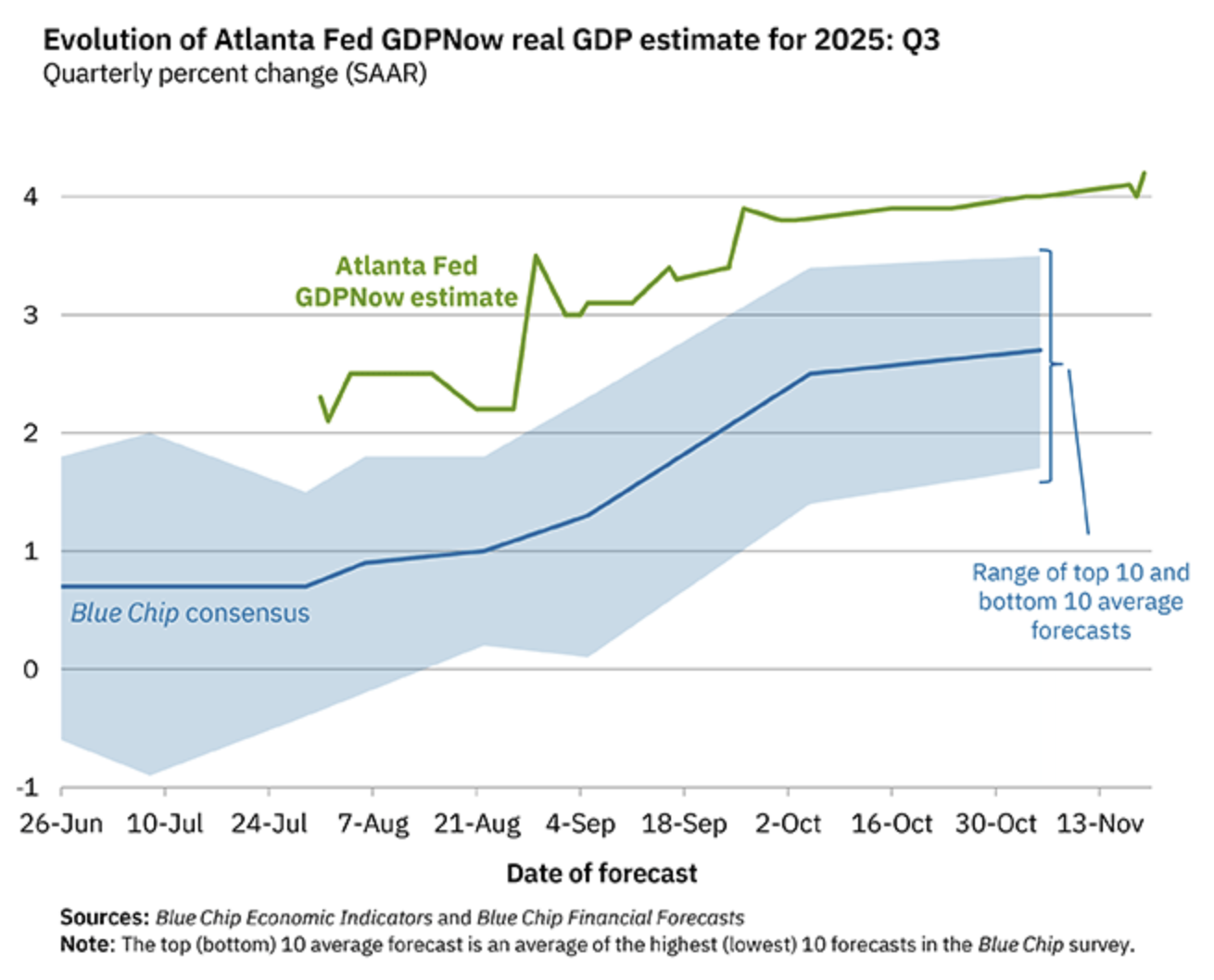
As to the Atlanta Fed’s GDPNow forecast, it ticked higher on Friday and is now sitting at 4.2% for Q3, certainly not synchronous with a major employment crisis.

This week, we will start to get much more information from the BLS and BEA although there is still a huge hole in that output, notably CPI, PCE and GDP.  It will likely take several more months before the rhythm of data gets back to the pre-shutdown cadence and more importantly, it offers the same level of completeness that existed back then.  I guess the FOMC will have to earn their keep for a while longer.

But Williams triggered a solid risk-on session with equities rallying and Treasury yields slipping, while the dollar held tight.  However, I want to touch on one more thing before looking at markets, where the overnight session was rather bland, and that is in reference to a Substack article by Michael Green I read over the weekend that offered a more quantitative approach toward understanding why despite what appears to be solid economic activity, so many people are so unhappy, unhappy enough to believe Socialism is a better choice for the nation going forward. 

The essence of the article, which is very well worth reading as he does all the math to prove his points, is that the delineation of poverty in the US (and I suspect in many Western nations) is laughably low.  For instance, the current poverty line is $31,200, which we all know is far below livable, while the current family median wage in the US is ~$80,000.  Seemingly, most folks should have no problems.  But Green does the calculations to show that if a family of 4 earns less than ~$140,000, they are going to struggle, even if they live in a lower cost area, not NYC where you probably need $350,000 to live.  Between health care, childcare, housing and food, etc., less than that $140k means you are not only living paycheck to paycheck but falling behind as well.

Read the article, linked above, and afterward, you can get a better appreciation for how Zohran Mamdani was elected Mayor of New York City, promising all sorts of free stuff, even though he has approximately zero chance of delivering any of it.

At any rate, that is background for the week ahead.  In Asia, Japan was closed for Workers Day, but Takaichi-san continues to make news regarding her hawkish stance on China.  Meanwhile, bourses in the region had a mixes session with some nice gainers (HK +2.0%, Australia +1.3%, Indonesia +1.85%) although the bulk of the rest of the region saw relatively little overall movement, +/-0.2% or so.  I guess they didn’t understand the benefits of the Fed potentially cutting rates. 🙃

Meanwhile, in Europe, things are far less interesting with a mix of gainers (Spain +0.5%, Germany +0.3%) and laggards (France -0.3%, Italy -1.1%) and the only notable news released being the German Ifo Expectations which slipped although remain solidly within its recent range.  Turning to US futures, at this hour (7:00), they are pointing higher by 0.5%.

In the bond market, Treasury yields continue to slide, down -2bps this morning and now back at 4.05%.  Clearly, the change in sentiment regarding the Fed rate cuts is dragging this yield lower for now.  In Europe, sovereign yields are little changed, overall, with some showing a -1bp decline and others completely lifeless.  Of course, JGB yields are unchanged given the Tokyo holiday.

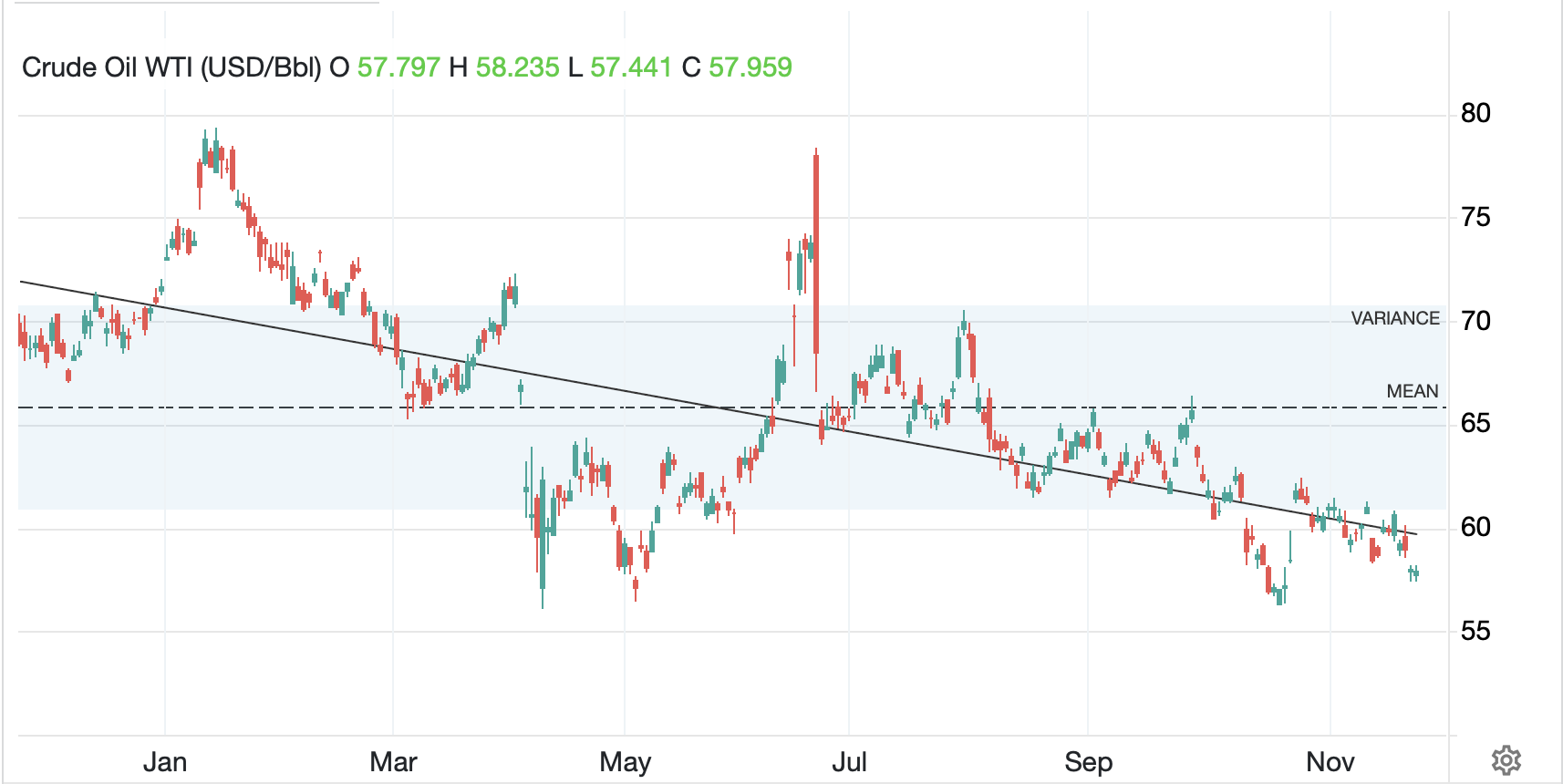
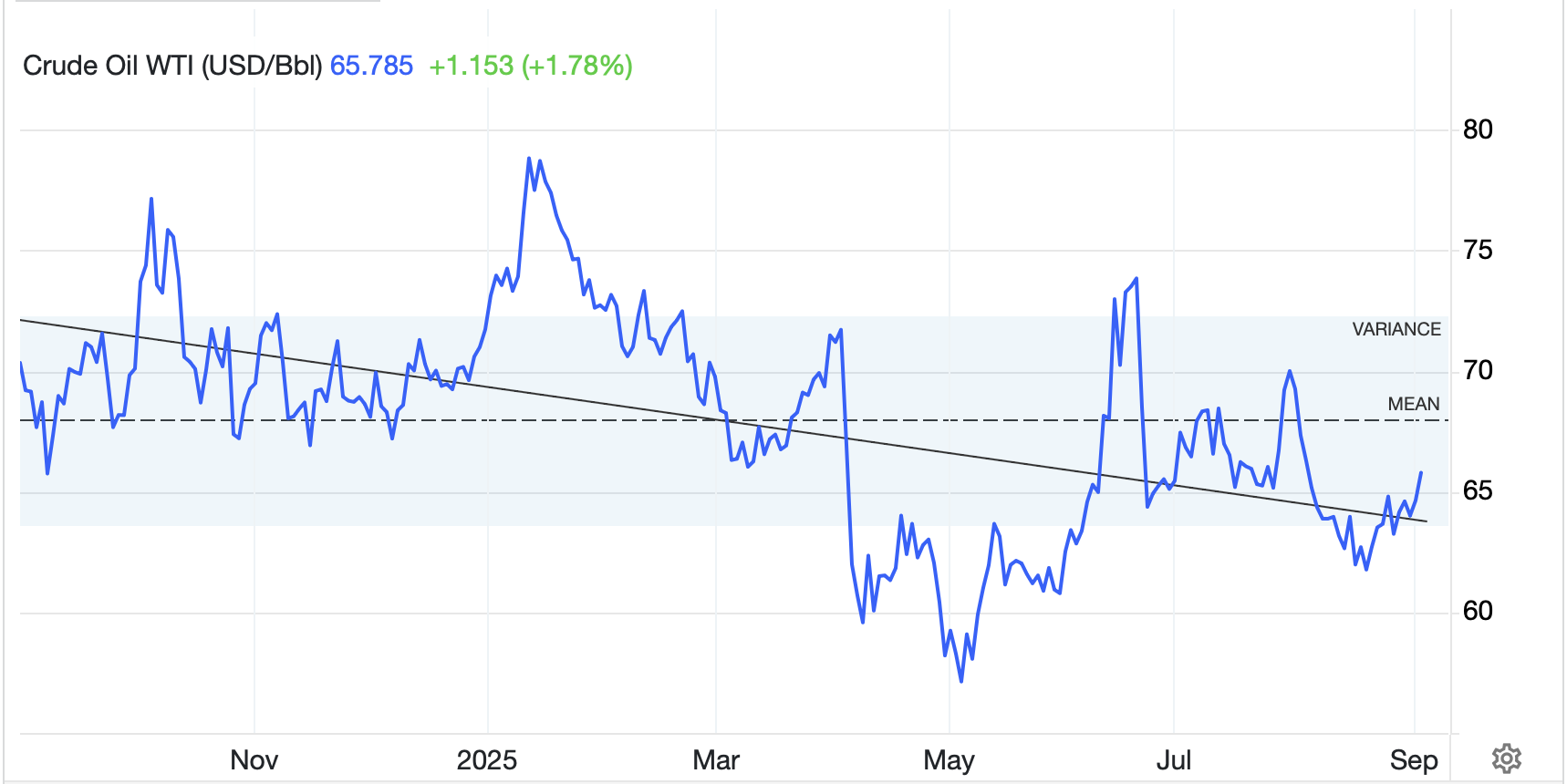
In the commodity space, oil (-0.25%) continues to drift lower and the trend remains very much in that direction as can be seen in the chart below.  There was a very interesting article by Doomberg on Substack this week, reviewing their call that the idea of peak cheap oil is a myth, and there is a virtually unlimited supply of hydrocarbons available with only the politics preventing more production. (For instance, consider the UK essentially shutting down their North Sea oil production despite being in the midst of a self-inflicted energy crisis with the highest electricity prices in the world.  That’s not geology, that’s politics.)  But geology shows there is plenty to go around and growing supply will continue to pressure prices lower.

Source: tradingeconomics.com

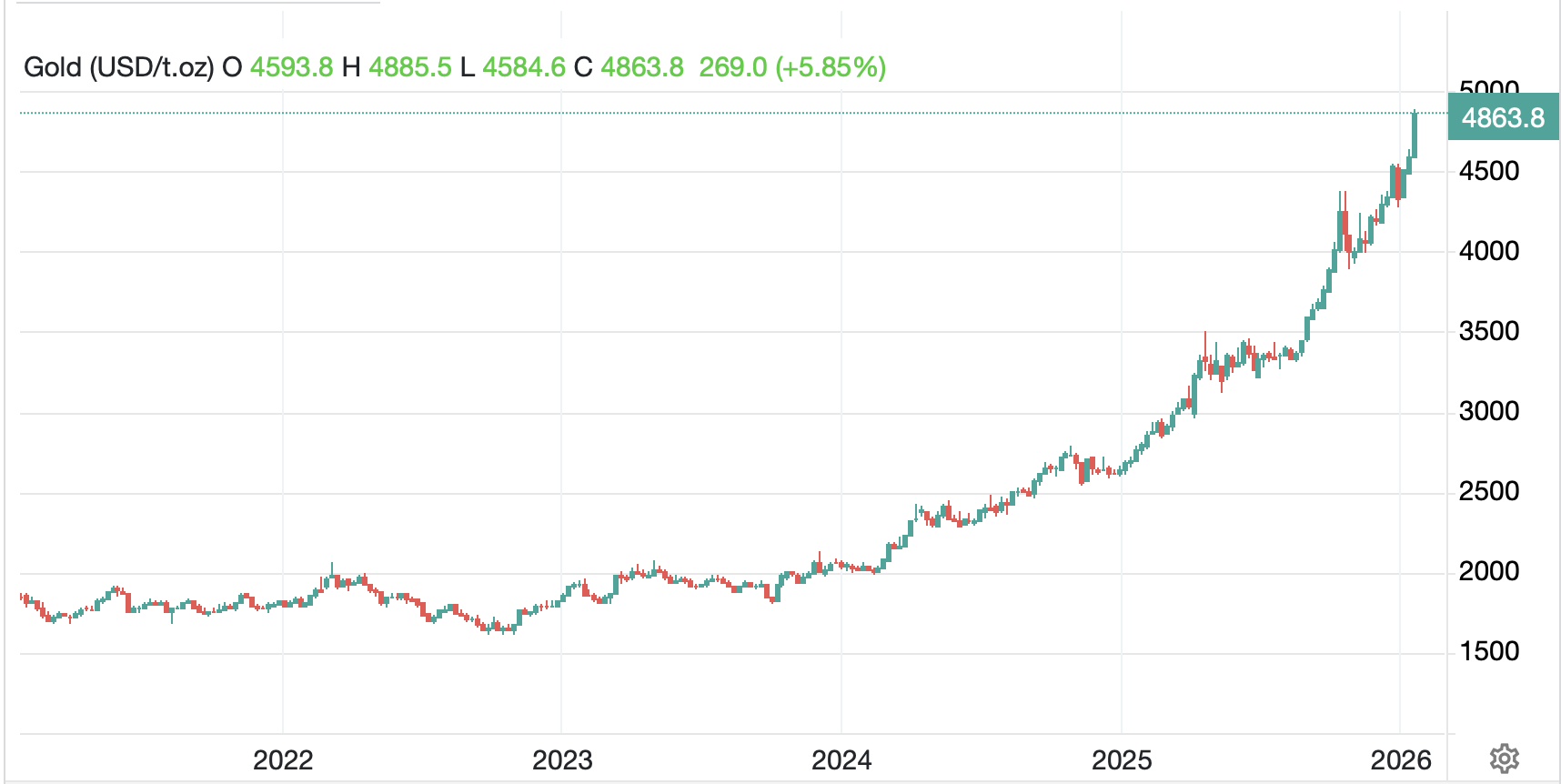
Meanwhile, the metals markets are fairly quiet this morning with gold (+0.25%) and silver (+0.1%) showing far less movement than we have seen of late.  The one thing to note is that while both these metals are well off their highs from last month, they both seem to have found a comfortable resting place for now, and nothing about the global macroeconomic situation leads me to believe that the direction is lower from here.

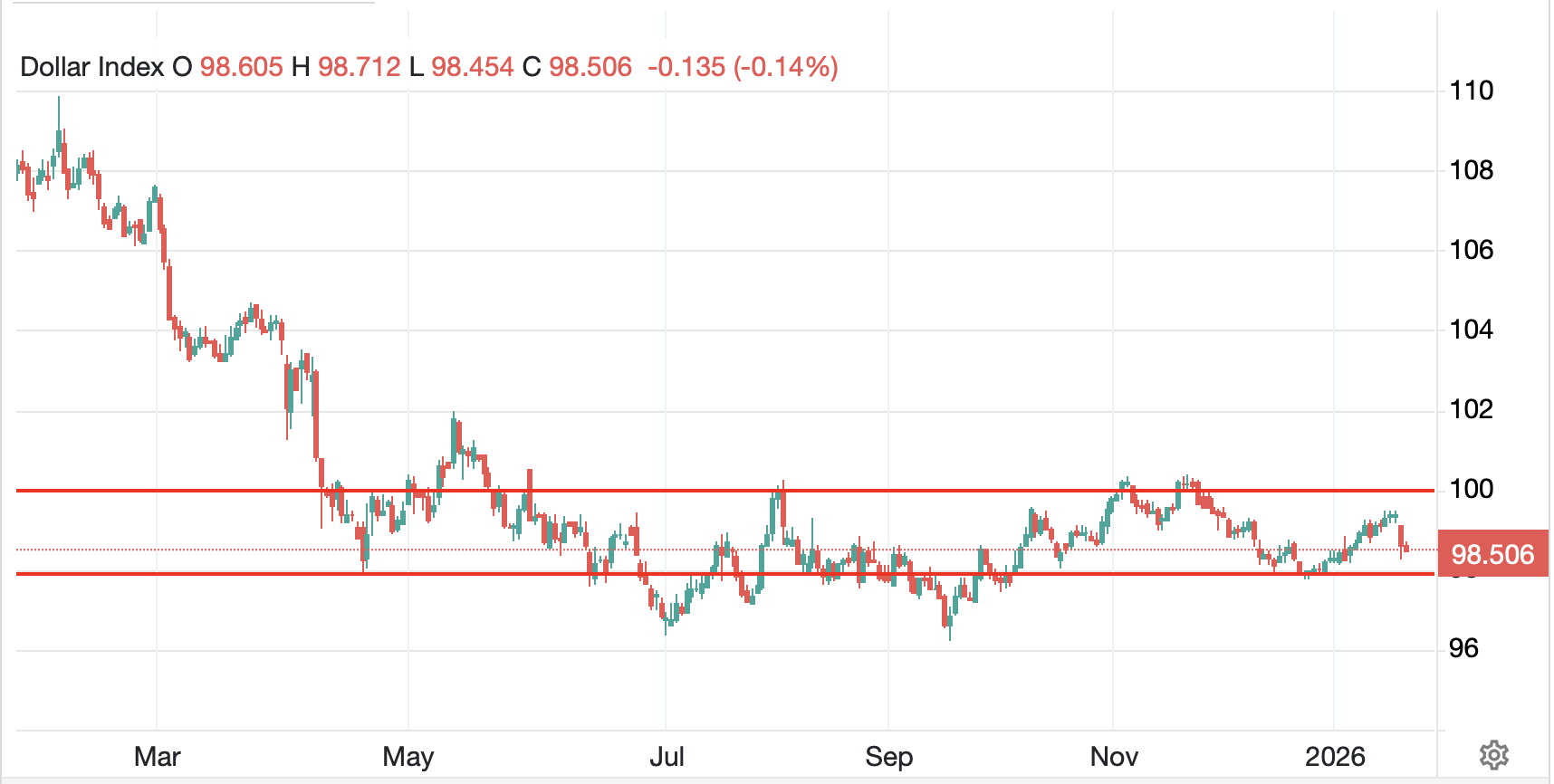
Finally, the dollar is a touch softer this morning with the euro (+0.25%) the largest gainer in the G10 although JPY (-0.3%) remains under pressure overall.  However, in the EMG bloc, INR (+0.5%) and the CE3 (HUF +0.4%, CZK +0.4%. PLN +0.5%) are all firmer with many other currencies in this bloc creeping higher by 0.2% or so.  Interestingly, the DXY has barely slipped and remains above 100 for now.

This week, we are going to see a lot of the delayed September data come out, so like the NFP report from last week, which was old news, the question is, will we learn anything?  But here is a listing to keep in mind:

TuesdaySep Retail Sales0.4%
 -ex autos0.4%
 Sep PPI0.3% (2.7% Y/Y)
 -ex food & energy0.3% (2.7% Y/Y)
 Case Shiller Home Prices1.4%
 Consumer Confidence93.5
WednesdaySep Durable Goods0.2%
 -ex Transport0.2%
 Initial Claims227K
 Chicago PMI43.8
 Fed’s Beige Book 

Source: tradingeconomics.com

Obviously, Thursday is the Thanksgiving holiday and Friday there is nothing slated to be released.  Housing Data, Personal Income and Spending and PCE data are all still up in the air as to when, and what exactly, will be released.  The good news is it appears the entire FOMC is taking the week off as no Fed speakers are currently on the calendar.

If I recap what we know, the market remains beholden to the idea that the economy needs a Fed rate cut and was encouraged by Williams’ comments Friday.  However, questions about AI accounting methods are being raised and there is a growing split between those looking for an equity correction and those who think the near-future is going to be all roses.  From this poet’s perspective, nothing has changed my view that the Fed wants to cut rates, they just need cover to do so, and some softer data will give that cover.  But I also look around the world and find almost every other nation is in a worse situation than the US from a macroeconomic perspective, and it is that issue that informs my view that the dollar remains the best of a bad lot.  So, while fiat currencies will remain under pressure vs. commodities, I’d rather hold dollars than yen, euros, pesos or pretty much anything else.

Good luck

Adf

Little Enjoyment

The Beige Book reported inflation
Was modest across the whole nation
And growth and employment
Found little enjoyment
While JOLTs data showed retardation
 
The upshot is traders were caught
Offsides, which is why bonds were bought
But so too was gold
And as things unfold
Be nimble or you’ll be distraught


Bonds rallied on both soft data, Factory Orders falling and JOLTs Job openings declining as well as a Beige Book that described modest economic activity across the nation.  Some cherry-picked quotes are as follows:

  • Most of the twelve Federal Reserve Districts reported little or no change in economic activity since the prior Beige Book period.
  • Eleven Districts described little or no net change in overall employment levels, while one District described a modest decline.
  • Ten Districts characterized price growth as moderate or modest. The other two Districts described strong input price growth that outpaced moderate or modest selling price growth.

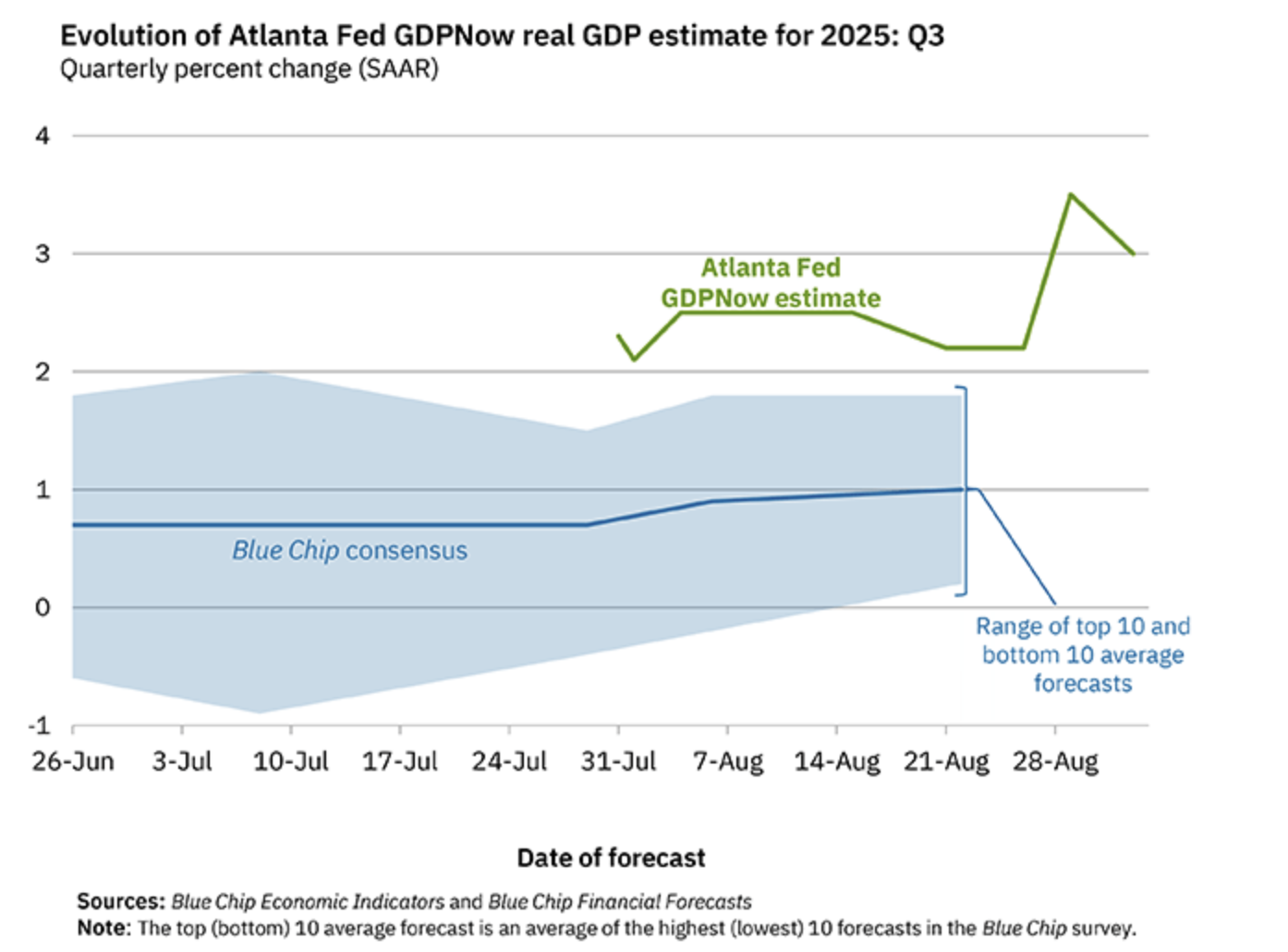
Actually, these were the first lines from each of the key segments, Overall Economic Activity, Labor Markets and Prices.  But if you read them, it is hard to get excited about either growth or inflation as both seem pretty lackluster.  This is at odds with the Q2 GDP results as well as the early Q3 estimates from the Atlanta Fed’s GDPNow forecast as per the below showing 3.0% growth.

While the JOLTS data has always been confusing, and I think is even less reliable these days given the number of phantom job openings (just ask anybody looking for a job using LinkedIn), the Factory Orders data seems to have lost some of its information content given current tariff policies, and their substantive changes on short notice, have upset a lot of apple carts.  I had the system draw a trend line in the below data because it was difficult for me to eyeball it, but FWIW this does not seem a positive result.  Arguably, this is exactly why President Trump is seeking to bring manufacturing back to the US.

Source: tradingeconomics.com

Meanwhile, with ADP jobs this morning (exp 65K) and NFP tomorrow (exp 75K), it is difficult to get too excited about the JOLTS data.  One interesting thing about this data is how it is undermining the higher bond yield narrative that has been rampant (I wrote about it on Tuesday) with yields around the world slipping yesterday in the US and then everywhere else overnight.  For instance, 10-year Treasury yields are lower by -9bps since yesterday morning with virtually all European sovereign yields having fallen about -5bps over the same period.  This is true even in France which auctioned €11 billions of 10yr through 30yr debt this morning.   Compared to their last auction, yields are 30bps to 40bps higher, a strong indication that investors are concerned over the French fiscal situation.

Of course, these two narratives can be simultaneously correct with timing the key difference.  While the short-term view is weaker economic activity will dampen demand and reduce yields, the long-term trajectory of government spending and debt issuance almost ensures that yields will go higher.  Corroborating the long-term story is gold (-0.6% this morning, +3.6% this week) as though some profit taking is evident right now, the barbarous relic has managed to trade to new all-time highs yet again.  That is not a sign of confidence in government finances.

And truthfully, that last sentence continues to be the overriding issue to my mind.  No matter what we hear from any government (perhaps Switzerland should be excluded here), spending is on a sharp upward trajectory, and no government wants to slow it down.  What they want to do is sound like they are doing things to slow it down, but politicians see too much personal benefit from increased government spending to ever stop.  And so, this will continue until such time as it no longer can.  Yesterday I mentioned YCC and I remain convinced that is coming to every major economy over time.  But different nations will respond on different timelines and that is what will drive FX rates given they are the ultimate relative relationship asset class.  I wish I could paint a cheerier picture, but I just don’t see it at this point.

So, let’s see how other markets behaved overnight.  Yesterday’s US equity rally (mostly anyway) seemed entirely on the back of Google’s legal victory allowing it to keep Chrome, where spinning it off was one of the proposed penalties in the anti-trust case, and which saw the share price rally more than 9% in the session.  That move helped Japan (+1.5%) and Australia (+1.0%) but China (-2.1%) and Hong Kong (-1.1%) both suffered on rumors that the government was growing concerned with excess speculation and would soon be implementing rules to prevent further inflating the stock market.  These two markets have had a very nice run since April, rising on the order of 25% each as per the below.

Source: tradingeconomics.com

As to the rest of the region, Korea (+0.5%) was the next best performer with lots of nothing elsewhere, +/-0.3% or so.  In Europe, the DAX (+0.7%) and IBEX (+0.6%) are having solid sessions although the CAC (-0.2%) seems to be feeling pressure from the bond auctions and concerns over the future government situation.  European data was largely in line with expectations and secondary in nature at best.  Meanwhile, at this hour (7:20) US futures are little changed to slightly higher.

We’ve already discussed bonds, but I should mention that even JGB yields slid -4bps overnight as the status of the Ishiba government remains unclear as well.

In the commodity space, oil (-1.3%) continues to chop around in its recent trading range as yesterday’s concerns over OPEC increasing production seem to be giving way to today’s story about weaker demand and growing inventories available in the US.  It’s tough to keep up without a scorecard, that’s for sure.  It should not be surprising that the other metals (Ag -0.75%, Cu -1.2%) are also slipping this morning after they also rallied sharply along with gold yesterday.  In fact, as is often the case, silver’s recent moves have been much more aggressive than gold’s, although in the same direction.

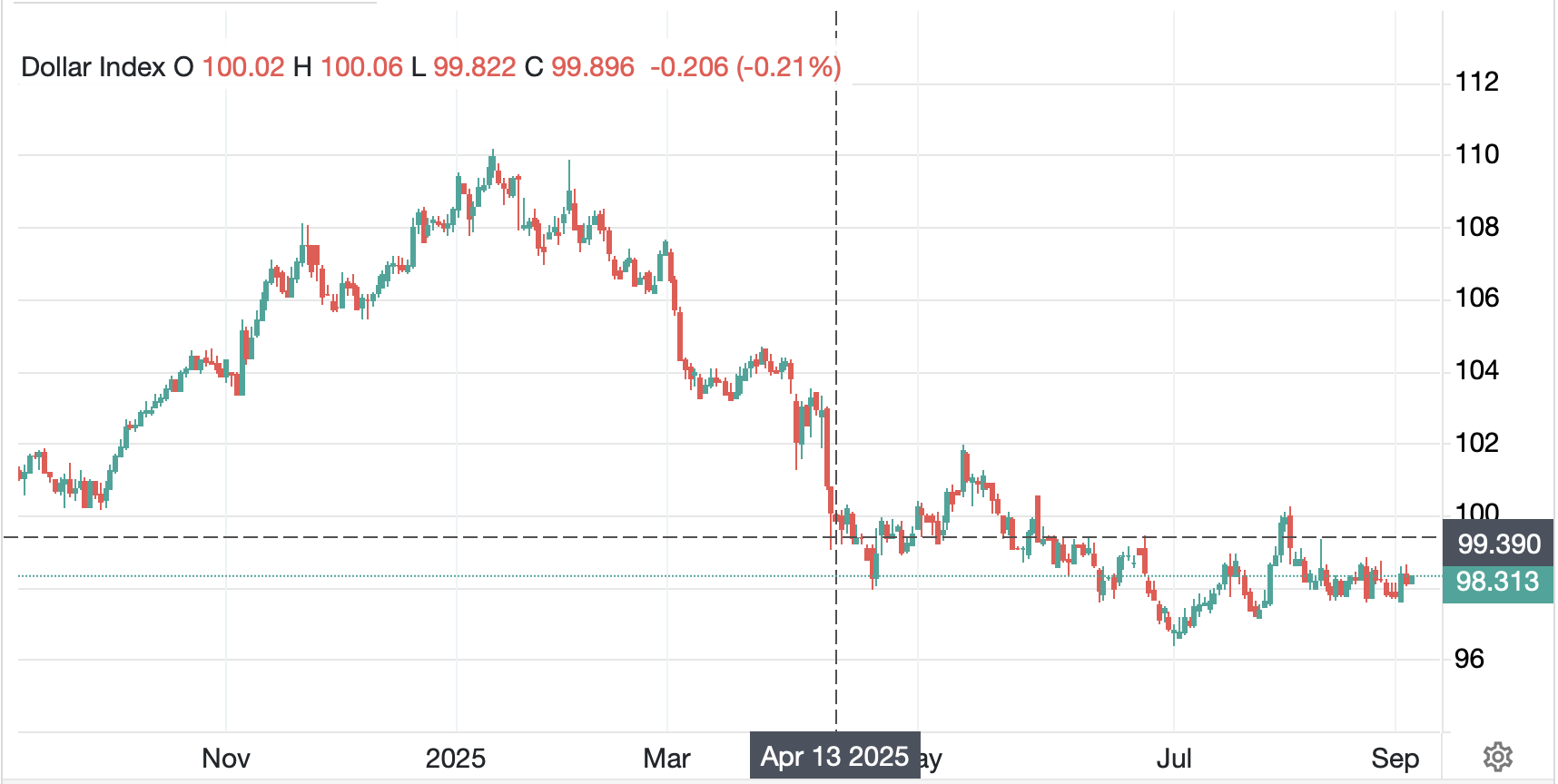
Finally, the dollar is a bit firmer this morning after a modest decline yesterday.  If we use the DXY as our proxy, while there is no doubt the dollar fell sharply during the first half of the year, arguably, since just past Liberation Day in early April, it has gone nowhere.  

Source: tradingeconomics.com

The short-term story for the dollar revolves around the Fed and its behavior.  After yesterday’s data, Fed funds futures increased the probability of a cut on the 17th to 97.6% with a one-third probability of a total of 75bps by year end.  If the Fed were to become more aggressive, perhaps after a much weaker than expected NFP number on Friday, then the dollar would have room to fall.  But you cannot show me the combined fiscal and economic situations elsewhere in the world and explain those are better places to hold assets at this time.

As to today’s movements, the laggards are ZAR (-0.9%) following the precious metals complex lower, and NOK (-0.6%) suffering on the back of oil’s decline.  Otherwise, there is a lot of -0.2% across the board with no terribly interesting stories.

This morning’s data brings Initial (exp 230K) and Continuing (1960K) Claims along with ADP as well as the Trade Balance (-$75.7B), Nonfarm Productivity (2.7%), Unit Labor Costs (1.2%) and finally ISM Services (51.0).  Two more Fed speakers are on the docket, Williams and Goolsbee, but the Fed story is much more about President Trump’s ability to fire Governor Cook than about the nuances these speakers are trying to get across.

Weak data should reflect as a weaker dollar in the near term, and the opposite is true as well.  My sense is a very weak number on Friday will result in the market starting to ramp up the odds of a 50bp cut later this month and that will undermine the buck.  But if that number is solid, I need another reason to sell dollars and I just don’t have it yet.

Good luck

Adf

Under Real Threat

The PCE data was warm
And still well above Powell’s norm
The problem for Jay
Despite what folks say
Is tariffs ain’t causing the storm
 
Instead, service prices keep rising
With wages not yet stabilizing
And so, long-date debt
Is under real threat
As traders, those bonds, are despising


Under the rubric, economic synchronization remains MIA, I think it is worth looking at the performance of 30-year bond yields across all major nations as per the below chart.  While the actual rates may be different, the inescapable conclusion is that yields across the board continue to rise to their highest levels in more than five years and the trend remains strongly in that direction.  Regardless of central bank actions, or perhaps more accurately because of their attempts to keep rates low, it is increasingly clear that confidence in government debt, the erstwhile safest assets around, continues to slide.  

Arguably, this is a direct response to the fact that despite their vaunted independence, central banks around the world have very clearly abandoned their inflation targets and are now doing all they can to support their respective economies with relatively easy money.  Friday’s PCE data is merely the latest in a long line of data points showing that although most of these banks are allegedly targeting 2.0% Y/Y inflation, the outcomes have been higher than target, yet excuses to cut rates are rife.  If you are wondering why gold continues to rally, look no further than this.

Source: tradingeconomics.com

In fact, this morning’s Eurozone CPI reading of 2.1%, 2.3% core, is merely another chink in the armor as it was a tick higher than expected.  One of the problems, I believe, is that there remains a very strong belief that the key driver of inflation is economic growth, not money supply growth, despite all evidence to the contrary.  But it is a Keynesian fundamental belief, and every central bank around the world is convinced that slowing economic activity will result in declining inflation rates.  Alas, as long as central banks continue to support their domestic government bond markets, inflation will remain.  

This is where the synchronicity, or lack thereof, of the economy is having its biggest impact.  The fact that certain parts of the economy, notably AI investment, continues to run at record pace and continues to support excess demand for certain things offsets weakness in other parts of the economy, for instance, commercial property, which is looking at a significant deterioration in its finances.  A look (see chart below) at Commercial Mortgage-Backed Securities (CMBS) for office buildings shows that the delinquency rate has reached an all-time high, higher even than the GFC, as the changes in the US working population and the increase in work-from-home have devastated the value of many office buildings.

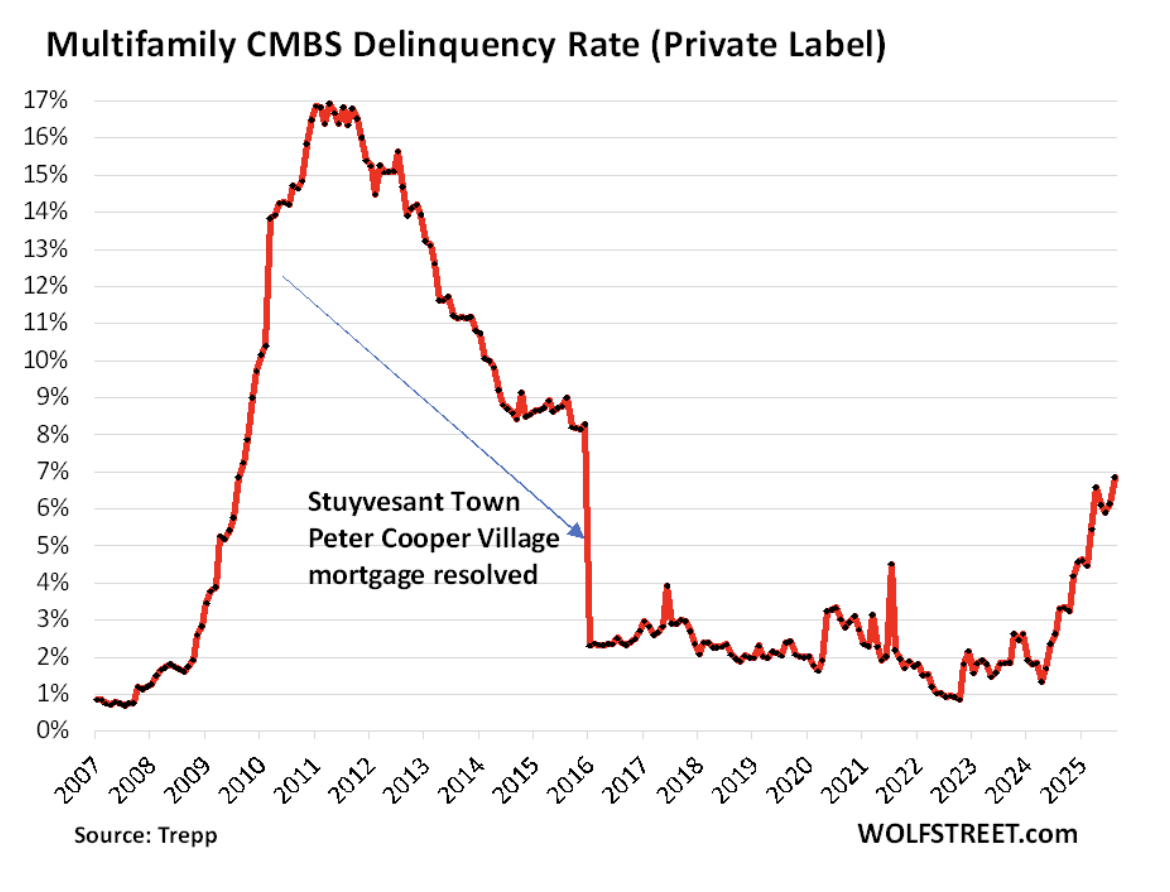
Perhaps more interesting is the fact that multifamily CMBS (financing for apartment buildings) is also suffering despite a housing shortage and rising rents.  While delinquency rates have not reached GFC levels, as you can see, they are rising rapidly as well.

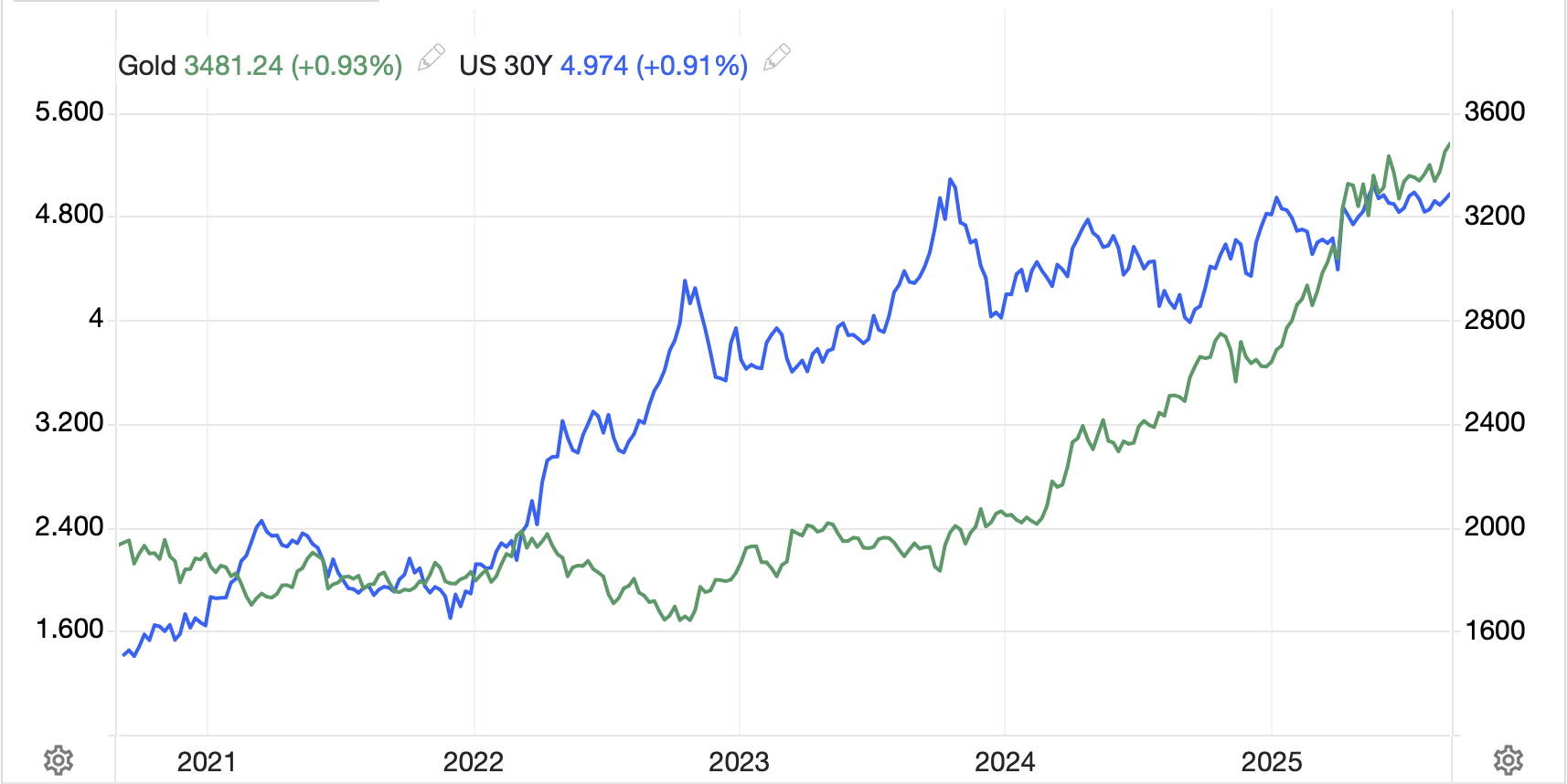
So, which is it?  Are yields rising because growth is driving inflation higher (the Keynesian view of the world)?  How does that accord with rising delinquencies if growth is the driver?  In the end, there is no single, simple answer to explain the dynamics of an extraordinarily complex system like the economy.  I do not envy policymakers’ current situation as there are no correct answers, merely tradeoffs (just like all economics).  But it is increasingly clear that investors are losing their interest in holding onto government debt as they seemingly lose faith in governments’ ability to manage their respective finances.  Which brings us to one more chart, the barbarous relic (which for those of you who don’t know, was Keynes’ term of derision for gold).  I thought it might be instructive to see how gold and 30-year Treasury yields seem to have the same trajectory as the shiny metal regains its all-time highs this morning.

Source: tradingeconomics.com

With that cheery thought after a beautiful Labor Day weekend, let’s see how markets are behaving now that September is upon us.  Friday’s selloff in the US (a disappointing way to end the month) was followed by a mixed session in Asia with the Nikkei (+0.3%) managing to rally although China (-0.75%) and Hong Kong (-0.5%) followed the US lower despite a slightly better than expected RatingDog (formerly Caixin) PMI of 50.5 released Sunday night.  Elsewhere in the region, Korea (+0.95%) was the big winner with modest losses almost everywhere else in the region.  As to Europe, the DAX (-1.25%) is the worst performer, although Spain’s IBEX (-0.95%) is giving it a run for its money as the higher Eurozone inflation squashed hopes that the ECB may cut rates again soon.  Interestingly, French shares are unchanged this morning, significantly outperforming the rest of the continent despite continued concerns over the status of the French government which seems likely to collapse next week after the confidence vote on Monday.  Perhaps the idea that the government will not be able to do anything is seen as a benefit!  As to US futures, negative is the vibe this morning, with all the major indices pointing lower by at least -0.6%.

In the bond market, based on my commentary above, you won’t be surprised that Treasury yields are higher by 6bps this morning and European sovereign yields are all higher by between 4bps and 6bps.  The big story here is that French yields are rising to Italian levels as the former’s finances are crumbling while Italy has stabilized things for the time being.  Of course, all this pales compared to UK yields (+4bps) where 30-year yields have climbed to their highest level since 1998 and the 10-year yields are now nearly 200 basis points higher than during the ‘Liz Truss’ moment of 2022 as per the below.  It is not clear to me if the UK or France will collapse first, but I suspect that both may be begging at the IMF soon!

Source: tradingeconomics.com

Oil prices (+1.8%) continue to rise as Russia and Ukraine intensify their fighting with Ukraine attacking Russian refining capacity, apparently shutting down up to 17% of their output.  However, while we have seen oil rebound over the past several weeks, the longer-term trend remains lower.

Source: tradingeconomics.com

As to metals, this morning gold (+0.2%) continues to set new highs while silver (-0.4%) is backing off of its recent multi-year highs, although remains well above $40/oz.  Precious metals are in demand and likely to stay that way for a long time to come in my view.

Finally, the dollar is much firmer this morning with the pound (-1.25%) the laggard across both G10 and EMG currencies as investors flee from the ongoing policy insanity there (between the zeal with which they are trying to reduce CO2 and the crackdown on free speech, it seems the government is trying to alienate the entire native population.). But the euro (-0.7%), Aussie (-0.7%), yen (-1.0%) and SEK (-0.75%) are all under pressure in the G10 bloc.  The UK is merely the worst of the lot.  As to the EMG bloc, MXN (-0.7%), ZAR (-0.7%) and PLN (-0.9%) are also sharply lower although Asian currencies (KRW -0.2%, INR -0.2%, CNY -0.15%) are faring a bit better overall.

On the data front this week, we have a bunch culminating in payrolls on Friday.

TodayISM Manufacturing49.0
 ISM Prices Paid 65.3
WednesdayJOLTS Job Openings7.4M
 Factory Orders-1.4%
 Fed’s Beige Book 
ThursdayInitial Claims230K
 Continuing Claims1960K
 Trade Balance-$75.3B
 Nonfarm Productivity2.7%
 Unit Labor Costs1.2%
 ISM Services51.0
FridayNonfarm Payrolls75K
 Private Payrolls75K
 Manufacturing Payrolls-5K
 Unemployment Rate4.3%
 Average Hourly Earnings0.3% (3.7% Y/Y)
 Average Weekly Hours34.3
 Participation Rate62.1%

Source: tradingeconomics.com

In addition, we hear from four Fed speakers with NY Fed president Williams likely the most impactful.  The current probability for a Fed funds cut according to CME futures is 92%.  A weak print on Friday will juice that and get people talking about 50bps to start.  A strong number will stop that talk in its tracks.  But until then, it is difficult to look at the messes everywhere else in the world and feel like you would rather own other currencies than the dollar (maybe the CHF).

Good luck

Adf

Political War

In Washington, Cook feels the heat
As Trump wants a change in her seat
In Paris, the sitch
For Macron’s a bitch
As confidence there’s in retreat
 
These two stories plus so much more
Explain that we’re in, Turning, Four
So, all that we knew
Seems no longer true
Instead, there’s political war


The dichotomy between the general lack of price volatility in markets and the increase in political volatility over policy choices and requirements around the world is truly remarkable.  However, just like so much else that many have assumed as a baseline process for so long, this relationship appears to be changing as well.  These changes have historical precedence, as documented by Neil Howe and William Strauss back in 1997 in their seminal book, The Fourth Turning.  

Perhaps this is the best definition of what the Fourth Turning is all about [emphaisis added]:

“In the recurring loop of modern history, a final, perilous era arrives once each lifetime.  It is marked by civic upheaval and national mobilization, both traumatic and transformative.  That era, reshaping the social and political landscape, is unfolding now.

Now, read that and tell me it is not a perfect description of what we are seeing daily, not just in the US, but around the world.  If you wondered why all the models that had been built about many things, whether financial, economic or governmental are no longer offering accurate forecasts, I would point to this as the underlying premises are going through the throes of change.

For instance, consider President Trump and his relationship with the Fed.  We already know that he and Chairman Powell are at odds and have been so for months over Powell’s reluctance to cut rates.  But his attacks on the Fed are unceasing, and last night he ‘fired’ Governor Lisa Cook for cause.  That cause being the allegations that she committed mortgage fraud, which if true is certainly a concern for a Federal Reserve Board Governor.  But this has never been attempted before so will involve legal wrangling which we will watch over the next many months.

Now, some of you may remember the last time there was a scandal at the FOMC, where two different regional Fed presidents, Dallas’s Robert Kaplan and Boston’s Eric Rosengren, were trading S&P 500 futures in their personal accounts prior to FOMC announcements of which they had inside knowledge.  Both did step down and allegedly the Fed has tightened its controls on that issue as they tried to sweep it under the rug, but let’s face it, Fed members are no angels.

I have no idea how this will play out, although I suspect that Governor Cook will eventually resign as the one thing at which President Trump excels is applying public pressure.  While Powell is an experienced public figure, Ms Cook was a professor at Michigan State, not exactly a spot where you feel the withering heat of a Trumpian attack on a regular basis.  Of course, if she did lie on her mortgage applications, that is a tough look for someone charged with overseeing the financial system.

But that is just the latest issue in the US, at least involving financial markets.  This Fourth Turning is coming alive all around the Western World, perhaps no place more than Paris this morning.  There, PM Bayrou has called for a confidence vote in order to gain the power to pass an austerity budget that cuts €44 billion from spending.  While at this point, it seems long ago, his predecessor PM, Michel Barnier, lasted just 99 days with his minority government and was ousted last December.  While Bayrou has made it for 9 months, it appears his odds of making it for a full year are greatly diminished now as all the opposition parties have promised to vote against him.  Recall, he leads a minority government and if he loses the vote, there will be yet another set of elections in France.

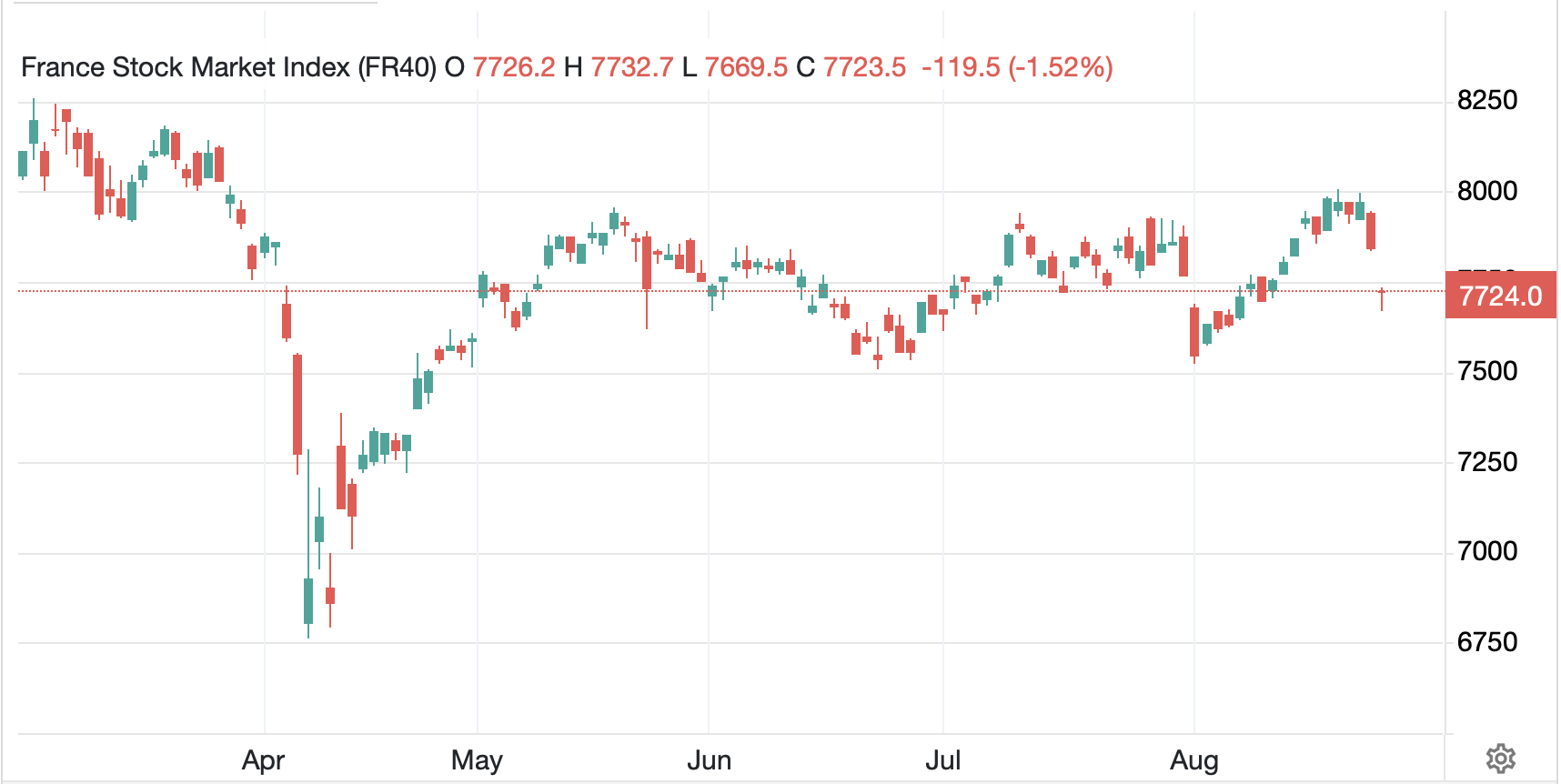
Again, this is emblematic of a Fourth Turning, where systems and institutions that have been operating for decades are suddenly coming apart.  From our perspective, the impact is more direct here with French equity markets (CAC -1.5%) falling sharply (see below) while French government bond yields soar.

Source: tradingeconomics.com

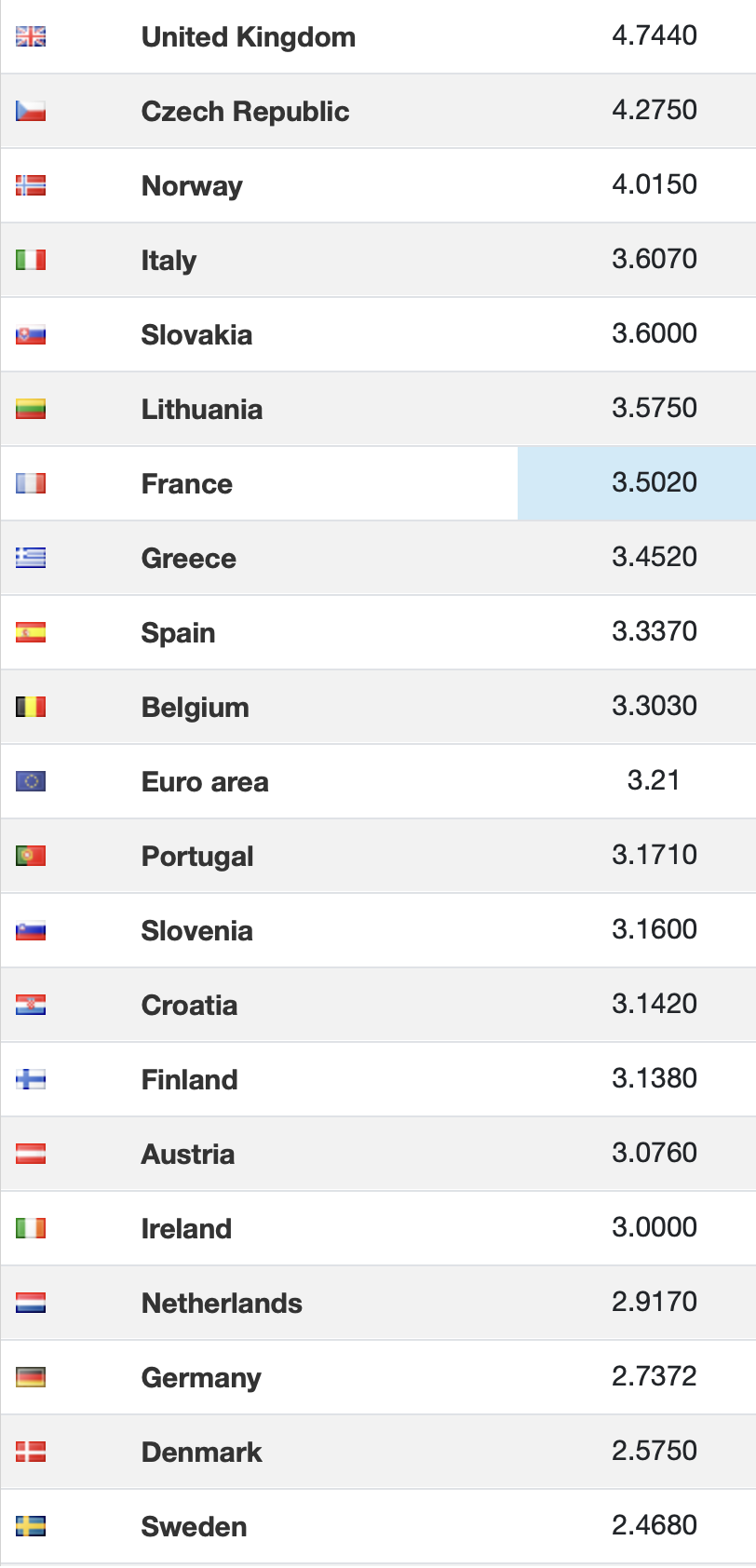
In fact, French 10-year yields now trade above almost all other EU nations including Greece and Spain, although Italian yields are still a touch higher.  Consider that during the European bond crisis of 2011-12, France was considered one of the stronger nations.  Oh, how the mighty have fallen!

Source: tradingeconomics.com

Again, my point is that much of what we thought we understood about how markets behave on both an absolute and relative basis is changing because the institutions underlying the Western economy are undergoing massive changes.  This is not merely a US phenomenon with President Trump, but we are seeing a growing nationalist fervor throughout the West as populations throughout Europe, and even Japan, increasingly reject the culmination of what has been described as the globalist agenda.  As John Steinbeck has been widely quoted, things can change gradually…and then suddenly.

So, let’s look at how other markets behaved overnight following the weakness in US equity markets yesterday.  Asian markets followed suit lower (Tokyo -1.0%, Hong Kong -1.2%, China -0.4%, Korea -1.0%, India -1.0%) with essentially the entire region in the red.  Europe, too, is under pressure this morning and while France leads the way, Germany (-0.4%), Spain (-0.8%) and the UK (-0.6%) are all declining in sync.  However, at this hour (7:10) US futures are essentially unchanged, so perhaps things will stabilize.

Those yields I picture above represent modest declines from yesterday’s levels, although that is only because European yields yesterday mostly climbed between 5bps and 7bps across the board.  As to Treasury yields, they are higher by 2bps this morning, but remain below 4.30%, so are showing no signs of a problem.

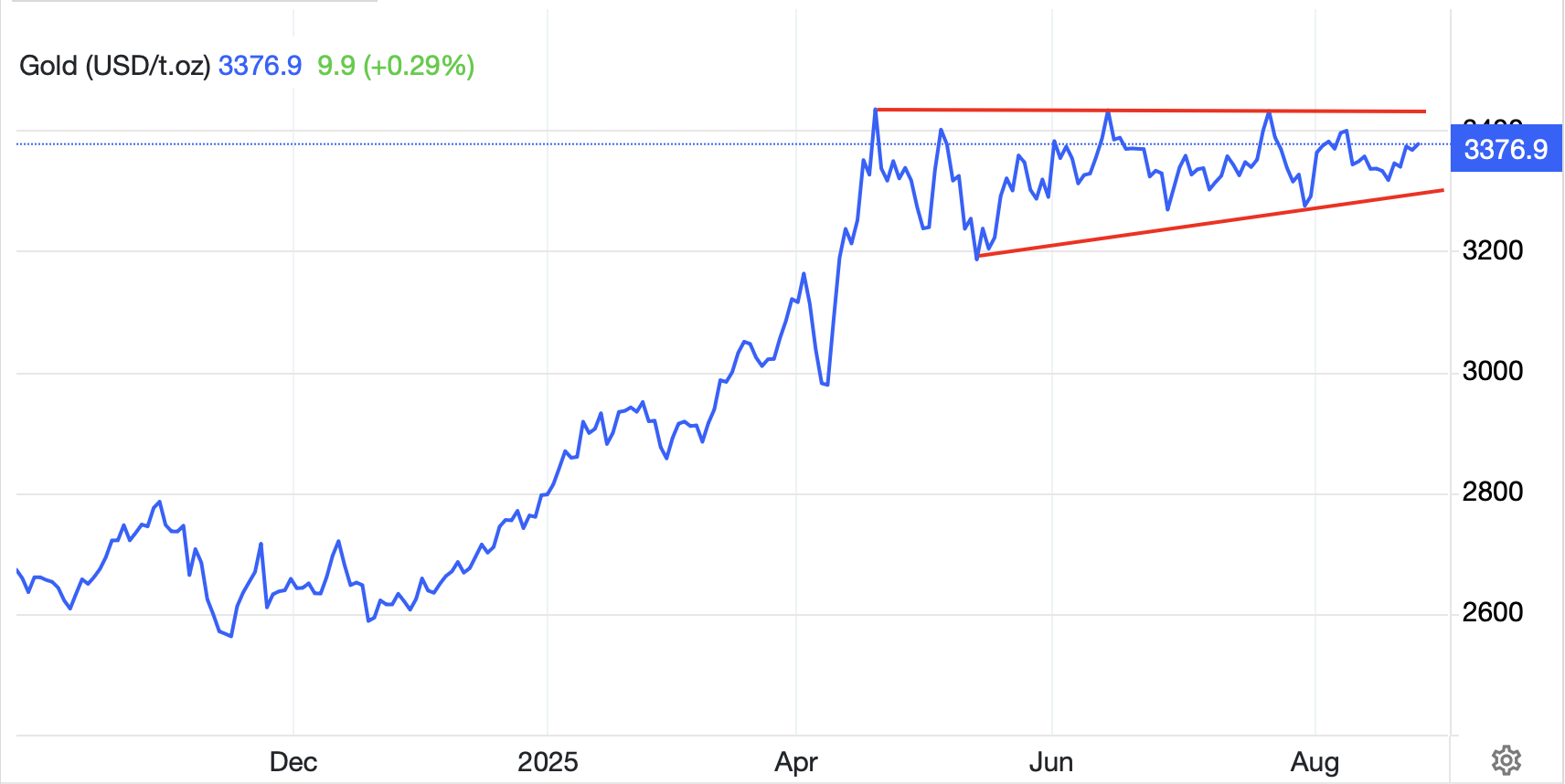
In the commodity markets, oil (-1.8%) is giving back all its gains from yesterday and a little bit more, but in the broad scheme of things, continues to trade in its recent range.  The one thing to watch here is Ukraine’s increasing ability to interrupt Russian production and shipment of oil via long-range drone strikes, as if they continue to be successful, it may well start to push prices above their recent cap at $70/bbl.  That is, however, a big if.  It is getting pretty boring describing metals markets as gold (+0.3%) has been trading in an increasingly narrow range as per the below chart.  This has been ongoing since April and feels like it could last another 5 months without a problem.  Silver’s chart is similar, albeit not quite as narrow a range.

Source: tradingeconomics.com

Finally, the dollar is a touch softer this morning, slipping against the euro (+0.3%), pound (+0.2%), and yen (+0.2%) with most of the rest of the G10 having moved less than that.  NOK (-0.3%) is the outlier following oil lower.  In the EMG bloc, +/- 0.3% is the range for the entire bloc today, so it appears that traders like other G10 currencies today for some reason I cannot fathom.

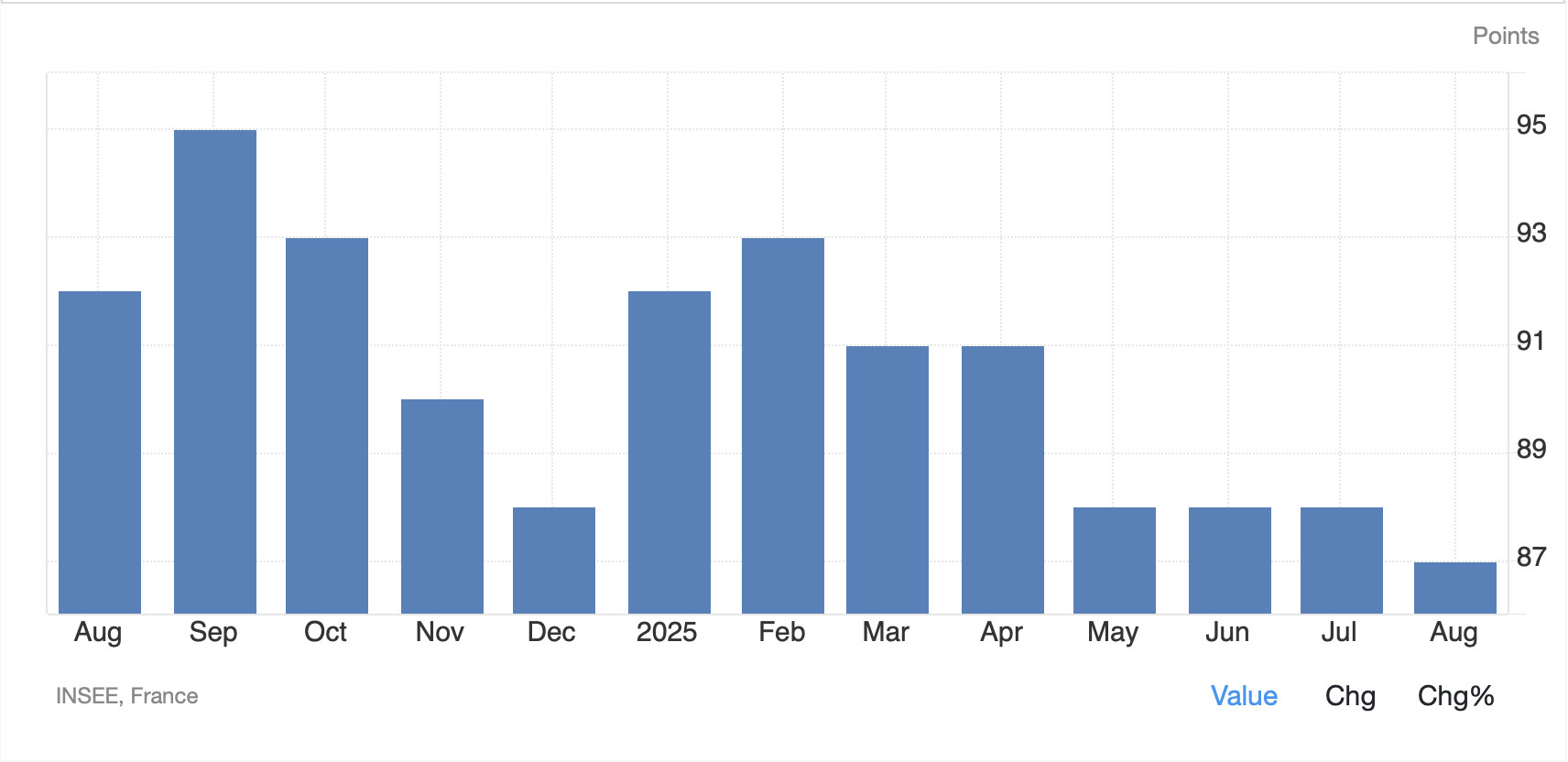
On the data front, we see Durable Goods (exp -4.0%, +0.2% ex Transport) as well as Case Shiller Home Prices (2.1%) and then Consumer Confidence (96.2).  Speaking of Consumer Confidence, in France this morning the latest reading was released at 87.0, three points lower than forecast and clearly trending down.  Perhaps the government’s problems are feeding into the national psyche.

Source: tradingeconomics.com

It is difficult to get excited by markets during the last week of August, and if we add the time of year, when vacations are rife, to the ongoing White House bingo outcomes, the best position seems to be no position at all.  As to the dollar, if the Fed does start to ease policy at this time, with inflation still sticky, I do foresee a decline.  However, it is very difficult to look around the world and think, damn, I want to own THAT currency, whatever currency that might be.  Perhaps the one exception would be the Swiss franc, where they really do work to have sane monetary policies.

Good luck

Adf

Filled With Gilding

There once was a banker named Jay
Who yesterday, tried to allay
Fears that his building
Was too filled with gilding
But Trump seemed to have final say
 
The fact that this story’s what leads
The news, when one looks through the feeds
Is proof that there’s nought
Of note to be bought
Or sold, as price action recedes


According to Merriam-Webster, this is the definition of the word frequently bandied about these days, and rightly so.  

Market activity is just not very interesting.  While there is a new battle brewing on the Thai-Cambodian border, it is unlikely to have much impact on the rest of the world, and the Russia-Ukraine war continues apace, with very little new news.  Congress is in recess, sort of, which means new legislation is not imminent.  And while the Fed meets next week, just like the ECB and the BOE and the BOJ, no policy changes are imminent.  Doldrums indeed.

Which is why the story about President Trump visiting the construction site at the Marriner Eccles Building, the home of the Federal Reserve, has received so much press.  And frankly, a quick look at this clip is so descriptive of the current relationship between Trump and Powell it is remarkable.

But frankly, I just don’t see much else to discuss this morning.  equity markets in the US have generally been creeping higher, the DJIA excepted, the dollar is doing a slow-motion bounce and bond yields trade within a 5bps range.  Yesterday’s jobs data was solid, with both types of claims slipping, while the Flash PMIs showed net strength, although it was entirely Services driven.  And it’s Friday, so I won’t take up too much time.

Here’s the overnight review.  Asian markets followed the Dow, not the S&P or NASDAQ with Tokyo (-0.9%), Hong Kong (-1.1%) and China (-0.5%) all under pressure.  In Japan, there are starting to be more questions asked about whether PM Ishiba can hold on, and if he cannot (my guess is he will go) there is no obvious successor as no party there has any substantial strength.  Remember, the populist Sanseito party is a new phenomenon there and really is screwing up their electoral math.  As to the rest of the region, only Korea and New Zealand managed any gains, and they were di minimis.  Red was the color of the session.

Not surprisingly, that is the story in Europe as well, with most bourses lower on the day (DAX -0.6%, FTSE 100 -0.3%, IBEX -0.5%) although the CAC is essentially unchanged despite LVMH earnings being a little soft.  German Ifo data was slightly better than June, but lower than expected and UK Retail Sales were modestly weaker than forecast on every measure.  Again, it is hard to get excited here.  As to US futures, they are pointing higher by 0.2% at this hour (7:00).

In the bond market, Treasury yields have bounced 2bps from yesterday but are still right around 4.40% while European sovereign yields are higher by 3bps across the board.  Apparently, there is residual concern over European spending plans and absent a trade agreement with the US, investors there are not sure what to do.

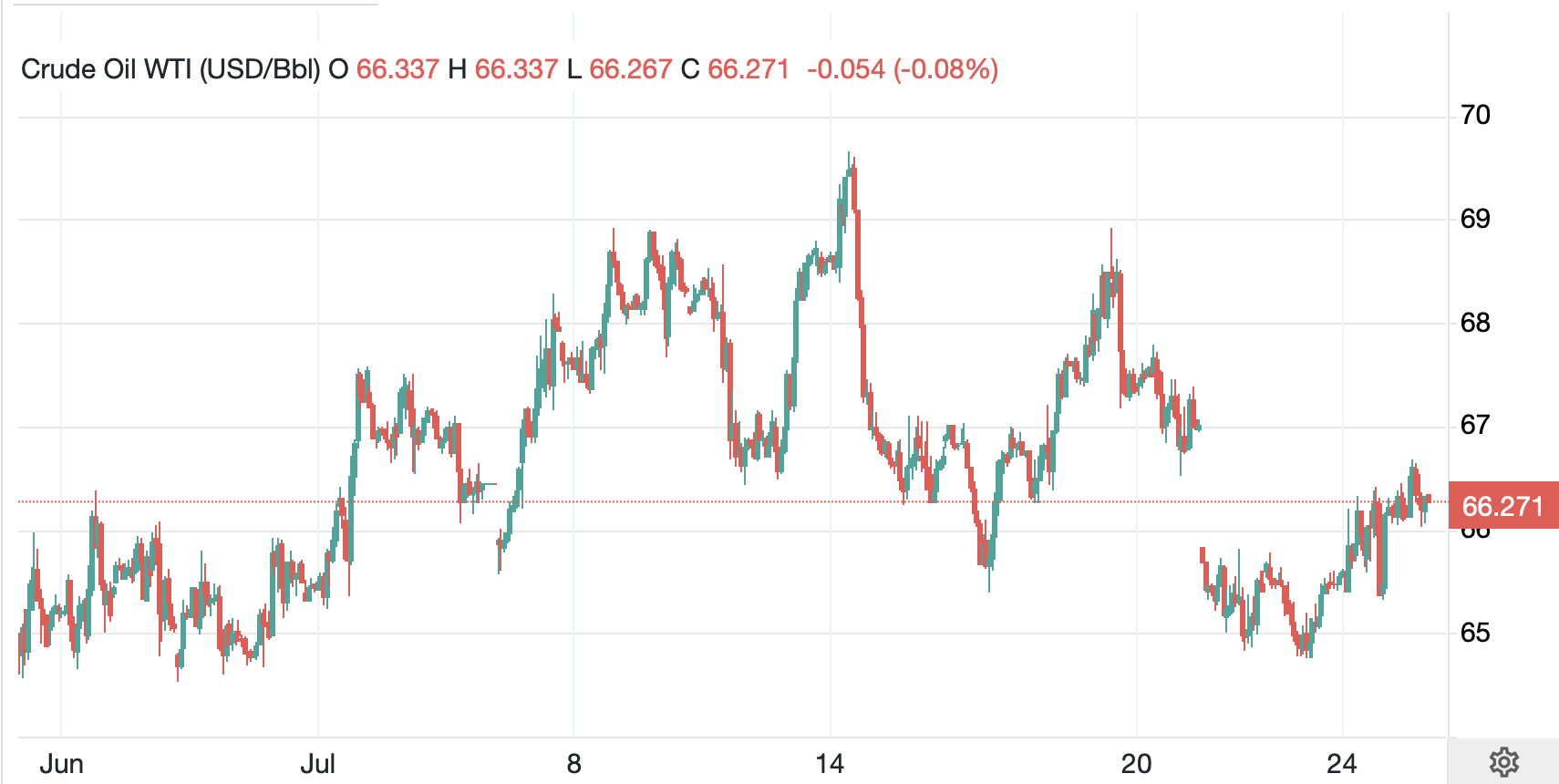
In the commodity markets, oil (+0.4%) is bouncing for a second day, but remains within that recent trading range where we have seen choppy trading but no direction.  The gap lower earlier in the week was filled, but it is hard to get excited here about a new trend either.

Source: tradingeconmics.com

Meanwhile, metals markets remain under pressure as we head into the end of the month.  They have had a solid rally this month and it looks to me like some profit taking, but this morning gold (-0.7%), silver (-0.8%) and copper (-0.7%) are all under pressure.

Perhaps one of the reasons that the metals are soft is the dollar is stronger today.  I know we continue to hear about the death of the dollar, but as Mark Twain remarked, “the report of [its] death was an exaggeration.” Instead, what we see this morning is a pattern in the DXY that could easily be mistaken for described as a bottoming and we are simply waiting for confirmation.

Source: tradingeconomics.com

Looking at individual currencies, the dollar is firmer against every G10 currency with the euro (-0.25%) and pound (-0.4%) indicative of the magnitude of movement.  In the EMG bloc, KRW (-0.6%) and ZAR (-0.7%) are the worst performers, with the latter clearly following precious metals lower while the former is feeling a little heat from the fact that Japan struck a trade deal while South Korea has not yet done so.   Otherwise, things are just not that interesting here either.

On the data front, this morning brings Durable Goods (exp -10.8%, 0.1% ex Transports) which tells me that a lot of Boeing deliveries were made last month when Durables rose 16.4%.  But otherwise, nothing and no Fed speakers.  As I said before, it is a summer Friday, and I suspect that most trading desks will be skeleton staffed by 3:00pm if not earlier.

Good luck and good weekend

Adf

Rate Cutting Pretension

The US and China have shaken
Their hands, as trade talks reawaken
And while it’s a start
It could fall apart
For granted, not much should be taken
 
So, markets have turned their attention
To ‘flation with some apprehension
This morning’s report
Might help, or might thwart
Chair Powell’s rate cutting pretension


Starting with the trade talks between China and the US, both sides have agreed that progress was made. Here is a quote from a report on China’s state broadcaster, CCTV, last night.  “China and the US held candid and in-depth talks and thoroughly exchanged views on economic and trade issues of mutual concern during their first meeting of the China-US economic and trade consultation mechanism in London on Monday and Tuesday. The two sides have agreed in principle the framework for implementing consensus between the two heads of state during their phone talks on June 5, as well as those reached at Geneva talks. The first meeting of such consultation mechanism led to new progress in addressing each other’s economic and trade concerns.”  I highlight this because it concurs with comments from Commerce Secretary Lutnick and tells me that things are back on track.

Clearly, this is a positive, although one I suspect that equity markets anticipated as they have been rallying for the past several sessions prior to the announcements.  Certainly, this is good news for all involved as if trade tensions between the US and China diminish, it should be a net global economic positive.  While anything can still happen, we must assume that a conclusion will be reached going forward that will stabilize the trade situation.  However, none of this precludes President Trump’s stated desire to reindustrialize the US, so that must be kept in mind.  And one of the features of that process, at least initially, is likely to be upward price pressures in the economy.

Which brings us to the other key story today, this morning’s CPI report.  Expectations for headline (0.2% M/M, 2.5% Y/Y) and core (0.3% M/M, 2.9% Y/Y) are indicating that the bottom of the move lower in inflation may have been seen last month.  However, these readings, while still higher than the Fed’s target (and I know the Fed uses Core PCE, but the rest of us live in a CPI world) remain well below the 2022 highs and inflation seems to be seen as less of a problem.  Yes, there are some fears that the newly imposed tariff regime is going to drive prices higher, and I have seen several analysts explain that we are about to see that particular process begin as of today’s data.  

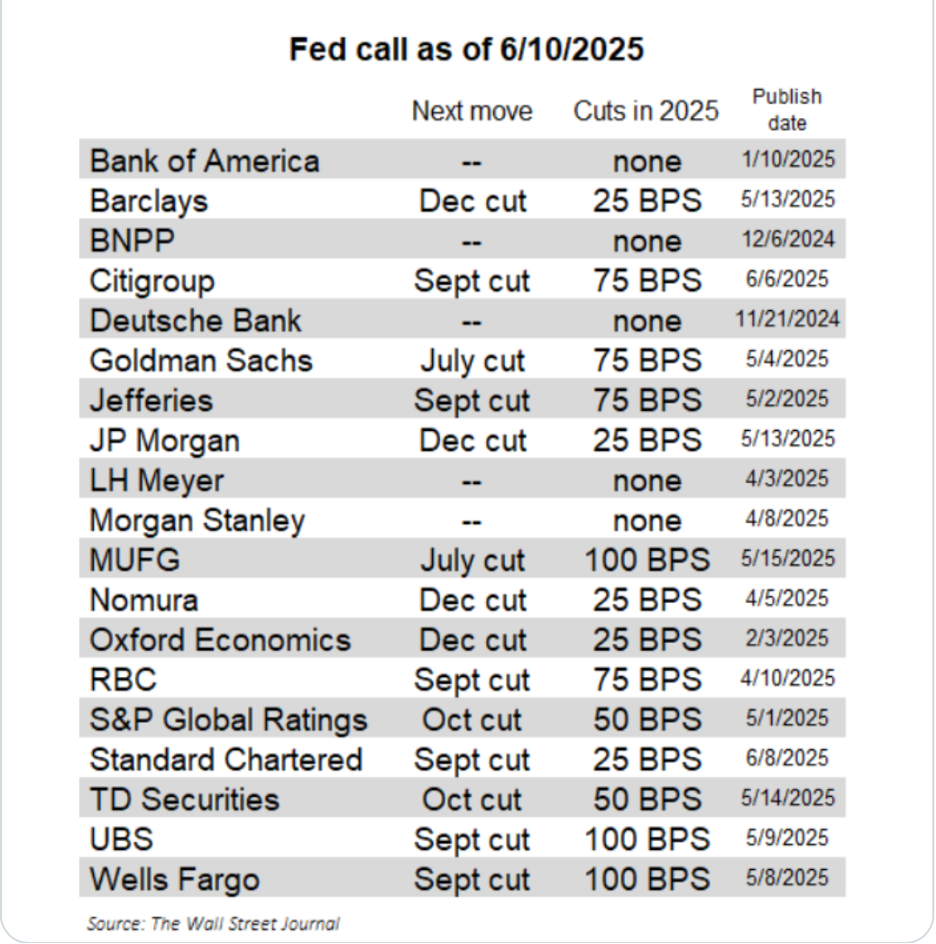
Of course, from a markets perspective, the key issue with inflation is how it will impact interest rates.  In this case, I think the following chart from Nick Timiraos in the WSJ is an excellent description of how there is NO consensus view at all.

At the same time, Fed funds futures markets are pricing in the following probabilities as of this morning.

Source: cmegroup.com

The thing about the Fed is they have proven to be far more political than they claim.  First, it is unambiguous that there is no love lost between President Trump and Chairman Powell.  Interestingly, the Fed is strongly of the belief that when they cut rates, they are helping the federal government, and more importantly, the population’s impression of what the federal government is doing.  Hence, the 100bps of cuts last summer/fall never had an economic justification, they appeared to have been the Fed’s effort to sway the electorate to maintain the status quo.  With that in mind, absent a collapse in the labor market with a significantly higher Unemployment Rate, I fall into the camp of no Fed action this year at all.  And, if as I suspect, inflation readings start to pick up further, questions about hikes are going to be raised.

Consider if the BBB is passed and it juices economic activity so nominal GDP accelerates to 6% or 7%, the Fed will be quite concerned about inflation at that point and the market will need to completely reevaluate their interest rate stance.  My point is the fact that rate cuts are currently priced does not make them a given.  Market pricing changes all the time.

So, let’s take a look at how things behaved overnight.  After a modest US rally in equities yesterday, Asia had a solid session, especially China (+0.75%) and Hong Kong (+0.8%) as both responded to the trade news. Elsewhere in the region, things were green (Nikkei +0.5%), but without the same fanfare.  I have to highlight a comment from PM Ishiba overnight where he said “[Japan] should be cautious about any plans that would deteriorate already tattered state finances.  Issuing more deficit financing bonds is not an option.”  That sounds an awful lot like a monetary hawk, although that species was long thought to be extinct in Japan.  It will be interesting to see how well they adhere to this idea.

Meanwhile, in Europe, the only equity market that has moved is Spain (-0.6%) which is declining on idiosyncratic issues locally while the rest of the continent is essentially unchanged.  As to US futures, at this hour (7:30) they are pointing slightly lower, about -0.15% across the board.

In the bond market, the somnolence continues with yields backing up in the US (+2bps) and Europe, (virtually all sovereign yields are higher by 2bps) with only UK Gilts (+5bps) under any real pressure implying today’s 10-year auction was not as well received as some had hoped.  In Japan, yields slipped -1bp overnight and I thought, in the wake of the Ishiba comments above, I would highlight Japan 40-year bonds, where yields have collapsed over the past three weeks.  Recall, back in May there was a surge in commentary about how Japanese yields were breaking out and how Japanese investors would be bringing money home with the yen strengthening dramatically.  I guess this story will have to wait.

Source: tradingeconomics.com

Turning to commodities, oil (+1.5%), which reversed course during yesterday’s session, has regained its mojo and is very close to closing that first gap I showed on the chart yesterday.  Above $65, I understand most shale drilling is profitable so do not be surprised to hear that narrative pick up again.  In the metals markets, gold (+0.2%) now has the distinction of being the second largest reserve asset at central banks around the world, surpassing the euro, although trailing the dollar substantially.  I expect this process will continue.  Silver (-0.8%) and copper (-2.1%) are both under pressure this morning although I have not seen a catalyst which implies this is trading and position adjustments, notably profit taking after strong runs in both.

Finally, the dollar is slightly stronger this morning with the euro and pound essentially unchanged, AUD, NZD and JPY all having slipped -0.25%, and some smaller currencies (KRW -0.55%, ZAR -0.5%) having fallen a bit further.  However, for those who follow the DXY, it is unchanged on the day.  The thing about the dollar is despite a lot of discussion about a break much lower, it has proven more resilient than many expected and really hasn’t gone anywhere in the past two months.  If the Fed turns hawkish as inflation rebounds, I suspect the dollar bears are going to have a tougher time to make their case (present poets included.)

In addition to the CPI at 8:30, we see EIA oil inventory data with a modest build expected although yesterday’s API data showed a draw that surprised markets.  I must admit I fear inflation data is going to start to rebound again which should get tongues wagging about next week’s FOMC meeting.  However, for today, a hot print is likely to see a knee-jerk reaction lower in stocks and bonds and higher in the dollar.  But the end of the day is a long way away and could be very different, especially given the always present headline risk.

Good luck

Adf

Struggling…Juggling

For users of Bloomberg worldwide
This morning, the service has died
So, traders are struggling
As it’s like they’re juggling
With one hand, behind their back, tied


While market activity continues, it seems that the single issue receiving the most attention today is that the Bloomberg professional service is not working almost anywhere in the world.  From what I have seen so far, there is no explanation other than technical problems, and on the Bloomberg website that I reference (the professional service is way too expensive for poets) the only mention has been oblique in the news that auctions in the UK and Europe have been extended in time until the service is operational again.  However, on X, the memes are wonderful.  I’m sure they will fix things shortly, and the financial world will go back to worrying about things like interest rates and equity valuations, but right now, this is the story!

JGB markets
Are garnering far more press
Than Ueda wants


Yesterday’s story about JGB yields continues to be a key market issue this morning, and likely will be so for some time to come.  Yields there continue to climb and as we all know, the fiscal situation in Japan has been tenuous at best.  The Japanese government debt/GDP ratio is somewhere around 263%.  Consider that when the US has been deemed the height of fiscal irresponsibility with a number half that high.  Granted, Japan is a net creditor nation, which is why they have been able to maintain this situation for so long, but as with every other situation where trends seem to go on forever, at some point they simply stop. 

Sourve: tradingeconomics.com

The thing that seemed to allow Japan to continue for so long was the fact that inflation there had remained quiescent, for decades.  It has been more than twenty years since official Japanese policy was to raise inflation.  Alas, to paraphrase HL Mencken, be careful what you wish for, you just may get it good and hard.  It appears that the good people of Japan are beginning to feel what it is like when a government achieves a policy goal after twenty years.  Notably, the key issue is that inflation, after literally decades of negative or near zero outcomes, has risen back to levels not seen since the early 1990’s, arguably two generations ago.  (The blip in 2014 was the result of the rise in Japan’s GST, their version of VAT, to 10%, which was a one-off impact on prices that dissipated within 12 months.)

This lack of inflation was deemed the fatal flaw in the Japanese economy, despite the fact that things there seem to work pretty well.  The infrastructure is continuously modernized and works well and while my understanding is that a part of the population was frustrated because their nominal incomes weren’t rising, with inflation averaging 0.0% or less for 20 years, they weren’t falling behind.  However, the broad macroeconomic view from policy analysts around the world was that Japan, a nation with an actual shrinking population, needed to do everything they could to push inflation higher in order to better the lives of its citizens.  Well, they have done so with inflation there now higher than the most recent readings in the US.  I fear that the good people of Japan are going to be asking many more questions about why the government thought this was a good idea as prices continue to rise.  It is already apparent in the approval numbers of the current government with readings on the order of 27%.

So, now we must ask, how will different markets interpret the ongoing rise in inflation.  We are already seeing what is happening in long-dated JGB markets, with the 30yr and 40yr yields rising to record levels, albeit below, and barely at current inflation readings respectively.  But, as I mentioned yesterday, the broader market question will be at what point will Japanese investors, who are one of the key sources of global capital, decide that the yield at home is sufficient to bring assets back from around the world, notably the US.  That level has not yet been reached although I suspect we are beginning to see the first signs of that.  

In the event this occurs, and I believe it will do so, what will be the impact on markets?  The first, and most obvious outcome will be a significant rise in the JPY (+0.6%).  As you can see below, while the yen has strengthened compared to levels seen in mid and late 2024, it remains far weaker than levels seen over the past 30+ years, where the average has been 112.62, more than 20% stronger than the current levels.

As to Treasury markets, Japan remains the largest non-US holder of Treasuries and while I doubt they will sell them aggressively, it would certainly be realistic to see them allow current positions to mature and not buy new ones but rather bring those funds home (stronger yen) while removing a key bid for the market (Kind of like their version of QT!).  Higher US yields are a real possibility here.  As to equities, these will likely be sold, although the Japanese proportion of holdings is not as large relative to others, but with rising yields and a falling dollar, it doesn’t feel like a good environment for equities.

Of course, all of this is dependent on the status quo in US policy remaining like it is today.  If President Trump can get Congress to implement his policies and they are successful at reinvigorating the US domestic economy, two big Ifs, these views will be subject to change.  The key to remember about markets, especially currency markets, is that there are two sides to every story, and expecting a particular outcome because one side of the equation moves may be quite disappointing if the other side moves and was unanticipated.

Ok, I spent far too long there, but not that much else is exciting.  The other story with some press has been driving oil markets higher (WTI +0.85%) with a gap up on news that Israel was considering a strike against Iranian nuclear facilities.  Naturally, this has been denied, and oil’s price has retreated from the early highs seen below.

Source: tradingeconomics.com

Sticking with commodities, gold (+0.5%) continues to rally, perhaps on fears of that Israeli news, or perhaps simply because more and more investors around the world want to own something they can hold onto and has maintained its value for millennia.

In the equity markets, yesterday’s modest US declines were followed by weakness in Japan (-0.6%) but strength in China (+0.5%) and Hong Kong (+0.6%).  As to the rest of the region, there were many more gainers (Korea, India, Taiwan, Australia) than laggards (Malaysia, Thailand) so a net positive tone.  In Europe, though, modest declines are the order of the day with the CAC (-0.5%) the worst performer and the FTSE 100 (-0.1%) the best.  US futures are also pointing lower at this hour (7:50) down on the order of -0.5% across the board.

Treasury yields (+4bps) have moved higher again this morning and have taken the entire government bond complex along with them as all European sovereign yields are higher by between 4bps (Germany, Netherlands) and 6bps (Switzerland, UK).  We have already discussed JGB yields where 10yr yields have moved higher by 2bps.

Finally, the dollar is softer across the board this morning with the DXY (-0.45%) a good proxy of what is happening.  The outliers are KRW (+1.2%) and NOK (+1.1%) with the latter an obvious beneficiary of oil’s rise while the former seems to be climbing in anticipation of something coming out of the G10 FinMin meeting in Canada this week.  Otherwise, that 0.45% move is a good proxy for most things.

On the data front, we have another day sans anything important although EIA oil inventories will be released with a solid draw expected.  Fed speakers were pretty consistent yesterday explaining that patience remains a virtue in a world where they have no idea what is going on.  Fed funds futures markets have pushed the probability of a June cut down to 5% and only 50bps are priced in for all of 2025.  (Personally, I see no reason that a cut is coming.)

The dollar remains on its back foot, and I expect that the combination of pressure from the Trump administration to keep it that way is all that is going to be necessary to see things continue with this trend.  Of course, an Israeli strike on Iran would change things dramatically in terms of risk perception and likely support the dollar, but absent that, right now, lower is still the call.

Good luck

Adf
As Though It Had Fleas

Well, CPI wasn’t as hot
As most of the punditry thought
But bonds don’t believe
The Fed will achieve
Low ‘flation, so they weren’t bought
 
But maybe, the biggest response
Has been that the buck, at the nonce
Has lost devotees
As though it had fleas
The end of the Trump renaissance?


Yesterday’s CPI data was released a touch softer than market expectations with both headline and core monthly numbers printing at 0.2%.  If you dig a bit deeper, and look out another decimal place, apparently the miss was just 0.03%, but I don’t think that really matters.  As always, when it comes to inflation issues, I rely on @inflation_guy for the scoop, and he provided it here.  The essence of the result is that while inflation is not as high as it had been post Covid, it also doesn’t appear likely that it is going to decline much further.  I think we all need to be ready for 3.5% inflation as the reality going forward.

Interestingly, different markets seemed to have taken different messages from the report.  For instance, Treasury yields did not see the outcome as particularly positive at all.  While yields have edged lower by -2bps this morning, as you can see from the below chart, they remain near their highest level in the past month.  

Source: tradingeconomics.com

There are two potential drivers of this price action, I believe, either bond investors don’t believe the headline data is representative of the future, akin to my views of inflation finding a home higher than current readings, or bond investors are losing faith in the full faith and credit of the US.  Certainly, the latter would be a much worse scenario for the US, and arguably the world, as the repudiation of the global risk-free asset of long-standing choice will result in a wild scramble to find a replacement.  I continue to see comments on X about how that is the case, and that US yields are destined to climb to 6% or 10% over the next couple of years as the dollar declines in importance in the global trading system.  However, when I look at the world, especially given my views on inflation, I find that to be a lot of doomporn clickbait and not so much analysis.  Alas, higher inflation is not a great outcome either.

Interestingly, while bond investors did not believe in the idea of lower yields, FX traders took the softer inflation figure as a reason to sell dollars.  This is a little baffling to me as there was virtually no change in Fed funds futures expectations with only an 8% probability of a cut next month and only 2 cuts priced for the year.  So, if long-dated yields didn’t decline, and short-dated yields didn’t decline, (and equity prices didn’t decline), I wonder what drove the dollar lower.  

Yet here we are this morning with the greenback softer against all its G10 counterparts (JPY +1.0%, NOK +0.6%, EUR +0.5%, CHF +0.5%) and almost all its EMG counterparts (KRW +1.5%, MXN +0.3%, ZAR +0.3%, CLP +0.6%, CZK +0.5%).  In fact, the only currency bucking the trend is INR (-0.25%) but given the gyrations driven by the Pakistan issues, that may simply be the market adjusting positions.

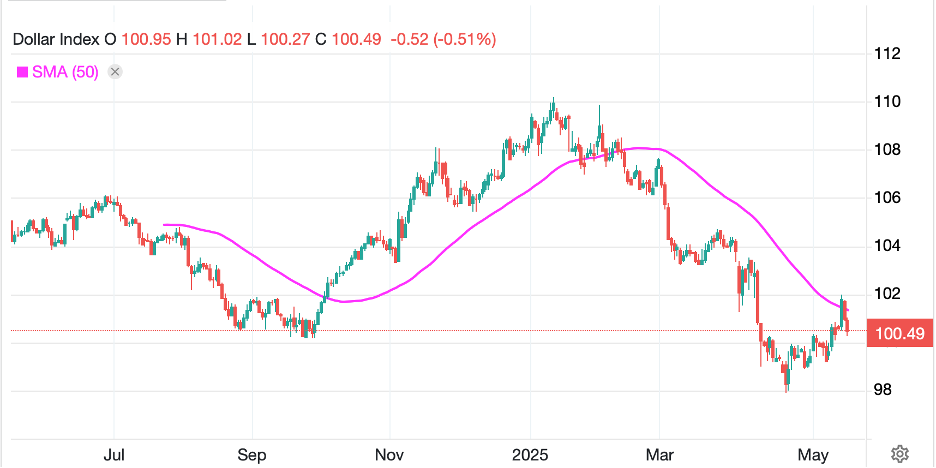
From a technical perspective, we are going to hear a lot about how the dollar failed on its break above the 50-day moving average that was widely touted just two days ago. (see DXY chart below).

Source: tradingeconomics.com

But let’s think about the fundamentals for a bit.  First, we know that the Trump administration would prefer a weaker dollar as it helps the competitiveness of US exporters and that is a clear focus.  Second, the fact that US yields remain higher than elsewhere in the world is old news, that hasn’t changed since the Fed stopped its brief cutting spree ahead of the election last year while other nations (except Japan) have been cutting rates consistently.  What about trade and tariffs?  While it is possible that the idea of a reduction in trade will reduce the demand for dollars, arguably, all I have read is that during this 90-day ‘truce’, companies are ordering as much as they can to lock in low tariffs.  That sounds like more dollars will be flowing, not less.

As I ponder this question, the first thing to remember is that markets don’t necessarily trade in what appears to be a logical or consistent fashion.  I often remark that markets are simply perverse.  But going back to the first point regarding President Trump’s desire for a weaker dollar, there was a story overnight that a stronger KRW was part of the trade discussion between the US and South Korea and I have a feeling that is going to be part of the discussion throughout Asia, especially with Japan.  As of now, I continue to see more downward pressure on the dollar than upward given the Administration’s desires.  I don’t think the Fed is going to do anything, nor should they, but I also don’t foresee a change in the recession narrative in the near future.  While that has not been the lead story today, it remains clear that concern about an impending recession is everywhere except, perhaps, the Marriner Eccles Building.  My view has been a lower dollar, and perhaps today’s price action is a good example of why that is the case.

Ok, let’s touch on other markets quickly.  After yesterday’s mixed session in the US, Asia saw much more positivity with China (+1.2%) and Hong Kong (+2.3%) leading the way higher with most regional markets having good sessions and only Japan (-0.15%) missing the boat.  In Europe, though, the picture is not as bright with both the CAC (-0.6%) and DAX (-0.5%) under some pressure this morning despite benign German inflation data and no French data.  Perhaps the euro’s strength is weighing on these markets.  As to US futures, at this hour (6:45), they are basically unchanged.

Away from Treasury markets, European sovereign yields have all slipped either -1bp or -2bps on the day with very little to discuss overall here.

Finally, in the true surprise, commodity prices are under pressure this morning across the board despite the weak dollar.  Oil (-1.1%) is slipping, with the proximate cause allegedly being API oil inventory data showed a surprising gain of >4 million barrels.  However, given the courteousness of the meeting between President Trump and Saudi Prince MBS, I would not be surprised to hear of an agreement to see prices lower overall.  I believe that is Trump’s goal for many reasons, notably to put more pressure on Russia’s finances, as well as Iran’s and to help the inflation story in the US.  As to the metals complex, they are all lower this morning with gold (-0.7%) leading the way but both silver (-0.3%) and copper (-0.5%) lagging as well.

On the data front, there is no front-line data to be released, although we do see EIA oil inventories with modest declines expected.  However, it is worth noting that Chinese monetary data was released this morning and it showed a significant decline in New Yuan Loans and Total Social Financing, exactly the opposite of what you would expect if the Chinese were seeking to stimulate their economy.  It is difficult for me to look at the chart below of New Bank Loans and see any trend of note.  I would not hold my breath for the Chinese bazooka of stimulus that so many seem to be counting on.

Source: tradingeconomics.com

Overall, it appears to me the market is becoming inured to the volatility which is Donald Trump.  As I have written before, after a while, traders simply get tired and stop chasing things.  My take is we will need something truly new, a resolution of the Chinese trade situation, or an Iran deal of some kind, to get things moving again.  But until then, choppy trading going nowhere is my call.

Good luck

Adf

No Longer Concern

Seems tariffs no longer concern
The markets, as mostly they yearn
For Jay and the Fed,
When looking ahead
To cut rates when next they adjourn
 
Alas, there’s no hint that’s the case
As prices keep rising apace
In fact, come this morning
There could be a warning
If CPI starts to retrace


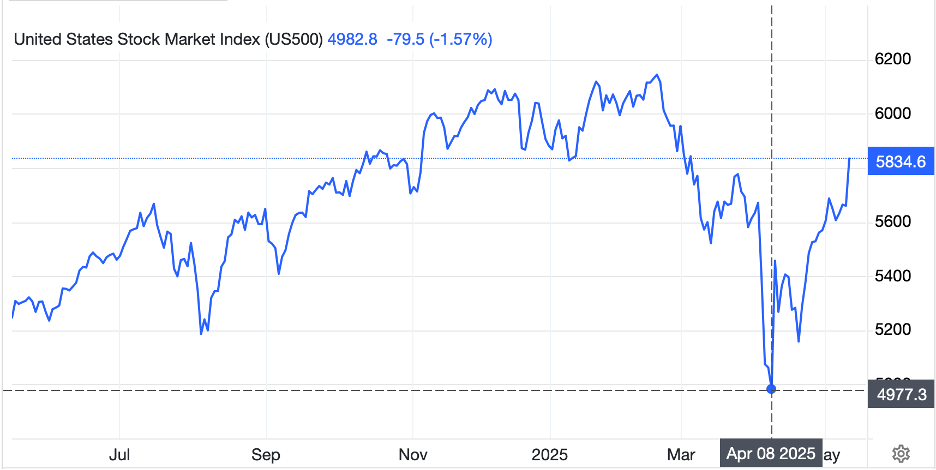
I am old enough to remember when President Trump’s actions on tariffs combined with DOGE was set to collapse the US economy.  I’m sure that was the case because it was headline news every day.  Equity markets fell sharply, the dollar fell sharply, gold rallied, and the clear consensus was the “end of American exceptionalism” in finance.  That was the description of how investors around the world flocked to the US equity markets as they held the best opportunities.  But the punditry was certain President Trump had killed that idea and were virtually licking their lips writing the obits for the US economy and President Trump’s plans.  In fact, I suspect all of you are old enough to remember that as well.  The chart below highlights the timing.

Source: tradingeconomics.com

But that is such old news it seems a mistake to even mention it.  The headlines this morning are all about how the stock market is now set to make new highs!  Bloomberg led with, Traders Model Bullish Moves for S&P 500 With Tariff Tensions Easing, although it is the theme everywhere.  So, is the world that much better today than a month ago?  Well, certainly the tariff situation continues to evolve, and we have moved away from the worst outcomes there it seems.  But recession probabilities remain elevated in all these econometric models, with current forecasts of 35%-50% quite common.  

Is a recession coming?  Well, the same people who have been telling us for the past 3 years that a recession was right around the corner, and some have even said we are currently living through one, are telling us that one is right around the corner.  Their track record isn’t inspiring.  In fact, these are the same people who are telling us that store shelves will be empty by the summer.  Personally, I take solace in the fact that the underlying numbers from the Q1 GDP data showed that despite a negative outcome, the positives of a huge increase in private investment and a reduction in government spending, were far more important to the economy than the fact that the trade deficit grew as companies rushed to stock up before the threatened tariffs.  Less government spending and more private investment are a much better mix for the economy’s performance going forward.  Let’s hope it stays that way.

But what about prices?  This morning’s CPI data (exp 0.3%, 2.4% Y/Y Headline, 0.3%, 2.8% Y/Y Core) will give us further hints about how the Fed will behave going forward.  As of now, there is no indication that the Fed is concerned about a growth slowdown of such magnitude that they need to cut rates.  In fact, Fed funds futures have reduced the probability of a June cut to just 8% and have reduced the total cuts for 2025 to just 2 now, down from 3 just a week ago.  Yesterday, Fed Governor Adriana Kugler reiterated the old view that tariffs could raise prices and reduce growth although gave no indication that cutting rates was the appropriate solution.  Arguably of more importance to the market will be Chairman Powell’s comments when he speaks Thursday morning.  My take here, though, is that the rate of inflation has bottomed and that the Fed is going to remain on hold all year long.  In fact, as I wrote back in the beginning of the year, I would not be surprised to ultimately see a rate hike before the year is over.  A rebound in growth and inflation remaining firm will change the narrative before too long, probably by the end of summer.  Of course, remember, I am just a poet and not nearly as smart as all those pundits, so take my views with at least a grain of salt.

Ok, let’s look at how markets have behaved in the new world order.  Yesterday’s massive US equity rally did not really see much follow through elsewhere although the Nikkei (+1.4%) had a solid session.  In fact, the Hang Seng (-1.9%) saw a reversal after a string of 8 straight gains as both profit-taking and some concerns about slowing growth in China seemed to be the main talking points there.  Elsewhere in the region, Malaysia and the Philippines had strong sessions while India lagged.  

In Europe, other than Spain’s IBEX (+0.8%), which has rallied purely on market internals, the rest of the continent and the UK are virtually unchanged this morning.  The most interesting comment I saw was from Treasury Secretary Bessent who dismissed the idea that a trade deal with the EU would be coming soon, “My personal belief is Europe may have a collective action problem; that the Italians want something that’s different than the French. But I’m sure at the end of the day, we will reach a satisfactory conclusion.”  That sounds to me like Europe is not high on the list of nations with whom the US is seeking to complete a deal quickly.  Finally, US futures are a touch softer this morning, although after the huge rallies yesterday, a little pullback is no surprise.

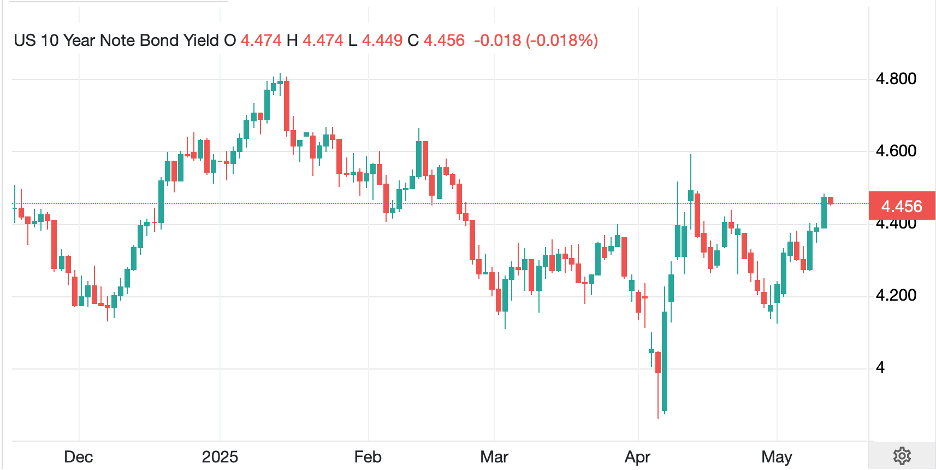
In the bond market, Treasury yields have backed off 2bps this morning, but in reality, they are higher by nearly 30bps so far this month as you can see below.

Source: tradingeconomics.com

This cannot please either Trump or Bessent but ultimately the question is, what is driving this price action?  If this is a consequence of investors anticipating faster US growth with inflation pressures building, that may be an acceptable outcome, especially if the administration can slow government spending.  But if this is the result of concern over the full faith and credit of the US government, or a liquidation by reserve holders around the world, that is a very different situation and one that I presume would be addressed directly by the Trump administration.  As to European sovereign yields, today has seen very modest rises, 1bp or 2bps across the board.  The biggest news there was the German ZEW survey which, while the Current Conditions Index fell to -82, saw the Economic Sentiment Index jump 39 points to +25.2, far better than expected.  It seems there is a lot of hope for the rearmament of Germany and the economic knock-on effects that will may bring.

In the commodity markets, oil (+0.6%) continues to grind higher as it looks set to test the recent highs near $64/bbl and from a technical perspective, may have put in a double bottom just above $56/bbl.  There is still a huge gap above the market that would need to be filled (trading above $70/bbl) in order to break this downtrend, at least in my mind.  But that doesn’t mean we can’t chop back and forth between $60 and $65 for a long time.  As to gold (+0.7%) after a sharp decline yesterday as the world was no longer scared about the future, it is bouncing back.  Whether this is merely technical, and we are heading lower, or yesterday’s price action was the aberration is yet to be determined.  Meanwhile, silver (+1.3%) and copper (+1.0%) are both having solid sessions as well.

Finally, the dollar is giving back a tiny bit of yesterday’s massive gains.  The euro (+0.2%) and pound (+0.25%) are emblematic of the overall movement although we have seen a few currencies with slightly stronger profiles this morning (SEK +0.8%, AUD +0.6%, CHF +0.5%).  In the EMG bloc, the movement has actually been far less impressive with ZAR (-0.45%) and KRW (-0.4%) bucking the trend of dollar softness but gains in MXN (+0.4%) and CZK (+0.4%) the best the bloc can do.  

One thing I will say about this administration is they have the ability to really change the tone of the discussion in a hurry.  If they are ultimately successful in reordering US economic activity away from the government and to the private sector, that is going to destroy my dollar weakness thesis.  I freely admit I didn’t expect anything like this to happen, but the early evidence points in that direction.  We will know more when Q2 GDP comes out and we find out if private sector activity is really increasing like the hints from Q1.  If that is the case, then the idea of American exceptionalism is going to make a major comeback in the punditry, although I suspect markets will have figured it out before then.

Other than the CPI, there is no other data and there are no Fed speakers on the docket.  While the dollar is soft this morning, I expect that any surprises in CPI will be the driver.  Otherwise, as I just mentioned, I am becoming concerned about my dollar weakness view.

Good luck

adf

Not Persuaded

As tariff concerns are digested
By markets, Chair Powell’s been tested
Is cutting the move
They need to improve?
Or are they, to tightness, still vested
 
It sounds as though he’s not persuaded
A rate cut will soon be paraded
But markets still price
He’ll be cutting thrice
It could be that view should be fade


Perusing the WSJ this morning, I stumbled across the following article, “What the Weak Dollar Means for the Global Economy” and couldn’t help but chuckle.  It was not that long ago when the punditry was complaining about the strong dollar as a problem for the global economy.  The current thesis is that the weakening dollar will make foreign exports to the US more expensive, on top of the tariffs, and will reduce the number of US tourists traveling abroad.  Foreign companies will also suffer as they translate their US sales into their respective local currencies, negatively impacting their earnings.  A moment as I shed a tear.

Of course, when the dollar was strong, the concern for the global economy was that it was increasingly expensive in local currency terms to obtain the dollars necessary to service the massive amounts of USD debt that foreign companies and nations have issued, thus reducing their ability to spend money on other things to drive their domestic economy.

As they say, you can’t have it both ways.  While there is no doubt the dollar’s decline this year has been swift, it is important to remember we are nowhere near an extremely weak dollar.  As you can see from the below chart, the euro was trading near 1.60 back in 2008 and as high as 1.38 even in 2014.  When looking at today’s price of 1.1375, it is hard to feel overly concerned.

Source: finance.yahoo.com

As it happens, this morning the single currency has slipped back -0.3% from yesterday’s levels.  The dollar’s future remains highly uncertain given the potential policy changes that may unfold as the tariff situation becomes clearer.  Which leads us to the Fed.

For the first time in many weeks, the Fed became a topic of conversation for the market when Chairman Powell spoke to the Economic Club of Chicago.  “Our obligation is to keep longer-term inflation expectations well anchored and to make certain that a one-time increase in the price level does not become an ongoing inflation problem,” Powell explained.  “We may find ourselves in the challenging scenario in which our dual-mandate goals are in tension. If that were to occur, we would consider how far the economy is from each goal, and the potentially different time horizons over which those respective gaps would be anticipated to close.”  

Let me start by saying, the Fed’s track record in anticipating economic outcomes is not stellar.  Equity markets were not encouraged by these comments and sold off during the discussion, although they retraced some of those losses before the end of the session.  At the same time, the Fed funds futures market, while having reduced the probability of a rate cut next month to just 15%, continues to price 88bps of cuts into the market by the December meeting.  Assuming there is no cut in May, that leaves five meetings for between three and four cuts.  Based on Powell’s comments, that seems like aggressive market pricing.

It appears that there is a growing belief that a recession is on its way and that will both reduce inflationary pressures and force allow the Fed to start to reduce rates further.  Of course, there are those, Powell included, who seem to believe that stagflation is a strong possibility.  If that were the case, especially given Powell’s new-found belief that price stability matters, and his clear distaste for the president, my sense is they will focus on inflation not growth if financial conditions (aka bond markets) remain in good shape.  Will the dollar continue to decline under that scenario?  That is a very tough call as a US recession would almost certainly spread globally, and other central banks will likely ease policy.  If the Fed stands pat amidst a global reduction in interest rates, I don’t see the dollar declining.  If for no other reason, the cost of carrying short dollar positions would become too prohibitive.

As usual, the future remains quite cloudy.  Cases can be made for Fed cuts, and against them.  Cases can be made for dollar weakness and dollar strength.  Arguably, the biggest unknown is how the trade talks are going to resolve.  Yesterday, President Trump explained that “big progress” has been made on the Japanese tariff talks.  If Trump is successful in creating a coalition of nations that have closer trade relations with lower tariffs, I expect that would be taken quite positively by the markets.  On the other hand, if those talks fall apart, I expect equity markets to start the next leg lower, and that is a global phenomenon, while the dollar sinks further.  There is much yet to come.

Ok, let’s see how things played out overnight.  After yesterday’s US rout, Trump’s comments on trade talks with Japan clearly helped the market there as the Nikkei (+1.35%) rallied nicely as did the Hang Seng (+1.6%).  In fact, gains were widespread with Korea, India and Australia, to name three, all rising nicely.  Alas, Chinese shares did not participate, and Taiwan actually slipped a bit.  In Europe, investors await the ECB’s outcome this morning, where a 25bp cut is the median forecast, but there are those hinting at a 50bp cut to help moderate strength in the euro as well as support the economy given the tariff situation.  Remember, we have heard from a number of ECB members that they are confident inflation is heading back to their target.  Ahead of the news, shares are softer across the board with declines on the order of -0.5% to -0.8% throughout the continent and the UK.  Remember, too, their tariff talks are after Japan.  Interestingly, US futures are mixed with DJIA (-1.3%) the laggard while the other two are both higher about 0.5%.  It seems United Health shares have fallen enough to take the DJIA down with it.

In the bond market, Treasury yields have regained the 3bps they fell during yesterday’s US session, so are unchanged over two days.  We have also seen European sovereign yields climb between 2bps and 4bps, rising alongside Treasuries and JGB yields jumped 5bps, responding to confidence that the US-Japan trade dialog will be successful and support Japanese risk.

Despite all the reasons for oil to decline, including recession fears and continued pumping by pariahs like Iran and Venezuela, the black sticky stuff is higher by 1.1% this morning, its highest level in two weeks.  But as you can see in the chart below, there remains a huge gap to be filled more than $8/bbl higher than current prices.  It is difficult to see a significant rally on the horizon absent a major change in the supply situation.

Source: tradingeconomics.com

As to the metals markets, gold (-0.6%) blasted higher to another new high yesterday, above $3300/oz, and while it is backing off a bit today, shows no signs of stopping for now.  Both silver and copper rallied yesterday as well, and both are also falling back this morning (Ag -1.4%, Cu -2.1%).

Finally, the dollar is modestly firmer across the board this morning, with the DXY seeming to find 99.50 as a key trading pivot level.  In the G10, JPY (-0.45%) is the laggard along with CHF (-0.4%) while other currencies in the bloc have fallen around -0.2%.  The exception here is NOK (+0.3%) as it benefits from oil’s rebound.  In the EMG bloc, the dollar is mostly firmer, but most of the movement has been of the 0.3% variety, so especially given the overall decline in the dollar, this looks an awful lot like position adjustments ahead of the long weekend with no new trend to discern.

On the data front, yesterday’s Retail Sales was stronger than expected, and not just goods that were bought ahead of tariffs, but also services and dining out, which would seem less impacted.  This morning, we see a bunch of stuff as follows: Housing Starts (exp 1.42M), Building Permits (1.45M), Philly Fed (2.0), Initial Claims (225K) and Continuing Claims (1870K).  As long as the employment data continues to hold up, my take is the Fed will sit on the sidelines.  If that is the case, I sense we have found a new range for the dollar, 99/101 in the DXY and we will need a headline of note to break that.

As tomorrow is Good Friday and markets are essentially closed throughout Europe, as well as US exchanges, there will be no poetry.

Good luck and good weekend

Adf