Splitting More Hairs

The data continues to be
Uncertain, and so what we see
Is both bulls and bears
Just splitting more hairs
Til markets reach their apogee
 
Meanwhile, throughout Europe concern
Is building, that no one did learn
Their energy dreams
Are nought but grift schemes
And growth’s in a long-term downturn


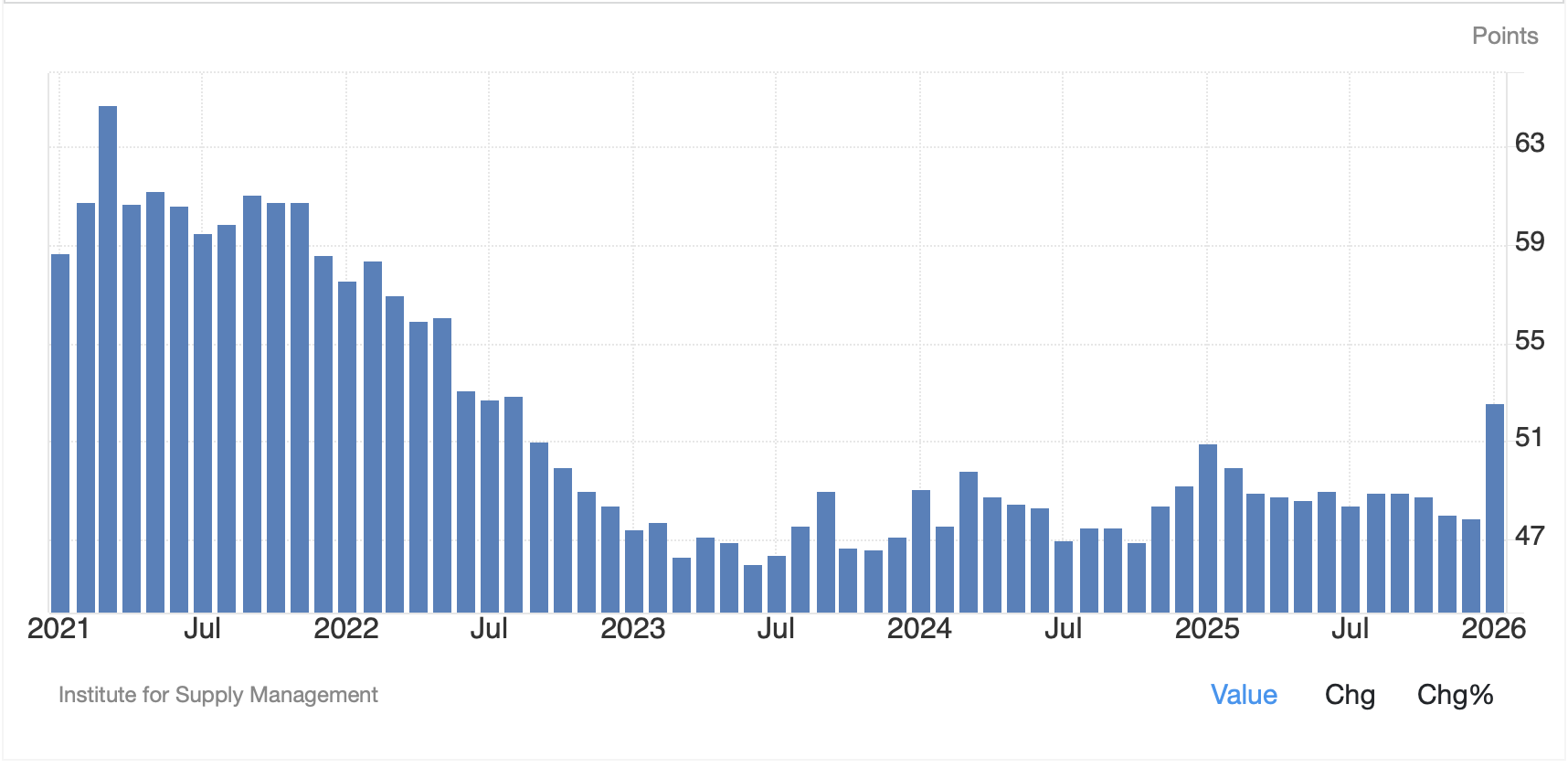
Once again, macroeconomic stories are light on the ground with no overarching theme atop the headlines.  As data continues to be released in the US post the government shutdown, we are seeing a similar pattern as before the shutdown, namely lots of conflicting data.  Yesterday was a perfect example as ADP Employment data was far weaker than expected printing at -32K (exp +10K) and indicative of a slowing economy.  At the same time, ISM Services showed unexpected strength, printing 52.6 with every sub indicator printing higher than last month except prices, which slipped 5 points.  While there was September IP and Capacity Utilization data, given it was so old, it just didn’t seem relevant.  

Depending on your underlying view, it was once again easy to point to recent data and make either the bull case on the economy and stocks or the bear case.  But there’s more.  A look at the last 5 years of ADP data shows a very distinct downward trend in employment as per the below.

Source: tradingeconomics.com

But as with so many things in the economy lately, it is fair to ask if the data we have known in the past is reflective of the current economic situation.  After all, if the Trump administration has deported 500K individuals, and another 1.5 million have self-deported, as the administration claims, it ought not be surprising that employment numbers are declining.  The implication is that population is declining, which would make sense.  So, I ask, does the declining ADP data signal what it did 5 years ago or 10 years ago?  I don’t believe the answer is that straightforward.

One of the things that has concerned me lately is the measurement of GDP.  My thesis has been that counting government spending in Keynes’s equation Y = C + I + G + (X-M) is double counting because, after all, if the government spends money, it goes into the economy and is recorded by the people/companies who receive it.  But perhaps my queasiness over the GDP idea is caused by something else instead, the fact that GDP measures credit creation, not economic activity.  This article by Alasdair Macleod, a pretty well-known economic analyst with a long career observing markets and economies, does an excellent job of identifying some really interesting problems that get accepted and assumed by many in their analysis of the current situation.  

For a while we have all seen, and probably felt, there is a disconnect between the data published and the feeling we get with respect to the current situation.  I highlighted the cost-of-living problem last week with the Michael Green articles.  This is another arrow in the quiver of things are not what they appear and that’s why so many people are so unhappy (even taking away TDS).

For me, where I try to synthesize a market view based on the information available, it is a very difficult time because of all the inconsistencies relative to what I have known in the past.  As well, I am being forced to reconfigure my mental models as the world has changed.  I suggest everyone do the same, as there is no going back to pre-Covid, let alone pre-GFC.

But the US is relatively well-off compared to most of the rest of the G10 as evidenced by this morning’s Eurozone data where Construction PMIs were, in a word, dreadful as can be seen below:

Source: tradingeconomics.com

No matter how you slice it, the fact that every reading is below 50 is a telling statement on the economic situation in Europe.  Adding to this problem is the fact that it appears, the EU, under the guidance(?) of President Ursula von der Leyen, is getting set to force the appropriation of Russian assets that were frozen at the outset of the Ukraine war, an act that Russia has indicated would, itself, be an act of war and they would respond in kind.  The US has unequivocally said they will not defend Europe if that is their decision, although we will continue to sell them weapons.  

For 80 years, NATO has been the defense umbrella allowing Europe to spend their money on butter, not guns.  Despite all the plans of rearmament, if Europe goes down this road, I suspect that there is nothing they can do to defend themselves without the US.  Once again, it is difficult to look at fiat currencies around the world, especially in Europe, and think they have more staying power than the dollar.  

Ok, let’s tour markets.  A solid day in the US was followed by strength virtually across the board in Asia (Japan +2.3%, HK +0.7%, China +0.3%) with the rest of the region +/- 0.3%, so not overwhelmingly positive or negative.  The Japanese outlier was based on news about Fanuc signing a deal with Nvidia to make AI industrial robots and that took the whole tech sector in Tokyo higher.  In Europe, green is also today’s theme as despite the weak data shown above, we started to get the first hints that the ECB may consider rate cuts after all.  While Madame Lagarde has been on her high horse saying there is no need to adjust rates, Piero Cipollone, a board member has highlighted concerns over further potential economic weakness going forward.  I look for others to come to the same conclusion and talk of an ECB cut to start to increase although swaps markets do not yet reflect any changes.  And at this hour (7:40) US futures are pointing slightly higher, 0.15% or so.

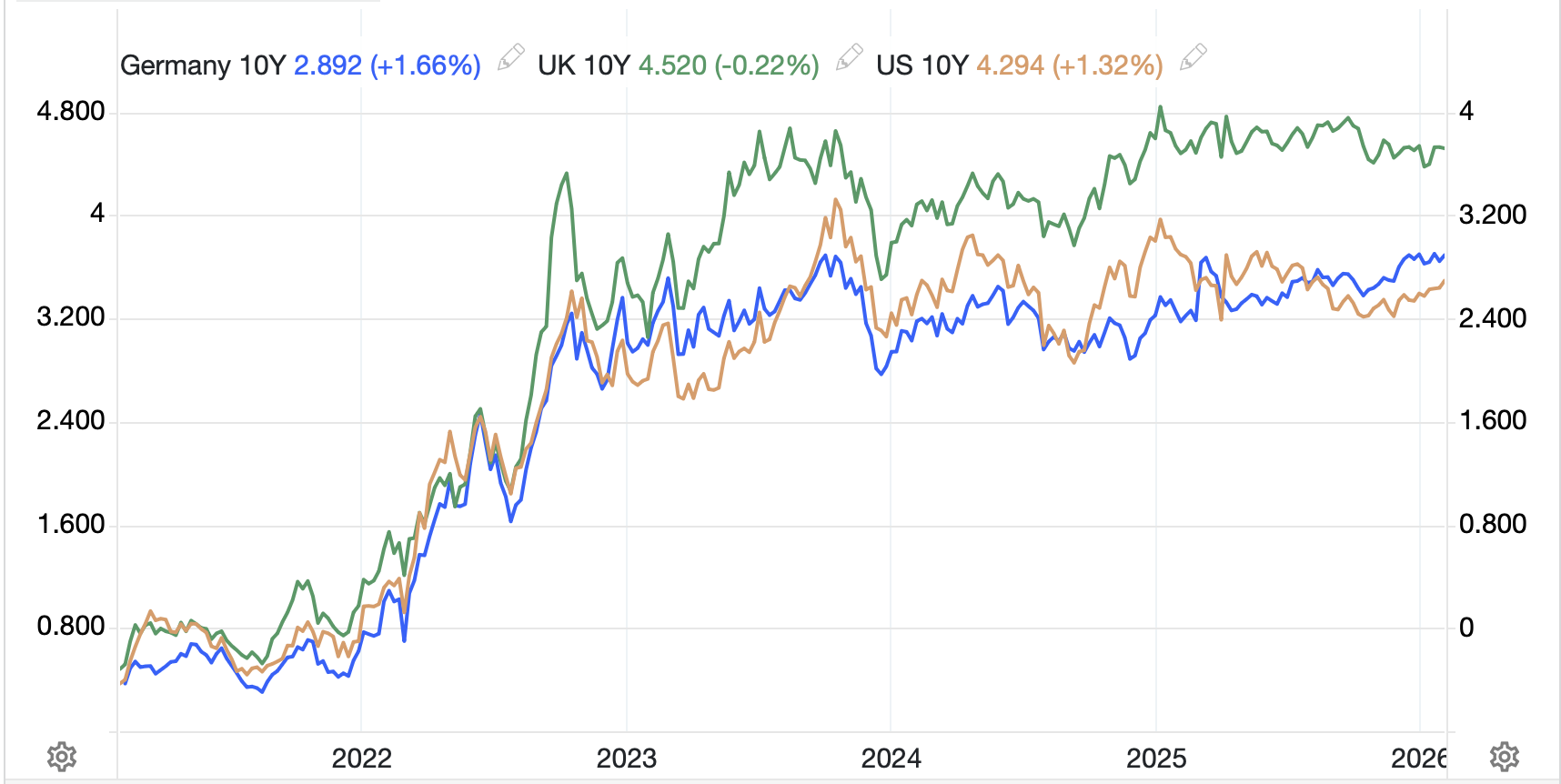
In the bond market, Treasury yields are reversing some of yesterday’s modest decline, rising 2bps this morning and that has helped pull European sovereign yields higher by similar amounts across the board.  The one exception here is UK gilts, which given the ongoing weak data seem to be anticipating a greater chance of a BOE cut than before.  in Asia, JGB yields rose 4bps and now sit at 1.93%, a new high for the move, but there is no indication we are near a top.  There is growing confidence the BOJ will hike rates later this month, although I would expect that should help slow the rise as at least it will have a modest impact on inflation readings going forward.

In the commodity markets, oil (+0.5%) continues to chop back and forth making no new ground in either direction.  Stories about peace in Ukraine don’t seem to matter much, nor do stories about a US invasion of Venezuela.  In fact, nothing seems to matter too much to this market other than actual supply and demand, and that seems pretty balanced, at least as evidenced by  the fact that for the past 2+ months, we have gyrated either side of $60/bbl with no impetus in either direction.  (see below)

Source: tradingeconomics.com

Metals markets are slipping a bit this morning (Au -0.25%, Ag -1.8%, Cu -0.6%) but that is simply part of the recent consolidation.  After all, metals have rallied forcefully all year, so taking a breather is no surprise. 

Finally, the dollar is a nonevent today with the most noteworthy story the news that the PBOC fixing last night was 160 pips higher (weaker CNY) than forecast by the market.  As well, there have been several stories that Chinese state-owned banks are buying dollars in the market to help slow down the yuan’s recent appreciation.  I discussed the yuan yesterday so this should be no surprise.  The tension on China to maintain a weak enough currency to support their export industries is huge, so a quick appreciation would be extremely negative for the nation’s trade balance and economic activity.

On the data front, Initial (exp 220K) and Continuing (1960K) Claims lead us off and then Factory Orders from September (0.5%) come at 10:00.  There are still no Fed speakers, so markets remain subject to headline risk, notably from the White House.  As we are in December, my sense is that things will become increasingly uninteresting from a market perspective absent a major new event.  While price action will likely remain choppy, it is hard to see a major directional move until next year.

Good luck

Adf

Gone Astray

The ADP Labor report
On Wednesday, came up a bit short
Investors decided
That they would be guided
By this and bought bonds like a sport
 
As well, there’s a story today
The BLS has gone astray
It seems that their data
Might have the wrong weight-a
So, CPI’s not what they say


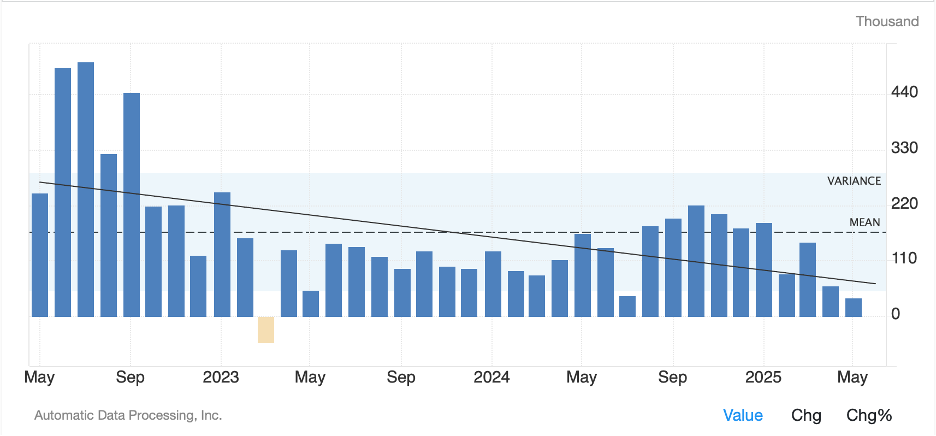
It has been another very dull session in most markets although yesterday did see a strong bond market rally after the ADP Employment Report was released much lower than expected at just 37K jobs created.  Certainly, the trend has been lower for the past three years as you can see in the below chart from tradingeconomics.com, so I guess we cannot be that surprised.

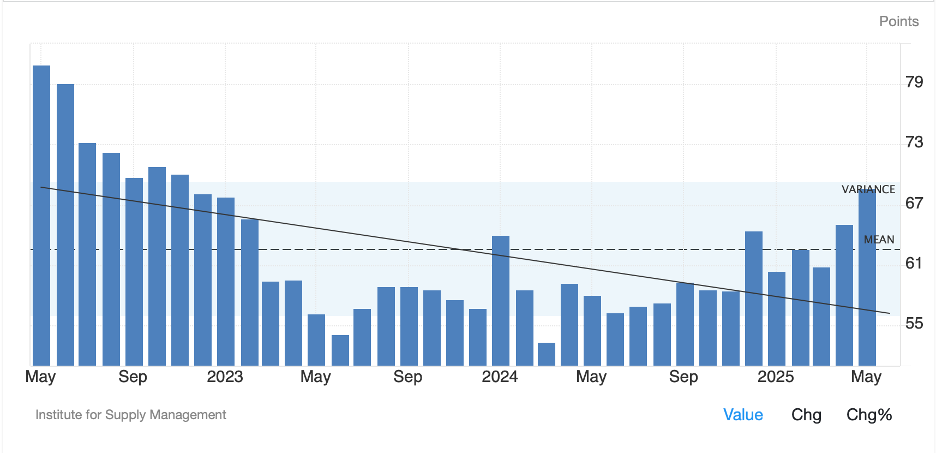
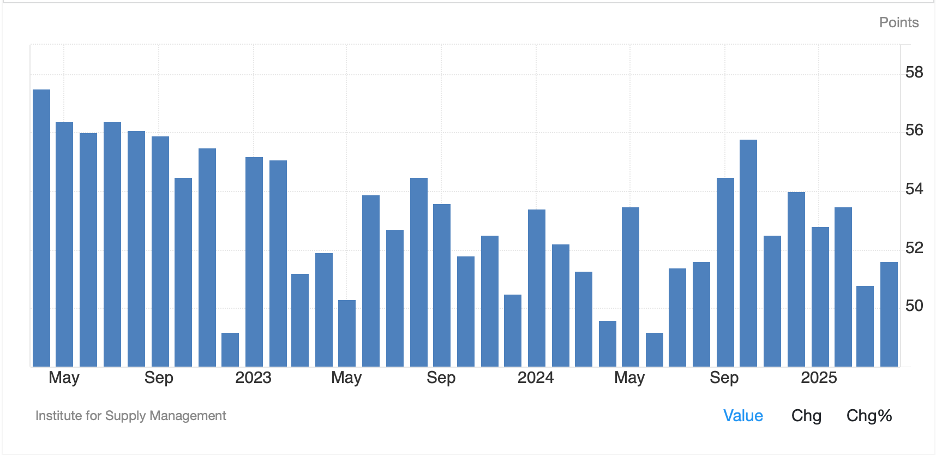
You will also not be surprised that this data brought out the recessionistas as they jumped all over the release to make their case that recession was just around the corner, and quite possibly stagflation.  Adding to their case was the ISM Services data which also disappointed at 49.9 and has also been trending lower for the past three years.  As well, they were almost gleeful in their description of the Prices Paid sub index rising to 68.7, its highest print since November 2022.  Alas, while Pries Paid have been rising for the past year or so, a look at the trendline shows they are continuing to retreat from the highs seen during the Bidenflation of 2022.

Source: tradingeconomics.com

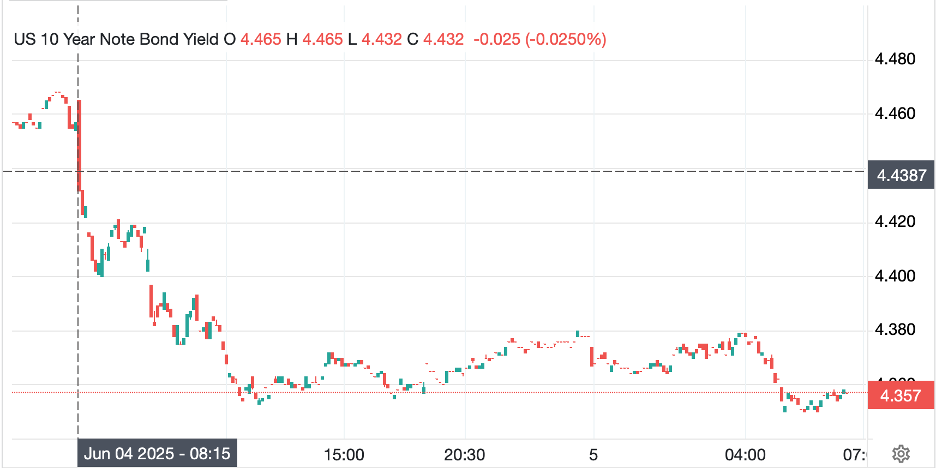
In the end, although this data was unquestionably disappointing, it feels a bit too early, at least to me, to declare the recession has arrived.  But not too early for the bond market where 10-year yields tumbled 11bps on the day and almost all the damage was done in the first hour after the ADP release although the ISM helped things along as well.

Source: tradingeconomics.com

Perhaps we are going into a recession, or even already in one, but overall, the data so far are just showing the beginnings of that.  I imagine opinions will be strengthened one way or another tomorrow when the NFP report is released, but for now, the recessionistas appear to have the upper hand, at least in the bond market.

The other story that is getting a response, at least amongst the Twitterati (X-eratti?) is the WSJ article about how the BLS, due to President Trump’s hiring freeze, is suddenly calling into question the accuracy of their statistical releases, notably the CPI report due next week.  I will let my friend, The Inflation Guy™, Mike Ashton, explain why this is a nothing burger. [emphasis added]

WSJ story about how staff shortages at BLS are affecting how many estimates the staff has to make instead of collecting actual data. It is very hard to make these errors accumulate to as much as 1-2bps on the monthly number.

UNLESS: there is bias in the estimating, or there are very large categories affected, or there are HUGE errors in some categories. Lots of random errors increases the overall error but is unlikely to affect the mean. And be honest. Do you have any idea what the MSE (mean standard error) of the CPI is?

People really should care about the error bars but even most economists almost never do. Unless it’s an opportunity to complain about budget cuts to economists, which is what this is. Nothing to see here.”

Otherwise, folks, another day in paradise with nothing else new, at least on the market front.  At some point, domestic politics, or geopolitics or war or something else is going to catch the fancy of the algos and change trading, but right now, that does not appear to be the case.  Perhaps Friday’s NFP data will be the catalyst to start a serious change in attitudes but I’m not holding my breath.

In the meantime, let’s survey market activity.  Yesterday’s US session was quite dull with limited movement and low volumes. Asia saw a mixed picture with the Nikkei (-0.5%) slipping, ostensibly, on concerns that a weaker US would negatively impact their export sector, tariffs be damned.  Hong Kong (+1.1%) though, rallied on Chinese PMI data holding on to recent levels rather than slipping further.  The rest of the region was far more positive, led by Korea (+1.5%) although the gains were more on the order of +0.5%.  Europe is all green this morning, with the CAC (+0.5%) leading the way, although the DAX (+0.4%) and FTSE 100 (+0.3%) are also holding up well on the back of positive German Factory orders data and solid UK Retail Sales.  Meanwhile, at this hour (7:00), US futures are ever so slightly firmer, +0.15% or so.

In the bond market this morning, after the big rally yesterday discussed above, Treasury yields this morning have edged lower by 1bp and European sovereigns have seen yields slide by between -3bps and -5bps as inflation data on the continent continues to soften encouraging the belief that the ECB, later this morning, may even consider more than the 25bp cut that is priced in.

The one true consistency lately has been gold (+0.8%) which has no shortage of demand, especially in Asia, and certainly feels like it is going to test, and break, the previous high of $3500/oz, which is now just $100 away.  But this has encouraged silver (+4.0%), copper (+2.65%) and now even platinum (+3.8%) has been invited to the party.  Regardless of the macroeconomic statistics, the ongoing global monetary policy of fiat debasement seems set to continue which can only help these metals.  As to oil (+0.3%), it continues to sit near its recent highs with not much activity in either direction.  It feels like we will need a major event/pronouncement of some sort, whether wider war in the Middle East or a change in OPEC policy to move this thing.

Finally, the dollar can best be described, again, as mixed.  While the euro and pound are marginally higher, the yen is marginally weaker.  In the EMG bloc, both KRW (+0.4%) and ZAR (+0.5%) are showing gains this morning, but nothing else of note is moving.  And when looking at the broad DXY, unchanged is where it’s at.  As with most markets right now, metals excepted, doing nothing seems the best choice.

On the data front, this morning brings the weekly Initial (exp 235K) and Continuing (1910K) Claims as well as the Trade Balance (-$94.0B) which if correct will almost certainly bring on a lot of White House crowing but is likely inconsequential with respect to the overall scheme of things.  We also see Nonfarm Productivity (-0.7%) and Unit Labor Costs (+5.7%) a combination of expectations that does speak to stagflation.  The ECB meeting will get some eyeballs, but unless they cut 50bps, a very low probability event based on current market pricing, it is hard to see much impact there either.

We are in a rut for now.  Whatever the catalyst that is required to change views substantially, it is not obvious at this point.  Bigger picture, nothing indicates any government is going to slow their spending or their money printing.  There is too much debt to ever be repaid, so a slow inflationary debasement is very likely our future.  I still think the dollar slides further, but it could be a few months before the current range breaks.

Good luck

Adf

More Pain

The data from China reflected
That tariffs have hurt, as expected
It’s likely more pain,
On China, will rain
As both nations are so connected
 
Meanwhile, in a German surprise
Herr Merz failed to get his allies
To name him to lead
Which seemed guaranteed
Could this presage his quick demise?

In the battle being waged between the US and China via tariffs, the first data indications have shown that the US is faring a bit better.  Yesterday’s ISM Services data was stronger than expected, remaining well above the 50 level although arguably slightly below the recent average reading.

Source: tradingeconomics.com

Meanwhile, last night, the Chinese Caixin Services PMI fell to 50.7, missing expectations and continuing its drift lower over time.  

Source: tradingeconmics.com

Are things really worse in China than the US, at least from the perspective of data releases?  I think both nations will suffer during this period as the impacts of the tariffs and reduced trade bleed into the data over the next months, but so far, it seems the US is holding its own.  One of the problems with analyzing the issue is that as the WSJ pointed out yesterday, when the data in China gets bad, they simply stop releasing it, so it may be difficult to see.

Now, last night, Chinese shares did manage a nice rally with the CSI 300 higher by 1.0% but that follows six consecutive down sessions, albeit of modest size.  

Source: tradingeconomics.com

As to the renminbi, after a 1% gain last Friday, it has done little and remains very much in line with its levels of the past year.  The thing about China is that nothing there moves quickly, so absent a policy announcement of some type, I expect this activity will continue to gradually adjust to the realities as they become clear to the market.  If President Trump reduces tariffs, as he implied he would eventually, things could work better, but again, given the time lags of moving products across the Pacific, we have a lot of time between now and whatever the new normal turns out to be.

But the more interesting story to me overnight was that Friedrich Merz, the ostensible winner of the German elections last month failed to achieve the votes to be named Chancellor despite his coalition having a 12-seat majority in the Bundestag.  As it was a secret ballot, nobody knows who didn’t support him, but this outcome certainly calls into question both his ability to lead Germany effectively, and correspondingly, Germany’s ability to lead Europe in the new world order.

Recall, Germany remains keen to support Ukraine in its ongoing war with Russia and even destroyed their once sacrosanct fiscal responsibility in order to be able to pay for that support.  But if they do not have an effective leader, one who can command their parliament to enact his policies, it is not clear why other European nations would follow their lead on anything.  It should not be surprising that the DAX (-1.3%) fell sharply when the news was released, and that has helped drag most European shares lower (CAC -0.7%, IBEX -0.3%, Poland -3.3%).  As to the euro, you can see from the below chart that the response, when the news was announced, that it slipped about 0.5%, basically wiping out the gains it had achieved prior to the vote.

Source: tradingeconomics.com

Will this matter in the long run?  I believe that a weakened Germany, which is likely the outcome of this situation, will simply undermine the euro’s value.  As such, while I still believe the dollar has further to decline, the euro will probably not be a major winner.  Look for other currencies to outperform the euro going forward.

Ok, I think those are the real stories as we head into today’s session with most market participants remaining tentative in the face of the ongoing confusion over policies, counter policies and macroeconomic data.  Remember, too, we have the Fed tomorrow and the BOE on Thursday, so despite the fact that fiscal policy has been the driver, the Fed’s opinions still carry weight amongst the fixed income community, at the very least.

Looking at the price action overnight, the Nikkei (+1.0%) gained on some solid earnings data from Japanese companies as well as increased hopes that the US-Japan trade talks will be successfully completed by June.  Apparently, there is also some faith that the US and China will begin talking soon on this subject.  Hong Kong (+0.7%) also benefitted from these discussions, but the rest of the region showed very little movement overall, with gains or losses on the order of 0.3% or less.  As we have already discussed Europe, a look at US futures shows they are pointing lower by about -0.5% at this hour (7:10).

Bond markets remain very dull these days with Treasury yields edging higher by 1bp this morning after climbing 3bps yesterday.  European sovereign yields are also higher. By 1bp to 2bps although there is neither data nor a story that seems to have had much impact.  The Services PMI data that was released this morning was very much in line with expectations and continues to hover around 50.0 for the continent as a whole.  Meanwhile, JGB yields were unchanged last night and sit at 1.25%, well below the levels seen back in late March and having really gone nowhere for the past month.  It strikes me that JGB yields will respond to any trade deals but are likely to be quiet in the interim.

Commodity prices are rallying this morning with oil (+2.2%) rebounding from its level yesterday which happen to come quite close to touching the lows from April 9th.  It should be no surprise that there are up days in this market, but if the Saudis and OPEC are going to continue increasing production, I expect that prices have further to fall.  In the metals markets, gold (+1.4%) is having another blockbuster day, now having gained $150/oz in the past three sessions and bouncing off the correction lows.  Demand for the barbarous relic continues to come from Asia mostly with all signs showing that US investors are not interested in this trade.  As to silver (+1.7%) and copper (+0.6%), they are both still along for the ride.

It should be no surprise with the commodity markets showing strength that the dollar is under pressure this morning.  while we’ve discussed the euro already, the pound (+0.5%) is looking quite solid as it continues its rally from the lows seen in mid-January.  But the yen (+0.5%), SEK (+0.45%) and NOK (+0.35%) are all gaining today as well.  Interestingly, the impact in emerging markets is far less noticeable with none of the major EMG currencies moving even 0.2% this morning.

On the data front, there is very little hard data this week although we do have the Fed on Wednesday and then a whole bunch of Fed speakers on Friday.

TodayTrade Balance-$137.0B
WednesdayFOMC Rate Decision4.50% (unchanged)
 Consumer Credit$9.5B
ThursdayBOE Rate Decision4.25% (-0.25%)
 Initial Claims230K
 Continuing Claims1890K
 Nonfarm Productivity-0.7%
 Unit Labor Costs5.1%

Source: tradingeconomics.com

Today’s trade data is for March, prior to the tariff impositions, so will reflect significant tariff front-running.  But really, it’s about the Fed this week, and since they have lost much of their cachet lately, I think the market is really going to continue to look to the White House for trade news and react to that.  Net, I continue to believe that the dollar’s FX rate will be part of many trade discussions, like we saw with Taiwan (which by the way did reverse 3% of yesterday’s gain overnight) and that means further weakness is in our future.

Good luck

Adf

Rate Cuts Have Slowed

The story that’s driving the news
Is one on which most have strong views
Both neighbors have claimed
Their borders are tamed
So, tariffs, the Prez, will not use
 
Meanwhile, data yesterday showed
That managers are in growth mode
The ISM rose
And Fed speakers chose
To validate rate cuts have slowed


The major economic story is, of course, the news that both Canada and Mexico have altered their behavior in order to prevent the imposition of 25% tariffs on their exports to the US.  Both nations have now promised to police the border between themselves and the US more tightly, and it also seems that the US now has operational control, via military overflights, of the Mexican border.  While there are many pundits who believe all this activity was merely theater and could have been accomplished without tariff threats, none of them are in a position of power.  In the end, I think it is very difficult to conclude anything other than Trump got what he wanted and achieved it via his preferred means.

The market response was very much what you might expect.  The early sharp declines in the CAD and MXN were reversed and the day ended with both currencies at basically the same levels they closed on Friday.  However, as you can see from the chart below, there was clearly some excitement and panic during the session, with back and forth 2% movements.

Source: tradingeconomics.com

Here’s the thing, I think you all need to be prepared for this type of activity on a regular basis for the next four years.  Certainly, there is nothing to suggest that President Trump is going to change his style and as long as he is successful in achieving his aims in this manner, he will continue with these activities.  Consider this as well, no national leader wants to appear weak, especially to their electorate, and so when President Trump turns his focus to a smaller nation, those leaders are very likely to try to stand up to the pressure, at least in public.  But in the end, most nations are far more reliant on the US market to buy their stuff than the other way around.  After all, the US is basically the consumer of last resort globally.  As such, very few nations can truthfully withstand an onslaught of this magnitude.

Now, turning to the state of the US economy, President Trump got some very positive news from the ISM data which printed at 50.9, its highest level since September 2022 and far higher than forecasts.  In fact, it is not hard to look at the recent trend in this data series and believe we are going to see positive economic growth going forward

Source: tradingeconomics.com

However, the downside here was that the Prices Paid portion of the index also rose, back to 54.9, implying that inflation pressures remain extant within the economy.  Now, you and I both know that is the case as we all deal with these prices on a daily basis, but until the data starts to become more obvious, it appears the Fed is always the last to know.

Speaking of the Fed, while only one speaker was on the schedule, Atlanta Fed President Bostic, we heard from three of them anyway as it remains clear to me there is a strong belief in the Marriner Eccles building that a key part of their job is to never shut up constantly pitch their narrative to try to keep markets in line.  So, as well as Bostic, we heard from Chicago’s Goolsbee and Boston’s Collins and they all basically said the same thing, perhaps best stated by Ms Collins, “There’s no urgency for making additional adjustments.  The data is going to have to tell us.  At some point I certainly would see additional normalization in terms of what the policy stance is.”  The last part of her comment refers to the idea that she, and truthfully all three, believe that further rate cuts remain appropriate despite the ongoing growth and continued stickiness of prices.  And to think, some people believe that Trump and the Fed are not on the same page.   They all want lower rates!

Ok, let’s turn to markets and see how they have behaved overnight.  Yesterday, after a pretty horrible opening on the basis of tariffs, tariffs everywhere, the news that they would be postponed saw US markets rebound, although still close lower on the session.  In Asia, Japan (+0.7%) rallied as so far, Japan remains out of the tariff sightlines, and Hong Kong (+2.8%) traded much higher in its first post-holiday session although mainland Chinese share trading doesn’t reopen until tonight.  Elsewhere in Asia, the screens were largely green, perhaps on the thesis that tariffs are just a negotiating tactic.  In Europe, the picture is more mixed with the UK (-0.2%) lagging while Spain’s IBEX (+0.8%) is the leading gainer.  The rest of the continent, though, is seeing gains on the order of just 0.2%, so not much love.  And at this hour (7:10) US futures are little changed.

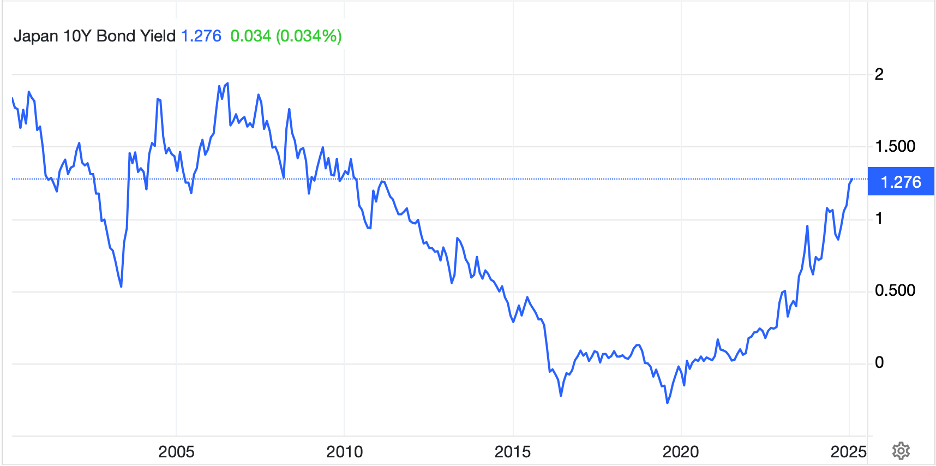
In the bond market, Treasury yields, after edging higher by a few bps yesterday, are up another 2bps this morning and pushing back to 4.60%.  In Europe, sovereign yields are also firmer this morning, up between 2bps and 4bps across the board, although this is after sharply lower yields yesterday on still weak PMI data from the continent.  As well, Mr Trump is hinting that he is going to turn his tariff sights on Europe soon, so there has to be some trepidation there.  After all, Europe, which is already a basket case due to self-inflicted energy-based wounds, really cannot afford a trade fight with the US, especially since they have a net trade surplus on the order of $200 billion with the US.  Finally, JGB yields rose 3bps and are now at their highest level since May 2010 and look for all the world like the trend remains strongly intact as per the below chart.

Source: tradingeconomics.com

In the commodity markets, confusion in energy reigns as yesterday’s initial rally on Canadian tariff news has been completely reversed with oil (-2.1%) and NatGas (-4.2%) both falling sharply today.  But what is not falling is gold (+0.1%) which made yet another new all-time high yesterday and continues to defy gravity.  This has helped the entire metals complex with both silver and copper higher by 0.5% this morning.

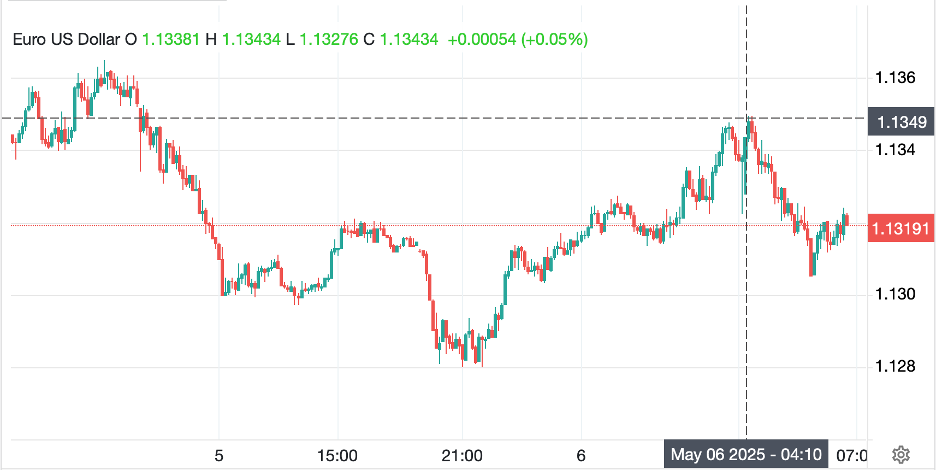
Finally, the dollar continues its general winning ways this morning.  Yesterday saw early gains, also on the tariff story, which as evidenced by the chart at the beginning of the note, reversed.  But in the other currencies, the euro and pound remain under modest pressure along with Aussie, as all three are softer by about -0.3% today, with the yen (-0.4%) along for the ride.  In the EMG bloc, MXN (-0.6%), BRL (-1.2%) and ZAR (-0.3%) are also under pressure as though the immediate tariff threat seems to have abated, fear remains the driving force in the space.  Add to the tariff fears the fact that the US economy continues to outperform its peers, and the Fed has basically put the kibosh on any rate cuts anytime soon and it is easy to understand why money is flowing this way.

On the data front, JOLTS Job Openings (exp 8.0M) and Factory Orders (-0.7%, +0.6% ex Transport) are today’s information, and we hear from more Fed speakers.  It seems clear, so far, that the Fed mantra is wait and see as things evolve under President Trump.  Unless one of these speakers (Bostic, Daly, Jefferson) offers a different view, which seems unlikely, then I suspect the dollar will continue to find more support than resistance for now.

Good luck

Adf

Quite Drear

The world is apparently ending
‘Cause stocks just will not stop descending
So, calls have increased
For fifty, at least
And government to up its spending
 
The cause of this rout is unclear
Though data of late’s been quite drear
If growth is much slower
Then stocks can go lower
And that, my good friends, triggers fear


The only topic on market practitioners’ lips this morning is the ongoing sell-off in equity markets around the world.  The US returned after the Labor Day holiday and sold equities aggressively with the NASDAQ falling more than 3.25% and the other major indices all declining at least -1.5%.  This led to a disastrous opening in Asia with the Nikkei (-4.25%) leading the way down as fears of a repeat of the early August rout were rampant.  While things never got to that point, we did see both Korea and Taiwan markets fall even more than Tokyo with declines between -4.5% and -5.0%.  This negative sentiment is alive and well in Europe with every market lower there, although the declines are less pronounced, between -0.7% and -1.1%, and US futures are lower this morning as well, down anywhere between -0.3% and -0.6% at this hour (6:30).

So, what’s happening?  Is there something new that was previously unknown?  The first place to look is the data which saw ISM manufacturing rise less than expected to 47.2, a number that historically represents recession, with the added problem of the ISM Prices Paid reading at 54.0, higher than expected and a potential harbinger that inflation may not be declining as quickly the Fed expects.  Add to that a weaker than expected Construction Spending result, -0.3%, and you have the makings of some potential dreariness on the economic front.  The problem with this thesis is that the equity market opened prior to the releases and was already down -1.0% by the time they hit the tape.

Perhaps it is simply the end of summer blues as historically, September seems to be the worst month for equity performance, although I don’t put much credence in the idea that just because something has happened at a particular time before in markets, it will happen again.  Seasonality is real, especially in things like commodities, but is technology really seasonal?  And tech was leading the way lower.

Of course, markets have a long history of simply moving up and down over time without any specific catalyst.  Positioning and changes in sentiment evolve over time and sometimes they combine to move markets more than would otherwise be expected.

From a macro perspective, I believe that this week will teach us a great deal as the ISM data along with the employment data will give further evidence of the potential for that widely hoped for soft-landing or whether things are declining more rapidly.  Certainly, we continue to read of problems arising elsewhere in the world with the VW news about potential plant closings and weakness in Chinese PMI data overnight indicating that President Xi may need to do more to support his economy.  The thing about sentiment is that it doesn’t necessarily need a clear catalyst to change.  

Source: Horace.org

In the end, I’m hard-pressed to define anything that has changed since Friday afternoon.  However, it appears that sentiment is clearly far more circumspect about the future of economic activity and how that will be able to support the current extremely high valuations of so many companies.  As Ace Greenberg, then Chairman of Bear Stearns said when asked about what happened in the wake of Black Monday in 1987, “markets move, next question.”  

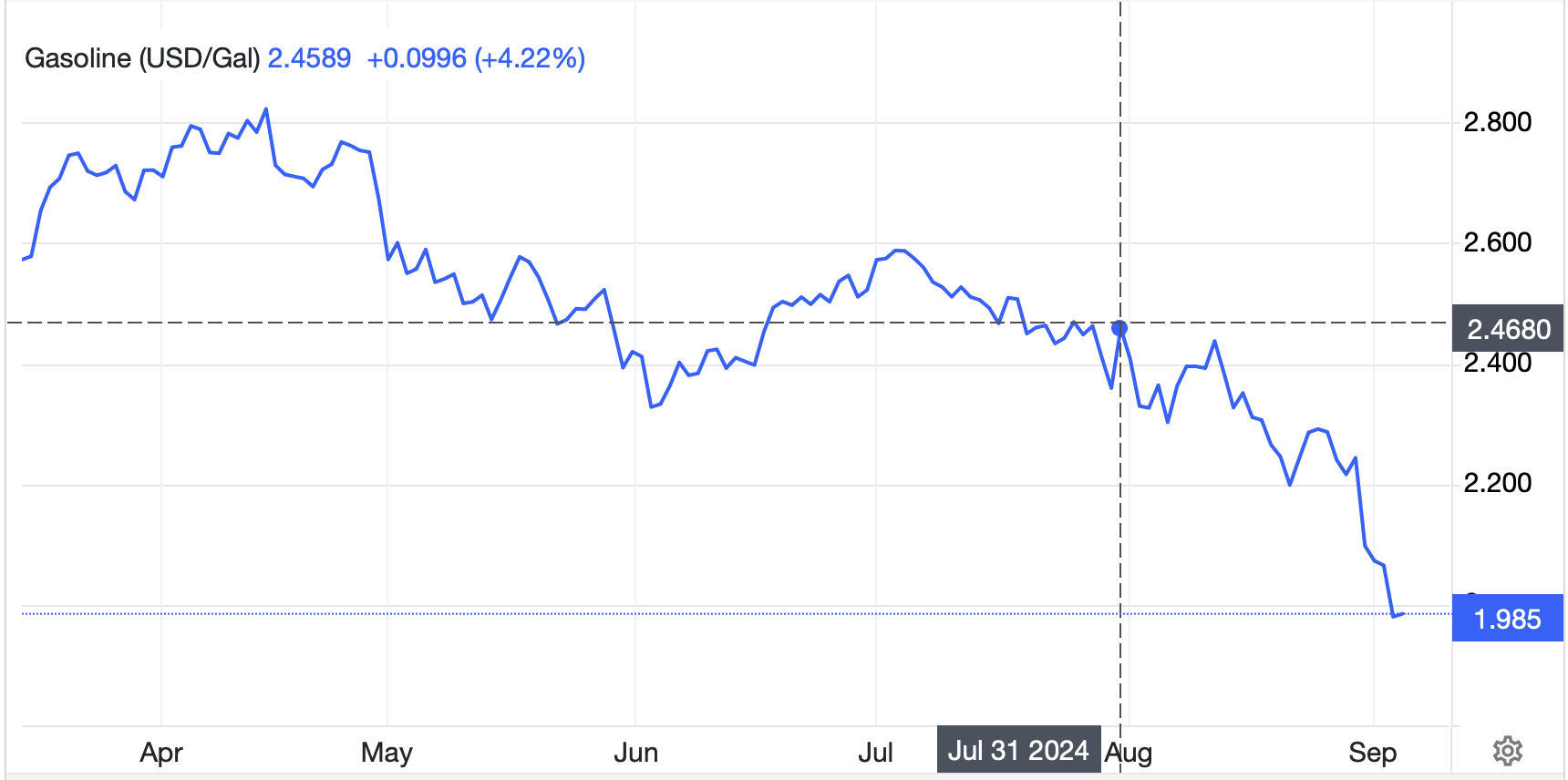
To this poet’s eyes, the big picture remains that economic activity is continuing to slow down around the world, and that price pressures in the US are lagging that decline.  It appears that China is flooding the global markets with manufactured goods as domestic consumption there remains lackluster, thus goods price inflation remains under control.  However, there is no sign that central banks or governments are reducing the amount of available liquidity which is finding its way into services pricing, and that is a much larger part of the economy, hence likely to sustain inflation readings going forward.  I’m confident the Fed will cut rates in 2 weeks’ time, but I’m also highly concerned that the result will be inflation remaining higher than ‘target’ going forward.  The one thing on Powell’s side right now is the decline in oil, and by extension gasoline (see chart below where gasoline futures fell >15% in August), prices, which will help push headline numbers lower.

Source: tradingeconomics.com

So, how did other markets behave while stocks were getting hammered?  Treasury yields fell 9bps yesterday after the data release and are lower by another 2bps this morning.  Clear risk-off behavior.  In Europe, sovereign bonds are all seeing declines this morning between -4bps and -5bps after declines yesterday as well and even JGB yields are lower by -4bps this morning.  investors are running for the relative safety of fixed income right now.

In the commodity markets, oil (+1.3%) is bouncing off the lows seen yesterday, when WTI traded down to $69.15/bbl briefly, as the recent decline has OPEC rethinking their decision to start increasing supply next month.  You may recall that when they cut production, they kept renewing that decision every few months but were set to slowly increase production again starting in October.  However, the sharp decline in the price of oil has them backtracking now.  The problem is that the evidence of slowing economic activity is weighing on the price here.  I suspect that until there is clear evidence that economic activity is rebounding, oil could remain under pressure.  In the metals markets, they were also sold off sharply yesterday, but have basically stopped declining for now, consolidating those losses.  Gold continues to be the best performer as the combination of risk-off and ongoing central bank purchases are supporting it well enough.  This is clearer if you look at the price of gold in other currencies, where it continues to make new highs.  But the industrial metals will have a difficult road ahead with slowing growth.

Finally, the dollar, after a strong rally yesterday, is little changed this morning.  In fact, most currencies are within a few basis points of their closing levels yesterday with only MXN (-0.35%) and SEK (-0.3%) showing any semblance of weakness while ZAR (+0.3%) and JPY (+0.3%) are the biggest gainers.  The yen story is clearly the haven aspect with Japanese investors bringing funds home.  Both the peso and krona are likely feeling a little pressure from the declines in commodity prices, while the rand has bucked that trend after reporting higher than expected GDP growth in Q2 and higher Business Confidence this morning.

Data today brings the Trade Balance (exp -$79.0B) at 8:30 and then the JOLTs Job Openings (8.10M) and Factory Orders (4.7$, -0.2% ex transport) at 10:00.  We also will see the BOC cut rates 25bps this morning, although nobody is paying much attention to Canada with all eyes on the Fed and ECB.

While a lower opening seems baked in, I wouldn’t be surprised to see a bounce of some sort by this afternoon as market participants seem to have a hard time allowing prices to fall for too long.  But there appears to be ample reason for further equity declines and further risk reduction, which historically has supported the dollar.

Good luck

Adf

Never Mind

The markets just said, never mind
Though yesterday’s moves were unkind
Twas all just a game
With punters to blame
It’s they who must need be maligned
 
Today is a whole other story
And one that is somewhat less gory
Now though it seems strange
Things just didn’t change
Believe us, it’s all hunky-dory


As much fear as was felt throughout global markets yesterday, that is how much relief is evident this morning.  In the midst of a panic sell-off, it is impossible to determine both the causes and how far things might run.  In fact, that is why stock exchanges around the world introduced circuit-breakers after the 1987 crash, to try to prevent any extended move lower.  As it happens, the only circuit breakers that triggered were in Asia (Japan, South Korea and Taiwan) as the rest of the world’s markets, though sharply lower, did not see the same magnitude of losses.

But that was so yesterday!  To their credit, no central bank reacted rashly to the movement, and there were precious few comments by any central bankers of note.  SF Fed President Daly spoke at a scheduled event and maintained the party line that they did not yet have enough confidence that inflation was going to sustainably decline to their target, although she is closely watching the labor market after last Friday’s NFP report.  “We’ve now confirmed that the labor market is slowing, and it’s extremely important that we not let it slow so much that it tips into a downturn.  It’s too early to tell if it is slowing to a sustainable pace which allows the economy to continue to grow or if it’s getting to a point where there’s real weakness there,” she explained.

Those comments certainly did not sound like someone who was concerned about the market’s dramatic movement yesterday.  And we should all be happy that is the case.  In fact, the central bank that should have been most concerned, the BOJ, said nothing at all.  As well, the RBA met last night and left policy on hold, as expected.  So, kudos to the central bank community for not overreacting to a stock market move.

Market participants, though, continue to clamor for support as they are confused by numbers that don’t go up.  Now, Tuesday has earned the name ‘turnaround Tuesday’ for a good reason, in that historically, after a large decline on Monday, especially if there was weakness at the end of the prior week, on average, there is a rebound in equity markets.  In fact, there was a very nice article in Bloomberg this morning giving details on that phenomenon.  

But the real question is, was yesterday an aberration or was it a harbinger of things to come?  On the one hand, the only data released yesterday was the ISM Services, which rose 2.6 points to 51.4, a much better than expected outcome, and certainly not seeming to be a signal that the US economy is heading into recession.  Ironically, if there is no recession coming, and the Fed remains sanguine about the economy, there is really no reason for them to worry about the interest rate structure.  I have asked this question many times, why would the Fed need to cut rates if the economy continues to grow at trend and equity markets continue to make new highs? 

But we cannot ignore the signals we have seen from other parts of the economy, notably the still weak manufacturing sector (as evidenced by the weak ISM Manufacturing and other regional Fed manufacturing indices) and the evident slowing in the payroll report.  Many of you will have heard of the Sahm Rule, which describes the relationship between movement in the Unemployment Rate and recessions.  

Briefly, the rule explains that if the three-month average of the Unemployment Rate rises 0.5% from its low point in the past 12 months, that signals the economy is already in a recession.  Last Friday’s rise in the UR ostensibly triggered that “rule”.  However, it is important to understand that the rule is merely the observation that since 1980, that situation has obtained each time a recession has occurred.  It is not a causal factor, just a coincidental indicator, so the fact that it has been triggered does not actually mean we are in a recession, just that historically that has been the case.

I have described numerous times that there are two broad camps of economists with some very smart people continuing to believe that we are already in a recession, even prior to Friday’s NFP report, and that the Fed is far behind the curve.  However, there is also a camp that believes in the no-landing scenario where the economy will be able to maintain its pace of growth given the combination of massive fiscal stimulus that continues to enter the economy, and the fact that the interest rate sensitivity of the US economy has declined dramatically since 2020 because so many borrowers, both individuals with mortgages and companies, termed out their debt during the ZIRP policy period.

However, there are several things to remember:

  • The stock market is not the economy.  Markets are forward looking indicators of indeterminate length, and while they may presage strength or weakness, they also get things wrong.  So, this market movement could merely be a trading correction amid ongoing economic growth, or it could be the beginning of the end.
  • The US economy’s reduced sensitivity to interest rates means that even if the Fed were to cut rates tomorrow, the impact on the economy is likely to take at least 12 months, if not much more before it is felt.  After all, the Fed started hiking rates two years ago and in Q2, GDP was still growing at 2.8% with inflation continuing above their target.
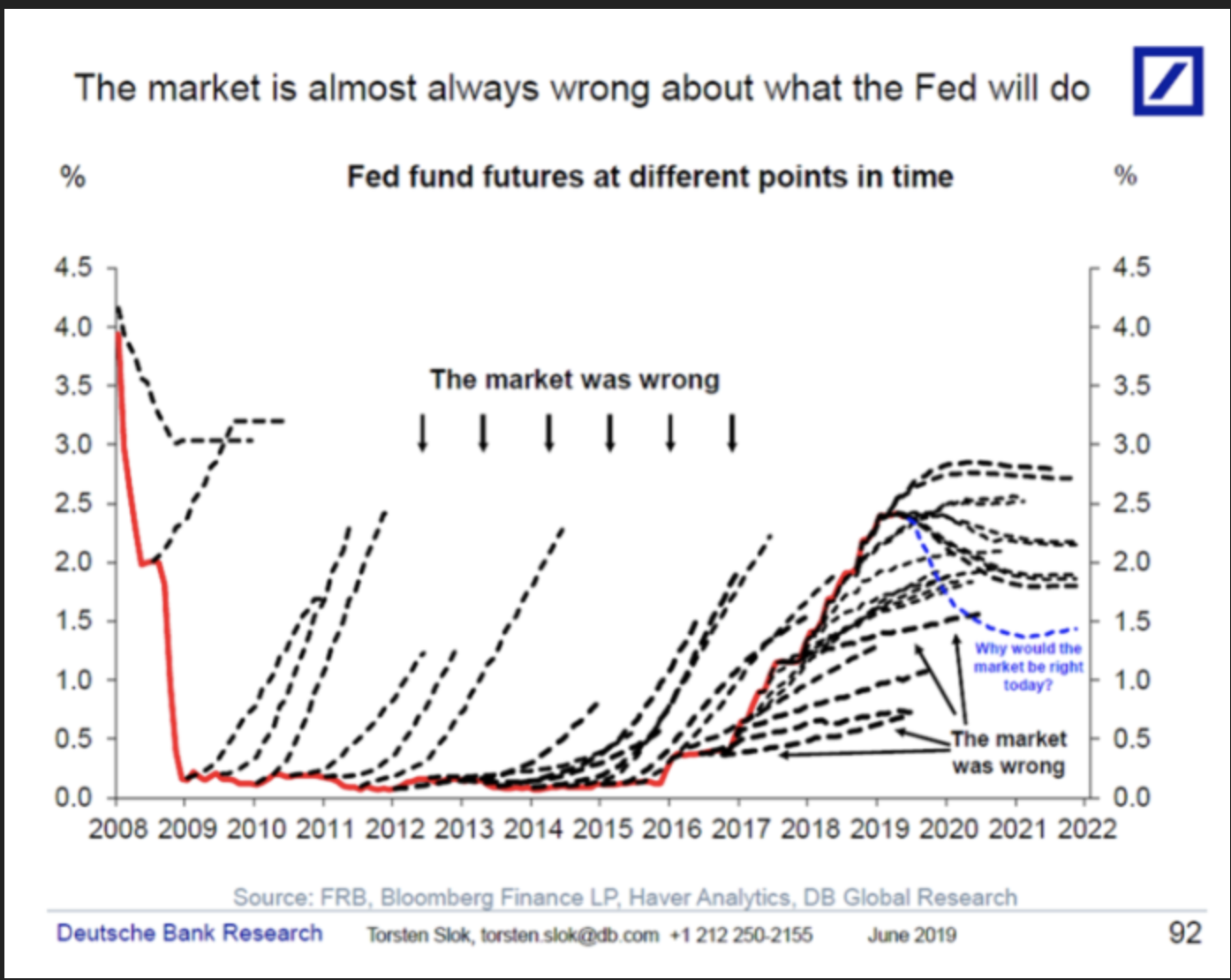
  • Interest rate markets often, if not almost always, are incorrect in their pricing of future Fed policy moves.  The below chart from Deutsche Bank Research shows the actual Fed funds rate (red line) and the way the futures market was pricing things at various points in time (black dashed lines).  As you can see, there are a lot more bad outcomes than correct ones.

I know I regularly discuss the Fed funds futures market, but I do so as an indicator of market sentiment, not an expectation of what the Fed will actually do.  And FWIW, this morning the futures market is pricing a 75% chance of a 50bp cut in September, up from Friday’s level of 25%, but down from the peak of 95% yesterday morning.

Ok, let’s tour markets very quickly now.  The Nikkei rebounded by 10.2% last night, its largest rise ever in a single session.  The other big decliners yesterday, South Korea (+3.3%) and Taiwan (+3.4%) also rebounded, although not nearly as impressively.  Chinese shares have basically sat this movement out, little changed last night after modest declines on Monday.  In Europe, the picture is mixed with the DAX (+0.1%) managing a gain while the CAC (-0.25%) and IBEX (-0.4%) both still lag.  The only data of note was Eurozone Retail Sales which disappointed at -0.3%.  US futures are rebounding as well, up about 1.0% at this hour (7:30).

In the bond market, Treasury yields bottomed yesterday morning at about 8:30 printing at 3.68% but have risen since then by a total of 20bps, with 7 of those occurring this morning.  Meanwhile, European sovereign yields are generally a touch softer, down between 1bp and 3bps as the European markets have ultimately seen limited impact from the big moves.  I guess, nobody was buying European stocks or bonds with their short yen funded positions.  As to JGB’s they also rebounded last night, closing higher by 11bps, although still well below the 1.0% level.

In the commodity markets, oil (-0.2%) spent most of yesterday rebounding alongside Treasury yields, and likely showing a little concern over the imminent (?) retaliation by Iran on Israel.  However, in the big scheme of things, it remains in its 70/90 range and obviously needs a bigger catalyst than we saw yesterday to break it.  Gold (+0.4%), which sold off yesterday, was the least impacted of risk assets and it is no surprise it is rebounding this morning.  The rest of the metals markets, though, remain under modest pressure after sharp declines yesterday.

Finally, the dollar has reversed some of yesterday’s moves, but there continues to be a wide range of movement.  Starting with the yen, during the NY session yesterday, the dollar rebounded sharply, more than 1.5% and though that move continued into the early Asian hours, right now, the yen is stronger (dollar lower) by 0.5%.  Elsewhere, though, the dollar is showing its haven status as it rallies vs. the rest of the G10, in some cases pretty substantially (GBP -0.75%, AUD -0.6%) and it is rallying against virtually all of the EMG bloc with the worst performers the MXN (-1.1%) and CE4 currencies, mostly lower by about -0.5%.

On the data front, today’s only release is the Trade Balance (exp -$72.5B) and I do not see any Fed speakers listed on the calendar.  Perhaps yesterday was a one-off, a type of warning shot across the bow of the economy that things are out of balance and subject to some jarring impacts.  Or perhaps it was just one of those things that markets periodically do irrespective of the economic fundamentals.  This poet remains in the camp that economic activity is slowing, and a recession is coming soon, although that will not necessarily help inflation decline.  But right now, it is anybody’s guess.  As to the dollar, nothing has changed its haven status I believe, so if fear continues to drive things, it should hold its own.

Good luck

Adf

Not Well Understood

The ISM data was weak
And traders, more bonds, did soon seek
The oil price fell
The dollar, as well
But stocks ended close to their peak
 
So, is now bad news really good?
‘Cause Jay will cut rates, or he should
Or is it the case
That growth’s slowing pace
Means risk is not well understood


The narrative had a little hiccup yesterday as the ISM data was released far weaker than expected.  The headline number, 48.7, fell vs. last month and was a full point below market expectations.  The real problem was that while the Employment sub-index was solid, New Orders tanked, and Prices remained high.  If you add this to the Chicago PMI data from Friday, which at 35.4, was the lowest print since the pandemic in May 2020 and back at levels seen in the recessions of 2001 and 2008, it is fair to question just how strong the US economy is right now.

Adding to this gloom is the news that the Atlanta Fed’s GDPNow estimate slipped to 1.8% for Q2, down from 2.7% last Friday, and the trend, as per the below chart, is not very pretty.

Given the data, it can be no surprise that the Treasury market rallied sharply, with yields declining 8 basis points on the session, although they are little changed this morning.  After all, if the economy is slowing, the theory is that inflationary pressures will decline, and the Fed will be able to cut rates sooner rather than later.   And maybe that is true.  But when we last heard from the FOMC membership, most were pretty convinced they needed to see more proof that inflation was actually lower, rather than simply that slowing growth should help their cause.  And I might argue that a weak ISM print, especially with the prices portion remaining high, is hardly the proof they require.

But yesterday’s markets were a bit confusing overall.  While the initial response to the weak data led to immediate selling across all equity markets, by the end of the day, those losses were reversed such that the NASDAQ had a fine day, rising 0.5%.  Ask yourself the question, why would stocks rebound despite further evidence that the economy is slowing down.  The obvious answer is that a slower economy will lead to slowing inflation and allow the Fed to reduce interest rates before long.  Of course, the flip side of that story is that a slower economy implies companies will lose pricing power as demand slides, thus reducing available profit margins and overall profits.  It seems hard to believe that stock prices will rally amid declining earnings, although these days, anything is possible.

While the Fed’s quiet period has many advantages (in truth I wish the entire time between meetings was the quiet period) one of its key attributes is that the narrative can run wild in whatever direction it likes.  As we will be receiving quite a bit of data this week, I suspect the narrative will have a few more twists and turns yet to come, although there is no question that the bulls remain in control of the conversation.  

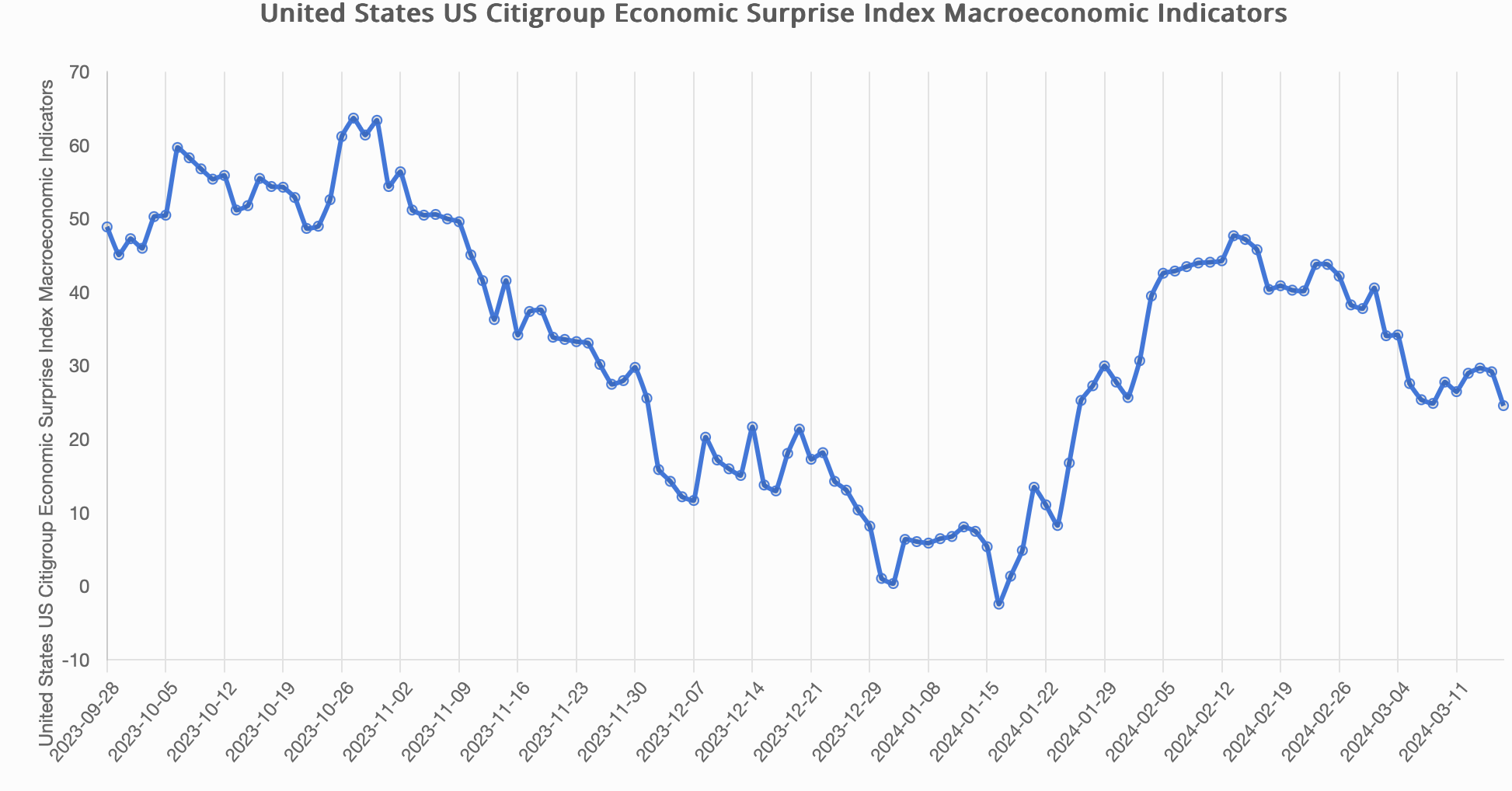
One other thing to keep in mind about that ISM data is that while the US data was weak, the PMI data elsewhere in the world indicated that the worst had been seen elsewhere.  While it is not full speed ahead yet in Europe or the UK or China, the trend is far better than in the US.  Remember, a key part of the narrative is that the US is the ‘cleanest shirt in the dirty laundry’ and so funds continue to flow into US equities and the dollar by extension supporting both.  But what if other nations are starting to see an uptick in their growth stories while the US is starting to slide a bit?  Perhaps the non-stop bullishness for the NASDAQ will find a limit after all.  Perhaps another way to consider this is to look at the Citi Economic Surprise Index, which is designed to compare actual data releases with the forecasts before the release.  As such, a high number shows better than expected data and vice versa.  As you can see from the below chart, the trend here is lower.

Source: macrovar.com

One interesting aspect of this chart is that you can see during Q1, when the equity markets rallied and bullishness was rife, this index was rallying as well.  But remember what we learned last week regarding Q1’s GDP, it was revised lower to just 1.3% annualized.  So, if better than expected data still led to weak growth, what will declining data do?  

In the end, at least in my view, the economy is struggling overall, although not collapsing.  If I am correct, then it leads to several potential, if not likely, outcomes.  While the Fed has continuously claimed they remain focused on inflation, if growth starts to decline more sharply, and unemployment starts to rise more rapidly, they will cut rates regardless of CPI or PCE, and they may well end QT if not start QE again.  The clear loser here will be the dollar.  Equity markets are likely to initially react to the rate cuts and rise, but if earnings suffer, I think that will reverse.  Bond markets, too, will rally initially, but if inflation rebounds, which seems highly likely if the Fed eases policy, I don’t think the long end of the yield curve will be very happy, and we could easily see 5.0% or higher in 10-year yields.  Finally, commodities will see a lot of love and rally across the board.

Ok, let’s look at what happened overnight, as other markets responded to the surprisingly weak US data.  Asia wound up mixed, similar to the US indices, as Japan (-0.25%) slipped while China (+0.75%) rallied along with Hong Kong (+0.25%).  But the big mover overnight was India (-5.75
%) which fell sharply as the election results there indicated that PM Narendra Modi, while winning a third term, saw a decline in his support that left him somewhat weakened.  The rupee (-0.5%) also slipped, although nothing like what we saw yesterday in Mexico.  As to the rest of the region, we saw winners (Indonesia, Malaysia) and laggards (Taiwan, Korea, Australia) so no real trend.  In Europe, this morning, there is a trend, and it is all red, with losses ranging from -0.4% in the UK to -1.1% in Spain.  The only data here was employment in both Spain and Germany, and while both numbers were a touch soft, neither seemed dramatic.  And, as I type (8:00), US futures are all lower by -0.3%.

In the bond markets, yesterday’s Treasury rally was mimicked by European sovereigns, with yields there falling as well, albeit not quite as much as in the US.  This morning, the European market is extremely quiet, with yields +/-1bp from yesterday’s closes.  However, overnight, we did see Asian government bond yields fall, with JGB’s -3bps and greater declines elsewhere in the space.

Oil prices (-1.85%) are under severe pressure this morning, following on yesterday’s $3/bbl decline, falling another $1.50/bbl.  It seems the combination of the weak ISM data and the OPEC+ discussion of an eventual return of more production to market next year was enough to convince a lot of long positioning to throw in the towel.  As is its wont, the oil market can move very sharply and overshoot in either direction.  It feels to me this could be one of those cases.  But commodity prices are getting killed everywhere this morning as although metals held up well yesterday, this morning we are seeing blood in the water.  Both precious (Au -0.9%, AG -3.4% and back below $30/oz) and industrial (Cu -2.3%, Al -0.5%) are falling as slowing growth and the belief that it will reduce inflationary pressures is today’s story.

Finally, the dollar, which sold off sharply yesterday in the wake of the ISM data, is bouncing a bit this morning, at least against most of its counterparts.  While most of the G10 is softer, led by NOK (-1.2%), the outlier is JPY (+0.85%) which is suddenly behaving like a safe haven amid troubled times.  I think that the increased uncertainty amid Japanese investors as to the state of the global economy may have them bringing home their funds, especially now that 10yr JGB yields are above 1.0% with no hedging costs.  As to the EMG bloc, MXN (-1.7%) remains under severe pressure but today they are not alone with all EEMEA currencies and other LATAM currencies declining as well.

The two data points this morning are the JOLTS Jobs Openings (exp 8.34M) and Factory Orders (0.6%), both released at 10:00.  Obviously, there is no Fedspeak, so I expect that equities will be the driver, and if fear starts to grow, we could get an old-fashioned risk off day with stocks falling, bonds rallying and the dollar gaining as well.

Good luck

Adf

At Long Last

With Jay and the Fed finally passed
All eyes are on jobs, at long last
These readings of late
Have all had the trait
Of rising more than the forecast
 
But now that Chair Powell has said
No rate hikes are likely ahead
If NFP’s hot
While stocks will be bought
Will bond markets trade in the red?


As we are another day removed from the FOMC meeting, perhaps we can get a better sense of what investors believe the future will bring.  But the clear dovishness that Powell expressed, while a positive for markets yesterday, will force many to rethink the Fed’s reaction function to data going forward.  And there is no single piece of data that garners more reaction than the payroll report.  So, let’s start with a look at current median expectations:

Nonfarm Payrolls243K
Private Payrolls190K
Manufacturing Payrolls5K
Unemployment Rate3.8%
Average Hourly Earnings0.3% (4.0% Y/Y)
Average Weekly Hours34.4
Participation Rate62.7%
ISM Services52.0

Source: tradingeconomics.com

Nine of the past twelve months have resulted in headline numbers higher than the forecast and the recent trend remains for substantial growth.  Certainly, there has been limited indication based on this data, that the job market is under significant negative pressure.  Clearly, that is one of the keys for the Fed’s maintenance of their higher for longer stance as both inflation and the job market remain hot. 

But now that Powell has taken a rate hike off the table, or at least raised the bar dramatically, how will markets respond to a hot number?  In the past, another big beat would likely have seen the bond market sell off quickly and equities suffer on the thesis that not only was no rate relief going to be coming anytime soon, but that higher rates could be in the cards.  However, most investors appear to have made their peace with the current interest rate framework and if they are no longer concerned about even higher funding costs, a hot number may simply be seen as an indication that profitability is going to continue to improve, and stocks are a raging buy.  At the same time, while the long end of the yield curve is likely to suffer somewhat on a big beat, the front end is now anchored by Powell’s comments.  In essence, we could easily see the yield curve bear steepen as inflation concerns grow and bond investors reduce duration risk while the front end of the curve remains relatively static.

Of course, despite the recent past, this morning’s data could be soft with a much lower print.  In that case, given Powell’s clear dovish bias, I suspect the bond market would rally sharply, as it would really change the calculus on the timing of that first rate cut, and stocks would be flying along with commodities.  In fact, the only loser in this scenario would be the dollar.

As it currently stands, the Fed funds futures market is now pricing just a 14% probability of a cut in June and still about 40bps of cuts total for the rest of the year.  On a timing basis, September is now the estimated first chance for a cut.  But a soft number, anything below 200K I think, is very likely to see that June probability jump substantially.  In fact, it would not surprise me if that type of print resulted in a one-third probability of a June cut by the end of the session.  Many people really want to see the Fed cut, and so they will push on any chance to drive the narrative.

To complete the discussion on the US session, we also see the ISM Services data at 10:00 and included with that will be the prices paid data.  That has been an important data point for many analysts when trying to determine the future course of inflation.  As can be seen from the chart below, unlike many other inflation readings, this one has the look of a still intact downtrend.

Source: tradingeconomics.com

And finally, we hear from our first Fed speakers post Wednesday’s meeting, with Goolsbee, Williams and Cook all on the calendar.  As always, it is a mug’s game to try to guesstimate what this morning’s data is going to be like numerically, but based on the recent overall trend in data, I have a feeling that we are going to continue with strong results, and a continued risk rally.

A quick peak at the overnight session shows that while Japan and China remain closed, there was more green than red in Asia with the Hang Seng (+1.5%) leading the way higher, but gains, too, in Taiwan, Australia, New Zealand and Indonesia.  Alas, both South Korea and India were under pressure, so not as universal a positive as might be hoped.  In Europe, though, it is unanimous with every market higher, mostly by about 0.5%, clearly following yesterday’s US outcome as there was virtually no data or commentary to note there other than the Norgesbank leaving their base rate on hold as expected.  As to US futures this morning, they are higher on the strength of Apple’s positive earnings report, and perhaps more importantly its newest buyback plan of $110 billion this year!

In the bond market, after rates declined yesterday despite data indicating higher prices (Unit Labor Costs +4.7%) along with weaker activity (Productivity 0.3%), it is clear that investors are simply paying attention to the Chairman’s messaging.  So, yields fell across the board yesterday, with 2yr yields sliding 8bps while 10yrs fell only 5bps.  That is the exact response you would expect given the end of any thoughts of a rate hike.  European bond yields fell yesterday as well on the order of 4bps and this morning, everything, Treasuries and European sovereigns, are all seeing yields lower by one more basis point.

In the commodity markets, oil (+0.3%) is edging higher today after a pretty flat day yesterday, although remains more than 5% lower than when the week began.  It appears that we have seen substantial position reductions here, but they seem to be finished for now.  However, the surprising inventory builds of the past few weeks are likely to keep a lid on the price.  Metals markets, too, were benign yesterday although this morning, copper (+1.2%) is showing some life.  My take is the investment community here is waiting to get a better sense of the pace of interest rate adjustments (aka cuts) since that is what everybody is assuming.  As well, metals prices have rocketed higher over the past several months, so this corrective price action can be no surprise.

Finally, the dollar is a touch softer this morning, arguably on the back of the recent decline in yields.  The outlier here continues to be the yen, which is consolidating near 153 now, well below the initial levels seen on Monday that inspired the first wave of intervention.  Remember, Japanese markets are closed, so liquidity there is suspect but more importantly, as the narrative adjusts to the idea that US rates will not be rising from here, that reduces substantial pressure on the yen.  One other noteworthy mover yesterday was BRL, which rallied 1.5% on the back of an improved economic outlook helping to allay concerns of rate cuts coming soon.  Away from those two, though, the overnight session has seen generally modest USD weakness pretty much across the board.

And that’s really all we have for today.  As I said before, I expect the data will be above the median forecast based on the fact that has been its recent trend as well as the other solid data we have seen. 

Good luck and good weekend

Adf

Dismay

The data continues to show
The US is able to grow
If this is the case
Seems foolish to chase
The idea rate cuts are a go
 
Instead, I expect Powell’s way
Is higher for longer will stay
If rates, thus, stay high
Can risk assets fly?
Or will those high rates cause dismay?


The case for the Fed to cut rates continues to fade as not only have Powell and his team been cautioning patience, the data continue to show that economic activity is not slowing down.  The latest exhibit comes from yesterday’s ISM Manufacturing data which printed at a much better-than-expected 50.3, its first print above 50 in 16 months.  Not only that, but the New Orders and Prices Paid sub-indices both printed much higher than last month indicating business is picking up and so are prices.  Certainly, the chart below from tradingeconomics.com indicates that a clear trend is forming for better growth ahead.

The Prices Paid chart looks almost identical.  It strikes me that the recession call continues to get harder to make.  Certainly, things can change, but as of right now, I cannot look at the menu of data and conclude growth is set to slow rapidly.  Given this as background, it becomes increasingly difficult to make the case that the Fed is going to cut rates at all, at least based on the data.  This is a big problem for Powell if he remains insistent on making those cuts because it will call into question the rationale and really push the politics front and center.

As it happens, I am not the only one concluding that rate cuts are less likely, the CME’s Fed funds futures contract is slowly pricing cuts out of the mix as well.  This morning not only has the probability of a June cut fallen slightly to 58.8%, but the market is now pricing in just 66bps of cuts by the December meeting, less than the three full 25bp moves that the median dot indicated.  There is a ton of Fedspeak this week, starting with 4 speeches today from Bowman, Williams Mester, and Daly.  Chairman Powell speaks tomorrow and there are a dozen more after that, so it will be very interesting to see if the tone has changed to even more caution and patience.  With this as a backdrop, perhaps longer duration assets, like bonds and high growth companies (i.e., tech) could well feel some pressure.  We shall see how things play out.

Cooperation
Is not what the market gives
Instead look for pain


While the US story continues to be about stronger economic activity and a reduced probability of lower rates, in Japan, the story remains entirely focused on the yen’s weakness and whether the MOF/BOJ are going to respond.  First, remember that in Japan, like here in the US, the MOF is responsible for the currency, not the BOJ, meaning any intervention is directed by the MOF although it is executed by the BOJ.  This is why we need to focus on the FinMin and his minions regarding any actions.  In this vein, last night as USDJPY once again approached 152.00, FinMin Suzuki was back in front of reporters explaining, “Language aside, we’re now watching markets with a strong sense of urgency.  We are carefully watching daily market moves.”  He added, “All we can say is that we will take appropriate action against excessive volatility, without ruling out any options.”  

So, the MOF continues to threaten intervention with their urgent watching of markets (I feel like that is a very poor translation of whatever he is actually saying, although I suppose it gets the message across.). In one way, it was surprising they didn’t take advantage of illiquid markets yesterday to push the dollar lower as every dollar spent would have been far more effective, but a look at the recent price activity shows that while the yen has weakened appreciably since the beginning of the year, thus far their words have been sufficient to prevent further damage as the currency hasn’t budged in two weeks.  

The problem they have is that the US seems less and less likely to begin easing monetary policy and so the underlying fundamental driver of the exchange rate, interest rate differentials, is going to continue to weigh on the yen (and every other currency).  I also see no reason for Secretary Yellen to consider that a weaker dollar is a help for the US right now, so concerted intervention, a redux of the Plaza Accord of 1985 seems highly unlikely.  While at some point I do expect the MOF to act on their own, as is always the case, it will only have a short-lived impact on markets and likely be used as an entry point for speculators to extend their short yen trade.  The only solution is a change in policies and the BOJ blew that last month.

Ok, now that markets are back open again, let’s see what’s happening.  In Asia, the big mover was the Hang Seng (+2.35%) which was catching up to the news that China seemed ready to implement further stimulus that we heard on Friday.  But there was no consistency throughout the rest of Asia with both gainers and losers around the continent.  Europe is a similar mixed bag, with some markets higher and others lower despite what I would characterize as mildly better than expected PMI data released this morning across the entire continent.  While it wasn’t showing growth, the data improved on the flash numbers of last week.  US futures, however, are softer this morning by about -0.5% after yesterday’s lackluster session.  Certainly, continued hopes for rate cuts are diminishing and that seems to be weighing on stocks at least a bit.

In the bond market, yesterday’s US data set the tone as Treasury yields jumped 12bps yesterday after the strong ISM data and are up another 5bps this morning.  This has dragged European yields higher across the board with gains between 9bps (Germany) and 14bps (Italy).  Of course, the mildly better PMI data in Europe is adding to that mix.  Even JGB yields managed to edge higher by 1bp overnight, although they remain below 0.75%.

Oil prices have been flying, up another 1.1% this morning and now nearly 9% in the past month.  It seems that the escalation of events in the Middle East is having an impact at the same time that OPEC+ is holding firm on their production cuts.  There are rumors of some big Middle East settlement deal to end the war as well as get Saudi Arabia to recognize Israel, but the market does not yet believe that, clearly.  Considering that growth is making a comeback, that China seems ready to stimulate further and that production is not growing, it seems there is a pretty good chance that oil prices continue to rally.  Meanwhile, metals remain the flavor of the day with gold (+0.3%), silver (+1.7%), copper (+0.6%) and aluminum (+1.6%) all in demand.  The industrial metals are responding to the growth story, while the precious set are simply on a roll with fears that fiat currencies are going to continue to be debased top of mind.

Speaking of fiat currencies, the dollar, which rallied nicely over the long weekend, is settling back a bit this morning, but with no consistency.  For instance, CHF (-0.5%) is lagging sharply while NOK (+0.5%) and SEK (+0.5%) are both powering ahead.  The rest of the G10 is modestly firmer, but the movements are within 10bps of yesterday’s closing levels.  In the EMG bloc, ZAR (+0.5%) continues to benefit from the metals rally while PLN (-0.4%) is under pressure after its PMI data disappointed relative to its peers.  My view continues to be that as long as the Fed remains the most hawkish central bank, the dollar will find support.

On the data front today we see JOLTS Job Openings (exp 8.75M) and Factory Orders (1.0%) and we have all those Fed speakers mentioned above.  German CPI fell to 2.2%, as expected, which implies to me that the chances remain greater the ECB will cut before the Fed.  And that is really the big question now, which major central bank acts first.  With all the Fed speakers on this week’s docket, I suspect by Friday we will have a much better idea as to whether a June cut is still on the table.  We will be watching closely.

Good luck

Adf

Not Fear, But Greed

It seems that on Friday, we learned
The prospect for rate cuts upturned
The ISM sunk
And Michigan stunk
So, doves got the data they yearned
 
And so, things are priced for perfection
Though history cautions reflection
Is what we all need
As not fear, but greed
Is likely to cause the correction


Markets are funny things with a history of reacting to catalysts that were completely unexpected while ignoring the ‘big’ things all the time.  Friday was a perfect example as the release of some second-tier data, ISM and Michigan Sentiment, drove a major change in the narrative and market prices in every asset class.  Prior to the Friday data releases, which saw ISM Manufacturing fall to 47.8, far below last month and forecasts, as well as the Michigan Sentiment index fall to 76.9, also well below last month’s number and forecasts, there had been a steady stream of strong data and hawkish Fed rhetoric.  

By now, you are all familiar with the Fed’s general lack of confidence that inflation is going to return to their 2.0% target soon as that sentiment has been expressed by, literally, all 17 FOMC members in the past three weeks.  The result of the hawkish talk and the solid data was a repricing in the Fed funds futures market of just how many rate cuts were coming in 2024, as well as their timing.  As well, we saw Treasury yields back up nearly 50bps during the month of February as the concept of higher for longer was finally getting internalized by market participants.  

But observing the market’s behavior, it was never clear that investors and traders really believed that tale of higher for longer.  Undoubtedly, there has been a camp, FX poets included, who have been singing that tune all year long.  But a much larger camp has been convinced that inflation was clearly on its way to 2% or lower and the Fed would want to cut sooner rather than later.  The rationales for these cuts had very little to do with the economy and focused instead on one of two things; the election this year and their effort to prevent President Trump from being elected support the current administration, or the fact that the extraordinary amount of funding that the Federal government needs to pay for its increasing deficits requires lower interest rates to prevent a fiscal disaster.

Then along comes Friday’s data and much of the Fed’s hard-won respect regarding higher for longer got tossed right out the window.  Treasury yields fell sharply, down 8bps, while the futures curves upped the ante for a May rate cut and made June that much more certain.  Not surprisingly, equity markets got quite the boost, although they have mostly been ignoring the rates story anyway. But perhaps the most interesting thing was what happened in the gold market, where the price of the barbarous relic jumped nearly 2% on the idea that rates were set to decline in the face of still high inflation.

It is important to remember that these two data points were, as I said at the top, secondary.  The fact that both pointed to economic weakness after a long string of strong data points was interesting, but was it really a signal that the trend has changed?  Personally, I am skeptical that is the case.  However, for a market that was looking for a reason to push back on the growing narrative of fewer rate cuts, they were a welcome sight.

In the broad scheme of things, though, this week is likely to be far more important in helping us all understand the nature of the current economy as well as the ongoing Fed reaction function thereto.  After all, not only do we hear from Chairman Powell as he testifies to the Senate and House on Wednesday and Thursday respectively, but Friday brings the payroll report.  Too, on Wednesday the Bank of Canada and on Thursday the ECB meet to lay out their latest views.  Remember, too, that the Chinese National People’s Congress is being held this week, and while leaks are rare, they will ultimately be announcing their growth targets for the year, so another crucial piece of information.  Net, I do not believe that last Friday’s data will have changed the minds of any FOMC members, and continue to believe that even a June cut is a low probability absent a significant overall economic decline, including lower inflation data.  But then, that’s what makes all this so exciting  A yellow face with a black line

Description automatically generated.

As we await all the activity to come, let’s recap the overnight session.  In Asia, only the Nikkei (+0.5%) managed to generate any excitement as it made yet another new all-time high and breached the 40,000 level for the first time.  Chinese shares were dull as was most of the rest of the region.  In Europe, the picture is mixed although the only mover of note is the FTSE 100 (-0.6%) which seems to be declining on the prospects of a lackluster budget announcement by the government this week.  Otherwise, bourses here are within +/- 0.2% of Friday’s closing levels.  And at this hour (8:00), US futures are edging slightly lower.

In the bond market, Treasury yields are backing up from Friday’s decline, rising 3bps this morning, but in Europe, sovereigns are mostly seeing some demand with yields slipping 2bps-4bps across the board.  The one exception is, again, the UK, where Gilt yields are unchanged on the day.  Overnight, JGB yields were unchanged, while we saw lower yields across the rest of Asia which seemed to simply be following the Treasury market.

In the commodity space, Friday also saw oil prices rise 2%, and this morning they are essentially unchanged, consolidating those gains.  OPEC+ announced that they would continue their lower production levels which clearly has had a bigger impact than rumors that a ceasefire would soon be taking place in Gaza.  Gold is also little changed this morning, holding its gains while copper is edging higher, and aluminum is slipping.  There are many analysts who discuss the coming super cycle for commodities, but thus far, there is little consistency in the price action there.

Finally, the dollar is mixed this morning.  In the G10 we are seeing weakness from SEK (-0.65%), NOK (-0.35%) and JPY (-0.3%) although some strength from the euro (+0.1%) and pound (+0.2%).  Similarly, EMG currencies are seeing gainers (ZAR +0.4%) and laggards (CLP -0.8%) and everything in between.  If the new narrative of easier Fed policy turns into reality, then I would look for the dollar to suffer.  However, I don’t yet accept that as the case.

As mentioned above, there is much on the data front this week as follows:

TuesdayISM Services53.0
WednesdayADP Employment150K
 Bank of Canada Rate Decision5.0% (unchanged)
 JOLTS Job Openings8.9M
 Fed’s Beige Book 
ThursdayECB Rate Decision4.0% (unchanged)
 Initial Claims215K
 Continuing Claims1885K
 Trade Balance -$63.4B
 Nonfarm Productivity3.1%
 Unit Labor Costs0.6%
 Consumer Credit$10B
FridayNonfarm Payrolls200K
 Private Payrolls158K
 Manufacturing Payrolls10K
 Unemployment Rate3.7%
 Average Hourly Earnings0.3% (4.4% Y/Y)
 Average Weekly Hours34.3
 Participation Rate62.6%

Source: tradingeconomics.com

In addition, as well as Chairman Powell’s testimonies in Congress, there are another four Fed speakers, although with Powell headlining, I don’t think folks will pay too close attention to them.  Last week, the Fedspeak onslaught was very consistent about that lack of confidence that inflation would reach target soon, and there is clearly no hurry to cut rates, although virtually all speakers expect rate cuts to be the case.  Perhaps the data this week will change some minds, but remember, the big number doesn’t come out until after Powell speaks, and after Friday, the Fed enters its quiet period ahead of the next FOMC meeting.  

Right now, I have to believe last Friday’s data was the exception, not the rule, but we will learn more as the week progresses.  In the end, I think the dollar remains tied to the yield story, so as long as growth remains stronger here than elsewhere, and doesn’t show signs of falling sharply, the dollar should maintain its broad level of strength.

Good luck

Adf