Small Beer

The market has made it quite clear
That over the course of next year
The interest rate Jay
Is willing to pay
On Fed funds will soon be small beer

The key to this view is the thought
Inflation will soon fall to naught
But if that is wrong
It will not be long
Ere stocks will be sold and not bought

As the market braces for today’s CPI data, investors and traders continue to home in on the view that the soft-landing scenario is the most likely.  While US equity markets sold off yesterday afternoon, futures this morning are higher across the board by about 0.5% and European bourses are also all higher.  In other words, fear is not in today’s lexicon as concerns over continuing gains in inflation quickly dissipate and the narrative focuses on said soft-landing.

A quick look at today’s data expectations shows the following according to Bloomberg:

Initial Claims230K
Continuing Claims1707K
CPI0.2% (3.3% Y/Y)
-ex food & energy0.2% (4.7% Y/Y)

I’m sure you all remember that last month’s CPI reading was 3.0%, which was widely touted as a sign the Fed has been successful in their efforts to slow price increases.  Of course, the reason the headline number fell so far was the base effect as in 2022, June’s monthly reading was +1.2% which drove the Y/Y number then to the cyclical high of 9.1%.  With that data point falling out of the mix, the comparison changed dramatically.  Here’s the thing, July 2022’s monthly print was 0.0%, so those same base effects are going to push the headline number higher. 

Now, if you annualize 0.2% it comes to a bit more than 2.4% inflation, so if the monthly number can maintain this level, the Fed will truly have achieved their goal.  Alas, oil (+15.8%) and gasoline (+11.2%) both rose sharply in the month of July and so that headline number seems likely to be higher.  The Cleveland Fed’s CPI Nowcast (similar to the Atlanta Fed’s GDP Nowcast) is pointing to a monthly CPI increase of 0.41%.  My suspicion is that we are going to see a hotter CPI number today and that is likely to be met with a little bit of concern, especially by risk assets that are counting on that soft-landing.

As long as the narrative continues to look for that soft-landing success, it opens up the risk of a significant repricing.  While Philly Fed president Harker was the first to talk about rate cuts next year, the futures market has been all-in on that view for quite a while.  A firm number today will bolster Powell’s ‘higher for longer’ narrative at the expense of those rosy views.  Be prepared for some market volatility today, especially in the bond market.

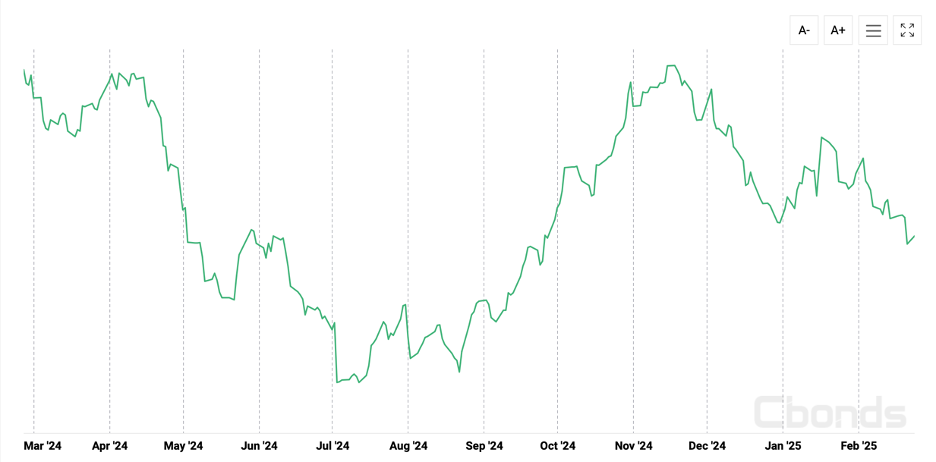
Speaking of the bond market, yesterday’s 10-year auction went pretty well as the clearing yield was (barely) below 4.00% at 3.999%.  The bid/cover ratio was a healthy 2.56, meaning there were bids for slightly more than $97 billion for the auction of $38 billion in new paper.  Today brings the final leg of the quarterly refunding with $23 billion of 30-year bonds to be auctioned.  At this hour (7:00) the 30yr yield is 4.17% with the 10yr yield at 4.00%.  A high CPI print could wind up costing the US government a bit more if yields move higher on the news, just another reason this CPI print will be so closely watched.  Meanwhile, European sovereigns are all softer this morning with yields edging higher by roughly 2.5 basis points across the board, and we saw higher yields across Asia as well, with JGBs rising 2bps, although still below the 0.6% level.  So far, Ueda-san has not had too much difficulty managing the yield there.

Turning back to the commodity markets, oil is little changed this morning, consolidating its recent gains, but certainly not showing any signs of reversing course.  Despite China’s lackluster economic performance, the supply situation continues to underpin oil prices.  Remarkably, despite all the focus on the need to reduce the use of fossil fuels, and the weaker than forecast Chinese economy, demand for oil continues to increase with the IEA raising its forecast for the next several years.  At the same time, oil companies are feeling only modest pressure to drill more, and instead are enjoying the fruits of their current production by repurchasing shares and paying large dividends to their shareholders.  In other words, it seems that supply is unlikely to ramp up to meet this increased demand and that can only lead to even higher oil prices over time.  $100/bbl seems quite realistic within the next 12 months, and that doesn’t assume any additional price shocks like we saw in the Russian invasion of Ukraine.  But while oil is on hold today, the metals markets are feeling a bit better with both precious and base metals rising nicely on the session.

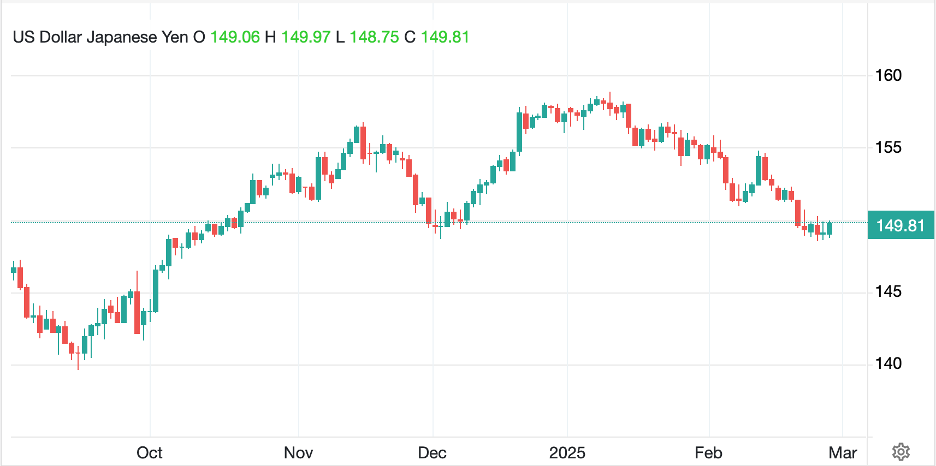
Finally, the dollar is softer pretty much across the board this morning with AUD (+0.6%) the leading G10 gainer although virtually the entire bloc is higher by between 0.3% and 0.5%.  The exception to this is JPY, which is unchanged on the day.  The yen continues to chart its own course lately as uncertainty about the ultimate outcome in the JGB market and any further monetary policy changes has traders and investors treading fearfully.  It remains the favored funding currency given its still lowest rates in the world, but the prospect of that changing has many traders on constant edge.

As to the emerging markets, they too are seeing strength virtually across the board with HUF (+1.3%) and ZAR (+1.2%) the leaders as both are benefitting from their high nominal interest rate carry.  After that there is a long list of currencies that are firmer by between 0.25% and 0.5% and only one laggard, THB (-0.5%) which continues to suffer from political uncertainties over the ability to establish a government there after the recent election.

And that is really the story today.  We hear from three more Fed speakers; Daly, Bostic, and Harker, so it will be interesting to see if either of Daly or Bostic hint at rate cuts next year.  All three are scheduled to speak after the CPI release, which if firm is likely to quash any hopes for that.  My take is that a hot CPI number will help to reverse some of the dollar’s losses, but a soft number could easily see the dollar slide further.

Good luck

Adf

Not Preordained

The first cracks have started to show
In Jay’s, up til now, status quo
When Harker explained,
Though not preordained,
That rate cuts, next year, they’d bestow

While he is the first of the Fed
To claim that rate cuts are ahead
Do not be surprised
When views are revised
By others now this road’s been tread

While things looked dire yesterday morning with respect to risk assets, along around lunchtime there was a reversal of attitudes and while equity markets did finish in the red, they were all well off their lows by the close. So, the question is, what could have caused that reversal?  Interestingly, an argument can be made that Philadelphia Fed President Patrick Harker’s comments may well have been the catalyst.  

After explaining, “I think there is a path to an economic soft landing,” Harker went on to the money quote, “Sometime, probably next year, we’ll start cutting rates.”  While the first comment was a nice sentiment, the second comment was the first time we have heard any Fed speaker consider that rate cuts would be appropriate in 2024.  Remember, the entire mantra has been, ‘higher for longer’ with no indication that the FOMC was even close to considering rate cuts.  Importantly, Mr Harker is a current voting member, so his views carry a touch more weight than the non-voters.

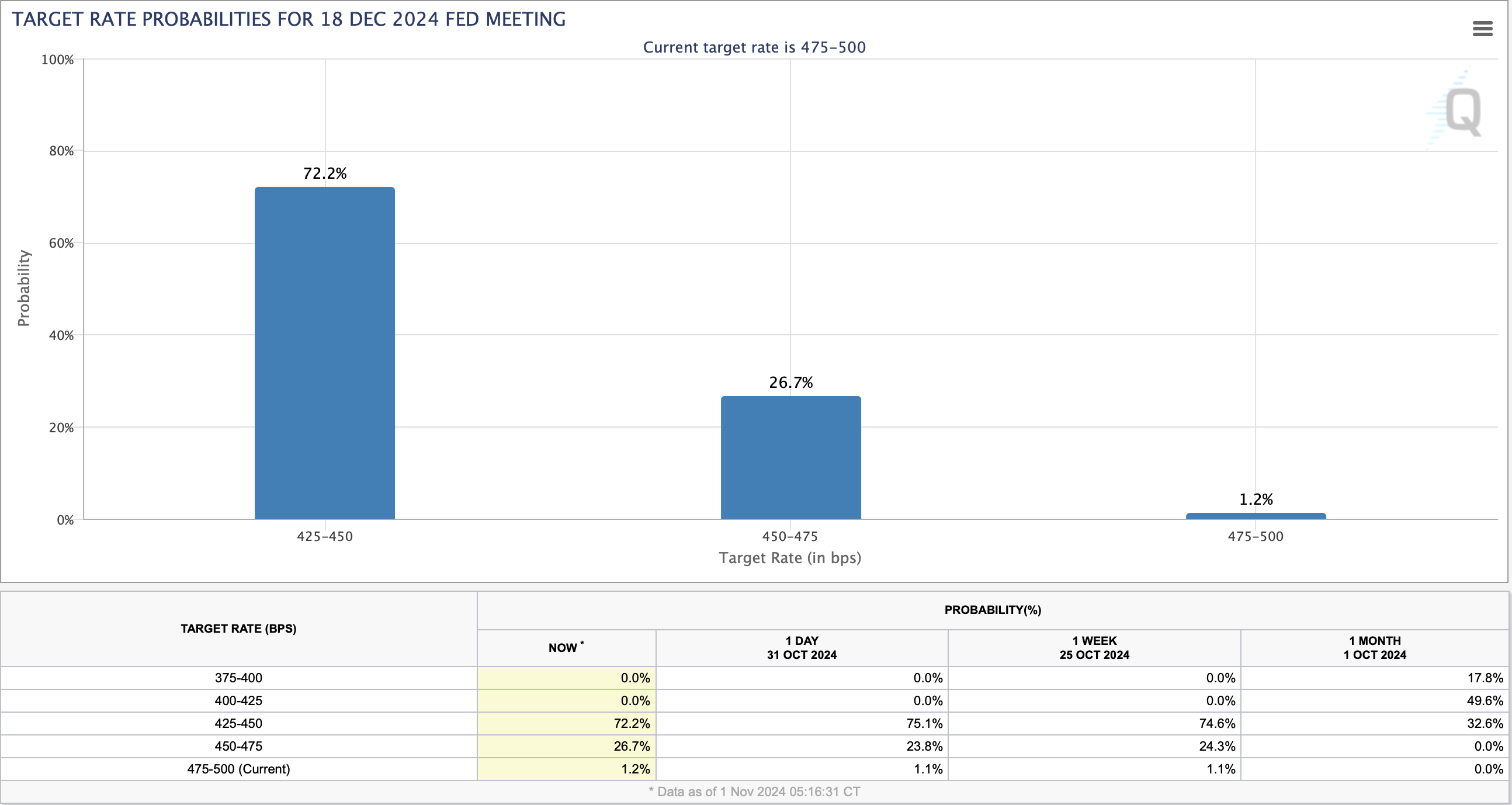
Of course, the Fed funds futures market has been pricing in that exact scenario for months, with the current expectation that by the end of 2024, Fed funds will be back to 4.0%.  The conundrum here, though, is that if the economy comes in for a soft landing, meaning we do not have a recession while inflation falls back to their target, why would they adjust rates at all?  It would seem under that scenario that interest rates could be termed ‘appropriate’, neither too high nor too low.  I get why equity investors want lower rates, but then seemingly, rate cuts could well bring on another bout of inflation as an already growing economy overheats with extra monetary stimulus.

Yesterday’s other Fed speaker, Richmond’s Thomas Barkin (a non-voter this year) had a less dovish message.  He was unwilling to ‘predeclare’ where rates are going, explaining they have time before the next FOMC meeting to monitor the data.  He also explained that there are competing outlooks for the economy, “one where inflation will glide down to 2%, another where it remains persistent.”  But that message is far more in line with what we have been hearing.  It was the Harker comments that got things rolling.

And so, as we walk in this morning, there is a lot of green on the screen in the equity markets as risk is once again in favor.  Not surprisingly, this has pushed commodity prices higher, especially oil, which while higher by 1.3% this morning, and back over $83/bbl, is more than 5% above the lows seen yesterday morning.  That is a big reversal!  Metals markets, too, are firmer this morning with gold, copper and aluminum all benefitting from this change in sentiment.

In the equity space, Asian markets were more mixed with the Nikkei (-0.5%) which had been holding its own giving back a bit, but the Hang Seng managed to reverse a small portion of yesterday’s losses.  The real story, though, is in Europe, where all the markets are higher, mostly by 1% or more, notably Italy’s FTSE MIB (+1.75%) which has benefitted from both the overall risk sentiment as well as a change in plans by the Italian government regarding the bank windfall profit tax mooted yesterday.  It seems that they got a little nervous over the market’s reaction, which wiped out more than €10 billion in market cap from the banking sector, and so reversed course a bit.  As to US futures, they are modestly firmer (+0.3%) at this hour (7:45).

In the bond market, after sharp declines in yields yesterday, we are seeing a bit of a reversal with 10yr Treasury yields up 1bp this morning.  While early yesterday that yield had fallen below 4.0%, it was a short-lived move, and we are back above that key level today.  The easy part of the quarterly refunding was well received yesterday with the 3yr note clearing at 4.398% and a 2.90 bid/cover ratio.  In other words, there were plenty of buyers for that $42 billion tranche.  Today could be a bit trickier as the Treasury seeks to sell $38 billion of 10yr notes.  We shall see where bonds trade as the auctions progress.  And tomorrow comes the 30yr, with $23 billion set to be auctioned, so there is still plenty of new supply coming.  Meanwhile, European sovereign bonds are all seeing yields higher as well this morning, mostly on the order of 1bp to 2.5 bps, after yesterday’s sharp yield declines.

Finally, the dollar is under a bit of pressure this morning, as would be expected given the change in risk attitude.  NOK (+0.5%) leads the way in the G10 on the back of oil’s performance, but in truth, the rest of this bloc has not moved very far at all, although I would argue that gainers mean more than laggards.  In the EMG space, the situation is similar with quite a few more currencies gaining ground, albeit not too much, while only a few are under pressure.  ZAR (-0.5%) is the laggard although there is no obvious catalyst for the movement, especially given the commodity rebound.

There is no data of note today and no Fed speakers are on the docket either.  With this in mind, and as we all await tomorrow’s CPI data, I suspect that risk will remain in favor today.  That means that commodities should continue to perform well along with equities, while the dollar remains under pressure.

Good luck

Adf

Views Will Be Tested

When looking ahead to this week
With data and central bank speak
Some views will be tested
And some have suggested
The market is reaching its peak

But there is a growing belief
The future (that’s AI in brief)
Is shiny and bright
And stocks will take flight
Beware though, it could lead to grief

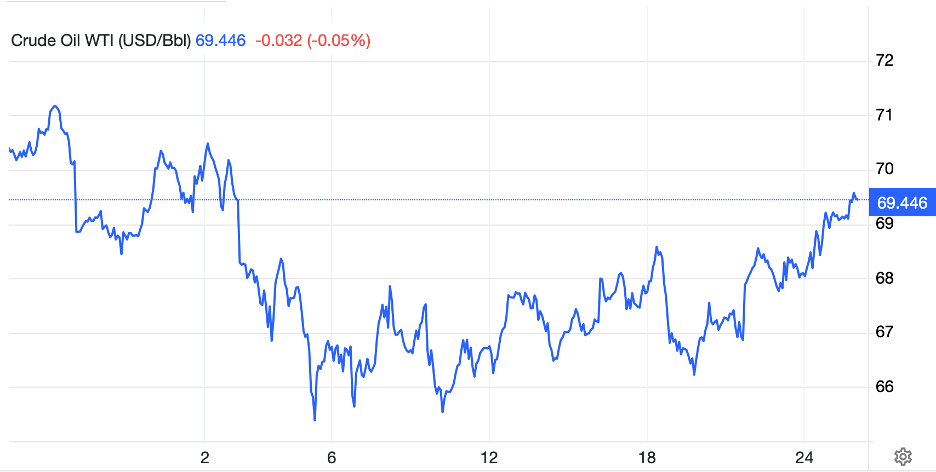
First a correction to Friday’s note regarding the blip lower in oil prices.  It was not inventory data but a story on a relatively obscure website, Middle East Eye, (h/t @inflation_guy) that discussed a seeming breakthrough in US-Iran talks that would allow Iran to export up to 1 million bbl/day in exchange for an agreement to slow their Uranium processing.  However, the story was vehemently denied by both the Iranians and the US and has been consistently denied since then by both sides repeatedly.  Now, I am of two minds on this story as denials of this extremity tend to point to some reality underlying the situation, but politically it would seem very difficult for the Biden administration to be seen to be negotiating with Iran heading into an election.  Regardless of the driver though, oil (-2.2%) is falling sharply again today with WTI below $69/bbl now.  This continues to point to the dichotomy of commodity markets sensing significant global slowing in growth while the equity markets see the world growing gangbusters.  Both sides cannot be correct, so at least one set of markets will need to adjust going forward.


Meanwhile, after an extremely lackluster week regarding new information, this week is exactly the opposite with critical data points like CPI as well as three major central bank meetings, Fed, ECB and BOJ.


Tuesday

NFIB Small Biz Optimism

88.4


CPI

0.2% (4.1% Y/Y)


-ex food & energy

0.4% (5.2% Y/Y)

Wednesday

PPI

-0.1% (1.5% Y/Y)


-ex food & energy

0.2% (2.9% Y/Y)


FOMC Rate Decision

5.25% (unchanged)

Thursday

ECB Rate Decision

3.50% (0.25% increase)


Initial Claims

250K


Continuing Claims

1787K


Retail Sales

-0.1%


-ex autos

0.1%


Empire Manufacturing

-15.1


Philly Fed

-13.0


IP

0.1%


Capacity Utilization

79.7%


Business Inventories

0.2%

Friday

BOJ Rate Decision

-0.1% (unchanged)


Michigan Sentiment

60.1

Source: Bloomberg


So, clearly, we have a lot to absorb this week although today is lacking in new news.  A quick look at the PPI data shows why there is a growing cadre of people who are in the ‘inflation is over’ camp, as the Y/Y data is collapsing back to levels with which we are more familiar over the past decades.  However, I would highlight that core CPI remains well above the Fed target with only a very slow decline ongoing.  I remain in the sticky inflation camp on the basis of both personal experience and the fact that a critical part of the statistic, housing, is not actually showing any real declines.  Here is a link to an excellent article that helps explain the fact that rents are not declining very much at all, in reality, and if housing costs continue to climb, so will CPI.


I think the real question is what will happen if the CPI number is hot, say 5.5% core and showing no indication that the much hoped for slowing is ongoing?  How will the Fed respond the following day?  Remember, the market is largely priced for a pause skip with a 27% probability of a rate hike currently in the futures market, although an 80% chance of one by next month.  However, we all thought Australia was done and they hiked last week.  We all thought Canada was done and they hiked last week.  Will the Fed be willing to ‘surprise’ the market if the data points to continuing inflation pressures? 


This is especially timely as this morning there was a story in Bloomberg explaining that the idea that wage pressures are driving inflation is losing credence with a far less certain outlook on that prospect.  Essentially, a Fed paper was published explaining that while wages and inflation are correlated, the direction of causality, if there is one, is not clear.  That seems like a way for the Fed to be able to pivot their views to a different underlying cause and given housing’s huge importance to the total CPI number, ongoing rises in rentals would certainly be a concern.  One thing we do know is that if the CPI data come out soft, the equity market will rocket higher, at least initially, as the working assumption will be that the Fed is done.  Like I said, lots to anticipate this week.


As to today, the bulls remain in control as Friday’s very modest US rally saw Asia follow higher and Europe currently showing gains on the order of 0.5% – 0.6%.  US futures are following suit, with NASDAQ futures up 0.5% at this hour (7:45) and leading the way.


Treasury yields are little changed this morning with the yield up just 1bp although European sovereign yields are all lower, especially Italy (-5.6bps) after the news that former Italian PM, Silvio Berlusconi, passed away overnight.  As he was still quite active in Italian politics and a key force in the Forza Italia party, the story is that his passing will have removed some anxiety from markets and allow the Bund – BTP spread to narrow further still.  Perhaps of more interest is the increasing inversion in the 2yr-10yr portion of the curve, now back to -86bps, and a direct result of the massive amount of Treasury issuance that has been happening since the debt ceiling was removed.  In fact, today there are auctions for 3m, 6m and 1y bills and 3y and 10y notes to the tune of $278 billion, a huge amount of supply.  Do not be surprised if the curve inversion continues further.


Finally, looking at the dollar, it is generally, though not universally softer.  Given oil’s decline, it is no surprise that NOK (-0.35%) is the G10 laggard, but there is also a bit of weakness in the CHF (-0.25%) on the back of a slight decline in Sight Deposits there.  Meanwhile, the rest of the bloc is modestly firmer with no outsized gainers.  In the EMG bloc, ZAR (+1.1%) continues its recent strength, having rallied 7% this month on continued belief that the electricity situation in the country is getting better.  But away from that, and the fact that TRY (-0.7%) continues to slide, the rest of the bloc appears to be awaiting the upcoming onslaught of news this week.


I have a sense that by the end of this week, we may have new marching orders from the markets.  I would not be surprised to see a hot CPI print get the Fed to hike instead of skipping and if we see something like that, I would look for the dollar to test its recent resistance levels and potentially break through.  Correspondingly, if CPI is soft, I imagine the market will assume the Fed is done, and we will see equities rally with the dollar falling, at least for the first leg of the move.  We shall see starting tomorrow.


Good luck

Adf

The Issuance Tap

The Saudis thought oil was cheap

So, figured that they’d rather keep

More stuff in the ground

And in a profound

Move, cut back production quite steep


Meanwhile now the debt ceiling’s gone

The Treasury’s set to turn on

The issuance tap

To refill the gap

In finance that started to yawn


The biggest story over the weekend was the Saudi’s decision to cut oil production by 1 million barrels per day as they are concerned the pending recession is going to further destroy demand and so are aiming to keep prices supported.  No other OPEC+ members joined with the Saudis as it seems they all want the money.  And who can blame them?  Not surprisingly, oil prices are firmer this morning, up nearly 2%, but remain far below levels seen prior to the last OPEC+ production cut when WTI was pushing $80/bbl.   However, if we look back to pre-covid times, oil was trading a full $10/bbl lower than the current level of ~$73/bbl.  In the interim, we have seen significant structural changes in the oil market, and I continue to expect these changes to force prices higher over time.


First, the election of President Joe Biden led to an immediate change in US energy policy with a destruction in production capabilities in the name of global warming.  Second, the Russian invasion of Ukraine and the ensuing sanctions on Russian oil (and NatGas) exports have helped reduce the amount of energy molecules available to be used worldwide.  Add to this the longer-term lack of energy infrastructure investment given the ESG push for the past decade, and the supply side of the equation does not look robust. 


On the demand side, however, things are likely to continue to trend higher for the foreseeable future.  Despite trillions of dollars of investment in alternative sources of energy, namely wind and solar, fossil fuels continue to represent more than 80% of total energy usage worldwide.  As well, every advancement in civilization throughout history has been driven by access to cheaper energy, and all those nations that we currently call emerging markets are quite keen to continue to advance their economies to the benefit of their populations.  They are far less concerned about global warming than they are about better living standards.  According to the IEA’s most recent forecasts, 2023 will set yet another record for oil demand regardless of the recession calls and the war in Ukraine.  Ultimately, this supply/demand imbalance is going to resolve toward higher prices still.  Mark my words.


As to the other discussion making the rounds in markets this morning, the upcoming deluge of Treasury security issuance, there are many claiming that this may have a significant impact on risk asset pricing, notably equities.  The idea is that as the Treasury refills its TGA (checking account) with up to $500 billion to get it back to its more normal balance, it will draw liquidity from potential equity investors who decide that earning a risk-free 5+% on their money is quite attractive, thus reducing demand for stocks.  However, this is a more nuanced discussion as there are other features in the money markets that will be impacted as well, and that are likely to offset a significant portion of that impact.


On the surface, that argument has validity, but digging a bit deeper is worthwhile to get a better understanding here.  The Fed runs a Reverse Repo program (RRP), where they essentially pay a small subset of investors to hold their securities at the Fed funds rate.  This program currently has about $2.2 trillion in it and is widely used by Money Market funds as an investment.  And that money in the RRP program is stuck at the Fed and not available for other investment.  However, T-bills have been yielding higher than Fed funds, and it is expected that those same Money Market funds will be snapping up the newly issued T-bills while running down their RRP balances, thus absorbing a great deal of the new issuance.  If this is the case, it will reduce the amount of available risk-free assets to which the equity investors described above will have access.  In other words, the feared demand drain is likely to be far smaller than the $1 trillion that has been bandied about lately.  Do not count on this as a rationale for equity weakness, although that doesn’t mean there are no problems ahead.


And, as we begin another week, those are really the noteworthy stories around.  After Friday’s blowout NFP number of 339K new jobs with a revision higher in the previous months, US equities took off and had a big day.  That has mostly been followed by Asia, which saw strength almost everywhere (mainland China being the most prominent exception) although Europe has had a less robust session today.  Arguably, that is because the Services PMI data in Europe released this morning was softer than expected across the board, and they had already reacted to the US payroll data on Friday as those markets were open during the release.  Meanwhile, US futures are either side of unchanged this morning, clearly not feeling any additional love from the payroll story.


Of more interest is the fact that bond yields are higher around the world this morning, with Treasuries (+5.4bps) seeing selling pressure along with all of Europe (Bunds +7.2bps, OATs +7.0bps, Gilts +5.8bps, BTPs +8.1bps) as it seems the flood of issuance due from the US is being felt everywhere.  After all, given the dollar’s recent trend higher, which is very evident today, for non-USD investors, higher yielding Treasury securities are likely to be very attractive. As to domestic investors, selling ahead of significant issuance is a time-honored tradition.


Aside from oil, metals markets are under very modest pressure this morning, which has more to do with the rising dollar than anything specific to those markets.


And speaking of the dollar, it is on top of the world yet again this morning, rising against all its G10 counterparts and almost all its EMG counterparts.  SEK (-1.1%) is the worst G10 performer, after its PMI data was substantially worse than forecast with the Composite index tumbling to 47.6, a level only ever achieved during Covid, the GFC and the Eurozone banking/bond crisis.  In other words, things don’t look too good there.  But even NOK (-0.55%) is under pressure despite the strong rally in oil.  This is unadulterated USD strength.  Similarly, EMG currencies are all under pressure save ZAR (+0.6%), which seems to have responded positively to news that there would be reduced blackouts going forward. 


On the data front, there is not very much this week, so activity is likely to be driven by other markets given the FOMC is in their quiet period.


Today

Factory Orders

0.8%


-ex Transport

0.2%


ISM Services

52.4

Wednesday

Trade Balance

-$75.5B

Thursday

Initial Claims

237K


Continuing Claims

1802K

Source: Bloomberg


And that’s really all we’ve got for today.  To me, the biggest risk to markets is the fact that US equity performance is entirely reliant on 7 companies, all of which are very good companies, but whose performance has been extraordinarily outsized and does not seem representative of the economy or market as a whole.  At some point, those stocks are likely to come back to earth and that will result in a very large adjustment to views about the Fed, the economy, and the stock market.  But for now, it is hard to fight the trend, and that includes the dollar higher trend.


Good luck

Adf


Before Omicron

There once was a narrative told
Explaining the Fed still controlled
The market’s reaction
Preventing contraction
Thus, making sure stocks ne’er got sold

But that was before Omicron
Evolved and put more pressure on
The future success
Of Fed’ral largesse
With no real conclusion foregone

So, later this morning we’ll hear,
When Janet and Jay both appear,
In front of the Senate
If they’ve still the tenet
That all will be well by next year

Perhaps all is not right with the world.  At least that would be a conclusion easily drawn based on market activity this morning.  Once again, risk is being shed rapidly and across the board.  Not only that, but the market is completely rethinking the idea of tighter monetary policy by the Fed with the growing conclusion that it is just not going to happen, at least not on the timeline that had been assumed a few short days ago.

It seems that the Omicron variant of Covid is proving to be a bigger deal in investor’s eyes than had been originally assumed.  When this variant was first identified by South African scientists, the initial belief was it was more virulent but not as acute as the Delta variant.  So, while it was spreading quite rapidly, those who were infected displayed milder symptoms than previous variants.  (If you think about the biology of this, that makes perfect sense.  After all, every organism’s biologic goal is to continue to reproduce as much as possible.  If a virus is so severe that its host dies, then it cannot reproduce very effectively.  Thus, a more virulent, less severe strain is far more likely to remain in the world than a less virulent, more deadly strain, which by killing its hosts will die off as well.)

In the meantime, financial markets have been trying to determine just what type of impact this new strain is going to have on economies and whether it will induce another series of lockdowns slowing economic activity, or if it will be handled in a different manner.  And so far, there is no clear conclusion as evidenced by the fact that we saw a massive sell-off in risk assets Friday, a major rebound yesterday and another sell-off this morning.  If pressed, I would expect lockdowns to come back into vogue as despite questions over their overall efficacy, their imposition allows government officials to highlight they are ‘doing something’ to prevent the spread.  Additional bad news came from the CEO of Moderna, one of the vaccine manufacturers, when he indicated that the nature of this variant would likely evade the vaccines’ defense.

So, story number one today is Omicron and how this new Covid variant is going to impact the global economy.  Ironically, central bankers around the world must be secretly thrilled by this situation as the focus there takes the spotlight off their problem, rapidly rising inflation.

For instance, after yesterday’s higher than expected CPI prints in Spain and Germany, one cannot be surprised that the Eurozone’s CPI printed this morning at 4.9%, the highest level since the Eurozone was born in 1997, and far higher than any of the 40 economist forecasts published.  Madame Lagarde wasted no time explaining that this was all temporary and that by the middle of next year inflation would be back to its pre-pandemic levels, but it seems fewer and fewer people are willing to believe that story.  Do not mistake the run to the relative safety of sovereign bonds as a vote of confidence in the central bank community.  Rather that is simply seen as a less risky place to park funds than the equity market, which by virtually every measure, remains significantly overvalued.

This leads to the third major story of the day, the upcoming testimony by Chairman Powell and Treasury Secretary Yellen in front of the Senate Banking Committee.  The pre-released opening comments focus on Omicron and how it can be a risk for both growth and inflation thus once again trying to divert attention from Fed policies as a problem by blaming exogenous events beyond their control.  Of course, this story will resolve itself starting at 10:00, so we will all listen in then.

Ok, with all that as prelude, a quick tour of markets shows just how much risk is in disfavor this morning.  Overnight in Asia we saw broad weakness (Nikkei -1.6%, Hang Seng -1.6%) although once again Shanghai was flat.  Europe is completely in the red (DAX -1.45%, CAC -1.25%, FTSE 100 -1.0%) and US futures are also pointing lower (DOW -1.2%, SPX -1.0%, NASDAQ -0.5%).

Meanwhile, bond markets are ripping higher with Treasuries (-5.1bps) leading the way as yields fall back to levels last seen in early September.  In Europe, Bunds (-2.1bps), OATs (-2.2bps) and Gilts (-4.0bps) are all seeing demand pick up with the rest of the Continent all looking at lower yields despite rising inflation.  Fear is clearly a powerful motivator.  Even in Asia we saw JGB’s (-1.9bps) rally as did Australian and New Zealand paper.

Commodity markets are having quite a day with some really mixed outcomes.  Oil (-2.5%) is back in the red after yesterday’s early morning rebound faded during the day, and although oil did close higher, it was well of the early highs.  NatGas (-5.0%) is falling sharply, which at this time of year is typically weather related.  On the other hand, gold (+0.5%) is bouncing from yesterday and industrial metals (Cu +1.4%, Al +1.6%, Sn +2.7%) are in clear demand.  It seems odd that on a risk-off day, these metals would rally, but there you have it.

Finally, the dollar can only be described as mixed this morning, with commodity currencies under pressure (NOK -0.4%, CAD -0.25%) while financial currencies (EUR +0.5%, CHF +0.5%, JPY +0
4%) are benefitting on receding expectations for a tighter Fed.  PS, I’m sure the risk off scenario is not hurting the yen or Swiss franc either.

Emerging market currencies are demonstrating a broader based strength with TRY (-1.6%) really the only major loser as further turmoil engulfs the central bank there and expectations for lower interest rates and higher inflation drive locals to get rid of as much lira as possible.  Otherwise, PLN (+0.8%) is leading the way higher as expectations for the central bank to raise rates grow with talk now the rate hike will be greater than 50 basis points.  But MYR (+0.8%) and CZK (+0.75%) are also showing strength with the ringgit simply rebounding after a 10-day down move as bargain hunters stepped in, while the koruna has benefitted from hawkish comments from the central bank governor.  It appears that most EMG central banks are taking the inflation situation quite seriously and I would look for further rate hikes throughout the space.

Aside from the Powell/Yellen testimony, this morning brings Case Shiller House Prices (exp 19.3%), Chicago PMI (67.0) and Consumer Confidence (111.0).  As well, two other Fed speakers, Williams and Clarida, will be on the tape, but it is hard to believe they will get much notice with Powell front and center.

The dollar appears to be back following the interest rate story, which means that if expectations of Fed tightening dissipate, the dollar will likely fade as well, at least versus the financial currencies.  Commodities have a life of their own and will continue to dominate those currencies beholden to them.  The tension between potential slower growth and rising inflation has not been solved, and while my view is the Fed will allow inflation to burn still hotter, keep in mind that if they do act to tighten policy, the dollar should find immediate support.

Good luck and stay safe
Adf

Future Pratfalls

In Germany, and too, in Spain
The people are feeling the pain
Of prices exploding
And therefore corroding
Their standards of living again

Meanwhile from the ECB’s halls
The comments from those know-it-alls
Show lack of concern
As each of them spurn
The idea of future pratfalls

In trading, ‘the trend is your friend’ is a very common sentiment and an idea backed with strong evidence.  One can think of this as analogous to Newton’s first law, i.e. a body in motion stays in motion.  So, when the price action in some market has been heading in one direction over time, it tends to continue in that direction.  This is the genesis of the moving average as a trading tool as the moving average is what defines the trend.  I highlight this because the concept is not restricted to trading but is also evident in many other price series, notably inflation.  When one looks at the history of inflation, it tends to trend in one direction for quite some time with major reversals relatively infrequent.  That is not to say a reversal cannot occur, but if one does, it tends to be the result of a long period of adjustment, not a quick flip of direction.

And yet, when listening to both Fed and ECB speakers lately, they would have you believe that the currently entrenched trend higher for prices is the aberration and that in a matter of months they will be back to their old concerns about deflation being the biggest problem for the economy.  One has to wonder at what evidence they are looking to come to that determination as certainly the recent data does not point in that direction.  Just this morning Spanish CPI (5.6%) printed at the highest level since 1992 while Italian PPI (25.3%) printed at the highest level in its history.  From Germany, we have seen CPI prints from several of its states (Hesse 5.3%, Baden Wuerttemberg 4.9%, Bavaria 5.3%, Saxony 5.0%) with the national number (exp 5.5%) due at 8:00 this morning.

Still, none of this seems to be having an impact on the thoughts of ECB members with Lagarde, Schnabel, Villeroy and de Cos all out explaining that this is a temporary phenomenon and that by the middle of next year CPI will be back at their 2.0% target or lower.  Maybe it will be so, but as Damon Runyon so aptly explained, “The race is not always to the swift, nor the battle to the strong; but that is the way to bet.”  In other words, looking at the current trends, it seems far more likely that inflation remains high than suddenly turns around lower.  The biggest problem the central banks have now is that it has become common knowledge that inflation is rising, which means that individual behaviors are adjusting to a new price regime.  And if you listen to the central bank thesis that inflation expectations are a critical input, then they are really in trouble as inflation expectations are clearly rising.

At least the Fed has begun to discuss the idea of removing accommodation, although the Omicron variant of Covid may given them pause, but in Europe, it is not even on the table.  A discussion point that has been raised numerous times lately is the idea of a central bank policy error, either raising rates prematurely to battle phantom inflation or waiting too long to tighten policy and allowing inflation to become more entrenched.  While my money is on the latter, it is very clear that the ECB, at least, and still many Fed members, are far more concerned with the former.  Perhaps they are correct, and all these rising prices will quickly dissipate, and that would be great.  However, I am not counting on that outcome, nor should anyone else at this point until there is ANY proof the Fed or ECB are correct.

Meanwhile, Friday’s dramatic events seem to have been erased from memory as while there are still headlines regarding the Omicron variant, the collective market view appears to be that it is not going to result in another wave of lockdowns and therefore the economic impact will be relatively minor.  As such, we are seeing a reversal of fortune across most markets from their Friday price action.  It should be no surprise that the biggest change comes from oil (+4.75%) which has recouped about one-third of its losses and seems set to continue rebounding.  After all, if the consensus is that Omicron is not going to have much of an impact, then the supply/demand story hasn’t changed and that bodes well for oil prices moving higher.  Elsewhere in the commodity space NatGas (+7.4%) is rising sharply on the back of colder than normal weather, while metals prices (Au +0.1%, Ag +0.5%, Cu +1.7%, Al +1.2%) are all rebounding as well.

In the equity markets, Asia never got a chance to sell off like Europe and the US on Friday so caught up (down?) with the Nikkei (-1.6%) leading the way although the Hang Seng (-1.0%) also suffered.  Shanghai traded flat for the day.  Europe, however, which sold off sharply on Friday, with many markets down more than 4%, has rebounded somewhat this morning (DAX +0.7%, CAC +1.1%, FTSE 100 +1.2%) although these markets are obviously well lower than Thursday’s closing levels.  Finally, US equities sold off sharply in Friday’s abbreviated session, with all three indices down about 2.3% but this morning futures are all rebounding as well, up between 0.6% and 0.8%.

Bonds saw the most dramatic move on Friday, with Treasury yields tumbling 16 basis points while European yields all fell as well, albeit less dramatically.  This morning, with risk back in vogue, bonds are back under pressure with Treasuries (+6.8bps) leading the way but all of Europe (Bunds +2.7bps, OATs +1.5bps, Gilts +3.9bps) also seeing higher yields.

It should come as no surprise that the dollar is also reversing some of Friday’s price action with the commodity bloc doing well (SEK +0.4%, CAD +0.3%, AUD +0.3%) while the financials are under modest pressure (EUR -0.2%).  This movement is nothing more than a reaction to the Friday movement.  EMG currencies are seeing similar price action with the best performers the commodity bloc here (RUB +0.9%, ZAR +0.7%) while weakness has been seen in TRY (-3.45%) and CLP (-0.7%).  The former continues to suffer from President Erdogan’s comments about never raising interest rates to fight inflation while the peso is reacting to early polls showing the leftist, Gabriel Boric, leading ahead of the runoff presidential election in 3 weeks.

It is a week full of data culminating in Friday’s payroll report although it starts out slowly.

Tuesday Case Shiller Home Prices 19.35%
Chicago PMI 67.0
Consumer Confidence 110.7
Wednesday ADP Employment 525K
Construction Spending 0.4%
ISM Manufacturing 61.1
ISM Prices Paid 85.8
Fed Beige Book
Thursday Initial Claims 250K
Continuing Claims 2000K
Friday Nonfarm Payrolls 535K
Private Payrolls 525K
Manufacturing Payrolls 45K
Unemployment Rate 4.5%
Average Hourly Earnings 0.4% (5.0% Y/Y)
Average Weekly Hours 34.7
Participation Rate 61.7%
ISM Services 65.0
Factory Orders 0.5%

Source: Bloomberg

In addition to all that data, we hear from Chairman Powell (and Secretary Yellen) in front of the Senate and House on Tuesday and Wednesday as well as eight more Fed speakers during the week.  If I were a betting man, I would expect that the broad message will continue to be that while inflation is not a long-term problem, it is appropriate to continue to normalize monetary policy now.  And that will be the message right up until markets force them to make a choice by either selling off sharply and forcing an end to policy tightening or running to new highs dragging inflation expectations, as well as inflation, along with them.

Meanwhile, the dollar remains beholden to the latest whims.  If tightening is back on the table, then look for the dollar to resume its uptrend.  However, if Omicron, or something else, causes a change in the message, the dollar seems likely to pull back smartly.

Good luck and stay safe
Adf

A Gordian knot

Now, what if inflation is not
As transit’ry as Powell thought?
And what if there’s slowing
Instead of more growing?
Would that be a Gordian knot?

Well, lately the bond market’s view
Appears to be, in ‘Twenty-two
Inflation will soar
Much higher before
The Fed figures out what to do

The Fed has been pushing the transitory inflation narrative for quite a while now, but lately, they have been struggling to get people to accept it at face value.  You can tell this is the case because pretty much every third story in any newsfeed is about rising prices in some product or service.  Commodities are particularly well represented in these stories, especially energy, as oil, NatGas and coal have all seen dramatic price rises in the past month or so.  It is also important to understand that despite the durm und strang regarding the continued use of coal as an energy source, it remains the largest source of electricity worldwide.  I bring this up because the situation in China is one where the country is restricting energy use due to a lack of coal available to burn.  (Perhaps one of the reasons for this is the Chinese, in a snit over Australia calling them out as to the origins of Covid-19, banned Australian coal imports.)

From an inflation perspective, this has the following consequences: less coal leads to less electricity production which leads to restrictions on electricity use by industry which leads to reduced production of everything.  Given China’s importance in the global supply chain for most products, less production leads to shortages and, presto, higher prices.  And this is not going to end anytime soon.  Much to the Fed’s chagrin, they can print neither coal nor NatGas and help mend those broken supply chains.  Thus, despite their (and every other central bank’s) efforts to repeal the laws of supply and demand, those laws still exist.  So, just as April showers lead to May flowers, less supply leads to higher prices.

The difference in the past week or so is that bond markets worldwide have started to cotton on to the idea that inflation is not transitory after all.  Yields have been rising and curves steepening, but even the front end of yield curves, where central banks have the most impact, have seen yields rise.  So, a quick look at global bond markets today shows yields higher in every major market around the world.  Treasuries (+1.1bps) have not moved that far overnight but are higher by 12bps in the past week.  Gilts (+4.8bps) on the other hand, have seen real selling in today’s session, also rising 12bps in the past week, but on a lower base (10-year Gilts yield 1.125% vs. 1.58% for Treasuries.)  And the same situation prevails in Bunds (+2.6bps, +6.6bps in past week), OATs (+2.5bps) and the rest of Europe.  Asia is not immune to this with even JGB’s (+1.2bps, +4bps in past week) selling off.  The point is that bond investors are starting to recognize that inflation may be more persistent after all.  And if the Fed loses control over their narrative, they have much bigger problems.  Forward guidance remains a key monetary policy tool, arguably more important that the Fed Funds rate these days, so if that is no longer effective, what will they do?

Needless to say, risk attitudes are starting to change somewhat as concern grows that almost the entire central banking community, certainly the Fed and ECB, will be too slow to react to very clear inflation signals.  In this situation, financial assets will definitely suffer.  Keep that in mind as you look ahead.

OK, next we need to look to this morning’s NFP report as that has been a key element of the recent market inactivity.  Investors are looking for confirmation that the Fed is going to begin tapering next month and have certainly been encouraged by both the ADP Employment number as well as yesterday’s much lower than expected Initial Claims data.  Here’s what current median forecasts look like:

Nonfarm Payrolls 500K
Private Payrolls 450K
Manufacturing Payrolls 25K
Unemployment Rate 5.1%
Average Hourly Earnings 0.4% (4.6% Y/Y)
Average Weekly Hours 34.7
Participation Rate 61.8%

Source: Bloomberg

Powell explained that as long as this report was not terrible, he felt the tapering would begin.  Interestingly, the range of forecasts is 0K to 750K, a pretty wide range of disagreement as to how things might play out.  Certainly, a number like last month’s 235K could throw a wrench into the tapering process.  Personally, my take is slightly weaker than median, but not enough to change the taper idea.

On a different note, I cannot help but look at the Average Hourly Earnings forecasts and wonder how any Fed speaker can argue that wages aren’t growing rapidly.  Absent the Covid induced gyrations, 4.6% is the highest number in the series by far going back to early 2007.  Again, this speaks to persistent inflationary pressures, not transient ones.

But we will know shortly how things turn out, so a quick recap before then shows that equity markets had a good session in Asia (Nikkei +1.3%, Hang Seng +0.55%, Shanghai +0.7%) but are less giddy in Europe (DAX -0.1%, CAC -0.4%, FTSE 100 0.0%).  Meanwhile, US futures are essentially unchanged ahead of the data.

We’ve already discussed the bond market selloff and cannot be surprised that commodity prices are mostly higher led by oil (+0.8%) and NatGas (+0.1%), but also seeing strength in gold (+0.3%).  Industrial metals are having a rougher go of it (Cu -0.3%, Al -0.4%) and Ags are a bit firmer this morning with all three major grains higher by about 0.55%.

As to the dollar, it is mixed this morning ahead of the data with the largest gainer NOK (+0.4%) on the back of oil’s strength, while SEK (+0.3%) is also firmer although with no clear driver other than positioning ahead of the data.  On the downside, JPY (-0.15%) continues under pressure as higher US yields continue to attract Japanese investors.

EMG currencies have seen a more negative session with PLN (-0.6%), TRY (-0.5%) and RUB (-0.5%) all under pressure and the APAC bloc mostly falling, albeit not quite as far.  The zloty story seems to be concerns over a judicial ruling that puts Poland further at odds with the EU which has been sufficient to offset the boost from yesterday’s surprise rate hike.  In Turkey, a story that President Erdogan is “cooling” on his view toward the central bank governor seems to have markets nervous while in Russia, rising inflation and limited central bank response has investors concerned despite oil’s rally.

There are no Fed speakers on the calendar today so it will all be about the NFP number.  Until then, don’t look for much, and afterwards, there is typically a short burst of activity and a slow afternoon.  I don’t think the big trend of dollar strength has ended by any means, but it is not clear today will see much of a gain.

Good luck, good weekend and stay safe
Adf

Prices Ascend

As energy prices ascend
More problems they seem to portend
Inflation won’t quit
While growth takes a hit
When will this bad dream ever end?

Another day, another new high in the price of oil.  We have now reached price levels not seen in seven years and there is no indication this trend is going to end anytime soon.  Rather, given the supply and demand characteristics in the marketplace, it is not hard to make a case that we will be seeing $100/bbl oil by Q1 2022, if not sooner.  OPEC+ just met and, not surprisingly, decided that they were quite comfortable with rising oil prices thus saw no reason to increase production at this time.  Meanwhile, Western governments continue to do everything in their power to prevent the expansion of energy production, at least the production of fossil fuels.  This combination of policies seems likely to have some serious side effects, especially as we head into winter.

For instance, while I have highlighted the price of energy in Europe and Asia, which remains far higher than in the US, it is worth repeating the story.  Natural gas in Europe is now trading at $37.28/mmBTU, compared with just under $6/mmBTU in the US.  Storage levels are at 74% of capacity which means that any cold snap is going to put serious pressure on the Eurozone economy as NatGas prices will almost certainly rise further in response.  In addition, Europe remains highly dependent on Russia as a supplier which seems to open them to some geopolitical risk.  After all, Vladimir Putin may not be the friendliest supplier in times of crisis.

China, too, is having problems as not only has the price of oil risen sharply, but so, too, has the price of thermal coal (+5.25% today, +200% YTD).  China still burns a significant amount of coal to produce electricity throughout the country with more than 1000 plants still operating and nearly 200 more under construction.  It is this situation which causes many to question President Xi Jinping’s commitment to reining in carbon emissions.  Unsurprisingly, the inherent conflicts in the desire to reduce carbon, thus capping coal production, while trying to generate enough electricity for a growing economy have resulted in the Chinese abandoning the carbon issues.  Last week, Xi ordered coal mines to produce “all they can” rather than adhere to the strict quotas that had been put in place.  Right now, there is a power crisis as utilities have cut back electricity production reducing service to both industrial and residential users.  Again, winter is coming, and insufficient electricity is not going to be acceptable to President Xi.  When push comes to shove, you can be sure that the primary goal is generating enough electricity for the economy not reducing carbon emissions.

Ultimately, this story is set to continue worldwide, with the tension between those focused on economic activity and growth continually at odds with those focused on carbon dioxide.  Until nuclear power is accepted as the only possible way to create stable baseload power with no carbon emissions, nothing in this story will change.  The implication is that energy prices have further, potentially much further, to run given the inelasticity of demand for power in the short-term.  And this matters for all other markets as it will impact both growth and inflation for years to come.

Consider bond markets and interest rates.  While the Fed and other central banks may choose to ignore energy prices in their policy decisions, the market does not ignore rising energy prices.  The ongoing increase in inflation around the world is going to result in higher interest rates around the world.  While central banks may cap the front end, absent YCC, back end yields will rally.  A rising cost of capital is going to have a negative impact on equity markets as well, as both future earnings are likely to suffer and the discount factor for those who still consider DCF models as part of their equity analysis, is going to reduce the current value of those future cash flows.  The dollar, however, seems likely to benefit from rising oil and energy prices, as most energy around the world (in wholesale markets) is priced in USD.  Essentially, people will need to buy dollars to buy oil or gas.  Adding all this up certainly has the appearance of a more substantial risk-off period coming soon.  We shall see.

This morning, however, that is not entirely clear.  While Asian equity markets saw more red than green (Nikkei -2.2%, Sydney -0.4%, Hang Seng +0.3%, Shanghai closed), Europe is feeling positively giddy with gains across the board (DAX +0.35%, CAC +0.8%, FTSE 100 +0.65%) as PMI data showed more winners than losers although it also showed the highest price pressures seen since 2008, pre GFC.  US futures, after markets had a tough day yesterday, are pointing higher at this hour, with all three main indices higher by about 0.35%.

Bond markets are a bit schizophrenic this morning as Treasury (+1.9bps) and Gilt (+2.0bps) yields climb while we see modest declines in Europe (Bunds -0.2bps, OATs -0.3bps).  While yields remain low on a historic basis, and real yields remain extremely negative, it certainly appears that the trend in yields is higher.  There is every possibility that central banks blink when it comes to fighting inflation and ultimately do prevent yields from rising much further, but so far, they have not felt compelled to do so.  This is something we will be watching closely going forward.

Turning to commodities, oil (WTI +1.05%) shows no signs of slowing down.  Nor does NatGas (+3.0%) or coal (+5.25%).  Energy remains in demand.  Precious metals, on the other hand, continue to flounder with both gold (-0.85%) and silver (-0.7%) under pressure.  Copper (-1.75%) too, is feeling it today along with the rest of the industrial metal space save aluminum (+0.6%).  Ags are softer as well.

The dollar, however, is having a much better day, rallying against most of its major counterparts.  For instance, JPY (-0.3%) continues to suffer as the market demonstrates a lack of excitement over the new PM and his team.  Meanwhile, EUR (-0.2%) has reversed its consolidation gains and appears set to resume its recent downtrend.  Technically, the euro looks pretty bad with a move toward 1.12 quite realistic before the end of the year.  AUD (-0.2%) found no support from the RBA’s message last night as they continue to look toward 2024 before interest rates may start to rise.  On the plus side, only NOK (+0.2%) on the back of oil’s gains, and GBP (+0.2%) on the back of a stronger than expected PMI release are in the green.

EMG currencies have also seen many more laggards than gainers led by HUF (-0.5%) and PLN (-0.3%) both high beta plays on the euro, and MXN (-0.2%) and RUB (-0.2%) both of which are somewhat surprising given oil’s continued rise.  The bulk of the APAC currencies also slid, albeit only in the -0.1% to -0.2% range, with several simply adjusting after several days with local markets closed.  ZAR (+0.35%) is the only gainer of note as the Services PMI data printed at a better than expected 50.7.

On the data front, the Trade Balance (exp -$70.8B) and ISM Services (59.9) are on the slate and we hear from Vice-Chair Quarles on LIBOR transition.  In other words, not much of note here.  While I believe oil prices remain the key driver right now, there is certainly some focus turning to Friday’s payroll data as that is the last big data point before the Fed’s November meeting.

The dollar’s trend remains higher and I see no reason for anything to halt that for now.  My take is the modest correction we saw Friday and Monday is all there is for now, and a test of the recent highs is coming soon to a screen near you.

Good luck and stay safe
Adf

At All Costs#

Ahead of the winter’s white frosts
The Chinese told firms, “at all costs”
Get oil and gas
And coal, so en masse
Our energy never exhausts

In Europe, as prices keep rising
For Nat Gas, most firms are revising
The prices they charge
Which has, by and large
Helped CPI keep on surprising

Ostensibly, the reason that the Fed, and any central bank, looks at prices on an -ex food & energy basis is because they realize that they have very little control over the prices of either one.  The only tool they have to control them is extremely blunt, that of interest rates.  After all, if they raise interest rates high enough to cause a recession, demand for food & energy is likely to decline, certainly that of energy, and so prices should fall.  Of course, precious few central bankers are willing to cause a recession as they know that their own job would be on the line.

And yet, central banks cannot ignore the impact of food & energy prices on the economy.  This is especially so for energy as it is used to make or provide everything else, so rising energy prices eventually feed into rising prices for non-energy products like computers and washing machines and haircuts.  As has become abundantly clear over the past months, energy prices continue to rise sharply and alongside them, we are seeing sharp rises in consumer prices as well.

Protestations by Lagarde and Powell that inflation is transitory do not detract from the fact that energy prices are exploding higher and that those charged with securing energy for their country or company are willing to continue to pay over the odds to do so.  Yesterday, an edict from the Chinese government to all its major companies exhorted them to get energy supplies for the winter “at all costs.”  This morning, they followed up by telling their coal mining companies to produce at maximum levels and ignore quotas.  Clearly, there is concern in Beijing that with winter coming, there will not be enough energy to heat homes and run factories, an unmitigated disaster.  But this price insensitive buying simply drives the price higher.  (see Federal Reserve impact on bonds via QE for an example.)

And higher these prices continue to go.  Nat Gas, which is the preferred form of fossil fuel, continues to rise dramatically in both Europe and Asia.  In both geographies, it has risen to nearly $35.00/mmBTU, almost 6x as expensive as US Nat Gas.  On an energy equivalent basis, that comes out to $190/bbl of oil.  And you wonder why the Chinese want to dig as much coal as possible.  The problem they are already having, which is adding to their overall economic concerns, is that they have run into an energy shortage and have been restricting power availability to the industrial sector in order to ensure that households have enough.  Of course, starving industry is going to have a pretty negative impact on the economy, hence the call for obtaining energy at all costs.  But that has its own problems, as driving prices higher will divert spending to energy from both investment and consumption.  In other words, as is often the case, there is no good answer to this problem.

If you are wondering how this impacts foreign exchange, let me explain.  First, energy is priced in dollars almost everywhere in the world, at least at a wholesale level.  So, buying energy requires having dollars to spend to do so.  I would contend one reason we have seen the dollar maintain its strength recently, and break out of a medium-term range, is because countries are panicking over their winter energy needs and need dollars to secure supplies.  Second, as energy prices rise, so too does inflation.  And while Mr Powell continues to refuse to accept that is the case, the market is not so stubborn on the issue.  We have seen the yield curve steepen sharply over the past several weeks, something which is historically a dollar positive, and with expectations for the taper firmly implanted into the market’s collective conscience, the strong view is interest rates in the US are going higher.  This, too, is very dollar supportive.  While I remain unconvinced that the Fed will ultimately be willing to tighten policy in any significant manner, that remains the current market narrative.  We shall see how things evolve, but for now, the dollar has legs alongside interest rates and energy prices.

Ok, to today’s price action.  The notable thing is the reduction in risk appetite that has been evident for the past several sessions.  For instance, yesterday we finally achieved a 5% correction in the S&P 500 for the first time in more than 200 sessions.  While prices remain extremely overvalued on traditional measures, it is not yet clear if the ‘buy the dip’ mentality will prevail as we enter a new fiscal quarter.  We shall see.

Overnight, Asia was mostly lower (Nikkei -2.3%, Hang Seng -0.4%) but Shanghai (+0.9%) managed to rally.  Of course, remember, Shanghai has been massively underperforming for quite a while.  Other than China, though, the rest of Asia was all red.  Europe, too, is bright red this morning (DAX -0.8%, CAC -0.8%, FTSE 100 -1.0%) as the broad risk-off sentiment combines with modestly weaker than expected PMI data and higher than expected Eurozone CPI data.  As to the latter, the 3.4% headline print is the highest since Sept 2008, right at the beginning of the GFC.  Yesterday, German CPI printed at 4.1%, which is the highest level since the wake of the reunification in 1993.  For a culture that still recalls the Weimar hyperinflation, things must be pretty uncomfortable there.  It is a good thing this inflation is transitory!

Not surprisingly, with risk being jettisoned, bonds are in demand this morning and although Treasuries are unchanged in this session, they did rally all day yesterday with yields declining nearly 5bps.  As to Europe, Bunds (-3.2bps) and OATs (-3.2bps) are firmly higher with the rest of the continent while Gilts (-1.5bps) are not seeing quite as much love despite an underperforming stock market.  I think one reason is that UK PMI data was actually better than expected and higher than last month, an outlier versus the continent.

Commodity prices are mixed this morning as despite my opening monologue, oil (WTI -0.9%) and Nat Gas (-0.7%) are both under pressure.  Of course, both have been rallying sharply for months, so nothing goes up in a straight line.  Precious metals are little changed on the day, but industrial metals are strong (Cu +1.6%, Al +0.5%, Sn +1.2%).  Ags, on the other hand, are mixed with no pattern whatsoever.

As to the dollar, it is under modest pressure this morning in what appears to be a consolidation at the end of the week.  The one noteworthy mover in the G10 is NOK (+0.75%) which is rallying despite oil’s decline as the market reacted to a surprisingly large decline in the Unemployment rate there to 2.4%.  But otherwise, GBP (+0.3%) is the next best performer and the rest of the bloc is +/-0.2%, with CAD (-0.2%) the laggard on weak oil prices.

EMG currencies have many more gainers than losers this morning with only RUB (-0.6%) on oil weakness, and KRW (-0.35%) on a smaller than expected trade surplus, declining of note, while THB (+0.6%), PLN (+0.6%) and HUF (+0.4%) all have shown some strength.  In Bangkok, the central bank vowed to monitor the baht, which has been falling steadily over the past 9 months to its weakest point in more than 4 years.  PLN saw higher than expected CPI data (5.8%) which has the market looking for higher rates from the central bank, while HUF was the beneficiary of central bank comments that the monetary tightening campaign was “far from the end.”

There is a veritable trove of data to be released this morning starting with Personal Income (exp 0.2%), Personal Spending (0.7%) and the Core PCE (3.5%) at 8:30.  Then at 10:00 we see ISM Manufacturing (59.5) and Prices Paid (78.5) as well as Michigan Sentiment (71.0).  If the PCE number prints on plan, the Fed will be crowing about how it, too, is falling and has peaked.  However, that is crow they will ultimately have to eat, as the peak is not nearly in.

The underlying picture for the dollar remains quite positive on both a technical and fundamental basis, but it appears today is a consolidation day.  Perhaps, a good time to buy dollars still needed to hedge.

Good luck, good weekend and stay safe
Adf

On Command

As Covid infections expand
Worldwide, and more meetings get banned
The worry is that
Growth’s surge will fall flat
And stocks will not rise on command

But Monday’s price action was fleeting
As dip buyers now are competing
To add to their stash
Of low value trash
Before the Fed’s next monthly meeting

Come with me on a journey to the past.  A time when investors considered risks as well as rewards and if those risks seemed elevated, those very same investors would consider actually selling stocks and running to the (relative) safety of the government bond market.  Risks could include slower growth, higher inflation or even the recurrence of a global pandemic.  Naturally, under circumstances of that nature, investors displayed caution.  Now, fortunately, situations like that don’t seem to happen very often anymore, although if you think back to…Monday, that seemed to be the developing narrative.   Ahh, but as Dinah Washington crooned so fantastically in 1959, What a Difference a Day Makes.

Monday’s price action and narrative might as well have occurred in 2008 during the GFC given how long ago it seems and how short memories have become over time.  So, all of the angst regarding the spread of the delta variant and additional lockdowns around the world, as well as the impact that would have on the global growth scenario has essentially been expunged from the record and it’s now all sunshine, lollipops and rainbows going forward.  At least, that’s the way it seems this morning.

Yesterday saw a significant rebound in the equity market and a sharp sell-off in Treasury and other government bond markets as the bargain hunters were out in force taking advantage of the 2% dip seen Monday.  After all, it’s not as though there was any new news released to encourage a change in view.  The only data release was Housing Starts which were marginally better than expected, but then everybody knows the housing market is en fuego.  With both the Fed and ECB in their quiet periods ahead of upcoming meetings, there were no central bank statements to help ameliorate concerns that had become manifest on Monday.  Which leads to the conclusion that nothing in the zeitgeist has changed; buy the dip because there is no alternative remains the single most powerful underlying force in markets today.

Which brings us to this morning’s situation, where the rally continues in equity markets, bond markets continue to retreat from their recent highs and commodity markets are getting their feet under themselves again.  What about inflation you may ask?  Bah, old news.  Clearly it is transitory as there hasn’t been a higher than expected print in more than a week!  (Well, that’s not strictly true as this morning South African CPI was released at a higher than expected 4.9% which has pushed back on the growing narrative that the SARB might be able to back off its mooted tightening.)  But South Africa is insignificant in the broad scheme of things, so the combination of increasing infections there along with rioting over the imprisonment of former president Jacob Zuma has just not been enough to concern investors in other markets.

One has to give props to the central banking community for their ability to convince economists, politicians and investors that the worsening inflation situation is really a very short-term blip, and that the big problem remains deflation.  Of course, it is not hard to convince politicians once they understand this stance allows for more spending.  Economists tend to be lost in their models so aren’t that important anyway.  Investors, however, have historically taken these things with a bit more skepticism, and the fact that the market is responding in exactly the manner central banks want is the truly surprising outcome.  Nothing has changed my view that this entire house-of-cards-like market will come tumbling down at some point, but it is very clear that as John Maynard Keynes explained in 1924, “the market can stay irrational longer than you can stay solvent.”  In other words, calling the timing of any significant pullback is a fool’s errand, and I will endeavor not to be foolish today.

As to markets today, it is very clear by now that risk is back on.  Equities in Asia were generally higher (Nikkei +0.6%, Hang Seng -0.1%, Shanghai +0.7%) and are quite strong in Europe (DAX +0.9%, CAC +1.4%, FTSE 100 +1.7%).  US futures you ask?  Generally higher as well, with DOW +0.4%, although NASDAQ futures are actually -0.1% at this hour.  The rotation into value seems to be this morning’s view.

The bond market is behaving as expected with investors quickly getting out of their recently added long positions.  Treasury yields are higher by 2.2bps, while Bunds, OATs and Gilts are all about 1.5bps higher this morning.  There is certainly no reason to own bonds when stocks are on the move!

Commodity markets are mixed this morning, although the most important of the bunch, oil, is higher by 1.5% and continuing to rebound from Monday’s substantial declines.  That price action on Monday was clearly technical in nature and shook out a great many weak hands.  The case for higher oil prices remains strong in my view, as the lack of capex in the sector as well as the ESG efforts to starve the industry of capital will result in a supply demand mismatch over time that will only resolve itself with higher prices.  As to the rest of the commodity space, precious metals are mixed (Au -0.5%, Ag 0.7%), as are base metals (Cu -0.2%, al +0.2%) and Ags (Soybeans -0.4%, Wheat +0.4%).  In other words, there is no directional bias here.

Finally, in the currency markets, movement has been a bit more muted overall, and mixed just like elsewhere.  In the G10 bloc, NOK (+0.35%) is following oil higher and JPY (-0.25%) is seeing its haven status work against it as it reverts to form, with the rest of the bloc +/- 0.1% meaning there is nothing to discuss.  In the emerging markets, there is a bit more weakness with ZAR (-0.4%) still suffering from the increased spread of Covid as are KRW (-0.3%) and the CE4 (HUF -0.3%, CZK -0.3%, PLN -0.25%).  On the plus side there is only CNY (+0.2%) which was supported by comments from the central bank claiming they will keep the yuan “basically stable”.

There is no data and no speakers today which means that the FX market is left to watch other markets for its cues.  With risk back in vogue, I expect that the dollar could cede some ground against the majors, but the ongoing issues throughout different emerging markets are likely to continue to weigh on currencies in that sector.

Good luck and stay safe
Adf