Sometime Soon Become Miffed

At this point, I think we’d agree
It’s oil that seems to be key
As it keeps on rising
It’s not that surprising
That markets elsewhere lack much glee

So, how might the narrative shift?
One way is a noteworthy rift
Twixt Trump and our friends
Who seek different ends
And might, sometime soon, become miffed

The war continues to be the only story that matters to markets right now, although this morning we will be seeing the payroll report.  And no matter the information we receive from ordinary news sources, all of which have their own biases, the one thing that rings true is market prices.  People can say whatever they like, but when it comes to money, the truth will out.

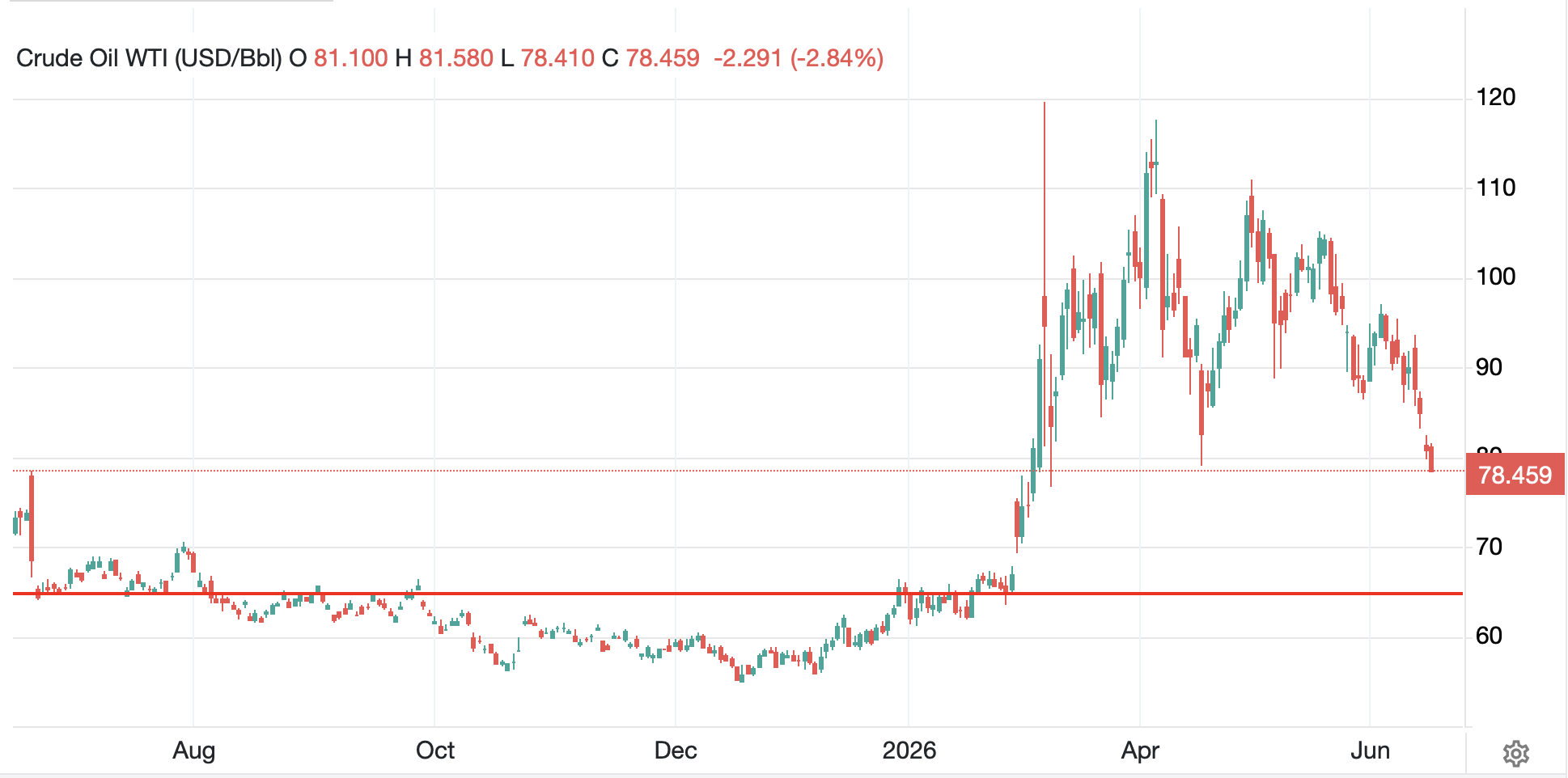
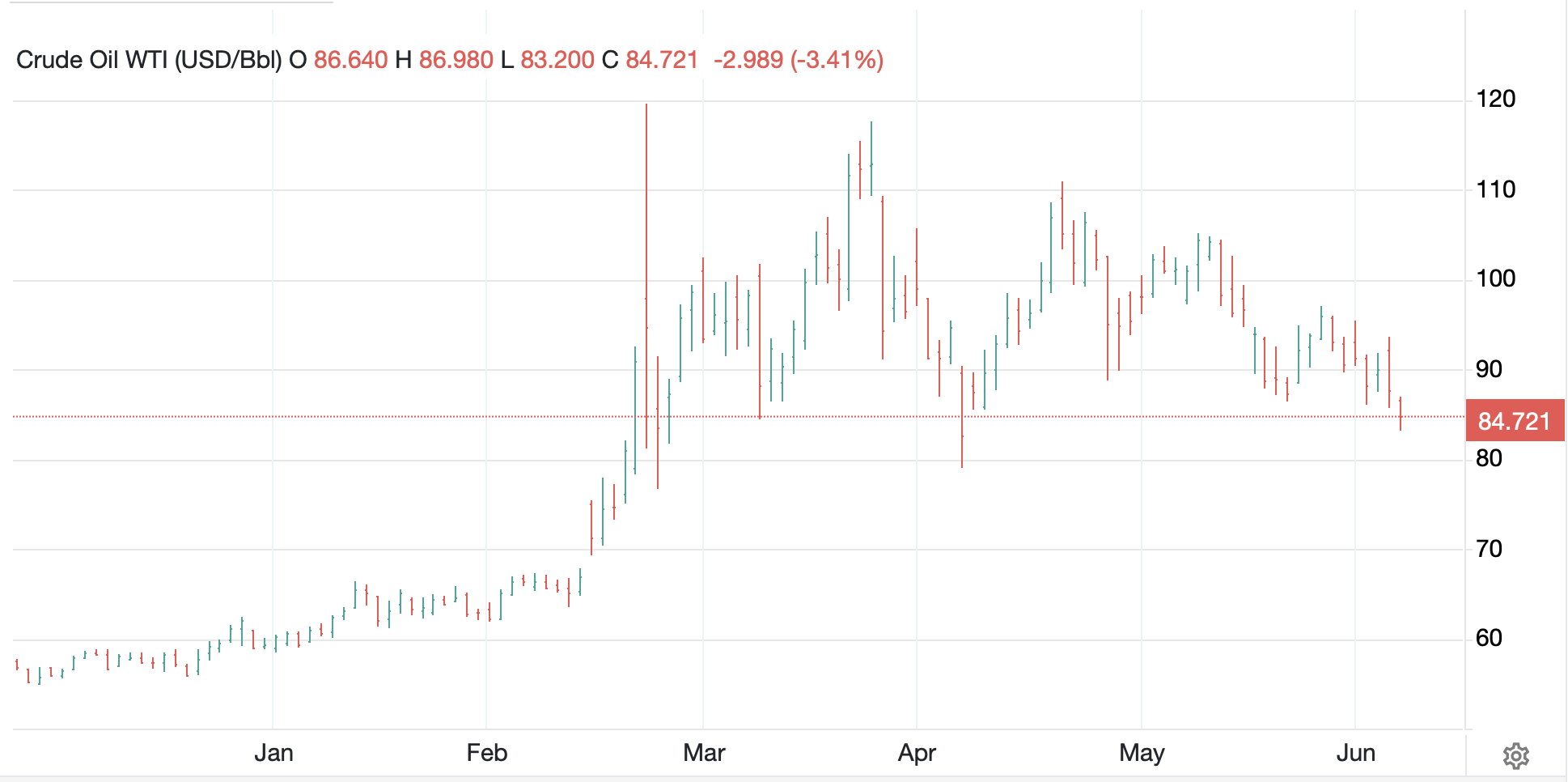
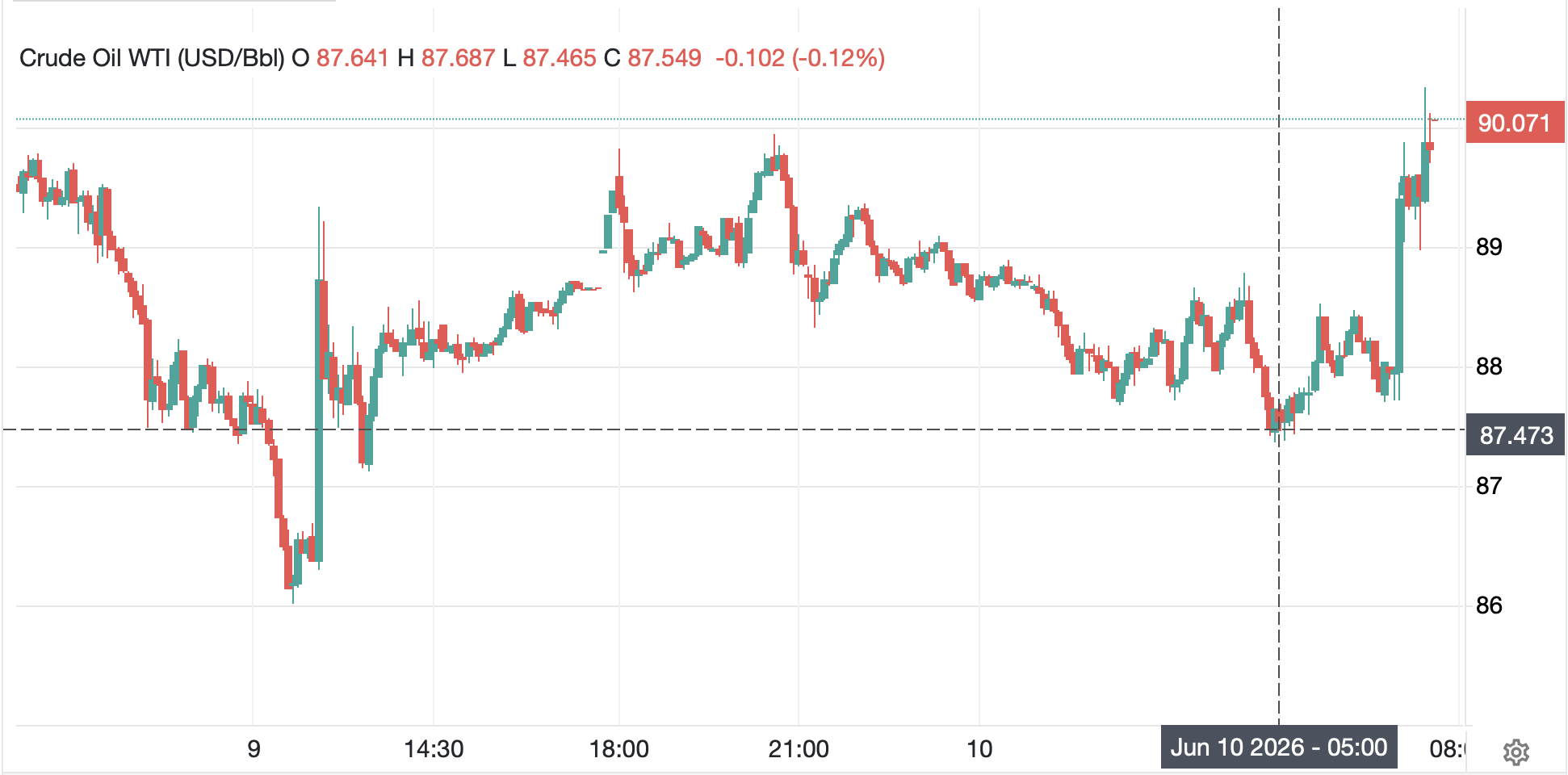
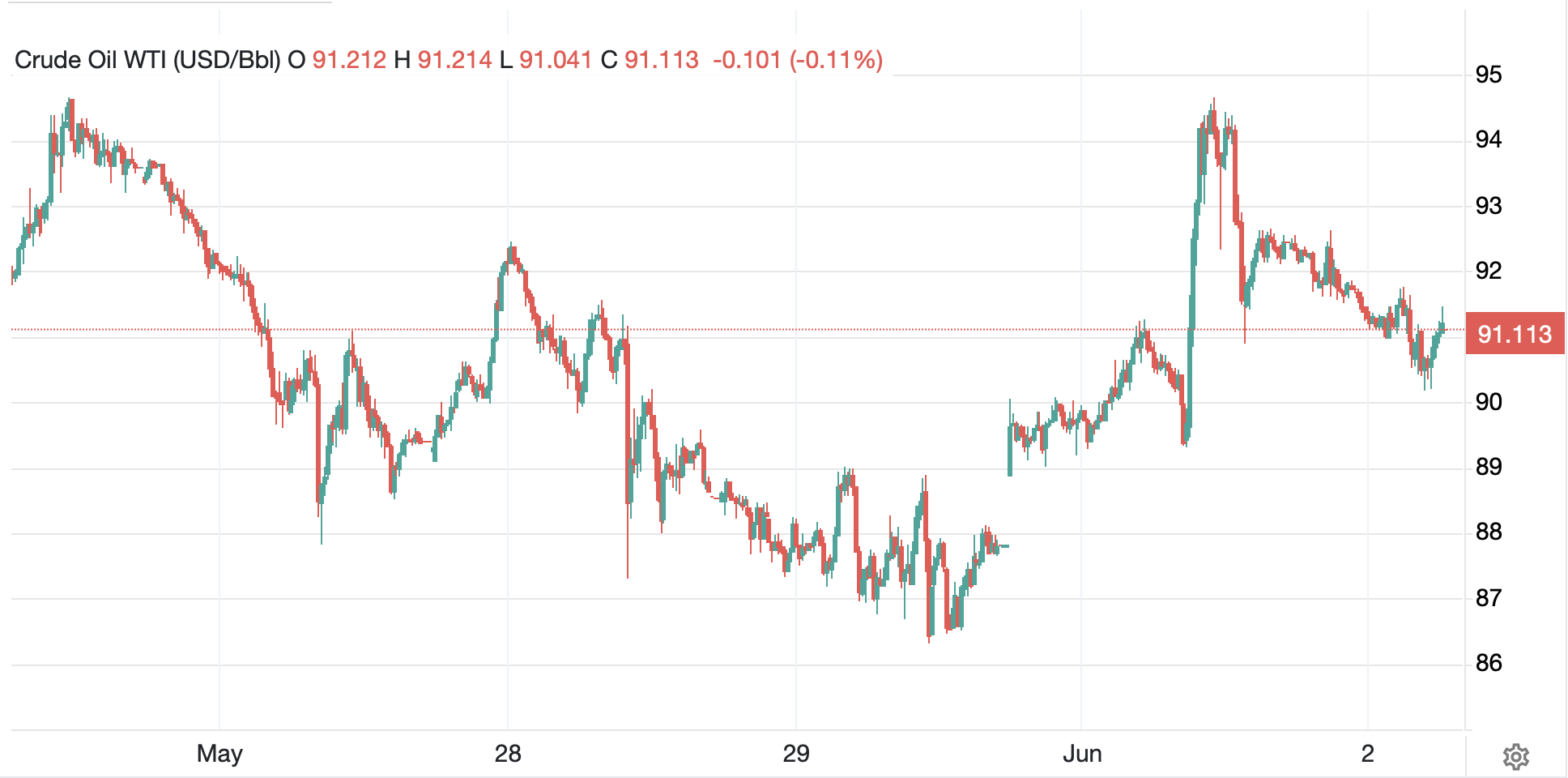
With that in mind, a look at the oil market this morning is not very optimistic as the black, sticky stuff is sharply higher once again, up by 5.25% as I type at 6:45.  I have highlighted this week that thus far, the rise had not been excessive, but as we look at the chart this morning, that claim may no longer be correct.  While we remain far below the levels seen shortly after Russia invaded Ukraine in 2022, the price has risen 25% this week.

Source: tradingeconomics.com
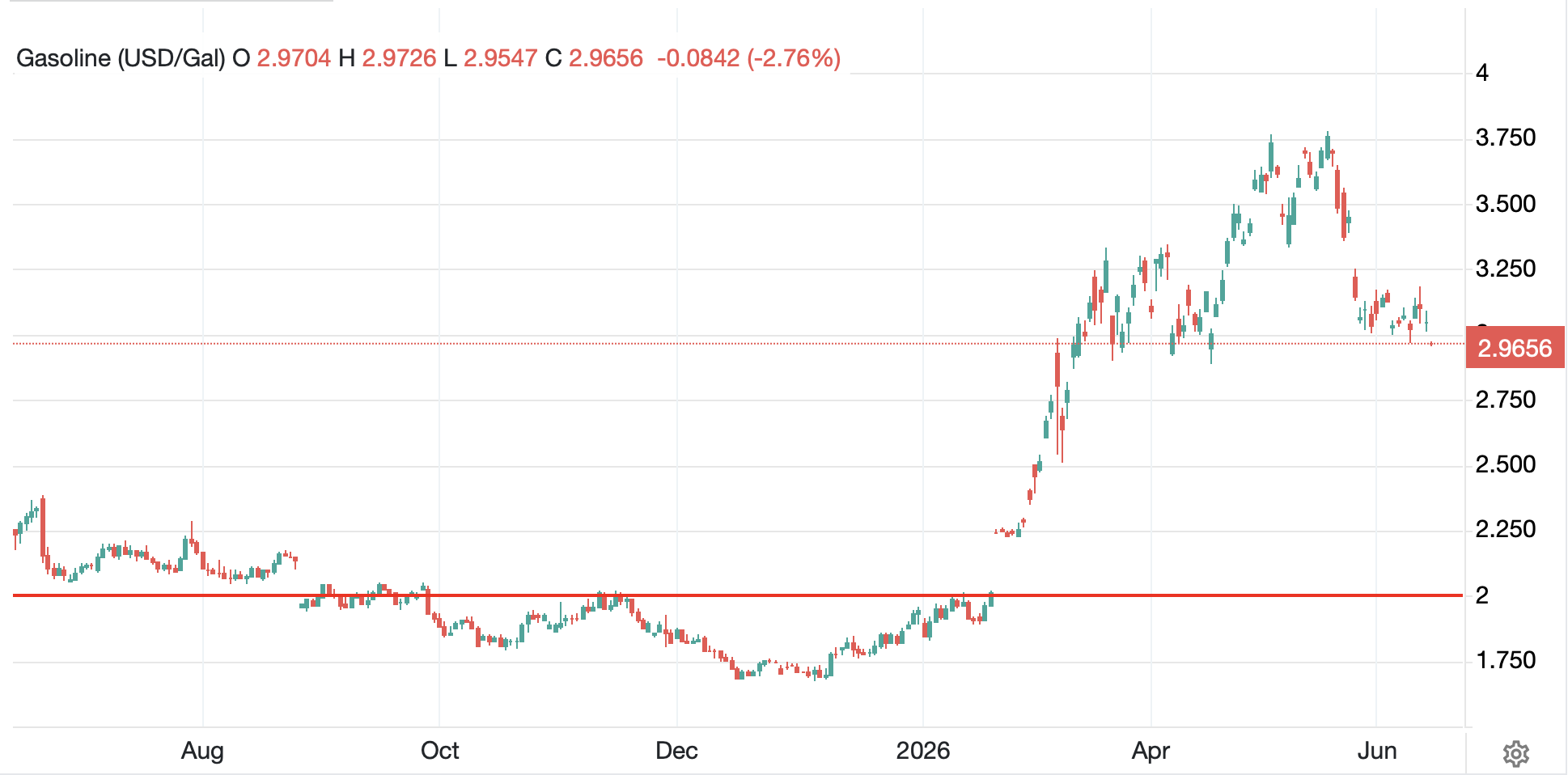
As others have highlighted, while the price of crude gets all the market press, for the man on the street, it is really the price of gasoline that matters, and that has risen some 17% this week.  Arguably, markets are beginning to price the idea that this war will continue longer than initial thoughts, and that the key chokepoint, the Strait of Hormuz, will remain closed for longer than initially expected.  I have seen several models that indicate the impact on measured inflation if gasoline continues to rise in price, which indicate that we should expect CPI to be jumping in the next few months.  The upshot there is that do not be surprised if inflation is suddenly running above the Fed funds rate by the summer, a forecast that I don’t believe was on any bingo card at the beginning of the year.

Remember, though, the narrative prior to the onset of this military action that there was an oil glut.  Remember, too, there is a significant amount of oil in storage around the world, and as I continue to say, the Western Hemisphere is pumping as fast as they can.  (As an aside, I saw this morning that the US is going to restart diplomatic relations with Venezuela, an indication that things there are working far better than the critics implied.)  Clearly, fear is rampant in the oil markets right now, but that is subject to change in a heartbeat.

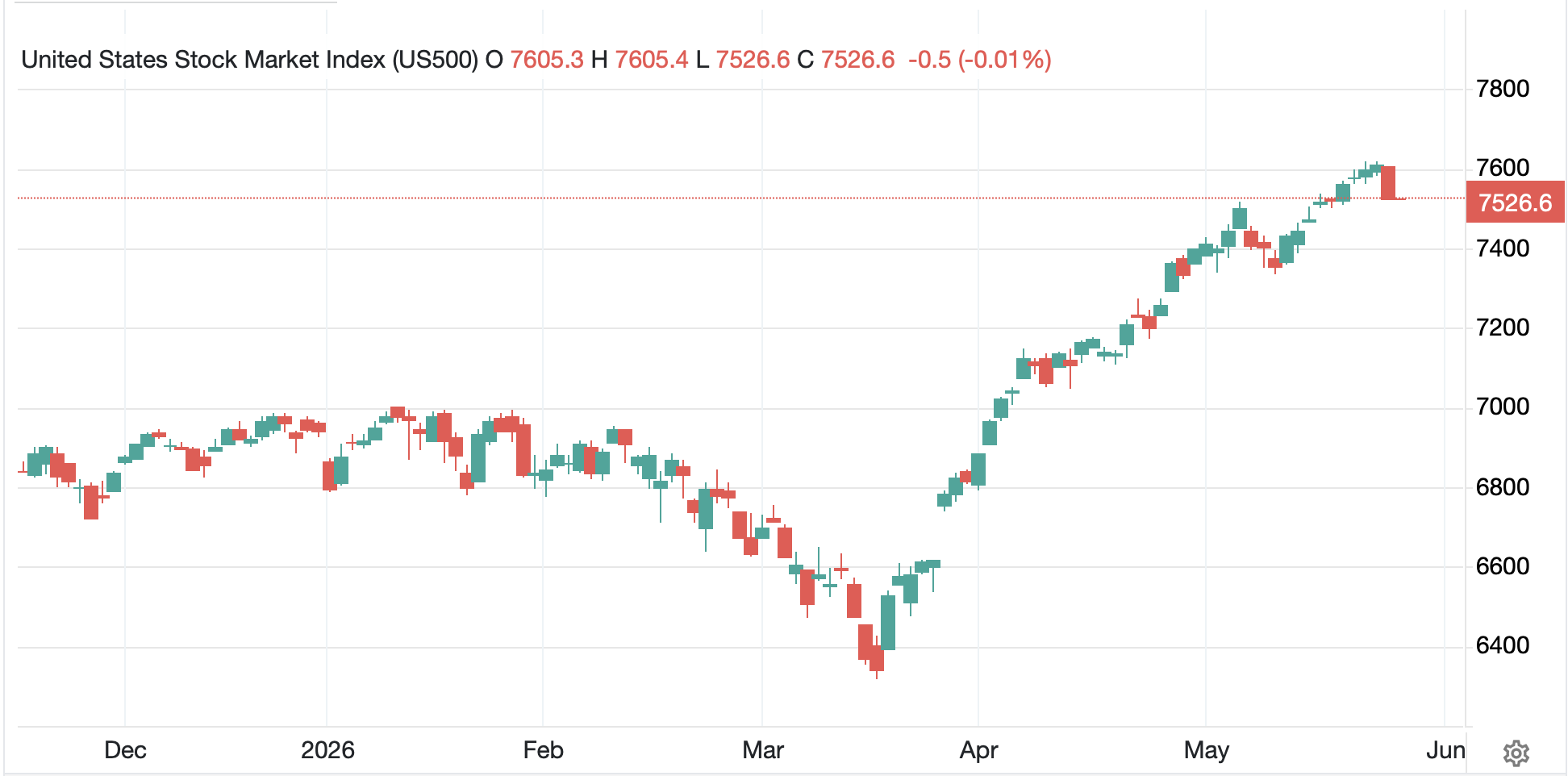
In the meantime, let’s see how markets have responded to the latest rise in oil prices.  Stocks cannot make up their mind, it seems, as the below chart of the S&P 500 shows the price action over the past week, since this started.

Source: tradingeconomics.com
I am hard pressed to discern a trend here, with the movement more akin to a sine wave than anything else.  Interestingly, yesterday’s weakness in the US was followed by a mix of strength and weakness in Asia with Tokyo (+0.6%), China (+0.3%) and HK (+1.7%) all gaining although there were declines in India (-1.4%), Australia (-1.0%) and Indonesia (-1.6%).  Not surprisingly, each nation in Asia is impacted by the war differently, although higher oil prices would seem to me to be quite a negative for the big 3 markets given how reliant each one is on imported oil, and how much of it transits the Strait of Hormuz.

As to Europe, this morning is all red, with losses between -0.1% (UK) and -0.5% (Spain) and everywhere in between.  I read a charming article in Bloomberg about how recent unseasonably mild and sunny weather in Germany has resulted in solar power generating more than 40GW of electricity for the 5th consecutive day this week, helping to keep prices in check despite the rise in energy prices elsewhere.  I hope, for the Germans’ sake, the weather stays more like Phoenix than Frankfurt going forward.  But reality is going to be a problem for them going forward, and high energy prices not only hurt consumers, but they are destroying what’s left of Europe’s industry.  As to US futures, at this hour (7:15) they are lower by -0.6% across the board.

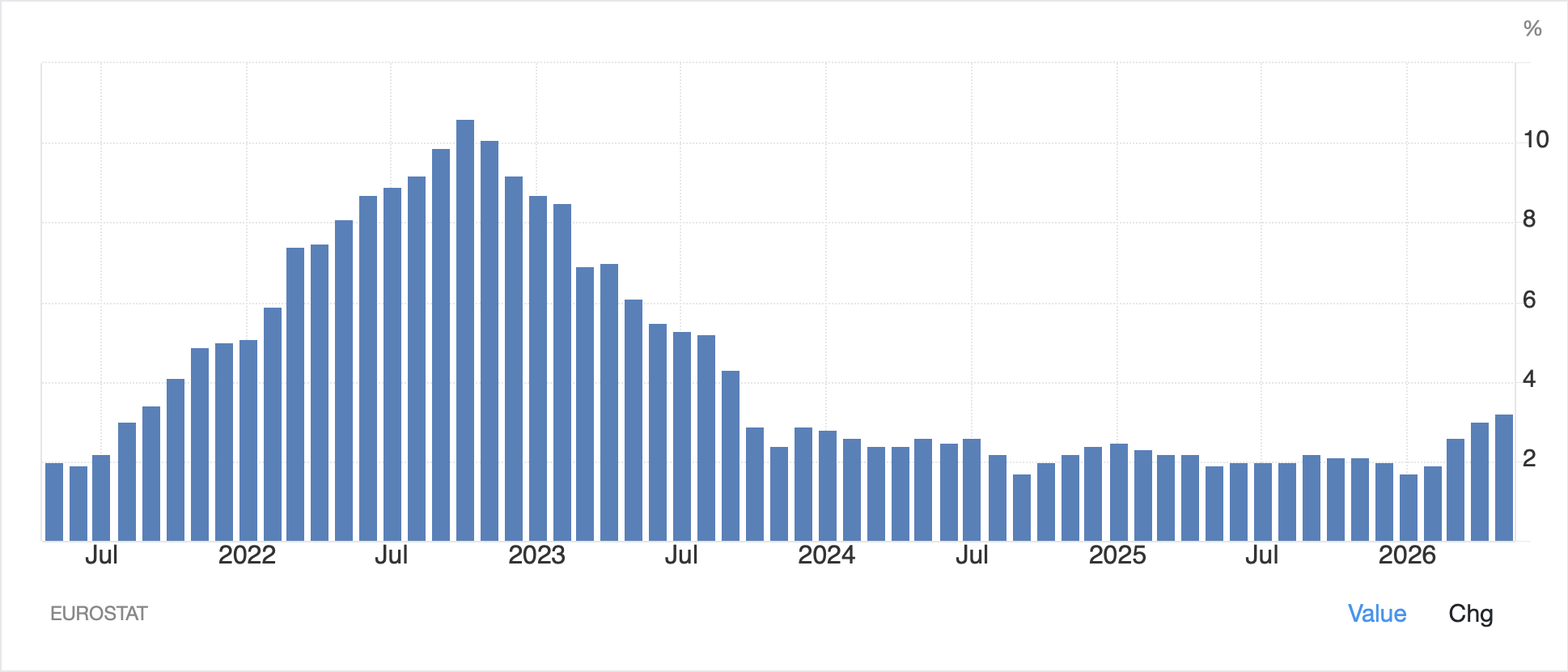
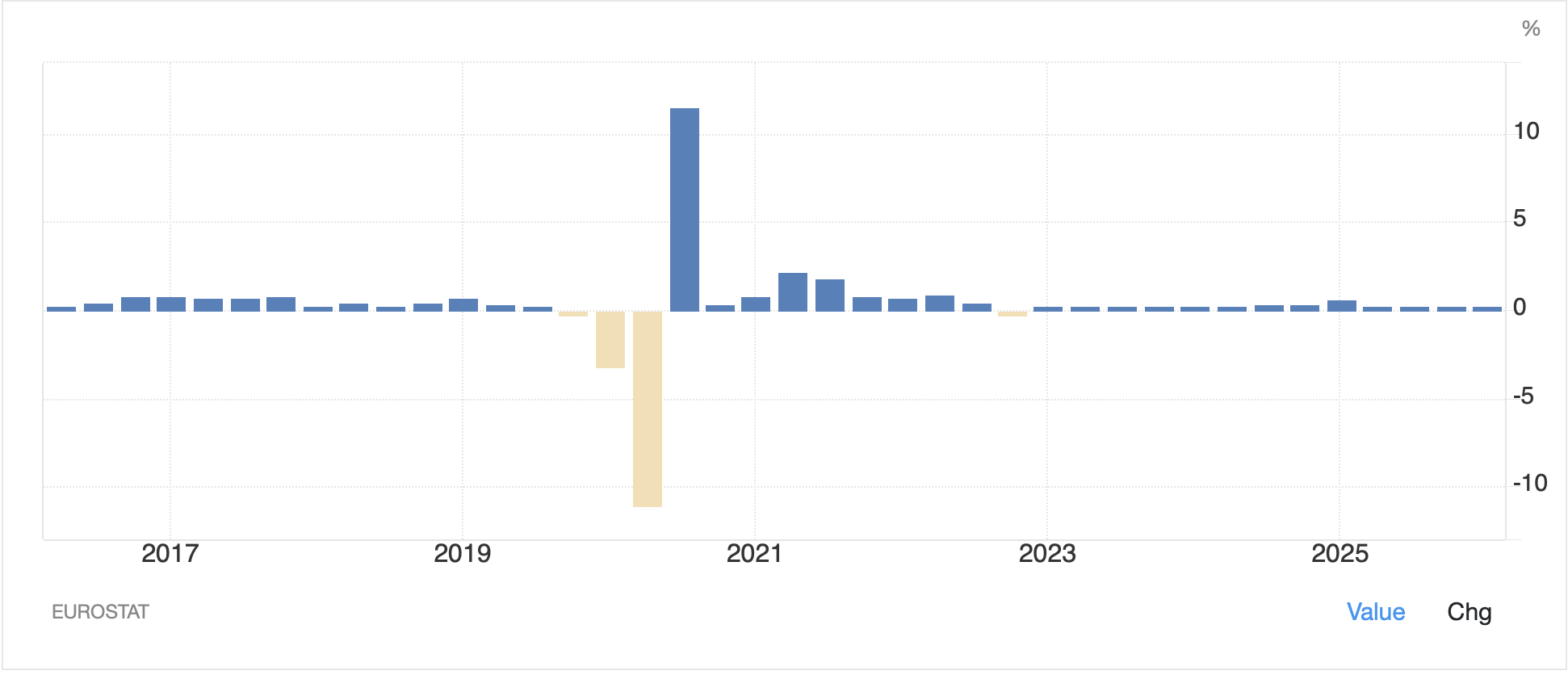
Bonds continue to shun their safe haven role in this conflict with yields continuing to climb.  Treasuries are higher by a further 3bps this morning and approaching the 4.20% level that had been the top of the trading range.  European sovereign yields are all higher by between 3bps and 6bps as inflation concerns percolate amid higher energy prices.  Alas for Europe, this morning they released Eurozone GDP growth for Q4 at a softer than expected 1.2%.  I expect we will begin to hear more about stagflation there if the war continues.

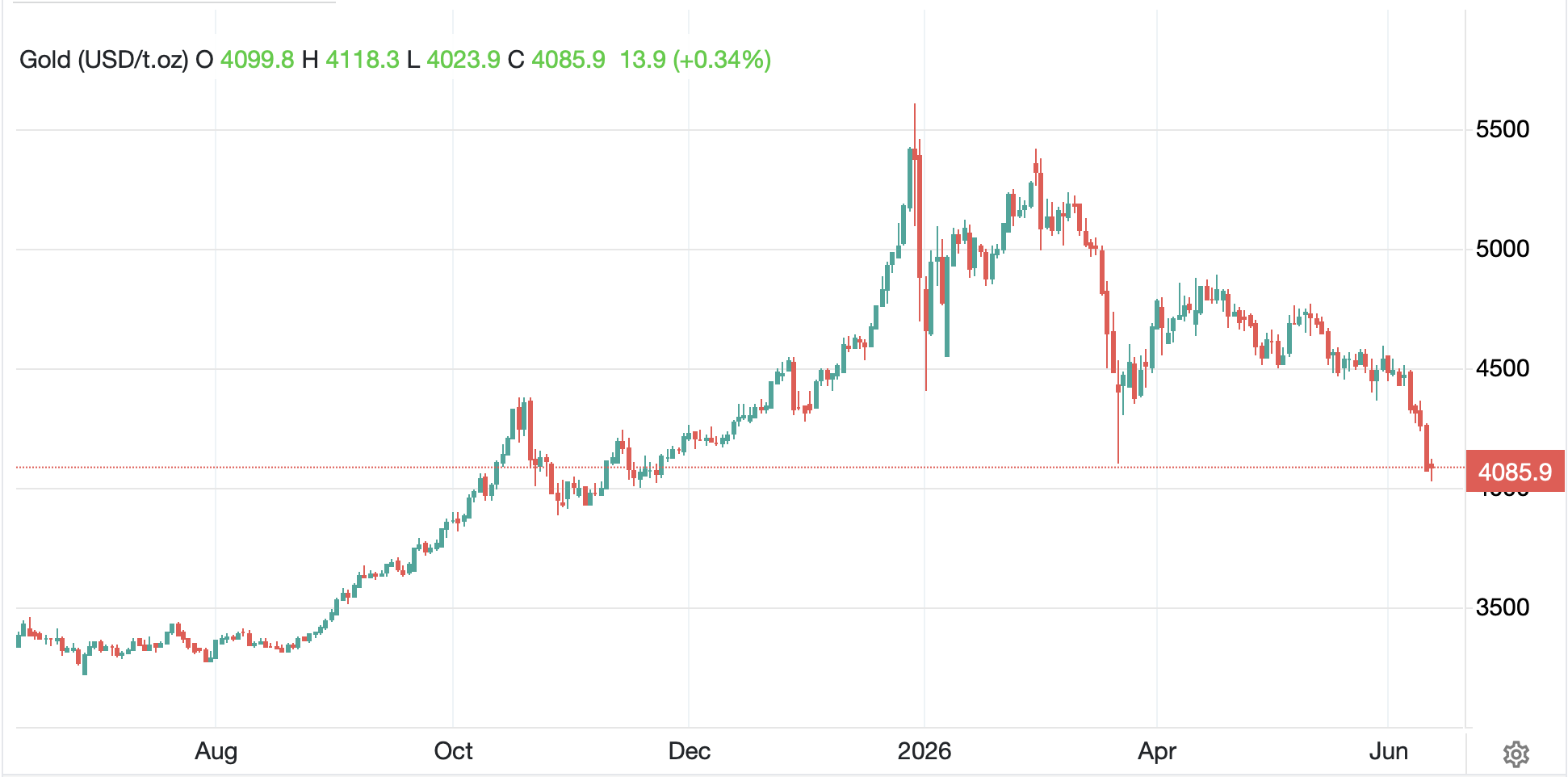
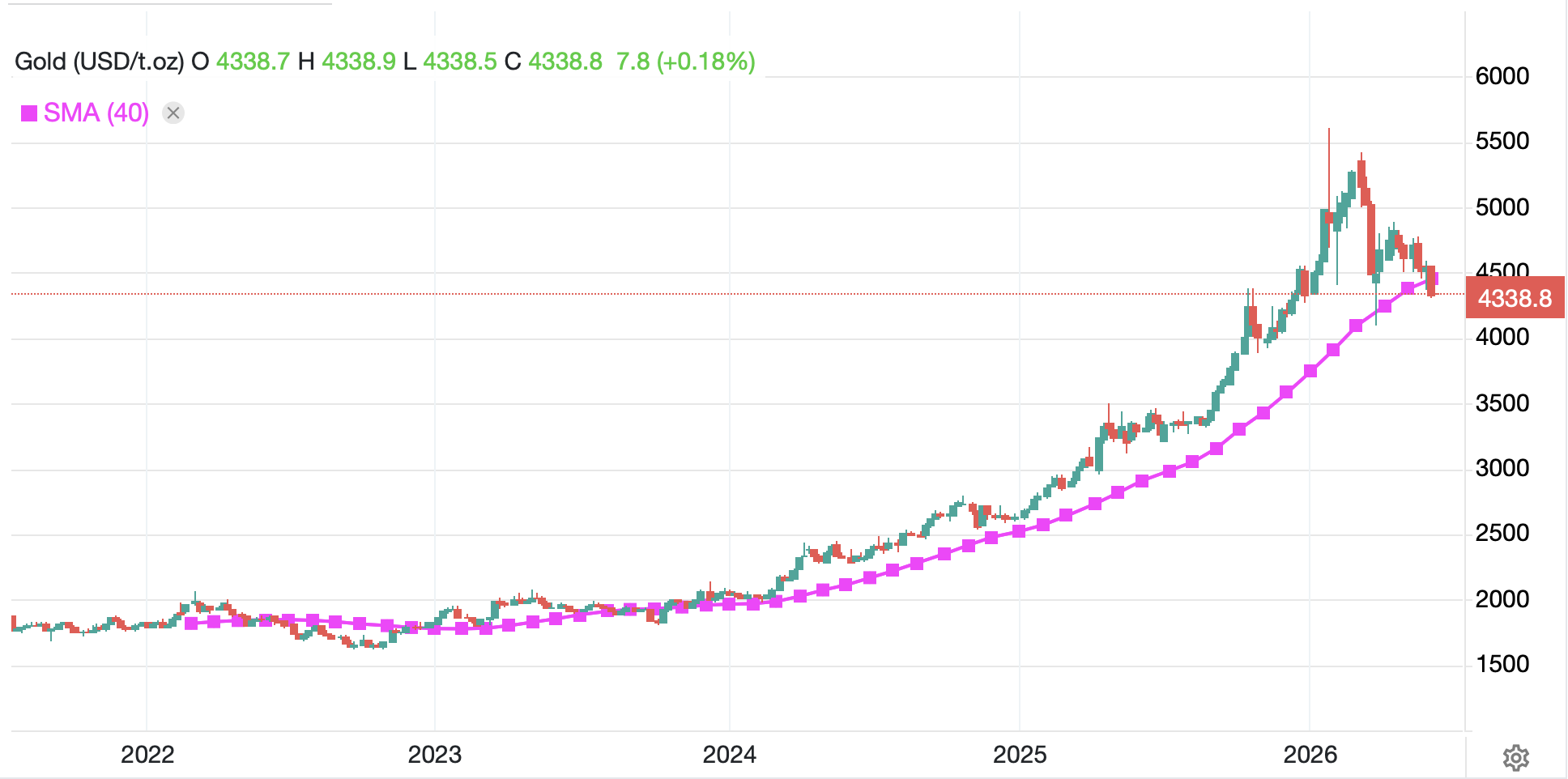
In the metals markets, both gold (+0.1%) and silver (+0.1%) are marginally higher this morning although both suffered yesterday.  My friend JJ who writes the Market Vibes Substack made a very prescient statement last evening, “However, when the shit is hitting the fan, you don’t want safe assets, you want safe prices.”  Thus far, gold has not proven to have safe prices, as evidenced by the daily chop you see below, but my belief remains that it will continue to maintain its value over time, especially in a situation like this.

Source: tradingeconomcis.com

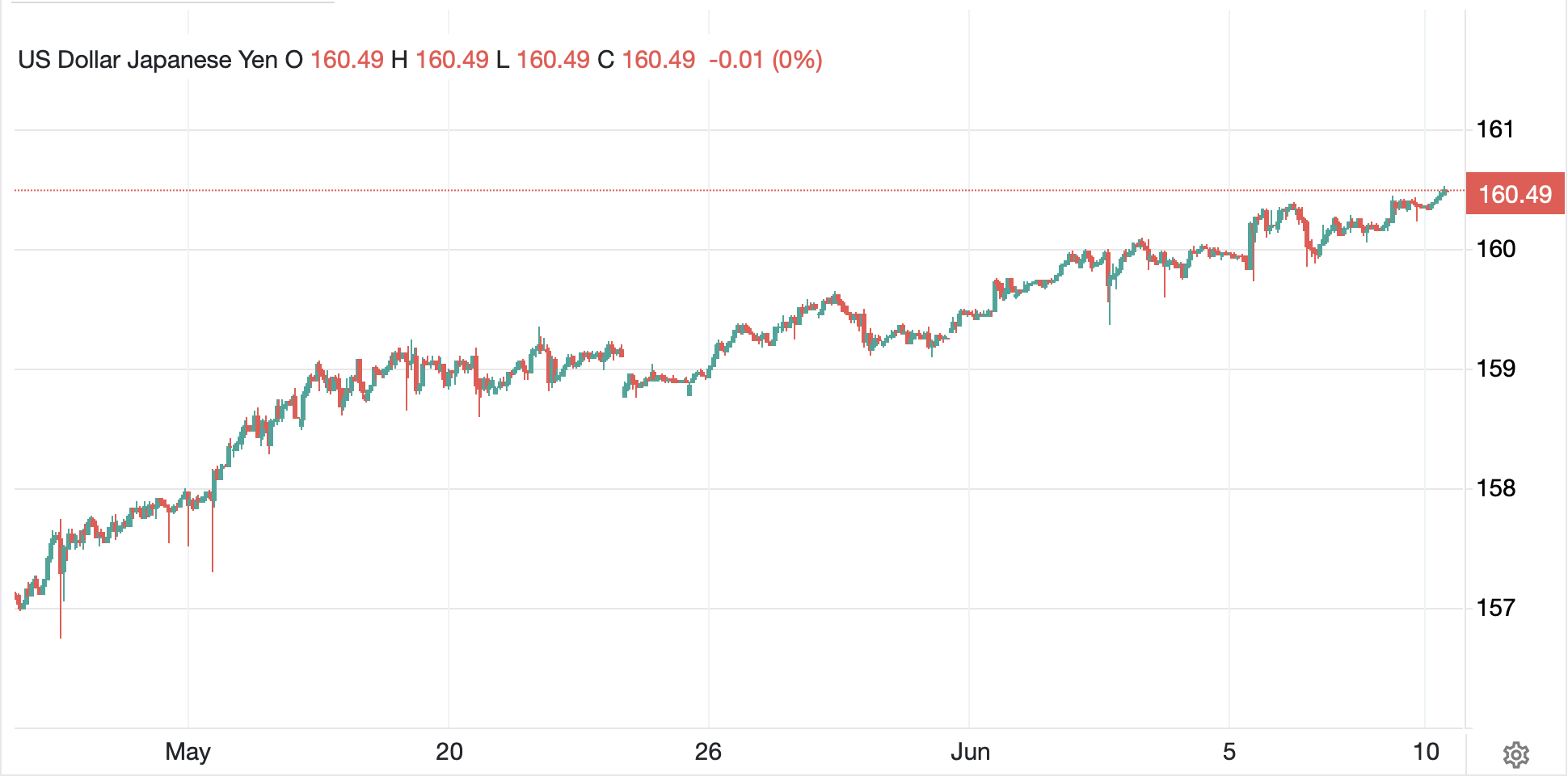
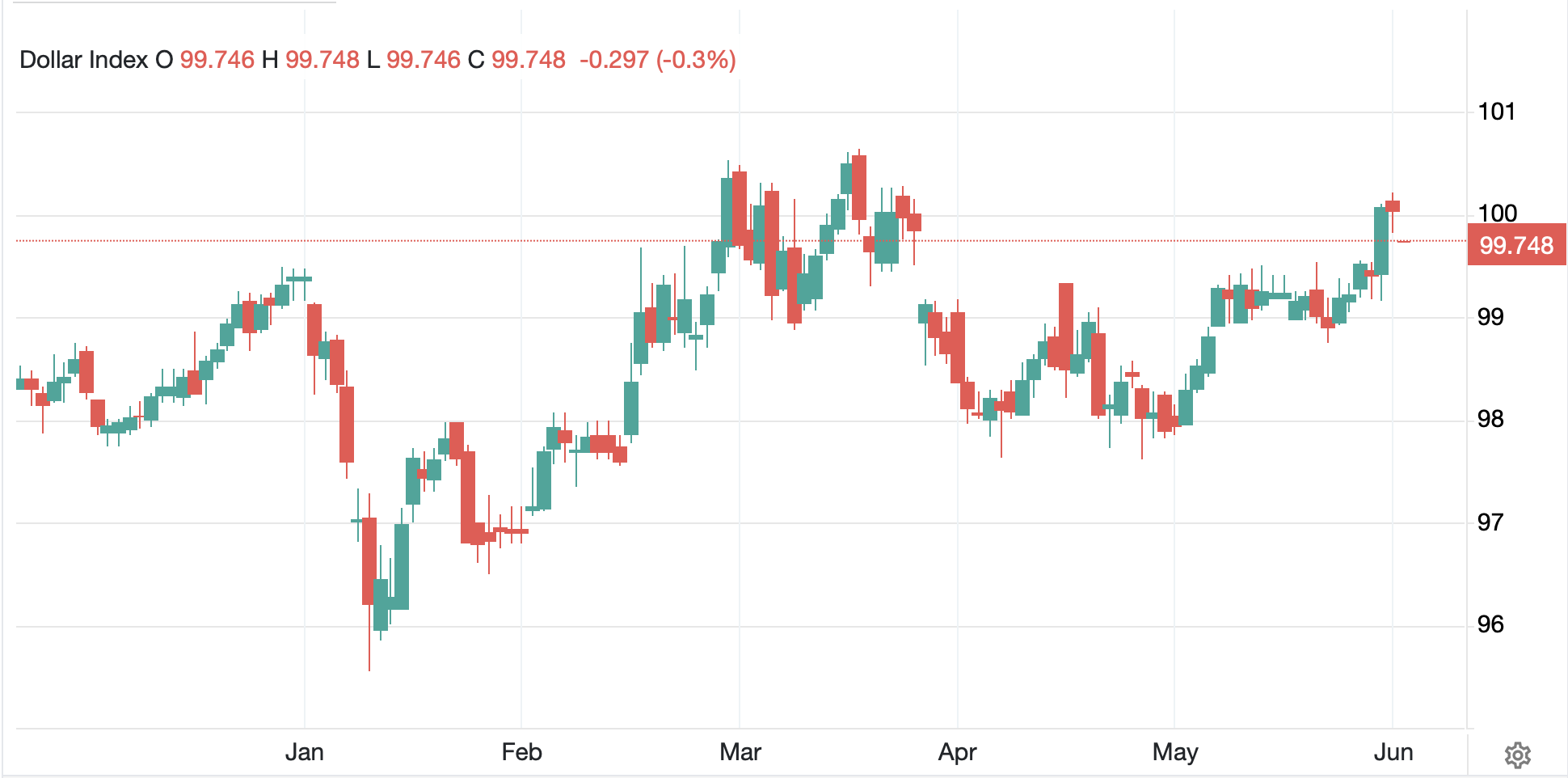
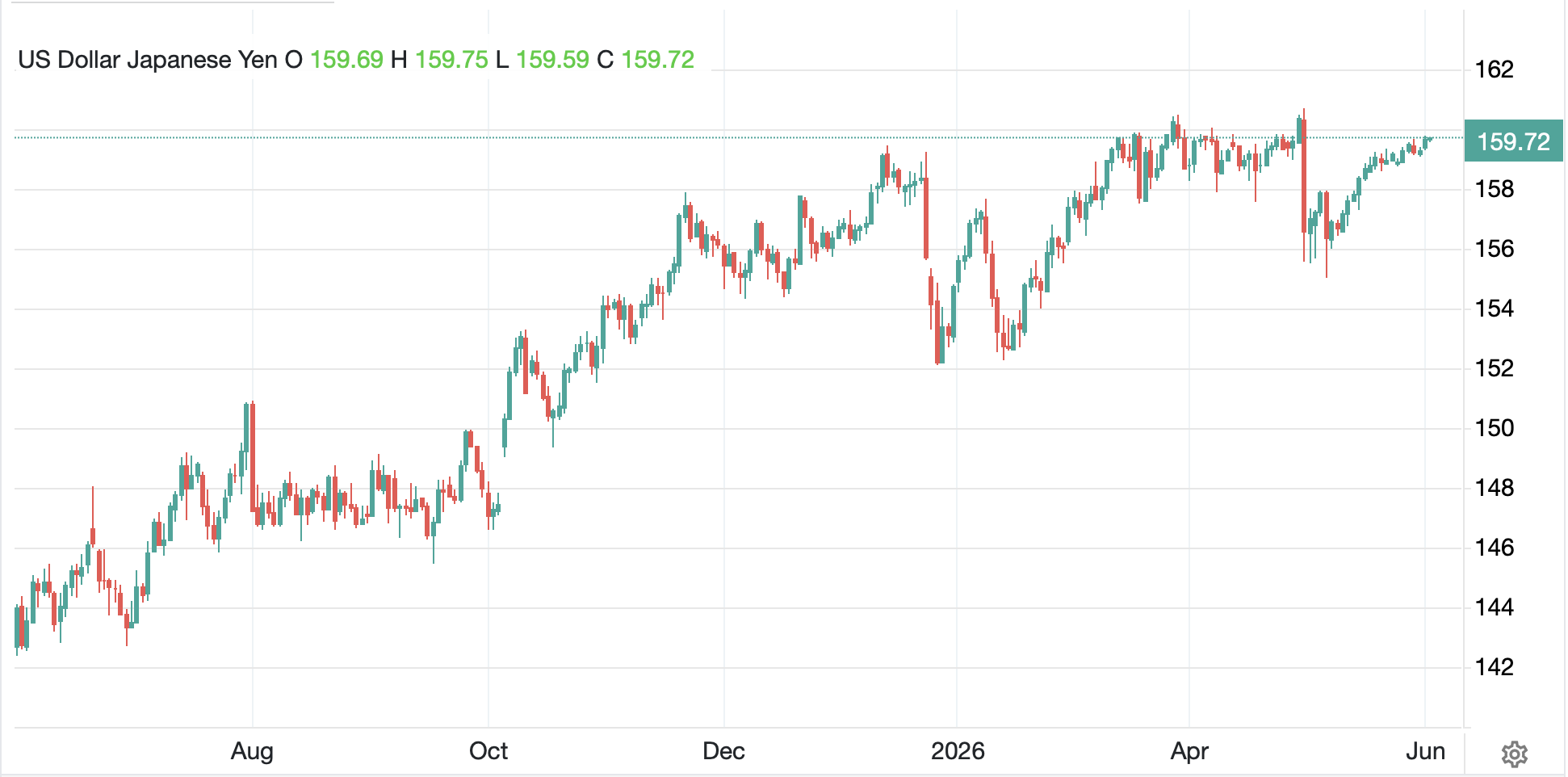
Finally, rumors of the dollar’s death continue to be exaggerated.  This morning, it is stronger vs. virtually all its counterparts in both the G10 and EMG blocs, even the traditional havens of CHF (-0.2%) and JPY (-0.3%).  As I have repeatedly written, I don’t believe you can look at the global energy equation without recognizing that the US combination of extraordinary resources and the willingness to exploit them is an unbeatable combination.  After all, despite 25% of global LNG shipping stopped due to the closure of Hormuz, natural gas prices in the US are just over $3.00/MMBtu, certainly above their levels from two years ago, but incredibly cost competitive on a global basis.  Just look at the chart below with European, UK and US gas prices and see how they have behaved.

Source: tradingeconomics.com
Back to the dollar, both the euro (-0.4%) and the pound (-0.3%) have slipped to their lowest levels vs. the dollar since late November 2025.  I believe that is a combination of both fear and the energy situation as it is aggravated by the war.  There are two currencies holding up this morning, NOK (+0.15%) and CAD (+0.15%) with the similarity that both are major oil exporters.  Oil continues to be the story driving everything.  Quite frankly, as long as the war continues, I find it hard to devise a scenario where the dollar declines in any meaningful way.

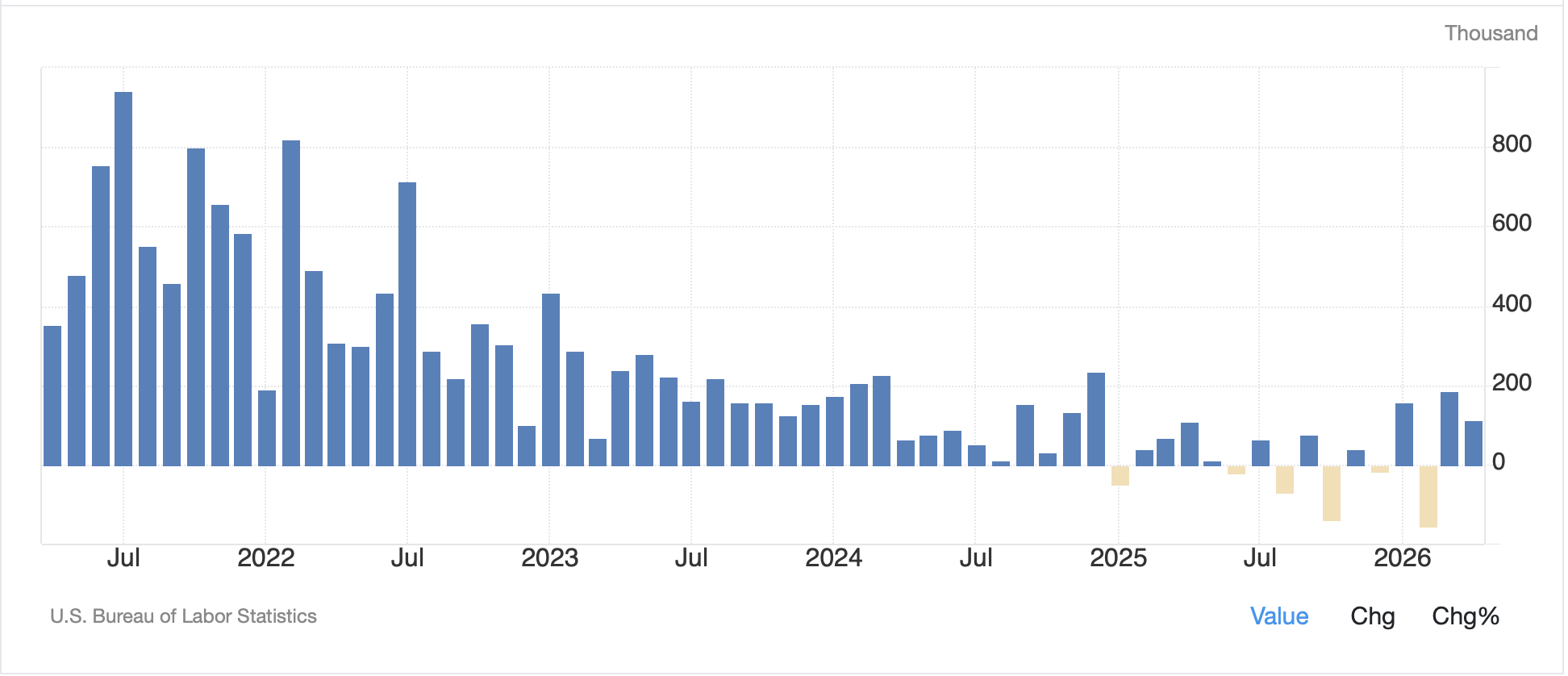
On the data front, this morning brings the payroll report with the following expectations:

Nonfarm Payrolls59K
Private Payrolls65K
Manufacturing Payrolls3K
Unemployment Rate4.3%
Average Hourly Earnings0.3% (3.7% Y/Y)
Average Weekly Hours34.3
Participation Rate62.5%
Retail Sales-0.3%
-ex Autos0.0%

Source: tradingeconomics.com
Yesterday’s Initial Claims data was in line and the productivity data was better than expected.  Wednesday’s ADP Employment Data was better than expected.  While there continues to be a lot of discussion about the economy setting to crack, at this point the data does not show that to be the case.  Remember, the tax impacts of the OBBB are starting to be felt, and that is a huge stimulus.  Remember, too, last month’s NFP was much stronger than expected.  A strong number will certainly support the dollar, although it will probably support oil prices as if the economy remains strong, it will encourage President Trump that he can continue in Iran for a longer time.

Good luck and good weekend

Adf

A Different Scapegoat

The war in Iran rages on
But markets are starting to yawn
Initial concern
Led traders to spurn
Risk assets each dusk until dawn

But now, just a few days have passed
And fear mongers all seem downcast
Most stocks have rebounded
And that has confounded
The bears who, gross shorts, had amassed

In fact, today’s story of note
Is China’s decision to float
A lower growth rate
To be their new fate
As Xi seeks a different scapegoat

This morning is the sixth day of the military action in Iran and depending on the source, the US is either kicking ass or setting up for the greatest collapse of all time.  Perhaps the most interesting statistic of this war is the number of casualties reported thus far, which when summed across all the theaters, appears to be somewhere between 1000 and 1200.  It seems to me that given the ferocity of the attacks on both sides, that is a remarkably low number.  I certainly hope it stays low, for everyone’s sake.

In the meantime, market participants have absorbed the ongoing information and much of the initial FUD has been ameliorated.  I only say this because yesterday and overnight, equity markets are almost universally higher, and in some cases, by substantial amounts.  Arguably, this is a bigger disaster for the Iranians than almost anything else.  If financial markets continue to motor along despite the war, it removes a potential pressure point on President Trump to deescalate.  In fact, the only market that is continuing to demonstrate any price concerns is the oil market, where WTI (+2.6%) and Brent (+2.2%) are both back close to the highest levels seen in the first days.

Source: tradingeconomics.com
The Strait of Hormuz continues to be effectively closed, and that remains a problem for both Europe and Asia, especially China.  In fact, this morning I read that China has ceased exporting refined products amid concerns of how long this war will continue.  

Now, permanently higher oil prices would definitely have severe negative consequences for the global economy if that were to be the outcome.  But I don’t see that as the outcome.  Rather, the world is awash in oil as the US and Canada and Venezuela and Brazil and Argentina continue to pump like crazy.  As well, Saudi Arabia has two major pipelines that ship oil to the Red Sea rather than require transit of the Strait, so I am not hugely concerned about a much higher price.  All of the fears of $100/bbl or higher oil in the event of a closure of the Strait of Hormuz have not come to pass, at least not yet, and I see no reason for that to be the case going forward.

But away from oil, things are remarkably ordinary in markets, so much so that the real story of the day, I believe, is that China has targeted GDP growth of ‘just’ 4.5%. – 5.0% for this year.  The WSJ had a very nice graph of the trajectory of Chinese GDP since 1985 showing a 4.5% outcome would be the lowest (excluding Covid) since 1991.

For a good explanation of things regarding the Chinese economy, it is always worthwhile to turn to @michaelxpettis on X and he didn’t disappoint this morning.  In a nutshell, his point is that while the statement claims they will be focusing more on domestic consumption in their effort to rebalance the economy, that has been the stated aim for at least 5 years, and we know that hasn’t happened.  President Xi’s problem is that if that goal were to be achieved, it would result in GDP growth somewhere on the order of 2%, and that is not acceptable.  For my money, nothing has changed there.  Chinese companies will still over produce, prices in China will still be pressured lower and the Chinese trade surplus will remain well in excess of $1 trillion.

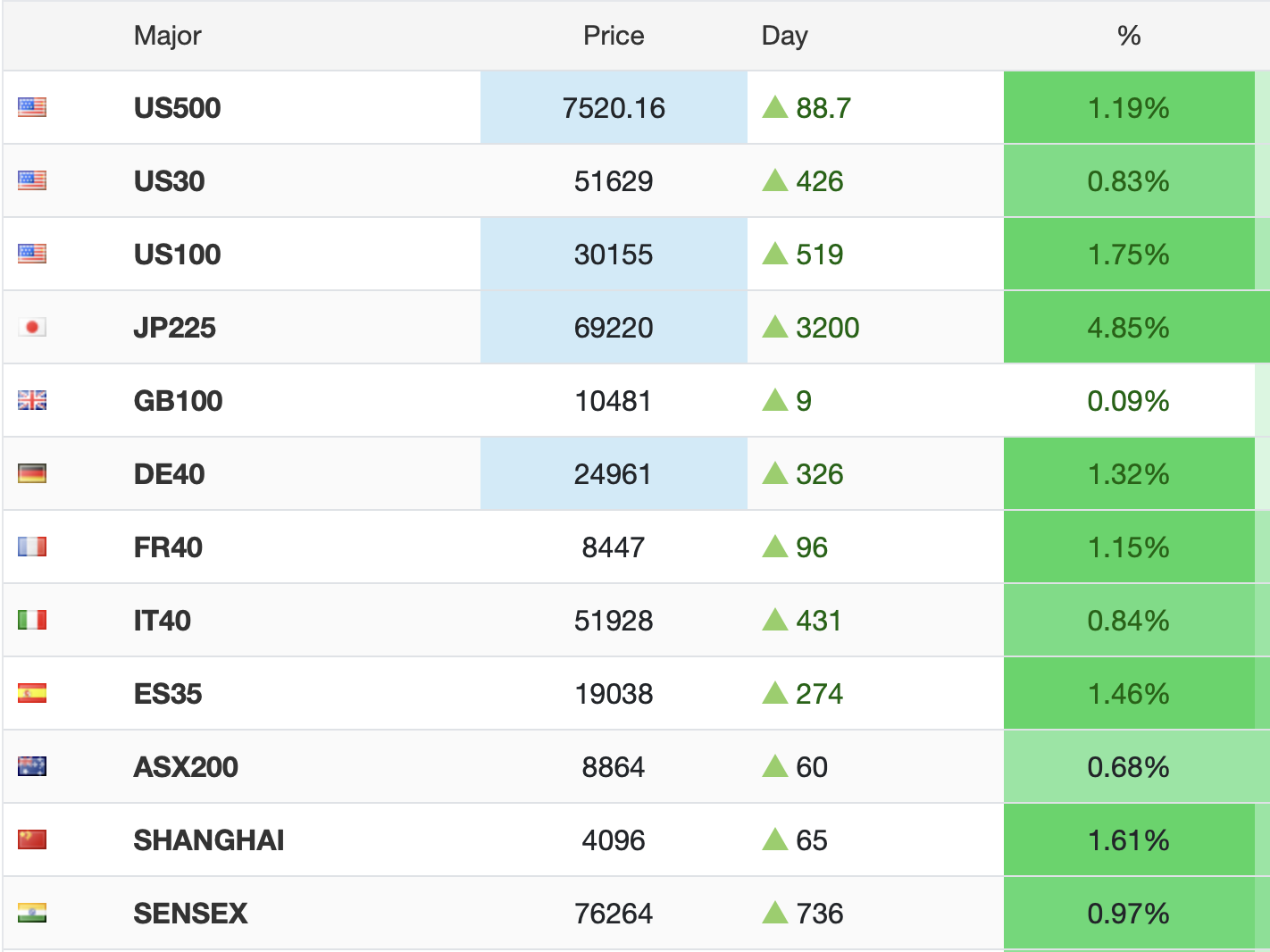
And that’s really what we have today.  I am not a war correspondent, so will not be highlighting anything there.  Rather, let’s turn to the markets and see what happened overnight.  under the guise of a picture is worth 1000 words, I give you major equity market performance in the past 24 hours below from Bloomberg.

Of course, this doesn’t consider Korea (+9.6%) which was the biggest winner overnight, and recouped most of the previous day’s losses as per the below.

Source: finance.yahoo.com

But virtually every market in Asia rallied overnight with Taiwan, Indonesia and Thailand all higher by 2% or more.  As to Europe, the euphoria is not as high, but still fear is not evident and at this hour (7:10), US futures are flat to -0.15%, so basically unchanged.

The bond market is having a tougher time around the world with Treasury yields rising yesterday by 4bps and up another 2bps this morning.  European sovereign yields are all higher by between 6bps and 8bps as inflation fears start to get built into investment theses.  Remember, Europe is probably the worst hit regarding the oil/LNG supply disruptions and prices there are likely to climb further than in the US or Western Hemisphere.  Too, JGBs (+4bps) are feeling a little strain, despite (because of?) Ueda-san and his cronies expressing concern over the war’s impact on inflation in Japan and maintaining that a rate hike in April is still a possibility.

Speaking of inflation, the Fed’s Beige Book was released yesterday as well as a NY Fed survey on prices in their region and both pointed to much more underlying inflation than the CPI data currently implies.  Wolf Richter had an excellent write-up here, and the numbers are eye opening.

In the metals markets, gold (+0.6%) really has a remarkable amount of support under all conditions.  Whether I look at a mechanically drawn trend line or the 50-day moving average, the barbarous relic remains in demand and shows no signs of breaking lower.  I continue to believe that the recent volatility and liquidations were the result of leveraged traders in other products needing to sell something to make margin calls, and gold was available for the job.

Source: tradingeconomics.com
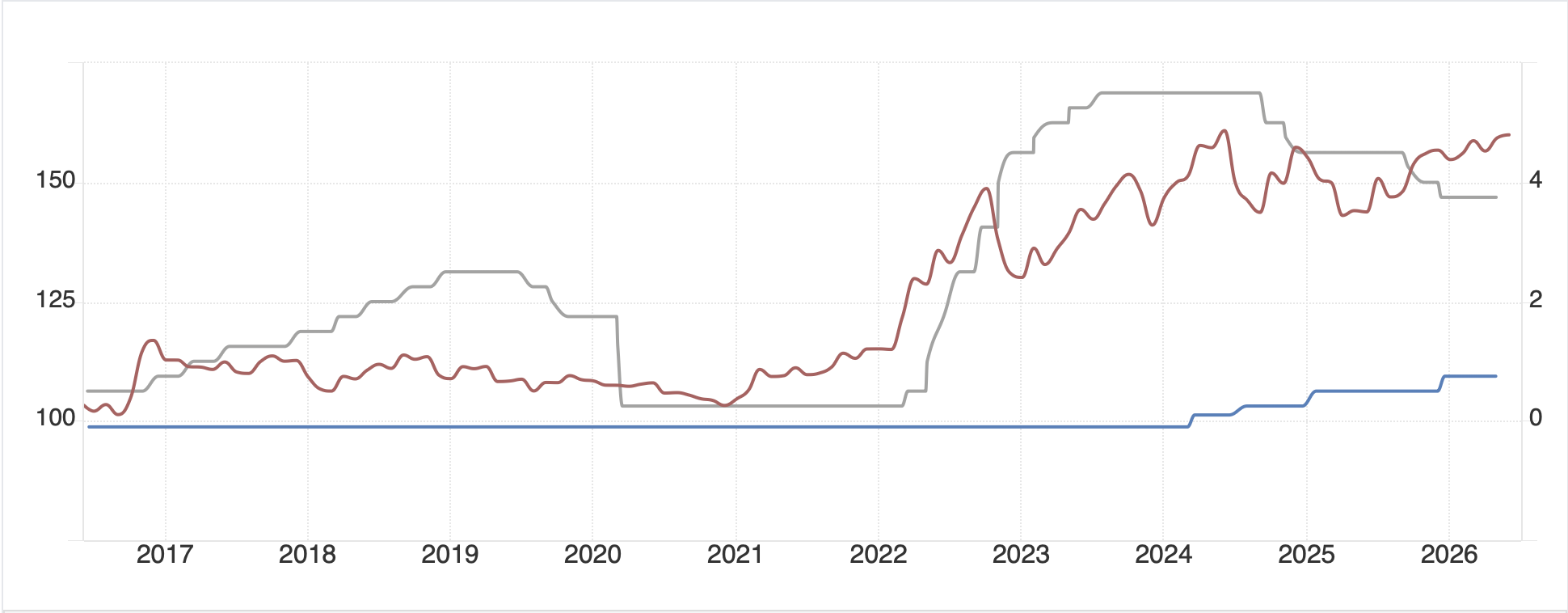
As to the other metals, silver (+1.1%) and platinum (+0.9%) are both modestly firmer while copper (-1.3%) is bucking the trend, although I see no good reason for it to decline.  One interesting thing to note is that silver in the COMEX vaults continues to decline which many see as a potential point of supply issues going forward.  Nothing has changed that story.

Finally, the FX markets are once again hewing toward dollars with the DXY (+0.15%) back around 99.00.  The worst performer today is CLP (-1.1%) which is feeling the pressure from copper’s struggles, but ZAR (-0.9%) is also under pressure despite gold’s rebound.  Interestingly, NOK (-0.2%) cannot seem to gain any ground despite oil’s rally, although arguably, the dollar itself has become a major petrocurrency with a positive correlation to oil.  This space is not that interesting right now.

On the data front, I neglected to mention ADP Employment yesterday, which wound up at a better-than-expected 63K.  Too, oil inventories in the US rose again last week.  This morning, Initial (exp 215K) and Continuing (1850K) Claims are due as well as Nonfarm Productivity for Q4 (1.9%) and Unit Labor Costs (2.0%).  But does the data really matter right now?  Perhaps tomorrow’s NFP will have impact, but with the war and higher oil prices, it is very difficult for me to see a scenario where the Fed will impose itself here, not where the market will care that much, at least not the stock market. Bonds would react I suppose.  But it ain’t gonna happen, so don’t worry about it.

Absent a change in the war’s current trajectory, I think investors are going to focus on trying to estimate how long oil prices will remain elevated as that is really the big question for most markets.  I can only hope it doesn’t take that much longer for a conclusion.

Good luck

Adf

Impacts of War

The financial impacts of war
Are many, and so here are four
Inflation will rise
And what this implies
Investors, most bonds, will abhor

The dollar is like to remain
Demanded and that will cause pain
For stocks everywhere
But one thing will fare
Just fine, look for gold, more, to gain

Obviously, the war in Iran remains the top story and is likely to remain so for a few more weeks at least.  Arguably, the only way this will change is either a regime change takes place and talks for peace begin, or Iran is able to retaliate in a heretofore unknown fashion sufficient to force the US and Israel to withdraw.  President Trump has indicated he believes this campaign will last 4-5 weeks with that regime change the result.  But remember, the Russia/Ukraine war slipped from the headlines after 6-8 weeks, and it is still ongoing.  In fact, I challenge you to find a story about that war anywhere these days.

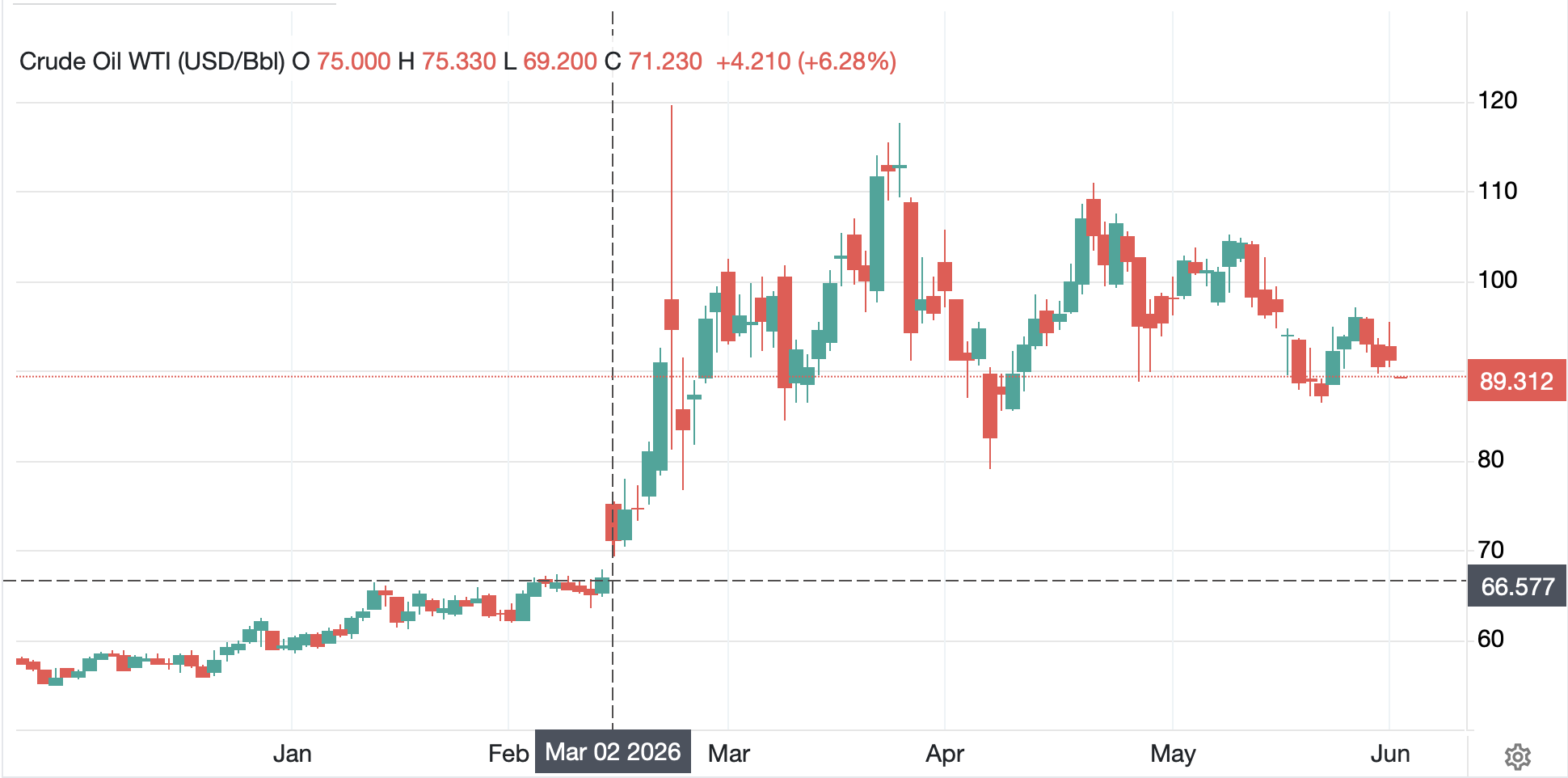
My point is, despite the ongoing hostilities, the rest of the world continues on its way, albeit with some new bumps in the road.  Clearly, the biggest bump remains the price of oil and, for much of Europe and Asia, its continued availability.  While the price of oil (+0.1% today) has risen about 18% in the past month, a look at the long-term chart below offers a bit more perspective as to just how limited this movement has been so far.

Source: tradingeconomics.com
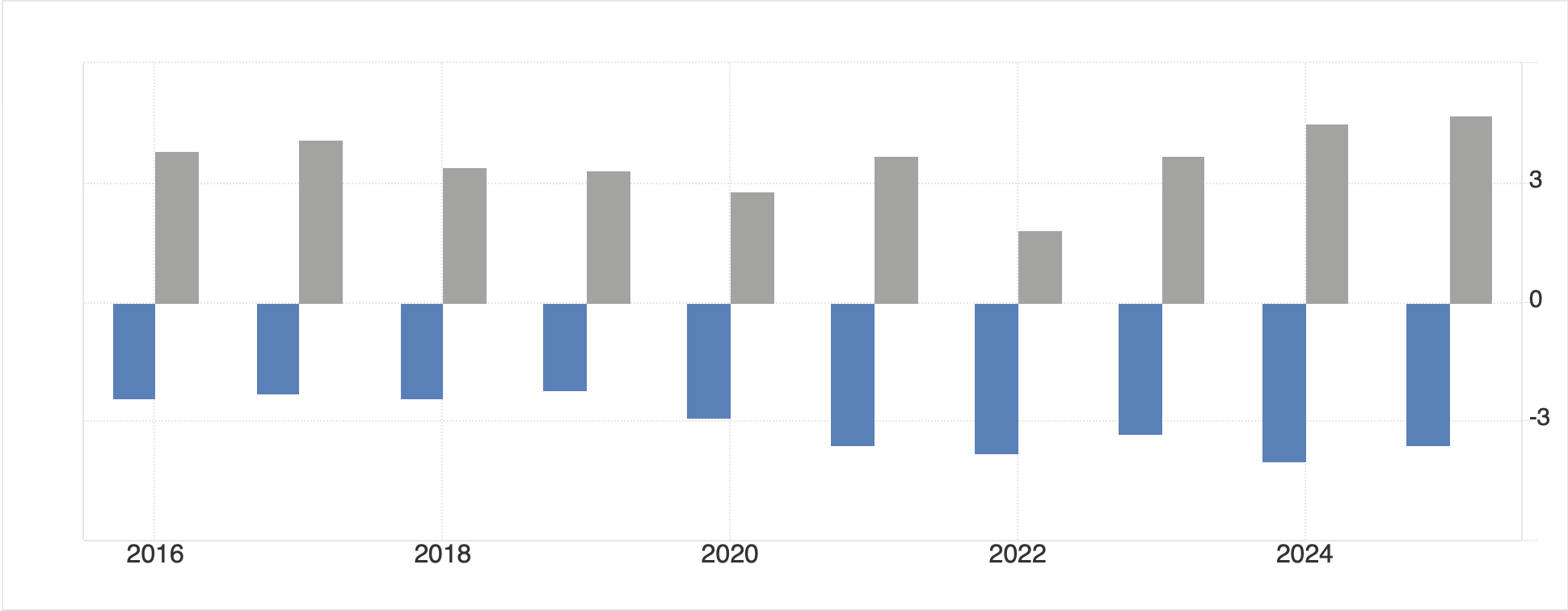
I have highlighted the week of the Russian invasion from February 2022, which saw oil rise more than 20% at the time and remain elevated for about 5 months before it retraced to prewar levels.  The reaction this time has not been nearly as dramatic even though the effective closure of the Strait of Hormuz has removed about 20% of global oil supply from the market right now, as well as a similar proportion of LNG.  This is why we have seen the massive spike in European and Asian LNG prices as that was the destination of those cargoes.  Ironically, one of the most negatively impacted nations is China, which was Iran’s biggest oil customer, but now has seen a dramatic decline in the availability of oil. Of course, they have built a significant stockpile, their own SPR, which holds between 1.2 -1.5 billion barrels, enough to supply the nation for upwards of 4 months.  While not an immediate concern, it will start to hurt after a while if this continues.

It appears to me that unless Iran starts targeting and destroying oil production facilities throughout the Middle East, which is certainly possible, the upside for prices from here is limited under current circumstances.  My guess, and it is just that, is another 10%.  Of course, the risk for Iran there is that it draws the Saudis, Emiratis and the rest of the Gulf into the war against Iran, probably not a desired outcome either.  

As an aside, I wonder if prices rise far enough in a worst-case scenario, if the UK removes its drilling restrictions, although thus far, PM Starmer has not indicated anything of the sort.  It depends on just how painful things become I suppose.

Moving on to the equity markets, while US markets have declined somewhat since the war began, the S&P 500 remains just 2.5% below its all-time high set February 28, and as you can see from the chart below, does not appear to be altering the recent trajectory in any meaningful fashion.

Source: tradingeconomics.com
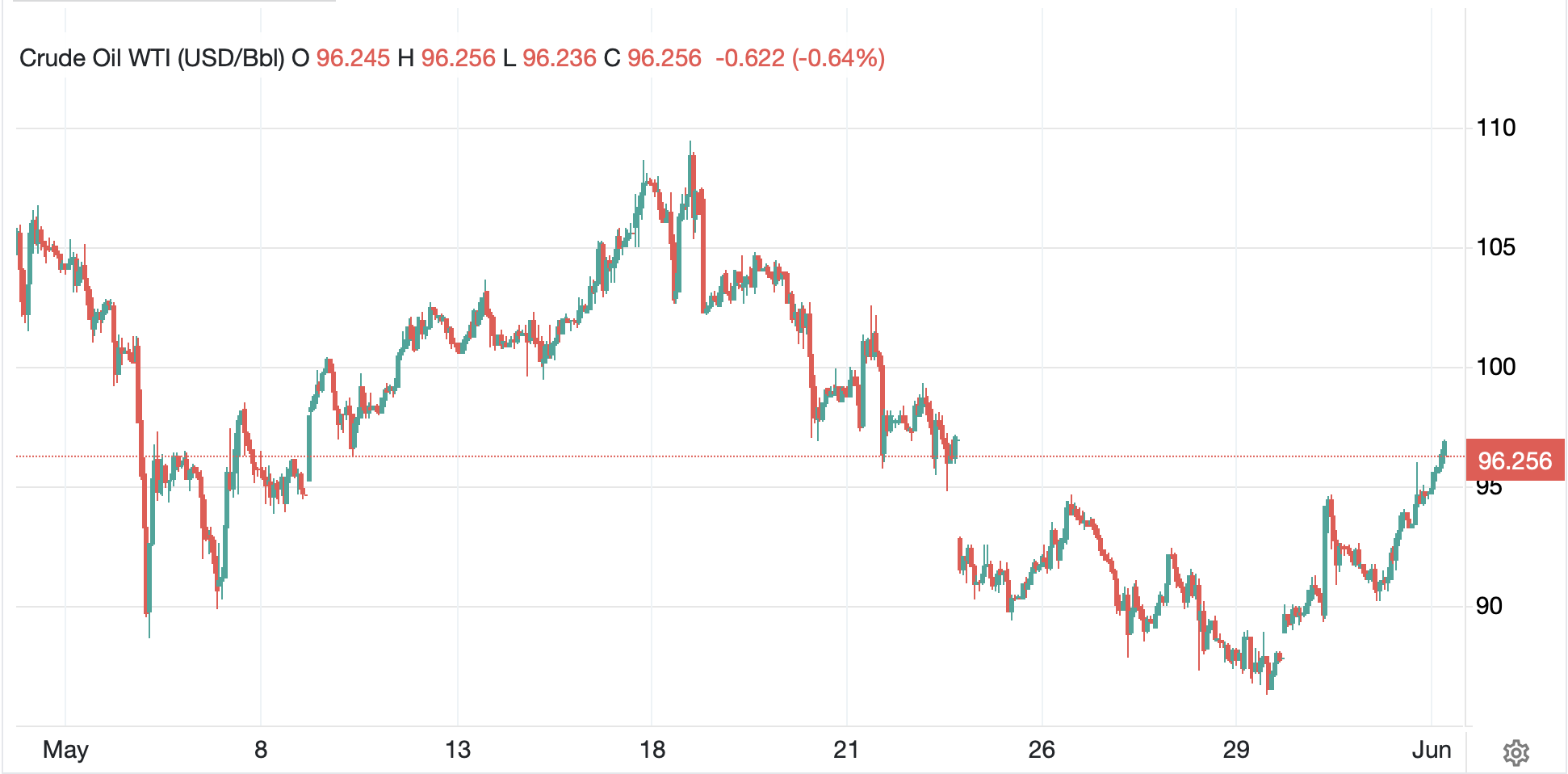
However, the same cannot be said for several other markets, notably those in Asia.  The Kospi (-12.1%) is the worst offender as seen below.  But weakness in the region was widespread with the Nikkei (-3.6%), Hang Seng (-2.0%), Taiex (-4.3%) and Thailand’s SET 50 (-5.4%) leading the way lower with most other bourses falling on the order of -1.0% to -2.0%.  This makes sense as virtually all these nations rely on energy from the Middle East, and with both higher prices and reduced supply, trouble is afoot.

Source: finance.yahoo.com

Of course, as you can also see in the KOSPI chart above, with similar price action elsewhere in the region, these stock markets have been on a tear given their tech focus (Korea’s two largest companies are Samsung and SK Hynix, both semiconductor manufacturers) so there was some room for a reversal.  In fact, remarkably, despite the KOSPI having fallen almost 20% this week, it remains above its trend line.  My take is this is a major correction and something we will see until things in the Middle East settle down.

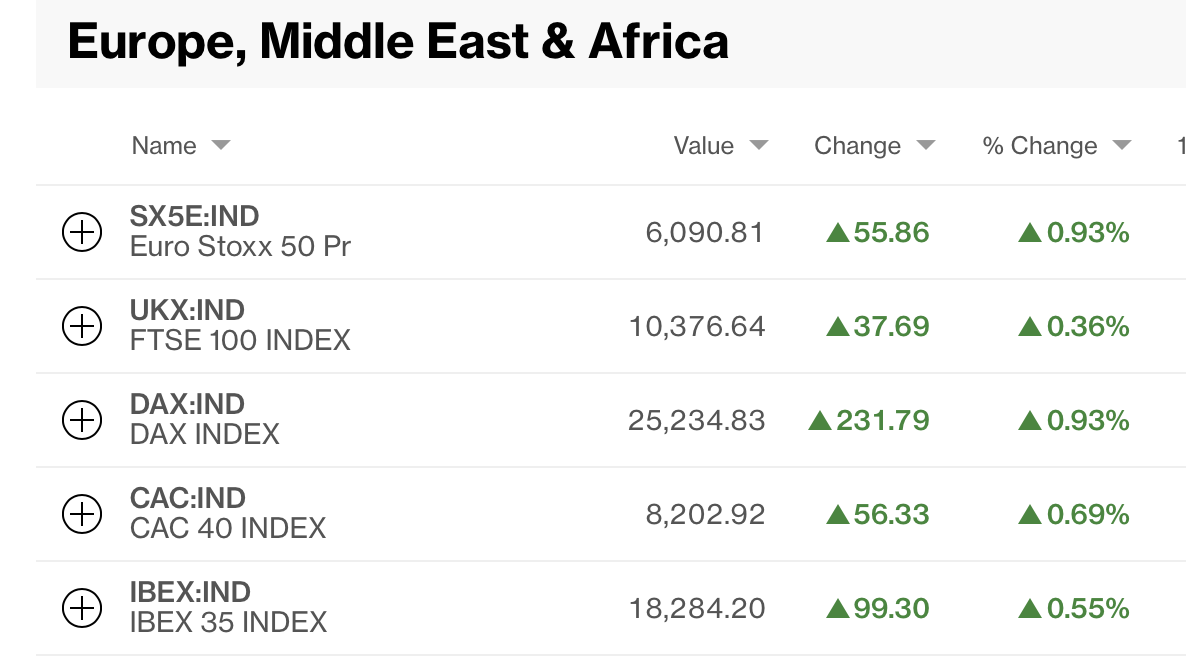
Working in favor of my correction explanation is the fact that European bourses, which all fell sharply yesterday, are all higher this morning as per the below Bloomberg table.

 As to US futures, at this hour (7:30) they are little changed. 

Turning to the bond market, after some initial fears over the inflation implications of the war, as well as the selling that accompanies margin calls, yields have settled down a bit.  This morning Treasury yields (+2bps) are a touch higher but, at 4.08%, hardly running away.  As to European sovereign yields, they are essentially unchanged this morning, and even JGB yields (-2bps) slipped a bit last night.  As I discussed above, markets have digested much of the news and seem to have found a new equilibrium

I didn’t mention metals markets above, but this morning, in sync with other markets that are rebounding, we see the entire space higher; Au +1.7%, Ag +4.3%, Cu +1.1%, Pt +3.8%.  This story of insufficient supply to meet ongoing industrial demand has not changed, nor has the demand by both central banks and individuals, especially in Asia, to hold gold as a store of value.

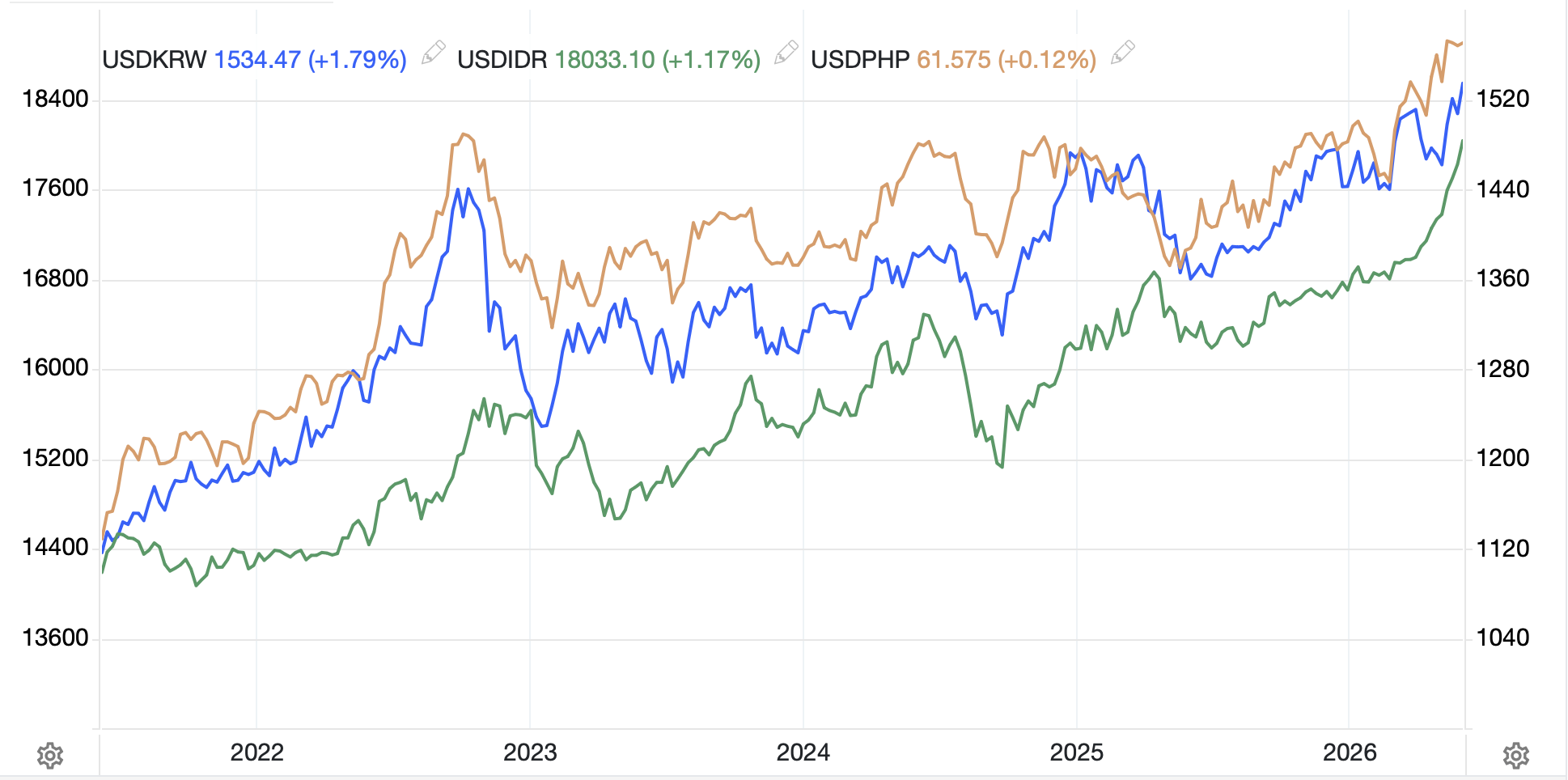
Finally, the dollar is backing off slightly this morning, which given the price action elsewhere, makes perfect sense.  In the G10 space, the movement has been on the order of 0.1% to 0.2% for the majors (EUR +0.2%, GBP +0.1%, AUD +0.1%, CHF +0.2%) with only JPY (+0.35%) and SEK (+0.8%) showing real gains.  However, it is important to remember that SEK was one of the worst performers recently, so had more ground to regain.  As to the EMG bloc, movement there has been more substantial, but again, this is after much larger declines.  For instance, BRL (+0.6%) and KRW (+0.9%) have both seen sharp declines in the past week before reversing overnight as per the below chart.

Source: tradingeconomics.com
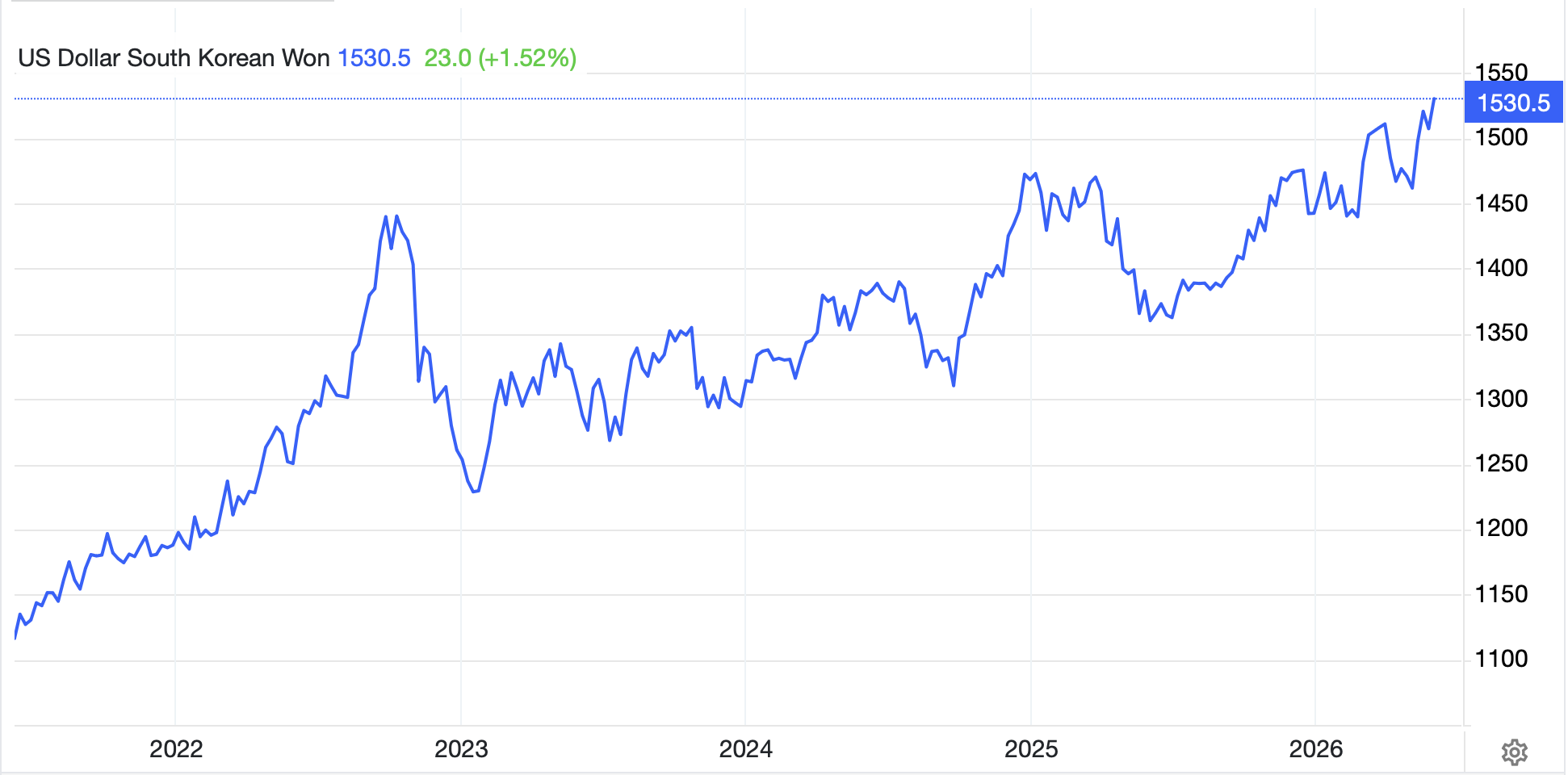
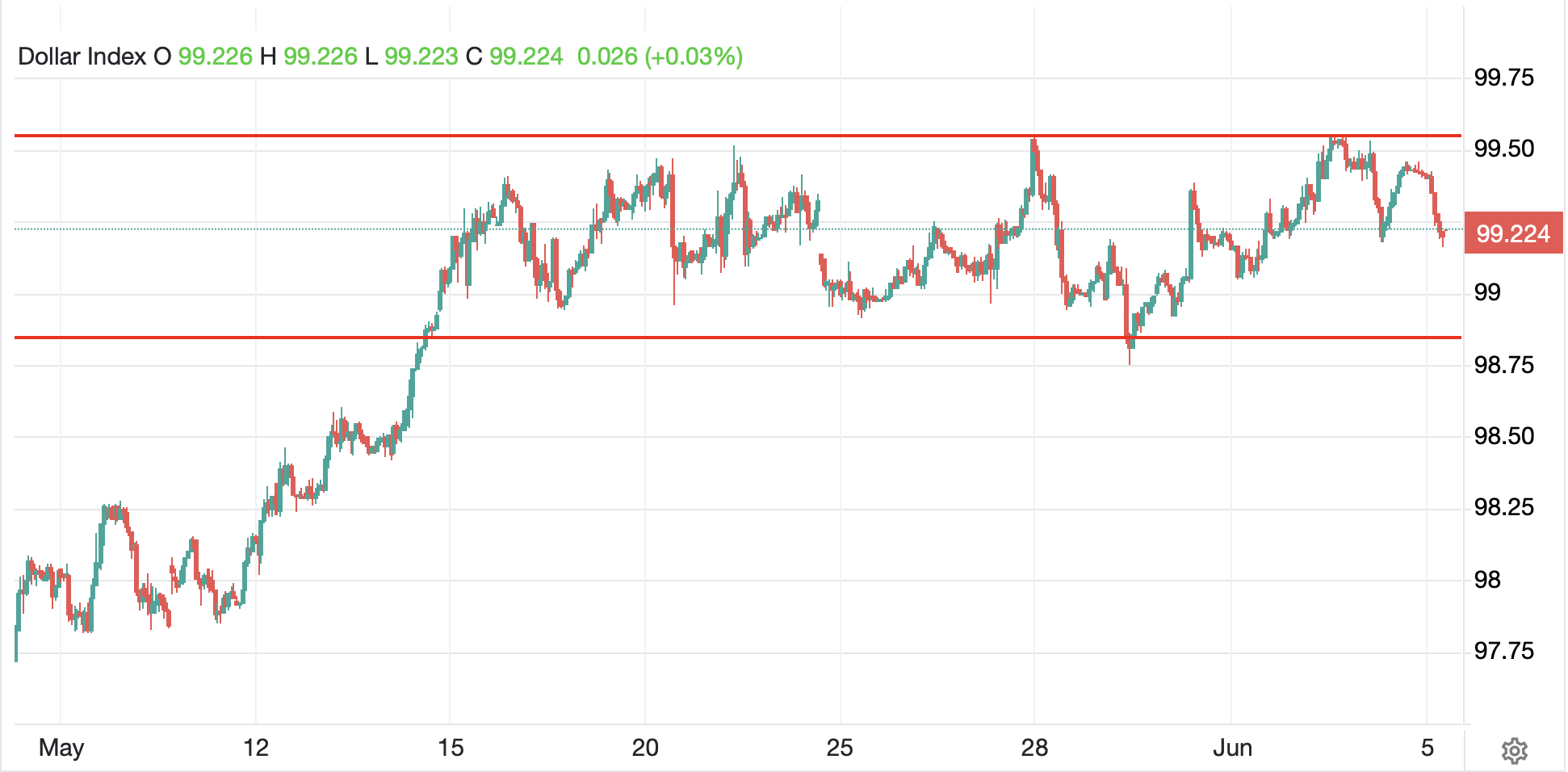
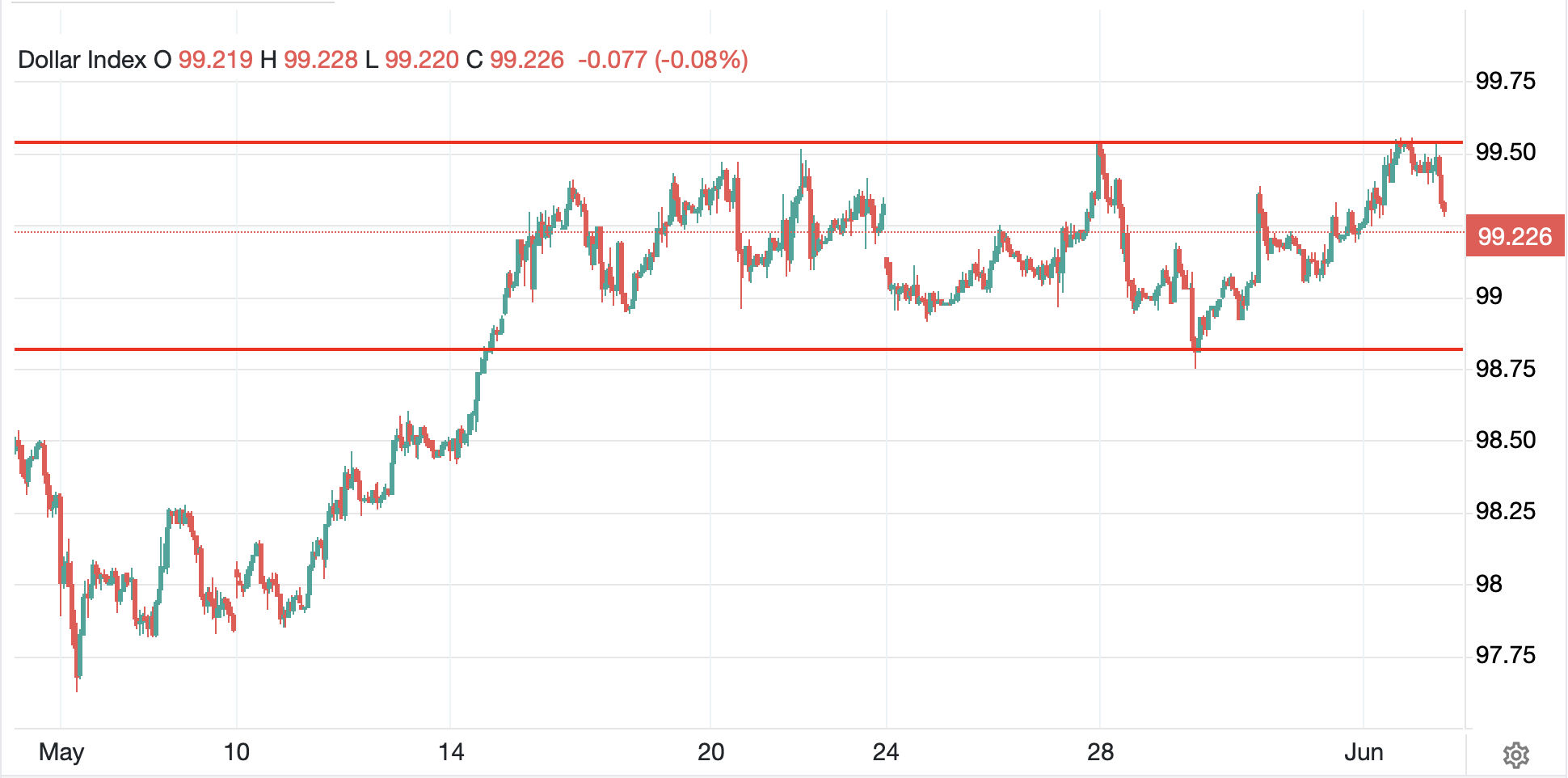
However, if we look at the DXY as our proxy, it remains in the middle of its trading range of the past 9+ months.

Source: tradingeconomics.com
In sum, we are three trading days into an entirely new geopolitical situation, and markets have digested the news and are seemingly trying to return to some sense of normalcy.  Now, there is still significant headline risk as nobody knows how things will evolve here.  What I will say is that if the Iranian regime falls or capitulates, I would look for risk to be quickly scooped up while oil prices slide.  Conversely, if things drag on much longer than another month, I think we could well see investor concern over how this will impact the global economy, especially if oil prices remain in the $75 – $80/bbl range, which likely means equity markets will suffer.

To the extent that anyone is still looking at data, this morning brings the ISM Services (exp 53.5) and then we see Crude Oil inventories later this morning.  The Services PMI data throughout Europe and Asia was in line with expectations showing slow growth remains the story.  Chinese data was marginally softer for large companies and marginally stronger for small companies.  As well, the Fed’s Beige Book is released at 2:00 this afternoon.

However, I don’t see data as a driver yet, so headline risk remains the biggest one out there, but the indications are markets are starting to absorb the war and move on.

Good luck

Adf

Bonds are a Flop

The war has now widened in scope
And though all of us truly hope
It won’t last too long
We could, there, be wrong
As such we must all learn to cope
 
So, oil, right now, knows no top
While havens like bonds are a flop
There’s no place to hide
Thus, you must decide
If trading makes sense or should stop

Carl von Clausewitz, the 19th century Prussian military strategist, is credited with describing the fog of war in his 1832 book, On War.  “…three quarters of the factors on which action in war is based are wrapped in a fog of greater or lesser uncertainty.”  This is quite an apt description of things, even now with cameras literally everywhere in the world.  Context remains difficult to understand, and, of course, there is an enormous amount of propaganda from both sides of any conflict as the protagonists attempt to sway both their own populations and those of their opponents.

I highlight this because I continue to be amazed at the certitude with which some analysts proclaim to “know” how things will turn out.  As I have written elsewhere, nobody knows nuthin right now.  With that in mind, I would highlight the IMF’s statement yesterday which added exactly zero to the conversation, “It is too early to assess the economic impact on the region and the global economy. That impact will depend on the extent and duration of the conflict.”  Now, don’t you feel educated after that pronouncement?

At any rate, with more than a full day’s trading in financial markets, perhaps we can try to assess how things are going.  The first thing to note is that many alleged haven assets are not performing up to snuff, notably Treasury bonds, Japanese yen, Swiss francs and gold.  In fact, as of this morning, the only traditional haven that is performing as expected is the dollar.

It was just over a month ago when the cognoscenti were explaining that the euro above 1.20 was indicative of the dollar’s long decline into the depths of history.  I recall someone in my LinkedIn feed asking how soon the euro would trade through 1.25 and beyond.  I would argue that timeline has been extended somewhat, if you still believe that is likely to be the case.  Rather, as you can see in the below chart, the single currency (-0.8%) is now back below 1.1600.

Source: tradingeconomics.com
There are several things weighing on the euro right now.  First is the fact that they are energy price takers for every form of energy, so not only are higher oil prices hurting the continent, but NatGas there has exploded higher as per the below chart, rising 37% today and nearly 95% since the weekend.

Source: tradingeconomics.com
Recall, Europe has been trying to wean themselves off Russian gas, have been huge buyers of US LNG but also huge buyers of Qatari LNG, and with the Strait of Hormuz effectively closed (shipowners cannot get insurance so nobody transits the Strait), this is a problem.  Adding to the European problem is the fact that their storage levels of NatGas are extremely low for this time of year, about 30%, when typical levels in early March are near 50%.  We cannot be surprised at this price action.  So, while US NatGas (+6.3% this morning, 10% this week) has risen, it is currently trading at $3.14/MMBtu.  The comparable Eurozone price is $20.28/MMBtu.  Perhaps a weaker euro is not that surprising after all.  (As an aside, one of the reasons I find it difficult to accept the weak dollar story is that the US controls its own energy destiny and given energy is life and the economy, we are fundamentally in better position to perform going forward.)

But the dollar is strong against all comers again today as per the below table from 7:10 this morning.  Will this continue?  While nobody knows, my take is there is still ample room for further strength in the buck, probably another 3%-5% before it starts to impact other things significantly.

Source: tradingeconomics.com
I think the biggest surprise for most of us is the incredibly poor performance of the bond market, which has always been seen as a safe haven.  However, this morning, that is not the case at all as you can see from the Bloomberg table below.

My take is that there is only one thing we truly know about war, it is inflationary.  While the early signs are for energy prices to rise, war is a major consumer of resources that will never be recycled and therefore will require new baseline production.  As well, governments don’t fight war on an austerity budget, so you can be sure that there will be plenty of money around.  All that leads to higher prices and that is why bond markets are feeling pain around the world this morning.  If, as President Trump has indicated, this war ends in the next 4 weeks or so, we will be able to re-evaluate the inflationary and other impacts, but while I had thought bonds were going to perform well, clearly that is not the case right now.

Turning to commodities, oil (+6.75%) continues to rise and I expect will remain well bid until the fighting stops.  The prospects for higher prices from here remain dependent on whether Iran tries to destroy other Middle East production facilities and if they are successful.  Meanwhile, in the Western hemisphere, the US, Canada, and all of Latin America are going to be pumping at full strength for now.  So, while prices may tick higher, it is unlikely we will see any supply issues here.

Metals are another surprising trade this morning with gold (-2.65), silver (-7.8%) and copper (-2.3%) all sharply lower.  Given the sharp decline in equity prices I will discuss below and given the amount of leverage that is rampant in the equity markets, I think gold is a victim of ‘sell what you can, not what you want to.’  Arguably, there is some of that with bonds as well.  In a way, though, I am more surprised about silver and copper given their criticality in fighting the war.  Both are being consumed rapidly via weapons being deployed so this is more baffling to me.  However, I do not believe the longer-term thesis in either of these metals has changed, there is a supply shortage relative to industrial usage for both with no new supply on the horizon.  As such, I do see prices here rallying over time.

Finally, the equity markets are sharply lower almost everywhere.  The below Bloomberg table shows how major markets in Asia performed overnight and how Europe stacks up at 7:30 this morning.

What it doesn’t show is that the KOSPI in Korea fell -7.25%, nor that there were sharp declines in India (-1.3%), Taiwan (-2.2%) and Thailand (-4.0%).  You will also not be surprised that US futures are pointing much lower this morning, -1.5% across the board.  Yesterday’s performance was quite the surprise, I think, but today is much more in line with what we expected.

And that’s where things stand this morning.  obviously, the war is the only story that matters, so data releases are going to be secondary for now, even Friday’s payroll report.  At some point, I expect that traditional havens will play their role, but as leveraged positions continue to get unwound, it may take a few more sessions before we see that.  If you’re trading, smaller sizes make sense.  If you’re hedging, stick to longer term fundamentals I think.

Good luck

Adf

No Longer the Same

The world is no longer the same
So, now everyone must reframe
Their views on positions
And whether conditions
Allow them to still play the game
 
Most markets have priced fatter tails
With stock markets seeing net sales
But oil and gold
Seem likely to hold
Their gains across longer timescales

Here we are on Monday morning in a very different world than we left on Friday evening.  While there was much talk about whether a peace would be reached then, obviously that never happened.  Of course, at this point, there is no other story than the ongoing military action in Iran and the Middle East.  As this is not a news commentary, but a financial markets one, that is all I will discuss here.

Not surprisingly, we have seen some large moves across markets, and largely in the direction one would have expected regarding risk.  So, oil prices (+7.5%) have exploded higher as shipping through the Strait of Hormuz has ceased for now and there is no timeline for it to reopen.  Given ~20% of the daily global consumption of oil flows through that waterway, there should be no surprise here.  You can see from the chart below that as concerns grew regarding military action, oil’s price climbed and then, of course, gapped on the opening last night.

Source: tradingeconomics.com
Perhaps a bit more surprising to me is that Brent Crude (+7.5%) has moved virtually the exact same amount as WTI.  I only say that because Brent is the price basis for global oil outside the US which is obviously going to be more impacted than the US markets.  But the Brent chart is virtually identical to the WTI above.  As to the future, clearly, no market is more dependent on the Middle East conflict than this one, but at this point, there is no indication it is going to end very soon, so I expect prices to remain at least at current levels for now, and if the conflict starts to target oil production facilities, we could go quite a bit higher.

While we are looking at commodities, it should also be no surprise that gold (+2.1%) is higher this morning as it performs its historical role as a safe haven.  While not quite as extreme as the oil chart, the similarities between the two, as you can see below, are significant.  Of course, it was a bit more than a month ago when we had that dramatic sell-off in the precious metals, so this has all been a recovery from there.  But a grind higher punctuated with a gap last night is the gold story as well.

Source: tradingeconomics.com
Arguably, gold will have more staying power than oil as when the conflict ends, and my initial take is it will not be a forever war, oil will once again flow more freely.  Gold, however, remains a haven in an uncertain world and nothing seems likely to reduce uncertainty anytime soon.

The other two traditional haven assets are the dollar and Treasury bonds so let’s look at them next.  Starting with the dollar, it has done what it regularly does in an uncertain situation, it has rallied sharply.  As you can see from the below table, shot at 6:39 this morning, the dollar is firmer against every single major currency this morning.

Source: tradingeconomics.com

Too, using the euro as our proxy for the dollar writ large, you can see that the chart below looks almost identical to that of both gold and oil above.  (I have inverted the Y-axis to highlight the similarities.)

Source: tradingeconomics.com

It appears that markets began pricing in this event back in the middle of February, although the real move required the onset of the military action.

As to the last haven asset, US Treasuries, they are not really doing the job today.  Yields there have edged higher by 2bps this morning and we are seeing similar price action across the entire European sovereign space.  The two exceptions today are UK Gilts (+8bps), which seem to be trading on concerns the BOE is less likely to cut rates as higher oil prices will prevent inflation from continuing lower and JGBs (-4bps) which are serving their haven role well, arguably given the distance from the action and the fact that with yields above 2%, investors seeking safety feel they have some cushion.

Source: tradingeconomics.com

The treasury move was interesting as the initial trade, at last night’s opening, was for lower yields as per the chart above, but that has since reversed.  It could be investors are concerned over additional defense spending blowing out the deficit further but there is no clear signal or commentary I have seen yet on the subject.

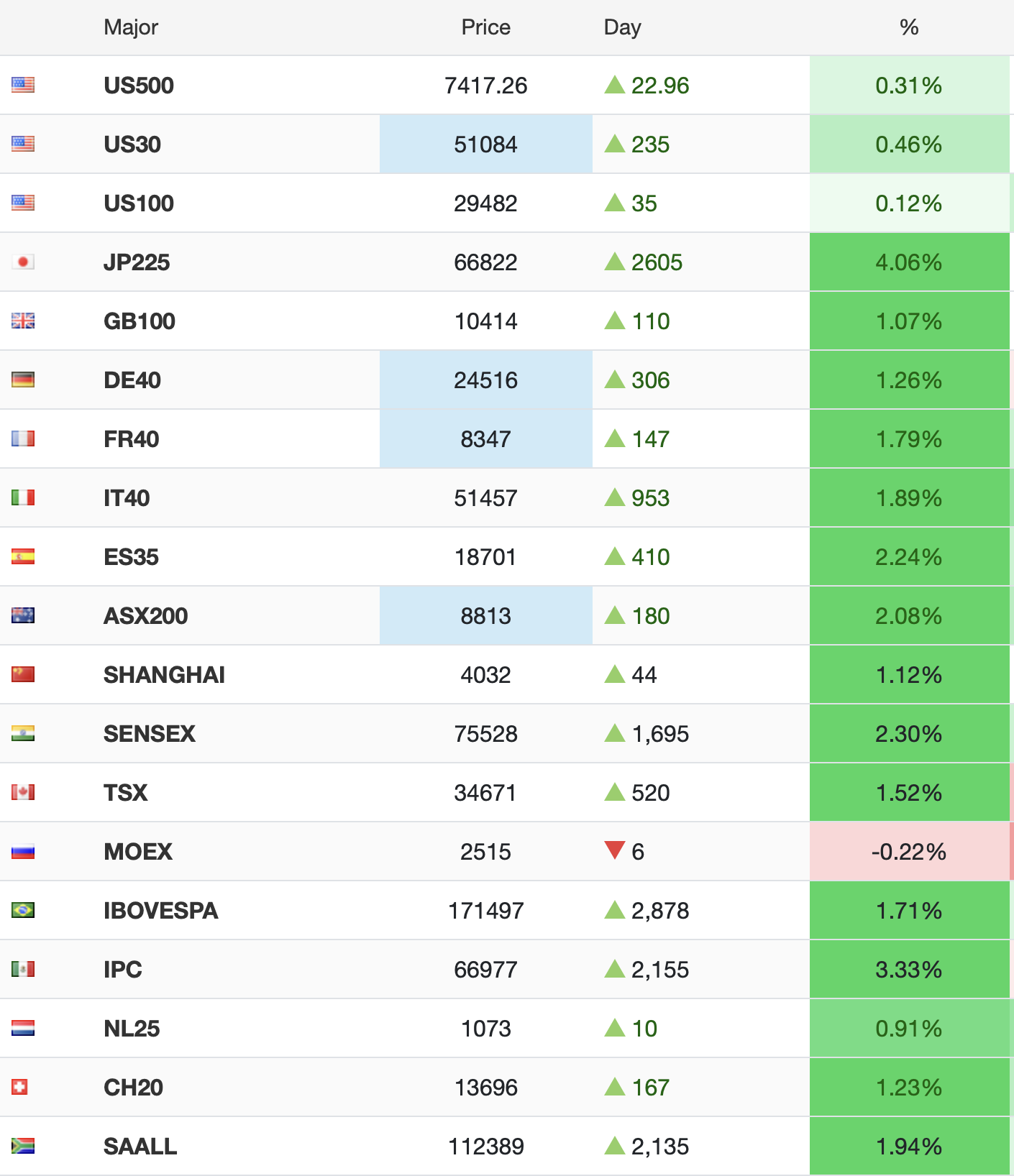
Finally, it should not be surprising that equity markets around the world are mostly lower this morning as investors pull in their wings and await more clarity on the outcome and how long this will continue.  The exception to this was mainland China (+0.4%) which managed to edge higher, but otherwise, all of Asia and Europe are down on the day, some pretty substantially.  Below you can see a screenshot of futures markets at 7:00 with the type of movements ongoing.

Source: tradingeconomics.com

The MOEX is Russia’s stock market, so it is not clear what value that adds to the conversation and the TSX, Toronto, does not have a futures market, so the price represents Friday’s close.  But as you can see, all of Europe and all of Asia ex-China have fallen sharply.

And that’s where we sit this morning.  Ironically, there is going to be a significant amount of data released this week, including the NFP report on Friday, but it is not clear market participants will be paying close attention.  For good orders’ sake, I will list the data releases anyway.

TodayISM Manufacturing51.8
 ISM Manufacturing Prices59.5
WednesdayADP Employment45K
 ISM Services54.0
ThursdayInitial Claims216K
 Continuing Claims1840K
 Nonfarm Productivity Q44.8%
 Unit Labor Costs Q40.2%
FridayNonfarm Payrolls60K
 Private Payrolls65K
 Manufacturing Payrolls0K
 Unemployment Rate4.3%
 Average Hourly Earnings0.3% (3.6% Y/Y)
 Average Weekly Hours34.3
 Participation Rate62.5%
 Retail Sales-0.2%
 -ex autos0.1%
 Consumer Credit$11.8B

Source: tradingeconomics.com

To me, market dynamics now are entirely restricted to the ongoing Middle East conflagration.  Ultimately, war is inflationary, and for many firms it is quite profitable.  But right now, investors are mostly hiding under their desks, waiting for the smoke to clear.  Institutional investors are typically unwilling to buck a key narrative trend, and I see no reason to believe this time will be different.

While much of this price movement will likely reverse when the bombing stops, until then, be prepared for more volatility, not less.

Good luck

Adf

Not Existential

The story that has the most traction
Continues to be the reaction
To stories AI
Will force firms to try
To profit from worker subtraction
 
The tech nerds see naught but potential
For robots plus, workers, essential
But history’s shown
Employment has grown
And new tech’s threat’s not existential

Block, the payments processing company announced during its earnings call that it would be laying off 4000 employees, nearly half its workforce, by the end of Q1 this year.  This was not a response to weak performance, but rather the founder, Jack Dorsey’s, belief that AI has reached the point where his company can be more effective with much fewer staff.  Of course, this is the entire AI argument compressed into a single event.

Recall Monday’s note and market response to the Citrini Research article that explained one scenario from AI adoption would be massive layoffs, a recession and a major stock market decline by 2028 as companies eliminated people from their processes.  This brought about a tremendous amount of back and forth with economists and historians explaining that every major technology creation (e.g. electricity, the automobile, the internet) was both disruptive but instrumental in expanding economic activity.  This morning’s WSJ had a nice summation by Greg Ip of the entire discussion.

It strikes me that this discussion is only beginning and we are going to hear from proponents of both sides for many months to come, although I imagine it will not be the top story every day.  As I consider the issue, I think back to John Maynard Keynes forecast in 1930 that the rapid advancement of technology would lead to a 15-hour workweek as all our needs could be met with much less effort.  Obviously, that was not his best forecast.  Rather, Jevon’s Paradox comes to mind, which states that as technology increases the efficiency with which a resource is used, the total consumption of that resource increases, it doesn’t decrease.  In this discussion, that resource is human labor.

FWIW, my view is AI is a remarkable tool for certain things but is neither sentient nor capable of breakthroughs on its own.  It is a wonderful research tool, and a wonderful computer programming tool, but as my experience taught me, people like to deal with people, not with machines, even when there are machines available to do the job.  Economic dislocation in certain areas is likely going forward, but not collapse, at least not because of greater usage of AI tools.

I highlight this because, while Block’s stock price rallied sharply in the aftermarket, up more than 20%, US futures are lower this morning by -0.5% or so as there continue to be fears about the dystopian outcome.  Remember, Nvidia had terrific earnings and the stock fell as well.  Of course, this could also be a response to the fact that the price of many equities is extremely rich on a P/E basis or a P/S basis, and we are simply seeing a little reversion to the mean.  

At any rate, as no war in Iran has begun and there have been no other changes on the geopolitical map, let’s tour markets to see how things look as we head into the weekend and month end.

Yesterday’s desultory equity performance in the US was followed by a mixed picture in Asia with the Nikkei (+0.2%) and Hang Seng (+1.0%) closing the month higher, but China (-0.3%), Korea (-1.0%) and India (-1.2%) all falling.  Malaysia (-1.4%), too, stands out for a poor session but the rest of the region was mixed with much smaller moves.  Given the tech heavy makeup of most of these nations’ bourses, I suspect that volatility will be the main feature going forward.  As to Europe, it’s a sleeper with continental bourses all +/- 0.2% or less while the UK (+0.35%) managed a modest rally after a by-election resulted in PM Starmer’s Labour party coming in 3rd place in a seat they have held for 100 years.  This appears to be adding pressure on Starmer to do something, or on Labour to remove him, but a key concern is they will move further left, something which I doubt will help the UK economy or stock market.

Turning to the bond market, yields are declining all around the world with Treasuries slipping -5bps yesterday and another -2bps this morning, now below the 4.00% level.  In fact, a look at the chart below shows a pretty strong trend lower in yields.

Source: tradingeconomics.com

But we saw European sovereign yields slide yesterday and continue lower by another -1bp to -2bps this morning and last night, JGB yields fell -4bps and showing a very similar trend to Treasury yields as per the below.  It seems that concerns over too much debt issuance driving yields higher have been put on the back burner for now.

Source: tradingeconomics.com

In the commodity space, it appears that Iran fears are making a comeback as oil (+2.1%) has rebounded sharply from the levels seen in the wake of the massive inventory build I described yesterday morning. It sure looks like somebody bought a lot of oil yesterday morning at around 9:45am, although I have no guess as to who it would have been.

Source: tradingeconomics.com

Interestingly, the news from Geneva is that the talks are going to continue next week, so while both sides are disputing the other’s version of things, the fact they are still speaking is a huge positive.  I fear given the military buildup, some type of action will occur, but we can be hopeful. 

Meanwhile, in the metals space, gold (+0.1%) is little changed for the past several sessions, consolidating just below the $5200/oz level.  Whatever the narrative may be here, regarding central bank buying and the end of the dollar system, this tells me that the market is tired and needs some R&R before moving forward.  I remain bullish, but not today.

Source: tradingeconmics.com

Silver (+1.7%) is showing very similar price action to gold, albeit with a bit more daily volatility.  The story here about a short squeeze for COMEX delivery is fading from the FinTwit feeds, but the structure remains not enough of the stuff for industrial usage going forward.

Finally, the dollar, this morning is, net, doing very little.  But there are two stories to note.  The first is CNY (-0.2%) where the PBOC changed its risk reserve rules for foreign exchange holdings for Chinese banks, reducing the required reserve to 0% from 20%.  In practice, this means that Chinese banks can run forward positions without a capital charge and allows them to be more competitive pricing forward sales of CNY for local hedging counterparts.  Obviously, this is a huge adjustment and speaks to the fact that they must be getting a bit uncomfortable with the speed with which the renminbi has been rising over recent months.  Ironically, there was a Bloomberg article highlighting how options traders were paying up for 6.50 CNY calls/USD puts anticipating further CNY strength.  Perhaps the PBOC didn’t like that!

The other story is from Hong Kong, where the currency is usually not an issue as it is pegged in a very tight band to the USD, allowed to trade between 7.75 and 7.85.  The HKMA (HK’s central bank) is committed to buying and selling HKD as necessary to maintain that band.  This has been a key feature of Hong Kong’s financial attractiveness for the past decades.  The way this operates is there is an exchange fund that is designed to be used only for FX intervention, and it has ~HKD 4 trillion in balances (~$510 billion) which, given their GDP is only $400 billion or so, seems like plenty.  Well, as always seems to be the case, the government there is proposing taking some of that money to use for financing a government project, a technology hub being built, and since they don’t want to raise taxes, they thought raiding that fund would be the answer.  The concern is the precedent it sets as if that goes through, what is the next project that will be determined to need the funding.  If we know one thing about governments it is that if they find a pot of money they can tap to spend more without raising taxes, they are going to do it!  The amount in question is a small fraction, just $19 billion, so would not likely impact the HKD peg.  But this is something to watch as it will not be a positive if we see this a second time.

Otherwise, NOK (+0.5%) is gaining on oil’s gains while KRW (-0.5%) is slipping on the equity market decline and foreign sales.  Beyond that, nothing.

On the data front, this morning brings headline PPI (exp 0.3%,2.6% Y/Y) and core (0.3%, 3.0% Y/Y) as well as Chicago PMI (52.8).  Regarding the last, a look at the chart below shows that last month’s reading was the highest since November 2023 and is arguably a good sign that we are seeing increased industrial activity in the middle of the country.  Recall, the Chicago number is often seen as a precursor for the economy as a whole.

Source: tradingeconomics.com

And that’s it.  Given equity market performance this month has been flat to slightly negative, it seems unlikely there will be large rebalancing flows.  I continue to look for quiet markets although the trend in bonds does seem like it is building up some steam.

Good luck

Adf

No Desire

Some days markets have no desire
To move, lacking seller or buyer
But don’t be concerned
The one thing we’ve learned
Is narratives always point higher

While it is clearly not summer as I look out my window and see a snow-covered yard, the doldrums seem to be the best description of markets right now.  A dearth of data, and in truth, a lack of commentary by all the usual players, at least new commentary, has both investors and traders looking elsewhere for signals.

Now, this is not to claim that there is nothing happening in the world, but right now, it all seems to be on hold.  With the SOTU behind us, we have had nothing new from the White House regarding virtually anything, tariffs, taxes, Iran, you name it.  Nvidia earnings last night beat expectations, but apparently not by enough to get people excited.  And virtually every other story is a warmed-over version of things we already know.

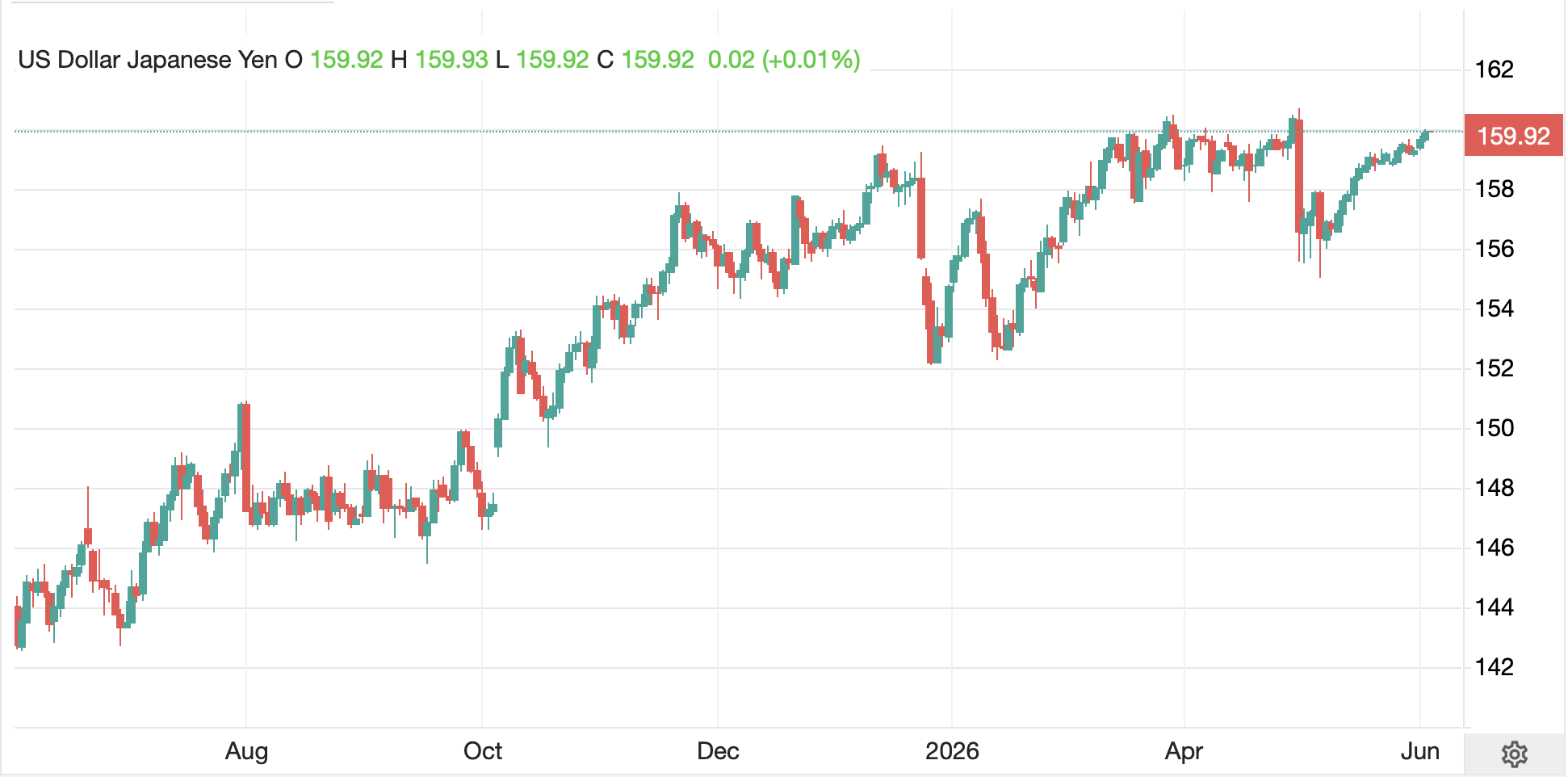
I think the most interesting market related news that I saw this morning was that the most hawkish member of the BOJ, Hajime Takata, said the BOJ needed to raise rates to fight Japan’s “heated” inflation.  This seemed a response to Takaichi-san appointing two doves to the board there.  However, the market response was essentially nil, as it should be, with the yen (+0.2%) edging higher while JGB yields (+2bps) also edged higher.  

Other than that, seriously, I cannot find a single thing that seems to matter to markets.  And it’s not like we have that much to look forward to today in the US, with Initial Claims the only data, so there is no reason to go on too long.

Here is a recap of the overnight session.  As I touched on JGB’s above, I will start with the rest of the government bond markets. What we see is that yields are literally unchanged this morning from yesterday’s closing levels.  All of them!  I am hard-pressed to describe a less exciting market than this.

Turning to equities, yesterday’s solid US performance was followed by mixed outcomes in Asia (Tokyo +0.3%, HK -1.4%, China -0.2%) in the major markets while most other regional bourses saw modest gains or losses with no driving stories.  The exception to this was Korea (+3.7%) which has been on an amazing tear lately, as the two largest market cap stocks there, Samsung and SK Hynix, continue to explode higher on demand for memory chips.  In fact, I think it is worthwhile to visualize this move as it is rare for equity markets to go parabolic like this.

Source: finance.yahoo.com

Of course, remember what happens to parabolic markets.  We just saw that in silver one month ago as per the below, so traders beware!

Source: tradingeconomics.com

Turning to Europe, France (+0.9%) is rallying on some earnings data from key companies, but the rest of the continent, and the UK, are doing little (Germany +0.4%, Spain -0.2%, UK +0.1%).  Fittingly, US futures are also unchanged at this hour (7:00).

In the commodity space, oil (-1.7%) has softened substantially this morning as the absence of a war in Iran weighs on long positions, but more importantly, I believe, yesterday’s EIA data showed a massive build of inventories of 16mm barrels, far higher than expected and the largest build since February 2023.  Back then, it appeared to be the residual response to the Russian invasion of Ukraine as there was a scramble for barrels.  Perhaps this is a signal that in the event of a war, there is supply around.  If you look at the inventory chart below, we have certainly seen a net build over the past three years.  Again, it is hard for me to look at things like this and see significantly higher prices in the future.

Source: tradingeconomics.com

In the metals markets, gold is unchanged this morning, though trading well above the $5000/oz level and seems like it is consolidating before moving higher.  Silver (-2.5%) is sliding as there continues to be a discussion regarding deliveries into COMEX contracts with the first notice day for the March contracts tomorrow.  There are many pundits who claim there is insufficient silver available to handle the likely deliveries which, if true, would likely cause a significant short squeeze.  However, I have no insight into how this will play out.  My longer-term view remains that there is a structural shortage of the stuff for industrial applications and the price trend will continue higher, but we have learned how volatile it can be.

Finally, the dollar is modestly stronger this morning with the yen’s rise the exception in the G10 space (EUR -0.1%, GBP -0.2%, AUD -0.2%, CHF -0.3%, NOK -0.3%).  In the EMG bloc, we are seeing similar modest weakness across the board (PLN -0.2%, ZAR -0.3%, MXN -0.2%) with the outlier here being CNY (+0.2%).  Regarding the renminbi, the Chinese have been marching it slowly higher for the past year, as per the below chart.  My take is President Xi is very focused on convincing others the CNY is a viable reserve currency candidate despite all the capital flow restrictions.  I’m not sure how that would work, but that is the best I can come up with.

Source: tradingeconomics.com

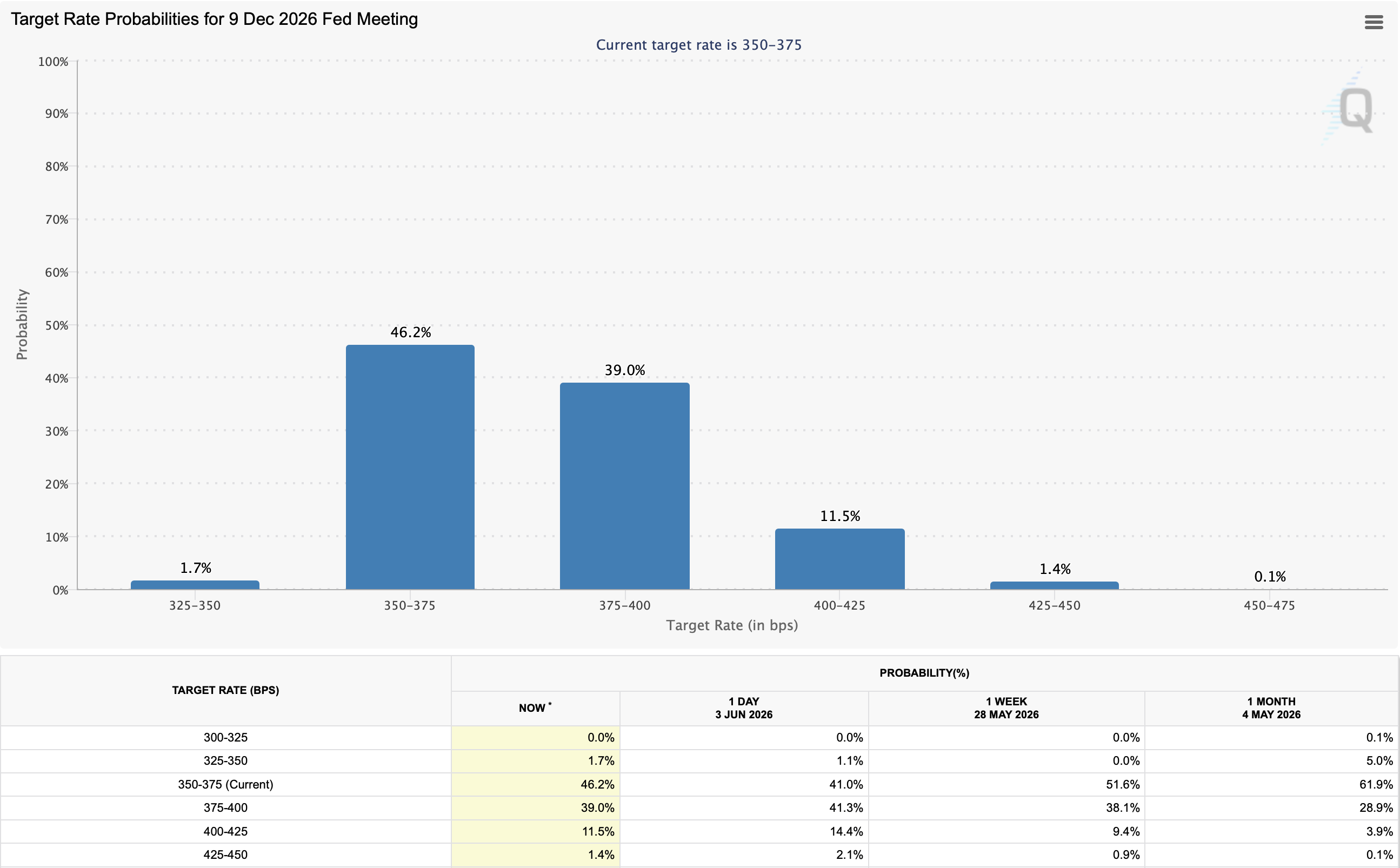
And that’s all we have in markets this morning.  On the data front, Initial (exp 215K) and Continuing (1860K) Claims are the only releases and we hear from Fed governor Bowman, although to the best of my knowledge, nobody is listening to Fedspeak right now.  The market continues to price just one 25bp cut for 2026 at this point, although that seems likely to change once we get a better idea as to what Mr Warsh would like to do when he gets the Chair.

My guess is that if there is going to be an attack on Iran, it will happen this weekend, so until then, given the absence of data, I think we drift in all markets and wait for Monday.  Today, and tomorrow, ought to be quiet.

Good luck

Adf

Far Too Extreme

Said Roberts and five more Supremes
Those tariffs, are far too extreme
They don’t pass the test
And so, we request
You find a new revenue scheme
 
Said Trump, while I think you are wrong
Your actions won’t stop me for long
We have many laws
That give me good cause
For tariffs, that help make us strong

For whatever reason, this is what first popped into my head upon hearing the tariff ruling on Friday.  I guess I confused love for law, but whatever.  At any rate, I’m sure you have seen far too much on this subject already so I will be brief.  The Supreme Court ruled against President Trump’s use of the IEEEA law to enable the imposition of tariffs on foreign nations.  They did not discuss what to do about the ~$200 billion that has already been collected under that law.  The companies that sued want the money rebated, but that was not part of the decision, and of course, the logistics of that would be extraordinarily complex.

But in the end, President Trump simply imposed a sweeping 15% tariff across the board under a different law, which to my understanding can remain in place for 150 days.  The equity market shook off the news, rallying across the board on Friday (DJIA +0.5%, S&P 500 +0.7%, NASDAQ +0.9%), so it didn’t seem to be that big a deal.  But then when Asia opened Sunday night, risk was in a much less desired state.  Early returns show equities softer across the board (-0.75% at 10:00pm), the dollar (DXY -0.4%) under pressure and gold (+1.25%) and silver (6.25%) seeing significant haven demand.

One of the things that appeared to be in question was whether countries that had signed trade deals accepting tariffs and promising investments as part of the deal, would renege, but thus far, that has not happened.

My take is the tariff discussion is no longer a concern to investors.  Playing the lead role once again is Iran, as concerns over a potential US military strike rise, with a new actor joining the cast, Mexico, which appears to be suffering significant chaos after the elimination of a cartel leader, “El Mencho” has resulted in fire fights throughout the country there.  Obviously, given the proximity to the US, this has the potential to be quite significant, although since the border with Mexico has been effectively sealed, my take is all the action will stay in country there.

Historically, when there’s a war
The first move is stocks to the floor
But generally speaking
Post first mover freaking
The buyers step up to the fore

So, if tariffs are not going to be the primary topic of discussion, and I sincerely hope that is the case, after we finish congratulating the US men’s ice hockey team for the thrilling Olympic victory this weekend, what’s next on the agenda? Iran.

The US continues to amass forces in the Middle East and from various sources, including MSM and X and Substack, the growing consensus is that some type of military action is going to occur.  The question now seems to be whether it will be an attempt to decapitate the regime, or just to impede its ongoing buildup of armaments, notably ballistic missiles.

Negotiations are set to resume this week in Geneva and given the stakes, especially for the Ayatollah, it remains unclear as to his willingness to cede to American demands of essential disarmament and the end of terrorist support.  For President Trump, the risk is that any military action does not work as quickly and smoothly as either the first attacks on the nuclear sites, or the exfiltration of erstwhile Venezuelan president Maduro.  If there is something quick and relatively clean that achieves a clear objective, I think it can be a huge boon for the President, but if anything drags on, it will have numerous ramifications for both the mid-term election and the markets.  Let’s focus on the latter.

Below is a long-term chart of the S&P 500 which shows both the extraordinary recent performance relative to its previous history, as well as helps highlight some of the downturns seen during that time.  Of course, the noteworthy feature is that the downturns don’t last very long.

Source: finance.yahoo.com

If we move from right to left on the chart (these are monthly candles), the first spike down is Liberation Day in April 2025, when President Trump first announced his tariff plans.  Obviously, that is long past investors’ concerns now, especially given the events on Friday.  The next major decline took place in February 2022, when Russia invaded Ukraine.  But remember what also happened around that time, the Fed began its aggressive rate hiking when it figured out that inflation may not be transitory after all.  You probably remember that 2022 was one of the worst market performances for both stocks and bonds.  It is a worthwhile question to ask how much of that was the Russia/Ukraine situation and how much was the Fed.  My money is on the Fed.  Moving left, we see the Covid spike lower in Q1 2020 and then a baby dip during the repo shock of late 2018, when the Fed lost control of the Fed funds rate.  After that, we go back to the GFC in 2008-09 and the bursting of the dot com bubble in 2000 – 2003.  Sure, in 2003, the US invaded Iraq, but I don’t think that was the market driver.

My point here is that any impact from military action is likely to be very short-lived in equity markets.  The other market that will certainly be impacted is the oil market.  A look at the long-term story there shows that, here too, there are many things that have a major impact on oil other than war.

Source: finance.yahoo.com

The huge decline on the left was the GFC and ensuing recession.  The drop in 2014 was the realization that shale oil was going to add an enormous amount of supply to the market.  You can see the Covid spike to negative prices and then the run up in prices in the wake of the Russian invasion in 2022, which was relatively short-lived, and we have been declining ever since.

Much of the commentary regarding Iran right now revolves around their ability to close the Strait of Hormuz and how that would cut 20% of the world’s oil supply from reaching the market.  (It would cut almost all of Iran’s oil off from the market as they have virtually no pipeline network).  But even here, the evidence is that a price spike will be relatively short-lived.

I raise these issues because while war is inflationary, that is generally not because of the impact on oil prices, but rather because of the increased government spending that accompanies war (remember LBJ’s guns AND butter policies leading to the inflation of the 1960’s and 70’s.). 

Summing the discussion up, while in the immediacy, there will be market responses to military actions, I do not believe they will have long-term impacts.

Ok, I went on way too long, so let’s do a hyper quick tour of markets this morning and I will leave the weekly data until tomorrow.

Equities – mainland China is still closed, (they open tomorrow) but the rest of Asia mostly ignored the war drums.  HK (+2.5%), Korea (+0.65%), India (+0.6%) and Taiwan (+0.5%) all showed strength although Australia (-0.6%) seems to have suffered on the tariff story.  Tokyo, too, was closed last night.  In Europe, despite slightly better than expected German Ifo data, the DAX (-0.45%) is today’s laggard while the IBEX (+1.0%) and FTSE MIB (+1.0%) both have seen strong support, ignoring any uncertainty regarding the US tariff situation and benefitting from positive earnings results. The UK and France have done little.  As to the US futures market, at this hour (7:15) they have risen from their early evening lows but are still softer by -0.35% across the board.

Bonds – the bond market remains the enigma, in my mind, as it is basically locked in place and has been for months.  Treasury yields (-1bp) have edged lower and European sovereign yields are essentially unchanged, as are JGB yields.  It continues to baffle me that bond markets, which typically sense fear first, do not seem to care about all that is ongoing in the world right now, whether war, government spending, or commodity prices.

Commodities – this morning, oil (0.0%) is ignoring Iran, which is maybe the most surprising thing of all.  Perhaps this is telling us that concerns over a closure of the Strait of Hormuz are overblown, or perhaps if that does happen, we will see a dramatic spike higher.  Again, like the bond market, something feels amiss.  In the metals markets, while both gold (+0.8%) and silver (+2.25%) are higher than Friday’s closing levels, they are well below last night’s opening levels.  I guess fear is abating, at least for now.

FX – As to the dollar, it’s early decline has largely been erased with both the euro and pound unchanged, AUD (-0.4%) sliding and the rest of the G10 under pressure.  In the EMG space, MXN (-0.5%) is feeling a little stress from the increased violence that has begun and there seems to be some sympathy in that move with CLP (-0.3%) and BRL (-0.2%). On the flip side, CZK (+0.5%) is the biggest gainer as the market continues to respond to recent central bank hawkishness.

In the US today we see the Chicago Fed National Activity Index (exp 0.3 in January) and Factory Orders (-0.5% from Dec).  But remember this, as per the below, don’t look for that much activity in NY as this is the picture out my backyard this morning, I’m estimating 10” of snow, so skeleton staffs will be the rule.

Good luck

Adf

Chock Full of Crises

Their mandate includes stable prices
And that they should use all devices
To work to achieve
That goal lest they leave
A legacy chock full of crises

Most participants, however, cautioned that progress toward the Committee’s 2 percent objective might be slower and more uneven than generally expected and judged that the risk

of inflation running persistently above the Committee’s objective was meaningful.”

These words [emphasis added] are from the FOMC Minutes released yesterday afternoon.  To set the stage, the Fed left rates on hold then, although there were two votes for another cut.  However, a full reading of the Minutes shows there were those who would have considered a hike as well.   Now, I am just a guy in a room who observes market behavior through the lens of too many years involved on a daily basis, and my resources are virtually nil, especially compared to the Federal Reserve.  I don’t have a PhD in economics (although I believe that is a benefit in this context, if not every context).  However, the bolded part of the comment seems a tad disingenuous to me based on the below chart which shows the history of their inflation metric, Core PCE prices.

Source: tradingeconomics.com

It has been exactly 5 years since their metric was at or below their 2% target by which they defined stable prices.  The idea that they are claiming the risk of inflation running hot was a meaningful risk is perhaps the worst gaslighting comments they have made.  It is very difficult to believe that the Fed, in its current incarnation, is going to ever address the inflation issue appropriately.  Perhaps a Chairman Warsh, if he is successful at reconfiguring their operating procedures will be able to drive positive changes.  I am hopeful but not confident.  The one thing we know is that changing government institutions requires a mammoth effort.  And let’s face it, he will only have two plus years of leeway for sure depending on whoever becomes president in 2028.

I continue to believe that the market is going to increasingly focus only on Warsh’s comments going forward as the direction he has expressed is very different than the current FOMC membership mindset.  We shall see how this all evolves.  In the meantime, I expect that Fed funds are not going anywhere before Warsh is confirmed.  As to bond yields, that is a very different question and will depend on both the macroeconomic outcomes and the risk perception of investors around the world.  For now, that trading range of 4.00%. – 4.20% seems likely to hold absent a major economic data miss in one direction or the other.  But as long as we continue to get mixed data, this market will remain on the backburner.

The fear that is growing each day
Trump’s policy might go astray
Regarding Iran
Although not Japan
Thus, oil’s up, up and away

Texas tea (+1.5%) is following yesterday’s 4.6% rise with another strong session and as you can see in the chart below, is showing a very clear trend higher since December.

Source: tradingeconomics.com

This movement is very clearly a response to the ongoing buildup of US military assets in proximity to Iran, with two aircraft carriers, and somewhere above 200 military aircraft as well as the carrier group tenders with Tomahawk missiles in tow.  While negotiations are ostensibly ongoing, the one thing that seems clear is that absent a complete capitulation by the Iranian government, something big is going to happen here.  Of course, the question is, how much, and for how long, will it impact oil supplies?

Obviously, nobody knows the answer to that question, but the recent history has shown that every time there was an event in the Middle East, whether the 12-day war several months ago, the killing of Suleimani, the attacks on Saudi oil infrastructure, or others, prices retraced pretty quickly as per the below.  

Even the Ukraine invasion in February 2022 saw prices retrace 50% within a few months.  Other issues lasted less time than that.  This recent history implies that fading the rally is the right trade, but boy, that is hard to do.  And of course, in the event that the Iranian government falls, the chaos could result in a significant degradation of Iranian oil production.  Given they pump about 5 mm bpd, ~5% of global supply, that would matter a lot at the margin.  Certainly, the oil glut narrative would disappear in a hurry.  This is a very large risk to both markets and the economy, and one which needs to be hedged, if possible.  This will certainly be the focus of markets for the next few weeks, at least, so be prepared.  Personally, I do own some stuff here, but I like the drillers generally, as they are going to be employed no matter what!

Ok, let’s see what else is happening.  After a solid US session yesterday, Asia saw some major positive price action with Korea (+3.1%) the leader although Tokyo (+1.1%) also had a solid session, as did Taiwan, New Zealand, Singapore and Australia.  The exception to this rule was India (-1.5%) which suffered after a three-day positive run as traders and investors fled worrying about oil, the Fed, and the future of India’s relationship with Russia after the seizure of more ‘dark fleet’ oil tankers trying to avoid sanctions on Russian oil.  Europe, meanwhile, is uniformly lower this morning, with all the major indices slipping -0.8% or so.  The narrative is pointing to the escalation in Iran as the cause du jour.  US futures are also slipping at this hour (7:20), -0.25% or so across the board.

I touched on bonds briefly above, but today’s price action shows yields edging higher by 1bp in Treasury markets and between 1bp and 2bps across European sovereign markets.  There has been no data of note to alter views, and the only ECB news is that Spain has thrown their hat into the ring to have the next ECB president.

In the metals markets, yesterday’s gains are being followed by a mixed picture with gold (+0.2%) and silver (+0.3%) edging higher while copper (-1.6%) and platinum (-1.8%) cede those gains.  However, as I highlighted yesterday, this all still feels like consolidation.  FYI, there is much talk in the markets about silver and how there is not enough physical silver in the COMEX vaults to cover open interest, and how that could result in a major squeeze, but my take is most of it will roll forward as the fundamental supply/demand equation does not appeared to have changed.

Finally, the dollar had a strong session yesterday, rising 0.6% as measured by the DXY, and making gains vs. almost all currencies.  This morning, those trends are continuing with SEK (-0.4%) and GBP (-0.2%) leading the way lower in the G10 space while ZAR (-0.85%), INR (-0.4%) and KRW (-0.4%) are dragging down the EMG bloc.  Again, data has been scarce, so I see this as a more traditional risk-off sentiment than some new macro story.

Data yesterday was generally stronger than forecast, notably IP and Capacity Utilization, which showed solid outcomes that were ascribed to AI infrastructure building as well utilities activity.  It strikes me this is exactly what the Trump administration is trying to achieve with their reshoring goals.  I guess the question is how productive this investment will be and how will it impact inflation readings.  This morning, we see the weekly Initial (exp 225K) and Continuing (1860K) claims, as well as the Trade Balance (-$55.5B), Philly Fed (8.5) and Leading Indicators (0.0%).  The interesting thing about the Leading Indicators number is that a flat result would be the highest in 4 years.  A look at the Conference Board’s chart below shows an interesting thing about this number, and to me, anyway, calls its value into question.  Leading Indicators have been declining for four years while coincident indicators (and economic growth) have been moving along just fine.  I’m trying to figure out what these indicators lead.

And that’s really it for today.  We do see oil inventories as well, with a slight build expected and we will hear from Minneapolis Fed president Kashkari, but I cannot remember the last time he said anything interesting.  To me, the concern today, and tomorrow and next week, is that we see an escalation in rhetoric regarding Iran, at the very least, if not an actual military strike.  That feels like it would be bad for stocks, good for bonds, the dollar and gold.  Hopefully I am wrong there.

Good luck

Adf

Yesterday’s Trauma

The story is yesterday’s trauma
As risk assets traded with drama
For stocks, it was news
AI could abuse
More sectors, that triggered the bomb-a
 
For gold and the metals, however,
It seemed an alternative lever
A bear raid, perhaps
Or filling chart gaps
No matter, twas quite the endeavor
 
Which leads to today’s CPI
Where narratives that with AI
Deflation is coming
As all jobs but plumbing
We’ll no longer need to apply

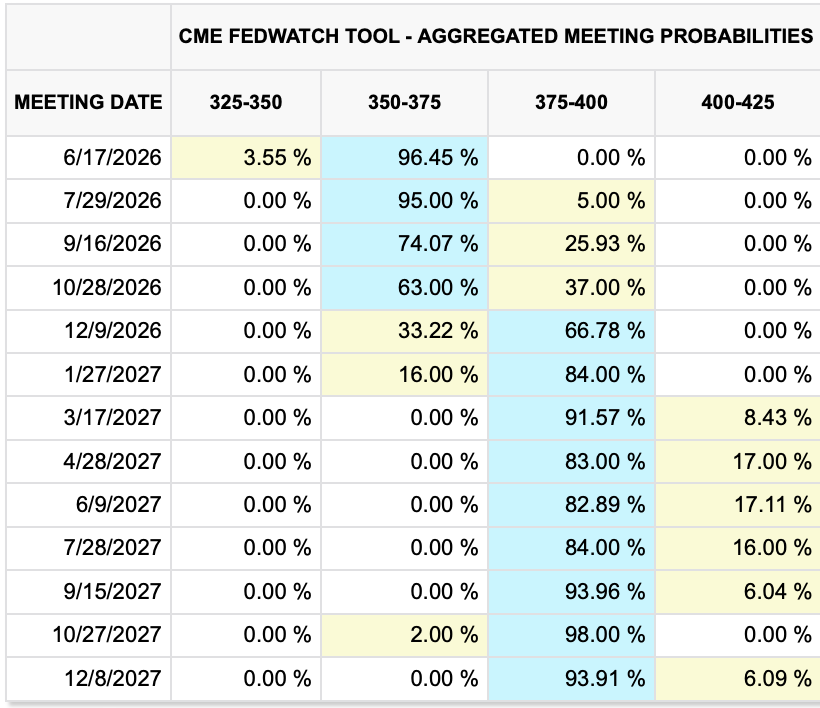
Let’s start with this morning’s CPI data as in some ways, I feel like that is a key part of the overall market discussion regarding yesterday’s dramatic declines.  Expectations are for both Core and Headline prints of 0.3% M/M and 2.5% Y/Y.  If we feed those numbers into the current narrative, the implication might be that the Fed is continuing to see a slowdown here and it would open the door to further rate cuts.  Remember, despite the comments of two Fed speakers earlier this week, Logan and Hammack, the most recent information we have is that the neutral rate is believed to be 3.0%, a full 75bps lower than the current Fed funds rate.  Interestingly, if we look at the Fed funds futures market, it shows that even after yesterday’s abysmal Existing Home Sales data (-8.4%), the probability of 3 cuts doesn’t hit 50% until the end of 2027!

Source: cmegroup.com

Remember, too, that the payroll report was strong on Wednesday, but that major annual revisions took much of the shine off that.  And of course, we cannot forget that since everything is political these days, certain FOMC members who dislike the President may be against rate cuts simply because the President wants them.  The point here is that the appearance of pretty solid economic activity combined with gradually decreasing inflation could argue for rate cuts but could also argue to leave things as they are since they seem to be working.  And let’s face it, the Fed doesn’t really know anyway, nor do any of us.

Which takes us to the broader narrative about what is driving stock market activity and why we saw such dramatic declines in the US yesterday, and pretty much everywhere else overnight.  It appears the proximate cause is the idea that recent AI announcements have indicated that there are entire service industries that may be destroyed because AI will serve as an effective replacement for their customers.  We have seen it for law firms, accountants and consultants and now logistics and software companies are under the gun.

Adding to the narrative is Elon Musk, who continuously claims that AI and robots will replace virtually all human labor and create enormous wealth for us all while driving prices ever lower.  The flip side of that claim is that throughout history, every major technological advance, while initially destroying jobs in the areas it was used, resulted in more, and better paying, jobs to help advance the overall economic situation.  Of course, historically, these changes took at least a generation, if not several to play out, while things appear to be happening a bit faster this time.

I have not done a deep dive on AI so take this for what it’s worth.  I use Grok as it is convenient for me given I have X open on my computer all the time.  I use it for quick research as it responds to my poorly worded questions with the information I seek and, happily, cites its sources.  But I am looking for data questions (e.g. the GDP of China or the size of European holdings of Treasuries) and I have never even considered using it to write my poetry.  Is it ready to make intuitive leaps in thought?  Maybe, but that seems a stretch.  As with all computers, its advantage over the human brain is its ability to ‘brute force’ a solution by making so many calculations in such a short time that no human can match.  However, my take is breakthroughs have come from intuitive leaps from one topic to another, not from simply doing more math on the same topic.  And it is not clear to me that AI programs, as they currently exist, are intuitive.

Of course, for our purposes, it doesn’t really matter right now if AI is that capable or not, it only matters if investors and traders believe that to be the case and invest accordingly.  That was yesterday’s story, as well as well as the story at the beginning of last week, at least based on the way the NASDAQ traded as per the below chart.

Source: tradingeconomics.com

We had six different significant drawdowns within a given hour since the end of January, and virtually all were described as a consequence of some industry sector being decimated by AI.  The thing is, valuations are pretty high in the tech sector (the area most likely to be hit) and it may simply be that investors have decided to sell the rich stuff and buy cheap stuff instead, like defensives and materials companies.  Just a thought.  But be prepared for a lot more of this narrative about AI eating some other company’s/industry’s lunch as we go forward.

Ok, let’s look at the overnight now.  First, remember, China is going on holiday all next week, and we will see much less activity from Asia accordingly.  But last night, Asia basically followed the US lower with Japan (-1.2%), HK (-1.7%), China (-1.25%) and Australia (-1.4%) headlining.  India (-1.25%) and Singapore (-1.6%) also suffered and you are hard pressed to find any markets that rose there.  As this was very tech focused, it should be no surprise.  (PS India is also suffering on AI as much of the business that had been outsourced to India could well be replaced by AI.)

In Europe, too, red is today’s color, and not simply because they lean more communist every day.  While tech is not a major part of the markets there, watching Italy (-1.5%), Spain (-1.0%), Norway (-1.1%) and Greece (-2.1%) all slide sharply tells the story, I think.  As it happens, France (-0.35%) and Germany (-0.1%) are the continental leaders and the UK (+0.1%) is the only market of note showing gains at all.  As to US futures, ahead of the data at this hour (7:30) they are softer by -0.2% across the board.

In the bond market, yesterday saw Treasury yields slip -4bps after the Housing data and this morning, they have recouped just 1bp.  European sovereign yields are all lower by between -1bp and -2bps as data releases continue to show a ‘muddle-through’ economy rather than one either growing strongly or falling sharply.  We did hear from ECB member Kazaks, telling us that the euro’s strength over the past year could have a negative impact on the economy there, implying the ECB may need to ease further.  Meanwhile, JGB yields (-2bps) continue to demonstrate virtually no concern about PM Takaichi’s plans for unfunded fiscal expansion.

Metals markets were the other noteworthy place yesterday with some very dramatic declines happening simultaneously in both gold and silver just after 11:00am.  (see below) My friend JJ who writes Market Vibes, explained last evening that the timing was impeccable as London had closed and the US is the least liquid metals market around, so if a large speculator was seeking to drive prices lower, that was when to do it.  And somebody did!  

Source: tradingeconomics.com

But that was then, and this is now.  As you can see from the chart, the market is already rebounding with gold (+1.0%) and silver (+3.2%) simply demonstrating that they remain incredibly volatile.  In truth, this was the best take I saw on the subject yesterday.

Turning to oil, President Trump indicated that talks with Iran may go on for weeks, so it is unlikely that things will combust there for a while.  At the same time, the IEA continues to try to convince everyone that peak oil is here and there is a huge glut, but net, Texas Tea slipped -2.8% yesterday and is lower by another -0.35% this morning.

Finally, the dollar…well nothing has changed.  the DXY (+0.1%) is clinging to 97 with no impetus to move in either direction.  JPY (-0.4%) may be softer this morning but is far enough away from 160, the perceived intervention level, that nobody cares.  AUD (-0.6%) slipped on the weak commodities pricing, although remains near its highest levels in three years as the RBA turned hawkish last week.  We are also seeing weakness in the EMG bloc (KRW -0.4%, ZAR -0.5%, CLP -0.6%) with yesterday’s tech and metals sell-offs the proximate drivers.  The narrative remains that the dollar is set to collapse, but I still don’t see it.  Maybe I’m just blind.  I cannot get past the economic growth outperformance and inward investment plans, as well as the need for dollars to continue the global USD debt flywheel as the key demand points.

And that’s really it.  Volatility is with us and likely to stay for a while.  This is a global regime change with respect to economic statecraft rather than the previous rules-based order, and frankly, nobody really knows how it’s going to ultimately play out.  This is why gold remains in demand, because history has shown it has maintained its value on a purchasing power basis for millennia, whatever the terms of the relevant currency may be.  But in the fiat world, I’m waiting for someone to make a better argument for something other than the dollar over time.

Good luck and good weekend

Adf