Will It Matter?

Will Japan hike rates?
How much will it matter if
They do?  Or they don’t?


Market activity and discussion has been somewhat lacking this week as the real fireworks appear to be in Washington DC where President-elect Trump’s cabinet nominees are going through their hearings at the Senate.  Certainly, between that and the ongoing fires in LA, the news cycle is not very focused on financial markets in the US.  This, then, gives us a chance to gaze Eastward to the Land of the Rising Sun and discuss what is happening there.

You may recall yesterday I mentioned a speech by BOJ Deputy Governor Himino where he explained that given the inflation situation as well as the indication that wages would continue to rise at a more robust clip in Japan, a rate hike may be appropriate.  Well, last night, Governor Ueda basically told us the same thing.  Alas, it seems that the BOJ takes a full day to translate speeches into English because there are no quotes from Ueda, but we now have the entire Himino speech from the day before.

Regardless, the essence of the story is that the BOJ is carefully watching the data and awaiting the Trump inauguration to see if there are any surprise tariff outcomes against Japan (something that has not been discussed) while they await their own meeting at the end of next week.  Market pricing now has a 72% probability of a 25bp rate hike next week, up from about 60% yesterday, and last night the yen did rally, climbing 0.7%.  However, a quick look at the chart below might indicate that the market is not overly concerned about a major yen revaluation.

Source: tradingeconomics.com

In fact, since the last BOJ meeting in December, when they sounded a bit more dovish than anticipated, the yen has done very little overall, treading water between 156.50 and 158.50.  While a BOJ rate hike would likely support the yen somewhat, there is another dynamic playing out that would likely have the opposite effect.  At the beginning of the year I prognosticated that the Fed may well hike rates by the end of 2025 as inflation seems unlikely to cooperate with their prayers belief that 2.0% was baked in the cake.  At the time, that was not a widely held view.  However, in a remarkably short period of time, market participants are starting to discuss the idea that may, in fact, be the case.  Even the WSJ today had a piece on the subject from James Mackintosh, one of their economics writers laying out the case.  The point here is that if tighter monetary policy by the Fed is in the cards, I suspect the yen will have a great deal of difficulty climbing much further.  Let’s keep an eye on the 156.00 level for clues that things are changing.

In England, inflation is rising
Less quickly than some theorizing
Meanwhile in the States
Jay and his teammates
Are hoping for data downsizing

Turning now to the inflation story, European releases were generally right on forecast except for the UK, where the headline rate fell to 2.5% while the core fell to 3.2%, 1 tick and 2 ticks lower than expected respectively.  Certainly, that is good news for the beleaguered people in the UK and it has now increased the odds that the BOE cuts rates at their next meeting on February 6th.  However, we cannot forget that the BOE’s inflation target, like that of the Fed, is 2.0%, and there is still limited belief that they will achieve that level even in 2025. But the markets did respond to the data with the FTSE 100 (+0.75%) leading the European bourses higher while 10-year Gilt yields (-8bps) have seen their largest decline in several weeks and are also leading European sovereign yields lower.  Interestingly, the pound has been left out of this movement as it is essentially unchanged on the day.  Perhaps there is a message there.

Which brings us to the US CPI data this morning.  after yesterday’s PPI data printed softer than expected at both the headline and core levels, excitement is building for a soft print and the resumption of the Fed cutting cycle.  However, it is important to remember that despite the concept that these prices should move together, the reality is they really don’t.  Looking at the monthly core movements below, while the sign is generally the same, the relationship is far weaker than one might imagine.

Source: tradingeconomics.com

In fact, since January 2000, the correlation between the two headline series is 0.04%, or arguably no relationship at all.  I would not count on a soft CPI print this morning based on yesterday’s PPI.  Rather, I am far more concerned that the ISM Services Prices Paid index last week was so hot at 64.1, a better indicator that inflation remains sticky.  But I guess we will all learn in an hour or two how it plays out.

Ahead of that, let’s look at the rest of the overnight session.  Yesterday’s mixed US equity performance (the NASDAQ lagged) was followed by mixed price action overnight with the Nikkei (-0.1%) edging lower on the modestly stronger yen and talk of a rate hike, while the Hang Seng (+0.3%) managed a gain on the back of Chinese central bank activity as the PBOC added more than $130 billion in liquidity ahead of the Lunar New Year holiday upcoming.  However, mainland shares (CSI 300 -0.6%) did not share the Hong Kong view.  Elsewhere in the region Taiwan (-1.25%) was the laggard while Indonesia (+1.8%) jumped on a surprise rate cut by the central bank there.

In Europe, though, all is green as gains of 0.4% (CAC) to 0.8% (DAX) have been driven by ECB comments that rate cuts are coming as concerns grow over the weakness of the economies there.  Germany released its GDP data and in 2024, Germany’s GDP shrank by -0.2%, the second consecutive annual decline and the truth is, given the combination of their insane energy policy and the fact that China is eating their proverbial lunch with respect to manufacturing, especially in the auto sector, it is hard to look ahead and see any positivity at all.  Meanwhile, US futures are higher by 0.5% or so at this hour (7:00) clearly with traders looking for a soft CPI print.

In the bond market, Treasury yields are lower by 3bps this morning but remain just below 4.80% and the 5.0% watch parties are still hot tickets.  European yields have also softened away from Gilts, with the entire continent lower by between -2bps and -4bps.  Right now, with dreams of a soft CPI, bond bulls are active.  We shall see how that plays out.

In the commodity space, oil (+0.3%) is modestly firmer after a reactionary sell-off yesterday.  The IEA modestly raised its demand forecast and supplies in the US, according to the API, were a bit tighter yesterday, so that seems to be the support.  NatGas is little changed right now while metals markets (Au +0.4%, Ag +0.5%, Cu +0.4%) are edging higher although mostly remain in a trading range lately.  Activity here has been lackluster with no new story to drive either direction.

Finally, the dollar is a touch softer overall, but away from USDJPY, most movement is of the 0.1% variety. Right now, the FX markets are not garnering much interest overall.

On the data front, expectations for CPI are as follows: Headline (0.3%, 2.9% Y/Y) and Core (0.2%, 3.3% Y/Y).  As well, we see Empire State Manufacturing (3.0) and then the Beige Book at 2:00pm.  We also have three Fed speakers, Williams, Kashkari and Barkin, but are they really going to alter the cautionary message?  I doubt it and the market continues to price a single 25bp cut for all of 2025.  The real fireworks will only come if/when price hikes start to get priced in as discussed above.

It is hard to get excited for market activity today as all eyes remain on the confirmation hearings and LA.  As such, I suspect there will be very little to see today.

Good luck

Adf
Havoc the Dollar Will Wreak

Apparently, President Xi
Is starting to listen to me 🤣
His currency’s falling
As he stops forestalling
The weakness in his renminbi
 
But it’s not just yuan that is weak
The havoc the dollar will wreak
Is set to keep growing
As funds keep on flowing
To US investments, still chic


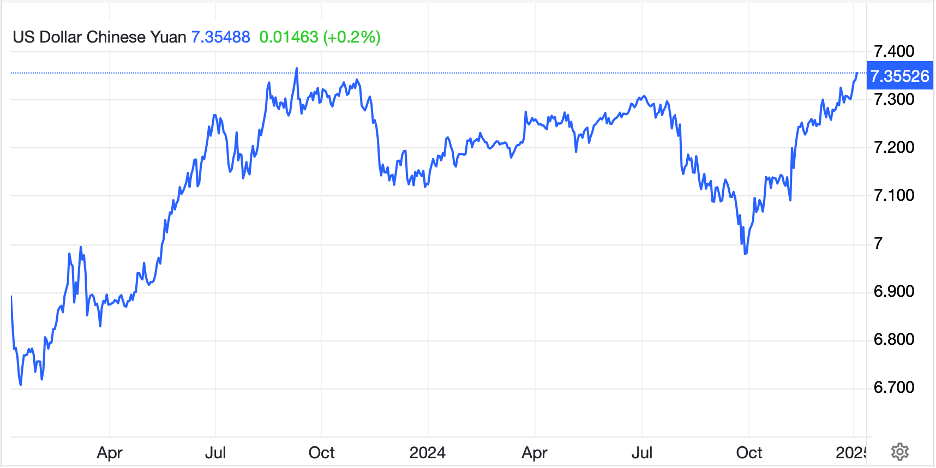
It seems that one of President Xi Jinping’s New Year’s resolutions was to finally allow the renminbi to resume its longer-term decline.  While 7.30 has been the line in the sand for a while, as can be seen from the first chart below, suddenly, as the calendar page turned to 2025, it appears that the PBOC is going to allow for the renminbi to weaken further.  Thus far, the PBOC has been adamant about fixing the Chinese currency at levels much stronger than anyone wants to pay for it, and even last night that was the case, with a fixing rate of 7.1878.  However, while the onshore market must trade within +/- 2% of that fixing rate, no such restriction limits the offshore market, and this morning, the offshore renminbi is trading 2.3% weaker than the fixing, above 7.35 to the dollar.

Much has been made of the “chess” moves that are ongoing between the US and China regarding currency policy with many pundits blankly claiming that if Trump is to impose the threatened tariffs, the renminbi will simply weaken to offset them.  However, while I do believe the CNY has much further to fall, that is not the driving case I see.  Rather, Xi’s problem is that his economy is not in nearly as good condition as he needs it to be and confidence in the consumer sector continues to wane.  This is largely a result of the ongoing destruction of the property bubble that was blown for decades.

Remember, Chinese investors have tied up significant personal wealth in second and third homes as stores of value.  This was encouraged as cities could sell property to developers, get paid a bunch to help finance their operations, and since demand was so high, prices kept rising so everyone was happy.  Alas, as with all bubbles (I’m looking at you, too, NASDAQ) eventually the air comes out.  For the past three years the Chinese have been trying to deal with this collapsing property market, but house prices continue to decline thus reducing investor wealth and confidence.  I read that there are an estimated 80 million empty homes that have been built over the past decades and are now in disrepair in the countryside.  These are the ghost cities that were all part of the Chinese growth miracle, but in fact were simply massive malinvestment.

While the prescription for China has long been to increase its consumer sector of the economy, Xi and his minions at the central committee have no idea how to do that (given they are communist, this is not that surprising) and so continue to support the means of production.  The problem is they have now seemingly gone too far in that space as well with not merely the Western world, but also much of the developing world starting to push back on all the excess stuff that is coming from China.  

Xi’s other problem is that as he rails against the dollar and seeks others to use the renminbi in their trade, if the currency starts to fall sharply, that will be a difficult ask.  Given the US FX policy remains benign neglect, it is entirely upon China to solve their own problems.  While it is unlikely to happen in a big devaluation a la August 2015, weakness is the trend to bet here this year.

Source: tradingeconomics.com

Source: tradingeconomics.com

Away from that news, though, the year is starting off in a fairly modestly.  Most of the world’s focus is on the upcoming Trump inauguration as well as the political machinations that will begin today as Trump’s Cabinet nominees start to go through their paces in front of the Senate.  New Year’s Eve’s horrifying terrorist attack in New Orleans has just upped the ante with respect to Trump getting his picks through the process.  

So, let’s review the overnight market activity to get a sense of what today could bring.  The first day of the US trading year resulted in modest declines across the board in equities, although as I type (7:30), they appear to be retracing those losses and are slightly higher.  The bigger news was from Asia where both the Nikkei (-1.0%) and CSI 300 (-1.2%) showed weakness with the former feeling the pain of some profit taking after gains last week, although Chinese shares seem to be succumbing to the troubles I have described above.  Elsewhere in the region there was no consistency with gainers (Hong Kong, Taiwan, Korea and Australia) and losers (India, New Zealand, Malaysia) with other exchanges little changed.  In Europe this morning, there is more red than green with the CAC (-0.8%) the biggest laggard amid concerns over the fiscal situation in France.  But the DAX (-0.35%) and FTSE MIB (-0.45%) are also lagging with only Spain’s IBEX (0.0%) bucking the trend.

In the bond market, Treasury yields have slipped 2bps this morning, but remain above 4.50%, something that continues to vex Chairman Powell as he and the Fed seemed certain that by cutting the Fed funds rate, he would drive the entire yield curve lower.  I wonder if he will learn this lesson about the relation between a made-up rate (Fed funds) and market rates (bond yields) anytime soon.  In Europe, French yields are 2bps higher, widening their spread vs. German bunds and perhaps more remarkably, at least from a nominal perspective, well above Greek government bond yields now! (Remember, there are far fewer GGB’s around than OAT’s so there is a scarcity bid there). Certainly, Madame Lagarde must be getting a bit concerned over her native nation’s profligacy and I suspect that the fiscal ‘need’ for lower Eurozone interest rates is one of the features of the discussion regarding the ECB’s future path (lower).  As to JGB’s, they are unchanged, sitting at 1.07% and showing no sign of rising anytime soon.  One last thing, Chinese 10yr bonds now yield a new record low of 1.61%, 2bps lower on the day and pretty convincing evidence that not all is well in the Middle Kingdom’s economy.

On the commodity front, oil (-0.2%) is consolidating yesterday’s strong gains which were ostensibly based on the idea that President Xi will successfully implement more stimulus and aid growth in China.  History shows otherwise, but we shall see.  Gold (-0.1%) is also consolidating yesterday’s strong gains as it appears there has been renewed central bank buying activity to start the year.  The other metals also benefitted yesterday with silver (+0.8%) continuing this morning.

Finally, the dollar is retracing some of yesterday’s gains but remains much stronger than we saw just last week, and certainly since the last time I wrote.  Looking at the Dollar Index, it is hovering near 109 this morning, having traded well above that yesterday afternoon.  The next obvious technical target is 112, about 3% higher and there are now many calls for a test of the 2002 highs of 120.  I assure you, if the DXY gets to those levels, EMG currencies are going to come under a great deal of pressure.  As an example, we already see several EMG currencies (CLP, BRL) trading at or near all-time lows (dollar highs) and there is nothing to think this will change soon.  As well, check out the euro at 1.03 this morning, which while 0.3% higher on the session, appears as though it could well test those October 2022 lows (dollar highs) sooner rather than later, especially if the ECB continues to lean more dovish than the Fed.  If you are a receivables hedger, currency puts seem like a pretty good idea these days.

On the data front, ISM Manufacturing (exp 48.4) and Prices Paid (51.7) are all we have today and late this morning Richmond Fed president Barkin speaks.  Interestingly, tomorrow evening and Sunday we hear from SF Fed President Daly and tomorrow evening Governor Kugler will be joining Daly.  I guess they can’t go but so long without hearing their voices in the echo chamber!

There is nothing to suggest that the dollar, while modestly softer today, is set to turn around soon.  Keep that in mind.

Good luck and good weekend

Adf

Panic Attack

The FX Poet will be in Nashville at the AFP Conference October 21-22, speaking about effective ways to use FX options in a hedging program.  Please come to the presentation on Monday at 1:45 in Grand Ballroom C1 if you are there.  I would love to meet and speak.
 
Said Madame Lagarde, we’re “on track”
To make sure inflation gets back
Below two percent
So, we can prevent
A government panic attack
 
The subsequent news from the East
Is Chinese growth, once more, decreased
Their five-percent goal
Ain’t on cruise control
So, Xi needs more skids to be greased


See if you can find the conundrum in the ECB statement issued yesterday after they cut interest rates 25bps, as expected, taking the Deposit Rate down to 3.25%,. [emphasis added]

“The incoming information on inflation shows that the disinflationary process is well on track. The inflation outlook is also affected by recent downside surprises in indicators of economic activity. Meanwhile, financing conditions remain restrictive.

Inflation is expected to rise in the coming months, before declining to target in the course of next year. Domestic inflation remains high, as wages are still rising at an elevated pace. At the same time, labour cost pressures are set to continue easing gradually, with profits partially buffering their impact on inflation.”

While I realize that I am just an FX guy, and that my education at MIT was far more focused on numbers than words, I cannot help but read the highlighted phrases and be confused how the conclusion of high domestic inflation and expectations for it to rise means the disinflationary process is “well on track.”  Of course, it is important to remember that Madame Lagarde is a politician, not an economist nor banker nor any other background familiar with numbers, so perhaps she is the one that doesn’t understand.  Either that or as with every politician she is simply lying.

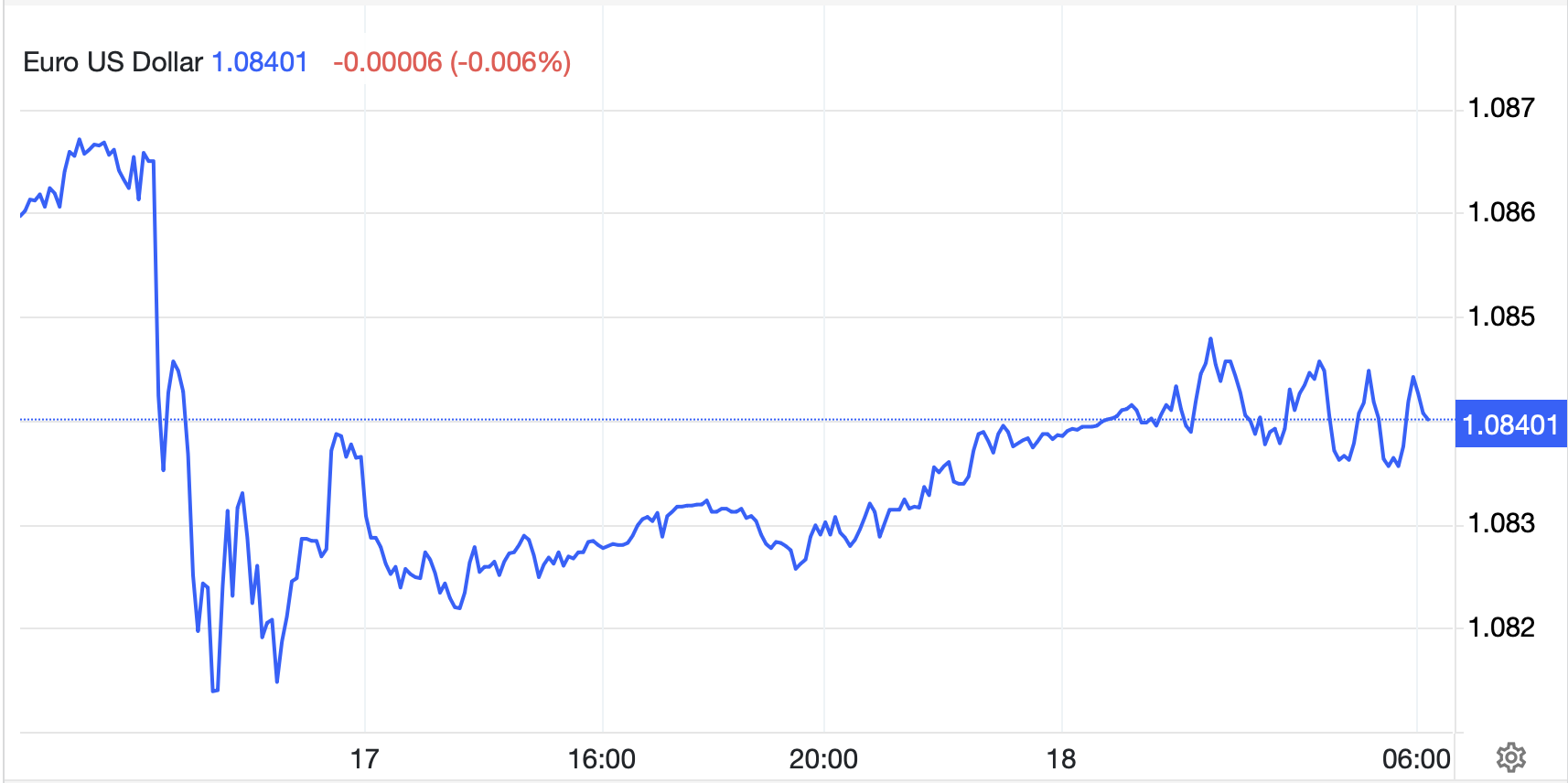
Regardless, as you can see in the chart below, the market response in the wake of the announcement was to sell the euro as interest rate traders priced in a December rate cut as well.

Source: tradingeconomics.com

The juxtaposition of US and Eurozone data remains the key here and as yesterday’s US numbers showed, the long-awaited recession continues to be postponed.  It becomes ever more difficult to see how the Fed will justify easing policy in any substantive manner if every economic print beats expectations.  (To clarify, Retail Sales printed at 0.4%, 0.5% ex-autos vs. expectations of 0.3% and 0.1% respectively. Philly Fed printed at 10.3 vs. expectations of 3.0 and Initial Claims fell to 241K despite the hurricanes, vs expectations of 260K). 

In the end, all this simply reinforces my view that the euro has further to decline going forward.  I still like the 1.05 – 1.06 level as a target by year end.

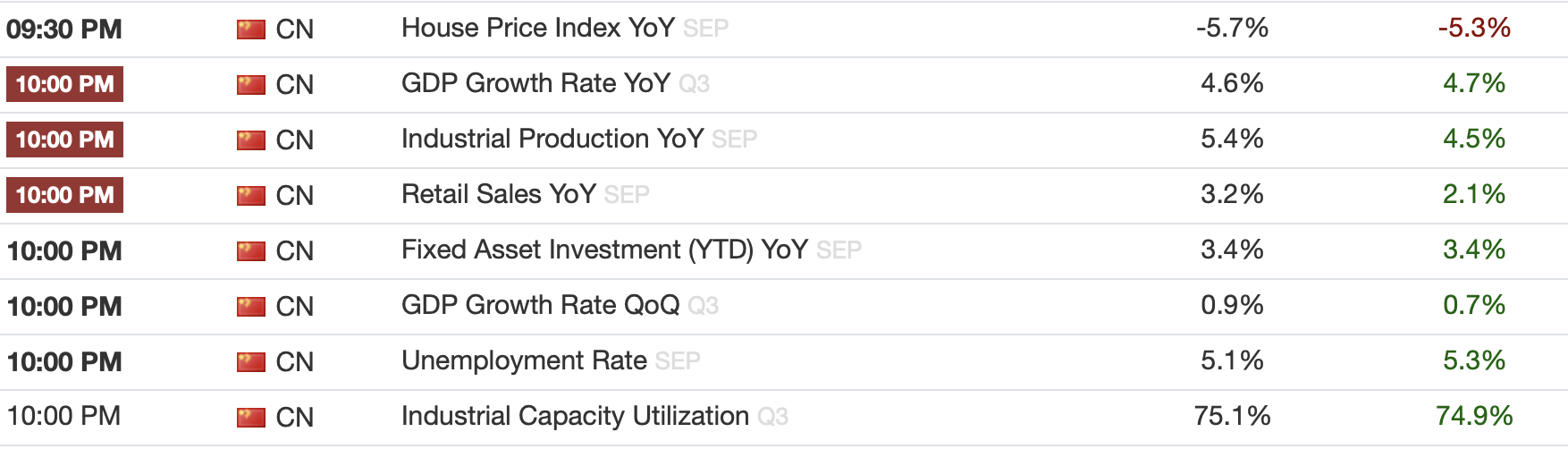
Turning to China, last night they had their monthly data dump and the numbers there continue to point to an economy struggling to gain momentum. (The first, black, number is the September data, the second, green or red, number is the August data.)

Source: tradingeconomics.com

Xi’s 5% target, or even if you use their recent “around 5%’ concept, is getting strained.  While Retail Sales there was a positive, the ongoing disintegration of the housing/property market is a major problem.  Now, all this data represents activity before the plethora of stimulus measures that have been announced.  However, recent equity market performance there, if using as an indicator of the belief that the stimulus was going to be effective, had shown a substantial decline from the early sugar highs back in September immediately following the first stimulus announcements.

With that in mind, PBOC Governor Pan Gongsheng strongly hinted that there would be another interest rate cut next week, as the government struggles to not only convince investors that they have things under control, but to also implement the measures already described.  Now, last night, after Pan hinted at the rate cuts, along with other comments regarding the funds allocated to help companies buy back shares, Chinese equity markets rose sharply in the afternoon session, as per the below chart, rising 3.6% on the day.

Source: Bloomberg.com

Once again, I will highlight the irony of the Chinese Communist Party focusing on the epitome of capitalism, the equity market, as a key means of economic improvement and a key signal that they are on the right track.

That was really all the big news since I last wrote.  Let’s look at the overall market activity.  After yesterday’ lackluster US session, Japanese shares (+0.2%) managed to edge a bit higher and Hong Kong (+3.6%) mirrored Chinese mainland shares.  The other beneficiary of the Chinese stimulus discussion was Taiwan (+1.9%) but Australia (-0.9%), Korea (-0.6%) and a host of other regional exchanges did not seem to appreciate the effort.  In Europe, only the UK (-0.3%) is really under any pressure although the gains on the continent are not terribly impressive with the CAC (+0.5%) the leader at this point.  Most other markets there are little changed to slightly higher.  As to US futures, at this hour (7:20), they are higher by about 0.25%.

In the bond market, after yesterday’s much stronger than expected US data, Treasury yields jumped 7bps and this morning have edged higher by another 1bp to get back to 4.10%.  However, on the continent, sovereign yields this morning are lower by between -2bps and -4bps after yesterday’s ECB action and comments.  The one exception here is the UK, where gilt yields are higher by 2bps after UK Retail Sales data printed much stronger than expected at +0.3% in September, vs. -0.3% expected.

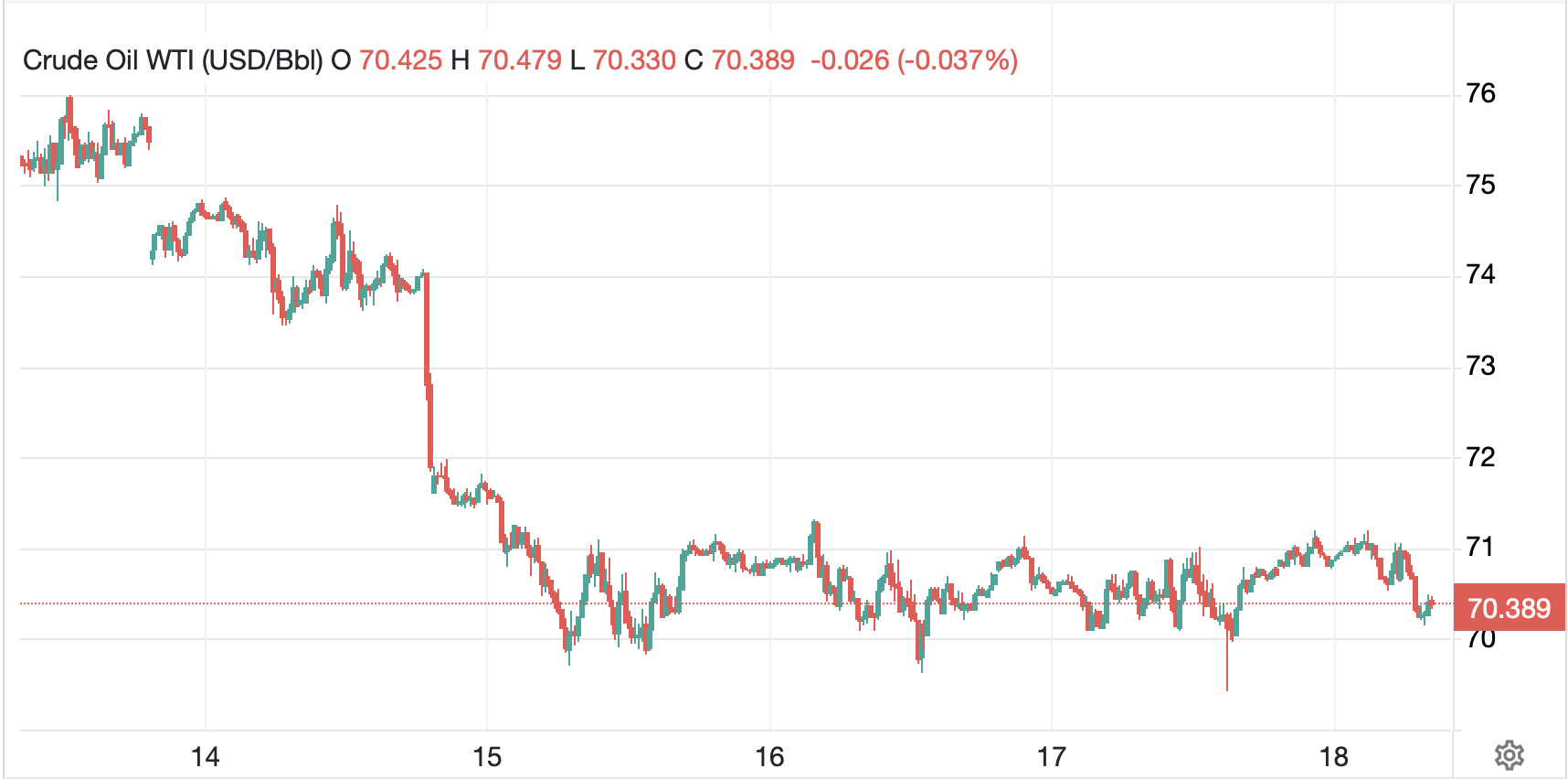
In the commodity markets, oil (-0.4%) is modestly lower this morning but really going nowhere for now as evidenced by the chart below.  Once the word had come that Israel was not going to target Iranian oil infrastructure and the price fell, it has basically been flat.

Source: tradingeconomics.com

As to the metals complex, gold (+0.6%) continues its ongoing rally and is at yet another new all-time high, above $2700/oz this morning, as demand continues to be present from all segments.  However, this morning, all the metals are rallying with silver (+1.0%) and copper (+1.5%) showing even better performance.  The combination of continued solid data from the US and hopes for a return to Chinese demand seem to be the drivers.

Finally, the dollar is closing the week on a down note, as traders reduce positions and take profits ahead of the weekend.  During the week, the dollar rose against virtually every one of its main counterparts in both the G10 and EMG blocs.  Again, the big picture here is that for the dollar, good US economic data is going to continue to benefit the greenback, and we will need to see not just one bad number, but a series of them before the dollar truly suffers.

On the data front, we see Housing Starts (exp 1.35M) and Building Permits (1.46M) at 8:30 this morning and then we hear from three more Fed speakers (Bostic, Kashkari and Waller) with Bostic making two appearances.  At this stage, despite the strong data, the Fed funds futures market is pricing in a 92% probability of a 25bp cut next month and then a 75% probability of another one in December.  I know that Powell seems desperate to cut rates, but if the data continues to show strength, the case to do so is going to be much harder to make.  That doesn’t mean he won’t do it, but if he continues down that path, it just means that inflation will return that much sooner.  

Good luck and good weekend and reach out if you are in Nashville at the AFP!

Adf

The Hits Keep on Coming

In China, the hits keep on coming
As Gongsheng adjusts China’s plumbing
Last night he cut rates
As he navigates
A way to help growth there keep humming
 
Combined with the Fed’s latest act
Worldwide it is clearly a fact
Liquidity’s growing
With stock markets showing
Why traders just love the impact


As virtually promised the other night, PBOC Governor Pan Gongsheng cut the medium-term lending facility rate to 2.0% from its previous level of 2.3% last night, the largest single cut in the history of this rate’s existence.  Of course, that only takes us back to 2016 when the PBOC rolled out this concept, but nonetheless, it is a clear expression of an aggressive easing policy by the central bank.  In fact, pundits are calling for further rate cuts this year as Xi’s government struggles with rekindling the animal spirits in China.  For equity investors there, this continues to be good news as the CSI 300 rallied another 1.5% and is now within spitting distance of being flat for the year.  As well, the renminbi rallied further, briefly trading through the 7.00 level and currently about 0.35% stronger than yesterday’s close.

Alas for President Xi, while all these measures are likely to have positive short-term impacts on economic statistics, especially the way they report them over there, it is unclear if they will help restart truly organic domestic economic activity.  Ultimately, that is a direct product of the level of confidence people have in their current employment situation as well as their perception of the prospects for better opportunities going forward.  Having the government pay you back for things that were supposed to rise in price forever is welcome, but not sufficient to do the trick, I think.  Clearly the current situation is that Chinese assets are going to perform in the short run, and it is very likely commodity prices will rise as well given the perception that Chinese demand will now increase, but personally, I suspect that the longevity of this price action, at least for the Chinese assets, may be limited.

Commodity prices, on the other hand, are getting boosts from all over the place, notably from the fact that virtually every country on earth, except perhaps Japan, has entered a monetary easing cycle.  Now that the Fed has begun, and gone big to start, other central banks will feel empowered to ease policy further with the confidence that their own currencies will not collapse amid a US rate cutting cycle.  And let’s face it, so far, everything we have heard in the wake of the FOMC move last week is that they are not afraid to cut rates a lot more.

Under the guise, actions speak louder than words, even though Powell explicitly said they had not declared victory over high inflation, listening to the four speakers since the meeting, it actually appears they have done just that.  Now, there is one market that seems to disagree with them, at least so far, and that is the 30-year Treasury bond. As you can see in the chart below, the yield there is now higher by 20bps since the first stories about the Fed cutting 50bps made their way into the press.  Whatever PCE holds in store for us later this week, the combination of commodity price rises and the yield on the long bond offer strong hints that inflation is going to make an inglorious return.

Source: tradingeconomics.com

But for now, be joyful because stock markets are continuing to rally.  This economic cycle is clearly unlike any others given the still subtle ripples from Covid policies and the fact that the housing market remains stuck with so many homeowners locked into their homes due to the exceptionally low mortgage rates they hold.  The result has been two very opposite views of how things are evolving, with one camp still celebrating the fact there has been no appreciable slowdown and all-in on the soft-landing while the other digs under the headlines and finds numerous issues with hiring and debt.  Perhaps next week’s NFP print will bring clarity although I doubt that will be the case.  In the meantime, we need to observe and react as it is all we have.  It is times like these that define why hedging is so important.

Ok, let’s look at the overnight activity.  After yesterday’s modest US rally, aside from China, the picture was far more mixed in Asia with the Nikkei (-0.2%) slipping slightly while the Hang Seng (+0.7%) continued its rally on the back of the China news.  But Singapore, Korea and the Antipodes all suffered although Taiwan (+1.5%) took heart in the Chinese news.  In Europe, the picture is also mixed with both the DAX (-0.4%) and CAC (-0.3%) slipping while the FTSE 100 (+0.4%) is higher despite a complete lack of data.  Well, that’s not completely true as French Consumer Confidence rose to 95, its highest level since February 2022, but apparently that is not so important.  Meanwhile, US futures are essentially unchanged at this hour (7:30).

In the bond market, Treasury yields are leading the way higher with 10-year yields higher by 3bps and pretty much all European sovereign yields higher by either 1bp or 2bps.  Bond investors are very clearly concerned over inflation’s prospects given the wholesale turn to monetary ease seen worldwide.  The outlier here was JGB yields (-1bp) as the market there continues to respond to Ueda-san’s comments from yesterday regarding the lack of urgency to tighten further, especially given the yen’s recent rebound.

In the commodity markets, oil (-1.3%) is fading this morning, perhaps because there has been no further escalation of hostilities in the middle east, they remain at a steady level, or perhaps because we have seen a 9% rally in the past two weeks, so traders are simply taking a rest.  Metals markets, too, are softer this morning, but that is also after a very strong rally and gold (-0.1%) continues to maintain the bulk of its daily new all-time high prints.  But both silver and copper have had very strong weeks as well.  One other thing to note is that NatGas is higher by 13% this week, perhaps an indication that supply concerns are growing.

As to the dollar, after several soft sessions, it is rallying this morning.  Weakness in currencies is broad-based with the pound (-0.4%), Aussie (-0.5%), yen (-1.0%) and Swiss franc (-0.9%) all retracing some of their recent gains.  We are seeing similar price action in the EMG bloc with MXN (-0.6%), KRW (-0.5%) and PLN (-0.3%) all under pressure but with one exception, ZAR (+0.4%) which continues to benefit from the combination of still high interest rates, so the carry trade, as well as a growing belief that the new government is going to be quite business, and by extension market, friendly.

On the data front, only New Home Sales (exp 700K) is on the docket although we also see the weekly EIA oil inventory data with further drawdowns forecast.  There are no scheduled Fed speakers, but I expect we will hear from one or two anyway.  While the dollar is bouncing today, I believe the current mindset is the Fed is going to lead the way lower in this rate cycle and that the dollar will suffer accordingly.  Just be careful as with everyone cutting rates, expecting a sharp dollar decline from here seems suspect.

Good luck

Adf

Juiced

No doubt it was President Xi
Who leaned on the PBOC
To cut rates at last
And try to recast
The tone of its cash policy
 
So, mortgage rates will be reduced
While bank reserves, too, will be juiced
But will cutting rates
Be what motivates
The people and give growth a boost?


It’s almost as though Pan Gongsheng, head of the PBOC, read my note yesterday morning and decided that it was time to really do something big!  While obviously, we know that is not the case (at least I don’t see his name on my subscriber list), the PBOC definitely painted the tape last night with their actions.  Fortunately, Bloomberg listed them for us as per the below:

  1. The seven-day reverse repurchase rate will be lowered to 1.5% from 1.7%
  2. RRR lowered by 0.5 percentage points, unleashing 1 trillion yuan in liquidity
  3. PBOC didn’t specify when RRR cut takes effect
  4. MLF expected to be cut by 0.3 percentage points
  5. Minimum down-payment ratio cut to 15% for second-home buyers, from 25%
  6. China may cut the RRR further this year by another 0.25 to 0.5 percentage points
  7. RRR cut won’t apply to small banks
  8. LPR and deposit rates to fall by 0.2 to 0.25 percentage points
  9. The PBOC to cover 100% of loans for local governments buying unsold homes with cheap funding, up from 60%

A glossary of terms is as follows:

  • RRR is the reserve ratio requirement which describes how much leverage banks may take, with the lower the number equating to more leverage (need to hold fewer reserves).
  • MLF is the medium-term lending facility which is the program that the PBOC uses to lend money to banks in China, and the rate had been the key interest rate for policy. 
  • LPR is the loan prime rate, the rate at which banks lend to their best clients
  • Seven-day reverse repurchase rate is a relatively new rate that the PBOC uses for its monetary policy efforts, similar to the Fed funds rate, and is now deemed the PBOC’s key interest rate.

Now, that’s a lot of activity for a central bank in one day.  Consider how long it takes the Fed to decide to raise or cut the Fed funds rate and compare that to just how much was done.  

And that’s just the rate moves.  In addition, they indicated they would lend up to CNY 500 billion for funds, brokers and insurers to buy Chinese shares and another CNY 300 billion for companies to buy back their own shares.  Again, I find the irony of a strictly communist nation worrying about their stock market unbelievably delicious.  So, the government is willing to roll out significant monetary stimulus, but as yet, has not been willing to inject fiscal stimulus.  Arguably the biggest economic problem in China right now is that sentiment is weak as people are concerned over both their jobs and the value of their property, hence consumption remains weak overall.  It is not clear what Xi can do to fix that problem, but cheap money is only effective if people and companies want to borrow and spend it.  That remains to be seen, although the odds of China achieving its 5.0% GDP growth target for 2024 have improved now.

One other thought is that this likely would not have been possible for the Chinese had the Fed not cut 50bps last week.  As I have consistently explained, once the Fed gets going, central banks everywhere will feel more comfortable cutting their own rates and easing policy further.  At least in China, inflation is not a problem, so they have plenty of room to cut.  However, elsewhere inflation has proven stickier than most central bankers would like to see.  Nothing is yet carved in stone as to just how many rate cuts are in the offing.

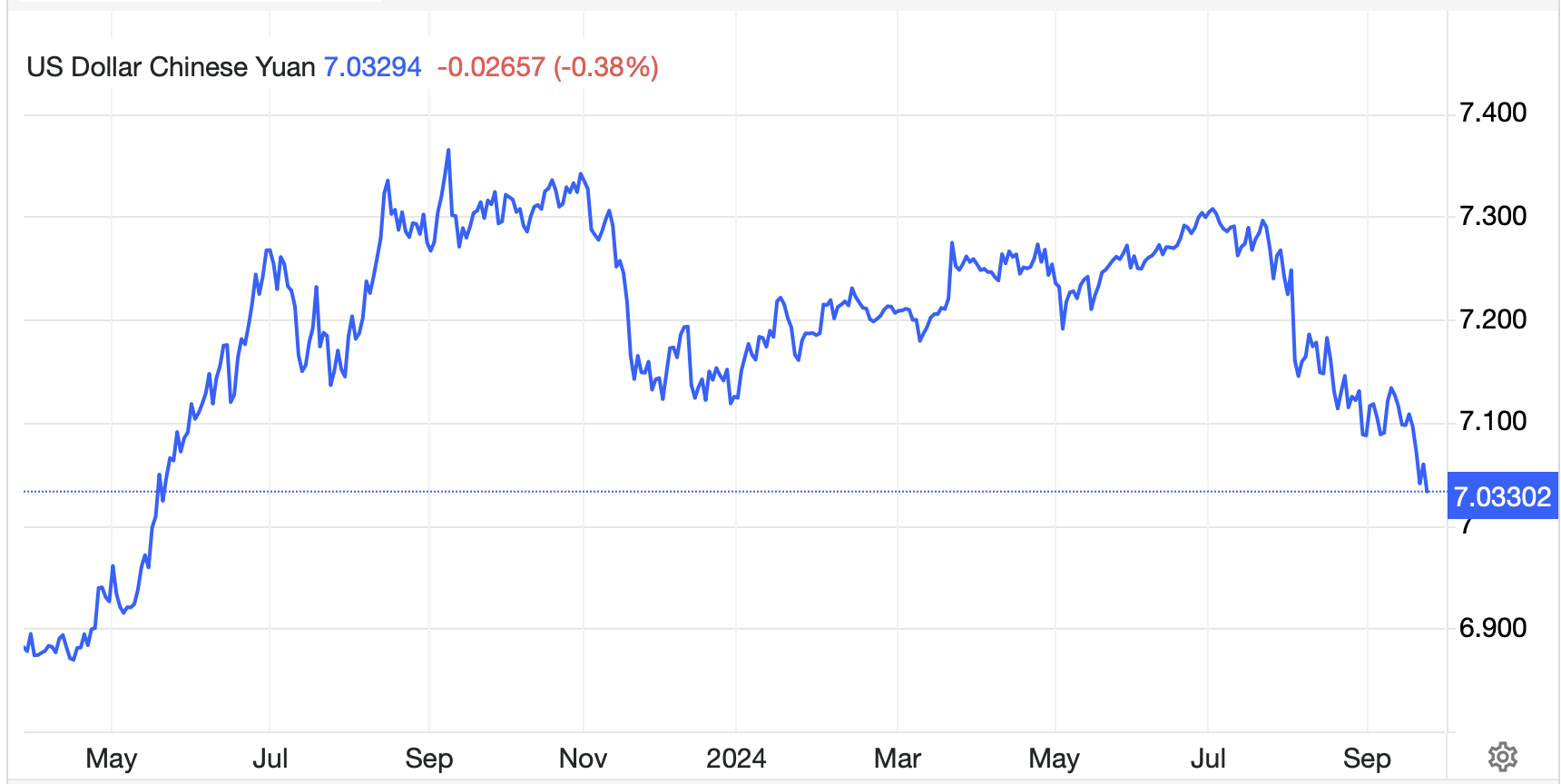
As this was the only noteworthy story, let’s look at how it impacted markets everywhere.  It can be no surprise that shares in China exploded higher given the explicit PBOC support with both the CSI 300 and Hang Seng rallying more than 4.1% on the session.  As well, Chinese yields backed up a bit, off the lows I described yesterday, but only by a few basis points.  As seen below, CNY (+0.4%) rallied nicely, trading to its strongest level since May 2023 and commodities rallied across the board with oil (+2.1%) and copper (+2.4%) the leaders although precious metals (Au +0.3%, Ag +0.8%) are also rising.

Source: tradingeconomics.com

Perhaps the most interesting thing about this story is just how little it impacted non-Chinese markets. Japanese shares (Nikkei +0.6%) rallied but given the yen’s decline (-0.3%) overnight, that likely had a bigger impact on those shares.  And the rest of Asia saw a mix of modest gains and losses, with Taiwan (+0.6%) and Korea (+1.1%) the next best performers although India, Australia and Singapore saw no benefit whatsoever.  It appears they are awaiting the fiscal boost.

In Europe, though, shares are definitely feeling the love led by the CAC (+1.6%) although even the DAX (+0.75%) is rallying despite another series of lousy data, this time the Ifo surveys all printing weaker than last month and weaker than expectations.  I guess given the importance of China as an export market for Germany, the PBOC news trumps the Ifo surveys from earlier this month.  As to US futures, after very modest gains yesterday, although some more record highs, they are essentially unchanged at this hour (7:00).

In the bond market, Treasury yields continue to back up, higher by 3bps this morning and now 15bps off the lows pre-FOMC meeting.  European sovereign yields are higher by 1bp across the board except for UK gilts (+4bps) as concerns grow that the fiscal situation in the UK may deteriorate more rapidly given the apparent confusion in the Starmer government about what to do to pay its bills.  It is also worth noting that JGB yields have slipped 3bps this morning and are now back to levels last seen back in April before the BOJ’s policy tightening got somewhat serious. 

As to the dollar, overall, it is on its back foot this morning although other than the renminbi, most of the moves have been 0.2% or less.  Today’s story is CNY for sure.

On the data front, this morning brings Case-Shiller Home Prices (exp 5.8%) and Consumer Confidence (103.8).  While there are no Fed speakers today, yesterday we heard from three (Goolsbee, Bostic and Kashkari) all of whom agreed with the 50bp cut last week and were mostly pushing for another one before the end of the year.  It seems Goolsbee has taken the mantle of chief dove on the committee, explaining there are “hundreds” of basis points left to cut before they achieve the neutral rate, however neither of the other two indicated any hesitation to cut further.  As of this morning, it is basically a 50:50 proposition as to 25bps or 50bps at the November 7th meeting according to the Fed funds futures market.

And that’s where we stand this morning.  China has opened their coffers and are adding yet more liquidity to the global system.  This should continue to help risk assets everywhere, and ultimately feed into inflation readings, although in China that is not a problem.  But what about elsewhere?  For now, it feels like the dollar is more likely to suffer given the dovish enthusiasm from the Fed speakers, but Thursday will bring 4 more speakers, including Chairman Powell, so perhaps we need to hear that before getting too excited.

Good luck

Adf

Juxtapose

In Europe, the ‘conomy’s woes
Continue while some juxtapose
Their weak PMIs
With US’s rise
Expecting the buck, higher, goes
 
Meanwhile, out of China we learned
The government there is concerned
Again, they cut rates
Which just illustrates
Their efforts, thus far, have been spurned


As we start a new week leading into month and quarter end, the market dialog continues to be about whether a recession is imminent or has been avoided completely.  As we have seen during the past months, it remains easy to choose the data that supports your view, in either direction, and make your case.  Ultimately, my take on that is very few opinions have been changed because as soon as one positive (negative) data point is printed, the opposite arrives within 24 hours.

However, let’s look at what we learned overnight.  The first story is that the PBOC cut their 14-day reverse repo rate by 10bps, another sign that the government there recognizes things are not really up to snuff.  In fact, most pundits were surprised that they didn’t cut the loan prime rates in the wake of the Fed’s rate cut last week.  Overall, this action is not that surprising, and most analysts are anticipating further rate cuts going forward, likely following the Fed lower every step of the way.  Perhaps the best indicator that more policy ease is coming is the fact that the yield on longer-term Chinese government debt has fallen to record lows (30-year at 2.15%, 10-year at 2.045%).

While the CSI 300 (+0.35%) did finally manage a bounce in the wake of the rate cut, perhaps there is no better picture of the situation in China than the chart of that stock index, which has been falling steadily since 2021.  I realize that the stock market is not the economy, especially in a command economy like China’s, but it appears quite clear that the many problems that have manifest themselves in China as the property bubble continues to unwind have been reflected in investor appetite, or lack thereof, to own potential future growth on the mainland.  The below chart speaks volumes I believe.  It ought to be no surprise that the renminbi (-0.25%) suffered a bit after the rate cut as well.

Source: tradingeconomics.com

As to the other noteworthy story, the Flash PMI data out of Europe was, in a word, dreadful.  Both manufacturing and services readings were below last month’s readings and below forecasts as the European growth story continues to suffer.  Given Europe’s reliance on imported energy overall, the recent rebound in oil and product prices are clearly impacting the economies there.  As well, there appears to be a growing divergence of opinion as to how different nations in the Eurozone want to move forward.  

For instance, this weekend’s elections in the German state of Brandenburg once again saw AfD make huge strides and massively complicate the coalition math, the third state to have that outcome this month.  As well, one of the keys to European convergence is the Schengen Agreement which allows for open borders within the EU.  However, the immigration situation there has now resulted in several nations closing their borders, not merely with the outside world, but internally as well as they try to cope with the massive influx of immigrants and asylum seekers that have been coming to the continent.  My point is if nations cannot agree on critical policies of this nature, it will become that much more difficult to arrive at common economic policies that are universally accepted.

Remember, last week Mario “whatever it takes” Draghi released his report on how the Eurozone could improve things with suggestions including more Eurozone debt (as opposed to individual national debt) and more government focused investment in areas where Europe lags, notably technology.  I guess the first step to correcting a problem is recognizing it exists, so credit is due that the Eurozone leadership has figured out things aren’t great for their citizens.  Alas, I fear Signor Draghi’s prescriptions, if enacted, are unlikely to solve many problems.

But that’s really all we have from the weekend, so let’s see how markets fared ahead of the US open.  Japan was closed for Vernal Equinox Day, a delightfully quaint holiday, while we’ve already discussed the mainland. The rest of Asia was generally positive, although Australian shares slid from recent all-time highs as investors await the RBA rate tonight with no change expected.  In Europe, it is a mixed picture, which given the PMI data, is better than I would have expected.  In fact, Germany (+0.5%) is the leading gainer there, although I cannot figure out any sensible catalyst driving that move.  The rest of the continent is +/-0.2%, so nothing really to note.  As to US futures, overall, they are slightly firmer at this hour (7:00), maybe 0.15%.

In the bond market, Treasury yields have edged higher by 1bp, continuing their rise from last week just ahead of the FOMC decision and now 13bps off the lows.  My sense is that yields will continue to slowly grind higher as a more aggressive Fed will open the door for a rebound in inflation.  As to European sovereigns, all are seeing yields slide between 2bps and 4bps this morning as it becomes clearer that the growth situation there is fading.

Oil prices (+0.3%) continue their slow rebound from the lows seen two weeks ago, although this looks much more like market internals and positioning than fundamental news.  Some claim that the escalation between Israel and Hezbollah is behind this, but given how little the market has seemed to care about the entire situation there for the past year, virtually, that doesn’t make much sense to me.  As to the metals markets, gold is unchanged this morning, sitting on its new all-time high although we have seen a retracement in both silver (-1.7%) and copper (-0.7%), though both remain in uptrends for now.

Finally, the dollar is mixed this morning with the euro (-0.4%) feeling the weight of the lousy PMI data but the commodity bloc mostly performing well (AUD +0.3%, NZD +0.25%, CAD +0.2%).  One exception here is NOK (-0.3%) and we are seeing far more weakness in EMG currencies as well (PLN -0.6%, HUF -0.9%, MXN -0.4%, KRW -0.5%).  The outlier here is ZAR (+0.25%) where investors are becoming increasingly comfortable with the pro-business attitude of the recently elected government and inward investment continues to grow.

On the data front this week, there is plenty as well as a number of Fed speakers

TodayChicago Fed Nat’l Activity-0.6
 Flash Manufacturing PMI48.5
 Flash Services PMI55.3
TuesdayCase-Shiller Home Prices5.8%
 Consumer Confidence103.8
WednesdayNew Home Sales700K
ThursdayInitial Claims225K
 Continuing Claims1832K
 Durable Goods-2.6%
 -ex Transport0.1%
 Q2 GDP3.0%
 GDP Final Sales2.2%
FridayPersonal Income0.4%
 Personal Spending0.3%
 PCE0.1% (2.3% Y/Y)
 Core PCE0.2% (2.7% Y/Y)
 Michigan Sentiment69.3

Source: tradingeconomics.com

Given the Fed’s pivot to employment from inflation, I suspect there will be a lot of scrutiny on the Claims data, especially since last week’s numbers were so surprisingly low.  If the labor market is behaving better, the need for rate cuts diminishes.  In addition to the data, we also hear from 7 Fed speakers including Chairman Powell Thursday morning.  As well, Treasury Secretary Yellen speaks on Thursday, no doubt to explain how great a job she has done.

Summing it all up, we continue to see signs of weakness elsewhere in the world while thus far, the headline data in the US continues to hold up reasonably well.  While I have consistently explained that as the Fed starts cutting rates, the dollar would suffer, the decline may be quite gradual if the rest of the world is in worse shape than the US.

Good luck

Adf

Data Confusion

The ongoing data confusion
Is certainly not an illusion
Some numbers are solid
While others are squalid
And each begs a different conclusion
 
Last night, Chinese data revealed
The ‘conomy there hasn’t healed
And Germany’s ZEW
Showed weakness, beaucoup
More rate cuts will soon be, out, wheeled
 
But here in the US we learned
The NFIB, up, had turned
And yesterday showed
Inflation has slowed
Investors, though, still are concerned


As we await today’s US PPI data, and more importantly, tomorrow’s US CPI data, the one consistency we have observed is that the data remains all over the map.  Or does it?  The below chart (data from NY Fed, chart from @fx_poet) shows the median readings of 1-year ahead and 3-year ahead inflation expectations, based on a survey of 1300 households.  While the 1-year ahead expectations are unchanged at 3.0%, the 3-year ahead expectations fell to 2.3%, the lowest in the series’ history since the NY Fed began the survey in June 2013.

If you’re Jay Powell, that certainly must be good news as the Fed puts great stock into the idea that inflation expectations lead inflation outcomes. While this is not a universally held belief amongst economists and analysts, it is certainly the majority view.  However, given that the Fed is a strong believer in this theory, the fact that inflation expectations, as measured here, are declining will help inform their decisions going forward.  Based on this, it is easy to believe that September will bring a 50 basis point cut.

Of course, one might ask, why are inflation expectations declining?  And that is not part of the data that is collected, or at least not reported.  If the expectation is that the economy is headed into recession, that implies there is still great concern amongst households going forward.  However, if this result is due to a strong belief in the Fed’s policies, then economic optimism should abound.  As such, we need to see other data to help interpret things.

Perhaps the first piece we can observe is this morning’s NFIB Small Business Optimism Index, which printed at 93.7, its highest level since March 2022.  That is certainly encouraging as given the importance of small businesses to the overall economy, if things there are starting to look up, it should translate into stronger growth going forward.  On the flip side, in the anecdata department, earnings calls from Expedia, Marriott, Airbnb and Hilton indicated that there is real weakness in the travel economy.  This WSJ report indicates that perhaps things are not as strong as might be indicated by other data.

Now, if we look overseas, the data is also mixed, but there is more negative than positive.  For instance, Chinese money and lending data was released at substantially lower levels than last month and well below expectations.  As well, the PBOC is becoming very concerned about the Chinese bond market inflating a bubble.  Last week, ostensibly, they told several banks to renege on deals to buy Chinese government bonds because they are trying to prevent the back end of the yield curve from declining too far.  It seems they are worried (and probably rightly so) that regional Chinese banks don’t have the capability to manage interest rate risks effectively.  But slowing loan growth and a weak equity market continue to indicate that the Chinese economy is lagging.

As to Europe, the German ZEW data was released and it was, in a word, putrid.  The Economic Sentiment Index fell from 41.8 to 19.2, far below expectations while the Current Conditions index fell to -77.3.  Granted, these surveys were taken the week after the weak NFP data in the US when people were screaming for an emergency 75bp rate cut, so perhaps they are not reflective of the ongoing situation.  But this highlights the problems with survey data, if you are asked about something on a day when the world seems to be ending, your response is likely to be more negative than not.  In fact, this is a caution for all survey data.

So, what are we to make of all this mixed information?  Well, we are right where we started, with no clearer picture of the current situation, let alone how the future may unfold.  In fact, this is why unfettered markets are so important.  Markets are excellent indicators of both future activity and sentiment, and when they are manipulated for political outcomes, investors lose a great deal of information.

But let’s see what the markets are telling us today.  Yesterday’s US session was mixed with modest gains and losses across the board.  But I’ll tell you what, last night Tokyo took the bull by the horns and continued its strong rebound from the previous week’s collapse with the Nikkei rallying 3.5%.  it seems that not only was this move a continuation after the Monday holiday of last week’s rebound, but a former BOJ official, Makoto Sakurai, explained, “they [the BOJ] won’t be able to hike again, at least for the rest of the year.  it’s a toss-up whether they can do one hike by next March.”  You will not be surprised that traders and algorithms jumped on those comments to buy more stocks.  As to the rest of the major markets in Asia, they mostly edged slightly higher, but only about 0.2% or so.  In Europe, there are more laggards than gainers, with the CAC (-0.3%) the worst of the bunch, but as you can see by the relatively small decline, markets here are also quiet.  Finally, US futures are up 0.4% at this hour (8:15).

In the bond market, yields are edging lower this morning with Treasuries down -1bp while European sovereigns are lower by between -2bps and -3bps.  Given the tenor of the economic data, this should be no surprise.  Interestingly, JGB yields remain unchanged at 0.83%, well below that 1.00% critical level and hardly indicative that the BOJ is going to tighten further.

In the commodity space, oil (-0.5%) after touching $80/bbl for WTI yesterday, is slipping a bit as traders await the apparently imminent Iranian attack on Israel to see if a wider war starts.  Meanwhile, the metals complex is lower across the board with gold (-0.4%) giving back some of yesterday’s gains while copper (-1.0%) is also under pressure, arguably on the weak economic story.

Lastly, the dollar is firmer this morning, notably against the yen (-0.3%) and CHF (-0.4%) although there are exceptions to this rule.  I find it quite interesting that the yen carry trade unwind story has basically ended with several large banks explaining that the alleged $20 trillion that was outstanding has been unwound.  Personally, I think that is ridiculous and that there is plenty left in place.  Remember, this trade has been building since the Fed began raising interest rates in 2022 and there are many investors whose entry points are far, far below the current spot level.   A quick look at USDJPY over the past 5 years shows that while the latest batch of entrants may have left the building, there is likely still a lot of borrowed yen funding other positions.

A graph with a line drawn on it

Description automatically generated

Source: tradingeconomics.com

When the Fed started raising interest rates, USDJPY was about 115.  I assure you the carry trade has not ended.

Turning to the data, this morning brings PPI (exp headline 0.2%, 2.3% Y/Y) and (core 0.2%, 2.7% Y/Y), although I believe the data will need to be very different for traders and investors to change their view that inflation is continuing to decline.  And later this afternoon, Atlanta Fed President Bostic speaks.

I believe the narrative remains that the soft-landing is still in play and that the Fed’s cut in September will be adequately timed to prevent a recession.  As of this morning, the futures market is still pricing in a 50:50 chance of either a 25bp or 50bp cut.  Right now, my money is on 25bps, but there is a lot to learn between now and then.  In the meantime, it is hard to turn too negative on the dollar as everybody else is cutting rates as well, and growth elsewhere seems anemic at best.

Good luck

Adf

Destined for Sloth

The Chinese are starting to worry
That if they don’t act in a hurry
Their ‘conomy’s growth
Is destined for slowth
Explaining their rate cutting flurry


Sunday night, the PBOC surprised markets by cutting both their 1-year and 5-year Loan Prime Rates by 10 basis points each.  As well, they cut the rate on their newly developed 7-day repo rate by 10bps as they endeavor to shorten the maturity of their money market operations. At the time, it was taken as a response to the Third Plenum and the only concrete action seen as new support for the economy.  As its name suggests, those rates represent the cost to borrow for credit worthy companies.  A quick look at the history of this rate (the blue line), which was first tracked toward the end of 2013, shows that over time, it has done nothing but decline.  I have overlayed a chart of USDCNY in the chart (the grey line) to help appreciate the long-term trend in that as well which, not surprisingly, shows a steady weakening of the renminbi (rise in the dollar).

Source: tradingeconomics.com

But the reason I bring this up is that last night, the PBOC surprised markets yet again by cutting its One-Year Medium-Term Lending Facility by 20 basis points, to 2.30%.  Not only was this the largest cut since the pandemic, but it was also done at an extraordinary meeting and combined with an injection of CNY235 billion (~$32B) into the economy.  Arguably, this is the most aggressive monetary policy stance that has been effected by the PBOC since the summer of 2015 when they surprisingly devalued the renminbi 2%.  Apparently, the PBOC is trying to adjust its policy actions to be more in line with the G7 where central banks use short term rates as their tools.  One other thing this implies is that President Xi remains steadfastly against any fiscal stimulus of substance at this point.  On the one hand, you must admire that effort, but I fear that the domestic Chinese economy remains so weighed down by the ongoing property sector problems, achieving their 5.0% GDP growth target is going to become that much more difficult as the year progresses.

For our purposes, though, the story is all about the CNY (+0.7%), which rallied sharply after the announcement, continuing its movement from the Monday rate cuts which totals 1.1%.  Now, ordinarily one might think that a country cutting its rates would lead to a weaker currency, ceteris paribus, However, given the market outcome, there is much discussion about how the PBOC “requested” Chinese banks to more aggressively buy CNY to support the currency.  Interestingly, the fixing rate on shore overnight (7.1321) continues to weaken ever so slightly overall, but now the spread between the fix and the market has fallen to just over 1%, well within the +/- 2% band and an indication there is less pressure on the currency.  My take is this is just window dressing, but I would not fight it.  I expect that we will see USDCNY slowly return to higher levels over time, with the key being it will take lots of time.

The ongoing rout
In tech stocks has another
Victim, dollar-yen

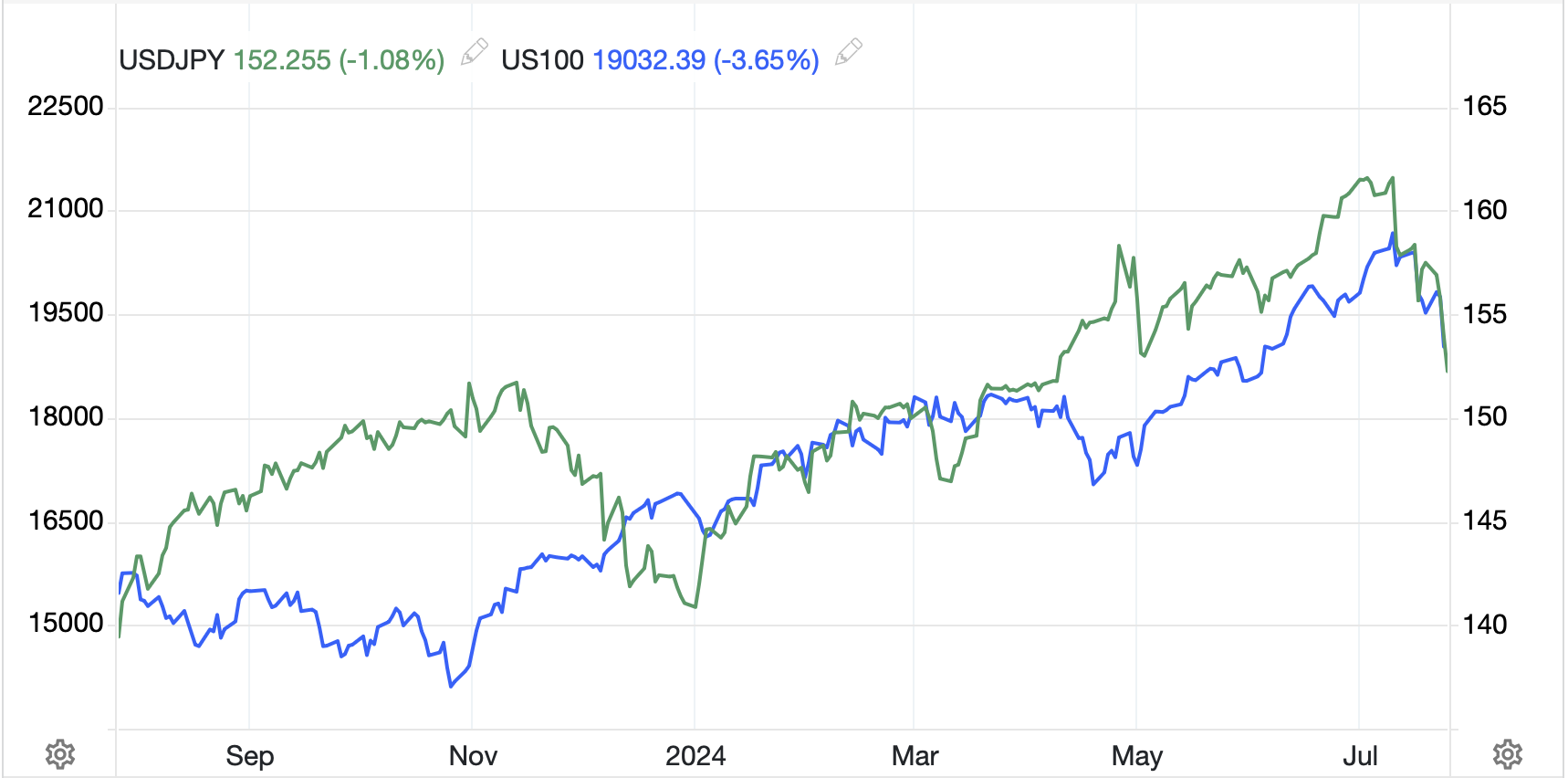
Under the guise, a picture is worth a thousand words, the below chart showing the NASDAQ 100 (blue line) and USDJPY (green line) overlaid is quite interesting.

Source: Tradingeconomics.com

While there is an ongoing argument amongst market practitioners as to whether it is the decline in the tech sector that is driving USDJPY’s decline or the other way round, what is clear is that there is a strong correlation between the two.  If you think about what the USDJPY trade represents, it is the purest form of a carry trade, shorting the cheapest currency and using the funds to buy a much higher yielding currency with maximum liquidity.  But another thing to do with those funds obtained from borrowing yen and buying dollars was to use the dollars to jump on the tech stock bandwagon.  After all, that added another 30% to the trade since the beginning of the year.  

However, over the past two weeks, nearly one-third of the NASDAQ gains have been erased and that has been made worse by the >6% rise in the yen.  At this stage, it no longer matters which is driving which, the reality is that we are seeing significant short covering in the yen with sales in other assets required to unwind the trade.  Arguably, this is why we are seeing virtually every risk asset lower this morning, although bonds are holding up as havens, as all have been funded with short yen.  Given that relationship, I am coming down on the side of the yen being the driver, but as I said, I don’t think it matters.  

The real question is can it continue?  It is important to understand that when markets achieve excessive levels like we saw in USDJPY, they rarely simply unwind to some concept of fair value.  Rather they typically overshoot dramatically in the other direction.  As such, if we assume PPP is fair value, and PPP for USDJPY is currently around 110.00, it appears there is ample room for USDJPY to decline much further.  Consider, this movement has happened, and the Fed has not even started to cut rates.  If we do, indeed, fall into recession, the Fed will respond, and I expect that we could see a very sharp decline in USDJPY.  Something to consider looking ahead.

While that was a lot about the currency markets, they seem to be the current drivers, so are quite important.  But let’s look at everything else.

Equity market pain has been universal with Japan (-3.3%), Hong Kong (-1.8%) and China (-0.6%) all following the US lower overnight and in Europe, this morning, it is no better with the CAC (-2.2%) the worst performer, but all the major indices falling sharply.  US futures are little changed at this hour (7:00), but remember, we are awaiting key GDP data and more earnings numbers, which have been the driver.

As mentioned above, bond markets are rallying with Treasury yields lower by 5bps and most European sovereigns seeing declines of -3bps or -4bps.  Credit is an issue as Italian BTPs are the laggard this morning, with yields there only lower by 1bp.  Equally of interest is the fact that the US yield curve inversion has been reduced to just 14bps and has been normalizing dramatically for the past several sessions.  One thing to remember about the yield curve is that when it inverts, it indicates a recession is coming, but when it uninverts, it indicates the recession has arrived!  This is all of a piece with softer economic data and expectations of Fed policy ease coming soon to a screen near you.

In the commodity markets, nobody wants to own anything.  Oil (-1.3%) is continuing its recent poor performance despite EIA data showing significant inventory reductions.  This is not a sign of strong demand.  But we are also seeing weakness across the entire metals space with gold (-1.0%) breaking back below $2400/oz and silver and copper under severe pressure.  Right now, nobody wants to hold these, although I suspect that the long-term supply/demand situation remains bullish.

Finally, the dollar is mixed overall.  While we have seen strength in JPY and CNY, as discussed above, and CHF (+0.8%) is also showing its haven status and use as a funding currency, there are numerous currencies under pressure, notably AUD (-0.8%), NOK (-0.8%), MXN (-0.8%), ZAR (-0.7% and SEK (-0.6%) all of which are commodity linked to some extent.  Yesterday, the BOC cut rates by 25bps, as expected, but the Loonie has been steadily weakening for the past two weeks, so yesterday’s decline and today’s is just of a piece with that.  Ultimately, we are watching a serious risk-off event, and I expect the dollar will hold its own vs. most currencies, although JPY and CHF seem to have room to run yet.

On the data front, once again yesterday’s data was on the soft side with the Flash Manufacturing PMI falling to 49.5, well below expectations and New Home Sales slipping to 617K.  In fact, it is difficult to find the last strong piece of data, perhaps the ex-autos Retail Sales number from last week.  This morning, we see Initial (exp 238K) and Continuing (1860K) Claims, Q2 GDP (2.0%), and Durable Goods (0.3%, 0.2% ex transport).  The Atlanta Fed’s GDPNow tool is indicating GDP in Q2 was 2.6%, well above the forecasts.  However, I think of much more interest will be to see how it starts out for Q3.  We have had a spate of weak data, and those recession calls are growing louder.

This is a tough market, but I expect we have not yet seen the last of the risk-off trade (just consider how long the risk-on trade has been going on) so further dollar strength against most currencies, except for JPY and CHF, and further weakness in commodities and equities seem the most likely direction.

Good luck

Adf

Concern ‘Bout the Fate

While waiting for Jay and the Fed
And CPI data on Wed
This week’s 3-year note
Was less than the GOAT
Though risk assets still moved ahead
 
But talk from some sources of late
Exhibit concern ‘bout the fate
Of how the US
Will deal with excess
Supply of bonds as they inflate


Since we observe market activities daily, though we remain subject to surprising outcomes (see Friday’s NFP results), there are more consistent features that offer a hint of how the mechanics of financial markets are working, and whether those mechanics are running smoothly or a bit creakier.

Arguably, the thing getting the most press is Nvidia’s stock price, as its continued rapid rise has resulted in the company now representing ~6.5% of the market capitalization of the S&P 500.  Along with Apple and Microsoft, all currently having market caps > $3 trillion, we are looking at three companies representing nearly 20% of the S&P 500.  This is unprecedented and many (including this poet) believe that it is unsustainable in the long run, and probably the medium run.

But another key market, arguably the most important when discussing the financial markets and the Fed, is the US Treasury market.  Countless hours are devoted to dissecting each tick and how movements in the yields of various maturity bonds may impact the economy and overall market sentiment.  With this in mind, when new securities are auctioned, it is always worth a look.  So, yesterday, the Treasury issued $53 billion of 3-year notes at a yield of 4.659%.  The underlying characteristics of this auction were not particularly encouraging for a Treasury that will be issuing 10-year and 30-year bonds as the week progresses, as well as another $trillion this year.  

The numbers that are most closely watched are the tail (the difference between the market estimate of the final yield prior to the auction and the actual results) which was at 1.1bps, a full basis point above the average tail of the past 6 months, an indication that demand was lacking.  As well, the bid to cover ratio (how many $ of bids were received vs. the $53 billion offered) fell to 2.43X, well below the average over the past 6-months of auctions.  Dealers were saddled with nearly 20% of the paper and overall, domestic demand was not very robust.

This gets highlighted because these little data points are often harbingers of bigger problems to come.  After all, if there is a dearth of demand for US Treasury paper, even short-dated paper like 3-year notes, that bodes quite ill for the US government, as well as for global financial markets.  Remember, US Treasury paper is the baseline for virtually all debt issuance around the world.  If it fails here, it will be GFC 2.0 or worse.

Why, you may ask, is this becoming an issue?  Well, one answer would be that the US’s current financial profligacy is starting to be discussed in quite negative terms at key institutions around the world.  For instance, the IMF’s managing director, Kristalina Georgieva, has expressed concern recently that the US is essentially hogging all the borrowing capacity around the world.  As well, Banque de France governor, Francois Villeroy de Galhau, explained, “U.S. fiscal policy is the elephant in the room: it is not in the hands of the Fed, and could significantly affect the level of long-term interest rates.  A large U.S. fiscal deficit tightens financial conditions and fuels inflation.”  

The point is that while Secretary Yellen, and Chair Powell, will not even discuss the potential ramifications of excess US government borrowing, it is being noticed in the halls of power elsewhere in the world, as well as on trading floors and in investment meetings at major asset managers.  This is not to say that anything dramatic is going to happen anytime soon, but death by a thousand cuts is still death.  Remember this, whatever the Fed’s mandate may say about price stability and maximum employment, I assure you, their number one priority, by miles and miles, is a smoothly working Treasury bond market.  A 1 basis point tail may not seem to be much, but like the little boy in Holland with his finger in the dike, it may foretell bigger problems to come.

The reason I can focus on minutiae like the details of a Treasury auction is that there is so little else ongoing from a macro perspective right now.  With US CPI to be released tomorrow and the FOMC meeting, statement and subsequent Powell press conference coming later tomorrow afternoon, most market participants are effectively holding their collective breath waiting for new information.

So, let’s review the overnight activity, which was not that exciting.  After modest gains in the US yesterday, Asia couldn’t seem to follow except for Japan (+0.25%) with most of the rest of the region selling off, notably the Hang Seng (-1.0%) and Australia (-1.3%).  European bourses, too, are under pressure across the board this morning with Spain (-1.4%) leading the way, but all the other large markets lower by at least -0.7%.  There is a rumor that French President Macron may resign if the RN wins the election at the end of the month and the first polling shows that Marine Le Pen’s group will win a plurality of votes, but not necessarily a working majority.  This will obviously be a major focus of markets going forward as regardless of who is in charge, it would be reasonable to expect many of the key issues that have driven this political shift (immigration, inflation, Ukraine) to become policies going forward.  As to US futures, at this hour (6:45) they are lower by about -0.25%.

In the bond market, the big news is really in Europe where the spread between German bunds and French OATs has widened by a further 8bps as concerns over the future government of France creep into investors’ minds.  Historically, Madame Le Pen has been quite anti-Europe so there seem to be some worries that if the RN wins an outright majority, there will be significant ructions in the European Union with France seeking more independence.  In the end, uncertainty breeds investor concern so I would not be surprised to see this spread widen further leading up to the election.  As to the Treasury market, yields have backed off 4bps this morning in what appears to be position inspired trading rather than being caused by new information.

Commodities, which had a very nice rebound yesterday with both energy and metals markets performing well, are back under pressure this morning with oil (-0.3%) and gold (-0.1%) the least impacted but the rest of the metals complex feeling the heat again.  However, NatGas continues its strong rally, up another 5% this morning and looking for all the world like it is going to continue rising until it tests the November 2023 highs of $3.80/MMBtu which is still $.75 higher.

Finally, the dollar continues to gain at the margins with the euro (-0.2%) slipping further on the French political news, although the pound is bucking the trend with a very modest rise.  The other currency that is having a good day is MXN (+0.8%) which continues its slow rebound from its post-election collapse last week.  Otherwise, EEMEA currencies are all under pressure as is the CNY (-0.1%).  Now, 0.1% may not seem like a lot, but the PBOC has been walking the value of the renminbi lower (dollar higher) ever so slightly every day for the past three months and the fix last night was at its highest level since January.  It appears clear that the pressure for a devaluation is strong in China and that the PBOC is working very hard to maintain a sense of stability.  My sense is this gradual weakness will continue for quite a while, at least until the Fed makes a change.

And that’s what we have today.  The NFIB Small Business Optimism Index was just released at 90.5, a bit firmer than forecast, but that is not a market-moving data point.  And there are no other data points to await today, nor any Fedspeak so the FX markets will take its cues from bonds and stocks.  Given that CPI and the Fed are both tomorrow, I anticipate another very quiet session overall in the US as investors (and algorithms) will want new news to drive their next trades.  Broadly, I think we are in a ‘good data is bad’ for risk assets as the mindset is it will delay any Fed rate cuts even further.  Of course, if Treasury auctions continue to see shrinking demand (today there is a 10-year auction for $39 billion) that will certainly have an impact on the bond market, the Fed’s response, and by extension risk assets and the dollar.  So, arguably, that auction is the biggest news of the day this afternoon.

Good luck

Adf

Top of Mind

Will they or won’t they?
The intervention question
Is now top of mind


As we approach Japanese Fiscal Year end, and while we all await Friday’s PCE data, the FX markets have taken on more importance, at least for now.  The big question is, will there be intervention by the Japanese?  Late last night, USDJPY traded to a new thirty-four year high of 151.96, one pip higher than the level touched in September 2022 which catalyzed the last intervention by the BOJ/MOF.  Recall, last week the BOJ “tightened” monetary policy by exiting their 8-year experiment with negative interest rates and ‘promised’ that they were just getting started.  Granted, they didn’t indicate things would move quickly in this direction and they also explained they would remain accommodative, but they did seem confident that this would change a lot of opinions.  Remember, too, that the market response to that policy shift was to weaken the currency further while JGB yields actually drifted lower.

So, here we are a bit more than a week later and the yen has fallen to new lows.  What’s a country to do?  In the timeless fashion of governments everywhere with respect to currency moves, they immediately started jawboning.  Last night we heard from BOJ Board member Naoki Tamura as follows, “The handling of monetary policy is extremely important from here on for slow but steady progress in normalization to fold back the extraordinarily large-scale monetary easing.  The continuation of an easy financial environment doesn’t mean there won’t be any more rate hikes at all.”  Traders did not exactly quake in fear that the BOJ was suddenly going to tighten aggressively, let’s put it that way, and so nothing has really changed.  One other thing to note is that Tamura-san is seen as the most hawkish member of the current BOJ, at least per Bloomberg Intelligence’s analysts.  Take a look at their views below.

But wait, there’s more!  We also heard from Japanese FinMin, Shunichi Suzuki, that the government would take “decisive steps” if they deemed it necessary to respond to recent currency movement.  And the, the coup de grace, an emergency meeting between the MOF, the BOJ and the Financial Services Agency (FSA) is ongoing as I type (6:30) to help come up with a plan.  

Does this mean intervention is coming soon to a screen near you?  While it is certainly possible, the ultimate issue remains that the relative monetary policy settings between the US (higher for longer) and Japan (still at ZIRP with a hike expected in…October) remain such that the yen is very likely to remain under pressure.  Remember, too, that Japan is in the midst of a technical recession, so tightening monetary policy is not likely to be appreciated by Mr and Mrs Watanabe.  At the end of the day, the politics of inflation are very different in the US and Japan, and I would contend that in Japan, it is still not the type of existential problem for the government that it appears to be in the US.

FWIW, which is probably not much, I expect the MOF to follow their playbook, talk tougher, check rates and ultimately intervene over the next several days.  They will take advantage of the upcoming Easter holiday weekend and the reduced liquidity in markets to seek an outsized impact for the least amount of money possible.  But I do not see them changing their monetary policy before the autumn and so I look for continued yen weakness over time.  Be careful in the short run, but the direction of travel is still the same, USDJPY will rise.

For China, the fact the yen’s weak
Has Xi and his staff set to freak
They’re all quite dismayed
‘Cause Japanese trade
Has lately been on a hot streak
 

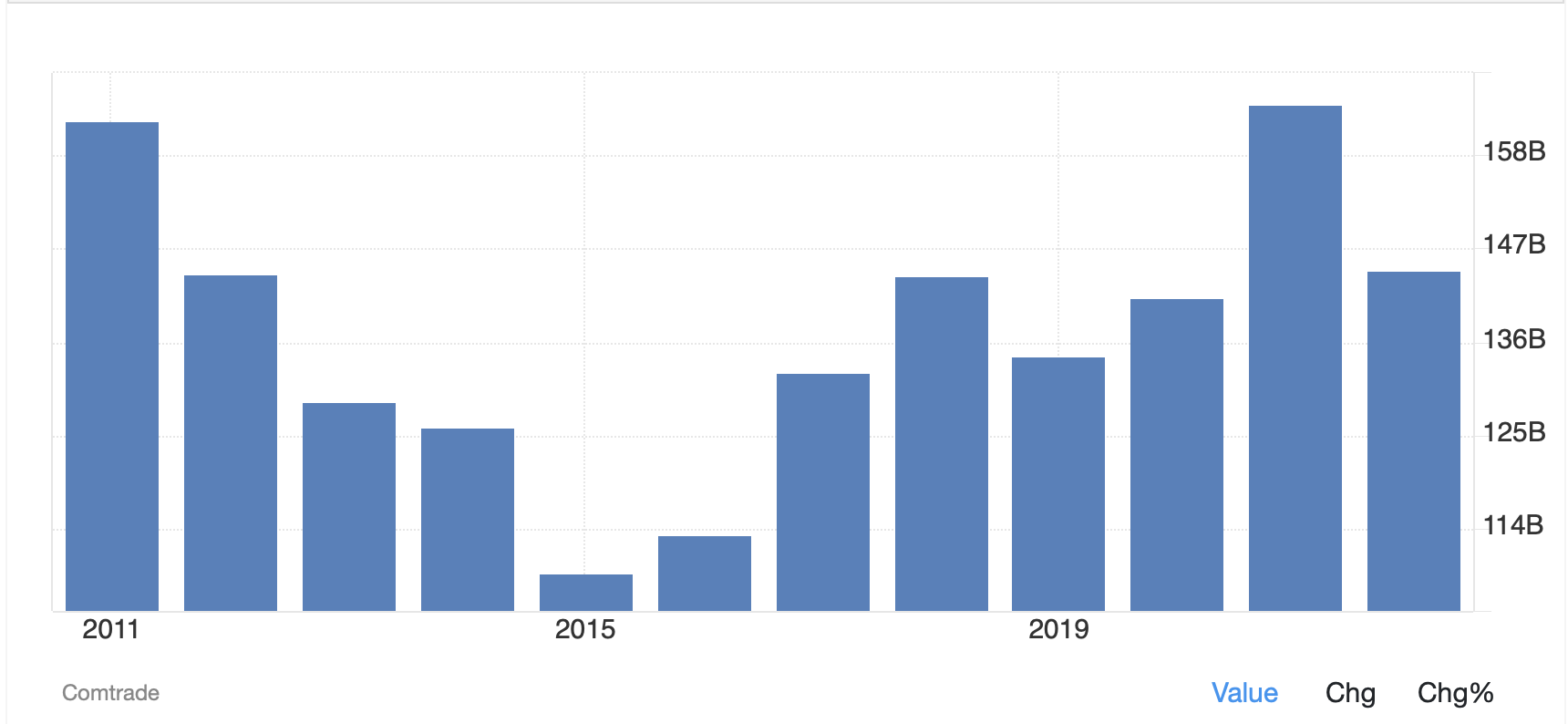
The other story in markets has been the ongoing ructions in the Chinese renminbi market.  It is key to understand that this is directly related to the yen story above as China and Japan are fierce competitors in many of their export activities.  But of even more concern to Xi and his gang is that Japanese exports to China are growing so rapidly and Japan ran a trade surplus with China in December (the last month with data released).  When you are a mercantilist nation like China, having a key competitor, like Japan, allow its currency to weaken dramatically against your own is a major problem.  Last week I highlighted the dramatic decline of the yen vs. the renminbi, and that has not changed.  Below is a chart from tradingeconomics.com showing Japanese exports to China ($billions) showing just how much this trend has changed and continues to do so.

Ultimately, both of these countries rely on exports as a critical part of their economic growth and activity, and in both cases, exports to the US and Europe are crucial markets.  If the Japanese continue to allow the yen to weaken, China has a problem.  Remember, Japan does not have capital controls, so while they don’t want the yen to collapse, they are perfectly comfortable with capital outflows in general.  China, on the other hand, is terrified of massive outflows if they were to even consider relaxing capital controls.  The fact is both companies and individuals work very hard to get their money out of the country.  This is one reason that gold is favored there by the population, and the reason that the government banned bitcoin as it was an open channel for funds to leave the country. 

This battle has just begun and seems likely to last for quite a while going forward.  The Chinese are caught between wanting to devalue the renminbi to compete more effectively and maintaining a stable exchange rate to demonstrate there are no fiscal or economic problems in the country.  Alas for Xi and the PBOC, never the twain shall meet.  I would look for a continuation of the recent market volatility here as they will use that uncertainty to discourage large position taking by speculators.  But, as I have maintained for a long time, I expect that USDCNY will trade to 7.50 and beyond as time progresses.

And that’s really it for today.  Ultimately, very little happened in markets overnight, certainly there were no changes in the recent data trajectory nor in any commentary from speakers (other than that mentioned above).  It is a holiday week and a key piece of data, PCE, is set to be released on a broad market holiday this Friday.  Do not look for large moves before then.

There is no US data due today but we do hear from Fed Governor Christopher Waller this afternoon so there is an opportunity for some market movement then.  But for now, consolidation seems the most likely outcome.

Good luck

Adf