A Final Bronx Cheer

Though markets are desperate for Jay
To cut, there is fear that he’ll say
It’s not yet the time
In this paradigm
As tariffs have caused disarray
 
But truly, Chair Jay’s greatest fear
Is that ere October this year
The Prez will have chosen
A new Chair and frozen
Him out with a final Bronx cheer


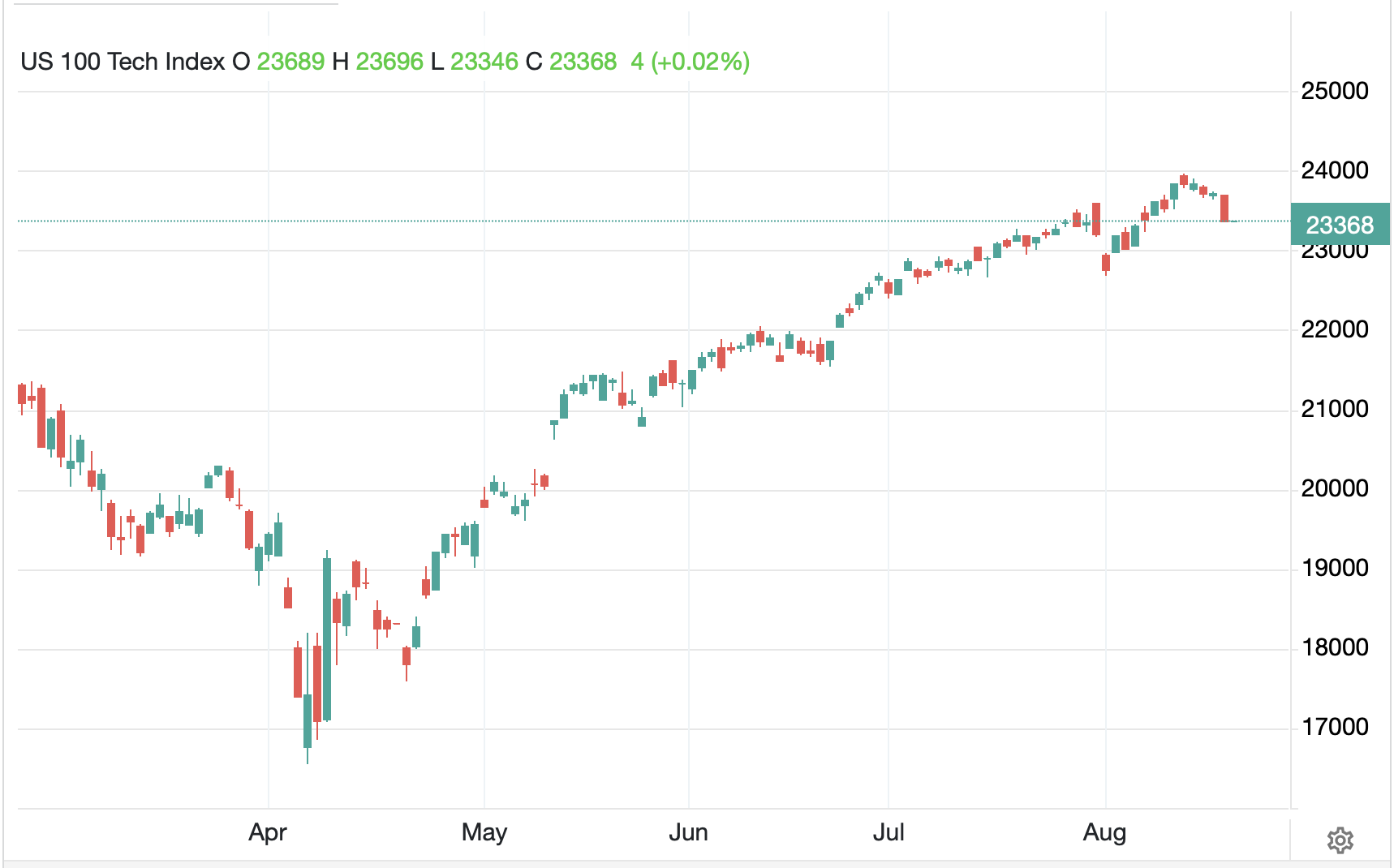
Yesterday saw the first substantial equity market move in nearly 3 weeks, with the NASDAQ declining 1.5% as concerns arose that the current extremely high valuations would have a more difficult time being maintained if the Fed does not ease policy as widely expected next month.  This resulted in all the Mag7 declining, which given they have been the driving force higher in the market, necessarily resulted in overall index declines.

Source: tradingeconomics.com

Of course, the question is, what made yesterday any different than previous sessions.  There were no earnings results of note, and arguably, the biggest tech news was the story about the US government taking a stake in Intel, something that seems likely to have been a positive.  However, there has been an increase in chatter about what Chair Powell is going to say on Friday at his Jackson Hole speech.  Notably, in the SOFR options market, there are a large, and still increasing, number of bets being placed that Powell will indicate 50bps is on the table in September.  But Wall St analysts continue to side with the patience crowd, explaining that while the current policy settings may be slightly restrictive, they are hardly suffocating for the economy.

While Powell has repeatedly blamed an uncertain impact of tariffs on his decision to maintain current policy settings, just like everything else, this is becoming extremely political.  Trump’s allies are lining up behind him and calling for immediate rate cuts to help support the economy.  At the same time, Trump’s political foes remain focused on preventing any Fed action that might help Trump, although they couch their arguments in terms of maintaining Fed ‘independence’.

However, last night was instructive in that two central banks, New Zealand and Indonesia, cut rates further while Sweden’s Riksbank, though standing pat, explained that more cuts are possible, if not likely, later this year.  While the PBOC did not cut rates, the pressure there is building as the economic situation is very clearly slowing down, as discussed last week after their data releases.  So, with most of the world cutting rates (Japan being the notable exception), pressure continues to mount on Powell and the Fed to pick up where they left off last December.

Hanging over both Powell’s speech and the September rate decision is the fact that Treasury Secretary Bessent explained yesterday that interviews for the next Fed chair would begin around Labor Day, just two weeks from now, and nearly eight months before Powell’s term ends.  This will almost certainly weaken Powell as other FOMC members and the market will look to whomever is selected for their views, with Powell serving out his term as a lame duck.  In fact, it is for this reason that my take is Powell’s speech at Jackson Hole will be less about policy and more an attempt to burnish his legacy.

And that’s where things stand.  With no data of note today, and yesterday’s housing data being mildly positive, but not enough to change macroeconomic opinions, the narrative writers are looking for something to say and Powell’s speech is where they have landed.  Absent a run of declining days, I put no stock in a change in the market temperature at this point.  So, let’s see how things behaved overnight.

In Asia, the Nikkei (-1.5%) had a rough night in a direct response to the US tech-led selloff.  Given that US markets have stabilized this morning, with futures unchanged at this hour (7:25), we need to see a continuation here before expecting a significant further decline there.  China (+1.1%), however, bucked that weaker trend, ostensibly on hopes that the ongoing trade talks with the US will prove fruitful.  Elsewhere in the region, Korea (-0.7%) and Taiwan (-3.0%) were both hit on the tech selloff blues but other markets, with less exposure to that sector were fine.  In Europe, it is a mixed picture with the DAX (-0.4%) the laggard after weaker than expected PPI indicated that current ECB policy needs to be more accommodative to help the country but may not be coming soon.  However, the rest of the continent is little changed.  surprisingly, UK stocks (+0.3%) are holding up well despite higher-than-expected CPI data which has adjusted analysts’ thoughts on whether the BOE will be able to cut again at their next meeting.

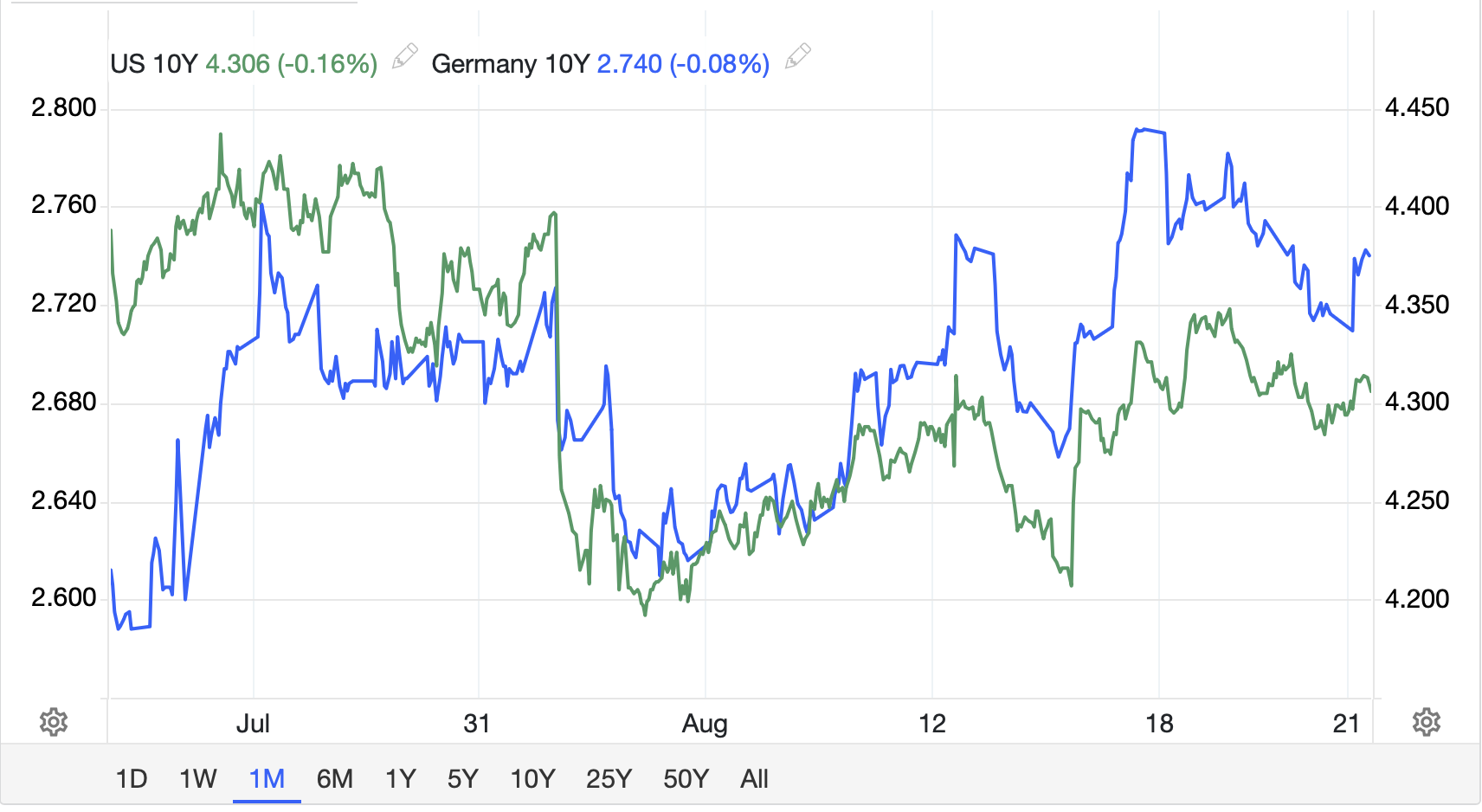
In the bond market, Treasury yields (-1bp) continue to trade in the middle of that band I showed yesterday, while European sovereign yields have also slipped between -1bp and -2bps this morning after the softer German price data.  The UK (-4bps) is a surprise as I would not have expected lower yields after a higher inflation reading.  Perhaps this is an indication that investors are expecting a much worse economic outcome from the UK going forward.

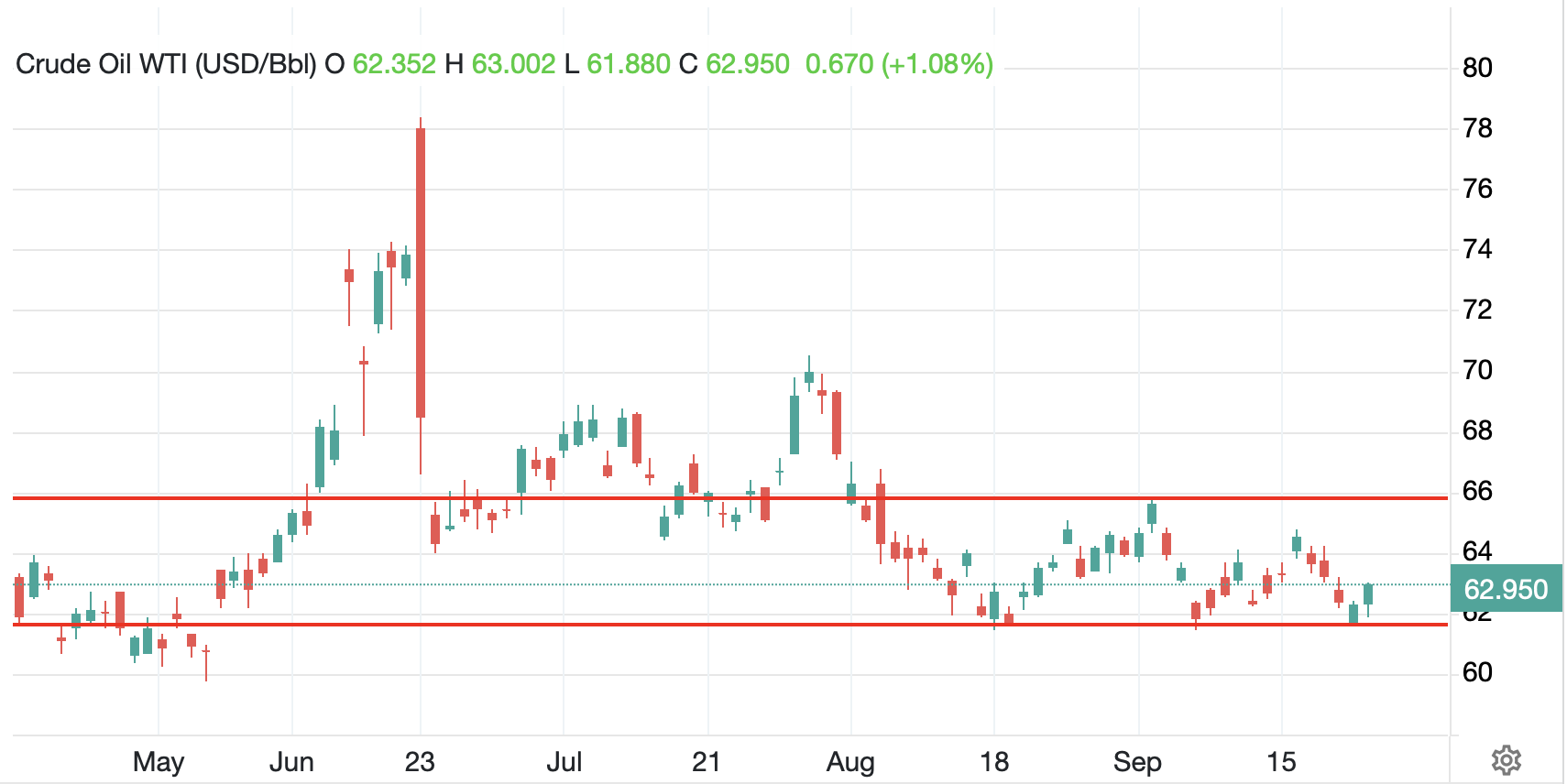
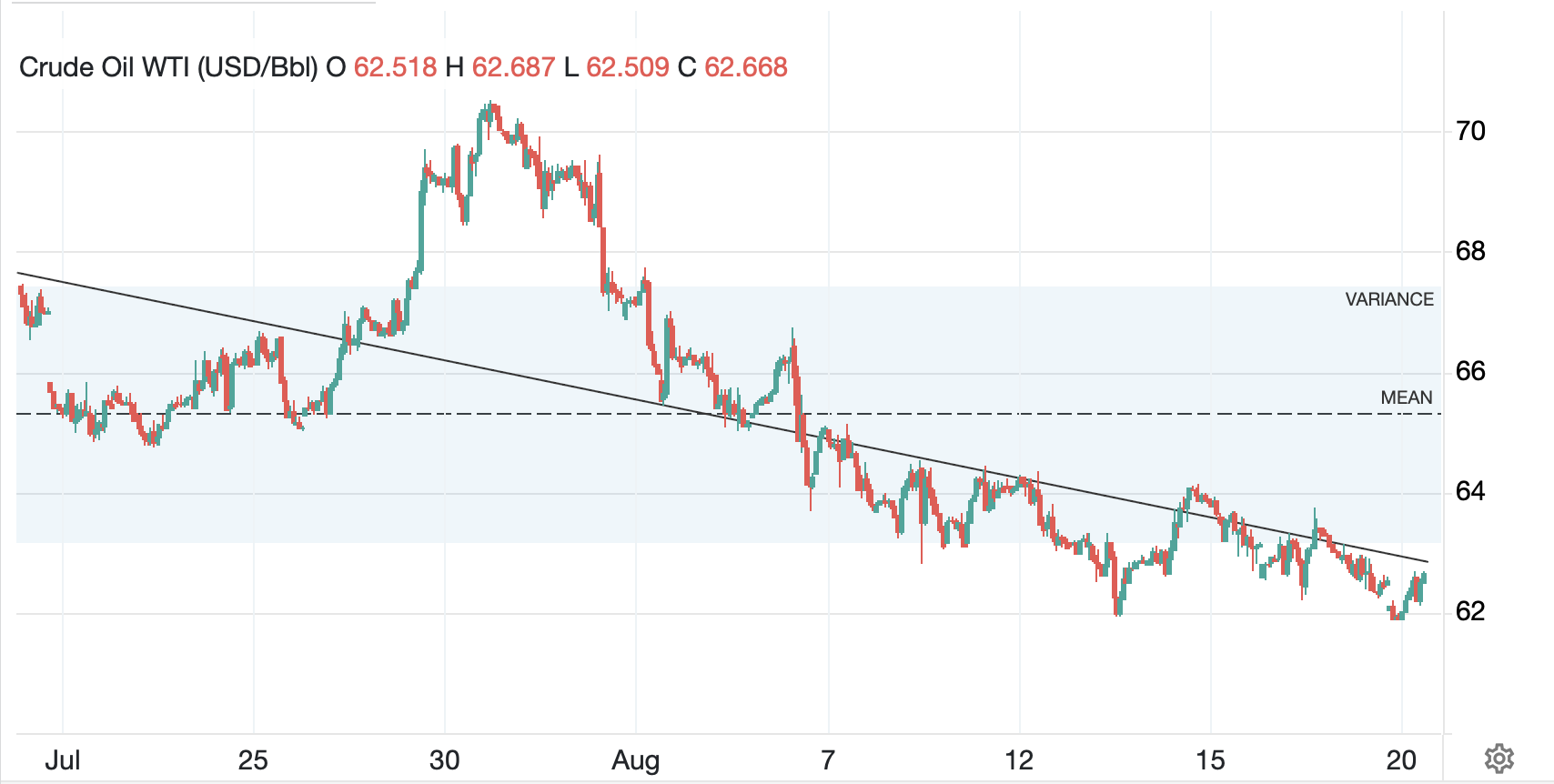
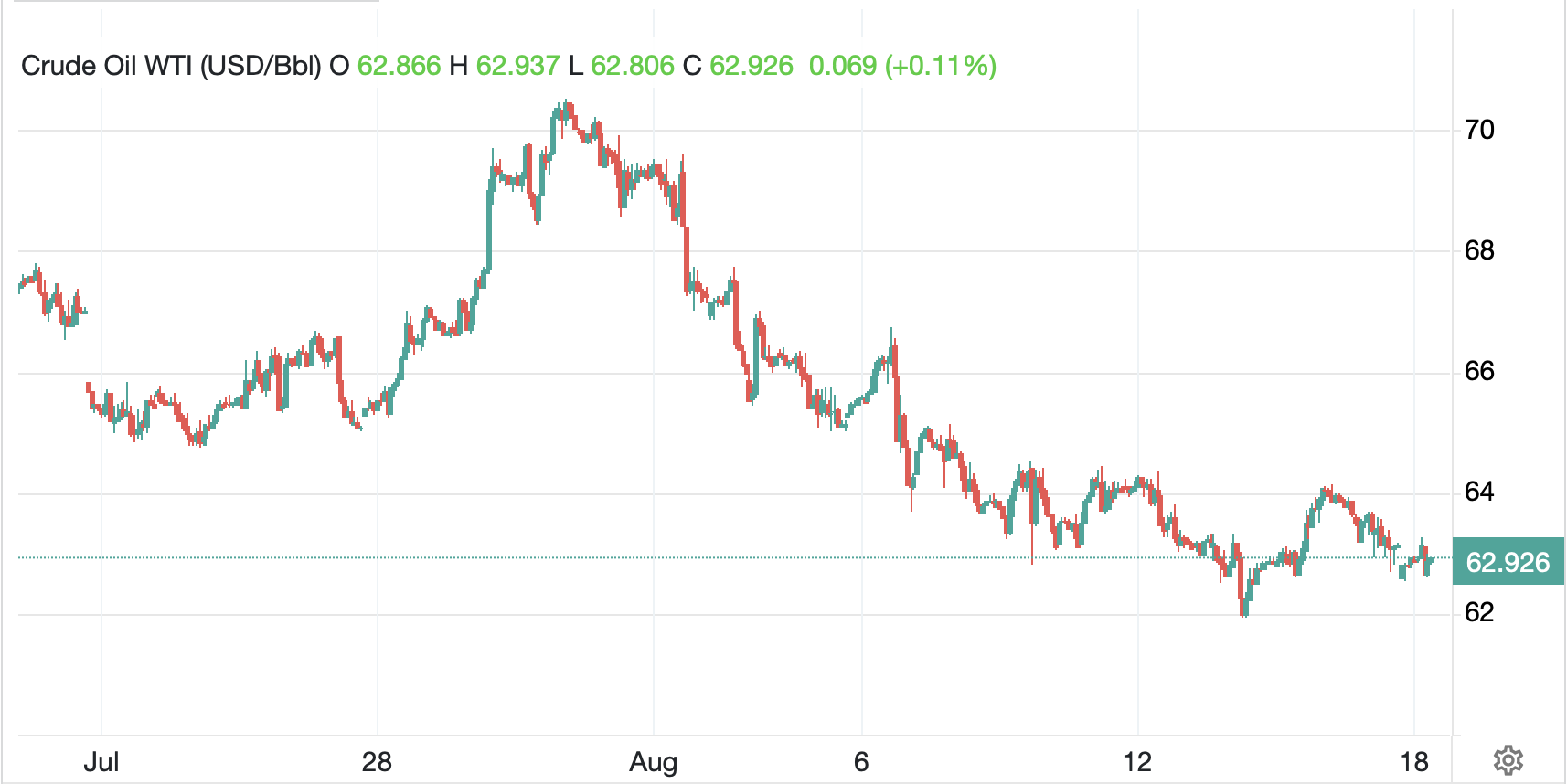
In the commodity markets, oil (+1.3%) is bouncing, but it remains in a well-defined downtrend for now as per the below chart.

Source: tradingeconomics.com

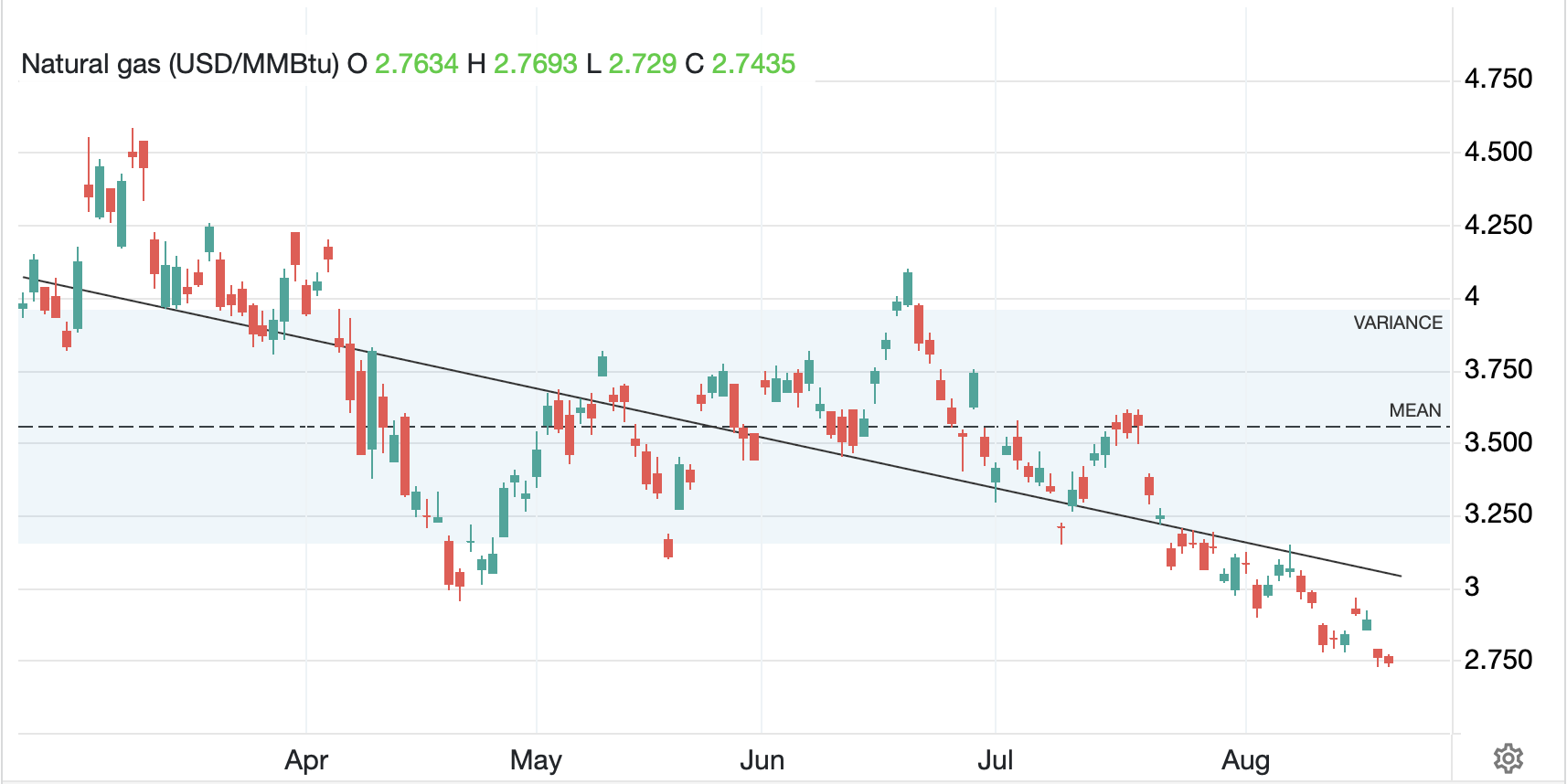
To change this trajectory, we will need to see something alter the production schedule, which with peace on the table in Ukraine seems likely to bring more oil to market not less, or we will need to see a significantly better economic outlook that drives a substantial increase in demand, something which right now seems unlikely as well.  I cannot get on board the higher oil price bandwagon at this time.  One other thing weighing on oil is the fact that NatGas has been trending lower for the past 6 months and is now at levels not seen since last November.  In fact, those two charts look remarkably similar!

Source: tradingeconomcis.com

There is a real substitution effect here and currently oil is trading at a price that is about 4X the energy price of NatGas.  Until that arbitrage closes, and it will eventually, oil will have difficulty rallying in my view. 

In the metals markets, gold (+0.4%) which sold off a few dollars yesterday is rebounding although both silver and copper are soft this morning.  These markets are just not that interesting right now.

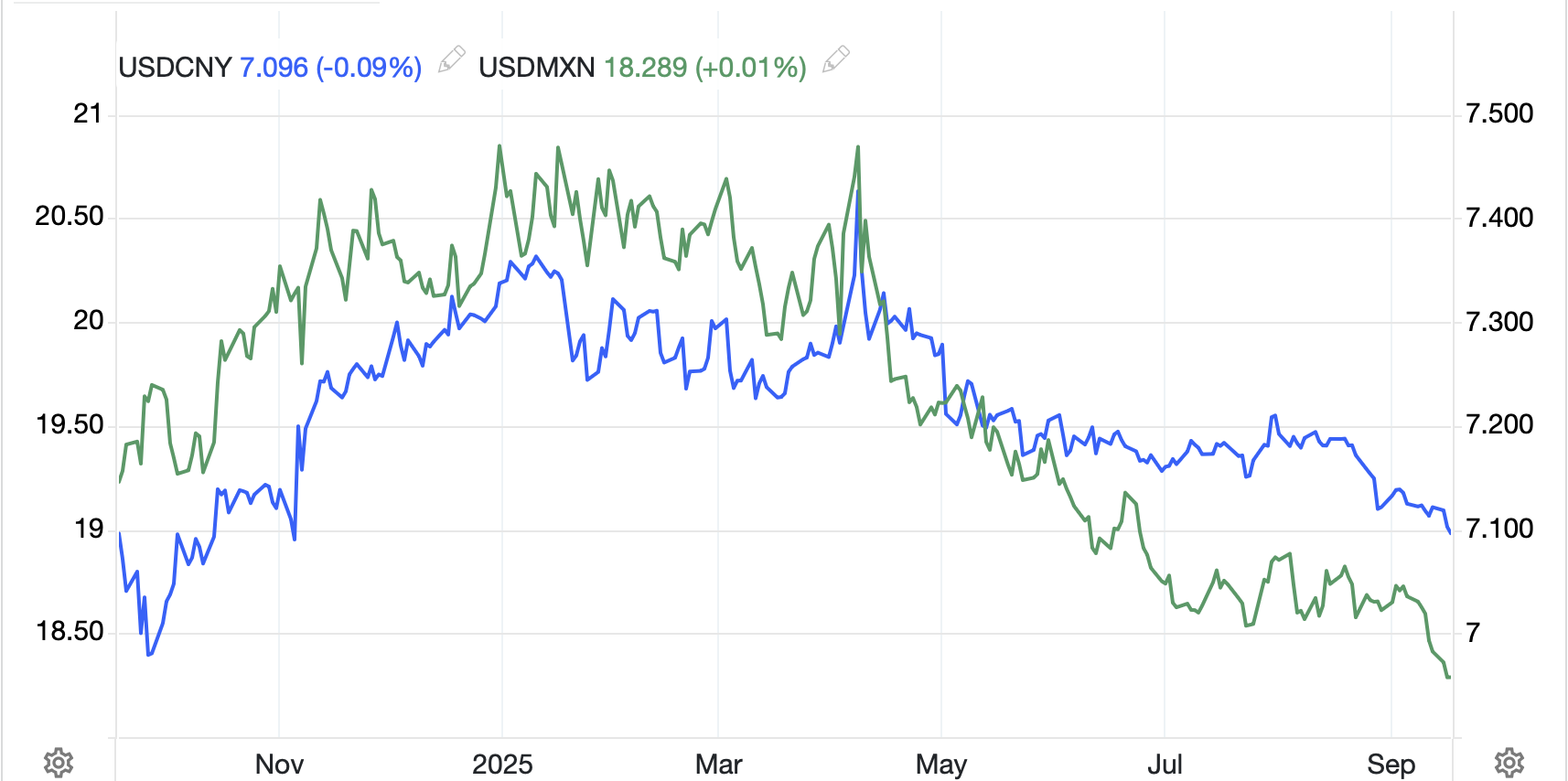
Finally, the dollar is little changed this morning with one real outlier, NZD (-1.2%) which responded to the dovish tones of the RBNZ last night and is pricing in more interest rate cuts now.  KRW (-0.4%) also fell on concerns over trade and the semiconductor results but otherwise, there is very little ongoing here.

The only data this morning is EIA oil inventories with a small draw anticipated.  The FOMC Minutes come at 2:00 and there will be a lot of digging to see if other members seemed to agree with Bowman and Waller in their dissents at the last meeting.  Bowman spoke yesterday, but was focused on her role as chief regulator, not monetary policy, although we hear from Waller this morning.

A down day in equities is not the end of the world despite much gnashing of teeth.  It remains difficult to get excited about markets right now.  Perhaps Mr Powell will shake things up on Friday, but my sense is we will need to wait for the next NFP data to get some action.

Good luck

Adf
PS. A reader explained to me that in Australia, black swans are the norm, not the remarkable case as here in the US.  I guess we will need to find a new term to discuss an unexpected surprise.

What Would You Choose?

As summer meanders along
No market is weak, nor’s it strong
But traders keep trading
With hope masquerading
As knowledge, though they know they’re wrong
 
The question is what sort of news
Can catalyze changes in views?
Seems rate cuts will not
And peace had its shot
Dear readers, just what would you choose?


My friend JJ (he writes the Market Vibes note) made a profound comment that described the current situation so well, I think it is worth repeating: 

It is not that the news and fundamentals are uninteresting or unimportant. They are. But vol control has anesthetized every future, ETF, equity, and FX market, and the managers of it are making trillions on it. Therefore, it is likely this narcolepsy won’t end for a while.”

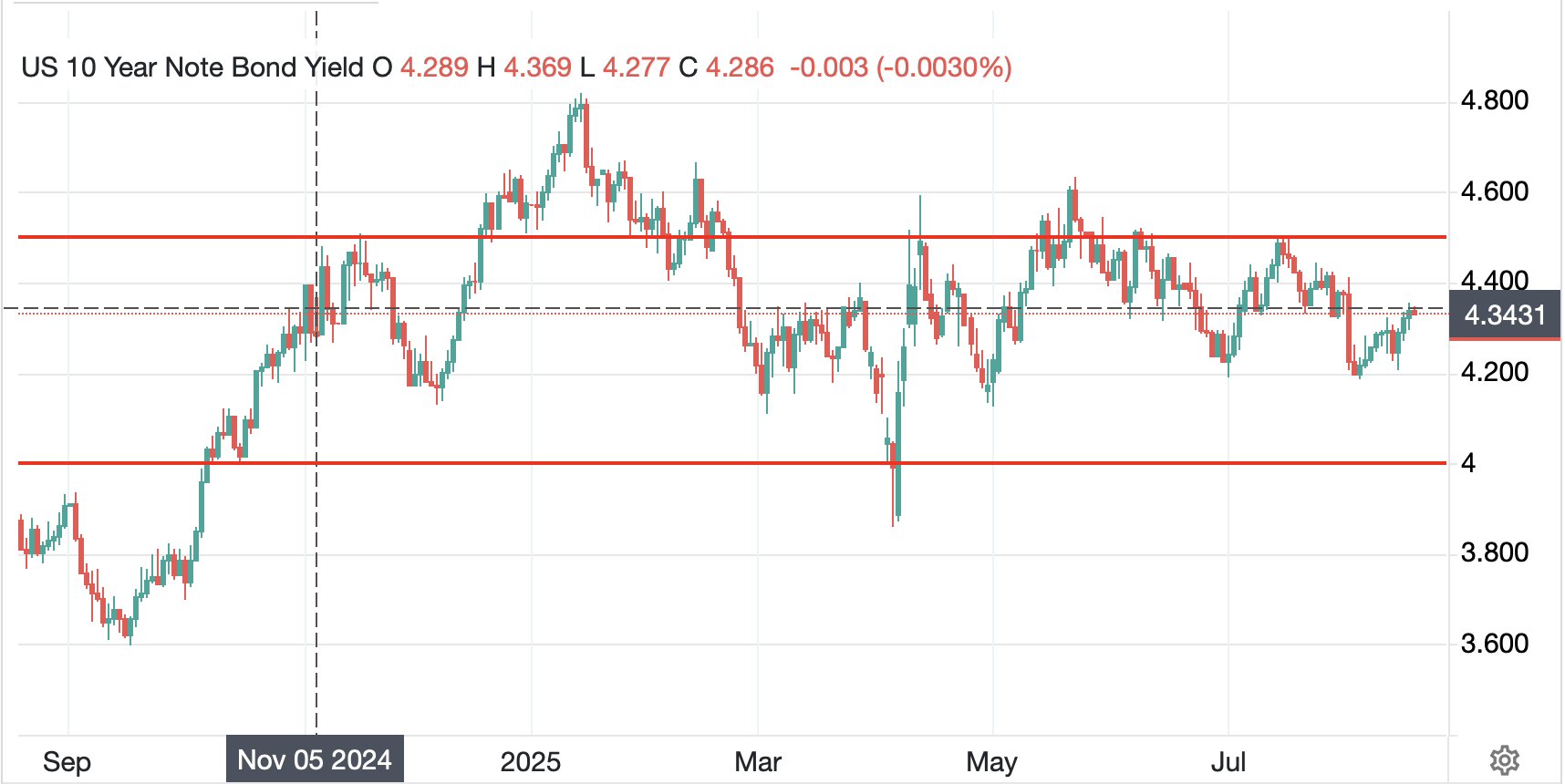
A point he has been making of late, and one with which I cannot argue, is that everything that is not algorithmic is dumb money as the algos drive it all.  And it is a fair point.  Market activity has ground to a halt, and while I have no proof, I would estimate it is even quieter than the typical year’s summer doldrums.  That seems remarkable given the panoply of news stories that exist and in other times would have had a major market impact.  Consider, war and peace in Ukraine, massive changes in federal regulations and administration priorities, and remarkable electoral shifts around the world, yet none of it matters.  Consider this chart of the US 10-year Treasury:

Source: tradingeconomics.com

The yield, which most afficionados agree is critical to not just US, but global, financial markets and activity, has largely traded between 4.0% and 4.5% since well before Mr Trump was elected.  The one thing that cannot be said is that the Trump administration has been boring.  More has happened on the fiscal front in the past six months than in entire presidential terms and yet yields are essentially unchanged since November 5th when Trump was elected.

JJ’s view is the massive increase in the use of options by retail traders has become the driving force.  Retail buys options, paying premium which decays away and that value accrues to the market making algorithms. The amounts of premium are huge, in the $trillions, and it is a straightforward business model that reaps huge rewards, so a lack of movement is the goal.  I cannot argue with that either.

However, the one thing I have learned over my too many years in the market is that no matter how smart you are, no matter how well you have considered the potential outcomes, reality will be different, and at some point, there will be a tipping point to change the market dynamic.  After all, Covid was not expected, nor even more importantly, the government responses to it which is what drove the market volatility.  I am pretty sure there is another true black swan out there, something nobody is discussing as it currently seems irrelevant or impossible, but which will alter the game.

I spent my trading career learning to manage risks while running a global FX options business, trying to profit, but more importantly preventing the huge drawdowns that end careers.  I spent my sales career trying to help my clients understand their FX risks and learn to mitigate them in the most cost-effective manner possible.  What I learned over that 40+ years is that while risks sometimes seem unimportant, or unimaginable, they exist.  Do not mistake the current state for the future state.  Things will change, although how I cannot currently imagine.

With that as preamble, let’s look at just how little things are moving.  Stocks did nothing in the US yesterday and movement overnight in Asia was lackluster as well (Nikkei -0.4%, Hang Seng -0.2%, CSI 300 -0.4%).  As I wrote above, there is just not that much that is exciting investors right now.  Europe, however, seems to be taking a positive stance on the Oval Office meeting with many of their leaders as perhaps peace in Ukraine, if it is coming, will be helpful for the continent.  Ostensibly, Presidents Trump and Putin discussed a closer economic relationship between the US and Russia, which if that came to pass, would undoubtedly rearrange some things in markets, largely to the benefit of Europe.  As to US futures, they are unchanged this morning, again.

Bond markets in Europe are exactly unchanged across the board, so much so that you would expect it was a holiday there.  Treasury yields have edged lower by -1bp, but as I explained above, are simply range trading.

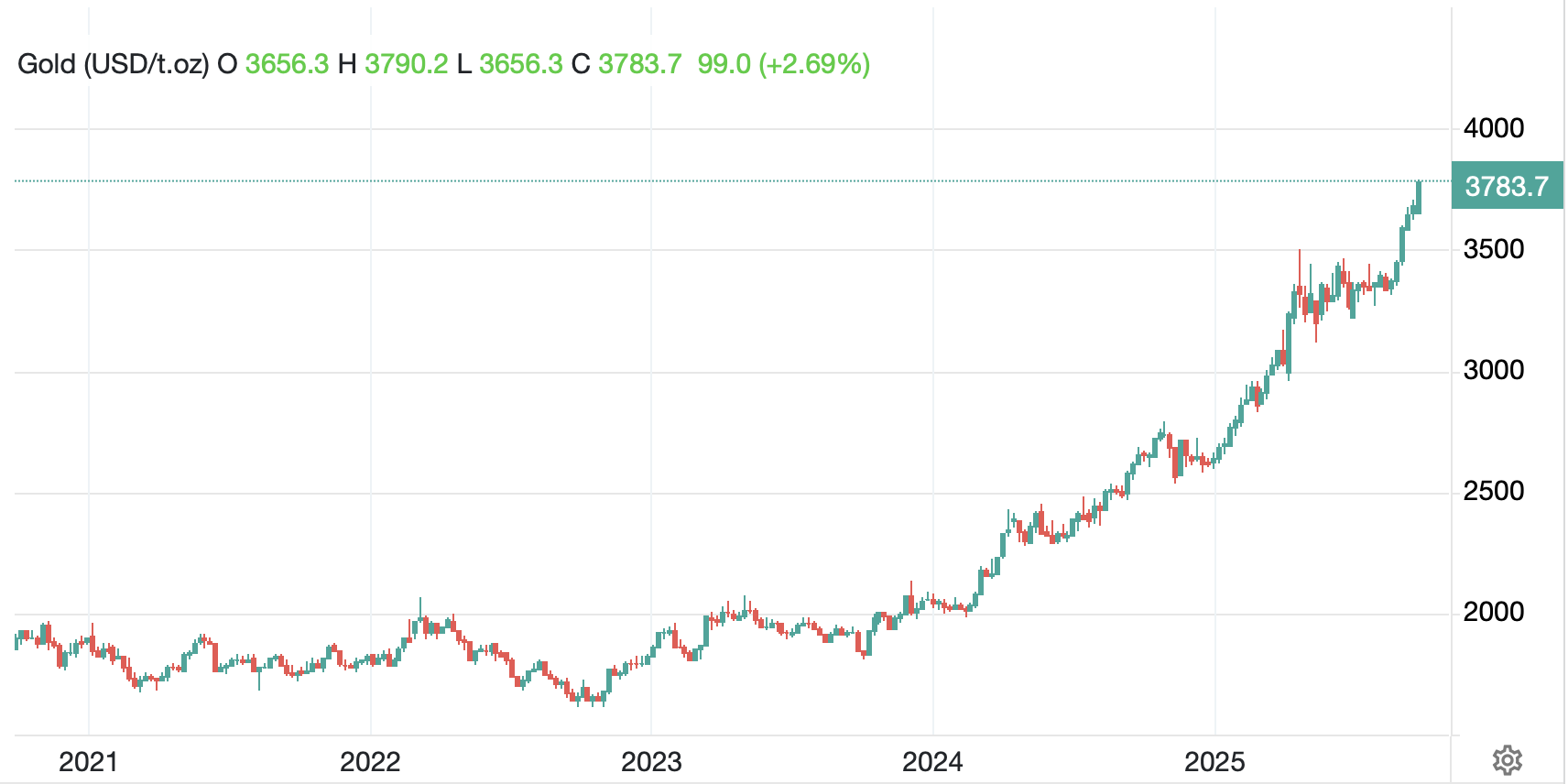
I would argue the commodity markets are where there is the most potential for movement going forward as any type of US-Russian economic détente would almost certainly reduce oil prices substantially.  And, coincidentally, WTI (-1.25%) is falling this morning as hopes for a direct meeting between Putin and Zelensky, and with it the end of the war, are increasing.  Weirdly, gold (+0.35%) is not declining on that news, despite the idea that gold represents a haven against war.  Perhaps gold represents a haven against money supply growth, which if there is an economic détente, you can be sure will increase.  As to the other metals, very little movement there either.  In the vein of the lack of activity, perhaps the below gold chart is even a better descriptor of just how little activity has been going on since spring.

Source: tradingeconomics.com

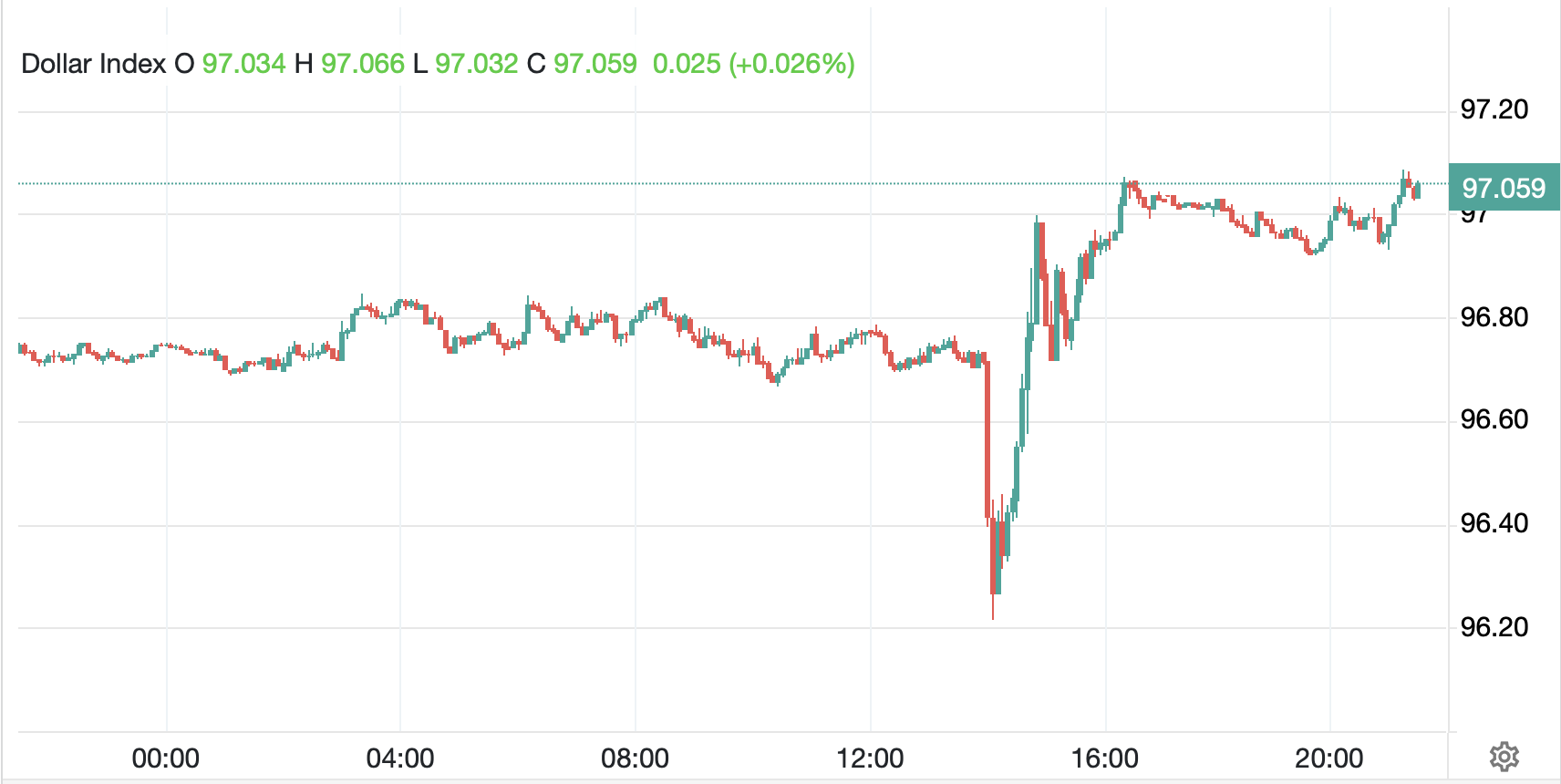
Finally, the dollar is a touch softer this morning, but it, too, remains rangebound.  While much has been made of its weakness in the first half of the year, as though that calendar period had some special significance (it doesn’t), here too, things have simply ground to a halt.  Using the dollar index (DXY) as our proxy, you can see that this market, too, has done nothing for months.

Source: tradingeconomics.com

Whether it’s G10 or EMG currencies, the movement remains desultory at best, and catatonic may be a better description.

So, let’s look at the data this week that will precede Chairman Powell’s speech Friday morning.

TodayHousing Starts1.30M
 Building Permits1.39M
WednesdayFOMC Minutes 
ThursdayInitial Claims226K
 Continuing Claims1960K
 Philly Fed6.0
 Flash Manufacturing PMI49.5
 Flash Services PMI53.7
 Existing Home Sales3.91M
 Leading Indicators-0.1%
FridayPowell Speech 

Source: tradingeconomics.com

I think it is worthwhile to consider why we look at the Leading Indicators.  The original design was that it tracked a series of indicators that historically had presaged economic activity.  Ahead of recessions, these indicators turned lower and so it seemed a pretty good fit.  However, as you can see from the below chart from conference-board.org, the creators of the index, since 2021, when the index turned lower, it has been completely out of sync with the economy’s outcome.

As I have repeatedly written, models that were created pre-Covid, and many pre-GFC, simply no longer have any relevance to today’s reality.

On the whole, the most likely outcome today, like every day lately, is limited movement in either direction.  While I am sure a black swan exists, he is currently hibernating.

Good luck

Adf

Falling Like Rain

Trump’s meeting with Putin went well
At least that’s the best we can tell
Now, later this week
Zelenskiy will speak
With Vlad, and say you go to hell
 
So, will peace be found in Ukraine?
Or will fighting grow once again
If looking for clues
One thing we might choose
Is oil that’s falling like rain


The aftermath of the Trump-Putin meeting on Friday has certainly been interesting.  While the administration, as would be expected, highlighted any and all positives as the president pushes for an uncomfortable peace process, the administration’s opponents, which include not merely the Democratic party, but most of Europe as well, are concerned he has just sold Ukraine down the river.  I am not nearly smart enough to have an informed opinion on this issue, which is likely the case for almost every commentator as well, but I know I come down on the side of anything that moves the conversation toward an end to the war and a lasting peace, even if the terms aren’t the ones either side would like, is a step in the right direction.

But this is not a political commentary, rather we are trying to understand market behavior and remain highly cognizant of global events on markets.  With that in mind, arguably the market most directly impacted by this war is oil and based on what we have seen over the past month, during which time the peace process accelerated, the participants in the oil market appear to be saying that Russian oil is coming back to the market on an unfettered basis.  One need only look at the chart below, which shows a very clear downtrend to understand.

Source: tradingeconomics.com

Certainly, some of this price decline may be attributed to the belief that the long-awaited recession in the US is upon us, although given that has been a view for nearly three years, it is not clear to me why this month is the moment.  I understand that the payroll data was weak, but I also understand that Retail Sales data on Friday was pretty strong.  The observation that the goods and services sectors of the economy are out of sync remains appropriate, I believe.  As long as that remains the case, a significant downturn seems unlikely, but so too does a significant growth spurt.  In fact, this is one of the reasons I take the decline in the price of oil to be a harbinger of an end to the Ukraine war.  

Come Friday, we’ll hear Chairman Jay
As he tries, his views, to convey
No doubt he’ll explain
Inflation’s a bane
And that’s why, rate cuts, he’ll delay
 
But also, employment is key
And so, he will want us to see
His minions are willing
To cut, if distilling
The data less growth they foresee

Arguably, the other big market story this week is the speech that we will hear Friday morning from Chairman Powell at the Jackson Hole Symposium.  Many in the market continue to look to Powell and the Fed for their guidance although my take is the Fed’s impact on market’s has been waning over time as fiscal dominance continues apace.  Nonetheless, it is still a key moment for the market as those who have been anticipating a Fed cut in September, as well as at least two more before the end of the year, will want confirmation that the weak payroll data was the trigger.  And while some of the Fed speakers since the NFP data have started to move toward a more dovish stance, I would contend the majority is still on the patience bandwagon.  

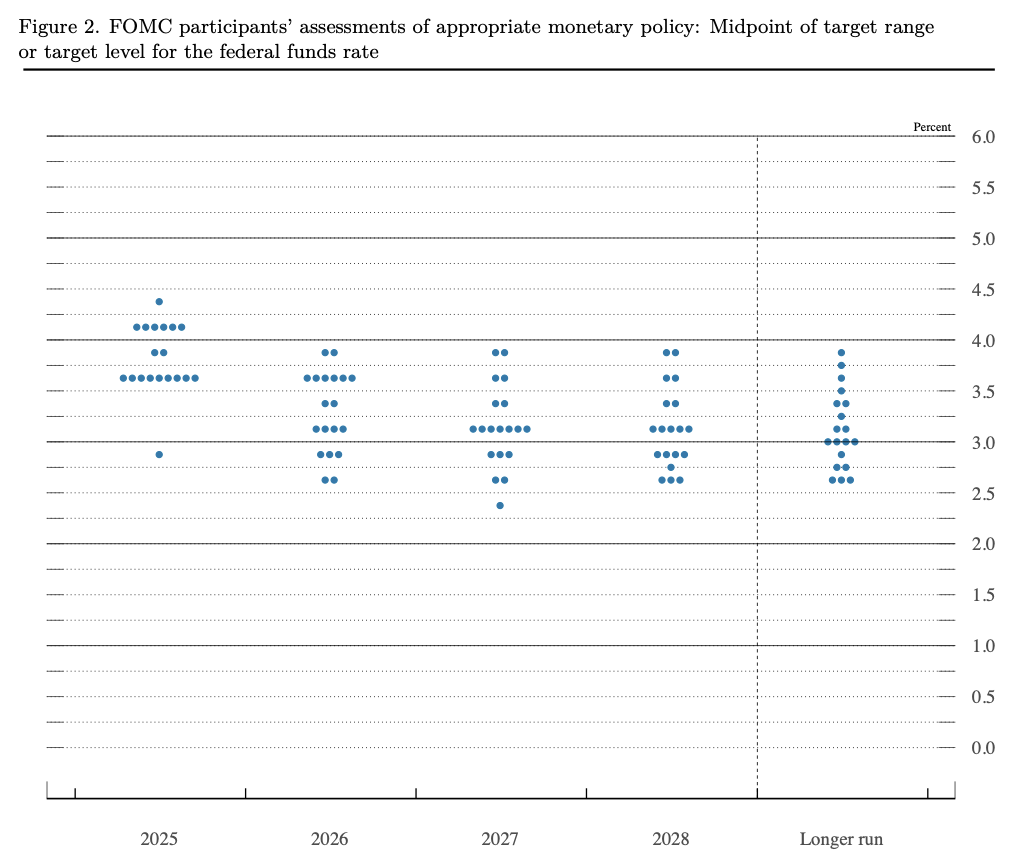
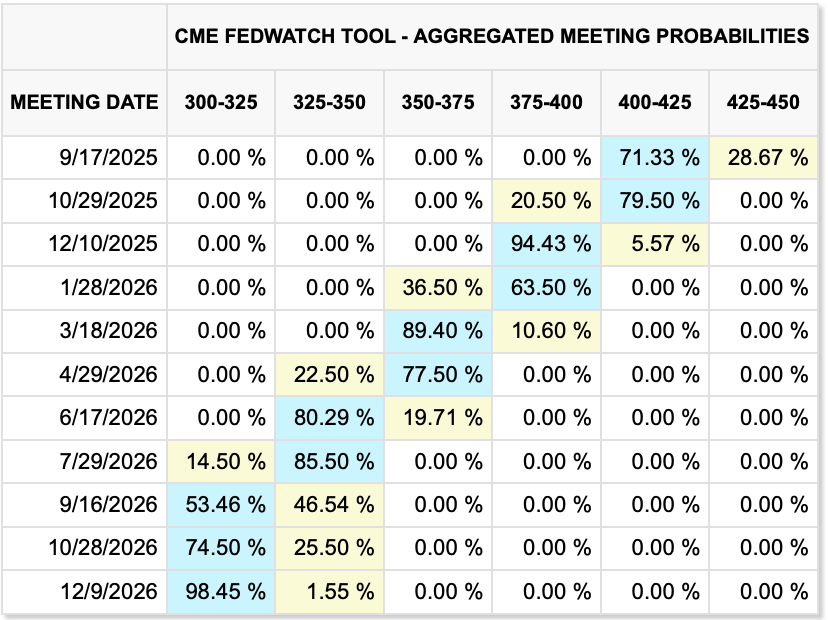
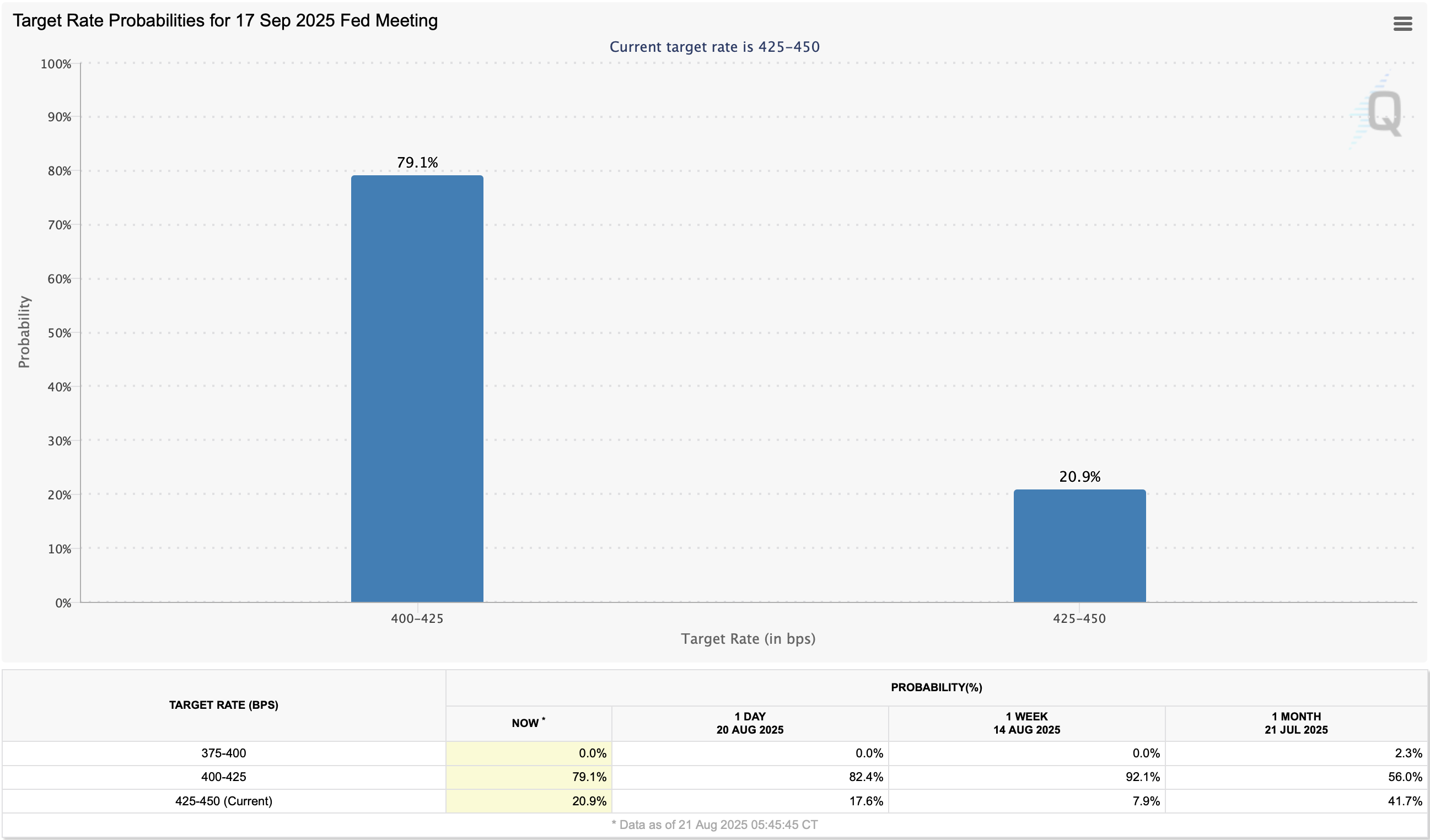
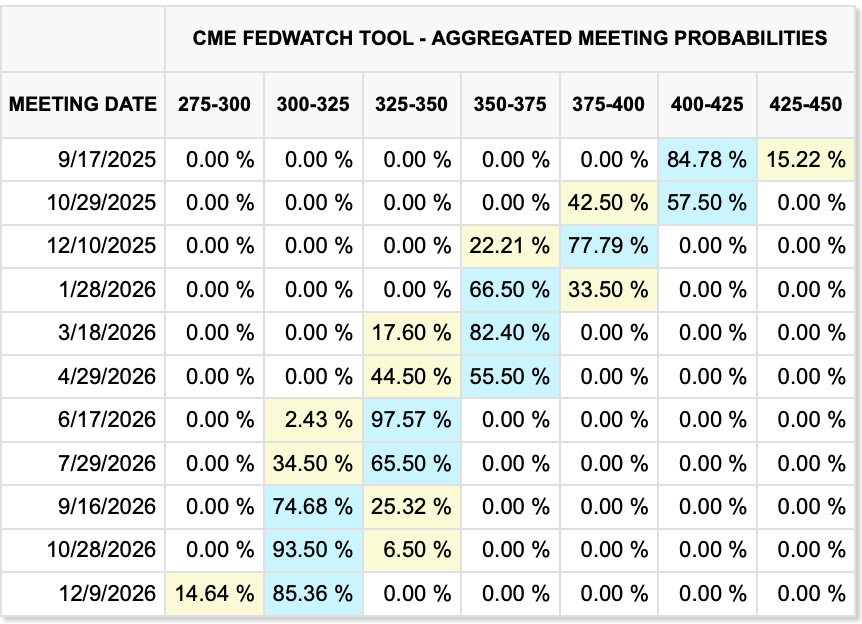
With that in mind, a look at the Fed funds futures markets shows that although the probability being priced in for a cut next month has fallen from its peak level, it remains extremely high at 85% with a 78% probability of two cuts by December and a third cut now likely by March.

Source: cmegroup.com

Remember, the reason this is so closely watched is the strong belief that when the Fed cuts rates, equity prices rise.  However, one need only look at a chart to note that frequently, equity markets are falling sharply when the Fed is cutting Fed funds.  That makes sense because given the reactive nature of Fed funds and the Fed in general, it is typically responding to weakness that is already evident in equity prices.  Which begs the question, why does everyone want the Fed to cut if it implies a weak economy and already declining stock prices?

Many measures continue to show equity valuations quite high, and there have been numerous calls that a correction in equity markets around the world is due.  I understand that view and have even bought put protection as it is pretty cheap to do so.  But I have given up on calling for a recession.  I can only be wrong for so long before I accept the evidence that one has not yet come, nor is obviously imminent.

Ok, let’s look at markets this morning.  While there was a late selloff in the US on Friday, Asian markets saw the world as a brighter place.  Perhaps they were encouraged by the Alaska meeting, or perhaps by the view that the Fed will cut, because there was no data there of which to note.  But the Nikkei (+0.8%), CSI 300 (+0.9%) and Australia (+0.25%) all managed gains although the Hang Seng (-0.4%) slipped a bit.  There was, however, a major laggard with Korea’s KOSPI (-1.5%) suffering on the back of concerns over potential new tariffs on Korean chips.  European equities, though, are on a bit shakier footing.  Perhaps it is the concern that despite their collective voice on Ukraine, they remain largely irrelevant.  Or perhaps it is the realization that the trade surpluses they have run in the past are set to decline as evidenced by the data showing Spain’s deficit growing to -€3.59B increasing more than €1B and the Eurozone’s surplus shrinking to €7B, down from €16.5B last month.  So, declines of -0.4% to -0.8% are today’s results in major markets there.  As to the US, futures are little changed at this hour (8:00).

In the bond market, yields have been edging lower this morning with Treasury yields (-2bps) slipping despite the stronger Retail Sales and PPI data from last week, while European sovereign yields are all lower by -3bps, perhaps anticipating slower growth overall.

In the commodities space, oil (+0.5%) has bounced from its overnight lows but remains in its downtrend.  Gold (+0.3%) continues to hover at its pivot point of $3350 or so while silver (+0.15%) and copper (-0.4%) are mixed this morning.  Away from the tariff story on copper, it remains an important economic indicator, so we must watch it closely.

Finally, the dollar is ever so slightly firmer this morning with the euro (-0.25%) leading the G10 slide although both Aussie and Kiwi are slightly firmer this morning.  In the EMG bloc, MXN (-0.4%) is the laggard along with HUF (-0.4%) and CZK (-0.4%) although the rest of the bloc, while mostly softer, hasn’t moved that far.  It does feel like a dollar story.

On the data front, as I am running late and there is nothing as important as Friday’s Powell speech, I will list it tomorrow.  Overall, my take is peace is nearer than further and that should adjust spending from fighting to rebuilding but spending it will be.  I expect to hear more about recession going forward, although it is not yet clear to me one is upon us.  While the dollar’s trend remains lower, I have a feeling we are at the end of that move so beware.

Good luck

Adf

Just a Bad Dream

Before yesterday traders whined
‘Bout how much that vol had declined
But President Trump
Caused copper to dump
And still, Chairman Powell, maligned
 
So, chaos is now the new theme
Though most hope it’s just a bad dream
And ere the week ends
Based on recent trends
We could see, results, more extreme


It isn’t often that copper is the talk of the town, but this is a new world in which we live, and as I’ve repeatedly explained, all that we think we knew about the way things work, or have worked in the past, is generically wrong.  It is with this in mind that I lead with a chart of the copper price, which after having rallied dramatically back in April, after Liberation Day, and again in July, both times on the back of tariff announcements, collapsed yesterday when President Trump altered the conversation by explaining that tariffs on copper would not be on the raw metal itself, but rather on refined products instead.  As you can see from the chart, this resulted in a massive decline, nearly 23% in the past twenty-four hours. 

Source: WSJ.com

Essentially, the US price, as traded on the COMEX, returned to be in line with the ROW price, as traded on the LME.  That doesn’t make the move any less dramatic, but the question of how long those price differentials could be maintained was always an open one.  At any rate, that was the biggest mover of the day yesterday and naturally, it had knock-on effects elsewhere with the entire metals complex falling sharply (Au -1.85%, Ag -3.0%, Pt -9.7%) as well as some currencies that are linked to those metals like CLP (-1.5%) and ZAR (-1.4%).  Remember how much complaining there was because market activity had slowed so much?  I bet most folks are looking wistfully at that pace this morning!

Turning to the other key focus of yesterday, the FOMC meeting, the FOMC statement was exactly as expected, with continued focus on “solid” labor market conditions and moderate economic activity acting as the rationale to leave rates on hold.  As widely expected, both Governors Bowman and Waller dissented, each calling for a 25 basis point cut.  The two schools of thought continue to be 1) headline data releases have been masking underlying economic weakness (declining home sales, declining air travel and restaurant activity); and 2) while those issues may be real at the margin, the fact that financial markets continue to rise, with significant speculative activity in things like meme coins and cryptocurrency in general, as well as Private Credit, indicate there is ample liquidity in the market and no reason to adjust policy.

This poet, while not a PhD economist (thankfully!), comes down on the side of number 2 above.  There has been talk by numerous, quite smart analysts, about the underlying weakness in the economy and how the data would be demonstrating it very soon.  Whether it is the makeup of the employment situation, the housing market showing a huge imbalance of homes for sale vs. buyers (at least at current prices) or the added uncertainty of tariffs and how they will impact the economy, this story has been ongoing for more than three years without any proof.  In fact, yesterday’s GDP reading for Q2 was a much higher than expected 3.0%, once again undermining the thesis that the economy is already in a recession.  If so, it is the fastest economic growth ever seen in a recession.

In fact, I do not understand the rationale for so many that a rate cut is necessary.  I realize the market continues to price a 60% probability of a cut in September and about 35bps of cuts by year end, but it makes no sense to me.  In fact, the market is pricing for 110 basis points of cuts through 2026.  Now, either market participants are anticipating a significant slowdown in inflation, which given all the tariff talk seems unlikely, or they see that recession on the horizon.  At this point, I have come to believe it is nothing more than wishful thinking because there is such a strong belief that Fed funds rate cuts lead to higher equity prices, and after all, isn’t that the goal?

Chairman Powell, despite all the pressure he receives from the White House, has not budged.  In this instance, I believe he is correct.  After all, if the data suddenly implodes, the Fed can cut far more substantially and do so on an intermeeting basis if necessary.  Remember, ahead of the election, he cut rates 50bps for no discernible reason based on the data.  Unemployment had risen from 3.9% to 4.2% over the prior three months and that was enough to scare him (although there was clearly a political motive as well).  If the Unemployment Rate rises to 4.5% on September 5th, they could cut that day if they thought things were really unraveling.  If the Fed is truly data dependent, then the data does not yet point to a major economic problem.  And the one thing we know about the Trump administration’s policies is they are going to try to run the economy as hot as possible.  That does not speak to lower interest rates.

Ok, let’s look at how markets around the world absorbed these changes, and how they are preparing for today’s PCE and tomorrow’s NFP data.  Despite all the noise, the DJIA was the worst performer yesterday, sliding just -0.4%, while the NASDAQ actually rallied at the margin, +0.15%.  And this morning, futures are pointing much higher (NASDAQ +1.4%, SPU +1.1%) as both Meta and Microsoft beat estimates handily.

Overnight, while Japanese shares (+1.0%) rallied nicely, China (-1.8%) and Hong Kong (-1.6%) significantly underperformed as weaker than expected PMI data put a damper on the idea that stimulus was going to solve Chinese problems.  A greater surprise is that Korea (-0.3%) didn’t perform better given the announcement that they had agreed a trade deal with the US with 15% baseline tariffs, although that may have been announced after the markets there closed.  But the rest of Asia had a rough session with most key regional exchanges (Singapore, Philippines, Indonesia, Malaysia) all declining about -1.0% with only Taiwan (+0.35%) on the other side of the ledger.  However, if we continue to see strength in the US tech sector, and trade deals keep getting inked, I suspect these markets will be able to rebound.

In Europe, the picture is also mixed, with the CAC and DAX essentially unchanged after in-line inflation readings, while Spain’s IBEX (+0.5%) reacted positively to Current Account data while the FTSE 100 (+0.5%) rallied on strong earnings data from Rolls Royce and Shell Oil.

Perhaps the most interesting aspect of yesterday was how the bond market sat out the chaos.  Treasury yields edged higher by 2bps yesterday and this morning they have fallen back by -1bp.  European sovereign yields this morning are essentially unchanged, although a few nations have seen yields slip -1bp.  In many ways, I feel that this is confirmation that despite a lot of noise, not much has really changed.

Oil (-0.5%), is giving back some of yesterday’s $2.00/bbl surge which was based on more sanctions talk from President Trump on Russia and reviving the discussion on 100% secondary sanctions on nations that import oil from Russia.  While EIA data showed a major inventory build, the talk was more than enough to spook traders.

Finally, currency markets, which have seen dollar strength for the past several sessions, are relatively calm this morning, at least in the G10, where the DXY is unchanged, although at its highest level since just before Memorial Day.  In that bloc, JPY (-0.5%) is the laggard after the BOJ left policy on hold, as expected, and while the yen has not been the market’s focus lately, it is back to 150.00 this morning for the first time since March.

Source: tradingeconomics.com

Remember all the talk about the end of the carry trade and how the yen was going to explode higher?  Me neither!  As to the EMG bloc, other than the aforementioned metals focused currencies, there has not been much movement in this space either.  However, overall, while the longer-term trend has clearly been lower, this bounce looks more and more like it is gaining strength.  The DXY is a solid 2% through the trendline and a move to 102 seems well within reason in the near term.

Source: tradingeconomics.com

On the data front, this morning brings Initial (exp 224K) and Continuing (1960K) Claims, Personal Income (0.2%) and Spending (0.4%) and PCE (0.3%, 2.5% Y/Y headline, 0.3%, 2.7% Y/Y Core) all at 8:30.  Then at 9:45 we see Chicago PMI (42.0).  There are no Fed speakers and assuming today’s data is in line, I expect that all eyes will turn to earnings from Apple and Amazon after the close and then NFP tomorrow.  So, despite yesterday’s volatility, I see a respite for the day.

Good luck

Adf

Qualm(s)

As all of us wait for the Fed
And try to absorb what’s been said
Investors are calm
Though pundits have qualm(s)
Their warnings of problems are dead
 
While no move is likely today
So many continue to pray say
A rate cut is coming
To keep markets humming
So, shorts best get out of the way


Markets have been in wait and see mode, at least equity markets have, for the past week as investors, traders and algorithms seek something new to discuss.  In fact, a look at the chart below shows that the S&P 500 has moved the grand total of 9 points over the past week!

Source: finance.yahoo.com

Yes, there have been some earnings announcements, with a couple of key ones this afternoon (MSFT and META), but there continues to be an increasing focus on the FOMC which will announce their policy decision (no change) this afternoon.  The focus is really on what Chair Powell will hint at in the ensuing press conference.  At this point, I would say it is baked in the cake that two governors, Waller and Bowman, are going to dissent seeking a 25bp rate cut.

Ironically, if markets are looking for a catalyst from this FOMC meeting, I believe they are looking in the wrong place.  Chairman Powell will do everything he can to not answer any question about anything whatsoever, whether on the likely trajectory of future policy decisions or whether he will resign or be fired.  And so, we will need to look elsewhere for market moving catalysts.

Of course, there is always the White House, which has proven to be a rich source of uncertainty, and then there is the data onslaught starting today through Friday, which if it comes in differently than forecast, will have the opportunity to move markets.  Regarding the former, I will not even attempt to guess what the next story will be.  However, the latter is a potentially rich vein to be mined for insight.

To set the table, a look at yesterday’s outcomes is worthwhile.  The Goods Trade Balance fell to -$86B, substantially less than forecast, on the back of a significant decline in consumer goods imports.  While the data still shows a deficit, I imagine Mr Trump is pleased with the direction.  Certainly, compared to the trend prior to his election (as well as the front-running of tariffs early this year) it seems a modest improvement, or at least a reduction. (see chart below)

Source: tradingeconomics.com

Otherwise, Home Prices rose less than forecast and continue to slow their pace of increase and job openings were withing spitting distance of forecast at 7.44M, although somewhat lower than last month.  Finally, Consumer Confidence continues to rebound.  While equity markets were nonplussed, with US markets slipping a bit on the day, Treasury bonds rallied nicely with 10-year yields sliding -8bps on the day.  The bulk of that rally was based on a very positive 7-year auction, with the bid-to-cover ratio rising to 2.79, and dealers only getting 4% of the issue, the lowest level recorded since 2004.  In other words, investors took in virtually the entire $44 billion.  This morning, we will also learn about Treasury’s planned quarterly issuance, although estimates are there will be no increase in long-term bonds, with T-bills continuing to be the main financing vehicle for now.

Too, this morning we will get the ADP Employment report (exp 75K) and the first look at Q2 GDP (2.4% after -0.5% in Q1).  While all of that could have an impact, my sense is that tomorrow’s PCE data and Friday’s NFP will be of much more import.  A final though this morning is that the BOC is going to complete their policy meeting, but no change is expected there.

If we consider this information, absent a new surprise from the White House on your bingo card, it seems to me Friday is the most likely timing for any substantive movement in equities or bonds.  And with that in mind, let’s look at how other markets have been responding to things.

Yesterday’s modest declines in the US were followed by a mixed picture in Asia with both Japan and China little changed on the day although Hong Kong (-1.4%) was under pressure as the US-China trade talks stumbled for now.  But much of the rest of the region had a solid session with Australia (+0.6%) rallying after better-than-expected inflation data encouraged traders to price in a rate cut by the RBA at their next meeting.  But there were gains in Korea, India and Taiwan as well with only Indonesia really lagging.  In Europe, it is a mixed session with the CAC (+0.45%) leading the way higher while both the IBEX (-0.2%) and FTSE 100 (-0.3%) are lagging as Eurozone data was mixed with inflation edging higher in Spain although Eurozone GDP came in a tick better than forecast.  However, the big discussion there continues to revolve around the details of the trade deal.  As to US futures, they are a touch higher at this hour (7:40), about 0.25%.

In the bond market, after yesterday’s rally, US yields are unchanged on the day, trading at the low end of their recent range, while European sovereign yields are all lower by -2bps (Gilts are -5bps) as the US move came later in the day and Europe didn’t really participate yesterday.  Overnight, JGB yields slipped -1bp, but Australian govies fell -7bs as thoughts of rate cuts danced in traders’ heads.

In the commodity markets, oil (-0.65%) is giving back some of its gains that were catalyzed by President Trump’s threats to Russia if they don’t sit down in the next 10 days, rather than the original 50-day window.  As to metals markets, gold is unchanged this morning, still trading in the middle of its range, although we have seen some weakness in both silver (-0.9%) and copper (-0.8%) but it seems more in line with ordinary trading than with any new news.

Finally, the dollar is continuing its rebound as the euro (-0.2%) retreats further from its recent highs and is now lower by more than -2% in the past week.  In fact, the DXY has traded back above 99.0 for the first time since early June as the bottoming formation that I have highlighted over the past several days continues to prove prescient.  In fact, some might say the dollar is starting to accelerate higher!  Once again, I would highlight that the descriptions of the dollar’s demise were greatly exaggerated.

Source: tradingeconomics.com

And that’s pretty much all there is to discuss.  We are firmly in the middle of the summer doldrums where market activity remains subdued at best.  Given the prominence of algorithms in trading most markets, it will require something new and unexpected to get things going.  Of course, perhaps this evening’s earnings data will start some movement, but I’m still focused on Friday.

Good luck

Adf
A Scold

The market’s convinced that Chair Jay
Is going far out of his way
To keep rates on hold
‘Cause Trump’s been a scold
And strength’s what Jay wants to portray
 
But ask yourself why should rates fall?
With stocks at new highs, after all
And crypto’s exploded
Which clearly eroded
The storied liquidity fall


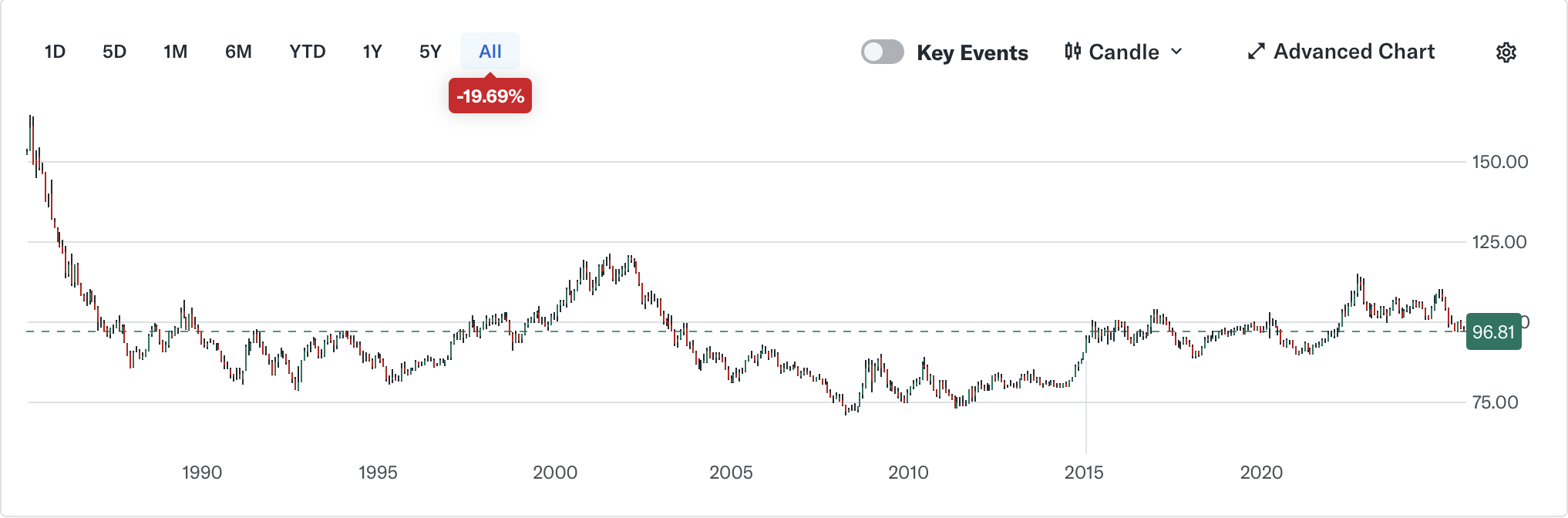
Yesterday’s market activity was benign with modest market movements in both equity and bond markets although the dollar did rally sharply, on the back of the EU trade deal.  Of course, economic theory predicts just that, when tariffs on a nation (or bloc of nations) are raised, that currency will decline in value to offset the tariffs.  Recall, this was the expectation in the beginning of 2025 when President Trump was just coming into office and calling himself ‘Tariff Man’ as he explained he would be imposing tariffs on virtually all US trading partners.  However, back then, the theory didn’t work out very well and the dollar declined throughout the first six months of the year as can be seen below.

Source: tradingeconomics.com

In fact, analysts quickly moved on and were virtually gleeful that the dollar’s decline of roughly 13% was the largest decline during the first six months of the year since the 1980’s.  Personally, I’m not sure why classifying the decline in terms of the time of year is relevant, but that was a key talking point in the narrative that described the end of American exceptionalism.  Other parts of that narrative were the end of the dollar as the global reserve currency (gold was going to take over) and the onset of other currencies as payment rails for trade.  

None of that ever made sense nor do current proclamations that the euro’s status has changed in any significant way.  There are still very significant long euro positions outstanding as the dollar decline theory has many adherents, but being long euros, aside from being expensive, just got a bit uglier after yesterday’s and this morning’s declines totaling about -1.5%.  

Remember, a key portion of the short dollar thesis is that the Fed is going to cut rates more than other central banks going forward.  And now that the FOMC’s meeting is starting this morning, let’s discuss that idea.  We all know that President Trump has been a vocal advocate for significant rate cuts immediately.  However, let’s look at some evidence.  On the one hand, equity markets are at historic highs in terms of prices as well as readings like the Buffett ratio (market cap/GDP) and P/E and P/S ratios as well.  Crypto currencies, arguably the most speculative of assets, have been flying, especially things like meme coins, which are literally a play on the greater fool paying someone more than they paid for a token with no intrinsic value whatsoever.  Credit spreads, especially for weak credits, are pushing historic lows as per the below chart.  All these things point to not merely ample liquidity and policy being appropriate, but excess liquidity and policy being easy.  

And yet the other side of that coin is a look at 2-year Treasury yields, which have a long history of accurately forecasting future Fed Funds levels.  Right now, as you can see in the below chart, they are trading at a 50 basis point discount to Fed Funds, an indication that the market is quite convinced the Fed is going to cut rates.  Ironically, I believe that Chairman Powell, a PE guy by background, is a strong believer in lower interest rates and I’m sure all his colleagues from his time at Carlyle Group are also pressing for lower interest rates, but he doesn’t want to seem cowed by Trump.

The market is pricing just a 3% probability of a cut tomorrow, but a 65% probability of a cut in September and then another cut in December.  It strikes me that we will need to see a major reversal in the economic situation in the US, with Unemployment rising and growth rapidly declining in order to bring about a situation where there is a real case to be made for a cut.  But we also know that politics plays an enormous role in this story, and while expectations are that we are going to see two dissents at tomorrow’s meeting, that will not change the outcome of no movement.

Adding this all up I conclude that the weak dollar thesis is largely predicated on the idea that the Fed is going to ease monetary policy going forward, catching down to what most other central banks have already done.  And I agree, if the Fed does cut rates, the dollar will fall.  But every day I watch market behavior and continue to see economic data that appears to be holding up pretty well despite a great deal of angst from the analyst community, and I find it harder and harder to come up with a reason to cut rates.  

Consider the story about the new effort by the Trump administration to remove 100,000 regulations by July 4th2026.  Estimates of the value that will unlock are upwards of $1.5 trillion and that assumes no policy changes.  That’s more than 5% of GDP.  I cannot help but believe that President Trump is going to be successful in completely changing the way the US economy works by changing the way (i.e. reducing) the government’s intrusions in the economy.  And if that is successful, it is not clear why interest rates need to decline.  Remember, too, there is an enormous amount of data compressed into this week, so by Friday afternoon, we will have much more information.

Ok, a quick turn round markets shows that after a mixed session in the US yesterday, Japan (-0.8%) slipped on concerns over the nature of the trade deal, while China (+0.4%) edged higher as trade talks continue in Stockholm between the US and China.  Elsewhere in the region both Korea and India rose a bit, spurred by hopes for trade deals there, and the rest of the area was mixed with no large movement.  In Europe, green is today’s color as investors have taken the avoidance of a trade war as a positive and added the euro’s weakness as a positive as well, helping European exporters.  So, gains are strong (DAX 1.3%, CAC 1.4%, FTSE 100 0.7%) and things are generally bright despite grumbling by some nations that the trade deal is going to hurt them.  And at this hour (7:30), US futures are higher by 0.3% or so.

In the bond market, yields are edging lower this morning (Treasuries -2bps, Gilts -1bp, Bunds unchanged) as investors remain either comfortable with the current situation or uncertain what to do to change things at current yields.  I vote for uncertainty.

In the commodity markets, neither oil nor metals markets are moving much at all this morning with daily fluctuations less than 0.2% in all of them.  This has all the feel of a consolidation ahead of tomorrow’s Fed and the rest of the week’s data including GDP, PCE and NFP.

Finally, the dollar is firmer again today vs. almost all its counterparts with gains on the order of 0.2% to 0.3% in most G10 and EMG currencies.  However, two CE4 currencies (PLN -0.6% and HUF -0.9%) are under pressure with the former complaining that the trade deal will cost them > €2 billion, while the latter is suffering from poor economic data heading into an election where President Orban is on shakier ground that normal.  But net, expect to hear about some more dollar strength in the wake of higher tariffs.

On the data front this morning, we see the Goods Trade Balance (exp -$98.4B), Case Shiller Home Prices (3.0%), JOLTS Job Openings (7.55M) and Consumer Confidence (95.8).  With so much focus on trade lately, I suspect that number could matter, but really the JOLTS number will be of more interest, especially for the bond market, as any weakness in the labor market will encourage the lower rates story.

And that’s really all for today.  Until we hear from Powell, it is hard to make a dollar call in the short-term, and the medium term is dependent on the Fed’s actions.

Good luck

Adf
Filled With Gilding

There once was a banker named Jay
Who yesterday, tried to allay
Fears that his building
Was too filled with gilding
But Trump seemed to have final say
 
The fact that this story’s what leads
The news, when one looks through the feeds
Is proof that there’s nought
Of note to be bought
Or sold, as price action recedes


According to Merriam-Webster, this is the definition of the word frequently bandied about these days, and rightly so.  

Market activity is just not very interesting.  While there is a new battle brewing on the Thai-Cambodian border, it is unlikely to have much impact on the rest of the world, and the Russia-Ukraine war continues apace, with very little new news.  Congress is in recess, sort of, which means new legislation is not imminent.  And while the Fed meets next week, just like the ECB and the BOE and the BOJ, no policy changes are imminent.  Doldrums indeed.

Which is why the story about President Trump visiting the construction site at the Marriner Eccles Building, the home of the Federal Reserve, has received so much press.  And frankly, a quick look at this clip is so descriptive of the current relationship between Trump and Powell it is remarkable.

But frankly, I just don’t see much else to discuss this morning.  equity markets in the US have generally been creeping higher, the DJIA excepted, the dollar is doing a slow-motion bounce and bond yields trade within a 5bps range.  Yesterday’s jobs data was solid, with both types of claims slipping, while the Flash PMIs showed net strength, although it was entirely Services driven.  And it’s Friday, so I won’t take up too much time.

Here’s the overnight review.  Asian markets followed the Dow, not the S&P or NASDAQ with Tokyo (-0.9%), Hong Kong (-1.1%) and China (-0.5%) all under pressure.  In Japan, there are starting to be more questions asked about whether PM Ishiba can hold on, and if he cannot (my guess is he will go) there is no obvious successor as no party there has any substantial strength.  Remember, the populist Sanseito party is a new phenomenon there and really is screwing up their electoral math.  As to the rest of the region, only Korea and New Zealand managed any gains, and they were di minimis.  Red was the color of the session.

Not surprisingly, that is the story in Europe as well, with most bourses lower on the day (DAX -0.6%, FTSE 100 -0.3%, IBEX -0.5%) although the CAC is essentially unchanged despite LVMH earnings being a little soft.  German Ifo data was slightly better than June, but lower than expected and UK Retail Sales were modestly weaker than forecast on every measure.  Again, it is hard to get excited here.  As to US futures, they are pointing higher by 0.2% at this hour (7:00).

In the bond market, Treasury yields have bounced 2bps from yesterday but are still right around 4.40% while European sovereign yields are higher by 3bps across the board.  Apparently, there is residual concern over European spending plans and absent a trade agreement with the US, investors there are not sure what to do.

In the commodity markets, oil (+0.4%) is bouncing for a second day, but remains within that recent trading range where we have seen choppy trading but no direction.  The gap lower earlier in the week was filled, but it is hard to get excited here about a new trend either.

Source: tradingeconmics.com

Meanwhile, metals markets remain under pressure as we head into the end of the month.  They have had a solid rally this month and it looks to me like some profit taking, but this morning gold (-0.7%), silver (-0.8%) and copper (-0.7%) are all under pressure.

Perhaps one of the reasons that the metals are soft is the dollar is stronger today.  I know we continue to hear about the death of the dollar, but as Mark Twain remarked, “the report of [its] death was an exaggeration.” Instead, what we see this morning is a pattern in the DXY that could easily be mistaken for described as a bottoming and we are simply waiting for confirmation.

Source: tradingeconomics.com

Looking at individual currencies, the dollar is firmer against every G10 currency with the euro (-0.25%) and pound (-0.4%) indicative of the magnitude of movement.  In the EMG bloc, KRW (-0.6%) and ZAR (-0.7%) are the worst performers, with the latter clearly following precious metals lower while the former is feeling a little heat from the fact that Japan struck a trade deal while South Korea has not yet done so.   Otherwise, things are just not that interesting here either.

On the data front, this morning brings Durable Goods (exp -10.8%, 0.1% ex Transports) which tells me that a lot of Boeing deliveries were made last month when Durables rose 16.4%.  But otherwise, nothing and no Fed speakers.  As I said before, it is a summer Friday, and I suspect that most trading desks will be skeleton staffed by 3:00pm if not earlier.

Good luck and good weekend

Adf

Kvetched

The story on everyone’s lips
A central bank apocalypse
If Trump fires Powell
The markets will howl
With yields rising numerous bips
 
However, said Trump, it’s farfetched
Despite plans that he’d clearly sketched
Thus, markets reversed
While bears, losses, nursed
And “right-thinking” people all kvetched


If you had Trump fires Powell on your White House Bingo card, congrats, it looked like a winner.  That was the story all morning yesterday, overshadowing PPI data that was quite benign, printing at 0.0% M/M for both headline and core, as the punditry postulated the problems with Trump doing that.  At this point, we are all familiar with the fact that the Fed Chair can only be fired for “cause” although exactly what “cause” represents is unclear.  Too, we know that in Trump’s efforts to reduce the size of the government, the Supreme Court gave him authority to remove the heads of many departments but explicitly carved out the Fed from that process.

In the end, though, despite rampant rumors that he had composed a letter for just such an occasion, at a press conference with Bahraini Crown Prince, Salman bin Hamad Al Khalifa, he said it was “highly unlikely” he was going to fire Powell, although he once again castigated him for not cutting rates. Most markets, after getting all excited about the prospects of this action, reverted to the previous solemnitude of doing nothing over the summer.  The below chart of the S&P 500 was replicated in virtually every market.

Source: finance.yahoo.com

It is also no surprise that the Fed Whisperer was out in the WSJ this morning defending his bread-and-butter relationship, but my take is this is just a feint on the president’s part to move the discussion away from issues he doesn’t like.  Given that Supreme Court protection and given that the Supreme Court has been very good for Mr Trump, I’m pretty confident that Powell will serve out his full term as Chair and be replaced next year.  I would, however, look for a candidate to be announced at the earliest possible time.

While that was the story that sucked up all the oxygen yesterday, life still goes on and this morning, arguably the biggest news is that UK Unemployment rose to 4.7% with earnings slipping and the Claimant count rising.  The punditry continues to harp on how the US is set to go into stagflation because of Trump’s tariffs which are driving inflation higher while weakening the economy (despite all evidence to the contrary) while ignoring the UK which saw inflation rise faster than expected yesterday, to 3.6% while Unemployment is rising.  That feels a lot closer to the stagflation story than in the US, and as we heard from BOE Governor Bailey yesterday, it’s all Trump’s fault because of the tariffs.  Talk about deflection.  However, a little sympathy for the Guv is in order as he really doesn’t know what to do.  After today’s data, there is more discussion of another rate cut by the BOE when they next meet on August 7th.  Certainly, the pound (-0.1%) is behaving as though a rate cut is coming as evidenced by the chart below.

Source: tradingeconomics.com

However, remember that the UK government of PM Starmer has proven its incompetence on virtually every issue it has addressed, both domestically and on an international basis, so the pound’s decline could well be a general exit from the UK by investors.  Speaking of currencies, the dollar is having quite a positive day across the board.  Aussie (-0.9%) is the laggard across both G10 and EMG blocs as its employment situation report showed a much weaker economy than expected, although the yen (-0.4%) is starting to feel real pressure as the Upper House Election approaches.  In fact, there is growing talk that USDJPY above 150 is likely if the PM Ishiba’s LDP loses their majority in the Upper House, or even if it wins given the amount of increased deficit spending they are promising.  Does anyone remember all the talk of the end of the yen carry trade and how the yen was going to rise dramatically?  There’s a theme that did not age well.  As to the rest of the currency market, the dollar is rising vs. everybody with a rough average gain of ~ 0.4%.  The dollar is not dead yet.

Heading back to equities, despite all the angst about Powell yesterday, US indices all managed a gain on the day.  In Asia, most markets performed well with Japan (+0.6%) and China (+0.7%) indicative of the movement.  Australia (+0.9%) responded to its jobs data with growing expectations of an RBA rate cut and there were many more regional exchange gainers than losers overnight.  In Europe, green is also today’s theme, with both the CAC (+0.9%) and DAX (+0.8%) having very nice sessions and most of the rest of the continent climbing around 0.5%.  The only data of note was the final CPI reading for the Eurozone, which was right on the button at 2.3% core.  However, at this hour (7:00) US futures are essentially unchanged.

Bonds were actually the biggest concern yesterday on the Powell news with a huge divergence between the 2-year and 30-year as the rumors flew, although most was forgiven after Mr Trump said he would not be firing Powell.  The Chart below shows that divergence and the retracement although 2-year notes did remain lower for the session.

Source: tradingeconomics.com

But that was yesterday.  This morning, 10-year Treasury yields have edged higher by 1bp, and European sovereigns have largely followed suit.  In Asia, though, it is noteworthy that Australian government bonds saw yields decline -5bps after the data, and JGB yields slid -2bps as election promises seem to imply more QE, not less.

Lastly, commodity prices also got the whipsaw treatment on the Powell story, but this morning, with the dollar showing strength across the board, we see metals prices slipping (Au -0.6
%, Ag -0.25%, Cu -0.15%) although oil (+0.5%) is finding a bottom it seems as per the below chart from tradingeconomics.com.

On the data front, in addition to the weekly Initial (exp 235K) and Continuing (1970K) Claims data, we also get Retail Sales (0.1%, 0.3% ex autos) and Philly Fed (-1.0).  We hear from one Fed speaker, Governor Kugler, but if anything, after yesterday’s Powell drama, I expect everybody we hear from to rally round the Chair, so there will be no talk of rate cuts.  Aside from yesterday’s PPI data, the Fed’s Beige Book indicated modest economic growth, again, not a reason to cut interest rates.

Let me leave you with a thought experiment though.  Last night, the Senate passed the first (of many we hope) rescission bill to actually reduce spending.  Tariff income has grown as evidenced by last month’s budget surplus.  What if Trump and his team are correct, and through reduced regulations as well as tariff and increased inward investment, the private economy grows more strongly and the budget deficit declines far more than current estimates, perhaps achieving Secretary Bessent’s goal of 2%?  Will yields rise or fall?  Will the dollar rise or fall?  Will equities rise or fall?  On the White House Bingo card, I would suggest very few believe in this outcome and are not managing their portfolios to address this.  But I would also suggest it is a non-zero probability, although not my base case.  Just remember, stranger things have happened.

Good luck

Adf

Trump’s Latest Ire

The Minutes explained that in June
The Fed felt no need to impugn
Their previous view
Of nothing to do
Though two sang an alternate tune


Yesterday’s release of the FOMC Minutes from their June meeting confirmed what we have learned in the interim.  Governors Waller and Bowman have been clear that they see tariffs as a one-off impact on the rate of inflation, and not something on which to base policy.  If you think about it, tariffs are like food and energy, something that cannot be addressed effectively by monetary policy and which the Fed explicitly excludes from their decision-making process.  (For a really good read on the inflationary impact on tariffs, @inflation_guy published this yesterday).  To me, the salient comments from the Minutes are below:

“While a few participants noted that tariffs would lead to a one-time increase in prices and would not affect longer-term inflation expectations, most participants noted the risk that tariffs could have more persistent effects on inflation.”

“Participants agreed that although uncertainty about inflation and the economic outlook had decreased, it remained appropriate to take a careful approach in adjusting monetary policy.” 

In fact, it is not hard to conclude that the Fed’s intransigence on this issue is politically motivated as well since we have already established that the Fed is clearly political (and partisan).  I would estimate part of the reason they do not want to cut rates here is because they don’t want to be seen as caving into President Trump’s demands.  But whatever the reason, even the futures market is reducing the probability of a cut with the July probability having fallen from more than 20% two weeks ago to 6.7% as I type this morning.  We will need to see some seriously weak economic data to get the Fed to move, I believe, although I expect we will see Governors Waller and Bowman dissent at the July 30th meeting.

However, I would contend that the market has already sussed this out and there will be limited impact on any financial markets after the meeting absent a surprise cut.  So, let’s move on.

The target of Trump’s latest ire
Brazil, has now come under fire
The issue’s not trade
Instead, Trump was swayed
By lawfare ‘gainst one he admire(s)

The other news from yesterday (and there has been precious little overnight) was President Trump’s threat of 50% tariffs on all of Brazil’s exports to the US.  Now, the US runs a trade surplus with Brazil of about $10 billion, so clearly trade is not the issue here.  Rather, it seems that Mr Trump is seeking to help is friend, former Brazilian president Joao Bolsonaro, who is also a right-leaning populist and who is on trial for leading an insurrection after he lost the last election.  It is not hard to understand Mr Trump’s concern over the issue given the history in the US and the previous administration’s efforts to imprison Trump himself.  

However, this seems, at least to me, a bit over the top.  Brazil had been slated to get the minimum 10% tariff prior to yesterday’s outburst.  As well, the US is Brazil’s second largest trading partner, so this will have a significant impact on the country if these tariffs are imposed.  As such, it is no surprise that the market responded immediately.  

Source: tradingeconomics.com

As you can see from the chart above, the announcement at 1:30 yesterday afternoon had an immediate impact with the real falling -2.5% with minutes of the news.  Too, the IBOVESPA stock index fell more than -1.3% yesterday with Embraer, the airplane manufacturer down nearly 10%.  Right now, this is a threat, and the immediate Brazilian response was to say they would not be cowed by this action and will continue with their internal legal activities.  There is no way I will opine on how this will end, but if these tariffs are put in place, it will be a distinct negative for Brazil’s economy, and I would expect that the real could quickly head back toward 6.00 from its current levels.

Away from those two stories, though, issues impacting financial markets are sparse.  With that in mind, let’s see how markets behaved overnight.  Yesterday’s US equity rally was followed by a mixed picture in Asia with Japan (-0.4%) slipping a bit but gains in both China (+0.5%) and Hong Kong (+0.6%) after rumors came out that the Chinese government was getting set to add more support to the still-imploding Chinese property market.  Other regional bourses saw some gains (Korea, Taiwan, Australia) and some losses (India, Thailand, Philippines).  At this point, all eyes remain on the tariff story for most of these nations.  Meanwhile, in Europe, the FTSE 100 (+1.1%) is today’s leader on the strength of its mining sector which responded positively to President Trump’s mooted 50% tariffs on copper.  Elsewhere, though, things have been less robust with the CAC (+0.7%) having a nice day, the DAX (+0.2%) edging higher after inflation data was released as expected at 2.0% while the IBEX (-0.6%) is moving in the other direction absent a major catalyst.  However, remember it has been performing well, so this could just be some profit taking.  US futures are essentially unchanged at this hour (7:00).

In the bond market, yesterday’s 10-year auction went well with no tail and yields ultimately slipped 6bps during the session.  This morning, that yield has edged back higher by just 1bp.  As to European sovereigns, they are +/- 1bp this morning, showing no direction or new views on anything.  Readings from Europe this morning have confirmed that the rate of inflation is quiet and near the ECB’s target so there is little reason for investors to worry.  As well, the word is that a trade deal between the US and EU is getting close, which will almost certainly be seen as a benefit for markets on the continent.

In the commodity markets, oil (-0.6%) is softer this morning but continues to hug the $68/bbl level despite EIA inventory data showing a net large build of nearly 4 mm barrels.  It appears that there is both ample supply and production and there continues to be concern over slowing economic activity, yet oil is in demand.  As I often say, sometimes markets are simply perverse.  In the metals markets, gold (+0.5%) continues to trade either side of $3350/oz and has done so since mid-April.  I continue to read about central banks buying the relic and replacing US Treasuries with gold in their reserve portfolios, but there is obviously enough supply to prevent further price appreciation for now.  But gold is leading gains across the entire metals complex (although copper is getting a boost from the tariff talk.)

Finally, in the FX markets, there is no direction this morning.  both the euro and pound are slightly softer, but AUD (+0.4%) and NZD (+0.35%) are firmer with the yen and CAD little changed.  ZAR (+0.4%) is also having a good day, arguably on the strength in the precious metals markets but otherwise, it is hard to find anything exciting to note.

Turning to this morning’s data, we get the weekly Initial (exp 235K) and Continuing (1980K) Claims and that’s it.  We do hear from three Fed speakers, Musalem, Daly and Waller, but since we already know Waller’s views, it will be far more interesting to hear the other two.  I do find it interesting that Ms Daly, one of the most dovish FOMC members, is not in the rate cut camp, a situation I attribute entirely to her political views.

And that’s what we’ve got today.  Nothing has changed any trends, and it seems highly unlikely that today’s data will.  However, if we hear dovish signals from both Daly and Musalem, that may indicate a turn at the Fed and perhaps we will see that narrative change.  I am confident the one thing Chairman Powell does not want is to have a 5-4 vote to leave rates unchanged.  I would contend that is the most intriguing thing on the horizon right now.

Good luck

Adf

The Perfect Riposte

Attention right now’s being paid
To Congress on taxes and trade
The One BBB
Is seen as the key
To growth in the coming decade
 
Meanwhile, Sintra right now’s the host
To Powell, Lagarde and almost
All central bankers
Each one of whom hankers
To nurture the perfect riposte


The headlines this morning highlight that Congress put in an all-nighter last night as they try to get the BBB over the line and on the president’s desk by Friday.  My take is they were seeking sympathy for all the hard work they must do and trying to make it seem like they are slaving away on their constituents’ behalf.  Yet it appears that since the president’s inauguration on January 20, 161 days ago, Congress has been in session for somewhere between 40 and 50 days (according to Grok), about one-quarter of the time.  I have seen these estimates elsewhere as well, and quite frankly, it doesn’t speak well of Congressional leadership.  

In the end, though, I continue to expect the BBB to get passed by both houses and sent to the president.  I’m certain there are still a lot of things in the bill that many fiscal conservatives will not like, but I’m also confident that the fact that not a single Democratic representative or senator is going to vote for the bill is likely a sign that it does more good than harm.  I am completely aware of the debt and deficit issues and questions of their long-term sustainability, and I am not ignoring that.  But politics is the art of the possible, not the perfect, and my take is this is possible.  Consider for a moment the Orwellian-named Inflation Reduction Act from 2022, which passed the Senate on a tiebreaker vote by VP Harris.  That was a much more harmful piece of legislation from a fiscal perspective than this.  In fact, I would say this is the very definition of politics.

Through a market lens, if (when) this is passed, while there may be an initial ‘sell the news’ move, I suspect that the stimulus it entails will be a net benefit for risk assets overall.  And the only reason there would be a sell the news event is that the market is already pricing in a great future as evidenced by yesterday’s quarterly close at new all-time highs for the S&P 500, above 6200.

Turning to the other noteworthy news, the ECB is holding their faux Jackson Hole event this week in Sintra, Portugal where all the heads of major central banks are currently gathered along with academics and journalists who are there to spread the good word.  Chairman Powell speaks today, but this is the Powell story of the day.  Apparently, President Trump had this hand-written note delivered to the Fed Chair.  Are we not entertained?

But ignoring for a moment the president’s desires, let us consider the dollar and its potential future direction.  The predominant current thinking is that it has further to slide as the trend is clearly lower and the rising anticipation of a recession in the US forcing the Fed to cut rates further will undermine the greenback.  Let’s break that down for a moment.  There is no question the dollar is currently in a downtrend as evidenced by the chart below.  A look at the red line on the right shows the slope of the decline thus far this year, which totals about 11%.

Source: tradingeconomics.com

In fact, much has been made of the decline thus far this year as to its speed and how it is a harbinger of both a recession and the end of the dollar’s hegemony.  Yet, we don’t have to go very far back in time, late 2022-early 2023 to see a virtually identical decline in the dollar over a slightly shorter period, hence the steeper slope of the line in the center of the chart, and I cannot find a single descrying of the end of the dollar at that time. Too, I remember being certain a recession was on the way then, when it never arrived.  According to JPMorgan, it seems the recession probability for 2025 is now 40%.  I have seen estimates ranging from 25% to 80% over the past few months which mostly tells me nobody has any idea.

We also don’t have to go very far back in time to see when the dollar was substantially weaker than its current levels.  I’m not sure why this time the dollar’s recent trend means the world is ending when that was not the case back in 2023 or any of the myriad times we have seen movement like this in the past.

But one other thing to consider regarding the dollar is that the BBB is going to provide significant stimulus to the economy.  Combining this with President Trump’s trade policies which are designed to draw investment into the US, and seemingly are working, and I think that despite his desire for lower interest rates, the Fed will have little reason to cut amid stronger growth in the economy.  I do not believe you can rule out a turn in the dollar higher once the legislation is passed as it is going to matter a great deal.  While spending priorities are going to change, it appears that investment is going to rise and that will help the buck.  Be wary of the dollar is dying thesis.

Ok, yesterday’s market activity, while reaching record highs in the equity markets, was actually incredibly slow with volumes shrinking.  My sense is folks are on holiday this week and those who aren’t are waiting for Thursday’s NFP data, so they can then run out of the office and go for their long weekend.  But the rest of the world doesn’t have the holiday Friday and are all trying to solve their trade situation with the US.  That led the Nikkei (-1.25%) lower yesterday as there appears to be a timing mismatch from a political perspective.  Ishiba doesn’t want to agree to open Japan’s market to US rice ahead of the election on July 20th as that will be a major political problem, but July 9th is approaching quickly, and Trump has said that is the date.  But aside from Japan and Hong Kong (-0.9%) the rest of the region had a pretty solid session led by Thailand (+2.1%) and Taiwan (+1.3%).  In Europe, though, PMI data was less than stellar, and bourses are modestly softer (DAX -0.5%, CAC -0.4%, FTSE 100 -0.3%) although Spain’s IBEX (+0.2%) has managed a gain as they had the best PMI outcome of the lot.  

In the bond market, yields continue to slide everywhere with Treasuries (-4bps) actually lagging the Eurozone which has seen declines of -6bps virtually across the board.  Madame Lagarde, in her Sintra opening speech, explained that the ECB would be altering their communication strategy to try to take account of the uncertainty in their forecasts, so not promise as much, but I have a feeling the movement is more a result of the softer PMI data as well as the Eurozone inflation release at 2.0% which has ECB members explaining things are under control.  Japan is a bit more confusing as JGB yields (-4bps) slipped despite what I would consider a strong Tankan report and a rise in their PMI data.  However, the newest BOJ board member did explain there was no reason to raise rates anytime soon, so perhaps that is the driver.

In the commodity markets, oil (+0.8%) continues to creep higher, perhaps a harbinger of stronger future economic activity around the world, or perhaps more short covering.  Gold (+1.4%) has completely erased the dip at the end of last week and is back at its recent pivot point of $3350 or so.  This has brought silver (+1.1%) and copper (+0.7%) along for the ride.

Finally, the dollar is clearly softer this morning with JPY (+0.6%) the leader in the G10 while ZAR (+0.9%) is the leading gainer in the EMG bloc as it follows precious metals prices higher.  Net, I would suggest that the average move here is about 0.25% strength in currencies.

On the data front, we get ISM Manufacturing (exp 48.8) and Prices Paid (69.0) and we get the JOLTs Job openings (7.3M) this morning.  Too, at 9:30, Chairman Powell speaks so it will be interesting to see if there is any change in his tune.

I see no reason for the dollar to turn higher right now but watch for the BBB.  Its passage could well change the dollar’s direction.

Good luck

Adf