He’s the Worst

The talking points have been disbursed
With narrative writers well-versed
The dollar is falling
‘Cause Trump is now calling
For Powell to leave, “He’s the worst!”
 
The idea is Trump will soon name
The next Fed Chair, turning Jay lame
This shadow Fed Chair
Will have to beware
Since he’ll, for bad outcomes, get blame


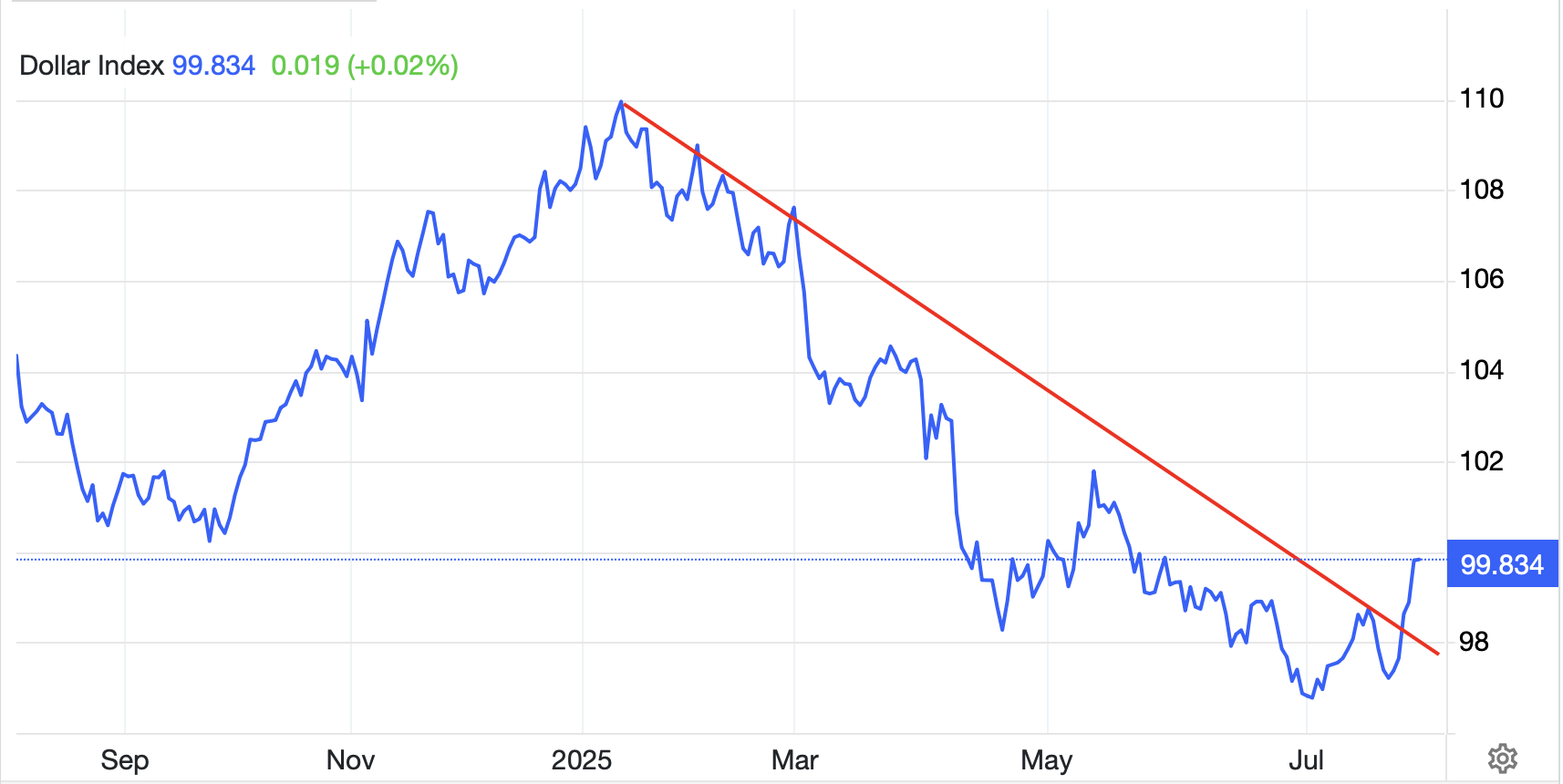
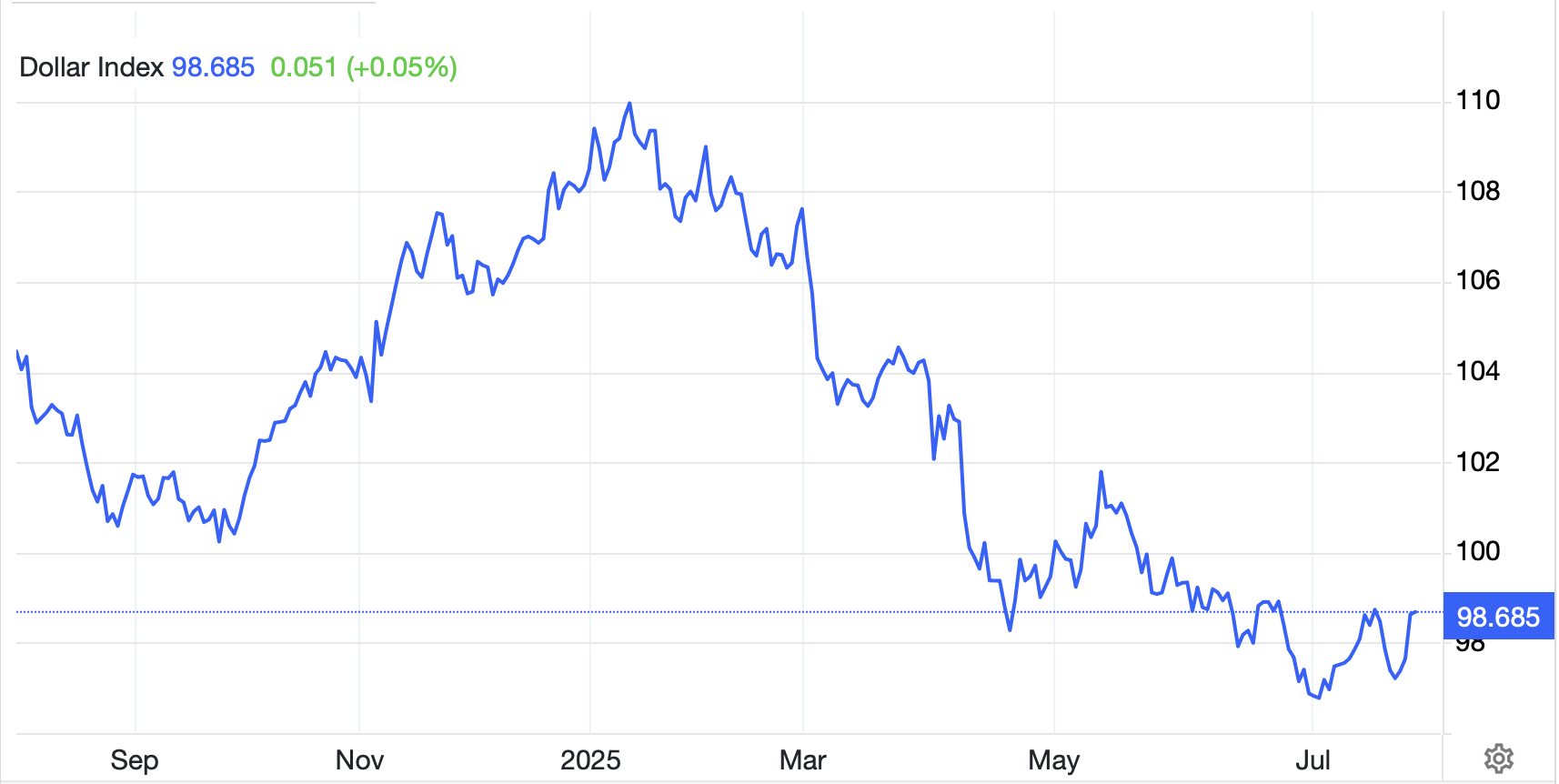
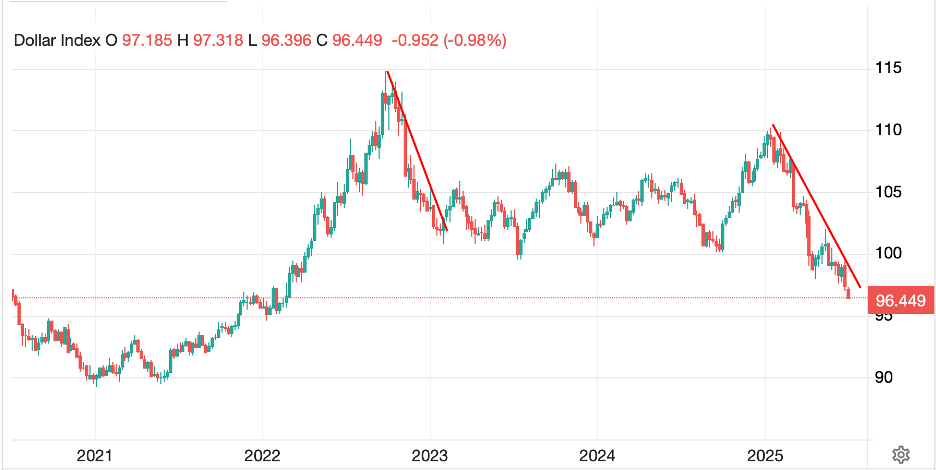
The dollar is weaker this morning and if we use the Dollar Index as a proxy, it has fallen to its lowest level since February 2022.  

Source: tradingeconomics.com

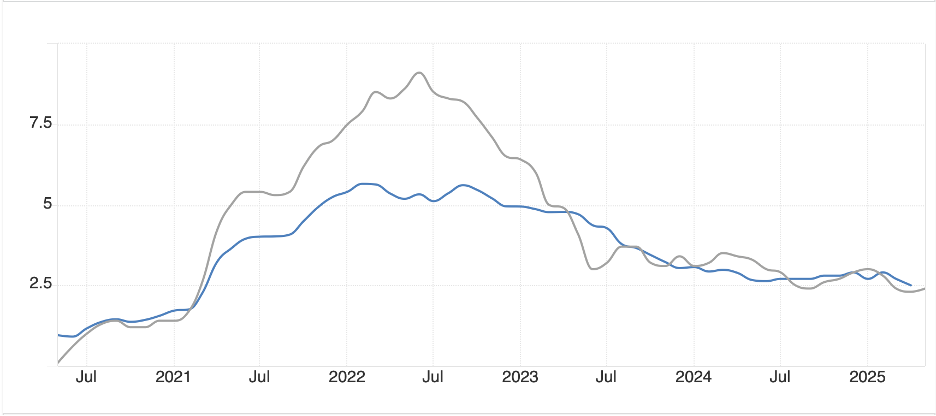
While certainly a part of this movement has been the fact that US yields continue to slide lately, it also seems there is a new narrative that has been distributed to journalists, the dollar is falling because President Trump is considering naming a new Fed Chair much earlier than usual in an effort to undermine Chairman Powell.  We have all heard about the rants the President has had regarding Powell’s unwillingness to cut rates even though inflation readings have been declining for the past two months, and are, on a Y/Y basis back to their lowest level since March 2021 whether measured as CPI (grey line) or Core PCE (blue line).

Source: tradingeconomics.com

But in an exclusive (!) article in the WSJ, which was repeated in Bloomberg, that is the story du jour.  While Bloomberg’s take cannot be a surprise given Mayor Mike’s intense hatred of Trump (after all Trump is the NY billionaire that became president, not Bloomberg), and editorial direction clearly comes from the top, it is more interesting that the Journal is pushing this theme.  Of course, given the Fed whisperer is the article’s writer, it is more than possible that he is simply airing Powell’s views and trying to explain how any move like this would result in chaos, so it’s not Powell’s fault if things go pear-shaped.

Nonetheless, that is today’s story.  In concert with this story, though is another, somewhat more interesting feature, where a really smart analyst, Marko Papic, has broken down the dollar’s movements across different time zones during 2025.  The chart below shows that the dollar selling has been emanating from Asia mostly with Europe having a lesser impact and no substantive change in the NY session.  The implication is that Asian holders of dollars, which tend to be sovereigns rather than other users like investors or corporates, are the ones bailing out.

This activity first became noticeable in early April, right around “Liberation Day” and does fit with the idea that higher US tariffs will result in a smaller US trade deficit.  But as I consider that concept, it strikes me that a smaller US trade deficit will result in fewer dollars around the rest of the world, a reduction in supply, and that would arguably increase the dollar’s value ceteris paribus.  Perhaps this reflects investors selling US assets and converting them to Europe, which has been another theme this year as European companies are set to benefit from a major increase in defense spending by NATO.  However, that doesn’t really sync with the fact that US equities continue to trade near all-time highs.  At this point, I think this is an interesting observation, but am not sure of its meaning.  I’m open to suggestions.

Ok, while that is the narrative this morning, let’s look at how markets are behaving.  Yesterday’s lackluster activity in the US, with the S&P 500 almost exactly unchanged and the other two main indices +/- 0.3% was followed by a burst higher in Tokyo (Nikkei +1.6%) but lagging activity in HK (-0.6%) and China (-0.4%).  The rest of the region couldn’t decide on much with a couple of solid performances (India, Indonesia) and one laggard of note (South Korea).  In Europe, Germany (+0.6%) is leading the way higher across the board, as NATO countries have promised to spend upward of 5% of GDP on total defense (including nonlethal investments), with as much as possible going to European based companies.  That is a lot of money, well over $1.5 trillion.  Meanwhile, US futures are all higher at this hour (7:15), up by about 0.4% or so.

In the bond market, Treasury yields (-2bps) continue to slip and are now back to their lowest level since early May.  Perhaps more interestingly, European sovereign yields are sliding today as well, led by Italian BTPs (-4bps) but lower across the board.  This is interesting given the promises of more borrowing based on the NATO announcement.  But net, bond yields have not really done very much lately at all.

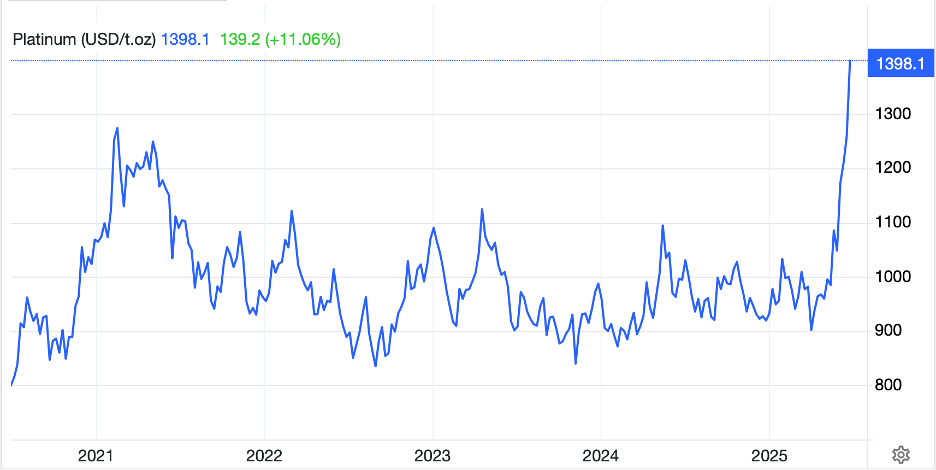
In the commodity markets, oil (+0.5%) is continuing to slowly bounce from the initial lows in the wake of the Iran/Israel ceasefire.  This market still feels quite heavy to me and absent a major change on the ground in the Middle East, if war were to resume and oil facilities be attacked, I still think lower is the way.  In the metals markets, gold (+0.25%) which tried to sell off yesterday continues to find bids below the market, likely central bank support.  But silver (+0.9%) and copper (+2.3% and above $5.00/lb) are looking good although nowhere near as impressive as platinum (+3.4%) which has now risen above $!400/oz and is going parabolic here.  There is much talk here about a supply shortage (it is used for catalytic converters) and significant Chinese demand.

Source: tradingeconomics.com

Finally, the dollar, as mentioned, is under pressure across the board, although the magnitude of this morning’s movement has not been that large.  The largest movement has been in Asia with IDR (+0.6%), JPY (+0.4%) and KRW (+0.35%) while European and LATAM movements have been generally 0.2% or less.  So, the direction is clear, but it has not been impressive.

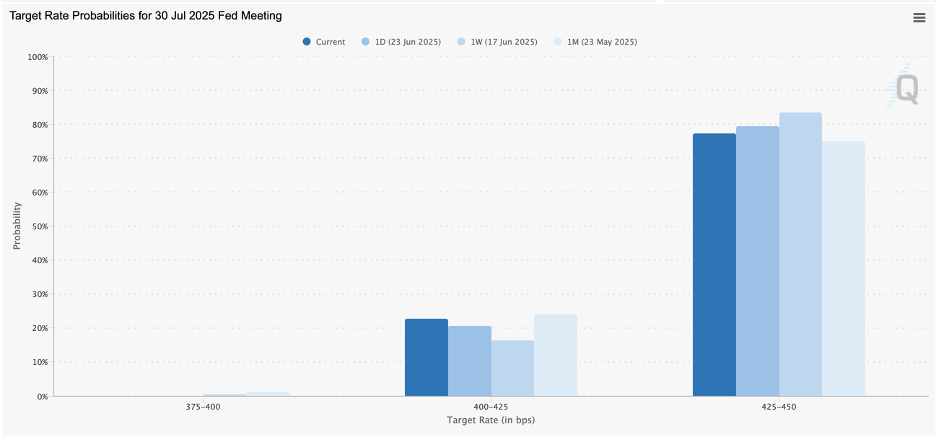
On the data front, there is plenty today starting with the weekly Initial (exp 245K) and Continuing (1950K) Claims, the Chicago Fed National Activity Index (-0.1), the last look at Q1 GDP (-0.2%), and Durable Goods (8.5%, 0.0% ex-Transports).  We also hear from four more Fed speakers, but Powell just repeated yesterday that they are happy where they are and unlikely to move soon unless something really changes rapidly.  However, despite Powell’s claims of nothing to come, the Fed funds futures market is pricing a 25% probability of a cut at the July 30 meeting.  There is a lot of time between now and then for that to change.

I keep trying to figure out what actually matters to markets anymore as responses to different potential catalysts seem confused.  People do seem to be coalescing around the dollar is falling theme, something I have believed for a while, and if the Fed does lean to a cut next month, I do believe there is further for it to fall.  One thing to remember, though, is with Mr Trump as president, things are still a tweet away from a dramatic change.  If I were in charge of hedging risk, I would adhere to guidelines closely.  There is too great an opportunity for a sudden major reversal in the current environment.

Good luck

Adf

What He Will Mention

Last night there was, briefly, a peace
This morning, though, that seemed to cease
But worries Iran
From Hormuz, would ban
Most ships, have now greatly decrease(d)
 
So, markets have turned their attention
To Powell and what he will mention
When he sits before
The Senate once more
Though most seated lack comprehension


Talk about yesterday’s news!  While I am pretty confident we have not heard the last of the Iran/Israel conflict, it has dropped off the radar in a NY minute.  Last night President Trump announced a cease fire between the two nations and while Israel alleged that Iran already broke the peace, the market has clearly moved on from the erstwhile WWIII concept to WWJS (What Will Jay Say).  In that vein, this morning’s WSJ had an articlefrom the Fed whisperer, Nick Timiraos, describing the trials and tribulations of poor Chairman Powell as he tries to fend off those mean words from President Trump.  

Powell sits down before the Senate Banking Committee this morning, and the House Financial Services Committee tomorrow, ostensibly to describe the state of the economy and the Fed’s current thinking.  I have begun to see discussions that two Trump appointed governors, Bowman and Waller, are now interested in potentially cutting the Fed funds rate in July and the futures market has raised the probability of a cut next month to 23%, back to the levels seen a month ago, pre-war and prior to a run of stronger than expected economic data.

Source: cmegroup.com

Frequently mentioned throughout the WSJ article was the idea of Fed independence and how critical that is for monetary policy to be effective.  As well, the fact that the comments on rate cuts are from governors Trump appointed, and that is being highlighted in a negative fashion, is further evidence that the Fed remains a highly political, and quite frankly, partisan organization.  One cannot look at the rate cuts last autumn ahead of the election, which were certainly not warranted by the data, as anything other than the Fed’s attempt to support VP Harris’s presidential campaign.  And when inflation was still quite high, although starting to decline, calls for cuts by Biden appointees Cook and Jefferson, were also likely politically motivated given the still high inflation rate.  

In fact, I wonder where Governor’s Cook and Jefferson are today with respect to rate cuts.  After all, both have demonstrated dovish biases throughout their tenure at the Fed, but suddenly they are strangely silent on the subject.  I’m sure that is not a political bias showing, but rather deeply considered economic analysis. 🙃

I do find it interesting that there is an underlying presumption that the Fed funds rate is always too high, at least for the narrative, although I guess that is because most narrative writers believe strongly in the idea if rates are low, stock prices will rise.

Regardless of the politics, Powell will very likely explain that there is still concern that tariffs could raise prices and while there is the beginning of concern over the labor market, it remains solid and does not warrant rate cuts at this time.  Of course, we will also be subject to the preening of all those senators (what is the probability that Senator Van Hollen brings up deportations?) with no useful discussion.  It seems unlikely that Chairman Powell will alter his message from the post meeting press conference which remains, patience is a virtue.

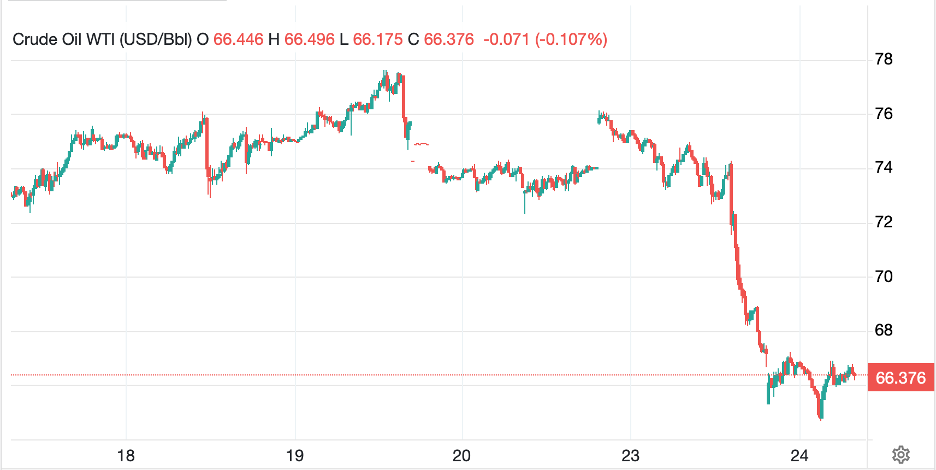
Ok, now that the war has ended, let’s see how markets have behaved.  I must start with oil (-3.0% today, -12.0% since yesterday morning) where traders have removed the entire Hormuz closing premium and are now dealing with the fact that there are more than ample supplies around.  Recall, OPEC+ continues to increase production, and the macroeconomic narrative remains one of slowing economic activity.  Happily, gasoline prices are following oil lower so look for less inflation concerns for next month.

Source: tradingeconomics.com

Meanwhile, with war off the table, gold (-1.3%) is no longer in such great demand although silver (unchanged) and copper (+0.7%) continue to find support.  Net, my longer-term views remain that oil prices have further to decline while metals prices should grind higher over time.

In the equity markets, you have to search long and hard to find a market that didn’t rally overnight or is in the process of doing so this morning.  After yesterday’s strong US closing (all three main indices up about 0.9%), Asia (Nikkei +1.1%, Hang Seng +2.1%, CSI 300 +1.2%) rallied sharply with Korea (+3.0%) really popping and only one negative, New Zealand (-0.5%) where local traders cannot seem to get on board with the better news.  In Europe, the gains are also substantial (DAX +1.8%, CAC +1.2%, IBEX +1.4%) although the UK (+0.3%) is lagging given the large weighting of energy in the index.  US futures are also pointing higher this morning, about 0.8%.

In the bond market, Treasury yields are unchanged this morning after slipping -3bps yesterday, but we are seeing yields rise in Europe (Bunds +5bps, OATs +3bps) after the Germans announced they would be borrowing 20% more this quarter than initially expected to help their rearmament program.  I guess investors had a mild bout of indigestion.

Finally, the dollar, which rallied nicely into yesterday’s NY opening has basically reversed all those gains since then and is back trading near 98 on the DXY. While there are various relative sizes of movement, it is all in the same direction and entirely driven by the Iran/Israel war story.  Perhaps we are starting to see some pricing of a Fed rate cut, and if they do act in July, I would expect the dollar to fall, but right now, it feels much more like unwinding the war footing.

On the data front, aside from Chairman Powell at 10:00 this morning, we see Case Shiller Home Prices (exp +4.0%) and Consumer Confidence (100.0).  However, I suspect that neither of those will matter very much.  The equity market has the bit in its mouth and is looking for reasons to go higher.  Any dovish hints by Powell will set that off, as well as undermine the dollar.  We shall see.

Good luck

Adf

Rate Cutting Pretension

The US and China have shaken
Their hands, as trade talks reawaken
And while it’s a start
It could fall apart
For granted, not much should be taken
 
So, markets have turned their attention
To ‘flation with some apprehension
This morning’s report
Might help, or might thwart
Chair Powell’s rate cutting pretension


Starting with the trade talks between China and the US, both sides have agreed that progress was made. Here is a quote from a report on China’s state broadcaster, CCTV, last night.  “China and the US held candid and in-depth talks and thoroughly exchanged views on economic and trade issues of mutual concern during their first meeting of the China-US economic and trade consultation mechanism in London on Monday and Tuesday. The two sides have agreed in principle the framework for implementing consensus between the two heads of state during their phone talks on June 5, as well as those reached at Geneva talks. The first meeting of such consultation mechanism led to new progress in addressing each other’s economic and trade concerns.”  I highlight this because it concurs with comments from Commerce Secretary Lutnick and tells me that things are back on track.

Clearly, this is a positive, although one I suspect that equity markets anticipated as they have been rallying for the past several sessions prior to the announcements.  Certainly, this is good news for all involved as if trade tensions between the US and China diminish, it should be a net global economic positive.  While anything can still happen, we must assume that a conclusion will be reached going forward that will stabilize the trade situation.  However, none of this precludes President Trump’s stated desire to reindustrialize the US, so that must be kept in mind.  And one of the features of that process, at least initially, is likely to be upward price pressures in the economy.

Which brings us to the other key story today, this morning’s CPI report.  Expectations for headline (0.2% M/M, 2.5% Y/Y) and core (0.3% M/M, 2.9% Y/Y) are indicating that the bottom of the move lower in inflation may have been seen last month.  However, these readings, while still higher than the Fed’s target (and I know the Fed uses Core PCE, but the rest of us live in a CPI world) remain well below the 2022 highs and inflation seems to be seen as less of a problem.  Yes, there are some fears that the newly imposed tariff regime is going to drive prices higher, and I have seen several analysts explain that we are about to see that particular process begin as of today’s data.  

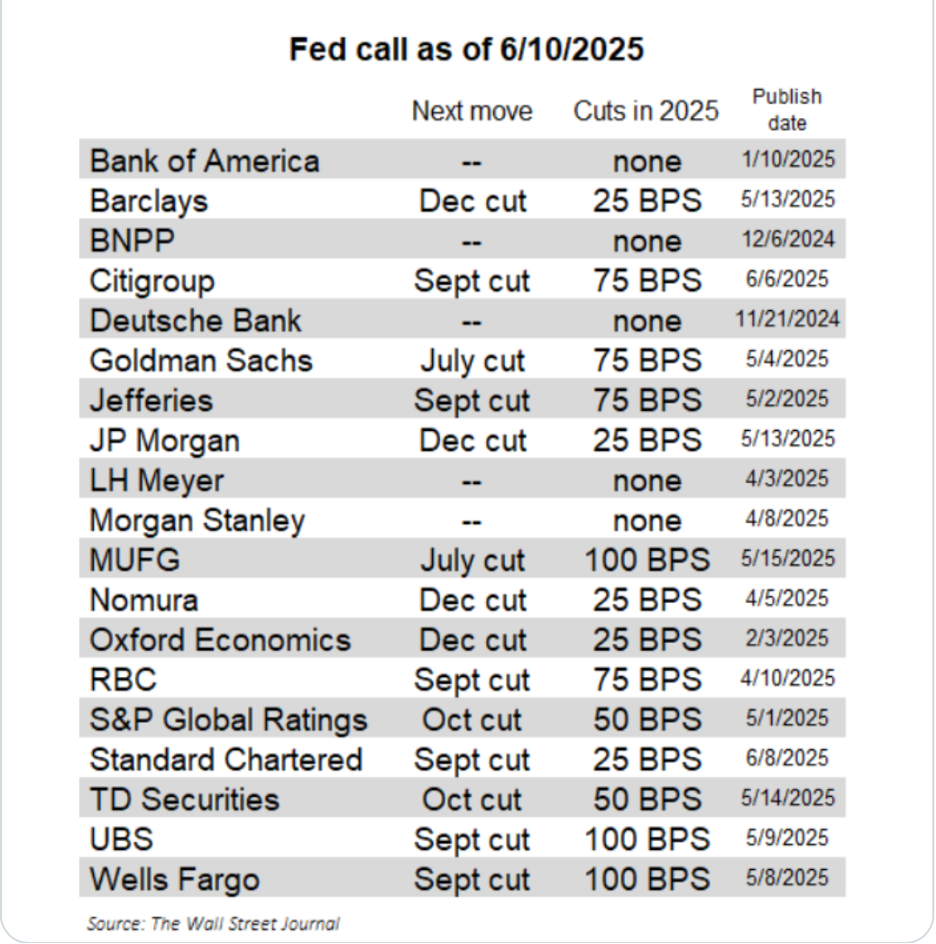
Of course, from a markets perspective, the key issue with inflation is how it will impact interest rates.  In this case, I think the following chart from Nick Timiraos in the WSJ is an excellent description of how there is NO consensus view at all.

At the same time, Fed funds futures markets are pricing in the following probabilities as of this morning.

Source: cmegroup.com

The thing about the Fed is they have proven to be far more political than they claim.  First, it is unambiguous that there is no love lost between President Trump and Chairman Powell.  Interestingly, the Fed is strongly of the belief that when they cut rates, they are helping the federal government, and more importantly, the population’s impression of what the federal government is doing.  Hence, the 100bps of cuts last summer/fall never had an economic justification, they appeared to have been the Fed’s effort to sway the electorate to maintain the status quo.  With that in mind, absent a collapse in the labor market with a significantly higher Unemployment Rate, I fall into the camp of no Fed action this year at all.  And, if as I suspect, inflation readings start to pick up further, questions about hikes are going to be raised.

Consider if the BBB is passed and it juices economic activity so nominal GDP accelerates to 6% or 7%, the Fed will be quite concerned about inflation at that point and the market will need to completely reevaluate their interest rate stance.  My point is the fact that rate cuts are currently priced does not make them a given.  Market pricing changes all the time.

So, let’s take a look at how things behaved overnight.  After a modest US rally in equities yesterday, Asia had a solid session, especially China (+0.75%) and Hong Kong (+0.8%) as both responded to the trade news. Elsewhere in the region, things were green (Nikkei +0.5%), but without the same fanfare.  I have to highlight a comment from PM Ishiba overnight where he said “[Japan] should be cautious about any plans that would deteriorate already tattered state finances.  Issuing more deficit financing bonds is not an option.”  That sounds an awful lot like a monetary hawk, although that species was long thought to be extinct in Japan.  It will be interesting to see how well they adhere to this idea.

Meanwhile, in Europe, the only equity market that has moved is Spain (-0.6%) which is declining on idiosyncratic issues locally while the rest of the continent is essentially unchanged.  As to US futures, at this hour (7:30) they are pointing slightly lower, about -0.15% across the board.

In the bond market, the somnolence continues with yields backing up in the US (+2bps) and Europe, (virtually all sovereign yields are higher by 2bps) with only UK Gilts (+5bps) under any real pressure implying today’s 10-year auction was not as well received as some had hoped.  In Japan, yields slipped -1bp overnight and I thought, in the wake of the Ishiba comments above, I would highlight Japan 40-year bonds, where yields have collapsed over the past three weeks.  Recall, back in May there was a surge in commentary about how Japanese yields were breaking out and how Japanese investors would be bringing money home with the yen strengthening dramatically.  I guess this story will have to wait.

Source: tradingeconomics.com

Turning to commodities, oil (+1.5%), which reversed course during yesterday’s session, has regained its mojo and is very close to closing that first gap I showed on the chart yesterday.  Above $65, I understand most shale drilling is profitable so do not be surprised to hear that narrative pick up again.  In the metals markets, gold (+0.2%) now has the distinction of being the second largest reserve asset at central banks around the world, surpassing the euro, although trailing the dollar substantially.  I expect this process will continue.  Silver (-0.8%) and copper (-2.1%) are both under pressure this morning although I have not seen a catalyst which implies this is trading and position adjustments, notably profit taking after strong runs in both.

Finally, the dollar is slightly stronger this morning with the euro and pound essentially unchanged, AUD, NZD and JPY all having slipped -0.25%, and some smaller currencies (KRW -0.55%, ZAR -0.5%) having fallen a bit further.  However, for those who follow the DXY, it is unchanged on the day.  The thing about the dollar is despite a lot of discussion about a break much lower, it has proven more resilient than many expected and really hasn’t gone anywhere in the past two months.  If the Fed turns hawkish as inflation rebounds, I suspect the dollar bears are going to have a tougher time to make their case (present poets included.)

In addition to the CPI at 8:30, we see EIA oil inventory data with a modest build expected although yesterday’s API data showed a draw that surprised markets.  I must admit I fear inflation data is going to start to rebound again which should get tongues wagging about next week’s FOMC meeting.  However, for today, a hot print is likely to see a knee-jerk reaction lower in stocks and bonds and higher in the dollar.  But the end of the day is a long way away and could be very different, especially given the always present headline risk.

Good luck

Adf

Much More Desirous

The world that we knew ere the virus
Was different, and much more desirous
‘Cause we got to ease
Whenever we’d please
And ‘flation was rare as papyrus


A few disparate thoughts this morning as there doesn’t seem to be a real theme in markets.  

Starting with Chairman Powell’s comments yesterday regarding the Fed’s policy framework and how they were reviewing the current framework established in 2020, to see if it was still appropriate.  It was during that policy discussion that the Fed came up with the idea of average inflation targeting, rather than maintaining a stable rate.  However, Chairman Powell was candid yesterday when he explained, “The idea of an intentional, moderate overshoot proved irrelevant to our policy discussions and has remained so through today.”  Ya think?

Of course, being the consummate central banker, he made sure to explain that their future failures would not be their fault.  As explained in the WSJ by the Fed whisperer himself, Nick Timiraos, Powell explained that higher real interest rates might “reflect the possibility that inflation could be more volatile going forward than in the intercrisis period of the 2010sWe may be entering a period of more frequent, and potentially more persistent, supply shocks—a difficult challenge for the economy and for central banks.” 

However, unlike the pre-Trump era, it’s not clear the market paid much attention to Mr Powell.  Going forward, I do expect the Fed to have more market sway again, but it may be a little while before that is the case.  But I think it is worthwhile for us to understand how they are thinking.

While pundits expressed they were certain
The US is who would be hurtin’
From tariffs and Trump
It turns out the slump
Is elsewhere, as he’d been assertin’

One of the themes following President Trump’s “Liberation Day” tariff announcements amongst much of the punditry was that the US was shooting itself in the foot and the US economy would be the loser in the end.  My thesis had been that the US, as the consumer of last resort, was far more important to other nations’ economic growth than vice versa.  Now, we know that the first look at Q1 GDP in the US was a negative number, but we also know that was entirely the result of the uptick in imports that came ahead of the tariffs.  Meanwhile, private economic activity in the US grew and government activity shrank, both distinct economic positives.

Well, it turns out that the rest of the world is finding that when the US market is not as welcoming of their exports as previously seen, those economies find themselves under pressure.  Yesterday we saw weaker Eurozone GDP and last night Japanese GDP declined much more than expected, -0.2% in Q1 leading to a -0.7% Y/Y result.  The change in trade relations and weaker exports were the driver.  Now, this is just one quarter, and not necessarily a trend, especially if trade negotiations conclude on a timely basis.  But Japanese inflation remains sticky on the high side while growth is ebbing.  The BOJ is unlikely to change policy anytime soon as they, like most central banks, try to figure out the underlying trends. 

My take is this is going to be the scenario through the summer, and likely into the early autumn as trade deals get concluded but their impacts will take time to feel.  I suspect that central banks will be reluctant to be too aggressive in either direction given the propensity of President Trump to upset the applecart of policy decisions.  Ultimately, I see this as the backdrop that will result in more market volatility in both directions in response to the currently unknown policy announcements that are sure to come.  If you are a hedger, maintain those hedge ratios, even if they are a little pricey, the alternative could be far worse.  If you are a speculator, keep your positions smaller than you might think.  Wrong is only a Trump tweet away.

And finally, let’s talk of peace
Which most folks would like to increase
Could we really see
A Trump policy
That gets global fighting to cease?

I’m going to don my tinfoil hat for a paragraph or two here, but I think we must consider the possibilities that Mr Trump has far larger plans for a geopolitical realignment than most are aware.  I discussed the remarkable Iranian proposal to re-enter the brotherhood of nations yesterday.  The recent history of war shows that it is a) hugely profitable for a select number of companies and b) generally inflationary.  Mr Trump’s overtures throughout the Middle East this week, as he seems to be cementing relationships with the leadership there could well have a motive beyond lower oil prices.  I read a remarkable piece from Dr Pippa Malmgrenyesterday that pulled together many threads as to potential motivations for Trump’s activities and they were framed as the enemy is not necessarily Russia or China or Iran, but rather the deep-state in the US (I told you it was tinfoil hat territory).  There is a group in government who profits immensely from the ongoing war footing and who are not interested in seeing peace break out all over.  

I have no idea if Mr Trump can be successful in this endeavor, but if he is, the implications for markets will be significant.  Oil prices will be far lower, as will commodity prices generally given the result could easily see more access granted for mining/drilling/growing.  Inflation will remain under control which would reduce interest rates, and by extension remove some pressure from the US budget situation.  As well, reduced defense requirements would also help the budget.  The dollar would maintain its status as the global reserve currency and focus would return to economic growth rather than geopolitical mischief.  And this feels like a pretty good state for equities, at least those that are not defense focused.  Maybe crazy…but maybe not.

Ok, really quick around the world.  In equities, mixed is the best description of the US yesterday and Asia overnight with no real outstanding movers in either direction.  Europe is all green this morning, with gains on the order of 0.6%, but I think that is based on the idea the ECB is going to continue to cut rates going forward given inflation there remains low and growth is declining.  US futures, at this hour (7:15) are pointing slightly higher, 0.25%.

Bond markets rallied yesterday with Treasury yields sliding 10bps and falling another -3bps this morning.  European sovereign yields tracked Treasuries yesterday and are actually leading the way today with yield declines on the order of -4bps to -6bps across the entire continent and the UK.  Even JGB yields fell -2bps overnight.

In the commodity space, oil (+0.25%) bounced from its worst levels of the morning during the session yesterday but has created a new gap above the price to add to the really big gap from the beginning of April.

Source: tradingeconomics.com

My take is the market sees the possibility of lower oil prices going forward as supply is set to increase further.  There has been some discussion about how low oil prices will reduce capex in the space, and that is probably true, but what are oil companies going to do if they don’t drill for oil?  My view is they will still drill.  Meanwhile, gold is under pressure again as fear seems to be abating around the world.  This morning the barbarous relic is lower by -2.0% and that is taking both copper and silver along with similar declines.

Finally, the dollar is a bit softer this morning, with NZD (+0.5%) the biggest mover in either the G10 or EMG blocs.  JPY, EUR, MXN, ZAR are all just basis points different this morning than yesterday with a few gainers and a few laggards but no real trend to note here.  I think it is very clear Mr Trump would like to see the dollar’s value decline in the FX markets for competitiveness reasons, but right now, uncertainty is the driving force.

On the data front, yesterday’s big surprise in PPI (-0.5%) seemed to be the driving force behind the bond market rally.  But there was also a huge surprise in the Philly Fed New Orders sub-index, which jumped 41.7 points, a 4.3SD move and the largest in the history of the series.  Perhaps things aren’t as negative as some would have us believe.  As to this morning, we get Housing Starts (exp 1.37M) and Building Permits (1.45M) at 8:30 followed by Michigan Consumer Sentiment (53.4) at 10:00.  

It is very difficult to determine if the recent equity rally is just a bear market rally, or if things are going to be fine.  Given the still uncertain policy outcomes both domestically and globally, there are still many possible paths forward.  I wonder if gold, which had been a harbinger of concerns about the future is now telling us that the worst has passed.  Certainly, a movement toward peace in the Middle East is going to be a net positive for risk appetite, which when I translate that back to the dollar, implies my view of weakness going forward remains intact.

Good luck and good weekend

Adf

Heartburned

There’s no one surprised that the Fed
Did nothing, and here’s what Jay said
We’re not in a hurry
To cut, but don’t worry
If things change, we can cut ahead
 
The narrative now has returned
To Trump, which has many concerned
That in the short run
The things that he’s done
Will leave many traders heartburned


As universally expected, the Fed left policy unchanged yesterday.  Everything we had heard from FOMC members prior to the quiet period indicated they had to be patient to see how things played out regarding the impact of tariffs.  Apparently, Chairman Powell used the term “wait” or some version of that idea 22 times in the press conference.  Tomorrow, the Fed speakers hit the circuit again, but absent some change in data, which will take at least another month or two, I don’t see that the Fed is relevant again for a while.  

I will note that the market is currently pricing only about a 17% chance of a cut at the June 18 meeting though they are still pricing in 3 cuts for the year.  It appears that the idea of a H2 recession is gaining ground amongst both the punditry and the futures market.

However, contra to that message, the bigger news of the day is that President Trump will be announcing, at 10am, the first trade deal in the new era, this one with the UK.  It strikes me that this should be the easiest of trade deals to negotiate since both economies produce the same types of things.  Neither has a labor cost advantage, and there is great commonality between them with respect to the overall culture.  Arguably, the biggest advantage the US has is its energy sector has not been destroyed by the government, something PM Starmer is working hard to accomplish on his end.  Realistically, the trade deal here is going to be more about services than goods I suspect, given that’s what drives both economies.  I guess we will learn later today.

In a modest surprise, UK equities (FTSE 100 +0.4%) do not seem to see the benefits of such a deal, as they lag most of the rest of Europe.  Too, the BOE is expected to cut its base rate by 25bps this morning, which in isolation would ordinarily be seen as a positive for stock markets.  Perhaps, this is why the UK is the first to say yes, things there may be worse than meet the eye.  After all, the stock market there is higher by just 2% in the past year, hardly a breathtaking performance.  In fact, as you can see below, the FTSE 100 and S&P 500 have had very similar performances this year, tracking each other closely, although despite all the angst about recent volatility in US markets, the S&P is still 8% higher in the past year, decently outperforming the UK.

Source: tradingeconomics.com

Stepping back for a moment from individual markets, my take is the following: President Trump is keen to sign a number of key trade deals in this 90-day window.  If they agree deals with the UK, Japan, South Korea, Taiwan, Canada and Mexico, all of which seem quite possible, it will reduce the uncertainty and accompanying stress in markets.  If, as well, Congress can get the ‘big, beautiful budget bill’ passed, thoughts of recession will quickly dissipate.  Obviously, the China trade talks will still be outstanding, but both sides need to find a solution here.  While the punditry in the US will continue to harp on how those tariffs are going to kill the US economy, China has already shown they are having problems and need to come to an agreement.  It is quite possible that Mr Trump can be successful in his aims to reorder the nature of world trade such that the US reduces its deficits without destroying the world.  I think I am going to take the over on this question.

In the meantime, let’s see how markets have behaved overnight.  Yesterday saw US equity markets rally modestly after the Fed and that followed through in Asia, with modest gains being the best description.  The Nikkei (+0.4%), Hang Seng (+0.4%) and CSI 300 (+0.5%) all seemed to benefit from the US and hopes for a reduction in trade anxiety.  Of note in Asia was India (-0.5%) and perhaps more tellingly Pakistan (-6.0%) as the escalation in military conflict between those two nations has grown even hotter.  I expect that market impact will remain more isolated as neither market is a key destination of foreign capital, at least if the actual military conflict doesn’t spread into other areas.

Turning to Europe, both Germany (+1.1%) and France (+1.0%) are having very good days with both markets ostensibly responding to the news of the impending UK trade deal and perhaps some hopes there will be one with the EU.  As well, German IP data was released at a much better level than expected (3.0% vs. 0.8% expected), an indication that companies there are gearing up for all that mooted military spending.  As to US futures, at this hour (7:00) they are all higher by at least 1.0% with the NASDAQ higher by 1.6%.  

In the bond market, Treasury yields are higher by 4bps this morning, having recouped the declines yesterday.  But still, the 10-year hovers either side of 4.30% and has done for the past month as you can see in the chart below.  If anything, it appears that the trend remains toward modestly lower rates.

Source: tradingeconomics.com

In Europe, sovereign yields are also climbing slightly, higher by between 2bps and 3bps this morning and we saw similar movement in JGB markets overnight.  Frankly, bond markets have not been very exciting lately.

In the commodity markets, oil (+1.6%) is continuing its recent bounce from the lows seen Sunday night, but WTI remains below $60/bbl.  There is growing talk that at current prices, capex is going to decline and supply along with that, but you cannot look at what is happening in Guyana, for instance, as they seek to exploit the massive new oilfield discovered in their coastal waters last year and think that oil supply is going to shrink.  As well, OPEC+ looks set to produce all out.  I do not see a good case for higher oil prices in the near term.  Meanwhile, gold (-1.0%) is giving back some of its recent rebound gains, but nothing about the recent price action indicates to me that the bigger picture trend higher is over.  However, today, it is weighing on both silver (-0.2%) and copper (-0.8%).  

As aside about copper.  The red metal has been nicknamed Dr Copper given its importance in industrial activity.  Hence, when demand is strong, it foretells strong economic activity and vice-versa.  With that in mind, what does the below chart of copper tell you about economic activity?

Source: tradingeconomics.com

What it tells me is that this, too, is a former economic signal that had been reliable in the old world view but has lost its way as a signpost of future activity in the new world view.

Finally, the dollar is modestly stronger this morning, most notably vs. the yen (-0.6%) and INR (-0.8%). The latter is clearly suffering on the impacts of some negative military news, having lost several fighter jets and drones, while the former seems to be responding to the story that Mr Trump will not lower tariffs with China ahead of the first meetings that are upcoming this weekend, and that had been demanded requested by the Chinese to start talking.  Too, NZD (-0.6%) is softer but elsewhere, there is far less of interest overall with the euro unchanged and the pound edging higher by 0.25% after the BOE cut rates 25bps, as expected, but the vote was 7-2, with two MPC members voting for no change, a slightly more hawkish outcome than expected.

On the data front, this morning brings the weekly Initial (exp 230K) and Continuing (1890K) Claims data as well as Nonfarm Productivity (-0.7%) and Unit Labor Costs (5.1%).  Yesterday’s EIA oil inventory data showed modest draws, as expected and didn’t seem to matter much to the market.  It is difficult to get too excited about much these days as the landscape remains highly uncertain.  If, and it’s a big if, President Trump can come to agreement on trade deals with a number of countries, I suspect that we will see uncertainty wane and markets continue higher.  But the Fed won’t be cutting rates in that scenario.  Ultimately, though, I do believe that a lower dollar will be part of many of these deals, and for now, a lower dollar still seems the most likely outcome.

Good luck

Adf

Quite Excited

The market is now quite excited
As trade talks have been expedited
With Bessent and He
Now speaking, we’ll see
If buyers last night were farsighted
 
However, do not ignore gold
Whose price is a thing to behold
The past several days
There’s been quite a craze
As sellers now rue what they’ve sold


Source: tradingeconomics.com

I don’t often lead with a chart, but I think it is worthwhile this morning.  I grabbed this picture at 7:00pm last night, shortly after the news hit that Treasury Secretary Bessent and Trade Representative Greer were heading to Switzerland later this week to sit down with He Lifeng, the Chinese Vice Premier and trade negotiator and begin trade talks.  Prior to that announcement, the barbarous relic had rallied more than $200/oz over the past four sessions, a pretty impressive move for something that has maintained a low overall volatility.  The first explanation of the reversal, which coincided with a sharp gain in equity futures (see chart below) is that all the fear of the world ending with corresponding equity weakness and a need to hold gold, has ended!  Hooray!!!

Source: tradingeconomics.com

Alas, just as I never believed the world was ending before, neither do I believe that everything is suddenly better.  Seemingly, this is all part of the process.  The idea that China could simply accept much of the stuff they produce would not be able to find a home in the US was never going to be the case.  I have no idea how things will work out, and they certainly will take a lot of time to come to some agreement, but it is very positive that the dialog has begun.

On the subject of which side blinked, which is a favorite for the punditry, especially those who despise dislike President Trump and believe this shows weakness on his part, I would note that the Chinese are the ones who have recently reported weaker economic data and last night the PBOC cut their 1-week reverse repo rate by 0.1% and reduced their Reserve Requirement Ratio by 50 basis points, both monetary easing measures to address the ongoing weakness in China.  Neither side benefits from this process in the short-term, but we will need to see the results of the talks, which will take many months I presume, before we know if goals have been achieved.

Away from the story on trade
The Fed story must be portrayed
Alas, it’s quite dull
As Jay and friends mull
The idea rate cuts be delayed

The only other story of note today is the FOMC meeting where they will release their policy statement at 2:00 this afternoon revealing no change in policy, and very likely almost no change in the wording, and then Chairman Powell will face the press at 2:30.  However, given the low probability of any changes, and given nothing regarding trade policy has really changed since they entered their quiet period, it seems unlikely that we will learn anything of consequence from Powell.  Today will be a complete non-event.

However, I cannot help but consider why the futures market appears so convinced that there are going to be rate cuts going forward this year.  As of this morning, the Fed funds futures are pricing a total of 78 basis points of cuts for the rest of this year, so three 25bp cuts as per the below chart from the CME.

Certainly, the data released thus far this year have not indicated the economy is heading into a tailspin.  Of course, there are many analysts calling for a recession to start in Q2 or Q3 as the tariff impacts ostensibly undermine the economy.  It is important to note, however, that these are the same analysts who have been calling for a recession for the past three years.  The boldest calls are for a period of stagflation, with the tariffs simultaneously killing growth and raising prices.

It is entirely possible that we see a recession this year, especially if government spending decreases given its role in supporting recent growth data.  (According to the BEA, Federal government spending in Q1 declined -5.1% while investment in the economy expanded more than 2%.). If this is the path forward, the long-term benefits will be substantial, but they must be maintained.  As well, if this is the path forward, total economic activity in the US will expand substantially and it is not clear that rate cuts will need to be part of that mix. 

Regardless, it seems that today’s activity is less likely to be impacted by the Fed than by any random headlines regarding trade or other administration maneuvers.  So, let’s see how markets have responded to the US-China trade talk news.

The China news came long after the close yesterday so the US markets closed lower on the session, approaching 1% declines, but US futures are currently higher by around 0.7% at 7:15.  In Asia, however, we did see some modest gains although the Nikkei (-0.15%) faded a bit, both China (0.6%) and Hong Kong (+0.15%) managed to rally.  As to the rest of the region, most markets were modestly higher although in a seeming sympathy move on the China news.  In Europe, bourses are softer this morning with the CAC (-0.7%) leading the way and other key indices falling less.  The data releases show Construction PMI softening on the continent as well as weak Eurozone Retail Sales (-0.1%), so I imagine that is weighing on investors’ minds today.

In the bond market, Treasury yields are 2bps firmer this morning but have been trading either side of 4.30% for the past several sessions as traders try to estimate the next big thing.  I see just as many stories about how yields are going to 10% as I do about how they are headed to 2% amid the depression coming, so my take is, we are going to range trade for a while yet.  In Europe, sovereign yields are lower by between -3bps (Germany) and -5bps (Italy) as that softer data is encouraging investors to believe that inflation will continue to decline and the ECB will cut further.

The commodity market has been where the real action is of late with oil (+0.9% today after +2.0% yesterday) rising after comments by two US oil companies that they will not be drilling any more if oil prices stay at these levels.  What I don’t understand is, what will they be doing as they are oil companies?  At any rate, this will be the tension in markets, who can afford to drill and sell oil at lower prices.  I expect we will hear from companies and pundits on both sides of this equation.  I discussed gold above, which has bounced slightly from its lowest levels overnight and I don’t believe anything will derail this train for a while yet.  However, both silver (-0.75%) and copper (-2.6%) are softer this morning, partly based on gold’s slide and partly on the weaker economy story.

Finally, the dollar is modestly firmer this morning, at least against its G10 counterparts with JPY (-0.6%) the weakest of the bunch, followed by SEK (-0.5%) and AUD (-0.3%).  The euro and pound are little changed and NOK (+0.15%) has gained on the back of oil’s strength.  In the EMG block, KRW (-1.1%) and TWD (-1.1%) have both rebounded some from their recent highs (dollar lows) in what seems more like a trading reaction than a change in policies.  Elsewhere in this bloc, though, MXN (+0.2%) is a touch stronger while ZAR (-0.5%) is a touch weaker and CNY is little changed.  There is a story making the rounds today that a well-known currency analyst, Steven Jen, is claiming that there could be as much as $2.5 trillion of excess currency reserves held by Asian nations that they may no longer need.  If this is true and these reserves were sold quickly, it would certainly drive the dollar much lower.  However, it strikes me that given the enormous amount of USD debt that has been issued by Asian companies and countries, and given these countries do not have access to Fed swap lines in emergencies, there is no reason to sell the dollars.  Rather they will simply have a ready supply without having to chase them when repayment and rollovers come due.  I would take this story with a large grain of salt.

Other than the Fed, we see EIA oil inventory data where some drawdowns are anticipated and that is really the day.  We are all awaiting the trade negotiation outcomes and I would say nobody has an inside track there.  Bigger picture, though, I do think the dollar has further to slide.

Good luck

Adf

Not Persuaded

As tariff concerns are digested
By markets, Chair Powell’s been tested
Is cutting the move
They need to improve?
Or are they, to tightness, still vested
 
It sounds as though he’s not persuaded
A rate cut will soon be paraded
But markets still price
He’ll be cutting thrice
It could be that view should be fade


Perusing the WSJ this morning, I stumbled across the following article, “What the Weak Dollar Means for the Global Economy” and couldn’t help but chuckle.  It was not that long ago when the punditry was complaining about the strong dollar as a problem for the global economy.  The current thesis is that the weakening dollar will make foreign exports to the US more expensive, on top of the tariffs, and will reduce the number of US tourists traveling abroad.  Foreign companies will also suffer as they translate their US sales into their respective local currencies, negatively impacting their earnings.  A moment as I shed a tear.

Of course, when the dollar was strong, the concern for the global economy was that it was increasingly expensive in local currency terms to obtain the dollars necessary to service the massive amounts of USD debt that foreign companies and nations have issued, thus reducing their ability to spend money on other things to drive their domestic economy.

As they say, you can’t have it both ways.  While there is no doubt the dollar’s decline this year has been swift, it is important to remember we are nowhere near an extremely weak dollar.  As you can see from the below chart, the euro was trading near 1.60 back in 2008 and as high as 1.38 even in 2014.  When looking at today’s price of 1.1375, it is hard to feel overly concerned.

Source: finance.yahoo.com

As it happens, this morning the single currency has slipped back -0.3% from yesterday’s levels.  The dollar’s future remains highly uncertain given the potential policy changes that may unfold as the tariff situation becomes clearer.  Which leads us to the Fed.

For the first time in many weeks, the Fed became a topic of conversation for the market when Chairman Powell spoke to the Economic Club of Chicago.  “Our obligation is to keep longer-term inflation expectations well anchored and to make certain that a one-time increase in the price level does not become an ongoing inflation problem,” Powell explained.  “We may find ourselves in the challenging scenario in which our dual-mandate goals are in tension. If that were to occur, we would consider how far the economy is from each goal, and the potentially different time horizons over which those respective gaps would be anticipated to close.”  

Let me start by saying, the Fed’s track record in anticipating economic outcomes is not stellar.  Equity markets were not encouraged by these comments and sold off during the discussion, although they retraced some of those losses before the end of the session.  At the same time, the Fed funds futures market, while having reduced the probability of a rate cut next month to just 15%, continues to price 88bps of cuts into the market by the December meeting.  Assuming there is no cut in May, that leaves five meetings for between three and four cuts.  Based on Powell’s comments, that seems like aggressive market pricing.

It appears that there is a growing belief that a recession is on its way and that will both reduce inflationary pressures and force allow the Fed to start to reduce rates further.  Of course, there are those, Powell included, who seem to believe that stagflation is a strong possibility.  If that were the case, especially given Powell’s new-found belief that price stability matters, and his clear distaste for the president, my sense is they will focus on inflation not growth if financial conditions (aka bond markets) remain in good shape.  Will the dollar continue to decline under that scenario?  That is a very tough call as a US recession would almost certainly spread globally, and other central banks will likely ease policy.  If the Fed stands pat amidst a global reduction in interest rates, I don’t see the dollar declining.  If for no other reason, the cost of carrying short dollar positions would become too prohibitive.

As usual, the future remains quite cloudy.  Cases can be made for Fed cuts, and against them.  Cases can be made for dollar weakness and dollar strength.  Arguably, the biggest unknown is how the trade talks are going to resolve.  Yesterday, President Trump explained that “big progress” has been made on the Japanese tariff talks.  If Trump is successful in creating a coalition of nations that have closer trade relations with lower tariffs, I expect that would be taken quite positively by the markets.  On the other hand, if those talks fall apart, I expect equity markets to start the next leg lower, and that is a global phenomenon, while the dollar sinks further.  There is much yet to come.

Ok, let’s see how things played out overnight.  After yesterday’s US rout, Trump’s comments on trade talks with Japan clearly helped the market there as the Nikkei (+1.35%) rallied nicely as did the Hang Seng (+1.6%).  In fact, gains were widespread with Korea, India and Australia, to name three, all rising nicely.  Alas, Chinese shares did not participate, and Taiwan actually slipped a bit.  In Europe, investors await the ECB’s outcome this morning, where a 25bp cut is the median forecast, but there are those hinting at a 50bp cut to help moderate strength in the euro as well as support the economy given the tariff situation.  Remember, we have heard from a number of ECB members that they are confident inflation is heading back to their target.  Ahead of the news, shares are softer across the board with declines on the order of -0.5% to -0.8% throughout the continent and the UK.  Remember, too, their tariff talks are after Japan.  Interestingly, US futures are mixed with DJIA (-1.3%) the laggard while the other two are both higher about 0.5%.  It seems United Health shares have fallen enough to take the DJIA down with it.

In the bond market, Treasury yields have regained the 3bps they fell during yesterday’s US session, so are unchanged over two days.  We have also seen European sovereign yields climb between 2bps and 4bps, rising alongside Treasuries and JGB yields jumped 5bps, responding to confidence that the US-Japan trade dialog will be successful and support Japanese risk.

Despite all the reasons for oil to decline, including recession fears and continued pumping by pariahs like Iran and Venezuela, the black sticky stuff is higher by 1.1% this morning, its highest level in two weeks.  But as you can see in the chart below, there remains a huge gap to be filled more than $8/bbl higher than current prices.  It is difficult to see a significant rally on the horizon absent a major change in the supply situation.

Source: tradingeconomics.com

As to the metals markets, gold (-0.6%) blasted higher to another new high yesterday, above $3300/oz, and while it is backing off a bit today, shows no signs of stopping for now.  Both silver and copper rallied yesterday as well, and both are also falling back this morning (Ag -1.4%, Cu -2.1%).

Finally, the dollar is modestly firmer across the board this morning, with the DXY seeming to find 99.50 as a key trading pivot level.  In the G10, JPY (-0.45%) is the laggard along with CHF (-0.4%) while other currencies in the bloc have fallen around -0.2%.  The exception here is NOK (+0.3%) as it benefits from oil’s rebound.  In the EMG bloc, the dollar is mostly firmer, but most of the movement has been of the 0.3% variety, so especially given the overall decline in the dollar, this looks an awful lot like position adjustments ahead of the long weekend with no new trend to discern.

On the data front, yesterday’s Retail Sales was stronger than expected, and not just goods that were bought ahead of tariffs, but also services and dining out, which would seem less impacted.  This morning, we see a bunch of stuff as follows: Housing Starts (exp 1.42M), Building Permits (1.45M), Philly Fed (2.0), Initial Claims (225K) and Continuing Claims (1870K).  As long as the employment data continues to hold up, my take is the Fed will sit on the sidelines.  If that is the case, I sense we have found a new range for the dollar, 99/101 in the DXY and we will need a headline of note to break that.

As tomorrow is Good Friday and markets are essentially closed throughout Europe, as well as US exchanges, there will be no poetry.

Good luck and good weekend

Adf

No Retreating

The virtue of patience remains
The key to our policy gains
Though tariffs and trade
May one day, soon, fade
It’s still ‘nuff to scramble our brains


In a bit of a surprise, Chairman Powell resurrected the term ‘transitory’ in his press conference yesterday with respect to the potential impact on prices from President Trump’s tariff policies.  He explained, “We now have inflation coming in from an exogenous source, but the underlying inflationary picture before that was basically 2½% inflation, 2% growth and 4% unemployment.”  In addition, he said, “It’s still the truth if there’s an inflationary impulse that’s going to go away on its own, it’s not the right policy to tighten policy because by the time you have your effect, you’re in effect, by design, you are lowering economic activity and employment.”  It is this mindset that returned ‘transitory’ to the discussion.  Now, while mainstream economics would agree to that characterization, with the idea being it is a one-off price rise, not the beginning of a trend, given the Fed’s history of using the word to describe the impact of monetary and fiscal policies in the wake of the pandemic, it caught most observers off guard.

But in the end, the Fed’s only policy change was a reduction in the pace of runoff of Treasuries from the Balance Sheet on a temporary basis.  Previously, they had been allowing $25B per month to run off without being replaced and starting April 1, that will be reduced to $5B per month.  The runoff of Mortgage-backed assets will continue as before.  This has been a widely discussed idea as the Fed approaches their target of “ample” reserves on the balance sheet, an amount they still characterize as “abundant”.

As to changes in the dot plot and SEP forecasts, they were, at the margin, modest, with the median dot plot ‘forecast’ continuing to call for 2 rate cuts this year.  Fed fund futures are now pricing in 65bps of cuts, so marginally tighter than the 75bps seen last week.  The SEP also showed slightly different forecasts for growth, inflation and unemployment, but just a tick or two different, hardly enough about which to get excited.  

Certainly, Mr Powell said nothing to upset equity markets as the response was a continuation of the modest rally that began in the morning.  As well, bond yields slid almost 9bps from their level just before the Statement was released.  Net, I expect the only people who are unhappy with the Fed’s performance are the hundreds of millions of Americans who have seen the inflation rate remain above the 2.0% target for the past 48 months (see chart below), but then Powell doesn’t really respond to them directly, now does he?

Source: tradingeconomics.com

Oh yeah, President Trump also published a little note on Truth Social that Powell should cut rates, but I don’t think that had any impact at all.  For now, Trump’s attention is elsewhere, and if 10-year yields continue to slide, I suspect he will be fine, certainly Secretary Bessent will be.

In Europe, the leaders are meeting
Again, as they keep on repeating
They need to spend more
To maintain the war
In Ukraine, ‘cause there’s no retreating

Back in the real world, the diverging points of view between President Trump, and his attempts to end the Ukraine War, and the EU, which seems hell-bent on continuing it ad infinitum were highlighted again today as yet another summit meeting is being held in Brussels to discuss the process and progress on rearming the continent as well as how they envision the future of Ukraine.  This matters to markets as the continuous calls for more fiscal military spending is going to be a driver of equity prices in Europe, and given it is going to be funded by issuing more debt, on both a national and supranational basis, yields are likely to rise as well over time.  

There has been much talk lately of the end of US exceptionalism, and certainly there has been a shift of investment into European shares, especially defense firms, and out of US tech shares.  This has helped support the single currency, which while it has slipped the past two days, remains higher by 4.5% since the beginning of the month.  Ex ante, there is no way to know how this situation will evolve, but if history is a guide at all, the US continues to hold all the defense cards in the deck, and so even with European protests, I suspect the war will come to an end.

But here’s a thought, perhaps even if the war ends, the pre-war energy flows may not resume.  This would not be because Europe doesn’t want cheap Russian gas, but perhaps because Russia doesn’t want to sell it to those who will use it to build armaments that can be used against Russia.  The world has moved to a different place both politically and economically, than where it was pre-Covid.  My sense is many old models may no longer work as proxies for reality, which takes me back to my favorite theme, the one thing on which we can count is more volatility!

Ok, let’s take a turn through markets overnight.  After the US rally, Asia was far more mixed with the Nikkei (-0.25%) slipping a bit and both China (-0.9%) and Hong Kong (-2.2%) falling more substantially on fears that US tariffs could slow growth there more than previously feared.  But elsewhere in the region there were far more gains (Korea, Australia, India, Taiwan) than losses (Malaysia, Thailand). 

Europe, though, is having a tougher session with losses across the board.  The continent is particularly hard hit (Germany -1.7%, France -1.2%, Spain -1.2%) although the UK (-0.3%) is holding up better after decent employment data was released.  We did see the Swiss National Bank cut its base rate by 25bps, as expected, while Sweden’s Riksbank left rates on hold, also as expected.  In fairness, European stocks have had quite a good run, so a pullback should not be a surprise, but it is disappointing, nonetheless.  As to US futures, at this hour (7:10), they are pointing lower by -0.5% or so.

In the bond market, Treasury yields are lower by a further -4bps this morning and down to 4.20%, still well within the recent trading range (see chart below).  As to European sovereigns, they too are lower by between -3bps and -5bps, as despite concerns over potential new issuance, fear seems to be today’s theme.  Oh yeah, JGB yields are still pegged at 1.50%.

Source: tradingeconomics.com

In the commodity bloc, oil is little changed this morning, and net, on the week little changed as well.  It is difficult to see short-term drivers although I continue to believe we will see it drift lower over time as supply continues apace while demand, especially in a slowing growth scenario, is likely to ebb.  Gold (-0.6%) is having its worst day in more than a week, but the trend remains strongly higher.  Arguably a bit of profit taking is visible today.  This is dragging silver (-1.8%) along for the ride although copper (+0.1%) is sitting this move out.

Finally, the dollar is firmer again this morning, higher by 0.5% according to the DXY, with the biggest currency laggards the AUD (-1.1%), SEK (-0.8%) and ZAR (-0.75%).  But the dollar’s strength is universal this morning.  One possibility is that traders have decided Powell is not going to cut rates, hence more pressure on US equities, and more support for the dollar.  I don’t agree with that thesis, as I believe Powell really wants to cut rates, but for now, the other argument has the votes.

On the data front, we get the weekly Initial (exp 224K) and Continuing (1890K) Claims as well as the Philly Fed (8.5) all at 8:30.  Then at 10:00 we see Existing Home Sales (3.95M) and Leading Indicators (-0.2%).  Also, at 8:00 we will get the BOE rate decision, with no change expected.  However, as I have been explaining, central bank stories are just not that important, I believe.  Investors in the UK are far more worried about the Starmer fiscal disaster than the BOE.

There are no Fed speakers on the schedule today, so, I suspect it will be headline bingo.  While the dollar has outperformed for the past two sessions, I continue to believe the trend is lower for the buck and higher for commodities.  Perhaps today is a good day to take advantage of some dollar strength for payables hedgers.

Good luck

Adf

Just a Mistake

It wasn’t all that long ago
That folks really wanted to know
What Jay and the Fed
Implied was ahead
And if more cuts were apropos
 
But later today when they break
Their words are unlikely to shake
The narrative theme
That whate’er they deem
Important, is just a mistake


Presidents Trump and Putin spoke at length yesterday, but no solution was achieved so the Ukraine War will continue unabated for now. While talks are better than not, certainly this is a disappointment to some.  As well, the astronauts who have been stranded in space for the past 8 months are safely back on earth.  I mention these things because they are seemingly far more important than central banks these days, and today, that is all we have to discuss regarding financial markets.

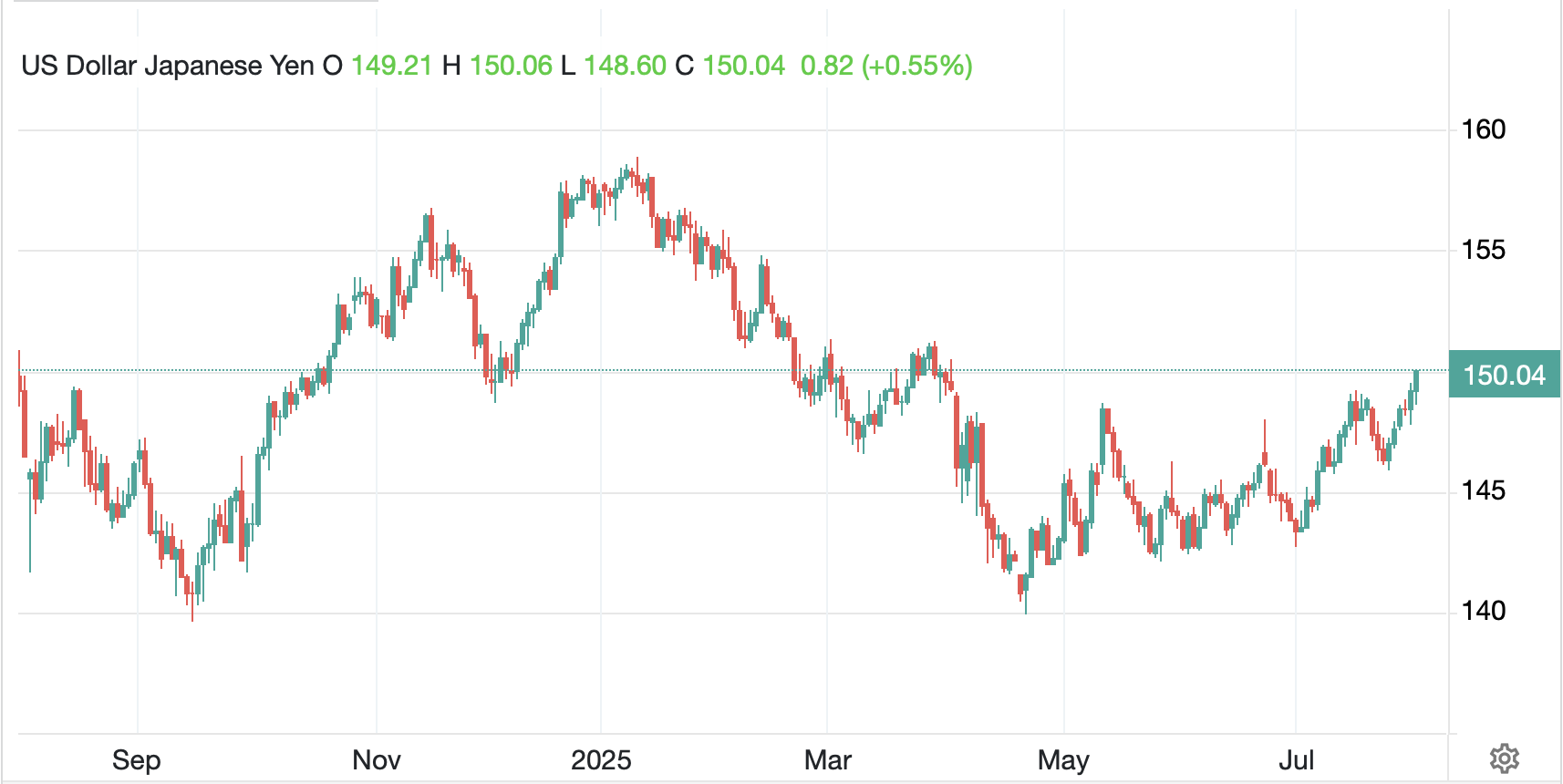
To begin, last night the BOJ left rates on hold as universally anticipated.  The initial market response was for the yen to weaken through 150 briefly, but then Ueda-san spoke and discussed the expected wage increases and how the economy was doing fine, and the new market assessment is that the BOJ will hike rates by 25bps in May at their next meeting.  The market response was to buy back the yen, at least for a little while, although right now, USDJPY seems to be attracted to the 150 level overall.  

Source: tradingeconomics.com

It is worth understanding, though, that the last time short-term interest rates were that high in Japan was back in July 2008.  And they have not been above that level since August 1995.  The below chart from FRED database speaks volumes about just how low interest rates have been in Japan over time, and as an adjunct, just how long the opportunity for shorting JPY on the carry trade has been around.  That dotted line is the Fed funds rate compared to the Japanese overnight rate.  

Along the central bank thesis, Bank Indonesia, too, met last night and left policy on hold with their policy rate at 5.75%.  Governor Warjiyo explained that he felt falling inflation and improving growth would help prevent rupiah weakness despite the fact that the currency has been the worst performing Asian currency this year and is trading at historic lows.

But on to the FOMC meeting which will conclude at 2:00 this afternoon with the policy statement (no change expected although some tweaking of the verbiage is likely) and the release of the latest dot plot.  You have probably forgotten that at the December meeting, the FOMC reduced the median expectation of rate cuts for 2025 from 4 prior to the election to just 2.  In the interim we have seen Fed funds futures trade to where barely one rate cut was priced in, although we are now back to three cuts, seemingly on the idea that tariffs will cause significant economic weakness, and the Fed will need to respond.  At least that’s what the punditry maintains.

Here is the last dot plot for information purposes and it will be interesting to see just how much things have changed.  will longer run rates continue to move higher?  Will 2 rate cuts still be the median outcome for 2025?  All this we get to learn at 2:00.

Source: federalreserve.gov

But arguably, of far more import will be Chairman Powell’s press conference beginning at 2:30.  Prior to the Fed’s quiet period, the broad assessment was that patience in future rate moves was appropriate and they were happy with the current situation.  However, I am confident there will be numerous questions regarding the potential impact of tariffs on monetary policy responses, as well as other things like DOGE and an audit of the Fed.  Will any of it matter?  Maybe at the margin, but for most markets, I suspect that fiscal issues will remain dominant.  The one exception is the FX market, where unalloyed hawkishness could change views on the dollar’s recent weakness (although it is firmer this morning) while a dovish tone will almost certainly undermine the greenback.  So, with no other data of note to be released beforehand, it is clearly the day’s major event.

Ahead of that event, let’s see how markets have behaved overnight.  Following a weak session in the US, where all three major indices were lower by about -1.0% on average, Asia had a mixed picture.  The Nikkei (-0.25%) found no love from Ueda-san and drifted lower.  Both Hong Kong (+0.1%) and China (+0.1%) edged higher but continue to doubt the benefits of the mooted Chinese stimulus program while the rest of the region was mixed with some gainers (Indonesia, Korea, India) and some laggards (Taiwan, Australia, Malaysia).  In Europe, too, the picture is mixed with the DAX (-0.4%) lagging while the CAC (+0.5%) is gaining.  In Germany, the historic breech of the debt brake is not having the positive impact anticipated, or perhaps this is just selling the news.  Overall, though, shares in Europe seem to be awaiting the Fed’s actions, or comments, rather than focusing on anything else.  As to US futures, at this hour (7:30), they are pointing slightly higher, about 0.25% across the board.

In the bond market, Treasury yields have edged up 1bp this morning but continue to hang around 4.30%.  European sovereign debt has seen yields slip -1bp to -2bps, arguably on the Eurozone inflation data released 0.1% lower than forecast at 2.3%.  This continues the idea that the ECB will be cutting rates again at their next meeting.  As to JGBs, they are unchanged yet again, seemingly affixed at 1.50%.

Commodity prices show oil (-0.2%) continuing yesterday’s decline.  From the time I wrote to the end of the session, WTI fell $2/bbl, perhaps on the idea that the Putin/Trump phone call was bringing the war closer to an end.  Regardless, if economic activity is slowing, that will lessen demand everywhere, a clear price negative.  As to gold (+0.25%) it continues to trade higher undaunted by any news on any front.  While silver is little changed this morning, copper (+0.7%) has now crested $5.00/lb and is pushing to the all-time highs seen back in May 2024.

Finally, the dollar is rallying this morning, higher against all its G10 counterparts by between 0.2% and 0.4%.  This looks to me like a trading correction, not a new trend.  The same price action is true in the EMG bloc with one real outlier, TRY (-4.2%) which actually traded down by as much as -10% earlier in the session (see chart below) on the news that President Erdogan had his key political rival, Istanbul mayor Ekrem Imamoglu, arrested on charges of fraud and terror, while his university diploma was revoked, seemingly in an effort to prevent him from running for president in the future.  Thank goodness we never have things like that happen in this country!

Source: tradingeconomics.com

There is no data released today other than EIA oil inventories where a modest net build across products is currently expected.  So, until the Fed, I would anticipate very little net movement.  After that, it all depends.  However, Powell will need to by extremely hawkish to shake any of my view that the dollar is headed lower overall.

Good luck

Adf

Not Worried

‘Bout markets, Scott Bessent’s not worried
As favor with specs can’t be curried
Instead, what he seeks
Is policy tweaks
To help growth, though folks want that hurried
 
Meanwhile, Chairman Jay and his team
Continue their policy theme
Inflation’s still falling
Although they are calling
For patience, as bulls start to scream


I’ve been in the investment business for 35 years, and I can tell you that corrections are healthy, they are normal,” Bessent said Sunday on NBC’s Meet The Press. “I‘m not worried about the markets. Over the long term, if we put good tax policy in place, deregulation and energy security, the markets will do great.”

The above comments from Treasury Secretary Scott Bessent yesterday morning (quote courtesy of Bloomberg.com) have garnered a remarkable amount of commentary amidst both the political and market punditry.  My first comment is I must be much older than Mr Bessent, since I have been in the investment business for 43 years.  However, as I have written numerous times over the course of the past years, the market has not cleared for a very long time.  Since the 1987 stock market crash, when then Fed Chair Greenspan started pumping liquidity into the financial markets to stabilize things, and realized he could do that to prevent serious downturns, we have seen two significant downdrafts, the tech bubble and the housing market crash, both of which were immediately met with massive liquidity injections, extremely low interest rates and for the latter, the advent of QE.

All of that liquidity has resulted in market excesses across many markets and has been a key driver in the stock market’s exceptional rise since the Covid blip.  Adding to that was the massive fiscal spending (remember those 7% budget deficits?) which has helped to insure that not only did markets rise, but so did retail prices.

Now, along comes a Treasury Secretary who hasn’t married himself to higher stock markets on a day-to-day basis and instead is focused on the long-term.  What I find most interesting is that the same pundits who are screaming about Bessent and Trump destroying the economy, were all-in on the discussion of how the US debt was going to ultimately cause a collapse.  Yet as the administration explicitly tries to address that issue (you may disagree with their methods, but that is their clear goal) suddenly, the fact that stock prices are falling is a tragedy of biblical proportions.  Here’s the thing, the worst performer, the NASDAQ, is down about -12% since its peak last month as per the below chart.  I might argue that is hardly a collapse.  In fact, a healthy correction doesn’t seem to be a bad description.

Source: tradingeconomics.com

There is no doubt that uncertainty about the near-term direction of the economy has grown, and there is no doubt that President Trump’s mercurial tendencies make long-term planning difficult.  However, I would contend we are a long way from the apocalypse or even a stockopalypse.  But once again, I highlight that volatility remains the key metric for now, and that hedging exposures remains very important.

With that as backdrop, the FOMC meets on Wednesday and while there is no expectation of any rate move, the market continues to price three rate cuts for the rest of the year, pretty much one each quarter.  A key unknown is just how hawkish or dovish Fed members currently find themselves given the recent market gyrations.  As well, while inflation had seemingly been the primary focus, with all the concern over a significant slowdown in the US economy, there are now many who believe we will see a rising Unemployment Rate despite a lack of evidence from the weekly Claims data.  These same pundits are also certain that Trump’s tariff policy will lead to rising inflation, really putting the Fed in a bind with a stagflationary outcome.  And maybe that is what will happen.

But I would contend it is far too early to assume that is our future.  First off, on the inflationary front, energy prices have fallen, a key inflation component, and as far as the tariffs are concerned, if they reduce demand, that is likely to cap prices. If on the other hand, demand is not reduced, I don’t see slowing growth as the likely outcome.  

In the end, if the economy is adjusting from one with far more government spending support, to one with more organic private sector economic activity, the transition may be bumpy, but the outcome will be far stronger.  We shall see if that is how things evolve.

In the meantime, let’s look at how the world has responded to the latest stories.  Friday’s US equity rebound was welcomed everywhere, although the key narrative remains the end of American exceptionalism, at least as regards equity markets.  Friday also saw the exiting German Bundestag agree to eliminate the debt brake for infrastructure and defense, with Chancellor-to-be Merz agreeing to waste spend €100 billion on climate related projects to convince the Green Party, which is out of the new government, to vote in the rule change before the new government is seated.  It is not clear to me how spending that money on net-zero ideas will defend Germany, but then I am just a poet, not a German policymaker.

As to Asian markets, other than mainland China (-0.25%) green was the predominant color on screens overnight with Japan (+0.9%), Australia (+0.8%) and Hong Kong (+0.8%) all following the US.  One of the remarkable things, though, is that Chinese data overnight showing IP (5.9%), Retail Sales (4.0%) and Fixed Asset Investment (4.1%) was generally solid.  Of course, Unemployment (5.4%) rose 2 ticks, an unwelcome outcome, and House prices (-4.8%) continue to decline, albeit at a slowing rate, but neither of those speak to a rebound in the Chinese economy.  The end of the Chinese NPC offered more platitudes about supporting the consumer, but it is not clear where the money is coming from.  And recall, more than 60% of Chinese household wealth remains tied up in housing investment, which continues to decline in value.  The Chinese have a long way to go in my view.

Quickly, European bourses are all modestly higher this morning, on the order of 0.3% or so, as hope springs eternal that the rearming of Europe will drive profit margins higher.  Unfortunately, at this hour (7:15), US futures are pointing lower, about -0.25% across the board, although that is up from earlier session lows.

In the bond market, Treasury yields have slipped -2bps this morning, but are really just trading around in their new trading range of 4.20% to 4.35% as investors try to get a handle on which of the big themes are going to drive markets going forward.  European sovereigns are all seeing rallies, with yields slipping -5bps to -6ps which seems out of step with the news about the end of the German debt brake.  Perhaps bond investors don’t believe the legislation will pass, or perhaps that they won’t spend the money after all.  As to JGB yields, the edged lower by -1bp in the 10yr, although longer dated paper has seen yields rise with 40-year bonds touching 3.0% for the first time in their relatively short history.

In the commodity markets, oil (+1.4%) is continuing to bounce of its lows from last week but remains well below levels seen at the beginning of the month.  The US attack on the Houthis is being called the beginning of an escalation in the Middle East by some, and perhaps that has traders concerned.  On the flip side, ostensibly, Presidents Trump and Putin are to speak tomorrow in an effort to get peace talks moving along, potentially a bearish oil signal.  In the metals markets, gold (+0.6%) remains in great demand having crested the $3000/oz level last week and rising from there.  This has helped both silver and copper, with the latter, despite concerns over slowing economic activity, pushing closer to $5.00/lb.  There is much talk of shortages in the market driving the price action.

Finally, the dollar is under pressure this morning with every G10 currency firmer led by NZD (+0.6%) and AUD (+0.4%) although gains elsewhere are on the order of +0.25%.  This story seems to go hand-in-hand with the German defense spending and the end of US exceptionalism.  As to the EMG bloc, most of these currencies are also stronger this morning, but the magnitude of these moves is generally less than the G10 bloc.  Recall, Trump wants a lower dollar, and my default is that is where we are headed at this point.

On the data front, we have an action-packed week ahead starting this morning.

TodayRetail Sales0.6%
 -ex autos0.4%
 Empire State Manufacturing-0.75
TuesdayHousing Starts1.375M
 Building Permits1.45M
 IP0.2%
 Capacity Utilization77.8%
WednesdayFOMC Rate Decision4.50% (unchanged)
ThursdayInitial Claims224K
 Continuing Claims1880K
 Philly Fed12.1
 Existing Home Sales3.92M
 Leading Indicators-0.2%

Source: tradingeconomics.com

As we have seen over the past many months, I suspect that this week’s data will be likely to give analysts on both sides of the economy is stronger/weaker argument new fodder.  While the Fed won’t be doing anything, and despite their relative decline in importance, I suspect that Chairman Powell’s press conference will still get a lot of attention.

While we don’t know what the future will bring for sure, I remain convinced that the dollar will slide, and commodities will rally.  As to stocks and bonds, well your guess is as good as mine.

Good luck

Adf