Awakened the Beast

The longshoreman’s union conceded
And ports will now work unimpeded
But is that enough
To make sure that stuff
Gets everywhere that it is needed?


Arguably, one of the biggest stories this morning is that the fears over the longshoreman’s union strike dramatically weakening the US economy while pushing up inflation have passed as there has been a temporary agreement to raise workers’ pay by 62% over the next six years although it seems that the questions over automation remain.  However, the agreement will last until January 15th, so the 3-day work stoppage is unlikely to have a major impact on the US economy, although I’m sure there will be a few hiccups around.  But hey, at least one problem is off the docket.
 
Meanwhile, problems in the Mideast
Continuously have increased
Iran took their shot
And all that it wrought
Was fear they’ve awakened the beast

Which takes us to the next major story, the nature of Israel’s response to Iran’s missile attack from earlier this week.  From what I have read, the US is trying very hard to persuade PM Netanyahu to leave Iran’s nuclear facilities and oil production capabilities alone.  While I understand the latter, given an attack there would likely drive oil prices far higher and not help VP Harris’s election prospects, I cannot understand why the US would be so adamant that Israel not seek to destroy Iran’s nuclear capabilities.  At any rate, the headline in this morning’s WSJ, “Biden Sidelined as Israel Reshapes Middle East”, seems to say it all.  At this point, we can only watch and wait.  

However, consider the benefits of either of those targets.  As it remains unclear whether Iran has achieved the capability to create nuclear weapons, an attack on those facilities, which are hardened and underground, may or may not be effective at preventing a future nuclear Iran.  But an attack on the oil production facilities, which are wide open and not nearly as well-defended, would immediately limit Iran’s income despite the certain rise in oil prices, as they would not be able to sell any.  Starving Iran of capital to continue to run its military and fund its proxies would likely be extremely effective at dramatically reducing threats to Israel.  As well, I’m pretty confident the Saudis would not be unhappy if oil rose to $90 or $100 per barrel.  My point is the latter strategy is likely to be effective at reducing Iranian activities while being quite achievable.  We shall see.

And finally, early today
The payrolls report will hold sway
O’er markets worldwide
As traders decide
If more cuts are soon on their way

Which takes us to the big economic story today, the monthly payroll report.  Wednesday’s ADP Employment data was much better than expected, showing job growth of 143K.  Current expectations are as follows:

Nonfarm Payrolls140K
Private Payrolls125K
Manufacturing Payrolls-5K
Unemployment Rate4.2%
Average Hourly Earnings0.3% (3.8% Y/Y)
Average Weekly Hours34.3
Participation Rate62.9%

Source: tradingeconomics.com

One thing to keep in mind is this is going to be the last meaningful payroll report before the next FOMC meeting because the October report, scheduled to be released on November 1st, is going to be a complete wreck with virtually no information because of the impact of Hurricane Helene.  In fact, it will likely take several months before economic data gets back to whatever its underlying trend may be given the disruption over such a wide swath of the nation.

The question of the economy’s strength continues to be a hotly contested disagreement between those who believe that a recession is coming soon, or has already started, vs. those who believe that there is no recession coming in the near future.  The first group tends to look through the headline data and sees decreasing quit rates and reduced hiring offsetting reduced firing with the lack of hiring seen as an indication business activity is slowing.  They look at high household credit card debt and growing delinquencies and see analogies to past recessions.  Meanwhile, the bulls look at the headline data and say, GDP continues to grow, inflation continues to slide and while manufacturing has been weak for nearly two years, this is a services economy and that has been strong (yesterday’s ISM Services print was a much stronger than expected 54.9).

Now, the very fact that Powell cut rates two weeks ago is indicative of the fact that there is real concern at the FOMC that growth is slowing.  I will not discuss the political question here.  But data like TSA travel clearances and restaurant seatings and the crowds at events show that at least some portion of the economy is still doing well.  Yesterday’s Claims data was 225K, a few thousand more than expected but still nowhere near a level that would indicate there is an employment glut.  

I believe the idea of the K-shaped recovery is the best description of things around.  The top quartile of income earners is doing just fine while the rest of the economy is struggling.  But that top quartile represents an outsized amount of economic activity, so the data continues to be positive.  In fact, if you are looking for a reason that there is so much angst in the electorate, this is it.  With all that in mind, though, my take is this morning’s number is going to be better than expected, somewhere on the 175K – 200K level.

Ok, let’s quickly run through market activity overnight.  Yesterday’s modest decline in US markets did not really give much direction to the overnight session as the Nikkei (+0.2%) managed to continue its recent modest rally and the Hang Seng (+2.8%) continues to benefit from a belief that Chinese stimulus is coming to the rescue.  But the rest of Asia couldn’t make up its mind (China is still closed) with gainers (Korea, New Zealand, Singapore) and laggards (India, Australia , Taiwan).  In Europe, the picture is also mixed ahead of the US data with modest gainers (CAC, DAX) and laggards (FTSE 100, IBEX) as the US data is still the key driver.  One story here is that the EU decided to impose tariffs of as much as 45% on Chinese BEV’s, something that is likely to become problematic for European exporters going forward.  As to US futures, just ahead of the data (8:00) markets are edging higher by 0.2%.

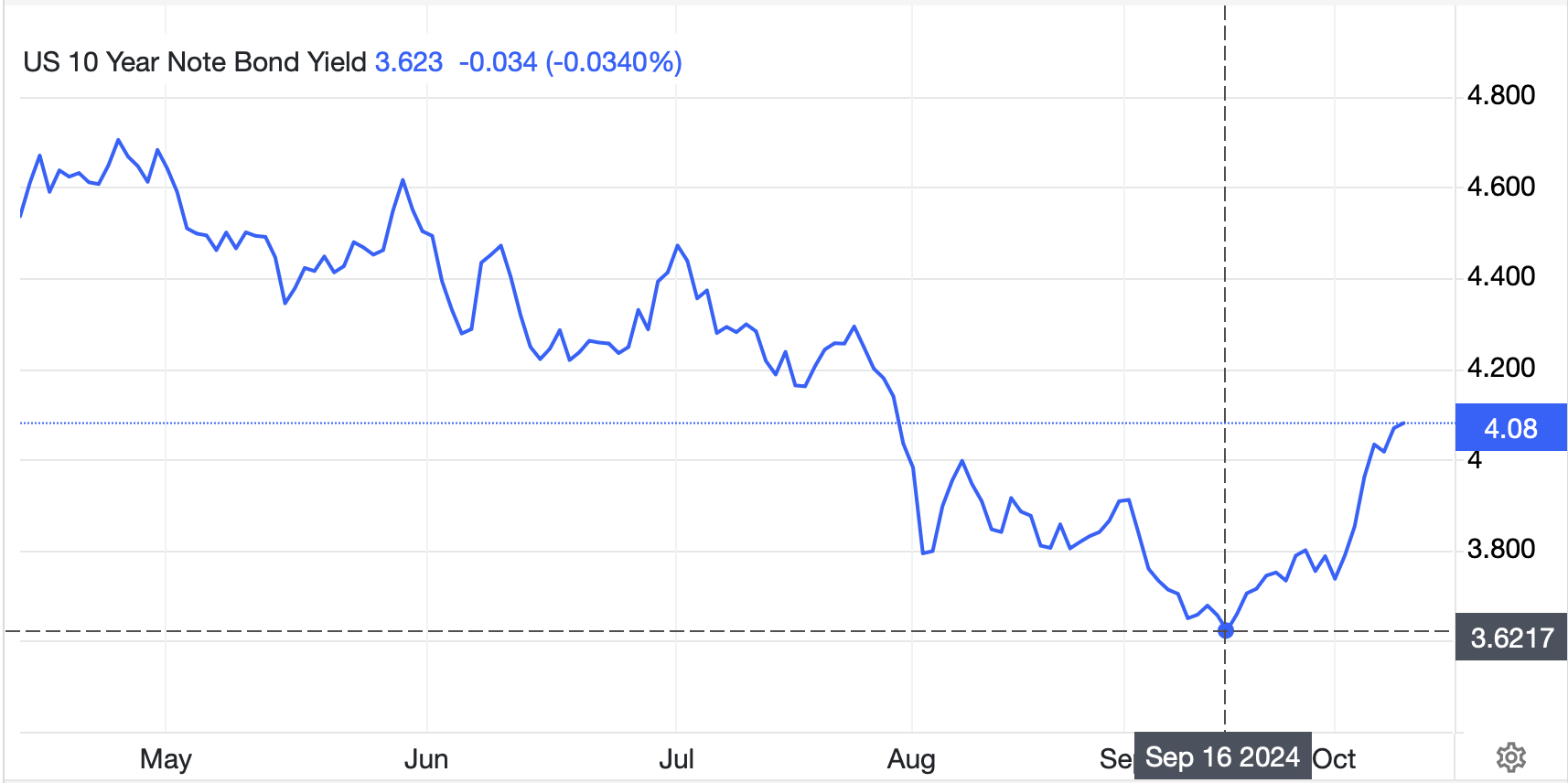
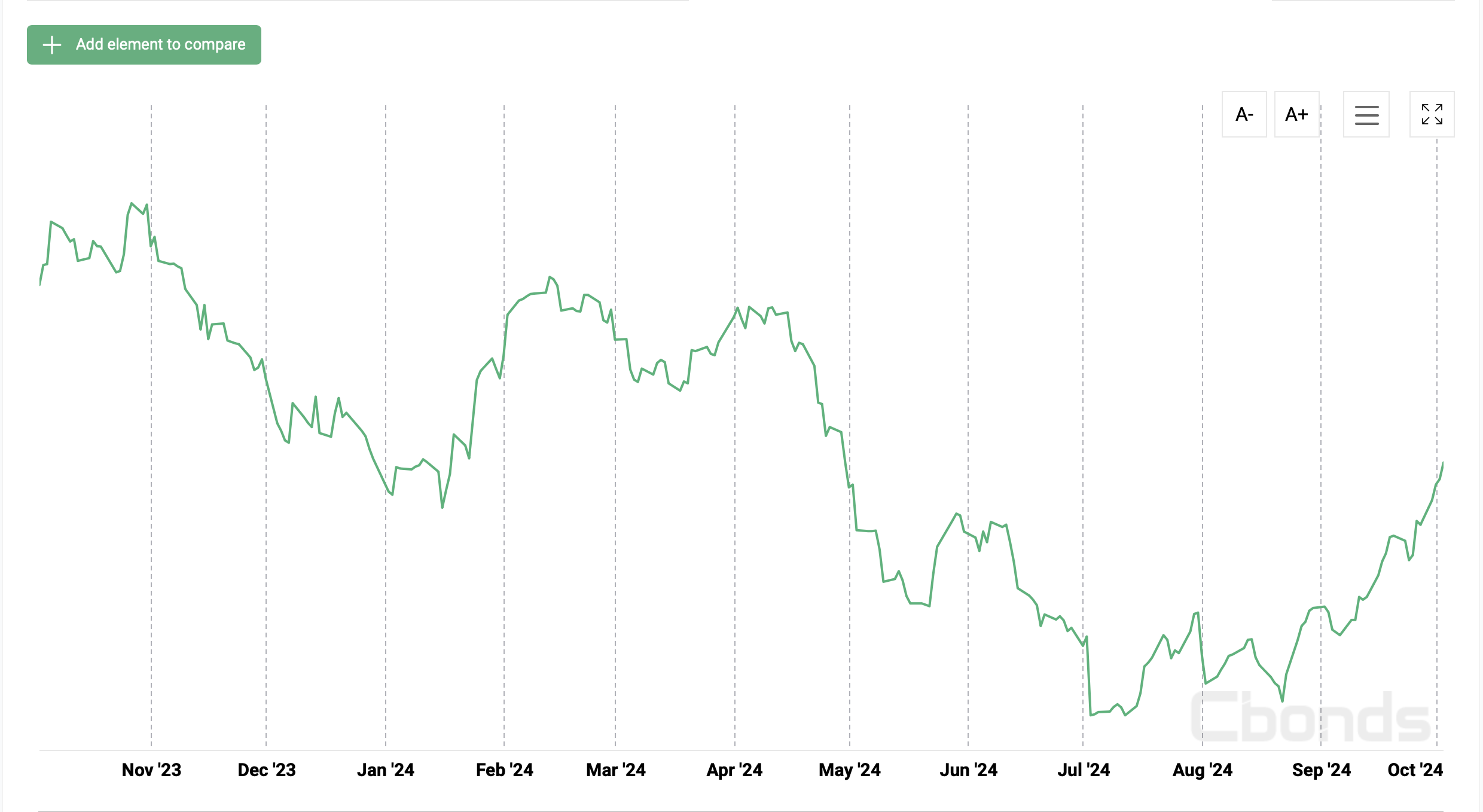
In the bond market, yields are continuing to rise around the world with Treasuries higher by 2bps this morning after a 5bp climb yesterday afternoon.  European sovereign yields are also much firmer, between 3bps and 6bps across the continent as concerns over inflation reignite.  Both the price of oil and the Chinese tariff story are driving this bond move.  As to JGB’s, they jumped 6bps last night, but that was more on the back of the US rise than any domestic news.

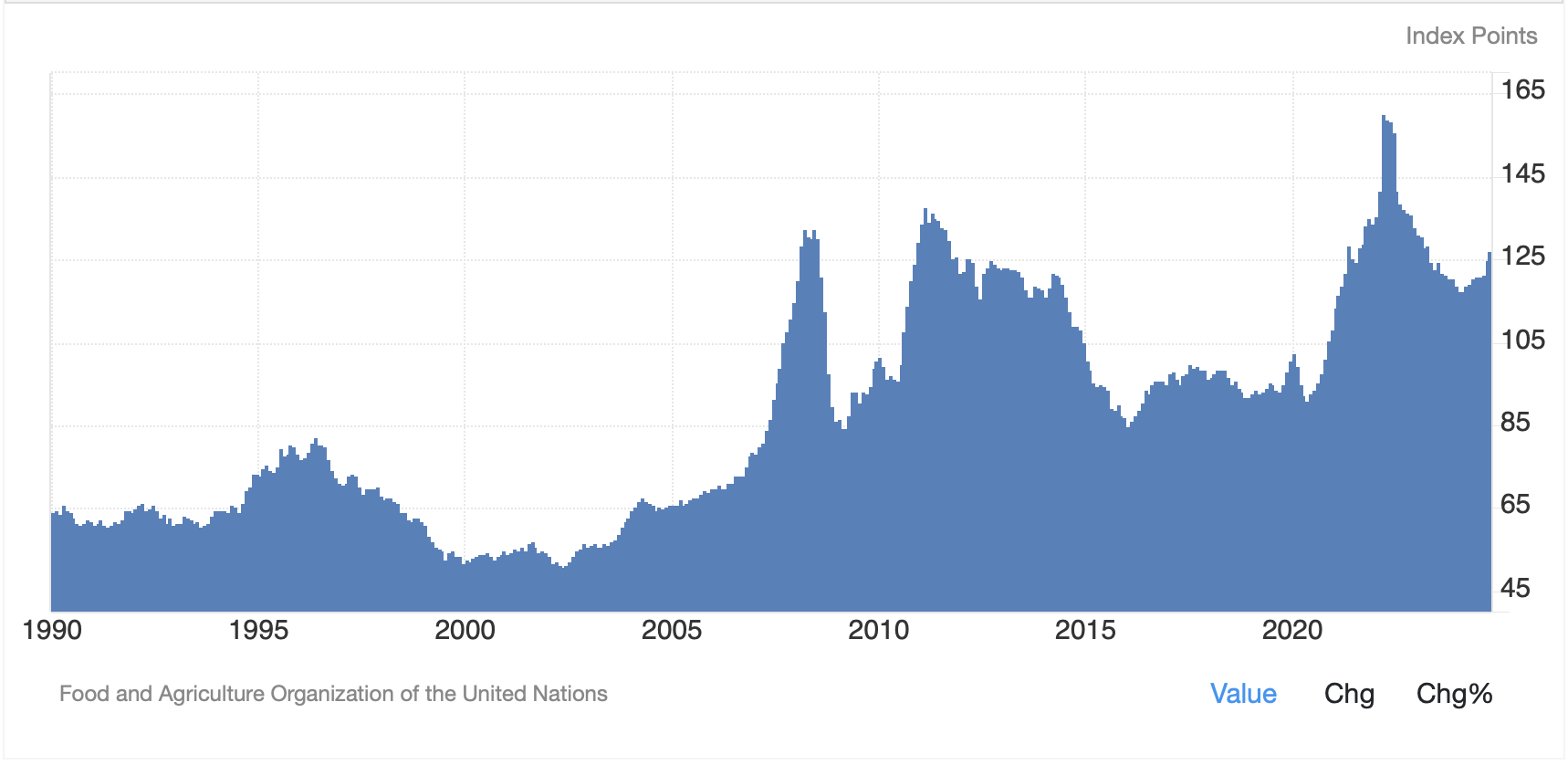
Oil (+1.4%) is continuing to rally as fears over an Israeli attack on Iranian assets builds.  This has helped the entire commodities complex with metals markets also firmer this morning, albeit only on the order of +0.25%. Nonetheless, the commodity higher story remains a fundamental one in my world view, especially as food prices are picking back up again around the world.  The UN’s FAO Food price index rose to its highest level in more than a year and looks for all the world like it has based and is now going to trend higher again.

Finally, the dollar is mixed this morning, with no defining theme here.  The pound (+0.35%) and MXN (+0.4%) have rallied while KRW (-0.5%) and AUD (-0.25%) have declined with the euro virtually unchanged.  My point is there is nothing specific to explain the movement.

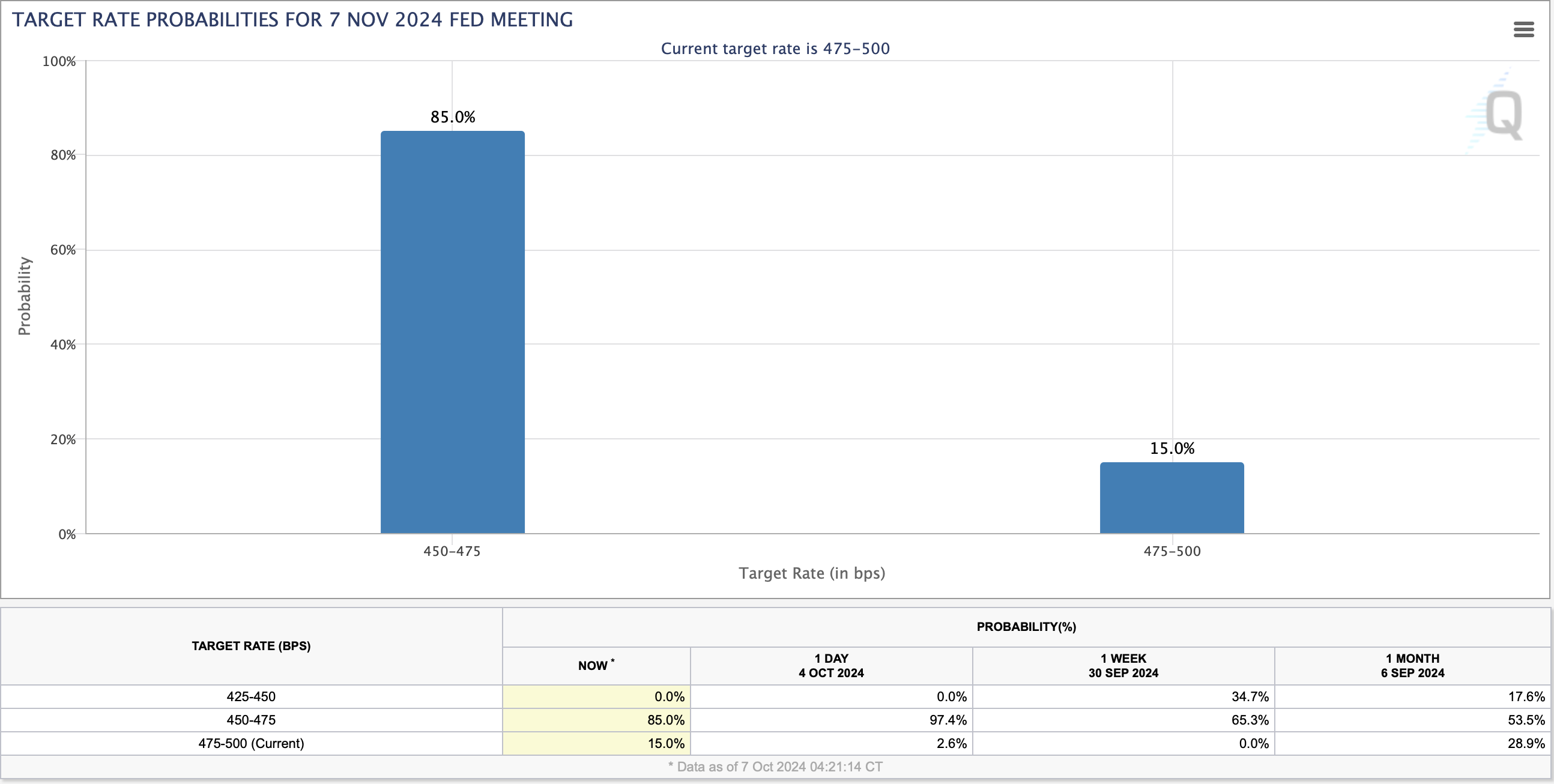
And that’s really it.  We hear from a couple of more Fed speakers but since Powell on Monday cooled the idea of another quick 50bp cut, they have not given us much new guidance.  If I am correct and the data is strong, I expect bonds to suffer along with commodities while the dollar should gain.  Stocks are a little less clear.  However, if it is a soft number, you can be sure that the 50bp talk will dramatically increase and stocks and commodities will soar as the dollar slides.

Good luck and good weekend

Adf

Not in a Hurry

The committee is not in a hurry
Said Jay, but the bulls needn’t worry
‘Cause Jay knows what’s what
And he can still cut
Quite quickly and watch the bears scurry
 
Meanwhile, at all ports in the east
The longshoremen’s working has ceased
With them now on strike
We could see a hike
In costs soon with ‘flation increased


“Overall, the economy is in solid shape; we intend to use our tools to keep it there. This is not a committee that feels like it’s in a hurry to cut rates quickly.  Ultimately, we will be guided by the incoming data. And if the economy slows more than we expect, then we can cut faster. If it slows less than we expect, we can cut slower.”

These were the key comments by Chairman Powell yesterday at the National Association for Business Economics annual meeting in Nashville.  They were the very essence of the two-handed economist who explains both sides of an issue without drawing a conclusion.  However, it appears what the market heard was ‘the Fed’s only going to cut 25bps at a clip going forward’.  This was made evident by the fact that when he began speaking, we saw equity markets dip right away as per the chart below of the S&P 500, although as he continued, and made clear that they expected to continue to cut rates and support the economy, traders (and algorithms) decided things were fine.  

Source: Bloomberg.com

We also heard from two other Fed members, Atlanta Fed president Bostic and Chicago Fed president Goolsbee, who both explained 50bps could well be the appropriate next move if things don’t follow their current script perfectly.  Naturally, equity markets heard that news and were soothed, hence the result that all three major indices closed slightly higher on the day.

The other major story this morning is that the International Longshoreman’s Association, the union for dockworkers along the entire East Coast and Gulf of Mexico, have gone on strike as of midnight.  They are demanding a 77% increase in wages over the next 6 years as well as promises about the speed with which further automation will occur in order to save jobs.  While the Taft-Hartley act could be invoked by the president to force both sides back to the bargaining table and require the workers to get back on the job for the next 80 days, President Biden has chosen not to do so in an effort to polish his political bona fides with unions.

The ultimate impact of the strike will depend entirely on its length.  This was not a surprise and many retailers and other importers pre-ordered inventory to tide them over as the holiday shopping season gets going.  However, estimates range up to an economic cost of $5 billion per day for each day of the strike, and the longer it goes on, the bigger the problem because rescheduling once things are settled will be that much more complex.  Regardless of the timing, though, one can be pretty certain that this will pressure prices higher as either shortages of certain items develop, or the wage gains result in higher shipping costs which will almost certainly be passed through the value chain.  

Remember, while headline PCE fell to 2.2% last month, core remained at 2.7%.  In the CPI readings, headline is still 2.5% with core at 3.2%, and perhaps more disconcertingly, median CPI at 4.2%.  Powell’s decision to cut rates 50bps last month with GDP still growing at 3%, the Unemployment Rate at a still historically low level of 4.2% and inflation, whether measured as PCE or CPI well above 2.0% was quite aggressive.  If this strike lasts a while, more than one week, expect to see price pressures begin to build again and that is going to put the Fed in a very difficult position.

One last thing to consider is the fact that virtually every major central bank around the world is in easing mode now that the Fed has begun to cut despite the fact that growth remains in decent shape in most places (Germany excepted).  This morning’s Eurozone CPI data (1.8%, 2.7% core) was even softer than expected virtually guaranteeing more aggressive action by the ECB and of course the PBOC was hyperaggressive last week in their easing actions.  Yesterday, Banxico indicated they may begin to cut more aggressively after having started their easing stance with 25bp cuts, as inflation in Mexico continues to decelerate to their target level of 3% +/- 1%.  The point is that policy worldwide is easing, or even in the few places where it is not, e.g. Japan and Australia, they are not tightening at any great pace.  The upshot is there is greater scope for a rebound in inflation while the dollar and other currencies continue to devalue vs. real items like commodities and real estate.  That is another way of saying that prices in those two asset classes should continue to climb.  As to the fiat currency world, relative values will depend on the pace with which individual nations ease, but they will all sink over time.

So, how have markets responded to the latest news?  After the modest US gains yesterday, and remember China is closed all week, Japan (+1.9%) regained about half of Monday’s declines after Ishiba-san was officially named PM and he appointed and Abenomics veteran, Katsunobu Kato, as his FinMin, helping encourage the idea that the BOJ may not be quite as aggressive as previously thought.  The rest of Asia saw more gainers than laggards with Taiwan (+0.75%) the next best performer and a mix otherwise.  In Europe, the picture is mixed with some gainers (FTSE 100 +0.4%, DAX +0.3%) and some laggards (IBEX -0.6%, CAC -0.2%) after Manufacturing PMI data across the continent continued to show lackluster results with Germany falling even further to a reading of 40.6 although Spain’s reading jumped to 53.0.  I must admit the stock market outcomes seem backward although I can understand the German view that the ECB will be more aggressive, thus supporting stocks, but why that is not helping Spain is a mystery.  As to US futures, at this hour (7:20) only the DJIA (-0.35%) is showing any discernible movement.

In the bond market, after yields backed up 5bps yesterday over concerns that the Fed’s more aggressive stance would lead to inflation and the port strike would not help that situation, they are sliding this morning.  Treasury yields, after touching 3.80% during yesterday’s session are down to 3.74% this morning and European sovereign yields have fallen even more sharply, between -7bps (Germany) and -12bps (France) as traders and investors become convinced that the ECB is going to become more aggressive in their easing.  JGB yields also slid 1bp last night after Kato-san’s appointment.

It should be no surprise that metals prices are rebounding this morning given the decline in yields as well as the growing concerns over inflation.  So, gold (+0.5%) is leading the way higher but the entire group is higher on the session.  However, oil (-0.8%) remains under pressure as news of Israel’s ground incursion into Lebanon to root out Hezbollah seem to be ignored while news that Libya is getting set to restart production after a political settlement was reached there adds to the supply picture.  

Finally, the real surprise is the dollar, which based on yields and metals would have been expected to continue sliding, but instead has rebounded sharply.  In fact, yesterday, the DXY rallied virtually all day and that has continued this morning with the index now above 101.00.  You may recall I highlighted that it was testing the 100 level which is seen as a key support.  I guess there is no break coming today.  This morning, the dollar’s move is universal, rising versus both the euro (-0.5%) and pound (-0.5%) as well as the rest of the G10 save the yen which is unchanged on the day.  In fact, 0.5% is the magnitude of that move virtually all the other currencies in the bloc.  As to the EMG bloc, these currencies have also suffered by -0.5% or so regardless of the region with the CE4 the worst performers, averaging -0.7%, while Asian currencies were down more on the order of -0.3% and LATAM -0.5%.

On the data front, ISM Manufacturing (exp 47.5) and JOLTS Job Openings (7.655M) are the main features and we hear from four more Fed speakers (Bostic, Cook, Barkin and Collins) before the day is done.

It is hard for me to look at the current situation without growing concern that the Fed is in the process of making a catastrophic error by easing policy into the base of an inflation cycle that just got more impetus from a key labor situation.  In the end, it is not clear to me how the dollar will behave against other currencies in the short run, but I see only upside for commodity prices.  If things do get ugly, the dollar will be seen as the best of a bad lot, and as commodity demand grows, so will demand for the greenback in order to buy those commodities, but this is not a positive story.

Good luck

Adf

A Brand New Zeitgeist

Although it’s the number two nation
Of late its shown real desperation
Seems Xi did appraise
The recent malaise
And ordered growth maximization
 
So, mortgage rates there have been sliced
And refi’s are now getting priced
It’s different this time
The bulls, in sync, chime
As Xi seeks a brand new zeitgeist


As China gets set to head off for a week-long holiday, President Xi wanted to make sure everybody there felt great and would start to spend money again.  His latest move came via the PBOC where they loosened the regulations regarding refinancing of home mortgages, now allowing them for everybody starting November 1st.  The key housing rate in China is the 5-year Loan Prime Rate, and while that has fallen steadily over the past two years, down nearly 1%, all the people who were swept up in the property bubble that began to burst three years ago have not been able to take advantage of the lower rates.  This is what is changing, and I presume there will be quite a bit of refi activity for the rest of the year.

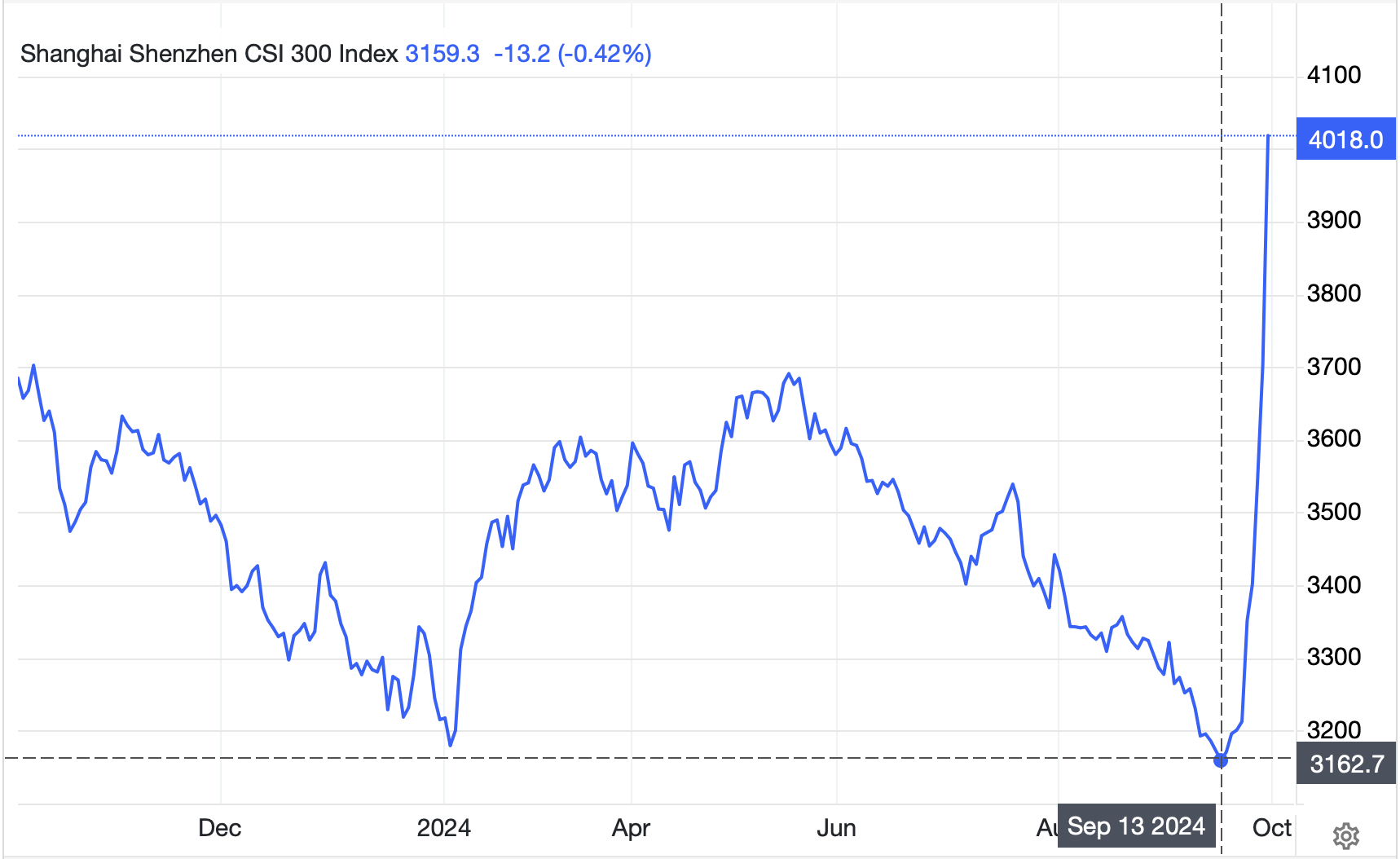
So, to recap what China has done in the past week, they have cut interest rates across the board, guaranteed loans to be used for stock repurchases, changed regulations to allow lower down payments on mortgages for first and second homes and now allowed more aggressive refinancing of existing mortgages.  As well, they reduced the RRR, freeing up capital for banks, and relaxed rules for regional governments to be able to spend more.  Now matter how this ultimately ends up, you must give Xi full marks for finally figuring out that in a command economy, he needed to command some more stimulus.  The latest mortgage news has simply excited the equity market even more and there was another huge rally last night (CSI 300 +8.5%), which when looking at a chart of that index shows an impressive rally in the past two weeks, slightly more than 27%!

Source: tradingeconomics.com

However, before we get too carried away, a little perspective may be in order.  The below chart is the 5-year view, and while the recent rebound is quite impressive, it simply takes us back to the level from July 2023 and remains more than 30% below the highs seen in February 2021.  I might argue that even if all of these policies work out as planned, something which rarely ever happens, until the economic data start to prove it out, things here feel a bit overbought for now.  Putting an exclamation on the last point, last night China released its monthly PMI data which showed just why Xi has become so aggressive.  Every reading, from both Caixin and the National Bureau of Statistics, was weaker than last month and weaker than expected.  Xi certainly needed to do something.

Source: tradingeconomics.com

Gravity remains
An unyielding force, even
For Japanese stocks

Now, a quick mea culpa from Friday’s note as I was in error on my analysis of the Japanese stock market in the wake of the election of Ishiba-san.  It seems that the announcement of his victory was not made until after the cash equity market was closed for the day. At that time, Sanae Takaichi remained the odds-on favorite to win the vote, and the market was anticipating a more dovish approach to things. Hence, the idea of the return to Abenomics and a much slower policy tightening was welcomed by the equity market at the same time the yen weakened.  But with Ishiba-san’s surprise victory, all of that got tossed out the window.  

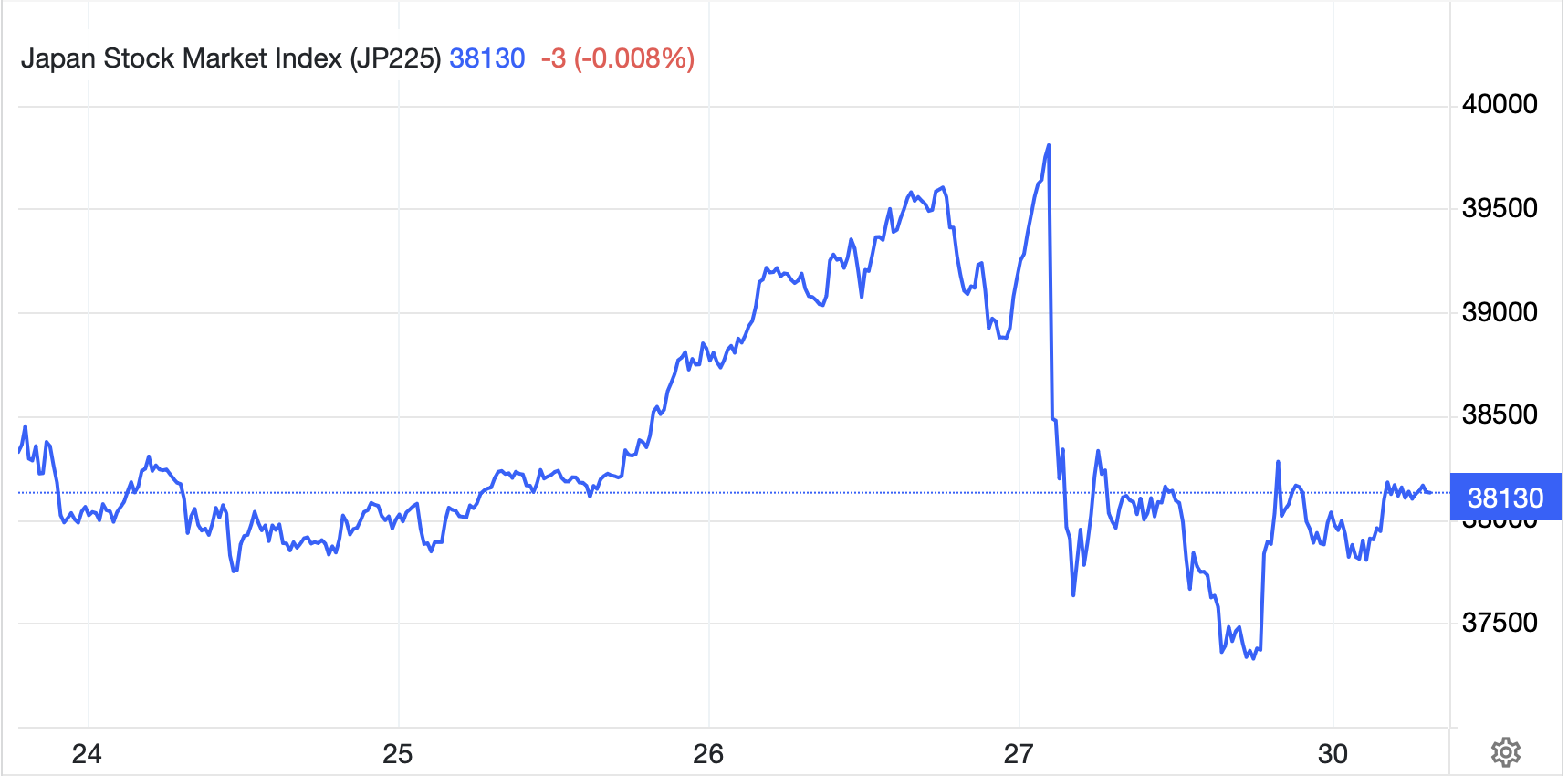
Of course, USDJPY was able to respond instantly, hence the sharp reversal in the market I showed in a chart on Friday.  However, the futures market sold off sharply on the election news and now that has been reflected in the overnight session with the Nikkei (-4.8%) giving back all the gains it had made in the previous two sessions in anticipation of a dovish turn.  So, as you can see in the below chart for the Nikkei 225 over the past week, we are basically exactly where things started before the Takaichi expectations built.  Truly much ado about nothing.

Source: tradingeconomics.com

As to the rest of the overnight session, beyond the Chinese data, we saw German state CPI readings which continue to fall as the German economy continues to slow appreciably.  We also saw UK GDP data, which was slightly softer than forecast, although at 0.9% Y/Y, still well ahead of Germany’s pace.  But otherwise, not very much else.  Last Friday’s PCE data was largely in line and quite frankly, most of the market seems to be focused on China right now, not the US, as that has become the newest idea on how to get rich quick.

So, here’s a quick recap of the session thus far.  Away from China and Japan, we saw more weakness than strength in Asia with both Korea and India falling more than -1.0%, although the rest of the region was mixed with much smaller moves.  Australia (+0.8%), though, benefitted from the China story as the price of iron ore, one of its major exports, rose 11% overnight on the idea that Chinese construction was coming back.  However, European bourses are under pressure this morning led by the CAC (-1.6%) with the rest of the continent also soft on the back of weaker earnings forecasts and announcements from European companies.  As to US futures, at this hour (7:20), they are pointing lower by -0.25%.

In the bond market, with all the excitement over renewed growth in China and continued tightening in Japan, yields are backing up slightly with virtually every G10 government seeing yields higher by 2bps this morning.  Ultimately, for Treasuries my fear is with the Fed cutting rates now and no real sign that the economy is slowing rapidly, we are going to see a quicker rebound in inflation than they are anticipating and that will not help the long end of the curve at all.

In the commodity markets, we are following Friday’s declines with further moves lower this morning as oil (-0.55%) continues to struggle on the weak demand story (this time from Europe, not China) while metals markets are also under pressure with all three biggies down (Au -0.75%, Ag -1.4%, Cu -0.7%).  This is a bit confusing for two reasons.  First, with the euphoria that the Chinese reflation story has generated, I would have expected copper to continue to rally alongside iron ore, but second, the dollar is softer today, and that generally supports the metals markets.

So, a quick look at the dollar shows the DXY is looking to test 100.00, a level it last briefly touched in July 2023 but spend most of 2020 and 2021 below.  This is concurrent with the euro (+0.3%) testing 1.12 and the pound (+0.3%) testing 1.35, with the former showing virtually the same pattern as the DXY and the latter making new highs for the past two years.  But there is some schizophrenia in the G10 with JPY (-0.2%), CHF (-0.3%), NOK (-0.35%) and SEK (-0.2%) all under pressure today.  While NOK and SEK make sense given the commodity moves, that doesn’t explain gains in AUD and NZD.  Some days are just like that.  In the EMG bloc, in truth, the dollar is showing more strength than weakness with ZAR (-0.35%), CNY (-0.2%) and KRW (-0.15%) although MXN (+0.3%) is bucking that trend.  On the one hand, it is quite confusing to see so many contrary moves amongst the currencies that typically track closely together.  On the other, though, none of the moves are very large, so there can be idiosyncratic explanations for all of this without changing the big picture story.

On the data front, we get a bunch of stuff culminating in NFP on Friday.

TodayChicago PMI46.2
 Dallas Fed Manufacturing-4.5
TuesdayISM Manufacturing47.5
 ISM Prices Paid53.7
 JOLTS Job Openings7.67M
WednesdayADP Employment120K
ThursdayInitial Claims220K
 Continuing Claims1837K
 ISM Services51.6
 Factory Orders0.1%
FridayNonfarm Payrolls140K
 Private Payrolls120K
 Manufacturing Payrolls-5K
 Unemployment Rate4.2%
 Average Hourly Earnings0.3% (3.8% Y/Y)
 Average Weekly Hours34.3
 Participation Rate62.9%

Source: tradingeconomics.com

As well as all that, we hear from nine different Fed speakers over 13 different speeches this week, including Chairman Powell this afternoon at 2:00pm.  It’s not clear that we have learned enough new information for Powell to change his tune although given all of China’s moves there could be some belief that the Fed doesn’t need to be so aggressive.  Now, as of this morning, the Fed funds futures market is pricing a 41% probability of a 50bp cut in November and a 50:50 chance of a total of 100bps by the end of the year.  but, if China is easing so aggressively, does the Fed need to as well?

Right now, the story is all China.  However, I still detect a lot of positive sentiment in the US and expectations that the Fed is going to continue to ease and boost growth, inflation be damned.  It still strikes me that you cannot be bullish both stocks and bonds here as they are going to respond quite differently to the future.  As to the dollar, it is clearly on its back foot as the pricing of further Fed ease undermines it for now, but remember, as other central banks follow the Fed more aggressively, any dollar declines will be muted.

Good luck

Adf

A Financial Home Run

Seems President Xi isn’t done
And last night he added a ton
Of new stimuli
In order to try
To hit a financial home run
 
The market response has been clear
Forget anything that’s austere
It’s buy with both hands
Ere Powell rebrands
QE as just more Christmas Cheer

Things are obviously worse in China than President Xi had been willing to let on for the past several months/years, as after two straight days of monetary policy stimulus announcements, they pulled out the big guns and got the fiscal side of the process involved.  Last night the Politburo pledged further support after a surprise meeting to discuss economic policies.  Their economic discussions have historically only occurred in April, July and December, so this was the latest indication that Xi is really concerned. 

Some of the actions include an (unspecified) effort to make the real estate market “stop declining”, limiting construction of new home projects, issuing CNY 2 trillion of special sovereign bonds to disburse funds to help fund financial assistance for low-income workers, shore up bank capital to encourage more lending and support further investment in productive capacity as well as to potentially buy up unfinished homes.  

Obviously, Xi was quite concerned that the country would not achieve his 5% GDP growth target for 2024 as an increasing number of analysts around the world were penciling in slower growth, and he decided he could not wait until December for the next policy adjustments.  Remember, too, that next week is a week-long Chinese holiday, so part of the impetus was to give cash to people to encourage more spending/activity.  While it is far too early to determine how effective these new policies will be at supporting real, organic economic activity, they did wonders for equity markets and risk assets around the world.

And really, that continues to be the main story.  With the Fed now having confirmed that lower rates are appropriate, I would look for almost every nation to boost stimulus, both monetary and fiscal, especially in the wake of recent election results which have seen incumbent after incumbent tossed from office.  After all, what good is being in power if you cannot buy your way to re-election?

So, how has all this impacted financial markets this morning?  You will not be surprised to see that risky assets are in huge demand with equity markets rallying everywhere along with metals, while haven assets see much more modest demand, with bond yields having slipped just a bit lower.

Yesterday’s mixed US market performance is but a distant memory this morning with Asian shares roaring higher (Nikkei +2.8%, Hang Seng +4.2%, CSI 300 +4.2%) and gains virtually across the region, albeit not quite as robust as those.  But after the Fed cut, this fiscal stimulus from China is seen as helping everybody.  Europe, too, is rocking this morning with gains well above 1.0% everywhere (DAX +1.2%, CAC +1.6%, IBEX +1.1%) except the UK (FTSE 100 +0.2%) which continues to struggle as the Labour government is shown to be further and further out of its depth with respect to actually running things rather than carping about how the Tories did it.  And not to worry, US futures are all racing higher as well this morning, higher by between 0.3% (DJIA) and 1.5% (NASDAQ) at this hour (7:15).

In the bond market, Treasury yields have edged lower by 2bps and remain far below the Fed funds rate.  It is not clear if this is the market anticipating a more significant economic slowdown or simply a continued manifestation of the fact that the Fed still owns a significant portion of the debt outstanding and so has restricted supply at the margin.  In Europe, yields are also lower, with the riskiest nations seeing the biggest declines as risk assets are in vogue this morning.  Thus, Italy (-7bps) and Greece (-6bps) have moved the farthest, but otherwise we are seeing movement on the order of -3bps elsewhere.  In another quirk, and a telling comment on the state of France’s finances, Spanish 10yr bonos now yield less than French 10yr OATs for the first time in more than 15 years.

Turning to commodities, oil (-2.8%) didn’t get the China rebound memo and has tumbled nearly $2/bbl falling well below the $70/bbl level.  It seems that Saudi Arabia is dropping its price target and preparing to increase production, something the market has been fearing.  As well, in Libya, which had not been producing lately due to political issues, it appears a tentative agreement is in place that will allow for more supply on the market.

But you know what really benefits from a lot of deficit spending and the effective abandonment of inflation targets?  That’s right, precious metals as gold (+0.8%) continues its steady move higher to new all-time highs and quickly approaches $2700/oz.  This has taken both silver (+2.2%) and copper (+2.2%) along for the ride and there is currently no end in sight.

Finally, the dollar is under pressure this morning in a classic risk-on reaction.  AUD (+0.9%) is the leading G10 gainer on the back of its strong metals exposure while NZD (+0.8%) is right behind.  But the dollar’s weakness is manifest in Europe (EUR +0.2%, GBP +0.5%, SEK +0.5%) as well as against most EMG currencies.  In fact, CNY (+0.55% and below 7.00) is one of the biggest movers today although we are seeing strength in KRW (+0.7%), MXN (+0.5%) and ZAR (+0.4%), an indication that this move is widespread.  As long as the perception remains that the Fed is going to lead the way to lower interest rates, I can see the dollar underperforming.  However, as soon as we see other nations become more aggressive, this move will abate.

On the data front, there is much on the calendar this morning starting with the weekly Initial (exp 225K) and Continuing (1832K) Claims data as well as the 3rd look at Q2 GDP (3.0%).  We also see Durable Goods (-2.6%, +0.1% ex-Transports) and then the ancillary data that comes with the GDP report including Real Consumer Spending (2.9%), Final Sales (2.2%) and the GDP PCE indicator (2.5% headline, 2.8% core).  But perhaps of far more importance, we hear from a host of Fed speakers this morning.  Governor Kugler and Boston Fed president Collins speak about financial inclusion, Governor Bowman discusses the economy and monetary policy, Governor Cook discusses AI and workforce development, Vice-chair Barr discusses regulation and Chairman Powell gives the opening remarks at the US Treasury Market Conference in NY. 

Yesterday, Governor Kugler added to the ‘mission accomplished’ view on inflation at the Fed and lauded the move to focus on Unemployment.  I would contend this is the key issue right now, the fact that central banks around the world, but particularly the Fed, have determined that the inflation fight is over.  While we may very well touch 2.0% core PCE in the next months, it strikes me as highly unlikely that level will be maintained.  Rather, 2.0% is now the floor and if the Unemployment Rate behaves in its historic manner, accelerating higher now that it has started to move in that direction, look for much sharper interest rate cuts, much higher inflation and a much weaker dollar.  To me, that is the biggest risk.  However, if Unemployment follows the Fed’s projected path, and stays quiescent, then the current slow decline in rates and a very gradual decline in the dollar seems more likely.

Good luck

Adf

Recalibration


All week we had heard many clues
That fifty is what Jay would choose
And that’s what he cut
With only one but
From Bowman, who shuns interviews
 
The key is now recalibration
In order to tackle inflation
Without driving higher
The joblessness spire
So, trust us, it’s all celebration


Recent indicators suggest that economic activity has continued to expand at a solid pace. Job gains have slowed, and the unemployment rate has moved up but remains lowInflation has made further progress toward the Committee’s 2 percent objective but remains somewhat elevated.” [emphasis added]

Reading the opening paragraph of the FOMC Statement, it might be confusing as to why they needed to cut rates 50bps.  After all, the economy is expanding at a solid pace (In fact, after the Retail Sales data on Tuesday, the Atlanta Fed’s GDPNow reading for Q3 is up to 3.0%!)  unemployment remains low and inflation is still somewhat elevated.  I know I am a simple poet, but the plain meaning of those words just doesn’t lead my thinking to, damn, we better cut 50 to get started.  But I guess that is just another reason I am not a member of the FOMC.

Perhaps the more interesting thing was the Summary of Economic Projections and the dot plot which showed that while expectations were for rates to fall far more dramatically than in June, the longer run expectations continue to rise.  In fact, Chairman Powell specifically addressed the SEP in the press conference, “If you look at the SEP you’ll see that it’s a process of recalibrating our policy stance away from where we had it a year ago when inflation was high and unemployment low to a place that’s more appropriate, given where we are now and where we expect to be, and that process will take place over time.” [emphasis added] In fact, there was a lot of recalibrating going on as that appears to be the Chairman’s new favorite word, using it 8 times in the press conference.

Source: federalreserve.cgov

Notice that their current forecasts are for GDP to slow to 2.0% with Unemployment edging only slightly higher while PCE inflation magically returns to their 2.0% target.  And take a look at the last two lines, with the Fed funds rate projections falling substantially for the next three years, far more quickly than their previous views, although they think the long-run level will be higher.  

I wonder about that last issue.  Historically, the thought was that the long run Fed funds rate would be inflation (2.0%) + real interest rate (0.5%) and they pegged it at 2.5% for years.  Now that they see it at 2.9%, is that because they think inflation is going to be higher (not according to their projections) which means that for some reason they think real interest rates are going to be higher.  However, when asked, Chairman Powell and every member of the board has been unable to explain this change.

But what really matters is how have markets responded to this earth-shattering news?  The initial movement was as expected, with stocks rallying sharply (see chart below) and yields sliding along with the dollar while commodities rallied.

Source: Bloomberg.com

But a funny thing happened on the way to the close, as can be seen in the chart.  Stocks gave back all their gains and then some, with all three major indices lower on the session while 10yr Treasury yields backed up 7bps and the dollar rebounded.  Arguably, this was a sell the news response, but we need to be careful.  Remember, there are many analysts who believe the economy is in deep trouble already and by starting off with a big cut, those with paranoia may be wondering what the Fed knows that the data, at least the headline data, is not really showing.

So much for yesterday, now let’s look at markets this morning beyond the initial knee-jerk responses.  Absent any other major news or data (Norgesbank leaving rates on hold doesn’t count as major), markets have played out far more along the lines of what would have been expected in the wake of a 50bp cut.  In other words, the dollar has fallen sharply against almost all its counterparts, equity markets have rallied around the world, commodity prices have rallied sharply, and bond yields are…unchanged? 

Which brings us to the question that has yet to be answered.  Which market is right, stocks or bonds?  They appear to be telling us different stories with stocks pushing to new highs amid rising multiples and rising profit growth expectations while bonds are pricing in another 200bps of rate cuts by the end of 2025, an outcome that would only seem to make sense in the event the economy fell into a recession.  But if we are in a recession, corporate earnings seem highly unlikely to rise as much as currently forecast and typically, P/E multiples contract.  Meanwhile, if the economy is humming along such that current equity pricing is warranted, what will be the driver for the Fed to cut rates as that will almost certainly reignite inflation.  

History has shown that the bond market tends to get these big questions right when they are pointing in different directions, but that doesn’t mean that risk assets will stop rallying right away.  In fact, this will likely take quite a while to play out.

Ok, so let’s put a little more detail on the market activity overnight.  Tokyo rocked (+2.0%) as did Hong Kong (+2.0%), Taiwan (+1.7%), Singapore (+1.1%) and even mainland China (+0.8%) managed to rally some.  It appears that investors around the world believe the Fed has opened the floodgates for a much lower interest rate environment everywhere.  European bourses, too, are sharply higher led by the CAC (+2.1%) but with strength across the board (DAX +1.5%, FTSE 100 +1.3%).  And US futures have shaken off the late selloff yesterday and are firmly higher this morning led by the NASDAQ (+2.2%).

Bond yields, though, are largely unchanged on the day, with yesterday’s backup in Treasury yields maintained and European sovereigns all within 1bp of yesterday’s close.  It appears that bond investors are less confident in a soft landing than equity investors.  Interestingly, JGB yields rose 2bps last night as Japanese markets prepare for the BOJ meeting tonight.

In the commodity markets, oil (0.75%) is continuing its recent rebound after another massive inventory draw was revealed by the EIA yesterday prior to the Fed meeting.  There is a growing concern that inventories in Cushing, Oklahoma are falling to a point where products like gasoline and diesel will not be able to be produced.  As an example, gasoline futures have risen far more than crude futures this week on that fear.  As to the metals markets, gold briefly touched $2600/oz yesterday immediately in the wake of the FOMC but sold off hard afterwards.  This morning, however, it is back pushing up to that level again and the entire metals complex is rising nicely.

Finally, the dollar, has been a whipsaw of late.  Post the FOMC, it fell sharply across the board, and then into yesterday’s close it rebounded to close higher on the day.  However, this morning it has given back all those late gains and then some, and is now sitting at its lowest level, at least per the DXY, since April 2022.  This morning, in the G10, we are seeing many currencies rally between 0.5% (EUR) and 1.3% (NOK) vs the dollar and everywhere in between.  The one exception to that is the yen (-0.2%) which is biding its time ahead of the BOJ meeting.  The working assumption is that the BOJ will do nothing tonight, but now that the Fed has cut 50bps, and given Ueda-san’s history of actively trying to surprise markets to achieve outcomes he wants, we cannot rule out another rate hike in Japan.  Monday morning, USDJPY fell below 140 for the first time in 18 months.  My take is Ueda-san is quite comfortable with it heading back to the 130 level, if not the 120 level.  If he were to surprise markets and raise the base rate by even 10bps tonight, I think we would see a sea change in sentiment and a much lower dollar.  And given inflation in Japan seems to have stalled at 2.8%, well above their 2.0% target, he has a built-in excuse.

Too, watch the CNY (+0.45%) as it is now trading at its highest level (weakest dollar) in more than a year, and is approaching the big, round number of 7.00.  the linkage between JPY and CNY is tight as they constantly compete in markets, especially now in autos and electronics.  If the Fed is really going to cut as much as markets are pricing, both these currencies should strengthen much further.

It is almost anticlimactic to discuss the data today but here goes.  First, the BOE left rates on hold, as expected and the market impact was limited.  Expectations are they will cut next in November.  As to data, we see Initial (exp 230K) and Continuing (1850K) Claims, Philly Fed (-1.0) and Existing Home Sales (3.90M).  None of that is likely to change any views.  Prior to the BOJ meeting, at 7:30 this evening we see Japanese CPI, which may change views there.

For now, the dollar is very likely to remain on its back foot as enthusiasm builds for multiple rate cuts by the Fed going forward.  However, if the data continues to impress like it has lately, that enthusiasm will need to be tempered.

Good luck

Adf

Lately Downturned

The story is still ‘bout the Fed
And whether, when looking ahead
They see skies are blue
And so, they eschew
A rate cut the bears will all dread
 
But if they are growing concerned
The ‘conomy’s lately downturned
Then fifty will be
What we all will see
And bears, once again, will be spurned


As we move closer to the FOMC announcement and Powell press conference, the nature of the discussion has focused entirely on the size of the rate cut that will be announced tomorrow.  Yet again this morning, the Fed whisperer, Nick Timiraos at the WSJpublished an article on the subject, once again making the case for 50 basis points.  The money quote is below:

“Fed officials aren’t likely to regret a larger rate cut this week if the economy chugs along between now and their next meeting, in early November, because rates will still be at a relatively high level, he said. But if the Fed makes a smaller move and the labor market deteriorates more rapidly, officials will feel greater regret.”

As well, the futures market is growing more and more certain 50bps is coming as evidenced by the pricing this morning as per the below chart from the CME:

The interesting thing is that an unbiased (if such a thing exists) look at the data does not scream out to me that the economy is collapsing such that an aggressive start to an easing cycle is necessary.  Unemployment remains in the lowest quintile of outcomes over the past 76 years.  For reference, the median reading since January 1948 has been 5.5%, the average has been 5.7% and today it is at 4.2%.  The chart below shows the distribution of outcomes over the entire data series from the FRED database.

Data source: FRED database; calculation: fx_poetry.com

It is difficult to look at this chart and think the economy is imploding.  And let us consider another thing, the widely mentioned long and variable lags by which monetary policy impacts the economy.  Whatever the Fed does tomorrow, the impact on almost the entire economy will not be felt for at least a year, if not much longer than that.  After all, do companies really make a borrowing decision based on the marginal 25bps of interest cost per annum?  I would argue that most corporate borrowing is based entirely on their current schedule of maturing debt and any forecast needs for capex or other funding.  It strikes me that whether the Fed funds rate is 5.25% or 5.00% is not going to change much in the real economy.

Markets, of course, are a different kettle of fish in this discussion, but let’s face it, the bond market has already priced in 250 basis points of cuts in the next twelve months, so whether they start with 25 or 50 seems less relevant than the destination.  Certainly, the equity market will try to goose things on a 50bp cut, and will almost certainly fall if the cut is only 25bps, at least initially, but again, will corporate profits change that much in the short-run because of this move?

In the end, I fear we make far too much of the outcome, at least in this case.  Now, if Powell and the Fed were to decide that the recent call for a 75bp cut by three senators was an eloquent argument and did that, the market surprise would be substantial and the initial move in risky assets would be higher.  But something like that would also engender fears that the Fed knows something bad about the economy that the rest of us have missed, and that would result in its own negative consequences. I guess the good news is we only have another 30 hours or so before we find out.

As to the market activity overnight, yesterday’s mixed US equity performance, with the DJIA making new all-time highs while the NASDAQ fell -0.5%, led to weakness in Tokyo (Nikkei -1.0%) as tech shares underperformed, but strength in HK (+1.4%) and much of the rest of Asia that was open.  Both China and South Korea remained closed for holidays.  In Europe, though, given the virtual lack of technology shares available, the DJIA was the template with all markets higher this morning led by Spain’s IBEX (+1.25%)), but with robust gains elsewhere on the order of +0.6% to +0.8%.  As to US futures, at this hour (7:30), they are higher by about 0.25%.

In the bond market, yields continue to edge lower overall.  While Treasuries are unchanged this morning, that follows another 2bp decline yesterday afternoon.  In Europe this morning, sovereign yields are all lower by between -1bp and -3bps, catching up (down?) to the Treasury market as well as responding to pretty awful German ZEW numbers (Sentiment 3.6 vs. 17.0 expected and 19.2 last month; Current Conditions -84.5 vs. -80.0 expected and -77.3 last month).  Germany remains the sick man of Europe and there is no doubt that they need to see the ECB start to cut rates more aggressively to help support their withering manufacturing sector.  And one more thing, JGB yields fell -2bps last night and are now at 0.81% in the 10yr.  While the focus will turn to the BOJ at the end of the week after the FOMC announcement tomorrow, the market does not appear to be particularly concerned over aggressive tightening there.

In the commodity markets, WTI (+0.15%) has crept back above $70/bbl for the first time in nearly two weeks as the big story in the market revolves around the net speculative Comex positioning which has turned negative for the first time ever.  That means that hedge funds and speculators are net short oil futures.  While they may have a negative outlook, the positioning does indicate there is an opportunity for a massive short-squeeze sometime going forward.  As to the metals markets, they are little changed this morning, broadly holding their recent gains with both precious and industrial metals all showing healthy gains in the past week.  A 50bp cut should support prices across the board here.

Finally, the dollar is softer again this morning, but by a modest amount, about -0.1% across the board.  Those are the types of gains we have seen across the G10 and most of the EMG currencies with one outlier, MXN (-0.9%).  However, the peso, which had strengthened nearly one full peso in the past four trading sessions looks more like it is responding to that movement than to any fundamental changes.  The judicial review story is now old news although there may be some concerns that Banxico will cut more aggressively next week if the Fed does so tomorrow.

On the data front, this morning brings Retail Sales (exp -0.2%, ex autos +0.2%) as well as IP (0.2%) and Capacity Utilization (77.9%).  We also hear from Dallas Fed president Logan this morning.  It’s funny, a strong Retail Sales number could well weigh on the chances for a 50bp cut as further evidence that things continue to be moving along fine.  Remember, even though inflation has been trending lower, it is not yet nearly at its target.  Retail Sales strength would indicate that employment remains robust as people spend money more readily when they have a paycheck, so the need for more stimulus may just not be that critical.

In the end, my best take is the Fed is going to cut 50bps tomorrow and the market is going to increasingly price that in as the session unfolds.  This will be especially true if Retail Sales is weaker than forecast, but even if it surprises on the upside, I remain convinced Powell wants to cut 50bps based on the number of articles discussing the idea in the mainstream press.  Ultimately, I think the dollar will suffer a bit further on that move and commodities will be the big winners.

Good luck

Adf

Powell’s Dream Team

The punditry’s dominant theme
Is whether Chair Powell’s dream team
Will cut twenty-five
And try to contrive
A reason a half’s a pipe dream
 
But there’s something getting no press
The balance sheet shrinking process
They’re still in QT
But what if QE
Is something they’ll now reassess?


With all the data of note now passed (PPI was largely in line although tending a bit higher than forecast) and the ECB having cut their deposit facility rate by 25bps, as widely expected, the market discussion is now on whether the Fed will cut by one-quarter or one-half percent next week.  The Fed funds futures market, which you may recall had been pricing as little as a 15% probability for that 50bp cut earlier this week, is currently a coin toss between the two outcomes.  In addition, the Fed whisperer, Nick Timiraos of the WSJ, had a front page article on the subject this morning, although he drew no conclusions.

But something that is getting virtually no airtime is the Fed’s balance sheet and its ongoing shrinkage.  You may recall that the current level of QT is $25 billion/month, which was reduced from the original amount of $60 billion/month back in June as the FOMC started to grow cautious regarding the appropriate amount of reserves and liquidity in the system.  

The issue is nobody knows what number constitutes the right amount of reserves.  Fed research is of the belief that somewhere between 10% and 12% of GDP (currently about $2.7 trillion to $3.3 trillion) should be sufficient to ensure that economic activity does not grind lower due to a lack of liquidity.  This has been the rationale behind the slow reduction in balance sheet assets.  But that research may not be accurate, and the underlying assumption was that the economy continued to grow at its trend rate.  In the event of a slowdown or recession, you can be sure that the Fed will add liquidity back as well as cut rates.

Now, working against my thesis is the Fed has not discussed this idea at all, at least publicly, and so a complete surprise is not their typical MO.  However, they have found themselves in a place where the market is pricing in more than 100 basis points of cuts over the next three meetings, including next week’s, which if they stick to their 25bp increments, means that one of these meetings needs a 50bp cut.  As I have written before, the bond market is pricing nearly 200bps of cuts in the next two years (see chart below), which would indicate that the likelihood of an economic slowdown is high.  

Source: tradingeconomics.com

At the same time, equity markets are trading near all-time highs with earnings estimates indicating that economic growth expectations remain quite robust.  Both of those scenarios cannot be true at the same time.

Source: LSEG

This is the landscape through which Chairman Powell must navigate the Fed’s policies as well as his communication of those policies.  In Jackson Hole, he virtually promised a rate cut was coming next week, and one is certainly on its way.  The magnitude of that cut, though, will offer the best clues as to the Fed’s thinking with respect to the future trajectory of the economy and which market, stocks or bonds, is right. 

There is one other thing to consider, though, as an investor. Given the bond market is pricing a significant slowdown, if that is your view, bonds will not offer much return if you are correct.  And if you are wrong, and growth is strong, it will be ugly.  Similarly, if you are of the view that there is no recession, but rather a soft- or no-landing is the likely outcome, then being long stocks, which have already priced for that outcome will likely have only a modest benefit.  However, in the event that the economy does fold and recession arrives, stocks are likely to sell-off sharply.  Arguably, the best positioning for a trader is to be short both stocks and bonds, as whichever outcome prevails, one asset will fall substantially while the other has limited upside, at least for a while.  For a hedger, this is the time that options make a lot of sense as the asymmetry they provide is what allows a hedger to prevent locking in the worst outcomes.

Ok, with that behind us, let’s look at the overnight session to see how things followed yesterday’s risk rally in the US.  In Asia, the Nikkei (-0.7%) has been struggling lately on the back of continued JPY strength.  As you can see from the below chart, that relationship has been pretty strong for a while, and last night, USDJPY traded to new lows for the year, erasing the entire gain (yen decline) that peaked at the end of June.

Source: tradingeconomics.com

As to the rest of Asia, mainland Chinese shares (CSI 300 -0.4%) continue to underperform although HK shares managed a rally (+0.75%) while most of the rest of the region showed very modest strength, certainly nothing like the US performance, but at least in the green.  In Europe, equity markets are all higher this morning with Spain’s IBEX (+0.8%) leading the way although solid gains of 0.3% – 0.5% prevalent elsewhere.  As to US futures, at this hour (7:45) they are creeping higher by about 0.1%.

In the bond market, Treasury yields are lower by 2bps this morning and European sovereign yields are generally little changed to lower by 2bps across the continent.  Yesterday’s ECB outcome was universally expected, and Madame Lagarde explained they remain data dependent and promised no timeline for potential further rate cuts, if they are even to come (they will).  As to JGB yields, they too fell 2bps last night, once again confusing those who are looking for policy tightening in Tokyo.

In the commodity markets, oil (+1.4%) is rallying for the third consecutive day as Hurricane Francine shut in about 40% of gulf production and the timing of its return is still uncertain.  Despite the US equity markets’ clear economic bullishness, the weak growth/demand story is still a major part of this discussion.  In the metals markets, gold (+0.3% overnight, +3.2% in the past week) continues to set new price records daily with a story making the rounds that SAMA, Saudi Arabia’s central bank, secretly bought 160 tons of gold last quarter, soaking up much supply.  This has helped drag silver back above $30/oz although copper (-0.5%) is stumbling a bit this morning.

Finally, it should be no surprise that the dollar is under some pressure this morning as the talk of more aggressive Fed easing grows.  While the euro and pound are little changed, JPY (+0.5%) is leading the way in the G10 with AUD (+0.45%), NZD (+0.4%), NOK (+0.2%) and SEK (+0.3%) all firmer on the back of commodity strength.  In the EMG bloc, the story is a bit more nuanced with ZAR (-0.15%) bucking the trend on domestic political concerns, although we saw strength in KRW (+0.5%) overnight and MXN (+0.35%) as the Fed rate cut story plays out across most currencies.

On the data front, only Michigan Sentiment (exp 68.0) is on the docket so once again, the dollar will be subject to the equity market behavior and the strength of narrative regarding just how dovish the Fed will wind up behaving next week.  I will say that a 50bp cut is likely to see some short-term dollar weakness, probably enough for it to fall to multi-year lows vs. its major counterparts.  But remember, if the Fed starts getting aggressive, other central banks will feel comfortable following that lead, so the dollar’s weakness may not be that long-lived.

Good luck and good weekend

Adf

A New Pox

The interest rate doves are excited
That job growth in August was blighted
If that was the case
The Fed may embrace
Enough cuts to leave them delighted
 
But if they’re correct, what of stocks?
Will weak data be a new pox
On earnings and growth
And undermine both
With stocks falling onto the rocks?


As far as anyone can tell, there is only one thing that matters today, the payroll report.  Let’s set the table with the latest median forecasts:

Nonfarm Payrolls160K
Private Payrolls139K
Manufacturing Payrolls0K
Unemployment Rate4.2%
Average Hourly Earnings 0.3% (3.7% Y/Y)
Average Weekly Hours34.3
Participation Rate62.6%

Source: tradingeconomics.com

I’m sure you all remember that last month we got a surprising, and disappointing, reading of 114K for the headline number and then we subsequently got those massive revisions from the BLS which indicated that they had overstated job growth by more than 800K over the year from April 2023 through March 2024.  As well, yesterday’s ADP Employment data showed private job growth of a below expectations 99K with a revision lower to the previous month’s number.  Certainly, some of the data we have seen is pointing in the direction of a weaker outcome.  However, if one looks at the Initial and Continuing Claims data, neither of those series are pointing to a significant weakening in the labor market, although it has cooled somewhat since last year.

Since the last NFP report, 10-year Treasury yields have declined by 28bps and now sit at 3.70% this morning.  If you compare that to the current Fed funds rate of 5.375%, the implication is that rates are going to fall by at least 160 basis points over the next two years.  In fact, we are starting to see some analysts (Citi) call for nearly that many cuts by the end of 2024!  It strikes me that 150bps of cuts by December 2024 would only occur in response to a significant slowing of US economic activity, in other words, the long-awaited recession. Now, if the Fed were to cut that aggressively without a clear decline in the economy, it would certainly open the door to much higher inflation ahead.  After all, why add liquidity and ease policy if the economy continues to cruise along at a decent clip?

The upshot is that it appears, at least to this poet’s eyes, that the bond market is way ahead of itself with respect to potential Fed rate cuts.  Either that or the stock market is completely mispriced for the potential future earnings results of its components.  The one consistent outcome from all recessions is that corporate earnings growth slows dramatically.  Given that current equity prices embody P/E multiples near historically high levels (see chart below of Cyclically Adjusted Price Earnings for the S&P 500), if the E in that fraction declines, you better believe that so will the P.

Source: lesswrong.com

What will this mean for other asset classes, notably commodities and the dollar?  Here we need to consider the driver of the potential rate cuts in question.  If the US economy is clearly slowing dramatically and the Fed is responding by cutting rates aggressively, I would expect that the dollar will come under real pressure, at least initially, as the Fed is likely to be more aggressive than other central banks.  However, remember that the market is already pricing in significant rate cuts, so given the reality that if the US enters recession, most of the rest of the world is going to see much slower economic growth with their central banks easing policy as well, I would not look for a dollar decline of historic proportions.  Another 5%-8% seems viable but looking for the euro at 1.50 or the pound at 1.75 or the renminbi at 6.00 seems unrealistic.  The one outlier here is the yen, of course, where a situation with declining US equity prices, and correspondingly declining risk asset prices all over the world, could easily see Japanese investors run home with their money and USDJPY could well fall back to the 120 level or even lower in that scenario.

As to commodity prices, I expect the initial move would be lower as concerns about growth would imply falling demand for the key commodities oil and copper.  Gold, however, is a different animal and I imagine that we could see more uptake here as a weaker dollar and growing fear drive more retail buying of the barbarous relic.

Of course, if the data this morning is firmer than expected, all these bets are off.  In fact, that appears to be the biggest risk in markets today, a strong NFP number with a decline in the Unemployment Rate.  Market participants seem quite confident that the slowdown is coming and that the Fed is going to stick the soft landing.  That is the only explanation for the fact that equity markets, despite yesterday’s modest declines, continue to trade near all-time highs regardless of the indications that US economic activity is slowing somewhat.  The belief seems to be that the Fed will be able to cut rates the appropriate amount to prevent a collapse without triggering a renewed burst in inflation.  And maybe they will.  But given the fact that equity ownership is at record high levels already, the question becomes who is going to buy from here.  Any misstep by the Fed, where it becomes clear that the outcome will be worse than a soft landing (either a recession or higher inflation or both) is going to weigh heavily on equity and other risk markets.

So, as we await the big news, a quick review of the overnight session shows that most equity markets in Asia (Nikkei -0.7%, CSI 300 -0.8%) and Europe (DAX -0.4%, FTSE 100 -0.3%) are lower, following the US session.

In the bond markets, yields everywhere continue to decline with Treasury yields (-3bps) continuing their fall while European sovereign yields are all softer by between -4bps and -5bps this morning.  Even JGB yields (-3bps) are continuing lower as the global bond markets seem to be implying that economic activity is waning everywhere.

In the commodity markets, oil (+0.5%) is a touch firmer but remains below $70/bbl and has not shown any real strength despite a dramatic inventory drawdown reported by the EIA yesterday.  OPEC+ has explained they are not going to restart production next month and will wait until at least December before doing so, but based on the price action of oil, I will wager they will delay it again then.  Metals markets are little changed this morning after rallying yesterday during the US session, but like almost every market, all eyes are on the tape at 8:30 when NFP is released.

Finally, the dollar is a touch softer net, with traders seemingly preparing for a weak number.  But the movements are so small that the largest is JPY (+0.25%) which is the result of a combination of fear and the broader dollar weakness I think.    Here, too, we will learn much based on the data, so not much to do until then.

In addition to the payroll report we will hear from NY Fed President Williams and Governor Waller this morning as they will be the last to speak ahead of the Fed’s quiet period.  Williams is due at 8:45, so his speech is prepared, but Waller will have time to alter things if the data is a significant surprise given he doesn’t speak until 11:00.

And that’s really it for today.  It’s all NFP all the time.  While it is very easy to believe that a weak number is coming, it is also clear to me that the pain trade would be a strong number.  As such, I have a sneaking suspicion we could see something much firmer than forecast, maybe 200K with the Unemployment Rate ticking back down to 4.1%.  That would be the real surprise.

Good luck and good weekend

Adf
JOLTed

The market, on Wednesday, was JOLTed
By data, and traders revolted
The jobs situation
Has changed the narration
And helped Jay, his door be unbolted


What door you may ask?  Why, the door that leads to a 50bp rate cut at the FOMC meeting in two weeks.  Already, the Fed funds futures market is pricing in a 43% probability of a 50bp cut, up from a one-third probability on Tuesday morning.  Remember, everything now revolves around the labor market, and yesterday’s JOLTs data was not only worse than forecast, at 7.67M (forecast 8.1M), but last month’s was revised lower by nearly 200K jobs as well.  Remember, too, that tomorrow the NFP report is released with current forecasts centering on 160K, higher than last month but well down on what we have been seeing all year prior to the August report.

There are many analysts who have been calling out Powell and the Fed for making a policy error and holding rates too high for too long.  Perhaps they are correct.  But so much of the decision to cut rates relies on the idea that inflation is well and truly dead, or at least terminal, and if that assumption is incorrect, there will be hell to pay.  The last time the US saw inflation of the same magnitude that we have seen in the past two years, then Fed Chair, Arthur Burns, cut rates too early and inflation exploded higher, peaking at a higher rate than the first rise.  In fact, he did that twice, with inflation spiking three times throughout the 1970’s and early 1980’s.  

Source: FRED database

Powell has been very clear that he is trying to channel Paul Volcker and not Arthur Burns, but if he cuts rates, he opens himself up to a much less satisfactory outcome.  There have been many charts of the following nature showing the parallels of the 1970’s to recent price levels and it is entirely possible we see another wave higher if the Fed cuts.

Source: Real Investment Advice

As things currently stand, I would contend that the Fed’s focus is almost entirely on employment, hence the market response to yesterday’s weaker than forecast JOLTs data.  This implies that this morning’s ADP and Initial Claims data have the chance to really move things.  It also means that tomorrow’s NFP data remains a critical focus for all markets.

In the meantime, market activity overall could well be described as choppy.  While US equity markets opened lower yesterday, following the sharp declines on Tuesday, they closed mixed with limited overall movement. The fears in the semiconductor sector, which were fanned by a, since denied, report that Nvidia had been subpoenaed in an anti-trust investigation, has stopped falling and there are still numerous stories about how much Capex the big 4 tech companies are going to invest this year in all things AI.  Traders and investors are looking for the next big clue which is why I expect limited activity until tomorrow morning’s data release.

Asian equity markets were similarly mixed overnight with some gainers (Australia +0.4%, Taiwan +0.45%, CSI 300 +0.2%) and some laggards (Nikkei -1.05%, KOSPI -0.2%, Hang Seng -0.1%), as no clear direction presently exists.  Late last week, BOJ Governor Ueda sent a letter to the Diet explaining he still expected to raise interest rates if the economy progressed as expected, and that has a number of analysts calling for another leg down in USDJPY and further Nikkei weakness.  But it seems that is a big IF.  With economic activity clearly slowing around the world, it is not hard to believe that the same will be true in Japan and conditions for further rate hikes may not develop.  As to European bourses, the picture here is mixed as well with the CAC (-0.5%) lagging while Spain’s IBEX (+0.7%) is having a pretty good day.  Both the DAX (+0.2%) and FTSE 100 (+0.1%) are modestly higher despite weak Construction PMI data, perhaps both anticipating further policy ease.

In the bond markets, though, the direction of travel is clear for now with yields everywhere having fallen sharply yesterday and simply consolidating today.  After the JOLTs data, Treasury yields fell 9bps (2yr yields fell 12bps and the 2yr-10yr spread is now flat), although this morning it has bounced by a single basis point.  European sovereign yields slipped yesterday as well, between -3bps and -5bps, after the JOLTs data and this morning have backed up by 1bp across the board.  As to JGB yields, they edged lower by -1bp last night and remain a good distance from the 1.00% level despite the recirculated Ueda comments.

In the commodity markets, oil (+0.2%) which had bounced a bit yesterday morning, ceded those gains as the session wore on and is currently below $70/bbl.  While talk of OPEC+ starting up more production has faded, the weak economy / slowing demand story, especially the weak Chinese economy story, remains front and center and continues to weigh on the price.  Meanwhile, in the metals markets, gold (+0.7%) continues to shine overall as the growing sentiment for a 50bp Fed funds cut helps all commodities, but especially this one as concerns over the dollar’s ability to maintain its purchasing power remain rife.  But this morning we are seeing silver (+1.4%) and copper (+0.2%) higher as well, although the latter seem more trading than fundamentally based.

Finally, the dollar is under some modest pressure this morning, which given the movement in yields and rate cut expectations, should be no surprise.  In the G10, virtually all the movement has been less than 0.2% with CAD (-0.1%) the laggard after the BOC cut rates by 25bps yesterday as widely expected.  This morning the yen is also a touch softer, but that is after a sharp rally yesterday of more than 1%, so this morning feels like a trading bounce.  In the EMG bloc, the picture is a bit more mixed with ZAR (+0.5%) the leader this morning on both the gold price as well as economic data showing the Current Account deficit shrank dramatically in Q2 in a pleasant surprise.  On the flipside, MXN (-0.3%) is lagging as the market absorbs recent modestly weaker than expected economic data on Unemployment and Fixed Investment.

Which brings us to today’s data releases.  We start with ADP Employment (exp 145K), then Initial (229K) and Continuing (1870K) Claims.  As well, at 8:30 we see Nonfarm Productivity (2.4%) and Unit Labor Costs (0.8%).  Then, at 10:00 comes ISM Services (51.1) with the final set of data the EIA oil inventories at 11:00 with net further drawdowns forecast.  There are no Fed speakers on the docket today, but we are supposed to hear from two tomorrow after the NFP data.

Absent a big surprise in either ADP or Initial Claims, with the former more likely than the latter, I suspect that it will be another choppy day as all eyes focus on NFP tomorrow.  However, the one thing that seems likely is the dollar has further to decline within the current market narrative of more rate cuts sooner by Powell and the Fed.

Good luck

Adf

Still Weak

In Germany, data’s still weak
For Europe, that doesn’t, well, speak
So, riddle me this
Are traders remiss
For claiming that euros are chic?
 
It’s true interest rates matter most
And Powell said Fed funds are toast
But can M. Lagarde
Just simply discard
The Germans, though they’re comatose?


There is a growing opinion that the dollar is going to decline sharply as the Fed begins to cut rates.  Numerous analysts believe that the market is underpricing how many Fed fund cuts are coming as they are all-in on the US recession story.  After Friday’s Jackson Hole speech, it certainly appears that we will get at least one cut come September, but stranger things have happened.  And obviously, given Powell’s pivot from inflation to unemployment as job #1, the NFP report a week from Friday is going to be crucial.

But we must never forget that the FX market is a relative concept.  It is not simply that one country’s economy is doing well or poorly, nor that their interest rates are high or low, or perhaps moving up or down, it is how those data points compare to other countries that determines the movement in the FX markets, at least the fundamentals, but also frequently the capital flows.  It is with this in mind that on a quiet day we have time to dissect the story in Germany for a bit.  Early this morning, Germany’s Federal Statistical Office released two data points, the GfK Consumer Confidence reading, which fell sharply to a below consensus reading of -22.0 and the Final GDP Growth numbers for Q2, which printed at -0.1% Q/Q and 0.0% Y/Y.  Now, this is not a single quarter feature in Germany as is illustrated in the below chart.

A graph with blue and yellow squares

Description automatically generated

Source: tradingeconomics.com

In fact, GDP growth in Germany has averaged just 0.3% annually over the past 5 years, a pretty anemic level, and one that bodes ill for Europe as a whole.  Recall, Germany’s economy is the largest in Europe (and 3rdlargest in the world) and represents about 28.6% of the Eurozone’s total economy.  If the largest economy in a group of nations is stagnating, it is very difficult for the group’s overall growth rate to expand.  Compare that to the fact that the data to date in the US indicate that growth remains fairly solid (GDP +2.8% in Q2), and then ask yourself, where are the opportunities for activity more prevalent, Europe or the US?  Again, the macro picture seems to point to the US as a continued preferred destination for capital.

And yet, the euro is pushing back to its highest level since a brief spike in July 2023, and otherwise, early 2022 prior to that.  So, does it really make sense for the euro to continue to rally from here?  Literally, the only argument in its favor is that the Fed has now committed to begin easing policy and the market is pricing in about 200bps of rate cuts through the end of 2025.  Meanwhile, although the ECB has implemented their first rate cut, and seem set to execute their second next month, the market is only pricing in 125bps of cuts by December 2025, and just 50bps total for 2024, compared to 100bps for the Fed.

As such, here is the explanation for the euro’s recent solid performance.  But I believe the question to ask is, can this last?  If Germany’s economy is going to continue to bounce along at essentially zero growth, and there is nothing indicating a rebound is coming soon, it seems more likely to me that the rest of Europe follows it lower, rather than ignores Germany and powers ahead.  It’s not that individual small nations in the Eurozone won’t grow more quickly, but Germany’s position in the Eurozone, notably as a trade partner, implies that things are more likely to sag than soar.  

Yes, the euro has rebounded lately, but that has been in response to the interest rate pricing described above.  I think it is a fair bet that Madame Lagarde, when faced with a Eurozone that is growing more slowly than desired, is likely to accelerate interest rate cuts there.  And when that happens, the euro’s recent rise will very likely retrace.  I am not saying that the dollar is going to climb against everything, just that the euro’s strength feels suspect.  One poet’s view.

I’m sorry for the focus on Germany, but some days, there is very little macro news of note, and this seemed the most important, especially given that the idea of a much weaker dollar going forward is gaining traction.  

Ok, with that in mind, let’s look at the overnight activity, which was not all that substantial.  After yesterday’s split between tech shares (NASDAQ -0.85%) and industrials (DJIA +0.16% and a new ATH), Asian shares were mixed as well.  The Nikkei (+0.5%) had a solid session as did the Hang Seng (+0.4%) although mainland Chinese shares (-0.6%) continue to suffer, last night due to a much weaker than forecast earnings result from the parent company of Temu.  Of more concern than the result was the commentary by their CEO that prospects for consumption were dimming.  In Europe, there are some very modest gains, with the DAX (+0.2%) surprisingly holding up well, although the move is obviously quite minimal.  I cannot look at the Eurozone economy and expect anything other than more aggressive rate cuts from the ECB going forward.  As to US futures, at this hour (7:30), they are essentially flat.

In the bond market, yields are backing up from their recent lows with Treasuries higher by 3bps and European sovereigns by between 5bps and 7bps.  In fact, the real outlier is the UK gilt market where 10yr yields are higher by 9bps as there is an increasing concern that the Starmer government is going to blow up the budget there as the PM tries to implement his new policies.  You may remember what happened when Liz Truss was PM and proposed a high spending, high deficit budget and caused all kinds of havoc in the gilt market back in October 2022.  I would not rule out another situation like that quite frankly.  Finally, JGB yields edged lower by 1bp last night, continuing to prove that normal monetary policy in Japan remains a distant prospect.

In the commodity markets, oil (-0.4%) which is higher by > 5% in the past week, has stopped climbing for now.  Perhaps the fact that there have been no new military incursions in the Middle East has been sufficient to get the algos to start selling again on the poor demand story.  Gold (-0.2%) is also biding its time, as are the other metals, although all are retaining the bulk of their recent gains.  Generically, my dollar view is that it will weaken vs. stuff like commodities, not necessarily vs. other currencies.  Of course, this implies a rebound in inflation, something which I continue to see going forward.

Lastly, the dollar is little changed this morning, with most G10 and EMG currencies +/-0.2% or less compared to yesterday’s closing levels.  The biggest mover today is NZD (+0.4%), although I am hard-pressed to see any fundamental reason as there was neither data nor central bank commentary.  Arguably, this is the result of some position changes rather than a fundamental move.  And after that, nothing has moved much at all.

Yesterday’s Durable Goods print of +9.9% was astonishingly high, although the ex-transport reading of -0.2% was a tick lower than forecast.  I guess Boeing sold more planes than anticipated.  As to this morning, we see Case-Shiller Home Prices (exp 6.0%) and Consumer Confidence (100.7), neither of which seems likely to have a major impact.  SF Fed president Daly reiterated the Powell idea that the time has come to cut rates, and I expect every Fed speaker going forward up to the quiet period to say the same.  I guess the real problem will be if the NFP report is hot.  Right now, the early forecasts are for 100K NFP and the Unemployment Rate to remain unchanged at 4.3%.  But what if it prints at 200K and Unemployment slips back a tick?  Will they still be anxious to cut?  I’m not forecasting that, simply reminding us all that assumptions need to be tempered.

As it is the last week of August with holidays rife around the Street, I suspect it will be very quiet overall.  At this point, we need more data to make decisions, so look for limited activity in the FX markets, although I guess the world is really waiting for Nvidia’s earnings tomorrow more than anything else.

Good luck

adf