I Am Your Savior

Investors are showing concern
‘Bout tariffs and Trump, so they spurn
The riskiest stuff
But that’s not enough
To help generate a return
 
Seems most of the holdings in favor
Are no longer risk takers’ flavor
How long before Jay
Will finally say
QE is here, I am your savior


Have you bailed out on your risk exposures yet?  Because if not, it certainly seems you are behind the curve!  At least, that’s what it feels like this morning as trepidation underlies every player’s market activity.  Based on the commentary, as well as the Fear & Greed Index, you might think we are in a depression!
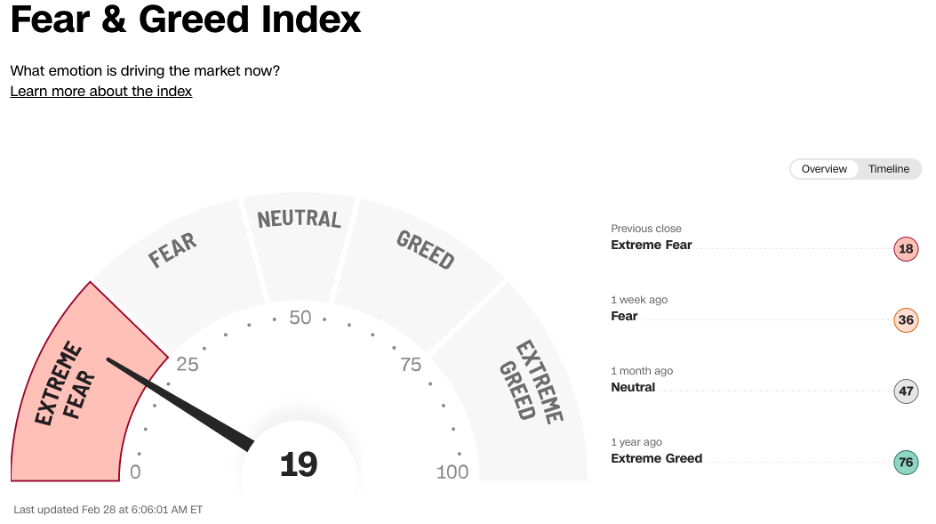
Source: cnn.com

But are things really that bad?  I know that the past week has seen a modest drawdown in equity prices, but after all, on February 20th, they reached yet another new all-time high, at least as per the S&P 500.  Since then, as you can see below, the decline has been less than 5%.  And while the market has traded below its 50-day moving average (blue line), a key technical indicator, it remains well above both the 200-day version of the same (purple line) and the longer-term trend line.  My point is it feels like the narrative is overstating the magnitude of the move thus far.

Source: tradingeconomics.com

Is this the beginning of the end?  While you can never rule that out, as major corrections can occur at any time, I have no reason to believe this will be the case.  Much has been made of yesterday’s Initial Claims print at 242K, much higher than forecast as a harbinger of future economic weakness.  However, looking at the past 3 years of weekly data here, while certainly in the upper levels of readings, it is not nearly the only occurrence and not nearly the highest reading.

Source: tradingeconomics.com

One data point does not make a trend and to my eye, looking at this chart, there is no discernible trend in either direction.  Yet part of the narrative evolution is that the DOGE cuts in government jobs, along with all the headline spending cuts, is setting the economy up for much slower growth in the short run.

In fact, this issue goes back to one about which I wrote several days ago here regarding the impact of government spending on actual economic activity.  The current view of economic activity includes government spending.  If President Trump’s goal is to reduce that spending, regardless of the net long-term benefits of such actions, GDP readings are going to decline initially.  Yes, there will be more productive use of capital with less regulation and less government, but that will take some time to become evident.  In the meantime, weaker economic activity is likely to be the outcome.

I have frequently written that there has not been a market clearing event since, arguably, October 1987, when equity markets plunged and erased significant excess and speculation.  Alas, newly minted (at the time) Fed Chair Greenspan stepped in and promised to support markets with ample liquidity the next day which opened the way for far more Fed intervention in markets leading up to Ben Bernanke and the first QE programs in the wake of the GFC in 2009 and every QE version since then.  While the movement so far does not remotely indicate the end of the world, based on the Fed’s history, once equity markets correct about 20%, they tend to become far more active in supporting the markets economy.  Will this time be different?  Given the Fed’s seeming underlying desperation to cut rates to begin with, my take is if the correction reaches 15% – 20%, we will see just that.

To sum things up, risk assets are under pressure on the basis of 1) excessive valuations, 2) the Trump efforts to reduce wasteful spending (which while wasteful is still spending and counted as economic activity), and 3) the idea that Trump’s imposition of tariffs is going to dramatically raise inflation and slow growth further.  Given the mainstream media’s inherent hatred of the president, they will certainly be playing up this theme for as long as they can as they try to force Trump to change tack.  But Trump, and Treasury Secretary Bessent, have been clear that their concern is 10-year bond yields, and getting them to lower levels.  A natural corollary of the current risk-off sentiment is that bond yields tend to decline.   Look at the chart below which shows that since Trump’s inauguration, 10-year yields are down nearly 40bps.  I would argue that Trump and Bessent are perfectly comfortable with the market right now.

Source: tradingeconomics.com

Ok, let’s move on to the overnight activity.  Sticking to the bond theme, while Treasuries, this morning, are unchanged, they did decline all yesterday afternoon and this morning European sovereigns are all lower by -2bps.  As well, JGB yields have also slipped by -3bps as we are seeing risk aversion evident all around the world.  Of course, the problem with all G10 nations (Germany excepted) is that they all have very high debt/GDP ratios and in Europe, especially, this is a problem as they have begun to realize they need to spend a great deal more on defense than they have in the past.  And all that spending is going to be funded by more borrowing.  The tension between additional issuance driving yields higher and risk aversion driving yields lower is going to be the theme of European bond markets for a while.

In the equity world, it is not a pretty picture anywhere in the world.  After yesterday’s US rout, with the NASDAQ (-2.8%) leading the way lower, Asian bourses were all in the red.  Japan (-2.9%), Hong Kong (-3.3%), China (-2.0%), Korea (-3.4%), India (-1.9%)… the list goes on across the entire region with only New Zealand (+0.5%) bucking the trend on some better than expected local earnings and consumer confidence data.  European markets, though, are in a bit better shape as they suffered yesterday and are consolidating those losses this morning with most markets trading +/- 0.3% on the session.  We have seen a lot of European inflation data this morning, most of it lower than forecast which has encouraged the view that the ECB will be cutting rates more aggressively going forward.  US futures, too, are higher at this hour (7:00), on the order of 0.5% as they bounce from yesterday’s, and truly the past week’s, declines.

In the commodity markets, oil (-1.25%) is back under pressure and back under $70/bbl.  The latest fear is that slowing economic activity around the world will reduce demand for the black sticky stuff and drive prices lower still.  Remember this, oil supply is restricted not by geology, but by politics.  As nations determine that cheaper energy is critical to their future, expect to see more effort to produce more oil.  Meanwhile, metals markets are also under pressure with gold (-0.5%) still falling despite its ostensible risk profile.  However, the barbarous relic remains well above $2800/oz and I continue to believe that this correction is just that, and not the reversal of a trend.  Too many things are happening around the world to induce more fear and in that scenario, gold is the oldest store of value around.  The rest of the metals complex is also under pressure with copper (-1.2%) slipping back a bit.  It is important to remember, though, that despite the recent declines, all the major metals are still nicely higher on the month.  

Finally, the dollar is a bit firmer again this morning after a rally yesterday as well.  In classic risk-off fashion, investors flocked to the dollar, arguably to buy Treasuries.  So, we are seeing weakness in NZD (-0.6%), JPY (-0.4%) and CHF (-0.3%) in the G10 and weakness in KRW (-0.5%), ZAR (-0.2%) amongst others in the EMG bloc.  Here the story remains the impacts of Trump’s tariffs and how they will be applied, if they will be applied, as well as a general fear factor which tends to help the dollar.  Consider, too, ideas that the ECB is going to cut rates will not help the single currency.

On the data front, this morning brings Personal Income (exp +0.3%), Personal Spending (0.1%), and the PCE data where Headline (0.3%, 2.5% Y/Y) and Core (0.3%, 2.6% Y/Y) will be the most important data points.  As well, we will see Chicago PMI (40.6) which has been below 50.0 in every month but one since August 2022.  

There is no question that the economic data has been softening lately.  We saw that with the Citi Surprise Index as well as the continuous stream of commentary by the economic bears who point to underlying pieces of data that point in that direction (whether housing or employment indicators and the recent weak PMI data).  

Consider this, an early recession in Trump’s term can be blamed on the Biden administration as well as set things up for future growth, certainly in time for the mid-term elections.  As well, it will likely help reduce the yield on the 10-year, an explicit goal.  This scenario likely means short-term weakness with an eye to longer term growth.  The dollar is likely to benefit early on, at least until the Fed steps in.

Good luck and good weekend

Adf

Scuppered

There once was a time many thought
That equities had to be bought
Then, darn it, Japan
It scuppered the plan
And havoc is all that they wrought
 
So, last week, not greed, but fear, won
And risk assets ended their run
But now folks are sure
In fact, it’s de jure
That rate cuts, next month, are, deal, done


Congratulations everyone.  You made it through the end of the world!  I must admit, though, that on this side of that extraordinary event, things don’t really seem that different.  A quick recap reminds us that on July 31st, the BOJ surprised markets and raised interest rates by 15bps, taking their overnight funding rate to 0.25%, its highest level in 15 years.  Twelve hours later, the FOMC did not cut rates, as some had been advocating, but seemed to promise that a cut was coming in September.  Then, two days later, the US employment report showed substantially weaker jobs activity than expected.  Over the ensuing several sessions, USDJPY declined dramatically, falling nearly 10 big figures as can be seen in the first chart below.

A graph with numbers and a line

Description automatically generated

Source: tradingeconomics.com

After an initial reflexive trading bounce, it was starting to slide again when, on August 6th, BOJ vice-governor Ichida explained that the BOJ would not, in fact, be aggressively tightening policy immediately.  The result was a relief rally and now USDJPY sits about halfway between the level prior to the rate hike and the low’s plumbed afterwards.

Perhaps just as interesting is the fact that the Nikkei 225 showed virtually the identical trading pattern, with its decline last Monday, August 5th, as the second largest single-day decline in its history.

Source: tradingeconomics.com

And yet, it is not hard to see that the trading pattern for both the Nikkei 225 and USDJPY are virtually identical, with the same catalysts.  In fact, we can look at other markets, 10yr Treasury yields and the NASDAQ come to mind, and see extremely similar price action.  (Alas, I couldn’t get the BOJ and Unemployment rate points on the combined chart, but you can see it is the same pattern.)

A graph of stock market

Description automatically generated

Source: tradingeconomics.com

The one truism that holds is that during a time of stress, all correlations go to one!

But perhaps it’s time to consider, once again, the idea of recession.  As of now, there are still two camps:

  1. Recession is already here and started sometime in the late spring.  This is based on the declining trend in manufacturing activity, the rise in the unemployment rate (the Sahm Rule), the rising number of bankruptcies and increasing size of household debt along with delinquencies.  Constant downward revisions of previous data releases also weigh on the view, and of course, the yield curve continues to point to lower interest rates going forward, the implication being growth is slowing.  One last feature is the dramatic difference between GDP and GDI, two different measures of US economic activity that should show the same thing, however currently, GDI (Gross Domestic Income) is printing below 1% real growth.
  • Meanwhile, the soft/no-landing scenario remains popular amongst a different set of analysts.  Perhaps the most comprehensive discussion comes from Apollo Research’s Torsten Slok as he highlights the fact that real-time indicators like air travel, restaurant seatings, income tax withholdings and Retail Sales remain quite strong.  As well, the Atlanta Fed’s GDPNow is currently running at 2.9%, which certainly doesn’t appear to be pointing to a recession.

So, which is it?  Of course, that’s the $1 trillion question.  However, let us consider a few incontrovertible truths.  First, business cycles still exist.  Despite all the efforts by finance ministries and central banks to create an ever upward trajectory in economic activity, or more accurately because of those efforts, excesses are created and at some point, that growth is no longer sustainable.  In other words, governments and central banks blow bubbles and eventually they pop.  Second, not all parts of the economy grow at the same pace and respond to the same catalysts in a similar manner.  So, certain parts of the economy may be under pressure while others are doing fine.  Third, trees don’t grow to the sky.  There are no magic beans which grow that beanstalk ever higher.  Rather, at some point, gravity becomes a stronger force, and things return to earth. 

From this poet’s viewpoint, we are continuing to see sectoral weakness that has not yet tipped into general weakness.  We’ve all heard about commercial real estate and the problems ongoing in that sector.  As well, we’ve all heard the excitement about AI and the massive (over)investment that has been focused on that sector, supporting the companies at the heart of the story.  In between, there are many shades of grey with some areas holding up better than others.  But on an economy-wide basis, it seems likely that given the amount of ongoing fiscal stimulus that is still being pumped into the economy, overall, a recession will still be delayed further.

Perhaps the bigger problem for the economy is that inflation remains a very real phenomenon. As the WSJnoted this morning, it is the prices of things with which we cannot do without (e.g., food, shelter, insurance) that continue to rise, rather than the discretionary items, which seem to see prices ebbing.  Ultimately, the downturn will come, but you can be sure that the government, and the Fed, will do all they can to prevent it happening, at least before the election.

Ok, with that in mind, let’s look at markets overnight as well as what this week’s data releases will bring.  After modest gains in the US on Friday, with the early part of last week’s dramatic declines essentially elimiated, Asian equity markets were generally stronger (Korea, Taiwan, Australia) although Chinese shares continue to lag (CSI 300 -0.2%) as data showed that investment into China has turned to divestment from China for the second quarter of the past four. (see chart below).  This is obviously not a positive story for the Chinese economy or its equity markets.  As an aside, Japanese markets were closed for a holiday last night.

A graph of a graph showing the value of a stock market

Description automatically generated with medium confidence

Source: Bloomberg.com

Meanwhile, European bourses are generally little changed, +/-0.15% or less except for the UK, where the FTSE 100 is higher by 0.5% despite hawkish comments from BOE member Catherine Mann warning against complacency on inflation and pushing back against the idea of consistent interest rate cuts.  Lastly, US futures are edging higher at this hour (7:15), up about 0.2% across the board.

In the bond market, yields are edging back up this morning, with Treasuries higher by 2bps and similar gains across all of Europe.  To the extent that government bonds are serving as havens again, the idea that equity markets are rebounding would certainly imply less demand for them.  The one place where yields continue to decline is in China, where 10-year yields are trading near the historic lows seen at the end of July, and clearly still trending lower, an indication that growth expectations are falling.

A graph with a line graph

Description automatically generated

Source: tradingeconomics.com

In the commodity markets, oil (+1.25%) is gaining on the growing expectation that Iran is set to finally respond to Israel and launch a significant assault with fears this can grow into a wider conflagration and impact supply.  That fear seems to be bleeding into gold (+0.5%) as well, which is back toward its historic highs, and taking the entire metals complex (Ag +1.8%, Cu +1.1%) with it.

Finally, the dollar is mixed this morning, rising strongly against the yen (-0.7%) and CHF (-0.5%) but lagging the commodity currencies (AUD +0.5%, NZD +0.5%, ZAR +0.6%).  As to the more financial currencies, like EUR, GBP, CAD, they are little changed on the session.  Ultimately, the story remains driven by expectations of Fed activity with the market currently pricing a 50:50 chance of a 50bp rate cut come September.

On the data front, we do see important things this week as follows:

TodayNY Fed Inflation Expectations3.0%
TuesdayNFIB Small Biz Confidence91.7
 PPI0.1% (2.3% Y/Y)
 -ex food & energy0.2% (2.7% Y/Y)
WednesdayCPI0.2% (2.9% Y/Y)
 -ex food & energy0.2% (3.2% Y/Y)
ThursdayInitial Claims235K
 Continuing Claims1880K
 Retail Sales0.3%
 -ex autos0.1%
 Empire State Mfg Index-6.0
 Philly Fed7.0
 IP0.1%
 Capacity Utilization78.6%
FridayHousing Starts1.35M
 Building Permits1.44M
 Michigan Sentiment66.7

Source: tradingeconomics.com

In addition, we hear from several Fed speakers, with at least three on the docket, but I imagine we will get more than that.  Last week’s fears have been memory-holed.  The vibe this morning is that it was all the BOJ’s fault and that everything is going to be great.  Maybe that will be the case, but I remain a skeptic.  Just consider, if everything is great, why would the Fed cut rates?  And the one thing that seems clear to me is that a Fed rate cut is the base case for virtually everyone. I maintain if they cut, especially 50bps, the dollar will fall sharply.  But if that recession data doesn’t start to appear soon, some folks are going to need to change their views, and positions, regarding how things unfold.

Good luck

Adf

Flags at Half-Mast

Twas just seven days in the past
When fears of recession forecast
Were rapidly rising
And folks analyzing
The data had flags at half-mast
 
But in a remarkable twist
Turns out that recession was missed
Instead, all is great
With not long to wait
Til worries no longer exist!


Until this week, I had always understood the Covid-linked recession to be the shortest on record, lasting just a few months.  But apparently, that is no longer the case.  You may recall that after last Friday’s weaker than expected NFP data and the increase in the Unemployment Rate to 4.3%, the commentariat was certain that the Fed had maintained their monetary policy too tight for too long.  The result was that the US had entered a recession, or at least was on the cusp of one.  Certainly, this appeared to be the market narrative as equity markets sold off aggressively on Friday and then again on Monday.  While there was much discussion of the impact of the BOJ’s policy adjustments and that as an additional catalyst, the key is panic was rampant.

However, it appears it was nothing more than a bad dream.  As of this morning, the S&P 500 is essentially unchanged from where it was at last Friday’s close as can be seen in the chart below.  

A graph on a white background

Description automatically generated

Source: tradingeconomics.com

All of the angst that had been felt because of that NFP print (which was still positive at 114K) and all of the clutching of pearls and gnashing of teeth that analysts suffered was unnecessary as the Fed sensibly made no policy changes and the equity market absorbed some volatility and is back to flat on the week.  

Does this imply everything is fine with the world?  Absolutely not.  There are still numerous concerns for both the economy and the financial markets, notably the bond market, but the world has not ended, and equity markets are reflecting that fact.  

All joking aside, the economy continues to show a mixed picture and arguably the biggest medium-term concern should be the willingness of investors to continue to finance the US deficit.  This is a fundamental that cannot be ignored forever and one that revealed itself again this week as both the 10-year and 30-year auctions had tails* of more than 3 basis points.  The implication of those outcomes is that demand for US Treasury debt at current levels could be waning, and that is a genuine problem.  

Consider that, already, interest payments by the Treasury on its debt exceed $1 trillion annually.  If buyers in the market demand higher interest rates and there are no expenditure reductions (which seems likely regardless of the election outcome), either yields will rise, or other buyers will need to be found.  Who might those other buyers be?  Well, obviously, the Fed is the number one suspect, although if they were to restart QE with inflation running above target, I suspect it would be very difficult to hide and the impact on inflation would likely be to push it higher, clearly not their goal.  Therefore, as I have written before, be ready for regulatory changes that require banks and insurance companies to hold larger portfolios of Treasury securities as part of their capital buffers.  This process would be far more opaque politically but would create the price insensitive bid that the Treasury needs.

To recap, the recession has not yet arrived, investors are climbing out of their foxholes and there are potential concerns regarding the bond market and natural demand for the ongoing increases in issuance.  While next week’s CPI data will be closely scrutinized, my sense is the equity narrative is going to be far more focused on production and consumption than on prices. 

In the meantime, let’s review last night’s session and see how things are behaving as we head into the weekend.  After yesterday’s impressive rally in the US, where all Monday’s fears were erased because the Initial Claims number seemed to indicate the job market wasn’t collapsing, Asian markets had a pretty good session as well.  The Nikkei (+0.6%) and Hang Seng (+1.2%) both followed the US higher as did virtually every other market in Asia except mainland Chinese shares (CSI 300 -0.35%) after Chinese inflation figures printed a touch higher than forecast.  It does seem to feel like the Chinese market is decoupling from the rest of the world.  Meanwhile, European bourses are all firmer this morning led by Spain’s IBEX (+0.9%) and the CAC (+0.5%) in Paris.  Clearly, fears over Monday’s meltdown have abated everywhere.  Lastly, at this hour (7:30), US futures are pointing slightly higher as well.  As I said above, Monday was just a bad dream.

In the bond markets, yields are declining almost everywhere with 10-year Treasuries falling 4bps and all European sovereigns seeing yields decline by between -3bps and -5bps.  Whatever fears existed during the auctions seem to have abated somewhat, at least for now.  But the bigger picture concerns over Treasury supply remain in place, if in the background today.

In the commodity markets, oil (+0.4%) continues to creep higher and has now retraced all its losses from the week.  However, the big picture here remains that oil is rangebound between $70/bbl and $90/bbl.  While the Middle East situation continues to cause some concerns, the absence of a widely anticipated strike by Iran on Israel has left traders on edge, but not actively hedging the prospects.  As to the metals markets, both gold and silver, which had very strong rebounds yesterday, are little changed on the morning, consolidating those gains.  Interestingly, copper (+1.6%) is showing a bit of life, perhaps on the view that the recession has not yet arrived, or more likely because traders who had shorted the red metal are closing positions ahead of the weekend.

Finally, the dollar is mixed this morning with a variety of gainers and laggards across both the G10 and EMG blocs.  In the former, AUD (-0.3%) is lagging as it adjusts after yesterday’s strong gains based on a more hawkish RBA view.  At the same time, JPY (+0.5%) is higher this morning although it has been trading either side of 147.00 for the past three sessions with no obvious directional bias.  Given the importance of monetary policy decisions to this currency pair, the fact that the BOJ walked back their hawkishness and the Fed speakers we have heard this week have continued the mantra of the time is not yet right for a cut, although September may be good, it shouldn’t be that surprising that it has found a new short-term equilibrium.

In the emerging markets, the chart below showing the relative moves of ZAR, MXN and BRL, the three key risk proxies, shows that all have strengthened from their worst levels on Monday, an indication that traders are returning to the carry trade.

A graph of stock market

Description automatically generated

Source: tradingeconomics.com

It is also worth noting that CNY (+0.2%) continues to track the yen at a slower pace.  The idea that the PBOC is willing to let the renminbi trade in a more volatile manner as long as it does not strengthen aggressively vs. the yen remains intact.

There is no data on the docket today and once again there are no Fed speakers scheduled either.  To my eyes, the market is exhausted after the wild moves at the beginning of the week.  I expect that there is limited appetite for aggressive price action in any market today and absent either an Iranian attack on Israel or a true black swan event, my best guess is it will be a quiet session heading into the weekend. 

Good luck and good weekend

Adf

*A tail in a bond auction simply describes how much higher the actual results were than the market’s anticipation of those results prior to the auction’s completion as priced in the when-issued market.  Typically, for 10-year bonds, that tail is close to zero, and even 30-year bonds average about 1bp.  A 3bp tail is considered quite wide and concerning as it indicates a lack of buying interest by investors of all stripes.

Losing Their Mirth

The data of late round the earth
Is showing, of late, there’s a dearth
Of positive vibes
Which aptly describes
Why people are losing their mirth
 
Last night and this morning we learned
The PMI data has turned
Much lower worldwide
Though many bulls tried
To urge us to not be concerned


Are we in a recession?  That question, which several analysts have already declared to be the case, is being asked more actively of late.  While the official recession call is not made until well after the fact by the National Bureau of Economic Research (NBER), for investing and hedging purposes, that is a little late in the game. Rather, the reason analysts exist at all is to help people understand the situation in real-time, not on a historical basis.  And remember, one of the biggest problems is that, almost by definition, most data are backward looking, describing what happened already, not what will occur going forward.

Now, it is true that when it comes to economic data, it tends to trend so extrapolating that trend makes some sense, but history has shown that the timing of those changes can vary widely.  Alternatively, we can look at the Survey data like PMI, ISM or the regional Fed surveys, to try to get a sense of what business managers are expecting.  This is certainly more forward-looking, but as it is describing expectations rather than actual spending and output, can diverge from what ultimately occurs.  We have seen this frequently over the past several years as several surveys indicated slowing activity while the hard data (payrolls, GDP, Retail Sales, IP, etc.) held up well.

This brings us back to the opening question, are we in a recession?  Well, so far this week the data that has been released is not pointing to strength of economic activity.  In the US, Monday’s Chicago Fed National Activity Index printed at 0.05, down significantly from the May print of 0.23.  Then yesterday, Existing Home Sales fell to 3.89M, far below expectations and pushing back toward levels last seen during the housing crisis in the GFC.  As well, the Richmond Fed Manufacturing Index fell to -17, well below last month and expectations.  

Turning the clock on the global day, we saw Japanese Manufacturing PMI fall to 49.2, well below expectations of 50.5, although the Services PMI held in well at 53.9.  Australian PMI data was soft (47.4) and the same was true in Europe (France 44.1, Germany 42.6, Eurozone 45.6). Again, there can easily be a difference between the survey data and the hard data, but the weight of evidence is starting to lean toward slowing growth.

Another key feature of a growing economy is rising profitability of the corporate sector.  As we have entered Q2 earnings season, it is worth looking at some of the big names that have released already.  Last night, Tesla reported weak earnings, and this morning we heard a similar story from LVMH in Paris and Deutsche Bank.  UPS was weak and Alphabet (Google), even though they beat forecasts, has been punished in the aftermarket because its YouTube data was poor.  In fact, I think that is a critical issue.  The equity market, or at least the large cap space, seems priced for perfection, so even good earnings may not support current pricing.  But more importantly, if large corporations are seeing earnings declines that could well be indicative of weaker economic activity.  And that comes back to that opening question.

To recap, we have recently seen broadly weaker Survey data, the US housing market is clearly struggling, and corporate earnings are not uniformly keeping up with expectations.  Does this mean we are in recession?  Absolutely not, but it has certainly raised the probability that the most widely anticipated recession in history is closer than we would like.

What are the implications of this situation?  Well, this morning we saw Bill Dudley, former NY Fed President, write in Bloomberg that the Fed shouldn’t wait until September to cut rates, but rather should cut them next week.  The market does not believe that will be the case as futures continue to price just a 4.7% probability of such a move, although the September cut is baked in right now.  In fact, dovish analysts and former policymakers are increasingly calling for the Fed to act before it’s too late.  Personally, I don’t see that happening, although if data continues to soften, there will be increasing discussion of a 50bp move in September, mark my words.

There is one other place to look for clues about economic activity as well, the commodity markets.  Consider that slowing economic activity generally leads to reduced demand for inputs like commodities, be they energy, metals or agricultural products.  A quick look at the Goldman Sachs Commodity Index, which is widely followed as a measure of broad commodity activity, shows that throughout Q2, at least, the trend has been down.

Source: tradingeconomics.com

My point is that the odds of a recession seem to be rising and that means we are likely to see weaker equities, weaker commodities, lower yields and a softer dollar, at least at first.  But remember, the dollar is a relative trade.  If the US enters recession, you can bet that so will many other countries, and the reaction functions around the world could well result in currency weakness of even greater magnitude elsewhere and the dollar holding its own.

Ok, I rambled a bit, so let’s quickly see how the overnight session went in markets.  After a very modest sell-off in the US, Asian markets were far more reactive to some negative US earnings reports with the Nikkei (-1.1%) and Hang Seng (-0.9%) leading pretty much all indices lower here.  Adding to the woes of the Nikkei was the further strength in the yen (+0.85%, +3.3% in the past month) as Japanese exporters feel the pain.  European bourses are also under pressure with the DAX (-0.7%) and CAC (-0.9%) leading the way lower after their worse than expected Flash PMI data discussed above.  Finally, US futures are all in the red this morning led by the NASDAQ (-1.0%) at this hour (7:30).

In the bond market, yields are little changed so far this morning despite the weaker data.  In fact, in the past month, 10-year Treasury yields have not moved at all.  There continues to be confusion as to whether inflation or economic activity is going to be the driving force in central bank activities and as long as that is the case, bond traders don’t know which way to jump.  One exception is JGB yields which are creeping higher again, up 2bps overnight.  There is now much discussion that the BOJ is going to raise rates at their meeting next week, as well as start to taper its ongoing QE program.  This is likely supporting the yen (as well as short covering there) but will seemingly undermine the equity markets in Japan if this is the case.  However, I expect this story to gain traction until the BOJ meeting.

In commodity markets, oil (+0.6%) is bouncing after a very rough week as the market awaits the EIA inventory data.  The API data, which is not given as much credence, showed a larger than expected draw yesterday, which seems to be helping crude this morning.  Gold (+0.1%) continues to hold its own but copper (-0.6%) remains under pressure on the weak China and recession stories.  Remember, it is often called Dr. Copper on the theory it has a PhD in economics for its ability to forecast economic activity.

Finally, the dollar is mixed this morning with the yen the notable outlier, but strength, too, in ZAR (+0.5%) on the back of a sharp rise in South African yields this morning.  But there are more laggards, albeit with modest movements in the G10 (EUR -0.1%, AUD -0.25%. SEK -0.2%).  In the EMG bloc, HUF (-0.8%) is the laggard, although we are seeing weakness throughout the CE4 on the back of the euro’s modest decline.  This story continues to be focused on the rate differential.  The more we hear about calls for the Fed to cut sooner or more aggressively, the more likely the dollar will remain under pressure.

On the data front, we see the Goods Trade Balance (exp -$98.0B) as well as the Flash PMI data (Manufacturing 51.7, Services 55.0) and finally New Home Sales (640K).  With no Fed speakers, the data will gain more prominence, especially if it shows up weaker than expected and continues the trend discussed above.  As well, the equity market will continue its importance to overall trading as further earnings reports are released.  Net, it is starting to feel like weaker economic activity is making itself felt.  That should result in a little dollar softness, at least until other countries demonstrate the same traits.  But for today, the one thing I see is further short covering in JPY and a continuation of that trend.

Good luck

Adf

Fight!

When fired upon, his response
Was jumping back up at the nonce
His cry was to “Fight!”
And some on the right
Now claim he’s a man, renaissance!


As John Lennon told us in 1977:

Nobody told me there’d be days like these
Strange days indeed

While this poet tries to keep politics largely out of the discussion, during these strange days, it is THE story of note.  Of course, by now you all not only have heard of the assassination attempt on former President Trump’s life on Saturday at a political rally in Butler, PA, but you all almost certainly have your own opinions about all the different theories, conspiracy and otherwise, so I will not go down that road.  I will simply note that it speaks poorly of the current political zeitgeist.  And while cooler heads are calling for a step away from the abyss, I have not yet seen the public take that step backwards.  Maybe soon.

In the meantime, my efforts are designed to help make sense of how both the political and economic storylines may impact the markets, and correspondingly, try to help those of you who need to hedge financial exposures, with a little understanding.  But history shows, when politics leads the news, the degree of difficulty goes up significantly.

The first thing to note is that sometimes, when momentous things occur in the real world, any financial implications take some time to manifest themselves.  With that in mind, I thought I would take a 30,000 foot view of the macroeconomic situation as we head into the new week.

The data of late calls into question
If we are now in a recession
With joblessness rising
And prices downsizing
Perhaps growth is seeing regression
 
And it’s not just here in the States
Where growth appears in dire straits
In China, as well,
Things have gone to h*ll
As data of late demonstrates

The question that is being asked more frequently is, are we currently in a recession?  While the data that has been released of late has been slowing, in the US it has not generally reached levels consistent with inflation, although there are some outliers that do point in that direction.  For instance, Friday’s Michigan Sentiment reading was pretty lousy at 66.0, well below expectations, and as can be seen in the below chart from the FRED data base, seemingly heading toward, if not already at, levels consistent with recessions (gray shaded areas).

Source: FRED Data base

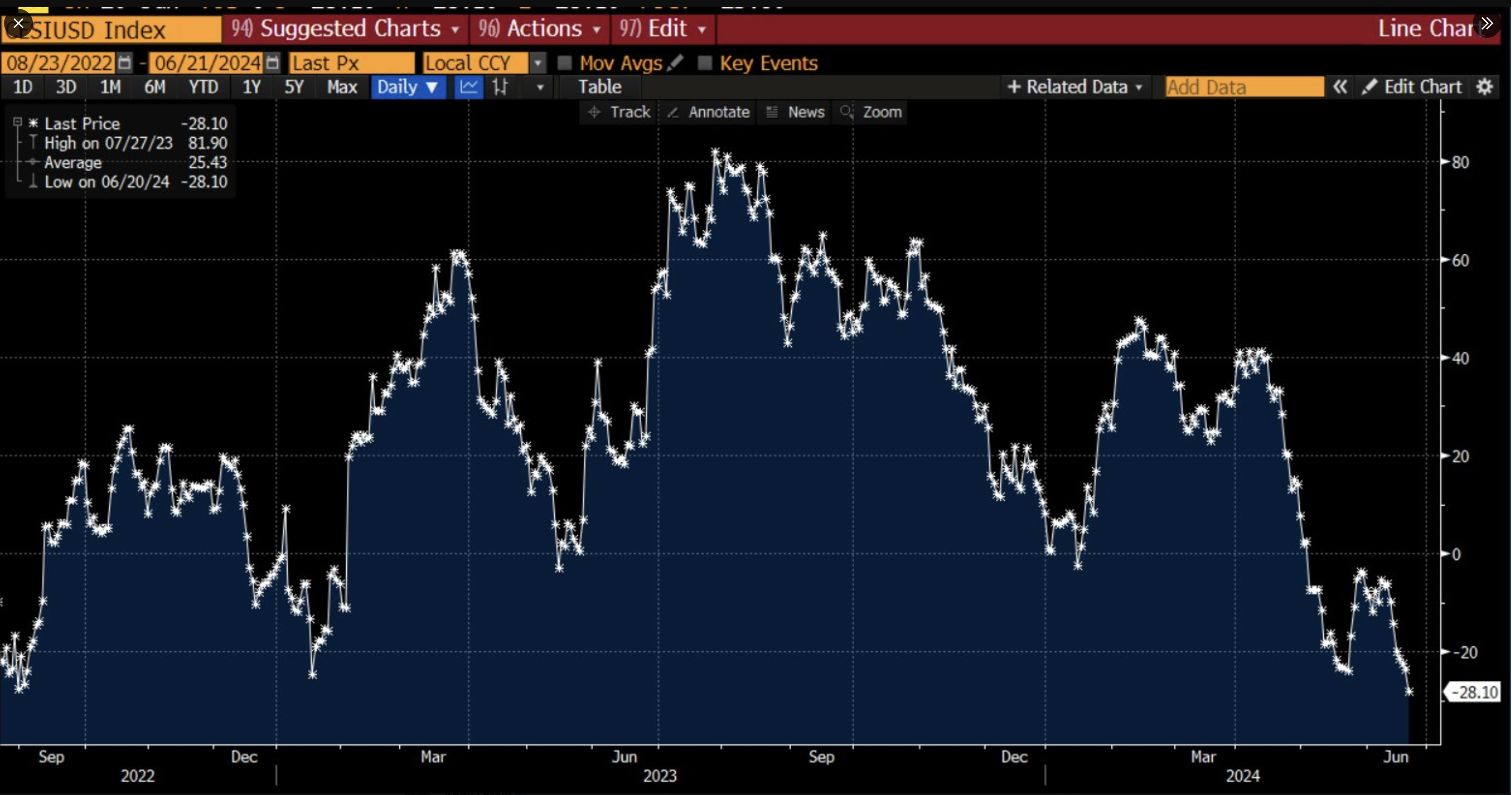
As well, a look at the Citibank Economic Surprise Index, an index that tracks the difference between the actual data releases and the consensus forecasts ahead of time, shows that data is consistently failing to meet expectations.

Source: Yardeni.com

Here, too, the data does not appear to have quite reached levels seen in the previous two recessions, but recall that those two recessions were not garden-variety, with the GFC the deepest recession since the global depression in 1929, and the Covid recession remarkably short and sharp in the wake of the unprecedented government shutdowns that occurred in early 2020.  But going back in time, it is generally true that if data released consistently underperform expectations, it is a signal of overall economic weakness.

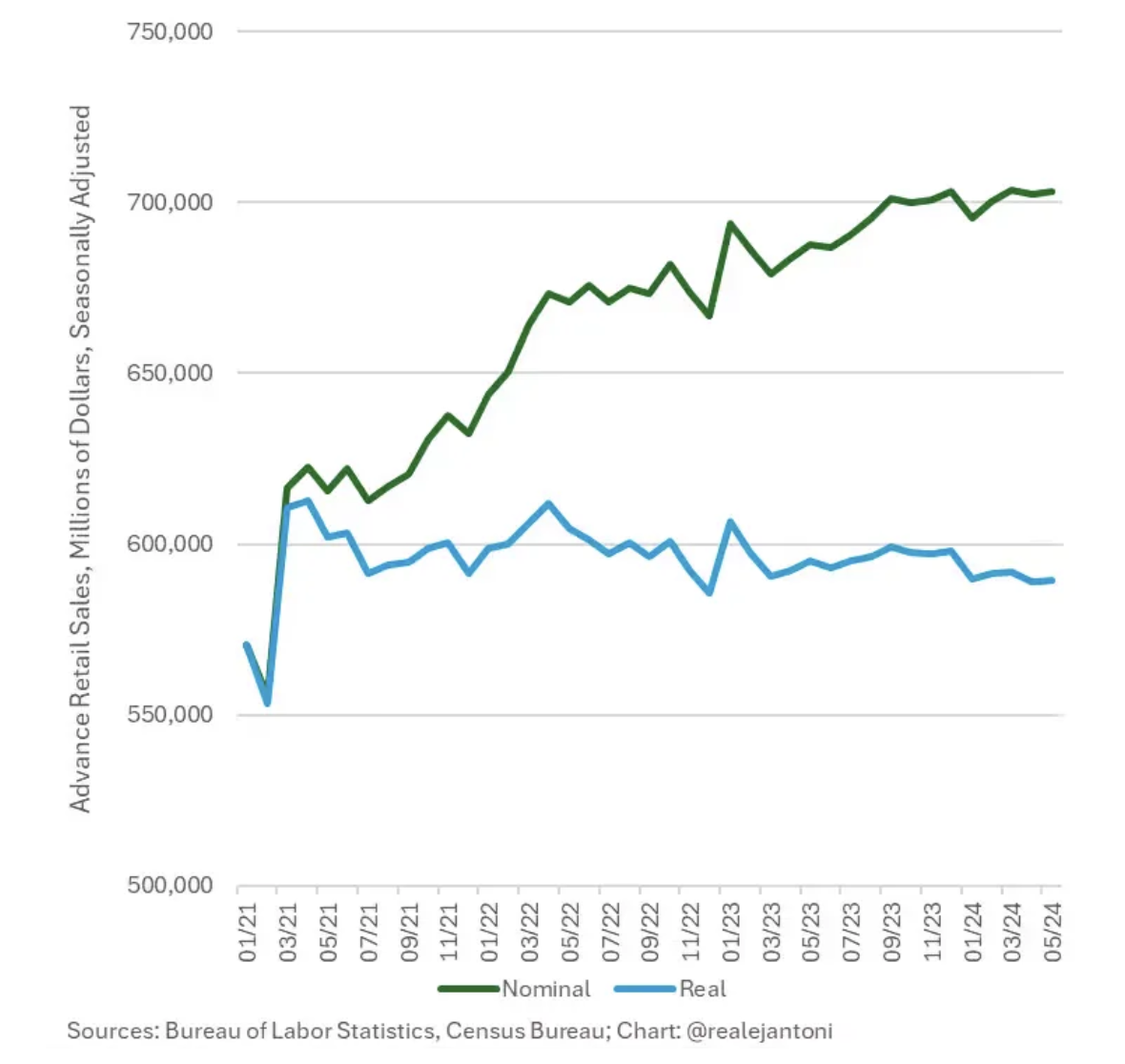
There are many other data points that are showing similar tendencies like the Unemployment Rate, which I have discussed lately, and is gaining momentum in its move higher.  As well, a look at almost all production factors or Retail Sales, which are reported in nominal terms, shows that when they are deflated by the inflation data of the past several years, real activity has been minimal or even declining.  A look at the below chart shows Retail Sales in both nominal and real terms with the latter actually declining since 2021 despite the rising nominal figures.  In other words, people are simply paying more for the same amount or less of stuff.

Source: brownstone.org

And this is not just a US situation.  As is typically the case, if the US is slowing, the rest of the world is going to suffer given its place as both the largest economy overall, and the largest mass consumer of everybody else’s stuff.  So, last night when China released its latest data, it showed the Q2 GDP disappointed, printing 4.7% while Retail Sales rose only 2.0%, far below Industrial Production, which grew 5.3%.  

Source: Bloomberg.com

In fact, this chart is the graphic representation of why nations around the world are calling for more tariffs on Chinese goods.  The combination of a still-collapsing property market there with the absence of significant government stimulus and a massive debt overhang has led President Xi to seek to increase industrial output and exports (remember the trade data from last week where exports soared, and imports actually declined) thus flooding other markets with goods and harming local manufacturing in other nations.  This is merely one more issue that policymakers must navigate amid a growing global concern over both political and economic unrest.

Summing it all up, I believe the case for there being a recession is growing strongly, and while nominal GDP is likely to remain positive, especially in the US given the government’s nonstop spending spree, real economic activity is suffering.  This has major implications for markets, especially as they appeared to still be priced for that perfect 10-point landing.  As I have written consistently, if (when) things turn more sharply, the Fed will respond quickly and cut rates and the impact on markets will be significant, especially for the dollar which will almost certainly decline sharply.  Just be nimble here.

I am sorry for the extended opening, but obviously, there is much ongoing.  So, let’s take a look at how things are behaving this morning.  At the opening of trading on Sunday evening, arguably the market that was showing the most impact was FX, where the dollar, which had fallen sharply at the end of last week in the wake of that CPI data, had rebounded a bit.  The narrative seems to be that the assassination attempt will secure President Trump’s reelection and the dollar will benefit from the economic policies that are believed to come with that.  As well, at this hour, (6:30) we are seeing US equity futures rallying, up 0.4% across the board.  That’s quite the contrast with the overnight session where the Nikkei (-2.5%) came under severe pressure as investors grow concerned over potential JPY strength.  Too, the Hang Seng (-1.5%) fell sharply although mainland shares have behaved better, little changed overnight, as investors look toward the Third Plenum with hopes that President Xi will unveil something to help the Chinese economy.

In Europe, though, this morning sees red across the screens, albeit not dramatically so.  The CAC (-0.4%) in Paris and the IBEX (-0.5%) in Madrid are the laggards, unwinding some of last week’s rebound, but every major market is under pressure this morning.  The lone piece of data released was Eurozone IP (-0.6%) which fell back into negative territory for the 6th time in the past twelve months.  Certainly, this is not pointing to a robust economy in Europe.

In the bond market, Treasury yields have backed up 4bps, also on the “Trump” trade, as investors believe that a Trump victory will result in more aggressive growth policies and higher US yields.  However, in the Eurozone, and in Asia, government bond yields are essentially unchanged from Friday’s levels as I don’t think foreign investors know what to think now about the US and how it may impact other nations going forward.  After all, if the US does grow more quickly in response to a Trump victory, will that mean more or fewer opportunities for tariffs and other mechanisms to affect foreign nations?

In the commodity markets, things are quiet with oil essentially unchanged this morning, as it consolidates at its recent highs.  Market technicians are looking for a break above $85.00/bbl, but I think that will require some substantially better economic data, which as explained above, does not seem to be in our immediate future.  In the metals markets, precious metals are little changed with gold consolidating above the $2400/oz level near its recent all-time highs, although copper (-0.9%) and aluminum (-0.8%) are both under pressure on the weaker economic picture.

Finally, the dollar is little changed overall this morning from Friday’s levels.  The early dollar strength seen last night has ebbed a bit although we still are seeing some strength against peripheral currencies like ZAR (-1.2%), NOK (-0.5%) and SEK (-0.5%).  The rand story seems to be more about local politics and the inability to get the new government up and running, while deeper investigation into the Skandies shows that this is a phantom move based on an unusual close on Friday.  My sense is there has really been no net movement here, as we have seen in the euro and the pound, both of which are mere pips from Friday’s closing levels.

On the data front this week, there is some important news as well as a series of Fed speeches starting with Chairman Powell this afternoon at 12:30.

TodayEmpire State Manufacturing-6.0
TuesdayRetail Sales0.0%
 -ex autos0.1%
 Business Inventories0.3%
WednesdayHousing Starts1.31M
 Building Permits1.39M
 IP0.3%
 Capacity Utilization78.6%
ThursdayECB Rate Decision4.25% (unchanged)
 Initial Claims235K
 Continuing Claims1855K
 Philly Fed2.9
 Leading Indicators-0.3%
Source: tradingeconomics.com

While there is not as much information due as we saw last week, I think the Retail Sales data will be instructive as another indicator of whether the economy is starting to roll over.  As well, watch for revisions from previous data releases as history shows that revisions to weaker numbers are another signal of a recession.  It will be quite interesting to see if Powell hints at a cut at the end of the month.  Certainly, the Fed funds futures market is not looking for that with <5% probability currently priced in although the September meeting is now a near-lock at 94%.  Remember, too, that after Friday’s speeches conclude this week’s group of 10 Fed comments, they will enter their quiet period and we won’t hear anything else until the FOMC meeting on July 31st.

While there is much to digest, my take is that we have rolled over in the economy.  The real question is about inflation and its ability to continue to decline.  Friday’s PPI data was the opposite of the CPI data on Thursday, showing hot prints for both headline and core, and indicative of resurging price issues.  Alas, I don’t rule out more stagflationary outcomes.  Funnily, I think that will ultimately help the dollar after an initial dip.

Good luck

Adf

Some Mystique

The Chairman is ready to speak
To Congress, and there’s some mystique
Will he indicate
The Fed’s favorite rate
Is likely soon in for a tweak?
 
Or will Chairman Powell explain
Inflation continues to drain
The ‘conomy’s health
And with it the wealth
He’s garnered through much of his reign


With recent elections behind us, market participants now turn their attention to Chairman Powell and his testimony today before the Senate Banking Committee and tomorrow before the House Financial Services Committee.  Of course, all eyes and ears will be searching for clues that the recent spate of softer than expected economic data has been sufficient to allow him, and his FOMC brethren, to gain the necessary confidence to cut the Fed funds rate.  Recall, to a (wo)man, every speaker has indicated that things were looking pretty good, but that they needed to see several months of this type of economic data before acting.

Lately, the punditry has become far more vocal about the possibility of a recession, with a number of well-known analysts claiming we are already in that state.  They point to the employment situation, notably the discrepancies between the establishment and household surveys.  Their argument revolves around the idea that the number of people working continues to decline despite the claim that there are more jobs being created.  It is true that job growth has been driven by an increase in part-time work, so this is not impossible.  And it is also true that when part-time work is ascendant, it typically signifies a weaker economy.

These same pundits point to the discrepancy between GDP and GDI (Gross Domestic Income) which ostensibly measure the same thing from different sides of the ledger.  Over the past year and change, as can be seen from the below chart, GDP has been growing at a faster rate than GDI with the difference between the two now at 2.3% of GDP.  

Source: St Louis Fed FRED data base

Putting that in context, the most recent Atlanta Fed GDPNow forecast for Q2 2024 has fallen to just 1.5% annual growth.  The implication is that GDP growth may well be negative.  Over time, these two measures get revised so that they are the same, but this particular discrepancy is both wider than normal and has been ongoing for a relatively long time in the history of the two.  Something is amiss and many pundits believe that the result will be GDP will be revised lower to match GDI rather than the other way around.  In other words, GDP growth is slower than reported and the chances we are currently in a recession are greater.

Of course, the other side of the story is also widely believed by other pundits who point to the consumer, which as evidenced by yesterday’s Consumer Credit data, continues to spend aggressively.  They also rely on the continued growth in the NFP data as a key indicator of economic activity and remain confident that the economy is simply in a slow patch during a continued growth period.

Now, it seems to me that the Fed are likely rooting for a bit more aggressive economic slowdown as that would give their models the signal that inflation is well and truly under control.  Perhaps Chairman Powell will give us those hints this morning, although he will certainly not explain that outright to the Senate.  (The one certainty from this morning’s testimony is that certain Senators from the Northeast are sure to rail at the current level of interest rates and berate Mr Powell for not having cut them already.)  In any event, that is really all we have on the calendar today, and likely the biggest news until Thursday’s CPI release.  After all, tomorrow’s House testimony will be identical by Powell, although we can look forward to even stupider questions from the likes of Representatives Maxine Waters and Ayanna Pressley.

And so, to markets.  Yesterday’s lackluster US session has seen a mix of results elsewhere in the world.  In Asia, the Nikkei (+2.0%) rallied sharply to new all-time highs, on the back of tech share enthusiasm and the AI story as well as the still weak JPY.  While the BOJ is slated to meet later this month, there is no clarity as to whether they will tighten policy given the still mixed data from Japan.  As well, Chinese shares (+1.1%) and Australian shares (+0.9%) both had solid performances although the Hang Seng was unable to gain any traction and was unchanged on the day.

In Europe, all is red this morning, led by the CAC (-0.8%) as it seems investors are beginning to understand that the electoral outcomes may not have been net beneficial for both the French and UK economies.  While the two nations have different issues (no leadership in France, a socialist one in the UK) I fear that both nations will have manifest economic problems going forward when it becomes clear that increased spending is unaffordable.  But for now, absent any additional data, investors are lightening up on exposures there.  US futures, though, are edging higher at this hour (8:00).

In the bond markets, yields are starting to turn higher again despite some lackluster economic data.  Treasury yields are higher by 2bps and across the UK and Europe, yields are higher by 3bps to 4bps universally.  This means there have been no changes to the spreads of OATs to Bunds, but it may not be that welcome overall.

In the commodity markets, oil (-0.4%) remains under pressure as concerns over US production being reduced by Hurricane Beryl have diminished now that wind speeds have fallen after landfall.  It did not impact the offshore drilling significantly.  As to metals markets, after a rough day yesterday, this morning both precious and industrial metals are little changed overall, arguably awaiting the next key catalyst, whether that is from Powell or CPI or something else.

Finally, the dollar is a bit firmer this morning across the board.  Both the euro (-0.15%) and the pound (-0.15%) have performed surprisingly well lately given the political backdrop.  Perhaps that is a hint that politics is not necessarily a key short-term driver of FX rates.  However, today, along with the rest of their G10 brethren, they are under pressure.  In the EMG bloc, ZAR (-0.6%) continues to demonstrate the greatest amount of volatility amongst the most traded currencies and is under pressure alongside metals prices.  As well, both HUF (-0.3%) and CZK (-0.4%) are showing their high beta response to the euro’s weakness.  However, today appears very much to be a dollar day, not a currency day.

The NFIB Survey was released at a better than expected 91.5, although that level remains in the lowest decile of readings in the history of the series.  In addition to Powell, we hear from Vice-chair for supervision Barr as well as Governor Bowman during the day, but really, it is all about Powell.  Personally, I doubt he tells us anything new and do not expect him to hint strongly at a rate cut coming soon.  However, if he does, look for the dollar to decline sharply.

Good luck

Adf

Equity’s Epitaph

Each day as more data arrives
And pundits perform their deep dives
The talk of recession
Has forced some to question
How anyone bullish survives
 
But stock bulls have had the last laugh
Just look at a stock market graph
However, fixed income
Has started to look glum
Is this equity’s epitaph?
 
The only thing one can say about the recent data is that there is no clear direction of travel.  For instance, in the past week we have seen better than forecast results from Consumer Confidence, Durable Goods, Chicago PMI and Michigan Confidence while the Richmond Fed, New Home Sales. Building Permits, Personal Income and ISM Manufacturing all printed on the soft side of things.  The biggest data point, PCE, was essentially right on the money, so didn’t alter this equation.  However, perhaps the best way to sum up this mix of data is to look at the Atlanta Fed’s GDPNow calculation, and as can be seen in the chart below, it is heading lower.


Source: Atlantafed.org

The history of this calculation is that early in the quarter, it has limited predictive ability, but as the quarter ends, which it just did on Friday, it becomes a much better predictor of the actual results to come.  If I were to characterize this statistic it shows that the economy is slowing down but is not yet looking at a recession.

Is this the fabled goldilocks outcome of a soft landing?  Perhaps, but personally, I have my doubts.  To explain, let’s discuss the yield curve for a moment.  As you are all well aware by now, when the yield curve inverts (short end rates are higher than long end rates) that has been a reliable indication that a recession is coming.  We continue to be in that situation and in fact, the current inversion between the 2yr and 10yr Treasury, one of the most common measures, has been inverted for a record long period, more than 16 months.  

However, one thing that is widely misunderstood about the yield curve signal is that it is not a description of a current recession, rather it is a harbinger of a future one.  That recession tends to be coincident with the steepening of the yield curve back to its more normal shape.  And the question right now is, will the yield curve steepen because the front end of the curve sees rates decline, a so-called bull steepener, or because the back end of the curve sees rates rise, a much more uncomfortable situation known as a bear steepener.  

The soft-landing view is that the former is in our future as the Fed will cut rates to help stabilize the economy while 10yr yields hang around the 3.5% – 4.0% level.  It certainly appears that has been a critical piece of the equity market bullish story.  However, the alternative, where long end rates rise despite economic weakness, seems equally probable right now, and based on the bond market’s moves over the past several sessions, may well be taking over the narrative.  In this situation, the Fed continues to see inflationary pressures as too great to ignore and maintains higher for longer.  At the same time, the fiscal profligacy that is evident right now, and shows no signs of ending regardless of the election outcome, starts to bite.  Investors demand ever higher yields to hold Treasuries for any extended length of time and the 10yr rises to 5.0% – 5.5% or higher.

While the Fed’s record of preventing a recession by cutting rates is quite poor (perhaps one positive outcome in their history in 1995), their record of seeing a recession hit when they don’t cut rates, or even raise them to fight stubborn inflation, is even worse.  While two days is not yet a trend, it is certainly important of us to watch how the bond market behaves.  If long end rates start to rise more aggressively, that would be a signal that investors are turning more negative on the future.  It is at this point where we will learn the answer to the question of exactly how the Fed’s reaction function works.  History has shown that the unemployment rate rises with bear steepeners, and that is what forces the Fed to respond by cutting rates.

However, remember, if inflation remains stubbornly high and the Fed decides to cut rates to address unemployment, I believe that is the worst of all worlds.  We would be in a weakening economy with high inflation and a Fed that is far behind the curve amid a government that is spending money with no limits.  In that scenario, which, alas, has a reasonably high probability of occurring, the dollar should decline, bonds will decline (yields rise), commodities will rally, and equities will likely start to rise, but as earnings falter, so will prices.  This is not where we want to go.

We are not there yet, so let’s look at how things played out overnight instead.  Japanese shares continue to rally (+1.1%) with the Nikkei reclaiming the 40K level.  This continues to be on the back of the uber-weak yen (discussed below) as so many companies are exporters and benefit from the weak yen.  However, Chinese shares did not fare as well, edging lower as investors begin to wonder what will come from the Third Plenum due to take place in two weeks’ time.  Elsewhere in the region, there was far more red than green on the screens.  The red seems to have been contagious as all of Europe is under water this morning, with most falling more than -1.0%.  This is not really a data story, rather this seems to be a re-evaluation of this weekend’s French second round elections and growing fears that Marine Le Pen and her RN party are going to win the day.  We just saw a right-wing party take power in the Netherlands and have seen the same throughout Scandinavia.  I continue to be baffled at why investors are more concerned regarding spending by right leaning governments than left leaning ones, but that is clearly the current situation.  As to US futures, at this hour (7:30) they are sliding by -0.45% or so.

Bond markets are consolidating after yesterday’s rout with Treasury yields unchanged this morning while most of Europe has seen yields edge higher by just one or two basis points.  However, global bond markets have been under pressure all this week and while today may provide a respite, I sense further stress to come.  JGB yields rallied 3bps overnight and are now at their highest level since July 2011.  Alas, these higher Japanese yields have not helped the yen.

In the commodity markets, oil (+0.7%) continues to rally although the current story is focused on Hurricane Beryl which is heading into the Caribbean and the Gulf of Mexico and likely to shut in some offshore production there for a while, reducing supply.  However, precious metals are under pressure amid a rising dollar though copper (+0.6%) is holding its own on inventory concerns.

Finally, the dollar is firmer this morning against virtually all its counterparts in both G10 and EMG blocs.  The euro (-0.15%), which had rallied a bit on Monday amid hopes that the RN would not capture a majority in France, has given that back as the story ebbs and flows.  But really, JPY (-0.1% today, -1.2% in the past week) is the story as traders gain confidence that the MOF is not ready to respond yet and with US yields climbing, the carry trade continues to be extremely attractive.  Today’s dollar rally is broad, but the large moves are limited with ZAR (-0.6%) the worst performer although there are numerous currencies that have slipped -0.25% or so.  But it’s a dollar thing today.

On the data front, today only brings JOLTS Job Openings data (exp 7.91M) although perhaps more importantly, we hear from Chairman Powell this morning at 9:30.  The thing is, I don’t see any reason for him to have gained confidence that inflation is reliably heading back to target, and until we see Friday’s payroll report, there is no reason to believe that they are concerned about that.  In fact, that brings up the issue that Friday’s data release is likely to be extremely important to the narrative and has the chance to be quite disruptive given the high likelihood that staffing across all desks in the US will be light.  Remember, too, that the UK election will be held on Thursday, so more change is afoot.

Right now, the dollar seems healthy, but there is much to be learned this week and it will help inform how things evolve.

Good luck

Adf

A Quagmire?

For those who believe a recession
Is coming, the data’s digression
From strength’s getting clearer
And rate cuts are nearer
Though maybe that begs a new question
 
Can equity markets go higher
If profits fall in a quagmire?
Though many agree
Rate cuts will bring glee
The past has shown they can be dire


The data of late have not been positive.  Interestingly, this is not simply a US phenomenon, but appears to be spreading elsewhere in the world as evidenced by this morning’s much weaker than expected Flash PMI data out of Australia (Mfg 47.5 vs. 49.7), Japan (50.1 vs. 50.6) and Europe (Germany 43.4/46.4, France 45.3/46.8, Eurozone 45.6/47.9).  This follows the US trend where yesterday we saw the weakest Building Permits and Housing Starts data since the pandemic in June 2020 as well as a weaker than forecast Philly Fed result and higher than forecast Initial Claims data.  Prior to the Juneteenth holiday, Retail Sales were also quite soft, and another harbinger is the Citi Surprise Index, which Citibank created to measure actual data vs. the forecasts ahead of the release.  Typically, as it declines, it indicates weakening growth and vice versa.  As you can see from the below chart, this indicator has fallen to its lowest level in two years.

Source: Bloomberg

Summing it up, the strength of the economy is clearly being called into question by the data releases. However, as we have seen for the past several years, this is not a universal phenomenon.  For instance, who can forget the recent NFP print which beat expectations handily.  As well, the Atlanta Fed’s GDPNow indicator remains at 3.0% after yesterday’s housing data, still far above the forecasts by most economists, and an outcome that would be welcomed by almost everyone.

(As an aside and related to yesterday’s discussion about how politics intrudes on, or at least colors, so much of the financial market commentary, there have been numerous articles ‘blaming’ the weak PMI data on the results of the European Parliament elections and the ensuing call by French President Macron for next week’s snap election.  While one can make the case that is the situation in France, given the inherent uncertainty of the outcome, it seems a stretch to say that is why Germany’s data suffered.  After all, it is possible that all the talk of Eurozone tariffs on Chinese goods and the demonstrated incompetence of the current German government are sufficient to dissuade businesses there from investment and growth.)

So, what are we to believe?  The first thing I would highlight is that the idea of two separate economies seems to gain validity by the day.  For the haves, however you want to describe them but arguably the top 10% of income and wealth, the current situation has been fine.  While inflation is annoying, they can afford the higher prices given their asset portfolios, whether real estate or equities, have risen so dramatically.  The wealth effect for them is quite real.  

However, for the rest of the nation, things are far less positive.  The Retail Sales data tell a tale of reduced purchases of stuff (remember, that data is not inflation adjusted, so higher sales and higher inflation could well indicate less stuff sold but more money paid for it).  Additionally, the employment data is also a mixed bag as although NFP was strong, the household survey indicated less people were working and the trend in the Unemployment Rate is clearly up and to the right as per the chart below.

Source: tradingeconomics.com

Adding to this mix we have the Fed, who continue to look at the inflation data, and while they were pleasantly surprised by the slightly softer tone of the CPI data earlier this month as well as the PCE data last month, are still not prepared to address potential weakness in the economy.  This was made evident again yesterday when Richmond Fed President Barkin said, “my personal view is let’s get more conviction before moving.”  In other words, as we have heard consistently, patience remains a virtue at the Eccles Building.

If pressed, my personal view is that the economy has peaked for this cycle and we are going to start to see more data show weakness going forward, not strength.  The bigger problem with this is that while inflation has ebbed from its highest levels, it appears to me that the idea it will reach, and remain at, the 2.0% target is extremely unlikely.  Rather, I remain in the camp that the new level of inflation is somewhere between 3% and 4% as defined by CPI, and that over time, the Fed is going to bless that as an appropriate description of stable prices.  Given the Fed’s clear desire to cut rates, I fear that they are going to act earlier than would otherwise be prudent and that while economic activity will decline, prices will rebound.  Absent a massive recession, something like we saw in 2008-09, I do not see prices falling back to the current target.

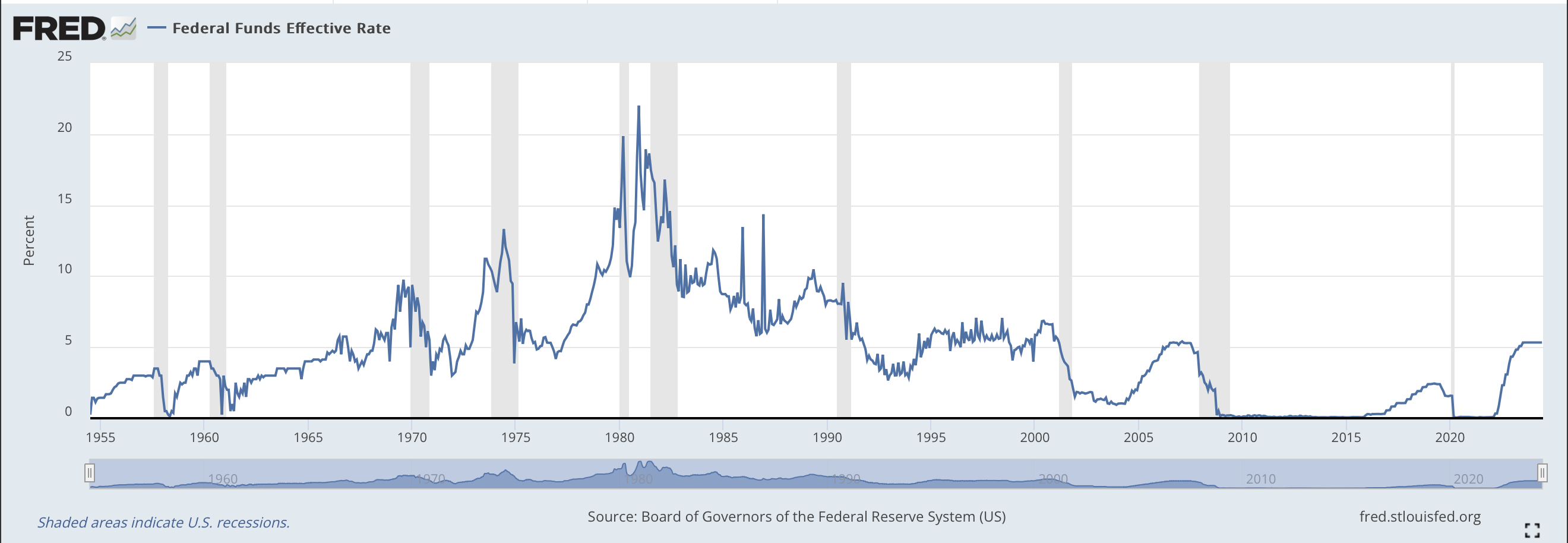
And here’s the problem with that view from a market’s perspective, if the recession comes, the Fed will cut rates and cut them relatively quickly.  This can be seen in the chart below showing Fed funds behavior relative to recessions.

Source FRED data base

Alas, for equity markets, during a recession, equity markets tend to fall, with declines of 30%-50% quite common and much greater as well (NASDAQ fell 88% during 2001-02 recession).  The road ahead appears to be filled with difficulty, so keep that in mind as you go forward.

Ok, sorry that ran on so long, but sometimes it is important to dig a little deeper I feel.  Let’s do a really quick turn of the overnight session.  Japanese equities were little changed but Hong Kong fell sharply (-1.7%) and the mainland drifted lower.  The rest of Asia was broadly under pressure although Australia (+0.35%) managed to eke out small gains.  In Europe, following the weak PMI data red is the color of the day with every market lower on the session, including the UK which released surprisingly positive Retail Sales data, although their PMI data was also soft.  At this hour, US futures are little changed awaiting the Triple Witching Day of expiries of futures, options and options on futures.

In the bond market, yields are lower across the board led by Treasuries (-3bps) and all of Europe as those PMI data are a harbinger of slower growth and will likely be an encouragement for more rate cuts by the ECB.  In fact, Klaas Knot, one of the more hawkish ECB members indicated he could see three more cuts this year, which is even more dovish than the market is pricing.

In the commodity markets, oil is essentially unchanged this morning, maintaining its recent gains as inventory data showed more draws than expected.  In the metals markets, gold (+0.2%) is holding onto its recent rebound, but given the weaker economic data story, both silver and copper are under pressure.

Finally, the dollar is gaining this morning as European currencies suffer from weak data and rate cut dreams, although there are two real outliers, MXN (+0.45%) on the back of surprising strength in recent economic data (Retail Sales and IP) and ZAR (+0.55%) as it appears more investors are turning to the rand as the pre-eminent carry trade earner vs. the yen and reducing their MXN exposures after the recent elections.

On the data front, the Flash PMI’s are due at 9:45 (exp 51.0 Mfg, 53.7 Services) and then at 10:00 we see both Existing Home Sales (4.10M) and Leading Indicators (-0.3%).  While there are no Fed speakers on the calendar, I fully expect to hear from someone before the end of the day as they simply cannot shut up.

Overall, risk is off, and I suspect that we could see some equity selling during today’s session, following yesterday’s moves.  With that, bonds are likely to perform as well as the dollar, and I think gold holds on, though the rest of the commodity complex is likely to suffer further losses.

Good luck and good weekend

Adf

Limited Sellin’

After the data on Friday
Powell said, rushing’s not my way
Rates, we’ll still lower
If growth turns out slower
Least that’s what the punditry might say
 
Forget any thoughts about hikes
Old ideas that nobody likes
Other than Yellen
Limited sellin’
Suggests there will be no yield spikes


“The fact that the US economy is growing at such a solid pace, the fact that the labor market is still very, very strong, gives us the chance to just be a little more confident about inflation coming down before we take the important step of cutting rates.”

When Chairman Powell expressed this sentiment Friday morning, my take was he was seeking to give himself an out.  One way to read it is, since the economy remains strong, higher for longer isn’t killing us.  However, my first reading of the statement was that since the economy is strong, they can confidently cut rates.  Perhaps it is my confusion, or perhaps it is simply a badly constructed statement of the first view, but regardless, my confidence in the process has not been enhanced.

Friday’s PCE data was released pretty much in line with expectations but that is not as helpful as you might think given expectations were for a continued rebound in the numbers.  The fact that Powell is not more vociferously calling for a tougher stance is the most important piece of the puzzle.  This is what tells me that he has abandoned the 2% target.  While he will never officially admit that is the case, it has become increasingly clear that to achieve that goal, the Fed will need to push much harder on the economy and possibly drive a recession.  My read is that there are very few FOMC members who are willing to accept that tradeoff, especially in a presidential election year.

Right now, as Q2 begins, there is still time to see inflation data ebb closer to their target and allow that June rate cut that he seems to be promising.  But if the data between now and then, which includes three NFP reports, three CPI reports and two more PCE reports, does not cooperate and continues to show economic strength and sticky, if not building, price pressures, Powell and friends are going to have a very hard case to make with regards to any rate cuts.  And this really cuts to the chase as it is increasingly clear that the Fed’s true goal is not to reduce inflation, but to reduce interest rates so government borrowing becomes cheaper.  If the Treasury is going to continue to flood the market with T-bills rather than coupons (see chart below from BofA Global Research), the Fed has the ability to reduce their interest costs directly.  I expect that the pressure to do so is immense and growing.  The Fed remains in a precarious position given their credibility is on the line and so much of it is dependent on things outside their control.

There continues to be a yawning gap between views on the economy in the analyst community.  One camp remains firmly committed to the soft or no-landing scenario, expecting ongoing economic growth as inflation magically fades away (the so-called immaculate disinflation).  The other camp sees a recession on the horizon, if not already arrived, as when breaking down the data, they are able to find key aspects which indicate growth is slowing rapidly.  Right now, my guess is Powell is praying for the recession to appear more clearly, so he has a good reason to cut rates because otherwise, any rate cuts are going to be much more difficult to explain.

Beyond the Fed story, the news overnight was about China and Japan as PMI data from the former showed unexpected strength (Caixin Manufacturing PMI to 51.1) while the latter saw a mixed picture with the PMI data rising to 48.2, but still below the key 50.0 level, while the Quarterly Tankan data had some good news for large manufacturers and not-so-good news for small manufacturers.  With all of Europe still closed for the Easter holiday, a look at the markets open in Asia shows that the Nikkei (-1.4%) found no joy in the data and the index slipped back below the 40K level.  However, Chinese shares rose (+1.6%) on the data as it seems any read of recent commentary from the nation’s leaders indicates more fiscal support is on its way.

Bond markets, too, are closed throughout Europe and so the overnight saw only JGB yields edge up 1bp, Chinese yields follow suit, rising 1bp while Treasury yields are higher by 3bps this morning.  My take is there is limited information in these movements given the overall lack of market activity.

In the commodity markets, oil prices are unchanged to start the day, although they rose more than 6% in March, so there is clearly upside pressure there.  But once again, the star is gold (+0.75%) which is at another new all-time high as it seems an increasing number of investors and traders are becoming more concerned over the ongoing flood of liquidity entering the markets.  This strength is gold is mirrored today in silver, copper and aluminum as the desire to own ‘stuff’ rather than paper continues to grow.

Finally, the dollar continues to be in demand versus essentially all its major counterparts.  With Europe out of the office today, movement has been muted, but it is firmer against every one of its G10 counterparts with NOK (-0.55%) and SEK (-0.5%) the laggards, while it remains stronger vs. most of its EMG counterparts, although ZAR (+0.3%) is benefitting from the strong rally in gold and precious metals.  When looking at the macro situation around the world, right now, the US remains the proverbial cleanest shirt in the dirty laundry and so has the lowest case to cut interest rates.  I believe the ECB and BOE (and BOC and Riksbank, etc.) will all be cutting before the Fed and the dollar will benefit accordingly.  However, as I have maintained for a long time, if the Fed starts cutting with inflation remaining well above target, the dollar will decline sharply.

Looking at the data this week shows we have much to anticipate, culminating in Friday’s NFP report:

TodayISM Manufacturing48.4
 ISM Prices Paid52.6
 Construction Spending0.6%
TuesdayJOLTS Job Openings8.79M
 Factory Orders1.0%
WednesdayADP Employment130K
 ISM Services52.6
ThursdayInitial Claims214K
 Continuing Claims1822K
 Trade Balance-$67.0B
FridayNonfarm Payrolls200K
 Private Payrolls160K
 Manufacturing Payrolls5K
 Unemployment Rate3.9%
 Average Hourly Earnings 0.3% ((4.1% Y/Y)
 Average Weekly Hours34.3
 Participation Rate62.5%
 Consumer Credit$16.5B

Source: tradingeconomics.com

In addition to the data, we hear from 15 different FOMC members across 18 speeches this week.  This includes Chairman Powell on Wednesday as he discusses the Economic Outlook at the Stanford Business, Government and Society Forum.  By the time he speaks, we will have seen the ISM and ADP data, but my guess is that nothing is going to change his mind right now.  At this stage, hotter data is the Fed’s real problem as it will make cutting rates that much more difficult.  The Atlanta Fed’s latest GDPNow reading ticked up to 2.3% for Q1, certainly not indicating a slowdown is coming.  Sit back and get your popcorn out, it is going to be interesting to watch the Fed explain why rate cuts are needed if the data continues along its recent trend.

Good luck

Adf

Jay Powell’s Dream

As markets await the release

Of Payrolls, all things are at peace
But once it’s revealed
We need watch the yield
In 10-years lest it should decrease

While Goldilocks is still the meme
And certainly, Jay Powell’s dream
The data’s beginning
To show growth is thinning
More quickly both down and upstream

So, here’s the scoop.  Today is payrolls day and that is the only thing that anybody cares about right now, ahead of the release, and it will be the topic du jour by all the talking heads for the rest of the day.  As of 7:00am, here are the latest consensus forecasts according to tradingeconomics.com:

Nonfarm Payrolls180K
Private Payrolls153K
Manufacturing Payrolls30K
Unemployment Rate3.9%
Average Hourly Earnings0.3% (4.0% Y/Y)
Average Weekly Hours34.3
Participation Rate62.7%

Now, looking at a chart of the past year’s releases, the numbers seem to show a very gradual decline, albeit hardly in a regular manner.

But let’s take a look at some underlying data that may help us understand the bigger picture a bit better.  First off, one of the things that draws a great deal of criticism is the birth/death model that the BLS uses to estimate the number of new companies that start up, hiring people, compared to the number of companies that close with the resulting job losses.  A key reason that every month this year has seen the data revised lower is because that portion of their data continues to be revised lower.  Historically, the birth/death model is at its worst during an inflection point, when the economy is either entering or exiting a recession.  Those downward revisions are a strong clue that things are not going that well.

But there is something else worth noting and that is the BLS breaks the payroll data down on a state-by-state basis as well.  This is not something that gets a lot of press but is nonetheless important.  While this data only goes back to 1976, that is still a fairly robust series.  I highlight this because every time in the past, when all 50 states + Washington DC have seen a decline in the number of employed workers, we have been in a recession already.  And shortly thereafter, the first negative NFP prints started showing up, usually withing 2-3 months.  Well, guess what?  Last month saw every state in the union report a decrease in the number of employed persons.  This is quite a negative signal for the economy, and one that is not getting much press, certainly not from the soft-landing set.  

I’m not saying that we are going to get a negative NFP print this morning, just that it seems one is coming to a screen near you soon.  If history is any guide, then sometime in Q1 seems realistic.  And ask yourself how Chairman Powell and his friends on the FOMC will respond to that type of data.  They had better hope that the recent trend in inflation, which has clearly been on a downward trajectory, continues, because otherwise, the Chairman will have nowhere to hide.  Cut rates to address economic weakness while stoking still firm inflation?  Leave rates on hold to fight inflation and let growth crater further?  Talk about a rock and a hard place.

It seems to me that the evidence continues to pile up on the side of a recession coming early next year.  Absent another wave of MMT or helicopter money or some type of direct fiscal stimulus by the federal government, this business cycle seems destined to end soon.  The bond market has been telling us that since the beginning of last month.  The oil market has been telling us that since the beginning of last month too.  The stock market has still not gotten the message.  It will, trust me, and it won’t be pretty.  However, I don’t think today is the day it will happen.  Just be prepared.

So, how have markets performed leading up to the NFP data?  Well, following yesterday’s rally in US stocks, Asia had a mixed picture.  Japanese equities continue to be pressured by a combination of concern over tighter monetary policy and a strengthening yen.  There was, however, a bump on the road to that tighter policy thesis as Q3 GDP was revised lower to -2.9% Y/Y, with the M/M falling -0.7%.  Will they really tighten policy into a shrinking economy?  Meanwhile, despite the word from the Chinese Politburo that they would be adding more fiscal stimulus in 2024, shares in Hong Kong and on the mainland barely eked out gains of 0.1%.  The rest of APAC, though, had a decent performance, with gains ranging from 0.3%-0.9%.

European bourses are in good shape today, with green across the board, albeit some just barely (DAX +0.1%) and some more robustly (CAC +0.7%).  Finally, US futures are edging lower, -0.2% or so, as I type (7:30am).

In the bond market, yields, which as we know have been trending sharply lower since early November, are rebounding slightly this morning with Treasuries up 3bps and European sovereigns all showing increases of between 5bps and 9bps. That seems a bit odd to me as there has been no data indicating inflation is rising or growth is impressive of late.  In fact, the Eurozone inflation data continues to point to deflation as Germany’s final reading came in at -0.4% in November.  In fact, as much as markets are expecting the Fed to cut rates soon, with a 60% probability now priced in for the March meeting, I suspect that the ECB is going to be cutting before the Fed as Eurozone growth and inflation are falling rapidly.  As to JGB’s, yields there edged higher by 1bp overnight and currently sit at 0.75%, certainly not pressing on the 1.00% cap.  

Turning to the commodity markets, oil (+2.2%) has finally found its footing with WTI back above $70/bbl.  While there continue to be rumors that OPEC+ is going to cut production further, this feels much more like a trading bounce than a structural move.  Interestingly, industrial metals are having a very good day with both copper and aluminum higher by 1% or more although gold is unchanged on the day.  Ordinarily, I might attribute that to a weaker dollar except that the dollar’s not weaker this morning.

Speaking of the dollar, if you remove the yen from the equation, it has, in truth, been reasonably strong.  Perhaps a better description is that other currencies have been weak as things like European economic doldrums weigh on those currencies while declining oil prices weigh on the petro-currencies.  Now, for all the JPY bulls out there, be careful as the weakening GDP growth and the fact that the most recent CPI data, while still above target, started to decline means that there is less pressure on Ueda-san to change policy.  Yes, they have started to discuss the idea of lifting rates out of negative territory, but they have also been quite clear that they need to see wage gains and the wage story really won’t be clear there until the March wage negotiations are completed.  All I’m saying here is that we have come quite a long way in less than a month.  Do not be surprised by a sharp rebound that wipes out a lot of profit and positions.

And that’s really it for the day.  At 10:00 we also see the first cut of the Michigan Sentiment Index (exp 62.0) as well as the concurrent inflation expectations indices (1yr 4.5%, 5yr 3.3%).  But by then, I expect that the excitement will have passed, and the market will be following whatever trend develops from the payrolls.  If pressed, I expect a softer number, something like 100K and a tick higher to 4.0% on Unemployment.  If that is correct, I expect that the market will continue with its ‘bad news is good’ concept and buy stocks in anticipation of Fed rate cuts.  But remember, virtually every time the Fed is cutting rates aggressively because economic activity is declining, risk assets are being sold, not bought.

Good luck and good weekend

Adf