It Won’t End Well

From Europe, we’re hearing some squawks
They’ve not been included in talks
‘Bout war and Ukraine
So, to inflict pain
They’ve threatened a US detox
 
It seems they believe if they sell
All Treasuries held we would yell
Please stop, it’s too much
And lighten our touch
Methinks, for them, it won’t end well


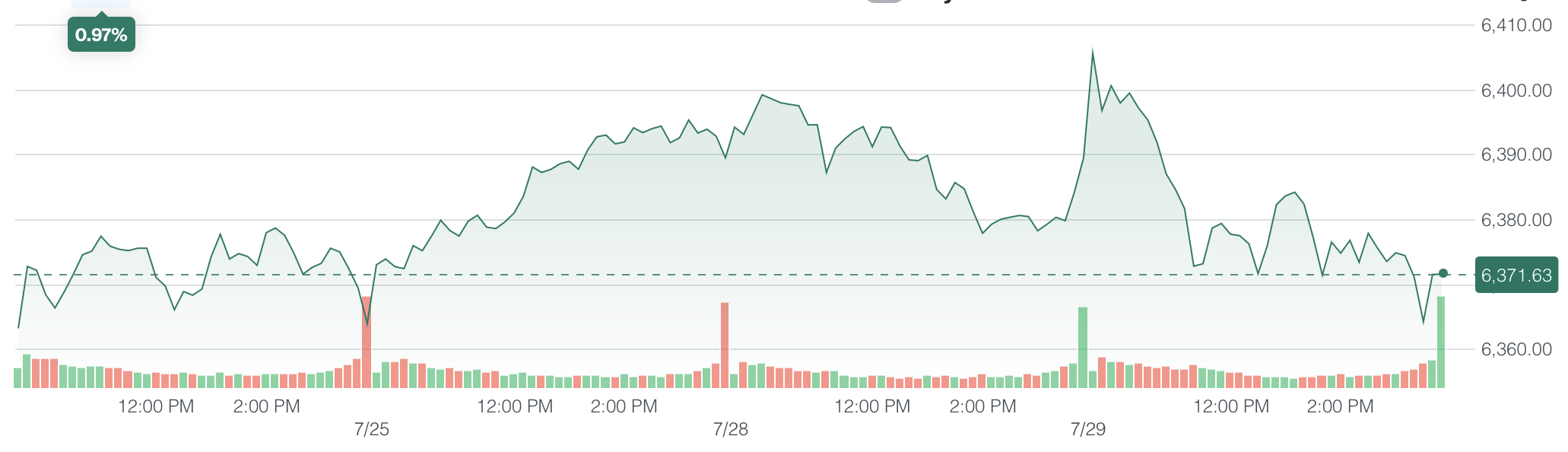
Markets continue to be dull these days.  While we are clearly not in the summer (it is 15° here in NJ this morning), doldrums certainly seem to be descriptive of the current situation.  Equities bounce back and forth each day, neither trading to new highs, nor falling sharply.  The same is true with the dollar, with oil, with gold of late and even, on a slightly longer-term view, of Treasury bonds.  I guess that could be the exception, depending on your horizon, but as you can see from the chart below, it has been several months since 10-year yields have traded outside the 4.0% – 4.2% range.

Source: tradingeconomics.com

Now, much digital ink has been spilled trying to explain that the latest 15bp rise in yields is a signal that the US economy is about to collapse under the weight of its $38+ trillion in debt, but I sense that is more about reporters trying to get clicks on their articles than a reflection of reality.

However, this morning I saw a story that I think is worth discussing, even though it is only a hypothetical.  Making the rounds is the story that Europe and the UK are extremely unhappy with President Trump’s approach to obtaining a peace in Ukraine and so have threatened their so-called ‘nuclear option’ of selling all their Treasury holdings to crash the US bond market and the US economy alongside it.  From what I have seen, if you sum up all the holdings in Europe and the UK it totals $2.3 trillion or so, although it is not clear if that is controlled by the governments, or there are private holdings included.  My strong suspicion is the latter, although I have not yet been able to confirm that.

But let’s assume those holdings are completely under the control of European central banks and governments and they decide that’s what they want to do.  What do you think will happen?  Arguably, much depends on how they go about selling them.  After all, it’s not as though there is anybody, other than the Fed, who can step up and show a bid on the full amount.  So how can they do this?  I figure there are only two viable options:

  1. They can sell them slowly and steadily over time, perhaps $200 billion/day (FYI daily Treasury market volume averages about $900 billion).  That would clearly put significant downward pressure on prices and push yields higher but would likely encourage the hedge fund community to double up on the bond basis trade thus slowing the decline.  However, if they did that for 11 days, US yields would undoubtedly be higher.  Too, remember that if the market started to get unstable, the Fed would step in and absorb whatever amount they deemed necessary to prevent things from getting out of hand.
  • Perhaps, since their ostensible goal is to destabilize the US bond market, they would literally all coordinate their timing and try to sell them all at once.  At that point, since nothing happens in the bond market without the Fed being aware, it would likely have an even smaller impact as the Fed would certainly step in and take down the entire lot.  After all, through QT, their balance sheet has shrunk about $2.3 trillion over the past 18 months, so they have plenty of capacity.

My point is, I believe this is an empty threat, as it seems most European threats tend to be.  Consider that the Eurodollar market remains the major source of funding throughout Europe, and it requires collateral (i.e. Treasury bills and bonds) in order to function.  If Europe no longer had that collateral, it feels like they might have a lot more problems funding anything on the continent.  

Another issue is that if we assume they successfully sell all their Treasuries, that means they will be holding $2.3 trillion in cash.  Exactly what are they going to do with that?  If they convert it into euros and pounds, the dollar will certainly fall sharply, meaning both the euro and pound will rise sharply.  Please explain how that will help their economies and their exporters.  They are getting killed right now because their energy policies have made manufacturing ridiculously expensive.  See how many cars VW or Mercedes sells overseas if the euro rallies 15%.

Now, the article linked above is from the Daily Express, not a website I trust, but they reference a WSJ article.  However, despite searching the Journal, and asking Grok to do the same, I can find no actual article that mentions this idea.  Ostensibly, if you want to search, it came out on December 1st, although if that is the case, why is it only getting press now?

It is a sign of the absence of market news that this is a story at all.  With market participants inhaling deeply so they may hold their breath until 2:00 tomorrow afternoon when the FOMC statement is released, they need something to do.  I guess this was today’s distraction.  As I said above, this is clickbait, not reality.

Ok, let’s tour markets. US equity market slipped a bit yesterday and Asian markets were dull as well with modest gains and losses almost everywhere.  The exception was HK (-1.3%) which suffered based on concern the FOMC will provide a ‘hawkish’ cut tomorrow and that will be the end of the road.  But China (-0.5%) was also soft despite hopes that when the Politburo meets in the next weeks, they will focus on more domestic stimulus (🤣🤣) just like they have been saying for the past three years.  Australia (-0.5%) slipped as the RBA left rates on hold and sounded more hawkish, indicating there were no cuts in the offing.

European bourses are mixed, although starting to lean lower.  The CAC (-0.6%) is the laggard here although Italy and Spain are also softer while Germany (+0.2%) leads the gainers after a slightly better than expected Trade Balance was reported this morning.  The hiccup here is that the balance improved because imports fell (-1.2%) so much more than exports rose (0.1%).  Hardly the sign of economic strength.

We’ve discussed bonds on a big picture basis, and recall, yields rose yesterday in both the US and Europe.  This morning, though, yields are little changed in the US and in Europe, with sovereign yields, if anything slightly lower.  JGB yields also slipped -1bp last night and the big mover was Australia after the RBA, with yields climbing 5bps.

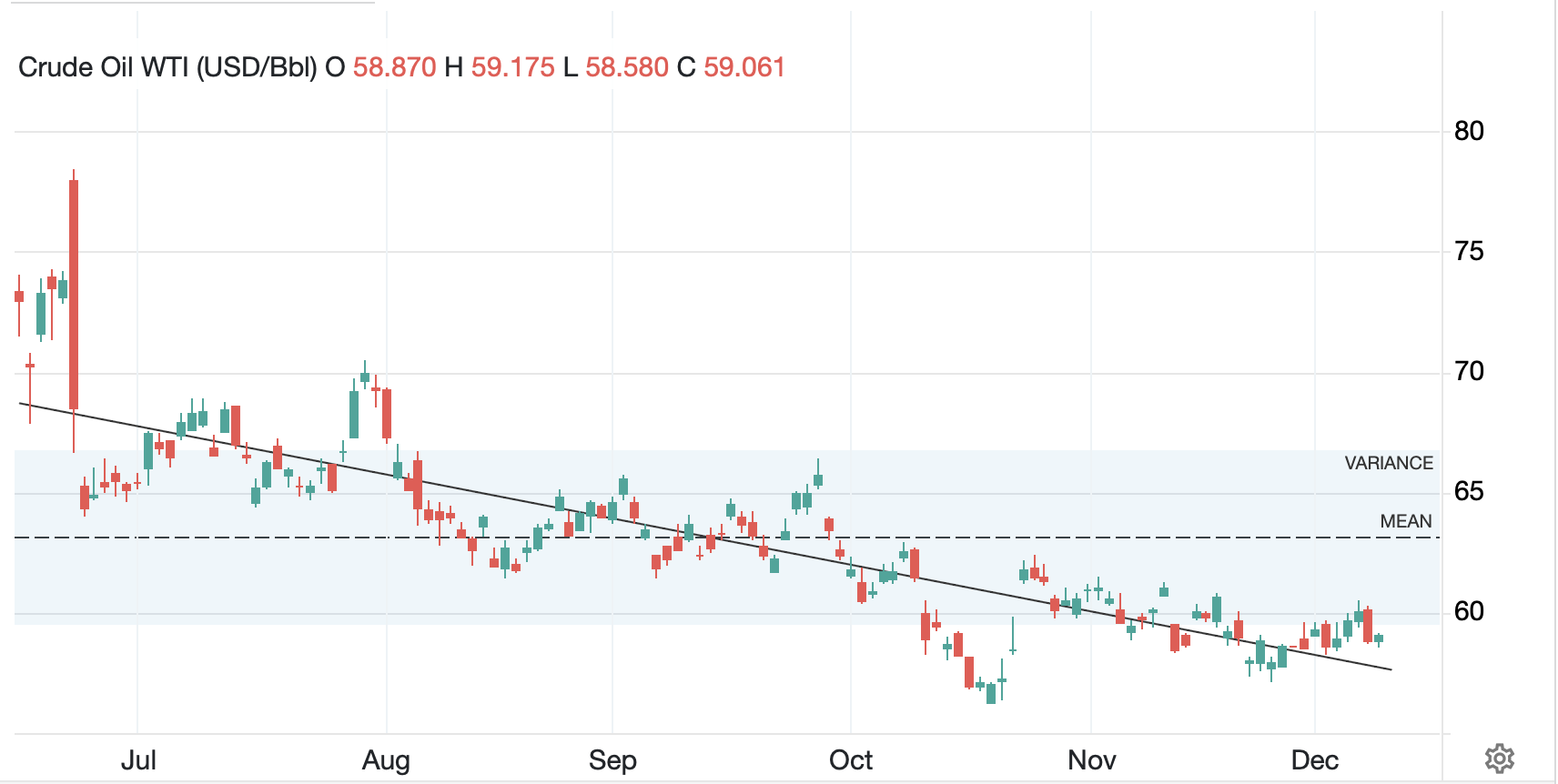
In the commodity markets, while the trend remains slightly lower in oil (+0.3%), as you can see from the chart below, $60/bbl is home.  As I have written before, absent an invasion of Venezuela or peace in Ukraine, it is hard to see what changes this for now.  I guess if China stops filling up its SPR, demand could shrink and that would accelerate the decline.
Source: tradingeconomics.com

In the metals markets, $4200/oz has become gold’s (+0.3%) home lately while silver (+0.9%) has found comfort between $58/oz and $59/oz.  Neither is seeing much in the way of volatility or new interest, but both trends remain strongly higher. 

Finally, the dollar, which rallied a bit yesterday, is little changed this morning.  USDJPY is interesting as it has traded back above 156 this morning, contradicting all that talk of a Japanese repatriation trade.  Again, it is difficult for me to look at the yen chart below and conclude the dollar has peaked.

Source: tradingeconomics.com

Elsewhere in the space, this is one of those days where 0.2% is a major move.  Historically, December is not a time when FX traders are active.

On the data front, the NFIB report rose to 99.0 this morning, its highest reading in three months and the underlying comments showed a modest increase in optimism with many businesses looking to hire more people but having trouble finding qualified candidates.  This is quite a juxtaposition with the narrative that small businesses are firing workers that I have read in several different places and is backed by things like the recent Challenger Gray survey which indicated that US businesses have fired more than 1.1 million workers so far this year.  This lack of clarity is not going to help the FOMC make decisions, that’s for sure.  As to the rest, the ADP Weekly Survey is due to be released as well as JOLTS Job Openings (7.2M) and Leading Indicators (-0.3%) at 10:00.

The very fact that the biggest story I could find was a hypothetical is indicative of the idea that there is nothing going on.  Look for a quiet one as market participants await Powell and friends tomorrow.

Good luck

Adf
Typically Dumb

On Friday, the market was sure
The end was nigh, and we’d be poor
The dollar was sold
And stocks mem’ry-holed
While bonds sashayed like haute couture
 
But somehow, the end did not come
As markets around the world hum
Perhaps we should learn
That markets do churn
And pundits are typically dumb


I admit to being confused this morning as by Friday evening, the entire narrative was that the recession was here, equity markets had peaked, and the dollar was set to collapse.  All the negative outcomes that have been prognosticated by doom pornsters were arriving and Friday was merely the first step.

And yet, here we are this morning, and not only did the sun rise in the East again, but equity markets throughout Asia also saw far more winners (China +0.4%, Hong Kong +0.9%, Korea +0.9%, India +0.5%, Singapore +1.0%, Thailand +1.25%, Philippines +0.7%) than laggards (Taiwan -0.2%, Malaysia -0.4%, Indonesia -1.0%, New Zealand -0.35%).  As to Europe, it is universally green (DAX +1.25%, CAC +0.8%, IBEX +1.4%, FTSE 100 +0.3%) and US futures, at this hour (6:35) are higher by 0.7% or so.  

Meanwhile, the dollar is higher against the euro (-0.15%), yen (-0.2%) and Swiss franc (-0.5%), although we have seen modest gains in some G10 currencies (GBP +0.15%, AUD +0.15%).  And if we look across the EMG bloc, while KRW (+0.4%) has rallied along with CNY (+0.2%), those are the outliers with the rest of the space softer by about -0.2% or so.  In other words, there has not yet been a wholesale rejection of the dollar on global foreign exchanges.

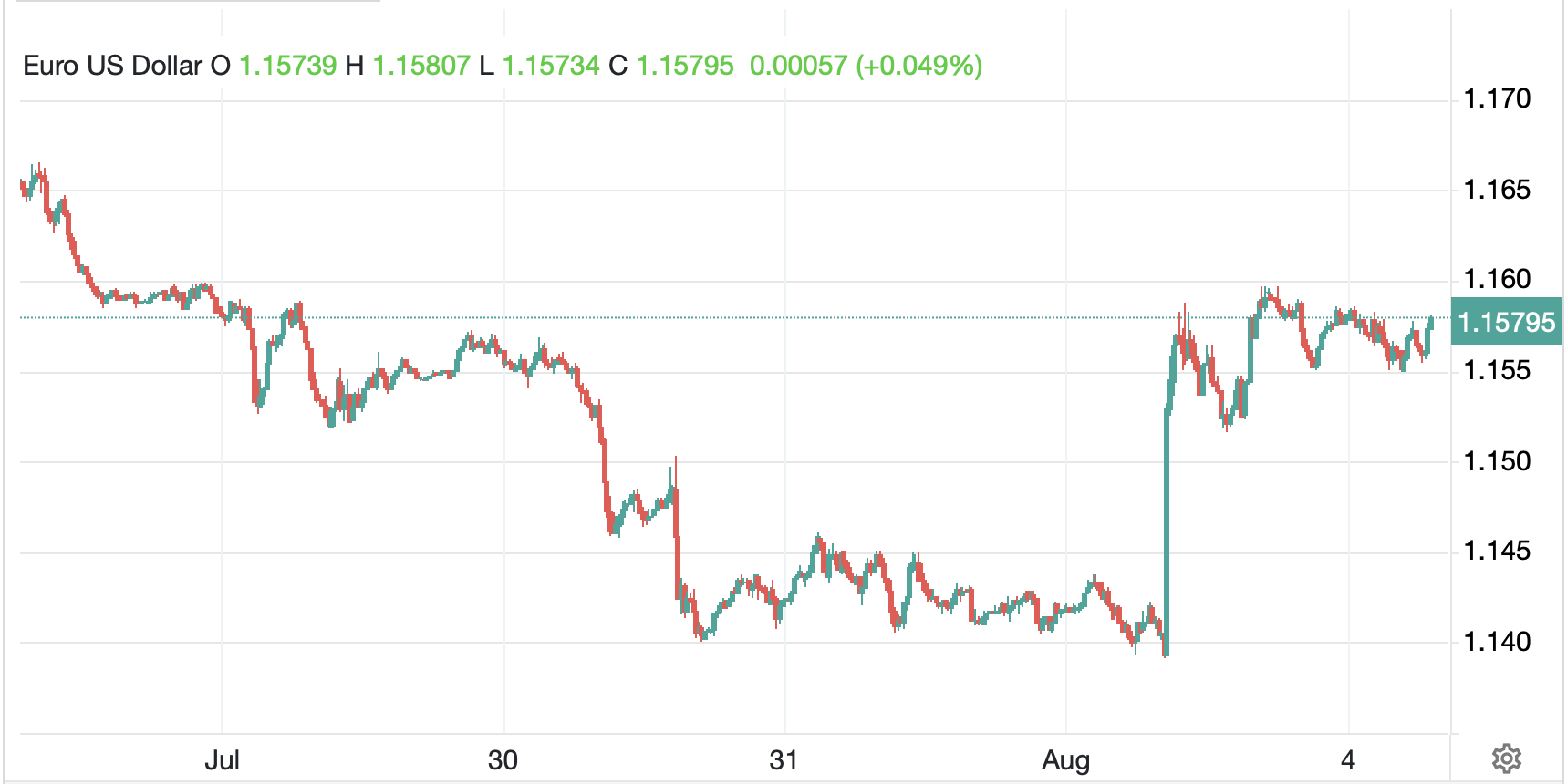
As to bond yields, after Friday’s dramatic decline, falling 15bps in the hour after the NFP report, they have largely stagnated, rising 1bp this morning.  European sovereign yields have slipped about 3bps on average as they continue the Friday move having closed before all the fun was finished.  In fact, while I have chosen the EURUSD exchange rate as a graph to depict the movement, basically every chart looks the same as this with a dislocation at the 8:30 mark on Friday and then a new range quickly established.

Source: tradingeconomics.com

I highlight this because so frequently, the narrative gets ahead of itself, and Friday was one of those days.  Yes, as I explained last night, the NFP data was weak, albeit still positive regardless of the fireworks surrounding the firing of the BLS Commissioner.  And remember, the idea that President Trump fired McEntarfar because the data displeased him does not mean she was not incompetent.  Certainly, nothing in her career demonstrates keen economic insights.  But that is still the talking point du jour.

However, that is a tired story at this point.  In fact, arguably, the reason it is getting so much press is that there is precious little else new to discuss amid the summer doldrums.  After all, the Russia Ukraine war continues apace with no end in sight, although it seems the rhetoric has increased with ex-president Medvedev seeming to threaten nuclear war and the US moving attack submarines closer to Russia.  

Texas Democratic state legislators have fled the state to avoid a special session where redistricting is due to be completed, so that has a lot of headlines, but seems likely to end like the last time this occurred, with the redistricting being completed, and Fed Governor Adriana Kugler stepped down a few months earlier than her term ends which opens another seat on the Fed for Mr Trump to fill.  

Of these stories, while our antenna should be raised given the Russia nuclear war scenario, it still seems a very low probability event, while Texas may matter in the midterm elections if they successfully redistrict as it is supposed to ensure another 5 Republican seats in the House.  But a new Fed governor, perhaps a precursor to the next Chair will have tongues wagging in the market until the seat is filled, and then until Powell is gone.

So, take your pick as to what is important.  Personally, I think the actual payroll data is the most important issue as we continue to see significant gyrations within the numbers.  Less government hiring (I read that 154,000 federal employees took the buyout) is an unalloyed good for the nation.  After all, if nothing else, given the average federal government employee salary is $106,382 (according to Grok) then that is about $16.4 billion less expenditure by the Federal government.  Every little bit helps.  In fact, all the data we have seen of late shows that the private sector continues to grow while the public sector is shrinking.  Over time, that is undoubtedly a better situation for the US and will reflect in the value of US assets.

But that’s really all there is to discuss, so let’s look at the data upcoming this week:

TodayFactory Orders-4.9%
 -ex Transport0.1%
TuesdayTrade Balance-$61.6B
 ISM Services51.5
ThursdayBOE Rate Decision4.00% (-0.25%)
 Initial Claims220K
 Continuing Claims1947K
 Nonfarm Productivity1.9%
 Unit Labor Costs1.6%
 Mexican Rate Decision7.75% (-0.25%)

Source: tradingeconomics.com

In other words, while we will hear from two more central banks as they cut rates (compared to a Fed that remains on hold, for now) it is hard to get that negative on the dollar.  Fed funds futures are pricing an 87% chance of a rate cut in September and now a 56% chance of three cuts this year, one at each meeting left, so that will weigh on the buck a bit, but if the US is cutting because recession is arriving, the economic situation elsewhere will be more dire.  After all, the US remains the consumer of last resort, and if the US pulls back, everyone else will feel it.

The big picture remains that the broader dollar trend is lower, but it is starting to make a case that trend is ending.  The data this week is largely second tier, and we need to wait until next week for CPI.  I have a feeling we will see very little net movement until then.

Good luck

Adf

Qualm(s)

As all of us wait for the Fed
And try to absorb what’s been said
Investors are calm
Though pundits have qualm(s)
Their warnings of problems are dead
 
While no move is likely today
So many continue to pray say
A rate cut is coming
To keep markets humming
So, shorts best get out of the way


Markets have been in wait and see mode, at least equity markets have, for the past week as investors, traders and algorithms seek something new to discuss.  In fact, a look at the chart below shows that the S&P 500 has moved the grand total of 9 points over the past week!

Source: finance.yahoo.com

Yes, there have been some earnings announcements, with a couple of key ones this afternoon (MSFT and META), but there continues to be an increasing focus on the FOMC which will announce their policy decision (no change) this afternoon.  The focus is really on what Chair Powell will hint at in the ensuing press conference.  At this point, I would say it is baked in the cake that two governors, Waller and Bowman, are going to dissent seeking a 25bp rate cut.

Ironically, if markets are looking for a catalyst from this FOMC meeting, I believe they are looking in the wrong place.  Chairman Powell will do everything he can to not answer any question about anything whatsoever, whether on the likely trajectory of future policy decisions or whether he will resign or be fired.  And so, we will need to look elsewhere for market moving catalysts.

Of course, there is always the White House, which has proven to be a rich source of uncertainty, and then there is the data onslaught starting today through Friday, which if it comes in differently than forecast, will have the opportunity to move markets.  Regarding the former, I will not even attempt to guess what the next story will be.  However, the latter is a potentially rich vein to be mined for insight.

To set the table, a look at yesterday’s outcomes is worthwhile.  The Goods Trade Balance fell to -$86B, substantially less than forecast, on the back of a significant decline in consumer goods imports.  While the data still shows a deficit, I imagine Mr Trump is pleased with the direction.  Certainly, compared to the trend prior to his election (as well as the front-running of tariffs early this year) it seems a modest improvement, or at least a reduction. (see chart below)

Source: tradingeconomics.com

Otherwise, Home Prices rose less than forecast and continue to slow their pace of increase and job openings were withing spitting distance of forecast at 7.44M, although somewhat lower than last month.  Finally, Consumer Confidence continues to rebound.  While equity markets were nonplussed, with US markets slipping a bit on the day, Treasury bonds rallied nicely with 10-year yields sliding -8bps on the day.  The bulk of that rally was based on a very positive 7-year auction, with the bid-to-cover ratio rising to 2.79, and dealers only getting 4% of the issue, the lowest level recorded since 2004.  In other words, investors took in virtually the entire $44 billion.  This morning, we will also learn about Treasury’s planned quarterly issuance, although estimates are there will be no increase in long-term bonds, with T-bills continuing to be the main financing vehicle for now.

Too, this morning we will get the ADP Employment report (exp 75K) and the first look at Q2 GDP (2.4% after -0.5% in Q1).  While all of that could have an impact, my sense is that tomorrow’s PCE data and Friday’s NFP will be of much more import.  A final though this morning is that the BOC is going to complete their policy meeting, but no change is expected there.

If we consider this information, absent a new surprise from the White House on your bingo card, it seems to me Friday is the most likely timing for any substantive movement in equities or bonds.  And with that in mind, let’s look at how other markets have been responding to things.

Yesterday’s modest declines in the US were followed by a mixed picture in Asia with both Japan and China little changed on the day although Hong Kong (-1.4%) was under pressure as the US-China trade talks stumbled for now.  But much of the rest of the region had a solid session with Australia (+0.6%) rallying after better-than-expected inflation data encouraged traders to price in a rate cut by the RBA at their next meeting.  But there were gains in Korea, India and Taiwan as well with only Indonesia really lagging.  In Europe, it is a mixed session with the CAC (+0.45%) leading the way higher while both the IBEX (-0.2%) and FTSE 100 (-0.3%) are lagging as Eurozone data was mixed with inflation edging higher in Spain although Eurozone GDP came in a tick better than forecast.  However, the big discussion there continues to revolve around the details of the trade deal.  As to US futures, they are a touch higher at this hour (7:40), about 0.25%.

In the bond market, after yesterday’s rally, US yields are unchanged on the day, trading at the low end of their recent range, while European sovereign yields are all lower by -2bps (Gilts are -5bps) as the US move came later in the day and Europe didn’t really participate yesterday.  Overnight, JGB yields slipped -1bp, but Australian govies fell -7bs as thoughts of rate cuts danced in traders’ heads.

In the commodity markets, oil (-0.65%) is giving back some of its gains that were catalyzed by President Trump’s threats to Russia if they don’t sit down in the next 10 days, rather than the original 50-day window.  As to metals markets, gold is unchanged this morning, still trading in the middle of its range, although we have seen some weakness in both silver (-0.9%) and copper (-0.8%) but it seems more in line with ordinary trading than with any new news.

Finally, the dollar is continuing its rebound as the euro (-0.2%) retreats further from its recent highs and is now lower by more than -2% in the past week.  In fact, the DXY has traded back above 99.0 for the first time since early June as the bottoming formation that I have highlighted over the past several days continues to prove prescient.  In fact, some might say the dollar is starting to accelerate higher!  Once again, I would highlight that the descriptions of the dollar’s demise were greatly exaggerated.

Source: tradingeconomics.com

And that’s pretty much all there is to discuss.  We are firmly in the middle of the summer doldrums where market activity remains subdued at best.  Given the prominence of algorithms in trading most markets, it will require something new and unexpected to get things going.  Of course, perhaps this evening’s earnings data will start some movement, but I’m still focused on Friday.

Good luck

Adf

Balling Their Fists

The world is no longer the same
Since Trump put Zelenskiy to shame
Now Europe insists
They’re balling their fists
And this time it isn’t a game
 
But markets just don’t seem to care
That, anymore, war’s in the air
Instead, what’s decisive
Is that the new price of
All cryptos has answered their prayer


Last Friday’s remarkable live TV meeting between Presidents Trump and Zelenskiy in the Oval Office has rocked the entire world, or certainly the entire Western World.  The unwillingness of Zelenskiy to consider a ceasefire and Trump’s dismissal of him from the White House, even before lunch, has clearly changed a lot of views of how things are going to evolve from here.

The most noteworthy result is the sudden realization by the EU and NATO that the US is committed to ending the war and is not interested in spending much, if any, more money on the subject.  The response by the EU, an emergency meeting in London yesterday where every nation committed to a strong defense of Ukraine, including boots on the ground, is remarkable.  My fear is that if they proceed along these lines, and French or British soldiers are attacked/shot during the conflict, NATO will seek to invoke Article 5 and drag the US into the conflict.  Certainly, that appears to be Zelenskiy’s goal, to get the US to fight Russia on their behalf.  (Although, there are those who might say the Biden administration was using Ukraine to fight Russia on their behalf, so this is justified not surprising.). In the end, I believe this path is terrifying as that would result in two nuclear powers meeting on the battlefield, perhaps a cogent definition of WWIII.

However, there is little evidence that market participants are terribly concerned about this situation.  Perhaps they are confident that this is all bluster and ultimately President Trump’s plan of increasing US economic interests in Ukraine will be enacted and a sufficient deterrent to prevent that outcome.  Or perhaps this is a YOLO moment, where the belief is, if nuclear war destroys the world, I can’t stop it, so I better make as much money as possible now.  I recognize geopolitical risk is tough to price, but I would have expected a lot more flight to safety than so far seen.

In fact, in markets, the true story of the weekend was the announcement of a cryptocurrency reserve to be created by the US although no specific size was revealed.  While I don’t typically write on the topic, that is because the crypto space has not yet, in my view, become enough of an influence on the macro world to matter.  However, this could change that.  

Source: tradingeconomics.com

One cannot be surprised that crypto currency prices have rallied dramatically on the back of the announcement, which almost seemed timed to arrest what had been a very sharp decline in those prices recently.  It is too early to really determine if this will draw cryptocurrencies closer to mainstream economic and financial discussion, but I would argue it is closer now than it has ever been before.

In Europe, the scoop on inflation
Does not seem ripe for celebration
While CPI slipped
Most forecasts, it pipped
So, slower but not near cessation

Eurozone CPI data was released this morning and the response to the outcome is quite interesting.  The data showed that headline fell from 2.5% to 2.4%, while core fell from 2.7% to 2.6%.  Obviously, that is a step in the right direction.  Alas, analysts’ forecasts were looking for a 0.2% decline in both readings, so while the data was good, it was worse than expectations.  In a perfect encapsulation of how narrative writing is so critical, both the WSJ and Bloomberg wrote articles explaining how the declines had set the table for the ECB to cut rates at their meeting this Thursday with neither one discussing market forecasts.

Now, a look at the market response shows that European sovereign yields have all risen between 6bps and 9bps, hardly the response one would expect in a lower inflation world.  As well, with Treasury yields higher only by 5bps this morning, as they bounce from their recent declines, the euro (+0.7%) has rallied sharply on the day.  

Much has been made of the European’s new commitments to increase defense spending, especially in the wake of yesterday’s meeting discussed above, and the requisite increases in defense spending that would accompany this new stance.  However, increased European defense spending has been a story for the past many weeks as President Trump has been railing against European members of NATO for not holding up their end of the bargain.  I guess the meeting added a greater sense of urgency, but remember, not an additional dime has been spent yet, nor even legislated.  Talk is cheap!

But there you have it.  Despite what appears to be a giant step closer to a major global conflagration, the market response has been a more classic risk-on result, with bond yields rising, the dollar falling and most equity indices doing fine.  Some days, things don’t make much sense.

Time for a quick recap of overnight markets then.  Friday’s strong US equity rally was followed by strength in Tokyo (+1.7%) and Australia (+0.9%) although both Hong Kong and China were little changed in the session. It appears Chinese traders are awaiting the news from Wednesday’s NPC meeting where the government will define their economic growth targets for the current year and how they might achieve them.  In Europe, Spain (-0.1%) is the laggard with the rest of the continent doing well, led by Germany (+1.1%).  It seems there are more defense companies there to benefit from all this mooted spending than elsewhere, hence the rally. Lastly, US futures are higher by 0.35% or so at this hour (7:00).

We have already discussed bonds, where yields are higher everywhere, including Japan (+4bps) as all the war talk has investors convinced there will be a lot more government borrowing everywhere in the world going forward.

In the commodity markets, oil (+0.25%) has been trading either side of unchanged in the overnight session but seems to be consolidating after last week’s declines.  I continue to believe that if the Ukraine war does end (and I believe that will be the outcome regardless of Europe’s hawkish turn), oil prices are likely to slide further as one of the likely outcomes will be the end of sanctions against Russian oil and Russian oil transports.  Meanwhile, gold (+0.6%) which had a rough week last week, is bouncing and dragging the entire metals complex higher with it.  If war is truly in the air, gold and silver seem likely to rally further.

Finally, the dollar is under great pressure this morning across the board.  Not only is the euro higher, but only JPY (-0.4%) is weaker vs. the dollar in the G10 as this seems a very risk-on initiative.  SEK (+1.3%) is the leader, perhaps because it is on the front lines of the potential war?  Seriously, I have no explanation there.  But EMG currencies are also rallying with HUF (+2.1%) the big winner, although the entire CE4 is stronger.  Again, this makes little sense to me if the politics is pushing toward war as all those nations are on the front lines.  Meanwhile, MXN (+0.4%) is managing to rally despite the ongoing threat of tariffs to be imposed tonight at midnight.  I continue to read numerous stories on the potential impacts of tariffs with dramatically different takes.  In the end, it appears that at least some things will go up in price, although fears of widespread massive price rises seem a bit overdone.

On the data front, along with Thursday’s ECB meeting, Friday brings the payroll report and there is plenty of stuff between now and then.

TodayISM Manufacturing50.5
 ISM Prices Paid56.2
WednesdayADP Employment 140K
 ISM Services52.9
 Factory Orders1.6%
 -ex Transport0.3%
 Fed’s Beige Book 
ThursdayECB Rate Decision2.75% (current 3.00%)
 Trade Balance-$93.1B
 Initial Claims340K
 Continuing Claims1870K
 Nonfarm Productivity1.2%
 Unit Labor Costs3.0%
FridayNonfarm Payrolls153K
 Private Payrolls138K
 Manufacturing Payrolls5K
 Unemployment Rate4.0%
 Average Hourly Earnings0.3% (4.1% Y/Y)
 Average Weekly Hours34.2
 Participation Rate62.6%
 Consumer Credit$15.5B

Source: tradingeconomics.com

In addition to this, we hear from 7 more Fed speakers at 9 venues including Chairman Powell Friday afternoon at 12:30.  Now, I have made a big deal about the fact that the Fed has lost much of its sway in the market to President Trump.  I believe that Powell’s speech will tell us much about whether they are unhappy about this, or whether they will be quite comfortable sinking into the background.  Given Powell’s previous antagonistic relationship with President Trump, I would think it would be the latter.  But every central banker seems drawn to the limelight like moths to a flame, so I would not be surprised to see something more dramatic.

As things currently stand, I see the ongoing efforts to cut government spending as a critical piece of the US fiscal puzzle.  The more success that DOGE and the administration has in this process, the better the potential outcomes for the US, tariffs or not.  This could increase private sector activity and reduce the deficit, thus slowing the debt issuance, and perhaps, weighing on inflation.  However, this is a longer-term process, not something that will happen in weeks, but over quarters.  In the meantime, I cannot get past the Ukraine situation as the biggest potential risk factors around, and if escalation is in the cards, I would expect Treasury yields to decline amid growing demand while the dollar rallies along with the yen as a haven.  Hopefully not but be prepared.

Good luck

Adf

Having a Fit

Seems Europe is having a fit
‘Cause Putin and Trump may submit
A plan for the peace
Where there’s an increase
In spending the Euros commit
 
Remarkably, though peace would seem
The basis of many a dream
Seems many despise
The fact that these guys
Don’t care Europe can’t stand this scheme


Here’s the thing about President Trump, you never know what he is going to do and how it is going to impact market behavior.  A case in point is the growing momentum for further peace negotiations between the US and Russia, with Ukraine basically going to be told how things are going to wind up.  On the one hand, you can understand Ukraine’s discomfort as they don’t feel like they are getting much say in the matter.  On the other hand, it seemed increasingly clear that the end game, if there is no US intervention of this nature, would be for Russia to bleed Ukraine of its fighting age population while systematically destroying its infrastructure.

The thing I find most remarkable is the number of pundits who hate this outcome despite the end result of the cessation of the fighting and destruction.  After three years of conflict, and with other nations willing to allow Ukrainians to die on the front lines while they preened about saving democracy, there was no serious push to find a solution.  I have no strong opinion on the terms that have been floated thus far, and I don’t believe rewarding a nation for aggressive action is the best outcome, but Russia has proven throughout history that they are willing to sacrifice millions of their own citizens in warfare, and the case for a Ukrainian victory seemed remote at best.  As experienced traders well understand, sometimes you have to cut your position so you can focus on something else.  Seems like a good time to cut the positions here.

Speaking of positions, let us consider what peace in Europe may mean for financial markets.  Yesterday I discussed how European NatGas prices have more than doubled since the war began.  If they return to their pre-war levels, that dramatically enhances Europe’s economic prospects, despite their ongoing climate policies.  Clearly, the FX market got that memo as the euro has rallied back to its highest level since December 2024 save for a one-day spike just after Trump’s inauguration.  In fact, it is not hard to look at the chart below and see a bottom forming in the single currency.  While the moving average I have included is only a short-term, 5-day version, you have to start somewhere.  While the fundamentals still seem to point to further downside in the single currency, between the Fed’s pause and more hawkish stance opposite the ECB’s ongoing policy ease, the medium-term picture could be far better for the Europeans.  If the war truly does end, it would likely see a significant uptick in investment and economic activity as they seek to rebuild Ukraine, and we could see substantial capital flows into the European economies.

Source: tradingeconomics.com

As well, oil prices, continue to trade near the bottom of their recent trading range as the working assumption seems to be that with a peace treaty, Russian oil would no longer be sanctioned, enhancing global supplies.  A look at the trend line in the chart below seems to indicate that is the direction of the future.

Source: tradingeconomics.com

The other remarkable thing is the decline in yields, where yesterday, despite a very hot PPI number, which followed Wednesday’s hot CPI number, Treasury yields fell back 7bps.  While there are likely some other aspects to this move, notably the ongoing story regarding DOGE and the attack on waste and fraud in the US, yesterday’s move was not indicative of fear, rather I read it as a positive sign that investors are betting on a chance that President Trump can be successful with respect to reducing the massive overspending by the government.  Clearly, this is early days regarding President Trump’s ability to get a handle on spending, and it could all blow up as legislative compromises may significantly water down any benefits, but I contend the market is showing hope right now, not fear.

And that, I would contend, is the big underlying driver of markets right now.  The prospects for peace and the potential impacts are the focus.  While tariffs are still a big deal, and yesterday’s talk about reciprocal tariffs is simply the latest in a long line of these discussions and pronouncements, the market seems to be getting tired of that conversation.  If we recap the current situation, central bank activities have lost their importance amid a huge uptick in governmental actions, both fiscal and geopolitical.  In many ways, I think this is great, the less central bank, the better.

Ok, let’s see how markets continue to absorb these daily haymakers from President Trump and the responses from other governments.  Clearly, the US equity market remains far more fixated on Trump’s actions than on higher inflation potentially forcing the Fed to raise rates.  In fact, despite the hot PPI print, the futures market has actually increased its expectation for rate cuts this year to 35bps.  That doesn’t make sense to me, but I’m just an FX poet. 

If we turn to Asian markets, Hong Kong (+3.7%) was the big winner overnight as a combination of growing expectations for more Chinese government stimulus to be announced soon, along with the ongoing tech positivity in the wake of the DeepSeek announcement got investors excited.  On the mainland, shares (CSI 300 +0.9%) were also higher, but not as frothy.  Meanwhile, the weaker dollar hindered the Nikkei (-0.8%) as the yen has gained 1.3% since the CPI data on Wednesday.  In Europe, the picture is mixed with the CAC (+0.4%) the best performer and the DAX (-0.4%) the worst performer.  Eurozone GDP surprised on the upside in Q4, growing…0.1%!! Talk about an explosive economy.  However, that was better than forecast and helped avoid a recession.  The interesting thing about European equity markets, though, is that despite a dismal economic backdrop, most major markets are trading at or near all-time highs.  Further proof that the market is not the economy.  As to US futures, ahead of this morning’s Retail Sales data, they are flat.

After several days of substantial movement in the bond market, it seems that traders have taken a long weekend given the virtual absence of movement here.  Treasury yields are unchanged on the day and European sovereign yields are higher by 1bp.  

In the commodity markets, on the day, oil prices are unchanged, although as per the above chart, it appears the trend is lower.  US NatGas (+1.8%) is rallying on forecasts for another cold spell, but European NatGas (-4.85%) continues to fall as prospects for peace indicate new supplies, or perhaps, renewed supplies.  In the metals markets, gold (+0.15%) is continuing its positive momentum but the big mover today is silver (+2.7%) which seems to be responding to some large option expirations in the SLV ETF (h/t Alyosha) which seem set to drive substantial demand for delivery.  

Finally, the dollar remains under pressure overall, although the movement has generally not been that large today.  The big outlier in the G10 is NZD (+0.9%) which has responded to the delay in the reciprocal tariff implementation until April.  Elsewhere in this bloc, gains are universal, but modest with movement between just 0.1% and 0.2%.  In the EMG bloc, the dollar is also under pressure with ZAR (+0.65%) a major gainer as precious metals continue to be in demand.  CLP (+1.15%) is also continuing to benefit from copper’s ongoing rally.  The exception to this movement has been Asia where most regional currencies are modestly softer this morning, KRW, TWD, INR, as the tariff talks still seem to be the driving force in these markets.

On the data front, we finish the week with Retail Sales (exp -0.1%, +0.3% ex autos), then IP (0.3%) and Capacity Utilization (77.7%).  Yesterday’s PPI data was several ticks hotter than forecast and seems to put paid to the idea that inflation is heading back to the Fed’s target.  This afternoon we hear from Dallas Fed president Lorrie Logan, but again, it is hard to make the case that the Fed is the driver of anything right now.

Fundamentals still point to dollar strength, I would argue, but the market is not paying attention. Rather peace and the peace dividend are now the driver in the FX markets and to me, that implies we are set to see the dollar give back some of its gains from the past 6 months.

Good luck and good weekend

Adf

Becoming a Bane

Twixt Europe and Russia, Ukraine
Is feeling incredible strain
As diplomats leave
The markets perceive
That risk is becoming a bane

The fear is that war is in view
At which time the best thing to do
Is buy francs and yen
And Treasuries, then
Be ready for stocks to eschew

While it is true that the Fed meeting on Wednesday is of significant importance to market participants, there is another, much greater concern that has risen to the top of the list today, the growing sound of war drums in the Ukraine.  Both sides seem to be increasing both their activities and their rhetoric, and financial markets are really starting to take notice.  The immediate losers have been on the Russian side as the MOEX (Russian stock market index) is down 6.1% so far this morning and 15% YTD.  In addition, RUB (-1.5%) is the worst performing EMG currency today and this year, having fallen -5.0% so far.  The implication is that international investors are fleeing given the threats of retaliation by the EU and NATO in the event Russia actually does invade.

The latest headline from the EU is, FURTHER MILITARY AGGRESSION TO COME AT SEVERE COST.  You can see why owning Russian assets seems quite risky here as on a military basis, there is probably very little the EU or NATO can do in response to an invasion.  But they can certainly impose much more severe economic sanctions and even boot Russia from the SWIFT system, removing the nation’s access to dollars for any transactions.  Of course, given the fact that Germany is so reliant on Russia for its natural gas supply, which by the way has seen prices explode higher this morning in Europe by 12.3%, it does seem unlikely that the most severe sanctions will be imposed.

Will this devolve into war?  There is no way to know at this time.  My take is neither side wants a hot war as those are extremely expensive and difficult to prosecute, but President Putin has an agenda with respect to the West’s attitude toward the Ukraine and what constitutes the Russian sphere of influence.  Arguably, one of the big concerns is that leadership in the West lacks both real world experience and any mandate to “protect” the Ukraine.  However, they also don’t want to look either foolish or weak to their own constituents.  I fear that pride and hubris on both sides could result in a much worse outcome than needs to occur.  For a long time, I read the Ukraine tensions as a negotiating tactic by Putin to achieve a greater buffer zone around Russia.  Alas, the situation seems to have deteriorated pretty severely and pretty quickly.  At this time, one must be prepared for a more dramatic and negative outcome, one which is likely to see traditional havens like yen, Swiss francs, the dollar, and Treasuries rise dramatically.

Apparently, President Xi
Does not like the FOMC
As Jay keeps implying
That rates will be flying
And Xi can’t force growth by decree

While Covid has been an extraordinary burden on the world in so many different ways, as with all things, there has been a modicum of good as a result as well.  For instance, the WEF has been downgraded to a bunch of Zoom calls with no elite hobnobbing and very little press overall.  However, that elite cadre persist in their efforts to rule the world by decree and I thought it worth highlighting something that didn’t get much press last week when it occurred but offers an indication of China’s current economic thinking.  President Xi’s speech included the following, (emphasis added) “Second, we need to resolve various risks and promote steady recovery of the world economy. The world economy is emerging from the depths, yet it still faces many constraints. The global industrial and supply chains have been disrupted. Commodity prices continue to rise. Energy supply remains tight. These risks compound one another and heighten the uncertainty about economic recovery. The global low inflation environment has notably changed, and the risks of inflation driven by multiple factors are surfacing. If major economies slam on the brakes or take a U-turn in their monetary policies, there would be serious negative spillovers. They would present challenges to global economic and financial stability and developing countries would bear the brunt of it.”

Boiled down, this comes to Xi Jinping basically asking (telling?) Jay Powell to avoid raising rates as that would be a problem for China, as well as other EMG economies.  Now, I don’t believe that Chairman Powell is overly concerned about China, but I do believe that while the tightening of policy is very likely to start, it will be short-lived as the economic situation proves to be less robust than currently thought.  However, I thought it instructive as backdrop for recent actions by the PBOC and as a harbinger of the future, where interest rates there are likely to continue declining.  However, nothing has changed my view that the renminbi (+0.2%) is going to continue to strengthen this year.

Ok, so a tour of markets makes for some pretty sad reading this morning.  While the Nikkei (+0.25%) managed to eke out a gain, the Hang Seng (-1.25%) could not despite ostensible positive news regarding Chinese property developers being able to sell some properties.  Europe, though, is bleeding badly on the Russia/Ukraine story (DAX -1.8%, CAC -1.7%, FTSE 100 -1.2%) with the UK clearly the least impacted for now.  Meanwhile, US futures, which had spent the bulk of the evening in the green, are now lower by -0.25% across the board.

Treasuries are playing their haven role like Olivier, rallying further with yields declining another 2.5bps, taking them 15bps from recent highs.  Bunds (-2.4bps), OATs (-1.9bps) and Gilts (-3.3bps) are all seeing strong demand as well as investors flee to the relative safety of fixed income.

Turning to commodities, oil (-0.2%) is in consolidation mode, although the uptrend remains strong.  NatGas in the US (-1.0%) is clearly dislocated from that in Europe but feels very much like it is developing a base around $4/mmBTU.  Gold (+0.4%) is proving more of a haven these days despite the dollar’s strength, although industrial metals (Cu -1.8%, Al -0.85%) are under pressure today.

And finally, the dollar is showing its traditional haven characteristics as well, rallying against all its G10 counterparts and most EMG currencies.  SEK (-0.8%) and NOK (-0.75%) are leading the way lower, arguably because of the proximity of those nations to the Ukraine and the escalation of military and naval activity in the Baltic and North Seas with both Russian and NATO ships and submarines seen.  AUD (-0.7%) is obviously feeling the impact of weakening commodity prices as well as the general dollar strength.  The rest of the bloc is all weaker, just not quite to this extent.

Aside from the RUB (now -2.0%), PLN (-0.9%), ZAR (-0.9%) and CZK (-0.85%) are the worst performers this morning in the EMG bloc.  The zloty story is interesting given central bank comments that “Polish rates should rise more than the market expects”, which would ordinarily be seen as currency bullish, however, given Poland’s proximity to the Ukraine, one cannot be surprised to see investors selling the currency.  The same is true of CZK, although frankly, other than a pure risk-off play, I can see no news from South Africa.

This is a big data week with far more than the Fed on tap.

Today PMI Manufacturing 56.7
PMI Services 54.8
Tuesday Case Shiller Home Prices 18.2%
Consumer Confidence 111.8
Wednesday New Home Sales 765K
FOMC Decision 0.00% – 0.25%
Thursday Initial Claims 260K
Continuing Claims 1650K
Durable Goods -0.5%
-ex Transport 0.3%
Q4 GDP 5.3%
Q4 Personal Consumption 2.9%
Friday Employment Cost Index 1.2%
Personal Income 0.5%
Personal Spending -0.6%
PCE Deflator 0.4% (5.8% Y/Y)
Core PCE Deflator 0.5% (4.8% Y/Y)
Michigan Sentiment 68.8

Source: Bloomberg

So, while of course the FOMC meeting is the primary piece of data, both the Claims and PCE data is going to be carefully scrutinized as well for indicators of the current economic situation and the Fed’s likely reaction function.  As of now, no Fed speakers are scheduled after the meeting for the rest of the week, although I imagine we will hear from several by the end of the week.

As to the dollar, right now, its haven status is all that matters.   Look for it to continue to perform will unless there is a real de-escalation of the Ukraine situation.

Good luck and stay safe
Adf

Still Under Stress

As traders are forced to assess
A bond market still under stress
Today’s jobs report
Might be of the sort
That causes some further regress

Global bond markets are still reeling after the past several sessions have seen yields explode higher. The proximate cause seems to have been the much stronger data released Wednesday in the US, where the ADP Employment and ISM Non-Manufacturing reports were stellar. Adding to the mix were comments by Fed Chairman Powell that continue to sing the praises of the US economy, and giving every indication that the Fed was going to continue to raise rates steadily for the next year. In fact, the Fed funds futures market finally got the message and has now priced in about 60bps of rate hikes for next year, on top of the 25bps more for this year. So in the past few sessions, that market has added essentially one full hike into their calculations. It can be no surprise that bond markets sold off, or that what started in the US led to a global impact. After all, despite efforts by some pundits to declare that the ECB was the critical global central bank as they continue their QE process, the reality is that the Fed remains top of the heap, and what they do will impact everybody else around the world.

Which of course brings us to this morning’s jobs data. Despite the strong data on Wednesday, there has been no meaningful change in the current analyst expectations, which are as follows:

Nonfarm Payrolls 185K
Private Payrolls 180K
Manufacturing Payrolls 12K
Unemployment Rate 3.8%
Participation Rate 62.7%
Average Hourly Earnings (AHE) 0.3% (2.8% Y/Y)
Average Weekly Hours 34.5
Trade Balance -$53.5B

The market risk appears to be that the release will show better than expected numbers today, which would encourage further selling in Treasuries and continuation of the cycle that has driven markets this week. What is becoming abundantly clear is that the Treasury market has become the pre-eminent driver of global markets for now. Based on the data we have seen lately, there is no reason to suspect that today’s releases will be weak. In fact, I suspect that we are going to see much better than expected numbers, with a chance for AHE to touch 3.0%. Any outcome like that should be met with another sharp decline in Treasuries as well as equities, while the dollar finds further support.

Away from the payroll data, there have been other noteworthy things ongoing around the world, so lets touch on a few here. First, there is growing optimism that with the Tory Party conference now past, and PM May still in control, that now a Brexit deal will be hashed out. One thing that speaks to this possibility is the recent recognition by Brussels that the $125 trillion worth of derivatives contracts that are cleared in London might become a problem if there is no Brexit deal, with payment issues needing to be sorted, and have a quite deleterious impact on all EU economies. As I have maintained, a fudge deal was always the most likely outcome, but it is by no means certain. However, today the market is feeling better about things and the pound has responded by rallying more than a penny. The idea is that with a deal in place, the BOE will have the leeway to continue raising rates thus supporting the pound.

Meanwhile, stronger than expected German Factory orders have helped the euro recoup some of its recent losses with a 0.25% gain since yesterday’s close. But the G10 has not been all rosy as the commodity bloc (AUD, NZD and CAD) are all weaker this morning by roughly 0.4%. Other currencies under stress include INR (-0.6%) after the RBI failed to raise interest rates as expected, although they explained there would be “calibrated tightening” going forward. I assume that means slow and steady, but sounds better. We have also seen further pressure on RUB (-1.3%) as revelations about Russian hacking efforts draw increased scrutiny and the idea of yet more sanctions on the Russian economy make the rounds. ZAR (-0.75%) and TRY (-2.0%) remain under pressure, as do IDR (-0.7%) and TWD (-0.5%), all of which are suffering from a combination of broad dollar strength and domestic issues, notably weak financial situations and current account deficits. However, there is one currency that has been on a roll lately, other than the dollar, and that is BRL, which is higher by 3.4% in the past week and 8.0% since the middle of September. This story is all about the presidential election there, where vast uncertainty has slowly morphed into a compelling lead for Jair Bolsonaro, a right-wing firebrand who is attacking the pervasive corruption in the country, and also has University of Chicago trained economists as his financial advisors. The market sees his election as the best hope for market-friendly policies going forward.

But for today, it is all about payrolls. Based on what we have heard from Chairman Powell lately, there is no reason to believe that the Fed is going to adjust its policy trajectory any time soon, and if they do, it is likely only because they need to move tighter, faster. Today’s data could be a step in that direction. All of this points to continued strength in the dollar.

Good luck and good weekend
Adf

Too Arcane

The Fed took the time to explain
Why ‘Neutral’ they’ll never attain
Though theories suppose
O’er that rate, growth slows
Its measurement is too arcane

If one needed proof that Fed watching was an arcane pastime, there is no need to look beyond yesterday’s activities. As universally expected, the FOMC raised the Fed funds rate by 25bps to a range of 2.00% – 2.25%. But in the accompanying statement, they left out the sentence that described their policy as ‘accommodative’. Initially this was seen as both surprising and dovish as it implied the Fed thought that rates were now neutral and therefore wouldn’t need to be raised much further. However, that was not at all their intention, as Chairman Powell made clear at the press conference. Instead, because there is an ongoing debate about where the neutral rate actually lies, he wanted to remove the concept from the Fed’s communications.

The neutral rate, or r-star (r*) is the theoretical interest rate that neither supports nor impedes growth in an economy. And while it makes a great theory, and has been a linchpin of Fed models for the past decade at least, Chairman Powell takes a more pragmatic view of things. Namely, he recognizes that since r* cannot be observed or measured in anything like real-time, it is pretty useless as a policy tool. His point in removing the accommodative language was to say that they don’t really know if current policy is accommodative or not, at least with any precision. However, given that their published forecasts, the dot plot, showed an increase in the number of FOMC members that are looking for another rate hike this year and at least three rate hikes next year, it certainly doesn’t seem the Fed believes they have reached neutral.

The market response was pretty much as you would expect it to be. When the statement was released, and initially seen as dovish, the dollar suffered, stocks rallied and Treasury prices fell in a classic risk-on move. However, once Powell started speaking and explained the rationale for the change, the market reversed those moves and the dollar actually edged higher on the day, equity markets closed lower and Treasury yields fell as bids flooded the market.

In the end, there is no indication that the Fed is slowing down its current trajectory of policy tightening. While they have explicitly recognized the potential risks due to growing trade friction, they made clear that they have not seen any evidence in the data that it was yet having an impact. And given that things remain fluid in that arena, it would be a mistake to base policy on something that may not occur. All told, if anything, I would characterize the Fed message as leaning more hawkish than dovish.

So looking beyond the Fed, we need to look at everything else that is ongoing. Remember, the trade situation remains fraught, with the US and China still at loggerheads over how to proceed, Canada unwilling to accede to US demands, and the ongoing threat of US tariffs on European auto manufacturers still in the air. As well, oil prices have been rallying lately amid the belief that increased sanctions on Iran are going to reduce global supply. There is the ongoing Brexit situation, which appears no closer to resolution, although we did have French President Macron’s refreshingly honest comments that he believes the UK should suffer greatly in the process to insure that nobody else in the EU will even consider the same rash act as leaving the bloc. And the Italian budget spectacle remains an ongoing risk within the Eurozone as failure to present an acceptable budget could well trigger another bout of fear in Italian government bonds and put pressure on the ECB to back off their plans to remove accommodation. In other words, there is still plenty to watch, although none of it has been meaningful to markets for more than a brief period yet.

Keeping all that in mind, let’s take a look at the market. As I type (which by the way is much earlier than usual as I am currently in London) the dollar is showing some modest strength with the Dollar Index up about 0.25% at this point. The thing is, there has been no additional news of note since yesterday to drive things, which implies that either a large order is going through the market, or that short dollar positions are being covered. Quite frankly, I would expect the latter reason is more compelling. But stepping back, the euro has traded within a one big figure range since last Thursday, meaning that nothing is really going on. The same is true for most of the G10, as despite both data and the Fed, it is clear very few opinions have really changed. My take is that we are going to need to see material changes in the data stream in order to alter views, and that will take time.

In the emerging markets, we have two key interest rate decisions shortly, Indonesia is forecasts to raise their base rate by 25bps to 5.75% and the Philippines are expected to raise their base rate by 50bps to 4.50%. Both nations have seen their currencies remain under pressure due to the dollar’s overall strength and their own current account deficits. They have been two of the worst three performing APAC currencies this year, with India the other member of that ignominious group. Meanwhile, rising oil prices have lately helped the Russian ruble rebound with today’s 0.2% rally adding to the nearly 7% gains seen in the past two plus weeks. And look for the Argentine peso to have a solid day today after the IMF increased its assistance to $57 billion with faster disbursement times. Otherwise, it is tough to get very excited about this bloc either.

On the data front, this morning brings the weekly Initial Claims data (exp 210K), Durable Goods (2.0%, 0.5% ex transport) and our last look at Q2 GDP (4.2%). I think tomorrow’s PCE data will be of far more interest to the markets, although a big revision in GDP could have an impact. But overall, things remain on the same general trajectory, solid US growth, slightly softer growth elsewhere, and a Federal Reserve that is continually tightening monetary policy. I still believe they will go tighter than the market has priced, and that the dollar will benefit accordingly. But for now, we remain stuck with the opposing cyclical and structural issues offsetting. It will be a little while before the outcome of that battle is determined, and in the meantime, a drifting currency market is the most likely outcome.

Good luck
Adf


Investor Frustrations

There once was a wide group of nations
Whose growth was built on weak foundations
Their policy actions
Are seen as subtractions
Increasing investor frustrations

Boy, I go away for a few days and world virtually collapses!!!

Needless to say, a lot has happened since I last wrote on Thursday, with a number of emerging market currencies and their respective equity markets really coming under pressure. It was the usual suspects; Turkey, Argentina, Indonesia, Brazil, Mexico, Russia and China, all of whom had felt significant pressure at various times during the year. But this new wave seems a bit more stressful in that prior to the past few days, each one had experienced a problem of its own, but since Friday, markets have pummeled them all together. This appears to be the contagion that had been feared by both investors and policymakers. The thing is, the unifying theme to pretty much all these markets is the stronger dollar. As the dollar resumes its strengthening trend, both companies and governments in those nations are finding it increasingly difficult to handle their debt loads. And given the near certainty that the Fed is going to continue its steady policy tightening alongside consistently stronger US economic data, the dollar strengthening trend seems likely to remain in tact for a while yet.

Could this be one of the ‘unexpected’ consequences of ten years of QE, ZIRP and NIRP? Apparently, despite assurances from esteemed central bankers like Ben Bernanke, Janet Yellen and Mario Draghi (as dovish a triumvirate as has ever been seen), there ARE negative consequences to dramatically changing the way monetary policy is handled, massively expanding balance sheets and driving real interest rates to significant negative levels. While there is no doubt that developed economy stock markets have benefitted generally, it seems like some of those risks are becoming more apparent.

These risks include things like the central bankers’ loss of control over markets. After all, markets around the world have basically danced to the tune of free money for the past decade. As that tune changes, investor behavior is sure to change as well. Another systemic risk has been the increasing inability of investors to adequately diversify their portfolios. If every market rises due to exogenous variables, like zero interest rates, then how can prudent investors manage their risk? Many took comfort in the fact that market volatility had declined so significantly, implying that systemic risk was reduced on net. However, what we have observed in 2018 is that volatility is not, in fact, dead, but had merely been anaesthetized by that free money.

The worrying thing is there is no reason to believe that this process is going to end soon. Rather, I fear that it may just be beginning. There are a significant number of excesses to wring out of the markets, and however much central bankers around the world try to prevent that from happening, they cannot hold back the tide forever. At some point, and it could be coming sooner than you think, markets are going adjust despite all the efforts of Powell, Draghi, Carney, Kuroda and their brethren. Never forget that the market is far bigger than any one nation.

We are already seeing how this can play out in some of the above-mentioned countries. Argentina, for example, has short-term interest rates of 60%, inflation of ‘only’ 31%, and therefore real interest rates are now +29%! But the economy is back in recession, having shrunk 6.7% last quarter, and the current account deficit remains a significant problem. So despite jacking rates to 60%, the currency has fallen 22% this week and 120% this year! And they are following orthodox monetary policy. Turkey, on the other hand, has been unwilling to bend to orthodoxy (when it comes to monetary policy) and has kept rates low such that real interest rates are near zero and heading negative as inflation continues its climb (17.9% in September) while rates remain on hold. So the fact that the lira is down 9% this week and 95% this year should be less surprising.

The point is that the market is losing its taste for discrimination and is beginning to treat all currencies under the rubric ‘emerging markets’ as the same. And they are selling them all. As long as the Fed continues its grind higher in rates, there is no reason to believe that this will end. And if these declines are steady, rather than sharp crashes, it will go on for a while. Chairman Powell will have no reason to stop if a few random EMG markets trend lower. If, however, the S&P 500 starts to suffer, that may be a different story, and one we will all watch with great interest!

In the meantime, turning to G10 currencies, the dollar is stronger here as well this morning, although it has fallen back from its best levels of the morning. In fact, while the pound has been consistently undermined (-0.3% today, -1.5% since Thursday) by what seems to be a worsening saga regarding Brexit, the euro has stabilized for now, although it is down about 1% since Thursday as well. Apparently, CAD is not taking the ongoing NAFTA negotiations that well, as it has fallen 2% since Thursday amid pressure on PM Trudeau to cave into US demands. The BOC meets today and while there had been previous expectations that they may raise rates, that has been pushed back to October now in view of the NAFTA process. This is despite the fact that inflation in Canada is running at 2.9%, well above target.

In the end, as long as the Fed continues along its recent path, expect market volatility to increase further, with more and more dominoes likely to fall.

As to today, the only noteworthy data is the Balance of Trade, where expectations are for a $50.3B outcome, not exactly what the president is hoping for, I’m sure. And as far as the dollar goes, there is no reason to believe that its recent strength is going to turn around anytime soon.

Good luck
Adf


Up To New Tricks

The nation that first tried to fix
Its price target’s up to new tricks
Last night it explained
That rates would remain
Unchanged til growth, up, finally ticks

You know it has been a relatively uneventful session when the most interesting story is about New Zealand! For those with a bent toward history, it was then-RBNZ Governor Donald Brash, who in 1988 set the first inflation target for a nation, 3.0% at that time, and who was able to maintain the RBNZ’s independence from government meddling ( a new philosophy then) to help achieve that target and eventually bring interest rates down from more than 15% to low single digits. Well, last night when the RBNZ met, they left rates on hold at a record low level of 1.75%, as was universally expected, but they added a sentence to their policy statement “…that rates will remain at this level through 2019 and into 2020”, adding forward guidance to the mix and surprising markets completely. The result was that the NZD fell a bit more than 1% instantly and has continued lower to currently trade down 1.4% on the session and back to its lowest level since March 2016.

This action simply underscores the policy divergence that we have seen over the past two and a half years. Since the Fed’s first, tentative steps towards tightening in December 2015, it has been clear that the US remains ahead of the global growth cycle. And now we find ourselves in a world where several countries are trending higher (US, Canada, India, Sweden) in growth and inflation, while others are seeing the opposite outcome (China, New Zealand, Australia). Of course there are those who are in between, like the Eurozone and Japan, where they want to believe that things are getting better so they can normalize policy, but just don’t quite have the confidence yet. Maybe soon. And it is these policy differences, as well as expectations for their evolution, that will continue to be the key drivers of currencies going forward.

However, away from New Zealand, the G10 has been a dull affair. There has been limited data released and currency movement has been extremely modest, generally less than 0.1% since yesterday’s closing levels.

Emerging markets, though, have been a different story, with several of them really taking a tumble. Starting with Turkey, which has, of course, been under pressure for the past several months, last night saw yet another significant decline of 2.2%, which makes 6.5% this week and more than 50% in the past year. Additional US sanctions driven by the arrest of a US pastor in Turkey have been the recent catalyst, but the reality is that there is an increasing sense of doom attached to President Erdogan’s economic management theories, which include the idea that high interest rates cause inflation; they don’t fight it. But high inflation is what they have there, with the annual rate now running above 16% and rising. The lira has further to fall, mark my words.

Next on the list is the Russian ruble, which has recovered as I write to only be down by 0.6%, after having been lower by as much as 1.3% earlier in the session. However, this week it is lower by 4.2% and nearly 7% this month. The story here is a combination of both new US sanctions as the latest response to the poisoning of an ex Russian agent in the UK earlier this year, as well as the sharp decline in oil prices yesterday, WTI fell 3.2% after storage data indicated there was much more oil and products around than expected. The Russian economy is definitely feeling the squeeze of US sanctions and I expect that the ruble will continue to be pressured lower for a while yet.

But once we get past those currencies, there is precious little to discuss in this space as well. Which takes us to the upcoming data releases. This morning we see Initial Claims (exp 220K) and PPI (3.4%, 2.8% core) at 8:30 and then we hear from Chicago Fed president Evans at 9:30. Evans is a known dove, so the only possibility of a newsworthy event would be if he sounded hawkish. Yesterday, Richmond Fed president Barkin said it was time to get rates back to ‘normal’ and that two more hikes this year seem reasonable. While the futures market is not yet pricing in great confidence in a December move by the Fed, it seems a foregone conclusion to me.

In the end, nothing has happened to alter my views that the Fed will continue to lead the way in tighter monetary policy and that the dollar will be the main beneficiary of that action.

Good luck
Adf