Leverage Thumbscrews

The President said that today
He’d let us know who’ll replace Jay
The favorite is Warsh
But that could be harsh
For markets, or so people say
 
But really, this morning, the news
Is silver and gold have the blues
It turns out their prices
Were causing a crisis
For players with leverage thumbscrews

The big news this morning, is that President Trump is ostensibly going to announce former Fed governor Kevin Warsh as his selection for the next Fed Chair.  His history has been as someone who has disagreed with many Fed decisions, and he skews to the hawkish side of the spectrum, which seems odd for Trump who everyone expected would nominate a dove. He is clearly quite capable of doing the job and brings a significant amount of intellectual firepower to the role.  It remains to be seen, if he is nominated, how the confirmation process will proceed, as well as what Jay Powell will do when his Chairmanship is up (his term runs until 2028).

The interesting connection for me is the number of stories that have linked this rumor to major market moves overnight, especially in the precious metals space.  So, let’s jump in and look at a few charts to offer some perspective on things.  

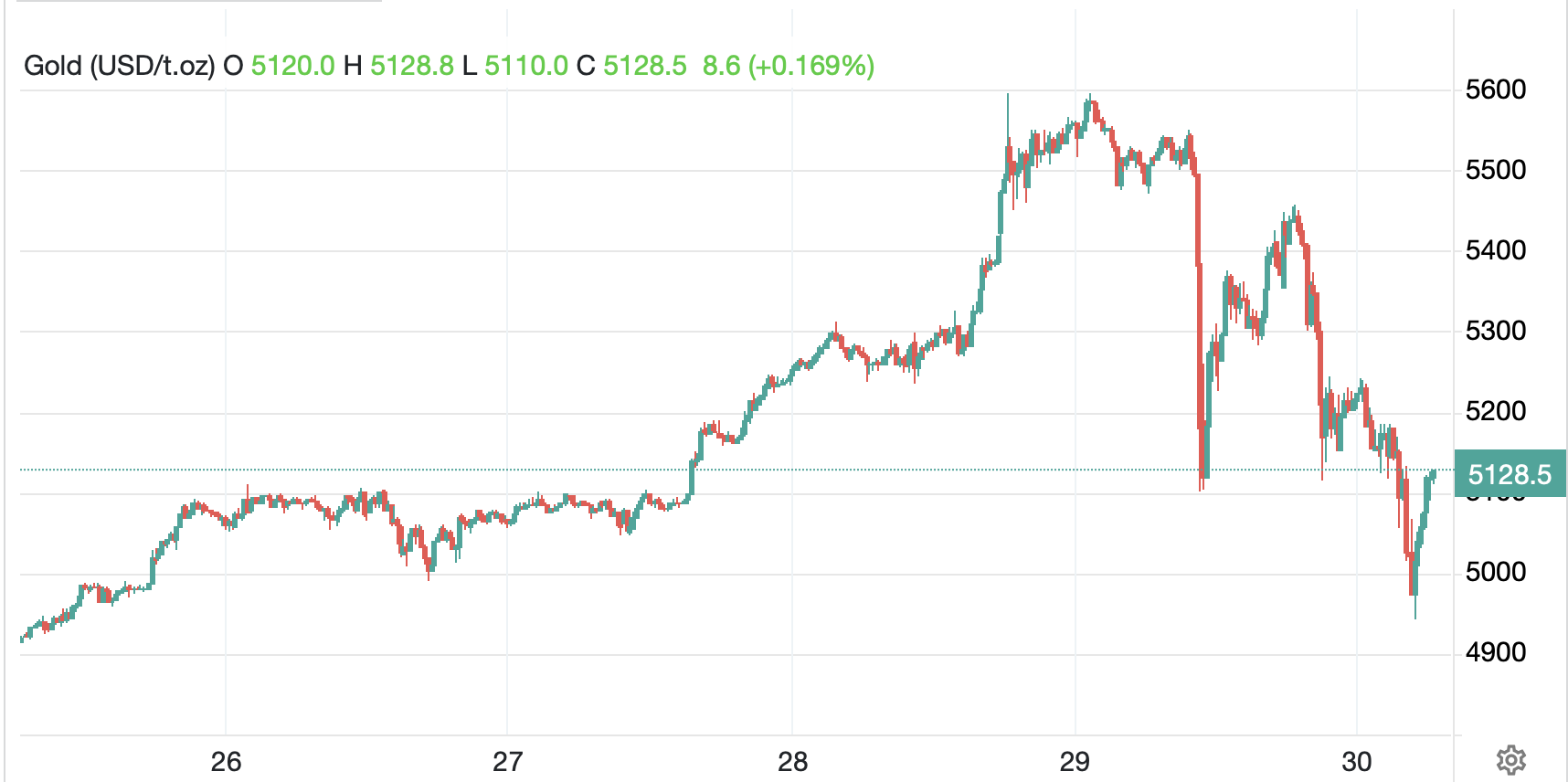
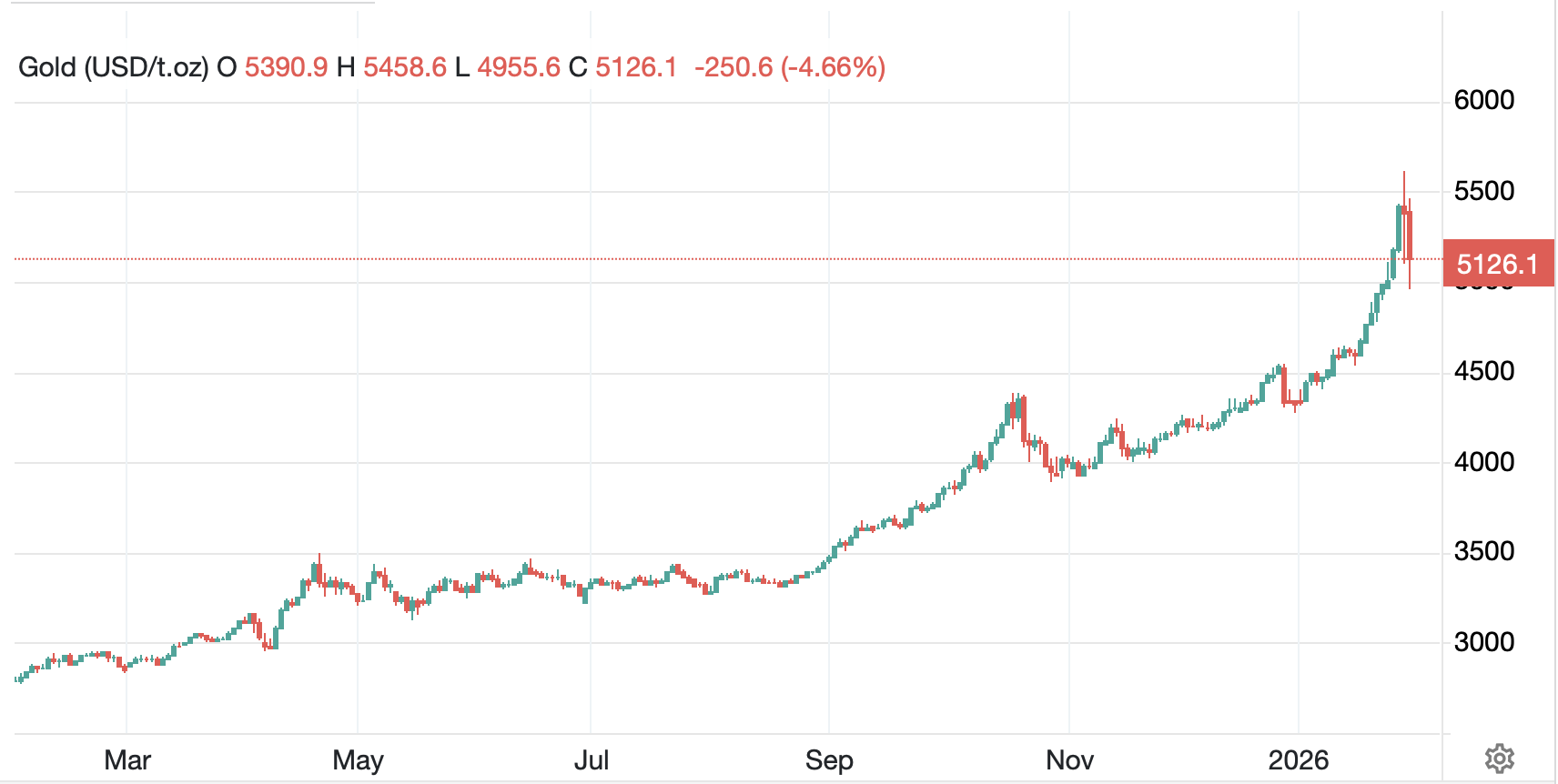
As we all live in the moment, it is often difficult to consider history in its fullness.  Look at the three charts of gold (from tradingecomomics.com) that follow, each over a different timespan, 1week, 1year and 5 years.

1 week:
1 year:
5 years:
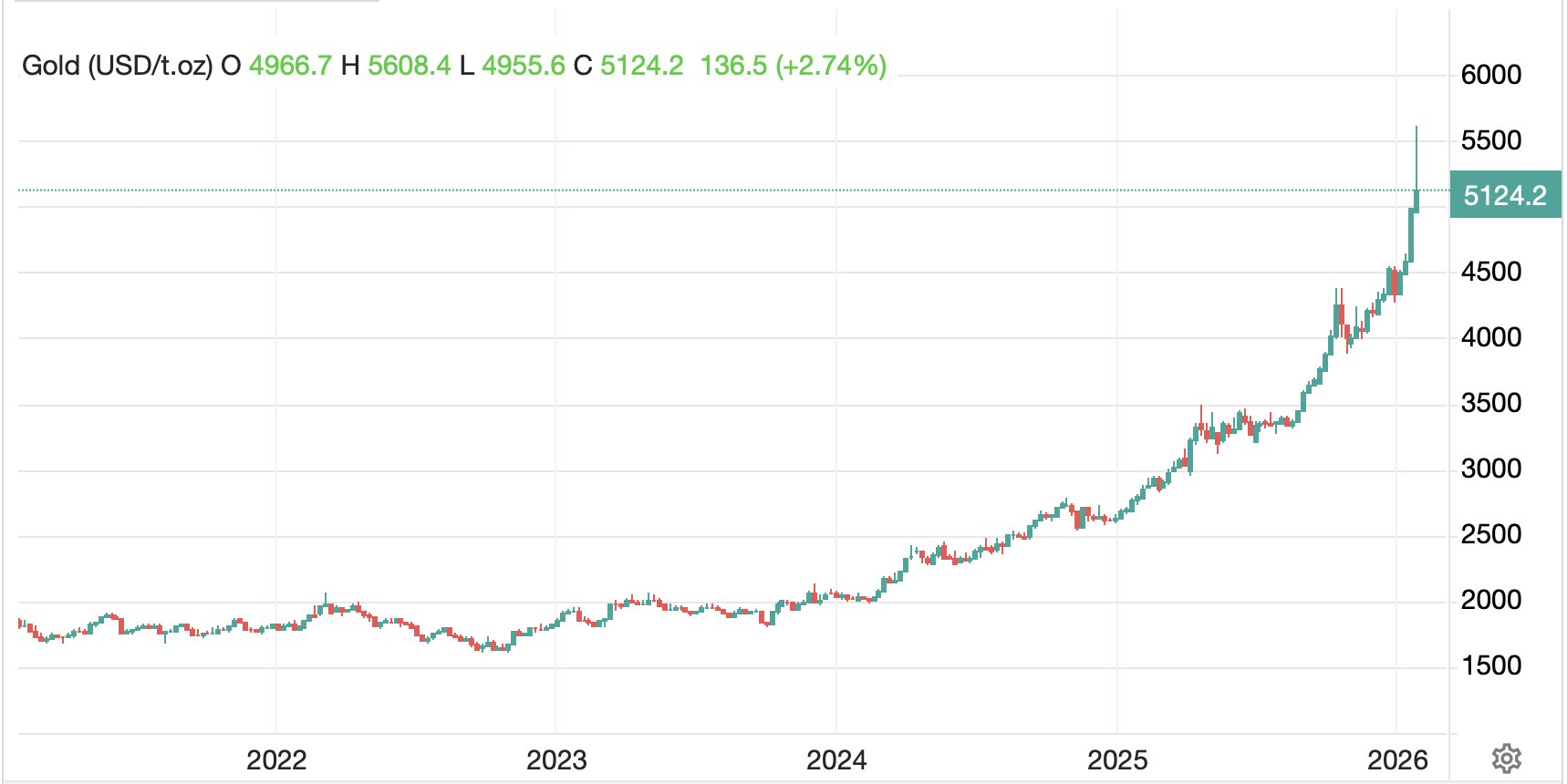
What do you notice:  there is no question that gold (-4.7% or $250/oz) has fallen sharply overnight.  that is evident in the first two charts.  However, a look at the first chart shows you that despite a decline of that magnitude, the barbarous relic is still higher THIS WEEK!  While gold has been exploding higher, it only crossed above $5000/oz for the first time on Sunday night in Asian trading.  Now, I expect the bulk of the discussion will center around the 1-year chart which shows the dramatic decline as that is the newsworthy story, the ‘collapse’ in the price.  But if we zoom out further, to the 5-year perspective, which has weekly candles, the last down week was in December.  Market technicians will point to the shape of the most recent weekly candle, which is typically referred to as a hammer candle, and explain it signals a reversal in trend.  And maybe it does.  But the fact is volumes on the way up were much higher than those overnight, which does not portend panic selling.  Trees don’t grow to the sky, and a reversal was always expected.  Here we are.

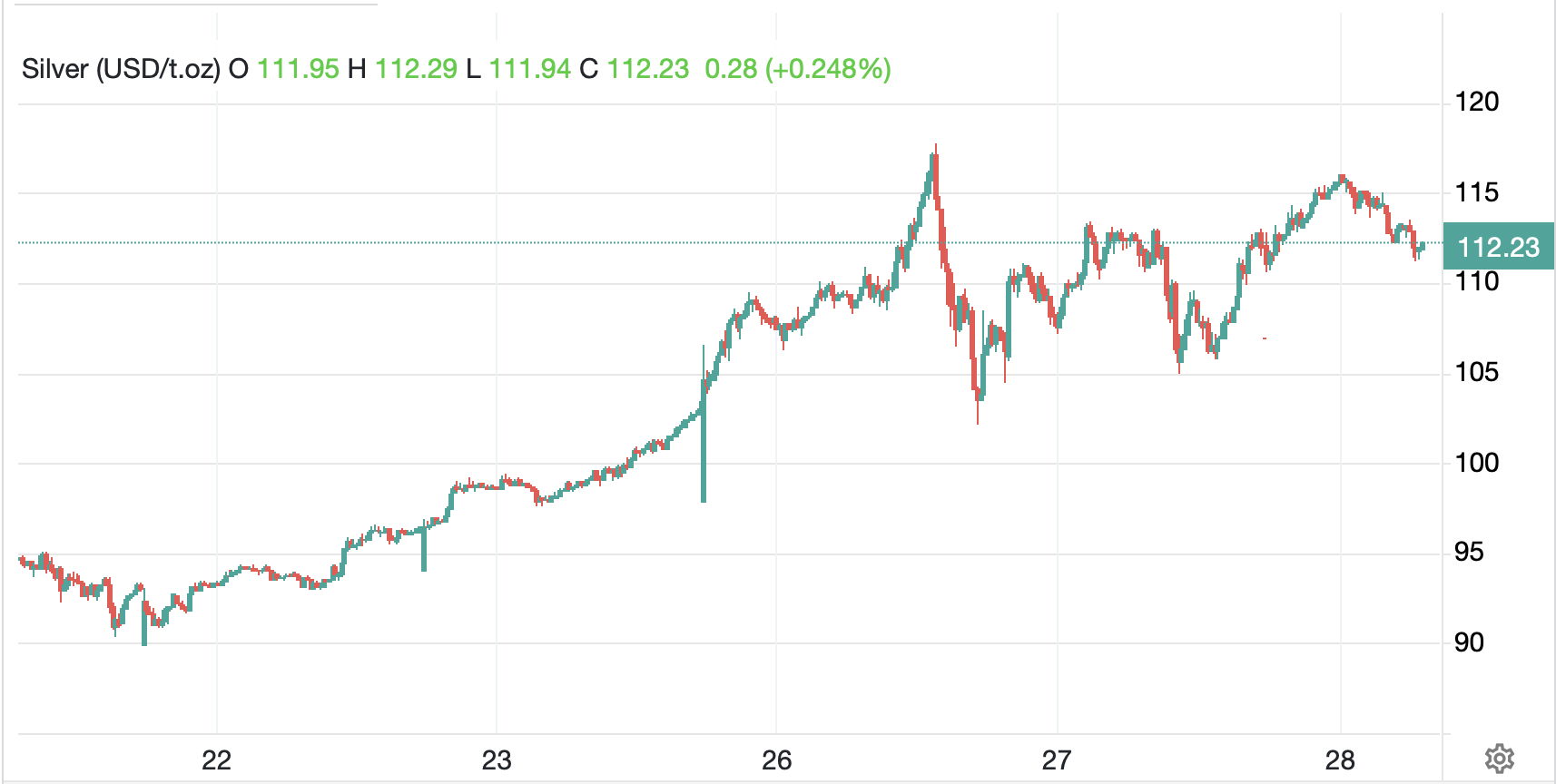
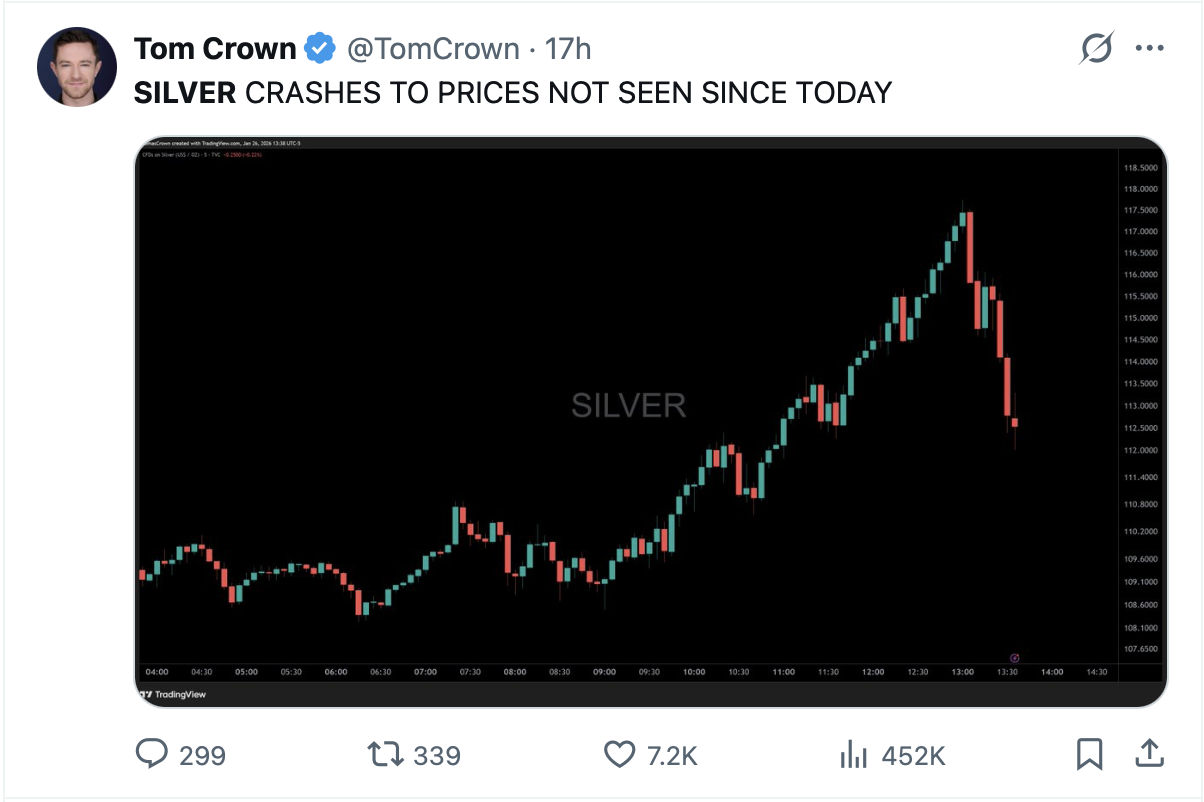
The price action in silver overnight was almost identical, albeit more violent as has been the case with the rally as well.  Platinum too.  A couple of other things to consider about this:

  • Today is month end, a time when positions are typically adjusted and rebalanced, so given the tremendous rally seen this month in the metals, selling is what rebalances things.
  • China has not changed its policy regarding gold purchases nor its policy on license restrictions for the export of silver, so to the extent that those were driving forces in the rally, they still exist
  • There is no evidence the world is a safer place this morning than it was yesterday morning.  There’s no peace in Ukraine; the Ayatollah has not relinquished power; Cuba and Venezuela remain in the status quo, and Europe continues to try to figure out how to power themselves without relying on the two largest energy exporters in the world, the US and Russia.

It beggar’s belief that this is entirely a reaction to the rumored naming of Kevin Warsh as the next Fed chair.  As I type early this morning, the prices of precious metals are already bouncing nicely off their lows.  I do not know what drove this move specifically, but I do not believe that the big picture story has changed.

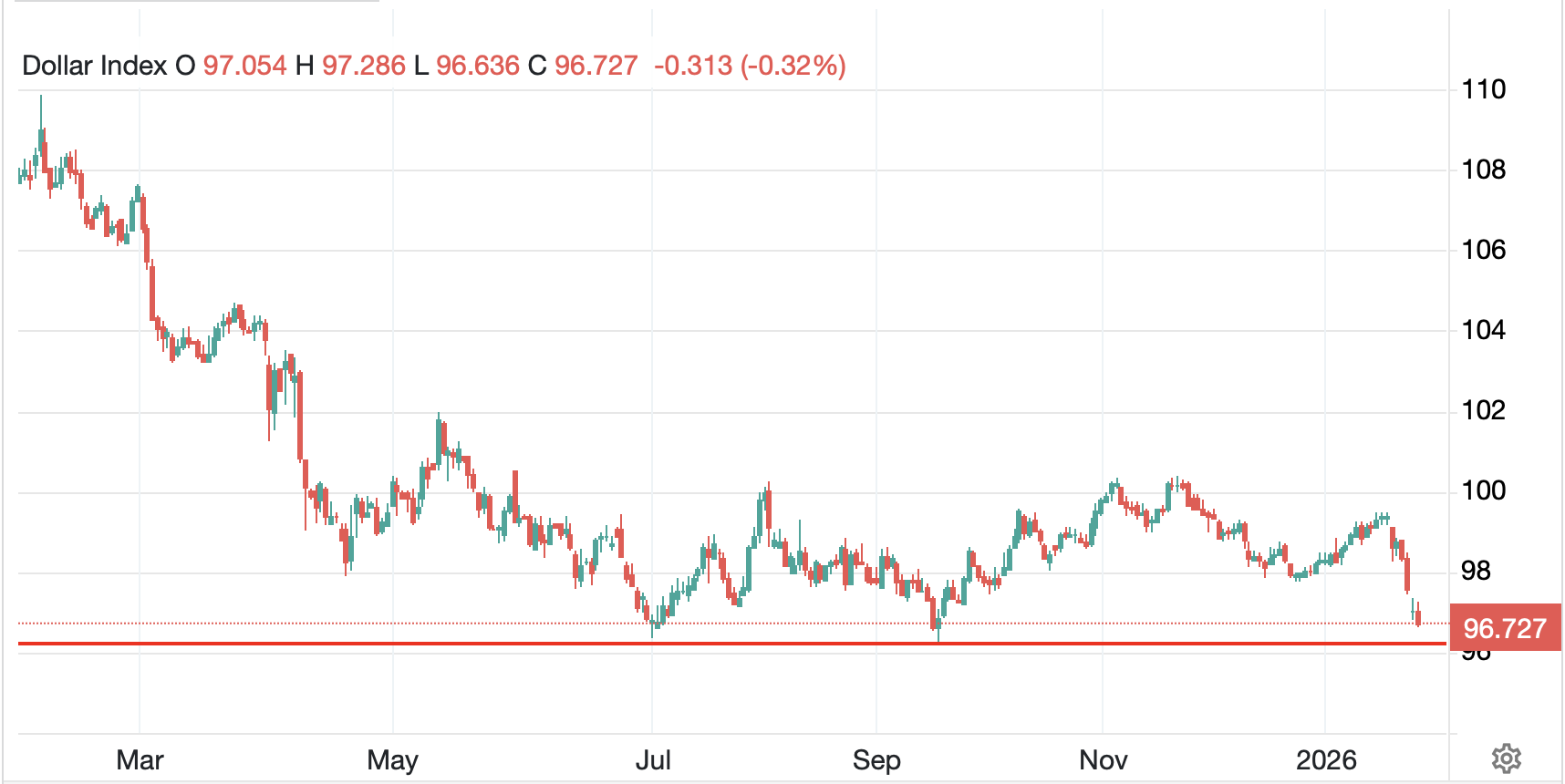
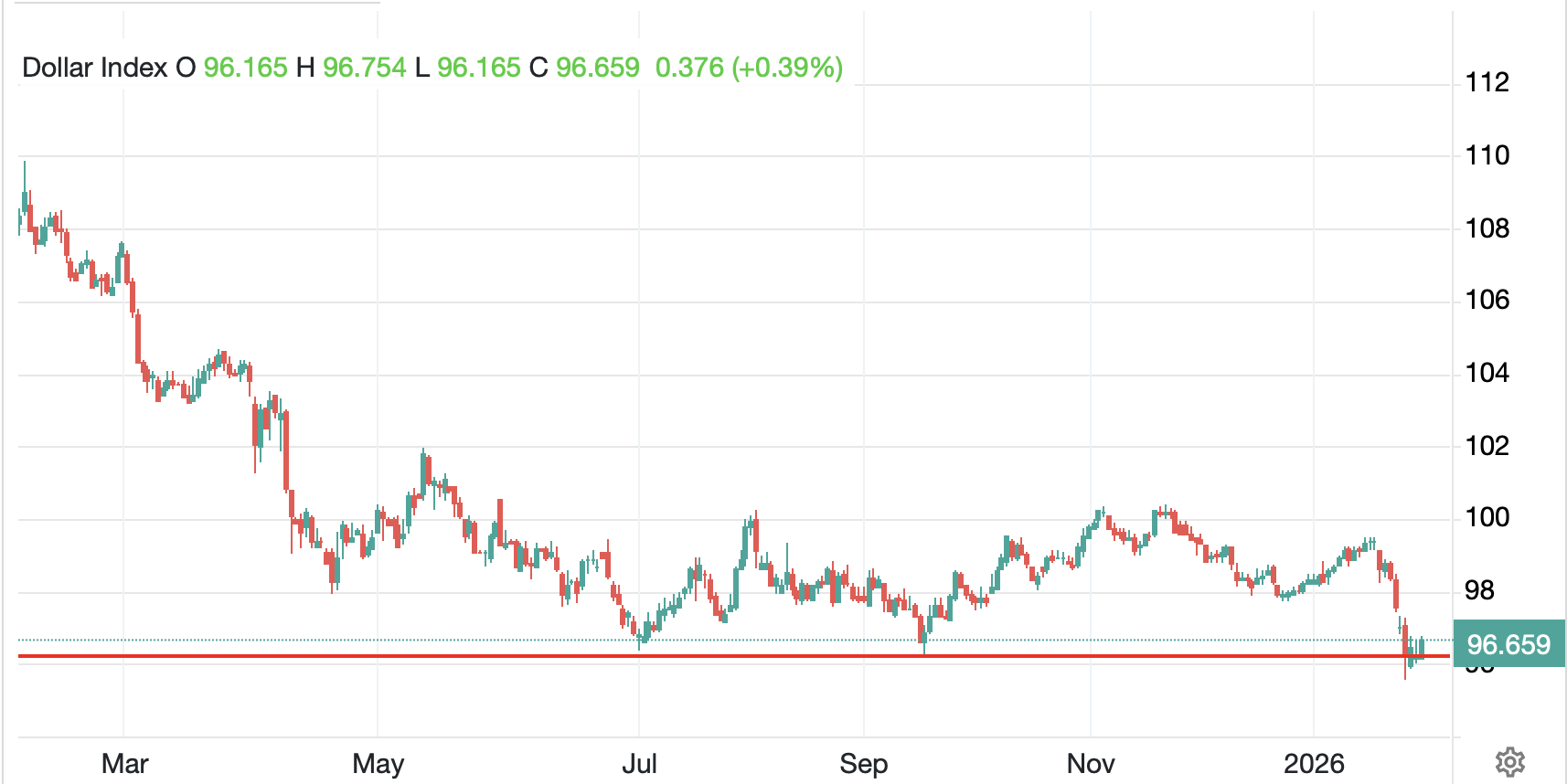
This segues nicely into another key narrative this week, the dollar’s massive break lower.  Earlier this week I had written about how the DXY was approaching a double bottom on the charts and many in the market were convinced that if we traded below that level, and more importantly, closed below the level, which was 96.22, that it opened the door for a much more significant leg lower.  I addressed this, pointed out that the dollar was still in the broad middle of its long-term trading range, but acknowledged that a move lower was quite realistic.  Well, as of yet, we have not closed below the key level, and this move is shaping up as a potential bounce back into the range.  As you can see in the chart below, the baseline is still holding on.
Source: tradingeconomics.com

Now, the dollar is stronger across the board this morning (EUR -0.2%, GBP -0.2%, JPY -0.5%, CHF -0.4%, ZAR -1.1%, CLP -0.6%) although these declines are abating in a similar fashion to the precious metals price action this morning.   Here, too, portfolio rebalancing would indicate that traders would be buying dollars given its decline this month.  Has anything really changed in the FX markets overnight?  All the recent policy decisions were exactly as expected.  Data overnight showed that European GDP continues to muddle along at just 1.3%, hardly a rationale to invest aggressively on the continent.  Is this dollar rebound just a response to the Warsh story and his presumed hawkishness?  Or is it the normal ebb and flow of markets.  I am not yet willing to concede the dollar is breaking lower, I need more proof for that, but I certainly cannot rule out that outcome, regardless of who the new Fed chair is.  

How about other markets?  Equities in the US yesterday were hampered by Microsoft’s earnings release Wednesday, with its decline dragging down the NASDAQ, although the DJIA managed to recoup all its early losses and finish in the green (barely).  But Asian bourses had a more difficult time.  While Japan (-0.1%) was little changed, both China (-1.0%) and HK (-2.1%) fell sharply, and I don’t believe those markets were responding to the Warsh rumor.  It appears that HK, especially, was the victim of month end profit taking and rebalancing as it has had quite a good run this month.  The other key laggard in the region was Taiwan (-1.45%) while the rest of the markets in the time zone were +/-0.5% or so, or less.  

European shares, though, are all firmer this morning led by Spain (+1.6%) after GDP data there was a tick better than expected at 2.6%.  But gains are universal (DAX +0.85%, CAC +0.7%, FTSE 100 +0.4%) as earnings results were enough to offset the generally lackluster data.  Perhaps the idea of another ECB rate cut is entering the collective consciousness, although according to the ECB’s own forecast tool, there is a 10% probability of a 25bp rate HIKE.  I’ll believe that when I see it.  As to US futures, they are softer this morning as I type (7:10), with declines on the order of -0.3% across the board, which is also a rebound from levels earlier this morning.

Bonds:  nobody seems to care.  Yields have edged higher by 1bp virtually across the board this morning and still remain within the recent trading ranges.  It is quite interesting how little financial markets are focusing on this key source of information.  

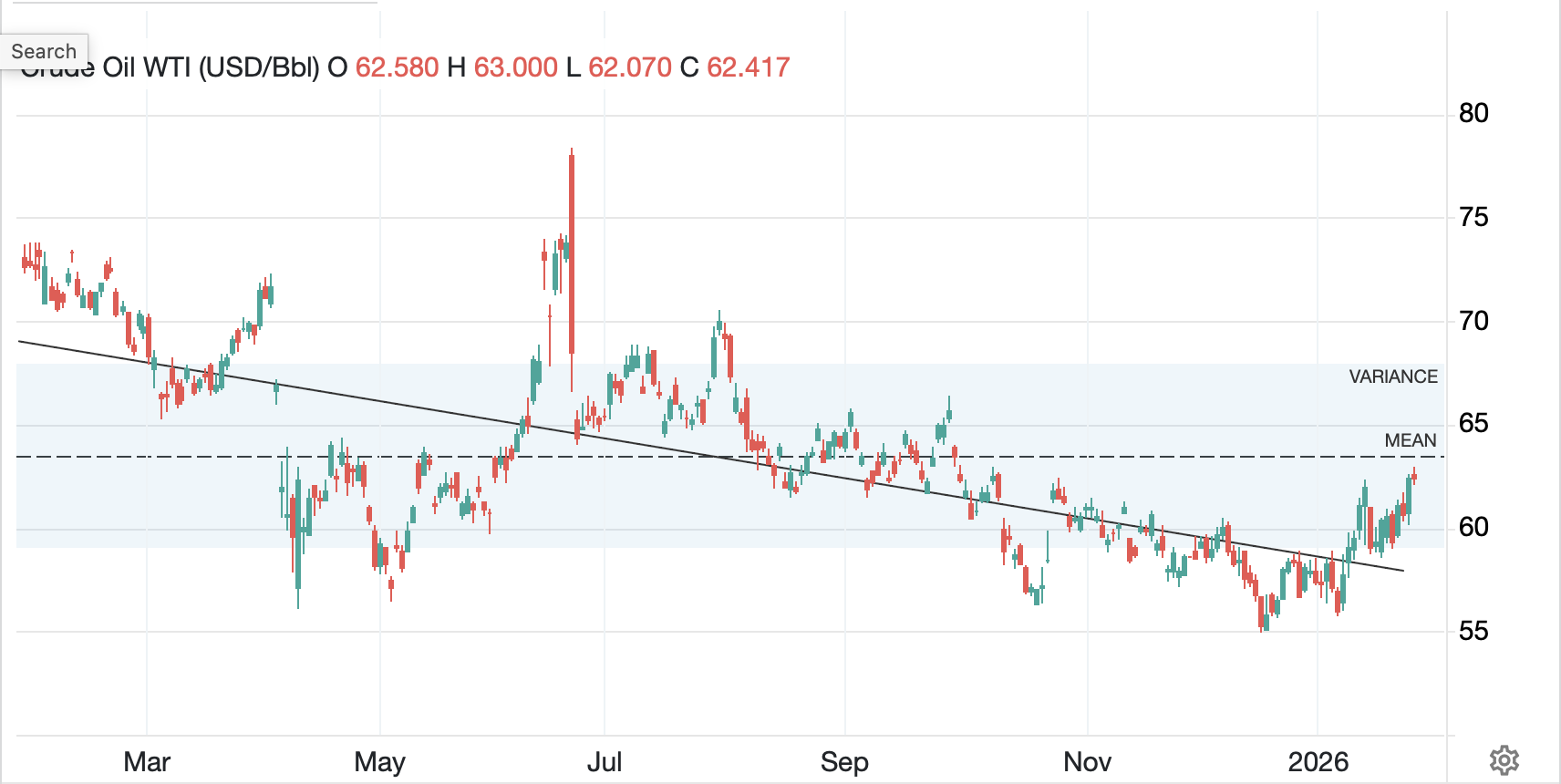
And before I leave, oil (-0.5%) has backed off its recent top, although remains higher by 6.5% this week as concerns over a possible US action in Iran continue to haunt traders.

On the data front, this morning brings PPI (exp 0.2%, 2.7% Y/Y) for headline and (0.2%, 2.9% Y/Y) for core as well as Chicago PMI (44.0).  Too, we get the first Fed speaker, Governor Bowman, but the only Fed news that is going to matter today is the mooted announcement about the next Chair.

What have we learned this week?  Volatility is alive and well in the commodity space, and, although not quite to the same extent, in the equity space.  Bonds are boring and the dollar continues to refuse to stick to the narrative that its days in the sun are over.  Regarding the dollar, remember that despite all the talk of the dollar’s collapse, the only thing we have heard from ECB members is that if the euro rises too much (i.e. the dollar falls sharply) that is a problem and they will need to respond.  It’s been an eventful month in the markets.  I suspect that this may be a map for at least the first half of the year.

Good luck and good weekend

Adf
Commodities Blazing

According to Jay and the Fed
The ‘conomy’s moving ahead
So, rates are on hold
With rallies in gold
And stocks and the dollar instead
 
But really, the thing that’s amazing
Is nobody cares about phrasing
Or Dot plots or pressers
‘Cause now all the stressors
Are Trump and commodities blazing

Once upon a time, the FOMC meeting was THE story for markets during the week leading up to the meeting and through the Chair’s press conference explaining the many virtues of what they did and why they did it.  Of course, this has not always been the case.  If we head back to the pre-Alan Greenspan days, the FOMC was peopled by 18 anonymous members and the Fed Chair, at that time Paul Volcker, and nobody ever spoke to the press and only grudgingly to Congress, they simply managed the money supply to the best of their ability to achieve their mandates.  The biggest data point of every week was the Thursday afternoon M2 release, and there was an entire subculture of ‘Fed watchers’, similar to ‘Kremlin watchers’ whose job was to read the tea leaves based on market behavior and data in trying to determine how the Fed would behave going forward.

Almost the only time Chairman Volcker spoke in public was at the semiannual Humphrey-Hawkins testimony to Congress, but he basically never answered any questions and clearly didn’t care what either Senators or Congressmen asked.

But then we got the “Maestro”, Alan Greenspan, who after Black Monday in October 1987, created the first Fed put.  At that time, the rest of the FOMC was still largely anonymous, but Greenspan craved the limelight, if only to try to show how much smarter he was than everybody else.  Famously, he explained in Congressional testimony in 1996, “If you understood what I said I must have misspoken.”  Greenspan was more available to the press than Volcker, but the rest of the committee remained in the background.

However, that simply set the table for the ensuing Fed chairs, Bernanke, Yellen and now Powell, all of whom give press conferences and clearly encouraged their minions to get out there and deliver the message.  As so many struggling leaders explain, it’s not the substance, it’s the messaging that’s the problem.  This is what we have all been dealing with since Bernanke sat down in 2006, mandated press conferences and pushed the narrative as a critical part of policy.

Then, along came President Trump’s second term, and times, they are a-changing.  While Trump rails on Powell to cut rates and lambastes him regularly, it turns out, the combination of new fiscal and economic policy is driving monetary policy into the background, at least from the perspective of market participants.  The result is that while FOMC members still get out there and give interviews regularly, they are never newsworthy.  In fact, my suspicion is that the reason Chairman Powell made his little video announcing the Fed received subpoenas was as an effort to get back on the front page, a place he and his committee members have clearly grown to enjoy, and from which they are increasingly absent.

Which brings us to the meeting yesterday where…nothing happened.  Policy rates remain unchanged, as universally expected, two voters wanted 25bp cuts (Miran and Waller), and they admitted that economic activity moved up from “moderate” to “solid”.  In the most stinging rebuke, the market virtually ignored the entire process.  In fact, the discussion about the next Fed chair is ebbing into the background.  My take is this is a better situation for all involved.  I only hope it stays this way.

So, what did happen?  Stocks were flat, bonds were flat, the dollar rebounded a bit, and commodities continue to rocket higher.  Let’s take a turn around markets overnight and start with commodities as that is where all the action is.

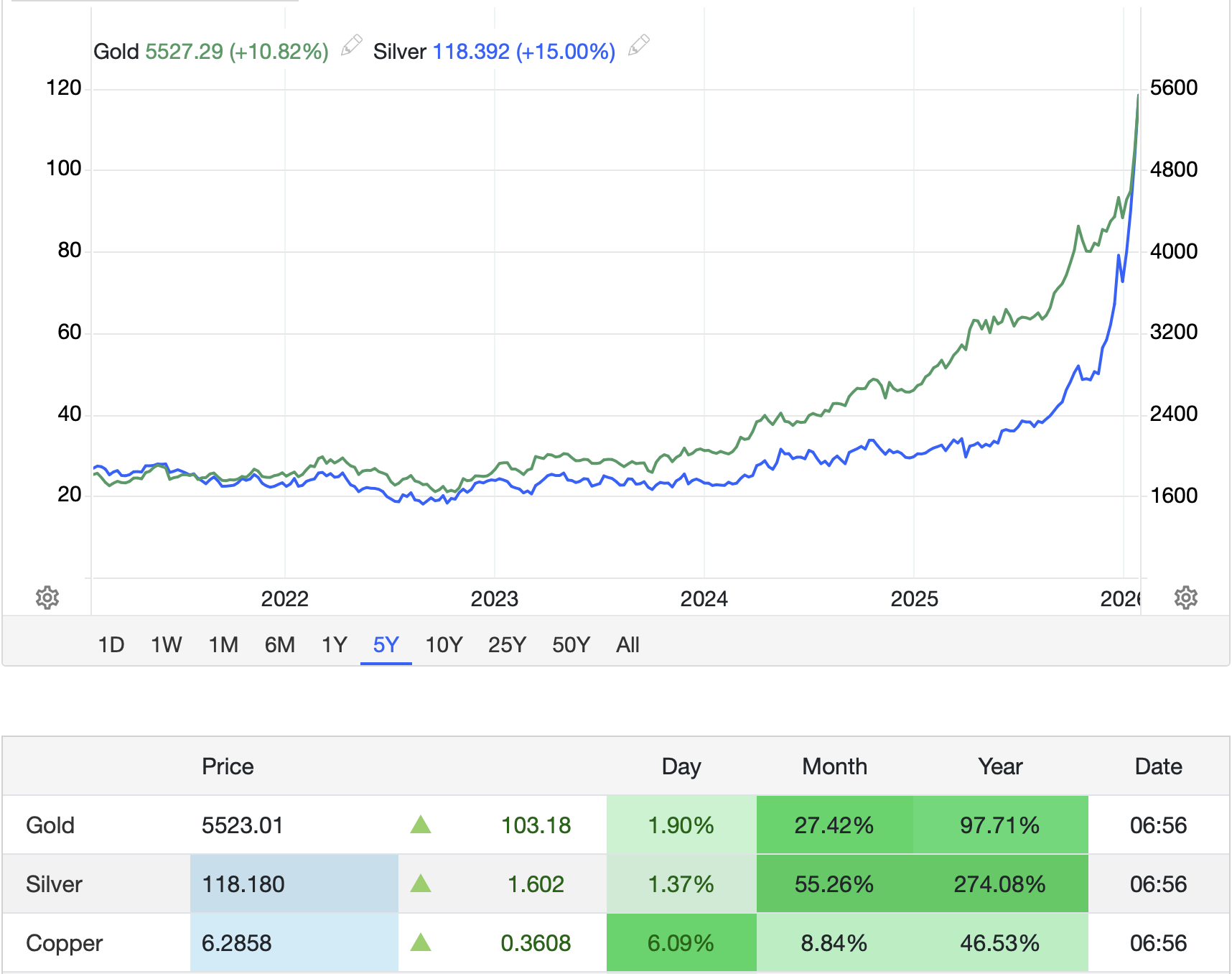
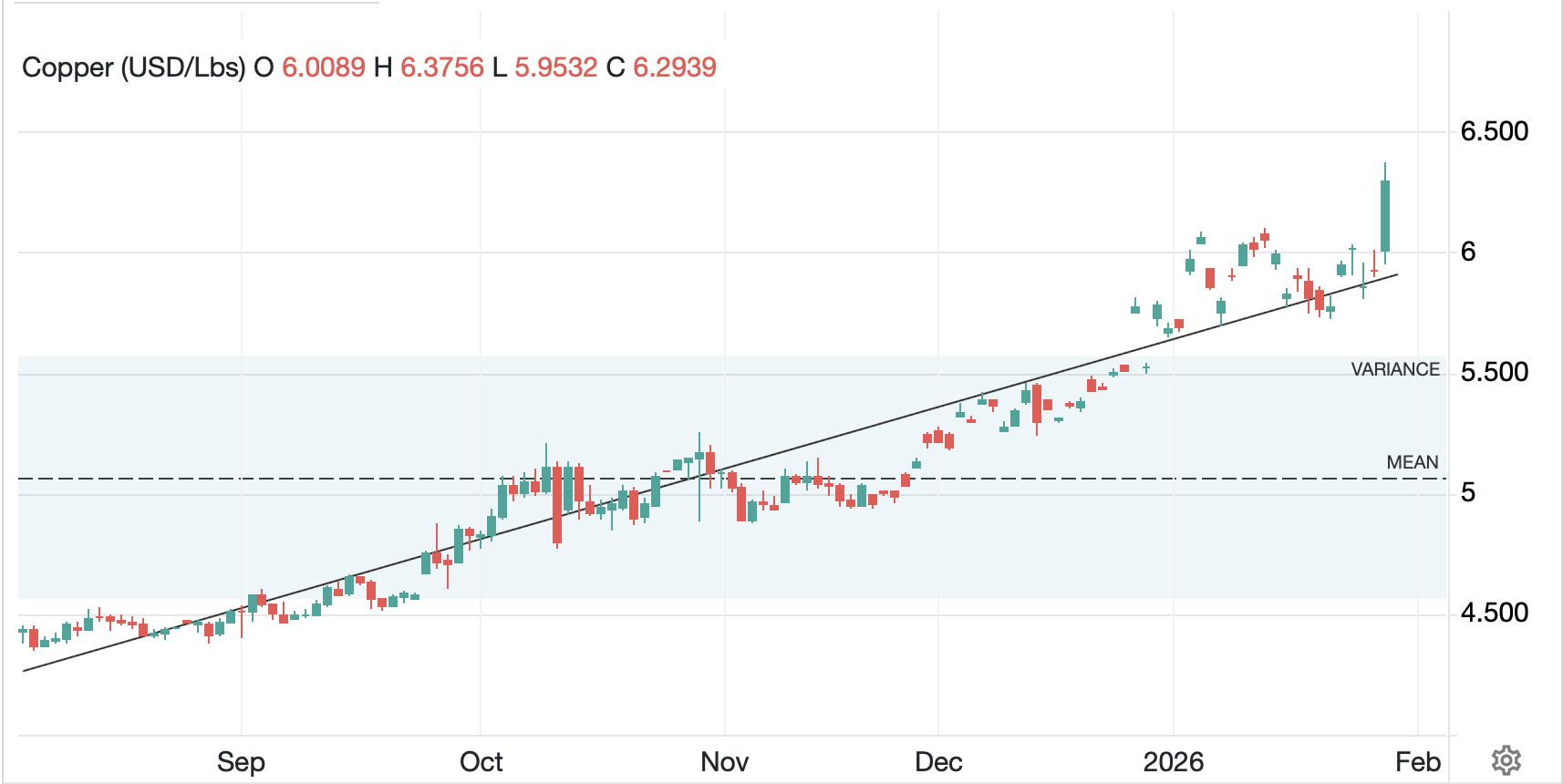
Copper (+6.1%) is the overnight star, soaring in Asia to record highs.  As with virtually all commodities right now, blame is laid at the feet of the weakening dollar (it didn’t move overnight) and with uncertainties about President Trump’s next actions and the potential risks attendant to those actions when they occur.  As we have seen with both gold (+1.9%, +27.1% in the past month) and silver (+1.3%, +54.6% in the past month), there is no doubt that fiat currencies are losing their status as a store of value, regardless of the interest rates they pay.  While copper’s movement has not been as extraordinary as that of either gold or silver, the trend, as you can see in the chart below, remains clearly higher.

Source: tradingeconomics.com

The underlying reality for all these metals is that the financialization of economies all around the world has resulted in far more market activity than was necessarily warranted by the physical markets.  And physical markets need ounces and pounds of stuff, which have very long lead times to get out of the ground.  As a trader, I look at these moves in precious metals and am very concerned they are overdone but as somebody with a basic understanding of physics, I see no reason to believe that the demand for these metals is going to slow down anytime soon.  The below chart shows just how extraordinary the silver move has been, and the table below it really tells the tale.

Source: tradingeconomics.com

As to oil (+2.6%), it is heading higher this morning on increasing fears that the President is going to initiate a military action to depose the Ayatollah in Iran.  Concerns are rising about Iran closing the Strait of Hormuz as well as its ability to respond via missile attacks.  Remember, though, a market that moves on a political issue will revert once that issue has either occurred, or clearly won’t occur, so do not mistake this move for the beginning of a new trend.  Consider what happened to oil after Russia invade Ukraine and after they invaded Crimea in 2014.

Source: finance.yahoo.com

Turning to the equity markets, yesterday’s US blahs were followed with a bit more price action in Asia as though Japan (-0.7%) slipped a bit, China (+0.8%), HK (+0.5%), Korea (+1.0%) and Taiwan (-0.8%) all so more significant movement, albeit not offering a larger theme given the relative gains and losses.  Elsewhere in the region, the smaller exchanges showed more red than green.  In Europe, Germany (-1.15%) is the dog, falling on idiosyncratic weakness in SAP and Deutsche Bank following weak earnings and forecasts, but the rest of the space is performing well (UK +0.4%, France +0.65%, Spain +0.4%) as earnings there have been relatively solid.  And, at this hour (7:10), US futures are pointing higher by about 0.25% or so as earnings numbers have been strong so far this week, highlighted by Meta last night.

In the bond market, activity is less frenetic with Treasury yields unchanged this morning, European sovereigns catching a bit of a bid as yields slip -2bps across the board and JGB yields (+2bps) rising after the latest poll showing PM Takaichi increasing her odds of getting an LDP majority in the Diet next week.  Something to watch closely going forward is the shape of the yield curve as there is growing concern that long-end rates may rise regardless of the Fed (yet another sign the Fed is losing its sway).  In fact, I suspect if that is the case, that we will see yet another bout of QE, although they will find an alternate name.

Finally, in the FX markets, despite all the pearl clutching about the end of the dollar, there is no movement of note in any currency today, with the entire screen showing gains or losses of 0.3% or less with one exception, CLP (+0.5%) following the remarkable jump in copper’s price.  The linked article is quite funny as they explain all the negatives of a weak dollar and then also explain that ECB members are concerned about a too strong euro.  I am frequently confused by whether a strong currency is good or bad for a nation, but I guess it depends on the narrative you are trying to push.

On the data front, weekly Initial (exp 205K) and Continuing (1860K) Claims come at 8:30 as does the Trade Balance (-$40.5B).  We also see final Nonfarm Productivity (4.9%) and Unit Labor Costs (-1.9%) which if those numbers are met indicate quite positive economic activity.  Then, at 10:00 we see Factory Orders from November (1.6%), but that is such old data I don’t think it matters.

Remember, it is Trump’s world (and Bessent) and we’re just living in it.  The White House is the source of all the news so let’s all be happy that the Fed is fading into the background.  With that in mind, based on President Trump’s goals, a weaker dollar is clearly his desire, at least in the short run, although I continue to see scope for longer term strength.

Good luck

Adf

Quite Gory

While yesterday, there was one story
‘Bout silver and gold and their glory
By end of the session
The dollar’s depression
Was headlining comments quite gory
 
The narrative now speaks of trends
Which lead to a dollar that ends
The problem they’ve got
Is history’s taught
That cycles and dollars are friends

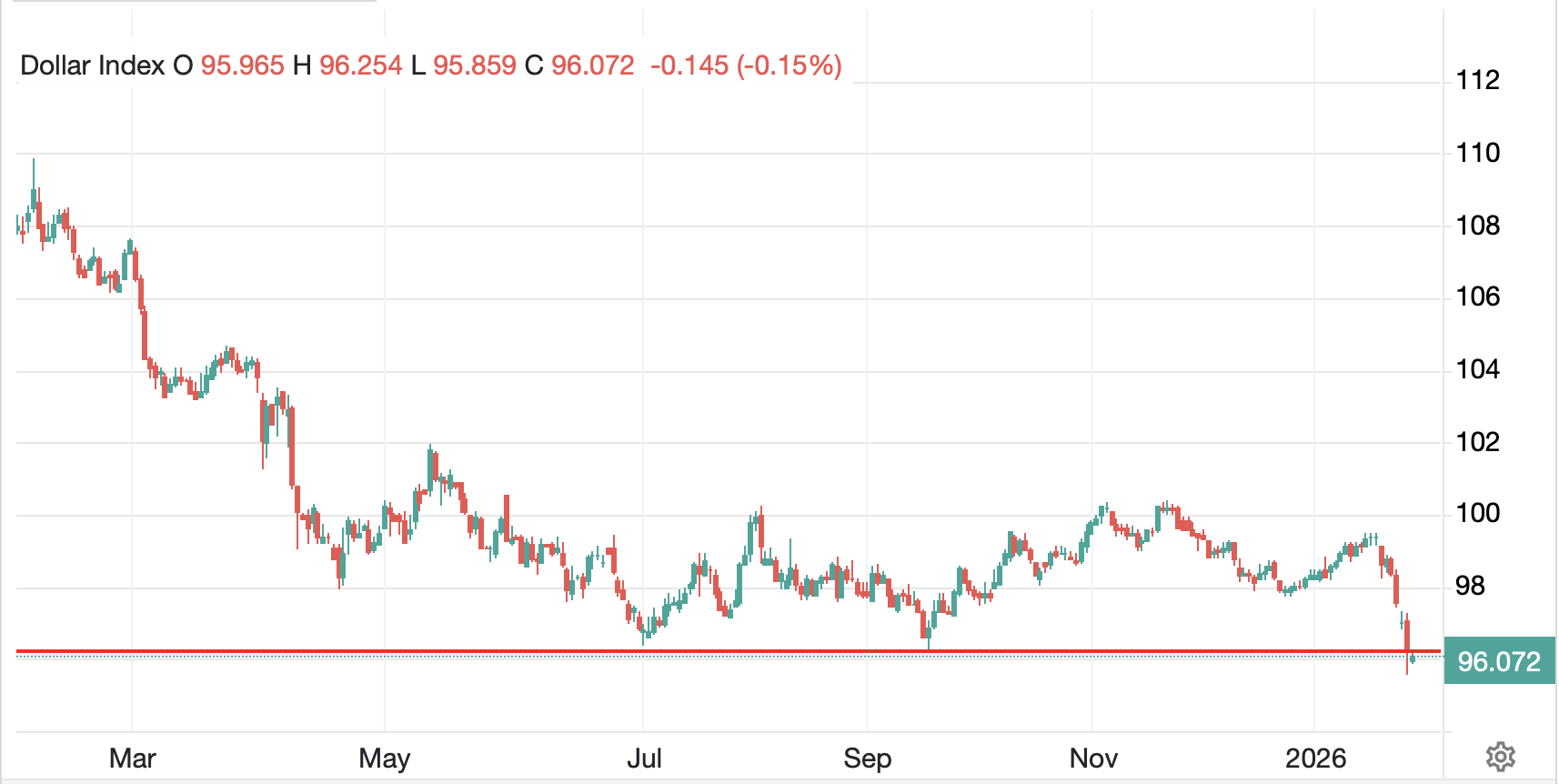
The dollar is clearly under pressure lately as discussed here yesterday morning.  Using the DXY as our proxy, it has traded and closed through the recent double bottom (see chart below), and the doomsayers are licking their chops that their views of the demise of the dollar are finally coming to fruition. 

Source: tradingeconomics.com

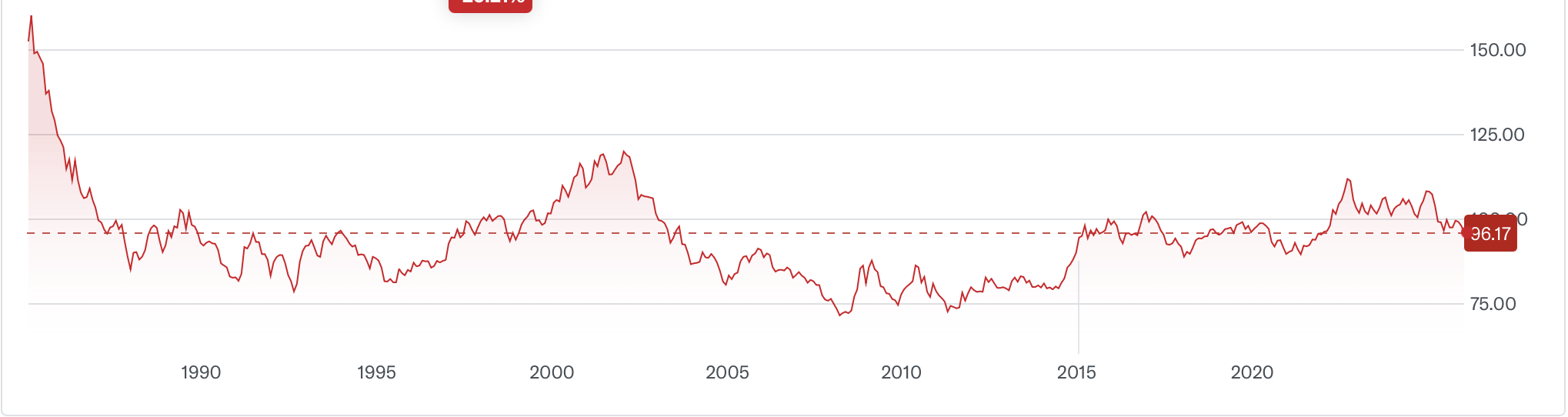
And I am not here to say the dollar is about to reverse course higher.  While I remain medium and long-term bullish on the buck, it doesn’t feel like the time to get long.  However, look at the chart below, to get a longer-term perspective on the dollar’s history.  This chart starts back in 1985, which is just before the Plaza Accord where it was agreed the dollar was too strong and central banks around the world intervened and altered policy to change it.  But here we are at 96ish in a market that has spent no little time below 80 with several drops below 75.  My point is, the dollar tends towards long cycles.  It is entirely possible that we peaked in late 2022 for this cycle and are now heading lower from there.  But I remain highly confident that it will reverse course and rebound. Not tomorrow, but this is not the end.  Just remember that when you read the eulogies for the buck.

Source: finance.yahoo.com

One other thing that seems to be getting headlines is that the president was asked his views on the dollar’s recent weakness and was (rightly) nonplussed over the issue as described here.  After all, this is a man who constantly rails against the artificial weakness of the yen and the yuan, and who is seeking to rebalance the trade account.  All that points to a weaker dollar, so it beggar’s belief that this is a surprise to the market.

One last thing while I’m on my high horse.  I couldn’t help but notice this article about Banque de France chief Villeroy explaining that the weakening dollar may impact ECB policy-making with a throwaway line about diminishing confidence in the dollar stemming from the unpredictability of US economic policy.  First off, US policy is very clear, run it hot!  And second, it is remarkable that when the euro was tumbling, we never saw this same introspection about Eurozone/EU economic policy and their self-destructive energy policies.  My point is, nothing we are currently witnessing is new in any way at all, but rather part of the longer-term cycle of FX markets.

OK, how has this dollar move impacted other markets?  Well, yesterday’s US equity session was marked by a rotation back to tech as the NASDAQ (+0.9%) had a fine day while the DJIA (-0.8%) fell hard.  This led to a mixed session in Asia with the Nikkei little changed (although other indices there were under steady pressure), while HK (+2.6%) exploded higher on news that China has licensed its first Nvidia H200 chips to Alibaba and someone threw money at China Vanke, one of the collapsing Chinese real estate firms.  The mainland was modestly higher (+0.25%) but there was strength in Korea (+1.7%), Taiwan (+1.5%) and India (+0.6%).  On the downside, Indonesia (-7.3%) tumbled after MSCI indicated they may downgrade the market there to frontier status due to lack of liquidity.

In Europe, red is today’s color led by Spain (-1.1%) and France (-1.0%) with the latter seeing weakness in luxury stocks while the former appears to be unwinding some of its recent strength with no particular catalyst, merely a negative view overall in Europe.  Germany (-0.2%) and the UK (-0.4%) are also softer without anything specific.  As to US futures, at this hour (6:40) they are pointing higher with NASDAQ (+1.1%) leading the way again.  As an aside, the S&P 500 futures are above 7000 now, and the cash market looks set to break that big round number this morning.

In the bond market, as we await the FOMC policy decision (no change expected) and the subsequent press conference, Treasury yields are unchanged this morning after having edged higher by 2bps yesterday.  European sovereign yields are all basically softer by -2bps, perhaps on the back of the euro’s strength.  After all, Villeroy hinted that if the euro remains strong, they may need to cut rates again.  Interestingly, JGB yields (-5bps) fell after BOJ Minutes from the December meeting (remember, they already met again last week) indicated that some members were concerned over the weaker yen driving inflation higher.  Talk about stale news.  My sense here is this is much more about the election and JGB’s will track Takaichi-san’s support level with lower yields coincident with weakening support, potentially preventing her Liz Truss moment.

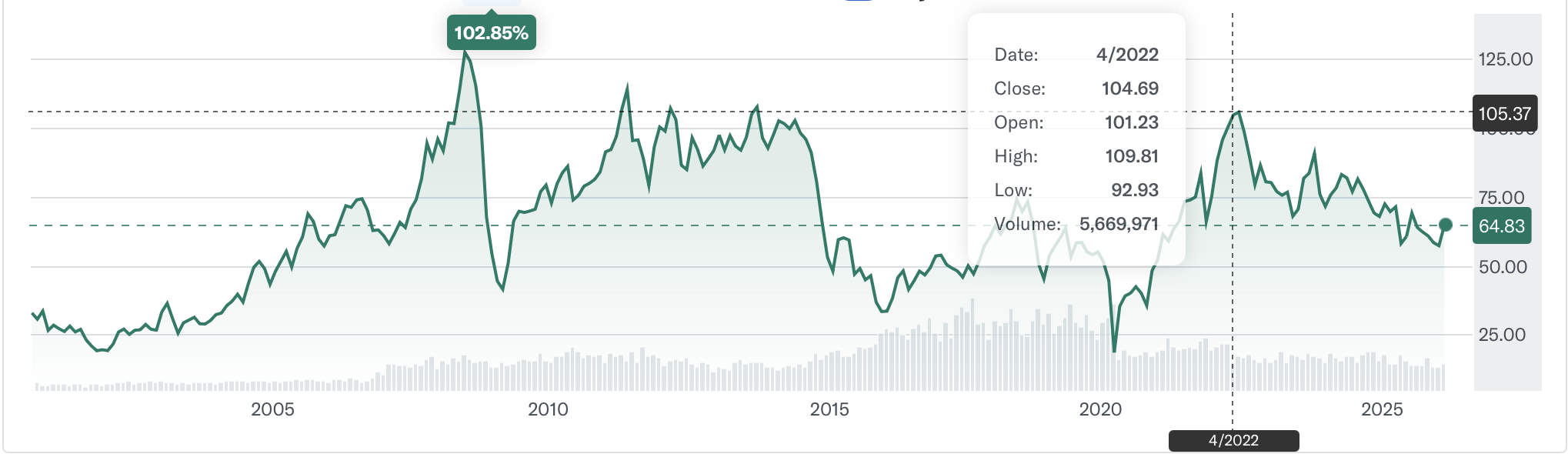
In the commodity space, oil (0.0%) is unchanged this morning but has rallied more than 7% in the past month after a solid session yesterday.  Looking at the chart, the trend clearly remains lower, but the short-term reversal is also quite clear.

Source: tradingeconomics.com

The dollar’s recent weakness is supporting all commodities (given they are generally priced in USD, other nations can afford more with the dollar’s slide), but the bigger picture remains that there is an extraordinarily large amount of the stuff around and much of the angst over its recovery is political (look at Europe) rather than geologic.  Nat Gas (-4.5%) is backing off its extended levels as temperatures are forecast to rebound early next week (cannot happen soon enough for me, where’s global warming when you need it?), but the long-term story here remains positive as it continues to be the energy source of choice for timely access with the least environmental impact.

Turning to metals, gold (+1.6%) continues to trade to new highs on the ‘all of the above’ thesis (weak dollar, debasement trade, geopolitical risk, central bank buying) and shows no signs of slowing down.  Silver (-0.1%), however, has been so incredibly volatile it is starting to become a concern for all involved.  It is not normal for 10%-12% daily moves in any product, let alone one with so much involvement from both retail and institutional players.

Source: tradingeconomics.com

The silver market has gone into backwardation which means that there is significant demand for the actual metal.  And prices in Shanghai trade at a significant premium to the COMEX.  Shanghai is a delivery market.  We will need to watch deliveries at futures expirations closely going forward.

Finally, the dollar today is bouncing off yesterday’s session lows but remain under pressure overall.  After trading through 1.20 yesterday, the euro (-0.6%) has backed off a bit and we have seen similar moves through much of the rest of the G10 (GBP -0.6%, SEK -0.7%, NOK -0.7%, CHF -0.9%).  The yen (-0.3%) continues to be caught between potential intervention fears and fears of unfunded spending.  In the EMG bloc, we have seen CE4 currencies all suffer on the order of -0.7% or so, although APAC currencies are little changed this morning.  The one currency bucking the trend is CLP (+0.2%) which remains closely connected to copper (+1.0%).

On the data front, yesterday’s Consumer Confidence Index fell sharply, a further indication that there is a split between most of the economic numbers and people’s beliefs.  Today, aside from the Fed, we hear from the BOC (no change expected) and we get EIA oil inventories with a small draw forecast after several weeks of large builds.  Too, later in the day the Banco do Brazil will announce their policy (no change expected).

The thing that makes me happy is the Fed is an afterthought today.  While the cacophony of noise that comes from media is extremely difficult to parse given the biases underlying almost all one reads or hears, to me, the question will be whether people start to believe things are getting better, and that is more political than economic in my view.  In the meantime, the dollar appears to be set for a bit of further weakness, but do not mistake this for the end of the dollar or the dollar’s role in the global economy.

Good luck

Adf

No One Can Kill

Remarkably, metals are still
The story that no one can kill
The rally refuses
To stop, as gold cruises
And silver gives traders a thrill

The funny thing about financial markets is that it goes through periods where a single story dominates the narrative so completely that everything else gets viewed through the lens of that story.  We have seen this happen many times with recent situations like tariffs, the Fed, Covid, Brexit, Russia, etc.  Well, these days, precious metals are the story through which everything else is defined.

Consider, for those who are inherently bearish the dollar, the remarkable rally in precious metals serves as proof positive of the theory.  For those who have been antagonistic to the equity rally, and let’s face it, there has been a huge amount of discussion about the equity bubble and overvaluation of the Mag7 stocks, it is a huge relief that precious metals have now outperformed equities on numerous timescales, whether looking over the past week, month, quarter, year or decade.  You see, they will claim, metals have been the best investment.

Source: tradingeconomics.com

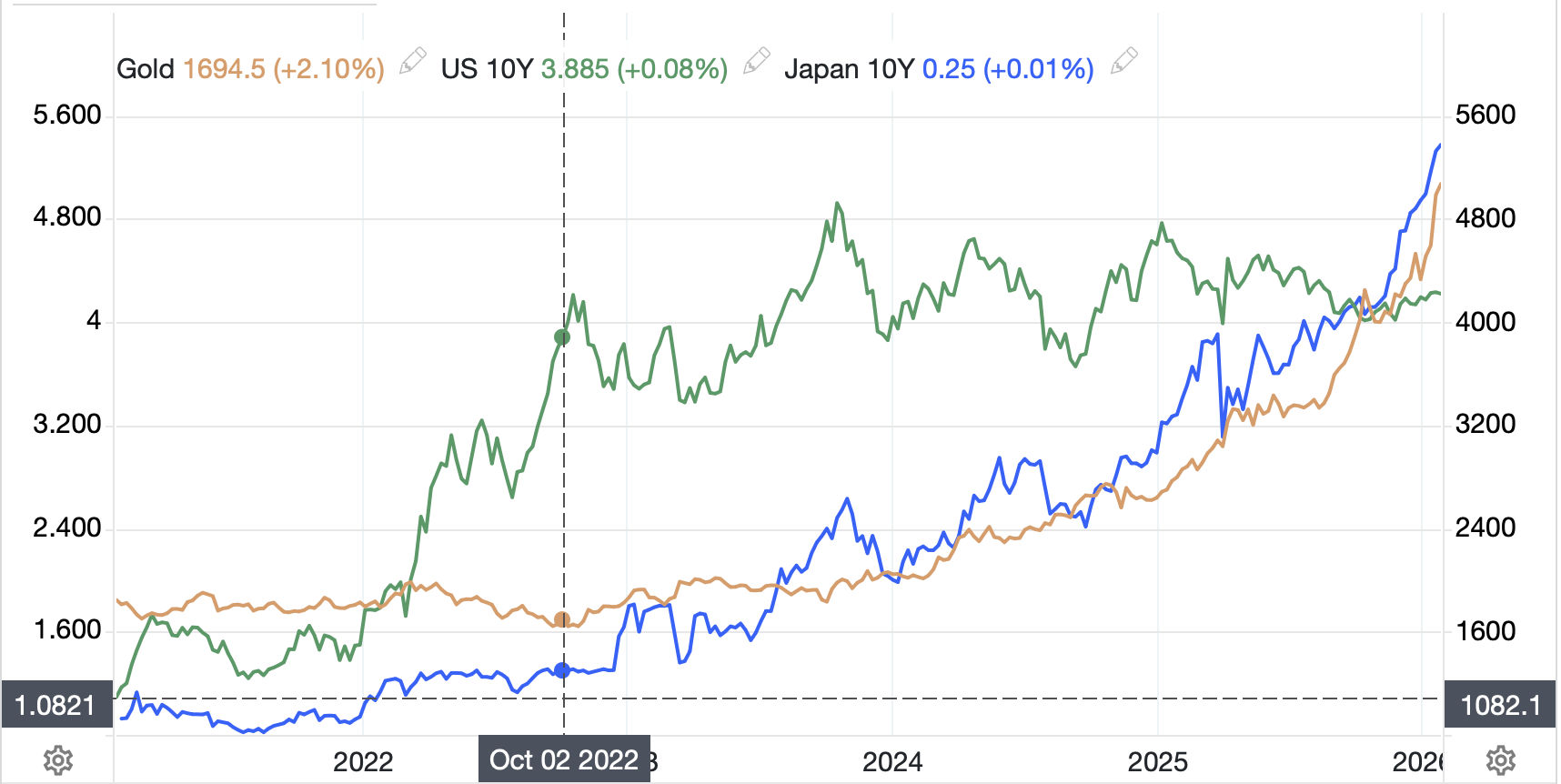
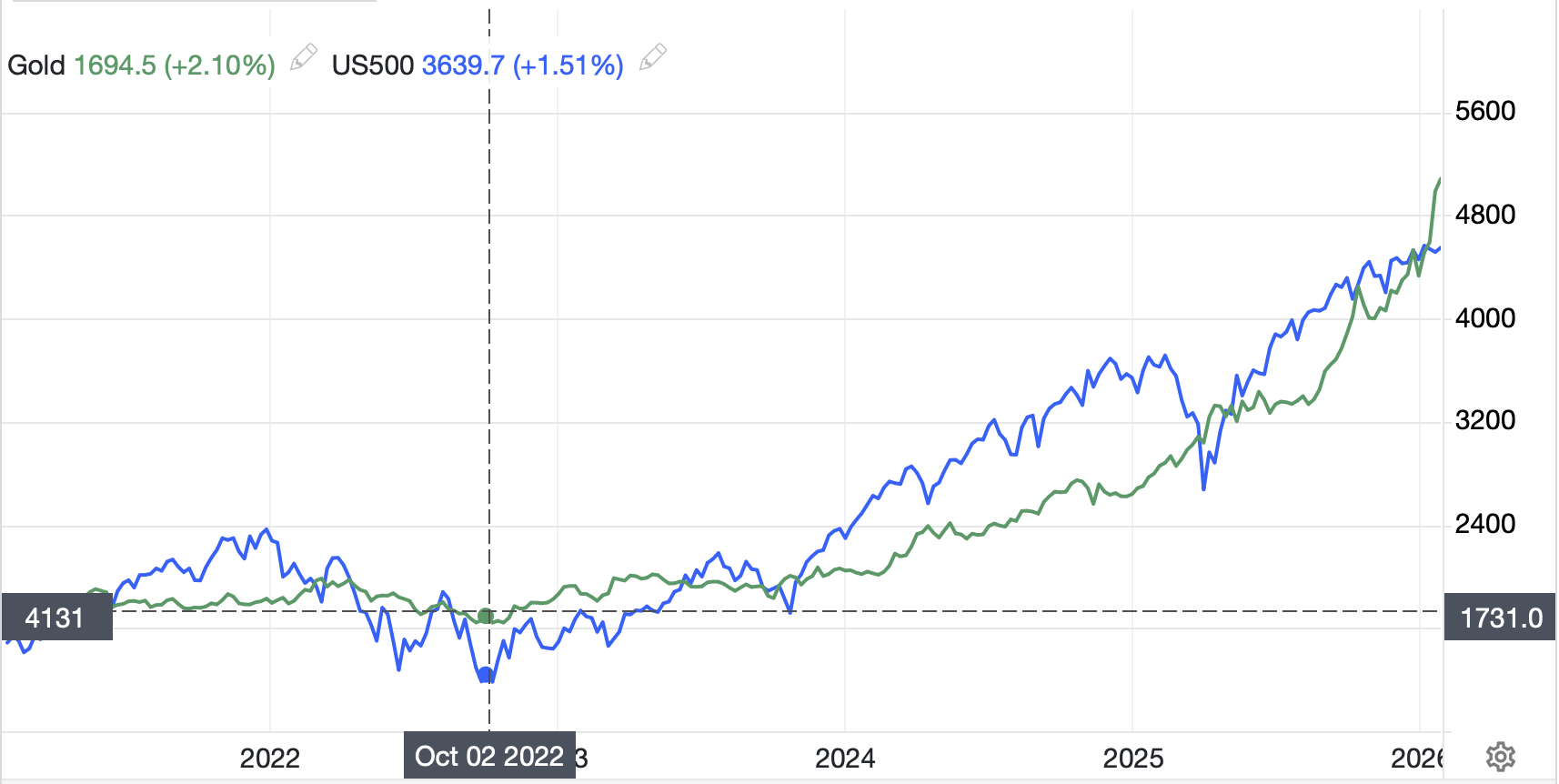
In the above chart, I have randomly selected Oct 2, 2022, as it appeared to be a local low over the past 5 years in both the S&P 500 and gold.  Since then, while the S&P has gained very impressive 190%, gold is up an even more remarkable 300%.

The bond story is more interesting as, usually, throughout history there has been an inverse relationship between yields and metals as higher yields foregone were an additional ‘cost’ of holding metals and traders generally sought to prevent that outcome.  Yet, if we go back to that same random date, the relationship has essentially broken down.  In fact, as you can see from the chart below, yields have edged modestly higher while gold has exploded.  And if we turn to JGB yields, which we all know are rising sharply, they are almost following gold’s trajectory directly.

Source: tradingeconomics.com

My point is, these days you cannot read an analysis about anything, whether the markets or the global economy, without the framework entailing the price of gold and silver.

As such, the major question facing all market participants is what is driving this extraordinary performance.  At this point my take is gold, and silver, have essentially become a Rorschach test for the viewers investing and political framework.  So, we are going to see a lot of different explanations as to the cause of this movement.

FWIW, my take, which is all that you get here, is there are a few things combining to juice this move.  First, the overriding theory of fiat currency debasement continues to gain adherents, not that economists are moving from the Keynesian to Austrian school of economics, but with M2 around the world growing at 12% while global GDP grows at 3%, the fundamental of too much money chasing too few goods has even broken through the Keynesians’ armor.  This leads to the natural next step that, those who are aware and are charged with maintaining the real value of their holdings, see gold as a better long-term investment given its history.  Enter central banks, who were, of course, further encouraged once the US froze Russian assets after their invasion of Ukraine.

This has bled into an increasing discussion of the overall geopolitical situation, notably tensions driven by the US interdiction in Venezuela, the uprising in Iran and the ongoing stress between the US and Europe and Canada over trade.  All these things have forced many to consider that traditional haven assets, notably Treasuries, may not be so haven-like after all.  Yet another reason to like gold.

And when any story gains traction like this has, we then get inundated with the ‘tourists’ who flood social media with their views, especially as to whether this is a blow-off top and the move is over, or whether there is much further to run.  I particularly like the below chart as an encapsulation of the market.

It is remarkable to me that the same folks who have demonstrated their expertise on Venezuelan oil production and the legality of Trump’s tariffs are now so clearly expert on the price of gold and silver, why they haven’t moved like this in the past and whether this is, or isn’t the top of the market.  Thank goodness we have them all!!

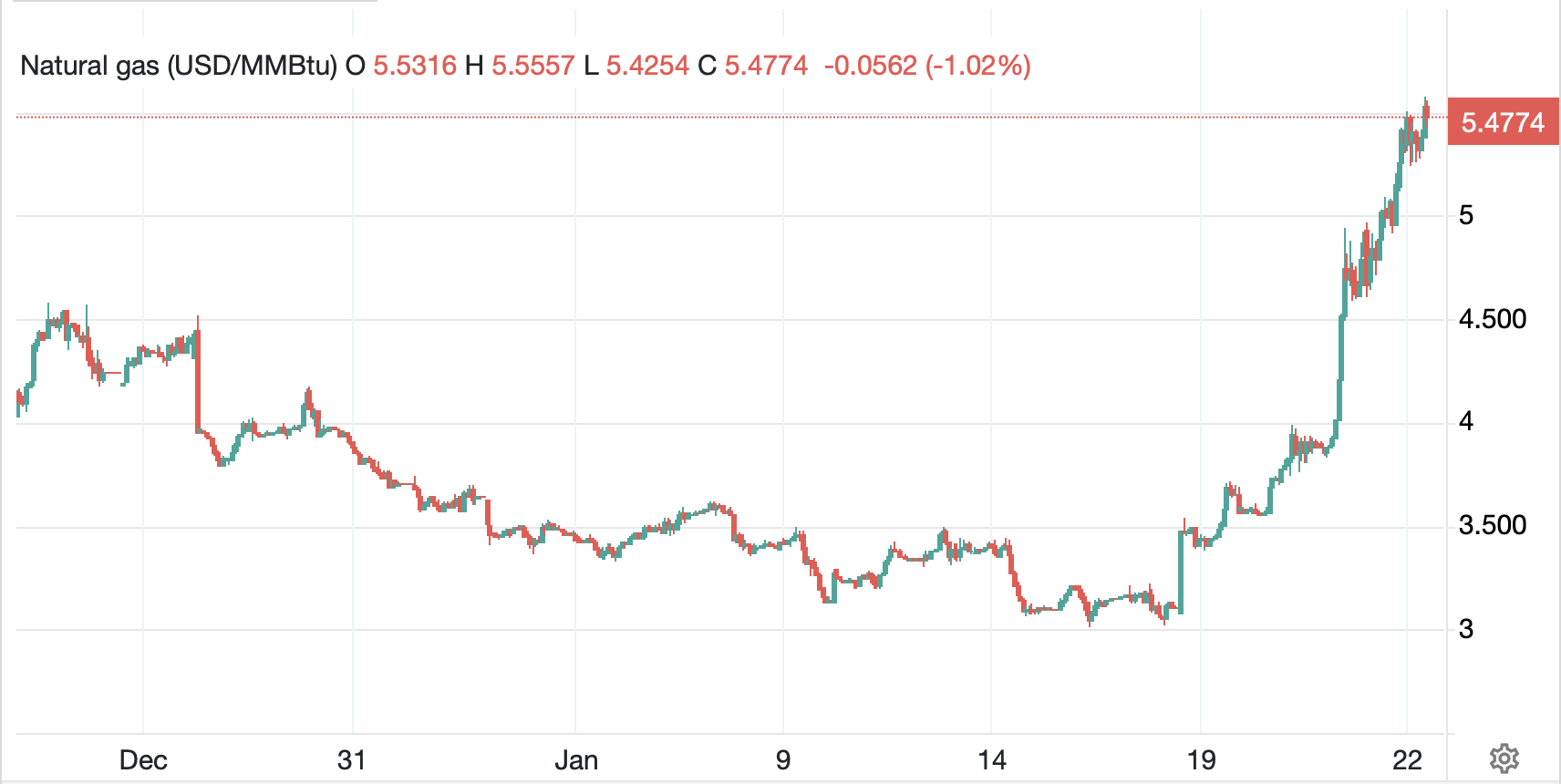
In the meantime, let’s turn to the market price action to see how things have behaved overnight.  starting, sensibly, with the precious metals, despite a late day pullback from its highs yesterday, gold (+1.3%) and silver (+6.7%) show no signs of stopping yet.  Personally, I remain in the camp that structural industrial shortages combined with China’s gating of exports of silver are likely to maintain a bid under the stuff for quite a while yet.  The fact that the US has listed it as a strategic metal is something not widely discussed nor remembered but is quite important as a demand signal.  Copper (-2.1%), however, is backing off its recent highs, although remains within spitting distance of its recent all-time highs.  As to oil (-0.15%) which used to be the belle of the commodity ball, it is stuck around $60/bbl with no obvious driver in the short-term in either direction.  Don’t forget NatGas (-4.8%), which is higher by 65% this week on the back of the polar conditions forecast to remain at least through the end of the week.

Turning to equities, yesterday’s US gains were followed by gains almost everywhere else in the world.  Tokyo (+0.85%), HK (+1.35%), Australia (+0.9%), Korea (+2.7%), India (+0.4%) after they signed their FTA with Europe, and Taiwan (+0.8%) were all in fine fettle last night.  Only China (0.0%) missed the boat, although there was no obvious reason for that outcome.  In Europe, too, we see almost all green on the screen with only Germany (0.0%) not taking part in the fun.  Otherwise, modest gains of 0.3% are the order of the day elsewhere in the UK and on the continent.  As to US futures, they are also pointing higher, about 0.5% at this hour (7:35).

In the bond market, JGB yields (+5bps) are the story, as the leadup to the election and its potential outcome dominate discussion.  My take is higher yields implies the market is anticipating PM Takaichi to win and improve her margin in the Diet, thus allowing more unfunded spending.  But in the US and Europe, yields have edged higher by 1bp to 2bps amid lackluster trading.

Finally, the dollar is under pressure yet again with the DXY (-0.3%) slipping, and as you can see in the below chart, now approaching a double bottom, a break of which seems likely to open up a more substantial decline.

Source: tradingeconomics.com

The dollar weakness is broad based this morning, with most currencies gaining by that 0.3% amount and only CHF (+0.75%) showing real leadership.  The yen (+0.4%) has been hanging around the post ‘rate check’ levels and I would contend today’s movement is about the dollar writ large rather than the yen in particular.  I did read that option traders are bidding up short-dated USD puts across numerous currencies as either fear is growing, or they think that DXY break is going to open a major move.  We shall see,

On the data front, yesterday say a huge Durable Goods print, another sign of economic strength.  This morning, we see Case Shiller Home Prices (exp 1.2%) and Consumer Confidence (90.9).  As well, the FOMC meeting starts with current expectations of no policy change at tomorrow’s meeting.

Gold and silver continue to dominate the conversation and I freely admit, I have been along for the ride and am getting nervous, at least in the short term.  As to the dollar, it does look awful right now, and if DXY breaks that line at 96.22 with any impetus, we could be in for another sharp leg lower.

Good luck

Adf

Totally Wrecked

The chaos is starting to spread
As traders, when they look ahead
Have come to the view
More debt will accrue
And fear that the dollar is dead
 
So, gold and its ilk rise unchecked
While fiat is totally wrecked
Most bonds have a pox
But hope lives for stocks
And crypto? They’re still circumspect

I cannot possibly cover all the things ongoing in the markets right now as it would take a 5000 word note to do so adequately.  As such, I will try to give a high level take in far fewer words.

Headlines – 

  • Minneapolis continues to consume most of the domestic press, but is only tangentially, if at all, related to markets.  Perhaps it questions President Trump’s authority and that is a negative for US assets and the dollar.  
  • Xi Jinping purges his most senior military leader, accused of spying and selling state nuclear secrets to the US. Xi has removed virtually his entire military leadership, probably reducing near term risk of a Taiwan invasion, but ignores economic issues

Currencies – 

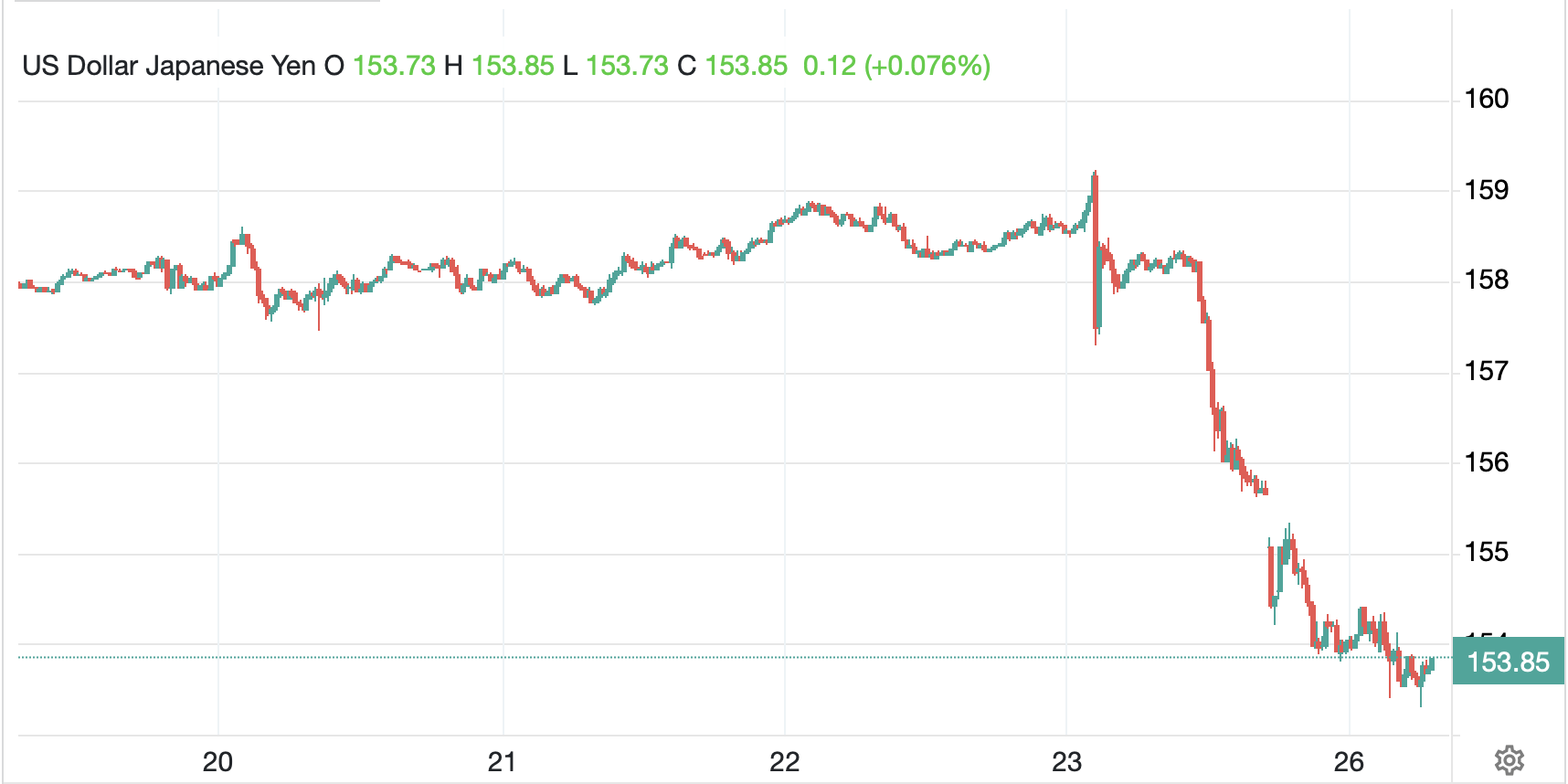
  • JPY (+1.2%) remains the top story as speculation remains rife that the BOJ stepped into markets on Friday (I don’t think so) and questions arise as to how soon they will do so. 

Source: tradingeconomics.com

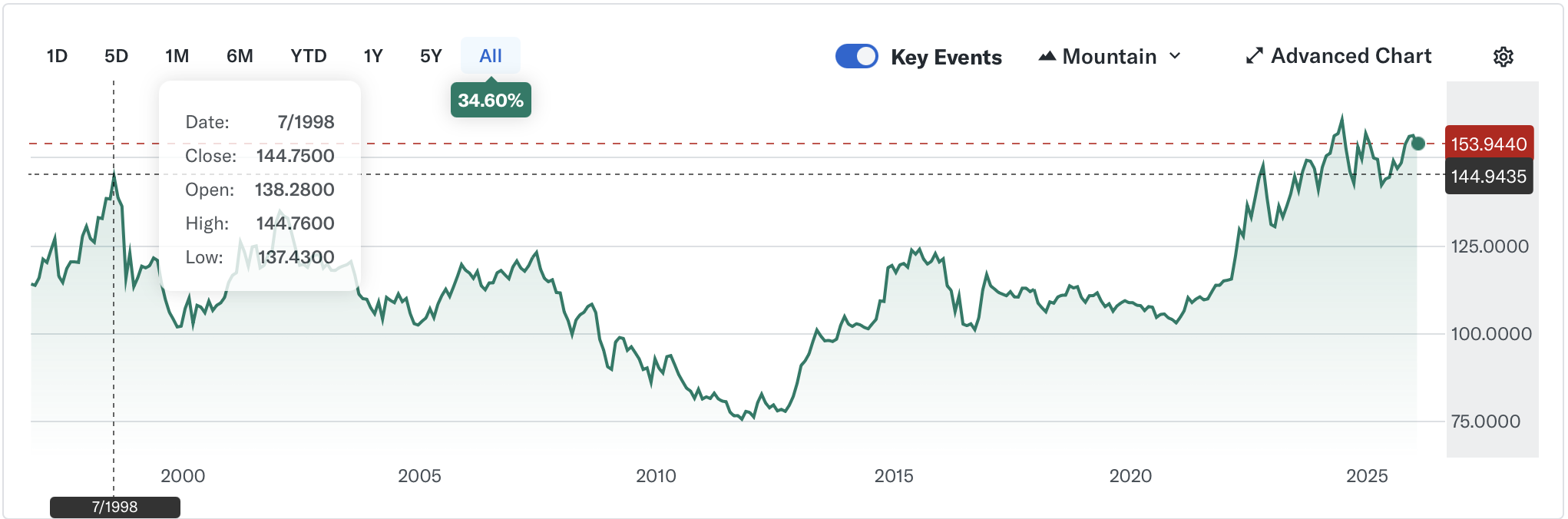
 There is a great deal of talk of joint intervention with the US, but I remain skeptical there.  It is critical to understand exactly what joint intervention is and what it represents.  Joint intervention means that the US Treasury is selling its own dollars alongside those of Japan.  That is very different than the Fed, acting on behalf of the Treasury-MOF-BOJ connection executing sales for the MOF.  The former implies a US effort to change the dollar; the latter is simply assisting an ally in our time zone.  I can only think of two times the US intervened, 1985 and 1998.  In the second chart, I highlighted the shape of the move from 1998, which was obviously far sharper than anything we have seen so far. 

Source: finance.yahoo.com

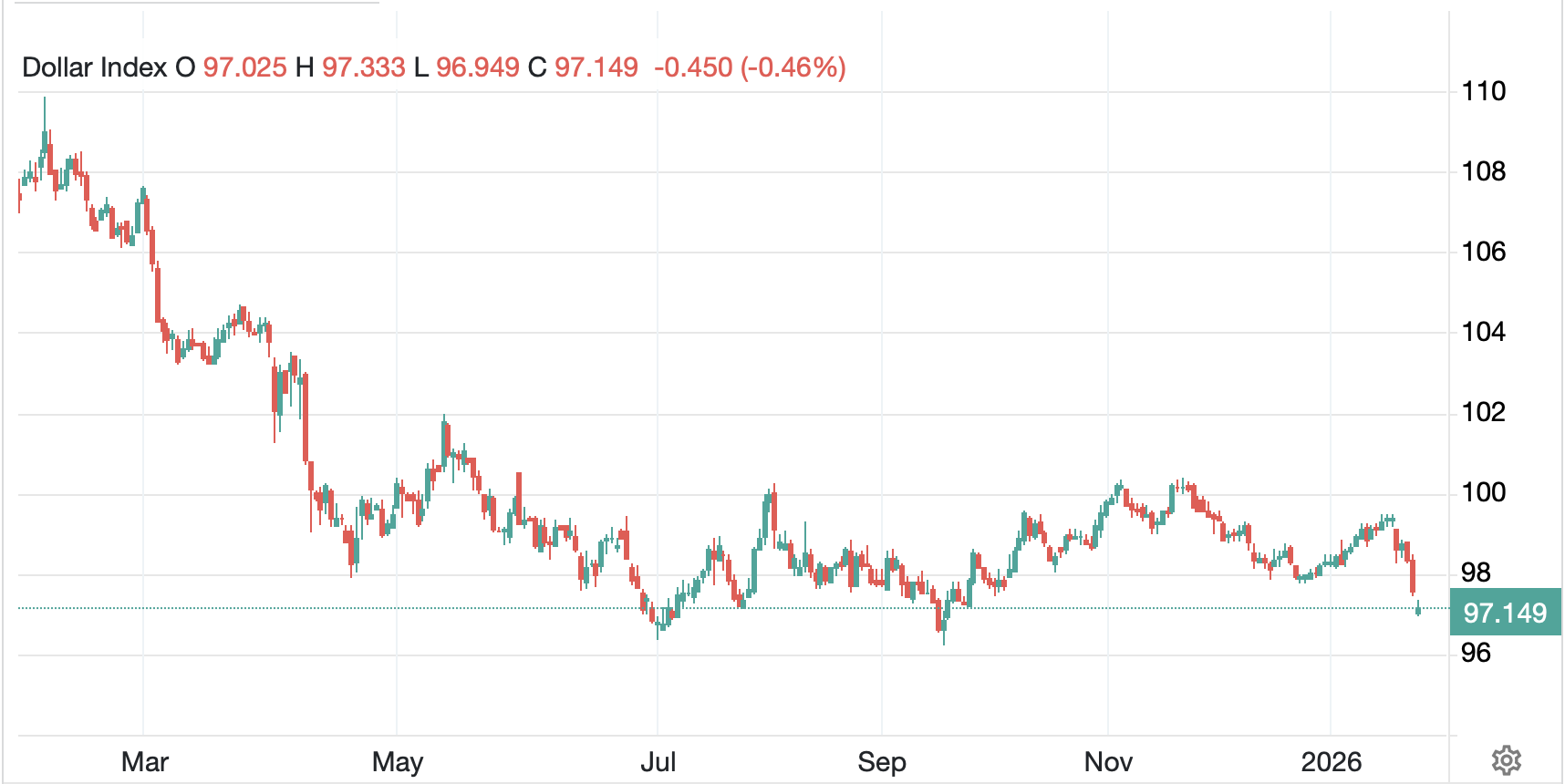
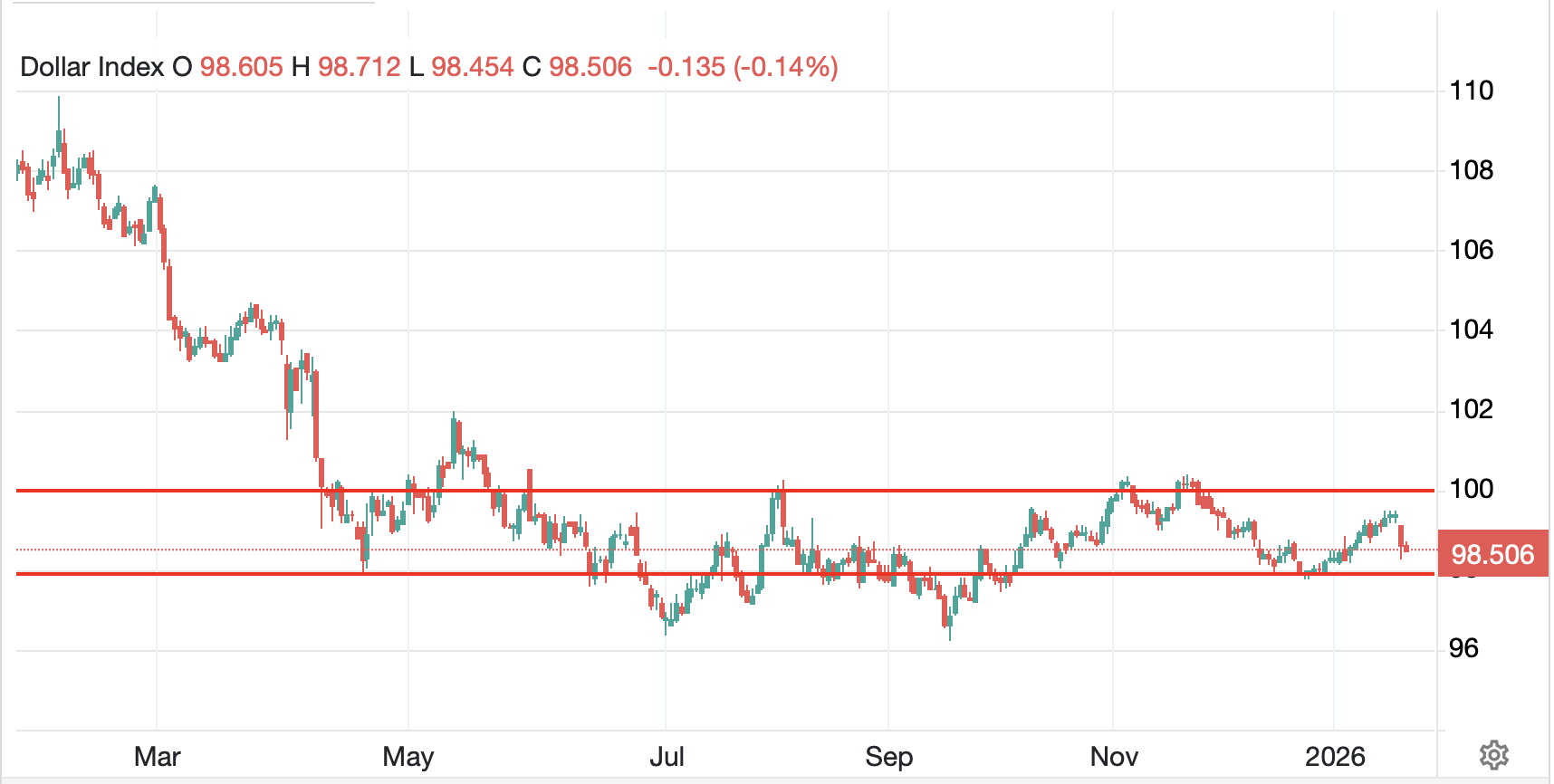
  • DXY (-0.5%) is falling as well, obviously dragged lower by the dollar’s decline vs. the yen, but the dollar’s weakness is universal today.  As you can see from the chart, the DXY has fallen through the bottom of the trading range at 98.00 and the bears are celebrating the end of the dollar.  But just looking at the chart below, we need to see a more substantial extension, in my view, before concluding the dollar is dead.

Source: tradingeconomics.com

Precious Metals – 

MetalPriceDay%WeeklyMonthlyYTDYoY
Gold5090.47101.85+2.0%8.9%17.6%17.95%85.85%
Silver110.347.38+7.2%16.7%53.15%55.05%266.2%
Copper5.99420.048+0.8%1.6%8.4%5.45%42.2%
Platinum2867.20128.8+4.65%21.75%35.2%39.7%205.3%

Source: tradingeconomics.com

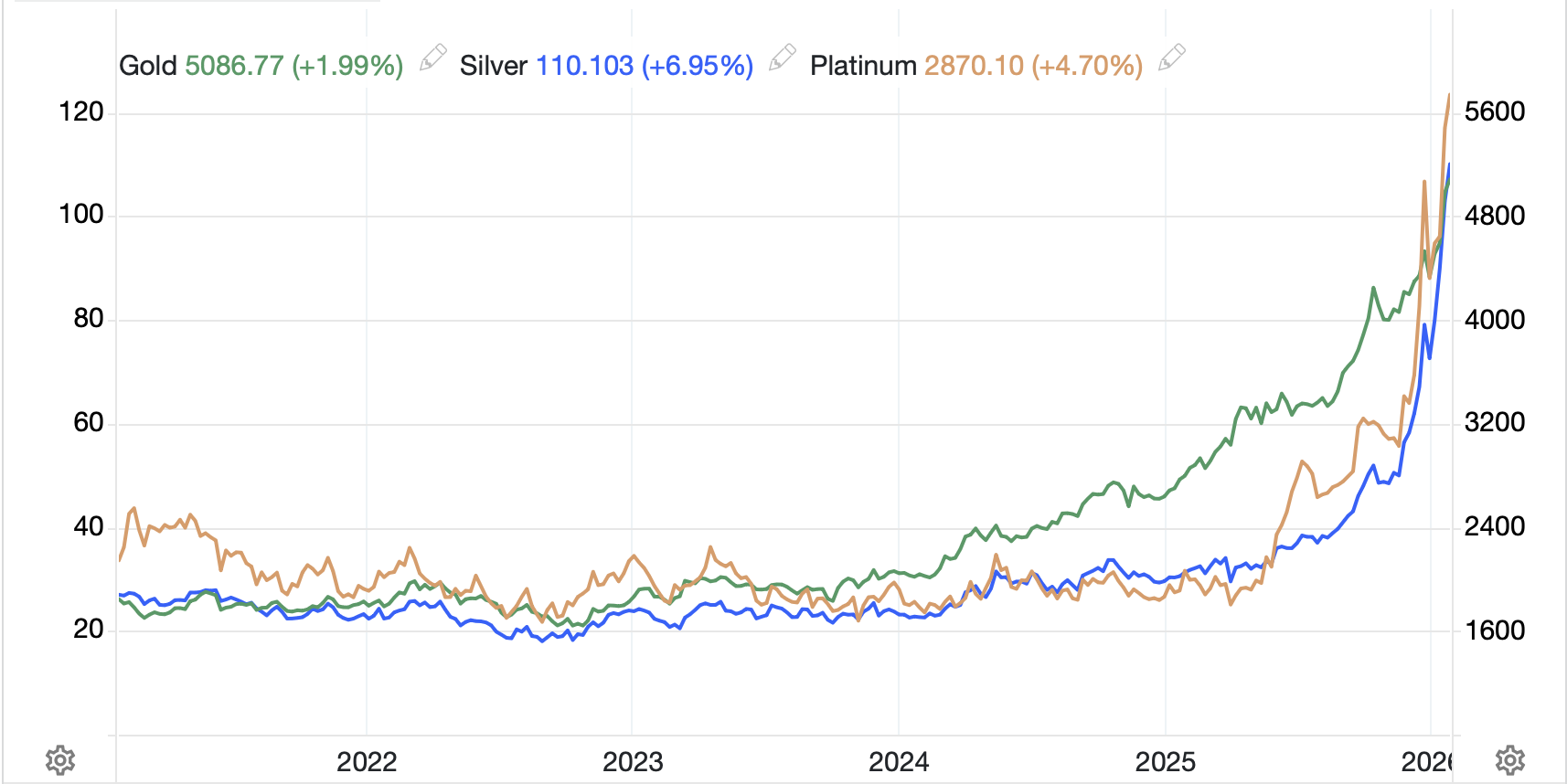
I think this table tells the entire story eloquently.  The combination of supply shortages in trading venues, as well as for industrial users, and fears over the collapse of fiat currencies as every government in the world runs it hot and issues massive amounts of debt, has an increasing number of both individuals and institutions looking for someplace to maintain their purchasing power.  Precious metals earned their name and reputation for this very reason.  If anything, the fear is that the speed of the move has been so extraordinary that it must slow down at some point, but so far, that has not been the case.  As you can see in the chart below, the moves in all three have become parabolic, or certainly in silver and platinum.  Historically, prices like this do not continue in this vein, but that doesn’t mean they cannot continue to rise further for a while yet.

Source: tradingeconomics.com

As to energy, oil (-0.2%) is trading above $60/bbl, but doesn’t show a great deal of interest in breaking in either direction right now.  I imagine a US action in Iran would push prices higher, but do not discount a breakthrough on the Russia/Ukraine war that could have the opposite effect.  However, NatGas (+14.6%) continues to be in massive demand as the 15° temperature outside my window this morning is indicative of what is happening across most of the country.  As well, it seems Germany, which is now hugely reliant on US LNG exports, has run their storage down to a dangerously low 40% or so, far below normal for this time of year.  Until this cold-snap ends, demand will remain exceedingly high.

Stocks – the biggest mover overnight was Tokyo (-1.8%) as the much stronger yen weighed heavily on Japanese exporters like Toyota.  Too, both South Korea (-0.8%) and India (-0.9%) slipped with the former showing concern that there would be intervention in the KRW market and negatively impact Korean exporters while the latter continues to see international capital outflows, with another $3 billion coming out so far this month (which has undermined the INR as well).  But otherwise, not much price action in China, HK or elsewhere in the region.  In Europe, most major bourses are little changed, although there have been modest gains in Spain (+0.5%) and Italy (+0.4%).  The only data of note was German Ifo Business Climate (87.6) which remained unchanged, falling below expectations for a modest gain.   And at this hour (7:45), US futures are virtually unchanged.

Bonds – yields have slipped modestly this morning with Treasuries (-1bps) not really showing signs of serious degradation.  European sovereign yields have fallen further between -3bps (Germany) and -5bps (France) with the latter benefitting from the idea that France would actually pass a budget soon.  JGB yields (-2bps) also slipped as polls show Takaichi-san’s approval ratings are slipping and some are assuming she won’t be able to run it quite as hot if she wins the election in two weeks.

Data this week is dominated by the Fed meeting on Wednesday, although as I have said from the beginning of the year, I think the Fed’s importance has waned relative to the market overall.

TodayDurable Goods3.7%
 -ex Transport0.3%
TuesdayCase Shiller Home Prices1.2%
 Consumer Confidence90.9
WednesdayFOMC Rate Decision3.75% (unchanged)
ThursdayInitial Claims205K
 Continuing Claims1860K
 Trade Balance-$42.1B
 Nonfarm Productivity4.9%
 Unit Labor Costs-1.9%
 Factory Orders1.7%
 -ex Transport0.3%
FridayDec PPI0.2% (2.8% Y/Y)
 -ex food & energy0.3% (2.9% Y/Y)
 Chicago PMI43.8

Source: tradingeconomics.com

And that’s pretty much what we have right now.  Clearly, the biggest signal comes from the precious metals space and indicates, to me at least, that there is huge concern over the way of the world right now.  I guess this is what the 4thTurning looks like.  As I said, if the Treasury is actually going to intervene of their own accord, working alongside the Japanese, that is a distinct negative for the dollar against all currencies and needs to be carefully assessed.  However, if the Fed sells dollars on the BOJ’s behalf, that is likely to have just a temporary impact on the FX markets.  Keep that in mind as we go forward.

Good luck (we all need that right now!)

Adf

Yen Reprobates

On Friday we questioned what stage
The BOJ reached for to gauge
If yen intervention
Would soon get a mention
And could Katayama assuage
 
The markets, without spending dough
Since Friday, we’re now in the know
That Bessent checked rates
With yen reprobates
Now anxious to deal a deathblow

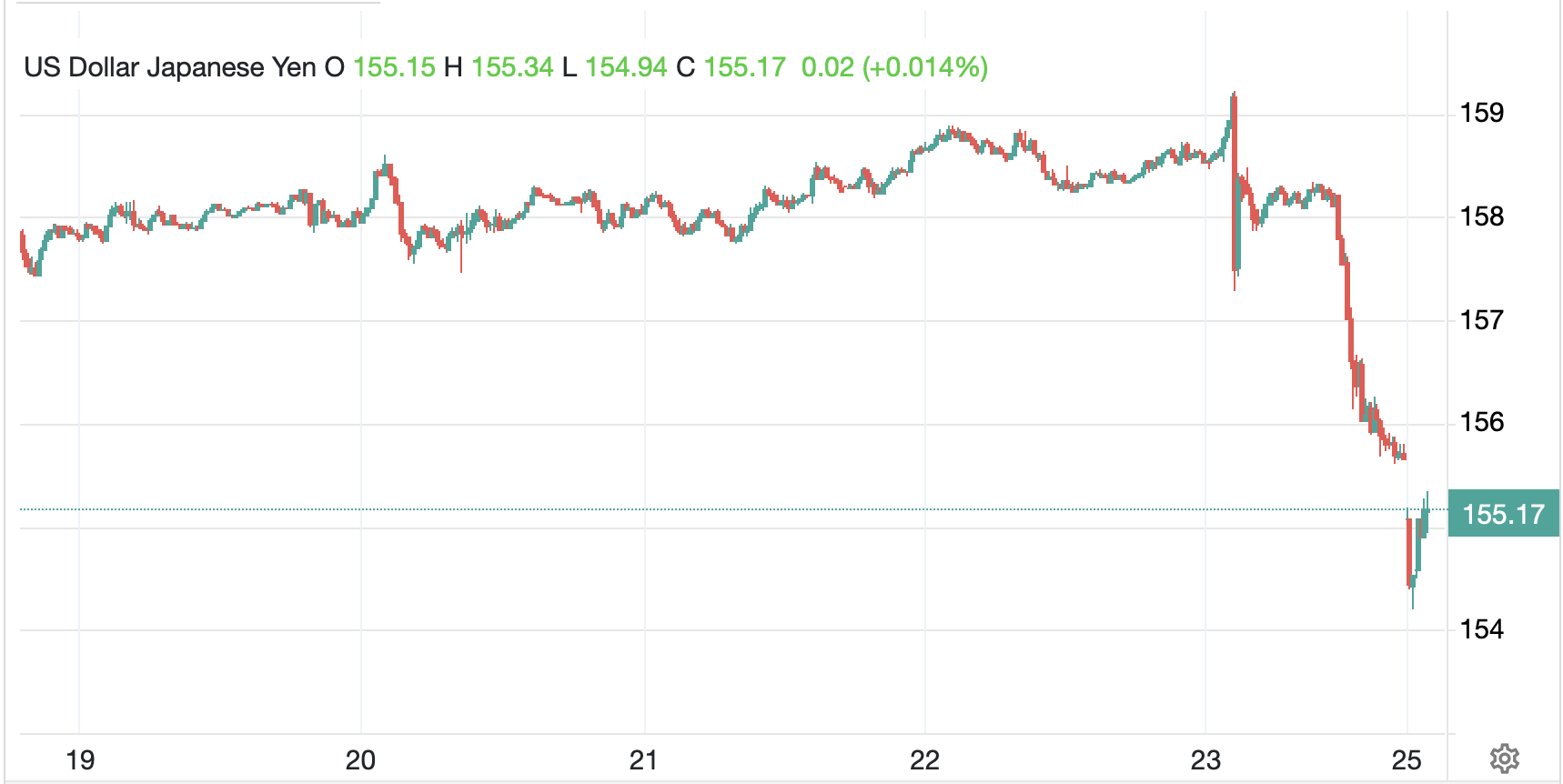
On Friday, I asked the question whether the movement seen in Tokyo after the BOJ meeting was finished consisted of step six, rate checks, or step seven, intervention.  Of course, my comments preceded the NY session and then in the afternoon, as you can see from the below chart, something much more substantial occurred.

Source: tradingeconomics.com

At this point on Sunday evening, it appears that about 11:00 Friday morning in NY, as Europe was heading home for the weekend, the Fed rang into major dealers around the Street and asked for prices where they could buy yen / sell dollars.  This is the very definition of ‘rate checks’ and the market response was exactly what you would expect.  The sequence of events was almost certainly that the Japanese MOF reached out to the Treasury department who then rang up the Fed and asked them to act. (Remember, currency policy is a Treasury function, not a Fed one). As you can see from the chart above, the initial move when Asia opened was a continuation of the yen’s strength, and in truth dollar weakness against most currencies, but we have already seen the initial bounce (the green bars to the right.)

Here’s the thing about rate checks, and in truth, every monetary policy, the law of diminishing returns is in effect here, so the next time they try it, and I would not be surprised to see something again tonight or tomorrow in NY, it will have a smaller impact.  Now, perhaps they are comfortable at 155 instead of pressing 160 and if USDJPY stabilizes here, things will go on much as before.  But I doubt that without further efforts, including direct intervention, things are going to change.  And even then, as history has shown time and again, intervention’s impact typically wears off after a few months.  The only way to truly change this trajectory is to change policy in Japan, and by all accounts, as the country heads into an election where PM Takichi’s platform is ‘run it hot’ that seems unlikely.  

It may not be a fade today, but at 150 or so, I expect that the risk/reward of selling yen is going to be extremely attractive again.

Have a good evening

Adf

Six or Seven?

History has shown
It takes seven steps before
The BOJ acts
 
Inquiring minds ask
Was last night six or seven?
FinMin’s lips are sealed


I must admit, when I went to bad last night, I thought this morning’s lead discussion would be about gold as it crested $5000/oz given it was trading at $4967 and nothing seemed likely to stop it.  But something did, probably some profit taking into the weekend, given it has rallied more than 7% this week.  

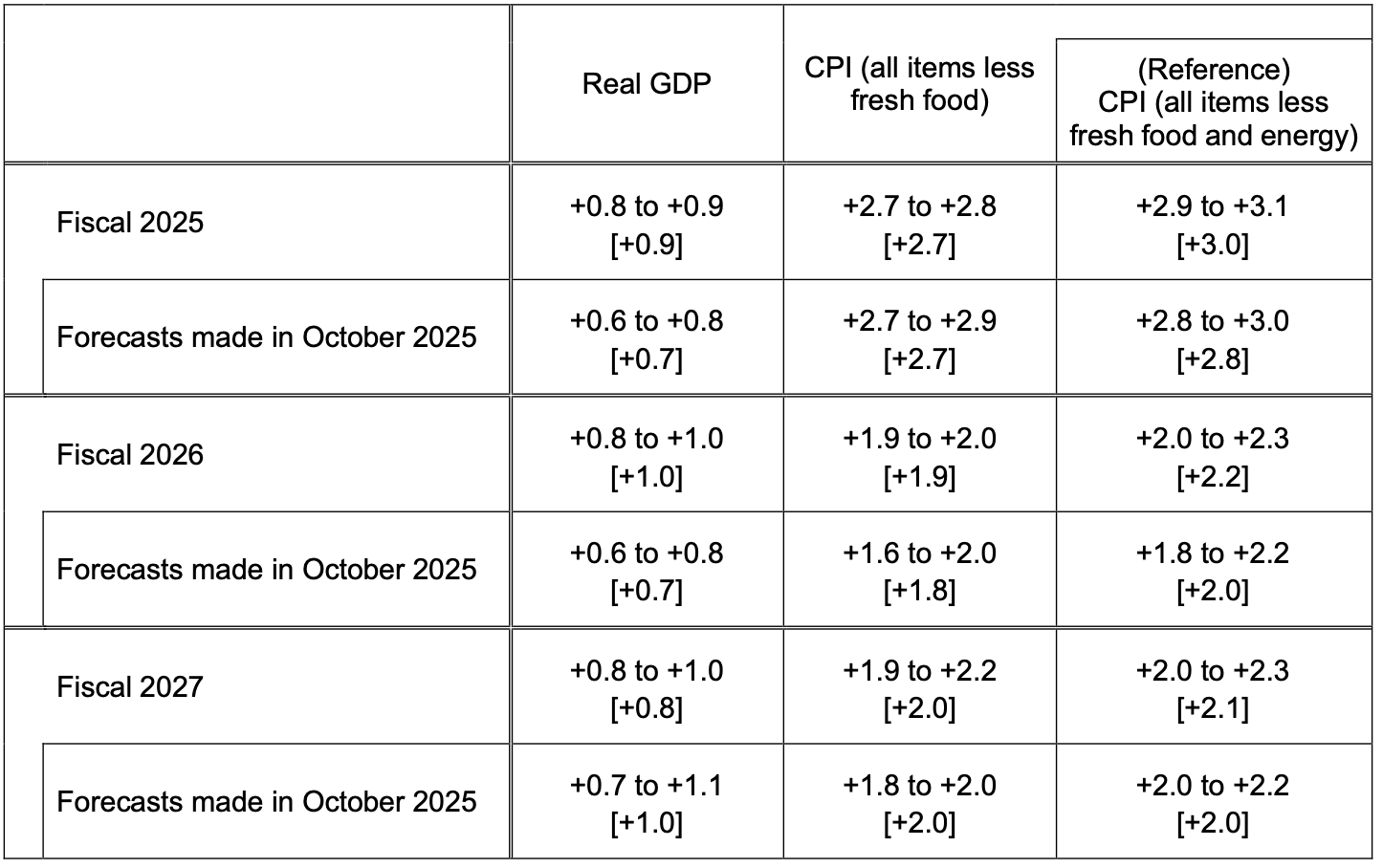
Thus, since there are no new geopolitical stories of note, with everyone still trying to figure out what the past several days means, we look toward the East this morning and start with Japan.  The BOJ left policy rates on hold, as widely expected, but Ueda-san also raised the BOJ’s forecasts for inflation (see below from BOJ policy statement).  

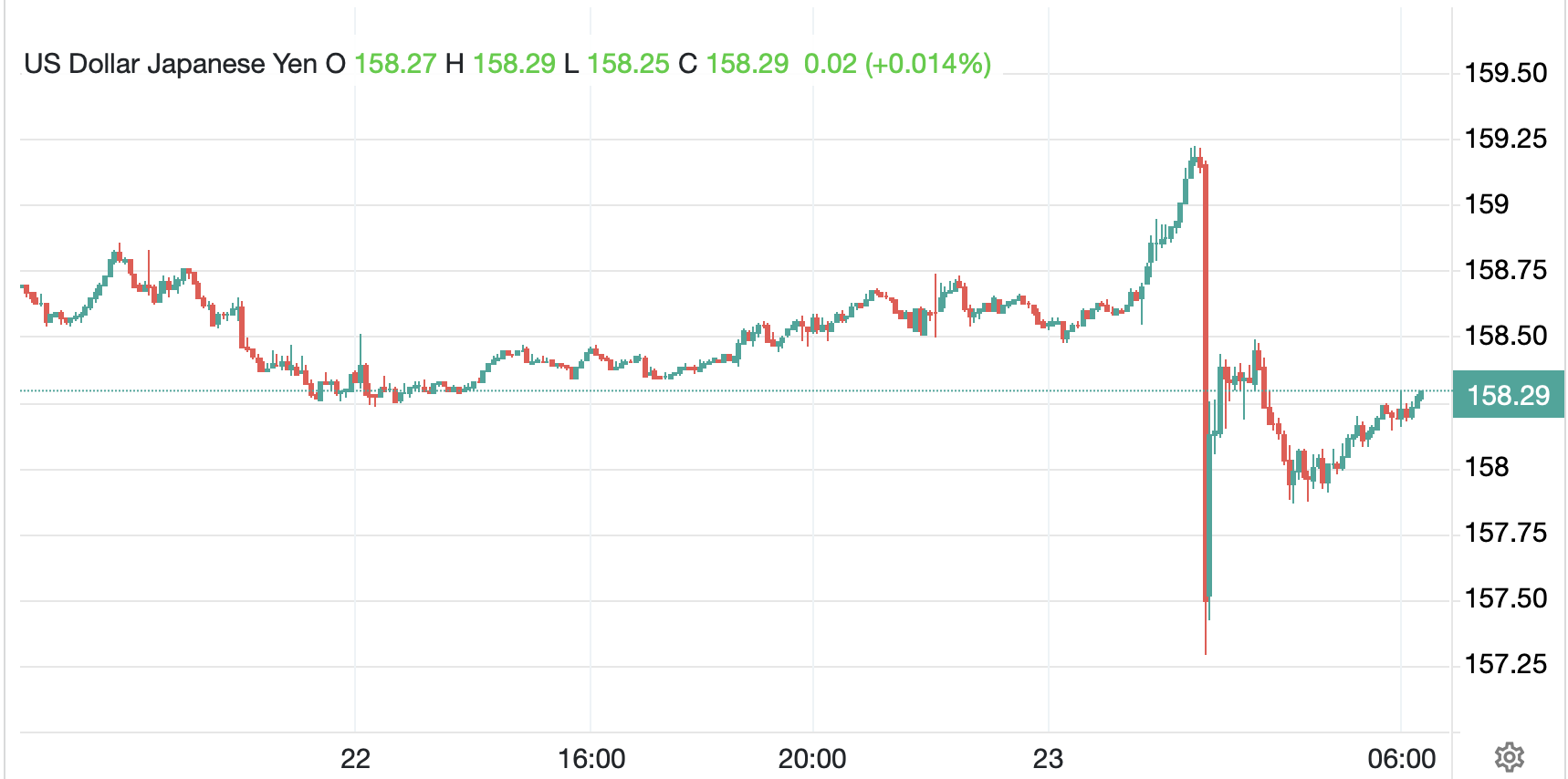
The latter move has been interpreted as offering more flexibility for the BOJ to hike rates further with expectations for a hike next month rising above 60%.  But of more interest was the price action seen in the immediate wake of the Ueda comments as seen in the below chart.

Source: tradingeconomics.com

While some have asked if the BOJ intervened last night, I would categorically answer, No.  The fact that the dollar’s decline was so short lived indicates that something else was likely the catalyst.  On the 7-step road to intervention, step 6 is checking rates.  This occurs when the BOJ calls the FX trading desks at banks in Tokyo and asks for prices where they could buy yen, but don’t actually execute the transaction.  However, it is a powerful signal that the BOJ, on behalf of the MOF, is growing concerned.  The thing is, historically when this happens, it is widely circulated within the market that the BOJ is checking rates.

Thus far, we have not heard that at all from either the banks or the MOF.  Rather, FinMin Katayama once more explained, “We’re always watching with a sense of urgency.”  (As an aside, I assume this comment is a result of a translation of Japanese that doesn’t fit the English language well as I do not understand how one can watch something ‘urgently’).  But that urgency is classic step 5, not step 6, so it is not clear that we are closer to intervention at this point.  After all, the dollar’s high last night was not as high as we had seen just 9 days ago, when they first took step 5, and historically, a new high is needed before the next step is taken.

But, getting away from the minutiae of their intervention process, I believe last night’s activities tell us that there is growing concern about the yen’s level and its impact on rising inflation.  If Governor Ueda is priming markets for a rate hike sooner than previously anticipated, it tells me that inflation data coming up is going to be higher than previously forecast, and he wants to be prepared.  Interestingly, JGB markets did not see the same type of price behavior as you can see below.

Source: tradingeconomics.com

My conclusion is there was no rate checking, but FinMin Katayama’s comments were sufficient to convince some that it was coming soon to a screen near you.  Remember, last month, Japanese CPI slipped to 2.1%, its lowest level since March 2022.  Given the next release is still nearly a month away, there is no clear consensus as to its reading, but I suspect a rebound is in order.   If forecasts start indicating a substantial rise, I expect the yen to initially weaken, and perhaps that will be sufficient for the BOJ to take the 6th step.

But other than that, there seems very little new news to discuss.  WEF is over and while there are still numerous analyses about what happened, and how things will evolve from here, consensus conclusions are few and far between.  So, let’s see how the rest of the financial markets fared overnight.

Yesterday’s solid US equity performance was followed by a generally solid one in Asia as well.  Tokyo (+0.3%) was nonplussed by the intervention discussion, while HK (+0.45%), Korea (+0.8%) and Taiwan (+0.7%) all followed the US higher.  However, there were some laggards with China (-0.45%) and India (-0.9%) suffering on what appeared to be some profit taking on the previous day’s gains.  Overall, there were more gainers than laggards here.  In Europe, the picture is also mixed as the IBEX (-0.4%) and CAC (-0.3%) both suffer after weaker than expected Flash PMI data was released while Germany (+0.1%) and the UK (+0.2%) are benefitting from modestly better numbers there.  We continue to hear German Chancellor Merz explain all the things that Germany is going to do to make things better going forward, but the nation has so totally hamstrung itself with its energy policy of the past decade, it is not clear to me they have any opportunity to be successful in the short run.  As to US futures, at this hour (7:40), they are pointing slightly lower, -0.15% or so.

In the bond market, yields around the world are within 1 to 2 basis points of yesterday’s closing levels with France (-4bps) the outlier after the weak data and the news that PM LeCornu has survived the first of two no-confidence votes and appears set to get a budget passed, albeit with a 5% deficit forecast.  Otherwise, not much here with yesterday’s PCE data unable to move the needle given it was right on forecasts.

In the commodity market, oil (+1.9%) is rallying after President Trump hinted at further Iranian activities when he indicated an armada of US naval vessels is heading there.  That has traders nervous, but, of course, with President Trump, it is always difficult to determine his strategy, even if we know the end game is to remove the theocracy if possible.  NatGas (-1.6%) is giving back some of its recent gains but given the forecast for a massive arctic blast this weekend, with single digit temperatures and up to two feet of snow on the East coast, I suspect it will maintain its recent gains for a few more days.

In the metals markets, gold is unchanged on the session, although continues to sit tantalizingly close to $5000/oz.  Just as remarkable is that silver (+3.1%) is now trading above $99/oz and certainly seems like it is going to crest $100/oz in the very near future.  This has helped all metals with both copper (+2.5%) and platinum (+5.2%) to rally with the latter now trading at an all-time high as well.

Finally, the dollar is…doing nothing.  While the DXY has sipped -0.07%, we are seeing a mixed picture with the euro slightly softer while the pound (+0.2%) has rallied on the stronger PMI data.  In fact, scanning my screens, nothing has moved more than 0.3% (NOK, AUD on the plus side, PLN, INR on the minus side), but indicative that FX remains an afterthought for now (except for the yen).

On the data front, we see the Flash PMI data (exp 52.0 Mfg, 52.8 Services) and Michigan Sentiment (54.0) and that’s it.  Given all the excitement from the president’s WEF visit, I think most traders and investors will be happy if we have a quiet session to head into the weekend.  As well, if the weather forecasts prove correct, I expect that Monday will be very quiet as many traders will be unable to get into the office.

I don’t know about you, but it is certainly exhausting trying to keep up with the world these days.  Hedging remains an important strategy regardless of your asset class, but right now, both equity and metals trends do not appear to be breaking while the dollar and bonds remain trendless.

Good luck and good weekend

Adf
What We’ve Learned

It wasn’t but three weeks ago
That pundits who felt in the know
Were sure the attack
On Vene would crack
The world, and more chaos bestow
 
But that news, so quickly, has faded
While Greenland fears have been upgraded
The pundits were sure
That war was the cure
And Europe would soon be invaded
 
Now as it turns out, what we’ve learned
Is NATO, which had been concerned
Has ‘greed to a deal
Which stopped Denmark’s squeal
As Trump, to the US, returned


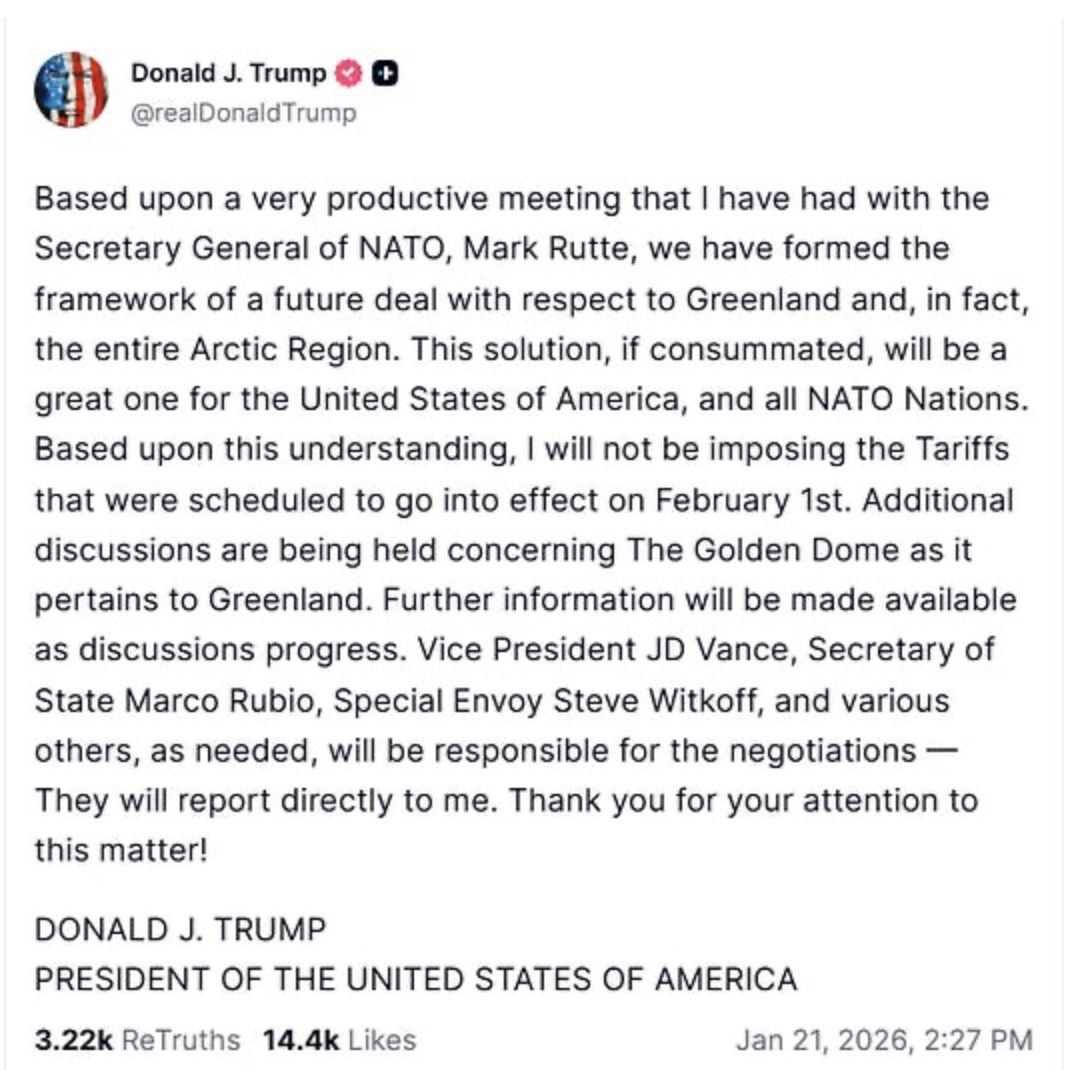
It is certainly difficult to keep up with current events these days, especially for the punditry who feel it is critical they demonstrate expertise on every issue, given the speed with which the issues change.  All that effort to understand the geopolitics behind ousting Nicholas Maduro has been forgotten in less than 2 weeks as they needed to pontificate on Greenland and its importance.  If, as the president’s TruthSocial post below is the current lay of the land, by Monday, Greenland will return to its historic obscurity as President Trump will move on to the next issue of his choosing.  In fact, this morning, the WSJ is claiming Cuba is next on the list, which, while it wouldn’t be that surprising, has to date only been mentioned in passing by Mr Trump.

Here’s the thing about all the pontification regarding President Trump, nearly, if not all of it, is simply that, pontification by outsiders who have no idea about what is really happening.  These folks are not sitting in the Oval Office when the President is meeting with his advisors discussing strategy and are generally wishcasting their views and creating a narrative around that.  As I am also an outsider, all I can do is observe and try to ascertain how things might impact markets, but if you are not hearing it from the president or Secretary Rubio or someone like that, it is all speculation.  However, one must admit, it is entertaining!

As I don’t know what the next ‘global crisis’ is going to be ahead of time, let’s turn our attention to markets and how they responded to the president’s speech in Davos as well as the news of the deal framework.

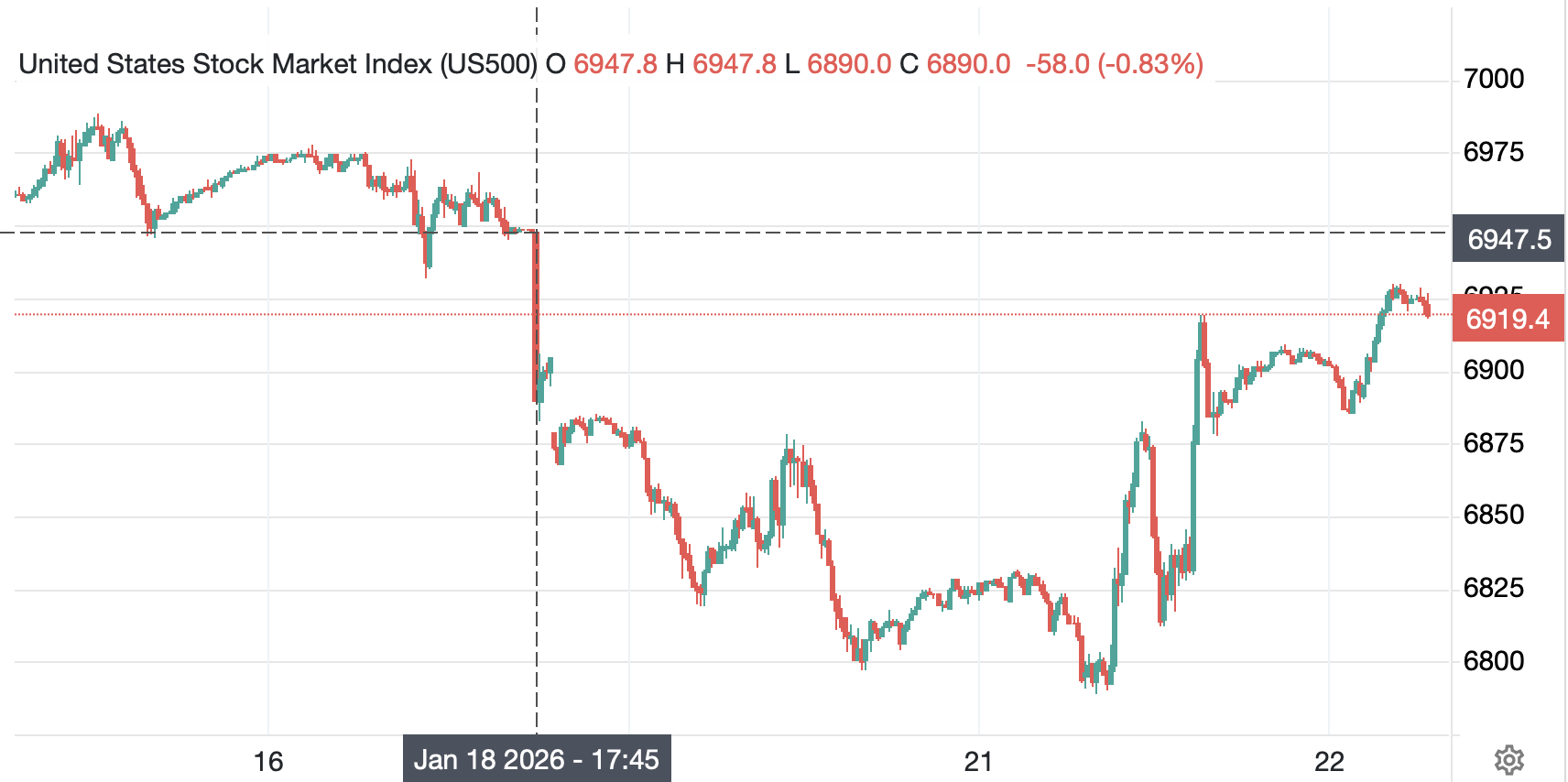
Equities were quite happy.  After the sharp decline seen Sunday night, when the tariff threats were made, the S&P 500 has recouped nearly all of the losses as per the below chart.  Yesterday saw US market gains of 1.2% across the board and futures, this morning, continue to rally, up about 0.5% across the board.

Source: tradingeconomics.com

It should be no surprise that things were bright in Asia as well, with Tokyo (+1.75%) leading the way as almost every exchange in the region was higher by a decent amount (Korea +0.9%, India +0.5%, Taiwan +1.6%, Australia +0.75%) but interestingly, China (0.0%) and HK (+0.2%) were the laggards.  Perhaps good news for the West is not seen that positively there, although the story of regulators in China cracking down on possible stock manipulation by social media influencers has raised some concerns.  After all, one of the biggest issues with investing in China by outsiders is the capriciousness of President Xi and the CCP as they decide what they don’t like that particular day.  

As to Europe, it should be no surprise that there has been a collective sigh of relief from investors there given the removal of the threat of more tariffs and the promises of more defense spending by European nations.  So, gains across the board with the DAX (+1.2%) leading the way although the CAC (+1.1%) is right there as well with most of the rest of the nations seeing gains on the order of 0.5% to 0.75%.

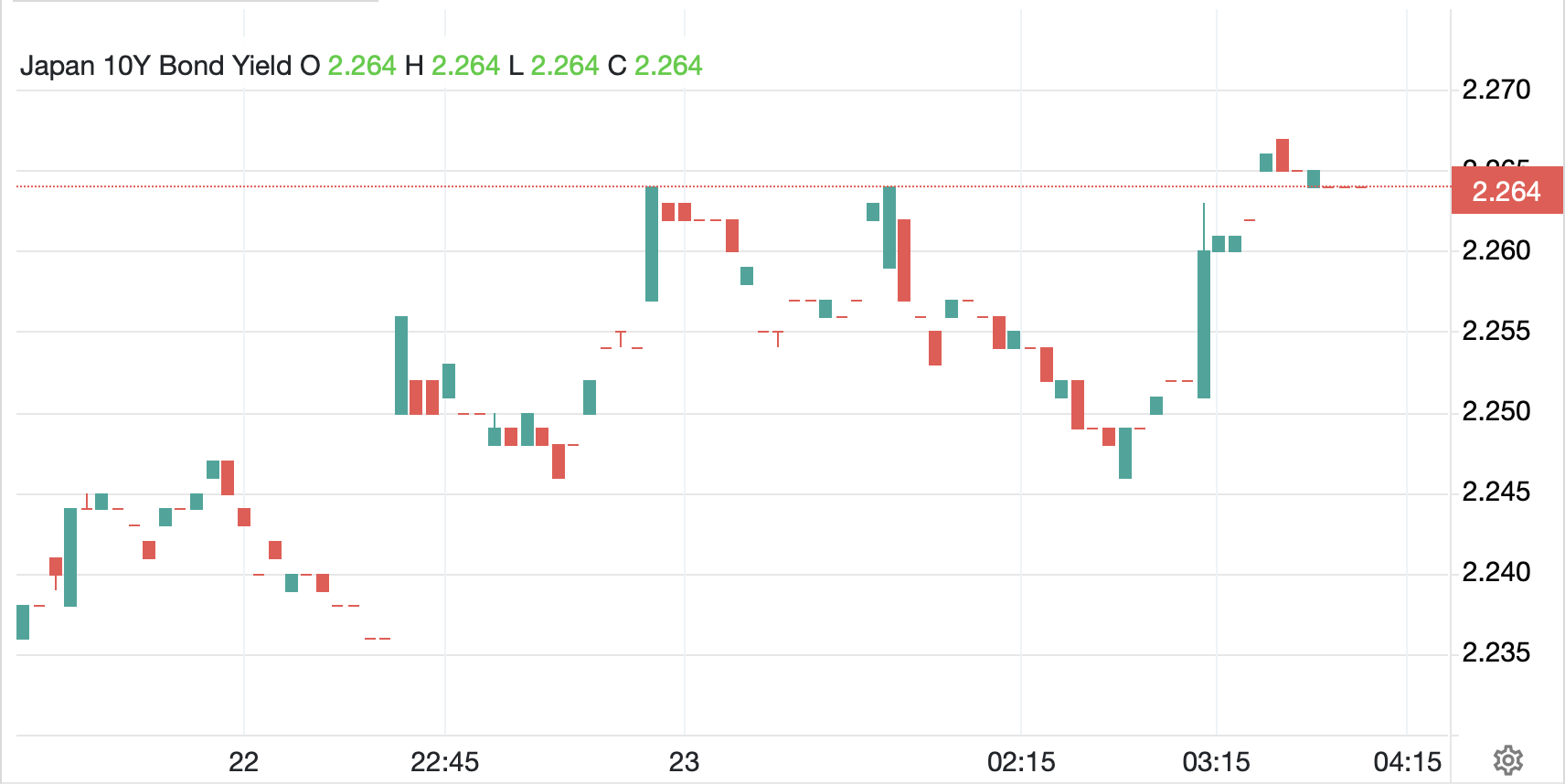
In the bond markets, apparently the end of the world has also been postponed.  Yields declined yesterday and this morning, Treasury yields are unchanged at 4.24%.  In Europe, yields have slipped -2bps to -4bps on the continent although UK gilts (+2bps) are bucking the trend, which appears to be an ongoing impact from yesterday’s higher than expected inflation data which continues to point toward stagflation in the UK.  Interestingly, JGB yields (-4bps) have also fallen again, although they certainly remain near recent highs.  PM Takaichi is going to formally dissolve the Diet tonight and the election is slated for February 8th (wouldn’t it be wonderful if US election campaigns were just 2 weeks long!).  While nothing has changed in her fiscal planning, it seems that investors are awaiting the BOJ announcement tonight (no change expected) and have been modestly appeased by a substantial increase in exports although the trade surplus declined slightly.  

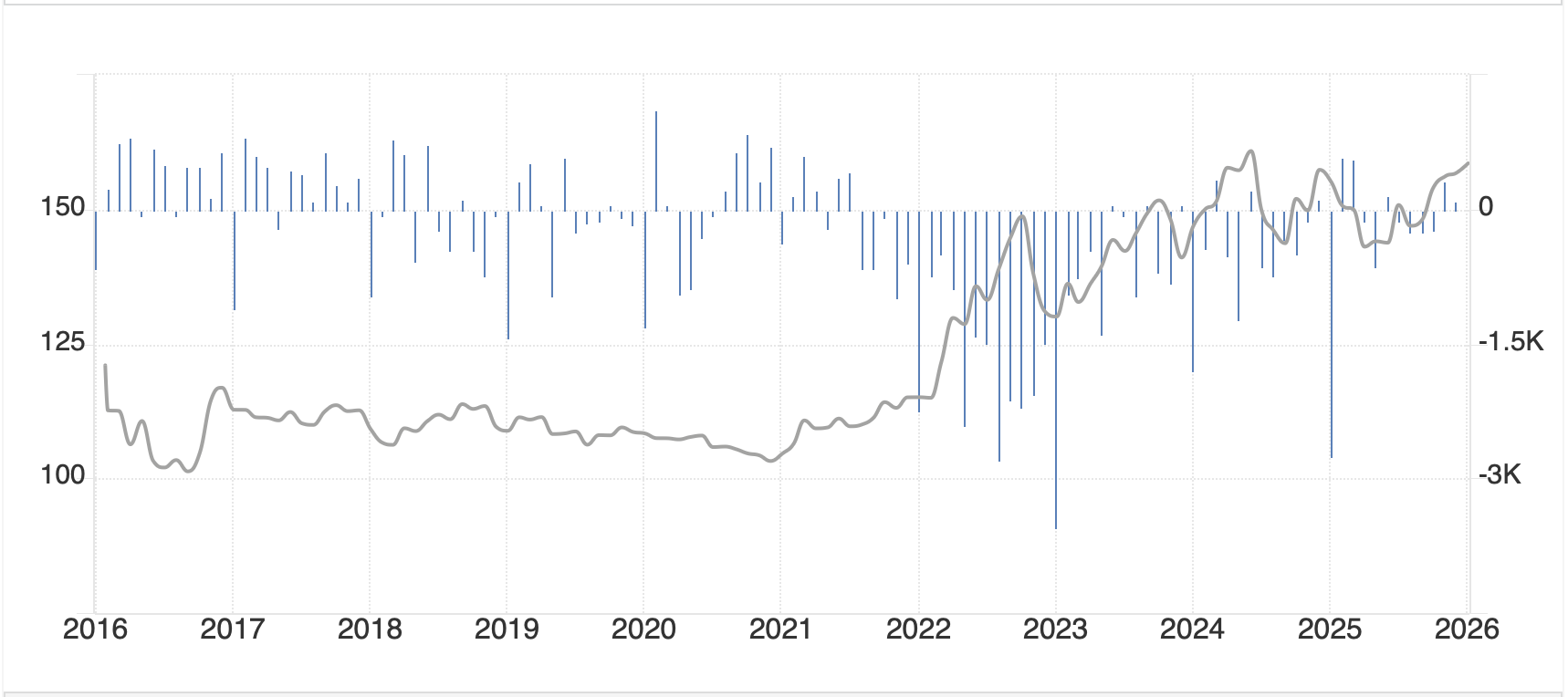
I think it is worth looking at the trade balance relative to the yen (-0.2%) as per the below chart.  Recall, historically, Japan ran major trade surpluses, which was always one of the tensions between the US and Japan dating back to President Reagan.  But as you can see below, the blue bars are the monthly trade numbers and since Covid, that situation changed dramatically.

Source: tradingeconomics.com

However, once the yen started to weaken substantially, the lagged effect showed up in trade data as can readily be seen above.  In fact, this is the real tension in Japan, I believe, that the weak yen helps exports significantly, but has become an inflation problem and the government is caught between the two issues.  This is why I believe we will see a weaker yen over time, especially if Takaichi-san comes out of the election with a solid majority.

As I’m on currencies, if we look elsewhere, the dollar, although we have been constantly assured it was collapsing, remains in its trading range.  This morning, the DXY (-0.1%) has edged lower after yesterday’s rebound.  As it happens, yen weakness has been offset by modest euro strength, but the real strength is in the commodity space with NOK (+0.8%), SEK (+0.36%), AUD (+0.6%) and NZD (+0.6%) all having solid sessions.  Now, my take is that the first two are more likely responses to the Greenland issue’s apparent resolution as NOK is rallying despite oil’s (-1.7%) sharp decline.  Remember, both those nations were in the crosshairs of Trump’s mooted tariffs.  On the other hand, last night, the employment situation in Australia perked up nicely which has helped raise market pricing for a rate hike by the RBA and given the strength in commodity prices and the apparent end of another global crisis, has helped support the currency.  Ironically, as I scan the EMG space, movements there have been much smaller overall.

Finally, turning to the rest of the commodity space, for the first time in a week, gold is not higher this morning, but rather essentially unchanged.  Silver (+0.25%) has bounced a tiny bit after selling off somewhat yesterday in NY.  I have maintained that trees don’t grow to the sky, and frankly, the price action here appears tired regarding ever larger gains.  I believe the fundamental story remains in place, but that doesn’t mean silver won’t chop around for a few weeks or months before starting higher again.   Copper (-0.6%) is also under modest pressure this morning and has retreated much further, about -6.3%, from its recent highs at $6.10/lb than the precious metals.  However, the red metal remains much in demand given the underlying electrification story. 

And lastly, a quick look at NatGas (+12%) shows what happens to commodity markets when there is the perception of insufficient supply for the current demand.  This is higher by 75% this week!  And while today in NJ, the temperature is a relatively balmy 34°, the forecast for the coming weekend is much colder and a huge snowfall.  It’s not often you see a movement of this magnitude so here is the chart for the past month.

Source: tradingeconomics.com

On the data front, today brings the final look at Q3 GDP (exp 4.3%) as well as Initial (212K) and Continuing (1880K) Claims.  Too, we get Personal Income (0.4%) and Spending (0.5%) for November and PCE (0.2%, 2.8% Y/Y) for both headline and core.  The EIA releases its weekly oil inventory data today, a day later than usual because of the holiday Monday, with a modest build expected.

Market participants in all markets appear to have found a comfort zone and are taking risk positions again, at least for now.  All the apocalyptic stories about the world rejecting the dollar and the rise of the BRICS will have to wait for another day.  While I don’t know what the next situation is going to be, I am highly confident we are going to have another geopolitical scenario that is going to result in more screaming, teeth gnashing and pearl clutching by those who continue to believe the rules-based order is the way things should be.  Alas for them, economic power and statecraft is the new world order, and my take is ultimately, the dollar benefits from this pivot.

Good luck

Adf

Clearly Explained

The warmups in Davos for Trump
With Howard and Scott on the stump
Quite clearly explained,
While WEFers complained,
The US was, no more, the chump
 
The globalist world that existed
Is no longer to be assisted
Instead, US goals
Align with Trump’s polls
No matter the words WEF has twisted


As we await President Trump’s address in Davos this morning, it is worth recapping the highlights from yesterday’s US speakers, Commerce Secretary Howard Lutnick and Treasury Secretary Scott Bessent.   Starting with Lutnick, he explained the White House view as follows; “The Trump Administration and I are here to make a very clear point—globalization has failed the West and the United States of America. It’s a failed policy… and it has left America behind.”  The video is linked above in his name.  It is hard to misunderstand what he is saying, and that is very clearly US policy.

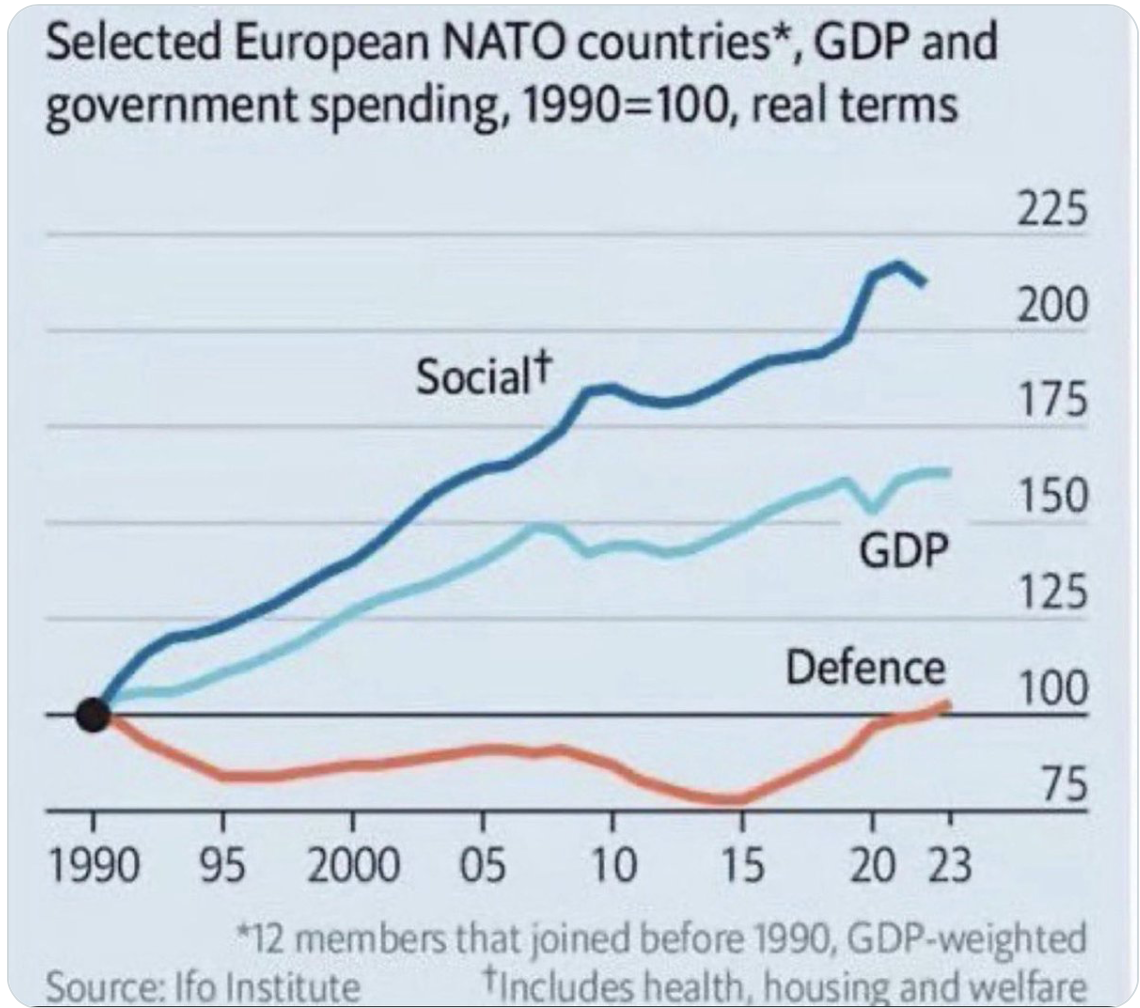
Turning to Secretary Bessent, he explained that the US has spent $22 trillion more than the rest of NATO since 1980 on defense while Europe and Canada created their welfare states.  “The Europeans have been spending the money on social welfare, on roads, on education, and it’s time for them to pay more, which they’ve agreed to do.”  The video clip is linked to his name in the first stanza.  The below graph is telling:

At the same time, Europe continues to buy Russian oil, funding Russia’s war against Europe.

Needless to say, Europeans were unhappy with the commentary as they appeared to be coming under attack from the US.  The market narrative quickly framed around President Trump going too far and how it was going to destroy the US as nobody will want to invest in the US. That is the explanation for yesterday’s decline in US equities (although they fell around the world), the dollar and Treasury bonds (although bonds, too, fell everywhere, notably in Japan).  

Yesterday I sought to disabuse you of the notion that Europe is going to sell all their Treasuries to hurt the US as the results would likely be either irrelevant or horrific for Europe.  So, the narrative pivoted to Trump is bad and destroying the US.  

And yet, remarkably, the world did not end either yesterday or last night, despite what many have explained is inevitable.  This morning markets are somewhat less catastrophic.  It makes sense that markets are going to remain volatile as the underlying theses for international relations adjust to the new reality of power politics and economic statecraft from the previous “Rules Based Order”.  And at this stage, there is no way to know which outcomes are most likely.  The only thing of which I am confident is that we have not seen the end of this play out.  

I must admit, that while I don’t think President Trump cares much about France and President Macron’s comments seeking more Chinese investment in that nation, I suspect that PM Carney’s efforts to cozy up to President Xi will be less welcome based on the Donroe Doctrine of US dominance in the Western Hemisphere.  But I also believe that the power structure between the US and Canada is such that it will ultimately bend to the US’s will.

So, let’s review market activity overnight as we await President Trump’s comments, which I understand have been delayed until 11:30 EST this morning.  Yesterday’s sharp declines around the world have been followed by less dramatic activity last night and so far today.  In Asia, Tokyo (-0.4%) slipped a bit further, but hardly dramatically, as FinMin Katayama focused on the JGB market in comments made in Davos.  “Since last October, our fiscal policy has consistently been responsible and sustainable, not expansionary, and the numbers clearly demonstrate that.  I’d like everyone in the market to calm down.”  I’m sure she would.  And it worked with JGB yields slipping -8bps and 30yr yields falling -17bps.  Elsewhere in Asia, China was flat, HK (+0.4%) rallied a bit along with Korea (+0.5%) while Taiwan (-1.6%) led the way lower across numerous other regional markets.  

In Europe, red is today’s color led by Germany (-0.7%) and Spain (-0.5%) although France and the UK have both only ceded -0.1% so far during the session.  The discussion here continues to revolve around President Trump, the trade deal, and potential new tariffs on nations that try to prevent the US from its Greenland desires.  As to US futures markets, at this hour (6:45) they are slightly firmer, +0.1%, so not yet, at least, indicating the end of the American investment thesis.

As to the rest of the bond market, away from Japan, yields are basically -1bp lower across Treasuries and European sovereigns as investors await Mr Trump’s comments.  Again, the mooted collapse in the US bond market has yet to appear.  However, there is a popular meme about the Danish pension fund, Akademikerpension, which has announced that it will sell all its US Treasuries by the end of the month, a total of $100 million, due to its perception of increased credit risk.  This has been fodder, though, for those who continue to believe that Europe is going to ditch their Treasuries, and many are calling it a signal.  While certainly a trendy decision, I see it as noise, not signal.

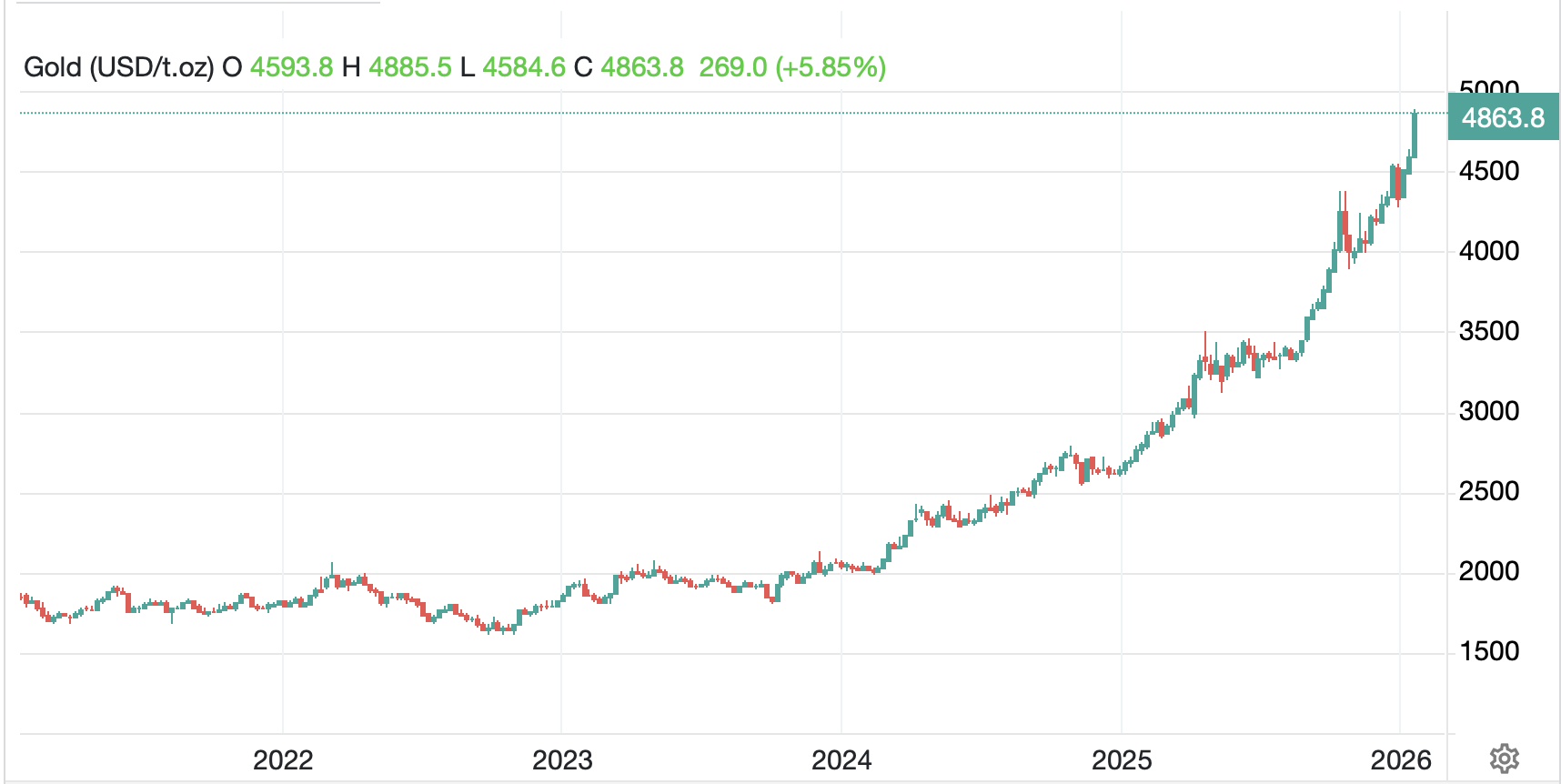
Turning to commodities, one cannot be but impressed with gold’s consistency of late.  It has risen another 2.1% this morning and is now nearing $4900/oz.  I guess $5000/oz is right around the corner.  Looking at the long-term chart below, we have seen a monster rally for the past two years.  

Source: tradingeconomics.com

FWIW, which may not be much, I continue to see this as a commentary on all fiat currencies, not the dollar per se as evidenced by the table I created from data on goldbroker.com.  While you can see that the dollar has definitely underperformed during the past year (which we already knew given the early year 10% decline vs. the euro and pound, over time, it is hard to make the case that other currencies are any better.  In fact, I find it particularly surprising that the rand has performed so poorly given its seeming benefits when gold rallies.  And of course, it is no surprise that the yen which has been having a really tough time, is the worst of the lot.

 Historical Returns of Gold 
Currency1 Month1Year5 Year10 Year
EUR9.54%54.22%164.28%300.85%
JPY10.02%76.45%288.91%481.02%
USD9.62%73.45%154.49%331.44%
GBP9.13%59.31%160.26%357.37%
MXN7.04%47.93%127.14%305.03%
ZAR7.35%53.89%179.88%327.69%

As to the other metals, silver (0.0%) seems to be getting tired after its move and has done little over the past several sessions.  Platinum (+1.0%) seems to still have life as does copper (+0.75%).  Turning to energy markets, oil (+0.3%) is trying to figure out whether the geopolitics is going to blow up or fade away and remains right around $60/bbl.  But given the temperature here in New Jersey is 1° this morning, we cannot be surprised that NatGas (+21.5%) has exploded (no pun intended) higher.

Finally, the dollar is a touch softer this morning, but not very much.  The euro is unchanged, and the pound, after some lousy inflation data, has fallen -0.2%.  But JPY (+0.2%) is offsetting that, arguably responding to FinMin Katayama’s comments, although elsewhere, KRW (+1.1%) rebounded after comments from President Lee Jae Myung sought to sooth investors and explain that the government would continue to work to boost economic growth with new policies.   But once again, my recent favorite chart of the DXY shows that this is not a USD story.

Source: tradingeconomics.com

On the data front, aside from the President’s speech today, nothing but tomorrow brings the real data.

ThursdayQ3 GDP4.3%
 Q3 Price Index3.7%
 Initial Claims212K
 Continuing Claims1880K
 Personal Spending (Nov)0.5%
 Personal Income (Nov)0.4%
 PCE (Nov)0.2% (2.8% Y/Y)
 Core PCE (Nov)0.2% (2.8% Y/Y)
FridayFlash PMI Manufacturing52.1
 Flash PMI Services52.8
 Michigan Sentiment54.0

Source: tradingeconomics.com

Don’t forget that next week the FOMC meets, but on the Fed story, today Governor Cook’s case about dismissal will be heard at the Supreme Court, which is, potentially, a much bigger deal.  If the Fed is not protected from Presidential authority, that will certainly change many views on the future, and likely initially, see the dollar and bond markets decline while stocks rally.  But that decision won’t come for months, and remember, we are still awaiting the tariff decision.

There is much we don’t know and volatility remains the most likely outcome.  Be careful out there.

Good luck

Adf

Most Enthralling

Some fractures are starting to show
In markets, as Trump’s blow by blow
Attack on the Danes
And friends, really strains
The view ‘Twenty-Six will lack woe
 
So, equities worldwide are falling
While bond yields, much higher, are crawling
The buck’s in a rut
While oil’s a glut
Thus, gold is the thing, most enthralling


Something is rotten in the state of Denmark.”  So said Marcellus, when Shakespeare introduced him to the world in 1603(ish) in one of his most brilliant works, Hamlet, and it seems true today, 423 years later.  By now, you are likely aware that President Trump has imposed 10% tariffs, to begin on February 1st, on Denmark, Norway, Sweden, France, Germany, Finland, the Netherlands and the UK as he presses his case for US ownership of Greenland.  This is not the venue to discuss the relative merits or pitfalls of the strategy, so I won’t bore you with my views on the subject.  

Rather, this is a venue to discuss the market impacts and how they may evolve, in one poet’s eyes, going forward given the new starting condition.  As I type this morning, investors around the world are extremely unhappy, at least holding paper claims on either assets or governments.  However, holding real assets, notably gold (+1.15% and at new all-time highs), silver (+0.9% and at new all-time highs) and platinum (+1.45%, not quite at new highs yet) are feeling much better.

It is interesting to me that the WEF is meeting this week, and likely no coincidence that President Trump escalated things ahead of the meeting where he is scheduled to speak tomorrow.  It seems that the protagonists in this latest drama are set to meet while in Davos as well, so all these views are subject to change at a moment’s notice.  But for now, since there really is no other story that matters, let’s look at how markets have (mis)behaved since we last saw them here in the US on Friday.

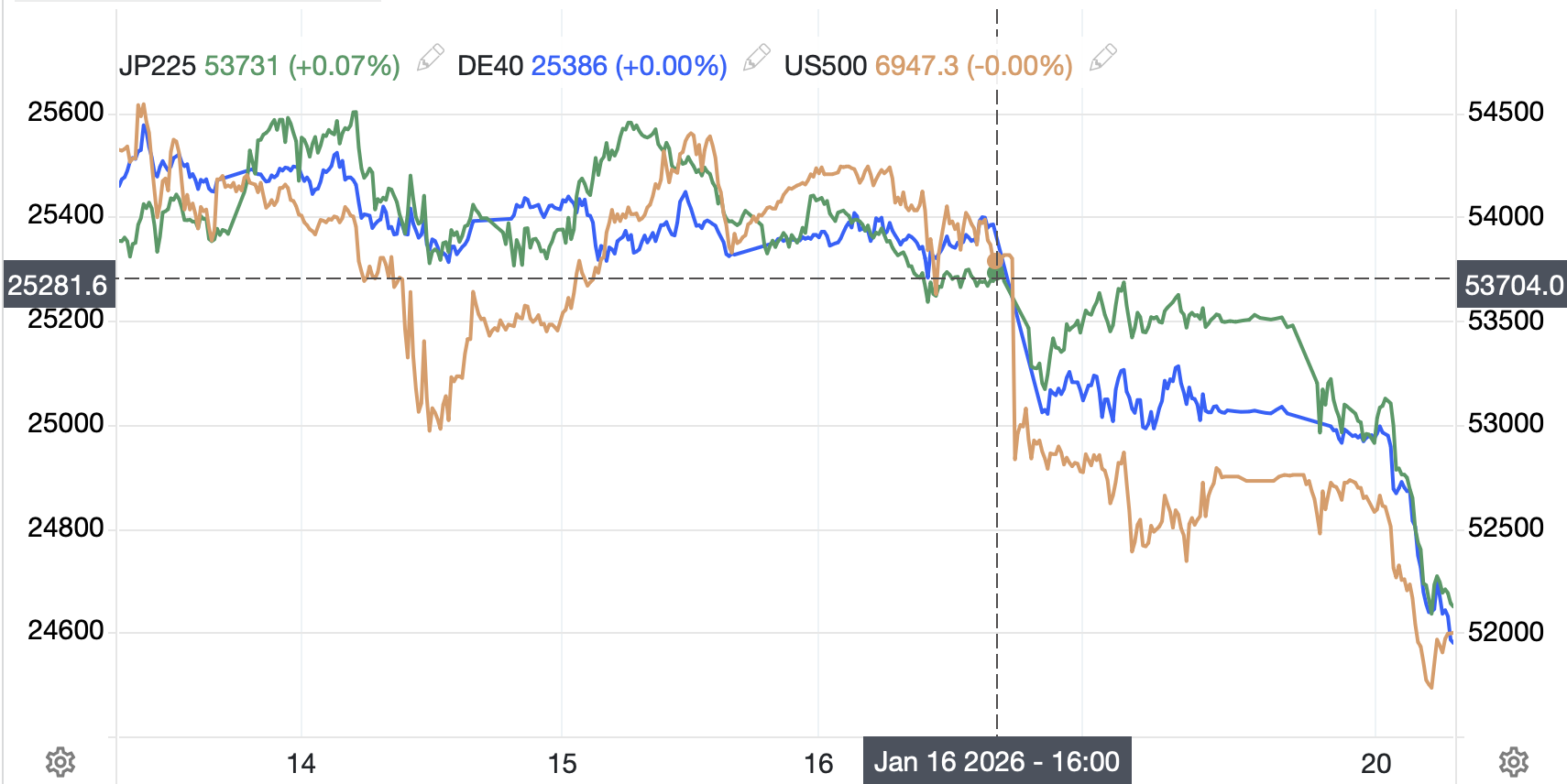
As you can see from the chart below combining the Nikkei 225, the DAX and the S&P 500 futures, the move has been consistent since the close in NY on Friday, with all three main indices lower by between -1.75% (Japan) and -3.1% (Germany), with the US (-2.1%) in the middle.  

Source: tradingeconomics.com

In fact, that price action has been widespread across the rest of the G10 markets and many EMG markets as well. Only China (-0.2% since Friday) has bucked the trend and remains little changed.  Of course, that makes sense given this spat has nothing to do with China, on the surface.  At this point, I expect that all equity markets are going to remain under pressure until there is some resolution.  While Europe has threatened to invoke its Anti-Coercion Instrument on the US if those tariffs come into being, one must wonder will that do more damage to the US or Europe?  FWIW, I expect some type of resolution to be achieved before the Feb 1 deadline but could easily be wrong about that.  One last thing about tariffs; remember last week when expectations were high that the Supreme Court was going to rule on the legality of the ones already imposed?  That has suddenly gone very quiet.  My take there is the longer we don’t hear anything, the more likely they are not going to stop them.

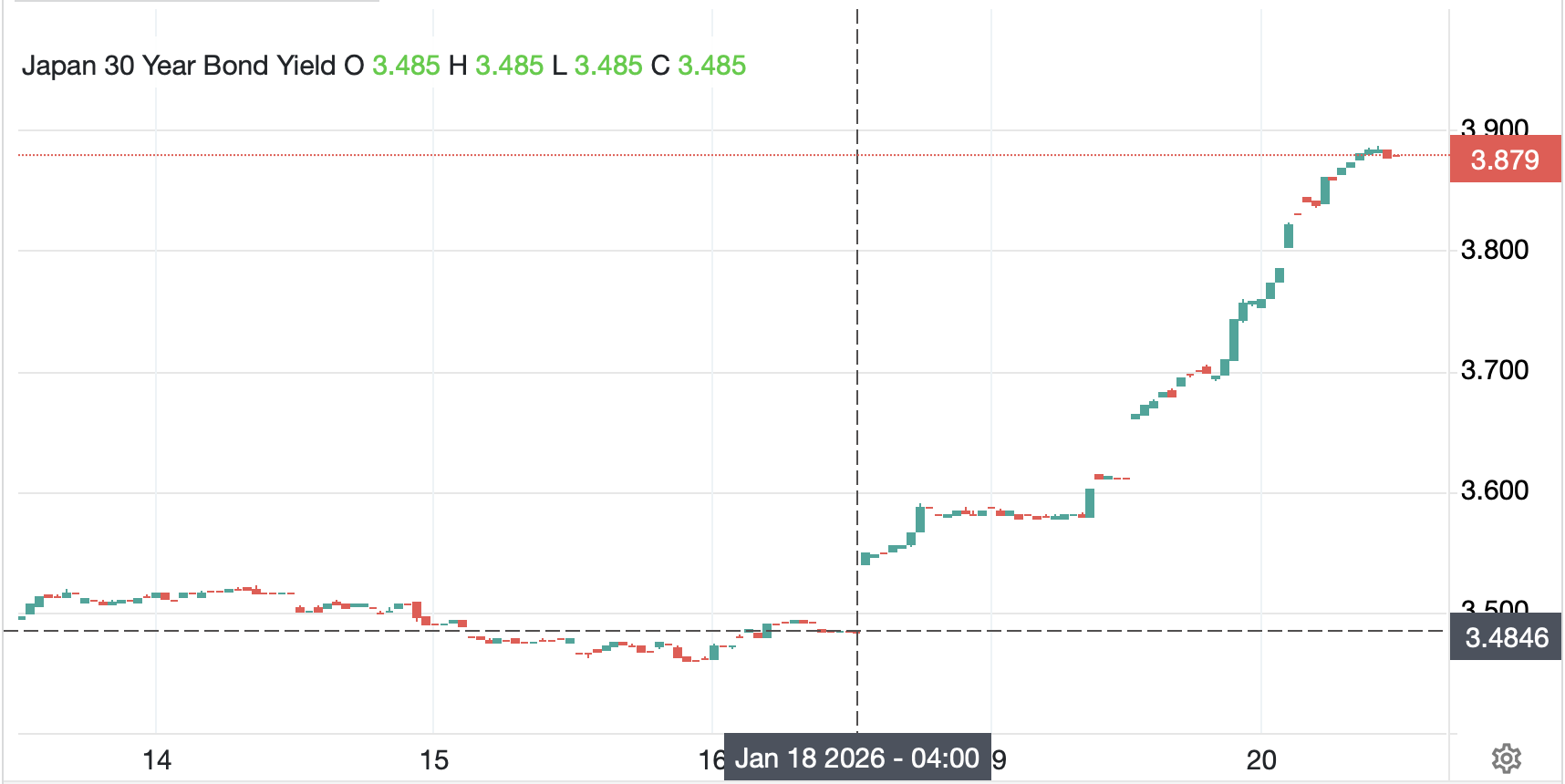
Perhaps, though, the bond market is the more interesting place to look this morning with government bonds around the world getting sold aggressively.  While all eyes have been focused on the US (+6bps and well above the top of the previous range) and Europe (Germany +5bps, UK +7bps, France +6bps) perhaps the real activity is happening in Japan (+9bps).  In fact, Japanese 30yr yields have exploded higher by 40 basis points since Friday’s close, and I’m confident that has nothing to do with Greenland!

Source: tradingeconomics.com

In fact, it appears that JGB holders are getting increasingly concerned that PM Takaichi is going to really run it hot, with more unfunded fiscal stimulus and are responding accordingly.  The latest Takaichi proposal for the upcoming election is that they are going to remove the GST (VAT tax) on food for 2 years to help alleviate inflation problems.  I certainly like that better than capping prices, but fiscally, it’s a tough road to follow.  

One other bond market story that is making the rounds is the idea that Europeans would attack the US by simultaneously unloading their US Treasury holdings.  We have heard this story before with respect to China, and if you look across all of Europe, between central banks and private investors, there are likely upwards of $2 trillion held there.  But the question I ask every time I hear something of this nature is…what will they do with the proceeds if they were somehow able to coordinate the sales?  First, in the worst case, the Fed would buy them to prevent the market from collapsing.  And second, now they would have a whole lot of dollars that need to be invested elsewhere.  Which markets can absorb that amount of flow?  US equities?  Sure, but would that achieve their goals?  I think not.  If they converted them into euros, a one-way flow of $2 trillion into euros in short order would pretty much render all European manufacturing uncompetitive right away as the euro rose to 1.50 or 1.60 or higher.  Gold?  Think $10k/oz or higher.  Ain’t gonna happen.

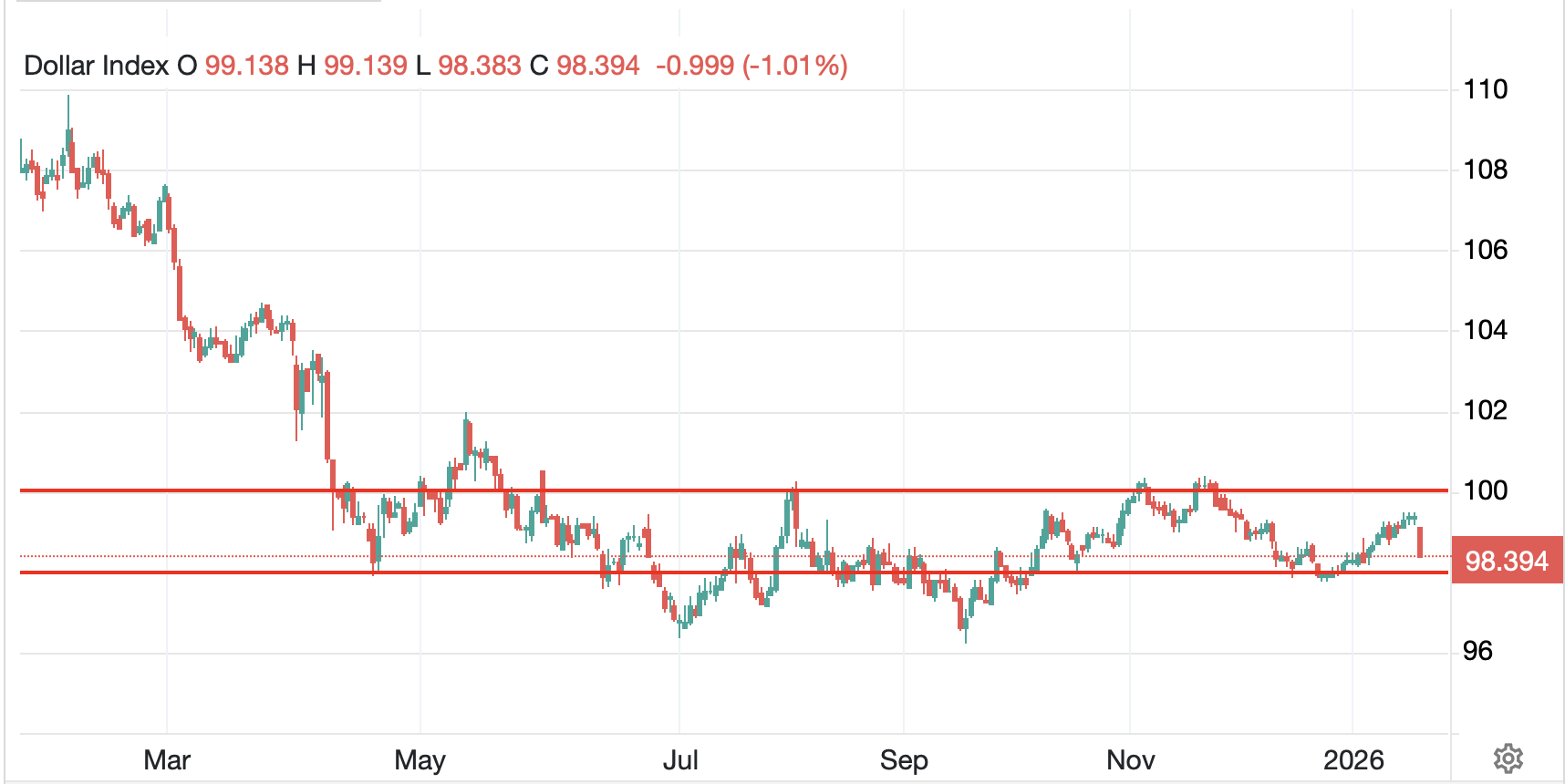
Let’s hit the dollar next, which is under pressure across the board.  As I type (7:20), the DXY has fallen -1.0% this morning, a very large move for that index, but remains within the trading range that we have seen since October.

Source: tradingeconomics.com

The sell-off in the dollar is almost universal, although interestingly, ZAR (-0.5%), MXN (-0.3%) and CLP (-0.3%) are all bucking that trend.  I understand the nervousness, but it strikes me that none of this conversation is a positive for Europe, excepting the idea they sell all their Treasuries and convert the dollars into euros and pounds, an idea I tried to squash above.  

Finally, let’s look at commodities where the metals, as discussed above are soaring while oil (+0.8%) is picking back up off its end of week lows and currently sits just below $60/bbl.  The Iran situation remains murky, at best, and my sense is we have not heard the last of the situation there, although from what I have seen on X, the rioting has been quelled to some extent.  However, I think there is still enormous pressure on the government there and would not be surprised to see some type of US intrusion. 

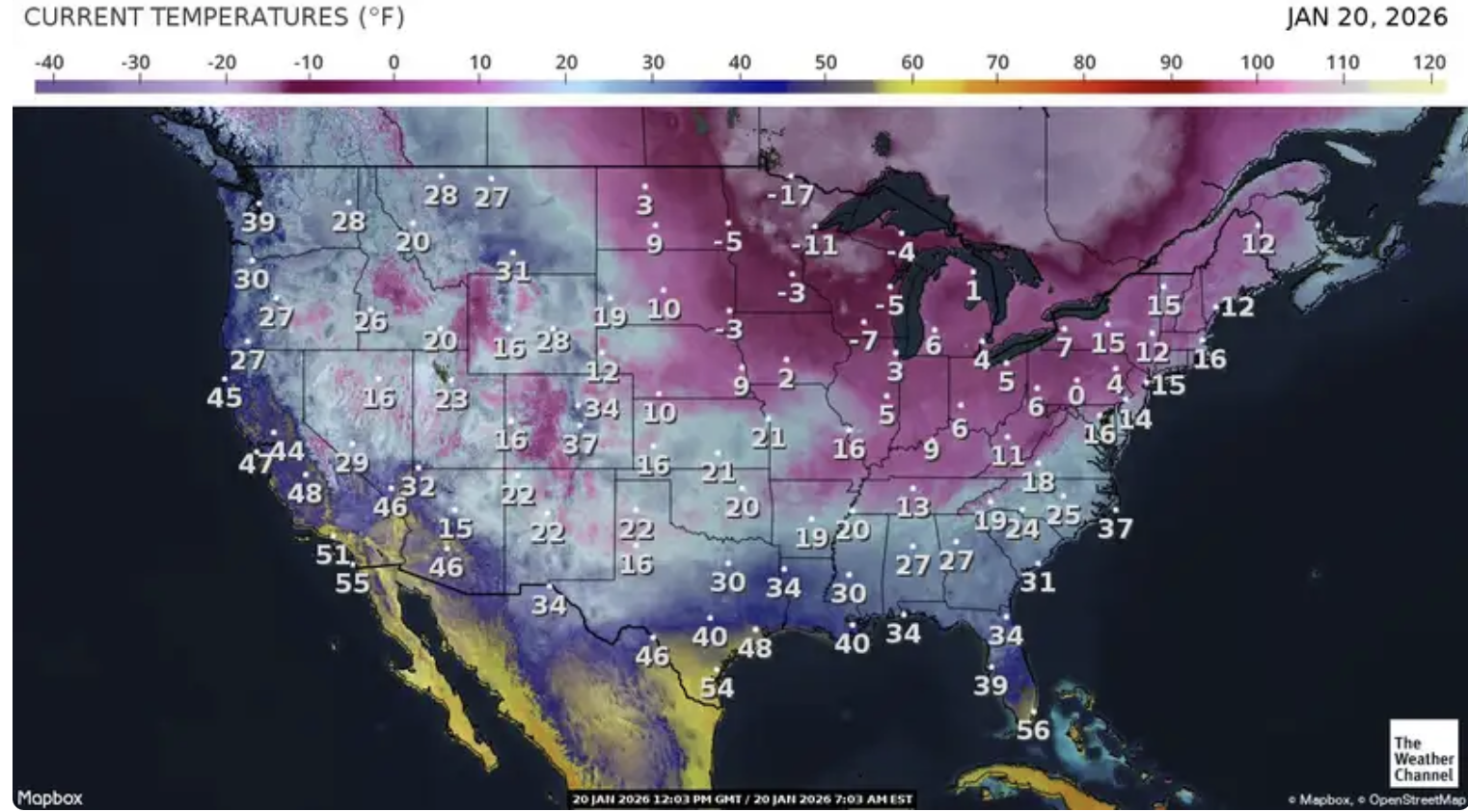
But I’m confident the one thing almost all of you are feeling this morning is the bitter cold that has enveloped most of the US as per the weather.com map below.

Given natural gas is the most common fuel for heating homes, we cannot be surprised that its price has skyrocketed today, jumping 24% in the session so far, although it is now simply back to where it was this time last year.  however, a key issue in this market is Europe, which since they virtually shut off Russian gas, is now highly reliant on US LNG to heat their homes.  It turns out that their storage has fallen to slightly less than 50% of capacity, well below their average storage level for this date of 60% – 65%.  European TTF gas, on a like for like basis, currently costs ~$12.25/MMBtu compared to $3.85/MMBtu in the US, even after the massive jump.  Again, Europe has some issues going forward.

On the data front, there is really nothing today or tomorrow of note although Thursday brings GDP amongst other things.  I will review them tomorrow because, after all, markets right now are far more beholden to President Trump and Europe than to data.

Fear is growing more widespread and will likely continue to do so until there is some type of resolution over Greenland.  But then, it will dissipate quickly as consider, two weeks ago we were all Venezuela experts and today, nobody even cares about that nation anymore!

As to the dollar, I expect that when the resolution arrives, the dollar will make up lost ground, but given we are in the midst of a White House bingo game, one needs to play things close to the vest.  Hedges are crucial here.

Good luck

Adf