Caution and Fear

For Jay and the FOMC
There’s nothing that’s likely to be
Enough to adjust
The often discussed
Reduction in rates, all agree
 
But as we look off to next year
The sitch has become much less clear
The dot plot and SEP
Could very well prep
Investors for caution and fear


*Let me begin by explaining this will be the last poetry for 2024 as I take some time to reflect on the past year as well as my views for 2025.  Come January 2nd, I will offer those views, as I always do, in a long-form poem.  For all of you who have come along for the ride, thank you very much, I sense next year may be even more interesting than the one ending in a few weeks*.

Now, back to our regularly scheduled programming.  To my eye, the ongoing coordinated policy easing by central banks around the world (US, Europe, UK, Canada, China, Switzerland, etc.) feels at odds to the ongoing inflation data that seems to show a reluctance for price rises to slow back to the preferred pace of those same central banks.  Certainly, in the US, as evidenced by both the CPI data Wednesday, and even more so by yesterday’s PPI data, the null hypothesis that the rate of inflation is slowing toward 2% feels as though it is no longer valid.  One needn’t dig too far under the surface to see core and median inflation readings with 3% and 4% handles and given this is almost entirely in the services sector, the sector that encompasses more than two-thirds of the economy, it seems increasingly hard to make the case that inflation is going to decline much further.  This is not to imply we are heading for hyperinflation, just that the slow pace of price increases that existed since the GFC seems to have ended.

At least in the US, the economic growth story appears to be a bit more positive than elsewhere around most of the world, and so the opportunity exists for wages to keep up with prices.  Alas, elsewhere in the world, that is not necessarily the case.  Yesterday, Madame Lagarde and the ECB cut rates by a further 25bps, as universally expected, and the market is looking for another 25bp cut in January.  However, despite what is a clearly slowing growth impulse on the continent, even Lagarde felt it necessary to caution about the sticky services prices in Europe and how they must be careful in their policy decisions to prevent a reemergence of inflation.  Remember, too, the ECB’s sole mandate is price stability, so theoretically, even if Europe falls into recession, it is not the ECB’s task to rescue the economy there.

Perhaps the one place where policy ease is appropriate is China, where the pace of activity in the economy is very clearly slowing.  President Xi and his minions have not yet been able to arrest the decline in the property market there, which given such a large proportion of Chinese GDP growth over the past decade was contingent upon an ever-growing property sector and consistently rising prices, is a problem.  An interesting feature of their recent announcements is that they seem ready to have the central bank lend directly to the government (monetizing debt) to finance activity rather than have the central bank buy bonds from the Chinese banking community (otherwise known as QE).  In fact, arguably the biggest problem in China is that the banking system there is dangerously overleveraged and undercapitalized when taking a true account of bad loans outstanding.  It seems that Xi and friends have figured out it would simply be cheaper to print money and directly give it to the government rather than pass it through a creaking banking system that no longer works.  While this almost certainly is smart policy given the circumstances, it doesn’t speak well of the overall situation there.

(As an aside, can we really be surprised that the Chinese banking system, which is basically an arm of the government’s finance ministry which directed lending to favored companies/industries without any real analysis, is having problems?)

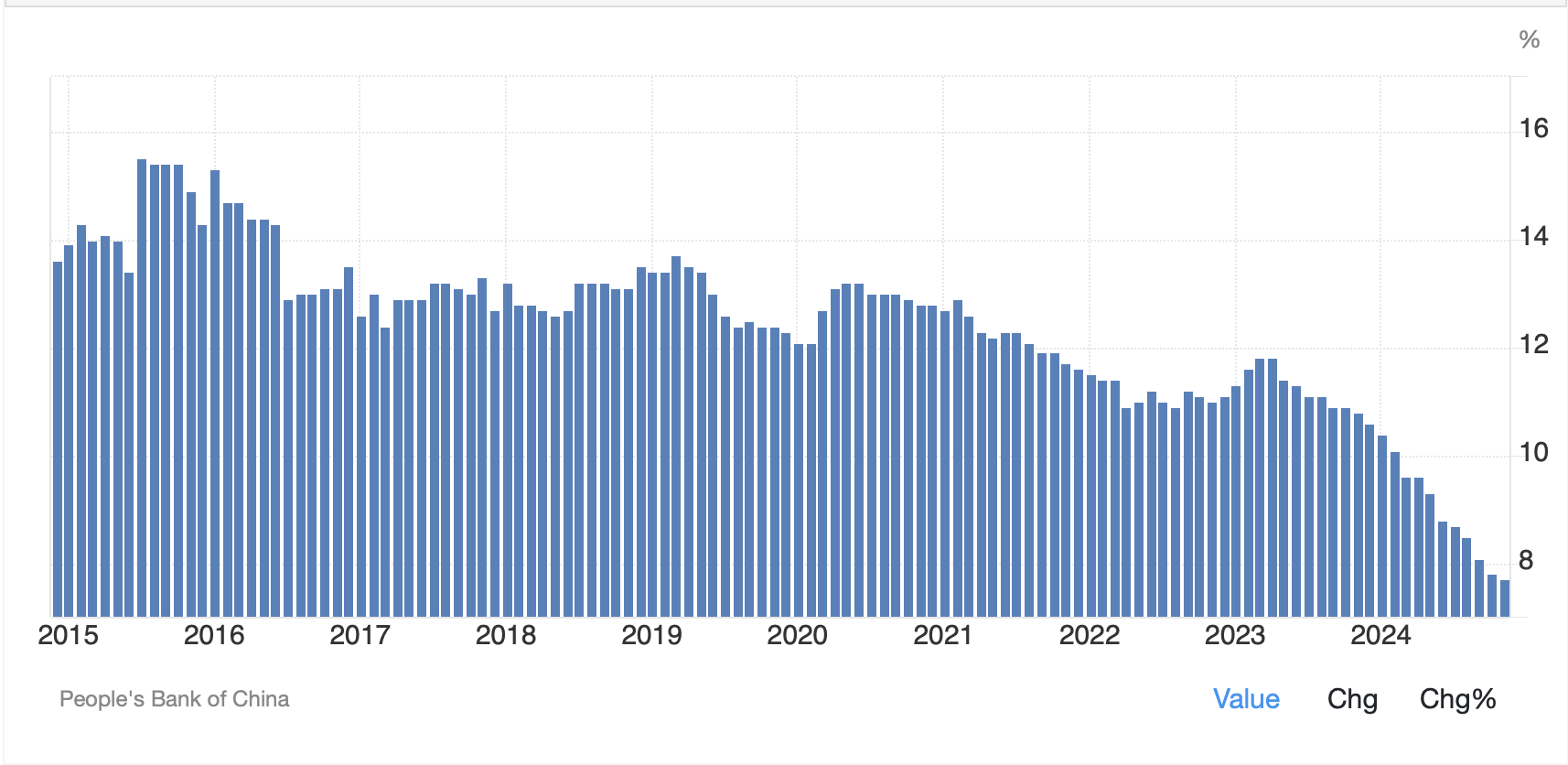
Under the guise, a picture is worth 1000 words, a quick look at the below chart from tradingeconomics.com which shows the trajectory of outstanding Yuan Loan Growth over the past 10 years is pretty descriptive.  Banks in China have lost their ability to help the government implement monetary policy so the government is going to simply do it themselves.  The “moderately loose” policy the Politburo announced seems likely to go beyond moderate as 2025 progresses, at least in this poet’s eyes.
In the end, there are many problems extant in the global economy.  As well, there has been an uptick in overall uncertainty with the election of Donald Trump as US president given his history of sudden, unpredictable pronouncements.  I would contend that the one constant in 2025 and beyond is that volatility is far more likely to increase than decrease across markets everywhere.

Ok, let’s take a quick tour of the overnight activity before my short-term hiatus.  Once again, US equity markets were under modest pressure yesterday as I continue to see more and more pundits calling for a short-term pullback before the next leg higher.  That weakness was followed by Asian markets selling off with China (-2.4%) and Hong Kong (-2.1%) both suffering from ongoing disappointment that the modest loosening wasn’t dramatic loosening!  Interestingly, despite the JPY (-0.55%) weakening further (its 5th consecutive down day) the Nikkei (-1.0%) couldn’t gain any traction, perhaps undercut by concerns over the tech story and rising US rates.  However, both Korea and India put in solid positive sessions.  Clearly Asia is not a monolithic market.  

In Europe this morning, the screens are green, but it is a pale green, with gains on the order of 0.1% to 0.3% only as investors seem to have taken some heart by the ECB’s cut and modest dovish follow up.  Meanwhile, US futures are slightly firmer at this hour (8:00).

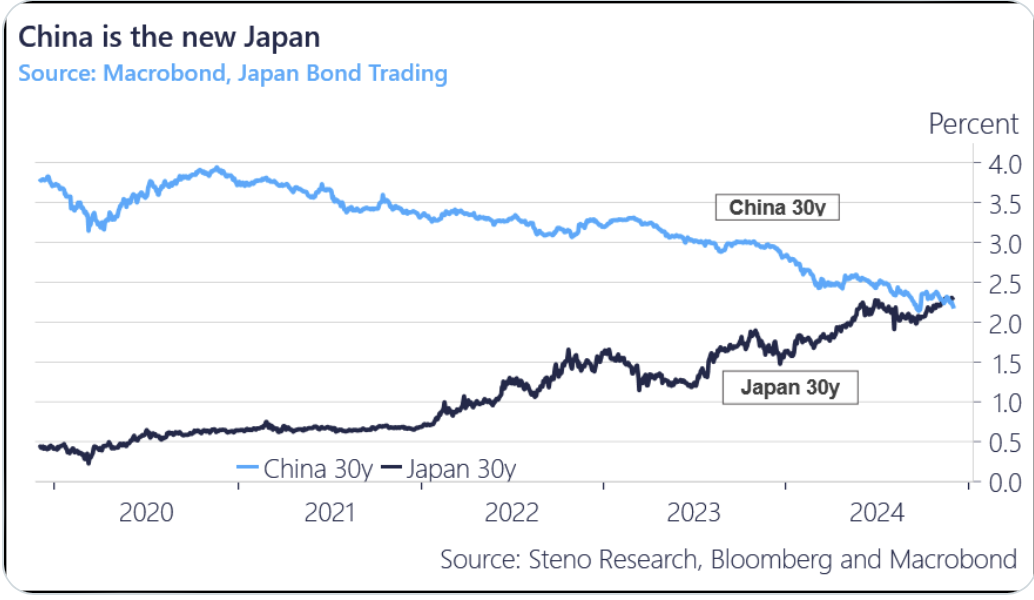
In the bond market, yields continue to climb in the US (Treasuries +2bps) and Europe (Bunds +4bps, OATs +3bps Gilts +2bps) as bond investors are far more circumspect of the ECB cutting rates while inflation lurks in the background.  Chinese yields continue to fall, with the 10-year there hitting a new low of 1.78% and talk now that by the end of 2025, Chinese yields may fall below those in Japan!  Now that would be something, and I suspect the FX markets would see a lot of volatility if that happens.

Oil prices (+0.5%) continue to hold the $70/bbl level with very little impetus after the rally early in the week.  Metals prices, though, are under modest pressure this morning, perhaps on the idea that Chinese demand is going to falter.  After all, if Chinese shares can’t hold up, why would traders believe they will be buying up copper, silver and gold?  All three are lower by about -0.2% this morning.

Finally, the dollar is mixed this morning, having rallied vs. some counterparts like JPY, BRL (-0.75%) and ZAR (-0.55%) while declining vs. the euro (+0.45%), NOK (+0.75%) and the CE4 currencies.  My take is the euro’s rebound, and that of the CE4, is more position related after a sell-off yesterday and given today is Friday, rather than anything fundamental.

There really is no data today and while we do see Retail Sales next Tuesday (exp 0.5%, 0.4% ex autos), I think it’s really all about the Fed next Wednesday.  The market is still pricing 97% probability of a cut, and I don’t see anything changing that.  Rather, the Fed’s dot plot will be the story for markets as the narrative starts to account for higher inflation and therefore, a higher long-term outcome for the neutral rate.

Again, none of this portends a weaker dollar as we head to the end of 2024.  For 2025, you will need to wait for January 2nd to see my views then.

Good luck, good weekend and have a wonderful holiday season

Adf
Tempt the Fates

Inflation just won’t seem to die
No matter what Jay and friends try
Will he tempt the fates
To once more cut rates?
And if so, will bond yields comply?


It took until 1:10pm yesterday for Nick Timiraos at the WSJ to publish his article regarding the fact that Strengthening Inflation Poses Challenge for Trump, Fed.  I find the title of the article interesting as, to the best of my knowledge, Mr Trump has yet to take office and enact any policies.  But I suppose if Chairman Powell doesn’t like Trump (which seems to be the widely held view) he wanted to ensure his mouthpiece took a dig and distracted the audience from Powell’s problems.

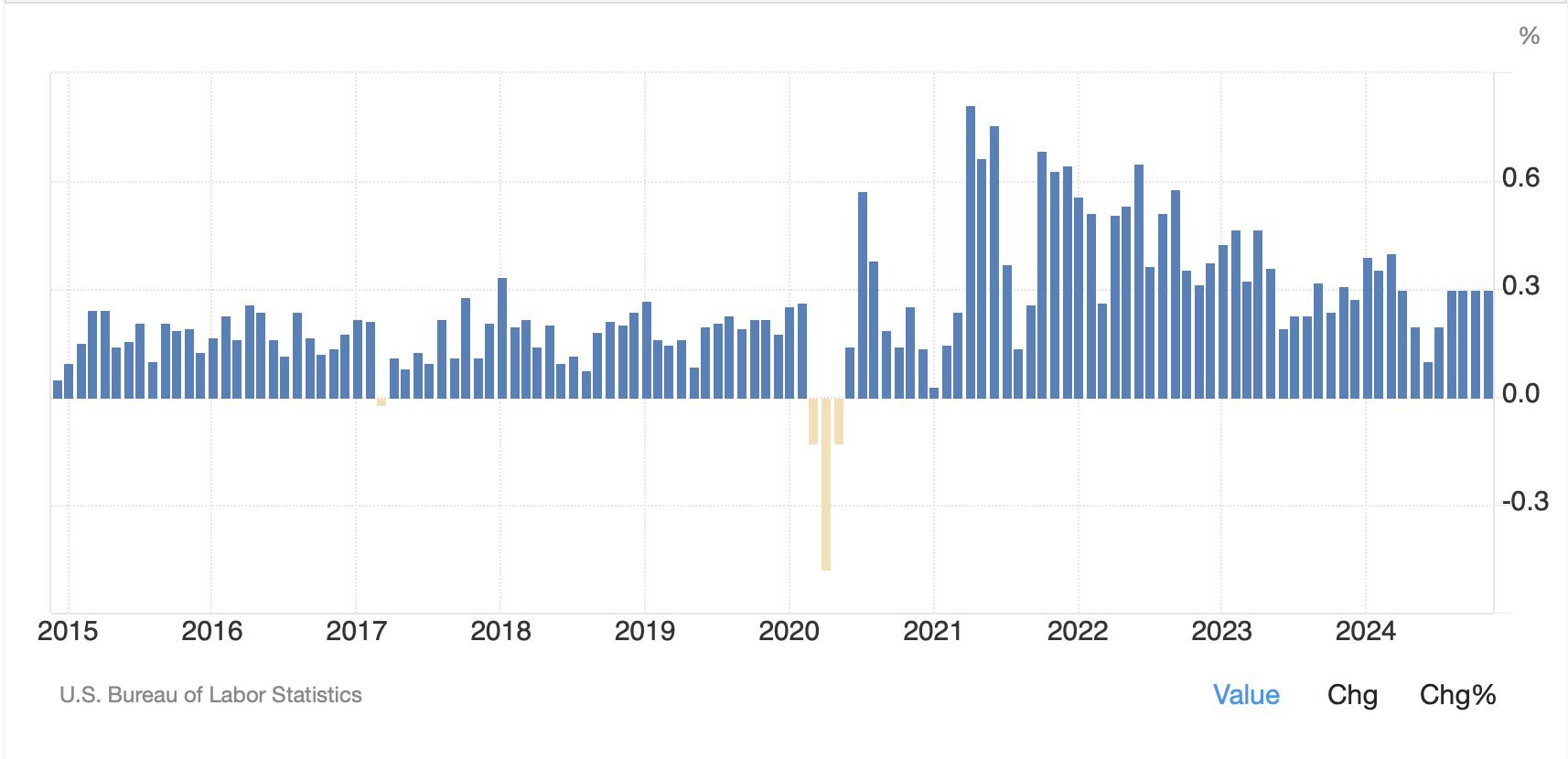
Regardless, yesterday’s CPI report was a bit firmer than forecast, at least at the second decimal place, which is enough for the punditry to discuss.  Of course, it is remarkable that a statistic of this nature is considered down to the second decimal place given the broad uncertainty over its measurement overall.  However,  looking at the chart below, which shows the monthly CPI readings for the past ten years, it is not hard to see that monthly inflation bottomed back in June and appears to be finding a new home at the 0.3% or higher level.  

Source: tradingeconomics.com

I showed the 10-year chart to also highlight that pre-Covid, the monthly readings were somewhere between 0.1% and 0.2% consistently.  My point is that 0.3% per month annualizes to about 3.7% which is as good a guess as any for how inflation is going to play out going forward absent some major fiscal and monetary changes.

Aside from the fact that this is important because we all suffer the consequences in our daily lives, from a markets perspective, I believe this is the money line in the article [emphasis added], “Officials have indicated sticky inflation could lead them to slow the pace of rate reductions or stop altogether.”  Yet, despite this strong hint that the Fed is getting uncomfortable with the market’s current assessment of how much further Fed funds are going to decline, the futures market is pricing a 98.6% probability of a cut next week.  

In fairness, the market is now pricing only two more rate cuts after next week for all of 2025, a number that has been declining slowly over the past month.  But ask yourself how the Fed will behave if their firmly held belief that inflation is still heading toward their 2% goal starts to falter under the weight of continued high readings.  There are a few analysts who are discussing rate hikes for next year for just this reason.  That, my friends, would upset the apple cart!

The central bank theme of the week
Is current rates need quite a tweak
Despite CPI
That’s still on the fly
More havoc, these bankers, will wreak
 
Down Under, though they didn’t cut
The doves’ case was open and shut
The Swiss and Canucks
Made changes, deluxe
While Christine, a quarter, will strut

While we are beginning to see some changes in the market’s perception of the Fed’s future path, those changes are not obvious elsewhere.  So far this week, the RBA left rates on hold, as they had promised, but explained the need to cut was upon them, demonstrating far less concern over inflation than in the past.  You may recall that the AUD fell sharply after the RBA statement put cuts in play going forward.  Then, yesterday, the BOC cut 50bps, as expected, as they, too, have turned their focus to economic activity and away from inflation, which continues above their target.  This morning, the Swiss National Bank surprised the markets with a 50bp cut, taking their base rate back down to 0.50%, expressing concern that inflation was slowing too rapidly and could become a problem.  Finally, shortly the ECB will announce their policy rate with the market highly confident a 25bp cut is on the way, although there are a few looking for 50bps.

The funny thing about all these cuts is that other than Switzerland, where recent CPI readings were at 0.7%, inflation remains above target levels and is demonstrating the same type of behavior as in the US, where it bottomed during the summer and is rebounding.  As well, especially in Europe, unemployment does not appear to be a major problem in these nations.  This begs the question, why are central banks so keen to cut rates if inflation remains sticky above their target levels and economic activity is hanging on?  

I have no good answer for this although I suspect there may be significant pressure from finance ministries regarding the cost of all that government debt that is outstanding and needs to be refinanced.  Alas, even though almost every central bank’s primary mandate is to maintain low inflation, it has become clearer by the day that following that mandate is not seen as important as other concerns.  Whether those concerns are economic activity or financing outstanding debt, or perhaps something else, I fear that we are heading back into a world where higher inflation is going to be the norm everywhere in the world.  Plan accordingly.

Ok, after another couple of record high closes in the US yesterday, let’s see how things have played out ahead of the ECB this morning.  In Asia, both Japan (+1.2%) and China (+1.0%) rallied on the brightening tech outlook, the prospect of further rate cuts and the ongoing hopes for that Chinese bazooka to finally be fired.  As well, Hong Kong (+1.2%) and Korea (+1.6%) also fared well, although the rest of the region was more mixed on much smaller movement.  In Europe, the best description ahead of the ECB is unchanged, with every bourse within 0.1% of Wednesday’s closing levels.  US futures at this hour (7:15) are pointing modestly lower, however, down about -0.2%.

In the bond market, despite all the surety of rate cuts, investors are not comfortable holding duration, and we are seeing yields continue to rise across the board.  Treasury yields are higher by another 3bps and back to 4.30% while European sovereign yields are all higher by between 3bps and 5bps.  It seems the bond markets are not convinced that central banks are behaving properly.  Perhaps the “bond vigilantes” will truly make a return after all.

In the commodity markets, oil (+0.1%) which managed to capture the $70/bl level is holding on this morning after the IEA raised its demand forecast for 2025 based on increased expectations for Chinese demand (because of the stimulus that is expected.). In the metals market, that Chinese stimulus is helping copper (+0.5%) although the precious sector is consolidating yesterday’s gains with gold (-0.3%) backing off slightly and silver unchanged.  However, gold is back above $2700/oz and appears to have finished its consolidation.

Finally, the dollar is mixed this morning, broadly holding onto its recent gains, but seeing some weakness against specific currencies.  For instance, BRL (+1.0%) responded to the fact that the central bank there, bucking the global trend, hiked the Selic rate by 100bps, a quarter point more than expected, as their concern over rising inflation increases.  (It seems they are one of the few central banks that is focused on their job, not the politics!). But away from that outlier move, we see AUD (+0.45%) rising on stronger than expected jobs growth data while NOK (+0.4%) is continuing to benefit from oil’s recent gains.  On the flip side, CHF (-0.35%) is suffering for the larger than expected SNB rate cut and GBP (-0.2%) is under modest pressure as traders debate whether the BOE will cut rates next week or not.

On the data front, Initial (exp 220K) and Continuing (1880K) Claims lead the way alongside PPI (0.2%, 2.6% Y/Y headline, 0.2%, 3.2% Y/Y core) at 8:30 this morning.  Beyond that, there is a 30-year auction this afternoon and that is really it.  I don’t see PPI having a great deal of impact and with CPI behind us, and Timiraos having told us that the Fed is going to slow the pace of cuts, I’m not sure what else there is to watch.  Obviously, this morning’s ECB meeting matters, but really, it is hard to get overly excited about the outcome there.  I suspect that attention will now be focused on the FOMC next week, with much more concern over the dot plot and SEP than the 25bp cut that seems a foregone conclusion.  

If the Fed is truly slowing the pace of cuts, once again, it becomes difficult to see how the dollar will soften vs. its major counterparts. Keep that in mind for now.

Good luck

Adf

A New Denouement

The story is that the Chinese
Will speed up their policy ease
Creating for Yuan
A new denouement
Of currency weakness disease
 
Their problem is that in the past
That weakness could happen too fast
So, how far will Xi
Be willing to see
Renminbi decline at long last?


As we await the US CPI data this morning, the story du jour in markets revolves around the Chinese renminbi and whether President Xi will allow, or encourage, the PBOC to weaken the currency.  Strategically, Xi has made a big deal to the rest of the world that the Chinese currency will remain strong and stable as he seeks other nations to increase their use of the renminbi in commercial transactions as well as a store of value.  I believe part of this is a legitimate goal but that there is also a significant fear underlying these actions as history has shown the Chinese people will flee the currency if it starts to weaken too quickly.  It is the latter issue that has been the primary driver of the PBOC’s efforts to continuously fix the renminbi at stronger than market levels.
 
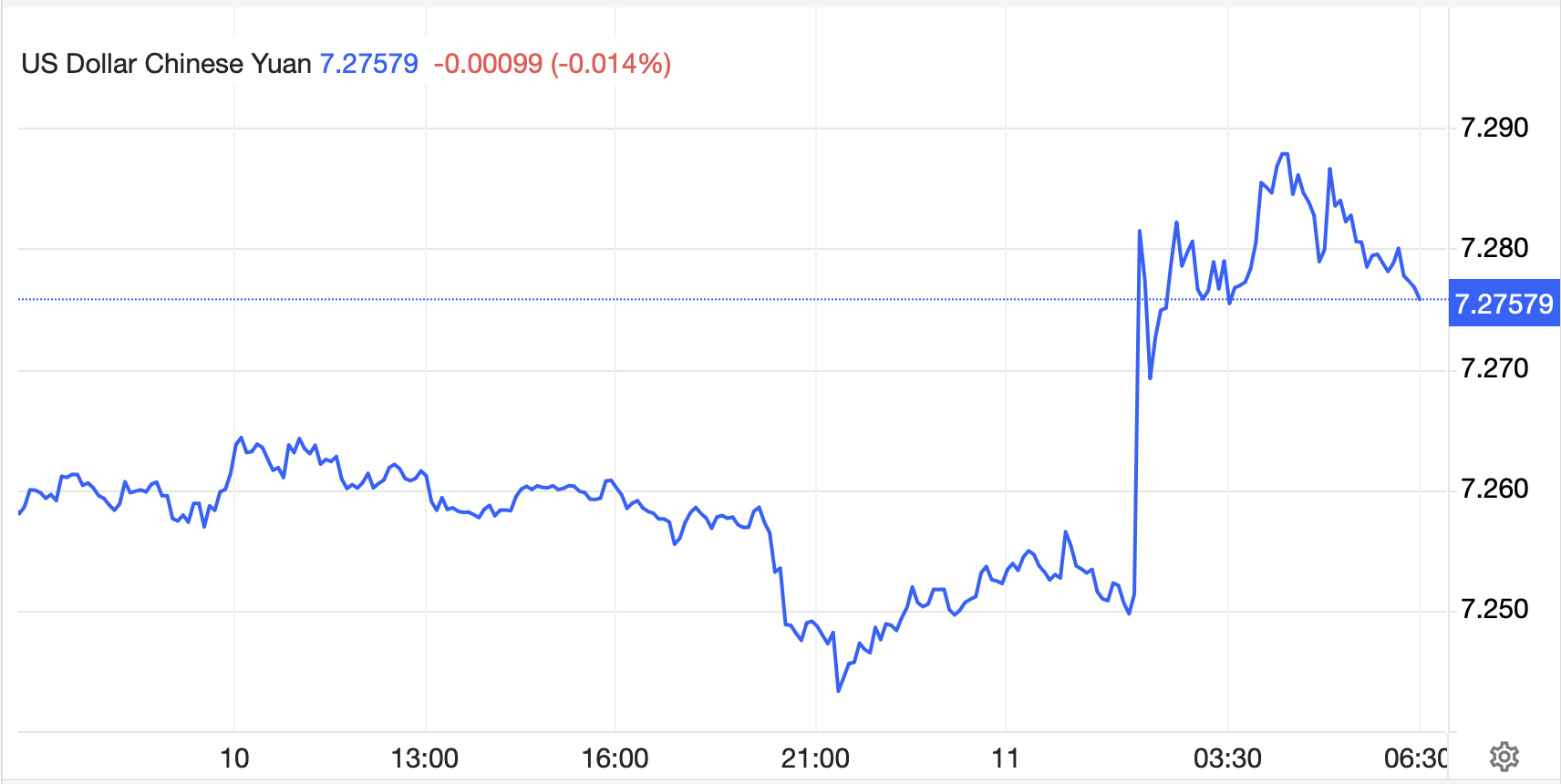
This process worked well enough for the past four years as the Biden administration, while certainly not friendly to China, was not aggressively attacking the nation’s efforts to expand its influence.  However, that situation is about to change with the Trump administration and as Mr Trump has already threatened numerous new tariffs on various parts of China’s production economy, Xi’s calculus must change.  This puts Xi in a difficult situation; allow the currency to weaken more aggressively to offset the impact of any tariffs and suffer through capital flight or maintain the renminbi’s value and see exports decline along with overall economic activity.  It is easy to see in the chart below when the story about allowing a weaker currency hit the tape.  However, there is not nearly enough information to take a longer-term view on the subject.


Source: tradingeconomics.com

One other thing to remember is that Chinese interest rates are continuing to decline with 10-year yields trading to yet another new low last night at 1.88%.  As the spread between US and Chinese yields continues to widen, by itself that will put pressure on the renminbi to decline.  The problem for Xi is that no matter the control the PBOC has over the FX markets in China, now that there is an offshore market, if the Chinese people become concerned over the value of the renminbi, it has the ability to decline far more quickly than the government would want to allow.

For those of you with Chinese assets on your balance sheet or Chinese denominated revenues, I would be looking to maximize my hedges for now.  As an aside, there were a number of forecast changes by major banks overnight with many calls for USDCNY to reach 7.50 or higher by the end of next year now.

The market’s convinced
A rate hike is on the way
Why won’t the yen rise?

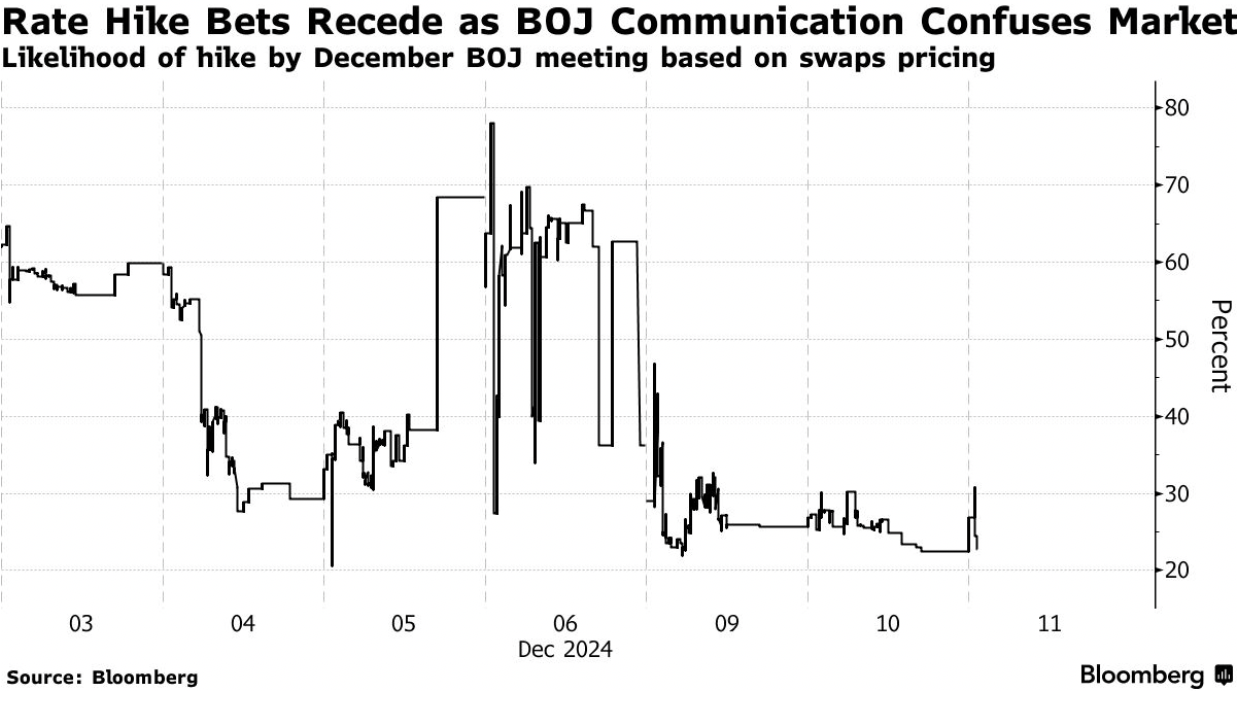
The other story overnight focused on Japan, or more precisely the BOJ meeting to be held in one week’s time.  It seems that there is a lot of dissent amongst the analyst community regarding whether or not the BOJ will hike rates.  As an example of how thin all the analyst gruel really is, one of the key rationales for the belief in a rate hike was that last week, Toyoaki Nakamura, perceived as the most dovish BOJ board member, indicated he didn’t object to a rate hike, although wanted to see more data before declaring one was appropriate for December.  However, just last night the BOJ added a speech and press briefing to their calendar for Deputy Governor Ryozo Himino right before the January meeting.  This has the punditry now expecting the BOJ to wait until then rather than move next week.  The below chart shows the change in the market’s expectations for a rate hike over the past week.

As I said, the tea leaves that the punditry are reading really don’t say very much at all.  Perhaps we can look at the economic data to get a sense.  Over the past month, we have seen CPI for both the nation and Tokyo print higher than forecast and continue to slowly climb.  As well, PPI printed higher and GDP continues to grow, albeit at a modest pace.  Of greater concern is that earnings data is lagging the CPI data.  

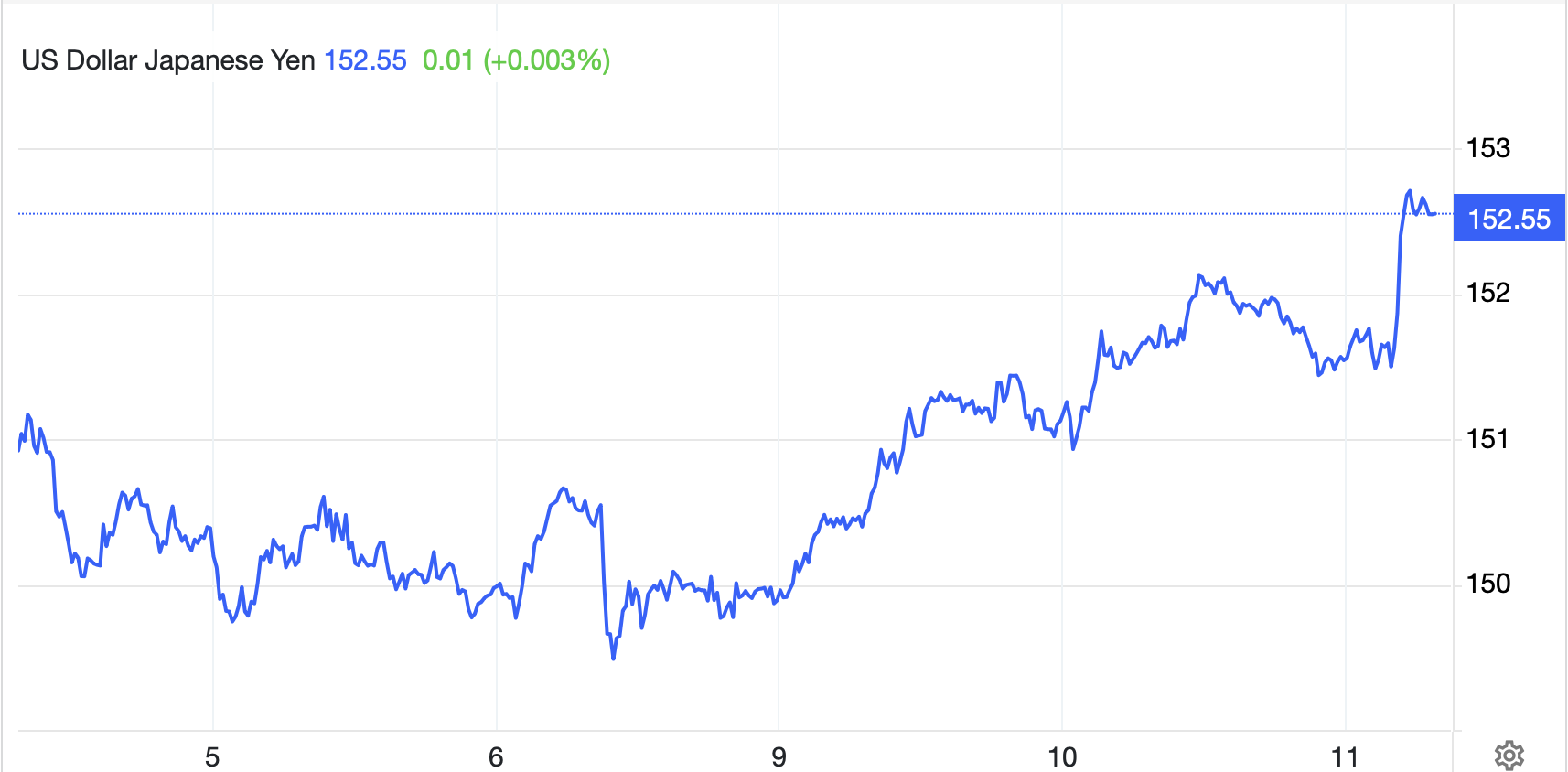
A look at the FX market would indicate that traders are losing their taste for a rate hike next week, at least as evidenced by the yen’s recent weakness.  As you can see in the past week, it has slipped nearly 2%, hardly a sign that higher Japanese rates are expected.  But something that is not getting much press is the potential Trump impact, where the incoming president would like to see the yen, specifically, strengthen as it is truly historically undervalued.  FWIW, which is probably not that much, I am in the rate hike camp for next week and expect the yen will find some support soon.

Source: tradingeconomics.com

Ok, enough Asian currency talk.  Let’s see how everything else behaved ahead of this morning’s data.  Yesterday’s modest US equity declines were followed by virtually no movement in Japanese shares although most of the rest of Asia followed the US lower.  Hong Kong (-0.8%) and Taiwan (-1.0%) were the worst performers and the one outlier the other way was Korea (+1.0%) as the KOSPI continues to recoup the losses made after the martial law fiasco.  European bourses are mostly little changed on the day with Spain’s IBEX (-1.1%) the lone exception which has been negatively impacted by Q3 results from Inditex (the parent company of Zara).  As to US futures, at this hour (7:25) they are little changed.

In the bond market, yields continue to edge higher in Treasuries (+2bps) and European sovereigns with gains on the order of 1bp to 2bps across the board.  While there is some discussion regarding fiscal questions in Europe, ultimately, nothing has broken the connection between US and European yields, and I would contend they are all awaiting this morning’s CPI.

In the commodity markets, oil (+1.4%) is rebounding although remains below $70/bbl, which seems to be a trading pivot for now.  The China stimulus story remains the key in the market with a growing belief that if China does successfully stimulate, oil demand will increase.  Meanwhile in the metals markets, gold is unchanged this morning after another nice rally yesterday while both silver and copper are under modest pressure.  I would contend, however, that the trend for all metals remains slightly upward.

Finally, the dollar is firmer against virtually all its counterparts this morning with most G10 currencies softer on the order of -0.3% or so although CAD and CHF are little changed on the session.  In the EMG bloc, KRW (+0.3%) is rebounding alongside the KOSPI as the excesses from the martial law story last week continue to be unwound, but elsewhere in the bloc, modest weakness, between -0.2% and -0.4%, is the rule.  However, this is all dollar focused today.

On the data front, it is worth noting that yesterday’s NFIB Small Business Optimism Index shot higher in November in the wake of the election results, heading back toward its long-term average just above 100.  As to this morning, forecasts for Headline (exp 0.3%, 2.7% Y/Y) and Core (0.3%, 3.3% Y/Y) CPI continue to indicate that the Fed may be overstating the case in their belief that inflation pressures are ebbing.  Rather, I continue to believe that we have seen the bottom in the rate of inflation and a gradual increase is in our future.  Two other things of note are the BOC rate decision (exp 50bps cut) this morning and then the Brazilian Central Bank rate decision (exp 75bp HIKE) this afternoon.  The latter is clearly an attempt to rein in the BRL’s recent dramatic decline.

With no Fed speakers, if the data this morning is significantly different than expectations, I would look for the Fed Whisperer, Nick Timiraos, to publish something before the end of the day in order to get the Fed’s latest views into the market.  Absent that, nothing has gotten in the way of the higher dollar at this stage so stay sharp.

Good luck

Adf

Just Won’t Evanesce

The RBA left rates on hold
And sounded quite dovish, all told
Meanwhile in Brazil
Old Lula is ill
With something much worse than a cold
 
In Syria, things are a mess
In Taipei they’re feeling some stress
With all this unfolding
It’s no shock beholding
Risk assets just won’t evanesce


Risk is the topic du jour as pretty much everywhere one looks around the world, things are afoot that can inculcate fear (and loathing) rather than embrace those animal spirits.  Perhaps the least frightful, but most directly impactful regarding markets, was the RBA meeting last night at which the committee left rates on hold, as universally expected, but appeared to turn (finally) to the dovish side of the ledger.  The policy statement explained, “Some of the upside risks to inflation appear to have eased and while the level of aggregate demand still appears to be above the economy’s supply capacity, that gap continues to close.  The board is gaining some confidence that inflation is moving sustainably toward target.”   However, the proof is in the pudding and a quick look at the AUD (-0.7%) shows that the market has come to believe the RBA is finally joining the central bank rate cutting party.

Source: tradingeconomics.com

The trend seems pretty clear and it is hard to make a case for a reversal absent a massive spike in inflation Down Under forcing the RBA to change direction or something coming from the US focusing on weakening the USD, but given nothing like that seems likely until Mr Trump is officially in office, I am concerned that the Aussie dog will live up to its nickname and make new lows going forward, perhaps testing 0.6000 before this is over.

Speaking of currencies under pressure, elsewhere in the Southern Hemisphere we find the Brazilian real which has fallen to new historic lows, with the dollar now trading above 6.08.  For those of you who hate to pay away the points in USDBRL to hedge your balance sheet assets, the reason that you need to do it is very evident from the chart below.

Source: tradingeconomics.com

While there were several short-term dips in the dollar during the past year, the spot rate (at which you remeasure your balance sheet each month) moved from 4.92 to 6.08 in 12 months, nearly a 24% decline in the real.  A one-year forward would have cost far less, something like 40-45 big figures, or less than half the actual move, and would have given you certainty as to the cost.  Hedging matters!

Now, why, you may ask is this happening?  Well, news that Brazilian president Lula da Silva had emergency brain surgery has clearly not helped the currency.  Suddenly there are many questions over who is running the country and how they will address the ongoing fiscal issues that are extant.  As an aside, this is likely another deterrent to the idea of a BRICS currency appearing any time soon, if ever.

Turning our gaze elsewhere, the situation in Syria continues to unfold with no clear outcome although increased concerns over what will happen with the beleaguered people of that nation and whether it will foment yet another immigration wave into Europe and elsewhere in the Middle East.  However, right now, the oil market remains nonplussed over this issue as evidenced by yet another day of quiet trading and a slow drift lower in the price (-0.55%).

However, we cannot ignore Taiwan, where China is currently in the process of military maneuvers that appear to be simulating a naval blockade of the nation.  Price action here has shown the TWD (-0.4%) sliding further and pushing back toward its weakest level in more than 15 years (since the GFC), while the TAIEX stock index (-0.65%) is also feeling a little heat, although the story there has been one of consistent gains over the past several years, following the NASDAQ higher given the breadth of technology companies there, notably TSMC.

Putting it all together leaves one wanting with respect to their risk appetite this morning as today seems like another step closer to that Fourth Turning.  So, it should be no surprise that after a down day yesterday in the US, with all three major equity indices declining, we have seen far more red than green on the screens overnight.  The exception to this rule was in Korea, where the KOSPI (+2.4%) rose sharply as it appears that things are starting to revert to more normalcy there politically.  President Yoon is under pressure to resign and seems likely to be impeached and the government is back to functioning in more of its ordinary manner.  But elsewhere in Asia, Hong Kong (-0.5%), Australia (-0.5%) and most of the smaller regional bourses were lower although the Nikkei (+0.5%) rallied on the back of the yen’s renewed weakness, and mainland Chinese shares (+0.7%) seemed to begin to believe that more stimulus is, in fact, on its way.  We shall see about that.

In Europe, the bourses range from flat (DAX, IBEX) to down CAC (-0.5%), FTSE 100 (-0.5%) with both these nations suffering from their own political distress.  French President Macron is trying to form a government but categorically refuses to include Marine Le Pen’s RN party so has no chance of a majority with concerns growing over the fiscal situation there.  Apparently, if they cannot get a financing bill passed, the French will get to experience the heretofore unique American experience of a government shutdown.  Meanwhile, PM Starmer is watching his ratings circle the drain as his government continues to try to raise revenues by raising taxes on the rich and finding out that one thing rich people are really good at is creating new methods of operations to avoid paying higher taxes.  While there is no vote necessary in the UK for years (remember, Starmer won election just this past July 4th) it certainly feels like his government is going to fall sooner rather than later.  Meanwhile, US futures are little changed at this hour (7:30).

In the bond market, yields are rebounding with Treasuries higher by 3bps this morning after a 3bp rally yesterday.  In Europe, there is very little change except for UK Gilts (+4bps) with concerns over inflation rising there while in Asia, Australian yields slipped 6bps on the dovish RBA.  Generally speaking, the bond market has not been very exciting lately which is one reason, I believe, that things have not fallen apart.  If we start to see more volatility here, watch out.

In the commodity markets, aside from oil’s modest decline, gold (+0.65%) continues to find support in this risk-off scenario although both copper and silver are little changed this morning after solid rallies yesterday.

Finally, the dollar is higher again this morning, with the DXY well back above 106.00 and every G10 currency declining led by NZD (-1.0%).  This is suffering from the RBA’s dovishness which is expected to allow the RBNZ to maintain, or even increase, its own dovishness.  But the whole bloc is softer.  In the EMG bloc, there are a few currencies that are holding their own vs. the dollar this morning, but only just, with MXN (+0.2%) arguably the strongest currency around while CNY (+0.1%) is also relatively strong.  But elsewhere in this bloc, ZAR (-0.7%), PLN (-0.55%), and CLP (-0.4%) are indicative of the type of price action we are seeing across the board.  This is a dollar day, though, not really focusing on individual currency foibles.

On the data front, we see only Nonfarm Productivity (exp 2.2%) and Unit Labor Costs (1.5%) and that is really it.  There was nothing yesterday and all eyes are truthfully turned toward tomorrow’s CPI data.  Things don’t feel very positive right now, so I expect risk to remain on its back foot to start the day.  However, given the number of uncertain situations that abound, anything can happen to either change that view or reinforce it.  Once again, this is why you hedge, to mitigate the markets’ inherent volatility.

Good luck

Adf

All Goes to Hell

The Turning is coming much faster
Than forecast by every forecaster
Now Syria’s fallen
And pundits are all in
Iran will soon be a disaster
 
However, the impact on trading
Is naught, with no pundits persuading
Investors to sell
As all goes to hell
Is narrative power now fading?


The suddenness of the collapse of Bashar Al-Assad’s control of Syria was stunning, essentially happening in on week, maybe less.  But it has happened, and it appears that there are going to be long-running ramifications from this event.  At the very least, the Middle East power structure has changed dramatically as Russia and Iran both abandoned someone who had been a key ally in their networks.  Russia is clearly otherwise occupied and did not have the wherewithal to help Assad, but it is certainly more interesting that Iran did not step up.  Rumors are that the government there is growing concerned that an uprising is coming that may change the Middle East even more dramatically.

I have previously discussed the idea of the Fourth Turning when events arise that shake up the status quo, and this is proof positive that Messrs. Howe and Strauss were onto something when they published their book back in 1997.  The thing is, even those who believed the idea and did their homework on the timing of events have been caught out by the speed of recent activities.  Most of the punditry in this camp, present poet included, didn’t expect things to become unruly until much closer to the end of the decade.  And maybe it will be the case that the collapse of Syria is just an appetizer to a much larger conflagration.  (I sincerely hope not!). But my take is these events were not on many bingo cards, certainly not in the financial punditry world.

Now, the humanitarian situation in Syria has been a disaster for the past 13 years, ever since the civil war there really took shape and fomented the European migration crisis.  Alas, it seems likely to worsen for the unfortunate souls who still live there.  But for our purposes, the question at hand is will this have an impact on markets?

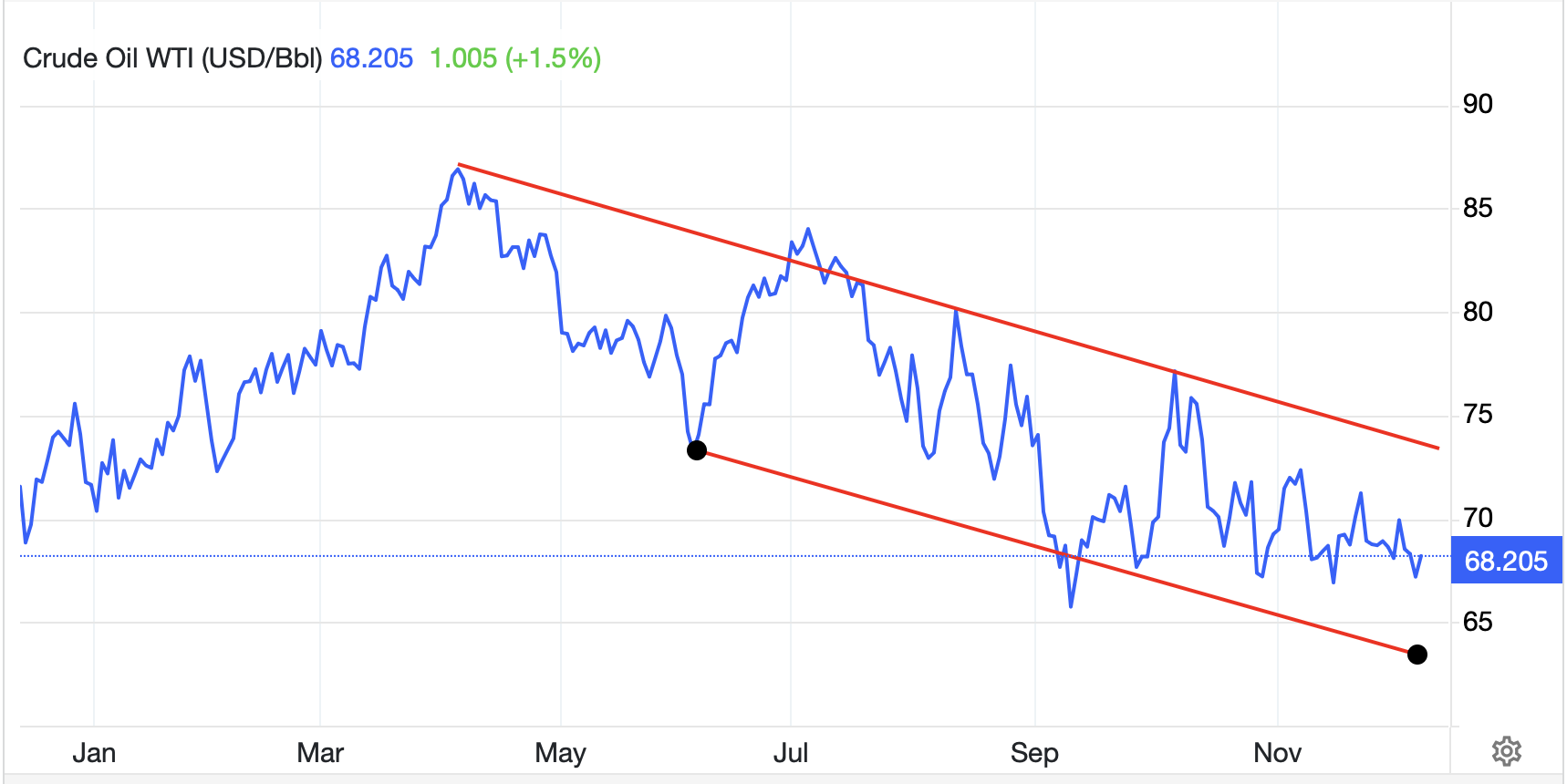
Interestingly, the answer, so far, is none whatsoever.  The obvious first concern would be in oil markets given the proximity to the major oil producing regions in that part of the world.  However, while oil (+1.4%) is a bit higher this morning, it remains well below $70/bbl and while I am no technical analyst, certainly appears to be well within a downtrend as per the below chart.

Source: tradingeconomics.com

Next on our list would be the FX markets, perhaps with expectations that haven currencies would be in demand.  Yet, the dollar is sliding against most of its counterparts this morning, with the notable exception of the yen (-0.3%) which is the one currency under more pressure.  That is the exact opposite behavior of a market that is demonstrating concern over future disruptions.  As to securities markets, they are much further removed from the situation and while US futures are edging lower at this hour (6:20), slipping about -0.15%, overnight activity showed no major concerns and European bourses are mixed, but all within 0.3% of Friday’s closing levels.  

Finally, bond markets are essentially unchanged this morning, with Treasury yields higher by 1bp and European sovereigns almost all unchanged on the day.  We did see yields slip a few bps in Asia, likely on the back of the weaker than forecast Chinese inflation data, but the bond market is certainly showing no signs of concern over the geopolitics of the moment.

On Sunday the Chinese did meet
And promised they’d finally complete
Their stimulus drive
And therefore revive
The growth that has been in retreat

A story that has had an impact on markets this morning is the Chinese Politburo’s comments that they are going to implement a “more proactive” fiscal policy in the upcoming year along with “moderately loose” monetary policy as President Xi scrambles to both improve the growth impulse and prepare for whatever President-elect Trump has in store for China once he is inaugurated.  Now, we have heard these words before and to date, each effort has been, at the very least, disappointing, if not irrelevant.  But hope is a trader’s constant companion and so once again we saw specific markets respond to the news.

Interestingly, mainland Chinese shares did not respond as enthusiastically as one might have expected with the CSI 300 actually slipping -0.2%.  But the Hang Seng (+2.75%) embraced the news warmly.  In the FX markets, early weakness in CNY was reversed although the renminbi closed the onshore session essentially unchanged on the day.  The big winners were AUD (+0.9%) and NZD (+0.5%) as traders bid up the currencies of the two nations likely to benefit most given their export profiles of commodities to China.  But beyond those market moves; it is hard to make a case that anyone was listening.

Ok, let’s look at the rest of the overnight session and see what we can anticipate in the week ahead. Japanese shares (Nikkei +0.2%) were little changed overnight while the big mover in Asia was Korea (-2.8%) as the ructions from the brief interlude of martial law last week continue to weigh on the short-term future of the government and economy there.  However, away from those markets, the rest of Asia saw movement of just +/- 0.3% or less, hardly newsworthy.  In Europe, the story is also mixed with the CAC (+0.5%) leading the way higher, perhaps on the back of the successful reopening of the Notre Dame cathedral, or more likely on the back of hopes that the luxury goods sector would improve based on Chinese stimulus supporting that economy.  As to the rest of the continent, more laggards than winners but movement has been small, 0.2% or less, although the FTSE 100 (+0.4%) is also higher this morning led by the mining shares in the index, also related to Chinese stimulus.

We have already discussed the bond market, which has been extremely quiet ahead of this week’s CPI and next week’s FOMC meeting so let’s turn to the commodity markets, where not only is oil rallying, perhaps more related to China than the Middle East, but we are seeing metals markets rally as well with both precious (Au +0.9%, Ag +2.2%) and industrial (Cu +1.6%, Zn +2.0%) performing well.  Surprisingly, aluminum (-0.25%) is not playing along this morning but if the China story is real, it should follow suit.

Finally, the rest of the currency story shows KRW (-0.5%) continuing to feel the pain, along with its stock market, from the politics last week.  At the same time, we are seeing solid gains in ZAR (+1.1%) on the metals moves and NOK (+0.4%) on the back of oil’s rally.  Elsewhere, while the dollar is broadly softer, it is of a much lesser magnitude, maybe 0.2% or so.

On the data front, this week brings two central banks (BOC and ECB) and a bunch of stuff, although CPI on Wednesday will be the most impactful.

TuesdayNFIB Small Biz Optimism94.2
 Nonfarm Productivity2.2%
 Unit Labor Costs1.9%
WednesdayCPI0.2% (2.7% Y/Y)
 -ex food & energy0.3% (3.3% Y/Y)
 BOC Meeting3.25% (current 3.75%)
ThursdayECB meeting3.0% (current 3.25%)
 Initial Claims220K
 Continuing Claims1870K
 PPI0.3% (2.6% Y/Y)
 -ex food & energy0.2% (3.3% Y/Y)

Source: tradingeconomics.com

Last week saw what appeared to be stronger payroll data on the surface, with the NFP rising 227K and upward revisions, while the Unemployment Rate rose the expected 1 tick to 4.2%.  As well, Average Hourly Earnings rose more than expected, to 4.0%.  And yet, the Fed funds futures market raised the probability of a rate cut next week to 87% (it was over 90% for a while in the session).  Now, there has been a group of analysts who have been claiming that the headline payroll data is very misleading and actually the jobs market is much weaker than the administration is portraying, and it seems they got a bit more traction in their case last week.  Nonetheless, it is hard for me to look at the data and justify another rate cut by the Fed, at least if their objective is to push inflation back to 2.0%.  Of course, that is another question entirely!

Mercifully, the Fed is in their quiet period so we will not hear from them until they pronounce things at the FOMC meeting a week from Wednesday.  Until then, I expect that the China story, as well as assorted Trump related stories, will drive things although keep a wary eye on the Middle East for anything more explosive.  As to the dollar, I have consistently explained that if the Fed eases in the face of rising inflation, that will undermine the greenback.  It will be very interesting to see how things play out this week and next as a set-up for 2025.  For now, I don’t see a good reason for a large move, but if I were a hedger, I would make sure that I am as hedged as I am allowed to be.

Good luck

Adf

Boom and Bust

According to people we “trust”
The past which involved boom and bust
Will stay in the past
And now, at long last
The owning of stocks is a must
 
So, whether today’s NFP
Is weak or strong, what we foresee
Can best be expressed
By buying the best
That BlackRock will sell for a fee


Is it different this time?  Have stocks reached a “permanently high plateau”?  Has the global economy exited the cycle of ‘boom and bust’ which has existed since the beginning?  These questions are relevant today after the release of BlackRock’s 2025 Global Outlook which explained that “Historical trends are being permanently broken in real time as mega forces, like the rise of artificial intelligence (AI), transform economies.”

BlackRock’s claim is simply the latest by a well-known investor that stock prices will never retreat again, and the future is unbelievably bright.  “This time is different” has been said about virtually every bull market top, whether the real estate bubble, the tech bubble, the Japanese bubble, the Chinese real estate bubble or even the South Seas bubble hundreds of years ago.  In fact, in order to inflate a bubble, the narrative must be, this time is different.

That permanently high plateau comment came from Irving Fisher, who while a very well-respected economist for his work on debt deflation (which came after the Depression started), famously made that comment on October 21, 1929, just days before the crash that led to the Great Depression.

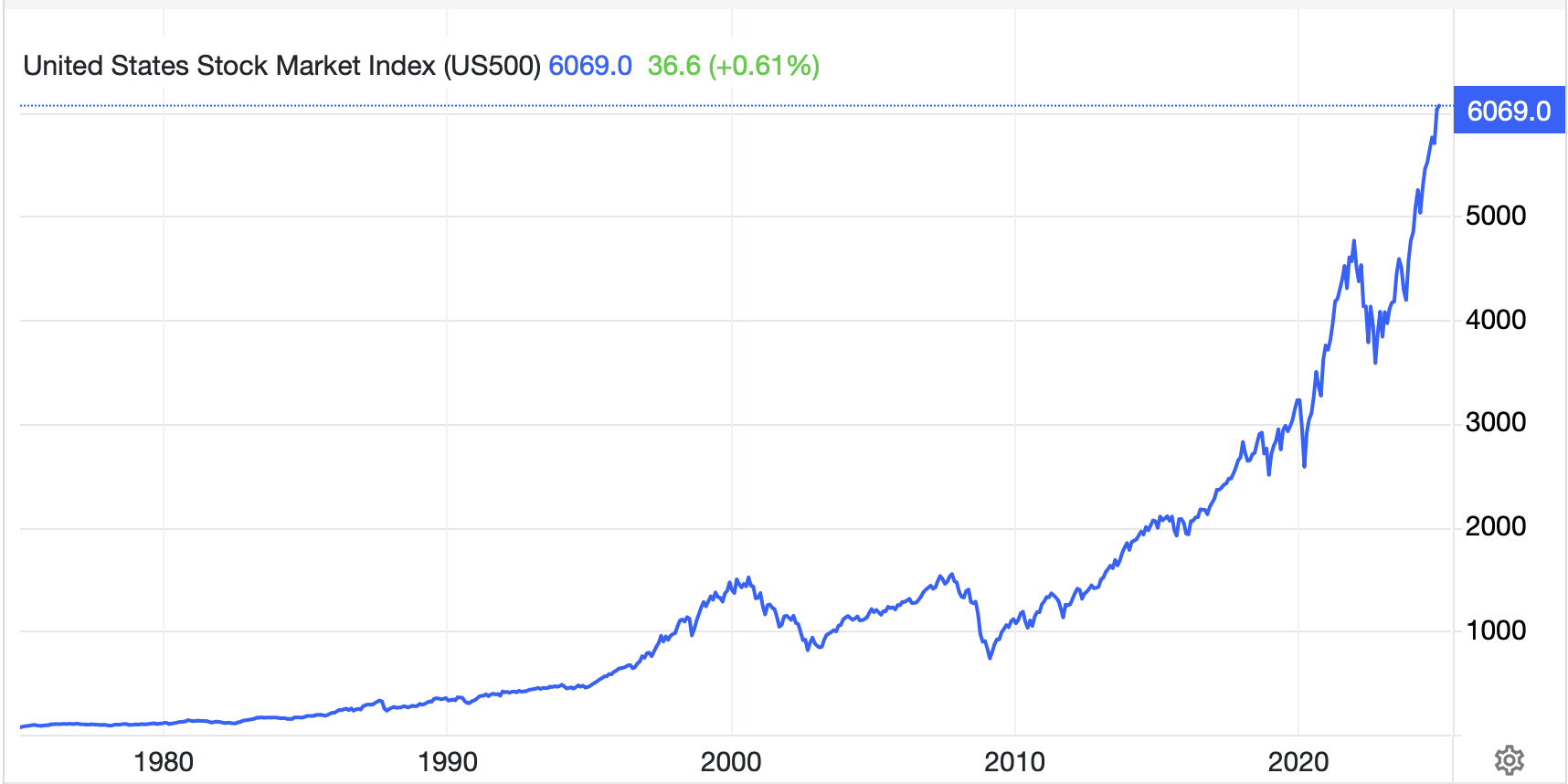
So, the question is, has BlackRock defined the top in equity markets this time?  I think it is worthwhile to take a longer-term perspective on market performance to try to answer that question, and more importantly, figure out what to do if this is the top.  A look at the chart below, the last 50 years of the S&P 500, shows that every one of the major downturns we have seen, at least in my lifetime, has been nothing more than a blip.

Source: tradingeconmics.com

For instance, the tech bubble was an anthill around 2000 on this chart, and the GFC crash, while described as the worst recession since the Great Depression, seems to be a pretty modest dip.  Covid in 2020 was almost nothing and the biggest was really 2022, which saw the index slide 25% through the first 9 months of the year.  Of course, part of this is the number itself.  A 25% decline now would be ~1500 S&P points (or 11,000 Dow points), the type of thing that would freak out nearly everybody.  

Is this possible?  Certainly, it is, 25% declines have occurred pretty regularly through the history of the market.  Is it likely?  This is a much tougher question.  BlackRock’s thesis is that this time is different; that AI is the game changer, and the future will be finally filled with flying cars and robots doing all our chores on the basis of unlimited free energy for everyone.  Ok, that may be a slight exaggeration, but they are extremely optimistic that technology will continue to move forward and solve what currently appear to be intractable problems.

The one thing working in their favor, I think, is that governments and central banks around the world have essentially lost their tolerance for market corrections, whether that is in equity or fixed income markets, and so will do whatever they can to prevent any small slide from becoming a large one.  Of course, the only thing they can do is print money to buy those assets that are falling in price.  If that is the plan of action, then the future will be highly inflationary, that is the only clear outcome.

I have no idea how things will turn out.  Perhaps BlackRock is correct, and we are about to embark on an entirely new segment of economic and financial history.  Perhaps Elon will successfully help restructure the US government so it is efficient and focused on a more limited role, and that process will inspire other nations to follow suit.  Perhaps pigs can fly as well.  I hate to be a curmudgeon, but trees still don’t grow to the sky, whether they are created by AI or nature.  Gravity remains undefeated.  But I am wary when I read reports claiming this time is different.  Forty plus years in the markets has taught me that is never the case.  Tools may change, timelines may change, but ultimate outcomes remain the same.

Ok, as we await this morning’s NFP report, let’s see what happened overnight.  Yesterday’s very modest declines in the US equity markets were followed by a slide in Japan (Nikkei -0.8%) and one in Australia (-0.6%) although this was predicated on weaker than expected GDP data, while Chinese shares (Hang Seng +1.6%, CSI 300 +1.3%) rallied on hopes that the economic conference next week is going to finally fire that long awaited Chinese bazooka!  In Europe, the most interesting aspect is the CAC (+1.4%) is having a wonderful day after the French government fell and prospects for managing the economy there remain extremely uncertain.  Perhaps that represents the idea that if the government is not interfering, French corporates can get on with the business of business unhindered and make more money.  Or perhaps it is an assumption that the ECB will ease more forcefully to prevent a major mishap.  After all, Madame Lagarde is French, so is likely not unbiased in the matter.  As to US futures, at this hour (7:15) they are lower by -0.1% across the board as we await the data.

In the bond market, there is nothing going on at all. Treasury yields are unchanged on the day which is true of virtually every European sovereign with one exception, French OATs which have seen more buying and have slipped 2bps lower in the session.  Here, too, it almost seems as though the market has decided the lack of a working government is better for France’s finances than when there is someone in power.  One other thing to note is that JGB yields have edged lower by 1bp this morning and have fallen 4bps this week as USDJPY has traded higher over the same period.  The most noteworthy thing here is that Toyoaki Nakamura, one of the most dovish BOJ members, explained that he was not against hiking rates, per se, and market participants took that as an opening for the BOJ to do just that and perhaps take a more pronounced stance against the ongoing inflation there.  I’ll believe it when I see it.

In the commodity markets, apparently nobody needs oil (-0.8%) anymore as it continues to sell off.  Remember just a few days ago we breached $70/bbl on the upside.  Well, this morning we are below $68/bbl amid fears(?) that peace is breaking out in the Middle East with talk that Hamas is willing to release the hostages to achieve a cease fire.  Arguably, a bigger issue is that much of the world (mostly China and Europe) have seen slowing economic activity and so demand estimates continue to decline along with the price.  As to the metals markets, they have been bouncing around lately, not making any headway in either direction as it appears traders are waiting for more concrete clues about demand here as well.  Gold (+0.2%) is the exception here, with demand not in question, just the timing of the next wave of central bank purchases.

Finally, the dollar is somewhat stronger overall this morning, notably vs. both AUD (-0.5%) and NZD (-0.4%) on the back of that weak GDP data.  Away from that, the rest of the G10 is mostly a bit softer, but not seeing large moves with NOK (-0.4%) excepted on the weak oil prices.  In the EMG bloc, declines are pretty consistent around the -0.2% range, but nothing really of note.

Now to the NFP data.  Here’s what is forecast:

Nonfarm Payrolls200K
Private Payrolls200K
Manufacturing Payrolls28K
Unemployment Rate4.2%
Average Hourly Earnings0.3% (3.9% y/Y)
Average Weekly Hours34.3
Participation Rate62.6%
Michigan Sentiment73.0

Source: tradingeconomics.com

In addition, we hear from four more Fed speakers (Bowman, Goolsbee, Hammack and Daly) so it will be interesting to see how they perceive the amount of caution that is appropriate going forward.  As a marker, this morning the Fed funds futures market is pricing a 70% probability of a December rate cut, down 4 points.

The big picture remains that the economy continues to outperform the naysayers, at least according to the official data.  The fact that performance is spread unevenly does not matter to markets at this time.  As such, it remains difficult for me to create the scenario where the dollar gives up substantial ground.  If the Fed does cut in two weeks, I think it will be the last for a while unless we start to see some major revisions lower in the data.  Maybe that starts this morning, but until then, you have to like the buck.

Good luck and good weekend

Adf

To Further Debase

Said Jay, “The economy’s strong”
But rate cuts before weren’t wrong
We’re in a good place
To further debase
Your dollars and will before long
As we slow the pace
Of policy ease all year long


Chairman Powell regaled the market for the last time before the Fed’s quiet period begins tomorrow evening and here are the three comments that seem to explain his current views. 

  • We wanted to send a strong signal that we were going to support the labor market if it continued to weaken.”
  • The economy is strong, and it’s stronger than we thought it was going to be in September.”
  • The good news is that we can afford to be a little more cautious as we try to find a rate-setting that neither spurs nor slows growth.”

My read is he was trying to make an excuse for the 50bp cut that started the process in September as there is still no justification for that move.  However, he essentially reiterated his last remarks of the Fed not being in a hurry to cut rates further.  As it happens, SF Fed president Mary Daly also explained, “We do not need to be urgent. There’s no sense of urgency, but we do need to continue to carefully calibrate our policy and make sure it’s in line with the economy we have today the one we expect to have going forward.” 

Now, a funny thing happened to me yesterday as I read those comments, and my expectation was that the Fed funds futures market might reduce the probability of a December rate cut.  After all, we just heard from the Chairman that things are good and they can be cautious about further cuts, while another member expressly said there was no urgency to cut.  But in fact, the 74% probability this morning is unchanged from yesterday’s level and the punditry remains very convinced that they are going to cut next week despite their caution.  It seems that my understanding of caution and Powell’s are somewhat different.  However, his understanding is the one that matters, so it appears absent a major upside surprise in both NFP tomorrow and CPI next week, a cut is coming on the 18th.

The French president, M. Macron
May soon find himself overthrown
His PM is out
And there is great doubt
‘Bout any new views he has shown

The other topic of note this morning is the collapse of Monsieur Macron’s minority government in France.  This was the widely expected outcome that markets had priced in, so there has been little in the way of impact there.  However, the bigger picture impact is about the structure of the Eurozone (and EU) and its rules.  After all, if the second largest economy in the group is not merely floundering economically, but essentially leaderless, the concept of a coherent set of plans to oversee the Eurozone seems a bit of a stretch.

Macron’s term is not up until 2027, and he has consistently maintained he will not step down early, but there are increasing calls for him to do just that.  Members of parliament on both the left and right, although not Marine Le Pen, the RN’s leader, have been vocal on the subject and a recent poll by Cluster17 for Le Point magazine showed that 54% of the French public wanted him to step down as well.  Now, you know as well as I that absent a criminal conviction, the odds of an elected official stepping down anywhere in the world approach zero and I expect nothing less from Macron.  At the same time, French law prevents another parliamentary election for 12 months after the last, which means July.  At that time, one will almost certainly be called, and it will be interesting to see how that plays out.  

However, in the meantime, it seems likely that France will be floundering with no ability to address fiscal issues, be they spending or deficit focused.  This cannot be a positive for the single currency, especially if France slips into recession.  Again, despite all the concerns over the dollar and the untenable fiscal deficits, things in Europe appear far worse.  Parity in the euro and below seems a far better bet over the next 6 months than the opposite.  While the euro (+0.2%) has bounced slightly this morning, a look at the chart below indicates, at least to me, that the trend is distinctly lower.

Source: tradingeconomics.com

And with that, let’s look at the overnight session in markets.  Continuing in the FX world, that modest euro gain is descriptive of the market as a whole, with the dollar slightly softer this morning, although few currencies showing any notable strength.  I suspect much of this is based on the idea that the Fed will cut rates soon despite the “strong economy”.  In truth, in the G10, no currency has moved more than 0.2% and even in the EMG space, only ZAR (+0.4%) and HUF (+0.5%) have climbed more.  Those moves, which don’t appear to have any fundamental drivers, seem more likely to be expressions of the fact those markets are more volatile than the G10.

In the equity markets, yesterday’s US rally, to new all-time highs across the board, saw a mixed review in Asia with the Nikkei (+0.3%) edging higher but both Hong Kong (-0.9%) and Shanghai (-0.25%) slipping a bit.  The rest of Asia was also mixed with Korea (-0.9%) still suffering from the bizarre happenings there yesterday but other markets performing well (India +1.0%, Singapore +0.6%).  In Europe, only the UK (-0.1%) is under water this morning although the CAC (+0.2%) is the continental laggard.  Spain’s IBEX (+1.2%) is the leader on the back of stronger IP, and although Eurozone Retail Sales were much weaker than expected, it has not seemed to impact investor views.  As to US futures, they are little changed at this hour (7:30).

In the bond market, Treasury yields have backed up 3bps and I am beginning to sense that there is a negative correlation to the probability of a Fed rate cut and the 10-year yield.  As that probability rises, bonds sell off further, but that is merely an anecdotal observation, I have not done the math.  In Europe, yields are mixed, but within 1bp of yesterday’s closing levels with even French yields slipping 1bp. It will be very interesting to see how the European Commission handles the fact that the French budget deficit is so far above the targeted 3% level and now without a government, there is no way to address the situation.  The original idea when the euro was formed was that governments would be fined if they broke the policy caps on debt and deficits.  Of course, no fine has ever been imposed and I don’t suppose one will be now.  (However, if Marine Le Pen’s RN wins the election next summer, you can be sure they will seek to impose fines on her government!)

Finally, in the commodity markets, it is very quiet this morning.  Oil (+0.3%) is edging higher after a big rise and fall yesterday.  The rise was the result of a steep draw in US inventories, but the decline seemed to be a response to OPEC+ confirming they will be increasing production at some point in 2025.  Meanwhile, metals markets are basically unchanged this morning.

One other thing I have not discussed but is obviously getting a lot of press this morning, is Bitcoin which traded through $100K yesterday after President-elect Trump named Paul Atkins to be his new SEC Chair.  Atkins has a very pro crypto bias, and I expect we will see far more impetus in the crypto space going forward, not just in Bitcoin.

On the data front, yesterday’s ISM data was a bit softer than forecast while the Beige Book explained that economic activity rose slightly in the past month along with employment and prices, but all movements were quite modest.  This morning, we see Initial (exp 215K) and Continuing (1910K) Claims as well as the Trade Balance (-$75.0B) and later we hear from Richmond Fed president Barkin.  

Looking at the overall situation, investors continue to ignore any potential problems and run to risk assets, as evidenced by the rally in Bitcoin and new highs in stock prices.  Unless we see some really surprising data, either crazy strong implying the Fed is going to stop easing, or crazy weak implying we are in a recession, I see no reason for this process to end heading into the new year and President Trump’s inauguration.  Again, in that scenario, I think you have to like the dollar higher.

Good luck

Adf

Chaos is Spreading

Around the world, chaos is spreading
As government norms get a shredding
Korea’s the latest
But not near the greatest
Seems to the Fourth Turning we’re heading

While Russia/Ukraine knows no end
And Israel seeks to defend
The French are about
To toss Michel out
And all this ere Trump does ascend


If you view markets through a macro lens, the current environment can only be described as insane.  Niel Howe and William Strauss wrote a book back in 1997 called The Fourth Turning (which I cannot recommend highly enough) that described a generational cycle structure that has played out for hundreds of years.  If you have ever heard the saying 

  • Hard times make strong men (1st Turning)
  • Strong men make good times (2nd Turning)
  • Good times make soft men (3rd Turning)
  • Soft men make hard times (4th Turning)

Or anything in the same vein, this book basically describes the process and how it evolves.  The essence is that about every 20-25 years, a new generation, raised by its parents whose formative years were in the previous Turning, falls into one of these scenarios.  Howe and Strauss explained that at the time they wrote the book, we were in the middle of the 3rd Turning, and that the 4th Turning would be upon us through the 2020’s.  One of the features they highlighted was that every 4th Turning was highlighted by major conflict (WWII, Civil War, Revolutionary War, etc.) with the implication that we could well be heading toward one now.

Of course, we already have a few minor wars with Russia/Ukraine (although that seems to have the potential to be more problematic) and Israel/Hezbollah/Hamas, with Iran hanging around the edges there.  In a funny way, we have to hope this is the worst we get, but there are still more than 5 years left in the decade for things to deteriorate, so we are not nearly out of the woods yet.  

But turmoil comes in many forms and political turmoil is also rampant these days.  This is evident by the number of sitting governments that have been ejected in the most recent elections as well as the increasingly strident blaming of others for a nation’s current problems.  In this vein, the latest situation will happen shortly when the French parliament votes on a no-confidence motion against the current PM, Michel Barnier.  As it is, he is merely a caretaker PM put in place by President Macron after Macron’s election gamble in June failed miserably.  Adding to France’s problems, and one way this comes back to the markets, is that the French fiscal situation is dire, with a current budget deficit exceeding 6% of GDP and no good way to shrink it.  In fact, Barnier’s efforts to do so are what led to the current vote.  I have already discussed French yields rising relative to their European peers and the underperformance of the CAC as well. 

On the one hand, today’s vote, which is tipped to eject Barnier, may well be the peak (or nadir) of the situation and things will only improve from the current worst case.  However, it strikes me this is not likely to be the case.  Rather, there are such a multitude of problems regarding immigration, culture, economic activity and government responsiveness, that we have not nearly found the end.  My fear is we will need to see things deteriorate far more than they have before populations come together and agree that ending the mess is the most important outcome.  Right now, there are two sides dug in on most issues and the split feels pretty even.  As such, neither side is going to give up what they believe for the greater good, at least not yet.

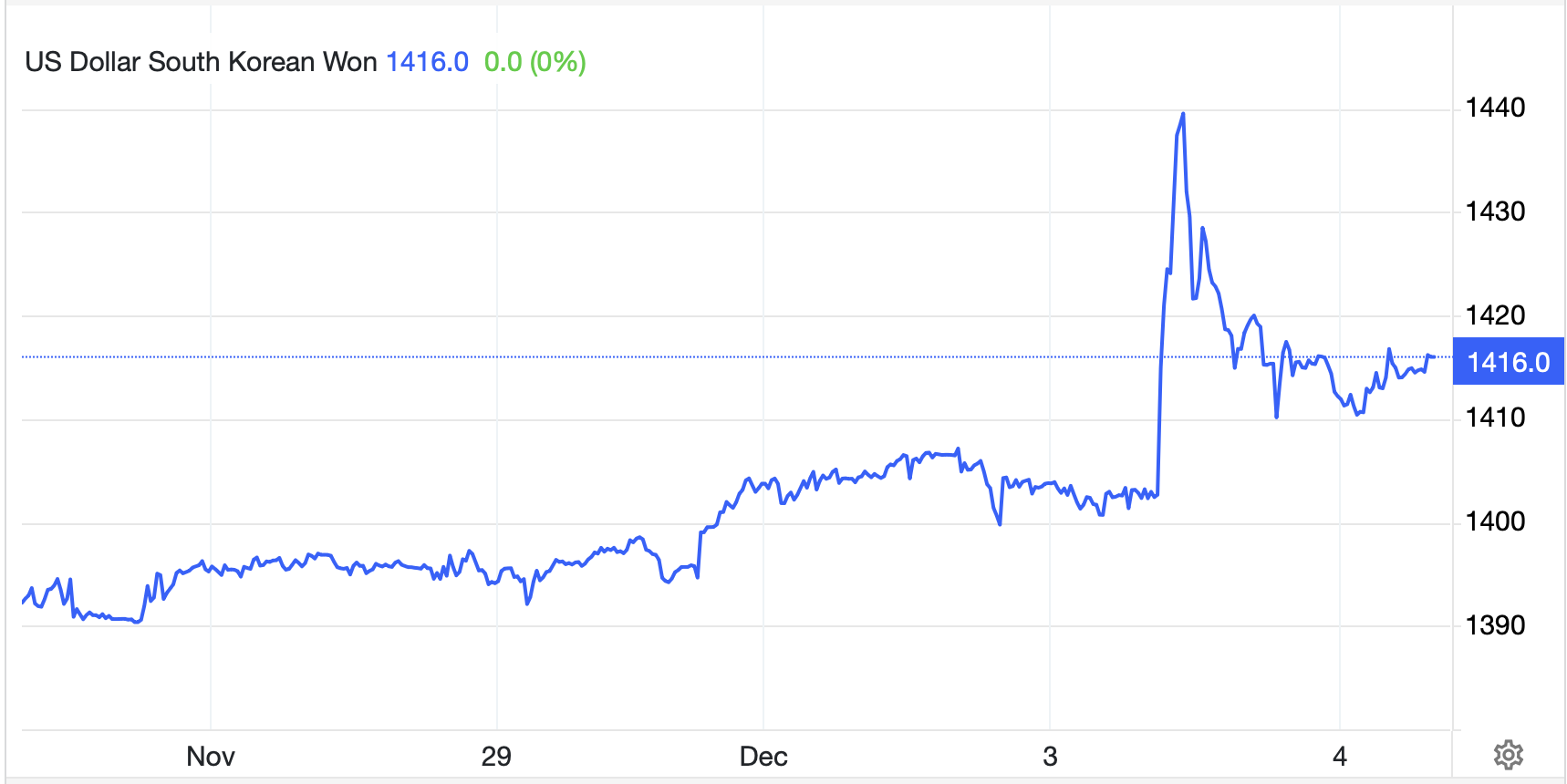
And before I move on to the markets, I cannot ignore the remarkable events in South Korea yesterday, where President Yoon Suk Yeol declared martial law in the early hours on the basis of the opposition’s efforts to paralyze the government (I guess that means they didn’t agree with him).  In the end, the Korean Parliament voted to rescind the order, and the military has since stood down with all eyes on the next steps including likely impeachment hearings for the President.  Not surprisingly, Korean assets suffered during this situation with the won tumbling briefly, more than 2.6%, before retracing the bulk of those losses once the order was rescinded.  

Source: tradingeconomics.com

Too, the KOSPI (-1.5%) suffered although that was off the worst levels of the day after things settled down.  The point to keep in mind here is that markets are subsidiaries of economies.  They may give indications of expectations for the future, or sentiments of the current situation, but if we continue to see geopolitical flare ups, markets are going to respond as investors seek havens.  In this case, the dollar, despite all its flaws, remains the safest choice in many investors’ eyes, so should remain well bid overall.

Ok, let’s look at how markets have been behaving through this current turmoil.  In Asia, given the events in Korea, it ought not be surprising that equities had little traction.  Japanese shares were unchanged as were Hong Kong although mainland Chinese (-0.5%) and Australian (-0.4%) shares were under some pressure.  That said, Australia suffered on weaker than forecast GDP data which puts more pressure on the RBA to cut rates despite inflation remaining sticky.  Australia dragged down New Zealand (-1.5%) shares as well with really the only notable winner overnight being Taiwan (+1.0%).  In Europe, investors seem to be betting on a more aggressive ECB as somewhat weaker than expected PMI Services data has led to gains on the continent (DAX +0.85%, CAC +0.5%, IBEX +0.7%) although UK shares (-0.2%) are not enjoying the same boost.  I guess the French market has already priced in the lack of a working government, hence the market’s underperformance all year.  US futures, at this hour (8:00) are pointing higher by between 0.3% and 0.6%.

In the bond market, yields are rising, with Treasuries (+4bps) leading the way although most of Europe are higher by between 3bps and 4bps.  It has the feel that bond markets are starting to decouple from central banks as they see inflationary pressures building and central banks still in active cutting mode.  I fear this will get messier as time goes on.

In the commodity markets, oil is unchanged this morning, right at $70/bbl, having continued its rally for the week on news that OPEC+ will maintain its production cuts through March 2025.  NatGas (-2.0%) has been sliding since the spike seen 2 weeks ago ahead of the current cold spell as warmer weather is forecast for next week.  In the metals market, gold (-0.2%) seems stuck in the mud right now while silver (-1.3%) and copper (-0.6%) appear to be victims of the dollar’s strength.

Turning to the dollar, it is stronger across the board with AUD (-1.3%) the laggard after that GDP data and it dragged NZD (-1.0%) down with it.  JPY (-1.1%) is also under pressure as hopes for that BOJ rate hike dissipate.  Away from those, the euro (-0.2%) and pound (-0.1%) are softer, but much less so.  In the EMG bloc, ZAR (-0.5%) is feeling the weight of the weaker metals prices and we are seeing BRL (-0.3%) and CLP (-0.1%) also sliding slightly although both are stabilizing after more pronounced weakness earlier in the week.

On the data front, this morning brings ADP Employment. (exp 150K) along with ISM Services (55.5) and then the Fed’s Beige Book.  Perhaps of more importance, at 12:45, Chairman Powell will be speaking and taking questions, so all eyes will be there looking for clues as to how the Fed will be viewing things going forward.  Fed funds futures have been increasing the probability of that rate cut, now up to 74%, which implies we are going to see one, regardless of the inflation story.

Central banks around the world are in a bind as inflation refuses to fall like they want but many nations are seeing slowing economic activity.  In the end, I expect that the rate cutting cycle has not ended, but the dollar is likely to remain well bid given both its haven status and the fact that the US economy is outperforming everywhere else.

Good luck

Adf

Declines and Duress

In France, there’s a government mess
That lately’s been causing some stress
For French sovereign debt
With stocks under threat
Of further declines and duress


In one of the most colossal political blunders in recent memory, French President Emmanuel Macron completely misread the country and called a snap election after the European Parliament elections sent his party and allies to a significant defeat in June.  In what should not have been a surprise to anyone, his party was decimated in the national election, although the results have been even more unfortunate for the people of France as they have basically left the nation without a working government.  While there is currently a caretaker PM in place, Monsieur Barnier is almost certainly going to lose a no-confidence vote tomorrow as both the left and right express their displeasure at the situation.

Alas, the pattern we observe of late is that European citizens have been generally unhappy with the decisions made by their governments, with a universal issue being immigration policies, and when elections have been held, the parties in power have been shown the door.  Or they would have been except that they are extremely reluctant to leave office and are willing to do anything at all, except work with the anti-immigration parties (typically on the right) to govern their nations.  The result has been a series of election results with very weak minority governments and no power to do anything to help their citizens by addressing key issues.  Budgets are a problem; massive debt loads are constraining and economic activity is shrinking.  

France is merely the current fracas although we have seen the same things occur in Germany, the Netherlands, Austria, Sweden and much of Eastern Europe.  From our perspective, the issue here is what does it mean for the economic prospects of the euro (and other European currencies) and how might the ECB respond.  Consider that as poorly as things are going in Germany, and they are really having a tough time, a quick look at the performance of the DAX and CAC (as well as the S&P 500) shows that France is really a laggard right now.

Source: tradingeconmics.com

Since the dip in the beginning of August, French equities are essentially unchanged while even German equities have risen 15% alongside their US brethren.  During that same period, French 10-year yields have been rising relative to their German counterparts as fears over a French fiscal disaster rise.  In fact, there is now discussion that the ECB will need to use their TPI program, originally designed to support Italian debt, to prevent the spread between French and German yields from widening too far.  

If you were wondering why the euro has been having problems lately, this has clearly been a piece of the puzzle, and likely a key piece.  While the single currency has rallied slightly this morning, up 0.2%, the below chart speaks volumes as to the direction of travel.

Source: tradingeconomics.com

While yesterday I explained why I thought over time the dollar might eventually decline, right now, I think we need to look for the euro to test parity and potentially go below for the first time since November 2022.

As well, there’s another key nation
That’s seeking its ‘nomic salvation
Their currency’s falling
As pundits are calling
For stimulus midst their frustration

This brings our attention to China, where next week, the Central Economic Work Conference will be held as President Xi tries to shake the nation out of its economic lethargy.  There are high hopes for yet more stimulus despite the fact that the efforts so far have had a limited impact at best.  Perhaps the Chinese problem can best be described as they produce far too many goods for their own consumption and so run large trade surpluses angering their trade partners.  While President-elect Trump gets most of the press regarding his complaints about China’s economic behavior, it turns out that many countries around the world are pushing back.  This morning’s WSJ had an article on this very issue and it seems possible that President Xi may find himself even more isolated on the issue than before.

The natural solution is for China to consume more of what it produces, but that is far easier said than done, especially as the youth unemployment rate in China remains quite high, above 17%, while demographics continue to work against the country.  Arguably, one way to solve this issue would be for the renminbi to strengthen dramatically, simultaneously increasing the price of Chinese exports, so likely reducing demand, while increasing demand for imports.  Unfortunately, as can be seen below, the currency is moving in the opposite direction as the tariff threats from the US and elsewhere feed into the market psyche.

Source: tradingeconomics.com

It will be interesting to see if the PBOC is comfortable allowing the renminbi to weaken further.  It is currently at its weakest point since July, but also at levels where historically, the PBOC has entered the market over the past several years to prevent further declines.  With tariffs imminent, will this time be different?

Ok, let’s turn to the overnight market activity.  Asian equity markets were all strong overnight led by Japan (+1.9%) although we saw gains throughout the region (Korea +1.9%, India +0.75%, Taiwan +1.3%).  In China, Hong Kong (+1.1%) fared far better than the mainland (+0.1%) although both these markets closed well off early session lows after discussion of the economic conference and more subsidies made the rounds.  In Europe, screens are green this morning as well, seemingly on growing hopes that the ECB will be cutting more aggressively as data there remains soft, and comments from Fed Governor Waller yesterday indicated he was on board with further cuts despite the current data showing solid performance.  However, US futures are little changed at this hour (7:30) as focus begins to turn toward Friday’s NFP report.

In the bond markets, yields are edging higher with 10-year Treasuries up 2bps while most European sovereigns are higher by between 1bp and 3bps.  France is an exception this morning as that TPI talk has traders thinking there will be a price insensitive bid for OATs soon.

In the commodity markets, oil (+1.2%) is rebounding nicely from yesterday’s selloff although continues to trade below that $70/bbl level.  In the metals market, yesterday’s declines, which seemed to have been driven by the much stronger dollar, are being reversed in silver (+0.8%) and copper (+1.0%) although gold is essentially unchanged on the day.

Finally, the dollar, after a ripping rally yesterday, is backing off a bit, but not very much.  In fact, there are a number of currencies which are still sliding somewhat, notably CNY (-0.2%) and SEK (-0.2%) with the only gainer of note this morning being CLP (+0.6%) as it follows the price of copper higher.  Broadly speaking, the current setup remains quite positive for the dollar I believe.

On the data front, this morning brings only the JOLTS Job Openings report (exp 7.48M) and a bit more Fedspeak.  Yesterday’s ISM data was stronger than expected but still, at 48.4, below the key 50.0 level indicating manufacturing is still in a funk.  Perhaps better news was that the Prices Paid survey declined to 50.3, potentially indicating reduced inflation pressures.

While the market keenly awaits Chairman Powell’s speech on Wednesday as well as the NFP release on Friday, I sense that there is limited appetite to take on new positions.  Implied volatility is climbing as uncertainty reigns over the market but has not yet reached extremely high levels.  For hedgers, this is when options make the most sense.

Good luck

Adf

The Conundrum We Find

Tis nearly a month since the vote
When President Trump, Harris, smote
So maybe it’s time
To sample the clime
Of what all his plans now connote
 
To many, his claims are just talk
With pundits believing he’ll balk
But history shows
That Trump will bulldoze
Detractors as he walks the walk
 
So, tariffs are likely to be
The first part of his strategy
But if that’s the case
The dollar may chase
Much higher than he’d like to see
 
It seems the conundrum we find
Is not all his thoughts are aligned
And this, my good friends
Is why dividends
Are paid to a hedge, well designed


I have tried to stay away from forecasting how things will evolve once Mr Trump is inaugurated, but this weekend, listening to a podcast (Palisades Gold Radio) I got inspired as there was some interesting discussion regarding the dollar.  As I consider the issues, as well as what appears to be the current expectations, I thought it might be worthwhile to note my views, especially in the context of companies considering their hedging needs for 2025 and 2026.

Clearly, the watchword for Trump is tariffs as he has been boasting about implementing significant tariffs on trade counterparties on day 1.  The latest discussion is 25% on Canada and Mexico and 60% on China with Europe in the crosshairs as well.  (Remember, though, many believe these tariff threats are being used to encourage those countries to change their emigration policies and help stop the current influx of illegal immigration.  So, if countries do their part, those tariffs may never materialize.)

The classical economic view is that tariffs are a terrible policy as impeding free trade negatively impacts all players.  As well, you will hear a lot about how the countries in question will not pay them, but rather consumers in the US will pay those tariffs.  As such, there is a great deal of talk about how tariffs will feed immediately into inflation.  (Of course, this is in addition to the inflation that will allegedly come immediately on the heels of Trump’s promise to deport all illegal aliens in the country because it will decimate the workforce.  On this subject, simply remember that the deportation will result in a significant decline in demand for things like housing which remain quite sticky in the pricing process.)

But let’s consider what Trump’ stated goals really are.  I would boil them down to rebuilding America’s industrial capacity and creating good jobs throughout the nation for citizens and legal residents.  If he is successful, the result will be a dramatic reduction in the trade deficit which will reduce the need to import so much foreign capital to fund things.  And what are the knock-on effects there?  Well, classical economics tells us that tariffs will be met with foreign currency depreciation (higher dollar) in an effort to offset the higher prices of those imports.  However, one of Trump’s goals is to reduce the value of the dollar in order to make US exporters more competitive internationally while reducing demand for imports.  Now, it seems that those two goals are at odds.

I think the thing we need to consider, though, is that the timing of these changes is very uncertain.  My guess is Trump is thinking of a 4-year process, or at least a 3-year one, not a 6-month outcome.  After all, these are tectonic shifts which will take time to play out.  Based on his commentary, and I think we must pay it close attention as he is pretty clearly telling us what he wants to do, the market response to any tariffs imposed will likely be weakness in the currencies of the countries affected.  

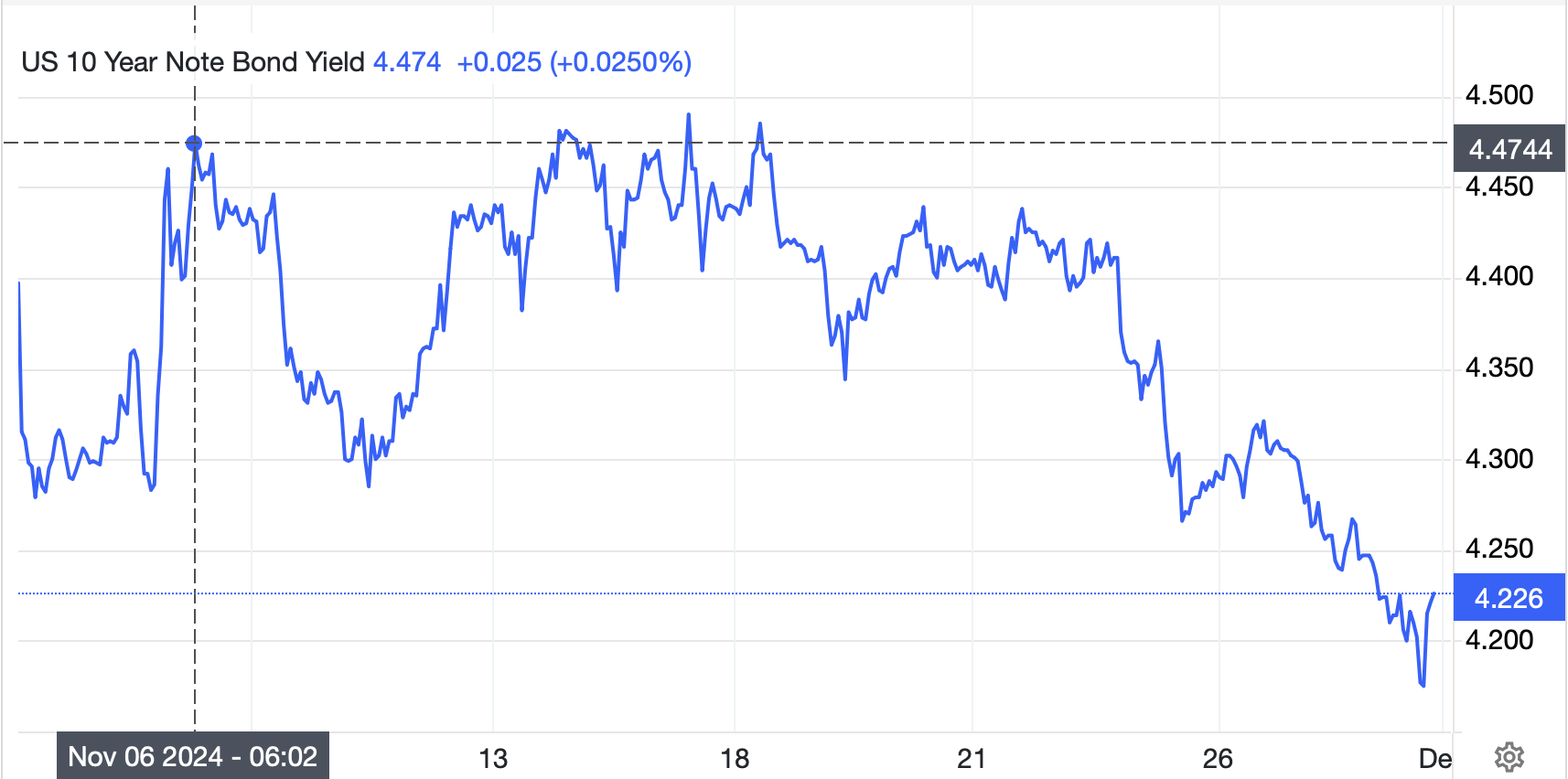
But, over time, it would not be surprising to see Trump lean effectively on the Fed to reduce policy rates (remember, he was quite upset the Fed never went negative).  As well, if there is any success in the DOGE project, with significant reductions in spending and deficits, that seems likely to alleviate some of the concerns over the US fiscal stance.  After all, if debt grows more slowly than the nominal pace of the economy, it remains quite manageable and should help remove some of the current hysteria.  In fact, a look at the 10-year yield over the past month (see chart below) shows that it has fallen 25bps (although they are 4bps higher this morning) and may well be signaling a market that is willing to give DOGE a chance.  If that is the case, it seems quite possible that the dollar will eventually start to recede from its current loftier levels.

Source: tradingeconomics.com

Bringing this back to the hedging issue, I might suggest that given the uncertainty of the timing of any movements, receivables hedgers will be well-served by using optionality here, whether outright purchases or zero-premium structures as they look to address 2025 and 2026 exposures.  While the dollar may well continue its recent strengthening trend with the euro heading to parity or below for a time, and other currencies following, at some point in H2 25 or beyond, it is quite feasible that the dollar reverses course.  Consider what could happen if Trump convenes a Mar-a -Lago accord, similar to the Plaza Accord of 1985, which saw the dollar decline dramatically in the ensuing three years, falling nearly 50% against a broad mix of trading partners’ currencies by the end of 1987.

Source: tradingeconomics.com

In that situation, those out-month hedges will want to have optionality to allow the weaker dollar to benefit the revenue line.  Similarly, for those with payables hedges, care must be taken to hedge effectively there as well given the opportunity for much higher costs due to the potential dollar decline.  Current market pricing (implied volatilities) is quite reasonable from a long-term perspective.  While they are not near the lows seen in the past year, they very likely offer real value for hedgers of either persuasion.

I apologize for the extended opening, but it just seemed to be a good time to review the evolving Trump impact.  Now onto markets. The first thing to recall is that last Wednesday’s PCE data continued to show that inflation, even in this measurement, appears to have stopped declining and is beginning to head higher again.  This will continue to put pressure on the Fed as housing data was pretty dreadful last Wednesday.  Add to the data conundrum the unknown unknowns of a Trump presidency and Chairman Powell will have his hands full until his term ends.

Friday’s abbreviated session in the US saw two of the three major indices trade to new all-time highs (NASDAQ is < 1.0% below its recent high) and that seemed to help support the Asian time zone markets with green outcomes nearly universal.  Japan (+0.8%), China (+0.8%) and Hong Kong (+0.65%) all had solid sessions as did every regional exchange other than Indonesia (-0.95%) which has been suffering for the past several months in contrast to most other nations.  In Europe, the picture is more mixed with most bourses in the green (DAX +0.8%, IBEX +0.9%) although the CAC (-0.35%) is feeling pain from increased worries that the government there will fall, and the fiscal situation will be a disaster going forward.  French yields continue to climb vs. every other European nation as the country is leaderless for now.  For the rest of the continent, slightly softer PMI Manufacturing data seems to have investors increasing their bets that the ECB is going to become even more aggressive in their rate cutting going forward.  As to the US futures market, at this hour (7:00) it is mixed with the SPX (+0.5%) rising but the other indices little changed.

In the bond market, as mentioned above, US yields have rallied a bit although European yields are all lower by between -2bps and -4bps (France excepted at unchanged) as those hopes for an ECB rate cut are manifest here as well.  As to JGB’s, 10yr yields are higher by 2bps this morning as there is increasing chatter that Ueda-san will be hiking rates later this month.  One other interesting note here is that in the 30-year space, Chinese yields have fallen below Japanese yields for the first time ever.  This seems to be an indication that market expectations of a Chinese rebound (despite solid Caixin PMI data overnight at 51.5) are limited at best.

In the commodity markets, oil is little changed on the day, remaining below the $70/bbl level but potentially seeing some support after a story surfaced that China would be reducing its purchases of Iranian oil in an effort to avoid US sanctions and tariffs under the Trump administration.  If Trump is successful in isolating Iran again, that could well support prices.  In the metals markets, this morning is seeing a little profit-taking in the precious space after last week’s late rally, but industrial metals are little changed.

Finally, the dollar is stronger again this morning, rallying against all of its counterparts in various degrees.  The euro (-0.5%) is lagging along with SEK (-0.65%) in the G10 space as concerns over slowing growth weigh on the single currency.  But the dollar is stronger across the board.  In the EMG bloc, BRL (-0.75% and back above 6.00) is leading the way lower but we have seen declines across the board with MXN (-0.4%), KRW (-0.7%), ZAR (-0.6%) and HUF (-1.1%) just some of the examples.  Despite that hotter than expected PCE data last Wednesday, the market is still pricing a nearly 62% probability of a cut by the Fed later this month.

On the data front, there is much to learn this week, culminating in NFP data on Friday.

TodayISM Manufacturing47.5
 ISM Prices Paid55.2
TuesdayJOLTS Job Openings7.48M
WednesdayADP Employment150K
 ISM Services55.6
 Factory Orders0.3%
 Fed’s Beige Book 
ThursdayInitial Claims215K
 Continuing Claims1905K
 Trade Balance-$75.1B
FridayNonfarm Payrolls195K
 Private Payrolls200K
 Manufacturing Payrolls15K
 Unemployment Rate4.2%
 Average Hourly Earnings0.3% (3.9% Y/Y)
 Average Weekly Hours34.3
 Participation Rate62.6%
 Michigan Sentiment73.3

Source: tradingeconomics.com

In addition to all the data, we hear from 10 different Fed speakers, most notably Chairman Powell on Wednesday afternoon.  Given that the recent data does not seem to be going according to their plans, at least not the inflation data, it will be very interesting to hear what Powell has to say about things.

As the end of the year approaches with many changes certain to come alongside the Trump inauguration, I will once again express my view that hedging is crucial for risk managers here.  While I see the dollar benefitting in the near term, as discussed above, the longer-term situation is far less certain.

Good luck

Adf