A Different Scapegoat

The war in Iran rages on
But markets are starting to yawn
Initial concern
Led traders to spurn
Risk assets each dusk until dawn

But now, just a few days have passed
And fear mongers all seem downcast
Most stocks have rebounded
And that has confounded
The bears who, gross shorts, had amassed

In fact, today’s story of note
Is China’s decision to float
A lower growth rate
To be their new fate
As Xi seeks a different scapegoat

This morning is the sixth day of the military action in Iran and depending on the source, the US is either kicking ass or setting up for the greatest collapse of all time.  Perhaps the most interesting statistic of this war is the number of casualties reported thus far, which when summed across all the theaters, appears to be somewhere between 1000 and 1200.  It seems to me that given the ferocity of the attacks on both sides, that is a remarkably low number.  I certainly hope it stays low, for everyone’s sake.

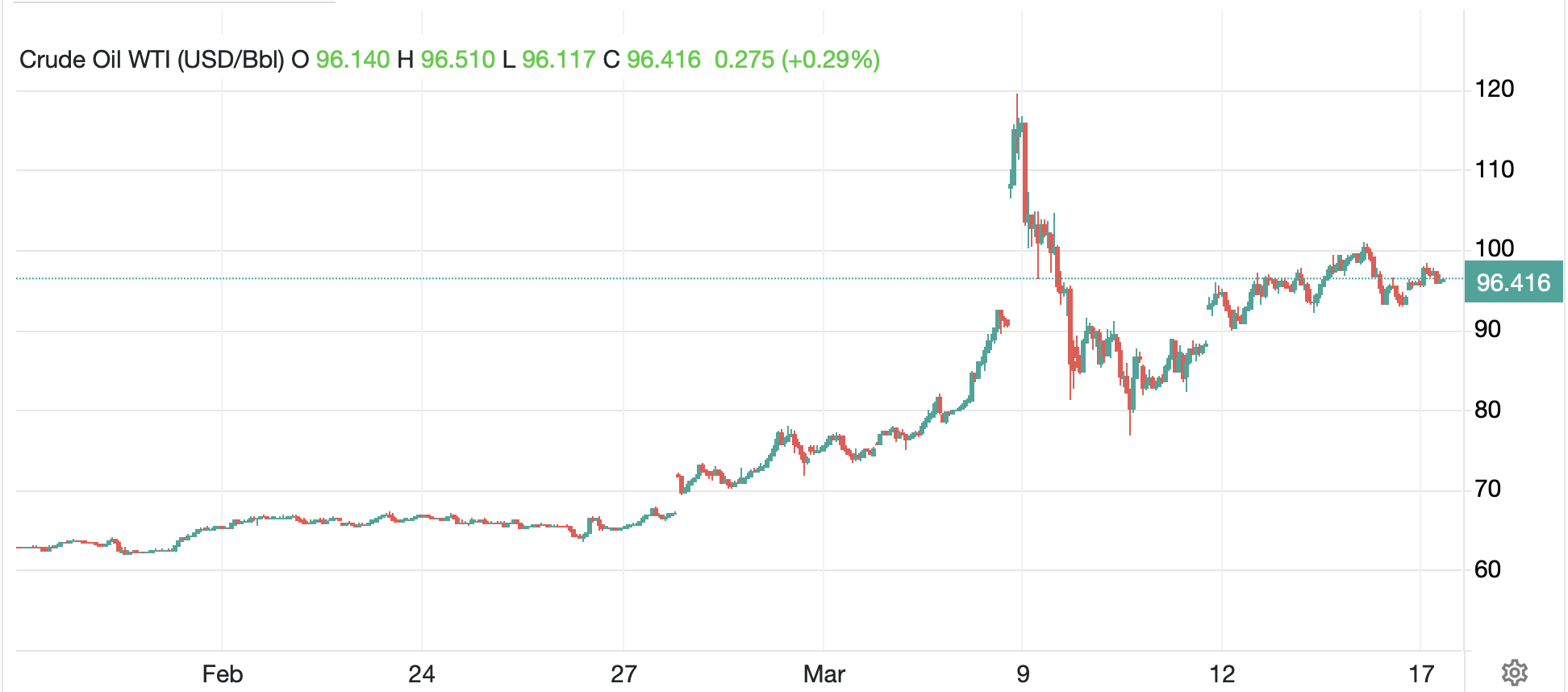
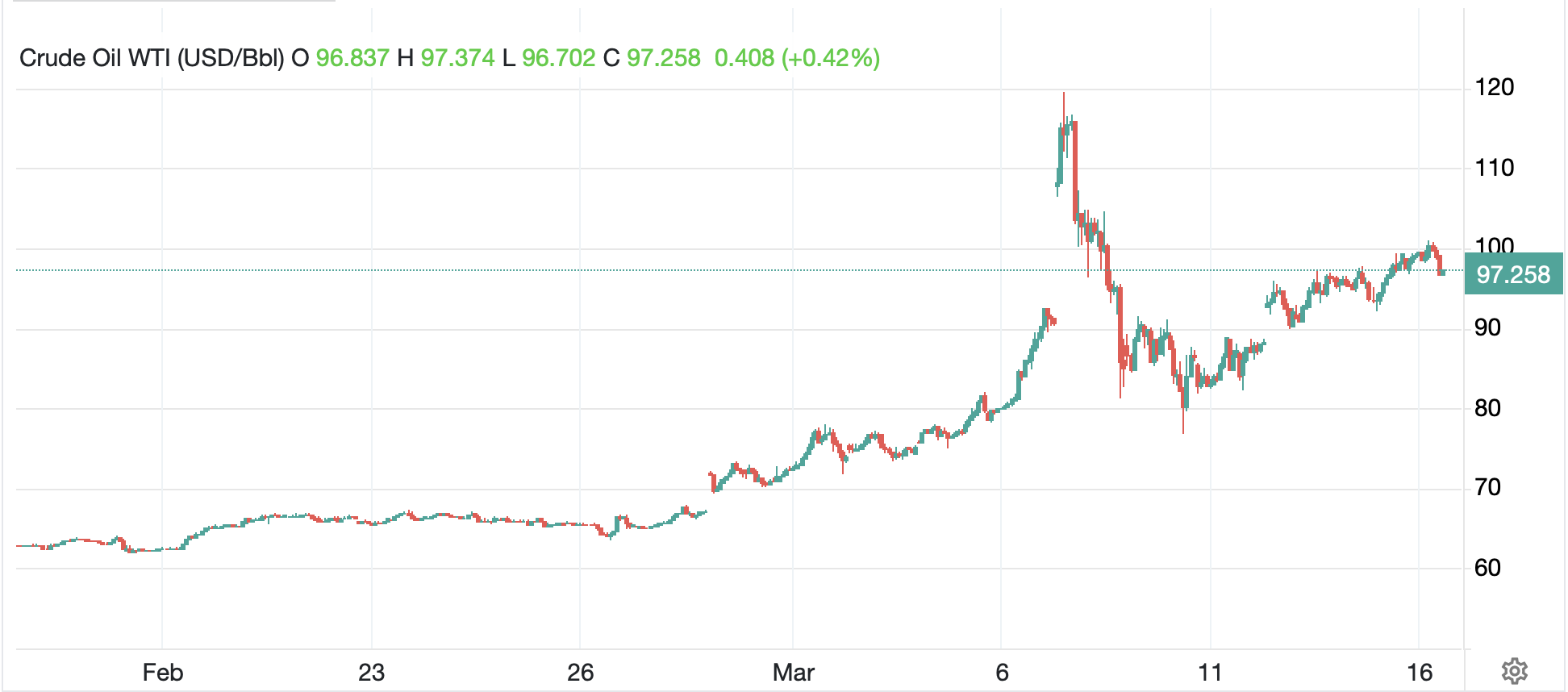
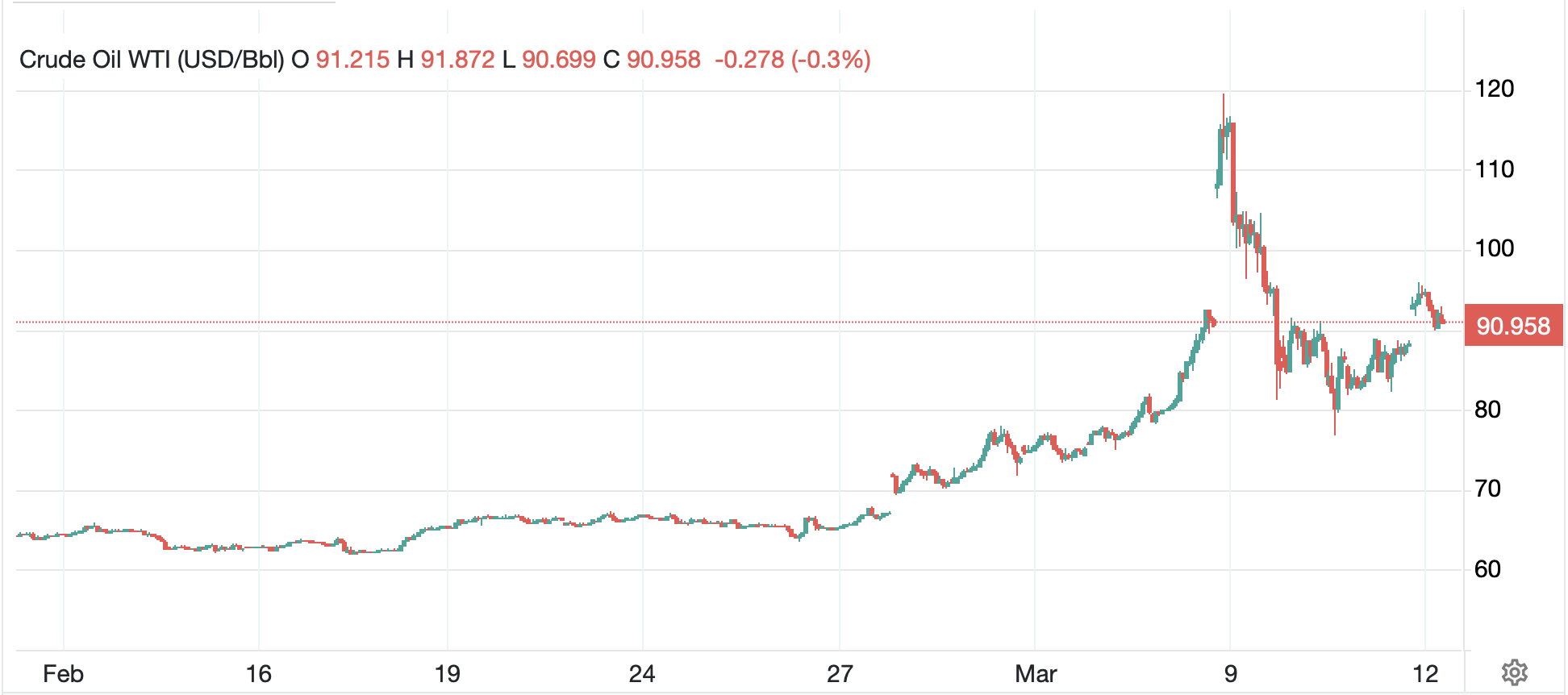
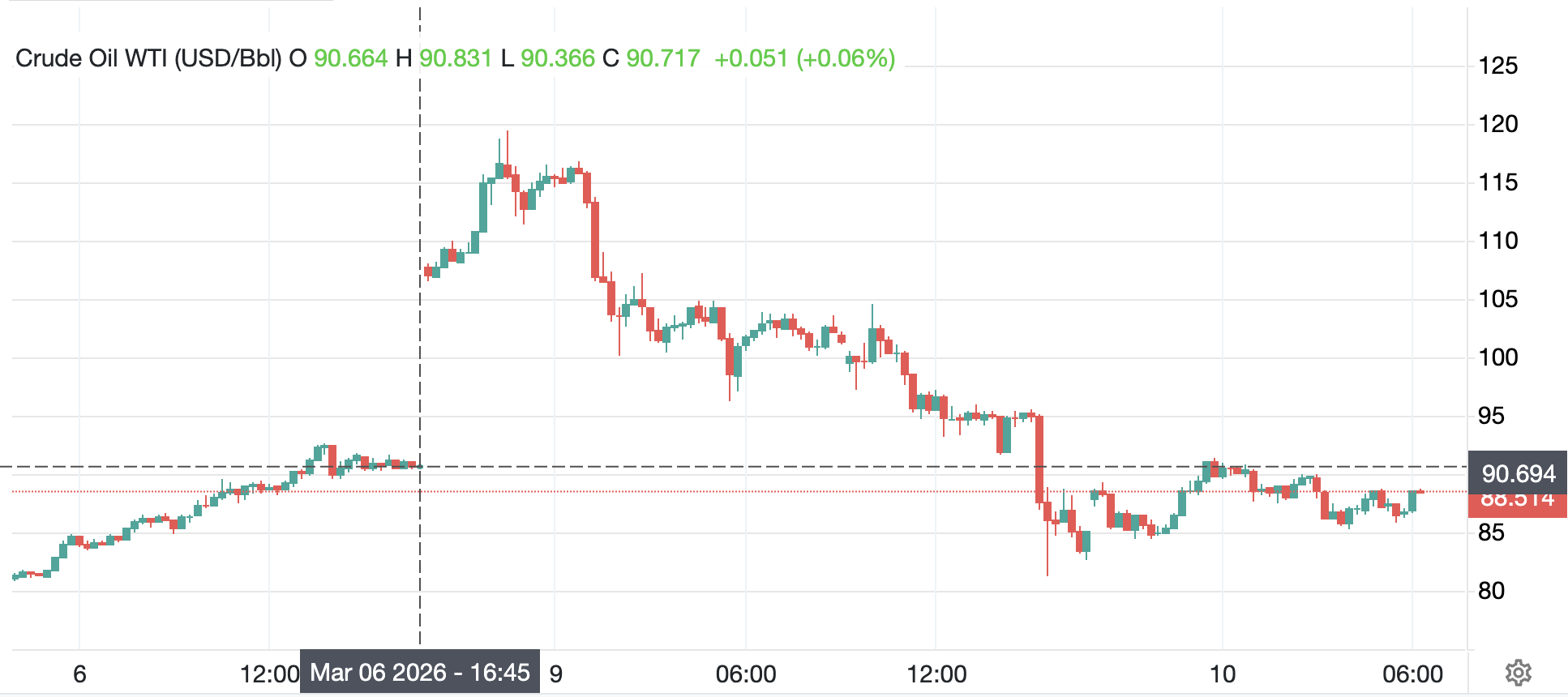
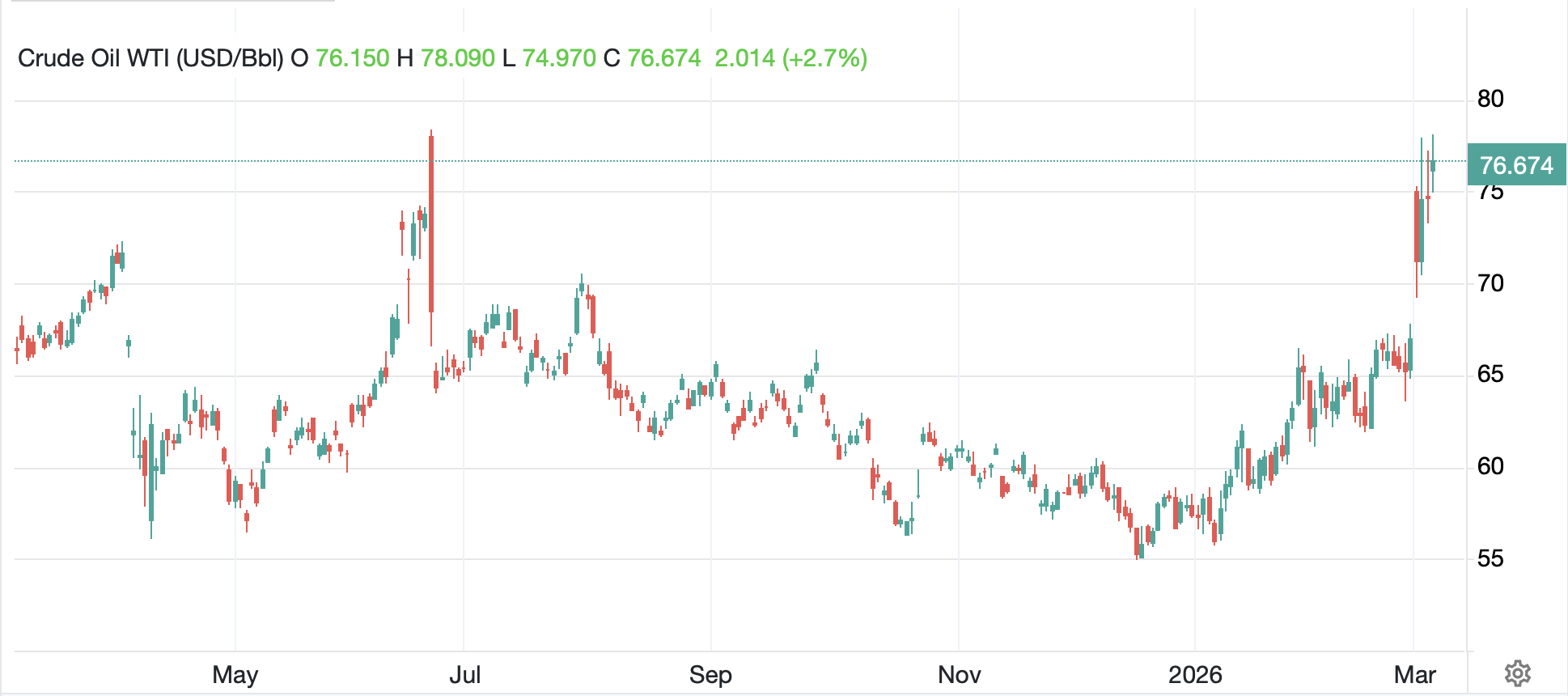
In the meantime, market participants have absorbed the ongoing information and much of the initial FUD has been ameliorated.  I only say this because yesterday and overnight, equity markets are almost universally higher, and in some cases, by substantial amounts.  Arguably, this is a bigger disaster for the Iranians than almost anything else.  If financial markets continue to motor along despite the war, it removes a potential pressure point on President Trump to deescalate.  In fact, the only market that is continuing to demonstrate any price concerns is the oil market, where WTI (+2.6%) and Brent (+2.2%) are both back close to the highest levels seen in the first days.

Source: tradingeconomics.com

The Strait of Hormuz continues to be effectively closed, and that remains a problem for both Europe and Asia, especially China.  In fact, this morning I read that China has ceased exporting refined products amid concerns of how long this war will continue.  

Now, permanently higher oil prices would definitely have severe negative consequences for the global economy if that were to be the outcome.  But I don’t see that as the outcome.  Rather, the world is awash in oil as the US and Canada and Venezuela and Brazil and Argentina continue to pump like crazy.  As well, Saudi Arabia has two major pipelines that ship oil to the Red Sea rather than require transit of the Strait, so I am not hugely concerned about a much higher price.  All of the fears of $100/bbl or higher oil in the event of a closure of the Strait of Hormuz have not come to pass, at least not yet, and I see no reason for that to be the case going forward.

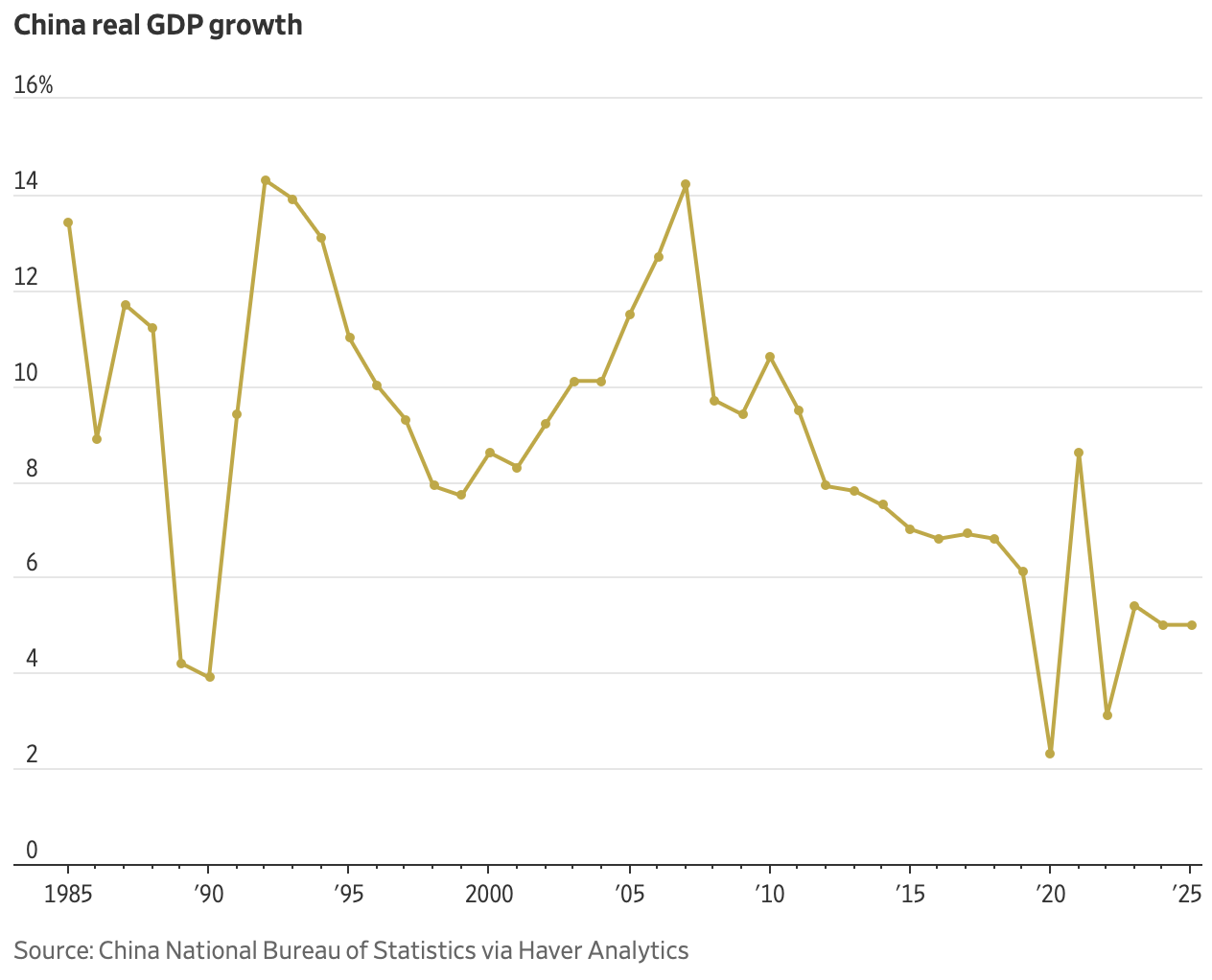
But away from oil, things are remarkably ordinary in markets, so much so that the real story of the day, I believe, is that China has targeted GDP growth of ‘just’ 4.5%. – 5.0% for this year.  The WSJ had a very nice graph of the trajectory of Chinese GDP since 1985 showing a 4.5% outcome would be the lowest (excluding Covid) since 1991.

For a good explanation of things regarding the Chinese economy, it is always worthwhile to turn to @michaelxpettis on X and he didn’t disappoint this morning.  In a nutshell, his point is that while the statement claims they will be focusing more on domestic consumption in their effort to rebalance the economy, that has been the stated aim for at least 5 years, and we know that hasn’t happened.  President Xi’s problem is that if that goal were to be achieved, it would result in GDP growth somewhere on the order of 2%, and that is not acceptable.  For my money, nothing has changed there.  Chinese companies will still over produce, prices in China will still be pressured lower and the Chinese trade surplus will remain well in excess of $1 trillion.

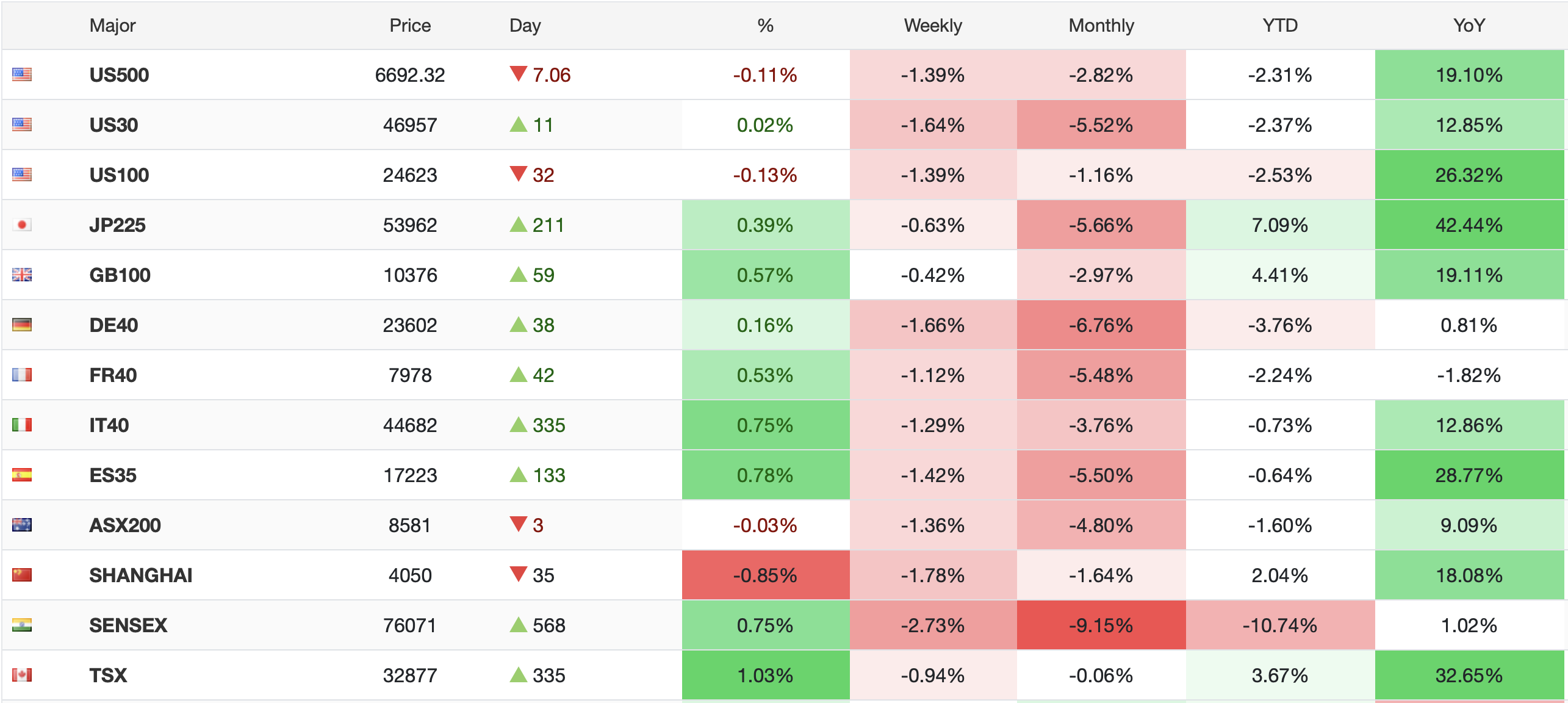
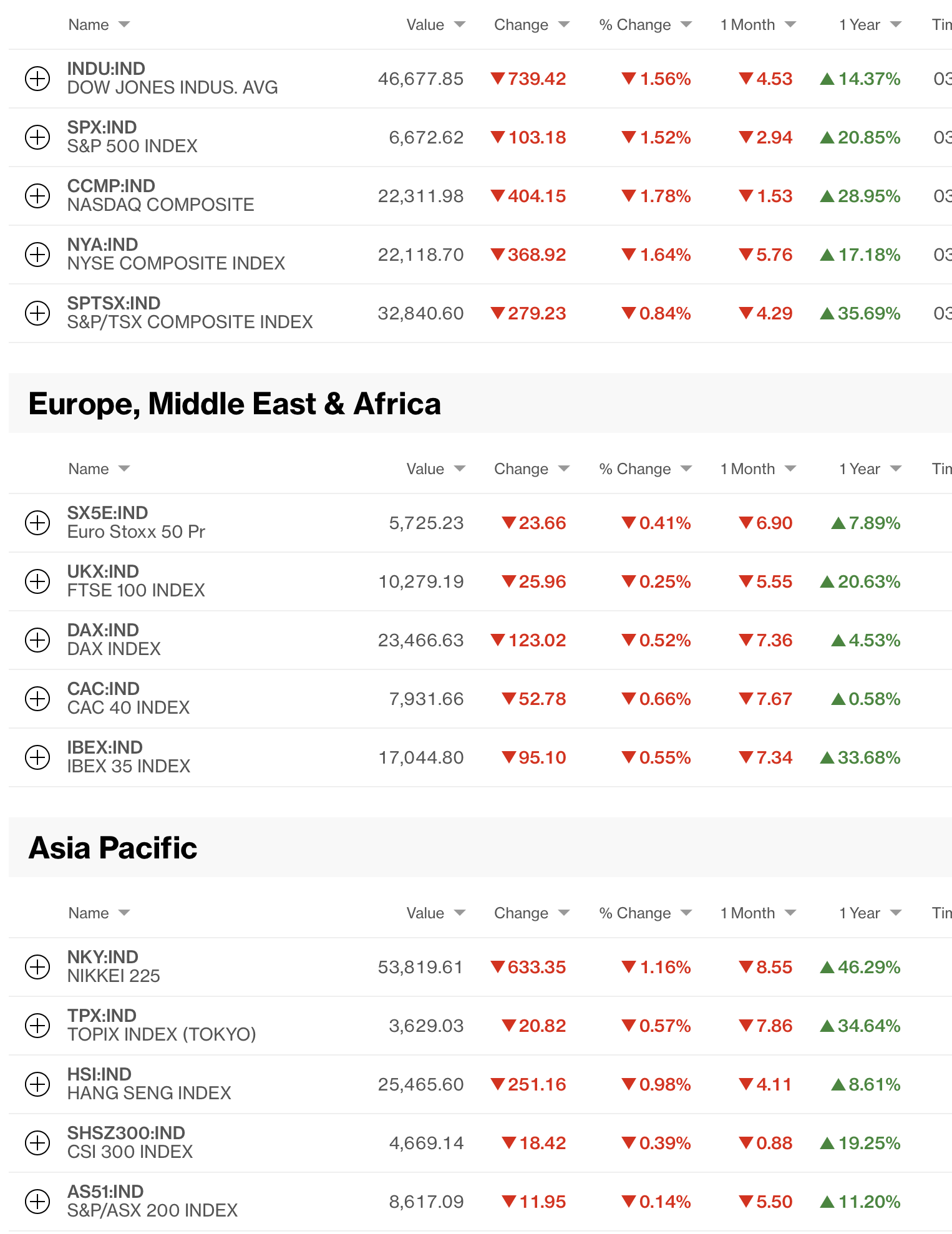
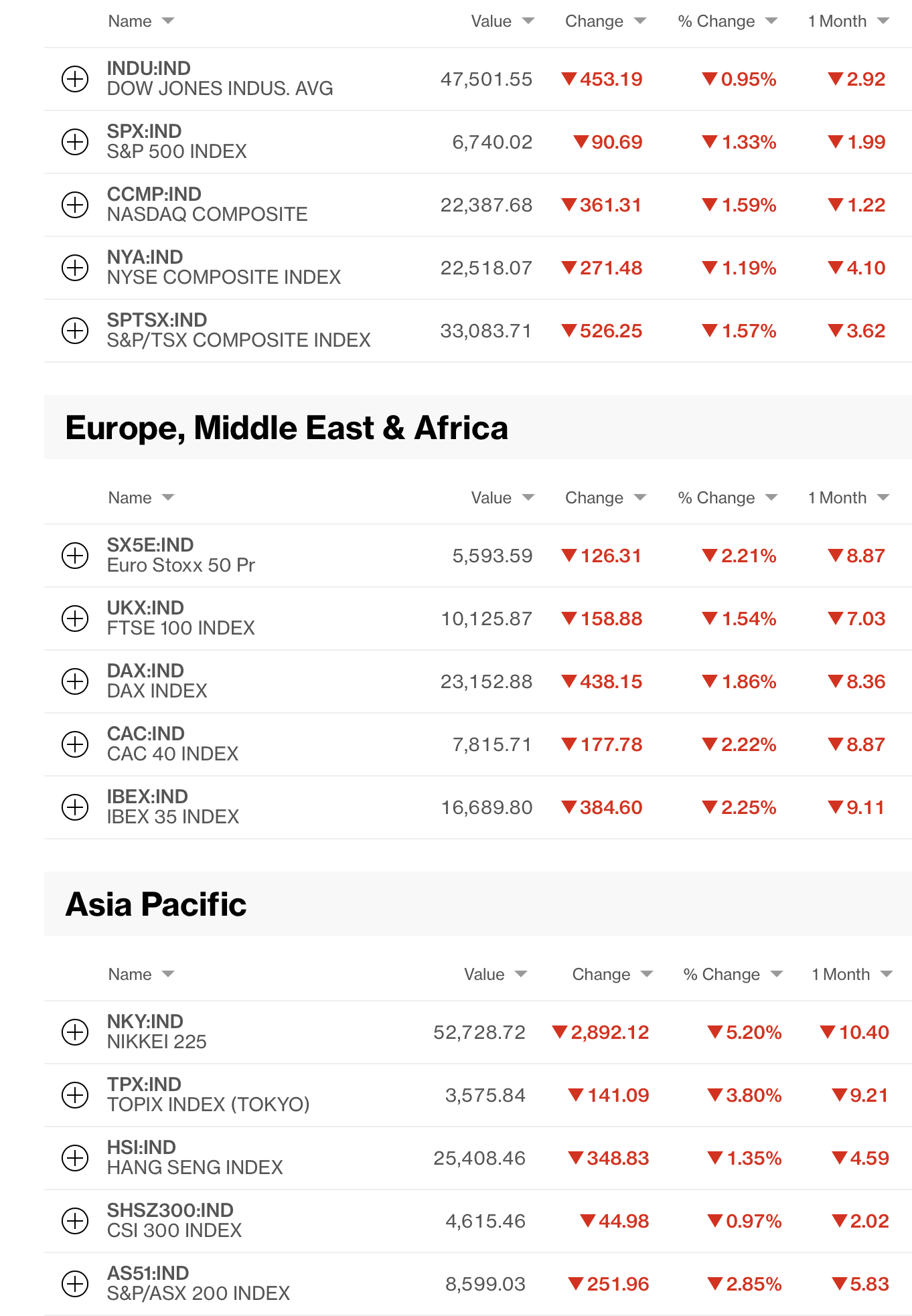
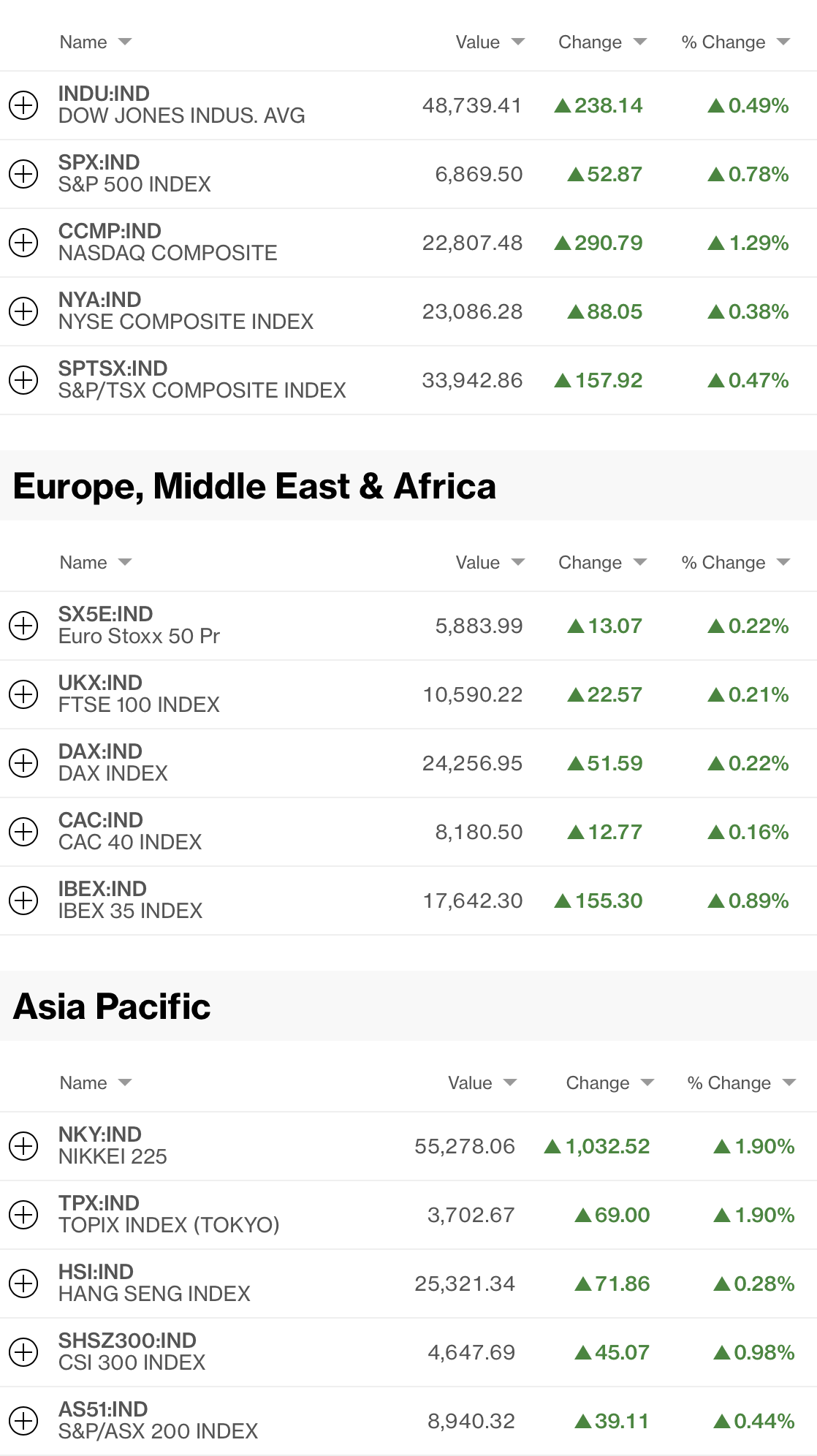
And that’s really what we have today.  I am not a war correspondent, so will not be highlighting anything there.  Rather, let’s turn to the markets and see what happened overnight.  under the guise of a picture is worth 1000 words, I give you major equity market performance in the past 24 hours below from Bloomberg.

Of course, this doesn’t consider Korea (+9.6%) which was the biggest winner overnight, and recouped most of the previous day’s losses as per the below.

Source: finance.yahoo.com

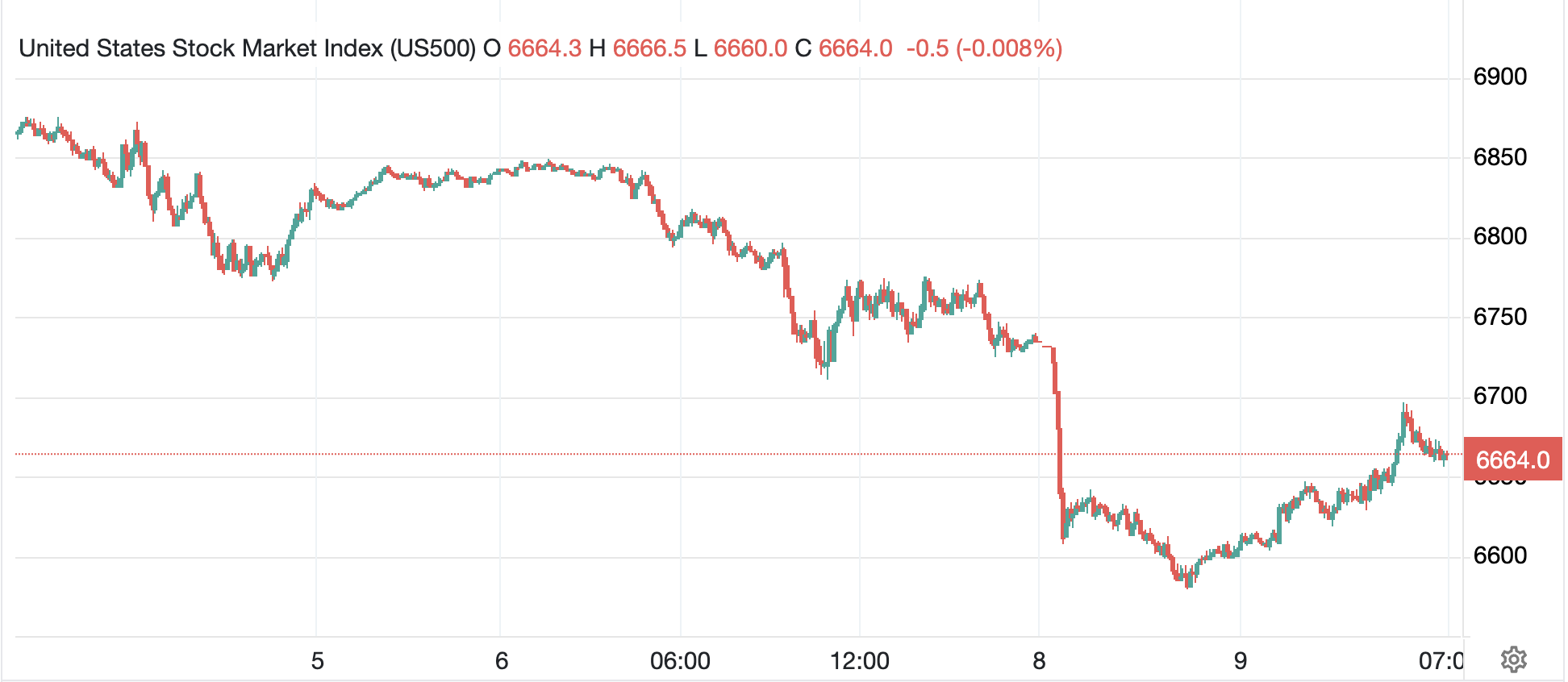
But virtually every market in Asia rallied overnight with Taiwan, Indonesia and Thailand all higher by 2% or more.  As to Europe, the euphoria is not as high, but still fear is not evident and at this hour (7:10), US futures are flat to -0.15%, so basically unchanged.

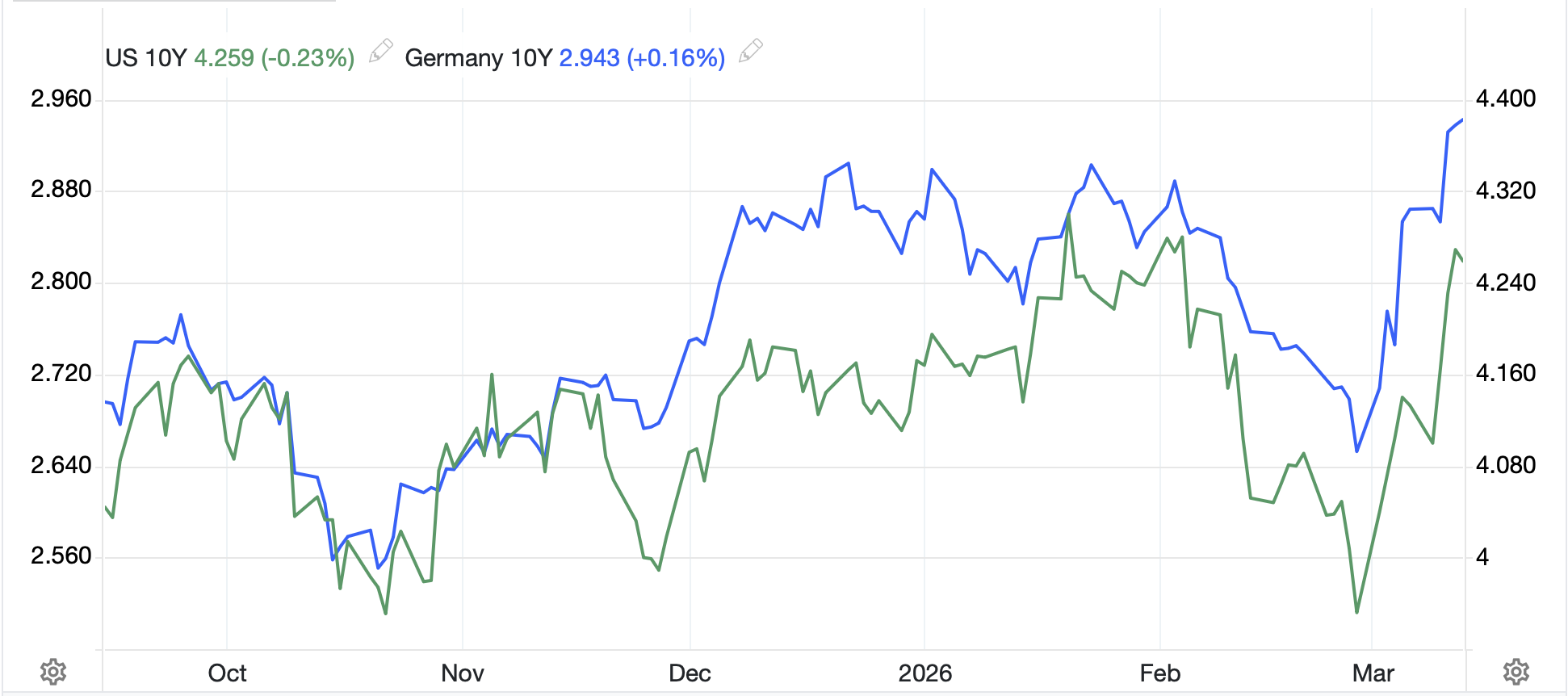
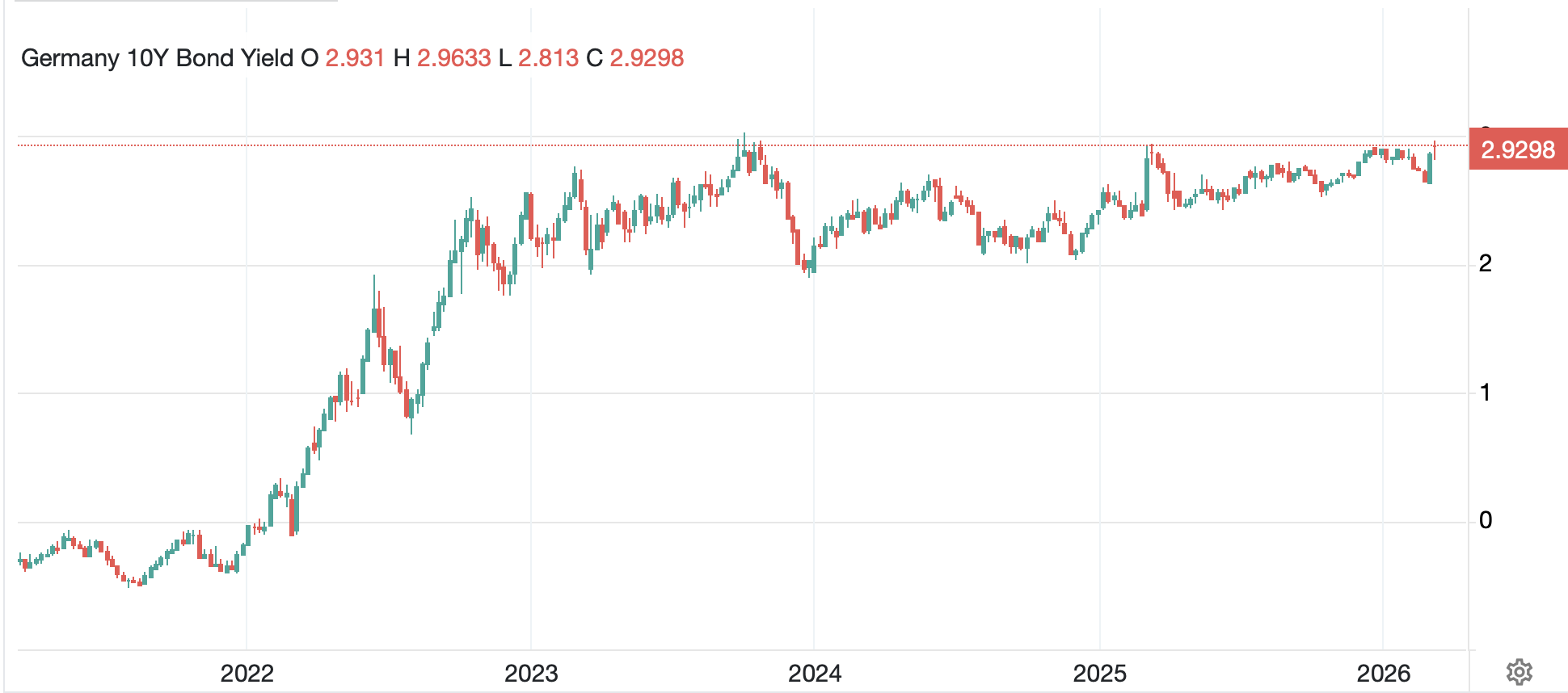
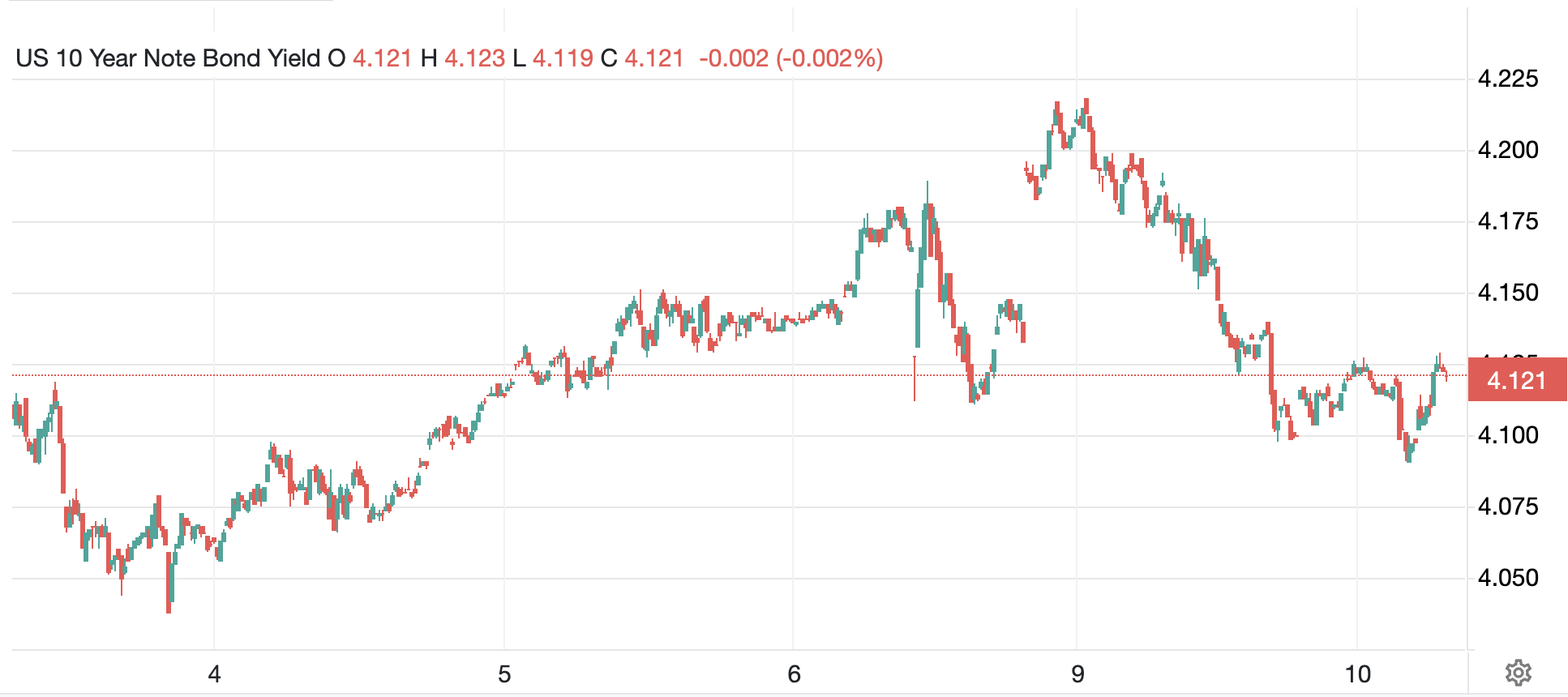
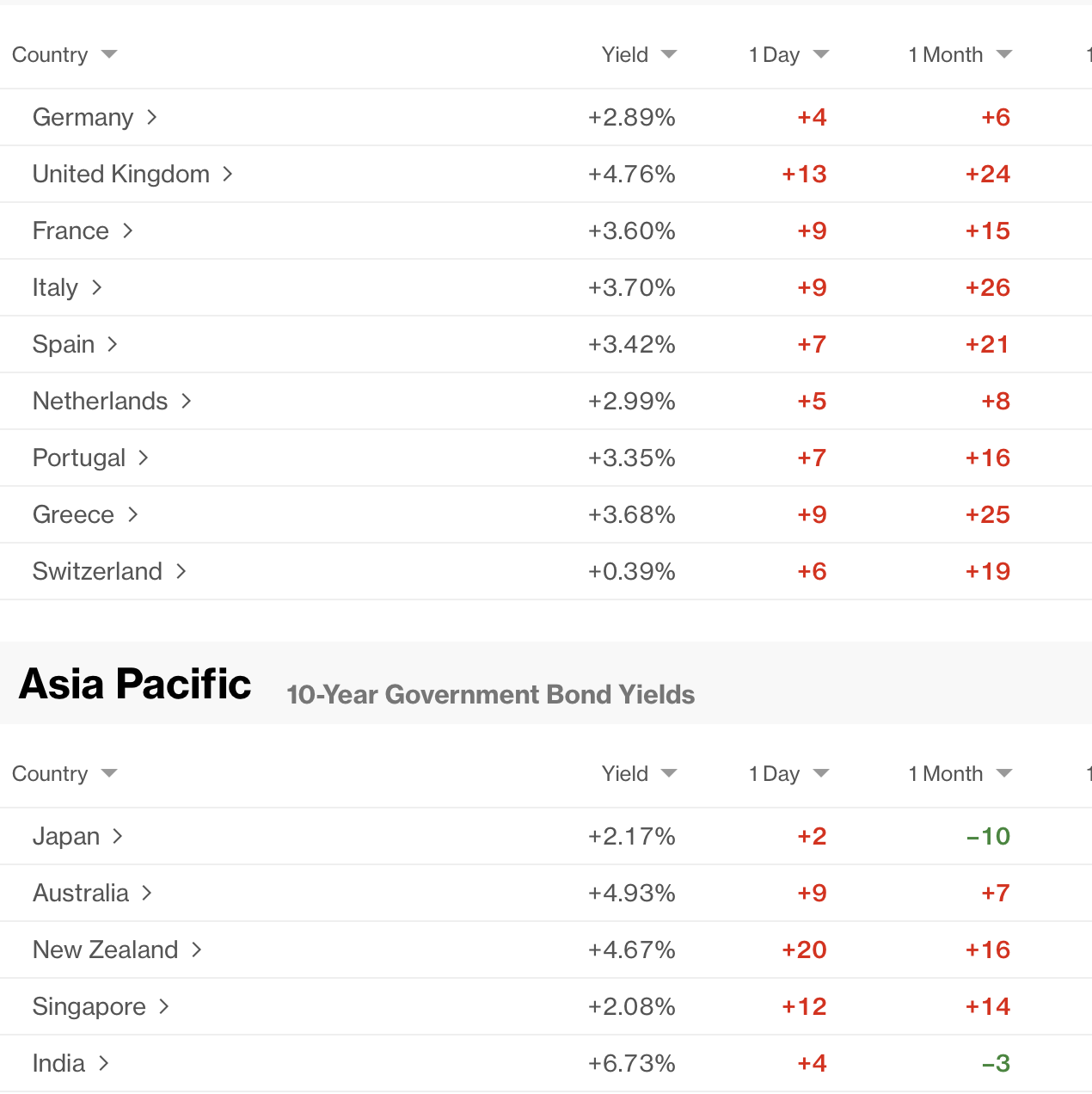
The bond market is having a tougher time around the world with Treasury yields rising yesterday by 4bps and up another 2bps this morning.  European sovereign yields are all higher by between 6bps and 8bps as inflation fears start to get built into investment theses.  Remember, Europe is probably the worst hit regarding the oil/LNG supply disruptions and prices there are likely to climb further than in the US or Western Hemisphere.  Too, JGBs (+4bps) are feeling a little strain, despite (because of?) Ueda-san and his cronies expressing concern over the war’s impact on inflation in Japan and maintaining that a rate hike in April is still a possibility.

Speaking of inflation, the Fed’s Beige Book was released yesterday as well as a NY Fed survey on prices in their region and both pointed to much more underlying inflation than the CPI data currently implies.  Wolf Richter had an excellent write-up here, and the numbers are eye opening.

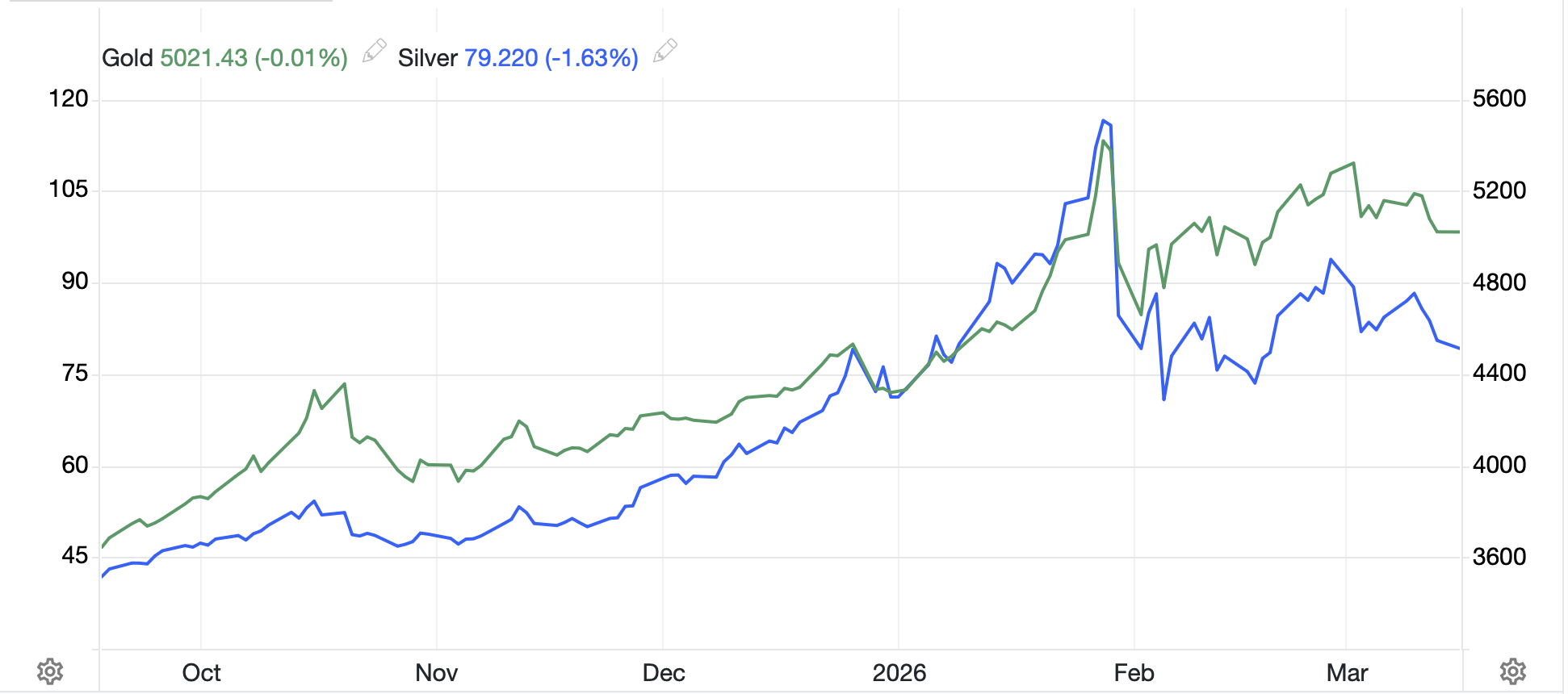
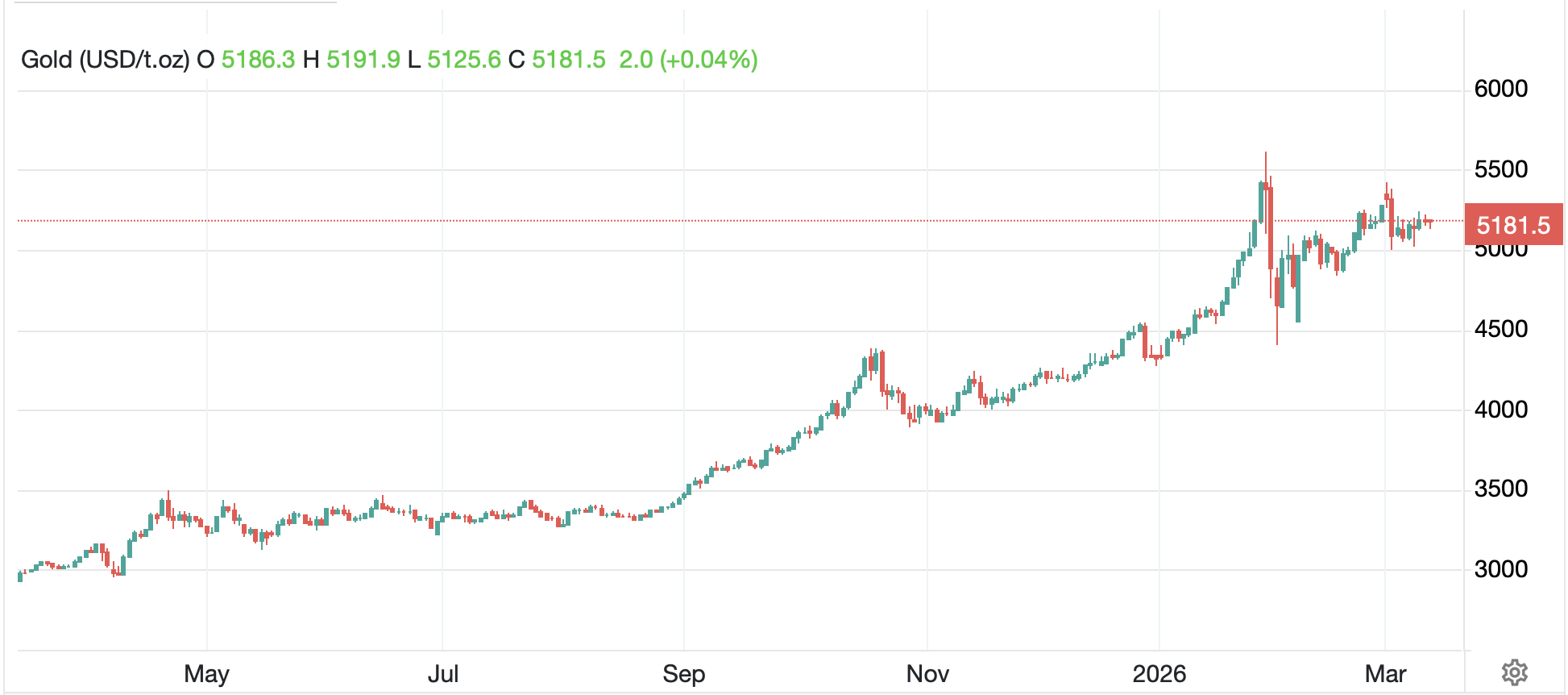
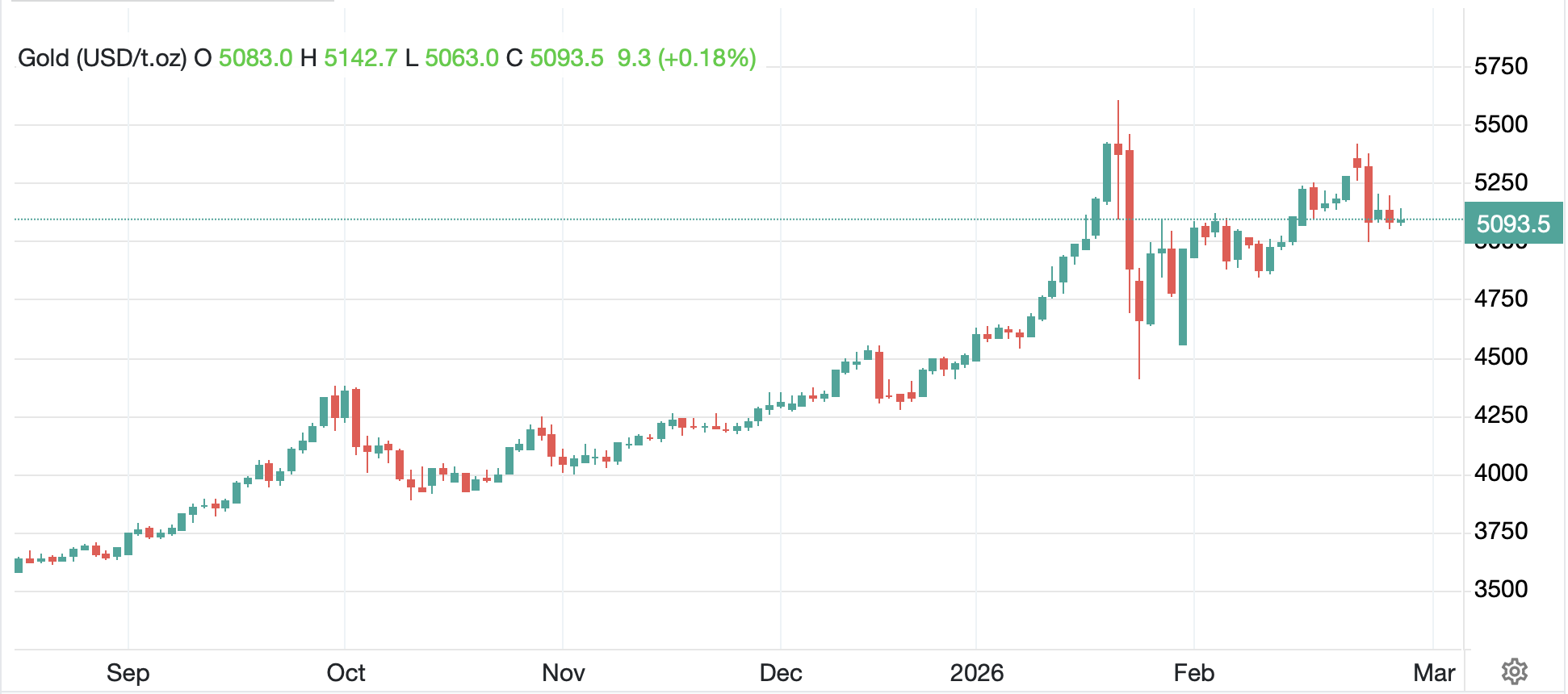
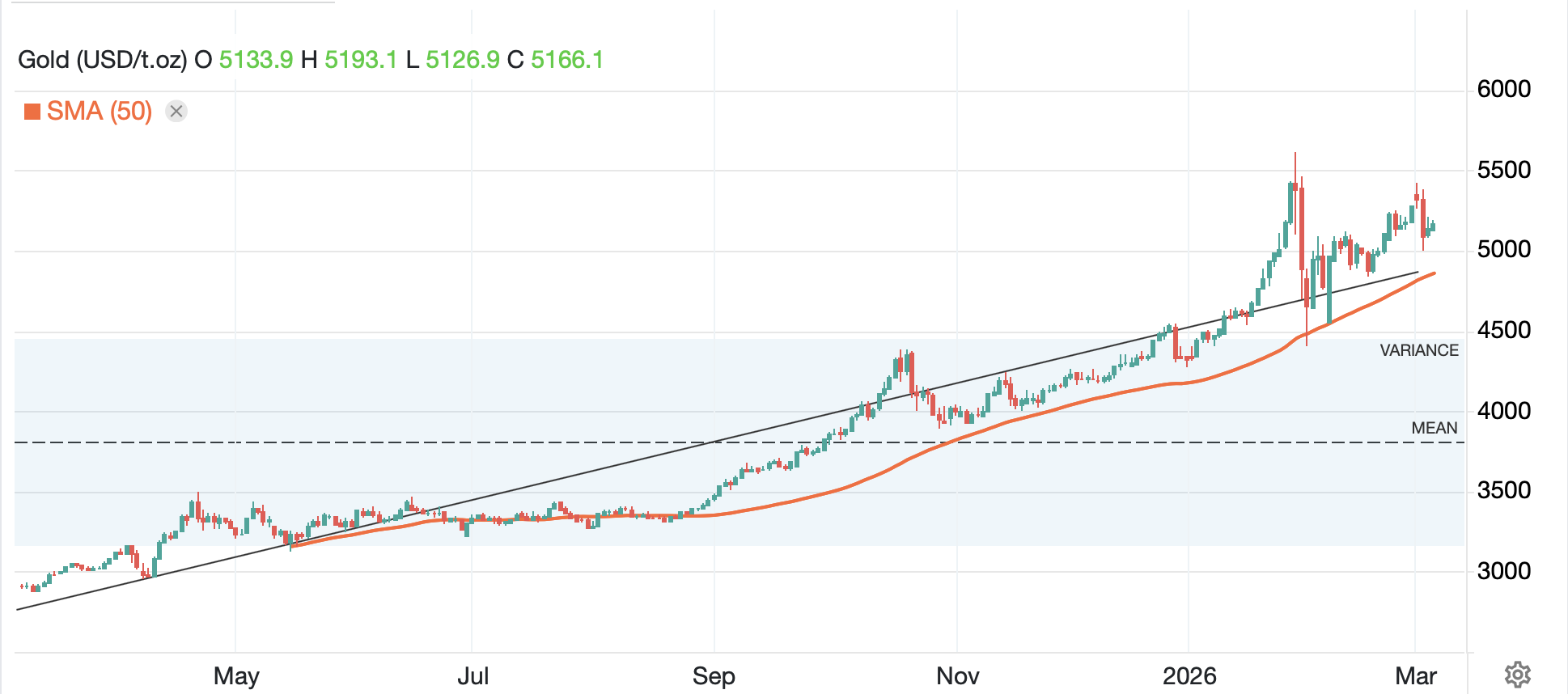
In the metals markets, gold (+0.6%) really has a remarkable amount of support under all conditions.  Whether I look at a mechanically drawn trend line or the 50-day moving average, the barbarous relic remains in demand and shows no signs of breaking lower.  I continue to believe that the recent volatility and liquidations were the result of leveraged traders in other products needing to sell something to make margin calls, and gold was available for the job.

Source: tradingeconomics.com

As to the other metals, silver (+1.1%) and platinum (+0.9%) are both modestly firmer while copper (-1.3%) is bucking the trend, although I see no good reason for it to decline.  One interesting thing to note is that silver in the COMEX vaults continues to decline which many see as a potential point of supply issues going forward.  Nothing has changed that story.

Finally, the FX markets are once again hewing toward dollars with the DXY (+0.15%) back around 99.00.  The worst performer today is CLP (-1.1%) which is feeling the pressure from copper’s struggles, but ZAR (-0.9%) is also under pressure despite gold’s rebound.  Interestingly, NOK (-0.2%) cannot seem to gain any ground despite oil’s rally, although arguably, the dollar itself has become a major petrocurrency with a positive correlation to oil.  This space is not that interesting right now.

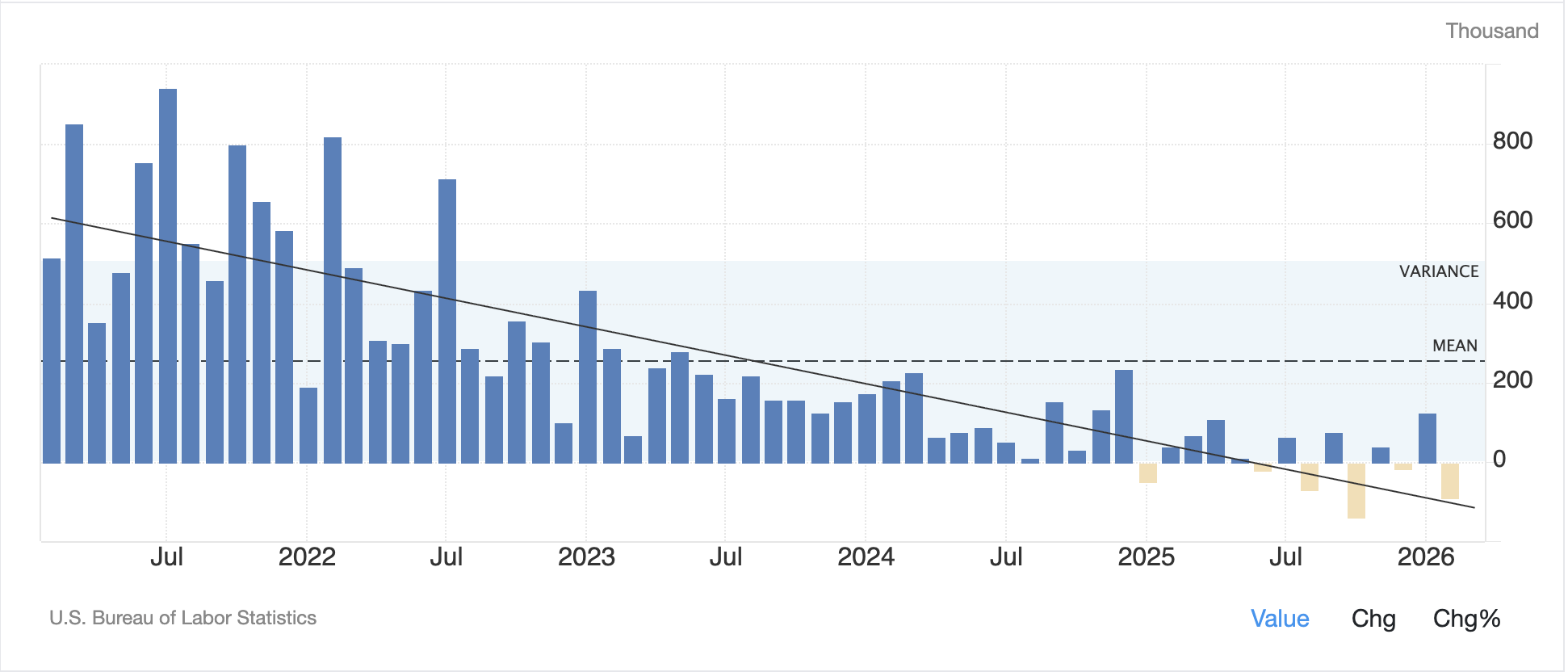
On the data front, I neglected to mention ADP Employment yesterday, which wound up at a better-than-expected 63K.  Too, oil inventories in the US rose again last week.  This morning, Initial (exp 215K) and Continuing (1850K) Claims are due as well as Nonfarm Productivity for Q4 (1.9%) and Unit Labor Costs (2.0%).  But does the data really matter right now?  Perhaps tomorrow’s NFP will have impact, but with the war and higher oil prices, it is very difficult for me to see a scenario where the Fed will impose itself here, not where the market will care that much, at least not the stock market. Bonds would react I suppose.  But it ain’t gonna happen, so don’t worry about it.

Absent a change in the war’s current trajectory, I think investors are going to focus on trying to estimate how long oil prices will remain elevated as that is really the big question for most markets.  I can only hope it doesn’t take that much longer for a conclusion.

Good luck

Adf
Impacts of War

The financial impacts of war
Are many, and so here are four
Inflation will rise
And what this implies
Investors, most bonds, will abhor

The dollar is like to remain
Demanded and that will cause pain
For stocks everywhere
But one thing will fare
Just fine, look for gold, more, to gain

Obviously, the war in Iran remains the top story and is likely to remain so for a few more weeks at least.  Arguably, the only way this will change is either a regime change takes place and talks for peace begin, or Iran is able to retaliate in a heretofore unknown fashion sufficient to force the US and Israel to withdraw.  President Trump has indicated he believes this campaign will last 4-5 weeks with that regime change the result.  But remember, the Russia/Ukraine war slipped from the headlines after 6-8 weeks, and it is still ongoing.  In fact, I challenge you to find a story about that war anywhere these days.

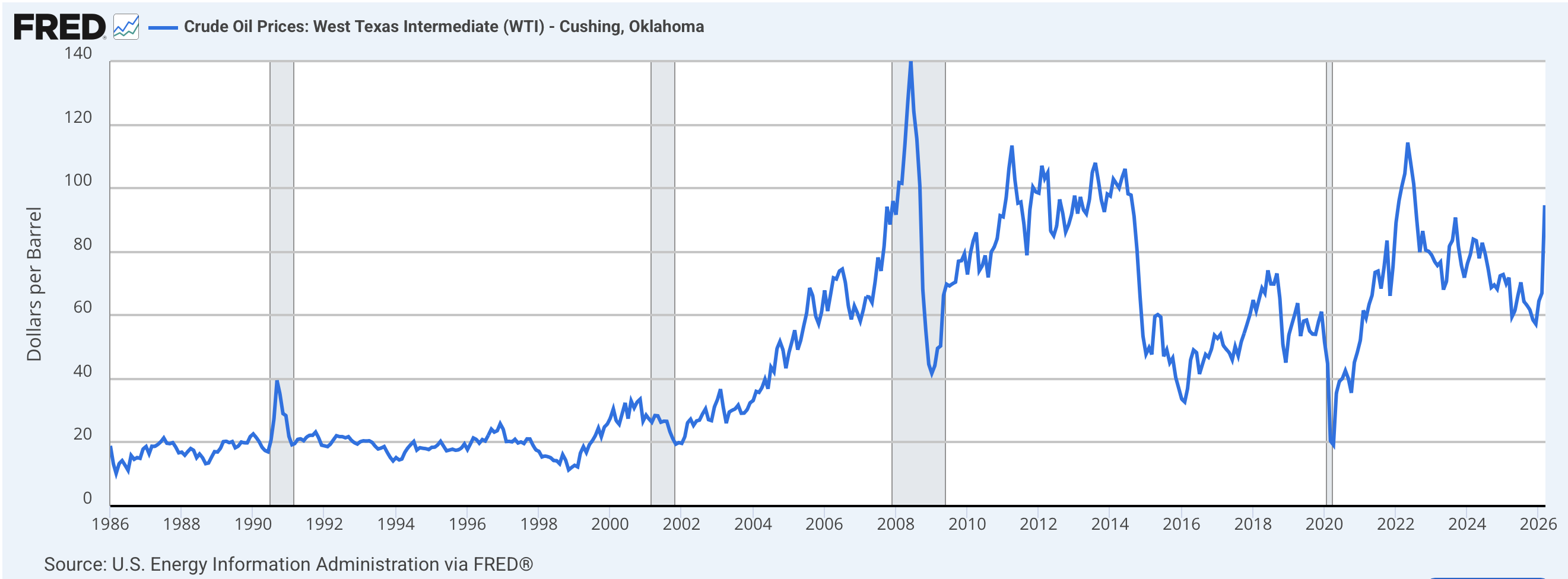
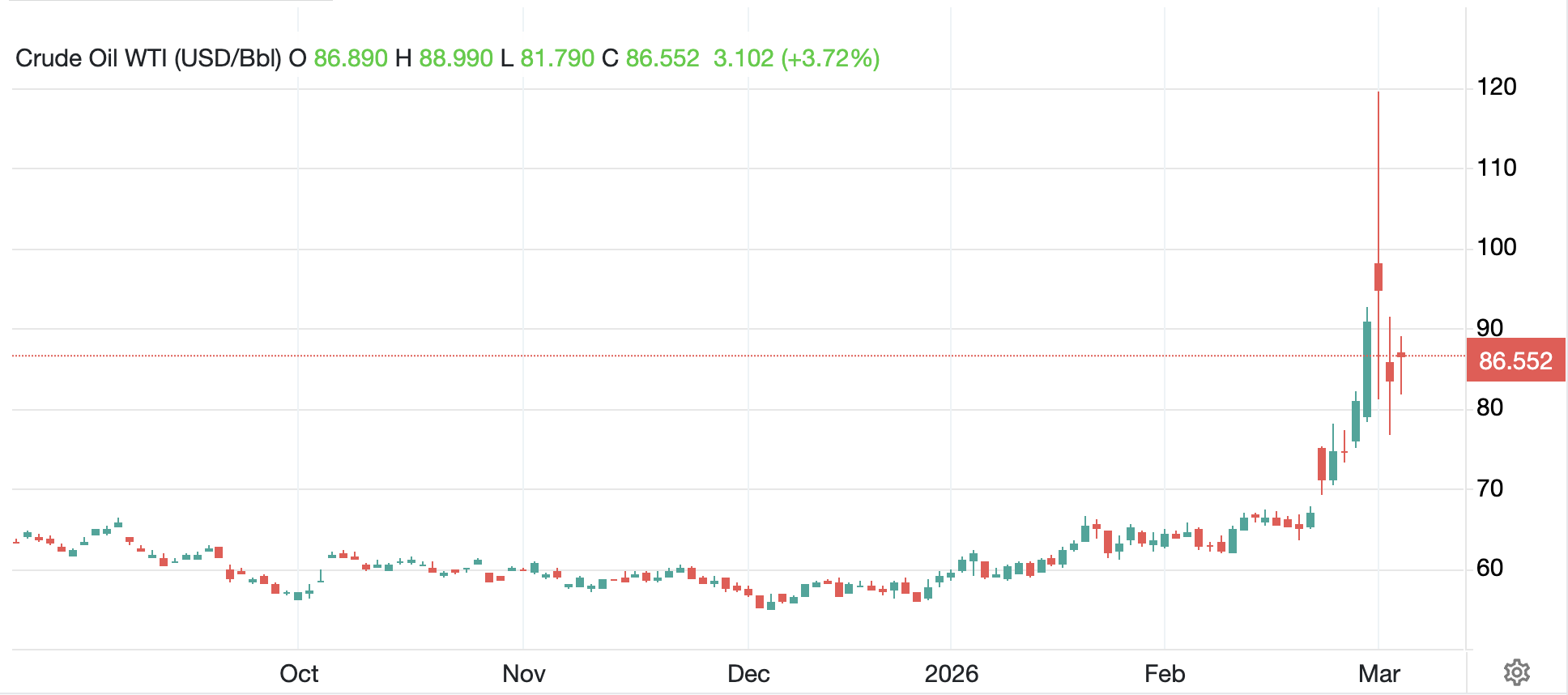
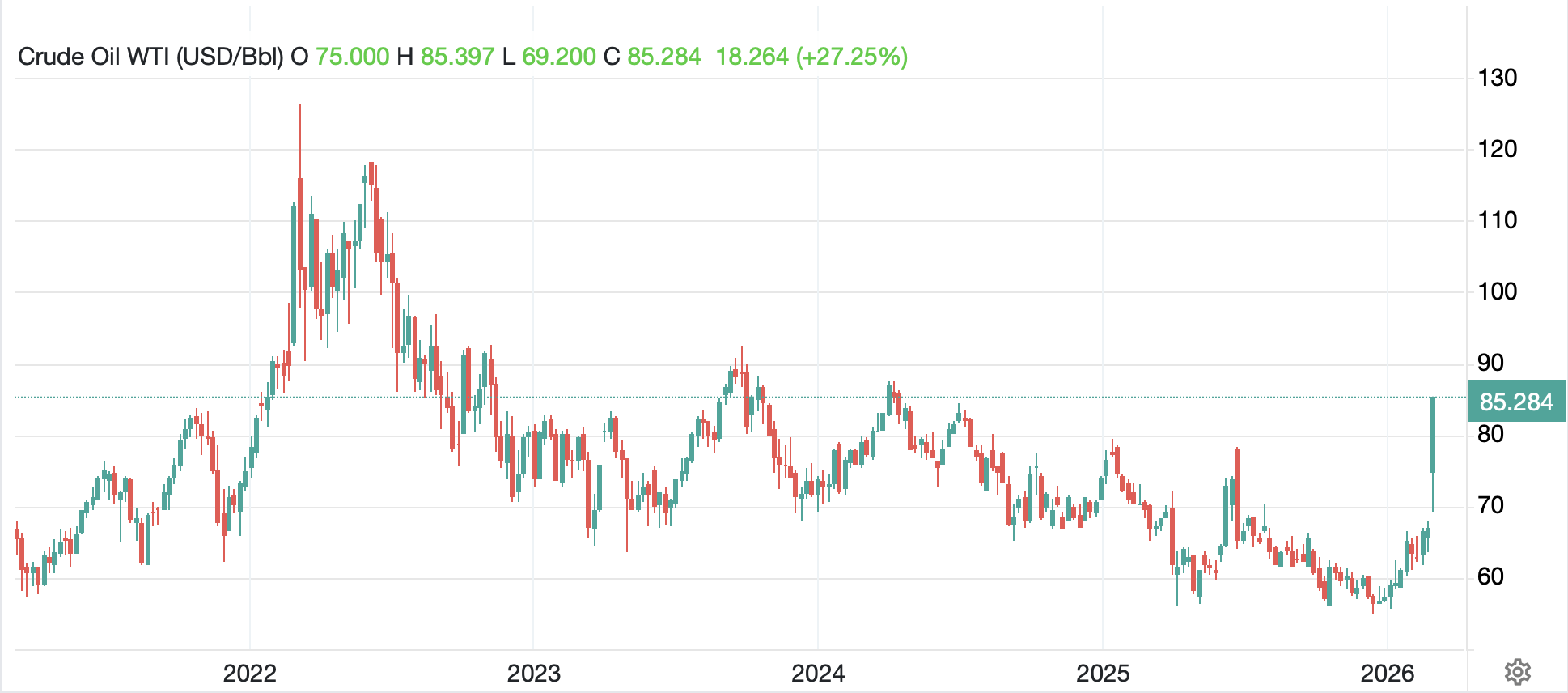
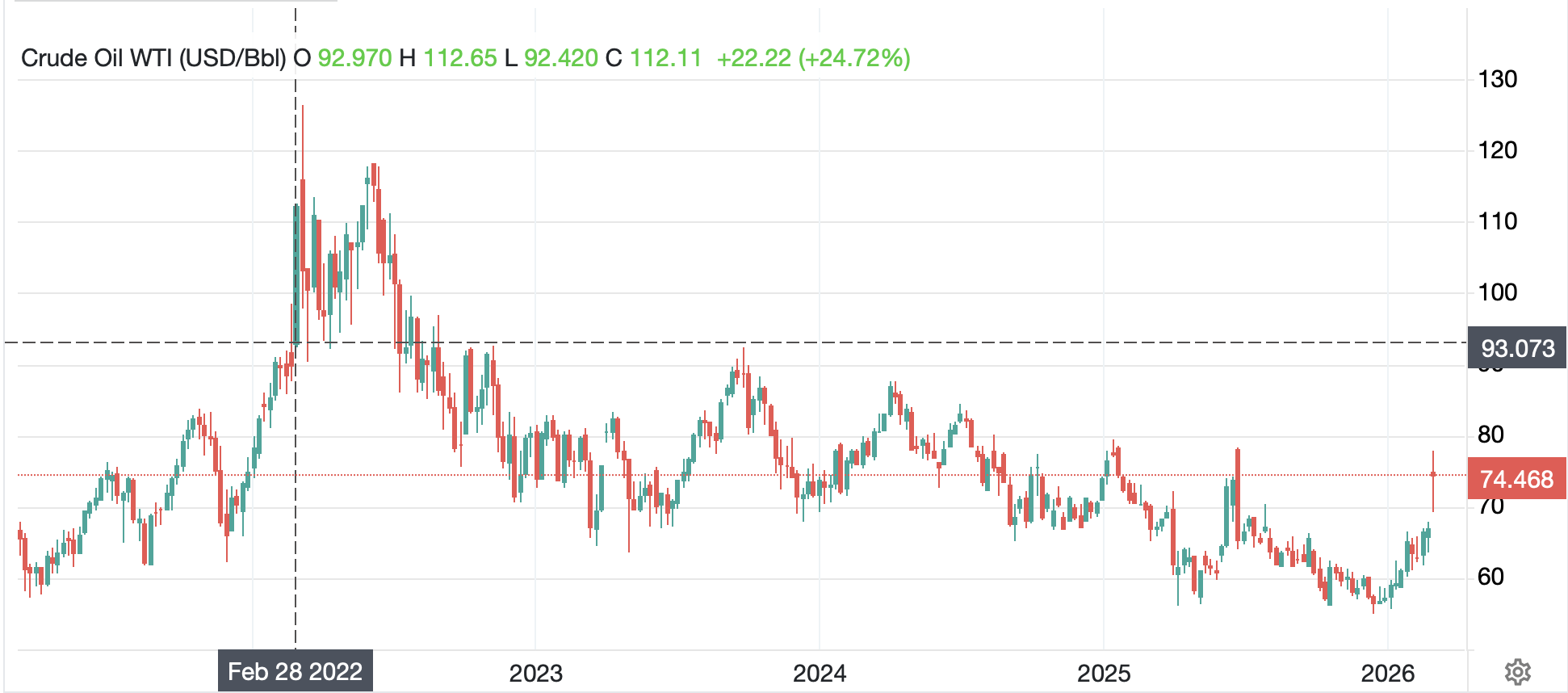
My point is, despite the ongoing hostilities, the rest of the world continues on its way, albeit with some new bumps in the road.  Clearly, the biggest bump remains the price of oil and, for much of Europe and Asia, its continued availability.  While the price of oil (+0.1% today) has risen about 18% in the past month, a look at the long-term chart below offers a bit more perspective as to just how limited this movement has been so far.

Source: tradingeconomics.com

I have highlighted the week of the Russian invasion from February 2022, which saw oil rise more than 20% at the time and remain elevated for about 5 months before it retraced to prewar levels.  The reaction this time has not been nearly as dramatic even though the effective closure of the Strait of Hormuz has removed about 20% of global oil supply from the market right now, as well as a similar proportion of LNG.  This is why we have seen the massive spike in European and Asian LNG prices as that was the destination of those cargoes.  Ironically, one of the most negatively impacted nations is China, which was Iran’s biggest oil customer, but now has seen a dramatic decline in the availability of oil. Of course, they have built a significant stockpile, their own SPR, which holds between 1.2 -1.5 billion barrels, enough to supply the nation for upwards of 4 months.  While not an immediate concern, it will start to hurt after a while if this continues.

It appears to me that unless Iran starts targeting and destroying oil production facilities throughout the Middle East, which is certainly possible, the upside for prices from here is limited under current circumstances.  My guess, and it is just that, is another 10%.  Of course, the risk for Iran there is that it draws the Saudis, Emiratis and the rest of the Gulf into the war against Iran, probably not a desired outcome either.  

As an aside, I wonder if prices rise far enough in a worst-case scenario, if the UK removes its drilling restrictions, although thus far, PM Starmer has not indicated anything of the sort.  It depends on just how painful things become I suppose.

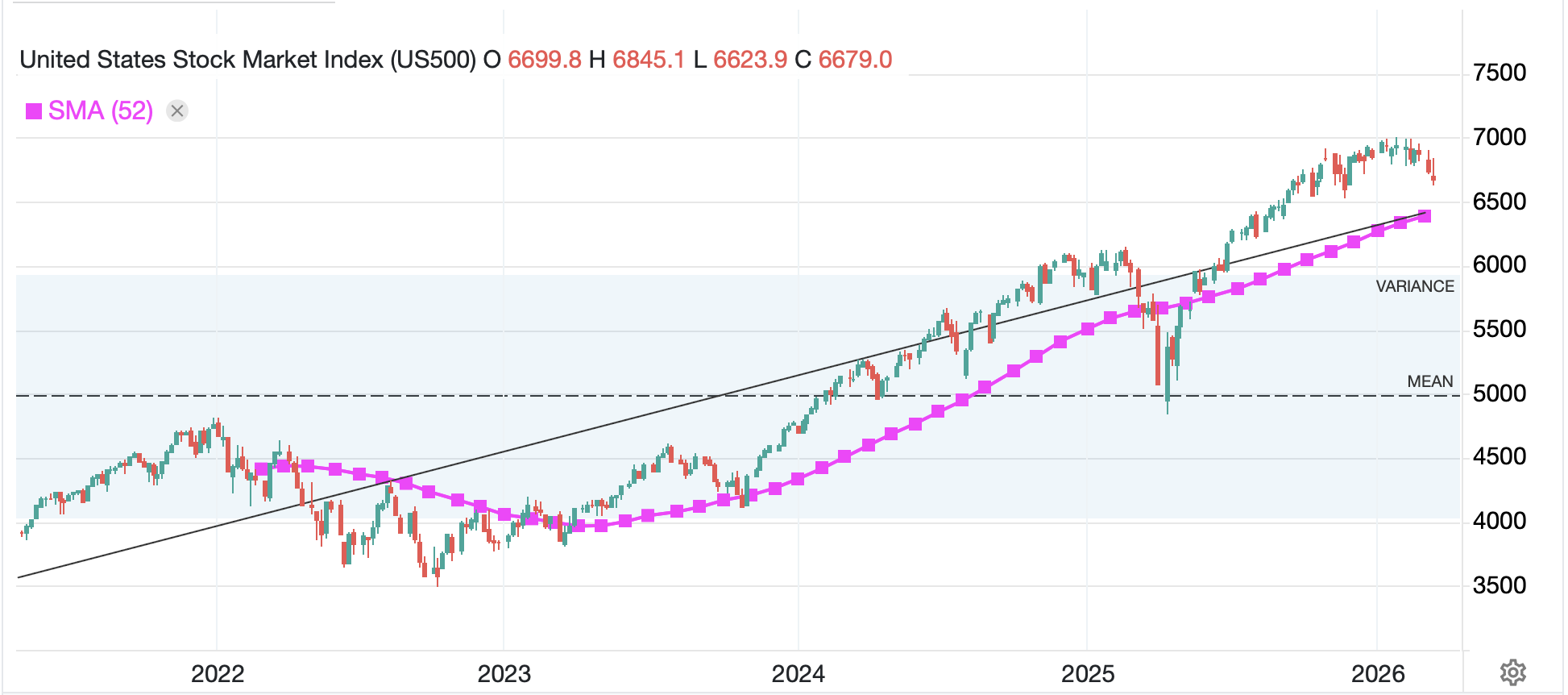
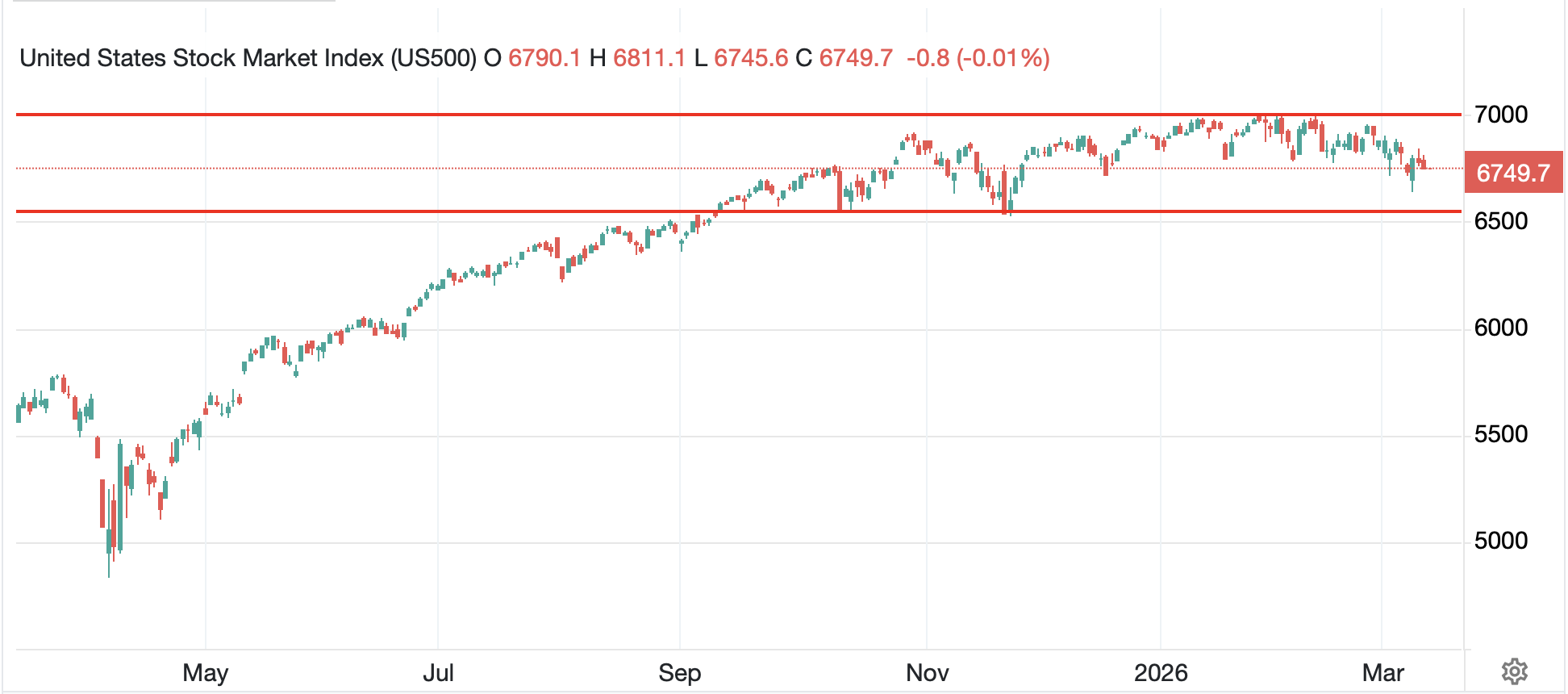
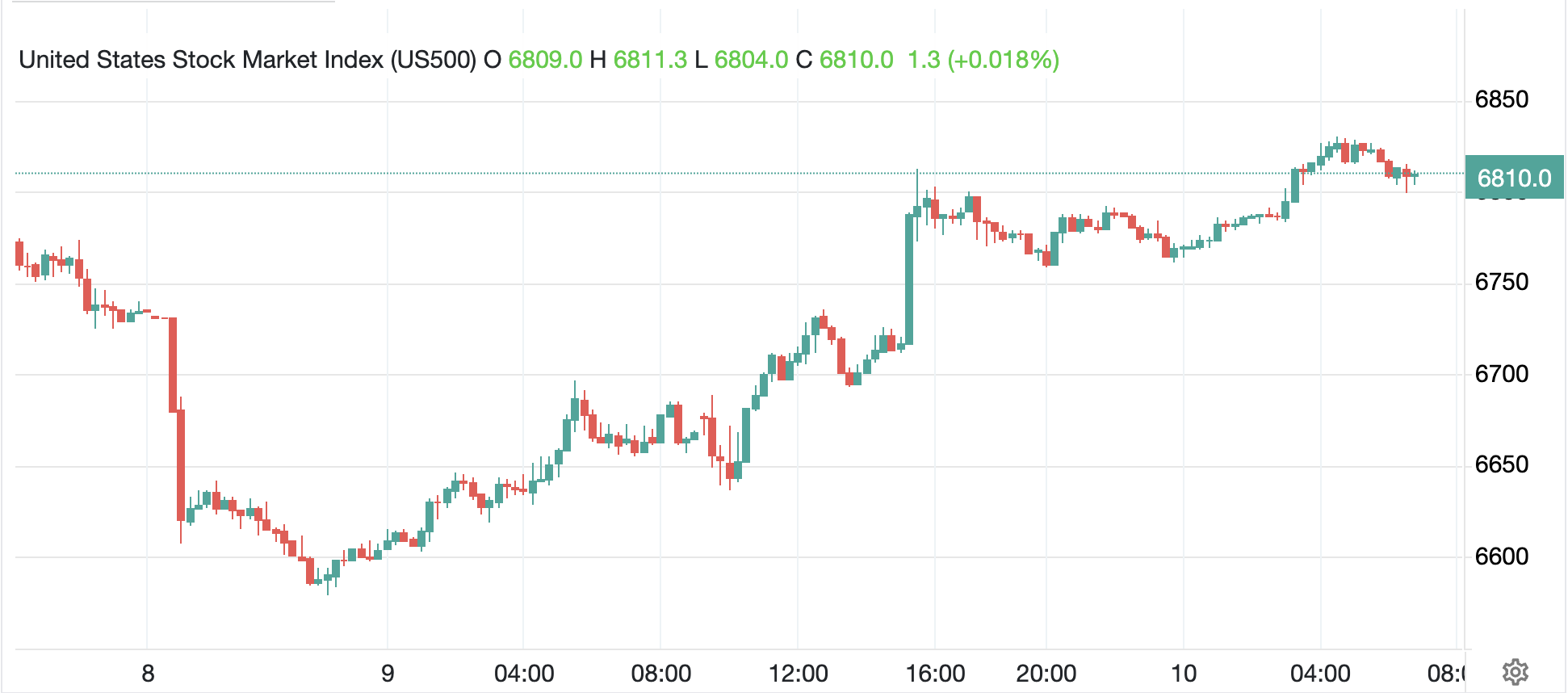
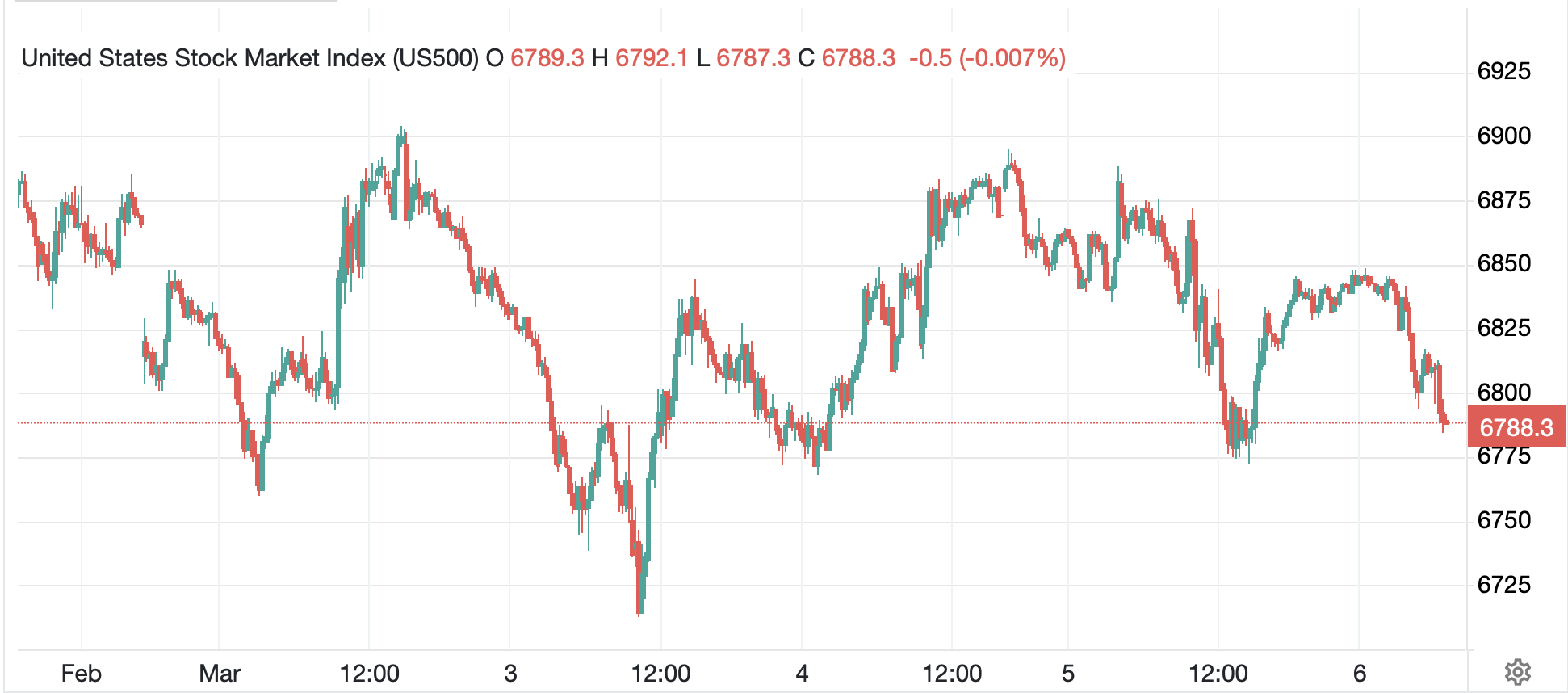
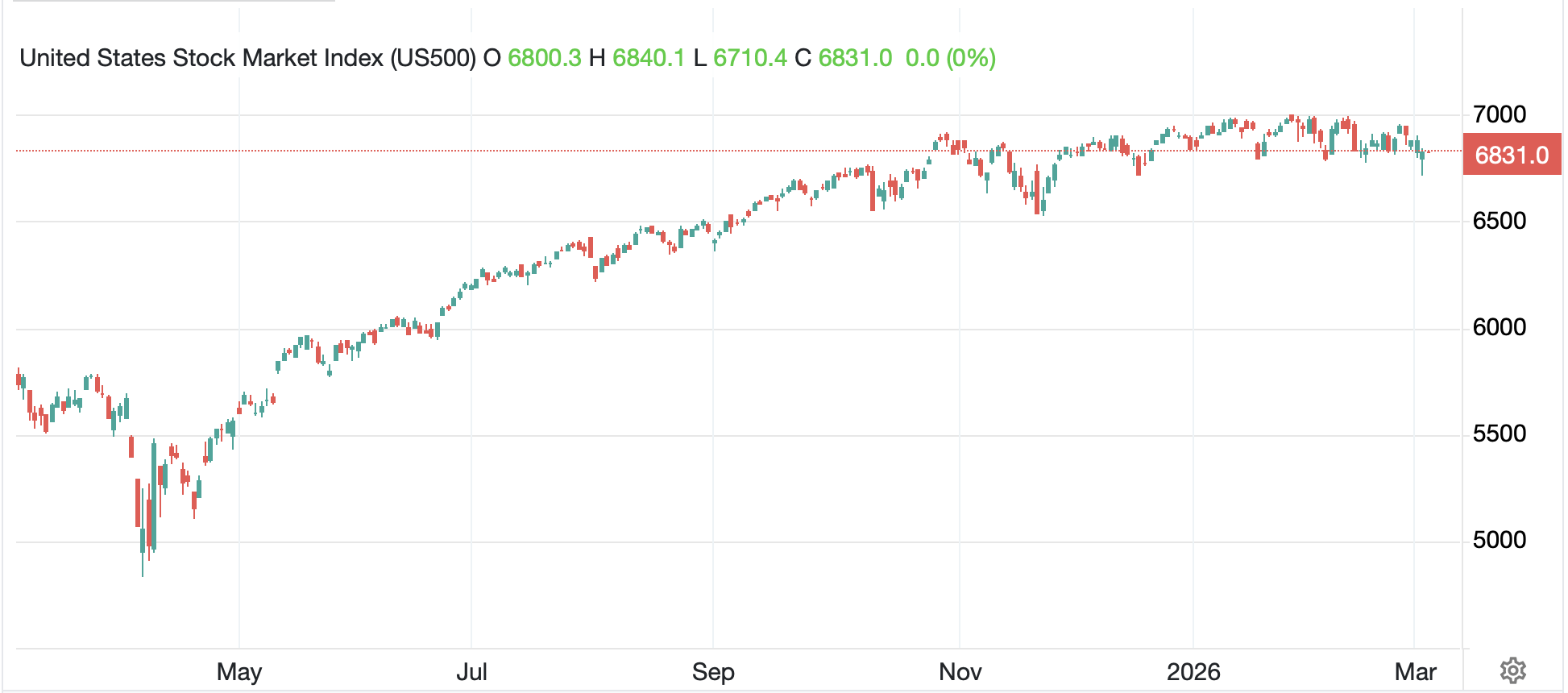
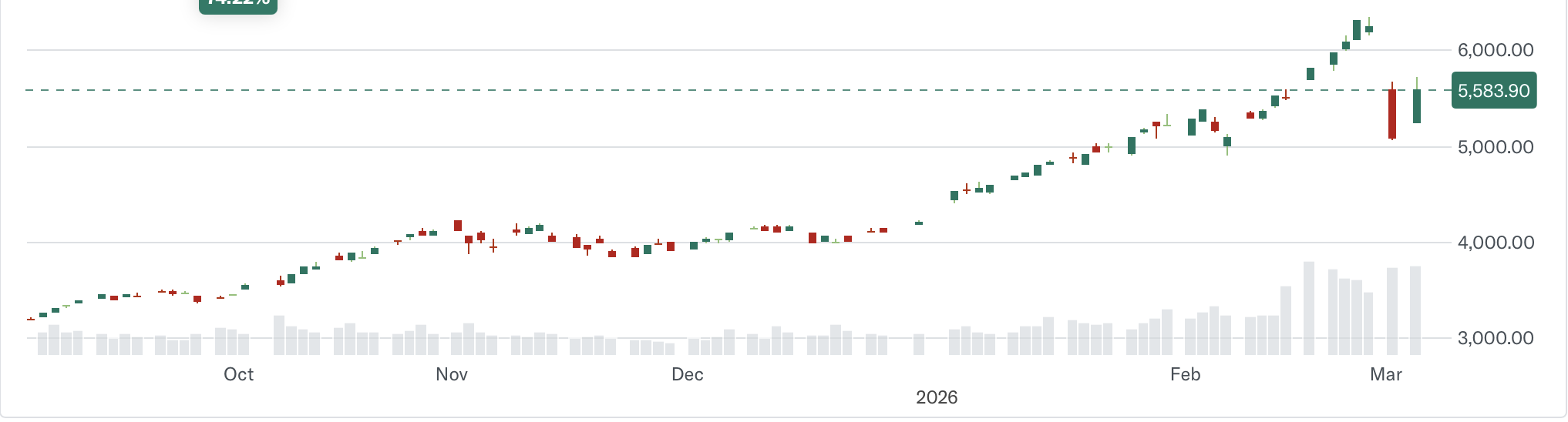
Moving on to the equity markets, while US markets have declined somewhat since the war began, the S&P 500 remains just 2.5% below its all-time high set February 28, and as you can see from the chart below, does not appear to be altering the recent trajectory in any meaningful fashion.

Source: tradingeconomics.com

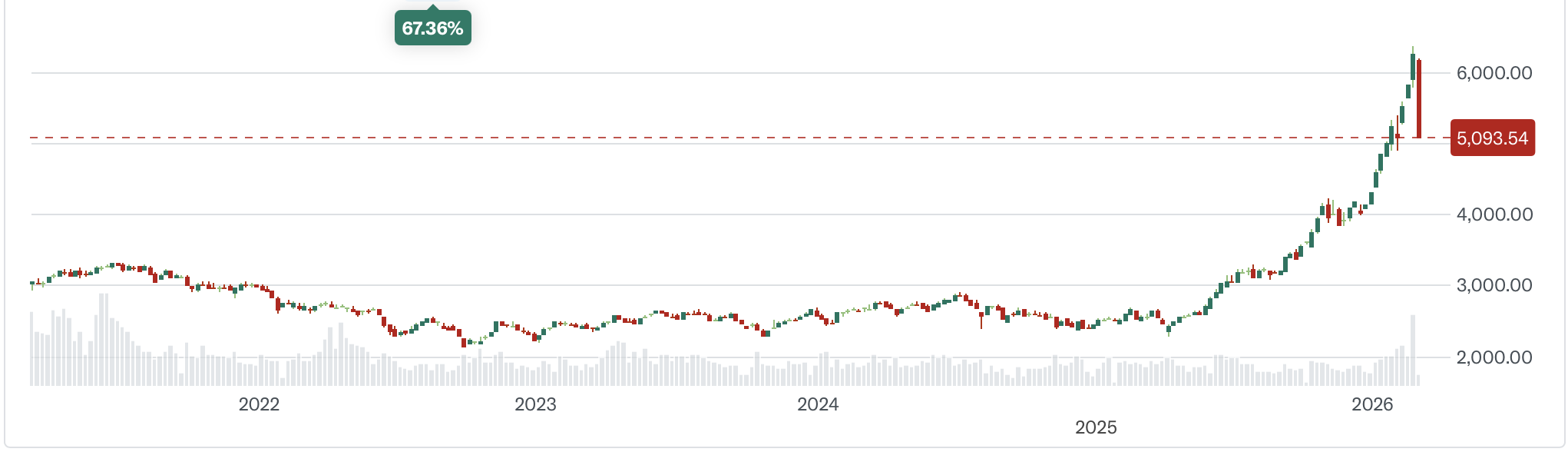
However, the same cannot be said for several other markets, notably those in Asia.  The Kospi (-12.1%) is the worst offender as seen below.  But weakness in the region was widespread with the Nikkei (-3.6%), Hang Seng (-2.0%), Taiex (-4.3%) and Thailand’s SET 50 (-5.4%) leading the way lower with most other bourses falling on the order of -1.0% to -2.0%.  This makes sense as virtually all these nations rely on energy from the Middle East, and with both higher prices and reduced supply, trouble is afoot.

Source: finance.yahoo.com

Of course, as you can also see in the KOSPI chart above, with similar price action elsewhere in the region, these stock markets have been on a tear given their tech focus (Korea’s two largest companies are Samsung and SK Hynix, both semiconductor manufacturers) so there was some room for a reversal.  In fact, remarkably, despite the KOSPI having fallen almost 20% this week, it remains above its trend line.  My take is this is a major correction and something we will see until things in the Middle East settle down.

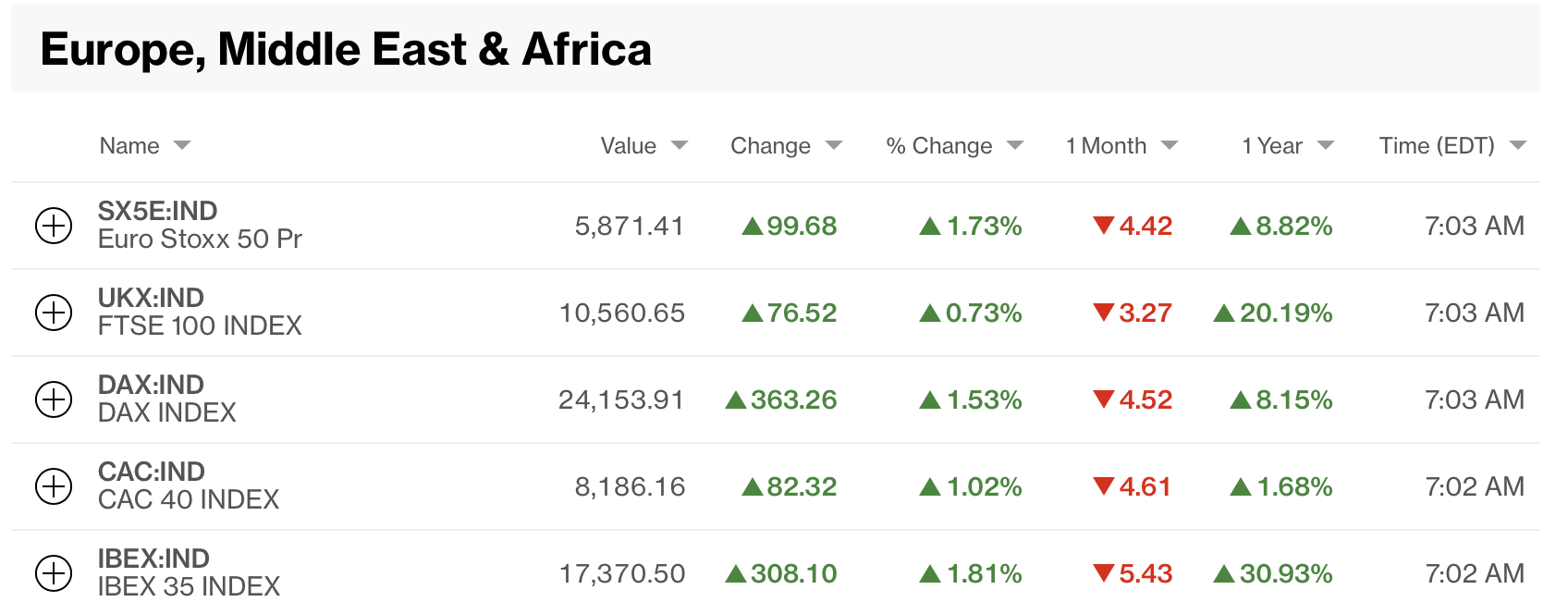
Working in favor of my correction explanation is the fact that European bourses, which all fell sharply yesterday, are all higher this morning as per the below Bloomberg table.

 As to US futures, at this hour (7:30) they are little changed. 

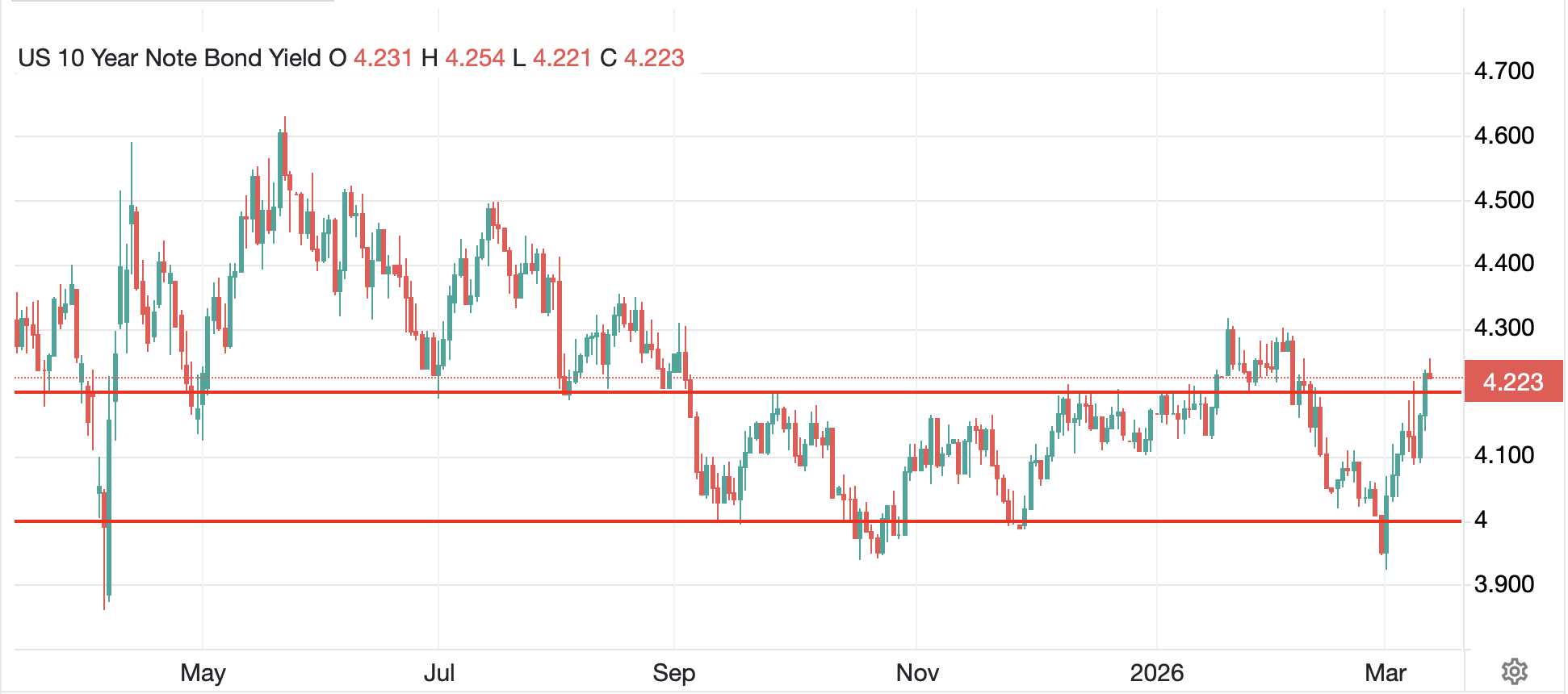
Turning to the bond market, after some initial fears over the inflation implications of the war, as well as the selling that accompanies margin calls, yields have settled down a bit.  This morning Treasury yields (+2bps) are a touch higher but, at 4.08%, hardly running away.  As to European sovereign yields, they are essentially unchanged this morning, and even JGB yields (-2bps) slipped a bit last night.  As I discussed above, markets have digested much of the news and seem to have found a new equilibrium

I didn’t mention metals markets above, but this morning, in sync with other markets that are rebounding, we see the entire space higher; Au +1.7%, Ag +4.3%, Cu +1.1%, Pt +3.8%.  This story of insufficient supply to meet ongoing industrial demand has not changed, nor has the demand by both central banks and individuals, especially in Asia, to hold gold as a store of value.

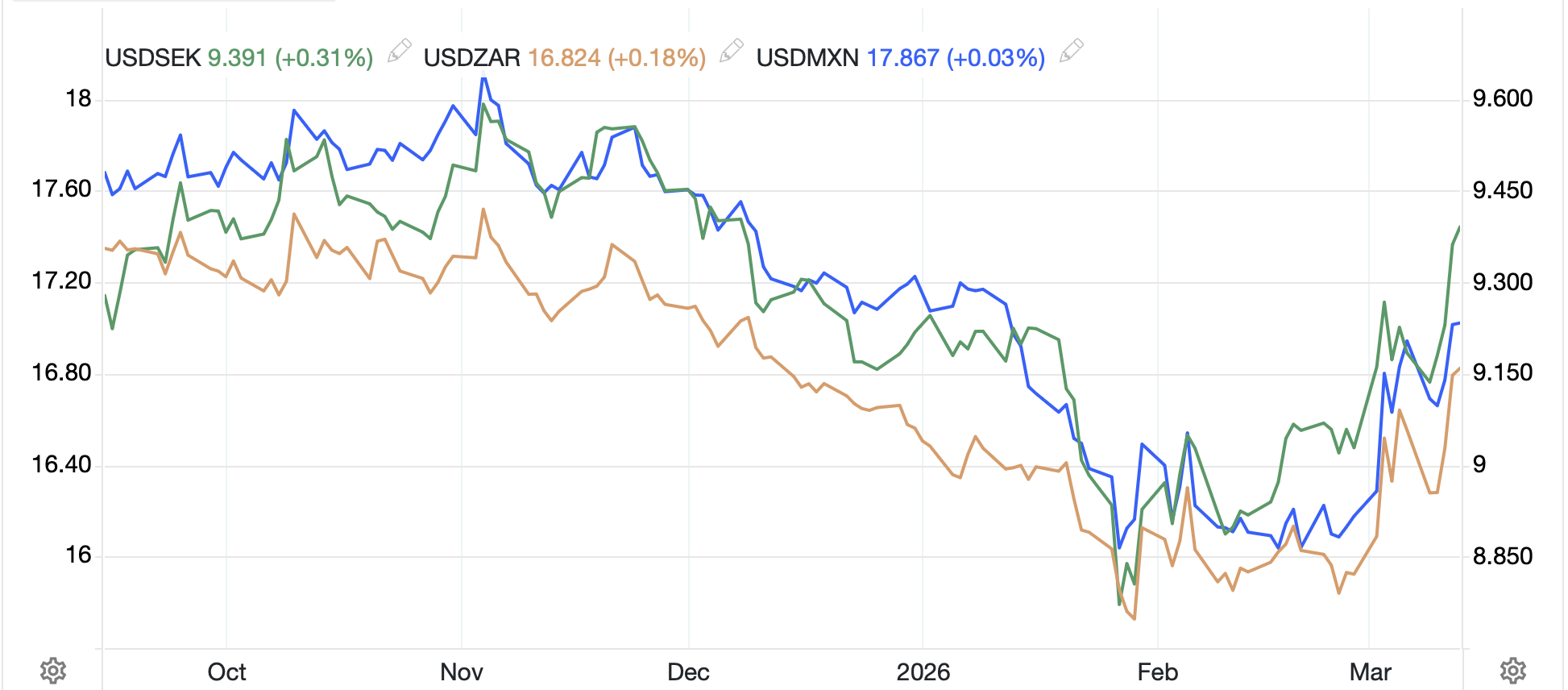
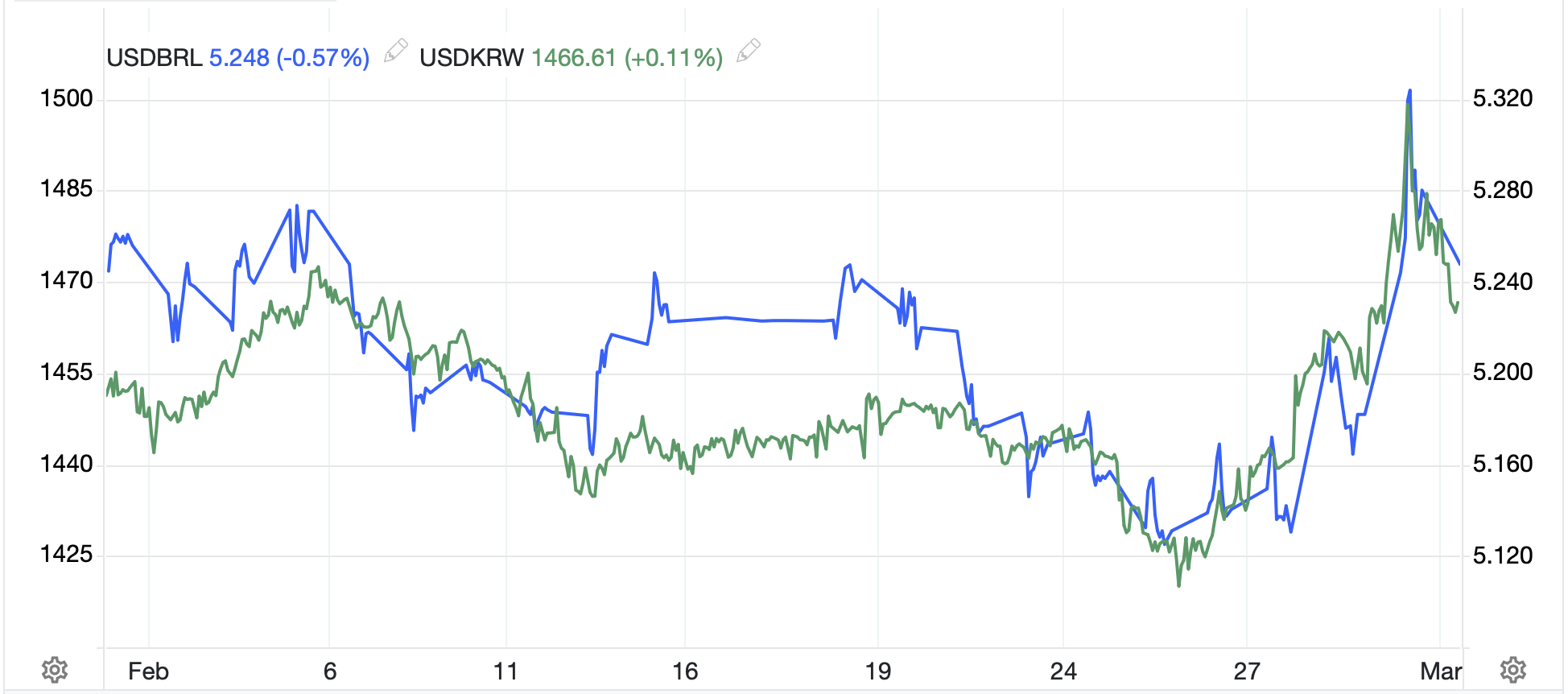
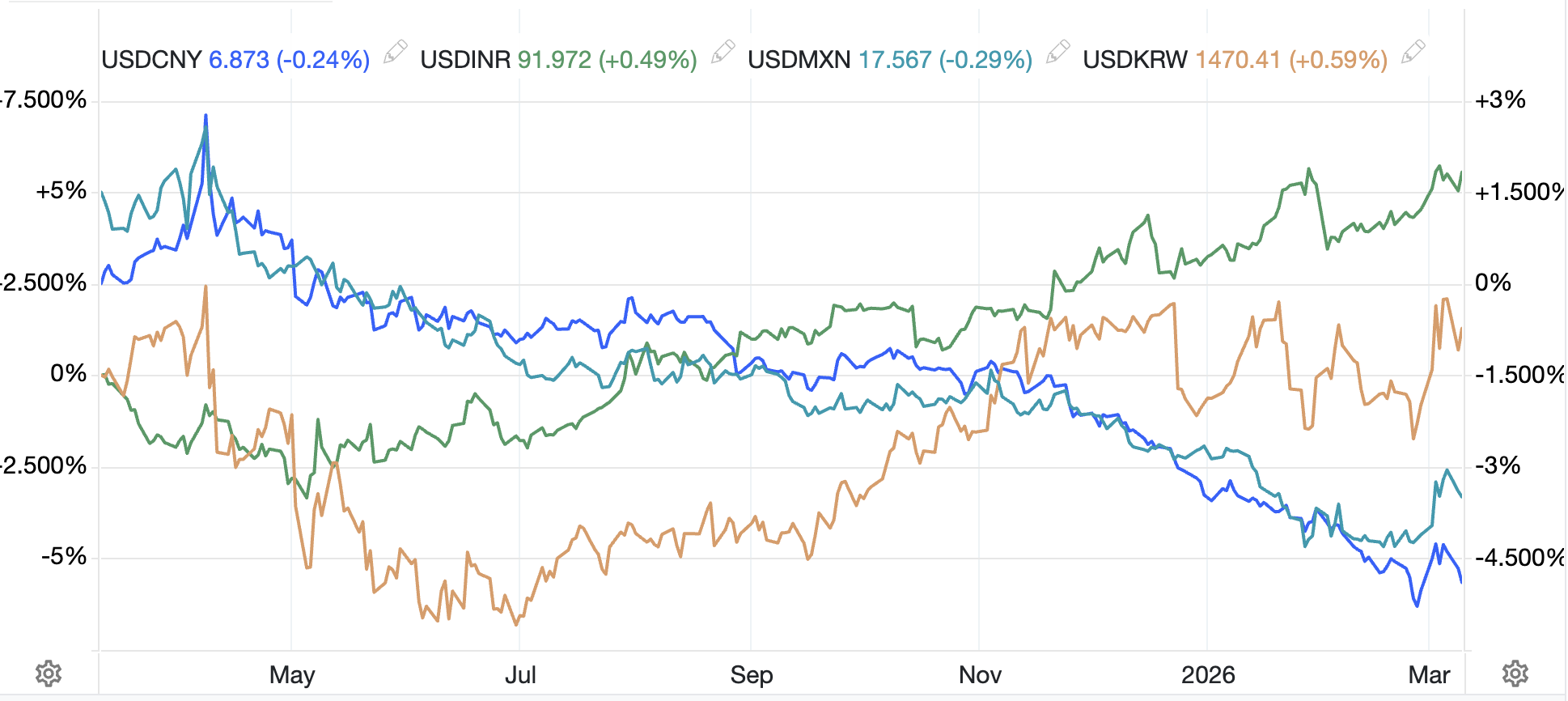
Finally, the dollar is backing off slightly this morning, which given the price action elsewhere, makes perfect sense.  In the G10 space, the movement has been on the order of 0.1% to 0.2% for the majors (EUR +0.2%, GBP +0.1%, AUD +0.1%, CHF +0.2%) with only JPY (+0.35%) and SEK (+0.8%) showing real gains.  However, it is important to remember that SEK was one of the worst performers recently, so had more ground to regain.  As to the EMG bloc, movement there has been more substantial, but again, this is after much larger declines.  For instance, BRL (+0.6%) and KRW (+0.9%) have both seen sharp declines in the past week before reversing overnight as per the below chart.

Source: tradingeconomics.com

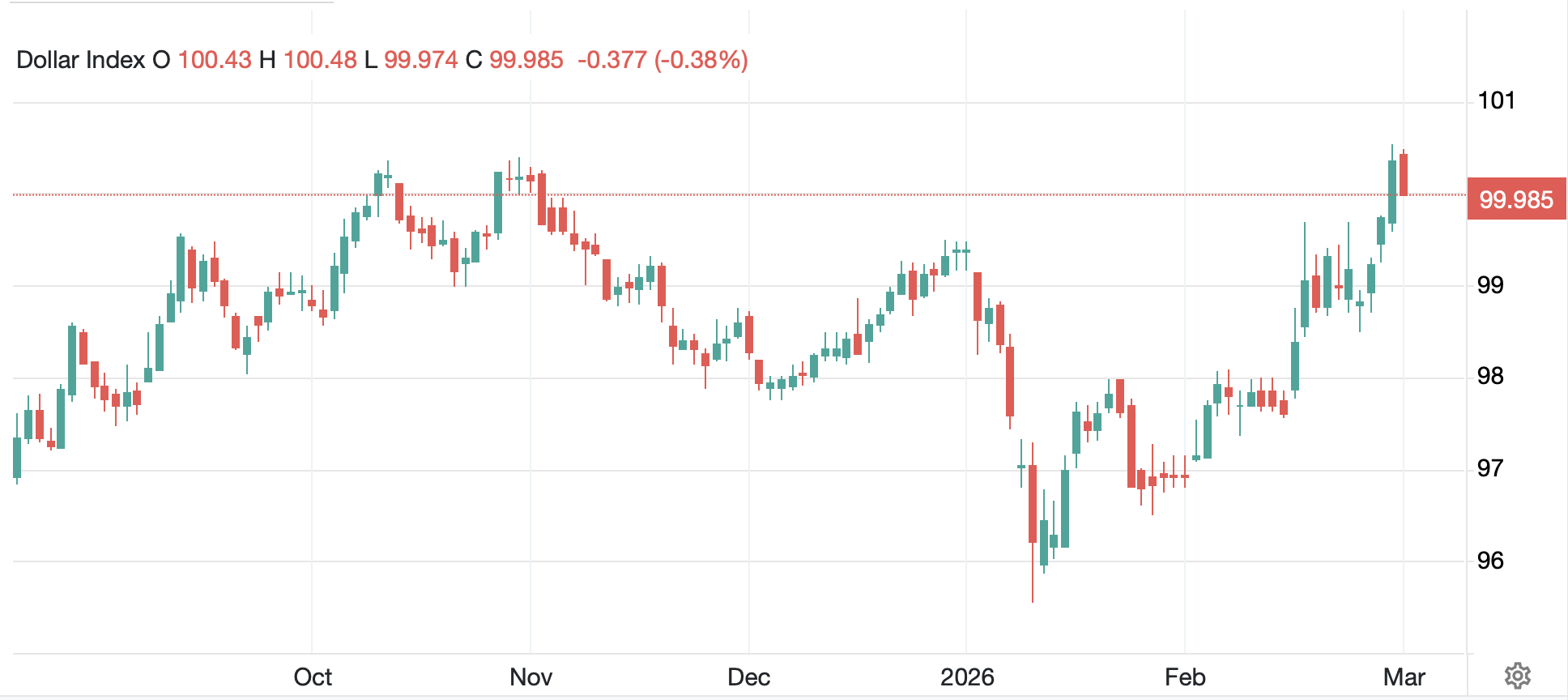
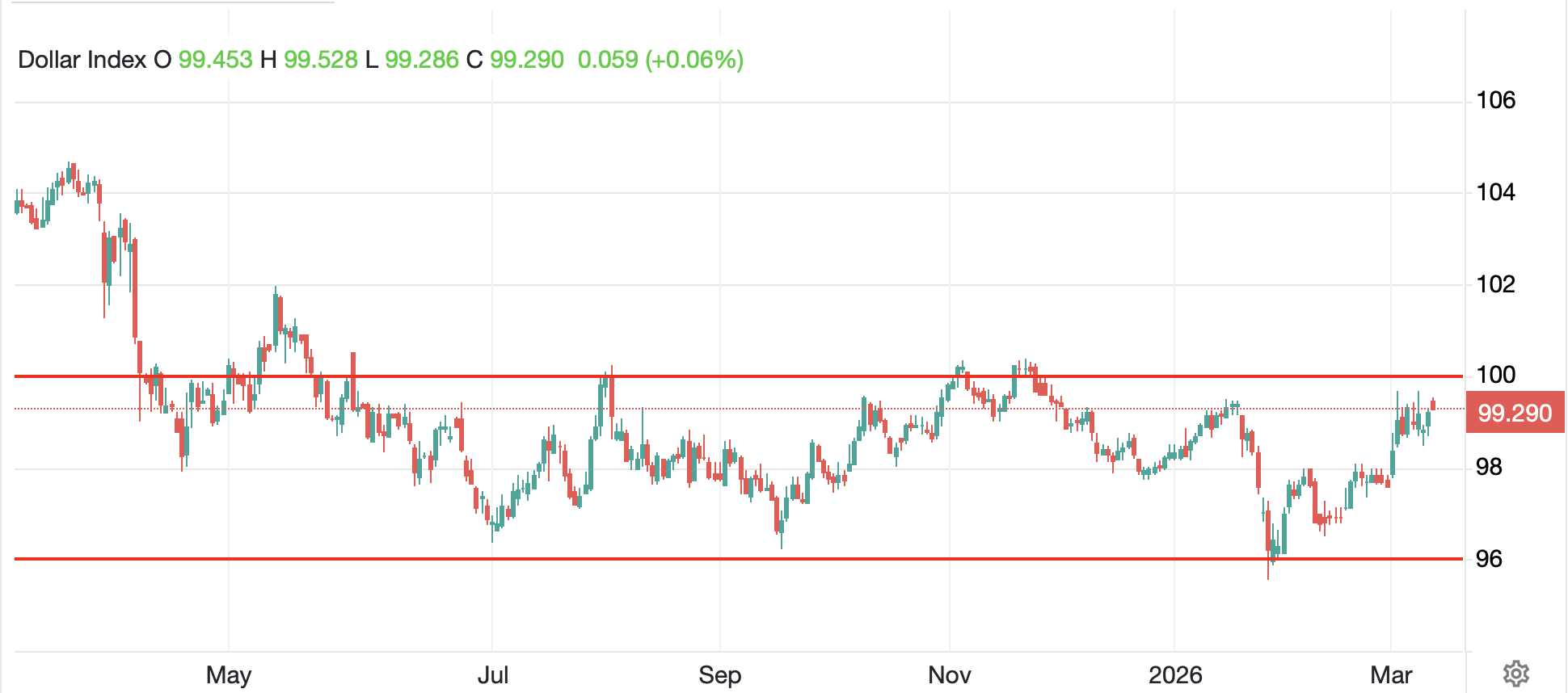
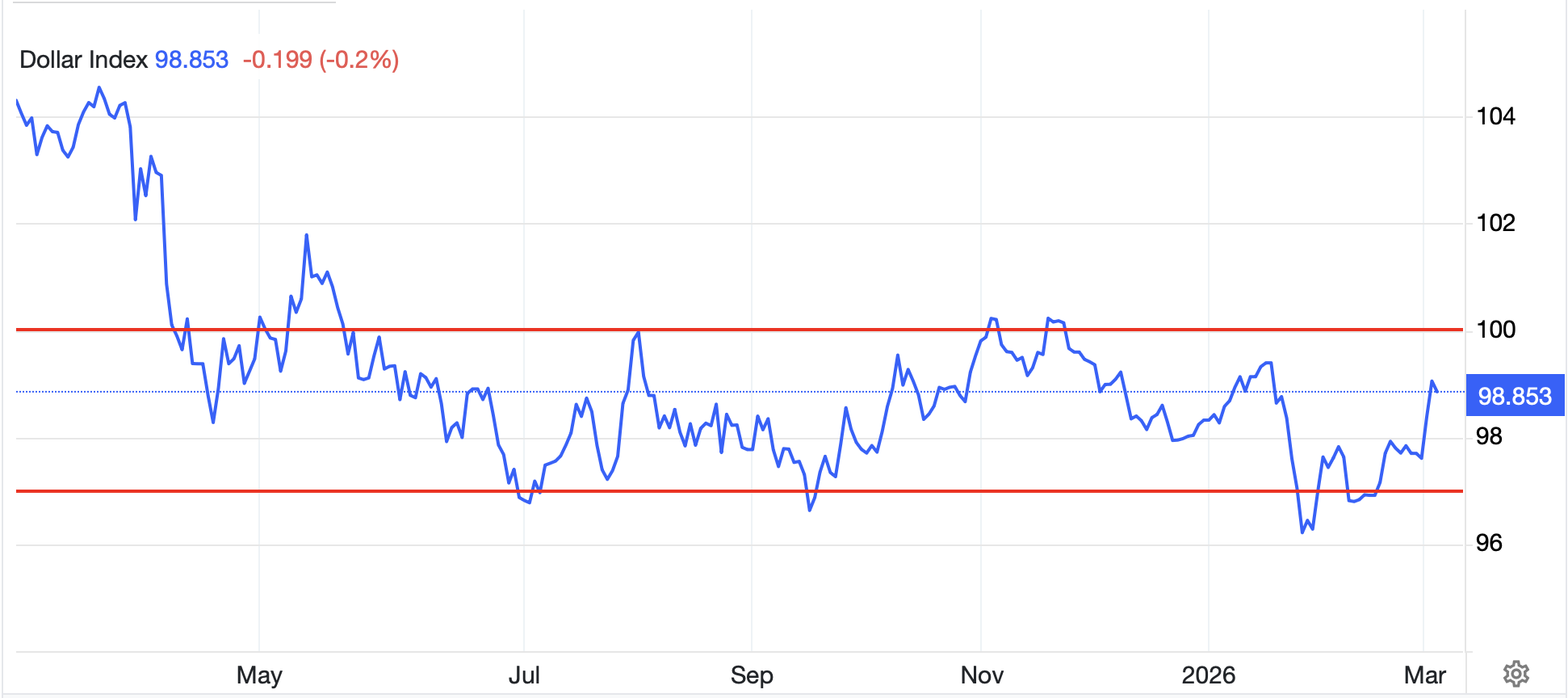
However, if we look at the DXY as our proxy, it remains in the middle of its trading range of the past 9+ months.

Source: tradingeconomics.com

In sum, we are three trading days into an entirely new geopolitical situation, and markets have digested the news and are seemingly trying to return to some sense of normalcy.  Now, there is still significant headline risk as nobody knows how things will evolve here.  What I will say is that if the Iranian regime falls or capitulates, I would look for risk to be quickly scooped up while oil prices slide.  Conversely, if things drag on much longer than another month, I think we could well see investor concern over how this will impact the global economy, especially if oil prices remain in the $75 – $80/bbl range, which likely means equity markets will suffer.

To the extent that anyone is still looking at data, this morning brings the ISM Services (exp 53.5) and then we see Crude Oil inventories later this morning.  The Services PMI data throughout Europe and Asia was in line with expectations showing slow growth remains the story.  Chinese data was marginally softer for large companies and marginally stronger for small companies.  As well, the Fed’s Beige Book is released at 2:00 this afternoon.

However, I don’t see data as a driver yet, so headline risk remains the biggest one out there, but the indications are markets are starting to absorb the war and move on.

Good luck

Adf
Bonds are a Flop

The war has now widened in scope
And though all of us truly hope
It won’t last too long
We could, there, be wrong
As such we must all learn to cope
 
So, oil, right now, knows no top
While havens like bonds are a flop
There’s no place to hide
Thus, you must decide
If trading makes sense or should stop

Carl von Clausewitz, the 19th century Prussian military strategist, is credited with describing the fog of war in his 1832 book, On War.  “…three quarters of the factors on which action in war is based are wrapped in a fog of greater or lesser uncertainty.”  This is quite an apt description of things, even now with cameras literally everywhere in the world.  Context remains difficult to understand, and, of course, there is an enormous amount of propaganda from both sides of any conflict as the protagonists attempt to sway both their own populations and those of their opponents.

I highlight this because I continue to be amazed at the certitude with which some analysts proclaim to “know” how things will turn out.  As I have written elsewhere, nobody knows nuthin right now.  With that in mind, I would highlight the IMF’s statement yesterday which added exactly zero to the conversation, “It is too early to assess the economic impact on the region and the global economy. That impact will depend on the extent and duration of the conflict.”  Now, don’t you feel educated after that pronouncement?

At any rate, with more than a full day’s trading in financial markets, perhaps we can try to assess how things are going.  The first thing to note is that many alleged haven assets are not performing up to snuff, notably Treasury bonds, Japanese yen, Swiss francs and gold.  In fact, as of this morning, the only traditional haven that is performing as expected is the dollar.

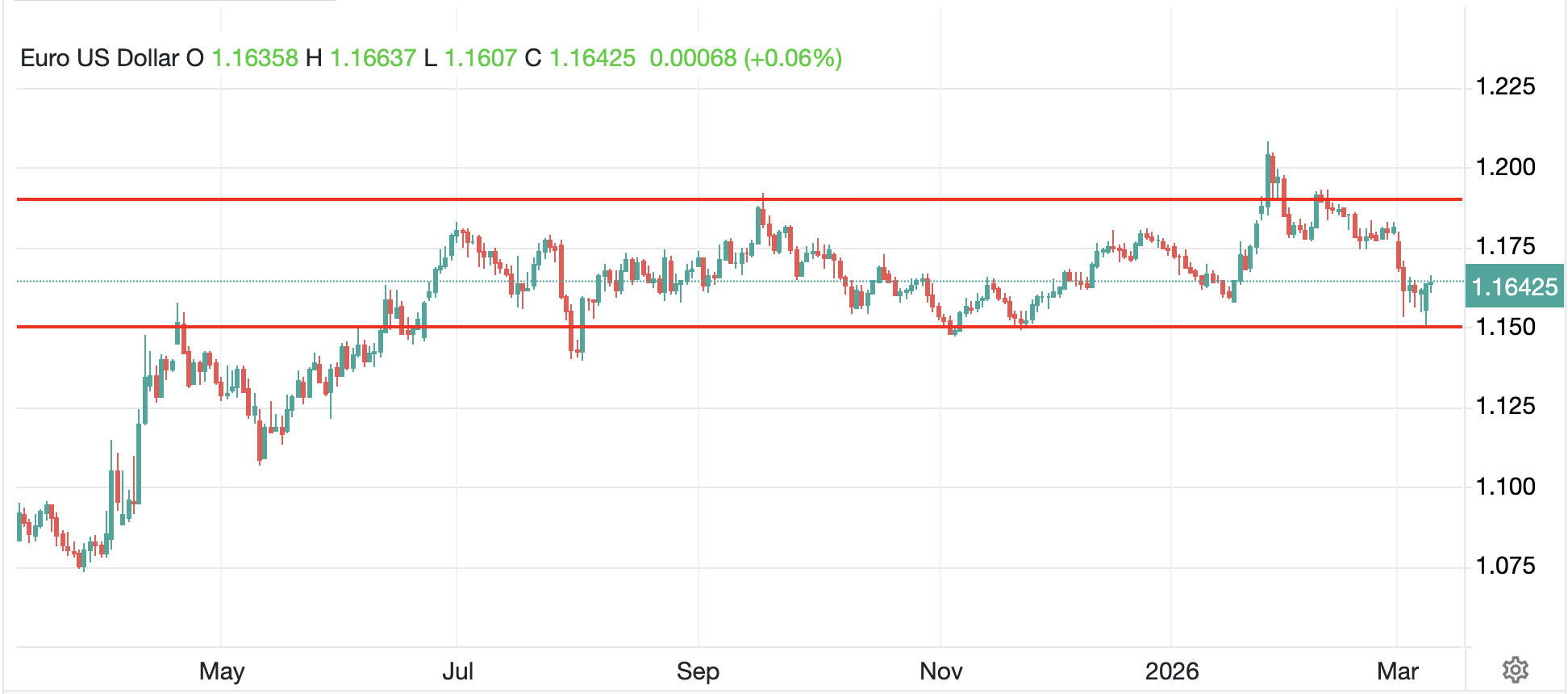
It was just over a month ago when the cognoscenti were explaining that the euro above 1.20 was indicative of the dollar’s long decline into the depths of history.  I recall someone in my LinkedIn feed asking how soon the euro would trade through 1.25 and beyond.  I would argue that timeline has been extended somewhat, if you still believe that is likely to be the case.  Rather, as you can see in the below chart, the single currency (-0.8%) is now back below 1.1600.

Source: tradingeconomics.com

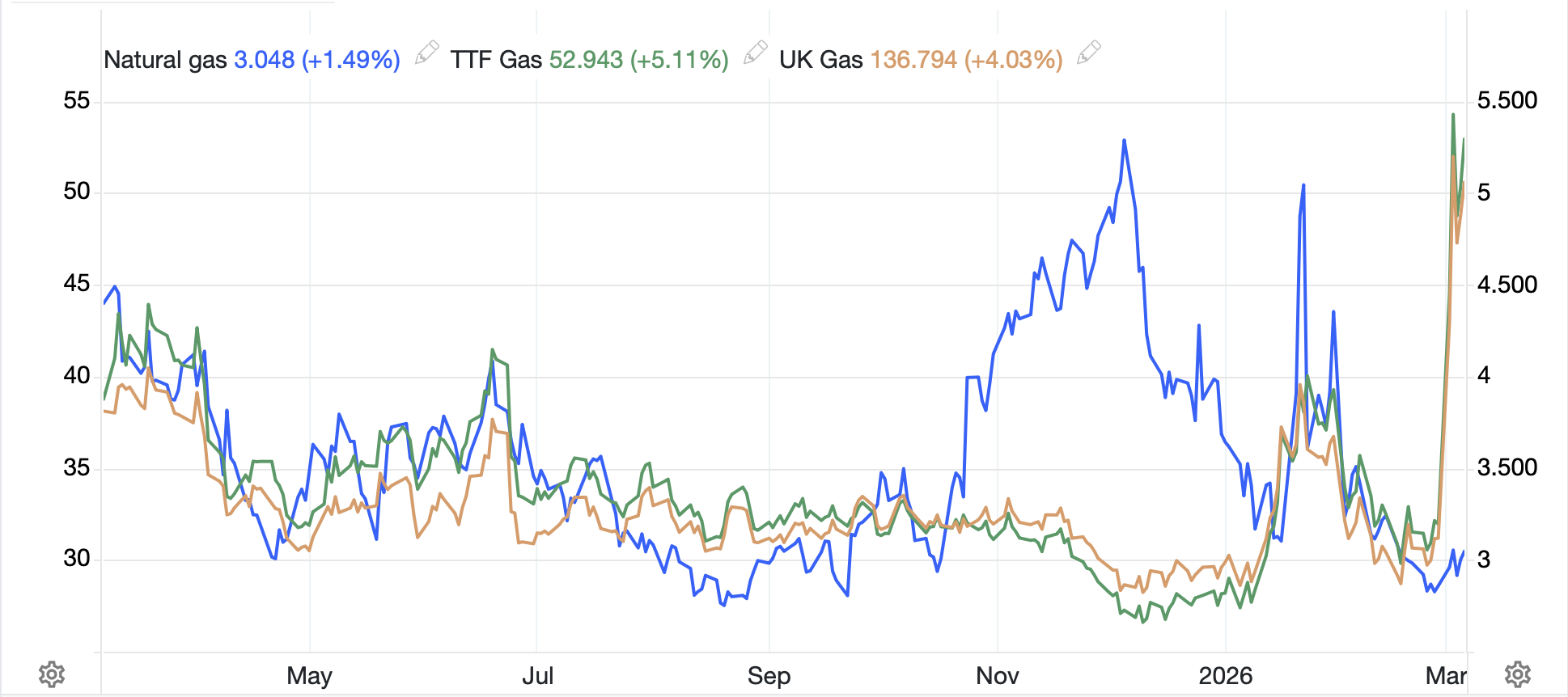
There are several things weighing on the euro right now.  First is the fact that they are energy price takers for every form of energy, so not only are higher oil prices hurting the continent, but NatGas there has exploded higher as per the below chart, rising 37% today and nearly 95% since the weekend.

Source: tradingeconomics.com

Recall, Europe has been trying to wean themselves off Russian gas, have been huge buyers of US LNG but also huge buyers of Qatari LNG, and with the Strait of Hormuz effectively closed (shipowners cannot get insurance so nobody transits the Strait), this is a problem.  Adding to the European problem is the fact that their storage levels of NatGas are extremely low for this time of year, about 30%, when typical levels in early March are near 50%.  We cannot be surprised at this price action.  So, while US NatGas (+6.3% this morning, 10% this week) has risen, it is currently trading at $3.14/MMBtu.  The comparable Eurozone price is $20.28/MMBtu.  Perhaps a weaker euro is not that surprising after all.  (As an aside, one of the reasons I find it difficult to accept the weak dollar story is that the US controls its own energy destiny and given energy is life and the economy, we are fundamentally in better position to perform going forward.)

But the dollar is strong against all comers again today as per the below table from 7:10 this morning.  Will this continue?  While nobody knows, my take is there is still ample room for further strength in the buck, probably another 3%-5% before it starts to impact other things significantly.

Source: tradingeconomics.com

I think the biggest surprise for most of us is the incredibly poor performance of the bond market, which has always been seen as a safe haven.  However, this morning, that is not the case at all as you can see from the Bloomberg table below.

My take is that there is only one thing we truly know about war, it is inflationary.  While the early signs are for energy prices to rise, war is a major consumer of resources that will never be recycled and therefore will require new baseline production.  As well, governments don’t fight war on an austerity budget, so you can be sure that there will be plenty of money around.  All that leads to higher prices and that is why bond markets are feeling pain around the world this morning.  If, as President Trump has indicated, this war ends in the next 4 weeks or so, we will be able to re-evaluate the inflationary and other impacts, but while I had thought bonds were going to perform well, clearly that is not the case right now.

Turning to commodities, oil (+6.75%) continues to rise and I expect will remain well bid until the fighting stops.  The prospects for higher prices from here remain dependent on whether Iran tries to destroy other Middle East production facilities and if they are successful.  Meanwhile, in the Western hemisphere, the US, Canada, and all of Latin America are going to be pumping at full strength for now.  So, while prices may tick higher, it is unlikely we will see any supply issues here.

Metals are another surprising trade this morning with gold (-2.65), silver (-7.8%) and copper (-2.3%) all sharply lower.  Given the sharp decline in equity prices I will discuss below and given the amount of leverage that is rampant in the equity markets, I think gold is a victim of ‘sell what you can, not what you want to.’  Arguably, there is some of that with bonds as well.  In a way, though, I am more surprised about silver and copper given their criticality in fighting the war.  Both are being consumed rapidly via weapons being deployed so this is more baffling to me.  However, I do not believe the longer-term thesis in either of these metals has changed, there is a supply shortage relative to industrial usage for both with no new supply on the horizon.  As such, I do see prices here rallying over time.

Finally, the equity markets are sharply lower almost everywhere.  The below Bloomberg table shows how major markets in Asia performed overnight and how Europe stacks up at 7:30 this morning.

What it doesn’t show is that the KOSPI in Korea fell -7.25%, nor that there were sharp declines in India (-1.3%), Taiwan (-2.2%) and Thailand (-4.0%).  You will also not be surprised that US futures are pointing much lower this morning, -1.5% across the board.  Yesterday’s performance was quite the surprise, I think, but today is much more in line with what we expected.

And that’s where things stand this morning.  obviously, the war is the only story that matters, so data releases are going to be secondary for now, even Friday’s payroll report.  At some point, I expect that traditional havens will play their role, but as leveraged positions continue to get unwound, it may take a few more sessions before we see that.  If you’re trading, smaller sizes make sense.  If you’re hedging, stick to longer term fundamentals I think.

Good luck

Adf
No Longer the Same

The world is no longer the same
So, now everyone must reframe
Their views on positions
And whether conditions
Allow them to still play the game
 
Most markets have priced fatter tails
With stock markets seeing net sales
But oil and gold
Seem likely to hold
Their gains across longer timescales

Here we are on Monday morning in a very different world than we left on Friday evening.  While there was much talk about whether a peace would be reached then, obviously that never happened.  Of course, at this point, there is no other story than the ongoing military action in Iran and the Middle East.  As this is not a news commentary, but a financial markets one, that is all I will discuss here.
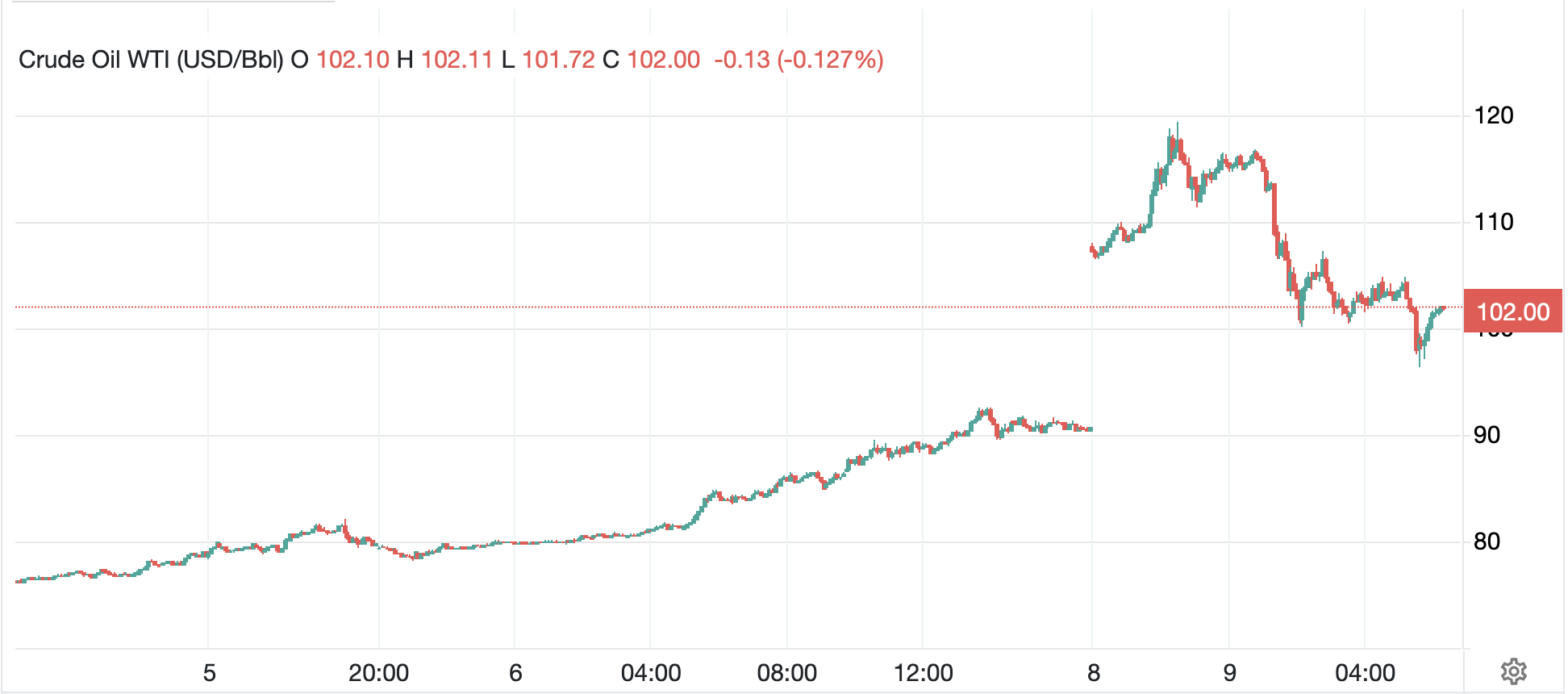
Not surprisingly, we have seen some large moves across markets, and largely in the direction one would have expected regarding risk.  So, oil prices (+7.5%) have exploded higher as shipping through the Strait of Hormuz has ceased for now and there is no timeline for it to reopen.  Given ~20% of the daily global consumption of oil flows through that waterway, there should be no surprise here.  You can see from the chart below that as concerns grew regarding military action, oil’s price climbed and then, of course, gapped on the opening last night.

Source: tradingeconomics.com

Perhaps a bit more surprising to me is that Brent Crude (+7.5%) has moved virtually the exact same amount as WTI.  I only say that because Brent is the price basis for global oil outside the US which is obviously going to be more impacted than the US markets.  But the Brent chart is virtually identical to the WTI above.  As to the future, clearly, no market is more dependent on the Middle East conflict than this one, but at this point, there is no indication it is going to end very soon, so I expect prices to remain at least at current levels for now, and if the conflict starts to target oil production facilities, we could go quite a bit higher.

While we are looking at commodities, it should also be no surprise that gold (+2.1%) is higher this morning as it performs its historical role as a safe haven.  While not quite as extreme as the oil chart, the similarities between the two, as you can see below, are significant.  Of course, it was a bit more than a month ago when we had that dramatic sell-off in the precious metals, so this has all been a recovery from there.  But a grind higher punctuated with a gap last night is the gold story as well.

Source: tradingeconomics.com

Arguably, gold will have more staying power than oil as when the conflict ends, and my initial take is it will not be a forever war, oil will once again flow more freely.  Gold, however, remains a haven in an uncertain world and nothing seems likely to reduce uncertainty anytime soon.

The other two traditional haven assets are the dollar and Treasury bonds so let’s look at them next.  Starting with the dollar, it has done what it regularly does in an uncertain situation, it has rallied sharply.  As you can see from the below table, shot at 6:39 this morning, the dollar is firmer against every single major currency this morning.

Source: tradingeconomics.com

Too, using the euro as our proxy for the dollar writ large, you can see that the chart below looks almost identical to that of both gold and oil above.  (I have inverted the Y-axis to highlight the similarities.)

Source: tradingeconomics.com

It appears that markets began pricing in this event back in the middle of February, although the real move required the onset of the military action.

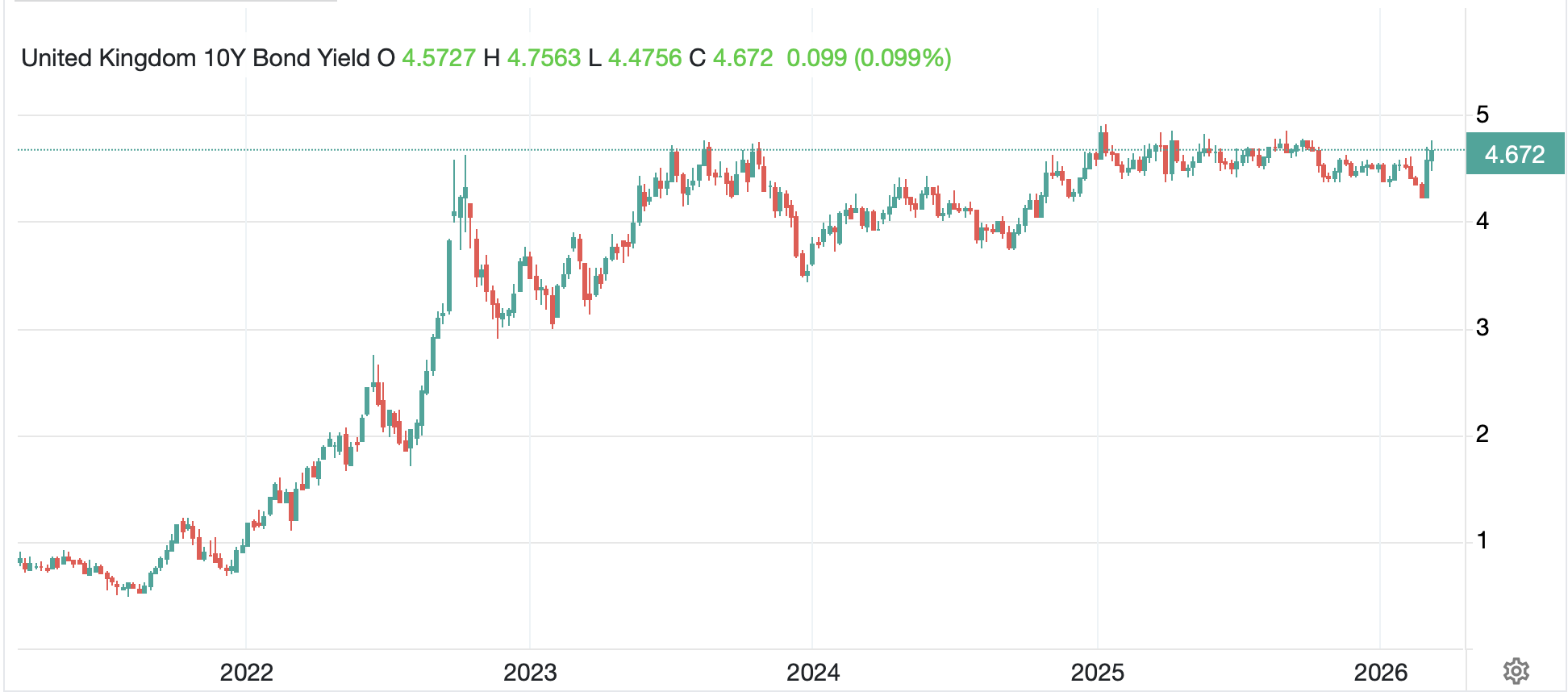
As to the last haven asset, US Treasuries, they are not really doing the job today.  Yields there have edged higher by 2bps this morning and we are seeing similar price action across the entire European sovereign space.  The two exceptions today are UK Gilts (+8bps), which seem to be trading on concerns the BOE is less likely to cut rates as higher oil prices will prevent inflation from continuing lower and JGBs (-4bps) which are serving their haven role well, arguably given the distance from the action and the fact that with yields above 2%, investors seeking safety feel they have some cushion.

Source: tradingeconomics.com

The treasury move was interesting as the initial trade, at last night’s opening, was for lower yields as per the chart above, but that has since reversed.  It could be investors are concerned over additional defense spending blowing out the deficit further but there is no clear signal or commentary I have seen yet on the subject.

Finally, it should not be surprising that equity markets around the world are mostly lower this morning as investors pull in their wings and await more clarity on the outcome and how long this will continue.  The exception to this was mainland China (+0.4%) which managed to edge higher, but otherwise, all of Asia and Europe are down on the day, some pretty substantially.  Below you can see a screenshot of futures markets at 7:00 with the type of movements ongoing.

Source: tradingeconomics.com

The MOEX is Russia’s stock market, so it is not clear what value that adds to the conversation and the TSX, Toronto, does not have a futures market, so the price represents Friday’s close.  But as you can see, all of Europe and all of Asia ex-China have fallen sharply.

And that’s where we sit this morning.  Ironically, there is going to be a significant amount of data released this week, including the NFP report on Friday, but it is not clear market participants will be paying close attention.  For good orders’ sake, I will list the data releases anyway.

TodayISM Manufacturing51.8
 ISM Manufacturing Prices59.5
WednesdayADP Employment45K
 ISM Services54.0
ThursdayInitial Claims216K
 Continuing Claims1840K
 Nonfarm Productivity Q44.8%
 Unit Labor Costs Q40.2%
FridayNonfarm Payrolls60K
 Private Payrolls65K
 Manufacturing Payrolls0K
 Unemployment Rate4.3%
 Average Hourly Earnings0.3% (3.6% Y/Y)
 Average Weekly Hours34.3
 Participation Rate62.5%
 Retail Sales-0.2%
 -ex autos0.1%
 Consumer Credit$11.8B

Source: tradingeconomics.com

To me, market dynamics now are entirely restricted to the ongoing Middle East conflagration.  Ultimately, war is inflationary, and for many firms it is quite profitable.  But right now, investors are mostly hiding under their desks, waiting for the smoke to clear.  Institutional investors are typically unwilling to buck a key narrative trend, and I see no reason to believe this time will be different.

While much of this price movement will likely reverse when the bombing stops, until then, be prepared for more volatility, not less.

Good luck

Adf