Turned to Sh*t

While headlines are all ‘bout elections
And some have discussed stock corrections
The dollar keeps climbing
As some think pump priming
By Jay will find no real objections
 
The punditry, though, remains split
One side claims things have turned to sh*t
The other side, though
Is really gung-ho
And weakness they will not admit


The Democrats had a good election, sweeping the big three races in NYC, NJ and Virginia and many down ticket ones as well.  One spin is this is all a vote against President Trump but given that those three venues are all heavily Democratic to begin with, that may be an exaggeration.  Of the three, my concern turns to NYC as having lived there prior to Mayor Rudy Giuliani’s cleanup of the city, I can tell you, things were not fantastic.  Mayor-elect Mamdani’s stated plans have failed every time they have been tried around the world and I suspect that will be the situation here as well. Alas, that will not prevent him from trying.  Ironically, regarding high rents, it is possible that the increased outmigration from the city by those in the center and on the right will reduce housing demand and arguably housing costs.  We will all watch as it unfolds.

But will that directly impact markets?  Of that I am far less concerned.  I read that JPMorgan already had more employees in Texas than NY prior to the election and given that the concept of a physical exchange has basically disappeared, trading can relocate quickly.  My take is, this will get the talking heads quite excited for a while but will have a minimal impact on markets.

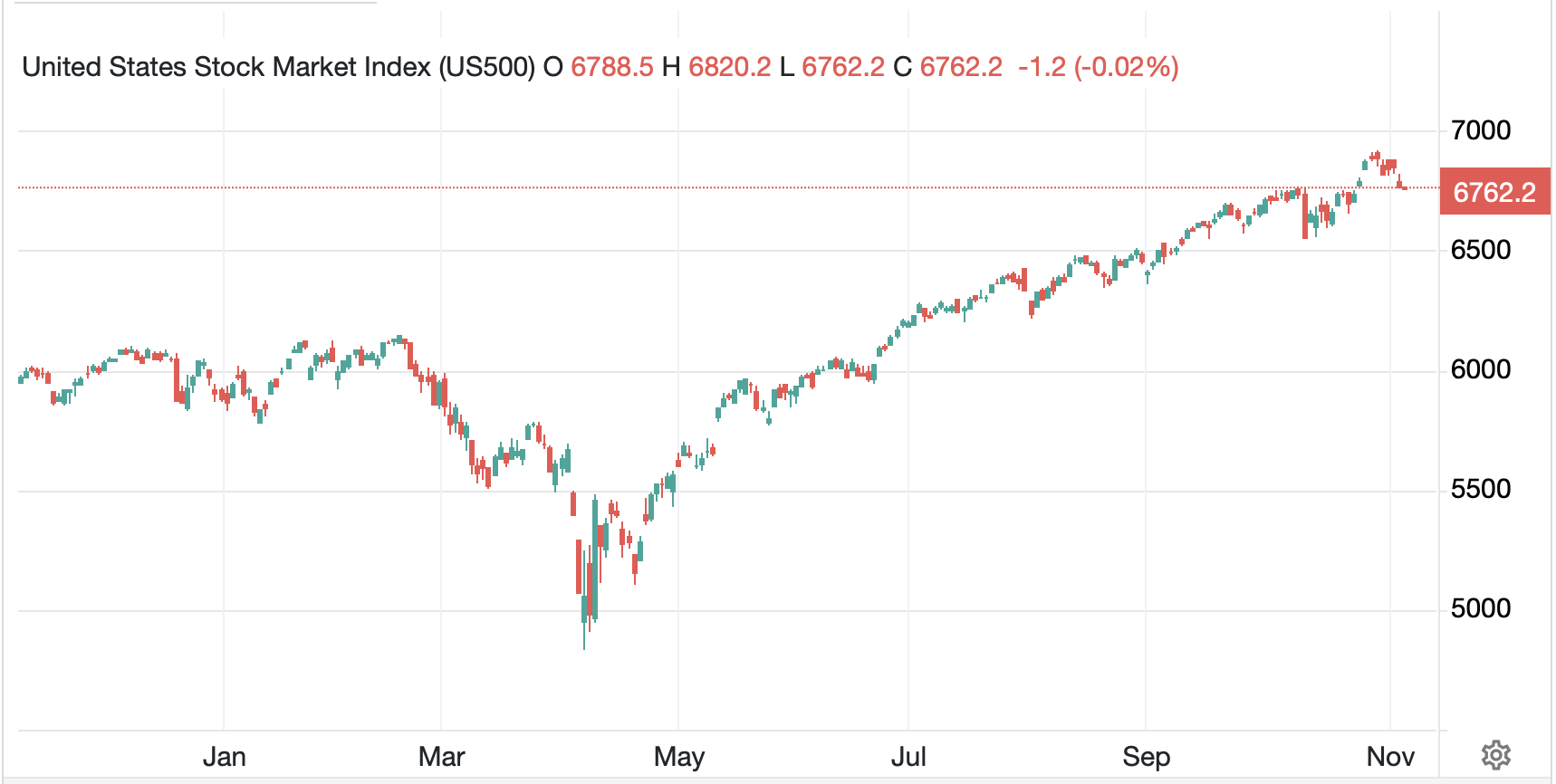
Which takes us to yesterday’s price action and its drivers.  First off, one might have thought that we experienced another Black Monday based on some of the hysteria in commentaries, but in the end, US equity indices only fell between -0.5% (DJIA) and -2.0% (NASDAQ).  In fact, using the S&P 500, a look at the chart shows that the decline over the past several sessions amounts to just -2.3% there, hardly calamitous!
Source: tradingeconomics.com

I continue to read about the K-shaped economy with the massive split between the top 10% of income/wealth representing 87% of spending and enjoying life while the bottom 90% struggle immensely.  This has been made possible by the ongoing support of financial assets by the Fed (and other central banks) which has accrued to asset holders, i.e. the top 10%.  In fact, this is a far more likely rationale for Zoran Mamdani’s victory yesterday, he has promised to help those who are struggling by freezing rents, offering free stuff and taking over the grocery stores to remove the profit motive and lower prices.  And when it comes to elections, the bottom 90% have a lot more votes!

Here is as good an explanation of the forces driving this narrative as any:

While equity and asset prices continue to climb, the working class is finding life increasingly difficult as job opportunities seem to be shrinking.  This latter issue seems only to be exacerbated by the growth in AI spending and the announcements by numerous companies that they will be reducing staffing because of the efficiencies created by AI in their operations.

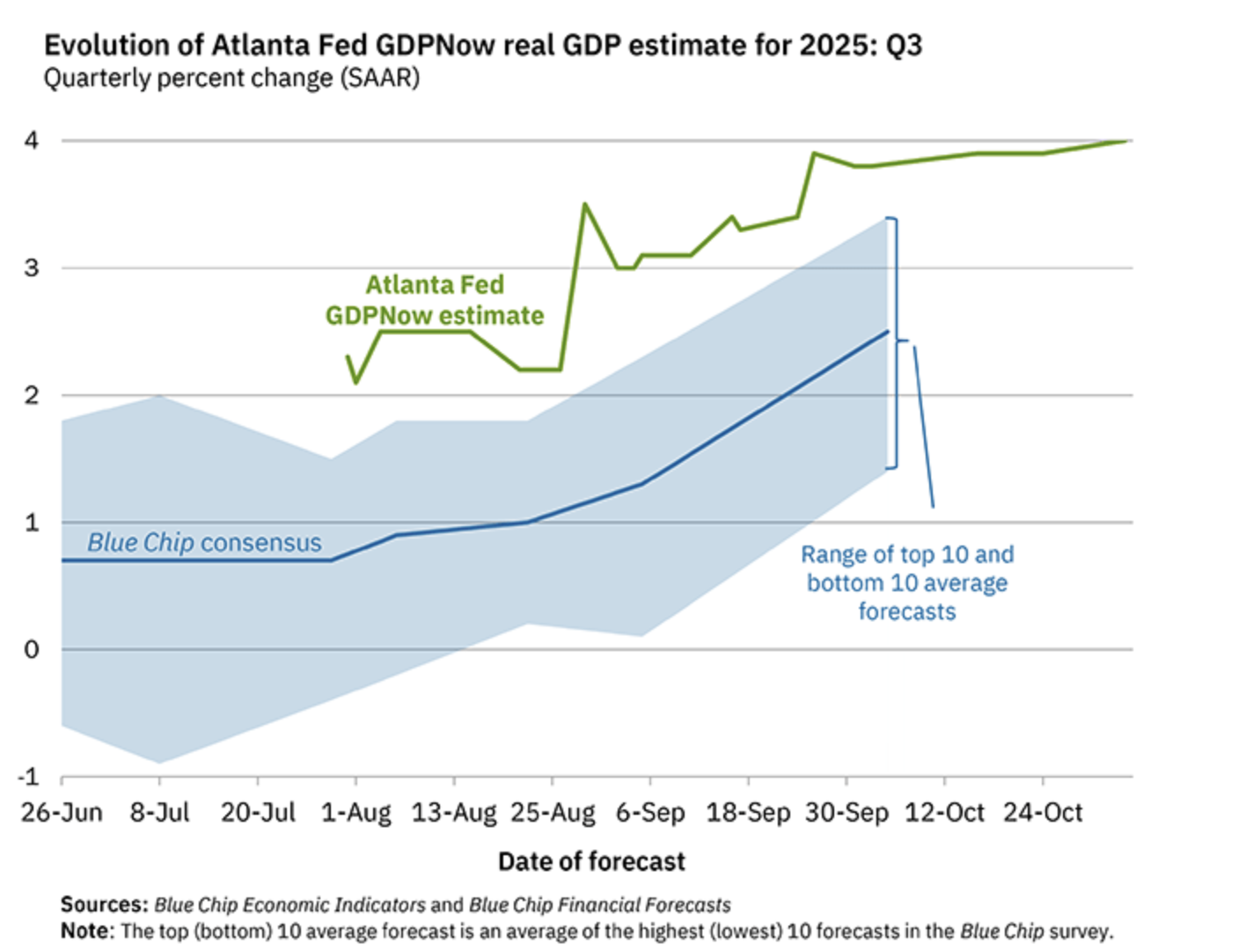
Arguably, the reason we have seen such a large dichotomy between analyst views is that some are focused on data that represents the bottom leg of the ‘K’ and see a recession around the corner, if not already upon us.  Meanwhile, others see the arm of the ‘K’ and see good times ahead.  Certainly, if we look at the broad-based GDP readings, at least based on the Atlanta Fed’s GDPNow forecast, Q3 was remarkably strong at real GDP growth of 4.0% annualized (see below chart).  Calling for a recession with that as backdrop is a very difficult case to make, in my view, but that won’t stop some analysts from trying.
Net, while nobody likes to see their portfolios’ value shrink, the declines so far have been very modest.  It is entirely reasonable to expect a correction of 10% – 15%, especially if we look at the chart at the top showing a 36% rally with limited drawdowns over the past 6 months.  It feels too early to panic.

And with that in mind, let’s see how markets behaved overnight.  Asian markets followed US ones lower with Tokyo (-2.5%) leading the way, although that was well off the early session lows which touched -4.0%.  Korea (-2.9%) and Taiwan (-1.4%) both suffered as well although the rest of the region was far less impacted.  Both China and HK were little changed and other gains and losses were on the order of +/-0.5% or less.  European bourses are all in the red as well this morning, although the one thing of which we can be sure is it is not related to the tech selloff given Europe has no tech industry of which to speak.  But Spain (-0.9%) and Germany (-0.75%) are both down despite reasonable Services PMI data from both nations and better than expected German Factory Orders (+1.1%).  UK equities are unchanged, and the rest of the continent is somewhere between unchanged and Spain.  Negative sentiment has clearly carried over, but there have been no strong reasons to sell aggressively.

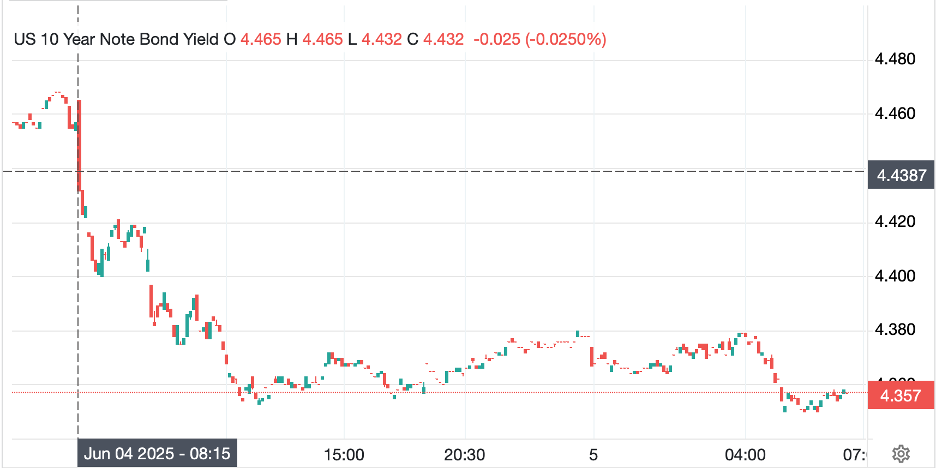
In the bond market, Zzzzzz is today’s message.  Every major government bond is within 1bp of yesterday’s close, and yesterday’s price action was only worth 1bp to 2bps.  In fact, as you can see from the chart below, since the FOMC and Powell’s hawkish press conference, nothing has changed.  This is true from Fed funds futures as well, with a 71% probability still price for a December cut.

Source: tradingeconomics.com

In the commodity space, oil (-0.3%) seems to be lower every morning when I write, but continues to trade in a narrow range around $60/bbl.  Perhaps the most interesting thing I read this morning was Javier Blas’ op-ed in Bloombergregarding the rationale for a US-led regime change in Venezuela given it is the nation with the largest known oil reserves.  If you are President Trump and seeking to get oil prices lower, that could be a very effective source of the stuff.  As to the metals markets, yesterday saw a sharp decline in precious metals and this morning they are rebounding with both gold and silver higher by 0.9%.  Copper (+0.25%), too is rising a bit, although remains well off the highs seen when gold peaked.

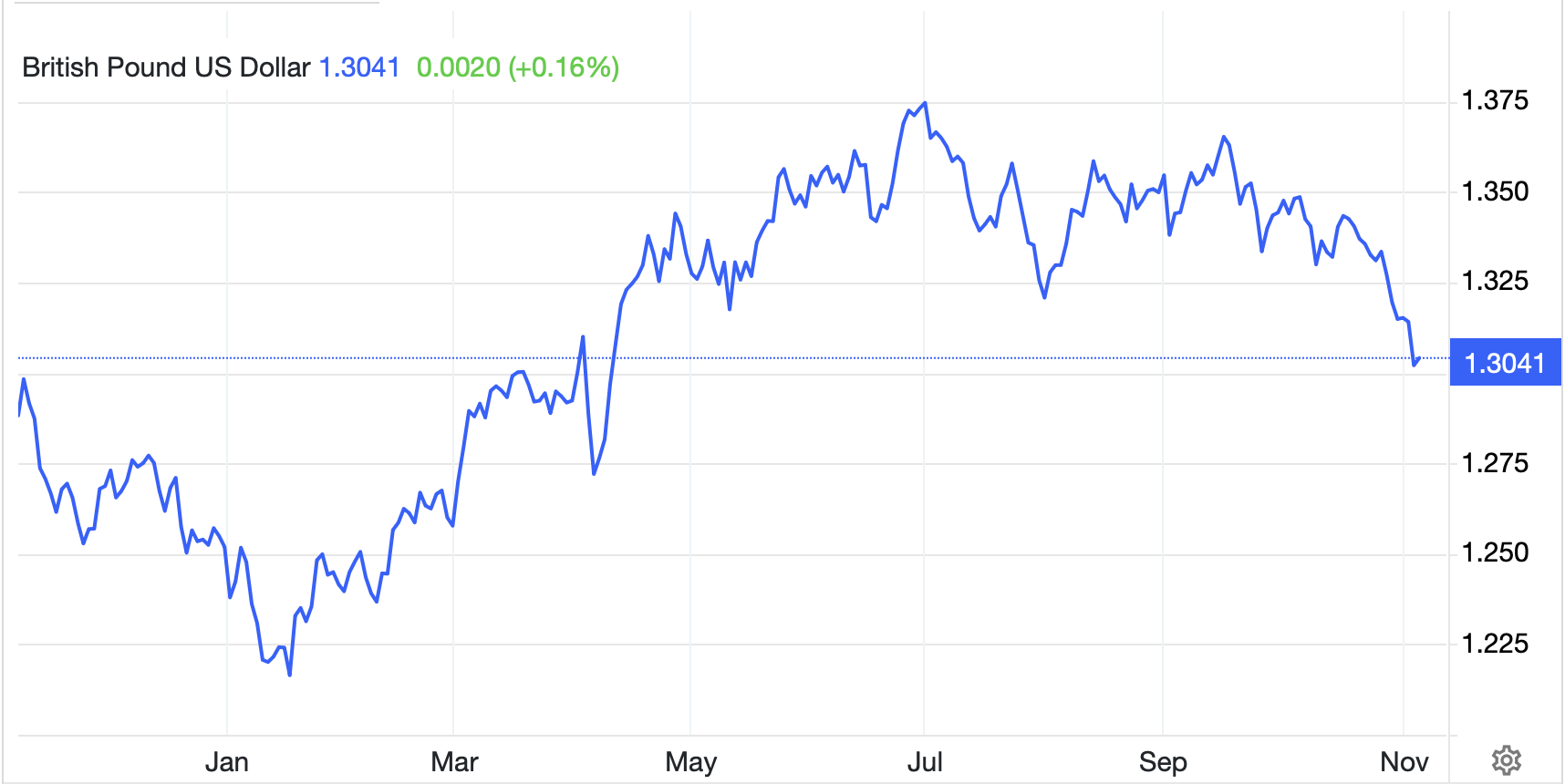
Finally, the dollar continues to impress.  While this morning it is little changed against most of its counterparts, it is, apparently, consolidating its recent gains.  The DXY remains above 100.00, which many have seen as a key resistance level.  The pound (+0.2%) while bouncing slightly this morning is hovering just above 1.30, a level last seen on Liberation Day, and certainly appears to be working its way lower from its summer peak.  If I consider the fiscal problems and the energy policy in the UK, it is very difficult to expect a significant amount of demand for the pound.
Source: tradingeconomics.com

Elsewhere, ZAR (+0.4%) is responding to the rise in gold prices and otherwise, +/-0.2% is today’s trading story.  Over time, given the promised investments into the US based on trade deals that have been signed, I expect there will be consistent demand for the greenback.  And as I wrote yesterday, the idea of a two-currency world in the future cannot be dismissed.

We do have data today with ADP Employment (exp 25K), ISM Services (50.8) and then the EIA oil inventory data where limited net change is expected although the API data yesterday showed a large build of 6.5mm barrels.  Remarkably, there are no scheduled Fed speakers, but that story remains caution but a tendency toward cutting.

For all the election hype, I don’t perceive that things have changed very much at all.  Perhaps the Supreme Court hearings on the legality of President Trump’s tariffs are the real story today, but regardless of the hearings, no verdict will be rendered for many weeks.  Which leaves us with a world in which tech is still dominant in equity markets and the US is still dominant in tech.  With the perception of the Fed being somewhat more hawkish, I don’t see a good reason to sell dollars.

Good luck

Adf
Crab Bisque

Though troubles worldwide haven’t ceased
Investors continue to feast
On assets with risk
As if they’re crab bisque
And appetites all have increased
 
Perhaps they believe peace is near
Or maybe they’re just cavalier
‘Cause Bitcoin has rallied
And profits they’ve tallied
Convinced them they’ll have a great year


This poet is a bit confused this morning as I watch ongoing record high equity markets in the US and elsewhere indicate a bright future, but I continue to read about the problems around the world, specifically in Ukraine and Gaza, but also throughout Africa, as well as the apparent end of democracy in the US.  Though it is showing my age, I recall during the Reagan presidency, equity markets performed well amid a sense that the world was going in the right direction.  The Cold War ended and Fed Chair Volcker had shown he had what it took to fight inflation effectively.  This combination was very effective at brightening one’s outlook on the future.

Then, leading up to the dotcom bubble, attitudes were also remarkably positive as the future held so many possibilities while peace had largely broken out around the world.  Again, the rally albeit overdone, at least had a basis that combined financial hopes with a positive geopolitical background.  Of course, the events of 9/11 put the kibosh on that for quite a while.

Leading up to the GFC, though, I would contend that the zeitgeist was a bit different, and while housing markets were on fire, the geopolitical picture was far less rosy with Russia reasserting itself and taking its first piece of Ukraine, the Middle East situation much dicier with the ongoing military action in Iraq and Afghanistan, and China beginning to flex its muscles in the South China Sea.

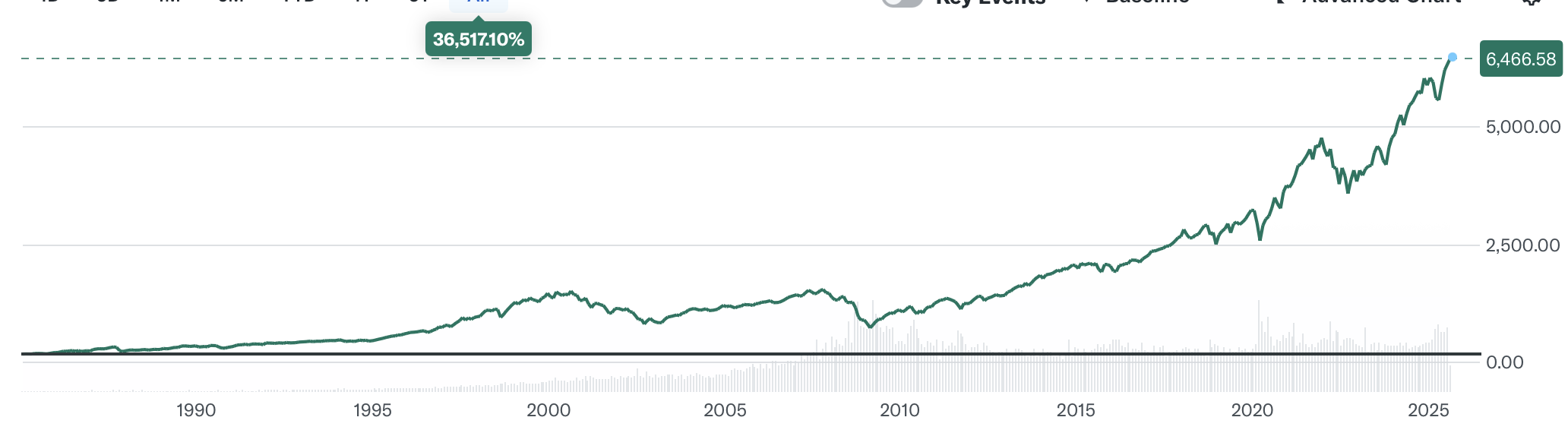
Of course, the similarity to these times is they all ended with significant equity market declines and resets of attitudes, at least for a while as per the below chart of the S&P 500.  Of course, given the exponential move over time, the early dips don’t seem so large today, although I assure you, on October 19, 1987, when the DJIA fell 22.6%, it seemed pretty consequential on the trading desk.

Source: finance.yahoo.com

But today, I find the disconnect between market behavior and global happenings far harder to understand. Yes, there is a prospect that Presidents Trump and Putin will agree a ceasefire tomorrow when they meet in Alaska, although I’m not holding my breath for that.  At the same time, President Trump is doing his best to reorder the global economic framework, and doing a pretty good job of it, but causing significant dislocations around the world with respect to trade and finance.  Too, through all the other bubbles, consumer price inflation was not a concern of note, with CPI remaining quiescent throughout until the Covid response as per the below and, as Tuesday’s core CPI reminded us, inflation remains a specter behind all our activities.

And yet, all-time highs are the norm in markets these days, whether US equities, Japanese equities, European equities, Bitcoin or gold, prices for financial assets remain in the uppermost percentiles of their historic ranges.  Perhaps this is the YOLO view of life, or perhaps markets are telling us the technology futurists are correct, and AI will bring so much benefit to mankind that everything will be better.  Or…maybe this is simply the latest bubble in financial markets, and that permanently high plateau for asset values, as Irving Fisher explained in October 1929, is once more a mirage.  Is the value of Nvidia, at $4.466 trillion, really greater than the economic output of every nation on earth other than the US, China and Germany?  It is a comparison of this nature that has me concerned over the short- and medium-term prospects, I must admit.

However, the valuations are what they are regardless of any logic or financial comparisons.  If the Fed cuts 50bps in September, which as of now would be a huge surprise to markets based on pricing, would that really increase the value of these companies by that much?  Perhaps, as frequently has been the case, Shakespeare was correct and “something is rotten in the state of Denmark.”  Care must be taken with regard to owning risk assets I believe, as a correction of some magnitude seems a viable outcome by the end of the year.  At least to my eyes.  Just not today.

Today, this is what we’ve seen in the wake of yesterday’s ongoing US equity rally.  Tokyo (-1.45%) slipped on what certainly looked like profit-taking after reaching new highs.  China was little changed but Hong Kong (-0.4%) fell ahead of concerns over Chinese data due this evening and the idea it may not be as strong as forecast.  As to the rest of the region, the larger exchanges, Korea and India, were little changed and the smaller ones were mixed, all +/- 0.5%.  In Europe, gains are the order of the day, at least on the continent (DAX +0.5%, CAC +0.35%, IBEX +0.8%) although the FTSE 100 (0.0%) is struggling after mixed data showing stronger than expected GDP but much weaker than expected Business Investment boding ill for the future.  As to US futures, they are little changed at this hour (7:30).

In the bond markets, Treasury yields (-3bps) continue to grind lower as comments from Treasury Secretary Bessent have encouraged investors that interest rates will be declining across the curve.  Teffifyingly, there is a story that President Trump is considering Janet Yellen as the next Fed Chair, something I sincerely hope is a hoax.  European sovereign yields are lower by -1bp across the board but JGB yields (+3bps) are rising after Bessent basically said in an interview that the Japanese needed to raise rates to support the yen!

In commodities, oil (+0.4%) is stabilizing after several days of modest declines, but the trend of late remains lower.  If peace breaks out in Ukraine, I suspect the price will have further to fall as the next step will be the reduction or ending of sanctions on Russian oil.  Meanwhile, the metals markets are little changed to slightly softer this morning after a modest rally yesterday as a stronger dollar and a general lack of interest are evident.

As to that dollar, only the yen (+0.4%) is bucking the trend of a stronger dollar today although the pound is unchanged after the data dump there.  But the rest of the G10 is weaker by between -0.2% and -0.4% which is also a pretty good description of the EMG bloc, softer by those amounts.  It’s funny, once again this morning I read some comments about how the dollar’s decline in the first half of this year, where it has fallen about -10%, is the largest since the 1970’s, as though the timing within the calendar is an important part of the dollar’s value.  While I would guess that Bessent is conflicted to some extent, I believe the administration is perfectly happy with a decline in the dollar if it helps US export competitiveness as long as inflation remains under control.  Of course, that is the $64 thousand (trillion?) dollar question.

On the data front, this morning brings the weekly Initial (exp 228K) and Continuing (1960K) Claims as well as PPI (Headline 0.2%, 2.5% Y/Y and Core 0.2%, 2.9% Y/Y).  I always find that there is less interest in PPI when it is released after CPI, but a surprise, especially a hot surprise, could well impact some views.  Once again, we hear from Richmond Fed president Barkin, although so far all he has told us is he is the quintessential two-handed economist, so I’m not expecting anything new here.

Personally, I am getting uncomfortable with equity market valuations and levels based on the rest of the things ongoing and sense a correction in the offing.  As to the dollar, I suspect if I am correct, the dollar will benefit alongside bonds.  Otherwise, the summer doldrums seem likely to describe the day.

Good luck

Adf

Typically Dumb

On Friday, the market was sure
The end was nigh, and we’d be poor
The dollar was sold
And stocks mem’ry-holed
While bonds sashayed like haute couture
 
But somehow, the end did not come
As markets around the world hum
Perhaps we should learn
That markets do churn
And pundits are typically dumb


I admit to being confused this morning as by Friday evening, the entire narrative was that the recession was here, equity markets had peaked, and the dollar was set to collapse.  All the negative outcomes that have been prognosticated by doom pornsters were arriving and Friday was merely the first step.

And yet, here we are this morning, and not only did the sun rise in the East again, but equity markets throughout Asia also saw far more winners (China +0.4%, Hong Kong +0.9%, Korea +0.9%, India +0.5%, Singapore +1.0%, Thailand +1.25%, Philippines +0.7%) than laggards (Taiwan -0.2%, Malaysia -0.4%, Indonesia -1.0%, New Zealand -0.35%).  As to Europe, it is universally green (DAX +1.25%, CAC +0.8%, IBEX +1.4%, FTSE 100 +0.3%) and US futures, at this hour (6:35) are higher by 0.7% or so.  

Meanwhile, the dollar is higher against the euro (-0.15%), yen (-0.2%) and Swiss franc (-0.5%), although we have seen modest gains in some G10 currencies (GBP +0.15%, AUD +0.15%).  And if we look across the EMG bloc, while KRW (+0.4%) has rallied along with CNY (+0.2%), those are the outliers with the rest of the space softer by about -0.2% or so.  In other words, there has not yet been a wholesale rejection of the dollar on global foreign exchanges.

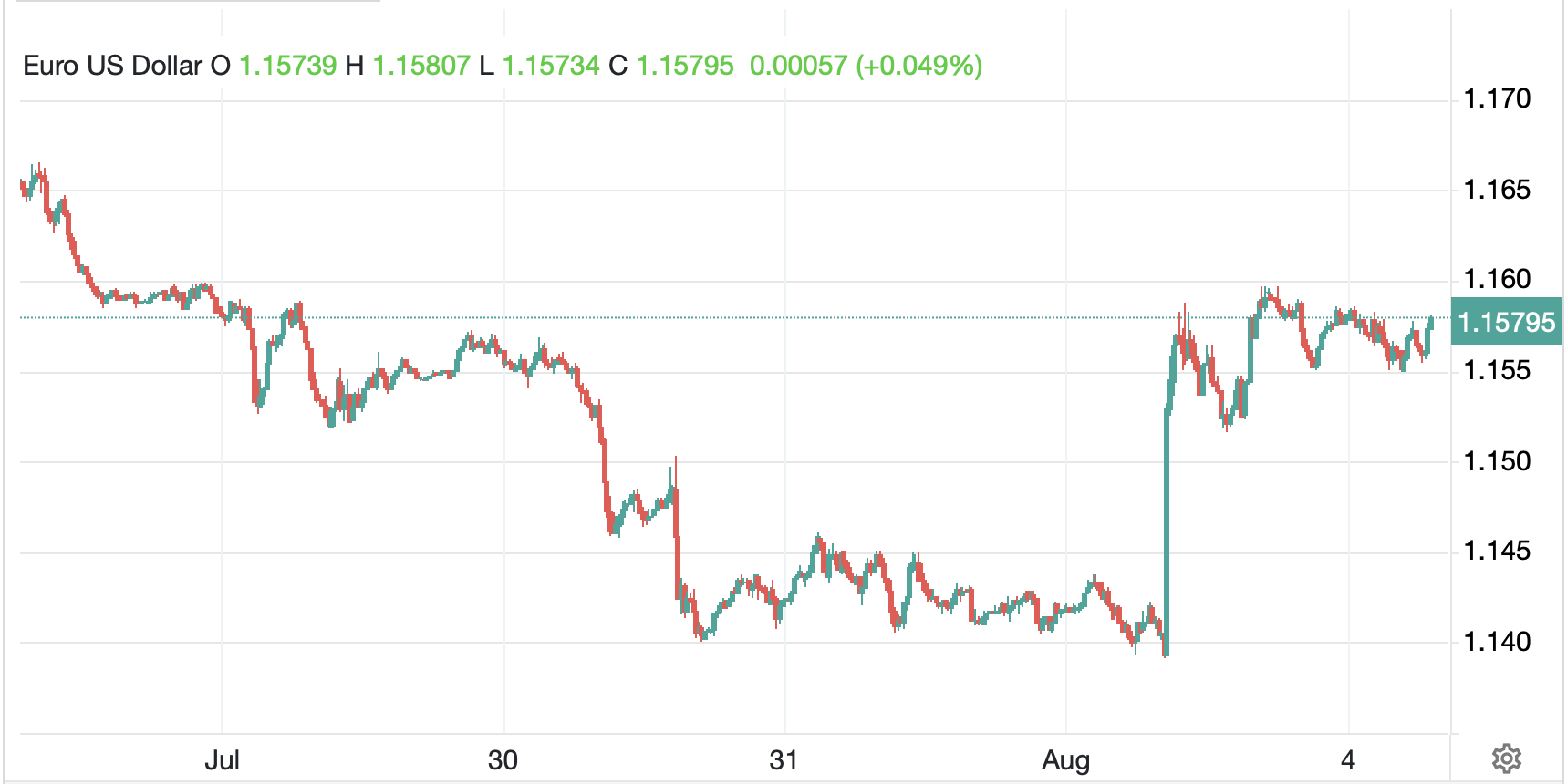
As to bond yields, after Friday’s dramatic decline, falling 15bps in the hour after the NFP report, they have largely stagnated, rising 1bp this morning.  European sovereign yields have slipped about 3bps on average as they continue the Friday move having closed before all the fun was finished.  In fact, while I have chosen the EURUSD exchange rate as a graph to depict the movement, basically every chart looks the same as this with a dislocation at the 8:30 mark on Friday and then a new range quickly established.

Source: tradingeconomics.com

I highlight this because so frequently, the narrative gets ahead of itself, and Friday was one of those days.  Yes, as I explained last night, the NFP data was weak, albeit still positive regardless of the fireworks surrounding the firing of the BLS Commissioner.  And remember, the idea that President Trump fired McEntarfar because the data displeased him does not mean she was not incompetent.  Certainly, nothing in her career demonstrates keen economic insights.  But that is still the talking point du jour.

However, that is a tired story at this point.  In fact, arguably, the reason it is getting so much press is that there is precious little else new to discuss amid the summer doldrums.  After all, the Russia Ukraine war continues apace with no end in sight, although it seems the rhetoric has increased with ex-president Medvedev seeming to threaten nuclear war and the US moving attack submarines closer to Russia.  

Texas Democratic state legislators have fled the state to avoid a special session where redistricting is due to be completed, so that has a lot of headlines, but seems likely to end like the last time this occurred, with the redistricting being completed, and Fed Governor Adriana Kugler stepped down a few months earlier than her term ends which opens another seat on the Fed for Mr Trump to fill.  

Of these stories, while our antenna should be raised given the Russia nuclear war scenario, it still seems a very low probability event, while Texas may matter in the midterm elections if they successfully redistrict as it is supposed to ensure another 5 Republican seats in the House.  But a new Fed governor, perhaps a precursor to the next Chair will have tongues wagging in the market until the seat is filled, and then until Powell is gone.

So, take your pick as to what is important.  Personally, I think the actual payroll data is the most important issue as we continue to see significant gyrations within the numbers.  Less government hiring (I read that 154,000 federal employees took the buyout) is an unalloyed good for the nation.  After all, if nothing else, given the average federal government employee salary is $106,382 (according to Grok) then that is about $16.4 billion less expenditure by the Federal government.  Every little bit helps.  In fact, all the data we have seen of late shows that the private sector continues to grow while the public sector is shrinking.  Over time, that is undoubtedly a better situation for the US and will reflect in the value of US assets.

But that’s really all there is to discuss, so let’s look at the data upcoming this week:

TodayFactory Orders-4.9%
 -ex Transport0.1%
TuesdayTrade Balance-$61.6B
 ISM Services51.5
ThursdayBOE Rate Decision4.00% (-0.25%)
 Initial Claims220K
 Continuing Claims1947K
 Nonfarm Productivity1.9%
 Unit Labor Costs1.6%
 Mexican Rate Decision7.75% (-0.25%)

Source: tradingeconomics.com

In other words, while we will hear from two more central banks as they cut rates (compared to a Fed that remains on hold, for now) it is hard to get that negative on the dollar.  Fed funds futures are pricing an 87% chance of a rate cut in September and now a 56% chance of three cuts this year, one at each meeting left, so that will weigh on the buck a bit, but if the US is cutting because recession is arriving, the economic situation elsewhere will be more dire.  After all, the US remains the consumer of last resort, and if the US pulls back, everyone else will feel it.

The big picture remains that the broader dollar trend is lower, but it is starting to make a case that trend is ending.  The data this week is largely second tier, and we need to wait until next week for CPI.  I have a feeling we will see very little net movement until then.

Good luck

Adf

Filled With Gilding

There once was a banker named Jay
Who yesterday, tried to allay
Fears that his building
Was too filled with gilding
But Trump seemed to have final say
 
The fact that this story’s what leads
The news, when one looks through the feeds
Is proof that there’s nought
Of note to be bought
Or sold, as price action recedes


According to Merriam-Webster, this is the definition of the word frequently bandied about these days, and rightly so.  

Market activity is just not very interesting.  While there is a new battle brewing on the Thai-Cambodian border, it is unlikely to have much impact on the rest of the world, and the Russia-Ukraine war continues apace, with very little new news.  Congress is in recess, sort of, which means new legislation is not imminent.  And while the Fed meets next week, just like the ECB and the BOE and the BOJ, no policy changes are imminent.  Doldrums indeed.

Which is why the story about President Trump visiting the construction site at the Marriner Eccles Building, the home of the Federal Reserve, has received so much press.  And frankly, a quick look at this clip is so descriptive of the current relationship between Trump and Powell it is remarkable.

But frankly, I just don’t see much else to discuss this morning.  equity markets in the US have generally been creeping higher, the DJIA excepted, the dollar is doing a slow-motion bounce and bond yields trade within a 5bps range.  Yesterday’s jobs data was solid, with both types of claims slipping, while the Flash PMIs showed net strength, although it was entirely Services driven.  And it’s Friday, so I won’t take up too much time.

Here’s the overnight review.  Asian markets followed the Dow, not the S&P or NASDAQ with Tokyo (-0.9%), Hong Kong (-1.1%) and China (-0.5%) all under pressure.  In Japan, there are starting to be more questions asked about whether PM Ishiba can hold on, and if he cannot (my guess is he will go) there is no obvious successor as no party there has any substantial strength.  Remember, the populist Sanseito party is a new phenomenon there and really is screwing up their electoral math.  As to the rest of the region, only Korea and New Zealand managed any gains, and they were di minimis.  Red was the color of the session.

Not surprisingly, that is the story in Europe as well, with most bourses lower on the day (DAX -0.6%, FTSE 100 -0.3%, IBEX -0.5%) although the CAC is essentially unchanged despite LVMH earnings being a little soft.  German Ifo data was slightly better than June, but lower than expected and UK Retail Sales were modestly weaker than forecast on every measure.  Again, it is hard to get excited here.  As to US futures, they are pointing higher by 0.2% at this hour (7:00).

In the bond market, Treasury yields have bounced 2bps from yesterday but are still right around 4.40% while European sovereign yields are higher by 3bps across the board.  Apparently, there is residual concern over European spending plans and absent a trade agreement with the US, investors there are not sure what to do.

In the commodity markets, oil (+0.4%) is bouncing for a second day, but remains within that recent trading range where we have seen choppy trading but no direction.  The gap lower earlier in the week was filled, but it is hard to get excited here about a new trend either.

Source: tradingeconmics.com

Meanwhile, metals markets remain under pressure as we head into the end of the month.  They have had a solid rally this month and it looks to me like some profit taking, but this morning gold (-0.7%), silver (-0.8%) and copper (-0.7%) are all under pressure.

Perhaps one of the reasons that the metals are soft is the dollar is stronger today.  I know we continue to hear about the death of the dollar, but as Mark Twain remarked, “the report of [its] death was an exaggeration.” Instead, what we see this morning is a pattern in the DXY that could easily be mistaken for described as a bottoming and we are simply waiting for confirmation.

Source: tradingeconomics.com

Looking at individual currencies, the dollar is firmer against every G10 currency with the euro (-0.25%) and pound (-0.4%) indicative of the magnitude of movement.  In the EMG bloc, KRW (-0.6%) and ZAR (-0.7%) are the worst performers, with the latter clearly following precious metals lower while the former is feeling a little heat from the fact that Japan struck a trade deal while South Korea has not yet done so.   Otherwise, things are just not that interesting here either.

On the data front, this morning brings Durable Goods (exp -10.8%, 0.1% ex Transports) which tells me that a lot of Boeing deliveries were made last month when Durables rose 16.4%.  But otherwise, nothing and no Fed speakers.  As I said before, it is a summer Friday, and I suspect that most trading desks will be skeleton staffed by 3:00pm if not earlier.

Good luck and good weekend

Adf

Mind-Numbing

According to those in the know
The BBB’s ready to go
The vote is this morning
So, this is your warning
That President Trump will soon crow
 
As well, ere the Fourth of July
The NFP may quantify
If rate cuts are coming
(A subject, mind-numbing)
Or whether Fed funds will stay high


Perhaps this will be the last day we hear about the Big Beautiful Bill, or at least the last day it leads the news, as it appears that by the time you read this, the House will have voted on the changes and by all accounts it is set to pass.  If so, the President will sign it tomorrow amidst great fanfare and then it will just be a secondary story when somebody complains about something that was in the bill.  However, the drama over passage will have finally ended.  

(I guess what has really led the news was that Diddy was found not guilty of the RICO charges and Kohburger in Idaho got a plea deal avoiding the death penalty, but neither of those are market related.)

At any rate, the question now to be asked is will the BBB perform as advertised by either side of the aisle?  Experience tells us that while the economy will not take off rapidly while inflation collpases, neither will there be people dropping in the streets because of the changes in Medicare, although if you listened to the pundits on both sides of the aisle, that is what you might expect.  While this is not quite as bad as Nancy Pelosi’s immortal words, “we have to pass the bill to find out what’s inside it”, the fact that it approaches 1000 pages in length implies there is a lot inside it.

From what I have read, and it has not been extensive, it appears that there is some stimulus in the bill in the form of tax relief on tips and overtime as well as reductions for seniors, and spending on defense and the border.  It also appears there have been several previous subsidies, notably for wind and solar, that are being removed.  The fact that the CBO is claiming it will increase the budget deficit by $1.5 trillion, and given the fact that Jim Cramer is the only one with a worse track record than the CBO, tells me it will have limited impact on the nation’s fiscal stance initially, although if growth does pick up, that will clearly help things.

Which takes us to the other story this morning, the payroll report.  Here are the current median forecasts by economists for the results, as well as the rest of the data to be released:

Nonfarm Payrolls110K
Private Payrolls105K
Manufacturing Payrolls-5K
Unemployment Rate4.3%
Average Hourly Earnings0.3% (3.9% Y/Y)
Average Weekly Hours34.3
Participation Rate62.3%
Initial Claims240K
Continuing Claims1960K
ISM Services50.5
Factory Orders8.2%
-ex Transport0.9%

Source: tradingeconomics.com

Some will point to yesterday’s ADP Employment report which showed a decline of -33K, the first decline in more than 2 years, as a harbinger of a bad number, but as you can see from the chart below, there has been a pretty big difference between ADP (grey bars) and NFP (blue bars) for a while now.

Source: tradingeconomics.com

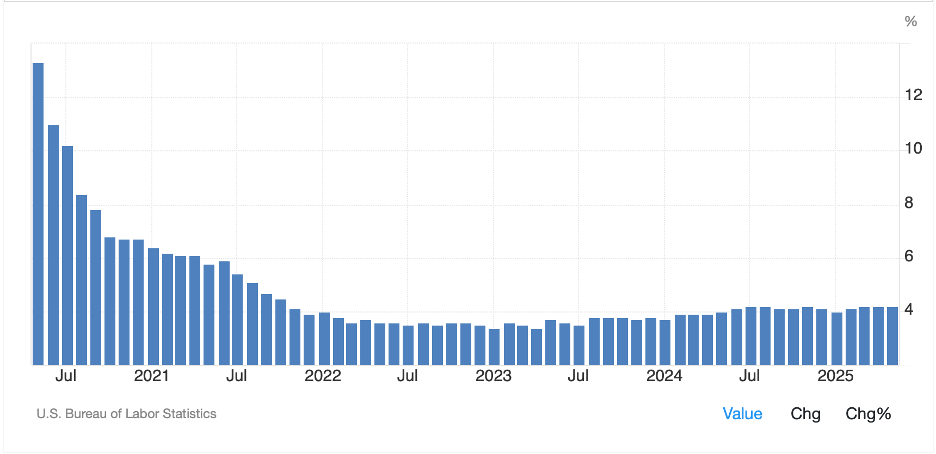
Perhaps of more concern is the Unemployment Rate, which is forecast to rise a tick to 4.3%, which would be its highest print since October 2021 and if I look at the chart below, it is not hard to see a very gradual trend rising higher here.  While markets really focus on NFP, I learned a long time ago from a very smart economist, Larry Kantor, that the Unemployment Rate was the best single indicator of economic activity in the US, and that when it is rising, that bodes ill for the future.  

Source: tradingeconomics.com

You may recall there was a great deal of discussion about a year ago regarding the Sahm Rule, which hypothesized that when the Unemployment Rate rose more than 0.5% above its cycle average within 12 months, the US was already in a recession.  The discussion centered on whether it had been triggered although the final claim was it hadn’t when extending the readings out to the second decimal place.  Now, for the past year, the Unemployment Rate has hovered between 3.9% and 4.2%, so there doesn’t seem to be any chance of a trigger here, although if it does rise, you can be sure you will hear about it.

And that’s what is on tap ahead of the long holiday weekend.  With that in mind, let’s look at the market action overnight. Excitement is clearly lacking in the equity markets these days as the summer doldrums are universal.  Yesterday’s new closing highs in the S&P 500 seem like they should be exciting but were anything but amid low volume.  As to Asia, Japan was flat, China (+0.6%) and Hong Kong (-0.6%) offset each other and in the rest of the region, other than Korea (+1.3%) which is starting to see a steady stream of foreign investment on the premise that the country is set to improve the regulatory structure for equities there, things were +/- a bit.

Meanwhile, in Europe, there is little net movement on the continent but the UK (+0.4%) is bouncing off recent lows after PM Starmer reiterated his support for Chancellor Reeves.  A story I missed yesterday was that when she was trying to make a case in parliament for spending cuts, the back bench liberals revolted, literally bringing her to tears.  The market response was that the UK would blow up its fiscal situation which saw Gilts tumble and yields rise 15bps yesterday at one point, while stocks fell.  But that problem has been addressed for now.  However, looking at the statement Starmer made, it reminded me of a baseball GM’s comments supporting his manager right before he fires him.

In the bond market, yields are declining, led by Gilts (-9bps) which are retracing yesterday’s gains on the above story.  But Treasury yields are down (-2bps) and European sovereigns are all seeing yields lower by between -4bps and -5bps.  In Japan, JGB yields are unchanged as PM Ishiba grapples with a trade deal where the US is keen to be able to export rice to the nation and Japan has a rice shortage with prices rising sharply but doesn’t want to accept imports.  Go figure.

In the commodity markets, oil (-0.2%) is slipping slightly after a solid rally over the past seven sessions where it rose over $3.50/bbl.  Gold (-0.3%) continues to trade around its pivot level of $3350/oz while silver (+1.0%) continues its longer run rally.

Finally, the dollar, which fell during yesterday’s session after I wrote, is effectively unchanged net this morning ahead of the data with very modest moves of +/-0.2% or less almost universal.  KRW (+0.4%) is the outlier here and based on equity inflows discussed above, that makes sense.

So, that’s where we stand heading into the payroll report and the long weekend.  If pressed on the NFP outcome, I expect a weak outcome, 50K or so, as the birth/death model continues to be revised.  But remember, the error bars on this number are huge.  However, if it is weak, look for the probability of a July rate cut (currently 25.3%) to rise and the equity market to follow that higher.  As to the dollar, I think for now, lower is still the trend.

Good luck and have a wonderful long weekend

Adf

The Perfect Riposte

Attention right now’s being paid
To Congress on taxes and trade
The One BBB
Is seen as the key
To growth in the coming decade
 
Meanwhile, Sintra right now’s the host
To Powell, Lagarde and almost
All central bankers
Each one of whom hankers
To nurture the perfect riposte


The headlines this morning highlight that Congress put in an all-nighter last night as they try to get the BBB over the line and on the president’s desk by Friday.  My take is they were seeking sympathy for all the hard work they must do and trying to make it seem like they are slaving away on their constituents’ behalf.  Yet it appears that since the president’s inauguration on January 20, 161 days ago, Congress has been in session for somewhere between 40 and 50 days (according to Grok), about one-quarter of the time.  I have seen these estimates elsewhere as well, and quite frankly, it doesn’t speak well of Congressional leadership.  

In the end, though, I continue to expect the BBB to get passed by both houses and sent to the president.  I’m certain there are still a lot of things in the bill that many fiscal conservatives will not like, but I’m also confident that the fact that not a single Democratic representative or senator is going to vote for the bill is likely a sign that it does more good than harm.  I am completely aware of the debt and deficit issues and questions of their long-term sustainability, and I am not ignoring that.  But politics is the art of the possible, not the perfect, and my take is this is possible.  Consider for a moment the Orwellian-named Inflation Reduction Act from 2022, which passed the Senate on a tiebreaker vote by VP Harris.  That was a much more harmful piece of legislation from a fiscal perspective than this.  In fact, I would say this is the very definition of politics.

Through a market lens, if (when) this is passed, while there may be an initial ‘sell the news’ move, I suspect that the stimulus it entails will be a net benefit for risk assets overall.  And the only reason there would be a sell the news event is that the market is already pricing in a great future as evidenced by yesterday’s quarterly close at new all-time highs for the S&P 500, above 6200.

Turning to the other noteworthy news, the ECB is holding their faux Jackson Hole event this week in Sintra, Portugal where all the heads of major central banks are currently gathered along with academics and journalists who are there to spread the good word.  Chairman Powell speaks today, but this is the Powell story of the day.  Apparently, President Trump had this hand-written note delivered to the Fed Chair.  Are we not entertained?

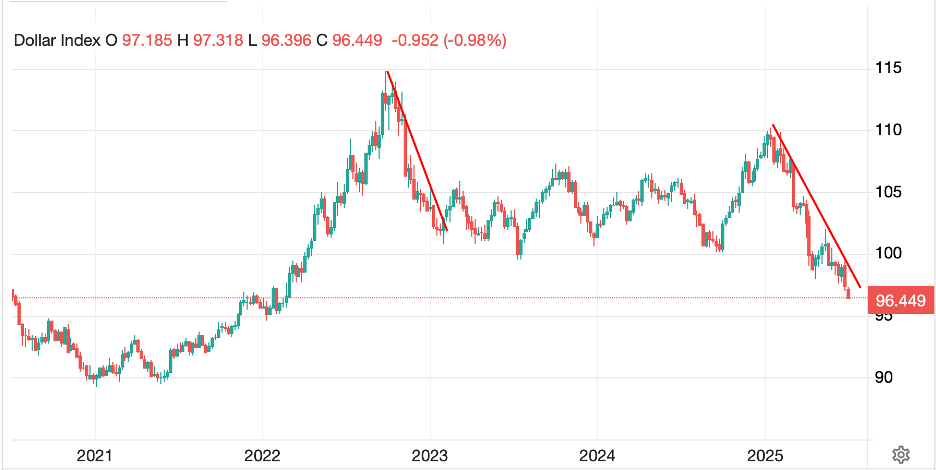
But ignoring for a moment the president’s desires, let us consider the dollar and its potential future direction.  The predominant current thinking is that it has further to slide as the trend is clearly lower and the rising anticipation of a recession in the US forcing the Fed to cut rates further will undermine the greenback.  Let’s break that down for a moment.  There is no question the dollar is currently in a downtrend as evidenced by the chart below.  A look at the red line on the right shows the slope of the decline thus far this year, which totals about 11%.

Source: tradingeconomics.com

In fact, much has been made of the decline thus far this year as to its speed and how it is a harbinger of both a recession and the end of the dollar’s hegemony.  Yet, we don’t have to go very far back in time, late 2022-early 2023 to see a virtually identical decline in the dollar over a slightly shorter period, hence the steeper slope of the line in the center of the chart, and I cannot find a single descrying of the end of the dollar at that time. Too, I remember being certain a recession was on the way then, when it never arrived.  According to JPMorgan, it seems the recession probability for 2025 is now 40%.  I have seen estimates ranging from 25% to 80% over the past few months which mostly tells me nobody has any idea.

We also don’t have to go very far back in time to see when the dollar was substantially weaker than its current levels.  I’m not sure why this time the dollar’s recent trend means the world is ending when that was not the case back in 2023 or any of the myriad times we have seen movement like this in the past.

But one other thing to consider regarding the dollar is that the BBB is going to provide significant stimulus to the economy.  Combining this with President Trump’s trade policies which are designed to draw investment into the US, and seemingly are working, and I think that despite his desire for lower interest rates, the Fed will have little reason to cut amid stronger growth in the economy.  I do not believe you can rule out a turn in the dollar higher once the legislation is passed as it is going to matter a great deal.  While spending priorities are going to change, it appears that investment is going to rise and that will help the buck.  Be wary of the dollar is dying thesis.

Ok, yesterday’s market activity, while reaching record highs in the equity markets, was actually incredibly slow with volumes shrinking.  My sense is folks are on holiday this week and those who aren’t are waiting for Thursday’s NFP data, so they can then run out of the office and go for their long weekend.  But the rest of the world doesn’t have the holiday Friday and are all trying to solve their trade situation with the US.  That led the Nikkei (-1.25%) lower yesterday as there appears to be a timing mismatch from a political perspective.  Ishiba doesn’t want to agree to open Japan’s market to US rice ahead of the election on July 20th as that will be a major political problem, but July 9th is approaching quickly, and Trump has said that is the date.  But aside from Japan and Hong Kong (-0.9%) the rest of the region had a pretty solid session led by Thailand (+2.1%) and Taiwan (+1.3%).  In Europe, though, PMI data was less than stellar, and bourses are modestly softer (DAX -0.5%, CAC -0.4%, FTSE 100 -0.3%) although Spain’s IBEX (+0.2%) has managed a gain as they had the best PMI outcome of the lot.  

In the bond market, yields continue to slide everywhere with Treasuries (-4bps) actually lagging the Eurozone which has seen declines of -6bps virtually across the board.  Madame Lagarde, in her Sintra opening speech, explained that the ECB would be altering their communication strategy to try to take account of the uncertainty in their forecasts, so not promise as much, but I have a feeling the movement is more a result of the softer PMI data as well as the Eurozone inflation release at 2.0% which has ECB members explaining things are under control.  Japan is a bit more confusing as JGB yields (-4bps) slipped despite what I would consider a strong Tankan report and a rise in their PMI data.  However, the newest BOJ board member did explain there was no reason to raise rates anytime soon, so perhaps that is the driver.

In the commodity markets, oil (+0.8%) continues to creep higher, perhaps a harbinger of stronger future economic activity around the world, or perhaps more short covering.  Gold (+1.4%) has completely erased the dip at the end of last week and is back at its recent pivot point of $3350 or so.  This has brought silver (+1.1%) and copper (+0.7%) along for the ride.

Finally, the dollar is clearly softer this morning with JPY (+0.6%) the leader in the G10 while ZAR (+0.9%) is the leading gainer in the EMG bloc as it follows precious metals prices higher.  Net, I would suggest that the average move here is about 0.25% strength in currencies.

On the data front, we get ISM Manufacturing (exp 48.8) and Prices Paid (69.0) and we get the JOLTs Job openings (7.3M) this morning.  Too, at 9:30, Chairman Powell speaks so it will be interesting to see if there is any change in his tune.

I see no reason for the dollar to turn higher right now but watch for the BBB.  Its passage could well change the dollar’s direction.

Good luck

Adf

Over the Hump

It’s beautiful and it’s quite big
Though more complicated than trig
But President Trump
Got over the hump
Though sans views that he is a Whig
 
As well, Friday’s Canada rift
Has ended, boy that was sure swift
Now, this week we’ll learn
If there’s still concern
‘Bout jobs, or if there’s been a shift


The weekend news revolves around the fact that the Senate has passed the BBB with a 51-49 vote, and it now moves to committee so both Houses of Congress can agree the final details before it gets to President Trump’s desk for signature and enactment.  This is another victory for the President, adding to last week’s wins and remarkably there have been several others as well.  The Supreme Court ended the ability of a single district court judge to injunct the entire nation based on a single case, a move that will prevent judges who disagree with the president from stopping his policy efforts.  Then, Canada announced they were going to impose a tax on US technology companies (the one that the Europeans just killed) and after Mr Trump ended the trade dialog quite vociferously, Canada backed down from that stance and is back at the negotiating table.

I mention this not to be political but as a backdrop to what is helping to drive the improved sentiment in US markets for both equities and bonds.  While a quick look at YTD performances of US equity indices vs. Europeans shows the US still lags, that gap is narrowing as the news cycle continues to point to positive things happening in the US.  Certainly, my understanding of the BBB is that it is quite stimulative, although it is changing priorities from the previous administration.

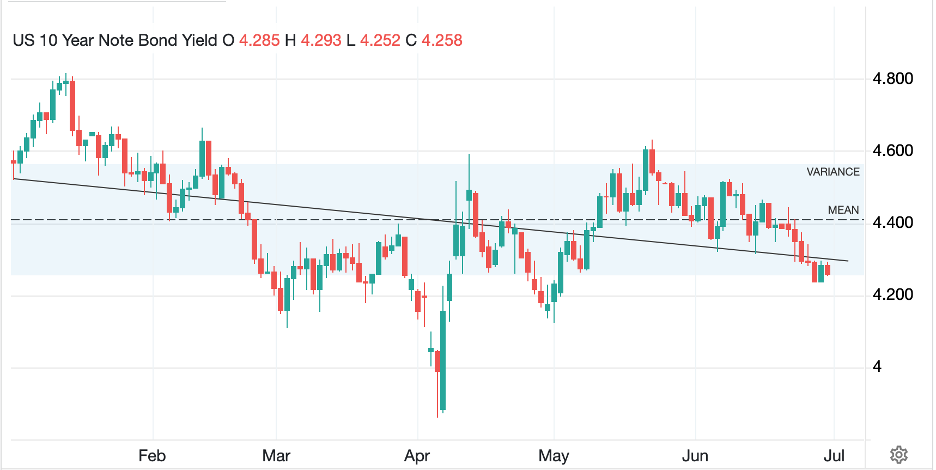
More interestingly, the Treasury market, which has been the subject of many slings and arrows lately from the part of the analyst community that continues to worry about refinancing the growing US debt pile, continues to behave remarkably well.  A quick look at the chart below shows that 10-year yields have been trending lower for the past 6 months, at least, and this morning are continuing that trend, slipping another -3bps.

Source: tradingeconomics.com

My point is that despite relentless doom porn regarding the economy, the big picture continues to point to ongoing growth in economic activity.  There are many anecdotes regarding the impending weakness, (the latest I saw was the increase in the number of credit card purchases that have been rejected is rising rapidly) and yet, the main data has yet to crack and roll over to point to a clear sign of significant slowing.  Perhaps this week when the NFP report is released on Thursday (Friday is July 4th holiday), we will see that long-awaited decline.  However, as of this morning, the Fed funds futures market continues to price just a 21% probability of a July rate cut as forecasts for NFP show the median to be 110K. 

While I completely understand the concerns that the doomers recite, I have come to understand that the idea of a recession is a policy choice, not a natural phenomenon.  While in the past, the business cycle was more powerful than the government, that is no longer the case.  Rather, what we have observed over the past 15 years at least, since the GFC and the onset of QE, is that the government has become a large enough part of the total economy to drive it at the margin.  And I assure you, if a recession is a policy choice, there is not a politician that is going to choose one.  Perhaps we will reach a point where the imbalances get beyond the control of the central banks and their finance ministries, but we are not there yet.

Ok, let’s take a peek at the overnight price action.  Despite all the spending promises by governments around the world, yields have slipped everywhere with all European sovereigns taking their lead from the US and lower this morning by -2bps to -3bps.  Even JGB yields (-1bp) have managed to decline slightly.  If inflation fears are building, they are not obvious this morning.

In the equity markets, Friday’s US rally was followed by most Asian bourses rising (Nikkei +0.8%, Australia +0.3%, China +0.4%) although HK (-0.9%) slipped after Chinese PMI data was released that indicated things weren’t collapsing, but that future monetary stimulus may not be coming after all.  The worst of both worlds for stocks.  Meanwhile, European exchanges are mostly a touch softer, but only on the order of -0.2%, so really very little changed amid light volume overall.  Interestingly, US futures are solidly higher at this hour (7:00), rising by 0.55% across the board.

In the commodity markets, oil (-0.35%) is slipping a bit, but is basically hanging around near its recent lows as the market remains unconcerned about an escalation of fighting between Iran and Israel and any possible closure of the Strait of Hormuz.  Meanwhile, gold (+0.4%) is bouncing from a weak performance Friday which appears to have been a bit oversold, although copper and silver are not following suit this morning with the former (Cu -0.7%) the laggard.  However, all the metals remain sharply higher this year and in strong up trends.

Finally, the dollar is modestly softer again this morning with KRW (+0.9%) the biggest mover, by far, while the entire G10 complex is showing gains on the order of 0.1% to 0.2%.  This trend lower in the dollar remains strong (see chart below), but as I continue to remind everyone, we are nowhere near an extreme valuation in the dollar.  If, and it’s a big if, we see substantial weakening in the employment data, I think the Fed could decide to act and that would increase the speed of the downtrend (as well as goose inflation higher), but absent that, I do not see a sharp decline, rather a slow descent.  Remember, this is exactly what Trump and Bessent want, a more competitive dollar for the manufacturing sector.

Source: tradingeconomics.com

As it is the first week of the month, there is plenty of data to digest.

TodayChicago PMI43.0
TuesdayISM Manufacturing48.8
 ISM Prices Paid69.0
 JOLTs Job Openings7.3M
WednesdayADP Employment 85K
ThursdayNonfarm Payrolls110K
 Private Payrolls110K
 Manufacturing Payrolls-6K
 Unemployment Rate4.3%
 Average Hourly Earnings0.3% (3.9% y/Y)
 Average Weekly Hours34.3
 Participation Rate62.3%
 Initial Claims240K
 Continuing Claims1960K
 ISM Services50.5
 Factory Orders8.0%
 -ex Transport0.9%

Source: tradingeconomics.com

In addition to the payrolls, we hear from Chairman Powell again on Tuesday and Atlanta Fed president Bostic twice.  I guess the rest of the FOMC took a long holiday week(end).

As it’s a holiday week, I expect that activity will be light, although headline bingo remains a key part of the markets today.  I feel like the trends are well entrenched though, with the dollar slipping, equities and commodities rallying and bonds currently leaning toward lower yields, although that seems out of sync with the other markets.  But in the summer, with less liquidity and activity, anomalies can continue for a while.

Good luck

Adf

Gone Astray

The ADP Labor report
On Wednesday, came up a bit short
Investors decided
That they would be guided
By this and bought bonds like a sport
 
As well, there’s a story today
The BLS has gone astray
It seems that their data
Might have the wrong weight-a
So, CPI’s not what they say


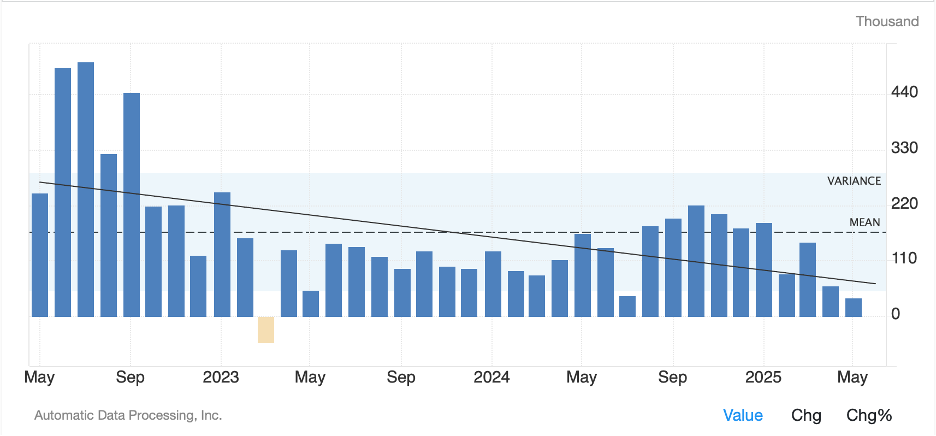
It has been another very dull session in most markets although yesterday did see a strong bond market rally after the ADP Employment Report was released much lower than expected at just 37K jobs created.  Certainly, the trend has been lower for the past three years as you can see in the below chart from tradingeconomics.com, so I guess we cannot be that surprised.

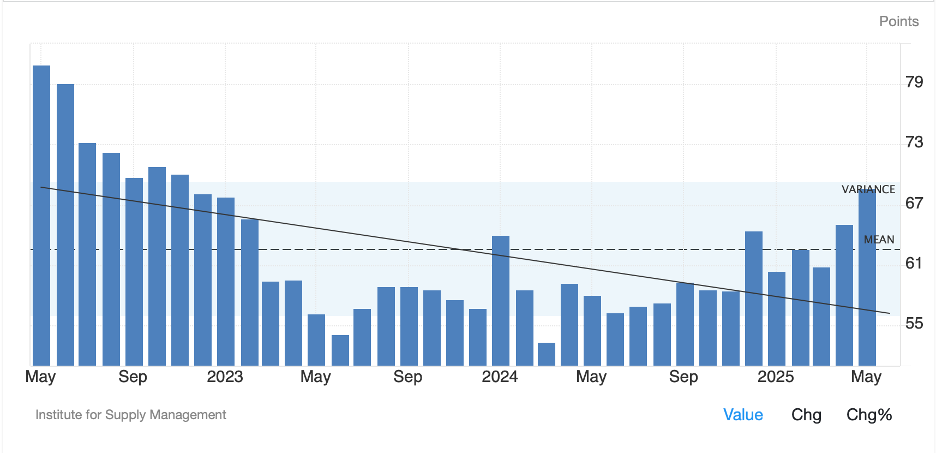
You will also not be surprised that this data brought out the recessionistas as they jumped all over the release to make their case that recession was just around the corner, and quite possibly stagflation.  Adding to their case was the ISM Services data which also disappointed at 49.9 and has also been trending lower for the past three years.  As well, they were almost gleeful in their description of the Prices Paid sub index rising to 68.7, its highest print since November 2022.  Alas, while Pries Paid have been rising for the past year or so, a look at the trendline shows they are continuing to retreat from the highs seen during the Bidenflation of 2022.

Source: tradingeconomics.com

In the end, although this data was unquestionably disappointing, it feels a bit too early, at least to me, to declare the recession has arrived.  But not too early for the bond market where 10-year yields tumbled 11bps on the day and almost all the damage was done in the first hour after the ADP release although the ISM helped things along as well.

Source: tradingeconomics.com

Perhaps we are going into a recession, or even already in one, but overall, the data so far are just showing the beginnings of that.  I imagine opinions will be strengthened one way or another tomorrow when the NFP report is released, but for now, the recessionistas appear to have the upper hand, at least in the bond market.

The other story that is getting a response, at least amongst the Twitterati (X-eratti?) is the WSJ article about how the BLS, due to President Trump’s hiring freeze, is suddenly calling into question the accuracy of their statistical releases, notably the CPI report due next week.  I will let my friend, The Inflation Guy™, Mike Ashton, explain why this is a nothing burger. [emphasis added]

WSJ story about how staff shortages at BLS are affecting how many estimates the staff has to make instead of collecting actual data. It is very hard to make these errors accumulate to as much as 1-2bps on the monthly number.

UNLESS: there is bias in the estimating, or there are very large categories affected, or there are HUGE errors in some categories. Lots of random errors increases the overall error but is unlikely to affect the mean. And be honest. Do you have any idea what the MSE (mean standard error) of the CPI is?

People really should care about the error bars but even most economists almost never do. Unless it’s an opportunity to complain about budget cuts to economists, which is what this is. Nothing to see here.”

Otherwise, folks, another day in paradise with nothing else new, at least on the market front.  At some point, domestic politics, or geopolitics or war or something else is going to catch the fancy of the algos and change trading, but right now, that does not appear to be the case.  Perhaps Friday’s NFP data will be the catalyst to start a serious change in attitudes but I’m not holding my breath.

In the meantime, let’s survey market activity.  Yesterday’s US session was quite dull with limited movement and low volumes. Asia saw a mixed picture with the Nikkei (-0.5%) slipping, ostensibly, on concerns that a weaker US would negatively impact their export sector, tariffs be damned.  Hong Kong (+1.1%) though, rallied on Chinese PMI data holding on to recent levels rather than slipping further.  The rest of the region was far more positive, led by Korea (+1.5%) although the gains were more on the order of +0.5%.  Europe is all green this morning, with the CAC (+0.5%) leading the way, although the DAX (+0.4%) and FTSE 100 (+0.3%) are also holding up well on the back of positive German Factory orders data and solid UK Retail Sales.  Meanwhile, at this hour (7:00), US futures are ever so slightly firmer, +0.15% or so.

In the bond market this morning, after the big rally yesterday discussed above, Treasury yields this morning have edged lower by 1bp and European sovereigns have seen yields slide by between -3bps and -5bps as inflation data on the continent continues to soften encouraging the belief that the ECB, later this morning, may even consider more than the 25bp cut that is priced in.

The one true consistency lately has been gold (+0.8%) which has no shortage of demand, especially in Asia, and certainly feels like it is going to test, and break, the previous high of $3500/oz, which is now just $100 away.  But this has encouraged silver (+4.0%), copper (+2.65%) and now even platinum (+3.8%) has been invited to the party.  Regardless of the macroeconomic statistics, the ongoing global monetary policy of fiat debasement seems set to continue which can only help these metals.  As to oil (+0.3%), it continues to sit near its recent highs with not much activity in either direction.  It feels like we will need a major event/pronouncement of some sort, whether wider war in the Middle East or a change in OPEC policy to move this thing.

Finally, the dollar can best be described, again, as mixed.  While the euro and pound are marginally higher, the yen is marginally weaker.  In the EMG bloc, both KRW (+0.4%) and ZAR (+0.5%) are showing gains this morning, but nothing else of note is moving.  And when looking at the broad DXY, unchanged is where it’s at.  As with most markets right now, metals excepted, doing nothing seems the best choice.

On the data front, this morning brings the weekly Initial (exp 235K) and Continuing (1910K) Claims as well as the Trade Balance (-$94.0B) which if correct will almost certainly bring on a lot of White House crowing but is likely inconsequential with respect to the overall scheme of things.  We also see Nonfarm Productivity (-0.7%) and Unit Labor Costs (+5.7%) a combination of expectations that does speak to stagflation.  The ECB meeting will get some eyeballs, but unless they cut 50bps, a very low probability event based on current market pricing, it is hard to see much impact there either.

We are in a rut for now.  Whatever the catalyst that is required to change views substantially, it is not obvious at this point.  Bigger picture, nothing indicates any government is going to slow their spending or their money printing.  There is too much debt to ever be repaid, so a slow inflationary debasement is very likely our future.  I still think the dollar slides further, but it could be a few months before the current range breaks.

Good luck

Adf

They Will Get Burned

In Europe, the corporate elite
Have started, their worries, to bleat
They’re now quite concerned
That they will get burned
If dollar sales start to retreat
 
For years, when the dollar was rising
Weak unit sales, it was disguising
But now the buck’s falling
Which they find appalling
As earnings forecasts, they’re downsizing
 

Markets are very interesting constructs.  Not only do they help find a clearing price for supply and demand of something, but they also tend to take on anthropomorphic characteristics in many eyes as some type of creature beyond anyone’s control, but with a tinge of malevolence.  Part of that latter feeling comes from markets’ ability to make every pundit seem like a fool.  After all, it was just 3 days ago when I was reliably informed by the punditry that equity values were set to collapse as the US economy entered a depression.  It seems we may have to wait a few more days for that situation to play out.  And, in fact, they have now changed their tune.  While ascribing the rebound to President Trump’s reversal on some issues, the overall doom and gloom story has moved to the background.  But if there is one thing I have continuously discussed since Trump’s election is that volatility was very likely to increase, and that has certainly been the case. 

Shifting our focus to the FX markets, though, I couldn’t help but chuckle at a Bloomberg article this morning titled, The Dollar’s Slide is Raising Red Flags for Corporate Earnings.  As I am based in the US, the fact that this was a front-page article had me somewhat confused.  A long career in speaking with corporate accounts on FX made it clear that a weak dollar was the best thing for earnings of US multinationals.  Generally, when the dollar was strong, CFOs would ascribe any earnings problems to that issue as a catch-all excuse, but when the dollar declined, outperformance by a company was the result of brilliant execution.

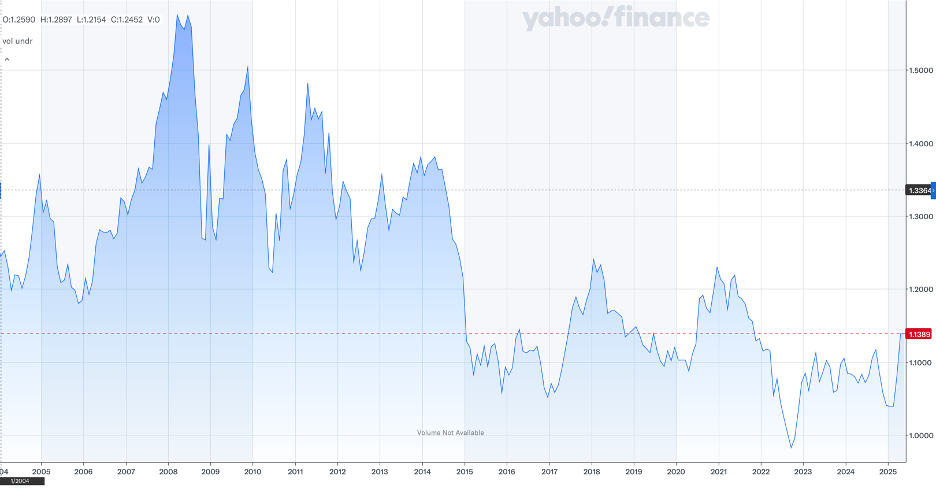
So, you can understand my initial confusion.  But upon reading the article, it turns out they were talking about European corporates, who for the first time in three years find that hedging their US dollar sales is critical.  Not only that, but they have also been quick to highlight that all new hedges will be at worse rates and therefore future earnings are already sure to be impacted.  Now, a quick look at the chart below does show that the euro has risen to its highest level in three years.  But it also shows that compared to the past 20 years, the euro is nowhere near high levels. In fact, it sits well below the median price (somewhere in the 40th percentile actually).  Perhaps European corporate Treasurers have simply forgotten their history.  Or more likely, just like US corporate Treasurers when the dollar is rising, they are seeking a scapegoat.

I cannot emphasize enough that the FX rate is not the driver, but the release valve for all the things that happen in the global economy.  Other actions take place, whether interest rate changes, policy or market, economic adjustments, policy or market, or exogenous events, and the FX rate is the place where equilibria are found.  In fact, arguably, that is the biggest flaw in the Trump administration’s idea that if they weaken the dollar, it will solve policy problems.  The dollar is the tail to the economy’s dog.

In the meantime, the reason one runs a hedge program with consistency is to mitigate the big moves in FX and their impacts on earnings.  But remember, even the best hedge programs lag large secular moves.

Ok, I’ll step down off my high horse and let’s look at how markets behaved overnight.  After yesterday’s second consecutive rally in the US, the picture elsewhere in the world is more mixed.  In Asia, the Nikkei (+0.5%) continued its rebound but the Hang Seng (-0.75%) and CSI 300 (-0.1%) saw no benefit overnight.  Elsewhere in the region winners and losers were pretty evenly split and nobody saw a movement of more than 0.8% in either direction.  In Europe, red is today’s color, but it’s a pale red with losses across the board of the 0.1% to 0.25% variety.  The only news overnight was German Ifo data, which showed a bit of a surprising uptick in the current business climate as well as expectations.  Perhaps the promise of more German fiscal largesse is outweighing concerns over tariffs.  As to US futures, they, too, are lower by about -0.15% at this hour (7:20).

In the bond market, yields are sliding around the world with Treasuries (-3bps) continuing to back away from their recent highs while European sovereigns see yields decline between -3bps and -4bps.  Even JGB yields slipped -1bp overnight.  My take is some of the fear has ebbed away from the market.

In the commodity markets, oil (+1.1%) remains in its recent trading range, with a still very large gap above the market in price terms.  The demand story seems fixed at weakening demand because of either slowing growth, or the electrification of everything or something like that, while the supply story is starting to see hints that oil companies are going to back off production with prices at current levels.  The latter feels like the larger short-term risk, although nothing has changed my longer-term view of lower prices here.  In the metals markets, gold (+0.7%) is rebounding after a difficult two days, arguably some real profit taking was seen.  Meanwhile silver (-0.5%) which actually outperformed gold for the past two sessions is giving some of those gains back and copper (+0.8%) is continuing its rebound after a dramatic decline from the all-time highs seen just one month ago.  Talk about a V-shaped recovery!

Source: tradingeconomics.com

Finally, the dollar is softer this morning, giving back about half of yesterday’s 1% gains.  In the G10, SEK and NOK (both +1.1%) are leading the way although the euro (+0.6%) is having a good day, as is the yen (+0.75%). The pound (+0.5%) is a bit of a laggard but after seeing this interview of Ed Miliband (UK Secretary of Energy and Climate Change), and his either inability to understand the implications of his policy, or his willingness to lie about it, I cannot believe the pound will continue to track the euro.  The UK’s energy policy appears designed to destroy the UK economy.  Consider that solar power is a key pillar of their future efforts to achieve net zero carbon emissions, and the UK is the nation that gets the least solar coverage in the world.  After all, it rains there half the time.  Meanwhile, the government is keen to end all other sources of energy.  No matter what you think of President Trump’s policies, they are not nationally suicidal like the UK’s.

Turning to the EMG bloc, gains are the norm, but not universal.  The CE4 are doing well but ZAR (-0.2%) and KRW (-0.6%) with the latter suffering from weaker than expected GDP growth in Q1 while the former, after a strong run since early in April, appears to merely be taking a breather.

We finally see some notable data this morning with Initial (exp 222K) and Continuing (1880K) Claims, Durable Goods (2.0%, 0.3% ex-Transport) and the Chicago Fed National Activity Index (0.11) all at 8:30, then at 10:00 we get Existing Home Sales (4.13M).  Yesterday saw New Home Sales pick up more than expected and the Beige Book indicate that economic activity was unchanged from the past, but uncertainty had risen.

Here’s what we know; the world is not ending but it is continuing to change from the structures created in the post WWII period.  This process is just beginning and anybody who claims to know where things are headed is lying.  I continue to believe in my bigger picture views, but day to day, there is no rhyme or reason, especially given the importance of headline bingo.

Good luck

Adf

Inundated

Investors have been inundated
By news that has been unabated
There’s tariffs and war
Plus rate cuts and more
With stocks and bonds depreciated
 
Now looking ahead to today
The payroll report’s on its way
As well, later on
With nothing foregone
We’ll hear from our own Chairman Jay


It has certainly been an interesting week in both markets and the world writ large.  So much has happened and yet so much is still unclear as to how things may evolve going forward.  Through it all, volatility is the only constant.  To me, what has become abundantly clear is the post WWII order is being dismantled, and every nation is trying to determine its place in the future.  This is a grave threat to those who benefitted from flowery words and limited action, which covers a wide swath of government leaders around the world.  I’m not sure if this is the 4th Turning, or if this is merely the prelude, with the impacts of all these changes what brings the 4thTurning about.  Regardless, history is clearly in the making.

I do not have the bandwidth to continuously follow the tariff story, although yesterday’s news was there will be more delays for both Canada and Mexico.  China received no such relief and at their National People’s Congress they seemed resolute in their pushback and highlighted their own achievements.  The data from China, though, tells me that their goals for more domestic consumption remain far in the distance.  Last night they reported their Trade Balance for the January/February period (they always combine because of the Lunar New year disruptions) and it jumped to $170.5B, far greater than anticipated.  While exports underperformed slightly, growing only 2.3% compared to a 5% estimate, it was the imports that really tells the story.  Imports fell -8.4%, a significant shortfall from both last year and consensus estimates, and an indication that the Chinese consumer is not yet the type of force that President Xi would like to see.  

In fact, a look at the chart below showing imports for the past 10 years demonstrates that very little has changed on this front.  As I wrote yesterday, converting a mercantilist economy into a consumer-focused one is a huge lift, and one that the CCP has not yet figured out.  It is not clear that they ever will.  Meanwhile, the obvious explanation for the huge jump in the trade balance was companies pre-ordering things to get ahead of the tariffs.

Source: tradingeconomics.com

Moving on to the Ukraine situation, while yesterday’s news was of the “whatever it takes” moment for defending Europe, this morning it seems there are some caveats attached.  Of course, the first caveat is the changing of the German constitution to allow them to spend all that money.  The second seems to be that not every European nation is on board for the massive spending increase and continuation of the war.  There are many political and financial hurdles to overcome in this story in Europe, and this morning’s European equity markets are indicative of the idea that this is not a straight-line higher.  In fact, every equity market in Europe is lower this morning, led by the DAX (-1.5%) although with solid declines elsewhere as well (CAC -1.0%, FTSE 100 -0.5%).  This, too, is a story with no clear end in sight.  One unconfirmed story I saw was that the group convened by the UK last weekend has not been able to agree terms for additional support.

Meanwhile, yesterday the ECB cut their short-term rates by 25bps, as widely expected, with the Deposit Rate now down to 2.50%.  The funny thing is nobody really noticed.  This is of a piece with my observation that central bankers just don’t have that much sway on market activity these days, it is all about politics and statecraft, not monetary policy.  This morning, Eurozone GDP for Q4 was released at 0.2%, a tick higher than forecast but still lower than Q3’s 0.4%.  There is no doubt the financial mandarins of Europe are keen to get this defense spending going, because otherwise they will continue to preside over a stagnant economy.  

But here’s an interesting thing to consider.  Germany has made a big deal about this new willingness to spend €500 billion outside the bounds of their budget framework on defense.  However, they continue with their Energiewende policy which has been the Achilles Heel of the German economy and will prevent them from actually producing armaments if they seek to continuously reduce fossil fuel powered energy for renewables.  It is almost as if this is theater, rather than policy, but that may just be my cynicism speaking.

Moving on to the US, this morning brings the Payroll Report with the following current median estimates:

Nonfarm Payrolls160K
Private Payrolls111K
Manufacturing Payrolls5K
Unemployment Rate4.0%
Average Hourly Earnings0.3% (4.1% Y/Y)
Average Weekly Hours34.2
Participation Rate62.6%

Source: tradingeconomics.com          

As well, we hear from Chairman Powell at 12:30pm, along with Bowman, Williams and Kugler in the hours leading up to that.  But again, I ask, do they matter to the markets right now?  Certainly, there is much discussion that the US economic data is starting to show more weakness, and there are many who are saying that long-anticipated recession is going to become evident.  If that is the case, we could certainly see the Fed cut rates, but again, my take is markets are far more attuned to 10-year yields than Fed funds.  And remember, while 10-year yields are clearly quite inflation sensitive, what we also know that questions over budget deficits and supply are critical to their pricing as well.  This was made evident yesterday in Germany.

I have glossed over market activity overnight so will give a really short update here.  Yesterday’s weakness in the US was followed by broad weakness throughout Asia, with most markets there lower on the day, notably Japan (-2.2%), but declines almost everywhere.  We have already discussed European bourses and at this hour (7:30) US futures are basically unchanged ahead of the data.

In the bond market, Treasury yields are slipping back -3bps this morning and we are seeing similar price action across most of Europe although Spain (+1bp) is bucking the trend on some domestic issues.  It is easy to believe that the Germany story was a bit overblown, and remember, if they cannot change the constitution, I expect a rally in Bunds (lower yields) along with a selloff in the DAX and the euro.

Speaking of the euro, it is continuing its sharp ascent, up another 0.6% this morning.  however, something to keep in mind regarding all the huffing and puffing about the euro is that with this sharp move higher in the past week, it is merely back to the middle of its 3-year trading range.  So, is this as big a deal as some are saying?

Source: tradingeconomics.com

But the overall currency picture is more mixed with both AUD (-0.6%) and NZD (-0.5%) lower along with CAD (-0.2%).  There are other gainers (GBP +0.2%, SEK +0.7%) and other laggards (ZAR -0.2%) although I would say the broad direction is still for dollar weakness.  

Finally, oil (+1.5%) is bouncing this morning, although this could well be a trading bounce as I have seen no new news on the subject.  I guess the delay on Canadian tariffs probably played a role as well.  Gold (+0.4%) is also firmer although both silver (-0.4%) and copper (-1.2%) are lagging.  In fairness, the latter two have had significant up weeks so are likely seeing some profit taking.

Once again, I will remark that for those who have real flows and exposures, the current market situation is why hedging is critical to maintain financial performance.  Nobody really knows where anything is going to go, but right now, it feels like the one thing we know is prices will not remain where they currently are for very long.

Good luck and good weekendAdf