Gone Astray

The ADP Labor report
On Wednesday, came up a bit short
Investors decided
That they would be guided
By this and bought bonds like a sport
 
As well, there’s a story today
The BLS has gone astray
It seems that their data
Might have the wrong weight-a
So, CPI’s not what they say


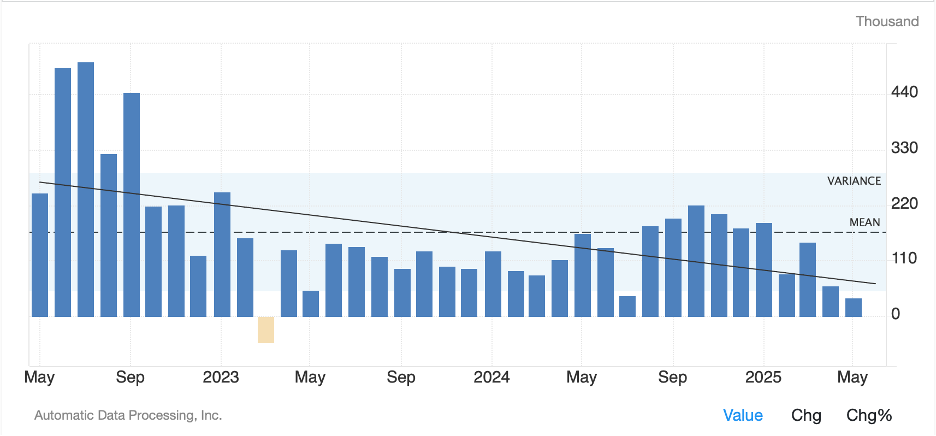
It has been another very dull session in most markets although yesterday did see a strong bond market rally after the ADP Employment Report was released much lower than expected at just 37K jobs created.  Certainly, the trend has been lower for the past three years as you can see in the below chart from tradingeconomics.com, so I guess we cannot be that surprised.

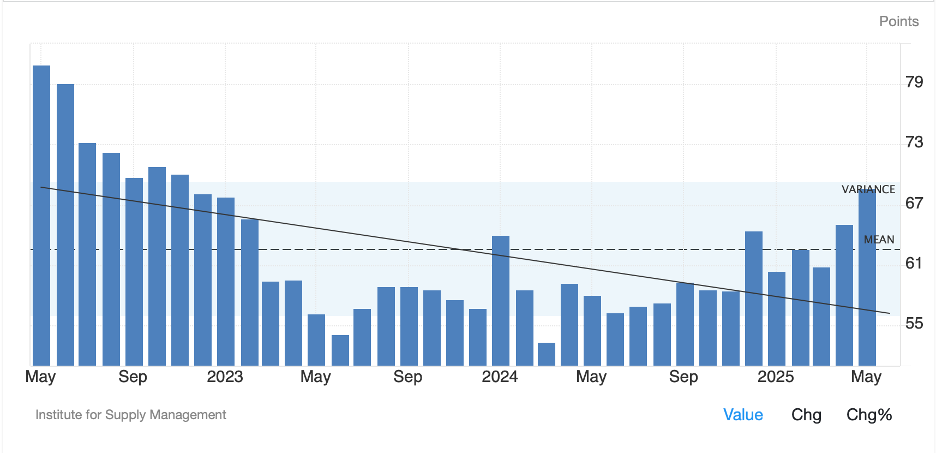
You will also not be surprised that this data brought out the recessionistas as they jumped all over the release to make their case that recession was just around the corner, and quite possibly stagflation.  Adding to their case was the ISM Services data which also disappointed at 49.9 and has also been trending lower for the past three years.  As well, they were almost gleeful in their description of the Prices Paid sub index rising to 68.7, its highest print since November 2022.  Alas, while Pries Paid have been rising for the past year or so, a look at the trendline shows they are continuing to retreat from the highs seen during the Bidenflation of 2022.

Source: tradingeconomics.com

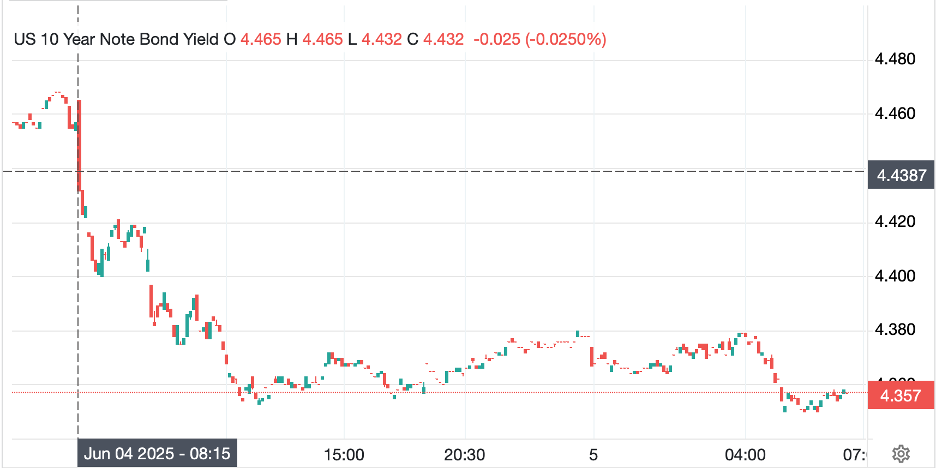
In the end, although this data was unquestionably disappointing, it feels a bit too early, at least to me, to declare the recession has arrived.  But not too early for the bond market where 10-year yields tumbled 11bps on the day and almost all the damage was done in the first hour after the ADP release although the ISM helped things along as well.

Source: tradingeconomics.com

Perhaps we are going into a recession, or even already in one, but overall, the data so far are just showing the beginnings of that.  I imagine opinions will be strengthened one way or another tomorrow when the NFP report is released, but for now, the recessionistas appear to have the upper hand, at least in the bond market.

The other story that is getting a response, at least amongst the Twitterati (X-eratti?) is the WSJ article about how the BLS, due to President Trump’s hiring freeze, is suddenly calling into question the accuracy of their statistical releases, notably the CPI report due next week.  I will let my friend, The Inflation Guy™, Mike Ashton, explain why this is a nothing burger. [emphasis added]

WSJ story about how staff shortages at BLS are affecting how many estimates the staff has to make instead of collecting actual data. It is very hard to make these errors accumulate to as much as 1-2bps on the monthly number.

UNLESS: there is bias in the estimating, or there are very large categories affected, or there are HUGE errors in some categories. Lots of random errors increases the overall error but is unlikely to affect the mean. And be honest. Do you have any idea what the MSE (mean standard error) of the CPI is?

People really should care about the error bars but even most economists almost never do. Unless it’s an opportunity to complain about budget cuts to economists, which is what this is. Nothing to see here.”

Otherwise, folks, another day in paradise with nothing else new, at least on the market front.  At some point, domestic politics, or geopolitics or war or something else is going to catch the fancy of the algos and change trading, but right now, that does not appear to be the case.  Perhaps Friday’s NFP data will be the catalyst to start a serious change in attitudes but I’m not holding my breath.

In the meantime, let’s survey market activity.  Yesterday’s US session was quite dull with limited movement and low volumes. Asia saw a mixed picture with the Nikkei (-0.5%) slipping, ostensibly, on concerns that a weaker US would negatively impact their export sector, tariffs be damned.  Hong Kong (+1.1%) though, rallied on Chinese PMI data holding on to recent levels rather than slipping further.  The rest of the region was far more positive, led by Korea (+1.5%) although the gains were more on the order of +0.5%.  Europe is all green this morning, with the CAC (+0.5%) leading the way, although the DAX (+0.4%) and FTSE 100 (+0.3%) are also holding up well on the back of positive German Factory orders data and solid UK Retail Sales.  Meanwhile, at this hour (7:00), US futures are ever so slightly firmer, +0.15% or so.

In the bond market this morning, after the big rally yesterday discussed above, Treasury yields this morning have edged lower by 1bp and European sovereigns have seen yields slide by between -3bps and -5bps as inflation data on the continent continues to soften encouraging the belief that the ECB, later this morning, may even consider more than the 25bp cut that is priced in.

The one true consistency lately has been gold (+0.8%) which has no shortage of demand, especially in Asia, and certainly feels like it is going to test, and break, the previous high of $3500/oz, which is now just $100 away.  But this has encouraged silver (+4.0%), copper (+2.65%) and now even platinum (+3.8%) has been invited to the party.  Regardless of the macroeconomic statistics, the ongoing global monetary policy of fiat debasement seems set to continue which can only help these metals.  As to oil (+0.3%), it continues to sit near its recent highs with not much activity in either direction.  It feels like we will need a major event/pronouncement of some sort, whether wider war in the Middle East or a change in OPEC policy to move this thing.

Finally, the dollar can best be described, again, as mixed.  While the euro and pound are marginally higher, the yen is marginally weaker.  In the EMG bloc, both KRW (+0.4%) and ZAR (+0.5%) are showing gains this morning, but nothing else of note is moving.  And when looking at the broad DXY, unchanged is where it’s at.  As with most markets right now, metals excepted, doing nothing seems the best choice.

On the data front, this morning brings the weekly Initial (exp 235K) and Continuing (1910K) Claims as well as the Trade Balance (-$94.0B) which if correct will almost certainly bring on a lot of White House crowing but is likely inconsequential with respect to the overall scheme of things.  We also see Nonfarm Productivity (-0.7%) and Unit Labor Costs (+5.7%) a combination of expectations that does speak to stagflation.  The ECB meeting will get some eyeballs, but unless they cut 50bps, a very low probability event based on current market pricing, it is hard to see much impact there either.

We are in a rut for now.  Whatever the catalyst that is required to change views substantially, it is not obvious at this point.  Bigger picture, nothing indicates any government is going to slow their spending or their money printing.  There is too much debt to ever be repaid, so a slow inflationary debasement is very likely our future.  I still think the dollar slides further, but it could be a few months before the current range breaks.

Good luck

Adf

As Though It Had Fleas

Well, CPI wasn’t as hot
As most of the punditry thought
But bonds don’t believe
The Fed will achieve
Low ‘flation, so they weren’t bought
 
But maybe, the biggest response
Has been that the buck, at the nonce
Has lost devotees
As though it had fleas
The end of the Trump renaissance?


Yesterday’s CPI data was released a touch softer than market expectations with both headline and core monthly numbers printing at 0.2%.  If you dig a bit deeper, and look out another decimal place, apparently the miss was just 0.03%, but I don’t think that really matters.  As always, when it comes to inflation issues, I rely on @inflation_guy for the scoop, and he provided it here.  The essence of the result is that while inflation is not as high as it had been post Covid, it also doesn’t appear likely that it is going to decline much further.  I think we all need to be ready for 3.5% inflation as the reality going forward.

Interestingly, different markets seemed to have taken different messages from the report.  For instance, Treasury yields did not see the outcome as particularly positive at all.  While yields have edged lower by -2bps this morning, as you can see from the below chart, they remain near their highest level in the past month.  

Source: tradingeconomics.com

There are two potential drivers of this price action, I believe, either bond investors don’t believe the headline data is representative of the future, akin to my views of inflation finding a home higher than current readings, or bond investors are losing faith in the full faith and credit of the US.  Certainly, the latter would be a much worse scenario for the US, and arguably the world, as the repudiation of the global risk-free asset of long-standing choice will result in a wild scramble to find a replacement.  I continue to see comments on X about how that is the case, and that US yields are destined to climb to 6% or 10% over the next couple of years as the dollar declines in importance in the global trading system.  However, when I look at the world, especially given my views on inflation, I find that to be a lot of doomporn clickbait and not so much analysis.  Alas, higher inflation is not a great outcome either.

Interestingly, while bond investors did not believe in the idea of lower yields, FX traders took the softer inflation figure as a reason to sell dollars.  This is a little baffling to me as there was virtually no change in Fed funds futures expectations with only an 8% probability of a cut next month and only 2 cuts priced for the year.  So, if long-dated yields didn’t decline, and short-dated yields didn’t decline, (and equity prices didn’t decline), I wonder what drove the dollar lower.  

Yet here we are this morning with the greenback softer against all its G10 counterparts (JPY +1.0%, NOK +0.6%, EUR +0.5%, CHF +0.5%) and almost all its EMG counterparts (KRW +1.5%, MXN +0.3%, ZAR +0.3%, CLP +0.6%, CZK +0.5%).  In fact, the only currency bucking the trend is INR (-0.25%) but given the gyrations driven by the Pakistan issues, that may simply be the market adjusting positions.

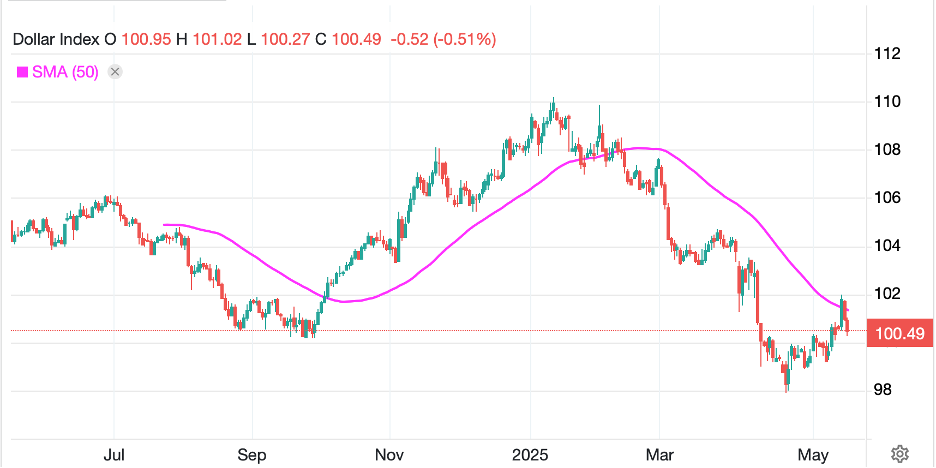
From a technical perspective, we are going to hear a lot about how the dollar failed on its break above the 50-day moving average that was widely touted just two days ago. (see DXY chart below).

Source: tradingeconomics.com

But let’s think about the fundamentals for a bit.  First, we know that the Trump administration would prefer a weaker dollar as it helps the competitiveness of US exporters and that is a clear focus.  Second, the fact that US yields remain higher than elsewhere in the world is old news, that hasn’t changed since the Fed stopped its brief cutting spree ahead of the election last year while other nations (except Japan) have been cutting rates consistently.  What about trade and tariffs?  While it is possible that the idea of a reduction in trade will reduce the demand for dollars, arguably, all I have read is that during this 90-day ‘truce’, companies are ordering as much as they can to lock in low tariffs.  That sounds like more dollars will be flowing, not less.

As I ponder this question, the first thing to remember is that markets don’t necessarily trade in what appears to be a logical or consistent fashion.  I often remark that markets are simply perverse.  But going back to the first point regarding President Trump’s desire for a weaker dollar, there was a story overnight that a stronger KRW was part of the trade discussion between the US and South Korea and I have a feeling that is going to be part of the discussion throughout Asia, especially with Japan.  As of now, I continue to see more downward pressure on the dollar than upward given the Administration’s desires.  I don’t think the Fed is going to do anything, nor should they, but I also don’t foresee a change in the recession narrative in the near future.  While that has not been the lead story today, it remains clear that concern about an impending recession is everywhere except, perhaps, the Marriner Eccles Building.  My view has been a lower dollar, and perhaps today’s price action is a good example of why that is the case.

Ok, let’s touch on other markets quickly.  After yesterday’s mixed session in the US, Asia saw much more positivity with China (+1.2%) and Hong Kong (+2.3%) leading the way higher with most regional markets having good sessions and only Japan (-0.15%) missing the boat.  In Europe, though, the picture is not as bright with both the CAC (-0.6%) and DAX (-0.5%) under some pressure this morning despite benign German inflation data and no French data.  Perhaps the euro’s strength is weighing on these markets.  As to US futures, at this hour (6:45), they are basically unchanged.

Away from Treasury markets, European sovereign yields have all slipped either -1bp or -2bps on the day with very little to discuss overall here.

Finally, in the true surprise, commodity prices are under pressure this morning across the board despite the weak dollar.  Oil (-1.1%) is slipping, with the proximate cause allegedly being API oil inventory data showed a surprising gain of >4 million barrels.  However, given the courteousness of the meeting between President Trump and Saudi Prince MBS, I would not be surprised to hear of an agreement to see prices lower overall.  I believe that is Trump’s goal for many reasons, notably to put more pressure on Russia’s finances, as well as Iran’s and to help the inflation story in the US.  As to the metals complex, they are all lower this morning with gold (-0.7%) leading the way but both silver (-0.3%) and copper (-0.5%) lagging as well.

On the data front, there is no front-line data to be released, although we do see EIA oil inventories with modest declines expected.  However, it is worth noting that Chinese monetary data was released this morning and it showed a significant decline in New Yuan Loans and Total Social Financing, exactly the opposite of what you would expect if the Chinese were seeking to stimulate their economy.  It is difficult for me to look at the chart below of New Bank Loans and see any trend of note.  I would not hold my breath for the Chinese bazooka of stimulus that so many seem to be counting on.

Source: tradingeconomics.com

Overall, it appears to me the market is becoming inured to the volatility which is Donald Trump.  As I have written before, after a while, traders simply get tired and stop chasing things.  My take is we will need something truly new, a resolution of the Chinese trade situation, or an Iran deal of some kind, to get things moving again.  But until then, choppy trading going nowhere is my call.

Good luck

Adf

No Longer Concern

Seems tariffs no longer concern
The markets, as mostly they yearn
For Jay and the Fed,
When looking ahead
To cut rates when next they adjourn
 
Alas, there’s no hint that’s the case
As prices keep rising apace
In fact, come this morning
There could be a warning
If CPI starts to retrace


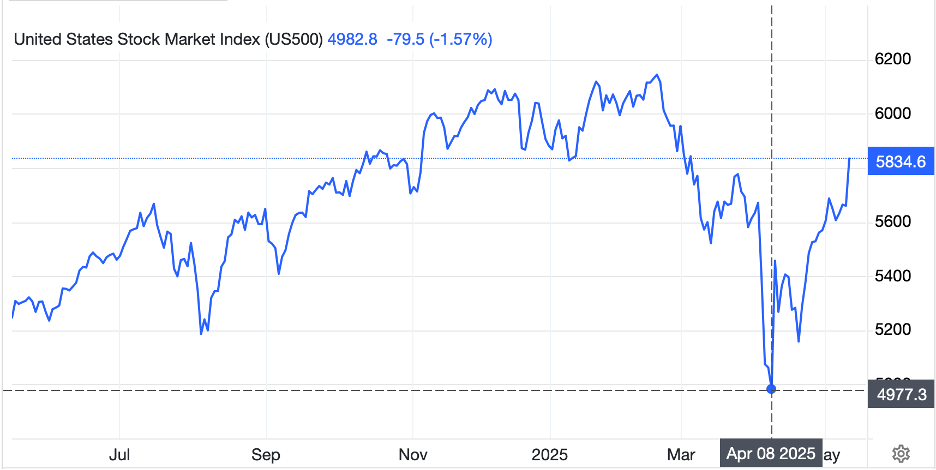
I am old enough to remember when President Trump’s actions on tariffs combined with DOGE was set to collapse the US economy.  I’m sure that was the case because it was headline news every day.  Equity markets fell sharply, the dollar fell sharply, gold rallied, and the clear consensus was the “end of American exceptionalism” in finance.  That was the description of how investors around the world flocked to the US equity markets as they held the best opportunities.  But the punditry was certain President Trump had killed that idea and were virtually licking their lips writing the obits for the US economy and President Trump’s plans.  In fact, I suspect all of you are old enough to remember that as well.  The chart below highlights the timing.

Source: tradingeconomics.com

But that is such old news it seems a mistake to even mention it.  The headlines this morning are all about how the stock market is now set to make new highs!  Bloomberg led with, Traders Model Bullish Moves for S&P 500 With Tariff Tensions Easing, although it is the theme everywhere.  So, is the world that much better today than a month ago?  Well, certainly the tariff situation continues to evolve, and we have moved away from the worst outcomes there it seems.  But recession probabilities remain elevated in all these econometric models, with current forecasts of 35%-50% quite common.  

Is a recession coming?  Well, the same people who have been telling us for the past 3 years that a recession was right around the corner, and some have even said we are currently living through one, are telling us that one is right around the corner.  Their track record isn’t inspiring.  In fact, these are the same people who are telling us that store shelves will be empty by the summer.  Personally, I take solace in the fact that the underlying numbers from the Q1 GDP data showed that despite a negative outcome, the positives of a huge increase in private investment and a reduction in government spending, were far more important to the economy than the fact that the trade deficit grew as companies rushed to stock up before the threatened tariffs.  Less government spending and more private investment are a much better mix for the economy’s performance going forward.  Let’s hope it stays that way.

But what about prices?  This morning’s CPI data (exp 0.3%, 2.4% Y/Y Headline, 0.3%, 2.8% Y/Y Core) will give us further hints about how the Fed will behave going forward.  As of now, there is no indication that the Fed is concerned about a growth slowdown of such magnitude that they need to cut rates.  In fact, Fed funds futures have reduced the probability of a June cut to just 8% and have reduced the total cuts for 2025 to just 2 now, down from 3 just a week ago.  Yesterday, Fed Governor Adriana Kugler reiterated the old view that tariffs could raise prices and reduce growth although gave no indication that cutting rates was the appropriate solution.  Arguably of more importance to the market will be Chairman Powell’s comments when he speaks Thursday morning.  My take here, though, is that the rate of inflation has bottomed and that the Fed is going to remain on hold all year long.  In fact, as I wrote back in the beginning of the year, I would not be surprised to ultimately see a rate hike before the year is over.  A rebound in growth and inflation remaining firm will change the narrative before too long, probably by the end of summer.  Of course, remember, I am just a poet and not nearly as smart as all those pundits, so take my views with at least a grain of salt.

Ok, let’s look at how markets have behaved in the new world order.  Yesterday’s massive US equity rally did not really see much follow through elsewhere although the Nikkei (+1.4%) had a solid session.  In fact, the Hang Seng (-1.9%) saw a reversal after a string of 8 straight gains as both profit-taking and some concerns about slowing growth in China seemed to be the main talking points there.  Elsewhere in the region, Malaysia and the Philippines had strong sessions while India lagged.  

In Europe, other than Spain’s IBEX (+0.8%), which has rallied purely on market internals, the rest of the continent and the UK are virtually unchanged this morning.  The most interesting comment I saw was from Treasury Secretary Bessent who dismissed the idea that a trade deal with the EU would be coming soon, “My personal belief is Europe may have a collective action problem; that the Italians want something that’s different than the French. But I’m sure at the end of the day, we will reach a satisfactory conclusion.”  That sounds to me like Europe is not high on the list of nations with whom the US is seeking to complete a deal quickly.  Finally, US futures are a touch softer this morning, although after the huge rallies yesterday, a little pullback is no surprise.

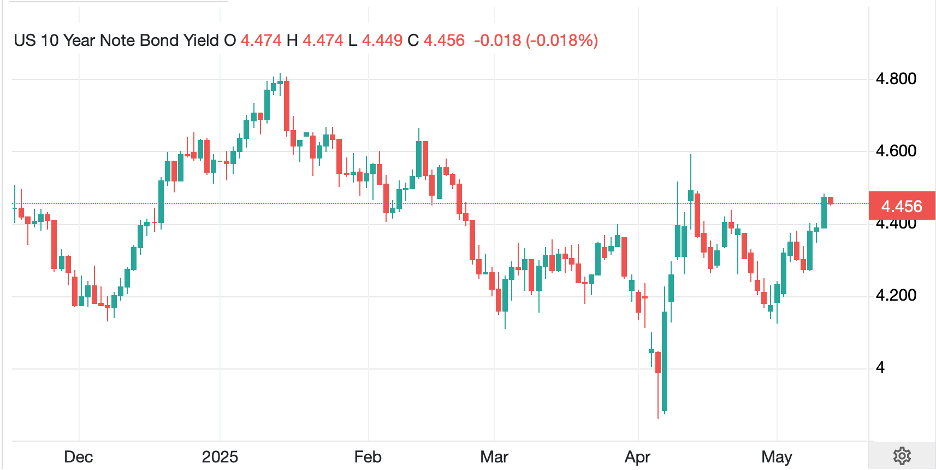
In the bond market, Treasury yields have backed off 2bps this morning, but in reality, they are higher by nearly 30bps so far this month as you can see below.

Source: tradingeconomics.com

This cannot please either Trump or Bessent but ultimately the question is, what is driving this price action?  If this is a consequence of investors anticipating faster US growth with inflation pressures building, that may be an acceptable outcome, especially if the administration can slow government spending.  But if this is the result of concern over the full faith and credit of the US government, or a liquidation by reserve holders around the world, that is a very different situation and one that I presume would be addressed directly by the Trump administration.  As to European sovereign yields, today has seen very modest rises, 1bp or 2bps across the board.  The biggest news there was the German ZEW survey which, while the Current Conditions Index fell to -82, saw the Economic Sentiment Index jump 39 points to +25.2, far better than expected.  It seems there is a lot of hope for the rearmament of Germany and the economic knock-on effects that will may bring.

In the commodity markets, oil (+0.6%) continues to grind higher as it looks set to test the recent highs near $64/bbl and from a technical perspective, may have put in a double bottom just above $56/bbl.  There is still a huge gap above the market that would need to be filled (trading above $70/bbl) in order to break this downtrend, at least in my mind.  But that doesn’t mean we can’t chop back and forth between $60 and $65 for a long time.  As to gold (+0.7%) after a sharp decline yesterday as the world was no longer scared about the future, it is bouncing back.  Whether this is merely technical, and we are heading lower, or yesterday’s price action was the aberration is yet to be determined.  Meanwhile, silver (+1.3%) and copper (+1.0%) are both having solid sessions as well.

Finally, the dollar is giving back a tiny bit of yesterday’s massive gains.  The euro (+0.2%) and pound (+0.25%) are emblematic of the overall movement although we have seen a few currencies with slightly stronger profiles this morning (SEK +0.8%, AUD +0.6%, CHF +0.5%).  In the EMG bloc, the movement has actually been far less impressive with ZAR (-0.45%) and KRW (-0.4%) bucking the trend of dollar softness but gains in MXN (+0.4%) and CZK (+0.4%) the best the bloc can do.  

One thing I will say about this administration is they have the ability to really change the tone of the discussion in a hurry.  If they are ultimately successful in reordering US economic activity away from the government and to the private sector, that is going to destroy my dollar weakness thesis.  I freely admit I didn’t expect anything like this to happen, but the early evidence points in that direction.  We will know more when Q2 GDP comes out and we find out if private sector activity is really increasing like the hints from Q1.  If that is the case, then the idea of American exceptionalism is going to make a major comeback in the punditry, although I suspect markets will have figured it out before then.

Other than the CPI, there is no other data and there are no Fed speakers on the docket.  While the dollar is soft this morning, I expect that any surprises in CPI will be the driver.  Otherwise, as I just mentioned, I am becoming concerned about my dollar weakness view.

Good luck

adf

Lost In Translation

The data today on inflation
Will help tweak the latest narration
But arguably
There’s little to see
As CPI’s lost in translation
 
And too, central bankers have learned
Their comments leave folks unconcerned
Today’s BOC
Where rate cuts will be
The outcome will ne’er be discerned


It is Donald Trump’s world, and we are all just living in it.  Virtually everything that happens in any financial market these days is a result of something that President Trump has either said or done.  Obviously, tariffs are a major player, but so are the peace talks in Ukraine (good news that Ukraine has agreed a cease fire to get things started) and his domestic initiatives regarding DOGE and the shake up that has come to government from that project.  You cannot look at a business journal without reading a story about how corporate America’s CEO’s are very concerned because of all the activity as they are having difficulty planning their strategies.

While this poet endeavors to track the macroeconomic issues and how they impact markets, and one can argue that tariffs are a macro issue, the ongoing back and forth as to which products will get tariffed and when is occurring far more rapidly than is worth reporting on a daily outlook.  After all, nobody has any idea what today will bring on that front.

With that in mind, one of the other things I have discussed has been the demotion of central bankers from their previous preeminence in the world of financial markets.  Now, every one of them is simply left to respond to whatever President Trump says that day.  Consider, the Fed entered their quiet period last Friday and the fact that we have not heard a word from them is entirely inconsequential.  The Fed funds futures market is currently pricing just a 3% probability of a rate cut next week and a total of 75bps of cuts by the end of the year, but that has been true for the past several weeks.  Despite an increase in the talk of a US recession, the markets are not indicating that is a concern.

Now, that doesn’t mean that other central banks aren’t doing things, but when the BOC cuts rates by 25bps this morning, taking their base rate to 2.75%, 150 basis points below the US, nothing is going to happen in the market.  It is already widely assumed.  I guess it is possible that Governor Macklem could make some comments of note, but given that Canada remains a bit player on the world stage, does whatever he says really matter?  In fact, the only reason people are discussing Canada now is because of President Trump and his trolling former PM Trudeau and calls to make it the 51st state.  Let’s face it, the economy there is ticking along fine for now, although if their exports to the US are impaired by tariffs it will definitely hurt them.  Meanwhile, other than a huge housing bubble, nobody really notices them.  After all, their economy is roughly $2.3 trillion, smaller than that of Texas.

We have also heard from Madame Lagarde recently as she tries to calm European leaders’ nerves while the ECB tries to manage their policy around US fiscal gyrations.  However, the most concerning information from there has been her confirmation that the ECB is pushing forward with their central bank digital currency (CBDC) project, looking to get things started in October of this year.  This contrasts with President Trump’s EO that the US will not pursue a CBDC and there is currently legislation in Congress to enshrine that into law.  My personal view is a CBDC would be very concerning given its inherent reduction in individual liberties.  While the current setup is for the euro to rise relative to the dollar, it is not clear to me that will remain the case in the event the digital euro comes into being.  In fact, it would not surprise me if many Europeans decided that holding dollars was a much better idea than holding euros in that environment.  But that is a story for the future.

As to today, CPI is set to be released with the following median expectations; headline (0.3%, 2.9% Y/Y) and core (0.3%, 3.2% Y/Y).  Both of those annualized numbers are one tick lower than last month’s outcomes, so would help the Fed narrative that inflation is falling back to their target.  But again, absent a major discrepancy, something like a 0.1% or 0.5% reading on the core number, I don’t think it will have any market impact across any market.  Data is just not that important these days.

Let’s turn to the overnight session to see how things are behaving in the wake of yesterday’s late US equity rebound, where while the indices all finished lower, they were well off the daily lows.  In Asia, the picture was very mixed with some major gainers (Korea +1.5%, Indonesia +1.8%, Taiwan +0.9%) and some major laggards (Thailand -2.5%, Malaysia -2.3%, Australia -1.3%, Hong Kong -0.8%) with both Japan and mainland China showing little movement.  In Europe, after a down day yesterday, this morning is seeing a solid rebound across most major markets with the DAX (+1.8%) leading the way followed by the CAC (+1.4%) and FTSE 100 (+0.6%).  Some solid earnings reports and ongoing hope belief that European defense spending will ramp up seems to be the drivers.  As to US futures, at this hour (7:30) they are firmer by 0.8% ish across the board.

In the bond market, after Treasury yields climbed 7bps yesterday, this morning they have edged a further 1bp higher.  The big domestic story is the continuing resolution which was just passed by the House and now sits at the Senate.  If it is not passed by Friday, the government will shut down, although it is not clear to me how that can be more disruptive than the way things have been operating for the past 6 weeks!  Meanwhile, European sovereign yields are also edging higher with German bunds (+4bps) leading the way as the ongoing discussion over breeching the debt brake continues and concerns over massive new issuance remain front and center.   Elsewhere in Europe, yields have risen as well, but generally by only 1bp or 2bps.  Last night, JGB yields didn’t move at all.

In the commodity bloc, oil (+1.1%) is continuing to bounce along the bottom of its trading range as per the below chart.

Source: tradingeconomics.com

A look at the trend line there shows that, at least based on the past 6 months, there has not been any net movement of note.  The question of whether the Ukraine war ends and that allows Russian oil back into the market, out in the open, is also current, with no clear answer in sight.  Meanwhile, the metals markets continue to ignore the recession calls with silver (+0.7%) and copper (+2.3%) both strong although gold is unchanged on the day.

Finally, the dollar is bouncing slightly this morning after declining sharply in 5 of the past 7 sessions with the other two basically unchanged.  This has all the hallmarks of a trading pause as there is nothing that has altered the idea that President Trump wants the dollar lower, and his policies are going to push it in that direction.  The one big outlier this morning is CLP (+0.9%) which is tracking copper’s rally, but otherwise, the yen (-0.6%) is the only mover of note, and that also seems a trading response, certainly not a fundamental change.

And that’s really it.  CPI is the only data for the day and there are no Fed speakers.  Of course, tape bombs are the new normal and we never have any idea what President Trump or Secretary Bessent may say at any given time.  However, with that in mind, the bigger picture remains intact.  I remain negative the equity space overall as changes continue, while the dollar is likely to remain under pressure as well.  This should help the bond market, and commodities.

Good luck

Adf

Shattered His Dreams

The data was hot yesterday
And that put the pressure on Jay
It shattered his dreams
‘Bout all of his schemes
To help keep inflation at bay


By now, I am sure you are aware that the CPI data was higher than forecast, and certainly higher than would have made Chairman Powell comfortable.  The outcome, showing Headline rising to 3.0% and core rising to 3.3% with correspondingly higher monthly rises was sufficient to alter the narrative at least a little bit.  Chair Powell even mentioned it in his House testimony, noting, “We are close, but not there on inflation…. So, we want to keep policy restrictive for now.”  Essentially, the data makes clear that the Fed is not going to be cutting the Fed funds rate anytime soon.  The futures market got the message as it is now pricing just 29bps of cuts this year, with December the likely date.

It will be no surprise that the stock market’s initial response was to sell off substantially, but as per the chart below, it spent the rest of the day clawing back the losses and wound up little changed on the day.  This morning, it remains basically unchanged as well.

Source: tradingeconomics.com

Treasury bonds, though, had a less fruitful session, falling (yields rising) sharply on the print, but never really regaining their footing with yields jumping almost 15bps at one point although finishing the day about 10bps higher and have given back 2bps more this morning.

Source: tradingeconomics.com

Now, we all know that the Fed doesn’t target CPI, but rather PCE.  However, after this morning’s PPI data release, most economists (although not poets) will be able to reasonably accurately estimate that data point for later this month, as will the Fed.  And that number is not going to be moving closer to their 2.0% target.  What seems very clear at this point is that every Fed speaker for the time being is going to be harping on the caution with which they are going to move forward.

If we look at this from a political perspective, something which is unavoidable these days, it is important to remember that Treasury Secretary Bessent has made clear that he and the president are far more focused on the 10-year yield than on the Fed funds rate.  To that end and given the fact that all this data was from a time preceding President Trump’s inauguration, I don’t think they are too worried.  I would look for the President to continue his drive to reduce waste and fraud in the government and attack that deficit.  Certainly, the news to date is there is a great deal of both waste and fraud to reduce, and if the president is successful, I believe that will play out in significantly lower 10-year yields, if for no other reason than the deficit is reduced or closed.  This story is just beginning to be written.

Now, Putin and Trump had a call
As Trump tries to end Russia’s brawl
They’re slated to meet
So, they can complete
A treaty with Europe awol

Under any interpretation, I believe the news that Presidents Trump and Putin are going to meet in an effort to hammer out an end to the Russia/Ukraine war is good news.  Beyond the simple fact that less war is an unadulterated good, I think it is very clear that this particular war has had significant market impacts, hence our interest here.  Obviously, energy prices have been impacted, as both oil and NatGas prices are higher than they would otherwise be given the removal of some portion of Russia’s exports from the global markets and economy.  As such, the end of this conflict, with one likely consequence being Western Europe reopening themselves to Russian energy imports, is likely to see prices decline.  

This matters for more reasons than the fact it will be cheaper to fill up your tank at the gas (petrol) station, it is very likely to have a very positive impact on inflation writ large.  As you can see from the chart below, there is a very strong correlation between the price of oil and US inflation expectations.  Declining oil prices are very likely to help people perceive a less inflationary future and will reduce the rate of inflation by definition.  

Source: ISABELNET

Inflation is an insidious process, and once entrenched is very hard to reduce, just ask Chairman Powell.  I also know that there has been much scoffing at President Trump’s claims he will reduce inflation, especially with his imposition of tariffs all over the place. (It is important to understand that tariffs are not necessarily inflationary by themselves as well explained by my friend the Inflation guy in this article.). However, between his strong start on reducing government expenditures and the potential for an end to the Russia/Ukraine war leading to lower energy prices, these are longer term effects that may do just that.

Ok, let’s move on to the market activities in the wake of yesterday’s CPI and ahead of this morning’s PPI data.  As discussed above, yesterday’s US markets rebounded from their worst levels of the morning and closed modestly lower with the NASDAQ actually unchanged.  In Asia, Japanese shares (+1.3%) had a solid day as the weak yen helped things along although Chinese shares (HK -0.2%, CSI 300 -0.4%) did not fare as well on the day with tariffs still top of mind.  Elsewhere in the region, other than Korea (+1.4%) movement was mixed and modest.  In Europe, the possibility of peace breaking out in Ukraine has clearly got investors excited as both Germany (+1.5%) and France (+1.2%) are seeing strong inflows. The UK (-0.7%) however, continues to suffer from economic underperformance with no discernible benefits shown from the governments weak efforts to right the ship.  GDP was released this morning and while they avoided recession, it’s very hard to get excited over 0.1% Q/Q growth.  As to the US futures market, at this hour (7:20), they are essentially unchanged.

In the bond market, we’ve already discussed Treasury yields, but another benefit of the prospects for a Ukrainian peace is that sovereign yields have fallen substantially, between -5bps and -8bps, throughout the continent.  Once again, the impact of that phone call between Trump and Putin has been quite significant.  Consider that not only are energy prices likely to slide, but the required government spending to prosecute the war is likely to diminish as well.

In the commodity markets, it should be no surprise that oil (-1.3%) prices are sliding as are NatGas prices in Europe (TTF -7.5%) as the opportunity for cheap Russian gas to flow to Europe is once again in view.  To highlight the impact that this has had on Europe, prior to the Ukraine war and the halting of gas flows, the TTF contract hovered between €5 and €25 per MWh.  Since the war broke out, even after the initial shock, it has been between €25 and €55 per MWh.  This is all you need to know about why Europe, and Germany especially, is deindustrializing.  As to the metals markets, after a few days of consolidation, gold (+0.4%) is on the move again although it has not yet recaptured the highs seen early Tuesday morning.  Give it time.  Copper (+0.6%), too, is back on the move and indicating that economic activity is set to continue to grow.

Finally, the dollar is mixed this morning, although arguably a touch softer overall, as the Russia news has traders looking for less negativity in Europe.  So modest gains in the euro and pound, about 0.15% each is offsetting larger losses in AUD (-0.3%) and NZD (-0.6%), although given the much smaller market size of the latter two, they matter much less.  JPY (+0.4%) is rebounding after yesterday’s sharp decline on the back of the jump in Treasury yields, and it is noteworthy that CHF (+0.65%) is gaining after its CPI data showed a decline in prices last month.  In the EMG bloc, CLP (+0.7%) is stronger on that copper rally, while ZAR (+0.1%) seems to be edging higher as gold continues to perform well. MXN (-0.4%) though is still struggling with the potential negative impact of tariffs and otherwise, there is not much to report.

This morning brings PPI (exp 0.3%. 3.3% Y/Y headline; 0.3%, 3.5% Y/Y core) as well as the weekly Initial (215K) and Continuing (1880K) Claims data.  There are no Fed speakers on the docket, but at this point, I expect the Fed will be fading into the background since they are clearly on hold and President Trump commands the spotlight.  Unless the data starts to veer dramatically away from what we have seen, it appears that the market is going to continue to respond to Trumpian headlines, which of course are impossible to predict.  But remember, most of the rest of the world is still in cutting mode so the dollar should continue to hold its own.

Good luck

Adf

Not in a Rush

Said Powell, we’re not in a rush
To cut rates as we try to crush
Remaining inflation
And feel the sensation
Of drawing an inside straight flush
 
Up next is the CPI data
Though not one on which we fixate-a
The surveys explain
That people remain
Quite certain that we’re doing great-a


Chairman Powell testified to the Senate Banking Committee yesterday and the key comments were as follows, “Inflation has eased significantly over the past two years but remains somewhat elevated relative to our 2 percent longer-run goal. Total personal consumption expenditures (PCE) prices rose 2.6 percent over the 12 months ending in December, and, excluding the volatile food and energy categories, core PCE prices rose 2.8 percent. Longer-term inflation expectations appear to remain well anchored, as reflected in a broad range of surveys of households, businesses, and forecasters, as well as measures from financial markets.” [Emphasis added.] He followed up, “With our policy stance now significantly less restrictive than it had been and the economy remaining strong, we do not need to be in a hurry to adjust our policy stance.  We know that reducing policy restraint too fast or too much could hinder progress on inflation.”  This is largely what was expected as virtually every Fed speaker since the last FOMC meeting has said the same thing, there is no rush to further cut rates. Powell did admit that the neutral rate had risen compared to where it was before inflation took off in 2022 but maintains that current policy is still restrictive. 

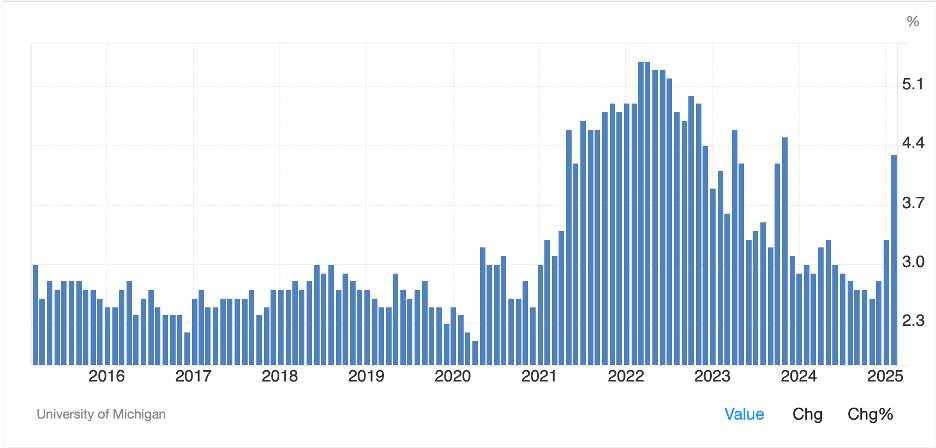
However, let’s examine the highlighted comment above a little more closely.  Two things belie that statement as wishful thinking rather than an accurate representation of the current situation.  The first is that the most recent survey released from Friday’s Michigan Sentiment surveys, shows that inflation expectations for the next year jumped dramatically, one full percent to 4.3% as per the below chart.

Source: tradingeconomics.com

Looking over the past 10 years of data, that is a pretty disturbing spike, taking us right back to the 2022-23 period when inflation was roaring.  In addition to that little jump, it is worth looking at those market measures that Powell frequently mentions.  Typically, they are either the 5-year or 10-year breakeven rate.  That rate is the difference between the 5-year Treasury yield and the 5-year TIPS yield (or correspondingly the 10-year yields).  A quick look at the chart below shows that since the Fed first cut rates in September 2024, the 5-year breakeven rate has risen 78bps to 2.64%.  Certainly, looking at the chart, the idea of ‘well anchored’ isn’t the first description I would apply.  Perhaps, rocketing higher?

At any rate, it appears quite clear that the Fed is on hold for a while yet as they await both the evolution of the economy and further clarity on President Trump’s policies on tariffs.  While there is no doubt that we will continue to hear from various Fed speakers going forward, I maintain that the Fed is not seen as the primary driver in markets right now, rather that is President Trump.

Of course, data will still play a role, just a lesser one I believe, but we cannot ignore the CPI report due this morning.  First, remember, the Fed doesn’t focus on CPI, but rather on PCE which is typically released at the end of the month and calculated by the Commerce Department, not the BLS.  But the rest of us basically live in CPI land, so we all care.  If nothing else, it gives us something to complain about as we look incredulously at the declining numbers despite what we see with our own eyes every time we go shopping.

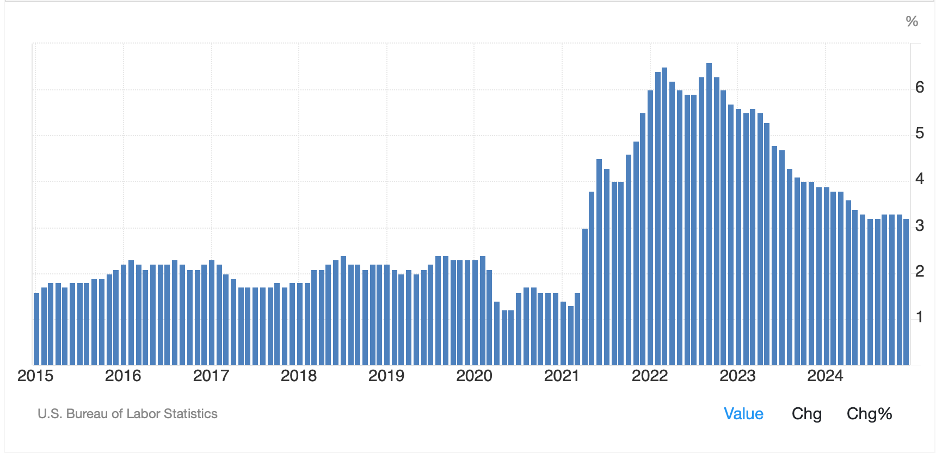
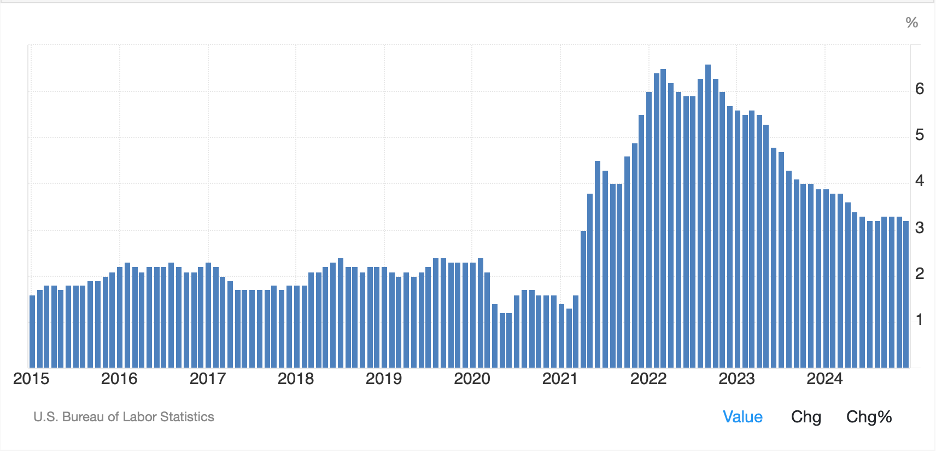
As it is, here are this morning’s median expectations for the data, headline CPI (+0.3% M/M, 2.9% Y/Y) and core CPI (+0.3% M/M, 3.1% Y/Y).  Once again, I believe there is value in taking a longer view of this data for two reasons; first to show that we are not remotely approaching the levels to which we became accustomed prior to the Covid pandemic and government response, and second to highlight that if your null hypothesis is CPI continues to decline, that may not be an appropriate view as we have spent the past 8 months in largely the same place as per the below chart.  Too, note the similarity between the Michigan Survey chart above and this one.

Source: tradingeconomics.com

OK, those are really the stories of the day since there have not, yet, been any new tariffs imposed by President Trump, and traders need to focus on something.  Let’s take a look at how things behaved overnight.

After a mixed US equity session, the strength was in Hong Kong (+2.6%) and China (+1.0%), seemingly on the back of several stories.  First is that China is looking at new ways to address the property bubble’s implosion, potentially allocating more support there, as well as this being a reflexive bounce from yesterday’s decline and the story that President’s Xi and Trump have spoken with the hope that things will not get out of hand there.  As to Japan, the Nikkei (+0.4%) has edged higher as the yen (-0.7%), despite a lot of talk about higher rates in Japan and the currency being massively undervalued, continues to weaken.  In Europe, once again there is limited movement overall with very tiny gains of less than 0.2% the norm although Spain’s IBEX (+0.7%) is the big winner today on some positive earnings results.  US futures are little changed at this hour (7:15).

In the bond market, Treasury yields are unchanged this morning, retaining the 4bps they added yesterday, and in Europe, sovereign yields are also little changed with German Bunds (+2bps) the biggest mover in the session.  JGB yields did rise 3bps overnight, but that seems to be following US yields as there was precious little new news there.

In the commodity markets, yesterday’s metal market declines are mostly continuing this morning with gold (-0.6%) down again, although still hanging around $2900/oz.  Silver has slipped although copper (+0.3%) has arrested its decline.  Oil (-1.1%) is giving back some of yesterday’s gains and continues to trade in the middle of its trading range with no real direction.  One thing I haven’t highlighted lately is European TTF NatGas prices, which while softer this morning (-1.9%) have risen 15% in the past month as storage levels in Europe are declining to concerning levels and global warming has not resulted in enough warm days for the winter.

Finally, the dollar is mixed away from the yen’s sharp decline with the euro (+0.1%) and CHF (+0.2%) offsetting the AUD (-0.3%) and NOK (-0.5%).  It is interesting that many of the financial and trading accounts that I follow on X (nee Twitter) continue to point to JPY and CAD as critical and are anticipating strength in both those currencies imminently.  And yet, neither one is showing much tendency to strengthen, at least for the past month or two.  I guess we shall see, but if the Fed is going to remain on hold, and especially if more tariffs are coming, I suspect the default direction of the dollar will be higher.  As to the EMG bloc, there is virtually nothing happening here, with a mix of gainers and laggards, none of which have moved 0.2% in either direction.

Other than the CPI data, Chairman Powell testifies to the House Financial Services Committee, and we will see EIA oil inventories with a modest build anticipated.  We also hear from two other Fed speakers, but again, with Powell in the spotlight, they just don’t matter.

Markets overall are pretty quiet, seemingly waiting for the next shoe to drop.  My money is on that shoe coming from the Oval Office, not data or Powell, which means we have no idea what will happen.  Stay hedged, but until further notice, I still don’t see a strong case for the dollar to decline.

Good luck

Adf

Shortsighted

The CPI data delighted
Investors, who in a shortsighted
Response bought the bond
Of which they’re now fond
And did so in, time, expedited
 
But does this response make much sense?
Or is it just way too intense?
I’d offer the latter
Although that may shatter
The narrative’s current pretense


Leading up to yesterday’s CPI data, it appeared to me that despite a better (lower) than expected set of PPI readings on Tuesday, the market was still wary about inflation and concerned that if the recent trend of stubbornly sticky CPI prints continued, the Fed would soon change their tune about further rate cuts.  Heading into the release, the median expectations were for a 0.3% rise in the headline rate and a 0.2% rise in the core rate for the month of December which translated into Y/Y numbers of 2.9%% and 3.3% respectively. At least those were the widely reported expectations based on surveys.  

However, in this day and age, the precision of those outcomes seems to be lacking, and many analysts look at the underlying indices prepared by the BLS and calculate the numbers out several more decimal places.  This is one way in which analysts can claim to be looking under the hood, and it can, at times, demonstrate that a headline number, which is rounded to the first decimal place, may misrepresent the magnitude of any change.  I would submit that is what we saw yesterday, where the headline rate rose to the expected 2.9% despite a 0.4% monthly print, but the core rate was only 3.24% higher, which rounded down to 3.2% on the report. Voila!  Suddenly we had confirmation that inflation was falling, and the Fed was right back on track to cut rates again.

Source: tradingeconomics.com

Now, I cannot look at the above chart of core CPI and take away that the rate of inflation is clearly heading back to 2% as the Fed claims to be the case.  But don’t just take my word for it.  On matters inflation I always refer to Mike Ashton (@inflation_guy) who has a better grasp on this stuff than anyone I know or read.  As he points out in his note yesterday, 3.5% is the new 2.0% and that did not change after yesterday’s data.

However, markets and investors did not see it that way and the response was impressive.  Treasury yields tumbled 13bps and took all European sovereign yields down by a similar amount, equity markets exploded higher with the NASDAQ soaring 2.5% and generally, the investment world is now in nirvana.  Growth remains robust but that pesky inflation is no longer a problem, thus the Fed can continue cutting rates to support equity prices even further.  At least that’s what the current narrative is.  

Remember all that concern over Treasury yields?  Just kidding!  Inflation is dying and Trump’s tariffs are not really a problem and… fill in your favorite rationale for remaining bullish on risk assets.  I guess this is where my skepticism comes to bear.  I do not believe yesterday’s data reset the clock on anything, at least not in the medium and long term.

Before I move on to the overnight, there is one other thesis which I read about regarding the recent (prior to yesterday) global bond market sell-off which has some elements of truth, although the timing is unclear to me.  It seems that if you look at the timing of the recent slide in bond markets, it occurred almost immediately after the fires in LA started and were realized to be out of control.  This thesis is that insurers, who initially were believed to be on the hook for $20 billion (although that has recently been raised to >$100 billion) recognized they would need cash and started selling their most liquid assets, namely Treasuries and US equities.  In fact, this thesis was focused on Japanese insurers, the three largest of which have significant exposure to California property, and how they were also selling JGB’s aggressively.  Now, the price action before yesterday was certainly consistent with that thesis, but correlation and causality are not the same thing.  If this is an important underlying driver, I would expect that there is more pressure to come on bond markets as almost certainly, most insurance companies don’t respond that quickly to claims that have not yet even been filed.

Ok, let’s see how the rest of the world responded to the end of inflation as we know it yesterday’s CPI data. Japanese equities (+0.3%) showed only a modest gain, perhaps those Japanese insurers were still out selling, or perhaps the fact that the yen (+0.3%) is continuing to grind higher has held back the Nikkei.  Hong Kong (+1.25%) stocks had a good day as did almost every other Asian market with the US inflation / Fed rate cuts story seemingly the driver.  The one market that did not participate was China (+0.1%) which managed only an anemic rally.  In Europe, the picture is mixed as the CAC (+2.0%) is roaring while the DAX (+0.2%) and IBEX (-0.4%) are both lagging as is the FTSE 100 (+0.65%).  The French are embracing the Fed story and assuming luxury goods will be back in demand although the rest of the continent is having trouble shaking off the weak overall economic data.  In the UK, GDP was released this morning at 1.0% Y/Y after just a 0.1% gain in November, slower than expected and adding pressure to the Starmer government who seems at a loss as to how to address the slowing economy.  As to US futures, at this hour (7:30) they are pointing slightly higher, about 0.2%.

In the bond market, after yesterday’s impressive rally, it is no surprise that there is consolidation across the board with Treasury yields higher by 2bps and similar gains seen across the continent.  Overnight, Asian government bond markets reacted to the Treasury rally with large gains (yield declines) across the board.  Even JGB yields fell 4bps.  The one market that didn’t move was China, where yields remain at 1.65% just above their recent historic lows.

In the commodity markets, oil (-1.0%) is backing off yesterday’s rally which saw WTI trade above $80/bbl for the first time since July as despite ongoing inventory builds in the US, and ostensibly peace in the Middle East, the market remains focused on the latest sanctions on Russia’s shadow tanker fleet and the likely inability of Russia (and Iran) to export as much as 2.5 million barrels/day going forward.  NatGas (+0.75%) remains as volatile as ever and given the polar vortex that seems set to settle over the US for the next two weeks, I expect will remain well bid.  On the metals side of things, yesterday’s rally across the board is being followed with modest gains this morning (Au +0.3%) as the barbarous relic now sits slightly above $2700/oz.

Finally, the dollar doesn’t seem to be following the correct trajectory lately as although there was a spike lower after the CPI print yesterday, it was recouped within a few hours, and we have held at that level ever since.  In fact, this morning we are seeing broader strength as the euro (-0.2%), pound (-0.4%) and AUD (-0.5%) are all leaking and we are seeing weakness in EMG (MXN -0.6%, ZAR -0.6%) as well.  My take is that the bond market, which had gotten quite short on a leveraged basis, washed out a bunch of positions yesterday and we are likely to see yields creep higher on the bigger picture supply issues going forward.  For now, this is going to continue to underpin the dollar.

On the data front, this morning opens with Retail Sales (exp 0.6%, 0.4% -ex autos) and Initial (210K) and Continuing (1870K) Claims.  We also see Philly Fed (-5.0) to round out the data.  There are no Fed speakers today, although in what cannot be a surprise, the three who spoke yesterday jumped all over the CPI print and reaffirmed their view that 2% was not only in sight, but imminent!  As well, today we hear from Scott Bessent, Trump’s pick to head the Treasury so that will be quite interesting.  In released remarks ahead of the hearings, he focused on the importance of the dollar remaining the world’s reserve currency, although did not explicitly say he would like to see it weaken as well.  The one thing I know is that he is so much smarter than every member of the Senate Finance committee, that it will be amusing to watch them try to take him down.

And that’s really it for now.  If Retail Sales are very strong, look for equities to see that as another boost in sentiment, but a weak number will just rev up the Fed cutting story.  Right now, the narrative is all is well, and risk assets are going higher.  I hope they are right; I fear they are not.

Good luck

Adf

Will It Matter?

Will Japan hike rates?
How much will it matter if
They do?  Or they don’t?


Market activity and discussion has been somewhat lacking this week as the real fireworks appear to be in Washington DC where President-elect Trump’s cabinet nominees are going through their hearings at the Senate.  Certainly, between that and the ongoing fires in LA, the news cycle is not very focused on financial markets in the US.  This, then, gives us a chance to gaze Eastward to the Land of the Rising Sun and discuss what is happening there.

You may recall yesterday I mentioned a speech by BOJ Deputy Governor Himino where he explained that given the inflation situation as well as the indication that wages would continue to rise at a more robust clip in Japan, a rate hike may be appropriate.  Well, last night, Governor Ueda basically told us the same thing.  Alas, it seems that the BOJ takes a full day to translate speeches into English because there are no quotes from Ueda, but we now have the entire Himino speech from the day before.

Regardless, the essence of the story is that the BOJ is carefully watching the data and awaiting the Trump inauguration to see if there are any surprise tariff outcomes against Japan (something that has not been discussed) while they await their own meeting at the end of next week.  Market pricing now has a 72% probability of a 25bp rate hike next week, up from about 60% yesterday, and last night the yen did rally, climbing 0.7%.  However, a quick look at the chart below might indicate that the market is not overly concerned about a major yen revaluation.

Source: tradingeconomics.com

In fact, since the last BOJ meeting in December, when they sounded a bit more dovish than anticipated, the yen has done very little overall, treading water between 156.50 and 158.50.  While a BOJ rate hike would likely support the yen somewhat, there is another dynamic playing out that would likely have the opposite effect.  At the beginning of the year I prognosticated that the Fed may well hike rates by the end of 2025 as inflation seems unlikely to cooperate with their prayers belief that 2.0% was baked in the cake.  At the time, that was not a widely held view.  However, in a remarkably short period of time, market participants are starting to discuss the idea that may, in fact, be the case.  Even the WSJ today had a piece on the subject from James Mackintosh, one of their economics writers laying out the case.  The point here is that if tighter monetary policy by the Fed is in the cards, I suspect the yen will have a great deal of difficulty climbing much further.  Let’s keep an eye on the 156.00 level for clues that things are changing.

In England, inflation is rising
Less quickly than some theorizing
Meanwhile in the States
Jay and his teammates
Are hoping for data downsizing

Turning now to the inflation story, European releases were generally right on forecast except for the UK, where the headline rate fell to 2.5% while the core fell to 3.2%, 1 tick and 2 ticks lower than expected respectively.  Certainly, that is good news for the beleaguered people in the UK and it has now increased the odds that the BOE cuts rates at their next meeting on February 6th.  However, we cannot forget that the BOE’s inflation target, like that of the Fed, is 2.0%, and there is still limited belief that they will achieve that level even in 2025. But the markets did respond to the data with the FTSE 100 (+0.75%) leading the European bourses higher while 10-year Gilt yields (-8bps) have seen their largest decline in several weeks and are also leading European sovereign yields lower.  Interestingly, the pound has been left out of this movement as it is essentially unchanged on the day.  Perhaps there is a message there.

Which brings us to the US CPI data this morning.  after yesterday’s PPI data printed softer than expected at both the headline and core levels, excitement is building for a soft print and the resumption of the Fed cutting cycle.  However, it is important to remember that despite the concept that these prices should move together, the reality is they really don’t.  Looking at the monthly core movements below, while the sign is generally the same, the relationship is far weaker than one might imagine.

Source: tradingeconomics.com

In fact, since January 2000, the correlation between the two headline series is 0.04%, or arguably no relationship at all.  I would not count on a soft CPI print this morning based on yesterday’s PPI.  Rather, I am far more concerned that the ISM Services Prices Paid index last week was so hot at 64.1, a better indicator that inflation remains sticky.  But I guess we will all learn in an hour or two how it plays out.

Ahead of that, let’s look at the rest of the overnight session.  Yesterday’s mixed US equity performance (the NASDAQ lagged) was followed by mixed price action overnight with the Nikkei (-0.1%) edging lower on the modestly stronger yen and talk of a rate hike, while the Hang Seng (+0.3%) managed a gain on the back of Chinese central bank activity as the PBOC added more than $130 billion in liquidity ahead of the Lunar New Year holiday upcoming.  However, mainland shares (CSI 300 -0.6%) did not share the Hong Kong view.  Elsewhere in the region Taiwan (-1.25%) was the laggard while Indonesia (+1.8%) jumped on a surprise rate cut by the central bank there.

In Europe, though, all is green as gains of 0.4% (CAC) to 0.8% (DAX) have been driven by ECB comments that rate cuts are coming as concerns grow over the weakness of the economies there.  Germany released its GDP data and in 2024, Germany’s GDP shrank by -0.2%, the second consecutive annual decline and the truth is, given the combination of their insane energy policy and the fact that China is eating their proverbial lunch with respect to manufacturing, especially in the auto sector, it is hard to look ahead and see any positivity at all.  Meanwhile, US futures are higher by 0.5% or so at this hour (7:00) clearly with traders looking for a soft CPI print.

In the bond market, Treasury yields are lower by 3bps this morning but remain just below 4.80% and the 5.0% watch parties are still hot tickets.  European yields have also softened away from Gilts, with the entire continent lower by between -2bps and -4bps.  Right now, with dreams of a soft CPI, bond bulls are active.  We shall see how that plays out.

In the commodity space, oil (+0.3%) is modestly firmer after a reactionary sell-off yesterday.  The IEA modestly raised its demand forecast and supplies in the US, according to the API, were a bit tighter yesterday, so that seems to be the support.  NatGas is little changed right now while metals markets (Au +0.4%, Ag +0.5%, Cu +0.4%) are edging higher although mostly remain in a trading range lately.  Activity here has been lackluster with no new story to drive either direction.

Finally, the dollar is a touch softer overall, but away from USDJPY, most movement is of the 0.1% variety. Right now, the FX markets are not garnering much interest overall.

On the data front, expectations for CPI are as follows: Headline (0.3%, 2.9% Y/Y) and Core (0.2%, 3.3% Y/Y).  As well, we see Empire State Manufacturing (3.0) and then the Beige Book at 2:00pm.  We also have three Fed speakers, Williams, Kashkari and Barkin, but are they really going to alter the cautionary message?  I doubt it and the market continues to price a single 25bp cut for all of 2025.  The real fireworks will only come if/when price hikes start to get priced in as discussed above.

It is hard to get excited for market activity today as all eyes remain on the confirmation hearings and LA.  As such, I suspect there will be very little to see today.

Good luck

Adf

In the “Know”

According to those in the “know”
It’s certain that tariffs will grow
But now some are saying
The timing is straying
From instant to something more slow


In what has been a generally quiet evening in the markets, the story that President-elect Trump is considering imposing all those tariffs on a gradual basis, rather than instantaneously when he is inaugurated, was taken as a bullish sign by investors.  This seems to have been the driving force behind yesterday afternoon’s modest rebound in equity markets as the current market narrative is tariffs = bad, no tariffs = good.  From what I can determine, these are anonymous comments not directly attributed to Trump or his incoming economics team and, in fact, Trump denied that possibility.

But the market impact was real as not only did equity markets rebound a bit, but the dollar, which had soared yesterday, has given back some of those gains and is modestly lower this morning.  If we learned nothing else from President Trump’s first term, it should be clear that there is frequently a great deal of bombast emanating from the White House and responding to each and every comment is a recipe for exhaustion and disaster. While this cannot be ruled out, if one were to ascribe a Trumpian gospel it would be that tariffs are beautiful so slow-rolling them doesn’t really accord with that view.  I guess we will all find out more next week.

Now, turning to data releases
This week its inflation showpieces
Today’s PPI
Is tipped to be high
While Wednesday the core rate increases

Away from that story, though, there has been little else of note overnight.  As such, let’s focus on the PPI data this morning and CPI tomorrow as they ought to help inform our views on the Fed’s actions going forward. Expectations are for headline to rise to 3.4% Y/Y while core jumps to 3.8% Y/Y.  It is difficult to look at a chart of these readings and not conclude that the bottom is in and the trend is higher.

Source: tradingeconomics.com

This is not to say that we are going to see price rises like we did back in 2022 as the waves of Covid spending washed through the economy, but the Fed’s mantra that inflation is going to head back to 2.0% over time is not obvious either.  In fact, if I were a betting man, I would estimate that we are likely to continue to see inflation run between 3.5% and 4.5% for the foreseeable future.  There is just nothing around to prevent that in the short run.  Now, if we do see significant productivity enhancements, those numbers will decline, but my take is the best opportunity for that, more effective and widespread use of AI, is still several years away.

Remember, too, that the government writ large, whether headed by R’s or D’s is all-in on inflation as it is the only opportunity they have to reduce the real value of the outstanding government debt.  Perhaps the Trump administration will take a different tack, but it is not clear they will be able to do so.  The only time inflation is a concern is when it becomes a political liability.  For the two decades leading up to Covid, it was not a daily concern of the population and central banks around the world were terrified of deflation!  In fact, there are so many comments by folks like Yellen, Bernanke and other Fed governors and presidents decrying the fact that their key regret was not getting inflation high enough, it is difficult to count them.  But as evidenced by the chart below of CPI, we no longer live in that world.

Source: tradingeconomics.com

Summing up, the current situation is that inflation has likely bottomed, the government continues to run massive fiscal deficits and given the $36 trillion in debt outstanding, the government needs to reduce the interest rate they pay on their debt.  If pressed, I would expect that we will see synthetic yield curve control (YCC) enabled by regulatory changes requiring banks and insurance companies to own a greater percentage of Treasury notes and bonds in their portfolios to ensure there is sufficient demand for issuance.  That can have the effect of turning long-term real yields negative, exactly the outcome the government wants. Remember, from 1944-1951, the Fed enacted YCC directly and it worked wonders in reducing the debt/GDP ratio.  They know this tool and will not be afraid to use it.

Ok, let’s take a look at what little action there was overnight.  After yesterday’s late rebound resulted in a mixed close with the NASDAQ still lower but the other two indices closing in the green, Asian equity markets also had a mixed picture.  The Nikkei (-1.8%) was the laggard, seemingly following last week’s US market movement after reopening from a holiday weekend.  However, Chinese shares (Hang Seng +1.8%, CSI 300 +2.6%) rallied sharply on the latest news that more Chinese stimulus was coming soon.  This time the Ministry of Commerce claimed they would be looking to boost consumption this year, but neglected to mention how they will do so.  Regardless, investors liked the story and when added to the gradual tariff story, it was all green.

European bourses are also in fine fettle this morning with gains across the board (CAC +1.2%, DAX +0.8%, IBEX +0.6%) and even the FTSE 100 (+0.1%) has managed to rally a bit.  This price movement, and that of the rest of Asia where gains were seen, seems all to be a piece with the slower tariff story discussed above.  As to US futures markets, at this hour (6:40), they are pointing modestly higher, 0.45%.

In the bond market, the only place where yields have moved significantly today is in Japan, where JGB yields have jumped 5bps and are now at their highest point since February 2011.  This followed comments from Deputy Governor Himino that the board was likely to debate a rate hike at their meeting next week and market pricing has a 60% probability priced in for the move.  There is much talk of wage increases in Japan, and Himino-san also raised questions about what the Trump administration will do and how it will impact yields.  Interestingly, despite the more hawkish rhetoric, the yen (-0.25%) actually declined today, not necessarily what you would expect.  As to the rest of the bond market, everything is within 1bp of Monday’s closing levels.

In the commodity markets, oil (-0.3%), which has been rocking lately on the increased Russia sanctions, is consolidating this morning although remains higher by nearly 6% this week and 12% in the past month. (As an aside, I don’t understand the Biden theory that sanctions driving up prices is going to be a detriment to Putin as he will make up for the loss of volume with higher prices, but then, I’m not a politician.). Meanwhile, NatGas (-3.2%) has backed off its recent highs as storage concerns ebb, although the ongoing cold weather appears to have the opportunity to push prices higher again.  As well, the latest dunkelflaute throughout Europe is driving demand for LNG.  In the metals markets, yesterday’s declines have been arrested, and we are basically unchanged this morning.

Finally, the dollar is mixed this morning, edging higher against some G10 counterparts (GBP -0.3%, JPY -0.4%) but sliding against others (NZD +0.6%).  Versus the EMG bloc, again the picture is mixed today with gainers (ZAR +0.4%, KRW +0.3%) and laggards (CZK -0.2%) although overall, I would argue the dollar is a touch softer on the back of the gradual tariff story.

On the data front, this morning’s PPI data (exp 0.3% M/M, 3.4% Y/Y) headline and (0.3% M/M, 3.8% Y/Y) core is the extent of what is to come.  Interestingly, the NFIB Index jumped to 105.1, the highest print since October 2018, as small businesses are clearly excited about the prospects of a Trump administration and the promised regulatory cuts.

Right now, both the dollar and Treasury yields are pushing to levels that have caused market problems in the past.  If these trends continue, be prepared for some more significant price action.  That could manifest as a sharp decline in equity markets, or some surprising Fed activity as they try to address any potential market structural problems that may arise.  But there is nothing due to stop the trends right now.

Good luck

Adf

Tempt the Fates

Inflation just won’t seem to die
No matter what Jay and friends try
Will he tempt the fates
To once more cut rates?
And if so, will bond yields comply?


It took until 1:10pm yesterday for Nick Timiraos at the WSJ to publish his article regarding the fact that Strengthening Inflation Poses Challenge for Trump, Fed.  I find the title of the article interesting as, to the best of my knowledge, Mr Trump has yet to take office and enact any policies.  But I suppose if Chairman Powell doesn’t like Trump (which seems to be the widely held view) he wanted to ensure his mouthpiece took a dig and distracted the audience from Powell’s problems.

Regardless, yesterday’s CPI report was a bit firmer than forecast, at least at the second decimal place, which is enough for the punditry to discuss.  Of course, it is remarkable that a statistic of this nature is considered down to the second decimal place given the broad uncertainty over its measurement overall.  However,  looking at the chart below, which shows the monthly CPI readings for the past ten years, it is not hard to see that monthly inflation bottomed back in June and appears to be finding a new home at the 0.3% or higher level.  

Source: tradingeconomics.com

I showed the 10-year chart to also highlight that pre-Covid, the monthly readings were somewhere between 0.1% and 0.2% consistently.  My point is that 0.3% per month annualizes to about 3.7% which is as good a guess as any for how inflation is going to play out going forward absent some major fiscal and monetary changes.

Aside from the fact that this is important because we all suffer the consequences in our daily lives, from a markets perspective, I believe this is the money line in the article [emphasis added], “Officials have indicated sticky inflation could lead them to slow the pace of rate reductions or stop altogether.”  Yet, despite this strong hint that the Fed is getting uncomfortable with the market’s current assessment of how much further Fed funds are going to decline, the futures market is pricing a 98.6% probability of a cut next week.  

In fairness, the market is now pricing only two more rate cuts after next week for all of 2025, a number that has been declining slowly over the past month.  But ask yourself how the Fed will behave if their firmly held belief that inflation is still heading toward their 2% goal starts to falter under the weight of continued high readings.  There are a few analysts who are discussing rate hikes for next year for just this reason.  That, my friends, would upset the apple cart!

The central bank theme of the week
Is current rates need quite a tweak
Despite CPI
That’s still on the fly
More havoc, these bankers, will wreak
 
Down Under, though they didn’t cut
The doves’ case was open and shut
The Swiss and Canucks
Made changes, deluxe
While Christine, a quarter, will strut

While we are beginning to see some changes in the market’s perception of the Fed’s future path, those changes are not obvious elsewhere.  So far this week, the RBA left rates on hold, as they had promised, but explained the need to cut was upon them, demonstrating far less concern over inflation than in the past.  You may recall that the AUD fell sharply after the RBA statement put cuts in play going forward.  Then, yesterday, the BOC cut 50bps, as expected, as they, too, have turned their focus to economic activity and away from inflation, which continues above their target.  This morning, the Swiss National Bank surprised the markets with a 50bp cut, taking their base rate back down to 0.50%, expressing concern that inflation was slowing too rapidly and could become a problem.  Finally, shortly the ECB will announce their policy rate with the market highly confident a 25bp cut is on the way, although there are a few looking for 50bps.

The funny thing about all these cuts is that other than Switzerland, where recent CPI readings were at 0.7%, inflation remains above target levels and is demonstrating the same type of behavior as in the US, where it bottomed during the summer and is rebounding.  As well, especially in Europe, unemployment does not appear to be a major problem in these nations.  This begs the question, why are central banks so keen to cut rates if inflation remains sticky above their target levels and economic activity is hanging on?  

I have no good answer for this although I suspect there may be significant pressure from finance ministries regarding the cost of all that government debt that is outstanding and needs to be refinanced.  Alas, even though almost every central bank’s primary mandate is to maintain low inflation, it has become clearer by the day that following that mandate is not seen as important as other concerns.  Whether those concerns are economic activity or financing outstanding debt, or perhaps something else, I fear that we are heading back into a world where higher inflation is going to be the norm everywhere in the world.  Plan accordingly.

Ok, after another couple of record high closes in the US yesterday, let’s see how things have played out ahead of the ECB this morning.  In Asia, both Japan (+1.2%) and China (+1.0%) rallied on the brightening tech outlook, the prospect of further rate cuts and the ongoing hopes for that Chinese bazooka to finally be fired.  As well, Hong Kong (+1.2%) and Korea (+1.6%) also fared well, although the rest of the region was more mixed on much smaller movement.  In Europe, the best description ahead of the ECB is unchanged, with every bourse within 0.1% of Wednesday’s closing levels.  US futures at this hour (7:15) are pointing modestly lower, however, down about -0.2%.

In the bond market, despite all the surety of rate cuts, investors are not comfortable holding duration, and we are seeing yields continue to rise across the board.  Treasury yields are higher by another 3bps and back to 4.30% while European sovereign yields are all higher by between 3bps and 5bps.  It seems the bond markets are not convinced that central banks are behaving properly.  Perhaps the “bond vigilantes” will truly make a return after all.

In the commodity markets, oil (+0.1%) which managed to capture the $70/bl level is holding on this morning after the IEA raised its demand forecast for 2025 based on increased expectations for Chinese demand (because of the stimulus that is expected.). In the metals market, that Chinese stimulus is helping copper (+0.5%) although the precious sector is consolidating yesterday’s gains with gold (-0.3%) backing off slightly and silver unchanged.  However, gold is back above $2700/oz and appears to have finished its consolidation.

Finally, the dollar is mixed this morning, broadly holding onto its recent gains, but seeing some weakness against specific currencies.  For instance, BRL (+1.0%) responded to the fact that the central bank there, bucking the global trend, hiked the Selic rate by 100bps, a quarter point more than expected, as their concern over rising inflation increases.  (It seems they are one of the few central banks that is focused on their job, not the politics!). But away from that outlier move, we see AUD (+0.45%) rising on stronger than expected jobs growth data while NOK (+0.4%) is continuing to benefit from oil’s recent gains.  On the flip side, CHF (-0.35%) is suffering for the larger than expected SNB rate cut and GBP (-0.2%) is under modest pressure as traders debate whether the BOE will cut rates next week or not.

On the data front, Initial (exp 220K) and Continuing (1880K) Claims lead the way alongside PPI (0.2%, 2.6% Y/Y headline, 0.2%, 3.2% Y/Y core) at 8:30 this morning.  Beyond that, there is a 30-year auction this afternoon and that is really it.  I don’t see PPI having a great deal of impact and with CPI behind us, and Timiraos having told us that the Fed is going to slow the pace of cuts, I’m not sure what else there is to watch.  Obviously, this morning’s ECB meeting matters, but really, it is hard to get overly excited about the outcome there.  I suspect that attention will now be focused on the FOMC next week, with much more concern over the dot plot and SEP than the 25bp cut that seems a foregone conclusion.  

If the Fed is truly slowing the pace of cuts, once again, it becomes difficult to see how the dollar will soften vs. its major counterparts. Keep that in mind for now.

Good luck

Adf