Lickspittle

The Fed has a banker named Jay
Who last week was quick to betray
His fervent belief
He can’t come to grief
If Trump wants to force him away
 
This morning his Journal lickspittle
Wrote glowingly ‘bout Jay’s committal
To stand strong and firm
And finish his term
No matter how much he’s belittled


First, on this Veteran’s Day holiday, let us all pause a minute and remember those veterans who gave their lives for our nation.

The reverberations of Donald Trump’s re-election last week continue to be felt around the world with comments from virtually every walk of life explaining their joy/distress at the outcome and trying to prognosticate what will play out in the future.  I will tell you that I have no idea how things will evolve, although I am hopeful that his administration will be able to reduce the size of the federal government as that can only be a benefit.

But one of the things that we learn about people during times of change, especially people who believe they are crucially important to the world, is just how much they believe they are crucially important to the world.  Nothing highlights this quite like the lead article in this morning’s WSJ titled, If Trump Tries to Fire Powell, Fed Chair Is Ready for a Legal Fight.  This is not to say that Powell doesn’t have an important role, he certainly does.  But this pre-emption of the entire question is a testimony of just how important he thinks he is.  

My one observation on this is that despite all the discussion that the Fed isn’t political, it is clearly a very political institution.  Nothing highlights that better than this Tweet from Joseph Wang (aka @FedGuy12), a commentator who spent a dozen years at the Fed and understands its inner workings quite well.  Under the rubric that a picture is worth 1000 words, take a look at Federal Reserve political contributions below and then ask yourself if the Fed is not only political, but partisan.  
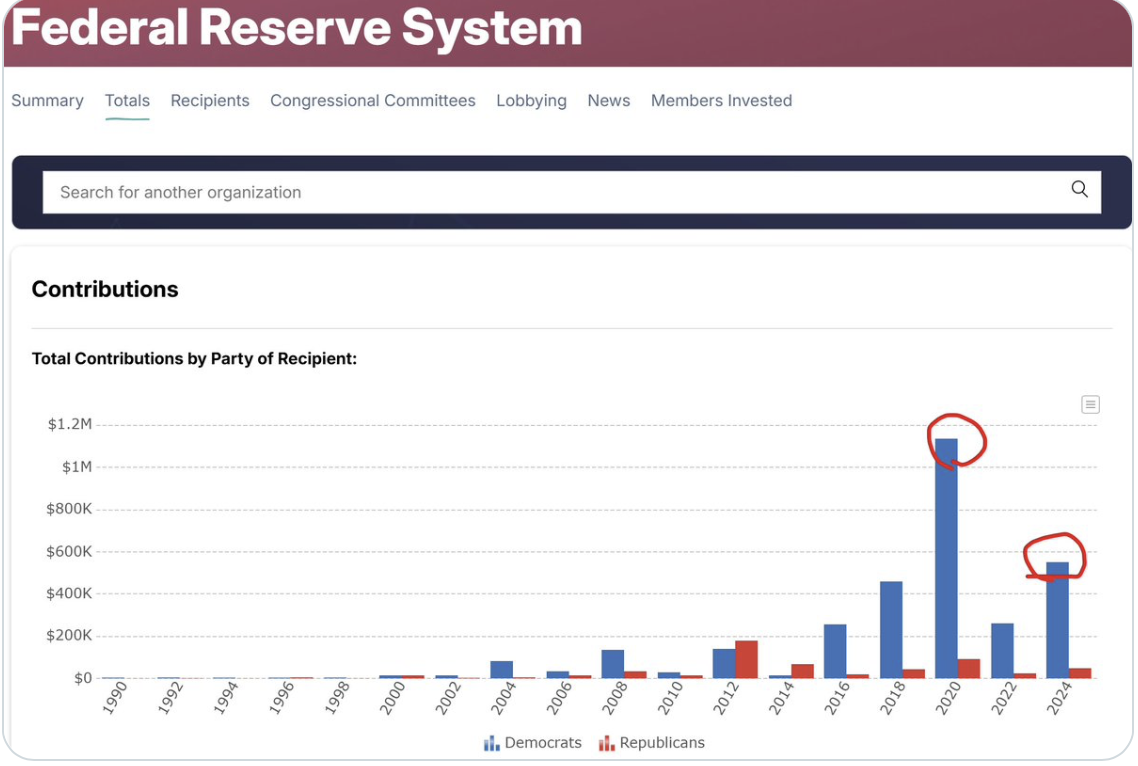
Source: X @FedGuy12

It is important to recognize this as it also may help explain why the Fed is cutting interest rates despite GDP (currently 2.8%) and Core PCE (currently 2.7%) running far above their long-term expectations and Unemployment (currently 4.1%) running below their long-term expectations as per the below SEP from the September FOMC meeting.  If anything, I might argue they should be raising interest rates!

Source: fedreserve.gov

At any rate, the ramifications of this election outcome are likely to drive the market narrative for a while yet.

But overnight, there just wasn’t that much of interest, at least not that much new.  So, let’s take a look at overnight market activity.  After Friday’s latest record high closes in the US, the picture in Asia was less robust with Japanese equities basically unchanged on the day after Shigeru Ishiba was elected PM to run a minority government, while Hong Kong (-1.5%) and mainland Chinese (+0.7%) shares went in opposite directions.  Chinese financing data was released that was mildly disappointing, but there are several stories about how the government is going to reacquire land that is currently in private hands but not being used and repurpose it for benefit.  The rest of the region had many more laggards than gainers, perhaps on concerns that Trump will be imposing tariffs throughout the region.  As to Europe, despite all the pearl clutching by the leadership there, equity investors are excited with gains seen across the board (DAX +1.3%, CAC +1.2%, FTSE 100 +0.8%).  US futures at this hour (7:30) are continuing their ride higher, up 0.4%.

In the bond market, Treasuries aren’t really trading today with banks closed.  In Europe, sovereign yields have edged down between 1bp and 2bps, perhaps feeling a little of that equity euphoria, as there was precious little in the way of news or commentary to drive things.

In the commodity space, oil (-1.7%) is under further pressure as broadly slower global growth undermines demand while prospects of the Trump administration fostering significant additional drilling opportunities helps build the supply side.  However, NatGas (+7.0%) is soaring this morning as Europe, notably Germany, is suffering from dunkelflaute (maybe the best word I have ever heard) which means ‘a period of low wind and solar power generation because it is cloudy, foggy and still’, and so they need to buy a lot more NatGas to power the economy.  In fact, NatGas is higher by nearly 15% in the past month although remains substantially cheaper in the US than in Europe and Asia.  My take is this discrepancy cannot last forever.  As to the metals markets, they are under pressure again this morning with both precious (Au -0.9%, Ag -0.3%) and industrial (Cu -0.5%, Al-1.4%) feeling the pain.  

A key driver in the metals space is the dollar, which is rallying against all its counterparts this morning quite robustly.  The euro (-0.6%) is back to levels last briefly touched in April, but where it spent more time a year ago, as it seems to be heading to 1.05 and below.  Meanwhile, JPY (-0.8%) is also feeling the heat while NOK (-0.7%) is pressured by both the dollar’s general strength and the oil weakness.  In the EMG bloc, MXN (-1.3%) is having a rough go as the tariff talk heats up, but we have also seen weakness in EEMEA with ZAR (-1.4%), PLN (-1.0%) and HUF (-1.2%) all under pressure this morning.  Not to be outdone, Asian currencies, too, are selling off with CNY (-0.3%) back above 7.20 for the first time since August while THB (-0.9%), MYR (-0.7%) and SGD (-0.6%) demonstrate the breadth of the move.

With the holiday, there is no data to be released today, but this week brings CPI amongst other things.

TuesdayNFIB Small Biz Optimism91.9
WednesdayCPI0.2% (2.6% Y/Y)
 Ex food & energy0.3% (3.3% Y/Y)
ThursdayPPI0.2% (2.3% Y/Y)
 Ex food & energy0.3% (2.9% Y/Y)
 Initial Claims224K
 Continuing Claims1895K
FridayRetail Sales0.3%
 -ex autos0.3%
 Empire State Mfg-1.4
 IP-0.3%
 Capacity Utilization77.2%

Source: tradingeconomics.com

In addition to this data, we hear from 11 different Fed speakers this week, including Chairman Powell again at 3:00pm on Thursday afternoon.  It is difficult to believe that the message from last week is going to change, but you never know.  However, I expect that every one of them is going to be explaining that things are good, but they are cutting rates to ensure things remain that way as they consistently congratulate themselves on having slain inflation.  I hope they are right…I fear they are not.

For now, though, the US economy remains the strongest in the world (7% budget deficits will help prop up growth after all) and capital continues to flow in this direction.  I see no reason for the dollar to fall anytime soon.  Whatever problems lie ahead, I believe they are over the metaphorical horizon and other than a few doomporn purveyors, not in the market’s view.

Good luck

Adf

Erring

Excitement does not quite portray
The thirst for risk shown yesterday
Though media cried
Investors took pride
In Trump, sure that he’ll save the day
 
So, next Chairman Jay and the Fed
Will try to explain that instead
Of further rate paring
They might soon be erring
On side that Fed rate cuts are dead


Wow!  That is pretty much all one can say about yesterday’s equity market response to the confirmation that Donald Trump will be the next president of the United States.  The DJIA rose 3.6%, far outpacing both the S&P 500 (+2.5%) and the NASDAQ (+3.0%) but even that paled in comparison to the Russell 2000 small-cap index which jumped nearly 6% on the day!  Investors are all-in on the idea that Trump will seek to bring home as much manufacturing and economic activity as possible via tariff policies and small caps and old-line companies are the ones likely to benefit.

But boy, bonds had a tough day with yields across the curve rising between 10bps (2yr) and 20bps (30yr) with the 10yr gaining 15bps on the day.  It is all part of the same mindset, higher economic activity and no slowdown in spending leading to rising inflation and, correspondingly, rising yields.

The other area that really suffered were the metals markets, with gold (-3.3% or $90/oz), silver (-4.7%) and copper (-5.0%) all getting hammered.  The best explanation for the gold price’s decline I have heard is the idea that with Trump coming into office, the prospects for a nuclear war have greatly diminished.  Certainly, based on the fact that there were no new wars during his last term and one of his promises is to end the Russia/Ukraine war on the first day, perhaps that is correct.  As well, consider that the dollar exploded higher, something which had lately been a benefit for metals, but historically has been a negative, and at least we can make some sense of things here.

So, where do we go from here?  That, of course, is the $64 billion question.  Reactions around the world are still coming in and I would characterize them as a mix of stoicism and fear.  Perhaps a good place to start is Germany where the governing coalition just collapsed as Chancellor Sholz fired the FinMin who was the head of the FDP, one of his coalition’s groups.  Their problem is that the German economic model is crumbling, and the population is unhappy with the current situation.  The former can be demonstrated by today’s data showing the Trade Surplus fell more than expected while IP fell back into negative territory again, an all-too-common occurrence over the past three years as can be seen below, and hardly the best way to improve the productivity of your economy.

Source: tradingeconomics.com

Meanwhile, politically, the country is seeing a widening of views across the spectrum with the combination of the anti-immigration parties, AfD on the right and BSW on the left, garnering support of about 25% of the population and preventing any meaningful coalitions from being formed.  

If Germany continues to lag economically, it will negatively impact the whole of the Eurozone.  The divergence between the US economy, which has all the hallmarks of faster growth ahead, especially under a new administration, and the European economy, which continues to struggle under a suicidal energy policy that undermines any chance of industrial resurgence, and therefore a significant rebound in economic activity could not be greater.  While much ink has been spilled regarding the prospects that the dollar is going to collapse because of the debt situation and the BRICS are going to create something to replace it, the reality is the euro is in far more dire straits.  The ECB is going to be much more aggressive cutting rates than the Fed and the market is starting to price that in.  The below chart from Bloomberg this morning does an excellent job showing the change in market pricing over the past month.  

I find it hard to see how the euro can benefit in this environment regardless of the dollar’s performance against other currencies given the more limited economic prospects on the continent.  They are dealing with an existential crisis because of Russia’s more aggressive stance since the invasion of Ukraine combined with an undermining of their economic model which was based on exporting high value items to China and the rest of the world.  The problem with the latter is China has become a huge competitor and a shrinking market for their wares, and they have limited other markets.  If Trump holds to his word and imposes 20% tariffs on European imports to the US, the euro is likely to fall even further.

That is just a microcosm of one area and its response to the US election, but one that may well be a harbinger for many others.  The US stance in the world is changing and other nations are not really prepared.  Expect more financial market volatility, in both directions, as these changes become more evident and play out over time.

Ok, let’s see how other markets behaved with confirmation of the Trump victory.  In Asia, the Nikkei (-0.25%) slid but other indices rallied indicating a mixed picture.  Meanwhile Chinese shares rallied sharply (CSI 300 +3.0%, Hang Seng +2.0%) as expectations grow that the Standing Committee will expand the stimulus measures in the wake of the election.  Remember, the Chinese had delayed this annual meeting by a week to capture the results of the US election and now traders are betting on a bigger response.  As well, the Chinese Trade Surplus expanded far more than forecast, to its third highest monthly reading of all time at $95.3B.  As to the rest of the region, the picture was very mixed with some gainers (Singapore +1.9%, Taiwan +0.8%) helped by the China story and some laggards (India-1.0%, Philippines -2.1%) with the latter suffering from a much weaker than expected GDP report.

In Europe, interestingly, most markets are performing well this morning led by the DAX (+1.3%) although the rest of the continent’s bourses are only higher by around 0.5% or so.  The laggard here is the FTSE 100 which is unchanged on the day in the wake of the BOE’s widely expected 25bp rate cut.  Although, there were apparently some looking for a 50bp cut as stocks fell a bit in the wake of the news and the pound jumped 0.3%, a clear sign of a minor surprise.

Speaking of currencies, the dollar which has had quite a run in the past two sessions is backing off overall this morning although remains well above the pre-election levels.  In the G10, NOK (+1.3%) is the leader as the Norgesbank left rates on hold and indicated that was likely their stance going forward, while AUD (+1.0%) seems to be benefitting from both the rebound in metals prices and the potential Chinese stimulus.  Otherwise, currencies have rallied between 0.3% and 0.5% in this bloc.  In the EMG space, ZAR (+1.4%) is the biggest gainer, also on the precious metals rebound, while MXN (+1.2%) is next, although that is simply a continuation of the retracement from the post-election decline.  Bigger picture, I think the dollar remains well bid, but not today.

In the bond market, Treasury yields are unchanged this morning, consolidating their gains from the past week and waiting for the Fed this afternoon.  However, European sovereign yields have all rallied substantially, between 6bps and 9bps, which looks, for all intents and purposes, like the continent’s catch-up trade to yesterday’s US movement.  Nothing has changed the view that Treasury yields lead bond market moves in the G10.

Finally, in the commodity space, oil (-1.0%) is a bit lower this morning although yesterday it recouped most of its early losses and closed lower only minimally.  Yesterday also saw a surprising inventory build in the US which would be expected to weigh on prices.  In the metals markets, after a virtual collapse yesterday, this morning is seeing stabilization in precious metals and a sharp rebound in copper (+2.3%) as hopes for that Chinese stimulus spread to this market as well.

In addition to the FOMC meeting this afternoon, we see regular Thursday morning data of Initial (exp 221K) and Continuing (1880K) Claims as well as Nonfarm Productivity (2.3%) and Unit Labor Costs (1.0%).  However, despite all the recent activity, and the fact that a 25bp cut is a virtual certainty, Chairman Powell’s press conference will still have the trading community riveted to see how he describes any potential future paths in the wake of the election results.  Given the recent data and the estimate prospects of a Trump administration’s efforts to goose growth further, it is hard to see how the Fed can really discuss cutting rates much further.  In fact, I will go out on a limb and say I expect forecasts of the neutral rate are going to consistently climb higher and reach 4% before the end of 2025.  And that means, as is evident by both the economy and the stock market, the Fed has not tightened financial conditions very much at all.

Good luck

Adf

The Throes of Anguish

The answer this morning is clear
The president starting next year
Is Donald J Trump
Who always could pump
Excitement when he did appear

The market response has been swift
With equities getting a lift
The dollar, too, rose
But bonds felt the throes
Of anguish while getting short shrift

The punditry was quite convinced that it would be a long time before the results of the election were clear as they anticipated significant delays in the vote count in the battleground states.  Fears were fanned that if Trump were to lose, he wouldn’t accept the election.  As well, virtually every pundit in the mainstream media portrayed the race as “tight as a tick’ (a somewhat odd expression in my mind).

But none of that is what happened at all.  Instead, somewhere around 3:00am NY time, Donald J Trump was called the winner of the presidential election, effectively in a landslide as he appears set to win > 300 electoral votes and, perhaps more importantly as a signal, the popular vote, and will be inaugurated as the 47thpresident of the United States on January 20th, 2025.  Congratulations are in order.

It ought not be surprising that the ‘Trump trade’ is back in full force early on with US equity futures rallying about 2%, Treasury bonds selling off sharply with 10-year yields jumping 20bps and the dollar exploding higher, jumping by about 1.5% as per the DXY, with substantial gains against virtually all its G10 and EMG counterparts.  Oil prices are under pressure as the prospect of ‘drill, baby, drill’ is the future and Bitcoin has exploded higher to new all-time highs amid the prospects of a pro-crypto Trump administration.

Much digital ink will be spilled over the next weeks and months as the punditry first tries to understand how they could have been so wrong, and then tries to create the new narrative.  However, if we learned nothing else from this election it is that the previous narrative writers, especially the MSM, have lost a great deal of sway and that it will be the new narrative writers, those independents on X and Substack and podcasters, who don’t answer to a corporate master, who will be leading the way imparting information and stories.  I’ve no idea how this will play out with respect to financial markets, but I am confident it will have an impact over time.

With all of the votes being tallied
While stocks and the dollar have rallied
We’ll turn to the Fed
Who soon will have said
On rate cuts, we’ve not dilly-dallied

With the election now past, at least as a point of volatility, all eyes will likely turn to the FOMC meeting, which starts this morning and will run until the statement is released tomorrow at 2pm with Chairman Powell’s press conference coming 30 minutes later.  The election result has not changed any views on tomorrow’s rate cut, with futures markets still pricing in a 98% probability, but the pricing as we look further out the curve has changed a bit more.  For instance, the December meeting is now priced at less than a 70% probability for the next 25bps, and if we look out to December 2025, the market has removed at least one 25bp cut from the future.

This makes sense based on the idea that a Trump administration is going to be heavily pro-growth and one consequence will potentially be more inflationary pressures.  Of course, if energy prices decline, that is going to help cap inflation, at least at the headline level, so the impact going forward is very hard to discern at this time.  As well, if that pro-growth agenda helps improve the employment situation, the Fed will be far less compelled to cut rates further.  In fact, the only reason to do so at that time would be to address the massive debt load and that cannot be ruled out, but my take is Powell is not inclined to try to help President Trump in any way, so will likely feign allegiance to the mandate when the situation arises.

But with all the election excitement today, my sense is the Fed is tomorrow’s market discussion, not today’s.  Rather, let’s see how markets around the world have responded to the news.

It seems that yesterday’s US markets foretold the story with a solid rally across the board.  Overnight, Japanese shares (+2.65%) were beneficiaries as the yen (-1.7%) weakened sharply along with all the other currencies.  Elsewhere in the region, China (-0.5%) and Hong Kong (-2.2%) both suffered on prospects of more tariffs coming and Korea (-0.5%) was also under pressure, but almost every other regional exchange rallied nicely.  As to Europe, green is the predominant color with the DAX (+0.9%), CAC (+1.5%) and FTSE 100 (+1.2%) all performing well although Spain’s IBEX (-1.5%) is underperforming allegedly on fears of some tax issues that will impact the Spanish banking sector.  But I would look at Spain’s Services PMI falling short of expectations as a better driver.

In the bond market, while US yields have rocketed higher as discussed above, in Europe, that is not the case at all.  Instead, we are seeing declines of between 4bps and 5bps across the continent as concerns grow that Eurozone economic activity may suffer with Trump in office as threats of tariffs rise.  The market has now priced in further rate cuts by the ECB and that seems to be the driver here.

Aside from oil prices falling, metals, too, are under severe pressure with the dollar’s sharp rally.  So precious (Au -1.3%, Ag-2.3%) and industrial (Cu-2.8%, Al -1.0%) are all selling off.  Now, this space has seen a strong rally overall lately so a correction can be no real surprise.  However, it strikes me that if the growth story is maintained, demand for industrial metals will expand and gold is going to find buyers no matter what.

Finally, the dollar just continues to rock, climbing further since I started writing this morning.  the biggest loser is MXN (-2.9%) which has fallen to multi-year lows amid concerns they will be an early target of tariffs.  While the dollar, writ large, is stronger across the board today, it is only back to levels last seen in July, hardly a massive breakout.  However, do not be surprised if this rally continues over time as investors learn more specifics of how President Trump wants to proceed on all these issues about the economy, taxes and tariffs.

The only meaningful data releases this morning are the EIA Oil inventories, which last week saw a large draw and are expected to see a further one today.  Otherwise, European Services PMI data, aside from Spain’s disappointing showing, was actually better than expected, probably helping equity markets there as well.  Of course, as the Fed doesn’t come out until tomorrow, there is no Fedspeak so traders will likely continue to push the Trump trade for now.  As such, look for the dollar to remain strong until further notice.

Good luck
Adf

Half-Crazed

The rest of the world is amazed
And frankly, I think, somewhat dazed
The vote in the States
Deteriorates
Each cycle, as folks turn half-crazed
 
But still, everyone cannot wait
To find out if we will be great (again)
Or if we will turn
The page and thus spurn
The chance to encourage debate


By now, I imagine most of you have figured out my preference for the election outcome and whatever your view, I sincerely hope you don’t hold it against me.  However, if that is the case, so be it.  In the meantime, whatever happened in markets yesterday and overnight just doesn’t matter at all as the opportunity for a major revision of perceptions is so large as to make any price information completely useless, at least in the US markets.

I have seen numerous studies showing the history of how markets behave in presidential election cycles, but I think it is a fair assessment that the current cycle is unlike any previous cycle that we have seen since, perhaps, just before the Great Depression.  Simply consider the massive amount of information that is available to the average person from numerous sources these days compared to anytime in the past.  As such, I don’t put much faith in any of those studies.

Which takes us to this morning.  Do we truly have any idea what the outcome will be?  I would argue not although we all have our favored outcomes.  And that bias, I believe, is deeply embedded in virtually every analysis.  As such, I will not try to analyze.  Rather, I will observe.

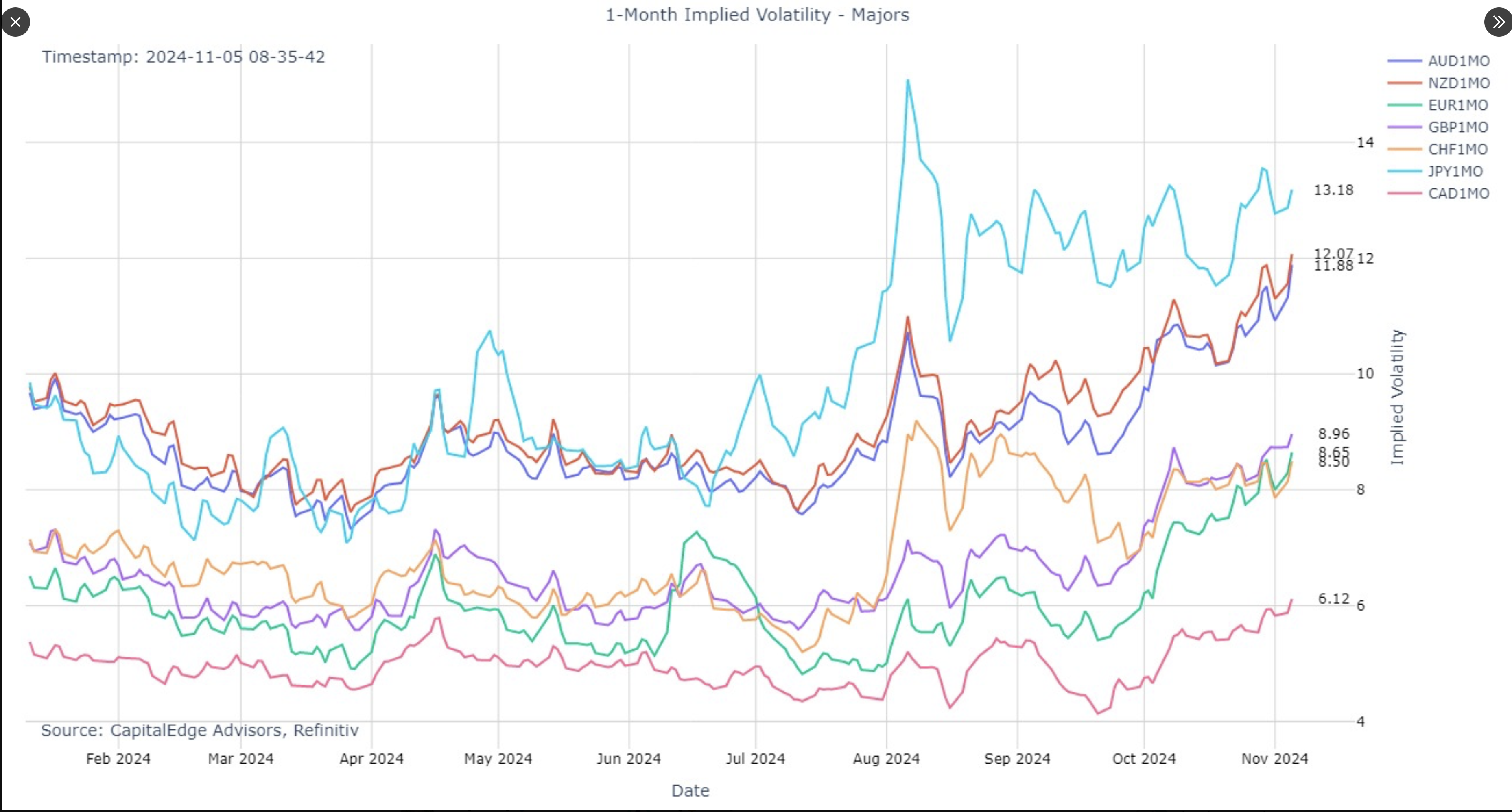
The first observation is that market implied volatility has been rising for the past weeks as the seemingly dramatic differences in policy outcomes depending on the ultimate winner mean market dislocations in either direction are quite possible.  

For example, let’s look at 1-month implied volatility in the major USD currency pairs this year as per the below:

Source: Capital Edge Corner via X

They have been rising steadily since early October as a combination of corporate hedgers trying to protect themselves and hedge funds and traders trying to profit from the dislocation have increased demand steadily.  The one truism here is that upon confirmation of a winner, regardless of the underlying move in the dollar, implied volatility is going to decline.

Much has been made of the ‘Trump trade’ which appears to mean that if Trump wins, the prospects for higher growth and inflation will steepen the yield curve, driving yields higher, while supporting the dollar (much to Trump’s chagrin) as foreign investors flock to US equities.  In fact, the most common explanation for the dollar’s decline over the past several sessions has been that Harris has improved in the polls.  

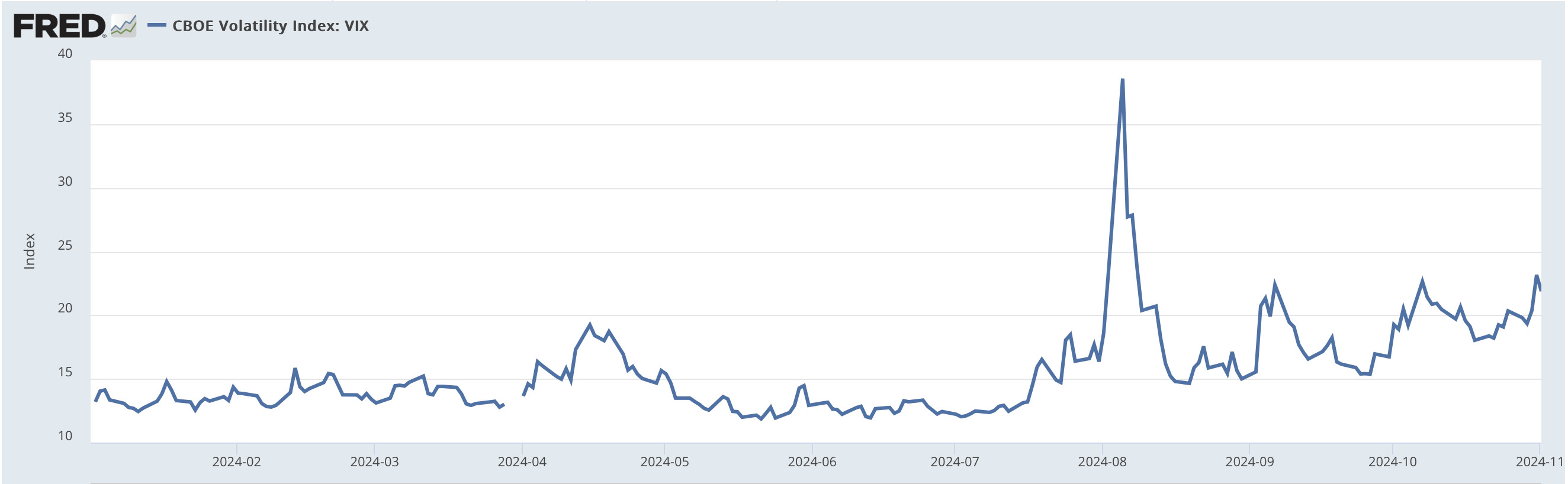
But it is not just the FX markets where implied volatility is rising, look at the VIX below, which is also showing a steady climb over the past two months.

Source: Fred.gov

That spike in August was the almost forgotten market response to the BOJ tightening policy and the -12% decline in the Nikkei just days after the Fed didn’t cut interest rates as many had hoped.  But if you eliminate that event, the trend higher remains intact.

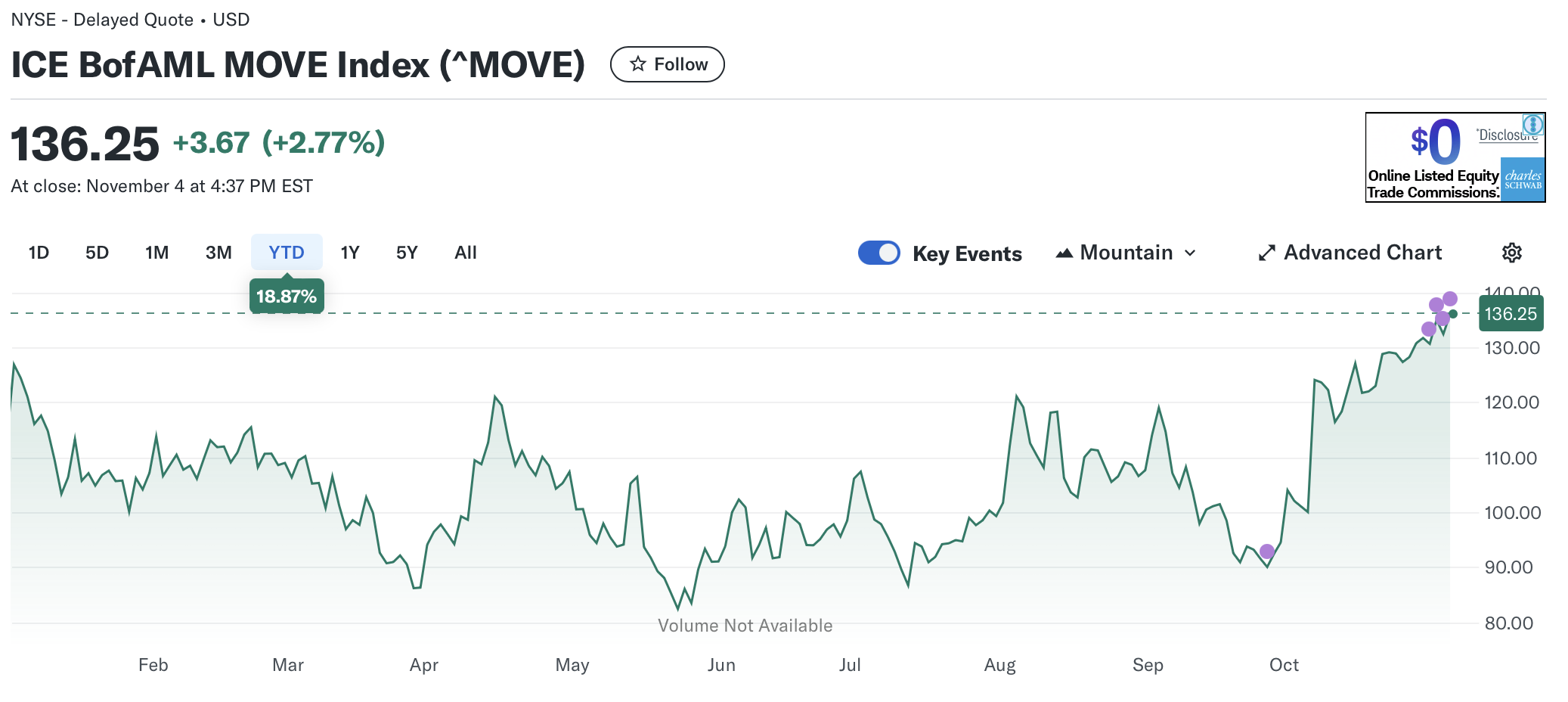
Finally, the MOVE Index, which is the bond market volatility index shows very similar behavior, a steady climb over the past month especially, but truly trending higher since the summer as seen below:

Source: Yahoo Finance

My point is that given the growing uncertainty across all markets as well as the complete inability to, ex ante, determine who is going to win the election, the signal to noise ratio of price movement right now is approximately 100% noise, at least in financial markets.  Commodity markets have a bit of a life away from the election, so price action there is far more representative of true supply and demand issues.  Arguably, this is merely another consequence of the financialization of most things, the loss of market signals as they have been overwhelmed by the flood of liquidity provided by central banks around the world.

At any rate, until we know who wins, it will be difficult to establish a view of the near-term or long-term future of market activity. So, let’s recap the overnight session as its all we have left.

After yesterday’s equity selloff in the US, most Asian exchanges posted gains led by China (+2.5%) and Hong Kong (+2.1%) which responded to comments from Chinese Premier Li Qiang’s comments that, “The Chinese government has the ability to drive sustained economic improvement.”  And perhaps they do, although there are clearly issues regarding the local entities that are willing to gain at the expense of each other in order to demonstrate their own progress.  But Japanese shares (+1.1%) also rallied along with most of the region, perhaps a direct analogy to the US decline as the ‘Trump trade’ has included weakness in markets likely subject to Trump’s promised tariffs.  Meanwhile, in Europe, bourses have edged slightly higher this morning, between 0.1% and 0.2%, with no new data or news of note.  Interestingly, US futures are starting to trade higher at this hour (6:50), perhaps an indication of market beliefs, although just as likely part of the random walk down Wall Street.

In the bond market, Treasury yields (+3bps) are creeping higher again, also in line with the Trump trade, and that seems to be dragging European sovereign yields along for the ride as all those markets have seen yields climb between 4bps and 5bps.  Again, given the lack of new data, and the history of these yields following Treasuries, I see no other strong explanation. 

In the commodity markets, oil (+0.3%) continues its rebound and has now gained more than 6.5% in the past week.  The combination of OPEC+ delaying their planned production increases and seeming hopes for a pickup in Chinese demand on the back of the coming details of the stimulus package seems to have traders in a better mood these days.  As to the metals markets, they are all firmer this morning with gold (+0.2%) mostly biding its time ahead of the election, but both silver (+0.8%) and copper (+0.9%) starting to accelerate a bit.  Nothing has changed my view that regardless of the election outcome, this space is far more dependent on continued central bank policy easing and there is no indication that is going to end soon.

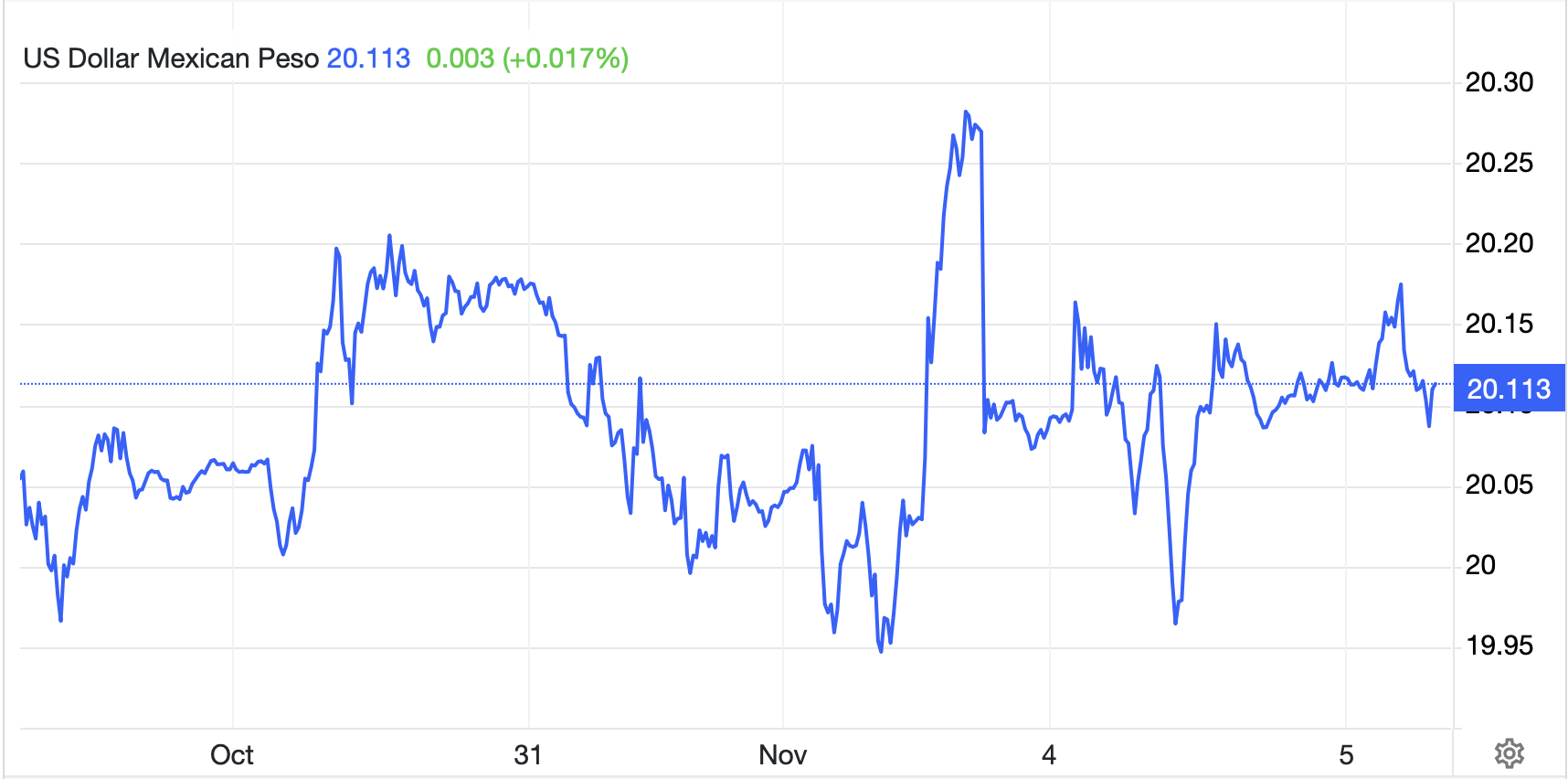
Finally, the dollar is softer again this morning, but in a more muted fashion than the past several sessions.  Although, with that in mind, we still see the euro and pound both climbing a further 0.25% and AUD (+0.6%) today’s leader after the RBA left rates on hold with a more hawkish statement than anticipated.  But the weakness is widespread with NOK (+0.4%) continuing to benefit from oil’s rise while ZAR (+0.6%) gains on the back of the rise in metals.  Of course, the currency that has seen the most discussion ahead of the election is MXN.  It is basically unchanged this morning, a perfect description of the narrative that the election will be extremely close.  However, a quick look at its price movement over the past week shows that it follows every bump in the polls.

Source: tradingeconomics.com

And that’s really it this morning.  We see the Trade Balance (exp -$84.1B) and ISM Services (53.8) but honestly, nobody is going to respond to that data.  Instead, all eyes will be on the early exit polls and the reporting of how the election is going.  No matter what, it seems hard to believe we will really have an idea before 10:00pm this evening, and then only if it is a blowout in either direction, seemingly a low probability.  So, today is a day to watch and wait if you don’t already have hedges in place because honestly, it’s probably too late to do anything now.

Good luck and go vote

Adf

Fraught

The job growth that everyone thought
Existed, seems like it was fraught
Meanwhile ISM
Showed further mayhem
As growth slowed while prices were hot
 
The funny thing was the reaction
Where stocks were a source of attraction
But at the same time
Bond buys were a crime
With sellers the ones gaining traction


The NFP data was certainly surprising as the headline number fell to its lowest level, 12K, since December 2020 with the worst part, arguably, the fact that government jobs rose 40K, so there were 52K private sector job losses.  That is just not a good look, nor were the revisions to the previous months which saw another 112K jobs reduced from the rolls.  It cannot be surprising that the Fed funds futures market immediately took the probability of a rate cut to 99% this week and raised the December probability to 82%, up more than 10 points in the past week.  After all, Chair Powell basically told us that he has slain inflation, and they are now hyper focused on the employment mandate.  With that in mind, the futures reaction makes perfect sense.

Perhaps even more surprising was the market reaction, or the dichotomy of market reactions, which saw equity markets in the US rally nicely, with gains between 0.4% and 0.8% in the major indices, while Treasury yields spiked 10bps despite the data.  That yield spike helped carry the dollar higher as the greenback rallied smartly against virtually all its counterparts by more than 0.50%, and it undermined commodity prices.  

The most common explanation here, though, had less to do with the NFP data and more to do with the recent polls regarding the US election, where it appeared the former president Trump was gaining an advantage.  Remember, the ‘Trump trade’ is being described as a steeper yield curve with benefits for the dollar and US equities on the back of stronger growth and higher inflation.

There once was a US election
Where both candidates lacked affection
The worry it seems
Is half the world’s dreams
Are likely soon met with dejection
 
Meanwhile for investors worldwide
This week ought to be quite a ride
To all our chagrins
No matter who wins
Look for either outcome denied

However, this morning, the markets have changed their collective mind, with virtually all of Friday’s movement now unwound, at least in the bond and FX markets.  What would have caused such a reversal?  Well, the latest polls show that the race is much tighter than thought on Friday, with VP Harris gaining ground in a number of them, which now has most pundits simply calling for their favored candidate to win, rather than trying to read the polls.  As such, the Trump trade has been partially unwound and my sense is that until there is an outcome, it will be difficult for markets to do more than increase the amplitude of their moves amid less and less actual trading.  At least, that is true in bonds, FX and commodities.  Stocks, as we all know, are legally mandated to rise every day, so are likely to continue to do so. 

And now, despite the fact that the Fed meets on Thursday, with a rate cut all but assured and ostensibly a great deal of interest in Chairman Powell’s press conference, all eyes are on the election.  Remember, too, not only is that the case in the US, but also around the world.  Whether friend or foe of the US, pretty much all 195 nations on the planet are invested in the outcome.

With that in mind, and since this poet has no deep insight into the outcome, let me simply recount the overnight market activity with the understanding that many trends have the opportunity to reverse depending on the results.

Starting with equity markets, Japanese shares (-2.6%) fell sharply as a combination of both their domestic political struggles (remember their government situation is unclear after the recent snap election) and the significant rebound in the yen (+0.9%) weighed on equities there.  India (-1.2%) also struggled but elsewhere in the time zone, stocks rallied nicely led by China (+1.4%) and Korea (+1.8%) as visions of that Chinese fiscal bazooka continue to dance in investors dreams.  Interestingly, the WSJ had an article this morning downplaying the idea, which based on their history makes a great deal of sense to me.  Turning to Europe, most markets there are firmer, albeit only modestly so, with gains from the CAC and IBEX (+0.3% each) outpacing the DAX (0.0%).  Finishing off, US futures are basically unchanged at this hour (7:00).

In the bond markets, while the Treasury move Friday did help drag European yields somewhat higher, it was nothing like seen in the US and this morning, those yields are essentially unchanged, +/- 1bp in most cases.  The only data of note was the final PMI data which confirmed the flash data from last week.  As to JGB yields, they have been stuck in the mud for a while now, still hanging below the 1.0% level with no designs of a large move.

Oil prices (+3.1%) are rebounding nicely on news that OPEC+ has delayed their previous plans to start increasing production as of December this year.  Concerns about oversupply in the global market plus the return of Libyan production and record high US production have convinced them they better leave things as they are.  Metals markets are a bit firmer this morning with gold (+0.2%) actually somewhat disappointing given the magnitude of the dollar’s decline, while both silver (+1.25%) and copper (+1.1%) show nice gains.

Finally, the dollar is under severe pressure across the board.  The biggest gainers are MXN (+1.2%), NOK (+1.2%) and PLN (+1.1%) although most gains are on the order of 0.7% or more.  Certainly, the oil story is helping NOK, and given the concerns that traders have about prospective tariff increases on Mexico if Trump wins, the idea that the race is closer than previously thought has supported the peso.  As to the zloty, it seems that their PMI data, printing at 49.2, a fourth consecutive rise) has traders looking for a more hawkish central bank on the back of stronger economic activity.

On the data front, aside from the election and the Fed, there is other information, although it is not clear that anyone will notice.

TodayFactory Orders-0.4%
TuesdayTrade Balance-$84.1B
 ISM Services53.8
ThursdayBOE Rate Decision4.75% (current 5.00%)
 Initial Claims223K
 Continuing Claims1865K
 Nonfarm Productivity2.5%
 Unit Labor Costs1.1%
 FOMC Rate Decision4.75% (current 5.0%)
FridayMichigan Sentiment71.0

Source: tradingeconomics.com

Of course, the election will dominate everything, and it certainly appears that there will be legal challenges from the losing side regardless of the outcome.  My expectation is that markets will remain jumpy with outsized moves on low volumes until there is more clarity.  It is not often that an FOMC meeting is seen as an afterthought, but much to Chairman Powell’s delight, I sense that is going to be the case this week.  

I have already voted early and I encourage each of you to vote as the more voices heard, the better the case the winner will have at achieving a mandate.  And the reality is, we need a president with a mandate if we are going to see broad-based positive changes in the nation going forward.

Good luck

adf

She Just Doesn’t Know

Though there was no change
Ueda-san hinted that
The future is known


Last night, the BOJ left policy unchanged, as universally expected, but indicated that “Our basic stance is that if our economic and price outlooks are realized, we’ll respond by raising rates.”  That seems pretty clear, and the market responded accordingly with the yen rallying nearly 1% in the immediate aftermath of the comments, although it has since retraced a bit and is now higher by just 0.5% on the session.  As well, he explained, “We’ve been looking at the downside risks to the US and overseas economies, but that fog is clearing somewhat. Needless to say, new risks could emerge depending on the policies coming from the new US president.”  The upshot is that market expectations are now for the next rate hike to take place at the January meeting (69% probability), although December cannot be ruled out.

Japanese equity markets fell modestly during the session (Nikkei -0.5%), but that could also have been more related to the US equity performance, where all three major indices fell yesterday (something that I thought had been made illegal 🤣).  As to JGB’s, they rallied slightly with the 10-year yield slipping 2bps on the session.

In the current market zeitgeist, I don’t believe the happenings in Japan are that crucial.  As Ueda-san said, US politics remains a key focus for every financial market around the world, as well as every economy, given the potential for a Trump victory and some very real changes to the current global trade and economic framework.  However, that doesn’t mean other things of note have stopped occurring.

The message from Madame Lagarde
Is further rate cuts aren’t barred
She just doesn’t know
How fast she should go
Though colleagues, more cuts, have pushed hard

The other story this morning, in the wake of some Eurozone data showing inflation ticked higher in October (headline 2.0%, core 2.7%), is the commentary from several ECB members.  Notably, Madame Lagarde explained “The objective is in sight, but I am not going to tell you that inflation is under control.  We also know that inflation will rise in the coming months, simply because of base effects.”  The punditry sees this as a middle ground between the more hawkish ECB members, like Nagel and Schnabel, who are calling for a “gradual approach” and that the ECB “mustn’t rush further steps,” and the doves, led by Panetta, who are concerned, “Monetary conditions are still tight and new cuts will be necessary.”  

The ECB is finding itself in a difficult position as they refuse to accept the idea that a recession is coming despite the lackluster economic data and the ongoing anecdotal evidence of trouble as evidenced by VW’s closing of factories and seeking wage cuts.  Meanwhile, they understand that inflation, at least optically, is due to rebound somewhat, and cutting rates while that is occurring may be more difficult to explain.

Ultimately, as we have seen repeatedly across all markets and nations, the biggest driver of almost everything is the combination of US economic activity and monetary policy.  However, that is not to say that other nations or blocs cannot demonstrate some independence for their own idiosyncratic reasons.  Regarding the euro, I find it interesting that I have seen more comments this morning about how the currency has found a bottom and is set to rebound.  However, I cannot help but look at the bigger picture (see chart below) and think nothing at all has changed.

Source: tradingeconomics.com

I continue to believe that in order for there to be any changes of substance, we will need to see the US policy change substantially.  That could take the form of an acknowledgement by the Fed that the economy remains strong and further cuts are not necessary (see yesterday’s ADP Employment number of 233K, twice expectations) or a decision by Chairman Jay that there are enough structural issues in the banking and financial system that further rate cuts are necessary despite what appears to be solid growth and still-high inflation.  If the former were to occur, I would look for the dollar to take another strong step higher and the euro to test parity along with other currencies declining commensurately.  If the opposite were to occur, the dollar would weaken substantially in my view, with the euro rising toward 1.15 or so.  However, I don’t see either of those scenarios playing out, so I believe the reality is we remain in the range we have traded in for the past two years as seen above.

And those were really the only stories to discuss away from the US election cacophony.  So, let’s see how markets behaved broadly overnight.  As mentioned above, US equities had a down day after some disappointing earnings results added to some overly long positioning.  Beyond Japanese shares, the rest of Asia was broadly negative as well, with Korea (-1.5%) and India (-0.7%) leading the way lower, but almost every market in the red.  We are seeing similar price action in Europe this morning as it appears Lagarde’s comments did not soothe any frazzled nerves, and the data was unhelpful as well.  As such, the CAC (-0.85%) is the lagging performer although the DAX (-0.5%) and FTSE 100 (-0.8%) are also under pressure.  Now, regarding the FTSE 100, that is also a product of the UK budget announcement yesterday which has been widely panned by most analysts.  It appears they have actually managed to create a situation where they increase spending and taxes but reduce growth substantially.  The upshot here is that there seems to be a little buyers’ remorse with the July election results.  Meanwhile, US futures are all pointing lower as well this morning, at least -0.5%.

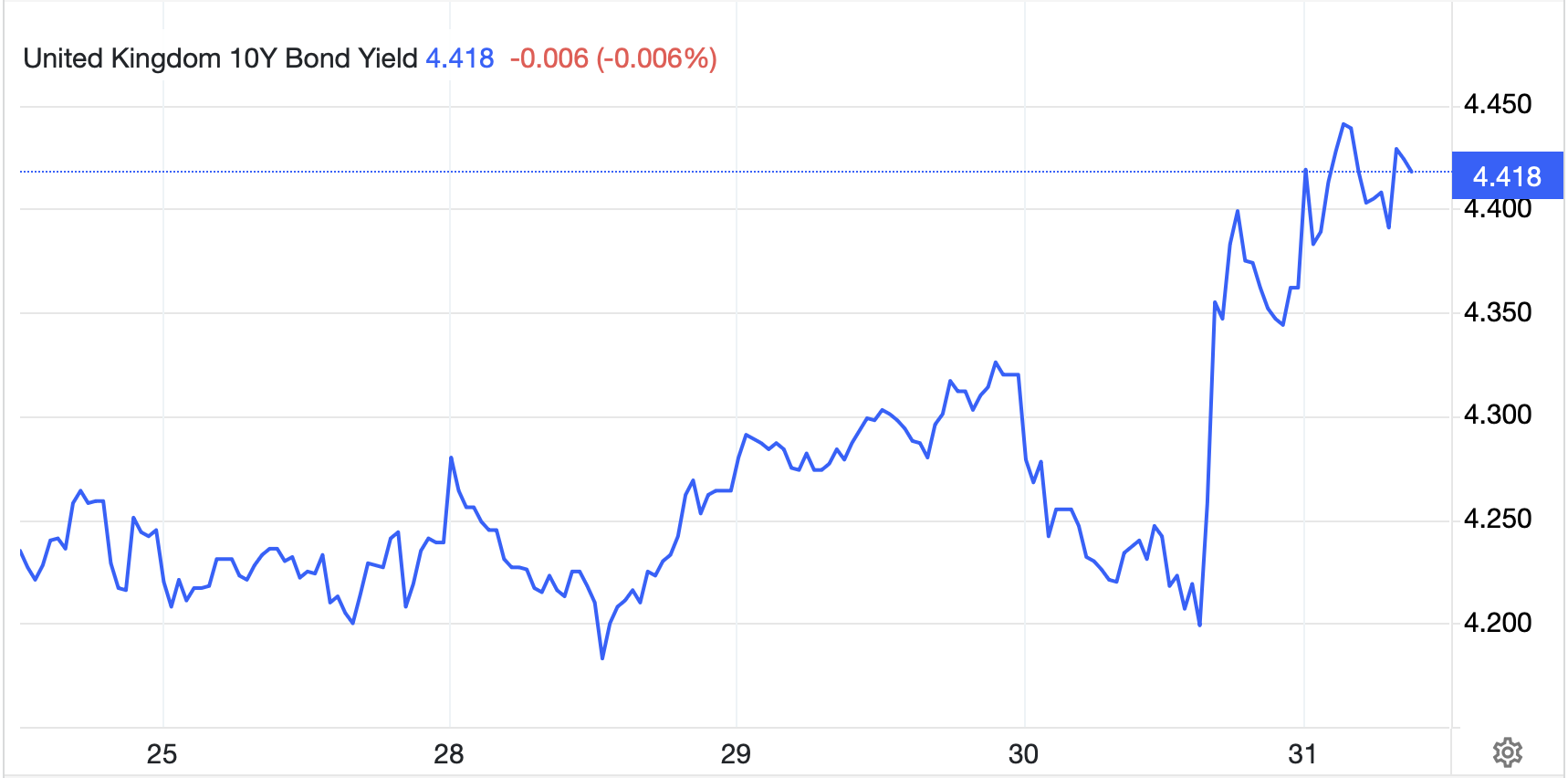
In the bond market, yesterday saw Treasury yields rebound to their recent highs at 4.30% but this morning they have slipped back lower by -2bps.  European sovereigns, however, are higher by those same 2bps as the market responds to the combination of yesterday’s Treasury movement and the higher than forecast Eurozone inflation report.  The outlier here is the UK, which after the budget has seen yields rise dramatically, a sign that markets are distinctly unimpressed with the proposals.  This is a case where a picture is truly worth 1000 words.

Source: tradingeconomics.com

I’ll let you determine when the budget was released, but one must be impressed with the more than 20bp response!

In the commodity space, oil (+0.5%) is continuing its rebound from its worst levels at the end of last week after EIA inventory saw surprising draws rather than modest builds.  As well, Chinese PMI data overnight was slightly better than expected and there are those now calling for a more robust Chinese economic rebound and increase in demand.  As to the metals markets, though, weakness is the order of the day with both precious and industrial metals slightly softer, although remember, these have rallied sharply over the course of the past month, so some trading movement lower is no surprise.

Finally, the dollar is mixed to slightly higher with only the MXN (+0.3%) showing any gains of note beyond the yen’s moves while there is more breadth in the decliners (NOK (-0.3%, ZAR -0.2%, AUD -0.2%) with almost no movement in Asian currencies overnight.

On the data front, this morning brings the weekly Initial (exp 230K) and Continuing (1890K) Claims data as well as Personal Income (0.3%), Personal Spending (0.4%) and PCE (0.2%/2.1%) and core PCE (0.3%/2.6%).  Already we are hearing that the impact of the recent hurricanes is likely to confuse the employment data, which makes sense, but I think much more attention will be paid to the Income/Spending data.  Certainly, Retail Sales have held up well, and if Personal Income continues to do well, it will call into question the need for that many more rate cuts by the Fed.  As of this morning, the futures market is pricing in a 94% probability of a cut next week and a 70% probability of another one in December.  Perhaps more interestingly, and where things could really change, is the fact the market is pricing in a total of 135bps of cuts by the end of next year.  We will need to keep an eye on how that changes for clues to the dollar’s future.

For now, the dollar appears on its back foot, but absent some much weaker than forecast data, it is hard for me to see a sharp decline.  Rather, I continue to see more reason for the dollar to maintain its broad strength going forward.

Good luck

Adf

Another Mistake

Said Janet, we need to watch out
‘Cause bank fraud is starting to sprout
So maybe I’ll make
Another mistake
And drive banking stocks to a rout


I absolutely agree with the premise — which is that fraud is becoming a huge problem.”  These sage wordsfrom our esteemed Treasury Secretary have made headlines and also raised some alarms.  After all, was not Madam Yellen in charge of bank regulation not that long ago?  Did she not receive millions of dollars in speaking fees from those same banks before being named Treasury Secretary?  It is difficult to listen to the recent change in tone without considering the fact that she is concerned if the election results in a Trump victory, her time at Treasury may come under deeper scrutiny so she is starting to spill a few beans to show she was on the ball.

But arguably, the biggest issue is not that fraud is rampant in banking, with action around government checks being the most fertile area, the biggest issue remains the nonstop borrowing that continues as the US government debt continues to grow aggressively each day.  There have been several recent commentaries by some very smart guys, Luke Gromen and Bob Elliott,  regarding the coincidence of rising interest rates in the US and almost every other G10 economy despite significant differences regarding the economic situation and borrowing patterns.  One conclusion is that owning government debt from any western government, at least debt with any significant duration, is losing its luster quickly.  This is a valid explanation of why yields continue to rise despite the Fed’s, and other central banks’, recent rate cuts.  

Of course, there is another popular explanation about the recent rise in yields; the prospects of a Trump victory and corresponding sweep in the House and Senate is seen as growing substantially.  The thesis is that if that is the outcome, the budget deficit will grow even larger as the tax cuts due to expire next year will very likely be rolled over, and there is no indication there will be a reduction in spending (the Republicans merely have different spending priorities).  Hence, deficits will continue to grow, Treasury debt will continue to increase, and yields will increase as well.  At least, that’s the thesis.

One thing which is undoubtedly true is that if there is an increase in volatility in government bond markets, the dollar is going to be one of the beneficiaries.  Keep that in mind going forward.

Though views about Europe were dire
Today, GDP printed higher
While Italy sank
They’ve Germans to thank
For being the major highflier

The other story of note this morning is the Eurozone GDP report alongside GDP readings from several key nations.  At the Eurozone level, GDP surprised everyone with a 0.4% Q/Q print and a 0.9% Y/Y print, higher than the 0.2%/0.8% expectations.  Now, in the big scheme of things, those numbers are not that great, but better than expected is certainly worth something.  Germany was the key driver as they avoided a technical recession by growing 0.2% in Q3.  What is little noted is that Q2’s data was revised lower from -0.1% to -0.3%, so it is fair to say that things have not been great there.  In fact, below is a chart of the past 5 years’ worth of quarterly results in Germany and you can see that the concept of a growth impulse there, at least since the beginning of 2022, has largely been absent.

Source: tradingeconomics.com

Another telling sign that the headline may not be a true reflection of the situation on the ground there is that the Eurozone also released a series of sentiment indicators, almost all of which were weaker than expected, notably Economic Sentiment (95.6 vs. 96.3 last month and expected) and Industrial Sentiment (-13.0 vs. -11.0 last month and -10.5 expected).  Apparently, the growth was the product of greater than expected government spending, not really the best way to grow your economy.  However, the market did respond by pushing the euro (+0.15%) a bit higher although the recent downtrend remains in place as evidenced by the below chart.  It remains difficult to get too excited about the single currency given the growing divergence in views on the Fed and ECB, with the former being questioned about its policy easing while the latter is being called on to do more.

Source: tradingeconomics.com

And that was really the macro news for the evening so let’s see how markets overall behaved.  Yesterday’s mixed US session was followed by similar price action in Asia with the Nikkei (+1.0%) continuing its recent rally as the market gets comfortable with PM Ishiba putting together a minority government while Chinese shares (CSI 300 -0.9%, Hang Seng -1.55%) suffered as hopes for the ‘bazooka’ stimulus faded, at least temporarily.  As to the rest of the region, almost all the stock markets declined on the evening.  That negative price action is evident in Europe as well this morning with every major market in the red (CAC -1.4%, DAX -0.8%, IBEX -0.6%) as the better than expected GDP figures don’t seem to have been that enticing for investors.  In the UK, too, stocks are softer (FTSE 100 -0.3%), although there has been no data released.  The big story there today is the budget release upcoming with most pundits looking for a lot of smoke and mirrors and no progress on spending stability.  Meanwhile, US futures are a bit firmer this morning after solid earnings from Google after the close yesterday.

In the bond market, yields have backed off from their recent highs with Treasuries (-4bps) falling after yesterday’s 4bp decline.  Yesterday’s US data was a bit softer than expected (Goods Trade Deficit fell to -$108.23B, much larger than expected while the JOLTS data (7.44M) fell to its lowest level since January 2021 and indicates a rough balance in the jobs market.  As discussed above, European yields are following Treasuries lower with declines on the order of -3bps across the major economies with only Italy (+1bp) the outlier on higher than expected CPI readings.  Meanwhile, UK Gilts (-10bps) are the real outlier as bond investors seem intrigued over the potential budget.

In the commodity space, oil (+1.3%) is bouncing a bit although remains well below the $70/bbl level.  It appears that the worst is over for now and a choppy market is in our immediate future pending the election outcome.  Consider that if Trump wins, given his ‘drill, baby, drill’ plank in the platform, it is likely that oil will slide on the news while a Harris win is likely to see prices rise on the fear of a fracking ban.  Gold (+0.2%) continues its steady march higher with investors abandoning bonds and looking for a haven, although the other metals (silver -1.1%, copper -0.6%) are suffering this morning on the softer economic data.

Finally, the dollar is under very modest pressure this morning but remains at the high end of its recent trading range.  JPY (+0.25%) has managed a modest rally ahead of tomorrow’s BOJ meeting but we have seen a mixed picture overall with some gainers (AUD, NZD, KRW) and some laggards (SEK, GBP, HUF).  Ahead of the election, I continue to expect choppiness and a lack of direction but once that is complete, as I have said before, market volatility in other markets is likely to lead to a stronger dollar.

On the data front today, we start with ADP Employment (exp 115K) and then see the first look at Q3 GDP (3.0%) along with a key subcomponent of Real Consumer Spending (3.0%).  We also see the Treasury Refunding Announcement, with not nearly as much press given to this as today as we had seen over the past several quarters.  Expectations are running for no large increases although given the budget deficit continues to widen, I’m not sure how that math works.  Lastly, we see oil inventories where a modest build is anticipated.

While the election continues to dominate the discussion, we cannot ignore this data or what is to come tomorrow and Friday, as the Fed will not be ignoring it.  We will need to see a spate of much weaker data to change my long-held view that the dollar has further to climb, so let’s watch and wait.

Good luck

Adf

Full Throat

The news cycle’s still ‘bout the vote
With Harris and Trump in full throat
‘Bout why each should be
The one filled with glee
When voters, to prez, they promote
 
Meanwhile, out of China we hear
More stimulus is coming near
The rumor is on
That ten trillion yuan
Is how much Xi’ll spend through next year


The presidential election continues to be the primary source of news stories and will likely remain that way until a winner is decided.  The vitriol has increased on both sides, and that is unlikely to stop, even after the election as neither side can seem to countenance the other’s views on so many subjects.  

As we watch Treasury yields continue to rise, many are ascribing this move to the recent polls that show former President Trump gaining an advantage.  The thesis seems to be that his proffered plans will increase the budget deficit by more than Harris’s proffered plans, but I find all this a bit premature as budget deficits are created by Congress, not presidents, so the outcome there will have a significant impact on the budget.  With that in mind, though, if we continue to see the yield curve steepen as long-end rates rise, my take is the dollar will continue to perform well.

But the election is still a week away and while there is no new data of note today, we do see important numbers starting tomorrow.  In the meantime, one of the big stories is that the Chinese National People’s Congress is now considering a total stimulus package of CNY 10 Trillion to help support the economy, and that if Trump wins, that number may grow larger under the assumption that he will make things more difficult for the nation.  This report from Reuters indicates that there would be a lot of new debt issuance to help support local governments repay their current borrowings as well as support the property market.  

Now, this is very similar to what was reported last week, although the totals are larger, but there is nothing in the story indicating that President Xi is going to give money to citizens, nor focus on new production.  This all appears to be an attempt to clean up the property market mess (remember, most local government debt problems are a result of the property debacle as well), which while necessary is not sufficient to get China back to its pre-pandemic growth trend.

As it happens, this story did not print until after the Chinese equity markets closed onshore, so the CSI 300’s decline of -1.0% has been reversed in the futures aftermarket.  As well, given that Hong Kong’s market doesn’t close until one hour later, it had the opportunity to rebound before the close and finished higher on the day by 0.5%.  As to the rest of Asia, it mostly followed the US rally from yesterday with the Nikkei (+0.8%) performing well and gains seen across virtually all the other markets there.

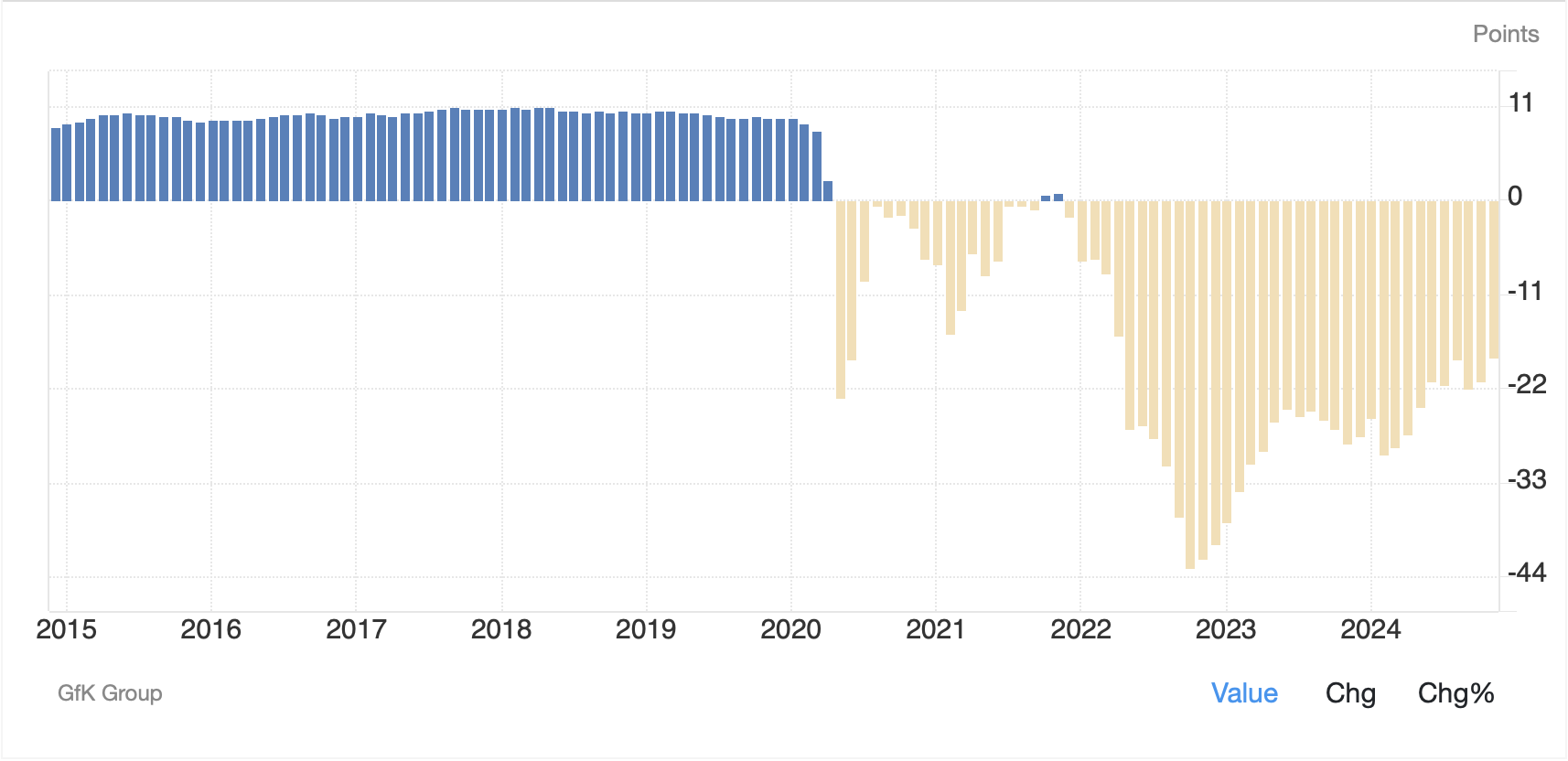
Turning to Europe, the only data of note was the German GfK Consumer Confidence index which rose to -18.3.  While this was better than last month and better than expected, a little perspective is in order.  Here is the series over the past ten years.

Source: tradingeconomics.com

While it seems clear that consumers are feeling a bit more confident than they have in the past year, ever since the pandemic, the German consumer has been one unhappy group!  And the other story from Germany this morning helps explain their unhappiness.  VW is set to close at least 3 factories and reduce wages by 10% as they try to compete more effectively with Chinese EV’s.  I can only imagine how confident that will make the people of Germany!

Now, the interesting thing about confidence is that while it offers a view of the overall sentiment in markets, it doesn’t really correlate to any specific market moves.  For instance, the euro (-0.2%) remains rangebound albeit slightly lower this morning, while the DAX (+0.25%) has actually rallied a bit, although that is likely on the basis of the VW news helping to convince the ECB that they need to cut rates further and faster.  In fact, most European bourses are firmer this morning on the lower rate thesis I believe, although Spain’s IBEX (-0.25%) is lagging after some moderately worse earnings news from local companies.

Turning to the commodities sector, it should be no surprise that they are higher across the board as the combination of proposed Chinese stimulus and potential future inflation in the US based on a possible Trump victory (although there is nothing in the Harris policies that seem likely to reduce inflation) means that commodities remain a favored outlet for investors.  After a couple of days of choppiness, we are seeing oil (+1.2%) rise nicely (perhaps the decline was a bit overdone on position adjustments) and the metals complex rise as well (Au +0.3%, Ag +1.3%, Cu +1.1%) as all three will benefit from all the new spending that is likely to occur in the US as well as China.  

One other thing to note, which disappointed the gold bulls, as well as the dollar bears, is that the BRICS meeting in Kazan, Russia resulted in…nothing at all regarding a new currency to ‘challenge’ the dollar.  Toward the bottom of their proclamation, they indicated they would continue to look for ways to work more closely together, but there is nothing concrete on this subject.  As I have been writing for the past several years, and paraphrasing Mark Twain, rumors of the dollar’s demise have been greatly exaggerated.  So, there will be no BRICS currency backed by gold or anything else, no new payment rails and Treasuries are going to remain the haven asset of choice alongside gold.

As to the dollar vs. its other fiat counterparts, it is a bit stronger this morning alongside US yields (Treasuries +3bps) with even the commodity bloc having difficulty gaining ground.  Of note is USDJPY, which is higher by 0.35% and now firmly above 153.00.  Last night, we did hear our first bout of verbal concern from a MOF spokesman explaining they are watching the yen carefully.  I’m sure they are, but I believe they will be very reluctant to enter the market when US yields are rising, and the BOJ is not keeping pace.  In fact, while the November rate cut is baked in at this point, the probability of the Fed cutting in December continues to slowly decrease (now 71%).  If we see a good NFP number Friday, I would look for that to decrease more rapidly and the dollar to see another leg higher.

And that’s all the market stuff today.  On the data front, Case Shiller Home Prices (exp 5.1%) and the JOLTS Job Openings data (7.99M) are the major releases.  As well, the Treasury is auctioning 7-year Notes this morning after a tepid 2-year auction yesterday.  It is very possible investors are starting to get a bit nervous about the US fiscal situation and if that continues, the irony is that higher yields will beget a higher dollar despite the concerns.

It is difficult to get away from the election impact on markets, and it seems that as momentum for Trump builds, the market is going to continue to push yields and stocks higher with the dollar gaining ground alongside gold.  Go figure.

Good luck

Adf

Pulling All-Nighters

As Harris and Trump try persuading
The voters, the markets keep trading
So, narrative writers
Are pulling all-nighters
To pump up the side that is fading
 
The latest attack is on Trump
Who’s blamed for the bond market slump
But what of the Fed
Whose rate cuts have spread
The fear that inflation will jump?


It appears we have reached the point in time when macroeconomic data is taking a backseat to the political situation.  Almost every story you can read in any of the mainstream media right now is about how the election is going to affect whatever subject an article is about.  The latest discussion, which I have seen across numerous sources like Bloomberg, the WSJ and Reuters, just to name a few, is that the bond markets recent decline is entirely Trump’s fault.  The logic is that as Trump’s election prospects improve, and those of fellow Republicans in both the House and Senate alongside him, the market is suddenly concerned that the government is going to spend a lot of money and run a large deficit.  You can’t make this up!

The federal government deficit under the current administration is pegged to be just shy of $2 trillion this fiscal year, and you have all heard about the fact that interest payments on the government’s nearly $36 trillion of debt have grown to be more than $1 trillion.  But that is not the driver according to the narrative.  The driver is the idea that the Republicans could sweep and that would mean large deficits because…Trump.

Now, I realize I am only an FX guy (FX poet I guess), but my rudimentary understanding of economics is that when economic activity is strong (like the current data implies) and the central bank then adds more liquidity to the system to goose demand, say by cutting interest rates in the front end of the curve, then demand can outstrip supply and prices will rise.  As such, bond investors, when they see a dovish Fed entering an easing cycle while economic activity continues to move along and the government is already running a large fiscal deficit, are concerned over higher inflation ahead and so demand higher yields to own Treasury securities.  Of course, that view doesn’t necessarily suit the narrative so desperately pushed by the mainstream media that Trump is the root of all evil, but it does seem to make more sense.

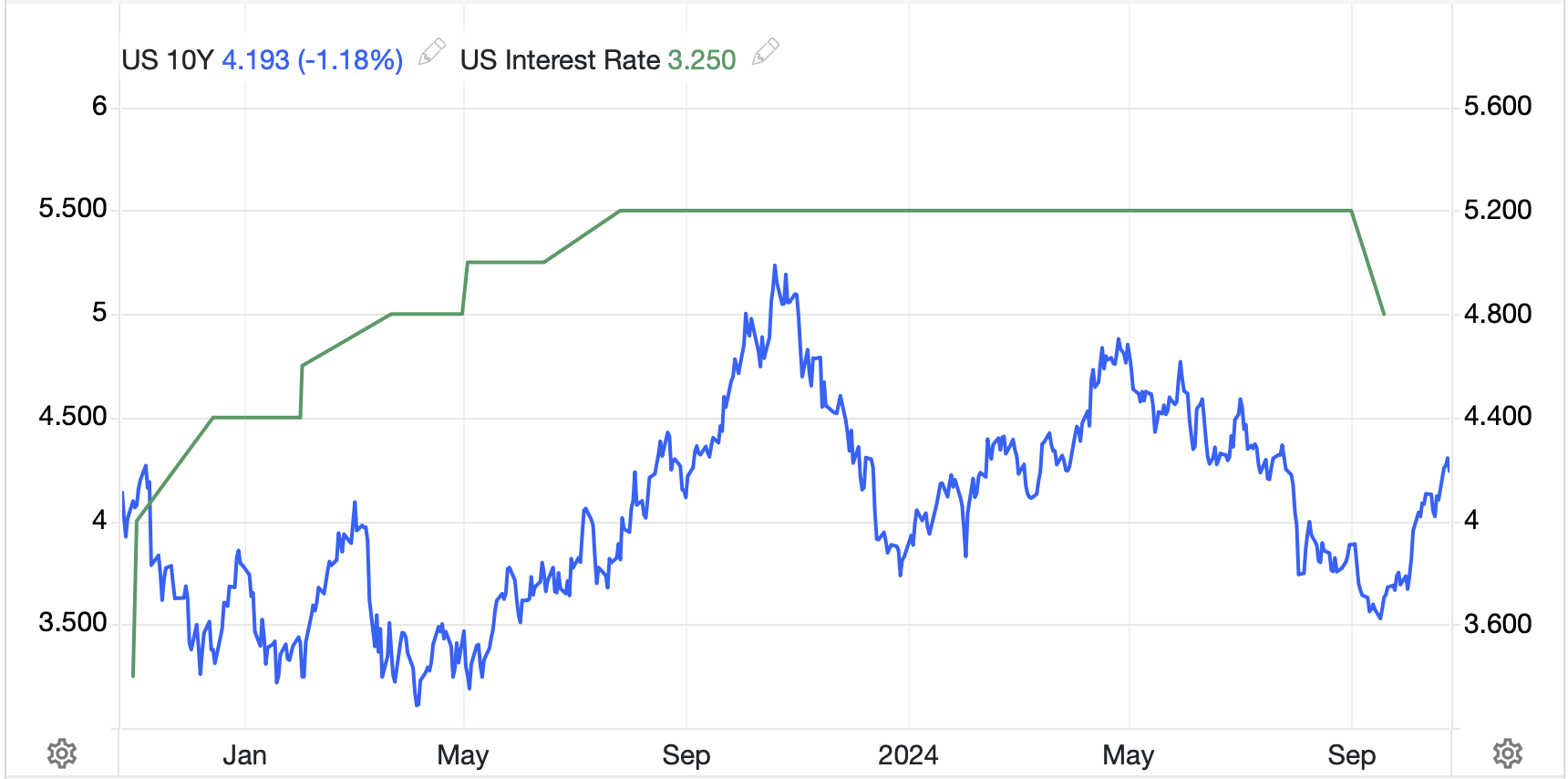
At any rate, for the next two weeks at least, and likely four years if Trump wins, I can assure you that every negative day in any financial market will be blamed on Trump and his policies, despite the fact that the Fed seems to be the one with far more direct impact on short-term economic outcomes.  A look at the below chart, showing 10yr Treasury yields and the Fed funds rate cannot help but show that it was the Fed’s rate cut that is coincident with the recent sharp rise in yields, and this took place long before the odds of a Trump victory improved.  Look through the narrative and instead at the data and Fed activities for the most important clues as to what is actually happening.  I would argue that this is a bond market that is concerned about returning inflation as the Fed’s policy prescription no longer matches the reality on the ground.

Source: tradingeconomics.com

One other thing.  If the Fed does continue to cut rates while US economic data continues to demonstrate solid growth, look for commodity prices to continue their ongoing rally, likely equity markets to continue to perform well, but the dollar is more nuanced as rising inflation ought to undermine the greenback, but given we are seeing more aggressive rate cuts elsewhere in the world (Bank of Canada just cut 50bps this week and the ECB and BOE are going to be cutting again next month), it is entirely possible the dollar holds its own despite macroeconomic fundamentals that should point to weakness.

Ok, let’s see what happened overnight.  Yesterday’s US sell-off, the third consecutive day of broad market weakness, seems to have been sufficient to wash out some of the froth in the market as US futures are pointing higher this morning, especially after Tesla’s better than expected earnings report.  But overnight, the trend from yesterday’s US session was intact with most Asian markets under pressure (Hang Seng -1.3%, CSI 300 -1.1%, KOSPI -0.7%) with only Japan (Nikkei +0.1%) bucking the trend.  In Europe, however, this morning’s color is green with all the major bourses showing life (CAC +0.75%, DAX +0.7%, FTSE 100 +0.5%). Now, there was data released in Europe with the Flash PMI readings out this morning.  The funny thing is that they did not paint a great picture, with continued softness almost everywhere.  My take is Europe is going through a ‘bad news is good’ phase where the weak PMI data implies there will be more aggressive rate cuts by the ECB going forward.  Certainly, Eurozone economic activity, led by Germany’s virtual stagnation, is lackluster at best.

In the bond markets, after several sessions of rising yields, Treasuries have seen yields slip back 5bps this morning with similar declines across the board in European sovereign markets.  Part of this is the weak PMI data I believe, but part of it is a simple trading response to a market that is likely somewhat oversold.  After all, for the past month, bonds have been under significant pressure so a bounce can be no surprise.

In the commodity markets, after yesterday’s rout, where there seemed to be a lot of profit taking of the recent rally, this morning the march higher continues.  Oil (+1.0%) is leading the energy complex higher and the entire metals complex (Au +0.5%, Ag +0.7%, Cu +0.5%, Al +0.9%) is back in gear as all the underlying drivers (rising inflation, solid demand, and for gold, ongoing geopolitical concerns) remain in place.

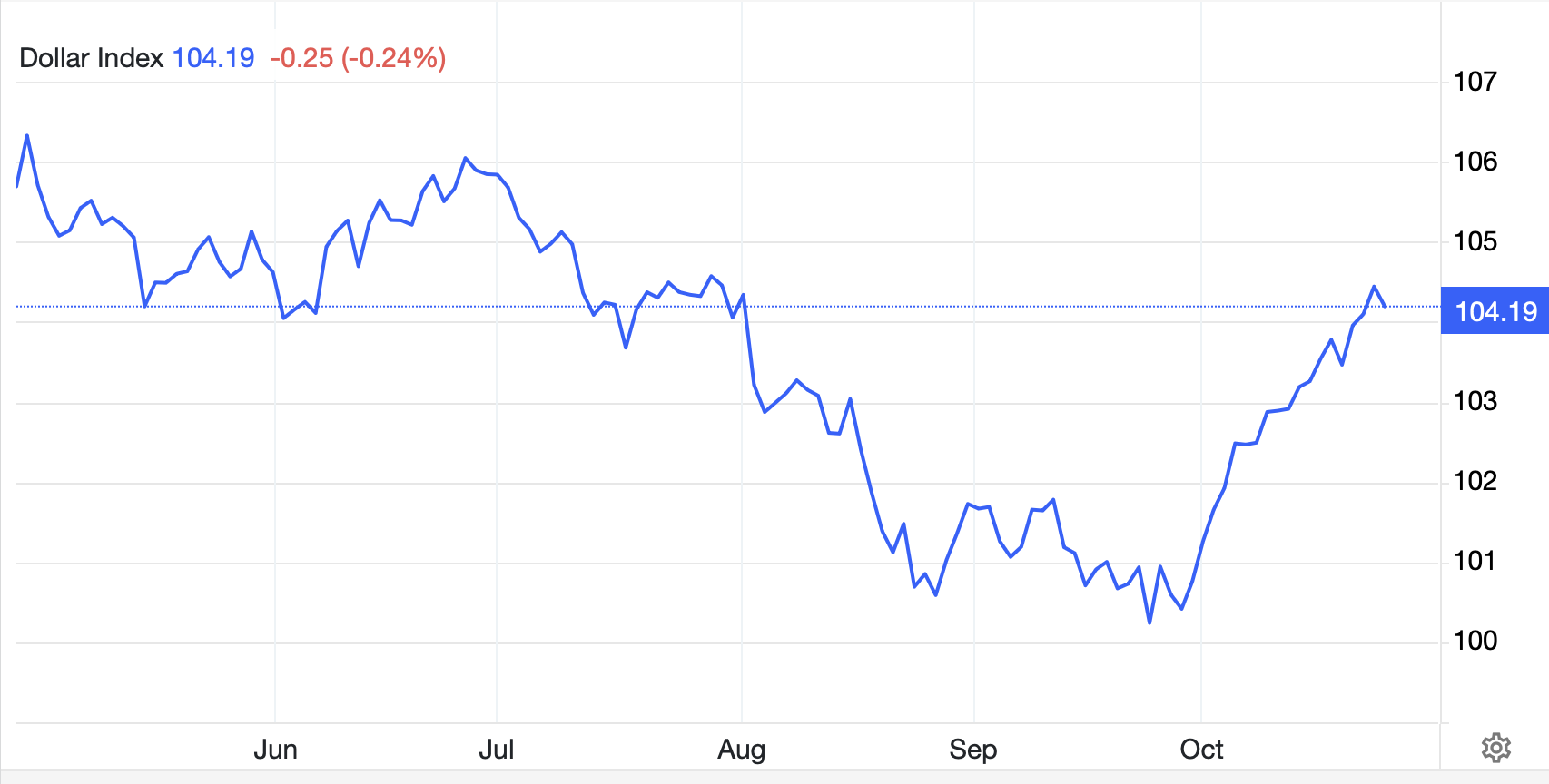
Finally, the dollar is a bit softer this morning, but this too seems like a response to what has been a strong rally.  Once again, using DXY as a proxy (see chart below) for the broad dollar, the rally over the past month has been quite strong, so a day of backing off is to be expected.  As I mentioned above, the future of the dollar is nuanced because while the macro indicators point to potential weakness, if the rest of the world eases monetary policy more aggressively, the dollar will still rally.

Source: tradingeconomics.com

As to today’s movement, currency gains have been between 0.2% and 0.5% with the commodity bloc the biggest beneficiary (ZAR +0.5%, NOK +0.4%, AUD +0.3%) and we have also seen the yen (+0.5%) regain a little of its footing amid declining US yields, although it remains far above the 150 level.  There are those who are looking for another bout of intervention, but I am not in that camp, at least not in the near-term.

On the data front, this morning brings the Chicago Fed National Activity Index (exp 0.2), Initial Claims (242K), Continuing Claims (1880K), Flash PMI (Mfg 47.5, Services 55.0) and New Home Sales (720K).  Yesterday’s Existing Home Sales data was weaker than expected at 3.84M, arguably a testament to the fact that mortgage rates have followed Treasury yields higher and are back above 7.0% again.  On the Fed front, we hear from new Cleveland Fed president Beth Hammack, but it feels like Fed speak is losing some momentum.  Nobody believes that they are going to stop cutting rates, and fewer and fewer analysts think they should continue amid strong growth.  The futures market is now pricing a 95% probability of a November cut but only a 71% probability of a December cut to follow.  I remain in the camp that they pause in December, especially in the event of a Trump victory.

While the dollar is under pressure today, I continue to believe it retains the ‘cleanest shirt in the dirty laundry’ appeal and will ultimately continue to rally.  

Good luck

Adf

Source of Despair

There once was a US VP
Who pined for the presidency
Her views were well-known
But many had shown
The voters could well disagree
 
So last night, amidst great fanfare
She finally took to the air
Disclaimed all her views
And thought to accuse
The Right as the source of despair
 
The reason for pointing this out
Is many are starting to doubt
If she wins the race
That she won’t debase
The buck, which could head for a rout


While this poet is always reluctant to discuss politics in the morning, sometimes that is the story that is driving the discussion.  Today, that is the case in the wake of VP Harris’s first interview of her presidential campaign.  One of the major complaints about her campaign was she had ostensibly changed many long-held views by 180° without explanation.  This was supposed to be rectified in the interview.  It should be no surprise that her supporters claim she did just that swimmingly while her detractors feel they know nothing more this morning than they did before the interview aired.

For instance, a key question is about energy markets, specifically fracking.  From a market perspective, if a President Harris were indeed to ban fracking, her long-standing view, oil prices would surge dramatically given that somewhere around 6mm-7mm barrels per day are pumped using this method.  At the margin, removing 6% of supply in the oil market could easily double the price given the relative inelasticity of demand as per the chart below.

My take is that would be quite destructive to the economy, dramatically reducing growth while raising inflation substantially.  My point is these policy pronouncements matter, and market participants know that.  Now, based on the price behavior of oil (unchanged today) and still trading in the middle of its recent year-long trading range, it is clear the market is not too concerned about that outcome.  Whether that is because the market is betting on a Trump victory or the market is betting that she will not be able to withstand the political pain of higher gasoline prices that would come with a dramatic reduction in US oil production, I have no idea.  

I am merely highlighting that the consequences for the economy and markets are very large depending on the outcome of the upcoming presidential election here.  And those consequences will be felt worldwide.  Were the US to decide to cede its energy status, it would be quite easy to see the dollar fall substantially in value as capital seeks a safer home elsewhere or simply because there would be less demand for dollars to pay for oil.  It would be quite easy to see bond yields rise as investors seek alternatives or demand higher yields to hold US paper.  These outcomes are not guaranteed, they are merely one direction in which things could turn.  

Remarkably, away from that story, there is precious little else of note ongoing as we await this morning’s PCE release.  It’s not that there wasn’t other data, there was, but the outcomes were close enough to expectations to result in limited movement.

For instance, last night Japanese data showed a modest rise in the Unemployment Rate to 2.7% as well as a rise in Tokyo CPI (2.6%, 2.4% core, 1.6% super core) with all three readings higher than last month.  Meanwhile, both Korean and Japanese IP were soft.  But none of that fazed markets as we saw gains in both the Nikkei (+0.75%) and KOSPI (+0.45%) while the yen (-0.25%) and won (0.0%) really did very little nor did JGB yields move.

Meanwhile, this morning there was a raft of European data with inflation readings from both France (1.9%) and Italy (1.1%) helping to complete the Eurozone composite rate (2.2%).  These readings follow Germany’s lower than expected 1.9% yesterday and seem to cement a 25bp cut by the ECB next month.  Alas for the French, GDP continues to underperform with Q2 printing at 0.2% M/M, 1.0% Y/Y, helping to boost the case for a rate cut.  The market response here has been more focused on the potential for cuts than the lackluster economic performance as equity markets are higher throughout Europe (DAX +0.2%, CAC +0.4%, IBEX +0.6%) and the UK (+0.3%).

Perhaps more interesting is the fact that UK economic data continues to outperform the continent with the most recent data showing the housing market there remains solid, at least based on new mortgage approvals and mortgage lending data.  This dichotomy is most evident in the EURGBP exchange rate which has moved sharply in the favor of the pound, more than 2.5%, over the past three weeks, after the BOE cut rates at their last meeting but in a very close 5/4 vote indicating that concerns over inflation remain, and future cuts are not baked in.

Source: tradingeconomics.com

And I feel that really sums up the overnight discussions.  In other markets of note, Chinese shares (CSI 300 + 1.3%) finally got off the schneid and had their first up day in a week.  Too, the Hang Seng (+1.1%) rallied alongside.  As to US futures, ahead of the PCE all three major indices are seeing futures higher following yesterday’s gains.

In the bond market, Treasuries are unchanged this morning and European sovereign yields are lower by 1bp across the board.  Clearly, there is little concern of either a collapse in Europe, nor a runaway higher in activity.  And that 25bp cut is baked in at this point.

In the commodity markets, as mentioned above, oil prices are unchanged awaiting the next shoe to drop, which in the metals markets, gold (0.0%) is unchanged, holding its recent gains while both silver (+0.5%) and copper (+1.0%) rebound further from some weakness earlier in the week.  

Finally, the dollar continues its mixed performance, with a number of the high yielding EMG currencies showing strength this morning (MXN +0.9%, ZAR +0.7%, BRL +0.6%) as the belief in the market is that the Fed will not only cut in September but will continue to do so going forward.  However, in the G10 bloc, the movement has been far less significant with only the yen moving more than 0.2%.  in my opinion, this is due to a combination of curiousity about the data this morning and the fact that it is the Friday of a holiday weekend in the US, hence most desks are lightly staffed.

As to that data, we see Personal Income (exp 0.2%), Personal Spending (0.5%) and PCE (0.2%, 2.6% Y/Y) along with Core PCE (0.2%, 2.7% Y/Y).  Later this morning we get Chicago PMI (45.5) and Michigan Consumer Sentiment (68.0).  Yesterday’s Claims data was on the button and the GDP data was actually revised higher to 3.0% in a surprise.  Once again, it remains difficult for me to understand the idea that the Fed needs to cut rates aggressively given the economy seems to be working well, at least based on the data the Fed discusses with us.  And yet, the market is still pricing in a one-third probability of a 50bp cut next month.

Putting it all together, while I believe the Fed is more focused on unemployment than inflation, as they have basically claimed victory over the latter, if we see a soft reading this morning, I suspect the market will price a greater probability of a 50bp cut and the dollar will suffer while stocks and bonds rally.  But a strong reading will not have the opposite effect as the focus will be on next week’s unemployment data.

Good luck and good weekend

Adf