
More Drear

While many, last night, were dismayed
By Jensens’s results as displayed
Most markets worldwide
Absorbed them in stride
As buyers keep up their crusade
 
Meanwhile, Europeans still fear
That things won’t get better this year
The war in Ukraine
Is at it again
While sentiment points to more drear


Please understand, I only write about Nvidia because it is topic number one in the markets overall, albeit not very important in FX for now.  So, briefly, despite record revenues and earnings, the numbers were slightly below expectations, and the immediate result was for the share price to decline about 3% or so.  As I type this morning, though, it has already begun to recoup some of those losses and while there are many commentators claiming this was a disaster and forecasts are unrealistic, my sense is the company is going to continue to churn out chips and profits.  I read that their gross margins are 72%, a remarkably high number.  In the end, it is hard for me to look at these results and think the end is nigh.  So, let’s move on.

A moment, first, to remember the tragedy in Minneapolis where two children were killed in a church shooting on the first day of school there as well as the increase in hostilities in Ukraine where last night Russia launched a massive aerial attack on Kyiv, sending 629 missiles and drones of which 40 got through and 14 were killed along with 38 injured.  At this time, it certainly doesn’t look like hostilities in Ukraine are about to end and I think it is fair to say that the only one seeking that result is President Trump.  Clearly Putin is determined to conquer Ukraine, clearly Zelenskiy is determined to resist and apparently the entire EU wants to continue the fight regardless of the costs.

My sense is the problem for Europe is that it is a theoretical construct, not a nation.  As such, it cannot make decisions on a timely basis as a group.  So, while some want to rearm and fight, others are reluctant to do so and would rather free ride.  This lack of cohesion makes the EU a very unstable partner and will hinder their efforts to do more than continue to shovel money to Zelenskiy and Ukraine.  The war has been ongoing for more than three years and I have become of the opinion that it will not end until one side runs out of resources.  Ukraine’s attacks on Russia’s oil infrastructure are starting to have an impact, but it remains to be seen if they can keep those up while Russia continues to bombard population centers.

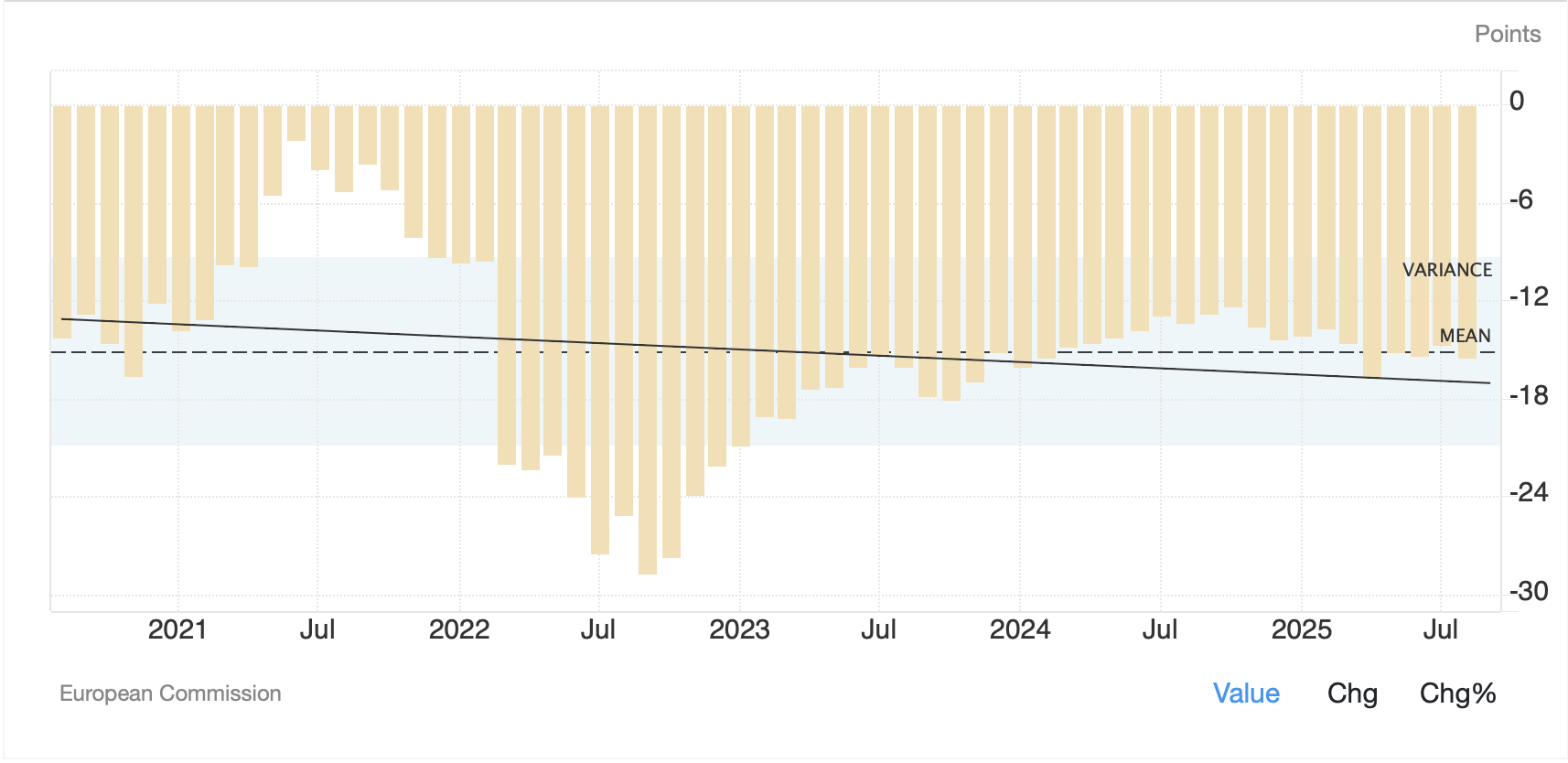
With that as backdrop, perhaps we should not be surprised that the data released this morning from the Eurozone showed Confidence and Sentiment indicators for both businesses and consumers falling compared to last month and relative to expectations.  Looking at the data from tradingeconomics.com, you can see that the August results were worse for everything with confidence falling but concerns over inflation rising.

                                                                                                             Actual          Previous            Estimate

While these numbers are not devastating in themselves, the trend is not positive.  Selecting just one, Consumer Confidence in this case, you can see that while not the worst it has been over the past 5 years (the initial invasion of Ukraine marked the nadir), the trend is not very friendly.  And pretty much all the charts are the same, not the worst but trending the wrong way.
Source: tradingeconomics.com

I make these points because I continue to read about negative sentiment regarding US assets and the dollar, and yet I cannot help but look at the Eurozone and see a negative situation.  I agree that if the Fed starts to get aggressive cutting rates, which seems unlikely as long as Powell remains Chair, the dollar will fall, but is Europe really where you want to be?  I’m not convinced.

Away from that, not much else has been happening (it is the last week of August, and it appears almost everyone is on holiday) so let’s look at overnight price action.  Leading up to the Nvidia earnings, equities in the US rallied, and despite the Nvidia disappointment, futures are currently (7:15) unchanged across the board.  Last night in Asia, China (+1.8%) was the leader, reversing yesterday’s declines with the talk of the town still AI and China’s new AI Plus strategy.  Meanwhile, the Hang Seng (-0.8%) disagreed with the mainland although there was no separate news.  Tokyo (+0.7%) was solid, but elsewhere in the region there were more laggards (India, Taiwan, Philippines) than winners (Korea, Australia) with the winners just barely so.

With that Eurozone data, you will not be surprised that European shares are generally softer, with the major bourses lower by between -0.2% and -0.4% and only the CAC (+0.1%) bucking the trend.  Perhaps this is because the French FinMin, Eric Lombard, claimed France would be able to pay its bills although it seems clear the current government is going to fall when the confidence vote is held on September 8th.

In the bond market, 10-year Treasury yields are unchanged this morning and edging toward the lower end of their recent trading range, with no indication that there is a funding problem for the US.  However, it is worth noting that the yield curve is steepening in the US (and everywhere else) as the 2yr-30yr spread is now 128bps and as you can see from the chart below, that spread has been widening all since July. (30yr yields are in green and the LHS Y-axis).

Source: tradingeconomics.com

When the yield curve inverted back in 2020, there was much talk of its prowess as a prognosticator of coming recessions.  However, we are still awaiting that recession.  In fact, I believe history shows it is when the curve steepens sharply that more problems occur.  It is easy to look at this and see the market is expecting inflation to continue to rise especially given the Fed seems to have put inflation in the back seat of their mandate.  Beware!

In commodities, oil (-0.1%) is stabilizing after a solid rally yesterday as the EIA data was a somewhat larger draw on inventories than expected and perhaps Ukraine’s recent successes regarding attacks on Russian oil infrastructure has some folks concerned.  However, as my friend JJ who writes Market Vibes notes, open interest is declining fast, and activity remains very slow in the space.  At the same time, gold (+0.3%) rallied all day yesterday and is continuing this morning and dragging silver (+1.1%) along for the ride.  Spot gold is back above $3400/oz, a level that had seemed toppish for quite a while.  Perhaps this is the long-awaited break higher the gold bugs have been talking about, but I think we need to see another $100/oz to make that commitment and that likely would entail a much weaker dollar, something that has not yet been happening.

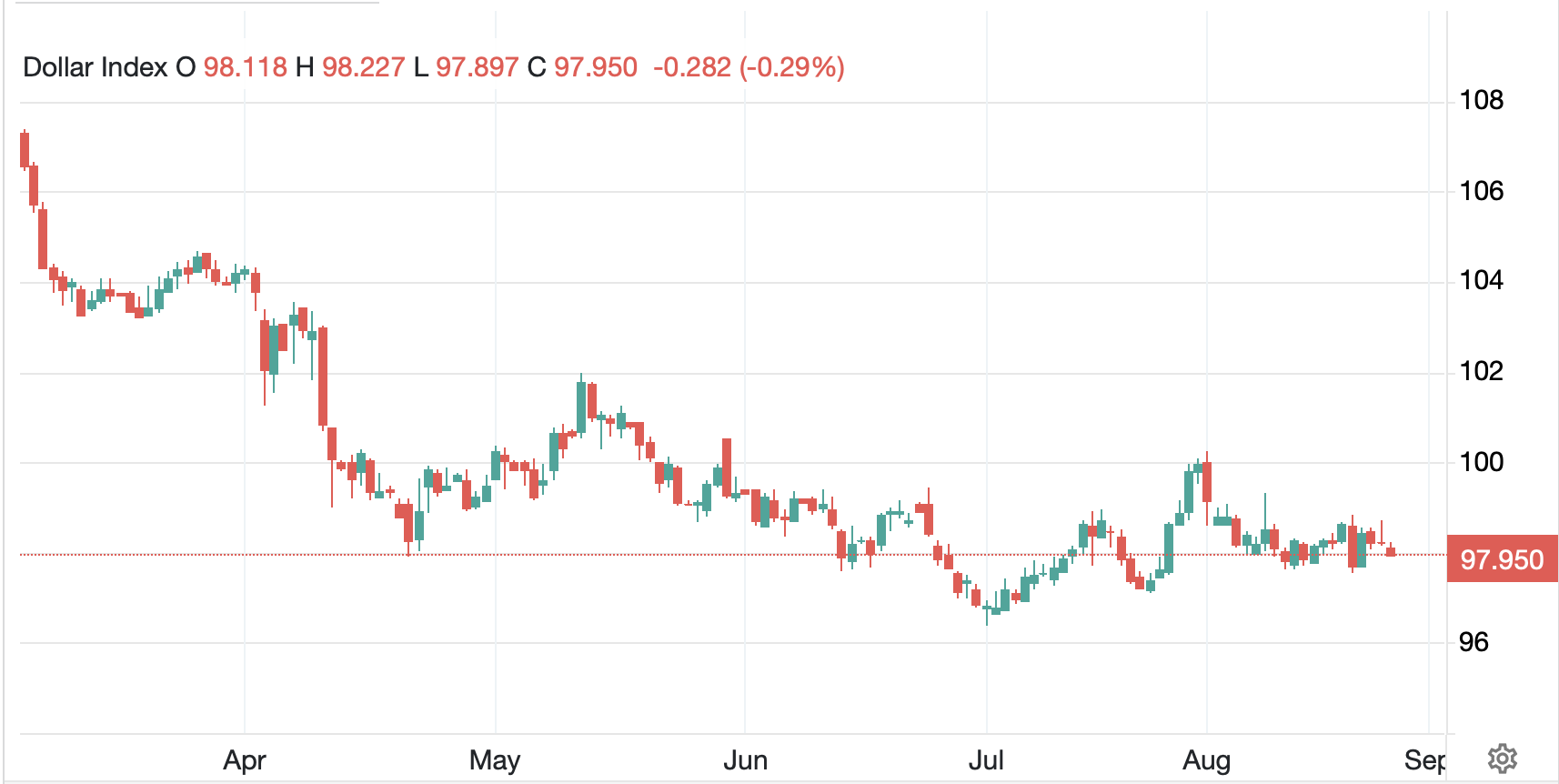
Turning to the dollar, while it is a touch softer this morning, -0.3% as per the DXY, if you look at the chart below (which resembles so many charts these days) since the post-Liberation Day volatility, it is hard to get excited about a move in either direction.  We will need a new out of the box catalyst and I just don’t know what that will be.
Source: tradingeconomics.com

While the dollar’s weakness this morning is universal, the biggest mover overnight was KRW (+0.6%) which rallied after BOK governor Rhee defended their intervention, even indicating it is part of the trade deal with the US.  Otherwise, 0.1% to 0.3% describes the entire slate of currency gains vs. the greenback.

We get some real data this morning as follows: Initial (exp 230K) and Continuing (1970K) Claims; Q2 GDP (3.1%); Q2 Real Consumer Spending (1.4%); and Q2 GDP Sales (6.3%), although this is the second look at all these numbers.  Tomorrow’s Personal Income and Spending as well as PCE data will be far more interesting.  We hear from Governor Waller as well, but we already know his views are to cut right away.

It is difficult to get too excited about much these days and there are valid arguments for movement in most markets in both directions (remember the idea that the goods and services economies are out of sync).  Net, until it is clear the Fed is going to cut aggressively, assuming that happens, the dollar is likely to drift.

Good luck

Adf

Not in a Hurry

Said Powell, we’re not in a hurry
To cut after last year’s late flurry
Instead, wait and see
Is likely to be
The future lest ‘flation hawks worry


The opening paragraph of the FOMC Statement was concise as they acknowledge that things aren’t too bad right now.  “Recent indicators suggest that economic activity has continued to expand at a solid pace. The unemployment rate has stabilized at a low level in recent months, and labor market conditions remain solid. Inflation remains somewhat elevated.”  

Of course, that didn’t stop Chairman Powell from still describing rates as restrictive or “meaningfully above” the neutral rate, although in fairness, he did explain “We do not need to be in a hurry to adjust our policy stance.”  When asked about the impact of President Trump’s mooted policies regarding tariffs and trade, he explained, “The committee is very much in the mode of waiting to see what policies are enacted. We need to let those policies be articulated before we can even begin to make a plausible assessment of what their implications for the economy will be.”

In the end, I don’t believe very much changed with respect to expectations for the Fed with the futures market still pricing in a total of 46 basis points of cuts for the rest of the year with just an 18% probability of a cut in March.  Certainly, nothing we heard or saw today changed my view of rates remaining here and potentially going higher before the end of 2025.  But for now, I don’t think there is much else to say on the subject.

In Europe, the data was bleak
As growth there remains awful weak
Today they’ll cut rates
And on future dates
A base rate much lower they’ll seek

As we await the ECB’s meeting announcement later this morning, where Madame Lagarde is virtually certain to cut their interest rate structure by 25bps, we were entertained by GDP data from the Eurozone as well as several of its members.  The numbers were disappointing even compared to weak forecasts.  For instance, in Q4, France (-0.1%) and Germany (-0.2%) both saw declining activity while Italy (0.0%) managed to not fall.  Not surprisingly, the Eurozone, as a whole, also saw a result of 0.0% GDP growth in Q4.  In every case, the annual number is below 1.0%.  Of course, if just looking at this data, it would be easy to say the ECB needs to cut rates further.  However, inflation remains uncomfortably higher than target and as evidenced by Spanish data this morning, showing it rose to 3.0% Y/Y in January, Madame Lagarde cannot ignore the sole ECB mandate of stable prices at 2.0%.

Under the rubric a picture is worth a thousand words, I think the chart below of quarterly GDP activity in Germany and the Eurozone speak volumes of how things are progressing on the continent. 

Source: tradingeconomics.com

The current policy mix in Europe is clearly not getting the job done, assuming the job is to grow the economy in a non-inflationary manner.  While the ECB can continue to cut rates in their effort to support growth, the problems on the continent have far more to do with energy policy than anything else.  The focus on ending the use of fossil fuels has resulted in the highest energy costs of any region which has led to the steady deindustrialization of the continent.  It doesn’t really matter where interest rates are if companies cannot power their operations and that is the crux of the ECB’s problems.  No matter what Lagarde and her friends do, it cannot reverse this decline.  If you were wondering why so many, including this poet, are negative on the euro’s prospects going forward, this is it in a nutshell.

Ok, let’s turn to the overnight market activity.  First, a moment’s thought for the tragedy that took place in Washington DC last night where a commuter jet collided with a military helicopter near Reagan National Airport.  As I write, it is not known how many fatalities occurred, but the word is there were 60 passengers plus crew on board the plane and 4 on the helicopter.

Yesterday’s US session was less positive than many had hoped with the specter of DeepSeek still haunting many investors but the situation in Asia was a bit more upbeat with the Nikkei (+0.25%) and Australia (+0.55%) both showing gains.  I read an entire X post as to why the next Chinese stimulus package was really going to change things and support the economy there although I continue to remain skeptical. (As an aside, it is Chinese New Year, the year of the snake, so markets in China and Hong Kong are closed for a few days.). Meanwhile, in Europe, all markets are higher as traders anticipate not only today’s ECB rate cut, but clearly more in the future as economic activity continues to wane.  So, gains across the board of between 0.35% (DAX) and 0.7% (IBEX).  US futures, too, are higher this morning, up by 0.4% at this hour (6:50).

In the bond market, yields are sliding as Treasuries (-3bps) are sitting right on 4.50% after Chairman Powell seemed to indicate they actually do care about inflation.  Meanwhile, European sovereign yields are all lower by between -6bps and -7bps ahead of the ECB announcement and responding to the weak GDP data.  Clearly, investors on the continent are convinced there are more rate cuts coming.  On the other side of that rate coin, JGB’s saw yields climb 2bps as Deputy BOJ Governor Himino indicated that further rate hikes would be appropriate given Japanese real interest rates remain negative.  Not only did that support JGB yields, but the yen (+0.5%) was also a beneficiary.  Finally, I would be remiss to ignore the Brazilian central bank, which hiked rates 100bps last night, taking their SELIC rate to 13.25%!  (And equity investors in the US complain rates are too high!)

In the commodity space, oil (-0.1%) is little changed this morning although remains near the bottom of its recent trading range.  There is so much discussion regarding what will happen here, whether Trump will be able to encourage more drilling in the US, how OPEC is going to respond to both Trump and the market, and what is going to happen in the Russia/Ukraine war, that it is very difficult to get a good handle on things.  Nothing has changed my long-term view that there is plenty of oil around and it is a political decision, not a technical nor geological one, that will determine the price.  As to metals markets, gold (+0.65%) continues to perform well and edges closer to the all-time high levels reached back in late October.  There is much discussion about the arbitrage between COMEX and LME gold with many deliveries apparently due in NY and not enough 100toz bars available.  This may be driving prices higher as those with short positions scramble to either roll their positions are get ready for delivery.  As to silver (+0.4%) and copper (+0.2%), they are both along for the ride.

Finally, the dollar is mixed this morning as while it is modestly stronger vs. some G10 counterparts (EUR -0.2%, SEK -0.2%), the yen’s strength is moderating the overall movement.  Versus its EMG counterparts, BRL (-0.8%) is the most notable mover as traders take profit after the BCB’s rate hike last night.  It was widely assumed to occur and real rates in Brazil are now nearly 9%, a very attractive level that has helped the currency appreciate more than 6% in the past month.  However, elsewhere, the movement is basically random.

On the data front, aside from the ECB rate decision, we see the weekly Initial (exp 220K) and Continuing (1890K) Claims data and the first look at Q4 GDP (exp 2.6%). Yesterday’s Goods Trade Balance was a record deficit of -$122.1 Billion as it appears many companies were ordering stuff to get ahead of the threatened tariffs.  Also, yesterday the BOC cut rates by 25bps, as widely expected, but nobody really noticed.  With the Fed sidelined for now, I suspect that we will continue to follow the equity stories more closely than the macro ones, although we do see PCE tomorrow, so a big surprise there could certainly impact the narrative.  But for now, it remains difficult to be too bearish the dollar.

Good luck

Adf

Another Mistake

Said Janet, we need to watch out
‘Cause bank fraud is starting to sprout
So maybe I’ll make
Another mistake
And drive banking stocks to a rout


I absolutely agree with the premise — which is that fraud is becoming a huge problem.”  These sage wordsfrom our esteemed Treasury Secretary have made headlines and also raised some alarms.  After all, was not Madam Yellen in charge of bank regulation not that long ago?  Did she not receive millions of dollars in speaking fees from those same banks before being named Treasury Secretary?  It is difficult to listen to the recent change in tone without considering the fact that she is concerned if the election results in a Trump victory, her time at Treasury may come under deeper scrutiny so she is starting to spill a few beans to show she was on the ball.

But arguably, the biggest issue is not that fraud is rampant in banking, with action around government checks being the most fertile area, the biggest issue remains the nonstop borrowing that continues as the US government debt continues to grow aggressively each day.  There have been several recent commentaries by some very smart guys, Luke Gromen and Bob Elliott,  regarding the coincidence of rising interest rates in the US and almost every other G10 economy despite significant differences regarding the economic situation and borrowing patterns.  One conclusion is that owning government debt from any western government, at least debt with any significant duration, is losing its luster quickly.  This is a valid explanation of why yields continue to rise despite the Fed’s, and other central banks’, recent rate cuts.  

Of course, there is another popular explanation about the recent rise in yields; the prospects of a Trump victory and corresponding sweep in the House and Senate is seen as growing substantially.  The thesis is that if that is the outcome, the budget deficit will grow even larger as the tax cuts due to expire next year will very likely be rolled over, and there is no indication there will be a reduction in spending (the Republicans merely have different spending priorities).  Hence, deficits will continue to grow, Treasury debt will continue to increase, and yields will increase as well.  At least, that’s the thesis.

One thing which is undoubtedly true is that if there is an increase in volatility in government bond markets, the dollar is going to be one of the beneficiaries.  Keep that in mind going forward.

Though views about Europe were dire
Today, GDP printed higher
While Italy sank
They’ve Germans to thank
For being the major highflier

The other story of note this morning is the Eurozone GDP report alongside GDP readings from several key nations.  At the Eurozone level, GDP surprised everyone with a 0.4% Q/Q print and a 0.9% Y/Y print, higher than the 0.2%/0.8% expectations.  Now, in the big scheme of things, those numbers are not that great, but better than expected is certainly worth something.  Germany was the key driver as they avoided a technical recession by growing 0.2% in Q3.  What is little noted is that Q2’s data was revised lower from -0.1% to -0.3%, so it is fair to say that things have not been great there.  In fact, below is a chart of the past 5 years’ worth of quarterly results in Germany and you can see that the concept of a growth impulse there, at least since the beginning of 2022, has largely been absent.

Source: tradingeconomics.com

Another telling sign that the headline may not be a true reflection of the situation on the ground there is that the Eurozone also released a series of sentiment indicators, almost all of which were weaker than expected, notably Economic Sentiment (95.6 vs. 96.3 last month and expected) and Industrial Sentiment (-13.0 vs. -11.0 last month and -10.5 expected).  Apparently, the growth was the product of greater than expected government spending, not really the best way to grow your economy.  However, the market did respond by pushing the euro (+0.15%) a bit higher although the recent downtrend remains in place as evidenced by the below chart.  It remains difficult to get too excited about the single currency given the growing divergence in views on the Fed and ECB, with the former being questioned about its policy easing while the latter is being called on to do more.

Source: tradingeconomics.com

And that was really the macro news for the evening so let’s see how markets overall behaved.  Yesterday’s mixed US session was followed by similar price action in Asia with the Nikkei (+1.0%) continuing its recent rally as the market gets comfortable with PM Ishiba putting together a minority government while Chinese shares (CSI 300 -0.9%, Hang Seng -1.55%) suffered as hopes for the ‘bazooka’ stimulus faded, at least temporarily.  As to the rest of the region, almost all the stock markets declined on the evening.  That negative price action is evident in Europe as well this morning with every major market in the red (CAC -1.4%, DAX -0.8%, IBEX -0.6%) as the better than expected GDP figures don’t seem to have been that enticing for investors.  In the UK, too, stocks are softer (FTSE 100 -0.3%), although there has been no data released.  The big story there today is the budget release upcoming with most pundits looking for a lot of smoke and mirrors and no progress on spending stability.  Meanwhile, US futures are a bit firmer this morning after solid earnings from Google after the close yesterday.

In the bond market, yields have backed off from their recent highs with Treasuries (-4bps) falling after yesterday’s 4bp decline.  Yesterday’s US data was a bit softer than expected (Goods Trade Deficit fell to -$108.23B, much larger than expected while the JOLTS data (7.44M) fell to its lowest level since January 2021 and indicates a rough balance in the jobs market.  As discussed above, European yields are following Treasuries lower with declines on the order of -3bps across the major economies with only Italy (+1bp) the outlier on higher than expected CPI readings.  Meanwhile, UK Gilts (-10bps) are the real outlier as bond investors seem intrigued over the potential budget.

In the commodity space, oil (+1.3%) is bouncing a bit although remains well below the $70/bbl level.  It appears that the worst is over for now and a choppy market is in our immediate future pending the election outcome.  Consider that if Trump wins, given his ‘drill, baby, drill’ plank in the platform, it is likely that oil will slide on the news while a Harris win is likely to see prices rise on the fear of a fracking ban.  Gold (+0.2%) continues its steady march higher with investors abandoning bonds and looking for a haven, although the other metals (silver -1.1%, copper -0.6%) are suffering this morning on the softer economic data.

Finally, the dollar is under very modest pressure this morning but remains at the high end of its recent trading range.  JPY (+0.25%) has managed a modest rally ahead of tomorrow’s BOJ meeting but we have seen a mixed picture overall with some gainers (AUD, NZD, KRW) and some laggards (SEK, GBP, HUF).  Ahead of the election, I continue to expect choppiness and a lack of direction but once that is complete, as I have said before, market volatility in other markets is likely to lead to a stronger dollar.

On the data front today, we start with ADP Employment (exp 115K) and then see the first look at Q3 GDP (3.0%) along with a key subcomponent of Real Consumer Spending (3.0%).  We also see the Treasury Refunding Announcement, with not nearly as much press given to this as today as we had seen over the past several quarters.  Expectations are running for no large increases although given the budget deficit continues to widen, I’m not sure how that math works.  Lastly, we see oil inventories where a modest build is anticipated.

While the election continues to dominate the discussion, we cannot ignore this data or what is to come tomorrow and Friday, as the Fed will not be ignoring it.  We will need to see a spate of much weaker data to change my long-held view that the dollar has further to climb, so let’s watch and wait.

Good luck

Adf

Harshly Depressed

The Payrolls report was a test
That Rorschach would clearly have blessed
The bears saw the data
As proof that the rate-a
Of growth would be harshly depressed
 
The bulls, though saw only the best
Of times and, their narrative, pressed
In their point of view
The Fed will come through
And stick the soft landing unstressed


With the Fed now in its quiet period, the market is trying to come to grips with what to expect going forward.  But before we look there, a quick recap of Friday’s NFP report, dubbed ‘the most important of all time’ by some hysterics, is in order.  By now you almost certainly know that the headline number was modestly weaker than expected, but that the revisions lower in the previous two months weighed on the report.  However, the Unemployment Rate ticked lower to 4.2% and wage growth edged higher by 0.1%.  Perhaps one of the worst pieces of the report was that the Manufacturing payrolls declined by -24K, the second worst outcome in the past 3 years, and hardly a sign of a strong economy.

The point is that depending on one’s underlying predispositions, it would be easy to come away with either a hopeful or dreary perspective after that report.  And, in fact, I would argue that the report changed exactly zero minds as to how the future is going to evolve, at least in the analyst community.  The biggest sentiment change came in the Fed funds futures markets where the probability of a 50bp cut next week fell to just 25%.  You may recall that particular probability has ranged from one-third up to one-half and now down to one-quarter just over the past week.  I think that is an excellent metaphor regarding both the uncertainty and the confidence in the economy’s growth and the Fed’s likely moves.  In other words, nobody has a clue (this poet included.)

One other observation is that reading headlines from various financial writers and publications shows that the world is still virtually split 50:50 on whether we are going to see a recession (with some calling for stagflation) or the Fed is going to stick the soft landing.  FWIW, which is probably not that much, my personal view is the recession is still going to arrive, but given how aggressively the government continues to spend money, we may need to redefine the concept of recession.  Consider if we look at only the private-sector and whether it is in recession and if that is enough to drag the overall economy, including the government spending, down with it.  In fact, given the 6+% deficits that the government is running, it may be realistic to consider this is exactly what is ongoing right now, although not to the extent that the totality of the economy is sinking.

Now that I’ve cleared that up 🤣, let’s look at how markets have been processing the NFP report and what we might expect going forward.  I’m sure you all know how poorly equity markets behaved on Friday, with US markets falling sharply led by the NASDAQ.  That negativity flowed into the Asian session with the Nikkei (-0.5%), Hang Seng (-1.4%) and CSI 300 (-1.2%) all under pressure.  While the Chinese data overnight, showing inflation rising slightly less than expected at 0.6% Y/Y while PPI there fell more than expected at -1.8%, continues to show that the Chinese economy is faltering and there is still no fiscal stimulus on the way, the Japanese data was generally solid with GDP growing 0.7% Q/Q, much higher than Q1 although a tick lower than the initial estimate.  The upshot is there is further slowing in China while Japan is rebounding.  I guess the question is why would both nations’ equity markets decline.  Arguably, the Chinese story is one of lost hope that the economy will be able to rebound in any timely fashion from an investor’s perspective while the Japanese story is that given the rebound in growth, the BOJ is far more likely to continue on the policy tightening path, thus undermining Japanese corporate earnings.

There once was a banker from Rome
Whose tenure preceded Jerome
“Whatever it takes”
Prevented the breaks
In Europe that would have hit home
 
But now he’s an eminence grise
Who answered the Eurozone’s pleas
To write a report
And help to exhort
Investment to beat the Chinese

But that was the Asian story.  In Europe, the story is far more optimistic with gains across the board on the order of 0.6% – 0.8% on all the major bourses.  The big news here is that Mario Draghi, he of “whatever it takes” fame from his time as President of the ECB and his famous comments that save the Eurozone and the euro back in 2012, was asked to evaluate the Eurozone and help come up with a plan to shake the economy from its current lethargy.  As a true technocrat, his view was that more government investment in key areas was critical.  On the positive side, he did suggest a reduction in regulations, although that really goes against the grain in Europe.  However, it appears that equity investors viewed the report positively as there has been no data or other commentary that might have catalyzed a rally there.  As to US futures, they are bouncing this morning after a rough week last week, with all three major indices higher by at least 0.6% at this hour (6:45).

In the bond market, after a week when yields fell around the world, we are seeing a bounce this morning everywhere.  Treasury yields (+4bps) are actually the laggard with European sovereigns all rising between 6pbs and 7bps and even JGB yields jumping 5bps overnight.  Of course, the Japan story is the solid growth numbers encouraging the belief that Ueda-san will raise rates again by December, while the European story is a combination of expectations of more European debt issuance (Draghi called for more European debt, rather than individual national debt) as well as the influence of Treasury yields.

In the commodity markets, oil (+0.8%) is bouncing this morning but remains well below $70/bbl and this looks far more like a trading bounce than a change in perspective.  The weak Chinese economic data continues to weigh on this market and if OPEC changes its stance and decides to restart production again later this year, it does appear that we could have a move much lower still.  As to the metals markets, they are firmer this morning although that is a bit surprising given the generally weak economic sentiment and the fact that the dollar is following yields higher.  Perhaps the biggest surprise is copper (+1.9%) which based on everything else, should be falling today.  Once again, markets are not mechanical and things occur, about which very few know, but have big consequences.

Finally, the dollar is much stronger this morning with the DXY (+0.5%) rejecting the push lower, at least for now.  This strength is broad-based with NOK (-1.1%) and JPY (-1.0%) the worst performers in the G10 despite the higher oil price and growing confidence that the BOJ will raise rates again.  But every G10 currency is weaker as are virtually every EMG currency with only MXN (+0.4%) bucking the trend, although that seems more of a trading response to the fact that the peso fell through 20.00 (dollar rose) for the first time in nearly two years on Friday.

As to the data this week, CPI is the biggest US number although we also hear from the ECB on Thursday.

WednesdayCPI0.2% M/M (2.6% Y/Y)
 -ex food & energy0.2% M/M (3.2% Y/Y)
ThursdayECB rate decision4.0% (current 4.25%)
 Initial Claims230K
 Continuing Claims1850K
 PPI0.1% (1.8% y/Y)
 -ex food & energy0.2% M/M (2.5% Y/Y)
FridayMichigan Sentiment68.0

Source: tradingeconomics.com

I guess the question is, does the CPI matter any more?  Given the Fed has essentially declared victory and turned its focus to employment, Wednesday’s number would have to be MUCH higher to matter.  With that in mind, I suspect that this week in FX will be far more focused on the equity market than on the macro situation.  If the equity rebound continues, I expect that the dollar will start to cede this morning’s gains, but if yields reverse their past two weeks’ sharp decline and the dollar continues this morning’s strength, then equity investors will feel some more pain.

Good luck

Adf

No Use Delaying

In Europe, the powers that be
Are feeling quite smug, don’t you see
Not only have they
Held Covid at bay
But also, they borrow for free

Thus, Italy now wants to spend
More money, recession, to end
If Germany’s paying
There’s no use delaying
With Merkel now Conte’s best friend

The euro is continuing its climb this morning, as it mounts a second attack on 1.1600, the highest level it has traded since October 2018. While the overall news cycle has been relatively muted, one thing did jump out today. It should be no surprise, but Italy is the first nation to take advantage of the new EU spending plans as they passed a supplemental €25 billion budget to help support their economy.

Now, it must be remembered that prior to the pandemic, Italy was in pretty bad shape already, at least when looking at both fiscal and economic indicators. For instance, Italy was in recession as of Q4 2019, before Covid, and it was maintaining a debt/GDP ratio of more than 130%. Unemployment was in double digits and there was ongoing political turmoil as the government was fighting for its life vs. the growing popularity of the conservative movement, The League, led by Matteo Salvini. Amongst his supporters were a large number of Euroskeptics, many of whom wanted to follow in the UK’s footsteps and leave the EU. (Quitaly, not Italexit!) However, it seems that the economic devastation of Covid-19 may have altered the equation, and while Salvini’s League still has the most support, at 26%, it has fallen significantly since the outbreak when it was polling more than 10 points higher. Of course, when the government in power can spend money without limits, which is the current situation, that tends to help that government stay in power. And that is the current situation. The EU has suspended its budget restrictions (deficits <3.0%) during the pandemic, and Italy clearly believes, and are probably correct, that the EU is ultimately going to federalize all EU member national debt.

It seems the growing consensus is that federalization of EU fiscal policies will be a true benefit. Of course, it remains to be seen if the 8 EU nations that are not part of the Eurozone will be forced to join, or if the EU will find a way to keep things intact. My money is on the EU forcing the issue and setting a deadline for conversion to the euro as a requisite for remaining in the club. Of course, this is all looking far in the future as not only are these monumental national decisions, but Europe takes a very long time to move forward on pretty much everything.

This story, though, is important as background information to developing sentiment regarding the euro, which is clearly improving. In fairness, there are shorter term positives for the single currency’s value, notably that real interest rates in the rest of the world are falling rapidly, with many others, including the US, now plumbing the depths of negative real rates. Thus, the rates disadvantage the euro suffered is dissipating. At the same time, as we have seen over the past several months, there is clearly very little fear in the market these days, with equity prices relentlessly marching higher on an almost daily basis. Thus, the dollar’s value as a safe haven has greatly diminished as well. And finally, the appearance of what seems to be a second wave of Covid infections in the US, which, to date, has not been duplicated as widely in Europe, has added to confidence in the Eurozone and the euro by extension.

With all this in mind, it should be no surprise that the euro continues to rally, and quite frankly, has room for further gains, at least as long as the economic indicators continue to rebound. And that is the big unknown. If the economic rebound starts to falter, which may well be the case based on some high-frequency data, it is entirely likely that there will be some changes to some of the narrative, most notably the idea that risk will continue to be eagerly absorbed, and the euro may well find itself without all its recent supports.

But for now, the euro remains in the driver’s seat, or perhaps more accurately, the dollar remains in the trunk. Once again, risk is on the move with equity markets having gained modestly in Asia (Hang Seng +0.8%, Sydney +0.3%, Nikkei was closed), while European bourses have also seen modest gains, on the order of 0.5% across the board. US futures are also pointing higher, as there is no reason to be worried for now. Bond markets have behaved as you would expect, with Treasuries and bunds little changed (although Treasuries remain at levels pointing to significant future economic weakness) while bonds from the PIGS are seeing more demand and yields there are falling a few basis points each. Oil is higher on optimism over economic growth, and gold continues to rally, preparing to set new all-time highs as it trades just below $1900/oz. The gold (and silver) story really revolves around the fact that negative real interest rates are becoming more widespread, thus the opportunity cost of holding that barbarous relic have fallen dramatically. Certainly, amongst the market punditry, gold is a very hot topic these days.

As to the rest of the currency space, there are two noteworthy decliners in the G10, NOK (-0.5%) and GBP (-0.25%). The former, despite rising oil prices, fell following the release of much worse than expected employment data. After all, rising unemployment is hardly the sign of an economic rebound. The pound, on the other hand, has suffered just recently after comments by both sides regarding Brexit negotiations, where the essence was that they are no nearer a positive conclusion than they were several months ago. Brexit has been a background issue for quite a few months, as most market players clearly assume a deal will be done, and that is a fair assumption. But that only means that there is the potential for a significant repricing lower in the pound if the situation falls apart there. Otherwise, the G10 is broadly, but modestly firmer.

In the emerging markets, the picture is a bit more mixed with the CE4 tracking the euro higher, but most other currencies ceding earlier session gains. IDR is the one exception, having rallied 0.5% for a second day as equity inflows helped to support the rupiah. On the downside, KRW (-0.2%) suffered after GDP data was released at a worse than expected -3.4%, confirming Korea is in a recession. Meanwhile, the weakest performer has been ZAR (-0.6%) as traders anticipate a rate cut by the SARB later today.

Data in the US this morning includes the ever-important Initial Claims (exp 1.3M) and Continuing Claims (17.1M), as well as Leading Indicators (2.1%). But all eyes will be on the Claims data as the consensus view is weakness there implies the rebound is over and the economic situation may slide back again. Counterintuitively, that could well help the dollar as it spreads fear that the V-shaped recovery is out of the question. However, assuming the estimates are close, I would look for the current trends to continue, so modestly higher equities and a modestly weaker dollar.

Good luck and stay safe
Adf

Terribly Slow

From Germany data did show
That Q1 was terribly slow
As well, for Q2
Recession’s in view
Their hope remains Q3 will grow

Meanwhile last night China revealed
‘twill be a long time ere its healed
Despite what they’ve said
‘bout moving ahead
Consumers, their checkbooks, won’t wield

While the market has not yet truly begun to respond to data releases, they are nonetheless important to help us understand the longer-term trajectory of each nation’s economy as well as the overall global situation. So, despite very modest movement in markets overnight, we did learn a great deal about how Q1 truly fared in Europe. Remember, Covid-19’s impact really only began in the second half of March, just a small slice of the Q1 calendar. And yet, Q1 GDP was released early this morning from Germany, with growth falling at a 2.2% quarterly rate, which annualized comes in somewhere near -9.0%. In addition, Q4 data was revised lower to -0.1%, so Germany’s technical recession has already begun. Remember, prior to the outbreak, Germany’s economy was already in the doldrums, having printed negative quarterly GDP data in three of the previous six quarters. Of course, those numbers were much less dramatic, but the point is the engine of Europe was sputtering before the recent calamity. Forecasts for Q2 are even worse, with a quarterly decline on the order of 6.5% penciled in there despite the fact that Germany seems to be leading the way in reopening their economy.

For the Eurozone as a whole, GDP in Q1 fell 3.8% in Q1 as Germany’s performance was actually far better than most. Remember, Italy, Spain and France all posted numbers on the order of -5.0%. The employment situation was equally grim, as despite massive efforts by governments to pay companies to keep employees on the payroll, employment fell 0.2%, the first decline in that reading since the Eurozone crisis in 2012-13. One other highlight (lowlight?) was Italian Industrial Activity, which saw both orders and sales fall more than 25% in March. Q2 is destined to be far worse than Q1, and the current hope is that there is no second wave of infections and that Q3 sees a substantial rebound. At least, that’s the current narrative.

The problem with the rebound narrative was made clear, though, by the Chinese last night when they released their monthly statistics. Retail Sales there have fallen 16.2% YTD, a worse outcome than forecast and strong evidence that despite the “reopening” of the Chinese economy, things are nowhere near back to normal. Fixed Asset Investment printed at -10.3% with Property Investment continuing to decline as well, -3.3%. Only IP showed any improvement, rising 3.9% in April, but the problem there is that inventories are starting to build rapidly as consumers are just not spending. Again, the point is that shutting things down took mere days or weeks to accomplish. Starting things back up will clearly take months and likely years to get back close to where things were before the outbreak.

However, as I mentioned at the top, market reactions to data points have been virtually nonexistent for the past two months. At this point, investors are well aware of the troubles, and so data confirming that knowledge is just not that interesting. Rather, the information that matters now is the policy response that is in store.

The one thing we have learned over the past decade is that the stigma of excessive debt has been removed. Japan is the poster child for this as JGB’s outstanding represent more than 240% of Japan’s GDP, and yet the yield on 10-year JGB’s this morning is -0.01%. Obviously, this is solely because the BOJ continues to buy up all the issuance these days, but in the end, the lesson for every other nation is that you can issue as much debt and spend as much money as you like with few, if any consequences. Central bank reaction functions have been to support the economy via market actions like QE whenever there is a hint of a downturn in either the economy or the stock market. Both the Fed and ECB have learned this lesson well, and look set to continue with extraordinary support for the foreseeable future.

But the consequence of this in the one market that is not directly supported (at least in the case of the G10), the FX market, is what we need to consider. And as I observe central bank activity and try to discern its economic impacts, I have become persuaded that the medium-term outlook for the dollar is actually much lower.

Consider that the Fed is clearly going to continue its QE programs across as many assets as they deem necessary. Not merely Treasuries and Agencies, but Corporates, Munis and Junk bonds as well. And as is almost always the case, these ‘emergency’ measures will evolve into ordinary policy, meaning they will be doing this forever. The implication of this policy is that yields on overall USD debt are going to decline from a combination of continued reductions in Treasury yields and compression of credit spreads. After all, don’t fight the Fed remain a key investment philosophy. Thus, nominal yields are almost certain to continue declining.

But what about real yields? Well, that is where we get to the crux of the story and why my dollar view has evolved. CPI was just released on Tuesday and fell to 0.3% Y/Y. Thus, strictly speaking, 10-year Treasuries show a +0.31% real yield this morning (nominal of 0.61% – CPI of 0.3%). The thing is, while current inflation readings are quite low, and may well fall for another few months, the supply shock we have felt in the economy is very likely to raise prices considerably over time. Inflation is not really on the market’s radar right now, nor on that of the Fed. If anything, the concern is over deflation. But that is exactly why inflation remains a far more dangerous concern, because higher prices will not only crimp consumer spending, it will create a policy conundrum for the Fed of epic proportions. After all, Paul Volcker taught us all that raising interest rates was how to fight inflation, but that is directly at odds with QE. The point is, if (when) inflation does begin to rise, the Fed is certain to ignore the evidence for as long as possible. And that means we are going to see increasingly negative real rates in the US. History has shown that when US real rates turn negative; the dollar suffers accordingly. Hence the evolution in my medium- and long-term views of the dollar.

A quick look at this morning’s markets shows that yesterday’s late day equity rally in the US has largely been followed through Asia and Europe. Bonds are also in demand as yields throughout the government sector are mostly lower. And the dollar this morning is actually little changed overall, with a smattering of winners and losers across both G10 and EMG blocs, and no truly noteworthy stories.

We do see a decent amount of US data this morning led by Retail Sales (exp -12.0%, -8.5% ex autos). We also see Empire Manufacturing (-60.0), IP (-12.0%), Capacity Utilization (63.8%), JOLTs Job Openings (5.8M) and finally Michigan Sentiment (68.0). Only the Empire number is truly current, but to imply that a rise from -78.2 to -60.0 is progress really overstates the case. As I’ve pointed out, the data has not been a driver. Markets are exhausted after a long period of significant volatility. My expectation is for the dollar to do very little today, and actually until we see a new narrative evolve. So modest movement should be the watchword.

Good luck, good weekend and stay safe
Adf

Undeterred

Said Christine, we are “undeterred”
By Germany’s court that inferred
QE is lawbreaking
As there’s no mistaking
Our power, from Brussels’, conferred

Thus, QE is here til we say
The ‘conomy’s finally okay
More bonds we will buy
And don’t even try
To hint there might be a delay!

Last week, when the German Constitutional Court ruled that the ECB’s original QE program, PSPP, broke EU laws about monetary financing of EU governments, there was a flurry of interest, but no clear understanding of the eventual ramifications of the ruling. This morning, those ramifications are beginning to become clear. Not surprisingly the ruling ruffled many feathers within the EU framework, as it contradicted the European Court of Justice, which is the EU’s highest court. This is akin to a State Supreme Court contradicting the US Supreme Court on a particular issue. At least, that’s what the legal difference is. But in one way, this is much more dangerous. There is no serious opportunity for any US state to leave the union, but what we have learned over the course of the past several years is that while the German people, on the whole, want to remain in the Eurozone and EU, they also don’t want to pay for everybody else’s problems. So, the question that is now being raised is, will Frau Merkel and her government be able to contain the damage?

In the end, this will most likely result in no changes of any sort by the ECB. There will be much harrumphing about what is allowed, and a great deal of technical jargon will be discussed about the framework of the EU. But despite Merkel’s weakened political state, she will likely manage to prevent a blow-up.

The thing is, this is the likely outcome, but it is certainly not the guaranteed outcome. The EU’s biggest problem right now is that Italy, and to a slightly lesser degree Spain, the third and fourth largest economies in the EU, have run are running out of fiscal space. As evidenced by the spreads on their debt vs. that of Germany, there remains considerable concern over either country’s ability to continue to provide fiscal support during the Covid-19 crisis. The ECB has been the only purchaser of their bonds, at least other than as short-term trading vehicles, and the entire premise of this ruling is that the ECB cannot simply purchase whatever bonds they want, but instead, must adhere to the capital key.

The threat is that if the ECB does not respond adequately, at least according to the German Court, then the Bundesbank would be prevented from participating in any further QE activities. Since they are the largest participant, it would essentially gut the program and correspondingly, the ECB’s current monetary support for the Eurozone economies. As always, it comes down to money, in this case, who is ultimately going to pay for the current multi-trillion euros of largesse. The Germans see the writing on the wall and want to avoid becoming the Eurozone’s ATM. Will they be willing to destroy a structure that has been so beneficial for them in order to not pick up the tab? That is the existential question, and the one on which hangs the future value of the euro.

Since the ruling was announced, the euro has slumped a bit more than 1.25% including this morning’s 0.2% fall. This is hardly a rout, and one could easily point to the continued awful data like this morning’s Italian March IP release (-28.4%) as a rationale. The thing about the data argument is that it no longer seems clear that the market cares much about data. As evidenced by equity markets’ collective ability to rally despite evidence of substantial economic destruction, it seems that no matter how awful a given number, traders’ attitudes have evolved into no data matters in the near-term, and in the longer-term, all the stimulus will solve the problem. With this as background, it appears that the euro’s existential questions are now a more important driver than the economy.

But it’s not just the euro that has fallen today, in fact the dollar is stronger across the board. In the G10 space, Aussie (-0.7%) and Kiwi (-0.8%) are the leading decliners, after a story hit the tapes that China may impose duties on Australia’s barley exports to the mainland. This appears to be in response to Australia’s insistence on seeking a deeper investigation into the source of the covid virus. But the pound (-0.65%), too, is softer this morning as PM Johnson has begun lifting lockdown orders in an effort to get the country back up and running. However, he is getting pushback from labor unions who are concerned for the safety of their members, something we are likely to see worldwide.

Interestingly, the yen is weaker this morning, down 0.6%, in what started as a risk-on environment in Asia. However, we have since seen equity markets turn around, with most of Europe now lower between 0.3% and 1.3%, while US futures have turned negative as well. The yen, however, has not caught a bid and remains lower at this point. I would look for the yen to gain favor if equity markets start to add to their current losses.

In the EMG space, the bulk of the group is softer today led by CZK (-1.1%) and MXN (-1.0%), although the other losses are far less impressive. On the plus side, many SE Asian currencies showed marginal gains overnight while the overall risk mood was more constructive. If today does turn more risk averse, you can look for those currencies to give back last night’s gains. A quick look at CZK shows comments from the central bank that they are preparing for unconventional stimulus (read QE) if the policy rate reaches 0%, which given they are currently at 0.25% as of last Thursday, seems quite likely. Meanwhile, the peso seems to be preparing for yet another rate cut by Banxico this week, with the only question being the size. 0.50% is being mooted, but there is clearly scope for more.

On the data front, to the extent this still matters, this week brings a modicum of important news:

Tuesday NFIB Small Biz Optimism 85.0
  CPI -0.8% (0.4% Y/Y)
  -ex food & energy -0.2% (1.7% Y/Y)
Wednesday PPI -0.5% (-0.3% Y/Y)
  -ex food & energy 0.0% (0.9% Y/Y)
Thursday Initial Claims 2.5M
  Continuing Claims 24.8M
Friday Retail Sales -11.7%
  -ex autos -6.0%
  IP -12.0%
  Capacity Utilization 64.0%
  Empire Manufacturing -60.0
  Michigan Sentiment 68.0

Source: Bloomberg

But, as I said above, it is not clear how much data matters right now. Certainly, one cannot look at these forecasts and conclude anything other than the US is in a deep recession. The trillion-dollar questions are how deep it will go and how long will this recession last. Barring a second wave of infections following the reopening of segments of the economy, it still seems like it will be a very long time before we are back to any sense of normalcy. The stock market continues to take the over, but the disconnect between stock prices and the economy seems unlikely to continue growing. As to the dollar, it remains the ultimate safe haven, at least for now.

Good luck and stay safe
Adf

Significant Woe

The data continue to show
A tale of significant woe
Last night’s PMIs
Define the demise
Of growth; from Spain to Mexico

Another day, another set of data requiring negative superlatives. For instance, the final March PMI data was released early this morning and Italy’s Services number printed at 17.4! That is not merely the lowest number in Italy’s series since the data was first collected in 1998, it is the lowest number in any series, ever. A quick primer on the PMI construction will actually help show just how bad things are there.

As I’ve written in the past, the PMI data comes from a single, simple question; ‘are things better, the same or worse than last month?’ Each answer received is graded in the following manner:

Better =      1.0
Same =        0.5
Worse =      0.0

Then they simply multiply the number of respondents by each answer, normalize it and voila! Essentially, Italy’s result shows that 65.2% of the country’s services providers indicated that March was worse than February, with 34.8% indicating things were the same. We can probably assume that there was no company indicating things were better. This, my friends, is not the description of a recession; this is the description of a full-blown depression. IHS Markit, the company that performs the surveys and calculations, explained that according to their econometric models, GDP is declining at a greater than 10% annual rate right now across all of Europe (where the Eurozone Composite reading was 26.4). In Italy (Composite reading of 20.2) the damage is that much worse. And in truth, given that the spread of the virus continues almost unabated there, it is hard to forecast a time when things might improve.

It does not seem like a stretch to describe the situation across the Eurozone as existential. What we learned in 2012, during the Eurozone debt crisis, was that the project, and the single currency, are a purely political construct. That crisis highlighted the inherent design failure of creating a single monetary policy alongside 19 fiscal policies. But it also highlighted that the desire to keep the experiment going was enormous, hence Signor Draghi’s famous comment about “whatever it takes”. However, the continuing truth is that the split between northern and southern European nations has never even been addressed, let alone mended. Germany, the Netherlands and Austria continue to keep fiscal prudence as a cornerstone of their government policies, and the populations in those nations are completely in tune with that, broadly living relatively frugal lives. Meanwhile, the much more relaxed atmosphere further south continues to encourage both government and individual profligacy, leading to significant debt loads across both sectors.

The interesting twist today is that while Italy and Spain are the two hardest hit nations in Europe regarding Covid-19, Germany is in third place and climbing fast. In other words, fiscal prudence is no protection against the spread of the disease. And that has led to, perhaps, the most important casualty of Covid-19, German intransigence on debt and deficits. While all the focus this morning is on the proposed 10 million barrel/day cut in oil production, and there is a modest amount of focus on the Chinese reduction in the RRR for small banks and talk of an interest rate cut there, I have been most amazed at comments from Germany;s Heiko Maas, granted the Foreign Minister, but still a key member of the ruling coalition, when he said, regarding Italy’s situation, “We will help, we must help, [it is] also in our own interest. These days will remind us how important it is that we have the European Union and that we cannot solve the crisis acting unilaterally. I am absolutely certain that in coming days we’ll find a solution that everyone can support.” (my emphasis). The point is that it is starting to look like we are going to see some significant changes in Europe, namely the beginnings of a European fiscal policy and borrowing authority. Since the EU’s inception, this has been prevented by the Germans and their hard money allies in the north. But this may well be the catalyst to change that view. If this is the case, it is a strong vote of confidence for the euro and would have a very significant long-term impact on the single currency in a positive manner. However, if this does not come about, we could well see the true demise of the euro. As I said, I believe this is an existential moment in time.

With that in mind, it is interesting that the market has continued to drive the euro lower, with the single currency down 0.5% on the day and falling below 1.08 as I type. That makes 3.3% this week and has taken us back within sight of the lows reached two weeks ago. In the short term, it is awfully hard to be positive on the euro. We shall see how the long term plays out.

But the euro is hardly the only currency falling today. In fact, the dollar is firmer vs. all its G10 counterparts, with Aussie and Kiwi the biggest laggards, down 1.2% each. The pound, too, is under pressure (finally) this morning, down 1.0% as there seems to be some concern that the UK’s response to Covid-19 is falling short. But in the end, the dollar continues to perform its role of haven of last resort, even vs. both the Swiss franc (-0.35%) and Japanese yen (-0.6%).

EMG currencies are similarly under pressure with MXN once again the worst performer of the day, down 2.1%, although ZAR (-2.0%) is giving it a run for its money. The situation in Mexico is truly dire, as despite its link to oil prices, and the fact that oil prices have rallied more than 35% since Wednesday, it has continued to fall further. AMLO is demonstrating a distinct lack of ability when it comes to running the country, with virtually all his decisions being called into question. I have to say that the peso looks like it has much further to fall with a move to 30.00 or even further quite possible. Hedgers beware.

Risk overall is clearly under pressure this morning with equity markets throughout Europe falling and US futures pointing in the same direction. Treasury prices are slightly firmer, but the market has the feeling of being ready for the weekend to arrive so it can recharge. I know I have been exhausted working to keep up with the constant flow of information as well as price volatility and I am sure I’m not the only one in that situation.

With that in mind, we do get the payroll report shortly with the following expectations:

Nonfarm Payrolls -100K
Private Payrolls -132K
Manufacturing Payrolls -10K
Unemployment Rate 3.8%
Average Hourly Earnings 0.2% (3.0% Y/Y)
Average Weekly Hours 34.1
Participation Rate 63.3%
ISM Non- Manufacturing 43.0

Source: Bloomberg

But the question remains, given the backward-looking nature of the payroll report, does it matter? I would argue it doesn’t. Of far more importance is the ISM data at 10:00, which will allow us to compare the situation in the US with that in Europe and the rest of the world on a more real-time basis. But in the end, I don’t think it is going to matter too much regarding the value of the dollar. The buck is still the place to be, and I expect that it will continue to gradually strengthen vs. all comers for a while yet.

Good luck, good weekend and stay safe
Adf

Tough Sledding

The Minister, Prime, has declared
Come June, the UK is prepared
To tell the EU
If no deal’s in view
He’ll walk. Sterling bulls should be scared!

Meanwhile as the virus keeps spreading
Investors have found it’s tough sledding
There’s no end in sight
For this terrible blight
Thus, risk assets, most holders keep shedding

While Covid-19 remains the top story across all markets, this morning we did get to hear about something else that mattered, the UK position paper on their upcoming negotiations with the EU regarding trade terms going forward. The EU insists that if a nation wants to trade with them, that nation must respect (read adhere) to the EU’s rules on various issues, notably competition and state aid, but also things like labor conditions. (Funnily enough, China doesn’t seem to need to adhere to these rules). However, Boris has declared, “At the end of this year we will regain, in full, our political and economic independence.” Those are two pretty different sentiments, and while I believe that this is just tough talk designed to level set the negotiations, which begin next week, there is every chance that the UK does walk without a deal. Certainly, that is a non-zero probability. And the FX markets have taken it to heart as the pound has suffered this morning with the worst G10 performance vs. the dollar, falling -0.3%.

In fact, it is the only currency falling vs. the dollar today, which some have ascribed to the dollar’s waning status as a haven asset. However, I would argue that given the dollar’s remarkable strength this year, as outlined yesterday, the fact that some currencies are rebounding a bit should hardly be surprising. Undoubtedly there are those who believe that as Covid-19 starts to be seen in the US, it will have a deleterious impact on the US economy, and so selling dollars makes sense. But remember, the US economy is the world’s largest consumer, by a long shot, so every other country will see their own economies suffer further in that event.

A more salient argument is that the US is the only G10 country (except Canada which really is too small to matter) that has any monetary policy room of note, and in an environment where further monetary policy ease seems a given, the US will be able to be more aggressive than anyone else, hence, lower rates leading to a softer dollar. While that is a viable argument, in the end, as the ongoing demand for Treasuries continues to show, people need dollars, and will buy them, even if they’re expensive. Speaking of Treasuries, the 10-year yield has now fallen another 4bps to 1.29%, a new all-time low yield. And you can’t buy Treasuries using euros or yen!

So as things shape up this morning, it is another risk-off session with most equity markets around the world in the red (Nikkei -2.3%, Kospi -1.1%, DAX -2.5%, CAC -2.4% FTSE 100 -2.2%) and most haven assets (CHF +0.55%, JPY, +0.3%, Gold + 0.4%) performing well. The Covid-19 virus and national responses to the infection continues to be the lead story pretty much everywhere. In fact, last night’s US Presidential press conference was seen to be quite the fiasco as President Trump was unable to convince anyone that the US is on top of the situation. And while I’ve no doubt that things here will not run smoothly, it is not clear to me that things are going to run smoothly anywhere in the world. Fast moving viral epidemics are not something that large governments are very good at addressing. As such, I would look for things to get worse everywhere before they get better.

Looking at some specific FX related stories, perhaps the biggest surprise this morning is the euro’s solid rally, +0.5%, which was underpinned by surprisingly strong Economic Sentiment data for the month of February. This is in spite of the fact that growth figures throughout the major economies on the continent have been turning lower and the unknown consequences of Covid-19. And the euro’s strength has been sufficient to underpin the CE4 currencies, all of which are up by even greater amounts, between 0.6% and 0.85%. Again, these are currencies that have been under pressure for the best part of 2020, so a rebound is not that surprising.

Elsewhere in the EMG bloc, we continue to see weakness in the commodity producers, with oil falling more than 2% this morning and base metals also in the red. MXN (-0.7%), CLP (-0.45%), RUB (-0.3%) and ZAR (-0.3%) remain victims of the coming economic slowdown and reduced demand for their key exports.

This morning’s US session brings us a lot of data including; Initial Claims (exp 212K), Q4 GDP (2.1%) and Durable Goods (-1.5%, +0.2% ex transport). Yesterday’s New Home Sales data was much better than forecast (764K), which given the historically low mortgage rates in the US cannot be that surprising. We also continue to hear from Fed speakers, with each one explaining they are watching the virus situation closely and are prepared to act (read cut rates) if necessary, but thus far, the economic situation has not changed enough to justify a move. It is comments like these that highlight just how much of a follower the Fed has become, unwilling to lead a situation.

Speaking of the foibles of the Fed, I must mention one other thing that serves to demonstrate how out of touch they are with reality. Economists from the SF Fed released a paper explaining that, as currently constructed, the Fed will not be able to achieve their inflation goals because in the next downturn, with rates so low, the public worries that the Fed will not be able to add more support to the economy (my emphasis). Now, I think about the Fed constantly as part of my job, but I am willing to wager that a vanishingly small number of people in this country, far less than 1%, think about the Fed at all…ever! To think that the Fed’s inability to hit their target has anything to do with public sentiment about their power is extraordinary, and laughable!

At any rate, today’s session looks set to continue the risk-off stance, with equity futures down 0.75% or so, and while the dollar has been under pressure overnight, I expect that will be short-lived.

Good luck
Adf


Hawks Must Beware

The BOE finally sees
That Brexit may not be a breeze
So hawks must beware
As rates they may pare
For doves, though, this act’s sure to please

Two stories from the UK are driving the narrative forward this morning, at least the narrative about the dollar continuing to strengthen. The first, and most impactful, were comments from BOE member, Michael Saunders, who prior to this morning’s speech was seen as one of the more hawkish members of the MPC. However, he explained that regardless of the Brexit outcome, the continuing slowdown in the UK, may require the BOE to cut rates soon. The UK economy has been under considerable pressure for some time and the data shows no signs of reversing. The market has been pricing in a rate cut for a while, although BOE rhetoric, especially from Governor Carney, worked hard to keep the idea of the next move being a rate hike. But no more. If Saunders is in the cutting camp, you can bet that we will see action at the November meeting, even if there is another Brexit postponement.

And speaking of Brexit postponements, Boris won a court victory in Northern Ireland where a lawsuit had been filed claiming a no-deal Brexit was a breach of the Good Friday accords that brought peace to the country. However, the court ruled it was no such thing, rather it was simply a political act. The upshot is this was seen as a further potential step toward a no-deal outcome, adding to the pound’s woes. In the meantime, Johnson’s government is still at odds with Parliament, and is in the midst of another round of talks with the EU to try to get a deal. It seems the odds of that deal are shrinking, although I continue to believe that the EU will blink. The next five weeks will be extremely interesting.

At any rate, once Saunders’ comments hit the tape, the pound quickly fell 0.5%, although it has since regained a bit of that ground. However, it is now trading below 1.23, its weakest level in two weeks, and as more and more investors and traders reintegrate a hard Brexit into their views, you can look for this decline to continue.

Of course, the other big story is the ongoing impeachment exercise in Congress which has caused further uncertainty in markets. As always, it is extremely difficult to trade a political event, especially one without a specific date attached like a vote. As such, it is difficult to even offer an opinion here. Broadly, in the event President Trump was actually removed from office, I expect the initial move would be risk-off but based on the only other impeachment exercise in recent memory, that of President Clinton in 1998, it took an awful long time to get through the process.

Turning to the data, growth in the Eurozone continues to go missing as evidenced by this morning’s confidence data. Economic Confidence fell to its lowest level in four years while the Business Climate and Industrial Confidence both fell more sharply than expected as well. We continue to see a lack of inflationary impulse in France (CPI 1.1%) and weakness remains the predominant theme. While the euro traded lower earlier in the session, it is actually 0.1% higher as I type. However, remember that the single currency has fallen more than 4.4% since the end of June and nearly 2.0% in the past two weeks alone. With the weekend upon us, it is no surprise that short term positions are being pared.

Overall, the dollar is having a mixed session. The yen and pound are vying for worst G10 performers, but the movement remains fairly muted. It seems the yen is benefitting from today’s risk-on feeling, which was just boosted by news that a cease-fire in Yemen is now backed by the Saudis. It is no surprise that oil is lower on the news, with WTI down 1.1%, and equity market have also embraced the news, extending early gains. On the other side of the coin, the mild risk-on flavor has helped the rest of the bunch.

In the EMG space it is also a mixed picture with ZAR suffering the most, -0.35%, as concerns grow over the government’s plans to increase growth. Meanwhile, overnight we saw strength in both PHP and INR (0.45% each) after the Philippine central bank cut rates and followed with a reserve ratio cut to help support the economy. Meanwhile, in India, as the central bank removes restrictions on foreign bond investment, the rupee has benefitted.

But overall, movement has not been large anywhere. US equity futures are pointing higher as we await this morning’s rash of data including: Personal Income (exp 0.4%); Personal Spending (0.3%); Core PCE (1.8%); Durable Goods (-1.0%, 0.2% ex transport); and Michigan Sentiment (92.1). We also hear from two more Fed speakers, Quarles and Harker. Speaking of Fed speakers (sorry), yesterday vice-Chairman Richard Clarida gave a strong indication that the Fed may change their inflation analysis to an average rate over time. This means that they will be comfortable allowing inflation to run hot for a time to offset any period of lower than targeted inflation. Given that inflation has been lower than targeted essentially since they set the target in 2012, if this becomes official policy, you can expect prices to continue to gain more steadily, and you can rule out higher rates anytime soon. In fact, this is quite dovish overall, and something that would work to change my view on the dollar. Essentially, given the history, it means rates may not go up for years! And that is not currently priced into any market, especially not the FX market.

The mixed picture this morning offers no clues for the rest of the day, but my sense is that the dollar is likely to come under further pressure overall, especially if risk is embraced more fully.

Good luck and good weekend
Adf