The Winds of Change

Takaichi-san
Her pronouns so very clear
Brings the winds of change


Japan has a new Prime Minister, Sanae Takaichi, the first woman to hold the position.  She was deemed by most of the press as the most right-wing of the candidates, which fits with a growing worldwide narrative regarding nationalism, antagonism toward immigration and concerns over China and its plans in the region.  However, in the waning days of the campaign, she moderated a number of her stances as she does not have a majority in either house of the Diet, and will need to persuade other, less rigid members to vote with her in order to pass legislation.

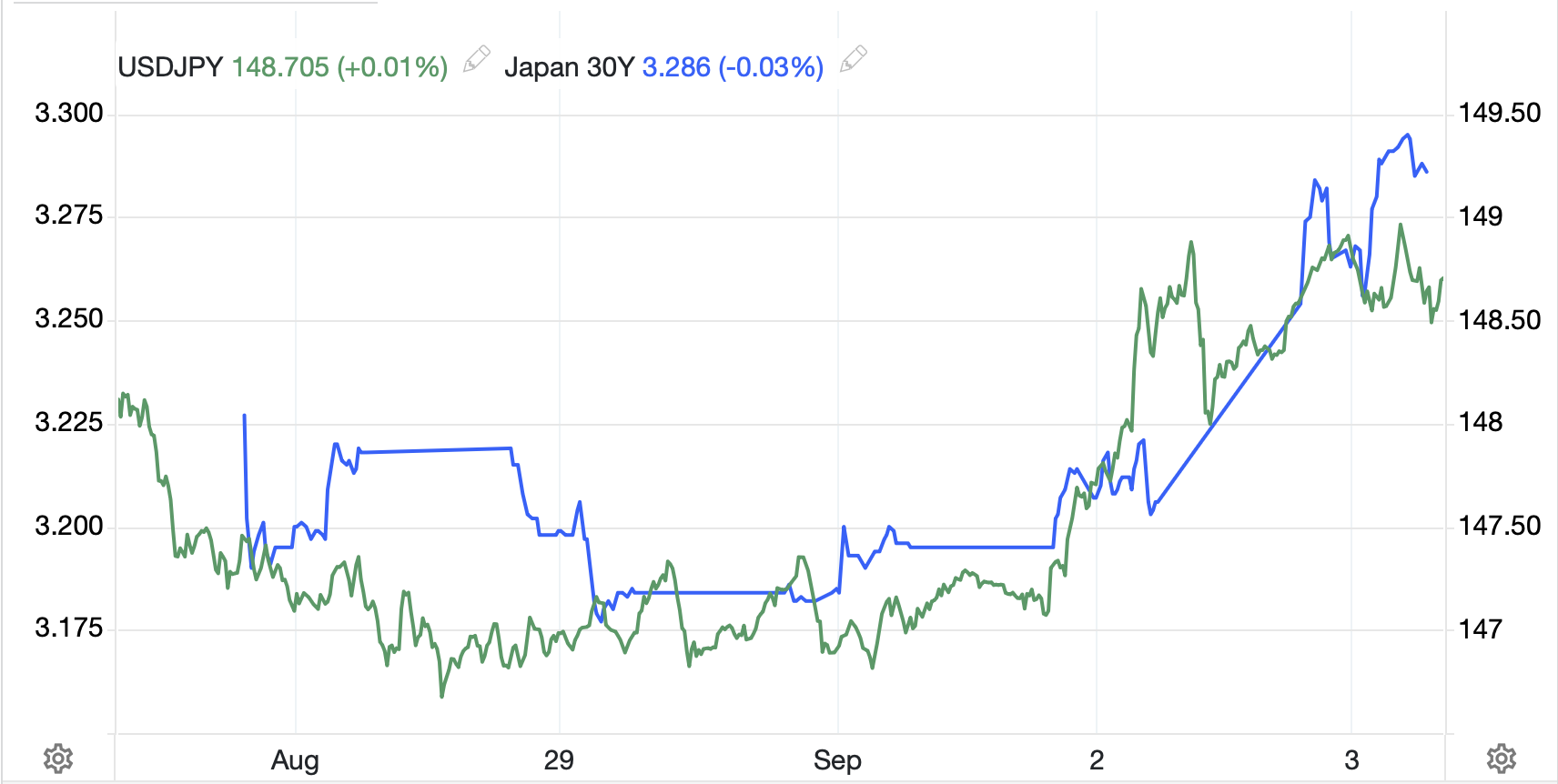
However, the initial market response has been remarkable.  The Nikkei opened in Tokyo +5.5% and held most of those gains, closing higher by 4.75%.  USDJPY gapped 1.3% on the Tokyo opening and is currently higher by 2.0% and back above 150.  Perhaps the most interesting thing is that despite dollar strength, the precious metals have roared higher with both gold and silver gaining 1.4% as gold touches yet another new all-time high and silver pushes ever closer to $50/oz. Meanwhile, JGB yields are little changed as I imagine it will take a few days, at least, for investors to get a better sense of just how effective she will be at governing in a minority role.

Below is the chart for USDJPY, demonstrating just how big the gap was.  This appears to be another chink in the ‘end of the dollar’s dominance’ armor.  Just sayin’!

Source: tradingeconomics.com

In Europe, the powers that be
Have found citizens disagree
With most of their actions
Thus, building up factions
That want nothing but to be free
 
The most recent story is France
Where Macron’s PM blew his chance
He’s now stepped aside
But Macron’s denied
He’ll willingly exit the dance

However, the dollar’s gains today are not merely against the yen, but also, we have seen the euro (-0.7%) slide sharply with the proximate cause here being the sudden resignation of French PM LeCornu.  And the reason it seems like it was only yesterday that France got a new PM after a no-confidence vote in September, is because it basically was only yesterday.  PM LeCornu lasted just one month in the role as President Macron didn’t want to change the cabinet there, thus making LeCornu’s job impossible.  While the next presidential election is not scheduled until April 2027, and Macron is grasping to his role as tightly as possible, it appears, at least from the cheap seats over here in the US, that the vote will happen far sooner than that.  He appears to have lost whatever credibility he had when first elected, and France has now had 4 PM’s in the past twelve months, hardly the sign of a stable and successful presidency.

Like the bulk of the current European leadership, Macron has decided that nearly half the country should not have their voices heard by banning Madame LePen’s RN from government.  And while President Biden was never successful imprisoning President Trump, in France, they managed to convict LePen on some charge and ban her from running.  But that has not dissuaded her followers one iota.  We see the same behavior in Germany with AfD, and the Merz government’s attempts to ban them as a party, and similar behavior throughout Europe as the unelected Brussels contingent in the European Commission struggles to do all they can to retain power.

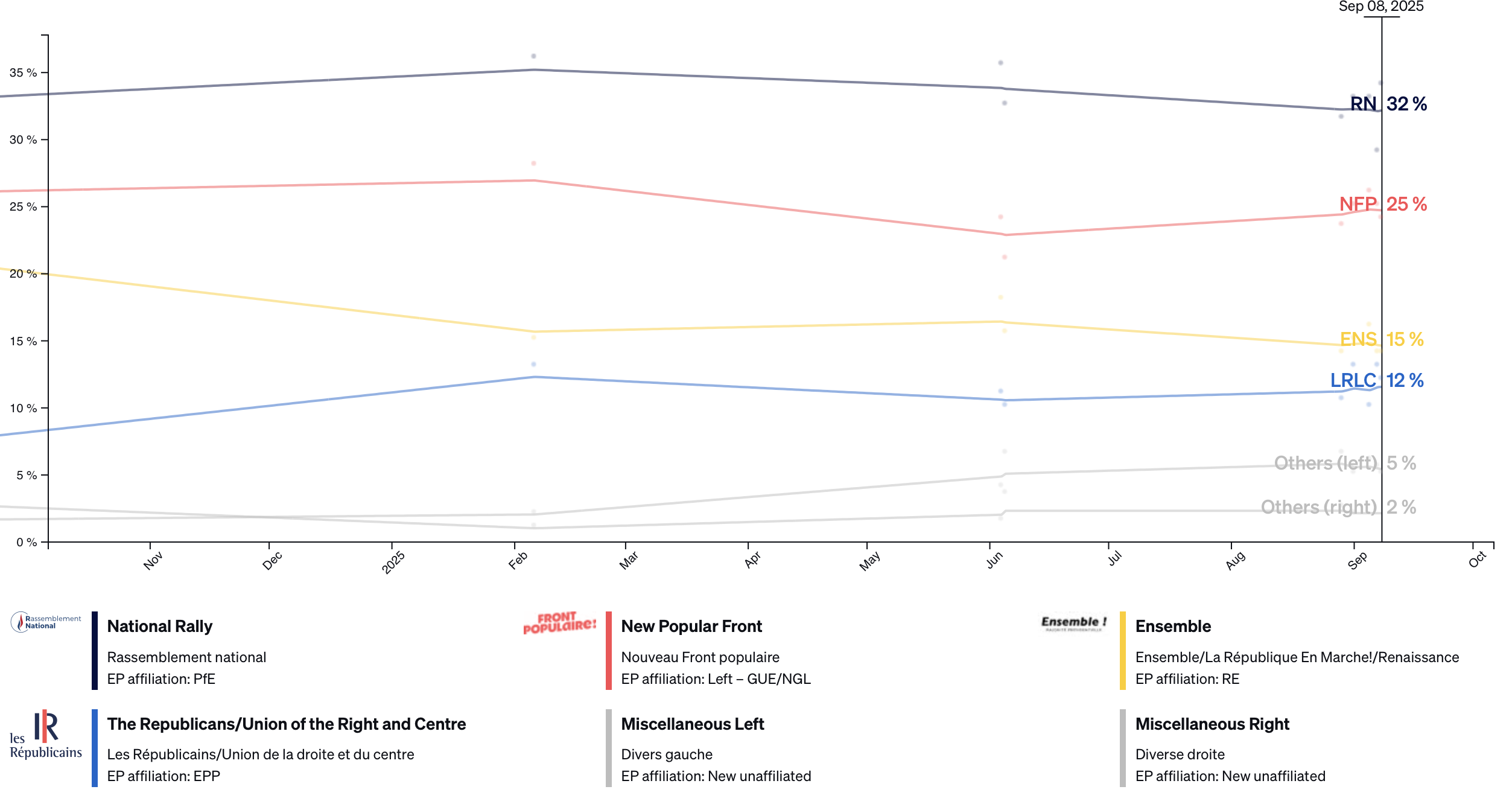
In fact, if you look at the most recent polls I can find for France, from Politico, you can see that RN, LePen’s party, is leading the polls while ENS, Macron’s centrist party has just 15% support.  The far left NFP is in second place and the center-right LRLC is at 12%.  It is difficult for me to believe that Macron can hold on until 2027, at least 18 months away, and if he does, what type of damage will he do to France?
The point of the story is that whatever you may think of Donald Trump, he has the reins of government and is doing the things he promised on the border and immigration, reducing government and reducing regulations.  In Europe, the entrenched bureaucracy is fighting tooth and nail to prevent that from happening with the result that economic activity is suffering and prospects for future growth are stunted.  And all that was before the US change in trade policy.  With that in mind, absent a massive Fed turnaround to dovishness, which doesn’t seem likely in the near term, the euro has more minuses than pluses I think and should struggle going forward.

Ok, two political stories are the driver today, and neither one has to do with Trump!  Meanwhile, let’s look at how everything else has behaved overnight.  Friday saw a mixed session in the US, and all I read and heard over the weekend was that the denouement was coming, perhaps sooner than we think.  The recurring analogy is Hemingway’s description of going into bankruptcy, gradually, then suddenly, and the punditry is trying to make the case that the ‘suddenly’ part is upon us.  I’m not convinced, and would argue that, at least in the US, things can go on longer than they should.  This is not to say the US doesn’t have serious fiscal issues, just that we have better tools to address them than anyone else.

Elsewhere in Asia, China is still on holiday while HK (-0.7%) could find no joy in the Japanese election.  But Korea (+2.7%), India (+0.7%) and Taiwan (+1.5%) all rallied nicely with only the Philippines (-1.8%) showing contrary price action as investors grew increasingly concerned over a growing corruption scandal with the government there and infrastructure embezzlment allegations.  I didn’t mention above but the rationale behind the Japanese jump is that Takaichi-san is expected to push for significant fiscal expansion on an unfunded basis, great for stocks, not as much for bonds.

In Europe, though, you won’t be surprised that France (-1.6%) is leading the charge lower, although in fairness, the rest of the continent is doing very little with the other major exchanges +/- 0.1% basically.  As to US futures, at this hour (7:15), they are all pointing higher by 0.5% or so.

In the bond market, Treasury yields have moved higher by 4bps this morning, adding to a similar gain on Friday as it appears there are lingering concerns over what happens with the government shutdown.  (Think about it, that issue hasn’t even been a topic of discussion yet this morning!). But remember, the government shutdown does not impact the payment of coupons on Treasury debt, so the issues are very different than the debt ceiling.  As to European sovereigns, not surprisingly, French OATs are the wors performers, with yields jumping 8bps (they have real fiscal problems) but the rest of the continent has tracked Treasury yields and are higher by 3bps to 4bps as well.

I’ve already highlighted precious metals, although copper (-0.7%) is bucking the trend, albeit after having risen more than 10% in the past month.  Oil (+1.4%) is also continuing to bounce off the bottom of the range trade and remains firmly ensconced in the $61.50 to $65.50 range as it has been for the past six months.  In fact, looking at the chart below from Yahoo finance, you can see that except for the twelve-day war between Israel and Iran, nothing has gone on here.  The net price change in the past six months has been just -0.19% as you can see in the upper left corner.  While this will not go on forever, I have no idea what will break this range trade.

Finally, the dollar is stronger across the board with the pound (-0.4%) and SEK (-0.5%) the next worst performers in the G10 while CAD and NOK are both unchanged on the day, reflecting the benefits of stronger oil and commodity prices.  In the EMG bloc, the CE4 are all softer by between -0.6% and -0.9%, tracking the euro, and we have seen APAC currencies slip as well (KRW -0.5%, CNY -0.15%).  MXN (-0.2%) and ZAR (-0.3%) seem to be holding in better than others given their commodity linkages.

And that’s all we have today.  With the shutdown ongoing, there are no government statistics coming but we will hear from 8 different Fed speakers, including Chairman Powell on Thursday morning, over a total of 15 different venues this week.  Again, there is a wide dispersion of views currently on the FOMC, so unless we start to see some coalescing, which given the lack of data seems unlikely in the near term, I don’t think we will learn very much new.  As far as the shutdown is concerned, the next vote is scheduled for today, but thus far, it doesn’t seem the Democratic leadership is willing to change their views.  Funnily, I don’t think the markets really care.

Overall, I see more reasons to like the dollar than not these days, and it will take a major Fed dovish turn to change that view.

Good luck

Adf
More Insane

Though debt round the world keeps on growing
The equity run isn’t slowing
But what’s more insane
Is yields slowly wane
Despite signs inflation ain’t slowing
 
The French are the latest to hear
Their credit’s somewhat less sincere
But CBs this week
Seem likely to tweak
Rates lower, and markets will cheer


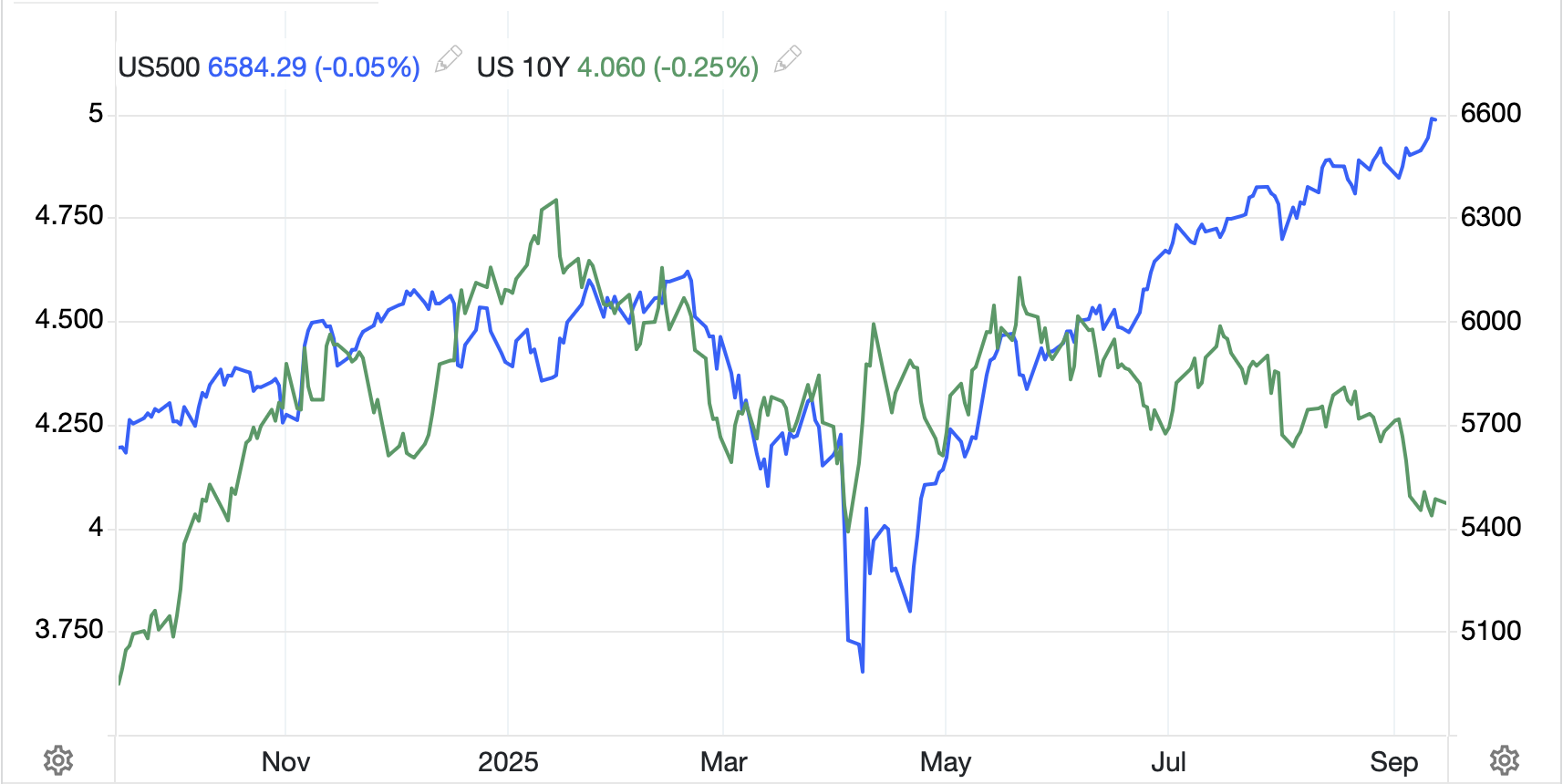
Something is rotten in the state of financial markets, or at least that is the conclusion this poet has drawn (and please do not think I am trying to compare myself to Shakespeare).  No matter what my personal view of the economy may be, I cannot help but look at the recent performance of the equity market and the bond market and be extremely confused.  The chart below shows the past year’s price action in the S&P 500 (blue line) and US 10-year yields (green line). 

Source: tradingeconomics.com

Since early June, the two price series, which have historically had a pretty decent correlation, have gone in completely opposite directions.  Equity markets continue to trade to new highs on a regular basis as earnings multiples continue their expansion.  Typically, multiples only expand when growth expectations are rising, and the economy is in an uptrend.  Ergo, if multiples are high and rising, it seems equity investors believe that is the case.  I understand that view as there are strong indications the administration is going to continue to ‘run the economy hot’ meaning do all it can to increase economic activity and allow inflation to rise as well, counting on the fast growth to offset the pain.

However, 10-year Treasury yields have been sliding steadily for the past three months despite the equity market belief in running it hot.  Bond yields have historically been far more sensitive to inflationary pressures and the fact that yields have been declining, down >40bps since early June, would lead to a very different conclusion about the economy, that it is going to see much slower growth and by consequence, reduced inflationary pressures.

I have discussed the asynchronous economy in the past and I believe this is more proof of that thesis.  The equity markets are still being largely driven by the AI/Tech sector and while that is a huge portion of the equity market, its size within the overall economy is pretty small.  Given the capital weightings of both the S&P 500 and NASDAQ, strength in that sector has clearly been sufficient to drive stock indices higher.  However, much of the rest of the economy is not seeing the same benefits, and in fact, there is a portion suffering as AI takes over roles that had been filled by people thus increasing unemployment.  That segment of the economy is much larger, and it seems there is a growing probability that a recession may be coming there.  

Or not, if the administration is able to run it hot.  Ultimately, the thing the makes the least sense to me is that there is no indication that inflation is slowing anywhere back toward the Fed’s alleged 2% target.  Rather CPI looks far more likely to coalesce around the 3.5%-4.0% level which means that PCE, even on a core basis, is going to be hanging around 3.0%.  If the Fed is getting set to cut rates, and by all indication they are going to cut at least 25bps on Wednesday, I think it is clear that 3.0% is the new 2.0%.

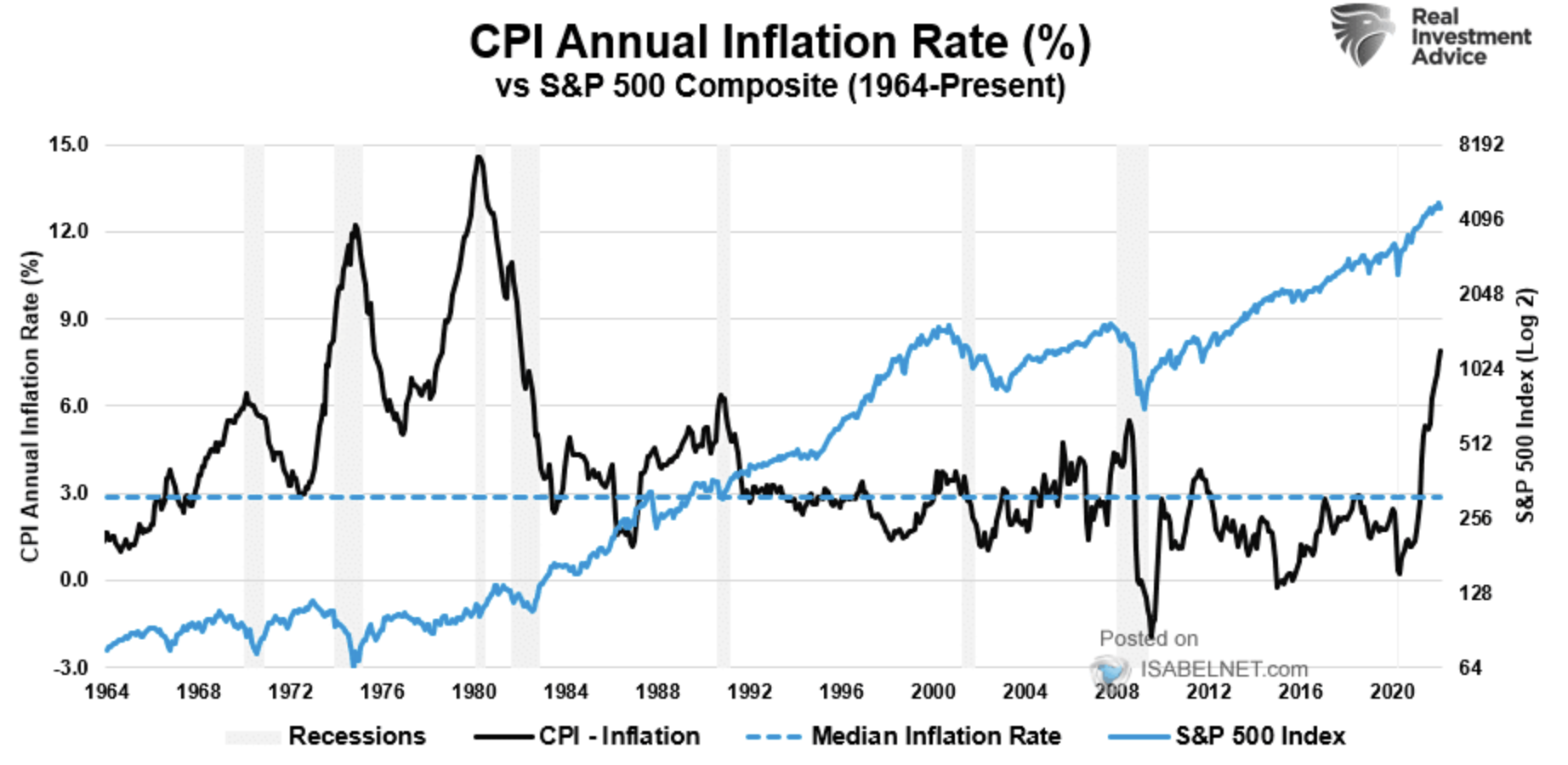
And here’s the problem with that. When inflation is low, 2% or less, equities have historically been negatively correlated with bond prices, so if stocks fell, bonds rallied and the 60:40 portfolio had an internal hedge.  But when inflation is higher, and it doesn’t need to be 10%, 4% is enough to change the relationship, equity prices and bond prices tend to move in sync.  This means, if stock prices fall because of a recession, so do bond prices with yields rising.  In that situation, the 60:40 portfolio suffers greatly.  Just think back to 2022 when both equities and bonds fell -30% or so.  Where was inflation?  Right, we were in the throes of the Fed’s last mistake regarding the word transitory.  The below chart is the best I could find to show how things behaved in the 60’s and 70’s with inflation running hot and then how things changed after Mr Volcker began to squash inflation.

Original source: Isabelnet.com

And what of the dollar you may ask?  Well, theoretically, rising inflation should undermine the currency, but rising rates, when central banks fight inflation, should help support it.  However, this time, with rising inflation and the Fed set to cut, it seems the dollar may have some trouble, although as other central banks follow suit, and they will, the dollar will find support.

Ok, let’s see how things behaved overnight.  While Friday’s US session was mixed with only the NASDAQ managing to gain, there was more green in Asia and Europe.  The Japanese celebrated Respect for the Aged Day, so markets there were closed.  However, both HK (+0.2%) and China (+0.25%) managed modest gains despite (because of?) weaker than expected Chinese economic data.  Every aspect of the data, IP, Retail Sales, Investment and Unemployment, printed worse than forecasts and has now encouraged investors to look for further Chinese government stimulus to support the economy.  That theory helped Korea, Malaysia and Indonesia, all showing solid gains, but did nothing for the rest of the region, perhaps most surprisingly Taiwan.

In Europe, Fitch cut France’s credit rating to A+ from AA- based on fiscal deficits and political turmoil (aka no government), yet equity investors saw that as a buy signal with the CAC (+1.15%) leading European shares higher.  The DAX (+0.4%) and IBEX (+0.6%) are also doing well although the FTSE 100 (0.0%) is just treading water.  There has been no data of note, so it appears investors there are anticipating good things from the US where futures are higher by 0.2% at this hour (7:30).

Bond yields in the US are unchanged this morning, but European sovereign yields have slipped -2bps across the board, despite France’s downgrade.  I am really at a loss these days to understand the mind of bond investors.  I guess there is a growing belief that central bank rate cuts are going to help!

In the commodity sector, oil (+0.4%) has edged higher this morning but remains firmly in the middle of its 3-month trading range and is showing no desire to move in either direction.  Metals markets, meanwhile, are basically unchanged this morning, simply sitting at their recent highs with the latest contest on Wall Street being who can forecast the highest price for gold in 2026.  Goldman just explained that $5000/oz is reasonable if just 1% of risk assets move into the relic.

As to the dollar, while it did little most of the evening, as NY is walking in, it is slipping a bit, with the euro (+0.25%) and pound (+0.5%) leading the way higher in the G10, and truthfully across the board as the largest EMG moves are KRW (+0.4%) and HUF (+0.4%) while the rest have moved on the order of 0.1% to 0.2%.  There has been growing chatter that China is now going to allow the renminbi to start to strengthen more steadily (in fairness, it has been strengthening modestly since the beginning of 2025, up about 3% since then), and that this is part of the trade negotiations ongoing with the US currently taking place in Madrid.  But remember, while CNY has been creeping higher this year, a quick look at the chart below shows it has fallen substantially since 2022, having declined more than 17% between 2022 and the beginning of this year.

Source: tradingeconomics.com

On the data front, in addition to the FOMC, there are several other central bank meetings and some important data as follows:

TodayEmpire State Manufacturing5.0
TuesdayRetail Sales0.3%
 -ex autos0.4%
 Control Group0.4%
 IP-0.1%
 Capacity Utilization77.4%
WednesdayIndonesia Rate Decision5.0% (Unchanged)
 Housing Starts1.37M
 Building Permits1.37M
 Bank of Canada Rate Decision2.5% (-0.25%)
 FOMC Decision4.25% (-0.25%)
 Brazil Rate Decision15.0% (unchanged)
ThursdayBOE Rate Decision4.0% (unchanged)
 Initial Claims240K
 Continuing Claims1950K
 Philly Fed2.3
 South Africa Rate Decision7.0% (unchanged)
 Leading Indicators-0.1%
 BOJ Rate Decision0.5% (unchanged)

Source: tradingeconomics.com

So, while Retail Sales may give us some more color on the strength of the economy, it is really a week filled with central bank policy decisions and the ensuing discussions they have to spin things as they desire.  I imagine we will be getting an article from Nickileaks this afternoon or tomorrow to get Powell’s message out, but it remains to be seen if we are watching bond traders buy the rumor and they are set to sell bonds on the news, especially if the Fed goes 50bps, something that remains a real possibility in my mind, though the futures market is pricing just a 4% chance of that as of this morning.

A 50bp cut will undermine the dollar in the short run and may put pressure on the BOE to cut more rather than hold.  Until then, though, I suspect there will be little net movement in either direction.

Good luck

Adf

Not Blazing

Inflation was hot, but not blazing
And so, though I am paraphrasing
A 50 bip cut
Is most likely what
We’ll see next week, ain’t that amazing!
 
Though futures are not there quite yet
The Claims data’s seen as a threat
It’s been four long years
Since Claims caused such fears
Seems Trump, what he wants he will get


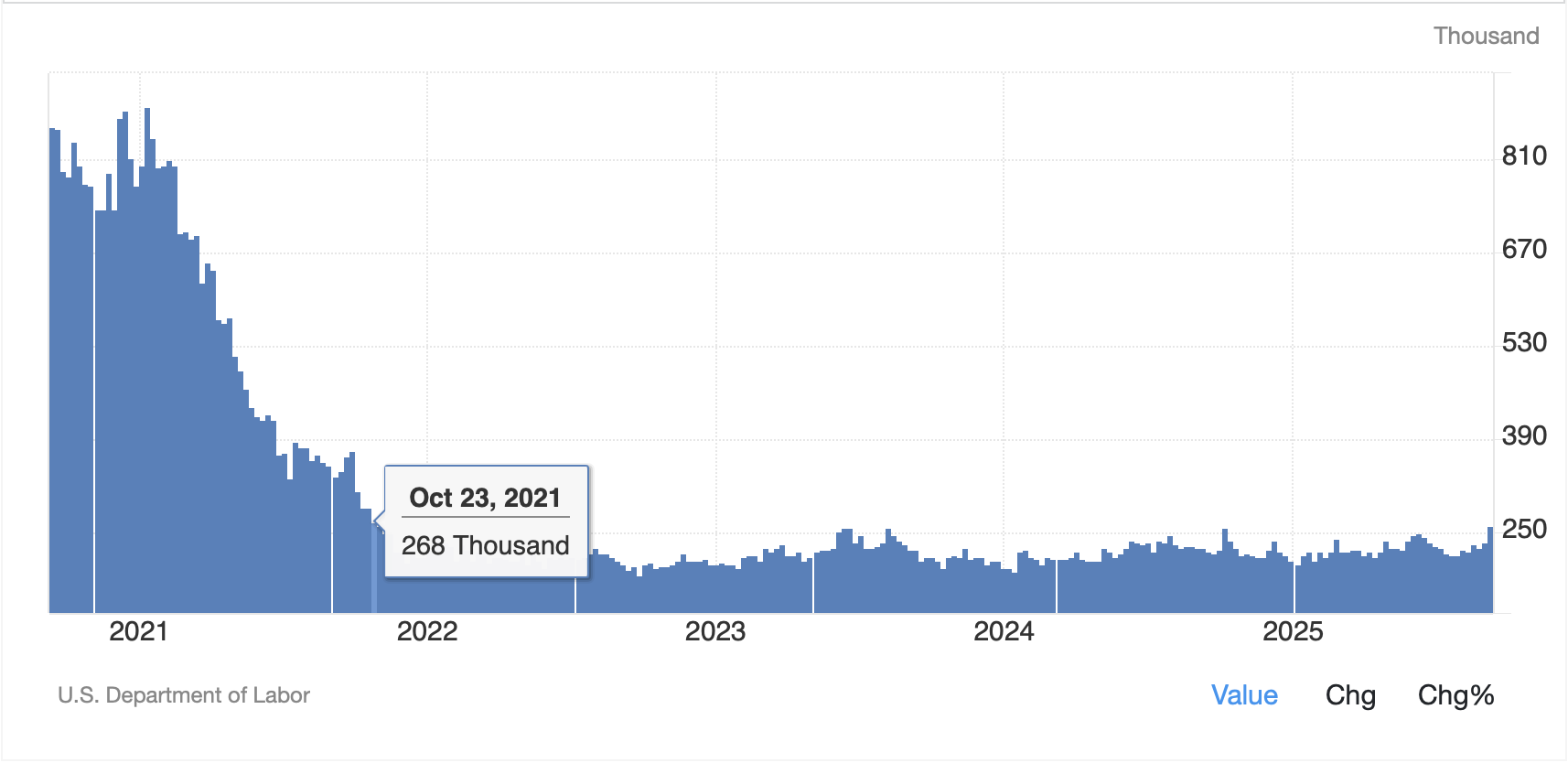
While I spent most of yesterday discussing the CPI data, which came out on the warm side of things with headline rising 0.4% M/M, a tick higher than forecast, although the Y/Y number at 2.9% was as expected, it seems far more attention than normal was paid to the Initial Claims data.  As it happens, the last time Initial Claims printed this high, 263K, was October 2021.

Source: tradingeconomics.com.

Now, we all remember last September, just prior to the Fed cutting 50bps in a surprise move, and as it happens, the Claims data the week before that jumped as well, a one-off blip to 259K.  Of course, the Fed felt it had a political imperative back then to cut as a means of supporting their preferred candidate for President, VP Harris, but that is another story.  Nonetheless, a precedent has been set that a strong claims number with inflation still warm was sufficient to get them to move.  So, will they cut 50bps next week?

Right now, the Fed funds futures market is still pricing just an 8% probability of that move, so apparently that is not the market perception.  However, this is exactly the time where we should be seeing an article from the Fed Whisperer, Nick Timiraos, at the WSJ (aka Nickileaks), which ought to explain that changes in the labor market are sufficient to overcome any concerns about inflation, especially since there is a growing expectation that a recession is coming.  Look for it on Monday.

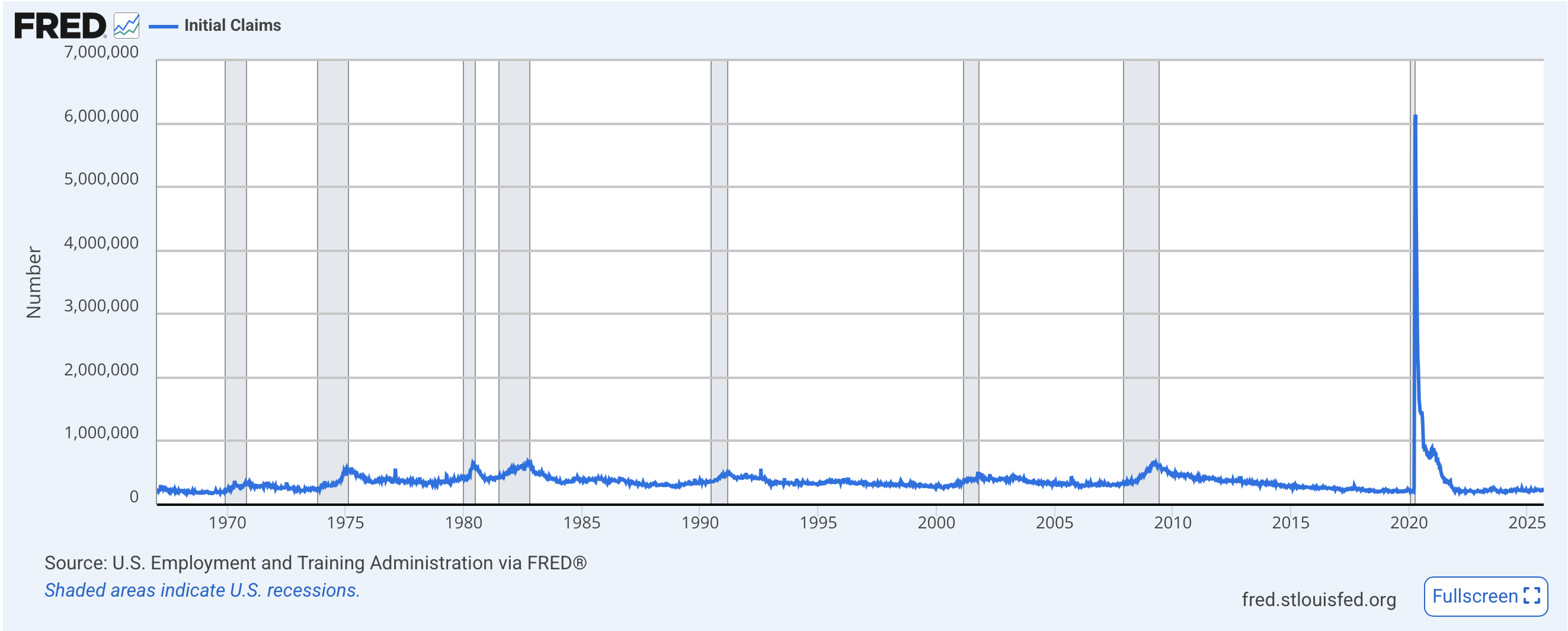
But let us consider this for another moment.  Based on BLS data, the median reading for Initial Claims since January 1967 is 339K, far more than we saw yesterday.  In addition, if you look at a long-term chart of the Claims data, or even the shorter-term one above, while it is possible this is the beginning of a trend higher in Claims, there is no evidence yet for that, and blips higher are pretty common throughout the data set.

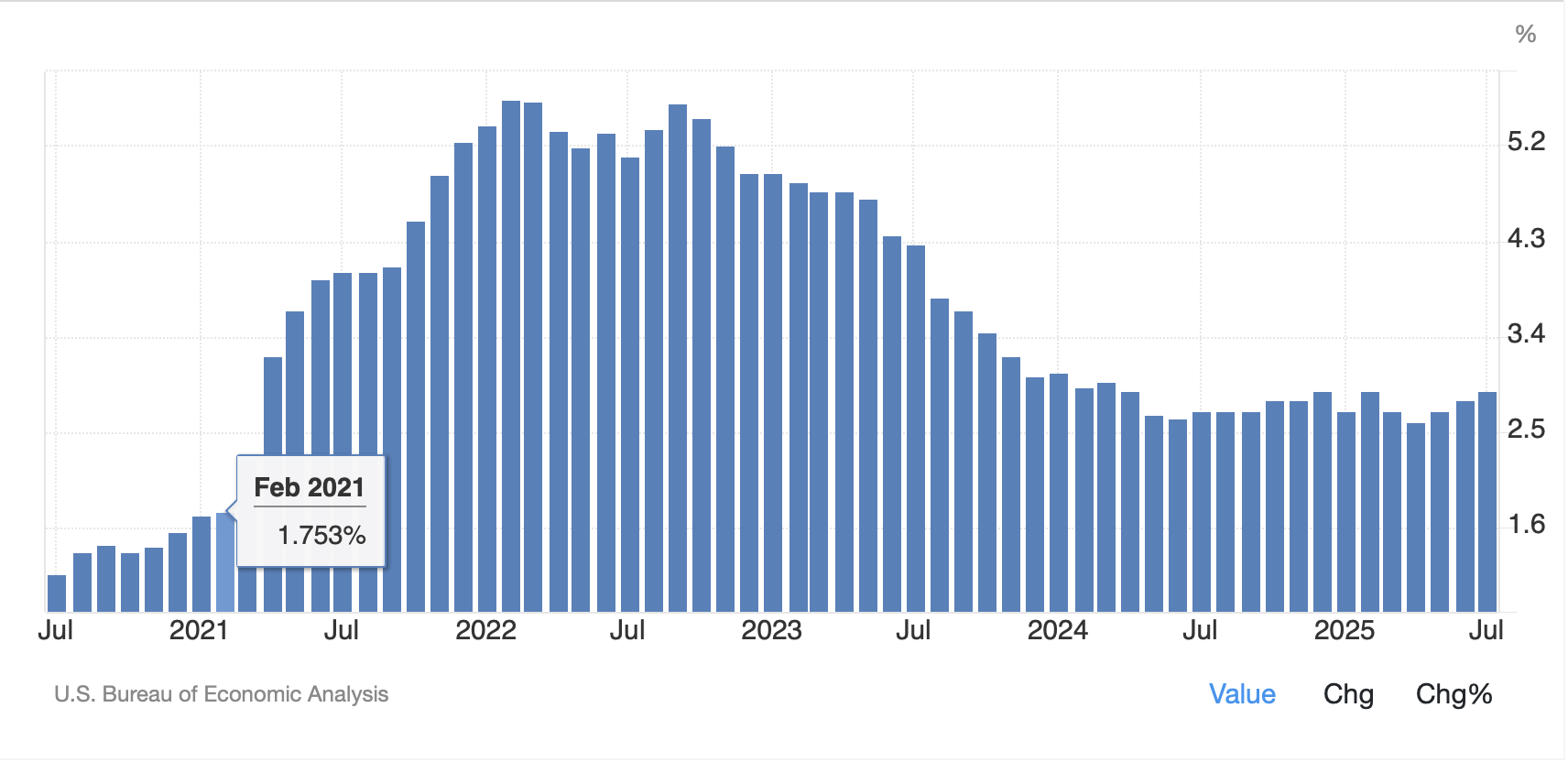
The one caveat here is that if we look at the recessions highlighted in gray in the above chart, the Claims data didn’t really rise until the end of the recession, so there is a chance that we are seeing the beginnings of bigger problems.  Certainly, if Claims data starts to climb further and we see 300K, there will be a stronger case to anticipate a recession.  But we haven’t yet seen that.  Alas, what we do know from Powell’s last press conference is that the Fed has basically abandoned their inflation target, so despite the fact it has been 54 months (February 2021) since core PCE has been at or below 2.0%, and even though the very idea that rate cuts are appropriate is remarkable, it seems the case for 50bps is strengthening.  

Source: tradingeconomics.com

But, as Walter Cronkite used to say, “That’s the way it is.”

So, how have markets been digesting this news?  Well, yesterday saw US equity indices make yet another set of new all-time highs on the prospects of a 50bp cut and that has largely fed to other equity markets around the world.  Bond yields remain quiescent, at least out to 10 years, although the really long stuff is having a tougher time, and the dollar remains range bound.  Aside from equities, the only market really moving is precious metals, which continue to rally nonstop.

Starting in Asia, Tokyo (+0.9%) rallied nicely as a combination of anticipated Fed cuts and the calming of trade tensions with the US has investors there feeling giddy.  It, too, has reached new all-time highs.  Hong Kong (+1.1%) also had a good session although China (-0.6%) didn’t follow through as profit taking was evident after what has been a very strong run in mainland stocks lately.  Elsewhere in the region, only two markets (Singapore and Philippines) lagged, and those were very modest declines of -0.3%.  Otherwise, gains of up to 1.5% were the norm.

However, Europe didn’t get that memo this morning with continental bourses all under pressure (DAX -0.3%, CAC -0.5%, IBEX -0.7%) amid a growing realization that the ECB may have finished its cutting cycle, at least according to Madame Lagarde’s comments yesterday expressing confidence the bank is in a “good place”.  However, under the rubric bad news is good, UK stocks (+0.3%) are edging higher after data showed GDP flatlined in July with the Trade deficit rising, and IP falling sharply (-0.9%) as traders are becoming more convinced the BOE will cut rates despite much stickier inflation than their target level.  Remember, too, the BOE’s mandate is entirely inflation focused, but these days, none of that matters!  Finally, US futures are either side of unchanged as I type (7:00).

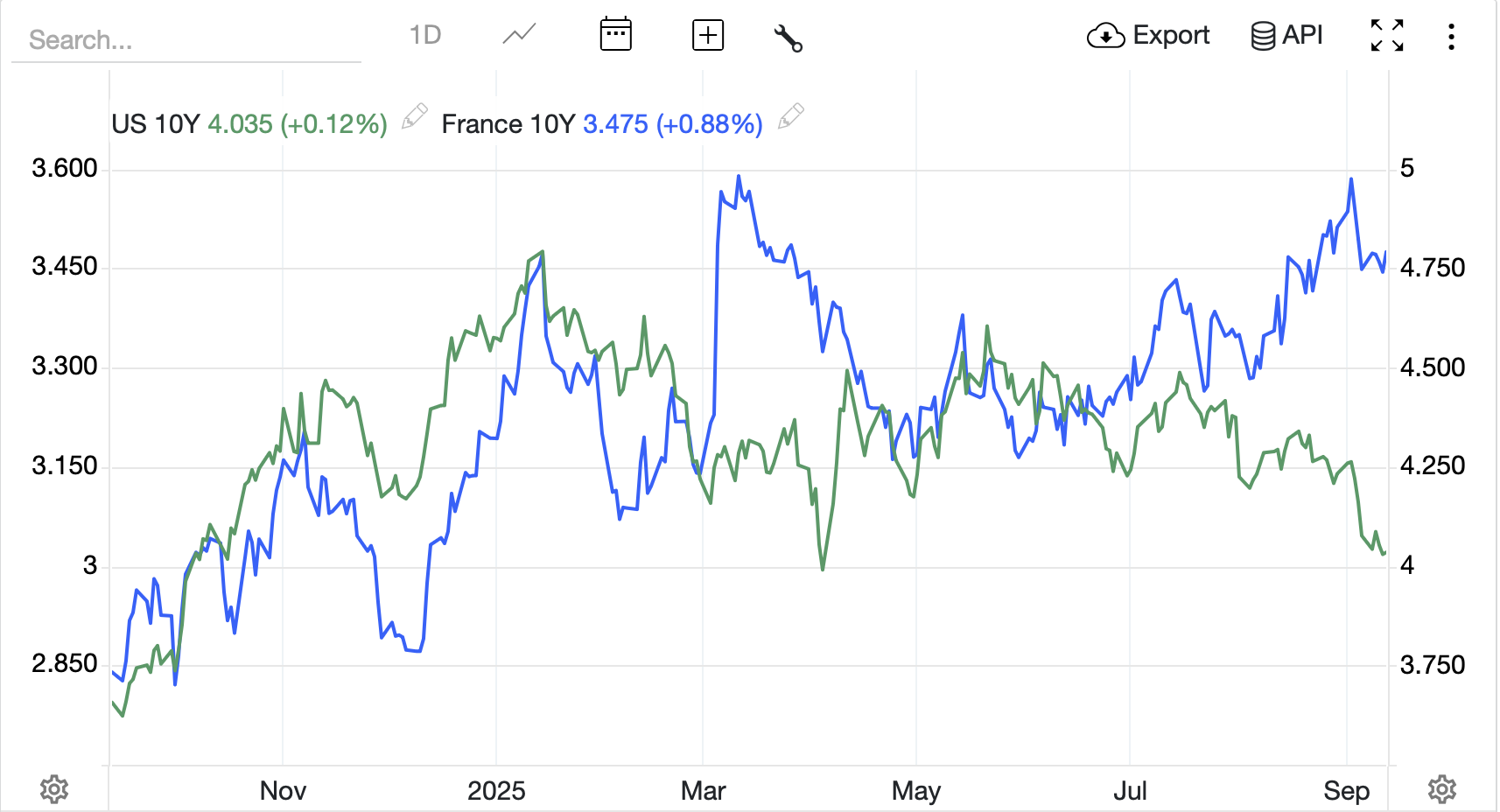
In the bond market, yields remain in their longer-term downtrend in the US although have edged higher by 1bp overnight.  European sovereign yields are higher by 3bps across the board as there are still growing concerns over French fiscal deficits and the fact that the ECB has finished cutting implies less support there.  It is interesting to look at the difference in performance between US and French 10-year bonds as per the below, as despite much angst over the US fiscal profligacy, which is well-deserved, investors still feel far more comfortable with Treasuries than with OATs.

Source: tradingeconomics.com

In the commodity markets, oil (+1.3%) is rebounding from yesterday’s decline and, net, continues to go nowhere.  Whatever the catalyst is that will change this view, it has not made an appearance yet.  Meanwhile, like the broken record I am, I see gold (+0.5%) and silver (+1.9%) continuing to rally as more and more investors around the world flock to the precious metals as they fear the destruction of the value of their fiat currencies.  And they are right because there is not a single central bank around (perhaps Switzerland and maybe Norway) that is concerned about inflation as evidenced by the fact that despite the fact inflation rates are running far higher than they had pre-Covid, every central bank is in a cutting cycle except Japan, and they have stopped hiking despite CPI there running at 3.4%!

Finally, the dollar is modestly firmer as I type, although it had been a bit softer overnight, and basically going nowhere fast.  If I look at the movement in the major currencies over the past month, only NOK (+3.0%) stands out on the back of higher than anticipated inflation readings and growing expectations that the Norges Bank, which did cut rates a few months ago, will soon have the highest interest rates in the G10 after the Fed cuts next week and they remain on hold.  As to today’s movement, JPY (-0.35%), NZD (-0.4%) and NOK (-0.3%) are the largest movers, with the EMG seeing even smaller movement than that.  Again, it is difficult to find a compelling short-term story here.

On the data front, this morning brings Michigan Sentiment (exp 58.0) and that’s it.  No Fed speakers ahead of the meeting next week, so we will be reliant on either the White House making some new, unexpected, announcement, or the dollar will take its cues from the equity markets.  It is interesting that the precious metals complex continues to perform well despite the dollar edging higher.  To me, that is the biggest story around.

Good luck and good weekend

Adf

Voters Have Doubt

In France, Monsiuer Bayrou is out
In Norway, though, Labor held stout
Japan’s been discussed
And Starmer’s soon Trussed
In governments, voters have doubt
 
Investors, though, see all this news
And none of them have changed their views
Just one thing they heed
And that’s market greed
At some point they’ll all sing the blues


Here we are on Wednesday and already we have seen two major (Japan and France) and one minor (Nepal) nations make governmental changes.  Actually, they haven’t really changed yet, they just defenestrated the PM and now need to figure out what to do next.  In Japan, it appears there are two key candidates vying to lead a minority LDP government, Sanae Takaichi and Shinjiro Koizumi, although at this point it appears too close to call.  Regardless, it will be rough sledding for whoever wins the seat as the underlying problems that undermined Ishiba-san remain.  

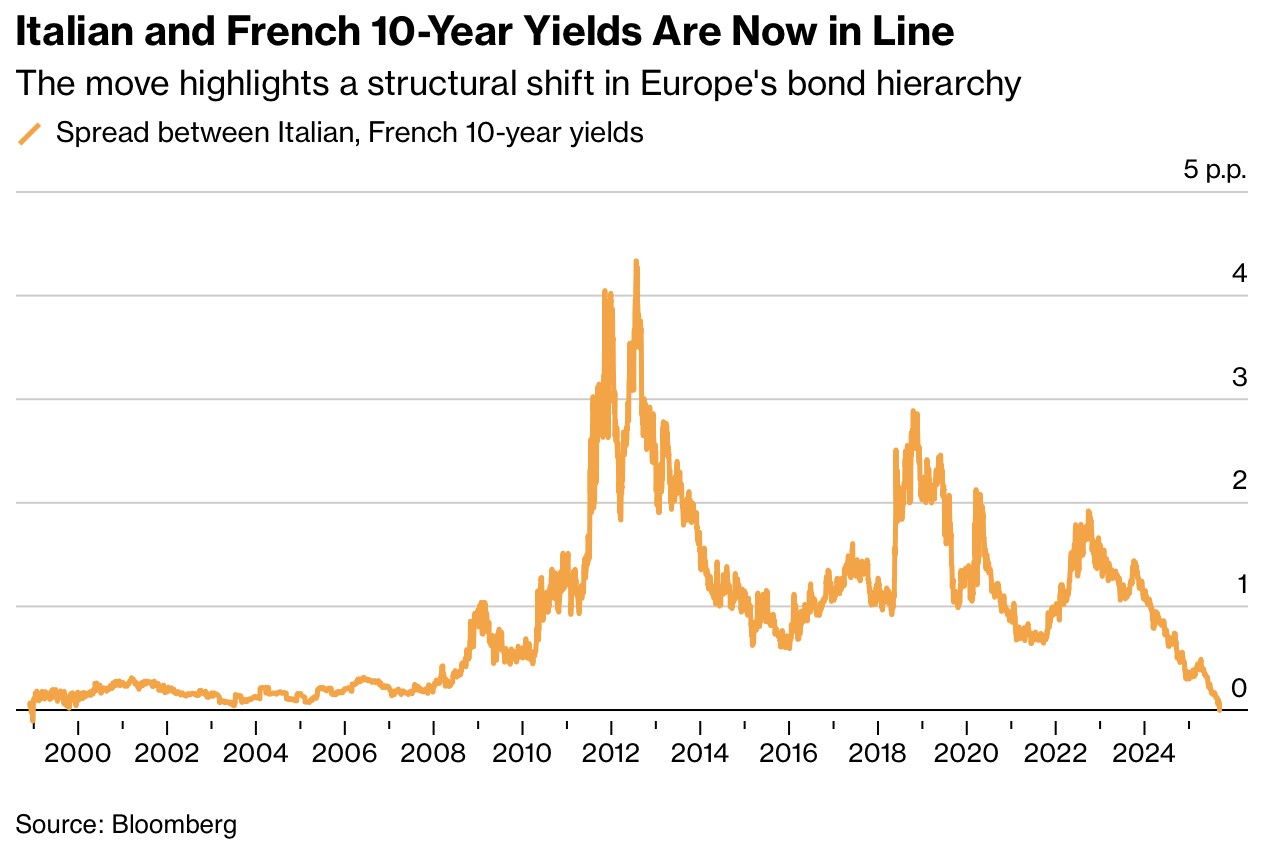
In France, President Macron has, so far, said he will not call for new elections, nor will he resign despite increasing pressure from both the left and the right for both measures.  He will appoint a new PM this week and they will go through this process yet again as the underlying issue, how to rein in spending and reduce the budget deficit, remains with nobody willing to make the hard decisions.  A side note here is that French 10-year OATs now trade at the same level as Italian 10-year BTPs, a catastrophic decline over the past 15 years as per the below chart. 

Recall, during the Eurozone crisis in 2011, Italy was perceived as the second worst situation after Greece in the PIGS, while France was grouped with Germany as hale and hearty.  Oh, how the mighty have fallen.

Nepal is clearly too insignificant from a global macroeconomic perspective to matter, but it strikes me that the fall of the PM there is merely in line with the growing unhappiness of populations around the world with their respective governments.

A friend of mine, Josh Myers, who writes a very thoughtful Substack published last night and it is well worth the read.  He makes the point that the Washington Consensus, which has since the 1980’s, underpinned essentially all G10 activity and focused on privatization of assets, free trade and liberalized financial systems, appears to have come to the end of the road.  I think this is an excellent observation and fits well with my thesis that the consensus views of appropriate policies are falling apart.  Too many people have been left behind as both income and wealth inequality in the G10 is rampant, and those who have fallen behind are now angry enough to make themselves heard.  

This is why we see governments fall.  It is why nationalist parties are gaining strength around the world as they focus on their own citizens rather than a global concept.  And it is why those governments still in power are desperately struggling to prevent their opponents from being able to speak.  This is the genesis of the restrictions on speech that are now rampant in Germany and the UK, two nations whose governments are under extreme pressure because of policy failures, but don’t want to give up the reins of power and are trying to prevent anybody from saying anything bad about them, thus literally jailing those who do!

And yet…investors are sanguine about it all!  At least that seems to be the case on the surface as equity indices around the world continue to trade higher with most major equity markets at or within a few percent of all-time highs.  This seems like misplaced confidence to me as the one thing I consistently read is that markets are performing well in anticipation of the FOMC cutting Fed funds next week, with hopes growing that it will be a 50bp cut.  

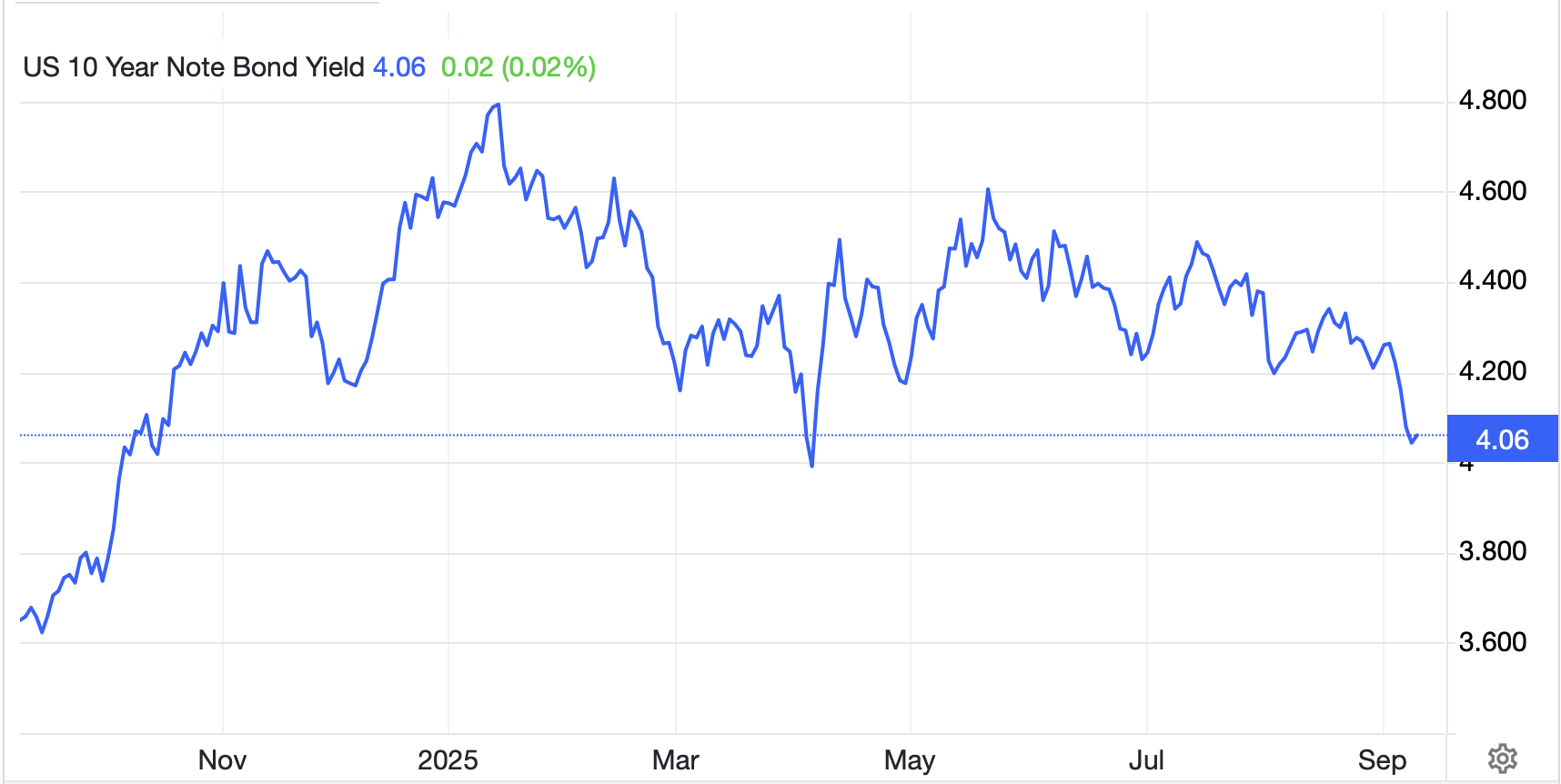
But if we look at the Treasury market, which has seen yields slide steadily since the beginning of the year, with 10-year yields now lower by 75bps since President Trump’s inauguration, it is difficult to square that circle.  

Source: tradingeconomics.com

Bond yields typically rise and fall based on two things, expected inflation and expected growth as those two have been conflated in investor (and economist) minds for a while.  The upshot is if yields are declining steadily, as they have been, it implies investors see slowing economic activity which will lead to lower inflation.  Now, if economic activity is set to slow, it strikes me that will not help corporate profitability, and in fact, has the potential to exacerbate the situation by forcing layoffs, reducing economic activity further.  Alas, it is not clear if that will drive inflation lower in any meaningful way.  The point is the bond market and the stock market are looking at the same data and seeing very different future outcomes.

Is there a tiebreaker we can use here?  The FX market might be one place, but the weakness in this idea is that FX rates are relative rates, not descriptive of the global economy.  Sure, historically the dollar has been the ultimate safe haven with funds flowing there when things got rough economically, but its recent weakness does not foretell that particular story.  Which brings us to the only other asset class around, commodities.  And the one thing we have seen lately is commodity prices continuously rising, or at least metals prices doing so, specifically gold.  Several millennia of history showing gold to be the one true store of value is not easily forgotten, and that is why the barbarous relic has rallied 39% so far in 2025.  

A number of analysts have likened the current situation to that of Wile E Coyote and I understand the idea.  It certainly is a potential outcome so beware.

Well, once again I have taken much time so this will be the lightning round.  Starting with bonds, this morning, yields in the US and Europe are higher by 2bps across the board, with one exception, France which has seen yields rise 6bps as discussed above.  JGB yields are unchanged as it appears investors there don’t know what to think yet and are awaiting the new PM decision.

In equities, yesterday’s very modest late rallies in the US were followed by a mixed session in Asia (Japan -0.4%, China -0.7%, HK +1.2%) although there were more winners (Korea, India, Taiwan, Thailand) than laggards (Australia, New Zealand, Indonesia) elsewhere in the region.  In Europe, mixed is also the proper adjective with the CAC (+0.4%) remarkably leading the way higher despite lousy IP data (-1.1%) while Germany (-0.4%) and Spain (-0.4%) both lag.  As to US futures, at this hour (7:20) they are marginally higher, 0.15% or so.

Oil (+0.8%) continues to trade back and forth each day with no direction for now.  I’m sure something will change the situation here, but I have no idea what it will be.  Gold (+0.5%) meanwhile goes from strength to strength and is sitting at yet another new all-time high, above $3600/oz.  While silver and copper are little changed this morning, the one thing that seems clear is there is no shortage of demand for gold.

Finally, the dollar is arguably slightly lower this morning, although mixed may be a better description.  The euro (-0.15%) is lagging but JPY (+0.6%) is the strongest currency across both G10 and EMG blocs.  Otherwise, it is largely +/-0.2% or less as traders ponder the data.

While CPI is released on Thursday, I think this morning’s NFP revision is likely to be the most impactful number we see this week, and truly, ahead of the FOMC next week.

TodayNFP Revision-500K to -950K
WednesdayPPI0.3% (3.3% Y/Y)
 -ex food & energy0.3% (3.5% Y/Y)
ThursdayECB Rate Decision2.0% (unchanged)
 CPI0.3% (2.9% Y/Y)
 -ex food & energy0.3% (3.1% Y/Y)
 Initial Claims235K
 Continuing Claims1950K
FridayMichigan Sentiment58.0

Source: tradingeconomics.com

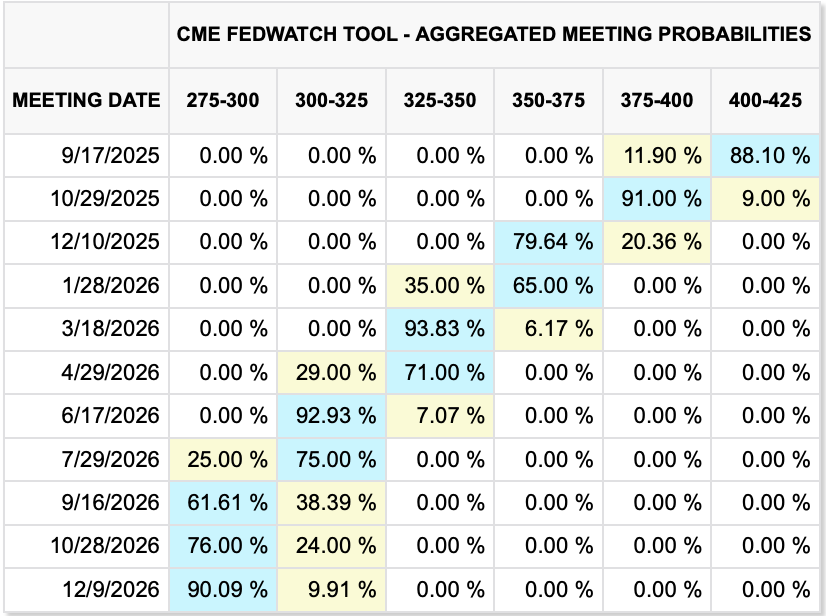
As I type, the Fed funds futures market is pricing a 12% probability of a 50bp cut next week and an 80% chance of 75bps this year.

Source: cmegroup.com

If the NFP revisions are more than -500K, I suspect that rate cut probabilities will rise sharply with the dollar falling, gold rising, and bond yields heading lower as well.  Equity markets will probably rally initially, although it strikes me that this type of bad news will not help corporate earnings.  So, buckle up for the fun this morning on a release that has historically been ignored but is now clearly center stage.

Good luck

Adf

Naught But Dismay

Ishiba’s fallen
Who’ll grab the poisoned chalice
For the next go round?


Well, it was inevitable after the LDP lost the Upper House election a few weeks ago, but now it is official, Japanese PM Shigeru Ishiba has resigned effective today and will only stay on until a new LDP leader is chosen.  You must admit, for a politician he was exceptionally ineffective.  He managed to lead the LDP to two major election losses in the span of 10 months, quite impressive if you think about it.  However, now that he has agreed a trade deal with the US, where ostensibly US tariffs on Japanese autos will be reduced from 25% to 15%, he felt he had done enough damage and is getting out of the way.  Frankly, I wouldn’t want to be the next man up here as the situation there remains fraught given still high inflation and a central bank that is so far behind the curve, it makes the Fed seem like it is Nostradamus!

The intricacies of Japanese politics are outside the bounds of this note, but the initial market response is a weaker yen (-0.7% as of 7:30pm Sunday night) and 1% gain in the Nikkei.  JGB yields have barely moved at all as it seems Japanese investors are not yet abandoning ship in hopes of a stronger PM.  However, my take is they have further to climb going forward as the BOJ’s ongoing unwillingness to tackle inflation will undermine their value.  Japan has a world of hurt and lacking an effective government is not going to help them address their problems.  It is hard to like Japanese assets or the yen in my view, at least until something or someone demonstrates competence in government.

The jobs report basically sucked
As companies smoothly conduct
More layoffs each week
While they try to tweak
Their staffing ere management’s f*cked

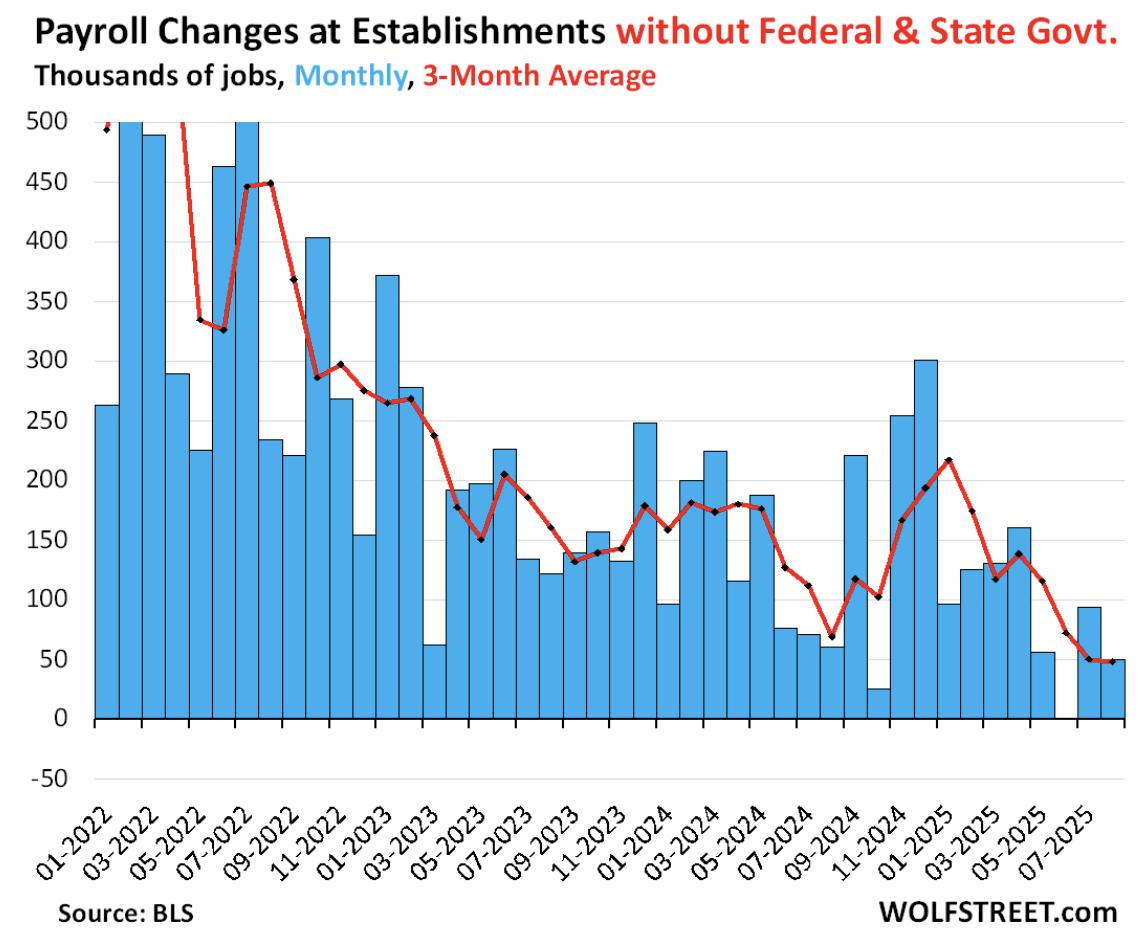
By now, I’m sure you’re all aware that the payroll report was pretty weak across the board.  NFP rose only 22K, well below expectations and although there was a marginal increase in last month’s results, just 6K, the overall picture was not bright.  The Unemployment Rate ticked up 0.1%, as expected with the labor force growing >400K, but only 288K of them getting jobs.  However, layoffs are down, and the real positive is that government jobs continue to fall, having declined 56K in the past three months with private hiring making up the slack.  In fact, if you look at the past three months, private job creation has been 144K or 48K/month.  That is the best news of the entire process.  Eliminating government employees will eventually result in lower government expenditures and let’s face it, if the government employees who leave become baristas at Starbucks, they are likely adding more value to the economy than their government roles!  The chart below from Wolfstreet.com does a great job of highlighting private sector jobs growth, which is slowing but still positive.  Maybe it is not yet the end of the world.

As to my efforts to prognosticate on the market behavior based on a range of outcomes, I mostly got the direction right, although some of the movement was a bit more aggressive than I anticipated.  The one place I missed was equities, which started higher, but ultimately fell on the day.  Nostradamus I’m not.

The last thing to mention today
Is France, where a vote’s underway
When finally completed
And Bayrou’s unseated
Macron will have naught but dismay

The last key story to discuss is the vote today in France’s parliament where another snap election has been called by a minority government (see Japan for previous results) and in all likelihood will result in the government falling.  The problem here, as it is pretty much everywhere in the Western world is that the government’s budget deficit is exploding higher and legislators cannot agree to cut spending.  The result is rising bond yields (see below chart as I discussed this last week here), and growing concern as to how things will ultimately play out.  The prognosis is not positive.  

Source: tradingeconomics.com

While the US is in a similar situation, we have substantially more tools available and more runway given our status as the global hegemon and owning the global reserve currency.  But France, and the UK or Japan for that matter, have no such backstop and investors are growing leery of the increasing risk of a more substantial meltdown.  Apparently, the results of this vote ought to be known by 3:00pm Eastern time this afternoon.

The question is, if/when he loses, what happens next?  The choice is President Macron appoints a different PM to head another minority government, which will almost certainly be unable to achieve anything else, or there is another parliamentary election, which at least could result in a majority government with the ability to enact whatever fiscal policies they believe.  Remember, France is the second largest economy in the Eurozone, so if it remains under pressure, it is difficult to make the case that the euro will rally very much, especially given Germany’s many issues.

And that feels like enough for one day.  Let me recap the overnight session but since there is no data of note today and the Fed is in its quiet period, I will list data tomorrow.  While US equity markets sold off a bit at the end of the day, that was not the vibe this morning anywhere else in the world as green is the predominant color on screens.  In Japan, no PM is no problem as the Nikkei (+1.45%) rallied after much stronger than expected GDP data (2.2% in Q2) helped convince investors things would be fine.  Hong Kong (+0.85%) and China (+0.2%) also managed gains as hopes for a Fed rate cut spring eternal.  In fact, the bulk of Asia saw gains on that basis.

Europe, too, has embraced the weaker US payroll data and prospective Fed rate cut to rally this morning, although in fairness, German IP rose 1.4% for its first gain in four months, so that helped the cause.  But even French stocks are higher despite the imminent collapse of the government.  I am beginning to notice a pattern of equity investors embracing the removal of ineffective governments, but perhaps I am looking too hard.  US futures are also modestly higher at this hour (7:15) this morning, rising about 0.25%.

In the bond markets, after Friday’s rally, Treasury yields have edged higher by 1bp while European sovereign yields are largely unchanged, perhaps +/- 1bp on the day.  Surprisingly, even JGB yields have not risen despite the lack of fiscal rectitude there.  It certainly appears that bond investors are ignoring a lot of potential bad news.  Either that or someone is buying a lot of bonds on the sly.

In the commodity markets, oil (+2.0%) after a down day Friday ahead of expectations that OPEC+ would be increasing production again, has rallied back as those increases were less than feared by the market.  But net, oil is just not going anywhere these days, trading between $62/bbl and $66/bbl for the past month.  It feels like we will need a major demand story to change this narrative, either up or down.  As to metals, they continue to rally sharply (Au +0.7%, Ag +0.7%, Cu +0.5%, Pt +1.9%) as no matter the bond markets’ collective ennui over global fiscal profligacy, this segment of the market is paying attention.  If this week’s CPI data is cooler than expected, I suspect that 50bps is going to be the default expectation and metals will climb further.

Finally, the dollar is under modest pressure this morning, with the euro and pound both rising 0.2% although AUD (+0.6%) and NZD (+0.8%) are having far better sessions on the back of commodity price strength.  JPY (-0.3%) has recouped some of its early losses from the overnight session, though my money is still on weakness there.  In the EMG bloc, it is hard to get excited about much with ZAR (+0.25%) appreciating the rally in gold and platinum, but only just, while the rest of the bloc hasn’t even moved that much.  

And that’s really all for today.  The discussion will continue around the Fed and whether 50bps is coming with Thursday’s CPI the last big piece of data that may sway that conversation.  Personally, I am surprised that the government upheavals in Japan and France (with the UK also having major fiscal problems) have not had a bigger impact on markets.  My sense is that there is an opportunity for more fireworks in those places in the near future.  But apparently not today.  As investors whistle past those particular graveyards, I imagine we will see a risk-on session continue with the dollar remaining under modest pressure.

Good luck

Adf

Got Smote

There once was a poet that wrote
‘Bout bonds and the fact they got smote
So, yields, they did rise
And to his surprise
Most pundits, this news did promote
 
Now turning to stories today
The biggest one, I’d have to say
Is how, in Japan
Ishiba’s grand plan
Has failed, thus he’ll be swept away


The number of stories this morning regarding the synchronous rise of long-dated bond yields around the world has risen dramatically.  While yesterday, I highlighted this fact, I certainly didn’t expect it to be the key narrative this morning.  But such is life, and virtually every news outlet is focusing on the subject as both a reason for the poor equity performances yesterday as well as a way to highlight government profligacy.  I do find it interesting, though, that the same publications that push for more spending for their preferred causes have suddenly become worried about too much government spending.  But double standards are nothing new.   A smattering of examples show ReutersBloomberg and the WSJ all feigning concern over too much government spending.

I say they are feigning concern because all these publications are perfectly willing to support excess government spending if it is spent on the things they care about.  Regardless, the fact that this has become one of today’s key talking points is evidence that some folks are starting to recognize that trees cannot grow to the sky.  Even though almost every major central bank is in easing mode, long-term yields keep rising.  Alas, the almost certain outcome here, albeit likely still well into the future, is some form of yield curve control as central banks will be forced to prevent yields from rising too high lest their respective governments go bust.  I expect that the initial stages will be regulations requiring banks and insurance companies, and maybe private, tax-advantaged accounts like IRA’s and 401K’s, to hold a certain percentage of Treasuries.  But I suspect that eventually, only central banks will have the wherewithal to prevent runaway yields.  Welcome to the future; got gold?

However, you can read about this everywhere, and after all, I touched on it yesterday so let’s move on.  Government stability/fragility is the topic du jour in this poet’s eyes.  We already know that the French government is set to fall on Monday when PM Bayrou loses a confidence vote.  It is unclear what comes next, but French finances are in bad shape and getting worse and they don’t print their own currency.  This tells me that we could see a lot more social unrest in France going forward given the French penchant for nationwide strikes.  

But a story that has gotten less press is in Japan, where PM Ishiba saw the LDP majority decimated in the Upper House two weeks ago and is now heading a minority government as the LDP does not have a majority in either house in the Diet.  One of the key members of the LDP, and apparently the glue that was holding together the fragile coalition was Hiroshi Moriyama, the LDP Secretary General, and he is now resigning along with several of his lieutenants, so it appears that Japan’s government is about to fall as well.  The upshot here is that the BOJ seems unlikely to raise interest rates given the political uncertainty, which is not only pressuring long-dated JGB’s but also the yen. (see chart below from tradingeconomics.com)

While I have not written extensively about the UK’s government, the situation there is quite similar, with massive fiscal problems driving yields higher while the government focuses on removing the right of free speech amongst its people if that speech is contra to the government’s policies.  While the next UK election need not be held for another 4 years, my take is it will be much sooner as PM Starmer has destroyed his legitimacy with recent policy decisions and will soon be unable to govern.  It will only be a matter of time before his own party turns on him.

The governments in Japan, France and the UK are all under increasing pressure as their policy prescriptions have not tackled the key problems in their respective economies.  Inflation in Japan and the UK and benefits in France need to be addressed, but it is abundantly clear that the current leadership will not be able to do so effectively.  Once again, please explain why people are so bearish the dollar, at least in the long run.  While inflation will be higher worldwide and fiat currencies will all suffer vs. real assets, on a relative basis, the dollar doesn’t appear so bad after all.

Ok, let’s move on to the overnight activity as it gets too depressing highlighting all the government failures around the world.  While US stocks closed above their worst levels of the session, they were all lower yesterday.  That bled into Asia with Japan (-0.9%), Hong Kong (-0.6%) and China (-0.7%) all falling with worse outcomes in some other parts of the region (Australia -1.8%, Philippines -0.75%) although there were winners as well (Korea, India, Taiwan) albeit in less impressive fashion.  Perhaps the surprise was Chinese underperformance after PMI Services data there printed at its highest level since May 2024.

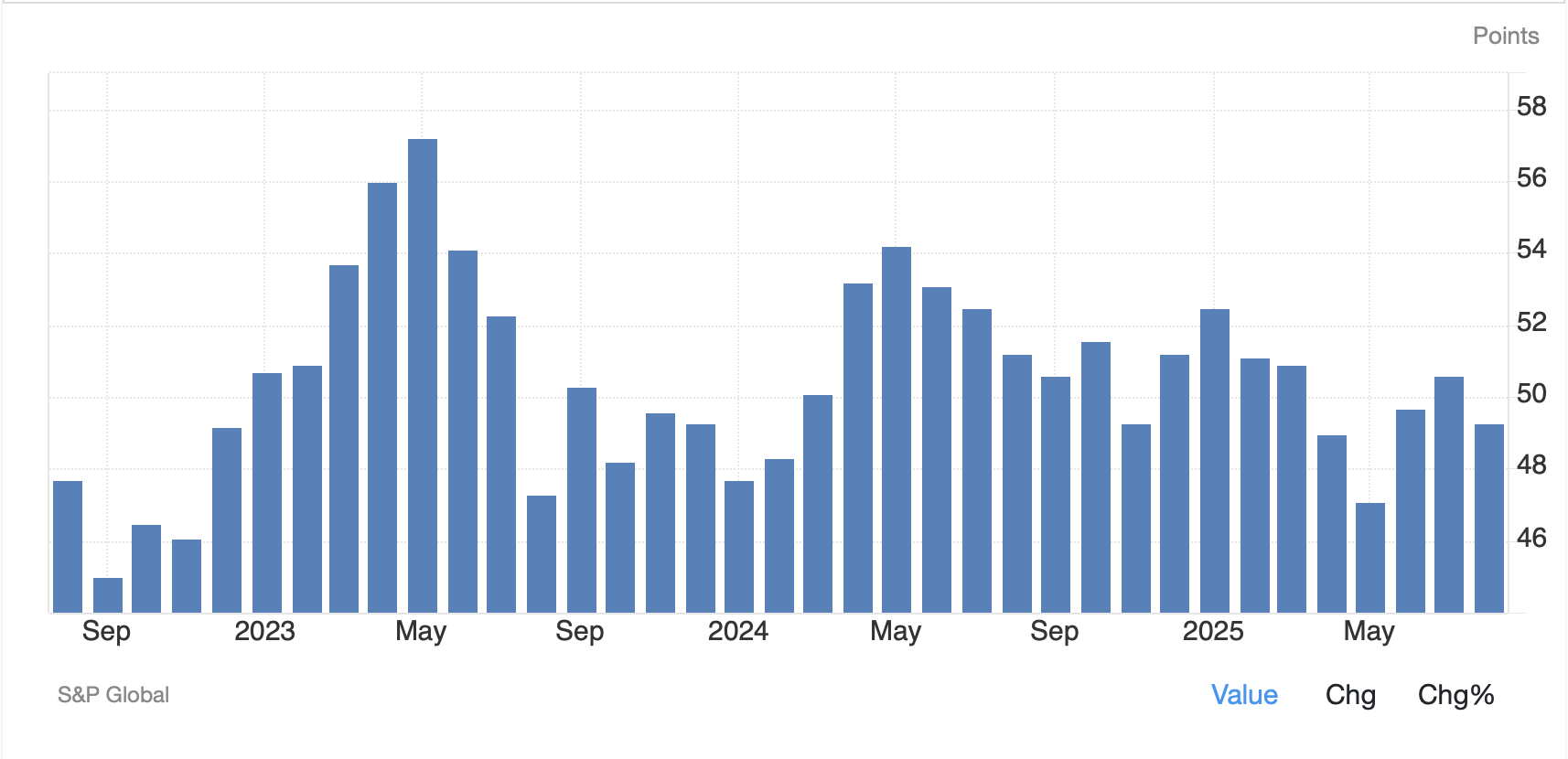
But whatever the negativity that existed in Asia was, it did not translate to European shares as they are all higher (CAC +1.0%, DAX +0.8%, FTSE 100 +0.55%, IBEX +0.2%).  Now, clearly it is not confidence in government activity that has investors excited.  The only data of note was Services PMI, which was mostly as expected except in Germany where it fell to 49.3, far lower than the initial estimate of 50.1 and based on the chart below, seemingly trending lower.

Source: tradingeconomics.com

US futures, too, are higher this morning, with gains of 0.5% to 0.75% for the S&P and NASDAQ.

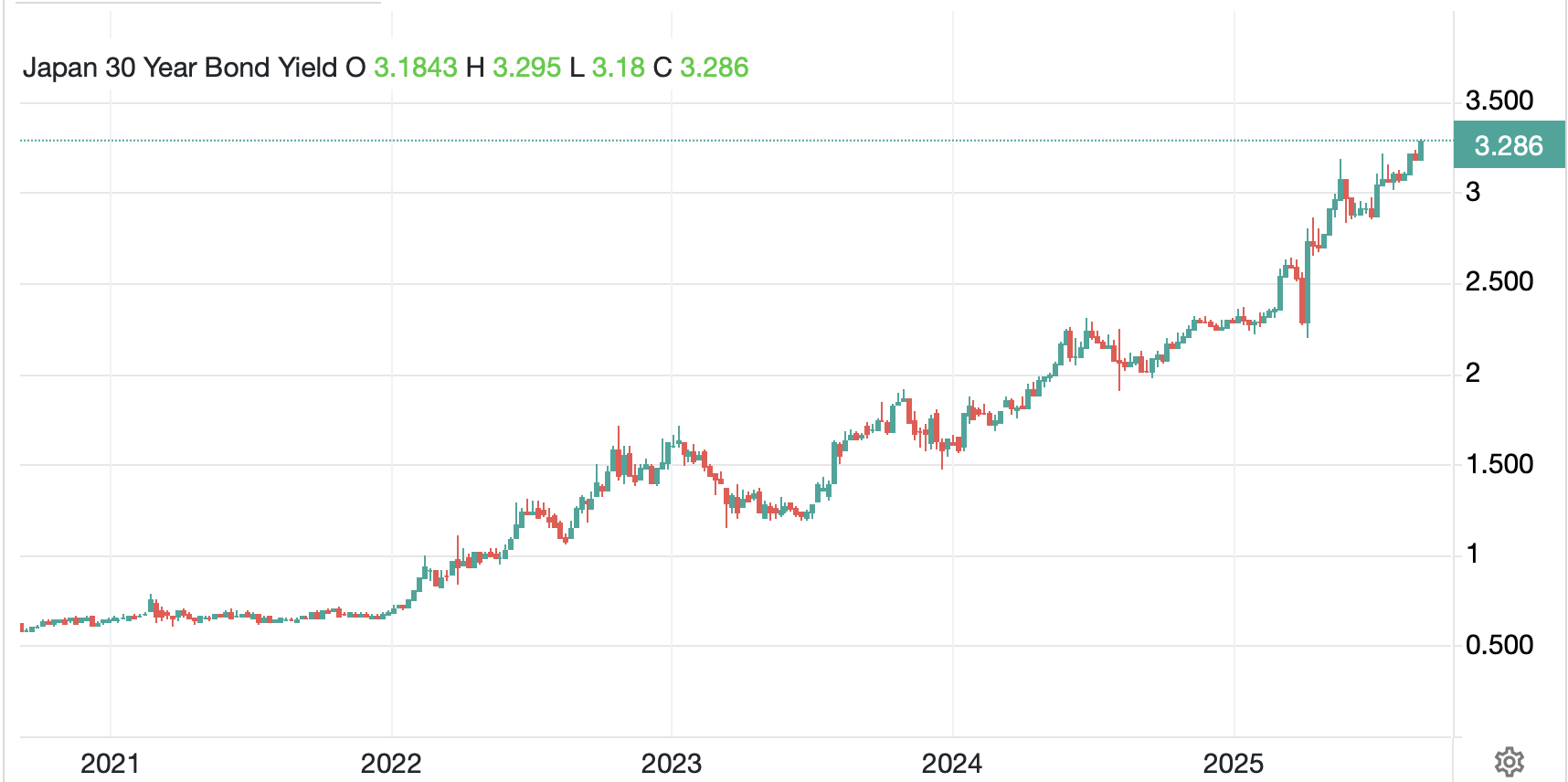
You won’t be surprised that bond yields continue to drift higher, even in the 10-year space with Treasuries higher by 2bps, although most European sovereign yields have edged down by -1bp in the 10-year space.  It is the longer dated yields that continue to see the most pressure with 30-year yields across the US, Europe and Japan all pushing to new highs for the move, and in the case of Japan, new all-time highs.

Source: tradingeconomics.com

This, of course, is the underlying story for virtually all markets right now.

In the commodity markets, oil (-2.1%) has given back yesterday’s gains after reports that OPEC+, which is meeting this weekend, will be raising their output yet again.  Whatever the situation is in Russia, whether Ukrainian attacks are reducing supply or not, it seems clear that OPEC is unperturbed and wants to pump as much as possible. In the metals markets, gold (+0.3%) has set another new all-time high and appears to be breaking out from its recent consolidation pattern.  I am no market technician (I’m a poet after all), but a consensus seems to be forming that $3700 is coming soon and $4000 will be achieved by early next year.

Source: tradingeconomics.com

The rest of the metals space is little changed this morning with silver holding at its 11-year highs and copper treading water at the levels that existed pre-tariff threats.

Finally, the currency markets, which saw the dollar rally sharply yesterday, are taking a breather with the dollar giving back some of those gains amid a consolidation.  In the G10, movement is 0.2% or less, so really nothing and in the EMG bloc, HUF (+0.6%), KRW (+0.5%) and ZAR (+0.3%) are the biggest gainers, with the latter following gold, while traders see the central bank in Hungary maintaining higher rates to fight still, too high inflation of 4.3%.  As to Korea, better than expected GDP data helped drive inflows to the currency.

On the data front today, we see JOLTs Job Openings (exp 7.4M) and Factory Orders (-1.4%) this morning and the Fed’s Beige Book is released at 2:00pm.  We also hear from two Fed speakers, which given the row over Governor Cook’s tenure at the Fed, may be interesting to see.  The market continues to price a 92% probability of a 25bp cut in two weeks’ time, but I suspect that Friday’s NFP data may be the ultimate arbiter there.

I cannot look at the world and conclude that the US is the biggest problem around.  However, if we do see weak data on Friday and the market starts to price 50bps of cuts by the Fed, the dollar will decline in the near term.  But longer term, the more I read, the more bullish I get on the greenback, at least relative to other currencies.

Good luck

Adf

Political War

In Washington, Cook feels the heat
As Trump wants a change in her seat
In Paris, the sitch
For Macron’s a bitch
As confidence there’s in retreat
 
These two stories plus so much more
Explain that we’re in, Turning, Four
So, all that we knew
Seems no longer true
Instead, there’s political war


The dichotomy between the general lack of price volatility in markets and the increase in political volatility over policy choices and requirements around the world is truly remarkable.  However, just like so much else that many have assumed as a baseline process for so long, this relationship appears to be changing as well.  These changes have historical precedence, as documented by Neil Howe and William Strauss back in 1997 in their seminal book, The Fourth Turning.  

Perhaps this is the best definition of what the Fourth Turning is all about [emphaisis added]:

“In the recurring loop of modern history, a final, perilous era arrives once each lifetime.  It is marked by civic upheaval and national mobilization, both traumatic and transformative.  That era, reshaping the social and political landscape, is unfolding now.

Now, read that and tell me it is not a perfect description of what we are seeing daily, not just in the US, but around the world.  If you wondered why all the models that had been built about many things, whether financial, economic or governmental are no longer offering accurate forecasts, I would point to this as the underlying premises are going through the throes of change.

For instance, consider President Trump and his relationship with the Fed.  We already know that he and Chairman Powell are at odds and have been so for months over Powell’s reluctance to cut rates.  But his attacks on the Fed are unceasing, and last night he ‘fired’ Governor Lisa Cook for cause.  That cause being the allegations that she committed mortgage fraud, which if true is certainly a concern for a Federal Reserve Board Governor.  But this has never been attempted before so will involve legal wrangling which we will watch over the next many months.

Now, some of you may remember the last time there was a scandal at the FOMC, where two different regional Fed presidents, Dallas’s Robert Kaplan and Boston’s Eric Rosengren, were trading S&P 500 futures in their personal accounts prior to FOMC announcements of which they had inside knowledge.  Both did step down and allegedly the Fed has tightened its controls on that issue as they tried to sweep it under the rug, but let’s face it, Fed members are no angels.

I have no idea how this will play out, although I suspect that Governor Cook will eventually resign as the one thing at which President Trump excels is applying public pressure.  While Powell is an experienced public figure, Ms Cook was a professor at Michigan State, not exactly a spot where you feel the withering heat of a Trumpian attack on a regular basis.  Of course, if she did lie on her mortgage applications, that is a tough look for someone charged with overseeing the financial system.

But that is just the latest issue in the US, at least involving financial markets.  This Fourth Turning is coming alive all around the Western World, perhaps no place more than Paris this morning.  There, PM Bayrou has called for a confidence vote in order to gain the power to pass an austerity budget that cuts €44 billion from spending.  While at this point, it seems long ago, his predecessor PM, Michel Barnier, lasted just 99 days with his minority government and was ousted last December.  While Bayrou has made it for 9 months, it appears his odds of making it for a full year are greatly diminished now as all the opposition parties have promised to vote against him.  Recall, he leads a minority government and if he loses the vote, there will be yet another set of elections in France.

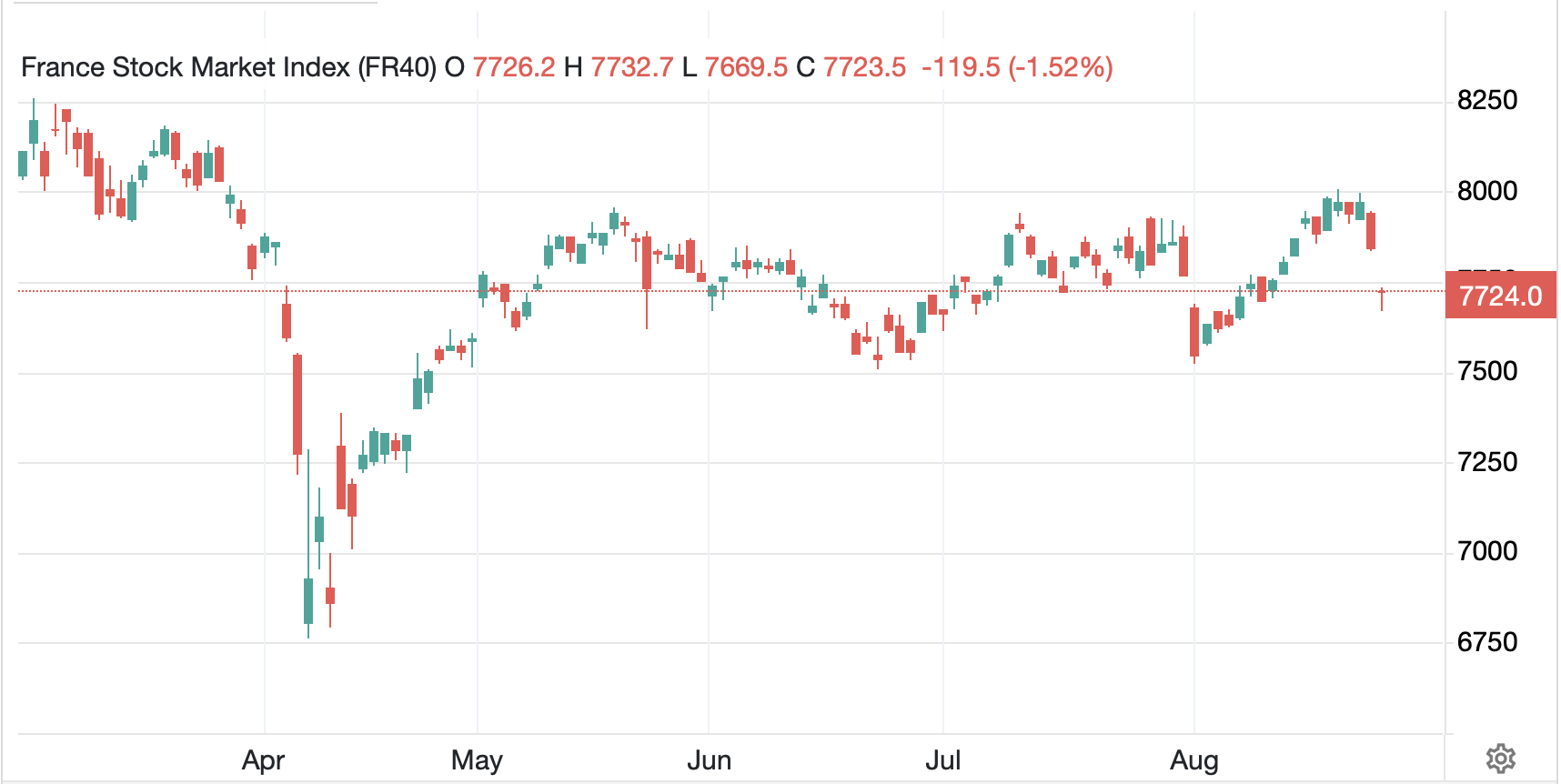
Again, this is emblematic of a Fourth Turning, where systems and institutions that have been operating for decades are suddenly coming apart.  From our perspective, the impact is more direct here with French equity markets (CAC -1.5%) falling sharply (see below) while French government bond yields soar.

Source: tradingeconomics.com

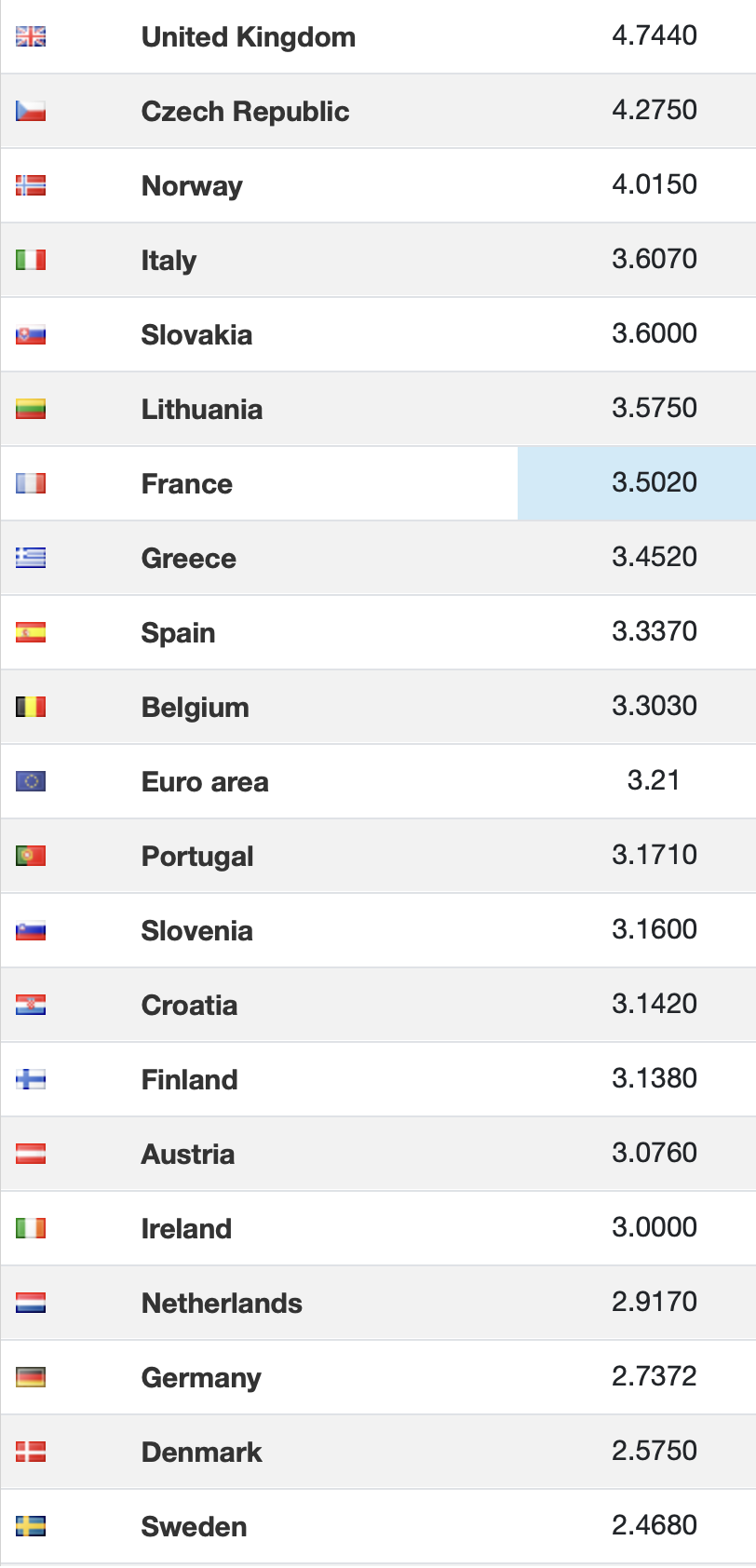
In fact, French 10-year yields now trade above almost all other EU nations including Greece and Spain, although Italian yields are still a touch higher.  Consider that during the European bond crisis of 2011-12, France was considered one of the stronger nations.  Oh, how the mighty have fallen!

Source: tradingeconomics.com

Again, my point is that much of what we thought we understood about how markets behave on both an absolute and relative basis is changing because the institutions underlying the Western economy are undergoing massive changes.  This is not merely a US phenomenon with President Trump, but we are seeing a growing nationalist fervor throughout the West as populations throughout Europe, and even Japan, increasingly reject the culmination of what has been described as the globalist agenda.  As John Steinbeck has been widely quoted, things can change gradually…and then suddenly.

So, let’s look at how other markets behaved overnight following the weakness in US equity markets yesterday.  Asian markets followed suit lower (Tokyo -1.0%, Hong Kong -1.2%, China -0.4%, Korea -1.0%, India -1.0%) with essentially the entire region in the red.  Europe, too, is under pressure this morning and while France leads the way, Germany (-0.4%), Spain (-0.8%) and the UK (-0.6%) are all declining in sync.  However, at this hour (7:10) US futures are essentially unchanged, so perhaps things will stabilize.

Those yields I picture above represent modest declines from yesterday’s levels, although that is only because European yields yesterday mostly climbed between 5bps and 7bps across the board.  As to Treasury yields, they are higher by 2bps this morning, but remain below 4.30%, so are showing no signs of a problem.

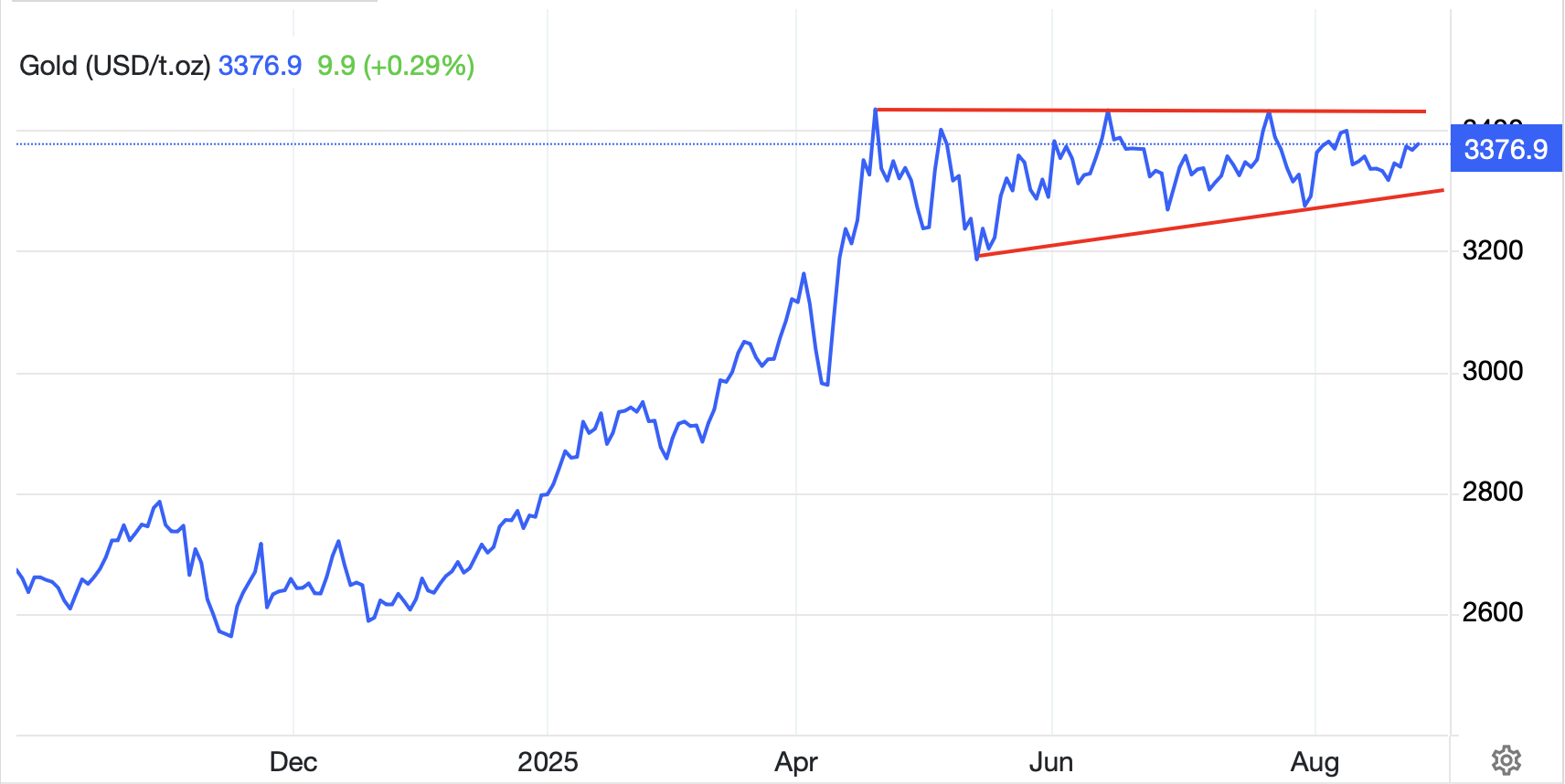
In the commodity markets, oil (-1.8%) is giving back all its gains from yesterday and a little bit more, but in the broad scheme of things, continues to trade in its recent range.  The one thing to watch here is Ukraine’s increasing ability to interrupt Russian production and shipment of oil via long-range drone strikes, as if they continue to be successful, it may well start to push prices above their recent cap at $70/bbl.  That is, however, a big if.  It is getting pretty boring describing metals markets as gold (+0.3%) has been trading in an increasingly narrow range as per the below chart.  This has been ongoing since April and feels like it could last another 5 months without a problem.  Silver’s chart is similar, albeit not quite as narrow a range.

Source: tradingeconomics.com

Finally, the dollar is a touch softer this morning, slipping against the euro (+0.3%), pound (+0.2%), and yen (+0.2%) with most of the rest of the G10 having moved less than that.  NOK (-0.3%) is the outlier following oil lower.  In the EMG bloc, +/- 0.3% is the range for the entire bloc today, so it appears that traders like other G10 currencies today for some reason I cannot fathom.

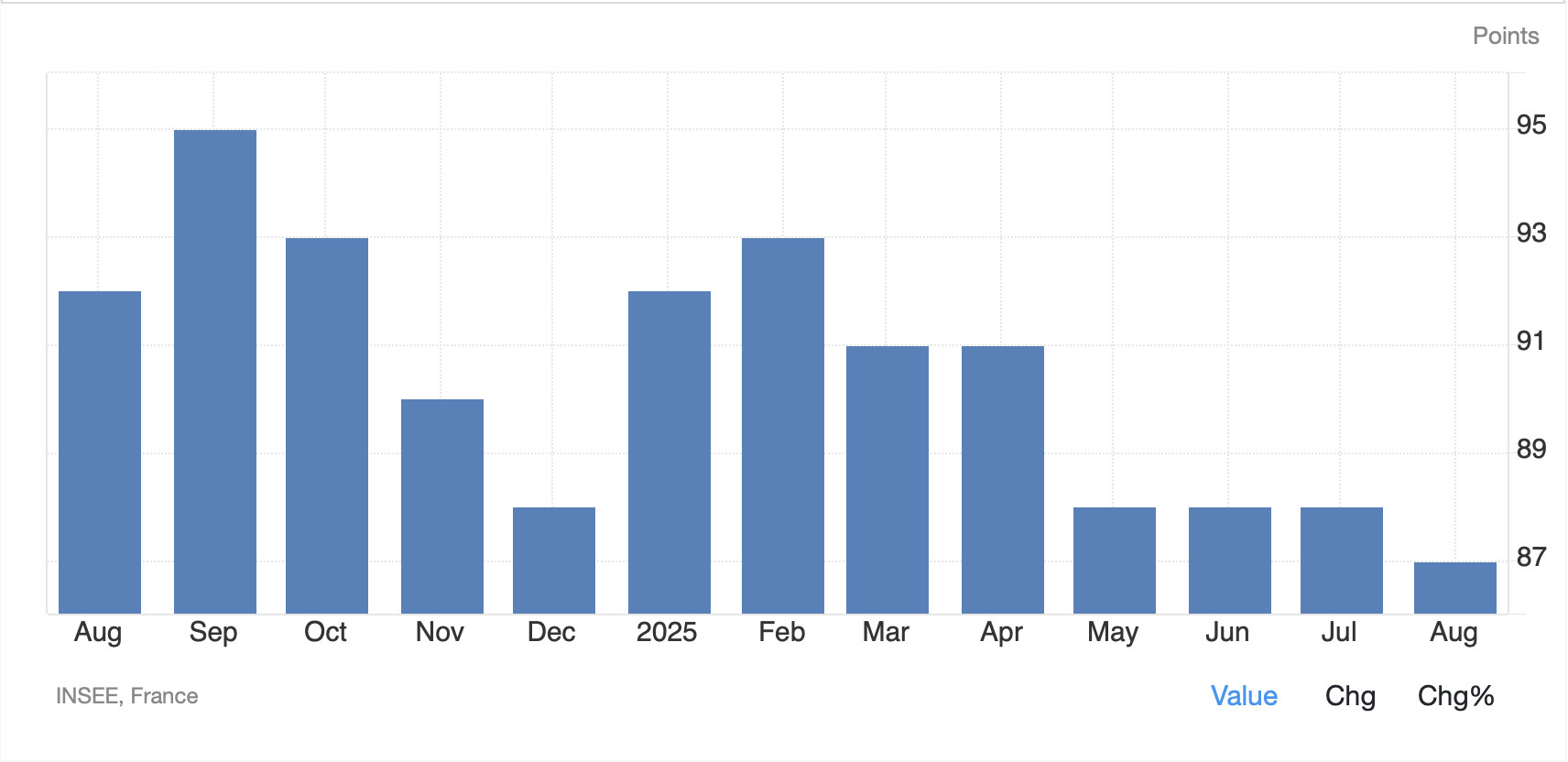
On the data front, we see Durable Goods (exp -4.0%, +0.2% ex Transport) as well as Case Shiller Home Prices (2.1%) and then Consumer Confidence (96.2).  Speaking of Consumer Confidence, in France this morning the latest reading was released at 87.0, three points lower than forecast and clearly trending down.  Perhaps the government’s problems are feeding into the national psyche.

Source: tradingeconomics.com

It is difficult to get excited by markets during the last week of August, and if we add the time of year, when vacations are rife, to the ongoing White House bingo outcomes, the best position seems to be no position at all.  As to the dollar, if the Fed does start to ease policy at this time, with inflation still sticky, I do foresee a decline.  However, it is very difficult to look around the world and think, damn, I want to own THAT currency, whatever currency that might be.  Perhaps the one exception would be the Swiss franc, where they really do work to have sane monetary policies.

Good luck

Adf

To Further Debase

Said Jay, “The economy’s strong”
But rate cuts before weren’t wrong
We’re in a good place
To further debase
Your dollars and will before long
As we slow the pace
Of policy ease all year long


Chairman Powell regaled the market for the last time before the Fed’s quiet period begins tomorrow evening and here are the three comments that seem to explain his current views. 

  • We wanted to send a strong signal that we were going to support the labor market if it continued to weaken.”
  • The economy is strong, and it’s stronger than we thought it was going to be in September.”
  • The good news is that we can afford to be a little more cautious as we try to find a rate-setting that neither spurs nor slows growth.”

My read is he was trying to make an excuse for the 50bp cut that started the process in September as there is still no justification for that move.  However, he essentially reiterated his last remarks of the Fed not being in a hurry to cut rates further.  As it happens, SF Fed president Mary Daly also explained, “We do not need to be urgent. There’s no sense of urgency, but we do need to continue to carefully calibrate our policy and make sure it’s in line with the economy we have today the one we expect to have going forward.” 

Now, a funny thing happened to me yesterday as I read those comments, and my expectation was that the Fed funds futures market might reduce the probability of a December rate cut.  After all, we just heard from the Chairman that things are good and they can be cautious about further cuts, while another member expressly said there was no urgency to cut.  But in fact, the 74% probability this morning is unchanged from yesterday’s level and the punditry remains very convinced that they are going to cut next week despite their caution.  It seems that my understanding of caution and Powell’s are somewhat different.  However, his understanding is the one that matters, so it appears absent a major upside surprise in both NFP tomorrow and CPI next week, a cut is coming on the 18th.

The French president, M. Macron
May soon find himself overthrown
His PM is out
And there is great doubt
‘Bout any new views he has shown

The other topic of note this morning is the collapse of Monsieur Macron’s minority government in France.  This was the widely expected outcome that markets had priced in, so there has been little in the way of impact there.  However, the bigger picture impact is about the structure of the Eurozone (and EU) and its rules.  After all, if the second largest economy in the group is not merely floundering economically, but essentially leaderless, the concept of a coherent set of plans to oversee the Eurozone seems a bit of a stretch.

Macron’s term is not up until 2027, and he has consistently maintained he will not step down early, but there are increasing calls for him to do just that.  Members of parliament on both the left and right, although not Marine Le Pen, the RN’s leader, have been vocal on the subject and a recent poll by Cluster17 for Le Point magazine showed that 54% of the French public wanted him to step down as well.  Now, you know as well as I that absent a criminal conviction, the odds of an elected official stepping down anywhere in the world approach zero and I expect nothing less from Macron.  At the same time, French law prevents another parliamentary election for 12 months after the last, which means July.  At that time, one will almost certainly be called, and it will be interesting to see how that plays out.  

However, in the meantime, it seems likely that France will be floundering with no ability to address fiscal issues, be they spending or deficit focused.  This cannot be a positive for the single currency, especially if France slips into recession.  Again, despite all the concerns over the dollar and the untenable fiscal deficits, things in Europe appear far worse.  Parity in the euro and below seems a far better bet over the next 6 months than the opposite.  While the euro (+0.2%) has bounced slightly this morning, a look at the chart below indicates, at least to me, that the trend is distinctly lower.

Source: tradingeconomics.com

And with that, let’s look at the overnight session in markets.  Continuing in the FX world, that modest euro gain is descriptive of the market as a whole, with the dollar slightly softer this morning, although few currencies showing any notable strength.  I suspect much of this is based on the idea that the Fed will cut rates soon despite the “strong economy”.  In truth, in the G10, no currency has moved more than 0.2% and even in the EMG space, only ZAR (+0.4%) and HUF (+0.5%) have climbed more.  Those moves, which don’t appear to have any fundamental drivers, seem more likely to be expressions of the fact those markets are more volatile than the G10.

In the equity markets, yesterday’s US rally, to new all-time highs across the board, saw a mixed review in Asia with the Nikkei (+0.3%) edging higher but both Hong Kong (-0.9%) and Shanghai (-0.25%) slipping a bit.  The rest of Asia was also mixed with Korea (-0.9%) still suffering from the bizarre happenings there yesterday but other markets performing well (India +1.0%, Singapore +0.6%).  In Europe, only the UK (-0.1%) is under water this morning although the CAC (+0.2%) is the continental laggard.  Spain’s IBEX (+1.2%) is the leader on the back of stronger IP, and although Eurozone Retail Sales were much weaker than expected, it has not seemed to impact investor views.  As to US futures, they are little changed at this hour (7:30).

In the bond market, Treasury yields have backed up 3bps and I am beginning to sense that there is a negative correlation to the probability of a Fed rate cut and the 10-year yield.  As that probability rises, bonds sell off further, but that is merely an anecdotal observation, I have not done the math.  In Europe, yields are mixed, but within 1bp of yesterday’s closing levels with even French yields slipping 1bp. It will be very interesting to see how the European Commission handles the fact that the French budget deficit is so far above the targeted 3% level and now without a government, there is no way to address the situation.  The original idea when the euro was formed was that governments would be fined if they broke the policy caps on debt and deficits.  Of course, no fine has ever been imposed and I don’t suppose one will be now.  (However, if Marine Le Pen’s RN wins the election next summer, you can be sure they will seek to impose fines on her government!)

Finally, in the commodity markets, it is very quiet this morning.  Oil (+0.3%) is edging higher after a big rise and fall yesterday.  The rise was the result of a steep draw in US inventories, but the decline seemed to be a response to OPEC+ confirming they will be increasing production at some point in 2025.  Meanwhile, metals markets are basically unchanged this morning.

One other thing I have not discussed but is obviously getting a lot of press this morning, is Bitcoin which traded through $100K yesterday after President-elect Trump named Paul Atkins to be his new SEC Chair.  Atkins has a very pro crypto bias, and I expect we will see far more impetus in the crypto space going forward, not just in Bitcoin.

On the data front, yesterday’s ISM data was a bit softer than forecast while the Beige Book explained that economic activity rose slightly in the past month along with employment and prices, but all movements were quite modest.  This morning, we see Initial (exp 215K) and Continuing (1910K) Claims as well as the Trade Balance (-$75.0B) and later we hear from Richmond Fed president Barkin.  

Looking at the overall situation, investors continue to ignore any potential problems and run to risk assets, as evidenced by the rally in Bitcoin and new highs in stock prices.  Unless we see some really surprising data, either crazy strong implying the Fed is going to stop easing, or crazy weak implying we are in a recession, I see no reason for this process to end heading into the new year and President Trump’s inauguration.  Again, in that scenario, I think you have to like the dollar higher.

Good luck

Adf

Chaos is Spreading

Around the world, chaos is spreading
As government norms get a shredding
Korea’s the latest
But not near the greatest
Seems to the Fourth Turning we’re heading

While Russia/Ukraine knows no end
And Israel seeks to defend
The French are about
To toss Michel out
And all this ere Trump does ascend


If you view markets through a macro lens, the current environment can only be described as insane.  Niel Howe and William Strauss wrote a book back in 1997 called The Fourth Turning (which I cannot recommend highly enough) that described a generational cycle structure that has played out for hundreds of years.  If you have ever heard the saying 

  • Hard times make strong men (1st Turning)
  • Strong men make good times (2nd Turning)
  • Good times make soft men (3rd Turning)
  • Soft men make hard times (4th Turning)

Or anything in the same vein, this book basically describes the process and how it evolves.  The essence is that about every 20-25 years, a new generation, raised by its parents whose formative years were in the previous Turning, falls into one of these scenarios.  Howe and Strauss explained that at the time they wrote the book, we were in the middle of the 3rd Turning, and that the 4th Turning would be upon us through the 2020’s.  One of the features they highlighted was that every 4th Turning was highlighted by major conflict (WWII, Civil War, Revolutionary War, etc.) with the implication that we could well be heading toward one now.

Of course, we already have a few minor wars with Russia/Ukraine (although that seems to have the potential to be more problematic) and Israel/Hezbollah/Hamas, with Iran hanging around the edges there.  In a funny way, we have to hope this is the worst we get, but there are still more than 5 years left in the decade for things to deteriorate, so we are not nearly out of the woods yet.  

But turmoil comes in many forms and political turmoil is also rampant these days.  This is evident by the number of sitting governments that have been ejected in the most recent elections as well as the increasingly strident blaming of others for a nation’s current problems.  In this vein, the latest situation will happen shortly when the French parliament votes on a no-confidence motion against the current PM, Michel Barnier.  As it is, he is merely a caretaker PM put in place by President Macron after Macron’s election gamble in June failed miserably.  Adding to France’s problems, and one way this comes back to the markets, is that the French fiscal situation is dire, with a current budget deficit exceeding 6% of GDP and no good way to shrink it.  In fact, Barnier’s efforts to do so are what led to the current vote.  I have already discussed French yields rising relative to their European peers and the underperformance of the CAC as well. 

On the one hand, today’s vote, which is tipped to eject Barnier, may well be the peak (or nadir) of the situation and things will only improve from the current worst case.  However, it strikes me this is not likely to be the case.  Rather, there are such a multitude of problems regarding immigration, culture, economic activity and government responsiveness, that we have not nearly found the end.  My fear is we will need to see things deteriorate far more than they have before populations come together and agree that ending the mess is the most important outcome.  Right now, there are two sides dug in on most issues and the split feels pretty even.  As such, neither side is going to give up what they believe for the greater good, at least not yet.

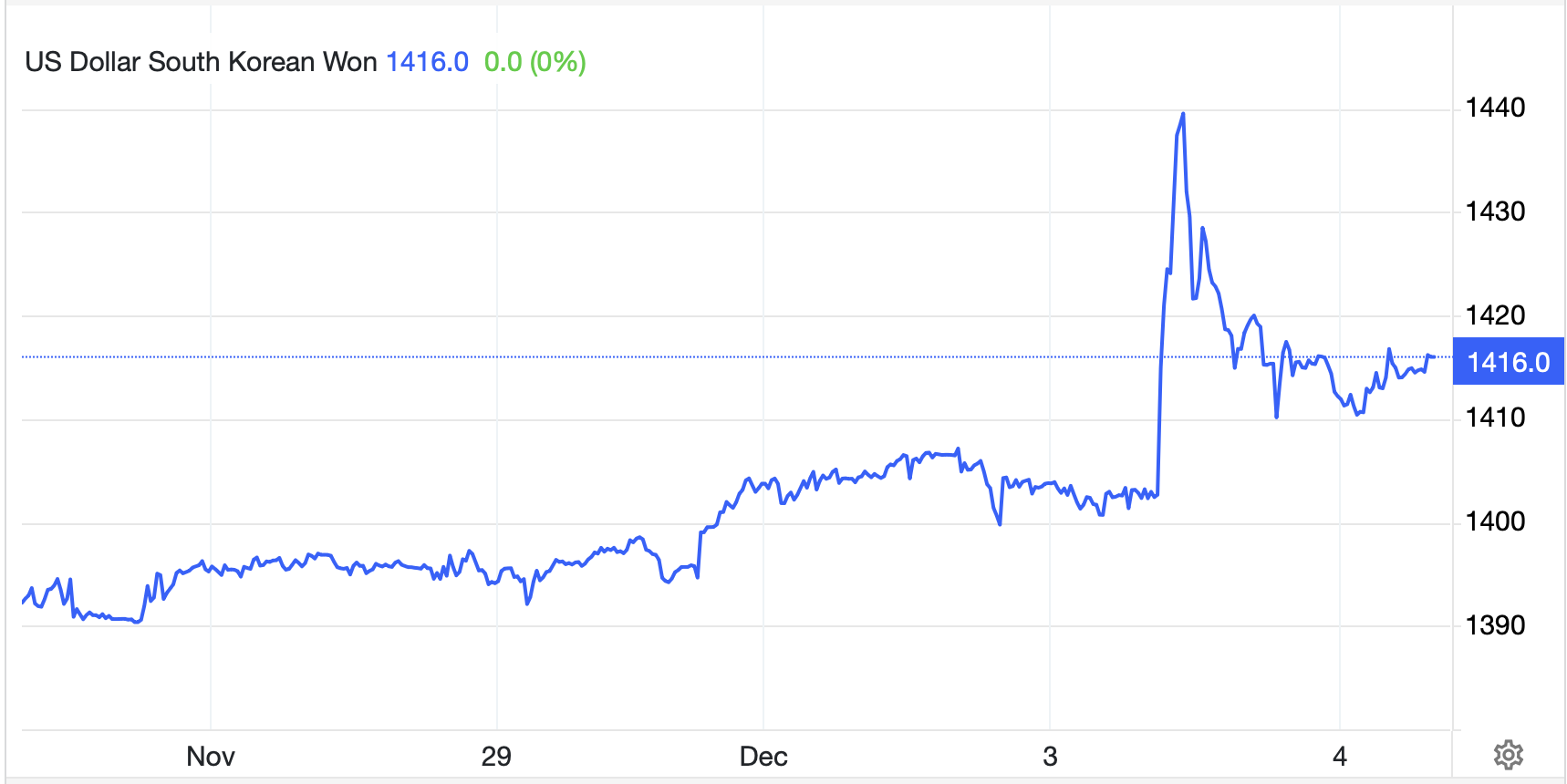
And before I move on to the markets, I cannot ignore the remarkable events in South Korea yesterday, where President Yoon Suk Yeol declared martial law in the early hours on the basis of the opposition’s efforts to paralyze the government (I guess that means they didn’t agree with him).  In the end, the Korean Parliament voted to rescind the order, and the military has since stood down with all eyes on the next steps including likely impeachment hearings for the President.  Not surprisingly, Korean assets suffered during this situation with the won tumbling briefly, more than 2.6%, before retracing the bulk of those losses once the order was rescinded.  

Source: tradingeconomics.com

Too, the KOSPI (-1.5%) suffered although that was off the worst levels of the day after things settled down.  The point to keep in mind here is that markets are subsidiaries of economies.  They may give indications of expectations for the future, or sentiments of the current situation, but if we continue to see geopolitical flare ups, markets are going to respond as investors seek havens.  In this case, the dollar, despite all its flaws, remains the safest choice in many investors’ eyes, so should remain well bid overall.

Ok, let’s look at how markets have been behaving through this current turmoil.  In Asia, given the events in Korea, it ought not be surprising that equities had little traction.  Japanese shares were unchanged as were Hong Kong although mainland Chinese (-0.5%) and Australian (-0.4%) shares were under some pressure.  That said, Australia suffered on weaker than forecast GDP data which puts more pressure on the RBA to cut rates despite inflation remaining sticky.  Australia dragged down New Zealand (-1.5%) shares as well with really the only notable winner overnight being Taiwan (+1.0%).  In Europe, investors seem to be betting on a more aggressive ECB as somewhat weaker than expected PMI Services data has led to gains on the continent (DAX +0.85%, CAC +0.5%, IBEX +0.7%) although UK shares (-0.2%) are not enjoying the same boost.  I guess the French market has already priced in the lack of a working government, hence the market’s underperformance all year.  US futures, at this hour (8:00) are pointing higher by between 0.3% and 0.6%.

In the bond market, yields are rising, with Treasuries (+4bps) leading the way although most of Europe are higher by between 3bps and 4bps.  It has the feel that bond markets are starting to decouple from central banks as they see inflationary pressures building and central banks still in active cutting mode.  I fear this will get messier as time goes on.

In the commodity markets, oil is unchanged this morning, right at $70/bbl, having continued its rally for the week on news that OPEC+ will maintain its production cuts through March 2025.  NatGas (-2.0%) has been sliding since the spike seen 2 weeks ago ahead of the current cold spell as warmer weather is forecast for next week.  In the metals market, gold (-0.2%) seems stuck in the mud right now while silver (-1.3%) and copper (-0.6%) appear to be victims of the dollar’s strength.

Turning to the dollar, it is stronger across the board with AUD (-1.3%) the laggard after that GDP data and it dragged NZD (-1.0%) down with it.  JPY (-1.1%) is also under pressure as hopes for that BOJ rate hike dissipate.  Away from those, the euro (-0.2%) and pound (-0.1%) are softer, but much less so.  In the EMG bloc, ZAR (-0.5%) is feeling the weight of the weaker metals prices and we are seeing BRL (-0.3%) and CLP (-0.1%) also sliding slightly although both are stabilizing after more pronounced weakness earlier in the week.

On the data front, this morning brings ADP Employment. (exp 150K) along with ISM Services (55.5) and then the Fed’s Beige Book.  Perhaps of more importance, at 12:45, Chairman Powell will be speaking and taking questions, so all eyes will be there looking for clues as to how the Fed will be viewing things going forward.  Fed funds futures have been increasing the probability of that rate cut, now up to 74%, which implies we are going to see one, regardless of the inflation story.

Central banks around the world are in a bind as inflation refuses to fall like they want but many nations are seeing slowing economic activity.  In the end, I expect that the rate cutting cycle has not ended, but the dollar is likely to remain well bid given both its haven status and the fact that the US economy is outperforming everywhere else.

Good luck

Adf

Declines and Duress

In France, there’s a government mess
That lately’s been causing some stress
For French sovereign debt
With stocks under threat
Of further declines and duress


In one of the most colossal political blunders in recent memory, French President Emmanuel Macron completely misread the country and called a snap election after the European Parliament elections sent his party and allies to a significant defeat in June.  In what should not have been a surprise to anyone, his party was decimated in the national election, although the results have been even more unfortunate for the people of France as they have basically left the nation without a working government.  While there is currently a caretaker PM in place, Monsieur Barnier is almost certainly going to lose a no-confidence vote tomorrow as both the left and right express their displeasure at the situation.

Alas, the pattern we observe of late is that European citizens have been generally unhappy with the decisions made by their governments, with a universal issue being immigration policies, and when elections have been held, the parties in power have been shown the door.  Or they would have been except that they are extremely reluctant to leave office and are willing to do anything at all, except work with the anti-immigration parties (typically on the right) to govern their nations.  The result has been a series of election results with very weak minority governments and no power to do anything to help their citizens by addressing key issues.  Budgets are a problem; massive debt loads are constraining and economic activity is shrinking.  

France is merely the current fracas although we have seen the same things occur in Germany, the Netherlands, Austria, Sweden and much of Eastern Europe.  From our perspective, the issue here is what does it mean for the economic prospects of the euro (and other European currencies) and how might the ECB respond.  Consider that as poorly as things are going in Germany, and they are really having a tough time, a quick look at the performance of the DAX and CAC (as well as the S&P 500) shows that France is really a laggard right now.

Source: tradingeconmics.com

Since the dip in the beginning of August, French equities are essentially unchanged while even German equities have risen 15% alongside their US brethren.  During that same period, French 10-year yields have been rising relative to their German counterparts as fears over a French fiscal disaster rise.  In fact, there is now discussion that the ECB will need to use their TPI program, originally designed to support Italian debt, to prevent the spread between French and German yields from widening too far.  

If you were wondering why the euro has been having problems lately, this has clearly been a piece of the puzzle, and likely a key piece.  While the single currency has rallied slightly this morning, up 0.2%, the below chart speaks volumes as to the direction of travel.

Source: tradingeconomics.com

While yesterday I explained why I thought over time the dollar might eventually decline, right now, I think we need to look for the euro to test parity and potentially go below for the first time since November 2022.

As well, there’s another key nation
That’s seeking its ‘nomic salvation
Their currency’s falling
As pundits are calling
For stimulus midst their frustration

This brings our attention to China, where next week, the Central Economic Work Conference will be held as President Xi tries to shake the nation out of its economic lethargy.  There are high hopes for yet more stimulus despite the fact that the efforts so far have had a limited impact at best.  Perhaps the Chinese problem can best be described as they produce far too many goods for their own consumption and so run large trade surpluses angering their trade partners.  While President-elect Trump gets most of the press regarding his complaints about China’s economic behavior, it turns out that many countries around the world are pushing back.  This morning’s WSJ had an article on this very issue and it seems possible that President Xi may find himself even more isolated on the issue than before.

The natural solution is for China to consume more of what it produces, but that is far easier said than done, especially as the youth unemployment rate in China remains quite high, above 17%, while demographics continue to work against the country.  Arguably, one way to solve this issue would be for the renminbi to strengthen dramatically, simultaneously increasing the price of Chinese exports, so likely reducing demand, while increasing demand for imports.  Unfortunately, as can be seen below, the currency is moving in the opposite direction as the tariff threats from the US and elsewhere feed into the market psyche.

Source: tradingeconomics.com

It will be interesting to see if the PBOC is comfortable allowing the renminbi to weaken further.  It is currently at its weakest point since July, but also at levels where historically, the PBOC has entered the market over the past several years to prevent further declines.  With tariffs imminent, will this time be different?

Ok, let’s turn to the overnight market activity.  Asian equity markets were all strong overnight led by Japan (+1.9%) although we saw gains throughout the region (Korea +1.9%, India +0.75%, Taiwan +1.3%).  In China, Hong Kong (+1.1%) fared far better than the mainland (+0.1%) although both these markets closed well off early session lows after discussion of the economic conference and more subsidies made the rounds.  In Europe, screens are green this morning as well, seemingly on growing hopes that the ECB will be cutting more aggressively as data there remains soft, and comments from Fed Governor Waller yesterday indicated he was on board with further cuts despite the current data showing solid performance.  However, US futures are little changed at this hour (7:30) as focus begins to turn toward Friday’s NFP report.

In the bond markets, yields are edging higher with 10-year Treasuries up 2bps while most European sovereigns are higher by between 1bp and 3bps.  France is an exception this morning as that TPI talk has traders thinking there will be a price insensitive bid for OATs soon.

In the commodity markets, oil (+1.2%) is rebounding nicely from yesterday’s selloff although continues to trade below that $70/bbl level.  In the metals market, yesterday’s declines, which seemed to have been driven by the much stronger dollar, are being reversed in silver (+0.8%) and copper (+1.0%) although gold is essentially unchanged on the day.

Finally, the dollar, after a ripping rally yesterday, is backing off a bit, but not very much.  In fact, there are a number of currencies which are still sliding somewhat, notably CNY (-0.2%) and SEK (-0.2%) with the only gainer of note this morning being CLP (+0.6%) as it follows the price of copper higher.  Broadly speaking, the current setup remains quite positive for the dollar I believe.

On the data front, this morning brings only the JOLTS Job Openings report (exp 7.48M) and a bit more Fedspeak.  Yesterday’s ISM data was stronger than expected but still, at 48.4, below the key 50.0 level indicating manufacturing is still in a funk.  Perhaps better news was that the Prices Paid survey declined to 50.3, potentially indicating reduced inflation pressures.

While the market keenly awaits Chairman Powell’s speech on Wednesday as well as the NFP release on Friday, I sense that there is limited appetite to take on new positions.  Implied volatility is climbing as uncertainty reigns over the market but has not yet reached extremely high levels.  For hedgers, this is when options make the most sense.

Good luck

Adf