Fading

In Germany, growth has been fading
Down Under, inflation’s upgrading
Chair Jay gave his views
But it was old news
And Trump, for more cuts, is crusading


Some days, there is less to discuss than others, and this morning that seems to be the case.  Even my X feed had very little of interest.  Arguably, the top story is German Ifo readings came out much lower than expected and have now reversed most of the gains that occurred from front-running US tariff policy changes.  Germany’s bigger problem, though, is that the trend here is abysmal, as ever since Russia’s invasion of Ukraine and the dramatic rise in energy prices there, the German economy has been under significant pressure.  A look at the 5-year history of the Ifo series does an excellent job of explaining why growth has completely stalled there.

Source: tradingeconomics.com

In fact, if we look at the last three+ years of GDP activity in Germany, as per the below chart, we see that seven of the thirteen quarters were negative while two were exactly flat and the sum total of growth was -0.9%.  It’s amazing what happens to a nation that decides to impose extreme conditions on the production of energy domestically.  Or perhaps it’s not so amazing.  After all, economic activity is merely energy transformed.  If the cost of energy is high, economic activity is going to be slow.

Source: tradingeconomics.com

I highlight this because it runs counter to the narrative that Europe is a better place to invest than the US, which has been the thesis of the ‘end of American exceptionalism’ trade.  Germany is the largest European nation by far and had been a manufacturing powerhouse.  But those days appear to have passed.  If Germany is going to continue to lag, and I see no reason for that to change based on the current political dynamic there, please explain the idea behind long-term strength in the euro.  As I wrote yesterday, if the Fed cuts aggressively, the dollar will decline in the short run, but one cannot look at the trajectories of the relative economies and claim Europe is the place to be in the long run.

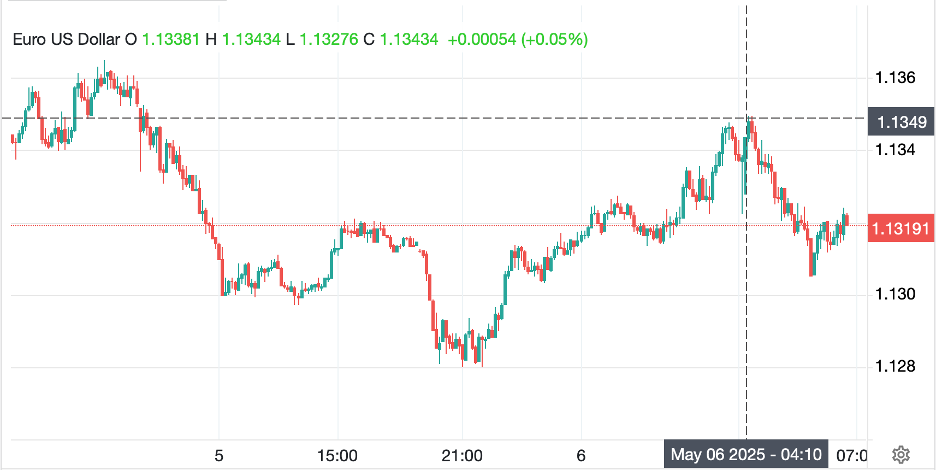
This morning, the euro (-0.5%) has responded logically to the data but the dollar is broadly stronger as well after Chair Powell’s speech yesterday where he continued the modestly hawkish tone from the FOMC press conference.  He continues to agonize over the fact that inflation won’t fall while unemployment is edging higher, although he finally admitted that tariffs would likely have a temporary, one-off impact on prices.  While there is no doubt the dollar has fallen since the beginning of the year, a 10% or 15% move is hardly unprecedented, but rather occurs pretty frequently.  A look at the below chart from the beginning of the euro’s existence in 1999 shows at least six or seven other instances when the euro rallied that much in a short period of time.
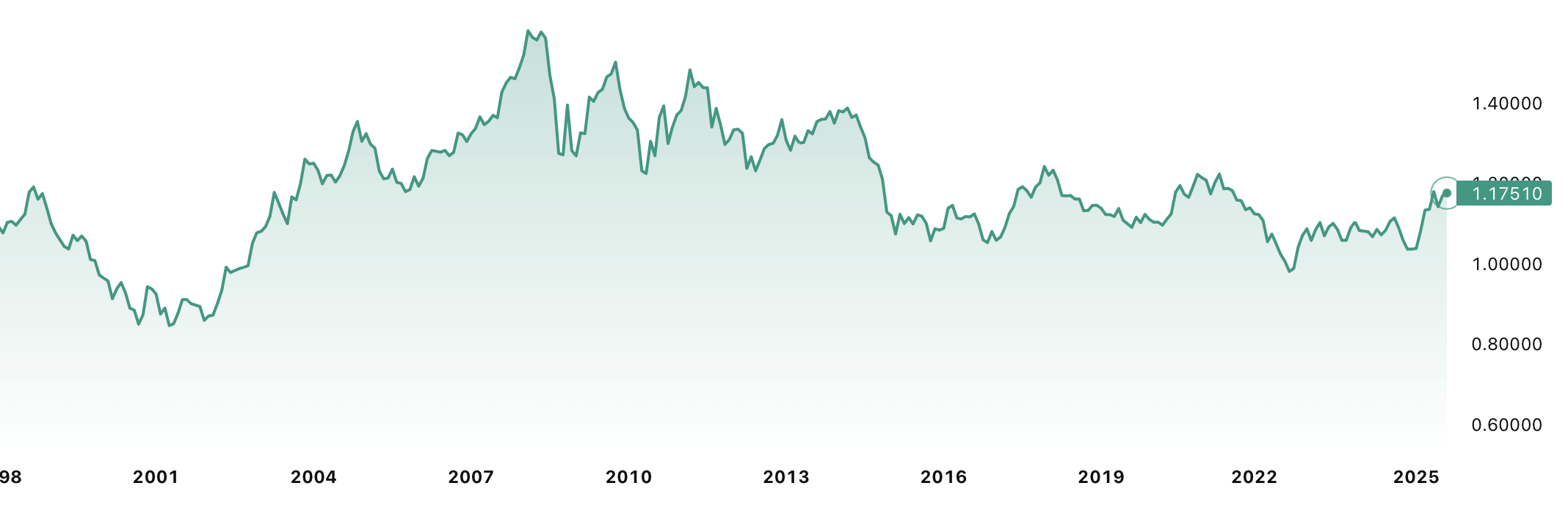
Source: tradingview.com

In fact, to demonstrate the politicization of the current world, one need only go back to the period in 2008 when the euro peaked at 1.60 or so to see that it was not seen as a global calamity, simply a period where US monetary policy had loosened dramatically relative to the rest of the world.

The other marginally interesting story this morning is Australia’s inflation rate, which came in at 3.0%, higher than expected and demonstrating what appears to be a break in the declining trend previously seen.

Source: tradingeconomics.com

This matters as AUD (+0.1%) is outperforming all its G10 peers this morning on the back of the idea that the RBA will be stuck on hold, rather than cutting rates again soon.  Too, this weighed on Australian equities (-0.9%) which underperformed other Asian markets overnight.

But that’s really all the interesting stuff, and it wasn’t that interesting, I fear.  So, let’s look at the rest of the market behavior overnight.  While I thought it was illegal, yesterday resulted in US equity markets declining on the session, albeit less than 1%.  And this morning, you’ll be happy to know, the futures are all modestly green.  As to Asian markets, Japan (+0.3%), China (+1.0%) and HK (+1.4%) all had strong sessions although it appears most of the other regional bourses declined.  The Chinese story making the rounds is the lessening in trade tensions between the US and China was seen as a key positive while HK survived Typhoon Ragasa without any major impacts.  But Korea, India, Taiwan and Singapore were all softer on the session.

In Europe, markets have generally done little with marginal declines the norm although, surprisingly, Germany’s DAX is unchanged on the day despite the weak Ifo data.  However, it is hard to get excited about anything happening there right now.

Bond yields fell yesterday with Treasuries declining -4bps although this morning they have edged back higher by 1bp.  Perhaps Powell’s tone yesterday was enough to keep the bond vigilantes on the sidelines, or perhaps there is simply not enough new information to change any views right now.  The Fed funds futures market continues to price a 94% probability of a cut at the end of next month and apparently bond investors are cool with that.  European yields are also little changed this morning as were JGB yields last night.

In the commodity space, oil (+1.1%) is heading back toward the top of the range I highlighted yesterday, but still more than $1 away and there have been no stories to drive things.  This is all just range trading in my view.  As to the metals markets, this morning gold and silver are essentially unchanged, consolidating their recent gains while copper (-.0.75%) is slipping slightly and has retraced some of its gains from earlier in the month.  Remember, copper is much more an economic play than a fear play or inflation play.

Finally, the dollar is firmer across the board this morning with gains against almost all G10 counterparts on the order of 0.5% and against EMG counterparts it is more like 0.8%.  Even CNY (-0.25%) is weakening as it appears Chinese state banks are selling renminbi in the spot market and hedging in the swap market to help mitigate its recent gains.  It is beginning to feel like the dollar’s decline this year, which has been widespread, is coming to an end.  

On the data front, today brings only New Home Sales (exp 650K) and EIA oil inventories.  Yesterday’s Flash PMI data was right in line with expectations, and my take is until NFP a week from Friday, there is going to be little of interest on the data front for markets overall.  Even PCE this week will have to be significantly different from expectations to have any impact.

It appears that absent Stephen Miran convincing the rest of the FOMC to cut rates aggressively, a very low probability event, the dollar is finding a bottom, and the next major move will be higher on the basis of stronger growth in the US vs. the rest of the world.  Of course, if the Fed does start to get more aggressive, then the dollar will suffer, I just don’t see that happening anytime soon.

Good luck

Adf
More Pain

The data from China reflected
That tariffs have hurt, as expected
It’s likely more pain,
On China, will rain
As both nations are so connected
 
Meanwhile, in a German surprise
Herr Merz failed to get his allies
To name him to lead
Which seemed guaranteed
Could this presage his quick demise?

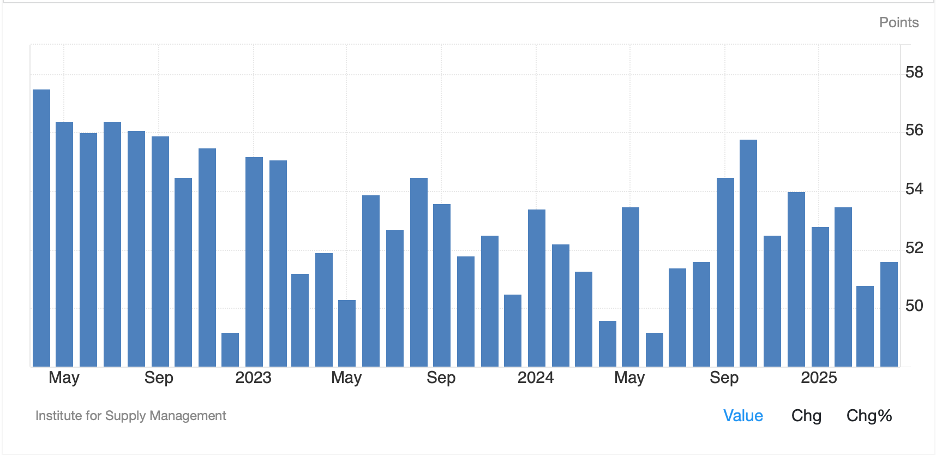
In the battle being waged between the US and China via tariffs, the first data indications have shown that the US is faring a bit better.  Yesterday’s ISM Services data was stronger than expected, remaining well above the 50 level although arguably slightly below the recent average reading.

Source: tradingeconomics.com

Meanwhile, last night, the Chinese Caixin Services PMI fell to 50.7, missing expectations and continuing its drift lower over time.  

Source: tradingeconmics.com

Are things really worse in China than the US, at least from the perspective of data releases?  I think both nations will suffer during this period as the impacts of the tariffs and reduced trade bleed into the data over the next months, but so far, it seems the US is holding its own.  One of the problems with analyzing the issue is that as the WSJ pointed out yesterday, when the data in China gets bad, they simply stop releasing it, so it may be difficult to see.

Now, last night, Chinese shares did manage a nice rally with the CSI 300 higher by 1.0% but that follows six consecutive down sessions, albeit of modest size.  

Source: tradingeconomics.com

As to the renminbi, after a 1% gain last Friday, it has done little and remains very much in line with its levels of the past year.  The thing about China is that nothing there moves quickly, so absent a policy announcement of some type, I expect this activity will continue to gradually adjust to the realities as they become clear to the market.  If President Trump reduces tariffs, as he implied he would eventually, things could work better, but again, given the time lags of moving products across the Pacific, we have a lot of time between now and whatever the new normal turns out to be.

But the more interesting story to me overnight was that Friedrich Merz, the ostensible winner of the German elections last month failed to achieve the votes to be named Chancellor despite his coalition having a 12-seat majority in the Bundestag.  As it was a secret ballot, nobody knows who didn’t support him, but this outcome certainly calls into question both his ability to lead Germany effectively, and correspondingly, Germany’s ability to lead Europe in the new world order.

Recall, Germany remains keen to support Ukraine in its ongoing war with Russia and even destroyed their once sacrosanct fiscal responsibility in order to be able to pay for that support.  But if they do not have an effective leader, one who can command their parliament to enact his policies, it is not clear why other European nations would follow their lead on anything.  It should not be surprising that the DAX (-1.3%) fell sharply when the news was released, and that has helped drag most European shares lower (CAC -0.7%, IBEX -0.3%, Poland -3.3%).  As to the euro, you can see from the below chart that the response, when the news was announced, that it slipped about 0.5%, basically wiping out the gains it had achieved prior to the vote.

Source: tradingeconomics.com

Will this matter in the long run?  I believe that a weakened Germany, which is likely the outcome of this situation, will simply undermine the euro’s value.  As such, while I still believe the dollar has further to decline, the euro will probably not be a major winner.  Look for other currencies to outperform the euro going forward.

Ok, I think those are the real stories as we head into today’s session with most market participants remaining tentative in the face of the ongoing confusion over policies, counter policies and macroeconomic data.  Remember, too, we have the Fed tomorrow and the BOE on Thursday, so despite the fact that fiscal policy has been the driver, the Fed’s opinions still carry weight amongst the fixed income community, at the very least.

Looking at the price action overnight, the Nikkei (+1.0%) gained on some solid earnings data from Japanese companies as well as increased hopes that the US-Japan trade talks will be successfully completed by June.  Apparently, there is also some faith that the US and China will begin talking soon on this subject.  Hong Kong (+0.7%) also benefitted from these discussions, but the rest of the region showed very little movement overall, with gains or losses on the order of 0.3% or less.  As we have already discussed Europe, a look at US futures shows they are pointing lower by about -0.5% at this hour (7:10).

Bond markets remain very dull these days with Treasury yields edging higher by 1bp this morning after climbing 3bps yesterday.  European sovereign yields are also higher. By 1bp to 2bps although there is neither data nor a story that seems to have had much impact.  The Services PMI data that was released this morning was very much in line with expectations and continues to hover around 50.0 for the continent as a whole.  Meanwhile, JGB yields were unchanged last night and sit at 1.25%, well below the levels seen back in late March and having really gone nowhere for the past month.  It strikes me that JGB yields will respond to any trade deals but are likely to be quiet in the interim.

Commodity prices are rallying this morning with oil (+2.2%) rebounding from its level yesterday which happen to come quite close to touching the lows from April 9th.  It should be no surprise that there are up days in this market, but if the Saudis and OPEC are going to continue increasing production, I expect that prices have further to fall.  In the metals markets, gold (+1.4%) is having another blockbuster day, now having gained $150/oz in the past three sessions and bouncing off the correction lows.  Demand for the barbarous relic continues to come from Asia mostly with all signs showing that US investors are not interested in this trade.  As to silver (+1.7%) and copper (+0.6%), they are both still along for the ride.

It should be no surprise with the commodity markets showing strength that the dollar is under pressure this morning.  while we’ve discussed the euro already, the pound (+0.5%) is looking quite solid as it continues its rally from the lows seen in mid-January.  But the yen (+0.5%), SEK (+0.45%) and NOK (+0.35%) are all gaining today as well.  Interestingly, the impact in emerging markets is far less noticeable with none of the major EMG currencies moving even 0.2% this morning.

On the data front, there is very little hard data this week although we do have the Fed on Wednesday and then a whole bunch of Fed speakers on Friday.

TodayTrade Balance-$137.0B
WednesdayFOMC Rate Decision4.50% (unchanged)
 Consumer Credit$9.5B
ThursdayBOE Rate Decision4.25% (-0.25%)
 Initial Claims230K
 Continuing Claims1890K
 Nonfarm Productivity-0.7%
 Unit Labor Costs5.1%

Source: tradingeconomics.com

Today’s trade data is for March, prior to the tariff impositions, so will reflect significant tariff front-running.  But really, it’s about the Fed this week, and since they have lost much of their cachet lately, I think the market is really going to continue to look to the White House for trade news and react to that.  Net, I continue to believe that the dollar’s FX rate will be part of many trade discussions, like we saw with Taiwan (which by the way did reverse 3% of yesterday’s gain overnight) and that means further weakness is in our future.

Good luck

Adf

Another Broadside

Investors don’t know where to hide
As Trump lands another broadside
Last night he did roil
All those who buy oil
From Vene, with tariffs applied
 
But yesterday, too, he amended
How tariffs would soon be extended
The lesson to learn
Is you’ll ne’er discern
His methods, so don’t be offended


Once again, the tariff game changed yesterday, although this time in two directions.  The first, and newest idea is that the US will impose “secondary” tariffs on all nations that buy oil from Venezuela.  The idea is to pressure Venezuela to concede to US demands by reducing the market for their one exportable commodity, at least the only one in demand (Tren de Aragua gang members, while a key export, have limited demand it seems).  This decision is being described as a new tool of statecraft, but it strikes me this is no different than previous international efforts like the apartheid movement, by isolating a nation for its behaviors.  Regardless, this was seen as bullish for oil prices.  The reason, as eloquently explained by Ole Hanson, Saxo Bank’s Head of Commodity Strategy, as per the below, is that Venezuelan and Iranian oil production has risen significantly over the past 4 years, offsetting the production cuts of the rest of OPEC+.  Take that oil out, and the demand/supply balance tips toward more demand.

It remains to be seen how this impacts specific countries, but apparently, China is the largest importer of sanctioned crude, so obviously, not a positive for President Xi.  Alas for Chevron, the deal they cut with the Biden administration to restart activity in Venezuela is looking shakier by the day.

But that is only one of the tariff stories.  The other was that there may be changes to previously expected actions come April 2nd, with imposition of tariffs being a bit more gradual nor as widespread as initially feared.  Recall, the idea of the reciprocal tariffs was almost every other nation charges higher tariffs on US goods than the US charges on their goods, so simply raising US tariffs to their levels would be effective.  The next step was focusing on the so-called “Dirty 15” nations that run the major trade surpluses with the US, but now he has indicated that some nations will get breaks.  I particularly loved this comment, “I may give a lot of countries breaks. They’ve charged us so much that I’m embarrassed to charge them what they’ve charged us, but it’ll be substantial, and you’ll be hearing about that on April 2.”

In any event, Trump’s specialty is his ability to think outside the box, or perhaps more accurately, break the box and move to a different container.  There is much consternation amongst business managers, and understandably, since planning is much more difficult in this environment.  However, as I have repeatedly written, the one thing on which we can count is continued higher volatility across all markets.  That condition requires a robust hedging plan for all those who have exposures, that is your only realistic protection.

Other than the tariff story, though, we have not seen much new information so let’s take a look at how markets have handled the latest tariff saga.  Yesterday’s broad US equity rally, on the back of a reduced tariff outlook, was followed by less positive price action in Asia.  While the Nikkei (+0.5%) rallied, potentially on the yen’s recent weakness, Hong Kong (-2.4%) was under great pressure on a weaker tech sector as earnings there were disappointing last quarter.  However, the CSI 300 (0.0%) which has far less tech in its makeup, didn’t budge.  As to the rest of the region, there were more gainers (Taiwan, Malaysia, New Zealand, Indonesia) than losers (Korea, Philippines, Thailand), so arguably the US rally and tariff story helped a bit.

In Europe, though, things are looking solid this morning with green everywhere on the screen and generally substantially so.  The DAX (+0.9%), CAC (+1.2%) and IBEX (+1.1%) are all having solid sessions after German Ifo Expectations data was released a touch better than expected at 87.7, but as importantly, 2 points better than last month.  However, a look at the history of this index shows that while recent data has turned mildly positive, compared to its long-term history, things in Germany remain in lousy shape.

Source: tradingeconomics.com

As to US futures, at this hour (7:10), they are little changed on the day as traders await the next pronouncements with great uncertainty.

In the bond market, though, yields have been climbing everywhere with Treasury yields higher by 2bps this morning after jumping 5bps yesterday.  In fact, we are back at the highest levels in a month, although still well below the peaks seen in early January or last spring.  But this move has dragged European sovereign yields along for the ride with across-the-board gains of 4bps-5bps and similar movement in JGBs overnight.  One of the alleged reasons for this bond weakness were hawkish comments from two ECB members, Slovakia’s Kazimir and Estonia’s Müller.  However, dovish comments from Greece’s Stournaras and Italy’s Cipollone would have seemed to offset that, and did so in the FX markets, but not in the bond market.

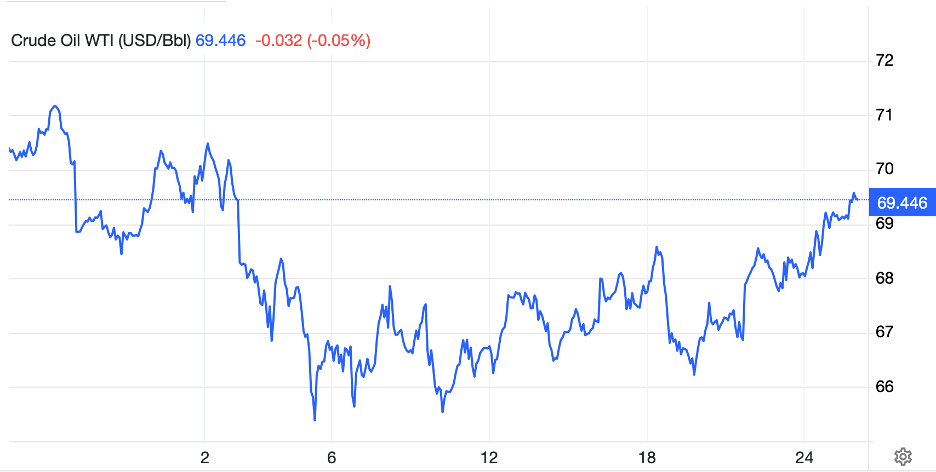
Turning to commodities, oil (+0.4%) continues to climb and is once again approaching $70/bbl.  In fact, since that fateful day, March 11th, it has rallied consistently as can be seen below.  I still don’t understand why that date seemed to offer a change of view, but there you go.

Source: tradingeconomics.com

In the metals markets, this morning is once again seeing a bullish tone with both precious and industrial metals in demand.  Gold (+0.5%) continues to be one of the best performing assets around, although so far this year silver (+1.5%) and copper (+1.15%) have been amongst the few things to beat it.  I believe this trend has legs.

Finally, the dollar is softer this morning, falling against both its G10 and EMG counterparts almost universally.  SEK (+0.9%) is the leader in the clubhouse, although we have seen solid gains from AUD (+0.5%) and NZD (+0.6%) with both the euro (+0.2%) and pound (+0.2%) lagging the pace but in the same direction.  JPY (+0.4%) which has suffered a bit lately, is following the broad dollar move this morning.  in the EMG bloc, the CE4 (+0.4% across all of them) is setting the tone with ZAR (+0.4%) right there.  Otherwise, the movement has been a bit more modest (MXN +0.2%, KRW +0.15%), but still putting pressure on the dollar.

Turning to the data, as I never got to show the week ahead, here we go:

TodayCase-Shiller Home Prices4.8%
 Consumer Confidence94
 New Home Sales680K
WednesdayDurable Goods-1.0%
 -ex Transport0.2%
ThursdayInitial Claims225K
 Continuing Claims1890K
 GDP Q4 Final2.3%
 GDP Final Sales Q43.2%
 Goods Trade Balance-$134.6B
FridayPersonal Income0.4%
 Personal Spending0.5%
 PCE0.3% (2.5% Y/Y)
 Core PCE0.3% (2.7% Y/Y)
 Michigan Sentiment57.9

Source: tradingeconomics.com

Obviously, the PCE data Friday will be the most interesting piece of data released, although we cannot ignore Case-Shiller today.  I keep looking at prices rising there at nearly 5% and wondering why economists expect inflation to fall.  If home prices are rising 5% per year, and they represent one-third of the CPI, it doesn’t leave much room for other prices to rise to achieve 2.0%.  Just sayin’.  In addition, we hear from seven different Fed speakers this week.  Now, I have been making a big deal about how Fedspeak doesn’t seem to matter as much anymore.  Perhaps this week, given the overall uncertainty across markets, it will matter.  However, the Fed funds futures market continues to price a bit more than two rate cuts for the rest of the year, which has not changed very much at all in the past month.  I still don’t think the Fed speakers matter right now.

Markets are highly attuned to whatever Trump says about tariffs.  Absent a new war, and maybe even if one starts, I suspect traders (or algos) will focus on that exclusively.  But despite all this, nothing has altered my longer-term view that the dollar will weaken, and commodities remain strong going forward.

Good luck

Adf

Dynamited

Investors don’t seem that excited
‘Bout Germany’s now expedited
Designs to rearm
And that caused much harm
To Bunds, with their price dynamited


One of the biggest impacts of President Trump’s recent friction with Ukraine and its security is that European nations now realize that their previous ability to make butter, not guns, because the US had enough guns for everybody is no longer necessarily the case.  Mr Trump’s turn inward, which should be no surprise given his campaign rhetoric and America First goals, apparently was a surprise to most European leaders.  It seems they couldn’t believe the US would change course in this manner.  Regardless, the upshot is that Europe finds itself badly under armed and is now promising to change this.

The country best placed to start this process is Germany, where soon-to-be Chancellor, Friedrich Merz has promised a €500 billion spending spree on new defense items.  However, as the Germans don’t have this money laying around, they will need to borrow it.  The wrinkle in this plan is that enshrined in Germany’s constitution is a debt brake designed to prevent fiscal profligacy, kind of like this.  So, Merz has proposed waiving the debt brake for defense expenditures, but in order to do so, will need a two-thirds majority vote in the Bundestag (German parliament).  Now given AfD has been quite anti-war, it is not clear he will be able to obtain the requisite votes but for now, that is not the concern.

However, the German bund market clearly believes he will be successful as evidenced by the chart below. Overall, German 10-year yields rose 30bps yesterday, a dramatic move, and dragged most European sovereigns along for the ride as the new narrative is that all European nations will increase borrowing to spend on their defense.  It is worth noting, though, that the reason German yields have been so low is because the economy there has been exhibiting approximately 0% growth for more than a year as they continue to commit energy suicide seek to achieve their idealistic greenhouse gas emission goals.

Source: tradingeconomics.com

The trick, though, is that while Germany, with a debt/GDP ratio around 60%, has plenty of fiscal space to follow through, assuming they can alter their constitution, the rest of Europe is in a much more difficult spot with both France and Italy already under EU scrutiny for their budget deficits and debt/GDP ratios.  Recall, a key aspect of the Eurozone’s creation was the regulation designed to keep national budget deficits below 3% of GDP and drive the debt/GDP ratios to 60% or below.  Right now, Germany is the only nation that fits within those parameters. 

While I have no doubt that they will alter the rules as necessary elsewhere in Europe and certainly given the now perceived existential crisis for Europe, those limits are sure to be ignored, the story in Germany remains different because of the constitution.  Markets, though, clearly believe that a lot more debt is about to be issued by European nations, hence the dramatic decline in bond prices and jump in yields.  

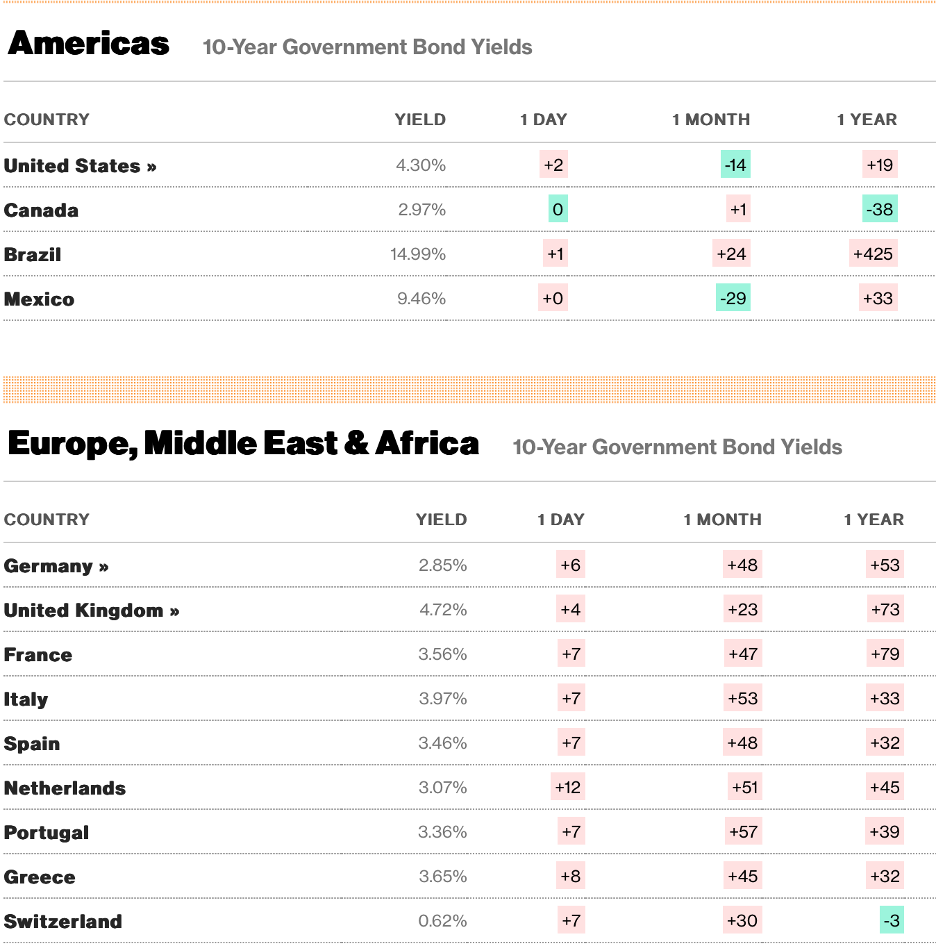
But there are other knock-on effects here as well, notably that the euro is climbing dramatically against the dollar, up nearly 4% in the past week, and far ahead of the pound and most G10 currencies with only the SEK (+1.0% overnight, +6.1% in past week) outperforming the single currency.  For a while I have suggested that short-term rates were losing their sway over the FX markets and traders were looking at 10-year yields.  Certainly, the recent price action indicates that remains the case as Treasury yields (+2bps) have bounced off their lows but have risen far less than their G10 counterparts.  In fact, a look at the movement in 10-year government bond yields over the past month and year reveals just how significant these changes have been.

Source: Bloomberg.com

I feel safe in saying that for the next several weeks, perhaps months, this story of European defensive revival and the knock-on effects is going to be top of mind for both investors and pundits.  Only history will determine if these dramatic changes in policy stances will have been effective in reducing the chance of war or not and if they will have been beneficial or detrimental to economies around the world. As much of the current narrative is driven by politics rather than economics, punditry on the latter is going to be worse than usual.  Once again, I harken back to the need for a robust hedging plan for all those with exposures.  As recent price action across all markets demonstrates, volatility is back, and I believe here to stay for a while.

Ok, let’s run down the rest of the markets not yet discussed.  Yesterday’s US equity bounce was widely appreciated by many although this morning, futures markets are all pointing lower by between -0.75% and -1.25%, enough to wipe out yesterday’s gains.  As to Asia overnight, Japan (+0.8%) followed the US and both Hong Kong (+3.3%) and China (+1.4%) are continuing to get positive vibes from the Chinese twin meetings of policymakers.  More stimulus continues to be the driving belief there although China’s history has shown their stimulus efforts have tended to fall short of initial expectations.  As to Europe, this morning only the DAX (+0.5%) is continuing yesterday’s gains as concerns begin to grow that while Germany can afford to spend more money on defense, the rest of Europe is not in the same situation, so government procurement contracts may be less prevalent than initially hoped.  This is evident in the -0.4% to -1.0% declines seen across both the UK and most of the rest of the continent.

We’ve already discussed bonds, although I should mention that JGB yields have risen 10bps as well, up to new highs for the move and finally above 1.50%

In the commodity space, oil (+0.65%) which has had a very rough week, falling more than -5% in the past seven days, seems to be finding a bit of support.  Recall yesterday’s chart showing the bimodal distribution and that we are now in supply destruction territory.  Ultimately, that should support the price, but the timing is unclear.  In the metals markets, this morning sees red across the board, although not dramatically so, with both precious and base metals sagging on the order of -0.5%.

And lastly the dollar continues to decline, albeit not as swiftly as yesterday.  However, while it is considerably weaker vs. its G10 counterparts, versus the EMG bloc, the story is far less clear.  For instance, the only notable EMG currency gaining ground this morning is CLP (+1.2%) while virtually every other major emerging market currency is actually slipping a bit.  Look at this list; CNY -0.2%, MXN -0.25%, PLN -0.3%, ZAR -0.15%, INR -0.3% and HUF -0.5%.  I have a feeling we are going to see more behavior like this going forward, where G10 currencies are now trading on a different basis than EMG currencies.

On the data front, this morning brings Initial (exp 235K) and Continuing (1880K) Claims as well as the Trade Balance (-$127.4B) and Nonfarm Productivity (1.2%) and Unit Labor Costs (3.0%) all at 8:30.  We also hear from two more Fed speakers, Waller and Bostic later in the day.  Yesterday’s ADP employment data was much weaker than expected, falling to 77K, while the ISM Services data held up well although the prices paid piece did rise.  In addition, there has been a change in tone from the Fed speakers as we are now hearing mention of the possibility of stagflation due to the Trump tariffs, although there was no indication as to which way they will lean if that is the economic path forward.

I continue to highlight volatility as the watchword for now and the near future at least.  As long as politics has become the key driver, and as long as President Trump is that driver, given his penchant to shake things up, the one thing of which I am sure is we have not seen the last dramatic change in perception.  With that in mind, my view is the dollar will remain under pressure for a while yet.

Good luck

Adf

Scapegoated

The people of Germany voted
With Friedrich Merz, at last, promoted
The nation, to lead
Though sure to misread
The sitch, with the Right still scapegoated


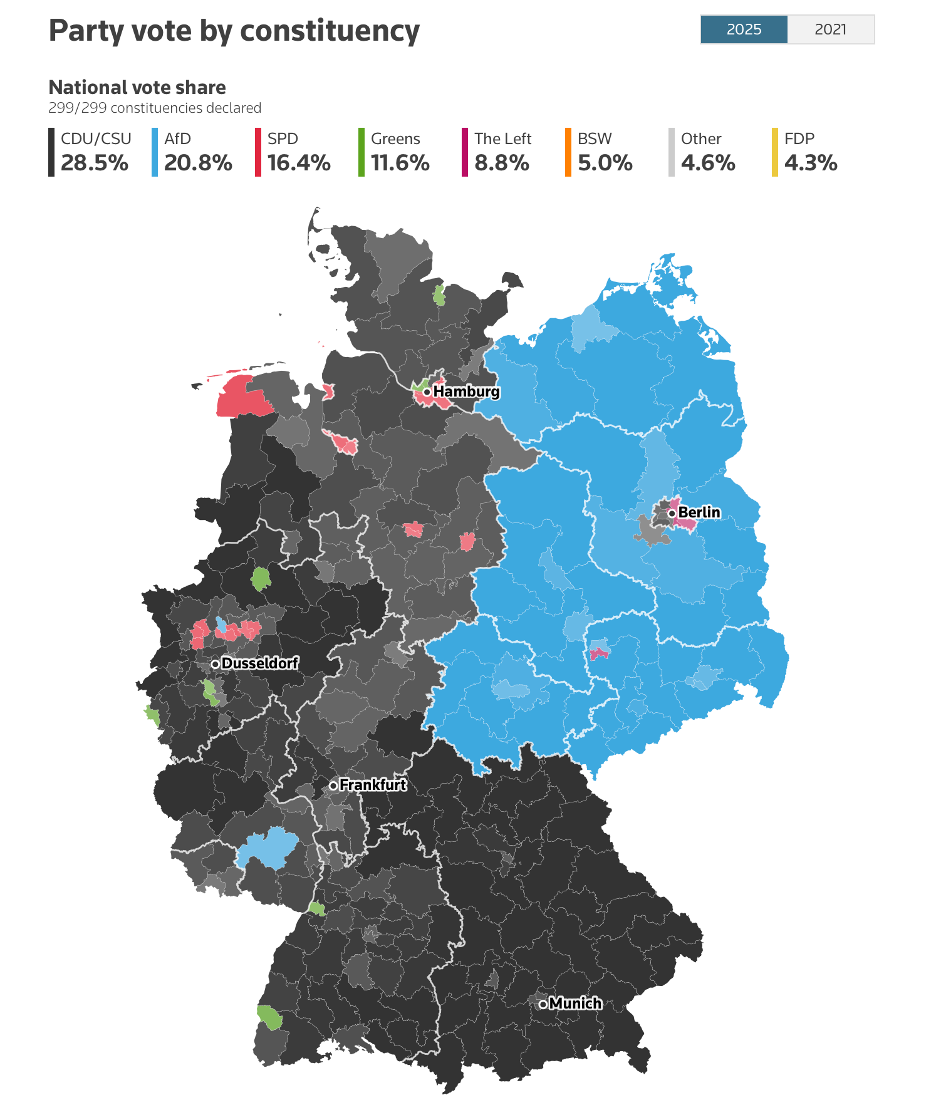
The result of the German Federal elections was very much as expected, the CDU/CSU won 28.5% of the votes and the largest share while AfD garnered 20.8%, the SPD just 16.4% (it’s worst showing in modern times) and the Greens gaining 11.6%.  A tail of other mostly very left-leaning parties made up the balance.  However, one cannot look at a map of the distribution of votes without noticing that the part of the country that was East Germany prior to the fall of the Berlin Wall, still sees things very differently than the rest of the nation.

Source: Reuters.com

Regardless of the distribution, however, the outcome will result in some sort of coalition government, almost certainly to be a combination of the CDU and SPD.  On the surface, it would seem this left-right coalition will be doomed to failure, and that could well be the case, but because the consensus amongst the ‘right-thinking’ people in politics is that AfD is the devil incarnate, or perhaps more accurately, Hitler incarnate, Herr Merz will not be able to rule with a sure majority of conservative voters.

As with virtually every election, the economy is a top priority of the voters, especially since GDP growth, as measured, has essentially been zero for the past three years as per the below chart, and is mooted to stay there on present policies.

Source: tradingeconomics.com

One of the key issues that is currently under discussion there is the constitutionally enshrined ‘debt-brake’ which prevents the German government from running deficits of greater than 0.35% of GDP in any fiscal year.  In order to change the constitution, there needs to be a 2/3’s approval in the Bundestag, but AfD holds a blocking minority and one of their policy platforms has been fiscal prudence.

Arguably, this begs a larger question, what exactly constitutes economic growth?  For instance, if government debt is rising more quickly than economic output, is that actually a growing economy?  And is that process sustainable going forward?  It is quite interesting to look at the government debt dynamics of different nations and ask that question, especially since Germany’s situation really stands out.  

Perhaps, after looking at this group of charts, it is worth reevaluating exactly how much actual growth has been occurring and how much economic activity has simply been government borrowing recycled into the economy across all these nations.  Of course, this process has not been restricted to G-7 nations, it is a global phenomenon, with China doing exactly the same thing as are virtually all nations.  In fact, Germany is unique amongst large nations for bucking the trend.

The reason this issue matters is there is a limit to how far a government can increase its leverage ratio.  At some point, investors will stop buying debt which will force the central bank to buy the debt.  Of course, they will do so by printing more money and devaluing the currency.  We know this because we have seen it happen before many times throughout history with Germany’s Weimar Republic in 1923, Argentina in the 1980’s and Zimbabwe in 2007-2008 as just the most recent examples.  In fact, the reason the Germans have the debt brake is that there is a national memory of that hyperinflation from a century ago.

Circling back to the growth question, what is it that constitutes economic growth?  If you remember your college macroeconomics classes, this is the equation that is used to calculate economic activity in an economy:

            Y = C + I + G + NX

Where:

Y = GDP

C = Consumption

I = Investment

G = Government spending

NX = Net Exports

This equation is taken as gospel in the economics and political worlds.  However, it is not often recalled that it was created in the 1930’s by John Maynard Keynes.  It is not a law of nature, but merely was Keynes’ way of expressing something that had not been effectively measured previously.  Nearly 100 years later, though, perhaps it is time to reevaluate the process.  Remember, economies grew prior to Keynes creating this equation when government activity was a much smaller proportion of the economy.  But as we can see by the dramatic rise in government debt, that is no longer the case.  Perhaps Germany is a peek behind the GDP curtain that shows absent constantly increasing government borrowing, economic growth is stagnant.  Neil Howe’s Fourth Turning could well be the conclusion of this period of government excess, where things will be extremely volatile during the change, but less government will be the norm on the other side, at least for a few generations!

Ok, sorry for the history and theoretical discussion, but that chart of German government debt vs. the rest of the world was really eye-opening.  Let’s turn to markets from the overnight session.

After Friday’s sharp downward movement in the US, the picture in Asia was far more mixed.  Japan (+0.25%) managed a small gain while Hong Kong (-0.6%) and China (-0.2%) both lagged.  Elsewhere in the region, New Zealand (-1.8%) stood out for its weakness, although Korea, India and Taiwan were all softer in the session as well.  Ironically, it seems that better than expected Retail Sales data in NZ hurt sentiment for further policy ease by the RBNZ and concerns over trade with China given US pronouncements is also hurting the situation there, at least for today.

In Europe, Germany’s DAX (+0.9%) is leading the way higher after IfO Expectation data was released a touch better than forecast at 85.4.  However, it is important to remember that while this was a positive outcome, the average reading prior to Covid was between 95 and 103.  As to the rest of Europe, there are more gainers than laggards but little of real note absent any other data.  US futures at this hour (7:00) are pointing higher by at least 0.5% across the board.

In the bond market, Friday saw a very sharp decline in yields, -10bps in Treasuries, after weak readings in the Flash PMI data, especially services at 49.7, Existing Home Sales and Michigan sentiment.  That helped bring global yields lower.  This morning, Treasuries have bounced just 1bp and we are seeing similar rises in most of Europe.  JGB yields are also unchanged and have continued to consolidate near recent highs.

In the commodity markets, after a sharp sell-off on Friday on the back of stories about increased supply from Kurdistan, oil (0.0%) is unchanged this morning.  Meanwhile gold (+0.5%) is rebounding from its regular Friday sell-off, almost as though there were efforts by some to depress the price at the end of every week.  It will be interesting to see what happens this Friday which is month end as well.  As to silver and copper, they are little changed and dull this morning.

Finally, the dollar is asleep this morning, with very limited movement vs. almost any of its counterparts.  USDJPY remains below 150, but the yen has actually fallen -0.3% on the session, while the biggest movers are in Eastern Europe (CZK +0.8%, HUF +0.4%, PLN +0.35%), perhaps on the back of the German election results offering hope for a more useful German government.  We shall see about that.  Otherwise, nobody is concerned over the dollar right now.

On the data front this week, it is a quiet one with PCE data the highlight on Friday.

TodayChicago Fed Natl Activity0.21
TuesdayCase Shiller Home Prices4.4%
 Consumer Confidence103.0
WednesdayNew Home Sales680K
ThursdayInitial Claims220K
 Continuing Claims1874K
 Q4 GDP (2nd look)2.3%
 Real Consumer Spending4.2%
 Durable Goods2.5%
 -ex Transport0.3%
FridayPersonal Income0.3%
 Personal Spending0.2%
 PCE0.3% (2.5% Y/Y)
 Core PCE0.3% (2.6% Y/Y)
 Chicago PMI41.5

Source: tradingeconomics.com

In addition to the data, we also hear from seven Fed speakers over 9 venues, but again, are they really going to change the cautious approach at this stage?  And does it even matter?  For now, financial markets are far more focused on President Trump and his cabinet’s activities than interest rate policy which seems set to remain in place for a while.

When it comes to the dollar, nothing has changed my perspective on relative interest rates in the front end, with US rates likely to be far stickier at current levels than others, but the back end has a potentially different outcome.  Recall that Bessent and Trump are focused on the 10-year yield and getting that lower and seem far less concerned over the Fed for now.  To achieve that they will need to demonstrate the ability to reduce spending and the deficit situation.  While a promising start has been seen with DOGE, we are still a long way from a balanced budget.  My take is the dollar, writ large, is going to take its cues from the 10-year yield for now, so bonds are the market to watch.  If we see yields head back toward 4.0%, the dollar will decline and any significant move higher in yields will likely see the dollar climb as well.

Good luck

Adf

In a Plight

The Minutes explained that the Fed
Is confident, looking ahead
They’ve conquered inflation
Although its duration
May last longer than they had said
 
They still think their policy’s tight
And truthfully, they may be right
But if they are not
And ‘flation’s still hot
They might find themselves in a plight


Below are a couple of key passages from the FOMC Minutes which show that the Fed continues to put on a game face when it comes to their performance.  Although some participants have begun to hedge their bets, it is clear the majority of the committee remains convinced that despite the broad inaccuracies of their models over the past forty four years, they are still on track to achieve their objectives.  

Participants anticipated that if the data came in about as expected, with inflation continuing to move down sustainably to 2% and the economy remaining near maximum employment, it would likely be appropriate to move gradually toward a more neutral stance of policy over time.”

Participants indicated that they remained confident that inflation was moving sustainably toward 2%, although a couple noted the possibility that the process could take longer than previously expected.”  [emphasis added]

And this morning, they will get to see if their confidence has been rewarded with the release of the October PCE data (exp 0.2%, 2.3% Y/Y headline; 0.3%, 2.8% Y/Y core).  One of the tell-tale signs that they are losing confidence is there has been more discussion about the vagaries of where exactly the neutral rate lies as evidenced by the following comment.  

Many participants observed that uncertainties concerning the level of the neutral rate of interest complicated the assessment of the degree of restrictiveness of monetary policy and, in their view, made it appropriate to reduce policy restraint gradually.

Once upon a time, the Fed was the undisputed master of markets, and their actions and words were the key drivers of prices across all asset classes.  However, not dissimilar to what we have seen occur regarding other mainstream institutions and their loss in respect, the same is happening at the Marriner Eccles Building I believe.  Chairman Powell, he of transitory inflation fame, is a far cry from the Maestro, Alan Greenspan, let alone Saint Volcker, and my observation is that more and more market participants listen to, but do not heed, the Fed’s words.

My read is the Fed has it in their mind that they need to continue to cut rates because the committee members have not lived through periods when interest rates were at current levels for any extended length of time.  They still fervently believe that their policy is restrictive, despite all the evidence to the contrary (record high stock prices and GDP expanding above potential) and so seem afraid that if they don’t cut rates they will be blamed for a recession.  I would argue the market interpretation of the Minutes was dovish as shown by the Fed funds futures market increasing the probability of a December cut to 66%.  Remember, Monday it was 52%.  My cynical view is the reason Powell wants to cut is his friends in the Private Equity space are suffering and he wants to help, because really, given both the inflation and economic activity data, it does not appear a cut is warranted.

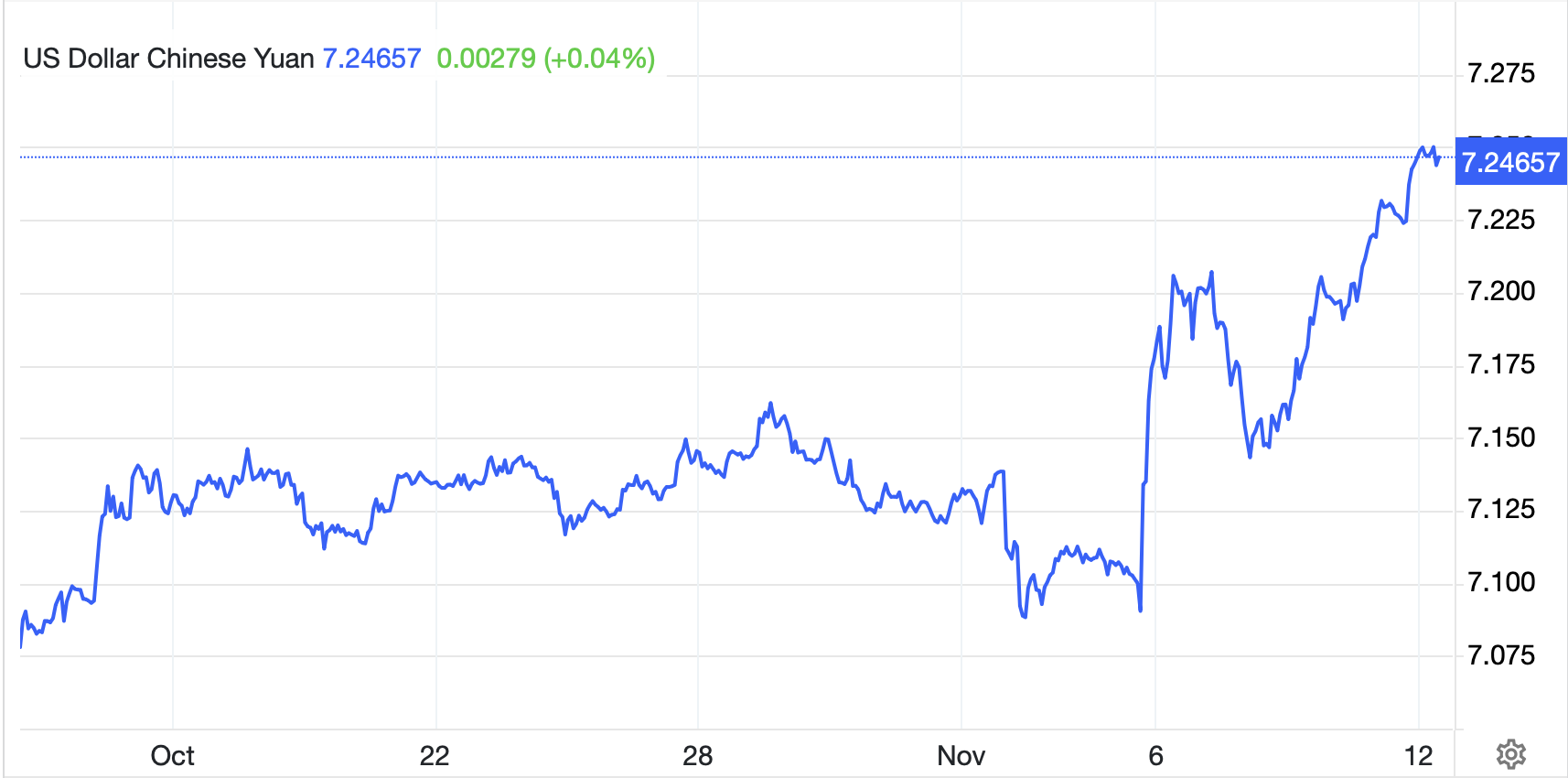
Turning our attention elsewhere, there is a story going round that China is preparing to fire that bazooka this time…for real.  At least that’s what I keep reading on X, and certainly, Chinese equity markets rallied on something (CSI 300 +1.75%, Hang Seng +2.3%), but I cannot find a news story explaining any of it.  Were there comments from Xi or Li Qiang?  If so, I have not seen them.  While Chinese assets have underperformed lately, that seems to have been a response to the Trump announcements of even more tariff-minded economic cabinet members.  And the currency is essentially unchanged this morning, hanging just above that 7.25 level vs. the dollar which has served as a cap for the past decade.  (see below).

Source: tradingeconomics.com

Keep in mind that the consensus view is if Trump imposes tariffs, the renminbi will weaken enough to offset them very quickly.  Arguably, the dollar’s strength since September, when it briefly traded below 7.00, is a response to first, Trump’s improving prospects to win, and then once he won, his cabinet selections.  Will CNY really decline 5% if tariffs are imposed?  That seems an awful lot, but I guess it’s possible.  It strikes me that hedgers should be looking at CNY puts to manage their risk here.

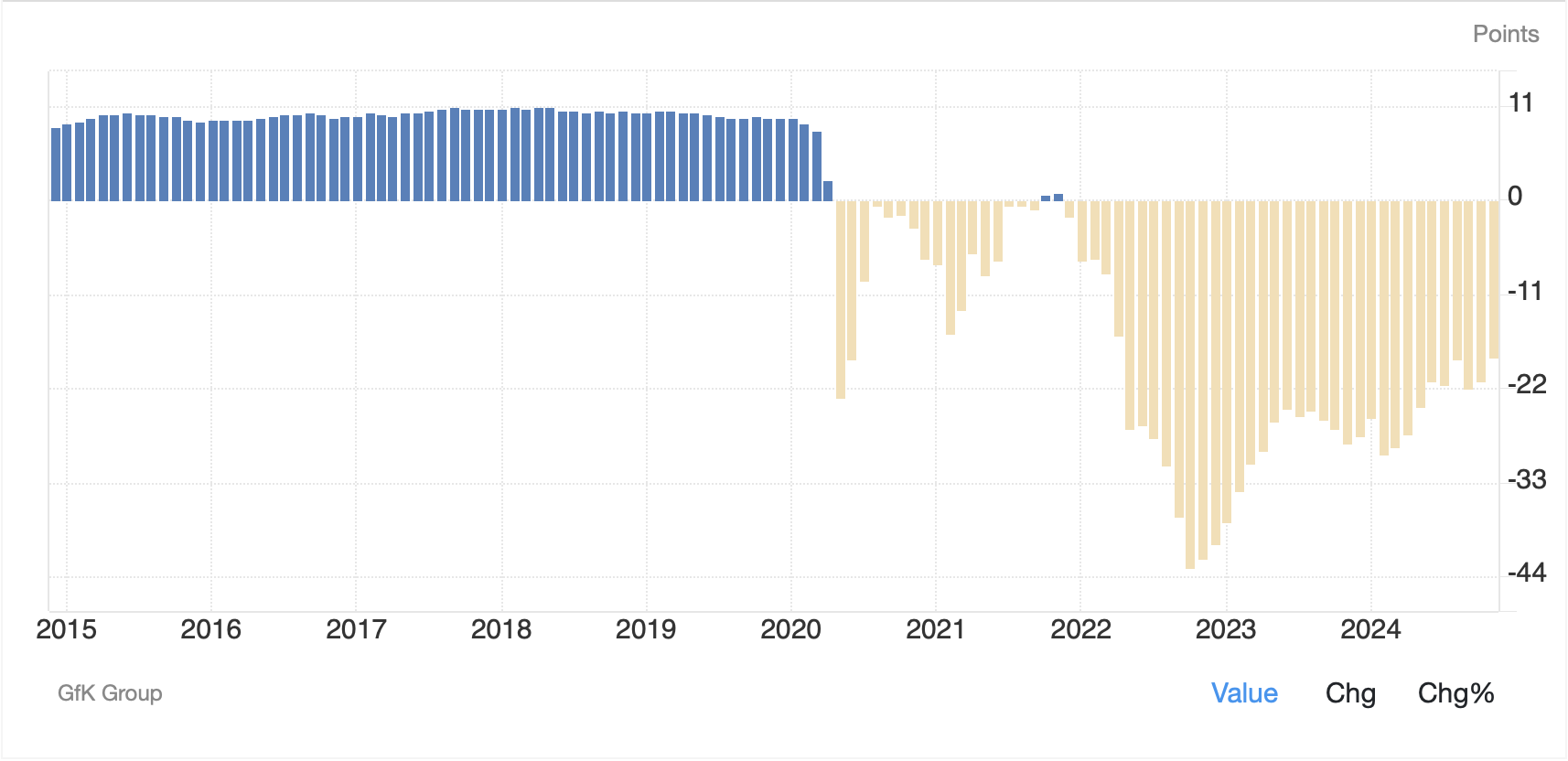
Finally, a look at Europe shows that the dysfunction on the continent seems to be accelerating.  France is the latest target as the current government is hanging on by a thread with growing expectations that Marine Le Pen’s RN party is going to call for a confidence vote and topple it.  As well, there are growing calls for President Macron to resign as he has clearly lost control.  They are currently running a 6% fiscal deficit (just like the US although without the benefit of the world’s reserve currency) and they already have the highest tax burden in Europe.    With Germany sinking further into its own morass (GfK Consumer Confidence fell to -23.3 and continues to show a nation lacking belief in its future.  Just look at the longer-term chart of this indicator below:

Source: tradingeconomics.com

While Covid was obviously a problem, things seemed to be getting back toward normal until Russia’s invasion of Ukraine in early 2022 sent energy prices higher and laid bare the insanity of their Energiewende policy.  As industry flees the country and politics focuses on the immigration issues ignited by Angela Merkel’s open borders policy, people there truly have little hope that things will get better.  

I cannot look at the situation in both Germany and France, with both nations struggling mightily and conclude anything other than the ECB is going to be cutting rates more aggressively going forward.  Combining that with the ongoing belief that Trump’s policies are going to be dollar positive overall, it seems that the euro has much further to decline.  Do not be surprised to see it break parity sometime early in 2025.

Ok, ahead of the Thanksgiving holiday, let’s look at other markets.  In addition to the gains in Chinese shares, Australia (+0.6%) and New Zealand (+0.7%) had a good session with the latter buoyed by the RBNZ cutting rates the expected 50bps.  However, Japan (-0.8%) was under pressure as the yen (+1.1%) rallied strongly on rumors that the BOJ is getting set to hike rates next month, a bit of a change from the previous viewpoint.  In Europe, the CAC (-1.25%) is the laggard as investors are watching French OATs slide in price (rise in yields) relative to their German Bund counterparts and worrying that if the government does fall, there is no way for things to work without the RN involved.  But the DAX (-0.6%) is also softer as is the rest of the continent.  Only the UK (0.0%) is holding up this morning.   meanwhile, at this hour (7:10), US futures are pointing slightly lower, just -0.15% or so.

In the bond market, Treasury yields (-4bps) continue to slide as investors are going all-in on the idea that proposed Treasury Secretary Bessent will be able to solve the intractable problems current Secretary Yellen is leaving him.  This decline is helping European sovereign yields slide as well, as they decline between -1bp and -3bps.  However, a quick look at the chart below shows the above-mentioned Bund-OAT story and how that spread is the widest it has been in many years.

Source: tradingeconomics.com

In the commodity space, oil (+0.2%) is settling in just below $70/bbl as it becomes clear that OPEC+ is not going to be raising production anytime soon.  NatGas (-4.8%) has suffered this morning on warmer weather in Europe, but the situation there remains dicey at best, and I think this has further to run.  In metals markets, gold (+0.8%) is continuing to rebound from Monday’s wipeout, having recouped about half of the move, and we are also seeing strength in silver and copper on the China stimulus story.

Finally, the dollar is under pressure again this morning with the yen and NZD (+1.1%) leading the way although the euro (+0.3%) and pound (+0.3%) are having solid sessions as well.  In the EMG bloc, MXN (-0.3%) continues to be pressured by the tariff talk although much of the rest of the bloc is following the euro’s lead and edging higher.  My sense here is that there are quite a few crosscurrents pushing the dollar around so on any given day, it is hard to tell what will happen.  However, I still am looking for eventual further dollar strength, especially given the Fed seems to be far less likely to cut aggressively.

On the data front, yesterday’s new Home Sales were horrific, falling -17.3% and indicating the housing market is beginning to struggle.  I think that is one of the reasons the rate cut probability rose.  As to the rest of today’s data beyond PCE we see the following: 

Personal Income0.3%
Personal Spending0.3%
Q2 GDP2.8%
Durable Goods0.5%
-ex Transport0.2%
Initial Claims216K
Continuing Claims1910K
Goods Trade Balance-$99.9B
Chicago PMI44.0

Source: tradingeconomics.com

With the holiday, there are no Fed speakers scheduled and Friday, exchanges are only open for a half-day.  There continues to be a very positive vibe overall, with retail investors the most bullish they have ever been according to several banking surveys.  As well, there continues to be a positive vibe from the Trump cabinet picks which has many people expecting great things.  As I said yesterday, I hope they are correct.

My concerns go back to the fact that I just don’t see inflation declining like the Fed projects and that is going to have some negative market impacts along the way.  The one inflation positive is that I see oil prices with the opportunity to fall further, although demand for NatGas should keep that market underpinned.  As to the dollar, I’m still looking for a reason to sell it and none has been presented.

There will be no poetry on Friday so please have a wonderful Thanksgiving holiday and we get to see how things play out come Monday.

Good luck and good weekend

Adf

Growth Stank

Three score and a year have now passed
Since flags in the States flew half-mast
In honor of Jack
Who wouldn’t backtrack
On his goal of world peace at last


It has been sixty-one years since President John F Kennedy was assassinated in Dallas.  This was one of the most dramatic and impactful events in the history of the US with many still of the belief that it was an inside job.  One needn’t wear a tin-foil hat all the time to recognize that the government has done nothing but grow dramatically since then, with the defense complex the leader of the pack.  Perhaps in his second term, President Trump will release the case files in an effort to shine a light on the underbelly of the government.  This poet has no idea what occurred that day (although I did recently visit the 6th floor museum in Dallas, a quite interesting place) and I would guess that all these years later, there are very few, if any, people who may have been involved that are still alive.  Of course, the risk is that powerful organizations like the CIA and FBI could be forever tarred with this if they were involved, and that would have dramatic implications going forward, hence their desire to maintain secrecy.  I highlight this simply as another potential flashpoint in the upcoming Trump presidency.

The data from Europe revealed
That if there is growth, it’s concealed
The PMI’s sank
And German growth stank
Thus Christine, her razor, will wield

Let us now discuss the Eurozone.  Not only do they have an increasingly hot war on their border and not only are they being inundated by a major blizzard interrupting power and transportation throughout France, Germany and Scandinavia, but their economies appear to be slowing down far more rapidly than previously anticipated.  But that inflation was slowing as quickly!

This morning the Flash PMI data was released for Germany, France and the Eurozone as a whole, as well as the UK.  It did not make for happy reading if you are a politician or policymaker in any of these nations.

IndicatorCurrentPrevious
 Germany 
Manufacturing PMI43.243.0
Services PMI49.451.6
Composite PMI47.348.6
 France 
Manufacturing PMI43.244.5
Services PMI45.749.2
Composite PMI44.848.1
 Eurozone 
Manufacturing PMI45.246.0
Services PMI49.251.6
Composite PMI48.150.0
 UK 
Manufacturing PMI48.649.9
Services PMI50.052.0
Composite PMI49.951.6

Source: tradingeconomics.com

One needn’t look too hard to see that the economic situation in Europe is ebbing toward a recession or at least toward much slower growth (German GDP was also released at a slower than expected 0.1% Q/Q, -0.3% Y/Y).  While the ECB is very aware of this situation, the problem is that like most other central banks, their strong belief that inflation is going to reach their 2.0% goal has not yet been realized let alone shown an ability to stay at that level over time.  However, the ongoing comments from ECB members is that more rate cuts are coming with only the timing and size in question.  There is still a strong belief that interest rates in Europe (and the UK) are well above ‘neutral’.

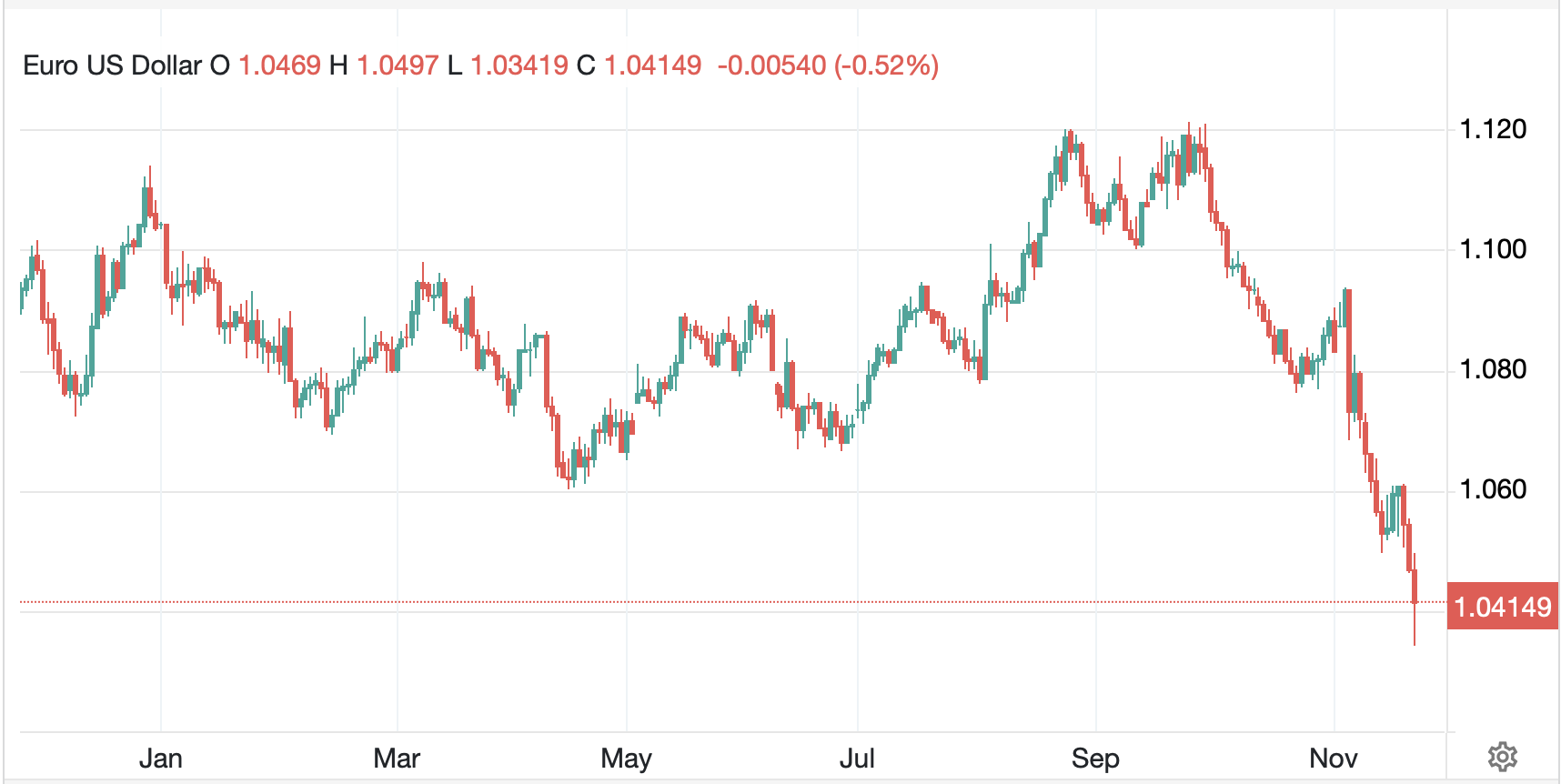
Of course, it will not surprise you to see the chart of the EURUSD exchange rate given this information as the single currency collapses continues its sharp decline.

Source: tradingeconomics.com

Since the end of September, the single currency has declined ~7.0% in a quite steady fashion.  All the technical levels that had been in play have been broken with the next noteworthy level to consider being parity.  I have been clear for a while that I expected the dollar to continue to perform well and nothing has changed that view.  The combination of an increase in fear amid the escalation of tensions in Ukraine and Russia’s intimation that the US and NATO have entered the war already and the very divergent paths of the US and Eurozone economies can only lead to the conclusion that the euro is going to continue to decline for a while.  And remember, this price action has very little to do with potential Trump tariff or other policies as they remain highly uncertain.  The euro is simply a victim of its own leaders’ ineptitude on both the economic and diplomatic/military fronts.  Any Trump tariffs that are imposed on Europe will simply add to the pain.

Before we head to other asset classes, let’s take a quick look beyond the euro in the FX markets.  It should be no surprise that the dollar is broadly higher, although not universally so.  Versus the rest of the G10, even the yen has not been able to find enough haven demand to hold up as the greenback rallies against them all with the euro (-0.6%) and pound (-0.6%) sharing honors as the laggards.  However, in the EMG bloc, the picture is more mixed with CE4 currencies all sliding but ZAR (+0.4%) rallying amid the ongoing rebound in the price of gold (+1.2%) which is also benefitting from increased fear and risk disposition.  As to Asian currencies, most were somewhat weaker but other than KRW (-0.4%) the moves were unimpressive.

On the commodity front, oil (-0.6%) is slipping a bit heading into the weekend but it has had an excellent week, rallying more than 4%.  There are many cross tensions in this market as on one side we have fears that the Russia/Ukraine situation will impact supply, or that Iran will react to Israel’s ongoing campaign in Lebanon and do something about the Strait of Hormuz.  These are obviously bullish for crude.  But the flip side is that Trump has made very clear his desire to open up far more land for drilling and is seeking to increase supply substantially, a negative price signal.  

Turning to bond markets, there is demand everywhere as the combination of risk aversion and weaker Eurozone growth have brought the buyers out of the woodwork.  Treasury yields have slipped -4bps and in Europe, the entire continent is seeing yields decline between -7bps and. -8bps.  After the PMI data this morning, the Euribor futures market upped pricing for a December ECB rate cut from a 15% to a 50% probability.  Add to that comments from ECB members Stournaras and Guindos and it seems quite likely that rates in Europe are going to decline.

Finally, equity markets have shown very little consistency.  Yesterday’s strong US rally was followed by strength in Japan (+0.7%) but massive weakness in China (CSI 300 -3.1%, Hang Seng -1.9%) as concerns over those Trump tariffs continue to weigh on investors there.  However, it was only China that suffered as pretty much every other market in the region saw gains, with some (India +2.55, Taiwan +1.6%, New Zealand +2.1%) quite substantial.  European shares, however, are more mixed with most continental bourses showing modest declines although the UK (+0.8%) has managed to buck that trend despite the weak PMI data and weak Retail Sales data as investors seem to be prepping for a BOE rate cut next month.  As to US futures, at this hour (7:30) they are little changed.

Yesterday’s data showed Initial Claims sliding but Continuing Claims rising to their highest level, above 1.9M, in three years.  It appears that while layoffs aren’t increasing, finding a job once you are unemployed is much tougher.  Philly Fed was also softer than forecast and that seemed to help the Fed funds futures market push up the probability of a December cut to 59% this morning, up from 55% yesterday.  This morning, we see the Flash PMI data here (exp Mfg 48.5, Services 55.0) and then Michigan Sentiment (73.7).  There are no Fed speakers on the schedule so I expect that this morning’s trends may run for a little longer, but as it is Friday, I would not be surprised to see a little reversal amid week ending profit taking.  However, the dollar has further to go, mark my words.

Good luck and good weekend

Adf

Great Expectations

In Europe, the largest of nations
Is faltering at its foundations
The ‘conomy’s sagging
And tongues are now wagging
‘Bout voting and great expectations
 
Alas for the good German folk
The government’s turned far too woke
Their energy views
Have caused them the blues
And soon they may realize they’re broke


With elections clearly on almost everybody’s mind, it can be no surprise that the crumbling government in Germany has also finally accepted their fate and called for a confidence vote to be held on December 16 which, when Chancellor Olaf Scholz loses (it is virtually guaranteed), will lead to a general election on February 23, 2025.  As has happened in literally every election held thus far in 2024, the incumbents are set to be tossed out.  The problems that have arisen in Europe, with Germany being ground zero, is that the declarations by the mainstream parties to avoid working with the right-wing parties that have garnered approximately 25% of the population’s support almost everywhere, means that the traditional parties cannot create working coalitions that make any sense.  After all, the German government that is collapsing was a combination of the Center-left Social Democrats, the far-left Greens and the free market FDP.  That was always destined to fail so perhaps the fact it took so long is what should be noted.

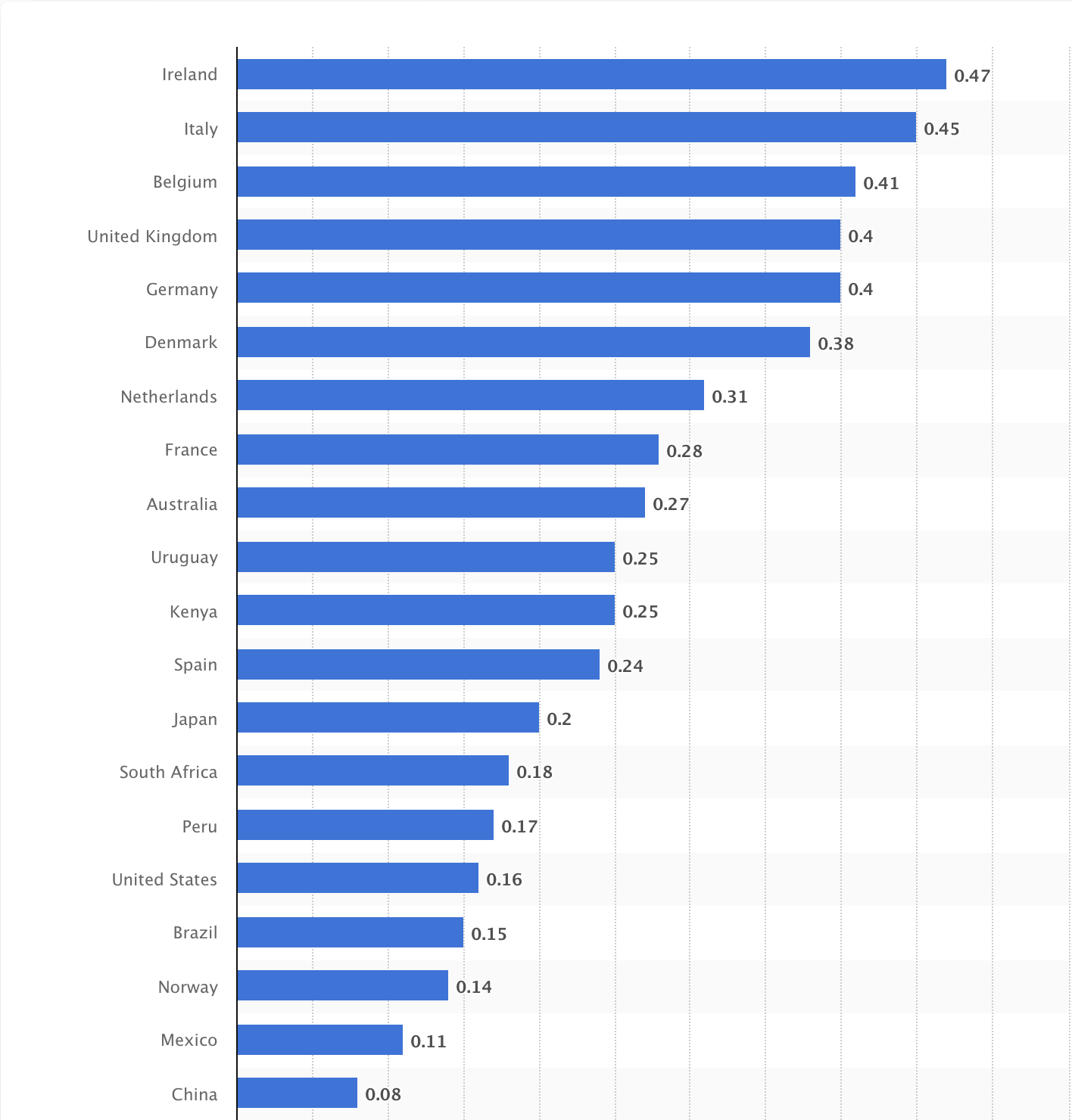
At any rate, it is not hard to understand why the people of Germany are unhappy given the economic situation there.  The economy hasn’t grown in more than two years, basically stagnating, while inflation continues to run above 2%.  Meanwhile, energy prices have risen sharply as a consequence of their Energiewende policy; the nation’s attempt to achieve net zero CO2 emissions.  However, not only did they shutter their nuclear generating fleet, the most stable source of CO2 free electricity, they decided that wind and solar were the way forward.  Given that there are, on average, between 1600 and 1700 hours of sunshine annually (4.3 to 4.5 hours per day), that seemed like a bad bet.  The results cannot be surprising as Germany energy costs are amongst the highest in the world.  The below chart shows electricity prices around the world.

Source: statista.com

If you want a good reason as to why incumbent governments around the world are falling, you don’t have to look much further than this.  Meanwhile, this morning brought the German ZEW Economic Sentiment Index which printed at 7.4, well below both last month and expectations.  As well, the Current Conditions Index fell to -91.4, which while not the lowest ever, certainly indicates concern given -100 is the end of the scale.  

I’m sure you won’t be surprised to note that the euro (-0.4%) has fallen further this morning amid a broad-based dollar rally, that German stocks (DAX -0.8%) are falling and German bund yields (-2bps) are also falling as it becomes ever clearer that the ECB is going to need to cut rates more aggressively than previously anticipated.  Perhaps the story of Bayer Chemical today, where their earnings fell 26% and the stock has fallen 11% to a level not seen since 2009, is a marker.  Just like Volkswagen, they are set to cut costs (i.e., fire people) further.  Germany is having a rough go, and if they continue to perform like this, Europe will have a hard time going forward.

So, while the media in the US continues to focus on President-elect Trump and his activities as he fills out his cabinet posts and other government roles, elsewhere around the world, governments are trying to figure out how to respond to the changes coming here.

In that vein, the COP 29 Climate Conference is currently ongoing in Baku, Azerbaijan (a major oil drilling city) but finding much less press than previous versions.  As well, the attendee list has shrunk, especially from governments around the world.  This appears to be another consequence of the shift in voting preferences.  In fact, I expect that over the next four years, the number of discussions on climate will decline substantially.  

Perhaps the best place to observe how things are changing is China, as they now find themselves in the crosshairs of Trump’s policy changes and they know it.  The question is how they will respond with their own policies.  Recall, last week there were great hopes that we would finally see that big bazooka of fiscal stimulus and it was never fired.  Recent surveys of analysts, while continuing to hope for that elusive stimulus, now see a greater chance of Xi allowing the CNY to decline more rapidly to offset the impacts of tariffs.  This is something that I have expressed for a long time, that the CNY will be the relief valve for the Chinese economy as it comes under pressure.  Certainly, the market seems to be on board with this thesis as evidenced by the CNY’s movement since the election.  I expect there is further to run here.

Source: tradingeconomics.com

Ok, between Germany and China, those were the big stories away from the Trump cabinet watch.  Let’s see how markets behaved overnight in the wake of yet another set of record high closings in the US yesterday.  Despite the yen’s weakness, the Nikkei (-0.4%) was under pressure, although nothing like the pressure seen in China (Hang Seng -2.8%, CSI 300 -1.1%) or even elsewhere in Asia (Korea -1.9%, India -1.0%, Taiwan -2.3%) with pretty much the entire region in the red.  Of course, the same is true in Europe with all the major bourses under pressure (CAC -1.3%, FTSE 100 -1.0%) alongside the DAX’s decline.  As to US futures, at this hour (7:15) they are essentially unchanged as we await a series of five more Fed speeches.

In the bond market, Treasury yields (+6bps) are rising as it appears the 4.30% level is acting as a trading floor now that we have seen moves above it.  However, as mentioned above, the weaker economic prospects in Europe have seen yields across the continent soften between -1bp and -2bps.  Futures markets are now pricing more rate cuts by the ECB over the next year than the Fed although both are pricing about the same probability of a cut in December.  I think the direction of travel is less Fed cutting and more ECB cutting and that will not help the euro.

In the commodity markets, the rout in the metals markets continues with both precious (Au -0.8%, Ag -1.0%) and industrial (Cu -2.0%, Al -0.8%) finding no love.  In fairness, these had all seen very substantial rallies since the beginning of the year, so much of this is profit-taking, although there are those who believe that Trump will be able to arrest the constant rise in US debt issuance.  I’m not so sure about that.  As to oil (+0.6%) it has found a temporary bottom for now, but I do expect that it will continue to see pressure lower.

Finally, the dollar is king today, higher against every one of its counterparts in both the G10 and EMG blocs.  In the G10, the movement is almost uniform with most currencies declining between -0.4% and -0.5% although CHF (-0.1%) is trying to hang on.  In the EMG bloc, there are some larger declines (ZAR -0.8%, CZK -0.9%, HUF -0.9%) while LATAM currencies are lower by -0.5% and we saw similar movements in Asia overnight, -0.5% declines or so.  Again, it is difficult to make a case, at least in the near term, for the dollar to decline very far.  Keep that in mind when considering your hedges.

On the data front, the NFIB Small Business Optimism Index was released earlier at a better than expected 93.7, roughly the same as the July reading and potentially heading back toward the 2022 levels obtained during the recovery from the covid shutdowns.  I expect the election results had some part in this move.  Otherwise, its Fed speakers and we wait for tomorrow’s CPI.  All signs continue to point to a positive view in the US and a stronger dollar going forward.  Parity in the euro is on the cards before long.

Good luck

Adf

Erring

Excitement does not quite portray
The thirst for risk shown yesterday
Though media cried
Investors took pride
In Trump, sure that he’ll save the day
 
So, next Chairman Jay and the Fed
Will try to explain that instead
Of further rate paring
They might soon be erring
On side that Fed rate cuts are dead


Wow!  That is pretty much all one can say about yesterday’s equity market response to the confirmation that Donald Trump will be the next president of the United States.  The DJIA rose 3.6%, far outpacing both the S&P 500 (+2.5%) and the NASDAQ (+3.0%) but even that paled in comparison to the Russell 2000 small-cap index which jumped nearly 6% on the day!  Investors are all-in on the idea that Trump will seek to bring home as much manufacturing and economic activity as possible via tariff policies and small caps and old-line companies are the ones likely to benefit.

But boy, bonds had a tough day with yields across the curve rising between 10bps (2yr) and 20bps (30yr) with the 10yr gaining 15bps on the day.  It is all part of the same mindset, higher economic activity and no slowdown in spending leading to rising inflation and, correspondingly, rising yields.

The other area that really suffered were the metals markets, with gold (-3.3% or $90/oz), silver (-4.7%) and copper (-5.0%) all getting hammered.  The best explanation for the gold price’s decline I have heard is the idea that with Trump coming into office, the prospects for a nuclear war have greatly diminished.  Certainly, based on the fact that there were no new wars during his last term and one of his promises is to end the Russia/Ukraine war on the first day, perhaps that is correct.  As well, consider that the dollar exploded higher, something which had lately been a benefit for metals, but historically has been a negative, and at least we can make some sense of things here.

So, where do we go from here?  That, of course, is the $64 billion question.  Reactions around the world are still coming in and I would characterize them as a mix of stoicism and fear.  Perhaps a good place to start is Germany where the governing coalition just collapsed as Chancellor Sholz fired the FinMin who was the head of the FDP, one of his coalition’s groups.  Their problem is that the German economic model is crumbling, and the population is unhappy with the current situation.  The former can be demonstrated by today’s data showing the Trade Surplus fell more than expected while IP fell back into negative territory again, an all-too-common occurrence over the past three years as can be seen below, and hardly the best way to improve the productivity of your economy.

Source: tradingeconomics.com

Meanwhile, politically, the country is seeing a widening of views across the spectrum with the combination of the anti-immigration parties, AfD on the right and BSW on the left, garnering support of about 25% of the population and preventing any meaningful coalitions from being formed.  

If Germany continues to lag economically, it will negatively impact the whole of the Eurozone.  The divergence between the US economy, which has all the hallmarks of faster growth ahead, especially under a new administration, and the European economy, which continues to struggle under a suicidal energy policy that undermines any chance of industrial resurgence, and therefore a significant rebound in economic activity could not be greater.  While much ink has been spilled regarding the prospects that the dollar is going to collapse because of the debt situation and the BRICS are going to create something to replace it, the reality is the euro is in far more dire straits.  The ECB is going to be much more aggressive cutting rates than the Fed and the market is starting to price that in.  The below chart from Bloomberg this morning does an excellent job showing the change in market pricing over the past month.  

I find it hard to see how the euro can benefit in this environment regardless of the dollar’s performance against other currencies given the more limited economic prospects on the continent.  They are dealing with an existential crisis because of Russia’s more aggressive stance since the invasion of Ukraine combined with an undermining of their economic model which was based on exporting high value items to China and the rest of the world.  The problem with the latter is China has become a huge competitor and a shrinking market for their wares, and they have limited other markets.  If Trump holds to his word and imposes 20% tariffs on European imports to the US, the euro is likely to fall even further.

That is just a microcosm of one area and its response to the US election, but one that may well be a harbinger for many others.  The US stance in the world is changing and other nations are not really prepared.  Expect more financial market volatility, in both directions, as these changes become more evident and play out over time.

Ok, let’s see how other markets behaved with confirmation of the Trump victory.  In Asia, the Nikkei (-0.25%) slid but other indices rallied indicating a mixed picture.  Meanwhile Chinese shares rallied sharply (CSI 300 +3.0%, Hang Seng +2.0%) as expectations grow that the Standing Committee will expand the stimulus measures in the wake of the election.  Remember, the Chinese had delayed this annual meeting by a week to capture the results of the US election and now traders are betting on a bigger response.  As well, the Chinese Trade Surplus expanded far more than forecast, to its third highest monthly reading of all time at $95.3B.  As to the rest of the region, the picture was very mixed with some gainers (Singapore +1.9%, Taiwan +0.8%) helped by the China story and some laggards (India-1.0%, Philippines -2.1%) with the latter suffering from a much weaker than expected GDP report.

In Europe, interestingly, most markets are performing well this morning led by the DAX (+1.3%) although the rest of the continent’s bourses are only higher by around 0.5% or so.  The laggard here is the FTSE 100 which is unchanged on the day in the wake of the BOE’s widely expected 25bp rate cut.  Although, there were apparently some looking for a 50bp cut as stocks fell a bit in the wake of the news and the pound jumped 0.3%, a clear sign of a minor surprise.

Speaking of currencies, the dollar which has had quite a run in the past two sessions is backing off overall this morning although remains well above the pre-election levels.  In the G10, NOK (+1.3%) is the leader as the Norgesbank left rates on hold and indicated that was likely their stance going forward, while AUD (+1.0%) seems to be benefitting from both the rebound in metals prices and the potential Chinese stimulus.  Otherwise, currencies have rallied between 0.3% and 0.5% in this bloc.  In the EMG space, ZAR (+1.4%) is the biggest gainer, also on the precious metals rebound, while MXN (+1.2%) is next, although that is simply a continuation of the retracement from the post-election decline.  Bigger picture, I think the dollar remains well bid, but not today.

In the bond market, Treasury yields are unchanged this morning, consolidating their gains from the past week and waiting for the Fed this afternoon.  However, European sovereign yields have all rallied substantially, between 6bps and 9bps, which looks, for all intents and purposes, like the continent’s catch-up trade to yesterday’s US movement.  Nothing has changed the view that Treasury yields lead bond market moves in the G10.

Finally, in the commodity space, oil (-1.0%) is a bit lower this morning although yesterday it recouped most of its early losses and closed lower only minimally.  Yesterday also saw a surprising inventory build in the US which would be expected to weigh on prices.  In the metals markets, after a virtual collapse yesterday, this morning is seeing stabilization in precious metals and a sharp rebound in copper (+2.3%) as hopes for that Chinese stimulus spread to this market as well.

In addition to the FOMC meeting this afternoon, we see regular Thursday morning data of Initial (exp 221K) and Continuing (1880K) Claims as well as Nonfarm Productivity (2.3%) and Unit Labor Costs (1.0%).  However, despite all the recent activity, and the fact that a 25bp cut is a virtual certainty, Chairman Powell’s press conference will still have the trading community riveted to see how he describes any potential future paths in the wake of the election results.  Given the recent data and the estimate prospects of a Trump administration’s efforts to goose growth further, it is hard to see how the Fed can really discuss cutting rates much further.  In fact, I will go out on a limb and say I expect forecasts of the neutral rate are going to consistently climb higher and reach 4% before the end of 2025.  And that means, as is evident by both the economy and the stock market, the Fed has not tightened financial conditions very much at all.

Good luck

Adf

Full Throat

The news cycle’s still ‘bout the vote
With Harris and Trump in full throat
‘Bout why each should be
The one filled with glee
When voters, to prez, they promote
 
Meanwhile, out of China we hear
More stimulus is coming near
The rumor is on
That ten trillion yuan
Is how much Xi’ll spend through next year


The presidential election continues to be the primary source of news stories and will likely remain that way until a winner is decided.  The vitriol has increased on both sides, and that is unlikely to stop, even after the election as neither side can seem to countenance the other’s views on so many subjects.  

As we watch Treasury yields continue to rise, many are ascribing this move to the recent polls that show former President Trump gaining an advantage.  The thesis seems to be that his proffered plans will increase the budget deficit by more than Harris’s proffered plans, but I find all this a bit premature as budget deficits are created by Congress, not presidents, so the outcome there will have a significant impact on the budget.  With that in mind, though, if we continue to see the yield curve steepen as long-end rates rise, my take is the dollar will continue to perform well.

But the election is still a week away and while there is no new data of note today, we do see important numbers starting tomorrow.  In the meantime, one of the big stories is that the Chinese National People’s Congress is now considering a total stimulus package of CNY 10 Trillion to help support the economy, and that if Trump wins, that number may grow larger under the assumption that he will make things more difficult for the nation.  This report from Reuters indicates that there would be a lot of new debt issuance to help support local governments repay their current borrowings as well as support the property market.  

Now, this is very similar to what was reported last week, although the totals are larger, but there is nothing in the story indicating that President Xi is going to give money to citizens, nor focus on new production.  This all appears to be an attempt to clean up the property market mess (remember, most local government debt problems are a result of the property debacle as well), which while necessary is not sufficient to get China back to its pre-pandemic growth trend.

As it happens, this story did not print until after the Chinese equity markets closed onshore, so the CSI 300’s decline of -1.0% has been reversed in the futures aftermarket.  As well, given that Hong Kong’s market doesn’t close until one hour later, it had the opportunity to rebound before the close and finished higher on the day by 0.5%.  As to the rest of Asia, it mostly followed the US rally from yesterday with the Nikkei (+0.8%) performing well and gains seen across virtually all the other markets there.

Turning to Europe, the only data of note was the German GfK Consumer Confidence index which rose to -18.3.  While this was better than last month and better than expected, a little perspective is in order.  Here is the series over the past ten years.

Source: tradingeconomics.com

While it seems clear that consumers are feeling a bit more confident than they have in the past year, ever since the pandemic, the German consumer has been one unhappy group!  And the other story from Germany this morning helps explain their unhappiness.  VW is set to close at least 3 factories and reduce wages by 10% as they try to compete more effectively with Chinese EV’s.  I can only imagine how confident that will make the people of Germany!

Now, the interesting thing about confidence is that while it offers a view of the overall sentiment in markets, it doesn’t really correlate to any specific market moves.  For instance, the euro (-0.2%) remains rangebound albeit slightly lower this morning, while the DAX (+0.25%) has actually rallied a bit, although that is likely on the basis of the VW news helping to convince the ECB that they need to cut rates further and faster.  In fact, most European bourses are firmer this morning on the lower rate thesis I believe, although Spain’s IBEX (-0.25%) is lagging after some moderately worse earnings news from local companies.

Turning to the commodities sector, it should be no surprise that they are higher across the board as the combination of proposed Chinese stimulus and potential future inflation in the US based on a possible Trump victory (although there is nothing in the Harris policies that seem likely to reduce inflation) means that commodities remain a favored outlet for investors.  After a couple of days of choppiness, we are seeing oil (+1.2%) rise nicely (perhaps the decline was a bit overdone on position adjustments) and the metals complex rise as well (Au +0.3%, Ag +1.3%, Cu +1.1%) as all three will benefit from all the new spending that is likely to occur in the US as well as China.  

One other thing to note, which disappointed the gold bulls, as well as the dollar bears, is that the BRICS meeting in Kazan, Russia resulted in…nothing at all regarding a new currency to ‘challenge’ the dollar.  Toward the bottom of their proclamation, they indicated they would continue to look for ways to work more closely together, but there is nothing concrete on this subject.  As I have been writing for the past several years, and paraphrasing Mark Twain, rumors of the dollar’s demise have been greatly exaggerated.  So, there will be no BRICS currency backed by gold or anything else, no new payment rails and Treasuries are going to remain the haven asset of choice alongside gold.

As to the dollar vs. its other fiat counterparts, it is a bit stronger this morning alongside US yields (Treasuries +3bps) with even the commodity bloc having difficulty gaining ground.  Of note is USDJPY, which is higher by 0.35% and now firmly above 153.00.  Last night, we did hear our first bout of verbal concern from a MOF spokesman explaining they are watching the yen carefully.  I’m sure they are, but I believe they will be very reluctant to enter the market when US yields are rising, and the BOJ is not keeping pace.  In fact, while the November rate cut is baked in at this point, the probability of the Fed cutting in December continues to slowly decrease (now 71%).  If we see a good NFP number Friday, I would look for that to decrease more rapidly and the dollar to see another leg higher.

And that’s all the market stuff today.  On the data front, Case Shiller Home Prices (exp 5.1%) and the JOLTS Job Openings data (7.99M) are the major releases.  As well, the Treasury is auctioning 7-year Notes this morning after a tepid 2-year auction yesterday.  It is very possible investors are starting to get a bit nervous about the US fiscal situation and if that continues, the irony is that higher yields will beget a higher dollar despite the concerns.

It is difficult to get away from the election impact on markets, and it seems that as momentum for Trump builds, the market is going to continue to push yields and stocks higher with the dollar gaining ground alongside gold.  Go figure.

Good luck

Adf