None Be Unique

When looking ahead to this week
The noteworthy thing is Fedspeak
At least fifteen times
They’ll give us their dimes’
Worth of knowledge, though none be unique
 
For instance, we already know
Their confidence is rather low
So, absent new data
Do they have schemata
Designed to get ‘flation to slow?


Arguably, the biggest news this morning is the death of the Iranian President and Foreign Minister in a helicopter crash overnight as it opens a range of possibilities regarding the future stance of Iran in the Middle East.  Will it remain the strict theocracy that it has been?  Or will a new leadership recognize the people appear to be growing tired of that stance and want something different.  While it would seem unlikely that there will be a major change, at least from this view thousands of miles away, if one were to come about, it would have a major impact on the Middle East and the ongoing conflict in Gaza.  After all, if Iran stopped funding terrorist groups, that would de-escalate things dramatically and potentially see a significant decline in the price of oil.  At this time, however, there is no information as to who will step into the role and what policies will be followed, so it is a wait-and-see period.  As it happens, oil prices (-0.35%) have edged lower this morning, but this is hardly a sign of anything new.  This will be quite critical to watch going forward.

However, beyond that, there has been vanishingly little new information about which to speak regarding the macroeconomic situation around the world.  The Chinese left their policy rates unchanged, as universally expected, and there has literally not been any other data from any major nation since Friday.  In fact, looking ahead at the calendar for the week, arguably the most significant piece of data to be released is Canadian CPI, or perhaps UK CPI and then on Friday we see the Flash PMI reports. 

Which brings us back to the Fedspeak.  It is staggering to think that the FOMC believes they need to be so visible at this time, especially after Chairman Powell explained that rate hikes were off the table and that while it may take a little longer than they had initially expected, they were still certain that inflation was going to head back to their 2% target.

Speaking of inflation, over the weekend I was reading some analysis (sad, I know) that highlighted if the US used the European HICP calculation the core reading would already be below their target with April’s data coming in at 1.9%.  To me this is a similar stance to what we heard at the end of 2023 when numerous pundits were explaining that the 3-month trend or the 6-month trend was already at 2.0% so why wait to cut?  Of course, the sticky inflation camp (this poet included) was quick to hoist them on their own petard as the recent 3-month and 6-month trends are pointing to 4+% CPI readings going forward.  

In this particular instance the question I would ask is, other than the fact that the reading is lower, why would anyone think that the European HICP inflation reading is a more accurate representation than the BLS representation?  The difference lies in the fact that HICP doesn’t incorporate housing price changes, which given they remain stubbornly high, have been supporting higher CPI readings.  But don’t people pay for their housing?  Certainly, it would be easy to create a lower CPI if you simply remove all the items that are going higher in price.  Unfortunately, that process doesn’t really tell you anything about reality.

Below is a very interesting chart I found on X (nee Twitter) created by Professor Alberto Cavallo of Harvard and Oleksiy Kryvtsov, a Bank of Canada economist, which may be a better description of inflation as felt by the average person.

The fact that prices are rising fastest for the least expensive goods indicates that inflation is a major problem for Joe Sixpack, and no matter how pundits seek to adjust the measurement, so the numbers look better, reality is a harsh mistress.  (If you want to know why President Biden’s numbers are so bad, you needn’t look further than this chart.)  

Alas, there is no escaping the plethora of blather that will be coming from the Fed this week, although I sincerely doubt any of it will change anyone’s opinions about anything.  Ok, it was another generally quiet session overnight with the exception being the ongoing blast higher in metals markets.

Equity markets have performed well across the board, although the gains have not been too dramatic.  Japan (Nikkei +0.7%) was the best performer although the entire region was in the green to a lesser extent, about 0.35% or so.  In Europe, all the bourses are higher as well, but here the gains are even smaller, on the order of +0.25% across the board while US futures are essentially unchanged at this hour (6:30).

In the bond market, Treasury yields, which backed up 2bps on Friday are unchanged this morning while European sovereigns are higher by roughly 1bp across the board.  ECB speakers have conceded that a rate cut is coming in June, but many are pushing back hard against the idea that a July cut is a sure thing, preferring to wait until September.  However, the really interesting thing is in Japan, where JGB yields have traded up to 0.98%, a new high yield for this move and a level not seen since March 2012.  At this point, it would seem that 1.00% is a foregone conclusion so it will be interesting to see how the BOJ responds when that ‘magic’ number is finally traded.

But, as I mentioned above, it is a metals day with gold (+0.9%), silver (+1.1%) and copper (+0.9%) all continuing last week’s strong gains with gold making yet further new highs, copper pushing its historic highs and silver breaking above a key technical resistance level at $30/oz last week and now extending those gains.  While there have been many explanations for this price movement, I think you need to consider precious and industrial metals separately.  For precious, there continues to be a growing concern in the ongoing debasement of the fiat currency universe and both individuals and central banks are seeking to hold alternative assets.  On the industrial side, though, especially copper and silver which are both critical to electronics, the ten-year hiatus in investment due to the ESG cult combined with the recent recognition that all the new-fangled tech wizardry like AI is going to require gobs of power and electrical capacity has simply skewed the supply/demand curve to much more demand than supply.

Finally, the dollar is little changed this morning, pretty much at the same level overall since Thursday.  Given the lack of movement in the rates space, this ought not be a surprise.  It also ought not be surprising that the best performing currencies of the past week have been CLP (+3.5%) as it has simply traveled alongside its major export, copper, and ZAR (+5.1%) as it rallies alongside the precious metals complex.  Meanwhile, there has been no movement in the interest rate narrative with, perhaps, the exception of Japan, but what we have learned there lately is that higher JGB yields lead to a weaker yen.  Go figure!

On the data front, as I said earlier, it is extremely light this week,

WednesdayExisting Home Sales4.22M
 FOMC Minutes 
ThursdayInitial Claims220K
 Continuing Claims1799K
 New Home Sales680K
FridayDurable Goods-0.7%
 -ex Transport0.1%
 Michigan Sentiment67.6
Source: tradingeconomics.com

It is not clear, given how much we have already heard from Fed speakers since the last FOMC meeting, that the Minutes will be very informative.  Perhaps the discussion about QT will change some minds, but I doubt it.  Otherwise, if stocks continue to rally, market players will be happy and not try to rock the boat.  Meanwhile, the dollar will need a new impetus to break out of this narrow range, but that may not come until next month’s NFP data.

Good luck

Adf

Jejune

Come Wednesday through Friday this week
It’s payrolls and Powell to speak
Let’s take time today
To hear people say
What’s driving the year-to-date streak
 
The first key is so many think
That Powell and friends need to blink
And cut rates quite soon
Else markets will swoon
And ‘flation will not rise, but sink
 
The other idea that’s around
Is AI and Bitcoin are bound
To fly to the moon
An idea, jejune,
For OG’s, though elsewhere profound


Once again, lackluster was an apt description of the market activity yesterday, although given the plethora of information that is on the horizon, we cannot be surprised by this result.  As such, I thought it might be worthwhile to review the themes that seem to be driving markets these days, as well as how expectations are built into pricing.

Clearly, the biggest story remains the Fed and its potential timeline for the mooted rate cuts necessary to achieve the much-vaunted soft landing.  As of this morning, the probability of a May cut remains near 24% with June the odds-on favorite for the first action.  While there has been some back and forth with respect to the actual probabilities, there has been no major change in that view for several weeks.  My question continues to be, why are so many people of the opinion that the Fed must cut rates?  

So far, at least based on both the GDP and payroll data, the economy is chugging along quite well with the current monetary policy settings while inflation remains well above the Fed’s target.  Arguably, a great deal of that is due to the fiscal impulse that has been ongoing, but there is no sign that is going to end anytime soon.  In fact, it strikes me that easing monetary policy amid a period of fiscal excess may juice the inflation data substantially.  Literally every Fed speaker has made this exact point, that things are going well, inflation seems to be trending lower, but there is more certainty needed before a cut would be appropriate.

Adjacent stories here are related to the election in the US, with many assuming the Fed will cut rates to help support the Biden administration (I think this is extremely unlikely).  The other key story has to do with the other G7 central banks, and their ability/willingness to change policy prior to the Fed.  Considering that Japan, Canada, the UK and Europe are all basically in recession, or right on the cusp, there is a far greater need to ease monetary policy in those places.  However, they have a serious concern that if they cut before the Fed, the dollar will rally sharply and negatively impact both economic activity and market activity, as well as undermine their currencies.  In the end, everybody is waiting for Godot Powell, and it is not clear he is going to come through.

The second key story is the remarkable performance of both Bitcoin and the tech sector.  There have been many stories comparing the current move in the NASDAQ to various times in the late 1990’s and the runup to the Tech bubble then.  We all know that eventually, despite the internet having an amazingly profound impact on all our lives, the tech sector corrected more than 80% from its early 2000 peak and it took 15 years to regain those levels.  I don’t think anybody is willing to say that the current tech leaders are bad companies with problems, but the price one pays for a company’s shares is THE key to long-term investment performance.  AI can be transformative in many ways and that doesn’t mean these shares will not decline and decline sharply.

Speaking of AI’s impact, my good friend the @inflation_guy, Mike Ashton, wrote a terrific piece about the potential impact on the economy overall, comparing it to the internet, the last significantly transformative technological revolution.  This is a must read!  Ultimately, while the impact of the internet was significant, it was not nearly as productivity enhancing as many had forecast at the initial stages of the mania.  Just keep that in mind with respect to AI as well.

As to Bitcoin, it is pushing to new all-time highs as flows into the spot ETF’s are quite substantial and driving the move.  However, it strikes me that the rationale for buying Bitcoin is very different than the rationale for buying NVIDIA.  Bitcoin believers are concerned over the integrity of the entire concept of money and its future.  They look at the dramatic increase in Treasury issuance and ask, is that debt really risk-free?  They are seeking to own alternative assets, outside the current monetary framework.  Meanwhile, buying the AI craze is as mainstream as you can get, counting on the equity values to rise substantially from here and protect your wealth, even if it is denominated in a currency that is subject to inflation and devaluation.  But for now, the two are linked at the proverbial hip.  

I would not look to short either process at this point, but having seen numerous bull markets in my time, the one thing I know is that trees don’t grow to the sky.  At some point, there will be a significant correction in both these asset classes, and we are sure to hear a great deal of screaming about how the Fed needs to come in and stop it.

In China, last night Premier Li
Revealed what their growth ought to be
Though clearly well-meant
To reach five percent
Is certainly no guarantee


One other key story overnight was Premier Li Qiang’s speech in which he declared the GDP growth target for China this year is “around 5%” with inflation to run at 3% and a budget deficit also at 3%.  While this all sounds great, there is reason for some skepticism.  Perhaps the biggest issue is that domestic demand for products is not growing and is unlikely to start doing so until the property crisis is behind them.  However, given President Xi’s unwillingness to face that music, the drawn-out process to address the situation will likely weigh on overall economic activity for a few more years yet.  

There is a potential knock-on effect of this, though, and something that I have not really considered in the past but need to investigate further.  We all know that there is a concerted effort by G10 nations to reshore and friendshore manufacturing capacity, and that has been a key driver of US economic activity.  Recall, that was the entire goal of the Inflation Reduction Act.  It has also been clear that there is currently a boom in factory construction in the US, something else supporting GDP data.  Now, if the US, and much of the G10, is adding to manufacturing capacity while China maintains its own manufacturing capacity, that is a LOT of capacity to build stuff.  It is not unreasonable to expect that the prices of manufactured goods will decline given what could well be significant excess supply.

In the US, regardless of who wins the presidential election, it is very easy to foresee another increase in import tariffs on Chinese goods (Trump has proposed a 60% tariff on all Chinese imports).  We have heard similar rumblings from Europe as well.  The point is that absent a substantial change in trade policy, goods inflation is likely to be well-contained.  Services inflation is a different issue, and given services represents a much larger proportion of the US economy, seems likely to keep price pressures pushing higher.  But rampant price rises are far less likely if we wind up with duplicate production sources for various goods.  Of course, tariffs will feed directly into inflation data, and the Fed cannot address that at all.

My point is that the economy is a highly interconnected and complex system and tracking all the potential outcomes is extremely difficult, if not impossible.  This is just one that I hadn’t considered in the past but may have some legs.  To be continued…

Ok, I have gone on too long so here’s the recap for overnight.  The Hang Seng sold off (-2.6%) but otherwise in Asia and Europe shares are little changed.  Yields are broadly lower (Treasuries -3bps, Europe -5bps on average) while oil prices have slipped a bit.  Gold (+0.5% and new all-time highs) is the commodity outlier.  Finally, the dollar remains little changed and is likely to stay that way until we see the next monetary policy adjustments.

ISM Services (exp 53.0) is the only data release today and only Michael Barr is speaking. I see no reason for things to move very far until tomorrow, when both ADP Employment is released, and Chairman Powell testifies.  Equity futures are pointing a bit lower this morning after a soft session yesterday.  That drift feels like it can continue as we await the rest of the week’s news.

Good luck

Adf

Thought-Provoking

My sight is clearing
I now see the price target
Closer than you think

With monetary easing continuing, I believe we have reached a point where attainment of the 2% price stability target is finally in sight, despite uncertainty over the Japanese economy.  It is necessary to consider shifting gears from extremely powerful monetary easing … and how we should respond nimbly and flexibly toward an exit.”  So said BOJ member Hajime Takata last night at a meeting with business leaders in western Japan.  These are the strongest words we have heard, I would argue, and the market did respond with the yen strengthening (+0.5%) and now right on the 150.00 level, while 2yr JGB yields rose another basis point, up to 0.18%, and its highest level since 2011.  I always find the BOJ wording to be odd as they try to be nimble and flexible in something that doesn’t appear to offer opportunities to behave in that manner.

Regardless, this has encouraged a more hawkish take on Japan with the probability of their first rate hike occurring in March rising to 26% from a previous level in single digits.  But despite these comments, we must remember this is from a single BOJ speaker.  Unless and until we hear this tone from multiple BOJ board members, I maintain that while an April move to 0.00% is possible, movement much beyond that seems very premature.  After all, last night saw IP in Japan fall -7.5% in January which takes the Y/Y number to -1.5%.  Recall, too, that Japan is in the midst of a technical recession.  It just doesn’t seem like tightening monetary policy is the prescription for what ails that nation.

However, the Japanese story is for the future as we have already seen the initial knee-jerk reaction.  And that means that all eyes are going to be on the US data at 8:30.

So, what if Core PCE’s smoking?
It seems that might be thought-provoking
If that is the case
We’d all best embrace
The idea the bulls will start choking

The flipside’s a cool PCE
Which winds up at zero point three
If that’s the result
The stock-buying cult
Will take every offer they see

As the market awaits this morning’s PCE data, a quick recap of yesterday seems in order.  I think you can argue that the data indicated economic activity remains at quite a high pace.  While the second look at Q4 GDP was revised down a tick, it is still at 3.2%.  The sub-indices showed that prices rose a bit more than expected and that Real Consumer spending rose a better than expected 3.0%.  The other data point was the Goods Trade Balance which showed a larger than expected deficit, a sign that imports are growing faster than exports.  This is typically a growth scenario, not a recessionary one, so nothing about the data hinted at a slowdown in things.

As well, we heard from three different Fed speakers and to a (wo)man they all explained that they remain data dependent and that the total economic situation was what they were following, not simply the inflation rate.  My point is that there is no indication that they are anywhere near ready to cut rates.

Turning to this morning’s release, expectations are as follows: Headline (0.3%, 2.4% Y/Y) and Core (0.4%, 2.8% Y/Y).  As well, we do see some other important data with Personal Income (exp 0.4%), Personal Spending (0.2%), Initial Claims (210K), Continuing Claims (1874K) and Chicago PMI (48.0).  But really, it is all about PCE.

My take is things are quite binary for a miss from expectations.  A hot print, 0.5% or more, will result in a sharp risk-off session as market participants will reduce the probability of future rate cuts.  This should see both stocks and bonds sell off, while the dollar rallies.  In contrast, a 0.3% or lower print for Core PCE will see the opposite outcome with a massive equity rally along with a huge bond rally, especially the front of the curve, and I suspect that futures markets will juice the odds of a May cut again (March is off the table no matter what.)

Of course, the last choice is a release right at the consensus view.  In that case, both sides of this argument will continue to argue their points, but my take is, based on yesterday’s price action, that equities may have a bit further to correct on the downside absent some other news that encourages the idea of stronger real growth, or an increased probability of a Fed cut.  One other thing to remember is we get four more Fed speeches today and this evening, so regardless of the outcome, there will be a lot of opportunity to reinforce their views.

Heading into the data release, a quick look at the overnight session shows us that the Asian market was quite mixed with Japan very little changed, a small decline in Hong Kong, but mainland Chinese shares rose sharply (CS! 300 +1.9%) as traders are looking for the government to announce a new fiscal stimulus package after they meet next week and roll out their growth targets for the coming year.  it strikes me there is ample opportunity for disappointment here given how unwilling Xi has been to do just that.  The European picture is equally mixed with some gainers (UK and Germany) and some laggards (France and Spain) although not a huge amount of movement in either direction.  There was a lot of Eurozone data released this morning with weak German Retail Sales, slowing growth in Scandinavia, and inflation throughout the continent coming in just a touch hotter than forecasts, although still trending lower.  And, after a lackluster day yesterday, US futures are softer by -0.2% at this hour (7:00).

In the bond market, yields are rising this morning with Treasuries (+4bps) back above 4.30% and all European sovereigns rising by at least that much.  In fact, UK Gilts (+7bps) are leading the way after some slightly better than expected housing data.  10-year JGB yields also edged up by 1bp after the Takata comments, but remain far below the 1.00% level that is still seen as a YCC cap.

Oil prices are a touch softer this morning, -0.4%, after a modest gain yesterday.  The big story remains the rumors of OPEC+ continuing to restrict their production.  In the metals markets, precious metals are under modest pressure this morning, but base metals are holding their own, with aluminum leading the way higher by 0.6%.

Finally, the dollar, away from the yen, has really done very little overall.  Looking at my screen, the only currency that has moved more than 0.2% in either direction is NZD (-0.25%) which seems to be continuing yesterday’s price action after the less hawkish RBNZ meeting outcome.  Otherwise, nada.

As we await the PCE data, and the Fedspeak later in the day, the one thing to remember is that if we see a soft number and the equity market cannot hold its early gains, that would be quite a negative signal for risk assets in the near term.  There are many who believe we are in a bubble market, especially the tech sector, and certainly there are many frothy valuations there.  It would not be hard to imagine a correction happening just because.  But if a market falls on ostensibly bullish news, that correction could have a little more oomph than most would like to see.  I’m not saying this is my expectation, just that it is something to keep in mind.  As to the dollar, that remains beholden to the monetary policy choices and so far, they haven’t changed.

Good luck
Adf

Annoyed

Seems President Xi is annoyed
His stock market has been devoid
Of buyers, so he
Has banned, by decree
The strategies quant funds employed
 
But otherwise, markets are waiting
To see if inflation’s abating
The PCE print
Will give the next hint
If cuts, Jay will be advocating


Market activity remains on the quiet side of the spectrum as all eyes continue to focus on the Fed, and by extension all central banks.  As an indication, last night the RBNZ left their OCR rate on hold, as widely expected, but sounded less hawkish in their views, dramatically lowering the probability that they may need to hike rates again.  Prior to the meeting, there was a view hikes could be the case, but now, cuts are seen as the next step.  The upshot is the NZD fell -1.2% as all those bets were unwound.  One of the reasons this was so widely watched is there are some who believe that the RBNZ has actually led the cycle, not the Fed, so if hikes remained on the table there, then the Fed may follow suit.  However, at this stage, I would say all eyes are on tomorrow’s PCE print for the strongest clues of how things will evolve.

Before we discuss that, though, it is worth touching on China, where last night “unofficially” the Chinese government began explaining to hedge funds onshore that they could no longer run “Direct Market Access” (DMA) products for external clients.  This means preventing new inflows as well as winding down current portfolios.  In addition, the proprietary books using this strategy were told they could not use any leverage.  (DMA is the process by which non broker-dealers can trade directly with an exchange’s order book, bypassing the membership requirement, and in today’s world of algorithmic trading, cutting out a step in the transaction process, thus speeding things up.)  

Apparently, this was an important part of the volume of activity in China, but also had been identified as a key reason the shares in China have been declining so much lately.  Last night was no exception with the Hang Seng (-1.5%) and CSI 300 (-1.3%) both falling sharply and the small-cap CSI 1000 falling a more impressive -6.8%.  Once again, we need to ask why the CCP is so concerned about the most capitalist thing in China.  But clearly, they are.  I suppose that it has become a pride issue as how can Xi explain to the world how great China is if its stock market is collapsing and investment is flowing out of the country.  This is especially so given the opposite is happening in their greatest rival, the US. 

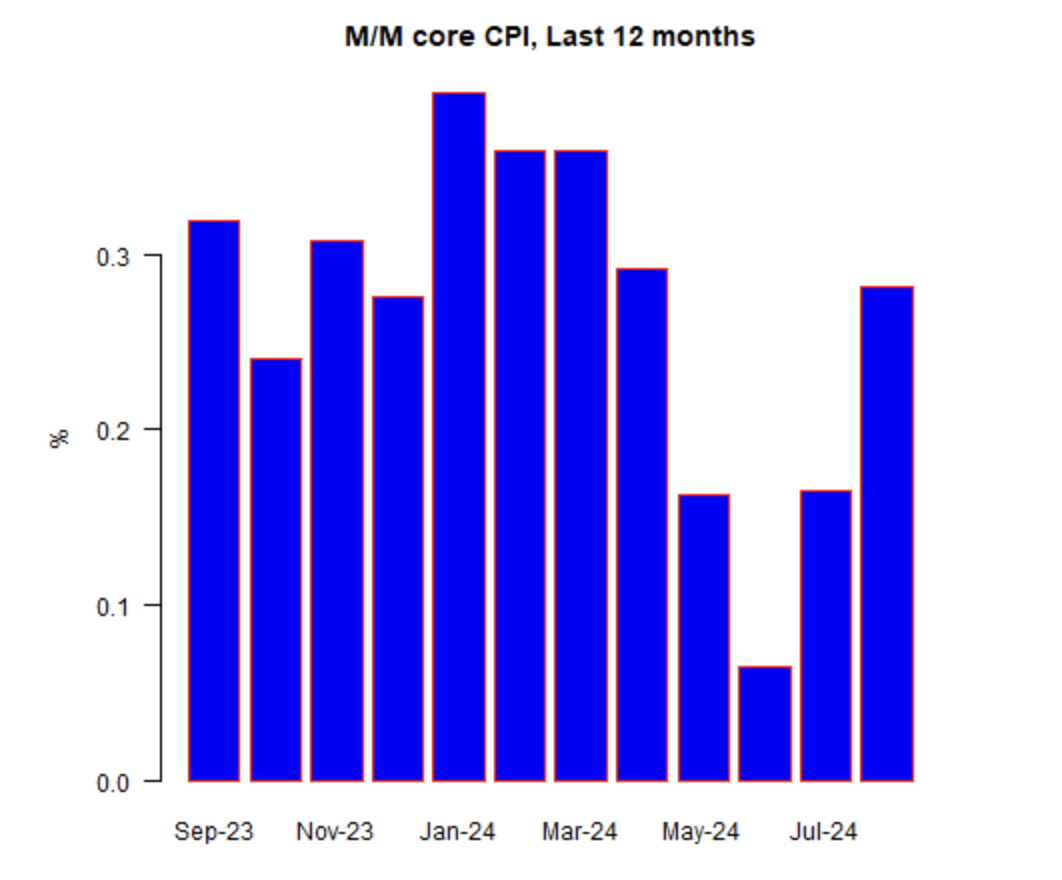
But back to PCE.  It appears that this PCE print has become pivotal to many macroeconomic views.  At least that is the case based on how much discussion surrounds it from both inflation hawks and doves.  As of now, and I don’t suppose it will change, the current consensus view of the M/M Core PCE print is 0.4% with a Y/Y of 2.8%.  As can be seen from the below chart from tradingeconomics.com, this will be the highest print in a year, and it would be easy to conclude that the trend here has turned upwards.

Of greater concern, though, is the idea that just like we saw the CPI data run hotter than expected earlier this month, what if this number prints at 0.5%?  Currently, the inflation doves are making the case that the trend is lower, and that if you look at the last 3 months or 6 months, the Fed has already achieved their target.  Their answer is the Fed should be cutting rates and soon.  For them, a 0.5% print would be much harder to explain and likely force a rethink of their thesis.

On the other side of the coin, the inflation hawks would feel right at home with that type of outcome and continue to point to the idea that the ‘last mile’ on the road back to 2.0% is extremely difficult and may not even be achievable without much tighter policy.  While housing is a much smaller part of the PCE data than the CPI data, remember, CPI saw strength throughout the services sector and that will be reflected.

One thing to consider here is the impact a hot number would have on the Treasury market.  Yields have already backed up from their euphoric lows at the beginning of the month by nearly 50bps.  Given the recent poor performance in Treasury auctions, where it seems buyers are demanding higher yields, if inflation is seen to be rising again, we could see much higher yields with the curve uninverting led by higher 10-year yields.  I’m not saying this is a given, just a risk on which few are focused.  In the end, tomorrow has the chance to be quite interesting and potentially change some longer-term views on the economy and the market’s direction.

But that is tomorrow.  Looking overnight, while Chinese stocks suffered, in Japan, equity markets were largely unchanged.  In Europe this morning, there is more weakness than strength with the FTSE 100 (-0.7%) and Spain’s IBEX (-0.7%) leading the way lower although other markets on the continent have seen far less movement.  As to US futures, at this hour (8:00), they are softer by about -0.3%.

In the bond market this morning, Treasury yields have fallen 2bps, while yield declines in Europe have generally been even smaller, mostly unchanged or just -1bp.  The biggest mover in this space was New Zealand, where their 10-year notes saw yields tumble 9bps after the aforementioned RBNZ meeting.

Oil prices (-0.3%) are giving back some of their gains yesterday, when the market rallied almost 2% on stories that OPEC+ was getting set to extend their production cuts into Q2.  It is very clear that they want to see Brent crude above $80/bbl these days.  In the metals markets, while precious metals are little changed, both copper and aluminum are softer by about -0.5% this morning.  I guess they are not feeling any positive economic vibes.

Finally, the dollar is much firmer this morning against pretty much all its counterparts.  While Kiwi is the laggard, AUD (-0.7%), NOK (-0.7%) and CAD (-0.4%) are all under pressure as well.  The same is true in the EMG bloc with EEMEA currencies really suffering (ZAR -0.5%, HUF -0.7%, CZK -0.4%) although there was weakness in APAC overnight as well (KRW -0.4%, PHP -0.6%).

On the data front, this morning brings the second look at Q4 GDP (exp unchanged at 3.3%), the Goods Trade Balance (-$88.46B) and then the EIA oil inventory data.  We also hear from Bostic, Collins and Williams from the Fed around lunchtime.  Yesterday’s data was generally not a good look for Powell and friends as Durable Goods tanked, even ex-transport, while Home Prices rose even more than expected to 6.1% and Consumer Confidence fell sharply to 106.7, well below the expected 115 reading.  

As we have been observing for a while now, the data continues to demonstrate limited consistency with respect to the economic direction.  Both bulls and bears can find data to support their theses, and I suspect this will continue.  With that in mind, to my eye, there are more things driving inflation higher rather than lower and that means that the Fed seems more likely to stand pat than anything else for quite a while.  Ultimately, I think we will see the ECB and BOE decide to ease policy sooner than the Fed and that will help the dollar.

Good luck

Adf
What If?

What if inflation’s not dead
And set to go higher instead?
Can Fed funds still fall?
Well, that’s a tough call
If not, look for trouble ahead


As we await Tuesday’s latest CPI data, I thought it might be a good time to review how things currently stand on a macro basis.  As I am just an FX guy, I am not nearly smart enough to see through the headlines and determine what is wrong with the narrative story of Goldilocks.  However, I can look at the actual numbers and perhaps we can draw some conclusions from that data.

Let’s start with CPI, as that is the next shoe to drop.  Looking at the last twelve months of monthly data, we see the following results on both an original and adjusted basis:

 CPI m/mannualizedCPI m/m (adj)annualized
Dec-230.33.60.22.4
Nov-230.23.00.22.4
Oct-230.12.40.12.0
Sep-230.43.00.42.7
Aug-230.53.60.53.36
Jul-230.23.40.23.2
Jun-230.2 0.2 
May-230.1 0.1 
Apr-230.4 0.4 
Mar-230.1 0.1 
Feb-230.4 0.4 
Jan-230.5 0.5 
Data tradingeconomics.com, calculations @fx_poet

Since the January 2024 data hasn’t been released, there would ordinarily be no revision yet.  However, as I wrote last week, the BLS does an annual revision which lowered the December 2023 result by a tick.  

As you can see that one tick had a big impact on the annualization trend for the past 6 months, and especially the past 3 months (highlighted), reducing it substantially.  Now, given the imperfections of the measuring process, 0.1% is probably not significant in the broad scheme of things.  But oh boy, for the narrative, it is everything.  Prior to that revision, it was pretty easy for those who believe inflation has bottomed to highlight that turn higher in the annualization rate.  This was especially true given how much the ‘inflation is dead’ crowd was relying on just that point.  But now that turn looks like a dead-cat bounce and is not nearly so impressive.  Tuesday’s outcome will be quite interesting as anything that is soft will almost certainly encourage the doves to be calling for a March cut more aggressively, and just as certainly, we will see risk assets rally sharply as the dollar declines.  A hot print, though, 0.3 or more, will have the opposite impact.

What if the ‘conomy’s state
Was built by the deficit’s weight?
And actual growth
Ain’t fast, but more sloth
Will Janet, more spending create?


When looking at GDP data and Federal government expenditures, it becomes pretty easy to determine why GDP continues to percolate along so well.  Given that GDP = Consumption + Investment + Government + Net eXports (Y = C + I + G + NX), a quick look at the G component shows just how much support the government has been adding to the economy despite what has been recorded as strong growth.  Or perhaps, more accurately, this is why growth has been so strong.  The below chart shows the trend of government expenditures relative to total GDP growth.  I removed the Covid years because they are extremely volatile and confusing. However, looking at the trend since the GFC in 2008/2009, there has been a step change higher in the amount of government activity measured in the economy. 

Source: data FRED St Louis Fed, calculations @fx_poet

Given the current budget deficit is running > 7% of GDP and is projected to remain at least this high going forward, it is quite clear that there is a lot of nonorganic effort to raise the GDP measures.  Look at the sharp upward turn at the right side of the chart.  It appears that the administration will do everything they can to continue to show that the economy is strong.  

Of course, this is where the rubber meets the road.  If the administration continues to pump more government spending into the economy, can inflation really decline any further?  Remember, government spending is almost entirely consumption based, with limited investment at this time.  Even the CHIPS Act only created incentives for private companies to invest, it is not government investment per se.  The point is, pumping up consumption demand without adding productive capacity is very likely to drive prices higher.  And if anything, given this administration’s war on energy markets, they are discouraging investment in critical infrastructure.  It is hard to see how this plays out for a Goldilocks outcome.  Far more likely, in my view, is that they continue to pump as hard as possible, and prices start moving higher again.  Timing is everything in life, and perhaps they can work it out so price hikes are delayed until after the election, but I am skeptical given the vast incompetence this administration has shown in virtually every sphere in which it operates.

What if employment’s a mess
And actually in some distress?
Is JOLTS data real?
And what is the deal
With households, it’s hard to assess


The last big macro area is, of course, the employment situation.  We all know that the NFP report was much stronger than expected for January, rising 353K, but also seeing upward revisions of the previous months for the first time in quite a while.  In fact, one of the bearish stories had been that the revisions mattered more than the headline data, and if revisions were for the worse, that was indicative of a slowing economy.  

Remember, too, that the US employment situation is measured in two ways, via the establishment survey which is a survey of companies’ (both large and small) actual hiring activity and leads to the NFP number, and the household survey, which is a telephone survey of ~60,000 households and asks the question if someone is employed and if not, whether they are looking for work.  The Unemployment Rate is calculated from the household survey, so both are clearly critical in assessing the situation on the ground.  

The funny thing is that the numbers come across pretty differently when you dig down.  While in the long-term, both data series have shown a strong correlation (96% since January 2000), the Household survey is far more volatile and in the past year has been telling a somewhat different story than the establishment survey.  Look at this chart below mapping each since the beginning of 2023:

Source: data FRED St Louis Fed, calculations @fx_poet

Doing the math shows that the establishment survey claims that 3.409 million jobs were created while the Household survey comes in at just over half that amount, 1.852 million jobs.  Now, in a nation of 330 million people, especially given the expansion of the gig economy and the dramatic changes in employment overall, maybe that is not such a big deal.  As well, simply looking at the two lines shows that the Household survey is far more volatile than the Establishment survey.  Does this mean we should ignore the household survey, given it seems to have more noise and less signal?  The problem with this is the household survey drives the Unemployment Rate, and nobody is willing to ignore that.  And these differences beg the question, is the employment situation as rosy as it seems?  With the Unemployment rate remaining so low for so long, it certainly appears that there is ample demand for workers.  Of course, that also implies that the cost of labor seems unlikely to decline very much and could well increase further and faster.  If that is the case, the impact will be seen in the inflation data as well.

Trying to sum things up here, looking at the three critical macro variables, inflation, growth and employment, there is a strong case to be made that the combination of ongoing government support and continued demand for labor into an aging workforce can lead to solid nominal GDP growth with inflation remaining far stickier than many currently anticipate.  If that is the situation, all the hopes and dreams of the interest rate doves may be delayed, if not destroyed, as it will be increasingly difficult for the Fed to ease policy into an inflationary environment.  Arguably, this is why they are seeking greater confidence that inflation is really dead.  

Now, maybe Goldilocks is real, and inflation will continue to decline on its own because…well just because.  But I find it hard to look at the data and conclude that lower inflation is our future, at least for any length of time.

Ok, this has gotten much longer than I intended but fortunately, absolutely nothing of note happened overnight in markets.  Literally.  There has been de minimis movement in stocks, bonds, commodities and currencies, and there is a distinct lack of data to be released today.  Tomorrow’s CPI is THE number of the week, so perhaps that will get the juices flowing again and drive some movement.  Until then, a quiet day is usually a good one on which to establish hedges.

Good luck

Adf

Singing the Blues

Here’s what’s underlying most views
Inflation is yesterday’s news
But what if it’s not
And starts to turn hot?
Those bulls will be singing the blues
 
So, care must be taken, I think
As in the bulls’ armor, a chink
Is wages keep rising
While homes are surprising
Be careful, the Kool-Aid, you drink


Market activity has generally been benign as investors and traders await the next big news.  Arguably, that is next Tuesday’s US CPI data given the dearth of new information otherwise due to be released this week.  The one thing we have in spades this week is central bank speakers, with three from the Fed yesterday and four more today, including the first comments I have seen from the newest Governor, Adriana Kugler.  As well we have been regaled by ECB, BOE and BOC speakers and they will continue all week as well.

Thus far, the message has been pretty consistent with the general theme that inflation has fallen nicely and is expected to continue to do so.  However, in a great sign of some humility, they are unwilling to accept that because price levels have fallen for the past 3 months that their job is done.  Obviously, the recent NFP and ISM data have shown no indication that the economy is even teetering on the brink of a slowdown, let alone desperate for rate cuts for support.  And for this, I applaud them.

But in this case, the central bank community seems to be in a small minority of economic observers who are not all-in on the idea that rate cuts are necessary right now.  Because, damn, virtually every other analyst seems to be on that train.  

There is a very good analyst group that calls themselves Doomberg, which mostly write about energy policy and its impacts on everything else, but in this morning’s article, I want to highlight a more general comment they made which I think is really important:

“How can you tell the difference between an analyst and an advocate? It is all in the handling of data that runs counter to assertion. To an analyst, being wrong is disappointing, but it is primarily an opportunity to learn—an expected element in a feedback loop of continuous improvement. When knowledge is your only objective, there is no such thing as a bad fact, only one which you do not yet understand. Not so for the advocate. The advocate has tied their hopes (and often their livelihoods) to a specific outcome and feels compelled, whether consciously or not, to rationalize away or attack inconvenient realities. It is advocacy when every perturbation in the weather is tagged as evidence of climate change, each squiggle of unfavorable price action is declared market manipulation, and no act or utterance from a favored politician is disqualifying.”

First, I cannot recommend their writings highly enough as they are consistently thoughtful, well-researched and important.  But second, I think this point is exactly in tune with the Goldilocks welcoming committee as they will ignore every piece of data that runs counter to their narrative and double down by saying the Fed is overtightening because inflation is collapsing, and deflation is going to be the economic problem soon.

While I am often quite critical of the Fed and their comments, and still think they speak far too much, right now, I am very happy to see them maintain a reluctance to cut rates just because the market is pricing in those cuts.  Certainly, to my eye, looking at the totality of the data (as Chairman Powell likes to say) there is little indication that prices are collapsing.  In fact, the super-core data, which was all the rage last year, has turned higher.  I understand why Wall Street analysts are better described as Wall Street advocates, but for the independent analysts out there, and over the past several years those numbers have exploded higher, it is remarkable to me that more of them are not suspect on the idea that rates need to be cut and cut soon.  In fact, at this point, one month into the year, I continue to like my 2024 forecasts of perhaps one cut in the first half of the year, but a reversal as inflation reignites.

Yes, the futures market is now only pricing five cuts into 2024, but nothing has changed my view that the pricing is bimodal, either 0 or 10 cuts will be the outcome, with the former if the economy continues along its recent pace and the latter if the recession finally arrives.  Given that interest rates, led by Treasury yields, are the clear driver of global market movements, and given that inflation is going to play a critical role in their movement going forward, I have altered my view as to the most important piece of data.  Whereas I used to believe it was NFP, it is now entirely CPI/PCE.  As I wrote yesterday, if next week’s print is at 0.4% M/M, watch out for a significant repricing.

But now, let’s turn to today.  President Xi continues to have problems with his stock market and is seemingly getting a bit more desperate aggressive in his efforts to prevent a complete implosion.  Last night, the head of the CSRC (China’s SEC analog) was replaced as blame needs to be placed on others for Xi’s policy errors.  It ought not be surprising that Chinese shares, after a weak start, rebounded on the news and closed higher by about 1%.  However, the Hang Seng could not manage any gains and the Nikkei edged lower as well.  All in all, it was not a great session overnight.  In Europe this morning, the markets are lower by between -0.25% and -0.5% as once again we saw weak German data (IP -1.6%) continuing to point to a recession on the continent.  Finally, US futures are basically flat at this hour (7:30).

In the bond market, yields, which all slid a bit yesterday on what seemed to be a profit-taking move after that massive runup following the NFP and ISM data, are a bit higher this morning, with Treasury yields up by 3bps and most of Europe seeing similar movements, between 2bps and 4bps.  As I wrote above, this story remains all about inflation’s future, and as data comes in to add to the conversation, I suspect that will be the key mover going forward.

Oil prices (+1.0%) are continuing their modest recent rebound with WTI touching $74/bbl this morning and Brent above $79/bbl.  Comments by the Biden administration that they would continue to attack Iranian proxy groups seems to have traders worried about an escalation.  But a more concerning story is that Ukraine has been targeting Russian refineries in an effort to degrade Putin’s cash flow.  They have already hit several and reduced capacity by 4%-5%.  If that continues successfully, then oil prices are going to go much higher.  This doesn’t seem to be in the bigger narrative right now, so beware.  As to the metals markets, they are all slightly softer this morning, but movement has been tiny.

Finally, the dollar is under a modest amount of pressure this morning, which given the rising yields and softer commodities, seems out of character.  Granted, the movements are small, with most currencies just 0.1% – 0.2% firmer vs. the dollar.  And this could also be profit-taking given the dollar’s recent rally.  After all, the euro remains below 1.08 and USDJPY above 148.00 so this is hardly a collapse.

Turning to the data today, the Trade Balance (exp -$62.2B) is this morning’s release and then after oil inventories, at 3:00 we get Consumer Credit ($16.0B).  As mentioned above, we have many more Fed speakers as well, and I sense that will be of far more interest to market participants.  I don’t anticipate anybody straying from the current theme of inflation has been falling nicely but they are not yet convinced.  If someone strays, that could move markets, but again, I see little to drive things today, or this week.

Good luck

Adf

Nary a Doubt

The two things we’re watching today
Are Jay and the new QRA
The pundits are out
With nary a doubt
That easing is coming our way

But what if this faith is misplaced
And Jay, at the presser, bald-faced
Says policy ease
Is not what we please
And we’ll not get there in great haste

Reading the Fed Whisperer, Nick Timiraos of the WSJ, this morning was enlightening only to the extent that everybody he interviewed demonstrated they have no idea what will happen, and merely described what they would like to see.  Now, in fairness, I don’t think Powell himself really knows how things are going to play out as we continue to see mixed pictures on the economy.  For every strong datapoint (e.g., GDP, JOLTS, Case Shiller) indicating that there are many potential inflationary pressures extant, we see some softer data points (e.g., PCE, Empire Manufacturing, Dallas Fed) that indicate policy is excessively restrictive.  While it is very clear that the Fed will not adjust policy today, a look at Fed funds futures shows that the market is pricing in a 45% chance of a cut in March.  A month ago, that was over 70%, so Powell must be a bit happier, but 6 weeks is such a long time in this context, anything can happen between now and then.  And, oh yeah, the market is still pricing in 6 cuts this year.

Of course, long before the FOMC statement and Powell presser this afternoon, the Treasury will release its QRA and the market will learn if Secretary Yellen is going to continue down her recent path of leaning toward more T-bills and less coupons.  Based on her continuous comments that the soft landing has been achieved and inflation is no longer a problem, it seems quite clear that she wants to see the Fed cut rates soon.  After all, lower interest rates take pressure off the budget deficit, which is entirely her baby at this point.  Interestingly, she could essentially force Powell’s hand in this situation as follows:

1.     Issuing a high percentage of T-bills will lead to
2.     Reducing the RRP balances and bank reserves which will
3.     Force the Fed to respond by slowing/ending QT to prevent any systemic problems like seen in September 2019

Remember, we have already heard from Powell, as well as Dallas Fed President Lorie Logan, whose previous role was at the NY Fed overseeing the Fed’s reserve portfolio, that the time to discuss slowing or ending QT was fast arriving.  By itself, that is a policy ease, but it would also be a signal that further changes were on their way.  In fact, a continued heavy reliance on T-bill issuance would have two vectors to support the bond market; ending QT reduces the amount of bonds the market needs to absorb and reducing new supply by itself will do exactly the same thing.  At least for as long as inflation remains quiescent.  And in the end, that remains the biggest unknown, inflation.  All these plans and ideas revolve around the premise that the Fed has won its inflation fight.  But I ask you, what if they haven’t?

Too much digital ink has been spilled already on the inflation question and the two camps remain at distinct odds.  Forgetting all the conspiracy theorists who claim inflation is really 10% or more, and looking only at serious economists and analysts, while all agree that the rate of inflation has fallen from its peak levels in the summer of 2022, there is still a pretty even split between the two sides.  While I fall on the side of stickier inflation than the market is pricing, I can understand the other side of the story.  But the point is, there are two very real sides to the story and the outcome remains unwritten.  However, if inflation does remain stickier than the doves believe, it will destroy their entire thesis of why the Fed should be easing policy.  Given the stock market is making new highs regularly, I suspect investors and traders have largely bought into the ‘inflation is over’ view.  Just be careful if it’s not.

Ok, as we await today’s activities, let’s look at what happened overnight.  Following a mixed session in the US yesterday, Asian markets turned back the clock a few weeks with the Nikkei (+0.6%) continuing its longer-term rally while both the Hang Seng (-1.4%) and CSI 300 (-0.9%) revert to their losing ways.  It seems that investors simply do not believe that President Xi has either the ability or willingness to do anything to support the stock market there, at least, if not the economy.  I believe it would be a mistake to believe he is not willing, which calls into question exactly what they are going to do to prevent things from starting to impact the economy more negatively.  And perhaps we have seen the first steps.  The other noteworthy story in the WSJ this morning was about how Chinese authorities are “discouraging” negative takes on the economy from being published and instead telling news outlets to publish stories about the bright prospects there.

Moving on to Europe, the main indices have moved very little thus far today after a mixture of data showing inflation in Germany and France continue to decline but Retail Sales in Germany (-1.6%) and Switzerland (-0.8%) and Industrial Sales in Italy (-1.0%) all falling sharply in December.  Given the weak GDP data yesterday on the continent, none of this can be surprising.  Finally, US futures are mostly lower this morning, led by the NASDAQ (-1.0%) despite (because of?) what seemed to be solid earnings from Microsoft and Alphabet.  In the end, though, I sense that investors are far more focused on the QRA and FOMC right now.

Treasury yields are unchanged this morning but that is after a 4bp decline yesterday and we have seen European sovereign yields slide this morning as well, between 1bp and 3bps, which seems to be a catch up move to the Treasuries.  I must mention Australian government bonds, which saw yields tumble 13bps overnight on the back of a much softer than expected CPI reading which has the market talking rate cuts there again.  Finally, JGB yields edged 2bps higher, despite weaker than expected Retail Sales and IP data.

Oil prices (-1.1%) are backing off this morning after another positive day yesterday and a very strong month of January, where WTI rose > 9%.  (My take is that will not help the CPI data when it comes out in a few weeks’ time.)  Meanwhile, metals prices are trading near unchanged on the day as traders here are also awaiting the new information.

It should be no surprise that the dollar is, net, little changed this morning on the same premise of waiting for Godot Powell.  Looking at my screen, I don’t see any currency that has moved more than 0.3% in either direction so really no information yet today.

In addition to the QRA and FOMC meeting, we see the ADP Employment Report (exp 145K), the Employment cost Index (1.0%) and Chicago PMI (48.0).  Careful attention should be paid to the ECI as the Fed focuses on that metric for wage inflation data.  As an indication, prior to the pandemic, that index averaged around 0.6%, but since then, it is more like 1.0% on a quarterly basis.  That annualizes to more than 4% and will maintain upward pressure on inflation if it stays there.  Just something else to keep in mind.

If pressed, I believe that the QRA will show reduced coupon issuance and Powell will be more dovish than not.  While we know the Treasury is political, by definition, and will do everything in its power to stay in power and get re-elected, my take is the Fed is in that camp as well.  I would not be surprised to see a more dovish take this afternoon after the QRA this morning.  And initially, at least, that tells me the dollar will trade back toward its recent lows ceteris paribus.

Good luck
Adf

Not One Whit

Both headline and core PCE
Were softer, with both below three
But under the hood
It’s not quite as good
As housing and transport are key
 
The narrative, though, will not quit
Assuring us all this is it
Rate cuts will come soon
And stocks to the moon
But so far, for proof, not one whit.
 
There is a very good analyst who writes regularly on the macroeconomic story named Wolf Richter.  In the wake of Friday’s PCE data release, he published an article that had the following table:

It is not hard to look at this table and see a bit of the reality we all face, rather than the widely touted headline numbers regarding inflation.  Housing continues to be sticky at much higher inflation rates than target, as well as transportation services, recreation services and financial services.  But even the other stuff, seems to be running above the elusive 2.0% level.  Now, this is the annualized rate of the past 6 months’ average readings.  But as I highlighted last week regarding CPI, this seems to be the new benchmark.  My point is that while the narrative is really working hard to convince us all that inflation is collapsing and the Fed is massively over-tight in its policy and needs to CUT RATES NOW, this breakdown doesn’t look quite the same.  My belief is the Fed remains on hold much longer than the market is expecting/hoping for, and that at some point, equity markets and risk assets are going to come to grips with that reality.  Just not quite yet.

Of course, maybe the narrative is spot on, and inflation is going to smoothly decline back to the 2% level while economic growth continues its recent above-trend course.  But personally, I have to fade that bet.  Based on the amount of continued fiscal stimulus, as well as the Fed’s discussion of slowing QT and their indication of rate cuts later this year, I believe that while the growth story is viable, it will be accompanied with much hotter inflation than is currently priced.  The fact that breakeven inflation rates are priced at 2.50% in the 10-year does not mean that is what is going to happen.  Just like the fact that the Fed funds futures market is currently pricing between 5 and 6 rate cuts in 2024 does not mean that is what is going to happen.  Let’s face it, nobody knows how the rest of the year is going to play out.  The one thing, however, of which we can be sure is that Treasury Secretary Yellen will spend as much money as possible in her effort to get President Biden re-elected.  That alone tells me that inflation is set to rebound.

And there is one other thing to remember, as things heat up in the Red Sea, and shipping avoids the area completely, the cost of transiting stuff from point A to point B continues to rise.  The cost is measured both in the dollars charged for the service and the extra 10-14 days it takes to complete the trip around the Cape of Good Hope in South Africa.  It seems that the Biden Administration’s foreign policy has unwittingly had a negative impact on its economic policy plans.  

In sum, when I look at both the data and the activities around the world, it remains very difficult to accept the narrative that inflation is collapsing so quickly that the Fed MUST cut rates and cut them soon.  The combination of still robust US growth on the back of excessive fiscal stimulus and the increased tensions in the oil market lead me to a very different conclusion.

With that in mind, let’s see what happened overnight.  Equity markets in Asia were mixed as Japan (Nikkei +0.8%) and Hong Kong (Hang Seng +0.8%) both rallied but mainland Chinese shares (CSI -0.9%) fell.  This was somewhat surprising as China, in their continuing efforts to prop up their stock markets, have restricted the lending of any securities for short sales while a HK court ruled Evergrande (remember them?) should be liquidated completely.  Perhaps the Chinese real estate situation is not quite fixed yet after all.  I suspect that we will see other liquidations as well before it is all over.  In the meantime, European bourses are mixed with the DAX (-0.4%) lagging while the FTSE 100 (+0.25%) is top dog today.  There’s been no news of which to speak so this seems like position adjustments ahead of the Fed’s activities later this week.  US futures, too, are mixed and little changed at this hour (7:15).

Bond markets, though, are really loving all the rate cut talk and are growing more confident that they will be coming soon as inflation collapses.  Treasury yields are lower by 3bps this morning and the entire European sovereign market has rallied with yields down an impressive 5bps-7bps today.  The only outlier is the JGB market, which saw the 10-year benchmark yield edge up 1bp.  It is much easier for me to believe that the ECB is going to cut as inflation in the Eurozone slows alongside the faltering growth story than to believe that the Fed is going to cut into an economy growing 3+%.  But that’s just me.

In the commodity markets, oil (+0.3%) continues to find support as the tensions in the Middle East expand after an attack in Jordan killed three US servicemen there.  Oil is higher by 5% in the past week and more than 11% in the past month.  It seems to me that will not help the inflation story.  At the same time, we are seeing demand for precious metals as gold (+0.5%) and sliver (+1.0%) are both rallying on the increased nervousness around the world.  Perhaps more interestingly is that copper is marginally higher this morning, something that would seem contra to the escalating tensions.

Finally, the dollar has rallied a bit this morning on net, although it is not a universal move by any stretch.  For instance, while European currencies are broadly weaker, in Asia and Oceania, we are seeing strength with AUD and NZD (both +0.4%) and JPY (+0.2%) fimer.  As to the rest of the world, it is a mixed session with minimal movement.  Feels like a wait and see situation given all the data and info coming this week.

Speaking of the data this week, there is much to absorb.

TodayTreasury Funding Amount$816B
 Dallas Fed Manufacturing-23
TuesdayCase Shiller Home Prices5.8%
 JOLTS Job Openings8.75M
 Consumer Confidence115
WednesdayADP Employment135K
 Treasury QRA 
 Employment Cost Index1.1%
 Chicago PMI48
 FOMC Meeting5.5% (unchanged)
ThursdayInitial Claims210K
 Continuing Claims1835K
 Nonfarm Productivity2.5%
 Unit Labor Costs1.7%
 ISM Manufacturing47.3
 Construction Spending0.5%
FridayNonfarm Payrolls173K
 Private Payrolls145K
 Manufacturing Payrolls2K
 Unemployment Rate3.8%
 Average Hourly Earnings0.3% (4.1% Y/Y)
 Average Weekly Hours34.3
 Participation Rate62.4%
 Factory Orders0.2%
 Michigan Confidence78.8

Source tradingeconomics.com

The first thing to understand is that this morning, the Treasury will be releasing how much funding they expect to need in Q1 of this year, currently expected at $816 billion, but Wednesday’s QRA will describe the mix of the borrowings.  Recall that last quarter, Secretary Yellen changed the mix of short-dated paper to long-dated coupons substantially and completely reversed the bond market rout that was ongoing at the time.  If she continues to issue far more bills than coupons, it should support the bond market and help continue to juice risk assets.  Any substantial increase in coupon issuance is likely to be met with a significant stock and bond market sell-off.  So, which do you think she will do?

Otherwise, looking at the other data, certainly there is no indication that housing prices are moderating.  The Fed will not change rates on Wednesday, but everyone is waiting to see if they will remove the line in their statement about potentially needing to raise rates going forward.  Perhaps there will be a little two-step where the QRA points to more bond issuance, but the Fed sounds more dovish to offset that news.  And of course, Friday’s NFP data will be keenly watched by all observers as any signs that the labor market is cracking will get the rate cut juices flowing even faster.

All in all, we have a lot of new information coming to our screens this week.  At this point, it is a mug’s game to try to guess how things will play out.  However, if we see dovishness from the Fed or the QRA (more bill issuance) then I expect risk assets to perform well and the dollar not so much.  The opposite should be true as well, a surprisingly hawkish Fed or more coupon issuance will not be welcomed by the bulls, at least not the equity bulls.  The dollar bulls will be happy.

Good luck

Adf

Quite Restrictive

The Fed keeps on spinning the tale
They’re watching like hawks so that they’ll
Be able to jump
In case Donald Trump
Does not look like going to jail
Be able to act
And not be attacked
If ‘flation forecasts start to fail
 
Twas Bostic’s turn yesterday to
Explain that the policy skew
Is still quite restrictive
Though that’s not predictive
Of what they may finally do
 
Atlanta Fed President Raphael Bostic was the latest FOMC member to regale us with his views on current policy settings amid two speeches yesterday.  The essence of his comments lines up with what we have heard for the past two weeks; policy is sufficiently restrictive to help drive inflation down to their 2% target, but they will be vigilant if that is not the outcome.  One of the things that he mentioned, and that has been a really popular chart crime over the past few months, at least for the doves, is he discussed annualizing the most recent three months of PCE data and the most recent 6 months of PCE data as proof that they are doing a good job.  In fact, in one of his two presentations, he used the following chart:

Unquestionably, if you look at the orange line, which represents the annualized value of the past 3 months, it shows that PCE is “now” running below their target.  But let me ask you a question, looking back to H1 of 2022, when inflation was peaking.  Both the 3-month and 6-month changes were well above the annual number at the time.  Do any of you remember the focus on those short-term nonsense numbers?  Me neither.  My point is the only number that matters is the actual annual one as that is their target.  Any indication that it is flattening or turning higher, just like the CPI data did earlier this month, is going to put paid to this story.  While I have no idea where next week’s data is going to print, we must be wary of the narrative spin on the actual data.  If we know one thing about the Fed, by definition, they are reactive.  That is what following the data means.  If they were predictive, they would move before the data, but they never do that. 
 
So, all this talk of cutting before inflation gets too low is not monetary policy.  However, we cannot rule out a cut based on the political implications as they view rate cuts as a way to boost the economy and try to ensure the current president is re-elected rather than the likely Republican candidate gets back in.  Alas, for now, we will have to live with the spin.  Today we hear from two more Fed speakers, SF’s Mary Daly and Governor Michael Barr.  I suspect we will hear exactly the same message from both.  Too early for cuts, but they are ready when the time comes.
 
Meanwhile, across the pond, the preponderance of ECB speakers has been very clear that March is off the table for a rate cut but June seems to be what they see as likely.  Here, too, they see the trend as their friend, but inflation readings are still nowhere near their 2.0% target.  However, it is clear that the pain of higher rates is having a much larger impact on Europe than on the US as GDP data continues to deteriorate.  Germany is in recession and much of the rest of the continent is on its way.  The benefit for Madame Lagarde is that the Europeans did not inject nearly as much stimulus during the Covid years as the US, so it is likely the Eurozone economy is following a better-known path.  In the end, though, they are very anxious for the Fed to get started as they really want to start cutting rates, I believe, but with inflation still far above target and the Fed still holding on, they would have no rational explanation for their actions.
 
One last thing to note is CPI in Japan was released last night and it fell to 2.6% headline and 2.3% core.  Any idea that the BOJ was going to need to tighten policy in the near-term to fight too high inflation has been dissipating quickly.  It turns out that they may have been correct to leave policy unchanged as now they do not need to do anything to be in the right spot.  The market response mostly made sense as the yen weakened with the dollar now above 148, while the Nikkei rose another 1.4% and is pushing those recent 30+ year highs.  The weird thing, though, was the JGB market which saw yields rally 4bps, back to their highest level in a month.  I have been unable to find any solid explanation for this move as certainly it is not fundamental.
 
Anyway, let’s look at the rest of the overnight session to see how things are feeling as we close the week.  After a solid US equity session yesterday, most of Asia had a good go of things with rallies pretty much everywhere except China and Hong Kong.  The equity markets in both those nations have been under significant pressure lately and show no signs of turning.  While the market is not the economy, President Xi has already called for the end of short sales and is now leaning on domestic institutions to not sell at all.  With the property market already in the tank, a rapidly declining stock market is not a good look for the concept of prosperity for all.  Europe, though, is modestly higher this morning and US futures are also in the green following yesterday’s session.
 
In the bond markets, Treasury yields are little changed on the day, but remain above the 4.10% level that some are calling a key technical spot.  European sovereigns, though, are all rallying more aggressively with yields falling between 3bps and 7bps despite what are continuous calls for the ECB to maintain tight policy for longer than the market is pricing.  Perhaps investors are feeling better about inflation prospects if the ECB holds the line.
 
After a rally yesterday, oil prices are essentially unchanged this morning.  The unrest in the Red Sea continues with the Houthis firing more missiles and fewer and fewer ships willing to transit the area while yesterday’s tit-for-tat Iran-Pakistan missile attacks are now merely history.  The fact that oil remains below $74/bbl implies it is not really pricing any possibility of a larger Middle East conflict.  That seems pretty hubristic to me as the probabilities seem to be far larger than zero.  As to the metals markets, both precious and base metals are firmer this morning in sync with softer yields and a softer dollar. 
 
Speaking of the dollar, while it is ever so slightly lower on a DXY basis this morning, it continues to hold the bulk of its gains for the past month.  Versus G10 currencies, the picture is mixed with GBP (-0.2%) underperforming after absolutely abysmal Retail Sales data was released this morning, but the rest of this bloc is higher by about 0.2% or so on average.  In the EMG space, the direction is broadly for currency strength, but the movement remains modest at best, on the order of 0.1%-0.3%.  In other words, not much is going on here.
 
On the data front, yesterday brought a mixed picture with Housing data slightly better than expectations, although starts fell compared to last month.  Initial Claims printed at 187K, their lowest in a very long time, but Philly Fed was at a worse than expected -10.6, not as bad as Empire State, but still not too bullish!  Today brings Michigan Sentiment (exp 70.0) and Existing Home Sales (3.82M) as well as the above-mentioned Fed speakers.  After today, the Fed is in their quiet period, so we will have to make up our own minds as to what the data means.
 
For now, the market seems quite comfortable buying dips and as evidenced by the Fed funds futures market, is still pricing a 55% chance of a March cut.  While that probability is shrinking slowly, there are still 6 cuts priced in for the year.  At this point, my thesis of the market fighting the Fed for the first half of the year before capitulating to higher inflation prospects and higher yields amid slowing growth remains my best guess.  But that is just me.  Absent something really surprising from Daly or Barr, I suspect that there will be limited price movement going into the weekend.
 
Good luck and good weekend
Adf
 

Looks Askance

On Wednesday, twas John Williams chance
To help explain, though at first glance
Inflation is sinking
No Kool-aid, he’s drinking
So, at cuts, he still looks askance

And backing him up in this view
Was Retail Sales, which really grew
There’s no indication
That US inflation
Is going to fall down near two

The pushback by FOMC speakers continued yesterday as NY Fed president Williams was the latest to explain that although things were heading in the right direction, the committee was unlikely to cut rates anywhere nearly as quickly as the market is pricing.  Here are the money lines, “My base case is that the current restrictive stance of monetary policy will continue to restore balance and bring inflation back to our 2 percent longer-run goal. I expect that we will need to maintain a restrictive stance of policy for some time to fully achieve our goals, and it will only be appropriate to dial back the degree of policy restraint when we are confident that inflation is moving toward 2 percent on a sustained basis.” [Emphasis added]. Once again, the idea that the Fed is going to cut rates in March seems awfully remote, at least based on what they are telling us.

Now, it is entirely possible that the data starts to deteriorate more rapidly with growth clearly falling and Unemployment starting to rise more rapidly and if that were to occur, I think a March cut would not be impossible.  But then yesterday we saw a much better than expected Retail Sales print, (headline +0.6%, ex autos +0.4%) with the Y/Y growth up to 5.6% (nominal).  Data like that is not indicative of a collapse in economic activity.  The fact that much of it is reliant on a combination of massive fiscal stimulus and increased credit card debt does not mean the growth is false.  It merely sets up for weakness later.

In the end, the Fed funds futures market is backing away a bit further from that March rate cut with the probability reduced to 61% now from 70% just a week ago.  It can be no surprise that between the Williams comments and the stronger data, Treasury yields backed up 5bps and equity markets suffered a bit more, down about -0.5%.

To me, the key question is, at what point will the market accept that 6 rate cuts are not the most likely outcome this year?  Clearly, they are not ready to do so yet, although based on the equity market performance so far this year, there is a little bit of nervousness, at least, making its way through the investment community.  Analyzing the price action over the past month and considering the information that we have gotten since the last FOMC meeting, the outlier seems to be Powell’s dovishness at the press conference, not the macroeconomic data nor the commentary from other Fed speakers.  Of course, Powell’s voice is clearly the most important, but when both Waller and Williams, his two top lieutenants, reiterate that maintaining restrictive policy is the right move for now, I have to believe that the next FOMC statement is going to reiterate that stance.

What does all this say about the future?  Well, since everything is data dependent, or at least that’s what they tell us, then we need to continue to watch the data to help understand the reaction function.  The problem is that there is no consistency in the data.  For instance, in addition to yesterday’s strong Retail Sales data, we saw stronger than expected NFP and higher than expected CPI readings, all three being critical real data points.  On the flip side, we have seen weaker than expected ISM data, both manufacturing and services and Tuesday’s Empire State Manufacturing Index fell to -43.7, a level only exceeded by the Covid readings in early 2020.  In fact, that index has fallen more than 50 points in the past two months.  The upshot is that we continue to see negative survey data and solid real data.  So, I ask you, which set of data is the Fed watching more closely?

FWIW my assessment of the situation is as follows: the Fed is aware of the goldilocks narrative but has not bought into it at this stage, at least not Powell and his two key lieutenants, and they are the ones that matter. Whatever the survey data, if the hard data holds up, they are going to maintain policy right where it is.  While we know they care about surveys (look at their focus on inflation expectations), I think Powell is still very afraid of being Arthur Burns redux.  Right now, it looks like the outlier was the Powell press conference, not all the push back.  I changed my entire thesis based on that pivot and that may have been a mistake.  However, if we start to see weaker hard data, so Housing softens, PCE is soft, GDP misses expectations or something like that, look for goldilocks to make a return.  Otherwise, regardless of the survey data, I fear risk assets are going to have trouble as are bond markets which have priced in a lot of rate cuts.

Speaking of push back, we continue to hear ECB speakers on the same page as the Fed, rate cuts are not coming on the market’s current timeline.  June seems to be the earliest it will happen there unless the Fed cuts sooner.  I continue to believe given the very weak growth profile in Europe that Madame Lagarde is quite anxious to get started cutting rates, but she knows she cannot do so yet.  I imagine that Interpol will have an APB out on goldilocks pretty soon as they want to capture her and keep her in the public’s eye.

One other thing to mention away from the financial markets is what appears to be a further escalation of fighting in the Middle East.  Last night, Pakistan retaliated against Iran with missile strikes of their own, ostensibly killing Pakistani militants who were based in Iran.  Whatever the rationale may be for these moves, the one truism is that things in the Middle East are getting more dangerous and that is going to pressure oil prices higher.  We have seen that this morning, with small gains, but I would suggest that will be the direction of travel if this keeps up.

Ok, on to markets where yesterday’s lackluster US equity performance was largely ignored as Japanese stocks were just barely lower, Chinese and Hong Kong stocks finally rebounded a bit and the rest of APAC saw more gainers than losers.  European markets are firmer this morning, in what could well be a trading bounce as there was no data to encourage the process and US futures are firmer at this hour (7:30) by about 0.5%.

After yesterday’s continuation bounce in yields, this morning we are seeing a bit of a pullback with Treasury and most European sovereign yields lower by about 2bps.  The one outlier is Japan, where JGB yields picked up 3bps, although that could well be a delayed response to yesterday’s Treasury price action as the Japanese data overnight was quite soft (Machinery Orders and IP both falling in November) and not indicative of tighter policy in the future.

Aside from oil’s modest gains, gold has rebounded a bit this morning, up 0.5%, arguably on the increased tensions in Iran/Pakistan but the base metals are under pressure today.  Lately, it is very difficult to glean much information from the base metals as confusion over whether Chinese growth is real, and how overall growth is progressing seems to be keeping traders on the sidelines.

Finally, the dollar is backing off its highs from yesterday, but the movement has not been large, about 0.2% broadly across both G10 and EMG currencies.  The most noteworthy outlier is ZAR, where the rand has rallied 0.85% on the back of that gold strength.

On the data front today, Housing Starts (exp 1.48M), Building Permits (1.426M), Initial Claims (207K), Continuing Claims (1845K) and Philly Fed (-7) all show up at 8:30.  As well, Atlanta Fed president Raphael Bostic speaks twice today, early and late, so it will be very interesting to hear if he is going to push back further on the Powell pivot or agree with it.

Today brings both hard and survey data, so if it all lines up one way or the other, perhaps it will be a driver.  But my take is we will continue to see a mixed picture and so will be highly reliant on Fedspeak as after Bostic today, we get Daly and Barr tomorrow and then the quiet period.  I think a risk rebound is in order just because things have been weak.  But I am worried about the longer-term trend now that Powell is seeming more and more like the outlier, not the driver.

Good luck
Adf